RPMS- PPST
School Year 2021 –
2022
DM 4 series of 2022
JOYCE B. LANUZA – BANCO February 17, 2022
1. explain comprehensive guidelines on the
implementation of RPMS 2021 -2022
2. identify the timelines and appropriate tools
to follow based on the chosen learning
modality
Objectives:
RPMS 2021- 2022
3. determine the classroom observable
objectives and their means of verifications
4. determine the non classroom observable
objectives and their means of verifications
5. Identify the plus factor means of
verifications
Objectives:
RPMS 2020- 2021
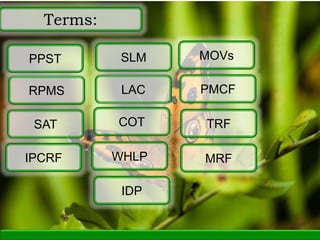
Terms:
WHLP
LAC PMCF
SAT
MOVs
COT
IPCRF
IDP
RPMS
PPST SLM
MRF
TRF
Class observation time
frame:
RPMS 2021- 2022
2 required observations:
 CO1 – between September 2021 and February
2022
 CO2 – between March and June 2022
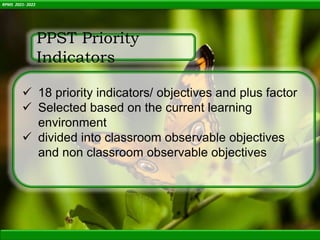
PPST Priority
Indicators
RPMS 2021- 2022
 18 priority indicators/ objectives and plus factor
 Selected based on the current learning
environment
 divided into classroom observable objectives
and non classroom observable objectives
 9 for Proficient
( Teachers I – III)
 7 Highly Proficient
( Master Teachers I – IV)
RPMS 2021 - 2022
Classroom Observable
Objectives:
For Proficient Teachers (9)
 Objectives 1, 3,4, 5 & 6
- MOV’s from CO ( quality)
 Objectives 7, 8,9 and 10
- MOV’s from CO, provision of SLM’s, or
accomplishment of TRF( Teacher Reflection Form)
RPMS 20201- 2022
Classroom Observable
Objectives:
For Proficient Teachers
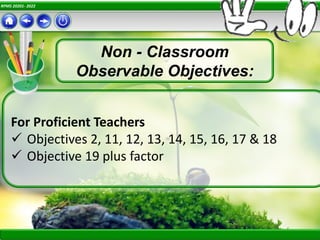
 Objectives 2, 11, 12, 13, 14, 15, 16, 17 & 18
 Objective 19 plus factor
RPMS 20201- 2022
Non - Classroom
Observable Objectives:
For Highly Proficient Teachers (7)
 Objectives 1, 3,4, 5 & 6
- MOV’s from CO ( quality)
 Objectives 9 &10
- MOV’s from CO, provision of SLM’s, or
accomplishment of TRF( Teacher Reflection Form) on
the context of the teacher
RPMS 20201- 2022
Classroom Observable
Objectives:
RPMS 20201- 2022
RPMS 20201- 2022
RPMS 20201- 2022
RPMS 20201- 2022
RPMS 2021 - 2022
Classroom Observable Objectives:
RPMS Objectives
Based on PPST priority indicator
Means of
Verification
1 Applied knowledge of content within and across
curriculum teaching process
COT Rating Sheet /
interobserver agreement
form 1 & 2
3 Displayed proficient use of mother tongue Filipino
and English to facilitate teaching and learning
4 Used verbal and non verbal classroom
communication strategies to support learner
understanding, participation engagement and
achievement
5 Established safe and secure learning
environments to enhance learning through the
consistent implementation of policies guidelines
and procedure
6 Maintained learning environments that promote
fairness, respect and care to encourage learning
RPMS 2021 - 2022
Classroom Observable Objectives:
RPMS Objectives
Based on PPST priority
indicator
Means of Verification
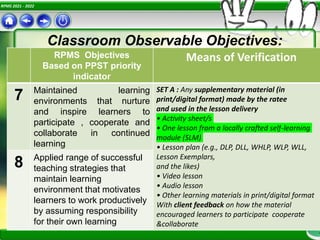
7 Maintained learning
environments that nurture
and inspire learners to
participate , cooperate and
collaborate in continued
learning
SET A : Any supplementary material (in
print/digital format) made by the ratee
and used in the lesson delivery
• Activity sheet/s
• One lesson from a locally crafted self-learning
module (SLM)
• Lesson plan (e.g., DLP, DLL, WHLP, WLP, WLL,
Lesson Exemplars,
and the likes)
• Video lesson
• Audio lesson
• Other learning materials in print/digital format
With client feedback on how the material
encouraged learners to participate cooperate
&collaborate
8 Applied range of successful
teaching strategies that
maintain learning
environment that motivates
learners to work productively
by assuming responsibility
for their own learning
RPMS 2021 - 2022
Classroom Observable Objectives:
RPMS Objectives
Based on PPST priority
indicator
Means of Verification
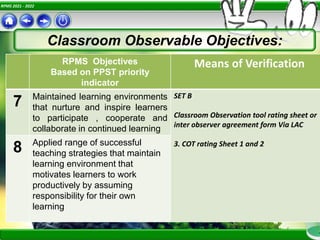
7 Maintained learning environments
that nurture and inspire learners
to participate , cooperate and
collaborate in continued learning
SET B
Classroom Observation tool rating sheet or
inter observer agreement form Via LAC
3. COT rating Sheet 1 and 2
8 Applied range of successful
teaching strategies that maintain
learning environment that
motivates learners to work
productively by assuming
responsibility for their own
learning
RPMS 2021 - 2022
Classroom Observable Objectives:
RPMS Objectives
Based on PPST priority
indicator
Means of Verification
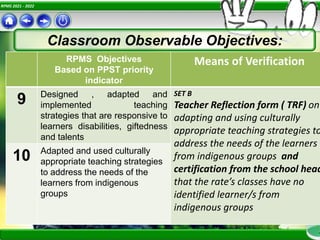
9 Designed , adapted and
implemented teaching
strategies that are responsive to
learners disabilities, giftedness
and talents
SET A
Classroom Observation tool
rating sheet or inter observer
agreement form Via LAC
3. COT rating Sheet 1 and 2
10 Adapted and used culturally
appropriate teaching strategies
to address the needs of the
learners from indigenous
groups
RPMS 2021 - 2022
Classroom Observable Objectives:
RPMS Objectives
Based on PPST priority
indicator
Means of Verification
9 Designed , adapted and
implemented teaching
strategies that are responsive to
learners disabilities, giftedness
and talents
SET B
Teacher Reflection form ( TRF) on
adapting and using culturally
appropriate teaching strategies to
address the needs of the learners
from indigenous groups and
certification from the school head
that the rate’s classes have no
identified learner/s from
indigenous groups
10 Adapted and used culturally
appropriate teaching strategies
to address the needs of the
learners from indigenous
groups
RPMS 2021 2022
Classroom Observable Objectives:
RPMS 2020 - 2021
Non - Classroom Observable Objectives:
 4 objectives for Proficient ( Teachers I – III)
and Highly Proficient ( Master Teachers I –
IV)
 Objective 8 ( quality)
 Objectives 9 -11 ( quality & efficiency)
RPMS 2022 - 2022
Non - Classroom Observable Objectives:
RPMS Objectives
Based on PPST
priority indicator
Means of Verification
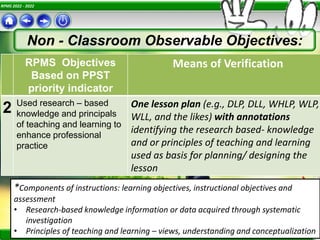
2 Used research – based
knowledge and principals
of teaching and learning to
enhance professional
practice
One lesson plan (e.g., DLP, DLL, WHLP, WLP,
WLL, and the likes) with annotations
identifying the research based- knowledge
and or principles of teaching and learning
used as basis for planning/ designing the
lesson
*Components of instructions: learning objectives, instructional objectives and
assessment
• Research-based knowledge information or data acquired through systematic
investigation
• Principles of teaching and learning – views, understanding and conceptualization
RPMS 2021 - 2022
Non - Classroom Observable Objectives:
RPMS Objectives
Based on PPST
priority indicator
Means of Verification
11 Adapted and implemented
learning programs that
ensure relevance and
responsiveness to the
needs of the learners
e.g literacy progam/
numeracy program /
SIM, enrichment &
intervention program
1. Proof of evaluation on the implementation of
adapted and conceptualized learning program
2. Progress report on the implementation of the
adapted contextualized learning program
3. Accomplishment / completion report on the
implementation of an adapted contextualized
learning program
4. Action plan / activity proposal activity matrix that
shows an adapted / contextualized learning
program
Planned -2 completed 3 monitored 4 evaluated 5
RPMS 2021 - 2022
Non - Classroom Observable Objectives:
RPMS Objectives
Based on PPST
priority indicator
Means of Verification
1
2
Utilized assessment data to
inform the modification of
teaching and learning
practices and programs
Note:
Analyzed assessment result -2
Planned strategy w/ MOV 3 -3
Developed materials w/MOV 2 – 4
Implemented w/ MOV 1 - 5
A list of identified least and most mastered skills
based on the frequency of errors / correct response
with any of the following supporting MOV:
1. Accomplishment report for remedial /
enhancement activities ( program or project)
2. Intervention material used for remediation/
reinforcement and enhancement
3. Lesson plan activity log for remediation/
enhancement utilizing of assessment data to
modify teaching and learning practices or
programs
RPMS 2021 - 2022
JAY R D> BANCO
Non - Classroom Observable Objectives:
RPMS Objectives
Based on PPST
priority indicator
Means of Verification ( 4 different kinds)
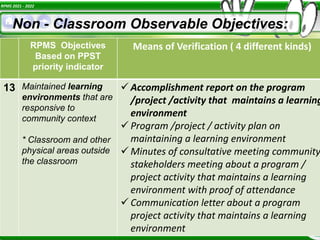
13 Maintained learning
environments that are
responsive to
community context
* Classroom and other
physical areas outside
the classroom
 Accomplishment report on the program
/project /activity that maintains a learning
environment
 Program /project / activity plan on
maintaining a learning environment
 Minutes of consultative meeting community
stakeholders meeting about a program /
project activity that maintains a learning
environment with proof of attendance
 Communication letter about a program
project activity that maintains a learning
environment
RPMS 2021 - 2022
JAY R D> BANCO
Non - Classroom Observable Objectives:
RPMS Objectives
Based on PPST
priority indicator
Means of Verification ( 4 different kinds)
14 Reviewed regularly
personal teaching
practices using
existing laws and
regulations that
apply to teaching
profession and
responsibilities
specified in the
code of ethics for
professional
teachers
1. Annotated video /audio recording one’s teaching that
shows impact of regularly reviewing one’s teaching
practice/s
2. Annotated teaching material that shows impact of
regularly reviewing one’s teaching practice/s
● lesson plan
● assessment materials
● others (please
specify)
3. Personal reflection notes as outputs from participation
in review of personal teaching practices in four (4) quarters
/ 2 for SHS
4. Proof of attendance (with date) in LAC or coaching and
mentoring sessions for review of personal
teaching practices
RPMS 2021 - 2022
JAY R D> BANCO
Non - Classroom Observable Objectives:
RPMS Objectives
Based on PPST
priority indicator
Means of Verification ( 4 different kinds)
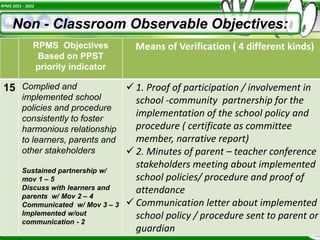
15 Complied and
implemented school
policies and procedure
consistently to foster
harmonious relationship
to learners, parents and
other stakeholders
Sustained partnership w/
mov 1 – 5
Discuss with learners and
parents w/ Mov 2 – 4
Communicated w/ Mov 3 – 3
Implemented w/out
communication - 2
 1. Proof of participation / involvement in
school -community partnership for the
implementation of the school policy and
procedure ( certificate as committee
member, narrative report)
 2. Minutes of parent – teacher conference
stakeholders meeting about implemented
school policies/ procedure and proof of
attendance
 Communication letter about implemented
school policy / procedure sent to parent or
guardian
RPMS 20201- 2022
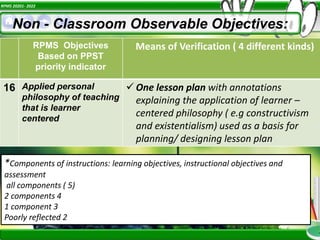
Non - Classroom Observable Objectives:
RPMS Objectives
Based on PPST
priority indicator
Means of Verification ( 4 different kinds)
16 Applied personal
philosophy of teaching
that is learner
centered
 One lesson plan with annotations
explaining the application of learner –
centered philosophy ( e.g constructivism
and existentialism) used as a basis for
planning/ designing lesson plan
*Components of instructions: learning objectives, instructional objectives and
assessment
all components ( 5)
2 components 4
1 component 3
Poorly reflected 2
RPMS 2021 - 2022
JAY R D> BANCO
Non - Classroom Observable Objectives:
RPMS Objectives
Based on PPST
priority indicator
Means of Verification ( 4 different kinds)
17 Adopted practices
that uphold dignity
of teaching
profession by
exhibiting qualities
of caring attitude,
respect and
integrity
1. Documented feedback from superiors, colleagues,
or other stakeholders directly reflecting the
rate's good practices that uphold the dignity of
teaching as a profession
2. Annotated evidence of practice indirectly linking to
the upholding of the dignity of teaching as a
profession
by exhibiting qualities such as caring attitude, respec
and integrity
● Remarks from superiors, colleagues, or master
teacher / school head about one’s qualities
(e.g., entries in Performance Monitoring and
Coaching Form
[PMCF] or in Mid-Year Review Form)
● Recognition from the school / school community
RPMS 2020 - 2021
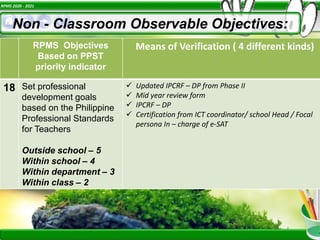
Non - Classroom Observable Objectives:
RPMS Objectives
Based on PPST
priority indicator
Means of Verification ( 4 different kinds)
18 Set professional
development goals
based on the Philippine
Professional Standards
for Teachers
Outside school – 5
Within school – 4
Within department – 3
Within class – 2
 Updated IPCRF – DP from Phase II
 Mid year review form
 IPCRF – DP
 Certification from ICT coordinator/ school Head / Focal
persona In – charge of e-SAT
RPMS 2021 - 2022
Plus Factor
RPMS Objectives
Based on PPST
priority indicator
Means of Verification ( same kind could used more than
once)
19 Performed various
related
works/activities
that contribute to
the teaching-
learning process
(Plus Factor)
Outside school – 5
Within school – 4
Within department – 3
Within class – 2
Proof of:
• committee involvement
• advisorship of co-curricular activities
• book or journal authorship/ contributorship
• coordinatorship/ chairpersonship
• coaching and mentoring learners in competitions
• Serving as reliever of classes due to the absence of teachers
• mentoring pre-service teachers
• participation in demonstration teaching
• Participation as technical working group member
• others (please specify and provide annotations)
Thank you very
much!
JBL
By JOYCE B. LANUZA -BANCO

RPMS-PPST-2021-2022.pptx

  • 1.
    RPMS- PPST School Year2021 – 2022 DM 4 series of 2022 JOYCE B. LANUZA – BANCO February 17, 2022
  • 2.
    1. explain comprehensiveguidelines on the implementation of RPMS 2021 -2022 2. identify the timelines and appropriate tools to follow based on the chosen learning modality Objectives: RPMS 2021- 2022
  • 3.
    3. determine theclassroom observable objectives and their means of verifications 4. determine the non classroom observable objectives and their means of verifications 5. Identify the plus factor means of verifications Objectives: RPMS 2020- 2021
  • 4.
  • 5.
    Class observation time frame: RPMS2021- 2022 2 required observations:  CO1 – between September 2021 and February 2022  CO2 – between March and June 2022
  • 6.
    PPST Priority Indicators RPMS 2021-2022  18 priority indicators/ objectives and plus factor  Selected based on the current learning environment  divided into classroom observable objectives and non classroom observable objectives
  • 7.
     9 forProficient ( Teachers I – III)  7 Highly Proficient ( Master Teachers I – IV) RPMS 2021 - 2022 Classroom Observable Objectives:
  • 8.
    For Proficient Teachers(9)  Objectives 1, 3,4, 5 & 6 - MOV’s from CO ( quality)  Objectives 7, 8,9 and 10 - MOV’s from CO, provision of SLM’s, or accomplishment of TRF( Teacher Reflection Form) RPMS 20201- 2022 Classroom Observable Objectives:
  • 9.
    For Proficient Teachers Objectives 2, 11, 12, 13, 14, 15, 16, 17 & 18  Objective 19 plus factor RPMS 20201- 2022 Non - Classroom Observable Objectives:
  • 10.
    For Highly ProficientTeachers (7)  Objectives 1, 3,4, 5 & 6 - MOV’s from CO ( quality)  Objectives 9 &10 - MOV’s from CO, provision of SLM’s, or accomplishment of TRF( Teacher Reflection Form) on the context of the teacher RPMS 20201- 2022 Classroom Observable Objectives:
  • 11.
  • 12.
  • 13.
  • 14.
  • 15.
    RPMS 2021 -2022 Classroom Observable Objectives: RPMS Objectives Based on PPST priority indicator Means of Verification 1 Applied knowledge of content within and across curriculum teaching process COT Rating Sheet / interobserver agreement form 1 & 2 3 Displayed proficient use of mother tongue Filipino and English to facilitate teaching and learning 4 Used verbal and non verbal classroom communication strategies to support learner understanding, participation engagement and achievement 5 Established safe and secure learning environments to enhance learning through the consistent implementation of policies guidelines and procedure 6 Maintained learning environments that promote fairness, respect and care to encourage learning
  • 16.
    RPMS 2021 -2022 Classroom Observable Objectives: RPMS Objectives Based on PPST priority indicator Means of Verification 7 Maintained learning environments that nurture and inspire learners to participate , cooperate and collaborate in continued learning SET A : Any supplementary material (in print/digital format) made by the ratee and used in the lesson delivery • Activity sheet/s • One lesson from a locally crafted self-learning module (SLM) • Lesson plan (e.g., DLP, DLL, WHLP, WLP, WLL, Lesson Exemplars, and the likes) • Video lesson • Audio lesson • Other learning materials in print/digital format With client feedback on how the material encouraged learners to participate cooperate &collaborate 8 Applied range of successful teaching strategies that maintain learning environment that motivates learners to work productively by assuming responsibility for their own learning
  • 17.
    RPMS 2021 -2022 Classroom Observable Objectives: RPMS Objectives Based on PPST priority indicator Means of Verification 7 Maintained learning environments that nurture and inspire learners to participate , cooperate and collaborate in continued learning SET B Classroom Observation tool rating sheet or inter observer agreement form Via LAC 3. COT rating Sheet 1 and 2 8 Applied range of successful teaching strategies that maintain learning environment that motivates learners to work productively by assuming responsibility for their own learning
  • 18.
    RPMS 2021 -2022 Classroom Observable Objectives: RPMS Objectives Based on PPST priority indicator Means of Verification 9 Designed , adapted and implemented teaching strategies that are responsive to learners disabilities, giftedness and talents SET A Classroom Observation tool rating sheet or inter observer agreement form Via LAC 3. COT rating Sheet 1 and 2 10 Adapted and used culturally appropriate teaching strategies to address the needs of the learners from indigenous groups
  • 19.
    RPMS 2021 -2022 Classroom Observable Objectives: RPMS Objectives Based on PPST priority indicator Means of Verification 9 Designed , adapted and implemented teaching strategies that are responsive to learners disabilities, giftedness and talents SET B Teacher Reflection form ( TRF) on adapting and using culturally appropriate teaching strategies to address the needs of the learners from indigenous groups and certification from the school head that the rate’s classes have no identified learner/s from indigenous groups 10 Adapted and used culturally appropriate teaching strategies to address the needs of the learners from indigenous groups
  • 20.
    RPMS 2021 2022 ClassroomObservable Objectives:
  • 21.
    RPMS 2020 -2021 Non - Classroom Observable Objectives:  4 objectives for Proficient ( Teachers I – III) and Highly Proficient ( Master Teachers I – IV)  Objective 8 ( quality)  Objectives 9 -11 ( quality & efficiency)
  • 22.
    RPMS 2022 -2022 Non - Classroom Observable Objectives: RPMS Objectives Based on PPST priority indicator Means of Verification 2 Used research – based knowledge and principals of teaching and learning to enhance professional practice One lesson plan (e.g., DLP, DLL, WHLP, WLP, WLL, and the likes) with annotations identifying the research based- knowledge and or principles of teaching and learning used as basis for planning/ designing the lesson *Components of instructions: learning objectives, instructional objectives and assessment • Research-based knowledge information or data acquired through systematic investigation • Principles of teaching and learning – views, understanding and conceptualization
  • 23.
    RPMS 2021 -2022 Non - Classroom Observable Objectives: RPMS Objectives Based on PPST priority indicator Means of Verification 11 Adapted and implemented learning programs that ensure relevance and responsiveness to the needs of the learners e.g literacy progam/ numeracy program / SIM, enrichment & intervention program 1. Proof of evaluation on the implementation of adapted and conceptualized learning program 2. Progress report on the implementation of the adapted contextualized learning program 3. Accomplishment / completion report on the implementation of an adapted contextualized learning program 4. Action plan / activity proposal activity matrix that shows an adapted / contextualized learning program Planned -2 completed 3 monitored 4 evaluated 5
  • 24.
    RPMS 2021 -2022 Non - Classroom Observable Objectives: RPMS Objectives Based on PPST priority indicator Means of Verification 1 2 Utilized assessment data to inform the modification of teaching and learning practices and programs Note: Analyzed assessment result -2 Planned strategy w/ MOV 3 -3 Developed materials w/MOV 2 – 4 Implemented w/ MOV 1 - 5 A list of identified least and most mastered skills based on the frequency of errors / correct response with any of the following supporting MOV: 1. Accomplishment report for remedial / enhancement activities ( program or project) 2. Intervention material used for remediation/ reinforcement and enhancement 3. Lesson plan activity log for remediation/ enhancement utilizing of assessment data to modify teaching and learning practices or programs
  • 25.
    RPMS 2021 -2022 JAY R D> BANCO Non - Classroom Observable Objectives: RPMS Objectives Based on PPST priority indicator Means of Verification ( 4 different kinds) 13 Maintained learning environments that are responsive to community context * Classroom and other physical areas outside the classroom  Accomplishment report on the program /project /activity that maintains a learning environment  Program /project / activity plan on maintaining a learning environment  Minutes of consultative meeting community stakeholders meeting about a program / project activity that maintains a learning environment with proof of attendance  Communication letter about a program project activity that maintains a learning environment
  • 26.
    RPMS 2021 -2022 JAY R D> BANCO Non - Classroom Observable Objectives: RPMS Objectives Based on PPST priority indicator Means of Verification ( 4 different kinds) 14 Reviewed regularly personal teaching practices using existing laws and regulations that apply to teaching profession and responsibilities specified in the code of ethics for professional teachers 1. Annotated video /audio recording one’s teaching that shows impact of regularly reviewing one’s teaching practice/s 2. Annotated teaching material that shows impact of regularly reviewing one’s teaching practice/s ● lesson plan ● assessment materials ● others (please specify) 3. Personal reflection notes as outputs from participation in review of personal teaching practices in four (4) quarters / 2 for SHS 4. Proof of attendance (with date) in LAC or coaching and mentoring sessions for review of personal teaching practices
  • 27.
    RPMS 2021 -2022 JAY R D> BANCO Non - Classroom Observable Objectives: RPMS Objectives Based on PPST priority indicator Means of Verification ( 4 different kinds) 15 Complied and implemented school policies and procedure consistently to foster harmonious relationship to learners, parents and other stakeholders Sustained partnership w/ mov 1 – 5 Discuss with learners and parents w/ Mov 2 – 4 Communicated w/ Mov 3 – 3 Implemented w/out communication - 2  1. Proof of participation / involvement in school -community partnership for the implementation of the school policy and procedure ( certificate as committee member, narrative report)  2. Minutes of parent – teacher conference stakeholders meeting about implemented school policies/ procedure and proof of attendance  Communication letter about implemented school policy / procedure sent to parent or guardian
  • 28.
    RPMS 20201- 2022 Non- Classroom Observable Objectives: RPMS Objectives Based on PPST priority indicator Means of Verification ( 4 different kinds) 16 Applied personal philosophy of teaching that is learner centered  One lesson plan with annotations explaining the application of learner – centered philosophy ( e.g constructivism and existentialism) used as a basis for planning/ designing lesson plan *Components of instructions: learning objectives, instructional objectives and assessment all components ( 5) 2 components 4 1 component 3 Poorly reflected 2
  • 29.
    RPMS 2021 -2022 JAY R D> BANCO Non - Classroom Observable Objectives: RPMS Objectives Based on PPST priority indicator Means of Verification ( 4 different kinds) 17 Adopted practices that uphold dignity of teaching profession by exhibiting qualities of caring attitude, respect and integrity 1. Documented feedback from superiors, colleagues, or other stakeholders directly reflecting the rate's good practices that uphold the dignity of teaching as a profession 2. Annotated evidence of practice indirectly linking to the upholding of the dignity of teaching as a profession by exhibiting qualities such as caring attitude, respec and integrity ● Remarks from superiors, colleagues, or master teacher / school head about one’s qualities (e.g., entries in Performance Monitoring and Coaching Form [PMCF] or in Mid-Year Review Form) ● Recognition from the school / school community
  • 30.
    RPMS 2020 -2021 Non - Classroom Observable Objectives: RPMS Objectives Based on PPST priority indicator Means of Verification ( 4 different kinds) 18 Set professional development goals based on the Philippine Professional Standards for Teachers Outside school – 5 Within school – 4 Within department – 3 Within class – 2  Updated IPCRF – DP from Phase II  Mid year review form  IPCRF – DP  Certification from ICT coordinator/ school Head / Focal persona In – charge of e-SAT
  • 31.
    RPMS 2021 -2022 Plus Factor RPMS Objectives Based on PPST priority indicator Means of Verification ( same kind could used more than once) 19 Performed various related works/activities that contribute to the teaching- learning process (Plus Factor) Outside school – 5 Within school – 4 Within department – 3 Within class – 2 Proof of: • committee involvement • advisorship of co-curricular activities • book or journal authorship/ contributorship • coordinatorship/ chairpersonship • coaching and mentoring learners in competitions • Serving as reliever of classes due to the absence of teachers • mentoring pre-service teachers • participation in demonstration teaching • Participation as technical working group member • others (please specify and provide annotations)
  • 32.
    Thank you very much! JBL ByJOYCE B. LANUZA -BANCO

Editor's Notes

  • #16 Notes: the two means of verifications for these objectives are the two classroom observation tool rating sheets in the two observations. The average of the two observations will be obtained then the result will be interpreted using the RPMS rating transmutation table For example in COT 1 you got a rating of 6 and in COT 2 you got a rating of 5. In RPMS 5 point scale rating these have equivalent points of 4 and 3 respectively. When you obtain the average this will be equivalent to 3.5 qhich is interpreted as very satisfactory.
  • #26 “Output” may include, but not limited to, lesson plan, instructional materials, action plan, or any teaching and learning-related materials. ** “Proof of implementation” can be in the form of implemented action plan, lesson plan executed in class, application project, etc. *** “Different kinds of acceptable MOV” under Efficiency means each type of MOV can be submitted only once (e.g. Submitted MOVs could be one (1) Certificate of participation in a webinar, one (1) Certificate of recognition/ speakership in a conference, one (1) proof of participation in a benchmarking activity, and one (1) proof of participation in school LAC session).
  • #27 “Output” may include, but not limited to, lesson plan, instructional materials, action plan, or any teaching and learning-related materials. ** “Proof of implementation” can be in the form of implemented action plan, lesson plan executed in class, application project, etc. *** “Different kinds of acceptable MOV” under Efficiency means each type of MOV can be submitted only once (e.g. Submitted MOVs could be one (1) Certificate of participation in a webinar, one (1) Certificate of recognition/ speakership in a conference, one (1) proof of participation in a benchmarking activity, and one (1) proof of participation in school LAC session).
  • #28 “Output” may include, but not limited to, lesson plan, instructional materials, action plan, or any teaching and learning-related materials. ** “Proof of implementation” can be in the form of implemented action plan, lesson plan executed in class, application project, etc. *** “Different kinds of acceptable MOV” under Efficiency means each type of MOV can be submitted only once (e.g. Submitted MOVs could be one (1) Certificate of participation in a webinar, one (1) Certificate of recognition/ speakership in a conference, one (1) proof of participation in a benchmarking activity, and one (1) proof of participation in school LAC session).
  • #29 “Output” may include, but not limited to, lesson plan, instructional materials, action plan, or any teaching and learning-related materials. ** “Proof of implementation” can be in the form of implemented action plan, lesson plan executed in class, application project, etc. *** “Different kinds of acceptable MOV” under Efficiency means each type of MOV can be submitted only once (e.g. Submitted MOVs could be one (1) Certificate of participation in a webinar, one (1) Certificate of recognition/ speakership in a conference, one (1) proof of participation in a benchmarking activity, and one (1) proof of participation in school LAC session).
  • #30 “Output” may include, but not limited to, lesson plan, instructional materials, action plan, or any teaching and learning-related materials. ** “Proof of implementation” can be in the form of implemented action plan, lesson plan executed in class, application project, etc. *** “Different kinds of acceptable MOV” under Efficiency means each type of MOV can be submitted only once (e.g. Submitted MOVs could be one (1) Certificate of participation in a webinar, one (1) Certificate of recognition/ speakership in a conference, one (1) proof of participation in a benchmarking activity, and one (1) proof of participation in school LAC session).
  • #31 “Output” may include, but not limited to, lesson plan, instructional materials, action plan, or any teaching and learning-related materials. ** “Proof of implementation” can be in the form of implemented action plan, lesson plan executed in class, application project, etc. *** “Different kinds of acceptable MOV” under Efficiency means each type of MOV can be submitted only once (e.g. Submitted MOVs could be one (1) Certificate of participation in a webinar, one (1) Certificate of recognition/ speakership in a conference, one (1) proof of participation in a benchmarking activity, and one (1) proof of participation in school LAC session).
  • #32 * “Any 4/3/2 of the acceptable MOV” under Efficiency means the same kind of MOV can be submitted more than once.