LESSON 9
Postwar Period and Neocolonialism in the Philippines
By the end of this lesson, the students will be able to.
describe the general characteristics of the Philippine government
and society in the postwar period,
analyze the relationship between the Philippines and the United
States of America through selected primary sources; and
assess the level of Philippine democracy and sovereignty in the
period after American colonization.
Neocolonialism – Control of less-developed countries by developed
nations through political, economic, or cultural pressure, rather than
military force.
Cold War – The period of non-military rivalry between the Soviet Union
and the United States from 1947 to 1991.
Huk Rebellion – A Communist-led peasant uprising in Central Luzon
from
1946 to 1954.
Democracy – A system of government where power is held by elected
representatives or directly by the people, based on the belief in freedom
and equality.
On 4 July 1946, the Americans bestowed upon the Filipino people their full
independence. However, despite the recognition of the full sovereignty of
the newly independent nation, the Philippines remained dependent on the
United States. Its economic policies, political system, and state agenda
were made and implemented to favor the Americans. The postwar years of
the country can be summarized to the single theme of neocolonialism. While
the government was composed of Filipinos’ the United States had a close
influence on the nationally elected governments that ruled the country for
most of the twentieth century. While the country ceased to be a U.S.
territory, the relationship that was built between the two countries still
contained elements of colonial subservience and dependency. In this lesson
we are going to look at different primary sources that demonstrate
American neocolonialism in the Philippines from the immediate postwar
years until the culmination of the EDSA republic.
This lesson explores the postwar period in the Philippines by
examining three key documents that reveal the relationship between the
newly independent Philippines and its former colonizer and global
superpower, the United States. We will analyze these primary sources to
better understand this era. The first document is a declassified CIA report
on the Philippines from 1950. The second is a Philippine Free Press article
covering the 1953 presidential election. The third is a speech delivered by
President Corazon Aquino before the U.S. Congress in September 1986.
Lesson Introduction
CIA Intelligence Memorandum No. 296 of June 1950
The Central Intelligence Agency (CIA) of the United States was
established after World War ll. It became the primary agency of the United
States in terms of intelligence work that has been crucial as they traverse a
new world order—the Cold War period. This period culminated after World
War Il and is characterized with the relentless competition between the
democratic-capitalist United States of America and the socialist-communist
Union of Soviet Socialist Republics (USSR) for world supremacy. In such a
context, the Philippines, as a former U.S. colony, was automatically
presumed to be under the U.S. umbrella. Thus, the policies of the postwar
presidents in the Philippines ostensibly featured anti-communist and liberal
economic leanings. These were explicitly demonstrated in many CIA
documents that were produced about the Philippines in this period. These
documents were originally confidential and classified. After the enactment of
the Freedom of Information law in the United States, CIA declassified
volumes of papers that were over 25 years old. However, most of these
documents were labeled as "sanitized copies." One of the earliest
documents is Intelligence Memorandum No. 296, titled "Current Situation in
the Philippines," dated June 6, 1950. This five-page report details the
political, economic, and military conditions in the Philippines and their impact
on the nation's relationship with the United States. The report begins with
the following statement:
Even though deteriorating conditions in the Philippines should in the
near future cause the downfall of President Quirino, the succeeding
administration could be expected to be pro-US. If the present decline in
stability throughout the Philippines continues for as much as ten years,
however, pro-Communist forces might be able to seize power.
The report was divided into three parts: political situation, economic
situation, and military situation. For the United States, these aspects were
the most important Ones in appraising the Philippines.
In the political aspect, the United States was pessimistic about the
presidency Of President Elpidio Quirino. His government was marred by
corruption scandals across different levels of governance. The CIA detected
an "active resentment against governmental inefficiency and abuses" among
the people, which led to a general "[Loss of confidence in the government."
This bleak development, in the CIA's assessment, further strengthened the
Communist-led Huk movement in Luzon. CIA also described "administrative
corruption and inefficiency at virtually all levels. „ Corruption was said to be
perpetrated by the "small group of wealthy landowners and entrepreneurs
who constitute the Filipino ruling clique" and "resulting from a lack of civil
spirit, from knowledge of economic power, and from confidence in the past
apathy of the disorganized and uneducated mass of the people."
In terms of the Philippine economy at that period, the CIA described
the Philippines as "almost self-sufficient in food [which] favors long-range
stability." However, they also mentioned how "long-standing inequalities in
the nation 's agrarian system... have been exploited by the Communist and
have not only facilitated the development of the Huk movement in Luzon
but are producing unrest elsewhere in the archipelago." The CIA also
mentioned the critical problem of the "nation's rapidly deteriorating financial
position." The Philippine government dealt with this problem by increasing
taxes and tightening import control. These measures resulted in price
increases in imported goods. The government also encountered difficulties
in the conduct of foreign trade, which further led to "increased popular
doubt as to the country's economic future, which led to aggravated political
instability."
Aside from the corruption and inefficiency of the government, which
the CIA saw as a result of "political immaturity and inadequate education,"
the law enforcement institutions of the Philippine Constabulary and the
Philippine Armed Forces were also seen to not possess any "capability for
maintaining law and order or even for preventing destructive raids by the
Huks." The Huks, which was the central concern of the United States, was
an organization that: ought the Japanese in the preceding war period and
became an anti-government group during the postwar years. In this 1950
document, the CIA estimated that "although Huk activity is presently
confined in the island of Luzon, it is expanding and growing the 1950
estimate of the CIA on Huk membership was pegged at 15,000 with the
prospect of further increase. The CIA believed that the Huks were equipped
with weapons that were sufficient and appropriate for their guerrilla
operations. These weapons were acquired through theft, purchase, and
seizure from government forces, the guerrillas were also sustained with the
food and clothing "willingly contributed by sympathetic peasants and
villagers." At times, the Huks also resort to force or intimidation in acquiring
these essential supplies.
The CIA assessed that the Huks were of high morals as evident on the "very
few Huks [who] have taken advantage of past Government amnesty offers."
On the other hand, the CIA's appraisal Of the Philippine Armed Forces and
Constabulary was pessimistic. While the government forces were "well-
equipped in comparison with their opponents" with U.S.-sourced materials,
the combat efficiency of both the Army and the Constabulary lacked
coordination and suffered from the failure in relieving small units in the
field. While the deteriorating political stability of the period had little to no
effect on the loyalty of the uniformed personnel, their morale was generally
low. The CIA concluded that more intensive." the "[u]nit leadership is not of
high quality, and an aggressive spirit is lacking in all ranks. The
ineffectiveness of government forces is in part attributable to difficult terrain
and local sympathy for the Huks."
Analysis of the CIA Memorandum
It is essential to have contextual knowledge of the 1950 period to
appreciate the report summarized on the previous pages. As mentioned, the
period that immediately followed World War Il was dictated by the Cold War.
In this period, the two strongest and most powerful nation-states in the
world were vying for world supremacy and were engaging in a diplomatic
contest. Both the United States and the USSR were suspecting each other of
an agenda to dominate the world.
Both countries engaged in a race of accumulation of arms, territories,
and wealth to secure their place in the current world order. The fundamental
difference between them would be their respective state ideologies. On the
one hand, the United States was committed to liberal democracy and a
liberal capitalist political economy. These ideas, after all, launched the
relatively young nation to world greatness in a matter of decades. On the
other hand, the USSR was as committed to their socialist and communist
ideology and the intent to export the glorious Russian Communist
Revolution of 1917 across the world.
In this scenario, the United States, erstwhile colonial master and ally
of the nascent Philippine Republic, was positioning in the Pacific. The
Philippines, as its territory since 1899, was an essential stronghold as the
Chinese Communist Party's revolution succeeded in 1949. The United States
wanted to contain communism in the Pacific and Southeast Asia. That was
why the presence of a growing communist army, the Huks, was a U.S.
concern.
This concern was apparent in this August 1950 memo. The report,
while presenting a general picture of the Philippines, was centrally
concerned with the current situation of the Huk rebellion in the country. For
example, in characterizing the political situation in the country, the report
ultimately tied back on the effects of instability and the increasing
discontent of the people against the government to the communist
movement. They were apprehensive about how the decline in the
government's popularity and Quirino's integrity would garner procommunist
sentiment. The same was true about their economic appraisals.
Their report on the economic condition in the country centered on
their appraisals of the long-standing inequalities in the Philippine
agricultural sector. Despite the projected self-sufficiency on food, the CIA
pointed out that the "continued failure of the Philippine governing class—the
beneficiaries of this agrarian system— to alleviate inequities has provided
local Communists with excellent opportunities to organize the otherwise
leaderless peasantry."
The CIA's preoccupation with the Huk rebellion is most highlighted in their
report on the country's military situation. They pointed out the continuous
strengthening of the rebel forces and the bleak improvements of the Armed
Forces and Constabulary.
The CIA had detailed intelligence on the capacities and artillery of the
Huks and expressed concerns on the ability of the rebels to acquire the
sympathy of the rural population. Like most of the declassified files of the
CIA, this memo is also a sanitized copy. Hence, it can be inferred that mote
controversial appraisals of the CIA have been omitted in the version that the
agency has approved for publication. Nevertheless, a contextual reading of
the document reveals insights on the agenda and interests of the United
States in the Philippines during the years that immediately followed the War
and the initial years of the Cold War period that would last until the
disintegration of the USSR in the last decade of the twentieth century.
: Think, Pair, Share
As previously discussed, the CIA played a crucial role in the postwar
government's efforts to combat the communist-led Huk rebellion. Among
the tactics employed by the CIA was psychological warfare.
Below is an excerpt from Brig. Gen. Edward G. Lansdale's memoir that
sheds light on these strategies:
To the superstitious, the Huk battleground was a haunted place filled
with ghosts and eerie creatures. Some of its aura of mystery was imparted
to me on my own visits there. Goose-bumps rose on Inv arms on
moonless nights in Huk territory as I listed to the haunting minor notes of
trumpets playing Pampanguenia dirges in the barrios or to the mournful
singings of men and women known as nangangaluluwa as they walked
from house to house on All Saints' night telling of lost and hungry souls.
Even Magsavsay ed in the apparition called a kapre, a huge black man
said to walk through tall grass at dusk to make it stir or to sit in a tree or
astride a roof smoking a large cigar.
One psywar operation played upon the popular dread of an aswang, or
vampire, to solve a difficult problem. Local politicians opposed
Magsaysay's plan of moving more troops out of defensive garrisons to
form further mobile and aggressive BCTS (Battalion Combat Teams), and
in one town the local bigwigs pointed out that a Huk squadron was based
on a hill near town. If the troops left, they were sure the Huks would
swoop down on the town and the bigwigs would be their victims. Only if
the Huk squadron left the vicinity would they agree to the removal of the
guarding troops. The problem, therefore, was to get the Huks to move.
The local troops had not been able to do this.
A combat psywar squad was brought in. It planted stories among town
residents of an aswang living on the hill where the Huks were based. Two
nights later after giving the stories time to circulate among Huk
sympathizers in the town and make their way up to the hill camp, the
psywar squad set up an ambush along a trail used by the Huks.
… When a Huk patrol came along the trail, the ambushers silently
snatched the last man of the patrol, their move unseen in the dark night,
they punctured their neck with two holes, vampire-fashion, held the body
up by the heels, drained its blood and put the corpse back on the trail.
When the Huks returned to look for the missing man and found their
bloodless comrade, every member of the patrol believed that the aswang
got him and that one of them would be next if they remained on that hill.
When daylight came, the whole Huk squadron moved out of the vicinity.
Another day passed before the local people were convinced that they were
really gone. Then Magsaysay moved the troops who were guarding the
town into a BCT."
Source: Edward G. Lansdale (1991). In the Midst of Wars: An American's
Mission to Southeast Asia. New York: Fordham University Press, pp. 72-
72.
Find a partner and answer the following questions:
(1) What does this say about the characteristics of the rural Philippine
society in the early 1950s?
(2) What does this say about the way that the CIA worked in the war
against the Communist-led Huk rebellion? Prepare to share your analysis
in class.
Leon O. Ty's "It's Up to You Now" and the Magsaysay Myth
Mainstream Philippine history textbooks always paint Ramon
Magsaysay as the People's President. His humble beginnings and
educational background were placed in stark contrast to his predecessors'.
Indeed, the presidents before him were all lawyers who came from the old,
landed elite families and were prominent figures in Philippine politics for
many generations of the American period. Magsaysay, however, did not
enjoy the same advantages. He was not a lawyer, did not come from the
national elite, was former employee of a bus company in his province, and a
hardened guerrilla during the war. He was a governor of Zambales, elected
as a legislator, and was appointed as secretary of National Defense under
President Quirino. As defense secretary, Magsaysay gained popularity in his
successful campaign against the Huks.
For all intents and purposes, Magsaysay was painted as a self-made
president who rose from the ranks of the masses through sheer ability and
patriotism. He was celebrated as an anti-communist hero who broke the
growing momentum of the Huk rebellion as a defense secretary. He was
beholden to no one because he had no significant business interest and was
perceived and portrayed as a "man of action" who would put an end to the
corruption and inefficiency of the government led by an oligarchy. U.S.
newspapers and magazines supported this image, and so did the Philippine
press.
Journalist Leon O. Ty penned an article "It's Up to You Now" for the
Philippine Free Press three days before the November 1953 presidential
election. This article is an illustration of Magsaysay's portrayal in the press.
The article started with an anecdote where defense secretary Magsaysay
called a newsman to express his worries in the way things were run in the
Quirino cabinet' The article narrated how Magsaysay worried about having
earned the ire of the president when he contradicted a particular shady deal
about sugar importation that involved a certain compadre to the president.
The article read:
I have my doubts,' Magsaysay answered rather gloomily. 'The APO
[pertaining to the president] seems to dislike me now.'
'But why should he dislike you?' the newsman queried. 'Didn't you restore
peace and order for him? You gave him prestige when you kept the 1951
elections clean. The President has repeatedly said he is proud of you.'
Magsaysay said Quirino began to be indifferent to him when articles about
his success in combating the Huks were published in leading American
magazines like Time, Life, Saturday Evening Post, Newsweek, and Collier's.
Leon Ty's write-up craftily narrated the history of Magsaysay's political
career, from his days as a war veteran to his days as the defense secretary,
until he resigned from the Quirino cabinet and immediately transferred from
the Liberal Party to the Nacionalista Party where he was drafted as the
standard-bearer. Ty's article also described Magsaysay's initial plan to resign
from the Nacionalista Party and to run for senator under a third party:
'What do you plan to do now?' Magsaysay was asked toward the end of the
conversation.
'Resign from the Cabinet and join a third party. I can't join the Opposition. I
don't think the Nacionalistas will accept me, knowing I'm a Liberal.' 'But
what will you do in a third party?' inquired the newsman.
'I'll run for senator,' he said.
'Useless for you to join a third party and run for a Senate post. You can't
win. Not as a third-party candidate
The foregoing story is related to show that Ramon Magsaysay at the time
never dreamed of becoming a candidate for president of the Liberal Party,
much less of the Opposition.
The article also described the confidence of hardcore nationalists to
Magsaysay. These include Jose P. Laurel, Claro M. Recto, and Lorenzo
Tañada This confidence demonstrated that Magsaysay had the trust of
leaders known for their anti-Americanism. Supporting Magsaysay, according
to Ty, was how the Nacionalista leaders such as Laurel showed patriotism:
Many people are still wondering why Dr. Laurel was willing to sacrifice his
personal ambition in favor of the former LP defense secretary. They still
believe that in a clean election, Laurel could win against any Liberal as
shown in 1951. With victory practically in sight, why did Dr. Laurel decide to
invite Magsaysay to be the NP standard-bearer?
Senator Laurel had his reasons for this action.
'If I run and lose through frauds and violence as in 1949,' he is said to have
told close friends, "1 will surely be driven to desperation. I may even have
to resort to drastic measures. In which case, I might have to go to the
mountains and lead a band of rebels, guerrillas. That I cannot do now on
account of my age... I'm tired.
'And if I win, could I get as much aid from the United States as Magsaysay
could? I don't think so. I know pretty well how I stand in the eyes of the
American people. Because of my collaboration record during the Occupation,
many Americans who still don't know what actually happened here during
the war will stand in the way of material aid to our country. I have no
choice. The welfare of our people is more important to me than my personal
ambition. But if Magsaysay wins, I think America will go out of her way to
help us because he is a friend, a great friend. To the American people, and
for that matter, to the people of the world, Magsaysay is the physical
embodiment of Democracy's courageous stand against Communism in the
Far East... ...
The rest of the article painted a picture of the Liberal regime in the
Philippines for the past eight years. Ty casually stated, "In this article, we
feel there is no need to enumerate what President Quirino has done for the
country during the years he has been in office. The Filipino people know
what he has accomplished. They also know what he failed to do." After a
hefty narrative of Magsaysay's career that included depictions of his
accomplishments, character, and frustrations, the article ended with a
challenge for its readers: "The hectic political campaign is over. You, fellow
voters, have heard the pros and cons of the issues involved in this
election... It's up to you now!"
Analysis of Philippine Free Press' Pitch for Magsaysay
Magsaysay's campaign was a staggering success. For the first time in
the history of elections in the Philippines, the president won a landslide
victory. Magsaysay defeated Liberal Party's standard-bearer and incumbent
Philippine President Elpidio Quirino with 68.9 percent ballots cast electing
Magsaysay as president. Indeed, the unpopular and reputedly corrupt and
aging Quirino was no match to the younger, energetic, and populist Ramon
Magsaysay.
The buildup of Magsaysay's presidential campaign, however, was
appraised by many historians like Stephen Shalom, William Pomeroy, and
Renato Constantino as a U.S. project. Indeed, Magsaysay was avidly
supported by the U.S. government. U.S. media such as Time and Reader's
Digest created fantastic myths about his humble beginnings. They painted
him as a fierce anti-communist, a relentless reformer of the corrupt
Philippine state, and a loyal supporter of the United States. Indeed, CIA
documents and former agents testified how CIA's Edward Lansdale
Orchestrated Magsaysay's journey to the presidency since the Joint U.S.
Military Assistance Group (JUSMAG) persuaded President Quirino to appoint
Magsaysay as defense secretary. The image of Magsaysay as a humble
politician was a packaging covertly manufactured by the CIA. They knew
that Quirino and his party were highly unpopular, and they wanted to ensure
that the next president would serve U.S. interests well.
The CIA was behind Magsaysay's campaign. They choreographed how
the media would portray him. The very image that Lansdale wanted for
Magsaysay was well captured by the Philippine Free Press article
summarized previously. Ty wrote about Magsaysay’s rise from the masses
and painted him as a humble and patriotic politician who despaired with
what he witnessed in the Quirino government. The article was, at times,
contradictory. On the one hand, it painted Magsaysay as a relatively low-
profile Liberal Party member who would never be considered as a
presidential candidate. On the other hand, it also claimed that "Magsaysay
easily stood out as the strongest pillar in the LP edifice." At the same time,
while the article tried to distance Magsaysay from the image of being a U.S.
puppet by having hardcore nationalists such as Laurel and Recto speak of
his worthiness, it also highlighted the advantages of keeping the United
States as allies, as depicted in the words of Recto quoted previously. Thus,
while the article avoided giving Magsaysay the image of a U.S. bet, it was
still able to place the United States as a valuable friend to the Philippine
government and economy.
The unconcealed and historically documented support of the United
States to Magsaysay's presidency is another indicator of the continued and
unbridled U.S. influence on the Philippines' national affairs, years after the
official end of U.S. colonization. Magsaysay is just a representation of how
Philippine presidents of the postwar period continuously led the country
according to the framework set by the United States.
: Media Power
Select a present-day Filipino politician and find a feature or opinion piece
about them. Read the article carefully and analyze how it portrays and
characterizes the politician. Be ready to share your analysis in class.
Corazon Aquino's Speech before the U.S. Congress
Corazon "Cory" Cojuangco Aquino functioned as the symbol of the
restoration of democracy and the overthrow of the Marcos dictatorship in
1986. The EDSA People Power, which installed Cory Aquino in the
presidency, put the Philippines in the international spotlight for overthrowing
a dictator through peaceful means. Cory was quickly a figure of the said
revolution; as the widow of the slain Marcos oppositionist and former
Senator Benigno "Ninoy" Aquino Jr., Cory was hoisted as the antithesis of
the dictator. Her image as a mourning, widowed housewife who has always
been in the shadow of her husband and relatives and had no experience in
politics was juxtaposed against Marcos' statesmanship, eloquence,
charisma, and cunning political skills. Nevertheless, Cory was able to
capture the imagination of the people whose rights and freedom had long
been compromised throughout the Marcos regime. The people rallied behind
Cory, even though she came from a wealthy haciendero family in Tarlac and
has owned vast estates of sugar plantations and whose relatives occupied
local and national government positions.
On 18 September 1986, seven months after Cory became president,
she went to the United States and spoke before the joint session of the U.S.
Congress. Cory was welcomed with long applause as she took the podium
and addressed the United States about her presidency and the challenges
faced by the new Republic. She began her speech with the story of her
leaving the United States three years prior as a newly widowed wife of
Ninoy Aquino.
She then told of Ninoy's character, conviction, and resolve in opposing the
authoritarianism of Marcos. She talked of the three times that they lost
Ninoy, including his demise on 21 August 1983. The first time was when the
dictatorship detained Ninoy with other dissenters. Cory related: The
government sought to break him by indignities and terror. They locked him
up in a tiny, nearly airless cell in a military camp in the north. They stripped
him naked and held a threat of a sudden midnight execution over his head.
Ninoy held up manfully under all of it. I barely did as well. For forty-three
days, the authorities would not tell me what had happened to him. This was
the first time my children and I felt we had lost him.
Cory continued that when Ninoy survived that first detention, he was
then charged with subversion, murder, and other crimes. He was tried by a
military court, whose legitimacy Ninoy adamantly questioned. To solidify his
protest, Ninoy decided to do a hunger strike and fasted for 40 days. Cory
treated this event as the second time that their family lost Ninoy. She said:
When that didn't work, they put him on trial for subversion, murder and a
host of other crimes before a military commission. Ninoy challenged its
authority and went on a fast. If he survived it, then he felt God intended
him for another fate. We had lost him again. For nothing would hold him
back from his determination to see his fast through to the end. He stopped
only when it dawned on him that the government would keep his body alive
after the fast had destroyed his brain. And so, with barely any life in his
body, he called off the fast on the 40th
day. Ninoy's death was the third and
the last time that Cory and their children lost Ninoy. She continued:
And then, we lost him irrevocably and more painfully than in the past. The
news came to us in Boston. It had to be after the three happiest years of
our lives together. But his death was my country's resurrection and the
courage and faith by which alone they could be free again. The dictator had
called him a nobody. Yet, two million people threw aside their passivity and
fear and escorted him to his grave.
Cory attributes the peaceful EDSA revolution to the martyrdom of
Ninoy. She stated that the death of Ninoy sparked the revolution, and the
responsibility of "offering the democratic alternative" had "fallen on (her)
shoulders." Cory's address introduced us to her democratic philosophy,
which she claims she also acquired from Ninoy. She argued:
I held fast to Ninoy's conviction that it must be by the ways of democracy. I
held out for participation in the 1984 election the dictatorship called, even if
I knew it would be rigged. I was warned by the lawyers of the opposition,
that I ran the grave risk of legitimizing the foregone results of elections that
were clearly going to be fraudulent. But I was not fighting for lawyers but
for the people in whose intelligence, I had implicit faith. By the exercise of
democracy even in a dictatorship, they would be prepared for democracy
when it came. And then also, it was the only way I knew by which we could
measure our power even in the terms dictated by the dictatorship. The
people vindicated me in an election shamefully marked by government
thuggery and fraud. The opposition swept the elections, garnering a clear
majority of the votes even if they ended up (thanks to a corrupt
Commission on Elections) with barely a third of the seats in Parliament.
Now, I knew our power.
Cory talked about her miraculous victory through the people's struggle
and continued talking about her earliest initiatives as the president of a
restored democracy. She stated that she intended to forge and draw
reconciliation after a bloody and polarizing dictatorship. Cory emphasized
the importance of the EDSA revolution in terms of being a "limited
revolution that respected the life and freedom of every Filipino." She also
boasted of the restoration of a fully constitutional government whose
constitution gave utmost respect to the Bill of Rights. She reported to the
U.S. Congress:
Again, as we restore democracy by the ways of democracy, so are we
completing the constitutional structures of our new democracy under a
constitution that already gives full respect to the Bill of Rights. A jealously
independent constitutional commission is completing its draft which will be
submitted later this year to a popular referendum. When it is approved,
there will be elections for both national and local positions. So, within about
a year from a peaceful but national upheaval that overturned a dictatorship,
we shall have returned to full constitutional government.
Cory then presented her peace agenda with the existing communist
insurgency, aggravated by the dictatorial and authoritarian measures of
Ferdinand Marcos. She asserted.
My predecessor set aside democracy to save it from a communist
insurgency that numbered less than five hundred. Unhampered by respect
for human rights he went at it with hammer and tongs. By the time he fled,
that insurgency had grown to more than sixteen thousand. I think there is a
lesson here to be learned about trying to stifle a thing with a means by
which it grows.
Cory's peace agenda involved political initiatives and reintegration
programs to persuade insurgents to leave the countryside and return to
mainstream society and participate in the restoration of democracy. She
invoked the path of peace because she believed that it was the path that a
moral government must take. Nevertheless, Cory took a step back when
she said that while peace is the priority of her presidency, she "will not
waver" when freedom and democracy are threatened. She noted that
similar to Abraham Lincoln, she understood that "force may be necessary
before mercy." While she did not relish the idea, she "will do whatever it
takes to defend the integrity and freedom of (her) country.
Cory then turned to the controversial topic of the Philippine foreign debt
amounting to 26 billion dollars at the time of her speech. This debt has
ballooned during the Marcos regime. Cory expressed her intention to honor
those debts despite mentioning that the people did not benefit from such
obligations. Thus, she expressed her protestations about the way the
Philippines was deprived of choices to pay those debts within the capacity of
the Filipino people. She lamented.
Finally, may I turn to that other slavery, our twenty-six-billion-dollar
foreign debt. I have said that we shall honor it. Yet, the means by which we
shall be able to do so are kept from us. Many of the conditions imposed on
the previous government that stole this debt, continue to be imposed on us
who never benefited from it.
She continued that while the country has experienced the calamities
brought about by the corrupt dictatorship of Marcos, no commensurate
assistance was yet extended to the Philippines. She even remarked on the
peaceful character of the EDSA People Power Revolution, "ours must have
been the cheapest revolution ever.' She demonstrated that the Filipino
people fulfilled the "most difficult condition of the debt negotiation,' which
was the "restoration of democracy and responsible government.
Cory related to the U.S. legislators that wherever she went, she met
poor and unemployed Filipinos willing to offer their lives to democracy. She
stated:
Wherever I went in the campaign, slum area or impoverished village. They
came to me with one cry, democracy. Not food although they clearly needed
it but democracy. Not work, although they surely wanted it but democracy.
Not money, for they gave what little they had to my campaign. They didn't
expect me to work a miracle that would instantly put food into their mouths,
clothes on their back, education in their children and give them work that
will put dignity in their lives. But I feel the pressing obligation to respond
quickly as the leader of the people so deserving of all these things.
Cory proceeded to enumerate the challenges of the Filipino people as
they tried building the new democracy. These were the persisting
communist insurgency and economic deterioration. Cory further lamented
that these problems worsened by the crippling debt because half of the
country's export earnings amounting to two billion dollars would "go to pay
just the interest on a debt whose benefit the Filipino people never received "
Cory then asked a rather compelling question to the United States:
Has there been a greater test of national commitment to the ideals you hold
dear than that my people have gone through? You have spent many lives
and much treasure to bring freedom to many lands that were reluctant to
receive it. And here, you have a people who want it by themselves and need
only the help to preserve it.
Cory ended her speech by thanking the United States for serving as
home to her family for what she referred to as the "three happiest years of
(their) lives together." She urged the United States to build the Philippines
as a new home for democracy and in turning the country as a "shining
testament of our two nations' commitment to freedom."
Analysis of Cory Aquino's Speech
Cory Aquino's speech was an essential event in the political and
diplomatic history of the country because it has arguably cemented the
legitimacy of the EDSA government in the international arena. The speech
talks of her family background, especially her relationship with her late
husband, Ninoy Aquino. It is well known that it was Ninoy who served as the
real leading figure of the opposition at that time. Indeed, Ninoy's eloquence
and charisma could very well compete with that of Marcos. In her speech,
Cory talked at length about Ninoy's toil and suffering at the hands of the
dictatorship. Even when she proceeded to talk about her new government,
she still went back to Ninoy's legacies and lessons. Moreover, her attribution
of the revolution to Ninoy's death not only demonstrated Cory's perception
of the revolution, but also, since she was the president, it represented the
dominant discourse at that point in our history.
The ideology or the principles of the new democratic government can
also be seen in the same speech. Aquino was able to draw the sharp
contrast between her government and of her predecessor by expressing her
commitment to a democratic constitution drafted by an independent
commission. She claims that such a constitution upholds and adheres to the
rights and liberty of the Filipino people. Cory also hoisted herself as the
reconciliatory agent after more than two decades of a polarizing
authoritarian politics. For example, Cory sees the blown-up communist
insurgency as a product of a repressive and corrupt government. Her
response to this insurgency rooted in her diametric opposition to the
dictator (i.e., initiating reintegration of communist rebels to the mainstream
Philippine society). Cory claimed that her primary approach to this problem
was through peace and not through war.
Despite Cory's efforts to hoist herself as the exact opposite of Marcos,
her speech still revealed certain parallelisms between her and Marcos'
government. These parallels are seen in terms of continuing the alliance
between the Philippines and the United States, despite the known affinity
between the said world superpower and Marcos. The Aquino regime—as
seen in Cory's acceptance of the invitation to address the U.S. Congress and
in the content of the speech—decided to build and continue with the alliance
between the Philippines and the United States and effectively implemented
a substantially similar foreign policy to that of the dictatorship. For example,
Cory recognized that the large sum of foreign debts incurred by the Marcos
regime never benefited the Filipino people. However, she still expressed her
intention to pay off those debts. Unknown to many Filipinos, there was a
choice of waiving the said debts because those were incurred and stolen by
a dictator and not the country. Cory's decision was an indicator of her
government's intent to carry on a debt-driven economy.
Reading through Cory's speech, we can already take cues not only on
Cory's ideas and aspirations, but also on the guiding principles and
framework of the government that she represented.
: Watch and Reflect
Watch the documentary Lakas Sambayanan via this link:
https://youtu.be/FsRlUk01UbQ.
As you watch, take note of the most impactful moments and prepare to
share your reflections during the class discussion.
 The postwar period in the Philippines can be discussed using the
unifying theme of neocolonialism. In this neocolonial state and
society, the United States maintained a crucial and significant role
in the Philippine government through indirectly influencing
economic and public policy.
 Against the backdrop of the Cold War, the Philippines was assumed
under the block led by the United States. Hence, America was
focused on the containment of the spread of communism in the
archipelago.
 The postwar government was marred by corruption and patronage.
The power remained at the hands of elite and Philippine politics
featured temporary elite alliances and rivalries.
 The leaders' perceived importance of being allied with the United
States was shared even among political rivals, as in the case of
Marcos and Cory Aquino.
Aquino, C. (1986). Speech of President Corazon Cojuangco Aquino during
the Joint Session of the U.S. Congress. Retrieved 4 February 2021 from:
https://www officialgazette.gov.ph
Central Intelligence Agency. (1950). Intelligence Memorandum No. 296.
Current Situation in the Philippines. Retrieved 4 February 2021 from:
http://bit.ly/RdgsPHi
Constantino, R. & Constantino, L. (1975). The Philippines: a past revisited.
Quezon City: Tala Publishing Services.
Cullather, N. (1993). America's Boy? Ramon Magsaysay and the Illusion of
Influence. Pacific Historical Review. 62 (3).
McCoy, A. (2009). Policing America 's Empire: The United States, the
Philippines, and the Rise of the Surveillance State. Madison: University of
Wisconsin Press.
Shalom, S. R. (1981). The United States and the Philippines: A Study of
Neocolonialism. Quezon City: New Day Publishers.
Simbulan, R. (2000). The CIA in Manila: Covert operationS and the CIA's
Hidden History in the Philippines. Manila Studies Program Paper #14.
University of the Philippines Manila.
Ty, L. O. (1953). It's Up to You Now! Philippine Free press. Retrieved 4
February 2021 from: http://bit.ly/RdgsPHi1
Batas Militar. (Documentary). Retrieved 4 February 2021 from:
http://bit.y/RdgsPHi2 PODKAS. (2021). Corazon Aquino's speech in the US
congress. [Podcast]. Retrieved 4 February 2021 from: http://bit.ly/RdgsPHi3
PODKAS. (2021). Leon Ty's It's Up To You Now. [Podcast]. Retrieved 4
February 2021 from: http://bit.ly/RdgsPHi4
U.S. Central Intelligence Library. Retrieved 4 February 2021 from:
https://www.cia. gov/library/readingroom/
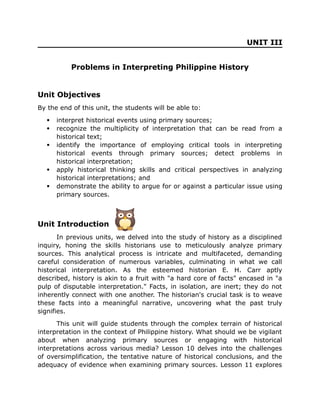
Primary Source Analysis. Read the letter below and answer the questions
that follow.
September 9, 1954
Dear Mr. Symington
I am happy learn that of the study that the National Planning Association
has making of The Philippine American Life Insurance has dramatically
profoundly demonstrated how the foreign-owned company in the Philippines
can advance its own interests by sincerely Identifying its objective with the
aspirations of people and contributing its share to national progress and
welfare.
We the Philippines are keenly aware of the national benefits private foreign
capital has brought the will bring to our country. We are building ang regaining
new strength with the valuable assistance of foreign investments, largely
American. We know that our young country vitally needs increasingly greater
amounts of the type of investment to develop our resources and train our
people in the modern skills no necessary to the improvement of our standard of
life.
The NPA study of the operations of the Philippine American Life Insurance
Company will be useful to other American companies who may be interested in
investing in this part of the world. It will also be of great interest to people
outsides the United States who could benefit, as we have, from the operation of
progressive American enterprises in their countries.
Sincerely yours,
/a/ RAMON MAGSAYSAY
President of the Philippines
Mr. Charles J.
Symington National
Planning
Association
Washington, D.C.
U.S.A.
Approved For Release 2002111/13 : CIA RDP80B01676R001100080016-7
1. What is the letter about?
2. What does the letter say about Ramon Magsaysay’s position on the
UNIT III
Problems in Interpreting Philippine History
Unit Objectives
By the end of this unit, the students will be able to:
 interpret historical events using primary sources;
 recognize the multiplicity of interpretation that can be read from a
historical text;
 identify the importance of employing critical tools in interpreting
historical events through primary sources; detect problems in
historical interpretation;
 apply historical thinking skills and critical perspectives in analyzing
historical interpretations; and
 demonstrate the ability to argue for or against a particular issue using
primary sources.
Unit Introduction
In previous units, we delved into the study of history as a disciplined
inquiry, honing the skills historians use to meticulously analyze primary
sources. This analytical process is intricate and multifaceted, demanding
careful consideration of numerous variables, culminating in what we call
historical interpretation. As the esteemed historian E. H. Carr aptly
described, history is akin to a fruit with "a hard core of facts" encased in "a
pulp of disputable interpretation." Facts, in isolation, are inert; they do not
inherently connect with one another. The historian's crucial task is to weave
these facts into a meaningful narrative, uncovering what the past truly
signifies.
This unit will guide students through the complex terrain of historical
interpretation in the context of Philippine history. What should we be vigilant
about when analyzing primary sources or engaging with historical
interpretations across various media? Lesson 10 delves into the challenges
of oversimplification, the tentative nature of historical conclusions, and the
adequacy of evidence when examining primary sources. Lesson 11 explores
the concepts of multi-perspectivity and the plurality of historical
interpretations, shedding light on how this influences our selection and
understanding of primary sources. Lesson 12 introduces the critical issue of
historical negationism, or the distortion of history to serve specific agendas,
often referred to as illegitimate historical revisionism. Finally, Lesson 13
addresses the problem of representation in the historical record, examining
how historical interpretations often reflect the biases and limitations inherent
in the sources themselves. Finally, Lesson 14 details how critical perspectives
should be employed in reading historical interpretations and how different
attitudes affect the way history is presented to the public. In this age of
digital disinformation, it is imperative that we apply historical thinking skills
to discern credible from false information and to understand the attitudes,
agendas, ideas, and interests behind the texts we engage with, especially on
social media. The skills we develop in history can guide us in identifying
sources and interpretations that are accurate, reliable, and authoritative—
because we deserve no less.
LESSON 10
Historical Interpretation
By the end of this lesson, the students will be able to:
explain problems in the historical interpretation of particular
Philippine historical events;
critique the interpretation of historical events using primary
sources; and
re-examine and assess the validity of historical interpretation in
light of newly discovered evidence.
Oversimplification – Often seen in educational or propaganda settings,
oversimplification occurs when complex historical events are reduced to
their basics to quickly convey what happened. While this approach can
make history more accessible, it risks stripping away the nuances and
deeper meanings that are essential for a full understanding.
Inadequacy – In cases where there is insufficient evidence to make
definitive conclusions about the past, some may still proceed with
historical interpretation. This can lead to incomplete or misleading
narratives that fail to fully capture the historical reality.
Tentativeness – Historical interpretation should never be considered
final or unchangeable. It must remain open to revision as new
information is uncovered, new voices are heard, and fresh interpretations
are proposed. This tentativeness is a vital part of the ongoing process of
understanding history.
While we may define history as "what happened in the past," in
practice, it is more accurately described as a dialogue among historians.
Each historian's contribution to this dialogue is an interpretation of the past,
grounded in the sources and evidence they consult. These interpretations go
beyond the basic facts of when, where, or who—they delve into the why and
how, aspects that cannot be directly extracted from the sources. When
historians write history, they do not present definitive theories; they offer
interpretations, which are only as reliable as the evidence supporting them.
These interpretations are influenced by several factors, and in this
lesson, we examine three key issues: oversimplification, inadequate
evidence, and tentativeness. Oversimplification occurs when an
interpretation lacks sufficient detail to provide a comprehensive view of the
past, potentially leading to an incomplete and inaccurate historical account.
Inadequate evidence, on the other hand, can result in interpretations that
perpetuate a flawed reading of history from the outset. Lastly, historical
interpretations are inherently tentative. As new research uncovers additional
Lesson Introduction
sources, history
may need to be
rewritten, and
evidence that
challenges
previous
accounts might
surface even
centuries later.
This dynamic
nature of history
underscores that studying history is not about memorizing answers but
about engaging with and evaluating arguments to arrive at well-reasoned,
complex, and adequately sourced conclusions.
Let's explore how these issues are exemplified in the following three
cases.
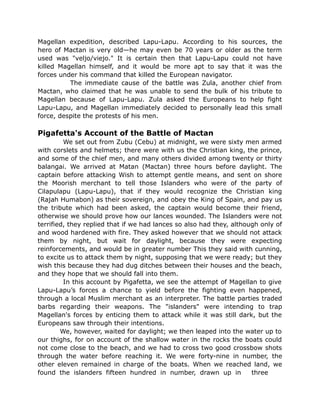
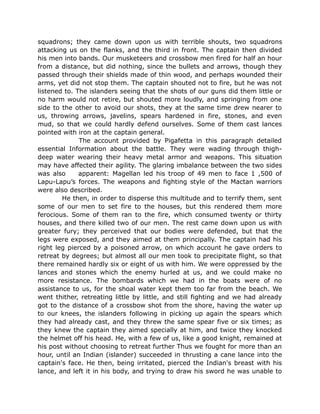
The Battle of Mactan
We all know the story of Lapu-Lapu—the chieftain of Mactan who
famously defeated Ferdinand Magellan and his small European force. This
tale is often one of the first lessons in Philippine history, symbolizing pre-
Hispanic resistance against foreign invaders. However, this widely known
version is an oversimplified account of the Battle of Mactan.
A closer examination of Pigafetta's First Voyage Around the World
reveals that the actual events of that day differ significantly from the popular
narrative we’ve been told.
Magellan reached a part of the Philippine islands, which he named Islas
de San Lazaro and claimed it in the name of Spain. In the process, he got
involved in the
conflicts of competing
chieftains in the area.
While he was able to
secure the
commitment of
Cebu's Rajah
Humabon, one
particular chief
eluded him: Mactan's Lapu-Lapu. While the primary source about the
mysterious chieftain is scarce, Gaspar Correa, a sixteenth century
Portuguese historian who obtained information from survivors of the
Magellan expedition, described Lapu-Lapu. According to his sources, the
hero of Mactan is very old—he may even be 70 years or older as the term
used was "veljo/viejo." It is certain then that Lapu-Lapu could not have
killed Magellan himself, and it would be more apt to say that it was the
forces under his command that killed the European navigator.
The immediate cause of the battle was Zula, another chief from
Mactan, who claimed that he was unable to send the bulk of his tribute to
Magellan because of Lapu-Lapu. Zula asked the Europeans to help fight
Lapu-Lapu, and Magellan immediately decided to personally lead this small
force, despite the protests of his men.
Pigafetta's Account of the Battle of Mactan
We set out from Zubu (Cebu) at midnight, we were sixty men armed
with corslets and helmets; there were with us the Christian king, the prince,
and some of the chief men, and many others divided among twenty or thirty
balangai. We arrived at Matan (Mactan) three hours before daylight. The
captain before attacking Wish to attempt gentle means, and sent on shore
the Moorish merchant to tell those Islanders who were of the party of
Cilapulapu (Lapu-Lapu), that if they would recognize the Christian king
(Rajah Humabon) as their sovereign, and obey the King of Spain, and pay us
the tribute which had been asked, the captain would become their friend,
otherwise we should prove how our lances wounded. The Islanders were not
terrified, they replied that if we had lances so also had they, although only of
and wood hardened with fire. They asked however that we should not attack
them by night, but wait for daylight, because they were expecting
reinforcements, and would be in greater number This they said with cunning,
to excite us to attack them by night, supposing that we were ready; but they
wish this because they had dug ditches between their houses and the beach,
and they hope that we should fall into them.
In this account by Pigafetta, we see the attempt of Magellan to give
Lapu-Lapu’s forces a chance to yield before the fighting even happened,
through a local Muslim merchant as an interpreter. The battle parties traded
barbs regarding their weapons. The "islanders" were intending to trap
Magellan's forces by enticing them to attack while it was still dark, but the
Europeans saw through their intentions.
We, however, waited for daylight; we then leaped into the water up to
our thighs, for on account of the shallow water in the rocks the boats could
not come close to the beach, and we had to cross two good crossbow shots
through the water before reaching it. We were forty-nine in number, the
other eleven remained in charge of the boats. When we reached land, we
found the islanders fifteen hundred in number, drawn up in three
squadrons; they came down upon us with terrible shouts, two squadrons
attacking us on the flanks, and the third in front. The captain then divided
his men into bands. Our musketeers and crossbow men fired for half an hour
from a distance, but did nothing, since the bullets and arrows, though they
passed through their shields made of thin wood, and perhaps wounded their
arms, yet did not stop them. The captain shouted not to fire, but he was not
listened to. The islanders seeing that the shots of our guns did them little or
no harm would not retire, but shouted more loudly, and springing from one
side to the other to avoid our shots, they at the same time drew nearer to
us, throwing arrows, javelins, spears hardened in fire, stones, and even
mud, so that we could hardly defend ourselves. Some of them cast lances
pointed with iron at the captain general.
The account provided by Pigafetta in this paragraph detailed
essential Information about the battle. They were wading through thigh-
deep water wearing their heavy metal armor and weapons. This situation
may have affected their agility. The glaring imbalance between the two sides
was also apparent: Magellan led his troop of 49 men to face 1 ,500 of
Lapu-Lapu’s forces. The weapons and fighting style of the Mactan warriors
were also described.
He then, in order to disperse this multitude and to terrify them, sent
some of our men to set fire to the houses, but this rendered them more
ferocious. Some of them ran to the fire, which consumed twenty or thirty
houses, and there killed two of our men. The rest came down upon us with
greater fury; they perceived that our bodies were defended, but that the
legs were exposed, and they aimed at them principally. The captain had his
right leg pierced by a poisoned arrow, on which account he gave orders to
retreat by degrees; but almost all our men took to precipitate flight, so that
there remained hardly six or eight of us with him. We were oppressed by the
lances and stones which the enemy hurled at us, and we could make no
more resistance. The bombards which we had in the boats were of no
assistance to us, for the shoal water kept them too far from the beach. We
went thither, retreating little by little, and still fighting and we had already
got to the distance of a crossbow shot from the shore, having the water up
to our knees, the islanders following in picking up again the spears which
they had already cast, and they threw the same spear five or six times; as
they knew the captain they aimed specially at him, and twice they knocked
the helmet off his head. He, with a few of us, like a good knight, remained at
his post without choosing to retreat further Thus we fought for more than an
hour, until an Indian (islander) succeeded in thrusting a cane lance into the
captain's face. He then, being irritated, pierced the Indian's breast with his
lance, and left it in his body, and trying to draw his sword he was unable to
draw it more than halfway, on account of a javelin wound which he had
received in the right arm. The enemies seeing this all rushed against him,
and one of them with a great sword, like a great scimitar gave him a great
blow on the left leg, which brought the captain down on his face, then the
Indians threw themselves upon him, and ran him through with lances and
scimitars, and all the other arms which they had, so that they deprived of
life our mirror, light, comfort, and true guide. Whilst the Indians were thus
overpowering him, several times he turned around toward us to see if we
were all in safety, as though his obstinate fight had no other object than to
give an opportunity for the retreat of his men. We who fought to extremity,
and who were covered with wounds, seeing that he was dead, proceeded to
the boats which were on the point of going away. This fatal battle was fought
on the 27th of April of 1521, on a Saturday; a day in which the captain had
chosen himself, because he had a special devotion to it. There perished with
him eight of our men, and four of the Indians, who had become Christians;
we had also many wounded, amongst whom I must reckon myself. The
enemy lost only fifteen men.
We can only imagine how the poisoned arrow hit him—it may be just
luck for the warriors, or they may have realized that the legs were better
targets because the Europeans were wearing armor that covered the upper
body. Nonetheless, it was an essential point because Magellan was defeated,
and they started to retreat to the boats. While wading to the boats, Magellan
was overcome by the Mactan warriors, who now used swords (scimitars) for
the kill.
This account of Magellan's death informs us how different we have
imagined this event. What we know as general knowledge about this battle
is an oversimplified narrative that is easy to tell. While it was true that it was
Lapu-Lapu’s forces who defeated Magellan's forces, once we base the story
from an eyewitness account, the variables of the battle become clearer.
But this account is only one account, and we cannot deny the fact
that Pigafetta was overcome by emotion seeing their leader die. He might
have even been exaggerating some aspects of the battle. For example,
would it not have terrified Magellan's forces, numbering at a measly 49, to
see the more than a thousand Mactan warriors while they waded toward the
shore? It would have been logical and easy to comprehend how grossly
outnumbered the Europeans were. Despite their more advanced weapons
and armors, it would have been obvious what was going to happen. How did
he know that the arrow that hit Magellan was poisoned, when the Europeans
never recovered Magellan's body? However, one thing is for sure: Lapu-Lapu
did not personally kill Magellan
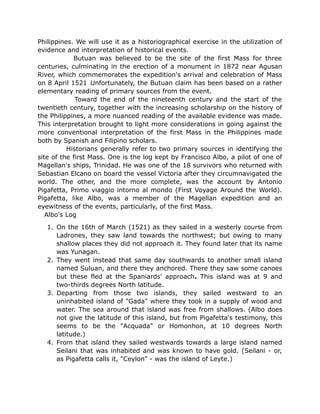
: Mactan’s Battle Royal
Using Pigafetta’s account of the Battle of Mactan, imagine you are:
1. Sports Commentator: If you were narrating the Battle of Mactan as if it
were a live sports event, how would you describe the key moments of the
battle? What details would you highlight to capture the intensity and
strategy of the confrontation?
2. News Anchor: As a prime-time news anchor reporting on the Battle of
Mactan, how would you structure your report to present the main events
and their significance? What key details would you include to ensure your
audience understands the outcome and context of the battle?
3. Ordinary Eyewitness: If you were recounting the Battle of Mactan to a
friend, what specific observations and impressions would you share? How
would you describe the scenes, actions, and emotions of the participants
to convey the experience of the battle from your perspective?
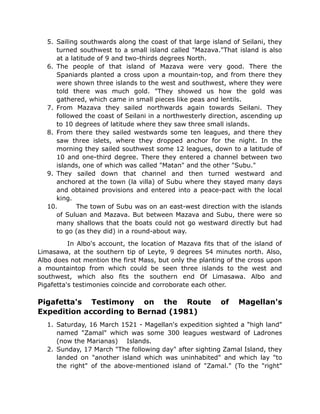
First Catholic Mass in the Philippines
The popularity of knowing where the 'Firsts" happened in history has been
an easy way to trivialize history. However, this case study will not focus on
the significance (or lack thereof) of the site of the first Catholic Mass in the
Philippines. We will use it as a historiographical exercise in the utilization of
evidence and interpretation of historical events.
Butuan was believed to be the site of the first Mass for three
centuries, culminating in the erection of a monument in 1872 near Agusan
River, which commemorates the expedition's arrival and celebration of Mass
on 8 April 1521 Unfortunately, the Butuan claim has been based on a rather
elementary reading of primary sources from the event.
Toward the end of the nineteenth century and the start of the
twentieth century, together with the increasing scholarship on the history of
the Philippines, a more nuanced reading of the available evidence was made.
This interpretation brought to light more considerations in going against the
more conventional interpretation of the first Mass in the Philippines made
both by Spanish and Filipino scholars.
Historians generally refer to two primary sources in identifying the
site of the first Mass. One is the log kept by Francisco Albo, a pilot of one of
Magellan's ships, Trinidad. He was one of the 18 survivors who returned with
Sebastian Elcano on board the vessel Victoria after they circumnavigated the
world. The other, and the more complete, was the account by Antonio
Pigafetta, Primo viaggio intorno al mondo (First Voyage Around the World).
Pigafetta, like Albo, was a member of the Magellan expedition and an
eyewitness of the events, particularly, of the first Mass.
Albo's Log
1. On the 16th of March (1521) as they sailed in a westerly course from
Ladrones, they saw land towards the northwest; but owing to many
shallow places they did not approach it. They found later that its name
was Yunagan.
2. They went instead that same day southwards to another small island
named Suluan, and there they anchored. There they saw some canoes
but these fled at the Spaniards' approach. This island was at 9 and
two-thirds degrees North latitude.
3. Departing from those two islands, they sailed westward to an
uninhabited island of "Gada" where they took in a supply of wood and
water. The sea around that island was free from shallows. (Albo does
not give the latitude of this island, but from Pigafetta's testimony, this
seems to be the "Acquada" or Homonhon, at 10 degrees North
latitude.)
4. From that island they sailed westwards towards a large island named
Seilani that was inhabited and was known to have gold. (Seilani - or,
as Pigafetta calls it, "Ceylon" - was the island of Leyte.)
5. Sailing southwards along the coast of that large island of Seilani, they
turned southwest to a small island called "Mazava."That island is also
at a latitude of 9 and two-thirds degrees North.
6. The people of that island of Mazava were very good. There the
Spaniards planted a cross upon a mountain-top, and from there they
were shown three islands to the west and southwest, where they were
told there was much gold. "They showed us how the gold was
gathered, which came in small pieces like peas and lentils.
7. From Mazava they sailed northwards again towards Seilani. They
followed the coast of Seilani in a northwesterly direction, ascending up
to 10 degrees of latitude where they saw three small islands.
8. From there they sailed westwards some ten leagues, and there they
saw three islets, where they dropped anchor for the night. In the
morning they sailed southwest some 12 leagues, down to a latitude of
10 and one-third degree. There they entered a channel between two
islands, one of which was called "Matan" and the other "Subu."
9. They sailed down that channel and then turned westward and
anchored at the town (la villa) of Subu where they stayed many days
and obtained provisions and entered into a peace-pact with the local
king.
10. The town of Subu was on an east-west direction with the islands
of Suluan and Mazava. But between Mazava and Subu, there were so
many shallows that the boats could not go westward directly but had
to go (as they did) in a round-about way.
In Albo's account, the location of Mazava fits that of the island of
Limasawa, at the southern tip of Leyte, 9 degrees 54 minutes north. Also,
Albo does not mention the first Mass, but only the planting of the cross upon
a mountaintop from which could be seen three islands to the west and
southwest, which also fits the southern end Of Limasawa. Albo and
Pigafetta's testimonies coincide and corroborate each other.
Pigafetta's Testimony on the Route of Magellan's
Expedition according to Bernad (1981)
1. Saturday, 16 March 1521 - Magellan's expedition sighted a "high land"
named "Zamal" which was some 300 leagues westward of Ladrones
(now the Marianas) Islands.
2. Sunday, 17 March "The following day" after sighting Zamal Island, they
landed on "another island which was uninhabited" and which lay "to
the right" of the above-mentioned island of "Zamal." (To the "right"
here would mean on their starboard going south or southwest.) There
they set up two tents for the Sick members of the crew and had a sow
killed for them name of this island was "l lumunu" (Homonhon). This
island was located at 10 degrees North latitude.
3. On that same day (Sunday, 17 March), Magellan named the entire
archipelago the "Islands of Saint Lazarus," the reason being that it was
Sunday in the Lenten season when the Gospel assigned for the Mass
and the liturgical Office was the eleventh chapter of St. John, which
tells of the raising of Lazarus from the dead.
4. Monday, 18 March - In the afternoon of their second day on that
island, they saw a boat coming towards them with nine men in it. An
exchange of gifts was affected. Magellan asked for food supplies, and
the men went away, promising to bring rice and other supplies in "four
days."
5. There were two springs of water on that island of Homonhon. Also,
they saw there some indications that there was gold in these islands.
Consequently, Magellan renamed the island and called it the "watering
Place of Good Omen" (Acquada la di bouni segnialli).
6. Friday, 22 March - At noon the natives returned. This time they were in
two boats, and they brought food supplies.
7. Magellan's expedition stayed eight days at Homonhon: from Sunday,
17 March, to the Monday of the following week, 25 March.
8. Monday, 25 March - In the afternoon, the expedition weighed anchor
and left the island of Homonhon. In the ecclesiastical calendar, this day
(25 March) was the feast-day of the Incamation, also called the feast
of the Annunciation and therefore "Our Lady's Day." On this day, as
they were about to weigh anchor, an accident happened to Pigafetta:
he fell into the water but was rescued. He attributed his narrow escape
from death as grace obtained through the intercession of the Blessed
Virgin Mary on her feast-day.
9. The route taken by the expedition after leaving Homonhon was
"toward the west southwest, between four islands: namely, Cenalo,
Hiunanghan, Ibusson and Albarien." Very probably "Cenalo" is a
misspelling in the Italian manuscript for what Pigafetta in his map calls
"Ceilon" and Albo calls "Seilani": namely the island of Leyte.
"Hiunanghan" (a misspelling of Hinunangan) seemed to Pigafetta to be
a separate island, but is actually on the mainland of Leyte (i.e.,
"Ceylon"). On the other hand, Hibuson (Pigafetta's Ibusson) is an
island east of Leyte's southern tip.
10. Thus, it is easy to see what Pigafetta meant by sailing "toward
the west southwest" past those islands. They left Homonhon sailing
westward towards Leyte, then followed the Leyte coast southward,
passing between the island of Hibuson on their portside and Hiunangan
Bay on their starboard, and then continued southward, then turning
westward to "Mazaua
11. Thursday, 28 March - In the morning of Holy Thursday, March
28, they anchored off an island where the previous night they had
seen a light or a bonfire. That island "lies in a latitude of nine and two-
thirds towards the Arctic Pole (i.e., North) and in a longitude of one
hundred and sixty-two degrees from the line of demarcation. It is
twenty-five leagues from the Acquada, and is called Mazaua.
12. They remained seven days on Mazaua Island.
13. Thursday, 4 April - They left Mazaua, bound for Cebu. They were
guided thither by the king of Mazaua who sailed in his own boat. Their
route took them past five "islands": namely: "Ceylon, Bohol, Canighan,
Baibai, and Gatighan."
14. At Gatighan, they sailed westward to the three islands of the
Camotes Group, namely, Poro, Pasihan and Ponson. Here the Spanish
ships stopped to allow the king of Mazaua to catch up with them, since
the Spanish ships were much faster than the native balanghai-a thing
that excited the admiration of the king of Mazaua.
15. From the Camotes Islands they sailed southwards towards
"Zubu."
16. Sunday, 7 April - At noon they entered the harbor of "Zubu"
(Cebu). It had taken them three days to negotiate the journey from
Mazaua northwards to the Camotes Islands and then southwards to
Cebu.
Pigafetta and Seven Days in Mazaua according to Bernad
(1981)
1. Thursday, 28 March - In the morning they anchored near an island
where they had seen a light the night before a small boat (boloto) came
with eight natives, to whom Magellan threw some trinkets as presents.
The natives paddled away, but two hours later two larger boats
(balanghai) came, in one of which the native king sat under an awning
of mats. At Magellan's invitation some of the natives went up the
Spanish ship, but the native king remained seated in his boat. An
exchange of gifts was affected. In the afternoon that day, the Spanish
ships weighed anchor and came closer to shore, anchoring near the
native king's village. This Thursday, 28 March, was Thursday in Holy
Week: i.e., Holy Thursday.
2. Friday, 29 March - "Next day. Holy Friday," Magellan sent his slave
interpreter ashore in a small boat to ask the king if he could provide
the expedition with food supplies, and to say that they had come as
friends and not as enemies. In reply to the king himself came in a boat
with six or eight men, and this time went up Magellan's ship and the
two men embraced. Another exchange of gifts was made. The native
king and his companions returned ashore, bringing with them two
members of Magellan's expedition as guests for the night. One of the
two was Pigafetta.
3. Saturday, 30 March - Pigafetta and his companion had spent the
previous evening feasting and drinking with the native king and his son.
Pigafetta deplored the fact that, although it was Good Friday, they had
to eat meat. The following morning (Saturday) Pigafetta and his
companion took leave of their hosts and returned to the ships.
4. Sunday, 31 March "Early in the morning of Sunday, the last of March
and Easter day," Magellan sent the priest ashore With some men to
prepare for the Mass. in the morning Magellan landed with some fifty
men and Mass was celebrated, after which a cross was venerated
Magellan and the Spaniards returned to the ship for the noon-dav meal,
but in the afternoon they returned ashore to plant the cross on the
summit of the highest hill In attendance both at the Mass and at the
planting of the cross were the king of Mazaua and the king of Butuan.
5. Sundav, 31 March - On that same afternoon, while on the summit of the
highest hill, Magellan asked the two kings which ports he should go to
In order to obtain more abundant supplies of food than were available
on that island. They replied that there were three ports to choose from
Ceylom Zubu, and Calagan. Of the three, Zubu was the port with the
most trade. Magellan then said that he wished to go to Zubu and to
depart tyæ following morning. He asked for someone to guide him
thither. The kings replied that the pilots would be available "any time."
But later that evening the king of Mazaua changed his mind and said
that he would himself conduct Magellan to Zubu but first he would first
have to bring the harvest in. He asked Magellan to send him men to
help with the harvest.
6. Monday, 1 April - Magellan sent men ashore to help with the harvest,
but no work was done that day because the two kings were sleeping off
their drinking bout the night before.
7. Tuesday, 2 April and Wednesday, 3 April - Work on the harvest during
the "next two days," i.e., Tuesday and Wednesday, the 2nd and 3rd of
April.
8. Thursday, 4 April - They leave Mazaua, bound for Cebu.
Using the primary sources available, Jesuit priest Miguel A. Bemad, in
his work Butuan or Limasawa: The Site of the First Mass in the Philippines: A
Reexamination of Evidence (1981 argued that in the Pigafetta account, a
crucial aspect of Butuan was not mentioned—the river. Butuan is a riverine
settlement, situated on the Agusan River. The beach of Masao is in the delta
of said river. It is a curious omission in the account of the river, which makes
part of a distinct characteristic of Butuan's geography that seemed to be too
important to be missed.
It must also be pointed out that later on, after Magellan's death, the
survivors of his expedition went to Mindanao, and seemingly went to Butuan.
In this instance, Pigafetta vividly describes a trip up a river. But note that
this account already happened after Magellan's death, and the Catholic Mass
should have occurred even before the Battle of Mactan.
: Butuan and Limasawa News
"Search for 'the first Mass in the Philippines' on Google and look for recent
news about the controversy. Take note of the evidence presented by both
the Butuan and Limasawa proponents. Prepare to share your findings in
class."
Rizal’s Retraction
Jose Rizal is identified as a hero of the revolution for his writings
that Center on ending colonialism and liberating Filipino minds to contribute
to creating the Filipino nation. The great volume of Rizal's lifework was
committed to this end, particularly the more influential ones, Noli Me
Tangere and El Filibusterismo. His essays vilified not the Catholic religion,
but the friars, the primary agents of injustice in the Philippine society.
It is understandable, therefore, that any piece of writing from Rizal
that recants everything he has written against the friars and the Catholic
Church in the Philippines could deal substantial damage to his image as a
prominent Filipino revolutionary. Such a document purportedly exists,
allegedly signed by Rizal a few hours before his execution. This document,
referred to as "The Retraction," declares belief in the Catholic faith, and
retracts everything he has written against the Church.
Rizal's Retraction (Translation of the document found by
Fr. Manuel Garcia)
C.M. on 18 May 1935
I declare myself a Catholic and in this Religion in which I was born
and educated I wish to live and die. I retract with all my heart whatever in
my words, writings, publications and conduct has been contrary to my
character as son of the Catholic Church. I believe and I confess whatever
she teaches and I submit to whatever she demands. I abominate Masonry,
as the enemy which is of the Church, and as a Society prohibited by the
Church.
The Diocesan Prelate may, as the Superior Ecclesiastical Authority,
make public this spontaneous manifestation of mine in order to repair the
scandal which my acts may have caused and so that God and people may
pardon me.
Manila 29 of December of 1896 Jose Rizal
There are several iterations of the texts of this retraction: the first
was published in La Voz Espanola and Diario de Manila on the day of the
execution, 30 December 1896. The second text appeared in Barcelona,
Spain, in the magazine La Juventud, a few months after the execution, 14
February 1897, from an anonymous writer who was later on revealed to be
Fr. Vicente Balaguer. However, the "original" text was only found in the
archdiocesan archives on 18 May 1935, after almost four decades of
disappearance.
Doubts on the retraction document abound, primarily because only
one eyewitness account of the writing of the document exists—that of the
Jesuit friar Fr. Vicente Balaguer. He claimed he "was the one who assisted
Rizal most of that sad day's hours" and even "argued with him and
demolished his arguments." According to his testimony, Rizal woke up
several times, confessed four times, attended a Mass, received communion,
and prayed the rosary, all of which seem out of character. But since it is the
only testimony of allegedly a "primary" account that Rizal ever wrote a
retraction document, it has been used to argue the authenticity of the
document.
Another eyewitness account surfaced in the last decade. Among the
1,000 reports found in the Cuerpo de Vigilancia collection published in 2011,
around 30 are about Rizal, and eight of these reports on the last hours of
Rizal, written by Federico Moreno. The report details the statement of
Moreno to the Cuerpo de Vigilancia.
Eyewitness Account of the Last Hours of Rizal
Most Illustrious Sir, the agent of the Cuerpo de Vigilancia stationed in
Fort Santiago to report on the events during the (illegible) day in prison of
the Jose Rizal, informs me on this date of the following:
At 7:50 yesterday morning, Jose Rizal entered death row
accompanied by his counsel. Senor Taviel de Andrade, and the Jesuit priest
[Josel Vilaclara. At the urgings of the former and moments after entering, he
was served a light brvakfast. At approximately 9, the Adjutant of the
Garrison, Senor [Eloyl Maure, asked Rizal if he wanted anything. He tvplied
that at the moment he only wanted a prayer book which was brought to him
shortly by Father [Estanislao] March.
Señor Andrade left death row at 10 and Rizal spoke for a long while
with the Jesuit fathers, March and Vilaclara, regarding religious matters, it
seems. It appears that these two presented him with a prepared retraction
on his life and deeds that he refused to sign. They argued about the matter
until 12:30 when Rizal ate some poached egg and a little chicken.
Afterwards he asked to leave to write and wrote for a long time by himself.
At 3 in the afternoon, Father March entered the chapel and Rizal
handed him what he had written. Immediately the chief of the firing squad,
Señor [Juan] del Fresno and the Assistant of the Plaza, Senor Maure, were
informed. They entered death row and together with Rizal signed the
document that the accused had written. It seems this was the retraction.
From 3 to 5:30 in the afternoon, Rizal read his prayer book several
times, prayed kneeling before the altar and in the company of Fathers
Vilaclara and March, read the Acts of Faith, Hope and Charity repeatedly as
well as the Prayers for the Departing Soul.
At 6 in the afternoon the following persons arrived and entered the
chapel, Teodora Alonzo, mother of Rizal, and his sisters, Lucia, Maria,
Olimpia, Josefa, Trinidad and Dolores. Embracing them, the accused bade
them farewell with great strength of character and without shedding a tear.
The mother of Rizal left the chapel weeping and carrying two bundles of
several utensils belonging to her son who had used them while in prison.
A little after 8 in the evening, at the urgings of Seior Andrade, the
accused was served a plate of tinola, his last meal on earth. The Assistant of
the Plaza, Señor Maure and Fathers March and Vilaclara visited him at 9 in
the evening. He rested until 4 in the morning and again resumed praying
before the altar.
At 5 this morning of the 30th, the lover of Rizal arrived at the prison
accompanied by his sister Pilar, both dressed in mourning. Only the former
entered the chapel, followed by a military chaplain whose name I cannot
ascertain. Donning his formal clothes and aided by a soldier of the artillery,
the nuptials of Rizal and the woman who had been his lover were performed
at the point of death (in articulo mortis). After embracing him she left'
flooded with tears.
Rizal heard mass and confessed to Father March. Afterwards he
heard another mass where he received communion. At 7:30, a European
artilleryman handcuffed him and he left for the place of execution
accompanied by various Jesuits, his counsel and the Assistant of the Plaza.
Father March gave him a holy picture of the Virgin that Rizal kissed
repeatedly.
When the accused left, I noticed he was very pale but I am very
certain that all the time he was imprisoned he demonstrated great strength
of Character and composure.
God grant Your Excellency.
Manila 30 December 1896.
This account corroborates the existence of the retraction document,
giving it credence. However, nowhere in the report was Fr. Balaguer
mentioned. This discrepancy is a blow to the priest's claim of being a
credible source.
The retraction of Rizal remains to this day a controversy; many
scholars, however, agree that the document does not tarnish the heroism of
Rizal. His relevance remained solidified to Filipinos and pushed them to
continue the revolution, which eventually resulted in independence in 1898.
: Stepping into Rizal's Shoes
Imagine yourself in José Rizal's position, imprisoned in Fort Santiago,
knowing that your execution is imminent. How do you think he felt in
those final days? If you were in his shoes, what emotions would you be
experiencing?
Instructions:
1. Pair Up: Get into pairs and discuss your insights. Consider the range of
emotions Rizal might have felt—fear, hope, despair, or even peace—and
compare them to how you think you would have felt.
2. Prepare to Share: After your discussion, be ready to share your
thoughts with the class.
 Historical interpretation is at the heart of historical analysis, and
historians interpret the past based on primary sources as evidence.
 Some historical interpretations suffer from oversimplification,
inadequate evidence, and tentativeness.
 The Battle of Mactan was oversimplified; based on the evidence,
Lapulapu was not the young warrior we imagine him to be, and he
did not personally kill Magellan. The battle was won because of the
Mactan's warriors, whose strategy and sheer number easily
defeated the Europeans.
 A closer analysis of primary accounts of the first Catholic Mass show
that it did not happen in Masao, Butuan, but instead in Limasawa,
Leyte.
 Rizal may have retracted his statements against the Catholic faith.
Still, scholars agree that this does not tarnish Rizal's heroism today.
Angeles, J. A. (2007). The Battle of Mactan and the Indigenous Discourse on
War. Philippine Studies 55(1 pp. 3—52.
Bernad, M. A. (1981). Butuan or Limasawa? The Site of the First Mass in the
Philippines. A Reexamination of Evidence. Kinaadman: A Journal of Southern
Philippines 3, pp. 1—35.
Escalante, R. (2019). Did Rizal Die a Catholic? Revisiting Rizal's Last 24
Hours Using Spy Reports. Southeast Asian Studies 8(3), pp. 369—386.
pigafetta, A. (1969). First Voyage Around the World. Manila: Filipiniana Book
Guild.
Escalante, R. (2019). Did Rizal Die a Catholic? Revisiting Rizal's Last 24
Hours Using Spy Reports. Southeast Asian Studies 8(3), pp. 369—386.
Retrieved 4 February 2021 from: http://bit.ly/RdgsPHJ1
GMA Public Affairs. (2017). Lapu Lapu. I Witness. Retrieved 4 February 2021
from: http://bit.ly/RdgsPHJ2
Pigafetta, A. (1874). First Voyage Around the World. London: Hakluyt
Society.
Retrieved 4 February 2021 from: http•]/bit.ly/RdgsPHJ3
PODKAS. (2021). Did Rizal Retract? [Podcast). Retrieved 4 February 2021
from: http://bit.ly/RdgsPHJ4
PODKAS. (2021). Did Rizal Retract? [Podcast). Retrieved 4 February 2021
from: http://bit.ly/RdgsPHJ4
PODKAS. (2021). Where did the First Mass happen? (Podcast). Retrieved 4
February 2021 from: http://bit.ly/RdgsPHJ5
PODKAS. (2021). Who killed Magellan? (Podcast). Retrieved 4 February 2021
from: http://bit.ly/RdgsPHJ6
PTV (Philippine Television Network). (2017, 1 January). Xiao Time:
Retraction ni Jose Rizal, totoo kaya? (YouTube video). Retrieved 4 February
2021 from: http://bit.ly/RdgsPHJ7
Reading and Analyzing Interpretations. Read the excerpt below and
answer the questions that follow.
"The monument (to the first Mass) erected in 1872 at Magallanes, near
Butuan... was near the river-edge and after a few decades went underwater...
In 1953 as was sent to the National Historical Committee (today, NHCP)
asking that the Butuan monument be rehabilitated...to comply with it would
give the impression that the Philippine government was giving official sanction
to the tradition that the first Mass had been celebrated in Butuan. On 11
December 1953 they [the committee) passed a resolution to rehabilitate...but
stipulated that the marble slab with the inscription claiming that this was the
site of the first Mass should be removed "for revision purposes."
It is easy to understand why the defenders of the Butuan tradition should have
been offended by what...seemed like a high-handed arbitrary rejection of their
claim They were not shown why the Butuan tradition was wrong.
In 1978. a more honorable future was being prepared for that monument. The
municipal authorities were constructing a concrete pedestal...to mount
monument. That monument should be preserved. In its own right it is a
historic artifact. But the historical error in the 1872 inscription should be
pointed out for what it is: a historical error."
Miguel A. Bernard. (1981). Butuan or Limasawa?
The Site of the First Mass in the Philippines: A Reexamination of
Evidence, Kinaadman: A Journal of Southern Philippines 3, p.35.
1. Based on Bernard’s analysis, it is evident that Limasawa is identified as
the site of the first Mass. In two to three sentences, explain the key
arguments that support the Limasawa tradition.
2. Bernard claims that the defenders of the Butuan tradition were not
shown why they were wrong. In two to three sentences, explain the
arguments of the Butuan tradition.
3. What do you think does the author means when he said that the
monument was "in its own right a historic artifact"? Explain in two
sentences.
LESSON 11
Multi-Perspectivity
By the end of this lesson, the students will be able to:
employ multi-perspectivity in analyzing historical interpretations;
compare and contrast the prevailing perspectives of an event's primary
accounts; and
assess the authenticity of conflicting and competing accounts of an
event.
Multi-perspectivity – Viewing historical events, figures, and cultures
from multiple perspectives, using methods fundamental to historical
analysis.
Mutiny – An open rebellion against authority, typically by soldiers or
sailors against their officers.
Polos’y Servicios – A forced labor system derived from the encomienda
system.
Insurrection – A violent uprising against authority or government.
Multi-perspectivity is an approach to understanding historical events,
figures, developments, cultures, and societies through multiple lenses. This
concept highlights that there are various valid perspectives, each offering
partial truths. Critics argue that historical writing inherently carries biases,
shaped by the historian’s choice of sources, interpretations, and underlying
agendas. Historians might selectively use evidence, omit crucial facts, or
impose ideologies that skew the narrative, leading to unbalanced
interpretations. They may also oversimplify events by attributing them to a
single cause, ignoring other possible factors. These are ways in which
historians can falter in their analysis. Multi-perspectivity, however,
acknowledges the discrepancies, contradictions, and ambiguities in historical
interpretations, emphasizing that they are often subjects of debate and
dissent.
The three cases in this
lesson are essential events in
Philippine history that could
be seen through different
vantage points. The Cavite
Mutiny in 1872 paved the
way for the Philippine
Revolution. The Cry of the
Rebellion in 1896 marked the revolutionary events that led to Philippine
independence in 1898. The Philippine American War from 1899 to 1902 is
the continuation of the revolution against Spain now focused against the
Lesson Introduction
United States. In all these events, we see two dis sides: the Filipino versus
the colonizers, Spain and the United States. This lesson discusses how these
two sides are apparent in the primary sources used to write the history of
these events.
The Cavite Mutiny
The year 1872 is a historic year of two events: the Cavite Mutiny and
the martyrdom of the three priests, Mariano Gomez, Jose Burgos, and
Jacinto Zamora later on immortalized as GOMBURZA. These events directly
influenced the decisive events of the Philippine Revolution toward the end of
the century. While the significance is unquestioned, what made this year
controversial is the different sides to the story, a battle of perspectives
supported by primary sources. In this case study, we zoom in to the events
of the Cavite Mutiny, a significant factor in the awakening of nationalism
among the Filipinos of that time.
The documentation of Spanish historian Jose Montero y Vidal centered
on how the event was an attempt to overthrow the Spanish government in
the Philippines Although regarded as a historian, his account of the mutiny
was criticized as woefully biased and rabid for a scholar. Another account
from the official report written by then Governor-General Rafael Izquierdo
implicated the native clergy, who were active the secularization movement.
These two accounts corroborated each other.
Excerpts from Montero's Account of the Cavite Mutiny
The abolition of privileges enjoyed by the laborers of the Cavite
arsenal of exemption from the tribute was, according to some, the cause of
the insurrection. There were, however, other causes.
The Spanish revolution which overthrew a secular throne; the
propaganda carried on by an unbridled press against monarchical principles,
attentatory of the most sacred respects towards the dethroned majesty; the
democratic and republican books and pamphlets; the speeches and
preaching’s of the apostles of these new ideas in Spain; the outbursts of the
American publicists and the criminal policy of the senseless Governor whom
the Revolutionary government sent to govern the Philippines, and who put
into practice these ideas were the determining circumstances which gave
use, among certain Filipinos, to the idea of attaining their independence. It
was towards this goal that they started to work, with the powerful assistance
of a certain section of the native clergy, who, out of spite toward friars,
made common cause with the enemies of the mother country.
At various times but especially in the beginning of the year 1872, the
authorities received anonymous communications with the information that a
great uprising would break out against the Spaniards, the minute the fleet at
Cavite left for the South, and that all would be assassinated, including the
friars. But nobody gave importance to these notices. The conspiracy had
been going on since the days of La Torre with utmost secrecy. At times, the
principal leaders met either in the house of Filipino Spaniard, D. Joaquin
Pardo de Tavera, or in that of the native priest, Jacinto Zamora, and these
meetings were usually attended by the curate of Bacoor, the soul of the
movement, whose energetic character and immense wealth enabled him to
exercise a strong influence
Excerpts from the Official Report of Governor Rafael
Izquierdo on the Cavite Mutiny of 1872
...It seems definite that the insurrection was motivated and prepared
by the native clergy, by the mestizos and native lawyers, and by those
known here as abogadillos...
The instigators, to carry out their criminal project, protested against
the injustice of the government in not paying the provinces for their tobacco
crop, and against the usury that some practice in documents that the
Finance department gives crop owners who have to sell them at a loss. They
encouraged the rebellion by protesting what they called the injustice of
having obliged the workers in the Cavite arsenal to pay tribute starting
January 1 and to render personal service, from which they were formerly
exempted.
Up to now it has not been clearly determined if they planned to
establish a monarchy or a republic, because the Indios have no word in their
language to describe this different form of government, whose head in
Tagalog would be called hari; but it turns out that they would place at the
head of the government a priest... that the head selected would be D. Jose
Burgos, or D. Jacinto Zamora...
Such is... the plan of the rebels, those who guided them, and the means
they counted upon for its realization.
These two accounts underscore the reason for the "revolution": the
abolition of privileges enjoyed by the workers of the Cavite arsenal such as
exemption from payment of tribute and being employed in Polos
Servicios’y or forced labor. They also identified other reasons which
seemingly made the issue a lot more serious, which included the presence of
the native clergy, who, out of spite against the Spanish friars, "conspired and
supported" the rebels. Izquierdo, in a biased report, highlighted that attempt
to overthrow the Spanish government in the Philippines, to install a new
"harr in the persons of Fathers Burgos and Zamora. According to him, native
clergy attracted supporters by giving them the Charismatic assurance that
the fight will not fail because they have God's support, aside from promises
of high rewards such as employment, wealth, and ranks in the army.
In the Spaniards' accounts, the event of 1872 was planned and is part
of a big conspiracy among the educated leaders, mestizos, lawyers, and
residents of Manila Cavite. They allegedly plan to liquidate high-ranking
Spanish officers, then kill the friars. The signal they identify among these
conspirators of Manila and Cavite was the rockets fired from Intramuros.
The accounts detail that on 20 January 1872, the district of Sampaloc
celebrated the feast of the Virgin of Loreto and came with it were some
firework displays. The Caviteños allegedly mistook this as the signal to
commence with the attack. The 200-men contingent led by Sergeant
Lamadrid attacked Spanish officers at sight and seized the arsenal. Izquierdo
ordered the reinforcements in Cavite to quell the revolt upon learning of the
attack. The "revolution" was quickly crushed when the Manileños, who were
expected to aid the Caviteños, did not arrive. Leaders of the plot were killed
in the resulting skirmish, while Fathers Gomez, Burgos, and Zamora were
tried by a court-martial and sentenced to be executed. Others were
implicated, such as Joaquin Pardo de Tavera, Antonio Ma. Regidor, Jose and
Pio Basa, and other Filipino lawyers. They were suspended from the practice
of law, arrested, and sentenced to life imprisonment at the Marianas Islands.
Izquierdo dissolved the native regiments of artillery and ordered the creation
of an artillery force composed exclusively by Peninsulares.
On 17 February 1872, the GOMBURZA were executed to serve as a
threat to Filipinos never to attempt to fight the Spaniards again.
Two other primary accounts exist that counter the accounts of
Izquierdo and Montero. First, the account of Dr. Trinidad Hermenigildo Pardo
de Tavera, a Filipino scholar and researcher, who wrote a Filipino version of
the bloody incident in Cavite.
Excerpt from Pardo de Tavera's Account of the Cavite
Mutiny
This uprising among the soldiers in Cavite was used as a powerful level
by the Spanish residents and by the friars...the Central Government in
Madrid had announced its intention to deprive the friars in these islands of
powers of intervention in matters of civil government and of the direction
and management of the university... it was due to these facts and promises
that the Filipinos had great hopes of an improvement in the affairs of their
country, while the friars, on the other hand, feared that their power in the
colony would soon be a complete thing of the past..
...Up to that time there had been no intention of secession from Spain,
and the only aspiration of the people was to secure the material and
education advancement of the country...
According to this account, the incident was merely a mutiny by Filipino
soldiers and laborers of the Cavite arsenal. Soldiers and laborers of the
arsenal to the dissatisfaction arising from the draconian policies of Izquierdo,
such as the aboliti0n of privileges and the prohibition of the founding of the
school of arts and trades for Filipinos, which the general saw as a smoke
screen to creating a political club.
Tavera believed that the Spanish friars and Izquierdo used the Cavite
Mutiny as a way to address other issues by blowing out of proportion the
isolated mutiny attempt. During this time, the Central Government in Madrid
was planning to deprive the friars of all the powers of intervention in matters
of civil government and direction and management of educational
institutions. The friars needed something to justify their continuing
dominance in the country, and the mutiny provided such an opportunity.
However, the Central Spanish Government introduced an educational
decree fusing sectarian schools run by the friars into a school called the
Philippine Institute. The decree aimed to improve the standard of education
in the Philippines by requiring teaching positions in these schools to be filled
by competitive examinations, an improvement welcomed by most Filipinos.
Another account, this time by French writer Edmund Plauchut,
complemented Tavera's account and analyzed the motivations of the 1872
Cavite Mutiny.
Excerpts from Plauchut’s Account of the Cavite Mutiny
General La Torre... created a junta composed of high officials...
including some friars and six Spanish officials.... At the same time there was
created by the. Government in Madrid a committee to investigate the same
problems submitted to the Manila committee. When the two finished work, it
was found that they came to the same conclusions. Here is the summary of
the reforms they considered necessary to introduce:
1. Changes in tariff rates at customs, and the methods of collection.
2. Removal of surcharges on foreign importations.
3. Reduction of export fees.
4. Permission for foreigners to reside in the Philippines, buy real estate,
enjoy freedom of worship, and operate commercial transports flying
the Spanish flag.
5. Establishment of an advisory council to inform the Minister of Overseas
Affairs in Madrid on the necessary reforms to be implemented.
6. Changes in primary and secondary education.
7. Establishment of an Institute of Civil Administration in the Philippines,
rendering unnecessary the sending home of short-term civil officials
every time there is a change of ministry.
8. Study of direct-tax system.
9. Abolition of the tobacco monopoly.
...The arrival in Manila of General Izquierdo... put a sudden end to all
dreams of reforms... the prosecutions instituted by the new Governor
General were probably expected as a result of the bitter disputes
between the Filipino clerics and the friars. Such a policy must really end in a
strong desire on the part of the other to repress cruelly.
In regard to schools, it was previously decreed that there should be in
Manila a Society of Arts and Trades to be opened in March of 1871... to
repress the growth of liberal teachings, General Izquierdo suspended the
opening of the school... the day previous to the scheduled inauguration...
The Filipinos had a duty to render service on public road construction and
pay taxes every year. But those who were employed at the maestranza of
the artillery, in the engineering shops and arsenal of Cavite, were exempted
from this obligation since time immemorial... Without preliminaries of any
kind, a decree by the Governor withdrew from such old employees their
retirement privileges and declassified them into the ranks of those who work
on public roads.
The friars used the incident as a part of a larger conspiracy to cement
their dominance, which has started to show cracks because of the discontent
of the Filipinos. They showcased the mutiny as part of a broader plot by
Filipinos to overthrow the Spanish government. Unintentionally, and more
so, prophetically, the Cavite Mutiny of 1872 resulted in the martyrdom of
GOMBURZA and paved the way to the revolution culminating in 1898.
: Buzz Session
1. Group Division: The class will be divided into three groups, each
assigned one perspective on the Cavite Mutiny:
- (1) Filipino accounts
- (2) Spanish accounts
- (3) Other perspectives
2. Discussion: Each group will discuss their assigned version of the mutiny
for a set period.
3. Mixed Groups: Afterward, students will form new groups of three, each
with a representative from the original groups.
4. Comparison and Analysis: In these mixed groups, students will share
their accounts and discuss which perspective they believe is the strongest
and weakest, providing reasons for their evaluations.
The Cry of Rebellion
Momentous events swept the Spanish colonies in the late nineteenth
century, including the Philippines. Journalists of the time referred to the
phrase El Grito de Rebelion or Cry of Rebellion to mark the start of these
revolutionary events, identifying the places where it happened. In the
Philippines, this happened in August 1896, Northeast of Manila, where the
Katipuneros declared rebellion against Spain. These events are essential
markers in the history of colonies that struggled for their independence
against their colonizers.
The controversy regarding this event stems from the identification of
the date and place where the Cry happened. Prominent Filipino historian
Teodoro Agoncillo emphasized the event when Bonifacio tore the cedula or
tax receipt before the Katipuneros, who also did the same. Some writers
identified the first military event with the Spaniards as the moment of the
Cry, for which Emilio Aguinaldo commissioned an "Himno de Balintawak" to
inspire the renewed struggle after the Pact of the Biak-na-Bato failed. A
monument to the Heroes of 1896 was erected in what is now the
intersection of Epifanio de los Santos (EDSA) Avenue and Andres Bonifacio
Drive-North Diversion road, and from then on until 1962, the Cty Of
Balintawak was celebrated every 26 August. The site of the monument was
chosen for an unknown reason.
Various accounts gave different dates and places. Below are three
accounts of the Cry from three eyewitnesses: Guillermo Masangkay, Pio
Valenzuela, and Santiago Alvarez.
Accounts of the Cry
Guillermo Masangkay
On August 26th, a big meeting was held in Balintawak, at the house of
Apolonio Samson, then the cabeza of that barrio of Caloocan. Among those
who attended, I remember, were Bonifacio, Emilio Jacinto, Aguedo del
Rosario, Tomas Remigio, Briccio Pantas, Teodoro Plata, Pio Valenzuela,
Enrique Pacheco, and Francisco Carreon. They were all leaders of the
Katipunan and composed the board of directors of the organization.
Delegates from Bulacan, Cabanatuan, Cavite, and Morong were also present.
At about nine o'clock in the morning of August 26, the meeting was
opened with Andres Bonifacio presiding and Emilio Jacinto acting as
secretary. The purpose was to discuss When the uprising was to take place.
Teodoro Plata, Briccio Pantas, and Pio Valenzuela were all opposed to
starting the revolution too early... Andres Bonifacio, sensing that he would
lose in the discussion then, left the session hall and talked to the people,
who were waiting outside for the result of the meeting of the leaders. He
told the people that the leaders were arguing against starting the revolution
early and appealed to them in a fiery speech in which he said: "You
remember the fate of our countrymen who were shot in Bagumbayan.
Should we return now to the towns, the Spaniards will only shoot us. Our
organization has been discovered and we are all marked men. If we don't
start the uprising, the Spaniards will get us anyway. What then, do you say?"
"Revolt!"' the people shouted as one.
Bonifacio then asked the people to give a pledge that they were to
revolt. He told them that the sign of slavery of the Filipinos were (sic) the
cedula tax charged each citizen. "If it is true that you are ready to revolt... I
want to see you destroy your cedulas. It will be a sign that all of us have
declared our severance from the Spaniards."
Pio Valenzuela
The first place of refuge of Andres Bonifacio, Emilio Jacinto, Procopio
Bonifacio, Teodoro Plata, Aguedo del Rosario, and myself was Balintawak,
the first five arriving there on August 19, and I, on August 20, 1896. The
first place where some 500 members of the Katipunan met on August 22,
1896, was the house and yard of Apolonio Samson at Kangkong. Aside from
the persons mentioned above, among those who were there were Briccio
Pantas, Alejandro Santiago, Ramon Bernardo, Apolonio Samson, and others.
Here, views were only exchanged, and no resolution was debated or
adopted. It was at Pugad Lawin, the house, store-house, and yard of Juan
Ramos, son of Melchora Aquino, where over 1,000 members of the
Katipunan met and carried out considerable debate and discussion on August
23, 1896.
The discussion was on whether or not the revolution against the
Spanish government should be started on August 29, 1896... After the
tumultuous meeting, many of those present tore their cedula certificates and
shouted "Long live the Philippines! Long live the Philippines!".
Santiago Alvarez
We started our trek to Kangkong at about eleven that night. We
walked through the rain over dark expanses of muddy meadows and fields.
Our clothes drenched and our bodies numbed by the cold wind, we plodded
wordlessly. It was nearly two in the morning when we reached the house of
Brother Apolonio Samson in Kangkong. We crowded into the house to rest
and warm ourselves. We were so tired that, after hanging our clothes out to
dry, we soon fell asleep. The Supremo began assigning guards at five o'clock
the following morning, Saturday 22 August 1896. He placed a detachment at
the Balintawak boundary and another at the backyard to the north of the
house where we were gathered. No less than three hundred men assembled
at the bidding of the Supremo Andres Bonifacio. Altogether, they carried
assorted weapons, bolos, spears, daggers, a dozen small revolvers and a
rifle used by its owner, one Lieutenant Manuel, for hunting birds. The
Supremo Bonifacio was restless because of fear of sudden attack by the
enemy. He was worried over the thought that any of the couriers carrying
the letter sent by Emilio Jacinto could have been intercepted; and in that
eventuality, the enemy would surely know their whereabouts and attack
them on the sly. He decided that it was better to move to a site called Bahay
Toro. At ten o'clock that Sunday morning, 23 August 1896 we arrived at
Bahay Toro. Our member had grown to more than 500 and the house, yard,
and warehouse of Cabesang Melchora was getting crowded with us
Katipuneros. The generous hospitality of Cabesang Melchora was no less
than that of Apolonio Samson. Like him, she also opened her granary and
had plenty of rice pounded and animals slaughtered to feed us. The following
day, Monday, 24 August, more Katipuneros came and increased our number
to more than a thousand. The Supremo called a meeting at ten o'clock that
morning inside Cabesang Melchora's barn. Flanking him on both sides at the
head of the table were Dr. Pio Valenzuela, Emilio Jacinto, Briccio Pantas,
Enrique Pacheco, Ramon Bernardo, Pantelaon Torres, Francisco Carreon,
Vicente Fernandez, Teodoro Plata, and others. We were so crowded that
some stood outside the barn. The following matters were approved at the
meeting: (1) An uprising to defend the people's freedom was to be started
at midnight of Saturday, 29 August 1896; (2) To be on a state of alert so
that the Katipunan forces could strike should the situation arise where the
enemy was at a disadvantage. Thus, the uprising could be started earlier
than the agreed time of midnight of 29 August 1896 should a favorable
opportunity arise at that date. Everyone should steel himself and be resolute
in the struggle that was imminent; and (3) The immediate objective was the
capture of Manila.
After the adjournment of the meeting at twelve noon, there were
tumultuous shouts of "Long live the Sons of the People!
From the eyewitness accounts presented, there is indeed marked
disagreement among historical witnesses as to the place and time of the
occurrence of the Cry. Four sites have been identified using primary and
secondary sources: Balintawak, Kangkong, Pugad Lawin, and Bahay Toro,
while the dates vary: 23, 24, 25, or 26 August 1896. Historian Jim
Richardson organized all propositions based on existing primary accounts, as
seen below:
Source Locations
Mentioned
Notes
Pio Valenzuela
(1911)
Kangkong Says the decision to revolt was taken at
Kangkong on August 23.
Pio Valenzuela, "Ang Sigaw sa Balintawak,"
Taliba, September 11, 1911.
Pio Valenzuela
(1917)
Pasong
Tamo
Says the decision to revolt was taken by
the General
Assembly on August 23 at the house of
Melchora Aquino on Daan-malalim, "in
Pasong Tamo, also known as Pacpac-
lawin."
"Testimony of Dr. Pio Valenzuela in the
Case of U.S. vs Vicente Sotto for Libel,"
[19171 in Minutes of the Kåtipunan, 234.
Labi ng
Katipunan,
marker (1917)
Kangkong Says the decision was taken at Kangkong
on August 23 — "Sa pook na ito...ipinasya
ng KKKNMANB ang paghihimagsik noong
ika-23 ng Agosto 1896."
Medina in Ronquillo, llang talata, 208.
Tomas Remigio
(1917)
Kangkong Says the decision was taken at Kangkong —
"nanditoy amin na ngang pinasiyahang
ituloy ang revolucion..."
Tomas Remigio, Untitled memoir [c. 1917]
in
Borromeo-Buehler, The Cry of Balintawak,
178.
Pio
Valenzuela
(c.i 920s)
Pugad
Lawin
(location
not
specified)
Says the revolutionists met in Kangkong on
August 22, but the decision was taken on
August 23 at Juan Ramos's place at Pugad
Lawin, and the "CM followed the decision.
Pio Valenzuela, "Memoirs," [c. 1920s]
translated by Luis Serrano, in Minutes of
the Katipunan, 102.
Julio Nakpil
(1925)
Kangkong Says the "primergritd' was raised at
Kangkong on August 26.
Julio Nakpil, "Apuntes para la historia de La
Revoluci6n Filipino de Teodoro M. Kalaw," in
Julio
Nakpil and the Philippine Revolution, with
the
Autobiography of Gregoria de Jesus (Manila:
Heirs of Julio Nakpil, 1964), 43.
Sinforoso San
Pedro (1925)
Kangkong Says the decision was taken in Kangkong.
Quoted in Sofronio G. Calderon, "Mga
nangyari sa kasaysayan ng Pilipinas
ayon sa pagsasaliksik ni Sofronio G.
Calderon" (Typescript, 1925), 211—2.
Ramon
Bernardo
[attrib. JR] in
Alvarez
(1927)
Bahay Toro Says the decision was taken and affirmed
("pinagkaisahan at pinagtibaY') on August
24 at Bahay Toro, but says the place
belonged to Melchora Aquino.
Alvarez, The Katipunan and the Revolution,
254.
Guillermo
Masangkay
(1929-57)
Kangkong Says in 1929 and 1957 that the decision was
taken at Kangkong, giving the date as
August 26. Agoncillo's notes of an interview
with Masangkay in 1947, however, says he
recalled the date was August 24.
1929: Guillermo Masangkay, draft article
written in response to a statement by Pio
Valenzuela that had been published in La
Vanguardia, n.d., in BorromeoBuehler, The
CryofBalintawak, 102; 112.
1947: Teodoro A. Agoncillo, "Pakikipanayam
sa Kgg.
Guillermo Masangkay, noong ika-ll Oktubre
1947," in Borromeo-Buehler, The Cry of
Balintawak, 182.
1957: Arturo Ma. Misa, "Living Revolutionary
Recalls
Freedom 'Cry'," The Saturday Weekend Mirror,
August 24, 1957, cited in Borromeo-Buehler,
The Cry of Balintawak, 36-7.
Cipriano
Pacheco
(1933)
Kangkong
and
Pugad
Lawin
(location
not
specified)
Says the decision was taken at Kangkong,
("nang ipahayaå na ang pinagkasunduan...")
but that the revolutionists then went to a
place "nearbV' known as Pugad Lawin
(location not specified), where Bonifacio
announced the decision and cedulas were
torn.
José P. Santos, "Ang kasaysayan sa
paghihimagsik ni
Heneral Cipriano Pacheco," Lingguhan ng
Mabuhay, Disyembre 3, 1933, cited by
Medina in Ronquillo, llang talata, 675-6.
Briccio
Pantas (c.
1935)
Kangkong Says he witnessed the debate in Kangkong
on whether the revolution should be
launched but left before the decision was
made.
Briccio Pantas, Undated declaration [c. 1935]
given to José P. Santos and included in his
unpublished manuscript, "Si Andres Bonifacio
at ang Katipunan," 1948, in Borromeo-
Buehler, The Cry of Balintawak, 144.
Francisco
Carreon
(1936)
Kangkong Says the decision was taken at Kangkong —
"kaya lumabas ang Supremo at inihayag ang
pinagkaisahan sa mga kapatid na nag-aantay
ng pasya."
Francisco Carreon, Untided memoir, in José P.
Santos, Ang tatlong na tulisan sa Pilipinas
(Tarlac,
1936), in Borromeo-Buehler, The Cry of
Balintawak, 158.
Vicente
Samson
(1961)
Kangkong Says the decision was taken at Kangkong on
August 26.
Ernesto A. Flores, "He was There: Man recalls
first Cry," The Evening News, August 26,
1961, in Gregorio F. Zaide, Documentary
Sources of Philppine History, vol.8 (Manila:
National Bookstore, 1990), 310-3.
Valenzuela's account should be read with caution: He once told a
Spanish investigator that the "CM' happened in Balintawak on Wednesday,
26 August 1896 Much later, he wrote in his Memoirs of the Revolution that it
happened at pugad Lawin on 23 August 1896. Such inconsistencies in
accounts should always be seen as a red flag when dealing with primary
sources.
According to Milagros Guerrero, Emmanuel Encarnacion, and Ramon
Villegas in an article titled Balintawak: The Cry for a Nationwide Revolution,
all these places are in Balintawak, then part of Caloocan, now, in Quezon
City. As for the dates, Bonifacio and his troops may have been moving from
one place to another to avoid being located by the Spanish government,
which could explain why there are several accounts of the Cry.
: Class Polling
After studying the different accounts of the Cry of Rebellion, which do you
think is the most compelling date and place of the event? The class will
vote on their choices, and the results will be discussed using the following
discussion points:
(1) What is the reason behind your chosen date and place?
(2) Is it important to identify where the Cry of Rebellion happened? Why
or why not?
(3) Propose an alternative way of dealing with this historical issue. What
can be done to end this confusion with differing accounts?
Philippine-American War or Insurrection?
The Philippine-American War continued the struggle for
independence of Filipino revolutionaries against Spain. This time, it was
against a new colonizer, the United States. In April 1898, the United States
went to war with Spain, and on May 1, the Americans destroyed the Spanish
fleet in Manila Bay. The Filipino revolutionary leaders, exiled in Hong Kong,
returned to the Philippines, and General Emilio Aguinaldo established a
government and gained control of much of Luzon by June 1898. During this
time, the U.S. government under President William McKinley was interested
in the Philippines and its commercial potential. Spain ceded the Philippines
to the United States in the Treaty of Paris in December 1898, and fighting
broke out between Aguinaldo's forces and the U.S. troops in Manila. The
Filipinos were adamant in their desire to resist the U.S. takeover.
McKinley's Decision on the Philippines
When next I realized that the Philippines had dropped into our laps, I
confess I did not know what to do with them. I sought counsel from all sides
— Democrats as well as Republicans—but got little help. I thought first we
would take only Manila; then Luzon; then other islands, perhaps, also.
I walked the floor of the White House night after night until midnight;
and I am not ashamed to tell you, gentlemen, that I went down on my
knees and prayed to Almighty God for light and guidance more than one
night. And one night late it came to me this way—I don't know how it was,
but it came:
1) That we could not give them back to Spain—that would be cowardly
and dishonorable;
2) That we could not turn them over to France or Germany, our
commercial rivals in the Orient-that would be bad business and
discreditable;
3) That we could not leave them to themselves—they were unfit for self-
government, and they would soon have anarchy and misrule worse
than Spain's was; and
4) That there was nothing left for us to do but to take them all, and to
educate the Filipinos, and uplift and civilize and Christianize them and
by God's grace do the very best we could by them, as our fellow men
for whom Christ also died.
And then I went to bed and went to sleep, and slept soundly, and the
next morning I sent for the chief engineer of the War Department (our map-
maker), and I told him to put the Philippines on the map of the United
States (pointing to a large map on the wall of his office), and there they are
and there they will stay while I am President!
The war had two phases. The first phase was dominated by
Aguinaldo's failed conventional warfare against the better trained and
equipped U.S. troops, lasting from February to November 1899. The second
phase was marked by the Filipinos' shift to guerrilla warfare, which lasted
from November 1899 until 1902, when U.S. President Theodore Roosevelt
declared the conflict over. The fighting on the side of the Filipinos continued,
sporadic and periodic, until 1913.
Historians have disagreed on what to call the war between the United
States and the Philippines. Historically, the U.S. government has referred to
it as the Philippine Insurrection. Insurrection is defined as "a violent uprising
against an authority or government." Scholars, especially Filipinos, refer to
the conflict as "the Philippine-American War," as war is defined as "a state of
armed conflict between nations, states, or different groups within a nation's
state."
Why did the United States see the conflict as an insurrection? For
them, the Philippines was already a territory of the United States of America
under the Treaty of Paris in 1899. The United States did not recognize
Aguinaldo's government and deemed any challenge made by Filipinos an
insurgency, an insurrection. Filipino historians in the 1950s saw the conflict
with the United States as that of a young nation asserting its identity and
denied the legalistic interpretation. In the same breath, would the United
States allow the American Revolutionary War to be referred to as the
American Insurrection against Great Britain?
Semper Vigilans, an anonymous Filipino personally authorized by Gen.
Emilio Aguinaldo, wrote a scathing article that was published in the North
American Review in 1899. It talks about the disconnect between the
foundation principles of the United States and what it was doing to the
Philippines.
Excerpts of "Aguinaldo's Case Against the United States by
a Filipino"
We Filipinos have all along believed that if the American nation at
large knew exactly, as we do, what is daily happening in the Philippine
Islands, they would rise en masse, and demand that this barbaric war should
stop. There are other methods of securing sovereignty—the true and lasting
sovereignty that has its foundation in the hearts of the people. And, did
America recognize this fact, she would cease to be the laughing stock of
other civilized nations, as she became when she abandoned her traditions
and set up a double standard of government—government by consent in
America, government by force in the Philippine Islands...
You have been deceived all along the line. You have been greatly
deceived in the personality of my countrymen. You went to the Philippines
under the impression that their inhabitants were ignorant savages, whom
Spain had kept in subjection at the bayonet's point The Filipinos have been
described in serious American journals as akin to the hordes of the Khalifa;
and the idea has prevailed that it required only some unknown American
Kitchener to march triumphantly from north to south to make the military
occupation complete. We have been represented by your popular press as if
we were Africans or Mohawk Indians. We smile, and deplore the want of
ethnological knowledge on the part of our literary friends. We are none of
these. We are simply Filipinos. You know us now in part: you will know us
better, I hope, by and by.
Little over a hundred years ago, it was extremely questionable,
when you, also, were rebels against the English Government, if you could
govern yourselves. You obtained the opportunity, thanks to political
combinations and generous assistance at the critical moment. You passed
with credit through the trying period when you had to make a beginning of
governing yourselves, and you eventually succeeded in establishing a
government on a republican basis, which, theoretically, is as good a system
of government as needs be, as it fulfills the just ideals and aspirations of the
human race.
Now, the moral of all this obviously is: Give us the chance; treat us
exactly as you demanded to be treated at the hands of England, when you
rebelled against her autocratic methods. . . Now, here is a unique spectacle
—the Filipinos fighting for liberty, the American people fighting them to give
them liberty.
"Lay down your arms," you say. Did you lay down your arms when
you, too, were rebels, and the English under good King George demanded
your submission? How in the name of all that is serious do you demand that
we shall do what you, being rebels, refused to do?
Our friend, Admiral Dewey, will undoubtedly have something to say to
your president when he reaches home. He caught the genius of the
Philippine people, and if he had been left alone many valuable lives would
have been spared and many millions of treasures saved. Be convinced, the
Philippines are for the Filipinos. We are a virile race. We have never
assimilated with our former oppressors, and we are not likely to assimilate
with you.
This anonymous author, who may have been Apolinario Mabini, was
talking to the American people regarding the unfair depiction of Filipinos and
the U.S. government's intent to take over the Philippines. The article made a
critical point: the Philippines is a young country, no different from the United
States who fought for its independence against the British, that the U.S.
colonies were also seen as rebels, and that while the United States is
manifesting its military might in its conquest of the Philippines, the Filipinos
have never assimilated with its former oppressors, and that they are not
likely to assimilate with the United States as well.
Thus, when the United States referred to the conflict from 1899 to
1902 as Philippine Insurrection, it was linguistically hinting that the Filipinos
were fighting a legitimate authority. But when Filipinos referred to the
Philippine-American War, they were asserting the validity of the Filipino
struggle for independence and the legitimacy of the Filipino nation.
: Graphic Organizer and Debate on
Terminology
1. Group Task: Students will be divided into groups, with each group
tasked with creating a graphic organizer that represents the arguments
supporting both:
- (1) The term "Philippine-American War"
- (2) The term "Philippine Insurrection"
2. Critical Argumentation: Each group will then develop and present a
well-reasoned argument explaining why "War" is a more accurate and
appropriate term than "Insurrection" in describing the conflict.
3. Presentation and Defense: Groups will present their graphic organizers
and arguments to the class, defending their choice of terminology and
addressing any counterarguments.
 Multi-perspectivity is a way of interpreting history by looking at
different perspectives of the past. There is no single objective
narrative of historical events. Instead, multiple coexisting
perspectives of the past could be equally valid and also equally
partial.
 The Spanish regime under the reactionary Governor-General
Izquierdo magnified the Cavite Mutiny and used it to persecute
Filipinos who had been advocating reform in the government. A
closer look at other primary sources shows that the mutiny was
caused by an order to subject some soldiers to personal taxes, from
which they were previously exempt.
 There are different competing accounts of the Cry of Rebellion that
started the Philippine Revolution. While some historians agree that
the precise dates and location are not exceptionally important, many
are still convinced that more in-depth research needs to be done to
mark this important event accurately.
 The Philippine-American War, the continuation of the struggle for
independence, is not an insurgency. To refer to it as the "Philippine
Insurrection" is to demote the memory of the Philippine Revolution,
the struggle for independence, and the creation of the Filipino nation.
Alvarez, S. (1998). Katipunan and the Revolution: Memoirs of a General.
Quezon City: Ateneo de Manila University Press.
Diokno, M. S. I. (1997). Perspectives on Peace during the Philippine-
American War of 1899—1902. South EastAsia Research 5(1), pp. 5—19.
Gotera, (2006). Past Perfect: War and the Mistakes of History. North
American Review 291(2), p. 52.
Guerrero, M. C., Encarnacion, E. N., & Villegas, R. N. (1996). "Balintawak:
The Cry for a Nationwide Revolution." Originally published in Sulyap Kultura,
Quarterly Magazine. National Commission for Culture and the Arts, 1996.
Retrieved 4 February 2021 from: http://bit.ly/RdgsPHK
Kramer, P. A. (2006). Race-Making and Colonial Violence in the U.S. Empire:
The Philippine-American War as Race War. Diplomatic History 30(2), pp. 169
—210.
No Author (1899). "Aguinaldo's Case Against the United States" By a Filipino
(1899, September)." The Nonh American Review 169 (514), pp. 425 & 430.
Richardson, J. (2019). Notes on the "Cry" ofAugust 1896. Unpublished
Manuscript. Retrieved 4 February 2021 from: http://bit.ly/RdgsPHKl
Rusling, J. (1903). Interview with President William McKinley. The Christian
Advocate. Retrieved 4 February 2021 from: http://bit.ly/RdgsPHK2
Stradling, R. (2003). Multiperspectivity in history teaching: A guide for
teachers. Strasbourg: Council of Europe.
Zaide, G., & Zaide, S. (1990). Documentary Sources of Philippine History.
Volume 7. Manila: National Book store, 269-286; 301-309.
Guerrero, M. C., Encarnacion, E. N., & Villegas, R. N. (1996). Balintawak:
The Cry for a Nationwide Revolution. Originally published in Sulyap Kultura,
Quarterly Magazine. National Commission for Culture and the Arts, 1996.
Retrieved 4 February 2021 from: http://bit.ly/RdgsPHK
PODKAS. (2021). What happened in the Cavite Mutiny? [Podcast]. Retrieved
4 February 2021 from: http://bit.ly/RdgsPHK3
PODKAS. (2021 When and where did the Cry of Rebellion take place?
[Podcast].
Retrieved 4 February 2021 from: http://bit.ly/RdgsPHK4
PTV (Philippine Television Network). (2013, 21 January). Xiao Time: Ang
pagaaklas sa Cavite [YouTube video]. Retrieved 4 February 2021 from:
http://bit. ly/RdgsPHK5
PTV (Philippine Television Network). (2015, 20 August). Xiao Time: Ang
Unang Sigaw ng Himagsikan sa Balintawak, Caloocan [YouTube video].
Retrieved 4 February 2021 from: http://bit.ly/RdgsPHK6
Richardson, J. (2019). Notes on the "CM' of August 1896. Retrieved 4
February 2021 from: http://bit.ly/RdgsPHK1
Reading and Analyzing Interpretations. Read the excerpt below
and answer the questions that follow
"That night of August 19, Andres Bonifacio, together with Jacinto, Procopio
Bonifacio, Teodoro Plata and Aguedo del Rosario slipped through the cordon
of Spanish sentries, reaching Balintawak before midnight. Pio Valenzuela
LESSON 12
1) Based on Agoncillo's interpretation of the Cry of the Rebellion, whose
primary account was he using? Identify at least three details on the
previous page that correspond to your chosen account.
_______________________________________________________
_______________________________________________________
_______________________________________________________
_______________________________________________________
2) How would you describe the way the author depicted the event?
_______________________________________________________
_______________________________________________________
_______________________________________________________
_______________________________________________________
3) What do you think is the problem of interpretation in Agoncillo's
version of the Cry of the Rebellion? Identify at least one and defend
your answer.
_______________________________________________________
_______________________________________________________
_______________________________________________________
_______________________________________________________
HISTORICAL NEGATIONISM
By the end of this lesson, the students will be able to:
differentiate historical revisionism and negationism;
examine how history could be twisted to forward an agenda; and
assess the veracity of claims put forward by historical propaganda in
social media.
Revisionism – The re-evaluation of historical accounts based on new
evidence or interpretations. This can be legitimate, involving professional
historians refining our understanding, or illegitimate, known as
negationism, which distorts history for propaganda purposes.
Negationism – The denial and distortion of historical facts, also referred
to as illegitimate revisionism, often used as a tool for propaganda.
Radicalization – The process of encouraging someone to adopt extreme
political or social views.
Cronyism – The practice of appointing friends and associates to positions
of power, often disregarding qualifications, to advance personal interests
and gain benefits.
When historians revise history, they engage in a legitimate and scholarly re-
examination of existing historical knowledge. This process is undertaken when new
perspectives or evidence emerge, prompting a careful and methodical reassessment
of past events. Such revisions are rooted in a commitment to academic rigor,
transparency, and fidelity to the historical record. However, the reinterpretation of
history can also be conducted illegitimately, often with a deliberate intent to
mislead, malign, or promote a specific agenda. While this too is a form of
revisionism, when history is distorted to deny, obscure, or falsify historical crimes, it
crosses into what is known as illegitimate historical revisionism or negationism.
Historical negationism is characterized by attempts to rewrite the past through
ethically unacceptable methods. These methods may include the use of forged
documents presented as authentic, the concoction of spurious yet seemingly
plausible interpretations of historical records, the manipulation of statistical data to
support biased conclusions, the mistranslation of texts, the selective editing of
photographs, and a range of other deceptive practices. The ultimate goal of
negationism is to obfuscate the truth, to recast perpetrators as heroes, or to falsely
portray certain figures as "victims of historical interpretation," despite
overwhelming evidence to the contrary. This insidious form of revisionism seeks not
to uncover the past but to distort it, often to serve contemporary political,
ideological, or personal interests.
Studying history and its methodologies equips us with critical tools to
navigate and counter the rampant misinformation and distortion that persist today.
In this lesson, we will explore three significant cases of illegitimate historical
revisionism: the fabricated attribution of the poem “Sa Aking Mga Kabata” to José
Rizal, the Marcos regime's attempt to legitimize its rule and position it as an
inevitable part of the Filipino people's destiny through the “Tadhana” project, and
the denial of the Jabidah Massacre. By examining these cases, we gain insight into
Lesson Introduction
how history is manipulated and negated. This exploration will also encourage us to
be more discerning and critical when encountering various historical claims,
especially those proliferating on platforms like the Internet.
Rizal's Sa Aking Mga Kabata
Rizal is known for his works Noli Me Tangere and El Filibusterismo, which stoked the
flames of revolution. We all grew up knowing that he was a genius. He spoke
several languages and was proficient in both the arts and sciences. We also know
that he was a genius from a very young age, having written a poem in Tagalog at
the age of eight. Every Buwan ng Wika, we hear his famous words: Ang hindi
magmahal sa sariling wika, higit pa sa hayop at malansang isda (He who does not
love his own language is worse than a beast and a stinking fish). We accepted this
because it was consistent with the Rizal we knew, but through a careful analysis of
the poem, scholars have proven that Rizal could not have written it, in fact, at any
point in his life.
Sa Aklng Mga Kabata
Kapagka ang baya'y sadyang umiibig sa
kanyang salitang ka106b ng langit, sanlang Kalayaan
nasä ring masapit katulad ng ibong na sa himpapawid.
Pagkat ang salita'y isang kahatulan sa bayan,
sa nayot mga kaharian, at ang isang tao'y katulad,
kabagay ng alin mang likhå noong kalayaan.
Ang hindt magmahål sa kanyang salitå
mahigft sa hayop at malansang isdå, kayå ang
marapat pagyamaning kuså na tulad sa inång tunay na
nagpalå.
Ang wikang tagålog tulad din sa latin, sa
inglés, kastilä, at salitang angel,
sa pagka ang Poong maalam tumingin syang
nag-gawad, nagbigay sa atin.
Ang salitå nati'y huad din sa ibå na may
alfabedo at sariling letra, na kayå nawala'y dinatnån
ng sigwa ang lunday sa lawå noong dåkong una.
Source: Hermenegildo Cruz. (1906). Kun Sino ang
Kumathå né "Florante" pp. 187-188.
To My Fellow Children
Whenever people of a country truly love
The language which by heav'n they were
taught to use
That country also surely liberty pursue
As does the bird which soars to freer space
above.
For language is the final judge and referee
Upon the people in the land where it holds
sway; In truth our human race resembles in this way
The other living beings born in libeny.
Whoever knows not how to love his native
tongue Is worse than any beast or evil smelling fish.
To make our language richer ought to be our
wish The same as any mother loves to feed her young.
Tagalog and the Latin language are the same
And English and Castilian and the angels'
tongue; And God, whose watchful care o'er all is flung,
Has given us His blessing in the speech we
claim,
Our mother tongue, like all the highest that
we know Had alphabet and letters of its very own;
But these were lost -- by furious waves were
overthrown Like bancas in the stormy sea, long years
ago.
Translation by Frank C. Laubach
Source: Gregorio F. Zaide. (1957). Jose Rizal, Life,
Works, and Writings. Quezon CRY. National Book
Store, p. 16.
In 1991, historian Ambeth Ocampo noted that the documentation of the
poem is lacking, and the original manuscript does not exist. Rizal has been known
to be very careful about documenting his life and meticulous in keeping these
documents. Otherwise, we would not have been able to know more about his life
and his activities. If Rizal wrote this poem, he must have kept it, or at least referred
to it in his letters to friends and family—after all, writing poetry at age eight is by
no means an easy feat.
The poem's earliest appearance was in 1906, when Hermenegildo Cruz, a
nationalist writer and union organizer, included it in his book Kun Sino ang Kumathå
né "Florante," a biography of Francisco Balagtas. Cruz noted that he got the poem
from Gabriel Beato Francisco, who got the poem from a certain Saturnino Raselis of
Lucban, a teacher in Majayjay in 1884 and a "very close friend of Rizal who gave
him a copy of this poem himself." Prominent Rizal biographer Austin Coates told a
different origin story, saying that the poem was "copied from hand to hand... one of
the very rare copies of this poem came many years later into the hands of Antonio
Luna... to whom it owes its survival." Despite the very problematic provenance of
the poem, it reached canon status in the twentieth century, and Filipinos just
accepted the poem, as it was consistent with Rizal's image of defiance against
Spain.
In 2002, Rizal scholar Nilo Ocampo argued that Rizal could not have written
the poem because it included the word "kalayaan." In an 1886 letter to his brother
Paciano, Rizal shared that while he was translating a story from German to Tagalog,
he lacked many words, one of which was Freiheit or liberty. He wrote, "The Tagalog
word kaligtasan cannot be used, because this means that formerly he was in prison,
slavery, etc. I found in the translation of Amor Patrio the nouns malayå and
kalayahan that Marcelo del Pilar used. In the only Tagalog book, I have—Florante—l
doesn’t find an equivalent noun." Ocampo asked, "Was it possible that Rizal forgot
or did not use the word kalayaan in the sixteen years that passed since he wrote
the poem? Or was it that those who found the poem admired it so much that they
believed without a doubt that only a genius like Rizal could have written it, even as
a child?" National Artist for Literature Virgilio Almario traced the use of the words
laya or kalayaan to mean "freedom" or "liberty" and found that the term was not
used until del Pilar used it in 1882. Old Tagalog dictionaries, such as that of San
Buenaventura in 1613, list the word mahar/ica for libertad (liberty) and timaua for
libre (free). Kalayaan only appeared in a dictionary in 1889, when writings of
Filipino revolutionaries have already popularized it.
For Rizal to even write about freedom at eight years old is a wonder by itself
and radical at best, because it was clear in Rizal's works that he was fighting for
reforms in the colonial government, and the fight for freedom from Spain will only
materialize among his peers in 1892 with the Katipunan. Rizal himself marked his
"radicalization" with’ his witnessing of injustice and cruelty through the execution Of
the GOMBURZA in 1872.
These are some of the central positions that belie the claim that Rizal wrote the
poem Sa Aking Mga Kabata. Now, this begs the question: what is there to gain by
claiming that Rizal wrote the poem? Rizal is already a prominent Filipino hero even
before the 1900s as his name became a rallying cry of the revolutionaries What
could be a more probable reason was to elevate Tagalog as a national language.
The Philippines in the early 1900s was an odd mix of languages, as Spanish was
still the official language while the United States has stepped in to propagate the
use of English. This poem, attributed to Rizal, might have been integral to argue for
Tagalog as the national language because even the "national hero" asserted its use.
After all, it is just as good as Spanish, English, and "the language of angels." A
committee 1936 investigated the major languages of the country and decided that
Tagalog Will be the basis of a national language to be developed. President Manuel
L. Quezon declared the same through Executive Order No. 134, series of 1937.
: Fact-checking a Viral Facebook Post
Below is a viral Facebook post about the alleged "friend-zoning" of a
certain "Analyn Bernabe" by prominent Filipino hero Jose Rizal during their
“days" at the University of Santo Tomas. Read the text and answer the
questions that follow. You may google the answers to questions 1 to 3.
My Great-Grandma Was Friendzoned by Jose Rizal In College
My great-grandma's journal was found in 1953, all in Spanish text. My
tito, a Modern Languages student, translated it into English during the
1990's. You can read Analyn Bernabe's journal compilation titled "A
Mediocre Lady" at Valenzuela City 'Library Hub.
This is an entry from the journal portraying the relationship of my great-
grandma and Jose Rizal during their college days in UST:
"We were there. It was just us. As always, it was just us. Before you can
reach granite-surfaced azotea, you ought to climb a narrow cedar ladder
mounted on the wall first. It seemed like a restriction and a turn-off to
most. That was why they didn't to seek the refuge of that roof. Pepe said
that people are just like that. They are back down whenever the path
doesn't look so pretty.
"José didn't mind whenever I accompanied him at the Medicine's roof, just
seated there in an Indian manner. He simply read and read as he listened
to me talk. From time to time, he would give commentary after my long
burst of emotions.
' "I know it was improper. I know it was a big inconvenience if we ever got
caught. Considering there was no companion or chaperone. But there was
no need for a chap for there was nothing. I didn't even know what he
thought of me, He never even invited me to that roof. Every time, I was
the one who would emerge there abruptly while he was drowsily
comprehending a text there, leaning back on the stovepipe.
"It felt so good listening to him talk. But it hurt whenever his voice would
utter 'Leonor Rivera.' He spoke in a carefree manner about her. She wasn't
even from Santo Tomas. In my opinion, a man should pick a lady who
goes to the same university as he does. Besides, they had a gap of six
years, for God's sake.
"I know for a fact that José Realonda was a poet. So, one nautical twilight,
while my finger circled the grains of granite, I talked beside him with
words having innuendo behind.
'"Should you care what society thinks when you want someone?' I casually
asked while he was contemplating Roughing It by Mark Twain.
'"I think you shouldn't.' His aloof reply.
'"And is distance necessary if you love someone?' I slipped gradually.
There was at present an aura of coldness in him.
"'I think, Analyn, you have a shallow definition of love.' I was so
frustrated that he seemed not to get it or seemed to intend not to.
'"What do you think of me?' I was desperate. I didn't care now what the
other ladies would think. I didn't care now whether my roots disown me.
However, he grinned at me understandingly.
"'You're a lost angel. A lost and sad angel. I know angels like you who
wander around everyday seeking for their haven to rest from forever. I'm
not your haven. I'm not the one who would soothe your tired body from
all this waiting. This ain't your place to settle your wings. IVs somewhere
else, I guess."'
MyGrandma&JoseRizaIAffair
Not From UST, 2010
1. Jose Rizal spent the years 1877—1882 at UST When were women
allowed to enroll in the university?
2.When was the book Roughing It by Mark Twain published? What was the
language of the book? When and where did Rizal learn to read and speak
English?
3.Is Analyn a Spanish name?
4.What do you think is the intent of this Facebook post?
Marcos and History
Ferdinand Marcos was the only official dictator that the Philippines ever
had since total independence from the United States in 1946. His
dictatorship was consolidated when he declared Martial Law in 1972. In the
first few years, Marcos' justification for such a declaration was the escalating
threat of communism. In the following years, however, when the military
had succeeded in repressing the underground movement, Marcos had to
come up with a new justification. The next phase of his dictatorship focused
on the creation of the New Society.
In the process of creating the framework for such a vision, Marcos
sought the assistance of scholars, intellectuals, and experts. One of the
works of Marcos that aimed at making sense of his New Society was Today's
Revolution Democracy. Although the authorship of this work (as in some of
his other works) is disputed, the book was an embodiment of Marcos' actions
that justify the New Society. In this piece, Marcos' goal was to frame his
regime as a revolution and to place himself as the heir of what historian
Reynaldo Ileto dubbed as the Unfinished Revolution of 1898. By doing so,
Marcos not only branded himself as revolutionary, but also seized the
revolutionary trope from the radical opposition.
Marcos knew the value of scholarship and was conscious of the
permanence of historical judgment. He was particularly wary on the way that
he would be judged by history. In one of his diary entries in October 1970,
Marcos wrote:
"I often wonder what will I be remembered in history for. Scholar? Military
hero? Builder? The new constitution? Reorganization of government? United
of the variant and antagonistic elements of our people? He brought light to
our dark country? Strong rallying point or a weak tyrant?"
Inspired by British Prime Minister Winston Churchill, Marcos wanted
to ensure that history would be kind to him by venturing in an ambitious
historical project where he employed topnotch Filipino historians to write a
multi-volume Philippine History under his name. The series was entitled
Tadhana: The History of the Filipino People. The project started in 1974 and
was headed by several historians from the University of the Philippines.
Marcos cared so much about the project that he allocated 10 million pesos
for its completion. The period of the project's take-off coincided with the
creation of other books written by and for Marcos and intended to justify
Martial Law and the New Society. Aside from this, Marcos also wanted to
have Tadhana written because he feared and distrusted historians. During
his first term, he said that he thought it was necessary to "correct" the
negative portrayal that is bestowed on him by-the academe and mass media
alike. Tadhana was meant to be used by Marcos to explain himself to the
future generations who would study his presidency long after he is gone.
Since Marcos hired topnotch historians, it is only expected that their
output will be nothing short of excellent. The plan was to cover the history of
the Philippines from as far back as 300 million BCE to the present (Marcos
era). This extremely long period was supposed to consist of 19 volumes. Of
the envisioned 1 9, only three
volumes were published. These are Volume I, which tackled the evolution of
the Philippine Island World; Volume 2 Part 1, which covered the world in the
1500s and the early encounters with the Europeans; and Volume 2 Part 3,
which covered most of the Spanish colonial period.
The most striking feature Of the Tadhana project was its radical shift
in perspective. Whereas previous Philippine History books use the country's
colonial past as its anchor, Tadhana attempted to demonstrate that our
colonial experience is just one period in the long history of the Filipino
people. Unlike other historical works that usually start with the arrival of the
Spaniards, Tadhana gave due emphasis to the ancient Philippine history that
had been developing long before the sixteenth century. Tadhana was
nationalist and argued for the greatness of our Filipino civilization. Tadhana
or destiny in English narrated how the Filipino people had a higher purpose
and that its society, battered by periods of colonization, was destined to
reach greatness and become the New Society. Through a kind of no.
nonsense historicizing of our greatness as a people, Marcos attempted to
inject his regime as the logical and historical next step.
The project was never completed. The historians who worked on the project
claimed that they finished the manuscript and submitted it to the Malacafian.
However, when Marcos was ousted through the EDSA People Power in 1986,
what remained of the 19-volume work was never found until today, though
some copies of the few volumes that were published are still sold or
auctioned. Few people knew of this project and did little to nothing in
ensuring that history would be kind to Marcos and his dictatorship.
However, despite the consensus among scholars and historians about
the failure of Marcos and his authoritarian experiment, a lot of people still
fall for the revisionist and negationist version of the history of Marcos regime
and Martial Law. In 2016, more than 30 years after the death of Marcos in
Hawaii, his remains were stealthily buried at the Heroes' Cemetery. Pro-
democracy groups and progressive activists protested against this move.
Still, social media platforms contain a lot of pro-Marcos and revisionist
historical claims about his regime. Some common assertions are that the
years of his presidency were the Golden Age of the Philippine economy, that
Marcos was the best president that the country has ever had, and that the
charges of corruption against him and his family were fabricated cases. A lot
of historical and scholarly works had been written to dispute these claims.
By the beginning of the 1980s, the country was hammered with inflation,
unemployment, and poverty. The Marcos era ushered the worst debt and
economic crisis ever experienced by the country.
One of the most popular claims of those who hoist the Marcos years as
golden years was the number of infrastructure projects done by the
government like hospitals, roads, bridges, expressways, and schools. They
conveniently omit the fact that those projects were financed by constant
borrowing of money from foreign institutions, and that those projects were
undertaken by contractors who were cronies of Marcos, and that despite the
continuous increase in highways, expressways, and cultural centers,
hundreds of thousands of Filipinos were still poor and hungry. There is no
need to go into detail about the false historical claims made by
propagandists regarding the Marcos years. The point here is to demonstrate
how history can be used, distorted, and twisted to serve the interest of a
particular individual to let him escape accountability and be glorified falsely.
: Watch the Video
"Need to Know, Totoo bang Golden Age ng Pilipinas and panahon ng mga
Marcos?" from this link: http://bit.ly/RdgsPHL. While watching, list down
the arguments presented by experts on why the Marcos years were far
from being a golden age. Share your thoughts about the video during the
class discussion.
The Jabidah Massacre
The Moros or Muslims in the Philippines have had a long history of
resistance against foreign rule from the Spanish to the Americans, and later
against the Philippine government. All of these regimes have relegated the
Moros as second-class citizens. For centuries, and with multiple strategies to
this resistance, the Moros' political awakening would come in 1968 during
the Marcos presidency and his quest to regain Sabah from Malaysia.
Operation Merdeka was led by General Eduardo Martelino of the
Armed Forces of the Philippines who went to Sulu and Tawi-Tawi to recruit for
a "special mission"; young men (a number ranging from 11 to 68 people)
eagerly joined for the prospect of becoming part of the prestigious military
and having a stable income. They flew to Corregidor in late 1967 to be
trained, and later they were named the "Jabidah" unit. However, after a few
months, the training soured for several reasons. While the unit was
dissolved, Jibin Arula, one of the members Of the Jabidah unit, relayed a
gruesome story of a massacre, of which he was the lone survivor.
Known sources on this incident would be his narration as an alleged survivor
of the massacre, and Ninoy Aquino's speech in the Senate based on his
investigation in Sutu. Both texts are excerpted below and on the next pages.
Excerpts from Jibin Arula's account of the Jabidah
Massacre (Arguillas, 2009)
On the Sabah claim
They said we started the fight. Then, when conflict besets Malaysia
and they complain to the United Nations, the Philippine president could say
that it was the Philippine Muslims who claim Sabah as their own. The
Philippine government will make it appear as if we were private soldiers of
the Muslim sultan and not the Philippine military. The patches [in our
uniform were just skulls [and not the Philippine flag].
On the Massacre
I had to find a way to have the (petition] letter sent to Malacanang. I
went to the pier in Corregidor, without the knowledge of officials. I saw the
guard, he was from our place, near our village. His name was Abhoud Tay.
He was from the Philippine Navy. I gave him the letter and told him to mail
the letter at the post office when he reaches Manila... The next day, March 3,
at around 3 p.m., we were summoned, seven of us. Four of us hid. The three
showed up. They were brave. I was worried. It was only yesterday when we
sent the letter. They even mentioned Col. (Eduardo) Martelino.
But I remember that after March 3, the other trainees were
wondering. Someone joked that in Muntinlupa, those who were sentenced to
die on the electric chair were fed good food. They even slaughtered a goat
for us. At 4 a.m. of March 18, the truck returned. The soldiers told us to
wake up, they said the plane was waiting. I woke up my groupmates. Let’s
go, I said. In one room, there were 24 of us. We were the first to go. Our
fellow trainees woke up and dressed up. I was dressed already because of
what I saw earlier. There were three of us who were relatives, and we talked
about our suspicions. When everyone had dressed up, Lt. Batalla and Lt.
Nepomuceno told us to hurry up. We boarded the truck, 12 of us Muslims sat
together.
So, I told my companions, but we spoke in Taosug so the others would
not understand us, I told them the Ilocanos are armed. The officials are
armed. We are not. They did not return our firearms since we were
disarmed. Some said, 'maybe they won't let us become soldiers after all.'
Another said, 'maybe they will send us home.' We kept on talking while the
truck was moving. When we reached Malinta Tunnel, it was very dark, the
magazine of the carbine of an Ilocano trainee fell. My uncle, who used a
carbine, said, 'watch out. He must have made a mistake. The safety lever
and the release catch of the magazine are near each other. The trainee is a
rookie, so he probably pressed the release catch instead of the safety lever.'
But even if we prepare, I said, we are helpless. We have no weapons. 'Even
then,' he said. So, we prepared.
When he said lineup, we lined up. We put down our bags. We had
barely stood. They were ahead of call us about his mother 15 meters or God.
away. I heard They turned nothing around, from my 9ced11
us. I didn't hear anyone companions. I was the sixth, in the middle of the
line-up. They all fell. When I looked to my left and right, they had all fallen.
Bloodied.
Excerpts from Ninoy Aquino, Jabidah! 9pecial forces of
Evil? 28 March 1968
JABIDAH! Who is Jabidah? What is Jabidah?....
It is a codename for a supposedly super-secret, twin goaled operation
of President Marcos to wipeout the opposition—literally, if need be—in
operation1969 and to set this country on a high foreign adventure. It is the
codename, Mr. President, for Mr. Marcos' special operation to ensure his
continuity in power and achieve territorial gains. It is an operation so
wrapped in fantasy and in fancy that—pardon the pun, Mr. President—it is
not at all funny.... it jumps out as too fantastic, too unreal and too make-
believe, except the facts and the figures, the personages, are all there.
And what is the truth? But before I unfold here the sorry and sordid tale
behind the Corregidor Affair, Mr. President, permit me to explain why I
checked out of my scheduled privileged speech last Thursday afternoon, the
afternoon after the so-called Corregidor massacres smashed out in the
banner headlines of the metropolitan dailies. I checked out for three
reasons: Firstly, after interviewing the self-asserted massacre survivor, Jibin
Arula, doubt nagged me that there had indeed been a massacre, many more
massacres.
Secondly, I had to check out the international repercussions. Thirdly, I
wanted to check and verify the story where it started, at its roots
In fact, as the newsmen who joined me and I found out, they [the
secret plans] were talked about as freely by the people on the islands as
were smuggling and the other nefarious operations in the southern backdoor
On Simunul Island, I saw the recruiting base for a special forces’ unit called
"Jabidah" and their camp, "Camp Sophia", named after the beautiful 18-
year-old Muslim maiden taken for a wife by the commanding officer of the
Jabidahs, Major Abdullatif Martelino. Camp Sophia was the recruiting station
for the Jabidahs.. .. I brought with me, Mr. President, pictures showing the
camp and all the things that went with it.... This is the badge of the
Jabidahs. (Senator Aquino digs into his coat pocket, shows a military badge).
It is yellow in background, with a black skull, with a drip of blood on the
skull's forehead, and with black crossbones... ... I went to Sulu with a sworn
statement of Jibin Arula. I checked out everything Jibin Arula had told me —
the description of the camp, the names of the boys — and everything that
Jibin Arula had told me checked out. ... And if the Army can produce the
eleven people with Jibin Arula unharmed and alive, then the Army would
escape the burden of being made to account for massacre.
Many have argued that the entire fiasco of the Jabidah massacre was
simply a ploy by the Muslims to be able to incite separatism and an invented
story of those who wanted to topple Marcos. Discussions about the massacre
were revived in 2018, 50 years since the event. Counter-narratives
resurfaced, such as Enrile's claim that it was "invented" by Ninoy, in a news
article published during the anniversary of Martial Law (see Galvez, 2018):
"I say invented because until now I have not heard of anyone who
complained about anybody being massacred in Corregidor. No one."
"The only one who appeared as a member of the supposedly Muslim training
in Corregidor was that fellow who swam across Corregidor to Cavite which
was the invention of Montano and Ninoy Aquino."
"We were dealing with separatism in Mindanao. We were dealing with a very
strong communist party. We were dealing with the onset of drug menace in
the country. We were dealing with political warlords over the land and the
high criminality in the land."
An earlier column article was published in The Manila
Times on 19 March 2018 by Rigoberto Tiglao:
Jabidah 'massacre' was the Yellow's first big fake news. It lost us Sabah. If
there was any killing it was of President Marcos' covert plans to forcibly take
over Sabah over which we had—and continue to have—- legitimate claims
under international law, but which Malaysia arrogantly ignored, and
continues to ignore. The episode only revealed the utter lack of nationalism
and deviousness of the Liberal Party, and its most articulate leader, Benigno
Aquino, Jr., to advance their political ambitions.
Under the guise of investigating reports of a so-called massacre in
Corregidor island of young Muslims being trained by the Army Special Forces
to infiltrate Sabah, the Yellows in effect ratted on Marcos and his plans to
Malaysia.
The Jabidah hoax nipped in the bud what would have been a
tremendous nationalist accomplishment for Marcos: reclaiming Sabah, a
resource-rich territory just a bit smaller than Mindanao. The Jabidah hoax
would have one huge negative consequence for the Philippines, which
hounds it to this day: The growth of the Muslim insurgency, which currently,
under the subterfuge of having a Basic Bangsamoro Law, threatens to
dismember the country.
How the Jabidah affair is mainly labeled, if it were a massacre, invention, or
imagination, depends on the person's political agenda. Arula himself had
said: "if I were not able to survive, they must have finished all the Muslims."
At the same time, he regrets having survived the incident because it led to
the MNLF "fighting the government," which had enormous human costs. He
said, "That's (Jabidah incident) the reason. Then, there was no MNLF, no
MILF, no NPA. Everything started with that." But the fact remains, when the
military could not contain news about the incident, they tried to explain and
give credible reasons as to what transpired in Corregidor as stated in the
counter. -narratives. On the other hand, Muslim leaders and intellectuals
were enraged and wanted a thorough investigation; they rallied for justice in
front of Malacanang. Imelda Marcos dramatically told Nur Misuari that
Muslims were close to Ferdinand Marcos' heart and that he would not cause
a single Muslim's death. Nevertheless, the movement could not be stopped.
In May 1968, Datu Udtog Matalam of Cotabato established the first Muslim
separatist group, the Muslim Independence Movement, which eventually led
to the establishment of the Moro National Liberation Front in 1972.
Though conflicting, narrations from both sides mentioned the goal to reclaim
Sabah. Violence from that plan could have caused more bloodshed in the
name of territorial expansion. It should be asked: was creating a secret
military unit to cause chaos in Sabah the appropriate method to reclaim
Sabah? Is it the work of a sovereign' modern government to lead covert
operations outside the rule of law? Whether the Jabidah is an "incident," a
"massacre," or an "invention," does the label matter, when it sparked
legitimate Moro political assertion? Arula may be unaware, but he might
have been the trigger for the Moro struggle to reach a boiling point that had
been simmering for centuries since the Spanish era. Arula was key to the
narratives that both sides sought to further during the incident itself, and to
this very day. His testimonies were and are used for purposes of arguments
and counterarguments until he regretted speaking about the events that
sparked the Moro awakening. Therefore, readers should be wary of the
shifting sentiments and motives from changeable loyalties that shape
narratives of polarizing events such as the Jabidah massacre.
: Watch the video
"Why Fake News Should Bother You" from this link: http:hbit.ly/RdgsPHL1.
In groups of three members, discuss (i) how fake news spreads today in
the Philippines using the information presented in the video, (2) how fake
news affects the way we engage with information in social media, and (3)
how fake news will change the way we analyze and interpret historical
events today and in the future.
 Historical negationism, or illegitimate revisionism, is the distortion
of the historical record to deny past crimes, change the way history
is interpreted, or forgeries appear as authentic to forward a
particular cause or personality.
 Rizal did not write Sa Aking Mga Kabata. It was a poem attributed
to him that might have been crucial to argue for Tagalog to be the
basis of the Philippine national language.
 Ferdinand Marcos had a clear understanding of the role of history in
cementing his legacy and in justifying his acts. His ambitious
Tadhana project was the embodiment of his many attempts to
justify his 'regime and to ensure that history would vindicate him.
 Initial arguments on the Jabidah incident revolved around the
cause, then on the number of men killed, and at present that it was
invented. The truth notwithstanding, the Jabidah massacre remains
a pivotal moment of Moro political awakening.
Almario, V. S. (1993). Panitikan ng Rebolusyong 1896: Isang Pag/ingon at
Katipunan ng mga Akda nina Bonifacio at Jacinto. Manila: Cultural Center of
the Philippines.
Alporha, V. C. (2019). The Trolloyalists of Ferdinand Marcos: Historical
Revisionism in the Age of (Dis)information in the Philippines. SocDem Asia
Quarterly 8(2), pp. 13-21
Aquino, B. S. Jr. (1968, 28 March). "Jabidah! Special Forces of Evil?" by
Senator Benigno S. Aquino, Jr. Official Gazette. Retrieved 4 February 2021
from: http:// bit.ly/RdgsPHL2
Arguillas, C. (2009, 16 March). "Q and A with Jibin Arula: 41 years after the
Jabidah Massacre." MindaNews. Retrieved 4 February 2021 from: http://bit.
ly/RdgsPHL3
Coates, A. (1968). Rizal: Philippine Nationalist and Martyr. Hong Kong:
Oxford University Press.
Cruz, H (1906). Kun Sino ang Kumathå né "Florante", Kasaysayan Né Bühay
Ni Francisco Baltazar at Paguulat Nang Kangyang Karununüa't Kadakilaan.
Manila: Libreria Manila Filatélica, pp. 187—188.
Curaming, R. A. (2020). Power and Knowledge in Southeast Asia: State and
Scholars in Indonesia and the Philippines. Oxon: Routledge.
Curaming, R. A., & Aljunied, S. M. K. (2013). On fluidity and stability of
personal memory: Jibin Arula and the Jabidah massacre in the Philippines. In
I-oh, K. S., Dobbs, S., ahd Koh, E. (Eds.), Oral history in SoutheastAsia, pp.
83—100. New York: Palgrave Macmillan.
Galvez, D. (2019, 21 September). Enrile claims Jabidah massacre 'invented'
by Ninoy. Inquirer.net. Retrieved 4 February 2021 from:
http://bit.ly/RdgsPHL4 Kunting, A. F. (2018). Sa Gilid ng Himala: Mga Moro
sa Kapangyarihang Bayan 1986. Saliksik 7(2), pp. 287-313.
Majul, C. A. (1985). The contemporary Muslim movement in the Philippines.
Berkeley: Mizan Press
Al Jazeera English. (2018, 19 March). Jabidah at 50: Unresolved massacre
stalling peace talks. [YouTube video]. Retrieved 4 February 2021 from:
http://bit.ly/ RdgsPHL7
Martial Law Museum. Retrieved 4 February 2021 from:
https://martiallawmuseUm.Ph
PODKAS. (2021). Did the Jabidah Massacre happen? [Podcast). Retrieved 4
February 2021 from: http://bit.ly/RdgsPHL8
PODKAS. (2021 ). What was that history book called Tadhana Podcast
Retrieved
4 February 2021 from: http://bit.ly/RdgsPHL9
Reading and Analyzing Interpretations. Read the excerpt below and
answer the questions that follow.
"Marcos also appeared to harbor deep anxiety with historians, many of he
described as and with the judgment of History (capital H) ...After reading
Bailey's book Presidential Greatness which, Marcos notes in his diary on 19
December 1971, 'explains the bias of historians and how they get R,' he
concluded that 'history should not be left to the historians"...
Despite the claims about Marcos' nonintervention [in the writing of Tadhana..
there are indications to the contrary. In my interview with Fe Mangahas in
2004, she narrates being asked to revise her manuscript. She was assigned to
write on the most recent period that coincided with the first six or seven years
of Marcos in office, 1966—1972. She recounted an emissary from Malacaniang
Palace, the president's official residence, came one day. Quiason called her for
a closed-door meeting where the man from the Palace told her that the
approach she used in writing the chapter entitled 'Radical Attematives' was
unacceptable. The emissary e*plained that Marcos' voice should be the one
heard in the chapter. Marcos' voice/perspective ought not be reduced to just
one amongst many, as was the case in Mangahas' draft. Mangahas recalled
being asked by Quiason if she was willing to revise and she responded: 'Sir, if
you can get somebody to rewrite it, please just have it rewritten.' The meeting
ended when Quiason said to the man from Malacaniang not to worry, that the
concern would be addressed.
This anecdote shows that despite the wide latitude Marcos allowed the scholars
to have, Marcos probably did insist to have his way when it concerned a
historical question crucial to his political' interests."
Rommel Curaming. (2018). Official History Reconsidered: The Tadhana Project
in the Philippines. In Berber Bevernage and Nico Wouters (Eds.)y The Palgrave
Handbook of State Sponsored HistoryAfter 1945. London: Palgrave Macmillan,
p, 245.
1. What was the Tadhana project? Explain in one sentence.
2. What do you think. Marcos meant when he wrote in his diary that
“history should not be left to the historians”? Explain your answer in no
more than two sentences.
3. What does the statement “Marcos” voice should be the one heard” mean?
Explain the implications of writing history from a single perspective in two
sentences.

RPH_ CHAPTER 2-lesson 9_CHAPTER 3-LESSON 10-12.docx

  • 1.
    LESSON 9 Postwar Periodand Neocolonialism in the Philippines By the end of this lesson, the students will be able to. describe the general characteristics of the Philippine government and society in the postwar period, analyze the relationship between the Philippines and the United States of America through selected primary sources; and assess the level of Philippine democracy and sovereignty in the period after American colonization.
  • 2.
    Neocolonialism – Controlof less-developed countries by developed nations through political, economic, or cultural pressure, rather than military force. Cold War – The period of non-military rivalry between the Soviet Union and the United States from 1947 to 1991. Huk Rebellion – A Communist-led peasant uprising in Central Luzon from 1946 to 1954. Democracy – A system of government where power is held by elected representatives or directly by the people, based on the belief in freedom and equality. On 4 July 1946, the Americans bestowed upon the Filipino people their full independence. However, despite the recognition of the full sovereignty of the newly independent nation, the Philippines remained dependent on the United States. Its economic policies, political system, and state agenda were made and implemented to favor the Americans. The postwar years of the country can be summarized to the single theme of neocolonialism. While the government was composed of Filipinos’ the United States had a close influence on the nationally elected governments that ruled the country for most of the twentieth century. While the country ceased to be a U.S. territory, the relationship that was built between the two countries still contained elements of colonial subservience and dependency. In this lesson we are going to look at different primary sources that demonstrate American neocolonialism in the Philippines from the immediate postwar years until the culmination of the EDSA republic. This lesson explores the postwar period in the Philippines by examining three key documents that reveal the relationship between the newly independent Philippines and its former colonizer and global superpower, the United States. We will analyze these primary sources to better understand this era. The first document is a declassified CIA report on the Philippines from 1950. The second is a Philippine Free Press article covering the 1953 presidential election. The third is a speech delivered by President Corazon Aquino before the U.S. Congress in September 1986. Lesson Introduction
  • 3.
    CIA Intelligence MemorandumNo. 296 of June 1950 The Central Intelligence Agency (CIA) of the United States was established after World War ll. It became the primary agency of the United States in terms of intelligence work that has been crucial as they traverse a new world order—the Cold War period. This period culminated after World War Il and is characterized with the relentless competition between the democratic-capitalist United States of America and the socialist-communist Union of Soviet Socialist Republics (USSR) for world supremacy. In such a context, the Philippines, as a former U.S. colony, was automatically presumed to be under the U.S. umbrella. Thus, the policies of the postwar presidents in the Philippines ostensibly featured anti-communist and liberal economic leanings. These were explicitly demonstrated in many CIA documents that were produced about the Philippines in this period. These documents were originally confidential and classified. After the enactment of the Freedom of Information law in the United States, CIA declassified volumes of papers that were over 25 years old. However, most of these documents were labeled as "sanitized copies." One of the earliest documents is Intelligence Memorandum No. 296, titled "Current Situation in the Philippines," dated June 6, 1950. This five-page report details the political, economic, and military conditions in the Philippines and their impact on the nation's relationship with the United States. The report begins with the following statement: Even though deteriorating conditions in the Philippines should in the near future cause the downfall of President Quirino, the succeeding administration could be expected to be pro-US. If the present decline in stability throughout the Philippines continues for as much as ten years, however, pro-Communist forces might be able to seize power. The report was divided into three parts: political situation, economic situation, and military situation. For the United States, these aspects were the most important Ones in appraising the Philippines. In the political aspect, the United States was pessimistic about the presidency Of President Elpidio Quirino. His government was marred by corruption scandals across different levels of governance. The CIA detected an "active resentment against governmental inefficiency and abuses" among the people, which led to a general "[Loss of confidence in the government." This bleak development, in the CIA's assessment, further strengthened the Communist-led Huk movement in Luzon. CIA also described "administrative corruption and inefficiency at virtually all levels. „ Corruption was said to be perpetrated by the "small group of wealthy landowners and entrepreneurs
  • 4.
    who constitute theFilipino ruling clique" and "resulting from a lack of civil spirit, from knowledge of economic power, and from confidence in the past apathy of the disorganized and uneducated mass of the people." In terms of the Philippine economy at that period, the CIA described the Philippines as "almost self-sufficient in food [which] favors long-range stability." However, they also mentioned how "long-standing inequalities in the nation 's agrarian system... have been exploited by the Communist and have not only facilitated the development of the Huk movement in Luzon but are producing unrest elsewhere in the archipelago." The CIA also mentioned the critical problem of the "nation's rapidly deteriorating financial position." The Philippine government dealt with this problem by increasing taxes and tightening import control. These measures resulted in price increases in imported goods. The government also encountered difficulties in the conduct of foreign trade, which further led to "increased popular doubt as to the country's economic future, which led to aggravated political instability." Aside from the corruption and inefficiency of the government, which the CIA saw as a result of "political immaturity and inadequate education," the law enforcement institutions of the Philippine Constabulary and the Philippine Armed Forces were also seen to not possess any "capability for maintaining law and order or even for preventing destructive raids by the Huks." The Huks, which was the central concern of the United States, was an organization that: ought the Japanese in the preceding war period and became an anti-government group during the postwar years. In this 1950 document, the CIA estimated that "although Huk activity is presently confined in the island of Luzon, it is expanding and growing the 1950 estimate of the CIA on Huk membership was pegged at 15,000 with the prospect of further increase. The CIA believed that the Huks were equipped with weapons that were sufficient and appropriate for their guerrilla operations. These weapons were acquired through theft, purchase, and seizure from government forces, the guerrillas were also sustained with the food and clothing "willingly contributed by sympathetic peasants and villagers." At times, the Huks also resort to force or intimidation in acquiring these essential supplies. The CIA assessed that the Huks were of high morals as evident on the "very few Huks [who] have taken advantage of past Government amnesty offers." On the other hand, the CIA's appraisal Of the Philippine Armed Forces and Constabulary was pessimistic. While the government forces were "well- equipped in comparison with their opponents" with U.S.-sourced materials, the combat efficiency of both the Army and the Constabulary lacked
  • 5.
    coordination and sufferedfrom the failure in relieving small units in the field. While the deteriorating political stability of the period had little to no effect on the loyalty of the uniformed personnel, their morale was generally low. The CIA concluded that more intensive." the "[u]nit leadership is not of high quality, and an aggressive spirit is lacking in all ranks. The ineffectiveness of government forces is in part attributable to difficult terrain and local sympathy for the Huks." Analysis of the CIA Memorandum It is essential to have contextual knowledge of the 1950 period to appreciate the report summarized on the previous pages. As mentioned, the period that immediately followed World War Il was dictated by the Cold War. In this period, the two strongest and most powerful nation-states in the world were vying for world supremacy and were engaging in a diplomatic contest. Both the United States and the USSR were suspecting each other of an agenda to dominate the world. Both countries engaged in a race of accumulation of arms, territories, and wealth to secure their place in the current world order. The fundamental difference between them would be their respective state ideologies. On the one hand, the United States was committed to liberal democracy and a liberal capitalist political economy. These ideas, after all, launched the relatively young nation to world greatness in a matter of decades. On the other hand, the USSR was as committed to their socialist and communist ideology and the intent to export the glorious Russian Communist Revolution of 1917 across the world. In this scenario, the United States, erstwhile colonial master and ally of the nascent Philippine Republic, was positioning in the Pacific. The Philippines, as its territory since 1899, was an essential stronghold as the Chinese Communist Party's revolution succeeded in 1949. The United States wanted to contain communism in the Pacific and Southeast Asia. That was why the presence of a growing communist army, the Huks, was a U.S. concern. This concern was apparent in this August 1950 memo. The report, while presenting a general picture of the Philippines, was centrally concerned with the current situation of the Huk rebellion in the country. For example, in characterizing the political situation in the country, the report ultimately tied back on the effects of instability and the increasing discontent of the people against the government to the communist movement. They were apprehensive about how the decline in the
  • 6.
    government's popularity andQuirino's integrity would garner procommunist sentiment. The same was true about their economic appraisals. Their report on the economic condition in the country centered on their appraisals of the long-standing inequalities in the Philippine agricultural sector. Despite the projected self-sufficiency on food, the CIA pointed out that the "continued failure of the Philippine governing class—the beneficiaries of this agrarian system— to alleviate inequities has provided local Communists with excellent opportunities to organize the otherwise leaderless peasantry." The CIA's preoccupation with the Huk rebellion is most highlighted in their report on the country's military situation. They pointed out the continuous strengthening of the rebel forces and the bleak improvements of the Armed Forces and Constabulary. The CIA had detailed intelligence on the capacities and artillery of the Huks and expressed concerns on the ability of the rebels to acquire the sympathy of the rural population. Like most of the declassified files of the CIA, this memo is also a sanitized copy. Hence, it can be inferred that mote controversial appraisals of the CIA have been omitted in the version that the agency has approved for publication. Nevertheless, a contextual reading of the document reveals insights on the agenda and interests of the United States in the Philippines during the years that immediately followed the War and the initial years of the Cold War period that would last until the disintegration of the USSR in the last decade of the twentieth century. : Think, Pair, Share As previously discussed, the CIA played a crucial role in the postwar government's efforts to combat the communist-led Huk rebellion. Among the tactics employed by the CIA was psychological warfare. Below is an excerpt from Brig. Gen. Edward G. Lansdale's memoir that sheds light on these strategies: To the superstitious, the Huk battleground was a haunted place filled with ghosts and eerie creatures. Some of its aura of mystery was imparted to me on my own visits there. Goose-bumps rose on Inv arms on moonless nights in Huk territory as I listed to the haunting minor notes of trumpets playing Pampanguenia dirges in the barrios or to the mournful singings of men and women known as nangangaluluwa as they walked from house to house on All Saints' night telling of lost and hungry souls.
  • 7.
    Even Magsavsay edin the apparition called a kapre, a huge black man said to walk through tall grass at dusk to make it stir or to sit in a tree or astride a roof smoking a large cigar. One psywar operation played upon the popular dread of an aswang, or vampire, to solve a difficult problem. Local politicians opposed Magsaysay's plan of moving more troops out of defensive garrisons to form further mobile and aggressive BCTS (Battalion Combat Teams), and in one town the local bigwigs pointed out that a Huk squadron was based on a hill near town. If the troops left, they were sure the Huks would swoop down on the town and the bigwigs would be their victims. Only if the Huk squadron left the vicinity would they agree to the removal of the guarding troops. The problem, therefore, was to get the Huks to move. The local troops had not been able to do this. A combat psywar squad was brought in. It planted stories among town residents of an aswang living on the hill where the Huks were based. Two nights later after giving the stories time to circulate among Huk sympathizers in the town and make their way up to the hill camp, the psywar squad set up an ambush along a trail used by the Huks. … When a Huk patrol came along the trail, the ambushers silently snatched the last man of the patrol, their move unseen in the dark night, they punctured their neck with two holes, vampire-fashion, held the body up by the heels, drained its blood and put the corpse back on the trail. When the Huks returned to look for the missing man and found their bloodless comrade, every member of the patrol believed that the aswang got him and that one of them would be next if they remained on that hill. When daylight came, the whole Huk squadron moved out of the vicinity. Another day passed before the local people were convinced that they were really gone. Then Magsaysay moved the troops who were guarding the town into a BCT." Source: Edward G. Lansdale (1991). In the Midst of Wars: An American's Mission to Southeast Asia. New York: Fordham University Press, pp. 72- 72. Find a partner and answer the following questions: (1) What does this say about the characteristics of the rural Philippine society in the early 1950s? (2) What does this say about the way that the CIA worked in the war against the Communist-led Huk rebellion? Prepare to share your analysis in class.
  • 8.
    Leon O. Ty's"It's Up to You Now" and the Magsaysay Myth Mainstream Philippine history textbooks always paint Ramon Magsaysay as the People's President. His humble beginnings and educational background were placed in stark contrast to his predecessors'. Indeed, the presidents before him were all lawyers who came from the old, landed elite families and were prominent figures in Philippine politics for many generations of the American period. Magsaysay, however, did not enjoy the same advantages. He was not a lawyer, did not come from the national elite, was former employee of a bus company in his province, and a hardened guerrilla during the war. He was a governor of Zambales, elected as a legislator, and was appointed as secretary of National Defense under President Quirino. As defense secretary, Magsaysay gained popularity in his successful campaign against the Huks. For all intents and purposes, Magsaysay was painted as a self-made president who rose from the ranks of the masses through sheer ability and patriotism. He was celebrated as an anti-communist hero who broke the growing momentum of the Huk rebellion as a defense secretary. He was beholden to no one because he had no significant business interest and was perceived and portrayed as a "man of action" who would put an end to the corruption and inefficiency of the government led by an oligarchy. U.S. newspapers and magazines supported this image, and so did the Philippine press. Journalist Leon O. Ty penned an article "It's Up to You Now" for the Philippine Free Press three days before the November 1953 presidential election. This article is an illustration of Magsaysay's portrayal in the press. The article started with an anecdote where defense secretary Magsaysay called a newsman to express his worries in the way things were run in the Quirino cabinet' The article narrated how Magsaysay worried about having earned the ire of the president when he contradicted a particular shady deal about sugar importation that involved a certain compadre to the president. The article read: I have my doubts,' Magsaysay answered rather gloomily. 'The APO [pertaining to the president] seems to dislike me now.' 'But why should he dislike you?' the newsman queried. 'Didn't you restore peace and order for him? You gave him prestige when you kept the 1951 elections clean. The President has repeatedly said he is proud of you.'
  • 9.
    Magsaysay said Quirinobegan to be indifferent to him when articles about his success in combating the Huks were published in leading American magazines like Time, Life, Saturday Evening Post, Newsweek, and Collier's. Leon Ty's write-up craftily narrated the history of Magsaysay's political career, from his days as a war veteran to his days as the defense secretary, until he resigned from the Quirino cabinet and immediately transferred from the Liberal Party to the Nacionalista Party where he was drafted as the standard-bearer. Ty's article also described Magsaysay's initial plan to resign from the Nacionalista Party and to run for senator under a third party: 'What do you plan to do now?' Magsaysay was asked toward the end of the conversation. 'Resign from the Cabinet and join a third party. I can't join the Opposition. I don't think the Nacionalistas will accept me, knowing I'm a Liberal.' 'But what will you do in a third party?' inquired the newsman. 'I'll run for senator,' he said. 'Useless for you to join a third party and run for a Senate post. You can't win. Not as a third-party candidate The foregoing story is related to show that Ramon Magsaysay at the time never dreamed of becoming a candidate for president of the Liberal Party, much less of the Opposition. The article also described the confidence of hardcore nationalists to Magsaysay. These include Jose P. Laurel, Claro M. Recto, and Lorenzo Tañada This confidence demonstrated that Magsaysay had the trust of leaders known for their anti-Americanism. Supporting Magsaysay, according to Ty, was how the Nacionalista leaders such as Laurel showed patriotism: Many people are still wondering why Dr. Laurel was willing to sacrifice his personal ambition in favor of the former LP defense secretary. They still believe that in a clean election, Laurel could win against any Liberal as shown in 1951. With victory practically in sight, why did Dr. Laurel decide to invite Magsaysay to be the NP standard-bearer? Senator Laurel had his reasons for this action. 'If I run and lose through frauds and violence as in 1949,' he is said to have told close friends, "1 will surely be driven to desperation. I may even have to resort to drastic measures. In which case, I might have to go to the mountains and lead a band of rebels, guerrillas. That I cannot do now on account of my age... I'm tired. 'And if I win, could I get as much aid from the United States as Magsaysay could? I don't think so. I know pretty well how I stand in the eyes of the American people. Because of my collaboration record during the Occupation, many Americans who still don't know what actually happened here during
  • 10.
    the war willstand in the way of material aid to our country. I have no choice. The welfare of our people is more important to me than my personal ambition. But if Magsaysay wins, I think America will go out of her way to help us because he is a friend, a great friend. To the American people, and for that matter, to the people of the world, Magsaysay is the physical embodiment of Democracy's courageous stand against Communism in the Far East... ... The rest of the article painted a picture of the Liberal regime in the Philippines for the past eight years. Ty casually stated, "In this article, we feel there is no need to enumerate what President Quirino has done for the country during the years he has been in office. The Filipino people know what he has accomplished. They also know what he failed to do." After a hefty narrative of Magsaysay's career that included depictions of his accomplishments, character, and frustrations, the article ended with a challenge for its readers: "The hectic political campaign is over. You, fellow voters, have heard the pros and cons of the issues involved in this election... It's up to you now!" Analysis of Philippine Free Press' Pitch for Magsaysay Magsaysay's campaign was a staggering success. For the first time in the history of elections in the Philippines, the president won a landslide victory. Magsaysay defeated Liberal Party's standard-bearer and incumbent Philippine President Elpidio Quirino with 68.9 percent ballots cast electing Magsaysay as president. Indeed, the unpopular and reputedly corrupt and aging Quirino was no match to the younger, energetic, and populist Ramon Magsaysay. The buildup of Magsaysay's presidential campaign, however, was appraised by many historians like Stephen Shalom, William Pomeroy, and Renato Constantino as a U.S. project. Indeed, Magsaysay was avidly supported by the U.S. government. U.S. media such as Time and Reader's Digest created fantastic myths about his humble beginnings. They painted him as a fierce anti-communist, a relentless reformer of the corrupt Philippine state, and a loyal supporter of the United States. Indeed, CIA documents and former agents testified how CIA's Edward Lansdale Orchestrated Magsaysay's journey to the presidency since the Joint U.S. Military Assistance Group (JUSMAG) persuaded President Quirino to appoint Magsaysay as defense secretary. The image of Magsaysay as a humble politician was a packaging covertly manufactured by the CIA. They knew that Quirino and his party were highly unpopular, and they wanted to ensure that the next president would serve U.S. interests well.
  • 11.
    The CIA wasbehind Magsaysay's campaign. They choreographed how the media would portray him. The very image that Lansdale wanted for Magsaysay was well captured by the Philippine Free Press article summarized previously. Ty wrote about Magsaysay’s rise from the masses and painted him as a humble and patriotic politician who despaired with what he witnessed in the Quirino government. The article was, at times, contradictory. On the one hand, it painted Magsaysay as a relatively low- profile Liberal Party member who would never be considered as a presidential candidate. On the other hand, it also claimed that "Magsaysay easily stood out as the strongest pillar in the LP edifice." At the same time, while the article tried to distance Magsaysay from the image of being a U.S. puppet by having hardcore nationalists such as Laurel and Recto speak of his worthiness, it also highlighted the advantages of keeping the United States as allies, as depicted in the words of Recto quoted previously. Thus, while the article avoided giving Magsaysay the image of a U.S. bet, it was still able to place the United States as a valuable friend to the Philippine government and economy. The unconcealed and historically documented support of the United States to Magsaysay's presidency is another indicator of the continued and unbridled U.S. influence on the Philippines' national affairs, years after the official end of U.S. colonization. Magsaysay is just a representation of how Philippine presidents of the postwar period continuously led the country according to the framework set by the United States. : Media Power Select a present-day Filipino politician and find a feature or opinion piece about them. Read the article carefully and analyze how it portrays and characterizes the politician. Be ready to share your analysis in class. Corazon Aquino's Speech before the U.S. Congress Corazon "Cory" Cojuangco Aquino functioned as the symbol of the restoration of democracy and the overthrow of the Marcos dictatorship in 1986. The EDSA People Power, which installed Cory Aquino in the presidency, put the Philippines in the international spotlight for overthrowing a dictator through peaceful means. Cory was quickly a figure of the said
  • 12.
    revolution; as thewidow of the slain Marcos oppositionist and former Senator Benigno "Ninoy" Aquino Jr., Cory was hoisted as the antithesis of the dictator. Her image as a mourning, widowed housewife who has always been in the shadow of her husband and relatives and had no experience in politics was juxtaposed against Marcos' statesmanship, eloquence, charisma, and cunning political skills. Nevertheless, Cory was able to capture the imagination of the people whose rights and freedom had long been compromised throughout the Marcos regime. The people rallied behind Cory, even though she came from a wealthy haciendero family in Tarlac and has owned vast estates of sugar plantations and whose relatives occupied local and national government positions. On 18 September 1986, seven months after Cory became president, she went to the United States and spoke before the joint session of the U.S. Congress. Cory was welcomed with long applause as she took the podium and addressed the United States about her presidency and the challenges faced by the new Republic. She began her speech with the story of her leaving the United States three years prior as a newly widowed wife of Ninoy Aquino. She then told of Ninoy's character, conviction, and resolve in opposing the authoritarianism of Marcos. She talked of the three times that they lost Ninoy, including his demise on 21 August 1983. The first time was when the dictatorship detained Ninoy with other dissenters. Cory related: The government sought to break him by indignities and terror. They locked him up in a tiny, nearly airless cell in a military camp in the north. They stripped him naked and held a threat of a sudden midnight execution over his head. Ninoy held up manfully under all of it. I barely did as well. For forty-three days, the authorities would not tell me what had happened to him. This was the first time my children and I felt we had lost him. Cory continued that when Ninoy survived that first detention, he was then charged with subversion, murder, and other crimes. He was tried by a military court, whose legitimacy Ninoy adamantly questioned. To solidify his protest, Ninoy decided to do a hunger strike and fasted for 40 days. Cory treated this event as the second time that their family lost Ninoy. She said: When that didn't work, they put him on trial for subversion, murder and a host of other crimes before a military commission. Ninoy challenged its authority and went on a fast. If he survived it, then he felt God intended him for another fate. We had lost him again. For nothing would hold him back from his determination to see his fast through to the end. He stopped only when it dawned on him that the government would keep his body alive after the fast had destroyed his brain. And so, with barely any life in his
  • 13.
    body, he calledoff the fast on the 40th day. Ninoy's death was the third and the last time that Cory and their children lost Ninoy. She continued: And then, we lost him irrevocably and more painfully than in the past. The news came to us in Boston. It had to be after the three happiest years of our lives together. But his death was my country's resurrection and the courage and faith by which alone they could be free again. The dictator had called him a nobody. Yet, two million people threw aside their passivity and fear and escorted him to his grave. Cory attributes the peaceful EDSA revolution to the martyrdom of Ninoy. She stated that the death of Ninoy sparked the revolution, and the responsibility of "offering the democratic alternative" had "fallen on (her) shoulders." Cory's address introduced us to her democratic philosophy, which she claims she also acquired from Ninoy. She argued: I held fast to Ninoy's conviction that it must be by the ways of democracy. I held out for participation in the 1984 election the dictatorship called, even if I knew it would be rigged. I was warned by the lawyers of the opposition, that I ran the grave risk of legitimizing the foregone results of elections that were clearly going to be fraudulent. But I was not fighting for lawyers but for the people in whose intelligence, I had implicit faith. By the exercise of democracy even in a dictatorship, they would be prepared for democracy when it came. And then also, it was the only way I knew by which we could measure our power even in the terms dictated by the dictatorship. The people vindicated me in an election shamefully marked by government thuggery and fraud. The opposition swept the elections, garnering a clear majority of the votes even if they ended up (thanks to a corrupt Commission on Elections) with barely a third of the seats in Parliament. Now, I knew our power. Cory talked about her miraculous victory through the people's struggle and continued talking about her earliest initiatives as the president of a restored democracy. She stated that she intended to forge and draw reconciliation after a bloody and polarizing dictatorship. Cory emphasized the importance of the EDSA revolution in terms of being a "limited revolution that respected the life and freedom of every Filipino." She also boasted of the restoration of a fully constitutional government whose constitution gave utmost respect to the Bill of Rights. She reported to the U.S. Congress: Again, as we restore democracy by the ways of democracy, so are we completing the constitutional structures of our new democracy under a constitution that already gives full respect to the Bill of Rights. A jealously independent constitutional commission is completing its draft which will be submitted later this year to a popular referendum. When it is approved,
  • 14.
    there will beelections for both national and local positions. So, within about a year from a peaceful but national upheaval that overturned a dictatorship, we shall have returned to full constitutional government. Cory then presented her peace agenda with the existing communist insurgency, aggravated by the dictatorial and authoritarian measures of Ferdinand Marcos. She asserted. My predecessor set aside democracy to save it from a communist insurgency that numbered less than five hundred. Unhampered by respect for human rights he went at it with hammer and tongs. By the time he fled, that insurgency had grown to more than sixteen thousand. I think there is a lesson here to be learned about trying to stifle a thing with a means by which it grows. Cory's peace agenda involved political initiatives and reintegration programs to persuade insurgents to leave the countryside and return to mainstream society and participate in the restoration of democracy. She invoked the path of peace because she believed that it was the path that a moral government must take. Nevertheless, Cory took a step back when she said that while peace is the priority of her presidency, she "will not waver" when freedom and democracy are threatened. She noted that similar to Abraham Lincoln, she understood that "force may be necessary before mercy." While she did not relish the idea, she "will do whatever it takes to defend the integrity and freedom of (her) country. Cory then turned to the controversial topic of the Philippine foreign debt amounting to 26 billion dollars at the time of her speech. This debt has ballooned during the Marcos regime. Cory expressed her intention to honor those debts despite mentioning that the people did not benefit from such obligations. Thus, she expressed her protestations about the way the Philippines was deprived of choices to pay those debts within the capacity of the Filipino people. She lamented. Finally, may I turn to that other slavery, our twenty-six-billion-dollar foreign debt. I have said that we shall honor it. Yet, the means by which we shall be able to do so are kept from us. Many of the conditions imposed on the previous government that stole this debt, continue to be imposed on us who never benefited from it. She continued that while the country has experienced the calamities brought about by the corrupt dictatorship of Marcos, no commensurate assistance was yet extended to the Philippines. She even remarked on the peaceful character of the EDSA People Power Revolution, "ours must have been the cheapest revolution ever.' She demonstrated that the Filipino
  • 15.
    people fulfilled the"most difficult condition of the debt negotiation,' which was the "restoration of democracy and responsible government. Cory related to the U.S. legislators that wherever she went, she met poor and unemployed Filipinos willing to offer their lives to democracy. She stated: Wherever I went in the campaign, slum area or impoverished village. They came to me with one cry, democracy. Not food although they clearly needed it but democracy. Not work, although they surely wanted it but democracy. Not money, for they gave what little they had to my campaign. They didn't expect me to work a miracle that would instantly put food into their mouths, clothes on their back, education in their children and give them work that will put dignity in their lives. But I feel the pressing obligation to respond quickly as the leader of the people so deserving of all these things. Cory proceeded to enumerate the challenges of the Filipino people as they tried building the new democracy. These were the persisting communist insurgency and economic deterioration. Cory further lamented that these problems worsened by the crippling debt because half of the country's export earnings amounting to two billion dollars would "go to pay just the interest on a debt whose benefit the Filipino people never received " Cory then asked a rather compelling question to the United States: Has there been a greater test of national commitment to the ideals you hold dear than that my people have gone through? You have spent many lives and much treasure to bring freedom to many lands that were reluctant to receive it. And here, you have a people who want it by themselves and need only the help to preserve it. Cory ended her speech by thanking the United States for serving as home to her family for what she referred to as the "three happiest years of (their) lives together." She urged the United States to build the Philippines as a new home for democracy and in turning the country as a "shining testament of our two nations' commitment to freedom." Analysis of Cory Aquino's Speech Cory Aquino's speech was an essential event in the political and diplomatic history of the country because it has arguably cemented the legitimacy of the EDSA government in the international arena. The speech talks of her family background, especially her relationship with her late husband, Ninoy Aquino. It is well known that it was Ninoy who served as the real leading figure of the opposition at that time. Indeed, Ninoy's eloquence and charisma could very well compete with that of Marcos. In her speech, Cory talked at length about Ninoy's toil and suffering at the hands of the
  • 16.
    dictatorship. Even whenshe proceeded to talk about her new government, she still went back to Ninoy's legacies and lessons. Moreover, her attribution of the revolution to Ninoy's death not only demonstrated Cory's perception of the revolution, but also, since she was the president, it represented the dominant discourse at that point in our history. The ideology or the principles of the new democratic government can also be seen in the same speech. Aquino was able to draw the sharp contrast between her government and of her predecessor by expressing her commitment to a democratic constitution drafted by an independent commission. She claims that such a constitution upholds and adheres to the rights and liberty of the Filipino people. Cory also hoisted herself as the reconciliatory agent after more than two decades of a polarizing authoritarian politics. For example, Cory sees the blown-up communist insurgency as a product of a repressive and corrupt government. Her response to this insurgency rooted in her diametric opposition to the dictator (i.e., initiating reintegration of communist rebels to the mainstream Philippine society). Cory claimed that her primary approach to this problem was through peace and not through war. Despite Cory's efforts to hoist herself as the exact opposite of Marcos, her speech still revealed certain parallelisms between her and Marcos' government. These parallels are seen in terms of continuing the alliance between the Philippines and the United States, despite the known affinity between the said world superpower and Marcos. The Aquino regime—as seen in Cory's acceptance of the invitation to address the U.S. Congress and in the content of the speech—decided to build and continue with the alliance between the Philippines and the United States and effectively implemented a substantially similar foreign policy to that of the dictatorship. For example, Cory recognized that the large sum of foreign debts incurred by the Marcos regime never benefited the Filipino people. However, she still expressed her intention to pay off those debts. Unknown to many Filipinos, there was a choice of waiving the said debts because those were incurred and stolen by a dictator and not the country. Cory's decision was an indicator of her government's intent to carry on a debt-driven economy. Reading through Cory's speech, we can already take cues not only on Cory's ideas and aspirations, but also on the guiding principles and framework of the government that she represented. : Watch and Reflect
  • 17.
    Watch the documentaryLakas Sambayanan via this link: https://youtu.be/FsRlUk01UbQ. As you watch, take note of the most impactful moments and prepare to share your reflections during the class discussion.  The postwar period in the Philippines can be discussed using the unifying theme of neocolonialism. In this neocolonial state and society, the United States maintained a crucial and significant role in the Philippine government through indirectly influencing economic and public policy.  Against the backdrop of the Cold War, the Philippines was assumed under the block led by the United States. Hence, America was focused on the containment of the spread of communism in the archipelago.  The postwar government was marred by corruption and patronage. The power remained at the hands of elite and Philippine politics featured temporary elite alliances and rivalries.  The leaders' perceived importance of being allied with the United States was shared even among political rivals, as in the case of Marcos and Cory Aquino. Aquino, C. (1986). Speech of President Corazon Cojuangco Aquino during the Joint Session of the U.S. Congress. Retrieved 4 February 2021 from: https://www officialgazette.gov.ph Central Intelligence Agency. (1950). Intelligence Memorandum No. 296. Current Situation in the Philippines. Retrieved 4 February 2021 from: http://bit.ly/RdgsPHi Constantino, R. & Constantino, L. (1975). The Philippines: a past revisited. Quezon City: Tala Publishing Services. Cullather, N. (1993). America's Boy? Ramon Magsaysay and the Illusion of Influence. Pacific Historical Review. 62 (3).
  • 18.
    McCoy, A. (2009).Policing America 's Empire: The United States, the Philippines, and the Rise of the Surveillance State. Madison: University of Wisconsin Press. Shalom, S. R. (1981). The United States and the Philippines: A Study of Neocolonialism. Quezon City: New Day Publishers. Simbulan, R. (2000). The CIA in Manila: Covert operationS and the CIA's Hidden History in the Philippines. Manila Studies Program Paper #14. University of the Philippines Manila. Ty, L. O. (1953). It's Up to You Now! Philippine Free press. Retrieved 4 February 2021 from: http://bit.ly/RdgsPHi1 Batas Militar. (Documentary). Retrieved 4 February 2021 from: http://bit.y/RdgsPHi2 PODKAS. (2021). Corazon Aquino's speech in the US congress. [Podcast]. Retrieved 4 February 2021 from: http://bit.ly/RdgsPHi3 PODKAS. (2021). Leon Ty's It's Up To You Now. [Podcast]. Retrieved 4 February 2021 from: http://bit.ly/RdgsPHi4 U.S. Central Intelligence Library. Retrieved 4 February 2021 from: https://www.cia. gov/library/readingroom/
  • 19.
    Primary Source Analysis.Read the letter below and answer the questions that follow. September 9, 1954 Dear Mr. Symington I am happy learn that of the study that the National Planning Association has making of The Philippine American Life Insurance has dramatically profoundly demonstrated how the foreign-owned company in the Philippines can advance its own interests by sincerely Identifying its objective with the aspirations of people and contributing its share to national progress and welfare. We the Philippines are keenly aware of the national benefits private foreign capital has brought the will bring to our country. We are building ang regaining new strength with the valuable assistance of foreign investments, largely American. We know that our young country vitally needs increasingly greater amounts of the type of investment to develop our resources and train our people in the modern skills no necessary to the improvement of our standard of life. The NPA study of the operations of the Philippine American Life Insurance Company will be useful to other American companies who may be interested in investing in this part of the world. It will also be of great interest to people outsides the United States who could benefit, as we have, from the operation of progressive American enterprises in their countries. Sincerely yours, /a/ RAMON MAGSAYSAY President of the Philippines Mr. Charles J. Symington National Planning Association Washington, D.C. U.S.A. Approved For Release 2002111/13 : CIA RDP80B01676R001100080016-7 1. What is the letter about? 2. What does the letter say about Ramon Magsaysay’s position on the
  • 20.
    UNIT III Problems inInterpreting Philippine History Unit Objectives By the end of this unit, the students will be able to:  interpret historical events using primary sources;  recognize the multiplicity of interpretation that can be read from a historical text;  identify the importance of employing critical tools in interpreting historical events through primary sources; detect problems in historical interpretation;  apply historical thinking skills and critical perspectives in analyzing historical interpretations; and  demonstrate the ability to argue for or against a particular issue using primary sources. Unit Introduction In previous units, we delved into the study of history as a disciplined inquiry, honing the skills historians use to meticulously analyze primary sources. This analytical process is intricate and multifaceted, demanding careful consideration of numerous variables, culminating in what we call historical interpretation. As the esteemed historian E. H. Carr aptly described, history is akin to a fruit with "a hard core of facts" encased in "a pulp of disputable interpretation." Facts, in isolation, are inert; they do not inherently connect with one another. The historian's crucial task is to weave these facts into a meaningful narrative, uncovering what the past truly signifies. This unit will guide students through the complex terrain of historical interpretation in the context of Philippine history. What should we be vigilant about when analyzing primary sources or engaging with historical interpretations across various media? Lesson 10 delves into the challenges of oversimplification, the tentative nature of historical conclusions, and the adequacy of evidence when examining primary sources. Lesson 11 explores
  • 21.
    the concepts ofmulti-perspectivity and the plurality of historical interpretations, shedding light on how this influences our selection and understanding of primary sources. Lesson 12 introduces the critical issue of historical negationism, or the distortion of history to serve specific agendas, often referred to as illegitimate historical revisionism. Finally, Lesson 13 addresses the problem of representation in the historical record, examining how historical interpretations often reflect the biases and limitations inherent in the sources themselves. Finally, Lesson 14 details how critical perspectives should be employed in reading historical interpretations and how different attitudes affect the way history is presented to the public. In this age of digital disinformation, it is imperative that we apply historical thinking skills to discern credible from false information and to understand the attitudes, agendas, ideas, and interests behind the texts we engage with, especially on social media. The skills we develop in history can guide us in identifying sources and interpretations that are accurate, reliable, and authoritative— because we deserve no less.
  • 22.
    LESSON 10 Historical Interpretation Bythe end of this lesson, the students will be able to: explain problems in the historical interpretation of particular Philippine historical events; critique the interpretation of historical events using primary sources; and re-examine and assess the validity of historical interpretation in light of newly discovered evidence.
  • 23.
    Oversimplification – Oftenseen in educational or propaganda settings, oversimplification occurs when complex historical events are reduced to their basics to quickly convey what happened. While this approach can make history more accessible, it risks stripping away the nuances and deeper meanings that are essential for a full understanding. Inadequacy – In cases where there is insufficient evidence to make definitive conclusions about the past, some may still proceed with historical interpretation. This can lead to incomplete or misleading narratives that fail to fully capture the historical reality. Tentativeness – Historical interpretation should never be considered final or unchangeable. It must remain open to revision as new information is uncovered, new voices are heard, and fresh interpretations are proposed. This tentativeness is a vital part of the ongoing process of understanding history. While we may define history as "what happened in the past," in practice, it is more accurately described as a dialogue among historians. Each historian's contribution to this dialogue is an interpretation of the past, grounded in the sources and evidence they consult. These interpretations go beyond the basic facts of when, where, or who—they delve into the why and how, aspects that cannot be directly extracted from the sources. When historians write history, they do not present definitive theories; they offer interpretations, which are only as reliable as the evidence supporting them. These interpretations are influenced by several factors, and in this lesson, we examine three key issues: oversimplification, inadequate evidence, and tentativeness. Oversimplification occurs when an interpretation lacks sufficient detail to provide a comprehensive view of the past, potentially leading to an incomplete and inaccurate historical account. Inadequate evidence, on the other hand, can result in interpretations that perpetuate a flawed reading of history from the outset. Lastly, historical interpretations are inherently tentative. As new research uncovers additional Lesson Introduction
  • 24.
    sources, history may needto be rewritten, and evidence that challenges previous accounts might surface even centuries later. This dynamic nature of history underscores that studying history is not about memorizing answers but about engaging with and evaluating arguments to arrive at well-reasoned, complex, and adequately sourced conclusions. Let's explore how these issues are exemplified in the following three cases. The Battle of Mactan We all know the story of Lapu-Lapu—the chieftain of Mactan who famously defeated Ferdinand Magellan and his small European force. This tale is often one of the first lessons in Philippine history, symbolizing pre- Hispanic resistance against foreign invaders. However, this widely known version is an oversimplified account of the Battle of Mactan. A closer examination of Pigafetta's First Voyage Around the World reveals that the actual events of that day differ significantly from the popular narrative we’ve been told. Magellan reached a part of the Philippine islands, which he named Islas de San Lazaro and claimed it in the name of Spain. In the process, he got involved in the conflicts of competing chieftains in the area. While he was able to secure the commitment of Cebu's Rajah Humabon, one particular chief eluded him: Mactan's Lapu-Lapu. While the primary source about the mysterious chieftain is scarce, Gaspar Correa, a sixteenth century Portuguese historian who obtained information from survivors of the
  • 25.
    Magellan expedition, describedLapu-Lapu. According to his sources, the hero of Mactan is very old—he may even be 70 years or older as the term used was "veljo/viejo." It is certain then that Lapu-Lapu could not have killed Magellan himself, and it would be more apt to say that it was the forces under his command that killed the European navigator. The immediate cause of the battle was Zula, another chief from Mactan, who claimed that he was unable to send the bulk of his tribute to Magellan because of Lapu-Lapu. Zula asked the Europeans to help fight Lapu-Lapu, and Magellan immediately decided to personally lead this small force, despite the protests of his men. Pigafetta's Account of the Battle of Mactan We set out from Zubu (Cebu) at midnight, we were sixty men armed with corslets and helmets; there were with us the Christian king, the prince, and some of the chief men, and many others divided among twenty or thirty balangai. We arrived at Matan (Mactan) three hours before daylight. The captain before attacking Wish to attempt gentle means, and sent on shore the Moorish merchant to tell those Islanders who were of the party of Cilapulapu (Lapu-Lapu), that if they would recognize the Christian king (Rajah Humabon) as their sovereign, and obey the King of Spain, and pay us the tribute which had been asked, the captain would become their friend, otherwise we should prove how our lances wounded. The Islanders were not terrified, they replied that if we had lances so also had they, although only of and wood hardened with fire. They asked however that we should not attack them by night, but wait for daylight, because they were expecting reinforcements, and would be in greater number This they said with cunning, to excite us to attack them by night, supposing that we were ready; but they wish this because they had dug ditches between their houses and the beach, and they hope that we should fall into them. In this account by Pigafetta, we see the attempt of Magellan to give Lapu-Lapu’s forces a chance to yield before the fighting even happened, through a local Muslim merchant as an interpreter. The battle parties traded barbs regarding their weapons. The "islanders" were intending to trap Magellan's forces by enticing them to attack while it was still dark, but the Europeans saw through their intentions. We, however, waited for daylight; we then leaped into the water up to our thighs, for on account of the shallow water in the rocks the boats could not come close to the beach, and we had to cross two good crossbow shots through the water before reaching it. We were forty-nine in number, the other eleven remained in charge of the boats. When we reached land, we found the islanders fifteen hundred in number, drawn up in three
  • 26.
    squadrons; they camedown upon us with terrible shouts, two squadrons attacking us on the flanks, and the third in front. The captain then divided his men into bands. Our musketeers and crossbow men fired for half an hour from a distance, but did nothing, since the bullets and arrows, though they passed through their shields made of thin wood, and perhaps wounded their arms, yet did not stop them. The captain shouted not to fire, but he was not listened to. The islanders seeing that the shots of our guns did them little or no harm would not retire, but shouted more loudly, and springing from one side to the other to avoid our shots, they at the same time drew nearer to us, throwing arrows, javelins, spears hardened in fire, stones, and even mud, so that we could hardly defend ourselves. Some of them cast lances pointed with iron at the captain general. The account provided by Pigafetta in this paragraph detailed essential Information about the battle. They were wading through thigh- deep water wearing their heavy metal armor and weapons. This situation may have affected their agility. The glaring imbalance between the two sides was also apparent: Magellan led his troop of 49 men to face 1 ,500 of Lapu-Lapu’s forces. The weapons and fighting style of the Mactan warriors were also described. He then, in order to disperse this multitude and to terrify them, sent some of our men to set fire to the houses, but this rendered them more ferocious. Some of them ran to the fire, which consumed twenty or thirty houses, and there killed two of our men. The rest came down upon us with greater fury; they perceived that our bodies were defended, but that the legs were exposed, and they aimed at them principally. The captain had his right leg pierced by a poisoned arrow, on which account he gave orders to retreat by degrees; but almost all our men took to precipitate flight, so that there remained hardly six or eight of us with him. We were oppressed by the lances and stones which the enemy hurled at us, and we could make no more resistance. The bombards which we had in the boats were of no assistance to us, for the shoal water kept them too far from the beach. We went thither, retreating little by little, and still fighting and we had already got to the distance of a crossbow shot from the shore, having the water up to our knees, the islanders following in picking up again the spears which they had already cast, and they threw the same spear five or six times; as they knew the captain they aimed specially at him, and twice they knocked the helmet off his head. He, with a few of us, like a good knight, remained at his post without choosing to retreat further Thus we fought for more than an hour, until an Indian (islander) succeeded in thrusting a cane lance into the captain's face. He then, being irritated, pierced the Indian's breast with his lance, and left it in his body, and trying to draw his sword he was unable to
  • 27.
    draw it morethan halfway, on account of a javelin wound which he had received in the right arm. The enemies seeing this all rushed against him, and one of them with a great sword, like a great scimitar gave him a great blow on the left leg, which brought the captain down on his face, then the Indians threw themselves upon him, and ran him through with lances and scimitars, and all the other arms which they had, so that they deprived of life our mirror, light, comfort, and true guide. Whilst the Indians were thus overpowering him, several times he turned around toward us to see if we were all in safety, as though his obstinate fight had no other object than to give an opportunity for the retreat of his men. We who fought to extremity, and who were covered with wounds, seeing that he was dead, proceeded to the boats which were on the point of going away. This fatal battle was fought on the 27th of April of 1521, on a Saturday; a day in which the captain had chosen himself, because he had a special devotion to it. There perished with him eight of our men, and four of the Indians, who had become Christians; we had also many wounded, amongst whom I must reckon myself. The enemy lost only fifteen men. We can only imagine how the poisoned arrow hit him—it may be just luck for the warriors, or they may have realized that the legs were better targets because the Europeans were wearing armor that covered the upper body. Nonetheless, it was an essential point because Magellan was defeated, and they started to retreat to the boats. While wading to the boats, Magellan was overcome by the Mactan warriors, who now used swords (scimitars) for the kill. This account of Magellan's death informs us how different we have imagined this event. What we know as general knowledge about this battle is an oversimplified narrative that is easy to tell. While it was true that it was Lapu-Lapu’s forces who defeated Magellan's forces, once we base the story from an eyewitness account, the variables of the battle become clearer. But this account is only one account, and we cannot deny the fact that Pigafetta was overcome by emotion seeing their leader die. He might have even been exaggerating some aspects of the battle. For example, would it not have terrified Magellan's forces, numbering at a measly 49, to see the more than a thousand Mactan warriors while they waded toward the shore? It would have been logical and easy to comprehend how grossly outnumbered the Europeans were. Despite their more advanced weapons and armors, it would have been obvious what was going to happen. How did he know that the arrow that hit Magellan was poisoned, when the Europeans never recovered Magellan's body? However, one thing is for sure: Lapu-Lapu did not personally kill Magellan
  • 28.
    : Mactan’s BattleRoyal Using Pigafetta’s account of the Battle of Mactan, imagine you are: 1. Sports Commentator: If you were narrating the Battle of Mactan as if it were a live sports event, how would you describe the key moments of the battle? What details would you highlight to capture the intensity and strategy of the confrontation? 2. News Anchor: As a prime-time news anchor reporting on the Battle of Mactan, how would you structure your report to present the main events and their significance? What key details would you include to ensure your audience understands the outcome and context of the battle? 3. Ordinary Eyewitness: If you were recounting the Battle of Mactan to a friend, what specific observations and impressions would you share? How would you describe the scenes, actions, and emotions of the participants to convey the experience of the battle from your perspective? First Catholic Mass in the Philippines The popularity of knowing where the 'Firsts" happened in history has been an easy way to trivialize history. However, this case study will not focus on the significance (or lack thereof) of the site of the first Catholic Mass in the
  • 29.
    Philippines. We willuse it as a historiographical exercise in the utilization of evidence and interpretation of historical events. Butuan was believed to be the site of the first Mass for three centuries, culminating in the erection of a monument in 1872 near Agusan River, which commemorates the expedition's arrival and celebration of Mass on 8 April 1521 Unfortunately, the Butuan claim has been based on a rather elementary reading of primary sources from the event. Toward the end of the nineteenth century and the start of the twentieth century, together with the increasing scholarship on the history of the Philippines, a more nuanced reading of the available evidence was made. This interpretation brought to light more considerations in going against the more conventional interpretation of the first Mass in the Philippines made both by Spanish and Filipino scholars. Historians generally refer to two primary sources in identifying the site of the first Mass. One is the log kept by Francisco Albo, a pilot of one of Magellan's ships, Trinidad. He was one of the 18 survivors who returned with Sebastian Elcano on board the vessel Victoria after they circumnavigated the world. The other, and the more complete, was the account by Antonio Pigafetta, Primo viaggio intorno al mondo (First Voyage Around the World). Pigafetta, like Albo, was a member of the Magellan expedition and an eyewitness of the events, particularly, of the first Mass. Albo's Log 1. On the 16th of March (1521) as they sailed in a westerly course from Ladrones, they saw land towards the northwest; but owing to many shallow places they did not approach it. They found later that its name was Yunagan. 2. They went instead that same day southwards to another small island named Suluan, and there they anchored. There they saw some canoes but these fled at the Spaniards' approach. This island was at 9 and two-thirds degrees North latitude. 3. Departing from those two islands, they sailed westward to an uninhabited island of "Gada" where they took in a supply of wood and water. The sea around that island was free from shallows. (Albo does not give the latitude of this island, but from Pigafetta's testimony, this seems to be the "Acquada" or Homonhon, at 10 degrees North latitude.) 4. From that island they sailed westwards towards a large island named Seilani that was inhabited and was known to have gold. (Seilani - or, as Pigafetta calls it, "Ceylon" - was the island of Leyte.)
  • 30.
    5. Sailing southwardsalong the coast of that large island of Seilani, they turned southwest to a small island called "Mazava."That island is also at a latitude of 9 and two-thirds degrees North. 6. The people of that island of Mazava were very good. There the Spaniards planted a cross upon a mountain-top, and from there they were shown three islands to the west and southwest, where they were told there was much gold. "They showed us how the gold was gathered, which came in small pieces like peas and lentils. 7. From Mazava they sailed northwards again towards Seilani. They followed the coast of Seilani in a northwesterly direction, ascending up to 10 degrees of latitude where they saw three small islands. 8. From there they sailed westwards some ten leagues, and there they saw three islets, where they dropped anchor for the night. In the morning they sailed southwest some 12 leagues, down to a latitude of 10 and one-third degree. There they entered a channel between two islands, one of which was called "Matan" and the other "Subu." 9. They sailed down that channel and then turned westward and anchored at the town (la villa) of Subu where they stayed many days and obtained provisions and entered into a peace-pact with the local king. 10. The town of Subu was on an east-west direction with the islands of Suluan and Mazava. But between Mazava and Subu, there were so many shallows that the boats could not go westward directly but had to go (as they did) in a round-about way. In Albo's account, the location of Mazava fits that of the island of Limasawa, at the southern tip of Leyte, 9 degrees 54 minutes north. Also, Albo does not mention the first Mass, but only the planting of the cross upon a mountaintop from which could be seen three islands to the west and southwest, which also fits the southern end Of Limasawa. Albo and Pigafetta's testimonies coincide and corroborate each other. Pigafetta's Testimony on the Route of Magellan's Expedition according to Bernad (1981) 1. Saturday, 16 March 1521 - Magellan's expedition sighted a "high land" named "Zamal" which was some 300 leagues westward of Ladrones (now the Marianas) Islands. 2. Sunday, 17 March "The following day" after sighting Zamal Island, they landed on "another island which was uninhabited" and which lay "to the right" of the above-mentioned island of "Zamal." (To the "right"
  • 31.
    here would meanon their starboard going south or southwest.) There they set up two tents for the Sick members of the crew and had a sow killed for them name of this island was "l lumunu" (Homonhon). This island was located at 10 degrees North latitude. 3. On that same day (Sunday, 17 March), Magellan named the entire archipelago the "Islands of Saint Lazarus," the reason being that it was Sunday in the Lenten season when the Gospel assigned for the Mass and the liturgical Office was the eleventh chapter of St. John, which tells of the raising of Lazarus from the dead. 4. Monday, 18 March - In the afternoon of their second day on that island, they saw a boat coming towards them with nine men in it. An exchange of gifts was affected. Magellan asked for food supplies, and the men went away, promising to bring rice and other supplies in "four days." 5. There were two springs of water on that island of Homonhon. Also, they saw there some indications that there was gold in these islands. Consequently, Magellan renamed the island and called it the "watering Place of Good Omen" (Acquada la di bouni segnialli). 6. Friday, 22 March - At noon the natives returned. This time they were in two boats, and they brought food supplies. 7. Magellan's expedition stayed eight days at Homonhon: from Sunday, 17 March, to the Monday of the following week, 25 March. 8. Monday, 25 March - In the afternoon, the expedition weighed anchor and left the island of Homonhon. In the ecclesiastical calendar, this day (25 March) was the feast-day of the Incamation, also called the feast of the Annunciation and therefore "Our Lady's Day." On this day, as they were about to weigh anchor, an accident happened to Pigafetta: he fell into the water but was rescued. He attributed his narrow escape from death as grace obtained through the intercession of the Blessed Virgin Mary on her feast-day. 9. The route taken by the expedition after leaving Homonhon was "toward the west southwest, between four islands: namely, Cenalo, Hiunanghan, Ibusson and Albarien." Very probably "Cenalo" is a misspelling in the Italian manuscript for what Pigafetta in his map calls "Ceilon" and Albo calls "Seilani": namely the island of Leyte. "Hiunanghan" (a misspelling of Hinunangan) seemed to Pigafetta to be a separate island, but is actually on the mainland of Leyte (i.e., "Ceylon"). On the other hand, Hibuson (Pigafetta's Ibusson) is an island east of Leyte's southern tip. 10. Thus, it is easy to see what Pigafetta meant by sailing "toward the west southwest" past those islands. They left Homonhon sailing
  • 32.
    westward towards Leyte,then followed the Leyte coast southward, passing between the island of Hibuson on their portside and Hiunangan Bay on their starboard, and then continued southward, then turning westward to "Mazaua 11. Thursday, 28 March - In the morning of Holy Thursday, March 28, they anchored off an island where the previous night they had seen a light or a bonfire. That island "lies in a latitude of nine and two- thirds towards the Arctic Pole (i.e., North) and in a longitude of one hundred and sixty-two degrees from the line of demarcation. It is twenty-five leagues from the Acquada, and is called Mazaua. 12. They remained seven days on Mazaua Island. 13. Thursday, 4 April - They left Mazaua, bound for Cebu. They were guided thither by the king of Mazaua who sailed in his own boat. Their route took them past five "islands": namely: "Ceylon, Bohol, Canighan, Baibai, and Gatighan." 14. At Gatighan, they sailed westward to the three islands of the Camotes Group, namely, Poro, Pasihan and Ponson. Here the Spanish ships stopped to allow the king of Mazaua to catch up with them, since the Spanish ships were much faster than the native balanghai-a thing that excited the admiration of the king of Mazaua. 15. From the Camotes Islands they sailed southwards towards "Zubu." 16. Sunday, 7 April - At noon they entered the harbor of "Zubu" (Cebu). It had taken them three days to negotiate the journey from Mazaua northwards to the Camotes Islands and then southwards to Cebu. Pigafetta and Seven Days in Mazaua according to Bernad (1981) 1. Thursday, 28 March - In the morning they anchored near an island where they had seen a light the night before a small boat (boloto) came with eight natives, to whom Magellan threw some trinkets as presents. The natives paddled away, but two hours later two larger boats (balanghai) came, in one of which the native king sat under an awning of mats. At Magellan's invitation some of the natives went up the Spanish ship, but the native king remained seated in his boat. An exchange of gifts was affected. In the afternoon that day, the Spanish ships weighed anchor and came closer to shore, anchoring near the native king's village. This Thursday, 28 March, was Thursday in Holy Week: i.e., Holy Thursday.
  • 33.
    2. Friday, 29March - "Next day. Holy Friday," Magellan sent his slave interpreter ashore in a small boat to ask the king if he could provide the expedition with food supplies, and to say that they had come as friends and not as enemies. In reply to the king himself came in a boat with six or eight men, and this time went up Magellan's ship and the two men embraced. Another exchange of gifts was made. The native king and his companions returned ashore, bringing with them two members of Magellan's expedition as guests for the night. One of the two was Pigafetta. 3. Saturday, 30 March - Pigafetta and his companion had spent the previous evening feasting and drinking with the native king and his son. Pigafetta deplored the fact that, although it was Good Friday, they had to eat meat. The following morning (Saturday) Pigafetta and his companion took leave of their hosts and returned to the ships. 4. Sunday, 31 March "Early in the morning of Sunday, the last of March and Easter day," Magellan sent the priest ashore With some men to prepare for the Mass. in the morning Magellan landed with some fifty men and Mass was celebrated, after which a cross was venerated Magellan and the Spaniards returned to the ship for the noon-dav meal, but in the afternoon they returned ashore to plant the cross on the summit of the highest hill In attendance both at the Mass and at the planting of the cross were the king of Mazaua and the king of Butuan. 5. Sundav, 31 March - On that same afternoon, while on the summit of the highest hill, Magellan asked the two kings which ports he should go to In order to obtain more abundant supplies of food than were available on that island. They replied that there were three ports to choose from Ceylom Zubu, and Calagan. Of the three, Zubu was the port with the most trade. Magellan then said that he wished to go to Zubu and to depart tyæ following morning. He asked for someone to guide him thither. The kings replied that the pilots would be available "any time." But later that evening the king of Mazaua changed his mind and said that he would himself conduct Magellan to Zubu but first he would first have to bring the harvest in. He asked Magellan to send him men to help with the harvest. 6. Monday, 1 April - Magellan sent men ashore to help with the harvest, but no work was done that day because the two kings were sleeping off their drinking bout the night before. 7. Tuesday, 2 April and Wednesday, 3 April - Work on the harvest during the "next two days," i.e., Tuesday and Wednesday, the 2nd and 3rd of April.
  • 34.
    8. Thursday, 4April - They leave Mazaua, bound for Cebu. Using the primary sources available, Jesuit priest Miguel A. Bemad, in his work Butuan or Limasawa: The Site of the First Mass in the Philippines: A Reexamination of Evidence (1981 argued that in the Pigafetta account, a crucial aspect of Butuan was not mentioned—the river. Butuan is a riverine settlement, situated on the Agusan River. The beach of Masao is in the delta of said river. It is a curious omission in the account of the river, which makes part of a distinct characteristic of Butuan's geography that seemed to be too important to be missed. It must also be pointed out that later on, after Magellan's death, the survivors of his expedition went to Mindanao, and seemingly went to Butuan. In this instance, Pigafetta vividly describes a trip up a river. But note that this account already happened after Magellan's death, and the Catholic Mass should have occurred even before the Battle of Mactan. : Butuan and Limasawa News "Search for 'the first Mass in the Philippines' on Google and look for recent news about the controversy. Take note of the evidence presented by both the Butuan and Limasawa proponents. Prepare to share your findings in class." Rizal’s Retraction Jose Rizal is identified as a hero of the revolution for his writings that Center on ending colonialism and liberating Filipino minds to contribute to creating the Filipino nation. The great volume of Rizal's lifework was committed to this end, particularly the more influential ones, Noli Me Tangere and El Filibusterismo. His essays vilified not the Catholic religion, but the friars, the primary agents of injustice in the Philippine society. It is understandable, therefore, that any piece of writing from Rizal that recants everything he has written against the friars and the Catholic Church in the Philippines could deal substantial damage to his image as a prominent Filipino revolutionary. Such a document purportedly exists, allegedly signed by Rizal a few hours before his execution. This document, referred to as "The Retraction," declares belief in the Catholic faith, and retracts everything he has written against the Church.
  • 35.
    Rizal's Retraction (Translationof the document found by Fr. Manuel Garcia) C.M. on 18 May 1935 I declare myself a Catholic and in this Religion in which I was born and educated I wish to live and die. I retract with all my heart whatever in my words, writings, publications and conduct has been contrary to my character as son of the Catholic Church. I believe and I confess whatever she teaches and I submit to whatever she demands. I abominate Masonry, as the enemy which is of the Church, and as a Society prohibited by the Church. The Diocesan Prelate may, as the Superior Ecclesiastical Authority, make public this spontaneous manifestation of mine in order to repair the scandal which my acts may have caused and so that God and people may pardon me. Manila 29 of December of 1896 Jose Rizal There are several iterations of the texts of this retraction: the first was published in La Voz Espanola and Diario de Manila on the day of the execution, 30 December 1896. The second text appeared in Barcelona, Spain, in the magazine La Juventud, a few months after the execution, 14 February 1897, from an anonymous writer who was later on revealed to be Fr. Vicente Balaguer. However, the "original" text was only found in the archdiocesan archives on 18 May 1935, after almost four decades of disappearance. Doubts on the retraction document abound, primarily because only one eyewitness account of the writing of the document exists—that of the Jesuit friar Fr. Vicente Balaguer. He claimed he "was the one who assisted Rizal most of that sad day's hours" and even "argued with him and demolished his arguments." According to his testimony, Rizal woke up several times, confessed four times, attended a Mass, received communion, and prayed the rosary, all of which seem out of character. But since it is the only testimony of allegedly a "primary" account that Rizal ever wrote a retraction document, it has been used to argue the authenticity of the document. Another eyewitness account surfaced in the last decade. Among the 1,000 reports found in the Cuerpo de Vigilancia collection published in 2011, around 30 are about Rizal, and eight of these reports on the last hours of Rizal, written by Federico Moreno. The report details the statement of Moreno to the Cuerpo de Vigilancia. Eyewitness Account of the Last Hours of Rizal
  • 36.
    Most Illustrious Sir,the agent of the Cuerpo de Vigilancia stationed in Fort Santiago to report on the events during the (illegible) day in prison of the Jose Rizal, informs me on this date of the following: At 7:50 yesterday morning, Jose Rizal entered death row accompanied by his counsel. Senor Taviel de Andrade, and the Jesuit priest [Josel Vilaclara. At the urgings of the former and moments after entering, he was served a light brvakfast. At approximately 9, the Adjutant of the Garrison, Senor [Eloyl Maure, asked Rizal if he wanted anything. He tvplied that at the moment he only wanted a prayer book which was brought to him shortly by Father [Estanislao] March. Señor Andrade left death row at 10 and Rizal spoke for a long while with the Jesuit fathers, March and Vilaclara, regarding religious matters, it seems. It appears that these two presented him with a prepared retraction on his life and deeds that he refused to sign. They argued about the matter until 12:30 when Rizal ate some poached egg and a little chicken. Afterwards he asked to leave to write and wrote for a long time by himself. At 3 in the afternoon, Father March entered the chapel and Rizal handed him what he had written. Immediately the chief of the firing squad, Señor [Juan] del Fresno and the Assistant of the Plaza, Senor Maure, were informed. They entered death row and together with Rizal signed the document that the accused had written. It seems this was the retraction. From 3 to 5:30 in the afternoon, Rizal read his prayer book several times, prayed kneeling before the altar and in the company of Fathers Vilaclara and March, read the Acts of Faith, Hope and Charity repeatedly as well as the Prayers for the Departing Soul. At 6 in the afternoon the following persons arrived and entered the chapel, Teodora Alonzo, mother of Rizal, and his sisters, Lucia, Maria, Olimpia, Josefa, Trinidad and Dolores. Embracing them, the accused bade them farewell with great strength of character and without shedding a tear. The mother of Rizal left the chapel weeping and carrying two bundles of several utensils belonging to her son who had used them while in prison. A little after 8 in the evening, at the urgings of Seior Andrade, the accused was served a plate of tinola, his last meal on earth. The Assistant of the Plaza, Señor Maure and Fathers March and Vilaclara visited him at 9 in the evening. He rested until 4 in the morning and again resumed praying before the altar. At 5 this morning of the 30th, the lover of Rizal arrived at the prison accompanied by his sister Pilar, both dressed in mourning. Only the former entered the chapel, followed by a military chaplain whose name I cannot ascertain. Donning his formal clothes and aided by a soldier of the artillery, the nuptials of Rizal and the woman who had been his lover were performed
  • 37.
    at the pointof death (in articulo mortis). After embracing him she left' flooded with tears. Rizal heard mass and confessed to Father March. Afterwards he heard another mass where he received communion. At 7:30, a European artilleryman handcuffed him and he left for the place of execution accompanied by various Jesuits, his counsel and the Assistant of the Plaza. Father March gave him a holy picture of the Virgin that Rizal kissed repeatedly. When the accused left, I noticed he was very pale but I am very certain that all the time he was imprisoned he demonstrated great strength of Character and composure. God grant Your Excellency. Manila 30 December 1896. This account corroborates the existence of the retraction document, giving it credence. However, nowhere in the report was Fr. Balaguer mentioned. This discrepancy is a blow to the priest's claim of being a credible source. The retraction of Rizal remains to this day a controversy; many scholars, however, agree that the document does not tarnish the heroism of Rizal. His relevance remained solidified to Filipinos and pushed them to continue the revolution, which eventually resulted in independence in 1898. : Stepping into Rizal's Shoes Imagine yourself in José Rizal's position, imprisoned in Fort Santiago, knowing that your execution is imminent. How do you think he felt in those final days? If you were in his shoes, what emotions would you be experiencing? Instructions: 1. Pair Up: Get into pairs and discuss your insights. Consider the range of emotions Rizal might have felt—fear, hope, despair, or even peace—and compare them to how you think you would have felt. 2. Prepare to Share: After your discussion, be ready to share your thoughts with the class.
  • 38.
     Historical interpretationis at the heart of historical analysis, and historians interpret the past based on primary sources as evidence.  Some historical interpretations suffer from oversimplification, inadequate evidence, and tentativeness.  The Battle of Mactan was oversimplified; based on the evidence, Lapulapu was not the young warrior we imagine him to be, and he did not personally kill Magellan. The battle was won because of the Mactan's warriors, whose strategy and sheer number easily defeated the Europeans.  A closer analysis of primary accounts of the first Catholic Mass show that it did not happen in Masao, Butuan, but instead in Limasawa, Leyte.  Rizal may have retracted his statements against the Catholic faith. Still, scholars agree that this does not tarnish Rizal's heroism today. Angeles, J. A. (2007). The Battle of Mactan and the Indigenous Discourse on War. Philippine Studies 55(1 pp. 3—52. Bernad, M. A. (1981). Butuan or Limasawa? The Site of the First Mass in the Philippines. A Reexamination of Evidence. Kinaadman: A Journal of Southern Philippines 3, pp. 1—35. Escalante, R. (2019). Did Rizal Die a Catholic? Revisiting Rizal's Last 24 Hours Using Spy Reports. Southeast Asian Studies 8(3), pp. 369—386. pigafetta, A. (1969). First Voyage Around the World. Manila: Filipiniana Book Guild. Escalante, R. (2019). Did Rizal Die a Catholic? Revisiting Rizal's Last 24 Hours Using Spy Reports. Southeast Asian Studies 8(3), pp. 369—386. Retrieved 4 February 2021 from: http://bit.ly/RdgsPHJ1 GMA Public Affairs. (2017). Lapu Lapu. I Witness. Retrieved 4 February 2021 from: http://bit.ly/RdgsPHJ2 Pigafetta, A. (1874). First Voyage Around the World. London: Hakluyt Society. Retrieved 4 February 2021 from: http•]/bit.ly/RdgsPHJ3 PODKAS. (2021). Did Rizal Retract? [Podcast). Retrieved 4 February 2021 from: http://bit.ly/RdgsPHJ4
  • 39.
    PODKAS. (2021). DidRizal Retract? [Podcast). Retrieved 4 February 2021 from: http://bit.ly/RdgsPHJ4 PODKAS. (2021). Where did the First Mass happen? (Podcast). Retrieved 4 February 2021 from: http://bit.ly/RdgsPHJ5 PODKAS. (2021). Who killed Magellan? (Podcast). Retrieved 4 February 2021 from: http://bit.ly/RdgsPHJ6 PTV (Philippine Television Network). (2017, 1 January). Xiao Time: Retraction ni Jose Rizal, totoo kaya? (YouTube video). Retrieved 4 February 2021 from: http://bit.ly/RdgsPHJ7 Reading and Analyzing Interpretations. Read the excerpt below and answer the questions that follow. "The monument (to the first Mass) erected in 1872 at Magallanes, near Butuan... was near the river-edge and after a few decades went underwater... In 1953 as was sent to the National Historical Committee (today, NHCP) asking that the Butuan monument be rehabilitated...to comply with it would give the impression that the Philippine government was giving official sanction to the tradition that the first Mass had been celebrated in Butuan. On 11 December 1953 they [the committee) passed a resolution to rehabilitate...but stipulated that the marble slab with the inscription claiming that this was the site of the first Mass should be removed "for revision purposes." It is easy to understand why the defenders of the Butuan tradition should have been offended by what...seemed like a high-handed arbitrary rejection of their claim They were not shown why the Butuan tradition was wrong. In 1978. a more honorable future was being prepared for that monument. The municipal authorities were constructing a concrete pedestal...to mount monument. That monument should be preserved. In its own right it is a historic artifact. But the historical error in the 1872 inscription should be pointed out for what it is: a historical error." Miguel A. Bernard. (1981). Butuan or Limasawa? The Site of the First Mass in the Philippines: A Reexamination of Evidence, Kinaadman: A Journal of Southern Philippines 3, p.35. 1. Based on Bernard’s analysis, it is evident that Limasawa is identified as the site of the first Mass. In two to three sentences, explain the key arguments that support the Limasawa tradition. 2. Bernard claims that the defenders of the Butuan tradition were not shown why they were wrong. In two to three sentences, explain the arguments of the Butuan tradition. 3. What do you think does the author means when he said that the monument was "in its own right a historic artifact"? Explain in two sentences.
  • 40.
    LESSON 11 Multi-Perspectivity By theend of this lesson, the students will be able to: employ multi-perspectivity in analyzing historical interpretations; compare and contrast the prevailing perspectives of an event's primary accounts; and assess the authenticity of conflicting and competing accounts of an event.
  • 41.
    Multi-perspectivity – Viewinghistorical events, figures, and cultures from multiple perspectives, using methods fundamental to historical analysis. Mutiny – An open rebellion against authority, typically by soldiers or sailors against their officers. Polos’y Servicios – A forced labor system derived from the encomienda system. Insurrection – A violent uprising against authority or government. Multi-perspectivity is an approach to understanding historical events, figures, developments, cultures, and societies through multiple lenses. This concept highlights that there are various valid perspectives, each offering partial truths. Critics argue that historical writing inherently carries biases, shaped by the historian’s choice of sources, interpretations, and underlying agendas. Historians might selectively use evidence, omit crucial facts, or impose ideologies that skew the narrative, leading to unbalanced interpretations. They may also oversimplify events by attributing them to a single cause, ignoring other possible factors. These are ways in which historians can falter in their analysis. Multi-perspectivity, however, acknowledges the discrepancies, contradictions, and ambiguities in historical interpretations, emphasizing that they are often subjects of debate and dissent. The three cases in this lesson are essential events in Philippine history that could be seen through different vantage points. The Cavite Mutiny in 1872 paved the way for the Philippine Revolution. The Cry of the Rebellion in 1896 marked the revolutionary events that led to Philippine independence in 1898. The Philippine American War from 1899 to 1902 is the continuation of the revolution against Spain now focused against the Lesson Introduction
  • 42.
    United States. Inall these events, we see two dis sides: the Filipino versus the colonizers, Spain and the United States. This lesson discusses how these two sides are apparent in the primary sources used to write the history of these events. The Cavite Mutiny The year 1872 is a historic year of two events: the Cavite Mutiny and the martyrdom of the three priests, Mariano Gomez, Jose Burgos, and Jacinto Zamora later on immortalized as GOMBURZA. These events directly influenced the decisive events of the Philippine Revolution toward the end of the century. While the significance is unquestioned, what made this year controversial is the different sides to the story, a battle of perspectives supported by primary sources. In this case study, we zoom in to the events of the Cavite Mutiny, a significant factor in the awakening of nationalism among the Filipinos of that time. The documentation of Spanish historian Jose Montero y Vidal centered on how the event was an attempt to overthrow the Spanish government in the Philippines Although regarded as a historian, his account of the mutiny was criticized as woefully biased and rabid for a scholar. Another account from the official report written by then Governor-General Rafael Izquierdo implicated the native clergy, who were active the secularization movement. These two accounts corroborated each other. Excerpts from Montero's Account of the Cavite Mutiny The abolition of privileges enjoyed by the laborers of the Cavite arsenal of exemption from the tribute was, according to some, the cause of the insurrection. There were, however, other causes. The Spanish revolution which overthrew a secular throne; the propaganda carried on by an unbridled press against monarchical principles, attentatory of the most sacred respects towards the dethroned majesty; the democratic and republican books and pamphlets; the speeches and preaching’s of the apostles of these new ideas in Spain; the outbursts of the American publicists and the criminal policy of the senseless Governor whom the Revolutionary government sent to govern the Philippines, and who put into practice these ideas were the determining circumstances which gave use, among certain Filipinos, to the idea of attaining their independence. It was towards this goal that they started to work, with the powerful assistance of a certain section of the native clergy, who, out of spite toward friars, made common cause with the enemies of the mother country.
  • 43.
    At various timesbut especially in the beginning of the year 1872, the authorities received anonymous communications with the information that a great uprising would break out against the Spaniards, the minute the fleet at Cavite left for the South, and that all would be assassinated, including the friars. But nobody gave importance to these notices. The conspiracy had been going on since the days of La Torre with utmost secrecy. At times, the principal leaders met either in the house of Filipino Spaniard, D. Joaquin Pardo de Tavera, or in that of the native priest, Jacinto Zamora, and these meetings were usually attended by the curate of Bacoor, the soul of the movement, whose energetic character and immense wealth enabled him to exercise a strong influence Excerpts from the Official Report of Governor Rafael Izquierdo on the Cavite Mutiny of 1872 ...It seems definite that the insurrection was motivated and prepared by the native clergy, by the mestizos and native lawyers, and by those known here as abogadillos... The instigators, to carry out their criminal project, protested against the injustice of the government in not paying the provinces for their tobacco crop, and against the usury that some practice in documents that the Finance department gives crop owners who have to sell them at a loss. They encouraged the rebellion by protesting what they called the injustice of having obliged the workers in the Cavite arsenal to pay tribute starting January 1 and to render personal service, from which they were formerly exempted. Up to now it has not been clearly determined if they planned to establish a monarchy or a republic, because the Indios have no word in their language to describe this different form of government, whose head in Tagalog would be called hari; but it turns out that they would place at the head of the government a priest... that the head selected would be D. Jose Burgos, or D. Jacinto Zamora... Such is... the plan of the rebels, those who guided them, and the means they counted upon for its realization. These two accounts underscore the reason for the "revolution": the abolition of privileges enjoyed by the workers of the Cavite arsenal such as exemption from payment of tribute and being employed in Polos Servicios’y or forced labor. They also identified other reasons which seemingly made the issue a lot more serious, which included the presence of
  • 44.
    the native clergy,who, out of spite against the Spanish friars, "conspired and supported" the rebels. Izquierdo, in a biased report, highlighted that attempt to overthrow the Spanish government in the Philippines, to install a new "harr in the persons of Fathers Burgos and Zamora. According to him, native clergy attracted supporters by giving them the Charismatic assurance that the fight will not fail because they have God's support, aside from promises of high rewards such as employment, wealth, and ranks in the army. In the Spaniards' accounts, the event of 1872 was planned and is part of a big conspiracy among the educated leaders, mestizos, lawyers, and residents of Manila Cavite. They allegedly plan to liquidate high-ranking Spanish officers, then kill the friars. The signal they identify among these conspirators of Manila and Cavite was the rockets fired from Intramuros. The accounts detail that on 20 January 1872, the district of Sampaloc celebrated the feast of the Virgin of Loreto and came with it were some firework displays. The Caviteños allegedly mistook this as the signal to commence with the attack. The 200-men contingent led by Sergeant Lamadrid attacked Spanish officers at sight and seized the arsenal. Izquierdo ordered the reinforcements in Cavite to quell the revolt upon learning of the attack. The "revolution" was quickly crushed when the Manileños, who were expected to aid the Caviteños, did not arrive. Leaders of the plot were killed in the resulting skirmish, while Fathers Gomez, Burgos, and Zamora were tried by a court-martial and sentenced to be executed. Others were implicated, such as Joaquin Pardo de Tavera, Antonio Ma. Regidor, Jose and Pio Basa, and other Filipino lawyers. They were suspended from the practice of law, arrested, and sentenced to life imprisonment at the Marianas Islands. Izquierdo dissolved the native regiments of artillery and ordered the creation of an artillery force composed exclusively by Peninsulares. On 17 February 1872, the GOMBURZA were executed to serve as a threat to Filipinos never to attempt to fight the Spaniards again. Two other primary accounts exist that counter the accounts of Izquierdo and Montero. First, the account of Dr. Trinidad Hermenigildo Pardo de Tavera, a Filipino scholar and researcher, who wrote a Filipino version of the bloody incident in Cavite. Excerpt from Pardo de Tavera's Account of the Cavite Mutiny This uprising among the soldiers in Cavite was used as a powerful level by the Spanish residents and by the friars...the Central Government in Madrid had announced its intention to deprive the friars in these islands of powers of intervention in matters of civil government and of the direction
  • 45.
    and management ofthe university... it was due to these facts and promises that the Filipinos had great hopes of an improvement in the affairs of their country, while the friars, on the other hand, feared that their power in the colony would soon be a complete thing of the past.. ...Up to that time there had been no intention of secession from Spain, and the only aspiration of the people was to secure the material and education advancement of the country... According to this account, the incident was merely a mutiny by Filipino soldiers and laborers of the Cavite arsenal. Soldiers and laborers of the arsenal to the dissatisfaction arising from the draconian policies of Izquierdo, such as the aboliti0n of privileges and the prohibition of the founding of the school of arts and trades for Filipinos, which the general saw as a smoke screen to creating a political club. Tavera believed that the Spanish friars and Izquierdo used the Cavite Mutiny as a way to address other issues by blowing out of proportion the isolated mutiny attempt. During this time, the Central Government in Madrid was planning to deprive the friars of all the powers of intervention in matters of civil government and direction and management of educational institutions. The friars needed something to justify their continuing dominance in the country, and the mutiny provided such an opportunity. However, the Central Spanish Government introduced an educational decree fusing sectarian schools run by the friars into a school called the Philippine Institute. The decree aimed to improve the standard of education in the Philippines by requiring teaching positions in these schools to be filled by competitive examinations, an improvement welcomed by most Filipinos. Another account, this time by French writer Edmund Plauchut, complemented Tavera's account and analyzed the motivations of the 1872 Cavite Mutiny. Excerpts from Plauchut’s Account of the Cavite Mutiny General La Torre... created a junta composed of high officials... including some friars and six Spanish officials.... At the same time there was created by the. Government in Madrid a committee to investigate the same problems submitted to the Manila committee. When the two finished work, it was found that they came to the same conclusions. Here is the summary of the reforms they considered necessary to introduce: 1. Changes in tariff rates at customs, and the methods of collection. 2. Removal of surcharges on foreign importations. 3. Reduction of export fees.
  • 46.
    4. Permission forforeigners to reside in the Philippines, buy real estate, enjoy freedom of worship, and operate commercial transports flying the Spanish flag. 5. Establishment of an advisory council to inform the Minister of Overseas Affairs in Madrid on the necessary reforms to be implemented. 6. Changes in primary and secondary education. 7. Establishment of an Institute of Civil Administration in the Philippines, rendering unnecessary the sending home of short-term civil officials every time there is a change of ministry. 8. Study of direct-tax system. 9. Abolition of the tobacco monopoly. ...The arrival in Manila of General Izquierdo... put a sudden end to all dreams of reforms... the prosecutions instituted by the new Governor General were probably expected as a result of the bitter disputes between the Filipino clerics and the friars. Such a policy must really end in a strong desire on the part of the other to repress cruelly. In regard to schools, it was previously decreed that there should be in Manila a Society of Arts and Trades to be opened in March of 1871... to repress the growth of liberal teachings, General Izquierdo suspended the opening of the school... the day previous to the scheduled inauguration... The Filipinos had a duty to render service on public road construction and pay taxes every year. But those who were employed at the maestranza of the artillery, in the engineering shops and arsenal of Cavite, were exempted from this obligation since time immemorial... Without preliminaries of any kind, a decree by the Governor withdrew from such old employees their retirement privileges and declassified them into the ranks of those who work on public roads. The friars used the incident as a part of a larger conspiracy to cement their dominance, which has started to show cracks because of the discontent of the Filipinos. They showcased the mutiny as part of a broader plot by Filipinos to overthrow the Spanish government. Unintentionally, and more so, prophetically, the Cavite Mutiny of 1872 resulted in the martyrdom of GOMBURZA and paved the way to the revolution culminating in 1898.
  • 47.
    : Buzz Session 1.Group Division: The class will be divided into three groups, each assigned one perspective on the Cavite Mutiny: - (1) Filipino accounts - (2) Spanish accounts - (3) Other perspectives 2. Discussion: Each group will discuss their assigned version of the mutiny for a set period. 3. Mixed Groups: Afterward, students will form new groups of three, each with a representative from the original groups. 4. Comparison and Analysis: In these mixed groups, students will share their accounts and discuss which perspective they believe is the strongest and weakest, providing reasons for their evaluations. The Cry of Rebellion Momentous events swept the Spanish colonies in the late nineteenth century, including the Philippines. Journalists of the time referred to the phrase El Grito de Rebelion or Cry of Rebellion to mark the start of these revolutionary events, identifying the places where it happened. In the Philippines, this happened in August 1896, Northeast of Manila, where the Katipuneros declared rebellion against Spain. These events are essential markers in the history of colonies that struggled for their independence against their colonizers. The controversy regarding this event stems from the identification of the date and place where the Cry happened. Prominent Filipino historian Teodoro Agoncillo emphasized the event when Bonifacio tore the cedula or tax receipt before the Katipuneros, who also did the same. Some writers identified the first military event with the Spaniards as the moment of the Cry, for which Emilio Aguinaldo commissioned an "Himno de Balintawak" to inspire the renewed struggle after the Pact of the Biak-na-Bato failed. A monument to the Heroes of 1896 was erected in what is now the intersection of Epifanio de los Santos (EDSA) Avenue and Andres Bonifacio Drive-North Diversion road, and from then on until 1962, the Cty Of
  • 48.
    Balintawak was celebratedevery 26 August. The site of the monument was chosen for an unknown reason. Various accounts gave different dates and places. Below are three accounts of the Cry from three eyewitnesses: Guillermo Masangkay, Pio Valenzuela, and Santiago Alvarez. Accounts of the Cry Guillermo Masangkay On August 26th, a big meeting was held in Balintawak, at the house of Apolonio Samson, then the cabeza of that barrio of Caloocan. Among those who attended, I remember, were Bonifacio, Emilio Jacinto, Aguedo del Rosario, Tomas Remigio, Briccio Pantas, Teodoro Plata, Pio Valenzuela, Enrique Pacheco, and Francisco Carreon. They were all leaders of the Katipunan and composed the board of directors of the organization. Delegates from Bulacan, Cabanatuan, Cavite, and Morong were also present. At about nine o'clock in the morning of August 26, the meeting was opened with Andres Bonifacio presiding and Emilio Jacinto acting as secretary. The purpose was to discuss When the uprising was to take place. Teodoro Plata, Briccio Pantas, and Pio Valenzuela were all opposed to starting the revolution too early... Andres Bonifacio, sensing that he would lose in the discussion then, left the session hall and talked to the people, who were waiting outside for the result of the meeting of the leaders. He told the people that the leaders were arguing against starting the revolution early and appealed to them in a fiery speech in which he said: "You remember the fate of our countrymen who were shot in Bagumbayan. Should we return now to the towns, the Spaniards will only shoot us. Our organization has been discovered and we are all marked men. If we don't start the uprising, the Spaniards will get us anyway. What then, do you say?" "Revolt!"' the people shouted as one. Bonifacio then asked the people to give a pledge that they were to revolt. He told them that the sign of slavery of the Filipinos were (sic) the cedula tax charged each citizen. "If it is true that you are ready to revolt... I want to see you destroy your cedulas. It will be a sign that all of us have declared our severance from the Spaniards." Pio Valenzuela The first place of refuge of Andres Bonifacio, Emilio Jacinto, Procopio Bonifacio, Teodoro Plata, Aguedo del Rosario, and myself was Balintawak, the first five arriving there on August 19, and I, on August 20, 1896. The first place where some 500 members of the Katipunan met on August 22, 1896, was the house and yard of Apolonio Samson at Kangkong. Aside from
  • 49.
    the persons mentionedabove, among those who were there were Briccio Pantas, Alejandro Santiago, Ramon Bernardo, Apolonio Samson, and others. Here, views were only exchanged, and no resolution was debated or adopted. It was at Pugad Lawin, the house, store-house, and yard of Juan Ramos, son of Melchora Aquino, where over 1,000 members of the Katipunan met and carried out considerable debate and discussion on August 23, 1896. The discussion was on whether or not the revolution against the Spanish government should be started on August 29, 1896... After the tumultuous meeting, many of those present tore their cedula certificates and shouted "Long live the Philippines! Long live the Philippines!". Santiago Alvarez We started our trek to Kangkong at about eleven that night. We walked through the rain over dark expanses of muddy meadows and fields. Our clothes drenched and our bodies numbed by the cold wind, we plodded wordlessly. It was nearly two in the morning when we reached the house of Brother Apolonio Samson in Kangkong. We crowded into the house to rest and warm ourselves. We were so tired that, after hanging our clothes out to dry, we soon fell asleep. The Supremo began assigning guards at five o'clock the following morning, Saturday 22 August 1896. He placed a detachment at the Balintawak boundary and another at the backyard to the north of the house where we were gathered. No less than three hundred men assembled at the bidding of the Supremo Andres Bonifacio. Altogether, they carried assorted weapons, bolos, spears, daggers, a dozen small revolvers and a rifle used by its owner, one Lieutenant Manuel, for hunting birds. The Supremo Bonifacio was restless because of fear of sudden attack by the enemy. He was worried over the thought that any of the couriers carrying the letter sent by Emilio Jacinto could have been intercepted; and in that eventuality, the enemy would surely know their whereabouts and attack them on the sly. He decided that it was better to move to a site called Bahay Toro. At ten o'clock that Sunday morning, 23 August 1896 we arrived at Bahay Toro. Our member had grown to more than 500 and the house, yard, and warehouse of Cabesang Melchora was getting crowded with us Katipuneros. The generous hospitality of Cabesang Melchora was no less than that of Apolonio Samson. Like him, she also opened her granary and had plenty of rice pounded and animals slaughtered to feed us. The following day, Monday, 24 August, more Katipuneros came and increased our number to more than a thousand. The Supremo called a meeting at ten o'clock that morning inside Cabesang Melchora's barn. Flanking him on both sides at the head of the table were Dr. Pio Valenzuela, Emilio Jacinto, Briccio Pantas,
  • 50.
    Enrique Pacheco, RamonBernardo, Pantelaon Torres, Francisco Carreon, Vicente Fernandez, Teodoro Plata, and others. We were so crowded that some stood outside the barn. The following matters were approved at the meeting: (1) An uprising to defend the people's freedom was to be started at midnight of Saturday, 29 August 1896; (2) To be on a state of alert so that the Katipunan forces could strike should the situation arise where the enemy was at a disadvantage. Thus, the uprising could be started earlier than the agreed time of midnight of 29 August 1896 should a favorable opportunity arise at that date. Everyone should steel himself and be resolute in the struggle that was imminent; and (3) The immediate objective was the capture of Manila. After the adjournment of the meeting at twelve noon, there were tumultuous shouts of "Long live the Sons of the People! From the eyewitness accounts presented, there is indeed marked disagreement among historical witnesses as to the place and time of the occurrence of the Cry. Four sites have been identified using primary and secondary sources: Balintawak, Kangkong, Pugad Lawin, and Bahay Toro, while the dates vary: 23, 24, 25, or 26 August 1896. Historian Jim Richardson organized all propositions based on existing primary accounts, as seen below: Source Locations Mentioned Notes Pio Valenzuela (1911) Kangkong Says the decision to revolt was taken at Kangkong on August 23. Pio Valenzuela, "Ang Sigaw sa Balintawak," Taliba, September 11, 1911. Pio Valenzuela (1917) Pasong Tamo Says the decision to revolt was taken by the General Assembly on August 23 at the house of Melchora Aquino on Daan-malalim, "in Pasong Tamo, also known as Pacpac- lawin." "Testimony of Dr. Pio Valenzuela in the Case of U.S. vs Vicente Sotto for Libel," [19171 in Minutes of the Kåtipunan, 234. Labi ng Katipunan, marker (1917) Kangkong Says the decision was taken at Kangkong on August 23 — "Sa pook na ito...ipinasya ng KKKNMANB ang paghihimagsik noong ika-23 ng Agosto 1896."
  • 51.
    Medina in Ronquillo,llang talata, 208. Tomas Remigio (1917) Kangkong Says the decision was taken at Kangkong — "nanditoy amin na ngang pinasiyahang ituloy ang revolucion..." Tomas Remigio, Untitled memoir [c. 1917] in Borromeo-Buehler, The Cry of Balintawak, 178. Pio Valenzuela (c.i 920s) Pugad Lawin (location not specified) Says the revolutionists met in Kangkong on August 22, but the decision was taken on August 23 at Juan Ramos's place at Pugad Lawin, and the "CM followed the decision. Pio Valenzuela, "Memoirs," [c. 1920s] translated by Luis Serrano, in Minutes of the Katipunan, 102. Julio Nakpil (1925) Kangkong Says the "primergritd' was raised at Kangkong on August 26. Julio Nakpil, "Apuntes para la historia de La Revoluci6n Filipino de Teodoro M. Kalaw," in Julio Nakpil and the Philippine Revolution, with the Autobiography of Gregoria de Jesus (Manila: Heirs of Julio Nakpil, 1964), 43. Sinforoso San Pedro (1925) Kangkong Says the decision was taken in Kangkong. Quoted in Sofronio G. Calderon, "Mga nangyari sa kasaysayan ng Pilipinas ayon sa pagsasaliksik ni Sofronio G. Calderon" (Typescript, 1925), 211—2. Ramon Bernardo [attrib. JR] in Alvarez (1927) Bahay Toro Says the decision was taken and affirmed ("pinagkaisahan at pinagtibaY') on August 24 at Bahay Toro, but says the place belonged to Melchora Aquino. Alvarez, The Katipunan and the Revolution, 254.
  • 52.
    Guillermo Masangkay (1929-57) Kangkong Says in1929 and 1957 that the decision was taken at Kangkong, giving the date as August 26. Agoncillo's notes of an interview with Masangkay in 1947, however, says he recalled the date was August 24. 1929: Guillermo Masangkay, draft article written in response to a statement by Pio Valenzuela that had been published in La Vanguardia, n.d., in BorromeoBuehler, The CryofBalintawak, 102; 112. 1947: Teodoro A. Agoncillo, "Pakikipanayam sa Kgg. Guillermo Masangkay, noong ika-ll Oktubre 1947," in Borromeo-Buehler, The Cry of Balintawak, 182. 1957: Arturo Ma. Misa, "Living Revolutionary Recalls Freedom 'Cry'," The Saturday Weekend Mirror, August 24, 1957, cited in Borromeo-Buehler, The Cry of Balintawak, 36-7. Cipriano Pacheco (1933) Kangkong and Pugad Lawin (location not specified) Says the decision was taken at Kangkong, ("nang ipahayaå na ang pinagkasunduan...") but that the revolutionists then went to a place "nearbV' known as Pugad Lawin (location not specified), where Bonifacio announced the decision and cedulas were torn. José P. Santos, "Ang kasaysayan sa paghihimagsik ni Heneral Cipriano Pacheco," Lingguhan ng Mabuhay, Disyembre 3, 1933, cited by Medina in Ronquillo, llang talata, 675-6. Briccio Pantas (c. 1935) Kangkong Says he witnessed the debate in Kangkong on whether the revolution should be launched but left before the decision was made. Briccio Pantas, Undated declaration [c. 1935] given to José P. Santos and included in his unpublished manuscript, "Si Andres Bonifacio at ang Katipunan," 1948, in Borromeo-
  • 53.
    Buehler, The Cryof Balintawak, 144. Francisco Carreon (1936) Kangkong Says the decision was taken at Kangkong — "kaya lumabas ang Supremo at inihayag ang pinagkaisahan sa mga kapatid na nag-aantay ng pasya." Francisco Carreon, Untided memoir, in José P. Santos, Ang tatlong na tulisan sa Pilipinas (Tarlac, 1936), in Borromeo-Buehler, The Cry of Balintawak, 158. Vicente Samson (1961) Kangkong Says the decision was taken at Kangkong on August 26. Ernesto A. Flores, "He was There: Man recalls first Cry," The Evening News, August 26, 1961, in Gregorio F. Zaide, Documentary Sources of Philppine History, vol.8 (Manila: National Bookstore, 1990), 310-3. Valenzuela's account should be read with caution: He once told a Spanish investigator that the "CM' happened in Balintawak on Wednesday, 26 August 1896 Much later, he wrote in his Memoirs of the Revolution that it happened at pugad Lawin on 23 August 1896. Such inconsistencies in accounts should always be seen as a red flag when dealing with primary sources. According to Milagros Guerrero, Emmanuel Encarnacion, and Ramon Villegas in an article titled Balintawak: The Cry for a Nationwide Revolution, all these places are in Balintawak, then part of Caloocan, now, in Quezon City. As for the dates, Bonifacio and his troops may have been moving from one place to another to avoid being located by the Spanish government, which could explain why there are several accounts of the Cry. : Class Polling After studying the different accounts of the Cry of Rebellion, which do you think is the most compelling date and place of the event? The class will
  • 54.
    vote on theirchoices, and the results will be discussed using the following discussion points: (1) What is the reason behind your chosen date and place? (2) Is it important to identify where the Cry of Rebellion happened? Why or why not? (3) Propose an alternative way of dealing with this historical issue. What can be done to end this confusion with differing accounts? Philippine-American War or Insurrection? The Philippine-American War continued the struggle for independence of Filipino revolutionaries against Spain. This time, it was against a new colonizer, the United States. In April 1898, the United States went to war with Spain, and on May 1, the Americans destroyed the Spanish fleet in Manila Bay. The Filipino revolutionary leaders, exiled in Hong Kong, returned to the Philippines, and General Emilio Aguinaldo established a government and gained control of much of Luzon by June 1898. During this time, the U.S. government under President William McKinley was interested in the Philippines and its commercial potential. Spain ceded the Philippines to the United States in the Treaty of Paris in December 1898, and fighting broke out between Aguinaldo's forces and the U.S. troops in Manila. The Filipinos were adamant in their desire to resist the U.S. takeover. McKinley's Decision on the Philippines When next I realized that the Philippines had dropped into our laps, I confess I did not know what to do with them. I sought counsel from all sides — Democrats as well as Republicans—but got little help. I thought first we would take only Manila; then Luzon; then other islands, perhaps, also. I walked the floor of the White House night after night until midnight; and I am not ashamed to tell you, gentlemen, that I went down on my knees and prayed to Almighty God for light and guidance more than one night. And one night late it came to me this way—I don't know how it was, but it came: 1) That we could not give them back to Spain—that would be cowardly and dishonorable; 2) That we could not turn them over to France or Germany, our commercial rivals in the Orient-that would be bad business and discreditable; 3) That we could not leave them to themselves—they were unfit for self- government, and they would soon have anarchy and misrule worse than Spain's was; and
  • 55.
    4) That therewas nothing left for us to do but to take them all, and to educate the Filipinos, and uplift and civilize and Christianize them and by God's grace do the very best we could by them, as our fellow men for whom Christ also died. And then I went to bed and went to sleep, and slept soundly, and the next morning I sent for the chief engineer of the War Department (our map- maker), and I told him to put the Philippines on the map of the United States (pointing to a large map on the wall of his office), and there they are and there they will stay while I am President! The war had two phases. The first phase was dominated by Aguinaldo's failed conventional warfare against the better trained and equipped U.S. troops, lasting from February to November 1899. The second phase was marked by the Filipinos' shift to guerrilla warfare, which lasted from November 1899 until 1902, when U.S. President Theodore Roosevelt declared the conflict over. The fighting on the side of the Filipinos continued, sporadic and periodic, until 1913. Historians have disagreed on what to call the war between the United States and the Philippines. Historically, the U.S. government has referred to it as the Philippine Insurrection. Insurrection is defined as "a violent uprising against an authority or government." Scholars, especially Filipinos, refer to the conflict as "the Philippine-American War," as war is defined as "a state of armed conflict between nations, states, or different groups within a nation's state." Why did the United States see the conflict as an insurrection? For them, the Philippines was already a territory of the United States of America under the Treaty of Paris in 1899. The United States did not recognize Aguinaldo's government and deemed any challenge made by Filipinos an insurgency, an insurrection. Filipino historians in the 1950s saw the conflict with the United States as that of a young nation asserting its identity and denied the legalistic interpretation. In the same breath, would the United States allow the American Revolutionary War to be referred to as the American Insurrection against Great Britain? Semper Vigilans, an anonymous Filipino personally authorized by Gen. Emilio Aguinaldo, wrote a scathing article that was published in the North American Review in 1899. It talks about the disconnect between the foundation principles of the United States and what it was doing to the Philippines. Excerpts of "Aguinaldo's Case Against the United States by a Filipino"
  • 56.
    We Filipinos haveall along believed that if the American nation at large knew exactly, as we do, what is daily happening in the Philippine Islands, they would rise en masse, and demand that this barbaric war should stop. There are other methods of securing sovereignty—the true and lasting sovereignty that has its foundation in the hearts of the people. And, did America recognize this fact, she would cease to be the laughing stock of other civilized nations, as she became when she abandoned her traditions and set up a double standard of government—government by consent in America, government by force in the Philippine Islands... You have been deceived all along the line. You have been greatly deceived in the personality of my countrymen. You went to the Philippines under the impression that their inhabitants were ignorant savages, whom Spain had kept in subjection at the bayonet's point The Filipinos have been described in serious American journals as akin to the hordes of the Khalifa; and the idea has prevailed that it required only some unknown American Kitchener to march triumphantly from north to south to make the military occupation complete. We have been represented by your popular press as if we were Africans or Mohawk Indians. We smile, and deplore the want of ethnological knowledge on the part of our literary friends. We are none of these. We are simply Filipinos. You know us now in part: you will know us better, I hope, by and by. Little over a hundred years ago, it was extremely questionable, when you, also, were rebels against the English Government, if you could govern yourselves. You obtained the opportunity, thanks to political combinations and generous assistance at the critical moment. You passed with credit through the trying period when you had to make a beginning of governing yourselves, and you eventually succeeded in establishing a government on a republican basis, which, theoretically, is as good a system of government as needs be, as it fulfills the just ideals and aspirations of the human race. Now, the moral of all this obviously is: Give us the chance; treat us exactly as you demanded to be treated at the hands of England, when you rebelled against her autocratic methods. . . Now, here is a unique spectacle —the Filipinos fighting for liberty, the American people fighting them to give them liberty. "Lay down your arms," you say. Did you lay down your arms when you, too, were rebels, and the English under good King George demanded your submission? How in the name of all that is serious do you demand that we shall do what you, being rebels, refused to do? Our friend, Admiral Dewey, will undoubtedly have something to say to your president when he reaches home. He caught the genius of the
  • 57.
    Philippine people, andif he had been left alone many valuable lives would have been spared and many millions of treasures saved. Be convinced, the Philippines are for the Filipinos. We are a virile race. We have never assimilated with our former oppressors, and we are not likely to assimilate with you. This anonymous author, who may have been Apolinario Mabini, was talking to the American people regarding the unfair depiction of Filipinos and the U.S. government's intent to take over the Philippines. The article made a critical point: the Philippines is a young country, no different from the United States who fought for its independence against the British, that the U.S. colonies were also seen as rebels, and that while the United States is manifesting its military might in its conquest of the Philippines, the Filipinos have never assimilated with its former oppressors, and that they are not likely to assimilate with the United States as well. Thus, when the United States referred to the conflict from 1899 to 1902 as Philippine Insurrection, it was linguistically hinting that the Filipinos were fighting a legitimate authority. But when Filipinos referred to the Philippine-American War, they were asserting the validity of the Filipino struggle for independence and the legitimacy of the Filipino nation. : Graphic Organizer and Debate on Terminology 1. Group Task: Students will be divided into groups, with each group tasked with creating a graphic organizer that represents the arguments supporting both: - (1) The term "Philippine-American War" - (2) The term "Philippine Insurrection" 2. Critical Argumentation: Each group will then develop and present a well-reasoned argument explaining why "War" is a more accurate and appropriate term than "Insurrection" in describing the conflict. 3. Presentation and Defense: Groups will present their graphic organizers and arguments to the class, defending their choice of terminology and addressing any counterarguments.
  • 58.
     Multi-perspectivity isa way of interpreting history by looking at different perspectives of the past. There is no single objective narrative of historical events. Instead, multiple coexisting perspectives of the past could be equally valid and also equally partial.  The Spanish regime under the reactionary Governor-General Izquierdo magnified the Cavite Mutiny and used it to persecute Filipinos who had been advocating reform in the government. A closer look at other primary sources shows that the mutiny was caused by an order to subject some soldiers to personal taxes, from which they were previously exempt.  There are different competing accounts of the Cry of Rebellion that started the Philippine Revolution. While some historians agree that the precise dates and location are not exceptionally important, many are still convinced that more in-depth research needs to be done to mark this important event accurately.  The Philippine-American War, the continuation of the struggle for independence, is not an insurgency. To refer to it as the "Philippine Insurrection" is to demote the memory of the Philippine Revolution, the struggle for independence, and the creation of the Filipino nation. Alvarez, S. (1998). Katipunan and the Revolution: Memoirs of a General. Quezon City: Ateneo de Manila University Press. Diokno, M. S. I. (1997). Perspectives on Peace during the Philippine- American War of 1899—1902. South EastAsia Research 5(1), pp. 5—19. Gotera, (2006). Past Perfect: War and the Mistakes of History. North American Review 291(2), p. 52. Guerrero, M. C., Encarnacion, E. N., & Villegas, R. N. (1996). "Balintawak: The Cry for a Nationwide Revolution." Originally published in Sulyap Kultura, Quarterly Magazine. National Commission for Culture and the Arts, 1996. Retrieved 4 February 2021 from: http://bit.ly/RdgsPHK Kramer, P. A. (2006). Race-Making and Colonial Violence in the U.S. Empire: The Philippine-American War as Race War. Diplomatic History 30(2), pp. 169 —210. No Author (1899). "Aguinaldo's Case Against the United States" By a Filipino (1899, September)." The Nonh American Review 169 (514), pp. 425 & 430.
  • 59.
    Richardson, J. (2019).Notes on the "Cry" ofAugust 1896. Unpublished Manuscript. Retrieved 4 February 2021 from: http://bit.ly/RdgsPHKl Rusling, J. (1903). Interview with President William McKinley. The Christian Advocate. Retrieved 4 February 2021 from: http://bit.ly/RdgsPHK2 Stradling, R. (2003). Multiperspectivity in history teaching: A guide for teachers. Strasbourg: Council of Europe. Zaide, G., & Zaide, S. (1990). Documentary Sources of Philippine History. Volume 7. Manila: National Book store, 269-286; 301-309. Guerrero, M. C., Encarnacion, E. N., & Villegas, R. N. (1996). Balintawak: The Cry for a Nationwide Revolution. Originally published in Sulyap Kultura, Quarterly Magazine. National Commission for Culture and the Arts, 1996. Retrieved 4 February 2021 from: http://bit.ly/RdgsPHK PODKAS. (2021). What happened in the Cavite Mutiny? [Podcast]. Retrieved 4 February 2021 from: http://bit.ly/RdgsPHK3 PODKAS. (2021 When and where did the Cry of Rebellion take place? [Podcast]. Retrieved 4 February 2021 from: http://bit.ly/RdgsPHK4 PTV (Philippine Television Network). (2013, 21 January). Xiao Time: Ang pagaaklas sa Cavite [YouTube video]. Retrieved 4 February 2021 from: http://bit. ly/RdgsPHK5 PTV (Philippine Television Network). (2015, 20 August). Xiao Time: Ang Unang Sigaw ng Himagsikan sa Balintawak, Caloocan [YouTube video]. Retrieved 4 February 2021 from: http://bit.ly/RdgsPHK6 Richardson, J. (2019). Notes on the "CM' of August 1896. Retrieved 4 February 2021 from: http://bit.ly/RdgsPHK1 Reading and Analyzing Interpretations. Read the excerpt below and answer the questions that follow "That night of August 19, Andres Bonifacio, together with Jacinto, Procopio Bonifacio, Teodoro Plata and Aguedo del Rosario slipped through the cordon of Spanish sentries, reaching Balintawak before midnight. Pio Valenzuela
  • 60.
    LESSON 12 1) Basedon Agoncillo's interpretation of the Cry of the Rebellion, whose primary account was he using? Identify at least three details on the previous page that correspond to your chosen account. _______________________________________________________ _______________________________________________________ _______________________________________________________ _______________________________________________________ 2) How would you describe the way the author depicted the event? _______________________________________________________ _______________________________________________________ _______________________________________________________ _______________________________________________________ 3) What do you think is the problem of interpretation in Agoncillo's version of the Cry of the Rebellion? Identify at least one and defend your answer. _______________________________________________________ _______________________________________________________ _______________________________________________________ _______________________________________________________
  • 61.
    HISTORICAL NEGATIONISM By theend of this lesson, the students will be able to: differentiate historical revisionism and negationism; examine how history could be twisted to forward an agenda; and assess the veracity of claims put forward by historical propaganda in social media.
  • 62.
    Revisionism – There-evaluation of historical accounts based on new evidence or interpretations. This can be legitimate, involving professional historians refining our understanding, or illegitimate, known as negationism, which distorts history for propaganda purposes. Negationism – The denial and distortion of historical facts, also referred to as illegitimate revisionism, often used as a tool for propaganda. Radicalization – The process of encouraging someone to adopt extreme political or social views. Cronyism – The practice of appointing friends and associates to positions of power, often disregarding qualifications, to advance personal interests and gain benefits. When historians revise history, they engage in a legitimate and scholarly re- examination of existing historical knowledge. This process is undertaken when new perspectives or evidence emerge, prompting a careful and methodical reassessment of past events. Such revisions are rooted in a commitment to academic rigor, transparency, and fidelity to the historical record. However, the reinterpretation of history can also be conducted illegitimately, often with a deliberate intent to mislead, malign, or promote a specific agenda. While this too is a form of revisionism, when history is distorted to deny, obscure, or falsify historical crimes, it crosses into what is known as illegitimate historical revisionism or negationism. Historical negationism is characterized by attempts to rewrite the past through ethically unacceptable methods. These methods may include the use of forged documents presented as authentic, the concoction of spurious yet seemingly plausible interpretations of historical records, the manipulation of statistical data to support biased conclusions, the mistranslation of texts, the selective editing of photographs, and a range of other deceptive practices. The ultimate goal of negationism is to obfuscate the truth, to recast perpetrators as heroes, or to falsely portray certain figures as "victims of historical interpretation," despite overwhelming evidence to the contrary. This insidious form of revisionism seeks not to uncover the past but to distort it, often to serve contemporary political, ideological, or personal interests. Studying history and its methodologies equips us with critical tools to navigate and counter the rampant misinformation and distortion that persist today. In this lesson, we will explore three significant cases of illegitimate historical revisionism: the fabricated attribution of the poem “Sa Aking Mga Kabata” to José Rizal, the Marcos regime's attempt to legitimize its rule and position it as an inevitable part of the Filipino people's destiny through the “Tadhana” project, and the denial of the Jabidah Massacre. By examining these cases, we gain insight into Lesson Introduction
  • 63.
    how history ismanipulated and negated. This exploration will also encourage us to be more discerning and critical when encountering various historical claims, especially those proliferating on platforms like the Internet. Rizal's Sa Aking Mga Kabata Rizal is known for his works Noli Me Tangere and El Filibusterismo, which stoked the flames of revolution. We all grew up knowing that he was a genius. He spoke several languages and was proficient in both the arts and sciences. We also know that he was a genius from a very young age, having written a poem in Tagalog at the age of eight. Every Buwan ng Wika, we hear his famous words: Ang hindi magmahal sa sariling wika, higit pa sa hayop at malansang isda (He who does not love his own language is worse than a beast and a stinking fish). We accepted this because it was consistent with the Rizal we knew, but through a careful analysis of the poem, scholars have proven that Rizal could not have written it, in fact, at any point in his life. Sa Aklng Mga Kabata Kapagka ang baya'y sadyang umiibig sa kanyang salitang ka106b ng langit, sanlang Kalayaan nasä ring masapit katulad ng ibong na sa himpapawid. Pagkat ang salita'y isang kahatulan sa bayan, sa nayot mga kaharian, at ang isang tao'y katulad, kabagay ng alin mang likhå noong kalayaan. Ang hindt magmahål sa kanyang salitå mahigft sa hayop at malansang isdå, kayå ang marapat pagyamaning kuså na tulad sa inång tunay na nagpalå. Ang wikang tagålog tulad din sa latin, sa inglés, kastilä, at salitang angel, sa pagka ang Poong maalam tumingin syang nag-gawad, nagbigay sa atin. Ang salitå nati'y huad din sa ibå na may alfabedo at sariling letra, na kayå nawala'y dinatnån ng sigwa ang lunday sa lawå noong dåkong una. Source: Hermenegildo Cruz. (1906). Kun Sino ang Kumathå né "Florante" pp. 187-188. To My Fellow Children Whenever people of a country truly love The language which by heav'n they were taught to use That country also surely liberty pursue As does the bird which soars to freer space above. For language is the final judge and referee Upon the people in the land where it holds sway; In truth our human race resembles in this way The other living beings born in libeny. Whoever knows not how to love his native tongue Is worse than any beast or evil smelling fish. To make our language richer ought to be our wish The same as any mother loves to feed her young. Tagalog and the Latin language are the same And English and Castilian and the angels' tongue; And God, whose watchful care o'er all is flung, Has given us His blessing in the speech we claim, Our mother tongue, like all the highest that we know Had alphabet and letters of its very own; But these were lost -- by furious waves were overthrown Like bancas in the stormy sea, long years ago. Translation by Frank C. Laubach Source: Gregorio F. Zaide. (1957). Jose Rizal, Life, Works, and Writings. Quezon CRY. National Book Store, p. 16. In 1991, historian Ambeth Ocampo noted that the documentation of the poem is lacking, and the original manuscript does not exist. Rizal has been known to be very careful about documenting his life and meticulous in keeping these documents. Otherwise, we would not have been able to know more about his life and his activities. If Rizal wrote this poem, he must have kept it, or at least referred
  • 64.
    to it inhis letters to friends and family—after all, writing poetry at age eight is by no means an easy feat. The poem's earliest appearance was in 1906, when Hermenegildo Cruz, a nationalist writer and union organizer, included it in his book Kun Sino ang Kumathå né "Florante," a biography of Francisco Balagtas. Cruz noted that he got the poem from Gabriel Beato Francisco, who got the poem from a certain Saturnino Raselis of Lucban, a teacher in Majayjay in 1884 and a "very close friend of Rizal who gave him a copy of this poem himself." Prominent Rizal biographer Austin Coates told a different origin story, saying that the poem was "copied from hand to hand... one of the very rare copies of this poem came many years later into the hands of Antonio Luna... to whom it owes its survival." Despite the very problematic provenance of the poem, it reached canon status in the twentieth century, and Filipinos just accepted the poem, as it was consistent with Rizal's image of defiance against Spain. In 2002, Rizal scholar Nilo Ocampo argued that Rizal could not have written the poem because it included the word "kalayaan." In an 1886 letter to his brother Paciano, Rizal shared that while he was translating a story from German to Tagalog, he lacked many words, one of which was Freiheit or liberty. He wrote, "The Tagalog word kaligtasan cannot be used, because this means that formerly he was in prison, slavery, etc. I found in the translation of Amor Patrio the nouns malayå and kalayahan that Marcelo del Pilar used. In the only Tagalog book, I have—Florante—l doesn’t find an equivalent noun." Ocampo asked, "Was it possible that Rizal forgot or did not use the word kalayaan in the sixteen years that passed since he wrote the poem? Or was it that those who found the poem admired it so much that they believed without a doubt that only a genius like Rizal could have written it, even as a child?" National Artist for Literature Virgilio Almario traced the use of the words laya or kalayaan to mean "freedom" or "liberty" and found that the term was not used until del Pilar used it in 1882. Old Tagalog dictionaries, such as that of San Buenaventura in 1613, list the word mahar/ica for libertad (liberty) and timaua for libre (free). Kalayaan only appeared in a dictionary in 1889, when writings of Filipino revolutionaries have already popularized it. For Rizal to even write about freedom at eight years old is a wonder by itself and radical at best, because it was clear in Rizal's works that he was fighting for reforms in the colonial government, and the fight for freedom from Spain will only materialize among his peers in 1892 with the Katipunan. Rizal himself marked his "radicalization" with’ his witnessing of injustice and cruelty through the execution Of the GOMBURZA in 1872. These are some of the central positions that belie the claim that Rizal wrote the poem Sa Aking Mga Kabata. Now, this begs the question: what is there to gain by claiming that Rizal wrote the poem? Rizal is already a prominent Filipino hero even before the 1900s as his name became a rallying cry of the revolutionaries What could be a more probable reason was to elevate Tagalog as a national language. The Philippines in the early 1900s was an odd mix of languages, as Spanish was still the official language while the United States has stepped in to propagate the use of English. This poem, attributed to Rizal, might have been integral to argue for
  • 65.
    Tagalog as thenational language because even the "national hero" asserted its use. After all, it is just as good as Spanish, English, and "the language of angels." A committee 1936 investigated the major languages of the country and decided that Tagalog Will be the basis of a national language to be developed. President Manuel L. Quezon declared the same through Executive Order No. 134, series of 1937. : Fact-checking a Viral Facebook Post Below is a viral Facebook post about the alleged "friend-zoning" of a certain "Analyn Bernabe" by prominent Filipino hero Jose Rizal during their “days" at the University of Santo Tomas. Read the text and answer the questions that follow. You may google the answers to questions 1 to 3. My Great-Grandma Was Friendzoned by Jose Rizal In College My great-grandma's journal was found in 1953, all in Spanish text. My tito, a Modern Languages student, translated it into English during the 1990's. You can read Analyn Bernabe's journal compilation titled "A Mediocre Lady" at Valenzuela City 'Library Hub. This is an entry from the journal portraying the relationship of my great- grandma and Jose Rizal during their college days in UST: "We were there. It was just us. As always, it was just us. Before you can reach granite-surfaced azotea, you ought to climb a narrow cedar ladder mounted on the wall first. It seemed like a restriction and a turn-off to most. That was why they didn't to seek the refuge of that roof. Pepe said that people are just like that. They are back down whenever the path doesn't look so pretty. "José didn't mind whenever I accompanied him at the Medicine's roof, just seated there in an Indian manner. He simply read and read as he listened to me talk. From time to time, he would give commentary after my long burst of emotions. ' "I know it was improper. I know it was a big inconvenience if we ever got caught. Considering there was no companion or chaperone. But there was no need for a chap for there was nothing. I didn't even know what he thought of me, He never even invited me to that roof. Every time, I was the one who would emerge there abruptly while he was drowsily comprehending a text there, leaning back on the stovepipe. "It felt so good listening to him talk. But it hurt whenever his voice would utter 'Leonor Rivera.' He spoke in a carefree manner about her. She wasn't
  • 66.
    even from SantoTomas. In my opinion, a man should pick a lady who goes to the same university as he does. Besides, they had a gap of six years, for God's sake. "I know for a fact that José Realonda was a poet. So, one nautical twilight, while my finger circled the grains of granite, I talked beside him with words having innuendo behind. '"Should you care what society thinks when you want someone?' I casually asked while he was contemplating Roughing It by Mark Twain. '"I think you shouldn't.' His aloof reply. '"And is distance necessary if you love someone?' I slipped gradually. There was at present an aura of coldness in him. "'I think, Analyn, you have a shallow definition of love.' I was so frustrated that he seemed not to get it or seemed to intend not to. '"What do you think of me?' I was desperate. I didn't care now what the other ladies would think. I didn't care now whether my roots disown me. However, he grinned at me understandingly. "'You're a lost angel. A lost and sad angel. I know angels like you who wander around everyday seeking for their haven to rest from forever. I'm not your haven. I'm not the one who would soothe your tired body from all this waiting. This ain't your place to settle your wings. IVs somewhere else, I guess."' MyGrandma&JoseRizaIAffair Not From UST, 2010 1. Jose Rizal spent the years 1877—1882 at UST When were women allowed to enroll in the university? 2.When was the book Roughing It by Mark Twain published? What was the language of the book? When and where did Rizal learn to read and speak English? 3.Is Analyn a Spanish name? 4.What do you think is the intent of this Facebook post? Marcos and History Ferdinand Marcos was the only official dictator that the Philippines ever had since total independence from the United States in 1946. His dictatorship was consolidated when he declared Martial Law in 1972. In the first few years, Marcos' justification for such a declaration was the escalating threat of communism. In the following years, however, when the military had succeeded in repressing the underground movement, Marcos had to
  • 67.
    come up witha new justification. The next phase of his dictatorship focused on the creation of the New Society. In the process of creating the framework for such a vision, Marcos sought the assistance of scholars, intellectuals, and experts. One of the works of Marcos that aimed at making sense of his New Society was Today's Revolution Democracy. Although the authorship of this work (as in some of his other works) is disputed, the book was an embodiment of Marcos' actions that justify the New Society. In this piece, Marcos' goal was to frame his regime as a revolution and to place himself as the heir of what historian Reynaldo Ileto dubbed as the Unfinished Revolution of 1898. By doing so, Marcos not only branded himself as revolutionary, but also seized the revolutionary trope from the radical opposition. Marcos knew the value of scholarship and was conscious of the permanence of historical judgment. He was particularly wary on the way that he would be judged by history. In one of his diary entries in October 1970, Marcos wrote: "I often wonder what will I be remembered in history for. Scholar? Military hero? Builder? The new constitution? Reorganization of government? United of the variant and antagonistic elements of our people? He brought light to our dark country? Strong rallying point or a weak tyrant?" Inspired by British Prime Minister Winston Churchill, Marcos wanted to ensure that history would be kind to him by venturing in an ambitious historical project where he employed topnotch Filipino historians to write a multi-volume Philippine History under his name. The series was entitled Tadhana: The History of the Filipino People. The project started in 1974 and was headed by several historians from the University of the Philippines. Marcos cared so much about the project that he allocated 10 million pesos for its completion. The period of the project's take-off coincided with the creation of other books written by and for Marcos and intended to justify Martial Law and the New Society. Aside from this, Marcos also wanted to have Tadhana written because he feared and distrusted historians. During his first term, he said that he thought it was necessary to "correct" the negative portrayal that is bestowed on him by-the academe and mass media alike. Tadhana was meant to be used by Marcos to explain himself to the future generations who would study his presidency long after he is gone. Since Marcos hired topnotch historians, it is only expected that their output will be nothing short of excellent. The plan was to cover the history of the Philippines from as far back as 300 million BCE to the present (Marcos era). This extremely long period was supposed to consist of 19 volumes. Of the envisioned 1 9, only three
  • 68.
    volumes were published.These are Volume I, which tackled the evolution of the Philippine Island World; Volume 2 Part 1, which covered the world in the 1500s and the early encounters with the Europeans; and Volume 2 Part 3, which covered most of the Spanish colonial period. The most striking feature Of the Tadhana project was its radical shift in perspective. Whereas previous Philippine History books use the country's colonial past as its anchor, Tadhana attempted to demonstrate that our colonial experience is just one period in the long history of the Filipino people. Unlike other historical works that usually start with the arrival of the Spaniards, Tadhana gave due emphasis to the ancient Philippine history that had been developing long before the sixteenth century. Tadhana was nationalist and argued for the greatness of our Filipino civilization. Tadhana or destiny in English narrated how the Filipino people had a higher purpose and that its society, battered by periods of colonization, was destined to reach greatness and become the New Society. Through a kind of no. nonsense historicizing of our greatness as a people, Marcos attempted to inject his regime as the logical and historical next step. The project was never completed. The historians who worked on the project claimed that they finished the manuscript and submitted it to the Malacafian. However, when Marcos was ousted through the EDSA People Power in 1986, what remained of the 19-volume work was never found until today, though some copies of the few volumes that were published are still sold or auctioned. Few people knew of this project and did little to nothing in ensuring that history would be kind to Marcos and his dictatorship. However, despite the consensus among scholars and historians about the failure of Marcos and his authoritarian experiment, a lot of people still fall for the revisionist and negationist version of the history of Marcos regime and Martial Law. In 2016, more than 30 years after the death of Marcos in Hawaii, his remains were stealthily buried at the Heroes' Cemetery. Pro- democracy groups and progressive activists protested against this move. Still, social media platforms contain a lot of pro-Marcos and revisionist historical claims about his regime. Some common assertions are that the years of his presidency were the Golden Age of the Philippine economy, that Marcos was the best president that the country has ever had, and that the charges of corruption against him and his family were fabricated cases. A lot of historical and scholarly works had been written to dispute these claims. By the beginning of the 1980s, the country was hammered with inflation, unemployment, and poverty. The Marcos era ushered the worst debt and economic crisis ever experienced by the country. One of the most popular claims of those who hoist the Marcos years as golden years was the number of infrastructure projects done by the
  • 69.
    government like hospitals,roads, bridges, expressways, and schools. They conveniently omit the fact that those projects were financed by constant borrowing of money from foreign institutions, and that those projects were undertaken by contractors who were cronies of Marcos, and that despite the continuous increase in highways, expressways, and cultural centers, hundreds of thousands of Filipinos were still poor and hungry. There is no need to go into detail about the false historical claims made by propagandists regarding the Marcos years. The point here is to demonstrate how history can be used, distorted, and twisted to serve the interest of a particular individual to let him escape accountability and be glorified falsely. : Watch the Video "Need to Know, Totoo bang Golden Age ng Pilipinas and panahon ng mga Marcos?" from this link: http://bit.ly/RdgsPHL. While watching, list down the arguments presented by experts on why the Marcos years were far from being a golden age. Share your thoughts about the video during the class discussion. The Jabidah Massacre The Moros or Muslims in the Philippines have had a long history of resistance against foreign rule from the Spanish to the Americans, and later against the Philippine government. All of these regimes have relegated the Moros as second-class citizens. For centuries, and with multiple strategies to this resistance, the Moros' political awakening would come in 1968 during the Marcos presidency and his quest to regain Sabah from Malaysia. Operation Merdeka was led by General Eduardo Martelino of the Armed Forces of the Philippines who went to Sulu and Tawi-Tawi to recruit for a "special mission"; young men (a number ranging from 11 to 68 people) eagerly joined for the prospect of becoming part of the prestigious military and having a stable income. They flew to Corregidor in late 1967 to be trained, and later they were named the "Jabidah" unit. However, after a few months, the training soured for several reasons. While the unit was dissolved, Jibin Arula, one of the members Of the Jabidah unit, relayed a gruesome story of a massacre, of which he was the lone survivor. Known sources on this incident would be his narration as an alleged survivor of the massacre, and Ninoy Aquino's speech in the Senate based on his investigation in Sutu. Both texts are excerpted below and on the next pages.
  • 70.
    Excerpts from JibinArula's account of the Jabidah Massacre (Arguillas, 2009) On the Sabah claim They said we started the fight. Then, when conflict besets Malaysia and they complain to the United Nations, the Philippine president could say that it was the Philippine Muslims who claim Sabah as their own. The Philippine government will make it appear as if we were private soldiers of the Muslim sultan and not the Philippine military. The patches [in our uniform were just skulls [and not the Philippine flag]. On the Massacre I had to find a way to have the (petition] letter sent to Malacanang. I went to the pier in Corregidor, without the knowledge of officials. I saw the guard, he was from our place, near our village. His name was Abhoud Tay. He was from the Philippine Navy. I gave him the letter and told him to mail the letter at the post office when he reaches Manila... The next day, March 3, at around 3 p.m., we were summoned, seven of us. Four of us hid. The three showed up. They were brave. I was worried. It was only yesterday when we sent the letter. They even mentioned Col. (Eduardo) Martelino. But I remember that after March 3, the other trainees were wondering. Someone joked that in Muntinlupa, those who were sentenced to die on the electric chair were fed good food. They even slaughtered a goat for us. At 4 a.m. of March 18, the truck returned. The soldiers told us to wake up, they said the plane was waiting. I woke up my groupmates. Let’s go, I said. In one room, there were 24 of us. We were the first to go. Our fellow trainees woke up and dressed up. I was dressed already because of what I saw earlier. There were three of us who were relatives, and we talked about our suspicions. When everyone had dressed up, Lt. Batalla and Lt. Nepomuceno told us to hurry up. We boarded the truck, 12 of us Muslims sat together. So, I told my companions, but we spoke in Taosug so the others would not understand us, I told them the Ilocanos are armed. The officials are armed. We are not. They did not return our firearms since we were disarmed. Some said, 'maybe they won't let us become soldiers after all.' Another said, 'maybe they will send us home.' We kept on talking while the truck was moving. When we reached Malinta Tunnel, it was very dark, the magazine of the carbine of an Ilocano trainee fell. My uncle, who used a carbine, said, 'watch out. He must have made a mistake. The safety lever and the release catch of the magazine are near each other. The trainee is a rookie, so he probably pressed the release catch instead of the safety lever.'
  • 71.
    But even ifwe prepare, I said, we are helpless. We have no weapons. 'Even then,' he said. So, we prepared. When he said lineup, we lined up. We put down our bags. We had barely stood. They were ahead of call us about his mother 15 meters or God. away. I heard They turned nothing around, from my 9ced11 us. I didn't hear anyone companions. I was the sixth, in the middle of the line-up. They all fell. When I looked to my left and right, they had all fallen. Bloodied. Excerpts from Ninoy Aquino, Jabidah! 9pecial forces of Evil? 28 March 1968 JABIDAH! Who is Jabidah? What is Jabidah?.... It is a codename for a supposedly super-secret, twin goaled operation of President Marcos to wipeout the opposition—literally, if need be—in operation1969 and to set this country on a high foreign adventure. It is the codename, Mr. President, for Mr. Marcos' special operation to ensure his continuity in power and achieve territorial gains. It is an operation so wrapped in fantasy and in fancy that—pardon the pun, Mr. President—it is not at all funny.... it jumps out as too fantastic, too unreal and too make- believe, except the facts and the figures, the personages, are all there. And what is the truth? But before I unfold here the sorry and sordid tale behind the Corregidor Affair, Mr. President, permit me to explain why I checked out of my scheduled privileged speech last Thursday afternoon, the afternoon after the so-called Corregidor massacres smashed out in the banner headlines of the metropolitan dailies. I checked out for three reasons: Firstly, after interviewing the self-asserted massacre survivor, Jibin Arula, doubt nagged me that there had indeed been a massacre, many more massacres. Secondly, I had to check out the international repercussions. Thirdly, I wanted to check and verify the story where it started, at its roots In fact, as the newsmen who joined me and I found out, they [the secret plans] were talked about as freely by the people on the islands as were smuggling and the other nefarious operations in the southern backdoor On Simunul Island, I saw the recruiting base for a special forces’ unit called "Jabidah" and their camp, "Camp Sophia", named after the beautiful 18- year-old Muslim maiden taken for a wife by the commanding officer of the Jabidahs, Major Abdullatif Martelino. Camp Sophia was the recruiting station for the Jabidahs.. .. I brought with me, Mr. President, pictures showing the camp and all the things that went with it.... This is the badge of the Jabidahs. (Senator Aquino digs into his coat pocket, shows a military badge).
  • 72.
    It is yellowin background, with a black skull, with a drip of blood on the skull's forehead, and with black crossbones... ... I went to Sulu with a sworn statement of Jibin Arula. I checked out everything Jibin Arula had told me — the description of the camp, the names of the boys — and everything that Jibin Arula had told me checked out. ... And if the Army can produce the eleven people with Jibin Arula unharmed and alive, then the Army would escape the burden of being made to account for massacre. Many have argued that the entire fiasco of the Jabidah massacre was simply a ploy by the Muslims to be able to incite separatism and an invented story of those who wanted to topple Marcos. Discussions about the massacre were revived in 2018, 50 years since the event. Counter-narratives resurfaced, such as Enrile's claim that it was "invented" by Ninoy, in a news article published during the anniversary of Martial Law (see Galvez, 2018): "I say invented because until now I have not heard of anyone who complained about anybody being massacred in Corregidor. No one." "The only one who appeared as a member of the supposedly Muslim training in Corregidor was that fellow who swam across Corregidor to Cavite which was the invention of Montano and Ninoy Aquino." "We were dealing with separatism in Mindanao. We were dealing with a very strong communist party. We were dealing with the onset of drug menace in the country. We were dealing with political warlords over the land and the high criminality in the land." An earlier column article was published in The Manila Times on 19 March 2018 by Rigoberto Tiglao: Jabidah 'massacre' was the Yellow's first big fake news. It lost us Sabah. If there was any killing it was of President Marcos' covert plans to forcibly take over Sabah over which we had—and continue to have—- legitimate claims under international law, but which Malaysia arrogantly ignored, and continues to ignore. The episode only revealed the utter lack of nationalism and deviousness of the Liberal Party, and its most articulate leader, Benigno Aquino, Jr., to advance their political ambitions. Under the guise of investigating reports of a so-called massacre in Corregidor island of young Muslims being trained by the Army Special Forces to infiltrate Sabah, the Yellows in effect ratted on Marcos and his plans to Malaysia. The Jabidah hoax nipped in the bud what would have been a tremendous nationalist accomplishment for Marcos: reclaiming Sabah, a resource-rich territory just a bit smaller than Mindanao. The Jabidah hoax
  • 73.
    would have onehuge negative consequence for the Philippines, which hounds it to this day: The growth of the Muslim insurgency, which currently, under the subterfuge of having a Basic Bangsamoro Law, threatens to dismember the country. How the Jabidah affair is mainly labeled, if it were a massacre, invention, or imagination, depends on the person's political agenda. Arula himself had said: "if I were not able to survive, they must have finished all the Muslims." At the same time, he regrets having survived the incident because it led to the MNLF "fighting the government," which had enormous human costs. He said, "That's (Jabidah incident) the reason. Then, there was no MNLF, no MILF, no NPA. Everything started with that." But the fact remains, when the military could not contain news about the incident, they tried to explain and give credible reasons as to what transpired in Corregidor as stated in the counter. -narratives. On the other hand, Muslim leaders and intellectuals were enraged and wanted a thorough investigation; they rallied for justice in front of Malacanang. Imelda Marcos dramatically told Nur Misuari that Muslims were close to Ferdinand Marcos' heart and that he would not cause a single Muslim's death. Nevertheless, the movement could not be stopped. In May 1968, Datu Udtog Matalam of Cotabato established the first Muslim separatist group, the Muslim Independence Movement, which eventually led to the establishment of the Moro National Liberation Front in 1972. Though conflicting, narrations from both sides mentioned the goal to reclaim Sabah. Violence from that plan could have caused more bloodshed in the name of territorial expansion. It should be asked: was creating a secret military unit to cause chaos in Sabah the appropriate method to reclaim Sabah? Is it the work of a sovereign' modern government to lead covert operations outside the rule of law? Whether the Jabidah is an "incident," a "massacre," or an "invention," does the label matter, when it sparked legitimate Moro political assertion? Arula may be unaware, but he might have been the trigger for the Moro struggle to reach a boiling point that had been simmering for centuries since the Spanish era. Arula was key to the narratives that both sides sought to further during the incident itself, and to this very day. His testimonies were and are used for purposes of arguments and counterarguments until he regretted speaking about the events that sparked the Moro awakening. Therefore, readers should be wary of the shifting sentiments and motives from changeable loyalties that shape narratives of polarizing events such as the Jabidah massacre.
  • 74.
    : Watch thevideo "Why Fake News Should Bother You" from this link: http:hbit.ly/RdgsPHL1. In groups of three members, discuss (i) how fake news spreads today in the Philippines using the information presented in the video, (2) how fake news affects the way we engage with information in social media, and (3) how fake news will change the way we analyze and interpret historical events today and in the future.  Historical negationism, or illegitimate revisionism, is the distortion of the historical record to deny past crimes, change the way history is interpreted, or forgeries appear as authentic to forward a particular cause or personality.  Rizal did not write Sa Aking Mga Kabata. It was a poem attributed to him that might have been crucial to argue for Tagalog to be the basis of the Philippine national language.  Ferdinand Marcos had a clear understanding of the role of history in cementing his legacy and in justifying his acts. His ambitious Tadhana project was the embodiment of his many attempts to justify his 'regime and to ensure that history would vindicate him.  Initial arguments on the Jabidah incident revolved around the cause, then on the number of men killed, and at present that it was invented. The truth notwithstanding, the Jabidah massacre remains a pivotal moment of Moro political awakening. Almario, V. S. (1993). Panitikan ng Rebolusyong 1896: Isang Pag/ingon at Katipunan ng mga Akda nina Bonifacio at Jacinto. Manila: Cultural Center of the Philippines. Alporha, V. C. (2019). The Trolloyalists of Ferdinand Marcos: Historical Revisionism in the Age of (Dis)information in the Philippines. SocDem Asia Quarterly 8(2), pp. 13-21
  • 75.
    Aquino, B. S.Jr. (1968, 28 March). "Jabidah! Special Forces of Evil?" by Senator Benigno S. Aquino, Jr. Official Gazette. Retrieved 4 February 2021 from: http:// bit.ly/RdgsPHL2 Arguillas, C. (2009, 16 March). "Q and A with Jibin Arula: 41 years after the Jabidah Massacre." MindaNews. Retrieved 4 February 2021 from: http://bit. ly/RdgsPHL3 Coates, A. (1968). Rizal: Philippine Nationalist and Martyr. Hong Kong: Oxford University Press. Cruz, H (1906). Kun Sino ang Kumathå né "Florante", Kasaysayan Né Bühay Ni Francisco Baltazar at Paguulat Nang Kangyang Karununüa't Kadakilaan. Manila: Libreria Manila Filatélica, pp. 187—188. Curaming, R. A. (2020). Power and Knowledge in Southeast Asia: State and Scholars in Indonesia and the Philippines. Oxon: Routledge. Curaming, R. A., & Aljunied, S. M. K. (2013). On fluidity and stability of personal memory: Jibin Arula and the Jabidah massacre in the Philippines. In I-oh, K. S., Dobbs, S., ahd Koh, E. (Eds.), Oral history in SoutheastAsia, pp. 83—100. New York: Palgrave Macmillan. Galvez, D. (2019, 21 September). Enrile claims Jabidah massacre 'invented' by Ninoy. Inquirer.net. Retrieved 4 February 2021 from: http://bit.ly/RdgsPHL4 Kunting, A. F. (2018). Sa Gilid ng Himala: Mga Moro sa Kapangyarihang Bayan 1986. Saliksik 7(2), pp. 287-313. Majul, C. A. (1985). The contemporary Muslim movement in the Philippines. Berkeley: Mizan Press Al Jazeera English. (2018, 19 March). Jabidah at 50: Unresolved massacre stalling peace talks. [YouTube video]. Retrieved 4 February 2021 from: http://bit.ly/ RdgsPHL7 Martial Law Museum. Retrieved 4 February 2021 from: https://martiallawmuseUm.Ph PODKAS. (2021). Did the Jabidah Massacre happen? [Podcast). Retrieved 4 February 2021 from: http://bit.ly/RdgsPHL8 PODKAS. (2021 ). What was that history book called Tadhana Podcast Retrieved 4 February 2021 from: http://bit.ly/RdgsPHL9
  • 76.
    Reading and AnalyzingInterpretations. Read the excerpt below and answer the questions that follow. "Marcos also appeared to harbor deep anxiety with historians, many of he described as and with the judgment of History (capital H) ...After reading Bailey's book Presidential Greatness which, Marcos notes in his diary on 19 December 1971, 'explains the bias of historians and how they get R,' he concluded that 'history should not be left to the historians"... Despite the claims about Marcos' nonintervention [in the writing of Tadhana.. there are indications to the contrary. In my interview with Fe Mangahas in 2004, she narrates being asked to revise her manuscript. She was assigned to write on the most recent period that coincided with the first six or seven years of Marcos in office, 1966—1972. She recounted an emissary from Malacaniang Palace, the president's official residence, came one day. Quiason called her for a closed-door meeting where the man from the Palace told her that the approach she used in writing the chapter entitled 'Radical Attematives' was unacceptable. The emissary e*plained that Marcos' voice should be the one heard in the chapter. Marcos' voice/perspective ought not be reduced to just one amongst many, as was the case in Mangahas' draft. Mangahas recalled being asked by Quiason if she was willing to revise and she responded: 'Sir, if you can get somebody to rewrite it, please just have it rewritten.' The meeting ended when Quiason said to the man from Malacaniang not to worry, that the concern would be addressed. This anecdote shows that despite the wide latitude Marcos allowed the scholars to have, Marcos probably did insist to have his way when it concerned a historical question crucial to his political' interests." Rommel Curaming. (2018). Official History Reconsidered: The Tadhana Project in the Philippines. In Berber Bevernage and Nico Wouters (Eds.)y The Palgrave Handbook of State Sponsored HistoryAfter 1945. London: Palgrave Macmillan, p, 245. 1. What was the Tadhana project? Explain in one sentence. 2. What do you think. Marcos meant when he wrote in his diary that “history should not be left to the historians”? Explain your answer in no more than two sentences. 3. What does the statement “Marcos” voice should be the one heard” mean? Explain the implications of writing history from a single perspective in two sentences.