• Composers interpretpoems, mood, atmosphere and
imagery into music.
• Romantic artists found inspiration in landscapes.
• 'Their subjects were traditional myths, legends and folklore
usually dealing with the supernatural, grotesque, and less
ordinary.
• Vocal music in this period require singers to perform a greater
range of tone color. donamics and pitch.
• Opera became an important source of musical expressions.
• 'The birth of the opera houses came.
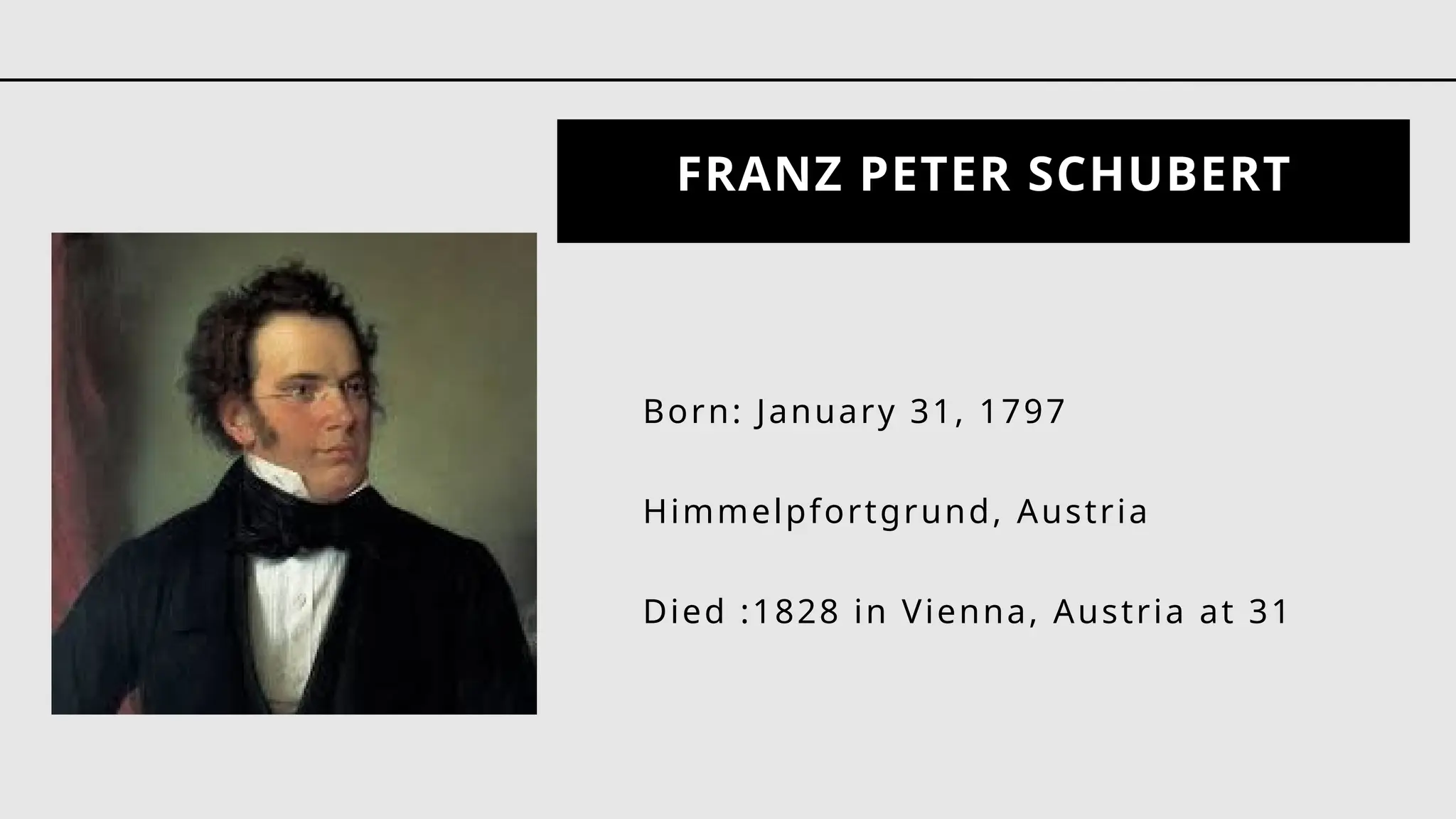
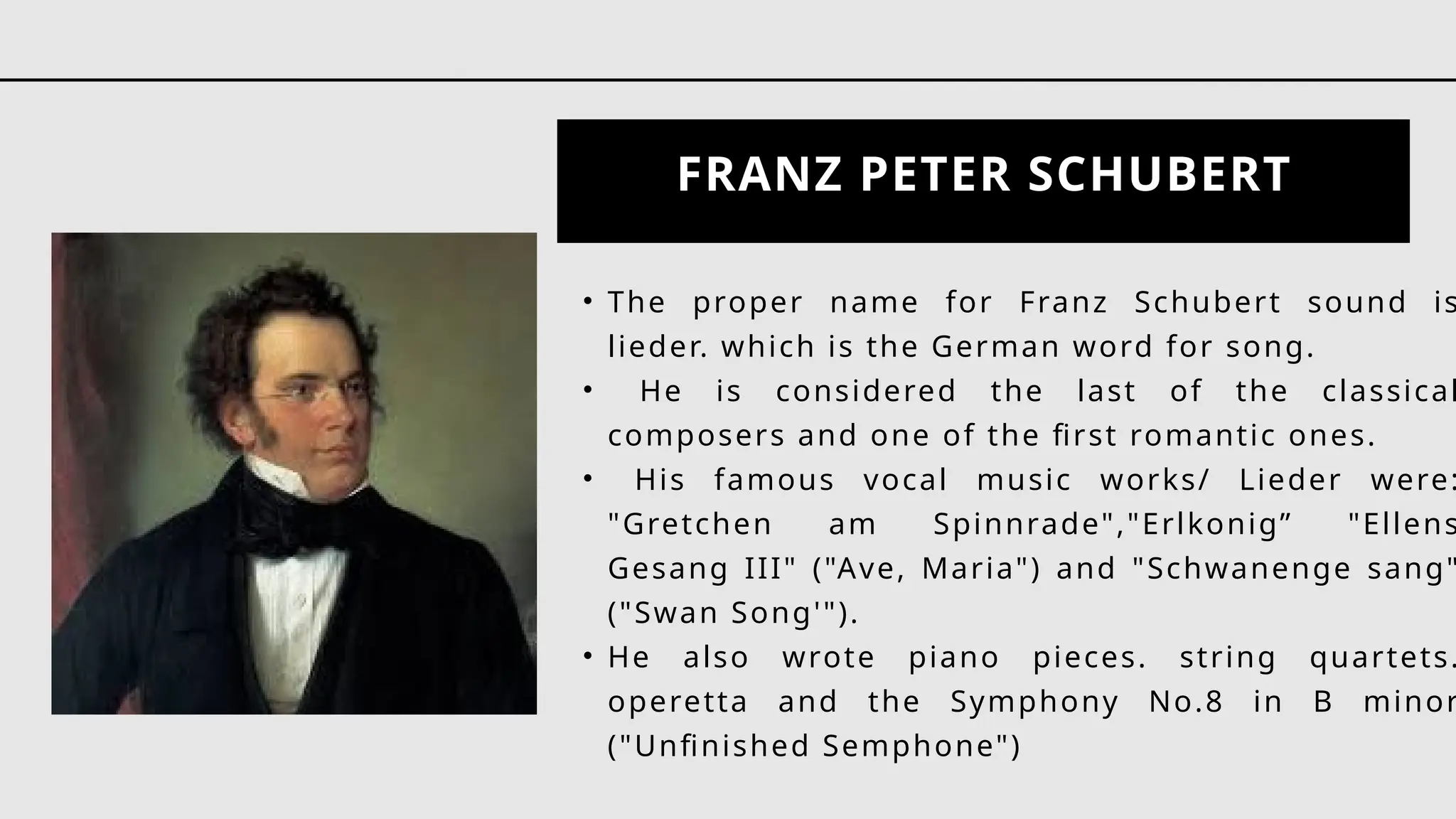
FRANZ PETER SCHUBERT
Born:January 31, 1797
Himmelpfortgrund, Austria
Died :1828 in Vienna, Austria at 31
5.
FRANZ PETER SCHUBERT
•The proper name for Franz Schubert sound is
lieder. which is the German word for song.
• He is considered the last of the classical
composers and one of the first romantic ones.
• His famous vocal music works/ Lieder were:
"Gretchen am Spinnrade","Erlkonig” "Ellens
Gesang III" ("Ave, Maria") and "Schwanenge sang"
("Swan Song'").
• He also wrote piano pieces. string quartets.
operetta and the Symphony No.8 in B minor
("Unfinished Semphone")
6.
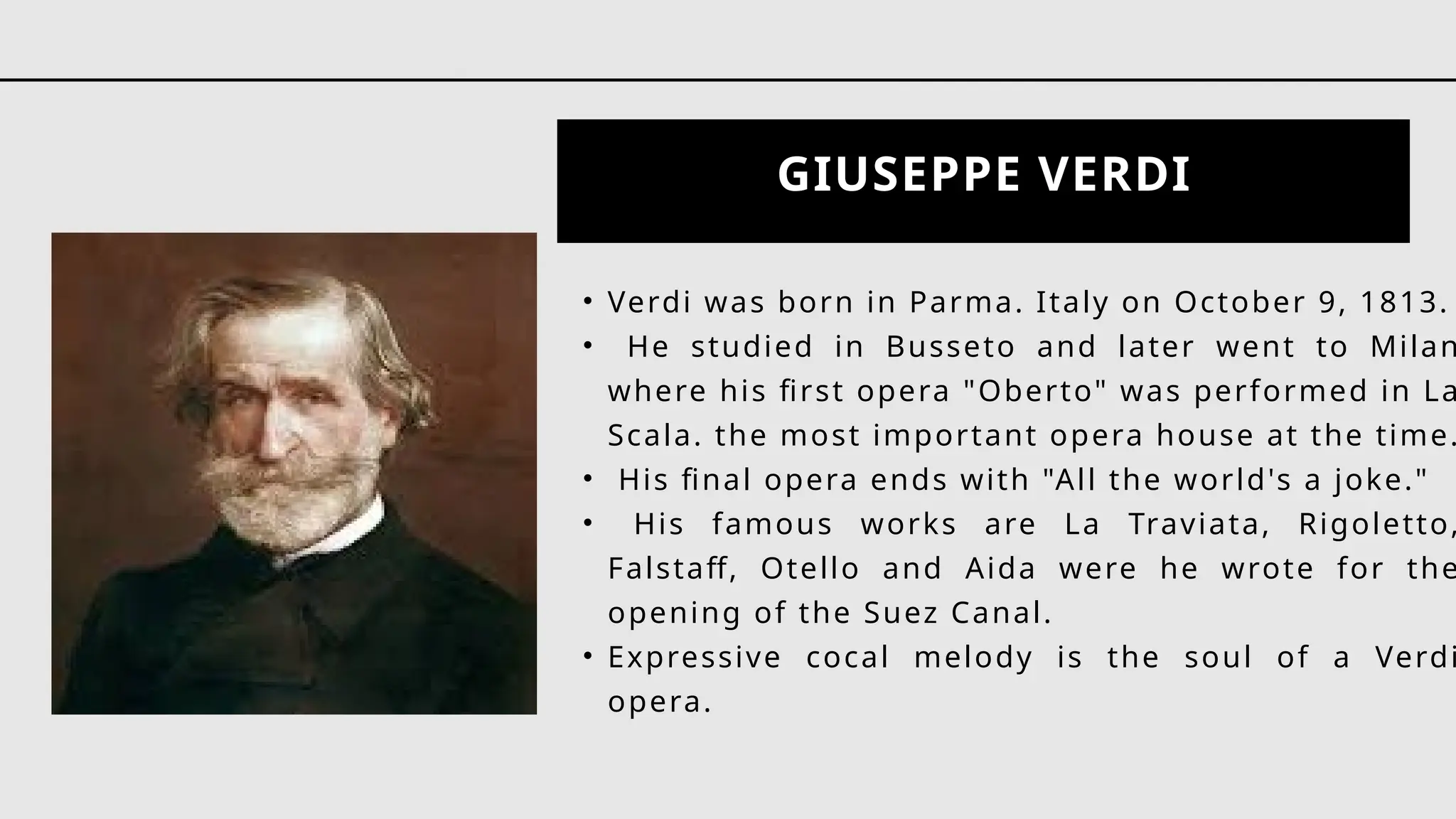
GIUSEPPE VERDI
• Verdiwas born in Parma. Italy on October 9, 1813.
• He studied in Busseto and later went to Milan
where his first opera "Oberto" was performed in La
Scala. the most important opera house at the time.
• His final opera ends with "All the world's a joke."
• His famous works are La Traviata, Rigoletto,
Falstaff, Otello and Aida were he wrote for the
opening of the Suez Canal.
• Expressive cocal melody is the soul of a Verdi
opera.
7.
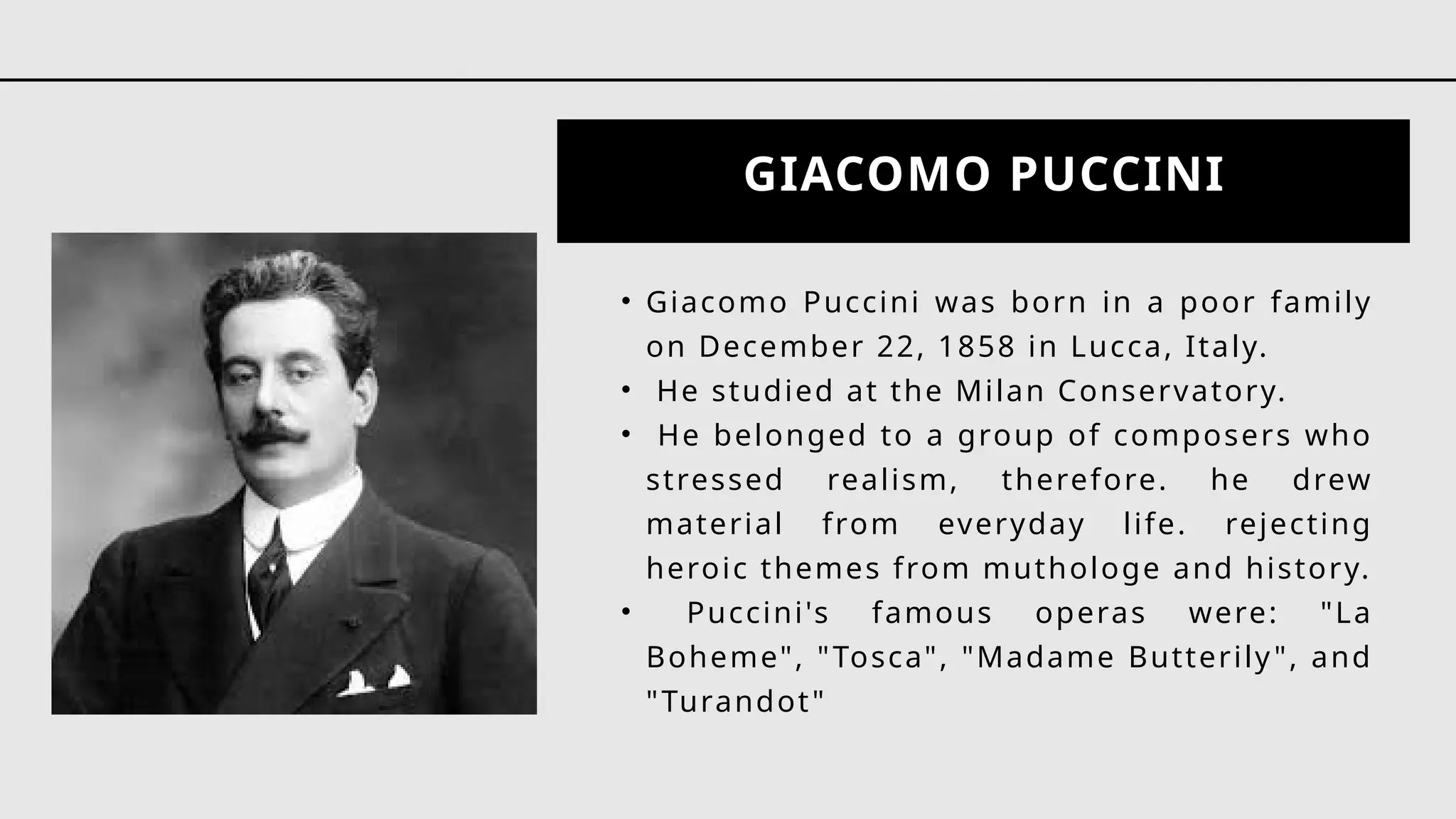
GIACOMO PUCCINI
• GiacomoPuccini was born in a poor family
on December 22, 1858 in Lucca, Italy.
• He studied at the Milan Conservatory.
• He belonged to a group of composers who
stressed realism, therefore. he drew
material from everyday life. rejecting
heroic themes from muthologe and history.
• Puccini's famous operas were: "La
Boheme", "Tosca", "Madame Butterily", and
"Turandot"
8.
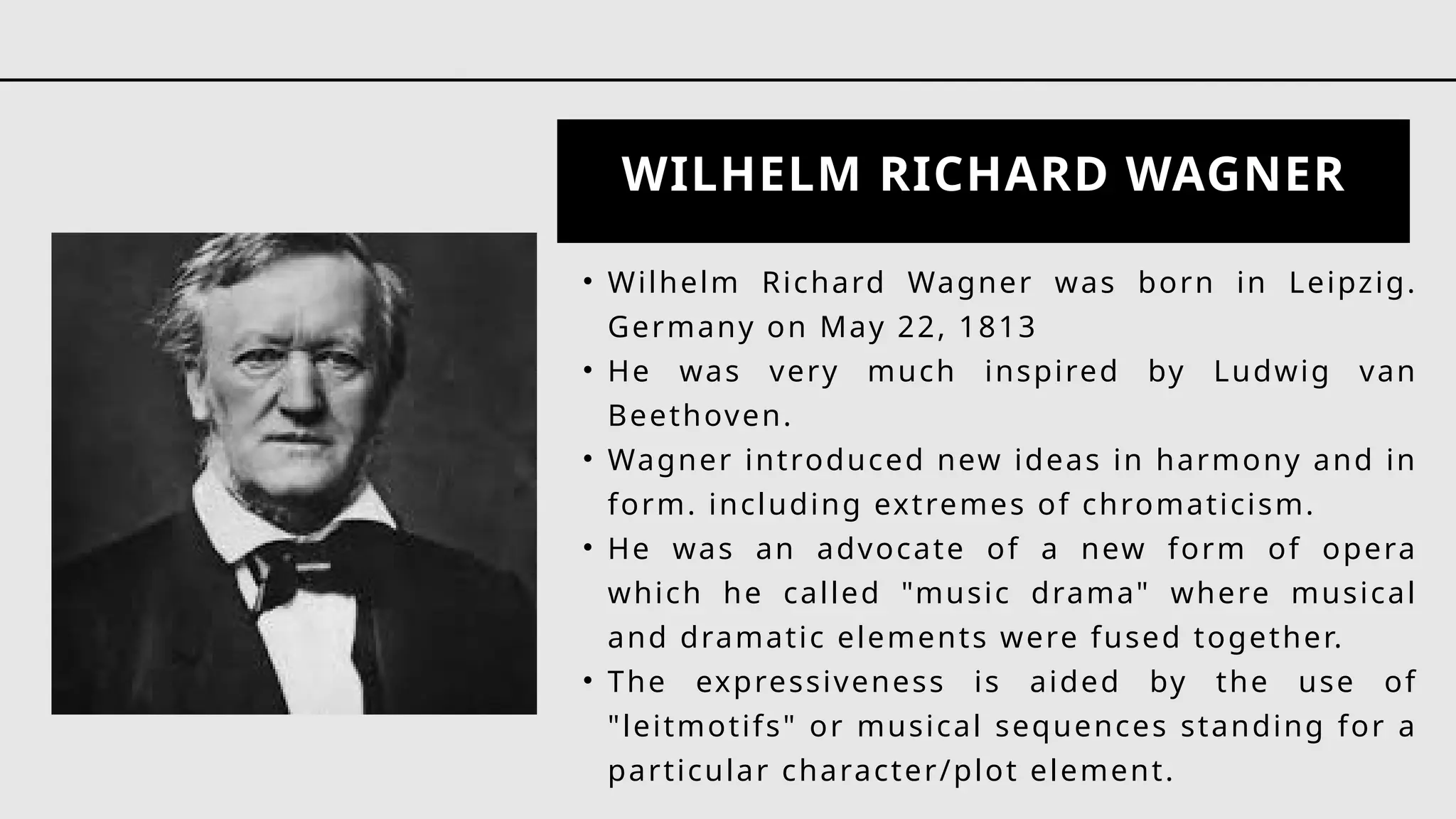
WILHELM RICHARD WAGNER
•Wilhelm Richard Wagner was born in Leipzig.
Germany on May 22, 1813
• He was very much inspired by Ludwig van
Beethoven.
• Wagner introduced new ideas in harmony and in
form. including extremes of chromaticism.
• He was an advocate of a new form of opera
which he called "music drama" where musical
and dramatic elements were fused together.
• The expressiveness is aided by the use of
"leitmotifs" or musical sequences standing for a
particular character/plot element.
9.
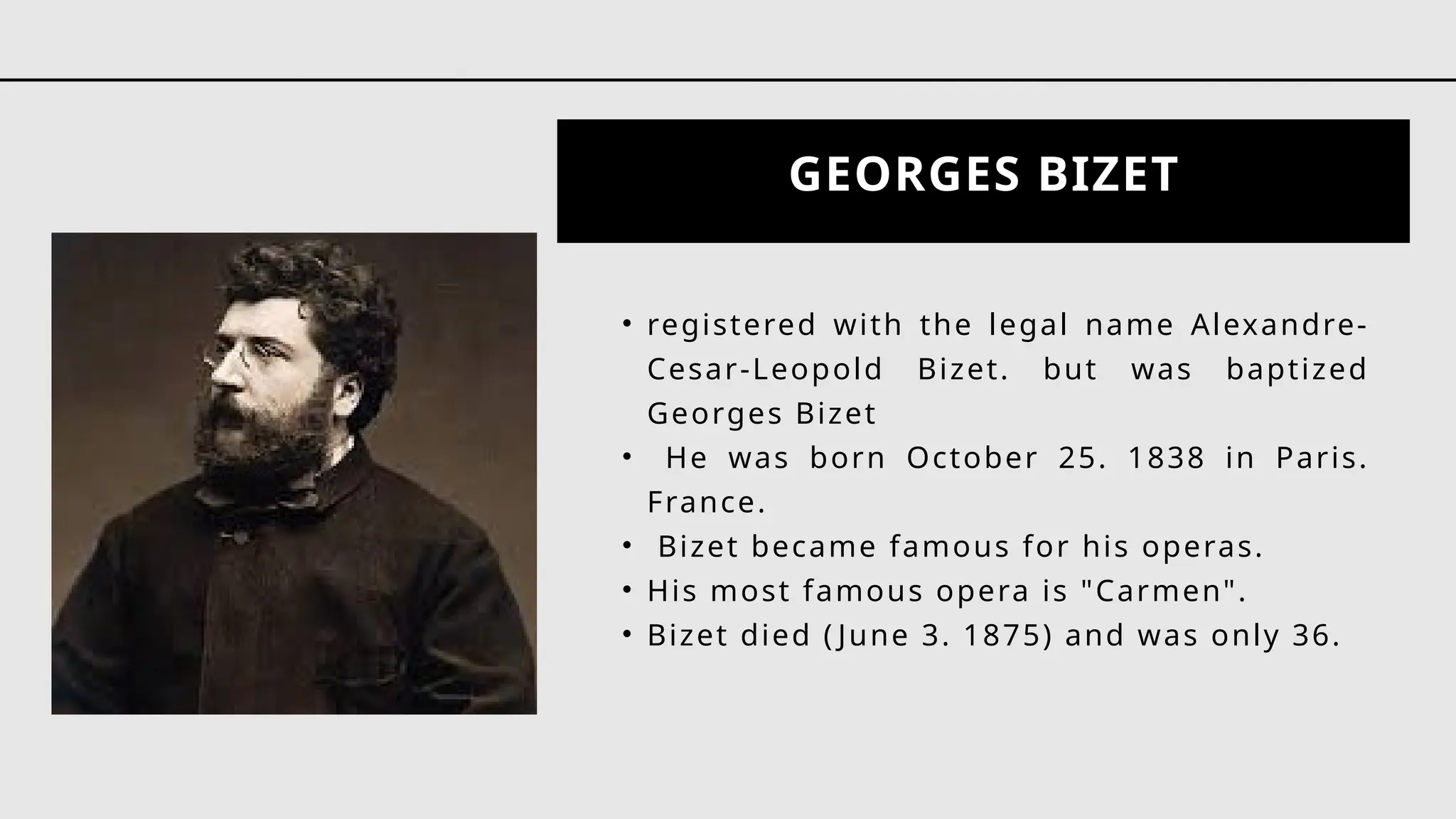
GEORGES BIZET
• registeredwith the legal name Alexandre-
Cesar-Leopold Bizet. but was baptized
Georges Bizet
• He was born October 25. 1838 in Paris.
France.
• Bizet became famous for his operas.
• His most famous opera is "Carmen".
• Bizet died ( June 3. 1875) and was only 36.
10.
OPERA
• Became increasinglypopular during the Romantic period.
• It is a story (libretto) told by the composers through
music while using the words of the librettist. They work
closely together to tell the story.
• The book that the composer and librettist put together is
called a score.
• The score has all the musical notes. words and ideas to
help the performers tell the story.
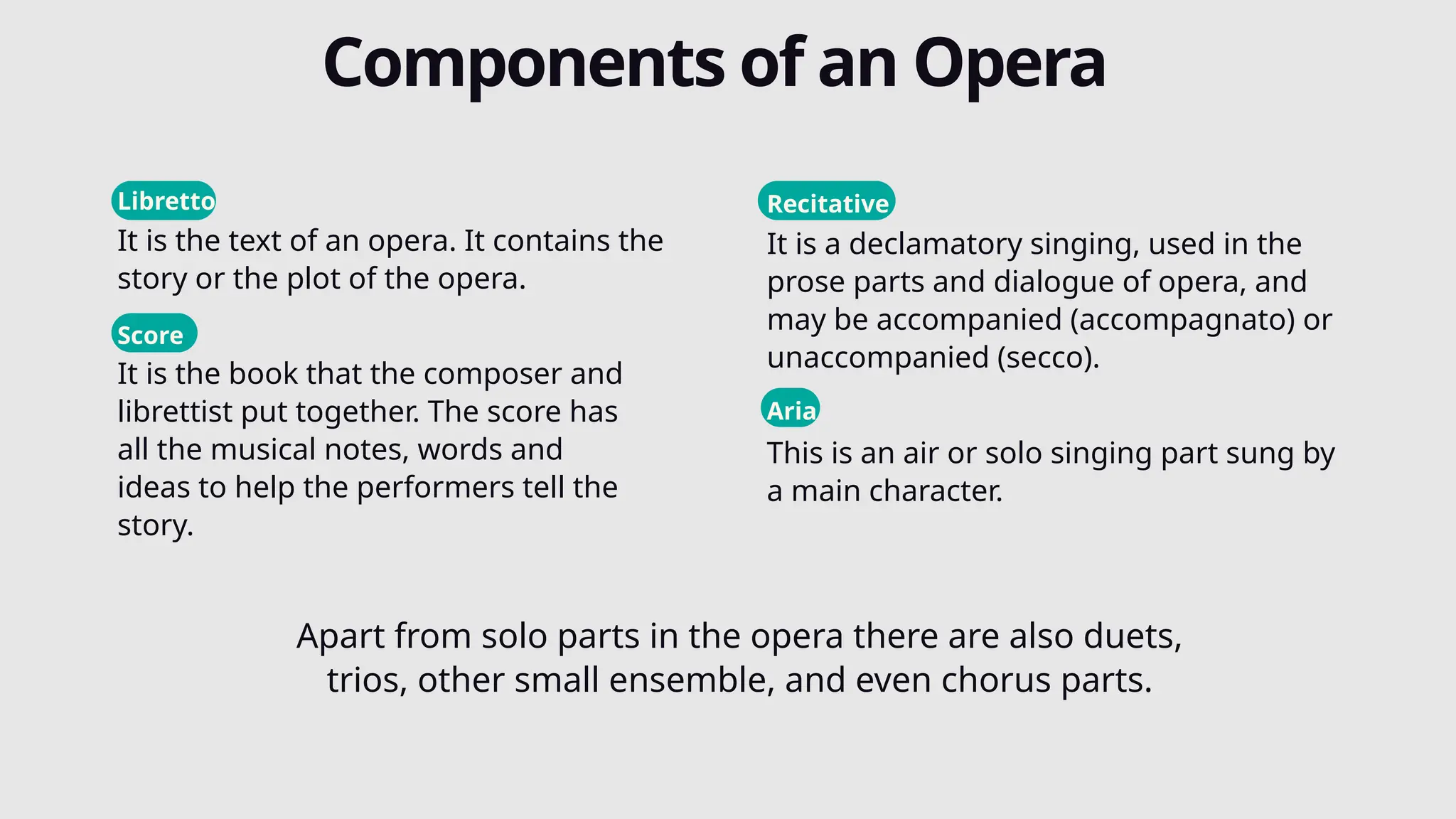
Components of anOpera
Libretto
It is the text of an opera. It contains the
story or the plot of the opera.
Score
It is the book that the composer and
librettist put together. The score has
all the musical notes, words and
ideas to help the performers tell the
story.
Recitative
It is a declamatory singing, used in the
prose parts and dialogue of opera, and
may be accompanied (accompagnato) or
unaccompanied (secco).
Aria
This is an air or solo singing part sung by
a main character.
Apart from solo parts in the opera there are also duets,
trios, other small ensemble, and even chorus parts.
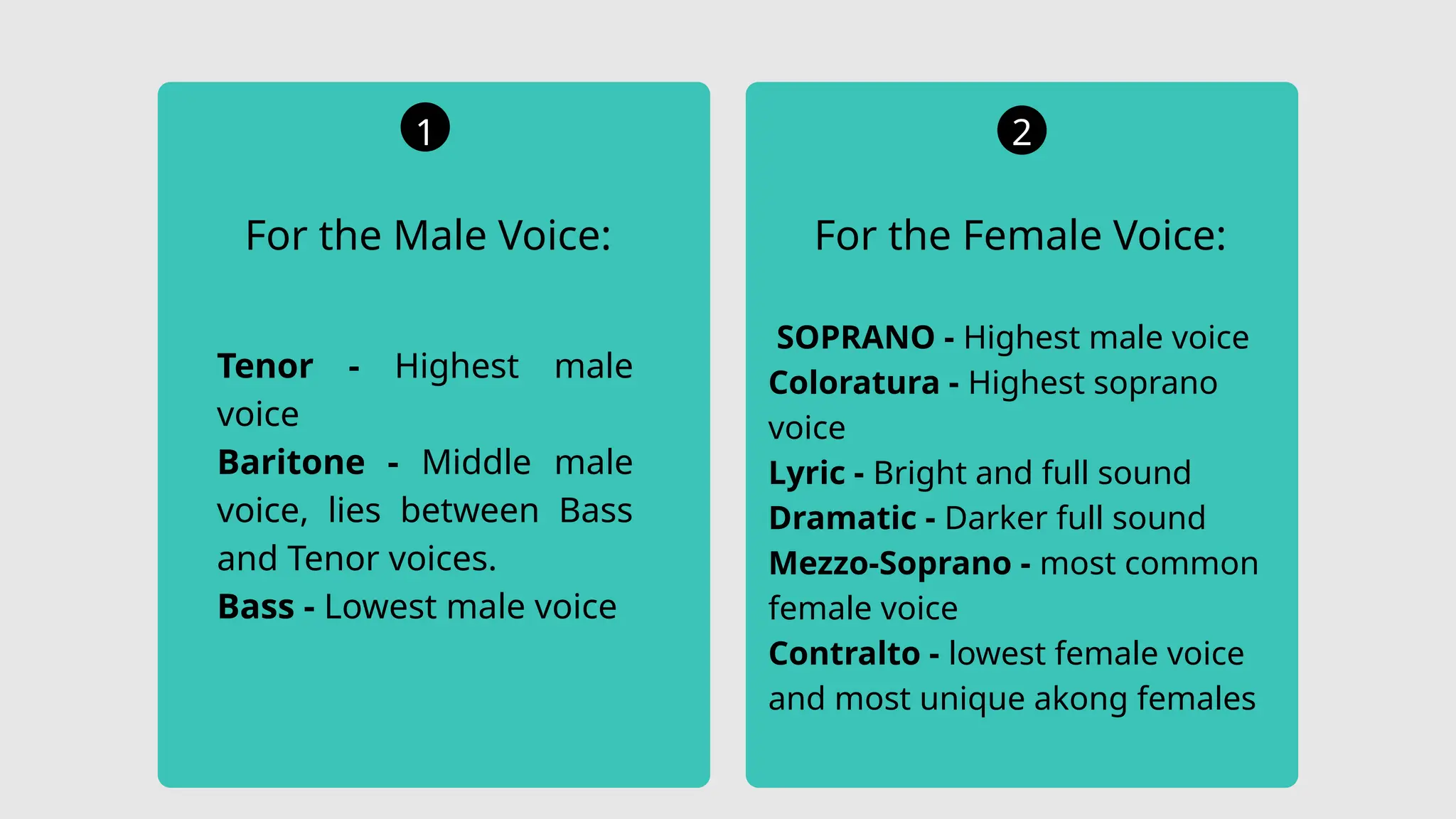
1 2
Tenor -Highest male
voice
Baritone - Middle male
voice, lies between Bass
and Tenor voices.
Bass - Lowest male voice
For the Male Voice: For the Female Voice:
SOPRANO - Highest male voice
Coloratura - Highest soprano
voice
Lyric - Bright and full sound
Dramatic - Darker full sound
Mezzo-Soprano - most common
female voice
Contralto - lowest female voice
and most unique akong females