ROMANIA’S VALUES
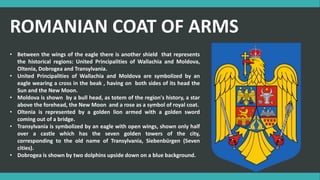
• Between the wings of the eagle there is another shield that represents
the historical regions: United Principalities of Wallachia and Moldova,
Oltenia, Dobrogea and Transylvania.
• United Principalities of Wallachia and Moldova are symbolized by an
eagle wearing a cross in the beak , having on both sides of its head the
Sun and the New Moon.
• Moldova is shown by a bull head, as totem of the region's history, a star
above the forehead, the New Moon and a rose as a symbol of royal coat.
• Oltenia is represented by a golden lion armed with a golden sword
coming out of a bridge.
• Transylvania is symbolized by an eagle with open wings, shown only half
over a castle which has the seven golden towers of the city,
corresponding to the old name of Transylvania, Siebenbürgen (Seven
cities).
• Dobrogea is shown by two dolphins upside down on a blue background.
ROMANIAN COAT OF ARMS
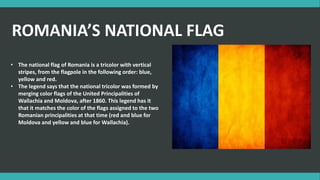
• The national flag of Romania is a tricolor with vertical
stripes, from the flagpole in the following order: blue,
yellow and red.
• The legend says that the national tricolor was formed by
merging color flags of the United Principalities of
Wallachia and Moldova, after 1860. This legend has it
that it matches the color of the flags assigned to the two
Romanian principalities at that time (red and blue for
Moldova and yellow and blue for Wallachia).
ROMANIA’S NATIONAL FLAG
ROMANIA’S NATIONAL ANTHEM
• “Awaken thee, Romanian!" is the national anthem of Romania, since 1990. The anthem melody was
composed by Anton Pann, and the lyrics and the musical arrangement belong to Andrei Muresanu
(1816-1863), the Romantic poet, journalist, translator, a true tribune of the era marked by the 1848
Revolution. The poem "An Echo” by Andrei Muresanu, written and published during the Revolution of
1848, was first sung in late June in the same year in the city of Brașov and was immediately accepted
as the revolutionary anthem and renamed “Awaken thee, Romanian!"
• The title " “Awaken thee, Romanian!" contains a message of liberty and patriotism; it has been sung
during all major Romanian conflicts, including during the 1989 anti-Ceausescu revolution. After that
revolution, it became the national anthem, replacing the communist-era national anthem "Trei culori"
("Three colors").
THE ROMANIAN TRADITIONAL BLOUSE ‘IA’
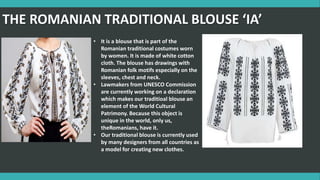
• It is a blouse that is part of the
Romanian traditional costumes worn
by women. It is made of white cotton
cloth. The blouse has drawings with
Romanian folk motifs especially on the
sleeves, chest and neck.
• Lawmakers from UNESCO Commission
are currently working on a declaration
which makes our traditioal blouse an
element of the World Cultural
Patrimony. Because this object is
unique in the world, only us,
theRomanians, have it.
• Our traditional blouse is currently used
by many designers from all countries as
a model for creating new clothes.
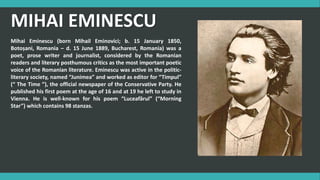
MIHAI EMINESCU
Mihai Eminescu (born Mihail Eminovici; b. 15 January 1850,
Botoșani, Romania – d. 15 June 1889, Bucharest, Romania) was a
poet, prose writer and journalist, considered by the Romanian
readers and literary posthumous critics as the most important poetic
voice of the Romanian literature. Eminescu was active in the politic-
literary society, named “Junimea” and worked as editor for “Timpul”
(“ The Time ”), the official newspaper of the Conservative Party. He
published his first poem at the age of 16 and at 19 he left to study in
Vienna. He is well-known for his poem “Luceafărul” (“Morning
Star”) which contains 98 stanzas.
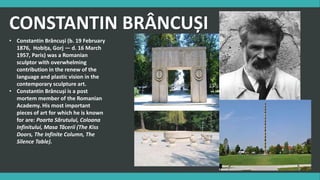
CONSTANTIN BRÂNCUȘI
• Constantin Brâncuși (b. 19 February
1876, Hobița, Gorj — d. 16 March
1957, Paris) was a Romanian
sculptor with overwhelming
contribution in the renew of the
language and plastic vision in the
contemporary sculpture art.
• Constantin Brâncuși is a post
mortem member of the Romanian
Academy. His most important
pieces of art for which he is known
for are: Poarta Sărutului, Coloana
Infinitului, Masa Tăcerii (The Kiss
Doors, The Infinite Column, The
Silence Table).
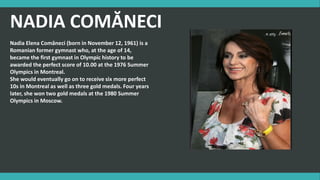
NADIA COMĂNECI
Nadia Elena Comăneci (born in November 12, 1961) is a
Romanian former gymnast who, at the age of 14,
became the first gymnast in Olympic history to be
awarded the perfect score of 10.00 at the 1976 Summer
Olympics in Montreal.
She would eventually go on to receive six more perfect
10s in Montreal as well as three gold medals. Four years
later, she won two gold medals at the 1980 Summer
Olympics in Moscow.
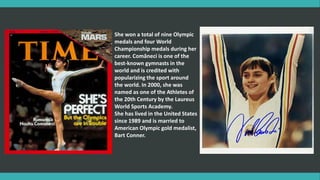
She won a total of nine Olympic
medals and four World
Championship medals during her
career. Comăneci is one of the
best-known gymnasts in the
world and is credited with
popularizing the sport around
the world. In 2000, she was
named as one of the Athletes of
the 20th Century by the Laureus
World Sports Academy.
She has lived in the United States
since 1989 and is married to
American Olympic gold medalist,
Bart Conner.
ROMANIAN ARCHITECTURE
• The Romanian architecture is diverse, including medieval
architecture, modern era architecture, interwar
architecture, communist architecture, and contemporary
21st century architecture. In Romania, there are also
regional differences with regard to architectural styles.
• During the middle ages in Romania there were two types
of construction that developed in parallel and are different
in points of both materials and technique. The first is the
popular architecture, whose most spectacular
achievements were the wooden churches, especially those
in the villages of Maramureş, Banat and Apuseni
Mountains, where the tradition is still carried out today. In
Maramureş, in Surdeşti village, the 54 m high church tower
built during 1721–1724 is among the highest of this kind in
Europe.
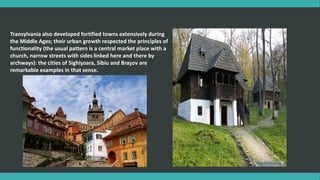
Transylvania also developed fortified towns extensively during
the Middle Ages; their urban growth respected the principles of
functionality (the usual pattern is a central market place with a
church, narrow streets with sides linked here and there by
archways): the cities of Sighişoara, Sibiu and Braşov are
remarkable examples in that sense.
THANK YOU FOR YOUR ATTENTION!

Romania’s values

  • 1.
  • 2.
    • Between thewings of the eagle there is another shield that represents the historical regions: United Principalities of Wallachia and Moldova, Oltenia, Dobrogea and Transylvania. • United Principalities of Wallachia and Moldova are symbolized by an eagle wearing a cross in the beak , having on both sides of its head the Sun and the New Moon. • Moldova is shown by a bull head, as totem of the region's history, a star above the forehead, the New Moon and a rose as a symbol of royal coat. • Oltenia is represented by a golden lion armed with a golden sword coming out of a bridge. • Transylvania is symbolized by an eagle with open wings, shown only half over a castle which has the seven golden towers of the city, corresponding to the old name of Transylvania, Siebenbürgen (Seven cities). • Dobrogea is shown by two dolphins upside down on a blue background. ROMANIAN COAT OF ARMS
  • 3.
    • The nationalflag of Romania is a tricolor with vertical stripes, from the flagpole in the following order: blue, yellow and red. • The legend says that the national tricolor was formed by merging color flags of the United Principalities of Wallachia and Moldova, after 1860. This legend has it that it matches the color of the flags assigned to the two Romanian principalities at that time (red and blue for Moldova and yellow and blue for Wallachia). ROMANIA’S NATIONAL FLAG
  • 4.
    ROMANIA’S NATIONAL ANTHEM •“Awaken thee, Romanian!" is the national anthem of Romania, since 1990. The anthem melody was composed by Anton Pann, and the lyrics and the musical arrangement belong to Andrei Muresanu (1816-1863), the Romantic poet, journalist, translator, a true tribune of the era marked by the 1848 Revolution. The poem "An Echo” by Andrei Muresanu, written and published during the Revolution of 1848, was first sung in late June in the same year in the city of Brașov and was immediately accepted as the revolutionary anthem and renamed “Awaken thee, Romanian!" • The title " “Awaken thee, Romanian!" contains a message of liberty and patriotism; it has been sung during all major Romanian conflicts, including during the 1989 anti-Ceausescu revolution. After that revolution, it became the national anthem, replacing the communist-era national anthem "Trei culori" ("Three colors").
  • 5.
    THE ROMANIAN TRADITIONALBLOUSE ‘IA’ • It is a blouse that is part of the Romanian traditional costumes worn by women. It is made of white cotton cloth. The blouse has drawings with Romanian folk motifs especially on the sleeves, chest and neck. • Lawmakers from UNESCO Commission are currently working on a declaration which makes our traditioal blouse an element of the World Cultural Patrimony. Because this object is unique in the world, only us, theRomanians, have it. • Our traditional blouse is currently used by many designers from all countries as a model for creating new clothes.
  • 6.
    MIHAI EMINESCU Mihai Eminescu(born Mihail Eminovici; b. 15 January 1850, Botoșani, Romania – d. 15 June 1889, Bucharest, Romania) was a poet, prose writer and journalist, considered by the Romanian readers and literary posthumous critics as the most important poetic voice of the Romanian literature. Eminescu was active in the politic- literary society, named “Junimea” and worked as editor for “Timpul” (“ The Time ”), the official newspaper of the Conservative Party. He published his first poem at the age of 16 and at 19 he left to study in Vienna. He is well-known for his poem “Luceafărul” (“Morning Star”) which contains 98 stanzas.
  • 7.
    CONSTANTIN BRÂNCUȘI • ConstantinBrâncuși (b. 19 February 1876, Hobița, Gorj — d. 16 March 1957, Paris) was a Romanian sculptor with overwhelming contribution in the renew of the language and plastic vision in the contemporary sculpture art. • Constantin Brâncuși is a post mortem member of the Romanian Academy. His most important pieces of art for which he is known for are: Poarta Sărutului, Coloana Infinitului, Masa Tăcerii (The Kiss Doors, The Infinite Column, The Silence Table).
  • 8.
    NADIA COMĂNECI Nadia ElenaComăneci (born in November 12, 1961) is a Romanian former gymnast who, at the age of 14, became the first gymnast in Olympic history to be awarded the perfect score of 10.00 at the 1976 Summer Olympics in Montreal. She would eventually go on to receive six more perfect 10s in Montreal as well as three gold medals. Four years later, she won two gold medals at the 1980 Summer Olympics in Moscow.
  • 9.
    She won atotal of nine Olympic medals and four World Championship medals during her career. Comăneci is one of the best-known gymnasts in the world and is credited with popularizing the sport around the world. In 2000, she was named as one of the Athletes of the 20th Century by the Laureus World Sports Academy. She has lived in the United States since 1989 and is married to American Olympic gold medalist, Bart Conner.
  • 10.
    ROMANIAN ARCHITECTURE • TheRomanian architecture is diverse, including medieval architecture, modern era architecture, interwar architecture, communist architecture, and contemporary 21st century architecture. In Romania, there are also regional differences with regard to architectural styles. • During the middle ages in Romania there were two types of construction that developed in parallel and are different in points of both materials and technique. The first is the popular architecture, whose most spectacular achievements were the wooden churches, especially those in the villages of Maramureş, Banat and Apuseni Mountains, where the tradition is still carried out today. In Maramureş, in Surdeşti village, the 54 m high church tower built during 1721–1724 is among the highest of this kind in Europe.
  • 11.
    Transylvania also developedfortified towns extensively during the Middle Ages; their urban growth respected the principles of functionality (the usual pattern is a central market place with a church, narrow streets with sides linked here and there by archways): the cities of Sighişoara, Sibiu and Braşov are remarkable examples in that sense.
  • 12.
    THANK YOU FORYOUR ATTENTION!