Sarath. C. Int. Journal of Engineering Research and Application www.ijera.com
ISSN : 2248-9622, Vol. 6, Issue 10, ( Part -4) October 2016, pp.12-16
www.ijera.com 12 | P a g e
Role of PMC in Construction of Collector Well Project, a Case
Study
Sarath. C
(Department of Civil Engineering, Manipal University Jaipur, Jaipur, India)
ABSTRACT
The rapid expansion and intricacy in the construction industry cause difficulties in maintaining performance,
time, and quality services of a construction project, which leads to the failure to meet the scope and objective of
a project. In addition, improper planning, widespread dependence, and low availability of materials increase the
cost of the construction project. To manage such issues, Project Management Consultancy is one of the
management solutions that have been widely used. Project Management Consultancy plays a multifaceted role
in providing services from the beginning of construction to its completion. Project Management Consultancy
makes sure whether we are moving in the right pathway according to the planned schedule. Use of Project
Management Consultancy offers constructive management solution for the proper execution of work, improved
performance, quality, and outcome of the project. The objective of this paper is to study the role and
responsibilities of Project Management Consultancy while executing a project and the risks associated with it.
This research is carried out via a case study of the construction of an industrial project governed by a Project
Management Consultancy from preconstruction phase to completion.
Keywords: Project Management Consultancy (PMC), Water Scheme Project, Risk factors by PMC, Collector
well, Construction industry.
I. INTRODUCTION
The construction industry in India plays a
vital role in the country’s socioeconomic growth by
providing shelters and employment for millions of
people by spending an average of 25 trillion rupees
over a period of 3 years [7]. In India, Tamil Nadu
has the second largest economy with current GDP of
Rupees 13,842 billion. During the year 2014–15,
Tamil Nadu has the highest per capita GDP of $3000
which was the third highest in India. Government is
the major investor with 51% of total investments in
32 districts of Tamil Nadu [8]. In that,
Tiruchirappalli district is the major engineering
equipment manufacturing and fabrication hub in
India. In 2010, the Tiruchirappalli unit of the BHEL
company contributed to nearly 30 per cent of its total
sales in a high-pressure boiler manufacturing plant,
making it the largest of all units. So, the ancillary
units together with BHEL contribute nearly 60 per
cent of India’s steel fabrication, earning the city the
title, ―Energy equipment and fabrication capital of
India‖ [9]. This massive improvement in the
construction industry brings us a challenge of
meeting the demands of the public and effective use
of foreign investment in Indian infrastructure
projects that lead to approaching a Project
Management Consultancy.
In the view of the Project Management
Institute (PMI), the definition of Project
Management is: ―The art of directing and
coordinating human and material resources
throughout the life of a project by using modern
management techniques to achieve predetermined
objectives of scope, cost, time, quality and
participant [stakeholder] satisfaction‖[5]. There is no
specific definition of project consultant. Most
definitions describe management consultants by
their roles and responsibility and services that they
provide using tools and skills they have in delivering
a task assigned by the client or the owner of the
project [6].
The Project Management Consultancy is
defined as: Project—Any work carried out by an
individual or group of people to achieve a particular
aim, Management—Managing a team to achieve a
project within a limited time and money,
Consultant/Consultancy—A person or a firm with an
excess of experience within a specific field. Thus,
the PMC is defined as ―A team of expertise, to
control, coordinate and tone a team of human and
material resources from the beginning to the end of a
project for achieving the preplanned scope within a
limited time and cost.‖
The PMC approach has many variations.
The concept of PMC centers on the introduction of
construction manager or agency, employed by the
owner, for managing the assigned project processes,
from the feasibility stage to the final delivery of the
construction facility. The agency can be a
professional consultant, firm, or an individual. The
main components of PMC are construction know-
how and management ability. It can assist the
owner/client in arranging the contractors and the
architects who will actually do all the work. A PMC
CASE REPORT OPEN ACCESS
Sarath. C. Int. Journal of Engineering Research and Application www.ijera.com
ISSN : 2248-9622, Vol. 6, Issue 10, ( Part -4) October 2016, pp.12-16
www.ijera.com 13 | P a g e
also ensures that all their efforts are coordinated
from the very start of the design process to the final
delivery of the completed facility. A PMC operates
in a manner similar to that of general contractor, but
is economical as opposed to a general contractor
who also makes an entrepreneurial profit on the
subcontractors he employs. A PMC helps the client
in the procurement of material and supplies, control
of quality and carrying out other construction-related
tasks. A principal benefit of the PMC approach is
that it lends itself to the ―fast-track‖ construction that
often results in major time and cost savings [2][4].
II. FRAMEWORK OF PMC ROLES
AND RESPONSIBILITY DESIGN
Construction projects involve various tasks,
which should be planned properly to avoid obstacles
and conflicts. The Project Management Consultancy
divides a whole construction project into three
phases: preconstruction phase, construction phase,
and postconstruction phase [1] [3].
2.1. Preconstruction Phase
• Carrying out a feasible study of project and
make sure with the client that it is can be done
with performance, time and quality.
• Developing project control systems.
• Directing the client and contractors to consider
about agreement and contract.
• Preparing a project strategy chart.
• Framing a work breakdown structure.
• Preparing master schedule with baseline for
planning, implementing and monitoring all the
activities to achieve target deadline.
• Finding out and coordinating with designers for
particular requirements.
• Acting as a chairman for project management
meetings as need arises from contractor’s team.
• Evaluating the special conditions of tendering
and also analyzing the constraints of tender in
order of being called out.
• Estimating a time vs. cost curve in order to
monitor the cost control during all stages.
• Reviewing of technical specification and bill of
quantities.
• Assisting client for conducting pre bid meetings
and explaining the tender technical parameters.
• Submitting a report to client regarding the
acceptance of tender.
2.2. Construction Phase
• Managing overall project tasks and schedule.
• Providing guidance and direction to project
team.
• Refining of work breakdown structure.
• Monitoring the progress of work with master
construction schedule.
• Ensuring the effective planning of operations on
site and minimizing the wastage of materials.
• Preparing QA/QC plan and method statement.
• Establishing SHE (safety healthy environment )
• Issuing goods for construction drawings to
contractors.
• Organizing the review meeting with contractors
in order to consider their network analysis for
the progress of work.
2.3. Postconstruction Phase
• Preparing and addressing the schedule of
defects/punch lists.
• Certifying the fitness from the relevant
authorities and to provide client maintenance,
operating and service manual as part of the
―handover‖ to all aspects of the project.
• Certifying all final accounts in accordance with
contractors, suppliers, vendors and consultants.
• Verifying that all as-built drawings.
• Reporting PMC to client close to the point of
practical completion on any incomplete works
and defects and instructing the contractors to
complete the works and make good defects,
during the defects liability period.
III. CASE STUDY
3.1. Introduction
The project management consultancy
manages the water improvement scheme project in
Tiruchirappalli, Tamil Nadu. The data of this thesis
were collected via descriptive, explanatory and
quantitative methods. The descriptive methods
consisted of collecting information about the current
situation on the construction field. The quantitative
works are carried out by gathering information from
field or site through engineers, supervisor and
managers.
Tiruchirappalli city is the fourth largest city
in Tamil Nadu, located on the banks of River
Cauvery at a distance of 320 kms. away from
Chennai. It is a pilgrimage and nerve center of entire
Tamil Nadu. The world-renown Sri Renganathar
temple at Srirangam and Thayumana Swamigal
temple at Rock Fort are located in this city. This city
is situated on 10° 49’ N, 78° 42’ E. The total area of
Tiruchirappalli City Corporation is 167.23 sq. kms.
and added area extent is 20.33 sq.kms.
Sarath. C. Int. Journal of Engineering Research and Application www.ijera.com
ISSN : 2248-9622, Vol. 6, Issue 10, ( Part -4) October 2016, pp.12-16
www.ijera.com 14 | P a g e
Table 1: General information about Tiruchirappalli
City (Source: Tiruchirappalli City Municipal
Corporation 2016)
The terrain of Tiruchirappalli city is
generally very flat. The general topography of
Tiruchirappalli City Corporation is mostly
characterized by a flat terrain. It is, however, broken
here and there by a number of protruding masses of
crystalline rock and masses of gneiss, of which the
Rockfort in the center of the town and the Golden
Rock, are the best known. There are, however,
many others scattered over the district, of which
Ratnagiri near Kulitalai and Perumalmalai near
Turaiyur are remarkable. The only hills of any
importance in the district are the Pachamalais, which
lie on the northern portion of Musiri Taluk. It has a
peak up to 1015m above MSL. General slope of the
district is towards east. Central and eastern part of
the district is situated in the deltaic region of the
famous river Cauvery and crisscrossed by lengthy
network of irrigation canals. Being in the deltaic
region of Cauvery river, this part of the district
consists of vast flat alluvial plains.
The perennial Cauvery river is the major
source of water supply for Tiruchirappalli city.
There are 60 service reservoirs which consist of
1470 bore wells in and around the city. Four of the
six head works are maintained by the municipal
corporation and the rest by other agencies.
Table 2: Total water connections in city (Source:
Tiruchirappalli City Municipal Corporation 2016)
• Total quantity of water supply per day is 82.47
MLD
• Per capita supply is 103 LPCD
• Total length of pumping main is 144.74 KM
• Total length of distribution main is 539.55 KM
3.2. Need of Collector Well
Five more wards are to be added to the city
following the merger of the Tiruverumbur town
panchayat, Pappakurichi, Ellakudi, Keezha
Kalkandarkottai and Alathur village panchayats, all
located in the eastern periphery of the city, with the
Tiruchirappalli City Corporation. The corporation has
decided to execute a new drinking water scheme for
the five new wards that have been added to it
recently. The wards 61 to 65 are spread over
Tiruverumbur Town Panchayat, and Pappakurichi,
Ellakudi, Keezha Kalkandarkottai and Alathur
panchayats, all in the eastern suburbs of the city, and
are merged with the corporation following
delimitation. They intends to increase the per capita
water supply to the residents of the five wards to 135
liters a day on a par with other parts of the city and in
line with the norms of Central Public Health and
Environmental Engineering Organization of the
Union Urban Development Ministry. At present,
residents are getting about 70 to 100 liters a day but
the supply is said to be unequal [10].
Table 3: Ward-wise population details (Source:
Census of India—Tiruchirappalli District 2011)
For 1–65 Wards
2001 Census population 7,52,066
2011 Census population 9,20,660
Total area 167.23 Sq.km.
For added areas 61–65 wards:
2001 Census population 44,578
2011 Census population 69,942
2013 Present population 81,174
2013 Actual population 1,02,897
2028 Intermediate population 1,23,476
2043 Ultimate population 1,44,055
Added area extant 20.33 Sq.km.
Daily floating population 2,00,000
The proposed drawl of water for
improvement in water supply scheme to added wards
61 to 65 of Tiruchirappalli city is 27.23 MLD. It is
propose to create a new source in Cauvery river in
between Kambaresamapettai Head Works and first
collector well for CWSS to Ramanathapuram. The
location is 1500 m upstream of Kambarasampettai
head works and 2000 m downstream of collector well
No.1 of CWSS to Ramanathapuram. The sustainable
yield expected on renewal of radial arms is about 6
MLD.
SL.
No
General information
1 Area 167.23 sq.kms
2 Population 10,27,436
3 Altitude 78 m
4 Temperature Maximum Minimum
Summer 41.10°C 36.40°C
Winter 21.31°C 18.60°C
5 Rainfall 82 cms
6 River basin Cauvery
7 Depth of
water level
3m to 15 m
8 Geology Hard rock mostly
charnockites and mixed
gneiss with river
alluvium.
Connections Numbers
Domestic connections 93,732
Non-Domestic connections 1,653
Total No. of connections 95,385
Sarath. C. Int. Journal of Engineering Research and Application www.ijera.com
ISSN : 2248-9622, Vol. 6, Issue 10, ( Part -4) October 2016, pp.12-16
www.ijera.com 15 | P a g e
3.3. Project Contract
The corporation has decided to hire a
consultant to design and prepare detailed project
estimates for the proposed new drinking water
scheme for the five wards that have been added to it
recently. After preparing the detailed estimate and
project report, the tender was advertised in daily
paper. The work ―Construction of Collector well,
Pipe Carrying Bridge, Control Room, Transformer
Yard and Supply and Erection of Pump sets,
Transformer etc. at Head Works for added areas
covering wards 61 to 65‖ was awarded to contract,
which was started in the month of July in 2016.
The contract works consist of the
construction of collector well 6.0 M diameter at a
depth of 18.0 m with pump house of 8.5M inner
diameter with 6.0 m head room in Cauvery river and
construction of pipe carrying bridge of 10.0m span
3.50 m width with well foundation and pile
foundation to a length of 800 m. These two are the
major work in these contracts rather than these
supply delivery erections of turbine pump set of 3–
150 HP and construction of transformer yard for 500
KVA and control panel room. The intended
completion date for the whole work is 24 months
from the start.
3.4. Risk Factors Overcome by PMC
As stated earlier in this study, the Project
Management Consultancy plays an important role in
ensuring the effectiveness of project management for
the construction project. In this case, the scope, time,
cost and quality factor are prominent. All of these
aspects will be the core for the project management.
Some of the risk factors handled by PMC are
examining safe work methodologies and
implementing safety health and environment (SHE),
organizing the team members in the development of
project plans. The PMC analyzes the various missed
objectives and deliverables, revising it with project
scope to achieve the technical deliverables and
ensuring the quality performance and identifying the
reason for failure of task completion.
In this case study, there were a total of two
instances of delayed events. The river flow was
mentioned in that schedule as 10 months as shown in
Table 04. Due to unforeseen river flow, the
construction of collector well would get delayed by
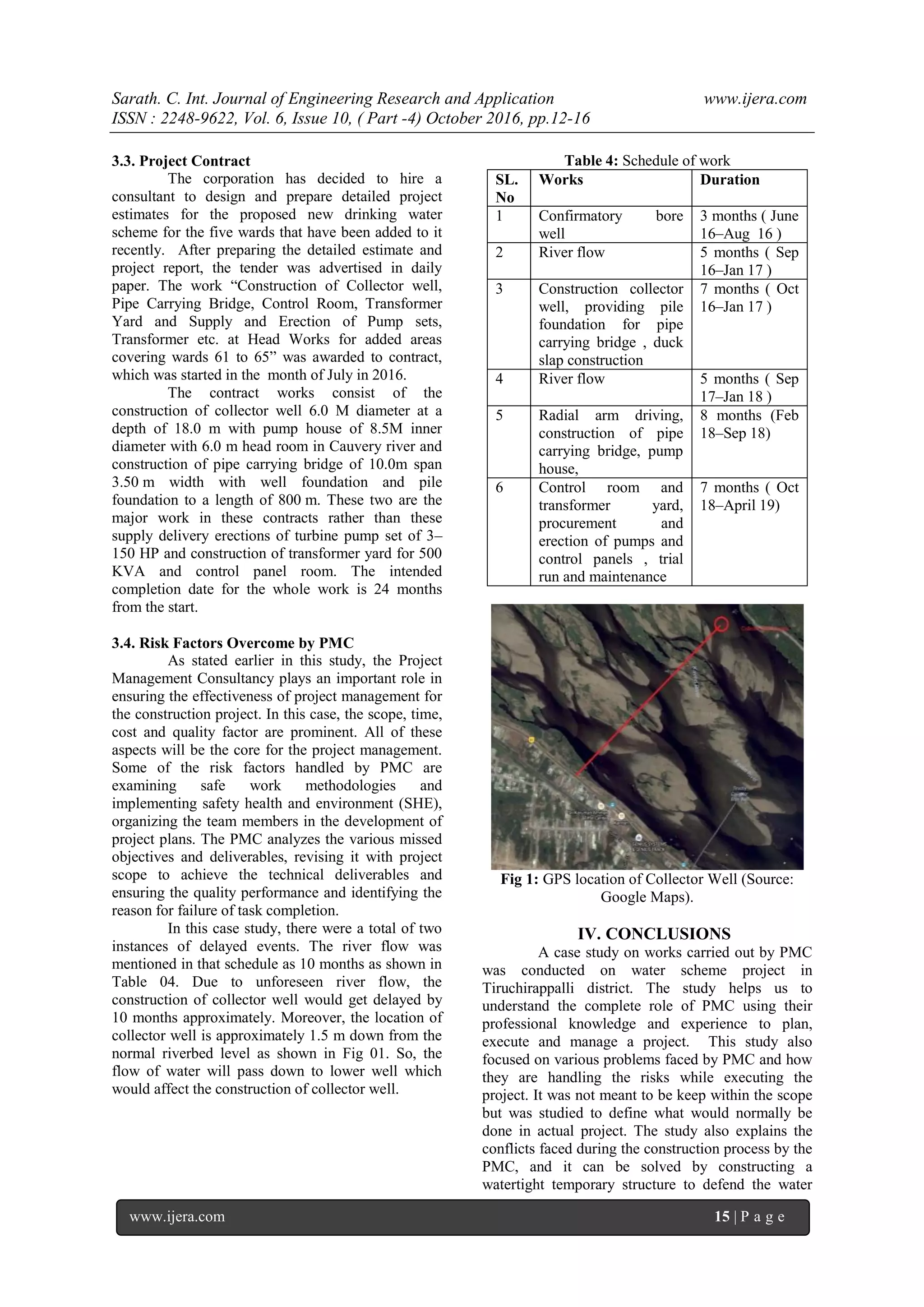
10 months approximately. Moreover, the location of
collector well is approximately 1.5 m down from the
normal riverbed level as shown in Fig 01. So, the
flow of water will pass down to lower well which
would affect the construction of collector well.
Table 4: Schedule of work
SL.
No
Works Duration
1 Confirmatory bore
well
3 months ( June
16–Aug 16 )
2 River flow 5 months ( Sep
16–Jan 17 )
3 Construction collector
well, providing pile
foundation for pipe
carrying bridge , duck
slap construction
7 months ( Oct
16–Jan 17 )
4 River flow 5 months ( Sep
17–Jan 18 )
5 Radial arm driving,
construction of pipe
carrying bridge, pump
house,
8 months (Feb
18–Sep 18)
6 Control room and
transformer yard,
procurement and
erection of pumps and
control panels , trial
run and maintenance
7 months ( Oct
18–April 19)
Fig 1: GPS location of Collector Well (Source:
Google Maps).
IV. CONCLUSIONS
A case study on works carried out by PMC
was conducted on water scheme project in
Tiruchirappalli district. The study helps us to
understand the complete role of PMC using their
professional knowledge and experience to plan,
execute and manage a project. This study also
focused on various problems faced by PMC and how
they are handling the risks while executing the
project. It was not meant to be keep within the scope
but was studied to define what would normally be
done in actual project. The study also explains the
conflicts faced during the construction process by the
PMC, and it can be solved by constructing a
watertight temporary structure to defend the water
Sarath. C. Int. Journal of Engineering Research and Application www.ijera.com
ISSN : 2248-9622, Vol. 6, Issue 10, ( Part -4) October 2016, pp.12-16
www.ijera.com 16 | P a g e
flow in collector well location which would effect in
progress of delay. This study was primarily planned
to serve as guide for PMC firm when they would face
like these kinds of problem and service in respect to
the project scope.
REFERENCES
[1]. Atul R Nikumbh, Dr.S.S.Pimplikar, Role
of Project Management Consultancy in
Construction Projects, Journal of
Mechanical and Civil Engineering, IOSR,
10(6), 2014, 14-19.
[2]. K KChitkara , Construction Project
Management (Tata McGraw Hill Pvt Ltd.,
2009).
[3]. FIDIC, Role of Construction Managers,
(Geneva, 2009).
[4]. Lt.Col.K Kchitkara, Construction Project
Management, Planning Scheduling and
Controlling ( Tata McGraw Hill Pvt Ltd.,
2000).
[5]. Project Management Institute, Inc., A Guide
to Project Management Body of
Knowledge, (Pennsylvania 19073-3299
USA, (PMBOK) Fifth Edition, Project
Management Institute, Inc., 2009).
[6]. Dzulkarnaen Ismail, Services Provided by
Project Management Consultant in
Malaysian Construction Industry, MSc
Thesis, Faculty of Civil Engineering,
Universiti Teknologi Malaysia, 2005.
[7]. Infrastructure Sector in India,
http://www.ibef.org/industry/infrastructure-
sector-india.aspx , 2016.
[8]. Nikhila Gill , TN still most economically
free; Gujarat, Andhra gain,
https://in.news.yahoo.com/tn-still-most-
economically-free-gujarat-andhra-gain.html
, 2010.
[9]. Energy Excellence Exhibition to roll out in
September,
http://www.thehindu.com/todays-paper/tp-
national/tp-tamilnadu/energy-excellence-
exhibition-to-roll-out-in-
september/article1281042.ece , 2008.
[10]. S.Ganeshan, Water Scheme report for
newly added wards ready,
http://www.thehindu.com/todays-paper/tp-
national/tp-tamilnadu/water-scheme-report-
for-newly-added-wards-
ready/article6182223.ece , 2014.

Role of PMC in Construction of Collector Well Project, a Case Study

  • 1.
    Sarath. C. Int.Journal of Engineering Research and Application www.ijera.com ISSN : 2248-9622, Vol. 6, Issue 10, ( Part -4) October 2016, pp.12-16 www.ijera.com 12 | P a g e Role of PMC in Construction of Collector Well Project, a Case Study Sarath. C (Department of Civil Engineering, Manipal University Jaipur, Jaipur, India) ABSTRACT The rapid expansion and intricacy in the construction industry cause difficulties in maintaining performance, time, and quality services of a construction project, which leads to the failure to meet the scope and objective of a project. In addition, improper planning, widespread dependence, and low availability of materials increase the cost of the construction project. To manage such issues, Project Management Consultancy is one of the management solutions that have been widely used. Project Management Consultancy plays a multifaceted role in providing services from the beginning of construction to its completion. Project Management Consultancy makes sure whether we are moving in the right pathway according to the planned schedule. Use of Project Management Consultancy offers constructive management solution for the proper execution of work, improved performance, quality, and outcome of the project. The objective of this paper is to study the role and responsibilities of Project Management Consultancy while executing a project and the risks associated with it. This research is carried out via a case study of the construction of an industrial project governed by a Project Management Consultancy from preconstruction phase to completion. Keywords: Project Management Consultancy (PMC), Water Scheme Project, Risk factors by PMC, Collector well, Construction industry. I. INTRODUCTION The construction industry in India plays a vital role in the country’s socioeconomic growth by providing shelters and employment for millions of people by spending an average of 25 trillion rupees over a period of 3 years [7]. In India, Tamil Nadu has the second largest economy with current GDP of Rupees 13,842 billion. During the year 2014–15, Tamil Nadu has the highest per capita GDP of $3000 which was the third highest in India. Government is the major investor with 51% of total investments in 32 districts of Tamil Nadu [8]. In that, Tiruchirappalli district is the major engineering equipment manufacturing and fabrication hub in India. In 2010, the Tiruchirappalli unit of the BHEL company contributed to nearly 30 per cent of its total sales in a high-pressure boiler manufacturing plant, making it the largest of all units. So, the ancillary units together with BHEL contribute nearly 60 per cent of India’s steel fabrication, earning the city the title, ―Energy equipment and fabrication capital of India‖ [9]. This massive improvement in the construction industry brings us a challenge of meeting the demands of the public and effective use of foreign investment in Indian infrastructure projects that lead to approaching a Project Management Consultancy. In the view of the Project Management Institute (PMI), the definition of Project Management is: ―The art of directing and coordinating human and material resources throughout the life of a project by using modern management techniques to achieve predetermined objectives of scope, cost, time, quality and participant [stakeholder] satisfaction‖[5]. There is no specific definition of project consultant. Most definitions describe management consultants by their roles and responsibility and services that they provide using tools and skills they have in delivering a task assigned by the client or the owner of the project [6]. The Project Management Consultancy is defined as: Project—Any work carried out by an individual or group of people to achieve a particular aim, Management—Managing a team to achieve a project within a limited time and money, Consultant/Consultancy—A person or a firm with an excess of experience within a specific field. Thus, the PMC is defined as ―A team of expertise, to control, coordinate and tone a team of human and material resources from the beginning to the end of a project for achieving the preplanned scope within a limited time and cost.‖ The PMC approach has many variations. The concept of PMC centers on the introduction of construction manager or agency, employed by the owner, for managing the assigned project processes, from the feasibility stage to the final delivery of the construction facility. The agency can be a professional consultant, firm, or an individual. The main components of PMC are construction know- how and management ability. It can assist the owner/client in arranging the contractors and the architects who will actually do all the work. A PMC CASE REPORT OPEN ACCESS
  • 2.
    Sarath. C. Int.Journal of Engineering Research and Application www.ijera.com ISSN : 2248-9622, Vol. 6, Issue 10, ( Part -4) October 2016, pp.12-16 www.ijera.com 13 | P a g e also ensures that all their efforts are coordinated from the very start of the design process to the final delivery of the completed facility. A PMC operates in a manner similar to that of general contractor, but is economical as opposed to a general contractor who also makes an entrepreneurial profit on the subcontractors he employs. A PMC helps the client in the procurement of material and supplies, control of quality and carrying out other construction-related tasks. A principal benefit of the PMC approach is that it lends itself to the ―fast-track‖ construction that often results in major time and cost savings [2][4]. II. FRAMEWORK OF PMC ROLES AND RESPONSIBILITY DESIGN Construction projects involve various tasks, which should be planned properly to avoid obstacles and conflicts. The Project Management Consultancy divides a whole construction project into three phases: preconstruction phase, construction phase, and postconstruction phase [1] [3]. 2.1. Preconstruction Phase • Carrying out a feasible study of project and make sure with the client that it is can be done with performance, time and quality. • Developing project control systems. • Directing the client and contractors to consider about agreement and contract. • Preparing a project strategy chart. • Framing a work breakdown structure. • Preparing master schedule with baseline for planning, implementing and monitoring all the activities to achieve target deadline. • Finding out and coordinating with designers for particular requirements. • Acting as a chairman for project management meetings as need arises from contractor’s team. • Evaluating the special conditions of tendering and also analyzing the constraints of tender in order of being called out. • Estimating a time vs. cost curve in order to monitor the cost control during all stages. • Reviewing of technical specification and bill of quantities. • Assisting client for conducting pre bid meetings and explaining the tender technical parameters. • Submitting a report to client regarding the acceptance of tender. 2.2. Construction Phase • Managing overall project tasks and schedule. • Providing guidance and direction to project team. • Refining of work breakdown structure. • Monitoring the progress of work with master construction schedule. • Ensuring the effective planning of operations on site and minimizing the wastage of materials. • Preparing QA/QC plan and method statement. • Establishing SHE (safety healthy environment ) • Issuing goods for construction drawings to contractors. • Organizing the review meeting with contractors in order to consider their network analysis for the progress of work. 2.3. Postconstruction Phase • Preparing and addressing the schedule of defects/punch lists. • Certifying the fitness from the relevant authorities and to provide client maintenance, operating and service manual as part of the ―handover‖ to all aspects of the project. • Certifying all final accounts in accordance with contractors, suppliers, vendors and consultants. • Verifying that all as-built drawings. • Reporting PMC to client close to the point of practical completion on any incomplete works and defects and instructing the contractors to complete the works and make good defects, during the defects liability period. III. CASE STUDY 3.1. Introduction The project management consultancy manages the water improvement scheme project in Tiruchirappalli, Tamil Nadu. The data of this thesis were collected via descriptive, explanatory and quantitative methods. The descriptive methods consisted of collecting information about the current situation on the construction field. The quantitative works are carried out by gathering information from field or site through engineers, supervisor and managers. Tiruchirappalli city is the fourth largest city in Tamil Nadu, located on the banks of River Cauvery at a distance of 320 kms. away from Chennai. It is a pilgrimage and nerve center of entire Tamil Nadu. The world-renown Sri Renganathar temple at Srirangam and Thayumana Swamigal temple at Rock Fort are located in this city. This city is situated on 10° 49’ N, 78° 42’ E. The total area of Tiruchirappalli City Corporation is 167.23 sq. kms. and added area extent is 20.33 sq.kms.
  • 3.
    Sarath. C. Int.Journal of Engineering Research and Application www.ijera.com ISSN : 2248-9622, Vol. 6, Issue 10, ( Part -4) October 2016, pp.12-16 www.ijera.com 14 | P a g e Table 1: General information about Tiruchirappalli City (Source: Tiruchirappalli City Municipal Corporation 2016) The terrain of Tiruchirappalli city is generally very flat. The general topography of Tiruchirappalli City Corporation is mostly characterized by a flat terrain. It is, however, broken here and there by a number of protruding masses of crystalline rock and masses of gneiss, of which the Rockfort in the center of the town and the Golden Rock, are the best known. There are, however, many others scattered over the district, of which Ratnagiri near Kulitalai and Perumalmalai near Turaiyur are remarkable. The only hills of any importance in the district are the Pachamalais, which lie on the northern portion of Musiri Taluk. It has a peak up to 1015m above MSL. General slope of the district is towards east. Central and eastern part of the district is situated in the deltaic region of the famous river Cauvery and crisscrossed by lengthy network of irrigation canals. Being in the deltaic region of Cauvery river, this part of the district consists of vast flat alluvial plains. The perennial Cauvery river is the major source of water supply for Tiruchirappalli city. There are 60 service reservoirs which consist of 1470 bore wells in and around the city. Four of the six head works are maintained by the municipal corporation and the rest by other agencies. Table 2: Total water connections in city (Source: Tiruchirappalli City Municipal Corporation 2016) • Total quantity of water supply per day is 82.47 MLD • Per capita supply is 103 LPCD • Total length of pumping main is 144.74 KM • Total length of distribution main is 539.55 KM 3.2. Need of Collector Well Five more wards are to be added to the city following the merger of the Tiruverumbur town panchayat, Pappakurichi, Ellakudi, Keezha Kalkandarkottai and Alathur village panchayats, all located in the eastern periphery of the city, with the Tiruchirappalli City Corporation. The corporation has decided to execute a new drinking water scheme for the five new wards that have been added to it recently. The wards 61 to 65 are spread over Tiruverumbur Town Panchayat, and Pappakurichi, Ellakudi, Keezha Kalkandarkottai and Alathur panchayats, all in the eastern suburbs of the city, and are merged with the corporation following delimitation. They intends to increase the per capita water supply to the residents of the five wards to 135 liters a day on a par with other parts of the city and in line with the norms of Central Public Health and Environmental Engineering Organization of the Union Urban Development Ministry. At present, residents are getting about 70 to 100 liters a day but the supply is said to be unequal [10]. Table 3: Ward-wise population details (Source: Census of India—Tiruchirappalli District 2011) For 1–65 Wards 2001 Census population 7,52,066 2011 Census population 9,20,660 Total area 167.23 Sq.km. For added areas 61–65 wards: 2001 Census population 44,578 2011 Census population 69,942 2013 Present population 81,174 2013 Actual population 1,02,897 2028 Intermediate population 1,23,476 2043 Ultimate population 1,44,055 Added area extant 20.33 Sq.km. Daily floating population 2,00,000 The proposed drawl of water for improvement in water supply scheme to added wards 61 to 65 of Tiruchirappalli city is 27.23 MLD. It is propose to create a new source in Cauvery river in between Kambaresamapettai Head Works and first collector well for CWSS to Ramanathapuram. The location is 1500 m upstream of Kambarasampettai head works and 2000 m downstream of collector well No.1 of CWSS to Ramanathapuram. The sustainable yield expected on renewal of radial arms is about 6 MLD. SL. No General information 1 Area 167.23 sq.kms 2 Population 10,27,436 3 Altitude 78 m 4 Temperature Maximum Minimum Summer 41.10°C 36.40°C Winter 21.31°C 18.60°C 5 Rainfall 82 cms 6 River basin Cauvery 7 Depth of water level 3m to 15 m 8 Geology Hard rock mostly charnockites and mixed gneiss with river alluvium. Connections Numbers Domestic connections 93,732 Non-Domestic connections 1,653 Total No. of connections 95,385
  • 4.
    Sarath. C. Int.Journal of Engineering Research and Application www.ijera.com ISSN : 2248-9622, Vol. 6, Issue 10, ( Part -4) October 2016, pp.12-16 www.ijera.com 15 | P a g e 3.3. Project Contract The corporation has decided to hire a consultant to design and prepare detailed project estimates for the proposed new drinking water scheme for the five wards that have been added to it recently. After preparing the detailed estimate and project report, the tender was advertised in daily paper. The work ―Construction of Collector well, Pipe Carrying Bridge, Control Room, Transformer Yard and Supply and Erection of Pump sets, Transformer etc. at Head Works for added areas covering wards 61 to 65‖ was awarded to contract, which was started in the month of July in 2016. The contract works consist of the construction of collector well 6.0 M diameter at a depth of 18.0 m with pump house of 8.5M inner diameter with 6.0 m head room in Cauvery river and construction of pipe carrying bridge of 10.0m span 3.50 m width with well foundation and pile foundation to a length of 800 m. These two are the major work in these contracts rather than these supply delivery erections of turbine pump set of 3– 150 HP and construction of transformer yard for 500 KVA and control panel room. The intended completion date for the whole work is 24 months from the start. 3.4. Risk Factors Overcome by PMC As stated earlier in this study, the Project Management Consultancy plays an important role in ensuring the effectiveness of project management for the construction project. In this case, the scope, time, cost and quality factor are prominent. All of these aspects will be the core for the project management. Some of the risk factors handled by PMC are examining safe work methodologies and implementing safety health and environment (SHE), organizing the team members in the development of project plans. The PMC analyzes the various missed objectives and deliverables, revising it with project scope to achieve the technical deliverables and ensuring the quality performance and identifying the reason for failure of task completion. In this case study, there were a total of two instances of delayed events. The river flow was mentioned in that schedule as 10 months as shown in Table 04. Due to unforeseen river flow, the construction of collector well would get delayed by 10 months approximately. Moreover, the location of collector well is approximately 1.5 m down from the normal riverbed level as shown in Fig 01. So, the flow of water will pass down to lower well which would affect the construction of collector well. Table 4: Schedule of work SL. No Works Duration 1 Confirmatory bore well 3 months ( June 16–Aug 16 ) 2 River flow 5 months ( Sep 16–Jan 17 ) 3 Construction collector well, providing pile foundation for pipe carrying bridge , duck slap construction 7 months ( Oct 16–Jan 17 ) 4 River flow 5 months ( Sep 17–Jan 18 ) 5 Radial arm driving, construction of pipe carrying bridge, pump house, 8 months (Feb 18–Sep 18) 6 Control room and transformer yard, procurement and erection of pumps and control panels , trial run and maintenance 7 months ( Oct 18–April 19) Fig 1: GPS location of Collector Well (Source: Google Maps). IV. CONCLUSIONS A case study on works carried out by PMC was conducted on water scheme project in Tiruchirappalli district. The study helps us to understand the complete role of PMC using their professional knowledge and experience to plan, execute and manage a project. This study also focused on various problems faced by PMC and how they are handling the risks while executing the project. It was not meant to be keep within the scope but was studied to define what would normally be done in actual project. The study also explains the conflicts faced during the construction process by the PMC, and it can be solved by constructing a watertight temporary structure to defend the water
  • 5.
    Sarath. C. Int.Journal of Engineering Research and Application www.ijera.com ISSN : 2248-9622, Vol. 6, Issue 10, ( Part -4) October 2016, pp.12-16 www.ijera.com 16 | P a g e flow in collector well location which would effect in progress of delay. This study was primarily planned to serve as guide for PMC firm when they would face like these kinds of problem and service in respect to the project scope. REFERENCES [1]. Atul R Nikumbh, Dr.S.S.Pimplikar, Role of Project Management Consultancy in Construction Projects, Journal of Mechanical and Civil Engineering, IOSR, 10(6), 2014, 14-19. [2]. K KChitkara , Construction Project Management (Tata McGraw Hill Pvt Ltd., 2009). [3]. FIDIC, Role of Construction Managers, (Geneva, 2009). [4]. Lt.Col.K Kchitkara, Construction Project Management, Planning Scheduling and Controlling ( Tata McGraw Hill Pvt Ltd., 2000). [5]. Project Management Institute, Inc., A Guide to Project Management Body of Knowledge, (Pennsylvania 19073-3299 USA, (PMBOK) Fifth Edition, Project Management Institute, Inc., 2009). [6]. Dzulkarnaen Ismail, Services Provided by Project Management Consultant in Malaysian Construction Industry, MSc Thesis, Faculty of Civil Engineering, Universiti Teknologi Malaysia, 2005. [7]. Infrastructure Sector in India, http://www.ibef.org/industry/infrastructure- sector-india.aspx , 2016. [8]. Nikhila Gill , TN still most economically free; Gujarat, Andhra gain, https://in.news.yahoo.com/tn-still-most- economically-free-gujarat-andhra-gain.html , 2010. [9]. Energy Excellence Exhibition to roll out in September, http://www.thehindu.com/todays-paper/tp- national/tp-tamilnadu/energy-excellence- exhibition-to-roll-out-in- september/article1281042.ece , 2008. [10]. S.Ganeshan, Water Scheme report for newly added wards ready, http://www.thehindu.com/todays-paper/tp- national/tp-tamilnadu/water-scheme-report- for-newly-added-wards- ready/article6182223.ece , 2014.