2. Definitions and Methods
2.1
JD 2008
2.2
ROCK PHYSICS DEFINITIONS
Volumetrics: Density, Porosity, Saturation
Radius
Porosity
0
1
.5
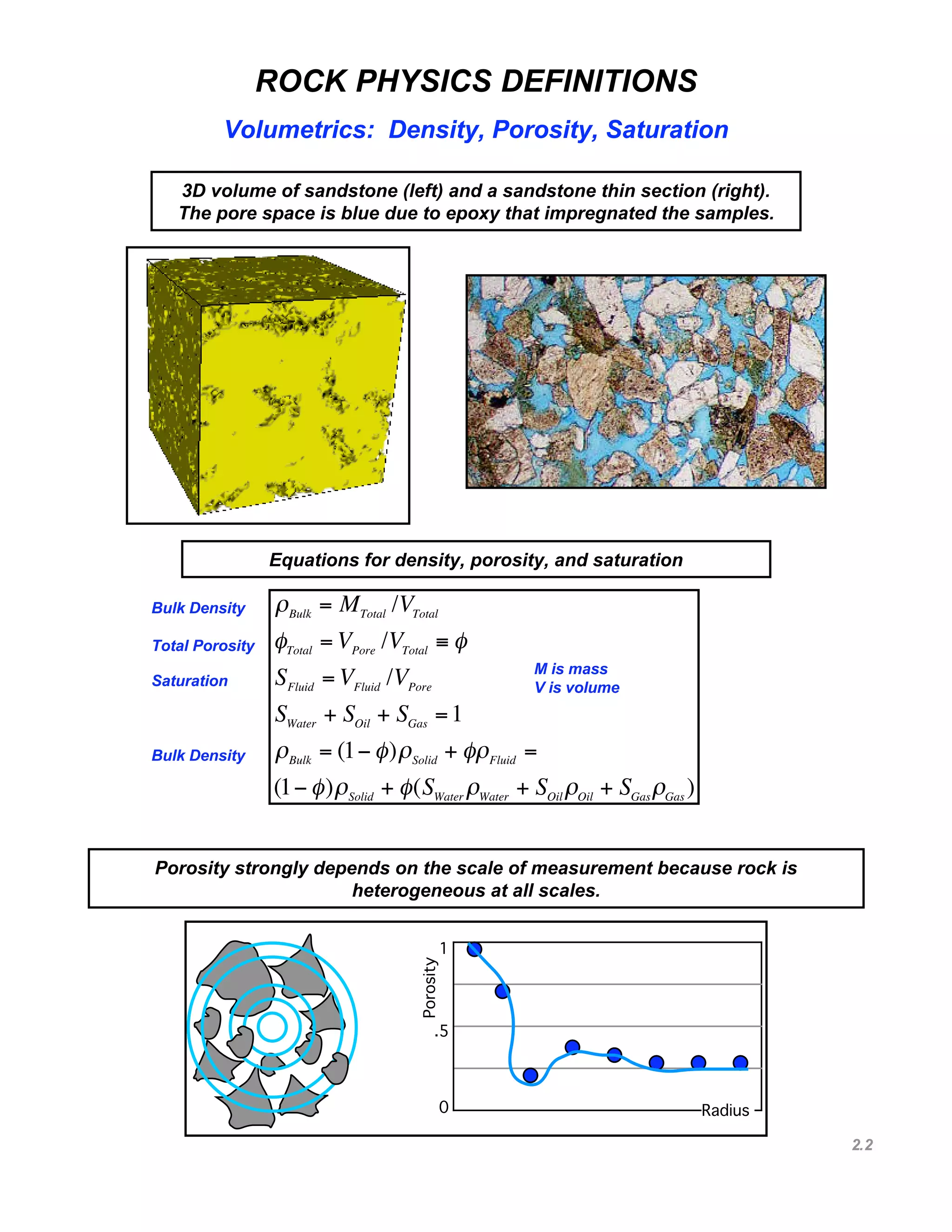
3D volume of sandstone (left) and a sandstone thin section (right).
The pore space is blue due to epoxy that impregnated the samples.
Equations for density, porosity, and saturation
Porosity strongly depends on the scale of measurement because rock is
heterogeneous at all scales.
Bulk Density
Total Porosity
Saturation
Bulk Density
€
ρBulk = MTotal /VTotal
φTotal
= VPore
/VTotal
≡ φ
SFluid = VFluid /VPore
SWater
+ SOil
+ SGas
=1
ρBulk = (1− φ)ρSolid + φρFluid =
(1− φ)ρSolid
+ φ(SWater
ρWater
+ SOil
ρOil
+ SGas
ρGas
)
M is mass
V is volume
2.3
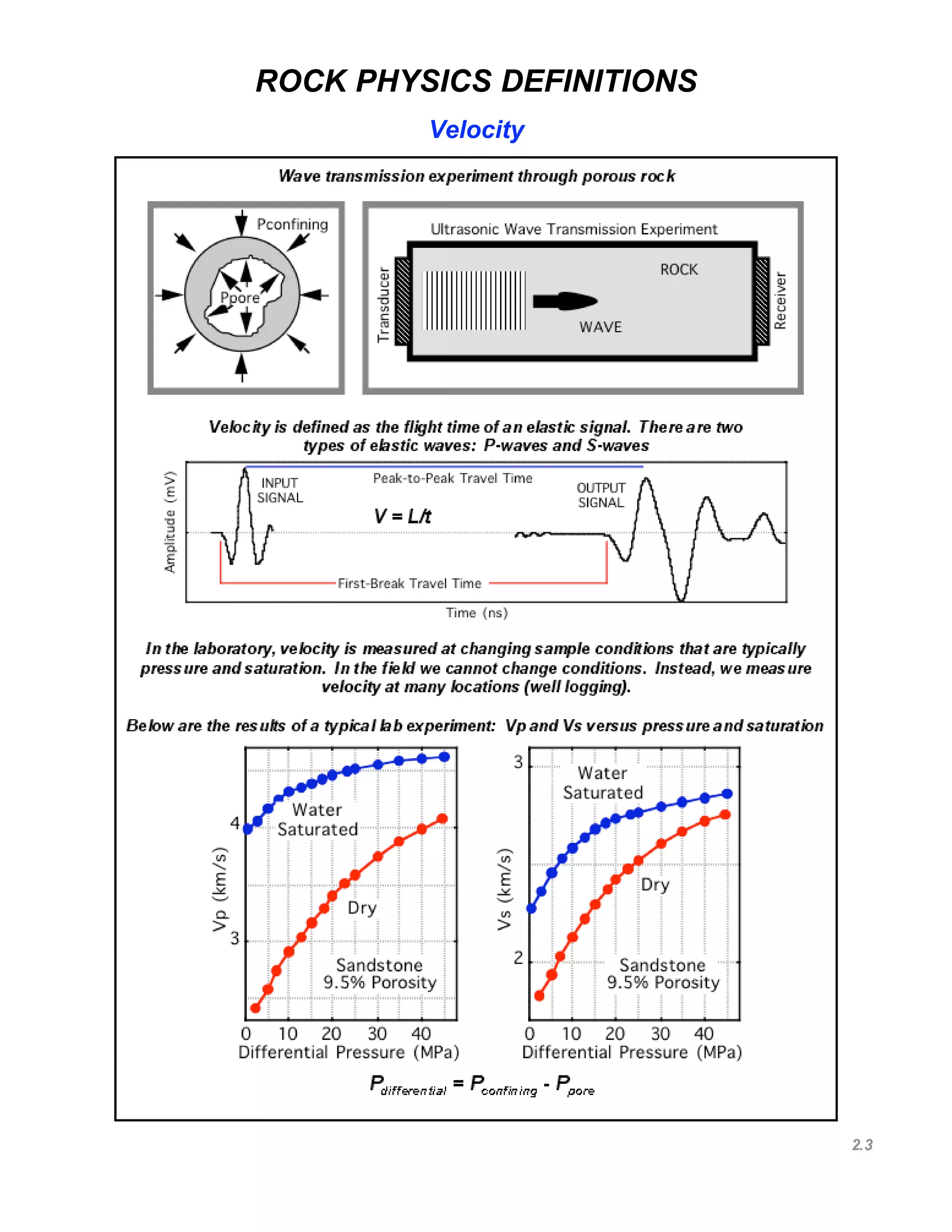
ROCK PHYSICS DEFINITIONS
Velocity
2.4
ROCK PHYSICS BASICS
Normal Reflection
Ip = ρVp ν =
1
2
(Vp / Vs )2
− 2
(Vp / Vs )2
− 1
1200
1300
1400
1500
1600
1700
1800
1900
2000
TravelTime(ms)
Normal
Reflection
T
R
R(0)=
Ip2 − Ip1
Ip2 + Ip1
=
dIp
2Ip
=
1
2
d ln Ip
Two important elastic parameters that affect reflection are derived from velocity
and density. They are the acoustic (or P-) impedance Ip and Poisson’s ratio ν
Normal Incidence. The reflection amplitude of a normal-incidence P-wave at the
interface between two infinite half-spaces depends on the difference between the
impedances of the half-spaces. The same law applies to S-wave reflection.
A reflection seismogram is a superposition of
signals reflected from interfaces between earth
layers of different elastic properties.
It is useful, therefore, to examine reflection at a
single interface between two elastic half-spaces.
Normal reflection forms a full differential. Therefore, it can be integrated to
arrive at the absolute values of P-wave impedance. This procedure is called
impedance inversion.
Zoeppritz (1919)
2.5
ROCK PHYSICS BASICS
Reflection at an Angle
Incident
P-Wave Reflected
P-Wave
Reflected
S-Wave
Transmitted
S-Wave
Transmitted
P-Wave
Θ1
Θ2
Φ1
Φ2
The reflection amplitude of a wave propagating at an angle to an interface not only
depends on the P-wave elastic properties of the half-spaces but also on the S-wave
properties. The rigorous Zoeppritz equations can be linearized to express the reflected
amplitude through the P-wave impedance and Poisson’s ratio difference.
A possible simplification for AVO computation. There are many other approximate
expressions for reflection at an angle.
The exact Zoeppritz equations do not form a full differential. However, their various
linearizations do. As a result, these full differentials can be integrated to arrive at a
quantity that is called the elastic impedance. It is important to remember that in most
cases, the units of the elastic impedance are not the same as of the acoustic impedance.
The equation below may serve as a definition of the elastic impedance Ie.
Parameters commonly used to characterize reflection at an angle are intercept and
gradient.
Intercept Gradient
€
R(θ) ≈ R(0)cos2
θ + d(
1
1−ν
)sin2
θ
€
R(θ) ≡
Def
1
2
dlnIe
≈ R(0)cos2
θ + d(
1
1−ν
)sin2
θ =
1
2
dlnIp
+ d(
1
1−ν
−
1
2
lnIp
)sin2
θ
⇒ lnIe
= lnIp
+ (
2
1−ν
− lnIp
)sin2
θ
€
R(θ) ≈ d(
lnIp
2
) + d(
1
1−ν
−
lnIp
2
) sin2
θ
Zoeppritz (1919)
2.6
ROCK PHYSICS BASICS
Reflection at an Angle
A convenient approximation for reflection at an angle belongs to Hilterman
(1989). It assumes that, on average, Poisson's ratio is 1/3.
It follows from this approximation that if the change in Poisson's ratio is
negative, the amplitude should decrease with offset. This is what happens
between shale and gas sand. Depending on the rock properties, 3 AVO
classes have been defined.
Zoeppritz P-wave reflection coefficients for a shale over gas sand interface
for a range of normal reflectivity values. The Poisson’s ratio and density
were assumed to be 0.38 and 2.4 g/cc for shale and 0.15 and 2.0 g/cc for gas
sand (from Rutherford and Williams, 1989).
€
R(θ) ≈ R(0)cos2
θ + 2.25Δν sin2
θ
2.7
ROCK PHYSICS BASICS
Relative Impedance Inversion
€
Rpp (θ) ≈ Rpp (0) cos2
θ + 2.25Δν sin2
θ
≈ Rpp (0) + [2.25Δν − Rpp (0)]sin2
θ,
€
Rpp
(0) =
Ip 2
− Ip1
Ip 2
+ Ip1
=
dIp
2Ip
=
1
2
d ln Ip
,
€
Ip
= exp[2 Rpp
(0)dz∫ ].
€
Δν =
Rpp (θ )− Rpp(0) cos2
θ
2.25sin2
θ
,
ν =
Rpp
(θ )− Rpp
(0) cos2
θ
2.25sin2
θ
∫ dz.
2.8
ROCK PHYSICS BASICS
Relative Impedance Example
Relative seismically-derived impedance and Poisson's ratio do
not provide the absolute values of these elastic constants.
However, they are often useful in obtaining spatial shapes of
impedance and Poisson's ratio.
2.9
ROCK PHYSICS BASICS
Elasticity
Ti = σijnj
Stress Tensor
u
x1
x2
x3
x1
T
n
x2
x3
Strain Tensor
εij =
1
2
(
∂ui
∂x j
+
∂uj
∂xi
)
σij = σji i ≠ j; εij = εji i ≠ j.
σij = cijklekl; cijkl = cjikl = cijlk = cjilk, cijkl = cklij .
σij = λδijεαα + 2µεij; εij = [(1 + ν)σij − νδijσαα ]/ E.
Commonly used constants are: λ and µ -- Lame's constants; ν -- Poisson's ratio; E -- Young's modulus. The elastic
moduli are determined by the experiment performed. For example, the bulk modulus is measured in the
hydrostatic compression experiment. The shear modulus is measured in the shear deformation experiment.
Stress and strain. Forces acting within a mechanical body are mathematically
characterized by the stress tensor which is a 3x3 matrix. By using a stress tensor we
can find the vector of traction acting on an elemental plane of any orientation within
the body (figure on the left).
The deformation within the body is characterized by the strain tensor. This tensor is
formed by the derivatives of the components of the displacement of a material point in
the body (figure on the right).
Both stress and strain tensors are symmetrical matrices.
Hooke’s law relates stress to strain. It postulates that this relation is linear. In general, there are 21 independent
elastic constants that linearly relate stress to strain.
Fortunately, if a body is isotropic, only two independent elastic constants are required. These constants are
called elastic moduli.
Elastic moduli derived from loading experiments are called static moduli
Bulk Modulus
K = λ + 2µ / 3
Z
X
Y
σ xz = 2µε xz
εxx = εyy = εzz = εxy = 0
Shear
Shear Modulus Compressional Modulus
Hydrostatic Loading Distortion, no volume
change
No lateral deformation
€
M = K + (4 /3)µ
2.10
ROCK PHYSICS BASICS
Elastic-Wave Velocity
An elastic stress wave can propagate through an elastic body and generate stress and
strain disturbance. The magnitude of deformation generated by a propagating wave is
usually very small, on the order of 10-7
. As a result, the stress perturbation is also
very small, much smaller than the ambient state of stress.
The speed of an elastic wave is related to the elastic moduli via the wave equation
(below) where u is displacement, t is time, z is the spatial coordinate, M is the elastic
modulus, and ρ is the density.
u(z)
σ(z+dz)σ(z) z
dzA
∂ 2
u
∂t2 =
M
ρ
∂2
u
∂z2
It follows from the wave equation that the speed of wave propagation is
M / ρ
Vp = M / ρ = (K + 4G / 3) / ρ
Vs = G / ρ
M = ρVp
2
; G = ρVs
2
; K = ρ(V p
2
− 4Vs
2
/ 3); λ = ρ(Vp
2
− 2Vs
2
).
M is the compressional modulus or M-modulus
G (or µ) is the shear modulus
K is the bulk modulus
E is Young’s modulus
ν is Poisson’s ratio
λ is Lame’s constant
ν =
1
2
(Vp / Vs )2
− 2
(Vp / Vs )
2
− 1
Elastic moduli derived from velocity data are called dynamic moduli
Poisson’s Ratio
€
ν =
1
2
(Vp /Vs)2
− 2
(Vp /Vs)2
−1
2.11
ROCK PHYSICS BASICS
Relations between Elastic Constants
Poisson’s ratio relates to the ratios of various elastic moduli and elastic-
wave velocities.
ν =
1
2
(Vp / Vs )
2
− 2
(Vp / Vs )
2
−1
=
1
2
M / G − 2
M / G −1
=
1
2
K / G − 2 / 3
K / G +1 / 3
=
1
2
λ / G
λ / G +1
Theoretically, PR may vary between -1 and 0.5
−1 ≤ ν ≤ 0.5
ν = −1 ⇒ M =
4
3
G; Vp =
2
3
Vs ; K = 0; λ = −
2
3
G
ν = 0 ⇒ M = 2G; Vp = 2Vs ; K =
2
3
G; λ = 0
ν = 0.5 ⇒ Vs = 0|K = ∞
Sometimes, the dynamic PR of dry sand at low pressure may appear negative.
Plot below shows PR versus porosity in dry unconsolidated sand at low differential
pressure. This may mean (a) wrong data or (b) anisotropic rock.
0.0
0.1
0.2 0.3 0.4
Poisson'sRatio
Porosity
Room-Dry Sands
5 MPa
2.12
ROCK PHYSICS BASICS
Static and Dynamic Moduli
Log Strain
Stress
10-7
10-2
DYNAMIC
STATIC
Load
Unload
By definition, the dynamic moduli of rock are those calculated from the elastic-
wave velocity and density. The static moduli are those directly measured in a
deformational experiment.
The static and dynamic moduli of the same rock may significantly differ from each
other. The main reason is likely to be the difference in the deformation (strain)
amplitude between the dynamic and static experiments.
In the dynamic wave propagation experiment the strain is about 10-7
while static
strain may reach 10-2
.
σ Stress
Axial Strain
εa
εr
E = σ / εa
ν = εr / εa
Typical Plastic Behavior
Radial
Strain
2.13
ROCK PHYSICS BASICS
Need for Static Moduli
2c
2b
SHmin
P
b = 2c
1 − ν2
E
(P − SHmin)
Importance of Static Young's
Modulus and Poisson's Ratio
for Hydrofracture Design
Static moduli are often used in wellbore stability and in-situ stress applications
to evaluate the possibility of breakouts, elevated pore pressure, and tectonic
stress distribution. For example, a common method of calculating the horizontal
stress in earth is by assuming that the earth is elastic and does not deform in the
horizontal direction.
SH
SV
SH = SV
ν
1 − ν
Vertical
(Overburden)
Stress
Horizontal
Stress
Poisson’s
Ratio
Hydrofracture can be approximated by a 2D elliptical crack who's dimensions
depend on the static Young's modulus and Poisson's ratio.
2.14
ROCK PHYSICS BASICS
Static and Dynamic Moduli in Sand
ν =
1
2
(Vp / Vs )
2
− 2
(Vp / Vs )
2
− 1
Porosity (left) and velocity (right) versus pressure in high-porosity room-dry sand
sample from the Gulf of Mexico.
Zimmer, M., 2003, Doctoral Thesis, Stanford University .
Velocity versus porosity (left) and dynamic and static bulk moduli calculated for the
same sample.
0.35
0.36
0.37
0.38
0.39
0.40
0 5 10 15 20
Porosity
Pressure (MPa)
POMPONIO
0.2
0.4
0.6
0.8
1.0
1.2
1.4
1.6
1.8
0 5 10 15 20
Velocity(km/s)
Pressure (MPa)
POMPONIO
SAND
SAND
0.2
0.4
0.6
0.8
1.0
1.2
1.4
1.6
1.8
0.36 0.38 0.4
Velocity(km/s)
Porosity
POMPONIO
P
S
SAND
0
1
2
3
4
0 5 10 15 20
BulkModulus(GPa)
Pressure (MPa)
POMPONIO
Static
Dynamic
SAND
CREEP
2.15
ROCK PHYSICS BASICS
Compaction Effects in Sand/Shale
Yin, H., 1992, Doctoral Thesis, Stanford University .
Velocity in shale depends on stress and porosity and deformation
history.
SAND/CLAY SAND/CLAY
SAND/CLAY
SAND/CLAY
Load
Load
Load
Unload
Unload
Unload
Unload
Load
2.16
ROCK PHYSICS BASICS
Elastic Composites and Elastic Bounds
Most physical bodies in nature are elastically heterogeneous, I.e., they are made of
components that have different elastic moduli. The effective elastic moduli of a
composite depend on (a) properties of individual components and (b) geometrical
arrangement of these components in space.
It is often very hard, if not impossible, to theoretically calculate the effective elastic
moduli of a composite.
However, elastic bounds help us contain the exact values of the effective elastic
moduli.
The simplest bounds are the Voigt (stiffest) and Reuss (softest) bound. No matter how
complex the composite is, its effective elastic moduli are contained within these
bounds.
Composite Voigt
Reuss
For an elastic modulus that may be either bulk or shear modulus of an N-component
composite where the i-th component has modulus Mi and occupies volume fraction
fi, the Voigt (upper) bound is:
MV = fi Mi
i =1
N
∑
MR = ( fi Mi
−1
i=1
N
∑ )−1
The Reuss (lower) bound is:
Hill’s average is simply the average between the Voigt and Reuss bounds:
MH =
MV + MR
2
=
1
2
[ fi Mi
i=1
N
∑ + ( fi Mi
−1
i=1
N
∑ )
−1
]
10
12
14
16
18
20
0 0.2 0.4 0.6 0.8 1
ElasticModulus
Volume Concentration
The graph on the right shows the Voigt and
Reuss bounds and Hill’s average of a two-
component composite.
The elastic modulus of the soft component is 10
and that of the stiff component is 20. The
horizontal axis is the concentration of the stiff
component.
Voigt
Reuss
Hill
2.17
ROCK PHYSICS BASICS
Hashin-Shrikman Elastic Bounds
For an isotropic composite, the effective elastic bulk and shear moduli are
contained within rigorous Hashin-Shtrikman bounds. These bounds have been
derived for the bulk and shear moduli. The Hashin-Shtrikman bounds are tighter
than the Voigt-Reuss bounds.
[
fi
Ki + 4
3
Gmini =1
N
∑ ]−1
−
4
3
Gmin ≤ Keff ≤ [
fi
Ki + 4
3
Gmax
]−1
i =1
N
∑ −
4
3
Gmax,
[
fi
Gi +
Gmin
6
9Kmin + 8Gmin
Kmin + 2Gmin






]
−1
i =1
N
∑ −
Gmin
6
9Kmin + 8Gmin
Kmin + 2Gmin





 ≤ Geff ≤
[
fi
Gi +
Gmax
6
9Kmax + 8Gmax
Kmax + 2Gmax






i =1
N
∑ ]
−1
−
Gmax
6
9Kmax +8Gmax
Kmax + 2Gmax





,
In the Hashin-Shtrikman equations, the subscript “eff” is for the effective elastic
bulk and shear moduli. The subscripts “min” and “max” are for the softest and
stiffest components, respectively.
A physical realization of the Hashin-Shtrikman bounds for two components is the
entire space filled by composite spheres of varying size. The outer shell of each
sphere is the softest component for the lower bound and the stiffest component for
the upper bound.
If one of the components is void (empty pore) the lower bound is zero.
Hashin-Shtrikman
Bounds: Realization
10
12
14
16
18
20
0 0.2 0.4 0.6 0.8 1
ElasticModulus
Volume Concentration
Voigt
Reuss
Hashin-
Shtrikman
2.18
ROCK PHYSICS BASICS
Elastic Bounds for Water-Saturated Sand
Unfortunately, if the elastic moduli of the two components of the composite
are very different, the bounds lie very far apart.
They cannot be used for practical velocity prediction.
In the example below, plotted is velocity versus porosity as calculated for a
quartz/water mixture using the elastic bounds. The data points are for water-
saturated sandstones. The data lie within the elastic bounds curves.
The bounds can still be used to quality control of the data.
1
2
3
4
5
6
0 0.2 0.4 0.6 0.8 1
Vp(km/s)
Porosity
Voigt
Reuss
Upper
Hashin-Shtrikman
1
2
3
4
5
6
0 0.2 0.4 0.6 0.8 1
Vp(km/s)
Porosity
Voigt
Reuss
Upper
Hashin-Shtrikman
In the example below, the red data points lie below the lower bound curve for
the quartz/water mix. The reason is that these data are for gas-saturated
sands.
2.19
ROCK PHYSICS BASICS
Mixing Fluids
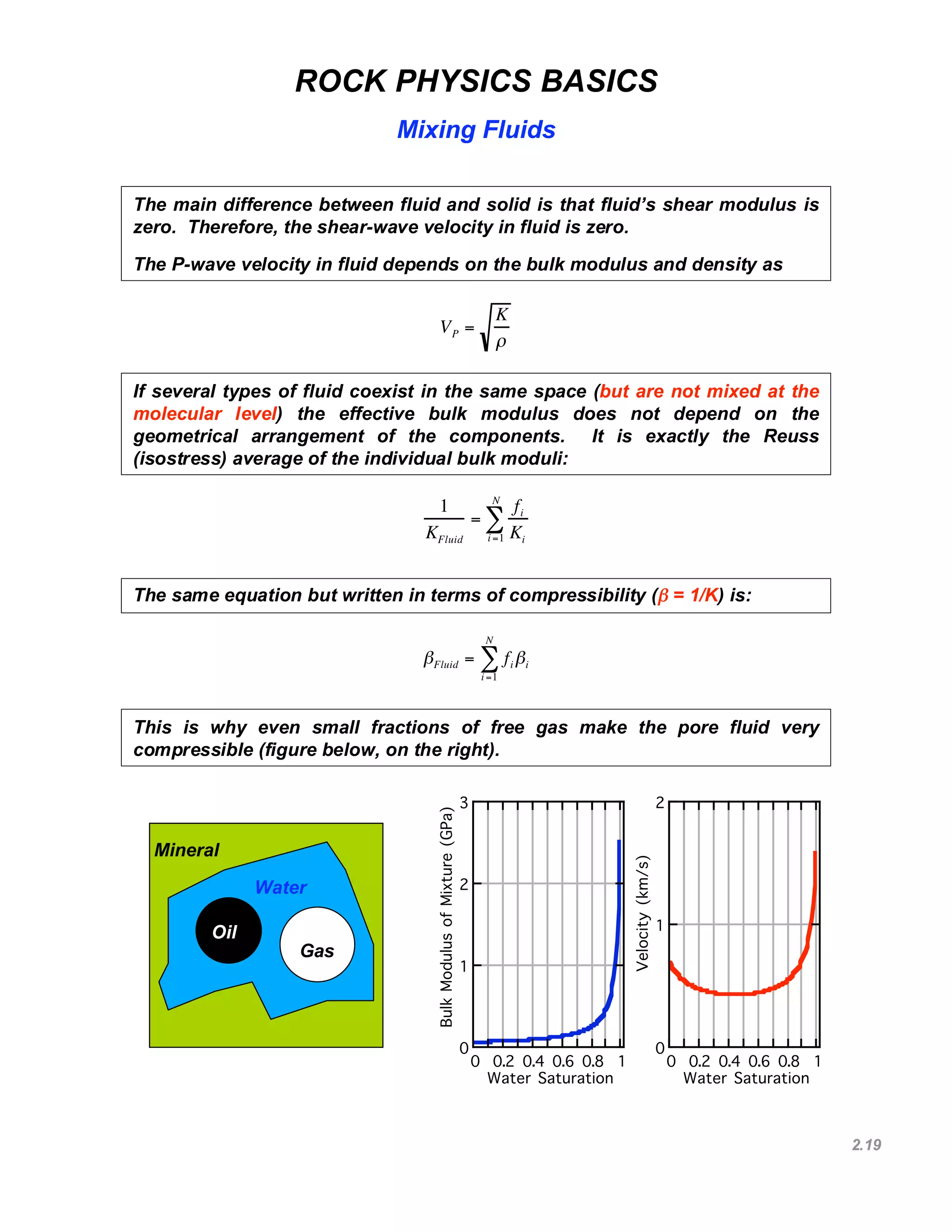
The main difference between fluid and solid is that fluid’s shear modulus is
zero. Therefore, the shear-wave velocity in fluid is zero.
The P-wave velocity in fluid depends on the bulk modulus and density as
VP =
K
ρ
If several types of fluid coexist in the same space (but are not mixed at the
molecular level) the effective bulk modulus does not depend on the
geometrical arrangement of the components. It is exactly the Reuss
(isostress) average of the individual bulk moduli:
1
KFluid
=
fi
Kii =1
N
∑
The same equation but written in terms of compressibility (β = 1/K) is:
βFluid = fi
i =1
N
∑ βi
This is why even small fractions of free gas make the pore fluid very
compressible (figure below, on the right).
Mineral
Water
Oil
Gas
0
1
2
3
0 0.2 0.4 0.6 0.8 1
BulkModulusofMixture(GPa)
Water Saturation
0
1
2
0 0.2 0.4 0.6 0.8 1
Velocity(km/s)
Water Saturation
2.20
ROCK PHYSICS BASICS
Pressure and Rock Properties
1.5
2.0
2.5
3.0
3.5
4.0
0 5 10 15 20 25
Velocity(km/s)
Confining Pressure (MPa)
In-Situ
Stress
Vp
Vs
When rock is extracted from depth and re-loaded in the lab, it exhibits a strong
velocity-pressure dependence, especially at low confining pressure. The primary
reason is microcracks that open during in-situ stress relief.
Below: Vp and Vs versus confining pressure in room-dry sandstone samples. The
in-situ effective stress is about 15 MPa. Different colors correspond to different
samples.
2.21
ROCK PHYSICS BASICS
Pressure and Rock Properties
Phenomenology of pressure effect on velocity in room-dry sandstone
dataset.
The velocity-porosity trends become sharper as pressure increases.
2
3
4
5
6
0 0.1 0.2 0.3
Vp(km/s)
Porosity
5 MPa
0 0.1 0.2 0.3
Porosity
20 MPa
0 0.1 0.2 0.3
Porosity
40 MPa
2.22
ROCK PHYSICS BASICS
Pressure and Rock Properties
Phenomenology of pressure effect on velocity in room-dry sandstone
dataset.
Both Vp and Vs may significantly change with changing pressure.
1
2
3
4
5
6
1 2 3 4 5 6
Vpat40MPa(km/s)
Vp at 5 MPa (km/s)
1
2
3
4
1 2 3 4
Vsat40MPa(km/s)
Vs at 5 MPa (km/s)
Vp Vs
Vs at 5 MPa
Vsat40MPa
Vp at 5 MPa
Vpat40MPa
2.23
ROCK PHYSICS BASICS
Pressure and Rock Properties
The Vp and Vs versus pressure changes are not necessarily scalable -- the
Vp/Vs ratio and Poisson's ratio change as well.
0
0.1
0.2
0.3
0 0.1 0.2 0.3
PRat40MPa
PR at 5 MPa
Poisson's
Ratio
PR at 5 MPa
PRat40MPa
2.24
ROCK PHYSICS BASICS
Pressure and Rock Properties
The effect of pressure on porosity is not as large as on velocity. The main
reason is that rock's elasticity is affected by thin compliant cracks that do
not occupy much of the pore space volume.
.1
.2
.3
.1 .2 .3
Porosity at 5 MPa
40 MPa
Porosityat40MPa
0
.01
.1 .2 .3
Porosity at 5 MPa
PorosityIncrease
0
.1
.2
.1 .2 .3
Porosity at 5 MPa
RelativeChange
5 MPa to 40 MPa
Relative Reduction
€
Δφ
φ
2.25
ROCK PHYSICS BASICS
Stress-Induced Anisotropy
θ
€
Vp (θ) ≈ α(1+ δsin2
θcos2
θ + εsin4
θ)
VsV (θ) ≈ β[1+
α2
β2
(ε −δ)sin2
θcos2
θ]
VsH (θ) ≈ β[1+ γ sin2
θ]
€
ε =
Vp (π /2) −Vp (0)
Vp (0)
γ =
VsH (π /2) −VsV (π /2)
VsV (π /2)
=
VsH (π /2) −VsH (0)
VsH (0)
Thomsen's anisotropic formulation (weak transverse isotropy)
Vzz
Vyy
Vxx Vyz
VyxVxz
Vxy
Vzy
Vzx
Z
Y
X
Vzz
Vxx
Vyy
Vyz
Vyx
Vxz
Vzy
Vxy
Vzx
Ottawa sand. Uniaxial compression.
Pxx = Pyy = 1.72 bar. Yin (1992).
Anisotropic stress field induces anisotropy in otherwise isotropic rock.
2.26
ROCK PHYSICS BASICS
Permeability
Permeability is a fluid flow property of a porous medium. Its definition comes
from Darcy’s law which states that the flow rate is linearly proportional to the
pressure gradient.
Q = −k
A
µ
ΔP
LFlow
Rate
Pressure
Head
Sample
LengthViscosity
Sample
Cross-SectionPERMEABILITY
2.27
ROCK PHYSICS BASICS
Permeability -- Kozeny-Carman Equation
Permeability depends on porosity and grain size.
Kozeny-Carman
Equation (SI UNITS)
€
k
d2
=
1
72
φ3
(1− φ)2
τ2
Permeability
Grain Size Tortuosity
Porosity
Permeability may be almost zero in carbonate where large vuggy pores are not connected.
This pore geometry is a topological inverse of the pore geometry of clastic sediment.
Permeability equations that work in clastics may not work in carbonates.
Drastic drop in permeability as
porosity increases but clay
content increases too (grain
size decreases). Yin (1992).
Permeability depends on porosity and grain size and also (critically) on the
pore-space geometry.
2.28
ROCK PHYSICS BASICS
Permeability and Stress
Permeability in medium-to-high porosity clastic sediment is weakly dependent on stress.
0.1
0.2
0.3
0.1 0.2 0.3
Porosityat4000psi
Porosity at 400 psi
a
1
10
100
1 10 100
Permeability(mD)at4000psi
Permeability (mD) at 400 psi
b
Ali Mese (1998) Ali Mese (1998)
Walls (1982)
Permeability in tight sandstone samples. Porosity 0.03 to 0.07.
Relative changes of high permeability with pressure are smaller than those for
low permeability. Both may have implications for fluid transport.
2.29
€
U1
€
U2
€
I
€
U = U1
−U2
R = U /I
Potential
Drop
Electrical
Current
Resistance
€
ρ = RA/l
Resistivity
€
[R] = Ω ≡ Ohm
[ρ] = Ω⋅ m ≡ Ohm⋅ m
€
σ =1/ρ
Conductivity
DEFINITIONS OF RESISTIVITY
0.1
1
10
100
6000 6500 7000 7500 8000
Rt(Ohmm)
Depth (ft)
0
50
100
150
6000 6500 7000 7500 8000
GR
Depth (ft)

Rock Physics: Definitions

  • 1.
    2. Definitions andMethods 2.1 JD 2008
  • 2.
    2.2 ROCK PHYSICS DEFINITIONS Volumetrics:Density, Porosity, Saturation Radius Porosity 0 1 .5 3D volume of sandstone (left) and a sandstone thin section (right). The pore space is blue due to epoxy that impregnated the samples. Equations for density, porosity, and saturation Porosity strongly depends on the scale of measurement because rock is heterogeneous at all scales. Bulk Density Total Porosity Saturation Bulk Density € ρBulk = MTotal /VTotal φTotal = VPore /VTotal ≡ φ SFluid = VFluid /VPore SWater + SOil + SGas =1 ρBulk = (1− φ)ρSolid + φρFluid = (1− φ)ρSolid + φ(SWater ρWater + SOil ρOil + SGas ρGas ) M is mass V is volume
  • 3.
  • 4.
    2.4 ROCK PHYSICS BASICS NormalReflection Ip = ρVp ν = 1 2 (Vp / Vs )2 − 2 (Vp / Vs )2 − 1 1200 1300 1400 1500 1600 1700 1800 1900 2000 TravelTime(ms) Normal Reflection T R R(0)= Ip2 − Ip1 Ip2 + Ip1 = dIp 2Ip = 1 2 d ln Ip Two important elastic parameters that affect reflection are derived from velocity and density. They are the acoustic (or P-) impedance Ip and Poisson’s ratio ν Normal Incidence. The reflection amplitude of a normal-incidence P-wave at the interface between two infinite half-spaces depends on the difference between the impedances of the half-spaces. The same law applies to S-wave reflection. A reflection seismogram is a superposition of signals reflected from interfaces between earth layers of different elastic properties. It is useful, therefore, to examine reflection at a single interface between two elastic half-spaces. Normal reflection forms a full differential. Therefore, it can be integrated to arrive at the absolute values of P-wave impedance. This procedure is called impedance inversion. Zoeppritz (1919)
  • 5.
    2.5 ROCK PHYSICS BASICS Reflectionat an Angle Incident P-Wave Reflected P-Wave Reflected S-Wave Transmitted S-Wave Transmitted P-Wave Θ1 Θ2 Φ1 Φ2 The reflection amplitude of a wave propagating at an angle to an interface not only depends on the P-wave elastic properties of the half-spaces but also on the S-wave properties. The rigorous Zoeppritz equations can be linearized to express the reflected amplitude through the P-wave impedance and Poisson’s ratio difference. A possible simplification for AVO computation. There are many other approximate expressions for reflection at an angle. The exact Zoeppritz equations do not form a full differential. However, their various linearizations do. As a result, these full differentials can be integrated to arrive at a quantity that is called the elastic impedance. It is important to remember that in most cases, the units of the elastic impedance are not the same as of the acoustic impedance. The equation below may serve as a definition of the elastic impedance Ie. Parameters commonly used to characterize reflection at an angle are intercept and gradient. Intercept Gradient € R(θ) ≈ R(0)cos2 θ + d( 1 1−ν )sin2 θ € R(θ) ≡ Def 1 2 dlnIe ≈ R(0)cos2 θ + d( 1 1−ν )sin2 θ = 1 2 dlnIp + d( 1 1−ν − 1 2 lnIp )sin2 θ ⇒ lnIe = lnIp + ( 2 1−ν − lnIp )sin2 θ € R(θ) ≈ d( lnIp 2 ) + d( 1 1−ν − lnIp 2 ) sin2 θ Zoeppritz (1919)
  • 6.
    2.6 ROCK PHYSICS BASICS Reflectionat an Angle A convenient approximation for reflection at an angle belongs to Hilterman (1989). It assumes that, on average, Poisson's ratio is 1/3. It follows from this approximation that if the change in Poisson's ratio is negative, the amplitude should decrease with offset. This is what happens between shale and gas sand. Depending on the rock properties, 3 AVO classes have been defined. Zoeppritz P-wave reflection coefficients for a shale over gas sand interface for a range of normal reflectivity values. The Poisson’s ratio and density were assumed to be 0.38 and 2.4 g/cc for shale and 0.15 and 2.0 g/cc for gas sand (from Rutherford and Williams, 1989). € R(θ) ≈ R(0)cos2 θ + 2.25Δν sin2 θ
  • 7.
    2.7 ROCK PHYSICS BASICS RelativeImpedance Inversion € Rpp (θ) ≈ Rpp (0) cos2 θ + 2.25Δν sin2 θ ≈ Rpp (0) + [2.25Δν − Rpp (0)]sin2 θ, € Rpp (0) = Ip 2 − Ip1 Ip 2 + Ip1 = dIp 2Ip = 1 2 d ln Ip , € Ip = exp[2 Rpp (0)dz∫ ]. € Δν = Rpp (θ )− Rpp(0) cos2 θ 2.25sin2 θ , ν = Rpp (θ )− Rpp (0) cos2 θ 2.25sin2 θ ∫ dz.
  • 8.
    2.8 ROCK PHYSICS BASICS RelativeImpedance Example Relative seismically-derived impedance and Poisson's ratio do not provide the absolute values of these elastic constants. However, they are often useful in obtaining spatial shapes of impedance and Poisson's ratio.
  • 9.
    2.9 ROCK PHYSICS BASICS Elasticity Ti= σijnj Stress Tensor u x1 x2 x3 x1 T n x2 x3 Strain Tensor εij = 1 2 ( ∂ui ∂x j + ∂uj ∂xi ) σij = σji i ≠ j; εij = εji i ≠ j. σij = cijklekl; cijkl = cjikl = cijlk = cjilk, cijkl = cklij . σij = λδijεαα + 2µεij; εij = [(1 + ν)σij − νδijσαα ]/ E. Commonly used constants are: λ and µ -- Lame's constants; ν -- Poisson's ratio; E -- Young's modulus. The elastic moduli are determined by the experiment performed. For example, the bulk modulus is measured in the hydrostatic compression experiment. The shear modulus is measured in the shear deformation experiment. Stress and strain. Forces acting within a mechanical body are mathematically characterized by the stress tensor which is a 3x3 matrix. By using a stress tensor we can find the vector of traction acting on an elemental plane of any orientation within the body (figure on the left). The deformation within the body is characterized by the strain tensor. This tensor is formed by the derivatives of the components of the displacement of a material point in the body (figure on the right). Both stress and strain tensors are symmetrical matrices. Hooke’s law relates stress to strain. It postulates that this relation is linear. In general, there are 21 independent elastic constants that linearly relate stress to strain. Fortunately, if a body is isotropic, only two independent elastic constants are required. These constants are called elastic moduli. Elastic moduli derived from loading experiments are called static moduli Bulk Modulus K = λ + 2µ / 3 Z X Y σ xz = 2µε xz εxx = εyy = εzz = εxy = 0 Shear Shear Modulus Compressional Modulus Hydrostatic Loading Distortion, no volume change No lateral deformation € M = K + (4 /3)µ
  • 10.
    2.10 ROCK PHYSICS BASICS Elastic-WaveVelocity An elastic stress wave can propagate through an elastic body and generate stress and strain disturbance. The magnitude of deformation generated by a propagating wave is usually very small, on the order of 10-7 . As a result, the stress perturbation is also very small, much smaller than the ambient state of stress. The speed of an elastic wave is related to the elastic moduli via the wave equation (below) where u is displacement, t is time, z is the spatial coordinate, M is the elastic modulus, and ρ is the density. u(z) σ(z+dz)σ(z) z dzA ∂ 2 u ∂t2 = M ρ ∂2 u ∂z2 It follows from the wave equation that the speed of wave propagation is M / ρ Vp = M / ρ = (K + 4G / 3) / ρ Vs = G / ρ M = ρVp 2 ; G = ρVs 2 ; K = ρ(V p 2 − 4Vs 2 / 3); λ = ρ(Vp 2 − 2Vs 2 ). M is the compressional modulus or M-modulus G (or µ) is the shear modulus K is the bulk modulus E is Young’s modulus ν is Poisson’s ratio λ is Lame’s constant ν = 1 2 (Vp / Vs )2 − 2 (Vp / Vs ) 2 − 1 Elastic moduli derived from velocity data are called dynamic moduli Poisson’s Ratio € ν = 1 2 (Vp /Vs)2 − 2 (Vp /Vs)2 −1
  • 11.
    2.11 ROCK PHYSICS BASICS Relationsbetween Elastic Constants Poisson’s ratio relates to the ratios of various elastic moduli and elastic- wave velocities. ν = 1 2 (Vp / Vs ) 2 − 2 (Vp / Vs ) 2 −1 = 1 2 M / G − 2 M / G −1 = 1 2 K / G − 2 / 3 K / G +1 / 3 = 1 2 λ / G λ / G +1 Theoretically, PR may vary between -1 and 0.5 −1 ≤ ν ≤ 0.5 ν = −1 ⇒ M = 4 3 G; Vp = 2 3 Vs ; K = 0; λ = − 2 3 G ν = 0 ⇒ M = 2G; Vp = 2Vs ; K = 2 3 G; λ = 0 ν = 0.5 ⇒ Vs = 0|K = ∞ Sometimes, the dynamic PR of dry sand at low pressure may appear negative. Plot below shows PR versus porosity in dry unconsolidated sand at low differential pressure. This may mean (a) wrong data or (b) anisotropic rock. 0.0 0.1 0.2 0.3 0.4 Poisson'sRatio Porosity Room-Dry Sands 5 MPa
  • 12.
    2.12 ROCK PHYSICS BASICS Staticand Dynamic Moduli Log Strain Stress 10-7 10-2 DYNAMIC STATIC Load Unload By definition, the dynamic moduli of rock are those calculated from the elastic- wave velocity and density. The static moduli are those directly measured in a deformational experiment. The static and dynamic moduli of the same rock may significantly differ from each other. The main reason is likely to be the difference in the deformation (strain) amplitude between the dynamic and static experiments. In the dynamic wave propagation experiment the strain is about 10-7 while static strain may reach 10-2 . σ Stress Axial Strain εa εr E = σ / εa ν = εr / εa Typical Plastic Behavior Radial Strain
  • 13.
    2.13 ROCK PHYSICS BASICS Needfor Static Moduli 2c 2b SHmin P b = 2c 1 − ν2 E (P − SHmin) Importance of Static Young's Modulus and Poisson's Ratio for Hydrofracture Design Static moduli are often used in wellbore stability and in-situ stress applications to evaluate the possibility of breakouts, elevated pore pressure, and tectonic stress distribution. For example, a common method of calculating the horizontal stress in earth is by assuming that the earth is elastic and does not deform in the horizontal direction. SH SV SH = SV ν 1 − ν Vertical (Overburden) Stress Horizontal Stress Poisson’s Ratio Hydrofracture can be approximated by a 2D elliptical crack who's dimensions depend on the static Young's modulus and Poisson's ratio.
  • 14.
    2.14 ROCK PHYSICS BASICS Staticand Dynamic Moduli in Sand ν = 1 2 (Vp / Vs ) 2 − 2 (Vp / Vs ) 2 − 1 Porosity (left) and velocity (right) versus pressure in high-porosity room-dry sand sample from the Gulf of Mexico. Zimmer, M., 2003, Doctoral Thesis, Stanford University . Velocity versus porosity (left) and dynamic and static bulk moduli calculated for the same sample. 0.35 0.36 0.37 0.38 0.39 0.40 0 5 10 15 20 Porosity Pressure (MPa) POMPONIO 0.2 0.4 0.6 0.8 1.0 1.2 1.4 1.6 1.8 0 5 10 15 20 Velocity(km/s) Pressure (MPa) POMPONIO SAND SAND 0.2 0.4 0.6 0.8 1.0 1.2 1.4 1.6 1.8 0.36 0.38 0.4 Velocity(km/s) Porosity POMPONIO P S SAND 0 1 2 3 4 0 5 10 15 20 BulkModulus(GPa) Pressure (MPa) POMPONIO Static Dynamic SAND CREEP
  • 15.
    2.15 ROCK PHYSICS BASICS CompactionEffects in Sand/Shale Yin, H., 1992, Doctoral Thesis, Stanford University . Velocity in shale depends on stress and porosity and deformation history. SAND/CLAY SAND/CLAY SAND/CLAY SAND/CLAY Load Load Load Unload Unload Unload Unload Load
  • 16.
    2.16 ROCK PHYSICS BASICS ElasticComposites and Elastic Bounds Most physical bodies in nature are elastically heterogeneous, I.e., they are made of components that have different elastic moduli. The effective elastic moduli of a composite depend on (a) properties of individual components and (b) geometrical arrangement of these components in space. It is often very hard, if not impossible, to theoretically calculate the effective elastic moduli of a composite. However, elastic bounds help us contain the exact values of the effective elastic moduli. The simplest bounds are the Voigt (stiffest) and Reuss (softest) bound. No matter how complex the composite is, its effective elastic moduli are contained within these bounds. Composite Voigt Reuss For an elastic modulus that may be either bulk or shear modulus of an N-component composite where the i-th component has modulus Mi and occupies volume fraction fi, the Voigt (upper) bound is: MV = fi Mi i =1 N ∑ MR = ( fi Mi −1 i=1 N ∑ )−1 The Reuss (lower) bound is: Hill’s average is simply the average between the Voigt and Reuss bounds: MH = MV + MR 2 = 1 2 [ fi Mi i=1 N ∑ + ( fi Mi −1 i=1 N ∑ ) −1 ] 10 12 14 16 18 20 0 0.2 0.4 0.6 0.8 1 ElasticModulus Volume Concentration The graph on the right shows the Voigt and Reuss bounds and Hill’s average of a two- component composite. The elastic modulus of the soft component is 10 and that of the stiff component is 20. The horizontal axis is the concentration of the stiff component. Voigt Reuss Hill
  • 17.
    2.17 ROCK PHYSICS BASICS Hashin-ShrikmanElastic Bounds For an isotropic composite, the effective elastic bulk and shear moduli are contained within rigorous Hashin-Shtrikman bounds. These bounds have been derived for the bulk and shear moduli. The Hashin-Shtrikman bounds are tighter than the Voigt-Reuss bounds. [ fi Ki + 4 3 Gmini =1 N ∑ ]−1 − 4 3 Gmin ≤ Keff ≤ [ fi Ki + 4 3 Gmax ]−1 i =1 N ∑ − 4 3 Gmax, [ fi Gi + Gmin 6 9Kmin + 8Gmin Kmin + 2Gmin       ] −1 i =1 N ∑ − Gmin 6 9Kmin + 8Gmin Kmin + 2Gmin       ≤ Geff ≤ [ fi Gi + Gmax 6 9Kmax + 8Gmax Kmax + 2Gmax       i =1 N ∑ ] −1 − Gmax 6 9Kmax +8Gmax Kmax + 2Gmax      , In the Hashin-Shtrikman equations, the subscript “eff” is for the effective elastic bulk and shear moduli. The subscripts “min” and “max” are for the softest and stiffest components, respectively. A physical realization of the Hashin-Shtrikman bounds for two components is the entire space filled by composite spheres of varying size. The outer shell of each sphere is the softest component for the lower bound and the stiffest component for the upper bound. If one of the components is void (empty pore) the lower bound is zero. Hashin-Shtrikman Bounds: Realization 10 12 14 16 18 20 0 0.2 0.4 0.6 0.8 1 ElasticModulus Volume Concentration Voigt Reuss Hashin- Shtrikman
  • 18.
    2.18 ROCK PHYSICS BASICS ElasticBounds for Water-Saturated Sand Unfortunately, if the elastic moduli of the two components of the composite are very different, the bounds lie very far apart. They cannot be used for practical velocity prediction. In the example below, plotted is velocity versus porosity as calculated for a quartz/water mixture using the elastic bounds. The data points are for water- saturated sandstones. The data lie within the elastic bounds curves. The bounds can still be used to quality control of the data. 1 2 3 4 5 6 0 0.2 0.4 0.6 0.8 1 Vp(km/s) Porosity Voigt Reuss Upper Hashin-Shtrikman 1 2 3 4 5 6 0 0.2 0.4 0.6 0.8 1 Vp(km/s) Porosity Voigt Reuss Upper Hashin-Shtrikman In the example below, the red data points lie below the lower bound curve for the quartz/water mix. The reason is that these data are for gas-saturated sands.
  • 19.
    2.19 ROCK PHYSICS BASICS MixingFluids The main difference between fluid and solid is that fluid’s shear modulus is zero. Therefore, the shear-wave velocity in fluid is zero. The P-wave velocity in fluid depends on the bulk modulus and density as VP = K ρ If several types of fluid coexist in the same space (but are not mixed at the molecular level) the effective bulk modulus does not depend on the geometrical arrangement of the components. It is exactly the Reuss (isostress) average of the individual bulk moduli: 1 KFluid = fi Kii =1 N ∑ The same equation but written in terms of compressibility (β = 1/K) is: βFluid = fi i =1 N ∑ βi This is why even small fractions of free gas make the pore fluid very compressible (figure below, on the right). Mineral Water Oil Gas 0 1 2 3 0 0.2 0.4 0.6 0.8 1 BulkModulusofMixture(GPa) Water Saturation 0 1 2 0 0.2 0.4 0.6 0.8 1 Velocity(km/s) Water Saturation
  • 20.
    2.20 ROCK PHYSICS BASICS Pressureand Rock Properties 1.5 2.0 2.5 3.0 3.5 4.0 0 5 10 15 20 25 Velocity(km/s) Confining Pressure (MPa) In-Situ Stress Vp Vs When rock is extracted from depth and re-loaded in the lab, it exhibits a strong velocity-pressure dependence, especially at low confining pressure. The primary reason is microcracks that open during in-situ stress relief. Below: Vp and Vs versus confining pressure in room-dry sandstone samples. The in-situ effective stress is about 15 MPa. Different colors correspond to different samples.
  • 21.
    2.21 ROCK PHYSICS BASICS Pressureand Rock Properties Phenomenology of pressure effect on velocity in room-dry sandstone dataset. The velocity-porosity trends become sharper as pressure increases. 2 3 4 5 6 0 0.1 0.2 0.3 Vp(km/s) Porosity 5 MPa 0 0.1 0.2 0.3 Porosity 20 MPa 0 0.1 0.2 0.3 Porosity 40 MPa
  • 22.
    2.22 ROCK PHYSICS BASICS Pressureand Rock Properties Phenomenology of pressure effect on velocity in room-dry sandstone dataset. Both Vp and Vs may significantly change with changing pressure. 1 2 3 4 5 6 1 2 3 4 5 6 Vpat40MPa(km/s) Vp at 5 MPa (km/s) 1 2 3 4 1 2 3 4 Vsat40MPa(km/s) Vs at 5 MPa (km/s) Vp Vs Vs at 5 MPa Vsat40MPa Vp at 5 MPa Vpat40MPa
  • 23.
    2.23 ROCK PHYSICS BASICS Pressureand Rock Properties The Vp and Vs versus pressure changes are not necessarily scalable -- the Vp/Vs ratio and Poisson's ratio change as well. 0 0.1 0.2 0.3 0 0.1 0.2 0.3 PRat40MPa PR at 5 MPa Poisson's Ratio PR at 5 MPa PRat40MPa
  • 24.
    2.24 ROCK PHYSICS BASICS Pressureand Rock Properties The effect of pressure on porosity is not as large as on velocity. The main reason is that rock's elasticity is affected by thin compliant cracks that do not occupy much of the pore space volume. .1 .2 .3 .1 .2 .3 Porosity at 5 MPa 40 MPa Porosityat40MPa 0 .01 .1 .2 .3 Porosity at 5 MPa PorosityIncrease 0 .1 .2 .1 .2 .3 Porosity at 5 MPa RelativeChange 5 MPa to 40 MPa Relative Reduction € Δφ φ
  • 25.
    2.25 ROCK PHYSICS BASICS Stress-InducedAnisotropy θ € Vp (θ) ≈ α(1+ δsin2 θcos2 θ + εsin4 θ) VsV (θ) ≈ β[1+ α2 β2 (ε −δ)sin2 θcos2 θ] VsH (θ) ≈ β[1+ γ sin2 θ] € ε = Vp (π /2) −Vp (0) Vp (0) γ = VsH (π /2) −VsV (π /2) VsV (π /2) = VsH (π /2) −VsH (0) VsH (0) Thomsen's anisotropic formulation (weak transverse isotropy) Vzz Vyy Vxx Vyz VyxVxz Vxy Vzy Vzx Z Y X Vzz Vxx Vyy Vyz Vyx Vxz Vzy Vxy Vzx Ottawa sand. Uniaxial compression. Pxx = Pyy = 1.72 bar. Yin (1992). Anisotropic stress field induces anisotropy in otherwise isotropic rock.
  • 26.
    2.26 ROCK PHYSICS BASICS Permeability Permeabilityis a fluid flow property of a porous medium. Its definition comes from Darcy’s law which states that the flow rate is linearly proportional to the pressure gradient. Q = −k A µ ΔP LFlow Rate Pressure Head Sample LengthViscosity Sample Cross-SectionPERMEABILITY
  • 27.
    2.27 ROCK PHYSICS BASICS Permeability-- Kozeny-Carman Equation Permeability depends on porosity and grain size. Kozeny-Carman Equation (SI UNITS) € k d2 = 1 72 φ3 (1− φ)2 τ2 Permeability Grain Size Tortuosity Porosity Permeability may be almost zero in carbonate where large vuggy pores are not connected. This pore geometry is a topological inverse of the pore geometry of clastic sediment. Permeability equations that work in clastics may not work in carbonates. Drastic drop in permeability as porosity increases but clay content increases too (grain size decreases). Yin (1992). Permeability depends on porosity and grain size and also (critically) on the pore-space geometry.
  • 28.
    2.28 ROCK PHYSICS BASICS Permeabilityand Stress Permeability in medium-to-high porosity clastic sediment is weakly dependent on stress. 0.1 0.2 0.3 0.1 0.2 0.3 Porosityat4000psi Porosity at 400 psi a 1 10 100 1 10 100 Permeability(mD)at4000psi Permeability (mD) at 400 psi b Ali Mese (1998) Ali Mese (1998) Walls (1982) Permeability in tight sandstone samples. Porosity 0.03 to 0.07. Relative changes of high permeability with pressure are smaller than those for low permeability. Both may have implications for fluid transport.
  • 29.
    2.29 € U1 € U2 € I € U = U1 −U2 R= U /I Potential Drop Electrical Current Resistance € ρ = RA/l Resistivity € [R] = Ω ≡ Ohm [ρ] = Ω⋅ m ≡ Ohm⋅ m € σ =1/ρ Conductivity DEFINITIONS OF RESISTIVITY 0.1 1 10 100 6000 6500 7000 7500 8000 Rt(Ohmm) Depth (ft) 0 50 100 150 6000 6500 7000 7500 8000 GR Depth (ft)