ROBUST IMAGE PROCESSING ALGORITHMS,
INVOLVING TOOLS FROM DIGITAL GEOMETRY
AND MATHEMATICAL MORPHOLOGY
CBA SEMINAR 2018
ANTOINE VACAVANT, PHD, HDR, ASSOCIATE PROFESSOR
INSTITUT PASCAL, UMR6602 UCA / SIGMA / CNRS, LE PUY-EN-VELAY
www.linkedin.com/in/antoinevacavant
twitter.com/antoinevacavant
antoine.vacavant@uca.fr
antoine-vacavant.eu
Outline
1. Me in one slide
2. Introduction
3. Definition of robustness
Noise and robustness
Robustness for image processing
4. MM: Smoothed shock filtering
Test of robustness
Improvement of machine learning tasks
Discussion
5. DG: Robust Reeb graph computations
Reeb graph computations by skeleton extraction
Experimental evaluation
Discussion
6. MM & DG for biomedical image analysis
HCC segmentation
Hepatic vascular network segmentation
Robustness with shape variability for liver segmentation
7. Conclusion, future works
Antoine Vacavant 1 / 55
Outline
1. Me in one slide
2. Introduction
3. Definition of robustness
Noise and robustness
Robustness for image processing
4. MM: Smoothed shock filtering
Test of robustness
Improvement of machine learning tasks
Discussion
5. DG: Robust Reeb graph computations
Reeb graph computations by skeleton extraction
Experimental evaluation
Discussion
6. MM & DG for biomedical image analysis
HCC segmentation
Hepatic vascular network segmentation
Robustness with shape variability for liver segmentation
7. Conclusion, future works
Antoine Vacavant 2 / 55
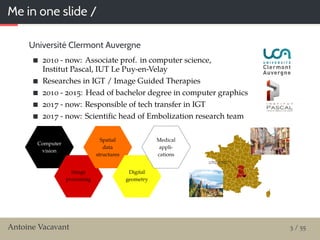
Me in one slide /
Université Clermont Auvergne
2010 - now: Associate prof. in computer science,
Institut Pascal, IUT Le Puy-en-Velay
Researches in IGT / Image Guided Therapies
2010 - 2015: Head of bachelor degree in computer graphics
2017 - now: Responsible of tech transfer in IGT
2017 - now: Scientific head of Embolization research team
Computer
vision
Image
processing
Spatial
data
structures
Digital
geometry
Medical
appli-
cations
Antoine Vacavant 3 / 55
Outline
1. Me in one slide
2. Introduction
3. Definition of robustness
Noise and robustness
Robustness for image processing
4. MM: Smoothed shock filtering
Test of robustness
Improvement of machine learning tasks
Discussion
5. DG: Robust Reeb graph computations
Reeb graph computations by skeleton extraction
Experimental evaluation
Discussion
6. MM & DG for biomedical image analysis
HCC segmentation
Hepatic vascular network segmentation
Robustness with shape variability for liver segmentation
7. Conclusion, future works
Antoine Vacavant 4 / 55
Introduction /
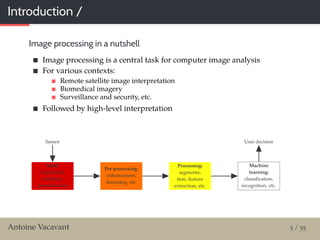
Image processing in a nutshell
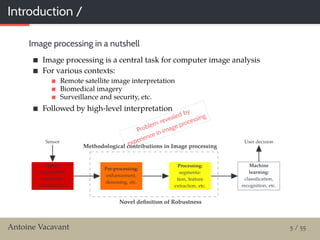
Image processing is a central task for computer image analysis
For various contexts:
Remote satellite image interpretation
Biomedical imagery
Surveillance and security, etc.
Followed by high-level interpretation
Methodological contributions: Image processing
Medical applications: Computer vision
Sensor
Input:
Acquisition,
sampling,
quantification
Pre-processing:
enhancement,
denoising, etc.
Processing:
segmenta-
tion, feature
extraction, etc.
Machine
learning:
classification,
recognition, etc.
User decision
Antoine Vacavant 5 / 55
Introduction /
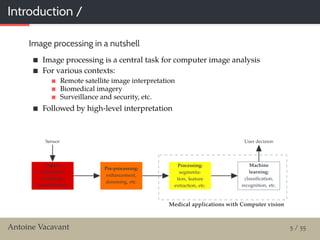
Image processing in a nutshell
Image processing is a central task for computer image analysis
For various contexts:
Remote satellite image interpretation
Biomedical imagery
Surveillance and security, etc.
Followed by high-level interpretation
Methodological contributions: Image processing
Medical applications: Computer visionMedical applications with Computer vision
Sensor
Input:
Acquisition,
sampling,
quantification
Pre-processing:
enhancement,
denoising, etc.
Processing:
segmenta-
tion, feature
extraction, etc.
Machine
learning:
classification,
recognition, etc.
User decision
Antoine Vacavant 5 / 55
Introduction /
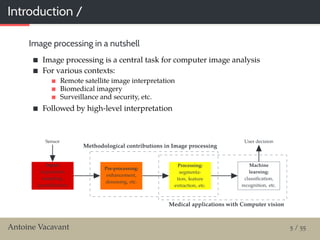
Image processing in a nutshell
Image processing is a central task for computer image analysis
For various contexts:
Remote satellite image interpretation
Biomedical imagery
Surveillance and security, etc.
Followed by high-level interpretation
Methodological contributions: Image processing
Medical applications: Computer vision
Methodological contributions in Image processing
Medical applications with Computer vision
Sensor
Input:
Acquisition,
sampling,
quantification
Pre-processing:
enhancement,
denoising, etc.
Processing:
segmenta-
tion, feature
extraction, etc.
Machine
learning:
classification,
recognition, etc.
User decision
Antoine Vacavant 5 / 55
Introduction /
Image processing in a nutshell
Image processing is a central task for computer image analysis
For various contexts:
Remote satellite image interpretation
Biomedical imagery
Surveillance and security, etc.
Followed by high-level interpretation
Problem revealed by
experience in image processing
Methodological contributions: Image processing
Medical applications: Computer vision
Methodological contributions in Image processing
Novel definition of Robustness
Sensor
Input:
Acquisition,
sampling,
quantification
Pre-processing:
enhancement,
denoising, etc.
Processing:
segmenta-
tion, feature
extraction, etc.
Machine
learning:
classification,
recognition, etc.
User decision
Antoine Vacavant 5 / 55
Outline
1. Me in one slide
2. Introduction
3. Definition of robustness
Noise and robustness
Robustness for image processing
4. MM: Smoothed shock filtering
Test of robustness
Improvement of machine learning tasks
Discussion
5. DG: Robust Reeb graph computations
Reeb graph computations by skeleton extraction
Experimental evaluation
Discussion
6. MM & DG for biomedical image analysis
HCC segmentation
Hepatic vascular network segmentation
Robustness with shape variability for liver segmentation
7. Conclusion, future works
Antoine Vacavant 6 / 55
Outline
1. Me in one slide
2. Introduction
3. Definition of robustness
Noise and robustness
Robustness for image processing
4. MM: Smoothed shock filtering
Test of robustness
Improvement of machine learning tasks
Discussion
5. DG: Robust Reeb graph computations
Reeb graph computations by skeleton extraction
Experimental evaluation
Discussion
6. MM & DG for biomedical image analysis
HCC segmentation
Hepatic vascular network segmentation
Robustness with shape variability for liver segmentation
7. Conclusion, future works
Antoine Vacavant 7 / 55
Definition of robustness / Noise and robustness
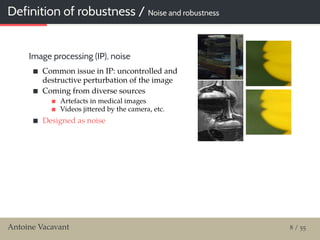
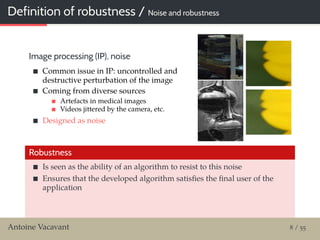
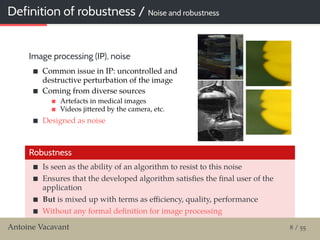
Image processing (IP), noise
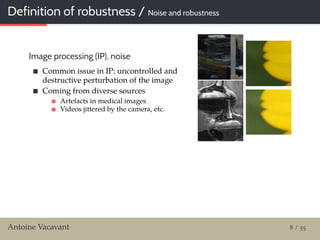
Common issue in IP: uncontrolled and
destructive perturbation of the image
Coming from diverse sources
Artefacts in medical images
Videos jittered by the camera, etc.
Antoine Vacavant 8 / 55
Definition of robustness / Noise and robustness
Image processing (IP), noise
Common issue in IP: uncontrolled and
destructive perturbation of the image
Coming from diverse sources
Artefacts in medical images
Videos jittered by the camera, etc.
Designed as noise
Antoine Vacavant 8 / 55
Definition of robustness / Noise and robustness
Image processing (IP), noise
Common issue in IP: uncontrolled and
destructive perturbation of the image
Coming from diverse sources
Artefacts in medical images
Videos jittered by the camera, etc.
Designed as noise
Robustness
Is seen as the ability of an algorithm to resist to this noise
Ensures that the developed algorithm satisfies the final user of the
application
Antoine Vacavant 8 / 55
Definition of robustness / Noise and robustness
Image processing (IP), noise
Common issue in IP: uncontrolled and
destructive perturbation of the image
Coming from diverse sources
Artefacts in medical images
Videos jittered by the camera, etc.
Designed as noise
Robustness
Is seen as the ability of an algorithm to resist to this noise
Ensures that the developed algorithm satisfies the final user of the
application
But is mixed up with terms as efficiency, quality, performance
Without any formal definition for image processing
Antoine Vacavant 8 / 55
Outline
1. Me in one slide
2. Introduction
3. Definition of robustness
Noise and robustness
Robustness for image processing
4. MM: Smoothed shock filtering
Test of robustness
Improvement of machine learning tasks
Discussion
5. DG: Robust Reeb graph computations
Reeb graph computations by skeleton extraction
Experimental evaluation
Discussion
6. MM & DG for biomedical image analysis
HCC segmentation
Hepatic vascular network segmentation
Robustness with shape variability for liver segmentation
7. Conclusion, future works
Antoine Vacavant 9 / 55
Definition of robustness / Robustness for image processing
Contribution
Propose a definition of robustness for IP algorithms
In parallel of what has been done in CV
Antoine Vacavant 10 / 55
Definition of robustness / Robustness for image processing
Contribution
Propose a definition of robustness for IP algorithms
In parallel of what has been done in CV
Presented at CBA in 2016
Antoine Vacavant 10 / 55
Definition of robustness / Robustness for image processing
Contribution
Propose a definition of robustness for IP algorithms
In parallel of what has been done in CV
Presented at CBA in 2016
Input noise model
We suppose that the input data is altered with an additive
noise, with similar notations as [Meer, 2001]
yi y0
i
+ δyi , yi ∈ Rq
, i 1, . . . , n
also shortened as
Y Y0
+ δY
Antoine Vacavant 10 / 55
Definition of robustness / Robustness for image processing
Contribution
Propose a definition of robustness for IP algorithms
In parallel of what has been done in CV
Presented at CBA in 2016
Input noise model
We suppose that the input data is altered with an additive
noise, with similar notations as [Meer, 2001]
yi y0
i
+ δyi , yi ∈ Rq
, i 1, . . . , n
also shortened as
Y Y0
+ δY
With
Y: measurements
Y0: true (and generally unknown) value
δY: corruption by the noise
We can suppose wlog an iid noise as δyi GI(0, σ2Cy)Antoine Vacavant 10 / 55
Definition of robustness / Robustness for image processing
Robustness model for IP
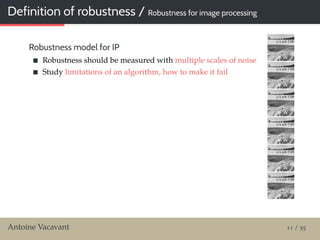
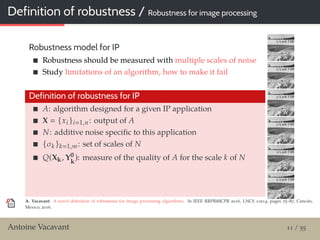
Robustness should be measured with multiple scales of noise
Study limitations of an algorithm, how to make it fail
Antoine Vacavant 11 / 55
Definition of robustness / Robustness for image processing
Robustness model for IP
Robustness should be measured with multiple scales of noise
Study limitations of an algorithm, how to make it fail
Definition of robustness for IP
A: algorithm designed for a given IP application
X {xi }i 1,n: output of A
N: additive noise specific to this application
{σk }k 1,m: set of scales of N
Q(Xk, Y0
k
): measure of the quality of A for the scale k of N
A. Vacavant: A novel definition of robustness for image processing algorithms. In IEEE RRPR@ICPR 2016, LNCS 10214, pages 75–87, Cancún,
Mexico, 2016.
Antoine Vacavant 11 / 55
Definition of robustness / Robustness for image processing
Robustness model for IP
Robustness should be measured with multiple scales of noise
Study limitations of an algorithm, how to make it fail
Definition of robustness for IP
A: algorithm designed for a given IP application
X {xi }i 1,n: output of A
N: additive noise specific to this application
{σk }k 1,m: set of scales of N
Q(Xk, Y0
k
): measure of the quality of A for the scale k of N
A is robust if Q respects a Lipschitz continuity under α:
dY Q(Xk, Y0
k
), Q(Xk+1, Y0
k+1
) ≤ αdX(σk+1 − σk), 1 ≤ k ≤ m
A. Vacavant: A novel definition of robustness for image processing algorithms. In IEEE RRPR@ICPR 2016, LNCS 10214, pages 75–87, Cancún,
Mexico, 2016.
Antoine Vacavant 11 / 55
Definition of robustness / Robustness for image processing
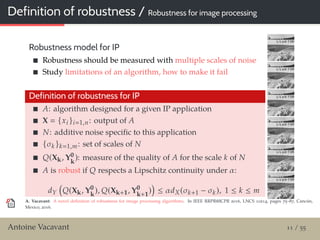
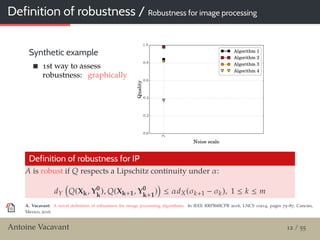
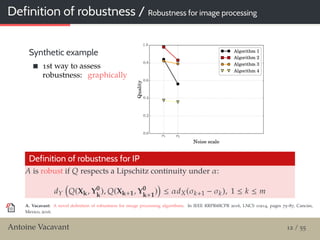
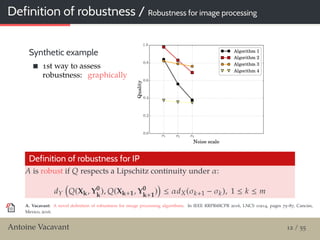
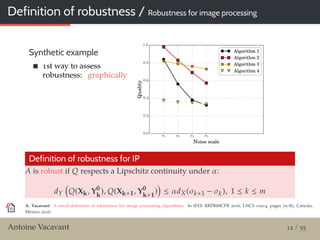
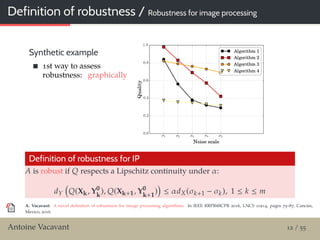
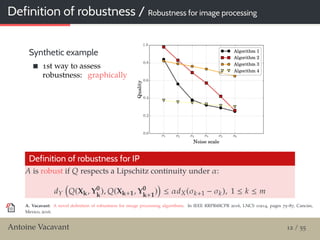
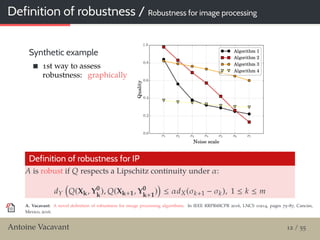
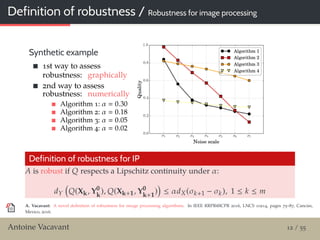
Synthetic example
1st way to assess
robustness: graphically
Definition of robustness for IP
A is robust if Q respects a Lipschitz continuity under α:
dY Q(Xk, Y0
k
), Q(Xk+1, Y0
k+1
) ≤ αdX(σk+1 − σk), 1 ≤ k ≤ m
A. Vacavant: A novel definition of robustness for image processing algorithms. In IEEE RRPR@ICPR 2016, LNCS 10214, pages 75–87, Cancún,
Mexico, 2016.
Antoine Vacavant 12 / 55
Definition of robustness / Robustness for image processing
Synthetic example
1st way to assess
robustness: graphically
Definition of robustness for IP
A is robust if Q respects a Lipschitz continuity under α:
dY Q(Xk, Y0
k
), Q(Xk+1, Y0
k+1
) ≤ αdX(σk+1 − σk), 1 ≤ k ≤ m
A. Vacavant: A novel definition of robustness for image processing algorithms. In IEEE RRPR@ICPR 2016, LNCS 10214, pages 75–87, Cancún,
Mexico, 2016.
Antoine Vacavant 12 / 55
Definition of robustness / Robustness for image processing
Synthetic example
1st way to assess
robustness: graphically
Definition of robustness for IP
A is robust if Q respects a Lipschitz continuity under α:
dY Q(Xk, Y0
k
), Q(Xk+1, Y0
k+1
) ≤ αdX(σk+1 − σk), 1 ≤ k ≤ m
A. Vacavant: A novel definition of robustness for image processing algorithms. In IEEE RRPR@ICPR 2016, LNCS 10214, pages 75–87, Cancún,
Mexico, 2016.
Antoine Vacavant 12 / 55
Definition of robustness / Robustness for image processing
Synthetic example
1st way to assess
robustness: graphically
Definition of robustness for IP
A is robust if Q respects a Lipschitz continuity under α:
dY Q(Xk, Y0
k
), Q(Xk+1, Y0
k+1
) ≤ αdX(σk+1 − σk), 1 ≤ k ≤ m
A. Vacavant: A novel definition of robustness for image processing algorithms. In IEEE RRPR@ICPR 2016, LNCS 10214, pages 75–87, Cancún,
Mexico, 2016.
Antoine Vacavant 12 / 55
Definition of robustness / Robustness for image processing
Synthetic example
1st way to assess
robustness: graphically
Definition of robustness for IP
A is robust if Q respects a Lipschitz continuity under α:
dY Q(Xk, Y0
k
), Q(Xk+1, Y0
k+1
) ≤ αdX(σk+1 − σk), 1 ≤ k ≤ m
A. Vacavant: A novel definition of robustness for image processing algorithms. In IEEE RRPR@ICPR 2016, LNCS 10214, pages 75–87, Cancún,
Mexico, 2016.
Antoine Vacavant 12 / 55
Definition of robustness / Robustness for image processing
Synthetic example
1st way to assess
robustness: graphically
Definition of robustness for IP
A is robust if Q respects a Lipschitz continuity under α:
dY Q(Xk, Y0
k
), Q(Xk+1, Y0
k+1
) ≤ αdX(σk+1 − σk), 1 ≤ k ≤ m
A. Vacavant: A novel definition of robustness for image processing algorithms. In IEEE RRPR@ICPR 2016, LNCS 10214, pages 75–87, Cancún,
Mexico, 2016.
Antoine Vacavant 12 / 55
Definition of robustness / Robustness for image processing
Synthetic example
1st way to assess
robustness: graphically
Definition of robustness for IP
A is robust if Q respects a Lipschitz continuity under α:
dY Q(Xk, Y0
k
), Q(Xk+1, Y0
k+1
) ≤ αdX(σk+1 − σk), 1 ≤ k ≤ m
A. Vacavant: A novel definition of robustness for image processing algorithms. In IEEE RRPR@ICPR 2016, LNCS 10214, pages 75–87, Cancún,
Mexico, 2016.
Antoine Vacavant 12 / 55
Definition of robustness / Robustness for image processing
Synthetic example
1st way to assess
robustness: graphically
2nd way to assess
robustness: numerically
Algorithm 1: α 0.30
Algorithm 2: α 0.18
Algorithm 3: α 0.05
Algorithm 4: α 0.02
Definition of robustness for IP
A is robust if Q respects a Lipschitz continuity under α:
dY Q(Xk, Y0
k
), Q(Xk+1, Y0
k+1
) ≤ αdX(σk+1 − σk), 1 ≤ k ≤ m
A. Vacavant: A novel definition of robustness for image processing algorithms. In IEEE RRPR@ICPR 2016, LNCS 10214, pages 75–87, Cancún,
Mexico, 2016.
Antoine Vacavant 12 / 55
Outline
1. Me in one slide
2. Introduction
3. Definition of robustness
Noise and robustness
Robustness for image processing
4. MM: Smoothed shock filtering
Test of robustness
Improvement of machine learning tasks
Discussion
5. DG: Robust Reeb graph computations
Reeb graph computations by skeleton extraction
Experimental evaluation
Discussion
6. MM & DG for biomedical image analysis
HCC segmentation
Hepatic vascular network segmentation
Robustness with shape variability for liver segmentation
7. Conclusion, future works
Antoine Vacavant 13 / 55
Outline
1. Me in one slide
2. Introduction
3. Definition of robustness
Noise and robustness
Robustness for image processing
4. MM: Smoothed shock filtering
Test of robustness
Improvement of machine learning tasks
Discussion
5. DG: Robust Reeb graph computations
Reeb graph computations by skeleton extraction
Experimental evaluation
Discussion
6. MM & DG for biomedical image analysis
HCC segmentation
Hepatic vascular network segmentation
Robustness with shape variability for liver segmentation
7. Conclusion, future works
Antoine Vacavant 14 / 55
MM / Context and motivation
Image denoising filtering
A lot of contributions since 70’s [Lebrun et al., 2012]
Linear, popular, simple filters: Gaussian, average, median, bilateral, etc.
Non-local strategies: NL-means, BM3D, total variation, etc.
PDE schemes: anisotropic diffusion, coherence, etc.
Antoine Vacavant 15 / 55
MM / Context and motivation
Image denoising filtering
A lot of contributions since 70’s [Lebrun et al., 2012]
Linear, popular, simple filters: Gaussian, average, median, bilateral, etc.
Non-local strategies: NL-means, BM3D, total variation, etc.
PDE schemes: anisotropic diffusion, coherence, etc.
Shock filtering
Shock filter iteratively produces local segmentations in inflection zones:
∆ f t−1(pi , qj) < 0 ⇒ f t(pi , qj) f t−1(pi , qj) ⊕ D ;
∆ f t−1(pi , qj) > 0 ⇒ f t(pi , qj) f t−1(pi , qj) D
Antoine Vacavant 15 / 55
MM / Context and motivation
Image denoising filtering
A lot of contributions since 70’s [Lebrun et al., 2012]
Linear, popular, simple filters: Gaussian, average, median, bilateral, etc.
Non-local strategies: NL-means, BM3D, total variation, etc.
PDE schemes: anisotropic diffusion, coherence, etc.
Shock filtering
Shock filter iteratively produces local segmentations in inflection zones:
∆ f t−1(pi , qj) < 0 ⇒ f t(pi , qj) f t−1(pi , qj) ⊕ D ;
∆ f t−1(pi , qj) > 0 ⇒ f t(pi , qj) f t−1(pi , qj) D
Smoothed shock filtering
Enhance contours by creating smoothed ruptures
PDE scheme with smoothed ⊕, operators
A. Vacavant, A. Albouy-Kissi, P.-Y. Menguy, J. Solomon: Fast smoothed shock filtering. In IEEE ICPR 2012, Tsukuba, Japan, 2012.
Antoine Vacavant 15 / 55
MM / Context and motivation
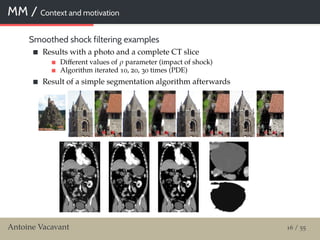
Smoothed shock filtering examples
Results with a photo and a complete CT slice
Different values of ρ parameter (impact of shock)
Algorithm iterated 10, 20, 30 times (PDE)
Result of a simple segmentation algorithm afterwards
Antoine Vacavant 16 / 55
Outline
1. Me in one slide
2. Introduction
3. Definition of robustness
Noise and robustness
Robustness for image processing
4. MM: Smoothed shock filtering
Test of robustness
Improvement of machine learning tasks
Discussion
5. DG: Robust Reeb graph computations
Reeb graph computations by skeleton extraction
Experimental evaluation
Discussion
6. MM & DG for biomedical image analysis
HCC segmentation
Hepatic vascular network segmentation
Robustness with shape variability for liver segmentation
7. Conclusion, future works
Antoine Vacavant 17 / 55
MM / Test of robustness
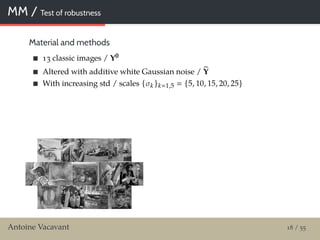
Material and methods
13 classic images / Y0
Altered with additive white Gaussian noise / Y
With increasing std / scales {σk }k 1,5 {5, 10, 15, 20, 25}
Antoine Vacavant 18 / 55
MM / Test of robustness
Material and methods
13 classic images / Y0
Altered with additive white Gaussian noise / Y
With increasing std / scales {σk }k 1,5 {5, 10, 15, 20, 25}
From state of the art
Shock-based methods
Classic algorithms
Median-based methods
Algorithm Reference
Median [Huang et al., 1979]
Coherence [Weickert, 2003]
OriginalShock [Osher and Rudin, 1990]
EnhancedShock [Alvarez and Mazorra, 1994]
ComplexShock [Gilboa et al., 2004]
Bilateral [Tomasi and Manduchi, 1998]
SmoothedMedian [Kass and Solomon, 2010]
SmoothedShock [Vacavant et al., 2012]
Antoine Vacavant 18 / 55
MM / Test of robustness
Experimental results
Quality measure: SSIM / Structural similarity [Wang et al., 2004]
A. Vacavant: A novel definition of robustness for image processing algorithms. In IEEE RRPR@ICPR 2016, LNCS 10214, pages 75–87, Cancún,
Mexico, 2016.
Antoine Vacavant 19 / 55
MM / Test of robustness
Experimental results
Quality measure: SSIM / Structural similarity [Wang et al., 2004]
Graphical evaluation of robustness
A. Vacavant: A novel definition of robustness for image processing algorithms. In IEEE RRPR@ICPR 2016, LNCS 10214, pages 75–87, Cancún,
Mexico, 2016.
Antoine Vacavant 19 / 55
MM / Test of robustness
Experimental results
Quality measure: SSIM / Structural similarity [Wang et al., 2004]
Graphical evaluation of robustness
A. Vacavant: A novel definition of robustness for image processing algorithms. In IEEE RRPR@ICPR 2016, LNCS 10214, pages 75–87, Cancún,
Mexico, 2016.
Antoine Vacavant 19 / 55
MM / Test of robustness
Experimental results
Quality measure: SSIM / Structural similarity [Wang et al., 2004]
Graphical evaluation of robustness
A. Vacavant: A novel definition of robustness for image processing algorithms. In IEEE RRPR@ICPR 2016, LNCS 10214, pages 75–87, Cancún,
Mexico, 2016.
Antoine Vacavant 19 / 55
MM / Test of robustness
Experimental results
Quality measure: SSIM / Structural similarity [Wang et al., 2004]
Graphical evaluation of robustness
A. Vacavant: A novel definition of robustness for image processing algorithms. In IEEE RRPR@ICPR 2016, LNCS 10214, pages 75–87, Cancún,
Mexico, 2016.
Antoine Vacavant 19 / 55
MM / Test of robustness
Experimental results
Quality measure: SSIM / Structural similarity [Wang et al., 2004]
Graphical evaluation of robustness
A. Vacavant: A novel definition of robustness for image processing algorithms. In IEEE RRPR@ICPR 2016, LNCS 10214, pages 75–87, Cancún,
Mexico, 2016.
Antoine Vacavant 19 / 55
MM / Test of robustness
Experimental results
Quality measure: SSIM / Structural similarity [Wang et al., 2004]
Graphical evaluation of robustness
Numerical evaluation of robustness
Algorithm α
Median 0.15
Coherence 0.15
OriginalShock 0.14
EnhancedShock 0.14
ComplexShock 0.12
Bilateral 0.11
SmoothedMedian 0.05
SmoothedShock 0.04
A. Vacavant: A novel definition of robustness for image processing algorithms. In IEEE RRPR@ICPR 2016, LNCS 10214, pages 75–87, Cancún,
Mexico, 2016.
Antoine Vacavant 19 / 55
Outline
1. Me in one slide
2. Introduction
3. Definition of robustness
Noise and robustness
Robustness for image processing
4. MM: Smoothed shock filtering
Test of robustness
Improvement of machine learning tasks
Discussion
5. DG: Robust Reeb graph computations
Reeb graph computations by skeleton extraction
Experimental evaluation
Discussion
6. MM & DG for biomedical image analysis
HCC segmentation
Hepatic vascular network segmentation
Robustness with shape variability for liver segmentation
7. Conclusion, future works
Antoine Vacavant 20 / 55
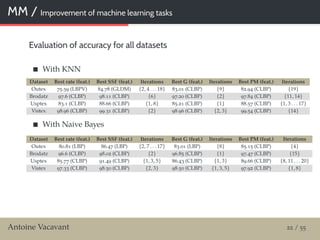
MM / Improvement of machine learning tasks
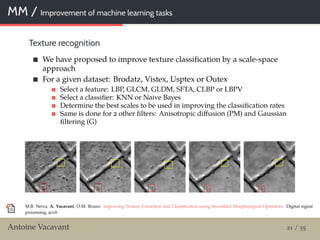
Texture recognition
We have proposed to improve texture classification by a scale-space
approach
For a given dataset: Brodatz, Vistex, Usptex or Outex
Select a feature: LBP, GLCM, GLDM, SFTA, CLBP or LBPV
Select a classifier: KNN or Naive Bayes
Determine the best scales to be used in improving the classification rates
Same is done for 2 other filters: Anisotropic diffusion (PM) and Gaussian
filtering (G)
M.B. Neiva, A. Vacavant, O.M. Bruno: Improving Texture Extraction and Classification using Smoothed Morphological Operators. Digital signal
processing, 2018.
Antoine Vacavant 21 / 55
MM / Improvement of machine learning tasks
Evaluation of accuracy for all datasets
With KNN
Dataset Best rate (feat.) Best SSF (feat.) Iterations Best G (feat.) Iterations Best PM (feat.) Iterations
Outex 75.59 (LBPV) 84.78 (GLDM) {2, 4 . . . 18} 83.01 (CLBP) {9} 82.94 (CLBP) {19}
Brodatz 97.6 (CLBP) 98.11 (CLBP) {6} 97.20 (CLBP) {2} 97.84 (CLBP) {11, 14}
Usptex 83.1 (CLBP) 88.66 (CLBP) {1, 8} 85.21 (CLBP) {1} 88.57 (CLBP) {1, 3 . . . 17}
Vistex 98.96 (CLBP) 99.31 (CLBP) {2} 98.96 (CLBP) {2, 3} 99.54 (CLBP) {14}
With Naive Bayes
Dataset Best rate (feat.) Best SSF (feat.) Iterations Best G (feat.) Iterations Best PM (feat.) Iterations
Outex 80.81 (LBP) 86.47 (LBP) {2, 7 . . . 17} 83.01 (LBP) {8} 85.15 (CLBP) {4}
Brodatz 96.6 (CLBP) 98.02 (CLBP) {2} 96.85 (CLBP) {1} 97.47 (CLBP) {15}
Usptex 85.77 (CLBP) 91.49 (CLBP) {1, 3, 5} 86.43 (CLBP) {1, 3} 89.66 (CLBP) {8, 11 . . . 20}
Vistex 97.33 (CLBP) 98.50 (CLBP) {2, 3} 98.50 (CLBP) {1, 3, 5} 97.92 (CLBP) {1, 8}
Antoine Vacavant 22 / 55
Outline
1. Me in one slide
2. Introduction
3. Definition of robustness
Noise and robustness
Robustness for image processing
4. MM: Smoothed shock filtering
Test of robustness
Improvement of machine learning tasks
Discussion
5. DG: Robust Reeb graph computations
Reeb graph computations by skeleton extraction
Experimental evaluation
Discussion
6. MM & DG for biomedical image analysis
HCC segmentation
Hepatic vascular network segmentation
Robustness with shape variability for liver segmentation
7. Conclusion, future works
Antoine Vacavant 23 / 55
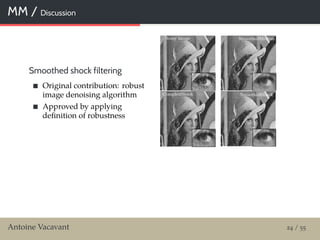
MM / Discussion
Smoothed shock filtering
Original contribution: robust
image denoising algorithm
Approved by applying
definition of robustness
Antoine Vacavant 24 / 55
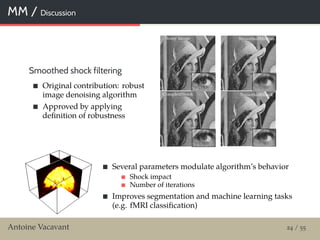
MM / Discussion
Smoothed shock filtering
Original contribution: robust
image denoising algorithm
Approved by applying
definition of robustness
Several parameters modulate algorithm’s behavior
Shock impact
Number of iterations
Improves segmentation and machine learning tasks
(e.g. fMRI classification)
Antoine Vacavant 24 / 55
Outline
1. Me in one slide
2. Introduction
3. Definition of robustness
Noise and robustness
Robustness for image processing
4. MM: Smoothed shock filtering
Test of robustness
Improvement of machine learning tasks
Discussion
5. DG: Robust Reeb graph computations
Reeb graph computations by skeleton extraction
Experimental evaluation
Discussion
6. MM & DG for biomedical image analysis
HCC segmentation
Hepatic vascular network segmentation
Robustness with shape variability for liver segmentation
7. Conclusion, future works
Antoine Vacavant 25 / 55
Outline
1. Me in one slide
2. Introduction
3. Definition of robustness
Noise and robustness
Robustness for image processing
4. MM: Smoothed shock filtering
Test of robustness
Improvement of machine learning tasks
Discussion
5. DG: Robust Reeb graph computations
Reeb graph computations by skeleton extraction
Experimental evaluation
Discussion
6. MM & DG for biomedical image analysis
HCC segmentation
Hepatic vascular network segmentation
Robustness with shape variability for liver segmentation
7. Conclusion, future works
Antoine Vacavant 26 / 55
DG / Context and motivation
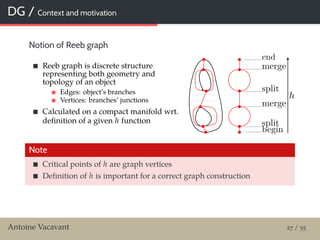
Notion of Reeb graph
Reeb graph is discrete structure
representing both geometry and
topology of an object
Edges: object’s branches
Vertices: branches’ junctions
Calculated on a compact manifold wrt.
definition of a given h function
Note
Critical points of h are graph vertices
Definition of h is important for a correct graph construction
Antoine Vacavant 27 / 55
DG / Context and motivation
Reeb graphs in literature
A lot of attention on its construction for 3-D
meshes [Biasotti et al., 2008; Harvey et al., 2010]
Generally, h is a height function (along an axis)
Appropriate for many objects, but not for all!
Can be calculated with other functions (e.g.
geodesic) [Tierny, 2006]
Antoine Vacavant 28 / 55
DG / Context and motivation
Reeb graphs in literature
A lot of attention on its construction for 3-D
meshes [Biasotti et al., 2008; Harvey et al., 2010]
Generally, h is a height function (along an axis)
Appropriate for many objects, but not for all!
Can be calculated with other functions (e.g.
geodesic) [Tierny, 2006]
Skeletons, medial axes and other 1-pixel-wide
centered structures capture topology [Arcelli et
al., 2010; Bertrand et al., 2014]
Strategy: Compute Reeb graph from such
structures [Janusch et al., 2015; Pascucci et al.,
2007]
Antoine Vacavant 28 / 55
DG / Context and motivation
Reeb graphs in literature
A lot of attention on its construction for 3-D
meshes [Biasotti et al., 2008; Harvey et al., 2010]
Generally, h is a height function (along an axis)
Appropriate for many objects, but not for all!
Can be calculated with other functions (e.g.
geodesic) [Tierny, 2006]
Skeletons, medial axes and other 1-pixel-wide
centered structures capture topology [Arcelli et
al., 2010; Bertrand et al., 2014]
Strategy: Compute Reeb graph from such
structures [Janusch et al., 2015; Pascucci et al.,
2007]
But they can be very sensitive to noise!
Linking them to Reeb graph is not trivial
Antoine Vacavant 28 / 55
DG / Context and motivation
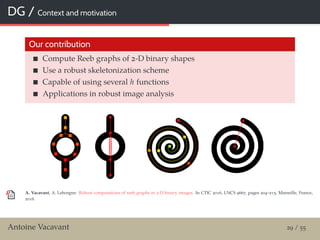
Our contribution
Compute Reeb graphs of 2-D binary shapes
Use a robust skeletonization scheme
Capable of using several h functions
Applications in robust image analysis
A. Vacavant, A. Leborgne: Robust computations of reeb graphs in 2-D binary images. In CTIC 2016, LNCS 9667, pages 204–215, Marseille, France,
2016.
Antoine Vacavant 29 / 55
Outline
1. Me in one slide
2. Introduction
3. Definition of robustness
Noise and robustness
Robustness for image processing
4. MM: Smoothed shock filtering
Test of robustness
Improvement of machine learning tasks
Discussion
5. DG: Robust Reeb graph computations
Reeb graph computations by skeleton extraction
Experimental evaluation
Discussion
6. MM & DG for biomedical image analysis
HCC segmentation
Hepatic vascular network segmentation
Robustness with shape variability for liver segmentation
7. Conclusion, future works
Antoine Vacavant 30 / 55
DG / Reeb graph computations by skeleton extraction
DECS algorithm
DECS: Discrete Euclidean Connected Skeleton [Leborgne et al., 2015]
Resist to noise, compared to other algorithms
Antoine Vacavant 31 / 55
DG / Reeb graph computations by skeleton extraction
DECS algorithm
DECS: Discrete Euclidean Connected Skeleton [Leborgne et al., 2015]
Resist to noise, compared to other algorithms
Algorithm:
From a binary image I
Euclidean distance map EDTI
Reduced medial axis RDMAI
Laplacian-of-Gaussian filtering of EDTI as RDGI
Combine RDGI and RDMAI to calculate a coarse skeleton SI
Thin and prune SI to obtain S∗
I
EDTI RDMAI RDGI SI S∗
I
Antoine Vacavant 31 / 55
DG / Reeb graph computations by skeleton extraction
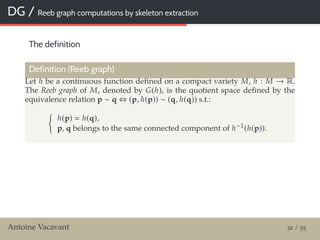
The definition
Definition (Reeb graph)
Let h be a continuous function defined on a compact variety M, h : M → R.
The Reeb graph of M, denoted by G(h), is the quotient space defined by the
equivalence relation p ∼ q ⇔ (p, h(p)) ∼ (q, h(q)) s.t.:
h(p) h(q),
p, q belongs to the same connected component of h−1(h(p)).
Antoine Vacavant 32 / 55
DG / Reeb graph computations by skeleton extraction
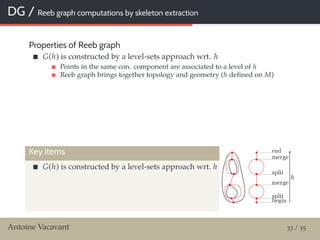
Properties of Reeb graph
G(h) is constructed by a level-sets approach wrt. h
Points in the same con. component are associated to a level of h
Reeb graph brings together topology and geometry (h defined on M)
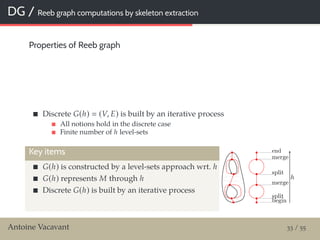
Key items
G(h) is constructed by a level-sets approach wrt. h
Antoine Vacavant 33 / 55
DG / Reeb graph computations by skeleton extraction
Properties of Reeb graph
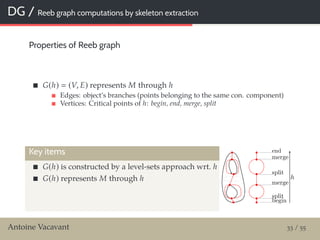
G(h) (V, E) represents M through h
Edges: object’s branches (points belonging to the same con. component)
Vertices: Critical points of h: begin, end, merge, split
Key items
G(h) is constructed by a level-sets approach wrt. h
G(h) represents M through h
Antoine Vacavant 33 / 55
DG / Reeb graph computations by skeleton extraction
Properties of Reeb graph
Discrete G(h) (V, E) is built by an iterative process
All notions hold in the discrete case
Finite number of h level-sets
Key items
G(h) is constructed by a level-sets approach wrt. h
G(h) represents M through h
Discrete G(h) is built by an iterative process
Antoine Vacavant 33 / 55
DG / Reeb graph computations by skeleton extraction
Properties of Reeb graph
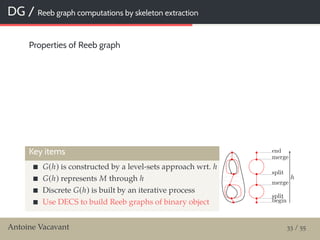
Key items
G(h) is constructed by a level-sets approach wrt. h
G(h) represents M through h
Discrete G(h) is built by an iterative process
Use DECS to build Reeb graphs of binary object
Antoine Vacavant 33 / 55
DG / Reeb graph computations by skeleton extraction
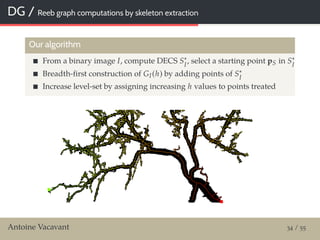
Our algorithm
From a binary image I, compute DECS S∗
I
, select a starting point pS in S∗
I
Breadth-first construction of GI(h) by adding points of S∗
I
Increase level-set by assigning increasing h values to points treated
Antoine Vacavant 34 / 55
Outline
1. Me in one slide
2. Introduction
3. Definition of robustness
Noise and robustness
Robustness for image processing
4. MM: Smoothed shock filtering
Test of robustness
Improvement of machine learning tasks
Discussion
5. DG: Robust Reeb graph computations
Reeb graph computations by skeleton extraction
Experimental evaluation
Discussion
6. MM & DG for biomedical image analysis
HCC segmentation
Hepatic vascular network segmentation
Robustness with shape variability for liver segmentation
7. Conclusion, future works
Antoine Vacavant 35 / 55
DG / Experimental evaluation
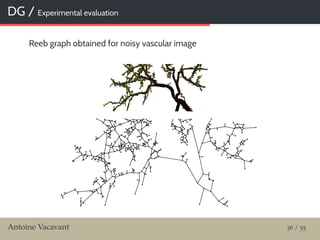
Reeb graph obtained for noisy vascular image
Antoine Vacavant 36 / 55
DG / Experimental evaluation
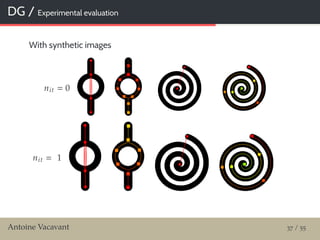
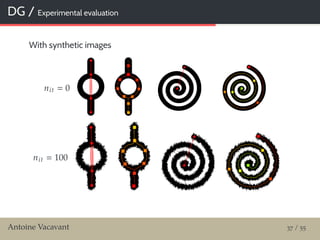
With synthetic images
nit 0
nit 1
Antoine Vacavant 37 / 55
DG / Experimental evaluation
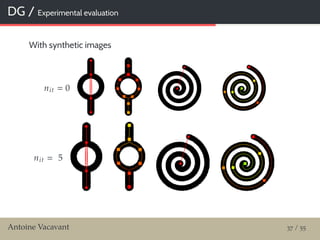
With synthetic images
nit 0
nit 5
Antoine Vacavant 37 / 55
DG / Experimental evaluation
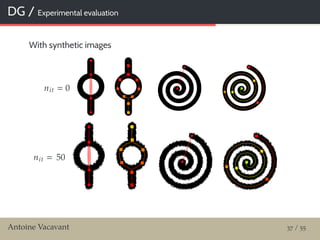
With synthetic images
nit 0
nit 50
Antoine Vacavant 37 / 55
DG / Experimental evaluation
With synthetic images
nit 0
nit 100
Antoine Vacavant 37 / 55
Outline
1. Me in one slide
2. Introduction
3. Definition of robustness
Noise and robustness
Robustness for image processing
4. MM: Smoothed shock filtering
Test of robustness
Improvement of machine learning tasks
Discussion
5. DG: Robust Reeb graph computations
Reeb graph computations by skeleton extraction
Experimental evaluation
Discussion
6. MM & DG for biomedical image analysis
HCC segmentation
Hepatic vascular network segmentation
Robustness with shape variability for liver segmentation
7. Conclusion, future works
Antoine Vacavant 38 / 55
DG / Discussion
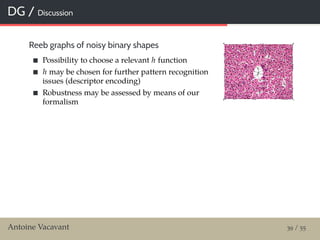
Reeb graphs of noisy binary shapes
Possibility to choose a relevant h function
h may be chosen for further pattern recognition
issues (descriptor encoding)
Robustness may be assessed by means of our
formalism
Antoine Vacavant 39 / 55
DG / Discussion
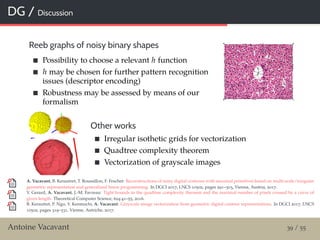
Reeb graphs of noisy binary shapes
Possibility to choose a relevant h function
h may be chosen for further pattern recognition
issues (descriptor encoding)
Robustness may be assessed by means of our
formalism
Other works
Irregular isothetic grids for vectorization
Quadtree complexity theorem
Vectorization of grayscale images
A. Vacavant, B. Kerautret, T. Roussillon, F. Feschet: Reconstructions of noisy digital contours with maximal primitives based on multi-scale/irregular
geometric representation and generalized linear programming. In DGCI 2017, LNCS 10502, pages 291–303, Vienna, Austria, 2017.
Y. Gerard, A. Vacavant, J.-M. Favreau: Tight bounds in the quadtree complexity theorem and the maximal number of pixels crossed by a curve of
given length. Theoretical Computer Science, 624:41–55, 2016.
B. Kerautret, P. Ngo, Y. Kenmochi, A. Vacavant: Greyscale image vectorization from geometric digital contour representations. In DGCI 2017, LNCS
10502, pages 319–331, Vienne, Autriche, 2017.
Antoine Vacavant 39 / 55
Outline
1. Me in one slide
2. Introduction
3. Definition of robustness
Noise and robustness
Robustness for image processing
4. MM: Smoothed shock filtering
Test of robustness
Improvement of machine learning tasks
Discussion
5. DG: Robust Reeb graph computations
Reeb graph computations by skeleton extraction
Experimental evaluation
Discussion
6. MM & DG for biomedical image analysis
HCC segmentation
Hepatic vascular network segmentation
Robustness with shape variability for liver segmentation
7. Conclusion, future works
Antoine Vacavant 40 / 55
Outline
1. Me in one slide
2. Introduction
3. Definition of robustness
Noise and robustness
Robustness for image processing
4. MM: Smoothed shock filtering
Test of robustness
Improvement of machine learning tasks
Discussion
5. DG: Robust Reeb graph computations
Reeb graph computations by skeleton extraction
Experimental evaluation
Discussion
6. MM & DG for biomedical image analysis
HCC segmentation
Hepatic vascular network segmentation
Robustness with shape variability for liver segmentation
7. Conclusion, future works
Antoine Vacavant 41 / 55
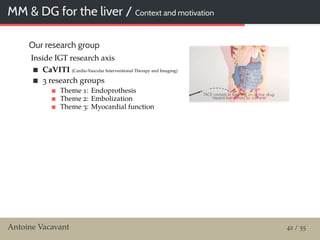
MM & DG for the liver / Context and motivation
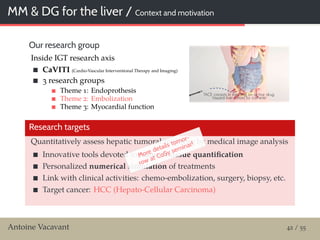
Our research group
Inside IGT research axis
CaVITI (Cardio-Vascular Interventional Therapy and Imaging)
3 research groups
Theme 1: Endoprothesis
Theme 2: Embolization
Theme 3: Myocardial function
Antoine Vacavant 42 / 55
MM & DG for the liver / Context and motivation
Our research group
Inside IGT research axis
CaVITI (Cardio-Vascular Interventional Therapy and Imaging)
3 research groups
Theme 1: Endoprothesis
Theme 2: Embolization
Theme 3: Myocardial function
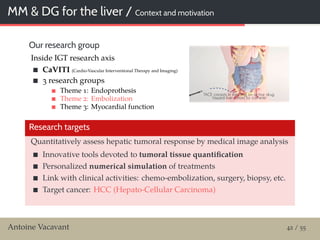
Research targets
Quantitatively assess hepatic tumoral response by medical image analysis
Innovative tools devoted to tumoral tissue quantification
Personalized numerical simulation of treatments
Link with clinical activities: chemo-embolization, surgery, biopsy, etc.
Target cancer: HCC (Hepato-Cellular Carcinoma)
Antoine Vacavant 42 / 55
MM & DG for the liver / Context and motivation
Our research group
Inside IGT research axis
CaVITI (Cardio-Vascular Interventional Therapy and Imaging)
3 research groups
Theme 1: Endoprothesis
Theme 2: Embolization
Theme 3: Myocardial function
Research targets
Quantitatively assess hepatic tumoral response by medical image analysis
Innovative tools devoted to tumoral tissue quantification
Personalized numerical simulation of treatments
Link with clinical activities: chemo-embolization, surgery, biopsy, etc.
Target cancer: HCC (Hepato-Cellular Carcinoma)
More details tomor-
row at CoSy seminar!
Antoine Vacavant 42 / 55
Outline
1. Me in one slide
2. Introduction
3. Definition of robustness
Noise and robustness
Robustness for image processing
4. MM: Smoothed shock filtering
Test of robustness
Improvement of machine learning tasks
Discussion
5. DG: Robust Reeb graph computations
Reeb graph computations by skeleton extraction
Experimental evaluation
Discussion
6. MM & DG for biomedical image analysis
HCC segmentation
Hepatic vascular network segmentation
Robustness with shape variability for liver segmentation
7. Conclusion, future works
Antoine Vacavant 43 / 55
MM & DG for the liver / HCC segmentation
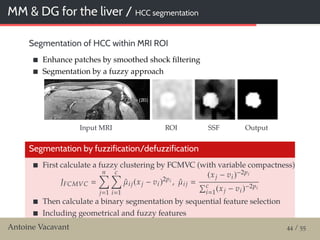
Segmentation of HCC within MRI ROI
Enhance patches by smoothed shock filtering
Segmentation by a fuzzy approach
Input MRI ROI SSF Output
Segmentation by fuzzification/defuzzification
First calculate a fuzzy clustering by FCMVC (with variable compactness)
JFCMVC
n
j 1
c
i 1
ˆµij(xj − vi)2pi , ˆµij
(xj − vi)−2pi
c
i 1
(xj − vi)−2pi
Then calculate a binary segmentation by sequential feature selection
Including geometrical and fuzzy features
Antoine Vacavant 44 / 55
MM & DG for the liver / HCC segmentation
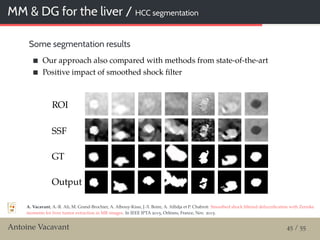
Some segmentation results
Our approach also compared with methods from state-of-the-art
Positive impact of smoothed shock filter
ROI
SSF
GT
Output
A. Vacavant, A.-R. Ali, M. Grand-Brochier, A. Albouy-Kissi, J.-Y. Boire, A. Alfidja et P. Chabrot: Smoothed shock filtered defuzzification with Zernike
moments for liver tumor extraction in MR images. In IEEE IPTA 2015, Orléans, France, Nov. 2015.
Antoine Vacavant 45 / 55
Outline
1. Me in one slide
2. Introduction
3. Definition of robustness
Noise and robustness
Robustness for image processing
4. MM: Smoothed shock filtering
Test of robustness
Improvement of machine learning tasks
Discussion
5. DG: Robust Reeb graph computations
Reeb graph computations by skeleton extraction
Experimental evaluation
Discussion
6. MM & DG for biomedical image analysis
HCC segmentation
Hepatic vascular network segmentation
Robustness with shape variability for liver segmentation
7. Conclusion, future works
Antoine Vacavant 46 / 55
MM & DG for the liver / Hepatic vascular network segmentation
Our pipeline for segmenting liver vessels
From a CT or MRI volume, I
Extract the liver and use it as a bounding box
Multi-scale vessel detection with Hessian matrix IS [Sato et al., 1994]
Partial skeletonization and reconnection S in IS [Homann et al., 2007]
Calculate the RORPO vesselness filter IR [Merveille et al., 2018]
Use S as initialization for fast marching segmentation within IR
M.-A. Lebre, A. Vacavant, M. Grand-Brochier, O. Merveille, A. Abergel, P. Chabrot, B. Magnin: Automatic 3-D Skeleton-based Segmentation of Liver
Vessels From MRI and CT for Couinaud Representation. In IEEE ICIP 2018, Athens, Greece,
Antoine Vacavant 47 / 55
MM & DG for the liver / Hepatic vascular network segmentation
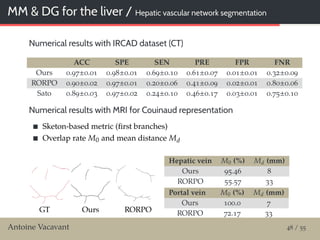
Numerical results with IRCAD dataset (CT)
ACC SPE SEN PRE FPR FNR
Ours 0.97±0.01 0.98±0.01 0.69±0.10 0.61±0.07 0.01±0.01 0.32±0.09
RORPO 0.90±0.02 0.97±0.01 0.20±0.06 0.41±0.09 0.02±0.01 0.80±0.06
Sato 0.89±0.03 0.97±0.02 0.24±0.10 0.46±0.17 0.03±0.01 0.75±0.10
Numerical results with MRI for Couinaud representation
Sketon-based metric (first branches)
Overlap rate M0 and mean distance Md
Hepatic vein M0 (%) Md (mm)
Ours 95.46 8
RORPO 55.57 33
Portal vein M0 (%) Md (mm)
Ours 100.0 7
RORPO 72.17 33
Antoine Vacavant 48 / 55
Outline
1. Me in one slide
2. Introduction
3. Definition of robustness
Noise and robustness
Robustness for image processing
4. MM: Smoothed shock filtering
Test of robustness
Improvement of machine learning tasks
Discussion
5. DG: Robust Reeb graph computations
Reeb graph computations by skeleton extraction
Experimental evaluation
Discussion
6. MM & DG for biomedical image analysis
HCC segmentation
Hepatic vascular network segmentation
Robustness with shape variability for liver segmentation
7. Conclusion, future works
Antoine Vacavant 49 / 55
MM & DG for the liver / Robustness with shape variability for liver segmentation
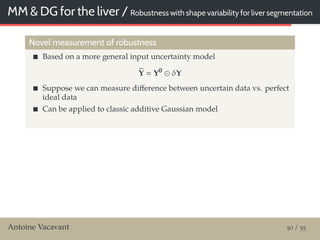
Novel measurement of robustness
Based on a more general input uncertainty model
Y Y0
δY
Suppose we can measure difference between uncertain data vs. perfect
ideal data
Can be applied to classic additive Gaussian model
Antoine Vacavant 50 / 55
MM & DG for the liver / Robustness with shape variability for liver segmentation
Novel measurement of robustness
Based on a more general input uncertainty model
Y Y0
δY
Suppose we can measure difference between uncertain data vs. perfect
ideal data
Can be applied to classic additive Gaussian model
We study here complex shape variability
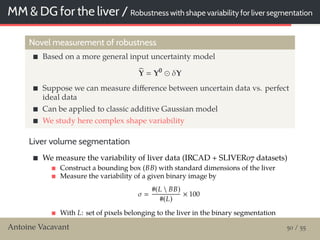
Liver volume segmentation
We measure the variability of liver data (IRCAD + SLIVER07 datasets)
Construct a bounding box (BB) with standard dimensions of the liver
Measure the variability of a given binary image by
σ
#(L  BB)
#(L)
× 100
With L: set of pixels belonging to the liver in the binary segmentation
Antoine Vacavant 50 / 55
MM & DG for the liver / Robustness with shape variability for liver segmentation
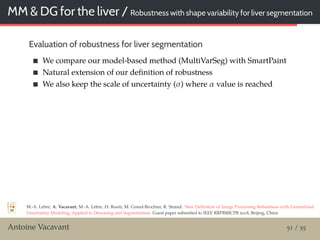
Evaluation of robustness for liver segmentation
We compare our model-based method (MultiVarSeg) with SmartPaint
Natural extension of our definition of robustness
We also keep the scale of uncertainty (σ) where α value is reached
M.-A. Lebre, A. Vacavant, M.-A. Lebre, H. Rositi, M. Grand-Brochier, R. Strand: New Definition of Image Processing Robustness with Generalized
Uncertainty Modeling, Applied to Denoising and Segmentation. Guest paper submitted to IEEE RRPR@ICPR 2018, Beijing, China
Antoine Vacavant 51 / 55
MM & DG for the liver / Robustness with shape variability for liver segmentation
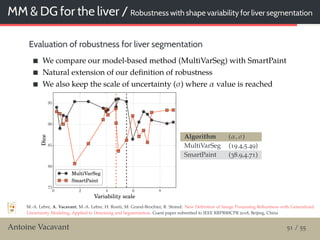
Evaluation of robustness for liver segmentation
We compare our model-based method (MultiVarSeg) with SmartPaint
Natural extension of our definition of robustness
We also keep the scale of uncertainty (σ) where α value is reached
0 2 4 6 8
Variability scale
75
80
85
90
95
Dice
MultiVarSeg
SmartPaint
Algorithm (α, σ)
MultiVarSeg (19.4,5.49)
SmartPaint (38.9,4.71)
M.-A. Lebre, A. Vacavant, M.-A. Lebre, H. Rositi, M. Grand-Brochier, R. Strand: New Definition of Image Processing Robustness with Generalized
Uncertainty Modeling, Applied to Denoising and Segmentation. Guest paper submitted to IEEE RRPR@ICPR 2018, Beijing, China
Antoine Vacavant 51 / 55
Outline
1. Me in one slide
2. Introduction
3. Definition of robustness
Noise and robustness
Robustness for image processing
4. MM: Smoothed shock filtering
Test of robustness
Improvement of machine learning tasks
Discussion
5. DG: Robust Reeb graph computations
Reeb graph computations by skeleton extraction
Experimental evaluation
Discussion
6. MM & DG for biomedical image analysis
HCC segmentation
Hepatic vascular network segmentation
Robustness with shape variability for liver segmentation
7. Conclusion, future works
Antoine Vacavant 52 / 55
Conclusion, future works
As a summary
Original contributions w/ other (young) researchers & MDs
Different (multi-scale) approaches for image analysis
Image enhancement and denoising employing mathematical morphology
Tools from digital geometry / topology for representing graphical objects
Machine learning and numerical simulation: important topics for
computer-aided liver cancer diagnosis
Antoine Vacavant 53 / 55
Conclusion, future works
As a summary
Original contributions w/ other (young) researchers & MDs
Different (multi-scale) approaches for image analysis
Image enhancement and denoising employing mathematical morphology
Tools from digital geometry / topology for representing graphical objects
Machine learning and numerical simulation: important topics for
computer-aided liver cancer diagnosis
Robustness
Original & foundational definitions for image processing algorithms
With 2 main applications: image denoising and liver segmentation
Related to benchmarking and big data issues
Antoine Vacavant 53 / 55
Conclusion, future works
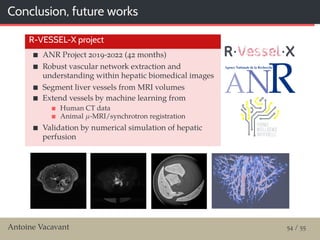
R-VESSEL-X project
ANR Project 2019-2022 (42 months)
Robust vascular network extraction and
understanding within hepatic biomedical images
Segment liver vessels from MRI volumes
Extend vessels by machine learning from
Human CT data
Animal µ-MRI/synchrotron registration
Validation by numerical simulation of hepatic
perfusion
Antoine Vacavant 54 / 55
The end...
Questions?
Antoine Vacavant 55 / 55

Robust image processing algorithms, involving tools from digital geometry and mathematical morphology

  • 1.
    ROBUST IMAGE PROCESSINGALGORITHMS, INVOLVING TOOLS FROM DIGITAL GEOMETRY AND MATHEMATICAL MORPHOLOGY CBA SEMINAR 2018 ANTOINE VACAVANT, PHD, HDR, ASSOCIATE PROFESSOR INSTITUT PASCAL, UMR6602 UCA / SIGMA / CNRS, LE PUY-EN-VELAY www.linkedin.com/in/antoinevacavant twitter.com/antoinevacavant antoine.vacavant@uca.fr antoine-vacavant.eu
  • 2.
    Outline 1. Me inone slide 2. Introduction 3. Definition of robustness Noise and robustness Robustness for image processing 4. MM: Smoothed shock filtering Test of robustness Improvement of machine learning tasks Discussion 5. DG: Robust Reeb graph computations Reeb graph computations by skeleton extraction Experimental evaluation Discussion 6. MM & DG for biomedical image analysis HCC segmentation Hepatic vascular network segmentation Robustness with shape variability for liver segmentation 7. Conclusion, future works Antoine Vacavant 1 / 55
  • 3.
    Outline 1. Me inone slide 2. Introduction 3. Definition of robustness Noise and robustness Robustness for image processing 4. MM: Smoothed shock filtering Test of robustness Improvement of machine learning tasks Discussion 5. DG: Robust Reeb graph computations Reeb graph computations by skeleton extraction Experimental evaluation Discussion 6. MM & DG for biomedical image analysis HCC segmentation Hepatic vascular network segmentation Robustness with shape variability for liver segmentation 7. Conclusion, future works Antoine Vacavant 2 / 55
  • 4.
    Me in oneslide / Université Clermont Auvergne 2010 - now: Associate prof. in computer science, Institut Pascal, IUT Le Puy-en-Velay Researches in IGT / Image Guided Therapies 2010 - 2015: Head of bachelor degree in computer graphics 2017 - now: Responsible of tech transfer in IGT 2017 - now: Scientific head of Embolization research team Computer vision Image processing Spatial data structures Digital geometry Medical appli- cations Antoine Vacavant 3 / 55
  • 5.
    Outline 1. Me inone slide 2. Introduction 3. Definition of robustness Noise and robustness Robustness for image processing 4. MM: Smoothed shock filtering Test of robustness Improvement of machine learning tasks Discussion 5. DG: Robust Reeb graph computations Reeb graph computations by skeleton extraction Experimental evaluation Discussion 6. MM & DG for biomedical image analysis HCC segmentation Hepatic vascular network segmentation Robustness with shape variability for liver segmentation 7. Conclusion, future works Antoine Vacavant 4 / 55
  • 6.
    Introduction / Image processingin a nutshell Image processing is a central task for computer image analysis For various contexts: Remote satellite image interpretation Biomedical imagery Surveillance and security, etc. Followed by high-level interpretation Methodological contributions: Image processing Medical applications: Computer vision Sensor Input: Acquisition, sampling, quantification Pre-processing: enhancement, denoising, etc. Processing: segmenta- tion, feature extraction, etc. Machine learning: classification, recognition, etc. User decision Antoine Vacavant 5 / 55
  • 7.
    Introduction / Image processingin a nutshell Image processing is a central task for computer image analysis For various contexts: Remote satellite image interpretation Biomedical imagery Surveillance and security, etc. Followed by high-level interpretation Methodological contributions: Image processing Medical applications: Computer visionMedical applications with Computer vision Sensor Input: Acquisition, sampling, quantification Pre-processing: enhancement, denoising, etc. Processing: segmenta- tion, feature extraction, etc. Machine learning: classification, recognition, etc. User decision Antoine Vacavant 5 / 55
  • 8.
    Introduction / Image processingin a nutshell Image processing is a central task for computer image analysis For various contexts: Remote satellite image interpretation Biomedical imagery Surveillance and security, etc. Followed by high-level interpretation Methodological contributions: Image processing Medical applications: Computer vision Methodological contributions in Image processing Medical applications with Computer vision Sensor Input: Acquisition, sampling, quantification Pre-processing: enhancement, denoising, etc. Processing: segmenta- tion, feature extraction, etc. Machine learning: classification, recognition, etc. User decision Antoine Vacavant 5 / 55
  • 9.
    Introduction / Image processingin a nutshell Image processing is a central task for computer image analysis For various contexts: Remote satellite image interpretation Biomedical imagery Surveillance and security, etc. Followed by high-level interpretation Problem revealed by experience in image processing Methodological contributions: Image processing Medical applications: Computer vision Methodological contributions in Image processing Novel definition of Robustness Sensor Input: Acquisition, sampling, quantification Pre-processing: enhancement, denoising, etc. Processing: segmenta- tion, feature extraction, etc. Machine learning: classification, recognition, etc. User decision Antoine Vacavant 5 / 55
  • 10.
    Outline 1. Me inone slide 2. Introduction 3. Definition of robustness Noise and robustness Robustness for image processing 4. MM: Smoothed shock filtering Test of robustness Improvement of machine learning tasks Discussion 5. DG: Robust Reeb graph computations Reeb graph computations by skeleton extraction Experimental evaluation Discussion 6. MM & DG for biomedical image analysis HCC segmentation Hepatic vascular network segmentation Robustness with shape variability for liver segmentation 7. Conclusion, future works Antoine Vacavant 6 / 55
  • 11.
    Outline 1. Me inone slide 2. Introduction 3. Definition of robustness Noise and robustness Robustness for image processing 4. MM: Smoothed shock filtering Test of robustness Improvement of machine learning tasks Discussion 5. DG: Robust Reeb graph computations Reeb graph computations by skeleton extraction Experimental evaluation Discussion 6. MM & DG for biomedical image analysis HCC segmentation Hepatic vascular network segmentation Robustness with shape variability for liver segmentation 7. Conclusion, future works Antoine Vacavant 7 / 55
  • 12.
    Definition of robustness/ Noise and robustness Image processing (IP), noise Common issue in IP: uncontrolled and destructive perturbation of the image Coming from diverse sources Artefacts in medical images Videos jittered by the camera, etc. Antoine Vacavant 8 / 55
  • 13.
    Definition of robustness/ Noise and robustness Image processing (IP), noise Common issue in IP: uncontrolled and destructive perturbation of the image Coming from diverse sources Artefacts in medical images Videos jittered by the camera, etc. Designed as noise Antoine Vacavant 8 / 55
  • 14.
    Definition of robustness/ Noise and robustness Image processing (IP), noise Common issue in IP: uncontrolled and destructive perturbation of the image Coming from diverse sources Artefacts in medical images Videos jittered by the camera, etc. Designed as noise Robustness Is seen as the ability of an algorithm to resist to this noise Ensures that the developed algorithm satisfies the final user of the application Antoine Vacavant 8 / 55
  • 15.
    Definition of robustness/ Noise and robustness Image processing (IP), noise Common issue in IP: uncontrolled and destructive perturbation of the image Coming from diverse sources Artefacts in medical images Videos jittered by the camera, etc. Designed as noise Robustness Is seen as the ability of an algorithm to resist to this noise Ensures that the developed algorithm satisfies the final user of the application But is mixed up with terms as efficiency, quality, performance Without any formal definition for image processing Antoine Vacavant 8 / 55
  • 16.
    Outline 1. Me inone slide 2. Introduction 3. Definition of robustness Noise and robustness Robustness for image processing 4. MM: Smoothed shock filtering Test of robustness Improvement of machine learning tasks Discussion 5. DG: Robust Reeb graph computations Reeb graph computations by skeleton extraction Experimental evaluation Discussion 6. MM & DG for biomedical image analysis HCC segmentation Hepatic vascular network segmentation Robustness with shape variability for liver segmentation 7. Conclusion, future works Antoine Vacavant 9 / 55
  • 17.
    Definition of robustness/ Robustness for image processing Contribution Propose a definition of robustness for IP algorithms In parallel of what has been done in CV Antoine Vacavant 10 / 55
  • 18.
    Definition of robustness/ Robustness for image processing Contribution Propose a definition of robustness for IP algorithms In parallel of what has been done in CV Presented at CBA in 2016 Antoine Vacavant 10 / 55
  • 19.
    Definition of robustness/ Robustness for image processing Contribution Propose a definition of robustness for IP algorithms In parallel of what has been done in CV Presented at CBA in 2016 Input noise model We suppose that the input data is altered with an additive noise, with similar notations as [Meer, 2001] yi y0 i + δyi , yi ∈ Rq , i 1, . . . , n also shortened as Y Y0 + δY Antoine Vacavant 10 / 55
  • 20.
    Definition of robustness/ Robustness for image processing Contribution Propose a definition of robustness for IP algorithms In parallel of what has been done in CV Presented at CBA in 2016 Input noise model We suppose that the input data is altered with an additive noise, with similar notations as [Meer, 2001] yi y0 i + δyi , yi ∈ Rq , i 1, . . . , n also shortened as Y Y0 + δY With Y: measurements Y0: true (and generally unknown) value δY: corruption by the noise We can suppose wlog an iid noise as δyi GI(0, σ2Cy)Antoine Vacavant 10 / 55
  • 21.
    Definition of robustness/ Robustness for image processing Robustness model for IP Robustness should be measured with multiple scales of noise Study limitations of an algorithm, how to make it fail Antoine Vacavant 11 / 55
  • 22.
    Definition of robustness/ Robustness for image processing Robustness model for IP Robustness should be measured with multiple scales of noise Study limitations of an algorithm, how to make it fail Definition of robustness for IP A: algorithm designed for a given IP application X {xi }i 1,n: output of A N: additive noise specific to this application {σk }k 1,m: set of scales of N Q(Xk, Y0 k ): measure of the quality of A for the scale k of N A. Vacavant: A novel definition of robustness for image processing algorithms. In IEEE RRPR@ICPR 2016, LNCS 10214, pages 75–87, Cancún, Mexico, 2016. Antoine Vacavant 11 / 55
  • 23.
    Definition of robustness/ Robustness for image processing Robustness model for IP Robustness should be measured with multiple scales of noise Study limitations of an algorithm, how to make it fail Definition of robustness for IP A: algorithm designed for a given IP application X {xi }i 1,n: output of A N: additive noise specific to this application {σk }k 1,m: set of scales of N Q(Xk, Y0 k ): measure of the quality of A for the scale k of N A is robust if Q respects a Lipschitz continuity under α: dY Q(Xk, Y0 k ), Q(Xk+1, Y0 k+1 ) ≤ αdX(σk+1 − σk), 1 ≤ k ≤ m A. Vacavant: A novel definition of robustness for image processing algorithms. In IEEE RRPR@ICPR 2016, LNCS 10214, pages 75–87, Cancún, Mexico, 2016. Antoine Vacavant 11 / 55
  • 24.
    Definition of robustness/ Robustness for image processing Synthetic example 1st way to assess robustness: graphically Definition of robustness for IP A is robust if Q respects a Lipschitz continuity under α: dY Q(Xk, Y0 k ), Q(Xk+1, Y0 k+1 ) ≤ αdX(σk+1 − σk), 1 ≤ k ≤ m A. Vacavant: A novel definition of robustness for image processing algorithms. In IEEE RRPR@ICPR 2016, LNCS 10214, pages 75–87, Cancún, Mexico, 2016. Antoine Vacavant 12 / 55
  • 25.
    Definition of robustness/ Robustness for image processing Synthetic example 1st way to assess robustness: graphically Definition of robustness for IP A is robust if Q respects a Lipschitz continuity under α: dY Q(Xk, Y0 k ), Q(Xk+1, Y0 k+1 ) ≤ αdX(σk+1 − σk), 1 ≤ k ≤ m A. Vacavant: A novel definition of robustness for image processing algorithms. In IEEE RRPR@ICPR 2016, LNCS 10214, pages 75–87, Cancún, Mexico, 2016. Antoine Vacavant 12 / 55
  • 26.
    Definition of robustness/ Robustness for image processing Synthetic example 1st way to assess robustness: graphically Definition of robustness for IP A is robust if Q respects a Lipschitz continuity under α: dY Q(Xk, Y0 k ), Q(Xk+1, Y0 k+1 ) ≤ αdX(σk+1 − σk), 1 ≤ k ≤ m A. Vacavant: A novel definition of robustness for image processing algorithms. In IEEE RRPR@ICPR 2016, LNCS 10214, pages 75–87, Cancún, Mexico, 2016. Antoine Vacavant 12 / 55
  • 27.
    Definition of robustness/ Robustness for image processing Synthetic example 1st way to assess robustness: graphically Definition of robustness for IP A is robust if Q respects a Lipschitz continuity under α: dY Q(Xk, Y0 k ), Q(Xk+1, Y0 k+1 ) ≤ αdX(σk+1 − σk), 1 ≤ k ≤ m A. Vacavant: A novel definition of robustness for image processing algorithms. In IEEE RRPR@ICPR 2016, LNCS 10214, pages 75–87, Cancún, Mexico, 2016. Antoine Vacavant 12 / 55
  • 28.
    Definition of robustness/ Robustness for image processing Synthetic example 1st way to assess robustness: graphically Definition of robustness for IP A is robust if Q respects a Lipschitz continuity under α: dY Q(Xk, Y0 k ), Q(Xk+1, Y0 k+1 ) ≤ αdX(σk+1 − σk), 1 ≤ k ≤ m A. Vacavant: A novel definition of robustness for image processing algorithms. In IEEE RRPR@ICPR 2016, LNCS 10214, pages 75–87, Cancún, Mexico, 2016. Antoine Vacavant 12 / 55
  • 29.
    Definition of robustness/ Robustness for image processing Synthetic example 1st way to assess robustness: graphically Definition of robustness for IP A is robust if Q respects a Lipschitz continuity under α: dY Q(Xk, Y0 k ), Q(Xk+1, Y0 k+1 ) ≤ αdX(σk+1 − σk), 1 ≤ k ≤ m A. Vacavant: A novel definition of robustness for image processing algorithms. In IEEE RRPR@ICPR 2016, LNCS 10214, pages 75–87, Cancún, Mexico, 2016. Antoine Vacavant 12 / 55
  • 30.
    Definition of robustness/ Robustness for image processing Synthetic example 1st way to assess robustness: graphically Definition of robustness for IP A is robust if Q respects a Lipschitz continuity under α: dY Q(Xk, Y0 k ), Q(Xk+1, Y0 k+1 ) ≤ αdX(σk+1 − σk), 1 ≤ k ≤ m A. Vacavant: A novel definition of robustness for image processing algorithms. In IEEE RRPR@ICPR 2016, LNCS 10214, pages 75–87, Cancún, Mexico, 2016. Antoine Vacavant 12 / 55
  • 31.
    Definition of robustness/ Robustness for image processing Synthetic example 1st way to assess robustness: graphically 2nd way to assess robustness: numerically Algorithm 1: α 0.30 Algorithm 2: α 0.18 Algorithm 3: α 0.05 Algorithm 4: α 0.02 Definition of robustness for IP A is robust if Q respects a Lipschitz continuity under α: dY Q(Xk, Y0 k ), Q(Xk+1, Y0 k+1 ) ≤ αdX(σk+1 − σk), 1 ≤ k ≤ m A. Vacavant: A novel definition of robustness for image processing algorithms. In IEEE RRPR@ICPR 2016, LNCS 10214, pages 75–87, Cancún, Mexico, 2016. Antoine Vacavant 12 / 55
  • 32.
    Outline 1. Me inone slide 2. Introduction 3. Definition of robustness Noise and robustness Robustness for image processing 4. MM: Smoothed shock filtering Test of robustness Improvement of machine learning tasks Discussion 5. DG: Robust Reeb graph computations Reeb graph computations by skeleton extraction Experimental evaluation Discussion 6. MM & DG for biomedical image analysis HCC segmentation Hepatic vascular network segmentation Robustness with shape variability for liver segmentation 7. Conclusion, future works Antoine Vacavant 13 / 55
  • 33.
    Outline 1. Me inone slide 2. Introduction 3. Definition of robustness Noise and robustness Robustness for image processing 4. MM: Smoothed shock filtering Test of robustness Improvement of machine learning tasks Discussion 5. DG: Robust Reeb graph computations Reeb graph computations by skeleton extraction Experimental evaluation Discussion 6. MM & DG for biomedical image analysis HCC segmentation Hepatic vascular network segmentation Robustness with shape variability for liver segmentation 7. Conclusion, future works Antoine Vacavant 14 / 55
  • 34.
    MM / Contextand motivation Image denoising filtering A lot of contributions since 70’s [Lebrun et al., 2012] Linear, popular, simple filters: Gaussian, average, median, bilateral, etc. Non-local strategies: NL-means, BM3D, total variation, etc. PDE schemes: anisotropic diffusion, coherence, etc. Antoine Vacavant 15 / 55
  • 35.
    MM / Contextand motivation Image denoising filtering A lot of contributions since 70’s [Lebrun et al., 2012] Linear, popular, simple filters: Gaussian, average, median, bilateral, etc. Non-local strategies: NL-means, BM3D, total variation, etc. PDE schemes: anisotropic diffusion, coherence, etc. Shock filtering Shock filter iteratively produces local segmentations in inflection zones: ∆ f t−1(pi , qj) < 0 ⇒ f t(pi , qj) f t−1(pi , qj) ⊕ D ; ∆ f t−1(pi , qj) > 0 ⇒ f t(pi , qj) f t−1(pi , qj) D Antoine Vacavant 15 / 55
  • 36.
    MM / Contextand motivation Image denoising filtering A lot of contributions since 70’s [Lebrun et al., 2012] Linear, popular, simple filters: Gaussian, average, median, bilateral, etc. Non-local strategies: NL-means, BM3D, total variation, etc. PDE schemes: anisotropic diffusion, coherence, etc. Shock filtering Shock filter iteratively produces local segmentations in inflection zones: ∆ f t−1(pi , qj) < 0 ⇒ f t(pi , qj) f t−1(pi , qj) ⊕ D ; ∆ f t−1(pi , qj) > 0 ⇒ f t(pi , qj) f t−1(pi , qj) D Smoothed shock filtering Enhance contours by creating smoothed ruptures PDE scheme with smoothed ⊕, operators A. Vacavant, A. Albouy-Kissi, P.-Y. Menguy, J. Solomon: Fast smoothed shock filtering. In IEEE ICPR 2012, Tsukuba, Japan, 2012. Antoine Vacavant 15 / 55
  • 37.
    MM / Contextand motivation Smoothed shock filtering examples Results with a photo and a complete CT slice Different values of ρ parameter (impact of shock) Algorithm iterated 10, 20, 30 times (PDE) Result of a simple segmentation algorithm afterwards Antoine Vacavant 16 / 55
  • 38.
    Outline 1. Me inone slide 2. Introduction 3. Definition of robustness Noise and robustness Robustness for image processing 4. MM: Smoothed shock filtering Test of robustness Improvement of machine learning tasks Discussion 5. DG: Robust Reeb graph computations Reeb graph computations by skeleton extraction Experimental evaluation Discussion 6. MM & DG for biomedical image analysis HCC segmentation Hepatic vascular network segmentation Robustness with shape variability for liver segmentation 7. Conclusion, future works Antoine Vacavant 17 / 55
  • 39.
    MM / Testof robustness Material and methods 13 classic images / Y0 Altered with additive white Gaussian noise / Y With increasing std / scales {σk }k 1,5 {5, 10, 15, 20, 25} Antoine Vacavant 18 / 55
  • 40.
    MM / Testof robustness Material and methods 13 classic images / Y0 Altered with additive white Gaussian noise / Y With increasing std / scales {σk }k 1,5 {5, 10, 15, 20, 25} From state of the art Shock-based methods Classic algorithms Median-based methods Algorithm Reference Median [Huang et al., 1979] Coherence [Weickert, 2003] OriginalShock [Osher and Rudin, 1990] EnhancedShock [Alvarez and Mazorra, 1994] ComplexShock [Gilboa et al., 2004] Bilateral [Tomasi and Manduchi, 1998] SmoothedMedian [Kass and Solomon, 2010] SmoothedShock [Vacavant et al., 2012] Antoine Vacavant 18 / 55
  • 41.
    MM / Testof robustness Experimental results Quality measure: SSIM / Structural similarity [Wang et al., 2004] A. Vacavant: A novel definition of robustness for image processing algorithms. In IEEE RRPR@ICPR 2016, LNCS 10214, pages 75–87, Cancún, Mexico, 2016. Antoine Vacavant 19 / 55
  • 42.
    MM / Testof robustness Experimental results Quality measure: SSIM / Structural similarity [Wang et al., 2004] Graphical evaluation of robustness A. Vacavant: A novel definition of robustness for image processing algorithms. In IEEE RRPR@ICPR 2016, LNCS 10214, pages 75–87, Cancún, Mexico, 2016. Antoine Vacavant 19 / 55
  • 43.
    MM / Testof robustness Experimental results Quality measure: SSIM / Structural similarity [Wang et al., 2004] Graphical evaluation of robustness A. Vacavant: A novel definition of robustness for image processing algorithms. In IEEE RRPR@ICPR 2016, LNCS 10214, pages 75–87, Cancún, Mexico, 2016. Antoine Vacavant 19 / 55
  • 44.
    MM / Testof robustness Experimental results Quality measure: SSIM / Structural similarity [Wang et al., 2004] Graphical evaluation of robustness A. Vacavant: A novel definition of robustness for image processing algorithms. In IEEE RRPR@ICPR 2016, LNCS 10214, pages 75–87, Cancún, Mexico, 2016. Antoine Vacavant 19 / 55
  • 45.
    MM / Testof robustness Experimental results Quality measure: SSIM / Structural similarity [Wang et al., 2004] Graphical evaluation of robustness A. Vacavant: A novel definition of robustness for image processing algorithms. In IEEE RRPR@ICPR 2016, LNCS 10214, pages 75–87, Cancún, Mexico, 2016. Antoine Vacavant 19 / 55
  • 46.
    MM / Testof robustness Experimental results Quality measure: SSIM / Structural similarity [Wang et al., 2004] Graphical evaluation of robustness A. Vacavant: A novel definition of robustness for image processing algorithms. In IEEE RRPR@ICPR 2016, LNCS 10214, pages 75–87, Cancún, Mexico, 2016. Antoine Vacavant 19 / 55
  • 47.
    MM / Testof robustness Experimental results Quality measure: SSIM / Structural similarity [Wang et al., 2004] Graphical evaluation of robustness Numerical evaluation of robustness Algorithm α Median 0.15 Coherence 0.15 OriginalShock 0.14 EnhancedShock 0.14 ComplexShock 0.12 Bilateral 0.11 SmoothedMedian 0.05 SmoothedShock 0.04 A. Vacavant: A novel definition of robustness for image processing algorithms. In IEEE RRPR@ICPR 2016, LNCS 10214, pages 75–87, Cancún, Mexico, 2016. Antoine Vacavant 19 / 55
  • 48.
    Outline 1. Me inone slide 2. Introduction 3. Definition of robustness Noise and robustness Robustness for image processing 4. MM: Smoothed shock filtering Test of robustness Improvement of machine learning tasks Discussion 5. DG: Robust Reeb graph computations Reeb graph computations by skeleton extraction Experimental evaluation Discussion 6. MM & DG for biomedical image analysis HCC segmentation Hepatic vascular network segmentation Robustness with shape variability for liver segmentation 7. Conclusion, future works Antoine Vacavant 20 / 55
  • 49.
    MM / Improvementof machine learning tasks Texture recognition We have proposed to improve texture classification by a scale-space approach For a given dataset: Brodatz, Vistex, Usptex or Outex Select a feature: LBP, GLCM, GLDM, SFTA, CLBP or LBPV Select a classifier: KNN or Naive Bayes Determine the best scales to be used in improving the classification rates Same is done for 2 other filters: Anisotropic diffusion (PM) and Gaussian filtering (G) M.B. Neiva, A. Vacavant, O.M. Bruno: Improving Texture Extraction and Classification using Smoothed Morphological Operators. Digital signal processing, 2018. Antoine Vacavant 21 / 55
  • 50.
    MM / Improvementof machine learning tasks Evaluation of accuracy for all datasets With KNN Dataset Best rate (feat.) Best SSF (feat.) Iterations Best G (feat.) Iterations Best PM (feat.) Iterations Outex 75.59 (LBPV) 84.78 (GLDM) {2, 4 . . . 18} 83.01 (CLBP) {9} 82.94 (CLBP) {19} Brodatz 97.6 (CLBP) 98.11 (CLBP) {6} 97.20 (CLBP) {2} 97.84 (CLBP) {11, 14} Usptex 83.1 (CLBP) 88.66 (CLBP) {1, 8} 85.21 (CLBP) {1} 88.57 (CLBP) {1, 3 . . . 17} Vistex 98.96 (CLBP) 99.31 (CLBP) {2} 98.96 (CLBP) {2, 3} 99.54 (CLBP) {14} With Naive Bayes Dataset Best rate (feat.) Best SSF (feat.) Iterations Best G (feat.) Iterations Best PM (feat.) Iterations Outex 80.81 (LBP) 86.47 (LBP) {2, 7 . . . 17} 83.01 (LBP) {8} 85.15 (CLBP) {4} Brodatz 96.6 (CLBP) 98.02 (CLBP) {2} 96.85 (CLBP) {1} 97.47 (CLBP) {15} Usptex 85.77 (CLBP) 91.49 (CLBP) {1, 3, 5} 86.43 (CLBP) {1, 3} 89.66 (CLBP) {8, 11 . . . 20} Vistex 97.33 (CLBP) 98.50 (CLBP) {2, 3} 98.50 (CLBP) {1, 3, 5} 97.92 (CLBP) {1, 8} Antoine Vacavant 22 / 55
  • 51.
    Outline 1. Me inone slide 2. Introduction 3. Definition of robustness Noise and robustness Robustness for image processing 4. MM: Smoothed shock filtering Test of robustness Improvement of machine learning tasks Discussion 5. DG: Robust Reeb graph computations Reeb graph computations by skeleton extraction Experimental evaluation Discussion 6. MM & DG for biomedical image analysis HCC segmentation Hepatic vascular network segmentation Robustness with shape variability for liver segmentation 7. Conclusion, future works Antoine Vacavant 23 / 55
  • 52.
    MM / Discussion Smoothedshock filtering Original contribution: robust image denoising algorithm Approved by applying definition of robustness Antoine Vacavant 24 / 55
  • 53.
    MM / Discussion Smoothedshock filtering Original contribution: robust image denoising algorithm Approved by applying definition of robustness Several parameters modulate algorithm’s behavior Shock impact Number of iterations Improves segmentation and machine learning tasks (e.g. fMRI classification) Antoine Vacavant 24 / 55
  • 54.
    Outline 1. Me inone slide 2. Introduction 3. Definition of robustness Noise and robustness Robustness for image processing 4. MM: Smoothed shock filtering Test of robustness Improvement of machine learning tasks Discussion 5. DG: Robust Reeb graph computations Reeb graph computations by skeleton extraction Experimental evaluation Discussion 6. MM & DG for biomedical image analysis HCC segmentation Hepatic vascular network segmentation Robustness with shape variability for liver segmentation 7. Conclusion, future works Antoine Vacavant 25 / 55
  • 55.
    Outline 1. Me inone slide 2. Introduction 3. Definition of robustness Noise and robustness Robustness for image processing 4. MM: Smoothed shock filtering Test of robustness Improvement of machine learning tasks Discussion 5. DG: Robust Reeb graph computations Reeb graph computations by skeleton extraction Experimental evaluation Discussion 6. MM & DG for biomedical image analysis HCC segmentation Hepatic vascular network segmentation Robustness with shape variability for liver segmentation 7. Conclusion, future works Antoine Vacavant 26 / 55
  • 56.
    DG / Contextand motivation Notion of Reeb graph Reeb graph is discrete structure representing both geometry and topology of an object Edges: object’s branches Vertices: branches’ junctions Calculated on a compact manifold wrt. definition of a given h function Note Critical points of h are graph vertices Definition of h is important for a correct graph construction Antoine Vacavant 27 / 55
  • 57.
    DG / Contextand motivation Reeb graphs in literature A lot of attention on its construction for 3-D meshes [Biasotti et al., 2008; Harvey et al., 2010] Generally, h is a height function (along an axis) Appropriate for many objects, but not for all! Can be calculated with other functions (e.g. geodesic) [Tierny, 2006] Antoine Vacavant 28 / 55
  • 58.
    DG / Contextand motivation Reeb graphs in literature A lot of attention on its construction for 3-D meshes [Biasotti et al., 2008; Harvey et al., 2010] Generally, h is a height function (along an axis) Appropriate for many objects, but not for all! Can be calculated with other functions (e.g. geodesic) [Tierny, 2006] Skeletons, medial axes and other 1-pixel-wide centered structures capture topology [Arcelli et al., 2010; Bertrand et al., 2014] Strategy: Compute Reeb graph from such structures [Janusch et al., 2015; Pascucci et al., 2007] Antoine Vacavant 28 / 55
  • 59.
    DG / Contextand motivation Reeb graphs in literature A lot of attention on its construction for 3-D meshes [Biasotti et al., 2008; Harvey et al., 2010] Generally, h is a height function (along an axis) Appropriate for many objects, but not for all! Can be calculated with other functions (e.g. geodesic) [Tierny, 2006] Skeletons, medial axes and other 1-pixel-wide centered structures capture topology [Arcelli et al., 2010; Bertrand et al., 2014] Strategy: Compute Reeb graph from such structures [Janusch et al., 2015; Pascucci et al., 2007] But they can be very sensitive to noise! Linking them to Reeb graph is not trivial Antoine Vacavant 28 / 55
  • 60.
    DG / Contextand motivation Our contribution Compute Reeb graphs of 2-D binary shapes Use a robust skeletonization scheme Capable of using several h functions Applications in robust image analysis A. Vacavant, A. Leborgne: Robust computations of reeb graphs in 2-D binary images. In CTIC 2016, LNCS 9667, pages 204–215, Marseille, France, 2016. Antoine Vacavant 29 / 55
  • 61.
    Outline 1. Me inone slide 2. Introduction 3. Definition of robustness Noise and robustness Robustness for image processing 4. MM: Smoothed shock filtering Test of robustness Improvement of machine learning tasks Discussion 5. DG: Robust Reeb graph computations Reeb graph computations by skeleton extraction Experimental evaluation Discussion 6. MM & DG for biomedical image analysis HCC segmentation Hepatic vascular network segmentation Robustness with shape variability for liver segmentation 7. Conclusion, future works Antoine Vacavant 30 / 55
  • 62.
    DG / Reebgraph computations by skeleton extraction DECS algorithm DECS: Discrete Euclidean Connected Skeleton [Leborgne et al., 2015] Resist to noise, compared to other algorithms Antoine Vacavant 31 / 55
  • 63.
    DG / Reebgraph computations by skeleton extraction DECS algorithm DECS: Discrete Euclidean Connected Skeleton [Leborgne et al., 2015] Resist to noise, compared to other algorithms Algorithm: From a binary image I Euclidean distance map EDTI Reduced medial axis RDMAI Laplacian-of-Gaussian filtering of EDTI as RDGI Combine RDGI and RDMAI to calculate a coarse skeleton SI Thin and prune SI to obtain S∗ I EDTI RDMAI RDGI SI S∗ I Antoine Vacavant 31 / 55
  • 64.
    DG / Reebgraph computations by skeleton extraction The definition Definition (Reeb graph) Let h be a continuous function defined on a compact variety M, h : M → R. The Reeb graph of M, denoted by G(h), is the quotient space defined by the equivalence relation p ∼ q ⇔ (p, h(p)) ∼ (q, h(q)) s.t.: h(p) h(q), p, q belongs to the same connected component of h−1(h(p)). Antoine Vacavant 32 / 55
  • 65.
    DG / Reebgraph computations by skeleton extraction Properties of Reeb graph G(h) is constructed by a level-sets approach wrt. h Points in the same con. component are associated to a level of h Reeb graph brings together topology and geometry (h defined on M) Key items G(h) is constructed by a level-sets approach wrt. h Antoine Vacavant 33 / 55
  • 66.
    DG / Reebgraph computations by skeleton extraction Properties of Reeb graph G(h) (V, E) represents M through h Edges: object’s branches (points belonging to the same con. component) Vertices: Critical points of h: begin, end, merge, split Key items G(h) is constructed by a level-sets approach wrt. h G(h) represents M through h Antoine Vacavant 33 / 55
  • 67.
    DG / Reebgraph computations by skeleton extraction Properties of Reeb graph Discrete G(h) (V, E) is built by an iterative process All notions hold in the discrete case Finite number of h level-sets Key items G(h) is constructed by a level-sets approach wrt. h G(h) represents M through h Discrete G(h) is built by an iterative process Antoine Vacavant 33 / 55
  • 68.
    DG / Reebgraph computations by skeleton extraction Properties of Reeb graph Key items G(h) is constructed by a level-sets approach wrt. h G(h) represents M through h Discrete G(h) is built by an iterative process Use DECS to build Reeb graphs of binary object Antoine Vacavant 33 / 55
  • 69.
    DG / Reebgraph computations by skeleton extraction Our algorithm From a binary image I, compute DECS S∗ I , select a starting point pS in S∗ I Breadth-first construction of GI(h) by adding points of S∗ I Increase level-set by assigning increasing h values to points treated Antoine Vacavant 34 / 55
  • 70.
    Outline 1. Me inone slide 2. Introduction 3. Definition of robustness Noise and robustness Robustness for image processing 4. MM: Smoothed shock filtering Test of robustness Improvement of machine learning tasks Discussion 5. DG: Robust Reeb graph computations Reeb graph computations by skeleton extraction Experimental evaluation Discussion 6. MM & DG for biomedical image analysis HCC segmentation Hepatic vascular network segmentation Robustness with shape variability for liver segmentation 7. Conclusion, future works Antoine Vacavant 35 / 55
  • 71.
    DG / Experimentalevaluation Reeb graph obtained for noisy vascular image Antoine Vacavant 36 / 55
  • 72.
    DG / Experimentalevaluation With synthetic images nit 0 nit 1 Antoine Vacavant 37 / 55
  • 73.
    DG / Experimentalevaluation With synthetic images nit 0 nit 5 Antoine Vacavant 37 / 55
  • 74.
    DG / Experimentalevaluation With synthetic images nit 0 nit 50 Antoine Vacavant 37 / 55
  • 75.
    DG / Experimentalevaluation With synthetic images nit 0 nit 100 Antoine Vacavant 37 / 55
  • 76.
    Outline 1. Me inone slide 2. Introduction 3. Definition of robustness Noise and robustness Robustness for image processing 4. MM: Smoothed shock filtering Test of robustness Improvement of machine learning tasks Discussion 5. DG: Robust Reeb graph computations Reeb graph computations by skeleton extraction Experimental evaluation Discussion 6. MM & DG for biomedical image analysis HCC segmentation Hepatic vascular network segmentation Robustness with shape variability for liver segmentation 7. Conclusion, future works Antoine Vacavant 38 / 55
  • 77.
    DG / Discussion Reebgraphs of noisy binary shapes Possibility to choose a relevant h function h may be chosen for further pattern recognition issues (descriptor encoding) Robustness may be assessed by means of our formalism Antoine Vacavant 39 / 55
  • 78.
    DG / Discussion Reebgraphs of noisy binary shapes Possibility to choose a relevant h function h may be chosen for further pattern recognition issues (descriptor encoding) Robustness may be assessed by means of our formalism Other works Irregular isothetic grids for vectorization Quadtree complexity theorem Vectorization of grayscale images A. Vacavant, B. Kerautret, T. Roussillon, F. Feschet: Reconstructions of noisy digital contours with maximal primitives based on multi-scale/irregular geometric representation and generalized linear programming. In DGCI 2017, LNCS 10502, pages 291–303, Vienna, Austria, 2017. Y. Gerard, A. Vacavant, J.-M. Favreau: Tight bounds in the quadtree complexity theorem and the maximal number of pixels crossed by a curve of given length. Theoretical Computer Science, 624:41–55, 2016. B. Kerautret, P. Ngo, Y. Kenmochi, A. Vacavant: Greyscale image vectorization from geometric digital contour representations. In DGCI 2017, LNCS 10502, pages 319–331, Vienne, Autriche, 2017. Antoine Vacavant 39 / 55
  • 79.
    Outline 1. Me inone slide 2. Introduction 3. Definition of robustness Noise and robustness Robustness for image processing 4. MM: Smoothed shock filtering Test of robustness Improvement of machine learning tasks Discussion 5. DG: Robust Reeb graph computations Reeb graph computations by skeleton extraction Experimental evaluation Discussion 6. MM & DG for biomedical image analysis HCC segmentation Hepatic vascular network segmentation Robustness with shape variability for liver segmentation 7. Conclusion, future works Antoine Vacavant 40 / 55
  • 80.
    Outline 1. Me inone slide 2. Introduction 3. Definition of robustness Noise and robustness Robustness for image processing 4. MM: Smoothed shock filtering Test of robustness Improvement of machine learning tasks Discussion 5. DG: Robust Reeb graph computations Reeb graph computations by skeleton extraction Experimental evaluation Discussion 6. MM & DG for biomedical image analysis HCC segmentation Hepatic vascular network segmentation Robustness with shape variability for liver segmentation 7. Conclusion, future works Antoine Vacavant 41 / 55
  • 81.
    MM & DGfor the liver / Context and motivation Our research group Inside IGT research axis CaVITI (Cardio-Vascular Interventional Therapy and Imaging) 3 research groups Theme 1: Endoprothesis Theme 2: Embolization Theme 3: Myocardial function Antoine Vacavant 42 / 55
  • 82.
    MM & DGfor the liver / Context and motivation Our research group Inside IGT research axis CaVITI (Cardio-Vascular Interventional Therapy and Imaging) 3 research groups Theme 1: Endoprothesis Theme 2: Embolization Theme 3: Myocardial function Research targets Quantitatively assess hepatic tumoral response by medical image analysis Innovative tools devoted to tumoral tissue quantification Personalized numerical simulation of treatments Link with clinical activities: chemo-embolization, surgery, biopsy, etc. Target cancer: HCC (Hepato-Cellular Carcinoma) Antoine Vacavant 42 / 55
  • 83.
    MM & DGfor the liver / Context and motivation Our research group Inside IGT research axis CaVITI (Cardio-Vascular Interventional Therapy and Imaging) 3 research groups Theme 1: Endoprothesis Theme 2: Embolization Theme 3: Myocardial function Research targets Quantitatively assess hepatic tumoral response by medical image analysis Innovative tools devoted to tumoral tissue quantification Personalized numerical simulation of treatments Link with clinical activities: chemo-embolization, surgery, biopsy, etc. Target cancer: HCC (Hepato-Cellular Carcinoma) More details tomor- row at CoSy seminar! Antoine Vacavant 42 / 55
  • 84.
    Outline 1. Me inone slide 2. Introduction 3. Definition of robustness Noise and robustness Robustness for image processing 4. MM: Smoothed shock filtering Test of robustness Improvement of machine learning tasks Discussion 5. DG: Robust Reeb graph computations Reeb graph computations by skeleton extraction Experimental evaluation Discussion 6. MM & DG for biomedical image analysis HCC segmentation Hepatic vascular network segmentation Robustness with shape variability for liver segmentation 7. Conclusion, future works Antoine Vacavant 43 / 55
  • 85.
    MM & DGfor the liver / HCC segmentation Segmentation of HCC within MRI ROI Enhance patches by smoothed shock filtering Segmentation by a fuzzy approach Input MRI ROI SSF Output Segmentation by fuzzification/defuzzification First calculate a fuzzy clustering by FCMVC (with variable compactness) JFCMVC n j 1 c i 1 ˆµij(xj − vi)2pi , ˆµij (xj − vi)−2pi c i 1 (xj − vi)−2pi Then calculate a binary segmentation by sequential feature selection Including geometrical and fuzzy features Antoine Vacavant 44 / 55
  • 86.
    MM & DGfor the liver / HCC segmentation Some segmentation results Our approach also compared with methods from state-of-the-art Positive impact of smoothed shock filter ROI SSF GT Output A. Vacavant, A.-R. Ali, M. Grand-Brochier, A. Albouy-Kissi, J.-Y. Boire, A. Alfidja et P. Chabrot: Smoothed shock filtered defuzzification with Zernike moments for liver tumor extraction in MR images. In IEEE IPTA 2015, Orléans, France, Nov. 2015. Antoine Vacavant 45 / 55
  • 87.
    Outline 1. Me inone slide 2. Introduction 3. Definition of robustness Noise and robustness Robustness for image processing 4. MM: Smoothed shock filtering Test of robustness Improvement of machine learning tasks Discussion 5. DG: Robust Reeb graph computations Reeb graph computations by skeleton extraction Experimental evaluation Discussion 6. MM & DG for biomedical image analysis HCC segmentation Hepatic vascular network segmentation Robustness with shape variability for liver segmentation 7. Conclusion, future works Antoine Vacavant 46 / 55
  • 88.
    MM & DGfor the liver / Hepatic vascular network segmentation Our pipeline for segmenting liver vessels From a CT or MRI volume, I Extract the liver and use it as a bounding box Multi-scale vessel detection with Hessian matrix IS [Sato et al., 1994] Partial skeletonization and reconnection S in IS [Homann et al., 2007] Calculate the RORPO vesselness filter IR [Merveille et al., 2018] Use S as initialization for fast marching segmentation within IR M.-A. Lebre, A. Vacavant, M. Grand-Brochier, O. Merveille, A. Abergel, P. Chabrot, B. Magnin: Automatic 3-D Skeleton-based Segmentation of Liver Vessels From MRI and CT for Couinaud Representation. In IEEE ICIP 2018, Athens, Greece, Antoine Vacavant 47 / 55
  • 89.
    MM & DGfor the liver / Hepatic vascular network segmentation Numerical results with IRCAD dataset (CT) ACC SPE SEN PRE FPR FNR Ours 0.97±0.01 0.98±0.01 0.69±0.10 0.61±0.07 0.01±0.01 0.32±0.09 RORPO 0.90±0.02 0.97±0.01 0.20±0.06 0.41±0.09 0.02±0.01 0.80±0.06 Sato 0.89±0.03 0.97±0.02 0.24±0.10 0.46±0.17 0.03±0.01 0.75±0.10 Numerical results with MRI for Couinaud representation Sketon-based metric (first branches) Overlap rate M0 and mean distance Md Hepatic vein M0 (%) Md (mm) Ours 95.46 8 RORPO 55.57 33 Portal vein M0 (%) Md (mm) Ours 100.0 7 RORPO 72.17 33 Antoine Vacavant 48 / 55
  • 90.
    Outline 1. Me inone slide 2. Introduction 3. Definition of robustness Noise and robustness Robustness for image processing 4. MM: Smoothed shock filtering Test of robustness Improvement of machine learning tasks Discussion 5. DG: Robust Reeb graph computations Reeb graph computations by skeleton extraction Experimental evaluation Discussion 6. MM & DG for biomedical image analysis HCC segmentation Hepatic vascular network segmentation Robustness with shape variability for liver segmentation 7. Conclusion, future works Antoine Vacavant 49 / 55
  • 91.
    MM & DGfor the liver / Robustness with shape variability for liver segmentation Novel measurement of robustness Based on a more general input uncertainty model Y Y0 δY Suppose we can measure difference between uncertain data vs. perfect ideal data Can be applied to classic additive Gaussian model Antoine Vacavant 50 / 55
  • 92.
    MM & DGfor the liver / Robustness with shape variability for liver segmentation Novel measurement of robustness Based on a more general input uncertainty model Y Y0 δY Suppose we can measure difference between uncertain data vs. perfect ideal data Can be applied to classic additive Gaussian model We study here complex shape variability Liver volume segmentation We measure the variability of liver data (IRCAD + SLIVER07 datasets) Construct a bounding box (BB) with standard dimensions of the liver Measure the variability of a given binary image by σ #(L BB) #(L) × 100 With L: set of pixels belonging to the liver in the binary segmentation Antoine Vacavant 50 / 55
  • 93.
    MM & DGfor the liver / Robustness with shape variability for liver segmentation Evaluation of robustness for liver segmentation We compare our model-based method (MultiVarSeg) with SmartPaint Natural extension of our definition of robustness We also keep the scale of uncertainty (σ) where α value is reached M.-A. Lebre, A. Vacavant, M.-A. Lebre, H. Rositi, M. Grand-Brochier, R. Strand: New Definition of Image Processing Robustness with Generalized Uncertainty Modeling, Applied to Denoising and Segmentation. Guest paper submitted to IEEE RRPR@ICPR 2018, Beijing, China Antoine Vacavant 51 / 55
  • 94.
    MM & DGfor the liver / Robustness with shape variability for liver segmentation Evaluation of robustness for liver segmentation We compare our model-based method (MultiVarSeg) with SmartPaint Natural extension of our definition of robustness We also keep the scale of uncertainty (σ) where α value is reached 0 2 4 6 8 Variability scale 75 80 85 90 95 Dice MultiVarSeg SmartPaint Algorithm (α, σ) MultiVarSeg (19.4,5.49) SmartPaint (38.9,4.71) M.-A. Lebre, A. Vacavant, M.-A. Lebre, H. Rositi, M. Grand-Brochier, R. Strand: New Definition of Image Processing Robustness with Generalized Uncertainty Modeling, Applied to Denoising and Segmentation. Guest paper submitted to IEEE RRPR@ICPR 2018, Beijing, China Antoine Vacavant 51 / 55
  • 95.
    Outline 1. Me inone slide 2. Introduction 3. Definition of robustness Noise and robustness Robustness for image processing 4. MM: Smoothed shock filtering Test of robustness Improvement of machine learning tasks Discussion 5. DG: Robust Reeb graph computations Reeb graph computations by skeleton extraction Experimental evaluation Discussion 6. MM & DG for biomedical image analysis HCC segmentation Hepatic vascular network segmentation Robustness with shape variability for liver segmentation 7. Conclusion, future works Antoine Vacavant 52 / 55
  • 96.
    Conclusion, future works Asa summary Original contributions w/ other (young) researchers & MDs Different (multi-scale) approaches for image analysis Image enhancement and denoising employing mathematical morphology Tools from digital geometry / topology for representing graphical objects Machine learning and numerical simulation: important topics for computer-aided liver cancer diagnosis Antoine Vacavant 53 / 55
  • 97.
    Conclusion, future works Asa summary Original contributions w/ other (young) researchers & MDs Different (multi-scale) approaches for image analysis Image enhancement and denoising employing mathematical morphology Tools from digital geometry / topology for representing graphical objects Machine learning and numerical simulation: important topics for computer-aided liver cancer diagnosis Robustness Original & foundational definitions for image processing algorithms With 2 main applications: image denoising and liver segmentation Related to benchmarking and big data issues Antoine Vacavant 53 / 55
  • 98.
    Conclusion, future works R-VESSEL-Xproject ANR Project 2019-2022 (42 months) Robust vascular network extraction and understanding within hepatic biomedical images Segment liver vessels from MRI volumes Extend vessels by machine learning from Human CT data Animal µ-MRI/synchrotron registration Validation by numerical simulation of hepatic perfusion Antoine Vacavant 54 / 55
  • 99.