Retro Technology
Topic: Robots
How far have we come from?
Why robots?
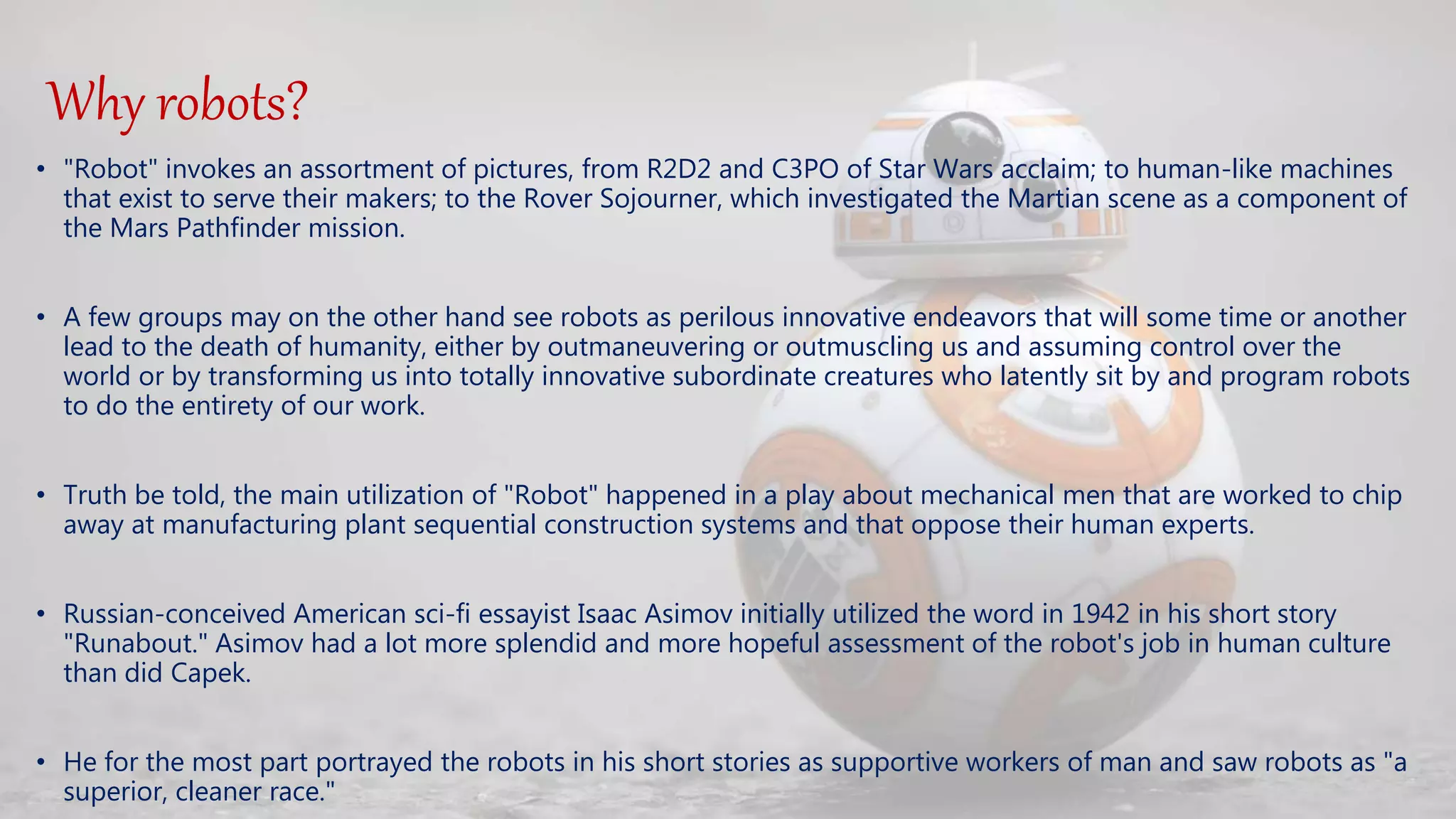
• "Robot" invokes an assortment of pictures, from R2D2 and C3PO of Star Wars acclaim; to human-like machines
that exist to serve their makers; to the Rover Sojourner, which investigated the Martian scene as a component of
the Mars Pathfinder mission.
• A few groups may on the other hand see robots as perilous innovative endeavors that will some time or another
lead to the death of humanity, either by outmaneuvering or outmuscling us and assuming control over the
world or by transforming us into totally innovative subordinate creatures who latently sit by and program robots
to do the entirety of our work.
• Truth be told, the main utilization of "Robot" happened in a play about mechanical men that are worked to chip
away at manufacturing plant sequential construction systems and that oppose their human experts.
• Russian-conceived American sci-fi essayist Isaac Asimov initially utilized the word in 1942 in his short story
"Runabout." Asimov had a lot more splendid and more hopeful assessment of the robot's job in human culture
than did Capek.
• He for the most part portrayed the robots in his short stories as supportive workers of man and saw robots as "a
superior, cleaner race."
Why robots? cont’d
• Asimov likewise proposed three "Laws of Robotics" that his robots, just as science fiction
automated characters of numerous different stories, followed:
Law One
• A robot may not harm a person or, through inaction, permit an individual to come to hurt.
Law Two
• A robot should submit to the orders given it by people aside from where such orders would
struggle with the First Law.
Law Three
• A robot should secure its own reality as long as such insurance doesn't struggle with the First or
Second Law.
Early concepts
• Using pressurized water worked sculptures that could talk, signal, and prediction
were normally built in Hellenic Egypt during the second century B.C. In the
primary century A.D., Petronius Arbiter made a doll that could move like an
individual.
• Mechanical innovations arrived at a relative top during the 1700s; innumerable
ingenius, yet unreasonable, automata were made during this time-frame.
• The nineteenth century was additionally loaded up with new automated
manifestations, for example, a talking doll by Edison and a steam-controlled
robot by Canadians.
• Albeit these developments since forever may have sowed the principal seeds of
motivation for the cutting edge robot, the logical advancement made in the
twentieth century in the field of mechanical technology outperform past
progressions a thousandfold.
First modern robots
• The most punctual robots as we probably are aware them were made in the mid 1950s by George C.
Devol, a designer from Louisville, Kentucky.
• He concocted and protected a reprogrammable controller called "Unimate," from "Widespread
Automation." For the following decade, he endeavored to sell his item in the business, yet didn't
succeed.
• In the last part of the 1960s, financial specialist/engineer Joseph Engleberger obtained Devol's robot
patent and had the option to change it into a modern robot and structure an organization called
Unimation to create and advertise the robots.
• For his endeavors and triumphs, Engleberger is referred to in the business as "The Father of
Robotics." The scholarly community additionally gained a lot of headway in the creation new robots.
• In 1958 at the Stanford Research Institute, Charles Rosen drove an examination group in building up
a robot called "Shakey." Shakey was undeniably further developed than the first Unimate, which was
intended for particular, modern applications.
Visual Presentation
To get a visual video presentation on this topic.
Click here to watch this video.

Retro Technology: Robots

  • 1.
    Retro Technology Topic: Robots Howfar have we come from?
  • 2.
    Why robots? • "Robot"invokes an assortment of pictures, from R2D2 and C3PO of Star Wars acclaim; to human-like machines that exist to serve their makers; to the Rover Sojourner, which investigated the Martian scene as a component of the Mars Pathfinder mission. • A few groups may on the other hand see robots as perilous innovative endeavors that will some time or another lead to the death of humanity, either by outmaneuvering or outmuscling us and assuming control over the world or by transforming us into totally innovative subordinate creatures who latently sit by and program robots to do the entirety of our work. • Truth be told, the main utilization of "Robot" happened in a play about mechanical men that are worked to chip away at manufacturing plant sequential construction systems and that oppose their human experts. • Russian-conceived American sci-fi essayist Isaac Asimov initially utilized the word in 1942 in his short story "Runabout." Asimov had a lot more splendid and more hopeful assessment of the robot's job in human culture than did Capek. • He for the most part portrayed the robots in his short stories as supportive workers of man and saw robots as "a superior, cleaner race."
  • 3.
    Why robots? cont’d •Asimov likewise proposed three "Laws of Robotics" that his robots, just as science fiction automated characters of numerous different stories, followed: Law One • A robot may not harm a person or, through inaction, permit an individual to come to hurt. Law Two • A robot should submit to the orders given it by people aside from where such orders would struggle with the First Law. Law Three • A robot should secure its own reality as long as such insurance doesn't struggle with the First or Second Law.
  • 4.
    Early concepts • Usingpressurized water worked sculptures that could talk, signal, and prediction were normally built in Hellenic Egypt during the second century B.C. In the primary century A.D., Petronius Arbiter made a doll that could move like an individual. • Mechanical innovations arrived at a relative top during the 1700s; innumerable ingenius, yet unreasonable, automata were made during this time-frame. • The nineteenth century was additionally loaded up with new automated manifestations, for example, a talking doll by Edison and a steam-controlled robot by Canadians. • Albeit these developments since forever may have sowed the principal seeds of motivation for the cutting edge robot, the logical advancement made in the twentieth century in the field of mechanical technology outperform past progressions a thousandfold.
  • 5.
    First modern robots •The most punctual robots as we probably are aware them were made in the mid 1950s by George C. Devol, a designer from Louisville, Kentucky. • He concocted and protected a reprogrammable controller called "Unimate," from "Widespread Automation." For the following decade, he endeavored to sell his item in the business, yet didn't succeed. • In the last part of the 1960s, financial specialist/engineer Joseph Engleberger obtained Devol's robot patent and had the option to change it into a modern robot and structure an organization called Unimation to create and advertise the robots. • For his endeavors and triumphs, Engleberger is referred to in the business as "The Father of Robotics." The scholarly community additionally gained a lot of headway in the creation new robots. • In 1958 at the Stanford Research Institute, Charles Rosen drove an examination group in building up a robot called "Shakey." Shakey was undeniably further developed than the first Unimate, which was intended for particular, modern applications.
  • 6.
    Visual Presentation To geta visual video presentation on this topic. Click here to watch this video.