Robin Holmes
Calum Jowett-Edge, Alice Mutton, Matthew Tingle,
Josh Levin, Aidan Oldroyd, Tom Bates
The Idea
A combination between two initial ideas:
‘Robin Holmes’ - a comedic idea where two burglars end up
robbing the same house
‘Lucky 26’ - A more dramatic and serious idea of a man breaking
in to his ex-girlfriend’s house to fund his gambling addiction
We realised going for something purely comedic was too ambitious
and ‘Lucky 26’ didn’t seem interesting enough so we used
attributes of both.
The final idea was still called ‘Robin Holmes’ who is the main
character who meets ‘Lou Dest’, a burglar robbing his ex-
girlfriend’s house.
Influences
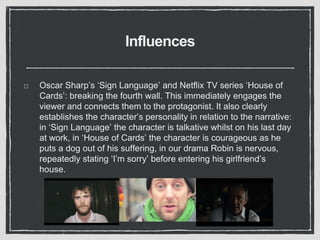
Oscar Sharp’s ‘Sign Language’ and Netflix TV series ‘House of
Cards’: breaking the fourth wall. This immediately engages the
viewer and connects them to the protagonist. It also clearly
establishes the character’s personality in relation to the narrative:
in ‘Sign Language’ the character is talkative whilst on his last day
at work, in ‘House of Cards’ the character is courageous as he
puts a dog out of his suffering, in our drama Robin is nervous,
repeatedly stating ‘I’m sorry’ before entering his girlfriend’s
house.
Influences (cont)
Barry Lyndon
Light from the camera (Eternal Sunshine of the
Spotless Mind)
Production
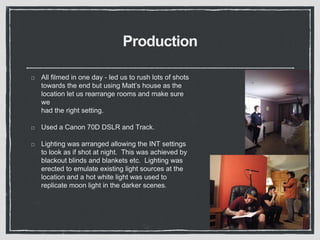
All filmed in one day - led us to rush lots of shots
towards the end but using Matt’s house as the
location let us rearrange rooms and make sure
we
had the right setting.
Used a Canon 70D DSLR and Track.
Lighting was arranged allowing the INT settings
to look as if shot at night. This was achieved by
blackout blinds and blankets etc. Lighting was
erected to emulate existing light sources at the
location and a hot white light was used to
replicate moon light in the darker scenes.
Post-production
Josh and Calum did majority of the video editing together, making mutual decisions
throughout the process to minimise chances of having to change the sequence.
Rough cuts and screenshots were sent to everyone else via the blogs, keeping the whole
group informed and letting the edit be open to group feedback.
Experimented with different angles of scenes like running through the kitchen, needed to
maintain eye trace and 2D/3D space. In the quick cuts we had to edit rhythmically to help
everything flow.
Managed to use technical skills acquired in previous modules such as shortcuts and
editing methods to apply in Avid Media Composer for this project - allowed the editing to
be quick. This allowed time for changing the sequence after edit tutorial as initially the
cuts were too frequent and weren’t embedded in the action.
Matt’s research on colour grading
Tom’s sound recording and using Pro Tools
Strengths
Film
The actors’ dialogue and actions reflect well off each other. The ‘Lou’ character is convincingly
menacing.
Through lighting setups and colour grading, we think the night-time setting is successful. Also Tom’s
added sounds are realistic, convincing and effective.
The sequence effectively tells a story which ends on a cliffhanger - Robin has developed from timid
to stealing the burglar’s bank card and Lou maintains his antagonistic persona.
Production Process
Because we were struggling with time restraints in production, the decision to change from static
shots to handheld helped speed up the process and we think it helps match the overall tone of the
film - static shots to build suspense and handheld shots to emphasise the conflict of the characters.
The producer found actors that were punctual and knew the script, and the director helped them
bring out the appropriate moods for the film.
The editor and camera operator working together for colour grading demonstrates professional
collaboration.
Weaknesses
Film
Continuity errors: open/closed doors
Pace - a larger variety of angles in scenes such as when the two characters meet would help give
more perspective and give a more effective pace
The ‘Jenny’ character not ever finding the robbers despite their loud conversations and running in
the house may add comedic value to the narrative but is unrealistic.
Production Process
No recce - figuring out shots and blocking as went along in production was very time-consuming and
led to the evening shots being rushed, because we only had one day.
Could have started pre-production earlier, we found actors and planned schedules during the Easter
holidays which made things more difficult for ourselves.
Practicalities of the idea - it was difficult, and again time-consuming, to make an interior location look
convincingly at night, when we were actually filming in the day
Reflection
Due to time constraints on the production, with various
shots and sound recordings that we had to rush, we
think the film isn’t as successful as it could have been.
Equipment (problem)
Lighting (problem)
Time-management (problem)
Organisation with actors, flow of the story, effective
sound design

Robin holmes

  • 1.
    Robin Holmes Calum Jowett-Edge,Alice Mutton, Matthew Tingle, Josh Levin, Aidan Oldroyd, Tom Bates
  • 2.
    The Idea A combinationbetween two initial ideas: ‘Robin Holmes’ - a comedic idea where two burglars end up robbing the same house ‘Lucky 26’ - A more dramatic and serious idea of a man breaking in to his ex-girlfriend’s house to fund his gambling addiction We realised going for something purely comedic was too ambitious and ‘Lucky 26’ didn’t seem interesting enough so we used attributes of both. The final idea was still called ‘Robin Holmes’ who is the main character who meets ‘Lou Dest’, a burglar robbing his ex- girlfriend’s house.
  • 3.
    Influences Oscar Sharp’s ‘SignLanguage’ and Netflix TV series ‘House of Cards’: breaking the fourth wall. This immediately engages the viewer and connects them to the protagonist. It also clearly establishes the character’s personality in relation to the narrative: in ‘Sign Language’ the character is talkative whilst on his last day at work, in ‘House of Cards’ the character is courageous as he puts a dog out of his suffering, in our drama Robin is nervous, repeatedly stating ‘I’m sorry’ before entering his girlfriend’s house.
  • 4.
    Influences (cont) Barry Lyndon Lightfrom the camera (Eternal Sunshine of the Spotless Mind)
  • 5.
    Production All filmed inone day - led us to rush lots of shots towards the end but using Matt’s house as the location let us rearrange rooms and make sure we had the right setting. Used a Canon 70D DSLR and Track. Lighting was arranged allowing the INT settings to look as if shot at night. This was achieved by blackout blinds and blankets etc. Lighting was erected to emulate existing light sources at the location and a hot white light was used to replicate moon light in the darker scenes.
  • 6.
    Post-production Josh and Calumdid majority of the video editing together, making mutual decisions throughout the process to minimise chances of having to change the sequence. Rough cuts and screenshots were sent to everyone else via the blogs, keeping the whole group informed and letting the edit be open to group feedback. Experimented with different angles of scenes like running through the kitchen, needed to maintain eye trace and 2D/3D space. In the quick cuts we had to edit rhythmically to help everything flow. Managed to use technical skills acquired in previous modules such as shortcuts and editing methods to apply in Avid Media Composer for this project - allowed the editing to be quick. This allowed time for changing the sequence after edit tutorial as initially the cuts were too frequent and weren’t embedded in the action. Matt’s research on colour grading Tom’s sound recording and using Pro Tools
  • 7.
    Strengths Film The actors’ dialogueand actions reflect well off each other. The ‘Lou’ character is convincingly menacing. Through lighting setups and colour grading, we think the night-time setting is successful. Also Tom’s added sounds are realistic, convincing and effective. The sequence effectively tells a story which ends on a cliffhanger - Robin has developed from timid to stealing the burglar’s bank card and Lou maintains his antagonistic persona. Production Process Because we were struggling with time restraints in production, the decision to change from static shots to handheld helped speed up the process and we think it helps match the overall tone of the film - static shots to build suspense and handheld shots to emphasise the conflict of the characters. The producer found actors that were punctual and knew the script, and the director helped them bring out the appropriate moods for the film. The editor and camera operator working together for colour grading demonstrates professional collaboration.
  • 8.
    Weaknesses Film Continuity errors: open/closeddoors Pace - a larger variety of angles in scenes such as when the two characters meet would help give more perspective and give a more effective pace The ‘Jenny’ character not ever finding the robbers despite their loud conversations and running in the house may add comedic value to the narrative but is unrealistic. Production Process No recce - figuring out shots and blocking as went along in production was very time-consuming and led to the evening shots being rushed, because we only had one day. Could have started pre-production earlier, we found actors and planned schedules during the Easter holidays which made things more difficult for ourselves. Practicalities of the idea - it was difficult, and again time-consuming, to make an interior location look convincingly at night, when we were actually filming in the day
  • 9.
    Reflection Due to timeconstraints on the production, with various shots and sound recordings that we had to rush, we think the film isn’t as successful as it could have been. Equipment (problem) Lighting (problem) Time-management (problem) Organisation with actors, flow of the story, effective sound design