Your Brain on
                 Product
            Development
Robin Dymond, CST
Agile Eastern Europe 2012

                            © 2012 Robin Dymond
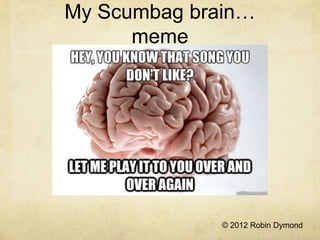
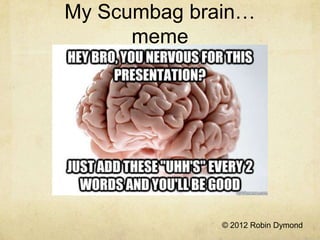
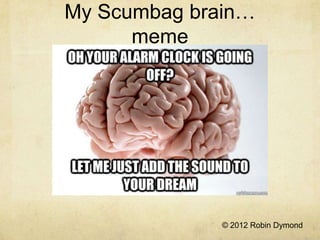
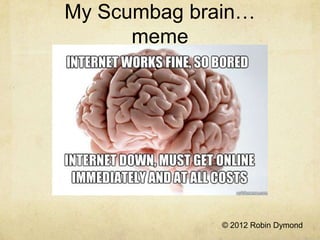
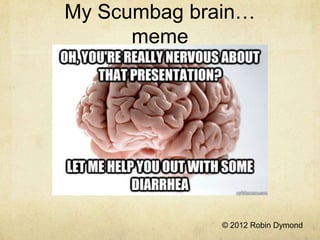
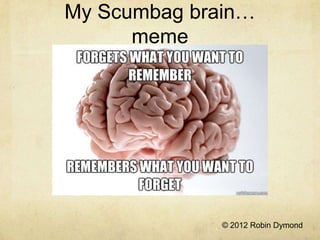
My Scumbag brain…
      meme


              © 2012 Robin Dymond
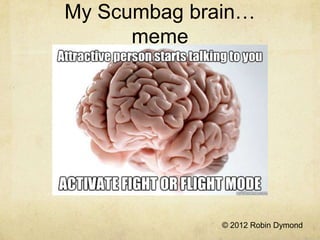
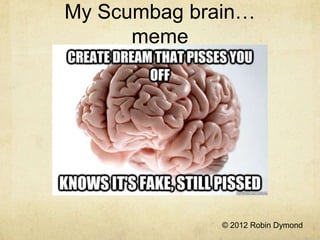
My Scumbag brain…
      meme


              © 2012 Robin Dymond
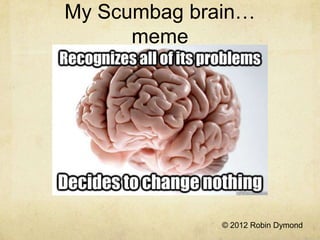
My Scumbag brain…
      meme


              © 2012 Robin Dymond
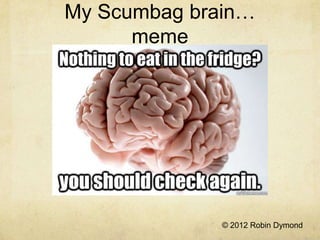
My Scumbag brain…
      meme


              © 2012 Robin Dymond
My Scumbag brain…
      meme


              © 2012 Robin Dymond
My Scumbag brain…
      meme


              © 2012 Robin Dymond
My Scumbag brain…
      meme


              © 2012 Robin Dymond
My Scumbag brain…
      meme


              © 2012 Robin Dymond
My Scumbag brain…
      meme


              © 2012 Robin Dymond
My Scumbag brain…
      meme


              © 2012 Robin Dymond
My Scumbag brain…
      meme


              © 2012 Robin Dymond
My Scumbag brain…
      meme


              © 2012 Robin Dymond
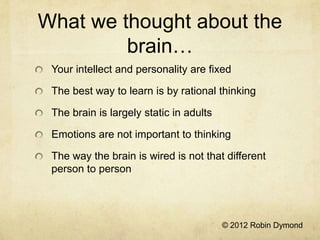
What we thought about the
         brain…
 Your intellect and personality are fixed

 The best way to learn is by rational thinking

 The brain is largely static in adults

 Emotions are not important to thinking

 The way the brain is wired is not that different
 person to person


                                         © 2012 Robin Dymond
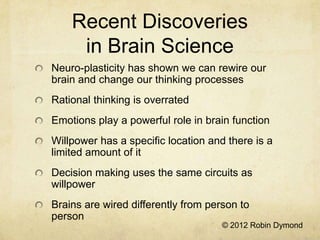
Recent Discoveries
     in Brain Science
Neuro-plasticity has shown we can rewire our
brain and change our thinking processes
Rational thinking is overrated
Emotions play a powerful role in brain function
Willpower has a specific location and there is a
limited amount of it
Decision making uses the same circuits as
willpower
Brains are wired differently from person to
person
                                     © 2012 Robin Dymond
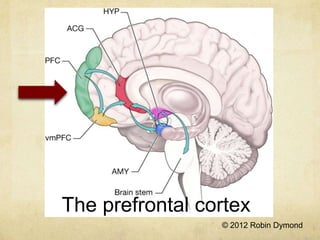
The prefrontal cortex
                 © 2012 Robin Dymond
Experiments
Brain mapping prior to epilepsy surgery

Let’s do some arithmetic

The cookie experiment

The Eureka! moment


                                   © 2012 Robin Dymond
Specific Brain Functions
 are a limited resource
Complex higher concentration tasks

Attention is limited

How would that change how you work today?


                                     © 2012 Robin Dymond
Insight
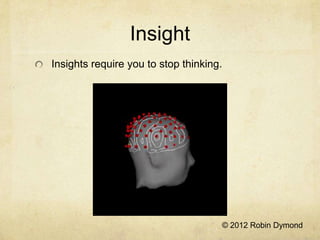
Insights require you to stop thinking.


                                     © 2012 Robin Dymond
Insight
Lab tests show more insights occur when people
are happy, much less when anxiety is present

Going and playing a game of foozball or pool
may improve insight

Control your brain by learning when to think
directly about a problem and when to not think
directly about a problem


                                   © 2012 Robin Dymond
Product Developers
Rational resources are limited, so try doing the
more creative, technical, challenging work early
in your day

Only work on one thing at a time

Collaboration improves focus, happiness

Email can wait


                                    © 2012 Robin Dymond
Emotions
The Limbic system

Move away from threats

Move toward rewards

We move much faster, stronger, and stay longer
in the threat response state

More activity in Limbic area the less effective the
PFC


                                     © 2012 Robin Dymond
Emotional Regulation
Suppression
    creates arousal, no change to memory, makes other
    uncomfortable

Cognitive change strategies
Label it
    reduces arousal, invokes stronger inhibition of threat
    response (ie, saying “I must be hungry, angry, etc.”)

Re-appraisal
    Fast re-interpretation of the event to change perspective.
    Reduces threat response, improves cognitive ability,
    memory

Recognizing internal brain function helps improve re-
appraisal
                                              © 2012 Robin Dymond
Product Developers
Recognize your threat response

Act quickly to re-appraise or label it before
cognitive ability is decrease

Realize that we use the same circuits for physical
and psychological threat, so we need a work
around.


                                      © 2012 Robin Dymond
When you hear…
“I need to give you some feedback”


“I need to talk to you about your
   project”


      What is your immediate reaction?

                              © 2012 Robin Dymond
Social issues
Brain is deeply social, massive circuitry dedicated to social
issues

Uses same threat reward circuits and pain circuits!

Status
    Local group
    Large threat response from perceived reduction in
    position

Certainty

Autonomy

Relatedness
   In group: share pain, see what they say,
   out group, don’t hear with same brain circuits, default
                                           © 2012 Robin Dymond
   to foe
Social issues
Status

Certainty

Autonomy

Relatedness

Fairness

What will improve these? What decreases them?


                                 © 2012 Robin Dymond
Attention
We can use the results from brain research to
change how we think and work.

Notice what your brain is doing.

Use strategies to change your responses

Minimizing the threat response will increase your
problem solving ability and insights

YOU ARE NOT YOUR BRAIN.


                                    © 2012 Robin Dymond
Mindfulness
Neuroscience of mindfulness

Noticing internal states

Focus in incoming senses directly

The direct experience allows much better
processing of inputs

The internal narrative suppresses inputs


                                    © 2012 Robin Dymond
Summary
The PFC has limited resources for problem solving
Insights come from engaging much larger regions of the
brain and are the result of detecting weak relationships
The threat response dramatically decreases our ability to
think, yet threat responses are much stronger
Social issues managed by the same threat and pain
circuitry
Understanding and attention to internal states allows one
to manage cognitive processes
Direct experience of inputs suppresses internal narrative
and allows much improved processing of inputs and more
insights

                                           © 2012 Robin Dymond
Your brain and Scrum
Improves the primary social issues that impact
problem solving:

Status

Certainty

Autonomy

Relatedness

Fairness


                                   © 2012 Robin Dymond
Your brain and Scrum
Improves focus:

One team, one project at a time

Collaboration, pairing

Social


                                  © 2012 Robin Dymond
What can you do
        tomorrow?
How to better manage your brain’s resources?

How to improve chances for insights?

How to reduce your natural threat response?

How to improve your attention to your internal
states?


                                    © 2012 Robin Dymond

Robin Dymond: "Your Brain and Better Product Development"

  • 1.
    Your Brain on Product Development Robin Dymond, CST Agile Eastern Europe 2012 © 2012 Robin Dymond
  • 2.
    My Scumbag brain… meme © 2012 Robin Dymond
  • 3.
    My Scumbag brain… meme © 2012 Robin Dymond
  • 4.
    My Scumbag brain… meme © 2012 Robin Dymond
  • 5.
    My Scumbag brain… meme © 2012 Robin Dymond
  • 6.
    My Scumbag brain… meme © 2012 Robin Dymond
  • 7.
    My Scumbag brain… meme © 2012 Robin Dymond
  • 8.
    My Scumbag brain… meme © 2012 Robin Dymond
  • 9.
    My Scumbag brain… meme © 2012 Robin Dymond
  • 10.
    My Scumbag brain… meme © 2012 Robin Dymond
  • 11.
    My Scumbag brain… meme © 2012 Robin Dymond
  • 12.
    My Scumbag brain… meme © 2012 Robin Dymond
  • 13.
    My Scumbag brain… meme © 2012 Robin Dymond
  • 14.
    What we thoughtabout the brain… Your intellect and personality are fixed The best way to learn is by rational thinking The brain is largely static in adults Emotions are not important to thinking The way the brain is wired is not that different person to person © 2012 Robin Dymond
  • 15.
    Recent Discoveries in Brain Science Neuro-plasticity has shown we can rewire our brain and change our thinking processes Rational thinking is overrated Emotions play a powerful role in brain function Willpower has a specific location and there is a limited amount of it Decision making uses the same circuits as willpower Brains are wired differently from person to person © 2012 Robin Dymond
  • 16.
    The prefrontal cortex © 2012 Robin Dymond
  • 17.
    Experiments Brain mapping priorto epilepsy surgery Let’s do some arithmetic The cookie experiment The Eureka! moment © 2012 Robin Dymond
  • 18.
    Specific Brain Functions are a limited resource Complex higher concentration tasks Attention is limited How would that change how you work today? © 2012 Robin Dymond
  • 19.
    Insight Insights require youto stop thinking. © 2012 Robin Dymond
  • 20.
    Insight Lab tests showmore insights occur when people are happy, much less when anxiety is present Going and playing a game of foozball or pool may improve insight Control your brain by learning when to think directly about a problem and when to not think directly about a problem © 2012 Robin Dymond
  • 21.
    Product Developers Rational resourcesare limited, so try doing the more creative, technical, challenging work early in your day Only work on one thing at a time Collaboration improves focus, happiness Email can wait © 2012 Robin Dymond
  • 22.
    Emotions The Limbic system Moveaway from threats Move toward rewards We move much faster, stronger, and stay longer in the threat response state More activity in Limbic area the less effective the PFC © 2012 Robin Dymond
  • 23.
    Emotional Regulation Suppression creates arousal, no change to memory, makes other uncomfortable Cognitive change strategies Label it reduces arousal, invokes stronger inhibition of threat response (ie, saying “I must be hungry, angry, etc.”) Re-appraisal Fast re-interpretation of the event to change perspective. Reduces threat response, improves cognitive ability, memory Recognizing internal brain function helps improve re- appraisal © 2012 Robin Dymond
  • 24.
    Product Developers Recognize yourthreat response Act quickly to re-appraise or label it before cognitive ability is decrease Realize that we use the same circuits for physical and psychological threat, so we need a work around. © 2012 Robin Dymond
  • 25.
    When you hear… “Ineed to give you some feedback” “I need to talk to you about your project” What is your immediate reaction? © 2012 Robin Dymond
  • 26.
    Social issues Brain isdeeply social, massive circuitry dedicated to social issues Uses same threat reward circuits and pain circuits! Status Local group Large threat response from perceived reduction in position Certainty Autonomy Relatedness In group: share pain, see what they say, out group, don’t hear with same brain circuits, default © 2012 Robin Dymond to foe
  • 27.
    Social issues Status Certainty Autonomy Relatedness Fairness What willimprove these? What decreases them? © 2012 Robin Dymond
  • 28.
    Attention We can usethe results from brain research to change how we think and work. Notice what your brain is doing. Use strategies to change your responses Minimizing the threat response will increase your problem solving ability and insights YOU ARE NOT YOUR BRAIN. © 2012 Robin Dymond
  • 29.
    Mindfulness Neuroscience of mindfulness Noticinginternal states Focus in incoming senses directly The direct experience allows much better processing of inputs The internal narrative suppresses inputs © 2012 Robin Dymond
  • 30.
    Summary The PFC haslimited resources for problem solving Insights come from engaging much larger regions of the brain and are the result of detecting weak relationships The threat response dramatically decreases our ability to think, yet threat responses are much stronger Social issues managed by the same threat and pain circuitry Understanding and attention to internal states allows one to manage cognitive processes Direct experience of inputs suppresses internal narrative and allows much improved processing of inputs and more insights © 2012 Robin Dymond
  • 31.
    Your brain andScrum Improves the primary social issues that impact problem solving: Status Certainty Autonomy Relatedness Fairness © 2012 Robin Dymond
  • 32.
    Your brain andScrum Improves focus: One team, one project at a time Collaboration, pairing Social © 2012 Robin Dymond
  • 33.
    What can youdo tomorrow? How to better manage your brain’s resources? How to improve chances for insights? How to reduce your natural threat response? How to improve your attention to your internal states? © 2012 Robin Dymond

Editor's Notes

  • #18 600 epilepsy surgeries1+1, 10+10, 49+287Cookies and math you can’t solve
  • #19 Brain power is limitedBest approach is to do work requiring high concentration firstShould we start our day with email?The more depleted our brain becomes, the more noisy it becomes.