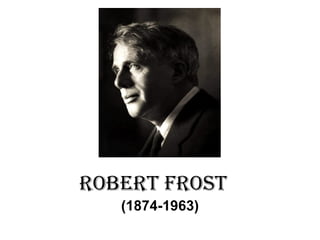
ROBERT FROST
   (1874-1963) 
ROBERT FROST
• Robert Lee Frost (March 26, 1874 – January
  29, 1963) an American poet, was born on 26
  March 1874 in San Francisco, California. He is
  highly regarded for his realistic depictions of
  rural life . His work frequently employed
  settings from rural life in the early twentieth
  century, using them to examine complex social
  and philosophical themes.
ROBERT FROST

• On January 29, 1963, he died, in Boston, 
  of complications from prostate surgery. He 
  was buried at the Old Bennington 
  Cemetery in Bennington, Vermont. His 
  epitaph reads, "I had a lover's quarrel with 
  the world." 
PULITZER PRIZES
 A popular and often-quoted poet, Frost was
  honored frequently during his lifetime, receiving
  four Pulitzer prizes.
• 1924 for New Hampshire: A Poem With
  Notes and Grace Notes
• 1931 for Collected Poems
• 1937 for A Further Range
• 1943 for A Witness Tree
OFT QUOTED FamOUS WORkS
• The Road Not Taken
                  ‘I shall be telling this with a sigh 
                Somewhere ages and ages hence:
              Two roads diverged in a wood, and I– 
                    I took the one less traveled by,
              And that has made all the difference.’

• Stopping By Woods On A Snowy Evening
                 ‘The woods are lovely, dark and deep.
                      But I have promises to keep,
                     And miles to go before I sleep,
                    And miles to go before I sleep.’
OFT QUOTED FamOUS WORkS
• Mending Wall

               ‘Something there is that doesn't love a wall, 
              That sends the frozen-ground-swell under it, 
                  And spills the upper boulders in the sun; 
             And makes gaps even two can pass abreast.’
• After Apple-Picking
        ‘My long two-pointed ladder's sticking through a tree 
                             Toward heaven still,
                    And there's a barrel that I didn't fill
                 Beside it, and there may be two or three
                  Apples I didn't pick upon some bough.’
NOTES FROM THE POET
• Frost claims that he wrote this poem about his friend 
  Edward Thomas, with whom he had walked many times 
  in the woods near London. Frost has said that while 
  walking they would come to different paths and after 
  choosing one, Thomas would always fret wondering 
  what they might have missed by not taking the other 
  path.
• About the poem, Frost asserted, "You have to be careful 
  of that one; it's a tricky poem - very tricky." And he is, of 
  course, correct. The poem has been and continues to be 
  used as an inspirational poem, one that to the 
  undiscerning eye seems to be encouraging self-reliance, 
  not following where others have led.
•  But a close reading of the poem proves otherwise. It 
  does not moralize about choice, it simply says that 
  choice is inevitable but you never know what your choice 
  will mean until you have lived it.
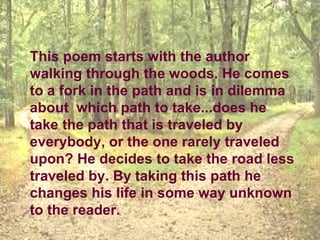
This poem starts with the author
walking through the woods. He comes
to a fork in the path and is in dilemma
about which path to take...does he
take the path that is traveled by
everybody, or the one rarely traveled
upon? He decides to take the road less
traveled by. By taking this path he
changes his life in some way unknown
to the reader.
The Road Not Taken is a twenty-line
poem with the rhyme scheme abaab
   The poem consists of four stanzas.
 In the first stanza, the speaker
describes his position.
 He has been out walking the woods
and comes to two roads, and he stands
looking as far down each one as he can
see.
   He would like to try out both, but
doubts he could do that, therefore he
continues to look down the roads for a
long time trying to make his decision
about which road to take.
The poet had looked down the first one ‘ to where
it bent in the undergrowth’ and in the second
stanza, he reports that he decided to take the
other path, because it seemed to have less traffic
than the first.
    But then he goes on to say that they actually
were very similarly worn. The second one that he
took seems less traveled, but as he thinks about
it, he realizes that they were ‘really about the
same.’ Not exactly same but only ‘about the
same.’
The third stanza states the possible
differences between the two roads. He
had noticed that the leaves were freshly
fallen on them both and had not been
walked on, but then again claims that
maybe he would come back and also walk
the first one sometime, but he doubted he
would be able to, because in life one thing
leads to another and time is short
The fourth stanza holds the key to the trickiness
of the poem: as stated with the word ‘sigh’.

  I shall be telling this with a sigh
 Somewhere ages and ages hence:
 Two roads diverged in a wood, and I
 I took the one less traveled by,
 And that has made all the difference.

 However we can interpret this poem as
suggesting non-conformity. Take the word
“difference” to be a positive difference.
WORD CONNOTATION
Though we usually associate the word
‘sigh’ with regret , the word ‘sigh’ in
the poem can however be interpreted
in terms of connoting a positive
difference. The sigh can be taken to
be as one of nostalgic relief;. Frost
asserts that the choice was all which
made the difference.
THEME OF THE POEM
This is a wonderful poem with many different 
themes and ideas. One of the prime themes is 
not being afraid to take a chance. Some of the 
other themes include, not following the crowd, 
trying new things and standing for something. 
This poem stated that the author "took the one 
(road) less traveled by, and that has made all 
the difference" so the author is telling the 
reader that we too should not be afraid to take 
a less frequented path. 
POET’S MESSAGE


•Robert Frost’s “The Road Not Taken” has
been one of the most analyzed, quoted,
anthologized poems in American poetry. A
wide-spread interpretation claims that the
speaker in the poem is promoting
individualism and non-conformity.

Robert frost presentation

  • 1.
    ROBERT FROST (1874-1963) 
  • 2.
    ROBERT FROST • RobertLee Frost (March 26, 1874 – January 29, 1963) an American poet, was born on 26 March 1874 in San Francisco, California. He is highly regarded for his realistic depictions of rural life . His work frequently employed settings from rural life in the early twentieth century, using them to examine complex social and philosophical themes.
  • 3.
    ROBERT FROST • On January 29, 1963, he died, in Boston,  of complications from prostate surgery. He  was buried at the Old Bennington  Cemetery in Bennington, Vermont. His  epitaph reads, "I had a lover's quarrel with  the world." 
  • 4.
    PULITZER PRIZES  A popularand often-quoted poet, Frost was honored frequently during his lifetime, receiving four Pulitzer prizes. • 1924 for New Hampshire: A Poem With Notes and Grace Notes • 1931 for Collected Poems • 1937 for A Further Range • 1943 for A Witness Tree
  • 5.
    OFT QUOTED FamOUSWORkS • The Road Not Taken   ‘I shall be telling this with a sigh    Somewhere ages and ages hence:   Two roads diverged in a wood, and I–     I took the one less traveled by,  And that has made all the difference.’ • Stopping By Woods On A Snowy Evening      ‘The woods are lovely, dark and deep. But I have promises to keep, And miles to go before I sleep, And miles to go before I sleep.’
  • 6.
    OFT QUOTED FamOUSWORkS • Mending Wall    ‘Something there is that doesn't love a wall,      That sends the frozen-ground-swell under it,       And spills the upper boulders in the sun;      And makes gaps even two can pass abreast.’ • After Apple-Picking ‘My long two-pointed ladder's sticking through a tree    Toward heaven still,  And there's a barrel that I didn't fill  Beside it, and there may be two or three  Apples I didn't pick upon some bough.’
  • 7.
    NOTES FROM THE POET • Frost claims that he wrote this poem about his friend  Edward Thomas, with whom he had walked many times  in the woods near London. Frost has said that while  walking they would come to different paths and after  choosing one, Thomas would always fret wondering  what they might have missed by not taking the other  path. • About the poem, Frost asserted, "You have to be careful  of that one; it's a tricky poem - very tricky." And he is, of  course, correct. The poem has been and continues to be  used as an inspirational poem, one that to the  undiscerning eye seems to be encouraging self-reliance,  not following where others have led. •  But a close reading of the poem proves otherwise. It  does not moralize about choice, it simply says that  choice is inevitable but you never know what your choice  will mean until you have lived it.
  • 8.
    This poem startswith the author walking through the woods. He comes to a fork in the path and is in dilemma about which path to take...does he take the path that is traveled by everybody, or the one rarely traveled upon? He decides to take the road less traveled by. By taking this path he changes his life in some way unknown to the reader.
  • 9.
    The Road NotTaken is a twenty-line poem with the rhyme scheme abaab The poem consists of four stanzas. In the first stanza, the speaker describes his position. He has been out walking the woods and comes to two roads, and he stands looking as far down each one as he can see. He would like to try out both, but doubts he could do that, therefore he continues to look down the roads for a long time trying to make his decision about which road to take.
  • 10.
    The poet hadlooked down the first one ‘ to where it bent in the undergrowth’ and in the second stanza, he reports that he decided to take the other path, because it seemed to have less traffic than the first. But then he goes on to say that they actually were very similarly worn. The second one that he took seems less traveled, but as he thinks about it, he realizes that they were ‘really about the same.’ Not exactly same but only ‘about the same.’
  • 11.
    The third stanzastates the possible differences between the two roads. He had noticed that the leaves were freshly fallen on them both and had not been walked on, but then again claims that maybe he would come back and also walk the first one sometime, but he doubted he would be able to, because in life one thing leads to another and time is short
  • 12.
    The fourth stanzaholds the key to the trickiness of the poem: as stated with the word ‘sigh’. I shall be telling this with a sigh Somewhere ages and ages hence: Two roads diverged in a wood, and I I took the one less traveled by, And that has made all the difference. However we can interpret this poem as suggesting non-conformity. Take the word “difference” to be a positive difference.
  • 13.
    WORD CONNOTATION Though weusually associate the word ‘sigh’ with regret , the word ‘sigh’ in the poem can however be interpreted in terms of connoting a positive difference. The sigh can be taken to be as one of nostalgic relief;. Frost asserts that the choice was all which made the difference.
  • 14.
    THEME OF THEPOEM This is a wonderful poem with many different  themes and ideas. One of the prime themes is  not being afraid to take a chance. Some of the  other themes include, not following the crowd,  trying new things and standing for something.  This poem stated that the author "took the one  (road) less traveled by, and that has made all  the difference" so the author is telling the  reader that we too should not be afraid to take  a less frequented path. 
  • 15.
    POET’S MESSAGE •Robert Frost’s“The Road Not Taken” has been one of the most analyzed, quoted, anthologized poems in American poetry. A wide-spread interpretation claims that the speaker in the poem is promoting individualism and non-conformity.