Objective: The student will understand and appreciate a narrative poem in order to examine blank verse and form in poetry
Warm-up How would you define idea of home?  How do you think your idea of home will change when you go to college or begin living on your own?
Build Background
Words to Know Abide Assurance Beholden Harbor taut
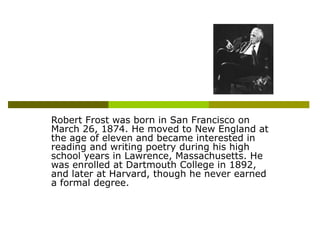
Robert Frost was born in San Francisco on March 26, 1874. He moved to New England at the age of eleven and became interested in reading and writing poetry during his high school years in Lawrence, Massachusetts. He was enrolled at Dartmouth College in 1892, and later at Harvard, though he never earned a formal degree.                       
In 1895, Frost married Elinor Miriam White, who became a major inspiration in his poetry until her death in 1938. The couple moved to England in 1912, after their New Hampshire farm failed, and it was abroad that Frost met and was influenced by such contemporary British poets as  Edward Thomas ,  Rupert Brooke , and  Robert Graves . While in England, Frost also established a friendship with the poet  Ezra Pound , who helped to promote and publish his work.
By the time Frost returned to the United States in 1915, he had published two full-length collections,  A Boy's Will  and  North of Boston , and his reputation was established. By the nineteen-twenties, he was the most celebrated poet in America, and with each new book—including  New Hampshire  (1923),  A Further Range  (1936),  Steeple Bush  (1947), and  In the Clearing  (1962)—his fame and honors (including four Pulitzer Prizes) increased
Though his work is principally associated with the life and landscape of New England, and though he was a poet of traditional verse forms and metrics who remained steadfastly aloof from the poetic movements and fashions of his time, Frost is anything but a merely regional or minor poet. The author of searching and often dark meditations on universal themes, he is a quintessentially modern poet in his adherence to language as it is actually spoken, in the psychological complexity of his portraits, and in the degree to which his work is infused with layers of ambiguity and irony.
In a 1970 review of  The Poetry of Robert Frost , the poet  Daniel Hoffman  describes Frost's early work as "the Puritan ethic turned astonishingly lyrical and enabled to say out loud the sources of its own delight in the world," and comments on Frost's career as The American Bard: "He became a national celebrity, our nearly official Poet Laureate, and a great performer in the tradition of that earlier master of the literary vernacular, Mark Twain."
About Frost, President John F. Kennedy said, "He has bequeathed his nation a body of imperishable verse from which Americans will forever gain joy and understanding." Robert Frost lived and taught for many years in Massachusetts and Vermont, and died in Boston on January 29, 1963
The teacher and students will continue to discuss and analyze the poem, “The Death of the Hired Man”.
Class work-Thinking Through the Literature Answer the following questions:  …..numbers 1-5 Language of Literature p. 1013

Robert frost biography

  • 1.
    Objective: The studentwill understand and appreciate a narrative poem in order to examine blank verse and form in poetry
  • 2.
    Warm-up How wouldyou define idea of home? How do you think your idea of home will change when you go to college or begin living on your own?
  • 3.
  • 4.
    Words to KnowAbide Assurance Beholden Harbor taut
  • 5.
    Robert Frost wasborn in San Francisco on March 26, 1874. He moved to New England at the age of eleven and became interested in reading and writing poetry during his high school years in Lawrence, Massachusetts. He was enrolled at Dartmouth College in 1892, and later at Harvard, though he never earned a formal degree.                       
  • 6.
    In 1895, Frostmarried Elinor Miriam White, who became a major inspiration in his poetry until her death in 1938. The couple moved to England in 1912, after their New Hampshire farm failed, and it was abroad that Frost met and was influenced by such contemporary British poets as Edward Thomas , Rupert Brooke , and Robert Graves . While in England, Frost also established a friendship with the poet Ezra Pound , who helped to promote and publish his work.
  • 7.
    By the timeFrost returned to the United States in 1915, he had published two full-length collections, A Boy's Will and North of Boston , and his reputation was established. By the nineteen-twenties, he was the most celebrated poet in America, and with each new book—including New Hampshire (1923), A Further Range (1936), Steeple Bush (1947), and In the Clearing (1962)—his fame and honors (including four Pulitzer Prizes) increased
  • 8.
    Though his workis principally associated with the life and landscape of New England, and though he was a poet of traditional verse forms and metrics who remained steadfastly aloof from the poetic movements and fashions of his time, Frost is anything but a merely regional or minor poet. The author of searching and often dark meditations on universal themes, he is a quintessentially modern poet in his adherence to language as it is actually spoken, in the psychological complexity of his portraits, and in the degree to which his work is infused with layers of ambiguity and irony.
  • 9.
    In a 1970review of The Poetry of Robert Frost , the poet Daniel Hoffman describes Frost's early work as "the Puritan ethic turned astonishingly lyrical and enabled to say out loud the sources of its own delight in the world," and comments on Frost's career as The American Bard: "He became a national celebrity, our nearly official Poet Laureate, and a great performer in the tradition of that earlier master of the literary vernacular, Mark Twain."
  • 10.
    About Frost, PresidentJohn F. Kennedy said, "He has bequeathed his nation a body of imperishable verse from which Americans will forever gain joy and understanding." Robert Frost lived and taught for many years in Massachusetts and Vermont, and died in Boston on January 29, 1963
  • 11.
    The teacher andstudents will continue to discuss and analyze the poem, “The Death of the Hired Man”.
  • 12.
    Class work-Thinking Throughthe Literature Answer the following questions: …..numbers 1-5 Language of Literature p. 1013