Roadtrip Highlights Along US-24
By Donald Dale Milne
https://www.roadtrip62.com/roadtrip-highlights-along-us-24.htm
I’m going to skip the next number in the US routes because it’s US-23, which I’ve traveled in detail on the Roadtrip-’62 TM site! You can find the
archives of that trip at the US-23 Archives (see http://www.roadtrip62.com/US-23-Archives.htm ). Instead, let’s look some highlights along US-24, which today
runs 1540 miles from Clarkston, Michigan to Minturn, Colorado. It crosses US-23 at Toledo, Ohio. Highway US-24 also crosses our US-6 roadtrip, at
Napoleon, Ohio and again at Minturn, Colorado, where it now ends. The section west of Minturn was decommissioned in 1975. Before that it ran together with
US-6 all the way to Grand Junction, Colorado, adding almost 200 more miles to the route we would have seen in 1962. The Michigan end was in Pontiac back in
1962, but extended north to Clarkston in 1987. All of US-24 within Michigan runs north-south, instead of the east-west routing suggested by its even number.
The remainder of the highway across the country does correctly run east-west.
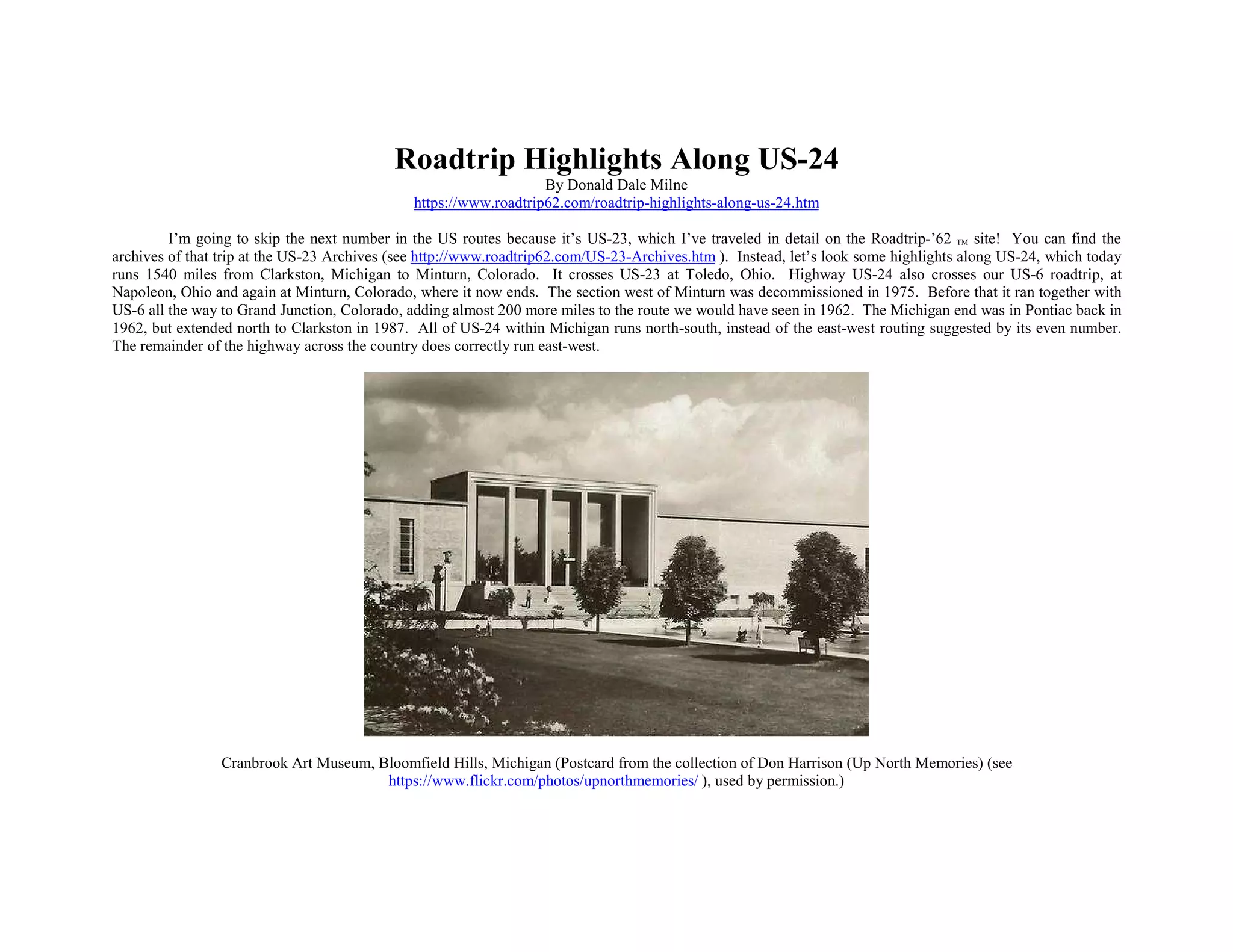
Cranbrook Art Museum, Bloomfield Hills, Michigan (Postcard from the collection of Don Harrison (Up North Memories) (see
https://www.flickr.com/photos/upnorthmemories/ ), used by permission.)
Near the east (north) end of US-24, in Bloomfield Hills, Michigan, is the Cranbrook Art Museum (see https://housegardens.cranbrook.edu/ ). It is
among the first contemporary art museums in America. The museum’s early collection was a portion of the personal collection of the Cranbrook Academy’s
founder, Mr. Henry Booth. The building was designed by Eliel Saarinen, who also designed the Cranbrook campus and other early buildings. It was completed
in 1942 and included an outdoor sculpture garden. The museum’s original collection was an eclectic mix of art and artifacts. It spanned the centuries and
included stained glass, architectural pieces, sculpture, paintings, ceramics, glass, furniture, textiles, and more. In 1955, the museum was given a new name,
Cranbrook Academy of Art Galleries, and a new mission. It now continues to show art of the past, but focuses on contemporary decorative and practical art,
sculpture and painting. The adjacent Cranbrook House and Gardens was the home of Mr. and Mrs. Booth and has been open to the public only since 1971.
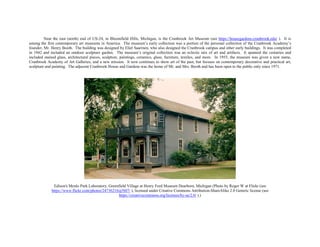
Edison's Menlo Park Laboratory, Greenfield Village at Henry Ford Museum Dearborn, Michigan (Photo by Roger W at Flickr (see
https://www.flickr.com/photos/24736216@N07/ ), licensed under Creative Commons Attribution-ShareAlike 2.0 Generic license (see
https://creativecommons.org/licenses/by-sa/2.0/ ).)
About 2½ miles off US-24, a little farther south in Dearborn, Michigan, is the Henry Ford Museum with Greenfield Village. This museum is America’s
premier historical collection outside of the Smithsonian Institution in Washington, DC. Industrialist Henry Ford began his collecting of historical artifacts in
1919, when he learned that his birthplace was due to be demolished for a highway improvement. He bought the farmhouse and restored it to fit his memory of
when he was 13 and sent employees scouring the county for artifacts to outfit the house. He followed this up by buying and restoring the one-room schoolhouse
from his boyhood, and then a pair of inns, thinking of establishing a complete histroical village. By the late 1920s, his quest to create a complete village led him
to become the primary collector of Americana in the world. The result was Greenfield Village. Though there are many authentic buildings, some were created
specifically for the site, including a re-creation of the Menlo Park, New Jersey, laboratory complex where his friend Thomas Edison had invented his electric
lighting system.
The Henry Ford Museum (see https://www.thehenryford.org/ ) is designed to resemble Independence Hall and related buildings of Philadelphia, with a
large “Exhibition Hall” in back. Ford rejected the idea of storage rooms, so nearly everything was exhibited out in the open. And at twelve-acres, the museum
contained a huge assemblage of stuff representing the evolution of technological progress. The museum opened to the public in 1933 and for nearly a decade
afterwards, it remained a work in progress. The exhibits were not completed until the early 1940s, when the village contained over 70 buildings complete with
artisans demonstrating traditional crafts. Today, the museum continues to collect and to tell stories of innovation. And if you can’t make it to the museum, you
can see items from the collection in action on the Emmy-winning TV series “Innovation Nation” hosted by CBS-TV correspondent Mo Rocca.
General Electric Partio barbeque cart, ca. 1960, at the Henry Ford Museum, Dearborn, Michigan
In their collection is this marvel of outdoor living, the General Electric Partio barbeque cart. The Partio Cart originally came with a patio umbrella, a
12-foot cord, and a cover. The two wood shelves drop down when not in use or can be removed entirely. In some model years, the shelves were more like
cafeteria metal racks instead of wood. They used 220-volt power, just like your electric range in the kitchen. Westinghouse may have produced a similar model.
They were sold from at least 1956-1960 and even featured in the 1960 GE Annual Report. The one at the Henry Ford was originally President Dwight D.
Eisenhower’s, which he kept at his Palm Springs, California home.
At Toledo, Ohio, we cross our US-23 roadtrip (see https://www.roadtrip62.com/us-23-day-6-milan-mi-fostoria-oh.htm#Toledo ). Highway US-24 turns
west there, traveling up the valley of the Maumee River through Ohio. Currently, US-24 is on a newer freeway alignment, but the old road of 1962 is less than a
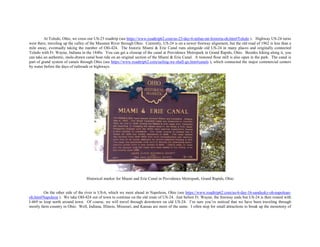
mile away, eventually taking the number of OH-424. The historic Miami & Erie Canal runs alongside old US-24 in many places and originally connected
Toledo with Ft. Wayne, Indiana in the 1840s. You can get a closeup of the canal at Providence Metropark in Grand Rapids, Ohio. Besides hiking along it, you
can take an authentic, mule-drawn canal boat ride on an original section of the Miami & Erie Canal. A restored flour mill is also open in the park. The canal is
part of grand system of canals through Ohio (see https://www.roadtrip62.com/sailing-we-shall-go.htm#canals ), which connected the major commercial centers
by water before the days of railroads or highways.
Historical marker for Miami and Erie Canal in Providence Metropark, Grand Rapids, Ohio
On the other side of the river is US-6, which we meet ahead in Napoleon, Ohio (see https://www.roadtrip62.com/us-6-day-16-sandusky-oh-napolean-
oh.htm#Napoleon ). We take OH-424 out of town to continue on the old route of US-24. Just before Ft. Wayne, the freeway ends but US-24 is then routed with
I-469 to loop north around town. Of course, we will travel through downtown on old US-24. I’m sure you’ve noticed that we have been traveling through
mostly farm country in Ohio. Well, Indiana, Illinois, Missouri, and Kansas are more of the same. I often stop for small attractions to break up the monotony of
long-distance travel and there’s one in Huntington, Illinois. The Sunken Gardens began as a stone quarry, but was eventually abandoned. It became such an
eyesore that the city purchased the property in 1924. The Huntington Chamber of Commerce acquired the quarry and created the beautiful gardens that now
occupy the site, giving it back to the city in 1929. It’s a pleasant little stop if you are in the area, either today or back in 1962. The city’s Parks Department says
it is one of only two such gardens in the country.
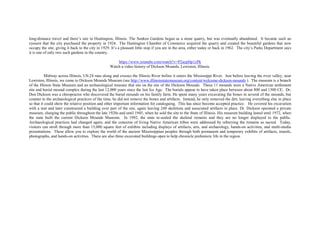
https://www.youtube.com/watch?v=P2azpHp1yPk
Watch a video history of Dickson Mounds, Lewiston, Illinois.
Midway across Illinois, US-24 runs along and crosses the Illinois River before it enters the Mississippi River. Just before leaving the river valley, near
Lewiston, Illinois, we come to Dickson Mounds Museum (see http://www.illinoisstatemuseum.org/content/welcome-dickson-mounds ). The museum is a branch
of the Illinois State Museum and an archaeological treasure that sits on the site of the Dickson Mounds. These 11 mounds were a Native American settlement
site and burial mound complex during the last 12,000 years since the last Ice Age. The burials appear to have taken place between about 800 and 1300 CE. Dr.
Don Dickson was a chiropractor who discovered the burial mounds on his family farm. He spent many years excavating the bones in several of the mounds, but
counter to the archaeological practices of the time, he did not remove the bones and artifacts. Instead, he only removed the dirt, leaving everything else in place
so that it could show the relative position and other important information for cataloguing. This has since become accepted practice. He covered his excavation
with a tent and later constructed a building over part of the site, again leaving 248 skeletons and associated artifacts in place. Dr. Dickson operated a private
museum, charging the public throughout the late 1920s and until 1945, when he sold the site to the State of Illinois. His museum building lasted until 1972, when
the state built the current Dickson Mounds Museum. In 1992, the state re-sealed the skeletal remains and they are no longer displayed to the public.
Archaeological practices had changed again, and the concerns of living Native American tribes were addressed by reburying the remains as sacred. Today,
visitors can stroll through more than 15,000 square feet of exhibits including displays of artifacts, arts, and archaeology, hands-on activities, and multi-media
presentations. These allow you to explore the world of the ancient Mississippian peoples through both permanent and temporary exhibits of artifacts, murals,
photographs, and hands-on activities. There are also three excavated buildings open to help chronicle prehistoric life in the region.
Harry S. Truman Library and Museum, Independence, Missouri (Public domain photo by Robert E. Nylund, via Wikimedia Commons.)
The Harry S. Truman Library and Museum (see http://www.trumanlibrary.org/ ) is located in Independence, Missouri, part of the Kansas City area. The
Truman Library is one of thirteen Presidential Libraries administered by the National Archives and Records Administration. It was dedicated in 1957 and was the
first presidential library to be created under the provisions of the 1955 Presidential Libraries Act, so we could have stopped in 1962. The building was designed
by architect Edward F. Neild, whom had worked with President Truman on other projects, notably the White House reconstruction in 1948-1952. Before his
death in 1972, President Truman was active in the day-to-day operation of the Library, talking with visiting school students and even training museum docents.
As with all the presidential libraries, this one contains papers, photos, audio-visual records, and more related to the President. There are changing exhibits and
core permanent exhibits highlighting the major issues and events of Harry Truman's Presidency, and also his personal life. The museum is located in
Independence because President Truman began his political career here in 1922, as a Jackson County judge.
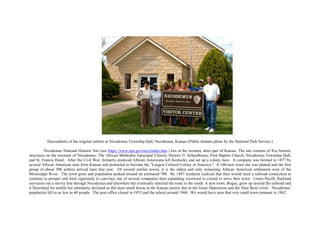
Descendents of the original settlers at Nicodemus Township Hall, Nicodemus, Kansas (Public domain photo by the National Park Service.)
Nicodemus National Historic Site (see https://www.nps.gov/nico/index.htm ) lies in the western, drier part of Kansas. The site consists of five historic
structures on the townsite of Nicodemus: The African Methodist Episcopal Church, District #1 Schoolhouse, First Baptist Church, Nicodemus Township Hall,
and St. Francis Hotel. After the Civil War, formerly enslaved African Americans left Kentucky and set up a colony here. A company was formed in 1877 by
several African American men from Kansas and promoted to become the "Largest Colored Colony in America." A 160-acre town site was platted and the first
group of about 300 settlers arrived later that year. Of several similar towns, it is the oldest and only remaining African American settlement west of the
Mississippi River. The town grew and population peaked around an estimated 700. By 1887 residents realized that they would need a railroad connection to
continue to prosper and tried vigorously to convince one of several companies then expanding westward to extend to serve their town. Union Pacific Railroad
surveyors ran a survey line through Nicodemus and elsewhere but eventually selected the route to the south. A new town, Bogue, grew up around the railroad and
it flourished for awhile but ultimately declined as did most small towns in the Kansas prairie due to the Great Depression and the Dust Bowl crisis. Nicodemus’
population fell to as low as 40 people. The post office closed in 1953 and the school around 1960. We would have seen that very small town remnant in 1962.
But starting in the 1970s, Nicodemus underwent some restoration. Donations from former residents helped repair some deteriorating buildings and the
town developed a reputation as a retirement destination for former residents. In 1976, Nicodemus was named a National Historic Landmark. The five historic
buildings were declared a unit of the National Park System in 1996. The only building open to the public is the former Nicodemus Township Hall, now used as
the National Park Visitor Center. About twenty people still live in Nicodemus but hundreds of descendants come back every June for the
Emancipation/Homecoming Celebration that began in 1878.
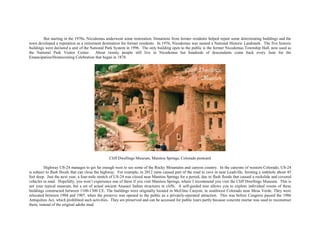
Cliff Dwellings Museum, Manitou Springs, Colorado postcard
Highway US-24 manages to get far enough west to see some of the Rocky Mountains and canyon country. In the canyons of western Colorado, US-24
is subject to flash floods that can close the highway. For example, in 2012 rains caused part of the road to cave in near Leadville, forming a sinkhole about 45
feet deep. Just the next year, a four-mile stretch of US-24 was closed near Manitou Springs for a period, due to flash floods that caused a rockslide and covered
vehicles in mud. Hopefully, you won’t experience one of these if you visit Manitou Springs, where I recommend you visit the Cliff Dwellings Museum. This is
not your typical museum, but a set of actual ancient Anasazi Indian structures in cliffs. A self-guided tour allows you to explore individual rooms of these
buildings constructed between 1100-1300 CE. The buildings were originally located in McElmo Canyon, in southwest Colorado near Mesa Verde. They were
relocated between 1904 and 1907, when the preserve was opened to the public as a privately-operated attraction. This was before Congress passed the 1906
Antiquities Act, which prohibited such activities. They are preserved and can be accessed for public tours partly because concrete mortar was used to reconstruct
them, instead of the original adobe mud.
Beyond Manitou Springs, US-24 heads into the Rocky Mountains and crosses the Continental Divide at Tennessee Pass, at about 25 miles from its
current end at Minturn, Colorado. For a review of sights along the portion of old US-24 west of Minturn to Grand Junction, Colorado, please check that part of
the Roadtrip-‘62 TM US-6 roadtrip (see https://www.roadtrip62.com/us-6-day-31-golden-co-glenwood-springs-co.htm#Minturn )!
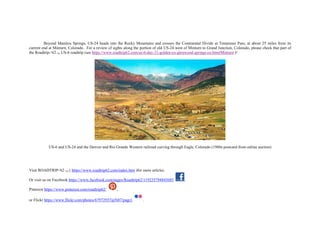
US-6 and US-24 and the Denver and Rio Grande Western railroad curving through Eagle, Colorado (1960s postcard from online auction)
Visit ROADTRIP-'62 TM ( https://www.roadtrip62.com/index.htm )for more articles.
Or visit us on Facebook https://www.facebook.com/pages/Roadtrip62/119235794845685 ,
Pinterest https://www.pinterest.com/roadtrip62/ ,
or Flickr https://www.flickr.com/photos/67972937@N07/page1 .
Author of Roadtrip-'62TM ( https://www.roadtrip62.com/ ), Donald Dale Milne
If you haven’t heard of Roadtrip-62 TM , my name is Don Milne and I'll be your travel guide on this virtual tour of the U. S. of A. First, I suppose you're
wondering why Roadtrip-62 TM is different from other travel sites? There's a very simple answer: everybody else travels only in space, but we also travel in time!
That's right, we don't just go somewhere, we also go somewhen. And the when is 1962. We'll try to see what's left today from 1962, by driving as if it were 1962.
We will drive on highways as they were in 1962, try to eat only at restaurants that existed in 1962, try to stay only at motels that existed in 1962, try to buy gas
and sundries, play the music, see only the sites across America, and just generally live in America as it was in 1962!
What we will do is enjoy the FUN of cross-country driving. And the fun of cross-country travel is all the differences from our everyday life! We'll talk
about politics, food, great inventions, how people lived, television, and more. We'll get to see some of the people that made our history; that made this country
great. We'll stumble across unexpected pleasures, like one trip I made through Cherokee, North Carolina where I just happened to be in town as the 1996
Olympic Torch procession came through on it's way to Atlanta, Georgia. You really never know what you'll find when you travel!
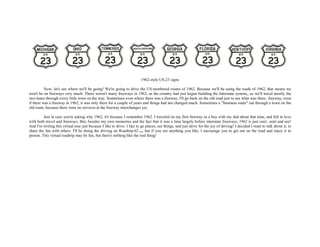
1962-style US-23 signs
Now, let's see where we'll be going! We're going to drive the US-numbered routes of 1962. Because we'll be using the roads of 1962, that means we
won't be on freeways very much. There weren't many freeways in 1962, as the country had just begun building the Interstate system,, so we'll travel mostly the
two-lanes through every little town on the way. Sometimes even where there was a freeway, I'll go back on the old road just to see what was there. Anyway, even
if there was a freeway in 1962, it was only there for a couple of years and things had not changed much. Sometimes a "business route" ran through a town on the
old route, because there were no services at the freeway interchanges yet.
Just in case you're asking why 1962, it's because I remember 1962. I traveled on my first freeway as a boy with my dad about that time, and fell in love
with both travel and freeways. But, besides my own memories and the fact that it was a time largely before interstate freeways, 1962 is just cool...wait and see!
And I'm writing this virtual tour just because I like to drive. I like to go places, see things, and just drive for the joy of driving! I decided I want to talk about it, to
share the fun with others. I'll be doing the driving on Roadtrip-62 TM, but if you see anything you like, I encourage you to get out on the road and enjoy it in
person. This virtual roadtrip may be fun, but there's nothing like the real thing!

Roadtrip Highlights along US-24

  • 1.
    Roadtrip Highlights AlongUS-24 By Donald Dale Milne https://www.roadtrip62.com/roadtrip-highlights-along-us-24.htm I’m going to skip the next number in the US routes because it’s US-23, which I’ve traveled in detail on the Roadtrip-’62 TM site! You can find the archives of that trip at the US-23 Archives (see http://www.roadtrip62.com/US-23-Archives.htm ). Instead, let’s look some highlights along US-24, which today runs 1540 miles from Clarkston, Michigan to Minturn, Colorado. It crosses US-23 at Toledo, Ohio. Highway US-24 also crosses our US-6 roadtrip, at Napoleon, Ohio and again at Minturn, Colorado, where it now ends. The section west of Minturn was decommissioned in 1975. Before that it ran together with US-6 all the way to Grand Junction, Colorado, adding almost 200 more miles to the route we would have seen in 1962. The Michigan end was in Pontiac back in 1962, but extended north to Clarkston in 1987. All of US-24 within Michigan runs north-south, instead of the east-west routing suggested by its even number. The remainder of the highway across the country does correctly run east-west. Cranbrook Art Museum, Bloomfield Hills, Michigan (Postcard from the collection of Don Harrison (Up North Memories) (see https://www.flickr.com/photos/upnorthmemories/ ), used by permission.)
  • 2.
    Near the east(north) end of US-24, in Bloomfield Hills, Michigan, is the Cranbrook Art Museum (see https://housegardens.cranbrook.edu/ ). It is among the first contemporary art museums in America. The museum’s early collection was a portion of the personal collection of the Cranbrook Academy’s founder, Mr. Henry Booth. The building was designed by Eliel Saarinen, who also designed the Cranbrook campus and other early buildings. It was completed in 1942 and included an outdoor sculpture garden. The museum’s original collection was an eclectic mix of art and artifacts. It spanned the centuries and included stained glass, architectural pieces, sculpture, paintings, ceramics, glass, furniture, textiles, and more. In 1955, the museum was given a new name, Cranbrook Academy of Art Galleries, and a new mission. It now continues to show art of the past, but focuses on contemporary decorative and practical art, sculpture and painting. The adjacent Cranbrook House and Gardens was the home of Mr. and Mrs. Booth and has been open to the public only since 1971. Edison's Menlo Park Laboratory, Greenfield Village at Henry Ford Museum Dearborn, Michigan (Photo by Roger W at Flickr (see https://www.flickr.com/photos/24736216@N07/ ), licensed under Creative Commons Attribution-ShareAlike 2.0 Generic license (see https://creativecommons.org/licenses/by-sa/2.0/ ).)
  • 3.
    About 2½ milesoff US-24, a little farther south in Dearborn, Michigan, is the Henry Ford Museum with Greenfield Village. This museum is America’s premier historical collection outside of the Smithsonian Institution in Washington, DC. Industrialist Henry Ford began his collecting of historical artifacts in 1919, when he learned that his birthplace was due to be demolished for a highway improvement. He bought the farmhouse and restored it to fit his memory of when he was 13 and sent employees scouring the county for artifacts to outfit the house. He followed this up by buying and restoring the one-room schoolhouse from his boyhood, and then a pair of inns, thinking of establishing a complete histroical village. By the late 1920s, his quest to create a complete village led him to become the primary collector of Americana in the world. The result was Greenfield Village. Though there are many authentic buildings, some were created specifically for the site, including a re-creation of the Menlo Park, New Jersey, laboratory complex where his friend Thomas Edison had invented his electric lighting system. The Henry Ford Museum (see https://www.thehenryford.org/ ) is designed to resemble Independence Hall and related buildings of Philadelphia, with a large “Exhibition Hall” in back. Ford rejected the idea of storage rooms, so nearly everything was exhibited out in the open. And at twelve-acres, the museum contained a huge assemblage of stuff representing the evolution of technological progress. The museum opened to the public in 1933 and for nearly a decade afterwards, it remained a work in progress. The exhibits were not completed until the early 1940s, when the village contained over 70 buildings complete with artisans demonstrating traditional crafts. Today, the museum continues to collect and to tell stories of innovation. And if you can’t make it to the museum, you can see items from the collection in action on the Emmy-winning TV series “Innovation Nation” hosted by CBS-TV correspondent Mo Rocca. General Electric Partio barbeque cart, ca. 1960, at the Henry Ford Museum, Dearborn, Michigan In their collection is this marvel of outdoor living, the General Electric Partio barbeque cart. The Partio Cart originally came with a patio umbrella, a 12-foot cord, and a cover. The two wood shelves drop down when not in use or can be removed entirely. In some model years, the shelves were more like cafeteria metal racks instead of wood. They used 220-volt power, just like your electric range in the kitchen. Westinghouse may have produced a similar model. They were sold from at least 1956-1960 and even featured in the 1960 GE Annual Report. The one at the Henry Ford was originally President Dwight D. Eisenhower’s, which he kept at his Palm Springs, California home.
  • 4.
    At Toledo, Ohio,we cross our US-23 roadtrip (see https://www.roadtrip62.com/us-23-day-6-milan-mi-fostoria-oh.htm#Toledo ). Highway US-24 turns west there, traveling up the valley of the Maumee River through Ohio. Currently, US-24 is on a newer freeway alignment, but the old road of 1962 is less than a mile away, eventually taking the number of OH-424. The historic Miami & Erie Canal runs alongside old US-24 in many places and originally connected Toledo with Ft. Wayne, Indiana in the 1840s. You can get a closeup of the canal at Providence Metropark in Grand Rapids, Ohio. Besides hiking along it, you can take an authentic, mule-drawn canal boat ride on an original section of the Miami & Erie Canal. A restored flour mill is also open in the park. The canal is part of grand system of canals through Ohio (see https://www.roadtrip62.com/sailing-we-shall-go.htm#canals ), which connected the major commercial centers by water before the days of railroads or highways. Historical marker for Miami and Erie Canal in Providence Metropark, Grand Rapids, Ohio On the other side of the river is US-6, which we meet ahead in Napoleon, Ohio (see https://www.roadtrip62.com/us-6-day-16-sandusky-oh-napolean- oh.htm#Napoleon ). We take OH-424 out of town to continue on the old route of US-24. Just before Ft. Wayne, the freeway ends but US-24 is then routed with I-469 to loop north around town. Of course, we will travel through downtown on old US-24. I’m sure you’ve noticed that we have been traveling through mostly farm country in Ohio. Well, Indiana, Illinois, Missouri, and Kansas are more of the same. I often stop for small attractions to break up the monotony of
  • 5.
    long-distance travel andthere’s one in Huntington, Illinois. The Sunken Gardens began as a stone quarry, but was eventually abandoned. It became such an eyesore that the city purchased the property in 1924. The Huntington Chamber of Commerce acquired the quarry and created the beautiful gardens that now occupy the site, giving it back to the city in 1929. It’s a pleasant little stop if you are in the area, either today or back in 1962. The city’s Parks Department says it is one of only two such gardens in the country. https://www.youtube.com/watch?v=P2azpHp1yPk Watch a video history of Dickson Mounds, Lewiston, Illinois. Midway across Illinois, US-24 runs along and crosses the Illinois River before it enters the Mississippi River. Just before leaving the river valley, near Lewiston, Illinois, we come to Dickson Mounds Museum (see http://www.illinoisstatemuseum.org/content/welcome-dickson-mounds ). The museum is a branch of the Illinois State Museum and an archaeological treasure that sits on the site of the Dickson Mounds. These 11 mounds were a Native American settlement site and burial mound complex during the last 12,000 years since the last Ice Age. The burials appear to have taken place between about 800 and 1300 CE. Dr. Don Dickson was a chiropractor who discovered the burial mounds on his family farm. He spent many years excavating the bones in several of the mounds, but counter to the archaeological practices of the time, he did not remove the bones and artifacts. Instead, he only removed the dirt, leaving everything else in place so that it could show the relative position and other important information for cataloguing. This has since become accepted practice. He covered his excavation with a tent and later constructed a building over part of the site, again leaving 248 skeletons and associated artifacts in place. Dr. Dickson operated a private museum, charging the public throughout the late 1920s and until 1945, when he sold the site to the State of Illinois. His museum building lasted until 1972, when the state built the current Dickson Mounds Museum. In 1992, the state re-sealed the skeletal remains and they are no longer displayed to the public. Archaeological practices had changed again, and the concerns of living Native American tribes were addressed by reburying the remains as sacred. Today, visitors can stroll through more than 15,000 square feet of exhibits including displays of artifacts, arts, and archaeology, hands-on activities, and multi-media presentations. These allow you to explore the world of the ancient Mississippian peoples through both permanent and temporary exhibits of artifacts, murals, photographs, and hands-on activities. There are also three excavated buildings open to help chronicle prehistoric life in the region.
  • 6.
    Harry S. TrumanLibrary and Museum, Independence, Missouri (Public domain photo by Robert E. Nylund, via Wikimedia Commons.) The Harry S. Truman Library and Museum (see http://www.trumanlibrary.org/ ) is located in Independence, Missouri, part of the Kansas City area. The Truman Library is one of thirteen Presidential Libraries administered by the National Archives and Records Administration. It was dedicated in 1957 and was the first presidential library to be created under the provisions of the 1955 Presidential Libraries Act, so we could have stopped in 1962. The building was designed by architect Edward F. Neild, whom had worked with President Truman on other projects, notably the White House reconstruction in 1948-1952. Before his death in 1972, President Truman was active in the day-to-day operation of the Library, talking with visiting school students and even training museum docents. As with all the presidential libraries, this one contains papers, photos, audio-visual records, and more related to the President. There are changing exhibits and core permanent exhibits highlighting the major issues and events of Harry Truman's Presidency, and also his personal life. The museum is located in Independence because President Truman began his political career here in 1922, as a Jackson County judge.
  • 7.
    Descendents of theoriginal settlers at Nicodemus Township Hall, Nicodemus, Kansas (Public domain photo by the National Park Service.) Nicodemus National Historic Site (see https://www.nps.gov/nico/index.htm ) lies in the western, drier part of Kansas. The site consists of five historic structures on the townsite of Nicodemus: The African Methodist Episcopal Church, District #1 Schoolhouse, First Baptist Church, Nicodemus Township Hall, and St. Francis Hotel. After the Civil War, formerly enslaved African Americans left Kentucky and set up a colony here. A company was formed in 1877 by several African American men from Kansas and promoted to become the "Largest Colored Colony in America." A 160-acre town site was platted and the first group of about 300 settlers arrived later that year. Of several similar towns, it is the oldest and only remaining African American settlement west of the Mississippi River. The town grew and population peaked around an estimated 700. By 1887 residents realized that they would need a railroad connection to continue to prosper and tried vigorously to convince one of several companies then expanding westward to extend to serve their town. Union Pacific Railroad surveyors ran a survey line through Nicodemus and elsewhere but eventually selected the route to the south. A new town, Bogue, grew up around the railroad and it flourished for awhile but ultimately declined as did most small towns in the Kansas prairie due to the Great Depression and the Dust Bowl crisis. Nicodemus’ population fell to as low as 40 people. The post office closed in 1953 and the school around 1960. We would have seen that very small town remnant in 1962.
  • 8.
    But starting inthe 1970s, Nicodemus underwent some restoration. Donations from former residents helped repair some deteriorating buildings and the town developed a reputation as a retirement destination for former residents. In 1976, Nicodemus was named a National Historic Landmark. The five historic buildings were declared a unit of the National Park System in 1996. The only building open to the public is the former Nicodemus Township Hall, now used as the National Park Visitor Center. About twenty people still live in Nicodemus but hundreds of descendants come back every June for the Emancipation/Homecoming Celebration that began in 1878. Cliff Dwellings Museum, Manitou Springs, Colorado postcard Highway US-24 manages to get far enough west to see some of the Rocky Mountains and canyon country. In the canyons of western Colorado, US-24 is subject to flash floods that can close the highway. For example, in 2012 rains caused part of the road to cave in near Leadville, forming a sinkhole about 45 feet deep. Just the next year, a four-mile stretch of US-24 was closed near Manitou Springs for a period, due to flash floods that caused a rockslide and covered vehicles in mud. Hopefully, you won’t experience one of these if you visit Manitou Springs, where I recommend you visit the Cliff Dwellings Museum. This is not your typical museum, but a set of actual ancient Anasazi Indian structures in cliffs. A self-guided tour allows you to explore individual rooms of these buildings constructed between 1100-1300 CE. The buildings were originally located in McElmo Canyon, in southwest Colorado near Mesa Verde. They were relocated between 1904 and 1907, when the preserve was opened to the public as a privately-operated attraction. This was before Congress passed the 1906 Antiquities Act, which prohibited such activities. They are preserved and can be accessed for public tours partly because concrete mortar was used to reconstruct them, instead of the original adobe mud.
  • 9.
    Beyond Manitou Springs,US-24 heads into the Rocky Mountains and crosses the Continental Divide at Tennessee Pass, at about 25 miles from its current end at Minturn, Colorado. For a review of sights along the portion of old US-24 west of Minturn to Grand Junction, Colorado, please check that part of the Roadtrip-‘62 TM US-6 roadtrip (see https://www.roadtrip62.com/us-6-day-31-golden-co-glenwood-springs-co.htm#Minturn )! US-6 and US-24 and the Denver and Rio Grande Western railroad curving through Eagle, Colorado (1960s postcard from online auction) Visit ROADTRIP-'62 TM ( https://www.roadtrip62.com/index.htm )for more articles. Or visit us on Facebook https://www.facebook.com/pages/Roadtrip62/119235794845685 , Pinterest https://www.pinterest.com/roadtrip62/ , or Flickr https://www.flickr.com/photos/67972937@N07/page1 .
  • 10.
    Author of Roadtrip-'62TM( https://www.roadtrip62.com/ ), Donald Dale Milne If you haven’t heard of Roadtrip-62 TM , my name is Don Milne and I'll be your travel guide on this virtual tour of the U. S. of A. First, I suppose you're wondering why Roadtrip-62 TM is different from other travel sites? There's a very simple answer: everybody else travels only in space, but we also travel in time! That's right, we don't just go somewhere, we also go somewhen. And the when is 1962. We'll try to see what's left today from 1962, by driving as if it were 1962. We will drive on highways as they were in 1962, try to eat only at restaurants that existed in 1962, try to stay only at motels that existed in 1962, try to buy gas and sundries, play the music, see only the sites across America, and just generally live in America as it was in 1962! What we will do is enjoy the FUN of cross-country driving. And the fun of cross-country travel is all the differences from our everyday life! We'll talk about politics, food, great inventions, how people lived, television, and more. We'll get to see some of the people that made our history; that made this country great. We'll stumble across unexpected pleasures, like one trip I made through Cherokee, North Carolina where I just happened to be in town as the 1996 Olympic Torch procession came through on it's way to Atlanta, Georgia. You really never know what you'll find when you travel!
  • 11.
    1962-style US-23 signs Now,let's see where we'll be going! We're going to drive the US-numbered routes of 1962. Because we'll be using the roads of 1962, that means we won't be on freeways very much. There weren't many freeways in 1962, as the country had just begun building the Interstate system,, so we'll travel mostly the two-lanes through every little town on the way. Sometimes even where there was a freeway, I'll go back on the old road just to see what was there. Anyway, even if there was a freeway in 1962, it was only there for a couple of years and things had not changed much. Sometimes a "business route" ran through a town on the old route, because there were no services at the freeway interchanges yet. Just in case you're asking why 1962, it's because I remember 1962. I traveled on my first freeway as a boy with my dad about that time, and fell in love with both travel and freeways. But, besides my own memories and the fact that it was a time largely before interstate freeways, 1962 is just cool...wait and see! And I'm writing this virtual tour just because I like to drive. I like to go places, see things, and just drive for the joy of driving! I decided I want to talk about it, to share the fun with others. I'll be doing the driving on Roadtrip-62 TM, but if you see anything you like, I encourage you to get out on the road and enjoy it in person. This virtual roadtrip may be fun, but there's nothing like the real thing!