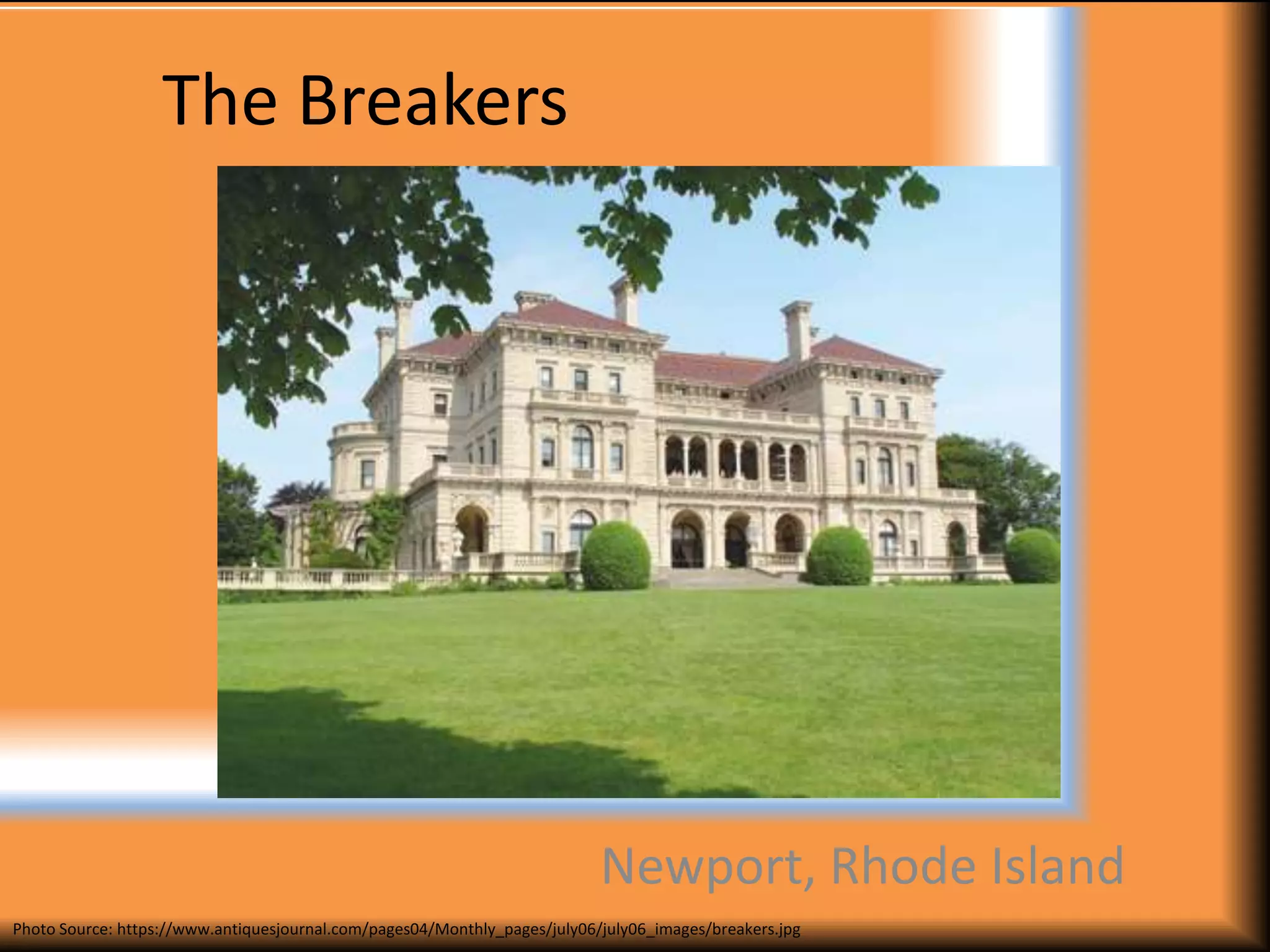
The Breakers


                                                                           Newport, Rhode Island
Photo Source: https://www.antiquesjournal.com/pages04/Monthly_pages/july06/july06_images/breakers.jpg
Background
• Summer home of Cornelius Vanderbilt (1843-
  1899)
  – Member of prominent American Cornelius family
• Located in prestigious summer house area
  – Considered social capital of America at the time
• When property was originally purchased in 1855,
  an 1877 wooden house was present on the land
• This house burned down in 1892 and Vanderbilt
  decided to build the Breakers in its place
• Open to the public and can be visited daily
The Estate
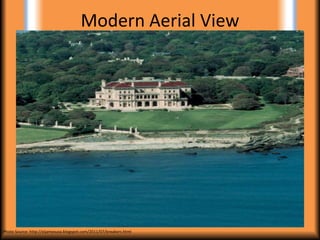
• 13 acre parcel of land overlooking Atlantic Ocean
• Italian Renaissance design
   – Designed by famous architect Richard Morris Hunt
   – Construction began in 1893; finished in 1895
• Approximately 250 ft by 150 ft and contain approximately
  70 rooms
   – 5 levels: three main stories along with an attic and a basement
• House contained electric power, with gas power as a
  backup system
   – Symbolized importance and emergence of technology during
     the time period
   – Additional symbol of wealth because of large costs of new
     technology
Exterior of the House
• Foundation of the house made out of brick,
  concrete, and Indiana limestone
    – No wood was used in the construction of the
      house to make it as fireproof as possible per Mr.
      Vanderbilt’s request
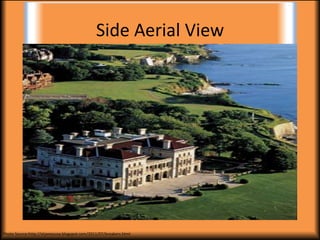
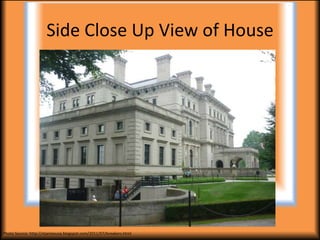
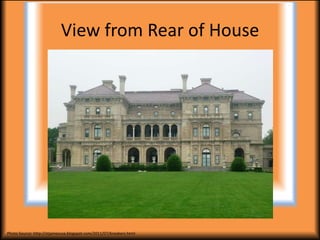
•   Limestone walls
•   Terra Cotta Red Tile roof
•   Marbles plaques
•   Wrought iron gates and fences
Modern Aerial View


Photo Source: http://stjamesusa.blogspot.com/2011/07/breakers.html
Side Aerial View


Photo Source:http://stjamesusa.blogspot.com/2011/07/breakers.html
Side Close Up View of House


Photo Source: http://stjamesusa.blogspot.com/2011/07/breakers.html
View from Rear of House


Photo Source: http://stjamesusa.blogspot.com/2011/07/breakers.html
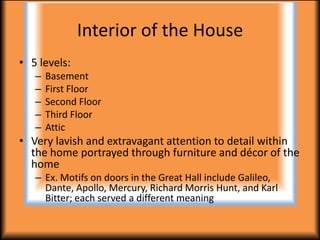
Interior of the House
• 5 levels:
   –   Basement
   –   First Floor
   –   Second Floor
   –   Third Floor
   –   Attic
• Very lavish and extravagant attention to detail within
  the home portrayed through furniture and décor of the
  home
   – Ex. Motifs on doors in the Great Hall include Galileo,
     Dante, Apollo, Mercury, Richard Morris Hunt, and Karl
     Bitter; each served a different meaning
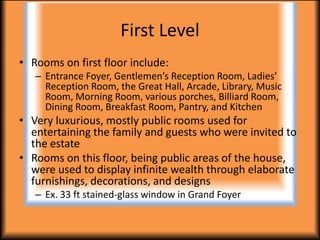
First Level
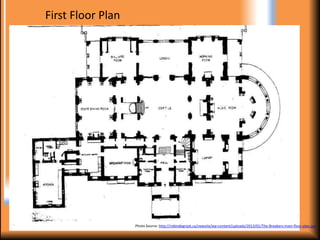
• Rooms on first floor include:
   – Entrance Foyer, Gentlemen’s Reception Room, Ladies’
     Reception Room, the Great Hall, Arcade, Library, Music
     Room, Morning Room, various porches, Billiard Room,
     Dining Room, Breakfast Room, Pantry, and Kitchen
• Very luxurious, mostly public rooms used for
  entertaining the family and guests who were invited to
  the estate
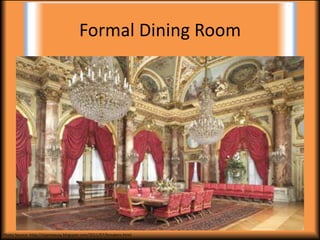
• Rooms on this floor, being public areas of the house,
  were used to display infinite wealth through elaborate
  furnishings, decorations, and designs
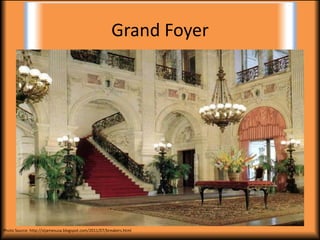
   – Ex. 33 ft stained-glass window in Grand Foyer
First Floor Plan


                   Photo Source: http://robindegroot.ca/newsite/wp-content/uploads/2013/01/The-Breakers-main-floor-plan.jpg
Formal Dining Room


Photo Source: http://stjamesusa.blogspot.com/2011/07/breakers.html
Grand Foyer


Photo Source: http://stjamesusa.blogspot.com/2011/07/breakers.html
Second, Third, and Attic Floors
• These levels of the house were used primarily
  for bedrooms and servant quarters, as well as
  storage areas.
  – Mr. and Mrs. Vanderbilt’s bedrooms were located
    on the second floor
Uses of the Property
• The Breakers was used by the Vanderbilt family as
  a summer home due to the milder summer
  temperatures in the northeastern United States
  as compared to the south
• Grand design and multitude of public rooms on
  the ground floor suggest the home was also used
  for entertainment and housing of guests
  – Possibly dinner parties, political functions, or visits
    from influential figures in society
What We Can Learn from the Home
• Due to the elegant and over the top design of the house, we can
  obviously assume (and already know from prior knowledge) that
  the Vanderbilt family is extremely wealthy. Additionally, we can
  assume that this house was meant to be a status symbol and a
  symbol of the immense wealth that the family has accumulated.
  Additionally, although there is an entire floor of public rooms, it is
  evident through the design of the house that the public and private
  spheres of the house were meant to remain separate and privacy
  was important to the Vanderbilt family. The majority of the
  entertainment was done on the main floor, therefore restricting
  non-overnight guests to that floor. The only guests who would have
  ventured to other parts of the house would have been those who
  were spending the night there. The outward appearance was very
  important to the Vanderbilt family and their secondary, summer
  residence clearly indicates that.
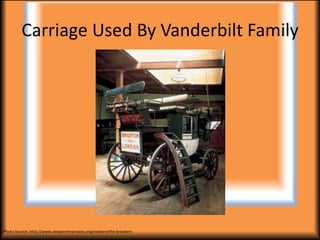
Carriage Used By Vanderbilt Family


Photo Source: http://www.newportmansions.org/explore/the-breakers
Explanation of Carriage
        • Located a short distance from the home on
          the property of the Breakers was a carriage
          house, where carriages such as the one shown
          on the previous slide were kept for the use of
          the family. The family could send for a carriage
          at any time and it would be brought to the
          house to take the family wherever it was they
          would like to go. These carriages were drawn
          by horses, which were kept in a stable located
          within the carriage house.
Source: http://www.newportmansions.org/explore/the-breakers
Works Cited
• United States Department of the Interior,
  National Park Service
  – National Historic Landmark Nomination form
    (gave complete details of the home and the rooms
    within, PDF file)

Hss the breakers

  • 1.
    The Breakers Newport, Rhode Island Photo Source: https://www.antiquesjournal.com/pages04/Monthly_pages/july06/july06_images/breakers.jpg
  • 2.
    Background • Summer homeof Cornelius Vanderbilt (1843- 1899) – Member of prominent American Cornelius family • Located in prestigious summer house area – Considered social capital of America at the time • When property was originally purchased in 1855, an 1877 wooden house was present on the land • This house burned down in 1892 and Vanderbilt decided to build the Breakers in its place • Open to the public and can be visited daily
  • 3.
    The Estate • 13acre parcel of land overlooking Atlantic Ocean • Italian Renaissance design – Designed by famous architect Richard Morris Hunt – Construction began in 1893; finished in 1895 • Approximately 250 ft by 150 ft and contain approximately 70 rooms – 5 levels: three main stories along with an attic and a basement • House contained electric power, with gas power as a backup system – Symbolized importance and emergence of technology during the time period – Additional symbol of wealth because of large costs of new technology
  • 4.
    Exterior of theHouse • Foundation of the house made out of brick, concrete, and Indiana limestone – No wood was used in the construction of the house to make it as fireproof as possible per Mr. Vanderbilt’s request • Limestone walls • Terra Cotta Red Tile roof • Marbles plaques • Wrought iron gates and fences
  • 5.
    Modern Aerial View PhotoSource: http://stjamesusa.blogspot.com/2011/07/breakers.html
  • 6.
    Side Aerial View PhotoSource:http://stjamesusa.blogspot.com/2011/07/breakers.html
  • 7.
    Side Close UpView of House Photo Source: http://stjamesusa.blogspot.com/2011/07/breakers.html
  • 8.
    View from Rearof House Photo Source: http://stjamesusa.blogspot.com/2011/07/breakers.html
  • 9.
    Interior of theHouse • 5 levels: – Basement – First Floor – Second Floor – Third Floor – Attic • Very lavish and extravagant attention to detail within the home portrayed through furniture and décor of the home – Ex. Motifs on doors in the Great Hall include Galileo, Dante, Apollo, Mercury, Richard Morris Hunt, and Karl Bitter; each served a different meaning
  • 10.
    First Level • Roomson first floor include: – Entrance Foyer, Gentlemen’s Reception Room, Ladies’ Reception Room, the Great Hall, Arcade, Library, Music Room, Morning Room, various porches, Billiard Room, Dining Room, Breakfast Room, Pantry, and Kitchen • Very luxurious, mostly public rooms used for entertaining the family and guests who were invited to the estate • Rooms on this floor, being public areas of the house, were used to display infinite wealth through elaborate furnishings, decorations, and designs – Ex. 33 ft stained-glass window in Grand Foyer
  • 11.
    First Floor Plan Photo Source: http://robindegroot.ca/newsite/wp-content/uploads/2013/01/The-Breakers-main-floor-plan.jpg
  • 12.
    Formal Dining Room PhotoSource: http://stjamesusa.blogspot.com/2011/07/breakers.html
  • 13.
    Grand Foyer Photo Source:http://stjamesusa.blogspot.com/2011/07/breakers.html
  • 14.
    Second, Third, andAttic Floors • These levels of the house were used primarily for bedrooms and servant quarters, as well as storage areas. – Mr. and Mrs. Vanderbilt’s bedrooms were located on the second floor
  • 15.
    Uses of theProperty • The Breakers was used by the Vanderbilt family as a summer home due to the milder summer temperatures in the northeastern United States as compared to the south • Grand design and multitude of public rooms on the ground floor suggest the home was also used for entertainment and housing of guests – Possibly dinner parties, political functions, or visits from influential figures in society
  • 16.
    What We CanLearn from the Home • Due to the elegant and over the top design of the house, we can obviously assume (and already know from prior knowledge) that the Vanderbilt family is extremely wealthy. Additionally, we can assume that this house was meant to be a status symbol and a symbol of the immense wealth that the family has accumulated. Additionally, although there is an entire floor of public rooms, it is evident through the design of the house that the public and private spheres of the house were meant to remain separate and privacy was important to the Vanderbilt family. The majority of the entertainment was done on the main floor, therefore restricting non-overnight guests to that floor. The only guests who would have ventured to other parts of the house would have been those who were spending the night there. The outward appearance was very important to the Vanderbilt family and their secondary, summer residence clearly indicates that.
  • 17.
    Carriage Used ByVanderbilt Family Photo Source: http://www.newportmansions.org/explore/the-breakers
  • 18.
    Explanation of Carriage • Located a short distance from the home on the property of the Breakers was a carriage house, where carriages such as the one shown on the previous slide were kept for the use of the family. The family could send for a carriage at any time and it would be brought to the house to take the family wherever it was they would like to go. These carriages were drawn by horses, which were kept in a stable located within the carriage house. Source: http://www.newportmansions.org/explore/the-breakers
  • 19.
    Works Cited • UnitedStates Department of the Interior, National Park Service – National Historic Landmark Nomination form (gave complete details of the home and the rooms within, PDF file)