5 Postcards from a US-35 Roadtrip
By Donald Dale Milne
https://www.roadtrip62.com/5-postcards-from-a-us-35-roadtrip.htm
Today Roadtrip-’62 ™ goes back to a north-south highway, sort of. While US-35 is numbered as a north-south route, it travels just about as far east-
west, drawing nearly a 45-degree line on a map. It runs about 416 miles across mostly farm country in Indiana and Ohio, with few truly scenic sites along the
way. Highway US-35 has always begun in Michigan City, Indiana, originally in downtown but since shortened by a few miles. The eastern end originally was
in Charleston, West Virginia, but it was shortened about 25 miles in 2008 to Scott Depot, West Virginia. It had also been shortened previously, to St. Albans,
West Virginia. This was the result of the tragic collapse of the Silver Bridge at Gallipolis, Ohio in 1967, which killed 46 people. When a new bridge over the
Ohio River was opened in 1969, the highway was moved and shortened to end at US-60 on the south side of the river.
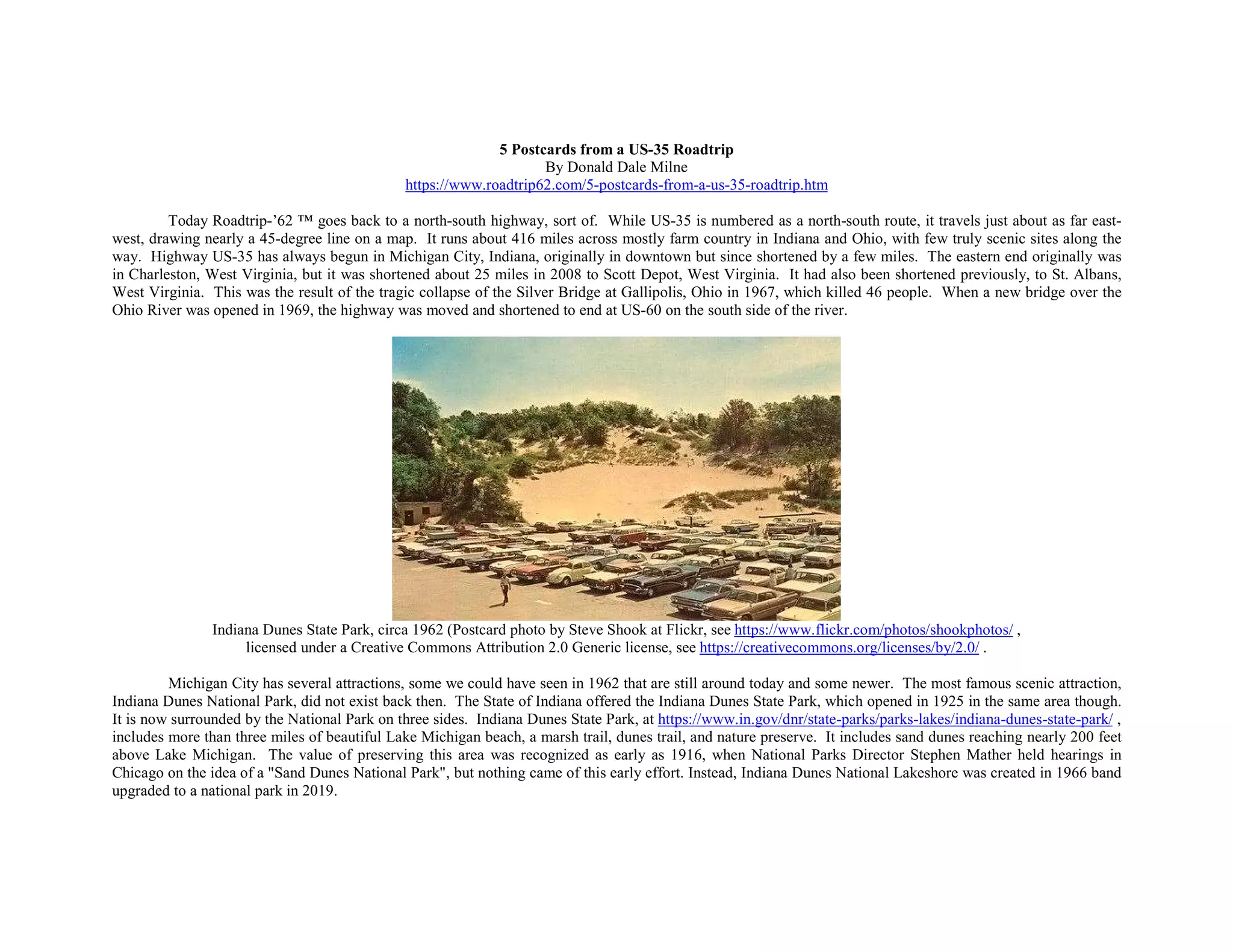
Indiana Dunes State Park, circa 1962 (Postcard photo by Steve Shook at Flickr, see https://www.flickr.com/photos/shookphotos/ ,
licensed under a Creative Commons Attribution 2.0 Generic license, see https://creativecommons.org/licenses/by/2.0/ .
Michigan City has several attractions, some we could have seen in 1962 that are still around today and some newer. The most famous scenic attraction,
Indiana Dunes National Park, did not exist back then. The State of Indiana offered the Indiana Dunes State Park, which opened in 1925 in the same area though.
It is now surrounded by the National Park on three sides. Indiana Dunes State Park, at https://www.in.gov/dnr/state-parks/parks-lakes/indiana-dunes-state-park/ ,
includes more than three miles of beautiful Lake Michigan beach, a marsh trail, dunes trail, and nature preserve. It includes sand dunes reaching nearly 200 feet
above Lake Michigan. The value of preserving this area was recognized as early as 1916, when National Parks Director Stephen Mather held hearings in
Chicago on the idea of a "Sand Dunes National Park", but nothing came of this early effort. Instead, Indiana Dunes National Lakeshore was created in 1966 band
upgraded to a national park in 2019.
The harbor at Michigan City has had an effect on the dunes by construction of the harbor breakwall. This has starved some nearby dunes of sand and
the dunes can literally blow away. Mount Baldy Beach, just 2 miles west of the old end of US-35 in downtown, is an example where beach erosion is taking
away more sand than Lake Michigan’s waves are bringing in. To try and correct this effect, the U.S. Army Corps of Engineers began feeding sand to the beach
in 1974. A combination of fine sand, coarse sand, and even dredged sand has been added over four different years through 1996. The harbor also offers the Old
Lighthouse Museum, but the building was closed from 1940 through 1965, so we could not have stopped in. It was not opened as a museum until 1973. This is a
lighthouse constructed in 1858, which saw many changes over its years of operation. The original 5th order Fresnel Lens and the 1904 Pierhead Light are both
now on display in the Old Lighthouse Museum.
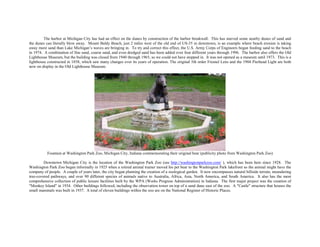
Fountain at Washington Park Zoo, Michigan City, Indiana commemorating their original bear (publicity photo from Washington Park Zoo)
Downtown Michigan City is the location of the Washington Park Zoo (see http://washingtonparkzoo.com/ ), which has been here since 1928. The
Washington Park Zoo began informally in 1925 when a retired animal trainer moved his pet bear to the Washington Park lakefront so the animal might have the
company of people. A couple of years later, the city began planning the creation of a zoological garden. It now encompasses natural hillside terrain, meandering
tree-covered pathways, and over 90 different species of animals native to Australia, Africa, Asia, North America, and South America. It also has the most
comprehensive collection of public leisure facilities built by the WPA (Works Progress Administration) in Indiana. The first major project was the creation of
"Monkey Island" in 1934. Other buildings followed, including the observation tower on top of a sand dune east of the zoo. A "Castle" structure that houses the
small mammals was built in 1937. A total of eleven buildings within the zoo are on the National Register of Historic Places.
Heading southeasterly from Michigan City, US-35 travels through lightly populated areas most of the way to West Virginia. Near Kingsbury, Indiana,
(see https://www.roadtrip62.com/us-6-day-18-nappanee-in-joliet-il.htm ) we run together with US-6 for about five miles through the Kingsford Heights /
Kingsbury area and would have seen this road from the other direction on our US-6 roadtrip. Near Logansport, Indiana my 1962 Rand McNally Atlas shows a
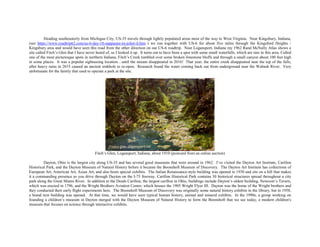
site called Fitch’s Glen that I have never heard of, so I looked it up. It turns out to have been a spot with some small waterfalls, which are rare in this area. Called
one of the most picturesque spots in northern Indiana, Fitch’s Creek tumbled over some broken limestone bluffs and through a small canyon about 100 feet high
in some places. It was a popular sightseeing location…until the stream disappeared in 2016! That year, the entire creek disappeared near the top of the falls,
after heavy rains in 2015 caused an ancient sinkhole to re-open. Research found the water coming back out from underground near the Wabash River. Very
unfortunate for the family that used to operate a park at the site.
Fitch’s Glen, Logansport, Indiana, about 1910 (postcard from an online auction)
Dayton, Ohio is the largest city along US-35 and has several good museums that were around in 1962. I’ve visited the Dayton Art Institute, Carillon
Historical Park, and the Dayton Museum of Natural History before it became the Boonshoft Museum of Discovery. The Dayton Art Institute has collections of
European Art, American Art, Asian Art, and also hosts special exhibits. The Italian Renaissance-style building was opened in 1930 and sits on a hill that makes
it a commanding presence as you drive through Dayton on the I-75 freeway. Carillon Historical Park contains 30 historical structures spread throughout a city
park along the Great Miami River. In addition to the Deeds Carillon, the largest carillon in Ohio, buildings include Dayton’s oldest building, Newcom’s Tavern,
which was erected in 1796, and the Wright Brothers Aviation Center, which houses the 1905 Wright Flyer III. Dayton was the home of the Wright brothers and
they conducted their early flight experiments here. The Boonshoft Museum of Discovery was originally some natural history exhibits in the library, but in 1958,
a brand new building was opened. At that time, we would have seen typical human history, animal and mineral exhibits. In the 1990s, a group working on
founding a children’s museum in Dayton merged with the Dayton Museum of Natural History to form the Boonshoft that we see today, a modern children's
museum that focuses on science through interactive exhibits.
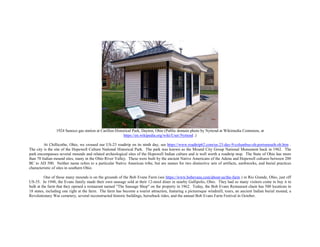
1924 Sunoco gas station at Carillon Historical Park, Dayton, Ohio (Public domain photo by Nyttend at Wikimedia Commons, at
https://en.wikipedia.org/wiki/User:Nyttend .)
At Chillicothe, Ohio, we crossed our US-23 roadtrip on its ninth day, see https://www.roadtrip62.com/us-23-day-9-columbus-oh-portsmouth-oh.htm .
The city is the site of the Hopewell Culture National Historical Park. The park was known as the Mound City Group National Monument back in 1962. The
park encompasses several mounds and related archeological sites of the Hopewell Indian culture and is well worth a roadtrip stop. The State of Ohio has more
than 70 Indian mound sites, many in the Ohio River Valley. These were built by the ancient Native Americans of the Adena and Hopewell cultures between 200
BC to AD 500. Neither name refers to a particular Native American tribe, but are names for two distinctive sets of artifacts, earthworks, and burial practices
characteristic of sites in southern Ohio.
One of those many mounds is on the grounds of the Bob Evans Farm (see https://www.bobevans.com/about-us/the-farm ) in Rio Grande, Ohio, just off
US-35. In 1948, the Evans family made their own sausage sold at their 12-stool diner in nearby Gallipolis, Ohio. They had so many visitors come to buy it in
bulk at the farm that they opened a restaurant named "The Sausage Shop" on the property in 1962. Today, the Bob Evans Restaurant chain has 500 locations in
18 states, including one right at the farm. The farm has become a tourist attraction, featuring a picturesque windmill, tours, an ancient Indian burial mound, a
Revolutionary War cemetery, several reconstructed historic buildings, horseback rides, and the annual Bob Evans Farm Festival in October.
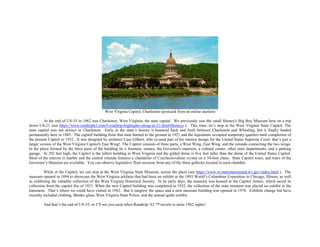
West Virginia Capitol, Charleston (postcard from an online auction)
At the end of US-35 in 1962 was Charleston, West Virginia, the state capital. We previously saw the small Shoney's Big Boy Museum here on a trip
down US-21 (see https://www.roadtrip62.com/5-roadtrip-highlights-along-us-21.htm#Shoneys ). This time, let’s stop at the West Virginia State Capitol. The
state capital was not always in Charleston. Early in the state’s history it bounced back and forth between Charleston and Wheeling, but it finally landed
permanently here in 1885. The capitol building from that time burned to the ground in 1921 and the legislature occupied temporary quarters until completion of
the present Capitol in 1932. It was designed by architect Cass Gilbert, who re-used part of his interior design for the United States Supreme Court: that’s just a
larger version of the West Virginia Capitol's East Wing! The Capitol consists of three parts, a West Wing, East Wing, and the rotunda connecting the two wings.
In the plaza formed by the three parts of the building lie a fountain, statues, the Governor's mansion, a cultural center, other state departments, and a parking
garage. At 292 feet high, the Capitol is the tallest building in West Virginia and the gilded dome is five feet taller than the dome of the United States Capitol.
Most of the interior is marble and the central rotunda features a chandelier of Czechoslovakian crystal on a 54-foot chain. State Capitol tours, and tours of the
Governor’s Mansion are available. You can observe legislative floor sessions from any of the three galleries located in each chamber.
While at the Capitol, we can stop at the West Virginia State Museum, across the plaza (see https://www.wvstatemuseumed.wv.gov/index.html ). The
museum opened in 1894 to showcase the West Virginia artifacts that had been on exhibit at the 1893 World’s Columbian Exposition in Chicago, Illinois, as well
as exhibiting the valuable collection of the West Virginia Historical Society. In its early days, the museum was housed at the Capitol Annex, which saved its
collection from the capitol fire of 1921. When the new Capitol building was completed in 1932, the collection of the state museum was placed on exhibit in the
basement. That’s where we could have visited in 1962. But it outgrew the space and a new museum building was opened in 1976. Exhibits change but have
recently included clothing, Blenko glass, West Virginia State Police, and the annual quilts exhibit.
And that’s the end of US-35, so I’ll see you soon when Roadtrip-’62 ™ travels to more 1962 sights!
Visit ROADTRIP-'62 ™ ( https://www.roadtrip62.com/index.htm )for more articles.
Or visit us on Facebook https://www.facebook.com/pages/Roadtrip62/119235794845685 ,
Pinterest https://www.pinterest.com/roadtrip62/ ,
or Flickr https://www.flickr.com/photos/67972937@N07/page1 .
Author of Roadtrip-'62TM ( https://www.roadtrip62.com/ ), Donald Dale Milne
If you haven’t heard of nor Roadtrip-'62 ™ , my name is Don Milne and I'll be your travel guide on this virtual tour of the U. S. of A. First, I suppose
you're wondering why nor Roadtrip-'62 ™ is different from other travel sites? There's a very simple answer: everybody else travels only in space, but we also
travel in time! That's right, we don't just go somewhere, we also go somewhen. And the when is 1962. We'll try to see what's left today from 1962, by driving as
if it were 1962. We will drive on highways as they were in 1962, try to eat only at restaurants that existed in 1962, try to stay only at motels that existed in 1962,
try to buy gas and sundries, play the music, see only the sites across America, and just generally live in America as it was in 1962!
What we will do is enjoy the FUN of cross-country driving. And the fun of cross-country travel is all the differences from our everyday life! We'll talk
about politics, food, great inventions, how people lived, television, and more. We'll get to see some of the people that made our history; that made this country
great. We'll stumble across unexpected pleasures, like one trip I made through Cherokee, North Carolina where I just happened to be in town as the 1996
Olympic Torch procession came through on it's way to Atlanta, Georgia. You really never know what you'll find when you travel!
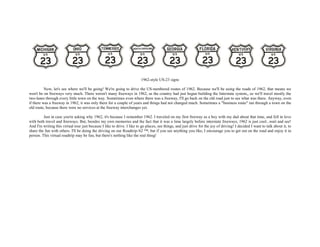
1962-style US-23 signs
Now, let's see where we'll be going! We're going to drive the US-numbered routes of 1962. Because we'll be using the roads of 1962, that means we
won't be on freeways very much. There weren't many freeways in 1962, as the country had just begun building the Interstate system,, so we'll travel mostly the
two-lanes through every little town on the way. Sometimes even where there was a freeway, I'll go back on the old road just to see what was there. Anyway, even
if there was a freeway in 1962, it was only there for a couple of years and things had not changed much. Sometimes a "business route" ran through a town on the
old route, because there were no services at the freeway interchanges yet.
Just in case you're asking why 1962, it's because I remember 1962. I traveled on my first freeway as a boy with my dad about that time, and fell in love
with both travel and freeways. But, besides my own memories and the fact that it was a time largely before interstate freeways, 1962 is just cool...wait and see!
And I'm writing this virtual tour just because I like to drive. I like to go places, see things, and just drive for the joy of driving! I decided I want to talk about it, to
share the fun with others. I'll be doing the driving on our Roadtrip-'62 ™, but if you see anything you like, I encourage you to get out on the road and enjoy it in
person. This virtual roadtrip may be fun, but there's nothing like the real thing!

5 Postcards from a US-35 Roadtrip

  • 1.
    5 Postcards froma US-35 Roadtrip By Donald Dale Milne https://www.roadtrip62.com/5-postcards-from-a-us-35-roadtrip.htm Today Roadtrip-’62 ™ goes back to a north-south highway, sort of. While US-35 is numbered as a north-south route, it travels just about as far east- west, drawing nearly a 45-degree line on a map. It runs about 416 miles across mostly farm country in Indiana and Ohio, with few truly scenic sites along the way. Highway US-35 has always begun in Michigan City, Indiana, originally in downtown but since shortened by a few miles. The eastern end originally was in Charleston, West Virginia, but it was shortened about 25 miles in 2008 to Scott Depot, West Virginia. It had also been shortened previously, to St. Albans, West Virginia. This was the result of the tragic collapse of the Silver Bridge at Gallipolis, Ohio in 1967, which killed 46 people. When a new bridge over the Ohio River was opened in 1969, the highway was moved and shortened to end at US-60 on the south side of the river. Indiana Dunes State Park, circa 1962 (Postcard photo by Steve Shook at Flickr, see https://www.flickr.com/photos/shookphotos/ , licensed under a Creative Commons Attribution 2.0 Generic license, see https://creativecommons.org/licenses/by/2.0/ . Michigan City has several attractions, some we could have seen in 1962 that are still around today and some newer. The most famous scenic attraction, Indiana Dunes National Park, did not exist back then. The State of Indiana offered the Indiana Dunes State Park, which opened in 1925 in the same area though. It is now surrounded by the National Park on three sides. Indiana Dunes State Park, at https://www.in.gov/dnr/state-parks/parks-lakes/indiana-dunes-state-park/ , includes more than three miles of beautiful Lake Michigan beach, a marsh trail, dunes trail, and nature preserve. It includes sand dunes reaching nearly 200 feet above Lake Michigan. The value of preserving this area was recognized as early as 1916, when National Parks Director Stephen Mather held hearings in Chicago on the idea of a "Sand Dunes National Park", but nothing came of this early effort. Instead, Indiana Dunes National Lakeshore was created in 1966 band upgraded to a national park in 2019.
  • 2.
    The harbor atMichigan City has had an effect on the dunes by construction of the harbor breakwall. This has starved some nearby dunes of sand and the dunes can literally blow away. Mount Baldy Beach, just 2 miles west of the old end of US-35 in downtown, is an example where beach erosion is taking away more sand than Lake Michigan’s waves are bringing in. To try and correct this effect, the U.S. Army Corps of Engineers began feeding sand to the beach in 1974. A combination of fine sand, coarse sand, and even dredged sand has been added over four different years through 1996. The harbor also offers the Old Lighthouse Museum, but the building was closed from 1940 through 1965, so we could not have stopped in. It was not opened as a museum until 1973. This is a lighthouse constructed in 1858, which saw many changes over its years of operation. The original 5th order Fresnel Lens and the 1904 Pierhead Light are both now on display in the Old Lighthouse Museum. Fountain at Washington Park Zoo, Michigan City, Indiana commemorating their original bear (publicity photo from Washington Park Zoo) Downtown Michigan City is the location of the Washington Park Zoo (see http://washingtonparkzoo.com/ ), which has been here since 1928. The Washington Park Zoo began informally in 1925 when a retired animal trainer moved his pet bear to the Washington Park lakefront so the animal might have the company of people. A couple of years later, the city began planning the creation of a zoological garden. It now encompasses natural hillside terrain, meandering tree-covered pathways, and over 90 different species of animals native to Australia, Africa, Asia, North America, and South America. It also has the most comprehensive collection of public leisure facilities built by the WPA (Works Progress Administration) in Indiana. The first major project was the creation of "Monkey Island" in 1934. Other buildings followed, including the observation tower on top of a sand dune east of the zoo. A "Castle" structure that houses the small mammals was built in 1937. A total of eleven buildings within the zoo are on the National Register of Historic Places.
  • 3.
    Heading southeasterly fromMichigan City, US-35 travels through lightly populated areas most of the way to West Virginia. Near Kingsbury, Indiana, (see https://www.roadtrip62.com/us-6-day-18-nappanee-in-joliet-il.htm ) we run together with US-6 for about five miles through the Kingsford Heights / Kingsbury area and would have seen this road from the other direction on our US-6 roadtrip. Near Logansport, Indiana my 1962 Rand McNally Atlas shows a site called Fitch’s Glen that I have never heard of, so I looked it up. It turns out to have been a spot with some small waterfalls, which are rare in this area. Called one of the most picturesque spots in northern Indiana, Fitch’s Creek tumbled over some broken limestone bluffs and through a small canyon about 100 feet high in some places. It was a popular sightseeing location…until the stream disappeared in 2016! That year, the entire creek disappeared near the top of the falls, after heavy rains in 2015 caused an ancient sinkhole to re-open. Research found the water coming back out from underground near the Wabash River. Very unfortunate for the family that used to operate a park at the site. Fitch’s Glen, Logansport, Indiana, about 1910 (postcard from an online auction) Dayton, Ohio is the largest city along US-35 and has several good museums that were around in 1962. I’ve visited the Dayton Art Institute, Carillon Historical Park, and the Dayton Museum of Natural History before it became the Boonshoft Museum of Discovery. The Dayton Art Institute has collections of European Art, American Art, Asian Art, and also hosts special exhibits. The Italian Renaissance-style building was opened in 1930 and sits on a hill that makes it a commanding presence as you drive through Dayton on the I-75 freeway. Carillon Historical Park contains 30 historical structures spread throughout a city park along the Great Miami River. In addition to the Deeds Carillon, the largest carillon in Ohio, buildings include Dayton’s oldest building, Newcom’s Tavern, which was erected in 1796, and the Wright Brothers Aviation Center, which houses the 1905 Wright Flyer III. Dayton was the home of the Wright brothers and they conducted their early flight experiments here. The Boonshoft Museum of Discovery was originally some natural history exhibits in the library, but in 1958, a brand new building was opened. At that time, we would have seen typical human history, animal and mineral exhibits. In the 1990s, a group working on founding a children’s museum in Dayton merged with the Dayton Museum of Natural History to form the Boonshoft that we see today, a modern children's museum that focuses on science through interactive exhibits.
  • 4.
    1924 Sunoco gasstation at Carillon Historical Park, Dayton, Ohio (Public domain photo by Nyttend at Wikimedia Commons, at https://en.wikipedia.org/wiki/User:Nyttend .) At Chillicothe, Ohio, we crossed our US-23 roadtrip on its ninth day, see https://www.roadtrip62.com/us-23-day-9-columbus-oh-portsmouth-oh.htm . The city is the site of the Hopewell Culture National Historical Park. The park was known as the Mound City Group National Monument back in 1962. The park encompasses several mounds and related archeological sites of the Hopewell Indian culture and is well worth a roadtrip stop. The State of Ohio has more than 70 Indian mound sites, many in the Ohio River Valley. These were built by the ancient Native Americans of the Adena and Hopewell cultures between 200 BC to AD 500. Neither name refers to a particular Native American tribe, but are names for two distinctive sets of artifacts, earthworks, and burial practices characteristic of sites in southern Ohio. One of those many mounds is on the grounds of the Bob Evans Farm (see https://www.bobevans.com/about-us/the-farm ) in Rio Grande, Ohio, just off US-35. In 1948, the Evans family made their own sausage sold at their 12-stool diner in nearby Gallipolis, Ohio. They had so many visitors come to buy it in bulk at the farm that they opened a restaurant named "The Sausage Shop" on the property in 1962. Today, the Bob Evans Restaurant chain has 500 locations in 18 states, including one right at the farm. The farm has become a tourist attraction, featuring a picturesque windmill, tours, an ancient Indian burial mound, a Revolutionary War cemetery, several reconstructed historic buildings, horseback rides, and the annual Bob Evans Farm Festival in October.
  • 5.
    West Virginia Capitol,Charleston (postcard from an online auction) At the end of US-35 in 1962 was Charleston, West Virginia, the state capital. We previously saw the small Shoney's Big Boy Museum here on a trip down US-21 (see https://www.roadtrip62.com/5-roadtrip-highlights-along-us-21.htm#Shoneys ). This time, let’s stop at the West Virginia State Capitol. The state capital was not always in Charleston. Early in the state’s history it bounced back and forth between Charleston and Wheeling, but it finally landed permanently here in 1885. The capitol building from that time burned to the ground in 1921 and the legislature occupied temporary quarters until completion of the present Capitol in 1932. It was designed by architect Cass Gilbert, who re-used part of his interior design for the United States Supreme Court: that’s just a larger version of the West Virginia Capitol's East Wing! The Capitol consists of three parts, a West Wing, East Wing, and the rotunda connecting the two wings. In the plaza formed by the three parts of the building lie a fountain, statues, the Governor's mansion, a cultural center, other state departments, and a parking garage. At 292 feet high, the Capitol is the tallest building in West Virginia and the gilded dome is five feet taller than the dome of the United States Capitol. Most of the interior is marble and the central rotunda features a chandelier of Czechoslovakian crystal on a 54-foot chain. State Capitol tours, and tours of the Governor’s Mansion are available. You can observe legislative floor sessions from any of the three galleries located in each chamber. While at the Capitol, we can stop at the West Virginia State Museum, across the plaza (see https://www.wvstatemuseumed.wv.gov/index.html ). The museum opened in 1894 to showcase the West Virginia artifacts that had been on exhibit at the 1893 World’s Columbian Exposition in Chicago, Illinois, as well as exhibiting the valuable collection of the West Virginia Historical Society. In its early days, the museum was housed at the Capitol Annex, which saved its collection from the capitol fire of 1921. When the new Capitol building was completed in 1932, the collection of the state museum was placed on exhibit in the basement. That’s where we could have visited in 1962. But it outgrew the space and a new museum building was opened in 1976. Exhibits change but have recently included clothing, Blenko glass, West Virginia State Police, and the annual quilts exhibit. And that’s the end of US-35, so I’ll see you soon when Roadtrip-’62 ™ travels to more 1962 sights!
  • 6.
    Visit ROADTRIP-'62 ™( https://www.roadtrip62.com/index.htm )for more articles. Or visit us on Facebook https://www.facebook.com/pages/Roadtrip62/119235794845685 , Pinterest https://www.pinterest.com/roadtrip62/ , or Flickr https://www.flickr.com/photos/67972937@N07/page1 . Author of Roadtrip-'62TM ( https://www.roadtrip62.com/ ), Donald Dale Milne If you haven’t heard of nor Roadtrip-'62 ™ , my name is Don Milne and I'll be your travel guide on this virtual tour of the U. S. of A. First, I suppose you're wondering why nor Roadtrip-'62 ™ is different from other travel sites? There's a very simple answer: everybody else travels only in space, but we also travel in time! That's right, we don't just go somewhere, we also go somewhen. And the when is 1962. We'll try to see what's left today from 1962, by driving as if it were 1962. We will drive on highways as they were in 1962, try to eat only at restaurants that existed in 1962, try to stay only at motels that existed in 1962, try to buy gas and sundries, play the music, see only the sites across America, and just generally live in America as it was in 1962! What we will do is enjoy the FUN of cross-country driving. And the fun of cross-country travel is all the differences from our everyday life! We'll talk about politics, food, great inventions, how people lived, television, and more. We'll get to see some of the people that made our history; that made this country great. We'll stumble across unexpected pleasures, like one trip I made through Cherokee, North Carolina where I just happened to be in town as the 1996 Olympic Torch procession came through on it's way to Atlanta, Georgia. You really never know what you'll find when you travel!
  • 7.
    1962-style US-23 signs Now,let's see where we'll be going! We're going to drive the US-numbered routes of 1962. Because we'll be using the roads of 1962, that means we won't be on freeways very much. There weren't many freeways in 1962, as the country had just begun building the Interstate system,, so we'll travel mostly the two-lanes through every little town on the way. Sometimes even where there was a freeway, I'll go back on the old road just to see what was there. Anyway, even if there was a freeway in 1962, it was only there for a couple of years and things had not changed much. Sometimes a "business route" ran through a town on the old route, because there were no services at the freeway interchanges yet. Just in case you're asking why 1962, it's because I remember 1962. I traveled on my first freeway as a boy with my dad about that time, and fell in love with both travel and freeways. But, besides my own memories and the fact that it was a time largely before interstate freeways, 1962 is just cool...wait and see! And I'm writing this virtual tour just because I like to drive. I like to go places, see things, and just drive for the joy of driving! I decided I want to talk about it, to share the fun with others. I'll be doing the driving on our Roadtrip-'62 ™, but if you see anything you like, I encourage you to get out on the road and enjoy it in person. This virtual roadtrip may be fun, but there's nothing like the real thing!