Gender	
African American	
Ethnicity	
Hispanic	
White	
Other	
American Indian	
Asian	
60%	
4%	
2%	
23%	
7%	
4%	
56%	


Scan the QR code for
more info!	


Analyzing Factors Impacting Student 	
Interest in Computer Science	
What is a Roadshow?	
	
	
Susana Bali, Jeanne Chen, Jen Dana,
Samantha McGuinn, Noor Muhyi, 	
Natasha Nesiba, and Nicole Ray 	
Future Work	
The Roadshow Experience 	
Grade Distribution	
Young Women in Computing	
Data collected from the surveys will assist in the development of future roadshow
curriculum. Every workshop YWiC hosts is tailored to achieve student success with
immediate results and outcomes through the teaching of early computing principles.
Evaluating survey results may establish a greater understanding of outreach
populations and their experiences, and lead to more effective teaching techniques.
The data collected will allow YWiC reach more students and bring awareness to the
impact of computer science on students. 	
	
	
Young Women in Computing Program (YWiC) is an outreach initiative
developed with the vision to increase the participation in computer science (CS)
activities and exposure for all students in New Mexico. YWiC began in 2006 and
is housed in the Department of Computer Science at New Mexico State
University and focuses on multidimensional program components such as:	
	
	
•  In-school presentations	
•  After-School programming	
•  Summer programs	
•  State-wide competitions	
•  Social networking	
•  Forums and conferences	
•  Teacher-program collaborations	
Survey Outcomes	
1%	
14%	
29%	
57%	
5%	
33%	
38%	
24%	
0	
 50	
 100	
Not Interested	
A Little interested	
Pretty Interested	
Super Interested	
Pre	
Post	
Student Access to
Technology at Home	
96%	
 95%	
Have Computers	
 Have Internet	
Do you know what 	
Computer Science is?	
Pre	
Post	
19%	
85%	
Data Analysis	
Research Methodology	
How Interested are you in
Computer Science?	
2nd	
4th	
5th	
6th	
7th	
9th	
40%	
1%	
1%	
22%	
33%	
3%	
An important component of YWiC research is outreach in the form of roadshows:
short, hands-on classroom-style workshops that are adaptable and mobile to
individualized situations. The level of difficulty for a roadshow session can be
tailored to students ranging from elementary to high school. All roadshow
instructors are undergraduate research assistants working at Young Women in
Computing. Each roadshow is composed of three parts:	
	
	
•  Awareness-raising Component: Demonstrate the diversity, variety,
and possibilities in the field of computing.	
•  Educational Component: Introduce students to computational
thinking skills.	
•  Hands-on Component: Computational thinking skills are utilized.	
In February 2013 YWiC began surveying students during roadshows to acquire a better
understanding of potential factors impacting student interest in computer science.
Surveys were conducted over a four month period during 18 workshops; 53% of the
surveys were administered to pre-workshop groups and 47% post-workshop groups.
Although the ideal survey model for this research would have been to issue both pre- and
post- surveys to every group, but time did not allow for two surveys every roadshow. 	
	
Roadshow curriculum consisted of various projects on two platforms: PicoCrickets and
Storytelling Alice. These platforms were chosen specifically because they are introductory
programming platforms. Specific projects were chosen based on the amount of time
allotted for each roadshow, but project difficulty was comparable across all projects.	
*Students were asked if they had access to
computers and internet in their homes.	
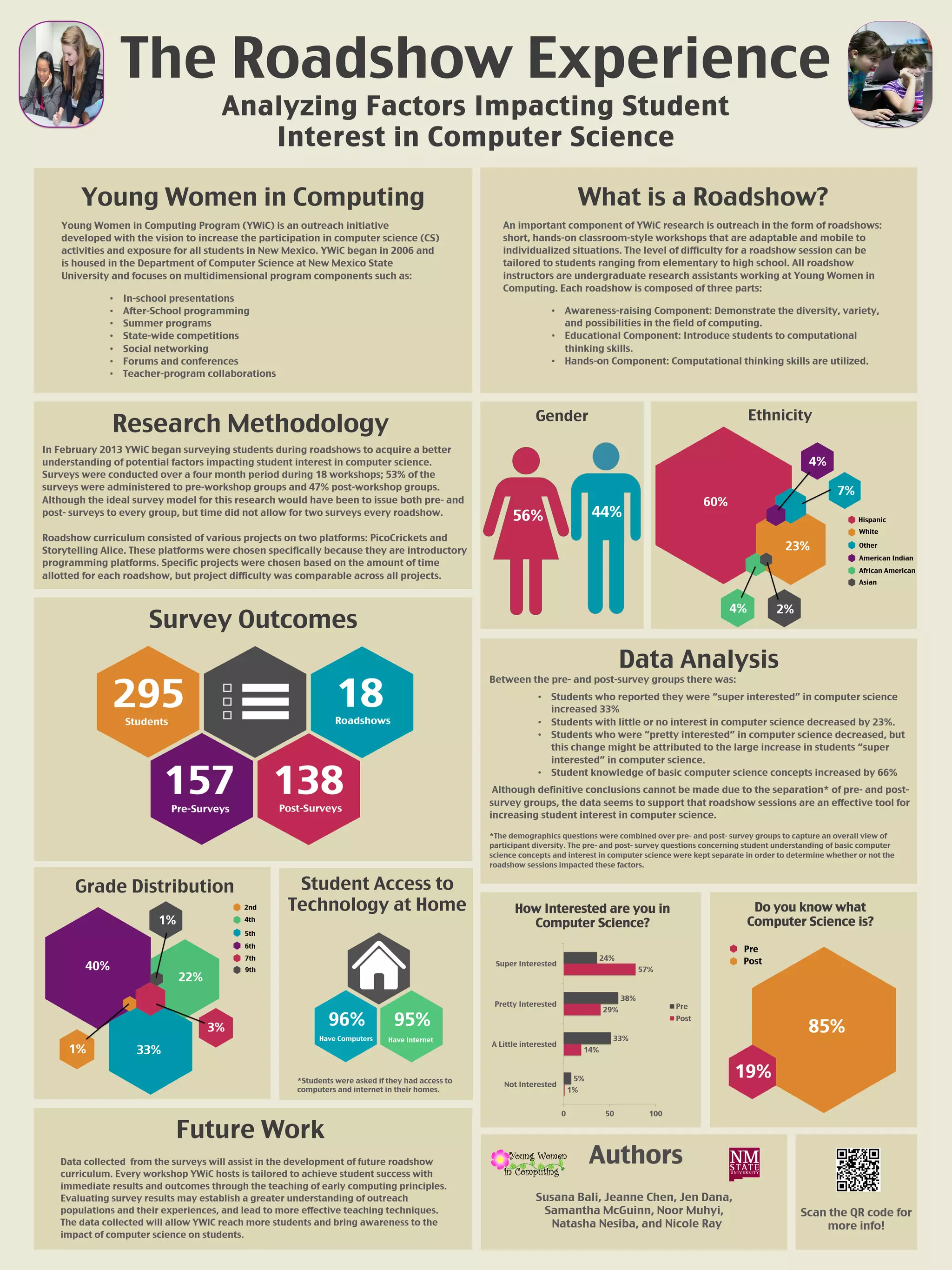
Between the pre- and post-survey groups there was: 	
	
•  Students who reported they were “super interested” in computer science
increased 33% 	
•  Students with little or no interest in computer science decreased by 23%. 	
•  Students who were “pretty interested” in computer science decreased, but
this change might be attributed to the large increase in students “super
interested” in computer science.	
•  Student knowledge of basic computer science concepts increased by 66%	
	
Although definitive conclusions cannot be made due to the separation* of pre- and post-
survey groups, the data seems to support that roadshow sessions are an effective tool for
increasing student interest in computer science.	
	
*The demographics questions were combined over pre- and post- survey groups to capture an overall view of
participant diversity. The pre- and post- survey questions concerning student understanding of basic computer
science concepts and interest in computer science were kept separate in order to determine whether or not the
roadshow sessions impacted these factors.	
60%	
23%	
22%	
40%	
33%

Roadshow_2013

  • 1.
    Gender African American Ethnicity Hispanic White Other American Indian Asian 60% 4% 2% 23% 7% 4% 56% Scanthe QR code for more info! Analyzing Factors Impacting Student Interest in Computer Science What is a Roadshow? Susana Bali, Jeanne Chen, Jen Dana, Samantha McGuinn, Noor Muhyi, Natasha Nesiba, and Nicole Ray Future Work The Roadshow Experience Grade Distribution Young Women in Computing Data collected from the surveys will assist in the development of future roadshow curriculum. Every workshop YWiC hosts is tailored to achieve student success with immediate results and outcomes through the teaching of early computing principles. Evaluating survey results may establish a greater understanding of outreach populations and their experiences, and lead to more effective teaching techniques. The data collected will allow YWiC reach more students and bring awareness to the impact of computer science on students. Young Women in Computing Program (YWiC) is an outreach initiative developed with the vision to increase the participation in computer science (CS) activities and exposure for all students in New Mexico. YWiC began in 2006 and is housed in the Department of Computer Science at New Mexico State University and focuses on multidimensional program components such as: •  In-school presentations •  After-School programming •  Summer programs •  State-wide competitions •  Social networking •  Forums and conferences •  Teacher-program collaborations Survey Outcomes 1% 14% 29% 57% 5% 33% 38% 24% 0 50 100 Not Interested A Little interested Pretty Interested Super Interested Pre Post Student Access to Technology at Home 96% 95% Have Computers Have Internet Do you know what Computer Science is? Pre Post 19% 85% Data Analysis Research Methodology How Interested are you in Computer Science? 2nd 4th 5th 6th 7th 9th 40% 1% 1% 22% 33% 3% An important component of YWiC research is outreach in the form of roadshows: short, hands-on classroom-style workshops that are adaptable and mobile to individualized situations. The level of difficulty for a roadshow session can be tailored to students ranging from elementary to high school. All roadshow instructors are undergraduate research assistants working at Young Women in Computing. Each roadshow is composed of three parts: •  Awareness-raising Component: Demonstrate the diversity, variety, and possibilities in the field of computing. •  Educational Component: Introduce students to computational thinking skills. •  Hands-on Component: Computational thinking skills are utilized. In February 2013 YWiC began surveying students during roadshows to acquire a better understanding of potential factors impacting student interest in computer science. Surveys were conducted over a four month period during 18 workshops; 53% of the surveys were administered to pre-workshop groups and 47% post-workshop groups. Although the ideal survey model for this research would have been to issue both pre- and post- surveys to every group, but time did not allow for two surveys every roadshow. Roadshow curriculum consisted of various projects on two platforms: PicoCrickets and Storytelling Alice. These platforms were chosen specifically because they are introductory programming platforms. Specific projects were chosen based on the amount of time allotted for each roadshow, but project difficulty was comparable across all projects. *Students were asked if they had access to computers and internet in their homes. Between the pre- and post-survey groups there was: •  Students who reported they were “super interested” in computer science increased 33% •  Students with little or no interest in computer science decreased by 23%. •  Students who were “pretty interested” in computer science decreased, but this change might be attributed to the large increase in students “super interested” in computer science. •  Student knowledge of basic computer science concepts increased by 66% Although definitive conclusions cannot be made due to the separation* of pre- and post- survey groups, the data seems to support that roadshow sessions are an effective tool for increasing student interest in computer science. *The demographics questions were combined over pre- and post- survey groups to capture an overall view of participant diversity. The pre- and post- survey questions concerning student understanding of basic computer science concepts and interest in computer science were kept separate in order to determine whether or not the roadshow sessions impacted these factors. 60% 23% 22% 40% 33%