


Road Safety Awareness Training
Avoid over speeding – prevent accidents*
* 29th Road safety week 2018 theme
S.Muthuirulappan EHS Professional Slide 1
Outline
 Common causes
 General precautions while driving
 Defensive driving
 Special precautions
 Fire precautions in vehicle
 Vehicular pollution
S.Muthuirulappan EHS Professional 2
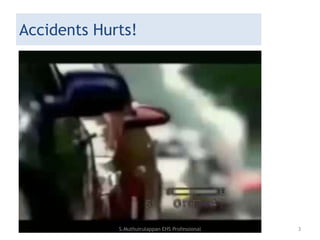
Accidents Hurts!
S.Muthuirulappan EHS Professional 3
Common causes for road accidents
A defensive driver knows the common causes for road
accidents
 Not following defensive driving techniques
 Following too closely
 Not observing lane discipline
 Overtaking on turns, bend and wrong side
 Poor road condition
 Extreme weather conditions
 Driver fatigue
 Poorly maintained vehicle
S.Muthuirulappan EHS Professional 4
General precautions while driving
 Follow all traffic rules, signs and signals.
 Plan your journey; start early to reach your destination
early
 Look out the potential hazards
 Remember that other road users may not follow traffic
rules and be prepared – that’s not in our control
 Allow other road users the time and space to correct
their mistakes.
 Do not exceed the speed limit
 Do not change the lane abruptly
 On long drives, 10 minute break after every 2 hours
S.Muthuirulappan EHS Professional 5
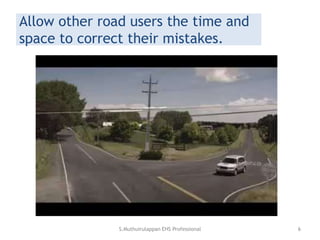
Allow other road users the time and
space to correct their mistakes.
S.Muthuirulappan EHS Professional 6
General precautions while driving.
Contd.,
 Keep both hands on steering wheel.
 Always signal to other drivers about what you intend to do
 Concentrate on driving and avoid distraction like.
• Changing the music
• Discussion with others
• Mobile phone usage
• Eating
• Mentally absent
 Don’t drive after having an alcoholic in any forms/quantity
 Don’t drive if you are not feeling well. Sleepy, under
medication
S.Muthuirulappan EHS Professional 7
Concentrate on driving
S.Muthuirulappan EHS Professional 8
Defensive driving
 A safe driver is a defensive driver. It means driving in a
manner that prevents accidents in spite of adverse
driving conditions and situations created by others who
may not follow rules
Basic requirements:
 Concern for accident prevention regardless of who is in
the right
 Care, courtesy, intimacy and consideration for other
road users
 Obeying the traffic rules, regulations and traffic signs
 Alertness for the illegal acts and driving errors
S.Muthuirulappan EHS Professional 9
Defensive driving
Correct maneuvering techniques.
A defensive driver always follow correct maneuvering
techniques while
 Driving
 Overtaking
 Negotiating turns
 Stopping
 Parking and
 Reversing
S.Muthuirulappan EHS Professional 10
Defensive driving
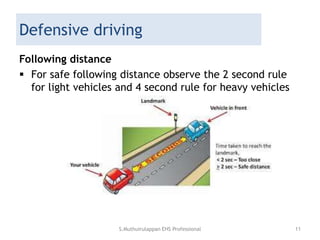
Following distance
 For safe following distance observe the 2 second rule
for light vehicles and 4 second rule for heavy vehicles
S.Muthuirulappan EHS Professional 11
Defensive driving
Overtaking
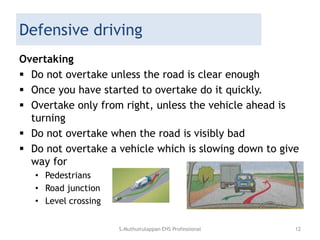
 Do not overtake unless the road is clear enough
 Once you have started to overtake do it quickly.
 Overtake only from right, unless the vehicle ahead is
turning
 Do not overtake when the road is visibly bad
 Do not overtake a vehicle which is slowing down to give
way for
• Pedestrians
• Road junction
• Level crossing
S.Muthuirulappan EHS Professional 12
Special precautions
Driving at night
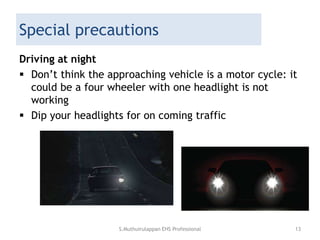
 Don’t think the approaching vehicle is a motor cycle: it
could be a four wheeler with one headlight is not
working
 Dip your headlights for on coming traffic
S.Muthuirulappan EHS Professional 13
Special precautions
Driving in fog
 Always drive at a speed that allows you to stop within
the distance of your visibility
 If possible avoid driving
Driving in rains
 Always keep speed under control
 Switch on the wipers as soon as the rain starts
 Switch on the headlights even in daytime, if visibility
poor
S.Muthuirulappan EHS Professional 14
Special precautions
Driving in summer
 Drive slowly on the tar roads as it may become slippery
due to tar bleeding due hot weather
 Frequent inspect the tyres for overheatinhg
 If tyres too hot to touch, stop some time and allow it to
cool
Hill driving
• Use correct gears to avoid excessive use of breaks
• While driving down hill use the same gear that you used
for climbing, do not put the vehicle in neutral/engine
off
S.Muthuirulappan EHS Professional 15
Commuting to workplace
If due care is not taken, accidents may happen while
travelling to and from the workplace and also within the
workplace
Here some tips
Be a safe pedestrian
 Always walk on the foot path
 Keeps your eye open for potholes and other obstacles
 For crossing the road use zebra crossing
S.Muthuirulappan EHS Professional 16
Commuting to workplace
S.Muthuirulappan EHS Professional 17
Commuting to workplace
At the workplace
 Never pass the prohibited area
 Never take ride in industrial trucks/forklifts/goods
hoist
 Observe speed limits
 Do not walkthrough or across any operating plant unless
you are authorized to do so
 Avoid short cuts
 Use designate routes for crossing the work areas/shops
 Respect caution barricades
S.Muthuirulappan EHS Professional 18
Commuting to workplace
The bus side
 Don’t jump to or off a running bus
 Don’t catch or get down the bus at signals and un
authorized stops
 Don’t stand in the doorway
 Don’t lean out of a running bus and let your arms of the
window
 Don’t distract the driver by shouting or making noise
 Hold on to a support bar while standing
S.Muthuirulappan EHS Professional 19
Commuting to workplace
Travelling by rail
 Don’t cross the tracks when the level crossing gates
are closed
 Don’t stand and lean out of the running train
 Don’t jump on to or off a running train
 Don’t keep your legs hanging out of the train
 Don’t board or alight a running train
 Don’t get in or down at unscheduled halts
S.Muthuirulappan EHS Professional 20
Commuting to workplace
Driving cars/two wheelers
 Don’t overload your vehicle beyond its capacity
 Keep safe distance from the vehicle in your front
 Keep to proper lane and don’t change it without due
care
 Overtake only on the right. Never overtake on turns
 Signal your intentions clearly well before you slow
down, stop or turn.
 Don not over speed while turning
 Avoid intake of alcohol or other intoxicants before
driving
 Park vehicles only at authorized and Safe spots
S.Muthuirulappan EHS Professional 21
Commuting to workplace
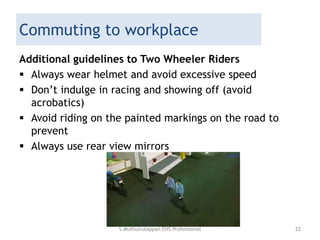
Additional guidelines to Two Wheeler Riders
 Always wear helmet and avoid excessive speed
 Don’t indulge in racing and showing off (avoid
acrobatics)
 Avoid riding on the painted markings on the road to
prevent
 Always use rear view mirrors
S.Muthuirulappan EHS Professional 22
Commuting to workplace
 Cycling
 Remember ! Cycle is for one person
 Before moving out, check tyre inflation, brakes, bell
and light
 Don’t catch another moving vehicle while riding
 Keep to left.
 Keep both hands on the handle bar. Don’t take anything
in hand
 Keep safe lateral distance from the fast moving heavy
vehicles
 Always wear light coloured /fluorescent clothes while
riding at night.
S.Muthuirulappan EHS Professional 23
Fire precaution in vehicle
 Motor vehicles are constructed with a variety of
synthetic, flammable materials that burn and produce
harmful gases
 Diesel/petrol/LPG and other flammable fluids are
present
 When heated by fire some parts of the vehicle can
explode, sending debris a greater distance
Legal compliance CMVR , 1989
 Tourist vehicle- must have a fir extinguisher
 Wire passing through a sheet metallic hold
S.Muthuirulappan EHS Professional 24
Fire precaution in vehicle
Common causes for fire
 Smoking in the vehicle
 Using open flame while refueling/inspecting the fuel
tank
 Fuel dripping from fuel line/tank
 Damaged wiring
 Accumulation oil/grease on brake shoe
S.Muthuirulappan EHS Professional 25
Vehicular pollution
 The exhaust fumes coming out of the tail pipe of
vehicles contain many polluting substances
 This is the major contribution for environmental
damage and diseases
as by a research study – india
 2 million people are estimated top die due to
environmental pollution
 Vehicle growth – 10 % per annum as an average
 50 to 60 % total air pollutants by 2,3,4 wheelers
 30% fuels remains unburned
S.Muthuirulappan EHS Professional 26
Vehicular pollution
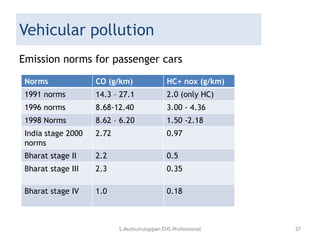
Emission norms for passenger cars
Norms CO (g/km) HC+ nox (g/km)
1991 norms 14.3 – 27.1 2.0 (only HC)
1996 norms 8.68-12.40 3.00 - 4.36
1998 Norms 8.62 – 6.20 1.50 -2.18
India stage 2000
norms
2.72 0.97
Bharat stage II 2.2 0.5
Bharat stage III 2.3 0.35
Bharat stage IV 1.0 0.18
S.Muthuirulappan EHS Professional 27
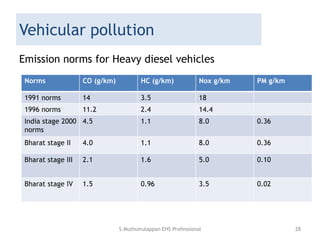
Vehicular pollution
Emission norms for Heavy diesel vehicles
Norms CO (g/km) HC (g/km) Nox g/km PM g/km
1991 norms 14 3.5 18
1996 norms 11.2 2.4 14.4
India stage 2000
norms
4.5 1.1 8.0 0.36
Bharat stage II 4.0 1.1 8.0 0.36
Bharat stage III 2.1 1.6 5.0 0.10
Bharat stage IV 1.5 0.96 3.5 0.02
S.Muthuirulappan EHS Professional 28
Road safety pledge
S.Muthuirulappan EHS Professional 29
Road Safety quiz
S.Muthuirulappan EHS Professional 30
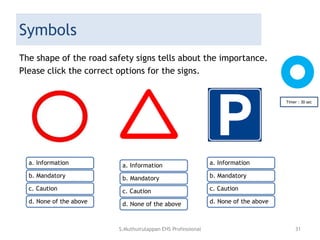
Symbols
The shape of the road safety signs tells about the importance.
Please click the correct options for the signs.
Timer : 30 sec
a. Information
b. Mandatory
c. Caution
d. None of the above
a. Information
b. Mandatory
c. Caution
d. None of the above
a. Information
b. Mandatory
c. Caution
d. None of the above
S.Muthuirulappan EHS Professional 31
Result
Back
S.Muthuirulappan EHS Professional 32
Result
Back
S.Muthuirulappan EHS Professional 33
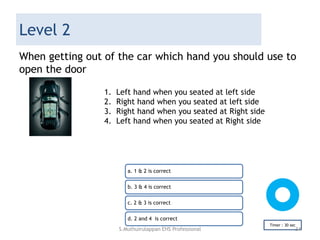
Level 2
When getting out of the car which hand you should use to
open the door
a. 1 & 2 is correct
b. 3 & 4 is correct
c. 2 & 3 is correct
d. 2 and 4 is correct
Timer : 30 sec
1. Left hand when you seated at left side
2. Right hand when you seated at left side
3. Right hand when you seated at Right side
4. Left hand when you seated at Right side
S.Muthuirulappan EHS Professional 34
Result
Back
S.Muthuirulappan EHS Professional 35
Result
Back
S.Muthuirulappan EHS Professional 36
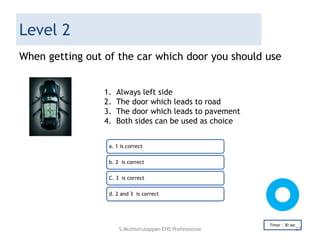
Level 2
When getting out of the car which door you should use
a. 1 is correct
b. 2 is correct
C. 3 is correct
d. 2 and 3 is correct
Timer : 30 sec
1. Always left side
2. The door which leads to road
3. The door which leads to pavement
4. Both sides can be used as choice
S.Muthuirulappan EHS Professional 37
Result
Back
S.Muthuirulappan EHS Professional 38
Result
Back
S.Muthuirulappan EHS Professional 39
THANK YOU
S.Muthuirulappan EHS Professional 40

Road safety awarness training

  • 1.
    Road Safety AwarenessTraining Avoid over speeding – prevent accidents* * 29th Road safety week 2018 theme S.Muthuirulappan EHS Professional Slide 1
  • 2.
    Outline  Common causes General precautions while driving  Defensive driving  Special precautions  Fire precautions in vehicle  Vehicular pollution S.Muthuirulappan EHS Professional 2
  • 3.
  • 4.
    Common causes forroad accidents A defensive driver knows the common causes for road accidents  Not following defensive driving techniques  Following too closely  Not observing lane discipline  Overtaking on turns, bend and wrong side  Poor road condition  Extreme weather conditions  Driver fatigue  Poorly maintained vehicle S.Muthuirulappan EHS Professional 4
  • 5.
    General precautions whiledriving  Follow all traffic rules, signs and signals.  Plan your journey; start early to reach your destination early  Look out the potential hazards  Remember that other road users may not follow traffic rules and be prepared – that’s not in our control  Allow other road users the time and space to correct their mistakes.  Do not exceed the speed limit  Do not change the lane abruptly  On long drives, 10 minute break after every 2 hours S.Muthuirulappan EHS Professional 5
  • 6.
    Allow other roadusers the time and space to correct their mistakes. S.Muthuirulappan EHS Professional 6
  • 7.
    General precautions whiledriving. Contd.,  Keep both hands on steering wheel.  Always signal to other drivers about what you intend to do  Concentrate on driving and avoid distraction like. • Changing the music • Discussion with others • Mobile phone usage • Eating • Mentally absent  Don’t drive after having an alcoholic in any forms/quantity  Don’t drive if you are not feeling well. Sleepy, under medication S.Muthuirulappan EHS Professional 7
  • 8.
  • 9.
    Defensive driving  Asafe driver is a defensive driver. It means driving in a manner that prevents accidents in spite of adverse driving conditions and situations created by others who may not follow rules Basic requirements:  Concern for accident prevention regardless of who is in the right  Care, courtesy, intimacy and consideration for other road users  Obeying the traffic rules, regulations and traffic signs  Alertness for the illegal acts and driving errors S.Muthuirulappan EHS Professional 9
  • 10.
    Defensive driving Correct maneuveringtechniques. A defensive driver always follow correct maneuvering techniques while  Driving  Overtaking  Negotiating turns  Stopping  Parking and  Reversing S.Muthuirulappan EHS Professional 10
  • 11.
    Defensive driving Following distance For safe following distance observe the 2 second rule for light vehicles and 4 second rule for heavy vehicles S.Muthuirulappan EHS Professional 11
  • 12.
    Defensive driving Overtaking  Donot overtake unless the road is clear enough  Once you have started to overtake do it quickly.  Overtake only from right, unless the vehicle ahead is turning  Do not overtake when the road is visibly bad  Do not overtake a vehicle which is slowing down to give way for • Pedestrians • Road junction • Level crossing S.Muthuirulappan EHS Professional 12
  • 13.
    Special precautions Driving atnight  Don’t think the approaching vehicle is a motor cycle: it could be a four wheeler with one headlight is not working  Dip your headlights for on coming traffic S.Muthuirulappan EHS Professional 13
  • 14.
    Special precautions Driving infog  Always drive at a speed that allows you to stop within the distance of your visibility  If possible avoid driving Driving in rains  Always keep speed under control  Switch on the wipers as soon as the rain starts  Switch on the headlights even in daytime, if visibility poor S.Muthuirulappan EHS Professional 14
  • 15.
    Special precautions Driving insummer  Drive slowly on the tar roads as it may become slippery due to tar bleeding due hot weather  Frequent inspect the tyres for overheatinhg  If tyres too hot to touch, stop some time and allow it to cool Hill driving • Use correct gears to avoid excessive use of breaks • While driving down hill use the same gear that you used for climbing, do not put the vehicle in neutral/engine off S.Muthuirulappan EHS Professional 15
  • 16.
    Commuting to workplace Ifdue care is not taken, accidents may happen while travelling to and from the workplace and also within the workplace Here some tips Be a safe pedestrian  Always walk on the foot path  Keeps your eye open for potholes and other obstacles  For crossing the road use zebra crossing S.Muthuirulappan EHS Professional 16
  • 17.
  • 18.
    Commuting to workplace Atthe workplace  Never pass the prohibited area  Never take ride in industrial trucks/forklifts/goods hoist  Observe speed limits  Do not walkthrough or across any operating plant unless you are authorized to do so  Avoid short cuts  Use designate routes for crossing the work areas/shops  Respect caution barricades S.Muthuirulappan EHS Professional 18
  • 19.
    Commuting to workplace Thebus side  Don’t jump to or off a running bus  Don’t catch or get down the bus at signals and un authorized stops  Don’t stand in the doorway  Don’t lean out of a running bus and let your arms of the window  Don’t distract the driver by shouting or making noise  Hold on to a support bar while standing S.Muthuirulappan EHS Professional 19
  • 20.
    Commuting to workplace Travellingby rail  Don’t cross the tracks when the level crossing gates are closed  Don’t stand and lean out of the running train  Don’t jump on to or off a running train  Don’t keep your legs hanging out of the train  Don’t board or alight a running train  Don’t get in or down at unscheduled halts S.Muthuirulappan EHS Professional 20
  • 21.
    Commuting to workplace Drivingcars/two wheelers  Don’t overload your vehicle beyond its capacity  Keep safe distance from the vehicle in your front  Keep to proper lane and don’t change it without due care  Overtake only on the right. Never overtake on turns  Signal your intentions clearly well before you slow down, stop or turn.  Don not over speed while turning  Avoid intake of alcohol or other intoxicants before driving  Park vehicles only at authorized and Safe spots S.Muthuirulappan EHS Professional 21
  • 22.
    Commuting to workplace Additionalguidelines to Two Wheeler Riders  Always wear helmet and avoid excessive speed  Don’t indulge in racing and showing off (avoid acrobatics)  Avoid riding on the painted markings on the road to prevent  Always use rear view mirrors S.Muthuirulappan EHS Professional 22
  • 23.
    Commuting to workplace Cycling  Remember ! Cycle is for one person  Before moving out, check tyre inflation, brakes, bell and light  Don’t catch another moving vehicle while riding  Keep to left.  Keep both hands on the handle bar. Don’t take anything in hand  Keep safe lateral distance from the fast moving heavy vehicles  Always wear light coloured /fluorescent clothes while riding at night. S.Muthuirulappan EHS Professional 23
  • 24.
    Fire precaution invehicle  Motor vehicles are constructed with a variety of synthetic, flammable materials that burn and produce harmful gases  Diesel/petrol/LPG and other flammable fluids are present  When heated by fire some parts of the vehicle can explode, sending debris a greater distance Legal compliance CMVR , 1989  Tourist vehicle- must have a fir extinguisher  Wire passing through a sheet metallic hold S.Muthuirulappan EHS Professional 24
  • 25.
    Fire precaution invehicle Common causes for fire  Smoking in the vehicle  Using open flame while refueling/inspecting the fuel tank  Fuel dripping from fuel line/tank  Damaged wiring  Accumulation oil/grease on brake shoe S.Muthuirulappan EHS Professional 25
  • 26.
    Vehicular pollution  Theexhaust fumes coming out of the tail pipe of vehicles contain many polluting substances  This is the major contribution for environmental damage and diseases as by a research study – india  2 million people are estimated top die due to environmental pollution  Vehicle growth – 10 % per annum as an average  50 to 60 % total air pollutants by 2,3,4 wheelers  30% fuels remains unburned S.Muthuirulappan EHS Professional 26
  • 27.
    Vehicular pollution Emission normsfor passenger cars Norms CO (g/km) HC+ nox (g/km) 1991 norms 14.3 – 27.1 2.0 (only HC) 1996 norms 8.68-12.40 3.00 - 4.36 1998 Norms 8.62 – 6.20 1.50 -2.18 India stage 2000 norms 2.72 0.97 Bharat stage II 2.2 0.5 Bharat stage III 2.3 0.35 Bharat stage IV 1.0 0.18 S.Muthuirulappan EHS Professional 27
  • 28.
    Vehicular pollution Emission normsfor Heavy diesel vehicles Norms CO (g/km) HC (g/km) Nox g/km PM g/km 1991 norms 14 3.5 18 1996 norms 11.2 2.4 14.4 India stage 2000 norms 4.5 1.1 8.0 0.36 Bharat stage II 4.0 1.1 8.0 0.36 Bharat stage III 2.1 1.6 5.0 0.10 Bharat stage IV 1.5 0.96 3.5 0.02 S.Muthuirulappan EHS Professional 28
  • 29.
  • 30.
  • 31.
    Symbols The shape ofthe road safety signs tells about the importance. Please click the correct options for the signs. Timer : 30 sec a. Information b. Mandatory c. Caution d. None of the above a. Information b. Mandatory c. Caution d. None of the above a. Information b. Mandatory c. Caution d. None of the above S.Muthuirulappan EHS Professional 31
  • 32.
  • 33.
  • 34.
    Level 2 When gettingout of the car which hand you should use to open the door a. 1 & 2 is correct b. 3 & 4 is correct c. 2 & 3 is correct d. 2 and 4 is correct Timer : 30 sec 1. Left hand when you seated at left side 2. Right hand when you seated at left side 3. Right hand when you seated at Right side 4. Left hand when you seated at Right side S.Muthuirulappan EHS Professional 34
  • 35.
  • 36.
  • 37.
    Level 2 When gettingout of the car which door you should use a. 1 is correct b. 2 is correct C. 3 is correct d. 2 and 3 is correct Timer : 30 sec 1. Always left side 2. The door which leads to road 3. The door which leads to pavement 4. Both sides can be used as choice S.Muthuirulappan EHS Professional 37
  • 38.
  • 39.
  • 40.