SCHOOL OF CLINICAL SCIENCES
MAKAMBO VILLAGE MAKENI
GROUP 5
PRESENTATION: RNA
TRANSCRIPTION AND TYPES 0f RNA
MODULE: BIOCHEMISTRY
LECTURER: Dr.EMMANUEL OLAL
DATE: 21-11-2017
NAMES/MEMBERS OF GROUP 5
John Conteh
Alhaji S.Kargbo
Famata Y.Marrah
Fenty Benk Sankoh
Allans James Koroma
Sallamatu Bangura
Abass Conteh
Nyakeih B.Baion
Kelly F.Koroma
RNA-TRANSCRIPTION
Introduction:
The differences in the composition of RNA and DNA have already been noted. In addition, RNA
is not usually found as a double helix but as a single strand. However, the single polynucleotide
strand may fold back on itself to form portions which have a double helix structure like the
tertiary structure of proteins.
RNA TRANSCRIPTION Is the first step of gene expression in which a particular segment of
DNA is copied into RNA(especially mRNA) by an enzyme RNA Polymerase. It begins when RNA
polymerase binds to a promoter sequence near the beginning of a gene(directly or through
helper proteins).RNA strands uses one of the DNA strands(the template strand).
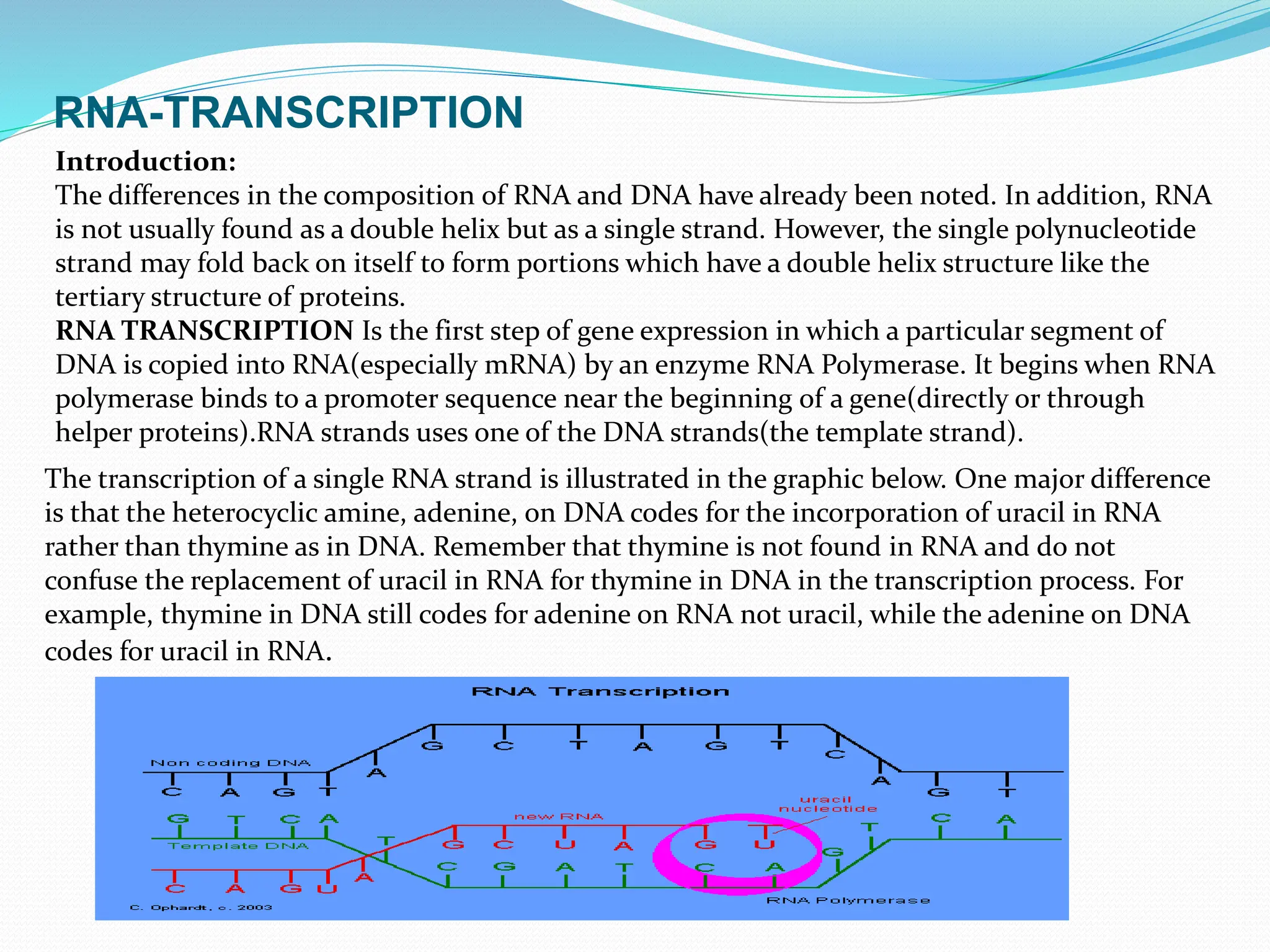
The transcription of a single RNA strand is illustrated in the graphic below. One major difference
is that the heterocyclic amine, adenine, on DNA codes for the incorporation of uracil in RNA
rather than thymine as in DNA. Remember that thymine is not found in RNA and do not
confuse the replacement of uracil in RNA for thymine in DNA in the transcription process. For
example, thymine in DNA still codes for adenine on RNA not uracil, while the adenine on DNA
codes for uracil in RNA.
RNA TRANSCRIPTION PROCESS
The RNA transcription process occurs in three stages: initiation, chain elongation, and
termination.
The first stage occurs when the RNA Polymerase-Promoter Complex binds to the promoter
gene in the DNA. This also allows for the finding of the start sequence for the RNA polymerase.
The promoter enzyme will not work unless the sigma protein is present (shown in blue in
graphic). Specific sequences on the non coding strand of DNA are recognized as the signal to
start the unwinding process.
The recognition sequences are as follows:
Non-coding DNA -5' recognition sections in bold
GGCCGCTTGACAAAAGTGTTAAATTGTGCTATACT
Once the process has been initiated, then the RNA polymerase elongation enzyme takes over and
is described in the next panel.
RNA Polymerase - Elongation:
The elongation begins when the RNA polymerase "reads" the template DNA. Only one strand of
the DNA is read for the base sequence. The RNA which is synthesized is the complementary
strand of the DNA.
The RNA (top strand) and DNA (bottom strand) sequences in the model are:
5' -GACCAGGCA-3'
3'-TCTGGTCCGTAAA-5'
In the next reaction step, uracil triphosphate (UTP) is the next to be added to the RNA by bind
and pairing with the adenine (A) nucleotide on the template DNA strand. A phosphodiester bond
is formed; the RNA chain is than elongated to 10 nucleotides; and diphosphate left over would
dissociate.
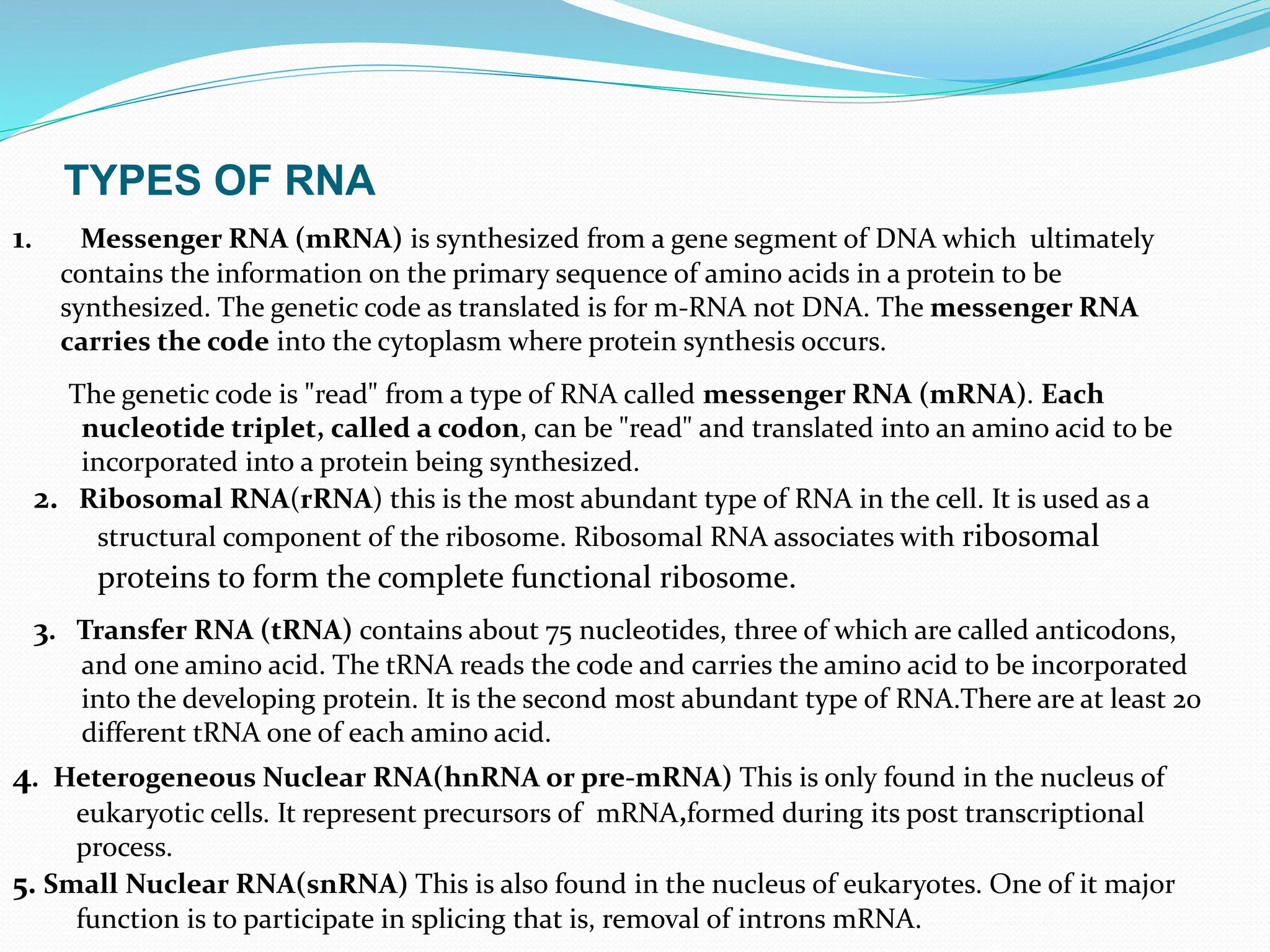
TYPES OF RNA
1. Messenger RNA (mRNA) is synthesized from a gene segment of DNA which ultimately
contains the information on the primary sequence of amino acids in a protein to be
synthesized. The genetic code as translated is for m-RNA not DNA. The messenger RNA
carries the code into the cytoplasm where protein synthesis occurs.
The genetic code is "read" from a type of RNA called messenger RNA (mRNA). Each
nucleotide triplet, called a codon, can be "read" and translated into an amino acid to be
incorporated into a protein being synthesized.
2. Ribosomal RNA(rRNA) this is the most abundant type of RNA in the cell. It is used as a
structural component of the ribosome. Ribosomal RNA associates with ribosomal
proteins to form the complete functional ribosome.
3. Transfer RNA (tRNA) contains about 75 nucleotides, three of which are called anticodons,
and one amino acid. The tRNA reads the code and carries the amino acid to be incorporated
into the developing protein. It is the second most abundant type of RNA.There are at least 20
different tRNA one of each amino acid.
4. Heterogeneous Nuclear RNA(hnRNA or pre-mRNA) This is only found in the nucleus of
eukaryotic cells. It represent precursors of mRNA,formed during its post transcriptional
process.
5. Small Nuclear RNA(snRNA) This is also found in the nucleus of eukaryotes. One of it major
function is to participate in splicing that is, removal of introns mRNA.

RNA Transcription.pptxbbbbbbbbbbbbbbbbbbbbbbbbb

  • 1.
    SCHOOL OF CLINICALSCIENCES MAKAMBO VILLAGE MAKENI GROUP 5 PRESENTATION: RNA TRANSCRIPTION AND TYPES 0f RNA MODULE: BIOCHEMISTRY LECTURER: Dr.EMMANUEL OLAL DATE: 21-11-2017
  • 2.
    NAMES/MEMBERS OF GROUP5 John Conteh Alhaji S.Kargbo Famata Y.Marrah Fenty Benk Sankoh Allans James Koroma Sallamatu Bangura Abass Conteh Nyakeih B.Baion Kelly F.Koroma
  • 3.
    RNA-TRANSCRIPTION Introduction: The differences inthe composition of RNA and DNA have already been noted. In addition, RNA is not usually found as a double helix but as a single strand. However, the single polynucleotide strand may fold back on itself to form portions which have a double helix structure like the tertiary structure of proteins. RNA TRANSCRIPTION Is the first step of gene expression in which a particular segment of DNA is copied into RNA(especially mRNA) by an enzyme RNA Polymerase. It begins when RNA polymerase binds to a promoter sequence near the beginning of a gene(directly or through helper proteins).RNA strands uses one of the DNA strands(the template strand). The transcription of a single RNA strand is illustrated in the graphic below. One major difference is that the heterocyclic amine, adenine, on DNA codes for the incorporation of uracil in RNA rather than thymine as in DNA. Remember that thymine is not found in RNA and do not confuse the replacement of uracil in RNA for thymine in DNA in the transcription process. For example, thymine in DNA still codes for adenine on RNA not uracil, while the adenine on DNA codes for uracil in RNA.
  • 4.
    RNA TRANSCRIPTION PROCESS TheRNA transcription process occurs in three stages: initiation, chain elongation, and termination. The first stage occurs when the RNA Polymerase-Promoter Complex binds to the promoter gene in the DNA. This also allows for the finding of the start sequence for the RNA polymerase. The promoter enzyme will not work unless the sigma protein is present (shown in blue in graphic). Specific sequences on the non coding strand of DNA are recognized as the signal to start the unwinding process. The recognition sequences are as follows: Non-coding DNA -5' recognition sections in bold GGCCGCTTGACAAAAGTGTTAAATTGTGCTATACT Once the process has been initiated, then the RNA polymerase elongation enzyme takes over and is described in the next panel. RNA Polymerase - Elongation: The elongation begins when the RNA polymerase "reads" the template DNA. Only one strand of the DNA is read for the base sequence. The RNA which is synthesized is the complementary strand of the DNA. The RNA (top strand) and DNA (bottom strand) sequences in the model are: 5' -GACCAGGCA-3' 3'-TCTGGTCCGTAAA-5' In the next reaction step, uracil triphosphate (UTP) is the next to be added to the RNA by bind and pairing with the adenine (A) nucleotide on the template DNA strand. A phosphodiester bond is formed; the RNA chain is than elongated to 10 nucleotides; and diphosphate left over would dissociate.
  • 5.
    TYPES OF RNA 1.Messenger RNA (mRNA) is synthesized from a gene segment of DNA which ultimately contains the information on the primary sequence of amino acids in a protein to be synthesized. The genetic code as translated is for m-RNA not DNA. The messenger RNA carries the code into the cytoplasm where protein synthesis occurs. The genetic code is "read" from a type of RNA called messenger RNA (mRNA). Each nucleotide triplet, called a codon, can be "read" and translated into an amino acid to be incorporated into a protein being synthesized. 2. Ribosomal RNA(rRNA) this is the most abundant type of RNA in the cell. It is used as a structural component of the ribosome. Ribosomal RNA associates with ribosomal proteins to form the complete functional ribosome. 3. Transfer RNA (tRNA) contains about 75 nucleotides, three of which are called anticodons, and one amino acid. The tRNA reads the code and carries the amino acid to be incorporated into the developing protein. It is the second most abundant type of RNA.There are at least 20 different tRNA one of each amino acid. 4. Heterogeneous Nuclear RNA(hnRNA or pre-mRNA) This is only found in the nucleus of eukaryotic cells. It represent precursors of mRNA,formed during its post transcriptional process. 5. Small Nuclear RNA(snRNA) This is also found in the nucleus of eukaryotes. One of it major function is to participate in splicing that is, removal of introns mRNA.