EL
FILIBUSTERISMO
Plot Summary of
• Rizal's 2nd work, intended as a
sequel to Noli Me Tangere, was
written in Spanish as well.
• "The Reign of Greed“ English
translation of El Filibusterismo
• 38 chapters
• In October 1887, Rizal started
writing his second novel.
• It was first published in 1891 in
Ghent, Belgium.
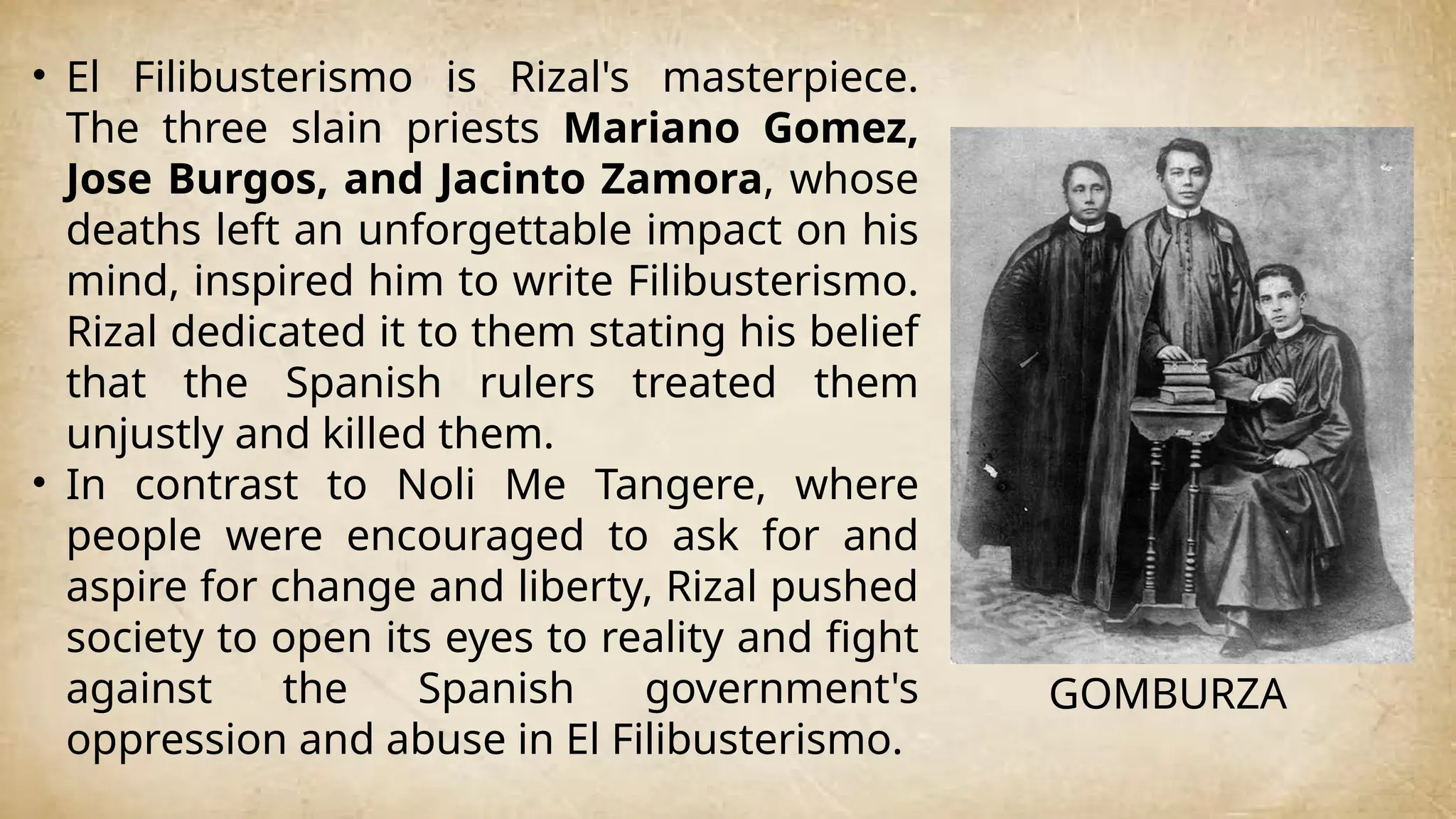
• El Filibusterismo is Rizal's masterpiece.
The three slain priests Mariano Gomez,
Jose Burgos, and Jacinto Zamora, whose
deaths left an unforgettable impact on his
mind, inspired him to write Filibusterismo.
Rizal dedicated it to them stating his belief
that the Spanish rulers treated them
unjustly and killed them.
• In contrast to Noli Me Tangere, where
people were encouraged to ask for and
aspire for change and liberty, Rizal pushed
society to open its eyes to reality and fight
against the Spanish government's
oppression and abuse in El Filibusterismo.
GOMBURZA
• El Filibusterismo (lit.) "filibustering" in Spanish: The
Subversive or Subversion, as in the English translation
the terrible execution of GomBurza in 1872 was the
first time it was heard.
• This term is used by Manila newspapers and
Spaniards to describe someone they want to label
as a revolutionary suspect.
• In the Philippines, the term "subversive" was coined.
• To expose the fake government's cruelties, graft,
and corruption, as well as to demonstrate the
wrongdoings of Filipinos that led to greater failure.
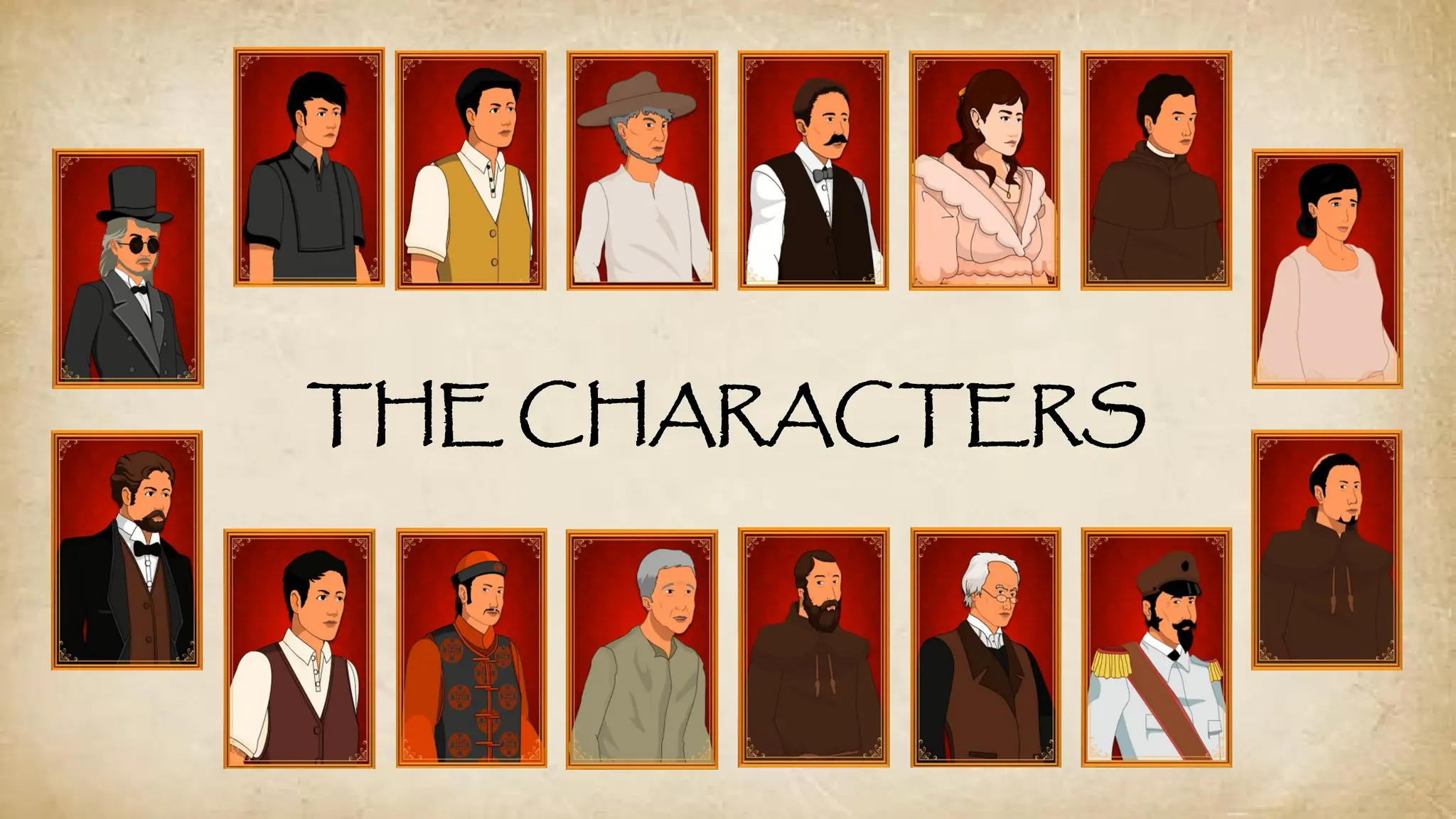
THE CHARACTERS
SIMOUN - The continuation of the character of
Crisostomo Ibarra disguised as a wealthy jeweler, bent
on starting a revolution. Using his wealth, he encouraged
the people who experienced abuse to join him in his
rebellion against the church and the government.
BASILIO - Sisa's son and was adopted by
Kapitan Tiago, boyfriend of Juli and an aspiring
doctor.
ISAGANI - poet and Basilio's best friend;
portrayed as emotional and reactive student
leader; Paulita Gómez' boyfriend before being
dumped for fellow student Juanito Pelaez.
KABESANG TALES - a former Cabeza de
Barangay (Barangay Head) who was known as a
Luzon bandit Matanglawin.
DON CUSTODIO - a famous "journalist" who was
asked by the students about his decision for the
Academia de Castellano. In reality, he was quite an
ordinary fellow who married a rich woman in order to be
a member of Manila's high society.
PAULITA GOMEZ - The girlfriend of Isagani and
the niece of Doña Victorina, the old India who passing
(racial identity) passes herself off as a Peninsulares. In the
end, she and Juanito Peláez were wed, and she
dumped Isagani, believing that she will have no future if
she marries him.
FATHER FLORENTINO - Isagani's godfather,
and a secular priest; was engaged to be married but
chose to be a priest after being pressured by his mother,
the story hinting at the ambivalence of his decision as he
chose.an assignment to a remote place, living in
solitude near the sea.
JULI - Juliana de Dios, the girlfriend of Basilio,
and the youngest daughter of Kabesang Tales.
BEN ZAYB - Abraham Ibañez is his real name.
He is a journalist who thought he was the "only"
one thinking in the Philippines.
PLACIDO PENITENTE - a student at the
University of Santo Tomas who was very intelligent
and wise but did not want, if not only by his
mother's plea, to pursue his studies.
QUIROGA - a Chinese businessman who
dreamt of being a consul of a "Consulate of
China“ in the Philippines. He kept Simoun's
weapons inside his house.
TANDANG SELO - Father of Kabesang
Tales. He raised the sick and young Basilio after
his mother Sisa had died.
FATHER FERNANDEZ - the priest-friend of
Isagani. He promised Isagani that he and the
other priests will give in to the students' demands.
ATTORNEY PASTA - one of the great
lawyers of mid-Hispanic Manila.
CAPTAIN GENERAL (no specific name) - the
powerful highest official in the Philippines.
PADRE SIBYLA - Hernando de la Sibyla, a
Filipino friar and now vice-rector of the University
of Santo Tomas.
SYNOPSIS
OF
EL FILIBUSTERISMO
The story in El Filibusterismo revolves around its main character
Simoun who is an affluent jeweler. Simoun is actually Crisostomo
Ibarra of the Noli whom everyone thought had been killed by the
Guardia Civil at Laguna de Bay. He had escaped, fled to Cuba,.
become wealthy and made connections with influential Spanish
officials. Upon his return to the Philippines after many years, he
becomes very influential as the governor general, who owes so
much to him, consults him in making decisions.
In reality however, everything Simoun does is just part of his grand
plan to take revenge against the Spanish officials and rescue
Maria Clara from the convent. Planning to stage a revolution, he
smuggles arms and looks for followers, mainly from the exploited
and abused natives.
One of his recruits is Basilio, the son of Sisa, who with
Capitan Tiago's help was able to study in Manila. Simoun
also makes an alliance with the revolutionary group of
Kabesang Tales, a former 'cabeza de barangay' who
suffered maltreatments from the hands of the friars. Using
his influence, Simoun encourages corruption,
decadence, and more oppressive government policies
so that the citizens may become more infuriated.
However, one night, the planned revolt was not carried
out because Simoun, upon hearing that Maria Clara
died in the nunnery, decided not to give the signal for
the outbreak of the uprising.
Another plan was made some months later. At the
venue of the wedding reception of Juanito Pelaez and
Paulita Gomez, Simoun planted many explosives-
enough to kill the invited guests, primarily the friars and
government officials. According to the plot, the big
explosion shall be started by the gift he would give to
the newlyweds at the reception-a kerosene lamp with
an
explosive. When the lamp flickers and- someone turns
the wick, it will result into a big explosion that will
become a signal to he revolutionary troops to
simultaneously attack all the government buildings in
Manila.
During the reception, Simoun gives his gift to the
newly- weds. Before hurriedly leaving the venue,
he leaves a piece of mysterious paper bearing the
message "You will die tonight" signed by Juan
Crisostomo Ibarra.
Meanwhile, Isagani, the rejected lover of Paulita,
is standing outside the reception. His friend Basilio
tells him to leave the place because the lamp will
soon blow up.
When Father Salvi identifies the handwriting in the note and
confirms that it was indeed Ibarra's, the guests begin to
panic. When the lamp flickers, Father Irene tries to turn the
wick up. But Isagani, wanting to save Paulita's life, rushes into
the house, grabs the lamp, and throws it into the river where
it explodes.
Simoun's revolutionary plot was discovered and he's
hunted by the Guardia Civil. He managed to escape but
was seriously wounded. Carrying his jewelry chest, he finds
shelter in the home of Padre Florentino. Learning of his
presence in the house of the priest, the lieutenant of the
Guardia Civil informs Padre Florentino that he will. come in
the evening to arrest Simoun.
Simoun then takes poison that he would not be caught
alive. As the poison's effects start to take toll on his body,
he confesses to Florentino his true identity and his plan of
revenge through bloody revolution. After the emotional
and agonizing confession of the dying man, the priest
absolves the dying man from his sins, saying: "God will
forgive you Señior Simoun." He knows that we are
fallilble. He has seen that you have suffered ... He has
frustrated your plans one by one … first by the death of
Maria Clara, then by a lack of preparation, then in some
mysterious way. Let us bow to His will and render Him
thanks!"
The story ends with the priest throwing Simon's treasures into
the sea so that they would not be used by the greedy. The
priest hopes that when the right time comes, they would be
recovered and used only for the good.
- The End of the Story

Plot-Summary-of-El-Filibusterismo-E163.pptx

  • 2.
  • 3.
    • Rizal's 2ndwork, intended as a sequel to Noli Me Tangere, was written in Spanish as well. • "The Reign of Greed“ English translation of El Filibusterismo • 38 chapters • In October 1887, Rizal started writing his second novel. • It was first published in 1891 in Ghent, Belgium.
  • 4.
    • El Filibusterismois Rizal's masterpiece. The three slain priests Mariano Gomez, Jose Burgos, and Jacinto Zamora, whose deaths left an unforgettable impact on his mind, inspired him to write Filibusterismo. Rizal dedicated it to them stating his belief that the Spanish rulers treated them unjustly and killed them. • In contrast to Noli Me Tangere, where people were encouraged to ask for and aspire for change and liberty, Rizal pushed society to open its eyes to reality and fight against the Spanish government's oppression and abuse in El Filibusterismo. GOMBURZA
  • 5.
    • El Filibusterismo(lit.) "filibustering" in Spanish: The Subversive or Subversion, as in the English translation the terrible execution of GomBurza in 1872 was the first time it was heard. • This term is used by Manila newspapers and Spaniards to describe someone they want to label as a revolutionary suspect. • In the Philippines, the term "subversive" was coined. • To expose the fake government's cruelties, graft, and corruption, as well as to demonstrate the wrongdoings of Filipinos that led to greater failure.
  • 8.
  • 9.
    SIMOUN - Thecontinuation of the character of Crisostomo Ibarra disguised as a wealthy jeweler, bent on starting a revolution. Using his wealth, he encouraged the people who experienced abuse to join him in his rebellion against the church and the government. BASILIO - Sisa's son and was adopted by Kapitan Tiago, boyfriend of Juli and an aspiring doctor.
  • 10.
    ISAGANI - poetand Basilio's best friend; portrayed as emotional and reactive student leader; Paulita Gómez' boyfriend before being dumped for fellow student Juanito Pelaez. KABESANG TALES - a former Cabeza de Barangay (Barangay Head) who was known as a Luzon bandit Matanglawin.
  • 11.
    DON CUSTODIO -a famous "journalist" who was asked by the students about his decision for the Academia de Castellano. In reality, he was quite an ordinary fellow who married a rich woman in order to be a member of Manila's high society. PAULITA GOMEZ - The girlfriend of Isagani and the niece of Doña Victorina, the old India who passing (racial identity) passes herself off as a Peninsulares. In the end, she and Juanito Peláez were wed, and she dumped Isagani, believing that she will have no future if she marries him.
  • 12.
    FATHER FLORENTINO -Isagani's godfather, and a secular priest; was engaged to be married but chose to be a priest after being pressured by his mother, the story hinting at the ambivalence of his decision as he chose.an assignment to a remote place, living in solitude near the sea. JULI - Juliana de Dios, the girlfriend of Basilio, and the youngest daughter of Kabesang Tales.
  • 13.
    BEN ZAYB -Abraham Ibañez is his real name. He is a journalist who thought he was the "only" one thinking in the Philippines. PLACIDO PENITENTE - a student at the University of Santo Tomas who was very intelligent and wise but did not want, if not only by his mother's plea, to pursue his studies.
  • 14.
    QUIROGA - aChinese businessman who dreamt of being a consul of a "Consulate of China“ in the Philippines. He kept Simoun's weapons inside his house. TANDANG SELO - Father of Kabesang Tales. He raised the sick and young Basilio after his mother Sisa had died.
  • 15.
    FATHER FERNANDEZ -the priest-friend of Isagani. He promised Isagani that he and the other priests will give in to the students' demands. ATTORNEY PASTA - one of the great lawyers of mid-Hispanic Manila.
  • 16.
    CAPTAIN GENERAL (nospecific name) - the powerful highest official in the Philippines. PADRE SIBYLA - Hernando de la Sibyla, a Filipino friar and now vice-rector of the University of Santo Tomas.
  • 17.
  • 18.
    The story inEl Filibusterismo revolves around its main character Simoun who is an affluent jeweler. Simoun is actually Crisostomo Ibarra of the Noli whom everyone thought had been killed by the Guardia Civil at Laguna de Bay. He had escaped, fled to Cuba,. become wealthy and made connections with influential Spanish officials. Upon his return to the Philippines after many years, he becomes very influential as the governor general, who owes so much to him, consults him in making decisions. In reality however, everything Simoun does is just part of his grand plan to take revenge against the Spanish officials and rescue Maria Clara from the convent. Planning to stage a revolution, he smuggles arms and looks for followers, mainly from the exploited and abused natives.
  • 19.
    One of hisrecruits is Basilio, the son of Sisa, who with Capitan Tiago's help was able to study in Manila. Simoun also makes an alliance with the revolutionary group of Kabesang Tales, a former 'cabeza de barangay' who suffered maltreatments from the hands of the friars. Using his influence, Simoun encourages corruption, decadence, and more oppressive government policies so that the citizens may become more infuriated. However, one night, the planned revolt was not carried out because Simoun, upon hearing that Maria Clara died in the nunnery, decided not to give the signal for the outbreak of the uprising.
  • 20.
    Another plan wasmade some months later. At the venue of the wedding reception of Juanito Pelaez and Paulita Gomez, Simoun planted many explosives- enough to kill the invited guests, primarily the friars and government officials. According to the plot, the big explosion shall be started by the gift he would give to the newlyweds at the reception-a kerosene lamp with an explosive. When the lamp flickers and- someone turns the wick, it will result into a big explosion that will become a signal to he revolutionary troops to simultaneously attack all the government buildings in Manila.
  • 21.
    During the reception,Simoun gives his gift to the newly- weds. Before hurriedly leaving the venue, he leaves a piece of mysterious paper bearing the message "You will die tonight" signed by Juan Crisostomo Ibarra. Meanwhile, Isagani, the rejected lover of Paulita, is standing outside the reception. His friend Basilio tells him to leave the place because the lamp will soon blow up.
  • 22.
    When Father Salviidentifies the handwriting in the note and confirms that it was indeed Ibarra's, the guests begin to panic. When the lamp flickers, Father Irene tries to turn the wick up. But Isagani, wanting to save Paulita's life, rushes into the house, grabs the lamp, and throws it into the river where it explodes. Simoun's revolutionary plot was discovered and he's hunted by the Guardia Civil. He managed to escape but was seriously wounded. Carrying his jewelry chest, he finds shelter in the home of Padre Florentino. Learning of his presence in the house of the priest, the lieutenant of the Guardia Civil informs Padre Florentino that he will. come in the evening to arrest Simoun.
  • 23.
    Simoun then takespoison that he would not be caught alive. As the poison's effects start to take toll on his body, he confesses to Florentino his true identity and his plan of revenge through bloody revolution. After the emotional and agonizing confession of the dying man, the priest absolves the dying man from his sins, saying: "God will forgive you Señior Simoun." He knows that we are fallilble. He has seen that you have suffered ... He has frustrated your plans one by one … first by the death of Maria Clara, then by a lack of preparation, then in some mysterious way. Let us bow to His will and render Him thanks!"
  • 24.
    The story endswith the priest throwing Simon's treasures into the sea so that they would not be used by the greedy. The priest hopes that when the right time comes, they would be recovered and used only for the good. - The End of the Story