Abstract
The	
   IT	
   world	
   is	
   a	
   complex	
   space	
   and	
  
companies	
   may	
   not	
   have	
   the	
   money	
   to	
  
completely	
   replace	
   all	
   of	
   their	
   systems.	
  
Therefore	
   we	
   need	
   solutions	
   to	
   optimize	
  
what	
   we	
   already	
   have.	
   This	
   white	
   paper	
  
examines	
   the	
   differences	
   between	
  
Greenfield	
  and	
  Brownfield	
  environments	
  –	
  
particularly	
   as	
   it	
   pertains	
   to	
   cloud	
  
migrations.	
  	
  
Introduction	
  
As	
  cloud	
  computing	
  gains	
  more	
  ground,	
  early-­‐
adopters	
   that	
   are	
   moving	
   their	
   infrastructure	
   into	
  
the	
   cloud	
   are	
   achieving	
   cost	
   savings	
   and	
   improved	
  
access	
   to	
   IT	
   systems.	
   The	
   migration	
   of	
   server	
  
workloads	
  from	
  on-­‐premise	
  environments	
  (physical	
  
or	
  virtual)	
  to	
  the	
  cloud	
  is	
  a	
  key	
  driver	
  of	
  technology	
  
spending.	
   	
  Morgan	
   Stanley	
   interviewed	
   300	
   IT	
  
decision-­‐makers	
   in	
   the	
   US,	
   Europe	
   and	
   Asia-­‐Pacific	
  
for	
   their	
   global	
   survey	
   on	
   cloud	
   migration.	
   Survey	
  
respondents	
  cited	
  server	
  hardware	
  as	
  the	
  primary	
  
area	
   of	
   savings	
   from	
   the	
   migration	
   to	
   cloud	
  
computing.	
  	
  
In	
   their	
   efforts	
   to	
   transition	
   to	
   the	
   cloud,	
   companies	
   may	
   decide	
   to	
   develop	
   new	
   cloud-­‐	
  
applications	
   or	
   to	
   migrate	
   their	
   existing	
   infrastructure	
   to	
   a	
   platform	
   provided	
   by	
   a	
   cloud	
   service	
  
provider.	
  The	
  real	
  challenge	
  is	
  that	
  the	
  second	
  approach	
  becomes	
  an	
  unknown	
  process,	
  with	
  a	
  lot	
  of	
  
workarounds	
   and	
   changes.	
   Systems	
   and	
   applications	
   can	
   be	
   newly	
   created,	
   but	
   businesses	
   need	
  
compatibility	
  and	
  continuity	
  of	
  existing	
  infrastructure.	
  This	
  raises	
  the	
  debate	
  between	
  greenfield	
  and	
  
brownfield	
  cloud	
  development.	


1
Migrating Into the Cloud:
The Brownfield vs.
Greenfield Opportunity
2
In	
   software	
   development,	
   greenfield	
   is	
   a	
   project	
   which	
   doesn’t	
   have	
   to	
   obey	
   constraints	
  
imposed	
   by	
   prior	
   work.	
   In	
   a	
   greenfield	
   environment	
   there	
   is	
   no	
   need	
   to	
   remodel	
   or	
   demolish	
   an	
  
existing	
   structure.	
   Brownfield	
   describes	
   the	
   deployment	
   of	
   existing	
   physical	
   and	
   virtual	
   servers	
  
workloads	
  into	
  new	
  cloud	
  environments.	
  
GREENFIELD	
  
20%	
  of	
  applications	
  are	
  delivered	
  on	
  
Greenfield	
   sites,	
   while	
   the	
   rest	
   of	
   80%	
   are	
  
Brownfield.	
   There	
   are	
   many	
   challenges	
  
when	
  performing	
  Greenfield	
  migrations	
  and	
  
any	
  Greenfield	
  development	
  is	
  to	
  become	
  a	
  
Brownfield	
   one	
   in	
   couple	
   of	
   months.	
  
Greefield	
   development	
   don’t	
   need	
   to	
   go	
  
through	
   a	
   lengthy	
   IT	
   process	
   to	
   locate	
  
available	
  enterprise	
  resources	
  and	
  lay	
  claim	
  
to	
   them,	
   or	
   for	
   that	
   matter	
   endure	
   a	
  
corporate	
   procurement	
   process.	
   Greenfield	
  
is	
   a	
   popular	
   way	
   to	
   describe	
   all-­‐new	
  
infrastructure	
   built	
   with	
   no	
   regard	
   for	
  
legacy	
  compatibility.	
  
In	
   networking,	
   a	
   greenfield	
  
deployment	
   is	
   the	
   installation	
   and	
  
configuration	
   of	
   a	
   network	
   where	
   one	
   did	
  
not	
   exist	
   before.	
   Greenfield	
   developments	
  
happen	
  when	
  you	
  start	
  a	
  brand	
  new	
  project;	
  
no	
  legacy	
  code	
  to	
  maintain	
  and	
  you	
  are	
  able	
  
to	
  start	
  fresh,	
  with	
  no	
  restrictions.	


Although	
  it	
  may	
  seem	
  easier	
  to	
  ripp	
  out	
  
and	
  replace	
  existing	
  systems,	
  companies	
  would	
  
see	
   the	
   benefit	
   in	
   continuity	
   with	
   existing	
  
infrastructure,	
   which	
   means	
   redevelopping	
  
applications.	
  	
  
Brownfield	
  
Most	
   businesses	
   already	
   have	
   a	
  
significant	
  and	
  complex	
  IT	
  environment.	
  Many	
  
already	
   have	
   some	
   type	
   of	
   server	
   or	
   cloud	
  
infrastructure	
   in	
   place,	
   meaning	
   they	
   fall	
   into	
  
the	
   Brownfield	
   category.	
   A	
   Brownfield	
  
deployment	
  is	
  an	
  upgrade	
  or	
  an	
  addition	
  to	
  an	
  
existing	
   structure.	
   Brownfield	
   development	
  
refers	
   to	
   the	
   deployment	
   of	
   systems,	
   servers	
  
and	
   applications	
   in	
   the	
   presence	
   of	
   other	
  
existing	
   software	
   applications/systems.	
   This	
  
implies	
   that	
   any	
   new	
   architecture	
   must	
   take	
  
into	
  account	
  and	
  coexist	
  with	
  already	
  existent	
  
software.	
  This	
  requires	
  a	
  detailed	
  knowledge	
  of	
  
the	
   systems,	
   services	
   and	
   data	
   in	
   the	
  
immediate	
   vicinity	
   of	
   the	
   application	
   under	
  
construction.	
  
Into	
   a	
   cloud	
  environment,	
   Brownfield	
  developments	
   happen	
   when	
   a	
  business	
   decides	
   to	
  
improve	
   upon	
   an	
   existing	
   application	
   infrastructure.	
   As	
   an	
   upgrade	
   is	
   implemented	
   into	
   an	
  
existing	
  solution,	
  the	
  development	
  is	
  said	
  to	
  be	
  Brownfield.	
  A	
  couple	
  of	
  months	
  after	
  any	
  type	
  of	
  IT	
  
asset	
  or	
  project	
  is	
  new	
  (Greenfield),	
  it	
  eventually	
  becomes	
  a	
  Brownfield.	
  	
  
How	
  Cloud	
  Migration	
  Helps	
  Greenfield	
  and	
  Brownfield	
  Environments	
  
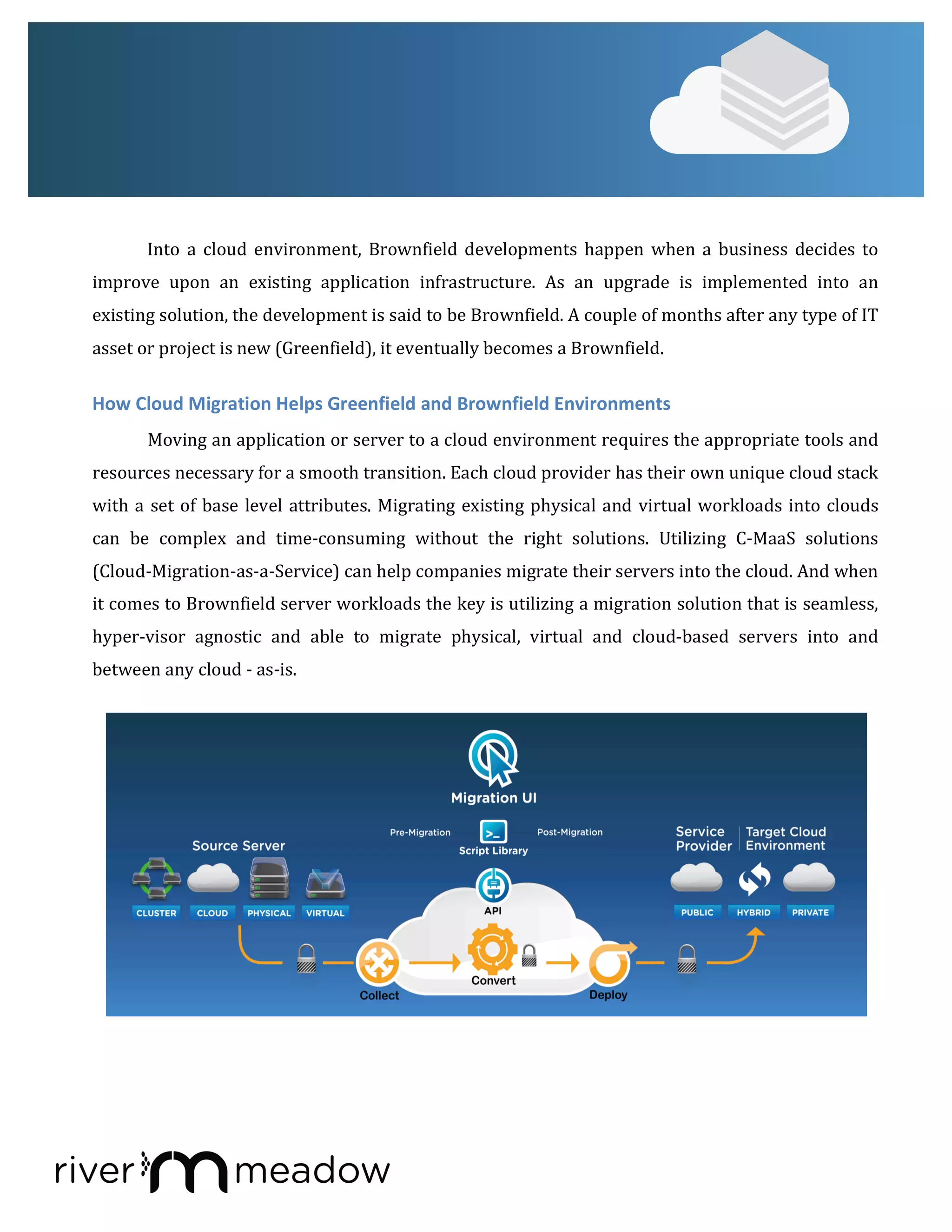
Moving	
  an	
  application	
  or	
  server	
  to	
  a	
  cloud	
  environment	
  requires	
  the	
  appropriate	
  tools	
  and	
  
resources	
  necessary	
  for	
  a	
  smooth	
  transition.	
  Each	
  cloud	
  provider	
  has	
  their	
  own	
  unique	
  cloud	
  stack	
  
with	
  a	
  set	
  of	
  base	
  level	
  attributes.	
  Migrating	
  existing	
  physical	
  and	
  virtual	
  workloads	
  into	
  clouds	
  
can	
   be	
   complex	
   and	
   time-­‐consuming	
   without	
   the	
   right	
   solutions.	
   Utilizing	
   C-­‐MaaS	
   solutions	
  
(Cloud-­‐Migration-­‐as-­‐a-­‐Service)	
  can	
  help	
  companies	
  migrate	
  their	
  servers	
  into	
  the	
  cloud.	
  And	
  when	
  
it	
  comes	
  to	
  Brownfield	
  server	
  workloads	
  the	
  key	
  is	
  utilizing	
  a	
  migration	
  solution	
  that	
  is	
  seamless,	
  
hyper-­‐visor	
   agnostic	
   and	
   able	
   to	
   migrate	
   physical,	
   virtual	
   and	
   cloud-­‐based	
   servers	
   into	
   and	
  
between	
  any	
  cloud	
  -­‐	
  as-­‐is.	


About	
  River	
  Meadow	
  
RiverMeadow Software Inc. develops industry-leading SaaS that automates the migration of
physical, virtual and cloud based servers (live and as-is) into and between public, private and
hybrid clouds. Our RiverMeadow cloud migration SaaS is a rapid cloud migration solution
developed specifically for Carrier and Service Provider Cloud IaaS platforms. Without having to
install agents or quiesce servers, the RiverMeadow SaaS dramatically reduces the cost and
complexity of cloud migration, enabling Carriers and Service Providers to quickly, easily and
cost-efficiently deliver the benefits of cloud elasticity to enterprise and SMB customers.
If you have any questions regarding your potential use of this solution, contact:
RiverMeadow Software, Inc.
East Coast
239 Littleton Road, Unit 4D
Westford, MA 01886
West Coast
25 Metro Drive, Suite 525
San Jose, CA 95110
P: (978) 467-4090
F: (978) 923-8673
E: sales@rivermeadow.com
Conclusions	
  
No	
  matter	
  what	
  your	
  industry,	
  businesses	
  today	
  are	
  tightening	
  budgets	
  and	
  looking	
  for	
  ways	
  
to	
  save.	
  IT	
  projects	
  in	
  particular,	
  can	
  have	
  cost,	
  time	
  and	
  resource	
  implications	
  that	
  are	
  challenging	
  
to	
  not	
  only	
  IT,	
  but	
  management	
  and	
  operations	
  as	
  well.	
  Having	
  the	
  ability	
  to	
  avoid	
  such	
  implications	
  
can	
  be	
  of	
  great	
  value	
  and	
  convenience.	
  	
  
For	
   cloud	
   service	
   providers,	
   a	
   seamless	
   and	
   automated	
   migration	
   solutions	
   would	
   help	
  
minimize	
   professional	
   service	
   costs	
   and	
   allow	
   for	
   faster	
   more	
   cost	
   effective	
   onboarding	
   of	
  
customers;	
  effectively	
  increasing	
  market	
  share	
  and	
  minimizing	
  cost	
  and	
  complexity.	
  
Cloud	
   computing	
   promises	
   reduced	
   IT	
   infrastructure	
   assets	
   and	
   processes	
   through	
   lower	
  
operational	
   expenses.	
   With	
   C-­‐MaaS	
   solutions,	
   server	
   workload	
   migrations	
   are	
   completed	
   in	
   a	
  
fraction	
  of	
  the	
  time	
  that	
  is	
  typically	
  needed	
  for	
  a	
  physical	
  to	
  virtual	
  conversion.	


Migrating Into the Cloud: The Brownfield vs. Greenfield Opportunity

  • 1.
    Abstract The   IT   world   is   a   complex   space   and   companies   may   not   have   the   money   to   completely   replace   all   of   their   systems.   Therefore   we   need   solutions   to   optimize   what   we   already   have.   This   white   paper   examines   the   differences   between   Greenfield  and  Brownfield  environments  –   particularly   as   it   pertains   to   cloud   migrations.     Introduction   As  cloud  computing  gains  more  ground,  early-­‐ adopters   that   are   moving   their   infrastructure   into   the   cloud   are   achieving   cost   savings   and   improved   access   to   IT   systems.   The   migration   of   server   workloads  from  on-­‐premise  environments  (physical   or  virtual)  to  the  cloud  is  a  key  driver  of  technology   spending.    Morgan   Stanley   interviewed   300   IT   decision-­‐makers   in   the   US,   Europe   and   Asia-­‐Pacific   for   their   global   survey   on   cloud   migration.   Survey   respondents  cited  server  hardware  as  the  primary   area   of   savings   from   the   migration   to   cloud   computing.     In   their   efforts   to   transition   to   the   cloud,   companies   may   decide   to   develop   new   cloud-­‐   applications   or   to   migrate   their   existing   infrastructure   to   a   platform   provided   by   a   cloud   service   provider.  The  real  challenge  is  that  the  second  approach  becomes  an  unknown  process,  with  a  lot  of   workarounds   and   changes.   Systems   and   applications   can   be   newly   created,   but   businesses   need   compatibility  and  continuity  of  existing  infrastructure.  This  raises  the  debate  between  greenfield  and   brownfield  cloud  development.     1 Migrating Into the Cloud: The Brownfield vs. Greenfield Opportunity 2
  • 2.
    In   software   development,   greenfield   is   a   project   which   doesn’t   have   to   obey   constraints   imposed   by   prior   work.   In   a   greenfield   environment   there   is   no   need   to   remodel   or   demolish   an   existing   structure.   Brownfield   describes   the   deployment   of   existing   physical   and   virtual   servers   workloads  into  new  cloud  environments.   GREENFIELD   20%  of  applications  are  delivered  on   Greenfield   sites,   while   the   rest   of   80%   are   Brownfield.   There   are   many   challenges   when  performing  Greenfield  migrations  and   any  Greenfield  development  is  to  become  a   Brownfield   one   in   couple   of   months.   Greefield   development   don’t   need   to   go   through   a   lengthy   IT   process   to   locate   available  enterprise  resources  and  lay  claim   to   them,   or   for   that   matter   endure   a   corporate   procurement   process.   Greenfield   is   a   popular   way   to   describe   all-­‐new   infrastructure   built   with   no   regard   for   legacy  compatibility.   In   networking,   a   greenfield   deployment   is   the   installation   and   configuration   of   a   network   where   one   did   not   exist   before.   Greenfield   developments   happen  when  you  start  a  brand  new  project;   no  legacy  code  to  maintain  and  you  are  able   to  start  fresh,  with  no  restrictions.     Although  it  may  seem  easier  to  ripp  out   and  replace  existing  systems,  companies  would   see   the   benefit   in   continuity   with   existing   infrastructure,   which   means   redevelopping   applications.     Brownfield   Most   businesses   already   have   a   significant  and  complex  IT  environment.  Many   already   have   some   type   of   server   or   cloud   infrastructure   in   place,   meaning   they   fall   into   the   Brownfield   category.   A   Brownfield   deployment  is  an  upgrade  or  an  addition  to  an   existing   structure.   Brownfield   development   refers   to   the   deployment   of   systems,   servers   and   applications   in   the   presence   of   other   existing   software   applications/systems.   This   implies   that   any   new   architecture   must   take   into  account  and  coexist  with  already  existent   software.  This  requires  a  detailed  knowledge  of   the   systems,   services   and   data   in   the   immediate   vicinity   of   the   application   under   construction.  
  • 3.
    Into   a   cloud  environment,   Brownfield  developments   happen   when   a  business   decides   to   improve   upon   an   existing   application   infrastructure.   As   an   upgrade   is   implemented   into   an   existing  solution,  the  development  is  said  to  be  Brownfield.  A  couple  of  months  after  any  type  of  IT   asset  or  project  is  new  (Greenfield),  it  eventually  becomes  a  Brownfield.     How  Cloud  Migration  Helps  Greenfield  and  Brownfield  Environments   Moving  an  application  or  server  to  a  cloud  environment  requires  the  appropriate  tools  and   resources  necessary  for  a  smooth  transition.  Each  cloud  provider  has  their  own  unique  cloud  stack   with  a  set  of  base  level  attributes.  Migrating  existing  physical  and  virtual  workloads  into  clouds   can   be   complex   and   time-­‐consuming   without   the   right   solutions.   Utilizing   C-­‐MaaS   solutions   (Cloud-­‐Migration-­‐as-­‐a-­‐Service)  can  help  companies  migrate  their  servers  into  the  cloud.  And  when   it  comes  to  Brownfield  server  workloads  the  key  is  utilizing  a  migration  solution  that  is  seamless,   hyper-­‐visor   agnostic   and   able   to   migrate   physical,   virtual   and   cloud-­‐based   servers   into   and   between  any  cloud  -­‐  as-­‐is.      
  • 4.
    About  River  Meadow   RiverMeadow Software Inc. develops industry-leading SaaS that automates the migration of physical, virtual and cloud based servers (live and as-is) into and between public, private and hybrid clouds. Our RiverMeadow cloud migration SaaS is a rapid cloud migration solution developed specifically for Carrier and Service Provider Cloud IaaS platforms. Without having to install agents or quiesce servers, the RiverMeadow SaaS dramatically reduces the cost and complexity of cloud migration, enabling Carriers and Service Providers to quickly, easily and cost-efficiently deliver the benefits of cloud elasticity to enterprise and SMB customers. If you have any questions regarding your potential use of this solution, contact: RiverMeadow Software, Inc. East Coast 239 Littleton Road, Unit 4D Westford, MA 01886 West Coast 25 Metro Drive, Suite 525 San Jose, CA 95110 P: (978) 467-4090 F: (978) 923-8673 E: sales@rivermeadow.com Conclusions   No  matter  what  your  industry,  businesses  today  are  tightening  budgets  and  looking  for  ways   to  save.  IT  projects  in  particular,  can  have  cost,  time  and  resource  implications  that  are  challenging   to  not  only  IT,  but  management  and  operations  as  well.  Having  the  ability  to  avoid  such  implications   can  be  of  great  value  and  convenience.     For   cloud   service   providers,   a   seamless   and   automated   migration   solutions   would   help   minimize   professional   service   costs   and   allow   for   faster   more   cost   effective   onboarding   of   customers;  effectively  increasing  market  share  and  minimizing  cost  and  complexity.   Cloud   computing   promises   reduced   IT   infrastructure   assets   and   processes   through   lower   operational   expenses.   With   C-­‐MaaS   solutions,   server   workload   migrations   are   completed   in   a   fraction  of  the  time  that  is  typically  needed  for  a  physical  to  virtual  conversion.