Rite Aid Case Analysis
Recommendations

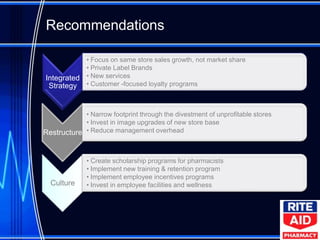
              • Focus on same store sales growth, not market share
              • Private Label Brands
Integrated    • New services
 Strategy     • Customer -focused loyalty programs


            • Narrow footprint through the divestment of unprofitable stores
            • Invest in image upgrades of new store base
Restructure • Reduce management overhead


              • Create scholarship programs for pharmacists
              • Implement new training & retention program
              • Implement employee incentives programs
  Culture     • Invest in employee facilities and wellness
Mission

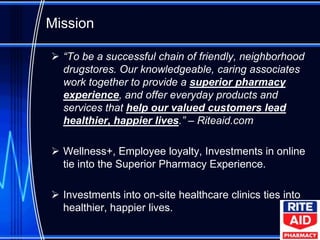
 “To be a successful chain of friendly, neighborhood
  drugstores. Our knowledgeable, caring associates
  work together to provide a superior pharmacy
  experience, and offer everyday products and
  services that help our valued customers lead
  healthier, happier lives.” – Riteaid.com

 Wellness+, Employee loyalty, Investments in online
  tie into the Superior Pharmacy Experience.

 Investments into on-site healthcare clinics ties into
  healthier, happier lives.
Core Values

   Passion for customers.
   Encouragement for employees.
   Winning through teamwork.
   Commitment to diversity and respect for the
    individual.
   Accountability for actions and results.
   Integrity in all Rite Aid does.
   Value for shareholders.
   Caring neighbors.
Business Model


 Growth
    Through acquisition of other pharmacy retailers.
    Diversified growth  Purchasing of PCS Health
     System.
 Create strategic partnerships
    Increase market presence and reach across
     various distribution channels.
    Ex: GNC & drugstore.com partnerships.
 Strong focus on customer loyalty.
Strategy:
  The Pharmaceutical Retail Industry.

 High bargaining power for
  wholesalers (Control 85% of all
  drugs sold).
 High bargaining power for
  buyers due to Pharmacy Benefit
  Managers and legislation.
 Strong rivalries between
  existing three major players.
 Substitutes to high margin
  brand names by generics.
Analysis / Assessment – Industry

 Types of pharmacies: independent, chain, mass
  merchants, supermarkets, and mail-order.
 Key Players: Walgreens, CVS, Medco, and Rite-Aid.
 Large customer base and opportunity for growth.
    Growing population of older consumers.
    Health care laws (40M previously uninsured).
 Highly competitive.
 Average profit margin for pharmacy-related sales is
  2-4%.
 Over $4.5B prescriptions were filled in US,
  accounting for $300B in total sales.
 Average # of prescriptions filled per person =
     12.6.
Overall Strategy - Past

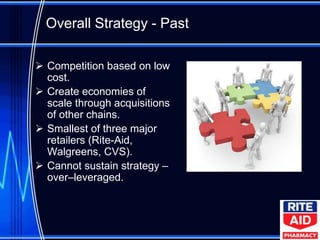
 Competition based on low
  cost.
 Create economies of
  scale through acquisitions
  of other chains.
 Smallest of three major
  retailers (Rite-Aid,
  Walgreens, CVS).
 Cannot sustain strategy –
  over–leveraged.
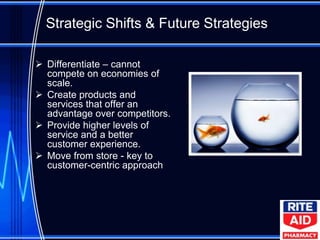
Strategic Shifts & Future Strategies

 Differentiate – cannot
  compete on economies of
  scale.
 Create products and
  services that offer an
  advantage over competitors.
 Provide higher levels of
  service and a better
  customer experience.
 Move from store - key to
  customer-centric approach
Industry Trends

 Consumers search for low-cost alternatives.
    Internet-based.
    Mail-order.
       Economies of scale, lower overhead  discounts.
    Automated.
    Generic drugs (80% of FDA-approved drugs have
     generic equivalent).
 Increased demand for:
    Prescription drugs.
    Pharmacists to spend more time on patient
     counseling.
    Walk-in clinics.
Portfolio Analysis

   Retail pharmacy services.
   Over-the-counter drugs.
   Household and personal care items.
   Convenience foods.
   Nutritional supplements.
   Photofinishing services.
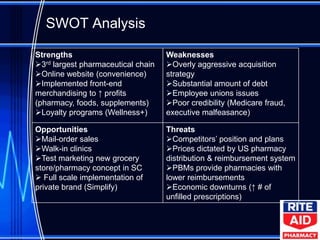
SWOT Analysis

Strengths                           Weaknesses
3rd largest pharmaceutical chain   Overly aggressive acquisition
Online website (convenience)       strategy
Implemented front-end              Substantial amount of debt
merchandising to ↑ profits          Employee unions issues
(pharmacy, foods, supplements)      Poor credibility (Medicare fraud,
Loyalty programs (Wellness+)       executive malfeasance)

Opportunities                       Threats
Mail-order sales                   Competitors’ position and plans
Walk-in clinics                    Prices dictated by US pharmacy
Test marketing new grocery         distribution & reimbursement system
store/pharmacy concept in SC        PBMs provide pharmacies with
 Full scale implementation of      lower reimbursements
private brand (Simplify)            Economic downturns (↑ # of
                                    unfilled prescriptions)
Financials

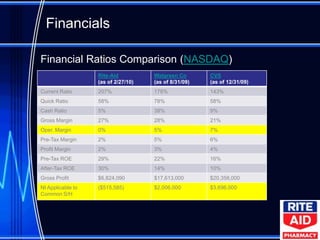
Financial Ratios Comparison (NASDAQ)
                   Rite-Aid          Walgreen Co       CVS
                   (as of 2/27/10)   (as of 8/31/09)   (as of 12/31/09)
Current Ratio      207%              178%              143%
Quick Ratio        58%               78%               58%
Cash Ratio         5%                38%               9%
Gross Margin       27%               28%               21%
Oper. Margin       0%                5%                7%
Pre-Tax Margin     2%                5%                6%
Profit Margin      2%                3%                4%
Pre-Tax ROE        29%               22%               16%
After-Tax ROE      30%               14%               10%
Gross Profit       $6,824,090        $17,613,000       $20,358,000
NI Applicable to   ($515,585)        $2,006,000        $3,696,000
Common S/H
Financials

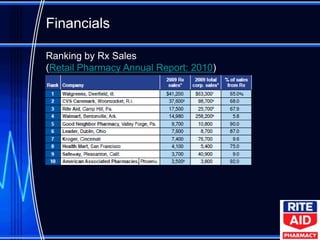
Ranking by Rx Sales
(Retail Pharmacy Annual Report: 2010)
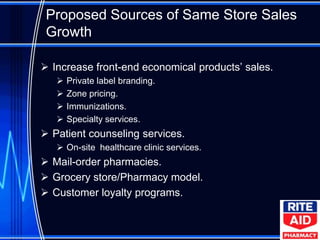
Proposed Sources of Same Store Sales
 Growth

 Increase front-end economical products’ sales.
      Private label branding.
      Zone pricing.
      Immunizations.
      Specialty services.
 Patient counseling services.
    On-site healthcare clinic services.
 Mail-order pharmacies.
 Grocery store/Pharmacy model.
 Customer loyalty programs.
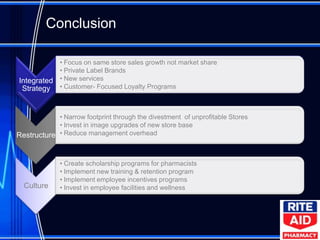
Conclusion

              • Focus on same store sales growth not market share
              • Private Label Brands
Integrated    • New services
 Strategy     • Customer- Focused Loyalty Programs


            • Narrow footprint through the divestment of unprofitable Stores
            • Invest in image upgrades of new store base
Restructure • Reduce management overhead


              • Create scholarship programs for pharmacists
              • Implement new training & retention program
              • Implement employee incentives programs
  Culture     • Invest in employee facilities and wellness
Questions?

Rite Aid

  • 1.
    Rite Aid CaseAnalysis
  • 2.
    Recommendations • Focus on same store sales growth, not market share • Private Label Brands Integrated • New services Strategy • Customer -focused loyalty programs • Narrow footprint through the divestment of unprofitable stores • Invest in image upgrades of new store base Restructure • Reduce management overhead • Create scholarship programs for pharmacists • Implement new training & retention program • Implement employee incentives programs Culture • Invest in employee facilities and wellness
  • 3.
    Mission  “To bea successful chain of friendly, neighborhood drugstores. Our knowledgeable, caring associates work together to provide a superior pharmacy experience, and offer everyday products and services that help our valued customers lead healthier, happier lives.” – Riteaid.com  Wellness+, Employee loyalty, Investments in online tie into the Superior Pharmacy Experience.  Investments into on-site healthcare clinics ties into healthier, happier lives.
  • 4.
    Core Values  Passion for customers.  Encouragement for employees.  Winning through teamwork.  Commitment to diversity and respect for the individual.  Accountability for actions and results.  Integrity in all Rite Aid does.  Value for shareholders.  Caring neighbors.
  • 5.
    Business Model  Growth  Through acquisition of other pharmacy retailers.  Diversified growth  Purchasing of PCS Health System.  Create strategic partnerships  Increase market presence and reach across various distribution channels.  Ex: GNC & drugstore.com partnerships.  Strong focus on customer loyalty.
  • 6.
    Strategy: ThePharmaceutical Retail Industry.  High bargaining power for wholesalers (Control 85% of all drugs sold).  High bargaining power for buyers due to Pharmacy Benefit Managers and legislation.  Strong rivalries between existing three major players.  Substitutes to high margin brand names by generics.
  • 7.
    Analysis / Assessment– Industry  Types of pharmacies: independent, chain, mass merchants, supermarkets, and mail-order.  Key Players: Walgreens, CVS, Medco, and Rite-Aid.  Large customer base and opportunity for growth.  Growing population of older consumers.  Health care laws (40M previously uninsured).  Highly competitive.  Average profit margin for pharmacy-related sales is 2-4%.  Over $4.5B prescriptions were filled in US, accounting for $300B in total sales.  Average # of prescriptions filled per person =  12.6.
  • 8.
    Overall Strategy -Past  Competition based on low cost.  Create economies of scale through acquisitions of other chains.  Smallest of three major retailers (Rite-Aid, Walgreens, CVS).  Cannot sustain strategy – over–leveraged.
  • 9.
    Strategic Shifts &Future Strategies  Differentiate – cannot compete on economies of scale.  Create products and services that offer an advantage over competitors.  Provide higher levels of service and a better customer experience.  Move from store - key to customer-centric approach
  • 10.
    Industry Trends  Consumerssearch for low-cost alternatives.  Internet-based.  Mail-order.  Economies of scale, lower overhead  discounts.  Automated.  Generic drugs (80% of FDA-approved drugs have generic equivalent).  Increased demand for:  Prescription drugs.  Pharmacists to spend more time on patient counseling.  Walk-in clinics.
  • 11.
    Portfolio Analysis  Retail pharmacy services.  Over-the-counter drugs.  Household and personal care items.  Convenience foods.  Nutritional supplements.  Photofinishing services.
  • 12.
    SWOT Analysis Strengths Weaknesses 3rd largest pharmaceutical chain Overly aggressive acquisition Online website (convenience) strategy Implemented front-end Substantial amount of debt merchandising to ↑ profits Employee unions issues (pharmacy, foods, supplements) Poor credibility (Medicare fraud, Loyalty programs (Wellness+) executive malfeasance) Opportunities Threats Mail-order sales Competitors’ position and plans Walk-in clinics Prices dictated by US pharmacy Test marketing new grocery distribution & reimbursement system store/pharmacy concept in SC PBMs provide pharmacies with  Full scale implementation of lower reimbursements private brand (Simplify) Economic downturns (↑ # of unfilled prescriptions)
  • 13.
    Financials Financial Ratios Comparison(NASDAQ) Rite-Aid Walgreen Co CVS (as of 2/27/10) (as of 8/31/09) (as of 12/31/09) Current Ratio 207% 178% 143% Quick Ratio 58% 78% 58% Cash Ratio 5% 38% 9% Gross Margin 27% 28% 21% Oper. Margin 0% 5% 7% Pre-Tax Margin 2% 5% 6% Profit Margin 2% 3% 4% Pre-Tax ROE 29% 22% 16% After-Tax ROE 30% 14% 10% Gross Profit $6,824,090 $17,613,000 $20,358,000 NI Applicable to ($515,585) $2,006,000 $3,696,000 Common S/H
  • 14.
    Financials Ranking by RxSales (Retail Pharmacy Annual Report: 2010)
  • 15.
    Proposed Sources ofSame Store Sales Growth  Increase front-end economical products’ sales.  Private label branding.  Zone pricing.  Immunizations.  Specialty services.  Patient counseling services.  On-site healthcare clinic services.  Mail-order pharmacies.  Grocery store/Pharmacy model.  Customer loyalty programs.
  • 16.
    Conclusion • Focus on same store sales growth not market share • Private Label Brands Integrated • New services Strategy • Customer- Focused Loyalty Programs • Narrow footprint through the divestment of unprofitable Stores • Invest in image upgrades of new store base Restructure • Reduce management overhead • Create scholarship programs for pharmacists • Implement new training & retention program • Implement employee incentives programs Culture • Invest in employee facilities and wellness
  • 17.

Editor's Notes

  • #7 - High barriers to entry due to large amounts of stores required to gain volumes.
  • #10 Need to talk about examples of dif products to integrate?
  • #12 List of Rite-Aid’s current (at time of the case) product offerings.
  • #13 Pharmacy benefits managers - integrated into reimbursement cycle as a ways to reduce prescription drug costs-Financed by manufacturers and 3rd party payers->70% of prescription benefits are managed by PBMs-To make up difference of the discounts provided to 3rd-party payers PBMs provide pharmacies with lower reimbursements, the difference between these two values being the spread –significant revenue stream for PBMs
  • #14 Ranking by Rx Sales (Retail Pharmacy Annual Report)http://www.drugstorenews.com/retail-pharmacy-annual-report-2010 Comparisons:http://www.nasdaq.com/symbol/cvs/financials http://www.nasdaq.com/symbol/wag/financialshttp://www.nasdaq.com/symbol/rad/financials
  • #15 Total Retail Sales for Prescription Drugs Filled at Pharmacies
  • #16 -Zone pricing: Setting prices for goods or services based on the location where they will be sold, Usually increase prices in zones farther away from manufacturing facilities to account for higher transport costsPatient counseling services-Estimated to be 6000 of these clinics by 2012-Serve as convenient and affordable alternative to a doctor’s office or hospital visit (on average about $60/visit, 47 million uninsured in the US)-Dominated by CVS and Walgreens-CVS is the leader – 500 in-store MinuteClinics; Walgreens – 350 Take Care clinics.Mail-order pharmacies-More efficient and have more economies of scale than the traditional brick-and-mortar pharmacy-Lower overheard – Less staff, rely heavily on automation and computers to enhance their daily fill capabilities-Are able to buy and dispense medications in bulk for patients who have ongoing meds requirements (Providers can offer discounts to patients because of this)-Big challenge to the traditional pharmacy-More and more companies are mandating that maintenance medications be filled through mail-order (Maintenance meds are currently 50-60% of volume filled by retail pharmacies) Grocery store/Pharmacy model-Testing a new grocery store/pharmacy concept with 10 stores in South Carolina (licensing agreement with Sav-A-Lot stores).Customer loyalty programs-Wellness +-Gift of Savings at holidays