Risk Perception of COVID-19
Prepared by
Tengku Hanidza Tengku Ismail, PhD
Public Opinion on Coronavirus:
Understanding COVID-19 from the
perspective of people and society
Perception: Different ways we interpret things
that we see and feel
Two
faces
vase
I am
right!
21/4/2020 risk perception COVID-19/Tengku Hanidza 2
It’s like Thanos snapping his
fingers. People we know are
disappearing”
(A Wuhan young resident talking
out people who died in Wuhan due
to COVID-19,
only to be known after
lifting of lockdown on April 8)
Thanos is a Marvel character
that has the ability to swipe out
lives with the snap of his fingers
21/4/2020
risk perception COVID-19/Tengku Hanidza
3
The Importance of Risk Perception
21/4/2020 risk perception COVID-19/Tengku Hanidza 4
• In the early phases of a possible epidemic, compliance to
precautionary behaviours among the populations at risk is often
the only means of prevention of a further spread of the disease
• Effective management of new epidemic infectious disease risks in
the phase that no treatment or vaccination is yet possible is
largely dependent on precautionary behavior of the population.
• Implementation of precautionary behavior is largely dependent
on effective risk communication, i.e. communication that induces
realistic risk perceptions, correct knowledge and skills to promote
and enable precautionary practices. Scientific knowledge about
these topics in the area of infectious disease control is scarce.
• For people to voluntarily engage in precautionary actions, they
first of all need to be aware of the risk.
This is the situation
right now we are
dealing with COVID-
19
Since COVID-19 is
novel, we learn new
things each day as the
world ride the COVID-
19 pandemic
Treatment is by trial
and error
COVID-19 vaccine is
not possible till 2021
In earlier stage of
outbreak and even
after WHO declare
COVID_19 as
pandemic, people do
not take is seriously21/4/2020 risk perception COVID-19/Tengku Hanidza 5
• Unwarranted high-risk perceptions may lead
to unnecessary mass scares, and are often
combined with stigmatization of specific risk
groups.
• Risk communication messages that are not
comprehended by the public at risk, or
communication of conflicting risk messages
will result in lack of precautionary actions.
• Communications that are perceived as coming
from a non-trustworthy source may have the
same results.
Since COVID-19
outbreak,, they was
increase in verbal abuse
against ‘Chinese looking’
people
Datuk Dr Noor Hisham Abdullah
(Malaysia), Dr. Anthony Fauci
(USA), and Ashley Bloomfield (NZ)
has been named “top doctors” by
China Global TV Network for their
competency in handling the Covid-
19 pandemic. They are “calm,
clear and trustworthy” sources of
information to their countrymen.
21/4/2020 risk perception COVID-19/Tengku Hanidza 6
IS IT IMPORTANT TO KNOW
PUBLIC OPINION? Examining
the TRUST and FEAR factors
during COVID-19 crisis
21/4/2020 risk perception COVID-19/Tengku Hanidza 7
21/4/2020 risk perception COVID-19/Tengku Hanidza 8
What do we mean by trust in government during
COVID-19 crisis?
• Trust in government represents confidence of citizens in the actions of
a “government to do what is right and perceived fair.” It is a subjective
matter, reflected in the “eyes of the beholder” that matters especially to
the extent that it shapes behaviour.
• Trust in government could improve compliance with rules and
regulations and reduce the cost of enforcement.
• Trust is based on perception, measured by perception surveys.
(Source: TRUST IN GOVERNMENT, POLICY EFFECTIVENESS AND THE GOVERNANCE AGENDA, OECD, 2013)
21/4/2020 risk perception COVID-19/Tengku Hanidza 9
“Calm, Clear and Trustworthy”
The faces of their country's response to Covid-19: How the
public perceive them.
A“trusted face” by Malaysians
Low-key image and
unassuming air
“We are lucky to have him”
Rely on facts and figures to
make decisions and inform
the public
“Bulkwark against confusion“
“warrior, an "inspiration", and
a "true hero of the country".
People are “worried” whenever
they don’t see him during White
House briefings
Voices of reason and sources of
calm and reassurance in often
conflicting messages
“America’s coronavirus crush”
“national treasure”
Get him voted as People
Magazine’s Sexiest Man Alive
2020.
Low key ways
“Mild-mannered health care
hero"
“Diligent” and “clear” responses
when speaking to the press
Petitioning to be named “New
Zealander of the Year”.
21/4/2020 risk perception COVID-19/Tengku Hanidza 10
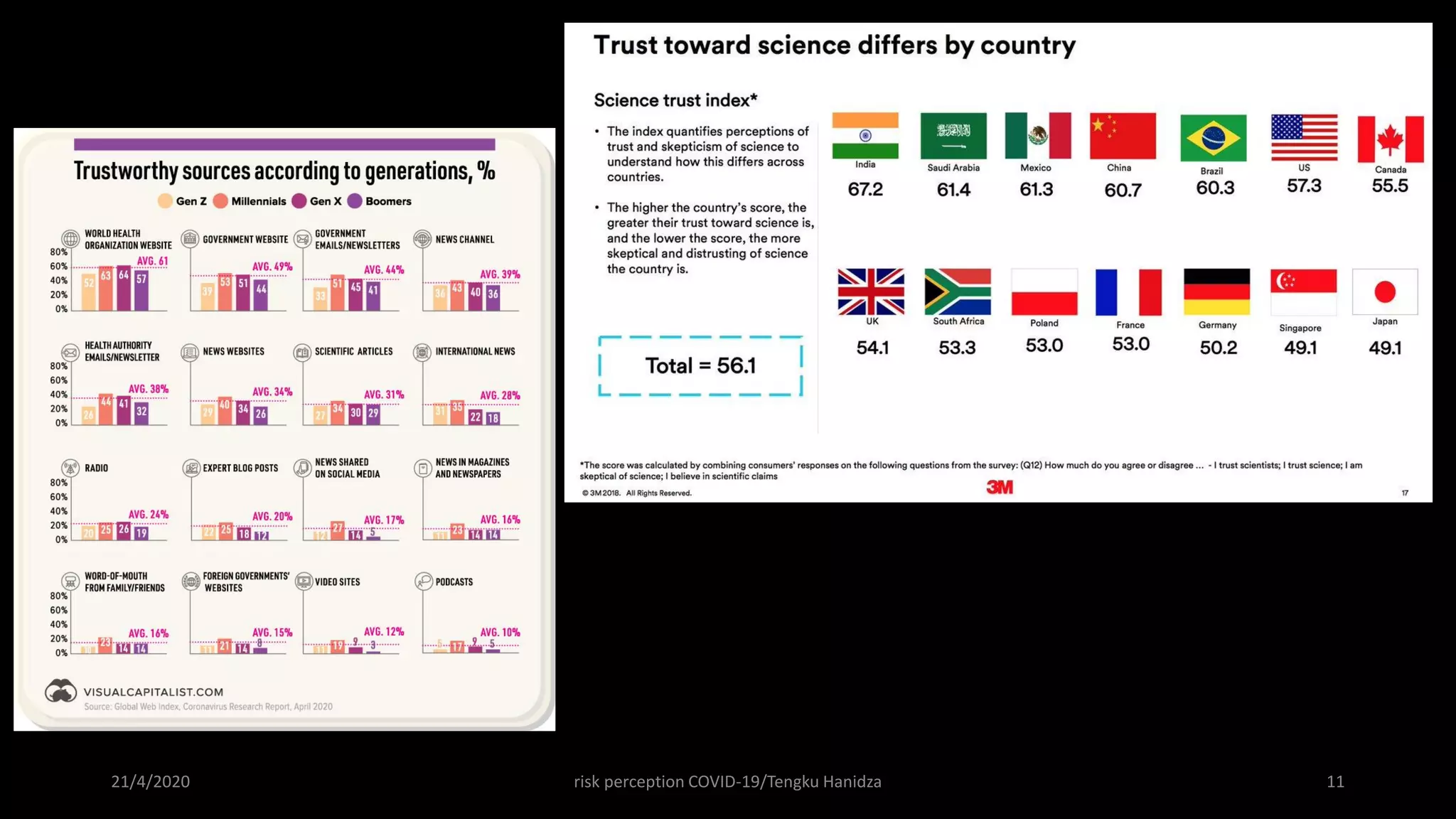
21/4/2020 risk perception COVID-19/Tengku Hanidza 11
Scientific studies on COVID-19 public perceptions surveys
• Measuring world wide COVID-19: Attitude and Beliefs (Covid-19
survey.com
• Understanding COVID-19 risk perception (Europe J Inf Dis Surv Epi
Prev Control)
• Tracking UK Public perception (Ipsos.com)
• Statistica.com
• Pew Research Center (USA)
• RTI International (USA)
• Malaysia (Min. of Health, Department of Statistics)
21/4/2020 risk perception COVID-19/Tengku Hanidza 12
Figures only show countries with at least 200 respondents
each.
Data collected between March 20th and March 30th 2020.
All averages are weighted by country-population age and
gender (weighting in terms of income and education to be
added soon)
21/4/2020 risk perception COVID-19/Tengku Hanidza 13
What happens when citizens don’t trust their government?
21/4/2020 risk perception COVID-19/Tengku Hanidza 14
How factually truthful do you
think your country's government
has been about the coronavirus
outbreak?
CHN
ITA
UK
SG
USA
IND
MY
SPN
Political trust
21/4/2020 risk perception COVID-19/Tengku Hanidza 15
How much do you trust your country’s
government to take care of its citizens?
UK
ITA
CHN
USA
MY
SG
IND
SPN
Political trust
21/4/2020 risk perception COVID-19/Tengku Hanidza 16
Do you think the reaction of your
country’s government to the current
coronavirus outbreak is appropriate,
too extreme, or not sufficient?
CHN
ITA
SG
MY
SPN
UK
IND
USA
Political trust
21/4/2020 risk perception COVID-19/Tengku Hanidza 17
Political trust
21/4/2020 risk perception COVID-19/Tengku Hanidza 18
The MCO effectiveness depends on the extent
to which people see them as fair and legitimate
enough to outweigh the benefits of non-
compliance.
A decline in trust can lead to lower rates of
compliance with rules and regulations.
How much citizens and businesses are trusted
by government is reflected in how government
functions and how public services are organized
as well as their efficiency and effectiveness –
e.g. the use of self-regulation and self-
monitoring
Political trust
21/4/2020 risk perception COVID-19/Tengku Hanidza 19
Do you think the reaction of
your country’s public is
appropriate, too extreme, or
not sufficient?
SPN
ITA
CHN
SG
UK
USA
IND
MY
Social trust
21/4/2020 risk perception COVID-19/Tengku Hanidza 20
The FEAR
factor
will it affect
change in
behavior?
21/4/2020 risk perception COVID-19/Tengku Hanidza 21
FEAR/SCARE/THREAT factor
21/4/2020 risk perception COVID-19/Tengku Hanidza 22
FEAR/SCARE/THREAT factor
21/4/2020 risk perception COVID-19/Tengku Hanidza 23
FEAR/SCARE/THREAT factor
21/4/2020 risk perception COVID-19/Tengku Hanidza 24
Take note of the disparity between age and gender groups
21/4/2020 risk perception COVID-19/Tengku Hanidza 25
FEAR/SCARE/THREAT factor
21/4/2020 risk perception COVID-19/Tengku Hanidza 26
FEAR/SCARE/THREAT factor
21/4/2020 risk perception COVID-19/Tengku Hanidza 27
FEAR/SCARE/THREAT factor
21/4/2020 risk perception COVID-19/Tengku Hanidza 28
FEAR/SCARE/THREAT factor
Are we willing to change our behaviour to
fight COVID-19 infection?
The surveys say…….
21/4/2020 risk perception COVID-19/Tengku Hanidza 29
21/4/2020 risk perception COVID-19/Tengku Hanidza 30
21/4/2020 risk perception COVID-19/Tengku Hanidza 31
21/4/2020 risk perception COVID-19/Tengku Hanidza 32
21/4/2020 risk perception COVID-19/Tengku Hanidza 33
How effective are social distancing
measures (e.g., through a general curfew)
to slow down the spread of the coronavirus?
USA
CHN
ITA
IND
SPN
MY UK
SG
21/4/2020 risk perception COVID-19/Tengku Hanidza 34
How do we communicate health crisis information on
COVID-19? Are we informed citizen?
The perception of risk among affected populations often differs from that of
experts and authorities. Effective risk communication and community
engagement can help bridge that gap by determining what people know,
how they feel, and what they do in response to disease outbreaks, as well
as what they ought to know and do to bring the outbreak under control.
Effective risk communication and community engagement helps transform
and deliver complex scientific knowledge so that it is understood by,
accessible to, and trusted by populations and communities.
People have the right to be informed about and understand the health
risks that they and their loved ones face (WHO, Mar 19).
21/4/2020 risk perception COVID-19/Tengku Hanidza 35
Six guiding principles for crisis communication (CDC):
(1) Be first: provide information as soon as possible or, if not possible,
explain how you are working to get it and when.
(2) Be right: tell people what you know when you know it, tell them
what you don't know, and tell them if you will know later.
(3) Be credible: tell the truth.
(4) Express empathy: acknowledge what people are feeling.
(5) Promote action: give people relevant things to do.
(6) Show respect: involve stakeholders in decision making processes
and try to meet media deadlines.
21/4/2020 risk perception COVID-19/Tengku Hanidza 36
The roles of media/press and social media on COVID-19 information dissemination
21/4/2020 risk perception COVID-19/Tengku Hanidza 37
The power of social media – with its astounding reach and
lack of filters – is surging.
21/4/2020 risk perception COVID-19/Tengku Hanidza 38
Messages that convey a moral
imperative for people to act and
messages that evoke strong
emotional reactions are more likely
to be and
Social media messaging by
authorities may not be beneficial
for knowledge, can reduce
perceptions of credibility and may
increase focus on panic and
uncertainty
A strong tendency for news outlets
to focus on information and
explanation, with little coverage of
expressions of empathy.
The roles of media/press and social media on COVID-19 information dissemination
21/4/2020 risk perception COVID-19/Tengku Hanidza 39
Social media has proved
effective not effective for
official communication
during outbreaks?
Offers potential for rapid
information dissemination.
Information more likely to
experience fear and anger?
21/4/2020 risk perception COVID-19/Tengku Hanidza 40
21/4/2020 risk perception COVID-19/Tengku Hanidza 41
21/4/2020 risk perception COVID-19/Tengku Hanidza 42
• Each person’s chance of contracting the virus
depends not only on their own behavior, but also
on the behavior of their fellow citizens. The
behavior is about “we” and “us” rather than “I” or
“you”.
• Ongoing scientific debate about whether ‘fear
appeals’ generate long-term behavior change.
• Evidence shows that ‘empathy appeals’ can have
positive impacts on behavior change
• Downplaying risk may undermine efforts to
change behavior, but overstating it could increase
economic and social costs
21/4/2020 risk perception COVID-19/Tengku Hanidza 43
The behaviors of the public are important for
outbreak management, particularly during the
early phase when no treatment or vaccination
is available and non pharmaceutical
interventions are the only options. The
efficacy of non pharmaceutical interventions
depends on persons’ degree of engagement
and compliance in precautionary behaviors,
such as face-mask wearing, hand hygiene,
and self-isolation. Willingness to engage in
precautionary behaviors voluntarily depends
on risk perception toward the current health
threat. In fact, risk perception is a main theme
in common health behavior theories
How society respond to COVID-19 crisis: The CLD
(Causal Loop Diagram) Model
21/4/2020 risk perception COVID-19/Tengku Hanidza 44
An integrated approach to preventing and responding to COVID-19
The approach LOOKS
COMPLICATED
but
it is EASIER to
UNDERSTAND because
we are DOING IT right
now in battling COVID-19
Lets break it down ….
21/4/2020 risk perception COVID-19/Tengku Hanidza 45
21/4/2020 risk perception COVID-19/Tengku Hanidza 46
21/4/2020 risk perception COVID-19/Tengku Hanidza 47
21/4/2020 risk perception COVID-19/Tengku Hanidza 48

Risk perception of covid 19

  • 1.
    Risk Perception ofCOVID-19 Prepared by Tengku Hanidza Tengku Ismail, PhD Public Opinion on Coronavirus: Understanding COVID-19 from the perspective of people and society
  • 2.
    Perception: Different wayswe interpret things that we see and feel Two faces vase I am right! 21/4/2020 risk perception COVID-19/Tengku Hanidza 2
  • 3.
    It’s like Thanossnapping his fingers. People we know are disappearing” (A Wuhan young resident talking out people who died in Wuhan due to COVID-19, only to be known after lifting of lockdown on April 8) Thanos is a Marvel character that has the ability to swipe out lives with the snap of his fingers 21/4/2020 risk perception COVID-19/Tengku Hanidza 3
  • 4.
    The Importance ofRisk Perception 21/4/2020 risk perception COVID-19/Tengku Hanidza 4
  • 5.
    • In theearly phases of a possible epidemic, compliance to precautionary behaviours among the populations at risk is often the only means of prevention of a further spread of the disease • Effective management of new epidemic infectious disease risks in the phase that no treatment or vaccination is yet possible is largely dependent on precautionary behavior of the population. • Implementation of precautionary behavior is largely dependent on effective risk communication, i.e. communication that induces realistic risk perceptions, correct knowledge and skills to promote and enable precautionary practices. Scientific knowledge about these topics in the area of infectious disease control is scarce. • For people to voluntarily engage in precautionary actions, they first of all need to be aware of the risk. This is the situation right now we are dealing with COVID- 19 Since COVID-19 is novel, we learn new things each day as the world ride the COVID- 19 pandemic Treatment is by trial and error COVID-19 vaccine is not possible till 2021 In earlier stage of outbreak and even after WHO declare COVID_19 as pandemic, people do not take is seriously21/4/2020 risk perception COVID-19/Tengku Hanidza 5
  • 6.
    • Unwarranted high-riskperceptions may lead to unnecessary mass scares, and are often combined with stigmatization of specific risk groups. • Risk communication messages that are not comprehended by the public at risk, or communication of conflicting risk messages will result in lack of precautionary actions. • Communications that are perceived as coming from a non-trustworthy source may have the same results. Since COVID-19 outbreak,, they was increase in verbal abuse against ‘Chinese looking’ people Datuk Dr Noor Hisham Abdullah (Malaysia), Dr. Anthony Fauci (USA), and Ashley Bloomfield (NZ) has been named “top doctors” by China Global TV Network for their competency in handling the Covid- 19 pandemic. They are “calm, clear and trustworthy” sources of information to their countrymen. 21/4/2020 risk perception COVID-19/Tengku Hanidza 6
  • 7.
    IS IT IMPORTANTTO KNOW PUBLIC OPINION? Examining the TRUST and FEAR factors during COVID-19 crisis 21/4/2020 risk perception COVID-19/Tengku Hanidza 7
  • 8.
    21/4/2020 risk perceptionCOVID-19/Tengku Hanidza 8
  • 9.
    What do wemean by trust in government during COVID-19 crisis? • Trust in government represents confidence of citizens in the actions of a “government to do what is right and perceived fair.” It is a subjective matter, reflected in the “eyes of the beholder” that matters especially to the extent that it shapes behaviour. • Trust in government could improve compliance with rules and regulations and reduce the cost of enforcement. • Trust is based on perception, measured by perception surveys. (Source: TRUST IN GOVERNMENT, POLICY EFFECTIVENESS AND THE GOVERNANCE AGENDA, OECD, 2013) 21/4/2020 risk perception COVID-19/Tengku Hanidza 9
  • 10.
    “Calm, Clear andTrustworthy” The faces of their country's response to Covid-19: How the public perceive them. A“trusted face” by Malaysians Low-key image and unassuming air “We are lucky to have him” Rely on facts and figures to make decisions and inform the public “Bulkwark against confusion“ “warrior, an "inspiration", and a "true hero of the country". People are “worried” whenever they don’t see him during White House briefings Voices of reason and sources of calm and reassurance in often conflicting messages “America’s coronavirus crush” “national treasure” Get him voted as People Magazine’s Sexiest Man Alive 2020. Low key ways “Mild-mannered health care hero" “Diligent” and “clear” responses when speaking to the press Petitioning to be named “New Zealander of the Year”. 21/4/2020 risk perception COVID-19/Tengku Hanidza 10
  • 11.
    21/4/2020 risk perceptionCOVID-19/Tengku Hanidza 11
  • 12.
    Scientific studies onCOVID-19 public perceptions surveys • Measuring world wide COVID-19: Attitude and Beliefs (Covid-19 survey.com • Understanding COVID-19 risk perception (Europe J Inf Dis Surv Epi Prev Control) • Tracking UK Public perception (Ipsos.com) • Statistica.com • Pew Research Center (USA) • RTI International (USA) • Malaysia (Min. of Health, Department of Statistics) 21/4/2020 risk perception COVID-19/Tengku Hanidza 12
  • 13.
    Figures only showcountries with at least 200 respondents each. Data collected between March 20th and March 30th 2020. All averages are weighted by country-population age and gender (weighting in terms of income and education to be added soon) 21/4/2020 risk perception COVID-19/Tengku Hanidza 13
  • 14.
    What happens whencitizens don’t trust their government? 21/4/2020 risk perception COVID-19/Tengku Hanidza 14
  • 15.
    How factually truthfuldo you think your country's government has been about the coronavirus outbreak? CHN ITA UK SG USA IND MY SPN Political trust 21/4/2020 risk perception COVID-19/Tengku Hanidza 15
  • 16.
    How much doyou trust your country’s government to take care of its citizens? UK ITA CHN USA MY SG IND SPN Political trust 21/4/2020 risk perception COVID-19/Tengku Hanidza 16
  • 17.
    Do you thinkthe reaction of your country’s government to the current coronavirus outbreak is appropriate, too extreme, or not sufficient? CHN ITA SG MY SPN UK IND USA Political trust 21/4/2020 risk perception COVID-19/Tengku Hanidza 17
  • 18.
    Political trust 21/4/2020 riskperception COVID-19/Tengku Hanidza 18
  • 19.
    The MCO effectivenessdepends on the extent to which people see them as fair and legitimate enough to outweigh the benefits of non- compliance. A decline in trust can lead to lower rates of compliance with rules and regulations. How much citizens and businesses are trusted by government is reflected in how government functions and how public services are organized as well as their efficiency and effectiveness – e.g. the use of self-regulation and self- monitoring Political trust 21/4/2020 risk perception COVID-19/Tengku Hanidza 19
  • 20.
    Do you thinkthe reaction of your country’s public is appropriate, too extreme, or not sufficient? SPN ITA CHN SG UK USA IND MY Social trust 21/4/2020 risk perception COVID-19/Tengku Hanidza 20
  • 21.
    The FEAR factor will itaffect change in behavior? 21/4/2020 risk perception COVID-19/Tengku Hanidza 21
  • 22.
    FEAR/SCARE/THREAT factor 21/4/2020 riskperception COVID-19/Tengku Hanidza 22
  • 23.
    FEAR/SCARE/THREAT factor 21/4/2020 riskperception COVID-19/Tengku Hanidza 23
  • 24.
    FEAR/SCARE/THREAT factor 21/4/2020 riskperception COVID-19/Tengku Hanidza 24
  • 25.
    Take note ofthe disparity between age and gender groups 21/4/2020 risk perception COVID-19/Tengku Hanidza 25 FEAR/SCARE/THREAT factor
  • 26.
    21/4/2020 risk perceptionCOVID-19/Tengku Hanidza 26 FEAR/SCARE/THREAT factor
  • 27.
    21/4/2020 risk perceptionCOVID-19/Tengku Hanidza 27 FEAR/SCARE/THREAT factor
  • 28.
    21/4/2020 risk perceptionCOVID-19/Tengku Hanidza 28 FEAR/SCARE/THREAT factor
  • 29.
    Are we willingto change our behaviour to fight COVID-19 infection? The surveys say……. 21/4/2020 risk perception COVID-19/Tengku Hanidza 29
  • 30.
    21/4/2020 risk perceptionCOVID-19/Tengku Hanidza 30
  • 31.
    21/4/2020 risk perceptionCOVID-19/Tengku Hanidza 31
  • 32.
    21/4/2020 risk perceptionCOVID-19/Tengku Hanidza 32
  • 33.
    21/4/2020 risk perceptionCOVID-19/Tengku Hanidza 33
  • 34.
    How effective aresocial distancing measures (e.g., through a general curfew) to slow down the spread of the coronavirus? USA CHN ITA IND SPN MY UK SG 21/4/2020 risk perception COVID-19/Tengku Hanidza 34
  • 35.
    How do wecommunicate health crisis information on COVID-19? Are we informed citizen? The perception of risk among affected populations often differs from that of experts and authorities. Effective risk communication and community engagement can help bridge that gap by determining what people know, how they feel, and what they do in response to disease outbreaks, as well as what they ought to know and do to bring the outbreak under control. Effective risk communication and community engagement helps transform and deliver complex scientific knowledge so that it is understood by, accessible to, and trusted by populations and communities. People have the right to be informed about and understand the health risks that they and their loved ones face (WHO, Mar 19). 21/4/2020 risk perception COVID-19/Tengku Hanidza 35
  • 36.
    Six guiding principlesfor crisis communication (CDC): (1) Be first: provide information as soon as possible or, if not possible, explain how you are working to get it and when. (2) Be right: tell people what you know when you know it, tell them what you don't know, and tell them if you will know later. (3) Be credible: tell the truth. (4) Express empathy: acknowledge what people are feeling. (5) Promote action: give people relevant things to do. (6) Show respect: involve stakeholders in decision making processes and try to meet media deadlines. 21/4/2020 risk perception COVID-19/Tengku Hanidza 36
  • 37.
    The roles ofmedia/press and social media on COVID-19 information dissemination 21/4/2020 risk perception COVID-19/Tengku Hanidza 37 The power of social media – with its astounding reach and lack of filters – is surging.
  • 38.
    21/4/2020 risk perceptionCOVID-19/Tengku Hanidza 38 Messages that convey a moral imperative for people to act and messages that evoke strong emotional reactions are more likely to be and Social media messaging by authorities may not be beneficial for knowledge, can reduce perceptions of credibility and may increase focus on panic and uncertainty A strong tendency for news outlets to focus on information and explanation, with little coverage of expressions of empathy. The roles of media/press and social media on COVID-19 information dissemination
  • 39.
    21/4/2020 risk perceptionCOVID-19/Tengku Hanidza 39 Social media has proved effective not effective for official communication during outbreaks? Offers potential for rapid information dissemination. Information more likely to experience fear and anger?
  • 40.
    21/4/2020 risk perceptionCOVID-19/Tengku Hanidza 40
  • 41.
    21/4/2020 risk perceptionCOVID-19/Tengku Hanidza 41
  • 42.
    21/4/2020 risk perceptionCOVID-19/Tengku Hanidza 42 • Each person’s chance of contracting the virus depends not only on their own behavior, but also on the behavior of their fellow citizens. The behavior is about “we” and “us” rather than “I” or “you”. • Ongoing scientific debate about whether ‘fear appeals’ generate long-term behavior change. • Evidence shows that ‘empathy appeals’ can have positive impacts on behavior change • Downplaying risk may undermine efforts to change behavior, but overstating it could increase economic and social costs
  • 43.
    21/4/2020 risk perceptionCOVID-19/Tengku Hanidza 43 The behaviors of the public are important for outbreak management, particularly during the early phase when no treatment or vaccination is available and non pharmaceutical interventions are the only options. The efficacy of non pharmaceutical interventions depends on persons’ degree of engagement and compliance in precautionary behaviors, such as face-mask wearing, hand hygiene, and self-isolation. Willingness to engage in precautionary behaviors voluntarily depends on risk perception toward the current health threat. In fact, risk perception is a main theme in common health behavior theories
  • 44.
    How society respondto COVID-19 crisis: The CLD (Causal Loop Diagram) Model 21/4/2020 risk perception COVID-19/Tengku Hanidza 44 An integrated approach to preventing and responding to COVID-19
  • 45.
    The approach LOOKS COMPLICATED but itis EASIER to UNDERSTAND because we are DOING IT right now in battling COVID-19 Lets break it down …. 21/4/2020 risk perception COVID-19/Tengku Hanidza 45
  • 46.
    21/4/2020 risk perceptionCOVID-19/Tengku Hanidza 46
  • 47.
    21/4/2020 risk perceptionCOVID-19/Tengku Hanidza 47
  • 48.
    21/4/2020 risk perceptionCOVID-19/Tengku Hanidza 48