ANALYTICS OF COVID19 ON WORLD & INDIA
Dr. Abhishek Kumar
M.B.B.S.,M.D.E.M.S.,A.F.I.H.,C.C.D.M.,D. Diabetology
What is the need of analytic study?
 The aim is to answer several open questions:
1. How does COVID-19 spread around the world?
2. What is its impact in terms of confirmed and death
cases at the continent, region, and country levels?
3. How does its severity compare with other epidemic
outbreaks, including Ebola 2014,MERS 2012, and
SARS 2003?
4. Is there a correlation between the number of
confirmed cases and death cases?
This presentation presents a comprehensive analytics
visualization to address the questions mentioned above.
How does COVID-19 spread around the world :-
 The Coronavirus (COVID-19) outbreak nowadays represents the
most critical event worldwide.
 It has been declared by the World Health Organization (WHO)
as a Global Public Health Emergency
 By the end of January 2020, and then as a Global Pandemic in
March 2020.
 The virus has begun on from Wuhan district in China , where the
first confirmed case was reported to have happened on
November 17, 2020 .
 Initially, the confirmed cases in China were continually
increasing.
 On January 31, the total infections reached a bit less than 10000
confirmed cases, with214 recovered and 213 reported deaths (2%
death rate, and similar for recovery).
 One of the most dangerous aspects of the Coronavirus is that it has an
incubation period of 2-14 days, during which the patient transmits the
virus without having any symptoms.
 All these circumstances have favored the exponential growth of the
infection leading to a world health emergency crisis.
 A total of 173 countries are reported to have confirmed cases with
different gravity, while only 60 countries had confirmed cases at the
end of February 2020, and only 25 countries at the end of January 2020.
 This means that the increase rate was between 2.4 to 2.9 each month.
 As a consequence, after only two months from the official declaration
of COVID-19 as Global Public Health Emergency, and despite the
numerous exceptional preventive measures that every country has
taken to avoid the outbreak, the virus has contaminated almost all the
world countries.
 We compare the impact of the COVID-19 virus with the previous and
recent epidemic diseases that have emerged in the last 20 years, namely
Ebola 2014, Middle East Respiratory Syndrome (MERS 2012), and
Severe Acute Respiratory Syndrome (SARS 2003) outbreaks.
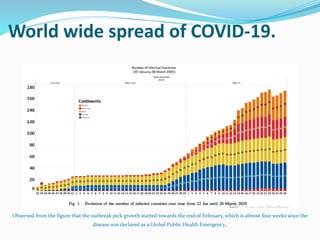
World wide spread of COVID-19.
Observed from the figure that the outbreak pick growth started towards the end of February, which is almost four weeks since the
disease was declared as a Global Public Health Emergency.
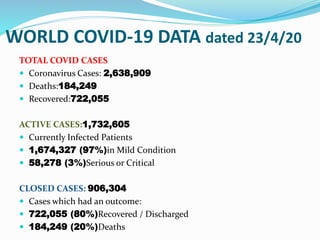
WORLD COVID-19 DATA dated 23/4/20
TOTAL COVID CASES
 Coronavirus Cases: 2,638,909
 Deaths:184,249
 Recovered:722,055
ACTIVE CASES:1,732,605
 Currently Infected Patients
 1,674,327 (97%)in Mild Condition
 58,278 (3%)Serious or Critical
CLOSED CASES: 906,304
 Cases which had an outcome:
 722,055 (80%)Recovered / Discharged
 184,249 (20%)Deaths
How does COVID-19 evolve and its impact:-
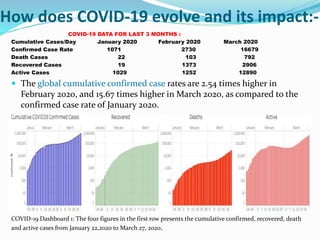
COVID-19 DATA FOR LAST 3 MONTHS :
Cumulative Cases/Day January 2020 February 2020 March 2020
Confirmed Case Rate 1071 2730 16679
Death Cases 22 103 792
Recovered Cases 19 1373 2906
Active Cases 1029 1252 12890
 The global cumulative confirmed case rates are 2.54 times higher in
February 2020, and 15.67 times higher in March 2020, as compared to the
confirmed case rate of January 2020.
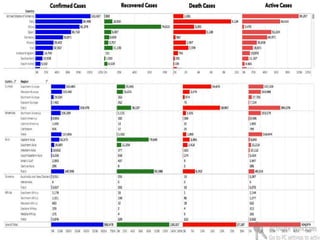
COVID-19 Dashboard 1: The four figures in the first row presents the cumulative confirmed, recovered, death
and active cases from January 22,2020 to March 27, 2020.
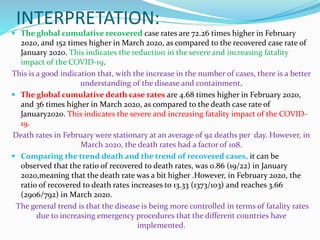
INTERPRETATION:
 The global cumulative recovered case rates are 72.26 times higher in February
2020, and 152 times higher in March 2020, as compared to the recovered case rate of
January 2020. This indicates the reduction in the severe and increasing fatality
impact of the COVID-19.
This is a good indication that, with the increase in the number of cases, there is a better
understanding of the disease and containment.
 The global cumulative death case rates are 4.68 times higher in February 2020,
and 36 times higher in March 2020, as compared to the death case rate of
January2020. This indicates the severe and increasing fatality impact of the COVID-
19.
Death rates in February were stationary at an average of 92 deaths per day. However, in
March 2020, the death rates had a factor of 108.
 Comparing the trend death and the trend of recovered cases, it can be
observed that the ratio of recovered to death rates, was 0.86 (19/22) in January
2020,meaning that the death rate was a bit higher .However, in February 2020, the
ratio of recovered to death rates increases to 13.33 (1373/103) and reaches 3.66
(2906/792) in March 2020.
The general trend is that the disease is being more controlled in terms of fatality rates
due to increasing emergency procedures that the different countries have
implemented.
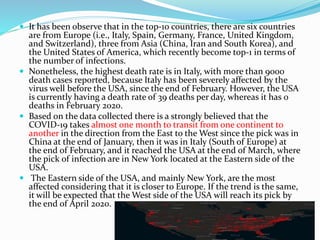
 It has been observe that in the top-10 countries, there are six countries
are from Europe (i.e., Italy, Spain, Germany, France, United Kingdom,
and Switzerland), three from Asia (China, Iran and South Korea), and
the United States of America, which recently become top-1 in terms of
the number of infections.
 Nonetheless, the highest death rate is in Italy, with more than 9000
death cases reported, because Italy has been severely affected by the
virus well before the USA, since the end of February. However, the USA
is currently having a death rate of 39 deaths per day, whereas it has 0
deaths in February 2020.
 Based on the data collected there is a strongly believed that the
COVID-19 takes almost one month to transit from one continent to
another in the direction from the East to the West since the pick was in
China at the end of January, then it was in Italy (South of Europe) at
the end of February, and it reached the USA at the end of March, where
the pick of infection are in New York located at the Eastern side of the
USA.
 The Eastern side of the USA, and mainly New York, are the most
affected considering that it is closer to Europe. If the trend is the same,
it will be expected that the West side of the USA will reach its pick by
the end of April 2020.
How does COVID-19 compare to other epidemics?
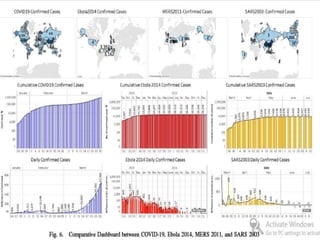
 It is visually apparent that COVID-19 is the largest outbreak to a considerable extent,
followed by SAR 2003, then Ebola 2012, and finally, MERS 2001.
 In what concerns the number of infected countries, COVID-19 has reached 177
countries, then SARS 2003 reached 36 countries, then MERS 2012 has affected 27
countries, and Ebola 2014 was spread in 10 countries. The severity and acuteness of
COVID-19 are unprecedented.
 Ebola 2014 has spanned over a significant period from August 2014 until March 2016,
it reached only 15249 confirmed cases. Thus it had an infection rate minimal as
compared to the two other diseases. Most of the confirmed cases were concentrated
in the Western coast of Africa, where the disease has emerged.
 SARS 2003 had a lifetime of five months from March 2003 until July 2003 and
reached 8434 confirmed cases with an average of 1686 cases per month, and a pick
rate in April 2003, one month after the outbreak.
 It can be observed that COVID-19 is considered as a more acute specie of SARS 2003,
as they both share some common features, including: (1) both have started from
China, (2)they belong to the same family of Coronavirus syndrome affecting the
respiratory system, (3) they have the highest contamination rate as compared to other
epidemics.
 Based on these observations, it seems that the COVID-19 containment will take a
more extended period for its complete containment as compared to SARS 2003.
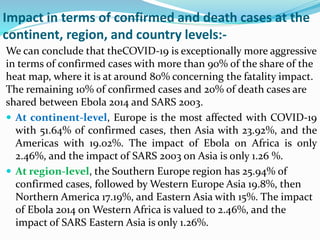
Impact in terms of confirmed and death cases at the
continent, region, and country levels:-
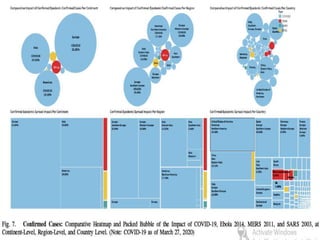
We can conclude that theCOVID-19 is exceptionally more aggressive
in terms of confirmed cases with more than 90% of the share of the
heat map, where it is at around 80% concerning the fatality impact.
The remaining 10% of confirmed cases and 20% of death cases are
shared between Ebola 2014 and SARS 2003.
 At continent-level, Europe is the most affected with COVID-19
with 51.64% of confirmed cases, then Asia with 23.92%, and the
Americas with 19.02%. The impact of Ebola on Africa is only
2.46%, and the impact of SARS 2003 on Asia is only 1.26 %.
 At region-level, the Southern Europe region has 25.94% of
confirmed cases, followed by Western Europe Asia 19.8%, then
Northern America 17.19%, and Eastern Asia with 15%. The impact
of Ebola 2014 on Western Africa is valued to 2.46%, and the
impact of SARS Eastern Asia is only 1.26%.
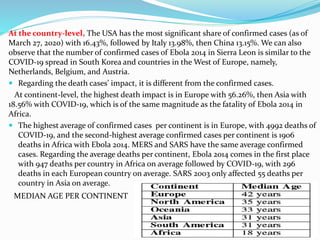
At the country-level, The USA has the most significant share of confirmed cases (as of
March 27, 2020) with 16.43%, followed by Italy 13.98%, then China 13.15%. We can also
observe that the number of confirmed cases of Ebola 2014 in Sierra Leon is similar to the
COVID-19 spread in South Korea and countries in the West of Europe, namely,
Netherlands, Belgium, and Austria.
 Regarding the death cases’ impact, it is different from the confirmed cases.
At continent-level, the highest death impact is in Europe with 56.26%, then Asia with
18.56% with COVID-19, which is of the same magnitude as the fatality of Ebola 2014 in
Africa.
 The highest average of confirmed cases per continent is in Europe, with 4992 deaths of
COVID-19, and the second-highest average confirmed cases per continent is 1906
deaths in Africa with Ebola 2014. MERS and SARS have the same average confirmed
cases. Regarding the average deaths per continent, Ebola 2014 comes in the first place
with 947 deaths per country in Africa on average followed by COVID-19, with 296
deaths in each European country on average. SARS 2003 only affected 55 deaths per
country in Asia on average.
MEDIAN AGE PER CONTINENT
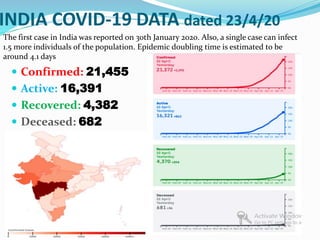
INDIA COVID-19 DATA dated 23/4/20
 Confirmed: 21,455
 Active: 16,391
 Recovered: 4,382
 Deceased: 682
The first case in India was reported on 30th January 2020. Also, a single case can infect
1.5 more individuals of the population. Epidemic doubling time is estimated to be
around 4.1 days
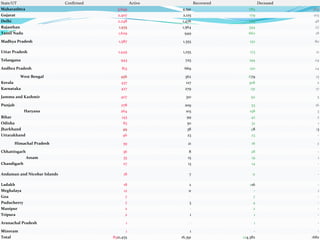
State/UT Confirmed Active Recovered Deceased
Maharashtra 5,649 4,591 789 269
Gujarat 2,407 2,125 179 103
Delhi 2,248 1,476 724 48
Rajasthan 1,935 1,564 344 27
Tamil Nadu 1,629 949 662 18
Madhya Pradesh 1,587 1,355 152 80
Uttar Pradesh 1,449 1,255 173 21
Telangana 943 725 194 24
Andhra Pradesh 813 669 120 24
West Bengal 456 362 679 15
Kerala 437 127 308 2
Karnataka 427 279 131 17
Jammu and Kashmir 407 310 92 5
Punjab 278 209 53 16
Haryana 264 103 158 3
Bihar 143 99 42 2
Odisha 83 50 32 1
Jharkhand 49 38 48 13
Uttarakhand 46 23 23 -
Himachal Pradesh 39 21 16 2
Chhattisgarh 36 8 28 -
Assam 35 15 19 1
Chandigarh 27 13 14 -
Andaman and Nicobar Islands 18 7 11 -
Ladakh 18 2 216 -
Meghalaya 12 11 - 1
Goa 7 - 7 -
Puducherry 7 3 4 -
Manipur 2 - 2 -
Tripura 2 1 1 -
Arunachal Pradesh 1 - 1 -
Mizoram 1 1 - -
Total 8321,455 16,391 124,382 1682
The COVID19 Hot-Spot Map of India]
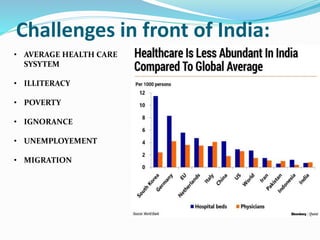
Challenges in front of India:
• AVERAGE HEALTH CARE
SYSYTEM
• ILLITERACY
• POVERTY
• IGNORANCE
• UNEMPLOYEMENT
• MIGRATION
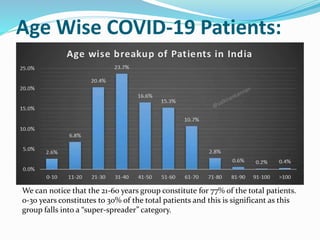
Age Wise COVID-19 Patients:
We can notice that the 21-60 years group constitute for 77% of the total patients.
0-30 years constitutes to 30% of the total patients and this is significant as this
group falls into a “super-spreader” category.
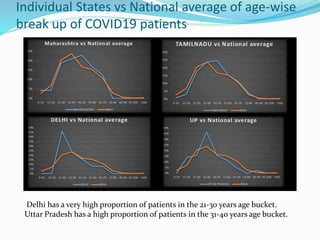
Individual States vs National average of age-wise
break up of COVID19 patients
Delhi has a very high proportion of patients in the 21-30 years age bucket.
Uttar Pradesh has a high proportion of patients in the 31-40 years age bucket.
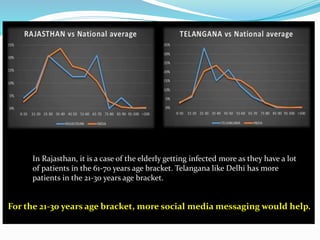
In Rajasthan, it is a case of the elderly getting infected more as they have a lot
of patients in the 61-70 years age bracket. Telangana like Delhi has more
patients in the 21-30 years age bracket.
For the 21-30 years age bracket, more social media messaging would help.
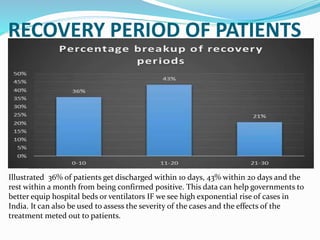
RECOVERY PERIOD OF PATIENTS
Illustrated 36% of patients get discharged within 10 days, 43% within 20 days and the
rest within a month from being confirmed positive. This data can help governments to
better equip hospital beds or ventilators IF we see high exponential rise of cases in
India. It can also be used to assess the severity of the cases and the effects of the
treatment meted out to patients.
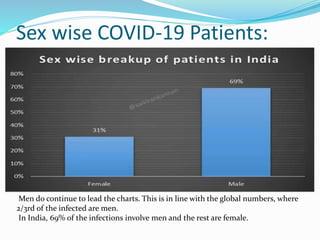
Sex wise COVID-19 Patients:
Men do continue to lead the charts. This is in line with the global numbers, where
2/3rd of the infected are men.
In India, 69% of the infections involve men and the rest are female.
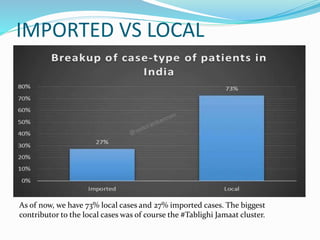
IMPORTED VS LOCAL
As of now, we have 73% local cases and 27% imported cases. The biggest
contributor to the local cases was of course the #Tablighi Jamaat cluster.
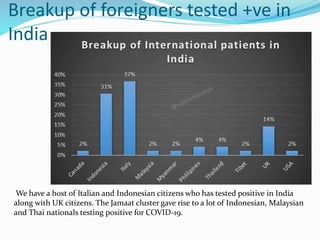
Breakup of foreigners tested +ve in
India
We have a host of Italian and Indonesian citizens who has tested positive in India
along with UK citizens. The Jamaat cluster gave rise to a lot of Indonesian, Malaysian
and Thai nationals testing positive for COVID-19.
What’s in future India?
 The coronavirus pandemic in India may peak in early to mid-May, according to
projections in a study conducted by global consulting firm Protiviti and Times
Network. The study predicts the number of cases will range from 30,000 to a
worst-case scenario of about 286,000. About 30% of the affected people may
require intensive care facilities.
 Susceptible Exposed Infected Recovered (SEIR)model suggests the pandemic
may continue on a nationwide scale until August end. Some states may come out
of the crisis by late May or early June while states with a higher number of
infected people may take up to a month longer.
 The Covid-19 pandemic is causing deep economic harm and could reverse the
gains made in the industrial economy over many decades. There is a need to
render immediate and sizable support to industry to protect people, jobs and
enterprises."
 Oxford University will start human testing with a
Covid-19 vaccine they developed from Thursday, the
UK government said in a coronavirus press conference.
 The Oxford team – led by Professor Sarah Gilbert, is
testing ChAdOx1 nCoV-19, a candidate based on a
chimpanzee adenovirus modified to include the spike
or ‘S’ protein on the surface of SARS-CoV-2, the virus
that causes Covid-19.

Analytics on covid 19

  • 1.
    ANALYTICS OF COVID19ON WORLD & INDIA Dr. Abhishek Kumar M.B.B.S.,M.D.E.M.S.,A.F.I.H.,C.C.D.M.,D. Diabetology
  • 2.
    What is theneed of analytic study?
  • 3.
    What is theneed of analytic study?  The aim is to answer several open questions: 1. How does COVID-19 spread around the world? 2. What is its impact in terms of confirmed and death cases at the continent, region, and country levels? 3. How does its severity compare with other epidemic outbreaks, including Ebola 2014,MERS 2012, and SARS 2003? 4. Is there a correlation between the number of confirmed cases and death cases? This presentation presents a comprehensive analytics visualization to address the questions mentioned above.
  • 4.
    How does COVID-19spread around the world :-  The Coronavirus (COVID-19) outbreak nowadays represents the most critical event worldwide.  It has been declared by the World Health Organization (WHO) as a Global Public Health Emergency  By the end of January 2020, and then as a Global Pandemic in March 2020.  The virus has begun on from Wuhan district in China , where the first confirmed case was reported to have happened on November 17, 2020 .  Initially, the confirmed cases in China were continually increasing.  On January 31, the total infections reached a bit less than 10000 confirmed cases, with214 recovered and 213 reported deaths (2% death rate, and similar for recovery).
  • 5.
     One ofthe most dangerous aspects of the Coronavirus is that it has an incubation period of 2-14 days, during which the patient transmits the virus without having any symptoms.  All these circumstances have favored the exponential growth of the infection leading to a world health emergency crisis.  A total of 173 countries are reported to have confirmed cases with different gravity, while only 60 countries had confirmed cases at the end of February 2020, and only 25 countries at the end of January 2020.  This means that the increase rate was between 2.4 to 2.9 each month.  As a consequence, after only two months from the official declaration of COVID-19 as Global Public Health Emergency, and despite the numerous exceptional preventive measures that every country has taken to avoid the outbreak, the virus has contaminated almost all the world countries.  We compare the impact of the COVID-19 virus with the previous and recent epidemic diseases that have emerged in the last 20 years, namely Ebola 2014, Middle East Respiratory Syndrome (MERS 2012), and Severe Acute Respiratory Syndrome (SARS 2003) outbreaks.
  • 6.
    World wide spreadof COVID-19. Observed from the figure that the outbreak pick growth started towards the end of February, which is almost four weeks since the disease was declared as a Global Public Health Emergency.
  • 7.
    WORLD COVID-19 DATAdated 23/4/20 TOTAL COVID CASES  Coronavirus Cases: 2,638,909  Deaths:184,249  Recovered:722,055 ACTIVE CASES:1,732,605  Currently Infected Patients  1,674,327 (97%)in Mild Condition  58,278 (3%)Serious or Critical CLOSED CASES: 906,304  Cases which had an outcome:  722,055 (80%)Recovered / Discharged  184,249 (20%)Deaths
  • 8.
    How does COVID-19evolve and its impact:- COVID-19 DATA FOR LAST 3 MONTHS : Cumulative Cases/Day January 2020 February 2020 March 2020 Confirmed Case Rate 1071 2730 16679 Death Cases 22 103 792 Recovered Cases 19 1373 2906 Active Cases 1029 1252 12890  The global cumulative confirmed case rates are 2.54 times higher in February 2020, and 15.67 times higher in March 2020, as compared to the confirmed case rate of January 2020. COVID-19 Dashboard 1: The four figures in the first row presents the cumulative confirmed, recovered, death and active cases from January 22,2020 to March 27, 2020.
  • 9.
    INTERPRETATION:  The globalcumulative recovered case rates are 72.26 times higher in February 2020, and 152 times higher in March 2020, as compared to the recovered case rate of January 2020. This indicates the reduction in the severe and increasing fatality impact of the COVID-19. This is a good indication that, with the increase in the number of cases, there is a better understanding of the disease and containment.  The global cumulative death case rates are 4.68 times higher in February 2020, and 36 times higher in March 2020, as compared to the death case rate of January2020. This indicates the severe and increasing fatality impact of the COVID- 19. Death rates in February were stationary at an average of 92 deaths per day. However, in March 2020, the death rates had a factor of 108.  Comparing the trend death and the trend of recovered cases, it can be observed that the ratio of recovered to death rates, was 0.86 (19/22) in January 2020,meaning that the death rate was a bit higher .However, in February 2020, the ratio of recovered to death rates increases to 13.33 (1373/103) and reaches 3.66 (2906/792) in March 2020. The general trend is that the disease is being more controlled in terms of fatality rates due to increasing emergency procedures that the different countries have implemented.
  • 10.
     It hasbeen observe that in the top-10 countries, there are six countries are from Europe (i.e., Italy, Spain, Germany, France, United Kingdom, and Switzerland), three from Asia (China, Iran and South Korea), and the United States of America, which recently become top-1 in terms of the number of infections.  Nonetheless, the highest death rate is in Italy, with more than 9000 death cases reported, because Italy has been severely affected by the virus well before the USA, since the end of February. However, the USA is currently having a death rate of 39 deaths per day, whereas it has 0 deaths in February 2020.  Based on the data collected there is a strongly believed that the COVID-19 takes almost one month to transit from one continent to another in the direction from the East to the West since the pick was in China at the end of January, then it was in Italy (South of Europe) at the end of February, and it reached the USA at the end of March, where the pick of infection are in New York located at the Eastern side of the USA.  The Eastern side of the USA, and mainly New York, are the most affected considering that it is closer to Europe. If the trend is the same, it will be expected that the West side of the USA will reach its pick by the end of April 2020.
  • 12.
    How does COVID-19compare to other epidemics?  It is visually apparent that COVID-19 is the largest outbreak to a considerable extent, followed by SAR 2003, then Ebola 2012, and finally, MERS 2001.  In what concerns the number of infected countries, COVID-19 has reached 177 countries, then SARS 2003 reached 36 countries, then MERS 2012 has affected 27 countries, and Ebola 2014 was spread in 10 countries. The severity and acuteness of COVID-19 are unprecedented.  Ebola 2014 has spanned over a significant period from August 2014 until March 2016, it reached only 15249 confirmed cases. Thus it had an infection rate minimal as compared to the two other diseases. Most of the confirmed cases were concentrated in the Western coast of Africa, where the disease has emerged.  SARS 2003 had a lifetime of five months from March 2003 until July 2003 and reached 8434 confirmed cases with an average of 1686 cases per month, and a pick rate in April 2003, one month after the outbreak.  It can be observed that COVID-19 is considered as a more acute specie of SARS 2003, as they both share some common features, including: (1) both have started from China, (2)they belong to the same family of Coronavirus syndrome affecting the respiratory system, (3) they have the highest contamination rate as compared to other epidemics.  Based on these observations, it seems that the COVID-19 containment will take a more extended period for its complete containment as compared to SARS 2003.
  • 15.
    Impact in termsof confirmed and death cases at the continent, region, and country levels:- We can conclude that theCOVID-19 is exceptionally more aggressive in terms of confirmed cases with more than 90% of the share of the heat map, where it is at around 80% concerning the fatality impact. The remaining 10% of confirmed cases and 20% of death cases are shared between Ebola 2014 and SARS 2003.  At continent-level, Europe is the most affected with COVID-19 with 51.64% of confirmed cases, then Asia with 23.92%, and the Americas with 19.02%. The impact of Ebola on Africa is only 2.46%, and the impact of SARS 2003 on Asia is only 1.26 %.  At region-level, the Southern Europe region has 25.94% of confirmed cases, followed by Western Europe Asia 19.8%, then Northern America 17.19%, and Eastern Asia with 15%. The impact of Ebola 2014 on Western Africa is valued to 2.46%, and the impact of SARS Eastern Asia is only 1.26%.
  • 16.
    At the country-level,The USA has the most significant share of confirmed cases (as of March 27, 2020) with 16.43%, followed by Italy 13.98%, then China 13.15%. We can also observe that the number of confirmed cases of Ebola 2014 in Sierra Leon is similar to the COVID-19 spread in South Korea and countries in the West of Europe, namely, Netherlands, Belgium, and Austria.  Regarding the death cases’ impact, it is different from the confirmed cases. At continent-level, the highest death impact is in Europe with 56.26%, then Asia with 18.56% with COVID-19, which is of the same magnitude as the fatality of Ebola 2014 in Africa.  The highest average of confirmed cases per continent is in Europe, with 4992 deaths of COVID-19, and the second-highest average confirmed cases per continent is 1906 deaths in Africa with Ebola 2014. MERS and SARS have the same average confirmed cases. Regarding the average deaths per continent, Ebola 2014 comes in the first place with 947 deaths per country in Africa on average followed by COVID-19, with 296 deaths in each European country on average. SARS 2003 only affected 55 deaths per country in Asia on average. MEDIAN AGE PER CONTINENT
  • 17.
    INDIA COVID-19 DATAdated 23/4/20  Confirmed: 21,455  Active: 16,391  Recovered: 4,382  Deceased: 682 The first case in India was reported on 30th January 2020. Also, a single case can infect 1.5 more individuals of the population. Epidemic doubling time is estimated to be around 4.1 days
  • 18.
    State/UT Confirmed ActiveRecovered Deceased Maharashtra 5,649 4,591 789 269 Gujarat 2,407 2,125 179 103 Delhi 2,248 1,476 724 48 Rajasthan 1,935 1,564 344 27 Tamil Nadu 1,629 949 662 18 Madhya Pradesh 1,587 1,355 152 80 Uttar Pradesh 1,449 1,255 173 21 Telangana 943 725 194 24 Andhra Pradesh 813 669 120 24 West Bengal 456 362 679 15 Kerala 437 127 308 2 Karnataka 427 279 131 17 Jammu and Kashmir 407 310 92 5 Punjab 278 209 53 16 Haryana 264 103 158 3 Bihar 143 99 42 2 Odisha 83 50 32 1 Jharkhand 49 38 48 13 Uttarakhand 46 23 23 - Himachal Pradesh 39 21 16 2 Chhattisgarh 36 8 28 - Assam 35 15 19 1 Chandigarh 27 13 14 - Andaman and Nicobar Islands 18 7 11 - Ladakh 18 2 216 - Meghalaya 12 11 - 1 Goa 7 - 7 - Puducherry 7 3 4 - Manipur 2 - 2 - Tripura 2 1 1 - Arunachal Pradesh 1 - 1 - Mizoram 1 1 - - Total 8321,455 16,391 124,382 1682
  • 19.
    The COVID19 Hot-SpotMap of India]
  • 20.
    Challenges in frontof India: • AVERAGE HEALTH CARE SYSYTEM • ILLITERACY • POVERTY • IGNORANCE • UNEMPLOYEMENT • MIGRATION
  • 21.
    Age Wise COVID-19Patients: We can notice that the 21-60 years group constitute for 77% of the total patients. 0-30 years constitutes to 30% of the total patients and this is significant as this group falls into a “super-spreader” category.
  • 22.
    Individual States vsNational average of age-wise break up of COVID19 patients Delhi has a very high proportion of patients in the 21-30 years age bucket. Uttar Pradesh has a high proportion of patients in the 31-40 years age bucket.
  • 23.
    In Rajasthan, itis a case of the elderly getting infected more as they have a lot of patients in the 61-70 years age bracket. Telangana like Delhi has more patients in the 21-30 years age bracket. For the 21-30 years age bracket, more social media messaging would help.
  • 24.
    RECOVERY PERIOD OFPATIENTS Illustrated 36% of patients get discharged within 10 days, 43% within 20 days and the rest within a month from being confirmed positive. This data can help governments to better equip hospital beds or ventilators IF we see high exponential rise of cases in India. It can also be used to assess the severity of the cases and the effects of the treatment meted out to patients.
  • 25.
    Sex wise COVID-19Patients: Men do continue to lead the charts. This is in line with the global numbers, where 2/3rd of the infected are men. In India, 69% of the infections involve men and the rest are female.
  • 26.
    IMPORTED VS LOCAL Asof now, we have 73% local cases and 27% imported cases. The biggest contributor to the local cases was of course the #Tablighi Jamaat cluster.
  • 27.
    Breakup of foreignerstested +ve in India We have a host of Italian and Indonesian citizens who has tested positive in India along with UK citizens. The Jamaat cluster gave rise to a lot of Indonesian, Malaysian and Thai nationals testing positive for COVID-19.
  • 28.
    What’s in futureIndia?  The coronavirus pandemic in India may peak in early to mid-May, according to projections in a study conducted by global consulting firm Protiviti and Times Network. The study predicts the number of cases will range from 30,000 to a worst-case scenario of about 286,000. About 30% of the affected people may require intensive care facilities.  Susceptible Exposed Infected Recovered (SEIR)model suggests the pandemic may continue on a nationwide scale until August end. Some states may come out of the crisis by late May or early June while states with a higher number of infected people may take up to a month longer.  The Covid-19 pandemic is causing deep economic harm and could reverse the gains made in the industrial economy over many decades. There is a need to render immediate and sizable support to industry to protect people, jobs and enterprises."
  • 29.
     Oxford Universitywill start human testing with a Covid-19 vaccine they developed from Thursday, the UK government said in a coronavirus press conference.  The Oxford team – led by Professor Sarah Gilbert, is testing ChAdOx1 nCoV-19, a candidate based on a chimpanzee adenovirus modified to include the spike or ‘S’ protein on the surface of SARS-CoV-2, the virus that causes Covid-19.