International Research Journal of Engineering and Technology (IRJET) e-ISSN: 2395-0056
Volume: 09 Issue: 11 | Nov 2022 www.irjet.net p-ISSN: 2395-0072
© 2022, IRJET | Impact Factor value: 7.529 | ISO 9001:2008 Certified Journal | Page 282
Risk Management Methodologies in Construction Industries
Mohammed Danish Hasnain
Graduate, Department of Civil Engineering, Jamia Millia Islamia, New Delhi, India
---------------------------------------------------------------------***-------------------------------------------------------------------
Abstract: Modern construction projects are getting
more and more complicated, which increases
unpredictability throughout the entire process. Most
project stakeholders do not consistently implement the
risk management procedure in building projects.
Construction projects are the most prevalent environment
in which some "rules of thumb" based on the knowledge
and judgement of stakeholders are applied. Unfortunately,
it is considered that risk management in construction
projects is no more than insurance management, with the
goal of locating the best insurance coverage for insurable
hazards. Risk management encompasses far more than
just "insurances," as we will see in this research paper.
Keywords: Construction projects, Stakeholders,
Building projects, Risk Management, Insurance
Management.
1. INTRODUCTION
The basis of any company or organisation is risk
management, and the construction sector and its
businesses are no exception. No matter the size, type of
organisation, or industry, this is essential. Failure to
recognise and assess risk in a timely manner can result
in significant financial losses for construction companies.
If risks are not identified in a timely manner, businesses
may even miss out on the chance to take advantage of
opportunities that may arise during their operations.
Therefore, preventing, or minimising losses is just as
important as looking forward to spot potential new
chances. The advantages of systematic risk identification
and management include:
 More realistic business and project planning.
 Actions implemented in time for effectiveness.
 Greater certainty of achieving business goals and
project objectives.
 Improved loss control.
 Improved control of business cost and project cost.
 Fewer risk through effective and transparent
contingency planning.
The method for recognising, evaluating, and controlling
risk is covered in this paper within a broad framework.
In a condensed manner, figure 1 depicts the key
characteristics of this procedure. Every component of
corporate activity and every decision-making level can
use the risk management method that is outlined in this
paper.
Fig.1 - A flowchart representing the Risk
Management Processes.
2. RISK
The word "risk" is used synonymously with words like
"hazard" and "uncertainty" in literature and has multiple
connotations. There is no common definition used by
researchers in this field. Although the word "risk" can
refer to both positive and negative outcomes (losses or
damages as well as profits or gains), it is more frequently
used to refer to the latter. Here risk is defined as being
exposed to the possibility of uncertainty. The chance of
an event happening is represented by uncertainty in this
context. As a result, it is presumed that the risk is a
function of an event's uncertainty and the loss or gain
that will probably result from it, and risk management is
termed as a formal, systematic method for discovering,
analysing and responding to risk occurrences during the
course of a project in order to achieve the best or
acceptable level of risk elimination or control.
3. RISK IDENTIFICATION PROCESS
The process of risk identification involves not only
determining the origins of those risks but also all
International Research Journal of Engineering and Technology (IRJET) e-ISSN: 2395-0056
Volume: 09 Issue: 11 | Nov 2022 www.irjet.net p-ISSN: 2395-0072
© 2022, IRJET | Impact Factor value: 7.529 | ISO 9001:2008 Certified Journal | Page 283
potential sources of project hazards and their expected
outcomes. Risk identification seeks to pinpoint where
the uncertainties are, since risks result from uncertainty.
One approach for identifying risks is brainstorming,
other methods include interviews, questionnaires, hiring
specialists, and past experience. A proactive strategy
should be taken when identifying risks, and in this case,
the goals should be to find both, the risks that provide a
threat and the opportunities that go along with it. To
have the biggest influence on the project, risk
identification should start as soon as possible. There are
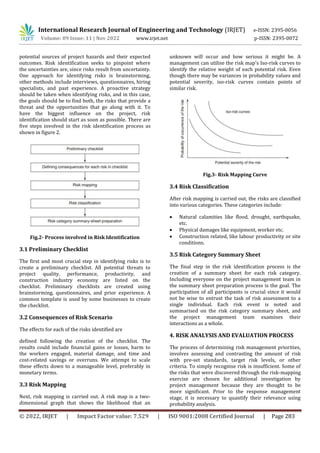
five steps involved in the risk identification process as
shown in figure 2.
Fig.2- Process involved in Risk Identification
3.1 Preliminary Checklist
The first and most crucial step in identifying risks is to
create a preliminary checklist. All potential threats to
project quality, performance, productivity, and
construction industry economy are listed on the
checklist. Preliminary checklists are created using
brainstorming, questionnaires, and prior experience. A
common template is used by some businesses to create
the checklist.
3.2 Consequences of Risk Scenario
The effects for each of the risks identified are
defined following the creation of the checklist. The
results could include financial gains or losses, harm to
the workers engaged, material damage, and time and
cost-related savings or overruns. We attempt to scale
these effects down to a manageable level, preferably in
monetary terms.
3.3 Risk Mapping
Next, risk mapping is carried out. A risk map is a two-
dimensional graph that shows the likelihood that an
unknown will occur and how serious it might be. A
management can utilise the risk map's Iso-risk curves to
identify the relative weight of each potential risk. Even
though there may be variances in probability values and
potential severity, iso-risk curves contain points of
similar risk.
Fig.3- Risk Mapping Curve
3.4 Risk Classification
After risk mapping is carried out, the risks are classified
into various categories. These categories include:
 Natural calamities like flood, drought, earthquake,
etc.
 Physical damages like equipment, worker etc.
 Construction related, like labour productivity or site
conditions.
3.5 Risk Category Summary Sheet
The final step in the risk identification process is the
creation of a summary sheet for each risk category.
Including everyone on the project management team in
the summary sheet preparation process is the goal. The
participation of all participants is crucial since it would
not be wise to entrust the task of risk assessment to a
single individual. Each risk event is noted and
summarised on the risk category summary sheet, and
the project management team examines their
interactions as a whole.
4. RISK ANALYSIS AND EVALUATION PROCESS
The process of determining risk management priorities,
involves assessing and contrasting the amount of risk
with pre-set standards, target risk levels, or other
criteria. To simply recognise risk is insufficient. Some of
the risks that were discovered through the risk-mapping
exercise are chosen for additional investigation by
project management because they are thought to be
more significant. Prior to the response management
stage, it is necessary to quantify their relevance using
probability analysis.
International Research Journal of Engineering and Technology (IRJET) e-ISSN: 2395-0056
Volume: 09 Issue: 11 | Nov 2022 www.irjet.net p-ISSN: 2395-0072
© 2022, IRJET | Impact Factor value: 7.529 | ISO 9001:2008 Certified Journal | Page 284
The systematic identification of risks and the intelligent
management of the significant ones are connected by the
process of risk analysis and evaluation. It serves as the
basis for choosing between various management
strategies. In this text, the term "risk analysis and
evaluation" refers to a method that uses probability
theory to quantify uncertainty and assess risk's possible
effects.
Fig.4- Process of Risk Analysis and Evaluation
A project could be subject to a variety of risks. There is
no use in attempting to focus on each one individually
because the time and effort invested may not be worth
the results. The qualitative importance of various threats
is established through risk mapping. To select the best
mitigation plan, further analysis is now being done on
the key and critical hazards.
4.1 Collecting Data
An essential and complex step in the risk analysis and
evaluation process is gathering data pertinent to a
particular type of risk. Even though some contractors do
preserve data as the job advances, it is frequently
unstructured and hence challenging to use. Then, one
must rely on evaluation based on professional
judgement. The information is organised properly in
order to get the correct conclusions.
4.2 Figuring the Uncertainty
Based on all the information that is currently available
regarding the risk under consideration, this stage aims to
calculate the likelihood of occurrence and associated
effects. A risk event's likelihood to occur is quantified in
terms of probability values based on historical facts,
common sense, and professional opinion. The possible
financial costs of the risk are calculated.
4.3 Evaluation of Potential Impact of Risk
This comes after the uncertainties have been
quantitatively modelled. The assessment of a risk's
possible effects is crucial for obtaining a comprehensive
picture of all the risks related to the project. Expected
value, Monte Carlo simulation, and influence diagrams
are a few of the methods employed in this study.
5. RISK TREATMENT STRATEGIES
The proper risk treatment techniques are created after
the risks have been assessed in terms of their financial
impact. The goals of risk management solutions are to
minimise potential consequences and tighten control
over risk.
5.1 Avoiding Risk
Avoiding risks is a tactic that is used frequently. By
avoiding risks, construction companies may be sure that
they won't experience the gain or loss that goes along
with a particular risk. For instance, a construction
business would not take on a tunnelling project if they
believed there were numerous dangers involved.
Naturally, this also means that the business will not be
able to benefit greatly from such projects.
5.2 Minimizing Loss and Preventing Risk
The goal of loss reduction and risk prevention is to
lessen the likelihood of a risk occurring and the financial
impact of that risk, should it do so. For instance, if a
building business knew that theft was an issue in the
area, they would strive to include security-related
expenditures in their proposal. The insurance premium
that the insurer charges the insured has an impact on the
loss reduction and risk prevention as well. For instance,
an insurer will charge a greater premium to a business
with a low level of loss reduction and a risk prevention
programme than to a business with a high level of loss
reduction and a risk prevention programme.
5.3 Reservation and Assumption of Risk
The value of the financial impact of risk is assumed in
terms of risk reservation and assumption. It could be
either planned or unplanned. Unplanned risk retention
and assumption occurs when a construction company
does not identify that a risk exists, as opposed to planned
risk retention and assumption, which indicates that an
effort has been taken to evaluate the financial impact of
the risk involved in the project. As a result, in the latter
scenario, the building company unknowingly accepts the
potential loss. The building company may have
overestimated the financial impact of a particular risk,
which would fall under the unanticipated category.
5.4 Risk Transfer
The construction corporation transfers risk to other
project partners, such as subcontractors, vendors, or
specialised contractors. With vendors, specialised
contractors, or subcontractors, the construction business
enters into a contractual agreement to transfer risk. The
main principle is that the person who is better equipped
International Research Journal of Engineering and Technology (IRJET) e-ISSN: 2395-0056
Volume: 09 Issue: 11 | Nov 2022 www.irjet.net p-ISSN: 2395-0072
© 2022, IRJET | Impact Factor value: 7.529 | ISO 9001:2008 Certified Journal | Page 285
or situated to keep control should be able to accept risk.
A professional contractor with experience in piling
works, for instance, would be better suited to take on the
risk if the project involved building a pile foundation.
The difference between risk transfer and insurance is
that risk is not transferred to an insurance company;
rather, it is transferred to an expert who has sufficient
historical data and is in a better position to evaluate the
risk.
5.5 Insurance
Using an insurance policy, the risks of two or more
people or businesses can be pooled through actual or
implied contributions to a fund from which claimants are
compensated. When one party agrees to pay another
party for a loss brought on by a certain contingency in
exchange for a compensation, a contractual relationship
known as insurance is created. The contract is the
insurance policy; the legal consideration is the premium;
the loss of life or property in question is the exposure;
and the contingency is the happening of the insured
event. The first party is known as the insurer or
underwriter, while the second is known as the insured or
policyholder.
6. CONCLUSION
Despite the fact that the concept can be measured in two
different ways, risk is typically thought of negatively.
Although they are unaware of it, experts in the
development industries are using the risk management
practises described in the paper. In the building industry
business, risks are always being monitored, but not in
the manner that the writing suggests. Although the
concept of risk is becoming more well understood among
development professionals, as other experts have also
stated, there is virtually little information on risk
management and the risk management process. In order
to achieve the goals of the building sector, the approach
known as the "hazard, the board" should be used.
Therefore, it is crucial to raise awareness of risk-taking
and incite passion among people to use it in building
industry firms.
REFERENCES
[1] Al-Bahar, J.F. and Crandall, K.C., 1990,
‘Systematic risk management in construction
projects’, ASCE Journal of Construction
Engineering and Management.
[2] Bing, L. and Tiong, R.L.K., 1999, ‘Risk
management model for international
construction joint ventures’, Journal of
Construction Engineering and Management,
ASCE.
[3] Kumar Neeraj Jha, Construction Project
Management Theory and Practice, 2015.
[4] M Sivagami and Sarath I P, 2018, ‘Risk
Management in Construction: A Literature
Review’, International Research Journal of
Engineering and Technology.
[5] Vishwa N. Vaghela, 2020, ‘Risk Management in
the Construction Industry’, International
Research Journal of Engineering and
Technology.
[6] S. Divya Sankar and Dr. Janani Selvam, 2020,
‘Risk Management in Construction Industry’,
International Research Journal of Engineering
and Technology

Risk Management Methodologies in Construction Industries

  • 1.
    International Research Journalof Engineering and Technology (IRJET) e-ISSN: 2395-0056 Volume: 09 Issue: 11 | Nov 2022 www.irjet.net p-ISSN: 2395-0072 © 2022, IRJET | Impact Factor value: 7.529 | ISO 9001:2008 Certified Journal | Page 282 Risk Management Methodologies in Construction Industries Mohammed Danish Hasnain Graduate, Department of Civil Engineering, Jamia Millia Islamia, New Delhi, India ---------------------------------------------------------------------***------------------------------------------------------------------- Abstract: Modern construction projects are getting more and more complicated, which increases unpredictability throughout the entire process. Most project stakeholders do not consistently implement the risk management procedure in building projects. Construction projects are the most prevalent environment in which some "rules of thumb" based on the knowledge and judgement of stakeholders are applied. Unfortunately, it is considered that risk management in construction projects is no more than insurance management, with the goal of locating the best insurance coverage for insurable hazards. Risk management encompasses far more than just "insurances," as we will see in this research paper. Keywords: Construction projects, Stakeholders, Building projects, Risk Management, Insurance Management. 1. INTRODUCTION The basis of any company or organisation is risk management, and the construction sector and its businesses are no exception. No matter the size, type of organisation, or industry, this is essential. Failure to recognise and assess risk in a timely manner can result in significant financial losses for construction companies. If risks are not identified in a timely manner, businesses may even miss out on the chance to take advantage of opportunities that may arise during their operations. Therefore, preventing, or minimising losses is just as important as looking forward to spot potential new chances. The advantages of systematic risk identification and management include:  More realistic business and project planning.  Actions implemented in time for effectiveness.  Greater certainty of achieving business goals and project objectives.  Improved loss control.  Improved control of business cost and project cost.  Fewer risk through effective and transparent contingency planning. The method for recognising, evaluating, and controlling risk is covered in this paper within a broad framework. In a condensed manner, figure 1 depicts the key characteristics of this procedure. Every component of corporate activity and every decision-making level can use the risk management method that is outlined in this paper. Fig.1 - A flowchart representing the Risk Management Processes. 2. RISK The word "risk" is used synonymously with words like "hazard" and "uncertainty" in literature and has multiple connotations. There is no common definition used by researchers in this field. Although the word "risk" can refer to both positive and negative outcomes (losses or damages as well as profits or gains), it is more frequently used to refer to the latter. Here risk is defined as being exposed to the possibility of uncertainty. The chance of an event happening is represented by uncertainty in this context. As a result, it is presumed that the risk is a function of an event's uncertainty and the loss or gain that will probably result from it, and risk management is termed as a formal, systematic method for discovering, analysing and responding to risk occurrences during the course of a project in order to achieve the best or acceptable level of risk elimination or control. 3. RISK IDENTIFICATION PROCESS The process of risk identification involves not only determining the origins of those risks but also all
  • 2.
    International Research Journalof Engineering and Technology (IRJET) e-ISSN: 2395-0056 Volume: 09 Issue: 11 | Nov 2022 www.irjet.net p-ISSN: 2395-0072 © 2022, IRJET | Impact Factor value: 7.529 | ISO 9001:2008 Certified Journal | Page 283 potential sources of project hazards and their expected outcomes. Risk identification seeks to pinpoint where the uncertainties are, since risks result from uncertainty. One approach for identifying risks is brainstorming, other methods include interviews, questionnaires, hiring specialists, and past experience. A proactive strategy should be taken when identifying risks, and in this case, the goals should be to find both, the risks that provide a threat and the opportunities that go along with it. To have the biggest influence on the project, risk identification should start as soon as possible. There are five steps involved in the risk identification process as shown in figure 2. Fig.2- Process involved in Risk Identification 3.1 Preliminary Checklist The first and most crucial step in identifying risks is to create a preliminary checklist. All potential threats to project quality, performance, productivity, and construction industry economy are listed on the checklist. Preliminary checklists are created using brainstorming, questionnaires, and prior experience. A common template is used by some businesses to create the checklist. 3.2 Consequences of Risk Scenario The effects for each of the risks identified are defined following the creation of the checklist. The results could include financial gains or losses, harm to the workers engaged, material damage, and time and cost-related savings or overruns. We attempt to scale these effects down to a manageable level, preferably in monetary terms. 3.3 Risk Mapping Next, risk mapping is carried out. A risk map is a two- dimensional graph that shows the likelihood that an unknown will occur and how serious it might be. A management can utilise the risk map's Iso-risk curves to identify the relative weight of each potential risk. Even though there may be variances in probability values and potential severity, iso-risk curves contain points of similar risk. Fig.3- Risk Mapping Curve 3.4 Risk Classification After risk mapping is carried out, the risks are classified into various categories. These categories include:  Natural calamities like flood, drought, earthquake, etc.  Physical damages like equipment, worker etc.  Construction related, like labour productivity or site conditions. 3.5 Risk Category Summary Sheet The final step in the risk identification process is the creation of a summary sheet for each risk category. Including everyone on the project management team in the summary sheet preparation process is the goal. The participation of all participants is crucial since it would not be wise to entrust the task of risk assessment to a single individual. Each risk event is noted and summarised on the risk category summary sheet, and the project management team examines their interactions as a whole. 4. RISK ANALYSIS AND EVALUATION PROCESS The process of determining risk management priorities, involves assessing and contrasting the amount of risk with pre-set standards, target risk levels, or other criteria. To simply recognise risk is insufficient. Some of the risks that were discovered through the risk-mapping exercise are chosen for additional investigation by project management because they are thought to be more significant. Prior to the response management stage, it is necessary to quantify their relevance using probability analysis.
  • 3.
    International Research Journalof Engineering and Technology (IRJET) e-ISSN: 2395-0056 Volume: 09 Issue: 11 | Nov 2022 www.irjet.net p-ISSN: 2395-0072 © 2022, IRJET | Impact Factor value: 7.529 | ISO 9001:2008 Certified Journal | Page 284 The systematic identification of risks and the intelligent management of the significant ones are connected by the process of risk analysis and evaluation. It serves as the basis for choosing between various management strategies. In this text, the term "risk analysis and evaluation" refers to a method that uses probability theory to quantify uncertainty and assess risk's possible effects. Fig.4- Process of Risk Analysis and Evaluation A project could be subject to a variety of risks. There is no use in attempting to focus on each one individually because the time and effort invested may not be worth the results. The qualitative importance of various threats is established through risk mapping. To select the best mitigation plan, further analysis is now being done on the key and critical hazards. 4.1 Collecting Data An essential and complex step in the risk analysis and evaluation process is gathering data pertinent to a particular type of risk. Even though some contractors do preserve data as the job advances, it is frequently unstructured and hence challenging to use. Then, one must rely on evaluation based on professional judgement. The information is organised properly in order to get the correct conclusions. 4.2 Figuring the Uncertainty Based on all the information that is currently available regarding the risk under consideration, this stage aims to calculate the likelihood of occurrence and associated effects. A risk event's likelihood to occur is quantified in terms of probability values based on historical facts, common sense, and professional opinion. The possible financial costs of the risk are calculated. 4.3 Evaluation of Potential Impact of Risk This comes after the uncertainties have been quantitatively modelled. The assessment of a risk's possible effects is crucial for obtaining a comprehensive picture of all the risks related to the project. Expected value, Monte Carlo simulation, and influence diagrams are a few of the methods employed in this study. 5. RISK TREATMENT STRATEGIES The proper risk treatment techniques are created after the risks have been assessed in terms of their financial impact. The goals of risk management solutions are to minimise potential consequences and tighten control over risk. 5.1 Avoiding Risk Avoiding risks is a tactic that is used frequently. By avoiding risks, construction companies may be sure that they won't experience the gain or loss that goes along with a particular risk. For instance, a construction business would not take on a tunnelling project if they believed there were numerous dangers involved. Naturally, this also means that the business will not be able to benefit greatly from such projects. 5.2 Minimizing Loss and Preventing Risk The goal of loss reduction and risk prevention is to lessen the likelihood of a risk occurring and the financial impact of that risk, should it do so. For instance, if a building business knew that theft was an issue in the area, they would strive to include security-related expenditures in their proposal. The insurance premium that the insurer charges the insured has an impact on the loss reduction and risk prevention as well. For instance, an insurer will charge a greater premium to a business with a low level of loss reduction and a risk prevention programme than to a business with a high level of loss reduction and a risk prevention programme. 5.3 Reservation and Assumption of Risk The value of the financial impact of risk is assumed in terms of risk reservation and assumption. It could be either planned or unplanned. Unplanned risk retention and assumption occurs when a construction company does not identify that a risk exists, as opposed to planned risk retention and assumption, which indicates that an effort has been taken to evaluate the financial impact of the risk involved in the project. As a result, in the latter scenario, the building company unknowingly accepts the potential loss. The building company may have overestimated the financial impact of a particular risk, which would fall under the unanticipated category. 5.4 Risk Transfer The construction corporation transfers risk to other project partners, such as subcontractors, vendors, or specialised contractors. With vendors, specialised contractors, or subcontractors, the construction business enters into a contractual agreement to transfer risk. The main principle is that the person who is better equipped
  • 4.
    International Research Journalof Engineering and Technology (IRJET) e-ISSN: 2395-0056 Volume: 09 Issue: 11 | Nov 2022 www.irjet.net p-ISSN: 2395-0072 © 2022, IRJET | Impact Factor value: 7.529 | ISO 9001:2008 Certified Journal | Page 285 or situated to keep control should be able to accept risk. A professional contractor with experience in piling works, for instance, would be better suited to take on the risk if the project involved building a pile foundation. The difference between risk transfer and insurance is that risk is not transferred to an insurance company; rather, it is transferred to an expert who has sufficient historical data and is in a better position to evaluate the risk. 5.5 Insurance Using an insurance policy, the risks of two or more people or businesses can be pooled through actual or implied contributions to a fund from which claimants are compensated. When one party agrees to pay another party for a loss brought on by a certain contingency in exchange for a compensation, a contractual relationship known as insurance is created. The contract is the insurance policy; the legal consideration is the premium; the loss of life or property in question is the exposure; and the contingency is the happening of the insured event. The first party is known as the insurer or underwriter, while the second is known as the insured or policyholder. 6. CONCLUSION Despite the fact that the concept can be measured in two different ways, risk is typically thought of negatively. Although they are unaware of it, experts in the development industries are using the risk management practises described in the paper. In the building industry business, risks are always being monitored, but not in the manner that the writing suggests. Although the concept of risk is becoming more well understood among development professionals, as other experts have also stated, there is virtually little information on risk management and the risk management process. In order to achieve the goals of the building sector, the approach known as the "hazard, the board" should be used. Therefore, it is crucial to raise awareness of risk-taking and incite passion among people to use it in building industry firms. REFERENCES [1] Al-Bahar, J.F. and Crandall, K.C., 1990, ‘Systematic risk management in construction projects’, ASCE Journal of Construction Engineering and Management. [2] Bing, L. and Tiong, R.L.K., 1999, ‘Risk management model for international construction joint ventures’, Journal of Construction Engineering and Management, ASCE. [3] Kumar Neeraj Jha, Construction Project Management Theory and Practice, 2015. [4] M Sivagami and Sarath I P, 2018, ‘Risk Management in Construction: A Literature Review’, International Research Journal of Engineering and Technology. [5] Vishwa N. Vaghela, 2020, ‘Risk Management in the Construction Industry’, International Research Journal of Engineering and Technology. [6] S. Divya Sankar and Dr. Janani Selvam, 2020, ‘Risk Management in Construction Industry’, International Research Journal of Engineering and Technology