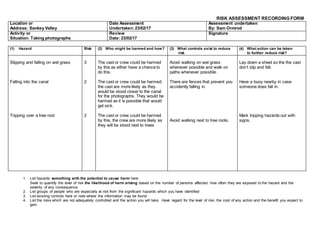
RISK ASSESSMENT RECORDING FORM
Location or
Address: Sankey Valley
Date Assessment
Undertaken:23/02/17
Assessment undertaken
By: Sam Ormrod
Activity or
Situation: Taking photographs
Review
Date: 23/02/17
Signature
(1) Hazard Risk (2) Who might be harmed and how? (3) What controls exist to reduce
risk
(4) What action can be taken
to further reduce risk?
Slipping and falling on wet grass
Falling into the canal
Tripping over a tree root
3
2
2
The cast or crew could be harmed
by this as either have a chance to
do this.
The cast or crew could be harmed;
the cast are more likely as they
would be stood closer to the canal
for the photographs. They would be
harmed as it is possible that would
get sick.
The cast or crew could be harmed
by this, the crew are more likely as
they will be stood next to trees
Avoid walking on wet grass
whenever possible and walk on
paths whenever possible.
There are fences that prevent you
accidently falling in.
Avoid walking next to tree roots.
Lay down a sheet so the the cast
don’t slip and fall.
Have a buoy nearby in case
someone does fall in.
Mark tripping hazards out with
signs.
1. List hazards something with the potential to cause harm here:
Seek to quantify the level of risk the likelihood of harm arising based on the number of persons affected, how often they are exposed to the hazard and the
severity of any consequence.
2. List groups of people who are especially at risk from the significant hazards which you have identified
3. List existing controls here or note where the information may be found
4. List the risks which are not adequately controlled and the action you will take. Have regard for the level of risk, the cost of any action and the benefit you expect to
gain.
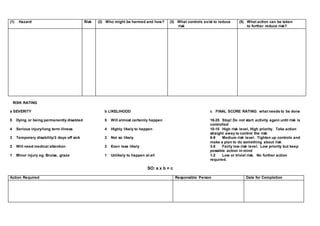
(1) Hazard Risk (2) Who might be harmed and how? (3) What controls exist to reduce
risk
(5) What action can be taken
to further reduce risk?
RISK RATING
a SEVERITY b LIKELIHOOD c FINAL SCORE RATING: what needs to be done
5 Dying or being permanently disabled 5 Will almost certainly happen 16-25 Stop! Do not start activity again until risk is
controlled
4 Serious injury/long term illness 4 Highly likely to happen 10-15 High risk level, High priority. Take action
straight away to control the risk
3 Temporary disability/3 days off sick 3 Not so likely 6-9 Medium risk level. Tighten up controls and
make a plan to do something about risk
2 Will need medical attention 2 Even less likely 3-5 Fairly low risk level. Low priority but keep
possible action in mind
1 Minor injury eg. Bruise, graze 1 Unlikely to happen at all 1-2 Low or trivial risk. No further action
required.
SO: a x b = c
Action Required Responsible Person Date for Completion

Risk assessment sankey valley

  • 1.
    RISK ASSESSMENT RECORDINGFORM Location or Address: Sankey Valley Date Assessment Undertaken:23/02/17 Assessment undertaken By: Sam Ormrod Activity or Situation: Taking photographs Review Date: 23/02/17 Signature (1) Hazard Risk (2) Who might be harmed and how? (3) What controls exist to reduce risk (4) What action can be taken to further reduce risk? Slipping and falling on wet grass Falling into the canal Tripping over a tree root 3 2 2 The cast or crew could be harmed by this as either have a chance to do this. The cast or crew could be harmed; the cast are more likely as they would be stood closer to the canal for the photographs. They would be harmed as it is possible that would get sick. The cast or crew could be harmed by this, the crew are more likely as they will be stood next to trees Avoid walking on wet grass whenever possible and walk on paths whenever possible. There are fences that prevent you accidently falling in. Avoid walking next to tree roots. Lay down a sheet so the the cast don’t slip and fall. Have a buoy nearby in case someone does fall in. Mark tripping hazards out with signs. 1. List hazards something with the potential to cause harm here: Seek to quantify the level of risk the likelihood of harm arising based on the number of persons affected, how often they are exposed to the hazard and the severity of any consequence. 2. List groups of people who are especially at risk from the significant hazards which you have identified 3. List existing controls here or note where the information may be found 4. List the risks which are not adequately controlled and the action you will take. Have regard for the level of risk, the cost of any action and the benefit you expect to gain.
  • 2.
    (1) Hazard Risk(2) Who might be harmed and how? (3) What controls exist to reduce risk (5) What action can be taken to further reduce risk? RISK RATING a SEVERITY b LIKELIHOOD c FINAL SCORE RATING: what needs to be done 5 Dying or being permanently disabled 5 Will almost certainly happen 16-25 Stop! Do not start activity again until risk is controlled 4 Serious injury/long term illness 4 Highly likely to happen 10-15 High risk level, High priority. Take action straight away to control the risk 3 Temporary disability/3 days off sick 3 Not so likely 6-9 Medium risk level. Tighten up controls and make a plan to do something about risk 2 Will need medical attention 2 Even less likely 3-5 Fairly low risk level. Low priority but keep possible action in mind 1 Minor injury eg. Bruise, graze 1 Unlikely to happen at all 1-2 Low or trivial risk. No further action required. SO: a x b = c Action Required Responsible Person Date for Completion