RISK ASSESSMENT RECORDING FORM
Location or
Address: P1.9
Date Assessment
Undertaken:16th
December 2013
Assessment undertaken
By:Stephanie Holden
Activity or
Situation: Editing Photographs
Review
Date: N/A
Signature
(1) Hazard Risk (2) Who might be harmed and how? (3) What controls exist to reduce
risk
(4) What action can be taken
to further reduce risk?
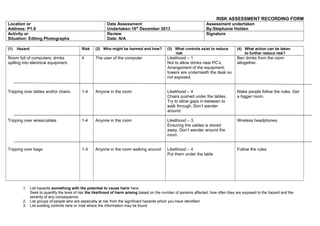
Room full of computers; drinks
spilling into electrical equipment.
Tripping over tables and/or chairs.
Tripping over wires/cables
Tripping over bags
4
1-4
1-4
1-4
The user of the computer
Anyone in the room
Anyone in the room
Anyone in the room walking around
Likelihood – 1
Not to allow drinks near PC’s.
Arrangement of the equipment;
towers are underneath the desk so
not exposed.
Likelihood – 4
Chairs pushed under the tables.
Try to allow gaps in-between to
walk through. Don’t wander
around.
Likelihood – 3.
Ensuring the cables is stored
away. Don’t wander around the
room.
Likelihood – 4
Put them under the table
Ban drinks from the room
altogether.
Make people follow the rules. Get
a bigger room.
Wireless headphones
Follow the rules
1. List hazards something with the potential to cause harm here:
Seek to quantify the level of risk the likelihood of harm arising based on the number of persons affected, how often they are exposed to the hazard and the
severity of any consequence.
2. List groups of people who are especially at risk from the significant hazards which you have identified
3. List existing controls here or note where the information may be found
4. List the risks which are not adequately controlled and the action you will take. Have regard for the level of risk, the cost of any action and the benefit you expect to
gain.
(1) Hazard Risk (2) Who might be harmed and how? (3) What controls exist to reduce
risk
(5) What action can be taken
to further reduce risk?
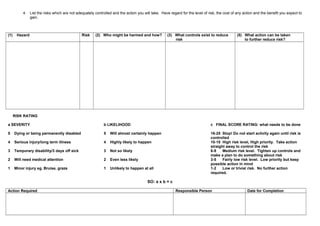
RISK RATING
a SEVERITY b LIKELIHOOD c FINAL SCORE RATING: what needs to be done
5 Dying or being permanently disabled 5 Will almost certainly happen 16-25 Stop! Do not start activity again until risk is
controlled
4 Serious injury/long term illness 4 Highly likely to happen 10-15 High risk level, High priority. Take action
straight away to control the risk
3 Temporary disability/3 days off sick 3 Not so likely 6-9 Medium risk level. Tighten up controls and
make a plan to do something about risk
2 Will need medical attention 2 Even less likely 3-5 Fairly low risk level. Low priority but keep
possible action in mind
1 Minor injury eg. Bruise, graze 1 Unlikely to happen at all 1-2 Low or trivial risk. No further action
required.
SO: a x b = c
Action Required Responsible Person Date for Completion
Risk assessment in p1.9

Risk assessment in p1.9

  • 1.
    RISK ASSESSMENT RECORDINGFORM Location or Address: P1.9 Date Assessment Undertaken:16th December 2013 Assessment undertaken By:Stephanie Holden Activity or Situation: Editing Photographs Review Date: N/A Signature (1) Hazard Risk (2) Who might be harmed and how? (3) What controls exist to reduce risk (4) What action can be taken to further reduce risk? Room full of computers; drinks spilling into electrical equipment. Tripping over tables and/or chairs. Tripping over wires/cables Tripping over bags 4 1-4 1-4 1-4 The user of the computer Anyone in the room Anyone in the room Anyone in the room walking around Likelihood – 1 Not to allow drinks near PC’s. Arrangement of the equipment; towers are underneath the desk so not exposed. Likelihood – 4 Chairs pushed under the tables. Try to allow gaps in-between to walk through. Don’t wander around. Likelihood – 3. Ensuring the cables is stored away. Don’t wander around the room. Likelihood – 4 Put them under the table Ban drinks from the room altogether. Make people follow the rules. Get a bigger room. Wireless headphones Follow the rules 1. List hazards something with the potential to cause harm here: Seek to quantify the level of risk the likelihood of harm arising based on the number of persons affected, how often they are exposed to the hazard and the severity of any consequence. 2. List groups of people who are especially at risk from the significant hazards which you have identified 3. List existing controls here or note where the information may be found
  • 2.
    4. List therisks which are not adequately controlled and the action you will take. Have regard for the level of risk, the cost of any action and the benefit you expect to gain. (1) Hazard Risk (2) Who might be harmed and how? (3) What controls exist to reduce risk (5) What action can be taken to further reduce risk? RISK RATING a SEVERITY b LIKELIHOOD c FINAL SCORE RATING: what needs to be done 5 Dying or being permanently disabled 5 Will almost certainly happen 16-25 Stop! Do not start activity again until risk is controlled 4 Serious injury/long term illness 4 Highly likely to happen 10-15 High risk level, High priority. Take action straight away to control the risk 3 Temporary disability/3 days off sick 3 Not so likely 6-9 Medium risk level. Tighten up controls and make a plan to do something about risk 2 Will need medical attention 2 Even less likely 3-5 Fairly low risk level. Low priority but keep possible action in mind 1 Minor injury eg. Bruise, graze 1 Unlikely to happen at all 1-2 Low or trivial risk. No further action required. SO: a x b = c Action Required Responsible Person Date for Completion