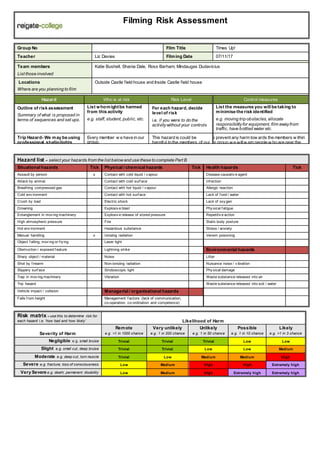
Filming Risk Assessment
Group No Film Title Times Up!
Teacher Liz Davies Filming Date 07/11/17
Team members
List those involved
Katie Bushell, Shania Dale, Ross Barham, Mindaugas Dudavicius
Locations
Where are you planning to film
Outside Castle field house and Inside Castle field house
Hazard Who is at risk Risk Level Control measures
Outline of risk assessment
Summary of what is proposed in
terms of sequences and set ups.
List whomightbe harmed
from this activity
e.g. staff, student, public, etc.
For each hazard, decide
level of risk
i.e. if you were to do the
activitywithout your controls
List the measures you will be taking to
minimise the risk identified
e.g. moving trip obstacles, allocate
responsibilityfor equipment, film awayfrom
traffic, have bottled water etc.
Trip Hazard- We may be using
professional, studiolights
which will have electrical wires
that can be trippedover.
Every member w e have in our
group.
This hazard is could be
harmful to the members of our
group or anyone w alking near
the w ires so could be classed
as slightly harmful.
To prevent any harm tow ards the members w ithin
our group w e willw arn people w ho are near the
electricalw ires.
Hazard list – select your hazards from the list belowand use these to complete Part B
Situational hazards Tick Physical / chemical hazards Tick Health hazards Tick
Assault by person x Contact with cold liquid / v apour Disease causativ e agent
Attack by animal Contact with cold surf ace Inf ection
Breathing compressed gas Contact with hot liquid / v apour Allergic reaction
Cold env ironment Contact with hot surf ace Lack of f ood / water
Crush by load Electric shock Lack of oxy gen
Drowning Explosiv e blast Phy sical f atigue
Entanglement in mov ing machinery Explosiv e release of stored pressure Repetitiv e action
High atmospheric pressure Fire Static body posture
Hot env ironment Hazardous substance Stress / anxiety
Manual handling x Ionizing radiation Venom poisoning
Object f alling, mov ing or f ly ing Laser light
Obstruction / exposed f eature Lightning strike Environmental hazards
Sharp object / material Noise Litter
Shot by f irearm Non-ionizing radiation Nuisance noise / v ibration
Slippery surf ace Stroboscopic light Phy sical damage
Trap in mov ing machinery Vibration Waste substance released into air
Trip hazard Waste substance released into soil / water
Vehicle impact / collision Managerial / organisational hazards
Falls f rom height Management f actors (lack of communication,
co-operation, co-ordination and competence)
Risk matrix – use this to determine risk for
each hazard i.e. ‘how bad and how likely’ Likelihood of Harm
Severity of Harm
Remote
e.g. <1 in 1000 chance
Very unlikely
e.g. 1 in 200 chance
Unlikely
e.g. 1 in 50 chance
Possible
e.g. 1 in 10 chance
Likely
e.g. >1 in 3 chance
Negligible e.g. small bruise Trivial Trivial Trivial Low Low
Slight e.g. small cut, deep bruise Trivial Trivial Low Low Medium
Moderate e.g. deep cut, torn muscle Trivial Low Medium Medium High
Severe e.g. fracture, loss of consciousness Low Medium High High Extremely high
Very Severe e.g. death, permanent disability Low Medium High Extremely high Extremely high
Risk assessment

Risk assessment

  • 1.
    Filming Risk Assessment GroupNo Film Title Times Up! Teacher Liz Davies Filming Date 07/11/17 Team members List those involved Katie Bushell, Shania Dale, Ross Barham, Mindaugas Dudavicius Locations Where are you planning to film Outside Castle field house and Inside Castle field house Hazard Who is at risk Risk Level Control measures Outline of risk assessment Summary of what is proposed in terms of sequences and set ups. List whomightbe harmed from this activity e.g. staff, student, public, etc. For each hazard, decide level of risk i.e. if you were to do the activitywithout your controls List the measures you will be taking to minimise the risk identified e.g. moving trip obstacles, allocate responsibilityfor equipment, film awayfrom traffic, have bottled water etc. Trip Hazard- We may be using professional, studiolights which will have electrical wires that can be trippedover. Every member w e have in our group. This hazard is could be harmful to the members of our group or anyone w alking near the w ires so could be classed as slightly harmful. To prevent any harm tow ards the members w ithin our group w e willw arn people w ho are near the electricalw ires. Hazard list – select your hazards from the list belowand use these to complete Part B Situational hazards Tick Physical / chemical hazards Tick Health hazards Tick Assault by person x Contact with cold liquid / v apour Disease causativ e agent Attack by animal Contact with cold surf ace Inf ection Breathing compressed gas Contact with hot liquid / v apour Allergic reaction Cold env ironment Contact with hot surf ace Lack of f ood / water Crush by load Electric shock Lack of oxy gen Drowning Explosiv e blast Phy sical f atigue Entanglement in mov ing machinery Explosiv e release of stored pressure Repetitiv e action High atmospheric pressure Fire Static body posture Hot env ironment Hazardous substance Stress / anxiety Manual handling x Ionizing radiation Venom poisoning Object f alling, mov ing or f ly ing Laser light Obstruction / exposed f eature Lightning strike Environmental hazards Sharp object / material Noise Litter Shot by f irearm Non-ionizing radiation Nuisance noise / v ibration Slippery surf ace Stroboscopic light Phy sical damage Trap in mov ing machinery Vibration Waste substance released into air Trip hazard Waste substance released into soil / water Vehicle impact / collision Managerial / organisational hazards Falls f rom height Management f actors (lack of communication, co-operation, co-ordination and competence) Risk matrix – use this to determine risk for each hazard i.e. ‘how bad and how likely’ Likelihood of Harm Severity of Harm Remote e.g. <1 in 1000 chance Very unlikely e.g. 1 in 200 chance Unlikely e.g. 1 in 50 chance Possible e.g. 1 in 10 chance Likely e.g. >1 in 3 chance Negligible e.g. small bruise Trivial Trivial Trivial Low Low Slight e.g. small cut, deep bruise Trivial Trivial Low Low Medium Moderate e.g. deep cut, torn muscle Trivial Low Medium Medium High Severe e.g. fracture, loss of consciousness Low Medium High High Extremely high Very Severe e.g. death, permanent disability Low Medium High Extremely high Extremely high