RIGHTS AND DUTIES
V. Joseph Xavier sj
1
CONCEPT OF RIGHT
• A Right is an individual’s entitlement to something.
A person has a right when he is entitled to act in a
certain way or is entitled to have others act in a certain
way toward him or her.
2
Legal and Moral Right
• Legal Right- entitlement derived from a legal system. It is
limited to the jurisdiction within the legal system.
Moral Right- derived from a system of moral standards. Also
called Human Rights, these are based on moral norms and
principles that specify that all human beings are permitted
to do something or are entitled to have something done for
them. Universal Rights.
Rights enable the individual to choose freely to pursue
certain actions and to protect those choices.
3
OTHER MEANINGS OF RIGHT
Authorization to do something either to secure the interests of
oneself or others.
Mere absence of prohibitions against pursuing some interests.
Existence of prohibitions or requirements on others that enable
the individual to pursue certain interests or activities. e.g.
freedom of speech.
4
OTHER MEANINGS OF RIGHT
Moral rights are the most important as these impose
prohibitions or requirements on others and thereby enable the
individual to choose freely to act in a certain way or not to act.
They protect the individual to pursue his interests within the
boundaries specified by the rights.
5
FEATURES OF MORAL RIGHTS
1. Moral rights are tightly correlated with duties. One’s
moral right can be defined in terms of the moral duties
other people have towards that person. e.g. right to
education. This correlative duty may fall not on specific
individual but on all the members of the group. (work).
2. They provide the individual with autonomy and equality in
the free pursuit of their interests. He is free to act in a way
without being subordinated to other’s interests.
3. These provide a basis for justifying one’s actions and for
invoking the protection or aid of others.
6
MORAL RIGHTS VS UTILITARIANISM
1. Moral rights express the requirements of morality from the
point of view of the individual whereas the utilitarianism
expresses the requirements of morality from the point of view
of society as a whole.
2. Rights limit the validity of appeals to social benefits and to
numbers. If a person has a right to do something then it is
wrong for anyone to interfere although a large number of
people might gain much more utility from such interference.
3. If the utilitarian benefits or losses imposed on society become
great enough, they might justify interference in the freedom of
a person to pursue his or her interests e.g. in time of war civil
rights can be curbed.
7
CLASSIFICATION OF RIGHTS
1. Negative Rights:
These are rights defined in terms of the duties others have not to
interfere in certain activities of the person who holds a given
right. (Right to privacy or a right use, sell or give away personal
assets).
2. Positive Rights:
Other agents have the positive duty to provide the holder of the
right with whatever help he needs to freely pursue his or her
interests (right to a decent std of living, right to work, to
education etc.) The society provide its members the necessities
of life that they are unable to provide for themselves.
8
CONTRACTUAL RIGHTS AND DUTIES
Contractual rights & duties are the limited rights and
correlative duties that arise when one person enters into
an agreement with another person.
1. These attach to specific individuals and the corresponding
duties also are imposed on specific individuals.
2. Contractual rights arise out of a specific transaction
between particular individuals.
9
CONTRACTUAL RIGHTS AND DUTIES
3. Contractual rights and duties depend on a publicly accepted
system of rules that define the transactions that give rise to
those rights and duties (may be unwritten)
4. All business depend very much on contracts requiring one
party rely on the word of the other party that he will perform a
particular action.
5. The institution of contract provides a way of ensuring that
people keep their word and thus help the business society to
function.
10
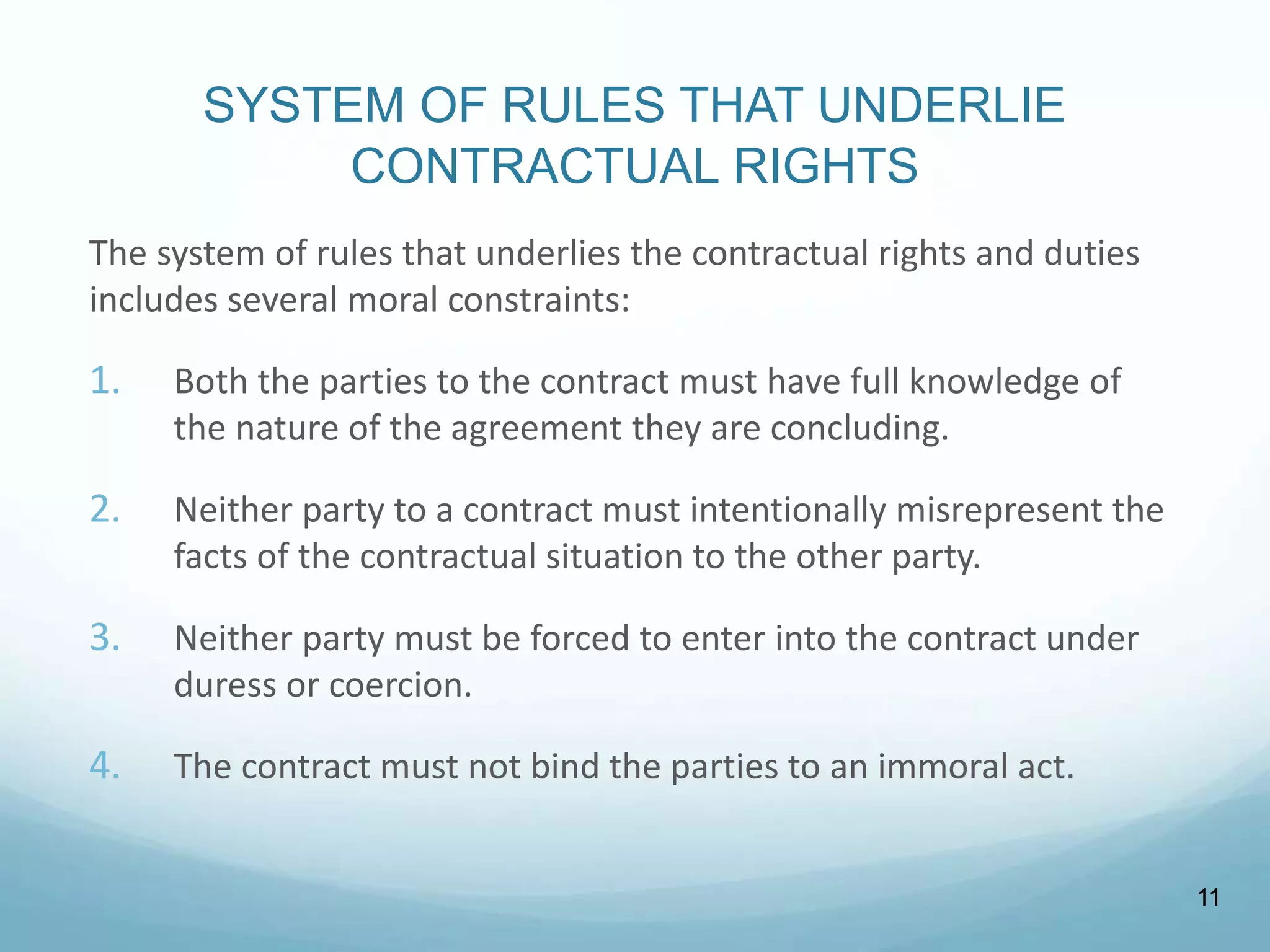
SYSTEM OF RULES THAT UNDERLIE
CONTRACTUAL RIGHTS
The system of rules that underlies the contractual rights and duties
includes several moral constraints:
1. Both the parties to the contract must have full knowledge of
the nature of the agreement they are concluding.
2. Neither party to a contract must intentionally misrepresent the
facts of the contractual situation to the other party.
3. Neither party must be forced to enter into the contract under
duress or coercion.
4. The contract must not bind the parties to an immoral act.
11
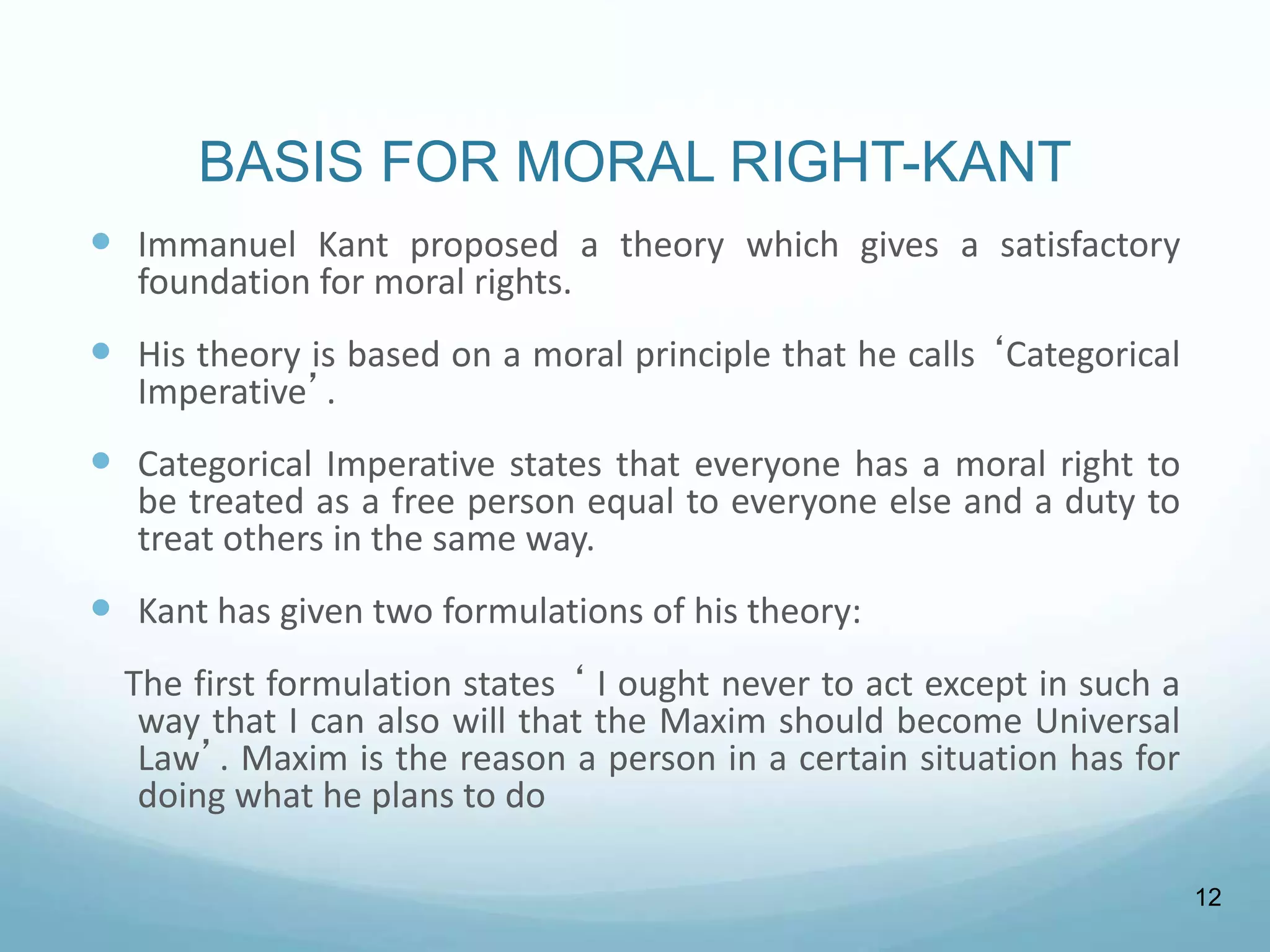
BASIS FOR MORAL RIGHT-KANT
 Immanuel Kant proposed a theory which gives a satisfactory
foundation for moral rights.
 His theory is based on a moral principle that he calls ‘Categorical
Imperative’.
 Categorical Imperative states that everyone has a moral right to
be treated as a free person equal to everyone else and a duty to
treat others in the same way.
 Kant has given two formulations of his theory:
The first formulation states ‘ I ought never to act except in such a
way that I can also will that the Maxim should become Universal
Law’. Maxim is the reason a person in a certain situation has for
doing what he plans to do
12
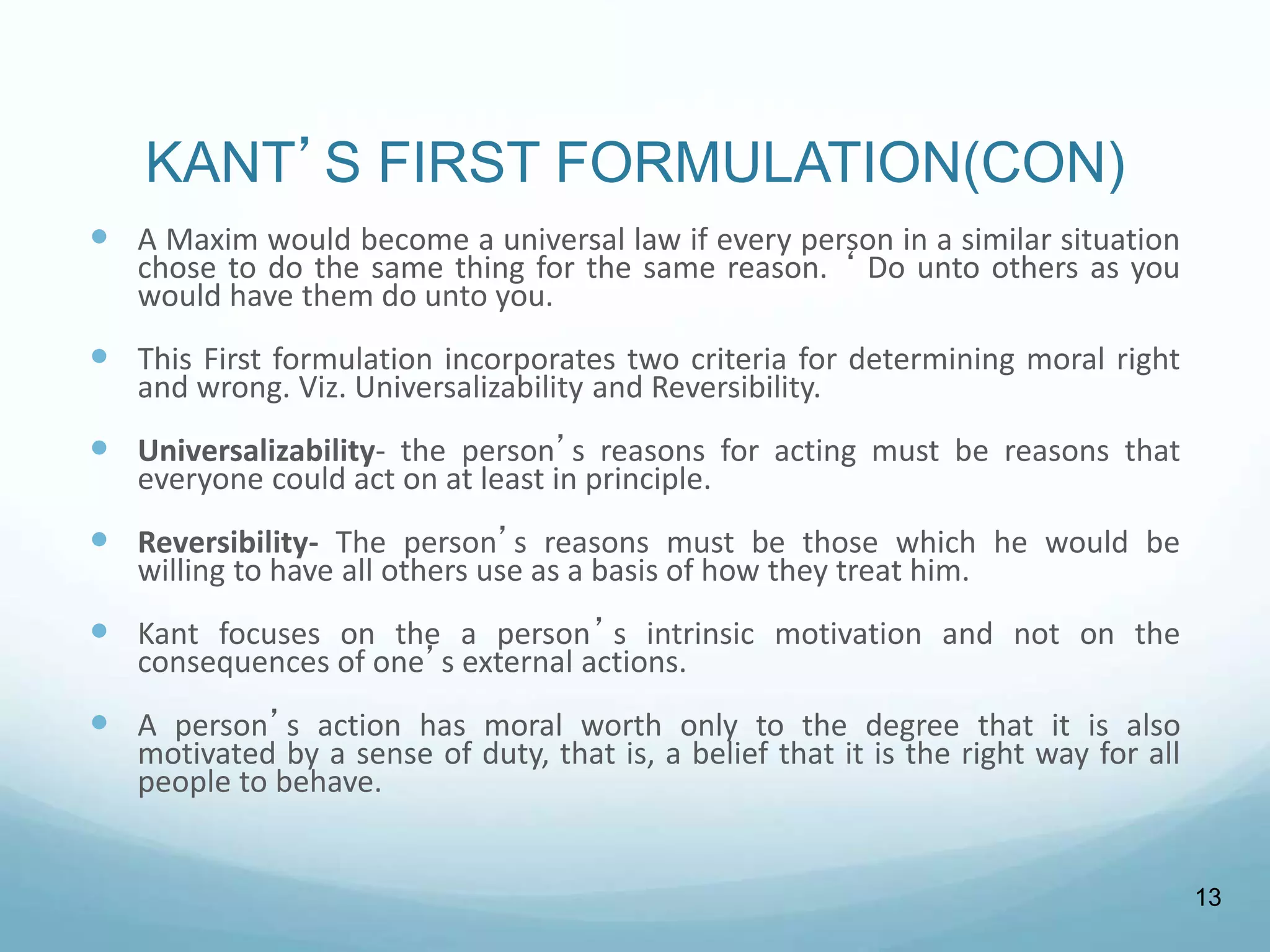
KANT’S FIRST FORMULATION(CON)
 A Maxim would become a universal law if every person in a similar situation
chose to do the same thing for the same reason. ‘ Do unto others as you
would have them do unto you.
 This First formulation incorporates two criteria for determining moral right
and wrong. Viz. Universalizability and Reversibility.
 Universalizability- the person’s reasons for acting must be reasons that
everyone could act on at least in principle.
 Reversibility- The person’s reasons must be those which he would be
willing to have all others use as a basis of how they treat him.
 Kant focuses on the a person’s intrinsic motivation and not on the
consequences of one’s external actions.
 A person’s action has moral worth only to the degree that it is also
motivated by a sense of duty, that is, a belief that it is the right way for all
people to behave.
13
SECOND FORMULATION OF KANT’S
CATEGORICAL IMPERATIVE
 ‘Act in such a way that you always treat humanity whether in
your own person or in the person of any other, never simply as a
means but always at the same time as an end’. This means :
1. Respect each person’s freedom by treating people only as they
have freely consented to be treated beforehand.
2. Develop each person’s capacity to freely choose for himself or
herself the aims he or she will pursue.
‘An action is morally right for a person if, and only if, in performing
the action, the person does not use others as a means for
advancing his or her own interests but also both respects and
develops their capacity to choose freely for themselves’.
14
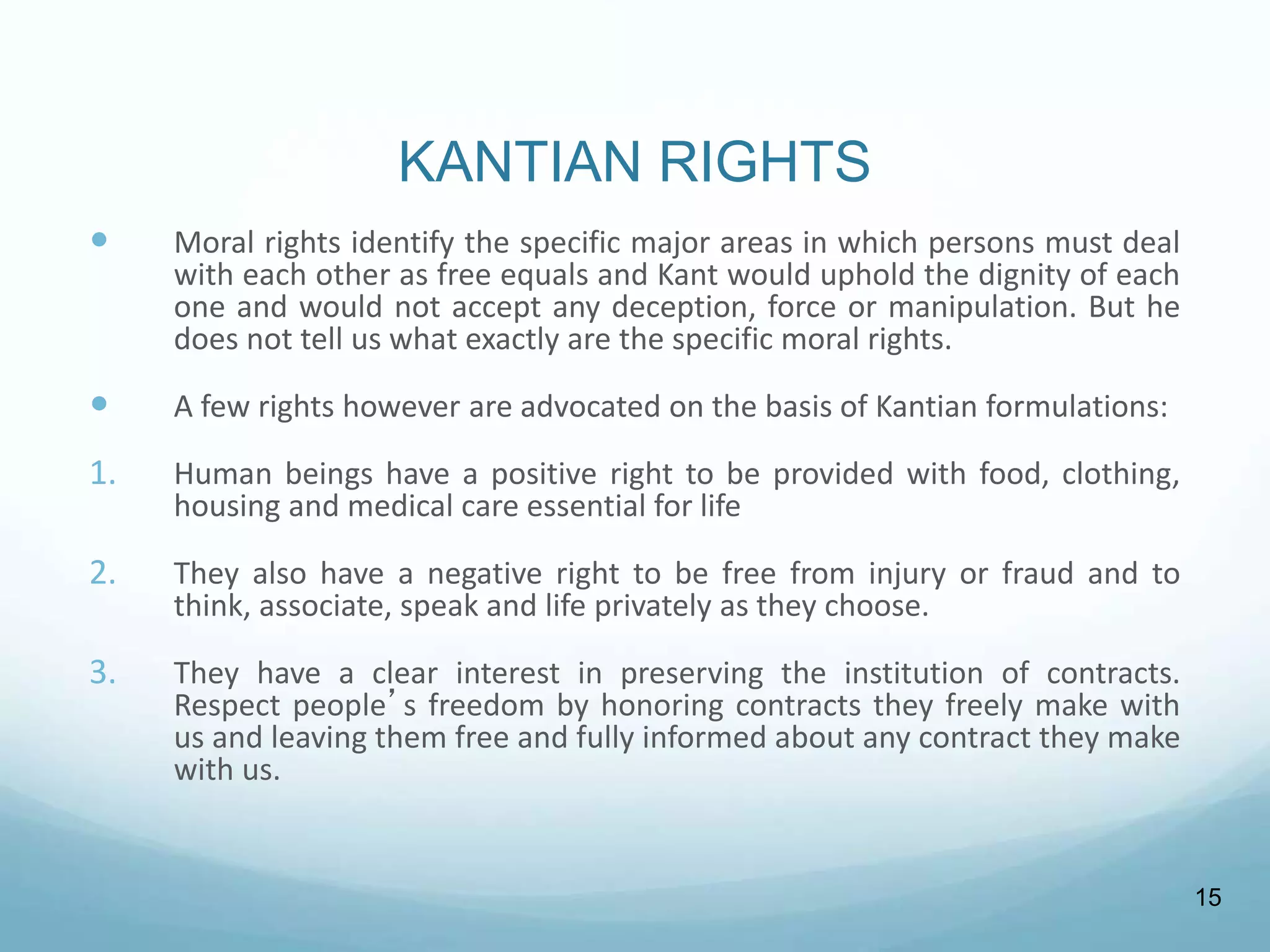
KANTIAN RIGHTS
 Moral rights identify the specific major areas in which persons must deal
with each other as free equals and Kant would uphold the dignity of each
one and would not accept any deception, force or manipulation. But he
does not tell us what exactly are the specific moral rights.
 A few rights however are advocated on the basis of Kantian formulations:
1. Human beings have a positive right to be provided with food, clothing,
housing and medical care essential for life
2. They also have a negative right to be free from injury or fraud and to
think, associate, speak and life privately as they choose.
3. They have a clear interest in preserving the institution of contracts.
Respect people’s freedom by honoring contracts they freely make with
us and leaving them free and fully informed about any contract they make
with us.
15
PROBLEMS WITH KANT’S THEORY
1. Critics say that Kant’s theory is not precise enough to be useful
always. One difficulty lies in trying to determine whether one
would be ‘willing to have everyone follow’ a certain policy and
whether one is using another merely as a means.
2. Some critics claim that although we might be able to agree on
the kinds of interests that have the status of moral rights, there
is a lot of disagreement concerning the limits of each of these
rights and how each of these rights should be balanced against
other conflicting rights.
3. There are counter examples that show that the theory does not
hold good. Most of these focus on the criteria of
Universalizability and Reversibility. E.g. discriminating in pay on
the basis of colour and race.
16

Rights and duties jothisj

  • 1.
    RIGHTS AND DUTIES V.Joseph Xavier sj 1
  • 2.
    CONCEPT OF RIGHT •A Right is an individual’s entitlement to something. A person has a right when he is entitled to act in a certain way or is entitled to have others act in a certain way toward him or her. 2
  • 3.
    Legal and MoralRight • Legal Right- entitlement derived from a legal system. It is limited to the jurisdiction within the legal system. Moral Right- derived from a system of moral standards. Also called Human Rights, these are based on moral norms and principles that specify that all human beings are permitted to do something or are entitled to have something done for them. Universal Rights. Rights enable the individual to choose freely to pursue certain actions and to protect those choices. 3
  • 4.
    OTHER MEANINGS OFRIGHT Authorization to do something either to secure the interests of oneself or others. Mere absence of prohibitions against pursuing some interests. Existence of prohibitions or requirements on others that enable the individual to pursue certain interests or activities. e.g. freedom of speech. 4
  • 5.
    OTHER MEANINGS OFRIGHT Moral rights are the most important as these impose prohibitions or requirements on others and thereby enable the individual to choose freely to act in a certain way or not to act. They protect the individual to pursue his interests within the boundaries specified by the rights. 5
  • 6.
    FEATURES OF MORALRIGHTS 1. Moral rights are tightly correlated with duties. One’s moral right can be defined in terms of the moral duties other people have towards that person. e.g. right to education. This correlative duty may fall not on specific individual but on all the members of the group. (work). 2. They provide the individual with autonomy and equality in the free pursuit of their interests. He is free to act in a way without being subordinated to other’s interests. 3. These provide a basis for justifying one’s actions and for invoking the protection or aid of others. 6
  • 7.
    MORAL RIGHTS VSUTILITARIANISM 1. Moral rights express the requirements of morality from the point of view of the individual whereas the utilitarianism expresses the requirements of morality from the point of view of society as a whole. 2. Rights limit the validity of appeals to social benefits and to numbers. If a person has a right to do something then it is wrong for anyone to interfere although a large number of people might gain much more utility from such interference. 3. If the utilitarian benefits or losses imposed on society become great enough, they might justify interference in the freedom of a person to pursue his or her interests e.g. in time of war civil rights can be curbed. 7
  • 8.
    CLASSIFICATION OF RIGHTS 1.Negative Rights: These are rights defined in terms of the duties others have not to interfere in certain activities of the person who holds a given right. (Right to privacy or a right use, sell or give away personal assets). 2. Positive Rights: Other agents have the positive duty to provide the holder of the right with whatever help he needs to freely pursue his or her interests (right to a decent std of living, right to work, to education etc.) The society provide its members the necessities of life that they are unable to provide for themselves. 8
  • 9.
    CONTRACTUAL RIGHTS ANDDUTIES Contractual rights & duties are the limited rights and correlative duties that arise when one person enters into an agreement with another person. 1. These attach to specific individuals and the corresponding duties also are imposed on specific individuals. 2. Contractual rights arise out of a specific transaction between particular individuals. 9
  • 10.
    CONTRACTUAL RIGHTS ANDDUTIES 3. Contractual rights and duties depend on a publicly accepted system of rules that define the transactions that give rise to those rights and duties (may be unwritten) 4. All business depend very much on contracts requiring one party rely on the word of the other party that he will perform a particular action. 5. The institution of contract provides a way of ensuring that people keep their word and thus help the business society to function. 10
  • 11.
    SYSTEM OF RULESTHAT UNDERLIE CONTRACTUAL RIGHTS The system of rules that underlies the contractual rights and duties includes several moral constraints: 1. Both the parties to the contract must have full knowledge of the nature of the agreement they are concluding. 2. Neither party to a contract must intentionally misrepresent the facts of the contractual situation to the other party. 3. Neither party must be forced to enter into the contract under duress or coercion. 4. The contract must not bind the parties to an immoral act. 11
  • 12.
    BASIS FOR MORALRIGHT-KANT  Immanuel Kant proposed a theory which gives a satisfactory foundation for moral rights.  His theory is based on a moral principle that he calls ‘Categorical Imperative’.  Categorical Imperative states that everyone has a moral right to be treated as a free person equal to everyone else and a duty to treat others in the same way.  Kant has given two formulations of his theory: The first formulation states ‘ I ought never to act except in such a way that I can also will that the Maxim should become Universal Law’. Maxim is the reason a person in a certain situation has for doing what he plans to do 12
  • 13.
    KANT’S FIRST FORMULATION(CON) A Maxim would become a universal law if every person in a similar situation chose to do the same thing for the same reason. ‘ Do unto others as you would have them do unto you.  This First formulation incorporates two criteria for determining moral right and wrong. Viz. Universalizability and Reversibility.  Universalizability- the person’s reasons for acting must be reasons that everyone could act on at least in principle.  Reversibility- The person’s reasons must be those which he would be willing to have all others use as a basis of how they treat him.  Kant focuses on the a person’s intrinsic motivation and not on the consequences of one’s external actions.  A person’s action has moral worth only to the degree that it is also motivated by a sense of duty, that is, a belief that it is the right way for all people to behave. 13
  • 14.
    SECOND FORMULATION OFKANT’S CATEGORICAL IMPERATIVE  ‘Act in such a way that you always treat humanity whether in your own person or in the person of any other, never simply as a means but always at the same time as an end’. This means : 1. Respect each person’s freedom by treating people only as they have freely consented to be treated beforehand. 2. Develop each person’s capacity to freely choose for himself or herself the aims he or she will pursue. ‘An action is morally right for a person if, and only if, in performing the action, the person does not use others as a means for advancing his or her own interests but also both respects and develops their capacity to choose freely for themselves’. 14
  • 15.
    KANTIAN RIGHTS  Moralrights identify the specific major areas in which persons must deal with each other as free equals and Kant would uphold the dignity of each one and would not accept any deception, force or manipulation. But he does not tell us what exactly are the specific moral rights.  A few rights however are advocated on the basis of Kantian formulations: 1. Human beings have a positive right to be provided with food, clothing, housing and medical care essential for life 2. They also have a negative right to be free from injury or fraud and to think, associate, speak and life privately as they choose. 3. They have a clear interest in preserving the institution of contracts. Respect people’s freedom by honoring contracts they freely make with us and leaving them free and fully informed about any contract they make with us. 15
  • 16.
    PROBLEMS WITH KANT’STHEORY 1. Critics say that Kant’s theory is not precise enough to be useful always. One difficulty lies in trying to determine whether one would be ‘willing to have everyone follow’ a certain policy and whether one is using another merely as a means. 2. Some critics claim that although we might be able to agree on the kinds of interests that have the status of moral rights, there is a lot of disagreement concerning the limits of each of these rights and how each of these rights should be balanced against other conflicting rights. 3. There are counter examples that show that the theory does not hold good. Most of these focus on the criteria of Universalizability and Reversibility. E.g. discriminating in pay on the basis of colour and race. 16