Asterisk The Definitive Guide 5th Edition Early
Release 5th Edition Jim Van Meggelen download
https://ebookbell.com/product/asterisk-the-definitive-guide-5th-
edition-early-release-5th-edition-jim-van-meggelen-34170472
Explore and download more ebooks at ebookbell.com
Here are some recommended products that we believe you will be
interested in. You can click the link to download.
Asterisk The Definitive Guide Open Source Telephony For The Enterprise
5th Edition Jim Van Meggelen
https://ebookbell.com/product/asterisk-the-definitive-guide-open-
source-telephony-for-the-enterprise-5th-edition-jim-van-
meggelen-10998190
Asterisk The Definitive Guide 3rd Edition Third Edition Leif Madsen
https://ebookbell.com/product/asterisk-the-definitive-guide-3rd-
edition-third-edition-leif-madsen-2227070
Asterisk The Definitive Guide 4th Edition 4th Edition Russell Bryant
https://ebookbell.com/product/asterisk-the-definitive-guide-4th-
edition-4th-edition-russell-bryant-34170474
Asterisk The Definitive Guide 3rd Ed Meggelen Jim Madsen Leif
https://ebookbell.com/product/asterisk-the-definitive-guide-3rd-ed-
meggelen-jim-madsen-leif-10501940
Asterisk The Definitive Guide Russell Bryant Jim Van Meggelen
https://ebookbell.com/product/asterisk-the-definitive-guide-russell-
bryant-jim-van-meggelen-50554660
Asterisk The Definitive Guide Russell Bryant Jim Van Meggelen Leif
Madsen
https://ebookbell.com/product/asterisk-the-definitive-guide-russell-
bryant-jim-van-meggelen-leif-madsen-59104910
Asterisk The Definitive Guide Jim Van Meggelen Russell Bryant Leif
Madsen
https://ebookbell.com/product/asterisk-the-definitive-guide-jim-van-
meggelen-russell-bryant-leif-madsen-59104914
Asterisk The Definitive Guide Russell Bryant Leif Madsen
https://ebookbell.com/product/asterisk-the-definitive-guide-russell-
bryant-leif-madsen-53639020
Asterisk The Future Of Telephony 2nd Edition Jim Van Meggelen
https://ebookbell.com/product/asterisk-the-future-of-telephony-2nd-
edition-jim-van-meggelen-56543686
Foreword
When contemplating the foreword for every edition of this book, we always had more people
we’d like contributions from than pages we could spare. In this fifth edition, we’ve again asked
a select group of people from the Asterisk community to write a few words about Asterisk from
their perspective.
Joshua Colp (Senior Software Developer,
Sangoma/Digium)
Over 15 years ago, I downloaded Asterisk onto my laptop and placed my first VoIP call using
IAX2 to the Digium PBX. I held my breath in anticipation, waiting to hear a voice, until finally
the sound of Allison came out of my laptop. At that point I knew there was something special to
Asterisk. It lit this spark of interest and imagination in me: my laptop had actually placed a call!
The realization that with only a little effort I could take calls and do with them what I wanted
was addictive and exciting—a sentiment shared by many to this day.
Asterisk today is vastly different from how it was during that time. In the past, it was primarily
focused on being a PBX. It had all of the features and continued to gain new ones to propel it
further into that area. Over time, however, the project has evolved to one where Asterisk is a
toolkit that can be used alone or in combination with other projects to build things. It’s there to
spark the question of “Can I do this?” in your mind and allow you to see it through.
This simple question is what drives many of the decisions made about Asterisk and its direction.
“Is this right for the users?”, “Is this what people truly need?,” “Does this break things?,” and
“Can they build what they want with this?” Together, these questions help ensure that people
can realize their ideas. This is what excites me about Asterisk today—seeing people use the
tools to create something new without hindrance.
I think that, going forward, this will continue for Asterisk. It will continue to add new tools and
functionality to provide greater flexibility and options for those building things, while respecting
its legacy and how users already use it. It will continue to be part of bigger and better solutions,
some of which may not even come to mind now. We’ve only taken a few steps forward and
have many to go.
I challenge new and old users of Asterisk alike to revisit what Asterisk can do, to learn new
features that have been added, and to build something new and exciting out of your normal skill
set. If you hit a roadblock where Asterisk can’t do what you need, then participate in the project
and contribute. Help others who may be trying to do the same thing. Become not just someone
who uses Asterisk, but also someone who helps others realize their dream.
Dan Jenkins (Founder, Nimble Ape Ltd)
Asterisk was my first foray into the open source telephony world, and as a web developer, I
found it very different from what I was used to, coming from the web industry. The Asterisk
project has moved on since then, and now the project incorporates many APIs and technologies
that a typical web developer has come to expect. The inclusion of WebRTC and Asterisk’s
Страница 1
REST interface is vital for integration from developers used to building for the web platform.
Asterisk is what I eventually ended building a business around—it is truly a remarkable piece of
software and has a brilliant community of people who both use and improve it. It’s been my
pleasure being a part of this community and proofreading this book for the future community.
Joyce Wilmot (Senior Web Developer)
I was introduced to Asterisk in 2012 when I was working for Voicenation, a company that
provides live answering service 24/7/365 for thousands of customers. At the time, the call center
was quickly outgrowing the third-party software they were using. Unable to find a flexible and
cost-effective solution for their quickly expanding call center, Voicenation decided that they
needed to create their own call center software. I was tasked with creating this software, which
started my journey with Asterisk. What started as a monumental task (since I did not have prior
IP telephony experience) quickly became a fascination with Asterisk as I discovered how it
simplified our setup without sacrificing power and flexibility.
Fast-forward nine years and tens of millions of calls later, and Asterisk still faithfully and
reliably runs our call center. This was my first exposure to open source software. Asterisk is
obviously an open source success story that illustrates how open source software fuels
entrepreneurism—and how entrepreneurism, in return, fuels development and enhancement of
the open source software. I’m thrilled to be part of that cycle, and look forward to being part of
the community as Asterisk continually evolves to keep up with the ever-changing world of
telecommunications.
Matt Florell (Founder, VICIdial)
My first exposure to open source telephony back in 2001 was actually not with Asterisk. It was
with a different software package, one that took me a couple of months to get working, using a
simple IVR to log contact requests for my employer at the time. It was not an easy system to
work with or modify, so I didn’t do much else with it beyond that first IVR project. Two years
later, I had a request from a client to build a much more complex telephony system, one that
would require user interactions through a computer. I knew the platform I had been using wasn’t
going to work for a project like this, so I looked around at both commercial and open source
options. That’s when I learned about Asterisk, which looked like it could be an ideal platform
for this project. I bought a T1 card with which to do some testing, and within two hours of its
arrival, I had configured it and I was able to replicate the old project that had taken me two
months to build. After that, I was hooked. The VICIdial Open-Source Contact Center project
grew out of that project; to date, over 100,000 Asterisk systems have been installed as a part of
VICIdial clusters, and those are just the ones we know about.
Asterisk was very different from the mostly web-based open source packages that I had worked
with in the past, and it had quite a few quirks and bugs in the earlier days that you had to work
around (sometimes in pretty creative ways). But our more recent experiences with the Asterisk
13 branch have shown significant improvements in both capacity and stability, compared to
earlier branches. There have also been many new features added that have allowed us to add
Страница 2
new functionality to our VICIdial package. Two of those are the ability to pause call recordings
and the addition of several layers of new SIP carrier logging.
Back in 2003 when I started using Asterisk, there were no real “releases.” You had to find a
stable build from one of the recent CVS revisions and test it out. As time went on, the
development and maintenance of the different branches became much more stable, and the use
of Asterisk in production systems all over the world skyrocketed. Today, Asterisk is the
telephony core of thousands of different service offerings, with billions of phone calls a day
being placed through them. It is being installed on wide varieties of hardware, from tiny
embedded systems to server farms with hundreds of high-powered machines. There are now
millions of people who use Asterisk every day who have no idea that they are interacting with a
piece of open source software.
Among our client base alone, we have several Fortune 500 companies, as well as school
districts, social clubs, political organizations, municipal emergency services organizations, and
of course, thousands of different types of commercial operations. While the low acquisition cost
is a common reason given for going with an Asterisk-based solution, we often hear that the fact
that it is open source is a big plus, as well as there being no possibility of vendor lock-in. One of
our larger clients even cited their use of open source telephony software as a “distinct strategic
advantage” over their competitors because of the flexibility of the systems and their ability to
self-manage them without having to rely on outside vendors. From what I’ve seen so far, the
future of Asterisk is an ever-growing installed base and continued enhancements. I look forward
to working with it for another 16 years, at least.
Matt Fredrickson (Director of Asterisk
Engineering, Sangoma/Digium)
I have had the opportunity to work with Asterisk for the last 18 years, and have seen it grow
from a small project with one or two people into something that has a life of its own with
hundreds of contributors. It’s amazing to see the number of different places it has disrupted
traditional telecom—at home, in the office, and in the enterprise. As traditional communication
patterns shift, the Asterisk project continues to be in the place where it does best—bridging old
forms of communication with the new, and pushing the boundaries of what can be done with the
new. This book will help you see the most modern face of Asterisk and how to better utilize it in
your telecommunications infrastructure. Huge thanks goes to Jim Van Meggelen for all the hard
work on putting this most current edition together.
Страница 3
Preface
This is a book for anyone who uses Asterisk.
Asterisk is an open source, converged telephony platform, which is designed primarily to run on
Linux. Asterisk combines more than 100 years of telephony knowledge into a robust suite of
tightly integrated telecommunications applications. The power of Asterisk lies in its
customizable nature, complemented by unmatched standards compliance. No other private
branch exchange (PBX) can be deployed in so many creative ways.
Applications such as voicemail, hosted conferencing, call queuing and agents, music on hold,
and call parking are all standard features built right into the software. Moreover, Asterisk can
integrate with other business technologies in ways that closed, proprietary PBXs can scarcely
dream of.
Asterisk can appear quite daunting and complex to a new user, which is why documentation is
so important to its growth. Documentation lowers the barrier to entry and helps people
contemplate the possibilities.
Produced with the generous support of O’Reilly Media, Asterisk: The Definitive Guide is the
fifth edition of what was formerly called Asterisk: The Future of Telephony.
This book was written for, and by, members of the Asterisk community.
Audience
This book is intended to be gentle toward those new to Asterisk, but we assume that you’re
familiar with basic Linux administration, networking, and other IT disciplines. If not, we
encourage you to explore the vast and wonderful library of books that O’Reilly publishes on
these subjects. We also assume you’re fairly new to telecommunications (both traditional
switched telephony and the new world of Voice over IP).
However, this book will also be useful for the more experienced Asterisk administrator. We
ourselves use the book as a reference for features that we haven’t used for a while.
Software
This book is focused on documenting Asterisk version 16; however, many of the conventions
and much of the information in this book is version-agnostic. Linux is the operating system we
have run and tested Asterisk on, and we have documented installation instructions for CentOS
(Red Hat Enterprise Linux, or RHEL).
Conventions Used in This Book
The following typographical conventions are used in this book:
Italic
Indicates new terms, URLs, email addresses, filenames, file extensions, pathnames,
directories, and package names, as well as Unix utilities, commands, modules,
parameters, and arguments.
Constant width
Страница 4
Used to display code samples, file contents, command-line interactions, database
commands, library names, and options.
Constant width bold
Indicates commands or other text that should be typed literally by the user. Also used for
emphasis in code.
Constant width italic
Shows text that should be replaced with user-supplied values.
[ Keywords and other stuff ]
Indicates optional keywords and arguments.
{ choice-1 | choice-2 }
Signifies either choice-1 or choice-2.
Tip
This element signifies a tip or suggestion.
Note
This element signifies a general note.
Caution
This element indicates a warning or caution.
O’Reilly Online Learning
Note
For almost 40 years, O’Reilly Media has provided technology and business training, knowledge,
and insight to help companies succeed.
Our unique network of experts and innovators share their knowledge and expertise through
books, articles, conferences, and our online learning platform. O’Reilly’s online learning
platform gives you on-demand access to live training courses, in-depth learning paths,
interactive coding environments, and a vast collection of text and video from O’Reilly and 200+
other publishers. For more information, please visit http://oreilly.com.
How to Contact Us
Please address comments and questions concerning this book to the publisher:
 O’Reilly Media, Inc.
 1005 Gravenstein Highway North
 Sebastopol, CA 95472
 800-998-9938 (in the United States or Canada)
 707-829-0515 (international or local)
 707-829-0104 (fax)
We have a web page for this book, where we list errata, examples, and any additional
information. You can access this page at https://oreil.ly/asterisk_tdg_5E.
To comment or ask technical questions about this book, send email to
bookquestions@oreilly.com.
For more information about our books, courses, conferences, and news, see our website at
http://www.oreilly.com.
Find us on Facebook: http://facebook.com/oreilly
Страница 5
Follow us on Twitter: http://twitter.com/oreillymedia
Watch us on YouTube: http://www.youtube.com/oreillymedia
Acknowledgments from Jim Van Meggelen
To David Duffett, thanks for the chapter on internationalization, which properly looks at this
technology from a more global perspective.
Thanks to Leif Madsen, Jared Smith, and Russell Bryant, for your contributions to the previous
editions of this book. It was fun flying solo, but I can’t deny I missed you guys!
Specific thanks to Matt Fredrickson and Matt Jordan of Digium, who generously shared their
time and knowledge with me, and without whom I would have been lost. Thanks guys!
Thanks to my editor, Jeff Bleiel, for keeping me on track and helping me make important
decisions about the content and pacing of the book.
Also thanks to the rest of the unsung heroes in O’Reilly’s production department. These are the
folks that take a book and make it an O’Reilly book.
Thanks especially to Joyce Wilmot and Dan Jenkins, my technical review team, for taking the
time to work through the book and provide essential feedback.
Thomas Cameron of RedHat generously shared his knowledge of Selinux with me, and helped
to demystify a Linux component that is too often left disabled.
Everyone in the Asterisk community also needs to thank the late Jim Dixon for creating the first
open source telephony hardware interfaces, starting the revolution, and giving his creations to
the community at large.
Finally, and most importantly, thanks go to Mark Spencer, the original author of Asterisk and
founder of Digium, for Asterisk, for Pidgin, and for contributing his creations to the open source
community. Asterisk is your legacy!
Страница 6
Chapter 1. A Telephony Revolution
We are what they grow beyond. That is the true burden of all masters.
Jedi Master Yoda
When we first set out in 2004 to write a book about Asterisk (15 years ago as of this edition!),
we confidently predicted that Asterisk would fundamentally change the telecommunications
industry. Today, the revolution we predicted is a part of history. Asterisk has been the most
successful private branch exchange (PBX) in the world for several years now, and is an accepted
technology within the telecommunications industry.
The revolution—as necessary as it was to the telecommunications industry of that time—has
tailed off significantly simply because the methods by which people like to communicate have
changed. Whereas 25 years ago phone calls were the preferred way to converse across distances,
the current trend is to send messages or conduct video-chat conference calls. The phone call is
seen as a bit of a dead thing, especially by up-and-coming generations. We’re not quite ready for
a funeral just yet.
Asterisk remains a powerful technology, and we believe it is still one of the best hopes for any
sort of sensible integration between telecom and all the other technologies businesses might
want to interconnect with. It will need to find its place within a communications ecosystem that
no longer places telephone calls in a place of importance. Our expectation is that WebRTC,
which promises to commoditize web-based communications,1
will emerge as a replacement for
all the copycat, closed, and proprietary “collaboration” products currently flooding (and
confusing) the market. Asterisk can play a role in this new future, and the Asterisk community
has willingly and enthusiastically taken on this new concept. So, maybe you’re being told that
voice is dead, but anyone who’s paid attention to any science fiction of any kind knows that
being able to talk to each other across long distances is not going to be the sole domain of those
who type on keyboards. Humans like to talk, and we’ll continue to find ways to do so.
There also exists, it must be noted, a massive generation of people whose memories predate the
internet, and for these folks the telephone is still a very useful technology. If one wishes to do
business with them, one had better do a good job of handling telephone calls. These folks are
retiring from the workforce, but their wallets still carry a lot of clout. Perhaps the PBX is a
dying thing, but its tail is very long.
In this book, we’re going to explore the nuts and bolts of Asterisk. It is a flexible, open,
standards-compliant toolkit, which we believe is still very relevant to businesses today, and will
remain useful for many years to come. The power of Asterisk lies in its flexibility. It has proven
to be very useful at tying various types of communications technologies together, and if it is to
have any sort of future, it will need to continue to do so. Newer technologies such as WebRTC
offer all sorts of possibilities for the future of communication, and the Asterisk community is
very focused on this paradigm shift.
The remarkable flexibility of Asterisk comes with a price: it is not a simple system to learn or
configure. This is not because it’s illogical, confusing, or cryptic; on the contrary, it is very
Страница 7
sensible and practical. People’s eyes light up when they first see an Asterisk dialplan and begin
to contemplate the possibilities. But when there are literally thousands of ways to achieve a
result, the process naturally requires extra effort. Perhaps it can be compared to building a
house: the components are relatively easy to understand, but a person contemplating such a task
must either a) enlist competent help or b) develop the required skills through instruction,
practice, and a good book on the subject.
Asterisk and VoIP: Bridging the Gap Between
Traditional and Network Telephony
It sometimes seems that we’ve forgotten that the purpose of the telephone is to allow people to
communicate. It is a simple goal, really, and it should be possible for us to make it happen in far
more flexible and creative ways than are currently available to us. New technologies always
seek to dominate the market with a proprietary offering. Few succeed. Communications
technologies need to interoperate, and technologies such as Asterisk lower the barriers to entry
for those wishing to innovate.
It is for this reason—communication—that we believe a future still exists for open source
telephony projects such as Asterisk. Yes, people might not want to make “phone calls” anymore,
but we believe there will still be value found in conversations. The technologies that can
facilitate those conversations may evolve in seemingly radical ways, yet the underlying desire to
communicate remains the same.
Asterisk is plugged into the future, and it has a long track record of successfully integrating
communications technologies.
The Zapata Telephony Project
When the Asterisk project was started (in 1999), there were other open source telephony
projects in existence. However, Asterisk, in combination with the Zapata Telephony Project,
was able to provide public switched telephone network (PSTN) interfaces, which represented an
important milestone in transitioning the software from something purely network-based to
something more practical in the world of telecom at that time, which was PSTN-centric.
The Zapata Telephony Project was conceived of by Jim Dixon, a telecommunications consulting
engineer who was inspired by the incredible advances in CPU speeds that the computer industry
has now come to take for granted. Dixon’s belief was that far more economical telephony
systems could be created if a card existed that had nothing more on it than the basic electronic
components required to interface with a telephone circuit. Rather than having expensive
components on the card, digital signal processing (DSP)2
would be handled in the CPU by
software. While this would impose a tremendous load on the CPU, Dixon was certain that the
low cost of CPUs relative to their performance made them far more attractive than expensive
DSPs, and, more importantly, that this price/performance ratio would continue to improve as
CPUs continued to increase in power.
Страница 8
Like so many visionaries, Dixon believed that many others would see this opportunity, and that
he merely had to wait for someone else to create what to him was an obvious improvement.
After a few years, he noticed that not only had no one created these cards, but also it seemed
unlikely that anyone was ever going to. At that point it was clear that if he wanted a revolution,
he was going to have to start it himself. And so the Zapata Telephony Project was born:
Since this concept was so revolutionary, and was certain to make a lot of waves in the
industry, I decided on the Mexican revolutionary motif, and named the technology and
organization after the famous Mexican revolutionary Emiliano Zapata. I decided to call the
card the “tormenta” which, in Spanish, means “storm,” but contextually is usually used to
imply a big storm, like a hurricane or such.
Perhaps we should be calling ourselves Asteristas. Regardless, we owe Jim Dixon a debt of
thanks, partly for thinking this up and partly for seeing it through, but mostly for giving the
results of his efforts to the open source community. As a result of Jim’s contribution, Asterisk’s
PSTN engine came to be. And thanks to this marrying of VoIP and PSTN, the open source
telecom revolution was born!
Over the years, the Zapata Telephony interface in Asterisk has been modified and improved.
The Digium Asterisk Hardware Device Interface (DAHDI) telephony interface in use today is
the offspring of Jim Dixon’s contribution.
Massive Change Requires Flexible
Technology
Every PBX in existence suffers from shortcomings. No matter how fully featured it is,
something will always be left out, because even the most feature-rich PBX will always fail to
anticipate the creativity of the customer. A small group of users will desire an odd little feature
that the design team either did not think of or could not justify the cost of building, and, since
the system is closed, the users will not be able to build it themselves.
If the internet had been thusly hampered by regulation and commercial interests, it is doubtful
that it would have gained the wide acceptance it currently enjoys. The openness of the internet
meant that anyone could afford to get involved. So, everyone did. The tens of thousands of
minds that collaborated on the creation of the internet delivered something that no corporation
alone ever could have.3
As with many other open source projects (such as Linux and so much of the critical software
running the internet), the development of Asterisk was fueled by the dreams of folks who knew
that there had to be something more than what traditional industries were producing. These
people knew that if one could take the best parts of various PBXs and separate them into
interconnecting components—akin to a boxful of LEGO bricks—one could begin to conceive of
things that would not survive a traditional corporate risk-analysis process.
Asterisk itself has become the basis of many massively productized creations. And yet, under
the hood, the soul of that open source project still remains.
Страница 9
Asterisk: The Hacker’s PBX
Asterisk is the ultimate hacker’s PBX. The term hacker has, of course, been twisted by the mass
media into meaning “malicious cracker” to the uneducated. This is unfortunate, because the term
actually existed long before the media corrupted its meaning. Hackers built the networking
engine that is the internet. Hackers built the Apple Macintosh and the Unix operating system.
Hackers are also building your next telecom system. Yes, some of these folks are malicious, but
the minds that steer the development of Asterisk are well aware of this, and you’ll find that
Asterisk allows you to build a system that’s far more capable of rapidly responding to security
threats. Open source software doesn’t hide its faults behind corporate spin departments. The dirt
gets dragged out into the open where it can be dealt with. Rather than being constricted by the
dubious and often poor security of closed systems, the Asterisk community quickly responds to
changing trends in security, and you’ll be able to fine-tune your telephone system in response to
both corporate policy and industry best practices.
Like other open source systems, Asterisk will be able to evolve into a far more secure platform
than any proprietary system, not in spite of its hacker roots, but rather because of them.
Asterisk: The Professional’s PBX
Asterisk is an enabling technology, and as with Linux, it will become increasingly rare to find
an enterprise that is not running some version of Asterisk, in some capacity, somewhere in the
network, solving a problem as only Asterisk can. You’re already using Asterisk, even if you
don’t know it.
The Asterisk Community
There’s no sense beating around the bush: the Asterisk community is a shadow of its former
self. A dozen years ago, Asterisk was just about the coolest thing in open source. Today, most
enthusiasts have moved on. What remains, however, is an experienced and battle-tested
community of professionals, who have been there and done that.
Do not expect a team of people willing to work for free on your projects. The price of entry to
this community is a personal commitment to skills development. If you bring a sense of
entitlement to this community, you will not enjoy the responses. If, however, you bring curiosity
and enthusiasm and a willingness to dive in, get your hands dirty, and do the work, you will find
a community more than willing to share their hard-won knowledge with you.
The following are some of the places the Asterisk community hangs out.
Asterisk’s Discourse-Based Community Site
Asterisk moved its official forums to https://community.asterisk.org/ in 2015. This appears to be
the most active community right now, and the signal-to-noise ratio is excellent. The Digium
folks do a good job of moderating this, and several of their senior and experienced people are
actively involved.
Страница 10
Bear in mind that this is not like paid support. You are expected to do the work yourself, but you
can expect to get some good quality advice here, which can help to steer you in the right
direction.
The Asterisk Mailing Lists
The activity on these lists has been reduced to a trickle (down from hundreds of messages per
day to maybe a dozen threads per month). They are probably most useful as an historical
archive, but may be worth searching through when you’re working on an intractable problem.
Of the mailing lists you will find at lists.digium.com, these two are likely to be the most useful:
Asterisk-Users
This list is a shadow of its former self. Whereas it used to generate several hundred
messages per day, most of this traffic has moved to Digium’s Asterisk Community site
(above).
Asterisk-Dev
The Asterisk developers hang out here. The purpose and focus of this list is the discussion
of developing the software that is Asterisk, and participants vigorously defend that
purpose. Expect a lot of heat if you post anything to this list not specifically relating to
the programming or development of the Asterisk code base. General coding questions
(such as queries on interfacing with AGI or AMI) should be directed to the Asterisk-
Users list.
Warning
The Asterisk-Dev list is not second-level support! If you scroll through the mailing list
archives, you’ll see this is a strict rule. The Asterisk-Dev mailing list is about discussion
of core Asterisk development, and questions about interfacing your external programs via
AGI or AMI should be posted on the Asterisk-Users list.
Asterisk Wiki Sites
This isn’t really a community hangout, but it deserves a mention. Digium maintains a wiki for
Asterisk at wiki.asterisk.org. This site is constantly kept up to date by the Digium team, and
automated scripts export the XML-based documentation from the Asterisk source into the wiki
itself, all of which helps to ensure that the data you’re reading is an accurate representation of
the world.
An older wiki exists at www.voip-info.org, which is these days somewhat of an historical
curiosity, and a source of much enlightenment and confusion. While there is a massive amount
of information contained here, much of it is out of date. We include reference to it here simply
because you’re likely to land on it one day and think you’ve hit the mother lode, but what
you’ve actually found is more akin to a museum of historical oddities: fascinating, but not
necessarily relevant.
The IRC Channels
The Asterisk community maintains Internet Relay Chat (IRC) channels on irc.freenode.net. The
two most active channels are #asterisk and #asterisk-dev.4
To cut down on spambot intrusions,
Страница 11
both of these channels require registration to join. To register, run /msg nickserv help when you
connect to the service via your favorite IRC client.
Conclusion
So where to begin? Well, when it comes to Asterisk, there is far more to talk about than we can
fit into one book. This book can only lay down the basics, but from this foundation you will be
able to come to an understanding of the concept of Asterisk—and from that, who knows what
you will build?
1
And more, perhaps, given that WebRTC is revolutionizing native apps too!
2
The term DSP also means digital signal processor, which is a device (usually a chip) that is
capable of interpreting and modifying signals of various sorts. In a voice network, DSPs are
primarily responsible for encoding, decoding, and transcoding audio information. This can
require a lot of computational effort.
3
We realize that the technology of the internet formed out of government and academic
institutions, but what we’re talking about here is not the technology of the internet so much as
the cultural phenomenon of it, which exploded in the early ’90s.
4
The #asterisk-dev channel is for the discussion of changes to the underlying code base of
Asterisk and is also not second-tier support. Discussions related to programming external
applications that interface with Asterisk via AGI or AMI are meant to be in #asterisk.
Страница 12
Chapter 2. Asterisk Architecture
First things first, but not necessarily in that order.
Doctor Who
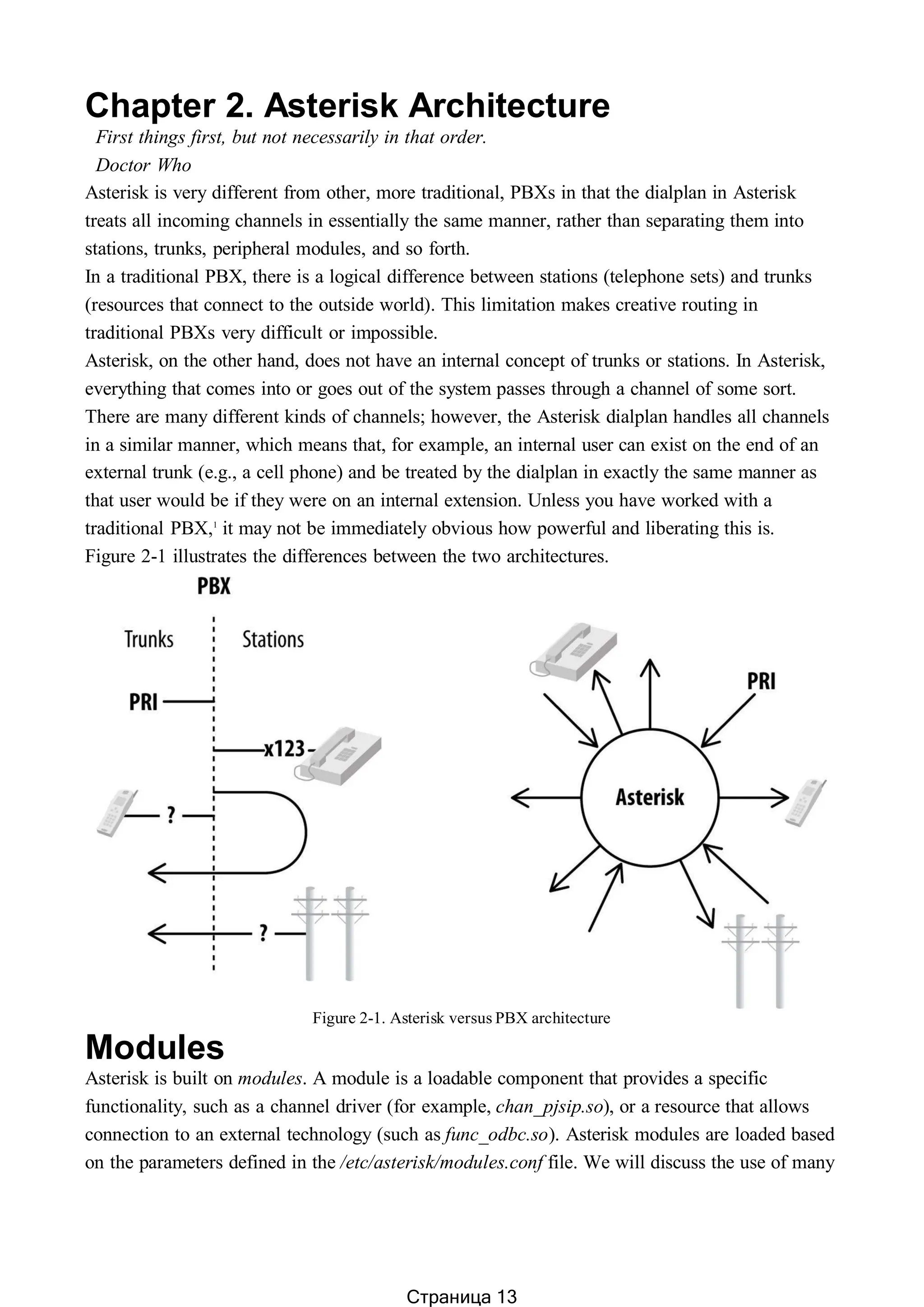
Asterisk is very different from other, more traditional, PBXs in that the dialplan in Asterisk
treats all incoming channels in essentially the same manner, rather than separating them into
stations, trunks, peripheral modules, and so forth.
In a traditional PBX, there is a logical difference between stations (telephone sets) and trunks
(resources that connect to the outside world). This limitation makes creative routing in
traditional PBXs very difficult or impossible.
Asterisk, on the other hand, does not have an internal concept of trunks or stations. In Asterisk,
everything that comes into or goes out of the system passes through a channel of some sort.
There are many different kinds of channels; however, the Asterisk dialplan handles all channels
in a similar manner, which means that, for example, an internal user can exist on the end of an
external trunk (e.g., a cell phone) and be treated by the dialplan in exactly the same manner as
that user would be if they were on an internal extension. Unless you have worked with a
traditional PBX,1
it may not be immediately obvious how powerful and liberating this is.
Figure 2-1 illustrates the differences between the two architectures.
Figure 2-1. Asterisk versus PBX architecture
Modules
Asterisk is built on modules. A module is a loadable component that provides a specific
functionality, such as a channel driver (for example, chan_pjsip.so), or a resource that allows
connection to an external technology (such as func_odbc.so). Asterisk modules are loaded based
on the parameters defined in the /etc/asterisk/modules.conf file. We will discuss the use of many
Страница 13
modules in this book, but at this point we just want to introduce the concept of modules, and
give you a feel for the types of modules that are available.
It is actually possible to start Asterisk without any modules at all, although in this state it will
not be capable of doing anything. It is useful to understand the modular nature of Asterisk in
order to appreciate the architecture.
Note
You can start Asterisk with no modules loaded by default and load each desired module
manually from the console, but this is not something that you’d want to put into production; it
would only be useful if you were performance-tuning a system where you wanted to eliminate
everything not required by your specific application of Asterisk.
The types of modules in Asterisk include the following:
 Applications—The workhorses of the dialplan, such as Dial(), Voicemail(), Playback(),
Queue(), and so forth
 Bridging modules—Mechanisms that connect channels (calls) to each other
 Call detail recording (CDR) modules
 Channel event logging (CEL) modules
 Channel drivers—Various connections into and out of the system; SIP (Session Initiation
Protocol)messaging uses the PJSIP channel drivers
 Codec translators—Convert various codecs such as G729, G711, G722, Speex, and so forth
 Format interpreters—As above, but relating to files stored in the filesystem
 Dialplan functions—Enhance the capabilities of the dialplan
 PBX modules
 Resource modules
 Add-on modules
 Test modules
In the following sections we have curated a list of modules we feel are important enough to be
discussed in this book. You’ll find many other modules in the Asterisk download, but many
older modules are either deprecated or have little or no support, and are therefore not
recommended for production unless you have access to developers who can maintain them for
you.
There is an official list of support status types included within menuselect.2
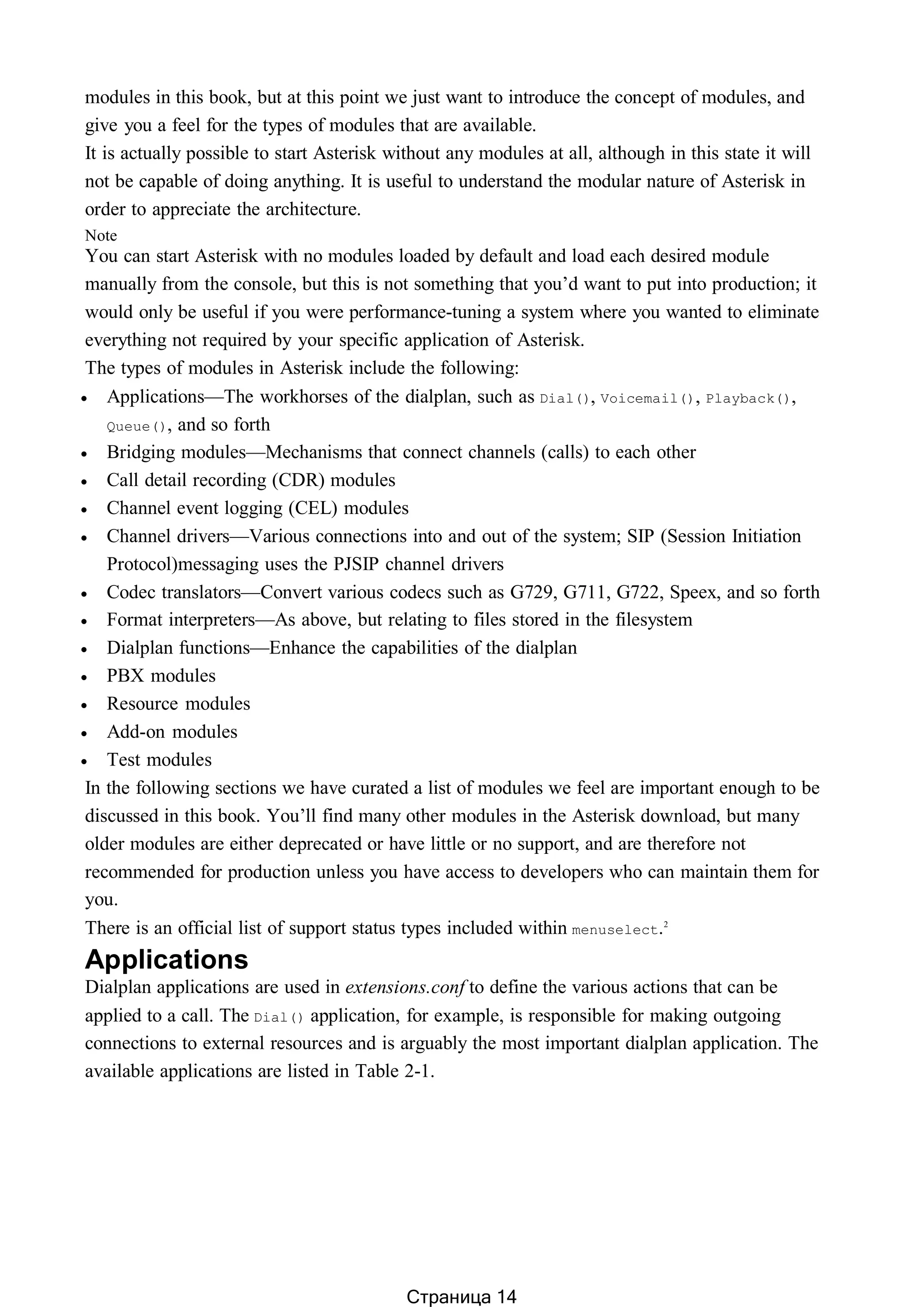
Applications
Dialplan applications are used in extensions.conf to define the various actions that can be
applied to a call. The Dial() application, for example, is responsible for making outgoing
connections to external resources and is arguably the most important dialplan application. The
available applications are listed in Table 2-1.
Страница 14
Table 2-1. Popular dialplan applications
Name Purpose
app_authenticate Compares dual-tone multifrequency (DTMF) input against a provided string (password)
app_cdr Writes ad hoc record to CDR
app_chanspy Allows a channel to listen to audio on another channel
app_confbridge Provides conferencing
app_dial Used to connect channels together (i.e., make phone calls)
app_directed_pickup Answers a call that’s ringing at another extension
app_directory Presents the list of names from voicemail.conf
app_dumpchan Dumps channel variables to Asterisk command-line interface (CLI)
app_echo Echos received audio back to source channel (can be helpful in demonstrating latency)
app_exec Contains Exec(), TryExec(), and ExecIf(): executes a dialplan application conditionally
app_mixmonitor Records both sides of a call (transmit and receive) and mixes them together into a single file
app_originate Allows dialplan logic to originate a call (as opposed to a call coming in on a channel)
app_page Creates multiple audio connections to specified devices for public address (paging)
app_parkandannounce Enables automated announcing of parked calls
app_playback Plays a file to the channel (does not accept input)
app_playtones Plays pairs of tones of specified frequencies (DTMF mostly)
app_queue Provides Automatic Call Distribution (ACD)
app_read Requests input of digits from callers and assigns input to a variable
app_readexten Requests input of digits from callers and passes call to a designated extension and context
app_record Records received audio to a file
app_senddtmf Transmits DTMF to calling party
app_stack Provides GoSub(), GoSubIf(), Return(), StackPop(), LOCAL(), and LOCAL_PEEK()
app_stasis
Passes call control to an ARI application—many Asterisk developers use this one application, and from there
handle all the rest of their development outside of the Asterisk dialplan
app_system Executes commands in a Linux shell
Страница 15
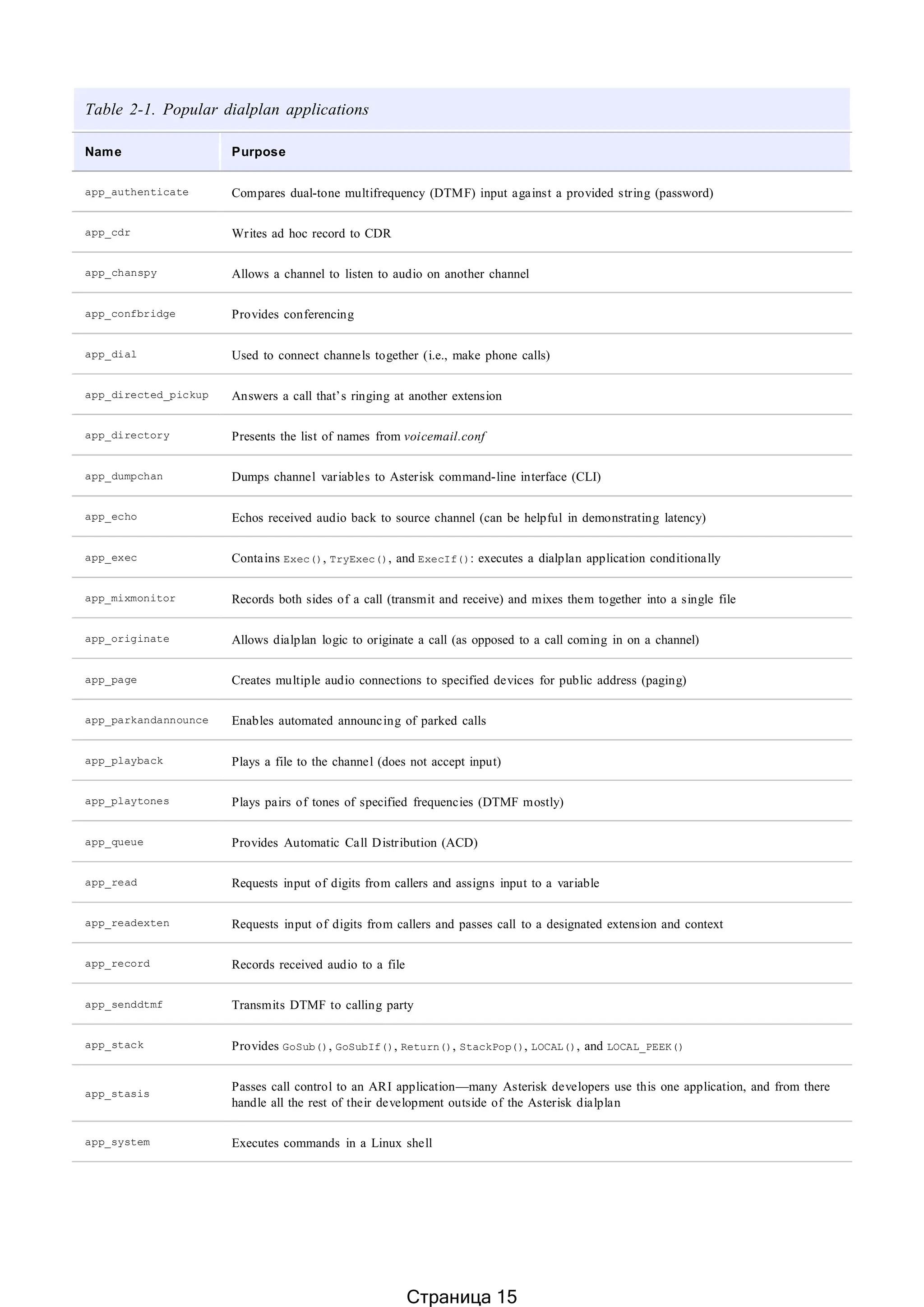
Table 2-1. Popular dialplan applications
Name Purpose
app_transfer Performs a transfer on the current channel
app_voicemail Provides voicemail
app_while
Includes While(), EndWhile(), ExitWhile(), and ContinueWhile(); provides while loop functionality in the
dialplan
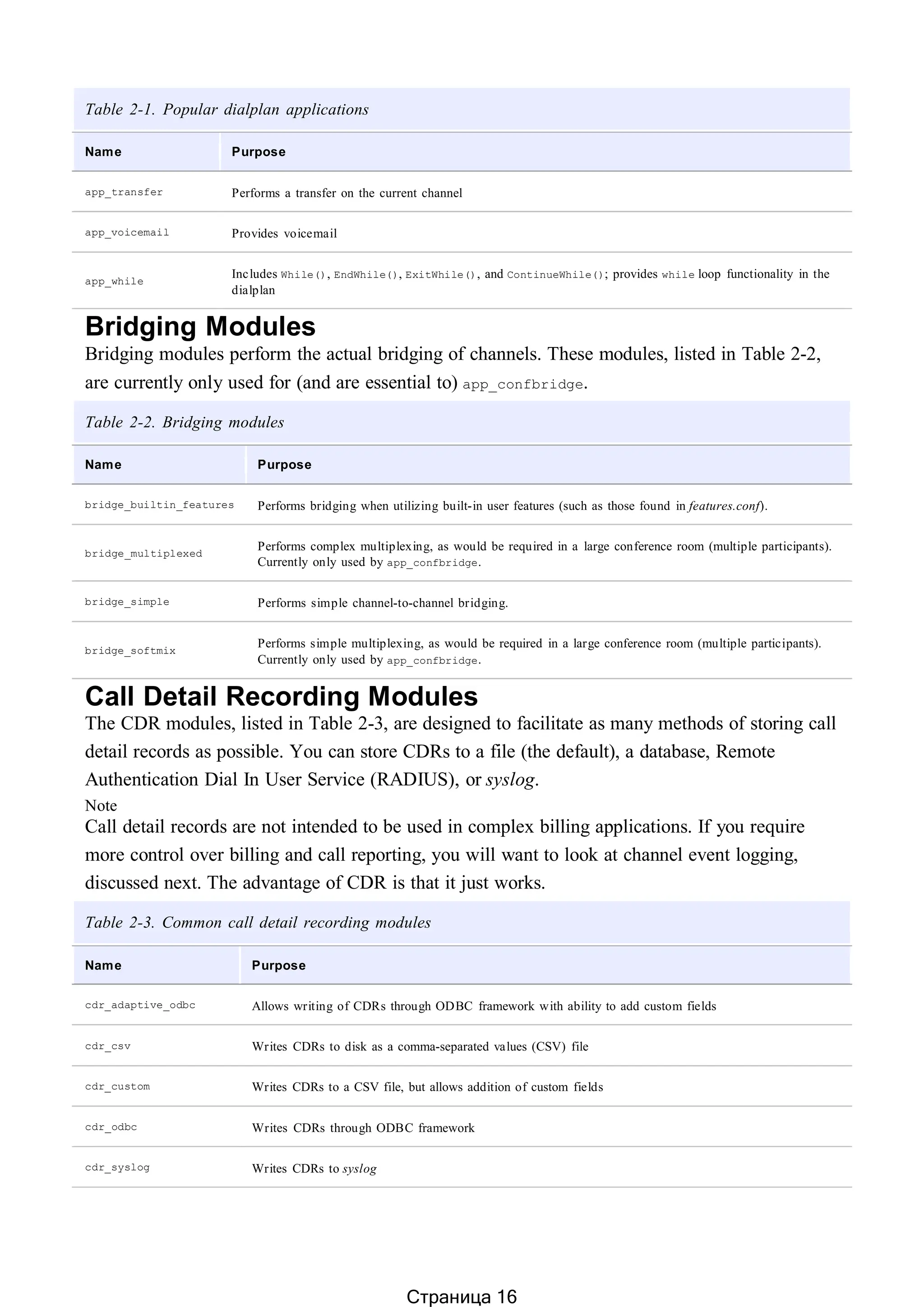
Bridging Modules
Bridging modules perform the actual bridging of channels. These modules, listed in Table 2-2,
are currently only used for (and are essential to) app_confbridge.
Table 2-2. Bridging modules
Name Purpose
bridge_builtin_features Performs bridging when utilizing built-in user features (such as those found in features.conf).
bridge_multiplexed
Performs complex multiplexing, as would be required in a large conference room (multiple participants).
Currently only used by app_confbridge.
bridge_simple Performs simple channel-to-channel bridging.
bridge_softmix
Performs simple multiplexing, as would be required in a large conference room (multiple participants).
Currently only used by app_confbridge.
Call Detail Recording Modules
The CDR modules, listed in Table 2-3, are designed to facilitate as many methods of storing call
detail records as possible. You can store CDRs to a file (the default), a database, Remote
Authentication Dial In User Service (RADIUS), or syslog.
Note
Call detail records are not intended to be used in complex billing applications. If you require
more control over billing and call reporting, you will want to look at channel event logging,
discussed next. The advantage of CDR is that it just works.
Table 2-3. Common call detail recording modules
Name Purpose
cdr_adaptive_odbc Allows writing of CDRs through ODBC framework with ability to add custom fields
cdr_csv Writes CDRs to disk as a comma-separated values (CSV) file
cdr_custom Writes CDRs to a CSV file, but allows addition of custom fields
cdr_odbc Writes CDRs through ODBC framework
cdr_syslog Writes CDRs to syslog
Страница 16
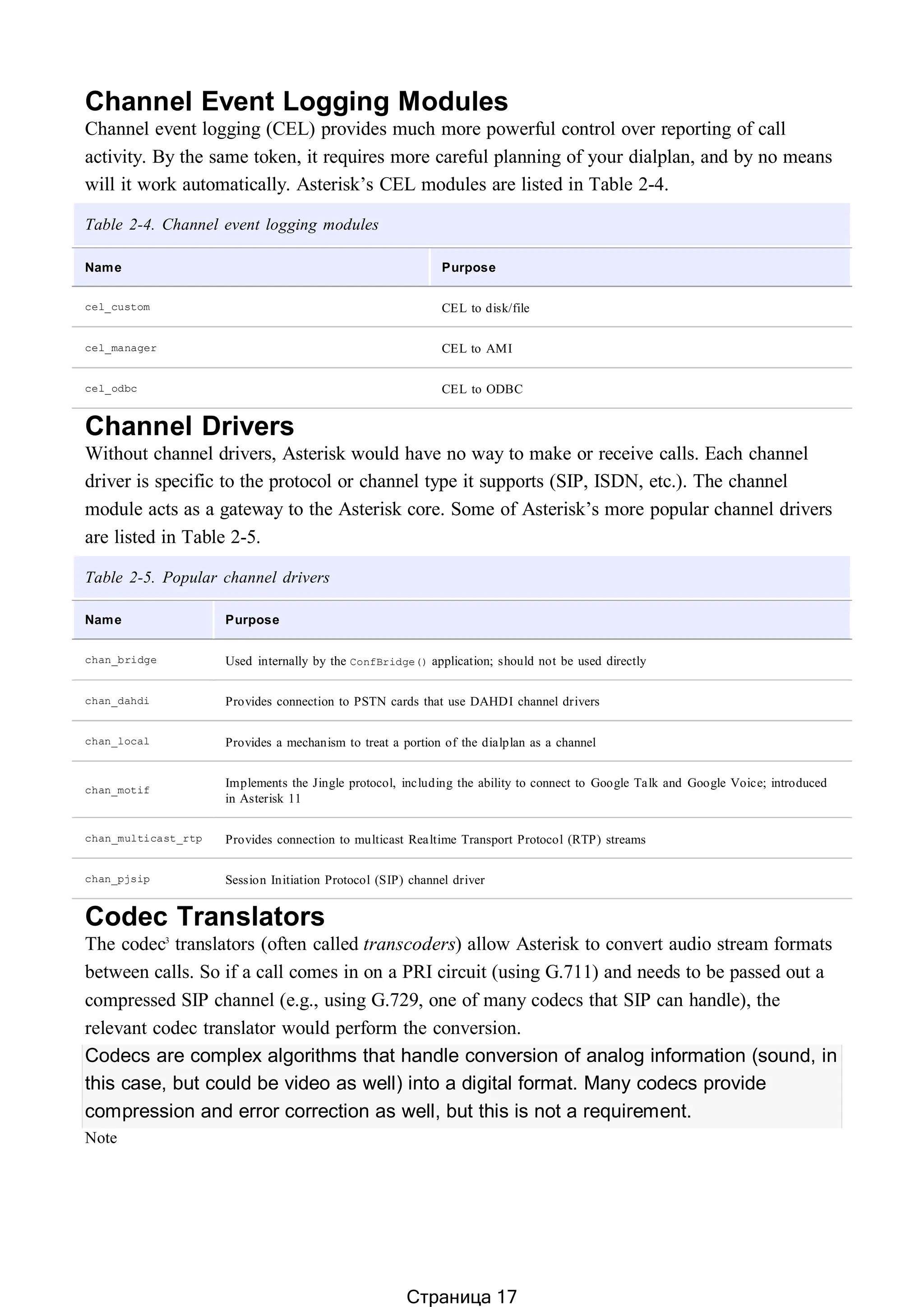
Channel Event Logging Modules
Channel event logging (CEL) provides much more powerful control over reporting of call
activity. By the same token, it requires more careful planning of your dialplan, and by no means
will it work automatically. Asterisk’s CEL modules are listed in Table 2-4.
Table 2-4. Channel event logging modules
Name Purpose
cel_custom CEL to disk/file
cel_manager CEL to AMI
cel_odbc CEL to ODBC
Channel Drivers
Without channel drivers, Asterisk would have no way to make or receive calls. Each channel
driver is specific to the protocol or channel type it supports (SIP, ISDN, etc.). The channel
module acts as a gateway to the Asterisk core. Some of Asterisk’s more popular channel drivers
are listed in Table 2-5.
Table 2-5. Popular channel drivers
Name Purpose
chan_bridge Used internally by the ConfBridge() application; should not be used directly
chan_dahdi Provides connection to PSTN cards that use DAHDI channel drivers
chan_local Provides a mechanism to treat a portion of the dialplan as a channel
chan_motif
Implements the Jingle protocol, including the ability to connect to Google Talk and Google Voice; introduced
in Asterisk 11
chan_multicast_rtp Provides connection to multicast Realtime Transport Protocol (RTP) streams
chan_pjsip Session Initiation Protocol (SIP) channel driver
Codec Translators
The codec3
translators (often called transcoders) allow Asterisk to convert audio stream formats
between calls. So if a call comes in on a PRI circuit (using G.711) and needs to be passed out a
compressed SIP channel (e.g., using G.729, one of many codecs that SIP can handle), the
relevant codec translator would perform the conversion.
Codecs are complex algorithms that handle conversion of analog information (sound, in
this case, but could be video as well) into a digital format. Many codecs provide
compression and error correction as well, but this is not a requirement.
Note
Страница 17
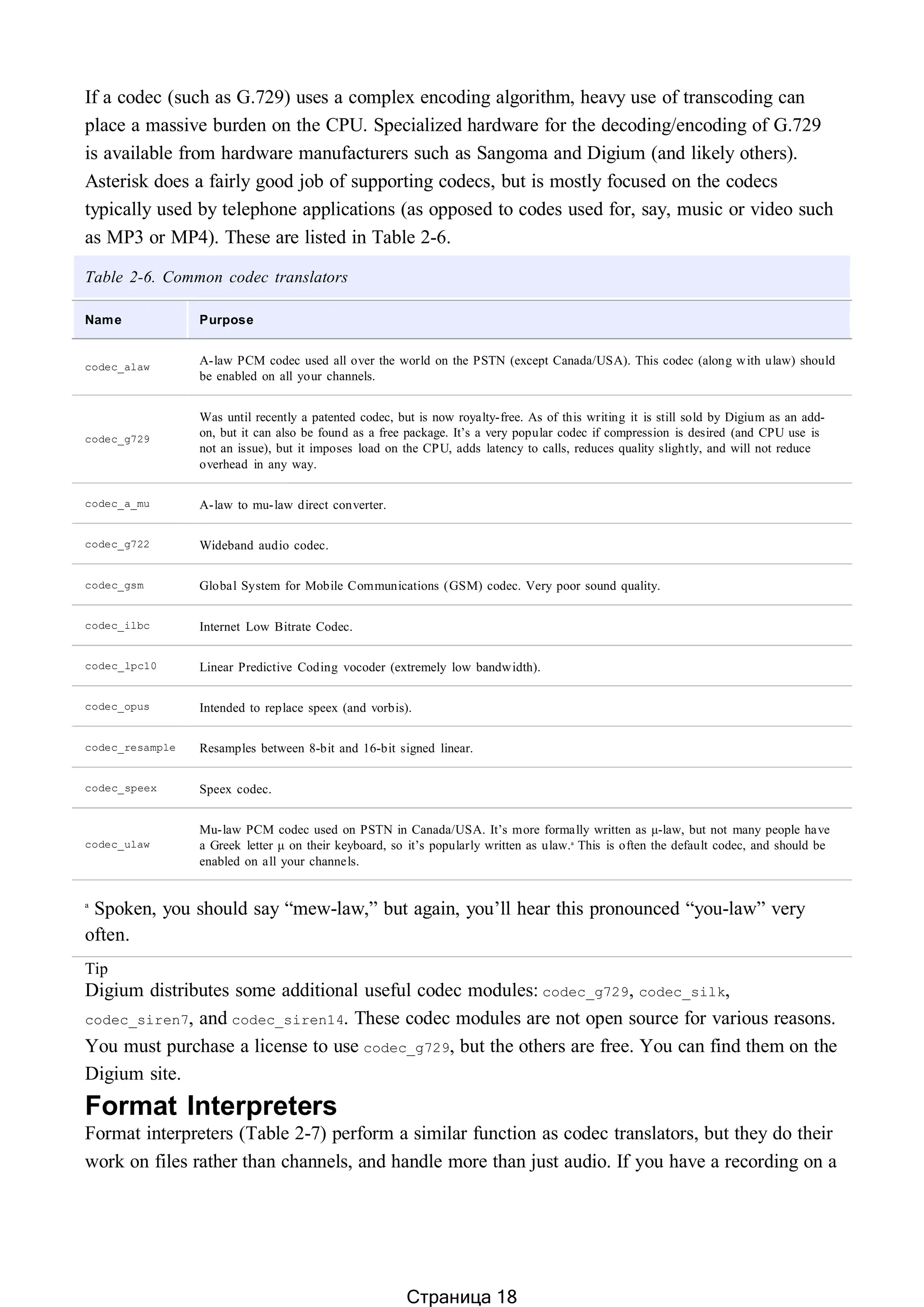
If a codec (such as G.729) uses a complex encoding algorithm, heavy use of transcoding can
place a massive burden on the CPU. Specialized hardware for the decoding/encoding of G.729
is available from hardware manufacturers such as Sangoma and Digium (and likely others).
Asterisk does a fairly good job of supporting codecs, but is mostly focused on the codecs
typically used by telephone applications (as opposed to codes used for, say, music or video such
as MP3 or MP4). These are listed in Table 2-6.
Table 2-6. Common codec translators
Name Purpose
codec_alaw
A-law PCM codec used all over the world on the PSTN (except Canada/USA). This codec (along with ulaw) should
be enabled on all your channels.
codec_g729
Was until recently a patented codec, but is now royalty-free. As of this writing it is still sold by Digium as an add-
on, but it can also be found as a free package. It’s a very popular codec if compression is desired (and CPU use is
not an issue), but it imposes load on the CPU, adds latency to calls, reduces quality slightly, and will not reduce
overhead in any way.
codec_a_mu A-law to mu-law direct converter.
codec_g722 Wideband audio codec.
codec_gsm Global System for Mobile Communications (GSM) codec. Very poor sound quality.
codec_ilbc Internet Low Bitrate Codec.
codec_lpc10 Linear Predictive Coding vocoder (extremely low bandwidth).
codec_opus Intended to replace speex (and vorbis).
codec_resample Resamples between 8-bit and 16-bit signed linear.
codec_speex Speex codec.
codec_ulaw
Mu-law PCM codec used on PSTN in Canada/USA. It’s more formally written as μ-law, but not many people have
a Greek letter μ on their keyboard, so it’s popularly written as ulaw.a
This is often the default codec, and should be
enabled on all your channels.
a
Spoken, you should say “mew-law,” but again, you’ll hear this pronounced “you-law” very
often.
Tip
Digium distributes some additional useful codec modules: codec_g729, codec_silk,
codec_siren7, and codec_siren14. These codec modules are not open source for various reasons.
You must purchase a license to use codec_g729, but the others are free. You can find them on the
Digium site.
Format Interpreters
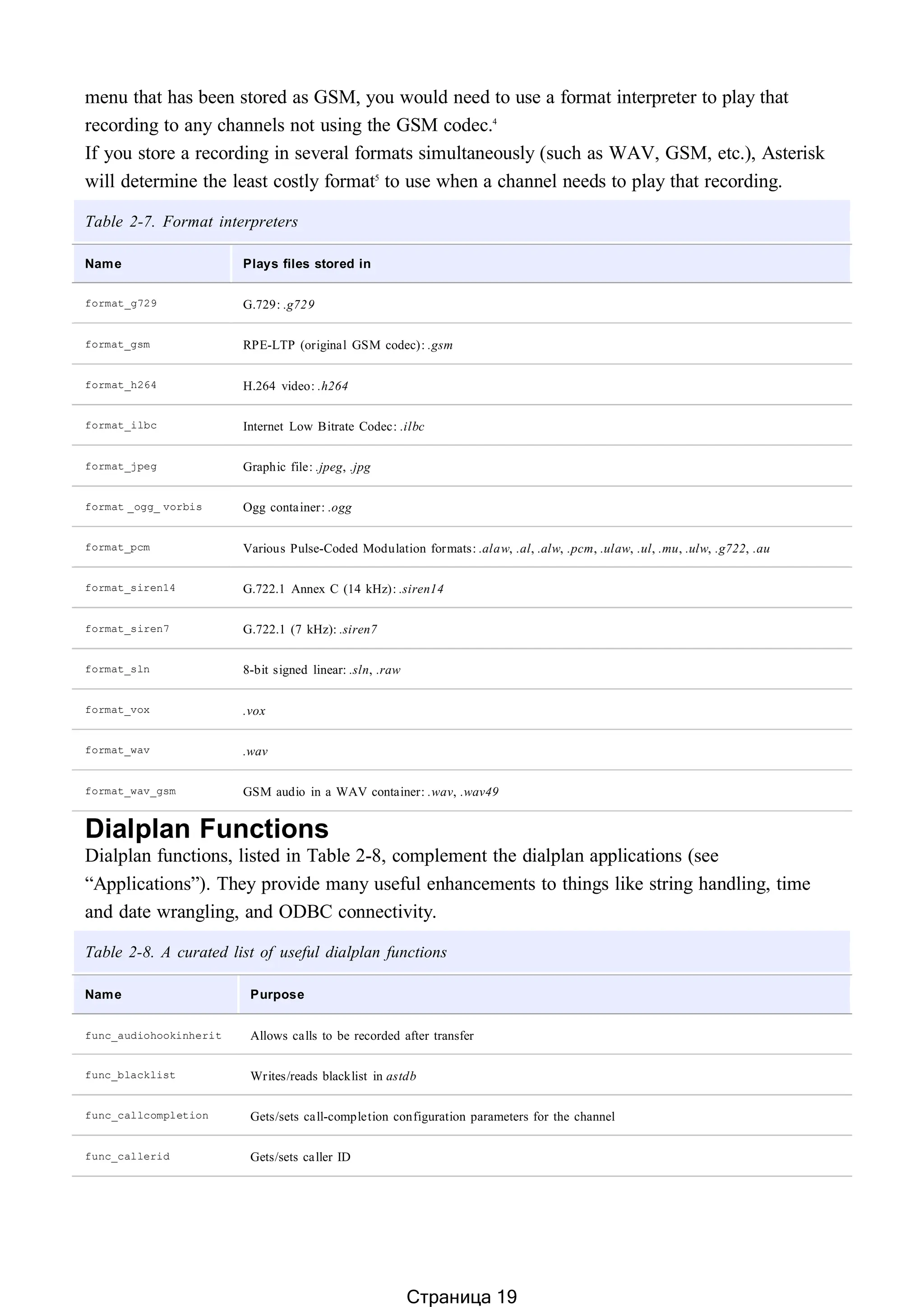
Format interpreters (Table 2-7) perform a similar function as codec translators, but they do their
work on files rather than channels, and handle more than just audio. If you have a recording on a
Страница 18
menu that has been stored as GSM, you would need to use a format interpreter to play that
recording to any channels not using the GSM codec.4
If you store a recording in several formats simultaneously (such as WAV, GSM, etc.), Asterisk
will determine the least costly format5
to use when a channel needs to play that recording.
Table 2-7. Format interpreters
Name Plays files stored in
format_g729 G.729: .g729
format_gsm RPE-LTP (original GSM codec): .gsm
format_h264 H.264 video: .h264
format_ilbc Internet Low Bitrate Codec: .ilbc
format_jpeg Graphic file: .jpeg, .jpg
format _ogg_ vorbis Ogg container: .ogg
format_pcm Various Pulse-Coded Modulation formats: .alaw, .al, .alw, .pcm, .ulaw, .ul, .mu, .ulw, .g722, .au
format_siren14 G.722.1 Annex C (14 kHz): .siren14
format_siren7 G.722.1 (7 kHz): .siren7
format_sln 8-bit signed linear: .sln, .raw
format_vox .vox
format_wav .wav
format_wav_gsm GSM audio in a WAV container: .wav, .wav49
Dialplan Functions
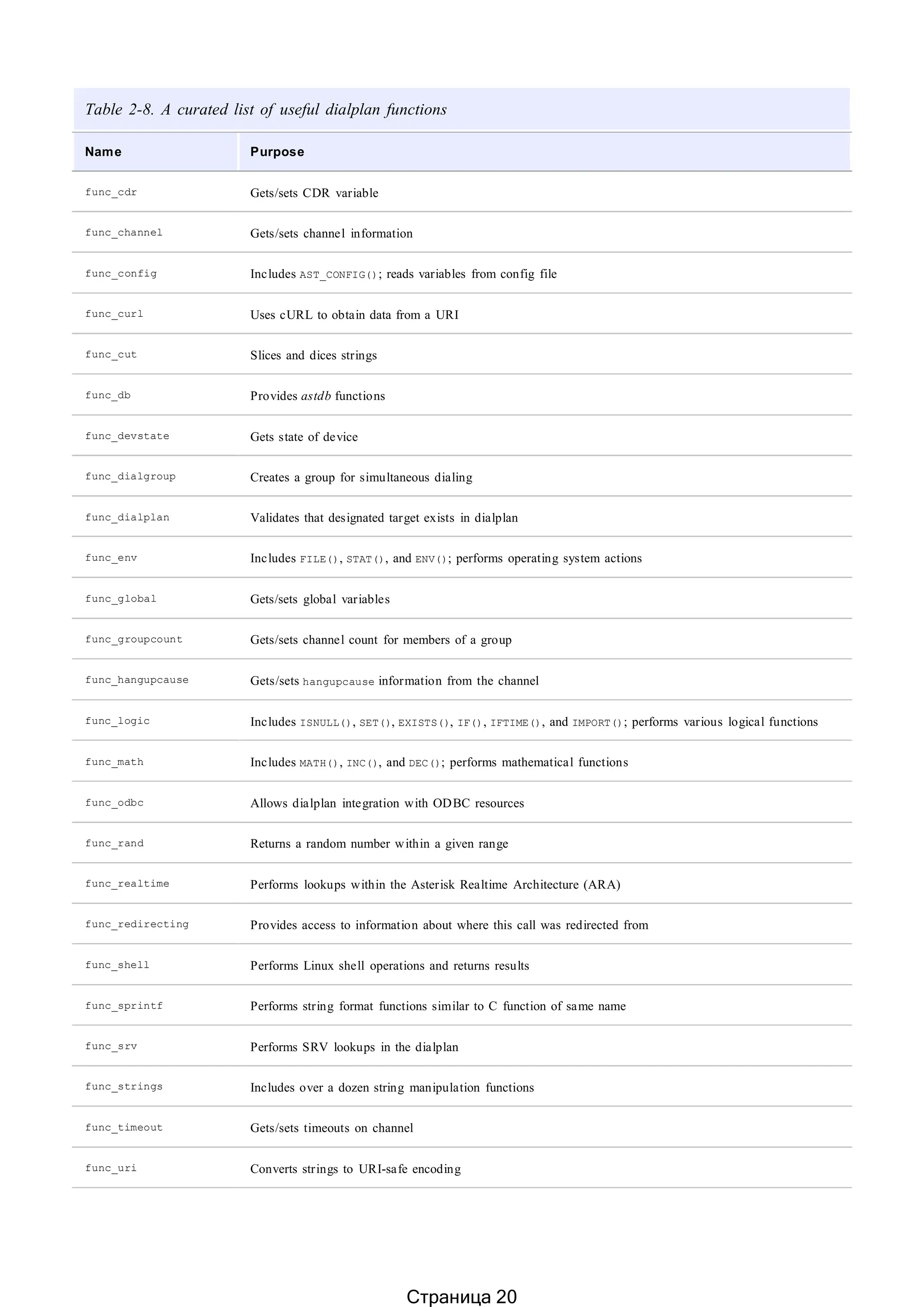
Dialplan functions, listed in Table 2-8, complement the dialplan applications (see
“Applications”). They provide many useful enhancements to things like string handling, time
and date wrangling, and ODBC connectivity.
Table 2-8. A curated list of useful dialplan functions
Name Purpose
func_audiohookin⁠herit Allows calls to be recorded after transfer
func_blacklist Writes/reads blacklist in astdb
func_callcompletion Gets/sets call-completion configuration parameters for the channel
func_callerid Gets/sets caller ID
Страница 19
Table 2-8. A curated list of useful dialplan functions
Name Purpose
func_cdr Gets/sets CDR variable
func_channel Gets/sets channel information
func_config Includes AST_CONFIG(); reads variables from config file
func_curl Uses cURL to obtain data from a URI
func_cut Slices and dices strings
func_db Provides astdb functions
func_devstate Gets state of device
func_dialgroup Creates a group for simultaneous dialing
func_dialplan Validates that designated target exists in dialplan
func_env Includes FILE(), STAT(), and ENV(); performs operating system actions
func_global Gets/sets global variables
func_groupcount Gets/sets channel count for members of a group
func_hangupcause Gets/sets hangupcause information from the channel
func_logic Includes ISNULL(), SET(), EXISTS(), IF(), IFTIME(), and IMPORT(); performs various logical functions
func_math Includes MATH(), INC(), and DEC(); performs mathematical functions
func_odbc Allows dialplan integration with ODBC resources
func_rand Returns a random number within a given range
func_realtime Performs lookups within the Asterisk Realtime Architecture (ARA)
func_redirecting Provides access to information about where this call was redirected from
func_shell Performs Linux shell operations and returns results
func_sprintf Performs string format functions similar to C function of same name
func_srv Performs SRV lookups in the dialplan
func_strings Includes over a dozen string manipulation functions
func_timeout Gets/sets timeouts on channel
func_uri Converts strings to URI-safe encoding
Страница 20
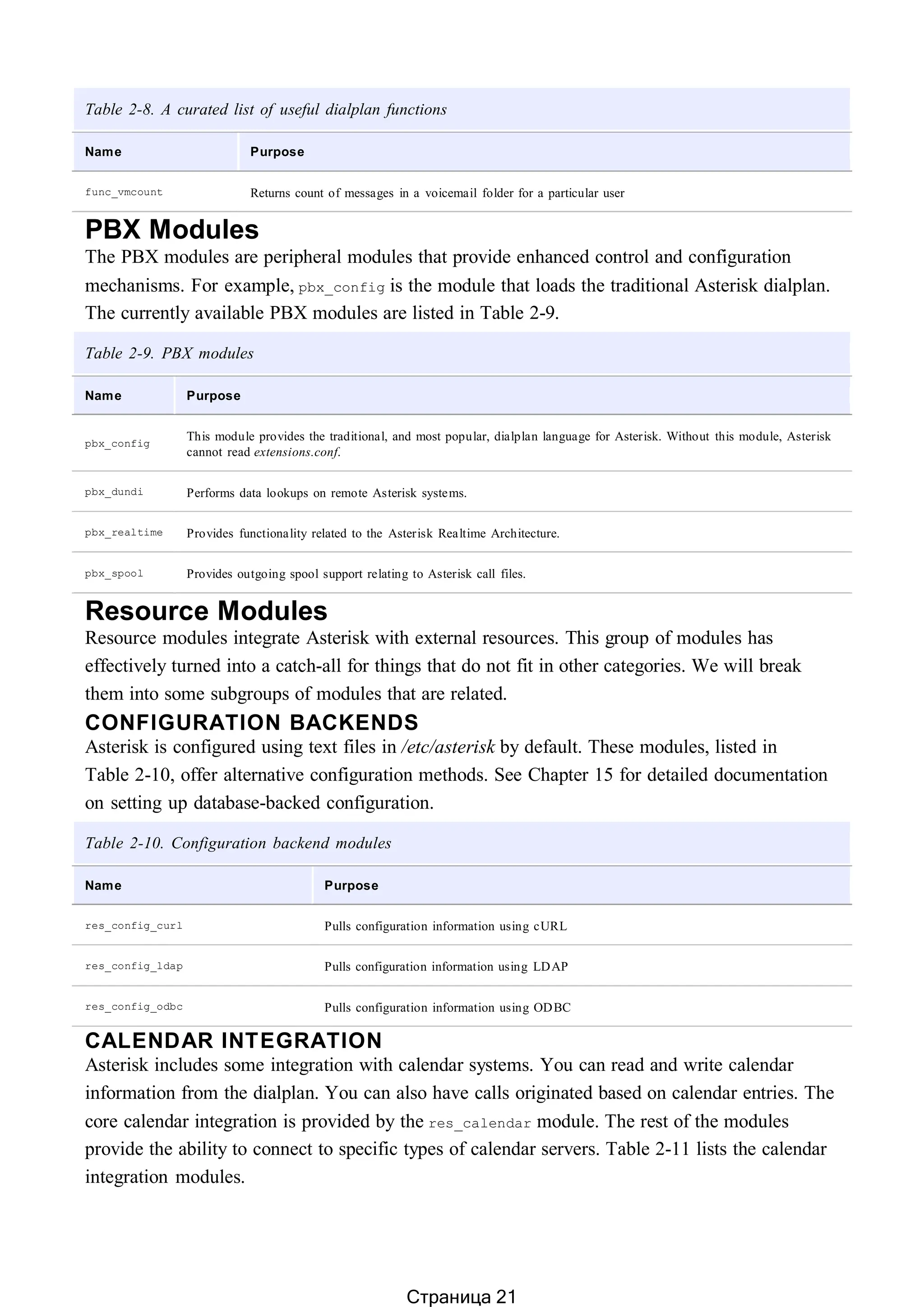
Table 2-8. A curated list of useful dialplan functions
Name Purpose
func_vmcount Returns count of messages in a voicemail folder for a particular user
PBX Modules
The PBX modules are peripheral modules that provide enhanced control and configuration
mechanisms. For example, pbx_config is the module that loads the traditional Asterisk dialplan.
The currently available PBX modules are listed in Table 2-9.
Table 2-9. PBX modules
Name Purpose
pbx_config
This module provides the traditional, and most popular, dialplan language for Asterisk. Without this module, Asterisk
cannot read extensions.conf.
pbx_dundi Performs data lookups on remote Asterisk systems.
pbx_realtime Provides functionality related to the Asterisk Realtime Architecture.
pbx_spool Provides outgoing spool support relating to Asterisk call files.
Resource Modules
Resource modules integrate Asterisk with external resources. This group of modules has
effectively turned into a catch-all for things that do not fit in other categories. We will break
them into some subgroups of modules that are related.
CONFIGURATION BACKENDS
Asterisk is configured using text files in /etc/asterisk by default. These modules, listed in
Table 2-10, offer alternative configuration methods. See Chapter 15 for detailed documentation
on setting up database-backed configuration.
Table 2-10. Configuration backend modules
Name Purpose
res_config_curl Pulls configuration information using cURL
res_config_ldap Pulls configuration information using LDAP
res_config_odbc Pulls configuration information using ODBC
CALENDAR INTEGRATION
Asterisk includes some integration with calendar systems. You can read and write calendar
information from the dialplan. You can also have calls originated based on calendar entries. The
core calendar integration is provided by the res_calendar module. The rest of the modules
provide the ability to connect to specific types of calendar servers. Table 2-11 lists the calendar
integration modules.
Страница 21
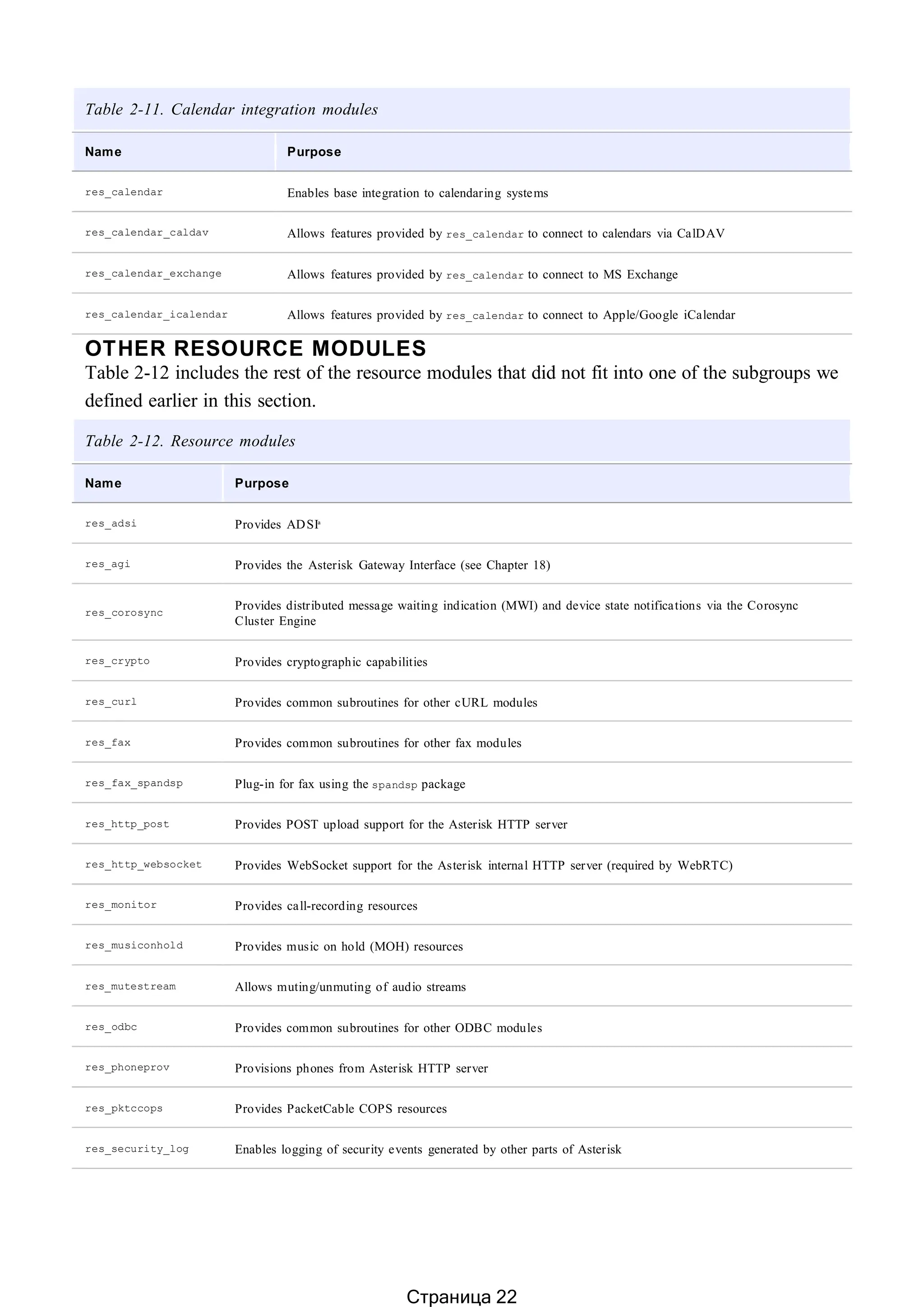
Table 2-11. Calendar integration modules
Name Purpose
res_calendar Enables base integration to calendaring systems
res_calendar_caldav Allows features provided by res_calendar to connect to calendars via CalDAV
res_calendar_exchange Allows features provided by res_calendar to connect to MS Exchange
res_calendar_icalendar Allows features provided by res_calendar to connect to Apple/Google iCalendar
OTHER RESOURCE MODULES
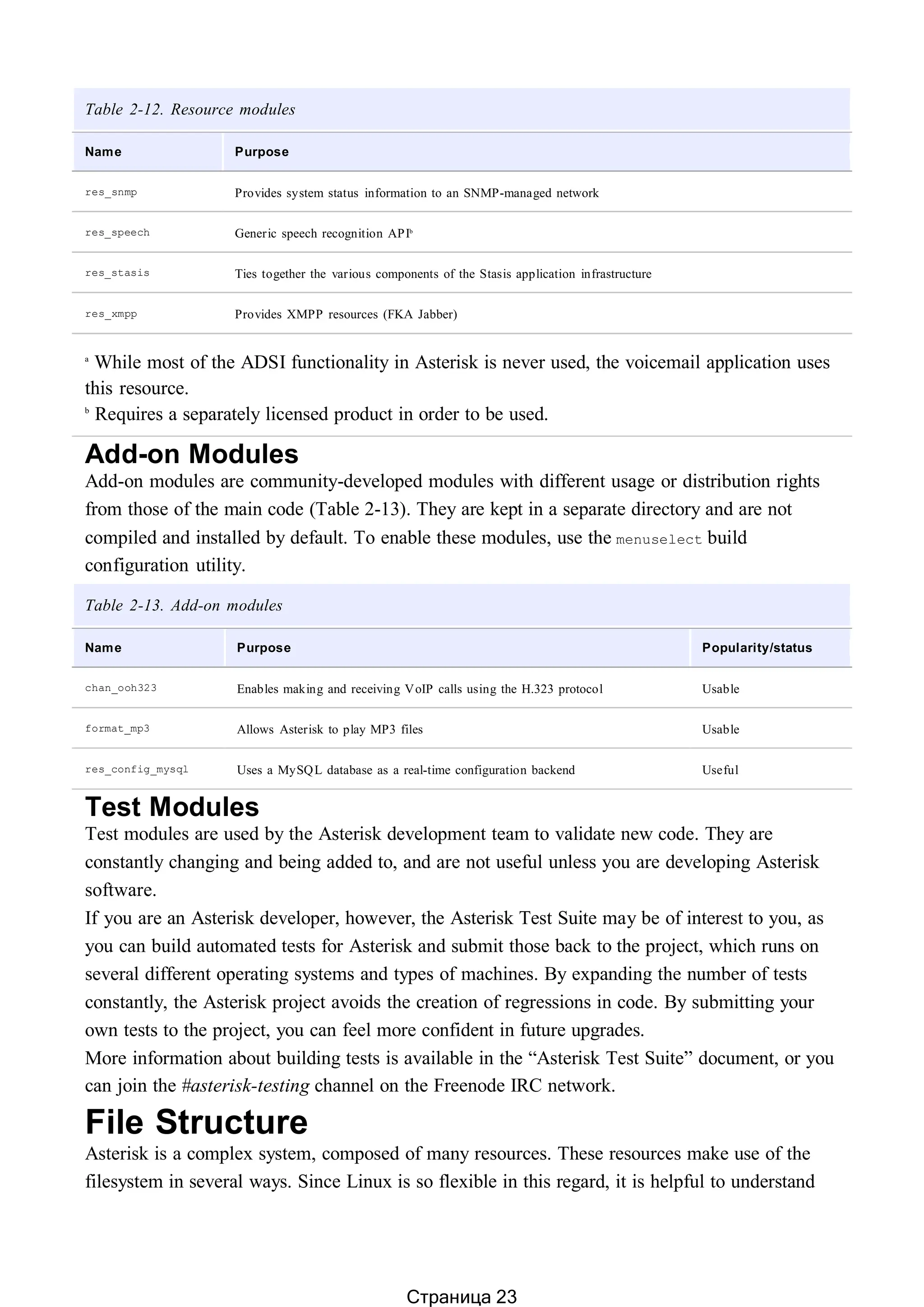
Table 2-12 includes the rest of the resource modules that did not fit into one of the subgroups we
defined earlier in this section.
Table 2-12. Resource modules
Name Purpose
res_adsi Provides ADSIa
res_agi Provides the Asterisk Gateway Interface (see Chapter 18)
res_corosync
Provides distributed message waiting indication (MWI) and device state notifications via the Corosync
Cluster Engine
res_crypto Provides cryptographic capabilities
res_curl Provides common subroutines for other cURL modules
res_fax Provides common subroutines for other fax modules
res_fax_spandsp Plug-in for fax using the spandsp package
res_http_post Provides POST upload support for the Asterisk HTTP server
res_http_websocket Provides WebSocket support for the Asterisk internal HTTP server (required by WebRTC)
res_monitor Provides call-recording resources
res_musiconhold Provides music on hold (MOH) resources
res_mutestream Allows muting/unmuting of audio streams
res_odbc Provides common subroutines for other ODBC modules
res_phoneprov Provisions phones from Asterisk HTTP server
res_pktccops Provides PacketCable COPS resources
res_security_log Enables logging of security events generated by other parts of Asterisk
Страница 22
Table 2-12. Resource modules
Name Purpose
res_snmp Provides system status information to an SNMP-managed network
res_speech Generic speech recognition APIb
res_stasis Ties together the various components of the Stasis application infrastructure
res_xmpp Provides XMPP resources (FKA Jabber)
a
While most of the ADSI functionality in Asterisk is never used, the voicemail application uses
this resource.
b
Requires a separately licensed product in order to be used.
Add-on Modules
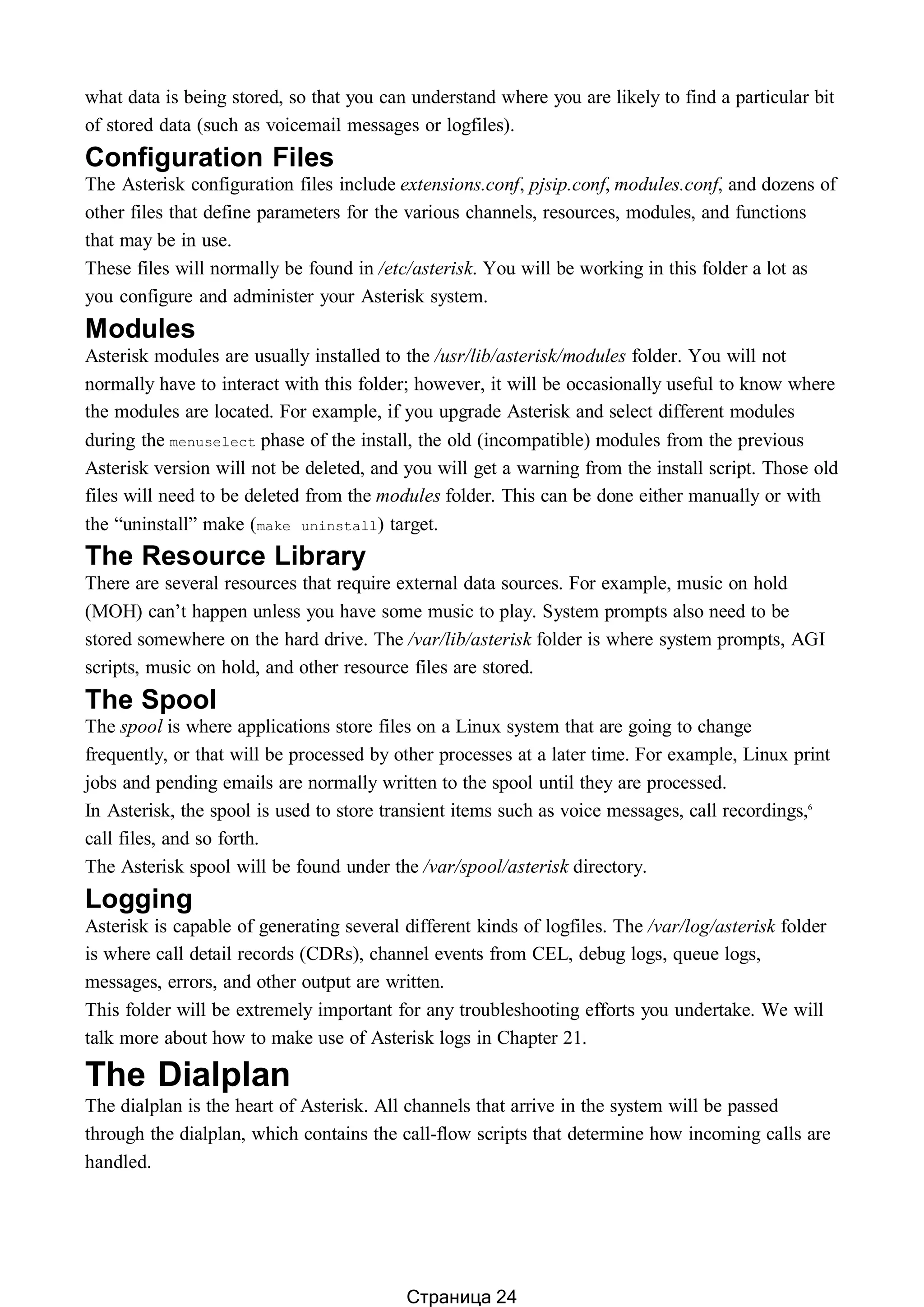
Add-on modules are community-developed modules with different usage or distribution rights
from those of the main code (Table 2-13). They are kept in a separate directory and are not
compiled and installed by default. To enable these modules, use the menuselect build
configuration utility.
Table 2-13. Add-on modules
Name Purpose Popularity/status
chan_ooh323 Enables making and receiving VoIP calls using the H.323 protocol Usable
format_mp3 Allows Asterisk to play MP3 files Usable
res_config_mysql Uses a MySQL database as a real-time configuration backend Useful
Test Modules
Test modules are used by the Asterisk development team to validate new code. They are
constantly changing and being added to, and are not useful unless you are developing Asterisk
software.
If you are an Asterisk developer, however, the Asterisk Test Suite may be of interest to you, as
you can build automated tests for Asterisk and submit those back to the project, which runs on
several different operating systems and types of machines. By expanding the number of tests
constantly, the Asterisk project avoids the creation of regressions in code. By submitting your
own tests to the project, you can feel more confident in future upgrades.
More information about building tests is available in the “Asterisk Test Suite” document, or you
can join the #asterisk-testing channel on the Freenode IRC network.
File Structure
Asterisk is a complex system, composed of many resources. These resources make use of the
filesystem in several ways. Since Linux is so flexible in this regard, it is helpful to understand
Страница 23
what data is being stored, so that you can understand where you are likely to find a particular bit
of stored data (such as voicemail messages or logfiles).
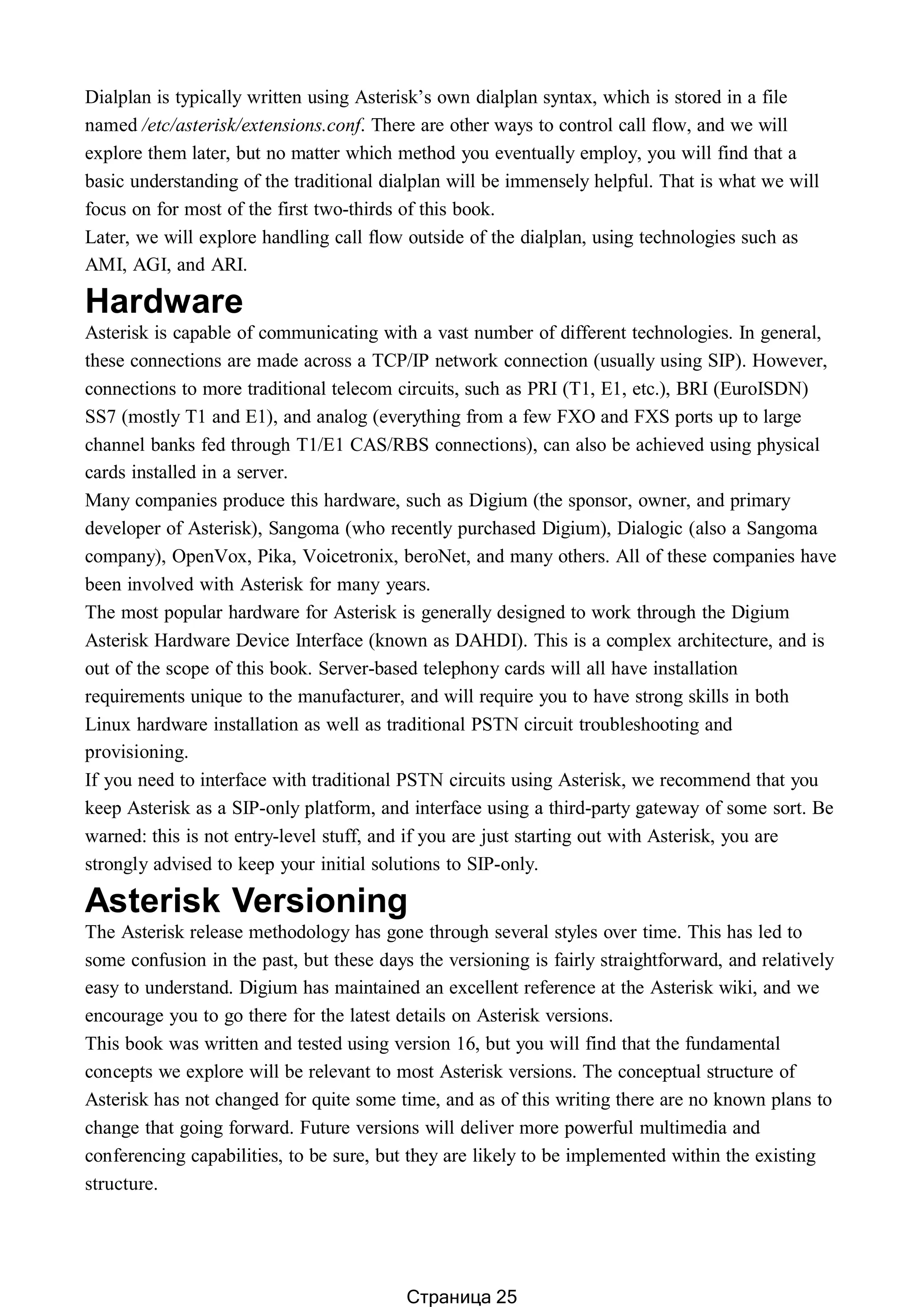
Configuration Files
The Asterisk configuration files include extensions.conf, pjsip.conf, modules.conf, and dozens of
other files that define parameters for the various channels, resources, modules, and functions
that may be in use.
These files will normally be found in /etc/asterisk. You will be working in this folder a lot as
you configure and administer your Asterisk system.
Modules
Asterisk modules are usually installed to the /usr/lib/asterisk/modules folder. You will not
normally have to interact with this folder; however, it will be occasionally useful to know where
the modules are located. For example, if you upgrade Asterisk and select different modules
during the menuselect phase of the install, the old (incompatible) modules from the previous
Asterisk version will not be deleted, and you will get a warning from the install script. Those old
files will need to be deleted from the modules folder. This can be done either manually or with
the “uninstall” make (make uninstall) target.
The Resource Library
There are several resources that require external data sources. For example, music on hold
(MOH) can’t happen unless you have some music to play. System prompts also need to be
stored somewhere on the hard drive. The /var/lib/asterisk folder is where system prompts, AGI
scripts, music on hold, and other resource files are stored.
The Spool
The spool is where applications store files on a Linux system that are going to change
frequently, or that will be processed by other processes at a later time. For example, Linux print
jobs and pending emails are normally written to the spool until they are processed.
In Asterisk, the spool is used to store transient items such as voice messages, call recordings,6
call files, and so forth.
The Asterisk spool will be found under the /var/spool/asterisk directory.
Logging
Asterisk is capable of generating several different kinds of logfiles. The /var/log/asterisk folder
is where call detail records (CDRs), channel events from CEL, debug logs, queue logs,
messages, errors, and other output are written.
This folder will be extremely important for any troubleshooting efforts you undertake. We will
talk more about how to make use of Asterisk logs in Chapter 21.
The Dialplan
The dialplan is the heart of Asterisk. All channels that arrive in the system will be passed
through the dialplan, which contains the call-flow scripts that determine how incoming calls are
handled.
Страница 24
Dialplan is typically written using Asterisk’s own dialplan syntax, which is stored in a file
named /etc/asterisk/extensions.conf. There are other ways to control call flow, and we will
explore them later, but no matter which method you eventually employ, you will find that a
basic understanding of the traditional dialplan will be immensely helpful. That is what we will
focus on for most of the first two-thirds of this book.
Later, we will explore handling call flow outside of the dialplan, using technologies such as
AMI, AGI, and ARI.
Hardware
Asterisk is capable of communicating with a vast number of different technologies. In general,
these connections are made across a TCP/IP network connection (usually using SIP). However,
connections to more traditional telecom circuits, such as PRI (T1, E1, etc.), BRI (EuroISDN)
SS7 (mostly T1 and E1), and analog (everything from a few FXO and FXS ports up to large
channel banks fed through T1/E1 CAS/RBS connections), can also be achieved using physical
cards installed in a server.
Many companies produce this hardware, such as Digium (the sponsor, owner, and primary
developer of Asterisk), Sangoma (who recently purchased Digium), Dialogic (also a Sangoma
company), OpenVox, Pika, Voicetronix, beroNet, and many others. All of these companies have
been involved with Asterisk for many years.
The most popular hardware for Asterisk is generally designed to work through the Digium
Asterisk Hardware Device Interface (known as DAHDI). This is a complex architecture, and is
out of the scope of this book. Server-based telephony cards will all have installation
requirements unique to the manufacturer, and will require you to have strong skills in both
Linux hardware installation as well as traditional PSTN circuit troubleshooting and
provisioning.
If you need to interface with traditional PSTN circuits using Asterisk, we recommend that you
keep Asterisk as a SIP-only platform, and interface using a third-party gateway of some sort. Be
warned: this is not entry-level stuff, and if you are just starting out with Asterisk, you are
strongly advised to keep your initial solutions to SIP-only.
Asterisk Versioning
The Asterisk release methodology has gone through several styles over time. This has led to
some confusion in the past, but these days the versioning is fairly straightforward, and relatively
easy to understand. Digium has maintained an excellent reference at the Asterisk wiki, and we
encourage you to go there for the latest details on Asterisk versions.
This book was written and tested using version 16, but you will find that the fundamental
concepts we explore will be relevant to most Asterisk versions. The conceptual structure of
Asterisk has not changed for quite some time, and as of this writing there are no known plans to
change that going forward. Future versions will deliver more powerful multimedia and
conferencing capabilities, to be sure, but they are likely to be implemented within the existing
structure.
Страница 25
Conclusion
Asterisk is composed of many different technologies, most of which are complicated in their
own right. As a result, understanding Asterisk architecture can be overwhelming. Still, the
reality is that Asterisk is well designed for what it does and, in our opinion, has achieved a
remarkable balance between flexibility and complexity.
1
A good indicator that you’ve worked with traditional PBXs is the presence of a large callus on
your forehead, obtained from smashing your head against a brick wall too many times to count.
2
This is a command that is available as part of the installation process. We will discuss the use
of menuselect in the installation chapter.
3
The term codec is short for “coder decoder.”
4
It is partly for this reason that we do not recommend the default GSM format for system
recordings. WAV recordings will sound better and use fewer CPU cycles.
5
Some codecs will impose a significant load on the CPU, so much so that a system that might
support several hundred channels without transcoding will only handle a few dozen when
transcoding is in use.
6
Not call detail records (CDRs), but rather audio recordings of calls generated by the
MixMonitor() and related applications.
Страница 26
Chapter 3. Installing Asterisk
I long to accomplish great and noble tasks, but it is my chief duty to accomplish humble tasks
as though they were great and noble. The world is moved along, not only by the mighty shoves
of its heroes, but also by the aggregate of the tiny pushes of each honest worker.
Helen Keller
In this chapter we’re going to walk through the installation of Asterisk from the source code.
Many people shy away from this method, claiming that it is too difficult and time-consuming.
Our goal here is to demonstrate that installing Asterisk from source is not actually that difficult to
do. More importantly, we want to provide you with the best Asterisk platform on which to learn.
In this book we will be helping you build a functioning Asterisk system from scratch. Toward that
goal, in this chapter we will build a base platform for your Asterisk system. Since we are
installing from source, there is potentially a lot of variation in how you can do this. Our goal here
is to deliver a standard sort of platform, suitable for explorations in many areas. It is possible to
strip Asterisk down to the very basics and run a very lean machine; however, that exercise is left
up to the reader. The process we discuss here is designed to get you up and running quickly and
simply, without short-changing you on access to interesting features.
Most of the commands you see are going to be best handled with a series of copy-paste operations
(in fact, we strongly recommend you have an electronic version of this book handy for that very
purpose).1
While it looks like a lot of typing, the commands we take you through can get you
from start to finish in less than 30 minutes, so it’s really not as complex as it might appear. We
run some prerequisites, some compilation, and some post-install config, and Asterisk is ready to
go.
For the sake of brevity, these steps will be performed on a CentOS 7 system. This is functionally
equivalent to RHEL, and similar enough to Fedora that the steps should be quite similar. For other
platforms such as Debian/Ubuntu and so forth, the instructions will also be similar, but you will
need to adjust as needed for your platform.2
The first part of the installation instructions will not deal with Asterisk as such, but rather some of
the dependencies that either Asterisk requires or are necessary for some of the more useful
features (such as database integration). We’ll try to keep the instructions general enough that they
should be useful on any distribution of your choice.
These instructions assume that you are an experienced Linux administrator.3
A fully working
Asterisk system will consist of enough discrete parts that you will find it challenging to deal with
Страница 27
all of it if you have little or no Linux background. We’d still encourage you to dive right in, but
please allow for the fact that there will be a steep learning curve if you don’t already have solid
Linux command-line experience.
Note
If you want to learn the Linux command line, one of the best books we’ve found is The Linux
Command Line by William Shotts, which has been released under a Creative Commons license,
and dives straight into all the knowledge you need to use the Linux shell effectively. It can be
found at linuxcommand.org. You could memorize the book from front to back, and pretty much
everything you’d learned would be something any seasoned Linux administrator would agree was
worth knowing.
Another fantastic book is of course the legendary UNIX and Linux System Administration
Handbook by Dan Mackin, Ben Whaley, Trent R. Hein, Garth Snyder, and Evi Nemeth (Prentice
Hall). Highly recommended.
Asterisk Packages
There are Asterisk packages that can be installed using package management systems
such as yum or apt-get. You are encouraged to use them once you are familiar with
Asterisk.
If you are using RHEL, Asterisk is available from the EPEL repository from the Fedora
project. Asterisk packages are available in the Universe repository for Ubuntu.
You should also note that because of Asterisk’s history, it is able to integrate with a multitude of
telephony technologies; however, these days, someone new to Asterisk is going to want to learn
SIP integration before worrying about more complex, obsolete or peripheral channel types. Once
you are comfortable with Asterisk in a pure SIP environment, it’ll be much easier to look at
integrating other channel types.
Asterisk-Based Projects
Many projects use Asterisk as their underlying platform. Some of these, such as the
FreePBX GUI, have become so popular that many people mistake them for the Asterisk
product itself. In fact, the FreePBX GUI is so ubiquitous it is found in most of the well-
known Asterisk-based projects. These projects take the base Asterisk product and add a
web-based administration interface, a complex database, and external functions that are
useful in a typical PBX (such as set provisioning, a time server, and so forth).
We have chosen not to cover these projects in this book, for several reasons:
 This book tries, as much as possible, to focus on Asterisk and only Asterisk.
Страница 28
 Books have already been written about many of these Asterisk-based projects.
 We believe that if you learn Asterisk in the way that we will teach you, the knowledge
will serve you well regardless of whether or not you eventually choose to use one of
these prepackaged versions of Asterisk.
 If you want to be able to make sense of what’s going on under the hood of a
FreePBX-based system, this book will introduce you to some of the skills you will
need.
 For us, the power of Asterisk is that it does not attempt to solve your problems for you.
These projects are truly amazing examples of what can be built with Asterisk.
However, if you are looking to build your own Asterisk application (which is really what
Asterisk is all about), these projects might create needless obstacles, simply because
they are focused on simplifying the process of building a business PBX, not on making
it possible to access the full potential of the Asterisk platform.
Some of the most popular Asterisk-based projects include (in no particular order):
AsteriskNOW
Managed by Digium. Uses FreePBX GUI.
Issabel
A fork of the original open source releases of the Elastix product.4
Uses FreePBX
GUI.
The Official FreePBX Distro
The official distro of the FreePBX project. Managed by Sangoma.
Asterisk for Raspberry Pi
A complete install of Asterisk and FreePBX for the Raspberry Pi.
AstLinux
The AstLinux project caters to a community that want to run Asterisk on small, low-
power, solid-state devices. The install size of the entire solution is measured in
megabytes (AstLinux was originally designed to fit on CompactFlash cards). If you
are fascinated by small computers, and want to play with a PBX-in-a-box that fits
in your pocket, AstLinux may be for you.
We recommend that you check them out.5
Linux Installation
Asterisk is developed using Linux, and unless you’re very comfortable with porting software
between various platforms, that is what you’re going to want to use.
Страница 29
In this book, we’re going to use CentOS as the platform. If you would prefer a different Linux
distro, it is expected that you have sufficient Linux skills to understand what some of the
differences may be. These days, it’s so easy and cheap to fire up an instance of any common
distribution that there’s no real harm in using CentOS to learn, and then migrate to whatever you
prefer when you’re ready.
We recommend installing the Minimal version of CentOS, since the installation process we will
be going through handles all the prerequisites. This also ensures you’re not installing anything
you don’t need.
Choosing Your Platform
OK, so strictly speaking we’ve already chosen your platform for you, but there are several
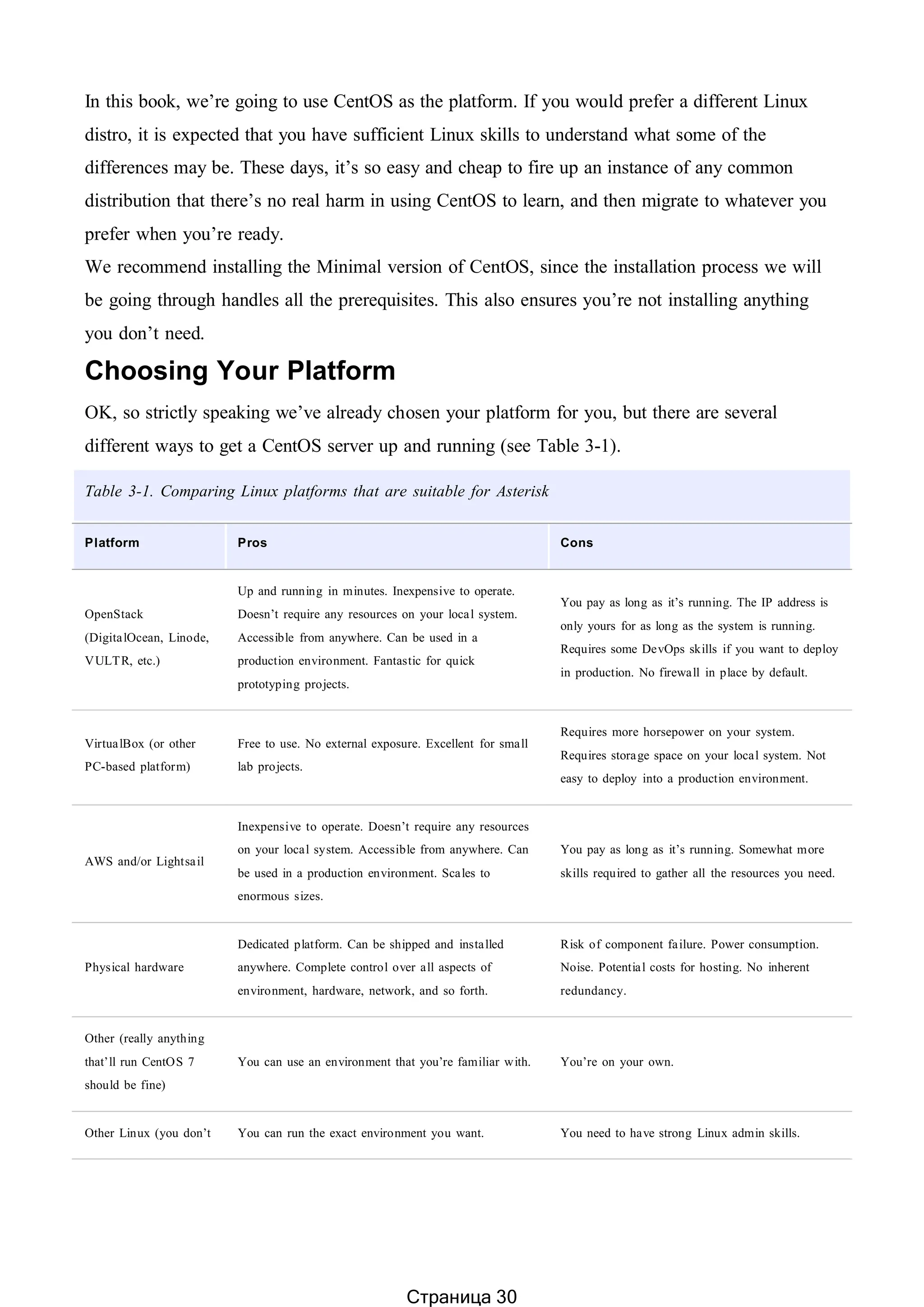
different ways to get a CentOS server up and running (see Table 3-1).
Table 3-1. Comparing Linux platforms that are suitable for Asterisk
Platform Pros Cons
OpenStack
(DigitalOcean, Linode,
VULTR, etc.)
Up and running in minutes. Inexpensive to operate.
Doesn’t require any resources on your local system.
Accessible from anywhere. Can be used in a
production environment. Fantastic for quick
prototyping projects.
You pay as long as it’s running. The IP address is
only yours for as long as the system is running.
Requires some DevOps skills if you want to deploy
in production. No firewall in place by default.
VirtualBox (or other
PC-based platform)
Free to use. No external exposure. Excellent for small
lab projects.
Requires more horsepower on your system.
Requires storage space on your local system. Not
easy to deploy into a production environment.
AWS and/or Lightsail
Inexpensive to operate. Doesn’t require any resources
on your local system. Accessible from anywhere. Can
be used in a production environment. Scales to
enormous sizes.
You pay as long as it’s running. Somewhat more
skills required to gather all the resources you need.
Physical hardware
Dedicated platform. Can be shipped and installed
anywhere. Complete control over all aspects of
environment, hardware, network, and so forth.
Risk of component failure. Power consumption.
Noise. Potential costs for hosting. No inherent
redundancy.
Other (really anything
that’ll run CentOS 7
should be fine)
You can use an environment that you’re familiar with. You’re on your own.
Other Linux (you don’t You can run the exact environment you want. You need to have strong Linux admin skills.
Страница 30
Table 3-1. Comparing Linux platforms that are suitable for Asterisk
Platform Pros Cons
actually have to run
CentOS)
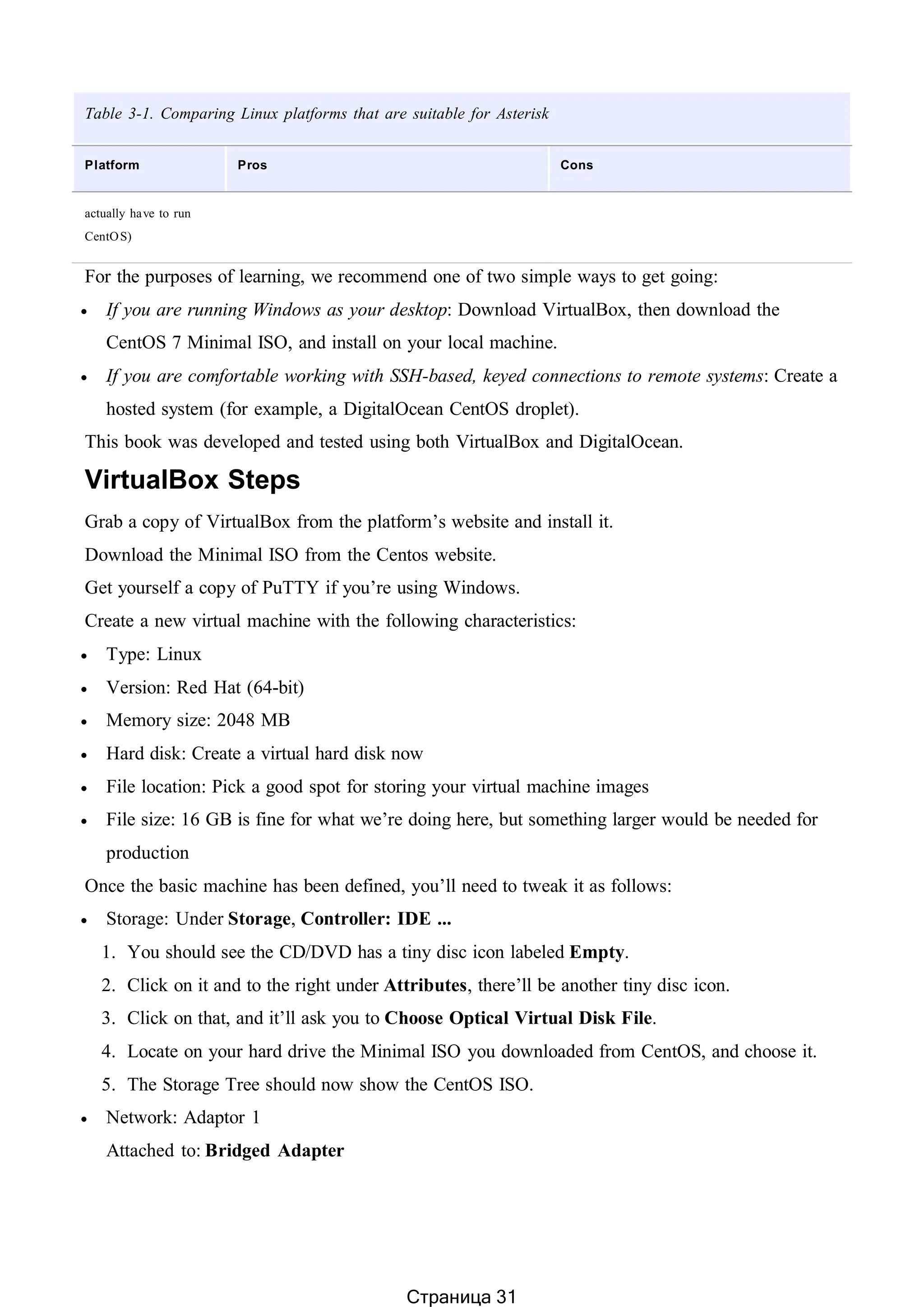
For the purposes of learning, we recommend one of two simple ways to get going:
 If you are running Windows as your desktop: Download VirtualBox, then download the
CentOS 7 Minimal ISO, and install on your local machine.
 If you are comfortable working with SSH-based, keyed connections to remote systems: Create a
hosted system (for example, a DigitalOcean CentOS droplet).
This book was developed and tested using both VirtualBox and DigitalOcean.
VirtualBox Steps
Grab a copy of VirtualBox from the platform’s website and install it.
Download the Minimal ISO from the Centos website.
Get yourself a copy of PuTTY if you’re using Windows.
Create a new virtual machine with the following characteristics:
 Type: Linux
 Version: Red Hat (64-bit)
 Memory size: 2048 MB
 Hard disk: Create a virtual hard disk now
 File location: Pick a good spot for storing your virtual machine images
 File size: 16 GB is fine for what we’re doing here, but something larger would be needed for
production
Once the basic machine has been defined, you’ll need to tweak it as follows:
 Storage: Under Storage, Controller: IDE ...
1. You should see the CD/DVD has a tiny disc icon labeled Empty.
2. Click on it and to the right under Attributes, there’ll be another tiny disc icon.
3. Click on that, and it’ll ask you to Choose Optical Virtual Disk File.
4. Locate on your hard drive the Minimal ISO you downloaded from CentOS, and choose it.
5. The Storage Tree should now show the CentOS ISO.
 Network: Adaptor 1
Attached to: Bridged Adapter
Страница 31
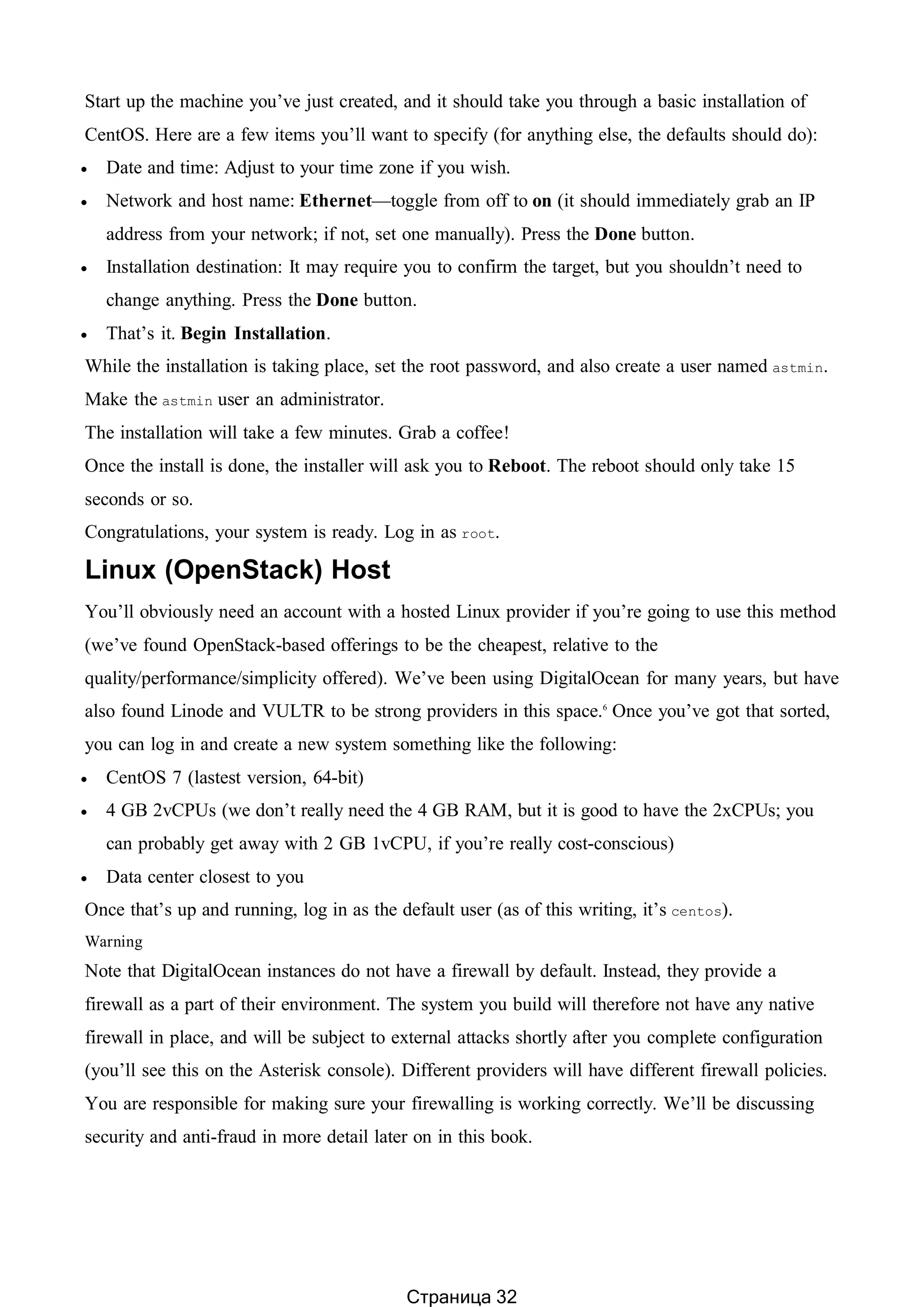
Start up the machine you’ve just created, and it should take you through a basic installation of
CentOS. Here are a few items you’ll want to specify (for anything else, the defaults should do):
 Date and time: Adjust to your time zone if you wish.
 Network and host name: Ethernet—toggle from off to on (it should immediately grab an IP
address from your network; if not, set one manually). Press the Done button.
 Installation destination: It may require you to confirm the target, but you shouldn’t need to
change anything. Press the Done button.
 That’s it. Begin Installation.
While the installation is taking place, set the root password, and also create a user named astmin.
Make the astmin user an administrator.
The installation will take a few minutes. Grab a coffee!
Once the install is done, the installer will ask you to Reboot. The reboot should only take 15
seconds or so.
Congratulations, your system is ready. Log in as root.
Linux (OpenStack) Host
You’ll obviously need an account with a hosted Linux provider if you’re going to use this method
(we’ve found OpenStack-based offerings to be the cheapest, relative to the
quality/performance/simplicity offered). We’ve been using DigitalOcean for many years, but have
also found Linode and VULTR to be strong providers in this space.6
Once you’ve got that sorted,
you can log in and create a new system something like the following:
 CentOS 7 (lastest version, 64-bit)
 4 GB 2vCPUs (we don’t really need the 4 GB RAM, but it is good to have the 2xCPUs; you
can probably get away with 2 GB 1vCPU, if you’re really cost-conscious)
 Data center closest to you
Once that’s up and running, log in as the default user (as of this writing, it’s centos).
Warning
Note that DigitalOcean instances do not have a firewall by default. Instead, they provide a
firewall as a part of their environment. The system you build will therefore not have any native
firewall in place, and will be subject to external attacks shortly after you complete configuration
(you’ll see this on the Asterisk console). Different providers will have different firewall policies.
You are responsible for making sure your firewalling is working correctly. We’ll be discussing
security and anti-fraud in more detail later on in this book.
Страница 32
Dependencies
The system you’ve just built isn’t really much more than a basic bootstrapped system. In order to
prepare it for an Asterisk installation, there are a few things we’ll need to install first.
The following commands can be typed from the command line, or added to a simple shell script
and run that way.
sudo yum -y update &&
sudo yum -y install epel-release &&
sudo yum -y install python-pip &&
sudo yum -y install vim wget dnf&&
sudo pip install alembic ansible &&
sudo pip install --upgrade pip &&
sudo mkdir /etc/ansible &&
sudo chown astmin:astmin /etc/ansible &&
sudo echo "[starfish]" >> /etc/ansible/hosts &&
sudo echo "localhost ansible_connection=local" >> /etc/ansible/hosts &&
mkdir -p ~/ansible/playbooks
We’ve installed Ansible simply because it’s a quick and easy way to get all the dependencies met.
We’ve written a playbook to perform the following operations:
1. Install dnf, vim, wget, and MySQL-python.
2. Install the MySQL community-edition repository.
3. Install mysql-server.
4. Tweak some variables in the mysql-server installation.
5. Start the mysql-server daemon.
6. Modify some MySQL credentials (create users, set passwords).
7. Create a MySQL database/schema for Asterisk to use.
8. Apply some security best practices (remove anonymous user, test database, etc.).
9. Create asterisk user.
10.Create astmin user.
11.Install dependencies for ODBC.
12.Install some diagnostic tools.
13.Tweak the firewall to allow SIP and RTP traffic.
14.Edit some ODBC config files.
This can all be done manually, but it’s just a lot of typing, and Ansible is really good at
streamlining this process.
Create an Ansible playbook in the file ~/ansible/playbooks/starfish.yml.
Страница 33
Note
The libmyodbc8a.so file is versioned, so, if you don’t have version 8 of UnixODBC:
1. Run the playbook the first time (to install the UnixODBC library).
2. Find out what file was installed at /usr/lib64/libmyodbc<version>a.so.
3. Edit the playbook as appropriate (provide the correct filename).
4. Save and rerun the playbook (which will then update the configuration files to point to the
correct library).
Here’s the playbook:
---
- hosts: starfish
become: yes
vars:
# Use these on the first run of this playbook
current_mysql_root_password: ""
updated_mysql_root_password: "YouNeedAReallyGoodPassword"
current_mysql_asterisk_password: ""
updated_mysql_asterisk_password: "YouNeedAReallyGoodPasswordHereToo"
# Comment the above out after the first run
# Uncomment these for subsequent runs
# current_mysql_root_password: "YouNeedAReallyGoodPassword"
# updated_mysql_root_password: "{{ current_mysql_root_password }}"
# current_mysql_asterisk_password: "YouNeedAReallyGoodPasswordHereToo"
# updated_mysql_asterisk_password: "{{ current_mysql_asterisk_password }}"
tasks:
- name: Install epel-release
dnf:
name: epel-release
state: present
- name: Install dependencies
dnf:
name: ['vim', 'wget', 'MySQL-python']
state: present
- name: Install the MySQL repo.
dnf:
name: http://repo.mysql.com/mysql-community-release-el7-5.noarch.rpm
state: present
- name: Install mysql-server
Страница 34
dnf:
name: mysql-server
state: present
- name: Override variables for MySQL (RedHat).
set_fact:
mysql_daemon: mysqld
mysql_packages: ['mysql-server']
mysql_log_error: /var/log/mysqld.err
mysql_syslog_tag: mysqld
mysql_pid_file: /var/run/mysqld/mysqld.pid
mysql_socket: /var/lib/mysql/mysql.sock
when: ansible_os_family == "RedHat"
- name: Ensure MySQL server is running
service:
name: mysqld
state: started
enabled: yes
- name: update mysql root pass for localhost root account from local servers
mysql_user:
login_user: root
login_password: "{{ current_mysql_root_password }}"
name: root
host: "{{ item }}"
password: "{{ updated_mysql_root_password }}"
with_items:
- localhost
- name: update mysql root password for all other local root accounts
mysql_user:
login_user: root
login_password: "{{ updated_mysql_root_password }}"
name: root
host: "{{ item }}"
password: "{{ updated_mysql_root_password }}"
with_items:
- "{{ inventory_hostname }}"
- 127.0.0.1
- ::1
- localhost.localdomain
- name: create asterisk database
mysql_db:
Страница 35
login_user: root
login_password: "{{ updated_mysql_root_password }}"
name: asterisk
state: present
- name: asterisk mysql user
mysql_user:
login_user: root
login_password: "{{ updated_mysql_root_password }}"
name: asterisk
host: "{{ item }}"
password: "{{ updated_mysql_asterisk_password }}"
priv: "asterisk.*:ALL"
with_items:
- "{{ inventory_hostname }}"
- 127.0.0.1
- ::1
- localhost
- localhost.localdomain
- name: remove anonymous user
mysql_user:
login_user: root
login_password: "{{ updated_mysql_root_password }}"
name: ""
state: absent
host: "{{ item }}"
with_items:
- localhost
- "{{ inventory_hostname }}"
- 127.0.0.1
- ::1
- localhost.localdomain
- name: remove test database
mysql_db:
login_user: root
login_password: "{{ updated_mysql_root_password }}"
name: test
state: absent
- user:
name: asterisk
state: present
createhome: yes
Страница 36
- group:
name: asterisk
state: present
- user:
name: astmin
groups: asterisk,wheel
state: present
- name: Install other dependencies
dnf:
name:
- unixODBC
- unixODBC-devel
- mysql-connector-odbc
- MySQL-python
- tcpdump
- ntp
- ntpdate
- jansson
- bind-utils
state: present
# Tweak the firewall for UDP/SIP
- firewalld:
port: 5060/udp
permanent: true
state: enabled
# Tweak firewall for UDP/RTP
- firewalld:
port: 10000-20000/udp
permanent: true
state: enabled
- name: Ensure NTP is running
service:
name: ntpd
state: started
enabled: yes
# The libmyodbc8a.so file is versioned, so if you don't have version 8, see what the
# /usr/lib64/libmyodbc<version>a.so file is, and refer to that instead
# on your 'Driver64' line, and then run the playbook again
Страница 37
- name: update odbcinst.ini
lineinfile:
dest: /etc/odbcinst.ini
regexp: "{{ item.regexp }}"
line: "{{ item.line }}"
state: present
with_items:
- regexp: "^Driver64"
line: "Driver64 = /usr/lib64/libmyodbc8a.so"
- regexp: "^Setup64"
line: "Setup64 = /usr/lib64/libodbcmyS.so"
- name: create odbc.ini
blockinfile:
path: /etc/odbc.ini
create: yes
block: |
[asterisk]
Driver = MySQL
Description = MySQL connection to 'asterisk' database
Server = localhost
Port = 3306
Database = asterisk
UserName = asterisk
Password = {{ updated_mysql_asterisk_password }}
#Socket = /var/run/mysqld/mysqld.sock
Socket = /var/lib/mysql/mysql.sock
...
Run the playbook with the following command:
$ ansible-playbook ~/ansible/playbooks/starfish.yml
Sit back and watch the magic happen.
Once Ansible has completed the assigned tasks, verify that ODBC can connect to the database
using the asterisk user credentials.
$ echo "select 1" | isql -v asterisk asterisk password
You should see a result something like this:
+---------------------------------------+
| Connected! |
| sql-statement |
| help [tablename] |
| quit |
+---------------------------------------+
Страница 38
SQL> select 1
+---------------------+
| 1 |
+---------------------+
| 1 |
+---------------------+
SQLRowCount returns 1
1 rows fetched
If you do not see the Connected! message, you need to troubleshoot your database and ODBC
installation. The first thing you should do is make sure you can log into the database from the
command line using the asterisk user (mysql -u asterisk -p). Most ODBC problems tend to
end up being credentials problems (i.e., wrong password or username), so work backward to
ensure all the credentials work as they should, and double-check that you didn’t get any problem
messages from Ansible.
As of this writing, the version of jansson installed from the EPEL repo is an older version than
the one Asterisk requires, so we’ll have to install that manually.
The system is now prepared, and we’re ready to download and install Asterisk.
Asterisk Installation
Asterisk is officially delivered in a tarball (as source code), and it must be downloaded, extracted,
and compiled.7
This is not difficult to do, so long as you have all the dependencies correct.
Between the writing of this book and your reading of it, there may have been some changes to the
various dependencies, so your install process may have to be run slightly differently. It’s often
difficult to know the difference between an error message that can safely be ignored, and one that
is indicating a critical problem; however, in general, you should have identified and resolved any
errors in the previous processes before arriving at this step. If your dependencies are sorted, the
Asterisk install will tend to go smoothly.
Download and Prerequisites
Log out of the system, and log back in as user astmin.8
Type the following commands from the shell in order to download the Asterisk source code:
Note
When you see us write <TAB> in a filename, what we mean is that you should press the Tab key
on your keyboard and allow autocomplete to fill in what it can. The rest of the typing then
follows.
$ mkdir ~/src
Страница 39
$ cd ~/src
$ wget https://downloads.asterisk.org/pub/telephony/asterisk/asterisk-16-
current.tar.gz
$ tar zxvf asterisk-16-current.tar.gz
$ cd asterisk-16.<TAB> # tab should auto-complete (unless it has more than one
match)
We can now run a few prerequisites that the Asterisk team has defined, and also have the
environment checked:
$ cd contrib/scripts (or cd ~/src/asterisk-16.<TAB>/contrib/scripts
$ sudo ./install_prereq install # asterisk has a few prerequisites that this
simplifies
$ cd ../..
$ ./configure --with-jansson-bundled
Asterisk is now ready to compile and install, but there are a few tweaks worth making to the
configuration before compilation.
Compiling and Installing
$ make menuselect
You will see a menu that presents various options you can select for the compiler. Use the arrow
and Tab keys to move around, and the Enter key to select/deselect. For the most part, the defaults
should be fine, but we want to make a few tweaks to the sound files in order to ensure we have all
the sounds we want, in the best format.
Note
At this point you can also select other languages you wish to have on your system. We
recommend you select the WAV and G722 formats (and G729 as well, if you need to support it).
Under Codec Translators (--- External ---):
 Select [*] codec_opus
 Select [*] codec_silk
 Select [*] codec_siren7
 Select [*] codec_siren14
 Select [*] codec_g729a
Under Core Sound Packages:
 Deselect [*] CORE-SOUNDS-EN-GSM
 Select [*] CORE-SOUNDS-EN-WAV
 Select [*] CORE-SOUNDS-EN-G722
Under Extras Sound Packages:
 Select [*] EXTRA-SOUNDS-EN-WAV
Страница 40
 Select [*] EXTRA-SOUNDS-EN-G722
Save and Exit.
Three more commands and Asterisk is installed:
$ make # this will take several minutes to complete
# (depending on the speed of your system)
$ sudo make install # you must run this with escalated privileges
$ sudo make config # this too
Warning
When the make config command has completed, it will suggest some commands to install the
sample configuration files. For the purposes of this book, you do not want to do this. We will be
building the necessary files by hand, so the sample files will only serve to disrupt and confuse that
process. Having said that, the sample files are useful, and we will mention them throughout this
book, since they are excellent reference material.
Reboot the system.
Once the boot is complete, log back in as the astmin user, and temporarily set SELinux to
Permissive (it will revert to Enforcing after each boot, so until we’ve sorted out the SELinux
portion of the install, this has to happen on every boot):
$ sudo setenforce Permissive
$ sudo sestatus
This should show Current mode: permissive
Verify that Asterisk is running with the following command:
$ ps -ef | grep asterisk
You want to see the /user/sbin/asterisk daemon running (currently as user root, but we’ll fix
that shortly).
Asterisk is now installed and is running; however, there are a few configuration settings we’ll
need to make before the system is in any way useful.
Initial Configuration
Asterisk stores its configuration files in the /etc/asterisk folder by default. The Asterisk process
itself doesn’t need any configuration files in order to run; however, it will not be usable yet, since
none of the features it provides have been specified. We’re going to handle a few of the initial
configuration tasks now.
Note
Asterisk configuration files use the semicolon (;) character for comments, primarily because the
hash character (#) is a valid character on a telephone number pad.
Страница 41
The modules.conf file gives you fine-grained control over what modules Asterisk will (and will
not) load. It’s usually not necessary to explicitly define each module in this file, but you could if
you wanted to. We’re going to create a very simple file like this:
$ sudo chown asterisk:asterisk /etc/asterisk ; sudo chmod 664 /etc/asterisk
$ sudo -u asterisk vim /etc/asterisk/modules.conf
[modules]
autoload=yes
preload=res_odbc.so
preload=res_config_odbc.so
We’re using ODBC to load many of the configurations of other modules, and we need this
connector available before Asterisk attempts to load anything else, so we’ll pre-load it.
Next up, we’re going to tweak the logger.conf file just a bit from the defaults.
$ sudo -u asterisk vim /etc/asterisk/logger.conf
[general]
exec_after_rotate=gzip -9 ${filename}.2;
[logfiles]
;debug => debug
;security => security
console => notice,warning,error,verbose
;console => notice,warning,error,debug
messages => notice,warning,error
full => notice,warning,error,debug,verbose,dtmf,fax
;full-json => [json]debug,verbose,notice,warning,error,dtmf,fax
;syslog keyword : This special keyword logs to syslog facility
;syslog.local0 => notice,warning,error
You will notice that many lines are commented out. They’re there as a reference, because you’ll
find when debugging your system you may want to frequently tweak this file. We’ve found it’s
easier to have a few handy lines prepared and commented out, rather than having to look up the
syntax each time.
The next file, asterisk.conf, defines various folders needed for normal operation, as well as
parameters needed to run as the asterisk user:
$ sudo -u asterisk vim /etc/asterisk/asterisk.conf
[directories](!)
astetcdir => /etc/asterisk
astmoddir => /usr/lib/asterisk/modules
astvarlibdir => /var/lib/asterisk
astdbdir => /var/lib/asterisk
Страница 42
astkeydir => /var/lib/asterisk
astdatadir => /var/lib/asterisk
astagidir => /var/lib/asterisk/agi-bin
astspooldir => /var/spool/asterisk
[options]
astrundir => /var/run/asterisk
astlogdir => /var/log/asterisk
astsbindir => /usr/sbin
runuser = asterisk ; The user to run as. The default is root.
rungroup = asterisk ; The group to run as. The default is root
We’ll configure more files later on, but these are all we need for the time being.
Let’s update the ownership of the files so the asterisk user has proper access to them.
$ sudo chown -R asterisk:asterisk
{/etc,/var/lib,/var/spool,/var/log,/var/run}/asterisk
We also may need to add a rule to the /etc/tmpfiles.d folder, to allow Asterisk to create a socket at
runtime.
$ sudo vim /etc/tmpfiles.d/asterisk.conf
d /var/run/asterisk 0775 asterisk asterisk
(See man tmpfiles.d for more information.)
Next up, we’re going to initialize the database with the tables Asterisk needs for ODBC-based
configuration.
The Asterisk source files include a contribution that the Digium folks maintain as part of Asterisk,
in order to version-control the database tables needed. This greatly simplifies keeping the
database correct through the upgrade process.
Navigate to the relevant directory and make a copy of the configuration file.
$ cd ~/src/asterisk-16.<TAB>/contrib/ast-db-manage
$ cp config.ini.sample config.ini
Now, we’re going to open the file and give it the credentials for our database (which are defined
in the Ansible playbook named starfish.yml, under the variable
current_mysql_asterisk_password, which we used at the beginning of this chapter):
$ vim config.ini
Find the lines that look similar to this:
#sqlalchemy.url = postgresql://user:pass@localhost/asterisk
sqlalchemy.url = mysql://user:pass@localhost/asterisk
# Logging configuration
[loggers]
keys = root,sqlalchemy,alembic
Страница 43
Make a copy of it, comment it out, and edit it with the correct credentials:
#sqlalchemy.url = postgresql://user:pass@localhost/asterisk
#sqlalchemy.url = mysql://user:pass@localhost/asterisk
sqlalchemy.url =
mysql://asterisk:YouNeedAReallyGoodPasswordHereToo@localhost/asterisk
# Logging configuration
[loggers]
keys = root,sqlalchemy,alembic
Now, with that very simple bit of configuration, we can use Alembic to automagically configure
the database perfectly for Asterisk (this used to be somewhat painful to do in past versions of
Asterisk):
$ alembic -c ./config.ini upgrade head
Note
Alembic is not used by Asterisk, so the configuration you’ve just performed does not allow
Asterisk to use the database. All it does is run a script that creates the schema and tables Asterisk
will use (you could do this manually as well, but trust us, you want Alembic to handle this). It’s
part of the install/upgrade process. It’s especially useful if you have live tables, with real data in
them, and want to be able to upgrade and retain the relevant configuration.
Log into the database now, and review all the tables that have been created:
$ mysql -u asterisk -p
mysql> use asterisk;
mysql> show tables;
Страница 44
You should see a list similar to this:
| alembic_version_config |
| extensions |
| iaxfriends |
| meetme |
| musiconhold |
| ps_aors |
| ps_asterisk_publications |
| ps_auths |
| ps_contacts |
| ps_domain_aliases |
| ps_endpoint_id_ips |
| ps_endpoints |
| ps_globals |
| ps_inbound_publications |
| ps_outbound_publishes |
| ps_registrations |
| ps_resource_list |
| ps_subscription_persistence |
| ps_systems |
| ps_transports |
| queue_members |
| queue_rules |
| queues |
| sippeers |
| voicemail |
We’re not going to configure anything in the database as of yet. We’ve got some more base
configuration to do first.
Exit the database CLI.
Now that we’ve got the database structure to handle Asterisk config, we’re going to tell Asterisk
how to connect to the database.
$ sudo -u asterisk vim /etc/asterisk/res_odbc.conf
Once again, you’ll need the credentials you defined in your Ansible playbook.
[asterisk]
enabled => yes
dsn => asterisk
username => asterisk
password => YouNeedAReallyGoodPasswordHereToo
pre-connect => yes
Страница 45
SELinux Tweaks
We’re going to install some SELinux tools, and make a few changes to the SELinux configuration
so that the system will boot properly.
Note
A common approach is to simply edit /etc/selinux/config, and set enforcing=disabled. We do not
recommend this, but doing so completely disables SELinux and renders the following steps
unnecessary.
$ sudo dnf -y install setools setroubleshoot setroubleshoot-server
$ sudo vim /etc/selinux/config
You’re going to change the line SELINUX=enforcing to SELINUX=permissive. This will ensure the
logfiles show potential SELinux errors, without actually blocking the relevant processes.
Next, we’re going to give Asterisk ownership of the /etc/odbc.ini file.
$ sudo chown asterisk:asterisk /etc/odbc.ini
$ sudo semanage fcontext -a -t asterisk_etc_t /etc/odbc.ini
$ sudo restorecon -v /etc/odbc.ini
$ sudo ls -Z /etc/odbc.ini
If all is well, you should see now that the file context for this file has been set to asterisk_etc_t:
-rw-r--r--. asterisk asterisk system_u:object_r:asterisk_etc_t:s0 /etc/odbc.ini
There are a few more SELinux errors we’ve seen here during the writing of the book. They may
have been corrected by the time you read this, but there should be no harm in running them:
$ sudo /sbin/restorecon -vr /var/lib/asterisk/*
$ sudo /sbin/restorecon -vr /etc/asterisk*
Reboot the system, and we’re going to check the log for any nasty SELinux errors before we set it
to enforcing.
$ sudo grep -i sealert /var/log/messages
There may be a few messages in there complaining about things Asterisk doesn’t need (for
example, a hidden file named .odbc.ini), but so long as it’s not full of errors about all sorts of
important Asterisk components, you should be good to go. One last thing you have to change is
an SELinux Boolean to allow Asterisk to create a TTY.
$ sudo setsebool -P daemons_use_tty 1
Edit the /etc/selinux/config file again, this time setting SELINUX=enforcing. Save and reboot once
more.
Страница 46
Verify that Asterisk is running (as user asterisk).
$ ps -ef | grep asterisk
asterisk 3992 3985 0 16:38 ? 00:00:01 /usr/sbin/asterisk -f -vvvg -c
OK, we’re nearly done with the installation now.
Firewall Tweaks
We’ll make a couple of firewall tweaks to prepare our system for SIP (and SIP Secure).
$ sudo firewall-cmd --zone=public --add-service=sip --permanent
$ sudo firewall-cmd --zone=public --add-service=sips --permanent
Final Tweaks
Your Asterisk system is ready to roll.
Let’s put some initial data into the configuration files, so that in the next chapter we can begin to
work with our new Asterisk system.
Since we’re going to use the PJSIP channel for all of our calling, we’re going to tell Asterisk to
look for PJSIP configuration in the database:
$ sudo -u asterisk vim /etc/asterisk/sorcery.conf
[res_pjsip] ; Realtime PJSIP configuration wizard
; eventually more modules will use sorcery to connect to the
; database, but currently only PJSIP uses this
endpoint=realtime,ps_endpoints
auth=realtime,ps_auths
aor=realtime,ps_aors
domain_alias=realtime,ps_domain_aliases
contact=realtime,ps_contacts
[res_pjsip_endpoint_identifier_ip]
identify=realtime,ps_endpoint_id_ips
$ sudo -u asterisk vim /etc/asterisk/extconfig.conf
[settings] ; older mechanism for connecting all other modules to the database
ps_endpoints => odbc,asterisk
ps_auths => odbc,asterisk
ps_aors => odbc,asterisk
ps_domain_aliases => odbc,asterisk
ps_endpoint_id_ips => odbc,asterisk
ps_contacts => odbc,asterisk
Страница 47
$ sudo -u asterisk vim /etc/asterisk/modules.conf
[modules]
autoload=yes
preload=res_odbc.so
preload=res_config_odbc.so
noload=chan_sip.so ; deprecated SIP module from days gone by
We now have to place one bit of config into the pjsip.conf file, which defines the transport
mechanism.
$ sudo -u asterisk vim /etc/asterisk/pjsip.conf
[transport-udp]
type=transport
protocol=udp
bind=0.0.0.0
Finally, let’s log into the database, and define some sample configurations for PJSIP:
$ mysql -D asterisk -u asterisk -p
mysql>
insert into asterisk.ps_aors (id, max_contacts) values ('0000f30A0A01', 1);
insert into asterisk.ps_aors (id, max_contacts) values ('0000f30B0B02', 1);
insert
into asterisk.ps_auths
(id, auth_type, password, username)
values
('0000f30A0A01', 'userpass', 'not very secure', '0000f30A0A01');
insert
into asterisk.ps_auths
(id, auth_type, password, username)
values
('0000f30B0B02', 'userpass', 'hardly to be trusted', '0000f30B0B02');
insert
into asterisk.ps_endpoints
(id, transport, aors, auth, context, disallow, allow, direct_media)
values
('0000f30A0A01', 'transport-udp', '0000f30A0A01', '0000f30A0A01',
'sets', 'all', 'ulaw', 'no');
insert
into asterisk.ps_endpoints
(id, transport, aors, auth, context, disallow, allow, direct_media)
values
('0000f30B0B02', 'transport-udp', '0000f30B0B02', '0000f30B0B02',
'sets', 'all', 'ulaw', 'no');
Страница 48
exit
Let’s reboot, and then we’ll log into our new Asterisk system and have a look at what we’ve
created.
Validating Your New Asterisk System
We don’t need to dive too deeply into the system at this point, since all the chapters that follow
will be doing exactly that.
So all we need to do is verify that we can log into the system and that the PJSIP endpoints we’ve
created are there.
$ sudo asterisk -rvvvv
*CLI> pjsip show endpoints
You should see the two endpoints we created listed as follows:
Endpoint: <Endpoint/CID.....................................> <State.....> <Channels.>
I/OAuth: <AuthId/UserName...........................................................>
Aor: <Aor............................................> <MaxContact>
Contact: <Aor/ContactUri..........................> <Hash....> <Status> <RTT(ms)..>
Transport: <TransportId........> <Type> <cos> <tos> <BindAddress..................>
Identify: <Identify/Endpoint.........................................................>
Match: <criteria.........................>
Channel: <ChannelId......................................> <State.....> <Time.....>
Exten: <DialedExten...........> CLCID: <ConnectedLineCID.......>
==========================================================================================
Endpoint: 0000f30A0A01 Not in use 0 of inf
InAuth: 1/0000f30A0A01
Transport: transport-udp udp 0 0 0.0.0.0:5060
Endpoint: 0000f30B0B02 Unavailable 0 of inf
InAuth: 2/0000f30B0B02
Transport: transport-udp udp 0 0 0.0.0.0:5060
Objects found: 2
If you don’t see the two endpoints listed, you’ve got a configuration issue. You’re going to have
to work backward to ensure you don’t have any errors that prevent Asterisk from connecting to
the database and instantiating these two endpoints.
Common Installation Errors
The following conditions (in no particular order) cause the majority of installation errors:
Syntax errors
In some cases, substituting a tab for a space can be enough to break something.
UnixODBC, for example, has proven to be sensitive to missing spaces between key =
Страница 49
Discovering Diverse Content Through
Random Scribd Documents
beautiful country so near at hand. The meadows of England giving
way to the mountains of Wales, one catches a glimpse of the stately
towers of Conway Castle, and then sails outward and westward upon
a level sea, which, on its farther side, holds the haven of desire,
Dublin, on the broad waters of the Liffey.
Ireland welcomes us, weeping softly the while, though smiling ever
and anon as the sunlight rifts downward from the west. The gang-
plank is slippery and the pavements mucky, but our welcome is a
warm one, at least one fat, comfortable looking old woman with a
shawl over her head, a gown whose colour I cannot attempt to give,
and shoes which have evidently been discarded by her "auld man,"
greets me with a "Glory be to God, but yer honour is welcome to
Ireland!" and then catching sight of my Jap servant, she gives
utterance to a very audible aside, "Be the powers of the divil, phat's
that he has wid him!" crossing herself vehemently the while, firmly
convinced, I doubt not, that she has seen a limb of Satan, which I
think he strongly resembles.
The Shelburn Hotel receives us within its walls, unchanged in the
thirty years which have elapsed since I last crossed the threshold, a
comfortable inn, pleasantly situated upon College Green, where a
band of Irish musicians are discoursing American ballads of the early
sixties.
One runs into the tide of American tourists here in Dublin, and to-
night this hotel is crowded with them. The clatter of tongues proving
too much for me, I dine and start to bed as soon as possible—a good
book and an easy resting-place are attractive after the long ride from
London.
In the hallway I encounter the porter trying to induce an old
gentleman to go to bed. Said gentleman is drunk as a gentleman
should be, and sound asleep in his chair, holding fast to a glass of
whiskey and soda, from which no efforts of the porter can part him.
"What's the number of your room, sir?"
The sleeping eyes half open as the happy man murmurs, "Wasn't
you tryin' to stale my whiskey just now?"
"Well, I thought, sir, ye would be more comfortable in yer room."
"Let slapin' dogs lie, me boy. But 'twas in a good cause ye did it, and
so I'll go," and he staggers off to the lift, sleeps on my shoulders
until I get out, and probably on the bench for the rest of the night,
as that small lift boy could never move that bulk, redolent of whiskey
and good humour.
So far I have heard nothing from Boyse, who was to have rejoined
me here, and, when ten o'clock comes round, give him up for the
night, and putting out the light am shortly in the land of dreams,
only to be awakened by a clatter on the door followed by the
entrance of the missing man. He has put up at the Club, having
reached here ahead of me. Our car he reports ready for us at nine
to-morrow morning, and I shortly drive him out as it has gotten late.
One must be of a sour disposition if one does not laugh in Ireland,
and be assured her people will always laugh with one, though at
times there sounds a catch of a sob running through it all. Seat
yourself on any spot in the island, and something funny is apt, nay
almost sure, to occur before you depart; all of which is apparently
arranged for your especial benefit.
Photo by W. Leonard
Statue of St. Patrick on Tara Hill
It is raining this morning and it is Sunday, which in the dominions of
his Majesty does not mean a day of diversion unless you happen to
be a guest in some country house. I am in a secluded seat on the
portico of the hotel, when directly before me, on the only spot of
pavement visible, appears a girl of fourteen dressed in everything
which could never by the widest stretch of the imagination have
been intended for her when purchased. She summons "Katie darlin'"
not to be such a "truble" to her, but to appear and "spake to the
gintleman," whereupon from around the corner of a stone post
comes "Katie darlin'," a mite of a child some two feet tall with a pair
of black eyes sparkling all over her dirty little face. She is robed in
what looks like a blue plush opera-cloak on wrong side in front and
festooned over what were once shoes; her shock of never combed
hair is topped by an old woman's bonnet. "Katie darlin'" is evidently
out for her Sunday. She is glad to see every one, and especially
"Your honour" after the reception of a "ha'penny." Bless her dirty
little face, what will be her portion in this life, I wonder! Yet, after all,
being Irish, she is safer than if born of another race, for the women
of her land do not go down to death and destruction as easily as
those of other countries, be it said to their credit. God grant it may
be so with "Katie darlin'," who goes smilingly away to meet whatever
fate the future holds for her, and which disturbs her not at all as yet.
The morning of our start from Dublin opens windy and with drifting
clouds but is a fair day for hereabouts, and after all these grey skys
are very soothing to one's eyes.
Our motor rolls up at ten A.M. and proves to be a handsome new
Panhard of fifteen horse-power. Packing and stowing take a half-hour
the first day, as economy of space is to be desired, and the proper
arrangement of luggage is a question to be considered. However, all
is done and I roll off to the "Kildare Street Club," where Boyse awaits
me.
His traps necessitate a new arrangement of all the luggage, which I
am not allowed to superintend at all, but am carried off to a room
well to the rear where a whiskey and soda is vainly pressed upon
me. I should much prefer to stay outside and boss the job of loading
up, but that would be undignified. So we stay cooped up until all is
arranged, and then sally forth and roll away with the utmost
grandeur of demeanour. I object several times during the day to the
arrangement of those traps, impressing upon Boyse the truth of the
old saying, "if you want a thing done, go,—if not, send—" and
pointing out to him that therein lies the reason for the increasing
glory and prosperity of our country and the evident decadence of the
British Empire.
He does not take me as serious,—perhaps I am not,—but daily life
must have its spice and we spend many hours like Pat and "Dinnis"
on the quay at Cork of a Saturday evening, "fighting each other for
conciliation and hating each other for the love of God."
Speeding away through Dublin's busy streets and out into Phœnix
Park, existence becomes life once more. The rushing winds drive the
last taint of the city and its world of men and women off and away.
Beyond the confines of the park we enter at once into the green
country; tall hawthorn hedges toss their branches above us as we
speed onward, the car moving like a bird. These are not French
roads but they are far from bad. Mile after mile glides by us, and a
sharp rain forces the top over our heads, but not for long,—it is soon
down again, and we give ourselves up for an hour to the enjoyment
of mere motion. And then history claims our attention. Dublin is of
course rich in its memories but leave it for the present and speeding
westward some thirty miles pause at the foot of Tara Hill, the most
renowned spot in Ireland. There are few in our Western land who do
not remember the sweet old song of Moore's:
"The harp that once through Tara's halls
The soul of music shed,
Now hangs as mute on Tara's walls
As if that soul were fled."
And there are many to whom its melodies will recall those better
days when voices long since sunken into silence sang them off into
dreamland with those words.
Green grow the grasses to-day over this site of Ireland's most
ancient capital. Gone are its garland-hung walls, silent its harps for
ever.
Leaving the present behind, one passes into the remotest recess of
the island's past as one mounts the hill. To-day wavering misty
shadows close in around me as I move upward, even as though the
spirits of the ancient kings and minstrels were yet about, and the
winds moan as though driven across the strings of many harps, and
there seems melody all around me.
Tara is not a great hill, but a fair green mound from which the
ancient kings were wont to spy out all the fair land around them. It
was the most sacred spot in the kingdom and none could wear the
crown who bore blemish of any sort. Cormac Mac Art, the great King,
was, upon the loss of his eye, forced to retire to the hill of Skreen
near-by. For twenty-five hundred years, Tara was the palace and
burial-place of the kings of Ireland, who every third year met here in
great convention. To-day as I stand on its summit nothing of that
period, save some long mounds, breaks the green carpet of grass
thrown like the covering of our holy communion over this holy of
holies. Tara was mentioned by Ptolemy and he called it "illustrious."
Its name by some is supposed to be taken from that of the wife of a
King, Heremon, the first monarch of Ireland. "Thea" was her name
and the place was called Temora (the house of Thea), but others call
it "the house of music" (Thead, a musical chord, and mur, a house).
Photo by W. Leonard
Castle of King John Trim
The main hall stood nine hundred feet square and "twenty-seven
cubits in height." It held its thousand guests daily and on great days
the monarch sat on his throne in its centre, his flowing yellow hair
bearing the golden crown, his stately form clothed in a brilliant
scarlet robe laden with rich ornaments of gold. Golden shoes
ornamented with red buckles and bearing stars and animals in gold,
were upon his feet; the King of Leinster sat, facing him, the King of
Ulster sat on his right, the King of Munster on his left, while the King
of Connaught sat behind him. On long rows of seats before him were
the druids, bards, philosophers, antiquaries, genealogists, musicians,
and the chiefs of all the towns of the kingdom. The assembly was
opened by the chief bard, followed by the druidical rites, after which
the fire of Saman, or the moon, was lighted. Not until then was the
business of the convention taken up. In one part of the palace, the
youths were instructed in poetry and music and initiated into the
hidden harmony of the universe. Evidently in those days a city must
have surrounded the base of this hill, but of the houses of the people
little seems to be known and nothing is left.
In these long mounds the traveller to-day may trace the outlines of
the hall composed of earth and wood from whence one hundred and
forty-two kings ruled the land, the great King Cormac dating back to
A.D. 227, and he it is who is supposed to have built this hall. Some
claim that the celebrated "Stone of Destiny" now in the coronation
chair in London was taken from here to Scotland. Of this there is no
proof, but so runs the legend.
There is only the music of the wind-swept grasses on Tara Hill to-
night, yet surely the moon rising so grandly yonder still holds her
feast and is summoning her worshippers from the mists of the valley
rising in fantastic forms all around us,—but the only thing bearing
semblance of human form which she illumines is a crazy statue of St.
Patrick here on the spot where he met and, by the power of the
Lord, vanquished the magicians of the king. There could be no fitter
heir to inherit and so we leave him in sole possession and go down
to our car, which rolls us silently away through the green lanes and
on towards Trim's ruined arches and towers. Now the tall "yellow
steeple" of the Abbey of St. Mary's, founded by St. Patrick, and close
into the town the great Castle of King John loom up in the
moonlight. Vast in extent, the castle appears doubly so in this
shadowy light, as we glide by it, a huge empty shell covered with
clambering ivy.
Rolling on through the town we pass to Navan, dear to hunters. All
this is a fair green country where the grass is good for the cattle,
where the poultry thrive, and the Boyne is full of fish, hence one
notes on all sides the ruins of many monasteries, for those old
monks were always to be found where their stomachs could be well
taken care of; and yet with all that they were the power in the land,
as the priest is still the power in southern Ireland.
Leaving Navan we turn northeastward towards Drogheda. The road
winds all the way by the banks of the Boyne and while that name
recalls to mind most prominently the famous battle of the kings,
James and William, still the region was celebrated long ages before
either was thought of. The whole valley was a vast necropolis for the
ancient kings and druids, and on both sides one sees the remains of
a remote antiquity, especially at New Grange where one finds a
tumulus covering some two acres. At first glance it resembles an
Indian mound in America, but it is far more satisfactory to explore as
one finds in its interior a tomb of extraordinary size and rich in
carving, which is supposed to date as far back as the earliest bronze
age, but who was buried here is a question which has never been
settled.
We enter by a passage on its southern side about fifty feet long,—a
stone corridor formed by upright slabs about seven feet high and
roofed by stones of great size. Our glimmering candles show the
centre tomb to be a lofty domed chamber, circular in form, its roof
composed of horizontally placed stones projecting one beyond the
other and capped by a single slab some twenty feet above the
observer. There are three recesses branching off from the rotunda,
probably the tombs of the lesser mortals, while the body of the
monarch evidently occupied the centre space.
There is another sepulchre of equal size at Dowth, and doubtless
every hill or mound in sight holds others. If the Boyne as it winds
and murmurs past them could speak, it could doubtless tell us tales
of kings and druids, of royal coronations and priestly ceremonies, of
life and death in the long dead past. How was it all, I wonder? Was it
picturesque and beautiful or did the barbaric side crowd all that
down and out, leaving nothing save a shuddering feeling of horror as
one gazed on the rites of the druids?
These tombs were rifled by the Danes a thousand years ago, and
therefore, aside from the carvings on their walls, have yielded but
little of interest to the antiquary. There is nothing of animal or
human life represented, merely coils, lozenges, and spirals, with now
and then a fern leaf, but nothing which tells their story as do the
Egyptian inscriptions. This valley of the Boyne is beautifully wooded
and the roads are fine. Our route lies past the obelisk marking the
famous battlefield where the sun of James II. set for ever. The valley
is lovely and reminds one greatly of that of the Thames near
Richmond. It has taken most of the day to make the chauffeur
understand that we are not out to kill time and distance. At the rate
he would like to travel we should reach Iceland in time for tea even
with the ocean to cross, but, as I have forced him to retrace the
route several times, he seems at last to understand our
determination not to rush.
Photo by W. Leonard
Monument on the Battle-field of the Boyne
The whole day's ride has been charming. We did not stop at
Drogheda, but passed on to Newry, a twelve-mile ride over a very
fine road, and rested at the Victoria Hotel, having covered one
hundred and three miles since eleven this morning, with long
stoppages several times. The auto has done splendidly and will do
better as it gets down to work.
This is the Protestant end of Ireland, prosperous and contented
apparently, but not picturesque. That goes with the state of affairs to
be found in the southern half.
Newry is a clean town with neat shops and houses, and a good
hotel, still there are Irish characteristics which those of us who
remember the Irish maid of long ago in America will recognise at
once. Many things are broken, "jist came that way"; a complete toilet
set is unnecessary where there are windows; and I notice that the
salutations sound always wrong end first,—when people meet they
say "Good-night," a form never used elsewhere except when parting.
Apparently the hotel is the social club of the town, where the men of
a certain class gather in the evenings, and drawing their chairs in a
circle before the bar, spend an hour or so in chaff with the barmaid,
drinking porter the while. To-night the talk is of a more serious
nature and turns on trade.
It is claimed that what kills all chance of Ireland being a profitable
country are the railway rates, that, for instance, it costs more to get
corn from Galway to Dublin than from America to any point on the
island.
I asked an Irishman whether Gladstone had benefited Ireland, and
he replied, "he was the cause of all our trouble, he cost Great Britain
two thousand millions sterling and countless lives, and yet they put
up statues to him."
The traveller of to-day sees no sign of the upper classes in Newry,
though there are estates all around it, and in turning the pages of its
history he will discover that it is a place of great antiquity, though its
streets to-day show no signs thereof. Prosperous and commonplace
would best describe it. However, it is just the prosperous and
commonplace which the traveller most welcomes as night comes
down upon him, for there, and not amongst the romantic and
picturesque, in Ireland at least, does he find comfortable quarters
and good food. So it is to-night and so to bed and dreams.
CHAPTER II
Through Newry to Tanderagee Castle—Life in the Castle—Excursions to Armagh
—Its History—The English in Armagh.
Our route lies from Newry north-west through Pointz-pass, beyond
which as we approach Tanderagee, the castle, a stately stone
structure, is seen towering high on a forest-crowned hill with a flag
denoting its owner's presence floating from the main tower.
While the castle is a modern structure of some seventy-five years of
age,—originally built by the Count de Salis,—it stands on the site of
the very ancient stronghold of Redmond O'Hanlon, the most noted
outlaw of Ireland. As we roll through the quaint town clustering
around the hill, where every soul appears to have gone to sleep or
gone dead long since, the sound of the motor brings a few pale faces
to the doors of the houses, but it is very quiet withal.
Looking upward from this street the growth of trees is so dense that
no sign of the castle is visible. We pass through almost a tunnel cut
through the rocks and trees, and emerging in a spacious courtyard,
draw up at the main portal where the maître d'hôtel meets and
conducts us within, our hosts being off somewhere in their motor but
will return shortly.
This gives us time for a quiet inspection. We find ourselves in a long,
wide, and lofty corridor having a row of windows on its right, while
on the left one has entrance first to the main hall and chapel, stately
apartments very richly decorated, and then in order follow several
drawing-rooms, a library, and a spacious dining-hall, and from the
walls of each and all, the painted faces of those who walked these
chambers long ago look down upon us with questioning gaze as
though they still retained some interest in this world of the living,
and yonder dame would, I know, like to hear the latest news from
London; but take my advice, my lady, and let it pass, it is productive
of just the same unrest and discontent now as when you trod the
boards of that great theatre of life,—Dead Sea fruit, the whole of it.
Wondering what part she played in life, my eyes wander to an open
window and straightway all thoughts of Madam vanish as I gaze
downward through the glades of one of those beautiful parks which
abound in these dominions. A stately terrace of stone shrouded in ivy
runs below these windows and from it the land drops away into a
gentle valley filled with great trees and blossoming banks of
rhododendrons with here and there a stretch of grassland and a
gleam of water, a vista which must have been a perpetual delight to
the Duke who collected these books in this library, for a lover of
books is generally a lover of nature.
Photo by W. Leonard
Tanderagee Castle
Passing onward you will enter the courtyard and at the end of the
long arcades on one side find the billiard and smoking rooms. On the
upper floors, aside from the state and family apartments, one finds
long rows of bachelor apartments, twenty or thirty of them I should
say, and in the middle of the row a cozy octagon chamber where
much high revel has held forth, and which looks very lonely just now.
There are small closets in the walls which certainly did not hold holy
water.
But times are changed at Tanderagee, and while there is to-day high
revel within its walls, it comes from the fresh young voices of
children and would in no way appeal to the ghosts which haunt the
octagon chamber.
After luncheon we visit the little ones in their rooms high up in the
sunlight, and very happy, fine children they appear to be. Round-
eyed little Lady Mary did the honours and presented her brother, who
at the time was making vain attempts to stand on his head in a
corner, while the new baby dreamed his days away in a crib by the
fire. I am told that the present Duke dying without an heir the estate
would pass to a Catholic owner, much to the distaste of the tenants
here, who are mostly Protestants, and that when little Lord
Mandeville was born the rejoicings were immense,—every man as he
heard it having a pull at the church bell. Now there are two sons and
hence little chance of the dreaded misfortune,—though it often
happened during the Boer war that many estates in the empire fell to
those so distant that no hope had been entertained for an instant of
their so passing. Let us trust it will not occur here, for these are fine
children.
Passing downward, we spend some hours in wandering over the
park, pausing at last by the grave of the late Duke in the little
churchyard. I did not notice the graves of any other members of the
family. I believe former dukes are interred at Kimbolton, the family
seat in England. The church holds some very beautiful windows
erected by the present Duchess to the memory of her mother,
Helena Zimmerman. As we return to the castle the voices of the
children have roused all the echoes of the courtyard into wild replies
and now the sunlight streams downward as though in thorough
approval.
Tea-time, that most pleasant hour of the day, finds me in the chapel
listening to the soft tones of the organ. My hand quite haphazard
picks up a volume lying near me whose title at once chains my
attention and in view of the base manner in which the author
afterward sold his talents to her enemies and slandered his Queen it
may be well to quote what he says of that Queen in this preface:
"To the Most Illustrious Mary Queen of Scots.
[An Epigram of George Buchanan.]
"Madam:
"Who now happily holdest the sceptre of the Caledonian coast
conveyed from hand to hand through a long line of innumerable
ancestors, whose fortune is exceeded by thy merits, thy years
by thy virtues, thy sex by thy spirit, and thy noble birth by the
nobility of thy manners,
"Receive (but with candour and good nature) these poems upon
which I have bestowed a Latine Dress, etc. etc. I durst not cast
away this ill-born product of mine lest I should reject what thou
hast been pleased to approve. What my poems could not hope
for from the wit and genius of the composer perhaps they will
obtain from thy good-will and approbation."[1]
Deep in thoughts of that most interesting period of Scotch history I
do not even hear the dressing bell until its clangour becomes too
insistent to be disregarded, and I mount to my room to dress for that
most important function of the day—dinner. A bright fire makes the
chamber warm and cozy so that it is difficult to resist the temptation
to further reverie.
Evidently Tanderagee has been greatly improved of late years. In the
building have been placed several modern bathrooms, a Turkish
plunge, and an electric light plant and steam heat, so that the damp,
penetrating cold and musty, mouldy smell usually so ever-present in
these houses, where fortunes are so constantly spent in decorations
and so little done for actual comfort, are absent. From my window I
can see on the lake of the park an ancient swan named Billy, alone in
all his glory and from choice and bad temper, not necessity. He has
killed off all his kind and all other kinds, is in fact a degenerate bird,
and when evening comes on he betakes himself with the rest of the
"boys" to the village street, and loafs around all night, no dog in the
place daring to molest him. I saw him outside of a public house there
with a desire for strong drink expressed in his eyes. He is a rake of
the worst character but you dare not tell him so. He leaves the park
every night before the gates are closed and returns next morning.
There are fine drives in all directions hereabouts, and the roads
being good we have many a rush in the motor-cars,—one to an old
ruin where the devil is supposed to leave the impress of his foot
upon a plank in the floor each night. I doubt if to-day even the devil
could reach the plank through the accumulation of dirt thereon.
Photo by Wm. Lawrence
Chapel, Tanderagee Castle
As we wait in the quadrangle one morning for our motors, to my
astonishment I am accosted in salutation by a name used only at
home, and by those I have known for years. "How de do, Mr. Mike?"
Around me rise the walls of the castle, but aside from the
expressionless faces of the house servants standing near I can see
no one until in a dark corner of the court a yet blacker spot suddenly
shows a white gleam of teeth, and out into the light comes the
speaker. "How de do, sir?—I'se de cook on de boss's car, and I
knowed you all your life. Don't you remember nigger John and Miss
Nancy Ballentine?" Convulsed with laughter, I can scarcely answer.
This explains the hot bread and waffles on the breakfast table, which
surprised me for the moment, but which I had entirely forgotten.
Bowing and scraping came black "Tom" into the sunshine and it
seemed to do his heart good to talk of the old times, of Black John
our own cook, and Miss Nancy Ballentine, who "tended de ladies'
waitin' room in the C. H. & D. station" when she was not assisting at
the marrying or burying of most of us, at the latter wearing a dress
composed of the crêpe from many a doorbell. That it did not match
in degrees of blackness mattered not at all to the good dame. She
arranged it in stripes and she could tell you which particular funeral
each of those stripes came from. She has been dead many years,
and to have her recalled here was strange indeed, but—the cars
come with a rush, and we are off with a rush, speeding through the
beautiful park whose trees certainly equal any I have seen except of
course those of California.
I find that my fifteen horse-power Clements keeps up very fairly with
the Duke's motor of sixty horse-power. Of course on the wide
straight roads of France this could not be, but on these narrow and
crooked lanes of Ireland we are never very far apart, and have had
many good runs together.
Our motoring carries us often to the town of Armagh where one
comes across traces of the hatred of that Catholic Queen, Mary I., for
the Irish. She burned this see and three other churches. The
cruelties of that Queen to the people of Kings and Queens counties
equals anything told in Irish history, but is rarely mentioned by the
historians of the day. In fact, all the territory forming now those
counties was stolen from its ancient owners and the name changed
as above, resulting in a warfare which lasted into the reign of
Elizabeth until the people finally disappeared into the mountains. No
torture or cruelty was spared.
In Forgotten facts in Irish History we read that "it seems very
apparent to the student of Irish history that these people received
their persecutions not because they were Catholics, but because they
were Irish. The most terrible persecutions took place under the
Catholic sovereigns of England and not until those monarchs became
so-called heretics was the Church of Rome turned against them, so
that at the present time it is the effort of all to show that the
persecution if it exists is because of the religion."
The history of the archbishopric of Dublin is an object-lesson on the
exclusion of the Irish from the Church ever since the Conquest. From
1171 down to the Reformation, in 1549, there were twenty-three
archbishops of Dublin. Of these not one was Irish. For the
archbishopric of Dublin "No Irish need apply!"
The Statute of Kilkenny enacted that no religious house shall receive
an Irishman, under penalty of being attainted and having its
temporalities seized.
One historian of our times asks:
"But would any Irishman have the hardihood to say that if King
Edward VII. were to become a Roman Catholic (which heaven
forbid), and to go hand in hand with the Papacy in the
prosecution of their Imperial and world-wide projects, that the
Pope would oppose the King in any tyrannies he might be
disposed to inflict upon Ireland which did not run counter to the
interests of the Roman Catholic Church? Would the Pope risk the
friendship of the ruler of a great Empire for the sake of what
Italians regard as 'a mere eruption on the chin of the world'?[2]
"The centuries of oppressive treatment which Ireland received
while the whole kingdom was under the 'shelter of the wings of
Rome' amply explains the animosity which rankles in the Irish
heart towards England and everything English. The whole story
of that almost forgotten period is a series of murders, cursings,
tyrannies, betrayals, rapacity, hypocrisy, and poverty, which
scarcely finds a parallel in the range of history."
Armagh has suffered terribly throughout the years since St. Patrick
founded the cathedral, but though abounding in memories, there is
little existing of the past in the town to-day. The site of its cathedral
is very fine, but the building has suffered a complete restoration.
Our days at Tanderagee have passed pleasantly but they are over at
last and bidding our hosts adieu we roll off towards Newry.
Photo by Wm. Lawrence
Drawing-room, Tanderagee Castle
FOOTNOTES:
[1] The Preface of George Buchanan's Poetical Paraphrase upon
the five books of Psalms.
Translated literally into English by Pat Stobin, A. M. Copied by me
from the MS. copy of Stobin at Tanderagee, owned by the Duke of
Manchester. The whole book is in MS.
M. M. Shoemaker.
[2] The late Professor Stokes ventured to say that an English Peer
is a more welcome visitor at the Vatican than an Irish Roman
Catholic Bishop.
CHAPTER III
Through Newcastle to Downpatrick—Grave of St. Patrick—His Life and Work—
The Old Grave-Digger—Belfast and Ballygalley Bay—O'Halloran the Outlaw.
It is nearly six o'clock when we start from Newry towards Newcastle.
Our road lies down the river, and so on by the sea the entire
distance.
The highway is excellent all the way, some thirty-two miles, and the
car speeds onward like a bird. The scenery is lovely, the glimpses of
mountain and meadow, sea and sky enchanting.
About 7.20 brings us to the hotel at Slieve Donard, a very large
costly establishment built by the railway company. It is evidently a
watering-place of some importance, and next month (July) will see it
crowded. The place is pleasantly situated by the sea and presided
over by the Mourne Mountains. There are golf-links and the walks
and drives are fine, but otherwise there is nothing of interest, and
we shall move northward to Dundrum.
The morning is clear and crisp as we leave Newcastle, getting lost at
once in the many byways, but that is rather a pleasure than an
annoyance. All the roadbeds are fine hereabouts and we roll merrily
along over hill and down dale until Downpatrick comes into view, and
we pass up her streets to her ancient cathedral, and there pay our
devotions at the grave of St. Patrick.
The church stands well above its ancient city and is visible from all
the country round about. Several places claim the birthplace of St.
Patrick, but that benign Scotchman was born near Dunbarton. He
himself says that his father was a deacon and his grandfather a
priest. He was a nephew of St. Martin of Tours, the sister of that holy
man having been the mother of the Irish patron. His name was
Succat, but it is by his Latin name of Patricius that he is known best
to the millions who revere his memory.
Ireland during its first millennium was called Scotland, and its people
"Scots," and by these St. Patrick was taken prisoner when he was
but sixteen years of age and carried to Antrim, where he was held
for six years and forced to care for the swine of Michu, a chieftain.
We are told that this occurred in the mountain of Llemish near
Ballymena. During this period his thoughts were ever turned towards
Christianity and after having effected his escape he is next heard of
at Auxerre with its Bishop, Germanus, by whom he was admitted to
holy orders. His thoughts always turned towards Ireland and here he
landed when he was sixty years of age near the present church of
Saul on Strangford Lough in 432 A.D. This was but four miles from
Downpatrick, and there the Lord promptly blessed his work by
enabling him to convert the chieftain of the district, Dichu, to
Christianity, receiving as a gift the barn of that same chieftain, which
formed the first Christian church of this island. The present church of
Saul stands on the spot and that name is but a corruption of the
ancient one of "Patrick's Sabball," or barn.
From here the faith spread until it covered all the land, and here in
492 he died.
Both Armagh and Dundalethglass—Downpatrick—claimed a right to
provide him with a tomb, and to settle the dispute two untamed
oxen were yoked to his bier, and they stopped on this hill of
Downpatrick. As to what sort of a wild ride they gave his saintship
before, out of wind, they rested on this hill, history is silent, but,
being Irish, there is no doubt but that he thoroughly enjoyed it.
I have always regretted that during an ocean voyage which I once
made with the late Bishop Donnelly, I did not make inquiry
concerning this funeral progress, for I have no doubt but that his
reverence—he was not a Bishop then—knew all about it. I have
never met any one who more thoroughly appreciated the sunshine
and sorrow, the laughter and tears of the land he loved so well, and
I greatly regret that that voyage was so short and that the good
Bishop so soon thereafter entered into his rest. But to return.
As far as the actual grave of St. Patrick is concerned, there is, of
course, no certainty; that he was buried somewhere on this hill
appears beyond doubt, and probably near the spot the church was
built on, but that his body remained long in the grave after he was
elevated to the sainthood is clearly doubtful. Probably every church
in Ireland has at one time contained a relic of his. As for this original
church here, it is spoken of way back in the sixth century and again
in the eleventh. The first claimed to have been erected by the saint
himself.
The relics of Columba were brought from Iona here and it is related
that it was that saint who enshrined those of St. Patrick just three-
score years after his death. In his tomb were found his goblet, his
Angel's Gospel, and the Bell of the Testament.
Into St. Patrick's tomb went also the bones of St. Brigid. The Danes
came here, and Strongbow and King John passed by.
The present church is supposed to be only the choir of the great
edifice—the second church—built by De Courcey and destroyed by
Edward, Lord Cromwell in 1605; but it is so completely restored that
it is of little interest, though very comfortable withal.
Photo by Wm. Lawrence
Terrace at Tanderagee Castle
Just outside there stands a venerable grave-digger amongst the
tombs, who might almost have been here fifteen hundred years ago,
and certainly he would resent any insinuation that he was not well
informed upon all which may or may not have occurred since the
death of the saint. He is leaning upon his rake near the church door,
and returns our salutation in an antique manner, nothing about him
as it were, belonging to this latter day or date. "Yes, the cathedral
can be visited, but perhaps 'twould be as well to visit the tomb, I will
show you that,—who better?"
It is off amongst a tangle of tombstones and high grasses, a great
flat irregular boulder engraved with a Celtic cross and the saint's
name—evidently the sinful dead have crowded as closely as possible
around the saintly ashes in order perhaps to pass into the heavenly
gates unobserved with such great company to chain the attention of
St. Peter. But some of these around started on their last journey
hundreds of years after St. Patrick,—still, as we are told that "in His
sight a thousand years are but as yesterday," perhaps they all arrived
together, and I doubt not that for his beloved Irish the holy Patrick
would delay his entry as long as possible and even come back again
from that farther shore at the calling of some late comers.
When I ask this grave-digger whether this be indeed the grave of the
holy man, he looks wise, plucks a bit of grass from a near-by grave,
and seizes his opportunity for an oration. It is useless to stop him
with questions, he will answer as and when it pleases him; and so,
sitting upon the tomb with the sunlight falling in a glowing
benediction upon us living and upon the old cathedral and its silent
company, he speaks on and on. "There's many, your honour, phwat
has heads but don't use thim. Is this the grave you ask. Well I have
puzzled out the question for many years. I don't believe it is, as I
suggested this spot to the antiquary society myself. In owlden days
the spot prayed upon as his tomb was under yonder middle window
of the church, but whin a bishop came along who wanted more silf-
glory than one driveway would give him, he made that one there,
and in so doing moved the owld tombstone,—not that I am claiming
that even that was the first one laid upon the blessed corpse, for an
owld woman of eighty who lived here until she was ten and then
moved away, came back to bid farewell to her native town on going
to America, and upon being shown the tomb undher the window
asked since whin had the dead taken to moving their graves, for
whin she left here it was below there in the valley. But we know it
was around here some place, and this new spot is as good as any
other." "Did St. Pathrick build that church?—no, sure, yer honour, he
was not the kind of a man who wint around glorifying himself. If he
had had as much money as that cost 't would be the poor who would
have got it. Still, the church yonder is fifteen hundred years old,
though it has been so built over that it is hard to believe it."
The old man would have talked on for ever, but, like most of his age,
it would have been but vain repetition, and so we move off and
away, feeling sure that the spirit of the benign old saint returns now
and then in floods of warm sunlight to his ancient cathedral of
Downpatrick.
Like most grave-diggers, the man up there knew more of the past
than of the present, and when he told us that we would find a fine
ferry from Strangford across the outlet of the lough of that name he
spoke without advisement. We found a proposition to place some
planks from one boat to another and so to ferry us and our great
machine over one of the deepest, swiftest currents passing outward
to the sea. It is useless to say that I vetoed this proposition, so we
rolled backward almost to Downpatrick, and then turned north-west
towards Belfast, which we reached for luncheon.
When I pass a city like Belfast without notice, it is not that there is
not much of interest there, but that it has been so often described,
and I would confine these notes to those more unfamiliar spots with
which Ireland abounds, places of which the general run of travellers
knows nothing. Yet Belfast, like its great neighbour Glasgow,
possesses much of interest of which the guide-books make no note.
Leaving the busy city of the north, our route lies towards the sea and
by the sea for some hours, the roads all very good. We pass
Carrickfergus and Larne and on the shores of Ballygalley Bay, coming
to a sudden stoppage, discover on investigation that our stupid
chauffeur has allowed the gasoline to run out. What to do is a
problem, as we are some miles from any town and the road is a
lonely one. To assist in a solution of the question Boyse goes to sleep
in the motor and I go out on a lonely rock at sea where O'Halloran,
that most renowned outlaw in Irish history, built his tower,—all in
ruins now. For ten years he kept all this district in subjection and was
killed in 1681.
There is but little left of his stronghold here—an angle of a tower, an
outline of a wall or two,—all on a tiny island around which murmur
the waters of the Irish Sea, while far out, seemingly afloat, in the
hazy distance rise the shadowy shores of Scotland. That is Cantyre
and Arran over yonder. There are no sails in sight and the sea is
asleep. The high-road winds away close down by the shore on either
hand, while high behind it the fantastic cliffs tower some three
hundred feet and more, wild and desolate. To have passed this way
in the days of O'Halloran, without paying heavy tribute, if he allowed
you to go at all, would have been well-nigh impossible, and our
further progress, unless that petrol comes, is as effectively
prohibited.
Photo by W. Leonard
The Tomb of St. Patrick
But there is peace about just now, the drifting clouds above, the
lapping waters and silent hills all around, Boyse still sleeping, and the
auto seemingly dead, while Yama occupies a pinnacle of an adjacent
rock, a bronze Buddha on its travels, as it were. But far down the
coast road a white speck shortly evolves into a jaunting-car laden
with petrol cans—we had sent word back by a passing cyclist—whose
contents are promptly transferred into our tank, and then with all
paid for we glide away to the north, with one last glimpse at the
ruined tower in its bay of Ballygalley.
I should make the chauffeur pay for his stupidity about that petrol,
but I don't suppose I shall do so.
The ride to Ballycastle is joyous, the road very fine and smooth,
running now by the glistening sea and then far up a thousand feet
amidst the silence of the hill and moors, over which flocks of sheep
are browsing upon grass rich and thick.
Several towns are holding fairs, and we have met two "Irish
gentlemen" returning home who would not care to-day whether the
Emerald Isle got her freedom or not. One led a huge stallion which
pranced and snorted at our passing, but while unable to stand
straight, his keeper held on to his charge, and I doubt not got him
home safely, occupying most all the roadway in his progress. It will
be a very sorry day indeed when an Irishman, no matter what his
condition, cannot hold on to a horse.
Ballycastle is reached at eight o'clock and we find quarters in a very
comfortable inn—the Marine Hotel,—after a run of over one hundred
miles.
CHAPTER IV
Ballycastle to the Causeway—Prosperity of Northern Ireland—Bundoran—Gay
Life in County Mayo—Mantua House—Troubles in Roscommon—Wit of the
People—Irish Girls—Emigration to America—Episode of the Horse—People of
the Hills—Chats by the Wayside—Mallaranny.
It is nineteen miles from Ballycastle to the Causeway. Immediately
upon leaving the former place, in fact quite within the town's
precincts, we struck one of those steep short hills which seem
greatly to try the temper of motors. While they will later mount much
more difficult and longer slopes, with apparently no difficulty, such a
hill so soon after breakfast always disagrees with them, and so it was
just here. In fact, it looked as though we must get out and walk, but
with an additional spurt and snort it was over the summit, and we
tobogganed down the other slope at a speed which made us hold on
tightly.
All this ride to the Causeway is up and down the wildest hills, close
beside yet high above the neighbouring ocean, and at times the
route lies down such steep inclines that I confess I take them in
great trepidation, commanding Robert to go slowly. This he consents
to do at the very summit, but half-way down with what a whiz and a
roar do we finish the descent, rushing far up the next incline!
There is a safer, far safer, route just inland, but the vote was against
that. Yet at times when the wind is roaring past us, as we rush
downward and we realise that a break in any part of our car might
hurl us over the wall and hundreds of feet downward, we almost
wish we had selected the safer route. The road is so close to the
cliff's wall that the prospect along the coast is at all times grandly
impressive while from far beneath arise the vague, delusive voices of
the ocean. Pausing for a space we cross the wall and creep out on to
a projecting headland and drink in the superb panorama. Far below
us and far out to sea spreads the great floor of the Giant's Causeway,
while on either hand away into the hazy distance of this lovely day in
June stretch the fantastic cliffs and headlands of this romantic coast,
showing by their jagged outlines the effects of their ceaseless battle
with the sea. On the headland where we stand green grasses
spangled with buttercups roll inland into broad meadow lands and
towards distant purple mountains. This world may hold more lovely
spots than Erin's Isle, but if so, I have never seen them.
As there are very few signboards in Ireland a motor tour is a
constant study of the map and one must come provided with such.
Before leaving London I purchased a set of Stanford's, seven in all,
covering this island, and very finely gotten up.[3] It is a pleasure to
study them and a child could scarcely go wrong, though we have
enjoyed the pleasure of getting lost several times.
So far my luck of two years back in France, as to weather, has
followed us. Aside from one shower the first day we have had fine
weather all the time, not all sunshine but no rains, and the cool grey
skies with rifts of sunlight breaking through them, illuminating like a
searchlight spots of the land or sea, are beautiful.
The auto has settled down to serious work by now and rushes
singing along, working better and better as the hours fly by. Leaving
the Causeway our route lies inland through Bushmills, Coleraine, and
Limavady.
All this end of Ireland appears prosperous. The highroads and
villages are well kept. The land is strongly Protestant, its men and
women fine, serious specimens of humanity, and there are no heaps
of manure and filth near the tidy houses, while the old mothers go
smilingly along through life.
Even the hens in this island have a degree of understanding denied
their French sisters. Scarce one has attempted to cross our pathway
and none have gotten killed.
Photo by W. Leonard
The Interior of a Cabin of the North
Lunching at Londonderry we made a rapid run to Bundoran on the
Atlantic coast. The ride was pleasant with good roads nearly all the
way, part way over the highlands and part by the shores of Lough
Erne. Bundoran is a desolate, bleak sort of watering-place, lonely
and dispiriting, but with a comfortable hotel of the Great Northern
Railway Company.
We depart next morning with every feeling of satisfaction. It is a
dreary place and the life led therein is dreary also. The power of the
ocean is so great here that it has carved the whole coast with
caverns and gulches until the observer wonders whether it will not
eventually carry off Bundoran, town, hotel, and all.
Welcome to our website – the perfect destination for book lovers and
knowledge seekers. We believe that every book holds a new world,
offering opportunities for learning, discovery, and personal growth.
That’s why we are dedicated to bringing you a diverse collection of
books, ranging from classic literature and specialized publications to
self-development guides and children's books.
More than just a book-buying platform, we strive to be a bridge
connecting you with timeless cultural and intellectual values. With an
elegant, user-friendly interface and a smart search system, you can
quickly find the books that best suit your interests. Additionally,
our special promotions and home delivery services help you save time
and fully enjoy the joy of reading.
Join us on a journey of knowledge exploration, passion nurturing, and
personal growth every day!
ebookbell.com

Asterisk The Definitive Guide 5th Edition Early Release 5th Edition Jim Van Meggelen

  • 1.
    Asterisk The DefinitiveGuide 5th Edition Early Release 5th Edition Jim Van Meggelen download https://ebookbell.com/product/asterisk-the-definitive-guide-5th- edition-early-release-5th-edition-jim-van-meggelen-34170472 Explore and download more ebooks at ebookbell.com

  • 2.
    Here are somerecommended products that we believe you will be interested in. You can click the link to download. Asterisk The Definitive Guide Open Source Telephony For The Enterprise 5th Edition Jim Van Meggelen https://ebookbell.com/product/asterisk-the-definitive-guide-open- source-telephony-for-the-enterprise-5th-edition-jim-van- meggelen-10998190 Asterisk The Definitive Guide 3rd Edition Third Edition Leif Madsen https://ebookbell.com/product/asterisk-the-definitive-guide-3rd- edition-third-edition-leif-madsen-2227070 Asterisk The Definitive Guide 4th Edition 4th Edition Russell Bryant https://ebookbell.com/product/asterisk-the-definitive-guide-4th- edition-4th-edition-russell-bryant-34170474 Asterisk The Definitive Guide 3rd Ed Meggelen Jim Madsen Leif https://ebookbell.com/product/asterisk-the-definitive-guide-3rd-ed- meggelen-jim-madsen-leif-10501940
  • 3.
    Asterisk The DefinitiveGuide Russell Bryant Jim Van Meggelen https://ebookbell.com/product/asterisk-the-definitive-guide-russell- bryant-jim-van-meggelen-50554660 Asterisk The Definitive Guide Russell Bryant Jim Van Meggelen Leif Madsen https://ebookbell.com/product/asterisk-the-definitive-guide-russell- bryant-jim-van-meggelen-leif-madsen-59104910 Asterisk The Definitive Guide Jim Van Meggelen Russell Bryant Leif Madsen https://ebookbell.com/product/asterisk-the-definitive-guide-jim-van- meggelen-russell-bryant-leif-madsen-59104914 Asterisk The Definitive Guide Russell Bryant Leif Madsen https://ebookbell.com/product/asterisk-the-definitive-guide-russell- bryant-leif-madsen-53639020 Asterisk The Future Of Telephony 2nd Edition Jim Van Meggelen https://ebookbell.com/product/asterisk-the-future-of-telephony-2nd- edition-jim-van-meggelen-56543686
  • 6.
    Foreword When contemplating theforeword for every edition of this book, we always had more people we’d like contributions from than pages we could spare. In this fifth edition, we’ve again asked a select group of people from the Asterisk community to write a few words about Asterisk from their perspective. Joshua Colp (Senior Software Developer, Sangoma/Digium) Over 15 years ago, I downloaded Asterisk onto my laptop and placed my first VoIP call using IAX2 to the Digium PBX. I held my breath in anticipation, waiting to hear a voice, until finally the sound of Allison came out of my laptop. At that point I knew there was something special to Asterisk. It lit this spark of interest and imagination in me: my laptop had actually placed a call! The realization that with only a little effort I could take calls and do with them what I wanted was addictive and exciting—a sentiment shared by many to this day. Asterisk today is vastly different from how it was during that time. In the past, it was primarily focused on being a PBX. It had all of the features and continued to gain new ones to propel it further into that area. Over time, however, the project has evolved to one where Asterisk is a toolkit that can be used alone or in combination with other projects to build things. It’s there to spark the question of “Can I do this?” in your mind and allow you to see it through. This simple question is what drives many of the decisions made about Asterisk and its direction. “Is this right for the users?”, “Is this what people truly need?,” “Does this break things?,” and “Can they build what they want with this?” Together, these questions help ensure that people can realize their ideas. This is what excites me about Asterisk today—seeing people use the tools to create something new without hindrance. I think that, going forward, this will continue for Asterisk. It will continue to add new tools and functionality to provide greater flexibility and options for those building things, while respecting its legacy and how users already use it. It will continue to be part of bigger and better solutions, some of which may not even come to mind now. We’ve only taken a few steps forward and have many to go. I challenge new and old users of Asterisk alike to revisit what Asterisk can do, to learn new features that have been added, and to build something new and exciting out of your normal skill set. If you hit a roadblock where Asterisk can’t do what you need, then participate in the project and contribute. Help others who may be trying to do the same thing. Become not just someone who uses Asterisk, but also someone who helps others realize their dream. Dan Jenkins (Founder, Nimble Ape Ltd) Asterisk was my first foray into the open source telephony world, and as a web developer, I found it very different from what I was used to, coming from the web industry. The Asterisk project has moved on since then, and now the project incorporates many APIs and technologies that a typical web developer has come to expect. The inclusion of WebRTC and Asterisk’s Страница 1
  • 7.
    REST interface isvital for integration from developers used to building for the web platform. Asterisk is what I eventually ended building a business around—it is truly a remarkable piece of software and has a brilliant community of people who both use and improve it. It’s been my pleasure being a part of this community and proofreading this book for the future community. Joyce Wilmot (Senior Web Developer) I was introduced to Asterisk in 2012 when I was working for Voicenation, a company that provides live answering service 24/7/365 for thousands of customers. At the time, the call center was quickly outgrowing the third-party software they were using. Unable to find a flexible and cost-effective solution for their quickly expanding call center, Voicenation decided that they needed to create their own call center software. I was tasked with creating this software, which started my journey with Asterisk. What started as a monumental task (since I did not have prior IP telephony experience) quickly became a fascination with Asterisk as I discovered how it simplified our setup without sacrificing power and flexibility. Fast-forward nine years and tens of millions of calls later, and Asterisk still faithfully and reliably runs our call center. This was my first exposure to open source software. Asterisk is obviously an open source success story that illustrates how open source software fuels entrepreneurism—and how entrepreneurism, in return, fuels development and enhancement of the open source software. I’m thrilled to be part of that cycle, and look forward to being part of the community as Asterisk continually evolves to keep up with the ever-changing world of telecommunications. Matt Florell (Founder, VICIdial) My first exposure to open source telephony back in 2001 was actually not with Asterisk. It was with a different software package, one that took me a couple of months to get working, using a simple IVR to log contact requests for my employer at the time. It was not an easy system to work with or modify, so I didn’t do much else with it beyond that first IVR project. Two years later, I had a request from a client to build a much more complex telephony system, one that would require user interactions through a computer. I knew the platform I had been using wasn’t going to work for a project like this, so I looked around at both commercial and open source options. That’s when I learned about Asterisk, which looked like it could be an ideal platform for this project. I bought a T1 card with which to do some testing, and within two hours of its arrival, I had configured it and I was able to replicate the old project that had taken me two months to build. After that, I was hooked. The VICIdial Open-Source Contact Center project grew out of that project; to date, over 100,000 Asterisk systems have been installed as a part of VICIdial clusters, and those are just the ones we know about. Asterisk was very different from the mostly web-based open source packages that I had worked with in the past, and it had quite a few quirks and bugs in the earlier days that you had to work around (sometimes in pretty creative ways). But our more recent experiences with the Asterisk 13 branch have shown significant improvements in both capacity and stability, compared to earlier branches. There have also been many new features added that have allowed us to add Страница 2
  • 8.
    new functionality toour VICIdial package. Two of those are the ability to pause call recordings and the addition of several layers of new SIP carrier logging. Back in 2003 when I started using Asterisk, there were no real “releases.” You had to find a stable build from one of the recent CVS revisions and test it out. As time went on, the development and maintenance of the different branches became much more stable, and the use of Asterisk in production systems all over the world skyrocketed. Today, Asterisk is the telephony core of thousands of different service offerings, with billions of phone calls a day being placed through them. It is being installed on wide varieties of hardware, from tiny embedded systems to server farms with hundreds of high-powered machines. There are now millions of people who use Asterisk every day who have no idea that they are interacting with a piece of open source software. Among our client base alone, we have several Fortune 500 companies, as well as school districts, social clubs, political organizations, municipal emergency services organizations, and of course, thousands of different types of commercial operations. While the low acquisition cost is a common reason given for going with an Asterisk-based solution, we often hear that the fact that it is open source is a big plus, as well as there being no possibility of vendor lock-in. One of our larger clients even cited their use of open source telephony software as a “distinct strategic advantage” over their competitors because of the flexibility of the systems and their ability to self-manage them without having to rely on outside vendors. From what I’ve seen so far, the future of Asterisk is an ever-growing installed base and continued enhancements. I look forward to working with it for another 16 years, at least. Matt Fredrickson (Director of Asterisk Engineering, Sangoma/Digium) I have had the opportunity to work with Asterisk for the last 18 years, and have seen it grow from a small project with one or two people into something that has a life of its own with hundreds of contributors. It’s amazing to see the number of different places it has disrupted traditional telecom—at home, in the office, and in the enterprise. As traditional communication patterns shift, the Asterisk project continues to be in the place where it does best—bridging old forms of communication with the new, and pushing the boundaries of what can be done with the new. This book will help you see the most modern face of Asterisk and how to better utilize it in your telecommunications infrastructure. Huge thanks goes to Jim Van Meggelen for all the hard work on putting this most current edition together. Страница 3
  • 9.
    Preface This is abook for anyone who uses Asterisk. Asterisk is an open source, converged telephony platform, which is designed primarily to run on Linux. Asterisk combines more than 100 years of telephony knowledge into a robust suite of tightly integrated telecommunications applications. The power of Asterisk lies in its customizable nature, complemented by unmatched standards compliance. No other private branch exchange (PBX) can be deployed in so many creative ways. Applications such as voicemail, hosted conferencing, call queuing and agents, music on hold, and call parking are all standard features built right into the software. Moreover, Asterisk can integrate with other business technologies in ways that closed, proprietary PBXs can scarcely dream of. Asterisk can appear quite daunting and complex to a new user, which is why documentation is so important to its growth. Documentation lowers the barrier to entry and helps people contemplate the possibilities. Produced with the generous support of O’Reilly Media, Asterisk: The Definitive Guide is the fifth edition of what was formerly called Asterisk: The Future of Telephony. This book was written for, and by, members of the Asterisk community. Audience This book is intended to be gentle toward those new to Asterisk, but we assume that you’re familiar with basic Linux administration, networking, and other IT disciplines. If not, we encourage you to explore the vast and wonderful library of books that O’Reilly publishes on these subjects. We also assume you’re fairly new to telecommunications (both traditional switched telephony and the new world of Voice over IP). However, this book will also be useful for the more experienced Asterisk administrator. We ourselves use the book as a reference for features that we haven’t used for a while. Software This book is focused on documenting Asterisk version 16; however, many of the conventions and much of the information in this book is version-agnostic. Linux is the operating system we have run and tested Asterisk on, and we have documented installation instructions for CentOS (Red Hat Enterprise Linux, or RHEL). Conventions Used in This Book The following typographical conventions are used in this book: Italic Indicates new terms, URLs, email addresses, filenames, file extensions, pathnames, directories, and package names, as well as Unix utilities, commands, modules, parameters, and arguments. Constant width Страница 4
  • 10.
    Used to displaycode samples, file contents, command-line interactions, database commands, library names, and options. Constant width bold Indicates commands or other text that should be typed literally by the user. Also used for emphasis in code. Constant width italic Shows text that should be replaced with user-supplied values. [ Keywords and other stuff ] Indicates optional keywords and arguments. { choice-1 | choice-2 } Signifies either choice-1 or choice-2. Tip This element signifies a tip or suggestion. Note This element signifies a general note. Caution This element indicates a warning or caution. O’Reilly Online Learning Note For almost 40 years, O’Reilly Media has provided technology and business training, knowledge, and insight to help companies succeed. Our unique network of experts and innovators share their knowledge and expertise through books, articles, conferences, and our online learning platform. O’Reilly’s online learning platform gives you on-demand access to live training courses, in-depth learning paths, interactive coding environments, and a vast collection of text and video from O’Reilly and 200+ other publishers. For more information, please visit http://oreilly.com. How to Contact Us Please address comments and questions concerning this book to the publisher:  O’Reilly Media, Inc.  1005 Gravenstein Highway North  Sebastopol, CA 95472  800-998-9938 (in the United States or Canada)  707-829-0515 (international or local)  707-829-0104 (fax) We have a web page for this book, where we list errata, examples, and any additional information. You can access this page at https://oreil.ly/asterisk_tdg_5E. To comment or ask technical questions about this book, send email to bookquestions@oreilly.com. For more information about our books, courses, conferences, and news, see our website at http://www.oreilly.com. Find us on Facebook: http://facebook.com/oreilly Страница 5
  • 11.
    Follow us onTwitter: http://twitter.com/oreillymedia Watch us on YouTube: http://www.youtube.com/oreillymedia Acknowledgments from Jim Van Meggelen To David Duffett, thanks for the chapter on internationalization, which properly looks at this technology from a more global perspective. Thanks to Leif Madsen, Jared Smith, and Russell Bryant, for your contributions to the previous editions of this book. It was fun flying solo, but I can’t deny I missed you guys! Specific thanks to Matt Fredrickson and Matt Jordan of Digium, who generously shared their time and knowledge with me, and without whom I would have been lost. Thanks guys! Thanks to my editor, Jeff Bleiel, for keeping me on track and helping me make important decisions about the content and pacing of the book. Also thanks to the rest of the unsung heroes in O’Reilly’s production department. These are the folks that take a book and make it an O’Reilly book. Thanks especially to Joyce Wilmot and Dan Jenkins, my technical review team, for taking the time to work through the book and provide essential feedback. Thomas Cameron of RedHat generously shared his knowledge of Selinux with me, and helped to demystify a Linux component that is too often left disabled. Everyone in the Asterisk community also needs to thank the late Jim Dixon for creating the first open source telephony hardware interfaces, starting the revolution, and giving his creations to the community at large. Finally, and most importantly, thanks go to Mark Spencer, the original author of Asterisk and founder of Digium, for Asterisk, for Pidgin, and for contributing his creations to the open source community. Asterisk is your legacy! Страница 6
  • 12.
    Chapter 1. ATelephony Revolution We are what they grow beyond. That is the true burden of all masters. Jedi Master Yoda When we first set out in 2004 to write a book about Asterisk (15 years ago as of this edition!), we confidently predicted that Asterisk would fundamentally change the telecommunications industry. Today, the revolution we predicted is a part of history. Asterisk has been the most successful private branch exchange (PBX) in the world for several years now, and is an accepted technology within the telecommunications industry. The revolution—as necessary as it was to the telecommunications industry of that time—has tailed off significantly simply because the methods by which people like to communicate have changed. Whereas 25 years ago phone calls were the preferred way to converse across distances, the current trend is to send messages or conduct video-chat conference calls. The phone call is seen as a bit of a dead thing, especially by up-and-coming generations. We’re not quite ready for a funeral just yet. Asterisk remains a powerful technology, and we believe it is still one of the best hopes for any sort of sensible integration between telecom and all the other technologies businesses might want to interconnect with. It will need to find its place within a communications ecosystem that no longer places telephone calls in a place of importance. Our expectation is that WebRTC, which promises to commoditize web-based communications,1 will emerge as a replacement for all the copycat, closed, and proprietary “collaboration” products currently flooding (and confusing) the market. Asterisk can play a role in this new future, and the Asterisk community has willingly and enthusiastically taken on this new concept. So, maybe you’re being told that voice is dead, but anyone who’s paid attention to any science fiction of any kind knows that being able to talk to each other across long distances is not going to be the sole domain of those who type on keyboards. Humans like to talk, and we’ll continue to find ways to do so. There also exists, it must be noted, a massive generation of people whose memories predate the internet, and for these folks the telephone is still a very useful technology. If one wishes to do business with them, one had better do a good job of handling telephone calls. These folks are retiring from the workforce, but their wallets still carry a lot of clout. Perhaps the PBX is a dying thing, but its tail is very long. In this book, we’re going to explore the nuts and bolts of Asterisk. It is a flexible, open, standards-compliant toolkit, which we believe is still very relevant to businesses today, and will remain useful for many years to come. The power of Asterisk lies in its flexibility. It has proven to be very useful at tying various types of communications technologies together, and if it is to have any sort of future, it will need to continue to do so. Newer technologies such as WebRTC offer all sorts of possibilities for the future of communication, and the Asterisk community is very focused on this paradigm shift. The remarkable flexibility of Asterisk comes with a price: it is not a simple system to learn or configure. This is not because it’s illogical, confusing, or cryptic; on the contrary, it is very Страница 7
  • 13.
    sensible and practical.People’s eyes light up when they first see an Asterisk dialplan and begin to contemplate the possibilities. But when there are literally thousands of ways to achieve a result, the process naturally requires extra effort. Perhaps it can be compared to building a house: the components are relatively easy to understand, but a person contemplating such a task must either a) enlist competent help or b) develop the required skills through instruction, practice, and a good book on the subject. Asterisk and VoIP: Bridging the Gap Between Traditional and Network Telephony It sometimes seems that we’ve forgotten that the purpose of the telephone is to allow people to communicate. It is a simple goal, really, and it should be possible for us to make it happen in far more flexible and creative ways than are currently available to us. New technologies always seek to dominate the market with a proprietary offering. Few succeed. Communications technologies need to interoperate, and technologies such as Asterisk lower the barriers to entry for those wishing to innovate. It is for this reason—communication—that we believe a future still exists for open source telephony projects such as Asterisk. Yes, people might not want to make “phone calls” anymore, but we believe there will still be value found in conversations. The technologies that can facilitate those conversations may evolve in seemingly radical ways, yet the underlying desire to communicate remains the same. Asterisk is plugged into the future, and it has a long track record of successfully integrating communications technologies. The Zapata Telephony Project When the Asterisk project was started (in 1999), there were other open source telephony projects in existence. However, Asterisk, in combination with the Zapata Telephony Project, was able to provide public switched telephone network (PSTN) interfaces, which represented an important milestone in transitioning the software from something purely network-based to something more practical in the world of telecom at that time, which was PSTN-centric. The Zapata Telephony Project was conceived of by Jim Dixon, a telecommunications consulting engineer who was inspired by the incredible advances in CPU speeds that the computer industry has now come to take for granted. Dixon’s belief was that far more economical telephony systems could be created if a card existed that had nothing more on it than the basic electronic components required to interface with a telephone circuit. Rather than having expensive components on the card, digital signal processing (DSP)2 would be handled in the CPU by software. While this would impose a tremendous load on the CPU, Dixon was certain that the low cost of CPUs relative to their performance made them far more attractive than expensive DSPs, and, more importantly, that this price/performance ratio would continue to improve as CPUs continued to increase in power. Страница 8
  • 14.
    Like so manyvisionaries, Dixon believed that many others would see this opportunity, and that he merely had to wait for someone else to create what to him was an obvious improvement. After a few years, he noticed that not only had no one created these cards, but also it seemed unlikely that anyone was ever going to. At that point it was clear that if he wanted a revolution, he was going to have to start it himself. And so the Zapata Telephony Project was born: Since this concept was so revolutionary, and was certain to make a lot of waves in the industry, I decided on the Mexican revolutionary motif, and named the technology and organization after the famous Mexican revolutionary Emiliano Zapata. I decided to call the card the “tormenta” which, in Spanish, means “storm,” but contextually is usually used to imply a big storm, like a hurricane or such. Perhaps we should be calling ourselves Asteristas. Regardless, we owe Jim Dixon a debt of thanks, partly for thinking this up and partly for seeing it through, but mostly for giving the results of his efforts to the open source community. As a result of Jim’s contribution, Asterisk’s PSTN engine came to be. And thanks to this marrying of VoIP and PSTN, the open source telecom revolution was born! Over the years, the Zapata Telephony interface in Asterisk has been modified and improved. The Digium Asterisk Hardware Device Interface (DAHDI) telephony interface in use today is the offspring of Jim Dixon’s contribution. Massive Change Requires Flexible Technology Every PBX in existence suffers from shortcomings. No matter how fully featured it is, something will always be left out, because even the most feature-rich PBX will always fail to anticipate the creativity of the customer. A small group of users will desire an odd little feature that the design team either did not think of or could not justify the cost of building, and, since the system is closed, the users will not be able to build it themselves. If the internet had been thusly hampered by regulation and commercial interests, it is doubtful that it would have gained the wide acceptance it currently enjoys. The openness of the internet meant that anyone could afford to get involved. So, everyone did. The tens of thousands of minds that collaborated on the creation of the internet delivered something that no corporation alone ever could have.3 As with many other open source projects (such as Linux and so much of the critical software running the internet), the development of Asterisk was fueled by the dreams of folks who knew that there had to be something more than what traditional industries were producing. These people knew that if one could take the best parts of various PBXs and separate them into interconnecting components—akin to a boxful of LEGO bricks—one could begin to conceive of things that would not survive a traditional corporate risk-analysis process. Asterisk itself has become the basis of many massively productized creations. And yet, under the hood, the soul of that open source project still remains. Страница 9
  • 15.
    Asterisk: The Hacker’sPBX Asterisk is the ultimate hacker’s PBX. The term hacker has, of course, been twisted by the mass media into meaning “malicious cracker” to the uneducated. This is unfortunate, because the term actually existed long before the media corrupted its meaning. Hackers built the networking engine that is the internet. Hackers built the Apple Macintosh and the Unix operating system. Hackers are also building your next telecom system. Yes, some of these folks are malicious, but the minds that steer the development of Asterisk are well aware of this, and you’ll find that Asterisk allows you to build a system that’s far more capable of rapidly responding to security threats. Open source software doesn’t hide its faults behind corporate spin departments. The dirt gets dragged out into the open where it can be dealt with. Rather than being constricted by the dubious and often poor security of closed systems, the Asterisk community quickly responds to changing trends in security, and you’ll be able to fine-tune your telephone system in response to both corporate policy and industry best practices. Like other open source systems, Asterisk will be able to evolve into a far more secure platform than any proprietary system, not in spite of its hacker roots, but rather because of them. Asterisk: The Professional’s PBX Asterisk is an enabling technology, and as with Linux, it will become increasingly rare to find an enterprise that is not running some version of Asterisk, in some capacity, somewhere in the network, solving a problem as only Asterisk can. You’re already using Asterisk, even if you don’t know it. The Asterisk Community There’s no sense beating around the bush: the Asterisk community is a shadow of its former self. A dozen years ago, Asterisk was just about the coolest thing in open source. Today, most enthusiasts have moved on. What remains, however, is an experienced and battle-tested community of professionals, who have been there and done that. Do not expect a team of people willing to work for free on your projects. The price of entry to this community is a personal commitment to skills development. If you bring a sense of entitlement to this community, you will not enjoy the responses. If, however, you bring curiosity and enthusiasm and a willingness to dive in, get your hands dirty, and do the work, you will find a community more than willing to share their hard-won knowledge with you. The following are some of the places the Asterisk community hangs out. Asterisk’s Discourse-Based Community Site Asterisk moved its official forums to https://community.asterisk.org/ in 2015. This appears to be the most active community right now, and the signal-to-noise ratio is excellent. The Digium folks do a good job of moderating this, and several of their senior and experienced people are actively involved. Страница 10
  • 16.
    Bear in mindthat this is not like paid support. You are expected to do the work yourself, but you can expect to get some good quality advice here, which can help to steer you in the right direction. The Asterisk Mailing Lists The activity on these lists has been reduced to a trickle (down from hundreds of messages per day to maybe a dozen threads per month). They are probably most useful as an historical archive, but may be worth searching through when you’re working on an intractable problem. Of the mailing lists you will find at lists.digium.com, these two are likely to be the most useful: Asterisk-Users This list is a shadow of its former self. Whereas it used to generate several hundred messages per day, most of this traffic has moved to Digium’s Asterisk Community site (above). Asterisk-Dev The Asterisk developers hang out here. The purpose and focus of this list is the discussion of developing the software that is Asterisk, and participants vigorously defend that purpose. Expect a lot of heat if you post anything to this list not specifically relating to the programming or development of the Asterisk code base. General coding questions (such as queries on interfacing with AGI or AMI) should be directed to the Asterisk- Users list. Warning The Asterisk-Dev list is not second-level support! If you scroll through the mailing list archives, you’ll see this is a strict rule. The Asterisk-Dev mailing list is about discussion of core Asterisk development, and questions about interfacing your external programs via AGI or AMI should be posted on the Asterisk-Users list. Asterisk Wiki Sites This isn’t really a community hangout, but it deserves a mention. Digium maintains a wiki for Asterisk at wiki.asterisk.org. This site is constantly kept up to date by the Digium team, and automated scripts export the XML-based documentation from the Asterisk source into the wiki itself, all of which helps to ensure that the data you’re reading is an accurate representation of the world. An older wiki exists at www.voip-info.org, which is these days somewhat of an historical curiosity, and a source of much enlightenment and confusion. While there is a massive amount of information contained here, much of it is out of date. We include reference to it here simply because you’re likely to land on it one day and think you’ve hit the mother lode, but what you’ve actually found is more akin to a museum of historical oddities: fascinating, but not necessarily relevant. The IRC Channels The Asterisk community maintains Internet Relay Chat (IRC) channels on irc.freenode.net. The two most active channels are #asterisk and #asterisk-dev.4 To cut down on spambot intrusions, Страница 11
  • 17.
    both of thesechannels require registration to join. To register, run /msg nickserv help when you connect to the service via your favorite IRC client. Conclusion So where to begin? Well, when it comes to Asterisk, there is far more to talk about than we can fit into one book. This book can only lay down the basics, but from this foundation you will be able to come to an understanding of the concept of Asterisk—and from that, who knows what you will build? 1 And more, perhaps, given that WebRTC is revolutionizing native apps too! 2 The term DSP also means digital signal processor, which is a device (usually a chip) that is capable of interpreting and modifying signals of various sorts. In a voice network, DSPs are primarily responsible for encoding, decoding, and transcoding audio information. This can require a lot of computational effort. 3 We realize that the technology of the internet formed out of government and academic institutions, but what we’re talking about here is not the technology of the internet so much as the cultural phenomenon of it, which exploded in the early ’90s. 4 The #asterisk-dev channel is for the discussion of changes to the underlying code base of Asterisk and is also not second-tier support. Discussions related to programming external applications that interface with Asterisk via AGI or AMI are meant to be in #asterisk. Страница 12
  • 18.
    Chapter 2. AsteriskArchitecture First things first, but not necessarily in that order. Doctor Who Asterisk is very different from other, more traditional, PBXs in that the dialplan in Asterisk treats all incoming channels in essentially the same manner, rather than separating them into stations, trunks, peripheral modules, and so forth. In a traditional PBX, there is a logical difference between stations (telephone sets) and trunks (resources that connect to the outside world). This limitation makes creative routing in traditional PBXs very difficult or impossible. Asterisk, on the other hand, does not have an internal concept of trunks or stations. In Asterisk, everything that comes into or goes out of the system passes through a channel of some sort. There are many different kinds of channels; however, the Asterisk dialplan handles all channels in a similar manner, which means that, for example, an internal user can exist on the end of an external trunk (e.g., a cell phone) and be treated by the dialplan in exactly the same manner as that user would be if they were on an internal extension. Unless you have worked with a traditional PBX,1 it may not be immediately obvious how powerful and liberating this is. Figure 2-1 illustrates the differences between the two architectures. Figure 2-1. Asterisk versus PBX architecture Modules Asterisk is built on modules. A module is a loadable component that provides a specific functionality, such as a channel driver (for example, chan_pjsip.so), or a resource that allows connection to an external technology (such as func_odbc.so). Asterisk modules are loaded based on the parameters defined in the /etc/asterisk/modules.conf file. We will discuss the use of many Страница 13
  • 19.
    modules in thisbook, but at this point we just want to introduce the concept of modules, and give you a feel for the types of modules that are available. It is actually possible to start Asterisk without any modules at all, although in this state it will not be capable of doing anything. It is useful to understand the modular nature of Asterisk in order to appreciate the architecture. Note You can start Asterisk with no modules loaded by default and load each desired module manually from the console, but this is not something that you’d want to put into production; it would only be useful if you were performance-tuning a system where you wanted to eliminate everything not required by your specific application of Asterisk. The types of modules in Asterisk include the following:  Applications—The workhorses of the dialplan, such as Dial(), Voicemail(), Playback(), Queue(), and so forth  Bridging modules—Mechanisms that connect channels (calls) to each other  Call detail recording (CDR) modules  Channel event logging (CEL) modules  Channel drivers—Various connections into and out of the system; SIP (Session Initiation Protocol)messaging uses the PJSIP channel drivers  Codec translators—Convert various codecs such as G729, G711, G722, Speex, and so forth  Format interpreters—As above, but relating to files stored in the filesystem  Dialplan functions—Enhance the capabilities of the dialplan  PBX modules  Resource modules  Add-on modules  Test modules In the following sections we have curated a list of modules we feel are important enough to be discussed in this book. You’ll find many other modules in the Asterisk download, but many older modules are either deprecated or have little or no support, and are therefore not recommended for production unless you have access to developers who can maintain them for you. There is an official list of support status types included within menuselect.2 Applications Dialplan applications are used in extensions.conf to define the various actions that can be applied to a call. The Dial() application, for example, is responsible for making outgoing connections to external resources and is arguably the most important dialplan application. The available applications are listed in Table 2-1. Страница 14
  • 20.
    Table 2-1. Populardialplan applications Name Purpose app_authenticate Compares dual-tone multifrequency (DTMF) input against a provided string (password) app_cdr Writes ad hoc record to CDR app_chanspy Allows a channel to listen to audio on another channel app_confbridge Provides conferencing app_dial Used to connect channels together (i.e., make phone calls) app_directed_pickup Answers a call that’s ringing at another extension app_directory Presents the list of names from voicemail.conf app_dumpchan Dumps channel variables to Asterisk command-line interface (CLI) app_echo Echos received audio back to source channel (can be helpful in demonstrating latency) app_exec Contains Exec(), TryExec(), and ExecIf(): executes a dialplan application conditionally app_mixmonitor Records both sides of a call (transmit and receive) and mixes them together into a single file app_originate Allows dialplan logic to originate a call (as opposed to a call coming in on a channel) app_page Creates multiple audio connections to specified devices for public address (paging) app_parkandannounce Enables automated announcing of parked calls app_playback Plays a file to the channel (does not accept input) app_playtones Plays pairs of tones of specified frequencies (DTMF mostly) app_queue Provides Automatic Call Distribution (ACD) app_read Requests input of digits from callers and assigns input to a variable app_readexten Requests input of digits from callers and passes call to a designated extension and context app_record Records received audio to a file app_senddtmf Transmits DTMF to calling party app_stack Provides GoSub(), GoSubIf(), Return(), StackPop(), LOCAL(), and LOCAL_PEEK() app_stasis Passes call control to an ARI application—many Asterisk developers use this one application, and from there handle all the rest of their development outside of the Asterisk dialplan app_system Executes commands in a Linux shell Страница 15
  • 21.
    Table 2-1. Populardialplan applications Name Purpose app_transfer Performs a transfer on the current channel app_voicemail Provides voicemail app_while Includes While(), EndWhile(), ExitWhile(), and ContinueWhile(); provides while loop functionality in the dialplan Bridging Modules Bridging modules perform the actual bridging of channels. These modules, listed in Table 2-2, are currently only used for (and are essential to) app_confbridge. Table 2-2. Bridging modules Name Purpose bridge_builtin_features Performs bridging when utilizing built-in user features (such as those found in features.conf). bridge_multiplexed Performs complex multiplexing, as would be required in a large conference room (multiple participants). Currently only used by app_confbridge. bridge_simple Performs simple channel-to-channel bridging. bridge_softmix Performs simple multiplexing, as would be required in a large conference room (multiple participants). Currently only used by app_confbridge. Call Detail Recording Modules The CDR modules, listed in Table 2-3, are designed to facilitate as many methods of storing call detail records as possible. You can store CDRs to a file (the default), a database, Remote Authentication Dial In User Service (RADIUS), or syslog. Note Call detail records are not intended to be used in complex billing applications. If you require more control over billing and call reporting, you will want to look at channel event logging, discussed next. The advantage of CDR is that it just works. Table 2-3. Common call detail recording modules Name Purpose cdr_adaptive_odbc Allows writing of CDRs through ODBC framework with ability to add custom fields cdr_csv Writes CDRs to disk as a comma-separated values (CSV) file cdr_custom Writes CDRs to a CSV file, but allows addition of custom fields cdr_odbc Writes CDRs through ODBC framework cdr_syslog Writes CDRs to syslog Страница 16
  • 22.
    Channel Event LoggingModules Channel event logging (CEL) provides much more powerful control over reporting of call activity. By the same token, it requires more careful planning of your dialplan, and by no means will it work automatically. Asterisk’s CEL modules are listed in Table 2-4. Table 2-4. Channel event logging modules Name Purpose cel_custom CEL to disk/file cel_manager CEL to AMI cel_odbc CEL to ODBC Channel Drivers Without channel drivers, Asterisk would have no way to make or receive calls. Each channel driver is specific to the protocol or channel type it supports (SIP, ISDN, etc.). The channel module acts as a gateway to the Asterisk core. Some of Asterisk’s more popular channel drivers are listed in Table 2-5. Table 2-5. Popular channel drivers Name Purpose chan_bridge Used internally by the ConfBridge() application; should not be used directly chan_dahdi Provides connection to PSTN cards that use DAHDI channel drivers chan_local Provides a mechanism to treat a portion of the dialplan as a channel chan_motif Implements the Jingle protocol, including the ability to connect to Google Talk and Google Voice; introduced in Asterisk 11 chan_multicast_rtp Provides connection to multicast Realtime Transport Protocol (RTP) streams chan_pjsip Session Initiation Protocol (SIP) channel driver Codec Translators The codec3 translators (often called transcoders) allow Asterisk to convert audio stream formats between calls. So if a call comes in on a PRI circuit (using G.711) and needs to be passed out a compressed SIP channel (e.g., using G.729, one of many codecs that SIP can handle), the relevant codec translator would perform the conversion. Codecs are complex algorithms that handle conversion of analog information (sound, in this case, but could be video as well) into a digital format. Many codecs provide compression and error correction as well, but this is not a requirement. Note Страница 17
  • 23.
    If a codec(such as G.729) uses a complex encoding algorithm, heavy use of transcoding can place a massive burden on the CPU. Specialized hardware for the decoding/encoding of G.729 is available from hardware manufacturers such as Sangoma and Digium (and likely others). Asterisk does a fairly good job of supporting codecs, but is mostly focused on the codecs typically used by telephone applications (as opposed to codes used for, say, music or video such as MP3 or MP4). These are listed in Table 2-6. Table 2-6. Common codec translators Name Purpose codec_alaw A-law PCM codec used all over the world on the PSTN (except Canada/USA). This codec (along with ulaw) should be enabled on all your channels. codec_g729 Was until recently a patented codec, but is now royalty-free. As of this writing it is still sold by Digium as an add- on, but it can also be found as a free package. It’s a very popular codec if compression is desired (and CPU use is not an issue), but it imposes load on the CPU, adds latency to calls, reduces quality slightly, and will not reduce overhead in any way. codec_a_mu A-law to mu-law direct converter. codec_g722 Wideband audio codec. codec_gsm Global System for Mobile Communications (GSM) codec. Very poor sound quality. codec_ilbc Internet Low Bitrate Codec. codec_lpc10 Linear Predictive Coding vocoder (extremely low bandwidth). codec_opus Intended to replace speex (and vorbis). codec_resample Resamples between 8-bit and 16-bit signed linear. codec_speex Speex codec. codec_ulaw Mu-law PCM codec used on PSTN in Canada/USA. It’s more formally written as μ-law, but not many people have a Greek letter μ on their keyboard, so it’s popularly written as ulaw.a This is often the default codec, and should be enabled on all your channels. a Spoken, you should say “mew-law,” but again, you’ll hear this pronounced “you-law” very often. Tip Digium distributes some additional useful codec modules: codec_g729, codec_silk, codec_siren7, and codec_siren14. These codec modules are not open source for various reasons. You must purchase a license to use codec_g729, but the others are free. You can find them on the Digium site. Format Interpreters Format interpreters (Table 2-7) perform a similar function as codec translators, but they do their work on files rather than channels, and handle more than just audio. If you have a recording on a Страница 18
  • 24.
    menu that hasbeen stored as GSM, you would need to use a format interpreter to play that recording to any channels not using the GSM codec.4 If you store a recording in several formats simultaneously (such as WAV, GSM, etc.), Asterisk will determine the least costly format5 to use when a channel needs to play that recording. Table 2-7. Format interpreters Name Plays files stored in format_g729 G.729: .g729 format_gsm RPE-LTP (original GSM codec): .gsm format_h264 H.264 video: .h264 format_ilbc Internet Low Bitrate Codec: .ilbc format_jpeg Graphic file: .jpeg, .jpg format _ogg_ vorbis Ogg container: .ogg format_pcm Various Pulse-Coded Modulation formats: .alaw, .al, .alw, .pcm, .ulaw, .ul, .mu, .ulw, .g722, .au format_siren14 G.722.1 Annex C (14 kHz): .siren14 format_siren7 G.722.1 (7 kHz): .siren7 format_sln 8-bit signed linear: .sln, .raw format_vox .vox format_wav .wav format_wav_gsm GSM audio in a WAV container: .wav, .wav49 Dialplan Functions Dialplan functions, listed in Table 2-8, complement the dialplan applications (see “Applications”). They provide many useful enhancements to things like string handling, time and date wrangling, and ODBC connectivity. Table 2-8. A curated list of useful dialplan functions Name Purpose func_audiohookin⁠herit Allows calls to be recorded after transfer func_blacklist Writes/reads blacklist in astdb func_callcompletion Gets/sets call-completion configuration parameters for the channel func_callerid Gets/sets caller ID Страница 19
  • 25.
    Table 2-8. Acurated list of useful dialplan functions Name Purpose func_cdr Gets/sets CDR variable func_channel Gets/sets channel information func_config Includes AST_CONFIG(); reads variables from config file func_curl Uses cURL to obtain data from a URI func_cut Slices and dices strings func_db Provides astdb functions func_devstate Gets state of device func_dialgroup Creates a group for simultaneous dialing func_dialplan Validates that designated target exists in dialplan func_env Includes FILE(), STAT(), and ENV(); performs operating system actions func_global Gets/sets global variables func_groupcount Gets/sets channel count for members of a group func_hangupcause Gets/sets hangupcause information from the channel func_logic Includes ISNULL(), SET(), EXISTS(), IF(), IFTIME(), and IMPORT(); performs various logical functions func_math Includes MATH(), INC(), and DEC(); performs mathematical functions func_odbc Allows dialplan integration with ODBC resources func_rand Returns a random number within a given range func_realtime Performs lookups within the Asterisk Realtime Architecture (ARA) func_redirecting Provides access to information about where this call was redirected from func_shell Performs Linux shell operations and returns results func_sprintf Performs string format functions similar to C function of same name func_srv Performs SRV lookups in the dialplan func_strings Includes over a dozen string manipulation functions func_timeout Gets/sets timeouts on channel func_uri Converts strings to URI-safe encoding Страница 20
  • 26.
    Table 2-8. Acurated list of useful dialplan functions Name Purpose func_vmcount Returns count of messages in a voicemail folder for a particular user PBX Modules The PBX modules are peripheral modules that provide enhanced control and configuration mechanisms. For example, pbx_config is the module that loads the traditional Asterisk dialplan. The currently available PBX modules are listed in Table 2-9. Table 2-9. PBX modules Name Purpose pbx_config This module provides the traditional, and most popular, dialplan language for Asterisk. Without this module, Asterisk cannot read extensions.conf. pbx_dundi Performs data lookups on remote Asterisk systems. pbx_realtime Provides functionality related to the Asterisk Realtime Architecture. pbx_spool Provides outgoing spool support relating to Asterisk call files. Resource Modules Resource modules integrate Asterisk with external resources. This group of modules has effectively turned into a catch-all for things that do not fit in other categories. We will break them into some subgroups of modules that are related. CONFIGURATION BACKENDS Asterisk is configured using text files in /etc/asterisk by default. These modules, listed in Table 2-10, offer alternative configuration methods. See Chapter 15 for detailed documentation on setting up database-backed configuration. Table 2-10. Configuration backend modules Name Purpose res_config_curl Pulls configuration information using cURL res_config_ldap Pulls configuration information using LDAP res_config_odbc Pulls configuration information using ODBC CALENDAR INTEGRATION Asterisk includes some integration with calendar systems. You can read and write calendar information from the dialplan. You can also have calls originated based on calendar entries. The core calendar integration is provided by the res_calendar module. The rest of the modules provide the ability to connect to specific types of calendar servers. Table 2-11 lists the calendar integration modules. Страница 21
  • 27.
    Table 2-11. Calendarintegration modules Name Purpose res_calendar Enables base integration to calendaring systems res_calendar_caldav Allows features provided by res_calendar to connect to calendars via CalDAV res_calendar_exchange Allows features provided by res_calendar to connect to MS Exchange res_calendar_icalendar Allows features provided by res_calendar to connect to Apple/Google iCalendar OTHER RESOURCE MODULES Table 2-12 includes the rest of the resource modules that did not fit into one of the subgroups we defined earlier in this section. Table 2-12. Resource modules Name Purpose res_adsi Provides ADSIa res_agi Provides the Asterisk Gateway Interface (see Chapter 18) res_corosync Provides distributed message waiting indication (MWI) and device state notifications via the Corosync Cluster Engine res_crypto Provides cryptographic capabilities res_curl Provides common subroutines for other cURL modules res_fax Provides common subroutines for other fax modules res_fax_spandsp Plug-in for fax using the spandsp package res_http_post Provides POST upload support for the Asterisk HTTP server res_http_websocket Provides WebSocket support for the Asterisk internal HTTP server (required by WebRTC) res_monitor Provides call-recording resources res_musiconhold Provides music on hold (MOH) resources res_mutestream Allows muting/unmuting of audio streams res_odbc Provides common subroutines for other ODBC modules res_phoneprov Provisions phones from Asterisk HTTP server res_pktccops Provides PacketCable COPS resources res_security_log Enables logging of security events generated by other parts of Asterisk Страница 22
  • 28.
    Table 2-12. Resourcemodules Name Purpose res_snmp Provides system status information to an SNMP-managed network res_speech Generic speech recognition APIb res_stasis Ties together the various components of the Stasis application infrastructure res_xmpp Provides XMPP resources (FKA Jabber) a While most of the ADSI functionality in Asterisk is never used, the voicemail application uses this resource. b Requires a separately licensed product in order to be used. Add-on Modules Add-on modules are community-developed modules with different usage or distribution rights from those of the main code (Table 2-13). They are kept in a separate directory and are not compiled and installed by default. To enable these modules, use the menuselect build configuration utility. Table 2-13. Add-on modules Name Purpose Popularity/status chan_ooh323 Enables making and receiving VoIP calls using the H.323 protocol Usable format_mp3 Allows Asterisk to play MP3 files Usable res_config_mysql Uses a MySQL database as a real-time configuration backend Useful Test Modules Test modules are used by the Asterisk development team to validate new code. They are constantly changing and being added to, and are not useful unless you are developing Asterisk software. If you are an Asterisk developer, however, the Asterisk Test Suite may be of interest to you, as you can build automated tests for Asterisk and submit those back to the project, which runs on several different operating systems and types of machines. By expanding the number of tests constantly, the Asterisk project avoids the creation of regressions in code. By submitting your own tests to the project, you can feel more confident in future upgrades. More information about building tests is available in the “Asterisk Test Suite” document, or you can join the #asterisk-testing channel on the Freenode IRC network. File Structure Asterisk is a complex system, composed of many resources. These resources make use of the filesystem in several ways. Since Linux is so flexible in this regard, it is helpful to understand Страница 23
  • 29.
    what data isbeing stored, so that you can understand where you are likely to find a particular bit of stored data (such as voicemail messages or logfiles). Configuration Files The Asterisk configuration files include extensions.conf, pjsip.conf, modules.conf, and dozens of other files that define parameters for the various channels, resources, modules, and functions that may be in use. These files will normally be found in /etc/asterisk. You will be working in this folder a lot as you configure and administer your Asterisk system. Modules Asterisk modules are usually installed to the /usr/lib/asterisk/modules folder. You will not normally have to interact with this folder; however, it will be occasionally useful to know where the modules are located. For example, if you upgrade Asterisk and select different modules during the menuselect phase of the install, the old (incompatible) modules from the previous Asterisk version will not be deleted, and you will get a warning from the install script. Those old files will need to be deleted from the modules folder. This can be done either manually or with the “uninstall” make (make uninstall) target. The Resource Library There are several resources that require external data sources. For example, music on hold (MOH) can’t happen unless you have some music to play. System prompts also need to be stored somewhere on the hard drive. The /var/lib/asterisk folder is where system prompts, AGI scripts, music on hold, and other resource files are stored. The Spool The spool is where applications store files on a Linux system that are going to change frequently, or that will be processed by other processes at a later time. For example, Linux print jobs and pending emails are normally written to the spool until they are processed. In Asterisk, the spool is used to store transient items such as voice messages, call recordings,6 call files, and so forth. The Asterisk spool will be found under the /var/spool/asterisk directory. Logging Asterisk is capable of generating several different kinds of logfiles. The /var/log/asterisk folder is where call detail records (CDRs), channel events from CEL, debug logs, queue logs, messages, errors, and other output are written. This folder will be extremely important for any troubleshooting efforts you undertake. We will talk more about how to make use of Asterisk logs in Chapter 21. The Dialplan The dialplan is the heart of Asterisk. All channels that arrive in the system will be passed through the dialplan, which contains the call-flow scripts that determine how incoming calls are handled. Страница 24
  • 30.
    Dialplan is typicallywritten using Asterisk’s own dialplan syntax, which is stored in a file named /etc/asterisk/extensions.conf. There are other ways to control call flow, and we will explore them later, but no matter which method you eventually employ, you will find that a basic understanding of the traditional dialplan will be immensely helpful. That is what we will focus on for most of the first two-thirds of this book. Later, we will explore handling call flow outside of the dialplan, using technologies such as AMI, AGI, and ARI. Hardware Asterisk is capable of communicating with a vast number of different technologies. In general, these connections are made across a TCP/IP network connection (usually using SIP). However, connections to more traditional telecom circuits, such as PRI (T1, E1, etc.), BRI (EuroISDN) SS7 (mostly T1 and E1), and analog (everything from a few FXO and FXS ports up to large channel banks fed through T1/E1 CAS/RBS connections), can also be achieved using physical cards installed in a server. Many companies produce this hardware, such as Digium (the sponsor, owner, and primary developer of Asterisk), Sangoma (who recently purchased Digium), Dialogic (also a Sangoma company), OpenVox, Pika, Voicetronix, beroNet, and many others. All of these companies have been involved with Asterisk for many years. The most popular hardware for Asterisk is generally designed to work through the Digium Asterisk Hardware Device Interface (known as DAHDI). This is a complex architecture, and is out of the scope of this book. Server-based telephony cards will all have installation requirements unique to the manufacturer, and will require you to have strong skills in both Linux hardware installation as well as traditional PSTN circuit troubleshooting and provisioning. If you need to interface with traditional PSTN circuits using Asterisk, we recommend that you keep Asterisk as a SIP-only platform, and interface using a third-party gateway of some sort. Be warned: this is not entry-level stuff, and if you are just starting out with Asterisk, you are strongly advised to keep your initial solutions to SIP-only. Asterisk Versioning The Asterisk release methodology has gone through several styles over time. This has led to some confusion in the past, but these days the versioning is fairly straightforward, and relatively easy to understand. Digium has maintained an excellent reference at the Asterisk wiki, and we encourage you to go there for the latest details on Asterisk versions. This book was written and tested using version 16, but you will find that the fundamental concepts we explore will be relevant to most Asterisk versions. The conceptual structure of Asterisk has not changed for quite some time, and as of this writing there are no known plans to change that going forward. Future versions will deliver more powerful multimedia and conferencing capabilities, to be sure, but they are likely to be implemented within the existing structure. Страница 25
  • 31.
    Conclusion Asterisk is composedof many different technologies, most of which are complicated in their own right. As a result, understanding Asterisk architecture can be overwhelming. Still, the reality is that Asterisk is well designed for what it does and, in our opinion, has achieved a remarkable balance between flexibility and complexity. 1 A good indicator that you’ve worked with traditional PBXs is the presence of a large callus on your forehead, obtained from smashing your head against a brick wall too many times to count. 2 This is a command that is available as part of the installation process. We will discuss the use of menuselect in the installation chapter. 3 The term codec is short for “coder decoder.” 4 It is partly for this reason that we do not recommend the default GSM format for system recordings. WAV recordings will sound better and use fewer CPU cycles. 5 Some codecs will impose a significant load on the CPU, so much so that a system that might support several hundred channels without transcoding will only handle a few dozen when transcoding is in use. 6 Not call detail records (CDRs), but rather audio recordings of calls generated by the MixMonitor() and related applications. Страница 26
  • 32.
    Chapter 3. InstallingAsterisk I long to accomplish great and noble tasks, but it is my chief duty to accomplish humble tasks as though they were great and noble. The world is moved along, not only by the mighty shoves of its heroes, but also by the aggregate of the tiny pushes of each honest worker. Helen Keller In this chapter we’re going to walk through the installation of Asterisk from the source code. Many people shy away from this method, claiming that it is too difficult and time-consuming. Our goal here is to demonstrate that installing Asterisk from source is not actually that difficult to do. More importantly, we want to provide you with the best Asterisk platform on which to learn. In this book we will be helping you build a functioning Asterisk system from scratch. Toward that goal, in this chapter we will build a base platform for your Asterisk system. Since we are installing from source, there is potentially a lot of variation in how you can do this. Our goal here is to deliver a standard sort of platform, suitable for explorations in many areas. It is possible to strip Asterisk down to the very basics and run a very lean machine; however, that exercise is left up to the reader. The process we discuss here is designed to get you up and running quickly and simply, without short-changing you on access to interesting features. Most of the commands you see are going to be best handled with a series of copy-paste operations (in fact, we strongly recommend you have an electronic version of this book handy for that very purpose).1 While it looks like a lot of typing, the commands we take you through can get you from start to finish in less than 30 minutes, so it’s really not as complex as it might appear. We run some prerequisites, some compilation, and some post-install config, and Asterisk is ready to go. For the sake of brevity, these steps will be performed on a CentOS 7 system. This is functionally equivalent to RHEL, and similar enough to Fedora that the steps should be quite similar. For other platforms such as Debian/Ubuntu and so forth, the instructions will also be similar, but you will need to adjust as needed for your platform.2 The first part of the installation instructions will not deal with Asterisk as such, but rather some of the dependencies that either Asterisk requires or are necessary for some of the more useful features (such as database integration). We’ll try to keep the instructions general enough that they should be useful on any distribution of your choice. These instructions assume that you are an experienced Linux administrator.3 A fully working Asterisk system will consist of enough discrete parts that you will find it challenging to deal with Страница 27
  • 33.
    all of itif you have little or no Linux background. We’d still encourage you to dive right in, but please allow for the fact that there will be a steep learning curve if you don’t already have solid Linux command-line experience. Note If you want to learn the Linux command line, one of the best books we’ve found is The Linux Command Line by William Shotts, which has been released under a Creative Commons license, and dives straight into all the knowledge you need to use the Linux shell effectively. It can be found at linuxcommand.org. You could memorize the book from front to back, and pretty much everything you’d learned would be something any seasoned Linux administrator would agree was worth knowing. Another fantastic book is of course the legendary UNIX and Linux System Administration Handbook by Dan Mackin, Ben Whaley, Trent R. Hein, Garth Snyder, and Evi Nemeth (Prentice Hall). Highly recommended. Asterisk Packages There are Asterisk packages that can be installed using package management systems such as yum or apt-get. You are encouraged to use them once you are familiar with Asterisk. If you are using RHEL, Asterisk is available from the EPEL repository from the Fedora project. Asterisk packages are available in the Universe repository for Ubuntu. You should also note that because of Asterisk’s history, it is able to integrate with a multitude of telephony technologies; however, these days, someone new to Asterisk is going to want to learn SIP integration before worrying about more complex, obsolete or peripheral channel types. Once you are comfortable with Asterisk in a pure SIP environment, it’ll be much easier to look at integrating other channel types. Asterisk-Based Projects Many projects use Asterisk as their underlying platform. Some of these, such as the FreePBX GUI, have become so popular that many people mistake them for the Asterisk product itself. In fact, the FreePBX GUI is so ubiquitous it is found in most of the well- known Asterisk-based projects. These projects take the base Asterisk product and add a web-based administration interface, a complex database, and external functions that are useful in a typical PBX (such as set provisioning, a time server, and so forth). We have chosen not to cover these projects in this book, for several reasons:  This book tries, as much as possible, to focus on Asterisk and only Asterisk. Страница 28
  • 34.
     Books havealready been written about many of these Asterisk-based projects.  We believe that if you learn Asterisk in the way that we will teach you, the knowledge will serve you well regardless of whether or not you eventually choose to use one of these prepackaged versions of Asterisk.  If you want to be able to make sense of what’s going on under the hood of a FreePBX-based system, this book will introduce you to some of the skills you will need.  For us, the power of Asterisk is that it does not attempt to solve your problems for you. These projects are truly amazing examples of what can be built with Asterisk. However, if you are looking to build your own Asterisk application (which is really what Asterisk is all about), these projects might create needless obstacles, simply because they are focused on simplifying the process of building a business PBX, not on making it possible to access the full potential of the Asterisk platform. Some of the most popular Asterisk-based projects include (in no particular order): AsteriskNOW Managed by Digium. Uses FreePBX GUI. Issabel A fork of the original open source releases of the Elastix product.4 Uses FreePBX GUI. The Official FreePBX Distro The official distro of the FreePBX project. Managed by Sangoma. Asterisk for Raspberry Pi A complete install of Asterisk and FreePBX for the Raspberry Pi. AstLinux The AstLinux project caters to a community that want to run Asterisk on small, low- power, solid-state devices. The install size of the entire solution is measured in megabytes (AstLinux was originally designed to fit on CompactFlash cards). If you are fascinated by small computers, and want to play with a PBX-in-a-box that fits in your pocket, AstLinux may be for you. We recommend that you check them out.5 Linux Installation Asterisk is developed using Linux, and unless you’re very comfortable with porting software between various platforms, that is what you’re going to want to use. Страница 29
  • 35.
    In this book,we’re going to use CentOS as the platform. If you would prefer a different Linux distro, it is expected that you have sufficient Linux skills to understand what some of the differences may be. These days, it’s so easy and cheap to fire up an instance of any common distribution that there’s no real harm in using CentOS to learn, and then migrate to whatever you prefer when you’re ready. We recommend installing the Minimal version of CentOS, since the installation process we will be going through handles all the prerequisites. This also ensures you’re not installing anything you don’t need. Choosing Your Platform OK, so strictly speaking we’ve already chosen your platform for you, but there are several different ways to get a CentOS server up and running (see Table 3-1). Table 3-1. Comparing Linux platforms that are suitable for Asterisk Platform Pros Cons OpenStack (DigitalOcean, Linode, VULTR, etc.) Up and running in minutes. Inexpensive to operate. Doesn’t require any resources on your local system. Accessible from anywhere. Can be used in a production environment. Fantastic for quick prototyping projects. You pay as long as it’s running. The IP address is only yours for as long as the system is running. Requires some DevOps skills if you want to deploy in production. No firewall in place by default. VirtualBox (or other PC-based platform) Free to use. No external exposure. Excellent for small lab projects. Requires more horsepower on your system. Requires storage space on your local system. Not easy to deploy into a production environment. AWS and/or Lightsail Inexpensive to operate. Doesn’t require any resources on your local system. Accessible from anywhere. Can be used in a production environment. Scales to enormous sizes. You pay as long as it’s running. Somewhat more skills required to gather all the resources you need. Physical hardware Dedicated platform. Can be shipped and installed anywhere. Complete control over all aspects of environment, hardware, network, and so forth. Risk of component failure. Power consumption. Noise. Potential costs for hosting. No inherent redundancy. Other (really anything that’ll run CentOS 7 should be fine) You can use an environment that you’re familiar with. You’re on your own. Other Linux (you don’t You can run the exact environment you want. You need to have strong Linux admin skills. Страница 30
  • 36.
    Table 3-1. ComparingLinux platforms that are suitable for Asterisk Platform Pros Cons actually have to run CentOS) For the purposes of learning, we recommend one of two simple ways to get going:  If you are running Windows as your desktop: Download VirtualBox, then download the CentOS 7 Minimal ISO, and install on your local machine.  If you are comfortable working with SSH-based, keyed connections to remote systems: Create a hosted system (for example, a DigitalOcean CentOS droplet). This book was developed and tested using both VirtualBox and DigitalOcean. VirtualBox Steps Grab a copy of VirtualBox from the platform’s website and install it. Download the Minimal ISO from the Centos website. Get yourself a copy of PuTTY if you’re using Windows. Create a new virtual machine with the following characteristics:  Type: Linux  Version: Red Hat (64-bit)  Memory size: 2048 MB  Hard disk: Create a virtual hard disk now  File location: Pick a good spot for storing your virtual machine images  File size: 16 GB is fine for what we’re doing here, but something larger would be needed for production Once the basic machine has been defined, you’ll need to tweak it as follows:  Storage: Under Storage, Controller: IDE ... 1. You should see the CD/DVD has a tiny disc icon labeled Empty. 2. Click on it and to the right under Attributes, there’ll be another tiny disc icon. 3. Click on that, and it’ll ask you to Choose Optical Virtual Disk File. 4. Locate on your hard drive the Minimal ISO you downloaded from CentOS, and choose it. 5. The Storage Tree should now show the CentOS ISO.  Network: Adaptor 1 Attached to: Bridged Adapter Страница 31
  • 37.
    Start up themachine you’ve just created, and it should take you through a basic installation of CentOS. Here are a few items you’ll want to specify (for anything else, the defaults should do):  Date and time: Adjust to your time zone if you wish.  Network and host name: Ethernet—toggle from off to on (it should immediately grab an IP address from your network; if not, set one manually). Press the Done button.  Installation destination: It may require you to confirm the target, but you shouldn’t need to change anything. Press the Done button.  That’s it. Begin Installation. While the installation is taking place, set the root password, and also create a user named astmin. Make the astmin user an administrator. The installation will take a few minutes. Grab a coffee! Once the install is done, the installer will ask you to Reboot. The reboot should only take 15 seconds or so. Congratulations, your system is ready. Log in as root. Linux (OpenStack) Host You’ll obviously need an account with a hosted Linux provider if you’re going to use this method (we’ve found OpenStack-based offerings to be the cheapest, relative to the quality/performance/simplicity offered). We’ve been using DigitalOcean for many years, but have also found Linode and VULTR to be strong providers in this space.6 Once you’ve got that sorted, you can log in and create a new system something like the following:  CentOS 7 (lastest version, 64-bit)  4 GB 2vCPUs (we don’t really need the 4 GB RAM, but it is good to have the 2xCPUs; you can probably get away with 2 GB 1vCPU, if you’re really cost-conscious)  Data center closest to you Once that’s up and running, log in as the default user (as of this writing, it’s centos). Warning Note that DigitalOcean instances do not have a firewall by default. Instead, they provide a firewall as a part of their environment. The system you build will therefore not have any native firewall in place, and will be subject to external attacks shortly after you complete configuration (you’ll see this on the Asterisk console). Different providers will have different firewall policies. You are responsible for making sure your firewalling is working correctly. We’ll be discussing security and anti-fraud in more detail later on in this book. Страница 32
  • 38.
    Dependencies The system you’vejust built isn’t really much more than a basic bootstrapped system. In order to prepare it for an Asterisk installation, there are a few things we’ll need to install first. The following commands can be typed from the command line, or added to a simple shell script and run that way. sudo yum -y update && sudo yum -y install epel-release && sudo yum -y install python-pip && sudo yum -y install vim wget dnf&& sudo pip install alembic ansible && sudo pip install --upgrade pip && sudo mkdir /etc/ansible && sudo chown astmin:astmin /etc/ansible && sudo echo "[starfish]" >> /etc/ansible/hosts && sudo echo "localhost ansible_connection=local" >> /etc/ansible/hosts && mkdir -p ~/ansible/playbooks We’ve installed Ansible simply because it’s a quick and easy way to get all the dependencies met. We’ve written a playbook to perform the following operations: 1. Install dnf, vim, wget, and MySQL-python. 2. Install the MySQL community-edition repository. 3. Install mysql-server. 4. Tweak some variables in the mysql-server installation. 5. Start the mysql-server daemon. 6. Modify some MySQL credentials (create users, set passwords). 7. Create a MySQL database/schema for Asterisk to use. 8. Apply some security best practices (remove anonymous user, test database, etc.). 9. Create asterisk user. 10.Create astmin user. 11.Install dependencies for ODBC. 12.Install some diagnostic tools. 13.Tweak the firewall to allow SIP and RTP traffic. 14.Edit some ODBC config files. This can all be done manually, but it’s just a lot of typing, and Ansible is really good at streamlining this process. Create an Ansible playbook in the file ~/ansible/playbooks/starfish.yml. Страница 33
  • 39.
    Note The libmyodbc8a.so fileis versioned, so, if you don’t have version 8 of UnixODBC: 1. Run the playbook the first time (to install the UnixODBC library). 2. Find out what file was installed at /usr/lib64/libmyodbc<version>a.so. 3. Edit the playbook as appropriate (provide the correct filename). 4. Save and rerun the playbook (which will then update the configuration files to point to the correct library). Here’s the playbook: --- - hosts: starfish become: yes vars: # Use these on the first run of this playbook current_mysql_root_password: "" updated_mysql_root_password: "YouNeedAReallyGoodPassword" current_mysql_asterisk_password: "" updated_mysql_asterisk_password: "YouNeedAReallyGoodPasswordHereToo" # Comment the above out after the first run # Uncomment these for subsequent runs # current_mysql_root_password: "YouNeedAReallyGoodPassword" # updated_mysql_root_password: "{{ current_mysql_root_password }}" # current_mysql_asterisk_password: "YouNeedAReallyGoodPasswordHereToo" # updated_mysql_asterisk_password: "{{ current_mysql_asterisk_password }}" tasks: - name: Install epel-release dnf: name: epel-release state: present - name: Install dependencies dnf: name: ['vim', 'wget', 'MySQL-python'] state: present - name: Install the MySQL repo. dnf: name: http://repo.mysql.com/mysql-community-release-el7-5.noarch.rpm state: present - name: Install mysql-server Страница 34
  • 40.
    dnf: name: mysql-server state: present -name: Override variables for MySQL (RedHat). set_fact: mysql_daemon: mysqld mysql_packages: ['mysql-server'] mysql_log_error: /var/log/mysqld.err mysql_syslog_tag: mysqld mysql_pid_file: /var/run/mysqld/mysqld.pid mysql_socket: /var/lib/mysql/mysql.sock when: ansible_os_family == "RedHat" - name: Ensure MySQL server is running service: name: mysqld state: started enabled: yes - name: update mysql root pass for localhost root account from local servers mysql_user: login_user: root login_password: "{{ current_mysql_root_password }}" name: root host: "{{ item }}" password: "{{ updated_mysql_root_password }}" with_items: - localhost - name: update mysql root password for all other local root accounts mysql_user: login_user: root login_password: "{{ updated_mysql_root_password }}" name: root host: "{{ item }}" password: "{{ updated_mysql_root_password }}" with_items: - "{{ inventory_hostname }}" - 127.0.0.1 - ::1 - localhost.localdomain - name: create asterisk database mysql_db: Страница 35
  • 41.
    login_user: root login_password: "{{updated_mysql_root_password }}" name: asterisk state: present - name: asterisk mysql user mysql_user: login_user: root login_password: "{{ updated_mysql_root_password }}" name: asterisk host: "{{ item }}" password: "{{ updated_mysql_asterisk_password }}" priv: "asterisk.*:ALL" with_items: - "{{ inventory_hostname }}" - 127.0.0.1 - ::1 - localhost - localhost.localdomain - name: remove anonymous user mysql_user: login_user: root login_password: "{{ updated_mysql_root_password }}" name: "" state: absent host: "{{ item }}" with_items: - localhost - "{{ inventory_hostname }}" - 127.0.0.1 - ::1 - localhost.localdomain - name: remove test database mysql_db: login_user: root login_password: "{{ updated_mysql_root_password }}" name: test state: absent - user: name: asterisk state: present createhome: yes Страница 36
  • 42.
    - group: name: asterisk state:present - user: name: astmin groups: asterisk,wheel state: present - name: Install other dependencies dnf: name: - unixODBC - unixODBC-devel - mysql-connector-odbc - MySQL-python - tcpdump - ntp - ntpdate - jansson - bind-utils state: present # Tweak the firewall for UDP/SIP - firewalld: port: 5060/udp permanent: true state: enabled # Tweak firewall for UDP/RTP - firewalld: port: 10000-20000/udp permanent: true state: enabled - name: Ensure NTP is running service: name: ntpd state: started enabled: yes # The libmyodbc8a.so file is versioned, so if you don't have version 8, see what the # /usr/lib64/libmyodbc<version>a.so file is, and refer to that instead # on your 'Driver64' line, and then run the playbook again Страница 37
  • 43.
    - name: updateodbcinst.ini lineinfile: dest: /etc/odbcinst.ini regexp: "{{ item.regexp }}" line: "{{ item.line }}" state: present with_items: - regexp: "^Driver64" line: "Driver64 = /usr/lib64/libmyodbc8a.so" - regexp: "^Setup64" line: "Setup64 = /usr/lib64/libodbcmyS.so" - name: create odbc.ini blockinfile: path: /etc/odbc.ini create: yes block: | [asterisk] Driver = MySQL Description = MySQL connection to 'asterisk' database Server = localhost Port = 3306 Database = asterisk UserName = asterisk Password = {{ updated_mysql_asterisk_password }} #Socket = /var/run/mysqld/mysqld.sock Socket = /var/lib/mysql/mysql.sock ... Run the playbook with the following command: $ ansible-playbook ~/ansible/playbooks/starfish.yml Sit back and watch the magic happen. Once Ansible has completed the assigned tasks, verify that ODBC can connect to the database using the asterisk user credentials. $ echo "select 1" | isql -v asterisk asterisk password You should see a result something like this: +---------------------------------------+ | Connected! | | sql-statement | | help [tablename] | | quit | +---------------------------------------+ Страница 38
  • 44.
    SQL> select 1 +---------------------+ |1 | +---------------------+ | 1 | +---------------------+ SQLRowCount returns 1 1 rows fetched If you do not see the Connected! message, you need to troubleshoot your database and ODBC installation. The first thing you should do is make sure you can log into the database from the command line using the asterisk user (mysql -u asterisk -p). Most ODBC problems tend to end up being credentials problems (i.e., wrong password or username), so work backward to ensure all the credentials work as they should, and double-check that you didn’t get any problem messages from Ansible. As of this writing, the version of jansson installed from the EPEL repo is an older version than the one Asterisk requires, so we’ll have to install that manually. The system is now prepared, and we’re ready to download and install Asterisk. Asterisk Installation Asterisk is officially delivered in a tarball (as source code), and it must be downloaded, extracted, and compiled.7 This is not difficult to do, so long as you have all the dependencies correct. Between the writing of this book and your reading of it, there may have been some changes to the various dependencies, so your install process may have to be run slightly differently. It’s often difficult to know the difference between an error message that can safely be ignored, and one that is indicating a critical problem; however, in general, you should have identified and resolved any errors in the previous processes before arriving at this step. If your dependencies are sorted, the Asterisk install will tend to go smoothly. Download and Prerequisites Log out of the system, and log back in as user astmin.8 Type the following commands from the shell in order to download the Asterisk source code: Note When you see us write <TAB> in a filename, what we mean is that you should press the Tab key on your keyboard and allow autocomplete to fill in what it can. The rest of the typing then follows. $ mkdir ~/src Страница 39
  • 45.
    $ cd ~/src $wget https://downloads.asterisk.org/pub/telephony/asterisk/asterisk-16- current.tar.gz $ tar zxvf asterisk-16-current.tar.gz $ cd asterisk-16.<TAB> # tab should auto-complete (unless it has more than one match) We can now run a few prerequisites that the Asterisk team has defined, and also have the environment checked: $ cd contrib/scripts (or cd ~/src/asterisk-16.<TAB>/contrib/scripts $ sudo ./install_prereq install # asterisk has a few prerequisites that this simplifies $ cd ../.. $ ./configure --with-jansson-bundled Asterisk is now ready to compile and install, but there are a few tweaks worth making to the configuration before compilation. Compiling and Installing $ make menuselect You will see a menu that presents various options you can select for the compiler. Use the arrow and Tab keys to move around, and the Enter key to select/deselect. For the most part, the defaults should be fine, but we want to make a few tweaks to the sound files in order to ensure we have all the sounds we want, in the best format. Note At this point you can also select other languages you wish to have on your system. We recommend you select the WAV and G722 formats (and G729 as well, if you need to support it). Under Codec Translators (--- External ---):  Select [*] codec_opus  Select [*] codec_silk  Select [*] codec_siren7  Select [*] codec_siren14  Select [*] codec_g729a Under Core Sound Packages:  Deselect [*] CORE-SOUNDS-EN-GSM  Select [*] CORE-SOUNDS-EN-WAV  Select [*] CORE-SOUNDS-EN-G722 Under Extras Sound Packages:  Select [*] EXTRA-SOUNDS-EN-WAV Страница 40
  • 46.
     Select [*]EXTRA-SOUNDS-EN-G722 Save and Exit. Three more commands and Asterisk is installed: $ make # this will take several minutes to complete # (depending on the speed of your system) $ sudo make install # you must run this with escalated privileges $ sudo make config # this too Warning When the make config command has completed, it will suggest some commands to install the sample configuration files. For the purposes of this book, you do not want to do this. We will be building the necessary files by hand, so the sample files will only serve to disrupt and confuse that process. Having said that, the sample files are useful, and we will mention them throughout this book, since they are excellent reference material. Reboot the system. Once the boot is complete, log back in as the astmin user, and temporarily set SELinux to Permissive (it will revert to Enforcing after each boot, so until we’ve sorted out the SELinux portion of the install, this has to happen on every boot): $ sudo setenforce Permissive $ sudo sestatus This should show Current mode: permissive Verify that Asterisk is running with the following command: $ ps -ef | grep asterisk You want to see the /user/sbin/asterisk daemon running (currently as user root, but we’ll fix that shortly). Asterisk is now installed and is running; however, there are a few configuration settings we’ll need to make before the system is in any way useful. Initial Configuration Asterisk stores its configuration files in the /etc/asterisk folder by default. The Asterisk process itself doesn’t need any configuration files in order to run; however, it will not be usable yet, since none of the features it provides have been specified. We’re going to handle a few of the initial configuration tasks now. Note Asterisk configuration files use the semicolon (;) character for comments, primarily because the hash character (#) is a valid character on a telephone number pad. Страница 41
  • 47.
    The modules.conf filegives you fine-grained control over what modules Asterisk will (and will not) load. It’s usually not necessary to explicitly define each module in this file, but you could if you wanted to. We’re going to create a very simple file like this: $ sudo chown asterisk:asterisk /etc/asterisk ; sudo chmod 664 /etc/asterisk $ sudo -u asterisk vim /etc/asterisk/modules.conf [modules] autoload=yes preload=res_odbc.so preload=res_config_odbc.so We’re using ODBC to load many of the configurations of other modules, and we need this connector available before Asterisk attempts to load anything else, so we’ll pre-load it. Next up, we’re going to tweak the logger.conf file just a bit from the defaults. $ sudo -u asterisk vim /etc/asterisk/logger.conf [general] exec_after_rotate=gzip -9 ${filename}.2; [logfiles] ;debug => debug ;security => security console => notice,warning,error,verbose ;console => notice,warning,error,debug messages => notice,warning,error full => notice,warning,error,debug,verbose,dtmf,fax ;full-json => [json]debug,verbose,notice,warning,error,dtmf,fax ;syslog keyword : This special keyword logs to syslog facility ;syslog.local0 => notice,warning,error You will notice that many lines are commented out. They’re there as a reference, because you’ll find when debugging your system you may want to frequently tweak this file. We’ve found it’s easier to have a few handy lines prepared and commented out, rather than having to look up the syntax each time. The next file, asterisk.conf, defines various folders needed for normal operation, as well as parameters needed to run as the asterisk user: $ sudo -u asterisk vim /etc/asterisk/asterisk.conf [directories](!) astetcdir => /etc/asterisk astmoddir => /usr/lib/asterisk/modules astvarlibdir => /var/lib/asterisk astdbdir => /var/lib/asterisk Страница 42
  • 48.
    astkeydir => /var/lib/asterisk astdatadir=> /var/lib/asterisk astagidir => /var/lib/asterisk/agi-bin astspooldir => /var/spool/asterisk [options] astrundir => /var/run/asterisk astlogdir => /var/log/asterisk astsbindir => /usr/sbin runuser = asterisk ; The user to run as. The default is root. rungroup = asterisk ; The group to run as. The default is root We’ll configure more files later on, but these are all we need for the time being. Let’s update the ownership of the files so the asterisk user has proper access to them. $ sudo chown -R asterisk:asterisk {/etc,/var/lib,/var/spool,/var/log,/var/run}/asterisk We also may need to add a rule to the /etc/tmpfiles.d folder, to allow Asterisk to create a socket at runtime. $ sudo vim /etc/tmpfiles.d/asterisk.conf d /var/run/asterisk 0775 asterisk asterisk (See man tmpfiles.d for more information.) Next up, we’re going to initialize the database with the tables Asterisk needs for ODBC-based configuration. The Asterisk source files include a contribution that the Digium folks maintain as part of Asterisk, in order to version-control the database tables needed. This greatly simplifies keeping the database correct through the upgrade process. Navigate to the relevant directory and make a copy of the configuration file. $ cd ~/src/asterisk-16.<TAB>/contrib/ast-db-manage $ cp config.ini.sample config.ini Now, we’re going to open the file and give it the credentials for our database (which are defined in the Ansible playbook named starfish.yml, under the variable current_mysql_asterisk_password, which we used at the beginning of this chapter): $ vim config.ini Find the lines that look similar to this: #sqlalchemy.url = postgresql://user:pass@localhost/asterisk sqlalchemy.url = mysql://user:pass@localhost/asterisk # Logging configuration [loggers] keys = root,sqlalchemy,alembic Страница 43
  • 49.
    Make a copyof it, comment it out, and edit it with the correct credentials: #sqlalchemy.url = postgresql://user:pass@localhost/asterisk #sqlalchemy.url = mysql://user:pass@localhost/asterisk sqlalchemy.url = mysql://asterisk:YouNeedAReallyGoodPasswordHereToo@localhost/asterisk # Logging configuration [loggers] keys = root,sqlalchemy,alembic Now, with that very simple bit of configuration, we can use Alembic to automagically configure the database perfectly for Asterisk (this used to be somewhat painful to do in past versions of Asterisk): $ alembic -c ./config.ini upgrade head Note Alembic is not used by Asterisk, so the configuration you’ve just performed does not allow Asterisk to use the database. All it does is run a script that creates the schema and tables Asterisk will use (you could do this manually as well, but trust us, you want Alembic to handle this). It’s part of the install/upgrade process. It’s especially useful if you have live tables, with real data in them, and want to be able to upgrade and retain the relevant configuration. Log into the database now, and review all the tables that have been created: $ mysql -u asterisk -p mysql> use asterisk; mysql> show tables; Страница 44
  • 50.
    You should seea list similar to this: | alembic_version_config | | extensions | | iaxfriends | | meetme | | musiconhold | | ps_aors | | ps_asterisk_publications | | ps_auths | | ps_contacts | | ps_domain_aliases | | ps_endpoint_id_ips | | ps_endpoints | | ps_globals | | ps_inbound_publications | | ps_outbound_publishes | | ps_registrations | | ps_resource_list | | ps_subscription_persistence | | ps_systems | | ps_transports | | queue_members | | queue_rules | | queues | | sippeers | | voicemail | We’re not going to configure anything in the database as of yet. We’ve got some more base configuration to do first. Exit the database CLI. Now that we’ve got the database structure to handle Asterisk config, we’re going to tell Asterisk how to connect to the database. $ sudo -u asterisk vim /etc/asterisk/res_odbc.conf Once again, you’ll need the credentials you defined in your Ansible playbook. [asterisk] enabled => yes dsn => asterisk username => asterisk password => YouNeedAReallyGoodPasswordHereToo pre-connect => yes Страница 45
  • 51.
    SELinux Tweaks We’re goingto install some SELinux tools, and make a few changes to the SELinux configuration so that the system will boot properly. Note A common approach is to simply edit /etc/selinux/config, and set enforcing=disabled. We do not recommend this, but doing so completely disables SELinux and renders the following steps unnecessary. $ sudo dnf -y install setools setroubleshoot setroubleshoot-server $ sudo vim /etc/selinux/config You’re going to change the line SELINUX=enforcing to SELINUX=permissive. This will ensure the logfiles show potential SELinux errors, without actually blocking the relevant processes. Next, we’re going to give Asterisk ownership of the /etc/odbc.ini file. $ sudo chown asterisk:asterisk /etc/odbc.ini $ sudo semanage fcontext -a -t asterisk_etc_t /etc/odbc.ini $ sudo restorecon -v /etc/odbc.ini $ sudo ls -Z /etc/odbc.ini If all is well, you should see now that the file context for this file has been set to asterisk_etc_t: -rw-r--r--. asterisk asterisk system_u:object_r:asterisk_etc_t:s0 /etc/odbc.ini There are a few more SELinux errors we’ve seen here during the writing of the book. They may have been corrected by the time you read this, but there should be no harm in running them: $ sudo /sbin/restorecon -vr /var/lib/asterisk/* $ sudo /sbin/restorecon -vr /etc/asterisk* Reboot the system, and we’re going to check the log for any nasty SELinux errors before we set it to enforcing. $ sudo grep -i sealert /var/log/messages There may be a few messages in there complaining about things Asterisk doesn’t need (for example, a hidden file named .odbc.ini), but so long as it’s not full of errors about all sorts of important Asterisk components, you should be good to go. One last thing you have to change is an SELinux Boolean to allow Asterisk to create a TTY. $ sudo setsebool -P daemons_use_tty 1 Edit the /etc/selinux/config file again, this time setting SELINUX=enforcing. Save and reboot once more. Страница 46
  • 52.
    Verify that Asteriskis running (as user asterisk). $ ps -ef | grep asterisk asterisk 3992 3985 0 16:38 ? 00:00:01 /usr/sbin/asterisk -f -vvvg -c OK, we’re nearly done with the installation now. Firewall Tweaks We’ll make a couple of firewall tweaks to prepare our system for SIP (and SIP Secure). $ sudo firewall-cmd --zone=public --add-service=sip --permanent $ sudo firewall-cmd --zone=public --add-service=sips --permanent Final Tweaks Your Asterisk system is ready to roll. Let’s put some initial data into the configuration files, so that in the next chapter we can begin to work with our new Asterisk system. Since we’re going to use the PJSIP channel for all of our calling, we’re going to tell Asterisk to look for PJSIP configuration in the database: $ sudo -u asterisk vim /etc/asterisk/sorcery.conf [res_pjsip] ; Realtime PJSIP configuration wizard ; eventually more modules will use sorcery to connect to the ; database, but currently only PJSIP uses this endpoint=realtime,ps_endpoints auth=realtime,ps_auths aor=realtime,ps_aors domain_alias=realtime,ps_domain_aliases contact=realtime,ps_contacts [res_pjsip_endpoint_identifier_ip] identify=realtime,ps_endpoint_id_ips $ sudo -u asterisk vim /etc/asterisk/extconfig.conf [settings] ; older mechanism for connecting all other modules to the database ps_endpoints => odbc,asterisk ps_auths => odbc,asterisk ps_aors => odbc,asterisk ps_domain_aliases => odbc,asterisk ps_endpoint_id_ips => odbc,asterisk ps_contacts => odbc,asterisk Страница 47
  • 53.
    $ sudo -uasterisk vim /etc/asterisk/modules.conf [modules] autoload=yes preload=res_odbc.so preload=res_config_odbc.so noload=chan_sip.so ; deprecated SIP module from days gone by We now have to place one bit of config into the pjsip.conf file, which defines the transport mechanism. $ sudo -u asterisk vim /etc/asterisk/pjsip.conf [transport-udp] type=transport protocol=udp bind=0.0.0.0 Finally, let’s log into the database, and define some sample configurations for PJSIP: $ mysql -D asterisk -u asterisk -p mysql> insert into asterisk.ps_aors (id, max_contacts) values ('0000f30A0A01', 1); insert into asterisk.ps_aors (id, max_contacts) values ('0000f30B0B02', 1); insert into asterisk.ps_auths (id, auth_type, password, username) values ('0000f30A0A01', 'userpass', 'not very secure', '0000f30A0A01'); insert into asterisk.ps_auths (id, auth_type, password, username) values ('0000f30B0B02', 'userpass', 'hardly to be trusted', '0000f30B0B02'); insert into asterisk.ps_endpoints (id, transport, aors, auth, context, disallow, allow, direct_media) values ('0000f30A0A01', 'transport-udp', '0000f30A0A01', '0000f30A0A01', 'sets', 'all', 'ulaw', 'no'); insert into asterisk.ps_endpoints (id, transport, aors, auth, context, disallow, allow, direct_media) values ('0000f30B0B02', 'transport-udp', '0000f30B0B02', '0000f30B0B02', 'sets', 'all', 'ulaw', 'no'); Страница 48
  • 54.
    exit Let’s reboot, andthen we’ll log into our new Asterisk system and have a look at what we’ve created. Validating Your New Asterisk System We don’t need to dive too deeply into the system at this point, since all the chapters that follow will be doing exactly that. So all we need to do is verify that we can log into the system and that the PJSIP endpoints we’ve created are there. $ sudo asterisk -rvvvv *CLI> pjsip show endpoints You should see the two endpoints we created listed as follows: Endpoint: <Endpoint/CID.....................................> <State.....> <Channels.> I/OAuth: <AuthId/UserName...........................................................> Aor: <Aor............................................> <MaxContact> Contact: <Aor/ContactUri..........................> <Hash....> <Status> <RTT(ms)..> Transport: <TransportId........> <Type> <cos> <tos> <BindAddress..................> Identify: <Identify/Endpoint.........................................................> Match: <criteria.........................> Channel: <ChannelId......................................> <State.....> <Time.....> Exten: <DialedExten...........> CLCID: <ConnectedLineCID.......> ========================================================================================== Endpoint: 0000f30A0A01 Not in use 0 of inf InAuth: 1/0000f30A0A01 Transport: transport-udp udp 0 0 0.0.0.0:5060 Endpoint: 0000f30B0B02 Unavailable 0 of inf InAuth: 2/0000f30B0B02 Transport: transport-udp udp 0 0 0.0.0.0:5060 Objects found: 2 If you don’t see the two endpoints listed, you’ve got a configuration issue. You’re going to have to work backward to ensure you don’t have any errors that prevent Asterisk from connecting to the database and instantiating these two endpoints. Common Installation Errors The following conditions (in no particular order) cause the majority of installation errors: Syntax errors In some cases, substituting a tab for a space can be enough to break something. UnixODBC, for example, has proven to be sensitive to missing spaces between key = Страница 49
  • 55.
    Discovering Diverse ContentThrough Random Scribd Documents
  • 56.
    beautiful country sonear at hand. The meadows of England giving way to the mountains of Wales, one catches a glimpse of the stately towers of Conway Castle, and then sails outward and westward upon a level sea, which, on its farther side, holds the haven of desire, Dublin, on the broad waters of the Liffey. Ireland welcomes us, weeping softly the while, though smiling ever and anon as the sunlight rifts downward from the west. The gang- plank is slippery and the pavements mucky, but our welcome is a warm one, at least one fat, comfortable looking old woman with a shawl over her head, a gown whose colour I cannot attempt to give, and shoes which have evidently been discarded by her "auld man," greets me with a "Glory be to God, but yer honour is welcome to Ireland!" and then catching sight of my Jap servant, she gives utterance to a very audible aside, "Be the powers of the divil, phat's that he has wid him!" crossing herself vehemently the while, firmly convinced, I doubt not, that she has seen a limb of Satan, which I think he strongly resembles. The Shelburn Hotel receives us within its walls, unchanged in the thirty years which have elapsed since I last crossed the threshold, a comfortable inn, pleasantly situated upon College Green, where a band of Irish musicians are discoursing American ballads of the early sixties. One runs into the tide of American tourists here in Dublin, and to- night this hotel is crowded with them. The clatter of tongues proving too much for me, I dine and start to bed as soon as possible—a good book and an easy resting-place are attractive after the long ride from London. In the hallway I encounter the porter trying to induce an old gentleman to go to bed. Said gentleman is drunk as a gentleman should be, and sound asleep in his chair, holding fast to a glass of whiskey and soda, from which no efforts of the porter can part him. "What's the number of your room, sir?"
  • 57.
    The sleeping eyeshalf open as the happy man murmurs, "Wasn't you tryin' to stale my whiskey just now?" "Well, I thought, sir, ye would be more comfortable in yer room." "Let slapin' dogs lie, me boy. But 'twas in a good cause ye did it, and so I'll go," and he staggers off to the lift, sleeps on my shoulders until I get out, and probably on the bench for the rest of the night, as that small lift boy could never move that bulk, redolent of whiskey and good humour. So far I have heard nothing from Boyse, who was to have rejoined me here, and, when ten o'clock comes round, give him up for the night, and putting out the light am shortly in the land of dreams, only to be awakened by a clatter on the door followed by the entrance of the missing man. He has put up at the Club, having reached here ahead of me. Our car he reports ready for us at nine to-morrow morning, and I shortly drive him out as it has gotten late. One must be of a sour disposition if one does not laugh in Ireland, and be assured her people will always laugh with one, though at times there sounds a catch of a sob running through it all. Seat yourself on any spot in the island, and something funny is apt, nay almost sure, to occur before you depart; all of which is apparently arranged for your especial benefit.
  • 58.
    Photo by W.Leonard Statue of St. Patrick on Tara Hill It is raining this morning and it is Sunday, which in the dominions of his Majesty does not mean a day of diversion unless you happen to be a guest in some country house. I am in a secluded seat on the portico of the hotel, when directly before me, on the only spot of pavement visible, appears a girl of fourteen dressed in everything which could never by the widest stretch of the imagination have been intended for her when purchased. She summons "Katie darlin'" not to be such a "truble" to her, but to appear and "spake to the gintleman," whereupon from around the corner of a stone post comes "Katie darlin'," a mite of a child some two feet tall with a pair of black eyes sparkling all over her dirty little face. She is robed in what looks like a blue plush opera-cloak on wrong side in front and
  • 59.
    festooned over whatwere once shoes; her shock of never combed hair is topped by an old woman's bonnet. "Katie darlin'" is evidently out for her Sunday. She is glad to see every one, and especially "Your honour" after the reception of a "ha'penny." Bless her dirty little face, what will be her portion in this life, I wonder! Yet, after all, being Irish, she is safer than if born of another race, for the women of her land do not go down to death and destruction as easily as those of other countries, be it said to their credit. God grant it may be so with "Katie darlin'," who goes smilingly away to meet whatever fate the future holds for her, and which disturbs her not at all as yet. The morning of our start from Dublin opens windy and with drifting clouds but is a fair day for hereabouts, and after all these grey skys are very soothing to one's eyes. Our motor rolls up at ten A.M. and proves to be a handsome new Panhard of fifteen horse-power. Packing and stowing take a half-hour the first day, as economy of space is to be desired, and the proper arrangement of luggage is a question to be considered. However, all is done and I roll off to the "Kildare Street Club," where Boyse awaits me. His traps necessitate a new arrangement of all the luggage, which I am not allowed to superintend at all, but am carried off to a room well to the rear where a whiskey and soda is vainly pressed upon me. I should much prefer to stay outside and boss the job of loading up, but that would be undignified. So we stay cooped up until all is arranged, and then sally forth and roll away with the utmost grandeur of demeanour. I object several times during the day to the arrangement of those traps, impressing upon Boyse the truth of the old saying, "if you want a thing done, go,—if not, send—" and pointing out to him that therein lies the reason for the increasing glory and prosperity of our country and the evident decadence of the British Empire. He does not take me as serious,—perhaps I am not,—but daily life must have its spice and we spend many hours like Pat and "Dinnis"
  • 60.
    on the quayat Cork of a Saturday evening, "fighting each other for conciliation and hating each other for the love of God." Speeding away through Dublin's busy streets and out into Phœnix Park, existence becomes life once more. The rushing winds drive the last taint of the city and its world of men and women off and away. Beyond the confines of the park we enter at once into the green country; tall hawthorn hedges toss their branches above us as we speed onward, the car moving like a bird. These are not French roads but they are far from bad. Mile after mile glides by us, and a sharp rain forces the top over our heads, but not for long,—it is soon down again, and we give ourselves up for an hour to the enjoyment of mere motion. And then history claims our attention. Dublin is of course rich in its memories but leave it for the present and speeding westward some thirty miles pause at the foot of Tara Hill, the most renowned spot in Ireland. There are few in our Western land who do not remember the sweet old song of Moore's: "The harp that once through Tara's halls The soul of music shed, Now hangs as mute on Tara's walls As if that soul were fled." And there are many to whom its melodies will recall those better days when voices long since sunken into silence sang them off into dreamland with those words. Green grow the grasses to-day over this site of Ireland's most ancient capital. Gone are its garland-hung walls, silent its harps for ever. Leaving the present behind, one passes into the remotest recess of the island's past as one mounts the hill. To-day wavering misty shadows close in around me as I move upward, even as though the spirits of the ancient kings and minstrels were yet about, and the winds moan as though driven across the strings of many harps, and there seems melody all around me.
  • 61.
    Tara is nota great hill, but a fair green mound from which the ancient kings were wont to spy out all the fair land around them. It was the most sacred spot in the kingdom and none could wear the crown who bore blemish of any sort. Cormac Mac Art, the great King, was, upon the loss of his eye, forced to retire to the hill of Skreen near-by. For twenty-five hundred years, Tara was the palace and burial-place of the kings of Ireland, who every third year met here in great convention. To-day as I stand on its summit nothing of that period, save some long mounds, breaks the green carpet of grass thrown like the covering of our holy communion over this holy of holies. Tara was mentioned by Ptolemy and he called it "illustrious." Its name by some is supposed to be taken from that of the wife of a King, Heremon, the first monarch of Ireland. "Thea" was her name and the place was called Temora (the house of Thea), but others call it "the house of music" (Thead, a musical chord, and mur, a house).
  • 62.
    Photo by W.Leonard Castle of King John Trim The main hall stood nine hundred feet square and "twenty-seven cubits in height." It held its thousand guests daily and on great days the monarch sat on his throne in its centre, his flowing yellow hair bearing the golden crown, his stately form clothed in a brilliant scarlet robe laden with rich ornaments of gold. Golden shoes ornamented with red buckles and bearing stars and animals in gold, were upon his feet; the King of Leinster sat, facing him, the King of Ulster sat on his right, the King of Munster on his left, while the King of Connaught sat behind him. On long rows of seats before him were the druids, bards, philosophers, antiquaries, genealogists, musicians, and the chiefs of all the towns of the kingdom. The assembly was
  • 63.
    opened by thechief bard, followed by the druidical rites, after which the fire of Saman, or the moon, was lighted. Not until then was the business of the convention taken up. In one part of the palace, the youths were instructed in poetry and music and initiated into the hidden harmony of the universe. Evidently in those days a city must have surrounded the base of this hill, but of the houses of the people little seems to be known and nothing is left. In these long mounds the traveller to-day may trace the outlines of the hall composed of earth and wood from whence one hundred and forty-two kings ruled the land, the great King Cormac dating back to A.D. 227, and he it is who is supposed to have built this hall. Some claim that the celebrated "Stone of Destiny" now in the coronation chair in London was taken from here to Scotland. Of this there is no proof, but so runs the legend. There is only the music of the wind-swept grasses on Tara Hill to- night, yet surely the moon rising so grandly yonder still holds her feast and is summoning her worshippers from the mists of the valley rising in fantastic forms all around us,—but the only thing bearing semblance of human form which she illumines is a crazy statue of St. Patrick here on the spot where he met and, by the power of the Lord, vanquished the magicians of the king. There could be no fitter heir to inherit and so we leave him in sole possession and go down to our car, which rolls us silently away through the green lanes and on towards Trim's ruined arches and towers. Now the tall "yellow steeple" of the Abbey of St. Mary's, founded by St. Patrick, and close into the town the great Castle of King John loom up in the moonlight. Vast in extent, the castle appears doubly so in this shadowy light, as we glide by it, a huge empty shell covered with clambering ivy. Rolling on through the town we pass to Navan, dear to hunters. All this is a fair green country where the grass is good for the cattle, where the poultry thrive, and the Boyne is full of fish, hence one notes on all sides the ruins of many monasteries, for those old monks were always to be found where their stomachs could be well
  • 64.
    taken care of;and yet with all that they were the power in the land, as the priest is still the power in southern Ireland. Leaving Navan we turn northeastward towards Drogheda. The road winds all the way by the banks of the Boyne and while that name recalls to mind most prominently the famous battle of the kings, James and William, still the region was celebrated long ages before either was thought of. The whole valley was a vast necropolis for the ancient kings and druids, and on both sides one sees the remains of a remote antiquity, especially at New Grange where one finds a tumulus covering some two acres. At first glance it resembles an Indian mound in America, but it is far more satisfactory to explore as one finds in its interior a tomb of extraordinary size and rich in carving, which is supposed to date as far back as the earliest bronze age, but who was buried here is a question which has never been settled. We enter by a passage on its southern side about fifty feet long,—a stone corridor formed by upright slabs about seven feet high and roofed by stones of great size. Our glimmering candles show the centre tomb to be a lofty domed chamber, circular in form, its roof composed of horizontally placed stones projecting one beyond the other and capped by a single slab some twenty feet above the observer. There are three recesses branching off from the rotunda, probably the tombs of the lesser mortals, while the body of the monarch evidently occupied the centre space. There is another sepulchre of equal size at Dowth, and doubtless every hill or mound in sight holds others. If the Boyne as it winds and murmurs past them could speak, it could doubtless tell us tales of kings and druids, of royal coronations and priestly ceremonies, of life and death in the long dead past. How was it all, I wonder? Was it picturesque and beautiful or did the barbaric side crowd all that down and out, leaving nothing save a shuddering feeling of horror as one gazed on the rites of the druids? These tombs were rifled by the Danes a thousand years ago, and therefore, aside from the carvings on their walls, have yielded but
  • 65.
    little of interestto the antiquary. There is nothing of animal or human life represented, merely coils, lozenges, and spirals, with now and then a fern leaf, but nothing which tells their story as do the Egyptian inscriptions. This valley of the Boyne is beautifully wooded and the roads are fine. Our route lies past the obelisk marking the famous battlefield where the sun of James II. set for ever. The valley is lovely and reminds one greatly of that of the Thames near Richmond. It has taken most of the day to make the chauffeur understand that we are not out to kill time and distance. At the rate he would like to travel we should reach Iceland in time for tea even with the ocean to cross, but, as I have forced him to retrace the route several times, he seems at last to understand our determination not to rush.
  • 66.
    Photo by W.Leonard Monument on the Battle-field of the Boyne The whole day's ride has been charming. We did not stop at Drogheda, but passed on to Newry, a twelve-mile ride over a very fine road, and rested at the Victoria Hotel, having covered one hundred and three miles since eleven this morning, with long stoppages several times. The auto has done splendidly and will do better as it gets down to work. This is the Protestant end of Ireland, prosperous and contented apparently, but not picturesque. That goes with the state of affairs to be found in the southern half. Newry is a clean town with neat shops and houses, and a good hotel, still there are Irish characteristics which those of us who remember the Irish maid of long ago in America will recognise at once. Many things are broken, "jist came that way"; a complete toilet set is unnecessary where there are windows; and I notice that the salutations sound always wrong end first,—when people meet they say "Good-night," a form never used elsewhere except when parting. Apparently the hotel is the social club of the town, where the men of a certain class gather in the evenings, and drawing their chairs in a circle before the bar, spend an hour or so in chaff with the barmaid, drinking porter the while. To-night the talk is of a more serious nature and turns on trade. It is claimed that what kills all chance of Ireland being a profitable country are the railway rates, that, for instance, it costs more to get corn from Galway to Dublin than from America to any point on the island. I asked an Irishman whether Gladstone had benefited Ireland, and he replied, "he was the cause of all our trouble, he cost Great Britain
  • 67.
    two thousand millionssterling and countless lives, and yet they put up statues to him." The traveller of to-day sees no sign of the upper classes in Newry, though there are estates all around it, and in turning the pages of its history he will discover that it is a place of great antiquity, though its streets to-day show no signs thereof. Prosperous and commonplace would best describe it. However, it is just the prosperous and commonplace which the traveller most welcomes as night comes down upon him, for there, and not amongst the romantic and picturesque, in Ireland at least, does he find comfortable quarters and good food. So it is to-night and so to bed and dreams.
  • 68.
    CHAPTER II Through Newryto Tanderagee Castle—Life in the Castle—Excursions to Armagh —Its History—The English in Armagh. Our route lies from Newry north-west through Pointz-pass, beyond which as we approach Tanderagee, the castle, a stately stone structure, is seen towering high on a forest-crowned hill with a flag denoting its owner's presence floating from the main tower. While the castle is a modern structure of some seventy-five years of age,—originally built by the Count de Salis,—it stands on the site of the very ancient stronghold of Redmond O'Hanlon, the most noted outlaw of Ireland. As we roll through the quaint town clustering around the hill, where every soul appears to have gone to sleep or gone dead long since, the sound of the motor brings a few pale faces to the doors of the houses, but it is very quiet withal. Looking upward from this street the growth of trees is so dense that no sign of the castle is visible. We pass through almost a tunnel cut through the rocks and trees, and emerging in a spacious courtyard, draw up at the main portal where the maître d'hôtel meets and conducts us within, our hosts being off somewhere in their motor but will return shortly. This gives us time for a quiet inspection. We find ourselves in a long, wide, and lofty corridor having a row of windows on its right, while on the left one has entrance first to the main hall and chapel, stately apartments very richly decorated, and then in order follow several drawing-rooms, a library, and a spacious dining-hall, and from the walls of each and all, the painted faces of those who walked these chambers long ago look down upon us with questioning gaze as though they still retained some interest in this world of the living, and yonder dame would, I know, like to hear the latest news from London; but take my advice, my lady, and let it pass, it is productive
  • 69.
    of just thesame unrest and discontent now as when you trod the boards of that great theatre of life,—Dead Sea fruit, the whole of it. Wondering what part she played in life, my eyes wander to an open window and straightway all thoughts of Madam vanish as I gaze downward through the glades of one of those beautiful parks which abound in these dominions. A stately terrace of stone shrouded in ivy runs below these windows and from it the land drops away into a gentle valley filled with great trees and blossoming banks of rhododendrons with here and there a stretch of grassland and a gleam of water, a vista which must have been a perpetual delight to the Duke who collected these books in this library, for a lover of books is generally a lover of nature.
  • 70.
    Photo by W.Leonard Tanderagee Castle Passing onward you will enter the courtyard and at the end of the long arcades on one side find the billiard and smoking rooms. On the upper floors, aside from the state and family apartments, one finds long rows of bachelor apartments, twenty or thirty of them I should say, and in the middle of the row a cozy octagon chamber where much high revel has held forth, and which looks very lonely just now. There are small closets in the walls which certainly did not hold holy water.
  • 71.
    But times arechanged at Tanderagee, and while there is to-day high revel within its walls, it comes from the fresh young voices of children and would in no way appeal to the ghosts which haunt the octagon chamber. After luncheon we visit the little ones in their rooms high up in the sunlight, and very happy, fine children they appear to be. Round- eyed little Lady Mary did the honours and presented her brother, who at the time was making vain attempts to stand on his head in a corner, while the new baby dreamed his days away in a crib by the fire. I am told that the present Duke dying without an heir the estate would pass to a Catholic owner, much to the distaste of the tenants here, who are mostly Protestants, and that when little Lord Mandeville was born the rejoicings were immense,—every man as he heard it having a pull at the church bell. Now there are two sons and hence little chance of the dreaded misfortune,—though it often happened during the Boer war that many estates in the empire fell to those so distant that no hope had been entertained for an instant of their so passing. Let us trust it will not occur here, for these are fine children. Passing downward, we spend some hours in wandering over the park, pausing at last by the grave of the late Duke in the little churchyard. I did not notice the graves of any other members of the family. I believe former dukes are interred at Kimbolton, the family seat in England. The church holds some very beautiful windows erected by the present Duchess to the memory of her mother, Helena Zimmerman. As we return to the castle the voices of the children have roused all the echoes of the courtyard into wild replies and now the sunlight streams downward as though in thorough approval. Tea-time, that most pleasant hour of the day, finds me in the chapel listening to the soft tones of the organ. My hand quite haphazard picks up a volume lying near me whose title at once chains my attention and in view of the base manner in which the author
  • 72.
    afterward sold histalents to her enemies and slandered his Queen it may be well to quote what he says of that Queen in this preface: "To the Most Illustrious Mary Queen of Scots. [An Epigram of George Buchanan.] "Madam: "Who now happily holdest the sceptre of the Caledonian coast conveyed from hand to hand through a long line of innumerable ancestors, whose fortune is exceeded by thy merits, thy years by thy virtues, thy sex by thy spirit, and thy noble birth by the nobility of thy manners, "Receive (but with candour and good nature) these poems upon which I have bestowed a Latine Dress, etc. etc. I durst not cast away this ill-born product of mine lest I should reject what thou hast been pleased to approve. What my poems could not hope for from the wit and genius of the composer perhaps they will obtain from thy good-will and approbation."[1] Deep in thoughts of that most interesting period of Scotch history I do not even hear the dressing bell until its clangour becomes too insistent to be disregarded, and I mount to my room to dress for that most important function of the day—dinner. A bright fire makes the chamber warm and cozy so that it is difficult to resist the temptation to further reverie. Evidently Tanderagee has been greatly improved of late years. In the building have been placed several modern bathrooms, a Turkish plunge, and an electric light plant and steam heat, so that the damp, penetrating cold and musty, mouldy smell usually so ever-present in these houses, where fortunes are so constantly spent in decorations and so little done for actual comfort, are absent. From my window I can see on the lake of the park an ancient swan named Billy, alone in all his glory and from choice and bad temper, not necessity. He has killed off all his kind and all other kinds, is in fact a degenerate bird, and when evening comes on he betakes himself with the rest of the
  • 73.
    "boys" to thevillage street, and loafs around all night, no dog in the place daring to molest him. I saw him outside of a public house there with a desire for strong drink expressed in his eyes. He is a rake of the worst character but you dare not tell him so. He leaves the park every night before the gates are closed and returns next morning. There are fine drives in all directions hereabouts, and the roads being good we have many a rush in the motor-cars,—one to an old ruin where the devil is supposed to leave the impress of his foot upon a plank in the floor each night. I doubt if to-day even the devil could reach the plank through the accumulation of dirt thereon. Photo by Wm. Lawrence
  • 74.
    Chapel, Tanderagee Castle Aswe wait in the quadrangle one morning for our motors, to my astonishment I am accosted in salutation by a name used only at home, and by those I have known for years. "How de do, Mr. Mike?" Around me rise the walls of the castle, but aside from the expressionless faces of the house servants standing near I can see no one until in a dark corner of the court a yet blacker spot suddenly shows a white gleam of teeth, and out into the light comes the speaker. "How de do, sir?—I'se de cook on de boss's car, and I knowed you all your life. Don't you remember nigger John and Miss Nancy Ballentine?" Convulsed with laughter, I can scarcely answer. This explains the hot bread and waffles on the breakfast table, which surprised me for the moment, but which I had entirely forgotten. Bowing and scraping came black "Tom" into the sunshine and it seemed to do his heart good to talk of the old times, of Black John our own cook, and Miss Nancy Ballentine, who "tended de ladies' waitin' room in the C. H. & D. station" when she was not assisting at the marrying or burying of most of us, at the latter wearing a dress composed of the crêpe from many a doorbell. That it did not match in degrees of blackness mattered not at all to the good dame. She arranged it in stripes and she could tell you which particular funeral each of those stripes came from. She has been dead many years, and to have her recalled here was strange indeed, but—the cars come with a rush, and we are off with a rush, speeding through the beautiful park whose trees certainly equal any I have seen except of course those of California. I find that my fifteen horse-power Clements keeps up very fairly with the Duke's motor of sixty horse-power. Of course on the wide straight roads of France this could not be, but on these narrow and crooked lanes of Ireland we are never very far apart, and have had many good runs together.
  • 75.
    Our motoring carriesus often to the town of Armagh where one comes across traces of the hatred of that Catholic Queen, Mary I., for the Irish. She burned this see and three other churches. The cruelties of that Queen to the people of Kings and Queens counties equals anything told in Irish history, but is rarely mentioned by the historians of the day. In fact, all the territory forming now those counties was stolen from its ancient owners and the name changed as above, resulting in a warfare which lasted into the reign of Elizabeth until the people finally disappeared into the mountains. No torture or cruelty was spared. In Forgotten facts in Irish History we read that "it seems very apparent to the student of Irish history that these people received their persecutions not because they were Catholics, but because they were Irish. The most terrible persecutions took place under the Catholic sovereigns of England and not until those monarchs became so-called heretics was the Church of Rome turned against them, so that at the present time it is the effort of all to show that the persecution if it exists is because of the religion." The history of the archbishopric of Dublin is an object-lesson on the exclusion of the Irish from the Church ever since the Conquest. From 1171 down to the Reformation, in 1549, there were twenty-three archbishops of Dublin. Of these not one was Irish. For the archbishopric of Dublin "No Irish need apply!" The Statute of Kilkenny enacted that no religious house shall receive an Irishman, under penalty of being attainted and having its temporalities seized. One historian of our times asks: "But would any Irishman have the hardihood to say that if King Edward VII. were to become a Roman Catholic (which heaven forbid), and to go hand in hand with the Papacy in the prosecution of their Imperial and world-wide projects, that the Pope would oppose the King in any tyrannies he might be disposed to inflict upon Ireland which did not run counter to the
  • 76.
    interests of theRoman Catholic Church? Would the Pope risk the friendship of the ruler of a great Empire for the sake of what Italians regard as 'a mere eruption on the chin of the world'?[2] "The centuries of oppressive treatment which Ireland received while the whole kingdom was under the 'shelter of the wings of Rome' amply explains the animosity which rankles in the Irish heart towards England and everything English. The whole story of that almost forgotten period is a series of murders, cursings, tyrannies, betrayals, rapacity, hypocrisy, and poverty, which scarcely finds a parallel in the range of history." Armagh has suffered terribly throughout the years since St. Patrick founded the cathedral, but though abounding in memories, there is little existing of the past in the town to-day. The site of its cathedral is very fine, but the building has suffered a complete restoration. Our days at Tanderagee have passed pleasantly but they are over at last and bidding our hosts adieu we roll off towards Newry.
  • 77.
    Photo by Wm.Lawrence Drawing-room, Tanderagee Castle FOOTNOTES: [1] The Preface of George Buchanan's Poetical Paraphrase upon the five books of Psalms. Translated literally into English by Pat Stobin, A. M. Copied by me from the MS. copy of Stobin at Tanderagee, owned by the Duke of Manchester. The whole book is in MS. M. M. Shoemaker.
  • 78.
    [2] The lateProfessor Stokes ventured to say that an English Peer is a more welcome visitor at the Vatican than an Irish Roman Catholic Bishop.
  • 79.
    CHAPTER III Through Newcastleto Downpatrick—Grave of St. Patrick—His Life and Work— The Old Grave-Digger—Belfast and Ballygalley Bay—O'Halloran the Outlaw. It is nearly six o'clock when we start from Newry towards Newcastle. Our road lies down the river, and so on by the sea the entire distance. The highway is excellent all the way, some thirty-two miles, and the car speeds onward like a bird. The scenery is lovely, the glimpses of mountain and meadow, sea and sky enchanting. About 7.20 brings us to the hotel at Slieve Donard, a very large costly establishment built by the railway company. It is evidently a watering-place of some importance, and next month (July) will see it crowded. The place is pleasantly situated by the sea and presided over by the Mourne Mountains. There are golf-links and the walks and drives are fine, but otherwise there is nothing of interest, and we shall move northward to Dundrum. The morning is clear and crisp as we leave Newcastle, getting lost at once in the many byways, but that is rather a pleasure than an annoyance. All the roadbeds are fine hereabouts and we roll merrily along over hill and down dale until Downpatrick comes into view, and we pass up her streets to her ancient cathedral, and there pay our devotions at the grave of St. Patrick. The church stands well above its ancient city and is visible from all the country round about. Several places claim the birthplace of St. Patrick, but that benign Scotchman was born near Dunbarton. He himself says that his father was a deacon and his grandfather a priest. He was a nephew of St. Martin of Tours, the sister of that holy man having been the mother of the Irish patron. His name was
  • 80.
    Succat, but itis by his Latin name of Patricius that he is known best to the millions who revere his memory. Ireland during its first millennium was called Scotland, and its people "Scots," and by these St. Patrick was taken prisoner when he was but sixteen years of age and carried to Antrim, where he was held for six years and forced to care for the swine of Michu, a chieftain. We are told that this occurred in the mountain of Llemish near Ballymena. During this period his thoughts were ever turned towards Christianity and after having effected his escape he is next heard of at Auxerre with its Bishop, Germanus, by whom he was admitted to holy orders. His thoughts always turned towards Ireland and here he landed when he was sixty years of age near the present church of Saul on Strangford Lough in 432 A.D. This was but four miles from Downpatrick, and there the Lord promptly blessed his work by enabling him to convert the chieftain of the district, Dichu, to Christianity, receiving as a gift the barn of that same chieftain, which formed the first Christian church of this island. The present church of Saul stands on the spot and that name is but a corruption of the ancient one of "Patrick's Sabball," or barn. From here the faith spread until it covered all the land, and here in 492 he died. Both Armagh and Dundalethglass—Downpatrick—claimed a right to provide him with a tomb, and to settle the dispute two untamed oxen were yoked to his bier, and they stopped on this hill of Downpatrick. As to what sort of a wild ride they gave his saintship before, out of wind, they rested on this hill, history is silent, but, being Irish, there is no doubt but that he thoroughly enjoyed it. I have always regretted that during an ocean voyage which I once made with the late Bishop Donnelly, I did not make inquiry concerning this funeral progress, for I have no doubt but that his reverence—he was not a Bishop then—knew all about it. I have never met any one who more thoroughly appreciated the sunshine and sorrow, the laughter and tears of the land he loved so well, and
  • 81.
    I greatly regretthat that voyage was so short and that the good Bishop so soon thereafter entered into his rest. But to return. As far as the actual grave of St. Patrick is concerned, there is, of course, no certainty; that he was buried somewhere on this hill appears beyond doubt, and probably near the spot the church was built on, but that his body remained long in the grave after he was elevated to the sainthood is clearly doubtful. Probably every church in Ireland has at one time contained a relic of his. As for this original church here, it is spoken of way back in the sixth century and again in the eleventh. The first claimed to have been erected by the saint himself. The relics of Columba were brought from Iona here and it is related that it was that saint who enshrined those of St. Patrick just three- score years after his death. In his tomb were found his goblet, his Angel's Gospel, and the Bell of the Testament. Into St. Patrick's tomb went also the bones of St. Brigid. The Danes came here, and Strongbow and King John passed by. The present church is supposed to be only the choir of the great edifice—the second church—built by De Courcey and destroyed by Edward, Lord Cromwell in 1605; but it is so completely restored that it is of little interest, though very comfortable withal.
  • 82.
    Photo by Wm.Lawrence Terrace at Tanderagee Castle Just outside there stands a venerable grave-digger amongst the tombs, who might almost have been here fifteen hundred years ago, and certainly he would resent any insinuation that he was not well informed upon all which may or may not have occurred since the death of the saint. He is leaning upon his rake near the church door, and returns our salutation in an antique manner, nothing about him as it were, belonging to this latter day or date. "Yes, the cathedral can be visited, but perhaps 'twould be as well to visit the tomb, I will show you that,—who better?"
  • 83.
    It is offamongst a tangle of tombstones and high grasses, a great flat irregular boulder engraved with a Celtic cross and the saint's name—evidently the sinful dead have crowded as closely as possible around the saintly ashes in order perhaps to pass into the heavenly gates unobserved with such great company to chain the attention of St. Peter. But some of these around started on their last journey hundreds of years after St. Patrick,—still, as we are told that "in His sight a thousand years are but as yesterday," perhaps they all arrived together, and I doubt not that for his beloved Irish the holy Patrick would delay his entry as long as possible and even come back again from that farther shore at the calling of some late comers. When I ask this grave-digger whether this be indeed the grave of the holy man, he looks wise, plucks a bit of grass from a near-by grave, and seizes his opportunity for an oration. It is useless to stop him with questions, he will answer as and when it pleases him; and so, sitting upon the tomb with the sunlight falling in a glowing benediction upon us living and upon the old cathedral and its silent company, he speaks on and on. "There's many, your honour, phwat has heads but don't use thim. Is this the grave you ask. Well I have puzzled out the question for many years. I don't believe it is, as I suggested this spot to the antiquary society myself. In owlden days the spot prayed upon as his tomb was under yonder middle window of the church, but whin a bishop came along who wanted more silf- glory than one driveway would give him, he made that one there, and in so doing moved the owld tombstone,—not that I am claiming that even that was the first one laid upon the blessed corpse, for an owld woman of eighty who lived here until she was ten and then moved away, came back to bid farewell to her native town on going to America, and upon being shown the tomb undher the window asked since whin had the dead taken to moving their graves, for whin she left here it was below there in the valley. But we know it was around here some place, and this new spot is as good as any other." "Did St. Pathrick build that church?—no, sure, yer honour, he was not the kind of a man who wint around glorifying himself. If he had had as much money as that cost 't would be the poor who would
  • 84.
    have got it.Still, the church yonder is fifteen hundred years old, though it has been so built over that it is hard to believe it." The old man would have talked on for ever, but, like most of his age, it would have been but vain repetition, and so we move off and away, feeling sure that the spirit of the benign old saint returns now and then in floods of warm sunlight to his ancient cathedral of Downpatrick. Like most grave-diggers, the man up there knew more of the past than of the present, and when he told us that we would find a fine ferry from Strangford across the outlet of the lough of that name he spoke without advisement. We found a proposition to place some planks from one boat to another and so to ferry us and our great machine over one of the deepest, swiftest currents passing outward to the sea. It is useless to say that I vetoed this proposition, so we rolled backward almost to Downpatrick, and then turned north-west towards Belfast, which we reached for luncheon. When I pass a city like Belfast without notice, it is not that there is not much of interest there, but that it has been so often described, and I would confine these notes to those more unfamiliar spots with which Ireland abounds, places of which the general run of travellers knows nothing. Yet Belfast, like its great neighbour Glasgow, possesses much of interest of which the guide-books make no note. Leaving the busy city of the north, our route lies towards the sea and by the sea for some hours, the roads all very good. We pass Carrickfergus and Larne and on the shores of Ballygalley Bay, coming to a sudden stoppage, discover on investigation that our stupid chauffeur has allowed the gasoline to run out. What to do is a problem, as we are some miles from any town and the road is a lonely one. To assist in a solution of the question Boyse goes to sleep in the motor and I go out on a lonely rock at sea where O'Halloran, that most renowned outlaw in Irish history, built his tower,—all in ruins now. For ten years he kept all this district in subjection and was killed in 1681.
  • 85.
    There is butlittle left of his stronghold here—an angle of a tower, an outline of a wall or two,—all on a tiny island around which murmur the waters of the Irish Sea, while far out, seemingly afloat, in the hazy distance rise the shadowy shores of Scotland. That is Cantyre and Arran over yonder. There are no sails in sight and the sea is asleep. The high-road winds away close down by the shore on either hand, while high behind it the fantastic cliffs tower some three hundred feet and more, wild and desolate. To have passed this way in the days of O'Halloran, without paying heavy tribute, if he allowed you to go at all, would have been well-nigh impossible, and our further progress, unless that petrol comes, is as effectively prohibited.
  • 86.
    Photo by W.Leonard The Tomb of St. Patrick But there is peace about just now, the drifting clouds above, the lapping waters and silent hills all around, Boyse still sleeping, and the auto seemingly dead, while Yama occupies a pinnacle of an adjacent rock, a bronze Buddha on its travels, as it were. But far down the coast road a white speck shortly evolves into a jaunting-car laden with petrol cans—we had sent word back by a passing cyclist—whose contents are promptly transferred into our tank, and then with all paid for we glide away to the north, with one last glimpse at the ruined tower in its bay of Ballygalley.
  • 87.
    I should makethe chauffeur pay for his stupidity about that petrol, but I don't suppose I shall do so. The ride to Ballycastle is joyous, the road very fine and smooth, running now by the glistening sea and then far up a thousand feet amidst the silence of the hill and moors, over which flocks of sheep are browsing upon grass rich and thick. Several towns are holding fairs, and we have met two "Irish gentlemen" returning home who would not care to-day whether the Emerald Isle got her freedom or not. One led a huge stallion which pranced and snorted at our passing, but while unable to stand straight, his keeper held on to his charge, and I doubt not got him home safely, occupying most all the roadway in his progress. It will be a very sorry day indeed when an Irishman, no matter what his condition, cannot hold on to a horse. Ballycastle is reached at eight o'clock and we find quarters in a very comfortable inn—the Marine Hotel,—after a run of over one hundred miles.
  • 88.
    CHAPTER IV Ballycastle tothe Causeway—Prosperity of Northern Ireland—Bundoran—Gay Life in County Mayo—Mantua House—Troubles in Roscommon—Wit of the People—Irish Girls—Emigration to America—Episode of the Horse—People of the Hills—Chats by the Wayside—Mallaranny. It is nineteen miles from Ballycastle to the Causeway. Immediately upon leaving the former place, in fact quite within the town's precincts, we struck one of those steep short hills which seem greatly to try the temper of motors. While they will later mount much more difficult and longer slopes, with apparently no difficulty, such a hill so soon after breakfast always disagrees with them, and so it was just here. In fact, it looked as though we must get out and walk, but with an additional spurt and snort it was over the summit, and we tobogganed down the other slope at a speed which made us hold on tightly. All this ride to the Causeway is up and down the wildest hills, close beside yet high above the neighbouring ocean, and at times the route lies down such steep inclines that I confess I take them in great trepidation, commanding Robert to go slowly. This he consents to do at the very summit, but half-way down with what a whiz and a roar do we finish the descent, rushing far up the next incline! There is a safer, far safer, route just inland, but the vote was against that. Yet at times when the wind is roaring past us, as we rush downward and we realise that a break in any part of our car might hurl us over the wall and hundreds of feet downward, we almost wish we had selected the safer route. The road is so close to the cliff's wall that the prospect along the coast is at all times grandly impressive while from far beneath arise the vague, delusive voices of the ocean. Pausing for a space we cross the wall and creep out on to a projecting headland and drink in the superb panorama. Far below
  • 89.
    us and farout to sea spreads the great floor of the Giant's Causeway, while on either hand away into the hazy distance of this lovely day in June stretch the fantastic cliffs and headlands of this romantic coast, showing by their jagged outlines the effects of their ceaseless battle with the sea. On the headland where we stand green grasses spangled with buttercups roll inland into broad meadow lands and towards distant purple mountains. This world may hold more lovely spots than Erin's Isle, but if so, I have never seen them. As there are very few signboards in Ireland a motor tour is a constant study of the map and one must come provided with such. Before leaving London I purchased a set of Stanford's, seven in all, covering this island, and very finely gotten up.[3] It is a pleasure to study them and a child could scarcely go wrong, though we have enjoyed the pleasure of getting lost several times. So far my luck of two years back in France, as to weather, has followed us. Aside from one shower the first day we have had fine weather all the time, not all sunshine but no rains, and the cool grey skies with rifts of sunlight breaking through them, illuminating like a searchlight spots of the land or sea, are beautiful. The auto has settled down to serious work by now and rushes singing along, working better and better as the hours fly by. Leaving the Causeway our route lies inland through Bushmills, Coleraine, and Limavady. All this end of Ireland appears prosperous. The highroads and villages are well kept. The land is strongly Protestant, its men and women fine, serious specimens of humanity, and there are no heaps of manure and filth near the tidy houses, while the old mothers go smilingly along through life. Even the hens in this island have a degree of understanding denied their French sisters. Scarce one has attempted to cross our pathway and none have gotten killed.
  • 90.
    Photo by W.Leonard The Interior of a Cabin of the North Lunching at Londonderry we made a rapid run to Bundoran on the Atlantic coast. The ride was pleasant with good roads nearly all the way, part way over the highlands and part by the shores of Lough Erne. Bundoran is a desolate, bleak sort of watering-place, lonely and dispiriting, but with a comfortable hotel of the Great Northern Railway Company. We depart next morning with every feeling of satisfaction. It is a dreary place and the life led therein is dreary also. The power of the ocean is so great here that it has carved the whole coast with caverns and gulches until the observer wonders whether it will not eventually carry off Bundoran, town, hotel, and all.
  • 91.
    Welcome to ourwebsite – the perfect destination for book lovers and knowledge seekers. We believe that every book holds a new world, offering opportunities for learning, discovery, and personal growth. That’s why we are dedicated to bringing you a diverse collection of books, ranging from classic literature and specialized publications to self-development guides and children's books. More than just a book-buying platform, we strive to be a bridge connecting you with timeless cultural and intellectual values. With an elegant, user-friendly interface and a smart search system, you can quickly find the books that best suit your interests. Additionally, our special promotions and home delivery services help you save time and fully enjoy the joy of reading. Join us on a journey of knowledge exploration, passion nurturing, and personal growth every day! ebookbell.com