Scaling up rice fortification
Overview
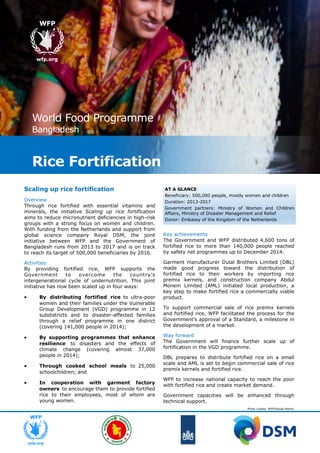
Through rice fortified with essential vitamins and
minerals, the initiative Scaling up rice fortification
aims to reduce micronutrient deficiencies in high-risk
groups with a strong focus on women and children.
With funding from the Netherlands and support from
global science company Royal DSM, the joint
initiative between WFP and the Government of
Bangladesh runs from 2013 to 2017 and is on track
to reach its target of 500,000 beneficiaries by 2016.
Activities
By providing fortified rice, WFP supports the
Government to overcome the country’s
intergenerational cycle of undernutrition. This joint
initiative has now been scaled up in four ways:
 By distributing fortified rice to ultra-poor
women and their families under the Vulnerable
Group Development (VGD) programme in 12
subdistricts and to disaster-affected families
through a relief programme in one district
(covering 141,000 people in 2014);
 By supporting programmes that enhance
resilience to disasters and the effects of
climate change (covering almost 37,000
people in 2014);
 Through cooked school meals to 25,000
schoolchildren; and
 In cooperation with garment factory
owners to encourage them to provide fortified
rice to their employees, most of whom are
young women.
Key achievements
The Government and WFP distributed 4,600 tons of
fortified rice to more than 140,000 people reached
by safety net programmes up to December 2014.
Garment manufacturer Dulal Brothers Limited (DBL)
made good progress toward the distribution of
fortified rice to their workers by importing rice
premix kernels, and construction company Abdul
Monem Limited (AML) initiated local production, a
key step to make fortified rice a commercially viable
product.
To support commercial sale of rice premix kernels
and fortified rice, WFP facilitated the process for the
Government’s approval of a Standard, a milestone in
the development of a market.
Way forward
The Government will finance further scale up of
fortification in the VGD programme.
DBL prepares to distribute fortified rice on a small
scale and AML is set to begin commercial sale of rice
premix kernels and fortified rice.
WFP to increase national capacity to reach the poor
with fortified rice and create market demand.
Government capacities will be enhanced through
technical support.
Rice Fortification
World Food Programme
Bangladesh
AT A GLANCE
Beneficiary: 500,000 people, mostly women and children
Duration: 2013-2017
Government partners: Ministry of Women and Children
Affairs, Ministry of Disaster Management and Relief
Donor: Embassy of the Kingdom of the Netherlands
Photo credits: WFP/Ranak Martin
World Food Programme
Bangladesh
About rice and nutrition
Why rice fortification?
The overall objective of rice fortification is to fight
micronutrient deficiencies among the poorest.
The nutritional challenge
Low dietary diversity and scanty intake of
nutrient-rich foods remain a challenge in
Bangladesh, despite a significant decline in
poverty in recent years, and deficiencies in
vitamin A, iron, zinc, iodine, vitamin B12 and
folate are widespread.
These micronutrient deficiencies, especially
among adolescent girls and women, are a key
factor in the persistence of undernutrition as a
woman’s health significantly affects the health
and development of her children.
Undernutrition slows economic growth and
perpetuates poverty. Productivity losses to
individuals through underdeveloped physique and
cognitive functions as well as increased health
costs are estimated at roughly 10 percent of
lifetime earnings.
Beyond ’plain’ rice
Rice is the main staple food in Bangladesh and
the poorest often eat only rice with vegetables
and spices. Regular milled rice although high in
carbohydrates is low in micronutrients.
With rice being the main commodity distributed
through the Government’s food-based social
safety nets reaching the ultra-poor, the
introduction of fortified rice can address the
widespread nutritional deficiencies and help
ensure an active and healthy life.
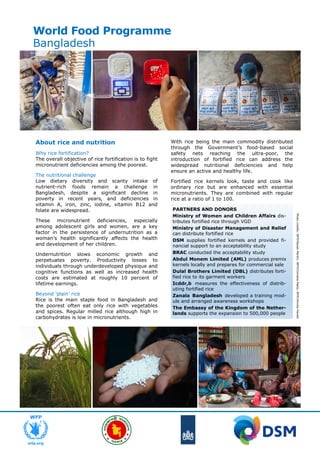
Fortified rice kernels look, taste and cook like
ordinary rice but are enhanced with essential
micronutrients. They are combined with regular
rice at a ratio of 1 to 100.
Date goes here
PARTNERS AND DONORS
Ministry of Women and Children Affairs dis-
tributes fortified rice through VGD
Ministry of Disaster Management and Relief
can distribute fortified rice
DSM supplies fortified kernels and provided fi-
nancial support to an acceptability study
BRAC conducted the acceptability study
Abdul Monem Limited (AML) produces premix
kernels locally and prepares for commercial sale
Dulal Brothers Limited (DBL) distributes forti-
fied rice to its garment workers
Icddr,b measures the effectiveness of distrib-
uting fortified rice
Zanala Bangladesh developed a training mod-
ule and arranged awareness workshops
The Embassy of the Kingdom of the Nether-
lands supports the expansion to 500,000 people
Photocredits:WFP/RanakMartin;WFP/CorneliaPaetz;WFP/AnnikaHarald

Rice Fortification Factsheet July 2015 FINAL.PDF

  • 1.
    Scaling up ricefortification Overview Through rice fortified with essential vitamins and minerals, the initiative Scaling up rice fortification aims to reduce micronutrient deficiencies in high-risk groups with a strong focus on women and children. With funding from the Netherlands and support from global science company Royal DSM, the joint initiative between WFP and the Government of Bangladesh runs from 2013 to 2017 and is on track to reach its target of 500,000 beneficiaries by 2016. Activities By providing fortified rice, WFP supports the Government to overcome the country’s intergenerational cycle of undernutrition. This joint initiative has now been scaled up in four ways:  By distributing fortified rice to ultra-poor women and their families under the Vulnerable Group Development (VGD) programme in 12 subdistricts and to disaster-affected families through a relief programme in one district (covering 141,000 people in 2014);  By supporting programmes that enhance resilience to disasters and the effects of climate change (covering almost 37,000 people in 2014);  Through cooked school meals to 25,000 schoolchildren; and  In cooperation with garment factory owners to encourage them to provide fortified rice to their employees, most of whom are young women. Key achievements The Government and WFP distributed 4,600 tons of fortified rice to more than 140,000 people reached by safety net programmes up to December 2014. Garment manufacturer Dulal Brothers Limited (DBL) made good progress toward the distribution of fortified rice to their workers by importing rice premix kernels, and construction company Abdul Monem Limited (AML) initiated local production, a key step to make fortified rice a commercially viable product. To support commercial sale of rice premix kernels and fortified rice, WFP facilitated the process for the Government’s approval of a Standard, a milestone in the development of a market. Way forward The Government will finance further scale up of fortification in the VGD programme. DBL prepares to distribute fortified rice on a small scale and AML is set to begin commercial sale of rice premix kernels and fortified rice. WFP to increase national capacity to reach the poor with fortified rice and create market demand. Government capacities will be enhanced through technical support. Rice Fortification World Food Programme Bangladesh AT A GLANCE Beneficiary: 500,000 people, mostly women and children Duration: 2013-2017 Government partners: Ministry of Women and Children Affairs, Ministry of Disaster Management and Relief Donor: Embassy of the Kingdom of the Netherlands Photo credits: WFP/Ranak Martin
  • 2.
    World Food Programme Bangladesh Aboutrice and nutrition Why rice fortification? The overall objective of rice fortification is to fight micronutrient deficiencies among the poorest. The nutritional challenge Low dietary diversity and scanty intake of nutrient-rich foods remain a challenge in Bangladesh, despite a significant decline in poverty in recent years, and deficiencies in vitamin A, iron, zinc, iodine, vitamin B12 and folate are widespread. These micronutrient deficiencies, especially among adolescent girls and women, are a key factor in the persistence of undernutrition as a woman’s health significantly affects the health and development of her children. Undernutrition slows economic growth and perpetuates poverty. Productivity losses to individuals through underdeveloped physique and cognitive functions as well as increased health costs are estimated at roughly 10 percent of lifetime earnings. Beyond ’plain’ rice Rice is the main staple food in Bangladesh and the poorest often eat only rice with vegetables and spices. Regular milled rice although high in carbohydrates is low in micronutrients. With rice being the main commodity distributed through the Government’s food-based social safety nets reaching the ultra-poor, the introduction of fortified rice can address the widespread nutritional deficiencies and help ensure an active and healthy life. Fortified rice kernels look, taste and cook like ordinary rice but are enhanced with essential micronutrients. They are combined with regular rice at a ratio of 1 to 100. Date goes here PARTNERS AND DONORS Ministry of Women and Children Affairs dis- tributes fortified rice through VGD Ministry of Disaster Management and Relief can distribute fortified rice DSM supplies fortified kernels and provided fi- nancial support to an acceptability study BRAC conducted the acceptability study Abdul Monem Limited (AML) produces premix kernels locally and prepares for commercial sale Dulal Brothers Limited (DBL) distributes forti- fied rice to its garment workers Icddr,b measures the effectiveness of distrib- uting fortified rice Zanala Bangladesh developed a training mod- ule and arranged awareness workshops The Embassy of the Kingdom of the Nether- lands supports the expansion to 500,000 people Photocredits:WFP/RanakMartin;WFP/CorneliaPaetz;WFP/AnnikaHarald