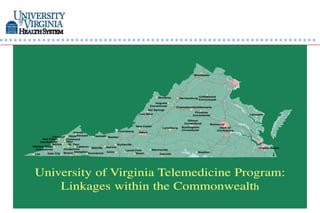







Telehealth:
A tool for the 21st century


                    Karen S. Rheuban MD
                    Professor of Pediatrics
                    Medical Director, Telemedicine
                    University of Virginia
                    ATA President
                    VTN Board Chair
                    Board Member, CTEL
Disclosure
Definitions

“Telemedicine” is the use of medical information
exchanged from one site to another via electronic
communications to support
      •   Medical diagnosis
         Ongoing patient care
         Remote patient monitoring

“Telehealth” encompasses a broader definition of
  remote healthcare that does not always involve
  clinical services
         Health-related distance learning
Mission

Facilitate the Health System’s missions of

          • Clinical Care
          • Teaching
          • Research
          • Public Service
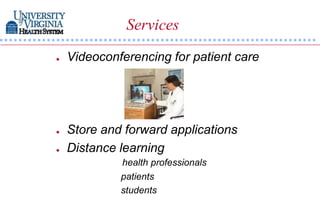
Services
   Videoconferencing for patient care


   Store and forward applications
   Distance learning
             health professionals
             patients
             students
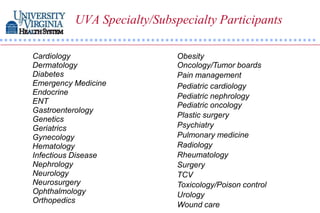
UVA Specialty/Subspecialty Participants

Cardiology                   Obesity
Dermatology                  Oncology/Tumor boards
Diabetes                     Pain management
Emergency Medicine           Pediatric cardiology
Endocrine                    Pediatric nephrology
ENT                          Pediatric oncology
Gastroenterology
                             Plastic surgery
Genetics
Geriatrics                   Psychiatry
Gynecology                   Pulmonary medicine
Hematology                   Radiology
Infectious Disease           Rheumatology
Nephrology                   Surgery
Neurology                    TCV
Neurosurgery                 Toxicology/Poison control
Ophthalmology                Urology
Orthopedics
                             Wound care
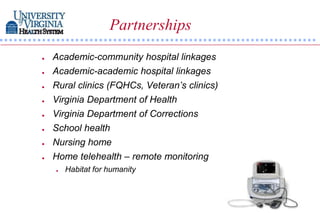
Partnerships
   Academic-community hospital linkages
   Academic-academic hospital linkages
   Rural clinics (FQHCs, Veteran’s clinics)
   Virginia Department of Health
   Virginia Department of Corrections
   School health
   Nursing home
   Home telehealth – remote monitoring
       Habitat for humanity
Benefits of telehealth

   Patients:
    • Timely access to locally unavailable services
    • Spared burden and cost of transportation
    • Improvement in quality of care
   Health professionals (workforce shortages)
    • Access to consultative services
    • Access to CME
    • Primary care retains oversight of patient care
   Rural communities
    • Enhanced healthcare/economic empowerment
Federal investment in telehealth
   Department of Health and Human Services          Department of Veterans Affairs
     • National Institutes of Health                 Department of Commerce
     • Health Resources Services Administration      Department of Agriculture
     • Agency for Health Research Quality            Department of Labor
     • Centers for Medicare and Medicaid Services    Department of State
     • Centers for Disease Control and Prevention
     • Substance Abuse and Mental Health Services    INDEPENDENT AGENCIES AND COMMISSIONS
        Administration                               • NASA
     • Food and Drug Administration                  •National Science Foundation
     • Indian Health Service                         •Federal Communications Commission
                                                     •Social Security Administration
   Department of Homeland Security                  •Office of Personnel Management
   Department of Housing and Urban Development      •Consumer Products Safety Commission
   CDC                                              •Appalachian Regional Commission
   Department of Defense                            •US Agency for International Development
     • Army Telemedicine Activities
     • Navy Telemedicine Activities
     • Air Force Telemedicine Activities
     • DARPA
     • Armed Forces Institute of Pathology
     • Uniformed Services University of the Health
        Services
State commitments to telehealth

   Medicaid
   State Rural Health Plan
   State Stroke Systems of Care Task Force
   Diabetes Council
   Center for Innovative Technologies
   Virginia Telehealth Network
   Office of Minority Health and Policy of VDH
   Joint Commission on Health Care
    • Workforce analysis
   Tobacco Indemnification Commission
   Medical schools and large hospital systems
   Virginia General Assembly
Patients served: UVA program

 >18,000 patient encounters
 > 30,000 teleradiology services/year
 Services in >30 different specialties
  •   Emergency
  •   Urgent
  •   Single consults/follow up visits
  •   Block scheduled clinics
  •   Screenings with store forward technologies
       • New mobile digital mammography van
       • Retinopathy
More than technology and numbers:
Saving lives: Infant with Interrupted aortic arch
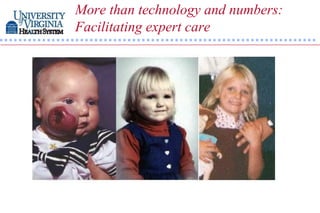
More than technology and numbers:
Facilitating expert care
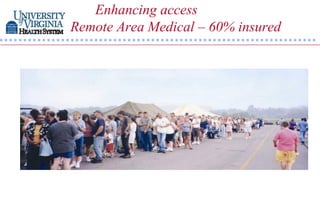
Enhancing access
Remote Area Medical – 60% insured
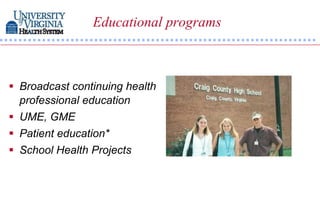
Educational programs


 Broadcast continuing health
  professional education
 UME, GME
 Patient education*
 School Health Projects
Clinical Telemedicine – examples
                High risk obstetrics

   Antenatal Neonatal Guidelines, Education and
    Learning System (ANGELS)
    • 26% reduction in neonatal mortality in Arkansas


   UVA High Risk Obstetrics Telehealth Program
    • Virginia PIF grant – from Secretaries Chopra and Tavenner
    • Shortage of maternal-fetal medicine specialists
    • High risk population
        partner with FQHC in Harrisonburg and community obstetricians
    • 1st year – no NICU admissions
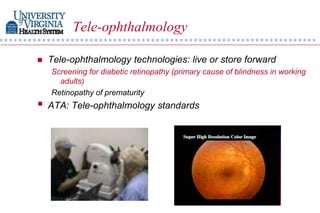
Tele-ophthalmology

   Tele-ophthalmology technologies: live or store forward
    Screening for diabetic retinopathy (primary cause of blindness in working
      adults)
    Retinopathy of prematurity
   ATA: Tele-ophthalmology standards
Pediatric cardiology


 Incidence of CHD is 8/1000 live births
 Traditional models of care:
     Schedule appointment
     Emergency transfer
     Wait for field clinic
     Obtain echo and mail, courier
 Tele-echocardiography has become standard of care
     Live interactive support of remotely located technologists
     Store forward images sent in digital format
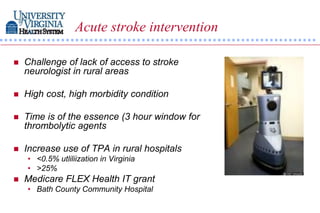
Acute stroke intervention

   Challenge of lack of access to stroke
    neurologist in rural areas

   High cost, high morbidity condition

   Time is of the essence (3 hour window for
    thrombolytic agents

   Increase use of TPA in rural hospitals
    • <0.5% utliliization in Virginia
    • >25%
   Medicare FLEX Health IT grant
    • Bath County Community Hospital
HIV/AIDS

Outcomes: UVA Telehealth HIV Program1
    213 correctional patients treated with 1812 visits over 5 year
    period
     Of patients naïve to therapy:
        – 77% attained undetectable viral load (<50 copies/ml)
        – 50-60% in HIV clinic
        – 40% receiving community based care by non-HIV specialists


1Rheuban,KS, Wispelwey B et al HIV/AIDS, HRSA Telemedicine Technical
Assistance Documents 2004
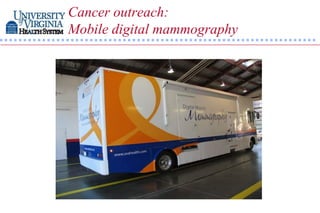
Cancer outreach:
Mobile digital mammography
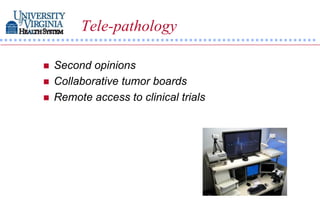
Tele-pathology

   Second opinions
   Collaborative tumor boards
   Remote access to clinical trials
Tele-mental health

   Shortage of mental health providers in rural
    areas
   Consultations, medication management
    •   Improve access, shorter wait times
    •   High rates of patient satisfaction in all age groups
    •   Controlled studies show efficacy = face to face psychiatry
    •   Huge cost savings in geriatric care facilities
e-ICU


   Two Models
    •   VISICU model with continuous monitoring
        –   Hospital mortality decreased from 12.9-9.4%, ICU
            length of stay shorter 4.35-3.63 days
    •   Consultation model (UC Davis model) using VTC
Pediatric emergency medicine

   Geographic disparities in pediatric emergency services
    (ratio:1.6/100,000 children)
   92% of children seen in non CH emergency rooms
   2-3% of seriously injured children receive initial treatment at a
    pediatric trauma center
   Rural EDs have limited access to pediatric specialists, and may
    not be trained in PALS, NALs, nor equipped
   UC Davis PICU connects with rural ERs in northern California

Parsapour,K, Presentation Pediatric Telehealth Colloquium, 9/07
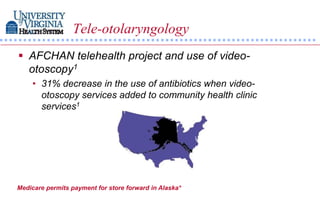
Tele-otolaryngology
 AFCHAN telehealth project and use of video-
  otoscopy1
    • 31% decrease in the use of antibiotics when video-
      otoscopy services added to community health clinic
      services1


Medicare permits payment for store forward in Alaska*
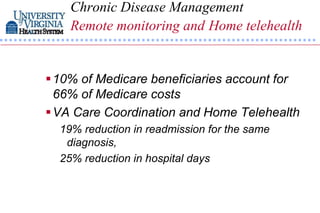
Chronic Disease Management
    Remote monitoring and Home telehealth


 10% of Medicare beneficiaries account for
  66% of Medicare costs
 VA Care Coordination and Home Telehealth
  19% reduction in readmission for the same
   diagnosis,
  25% reduction in hospital days
Chronic Disease Management
  Remote monitoring and Home telehealth

Targets
 CHF
 Diabetes
 Hypertension
 COPD/Asthma
 Obesity
 Alzheimers disease
Devices:
 Wired
 Wireless
Broadcast patient education
Challenges:2010

   Funding of telehealth (Stark, Anti-kickback Laws)
   Reimbursement
   Confidentiality
   Credentialing and Privileging
   Licensure
   Malpractice
   Telecommunications venue/costs
   Integration with EMRS/HIE
   Interagency alignment related to policies
   ARRA, Health reform
   Outcomes
Reimbursement varies by state

   Reimbursement
    - Virginia Medicaid (urban and rural) - ~ 30 Medicaid states
    - Medicare (rural, non-MSA, store forward Alaska and Hawaii)
       - ~ $2 million/year
    - Private payers:
       - Virginia becomes the 12th state to mandate
    - Anthem grant for Virginia
    - Contracts
       - Peds cardiology
       - Psychiatry
       - Dept of Corrections
Licensure


 No portability
 UVA telemedicine serves Virginians
 Consultation based model
Credentialing and Privileging

2004 JCAHO standards
     Credentialing and privileging by proxy
     Remote hospital medical staff agree to telehealth
      relationship
     Link to quality data
     Legal agreements between institutions
2010 Medicare Conditions of Participation, medical
 staff standards
     July 15, 2010 Credentialing and privileging at all sites
     THANK YOU CMS for considering alternative solutions
Malpractice


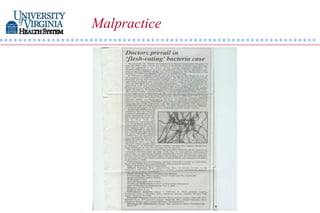
 Serve primarily Virginians
  Malpractice cap in Virginia
  UVA faculty are self insured
 Informed consent
 New local standard of care?
 Limited precedents in case law
Malpractice
Telecommunications


   POTS – Fiber
   Universal service fund
   Rural healthcare pilot program
   NATIONAL BROADBAND PLAN !!!!
       Addresses interagency lack of coordination
       Addresses barriers to adoption
       Universal service reform
       If we build it, will they come?
Confidentiality


   HIPAA
   Encrypted data
   Network design and architecture
ARRA, Health Reform opportunities

   Health Reform:
       CMS Innovation center
       Independence at home – care coordination program
   Multi-billion dollar funding ARRA
     NIH
     DoC/NTIA
     USDA
     HRSA
     ONC
The future of telehealth


   Outcomes
   Standards
   Demonstration projects (ARRA, Health reform)
   Broadband plan
   Integration into mainstream medicine
   Innovation
   Collaboration amongst providers, policymakers
   Champions at all levels
Champions


Congressman Rick Boucher
Champions


State Senator William Wampler
Champions


Senator Mark Warner
Champions


Governor Bob McDonnell
Champions


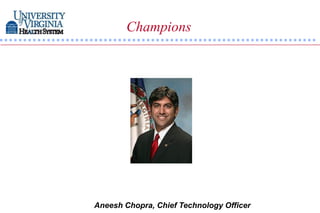
Aneesh Chopra, Chief Technology Officer
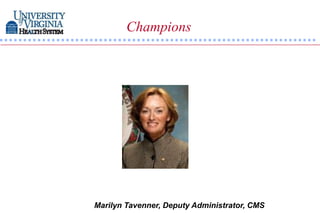
Champions


Marilyn Tavenner, Deputy Administrator, CMS
Rheuban

Rheuban

  • 1.
    Telehealth: A tool forthe 21st century Karen S. Rheuban MD Professor of Pediatrics Medical Director, Telemedicine University of Virginia ATA President VTN Board Chair Board Member, CTEL
  • 2.
  • 3.
    Definitions “Telemedicine” is theuse of medical information exchanged from one site to another via electronic communications to support • Medical diagnosis  Ongoing patient care  Remote patient monitoring “Telehealth” encompasses a broader definition of remote healthcare that does not always involve clinical services  Health-related distance learning
  • 4.
    Mission Facilitate the HealthSystem’s missions of • Clinical Care • Teaching • Research • Public Service
  • 5.
    Services  Videoconferencing for patient care  Store and forward applications  Distance learning health professionals patients students
  • 6.
    UVA Specialty/Subspecialty Participants Cardiology Obesity Dermatology Oncology/Tumor boards Diabetes Pain management Emergency Medicine Pediatric cardiology Endocrine Pediatric nephrology ENT Pediatric oncology Gastroenterology Plastic surgery Genetics Geriatrics Psychiatry Gynecology Pulmonary medicine Hematology Radiology Infectious Disease Rheumatology Nephrology Surgery Neurology TCV Neurosurgery Toxicology/Poison control Ophthalmology Urology Orthopedics Wound care
  • 7.
    Partnerships  Academic-community hospital linkages  Academic-academic hospital linkages  Rural clinics (FQHCs, Veteran’s clinics)  Virginia Department of Health  Virginia Department of Corrections  School health  Nursing home  Home telehealth – remote monitoring  Habitat for humanity
  • 8.
    Benefits of telehealth  Patients: • Timely access to locally unavailable services • Spared burden and cost of transportation • Improvement in quality of care  Health professionals (workforce shortages) • Access to consultative services • Access to CME • Primary care retains oversight of patient care  Rural communities • Enhanced healthcare/economic empowerment
  • 9.
    Federal investment intelehealth  Department of Health and Human Services Department of Veterans Affairs • National Institutes of Health Department of Commerce • Health Resources Services Administration Department of Agriculture • Agency for Health Research Quality Department of Labor • Centers for Medicare and Medicaid Services Department of State • Centers for Disease Control and Prevention • Substance Abuse and Mental Health Services INDEPENDENT AGENCIES AND COMMISSIONS Administration • NASA • Food and Drug Administration •National Science Foundation • Indian Health Service •Federal Communications Commission •Social Security Administration  Department of Homeland Security •Office of Personnel Management  Department of Housing and Urban Development •Consumer Products Safety Commission  CDC •Appalachian Regional Commission  Department of Defense •US Agency for International Development • Army Telemedicine Activities • Navy Telemedicine Activities • Air Force Telemedicine Activities • DARPA • Armed Forces Institute of Pathology • Uniformed Services University of the Health Services
  • 10.
    State commitments totelehealth  Medicaid  State Rural Health Plan  State Stroke Systems of Care Task Force  Diabetes Council  Center for Innovative Technologies  Virginia Telehealth Network  Office of Minority Health and Policy of VDH  Joint Commission on Health Care • Workforce analysis  Tobacco Indemnification Commission  Medical schools and large hospital systems  Virginia General Assembly
  • 13.
    Patients served: UVAprogram  >18,000 patient encounters  > 30,000 teleradiology services/year  Services in >30 different specialties • Emergency • Urgent • Single consults/follow up visits • Block scheduled clinics • Screenings with store forward technologies • New mobile digital mammography van • Retinopathy
  • 14.
    More than technologyand numbers: Saving lives: Infant with Interrupted aortic arch
  • 15.
    More than technologyand numbers: Facilitating expert care
  • 16.
    Enhancing access Remote AreaMedical – 60% insured
  • 17.
    Educational programs  Broadcastcontinuing health professional education  UME, GME  Patient education*  School Health Projects
  • 18.
    Clinical Telemedicine –examples High risk obstetrics  Antenatal Neonatal Guidelines, Education and Learning System (ANGELS) • 26% reduction in neonatal mortality in Arkansas  UVA High Risk Obstetrics Telehealth Program • Virginia PIF grant – from Secretaries Chopra and Tavenner • Shortage of maternal-fetal medicine specialists • High risk population partner with FQHC in Harrisonburg and community obstetricians • 1st year – no NICU admissions
  • 19.
    Tele-ophthalmology  Tele-ophthalmology technologies: live or store forward Screening for diabetic retinopathy (primary cause of blindness in working adults) Retinopathy of prematurity  ATA: Tele-ophthalmology standards
  • 20.
    Pediatric cardiology  Incidenceof CHD is 8/1000 live births  Traditional models of care:  Schedule appointment  Emergency transfer  Wait for field clinic  Obtain echo and mail, courier  Tele-echocardiography has become standard of care  Live interactive support of remotely located technologists  Store forward images sent in digital format
  • 21.
    Acute stroke intervention  Challenge of lack of access to stroke neurologist in rural areas  High cost, high morbidity condition  Time is of the essence (3 hour window for thrombolytic agents  Increase use of TPA in rural hospitals • <0.5% utliliization in Virginia • >25%  Medicare FLEX Health IT grant • Bath County Community Hospital
  • 22.
    HIV/AIDS Outcomes: UVA TelehealthHIV Program1  213 correctional patients treated with 1812 visits over 5 year period  Of patients naïve to therapy: – 77% attained undetectable viral load (<50 copies/ml) – 50-60% in HIV clinic – 40% receiving community based care by non-HIV specialists 1Rheuban,KS, Wispelwey B et al HIV/AIDS, HRSA Telemedicine Technical Assistance Documents 2004
  • 23.
  • 24.
    Tele-pathology  Second opinions  Collaborative tumor boards  Remote access to clinical trials
  • 25.
    Tele-mental health  Shortage of mental health providers in rural areas  Consultations, medication management • Improve access, shorter wait times • High rates of patient satisfaction in all age groups • Controlled studies show efficacy = face to face psychiatry • Huge cost savings in geriatric care facilities
  • 26.
    e-ICU  Two Models • VISICU model with continuous monitoring – Hospital mortality decreased from 12.9-9.4%, ICU length of stay shorter 4.35-3.63 days • Consultation model (UC Davis model) using VTC
  • 27.
    Pediatric emergency medicine  Geographic disparities in pediatric emergency services (ratio:1.6/100,000 children)  92% of children seen in non CH emergency rooms  2-3% of seriously injured children receive initial treatment at a pediatric trauma center  Rural EDs have limited access to pediatric specialists, and may not be trained in PALS, NALs, nor equipped  UC Davis PICU connects with rural ERs in northern California Parsapour,K, Presentation Pediatric Telehealth Colloquium, 9/07
  • 28.
    Tele-otolaryngology  AFCHAN telehealthproject and use of video- otoscopy1 • 31% decrease in the use of antibiotics when video- otoscopy services added to community health clinic services1 Medicare permits payment for store forward in Alaska*
  • 29.
    Chronic Disease Management Remote monitoring and Home telehealth  10% of Medicare beneficiaries account for 66% of Medicare costs  VA Care Coordination and Home Telehealth 19% reduction in readmission for the same diagnosis, 25% reduction in hospital days
  • 30.
    Chronic Disease Management Remote monitoring and Home telehealth Targets  CHF  Diabetes  Hypertension  COPD/Asthma  Obesity  Alzheimers disease Devices:  Wired  Wireless Broadcast patient education
  • 31.
    Challenges:2010  Funding of telehealth (Stark, Anti-kickback Laws)  Reimbursement  Confidentiality  Credentialing and Privileging  Licensure  Malpractice  Telecommunications venue/costs  Integration with EMRS/HIE  Interagency alignment related to policies  ARRA, Health reform  Outcomes
  • 32.
    Reimbursement varies bystate  Reimbursement - Virginia Medicaid (urban and rural) - ~ 30 Medicaid states - Medicare (rural, non-MSA, store forward Alaska and Hawaii) - ~ $2 million/year - Private payers: - Virginia becomes the 12th state to mandate - Anthem grant for Virginia - Contracts - Peds cardiology - Psychiatry - Dept of Corrections
  • 33.
    Licensure  No portability UVA telemedicine serves Virginians  Consultation based model
  • 34.
    Credentialing and Privileging 2004JCAHO standards  Credentialing and privileging by proxy  Remote hospital medical staff agree to telehealth relationship  Link to quality data  Legal agreements between institutions 2010 Medicare Conditions of Participation, medical staff standards  July 15, 2010 Credentialing and privileging at all sites  THANK YOU CMS for considering alternative solutions
  • 35.
    Malpractice  Serve primarilyVirginians Malpractice cap in Virginia UVA faculty are self insured  Informed consent  New local standard of care?  Limited precedents in case law
  • 36.
  • 37.
    Telecommunications  POTS – Fiber  Universal service fund  Rural healthcare pilot program  NATIONAL BROADBAND PLAN !!!!  Addresses interagency lack of coordination  Addresses barriers to adoption  Universal service reform  If we build it, will they come?
  • 38.
    Confidentiality  HIPAA  Encrypted data  Network design and architecture
  • 39.
    ARRA, Health Reformopportunities  Health Reform:  CMS Innovation center  Independence at home – care coordination program  Multi-billion dollar funding ARRA  NIH  DoC/NTIA  USDA  HRSA  ONC
  • 40.
    The future oftelehealth  Outcomes  Standards  Demonstration projects (ARRA, Health reform)  Broadband plan  Integration into mainstream medicine  Innovation  Collaboration amongst providers, policymakers  Champions at all levels
  • 41.
  • 42.
  • 43.
  • 44.
  • 45.
  • 46.