•
http://w
ww.
gbooksdownloade
r. com/
6
in collaboration with
Philippine National
Research Center for Teacher
Quality
Teacher
Induction
Program
(TIP)
CORE
COURSE
Teachers’ Professional and Personal
Development
Course
6:
Teachers’ Professional
and Personal
Development
HIS COURSE EMPHASIZES
the value of
teachers’ professional and personal
development.
Introduction
TIt will help you better understand the
importance
of continuing professional development and
participating in professional networks to share and
enhance your knowledge and practices. It presents
the policies on promotion and opportunities for
progression available for teachers in the department.
You will also know about how to maintain your
personal development and well- being. As the last
course in the TIP, it will help you adopt practices that
will sustain your professional and personal
development.
Intended Course Learning Outcomes
At the end of this course, you should be able to:
1. be familiar, and eventually comply with the guidelines on continuing
professional development, career progression, and promotion,
2. participate in professional networks to share knowledge and to enhance
practice towards continuing professional development (7.3.2), and
3. adopt practices that uphold the dignity of teaching as a profession through
professional and personal development (7.2.2).
Course Outline:
Module 1: Salaries, Wages, and Benefits of Teachers
Module 2: Continuing Professional Development
Module 3: Policies on Promotion and Opportunities for
Progression
Module 4: Personal Development and Well-being
Module 5: Developing a Personal Professional Improvement
Plan
Estimated time required: 5
hours
Portfolio Output: Professional Development
Plan
Module 1 – Salaries, Wages, and Benefits
of
Teachers
Intended Module Learning
Outcomes
At the end of this module, you should be able
to:
1. become aware of existing laws and regulations that
apply to the teaching profession;
2. become familiar with the responsibilities
specified in the
Code of Ethics for Professional Teachers, (6.3.1); and
3. regularly review personal teaching practices using
existing laws and regulations that apply to the teaching
profession and the responsibilities specified in the
Code of Ethics for Professional Teachers. (6.3.2)
Module Outline
Session 1: Salary and Allowances of
Teachers
Session 2: Incentives and Benefits of
Teachers
Session 3: Leave of Absence of
Teachers
Session 4: Other
Benefits
Estimated Time Required: 1
hour
Required Tasks
• Developmental activities: Learning assessments
and testing prior knowledge
• Scenario and case analysis
• Document reading
Required Resources
Government of the Philippines, Department of Education.
Statement on the Appeal to Provide Leave Benefits
for Teachers during the School Year.
Accessed August 25, 2020. https://www.deped.gov.
ph/2018/10/03/statement-on-the-appeal-to-provide-
leave-benefits-for-teachers-during-the-school-year/
Government of the Philippines, DepEd Order No. 64, s. 1996
on Implementing Rules and Regulations of Republic
Act no. 8187 (The Paternity Leave Act of 1996).
Government of the Philippines, Department of Budget and
Management, NBC No. 514, s. 2007, Guidelines on
Grant of Hardship Allowance. Manila, 2007.
Government of the Philippines, Official Gazette of the
Republic of the Philippines. Performance-Based
Incentive System: Frequently Asked Questions:
GOVPH. Accessed August 25, 2020.
https://www.officialgazette.gov.ph/pbb/faqs/
Government of the Philippines, Official Gazette of the
Republic of the Philippines. CSC Memorandum
Circular No. 2, 2012: GOVPH. February 16, 2012.
https://www. officialgazette.gov.ph/2012/02/16/csc-
memorandum- circular-no-2-2012/
Government of the Philippines, Civil Service Commission,
MC No. 41, s. 1998. Amendments to Rules I and XVI
of the Omnibus Rules Implementing
Book V of the Administrative Code of 1987 (Executive Order
292); Manila City, 1998.
4 The Teacher Induction Program - Core
Course 6
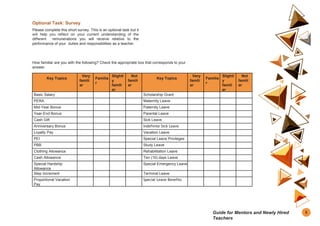
Optional Task: Survey
Please complete this short survey. This is an optional task but it
will help you reflect on your current understanding of the
different remunerations you will receive relative to the
performance of your duties and responsibilities as a teacher.
How familiar are you with the following? Check the appropriate box that corresponds to your
answer.
Key Topics
Very
famili
ar
Familia
r
Slightl
y
famili
ar
Not
famili
ar
Key Topics
Very
famili
ar
Familia
r
Slightl
y
famili
ar
Not
famili
ar
Basic Salary Scholarship Grant
PERA Maternity Leave
Mid-Year Bonus Paternity Leave
Year-End Bonus Parental Leave
Cash Gift Sick Leave
Anniversary Bonus Indefinite Sick Leave
Loyalty Pay Vacation Leave
PEI Special Leave Privileges
PBB Study Leave
Clothing Allowance Rehabilitation Leave
Cash Allowance Ten (10) days Leave
Special Hardship
Allowance
Special Emergency Leave
Step Increment Terminal Leave
Proportional Vacation
Pay
Special Leave Benefits
5
Guide for Mentors and Newly Hired
Teachers
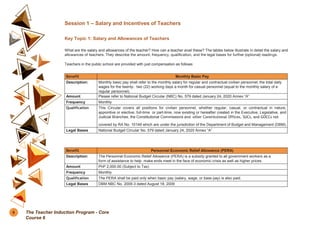
Session 1 – Salary and Incentives of Teachers
Key Topic 1: Salary and Allowances of Teachers
What are the salary and allowances of the teacher? How can a teacher avail these? The tables below illustrate in detail the salary and
allowances of teachers. They describe the amount, frequency, qualification, and the legal bases for further (optional) readings.
Teachers in the public school are provided with just compensation as follows:
Benefit Monthly Basic Pay
Description: Monthly basic pay shall refer to the monthly salary for regular and contractual civilian personnel; the total daily
wages for the twenty- two (22) working days a month for casual personnel (equal to the monthly salary of a
regular personnel).
Amount Please refer to National Budget Circular (NBC) No. 579 dated January 24, 2020 Annex “A”
Frequency Monthly
Qualification This Circular covers all positions for civilian personnel, whether regular, casual, or contractual in nature,
appointive or elective, full-time or part-time, now existing or hereafter created in the Executive, Legislative, and
Judicial Branches, the Constitutional Commissions and other Constitutional Offices, SUCs, and GOCCs not
covered by RA No. 10149 which are under the jurisdiction of the Department of Budget and Management (DBM).
Legal Bases National Budget Circular No. 579 dated January 24, 2020 Annex “A”
Benefit Personnel Economic Relief Allowance (PERA)
Description: The Personnel Economic Relief Allowance (PERA) is a subsidy granted to all government workers as a
form of assistance to help make ends meet in the face of economic crisis as well as higher prices.
Amount PhP 2,000.00 (Subject to Tax)
Frequency Monthly
Qualification The PERA shall be paid only when basic pay (salary, wage, or base pay) is also paid.
Legal Bases DBM NBC No. 2009-3 dated August 18, 2009
6 The Teacher Induction Program - Core
Course 6
Benefit Special Hardship Allowance
Description: Special Hardship Allowance refers to the allowance granted to qualified teachers under any of the following
situations: (1) being assigned to hardship post; (2) performing multi-grade teaching; (3) carrying out mobile
teaching functions; or (4) performing functions of non-formal education (now Alternative Learning System)
coordinators. The qualified teachers may either be resident or transient having regular or temporary
appointments.
Amount At least twenty-five per cent of a teacher’s monthly salary. (Subject to Tax)
Qualification Guidelines on the Grant of Special Hardship Allowance shall apply to the following personnel of the
Department of Education:
(National Budget Circular No. 514 dated December 5, 2007)
• Classroom teachers in elementary and secondary schools and school heads/administrators assigned to
a hardship post;
• Multi-grade teachers;
• Mobile teachers; and
• Non-formal Education or Alternative Learning System (ALS) Coordinators.
Legal Bases Republic Act No. 4670 June 18, 1966
National Budget Circular No. 514 dated December 5, 2007
Benefit Uniform/Clothing Allowance
Description: The uniform/clothing Allowance (UCA) authorized under the pertinent general provision of the annual
General Appropriations Act (GAA) is granted to cover the cost of uniform/clothing of government employees
to identify them with their mother agency/office.
Amount PhP 6,000.00 (Subject to Tax)
Frequency Annually
Qualification Covers civilian government personnel occupying regular, contractual, or casual positions; appointive or
elective; rendering services on full-time or part-time basis. A newly hired employee may qualify for the grant
of Clothing Allowance only after rendering six (6) months of service, and if expected to render service for at
least 6 months for the rest of the year.
Legal Bases DBM Budget Circular (BC) No. 2012-1 dated February 23, 2012
7
Guide for Mentors and Newly Hired
Teachers
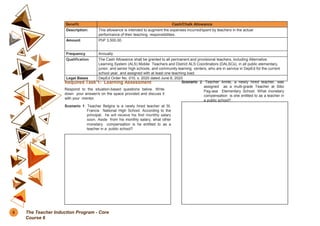
Benefit Cash/Chalk Allowance
Description: This allowance is intended to augment the expenses incurred/spent by teachers in the actual
performance of their teaching responsibilities.
Amount PhP 3,500.00
Frequency Annually
Qualification The Cash Allowance shall be granted to all permanent and provisional teachers, including Alternative
Learning System (ALS) Mobile Teachers and District ALS Coordinators (DALSCs), in all public elementary,
junior, and senior high schools, and community learning centers, who are in service in DepEd for the current
school year, and assigned with at least one teaching load.
Legal Bases DepEd Order No. 010, s. 2020 dated June 8, 2020
Required Task 1: Learning Assessment
Respond to the situation-based questions below. Write
down your answer/s on the space provided and discuss it
with your mentor.
Scenario 1: Teacher Belgira is a newly hired teacher at St.
Francis National High School. According to the
principal, he will receive his first monthly salary
soon. Aside from his monthly salary, what other
monetary compensation is he entitled to as a
teacher in a public school?
Scenario 2: Teacher Annie, a newly hired teacher, was
assigned as a multi-grade Teacher at Sitio
Pag-asa Elementary School. What monetary
compensation is she entitled to as a teacher in
a public school?
8 The Teacher Induction Program - Core
Course 6
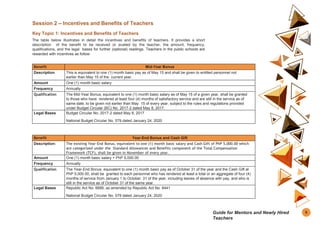
Session 2 – Incentives and Benefits of Teachers
Key Topic 1: Incentives and Benefits of Teachers
The table below illustrates in detail the incentives and benefits of teachers. It provides a short
description of the benefit to be received or availed by the teacher, the amount, frequency,
qualifications, and the legal bases for further (optional) readings. Teachers in the public schools are
rewarded with incentives as follow:
Benefit Mid-Year Bonus
Description This is equivalent to one (1) month basic pay as of May 15 and shall be given to entitled personnel not
earlier than May 15 of the current year.
Amount One (1) month basic salary
Frequency Annually
Qualification The Mid-Year Bonus, equivalent to one (1) month basic salary as of May 15 of a given year, shall be granted
to those who have rendered at least four (4) months of satisfactory service and are still in the service as of
same date, to be given not earlier than May 15 of every year, subject to the rules and regulations provided
under Budget Circular (BC) No. 2017-2 dated May 8, 2017.
Legal Bases Budget Circular No. 2017-2 dated May 8, 2017
National Budget Circular No. 579 dated January 24, 2020
Benefit Year-End Bonus and Cash Gift
Description: The existing Year-End Bonus, equivalent to one (1) month basic salary and Cash Gift of PhP 5,000.00 which
are categorized under the Standard Allowances and Benefits component of the Total Compensation
Framework (TCF), shall be given in November of every year.
Amount One (1) month basic salary + PhP 5,000.00
Frequency Annually
Qualification The Year-End Bonus, equivalent to one (1) month basic pay as of October 31 of the year and the Cash Gift at
PhP 5,000.00, shall be granted to each personnel who has rendered at least a total or an aggregate of four (4)
months of service from January 1 to October 31 of the year, including leaves of absence with pay, and who is
still in the service as of October 31 of the same year.
Legal Bases Republic Act No. 6686, as amended by Republic Act No. 8441
National Budget Circular No. 579 dated January 24, 2020
9
Guide for Mentors and Newly Hired
Teachers
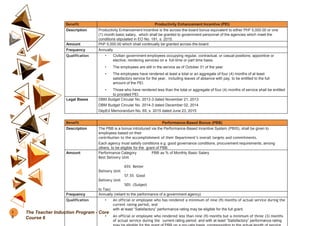
Benefit Productivity Enhancement Incentive (PEI)
Description Productivity Enhancement Incentive is the across-the-board bonus equivalent to either PhP 5,000.00 or one
(1) month basic salary, which shall be granted to government personnel of the agencies which meet the
conditions stipulated in EO No. 181, s. 2015.
Amount PhP 5,000.00 which shall continually be granted across-the-board.
Frequency Annually
Qualification • Civilian government employees occupying regular, contractual, or casual positions; appointive or
elective; rendering services on a full-time or part time basis.
• The employees are still in the service as of October 31 of the year.
• The employees have rendered at least a total or an aggregate of four (4) months of at least
satisfactory service for the year, including leaves of absence with pay, to be entitled to the full
amount of the PEI.
• Those who have rendered less than the total or aggregate of four (4) months of service shall be entitled
to prorated PEI.
Legal Bases DBM Budget Circular No. 2013-3 dated November 21, 2013
DBM Budget Circular No. 2014-3 dated December 02, 2014
DepEd Memorandum No. 65, s. 2015 dated June 23, 2015
Benefit Performance-Based Bonus (PBB)
Description The PBB is a bonus introduced via the Performance-Based Incentive System (PBIS), shall be given to
employees based on their
contribution to the accomplishment of their Department’s overall targets and commitments.
Each agency must satisfy conditions e.g. good governance conditions, procurement requirements, among
others, to be eligible for the grant of PBB.
Amount Performance Category PBB as % of Monthly Basic Salary
Best Delivery Unit
–
65% Better
Delivery Unit –
57.5% Good
Delivery Unit –
50% (Subject
to Tax)
Frequency Annually (reliant to the performance of a government agency)
Qualification • An official or employee who has rendered a minimum of nine (9) months of actual service during the
current rating period, and
with at least “Satisfactory” performance rating may be eligible for the full grant.
• An official or employee who rendered less than nine (9) months but a minimum of three (3) months
of actual service during the current rating period, and with at least “Satisfactory” performance rating
1
0
The Teacher Induction Program - Core
Course 6
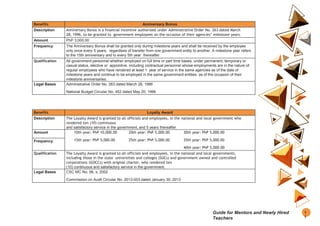
Benefits Anniversary Bonus
Description Anniversary Bonus is a financial incentive authorized under Administrative Order No. 263 dated March
28, 1996, to be granted to government employees on the occasion of their agencies’ milestone years.
Amount PhP 3,000.00
Frequency The Anniversary Bonus shall be granted only during milestone years and shall be received by the employee
only once every 5 years, regardless of transfer from one government entity to another. A milestone year refers
to the 15th anniversary and to every 5th year thereafter.
Qualification All government personnel whether employed on full time or part time bases, under permanent, temporary or
casual status, elective or appointive, including contractual personnel whose employments are in the nature of
regular employees who have rendered at least 1 year of service in the same agencies as of the date of
milestone years and continue to be employed in the same government entities as of the occasion of their
milestone anniversaries.
Legal Bases Administrative Order No. 263 dated March 28, 1996
National Budget Circular No. 452 dated May 20, 1996
Benefits Loyalty Award
Description The Loyalty Award is granted to all officials and employees, in the national and local government who
rendered ten (10) continuous
and satisfactory service in the government, and 5 years thereafter.
Amount 10th year: PhP 10,000.00 20th year: PhP 5,000.00 30th year: PhP 5,000.00
15th year: PhP 5,000.00 25th year: PhP 5,000.00 35th year: PhP 5,000.00
40th year: PhP 5,000.00
Frequency
Qualification The Loyalty Award is granted to all officials and employees, in the national and local governments,
including those in the state universities and colleges (SUCs) and government owned and controlled
corporations (GOCCs) with original charter, who rendered ten
(10) continuous and satisfactory service in the government.
Legal Bases CSC MC No. 06, s. 2002
Commission on Audit Circular No. 2013-003 dated January 30, 2013
1
1
Guide for Mentors and Newly Hired
Teachers
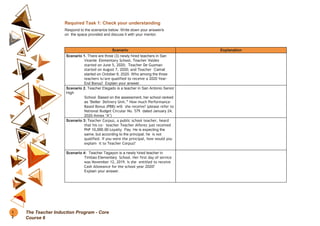
Required Task 1: Check your understanding
Respond to the scenarios below. Write down your answer/s
on the space provided and discuss it with your mentor.
Scenario Explanation
Scenario 1. There are three (3) newly hired teachers in San
Vicente Elementary School. Teacher Valdez
started on June 5, 2020; Teacher De Guzman
started on August 7, 2020; and Teacher Camat
started on October 8, 2020. Who among the three
teachers is/are qualified to receive a 2020 Year-
End Bonus? Explain your answer.
Scenario 2. Teacher Elegado is a teacher in San Antonio Senior
High
School. Based on the assessment, her school ranked
as “Better Delivery Unit.” How much Performance-
Based Bonus (PBB) will she receive? (please refer to
National Budget Circular No. 579 dated January 24,
2020 Annex “A”)
Scenario 3: Teacher Corpuz, a public school teacher, heard
that his co- teacher Teacher Alferez just received
PhP 10,000.00 Loyalty Pay. He is expecting the
same; but according to the principal, he is not
qualified. If you were the principal, how would you
explain it to Teacher Corpuz?
Scenario 4: Teacher Tagayon is a newly hired teacher in
Timbao Elementary School. Her first day of service
was November 12, 2019. Is she entitled to receive
Cash Allowance for the school year 2020?
Explain your answer.
1
2
The Teacher Induction Program - Core
Course 6
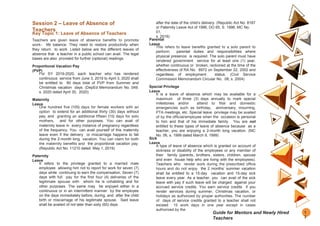
Session 2 – Leave of Absence of
Teachers
Key Topic 1: Leave of Absence of Teachers
Teachers are given leave of absence benefits to promote
work- life balance. They need to restore productivity when
they return to work. Listed below are the different leaves of
absence that a teacher in a public school can avail. The legal
bases are also provided for further (optional) readings.
Proportional Vacation Pay
(PVP)
For SY 2019-2020, each teacher who has rendered
continuous service from June 3, 2019 to April 3, 2020 shall
be entitled to 80 days total of PVP from Summer and
Christmas vacation days. (DepEd Memorandum No. 049,
s. 2020 dated April 30, 2020)
Maternity
Leave
One hundred five (105) days for female workers with an
option to extend for an additional thirty (30) days without
pay, and granting an additional fifteen (15) days for solo
mothers, and for other purposes. You can avail of
maternity leave in every instance of pregnancy regardless
of the frequency. You can avail yourself of this maternity
leave even if the delivery or miscarriage happens to fall
during the 2-month long vacation. You can claim for both
the maternity benefits and the proportional vacation pay.
(Republic Act No. 11210 dated May 1, 2019)
Paternity
Leave
It refers to the privilege granted to a married male
employee allowing him not to report for work for seven (7)
days while continuing to earn the compensation. Seven (7)
days with full pay for the first four (4) deliveries of the
legitimate spouse with whom he is cohabiting and for
other purposes. The same may be enjoyed either in a
continuous or in an intermittent manner by the employee
on the days immediately before, during, and after the child
birth or miscarriage of his legitimate spouse. Said leave
shall be availed of not later than sixty (60) days
after the date of the child’s delivery. (Republic Act No. 8187
or Paternity Leave Act of 1996, DO 65, S. 1996, MC No.
01,
s. 2016)
Parental
Leave
This refers to leave benefits granted to a solo parent to
perform parental duties and responsibilities where
physical presence is required. The solo parent must have
rendered government service for at least one (1) year,
whether continuous or broken, reckoned at the time of the
effectiveness of RA No. 8972 on September 22, 2002 and
regardless of employment status. (Civil Service
Commission Memorandum Circular No. 08, s. 2004)
Special Privilege
Leave
It is a leave of absence which may be available for a
maximum of three (3) days annually to mark special
milestones and/or attend to filial and domestic
emergencies such as birthday, anniversary, mourning,
PTA meetings, etc. Special leave privilege may be availed
of by the official/employee when the occasion is personal
to him and that of his immediate family. You are not
entitled to these types of leave of absence because as a
teacher, you are enjoying a 2-month long vacation. (MC
No. 06, s. 1999 dated March 9, 1999)
Sick
Leave
A type of leave of absence which is granted on account of
sickness or disability of the employees or any member of
their family (parents, brothers, sisters, children, spouse
and even house help who are living with the employees).
Teachers who render work during the prescribed office
hours and do not enjoy the 2 months’ summer vacation
shall be entitled to a 15-day vacation and 15-day sick
leave every year. As a teacher, you can avail of the sick
leave with pay if such leave will be charged against your
accrued service credits. You earn service credits if you
render services during summer, Christmas vacation, or
holidays as authorized by proper authorities. The number
of days of service credits granted to a teacher shall not
exceed 15 work days in one year except in cases
authorized by the
1
3
Guide for Mentors and Newly Hired
Teachers
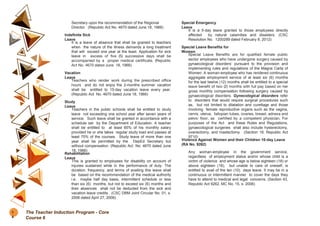
Secretary upon the recommendation of the Regional
Director. (Republic Act No. 4670 dated June 18, 1966)
Indefinite Sick
Leave
It is a leave of absence that shall be granted to teachers
when the nature of the illness demands a long treatment
that will exceed one year at the least. Application for sick
leave in excess of five (5) successive days shall be
accompanied by a proper medical certificate. (Republic
Act No. 4670 dated June 18, 1966)
Vacation
Leave
Teachers who render work during the prescribed office
hours and do not enjoy the 2-months summer vacation
shall be entitled to 15-day vacation leave every year.
(Republic Act No. 4670 dated June 18, 1966)
Study
Leave
Teachers in the public schools shall be entitled to study
leave not exceeding one school year after seven years of
service. Such leave shall be granted in accordance with a
schedule set by the Department of Education. A teacher
shall be entitled to at least 65% of his monthly salary
provided he or she takes regular study load and passes at
least 75% of the courses. Study leave of more than one
year shall be permitted by the DepEd Secretary but
without compensation. (Republic Act No. 4670 dated June
18, 1966)
Rehabilitation
Leave
This is granted to employees for disability on account of
injuries sustained while in the performance of duty. The
duration, frequency, and terms of availing this leave shall
be based on the recommendation of the medical authority
i.e. maybe half day basis, intermittent schedule or less
than six (6) months, but not to exceed six (6) months and
their absences shall not be deducted from the sick and
vacation leave credits. (CSC DBM Joint Circular No. 01, s.
2006 dated April 27, 2006)
Special Emergency
Leave
It is a 5-day leave granted to those employees directly
affected by natural calamities and disasters. (CSC
Resolution No. 1200289 dated February 8, 2012)
Special Leave Benefits for
Women
Special Leave Benefits are for qualified female public
sector employees who have undergone surgery caused by
gynaecological disorders’ pursuant to the provision and
implementing rules and regulations of the Magna Carta of
Women. A woman-employee who has rendered continuous
aggregate employment service of at least six (6) months
for the last twelve (12) months shall be entitled to a special
leave benefit of two (2) months with full pay based on her
gross monthly compensation following surgery caused by
gynaecological disorders. Gynecological disorders refer
to disorders that would require surgical procedures such
as, but not limited to dilatation and curettage and those
involving female reproductive organs such as the vagina,
cervix, uterus, fallopian tubes, ovaries, breast, adnexa and
pelvic floor, as certified by a competent physician. For
purposes of the Act and these Rules and Regulations,
gynaecological surgeries shall also include hysterectomy,
ovariectomy, and mastectomy. (Section 18, Republic Act
9710)
Violence Against Women and their Children 10-day Leave
(RA No. 9262)
Any woman-employee in the government service,
regardless of employment status and/or whose child is a
victim of violence and whose age is below eighteen (18) or
above eighteen (18), but unable to care of oneself, is
entitled to avail of the ten (10) days leave. It may be in a
continuous or intermittent manner to cover the days they
have to attend to medical and legal concerns. (Section 43,
Republic Act 9262, MC No. 15, s. 2006)
1
4
The Teacher Induction Program - Core
Course 6
Required Task 1: Check your Understanding
Respond to the scenario below. Write down your answers on
the space provided below and discuss them with your mentor.
Limit your responses to 100 words per scenario.
Scenario 1: Teacher Lani, a Senior High School Teacher, gave
birth to her fifth child. Can she avail of maternity
leave? If yes, how long? Will she still receive a
salary even if she is on leave for a reason
already mentioned? Explain your answer.
Scenario 2: One of the teachers in Dela Paz Elementary
School was suffering from domestic violence.
Allegedly, her husband was having an affair with
other women, resulting in the withdrawal of
financial support for their three (3) children. The
teacher wants to take some time off to file a
case against her husband, but she is worried
that she has already incurred too many
absences, leaving her with no more service
credits. What will you advise the teacher?
1
5
Guide for Mentors and Newly Hired
Teachers
Scenario 3: Teacher Anthony is a Technical-Vocational-
Livelihood (TVL) teacher in Sto. Tomas Senior
High School.
During his demonstration teaching, an accident
happened due to a short circuit. He was rushed
to the hospital. The doctor advised him to leave
work for 2 weeks. What benefits is he entitled
to?
1
6
The Teacher Induction Program - Core
Course 6
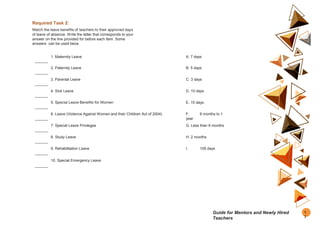
Required Task 2:
Match the leave benefits of teachers to their approved days
of leave of absence. Write the letter that corresponds to your
answer on the line provided for before each item. Some
answers can be used twice.
1. Maternity Leave A. 7 days
2. Paternity Leave B. 5 days
3. Parental Leave C. 3 days
4. Sick Leave D. 10 days
5. Special Leave Benefits for Women E. 15 days
6. Leave (Violence Against Women and their Children Act of 2004) F. 6 months to 1
year
7. Special Leave Privileges G. Less than 6 months
8. Study Leave H. 2 months
9. Rehabilitation Leave I. 105 days
10. Special Emergency Leave
1
7
Guide for Mentors and Newly Hired
Teachers
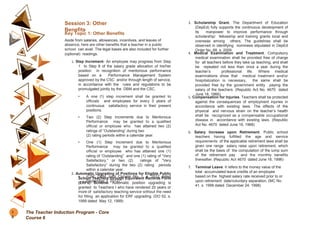
Session 3: Other
Benefits
Key Topic 1: Other Benefits
Aside from salaries, allowances, incentives, and leaves of
absence, here are other benefits that a teacher in a public
school can avail. The legal bases are also included for further
(optional) readings.
1. Step Increment- An employee may progress from Step
1 to Step 8 of the salary grade allocation of his/her
position in recognition of meritorious performance
based on a Performance Management System
approved by the CSC and/or through length of service,
in accordance with the rules and regulations to be
promulgated jointly by the DBM and the CSC.
• A one (1) step increment shall be granted to
officials and employees for every 3 years of
continuous satisfactory service in their present
positions.
• Two (2) Step Increments due to Meritorious
Performance may be granted to a qualified
official or employee who has attained two (2)
ratings of “Outstanding” during two
(2) rating periods within a calendar year.
• One (1) Step Increment due to Meritorious
Performance may be granted to a qualified
official or employee who has attained one (1)
rating of “Outstanding” and one (1) rating of “Very
Satisfactory,” or two (2) ratings of “Very
Satisfactory” during the two (2) rating periods
within a calendar year.
• (CSC DBM Joint Circular No. 1, s. 2012 dated
September 3, 2012)
2. Automatic Upgrading of Positions for Eligible Public
School Teachers through Equivalent Records Form
(ERFs) Scheme. Automatic position upgrading is
granted to Teachers I who have rendered 20 years or
more of satisfactory teaching service without the need
for filling an application for ERF upgrading. (DO 52, s.
1999 dated May 12, 1999)
3. Scholarship Grant. The Department of Education
(DepEd) fully supports the continuous development of
its manpower to improve performance through
scholarship/ fellowship and training grants local and
overseas among others. The guidelines shall be
observed in identifying nominees stipulated in DepEd
Order No. 68, s. 2009.
4. Medical Examination and Treatment. Compulsory
medical examination shall be provided free of charge
for all teachers before they take up teaching, and shall
be repeated not less than once a year during the
teacher’s professional life. Where medical
examinations show that medical treatment and/or
hospitalization is necessary, the same shall be
provided free by the government entity paying the
salary of the teachers. (Republic Act No. 4670 dated
June 18, 1966)
5. Compensation for Injuries. Teachers shall be protected
against the consequences of employment injuries in
accordance with existing laws. The effects of the
physical and nervous strain on the teacher’s health
shall be recognized as a compensable occupational
disease in accordance with existing laws. (Republic
Act No. 4670 dated June 18, 1966)
6. Salary Increase upon Retirement. Public school
teachers having fulfilled the age and service
requirements of the applicable retirement laws shall be
given one range salary raise upon retirement, which
shall be the basis of the computation of the lump sum
of the retirement pay and the monthly benefits
thereafter. (Republic Act 4670 dated June 18, 1996)
7. Terminal Leave. It refers to the money value of the
total accumulated leave credits of an employee
based on the highest salary rate received prior to or
upon retirement date/voluntary separation. (MC No.
41, s. 1998 dated December 24, 1998)
1
8
The Teacher Induction Program - Core
Course 6
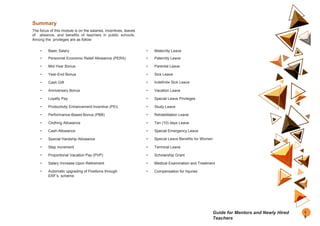
Summary
The focus of this module is on the salaries, incentives, leaves
of absence, and benefits of teachers in public schools.
Among the privileges are as follow:
• Basic Salary • Maternity Leave
• Personnel Economic Relief Allowance (PERA) • Paternity Leave
• Mid-Year Bonus • Parental Leave
• Year-End Bonus • Sick Leave
• Cash Gift • Indefinite Sick Leave
• Anniversary Bonus • Vacation Leave
• Loyalty Pay • Special Leave Privileges
• Productivity Enhancement Incentive (PEI) • Study Leave
• Performance-Based Bonus (PBB) • Rehabilitation Leave
• Clothing Allowance • Ten (10) days Leave
• Cash Allowance • Special Emergency Leave
• Special Hardship Allowance • Special Leave Benefits for Women
• Step Increment • Terminal Leave
• Proportional Vacation Pay (PVP) • Scholarship Grant
• Salary Increase Upon Retirement • Medical Examination and Treatment
• Automatic upgrading of Positions through
ERF’s scheme
• Compensation for Injuries
1
9
Guide for Mentors and Newly Hired
Teachers
Required Task: Reflection Question (Portfolio
Output)
The Department of Education values the vital role of teachers
in nurturing the holistic being of the learners to become
productive citizens of the nation. It ensures teachers just
compensation, incentives, benefits, and rewards for them to
live a decent life. As a new member of the DepEd family,
how can you show appreciation to this effort of the
government?
2
0
The Teacher Induction Program - Core
Course 6
Module 2 – Continuing
Professional Development
Intended Module Learning
Outcomes
At the end of this module you should be able
to:
1. understand the guidelines on continuing
professional development (CPD), career
progression and promotion;
2. assess one’s credential and practice in view of
the CPD requirements; and
3. craft a Professional Development Plan based
on learning needs.
Module Outline
Session 1 – Republic Act 10912: Continuing
Professional Development (CPD) Act of 2016
Session 2 – Resolution No. 11, s. 2017: Operational
Guidelines in the Implementation of RA 10912 for Professional
Teachers
Estimated Time Required: 1
hour
Required Tasks
The following are the tasks in this module:
1. Reflection
2. Enumeration Activity
3. Reading
4. Preparing a Professional Development
Plan
Required Resources
DepEd Order No. 001, s. 2020 on Guidelines for NEAP
Recognition of Professional Development Programs
and Courses for Teachers and School Leaders.
(https:// www.deped.gov.ph/wp-
content/uploads/2020/01/DO_ s2020_001.pdf)
Implementing Rules and Regulations of Republic Act No.
10968 on An Act Institutionalizing the Philippine
Qualifications Framework (PQF), Establishing the
PQF-National Coordinating Council (NCC) and
Appropriating Funds Therefor.
(https://www.officialgazette.
gov.ph/2019/01/15/implementing-rules-and-regulations-
of- republic-act-no-10968/)
Resolution No. 11, s. 2017 on Operational Guidelines in the
Implementation of RA 10912, Otherwise Known as
“Continuing Professional Development (CPD) Act of
2016” for Professional Teachers.
(https://www.prc.gov.ph/sites/
default/files/resoProfTeachers
2017-11.pdf)
Republic Act No. 7836 on An Act to Strengthen the
Regulation and Supervision of the Practice of
Teaching in the Philippines and Prescribing a
Licensure Examination for Teachers and for Other
Purposes. (https://www.pcw.gov. ph/law/republic-act-
7836)
Republic Act No. 10912 on Act Mandating the Continuing
Professional Development Program for All
Regulated Professions, creating the Continuing
Professional Development Council.
(https://www.officialgazette.gov.
ph/2016/07/21/republic-act-no-10912/)
2
1
Guide for Mentors and Newly Hired
Teachers
Session 1 – Republic Act No. 10912 on
Continuing Professional Development (CPD) Act of
2016.
Preliminary Activity
1. As a teacher, what good qualities and assets do you
have? How is it helpful in your professional
practice? Input your answer here.
2. Reflecting on your current practices, what domains of
teaching practice do you want to further improve?
You may refer to specific domains or strands from
the PPST. Input your answer here.
2
2
The Teacher Induction Program - Core
Course 6
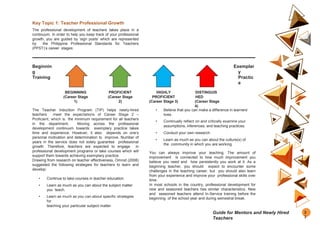
Key Topic 1: Teacher Professional Growth
The professional development of teachers takes place in a
continuum. In order to help you keep track of your professional
growth, you are guided by ‘sign posts’ which are represented
by the Philippine Professional Standards for Teachers
(PPST)’s career stages:
The Teacher Induction Program (TIP) helps newly-hired
teachers meet the expectations of Career Stage 2 –
Proficient, which is the minimum requirement for all teachers
in the department. Moving across the professional
development continuum towards exemplary practice takes
time and experience. However, it also depends on one’s
personal motivation and determination to improve. Number of
years in the service does not solely guarantee professional
growth. Therefore, teachers are expected to engage in
professional development programs or take courses which will
support them towards achieving exemplary practice.
Drawing from research on teacher effectiveness, Omrod (2008)
suggested the following strategies for teachers to learn and
develop:
• Continue to take courses in teacher education.
• Learn as much as you can about the subject matter
you teach.
• Learn as much as you can about specific strategies
for
teaching your particular subject matter.
Beginnin
g
Training
Exemplar
y
Practic
e
BEGINNING
(Career Stage
1)
PROFICIENT
(Career Stage
2)
HIGHLY
PROFICIENT
(Career Stage 3)
DISTINGUIS
HED
(Career Stage
4)
• Believe that you can make a difference in learners’
lives.
• Continually reflect on and critically examine your
assumptions, inferences, and teaching practices.
• Conduct your own research.
• Learn as much as you can about the culture(s) of
the community in which you are working.
You can always improve your teaching. The amount of
improvement is connected to how much improvement you
believe you need and how persistently you work at it. As a
beginning teacher, you should expect to encounter some
challenges in the teaching career, but you should also learn
from your experience and improve your professional skills over
time.
In most schools in the country, professional development for
new and seasoned teachers has similar characteristics. New
and seasoned teachers attend In-Service training before the
beginning of the school year and during semestral break.
2
3
Guide for Mentors and Newly Hired
Teachers
Professional development is actually prescribed by law through
Republic Act No. 10912, also known as Act Mandating the
Continuing Professional Development Program for All
Regulated Professions, creating the Continuing Professional
Development Council. This Act mandates and strengthens the
continuing professional development program for all regulated
professions, including the teaching profession, (Republic Act
10912). The
measure will ensure the continuous improvement of the
competence of the professionals in accordance with the
international standards of practice, thereby, ensuring their
contribution in uplifting the general welfare, economic growth
and development of the nation.
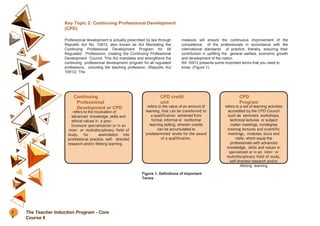
RA 10912 presents some important terms that you need to
know (Figure 1).
Continuing
Professional
Development or CPD
refers to the inculcation of
advanced knowledge, skills and
ethical values in a post-
licensure specialization or in an
inter- or multidisciplinary field of
study, for assimilation into
professional practice, self- directed
research and/or lifelong learning.
CPD credit
unit
refers to the value of an amount of
learning that can be transferred to
a qualification achieved from
formal, informal or nonformal
learning setting, wherein credits
can be accumulated to
predetermined levels for the award
of a qualification.
CPD
Program
refers to a set of learning activities
accredited by the CPD Council
such as seminars, workshops,
technical lectures or subject
matter meetings, nondegree
training lectures and scientific
meetings, modules, tours and
visits, which equip the
professionals with advanced
knowledge, skills and values in
specialized or in an inter- or
multidisciplinary field of study,
self-directed research and/or
lifelong learning
Figure 1. Definitions of Important
Terms
Key Topic 2: Continuing Professional Development
(CPD)
2
4
The Teacher Induction Program - Core
Course 6
RA 10912 Section 4 specifies that CPD Programs in each of
the
regulated professions are formulated and implemented to:
a. enhance and upgrade the competencies and
qualifications of professionals for the practice of their
professions pursuant to the Philippine Qualifications
Framework (PQF), the ASEAN Qualifications Reference
Framework (AQRF) and the ASEAN Mutual Recognition
Arrangements (MRAs);
b. ensure international alignment of competencies and
qualifications of professionals through career
progression mechanisms leading to specialization/sub-
specialization;
c. ensure the development of quality assured mechanisms
for the validation, accreditation and recognition of formal,
non-formal and informal learning outcomes, including
professional work experiences and prior learning;
d. ensure maintenance of core competencies and
development of advanced and new competencies, in
order to respond to national, regional and international
labor market needs; and
e. recognize and ensure the contributions of professionals
in uplifting the general welfare, economic growth and
development of the nation.
Meanwhile, CPD Programs consist of activities that range from
structured to unstructured activities, which have learning
processes and outcomes. These include, but are not limited to,
the following: formal learning, non-formal learning, informal
learning, self-directed learning, online learning activities, and
professional work experience.
2
5
Guide for Mentors and Newly Hired
Teachers
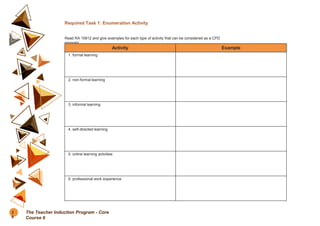
Required Task 1: Enumeration Activity
Read RA 10912 and give examples for each type of activity that can be considered as a CPD
program.
Activity Example
1. formal learning
2. non-formal learning
3. informal learning
4. self-directed learning
5. online learning activities
6. professional work experience
2
6
The Teacher Induction Program - Core
Course 6
Summar
y
• Becoming an outstanding public school teacher takes
time and experience. Continuing professional
development can help teachers progress.
• Continuing professional development is prescribed by
law through Republic Act No. 10912, also known as
Act Mandating the Continuing Professional
Development Program for All Regulated Professions,
creating the Continuing Professional Development
Council.
2
7
Guide for Mentors and Newly Hired
Teachers
Session 2 – Resolution No. 11, s. 2017
on
Operational Guidelines in the Implementation of
RA 10912 for Professional Teachers.
The professional growth and lifelong learning of teachers are
essential in ensuring the quality of basic education. Teachers
nurture a responsible and literate citizenry. The State
recognizes the vital role of teachers in nation-building and
development as stipulated in Section 2 of Article I of Republic
Act (RA) No. 7836 on Philippine Teachers Professionalization
Act of 1994.
In order to continuously improve the competence of
professional teachers, DepEd implements various professional
development initiatives. These learning experiences are
intended to address teachers’ identified competency-based
gaps or development needs. The quality of CPD interventions
shall be assured through an institutionalized Recognition
System. The prescribed CPD
requirements and procedure are indicated under Resolution
No.
11, s. 2017 issued by the Professional Regulatory
Board for
Professional Teachers. This contains the operational guidelines
in the implementation of RA No. 10912 on CPD Act of 2016.
Required Task 1:
Reading
Read the CPD Operational Guidelines. Use the provided
template in noting down your issues, concerns, and new
learning. Share your notes with your mentor and co-newly
hired teachers during your learning discussion.
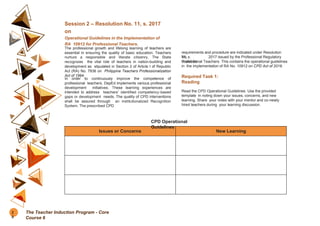
Issues or Concerns New Learning
CPD Operational
Guidelines
2
8
The Teacher Induction Program - Core
Course 6
Analyze each given scenario. Apply your learning on CPD
Operational Guidelines and identify whether the statements
are True or False.
1. Teacher Gilda has served in her school for six years.
Her Professional Identification Card (PIC) expired two
months ago. She actually thought of skipping the
errand for renewal because of her workloads. She
changed her mind after knowing the new system of the
Professional Regulation Commission (PRC) on
renewal. Whenever there
is an available professional program offered by a
certified provider online, Teacher Gilda prioritizes
participation in it. This helps her a lot in writing articles
to a monthly teacher magazine. Her contribution in
teaching innovations has been recognized not just in
her school but in the Schools Division as well.
STATEMENTS ANSWERS FEEDBACK
Teacher Gilda needs to present a
certificate of attendance (even without
the corresponding number of hours) for
approval of credit units to a program.
The published articles of Teacher
Gilda in the teacher magazine may
also provide her credit units for
renewal of professional license.
Teacher Gilda shall present a duly
notarized copy of certification from
the awarding body if she intends to
include her recognition points as part of
accumulated credit units.
All professional development programs and courses offered to
teachers shall be aligned to the Philippine Professional
Standards for Teachers (PPST) and Three-year Professional
Development Priorities of DepEd. The validated and
recognized CPD credit units earned by a professional shall be
accumulated and transferred in accordance with the pathways
and equivalencies of the Philippine Qualifications Framework
(PQF).
2
9
Guide for Mentors and Newly Hired
Teachers
Optional Task: Reading
Read the Implementing Rules and Regulations of RA No.
10968 on Philippine Qualifications Framework (PQF) Act.
Share your new learning with your mentor and co-newly-
hired teachers during your discussion meeting. The template
below can help
you in organizing your insights. Provisions of the law that are
related with the duties and responsibilities of DepEd may also
be discussed in your Learning Action Cell (LAC).
Salient Points of the PQF Act Issues or Concerns New Learning
Optional task:
Reflection
Cite your personal experience in applying for renewal of your
Professional Identification Card (PIC). Identify the hindering
and
facilitating factors in the process that you encountered. Be
open with your mentor and co-newly-hired teachers in
sharing your experience for reflective learning.
Your Personal Experience Hindering Factors Facilitating Factors
3
0
The Teacher Induction Program - Core
Course 6
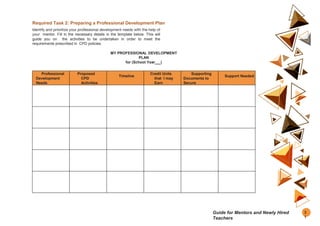
Required Task 2: Preparing a Professional Development Plan
Identify and prioritize your professional development needs with the help of
your mentor. Fill in the necessary details in the template below. This will
guide you on the activities to be undertaken in order to meet the
requirements prescribed in CPD policies.
MY PROFESSIONAL DEVELOPMENT
PLAN
for (School Year )
Professional
Development
Needs
Proposed
CPD
Activities
Timeline
Credit Units
that I may
Earn
Supporting
Documents to
Secure
Support Needed
3
1
Guide for Mentors and Newly Hired
Teachers
Summary
With the government’s commitment to advocate far-reaching
reforms in Human Resource Development, RA No. 10912 on
Continuing Professional Development (CPD) Act of 2016 has
been implemented. This provided the purpose for the issuance
of Resolution No. 11 s. 2017, which contains the Operational
Guidelines for Teachers in the Implementation of RA 10912
otherwise known as “Continuing Professional Act of 2016” for
teachers. The conduct of relevant professional development
interventions for teachers has been made to address existing
learning needs. These interventions have to be delivered by
accredited learning service providers for quality assurance.
The State shall ensure the promotion of quality education by
proper supervision and professionalization of the teaching
practice. Thus, it is mandated for DepEd to institute measures
that will continuously improve the competence of teachers in
accordance with the international standards of practice. The
CPD for Licensed Professional Teachers (LPTs) has become
a mandatory requirement by the Professional Regulation
Commission (PRC) in the renewal of the professional license.
Currently, all professional teachers are required to complete
the required number of credit units every three (3) years.
3
2
The Teacher Induction Program - Core
Course 6
Module 3 – Policies on Promotion
and
Opportunities for
Progression
Intended Module Learning
Outcomes
At the end of this module you should be able
to:
1. be familiar, and eventually comply with the
guidelines on continuing professional
development, career progression and promotion;
2. participate in professional networks to share
knowledge and to enhance practice towards
continuing professional development (7.3.2); and
3. adopt practices that uphold the dignity of teaching
as a profession through professional and personal
development (7.2.2).
Module Outline
Session 1: Appointment and Promotion of other Teaching,
Related Teaching and Non-teaching Positions
Session 2: Scholarships
Session 3: Professional Associations for
Teachers
Estimated Time Required: 1
hour
Required
Tasks
1. Viewing
2. Formative
Quizzes
3. Reflection
Activity
Required
Resources
Printed/Online Copy of:
• DepEd Order No. 66, s. 2007 on Revised Guidelines
on the Appointment and Promotion of other Teaching,
Related Teaching and Non-teaching Positions
• CSC Resolution No. 1100824 Title?
(http://www.csc.gov.
ph/phocadownload/PolicyReso/polresR1100824LSP.p
df)
• Republic Act No. 4670 on The Magna Carta For Public
School Teachers.
(http://docshare01.docshare.tips/
files/6716/67163834.pd
f)
3
3
Guide for Mentors and Newly Hired
Teachers
Session 1 – Appointment and Promotion
of other Teaching, Related Teaching and
Non- teaching Positions
Key Topic 1: The Need for Professional
Growth
The videos in the introductory activity aim to encourage you to
consider your career direction in the Department of Education.
Now that you are in the final course of the TIP, consider how
you will grow your career in the Department of Education.
PAUSE AND REFLECT: Why should you start now to consider
ways for improving your skills as a teacher?
Input your answer
here.
Qualify Yourself.
“Compounding is the most powerful force in the universe,”
says Albert Einstein. To be able to reach career
promotion, you have to qualify yourself. QUALIFY
YOURSELF. That is the common encouragement of
school heads to their teachers who aim for promotion.
Probably, you are already thinking how you will grow
professionally in the Department of Education. This module
will guide you on this particular track. But why do you need
to know about promotion and why is it important to be
promoted?
In her book Never Work Harder Than Your Students &
Other Principles of Great Teaching, Robyn Jackson
stressed, “You don’t become a master teacher by simply
doing what a master teacher does. You become a master
teacher by thinking like a master teacher thinks. Any
teacher can become a master teacher.” After several
years in service, you will yield a lot of experiences as a
teacher. All you have to do is to nourish a productive
mindset, and work in a way that will make you one.
Since this is the last module of TIP, probably you have
somewhat grasped the culture in your public school. How
are you thriving so far? Hence, this TIP hopes that you are
adjusting and working well in your respective workstation.
Kottler, E., Kottler, A., & Kottler, C. (1998) encouraged
new teachers to succeed in their first year:
If you hope to have a long, distinguished
career as a teacher, not as someone who does
a credible job but rather as one who strives for
excellence, then the seeds for this passion must
be planted now. Much depends on who you
choose as your mentors, who you surround
yourself with as a support system, and how hard
you are willing to work on your growth and
development. Just like an athlete who works out
every day, practices skills religiously, studies
new innovations, and keeps himself or herself in
peak physical shape, you too, must devote
yourself to superb conditioning—not only of your
body but your mind and your spirit as well (105).
3
4
The Teacher Induction Program - Core
Course 6
Maintain your enthusiasm to learn.
For the past several months, you have engaged yourself
in a teacher induction program by the Department of
Education that orients you on what it takes not only to do
well in your first year in the Department of Education, but
to actually flourish, so what happens after that? Kottler
et al (1998) also advised teachers to be the kind of
teacher they wish to be:
Ironically, in some ways, your first year is
the easiest one in the sense that you have no
worries about keeping your excitement and
enthusiasm at peak levels. Unfortunately, as
some teachers gain experience, they also lose
some of the spark they once had, the innocence
that led them to believe anything was possible,
that they really could make a difference.
Right now, you have something very, very
precious: your own strong belief that you will be
different. You will be the kind of teacher who
keeps the momentum going, who continues to
commit yourself to future growth, who is always
learning, always reinventing yourself. You will
be the kind of teacher who learners revere and
admire, not just for what you know but for who
you are as a human being. Your love and
compassion and empathy are transparent, for
anyone to see. The kids know how much you
care. (106)
Strive to be better.
Indeed, you need to have a promotion because you also
need to improve your earning ability for your personal and
professional growth. In his book Master Your Time, Master
Your Life, international best-selling author and inspirational
speaker Brian Tracy (2016) defines earning ability as “the
total accumulation of all your knowledge, skills,
experience, study, hard work, and results you have
acquired over the course of your life and your career. It
has taken you your whole life to develop (66).”
Tracy (2016) also pointed out that since earning ability is
an asset, it can either be appreciating or depreciating over
time. Earning ability can be an asset “when you are
continually upgrading yourself, making yourself become
more and more valuable, doing more of those tasks that
people value highly and are willing to pay for (66).” On the
other hand, your earning ability can be depreciating if you
are not continually upgrading your skills and abilities that
can be done through study and hard work. He cited
Anders Ericson who stated that “most people work for the
first year to learn their jobs well enough so as not to get
fired. After that, they never get any better. They never
improve. Ten years after they started their job, they’re no
more productive than they were after one year (67).”
Hence, as a teacher in the Department of Education you
are inspired to have an appreciating asset.
3
5
Guide for Mentors and Newly Hired
Teachers
Key Topic 2: DepEd Order on the Appointment
and Promotion of Teaching, Related Teaching,
and Non- Teaching Positions
In the previous module, you were oriented about your
continuing professional development. In this module, you
will know different options for career progression. DepEd
issues orders to facilitate the appointment and promotion
of teaching, related teaching and non-teaching positions in
the department.
As of 2020, *DepEd Order No. 66, s. 2007 on Revised
Guidelines on the Appointment and Promotion of Other
Teaching, Related Teaching, and Non-Teaching Positions
is still in effect. These guidelines shall apply to the
appointment and promotion of Teaching and Related
Teaching Group such as:
• Teacher II and III;
• Education Supervisor I, II, and III;
• Chief Education Supervisor;
• Education Program Specialist I and II;
• Senior Education Program Specialist;
• Chief Education Program Specialist;
• Guidance Counselors;
• Guidance Coordinators; and
• other teaching and related positions indicated in the
Magna Carta for Public School Teachers, except
School Heads – Principals and Head Teachers and all
Non- Teaching Groups.
*This DepEd Order may be updated to address the
needs of the system. Check with your mentor if there are
more recent DepEd Orders.
The guidelines in the DepEd order aim to achieve the principles
of merit and fitness, objectivity and uniformity in evaluation;
and strengthening of the selection process. Moreover, these
should guide teachers in planning for their career progression
in the department.
Required Task: Policy Reading
The most important thing for teachers to know about
promotions are the criteria and the requirements or means to
verify achievement of those criteria. These are goals tied up
with your everyday teaching practice. Read the latest policy on
teacher promotions and see how you could align your teaching
practices and professional development aims with the criteria
and requirements. Fill in the table on the next page with your
answers.
3
6
The Teacher Induction Program - Core
Course 6
Criteria for Promotion
Requirements or means to
verify achievement of the
criteria
Teaching practices or
professional development aims
aligned with the promotion
criteria
Example: Performance Rating Performance rating for the last 3 rating
pe- riods should be at least Very
Satisfactory
• Focus on improving my teaching
practice to meet expectations in the
RPMS-PPST and get Very
Satisfactory rating
Example: Education Master’s Degree • I intend to enroll in a Master’s
Degree to further my knowledge
and skills in content and pedagogy
3
7
Guide for Mentors and Newly Hired
Teachers
Summary
• The teaching profession demands continual
professional growth. The classroom offers experience
for teachers to improve their practices with the help of
mentors, but it also needs to be coupled with
continuous enthusiasm to learn through conscious
planning of professional development goals.
• DepEd acknowledges the need to align the
guidelines on promotion with what the teachers
need in order to improve their teaching. It is
important for teachers be mindful of the criteria and
means to verify achievement not only for career
progression but also towards professional
development.
3
8
The Teacher Induction Program - Core
Course 6
Session 2 – Scholarship
Programs
Key Topic 1: Lifelong Learning
You can continue your education to discover your potential.
Most successful people in any discipline are lifelong learners.
They are continually adding to their range of knowledge and
skills. The most competitive teachers spend much more time
practicing and upgrading their skills. In her book What Keeps
Teachers Going, Sonia Nietto (2003) shared her observations
about newly-hired teachers:
Excellent teachers don’t develop full-blown at
graduation; nor are they just “born teachers.” Instead,
teachers are always in the process of becoming.”
Given the dynamics of their work, they need to
continually rediscover who they are and what they
stand for through their dialogue and collaboration
with peers, through ongoing and consistent study,
and through deep reflection about their craft. They
also need to understand the nature of their work and
its life-and-death potential in the lives of their
students. They need to understand that teaching is
neither missionary work (although it may be a
mission), nor just another job. (125)
When you become a lifelong learner, your potential has no
limit. Hence, keeping up with the professional literature and
enrolling in professional course work are important in
developing and maintaining teacher effectiveness. You may try
doing university course work and programs that lead to a
graduate degree in a field of study. Make sure that it is
relevant to your discipline or specialization. You may also
attend workshops and special courses conducted by a
university or college. If you are thinking about the expenses,
you may check to see whether scholarships or grants are
available. Several cities or provinces or government agencies
offer monetary incentives or financial assistance for enrolling
in teachers’ professional development programs. Some cities
or municipalities offer partial or full reimbursement for graduate
work.
You may consider the local scholarship program of the Civil
Service Commission (CSC).
Key Topic 2: The Local Scholarship Program of
the Civil Service Commission
CSC Resolution No. 1100824 on Local Scholarship Program
(Modified) was signed on June 21, 2011 “to keep abreast of
the changing times, and to strengthen and make appropriate
the Local Scholarship Program to the Strategic Priorities and
the Performance Government System (PGS) of the
Commission (CSC Res. No. 1100824 page 1).”
The objective of Local Scholarship Program (Modified) is “to
equip government employees with competencies in advancing
their personal and career growth as well as engaging
themselves in pursuing national development goals (CSC Res.
No. 1100824 page 4).”
Who can be scholars? Scholars are “deserving and qualified
government employees who are expected to contribute to the
development and implementation of policies and programs of
their respective agencies (CSC Res. No. 1100824 page 5).”
3
9
Guide for Mentors and Newly Hired
Teachers
Key Topic 3: Recruitment, Selection, and Grant
for Local Scholarship Program
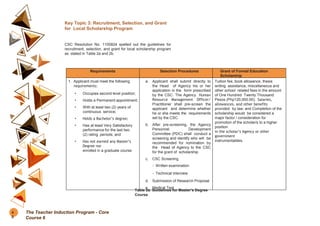
CSC Resolution No. 1100824 spelled out the guidelines for
recruitment, selection, and grant for local scholarship program
as stated in Table 2a and 2b.
Requirements Selection Procedures Grant of Formal Education
Scholarship
1. Applicant must meet the following
requirements:
• Occupies second level position;
• Holds a Permanent appointment;
• With at least two (2) years of
continuous service;
• Holds a Bachelor’s degree;
• Has at least Very Satisfactory
performance for the last two
(2) rating periods; and
• Has not earned any Master’s
Degree nor
enrolled in a graduate course.
a. Applicant shall submit directly to
the Head of Agency his or her
application in the form prescribed
by the CSC. The Agency Human
Resource Management Officer/
Practitioner shall pre-screen the
applicant and determine whether
he or she meets the requirements
set by the CSC.
b. After pre-screening, the Agency
Personnel Development
Committee (PDC) shall conduct a
screening and identify who will be
recommended for nomination by
the Head of Agency to the CSC
for the grant of scholarship.
c. CSC Screening
- Written examination
- Technical interview
d. Submission of Research Proposal
e. Medical Test
Tuition fee, book allowance, thesis
writing assistance, miscellaneous and
other school related fees in the amount
of One Hundred Twenty Thousand
Pesos (Php120,000.00); Salaries,
allowances, and other benefits
provided by law; and Completion of the
scholarship would be considered a
major factor / consideration for
promotion of the scholar/s to a higher
position
in the scholar’s Agency or other
government
instrumentalities.
Table 2a. Guidelines for Master’s Degree
Course
4
0
The Teacher Induction Program - Core
Course 6
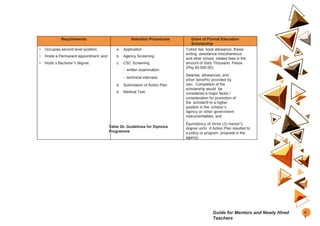
Requirements Selection Procedures Grant of Formal Education
Scholarship
• Occupies second level position;
• Holds a Permanent appointment; and
• Holds a Bachelor’s degree.
a. Application
b. Agency Screening
c. CSC Screening
- written examination
- technical interview
d. Submission of Action Plan
e. Medical Test
Tuition fee, book allowance, thesis
writing assistance miscellaneous
and other school related fees in the
amount of Sixty Thousand Pesos
(Php 60,000.00);
Salaries, allowances, and
other benefits provided by
law; Completion of the
scholarship would be
considered a major factor /
consideration for promotion of
the scholar/9 to a higher
position in the scholar’s
Agency or other government
instrumentalities; and
Equivalency of three (3) master’s
degree units if Action Plan resulted to
a policy or program proposal in the
agency.
Table 2b. Guidelines for Diploma
Programme
4
1
Guide for Mentors and Newly Hired
Teachers
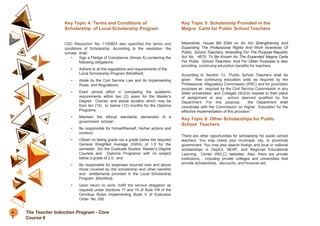
Key Topic 4: Terms and Conditions of
Scholarship of Local Scholarship Program
CSC Resolution No. 1100824 also specified the terms and
conditions of Scholarship. According to the resolution, the
scholar shall:
• Sign a Pledge of Compliance (Annex A) containing the
following obligations:
• Adhere to all the regulations and requirements of the
Local Scholarship Program (Modified);
• Abide by the Civil Service Law and its Implementing
Rules and Regulations;
• Exert utmost effort in completing the academic
requirements within two (2) years for the Master’s
Degree Course; and actual duration which may be
from ten (10) to twelve (12) months for the Diploma
Programs;
• Maintain the ethical standards demanded of a
government scholar;
• Be responsible for himself/herself, his/her actions and
conduct;
• Obtain no failing grade nor a grade below the required
General Weighted Average (GWA) of 1.5 for the
semester (for the Graduate Studies: Master’s Degree
Courses and Diploma Programs) with no subject
below a grade of 2.0; and
• Be responsible for expenses incurred over and above
those covered by the scholarship and other benefits
and entitlements provided in the Local Scholarship
Program (Modified).
• Upon return to work, fulfill the service obligation as
required under Sections 17 and 19 of Rule VIII of the
Omnibus Rules Implementing Book V of Executive
Order No. 292.
Key Topic 5: Scholarship Provided in the
Magna Carta for Public School Teachers
Meanwhile, House Bill 8384 on An Act Strengthening And
Expanding The Professional Rights And Work Incentives Of
Public School Teachers, Amending For The Purpose Republic
Act No. 4670, To Be Known As The Expanded Magna Carta
For Public School Teachers, And For Other Purposes is also
providing continuing education benefits for teachers.
According to Section 13, “Public School Teachers shall be
given free continuing education units as required by the
Professional Regulatory Commission (PRC) and for promotion
purposes as required by the Civil Service Commission in any
State Universities and Colleges (SUCs) nearest to their place
of assignment or any school deemed qualified by the
Department. For this purpose, the Department shall
coordinate with the Commission on Higher Education for the
effective implementation of this provision.”
Key Topic 6: Other Scholarships for Public
School Teachers
There are other opportunities for scholarship for public school
teachers. You may check your municipal, city, or provincial
government. You may also search foreign and local or national
scholarships in DepEd, NEAP, and Regional Educational
Learning Center (RELC) websites. Also, there are private
institutions, including private colleges and universities that
provide scholarships, discounts, and financial aid.
4
2
The Teacher Induction Program - Core
Course 6
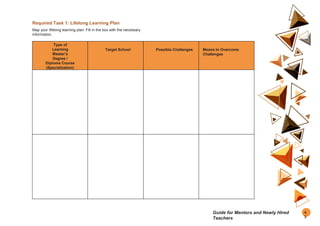
Required Task 1: Lifelong Learning Plan
Map your lifelong learning plan. Fill in the box with the necessary
information.
Type of
Learning
Master’s
Degree /
Diploma Course
(Specialization)
Target School Possible Challenges Means to Overcome
Challenges
4
3
Guide for Mentors and Newly Hired
Teachers
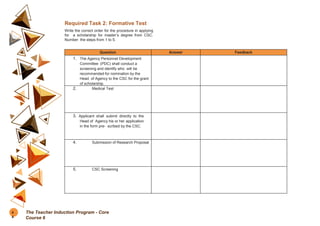
Required Task 2: Formative Test
Write the correct order for the procedure in applying
for a scholarship for master’s degree from CSC.
Number the steps from 1 to 5.
Question Answer Feedback
1. The Agency Personnel Development
Committee (PDC) shall conduct a
screening and identify who will be
recommended for nomination by the
Head of Agency to the CSC for the grant
of scholarship.
2. Medical Test
3. Applicant shall submit directly to the
Head of Agency his or her application
in the form pre- scribed by the CSC.
4. Submission of Research Proposal
5. CSC Screening
4
4
The Teacher Induction Program - Core
Course 6
Summary
• Most successful people in any discipline are lifelong
learners.
• *CSC Resolution No. 1100824 on Local Scholarship
Program (Modified) was signed July 21, 2021 to
provide local scholarship programs for public
servants.
• *CSC Resolution No. 1100824 spelled out the
guidelines for recruitment, selection, and grant for
local scholarship programs.
• *House Bill 8384 on An Act Strengthening and
Expanding The Professional Rights And Work
Incentives Of Public School Teachers, Amending For
The Purpose Republic Act No. 4670, To Be Known As
The Expanded Magna Carta For Public School
Teachers, And For Other Purposes highlighted
scholarships for teachers.
• There are other opportunities for scholarship for public
school teachers.
*Note: Always check for possible recent issuances. You may
ask your mentor, co-teachers, and school head.
4
5
Guide for Mentors and Newly Hired
Teachers
Session 3 – Professional Associations
for Teachers
Preliminary Activity
How did you deal with challenges on the first days of
reporting in your workstation? Write your answer in the
field below and answer the questions that follow.
Processing
Questions:
1. What challenges did you encounter in
your first days?
Input your answer here.
4
6
The Teacher Induction Program - Core
Course 6
2. How did you overcome these
challenges? Input your answer here.
3. Did you rely on a specific person or
people? How did you
seek help? Input your answer here.
4
7
Guide for Mentors and Newly Hired
Teachers
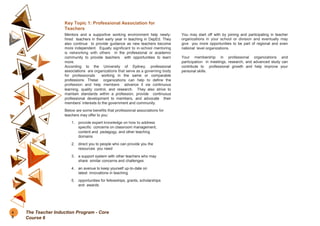
Key Topic 1: Professional Association for
Teachers
Mentors and a supportive working environment help newly-
hired teachers in their early year in teaching in DepEd. They
also continue to provide guidance as new teachers become
more independent. Equally significant to in-school mentoring
is networking with others in the professional or academic
community to provide teachers with opportunities to learn
more.
According to the University of Sydney, professional
associations are organizations that serve as a governing body
for professionals working in the same or comparable
professions. These organizations can help to define the
profession and help members advance it via continuous
learning, quality control, and research. They also strive to
maintain standards within a profession, provide continuous
professional development to members, and advocate their
members’ interests to the government and community.
Below are some benefits that professional associations for
teachers may offer to you:
1. provide expert knowledge on how to address
specific concerns on classroom management,
content and pedagogy, and other teaching
domains
2. direct you to people who can provide you the
resources you need
3. a support system with other teachers who may
share similar concerns and challenges
4. an avenue to keep yourself up-to-date on
latest innovations in teaching
5. opportunities for fellowships, grants, scholarships
and awards
You may start off with by joining and participating in teacher
organizations in your school or division and eventually may
give you more opportunities to be part of regional and even
national level organizations.
Your membership in professional organizations and
participation in meetings, research, and advanced study can
contribute to professional growth and help improve your
personal skills.
4
8
The Teacher Induction Program - Core
Course 6
Required Task 1: Research on
Professional Associations for Teachers
Do research on professional associations for teachers. You
may ask your mentor and co-teachers about associations that
they are part of or familiar with. You may also do further
research online. Choose three professional associations that
appeal to your interest. Take note of their activities and goals,
and write the things that you like in each professional
association in the boxes below.
Name of Association Brief Description Activities and Goals What you like most about
it
4
9
Guide for Mentors and Newly Hired
Teachers
Optional Task 1:
Sharing
Suggested modality: via LAC. But could also be done through
informal meeting among teachers.
Share you answers in Required Task 1 with co-newly-hired
teachers. Did you list down similar associations? Did they list
associations that you are also interested in? Share plans on the
possibility of joining these associations. You may also seek
advice from your mentors and other co-teachers.
Key Topic 2: Choosing an Association to
Join
Being part of an association requires resources, time and
commitment. Therefore, if you’re choosing an association to
join, you have to choose well to ensure that it will be
worthwhile, beneficial and fun.
Here are some tips in choosing a professional association to
join:
1. Choose an organization
that interests you
2. Find out what organizations others have joined
3. Join an organization that will help you achieve
your
professional development goals
4. Do research
5
0
The Teacher Induction Program - Core
Course 6
Optional Task 2:
Survey
Ask your mentor and other co-teachers about other
considerations in choosing a professional association. Write
down their tips below: Input your answer here.
Required Task 2: Reflection
Go back to your list of professional associations that interest
you. Given the tips, which association are you most likely to
join and why? Input your answer here.
5
1
Guide for Mentors and Newly Hired
Teachers
How do you expect this association to help you achieve your
professional development goals? (List down some benefits
and opportunities that are aligned with your goals)
Input your answer
here.
Summar
y • Participating in teacher organizations whether in
national, regional, or division levels could help you
grow as a teacher, not only professionally but
personally as well.
• Your membership in professional organizations and
participation in meetings, research, and advanced
study can contribute to professional growth and help
improve your personal skills.
• You have to carefully choose the associations that you
will join in. One key consideration is to ensure that the
organization will help you achieve your professional
development goals.
5
2
The Teacher Induction Program - Core
Course 6
Module 4 – Personal
Development and Well-being
Intended Module Learning Outcome
1. At the end of this module, you should be able to adopt
practices that uphold the dignity of teaching as a
profession by exhibiting qualities such as caring
attitude, respect and integrity (7.2.2).
Module Outline
Session 1: Health and
Wellness
Session 2: Financial Literacy
Estimated Time Required: 2 hours
Required Tasks
• Scenario-based Activities
• Short Quiz
• Reflection
• Financial Literacy Self-assessment
• Making a Personal Development
Plan
Required
Resources
Printed/Online Copies
of:
• A. Mason. 2019. 10 Bad Money Habits You Need to
Break
Today.
https://thecollegeinvestor.com/19037/1
0-bad-
money-habits-need-break-today/
• Government of the Philippines, Department of Health.
2019. Implementing Rules and Regulations of
Republic Act 11036, Otherwise Known as the Mental
Health
Act.
https://www.doh.gov.ph/sites/default/
files/health_
advisory/IRR%20of%20RA%2011036.pdf
5
3
Guide for Mentors and Newly Hired
Teachers
Session 1 – Health and
Wellness
Preliminary
Activity
What activities outside work do you enjoy doing?
(Example: Watching tv series and movies, hiking,
Zumba, etc.)
Input your answer here.
How often are you able to do these
activities? Input your answer here.
How do you balance your work with social life or family/me
time? Input your answer here.
Key Topic 1: Maintaining Work-Life
Balance
Teachers’ commitment with their profession sometimes lead to
stereotyping teachers as always busy, spending time at school
to teach and spending the rest of their time to plan what to
teach. As someone new to the profession, you may not be new
to these assumptions about the life of teachers. Although
teaching requires a lot of dedication and hard work, it is
possible for teachers to have work-life balance.
First, you need to know more about something which may
hinder having this balance. Most of the time, you may lose
time to do activities outside work because your work may
overwhelm you. This feeling is often described as ‘stress’.
According to the Mental Health Foundation, stress is defined
as the degree to which you feel overwhelmed or unable to
cope as a result of pressures that are unmanageable.
The nature and severity of stress could be attributed to various
factors. Some reasons include daily pressures, workloads, new
assignments, learner behavior, or professional conflicts in the
workplace. It is important to identify which of these factors you
could control so that you could help yourself relieve some of
the work pressures.
5
4
The Teacher Induction Program - Core
Course 6
Required Task 1: Activity
Read the given situations which might be experienced by a teacher like you. Identify the possible stress triggers, its effects, and
your coping strategies for each situation. Discuss your initial reactions and insights from the activity with your mentor and co-
newly-hired teachers.
Scenario Stress Trigger/s Effects Coping Strategies
1. You come home exhausted after a long day
from school. You feel the need for an early
night rest. However, you are worried about
the scheduled visit of the Public Schools
District Supervisor (PSDS) in your school to
observe classes the following day. In
anticipation that you might be chosen for
observation, you spend time enhancing your
Daily Lesson Plan and preparing
instructional materials. You know that you will
end up sleeping late.
2. You are assigned by your principal to lead the
Monday Flag Ceremony. The activity is
scheduled to start at 5:45 AM. Yet you wake
up late after doing overtime work the night
before. You know how important it is to have
breakfast before working. If you still take your
breakfast, you might be late going to school.
3. As a pilot school in the Learning and
Development System, your principal
received a notice that DepEd external
partners are set for a visit tomorrow. Your
grade level team is in-charge of the
preparations. While working, one of your co-
teachers begged off to render extended time
due to prior commitments. This teacher has
knowledge and skills in Events Management.
You are all pressured to accomplish the
delegated task.
In the above scenarios, you will see how managing work-life balance may be tricky especially if there are sudden changes in the
schedule, and
5
5
Guide for Mentors and Newly Hired
Teachers
unexpected events. Even routine tasks (like the Flag
Ceremony) may cause stress due to several factors. Below
are some tips on how to cope with possible stress triggers:
1. Since stress is caused by being overwhelmed or
unprepared, setting and sticking to your routines
and schedules will be helpful.
2. Learn to say “No” to sudden invitations. This does
not mean that you can’t have fun. Instead, schedule a
time for you to have fun and do your leisure activities.
Doing leisure activities ‘only when you have the time’
will not help you achieve work-life balance. Do not
feel guilty to schedule a whole weekend day or one
full hour every day to unwind.
3. Make best practice your everyday practice. Sudden
visitors and changes in observation schedule could
cause anxiety because you may feel like you need to
do something beyond the usual. That is why it is
important to make best practices as your normal
practice. This way, you just have to remind yourself in
time of unexpected situations that you are always
doing your best.
4. Build supportive work environments. Be there for
your colleagues to provide moral support and
guidance. Not only because you expect them to do the
same for you, but because helping out a colleague
should remind you of how to treat yourself as well
when you are going through a bad day. It will help you
go easy on yourself.
Key Topic 2: Stress and Stress
Factor
It is important to take note that stress is the body’s response to
situational changes that require challenging adjustments.
Stress is not always a negative experience. There is a
difference between positive and negative stress.
Positive stress is labelled as eustress. It is observable in
difficult situations when a person chooses to take a positive
view of things rather than get affected negatively. Eustress is
also characterized as a short-term coping mechanism that
provides enthusiasm, motivation, and passion to a person in
improving performance.
On the other hand, negative stress or distress involves the
formation of discomfort and anxiety to various uncontrollable
events. It is related to one’s perception that negative outcomes
can possibly happen in the existing situations. Distress can
either be short or long term depending on the person’s
flexibility for acceptance.
The following are the major categories of
stress:
• Daily Life Hassles - These are stressors that are
considered minor and short-term in nature including
traffic hassles, relation conflicts, and time pressures.
It can cause feelings of sickness and lack of sleep
and concentration (Serido et.al., 2004, p. 17-33);
• Major Life Events - This is a by-product of major
emotional adjustments due to personal crisis like
health or financial problems, as well as other
circumstances like career advancement or retirement
(Depression NZ, 2021); and
• Internal Stressors - It basically involves lifestyle
choices, self-thinking, expectations, and personality
traits.
5
6
The Teacher Induction Program - Core
Course 6
Optional Task: Activity
Answer the questions based on the scenario provided.
Teacher James is an Araling Panlipunan Teacher. He had
done well in teaching. In the past year, he was designated as
Supreme Student Government (SSG) Adviser, and he
volunteered as Brigada Eskwela and Learning Action Cell
(LAC) Coordinator. Due to his busy schedule, he seldom ate
dinner with his family. His meals often consisted of fast food.
He even started drinking soda to boost his energy. This led to
decreased immunity which makes him sick almost all the time.
1. What are some indicators that Teacher James is
under stress?
Possible answer and explanation that could be
provided by the mentor during discussion with
the mentee:
Stress can be manifested both in physical and
behavioral symptoms.
Physical symptoms of stress include increased
sickness, cold and sweaty palm, headache, jaw
pain, heartburn, and Diarrhea.
It also contributes to illnesses such as
Cardiovascular and Immune System disease,
Asthma, Diabetes, memory loss, Ulcers, Psoriasis,
eating disorders, and Depression
Behavioral symptoms are increased use of alcohol
and drugs, difficult relationships, reduced social
contract, poor judgment/indecision, loss of appetite,
irritability, and tearfulness.
5
7
Guide for Mentors and Newly Hired
Teachers
3. What help could Teacher James seek from the
school? Input your answer here.
2. What could be the root cause of his stress and
how could he address this? Input your answer
here.
5
8
The Teacher Induction Program - Core
Course 6
Required Task 2: Reflection
Assess whether you are practicing the following health and wellness habits that can be helpful
in coping with stress. Tell the reasons why you are doing or not doing it. Share your
realization to your mentor and co-newly-hired teachers in your learning discussion.
QUESTIONS ANSWERS FEEDBACK
1. What kind of food do
you usually
eat?
2. How much time do
you allot for
exercise?
3. Do you regularly
stretch and
massage?
4. How long do you
usually sleep?
5. Do you take a few
deep breaths
every time you are under
pressure?
6. What strategies do
you do to
motivate yourself?
7. Do you express your feelings
properly when at the height of
anger?
8. Do you feel good
about yourself?
9. Do you talk to
someone whenever
you have emotional
challenges?
10. Do you take meditation to
attain in-
ner peace?
11. Do you have a regular time to
pray
or reflect spiritually?
5
9
Guide for Mentors and Newly Hired
Teachers
Key Topic 3: Managing
Stress
ABCs of Managing Stress
When challenging situations arise, it is important for you to
analyze the events, determine the right feelings, and create
realistic beliefs that are based on facts. For this purpose, the
formula below will better help you in coping with stress:
A (Activating Event) + B (Belief) = C
(Consequence)
Activating Event is any situation that triggers the formation of
stress in you. Your Belief will influence how you respond to the
activating event. The Consequence will be your resulting
feeling or reaction.
There are times that you probably jump from Activating Event
to Consequence without even considering your Belief. You
may be unaware that you are already processing your Belief in
dealing with the event. Relatively, the Consequence primarily
comes from your Belief.
The use of this ABCs formula will enable you to turn a negative
situation into an opportunity for learning and maturity. It
involves reframing and viewing your stressful situation from a
more positive perspective. For instance, rather than focusing
on discouragement when your principal corrects you for a
mistake, you may try to look at them as a way for personal
growth. You may reflect from your bad decision that
contributed to the situation and learn from it.
Required Task 3:
Activity
LEARNING THE
ABCs:
Practice the ABCs in managing stress from the given Activating
Events. Be able to provide your Beliefs and the possible
Consequences. Identify other stress-triggering experiences
where you could apply the principles of ABCs Formula.
6
0
The Teacher Induction Program - Core
Course 6
ACTIVATING EVENTS BELIEFS AND
CONSEQUENCES
FEEDBACK
During a teaching demonstration,
your senior co-teachers seem to be
unreceptive of your suggestions in
introducing technology-based
instructional strategies. They still
prefer to do the conventional ways of
delivering lessons.
You notice that there is no
rationalization of work in your
Department. Sometimes, when the
department gets busy, they overlook
workload distribution. Since you are
new-
ly-hired, most of the work were given
to you. You extend time in school to
meet deadlines. You do not have
enough energy to prepare lessons at
home.
Being new in your school, you are
still ad- justing with the culture and
practices of your co-teachers. You
know how important it is to work
collaboratively with them. But they do
not approach you for conversation.
Your own event
Your own event
The following are additional strategies that can help you in managing stress:
1. Avoid unnecessary stress (person, responsibility, environment, or
topic);
2. Manage your time better;
3. Know your priorities;
4. Accept the things you cannot change; and
5. Make yourself resilient.
6
1
Guide for Mentors and Newly Hired
Teachers
Key Topic 4: Mental Health
Emotional, psychological, and social well-being all contribute to
our mental health. It has an impact on our thoughts, feelings,
and actions. It also affects how we deal with stress, interact
with others, and make decisions. From childhood and
adolescence through maturity, mental health is critical at all
stages of life. Mental health is not only attributed to teachers
alone. Everybody can go through stress and mental health
stigma.
One of the most pressing concerns that DepEd seeks to
address is the mental health of teachers. Teachers always do
their best to show a smile, be happy and be their best in front
of their learners. This may sometimes seem like they do not
have problems, but teachers do a lot of crucial decision
making (from what activities to do to how to help learners in
difficult circumstances) that may be taxing to their mental
health.
Below are some ways on how to manage mental health:
1. Talk openly about mental health.
2. Get professional help if you need it.
3. Connect with others.
4. Get physically active.
5. Help others.
6. Get enough sleep.
7. Develop coping skills.
Republic Act No. 11036 on The Mental Health Act, recognizes
the key roles of schools in ensuring that mental health for every
Filipino is valued, promoted, and protected. Chapter V of the
law mandates the integration of age-appropriate mental health
content into the curriculum at all educational levels. All public
and private educational institutions shall be required to have a
complement of mental health professionals. Likewise, relevant
programs and policies for mental health awareness and
support shall be developed and implemented.
Optional Task:
Reading
Read the Implementing Rules and Regulations of Republic Act
No. 11036 on The Mental Health ActI. Share your new learning
with your mentor and co-newly-hired teachers during your
discussion meeting. The template below can help you in
organizing your insights. Provisions of the law that are related
with the Duties and Responsibilities of DepEd can also be
discussed in your Learning Action Cell (LAC).
6
2
The Teacher Induction Program - Core
Course 6
Salient Points
of The Mental Health Act
Issues/Concerns
Encountered
New Learning
Input your answer here. Input your answer here. Input your answer here.
6
3
Guide for Mentors and Newly Hired
Teachers
Required Task 5: Activity
Complete the given Health and Wellness Plan. Put your
personal goal in ensuring positive health and wellness. Be
able also to identify your distress triggers, its effects, and the
strategies or practices that you commit to start doing to
manage distress.
MY HEALTH AND WELLNESS PLAN
Health and Wellness Goal: Input your answer here.
Distress Triggers
Effects
(Physical, Psychological, Mental, or
Social)
Coping Strategies/To-Do Practices
Input your answer here. Input your answer here. Input your answer here.
6
4
The Teacher Induction Program - Core
Course 6
Summary
In view of the personal and professional challenges of
teachers, stress is a common experience that needs to be
addressed. The effect of stress in terms of physical,
psychological, mental, and social aspects among teachers can
directly affect their work productivity. Learning to manage
stress effectively will definitely help teachers in maintaining
positive health and wellness. The dignity of the teaching
profession is reflected with the balance and quality of life that
teachers have.
6
5
Guide for Mentors and Newly Hired
Teachers
Session 2 – Financial Literacy
Preliminary Activity
Find out your current financial status by accomplishing the self-assessment tool adapted from
Money Management International (2015). Tick the appropriate column in each item that
describes your financial practices and habits. Interpreted results of this assessment will
provide you information on how you manage your finances at this point. Make this activity as
an area of conversation with your mentor and co-newly-hired teachers.
Financial Practices Always Sometimes Never
Do you…
pay the rent/mortgage obligations and utility bills on time?
save at least 10% of your net income?
keep three months net income in reserve for emergencies?
plan ahead for large expenses?
set and keep financial goals?
follow a budget?
shop for comparison?
regularly review your credit?
examine your checking account statements often?
continue your financial education?
Key to Interpretation of
Answers:
Add your points using this system:
Always = 2 points Sometimes = 1 point
0-10 Points: You need to take control of your
finances
Never = No
point
11-15 Points: You have a good effort in managing your money effectively
16-20 Points: You demonstrate ability to manage your finances
successfully
6
6
The Teacher Induction Program - Core
Course 6
Make a short reflection of your assessment
result.
I have realized that Input your answer
here.
Key Topic 1: Managing Personal Finances
As a steward of financial resources, there is a need for you to
become financially literate (Liuson 2015). Managing your
personal finances effectively will bring you a lot of
advantages, particularly on attaining financially sound living.
You have to make appropriate decisions on spending,
budgeting, saving, investing, and planning. Financial literacy
will enable you to avoid chronic debts and other financial
issues. Falling short of budget will definitely contribute to
stress that affects a teacher’s well-being.
Required Task 1:
Activity
MONEY MATTERS:
Read and analyze the given scenarios. Identify the main
problem in each financial situation and the possible effects
that it may bring.
1. Teacher Marie has a big family. She has four sons
and two daughters. Her husband has no regular
work. Every month, there is an expectation from their
children that they will be going to the mall to spend
time dining together. They also buy the things that
their children are requesting, even unnecessary
ones. Teacher Marie does not want to disappoint
them. So, upon receiving her salary, she always
gives favor to them.
Main Problem Input your answer here.
Possible Effects Input your answer here.
6
7
Guide for Mentors and Newly Hired
Teachers
2. Principal Santos has observed the spending pattern of
the newly-hired teachers in their school. Their lifestyle
includes passion for international travels, fashionable
clothes, and latest gadgets. They even invest part of
their salaries to an online business that is not
authorized and does not provide sure income. No
wonder that they are always hopeful for paydays.
Main Problem Input your answer here.
Possible Effects Input your answer here.
6
8
The Teacher Induction Program - Core
Course 6
Key Topic 2: Budgeting
Budgeting is a foundational step in achieving financial literacy.
It involves the crafting of a plan to wisely spend your income in
meeting your personal and financial goals in life. Living
beyond your means is an unhealthy financial habit. Basically,
your expenses should not be more than your income. Savings
are important for emergency situations and other financial
goals.
You may use the 5-10-85 Rule for keeping control of your
finances. This budgeting model was introduced by Mr. Mariel
Vincent A. Rapisura, a well-known financial trainer. It is suited
for those who earn up to PhP250,000 a year.
5-10-85 Rule – Allocation of Income
5% Insurance
10% Savings
85% Expenses
• 5% of your monthly income should be allocated to
insurance. You must protect your most valuable asset
which is yourself. This is more appropriate if you are
the sole breadwinner of your family. Prioritize getting
affordable health insurance that covers emergency
care to augment PhilHealth insurance benefits.
• 10% is considered as a decent percentage to be set
aside for savings, especially for those who are new to
the workforce. Use your savings for needed situations
only. Once annual income increases to greater than
PhP250,000, this should increase to 15%.
• 85% is your monthly ceiling for expenses including
food, clothing, rentals, bills and other expenditures. It
is best that you do not access loans, especially
when used for non-productive purposes. Be
forewarned that when you access a loan early, this
will eat up in your budget for daily living expenses.
Once your income reaches PhP250,000, strive to
maintain your lifestyle such that you gradually
reduce expenses to 60% of your salary.
At the same time, gradually allocate a portion of
your salary for secure investments until it
reaches 20% of your salary.
Prompt
:
Look at your budgeting or spending pattern. Share with
your mentor and co-newly-hired teachers if you are
closely applying or not applying the principles of 5-10-85
Rule. You may start practicing it to improve your
financial condition.
According to the Institute for Financial Literacy, it is imperative
for you to set personal financial goals. It can be short-term
or long- term depending on your priorities and life situation.
Your financial goals reflect your values and the things you
care about. This will keep you on track in the proper
management of your financial resources. Based on these
goals, you can create specific plans. Your goals have to
follow the acronym SMART, to wit:
• S - pecific: It clearly states what will you do and
how
will you do it;
• M - easurable: It can measure progress for
corrective actions if necessary;
• A - ttainable and
• R - ealistic: It is based on your current financial
status
and can discipline you to stick with the plan; and
• T - ime-bound It has a target timeframe.
6
9
Guide for Mentors and Newly Hired
Teachers
Below is an example of a financial goal statement. Try to
create
your own by putting emphasis on the acronym SMART.
I want to completely pay off my personal loan in 3 years
by setting aside P3,000.00 from my monthly salary
for payment.
Input your answer here.
7
0
The Teacher Induction Program - Core
Course 6
Optional Task
Provide your honest responses to the following questions that center on
spending
and debt. Read the feedback section for learning inputs on financial literacy.
QUESTIONS ANSWERS FEEDBACK
What are the sources of your
income?
In your monthly expenses,
what are those that fall
under needs? How about
wants?
Do you have an existing
loan from a lending
institution, an individual, or
through a credit card?
If yes, what was your reason
from
borrowing?
7
1
Guide for Mentors and Newly Hired
Teachers
Key Topic 3: Teacher Financial Literacy
Concerns
“SANGLA-
ATM”
Every payday, most of the teachers in a school would either go
to work late or go home early. They have to visit a well-known
loan shark in the locality who is holding their Automated Teller
Machine (ATM) Cards due to loans. The loan shark knows as
well the Personal Identification Numbers (PIN) of borrowers
which are supposed to be private. These teachers will have to
get the remaining balance out of their salaries. It is automatic
that their monthly installment payment and interest value from
loans are deducted in their accounts.
Optional
Task
How do you feel about the financial condition of these
teachers?
Input your answer here.
Based on the study conducted by the Philippine Institute for
Developmental Studies (PIDS) on households, the tendency
rate of public school teachers to borrow is 50 percent higher
compared to other government employees. For this reason,
the following rules should be kept in mind in getting a loan:
• Consider to get a loan for productive purposes only;
• Make sure that the rate of return is greater than
the interest of the loan;
• Purchase non-essential stuff through savings, not
loans;
• Check the amount and frequency of loan payments
due;
• Limit your loan payments at a maximum of 20% for
your steady income;
• Plan for making loan payments and
generating additional income; and
• Explore the possibility of consolidating all your loans
into one loan
7
2
The Teacher Induction Program - Core
Course 6
Optional Task
Suppose you are saving P12,000.00 in a bank for your first year of teaching (equivalent to
P1,000.00 per month). The interest rate is 4% per annum. Compute the value that you may
get after five years of saving.
Year Amount at the Start of the Year Interest Earned per Year Amount at the End of the Year
1 12,000.00 480.00
2 12,480.00
3
4
5
7
3
Guide for Mentors and Newly Hired
Teachers
Key Topic 4: Savings
Developing savings and planning for your retirement will
financially secure you in the future. Saving is regarded as the
postponement of one’s pleasure for spending. It takes
discipline to prioritize savings over expenses (Income -
Savings = Expenses). Ideally, emergency savings should be
equivalent to nine times of your monthly expenses or six times
of your monthly income. This will make you recover from any
uncertain situations. In order to increase savings, you have to
reduce your expenses and increase your income (Rapisura
2016).
K - nowledge
(Something that confirms what you already know)
C - hallenge
(Something that challenges you)
C - hange
(Something you plan to change)
I
F - eel
(Something you feel on what you learn)
I
Optional
Task
KNOW THE
HABITS:
Read and reflect on the online article “10 Bad Money Habits
You Need to Break Today” written by Alexa Mason. You may
access it via the link found inside the box.
https://thecollegeinvestor.com/19037/
10-bad-money-habits-need-break-
today/
Organize your insights through the use of KCCF Quadrants.
Sharing of your learning to your mentor and co-newly-hired
teachers is encouraged.
7
4
The Teacher Induction Program - Core
Course 6
Required Task 2: Financial Development Plan
Craft a Personal Financial Development Plan using the provided template. Apply the principles of
financial literacy that you learned from this session. You are encouraged to follow this plan and
monitor your progress to attain financially sound living. You may use a separate Word document
for this.
PERSONAL FINANCIAL DEVELOPMENT PLAN
BUDGET AND SPENDING
Month and Year:
Total Income:
Savings/Item/Service Need/Want? Target Cost Actual Cost
Total
LONG-TERM AND RETIREMENT
Financial Goal
Priority
(Low;
Medium; or
High)
Target Date
Number
of
Years
Require
d
Amount
Actions to
be
Taken
Remarks
Name: Date:
7
5
Guide for Mentors and Newly Hired
Teachers
Summary
Teachers need to become effective financial stewards. In
order to attain financially sound living, proper management of
personal finances is crucial. In developing a workable
financial plan, SMART goals should be well-defined. Financial
literacy is a life skill that should be understood and mastered.
This will keep you on the right track in terms of budgeting,
spending, borrowing, saving, and planning for retirement.
7
6
The Teacher Induction Program - Core
Course 6
Module 5 – Developing a Personal
Professional Improvement Plan
Intended Module Learning
Outcomes
At the end of this module you should be able
to:
• adopt practices that uphold the dignity of teaching
as a profession through professional and personal
development (7.2.2); and
• develop a personal professional improvement plan
based on reflection of one’s practice and ongoing
professional learning, specifically after taking the
courses in the TIP.
Module Outline
Session 1 – Developing a Personal Professional
Improvement Plan
Estimated Time Required: 1
hour
Required
Tasks
Enumerate the
tasks
Required
Resources
• Copy of RPMS Manual for Teachers and School
Heads
Session 1 – Developing an
Individual Development Plan
Preliminary Activity
Pick one object in your bag that you can connect to the word
“planning.” Draw the image of that object below, and explain
how it relates with planning. Answer the questions that follow.
Processing Questions:
1. What is planning?
2. Is planning important in the teaching profession?
3. Is planning important in professional growth?
How?
Key Topic 1: Making a Personal
Professional Improvement Plan
It is not enough to just say that you want to become a better
teacher. Hence, you have to develop an Individual
Development Plan that will guide you to reach your objective.
When we plan our lesson, we set goals, develop a procedure
to reach those goals, get feedback and do some adjustments,
and monitor progress. In crafting a personal professional
improvement plan, we must also perform the same things for
us to have our own professional improvement. The personal
professional improvement plan will serve that purpose.
Your personal professional improvement plan requires
commitment. You could prepare one during this teacher
induction program and then save it on your computer and
never ever use it. Next quarters or school years later, you
remain the same teacher you used to be.
7
7
Guide for Mentors and Newly Hired
Teachers
Indeed, the personal professional improvement plan simply
helps you to be more deliberate as you work on your goals.
You have to make a commitment that whatever you indicate
here will be executed in due time.
Making a personal professional improvement plan provides
something that you should start doing. But equally important
are the things that you should stop doing. In other words, you
should stop doing anything that does not align with your
personal professional development plan.
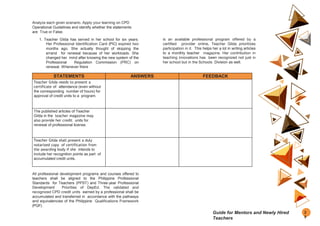
Consider also what you need to stop doing. If we quit doing all
the things that are not working and focus our efforts on those
that are, our work would not only be efficient, but much more
productive and fulfilling.
Optional Task
Pause & Reflect: Are there habits or activities that you do now
as a teacher that do not contribute to your work effectively?
Why do you think so? Input your answer here.
Key Topic 2: Development Plans
The Results-based Performance Management System Manual
for Teachers and School Heads (2018).
The DepEd released Order No. 2, s. 2015 on Guidelines on
the Establishment and Implementation of the Results-based
Performance
Management System (RPMS) in the Department of Education
following Civil Service Commission Memorandum Circular No.
06,
s. 2012 on Strategic Performance Management System
(SPMS) to warrant efficient, timely and quality performance
among personnel (RPMS Manual for Teachers and School
Heads, 2018).
To match the reform initiatives on teacher quality, the Philippine
Professional Standards for Teachers (PPST) has been
developed and nationally validated. PPST was signed into
policy by Department of Education (DepEd) Secretary Maria
Leonor Briones through DepEd Order No. 42, s. 2017 (RPMS
Manual for Teachers and School Heads, 2018).
At the beginning of the school year, each teacher is requested
to take the Self-Assessment Tool (SAT). SAT is “a common
tool for assessing teacher performance. It can be used as a
starting point for informal purposes of self-reflection to clarify
performance expectations and determine which competencies
to focus on. It can also be used to monitor the progress or
improvement of teacher competencies and validate whether
the interventions provided are effective. It can guide
discussions about goal-setting and professional development
needs (RPMS Manual for Teachers and School Heads, 2018).”
7
8
The Teacher Induction Program - Core
Course 6
As indicated in D.O. No. 2, s. 2015, the following steps shall
be applied in preparing Development Plans:
1. Identify the development
needs.
2. Set goals for meeting the development
needs.
3. Prepare action plans for meeting the development
needs such as a list of learning activities, resources
and supports, measure of successes, among other
needs.
4. Implement action
plans.
5.
Evaluate.
After taking the SAT, the teacher will draft the Development
Plan based on the results of SAT-RPMS. The teacher can
reflect on the plan as development needs the objectives that
are rated “Low”
in terms of level of capability, or “High” or “Very High” in terms
of priority for development.
The objectives rated “High” or “Very High” in terms of level of
capability can be reflected as strengths in the Development
Plan. Both the teacher and the Principal may also refer to the
Development Plans in the monitoring and coaching of the
teacher’s performance and in providing the necessary
interventions (RPMS Manual for Teachers and School Heads,
2018).”
Required Task
Make Your Own Development Plan
If you haven’t created your own development plan, now is
the time that you make one. Table 1 shows the format for
the Developmental Plan (RPMS Manual for Teachers and
School
Heads, 2018). You may do this on a separate Word
document.
Strengths Developmental
Needs
Action Plan
(Recommen
ded
Developmental
Intervention)
Timeline Resources Needed
A. Functional Competencies
B. Core Behavioral Competencies
Table 1. Format of Developmental Plan
Add a good ending topic/quotation for the end of this session/module.
For the summary of this module, add something on positive image for teachers, helping newly-hired
teachers, etc.
7
9
Guide for Mentors and Newly Hired
Teachers
Key Topic: Your Personal Professional
Improvement Plan as a Newly-hired
teacher
Since a development plan is only intended for one school year,
draft a different kind of plan for your professional improvement.
This will be your Individual Development Plan.
Your personal professional improvement plan is divided into 5
columns: teacher skill, specific actions, expected results, and
completion date.
The first part will ask you to identify the Teacher Skills that
you need to develop. Specifically, these skills may be
obtained from the PPST, which you discussed initially in Core
Course 3.
The second part focuses on Specific Actions. As you develop
those particular skills, this plan will provide you a step-by-step
procedure. It will all depend on you, so remember that you want
to develop a personal professional improvement plan that you
can practically achieve in about the time you set for yourself.
You will put your actions here in detail that will show how the
actions you will commit to do in order to master a particular
teacher skill. Again, this should be personal.
The third part of the plan is Expected Results. In this section,
you will choose what result you will observe whether or not you
are having improvement. How will you gauge that you have
indeed improved? Identifying your expected results is
important because it will help you monitor your development
toward achieving your goals. It will also make you impartial
about your improvement.
The next part of the action plan is your Resources. The
resources may include physical resources such as curriculum
developments, learner records, or supplementary materials. It
may also involve intangible resources such as mentorship,
attendance from a seminar, or conduct of an action research.
Hence, showing the resources you need that are related to
your improvement make it easier to encourage your school
heads to provide the needed resources.
This plan also asks you to identify your Completion Date. It is
significant because you don’t want to implement your plan
with indefinite time. You have to see whether your plan is
going well and if it is not, then you can have some
modification to your plan instead of continuing to perform
actions that are not yielding the results that you want to see.
Giving yourself a completion date is a way to make yourself
responsible for your plan by letting you check yourself and
evaluate your improvement.
8
0
The Teacher Induction Program - Core
Course 6
Republic of the Philippines
Department of
Education Region
CITY SCHOOLS DIVISION OFFICE OF
Teacher Skill Specific Actions Expected Results Resources Completion Date
8
1
Guide for Mentors and Newly Hired
Teachers
It is advisable that you select a mentor who will gladly monitor
your progress. Lasting change does not occur overnight. It
takes time to make changes, but the personal professional
development plan helps you to achieve your goals.
Reflective
Journals
To monitor your progress, try to have a reflective journal.
Snowman and Biehler (2000) gave two purposes of
developing a reflective journal: “(1) to serve as a repository of
instructional ideas and techniques that you have either created
from your own experiences or gleaned from other sources, and
(2) to give yourself a format for recording your observations
and reflections on teaching.”
Snowman and Biehler (2000) showed these two journal entry
samples from two teachers as presented in Figure 1.
I am a teacher. I write about my work, about
teaching, and about researching my teaching
through my journal. I enjoy writing, but
teaching must be at the center of any work
that I do; my research and writing must
directly feed my teaching. Keeping a journal
has been a realistic way for me to learn about,
inquire into, collect data about, and enhance
my practice as well as to learn about and plan
for children. Although writing in my journal
each day takes time, it is economical and is
the genre most compatible with my style of
writing, my way of teaching, and my way of
thinking.
Since 1980, I have kept some kind of
journal… I continue to keep a journal for a
variety of reasons. First and most important,
it helps me with my teaching. When used in
certain ways, the journal allows me to look
closely at the curriculum. As I teach, I
wonder how my thinking and my learners’
thinking evolve over time. I wonder what I
have valued and what the children are
interested in
and value. Lesson plans don’t tell me this, but
the journal does. My journal is a place for
planning, for raising questions, for figuring
things out, and for thinking. (507)”
After your lesson, you may
say, “It’s over,” and you may
not think about it again. But
with the reflective logs, you
are forced to sit down and
really think about what was
something significant about
the class and what did you do
about it? So, I think it
is important. Because if this
assignment wasn’t there, I
probably would just go on and
forget about the lesson, and
this is not a good thing to do.
(506)
Figure 1. Samples of Reflective
Journals
8
2
The Teacher Induction Program - Core
Course 6
Summary
• In crafting a personal professional improvement plan,
we must also perform the same things for us to have
our own professional improvement.
• The developmental needs are reflected in the
Developmental Plan.
• Reflective journals may reflect your progress.
8
3
Guide for Mentors and Newly Hired
Teachers
Congratulation
s!
You’ve come to the end of this course.
Please go to this link for the summative assessment:
Don’t forget to take a screenshot of your score.
It will be submitted to your mentor for verification and recording
purposes.
Once you’re done, kindly input your score here: Input your score here.
Additional reminder:
Compile your portfolio output/s and make sure
that your mentor has checked your
coursebook.
8
4
The Teacher Induction Program - Core
Course 6
Authorization refers to the formal evaluation of non-DepEd entities applying to become a provider of
recognized
professional development programs and/or courses for teachers.
Authorized Learning
Service Provider
refers to a non-DepEd provider that has been awarded formal, fixed term Authorization of
the National Educators Academy of the Philippines to provide professional development to
teachers within DepEd.
Continuing
Professional
Development (CPD)
refers to the inculcation of advanced knowledge, skills and ethical values in a post-licensure
specialization or in an inter- or multidisciplinary field of study, for assimilation into
professional practice, self-directed research and/or lifelong learning.
Continuing Professional
Development (CPD)
Program
refers to a set of learning activities accredited by the CPD Council such as seminars,
workshops, technical lectures or subject matter meetings, non-degree training lectures
and scientific meetings, modules, tours and visits, which equip the professionals with
advanced knowledge, skills and values in specialized or in an inter- or multidisciplinary
field of study, self-directed research and/or lifelong learning
Continuing Professional
Development (CPD)
Credit Unit
refers to the value of an amount of learning that can be transferred to a qualification
achieved from formal, informal or nonformal learning setting, wherein credits can be
accumulated to predetermined levels for the award of a qualification.
Philippine
Professional
Standards for
Teachers (PPST)
refers to the official document that articulates what constitutes teacher quality. The PPST
describes the increasing levels of knowledge, practice, and professional engagement
expected of teachers.
Philippine
Qualifications
Framework (PQF)
refers to a quality assured national system for the development, recognition, and award of
qualifications based on standards of knowledge, skills, and values acquired in different
ways and methods by learners and workers in the country.
Recognition refers to a quality assurance process intended to uphold the Learning and Development
standards in the development and delivery of professional development programs and
courses provided to DepEd teachers through an evaluation mechanism.
Teachers refers to the regular and permanent personnel in schools or learning centers “engaged in
the classroom teaching of any subject, including practical/vocational arts, at the elementary
and secondary levels of instruction including persons performing guidance and counseling,
instructional supervision in all private or public education institutions, but shall not include
school nurses, school physicians, school dentists, school administrators, and other school
administrative support employees”.
Glossar
y
8
5
Guide for Mentors and Newly Hired
Teachers
Budgeting refers to the breaking down of income into different expenses and savings
Debt refers to the amount or thing owed from an individual or an institution
Expense refers to the amount spent on anything
Financial literacy refers to the awareness and ability of a person in managing finances to make responsible
and effective decision on the flow of the finances
Health refers to the level of functional and metabolic efficiency of a living organism. In humans it
is the ability of individuals or communities to adapt and self-manage when facing physical,
mental, psychological and social changes with the environment. It encompasses a broad
spectrum. It is a state of complete physical, mental, and social well-being and not merely
the absence of disease or infirmity.
Health Awareness refers to the process that provides health related knowledge to the people for preventing
and curing disease
Healthy lifestyles/practices refers to the lifestyles/practices that contribute positively to physical, mental and social
wellbeing and which include regular exercise and physical activity to help and improve
people’s health and well-being
Income refers to the amount earned from one or many sources
Mental Health refers to the positive thoughts and ideas. Brain is a body part that deals with both emotional
and mental aspects (thoughts, perception of reality, and response to it)
Personal Goal refers to a self-motivation task which is the force that keeps pushing someone to go on. It is
the internal drive to achieve, produce, develop, and keep moving forward. It is what pushes
people to go on, especially when one thinks they are ready to quit something.
Physical Health refers to a form of the body that includes perfect and harmonious physiological functions of
all the body parts that are anatomically intact with each other
Psychological Health refers to the emotional state (feelings and moods), adaptability to circumstances, and
development of sense of meaning of life compassion, and unselfishness.
Saving refers to the amount set aside and kept for whatever financial goal
8
6
The Teacher Induction Program - Core
Course 6
Social Health refers to the ability to interact effectively with other people and can developing satisfying
relationships
Wellness refers to the state of being in optimal mental and physical health. It is a dynamic process of
change and growth. It’s about living a life full of personal responsibility and therefore taking
proactive steps for one’s entire well-being. This means that a person living life very well
controls risk factors that can harm them. It has a direct influence on overall health, which
is essential if one is trying to live a better life.
8
7
Guide for Mentors and Newly Hired
Teachers
References
A. Mason. 2019. 10 Bad Money Habits You Need to Break
Today. https://thecollegeinvestor.com/19037/10-bad-
money- habits-need-break-today/
A. Woolfolk. 2007. Educational Psychology (Tenth
Edition). Massachusetts: Pearson.
Bank of America Corporation. 2020. 8 simple ways to save
money.
https://bettermoneyhabits.bankofamerica.com/
en/saving-budgeting/ways-to-save-money
CSC Resolution No. 1100824 also known as Local
Scholarship
Program (Modified)
DepEd Order No. 66, s.2007. Revised Guidelines on the
Appointment and Promotion of Other Teaching,
Related Teaching, and Non-Teaching Positions.
Depression.org.nz. “Major Changes.” Depression and Anxiety.
Accessed June 23, 2021.
https://depression.org.nz/the- causes/major-
changes/.
Government of the Philippines, Department of Education.
2017.
DepEd Order No. 42 S. 2017 -National Adoption and
Implementation of the Philippine Professional
Standards for Teachers.
https://www.deped.gov.ph/2017/08/11/
do-42-s-2017-national-adoption-and-implementation-
of- the-philippine-professional-standards-for-teachers/
Government of the Philippines, Department of Education.
2020.
DepEd Order No. 001 S. 2020, Guidelines for NEAP
Recognition of Professional Development Programs
and Courses for Teachers and School Leaders.
https://www. deped.gov.ph/wp
content/uploads/2020/01/ DO_s2020_001.pdf
Government of the Philippines, Department of Health.
2019. Implementing Rules and Regulations of
Republic Act 11036, Otherwise Known as the
Mental Health Act.
https://www.doh.gov.ph/sites/default/files/health_
advisory/IRR%20of%20RA%2011036.pdf
Government of the Philippines, Professional Regulatory Board
for Professional Teachers. 2017. Resolution No. 11,
Series of 2017,Operational Guidelines in the
Implementation of RA 10912, Otherwise Known as
“Continuing Professional Development (CPD) Act of
2016” for Professional Teachers.
https://www.prc.gov.ph/sites/default/files/
resoProfTeachers2017-11.pdf
Government of the Philippines. 1994. Republic Act 7784, An
Act to Strengthen Teacher Education in the
Philippines by Establishing Centers of Excellence,
Creating a Teacher Education Council for the
Purpose, Appropriating Funds Therefor, and for
Other Purposes.
https://www.officialgazette.gov.ph/1994/08/04/repub
lic- act-no-7784/
Government of the Philippines. 1994. Republic Act 7836, An
Act to Strengthen the Regulation and Supervision of
the Practice of Teaching in the Philippines and
Prescribing a Licensure Examination for Teachers
and for Other Purposes.
https://www.pcw.gov.ph/law/republic-
act-7836
Government of the Philippines. 2016. Republic Act 10912,
Act Mandating the Continuing Professional
Development Program for All Regulated
Professions, creating the Continuing Professional
Development Council. https://
www.officialgazette.gov.ph/2016/07/21/republic-
act- no10912/
Government of the Philippines. 2017. Implementing
Rules and Regulations of Republic Act No.
10968, An Act
Institutionalizing the Philippine Qualifications
Framework (PQF), Establishing the PQF-National
Coordinating Council (NCC) and Appropriating Funds
Therefor.
https://www.officialgazette.gov.ph/2019/01/15/
implementing-rules-and-regulations-of-republic-act-
no-10968/
Greenstein, Laura. 2017. 9 Ways to Fight Mental Health
Stigma.
National Alliance on Mental Illness. Retrieved from:
https://www.nami.org/blogs/nami-blog/october-
2017/9- ways-to-fight-mental-health-stigma
8
8
The Teacher Induction Program - Core
Course 6
House Bill 8384. The Expanded Magna Carta For Public
School Teachers, and For Other Purposes
J.E. Ellis. 2008. Educational Psychology: Developing
Learners (Sixth Edition). Massachusetts: Pearson
Prentice Hall.
Jackson, Robyn. 2009. Never Work Harder Than Your
Students & Other Principles of Great Teaching.
Alexandria,
VA: Association for Supervision and
Curriculum Development.
Kottler, Ellen, Kottler; Kottler, Jeffrey; and Kottler, Cary. 1998.
Secrets for Secondary School Teachers: How to
Succeed in Your First Year. California: Corwin Press,
Inc.
L. Bonser. 2014. What is Financial Stewardship?. https://
www.lauriebonser.com/2014/05/16/what-is-
financial- stewardship/
Littky, Dennis. (2004). The Big Picture: Education Is
Everyone’s Business. Virginia: Association for
Supervision and Curriculum Development.
Malipot, Merlinda. May 1, 2018. DepEd convenes
employee associations to promote welfare,
development.
Manila Bulletin. Retried from: https://news.mb.com.
ph/2018/05/01/deped-convenes-employee-
associations- to-promote-welfare-development/
Mental Health Foundation. Stress. Retrieved from:
https://www. mentalhealth.org.uk/a-to-
z/s/stress#:~:text=Stress%20
can%20be%20defined%20as,of%20pressures%20
that%20are%20unmanageable.
Money Management International. 2015. Financial Literacy:
Your 30 Step Path to Financial Wellness.
https://www. moneymanagement.org/
/media/ebooks/30-step-path-to-financial-
wellness.ashx
N.K. Pandey and A. Saxena. 2015. Teacher’s
Occupational Stress: A Review Study in National
& International Scenario. International Journal of
Organizational Behaviour & Management
Perspectives, Pezzottaite
Journals. 4 (2). https://www.researchgate.net/
publication/281834645_
Teacher’s_Occupational_Stress_A_Review_Study
_in_ National_International_Scenario
National Center for Complementary and Integrative Health. 5
Things to Know About Relaxation Techniques for
Stress. https://nccih.nih.gov
/health/tips/stress
Nieto, Sonia. 2003. What Keeps Teachers Going? New
York: Teachers College Press.
Professional associations. The University of Sydney. (n.d.).
https://www.sydney.edu.au/careers/students/career-
advice-and-development/professional-
associations.html.
Results-based Performance Management System Manual
for Teachers and School Heads. 2018.
Department of Education.
Robbins, Mel. 2011. “How to Stop Screwing Yourself
Over?” Filmed June 2011.
S. Lipscomb. 2019. Understanding Needs vs. Wants for your
Budget. https://smartasset.com/financial-
advisor/needs- vs-wants
Serido, Joyce, David M. Almeida, and Elaine Wethington.
“Chronic Stressors and Daily Hassles: Unique and
Interactive Relationships with Psychological
Distress.” Journal of Health and Social Behavior 45,
no. 1 (2004): 17-33. Accessed June 23, 2021.
http://www.jstor.org/ stable/3653802.
Snowman, Jack & Biehler, Robert. 2000. Psychology
Applied to Teaching (Ninth Edition).
Massachusetts: Houghton Mifflin Company.
8
9
T.C. Rosenberg. 2010. Teacher stress: An assessment of
teachers’ need for and receptiveness towards a
stress reduction program within one rural school
system. Educational Specialist.
https://commons.lib.jmu.edu/ edspec201019/98
Guide for Mentors and Newly Hired
Teachers
Tracy, Brian. 2016. Master Your Time, Master Your Life:
The Breakthrough System to Get More Results,
Faster, in Every Area of Your Life. New York:
Tarcher Perigee.
Urban, Tim. 2016. “Inside the Mind of a Master
Procrastinator.” Filmed February 2016.
Books:
A. Liuson. 2015. The Debt Free Lifestyle: Ten Principles that
Can Revolutionize Your Life. Makati City: Church
Strengthening Ministry.
V. Rapisura. 2016. (L)earning Wealth: Successful Strategies in
Money Management. Quezon City: SEDPI.
Modules:
Department of Education. 2018. Teacher Induction
Program. Department of Education - National Capital
Region. 2018.
Competency-Based Learning Materials.
Website:
https://www.youtube.com/watch?v=s93ywqFa6CM
https://www.deped.gov.ph/wp-content/uploads/2007/09/DO_
s2007_066-1.pdf
https://www.ted.com/talks/mel_robbins_how_to_stop_screwin
g_ yourself_over?language=en
https://www.ted.com/talks/tim_urban_inside_the_mind_of_
a_ master_procrastinator
9
0
The Teacher Induction Program - Core
Course 6
Department of Education
National Educators
Academy of the
Philippines
Dir. John Arnold S. Siena
Teacher Education Council
Ms. Anna Marie San Diego Dir. Runvi V. Manguerra
Officer-in-charge, Professional
Development Division (PDD)
Ms. Donnabel Bihasa
Ms. Ana-Sol Reyes
Senior Education Program
Specialist, TEC
Secretariat
Senior Education
Program Specialist,
NEAP-PDD
Mr. Jayson Peñafiel
Mr. Jerson Capuyan
Education Program
Specialist, TEC
Secretariat
Education Program Specialist
II, NEAP-PDD
Acknowledgments
Philippine National Research Center for Teacher Quality
Dir. Gina O. Gonong
Dr. Levi E. Elipane
Senior Program Manager II
Ma. Izella D. Lampos
Project Officer
Jeanny S. Burce
Research Officer
UNE-SiMERR
Dr. Joy Hardy
Deputy Director
Technical Working Group
Ricardo Ador Dionisio Warren Quisada Angelo Uy
Marie Flo M. Aysip Jeanette Alvarez Jeaz DC Campano
Ian Harvey Claros Alfredo G. Desamparo, Jr. Jerome Hilario
Charito N. Laggui Gayle Malibiran Khristian Ross Pimentel
Josefino C. Pogoy, Jr. Chinita Tolentino Jennifer F. Vivas
9
2
The Teacher Induction Program - Core
Course 6
Validators
Ricky Agbay
Ma. Agie Amar
Jonathan Baniaga
Ms. Noemi Baysa
Alma Belarmino
Rageene Vera
Dueñas Nerio
Benito Eseo
Zenylou Frias
Clarivil S. Layug
Carlos B. Llamas III
Jeanrick Deuna
Nuñez Maribel Perez
Beverlyn Ramirez
Frankie Delos Santos
Marie Eugenie Soriano
Marina Tagsip
Ma. Sonia A. Tomalabcad
Reggie Tuazon
Gladys Uy
Maria Lourie
Victor
Support Team
Ruth Mae Ellorin
Layout Artist
Aris L. Solis
Layout Artist
Roy Benson
NEAP ICT Technical Support
Pilot Testing Participants
Region IV-A
Division of Cavite
Division of Quezon
Division of
Batangas
Region VI
Division of Iloilo
Division of Negros
Occidental
Division of Antique
Region VII
Division of
Bohol Division
of Cebu
Division of Negros Oriental
9
3
Guide for Mentors and Newly Hired
Teachers
New-TIP-Course-6-DepEd-Teacher.pptx

New-TIP-Course-6-DepEd-Teacher.pptx

  • 1.
    • http://w ww. gbooksdownloade r. com/ 6 in collaborationwith Philippine National Research Center for Teacher Quality Teacher Induction Program (TIP) CORE COURSE Teachers’ Professional and Personal Development
  • 2.
    Course 6: Teachers’ Professional and Personal Development HISCOURSE EMPHASIZES the value of teachers’ professional and personal development. Introduction TIt will help you better understand the importance of continuing professional development and participating in professional networks to share and enhance your knowledge and practices. It presents the policies on promotion and opportunities for progression available for teachers in the department. You will also know about how to maintain your personal development and well- being. As the last course in the TIP, it will help you adopt practices that will sustain your professional and personal development.
  • 3.
    Intended Course LearningOutcomes At the end of this course, you should be able to: 1. be familiar, and eventually comply with the guidelines on continuing professional development, career progression, and promotion, 2. participate in professional networks to share knowledge and to enhance practice towards continuing professional development (7.3.2), and 3. adopt practices that uphold the dignity of teaching as a profession through professional and personal development (7.2.2). Course Outline: Module 1: Salaries, Wages, and Benefits of Teachers Module 2: Continuing Professional Development Module 3: Policies on Promotion and Opportunities for Progression Module 4: Personal Development and Well-being Module 5: Developing a Personal Professional Improvement Plan Estimated time required: 5 hours Portfolio Output: Professional Development Plan
  • 4.
    Module 1 –Salaries, Wages, and Benefits of Teachers Intended Module Learning Outcomes At the end of this module, you should be able to: 1. become aware of existing laws and regulations that apply to the teaching profession; 2. become familiar with the responsibilities specified in the Code of Ethics for Professional Teachers, (6.3.1); and 3. regularly review personal teaching practices using existing laws and regulations that apply to the teaching profession and the responsibilities specified in the Code of Ethics for Professional Teachers. (6.3.2) Module Outline Session 1: Salary and Allowances of Teachers Session 2: Incentives and Benefits of Teachers Session 3: Leave of Absence of Teachers Session 4: Other Benefits Estimated Time Required: 1 hour Required Tasks • Developmental activities: Learning assessments and testing prior knowledge • Scenario and case analysis • Document reading Required Resources Government of the Philippines, Department of Education. Statement on the Appeal to Provide Leave Benefits for Teachers during the School Year. Accessed August 25, 2020. https://www.deped.gov. ph/2018/10/03/statement-on-the-appeal-to-provide- leave-benefits-for-teachers-during-the-school-year/ Government of the Philippines, DepEd Order No. 64, s. 1996 on Implementing Rules and Regulations of Republic Act no. 8187 (The Paternity Leave Act of 1996). Government of the Philippines, Department of Budget and Management, NBC No. 514, s. 2007, Guidelines on Grant of Hardship Allowance. Manila, 2007. Government of the Philippines, Official Gazette of the Republic of the Philippines. Performance-Based Incentive System: Frequently Asked Questions: GOVPH. Accessed August 25, 2020. https://www.officialgazette.gov.ph/pbb/faqs/ Government of the Philippines, Official Gazette of the Republic of the Philippines. CSC Memorandum Circular No. 2, 2012: GOVPH. February 16, 2012. https://www. officialgazette.gov.ph/2012/02/16/csc- memorandum- circular-no-2-2012/ Government of the Philippines, Civil Service Commission, MC No. 41, s. 1998. Amendments to Rules I and XVI of the Omnibus Rules Implementing Book V of the Administrative Code of 1987 (Executive Order 292); Manila City, 1998. 4 The Teacher Induction Program - Core Course 6
  • 5.
    Optional Task: Survey Pleasecomplete this short survey. This is an optional task but it will help you reflect on your current understanding of the different remunerations you will receive relative to the performance of your duties and responsibilities as a teacher. How familiar are you with the following? Check the appropriate box that corresponds to your answer. Key Topics Very famili ar Familia r Slightl y famili ar Not famili ar Key Topics Very famili ar Familia r Slightl y famili ar Not famili ar Basic Salary Scholarship Grant PERA Maternity Leave Mid-Year Bonus Paternity Leave Year-End Bonus Parental Leave Cash Gift Sick Leave Anniversary Bonus Indefinite Sick Leave Loyalty Pay Vacation Leave PEI Special Leave Privileges PBB Study Leave Clothing Allowance Rehabilitation Leave Cash Allowance Ten (10) days Leave Special Hardship Allowance Special Emergency Leave Step Increment Terminal Leave Proportional Vacation Pay Special Leave Benefits 5 Guide for Mentors and Newly Hired Teachers
  • 6.
    Session 1 –Salary and Incentives of Teachers Key Topic 1: Salary and Allowances of Teachers What are the salary and allowances of the teacher? How can a teacher avail these? The tables below illustrate in detail the salary and allowances of teachers. They describe the amount, frequency, qualification, and the legal bases for further (optional) readings. Teachers in the public school are provided with just compensation as follows: Benefit Monthly Basic Pay Description: Monthly basic pay shall refer to the monthly salary for regular and contractual civilian personnel; the total daily wages for the twenty- two (22) working days a month for casual personnel (equal to the monthly salary of a regular personnel). Amount Please refer to National Budget Circular (NBC) No. 579 dated January 24, 2020 Annex “A” Frequency Monthly Qualification This Circular covers all positions for civilian personnel, whether regular, casual, or contractual in nature, appointive or elective, full-time or part-time, now existing or hereafter created in the Executive, Legislative, and Judicial Branches, the Constitutional Commissions and other Constitutional Offices, SUCs, and GOCCs not covered by RA No. 10149 which are under the jurisdiction of the Department of Budget and Management (DBM). Legal Bases National Budget Circular No. 579 dated January 24, 2020 Annex “A” Benefit Personnel Economic Relief Allowance (PERA) Description: The Personnel Economic Relief Allowance (PERA) is a subsidy granted to all government workers as a form of assistance to help make ends meet in the face of economic crisis as well as higher prices. Amount PhP 2,000.00 (Subject to Tax) Frequency Monthly Qualification The PERA shall be paid only when basic pay (salary, wage, or base pay) is also paid. Legal Bases DBM NBC No. 2009-3 dated August 18, 2009 6 The Teacher Induction Program - Core Course 6
  • 7.
    Benefit Special HardshipAllowance Description: Special Hardship Allowance refers to the allowance granted to qualified teachers under any of the following situations: (1) being assigned to hardship post; (2) performing multi-grade teaching; (3) carrying out mobile teaching functions; or (4) performing functions of non-formal education (now Alternative Learning System) coordinators. The qualified teachers may either be resident or transient having regular or temporary appointments. Amount At least twenty-five per cent of a teacher’s monthly salary. (Subject to Tax) Qualification Guidelines on the Grant of Special Hardship Allowance shall apply to the following personnel of the Department of Education: (National Budget Circular No. 514 dated December 5, 2007) • Classroom teachers in elementary and secondary schools and school heads/administrators assigned to a hardship post; • Multi-grade teachers; • Mobile teachers; and • Non-formal Education or Alternative Learning System (ALS) Coordinators. Legal Bases Republic Act No. 4670 June 18, 1966 National Budget Circular No. 514 dated December 5, 2007 Benefit Uniform/Clothing Allowance Description: The uniform/clothing Allowance (UCA) authorized under the pertinent general provision of the annual General Appropriations Act (GAA) is granted to cover the cost of uniform/clothing of government employees to identify them with their mother agency/office. Amount PhP 6,000.00 (Subject to Tax) Frequency Annually Qualification Covers civilian government personnel occupying regular, contractual, or casual positions; appointive or elective; rendering services on full-time or part-time basis. A newly hired employee may qualify for the grant of Clothing Allowance only after rendering six (6) months of service, and if expected to render service for at least 6 months for the rest of the year. Legal Bases DBM Budget Circular (BC) No. 2012-1 dated February 23, 2012 7 Guide for Mentors and Newly Hired Teachers
  • 8.
    Benefit Cash/Chalk Allowance Description:This allowance is intended to augment the expenses incurred/spent by teachers in the actual performance of their teaching responsibilities. Amount PhP 3,500.00 Frequency Annually Qualification The Cash Allowance shall be granted to all permanent and provisional teachers, including Alternative Learning System (ALS) Mobile Teachers and District ALS Coordinators (DALSCs), in all public elementary, junior, and senior high schools, and community learning centers, who are in service in DepEd for the current school year, and assigned with at least one teaching load. Legal Bases DepEd Order No. 010, s. 2020 dated June 8, 2020 Required Task 1: Learning Assessment Respond to the situation-based questions below. Write down your answer/s on the space provided and discuss it with your mentor. Scenario 1: Teacher Belgira is a newly hired teacher at St. Francis National High School. According to the principal, he will receive his first monthly salary soon. Aside from his monthly salary, what other monetary compensation is he entitled to as a teacher in a public school? Scenario 2: Teacher Annie, a newly hired teacher, was assigned as a multi-grade Teacher at Sitio Pag-asa Elementary School. What monetary compensation is she entitled to as a teacher in a public school? 8 The Teacher Induction Program - Core Course 6
  • 9.
    Session 2 –Incentives and Benefits of Teachers Key Topic 1: Incentives and Benefits of Teachers The table below illustrates in detail the incentives and benefits of teachers. It provides a short description of the benefit to be received or availed by the teacher, the amount, frequency, qualifications, and the legal bases for further (optional) readings. Teachers in the public schools are rewarded with incentives as follow: Benefit Mid-Year Bonus Description This is equivalent to one (1) month basic pay as of May 15 and shall be given to entitled personnel not earlier than May 15 of the current year. Amount One (1) month basic salary Frequency Annually Qualification The Mid-Year Bonus, equivalent to one (1) month basic salary as of May 15 of a given year, shall be granted to those who have rendered at least four (4) months of satisfactory service and are still in the service as of same date, to be given not earlier than May 15 of every year, subject to the rules and regulations provided under Budget Circular (BC) No. 2017-2 dated May 8, 2017. Legal Bases Budget Circular No. 2017-2 dated May 8, 2017 National Budget Circular No. 579 dated January 24, 2020 Benefit Year-End Bonus and Cash Gift Description: The existing Year-End Bonus, equivalent to one (1) month basic salary and Cash Gift of PhP 5,000.00 which are categorized under the Standard Allowances and Benefits component of the Total Compensation Framework (TCF), shall be given in November of every year. Amount One (1) month basic salary + PhP 5,000.00 Frequency Annually Qualification The Year-End Bonus, equivalent to one (1) month basic pay as of October 31 of the year and the Cash Gift at PhP 5,000.00, shall be granted to each personnel who has rendered at least a total or an aggregate of four (4) months of service from January 1 to October 31 of the year, including leaves of absence with pay, and who is still in the service as of October 31 of the same year. Legal Bases Republic Act No. 6686, as amended by Republic Act No. 8441 National Budget Circular No. 579 dated January 24, 2020 9 Guide for Mentors and Newly Hired Teachers
  • 10.
    Benefit Productivity EnhancementIncentive (PEI) Description Productivity Enhancement Incentive is the across-the-board bonus equivalent to either PhP 5,000.00 or one (1) month basic salary, which shall be granted to government personnel of the agencies which meet the conditions stipulated in EO No. 181, s. 2015. Amount PhP 5,000.00 which shall continually be granted across-the-board. Frequency Annually Qualification • Civilian government employees occupying regular, contractual, or casual positions; appointive or elective; rendering services on a full-time or part time basis. • The employees are still in the service as of October 31 of the year. • The employees have rendered at least a total or an aggregate of four (4) months of at least satisfactory service for the year, including leaves of absence with pay, to be entitled to the full amount of the PEI. • Those who have rendered less than the total or aggregate of four (4) months of service shall be entitled to prorated PEI. Legal Bases DBM Budget Circular No. 2013-3 dated November 21, 2013 DBM Budget Circular No. 2014-3 dated December 02, 2014 DepEd Memorandum No. 65, s. 2015 dated June 23, 2015 Benefit Performance-Based Bonus (PBB) Description The PBB is a bonus introduced via the Performance-Based Incentive System (PBIS), shall be given to employees based on their contribution to the accomplishment of their Department’s overall targets and commitments. Each agency must satisfy conditions e.g. good governance conditions, procurement requirements, among others, to be eligible for the grant of PBB. Amount Performance Category PBB as % of Monthly Basic Salary Best Delivery Unit – 65% Better Delivery Unit – 57.5% Good Delivery Unit – 50% (Subject to Tax) Frequency Annually (reliant to the performance of a government agency) Qualification • An official or employee who has rendered a minimum of nine (9) months of actual service during the current rating period, and with at least “Satisfactory” performance rating may be eligible for the full grant. • An official or employee who rendered less than nine (9) months but a minimum of three (3) months of actual service during the current rating period, and with at least “Satisfactory” performance rating 1 0 The Teacher Induction Program - Core Course 6
  • 11.
    Benefits Anniversary Bonus DescriptionAnniversary Bonus is a financial incentive authorized under Administrative Order No. 263 dated March 28, 1996, to be granted to government employees on the occasion of their agencies’ milestone years. Amount PhP 3,000.00 Frequency The Anniversary Bonus shall be granted only during milestone years and shall be received by the employee only once every 5 years, regardless of transfer from one government entity to another. A milestone year refers to the 15th anniversary and to every 5th year thereafter. Qualification All government personnel whether employed on full time or part time bases, under permanent, temporary or casual status, elective or appointive, including contractual personnel whose employments are in the nature of regular employees who have rendered at least 1 year of service in the same agencies as of the date of milestone years and continue to be employed in the same government entities as of the occasion of their milestone anniversaries. Legal Bases Administrative Order No. 263 dated March 28, 1996 National Budget Circular No. 452 dated May 20, 1996 Benefits Loyalty Award Description The Loyalty Award is granted to all officials and employees, in the national and local government who rendered ten (10) continuous and satisfactory service in the government, and 5 years thereafter. Amount 10th year: PhP 10,000.00 20th year: PhP 5,000.00 30th year: PhP 5,000.00 15th year: PhP 5,000.00 25th year: PhP 5,000.00 35th year: PhP 5,000.00 40th year: PhP 5,000.00 Frequency Qualification The Loyalty Award is granted to all officials and employees, in the national and local governments, including those in the state universities and colleges (SUCs) and government owned and controlled corporations (GOCCs) with original charter, who rendered ten (10) continuous and satisfactory service in the government. Legal Bases CSC MC No. 06, s. 2002 Commission on Audit Circular No. 2013-003 dated January 30, 2013 1 1 Guide for Mentors and Newly Hired Teachers
  • 12.
    Required Task 1:Check your understanding Respond to the scenarios below. Write down your answer/s on the space provided and discuss it with your mentor. Scenario Explanation Scenario 1. There are three (3) newly hired teachers in San Vicente Elementary School. Teacher Valdez started on June 5, 2020; Teacher De Guzman started on August 7, 2020; and Teacher Camat started on October 8, 2020. Who among the three teachers is/are qualified to receive a 2020 Year- End Bonus? Explain your answer. Scenario 2. Teacher Elegado is a teacher in San Antonio Senior High School. Based on the assessment, her school ranked as “Better Delivery Unit.” How much Performance- Based Bonus (PBB) will she receive? (please refer to National Budget Circular No. 579 dated January 24, 2020 Annex “A”) Scenario 3: Teacher Corpuz, a public school teacher, heard that his co- teacher Teacher Alferez just received PhP 10,000.00 Loyalty Pay. He is expecting the same; but according to the principal, he is not qualified. If you were the principal, how would you explain it to Teacher Corpuz? Scenario 4: Teacher Tagayon is a newly hired teacher in Timbao Elementary School. Her first day of service was November 12, 2019. Is she entitled to receive Cash Allowance for the school year 2020? Explain your answer. 1 2 The Teacher Induction Program - Core Course 6
  • 13.
    Session 2 –Leave of Absence of Teachers Key Topic 1: Leave of Absence of Teachers Teachers are given leave of absence benefits to promote work- life balance. They need to restore productivity when they return to work. Listed below are the different leaves of absence that a teacher in a public school can avail. The legal bases are also provided for further (optional) readings. Proportional Vacation Pay (PVP) For SY 2019-2020, each teacher who has rendered continuous service from June 3, 2019 to April 3, 2020 shall be entitled to 80 days total of PVP from Summer and Christmas vacation days. (DepEd Memorandum No. 049, s. 2020 dated April 30, 2020) Maternity Leave One hundred five (105) days for female workers with an option to extend for an additional thirty (30) days without pay, and granting an additional fifteen (15) days for solo mothers, and for other purposes. You can avail of maternity leave in every instance of pregnancy regardless of the frequency. You can avail yourself of this maternity leave even if the delivery or miscarriage happens to fall during the 2-month long vacation. You can claim for both the maternity benefits and the proportional vacation pay. (Republic Act No. 11210 dated May 1, 2019) Paternity Leave It refers to the privilege granted to a married male employee allowing him not to report for work for seven (7) days while continuing to earn the compensation. Seven (7) days with full pay for the first four (4) deliveries of the legitimate spouse with whom he is cohabiting and for other purposes. The same may be enjoyed either in a continuous or in an intermittent manner by the employee on the days immediately before, during, and after the child birth or miscarriage of his legitimate spouse. Said leave shall be availed of not later than sixty (60) days after the date of the child’s delivery. (Republic Act No. 8187 or Paternity Leave Act of 1996, DO 65, S. 1996, MC No. 01, s. 2016) Parental Leave This refers to leave benefits granted to a solo parent to perform parental duties and responsibilities where physical presence is required. The solo parent must have rendered government service for at least one (1) year, whether continuous or broken, reckoned at the time of the effectiveness of RA No. 8972 on September 22, 2002 and regardless of employment status. (Civil Service Commission Memorandum Circular No. 08, s. 2004) Special Privilege Leave It is a leave of absence which may be available for a maximum of three (3) days annually to mark special milestones and/or attend to filial and domestic emergencies such as birthday, anniversary, mourning, PTA meetings, etc. Special leave privilege may be availed of by the official/employee when the occasion is personal to him and that of his immediate family. You are not entitled to these types of leave of absence because as a teacher, you are enjoying a 2-month long vacation. (MC No. 06, s. 1999 dated March 9, 1999) Sick Leave A type of leave of absence which is granted on account of sickness or disability of the employees or any member of their family (parents, brothers, sisters, children, spouse and even house help who are living with the employees). Teachers who render work during the prescribed office hours and do not enjoy the 2 months’ summer vacation shall be entitled to a 15-day vacation and 15-day sick leave every year. As a teacher, you can avail of the sick leave with pay if such leave will be charged against your accrued service credits. You earn service credits if you render services during summer, Christmas vacation, or holidays as authorized by proper authorities. The number of days of service credits granted to a teacher shall not exceed 15 work days in one year except in cases authorized by the 1 3 Guide for Mentors and Newly Hired Teachers
  • 14.
    Secretary upon therecommendation of the Regional Director. (Republic Act No. 4670 dated June 18, 1966) Indefinite Sick Leave It is a leave of absence that shall be granted to teachers when the nature of the illness demands a long treatment that will exceed one year at the least. Application for sick leave in excess of five (5) successive days shall be accompanied by a proper medical certificate. (Republic Act No. 4670 dated June 18, 1966) Vacation Leave Teachers who render work during the prescribed office hours and do not enjoy the 2-months summer vacation shall be entitled to 15-day vacation leave every year. (Republic Act No. 4670 dated June 18, 1966) Study Leave Teachers in the public schools shall be entitled to study leave not exceeding one school year after seven years of service. Such leave shall be granted in accordance with a schedule set by the Department of Education. A teacher shall be entitled to at least 65% of his monthly salary provided he or she takes regular study load and passes at least 75% of the courses. Study leave of more than one year shall be permitted by the DepEd Secretary but without compensation. (Republic Act No. 4670 dated June 18, 1966) Rehabilitation Leave This is granted to employees for disability on account of injuries sustained while in the performance of duty. The duration, frequency, and terms of availing this leave shall be based on the recommendation of the medical authority i.e. maybe half day basis, intermittent schedule or less than six (6) months, but not to exceed six (6) months and their absences shall not be deducted from the sick and vacation leave credits. (CSC DBM Joint Circular No. 01, s. 2006 dated April 27, 2006) Special Emergency Leave It is a 5-day leave granted to those employees directly affected by natural calamities and disasters. (CSC Resolution No. 1200289 dated February 8, 2012) Special Leave Benefits for Women Special Leave Benefits are for qualified female public sector employees who have undergone surgery caused by gynaecological disorders’ pursuant to the provision and implementing rules and regulations of the Magna Carta of Women. A woman-employee who has rendered continuous aggregate employment service of at least six (6) months for the last twelve (12) months shall be entitled to a special leave benefit of two (2) months with full pay based on her gross monthly compensation following surgery caused by gynaecological disorders. Gynecological disorders refer to disorders that would require surgical procedures such as, but not limited to dilatation and curettage and those involving female reproductive organs such as the vagina, cervix, uterus, fallopian tubes, ovaries, breast, adnexa and pelvic floor, as certified by a competent physician. For purposes of the Act and these Rules and Regulations, gynaecological surgeries shall also include hysterectomy, ovariectomy, and mastectomy. (Section 18, Republic Act 9710) Violence Against Women and their Children 10-day Leave (RA No. 9262) Any woman-employee in the government service, regardless of employment status and/or whose child is a victim of violence and whose age is below eighteen (18) or above eighteen (18), but unable to care of oneself, is entitled to avail of the ten (10) days leave. It may be in a continuous or intermittent manner to cover the days they have to attend to medical and legal concerns. (Section 43, Republic Act 9262, MC No. 15, s. 2006) 1 4 The Teacher Induction Program - Core Course 6
  • 15.
    Required Task 1:Check your Understanding Respond to the scenario below. Write down your answers on the space provided below and discuss them with your mentor. Limit your responses to 100 words per scenario. Scenario 1: Teacher Lani, a Senior High School Teacher, gave birth to her fifth child. Can she avail of maternity leave? If yes, how long? Will she still receive a salary even if she is on leave for a reason already mentioned? Explain your answer. Scenario 2: One of the teachers in Dela Paz Elementary School was suffering from domestic violence. Allegedly, her husband was having an affair with other women, resulting in the withdrawal of financial support for their three (3) children. The teacher wants to take some time off to file a case against her husband, but she is worried that she has already incurred too many absences, leaving her with no more service credits. What will you advise the teacher? 1 5 Guide for Mentors and Newly Hired Teachers
  • 16.
    Scenario 3: TeacherAnthony is a Technical-Vocational- Livelihood (TVL) teacher in Sto. Tomas Senior High School. During his demonstration teaching, an accident happened due to a short circuit. He was rushed to the hospital. The doctor advised him to leave work for 2 weeks. What benefits is he entitled to? 1 6 The Teacher Induction Program - Core Course 6
  • 17.
    Required Task 2: Matchthe leave benefits of teachers to their approved days of leave of absence. Write the letter that corresponds to your answer on the line provided for before each item. Some answers can be used twice. 1. Maternity Leave A. 7 days 2. Paternity Leave B. 5 days 3. Parental Leave C. 3 days 4. Sick Leave D. 10 days 5. Special Leave Benefits for Women E. 15 days 6. Leave (Violence Against Women and their Children Act of 2004) F. 6 months to 1 year 7. Special Leave Privileges G. Less than 6 months 8. Study Leave H. 2 months 9. Rehabilitation Leave I. 105 days 10. Special Emergency Leave 1 7 Guide for Mentors and Newly Hired Teachers
  • 18.
    Session 3: Other Benefits KeyTopic 1: Other Benefits Aside from salaries, allowances, incentives, and leaves of absence, here are other benefits that a teacher in a public school can avail. The legal bases are also included for further (optional) readings. 1. Step Increment- An employee may progress from Step 1 to Step 8 of the salary grade allocation of his/her position in recognition of meritorious performance based on a Performance Management System approved by the CSC and/or through length of service, in accordance with the rules and regulations to be promulgated jointly by the DBM and the CSC. • A one (1) step increment shall be granted to officials and employees for every 3 years of continuous satisfactory service in their present positions. • Two (2) Step Increments due to Meritorious Performance may be granted to a qualified official or employee who has attained two (2) ratings of “Outstanding” during two (2) rating periods within a calendar year. • One (1) Step Increment due to Meritorious Performance may be granted to a qualified official or employee who has attained one (1) rating of “Outstanding” and one (1) rating of “Very Satisfactory,” or two (2) ratings of “Very Satisfactory” during the two (2) rating periods within a calendar year. • (CSC DBM Joint Circular No. 1, s. 2012 dated September 3, 2012) 2. Automatic Upgrading of Positions for Eligible Public School Teachers through Equivalent Records Form (ERFs) Scheme. Automatic position upgrading is granted to Teachers I who have rendered 20 years or more of satisfactory teaching service without the need for filling an application for ERF upgrading. (DO 52, s. 1999 dated May 12, 1999) 3. Scholarship Grant. The Department of Education (DepEd) fully supports the continuous development of its manpower to improve performance through scholarship/ fellowship and training grants local and overseas among others. The guidelines shall be observed in identifying nominees stipulated in DepEd Order No. 68, s. 2009. 4. Medical Examination and Treatment. Compulsory medical examination shall be provided free of charge for all teachers before they take up teaching, and shall be repeated not less than once a year during the teacher’s professional life. Where medical examinations show that medical treatment and/or hospitalization is necessary, the same shall be provided free by the government entity paying the salary of the teachers. (Republic Act No. 4670 dated June 18, 1966) 5. Compensation for Injuries. Teachers shall be protected against the consequences of employment injuries in accordance with existing laws. The effects of the physical and nervous strain on the teacher’s health shall be recognized as a compensable occupational disease in accordance with existing laws. (Republic Act No. 4670 dated June 18, 1966) 6. Salary Increase upon Retirement. Public school teachers having fulfilled the age and service requirements of the applicable retirement laws shall be given one range salary raise upon retirement, which shall be the basis of the computation of the lump sum of the retirement pay and the monthly benefits thereafter. (Republic Act 4670 dated June 18, 1996) 7. Terminal Leave. It refers to the money value of the total accumulated leave credits of an employee based on the highest salary rate received prior to or upon retirement date/voluntary separation. (MC No. 41, s. 1998 dated December 24, 1998) 1 8 The Teacher Induction Program - Core Course 6
  • 19.
    Summary The focus ofthis module is on the salaries, incentives, leaves of absence, and benefits of teachers in public schools. Among the privileges are as follow: • Basic Salary • Maternity Leave • Personnel Economic Relief Allowance (PERA) • Paternity Leave • Mid-Year Bonus • Parental Leave • Year-End Bonus • Sick Leave • Cash Gift • Indefinite Sick Leave • Anniversary Bonus • Vacation Leave • Loyalty Pay • Special Leave Privileges • Productivity Enhancement Incentive (PEI) • Study Leave • Performance-Based Bonus (PBB) • Rehabilitation Leave • Clothing Allowance • Ten (10) days Leave • Cash Allowance • Special Emergency Leave • Special Hardship Allowance • Special Leave Benefits for Women • Step Increment • Terminal Leave • Proportional Vacation Pay (PVP) • Scholarship Grant • Salary Increase Upon Retirement • Medical Examination and Treatment • Automatic upgrading of Positions through ERF’s scheme • Compensation for Injuries 1 9 Guide for Mentors and Newly Hired Teachers
  • 20.
    Required Task: ReflectionQuestion (Portfolio Output) The Department of Education values the vital role of teachers in nurturing the holistic being of the learners to become productive citizens of the nation. It ensures teachers just compensation, incentives, benefits, and rewards for them to live a decent life. As a new member of the DepEd family, how can you show appreciation to this effort of the government? 2 0 The Teacher Induction Program - Core Course 6
  • 21.
    Module 2 –Continuing Professional Development Intended Module Learning Outcomes At the end of this module you should be able to: 1. understand the guidelines on continuing professional development (CPD), career progression and promotion; 2. assess one’s credential and practice in view of the CPD requirements; and 3. craft a Professional Development Plan based on learning needs. Module Outline Session 1 – Republic Act 10912: Continuing Professional Development (CPD) Act of 2016 Session 2 – Resolution No. 11, s. 2017: Operational Guidelines in the Implementation of RA 10912 for Professional Teachers Estimated Time Required: 1 hour Required Tasks The following are the tasks in this module: 1. Reflection 2. Enumeration Activity 3. Reading 4. Preparing a Professional Development Plan Required Resources DepEd Order No. 001, s. 2020 on Guidelines for NEAP Recognition of Professional Development Programs and Courses for Teachers and School Leaders. (https:// www.deped.gov.ph/wp- content/uploads/2020/01/DO_ s2020_001.pdf) Implementing Rules and Regulations of Republic Act No. 10968 on An Act Institutionalizing the Philippine Qualifications Framework (PQF), Establishing the PQF-National Coordinating Council (NCC) and Appropriating Funds Therefor. (https://www.officialgazette. gov.ph/2019/01/15/implementing-rules-and-regulations- of- republic-act-no-10968/) Resolution No. 11, s. 2017 on Operational Guidelines in the Implementation of RA 10912, Otherwise Known as “Continuing Professional Development (CPD) Act of 2016” for Professional Teachers. (https://www.prc.gov.ph/sites/ default/files/resoProfTeachers 2017-11.pdf) Republic Act No. 7836 on An Act to Strengthen the Regulation and Supervision of the Practice of Teaching in the Philippines and Prescribing a Licensure Examination for Teachers and for Other Purposes. (https://www.pcw.gov. ph/law/republic-act- 7836) Republic Act No. 10912 on Act Mandating the Continuing Professional Development Program for All Regulated Professions, creating the Continuing Professional Development Council. (https://www.officialgazette.gov. ph/2016/07/21/republic-act-no-10912/) 2 1 Guide for Mentors and Newly Hired Teachers
  • 22.
    Session 1 –Republic Act No. 10912 on Continuing Professional Development (CPD) Act of 2016. Preliminary Activity 1. As a teacher, what good qualities and assets do you have? How is it helpful in your professional practice? Input your answer here. 2. Reflecting on your current practices, what domains of teaching practice do you want to further improve? You may refer to specific domains or strands from the PPST. Input your answer here. 2 2 The Teacher Induction Program - Core Course 6
  • 23.
    Key Topic 1:Teacher Professional Growth The professional development of teachers takes place in a continuum. In order to help you keep track of your professional growth, you are guided by ‘sign posts’ which are represented by the Philippine Professional Standards for Teachers (PPST)’s career stages: The Teacher Induction Program (TIP) helps newly-hired teachers meet the expectations of Career Stage 2 – Proficient, which is the minimum requirement for all teachers in the department. Moving across the professional development continuum towards exemplary practice takes time and experience. However, it also depends on one’s personal motivation and determination to improve. Number of years in the service does not solely guarantee professional growth. Therefore, teachers are expected to engage in professional development programs or take courses which will support them towards achieving exemplary practice. Drawing from research on teacher effectiveness, Omrod (2008) suggested the following strategies for teachers to learn and develop: • Continue to take courses in teacher education. • Learn as much as you can about the subject matter you teach. • Learn as much as you can about specific strategies for teaching your particular subject matter. Beginnin g Training Exemplar y Practic e BEGINNING (Career Stage 1) PROFICIENT (Career Stage 2) HIGHLY PROFICIENT (Career Stage 3) DISTINGUIS HED (Career Stage 4) • Believe that you can make a difference in learners’ lives. • Continually reflect on and critically examine your assumptions, inferences, and teaching practices. • Conduct your own research. • Learn as much as you can about the culture(s) of the community in which you are working. You can always improve your teaching. The amount of improvement is connected to how much improvement you believe you need and how persistently you work at it. As a beginning teacher, you should expect to encounter some challenges in the teaching career, but you should also learn from your experience and improve your professional skills over time. In most schools in the country, professional development for new and seasoned teachers has similar characteristics. New and seasoned teachers attend In-Service training before the beginning of the school year and during semestral break. 2 3 Guide for Mentors and Newly Hired Teachers
  • 24.
    Professional development isactually prescribed by law through Republic Act No. 10912, also known as Act Mandating the Continuing Professional Development Program for All Regulated Professions, creating the Continuing Professional Development Council. This Act mandates and strengthens the continuing professional development program for all regulated professions, including the teaching profession, (Republic Act 10912). The measure will ensure the continuous improvement of the competence of the professionals in accordance with the international standards of practice, thereby, ensuring their contribution in uplifting the general welfare, economic growth and development of the nation. RA 10912 presents some important terms that you need to know (Figure 1). Continuing Professional Development or CPD refers to the inculcation of advanced knowledge, skills and ethical values in a post- licensure specialization or in an inter- or multidisciplinary field of study, for assimilation into professional practice, self- directed research and/or lifelong learning. CPD credit unit refers to the value of an amount of learning that can be transferred to a qualification achieved from formal, informal or nonformal learning setting, wherein credits can be accumulated to predetermined levels for the award of a qualification. CPD Program refers to a set of learning activities accredited by the CPD Council such as seminars, workshops, technical lectures or subject matter meetings, nondegree training lectures and scientific meetings, modules, tours and visits, which equip the professionals with advanced knowledge, skills and values in specialized or in an inter- or multidisciplinary field of study, self-directed research and/or lifelong learning Figure 1. Definitions of Important Terms Key Topic 2: Continuing Professional Development (CPD) 2 4 The Teacher Induction Program - Core Course 6
  • 25.
    RA 10912 Section4 specifies that CPD Programs in each of the regulated professions are formulated and implemented to: a. enhance and upgrade the competencies and qualifications of professionals for the practice of their professions pursuant to the Philippine Qualifications Framework (PQF), the ASEAN Qualifications Reference Framework (AQRF) and the ASEAN Mutual Recognition Arrangements (MRAs); b. ensure international alignment of competencies and qualifications of professionals through career progression mechanisms leading to specialization/sub- specialization; c. ensure the development of quality assured mechanisms for the validation, accreditation and recognition of formal, non-formal and informal learning outcomes, including professional work experiences and prior learning; d. ensure maintenance of core competencies and development of advanced and new competencies, in order to respond to national, regional and international labor market needs; and e. recognize and ensure the contributions of professionals in uplifting the general welfare, economic growth and development of the nation. Meanwhile, CPD Programs consist of activities that range from structured to unstructured activities, which have learning processes and outcomes. These include, but are not limited to, the following: formal learning, non-formal learning, informal learning, self-directed learning, online learning activities, and professional work experience. 2 5 Guide for Mentors and Newly Hired Teachers
  • 26.
    Required Task 1:Enumeration Activity Read RA 10912 and give examples for each type of activity that can be considered as a CPD program. Activity Example 1. formal learning 2. non-formal learning 3. informal learning 4. self-directed learning 5. online learning activities 6. professional work experience 2 6 The Teacher Induction Program - Core Course 6
  • 27.
    Summar y • Becoming anoutstanding public school teacher takes time and experience. Continuing professional development can help teachers progress. • Continuing professional development is prescribed by law through Republic Act No. 10912, also known as Act Mandating the Continuing Professional Development Program for All Regulated Professions, creating the Continuing Professional Development Council. 2 7 Guide for Mentors and Newly Hired Teachers
  • 28.
    Session 2 –Resolution No. 11, s. 2017 on Operational Guidelines in the Implementation of RA 10912 for Professional Teachers. The professional growth and lifelong learning of teachers are essential in ensuring the quality of basic education. Teachers nurture a responsible and literate citizenry. The State recognizes the vital role of teachers in nation-building and development as stipulated in Section 2 of Article I of Republic Act (RA) No. 7836 on Philippine Teachers Professionalization Act of 1994. In order to continuously improve the competence of professional teachers, DepEd implements various professional development initiatives. These learning experiences are intended to address teachers’ identified competency-based gaps or development needs. The quality of CPD interventions shall be assured through an institutionalized Recognition System. The prescribed CPD requirements and procedure are indicated under Resolution No. 11, s. 2017 issued by the Professional Regulatory Board for Professional Teachers. This contains the operational guidelines in the implementation of RA No. 10912 on CPD Act of 2016. Required Task 1: Reading Read the CPD Operational Guidelines. Use the provided template in noting down your issues, concerns, and new learning. Share your notes with your mentor and co-newly hired teachers during your learning discussion. Issues or Concerns New Learning CPD Operational Guidelines 2 8 The Teacher Induction Program - Core Course 6
  • 29.
    Analyze each givenscenario. Apply your learning on CPD Operational Guidelines and identify whether the statements are True or False. 1. Teacher Gilda has served in her school for six years. Her Professional Identification Card (PIC) expired two months ago. She actually thought of skipping the errand for renewal because of her workloads. She changed her mind after knowing the new system of the Professional Regulation Commission (PRC) on renewal. Whenever there is an available professional program offered by a certified provider online, Teacher Gilda prioritizes participation in it. This helps her a lot in writing articles to a monthly teacher magazine. Her contribution in teaching innovations has been recognized not just in her school but in the Schools Division as well. STATEMENTS ANSWERS FEEDBACK Teacher Gilda needs to present a certificate of attendance (even without the corresponding number of hours) for approval of credit units to a program. The published articles of Teacher Gilda in the teacher magazine may also provide her credit units for renewal of professional license. Teacher Gilda shall present a duly notarized copy of certification from the awarding body if she intends to include her recognition points as part of accumulated credit units. All professional development programs and courses offered to teachers shall be aligned to the Philippine Professional Standards for Teachers (PPST) and Three-year Professional Development Priorities of DepEd. The validated and recognized CPD credit units earned by a professional shall be accumulated and transferred in accordance with the pathways and equivalencies of the Philippine Qualifications Framework (PQF). 2 9 Guide for Mentors and Newly Hired Teachers
  • 30.
    Optional Task: Reading Readthe Implementing Rules and Regulations of RA No. 10968 on Philippine Qualifications Framework (PQF) Act. Share your new learning with your mentor and co-newly- hired teachers during your discussion meeting. The template below can help you in organizing your insights. Provisions of the law that are related with the duties and responsibilities of DepEd may also be discussed in your Learning Action Cell (LAC). Salient Points of the PQF Act Issues or Concerns New Learning Optional task: Reflection Cite your personal experience in applying for renewal of your Professional Identification Card (PIC). Identify the hindering and facilitating factors in the process that you encountered. Be open with your mentor and co-newly-hired teachers in sharing your experience for reflective learning. Your Personal Experience Hindering Factors Facilitating Factors 3 0 The Teacher Induction Program - Core Course 6
  • 31.
    Required Task 2:Preparing a Professional Development Plan Identify and prioritize your professional development needs with the help of your mentor. Fill in the necessary details in the template below. This will guide you on the activities to be undertaken in order to meet the requirements prescribed in CPD policies. MY PROFESSIONAL DEVELOPMENT PLAN for (School Year ) Professional Development Needs Proposed CPD Activities Timeline Credit Units that I may Earn Supporting Documents to Secure Support Needed 3 1 Guide for Mentors and Newly Hired Teachers
  • 32.
    Summary With the government’scommitment to advocate far-reaching reforms in Human Resource Development, RA No. 10912 on Continuing Professional Development (CPD) Act of 2016 has been implemented. This provided the purpose for the issuance of Resolution No. 11 s. 2017, which contains the Operational Guidelines for Teachers in the Implementation of RA 10912 otherwise known as “Continuing Professional Act of 2016” for teachers. The conduct of relevant professional development interventions for teachers has been made to address existing learning needs. These interventions have to be delivered by accredited learning service providers for quality assurance. The State shall ensure the promotion of quality education by proper supervision and professionalization of the teaching practice. Thus, it is mandated for DepEd to institute measures that will continuously improve the competence of teachers in accordance with the international standards of practice. The CPD for Licensed Professional Teachers (LPTs) has become a mandatory requirement by the Professional Regulation Commission (PRC) in the renewal of the professional license. Currently, all professional teachers are required to complete the required number of credit units every three (3) years. 3 2 The Teacher Induction Program - Core Course 6
  • 33.
    Module 3 –Policies on Promotion and Opportunities for Progression Intended Module Learning Outcomes At the end of this module you should be able to: 1. be familiar, and eventually comply with the guidelines on continuing professional development, career progression and promotion; 2. participate in professional networks to share knowledge and to enhance practice towards continuing professional development (7.3.2); and 3. adopt practices that uphold the dignity of teaching as a profession through professional and personal development (7.2.2). Module Outline Session 1: Appointment and Promotion of other Teaching, Related Teaching and Non-teaching Positions Session 2: Scholarships Session 3: Professional Associations for Teachers Estimated Time Required: 1 hour Required Tasks 1. Viewing 2. Formative Quizzes 3. Reflection Activity Required Resources Printed/Online Copy of: • DepEd Order No. 66, s. 2007 on Revised Guidelines on the Appointment and Promotion of other Teaching, Related Teaching and Non-teaching Positions • CSC Resolution No. 1100824 Title? (http://www.csc.gov. ph/phocadownload/PolicyReso/polresR1100824LSP.p df) • Republic Act No. 4670 on The Magna Carta For Public School Teachers. (http://docshare01.docshare.tips/ files/6716/67163834.pd f) 3 3 Guide for Mentors and Newly Hired Teachers
  • 34.
    Session 1 –Appointment and Promotion of other Teaching, Related Teaching and Non- teaching Positions Key Topic 1: The Need for Professional Growth The videos in the introductory activity aim to encourage you to consider your career direction in the Department of Education. Now that you are in the final course of the TIP, consider how you will grow your career in the Department of Education. PAUSE AND REFLECT: Why should you start now to consider ways for improving your skills as a teacher? Input your answer here. Qualify Yourself. “Compounding is the most powerful force in the universe,” says Albert Einstein. To be able to reach career promotion, you have to qualify yourself. QUALIFY YOURSELF. That is the common encouragement of school heads to their teachers who aim for promotion. Probably, you are already thinking how you will grow professionally in the Department of Education. This module will guide you on this particular track. But why do you need to know about promotion and why is it important to be promoted? In her book Never Work Harder Than Your Students & Other Principles of Great Teaching, Robyn Jackson stressed, “You don’t become a master teacher by simply doing what a master teacher does. You become a master teacher by thinking like a master teacher thinks. Any teacher can become a master teacher.” After several years in service, you will yield a lot of experiences as a teacher. All you have to do is to nourish a productive mindset, and work in a way that will make you one. Since this is the last module of TIP, probably you have somewhat grasped the culture in your public school. How are you thriving so far? Hence, this TIP hopes that you are adjusting and working well in your respective workstation. Kottler, E., Kottler, A., & Kottler, C. (1998) encouraged new teachers to succeed in their first year: If you hope to have a long, distinguished career as a teacher, not as someone who does a credible job but rather as one who strives for excellence, then the seeds for this passion must be planted now. Much depends on who you choose as your mentors, who you surround yourself with as a support system, and how hard you are willing to work on your growth and development. Just like an athlete who works out every day, practices skills religiously, studies new innovations, and keeps himself or herself in peak physical shape, you too, must devote yourself to superb conditioning—not only of your body but your mind and your spirit as well (105). 3 4 The Teacher Induction Program - Core Course 6
  • 35.
    Maintain your enthusiasmto learn. For the past several months, you have engaged yourself in a teacher induction program by the Department of Education that orients you on what it takes not only to do well in your first year in the Department of Education, but to actually flourish, so what happens after that? Kottler et al (1998) also advised teachers to be the kind of teacher they wish to be: Ironically, in some ways, your first year is the easiest one in the sense that you have no worries about keeping your excitement and enthusiasm at peak levels. Unfortunately, as some teachers gain experience, they also lose some of the spark they once had, the innocence that led them to believe anything was possible, that they really could make a difference. Right now, you have something very, very precious: your own strong belief that you will be different. You will be the kind of teacher who keeps the momentum going, who continues to commit yourself to future growth, who is always learning, always reinventing yourself. You will be the kind of teacher who learners revere and admire, not just for what you know but for who you are as a human being. Your love and compassion and empathy are transparent, for anyone to see. The kids know how much you care. (106) Strive to be better. Indeed, you need to have a promotion because you also need to improve your earning ability for your personal and professional growth. In his book Master Your Time, Master Your Life, international best-selling author and inspirational speaker Brian Tracy (2016) defines earning ability as “the total accumulation of all your knowledge, skills, experience, study, hard work, and results you have acquired over the course of your life and your career. It has taken you your whole life to develop (66).” Tracy (2016) also pointed out that since earning ability is an asset, it can either be appreciating or depreciating over time. Earning ability can be an asset “when you are continually upgrading yourself, making yourself become more and more valuable, doing more of those tasks that people value highly and are willing to pay for (66).” On the other hand, your earning ability can be depreciating if you are not continually upgrading your skills and abilities that can be done through study and hard work. He cited Anders Ericson who stated that “most people work for the first year to learn their jobs well enough so as not to get fired. After that, they never get any better. They never improve. Ten years after they started their job, they’re no more productive than they were after one year (67).” Hence, as a teacher in the Department of Education you are inspired to have an appreciating asset. 3 5 Guide for Mentors and Newly Hired Teachers
  • 36.
    Key Topic 2:DepEd Order on the Appointment and Promotion of Teaching, Related Teaching, and Non- Teaching Positions In the previous module, you were oriented about your continuing professional development. In this module, you will know different options for career progression. DepEd issues orders to facilitate the appointment and promotion of teaching, related teaching and non-teaching positions in the department. As of 2020, *DepEd Order No. 66, s. 2007 on Revised Guidelines on the Appointment and Promotion of Other Teaching, Related Teaching, and Non-Teaching Positions is still in effect. These guidelines shall apply to the appointment and promotion of Teaching and Related Teaching Group such as: • Teacher II and III; • Education Supervisor I, II, and III; • Chief Education Supervisor; • Education Program Specialist I and II; • Senior Education Program Specialist; • Chief Education Program Specialist; • Guidance Counselors; • Guidance Coordinators; and • other teaching and related positions indicated in the Magna Carta for Public School Teachers, except School Heads – Principals and Head Teachers and all Non- Teaching Groups. *This DepEd Order may be updated to address the needs of the system. Check with your mentor if there are more recent DepEd Orders. The guidelines in the DepEd order aim to achieve the principles of merit and fitness, objectivity and uniformity in evaluation; and strengthening of the selection process. Moreover, these should guide teachers in planning for their career progression in the department. Required Task: Policy Reading The most important thing for teachers to know about promotions are the criteria and the requirements or means to verify achievement of those criteria. These are goals tied up with your everyday teaching practice. Read the latest policy on teacher promotions and see how you could align your teaching practices and professional development aims with the criteria and requirements. Fill in the table on the next page with your answers. 3 6 The Teacher Induction Program - Core Course 6
  • 37.
    Criteria for Promotion Requirementsor means to verify achievement of the criteria Teaching practices or professional development aims aligned with the promotion criteria Example: Performance Rating Performance rating for the last 3 rating pe- riods should be at least Very Satisfactory • Focus on improving my teaching practice to meet expectations in the RPMS-PPST and get Very Satisfactory rating Example: Education Master’s Degree • I intend to enroll in a Master’s Degree to further my knowledge and skills in content and pedagogy 3 7 Guide for Mentors and Newly Hired Teachers
  • 38.
    Summary • The teachingprofession demands continual professional growth. The classroom offers experience for teachers to improve their practices with the help of mentors, but it also needs to be coupled with continuous enthusiasm to learn through conscious planning of professional development goals. • DepEd acknowledges the need to align the guidelines on promotion with what the teachers need in order to improve their teaching. It is important for teachers be mindful of the criteria and means to verify achievement not only for career progression but also towards professional development. 3 8 The Teacher Induction Program - Core Course 6
  • 39.
    Session 2 –Scholarship Programs Key Topic 1: Lifelong Learning You can continue your education to discover your potential. Most successful people in any discipline are lifelong learners. They are continually adding to their range of knowledge and skills. The most competitive teachers spend much more time practicing and upgrading their skills. In her book What Keeps Teachers Going, Sonia Nietto (2003) shared her observations about newly-hired teachers: Excellent teachers don’t develop full-blown at graduation; nor are they just “born teachers.” Instead, teachers are always in the process of becoming.” Given the dynamics of their work, they need to continually rediscover who they are and what they stand for through their dialogue and collaboration with peers, through ongoing and consistent study, and through deep reflection about their craft. They also need to understand the nature of their work and its life-and-death potential in the lives of their students. They need to understand that teaching is neither missionary work (although it may be a mission), nor just another job. (125) When you become a lifelong learner, your potential has no limit. Hence, keeping up with the professional literature and enrolling in professional course work are important in developing and maintaining teacher effectiveness. You may try doing university course work and programs that lead to a graduate degree in a field of study. Make sure that it is relevant to your discipline or specialization. You may also attend workshops and special courses conducted by a university or college. If you are thinking about the expenses, you may check to see whether scholarships or grants are available. Several cities or provinces or government agencies offer monetary incentives or financial assistance for enrolling in teachers’ professional development programs. Some cities or municipalities offer partial or full reimbursement for graduate work. You may consider the local scholarship program of the Civil Service Commission (CSC). Key Topic 2: The Local Scholarship Program of the Civil Service Commission CSC Resolution No. 1100824 on Local Scholarship Program (Modified) was signed on June 21, 2011 “to keep abreast of the changing times, and to strengthen and make appropriate the Local Scholarship Program to the Strategic Priorities and the Performance Government System (PGS) of the Commission (CSC Res. No. 1100824 page 1).” The objective of Local Scholarship Program (Modified) is “to equip government employees with competencies in advancing their personal and career growth as well as engaging themselves in pursuing national development goals (CSC Res. No. 1100824 page 4).” Who can be scholars? Scholars are “deserving and qualified government employees who are expected to contribute to the development and implementation of policies and programs of their respective agencies (CSC Res. No. 1100824 page 5).” 3 9 Guide for Mentors and Newly Hired Teachers
  • 40.
    Key Topic 3:Recruitment, Selection, and Grant for Local Scholarship Program CSC Resolution No. 1100824 spelled out the guidelines for recruitment, selection, and grant for local scholarship program as stated in Table 2a and 2b. Requirements Selection Procedures Grant of Formal Education Scholarship 1. Applicant must meet the following requirements: • Occupies second level position; • Holds a Permanent appointment; • With at least two (2) years of continuous service; • Holds a Bachelor’s degree; • Has at least Very Satisfactory performance for the last two (2) rating periods; and • Has not earned any Master’s Degree nor enrolled in a graduate course. a. Applicant shall submit directly to the Head of Agency his or her application in the form prescribed by the CSC. The Agency Human Resource Management Officer/ Practitioner shall pre-screen the applicant and determine whether he or she meets the requirements set by the CSC. b. After pre-screening, the Agency Personnel Development Committee (PDC) shall conduct a screening and identify who will be recommended for nomination by the Head of Agency to the CSC for the grant of scholarship. c. CSC Screening - Written examination - Technical interview d. Submission of Research Proposal e. Medical Test Tuition fee, book allowance, thesis writing assistance, miscellaneous and other school related fees in the amount of One Hundred Twenty Thousand Pesos (Php120,000.00); Salaries, allowances, and other benefits provided by law; and Completion of the scholarship would be considered a major factor / consideration for promotion of the scholar/s to a higher position in the scholar’s Agency or other government instrumentalities. Table 2a. Guidelines for Master’s Degree Course 4 0 The Teacher Induction Program - Core Course 6
  • 41.
    Requirements Selection ProceduresGrant of Formal Education Scholarship • Occupies second level position; • Holds a Permanent appointment; and • Holds a Bachelor’s degree. a. Application b. Agency Screening c. CSC Screening - written examination - technical interview d. Submission of Action Plan e. Medical Test Tuition fee, book allowance, thesis writing assistance miscellaneous and other school related fees in the amount of Sixty Thousand Pesos (Php 60,000.00); Salaries, allowances, and other benefits provided by law; Completion of the scholarship would be considered a major factor / consideration for promotion of the scholar/9 to a higher position in the scholar’s Agency or other government instrumentalities; and Equivalency of three (3) master’s degree units if Action Plan resulted to a policy or program proposal in the agency. Table 2b. Guidelines for Diploma Programme 4 1 Guide for Mentors and Newly Hired Teachers
  • 42.
    Key Topic 4:Terms and Conditions of Scholarship of Local Scholarship Program CSC Resolution No. 1100824 also specified the terms and conditions of Scholarship. According to the resolution, the scholar shall: • Sign a Pledge of Compliance (Annex A) containing the following obligations: • Adhere to all the regulations and requirements of the Local Scholarship Program (Modified); • Abide by the Civil Service Law and its Implementing Rules and Regulations; • Exert utmost effort in completing the academic requirements within two (2) years for the Master’s Degree Course; and actual duration which may be from ten (10) to twelve (12) months for the Diploma Programs; • Maintain the ethical standards demanded of a government scholar; • Be responsible for himself/herself, his/her actions and conduct; • Obtain no failing grade nor a grade below the required General Weighted Average (GWA) of 1.5 for the semester (for the Graduate Studies: Master’s Degree Courses and Diploma Programs) with no subject below a grade of 2.0; and • Be responsible for expenses incurred over and above those covered by the scholarship and other benefits and entitlements provided in the Local Scholarship Program (Modified). • Upon return to work, fulfill the service obligation as required under Sections 17 and 19 of Rule VIII of the Omnibus Rules Implementing Book V of Executive Order No. 292. Key Topic 5: Scholarship Provided in the Magna Carta for Public School Teachers Meanwhile, House Bill 8384 on An Act Strengthening And Expanding The Professional Rights And Work Incentives Of Public School Teachers, Amending For The Purpose Republic Act No. 4670, To Be Known As The Expanded Magna Carta For Public School Teachers, And For Other Purposes is also providing continuing education benefits for teachers. According to Section 13, “Public School Teachers shall be given free continuing education units as required by the Professional Regulatory Commission (PRC) and for promotion purposes as required by the Civil Service Commission in any State Universities and Colleges (SUCs) nearest to their place of assignment or any school deemed qualified by the Department. For this purpose, the Department shall coordinate with the Commission on Higher Education for the effective implementation of this provision.” Key Topic 6: Other Scholarships for Public School Teachers There are other opportunities for scholarship for public school teachers. You may check your municipal, city, or provincial government. You may also search foreign and local or national scholarships in DepEd, NEAP, and Regional Educational Learning Center (RELC) websites. Also, there are private institutions, including private colleges and universities that provide scholarships, discounts, and financial aid. 4 2 The Teacher Induction Program - Core Course 6
  • 43.
    Required Task 1:Lifelong Learning Plan Map your lifelong learning plan. Fill in the box with the necessary information. Type of Learning Master’s Degree / Diploma Course (Specialization) Target School Possible Challenges Means to Overcome Challenges 4 3 Guide for Mentors and Newly Hired Teachers
  • 44.
    Required Task 2:Formative Test Write the correct order for the procedure in applying for a scholarship for master’s degree from CSC. Number the steps from 1 to 5. Question Answer Feedback 1. The Agency Personnel Development Committee (PDC) shall conduct a screening and identify who will be recommended for nomination by the Head of Agency to the CSC for the grant of scholarship. 2. Medical Test 3. Applicant shall submit directly to the Head of Agency his or her application in the form pre- scribed by the CSC. 4. Submission of Research Proposal 5. CSC Screening 4 4 The Teacher Induction Program - Core Course 6
  • 45.
    Summary • Most successfulpeople in any discipline are lifelong learners. • *CSC Resolution No. 1100824 on Local Scholarship Program (Modified) was signed July 21, 2021 to provide local scholarship programs for public servants. • *CSC Resolution No. 1100824 spelled out the guidelines for recruitment, selection, and grant for local scholarship programs. • *House Bill 8384 on An Act Strengthening and Expanding The Professional Rights And Work Incentives Of Public School Teachers, Amending For The Purpose Republic Act No. 4670, To Be Known As The Expanded Magna Carta For Public School Teachers, And For Other Purposes highlighted scholarships for teachers. • There are other opportunities for scholarship for public school teachers. *Note: Always check for possible recent issuances. You may ask your mentor, co-teachers, and school head. 4 5 Guide for Mentors and Newly Hired Teachers
  • 46.
    Session 3 –Professional Associations for Teachers Preliminary Activity How did you deal with challenges on the first days of reporting in your workstation? Write your answer in the field below and answer the questions that follow. Processing Questions: 1. What challenges did you encounter in your first days? Input your answer here. 4 6 The Teacher Induction Program - Core Course 6
  • 47.
    2. How didyou overcome these challenges? Input your answer here. 3. Did you rely on a specific person or people? How did you seek help? Input your answer here. 4 7 Guide for Mentors and Newly Hired Teachers
  • 48.
    Key Topic 1:Professional Association for Teachers Mentors and a supportive working environment help newly- hired teachers in their early year in teaching in DepEd. They also continue to provide guidance as new teachers become more independent. Equally significant to in-school mentoring is networking with others in the professional or academic community to provide teachers with opportunities to learn more. According to the University of Sydney, professional associations are organizations that serve as a governing body for professionals working in the same or comparable professions. These organizations can help to define the profession and help members advance it via continuous learning, quality control, and research. They also strive to maintain standards within a profession, provide continuous professional development to members, and advocate their members’ interests to the government and community. Below are some benefits that professional associations for teachers may offer to you: 1. provide expert knowledge on how to address specific concerns on classroom management, content and pedagogy, and other teaching domains 2. direct you to people who can provide you the resources you need 3. a support system with other teachers who may share similar concerns and challenges 4. an avenue to keep yourself up-to-date on latest innovations in teaching 5. opportunities for fellowships, grants, scholarships and awards You may start off with by joining and participating in teacher organizations in your school or division and eventually may give you more opportunities to be part of regional and even national level organizations. Your membership in professional organizations and participation in meetings, research, and advanced study can contribute to professional growth and help improve your personal skills. 4 8 The Teacher Induction Program - Core Course 6
  • 49.
    Required Task 1:Research on Professional Associations for Teachers Do research on professional associations for teachers. You may ask your mentor and co-teachers about associations that they are part of or familiar with. You may also do further research online. Choose three professional associations that appeal to your interest. Take note of their activities and goals, and write the things that you like in each professional association in the boxes below. Name of Association Brief Description Activities and Goals What you like most about it 4 9 Guide for Mentors and Newly Hired Teachers
  • 50.
    Optional Task 1: Sharing Suggestedmodality: via LAC. But could also be done through informal meeting among teachers. Share you answers in Required Task 1 with co-newly-hired teachers. Did you list down similar associations? Did they list associations that you are also interested in? Share plans on the possibility of joining these associations. You may also seek advice from your mentors and other co-teachers. Key Topic 2: Choosing an Association to Join Being part of an association requires resources, time and commitment. Therefore, if you’re choosing an association to join, you have to choose well to ensure that it will be worthwhile, beneficial and fun. Here are some tips in choosing a professional association to join: 1. Choose an organization that interests you 2. Find out what organizations others have joined 3. Join an organization that will help you achieve your professional development goals 4. Do research 5 0 The Teacher Induction Program - Core Course 6
  • 51.
    Optional Task 2: Survey Askyour mentor and other co-teachers about other considerations in choosing a professional association. Write down their tips below: Input your answer here. Required Task 2: Reflection Go back to your list of professional associations that interest you. Given the tips, which association are you most likely to join and why? Input your answer here. 5 1 Guide for Mentors and Newly Hired Teachers
  • 52.
    How do youexpect this association to help you achieve your professional development goals? (List down some benefits and opportunities that are aligned with your goals) Input your answer here. Summar y • Participating in teacher organizations whether in national, regional, or division levels could help you grow as a teacher, not only professionally but personally as well. • Your membership in professional organizations and participation in meetings, research, and advanced study can contribute to professional growth and help improve your personal skills. • You have to carefully choose the associations that you will join in. One key consideration is to ensure that the organization will help you achieve your professional development goals. 5 2 The Teacher Induction Program - Core Course 6
  • 53.
    Module 4 –Personal Development and Well-being Intended Module Learning Outcome 1. At the end of this module, you should be able to adopt practices that uphold the dignity of teaching as a profession by exhibiting qualities such as caring attitude, respect and integrity (7.2.2). Module Outline Session 1: Health and Wellness Session 2: Financial Literacy Estimated Time Required: 2 hours Required Tasks • Scenario-based Activities • Short Quiz • Reflection • Financial Literacy Self-assessment • Making a Personal Development Plan Required Resources Printed/Online Copies of: • A. Mason. 2019. 10 Bad Money Habits You Need to Break Today. https://thecollegeinvestor.com/19037/1 0-bad- money-habits-need-break-today/ • Government of the Philippines, Department of Health. 2019. Implementing Rules and Regulations of Republic Act 11036, Otherwise Known as the Mental Health Act. https://www.doh.gov.ph/sites/default/ files/health_ advisory/IRR%20of%20RA%2011036.pdf 5 3 Guide for Mentors and Newly Hired Teachers
  • 54.
    Session 1 –Health and Wellness Preliminary Activity What activities outside work do you enjoy doing? (Example: Watching tv series and movies, hiking, Zumba, etc.) Input your answer here. How often are you able to do these activities? Input your answer here. How do you balance your work with social life or family/me time? Input your answer here. Key Topic 1: Maintaining Work-Life Balance Teachers’ commitment with their profession sometimes lead to stereotyping teachers as always busy, spending time at school to teach and spending the rest of their time to plan what to teach. As someone new to the profession, you may not be new to these assumptions about the life of teachers. Although teaching requires a lot of dedication and hard work, it is possible for teachers to have work-life balance. First, you need to know more about something which may hinder having this balance. Most of the time, you may lose time to do activities outside work because your work may overwhelm you. This feeling is often described as ‘stress’. According to the Mental Health Foundation, stress is defined as the degree to which you feel overwhelmed or unable to cope as a result of pressures that are unmanageable. The nature and severity of stress could be attributed to various factors. Some reasons include daily pressures, workloads, new assignments, learner behavior, or professional conflicts in the workplace. It is important to identify which of these factors you could control so that you could help yourself relieve some of the work pressures. 5 4 The Teacher Induction Program - Core Course 6
  • 55.
    Required Task 1:Activity Read the given situations which might be experienced by a teacher like you. Identify the possible stress triggers, its effects, and your coping strategies for each situation. Discuss your initial reactions and insights from the activity with your mentor and co- newly-hired teachers. Scenario Stress Trigger/s Effects Coping Strategies 1. You come home exhausted after a long day from school. You feel the need for an early night rest. However, you are worried about the scheduled visit of the Public Schools District Supervisor (PSDS) in your school to observe classes the following day. In anticipation that you might be chosen for observation, you spend time enhancing your Daily Lesson Plan and preparing instructional materials. You know that you will end up sleeping late. 2. You are assigned by your principal to lead the Monday Flag Ceremony. The activity is scheduled to start at 5:45 AM. Yet you wake up late after doing overtime work the night before. You know how important it is to have breakfast before working. If you still take your breakfast, you might be late going to school. 3. As a pilot school in the Learning and Development System, your principal received a notice that DepEd external partners are set for a visit tomorrow. Your grade level team is in-charge of the preparations. While working, one of your co- teachers begged off to render extended time due to prior commitments. This teacher has knowledge and skills in Events Management. You are all pressured to accomplish the delegated task. In the above scenarios, you will see how managing work-life balance may be tricky especially if there are sudden changes in the schedule, and 5 5 Guide for Mentors and Newly Hired Teachers
  • 56.
    unexpected events. Evenroutine tasks (like the Flag Ceremony) may cause stress due to several factors. Below are some tips on how to cope with possible stress triggers: 1. Since stress is caused by being overwhelmed or unprepared, setting and sticking to your routines and schedules will be helpful. 2. Learn to say “No” to sudden invitations. This does not mean that you can’t have fun. Instead, schedule a time for you to have fun and do your leisure activities. Doing leisure activities ‘only when you have the time’ will not help you achieve work-life balance. Do not feel guilty to schedule a whole weekend day or one full hour every day to unwind. 3. Make best practice your everyday practice. Sudden visitors and changes in observation schedule could cause anxiety because you may feel like you need to do something beyond the usual. That is why it is important to make best practices as your normal practice. This way, you just have to remind yourself in time of unexpected situations that you are always doing your best. 4. Build supportive work environments. Be there for your colleagues to provide moral support and guidance. Not only because you expect them to do the same for you, but because helping out a colleague should remind you of how to treat yourself as well when you are going through a bad day. It will help you go easy on yourself. Key Topic 2: Stress and Stress Factor It is important to take note that stress is the body’s response to situational changes that require challenging adjustments. Stress is not always a negative experience. There is a difference between positive and negative stress. Positive stress is labelled as eustress. It is observable in difficult situations when a person chooses to take a positive view of things rather than get affected negatively. Eustress is also characterized as a short-term coping mechanism that provides enthusiasm, motivation, and passion to a person in improving performance. On the other hand, negative stress or distress involves the formation of discomfort and anxiety to various uncontrollable events. It is related to one’s perception that negative outcomes can possibly happen in the existing situations. Distress can either be short or long term depending on the person’s flexibility for acceptance. The following are the major categories of stress: • Daily Life Hassles - These are stressors that are considered minor and short-term in nature including traffic hassles, relation conflicts, and time pressures. It can cause feelings of sickness and lack of sleep and concentration (Serido et.al., 2004, p. 17-33); • Major Life Events - This is a by-product of major emotional adjustments due to personal crisis like health or financial problems, as well as other circumstances like career advancement or retirement (Depression NZ, 2021); and • Internal Stressors - It basically involves lifestyle choices, self-thinking, expectations, and personality traits. 5 6 The Teacher Induction Program - Core Course 6
  • 57.
    Optional Task: Activity Answerthe questions based on the scenario provided. Teacher James is an Araling Panlipunan Teacher. He had done well in teaching. In the past year, he was designated as Supreme Student Government (SSG) Adviser, and he volunteered as Brigada Eskwela and Learning Action Cell (LAC) Coordinator. Due to his busy schedule, he seldom ate dinner with his family. His meals often consisted of fast food. He even started drinking soda to boost his energy. This led to decreased immunity which makes him sick almost all the time. 1. What are some indicators that Teacher James is under stress? Possible answer and explanation that could be provided by the mentor during discussion with the mentee: Stress can be manifested both in physical and behavioral symptoms. Physical symptoms of stress include increased sickness, cold and sweaty palm, headache, jaw pain, heartburn, and Diarrhea. It also contributes to illnesses such as Cardiovascular and Immune System disease, Asthma, Diabetes, memory loss, Ulcers, Psoriasis, eating disorders, and Depression Behavioral symptoms are increased use of alcohol and drugs, difficult relationships, reduced social contract, poor judgment/indecision, loss of appetite, irritability, and tearfulness. 5 7 Guide for Mentors and Newly Hired Teachers
  • 58.
    3. What helpcould Teacher James seek from the school? Input your answer here. 2. What could be the root cause of his stress and how could he address this? Input your answer here. 5 8 The Teacher Induction Program - Core Course 6
  • 59.
    Required Task 2:Reflection Assess whether you are practicing the following health and wellness habits that can be helpful in coping with stress. Tell the reasons why you are doing or not doing it. Share your realization to your mentor and co-newly-hired teachers in your learning discussion. QUESTIONS ANSWERS FEEDBACK 1. What kind of food do you usually eat? 2. How much time do you allot for exercise? 3. Do you regularly stretch and massage? 4. How long do you usually sleep? 5. Do you take a few deep breaths every time you are under pressure? 6. What strategies do you do to motivate yourself? 7. Do you express your feelings properly when at the height of anger? 8. Do you feel good about yourself? 9. Do you talk to someone whenever you have emotional challenges? 10. Do you take meditation to attain in- ner peace? 11. Do you have a regular time to pray or reflect spiritually? 5 9 Guide for Mentors and Newly Hired Teachers
  • 60.
    Key Topic 3:Managing Stress ABCs of Managing Stress When challenging situations arise, it is important for you to analyze the events, determine the right feelings, and create realistic beliefs that are based on facts. For this purpose, the formula below will better help you in coping with stress: A (Activating Event) + B (Belief) = C (Consequence) Activating Event is any situation that triggers the formation of stress in you. Your Belief will influence how you respond to the activating event. The Consequence will be your resulting feeling or reaction. There are times that you probably jump from Activating Event to Consequence without even considering your Belief. You may be unaware that you are already processing your Belief in dealing with the event. Relatively, the Consequence primarily comes from your Belief. The use of this ABCs formula will enable you to turn a negative situation into an opportunity for learning and maturity. It involves reframing and viewing your stressful situation from a more positive perspective. For instance, rather than focusing on discouragement when your principal corrects you for a mistake, you may try to look at them as a way for personal growth. You may reflect from your bad decision that contributed to the situation and learn from it. Required Task 3: Activity LEARNING THE ABCs: Practice the ABCs in managing stress from the given Activating Events. Be able to provide your Beliefs and the possible Consequences. Identify other stress-triggering experiences where you could apply the principles of ABCs Formula. 6 0 The Teacher Induction Program - Core Course 6
  • 61.
    ACTIVATING EVENTS BELIEFSAND CONSEQUENCES FEEDBACK During a teaching demonstration, your senior co-teachers seem to be unreceptive of your suggestions in introducing technology-based instructional strategies. They still prefer to do the conventional ways of delivering lessons. You notice that there is no rationalization of work in your Department. Sometimes, when the department gets busy, they overlook workload distribution. Since you are new- ly-hired, most of the work were given to you. You extend time in school to meet deadlines. You do not have enough energy to prepare lessons at home. Being new in your school, you are still ad- justing with the culture and practices of your co-teachers. You know how important it is to work collaboratively with them. But they do not approach you for conversation. Your own event Your own event The following are additional strategies that can help you in managing stress: 1. Avoid unnecessary stress (person, responsibility, environment, or topic); 2. Manage your time better; 3. Know your priorities; 4. Accept the things you cannot change; and 5. Make yourself resilient. 6 1 Guide for Mentors and Newly Hired Teachers
  • 62.
    Key Topic 4:Mental Health Emotional, psychological, and social well-being all contribute to our mental health. It has an impact on our thoughts, feelings, and actions. It also affects how we deal with stress, interact with others, and make decisions. From childhood and adolescence through maturity, mental health is critical at all stages of life. Mental health is not only attributed to teachers alone. Everybody can go through stress and mental health stigma. One of the most pressing concerns that DepEd seeks to address is the mental health of teachers. Teachers always do their best to show a smile, be happy and be their best in front of their learners. This may sometimes seem like they do not have problems, but teachers do a lot of crucial decision making (from what activities to do to how to help learners in difficult circumstances) that may be taxing to their mental health. Below are some ways on how to manage mental health: 1. Talk openly about mental health. 2. Get professional help if you need it. 3. Connect with others. 4. Get physically active. 5. Help others. 6. Get enough sleep. 7. Develop coping skills. Republic Act No. 11036 on The Mental Health Act, recognizes the key roles of schools in ensuring that mental health for every Filipino is valued, promoted, and protected. Chapter V of the law mandates the integration of age-appropriate mental health content into the curriculum at all educational levels. All public and private educational institutions shall be required to have a complement of mental health professionals. Likewise, relevant programs and policies for mental health awareness and support shall be developed and implemented. Optional Task: Reading Read the Implementing Rules and Regulations of Republic Act No. 11036 on The Mental Health ActI. Share your new learning with your mentor and co-newly-hired teachers during your discussion meeting. The template below can help you in organizing your insights. Provisions of the law that are related with the Duties and Responsibilities of DepEd can also be discussed in your Learning Action Cell (LAC). 6 2 The Teacher Induction Program - Core Course 6
  • 63.
    Salient Points of TheMental Health Act Issues/Concerns Encountered New Learning Input your answer here. Input your answer here. Input your answer here. 6 3 Guide for Mentors and Newly Hired Teachers
  • 64.
    Required Task 5:Activity Complete the given Health and Wellness Plan. Put your personal goal in ensuring positive health and wellness. Be able also to identify your distress triggers, its effects, and the strategies or practices that you commit to start doing to manage distress. MY HEALTH AND WELLNESS PLAN Health and Wellness Goal: Input your answer here. Distress Triggers Effects (Physical, Psychological, Mental, or Social) Coping Strategies/To-Do Practices Input your answer here. Input your answer here. Input your answer here. Input your answer here. Input your answer here. Input your answer here. Input your answer here. Input your answer here. Input your answer here. 6 4 The Teacher Induction Program - Core Course 6
  • 65.
    Summary In view ofthe personal and professional challenges of teachers, stress is a common experience that needs to be addressed. The effect of stress in terms of physical, psychological, mental, and social aspects among teachers can directly affect their work productivity. Learning to manage stress effectively will definitely help teachers in maintaining positive health and wellness. The dignity of the teaching profession is reflected with the balance and quality of life that teachers have. 6 5 Guide for Mentors and Newly Hired Teachers
  • 66.
    Session 2 –Financial Literacy Preliminary Activity Find out your current financial status by accomplishing the self-assessment tool adapted from Money Management International (2015). Tick the appropriate column in each item that describes your financial practices and habits. Interpreted results of this assessment will provide you information on how you manage your finances at this point. Make this activity as an area of conversation with your mentor and co-newly-hired teachers. Financial Practices Always Sometimes Never Do you… pay the rent/mortgage obligations and utility bills on time? save at least 10% of your net income? keep three months net income in reserve for emergencies? plan ahead for large expenses? set and keep financial goals? follow a budget? shop for comparison? regularly review your credit? examine your checking account statements often? continue your financial education? Key to Interpretation of Answers: Add your points using this system: Always = 2 points Sometimes = 1 point 0-10 Points: You need to take control of your finances Never = No point 11-15 Points: You have a good effort in managing your money effectively 16-20 Points: You demonstrate ability to manage your finances successfully 6 6 The Teacher Induction Program - Core Course 6
  • 67.
    Make a shortreflection of your assessment result. I have realized that Input your answer here. Key Topic 1: Managing Personal Finances As a steward of financial resources, there is a need for you to become financially literate (Liuson 2015). Managing your personal finances effectively will bring you a lot of advantages, particularly on attaining financially sound living. You have to make appropriate decisions on spending, budgeting, saving, investing, and planning. Financial literacy will enable you to avoid chronic debts and other financial issues. Falling short of budget will definitely contribute to stress that affects a teacher’s well-being. Required Task 1: Activity MONEY MATTERS: Read and analyze the given scenarios. Identify the main problem in each financial situation and the possible effects that it may bring. 1. Teacher Marie has a big family. She has four sons and two daughters. Her husband has no regular work. Every month, there is an expectation from their children that they will be going to the mall to spend time dining together. They also buy the things that their children are requesting, even unnecessary ones. Teacher Marie does not want to disappoint them. So, upon receiving her salary, she always gives favor to them. Main Problem Input your answer here. Possible Effects Input your answer here. 6 7 Guide for Mentors and Newly Hired Teachers
  • 68.
    2. Principal Santoshas observed the spending pattern of the newly-hired teachers in their school. Their lifestyle includes passion for international travels, fashionable clothes, and latest gadgets. They even invest part of their salaries to an online business that is not authorized and does not provide sure income. No wonder that they are always hopeful for paydays. Main Problem Input your answer here. Possible Effects Input your answer here. 6 8 The Teacher Induction Program - Core Course 6
  • 69.
    Key Topic 2:Budgeting Budgeting is a foundational step in achieving financial literacy. It involves the crafting of a plan to wisely spend your income in meeting your personal and financial goals in life. Living beyond your means is an unhealthy financial habit. Basically, your expenses should not be more than your income. Savings are important for emergency situations and other financial goals. You may use the 5-10-85 Rule for keeping control of your finances. This budgeting model was introduced by Mr. Mariel Vincent A. Rapisura, a well-known financial trainer. It is suited for those who earn up to PhP250,000 a year. 5-10-85 Rule – Allocation of Income 5% Insurance 10% Savings 85% Expenses • 5% of your monthly income should be allocated to insurance. You must protect your most valuable asset which is yourself. This is more appropriate if you are the sole breadwinner of your family. Prioritize getting affordable health insurance that covers emergency care to augment PhilHealth insurance benefits. • 10% is considered as a decent percentage to be set aside for savings, especially for those who are new to the workforce. Use your savings for needed situations only. Once annual income increases to greater than PhP250,000, this should increase to 15%. • 85% is your monthly ceiling for expenses including food, clothing, rentals, bills and other expenditures. It is best that you do not access loans, especially when used for non-productive purposes. Be forewarned that when you access a loan early, this will eat up in your budget for daily living expenses. Once your income reaches PhP250,000, strive to maintain your lifestyle such that you gradually reduce expenses to 60% of your salary. At the same time, gradually allocate a portion of your salary for secure investments until it reaches 20% of your salary. Prompt : Look at your budgeting or spending pattern. Share with your mentor and co-newly-hired teachers if you are closely applying or not applying the principles of 5-10-85 Rule. You may start practicing it to improve your financial condition. According to the Institute for Financial Literacy, it is imperative for you to set personal financial goals. It can be short-term or long- term depending on your priorities and life situation. Your financial goals reflect your values and the things you care about. This will keep you on track in the proper management of your financial resources. Based on these goals, you can create specific plans. Your goals have to follow the acronym SMART, to wit: • S - pecific: It clearly states what will you do and how will you do it; • M - easurable: It can measure progress for corrective actions if necessary; • A - ttainable and • R - ealistic: It is based on your current financial status and can discipline you to stick with the plan; and • T - ime-bound It has a target timeframe. 6 9 Guide for Mentors and Newly Hired Teachers
  • 70.
    Below is anexample of a financial goal statement. Try to create your own by putting emphasis on the acronym SMART. I want to completely pay off my personal loan in 3 years by setting aside P3,000.00 from my monthly salary for payment. Input your answer here. 7 0 The Teacher Induction Program - Core Course 6
  • 71.
    Optional Task Provide yourhonest responses to the following questions that center on spending and debt. Read the feedback section for learning inputs on financial literacy. QUESTIONS ANSWERS FEEDBACK What are the sources of your income? In your monthly expenses, what are those that fall under needs? How about wants? Do you have an existing loan from a lending institution, an individual, or through a credit card? If yes, what was your reason from borrowing? 7 1 Guide for Mentors and Newly Hired Teachers
  • 72.
    Key Topic 3:Teacher Financial Literacy Concerns “SANGLA- ATM” Every payday, most of the teachers in a school would either go to work late or go home early. They have to visit a well-known loan shark in the locality who is holding their Automated Teller Machine (ATM) Cards due to loans. The loan shark knows as well the Personal Identification Numbers (PIN) of borrowers which are supposed to be private. These teachers will have to get the remaining balance out of their salaries. It is automatic that their monthly installment payment and interest value from loans are deducted in their accounts. Optional Task How do you feel about the financial condition of these teachers? Input your answer here. Based on the study conducted by the Philippine Institute for Developmental Studies (PIDS) on households, the tendency rate of public school teachers to borrow is 50 percent higher compared to other government employees. For this reason, the following rules should be kept in mind in getting a loan: • Consider to get a loan for productive purposes only; • Make sure that the rate of return is greater than the interest of the loan; • Purchase non-essential stuff through savings, not loans; • Check the amount and frequency of loan payments due; • Limit your loan payments at a maximum of 20% for your steady income; • Plan for making loan payments and generating additional income; and • Explore the possibility of consolidating all your loans into one loan 7 2 The Teacher Induction Program - Core Course 6
  • 73.
    Optional Task Suppose youare saving P12,000.00 in a bank for your first year of teaching (equivalent to P1,000.00 per month). The interest rate is 4% per annum. Compute the value that you may get after five years of saving. Year Amount at the Start of the Year Interest Earned per Year Amount at the End of the Year 1 12,000.00 480.00 2 12,480.00 3 4 5 7 3 Guide for Mentors and Newly Hired Teachers
  • 74.
    Key Topic 4:Savings Developing savings and planning for your retirement will financially secure you in the future. Saving is regarded as the postponement of one’s pleasure for spending. It takes discipline to prioritize savings over expenses (Income - Savings = Expenses). Ideally, emergency savings should be equivalent to nine times of your monthly expenses or six times of your monthly income. This will make you recover from any uncertain situations. In order to increase savings, you have to reduce your expenses and increase your income (Rapisura 2016). K - nowledge (Something that confirms what you already know) C - hallenge (Something that challenges you) C - hange (Something you plan to change) I F - eel (Something you feel on what you learn) I Optional Task KNOW THE HABITS: Read and reflect on the online article “10 Bad Money Habits You Need to Break Today” written by Alexa Mason. You may access it via the link found inside the box. https://thecollegeinvestor.com/19037/ 10-bad-money-habits-need-break- today/ Organize your insights through the use of KCCF Quadrants. Sharing of your learning to your mentor and co-newly-hired teachers is encouraged. 7 4 The Teacher Induction Program - Core Course 6
  • 75.
    Required Task 2:Financial Development Plan Craft a Personal Financial Development Plan using the provided template. Apply the principles of financial literacy that you learned from this session. You are encouraged to follow this plan and monitor your progress to attain financially sound living. You may use a separate Word document for this. PERSONAL FINANCIAL DEVELOPMENT PLAN BUDGET AND SPENDING Month and Year: Total Income: Savings/Item/Service Need/Want? Target Cost Actual Cost Total LONG-TERM AND RETIREMENT Financial Goal Priority (Low; Medium; or High) Target Date Number of Years Require d Amount Actions to be Taken Remarks Name: Date: 7 5 Guide for Mentors and Newly Hired Teachers
  • 76.
    Summary Teachers need tobecome effective financial stewards. In order to attain financially sound living, proper management of personal finances is crucial. In developing a workable financial plan, SMART goals should be well-defined. Financial literacy is a life skill that should be understood and mastered. This will keep you on the right track in terms of budgeting, spending, borrowing, saving, and planning for retirement. 7 6 The Teacher Induction Program - Core Course 6
  • 77.
    Module 5 –Developing a Personal Professional Improvement Plan Intended Module Learning Outcomes At the end of this module you should be able to: • adopt practices that uphold the dignity of teaching as a profession through professional and personal development (7.2.2); and • develop a personal professional improvement plan based on reflection of one’s practice and ongoing professional learning, specifically after taking the courses in the TIP. Module Outline Session 1 – Developing a Personal Professional Improvement Plan Estimated Time Required: 1 hour Required Tasks Enumerate the tasks Required Resources • Copy of RPMS Manual for Teachers and School Heads Session 1 – Developing an Individual Development Plan Preliminary Activity Pick one object in your bag that you can connect to the word “planning.” Draw the image of that object below, and explain how it relates with planning. Answer the questions that follow. Processing Questions: 1. What is planning? 2. Is planning important in the teaching profession? 3. Is planning important in professional growth? How? Key Topic 1: Making a Personal Professional Improvement Plan It is not enough to just say that you want to become a better teacher. Hence, you have to develop an Individual Development Plan that will guide you to reach your objective. When we plan our lesson, we set goals, develop a procedure to reach those goals, get feedback and do some adjustments, and monitor progress. In crafting a personal professional improvement plan, we must also perform the same things for us to have our own professional improvement. The personal professional improvement plan will serve that purpose. Your personal professional improvement plan requires commitment. You could prepare one during this teacher induction program and then save it on your computer and never ever use it. Next quarters or school years later, you remain the same teacher you used to be. 7 7 Guide for Mentors and Newly Hired Teachers
  • 78.
    Indeed, the personalprofessional improvement plan simply helps you to be more deliberate as you work on your goals. You have to make a commitment that whatever you indicate here will be executed in due time. Making a personal professional improvement plan provides something that you should start doing. But equally important are the things that you should stop doing. In other words, you should stop doing anything that does not align with your personal professional development plan. Consider also what you need to stop doing. If we quit doing all the things that are not working and focus our efforts on those that are, our work would not only be efficient, but much more productive and fulfilling. Optional Task Pause & Reflect: Are there habits or activities that you do now as a teacher that do not contribute to your work effectively? Why do you think so? Input your answer here. Key Topic 2: Development Plans The Results-based Performance Management System Manual for Teachers and School Heads (2018). The DepEd released Order No. 2, s. 2015 on Guidelines on the Establishment and Implementation of the Results-based Performance Management System (RPMS) in the Department of Education following Civil Service Commission Memorandum Circular No. 06, s. 2012 on Strategic Performance Management System (SPMS) to warrant efficient, timely and quality performance among personnel (RPMS Manual for Teachers and School Heads, 2018). To match the reform initiatives on teacher quality, the Philippine Professional Standards for Teachers (PPST) has been developed and nationally validated. PPST was signed into policy by Department of Education (DepEd) Secretary Maria Leonor Briones through DepEd Order No. 42, s. 2017 (RPMS Manual for Teachers and School Heads, 2018). At the beginning of the school year, each teacher is requested to take the Self-Assessment Tool (SAT). SAT is “a common tool for assessing teacher performance. It can be used as a starting point for informal purposes of self-reflection to clarify performance expectations and determine which competencies to focus on. It can also be used to monitor the progress or improvement of teacher competencies and validate whether the interventions provided are effective. It can guide discussions about goal-setting and professional development needs (RPMS Manual for Teachers and School Heads, 2018).” 7 8 The Teacher Induction Program - Core Course 6
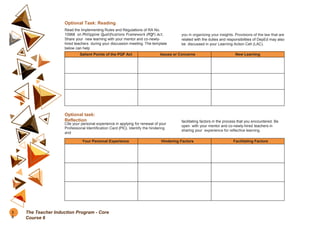
  • 79.
    As indicated inD.O. No. 2, s. 2015, the following steps shall be applied in preparing Development Plans: 1. Identify the development needs. 2. Set goals for meeting the development needs. 3. Prepare action plans for meeting the development needs such as a list of learning activities, resources and supports, measure of successes, among other needs. 4. Implement action plans. 5. Evaluate. After taking the SAT, the teacher will draft the Development Plan based on the results of SAT-RPMS. The teacher can reflect on the plan as development needs the objectives that are rated “Low” in terms of level of capability, or “High” or “Very High” in terms of priority for development. The objectives rated “High” or “Very High” in terms of level of capability can be reflected as strengths in the Development Plan. Both the teacher and the Principal may also refer to the Development Plans in the monitoring and coaching of the teacher’s performance and in providing the necessary interventions (RPMS Manual for Teachers and School Heads, 2018).” Required Task Make Your Own Development Plan If you haven’t created your own development plan, now is the time that you make one. Table 1 shows the format for the Developmental Plan (RPMS Manual for Teachers and School Heads, 2018). You may do this on a separate Word document. Strengths Developmental Needs Action Plan (Recommen ded Developmental Intervention) Timeline Resources Needed A. Functional Competencies B. Core Behavioral Competencies Table 1. Format of Developmental Plan Add a good ending topic/quotation for the end of this session/module. For the summary of this module, add something on positive image for teachers, helping newly-hired teachers, etc. 7 9 Guide for Mentors and Newly Hired Teachers

  • 80.
    Key Topic: YourPersonal Professional Improvement Plan as a Newly-hired teacher Since a development plan is only intended for one school year, draft a different kind of plan for your professional improvement. This will be your Individual Development Plan. Your personal professional improvement plan is divided into 5 columns: teacher skill, specific actions, expected results, and completion date. The first part will ask you to identify the Teacher Skills that you need to develop. Specifically, these skills may be obtained from the PPST, which you discussed initially in Core Course 3. The second part focuses on Specific Actions. As you develop those particular skills, this plan will provide you a step-by-step procedure. It will all depend on you, so remember that you want to develop a personal professional improvement plan that you can practically achieve in about the time you set for yourself. You will put your actions here in detail that will show how the actions you will commit to do in order to master a particular teacher skill. Again, this should be personal. The third part of the plan is Expected Results. In this section, you will choose what result you will observe whether or not you are having improvement. How will you gauge that you have indeed improved? Identifying your expected results is important because it will help you monitor your development toward achieving your goals. It will also make you impartial about your improvement. The next part of the action plan is your Resources. The resources may include physical resources such as curriculum developments, learner records, or supplementary materials. It may also involve intangible resources such as mentorship, attendance from a seminar, or conduct of an action research. Hence, showing the resources you need that are related to your improvement make it easier to encourage your school heads to provide the needed resources. This plan also asks you to identify your Completion Date. It is significant because you don’t want to implement your plan with indefinite time. You have to see whether your plan is going well and if it is not, then you can have some modification to your plan instead of continuing to perform actions that are not yielding the results that you want to see. Giving yourself a completion date is a way to make yourself responsible for your plan by letting you check yourself and evaluate your improvement. 8 0 The Teacher Induction Program - Core Course 6
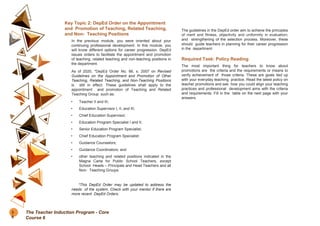
  • 81.
    Republic of thePhilippines Department of Education Region CITY SCHOOLS DIVISION OFFICE OF Teacher Skill Specific Actions Expected Results Resources Completion Date 8 1 Guide for Mentors and Newly Hired Teachers
  • 82.
    It is advisablethat you select a mentor who will gladly monitor your progress. Lasting change does not occur overnight. It takes time to make changes, but the personal professional development plan helps you to achieve your goals. Reflective Journals To monitor your progress, try to have a reflective journal. Snowman and Biehler (2000) gave two purposes of developing a reflective journal: “(1) to serve as a repository of instructional ideas and techniques that you have either created from your own experiences or gleaned from other sources, and (2) to give yourself a format for recording your observations and reflections on teaching.” Snowman and Biehler (2000) showed these two journal entry samples from two teachers as presented in Figure 1. I am a teacher. I write about my work, about teaching, and about researching my teaching through my journal. I enjoy writing, but teaching must be at the center of any work that I do; my research and writing must directly feed my teaching. Keeping a journal has been a realistic way for me to learn about, inquire into, collect data about, and enhance my practice as well as to learn about and plan for children. Although writing in my journal each day takes time, it is economical and is the genre most compatible with my style of writing, my way of teaching, and my way of thinking. Since 1980, I have kept some kind of journal… I continue to keep a journal for a variety of reasons. First and most important, it helps me with my teaching. When used in certain ways, the journal allows me to look closely at the curriculum. As I teach, I wonder how my thinking and my learners’ thinking evolve over time. I wonder what I have valued and what the children are interested in and value. Lesson plans don’t tell me this, but the journal does. My journal is a place for planning, for raising questions, for figuring things out, and for thinking. (507)” After your lesson, you may say, “It’s over,” and you may not think about it again. But with the reflective logs, you are forced to sit down and really think about what was something significant about the class and what did you do about it? So, I think it is important. Because if this assignment wasn’t there, I probably would just go on and forget about the lesson, and this is not a good thing to do. (506) Figure 1. Samples of Reflective Journals 8 2 The Teacher Induction Program - Core Course 6
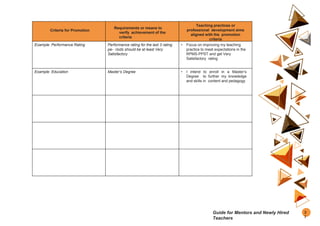

  • 83.
    Summary • In craftinga personal professional improvement plan, we must also perform the same things for us to have our own professional improvement. • The developmental needs are reflected in the Developmental Plan. • Reflective journals may reflect your progress. 8 3 Guide for Mentors and Newly Hired Teachers
  • 84.
    Congratulation s! You’ve come tothe end of this course. Please go to this link for the summative assessment: Don’t forget to take a screenshot of your score. It will be submitted to your mentor for verification and recording purposes. Once you’re done, kindly input your score here: Input your score here. Additional reminder: Compile your portfolio output/s and make sure that your mentor has checked your coursebook. 8 4 The Teacher Induction Program - Core Course 6
  • 85.
    Authorization refers tothe formal evaluation of non-DepEd entities applying to become a provider of recognized professional development programs and/or courses for teachers. Authorized Learning Service Provider refers to a non-DepEd provider that has been awarded formal, fixed term Authorization of the National Educators Academy of the Philippines to provide professional development to teachers within DepEd. Continuing Professional Development (CPD) refers to the inculcation of advanced knowledge, skills and ethical values in a post-licensure specialization or in an inter- or multidisciplinary field of study, for assimilation into professional practice, self-directed research and/or lifelong learning. Continuing Professional Development (CPD) Program refers to a set of learning activities accredited by the CPD Council such as seminars, workshops, technical lectures or subject matter meetings, non-degree training lectures and scientific meetings, modules, tours and visits, which equip the professionals with advanced knowledge, skills and values in specialized or in an inter- or multidisciplinary field of study, self-directed research and/or lifelong learning Continuing Professional Development (CPD) Credit Unit refers to the value of an amount of learning that can be transferred to a qualification achieved from formal, informal or nonformal learning setting, wherein credits can be accumulated to predetermined levels for the award of a qualification. Philippine Professional Standards for Teachers (PPST) refers to the official document that articulates what constitutes teacher quality. The PPST describes the increasing levels of knowledge, practice, and professional engagement expected of teachers. Philippine Qualifications Framework (PQF) refers to a quality assured national system for the development, recognition, and award of qualifications based on standards of knowledge, skills, and values acquired in different ways and methods by learners and workers in the country. Recognition refers to a quality assurance process intended to uphold the Learning and Development standards in the development and delivery of professional development programs and courses provided to DepEd teachers through an evaluation mechanism. Teachers refers to the regular and permanent personnel in schools or learning centers “engaged in the classroom teaching of any subject, including practical/vocational arts, at the elementary and secondary levels of instruction including persons performing guidance and counseling, instructional supervision in all private or public education institutions, but shall not include school nurses, school physicians, school dentists, school administrators, and other school administrative support employees”. Glossar y 8 5 Guide for Mentors and Newly Hired Teachers
  • 86.
    Budgeting refers tothe breaking down of income into different expenses and savings Debt refers to the amount or thing owed from an individual or an institution Expense refers to the amount spent on anything Financial literacy refers to the awareness and ability of a person in managing finances to make responsible and effective decision on the flow of the finances Health refers to the level of functional and metabolic efficiency of a living organism. In humans it is the ability of individuals or communities to adapt and self-manage when facing physical, mental, psychological and social changes with the environment. It encompasses a broad spectrum. It is a state of complete physical, mental, and social well-being and not merely the absence of disease or infirmity. Health Awareness refers to the process that provides health related knowledge to the people for preventing and curing disease Healthy lifestyles/practices refers to the lifestyles/practices that contribute positively to physical, mental and social wellbeing and which include regular exercise and physical activity to help and improve people’s health and well-being Income refers to the amount earned from one or many sources Mental Health refers to the positive thoughts and ideas. Brain is a body part that deals with both emotional and mental aspects (thoughts, perception of reality, and response to it) Personal Goal refers to a self-motivation task which is the force that keeps pushing someone to go on. It is the internal drive to achieve, produce, develop, and keep moving forward. It is what pushes people to go on, especially when one thinks they are ready to quit something. Physical Health refers to a form of the body that includes perfect and harmonious physiological functions of all the body parts that are anatomically intact with each other Psychological Health refers to the emotional state (feelings and moods), adaptability to circumstances, and development of sense of meaning of life compassion, and unselfishness. Saving refers to the amount set aside and kept for whatever financial goal 8 6 The Teacher Induction Program - Core Course 6
  • 87.
    Social Health refersto the ability to interact effectively with other people and can developing satisfying relationships Wellness refers to the state of being in optimal mental and physical health. It is a dynamic process of change and growth. It’s about living a life full of personal responsibility and therefore taking proactive steps for one’s entire well-being. This means that a person living life very well controls risk factors that can harm them. It has a direct influence on overall health, which is essential if one is trying to live a better life. 8 7 Guide for Mentors and Newly Hired Teachers
  • 88.
    References A. Mason. 2019.10 Bad Money Habits You Need to Break Today. https://thecollegeinvestor.com/19037/10-bad- money- habits-need-break-today/ A. Woolfolk. 2007. Educational Psychology (Tenth Edition). Massachusetts: Pearson. Bank of America Corporation. 2020. 8 simple ways to save money. https://bettermoneyhabits.bankofamerica.com/ en/saving-budgeting/ways-to-save-money CSC Resolution No. 1100824 also known as Local Scholarship Program (Modified) DepEd Order No. 66, s.2007. Revised Guidelines on the Appointment and Promotion of Other Teaching, Related Teaching, and Non-Teaching Positions. Depression.org.nz. “Major Changes.” Depression and Anxiety. Accessed June 23, 2021. https://depression.org.nz/the- causes/major- changes/. Government of the Philippines, Department of Education. 2017. DepEd Order No. 42 S. 2017 -National Adoption and Implementation of the Philippine Professional Standards for Teachers. https://www.deped.gov.ph/2017/08/11/ do-42-s-2017-national-adoption-and-implementation- of- the-philippine-professional-standards-for-teachers/ Government of the Philippines, Department of Education. 2020. DepEd Order No. 001 S. 2020, Guidelines for NEAP Recognition of Professional Development Programs and Courses for Teachers and School Leaders. https://www. deped.gov.ph/wp content/uploads/2020/01/ DO_s2020_001.pdf Government of the Philippines, Department of Health. 2019. Implementing Rules and Regulations of Republic Act 11036, Otherwise Known as the Mental Health Act. https://www.doh.gov.ph/sites/default/files/health_ advisory/IRR%20of%20RA%2011036.pdf Government of the Philippines, Professional Regulatory Board for Professional Teachers. 2017. Resolution No. 11, Series of 2017,Operational Guidelines in the Implementation of RA 10912, Otherwise Known as “Continuing Professional Development (CPD) Act of 2016” for Professional Teachers. https://www.prc.gov.ph/sites/default/files/ resoProfTeachers2017-11.pdf Government of the Philippines. 1994. Republic Act 7784, An Act to Strengthen Teacher Education in the Philippines by Establishing Centers of Excellence, Creating a Teacher Education Council for the Purpose, Appropriating Funds Therefor, and for Other Purposes. https://www.officialgazette.gov.ph/1994/08/04/repub lic- act-no-7784/ Government of the Philippines. 1994. Republic Act 7836, An Act to Strengthen the Regulation and Supervision of the Practice of Teaching in the Philippines and Prescribing a Licensure Examination for Teachers and for Other Purposes. https://www.pcw.gov.ph/law/republic- act-7836 Government of the Philippines. 2016. Republic Act 10912, Act Mandating the Continuing Professional Development Program for All Regulated Professions, creating the Continuing Professional Development Council. https:// www.officialgazette.gov.ph/2016/07/21/republic- act- no10912/ Government of the Philippines. 2017. Implementing Rules and Regulations of Republic Act No. 10968, An Act Institutionalizing the Philippine Qualifications Framework (PQF), Establishing the PQF-National Coordinating Council (NCC) and Appropriating Funds Therefor. https://www.officialgazette.gov.ph/2019/01/15/ implementing-rules-and-regulations-of-republic-act- no-10968/ Greenstein, Laura. 2017. 9 Ways to Fight Mental Health Stigma. National Alliance on Mental Illness. Retrieved from: https://www.nami.org/blogs/nami-blog/october- 2017/9- ways-to-fight-mental-health-stigma 8 8 The Teacher Induction Program - Core Course 6
  • 89.
    House Bill 8384.The Expanded Magna Carta For Public School Teachers, and For Other Purposes J.E. Ellis. 2008. Educational Psychology: Developing Learners (Sixth Edition). Massachusetts: Pearson Prentice Hall. Jackson, Robyn. 2009. Never Work Harder Than Your Students & Other Principles of Great Teaching. Alexandria, VA: Association for Supervision and Curriculum Development. Kottler, Ellen, Kottler; Kottler, Jeffrey; and Kottler, Cary. 1998. Secrets for Secondary School Teachers: How to Succeed in Your First Year. California: Corwin Press, Inc. L. Bonser. 2014. What is Financial Stewardship?. https:// www.lauriebonser.com/2014/05/16/what-is- financial- stewardship/ Littky, Dennis. (2004). The Big Picture: Education Is Everyone’s Business. Virginia: Association for Supervision and Curriculum Development. Malipot, Merlinda. May 1, 2018. DepEd convenes employee associations to promote welfare, development. Manila Bulletin. Retried from: https://news.mb.com. ph/2018/05/01/deped-convenes-employee- associations- to-promote-welfare-development/ Mental Health Foundation. Stress. Retrieved from: https://www. mentalhealth.org.uk/a-to- z/s/stress#:~:text=Stress%20 can%20be%20defined%20as,of%20pressures%20 that%20are%20unmanageable. Money Management International. 2015. Financial Literacy: Your 30 Step Path to Financial Wellness. https://www. moneymanagement.org/ /media/ebooks/30-step-path-to-financial- wellness.ashx N.K. Pandey and A. Saxena. 2015. Teacher’s Occupational Stress: A Review Study in National & International Scenario. International Journal of Organizational Behaviour & Management Perspectives, Pezzottaite Journals. 4 (2). https://www.researchgate.net/ publication/281834645_ Teacher’s_Occupational_Stress_A_Review_Study _in_ National_International_Scenario National Center for Complementary and Integrative Health. 5 Things to Know About Relaxation Techniques for Stress. https://nccih.nih.gov /health/tips/stress Nieto, Sonia. 2003. What Keeps Teachers Going? New York: Teachers College Press. Professional associations. The University of Sydney. (n.d.). https://www.sydney.edu.au/careers/students/career- advice-and-development/professional- associations.html. Results-based Performance Management System Manual for Teachers and School Heads. 2018. Department of Education. Robbins, Mel. 2011. “How to Stop Screwing Yourself Over?” Filmed June 2011. S. Lipscomb. 2019. Understanding Needs vs. Wants for your Budget. https://smartasset.com/financial- advisor/needs- vs-wants Serido, Joyce, David M. Almeida, and Elaine Wethington. “Chronic Stressors and Daily Hassles: Unique and Interactive Relationships with Psychological Distress.” Journal of Health and Social Behavior 45, no. 1 (2004): 17-33. Accessed June 23, 2021. http://www.jstor.org/ stable/3653802. Snowman, Jack & Biehler, Robert. 2000. Psychology Applied to Teaching (Ninth Edition). Massachusetts: Houghton Mifflin Company. 8 9 T.C. Rosenberg. 2010. Teacher stress: An assessment of teachers’ need for and receptiveness towards a stress reduction program within one rural school system. Educational Specialist. https://commons.lib.jmu.edu/ edspec201019/98 Guide for Mentors and Newly Hired Teachers
  • 90.
    Tracy, Brian. 2016.Master Your Time, Master Your Life: The Breakthrough System to Get More Results, Faster, in Every Area of Your Life. New York: Tarcher Perigee. Urban, Tim. 2016. “Inside the Mind of a Master Procrastinator.” Filmed February 2016. Books: A. Liuson. 2015. The Debt Free Lifestyle: Ten Principles that Can Revolutionize Your Life. Makati City: Church Strengthening Ministry. V. Rapisura. 2016. (L)earning Wealth: Successful Strategies in Money Management. Quezon City: SEDPI. Modules: Department of Education. 2018. Teacher Induction Program. Department of Education - National Capital Region. 2018. Competency-Based Learning Materials. Website: https://www.youtube.com/watch?v=s93ywqFa6CM https://www.deped.gov.ph/wp-content/uploads/2007/09/DO_ s2007_066-1.pdf https://www.ted.com/talks/mel_robbins_how_to_stop_screwin g_ yourself_over?language=en https://www.ted.com/talks/tim_urban_inside_the_mind_of_ a_ master_procrastinator 9 0 The Teacher Induction Program - Core Course 6
  • 91.
    Department of Education NationalEducators Academy of the Philippines Dir. John Arnold S. Siena Teacher Education Council Ms. Anna Marie San Diego Dir. Runvi V. Manguerra Officer-in-charge, Professional Development Division (PDD) Ms. Donnabel Bihasa Ms. Ana-Sol Reyes Senior Education Program Specialist, TEC Secretariat Senior Education Program Specialist, NEAP-PDD Mr. Jayson Peñafiel Mr. Jerson Capuyan Education Program Specialist, TEC Secretariat Education Program Specialist II, NEAP-PDD
  • 92.
    Acknowledgments Philippine National ResearchCenter for Teacher Quality Dir. Gina O. Gonong Dr. Levi E. Elipane Senior Program Manager II Ma. Izella D. Lampos Project Officer Jeanny S. Burce Research Officer UNE-SiMERR Dr. Joy Hardy Deputy Director Technical Working Group Ricardo Ador Dionisio Warren Quisada Angelo Uy Marie Flo M. Aysip Jeanette Alvarez Jeaz DC Campano Ian Harvey Claros Alfredo G. Desamparo, Jr. Jerome Hilario Charito N. Laggui Gayle Malibiran Khristian Ross Pimentel Josefino C. Pogoy, Jr. Chinita Tolentino Jennifer F. Vivas 9 2 The Teacher Induction Program - Core Course 6
  • 93.
    Validators Ricky Agbay Ma. AgieAmar Jonathan Baniaga Ms. Noemi Baysa Alma Belarmino Rageene Vera Dueñas Nerio Benito Eseo Zenylou Frias Clarivil S. Layug Carlos B. Llamas III Jeanrick Deuna Nuñez Maribel Perez Beverlyn Ramirez Frankie Delos Santos Marie Eugenie Soriano Marina Tagsip Ma. Sonia A. Tomalabcad Reggie Tuazon Gladys Uy Maria Lourie Victor Support Team Ruth Mae Ellorin Layout Artist Aris L. Solis Layout Artist Roy Benson NEAP ICT Technical Support Pilot Testing Participants Region IV-A Division of Cavite Division of Quezon Division of Batangas Region VI Division of Iloilo Division of Negros Occidental Division of Antique Region VII Division of Bohol Division of Cebu Division of Negros Oriental 9 3 Guide for Mentors and Newly Hired Teachers