Revolutionizing Industries: A
Deep Dive into the
Technology in Robots

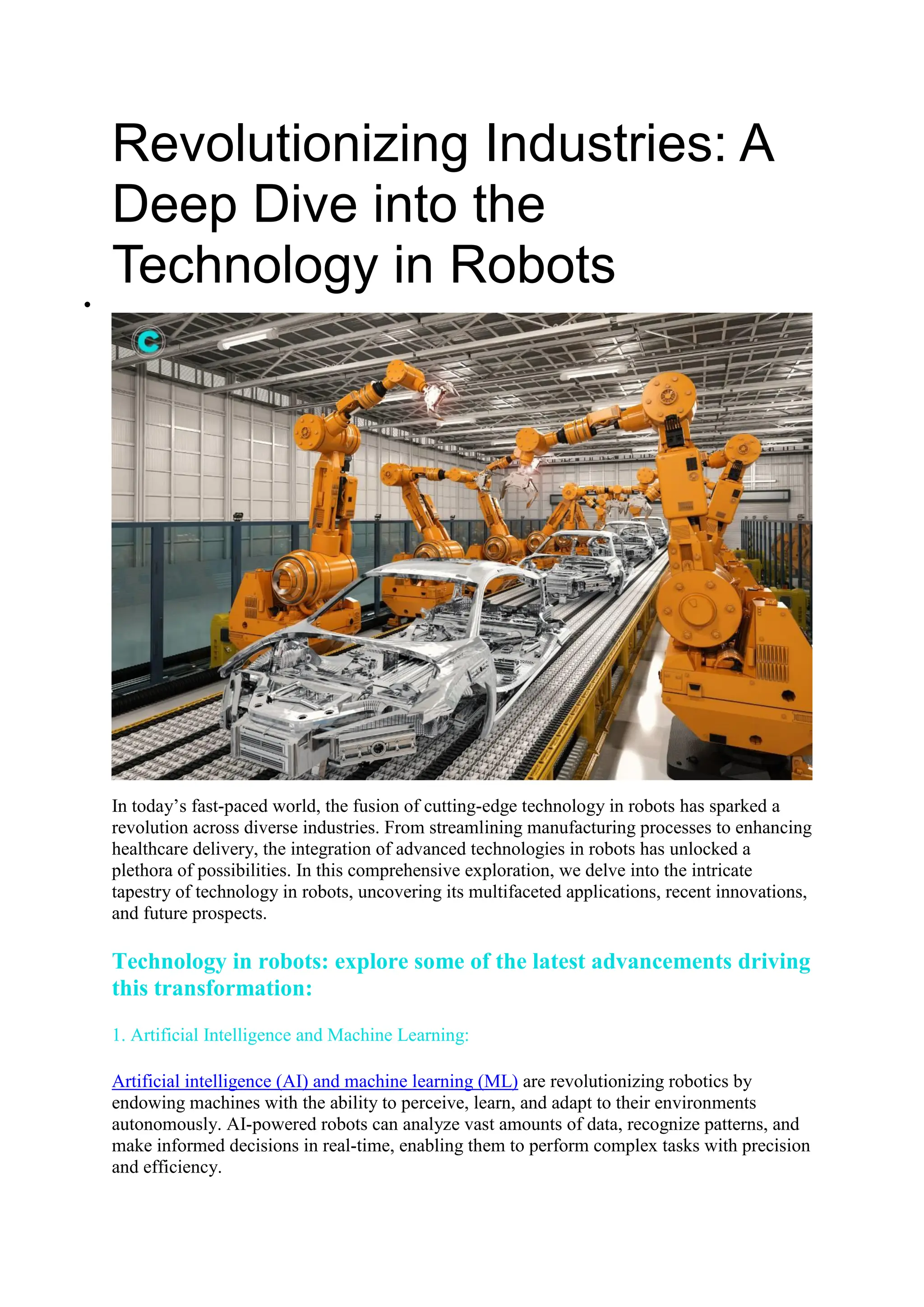
In today’s fast-paced world, the fusion of cutting-edge technology in robots has sparked a
revolution across diverse industries. From streamlining manufacturing processes to enhancing
healthcare delivery, the integration of advanced technologies in robots has unlocked a
plethora of possibilities. In this comprehensive exploration, we delve into the intricate
tapestry of technology in robots, uncovering its multifaceted applications, recent innovations,
and future prospects.
Technology in robots: explore some of the latest advancements driving
this transformation:
1. Artificial Intelligence and Machine Learning:
Artificial intelligence (AI) and machine learning (ML) are revolutionizing robotics by
endowing machines with the ability to perceive, learn, and adapt to their environments
autonomously. AI-powered robots can analyze vast amounts of data, recognize patterns, and
make informed decisions in real-time, enabling them to perform complex tasks with precision
and efficiency.
2. Advanced Sensors and Perception Systems:
Robots utilize an array of advanced sensors, including LiDAR, radar, cameras, and inertial
measurement units (IMUs), to perceive and navigate their surroundings accurately. These
sensors provide valuable feedback for localization, obstacle detection, and environmental
mapping, allowing robots to operate safely and effectively in dynamic environments.
3. Robotic Vision and Image Processing:
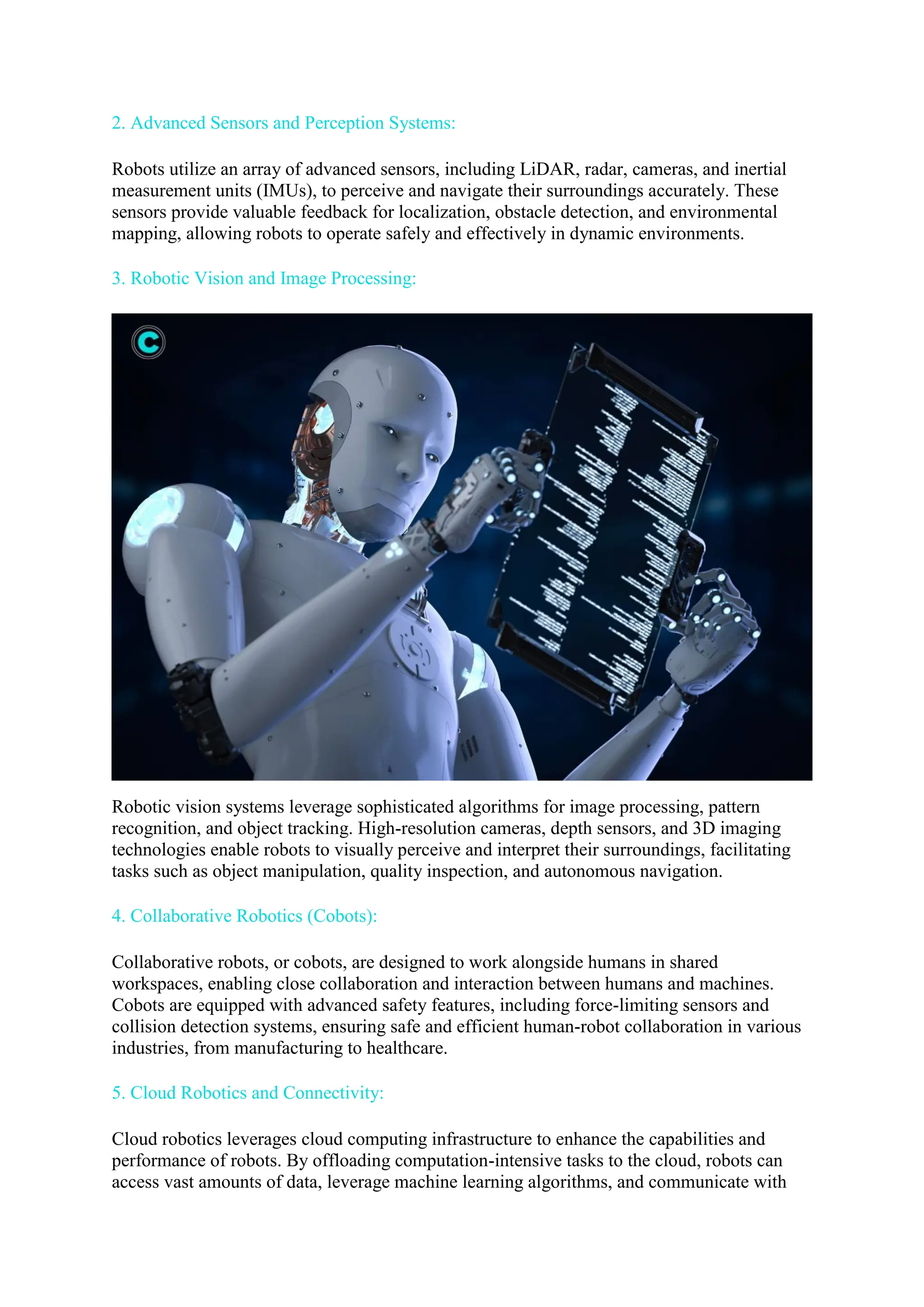
Robotic vision systems leverage sophisticated algorithms for image processing, pattern
recognition, and object tracking. High-resolution cameras, depth sensors, and 3D imaging
technologies enable robots to visually perceive and interpret their surroundings, facilitating
tasks such as object manipulation, quality inspection, and autonomous navigation.
4. Collaborative Robotics (Cobots):
Collaborative robots, or cobots, are designed to work alongside humans in shared
workspaces, enabling close collaboration and interaction between humans and machines.
Cobots are equipped with advanced safety features, including force-limiting sensors and
collision detection systems, ensuring safe and efficient human-robot collaboration in various
industries, from manufacturing to healthcare.
5. Cloud Robotics and Connectivity:
Cloud robotics leverages cloud computing infrastructure to enhance the capabilities and
performance of robots. By offloading computation-intensive tasks to the cloud, robots can
access vast amounts of data, leverage machine learning algorithms, and communicate with
other devices and systems seamlessly. Cloud robotics enables robots to adapt to changing
conditions, learn from collective experiences, and perform complex tasks more efficiently.
6. Autonomous Navigation and Localization:
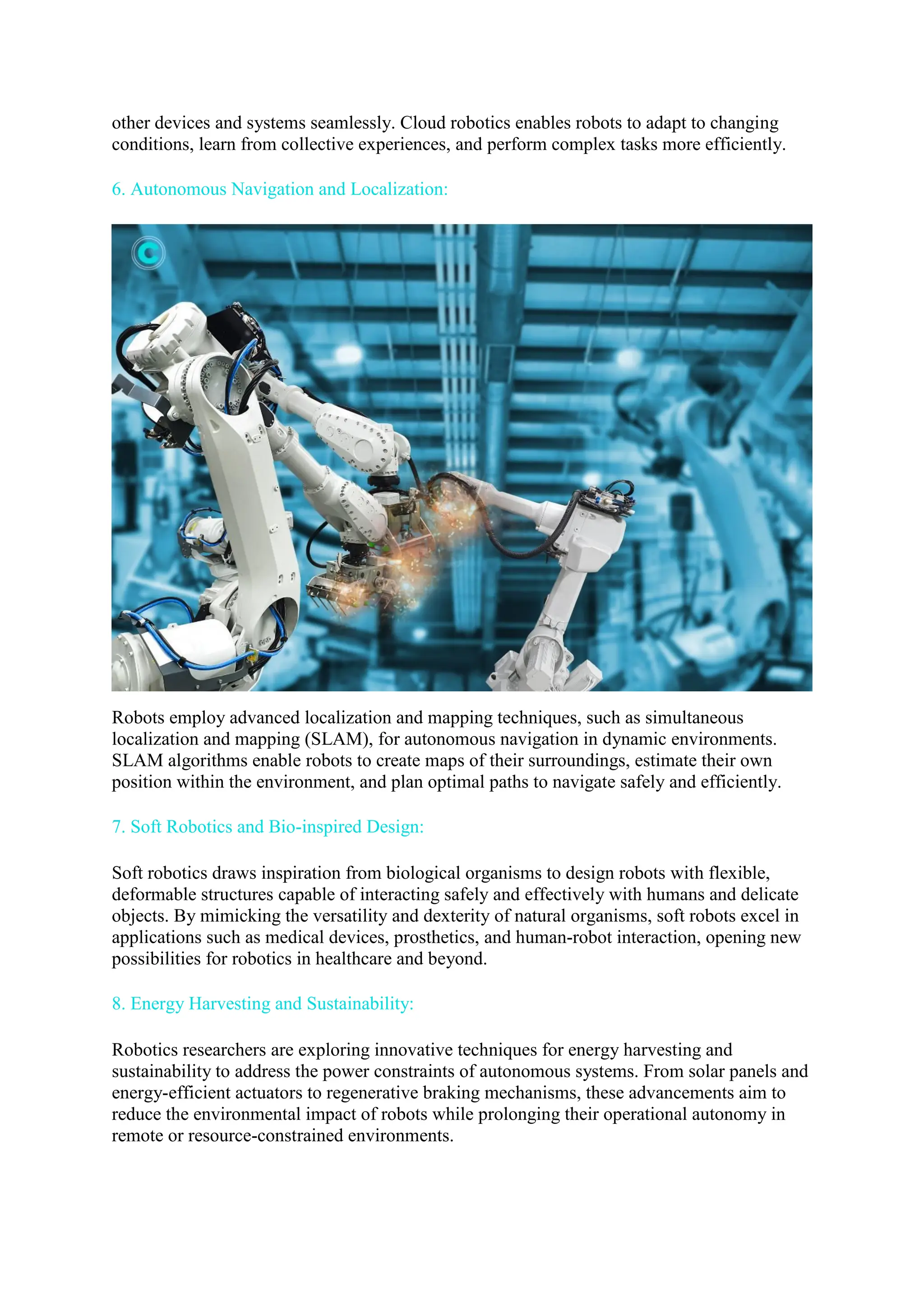
Robots employ advanced localization and mapping techniques, such as simultaneous
localization and mapping (SLAM), for autonomous navigation in dynamic environments.
SLAM algorithms enable robots to create maps of their surroundings, estimate their own
position within the environment, and plan optimal paths to navigate safely and efficiently.
7. Soft Robotics and Bio-inspired Design:
Soft robotics draws inspiration from biological organisms to design robots with flexible,
deformable structures capable of interacting safely and effectively with humans and delicate
objects. By mimicking the versatility and dexterity of natural organisms, soft robots excel in
applications such as medical devices, prosthetics, and human-robot interaction, opening new
possibilities for robotics in healthcare and beyond.
8. Energy Harvesting and Sustainability:
Robotics researchers are exploring innovative techniques for energy harvesting and
sustainability to address the power constraints of autonomous systems. From solar panels and
energy-efficient actuators to regenerative braking mechanisms, these advancements aim to
reduce the environmental impact of robots while prolonging their operational autonomy in
remote or resource-constrained environments.
9. Swarm Robotics and Collective Intelligence:
Swarm robotics harnesses the collective intelligence of multiple robots working together to
achieve complex tasks beyond the capabilities of individual agents. Inspired by the behavior
of social insects, swarm robotic systems exhibit emergent behaviors, self-organization, and
robustness in dynamic environments, making them ideal for applications such as search and
rescue, environmental monitoring, and distributed sensing.
10. Ethics, Privacy, and Responsible AI:
As robots become more pervasive in society, ethical considerations surrounding their use and
impact on human lives are paramount. It is essential to establish guidelines and regulations to
ensure the responsible development, deployment, and use of robotic technology, safeguarding
privacy, autonomy, and human dignity while maximizing the societal benefits of robotics.
FAQs About Technology in Robots:
1. What are the primary components of a robotic system?
A typical robotic system comprises mechanical components for physical movement, sensors
for perception and feedback, actuators for executing tasks, and a control system, often
powered by sophisticated algorithms and software.
2. How does robotics contribute to industrial automation?
Robotics revolutionizes industrial automation by automating repetitive tasks, increasing
production efficiency, ensuring consistent quality, and improving workplace safety.
Advanced robotics technologies, such as collaborative robots (cobots) and flexible
automation solutions, enable manufacturers to adapt quickly to changing demands and stay
competitive in the global market.
3. What role does robotics play in healthcare?
In healthcare, robots are employed for a myriad of tasks, including surgical assistance, patient
care, rehabilitation, and telemedicine. Surgical robots enable precise, minimally invasive
procedures, reducing patient trauma and recovery time. Service robots assist healthcare
professionals in routine tasks, such as medication delivery and patient monitoring, enhancing
workflow efficiency and patient care quality.
4. How are robots utilized in the field of transportation and logistics?
Robots are revolutionizing transportation and logistics through automation of warehousing,
distribution, and last-mile delivery operations. Autonomous mobile robots (AMRs) and
drones optimize inventory management, accelerate order fulfillment, and reduce delivery lead
times, enabling companies to meet growing customer expectations for speed and efficiency in
e-commerce.
5. What are the emerging trends in consumer robotics?
Consumer robotics is witnessing a surge in innovation, with robots designed for household
chores, entertainment, and personal assistance gaining popularity. From robotic vacuum
cleaners and lawnmowers to companion robots that offer companionship and emotional
support, consumer-grade robots are becoming an integral part of modern households, offering
convenience and lifestyle enhancement.
Conclusion:
The integration of advanced technology in robots is reshaping industries, revolutionizing
workflows, and enhancing the quality of life for individuals worldwide. From AI
and machine learning to advanced sensors and collaborative robotics, the convergence of
diverse technologies is driving unprecedented innovation and transformation in robotics. As
we navigate this ever-evolving landscape of technological progress, it is imperative to
embrace these advancements responsibly, addressing ethical, social, and environmental
considerations to unlock the full potential of robotics for the betterment of humanity.

Revolutionizing Industries: A Deep Dive into the Technology in Robots

  • 1.
    Revolutionizing Industries: A DeepDive into the Technology in Robots  In today’s fast-paced world, the fusion of cutting-edge technology in robots has sparked a revolution across diverse industries. From streamlining manufacturing processes to enhancing healthcare delivery, the integration of advanced technologies in robots has unlocked a plethora of possibilities. In this comprehensive exploration, we delve into the intricate tapestry of technology in robots, uncovering its multifaceted applications, recent innovations, and future prospects. Technology in robots: explore some of the latest advancements driving this transformation: 1. Artificial Intelligence and Machine Learning: Artificial intelligence (AI) and machine learning (ML) are revolutionizing robotics by endowing machines with the ability to perceive, learn, and adapt to their environments autonomously. AI-powered robots can analyze vast amounts of data, recognize patterns, and make informed decisions in real-time, enabling them to perform complex tasks with precision and efficiency.
  • 2.
    2. Advanced Sensorsand Perception Systems: Robots utilize an array of advanced sensors, including LiDAR, radar, cameras, and inertial measurement units (IMUs), to perceive and navigate their surroundings accurately. These sensors provide valuable feedback for localization, obstacle detection, and environmental mapping, allowing robots to operate safely and effectively in dynamic environments. 3. Robotic Vision and Image Processing: Robotic vision systems leverage sophisticated algorithms for image processing, pattern recognition, and object tracking. High-resolution cameras, depth sensors, and 3D imaging technologies enable robots to visually perceive and interpret their surroundings, facilitating tasks such as object manipulation, quality inspection, and autonomous navigation. 4. Collaborative Robotics (Cobots): Collaborative robots, or cobots, are designed to work alongside humans in shared workspaces, enabling close collaboration and interaction between humans and machines. Cobots are equipped with advanced safety features, including force-limiting sensors and collision detection systems, ensuring safe and efficient human-robot collaboration in various industries, from manufacturing to healthcare. 5. Cloud Robotics and Connectivity: Cloud robotics leverages cloud computing infrastructure to enhance the capabilities and performance of robots. By offloading computation-intensive tasks to the cloud, robots can access vast amounts of data, leverage machine learning algorithms, and communicate with
  • 3.
    other devices andsystems seamlessly. Cloud robotics enables robots to adapt to changing conditions, learn from collective experiences, and perform complex tasks more efficiently. 6. Autonomous Navigation and Localization: Robots employ advanced localization and mapping techniques, such as simultaneous localization and mapping (SLAM), for autonomous navigation in dynamic environments. SLAM algorithms enable robots to create maps of their surroundings, estimate their own position within the environment, and plan optimal paths to navigate safely and efficiently. 7. Soft Robotics and Bio-inspired Design: Soft robotics draws inspiration from biological organisms to design robots with flexible, deformable structures capable of interacting safely and effectively with humans and delicate objects. By mimicking the versatility and dexterity of natural organisms, soft robots excel in applications such as medical devices, prosthetics, and human-robot interaction, opening new possibilities for robotics in healthcare and beyond. 8. Energy Harvesting and Sustainability: Robotics researchers are exploring innovative techniques for energy harvesting and sustainability to address the power constraints of autonomous systems. From solar panels and energy-efficient actuators to regenerative braking mechanisms, these advancements aim to reduce the environmental impact of robots while prolonging their operational autonomy in remote or resource-constrained environments.
  • 4.
    9. Swarm Roboticsand Collective Intelligence: Swarm robotics harnesses the collective intelligence of multiple robots working together to achieve complex tasks beyond the capabilities of individual agents. Inspired by the behavior of social insects, swarm robotic systems exhibit emergent behaviors, self-organization, and robustness in dynamic environments, making them ideal for applications such as search and rescue, environmental monitoring, and distributed sensing. 10. Ethics, Privacy, and Responsible AI: As robots become more pervasive in society, ethical considerations surrounding their use and impact on human lives are paramount. It is essential to establish guidelines and regulations to ensure the responsible development, deployment, and use of robotic technology, safeguarding privacy, autonomy, and human dignity while maximizing the societal benefits of robotics. FAQs About Technology in Robots: 1. What are the primary components of a robotic system? A typical robotic system comprises mechanical components for physical movement, sensors for perception and feedback, actuators for executing tasks, and a control system, often powered by sophisticated algorithms and software.
  • 5.
    2. How doesrobotics contribute to industrial automation? Robotics revolutionizes industrial automation by automating repetitive tasks, increasing production efficiency, ensuring consistent quality, and improving workplace safety. Advanced robotics technologies, such as collaborative robots (cobots) and flexible automation solutions, enable manufacturers to adapt quickly to changing demands and stay competitive in the global market. 3. What role does robotics play in healthcare? In healthcare, robots are employed for a myriad of tasks, including surgical assistance, patient care, rehabilitation, and telemedicine. Surgical robots enable precise, minimally invasive procedures, reducing patient trauma and recovery time. Service robots assist healthcare professionals in routine tasks, such as medication delivery and patient monitoring, enhancing workflow efficiency and patient care quality. 4. How are robots utilized in the field of transportation and logistics? Robots are revolutionizing transportation and logistics through automation of warehousing, distribution, and last-mile delivery operations. Autonomous mobile robots (AMRs) and drones optimize inventory management, accelerate order fulfillment, and reduce delivery lead times, enabling companies to meet growing customer expectations for speed and efficiency in e-commerce. 5. What are the emerging trends in consumer robotics? Consumer robotics is witnessing a surge in innovation, with robots designed for household chores, entertainment, and personal assistance gaining popularity. From robotic vacuum cleaners and lawnmowers to companion robots that offer companionship and emotional support, consumer-grade robots are becoming an integral part of modern households, offering convenience and lifestyle enhancement. Conclusion: The integration of advanced technology in robots is reshaping industries, revolutionizing workflows, and enhancing the quality of life for individuals worldwide. From AI and machine learning to advanced sensors and collaborative robotics, the convergence of diverse technologies is driving unprecedented innovation and transformation in robotics. As we navigate this ever-evolving landscape of technological progress, it is imperative to embrace these advancements responsibly, addressing ethical, social, and environmental considerations to unlock the full potential of robotics for the betterment of humanity.