Robots in
different fields
Chapter#1 :Introduction
PART 2
College of Computer Science and EngineeringI
C C A I 414
Robotics
Robots taxonomies
 Depending on in which field the robots are used for, their characteristics and
capabilities are set accordingly.
 Some classifications based on the application domain, another on the type of
technology used in robotics, other taxonomies help in reviewing some robots,
characteristics, features, capabilities and their requirements.
 Classifying the robot according to one of its components, such as sensors and
actuates, to cover what the robot consists of. This classification defines the
hardware and software features within the robot.
Robots classification
1. The robot can be designed either as an industrial or as a non-industrial application.
 Industrial applications: robot performs industrial capabilities.
 Non-industrial robot perform capabilities belong to the domain it executes in. such as
producing material goods for building, mining or agriculture, or it could be providing services
such as medicine, transport, trade or tourism.
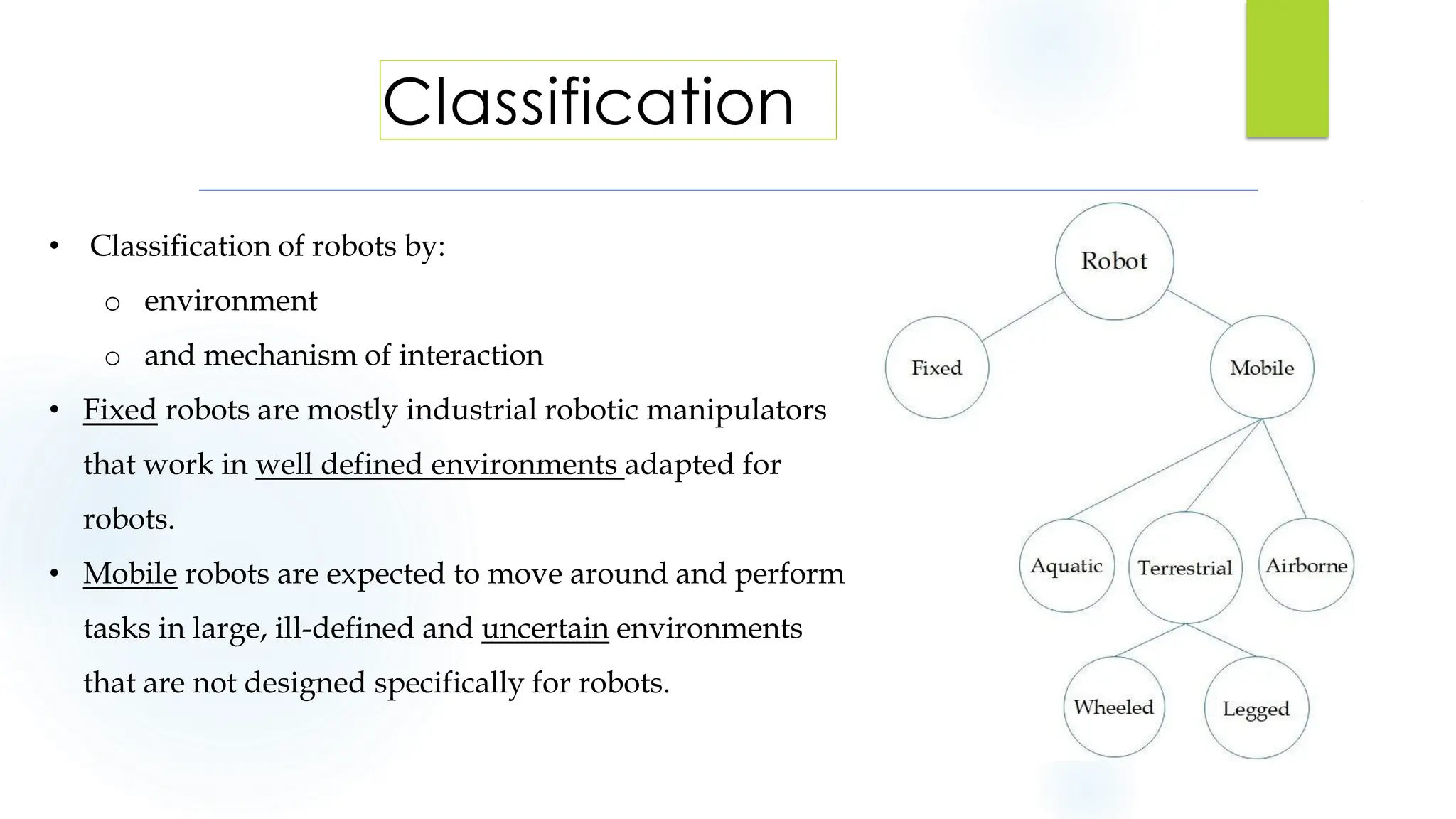
• Classification of robots by:
o environment
o and mechanism of interaction
• Fixed robots are mostly industrial robotic manipulators
that work in well defined environments adapted for
robots.
• Mobile robots are expected to move around and perform
tasks in large, ill-defined and uncertain environments
that are not designed specifically for robots.
Classification
4
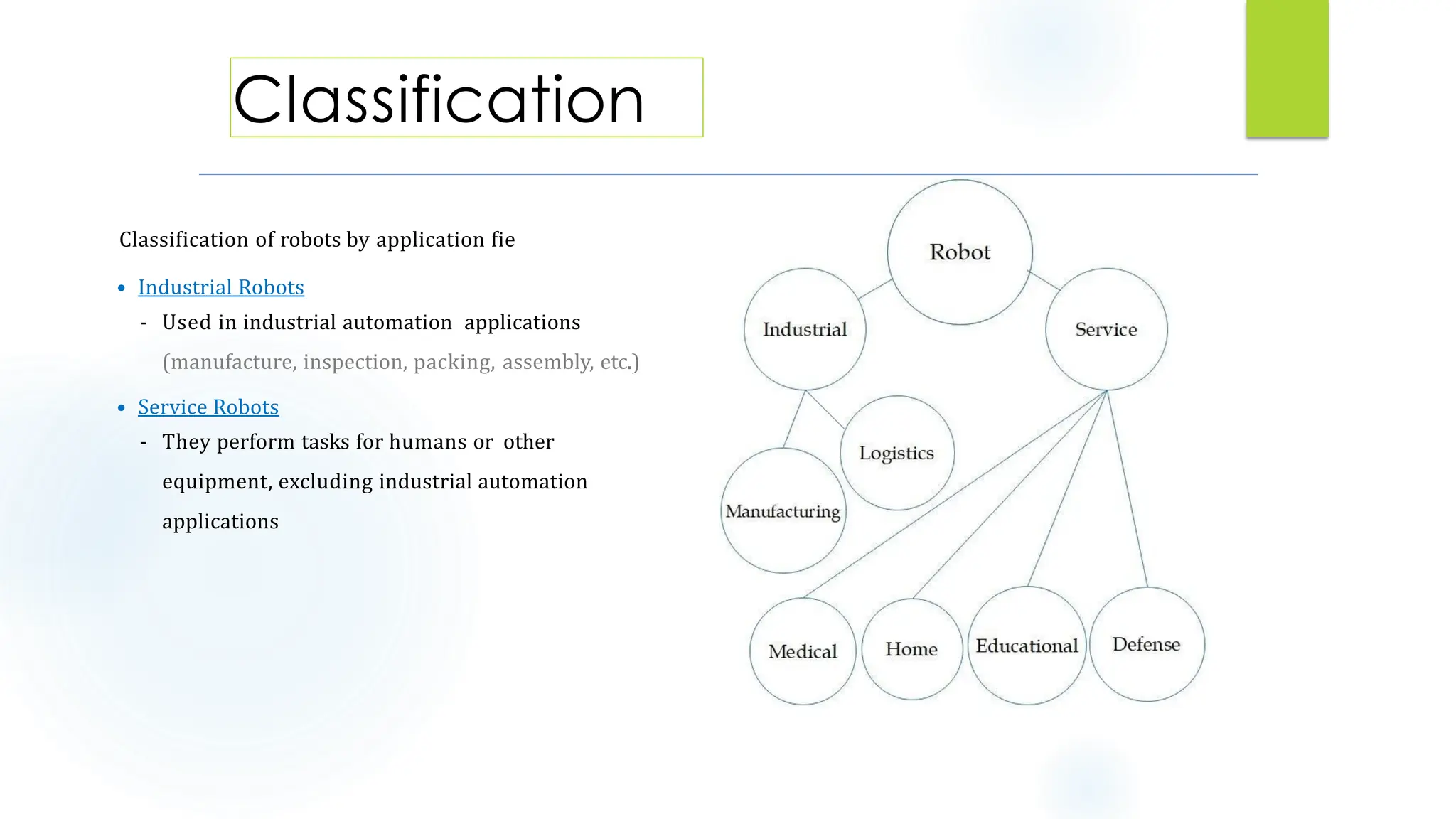
Classification of robots by application field:
• Industrial Robots
- Used in industrial automation applications
(manufacture, inspection, packing, assembly, etc.)
• Service Robots
- They perform tasks for humans or other
equipment, excluding industrial automation
applications
5
Classification
Service Robots
Personal
Used for non-commercial tasks by
common (untrained) people
Professional
Used for commercial tasks by
trained people
- Domestic robots
- Automated
wheelchairs
- Personal
assistants
- Robots for
entertainment
- Etc.
- Robots to clean public
places
- Delivery robots
- Firefighting robots
- Robots for rehabilitation
and surgery
- Etc.
6
Industrial robots
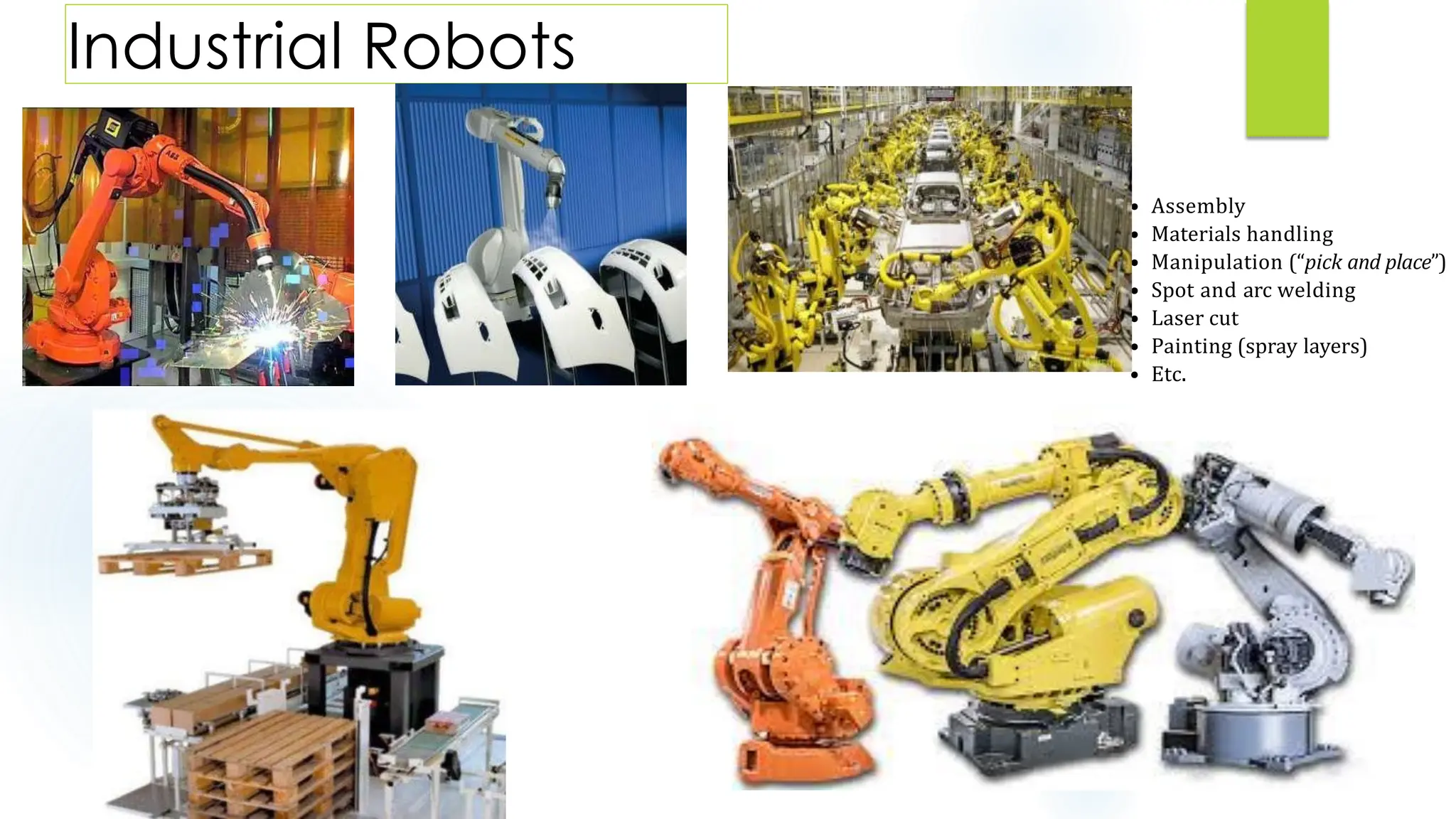
Industrial Robots
• Assembly
• Materials handling
• Manipulation (“pick and place”)
• Spot and arc welding
• Laser cut
• Painting (spray layers)
• Etc.
8
• Industrial robots are the most widespread robots and the oldest.
• Industrial robots enable automation, to be used in car assembly, power train
assembly and engine assembly.
• They returned numerous advantages to the manufacturers that have adopted them.
• They provide :
• robust productivity,
• constancy in production lines
• accuracy in each product
• reduction of manufacturing costs.
• Industrial robots are categorized:
1. manual manipulator
2. fixed sequence
3. variable sequence
4. playback
5. numerical control robots
Rehabilitation and healthcare
robots
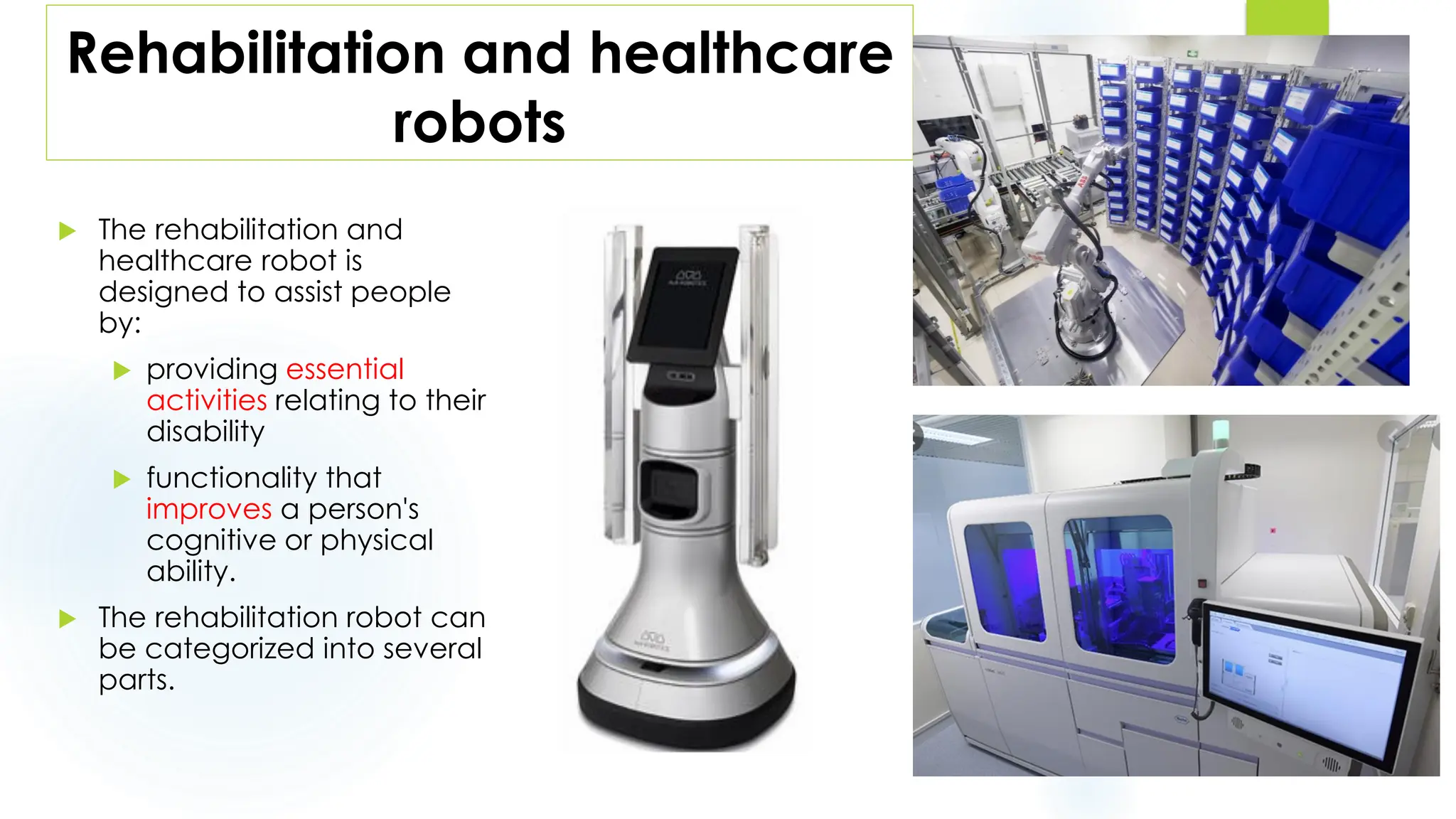
 The rehabilitation and
healthcare robot is
designed to assist people
by:
 providing essential
activities relating to their
disability
 functionality that
improves a person's
cognitive or physical
ability.
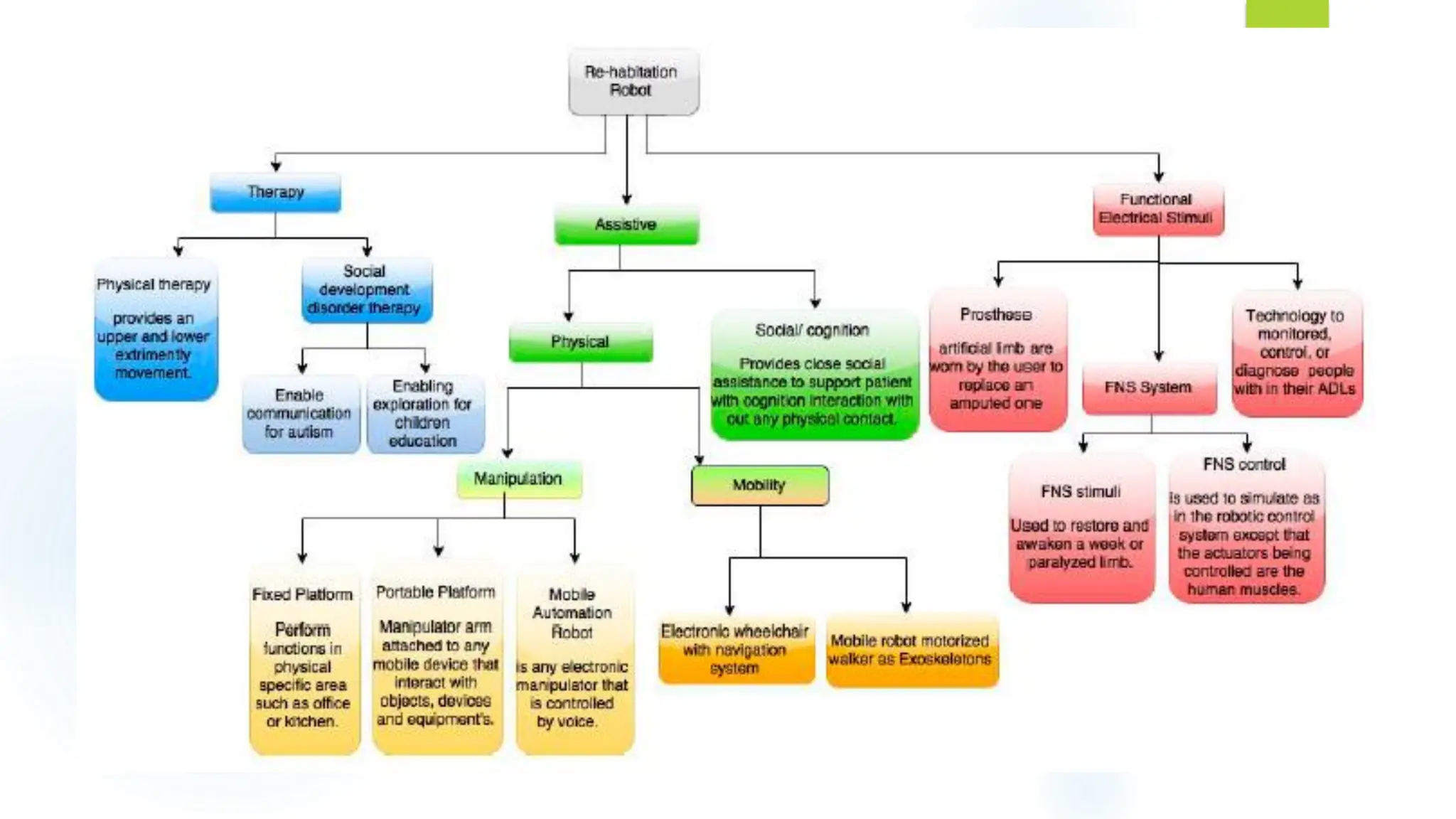
 The rehabilitation robot can
be categorized into several
parts.
1
0
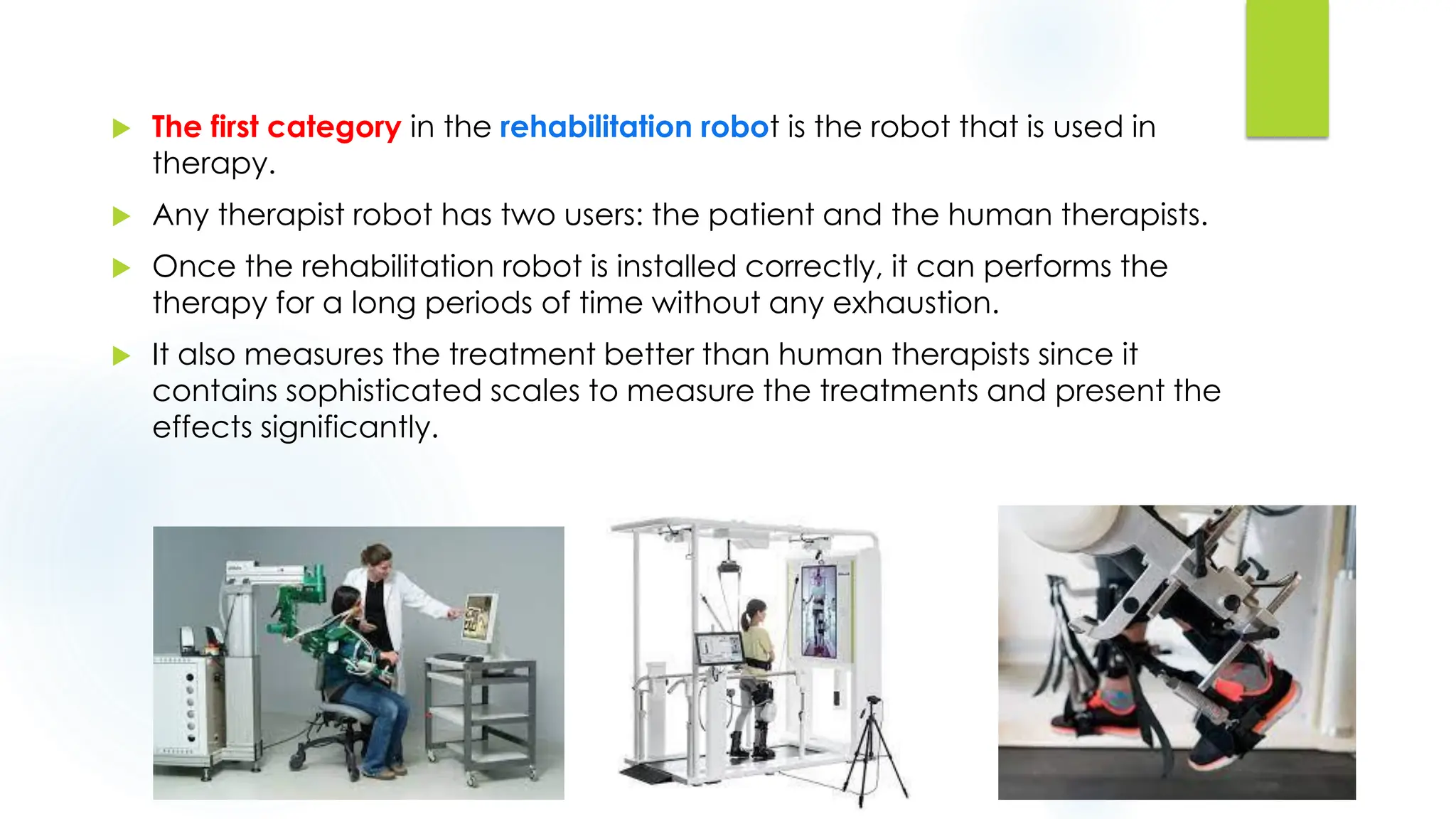
 The first category in the rehabilitation robot is the robot that is used in
therapy.
 Any therapist robot has two users: the patient and the human therapists.
 Once the rehabilitation robot is installed correctly, it can performs the
therapy for a long periods of time without any exhaustion.
 It also measures the treatment better than human therapists since it
contains sophisticated scales to measure the treatments and present the
effects significantly.
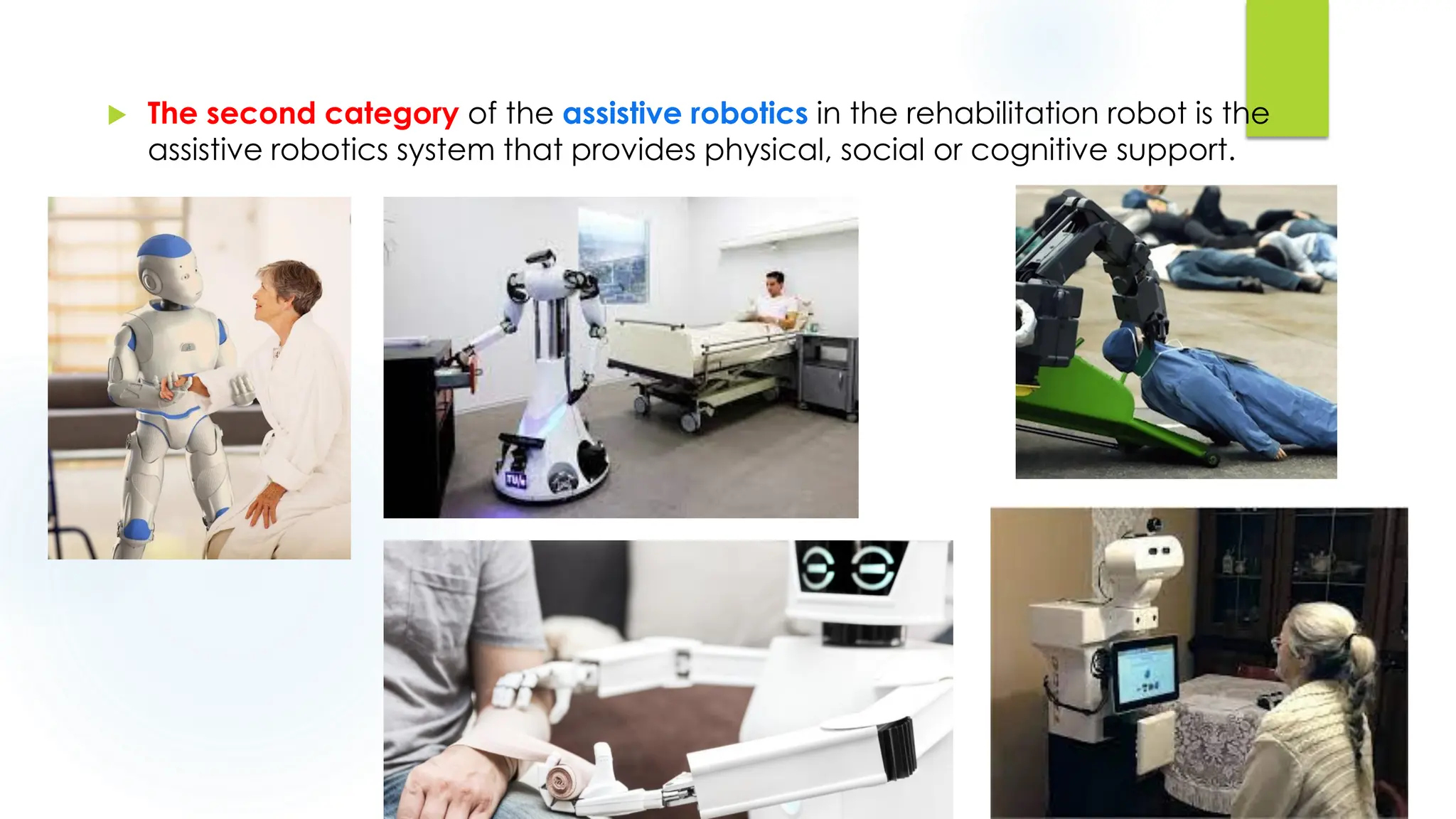
 The second category of the assistive robotics in the rehabilitation robot is the
assistive robotics system that provides physical, social or cognitive support.
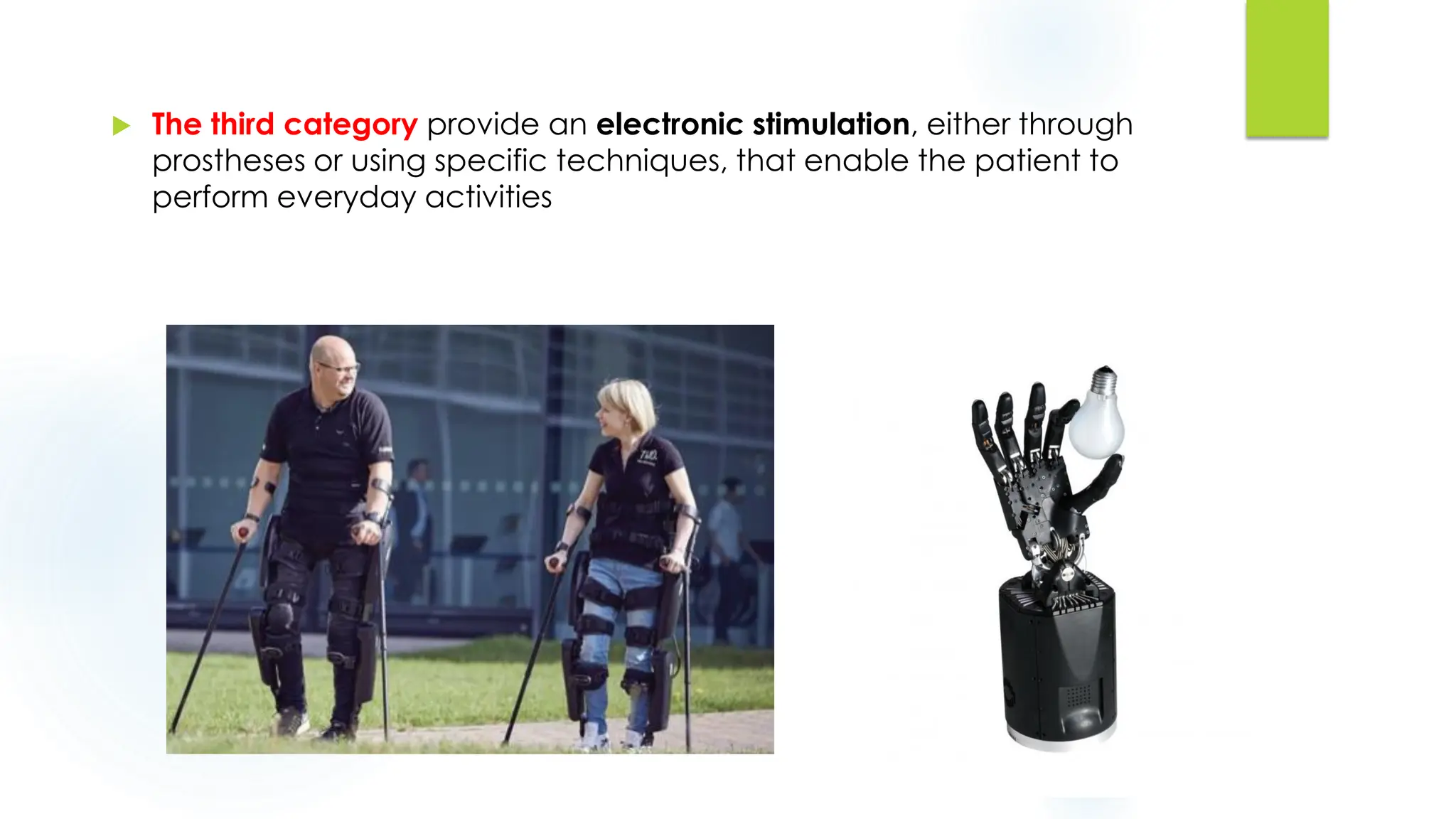
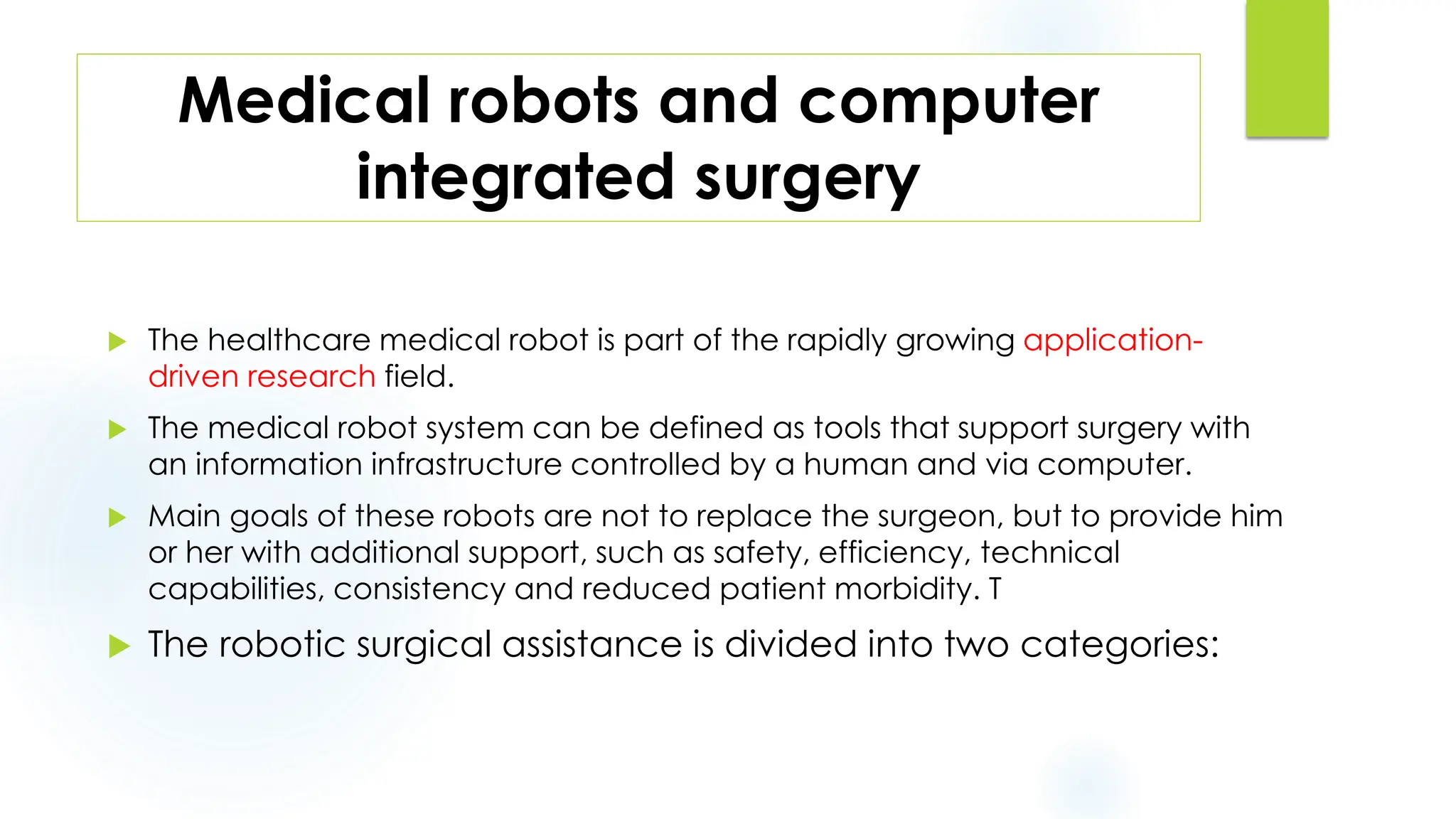
 The third category provide an electronic stimulation, either through
prostheses or using specific techniques, that enable the patient to
perform everyday activities
Medical robots and computer
integrated surgery
 The healthcare medical robot is part of the rapidly growing application-
driven research field.
 The medical robot system can be defined as tools that support surgery with
an information infrastructure controlled by a human and via computer.
 Main goals of these robots are not to replace the surgeon, but to provide him
or her with additional support, such as safety, efficiency, technical
capabilities, consistency and reduced patient morbidity. T
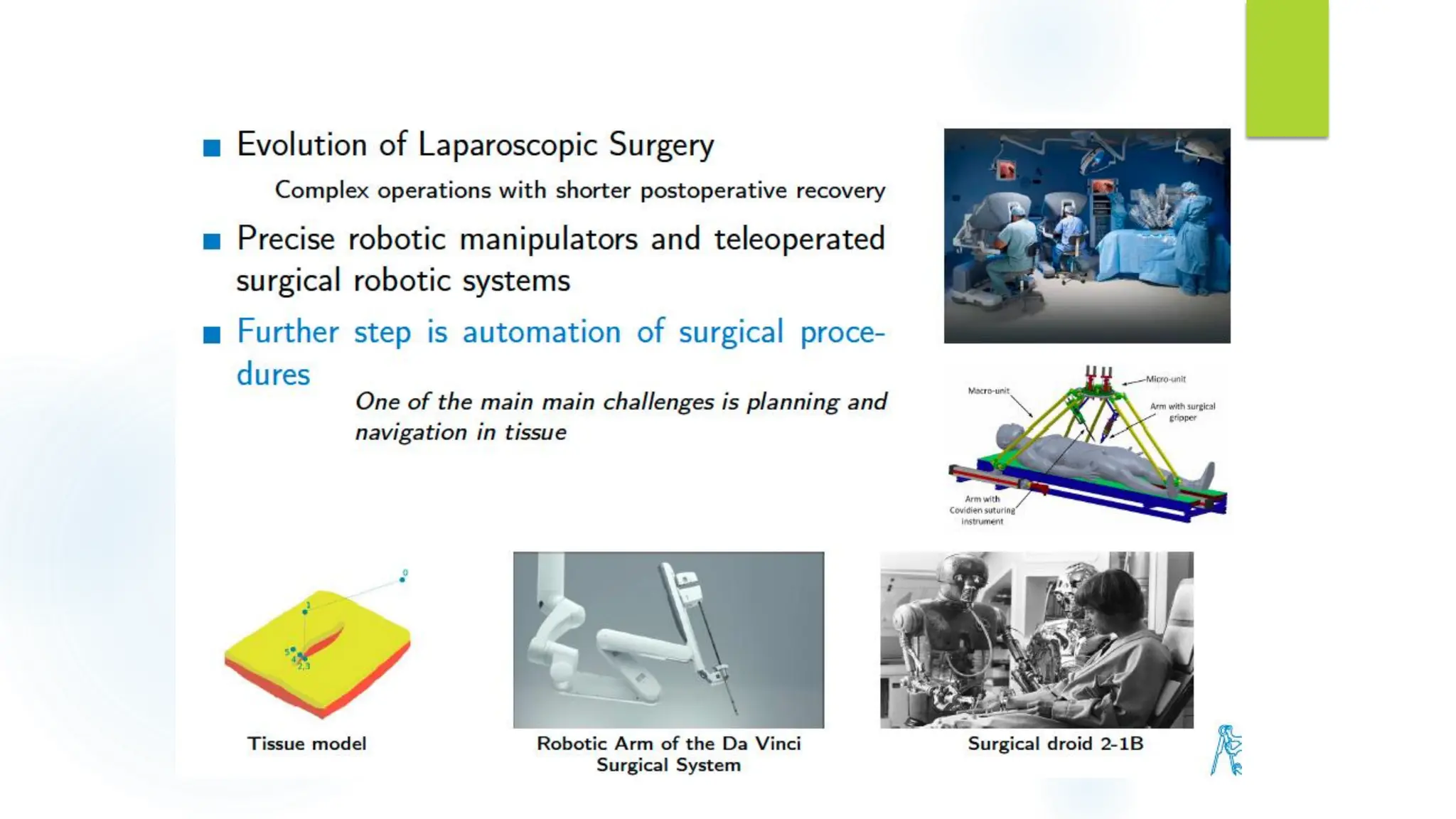
 The robotic surgical assistance is divided into two categories:
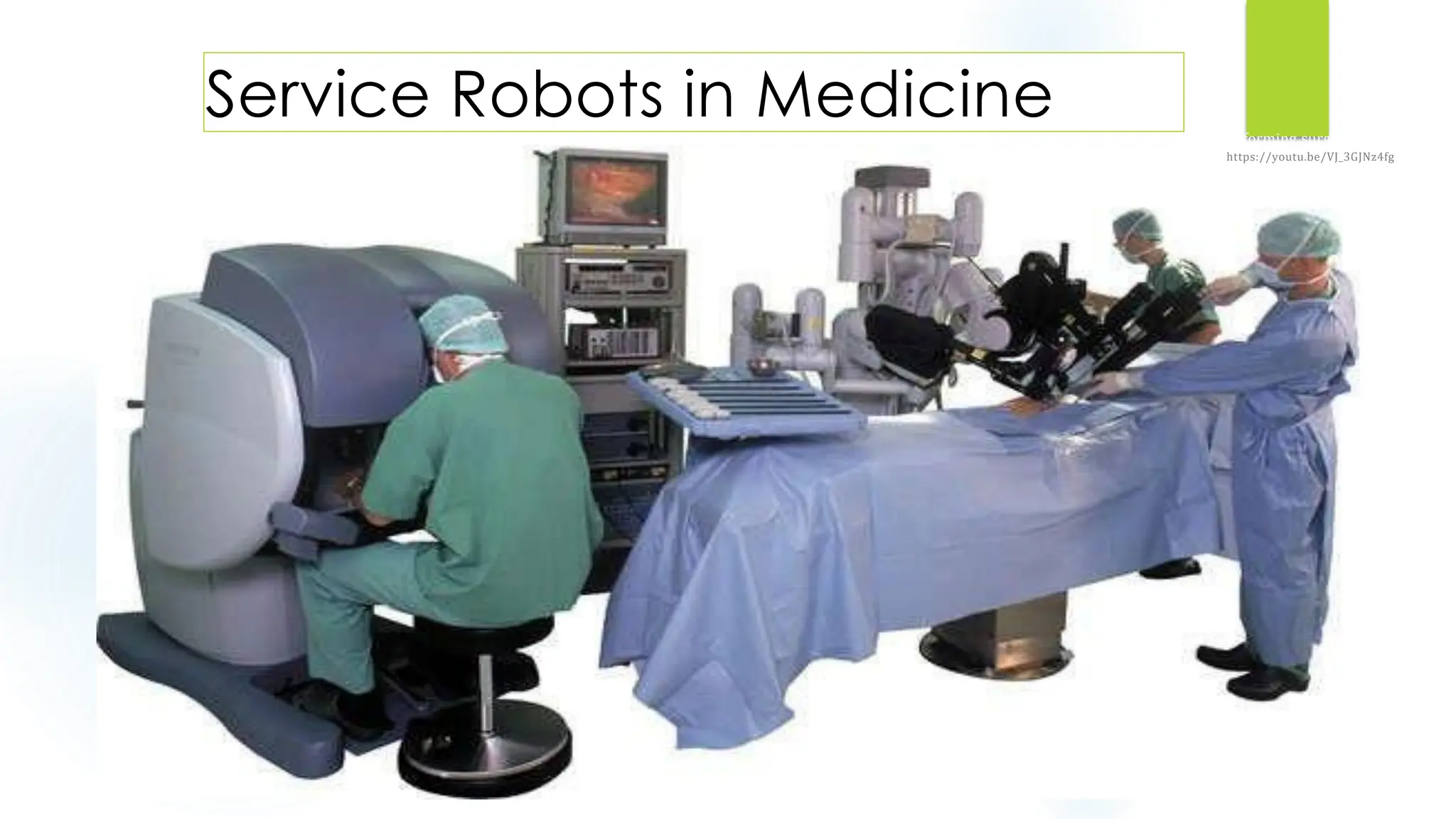
Service Robots in Medicine Da Vinci robot performing surgery through teleop
https://youtu.be/VJ_3GJNz4fg
1
9
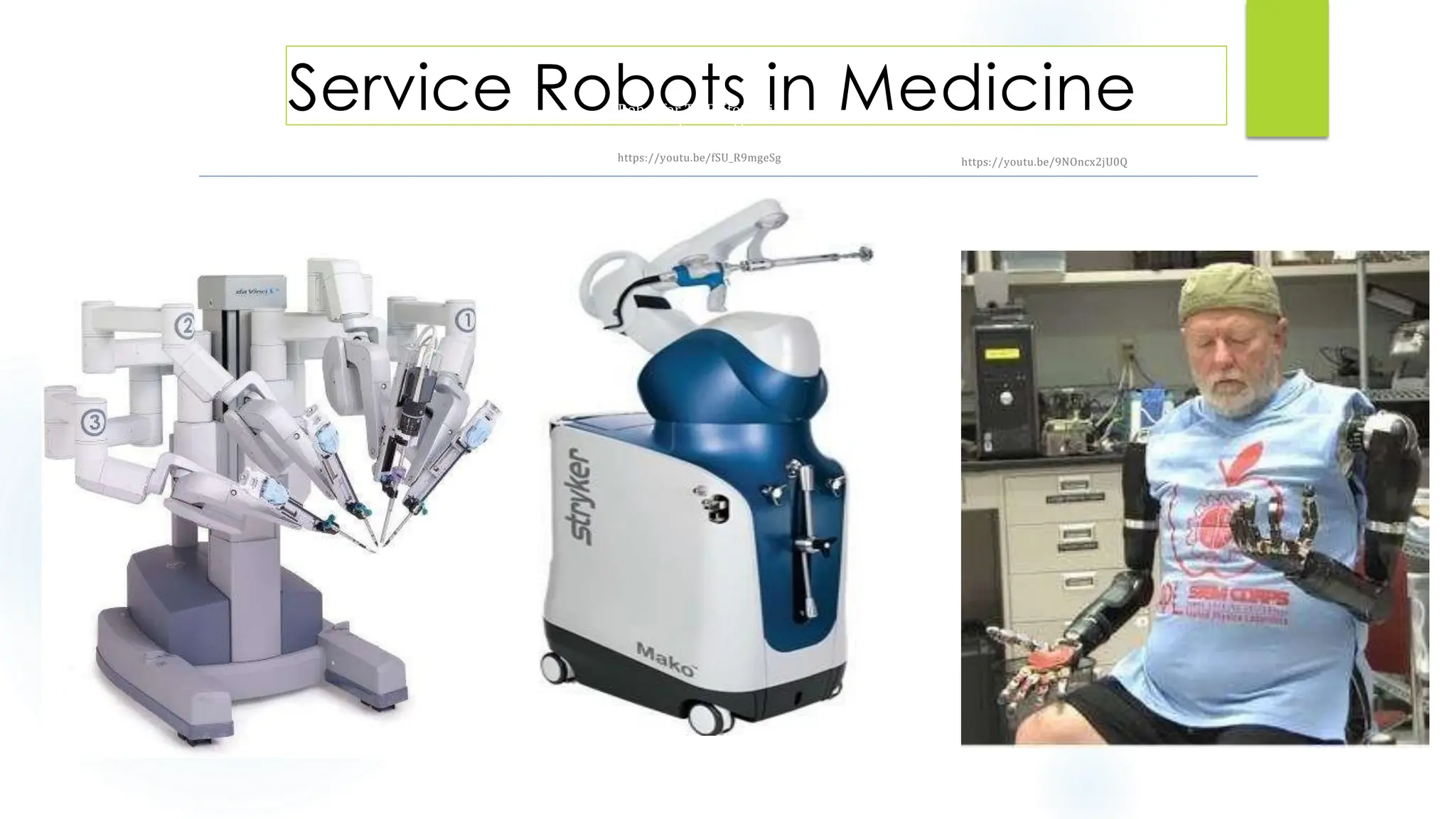
Service Robots in Medicine
DaVinci Robot
Robotic Prosthesis
(Johns Hopkins University)
https://youtu.be/9NOncx2jU0Q
Robot for THR (total hip
replacement)
https://youtu.be/fSU_R9mgeSg
2
0
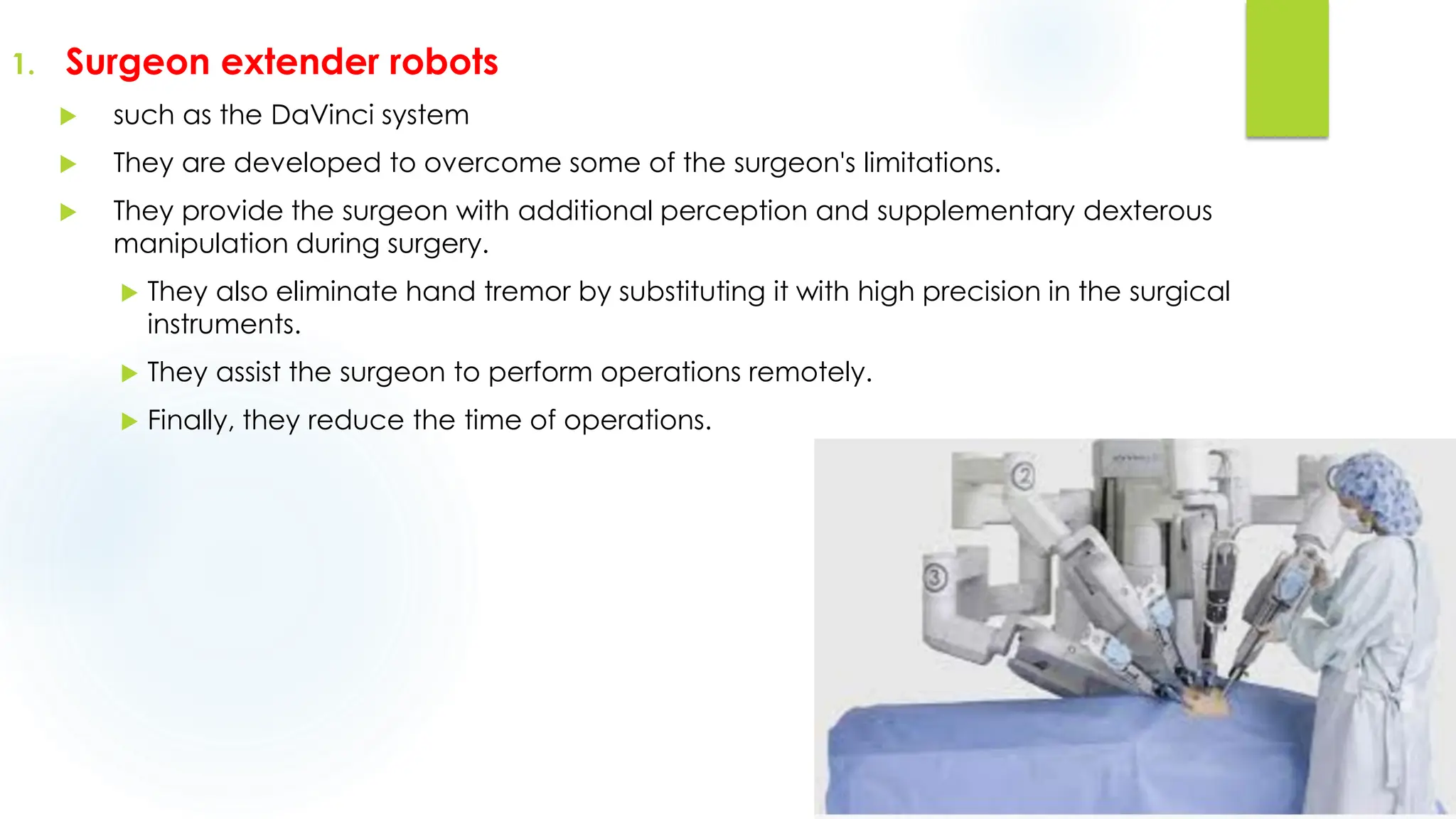
1. Surgeon extender robots
 such as the DaVinci system
 They are developed to overcome some of the surgeon's limitations.
 They provide the surgeon with additional perception and supplementary dexterous
manipulation during surgery.
 They also eliminate hand tremor by substituting it with high precision in the surgical
instruments.
 They assist the surgeon to perform operations remotely.
 Finally, they reduce the time of operations.
2. Auxiliary surgical support robots
 Such as the Automated Endoscopic System for Optimal Positioning (AESOP),
 They are developed to work with the surgeon and perform routine tasks that are
usually performed by the surgeon's assistant nurse.
 Among the benefits of these robots are the reduction of the number of people in
the operating theatre
 Improved task performance, provision of extra safety and enabling the surgeon to
have more control over the surgery by providing instructions that can be followed
precisely during the operation or procedure.
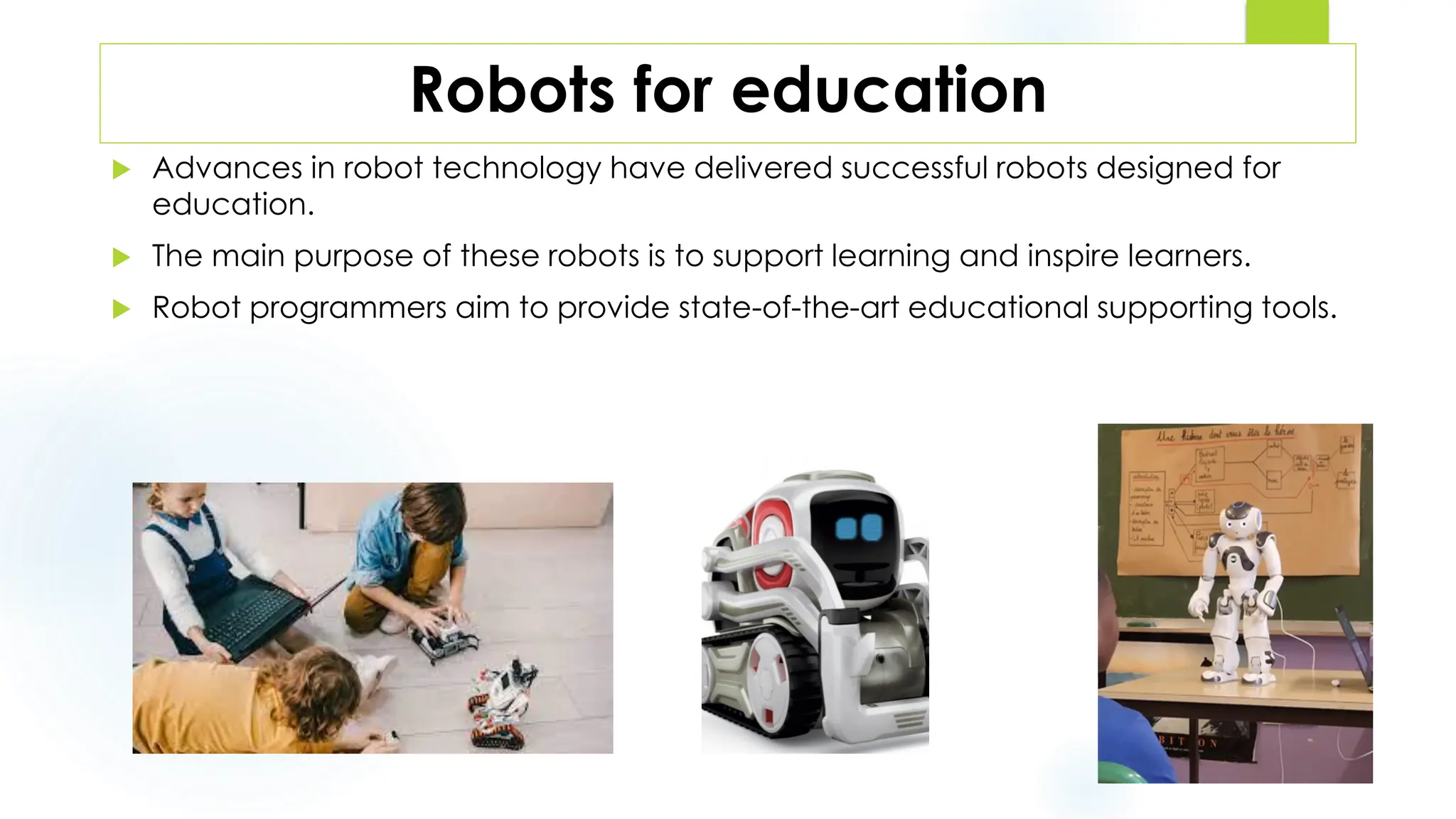
Robots for education
 Advances in robot technology have delivered successful robots designed for
education.
 The main purpose of these robots is to support learning and inspire learners.
 Robot programmers aim to provide state-of-the-art educational supporting tools.
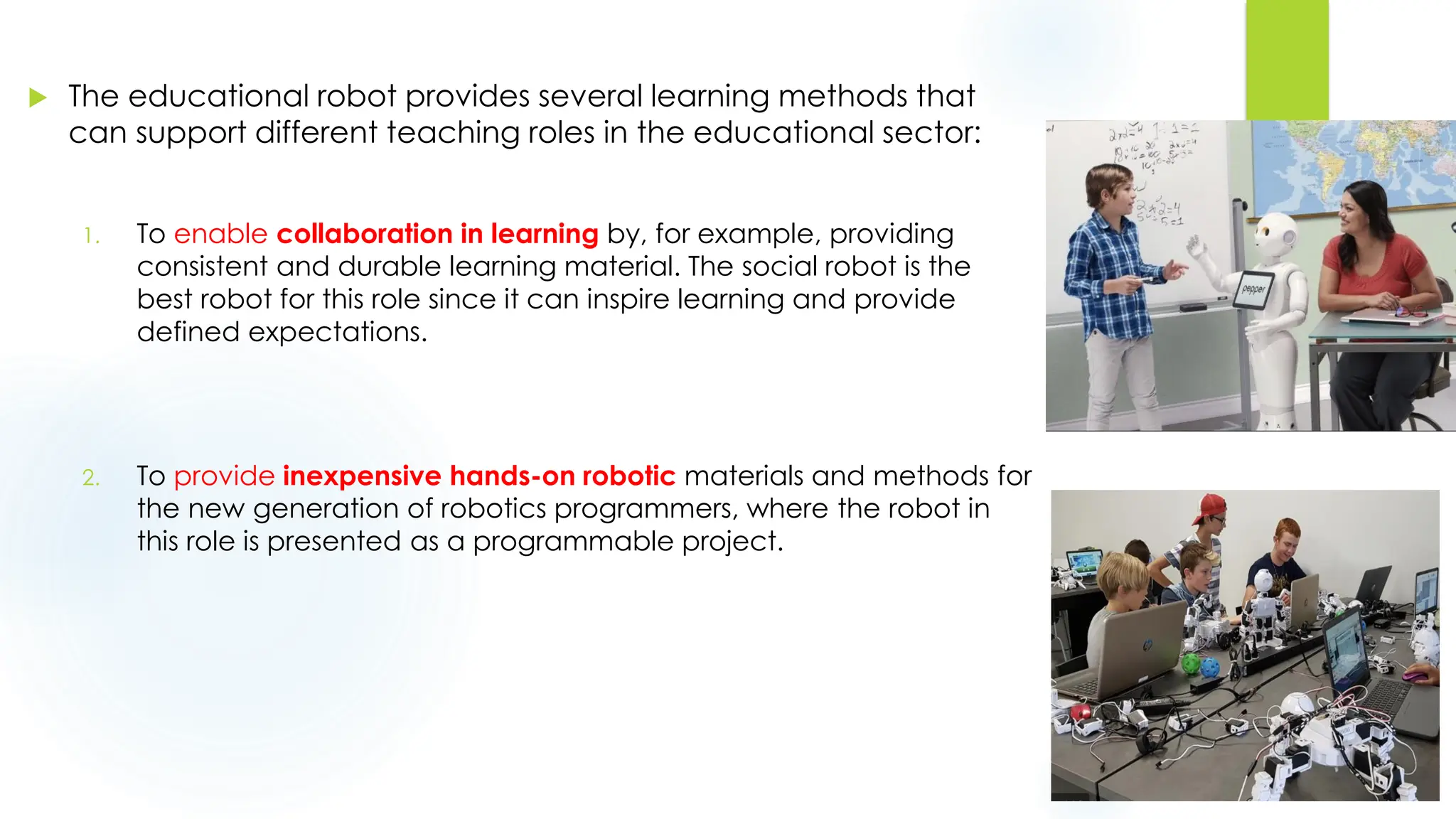
 The educational robot provides several learning methods that
can support different teaching roles in the educational sector:
1. To enable collaboration in learning by, for example, providing
consistent and durable learning material. The social robot is the
best robot for this role since it can inspire learning and provide
defined expectations.
2. To provide inexpensive hands-on robotic materials and methods for
the new generation of robotics programmers, where the robot in
this role is presented as a programmable project.
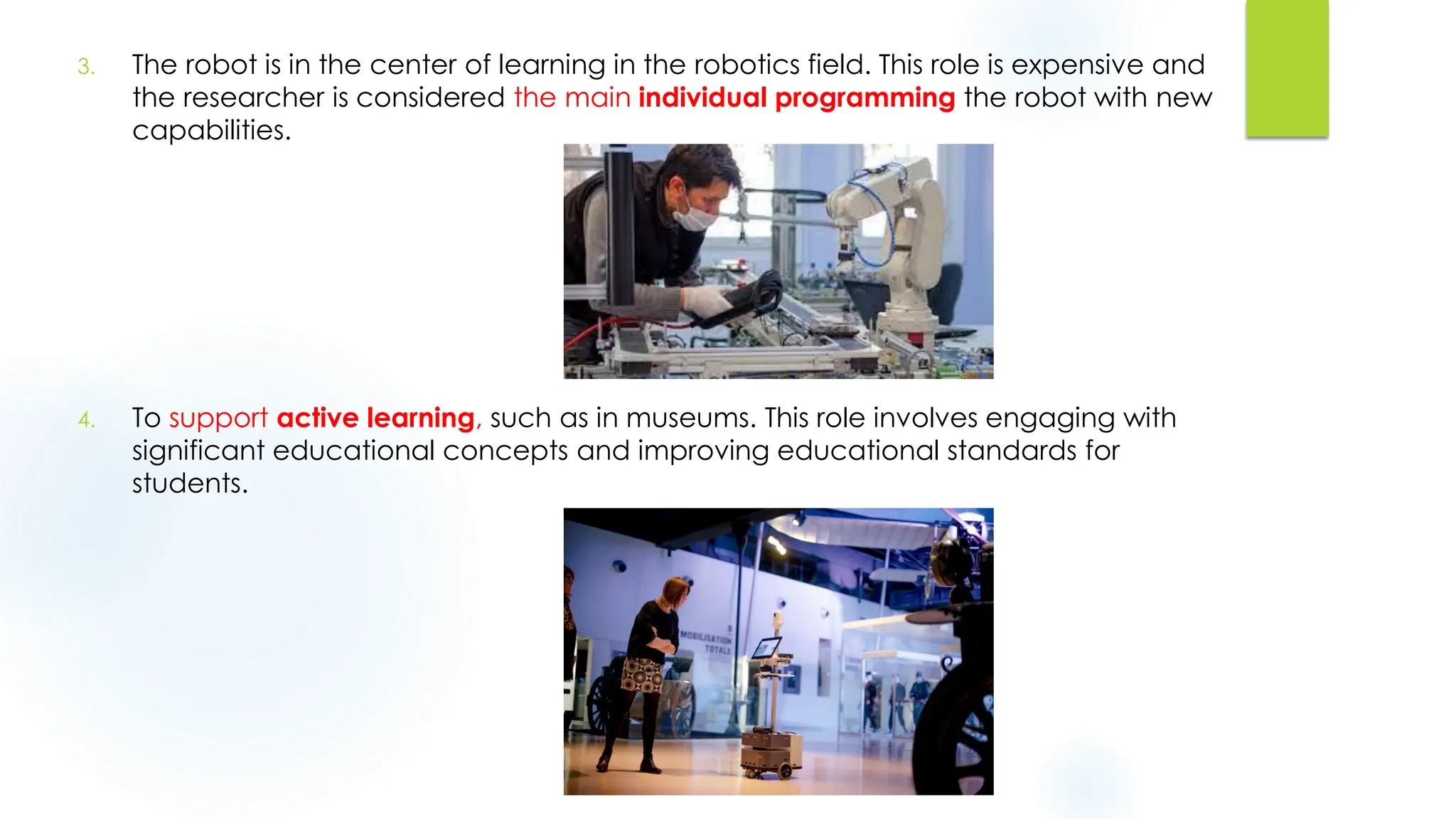
3. The robot is in the center of learning in the robotics field. This role is expensive and
the researcher is considered the main individual programming the robot with new
capabilities.
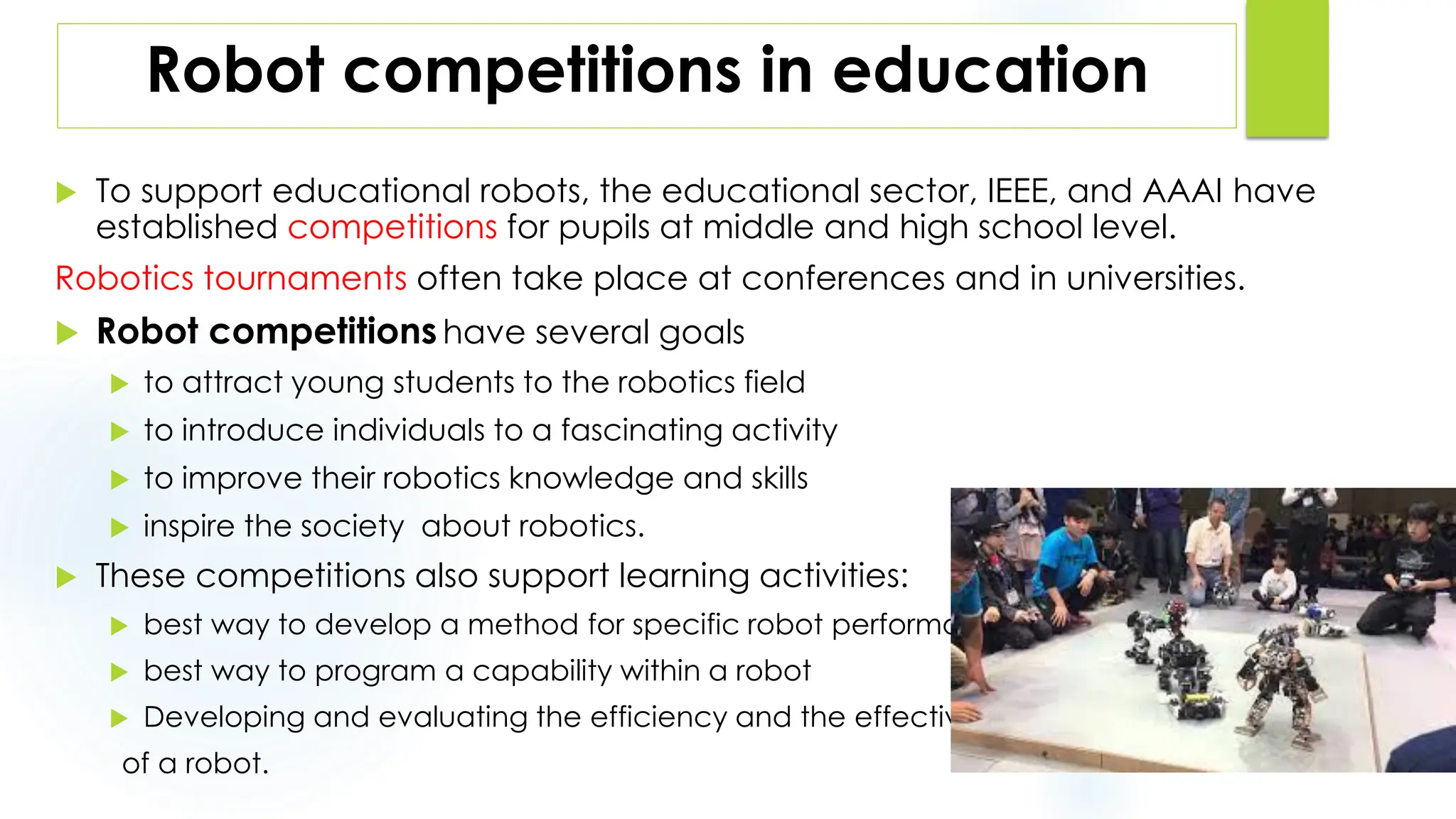
4. To support active learning, such as in museums. This role involves engaging with
significant educational concepts and improving educational standards for
students.
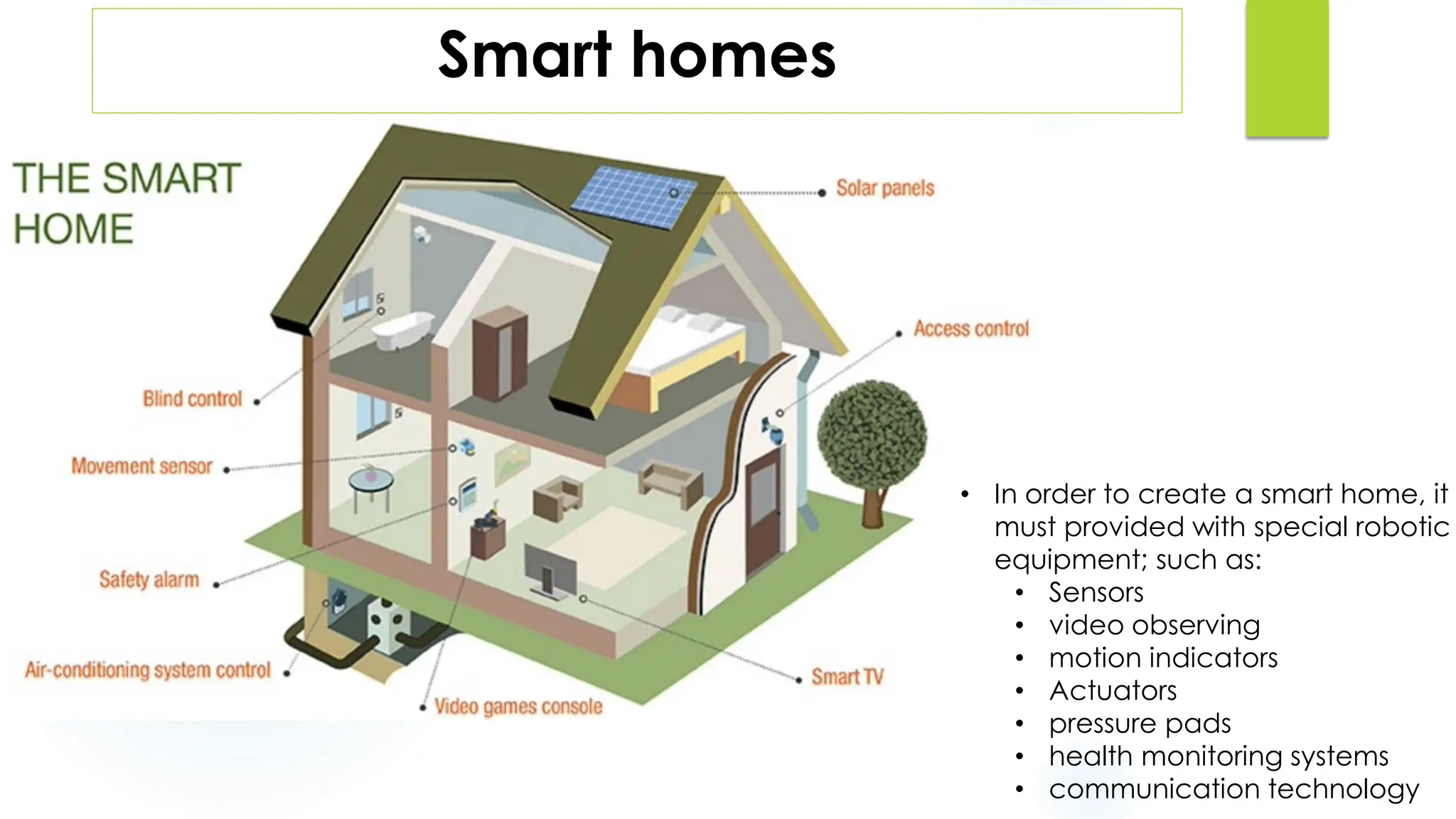
Robot competitions in education
 To support educational robots, the educational sector, IEEE, and AAAI have
established competitions for pupils at middle and high school level.
Robotics tournaments often take place at conferences and in universities.
 Robot competitions have several goals
 to attract young students to the robotics field
 to introduce individuals to a fascinating activity
 to improve their robotics knowledge and skills
 inspire the society about robotics.
 These competitions also support learning activities:
 best way to develop a method for specific robot performance
 best way to program a capability within a robot
 Developing and evaluating the efficiency and the effectiveness
of a robot.
Smart homes
• The smart homes presents various
technological developments in the
structure of the home.
• Smart homes are equipped with
technology that anticipates and
responds to their residents.
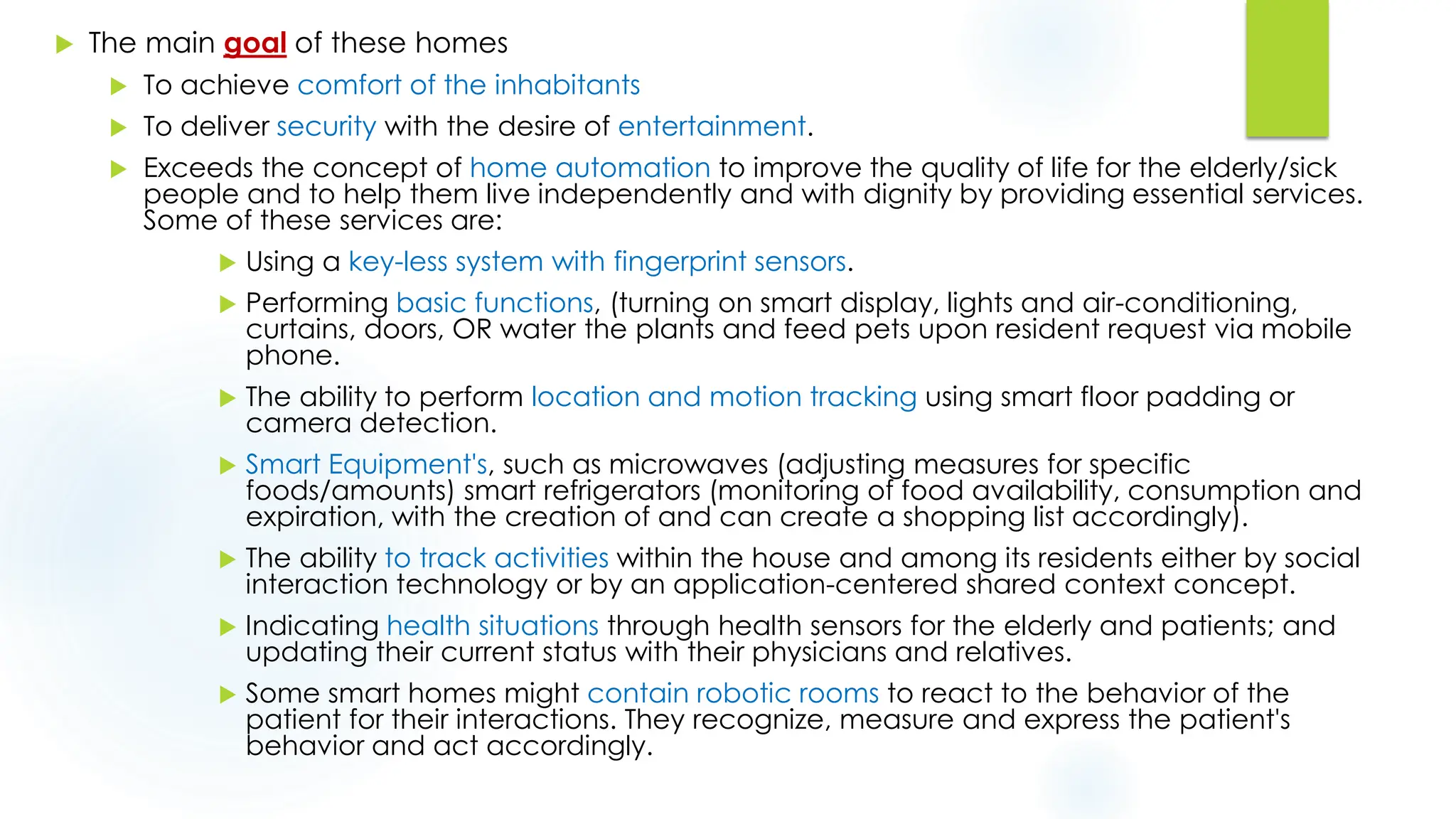
• In order to create a smart home, it
must provided with special robotic
equipment; such as:
• Sensors
• video observing
• motion indicators
• Actuators
• pressure pads
• health monitoring systems
• communication technology
 The main goal of these homes
 To achieve comfort of the inhabitants
 To deliver security with the desire of entertainment.
 Exceeds the concept of home automation to improve the quality of life for the elderly/sick
people and to help them live independently and with dignity by providing essential services.
Some of these services are:
 Using a key-less system with fingerprint sensors.
 Performing basic functions, (turning on smart display, lights and air-conditioning,
curtains, doors, OR water the plants and feed pets upon resident request via mobile
phone.
 The ability to perform location and motion tracking using smart floor padding or
camera detection.
 Smart Equipment's, such as microwaves (adjusting measures for specific
foods/amounts) smart refrigerators (monitoring of food availability, consumption and
expiration, with the creation of and can create a shopping list accordingly).
 The ability to track activities within the house and among its residents either by social
interaction technology or by an application-centered shared context concept.
 Indicating health situations through health sensors for the elderly and patients; and
updating their current status with their physicians and relatives.
 Some smart homes might contain robotic rooms to react to the behavior of the
patient for their interactions. They recognize, measure and express the patient's
behavior and act accordingly.
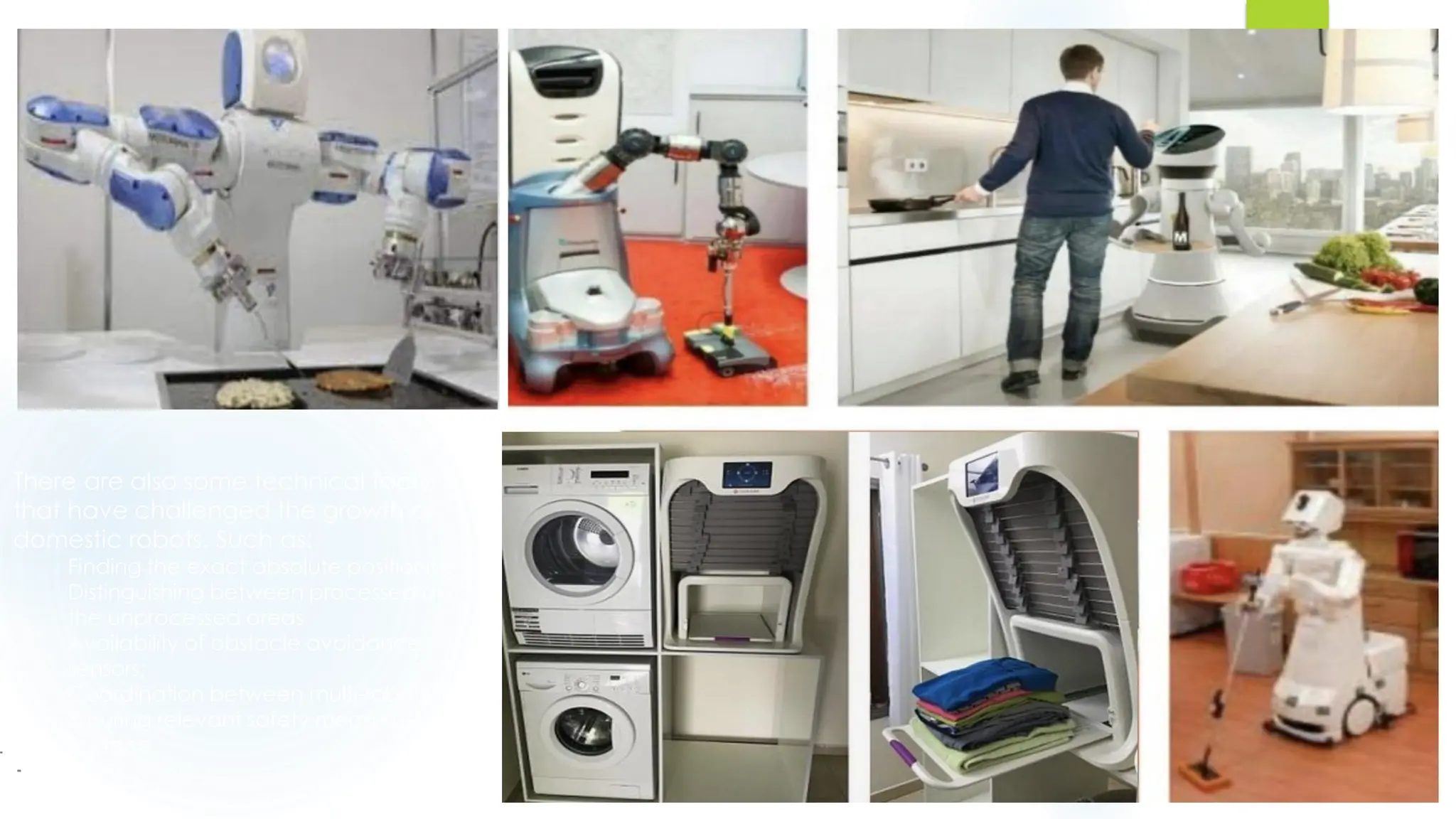
 Domestic appliances refer to robotic appliance systems that contain sensors, actuators
and smart controls, which are very important elements in domestic robotics.
 Some of the domestic appliance robotic systems are:
 The ironing robot (which irons any type of trousers by blowing very hot air on the silky lining
attached to the trousers, thereby removing its crease)
 Intelligent refrigerators (which contain an Internet connection that enables some communication
functionality)
 Smart wardrobes (which can select clothing appropriate to the occasion).
 Domestic cleaning robots to vacuum, mow the lawn and do window cleaning and
cooking.
 There have been new dimensions for characterizing the domestic cleaning robot
according to the task, control of the workplace, complexity, scale, size, dimension (2D or
3D) and type of surface on which the robot works (even, uneven, horizontal, or vertical).
Domestic Robots
There are also some technical factors
that have challenged the growth of
domestic robots. Such as:
Finding the exact absolute positioning;
Distinguishing between processed and
the unprocessed areas
Availability of obstacle avoidance
sensors;
Coordination between multi-robots
Ensuring relevant safety measures are
in place.
Search and rescue robotics
 hazardous applications uses Remote robotic handling systems
 The nuclear remote management operations used engineered systems to keep
humans away from danger. Hazardous environments require humans to jeopardize their lives
to perform risky missions. The availability of robots in these environment with special capabilities to
accomplish specific tasks saves humans from danger, especially when the magnitude of the hazards
reaches a point that threatens a human physically or causes a long-term medical reaction.
 The remote handling system allows humans to work successfully in a protected
location away from exposure to the hazard.
 There have been many different natural Very dangerous hazarded areas that
use these types of robots, such as:
 radioactive explosions,
 toxicity threats,
 bomb explosions
 nuclear radiation) need modern robotic technologies
Rescue robotics
 The rescue robot performs rescue missions, especially when natural disasters have occurred.
 Interacting directly with survivor or victim, it surround survivor, or perform some survivor-
supporting activity
 The goal is to locate survivors quickly, move towards them, and move them without adding
any injury.
 Also, rescue robots are used in rescue operations such as in
 Firefighting
 removal of nuclear or chemical contamination
 reactor breakdown
 collapsed mines require the use of
 Rescue operations require a real-time video and special sensory system to present the
situation.
 Such robots contain remote handling systems that enable many subsystems to perform their
tasks. These subsystems involve different aspects of capabilities within the robots.
 There are two main ways that the remote handling system can operate in hazardous
environments through
1. Telepresence technology
2. tele-operated technology.
These two provide the human:
 the accessibility to the environment
 allows an effective rescue operation
 Designing robotic system need to consider:
 the nature of the environment
 should be designed to avoid any mission failure. There are several factors for the robot to fail such
missions, one of the most likely is the equipment failure within the system itself.
 The system should perform maintenance on its own parts or to be able to perform the
required maintenance on the system remotely.
35
There are three categories for classifying this
type of robot:
1. Modality: The first type defines the modality
of the robot performance environment
according to whether it is aerial, ground,
underwater or water surface, and so on.
2. Size: The second type defines the size of the
robot as man-backpack if one person could
carry it, man-portable robot if two people
can carry it, and maxi-rescue robot for very
large robots that probably need a trailer to
be transported.
3. Task: robot according to the task they
perform at the time of rescue.

CcDifferent classifications of robotics in the industrial V3.pdf

  • 1.
    Robots in different fields Chapter#1:Introduction PART 2 College of Computer Science and EngineeringI C C A I 414 Robotics
  • 2.
    Robots taxonomies  Dependingon in which field the robots are used for, their characteristics and capabilities are set accordingly.  Some classifications based on the application domain, another on the type of technology used in robotics, other taxonomies help in reviewing some robots, characteristics, features, capabilities and their requirements.  Classifying the robot according to one of its components, such as sensors and actuates, to cover what the robot consists of. This classification defines the hardware and software features within the robot.
  • 3.
    Robots classification 1. Therobot can be designed either as an industrial or as a non-industrial application.  Industrial applications: robot performs industrial capabilities.  Non-industrial robot perform capabilities belong to the domain it executes in. such as producing material goods for building, mining or agriculture, or it could be providing services such as medicine, transport, trade or tourism.
  • 4.
    • Classification ofrobots by: o environment o and mechanism of interaction • Fixed robots are mostly industrial robotic manipulators that work in well defined environments adapted for robots. • Mobile robots are expected to move around and perform tasks in large, ill-defined and uncertain environments that are not designed specifically for robots. Classification 4
  • 5.
    Classification of robotsby application field: • Industrial Robots - Used in industrial automation applications (manufacture, inspection, packing, assembly, etc.) • Service Robots - They perform tasks for humans or other equipment, excluding industrial automation applications 5 Classification
  • 6.
    Service Robots Personal Used fornon-commercial tasks by common (untrained) people Professional Used for commercial tasks by trained people - Domestic robots - Automated wheelchairs - Personal assistants - Robots for entertainment - Etc. - Robots to clean public places - Delivery robots - Firefighting robots - Robots for rehabilitation and surgery - Etc. 6
  • 7.
  • 8.
    Industrial Robots • Assembly •Materials handling • Manipulation (“pick and place”) • Spot and arc welding • Laser cut • Painting (spray layers) • Etc. 8
  • 9.
    • Industrial robotsare the most widespread robots and the oldest. • Industrial robots enable automation, to be used in car assembly, power train assembly and engine assembly. • They returned numerous advantages to the manufacturers that have adopted them. • They provide : • robust productivity, • constancy in production lines • accuracy in each product • reduction of manufacturing costs. • Industrial robots are categorized: 1. manual manipulator 2. fixed sequence 3. variable sequence 4. playback 5. numerical control robots
  • 10.
    Rehabilitation and healthcare robots The rehabilitation and healthcare robot is designed to assist people by:  providing essential activities relating to their disability  functionality that improves a person's cognitive or physical ability.  The rehabilitation robot can be categorized into several parts. 1 0
  • 12.
     The firstcategory in the rehabilitation robot is the robot that is used in therapy.  Any therapist robot has two users: the patient and the human therapists.  Once the rehabilitation robot is installed correctly, it can performs the therapy for a long periods of time without any exhaustion.  It also measures the treatment better than human therapists since it contains sophisticated scales to measure the treatments and present the effects significantly.
  • 13.
     The secondcategory of the assistive robotics in the rehabilitation robot is the assistive robotics system that provides physical, social or cognitive support.
  • 14.
     The thirdcategory provide an electronic stimulation, either through prostheses or using specific techniques, that enable the patient to perform everyday activities
  • 15.
    Medical robots andcomputer integrated surgery  The healthcare medical robot is part of the rapidly growing application- driven research field.  The medical robot system can be defined as tools that support surgery with an information infrastructure controlled by a human and via computer.  Main goals of these robots are not to replace the surgeon, but to provide him or her with additional support, such as safety, efficiency, technical capabilities, consistency and reduced patient morbidity. T  The robotic surgical assistance is divided into two categories:
  • 16.
    Service Robots inMedicine Da Vinci robot performing surgery through teleop https://youtu.be/VJ_3GJNz4fg 1 9
  • 17.
    Service Robots inMedicine DaVinci Robot Robotic Prosthesis (Johns Hopkins University) https://youtu.be/9NOncx2jU0Q Robot for THR (total hip replacement) https://youtu.be/fSU_R9mgeSg 2 0
  • 18.
    1. Surgeon extenderrobots  such as the DaVinci system  They are developed to overcome some of the surgeon's limitations.  They provide the surgeon with additional perception and supplementary dexterous manipulation during surgery.  They also eliminate hand tremor by substituting it with high precision in the surgical instruments.  They assist the surgeon to perform operations remotely.  Finally, they reduce the time of operations.
  • 20.
    2. Auxiliary surgicalsupport robots  Such as the Automated Endoscopic System for Optimal Positioning (AESOP),  They are developed to work with the surgeon and perform routine tasks that are usually performed by the surgeon's assistant nurse.  Among the benefits of these robots are the reduction of the number of people in the operating theatre  Improved task performance, provision of extra safety and enabling the surgeon to have more control over the surgery by providing instructions that can be followed precisely during the operation or procedure.
  • 21.
    Robots for education Advances in robot technology have delivered successful robots designed for education.  The main purpose of these robots is to support learning and inspire learners.  Robot programmers aim to provide state-of-the-art educational supporting tools.
  • 22.
     The educationalrobot provides several learning methods that can support different teaching roles in the educational sector: 1. To enable collaboration in learning by, for example, providing consistent and durable learning material. The social robot is the best robot for this role since it can inspire learning and provide defined expectations. 2. To provide inexpensive hands-on robotic materials and methods for the new generation of robotics programmers, where the robot in this role is presented as a programmable project.
  • 23.
    3. The robotis in the center of learning in the robotics field. This role is expensive and the researcher is considered the main individual programming the robot with new capabilities. 4. To support active learning, such as in museums. This role involves engaging with significant educational concepts and improving educational standards for students.
  • 24.
    Robot competitions ineducation  To support educational robots, the educational sector, IEEE, and AAAI have established competitions for pupils at middle and high school level. Robotics tournaments often take place at conferences and in universities.  Robot competitions have several goals  to attract young students to the robotics field  to introduce individuals to a fascinating activity  to improve their robotics knowledge and skills  inspire the society about robotics.  These competitions also support learning activities:  best way to develop a method for specific robot performance  best way to program a capability within a robot  Developing and evaluating the efficiency and the effectiveness of a robot.
  • 25.
    Smart homes • Thesmart homes presents various technological developments in the structure of the home. • Smart homes are equipped with technology that anticipates and responds to their residents. • In order to create a smart home, it must provided with special robotic equipment; such as: • Sensors • video observing • motion indicators • Actuators • pressure pads • health monitoring systems • communication technology
  • 26.
     The maingoal of these homes  To achieve comfort of the inhabitants  To deliver security with the desire of entertainment.  Exceeds the concept of home automation to improve the quality of life for the elderly/sick people and to help them live independently and with dignity by providing essential services. Some of these services are:  Using a key-less system with fingerprint sensors.  Performing basic functions, (turning on smart display, lights and air-conditioning, curtains, doors, OR water the plants and feed pets upon resident request via mobile phone.  The ability to perform location and motion tracking using smart floor padding or camera detection.  Smart Equipment's, such as microwaves (adjusting measures for specific foods/amounts) smart refrigerators (monitoring of food availability, consumption and expiration, with the creation of and can create a shopping list accordingly).  The ability to track activities within the house and among its residents either by social interaction technology or by an application-centered shared context concept.  Indicating health situations through health sensors for the elderly and patients; and updating their current status with their physicians and relatives.  Some smart homes might contain robotic rooms to react to the behavior of the patient for their interactions. They recognize, measure and express the patient's behavior and act accordingly.
  • 27.
     Domestic appliancesrefer to robotic appliance systems that contain sensors, actuators and smart controls, which are very important elements in domestic robotics.  Some of the domestic appliance robotic systems are:  The ironing robot (which irons any type of trousers by blowing very hot air on the silky lining attached to the trousers, thereby removing its crease)  Intelligent refrigerators (which contain an Internet connection that enables some communication functionality)  Smart wardrobes (which can select clothing appropriate to the occasion).  Domestic cleaning robots to vacuum, mow the lawn and do window cleaning and cooking.  There have been new dimensions for characterizing the domestic cleaning robot according to the task, control of the workplace, complexity, scale, size, dimension (2D or 3D) and type of surface on which the robot works (even, uneven, horizontal, or vertical). Domestic Robots
  • 28.
    There are alsosome technical factors that have challenged the growth of domestic robots. Such as: Finding the exact absolute positioning; Distinguishing between processed and the unprocessed areas Availability of obstacle avoidance sensors; Coordination between multi-robots Ensuring relevant safety measures are in place.
  • 29.
    Search and rescuerobotics  hazardous applications uses Remote robotic handling systems  The nuclear remote management operations used engineered systems to keep humans away from danger. Hazardous environments require humans to jeopardize their lives to perform risky missions. The availability of robots in these environment with special capabilities to accomplish specific tasks saves humans from danger, especially when the magnitude of the hazards reaches a point that threatens a human physically or causes a long-term medical reaction.  The remote handling system allows humans to work successfully in a protected location away from exposure to the hazard.  There have been many different natural Very dangerous hazarded areas that use these types of robots, such as:  radioactive explosions,  toxicity threats,  bomb explosions  nuclear radiation) need modern robotic technologies
  • 30.
    Rescue robotics  Therescue robot performs rescue missions, especially when natural disasters have occurred.  Interacting directly with survivor or victim, it surround survivor, or perform some survivor- supporting activity  The goal is to locate survivors quickly, move towards them, and move them without adding any injury.  Also, rescue robots are used in rescue operations such as in  Firefighting  removal of nuclear or chemical contamination  reactor breakdown  collapsed mines require the use of  Rescue operations require a real-time video and special sensory system to present the situation.  Such robots contain remote handling systems that enable many subsystems to perform their tasks. These subsystems involve different aspects of capabilities within the robots.
  • 31.
     There aretwo main ways that the remote handling system can operate in hazardous environments through 1. Telepresence technology 2. tele-operated technology. These two provide the human:  the accessibility to the environment  allows an effective rescue operation  Designing robotic system need to consider:  the nature of the environment  should be designed to avoid any mission failure. There are several factors for the robot to fail such missions, one of the most likely is the equipment failure within the system itself.  The system should perform maintenance on its own parts or to be able to perform the required maintenance on the system remotely.
  • 32.
    35 There are threecategories for classifying this type of robot: 1. Modality: The first type defines the modality of the robot performance environment according to whether it is aerial, ground, underwater or water surface, and so on. 2. Size: The second type defines the size of the robot as man-backpack if one person could carry it, man-portable robot if two people can carry it, and maxi-rescue robot for very large robots that probably need a trailer to be transported. 3. Task: robot according to the task they perform at the time of rescue.