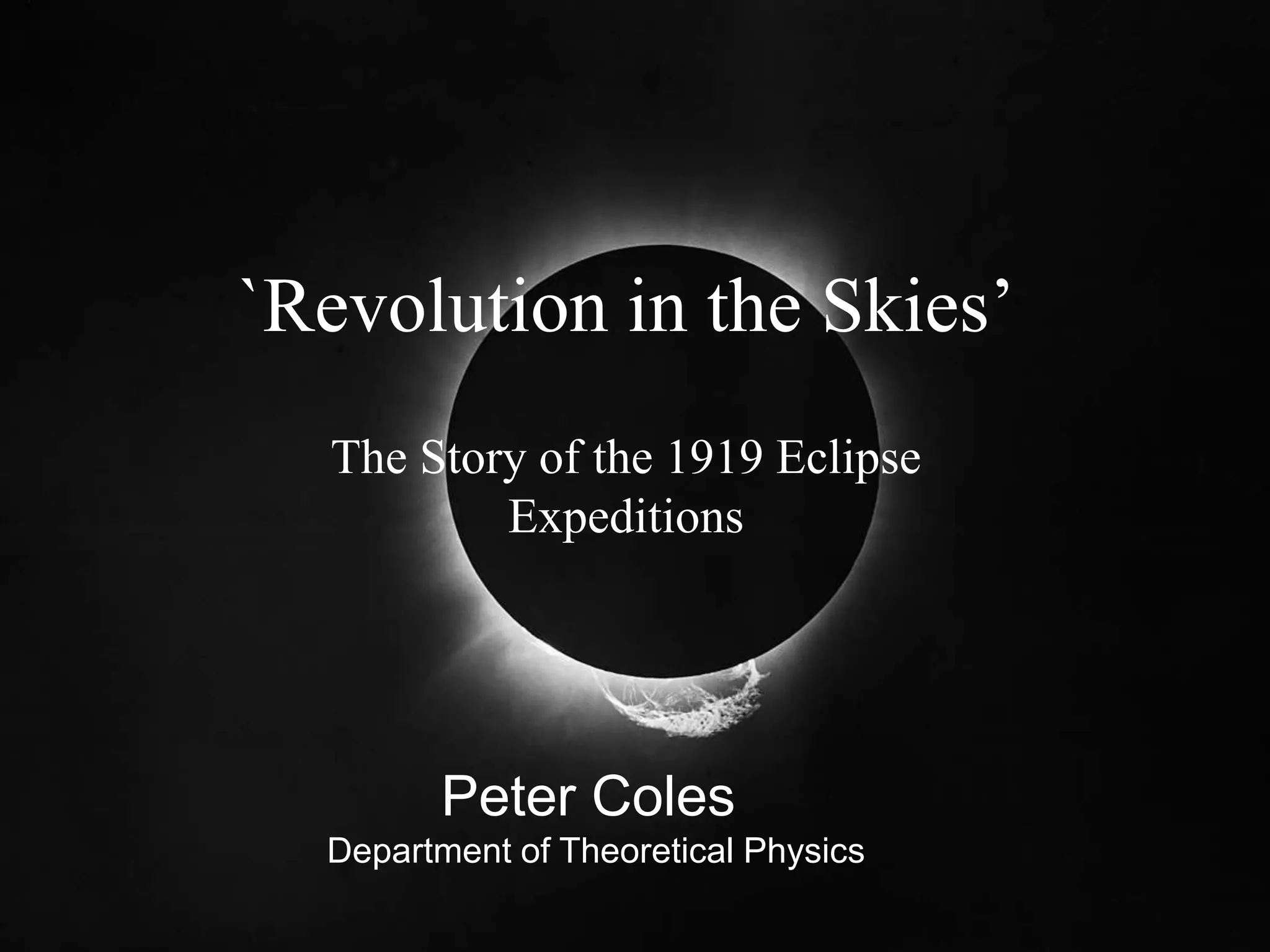
`Revolution in the Skies’
The Story of the 1919 Eclipse
Expeditions
Peter Coles
Department of Theoretical Physics
Newton’s Laws of Motion
• I. Every body continues in a state of rest or
uniform motion in a straight line unless it is
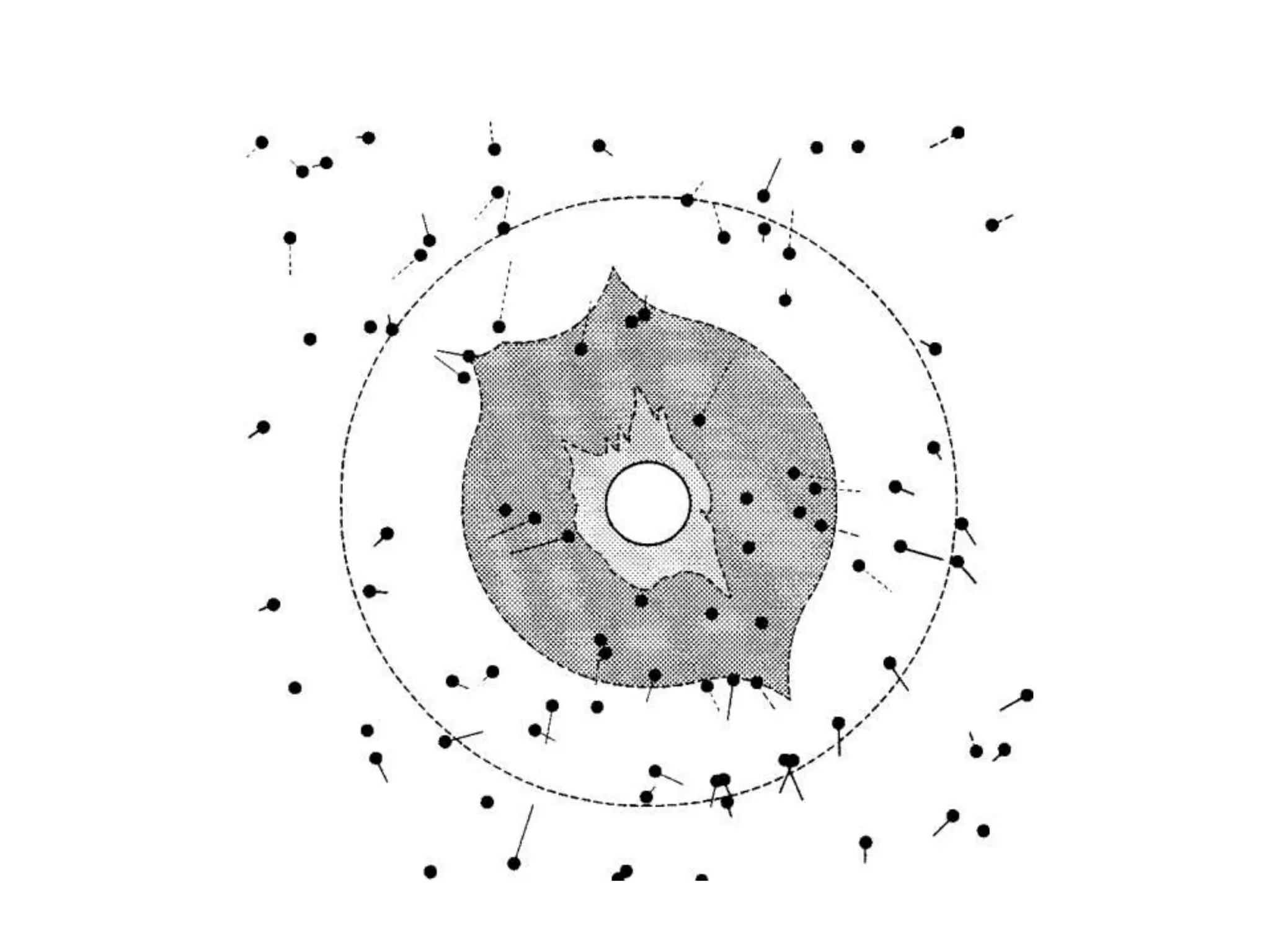
compelled to change that state by forces
impressed upon it.
• II. Rate of change of momentum is
proportional to the impressed force, and is in
the direction in which this force acts
• III. To every action, there is always opposed
an equal reaction.
“..the Supreme God is a Being eternal, infinite,
absolutely perfect…He endures forever and is
everywhere present; and by existing always and
everywhere, he constitutes duration and
space..”
Newton, Principia (General Scholium).
Absolute Space, Absolute Time
Universal Gravitation
• “the attractive force between any two
bodies depends on the product of the
masses of the bodies and on the square
of the distance between them”
• “the attraction always is in a
duplicate proportion to the Distance
from the Center Reciprocall”
The Mystery of Mass
• Mass can represent the resistance of a
body to being accelerated (inertial)
• ..or the strength of gravity produced
(active)
• ..or the tendency to feel gravity
(passive)
• Are these masses the same?
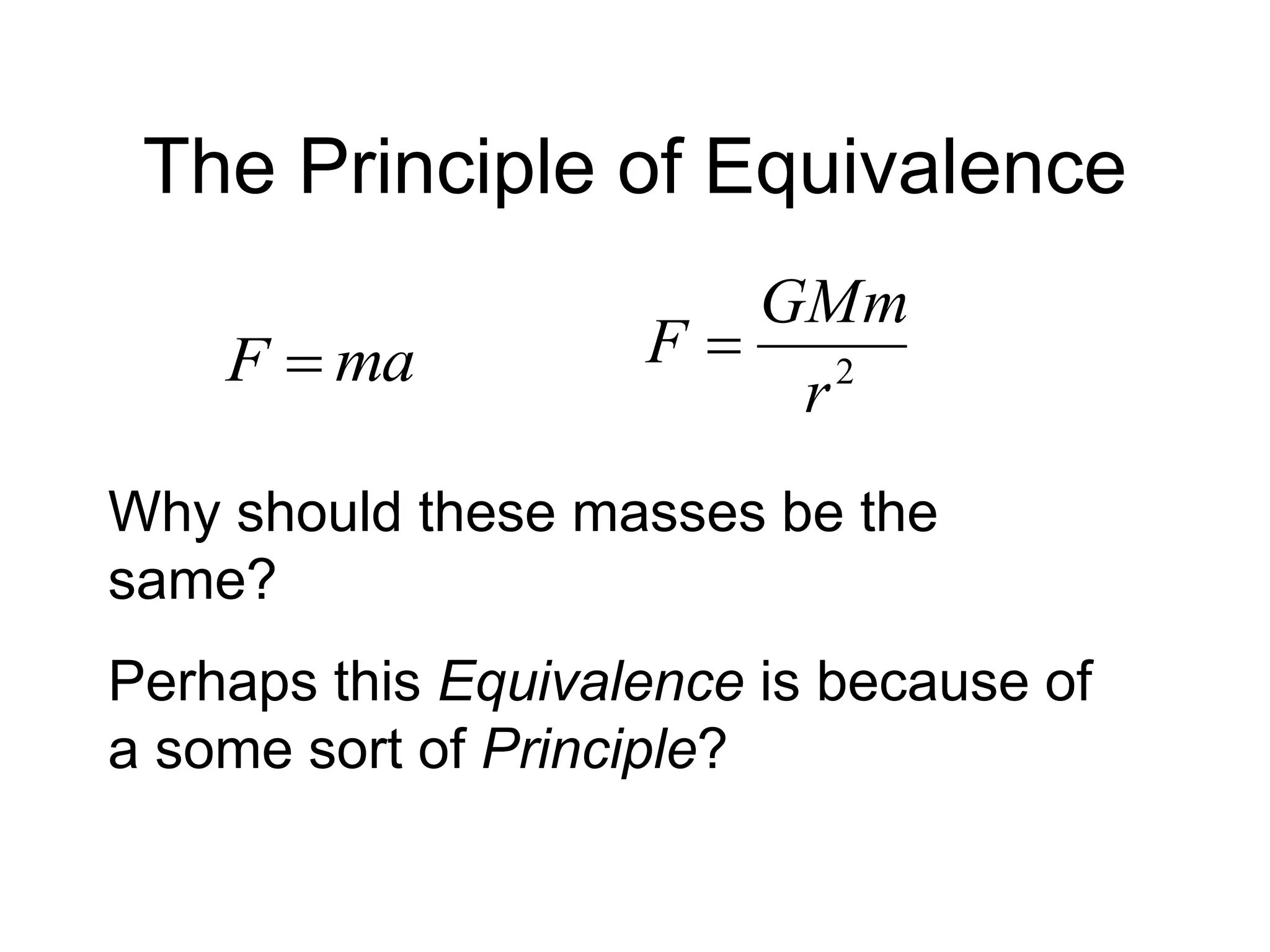
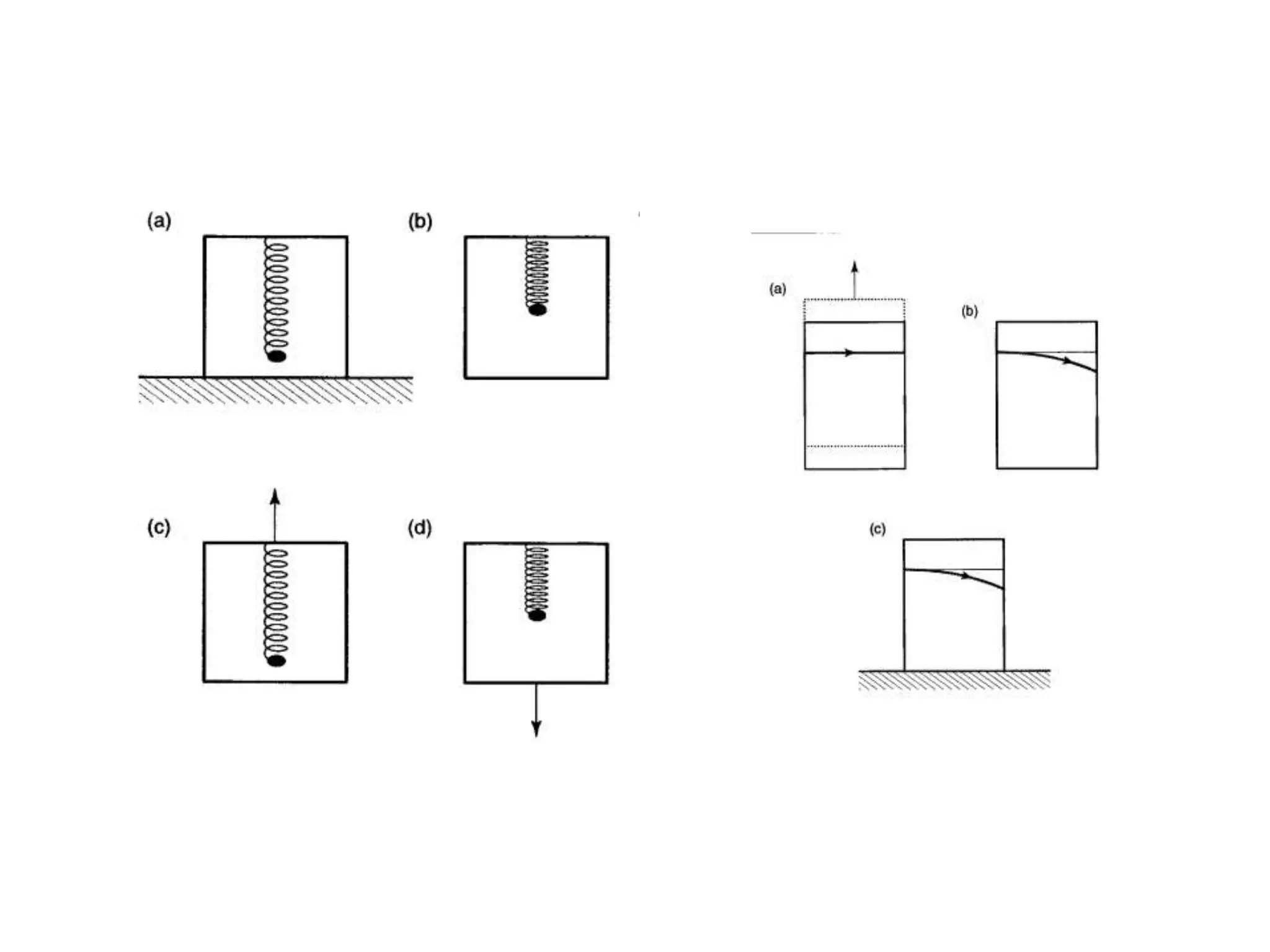
The Principle of Equivalence
maF  2
r
GMm
F 
Why should these masses be the
same?
Perhaps this Equivalence is because of
a some sort of Principle?
The Einstein (R)evolution
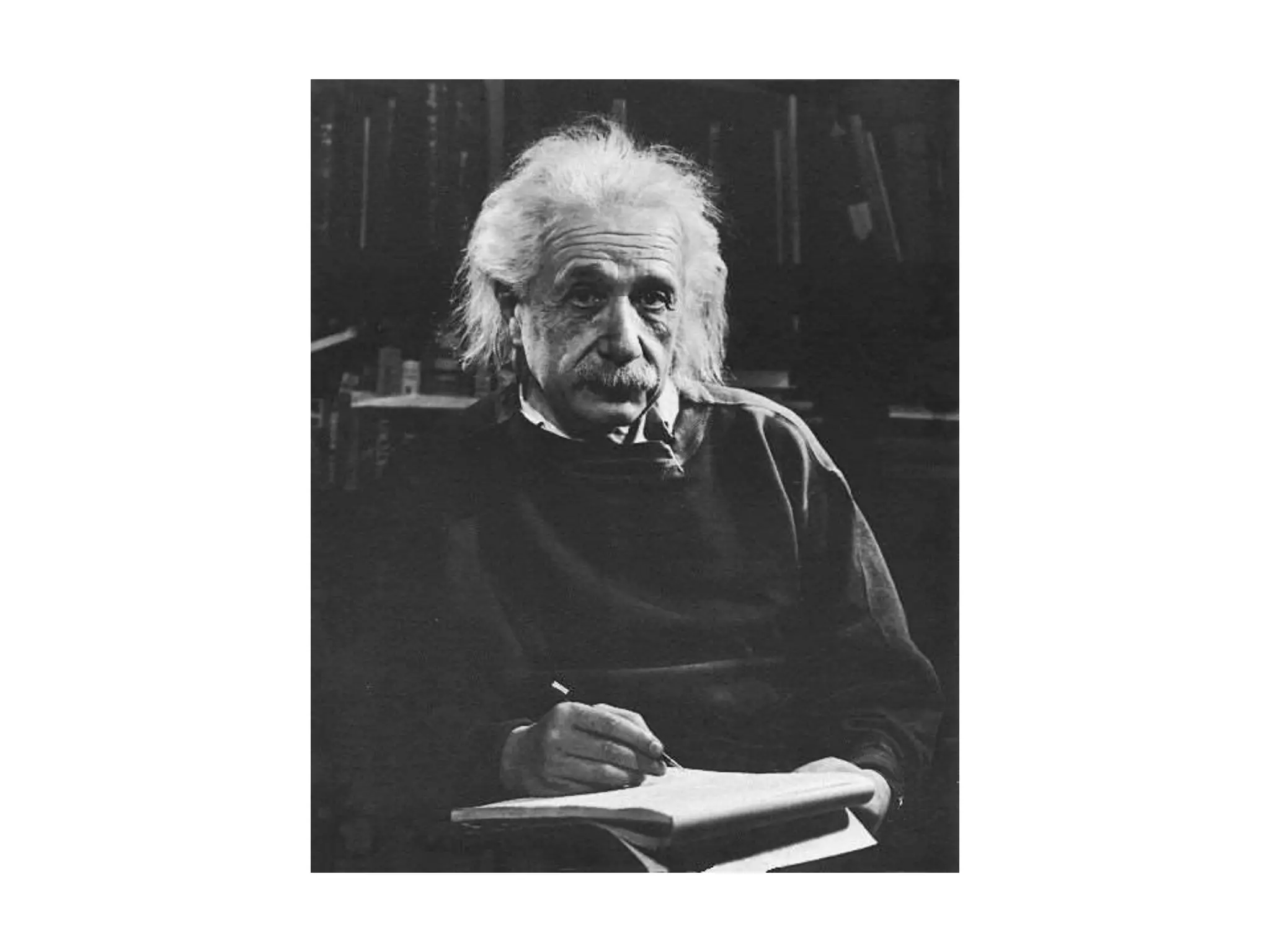
• Albert Einstein was born in Ulm on 14 March 1879
• After failing the entrance exam the previous year, he
entered the Institute of Technology (Zurich) in 1896.
• “Too lazy” to continue as a scientist, he left in 1902 to
become a patent clerk in Bern.
• In 1905, he revolutionized science with the special
theory of relativity. “E=mc2” and all that.
• In 1915, he went even further, with the general
theory of relativity.
General Relativity
• The “Principle of Equivalence”
• Acceleration and Gravity
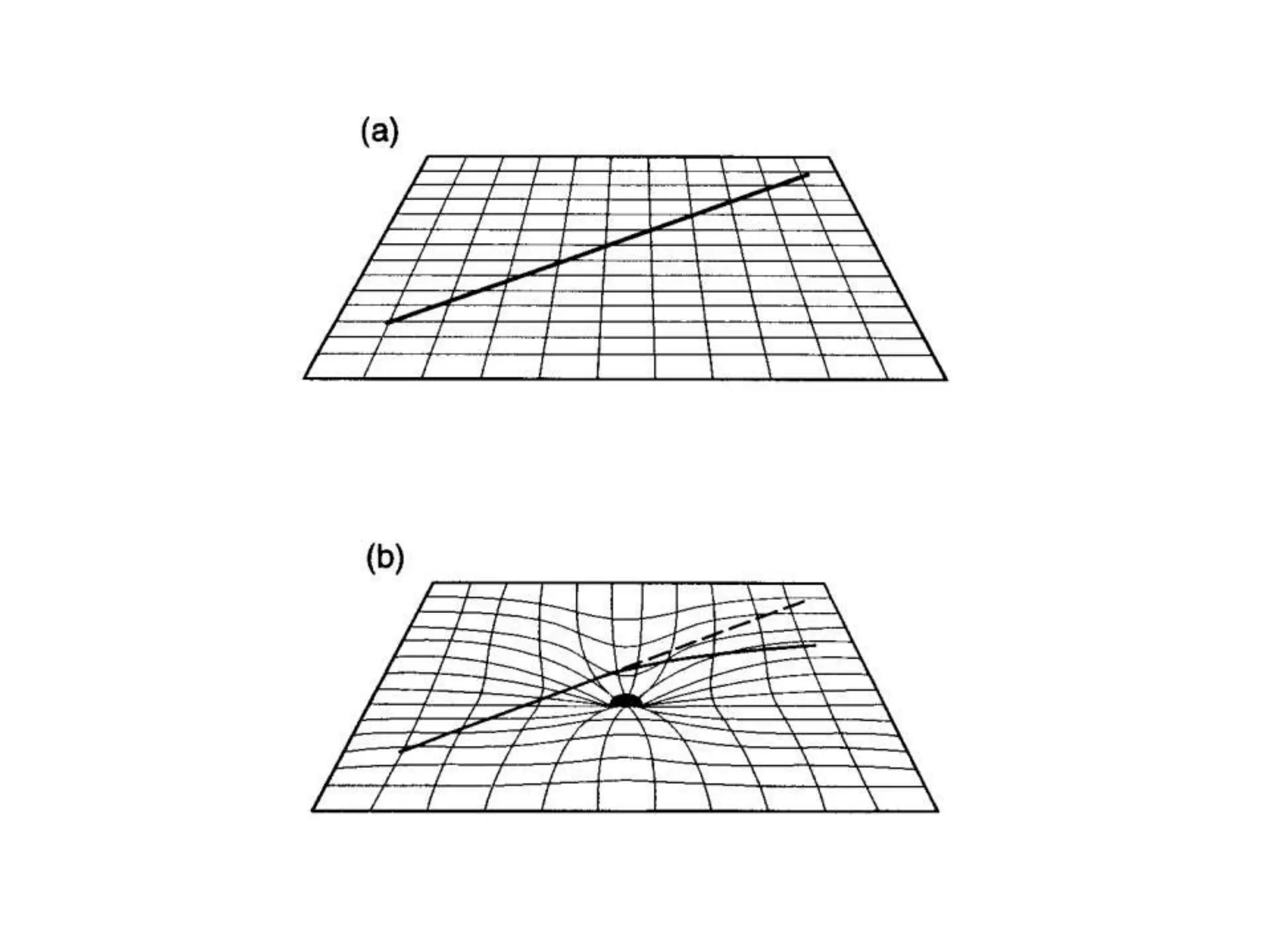
• The curving of space
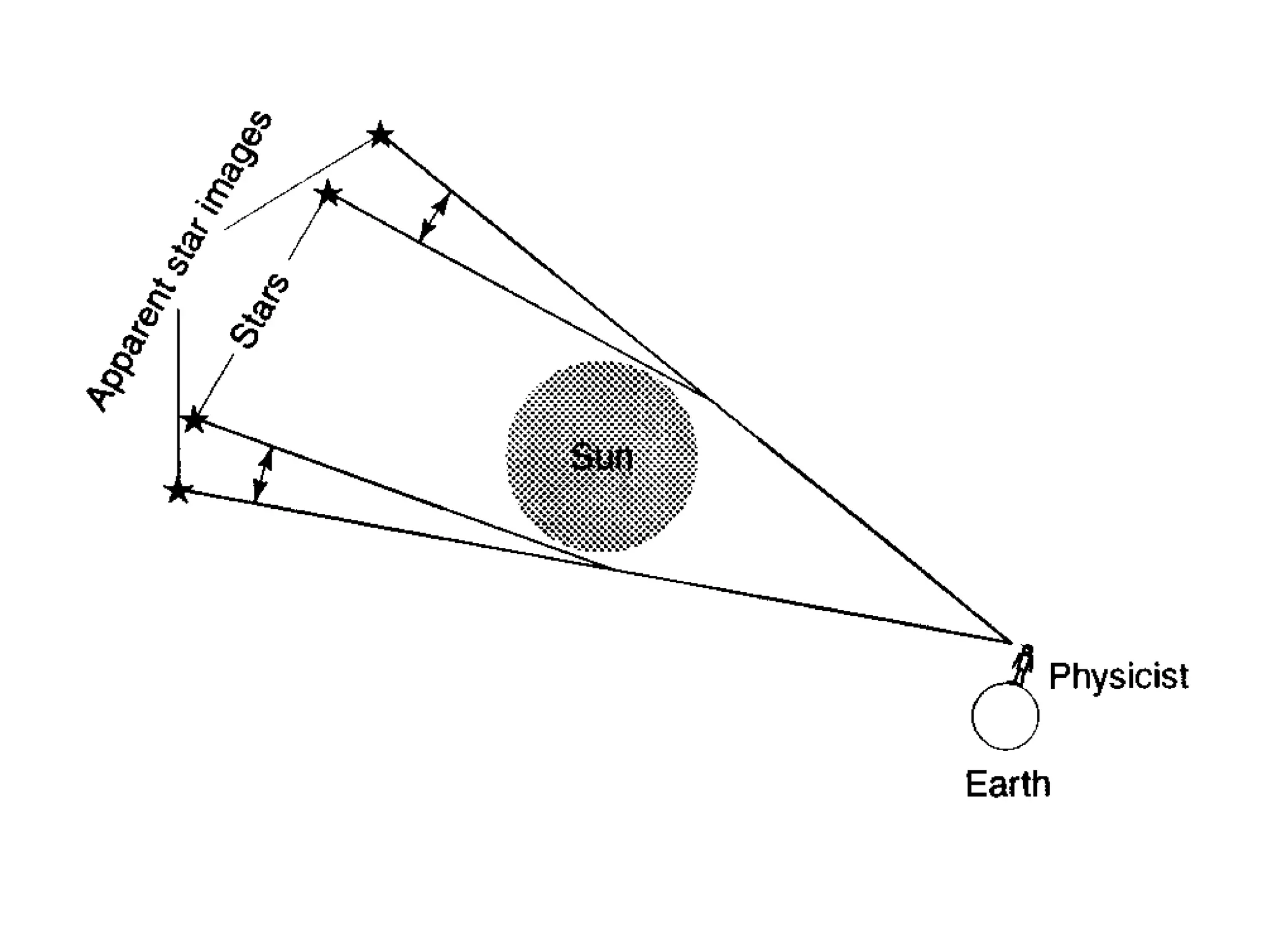
• ..and the bending of light!
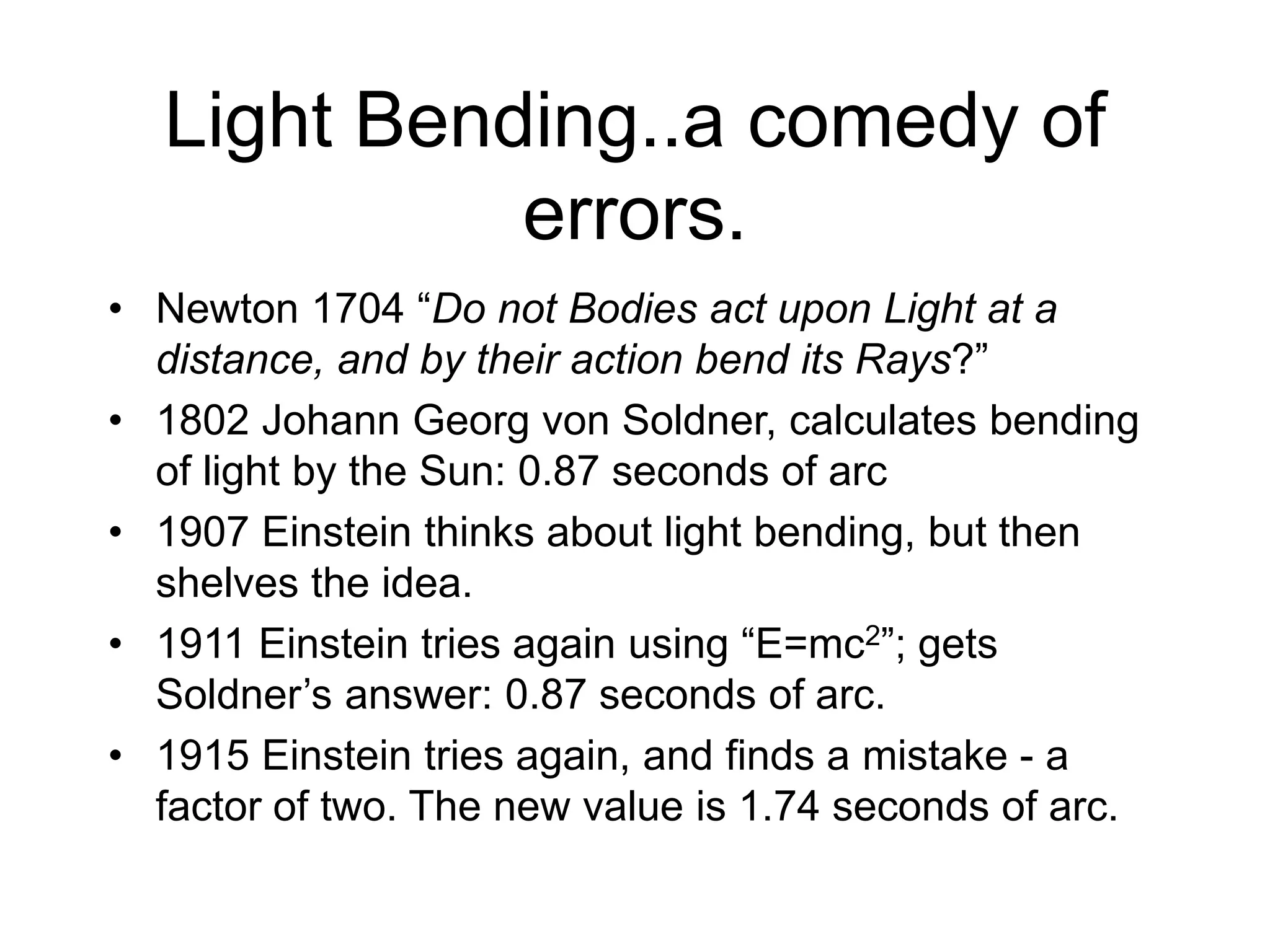
Light Bending..a comedy of
errors.
• Newton 1704 “Do not Bodies act upon Light at a
distance, and by their action bend its Rays?”
• 1802 Johann Georg von Soldner, calculates bending
of light by the Sun: 0.87 seconds of arc
• 1907 Einstein thinks about light bending, but then
shelves the idea.
• 1911 Einstein tries again using “E=mc2”; gets
Soldner’s answer: 0.87 seconds of arc.
• 1915 Einstein tries again, and finds a mistake - a
factor of two. The new value is 1.74 seconds of arc.
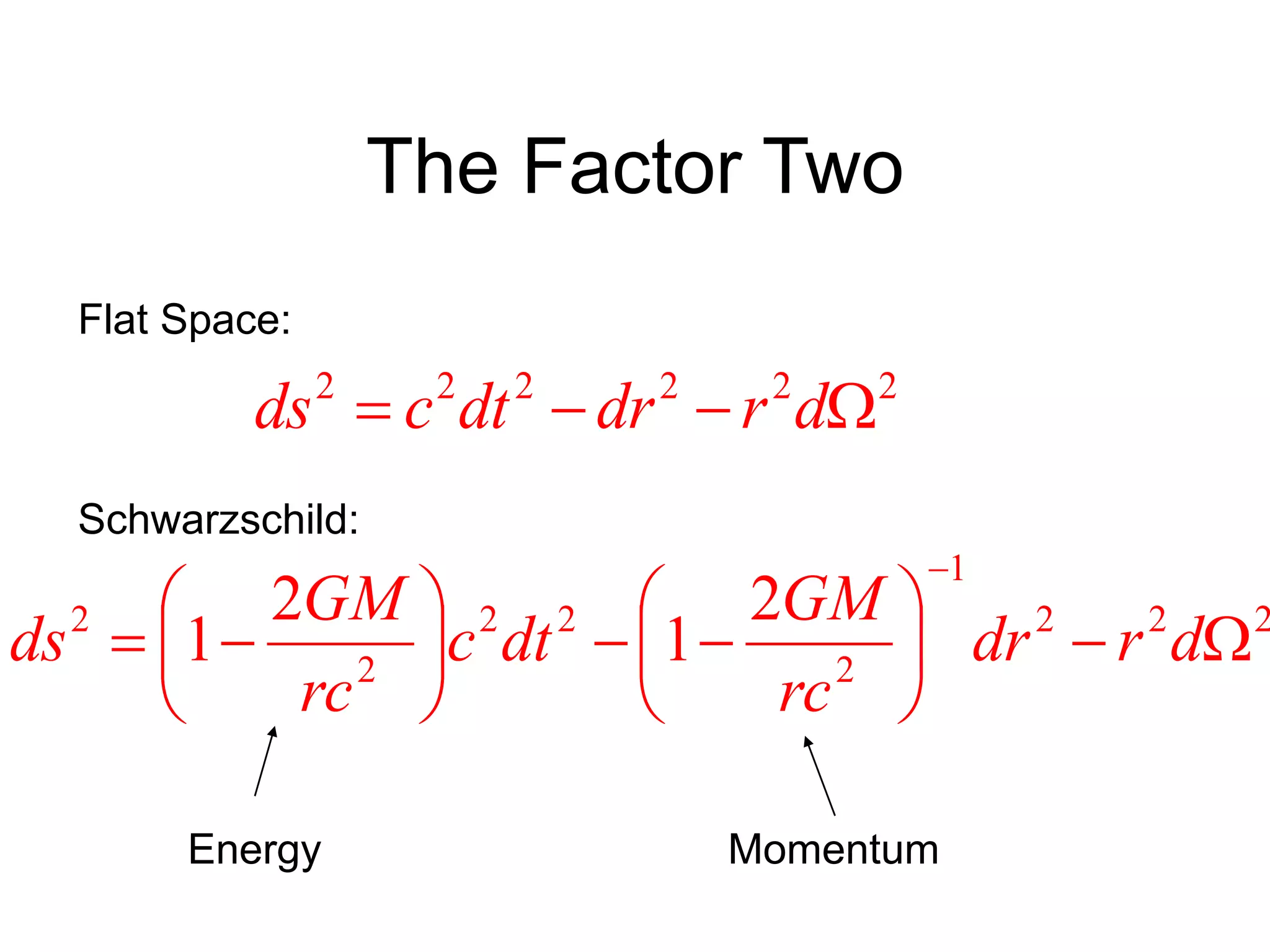
The Factor Two
222222
 drdrdtcds
222
1
2
22
2
2 2
1
2
1 













drdr
rc
GM
dtc
rc
GM
ds
Flat Space:
Schwarzschild:
Energy Momentum
Eddington and the Expeditions
• Arthur Stanley Eddington was born in 1882.
• In 1912 becomes Plumian Professor of Astronomy
and Experimental Philosophy at Cambridge.
• Earlier in 1912 Eddington had been involved in an
Eclipse expedition to Argentina. It rained.
• 1916 de Sitter tells him about Einstein’s prediction
and suggests the idea of light bending measurements
during an eclipse.
• 1917, Frank Watson Dyson, the Astronomer Royal
realises the eclipse of 29 May 1919 would be perfect.
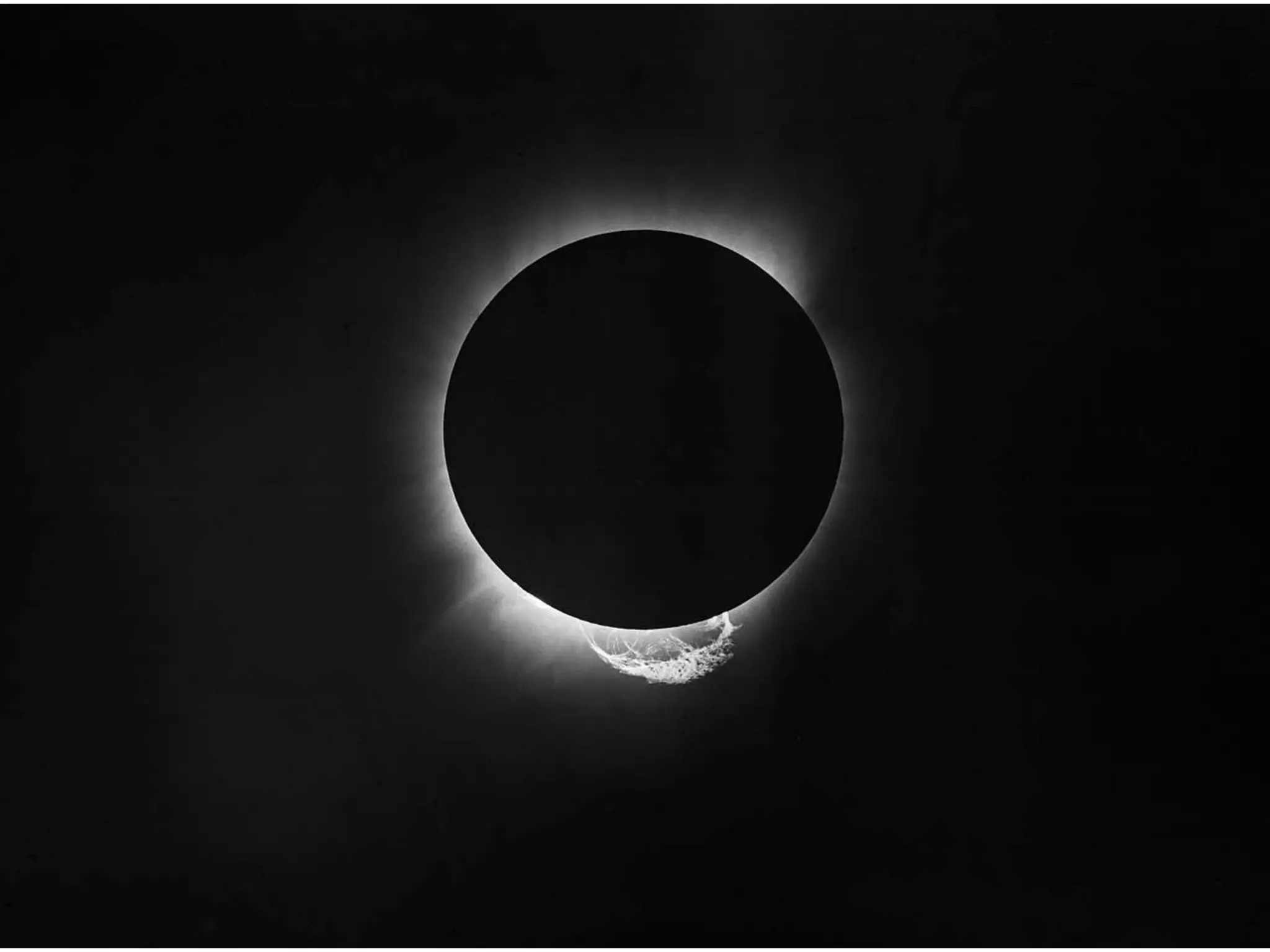
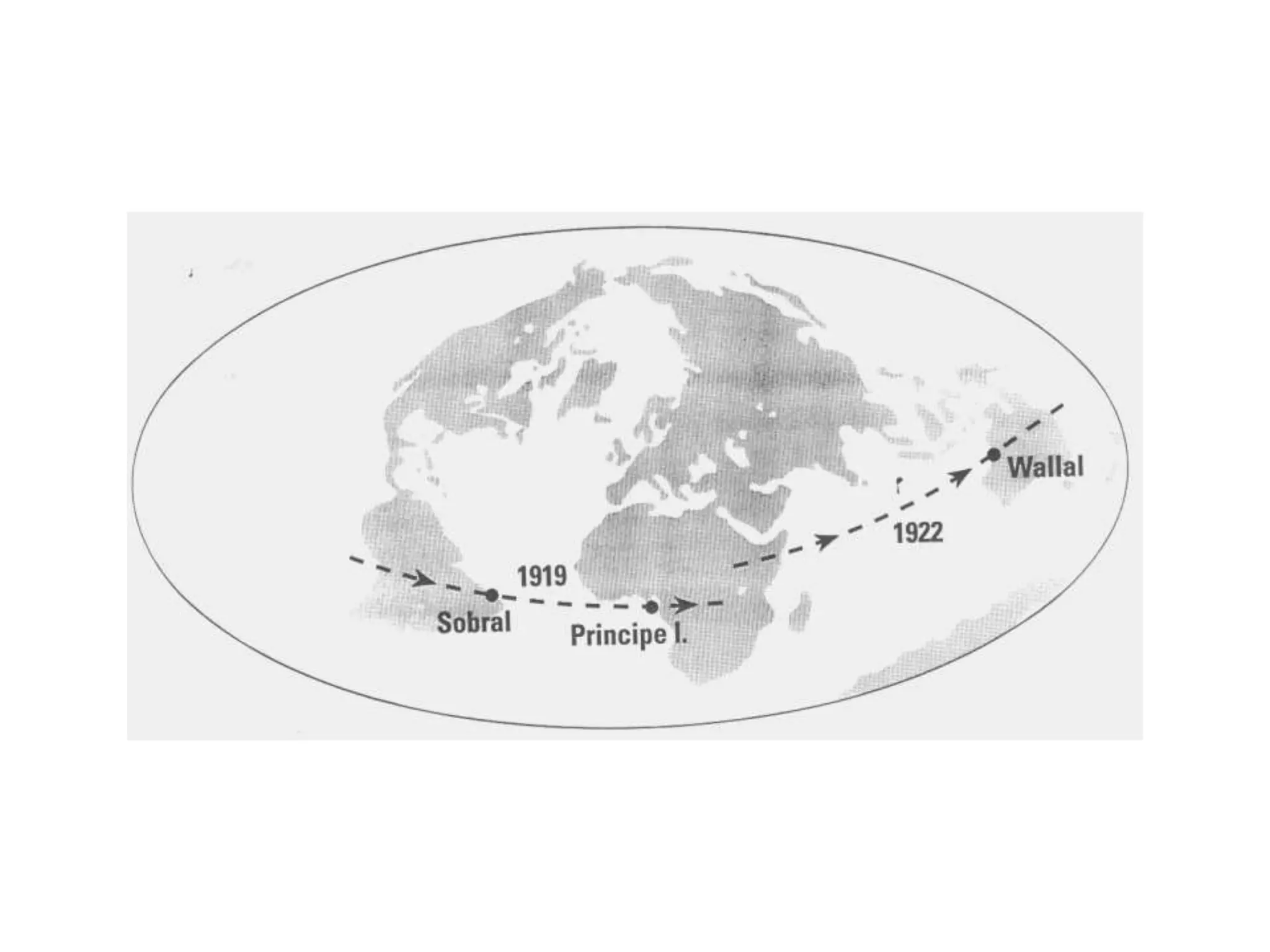
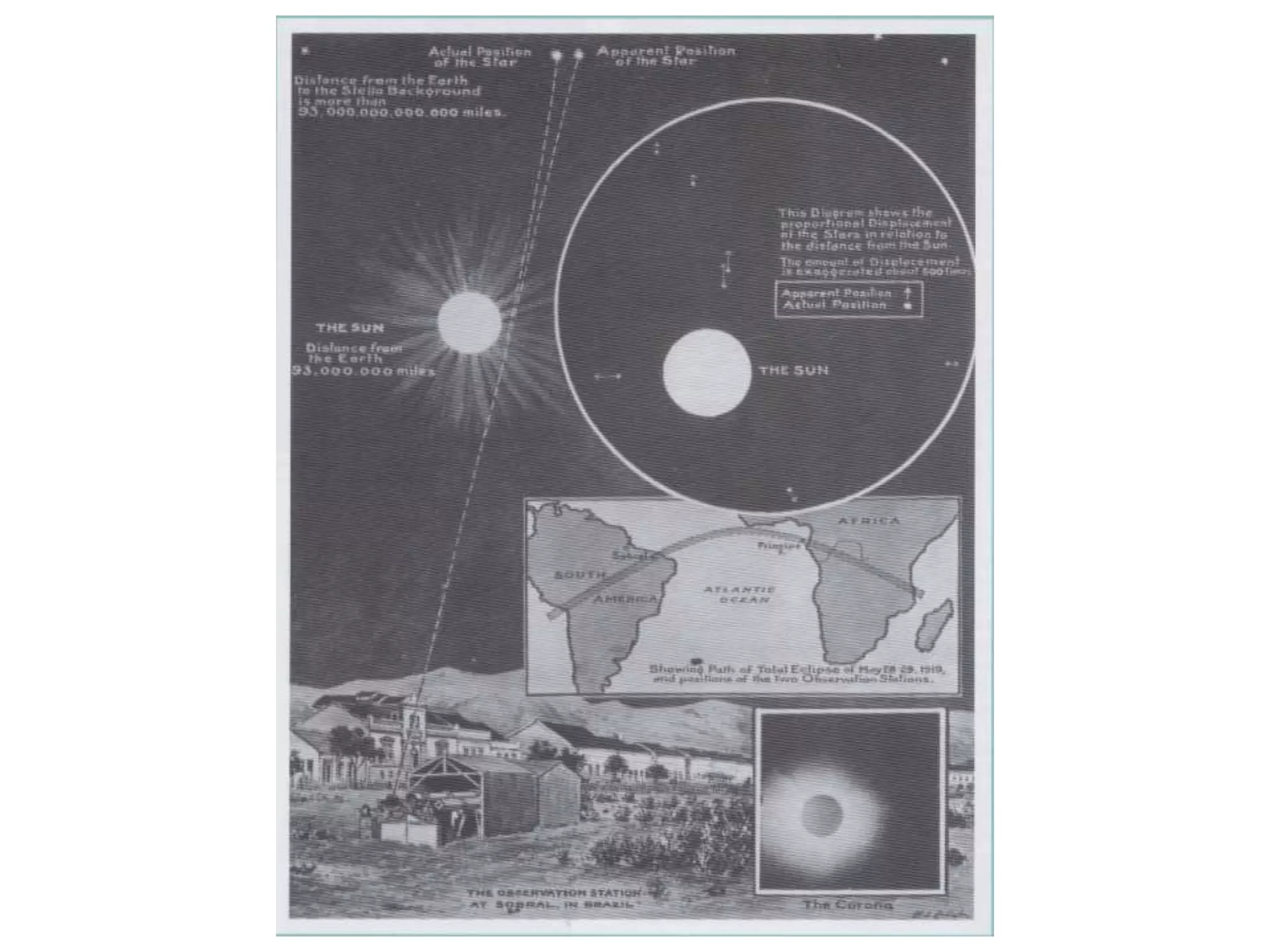
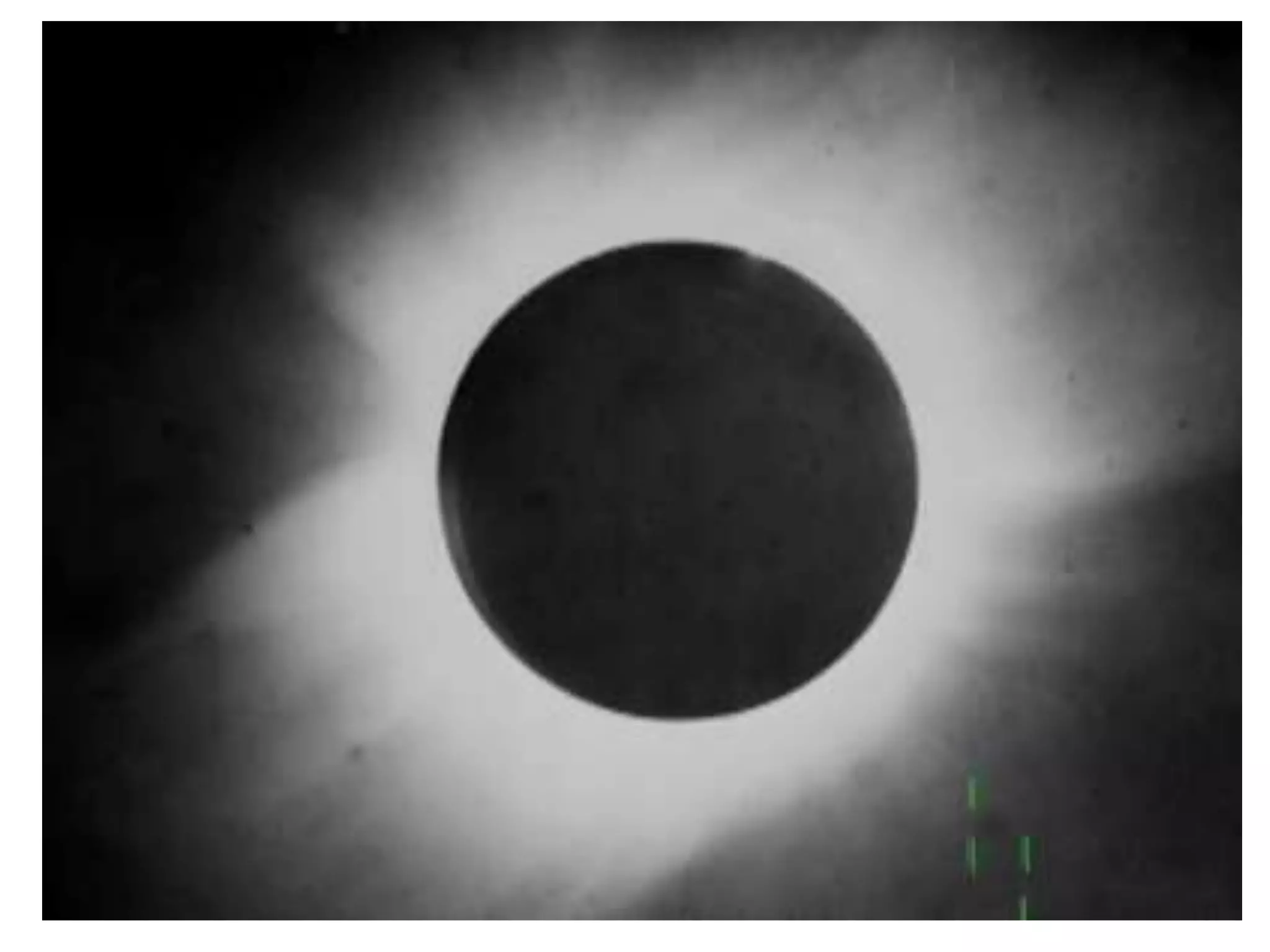
The Eclipse of 1919
• Date: 29 May 1919
• Path of Totality is across the South
Atlantic from Sobral to Principe
• Duration is long…7 minutes or so at
Principe.
• Near the Sun during totality was not just
one star, but a cluster of stars: The
Hyades
War and Peace
• BUT Eddington was a Quaker, and therefore
a pacifist.
• The First World War had started in 1914, but
conscription was not introduced in the British
Army until 1916.
• Eddington refused to be drafted…
• He was saved by a deal by Dyson, which
protected him on condition he agreed to lead
an expedition in 1919 if the war was over.
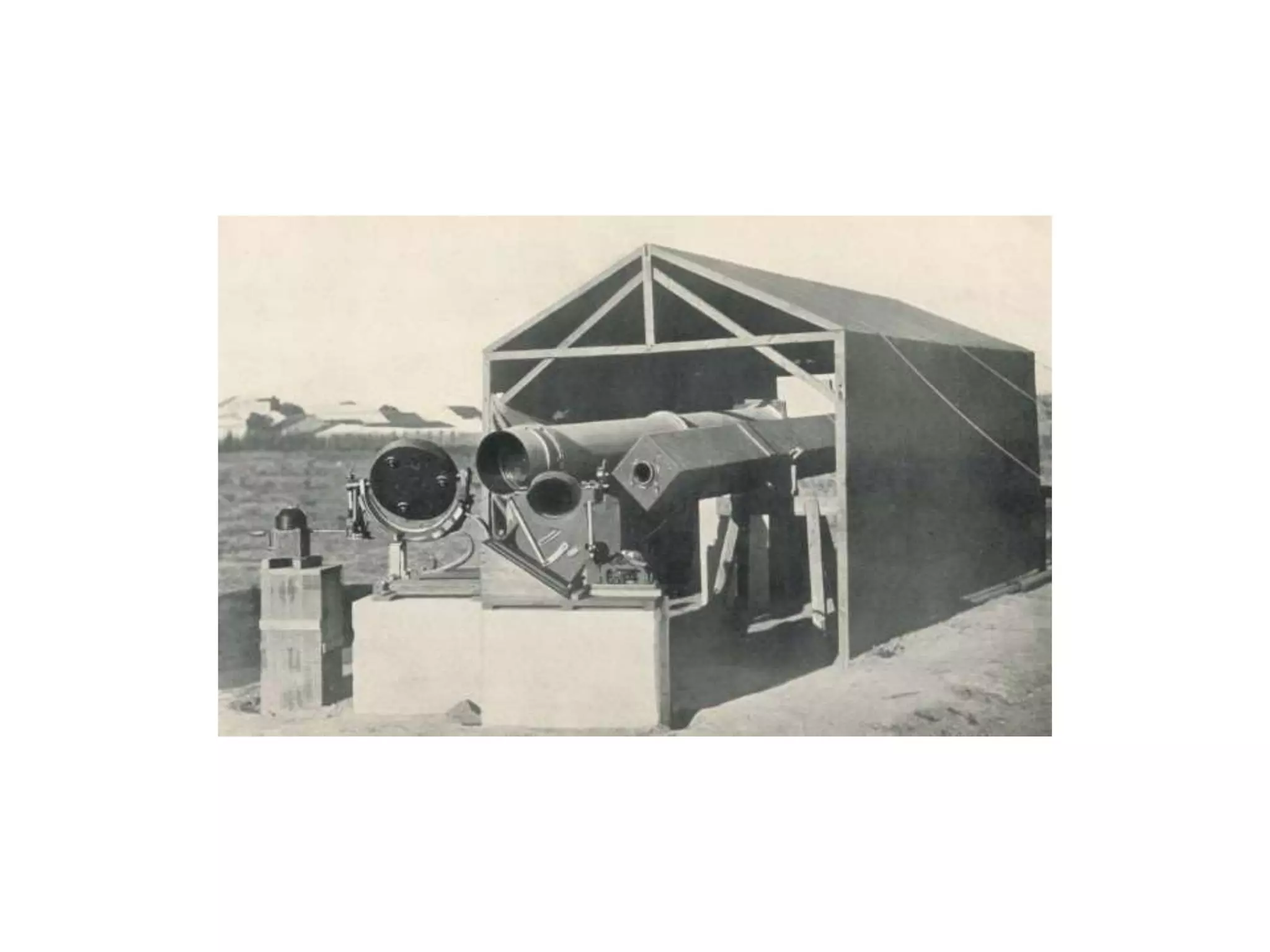
The Equipment
• Funding: £100 for equipment, £1000 for travel
and labour costs
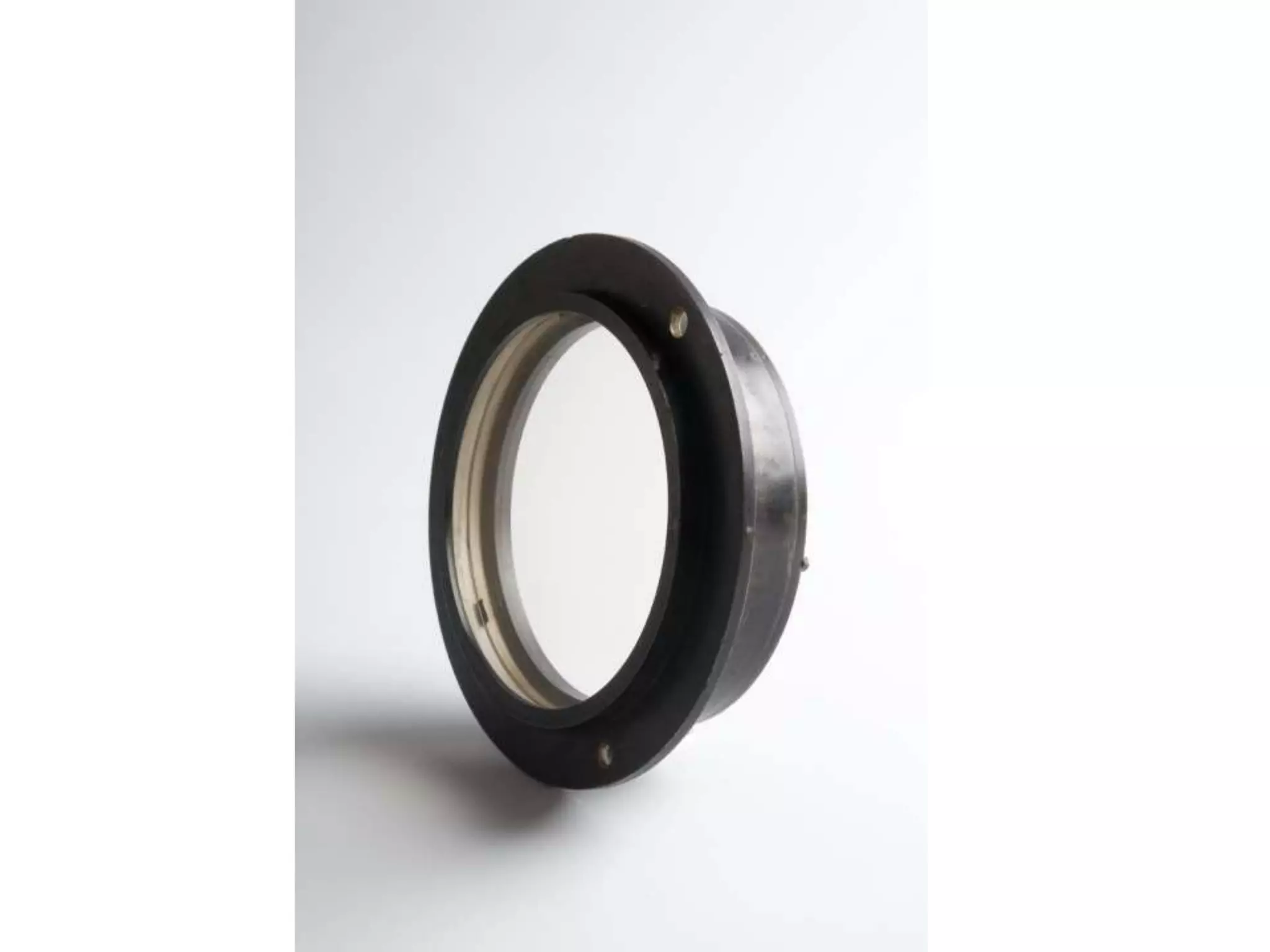
• Two “astrographic” object glasses, one to
Principe (Oxford), Sobral (Greenwich), both
stopped down to 8 inches.
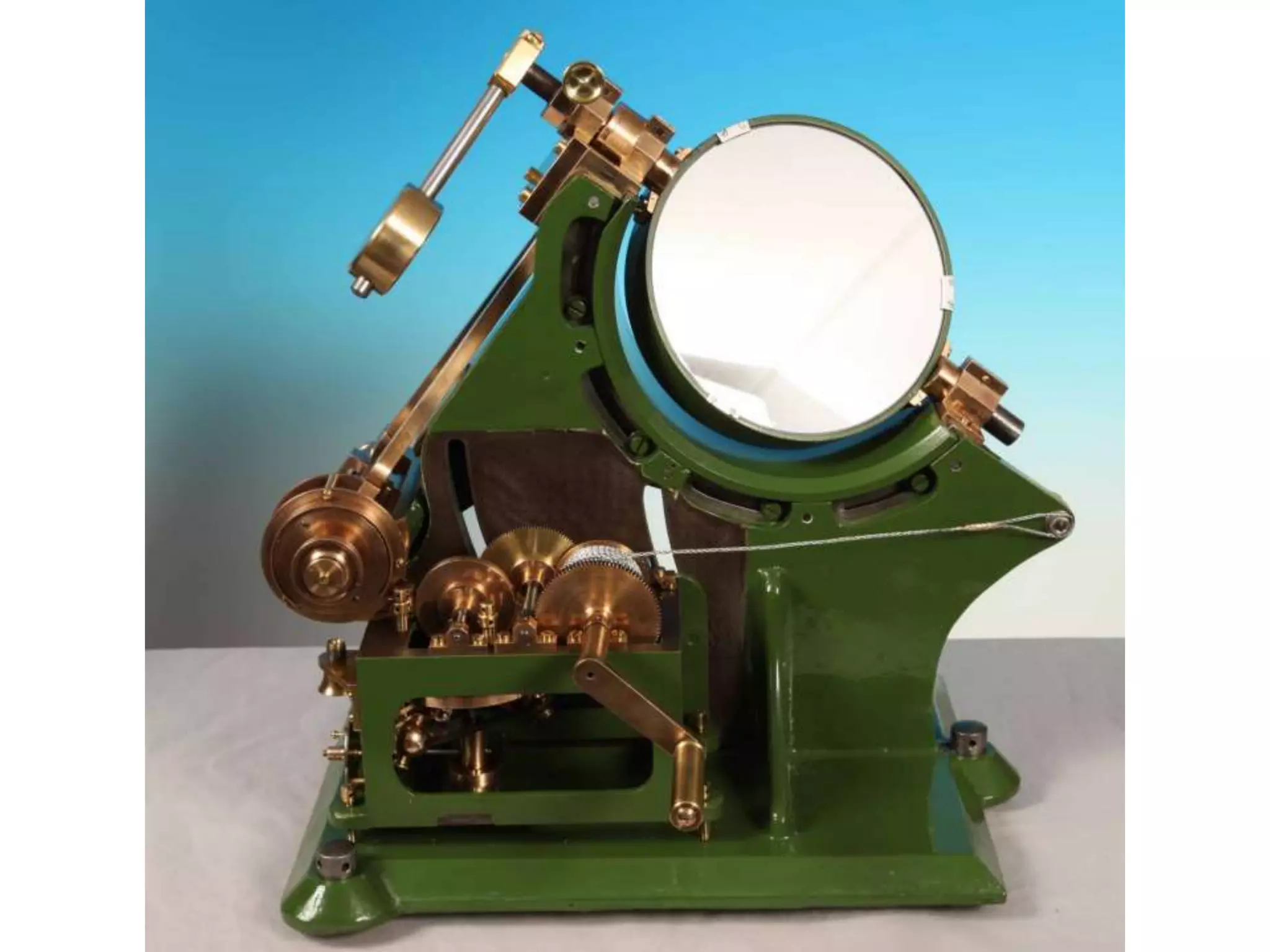
• A 4 inch telescope taken to Sobral as a
backup
• All were equipped with coelostats
• The two astrographic object glasses were
mounted in stainless steel tubes
The Irish Connection
• All the optical equipment was made by Grubb
in Dublin.
• The Oxford astrographic moved to Keele
University in 1962
• The RGO moved to Herstmonceux
• The 4-inch telescope and coelostat are on
display at Dunsink Observatory
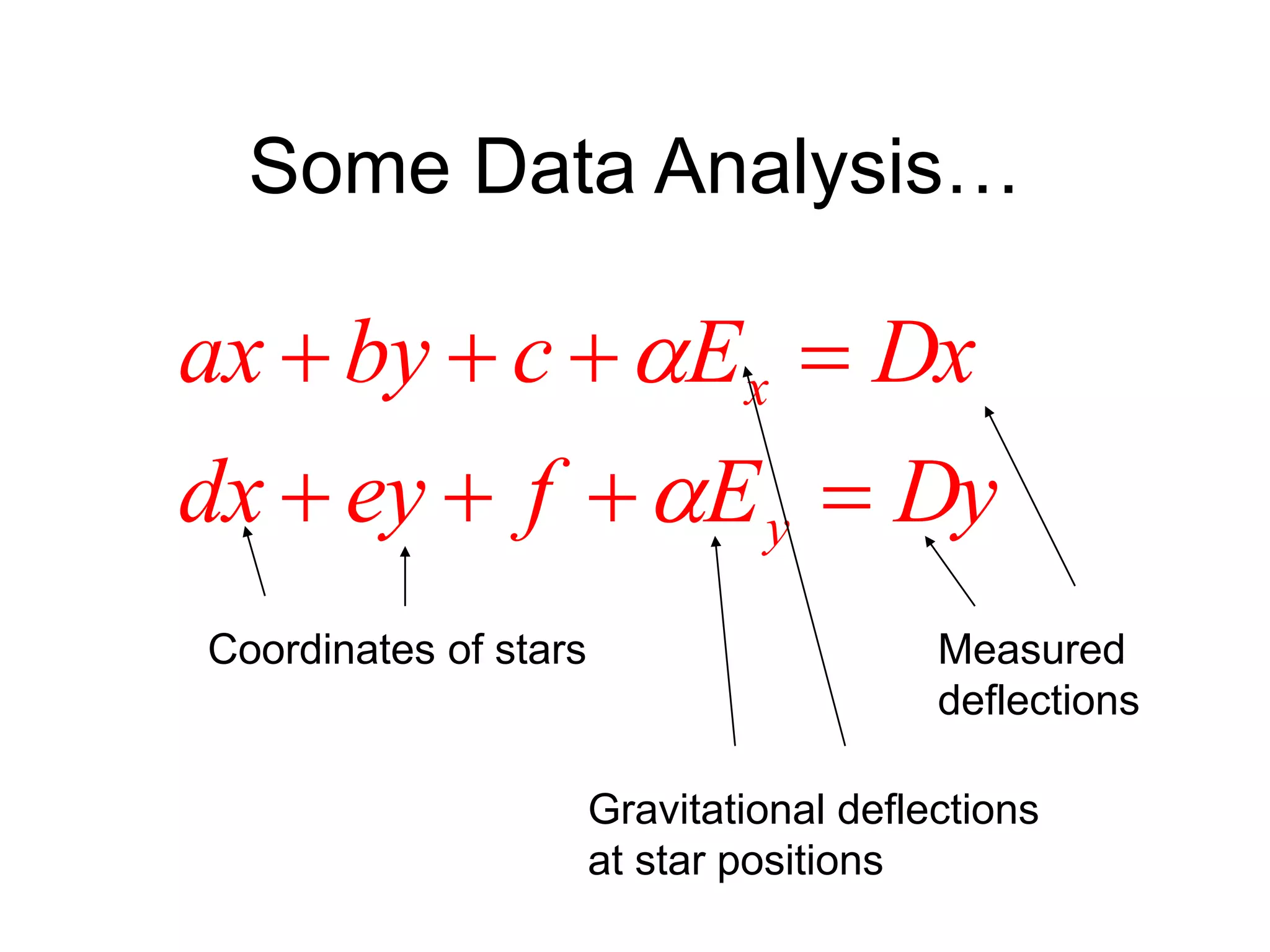
Some Data Analysis…
DyEfeydx
DxEcbyax
y
x




Coordinates of stars Measured
deflections
Gravitational deflections
at star positions
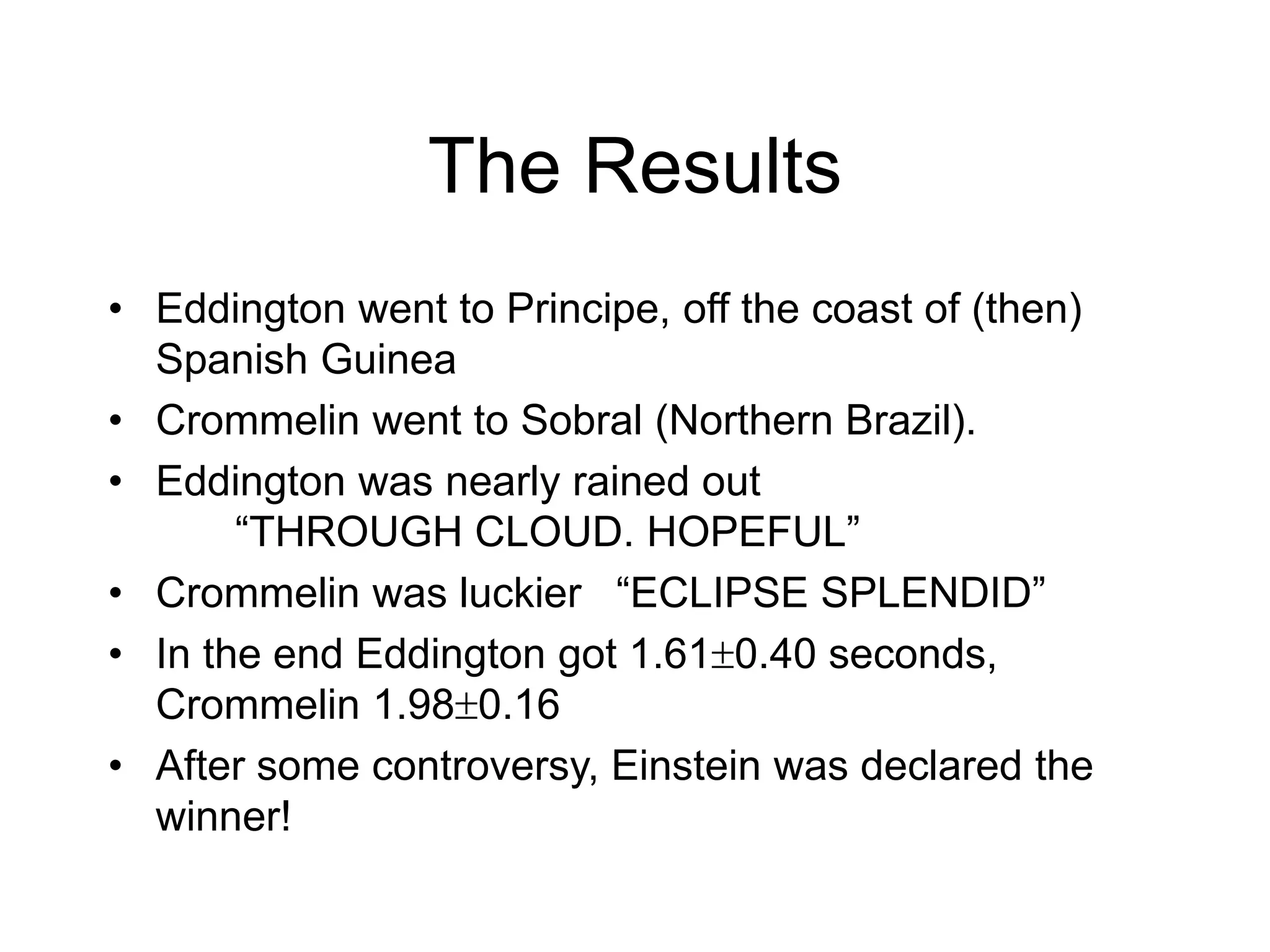
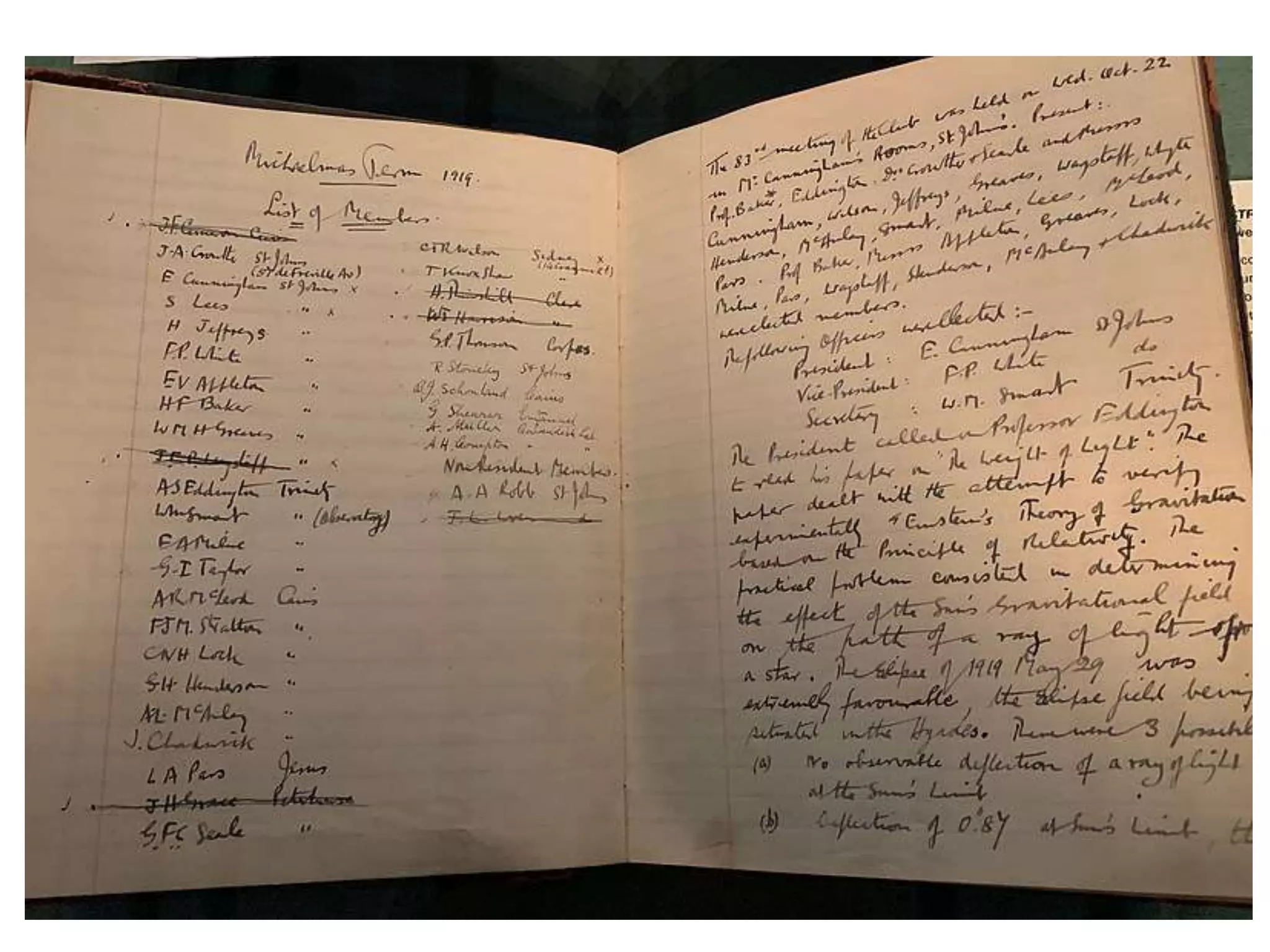
The Results
• Eddington went to Principe, off the coast of (then)
Spanish Guinea
• Crommelin went to Sobral (Northern Brazil).
• Eddington was nearly rained out
“THROUGH CLOUD. HOPEFUL”
• Crommelin was luckier “ECLIPSE SPLENDID”
• In the end Eddington got 1.610.40 seconds,
Crommelin 1.980.16
• After some controversy, Einstein was declared the
winner!
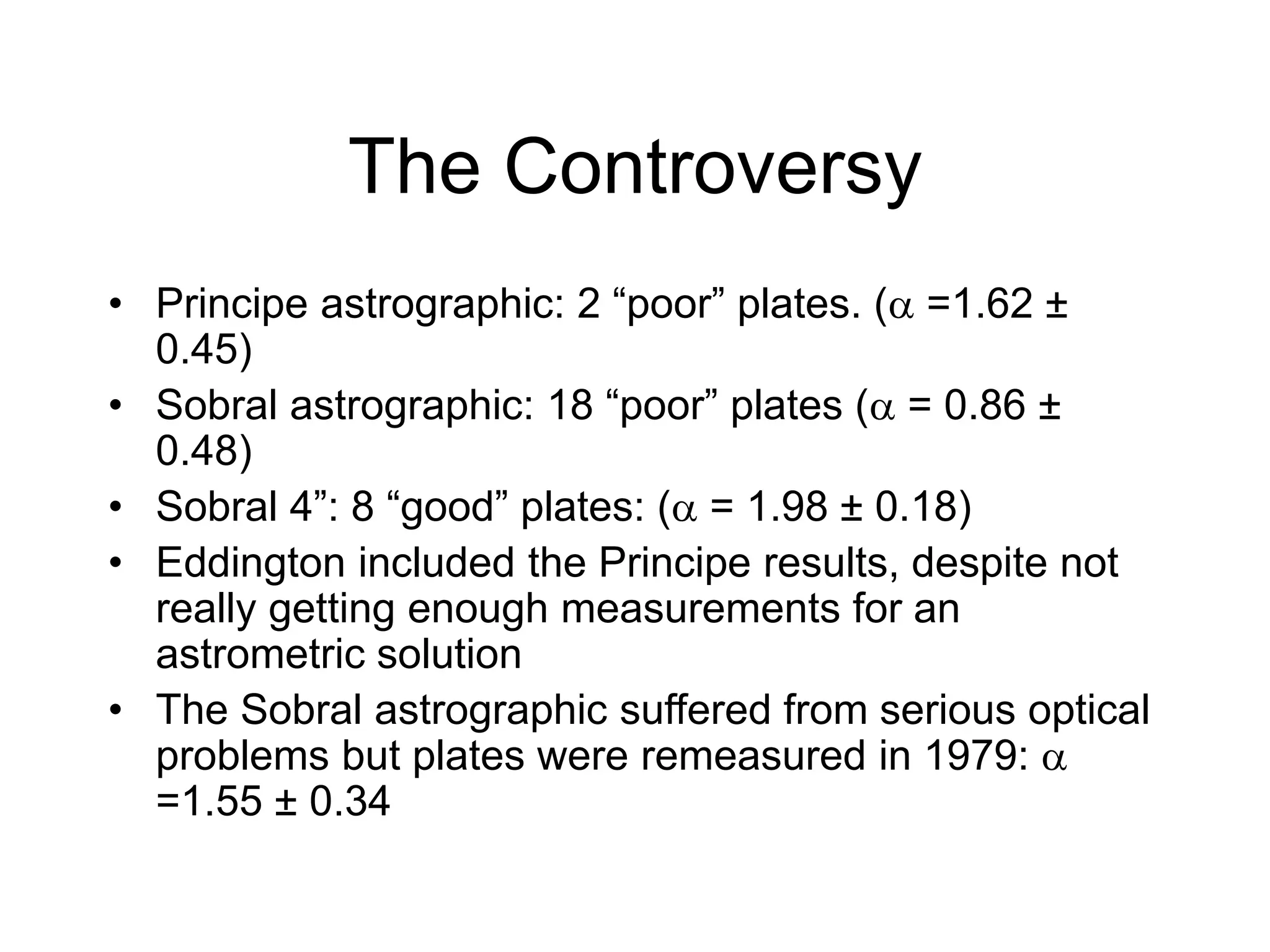
The Controversy
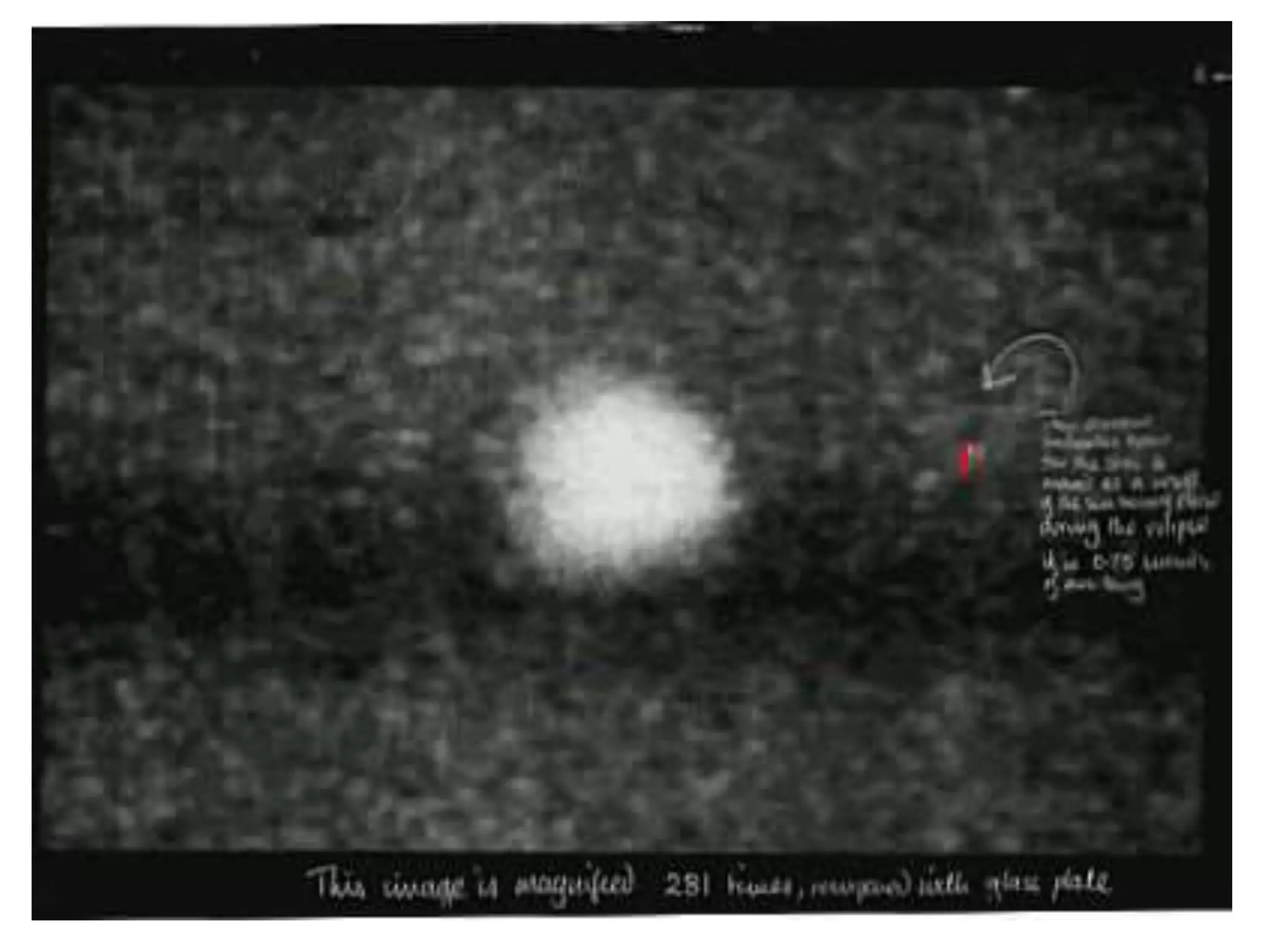
• Principe astrographic: 2 “poor” plates. ( =1.62 ±
0.45)
• Sobral astrographic: 18 “poor” plates ( = 0.86 ±
0.48)
• Sobral 4”: 8 “good” plates: ( = 1.98 ± 0.18)
• Eddington included the Principe results, despite not
really getting enough measurements for an
astrometric solution
• The Sobral astrographic suffered from serious optical
problems but plates were remeasured in 1979: 
=1.55 ± 0.34
The Aftermath
• This made Einstein more
famous than any scientist
before or since.
• Reconciliation of Britain and
Germany
• What might have been…the
two expeditions of 1912 and
1914 failed to take
measurements when the
prediction was wrong!
• Much better measurements
were made in 1922, and
later using radio
observations.
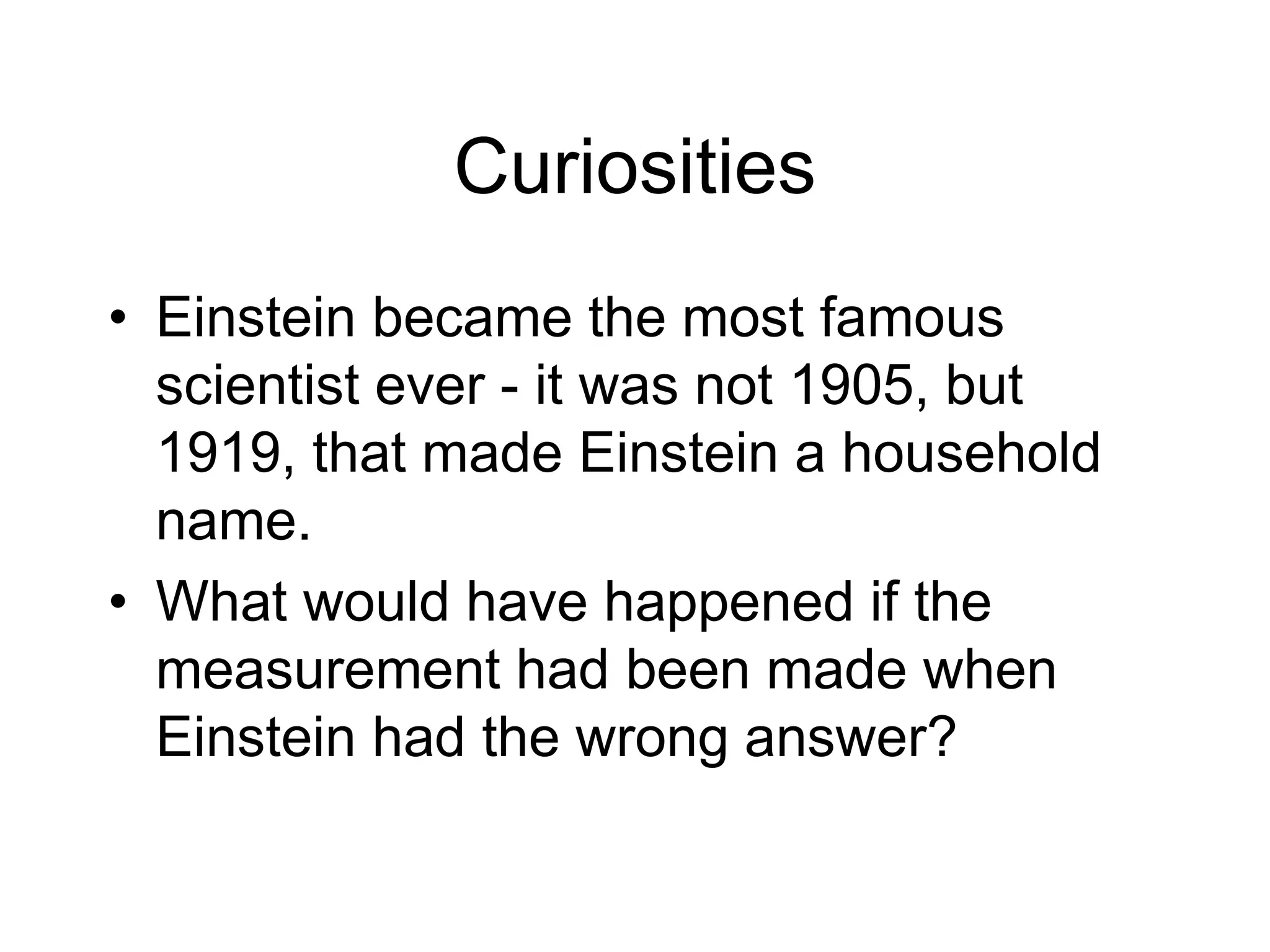
Curiosities
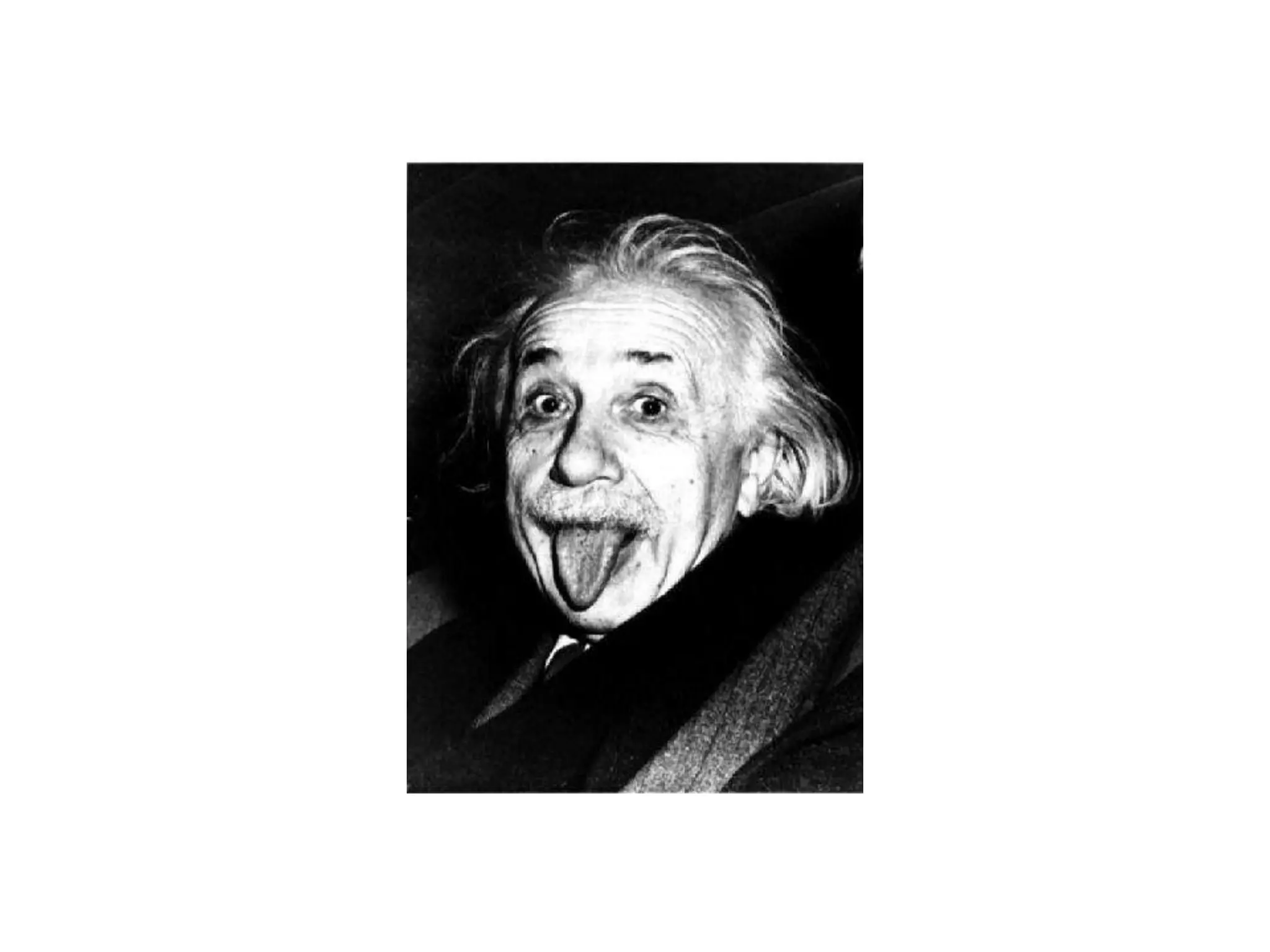
• Einstein became the most famous
scientist ever - it was not 1905, but
1919, that made Einstein a household
name.
• What would have happened if the
measurement had been made when
Einstein had the wrong answer?
Revolution in the Skies: The Experiment that made Einstein famous

Revolution in the Skies: The Experiment that made Einstein famous

  • 1.
    `Revolution in theSkies’ The Story of the 1919 Eclipse Expeditions Peter Coles Department of Theoretical Physics
  • 4.
    Newton’s Laws ofMotion • I. Every body continues in a state of rest or uniform motion in a straight line unless it is compelled to change that state by forces impressed upon it. • II. Rate of change of momentum is proportional to the impressed force, and is in the direction in which this force acts • III. To every action, there is always opposed an equal reaction.
  • 5.
    “..the Supreme Godis a Being eternal, infinite, absolutely perfect…He endures forever and is everywhere present; and by existing always and everywhere, he constitutes duration and space..” Newton, Principia (General Scholium). Absolute Space, Absolute Time
  • 6.
    Universal Gravitation • “theattractive force between any two bodies depends on the product of the masses of the bodies and on the square of the distance between them” • “the attraction always is in a duplicate proportion to the Distance from the Center Reciprocall”
  • 7.
    The Mystery ofMass • Mass can represent the resistance of a body to being accelerated (inertial) • ..or the strength of gravity produced (active) • ..or the tendency to feel gravity (passive) • Are these masses the same?
  • 8.
    The Principle ofEquivalence maF  2 r GMm F  Why should these masses be the same? Perhaps this Equivalence is because of a some sort of Principle?
  • 10.
    The Einstein (R)evolution •Albert Einstein was born in Ulm on 14 March 1879 • After failing the entrance exam the previous year, he entered the Institute of Technology (Zurich) in 1896. • “Too lazy” to continue as a scientist, he left in 1902 to become a patent clerk in Bern. • In 1905, he revolutionized science with the special theory of relativity. “E=mc2” and all that. • In 1915, he went even further, with the general theory of relativity.
  • 11.
    General Relativity • The“Principle of Equivalence” • Acceleration and Gravity • The curving of space • ..and the bending of light!
  • 15.
    Light Bending..a comedyof errors. • Newton 1704 “Do not Bodies act upon Light at a distance, and by their action bend its Rays?” • 1802 Johann Georg von Soldner, calculates bending of light by the Sun: 0.87 seconds of arc • 1907 Einstein thinks about light bending, but then shelves the idea. • 1911 Einstein tries again using “E=mc2”; gets Soldner’s answer: 0.87 seconds of arc. • 1915 Einstein tries again, and finds a mistake - a factor of two. The new value is 1.74 seconds of arc.
  • 17.
    The Factor Two 222222 drdrdtcds 222 1 2 22 2 2 2 1 2 1               drdr rc GM dtc rc GM ds Flat Space: Schwarzschild: Energy Momentum
  • 18.
    Eddington and theExpeditions • Arthur Stanley Eddington was born in 1882. • In 1912 becomes Plumian Professor of Astronomy and Experimental Philosophy at Cambridge. • Earlier in 1912 Eddington had been involved in an Eclipse expedition to Argentina. It rained. • 1916 de Sitter tells him about Einstein’s prediction and suggests the idea of light bending measurements during an eclipse. • 1917, Frank Watson Dyson, the Astronomer Royal realises the eclipse of 29 May 1919 would be perfect.
  • 20.
    The Eclipse of1919 • Date: 29 May 1919 • Path of Totality is across the South Atlantic from Sobral to Principe • Duration is long…7 minutes or so at Principe. • Near the Sun during totality was not just one star, but a cluster of stars: The Hyades
  • 22.
    War and Peace •BUT Eddington was a Quaker, and therefore a pacifist. • The First World War had started in 1914, but conscription was not introduced in the British Army until 1916. • Eddington refused to be drafted… • He was saved by a deal by Dyson, which protected him on condition he agreed to lead an expedition in 1919 if the war was over.
  • 23.
    The Equipment • Funding:£100 for equipment, £1000 for travel and labour costs • Two “astrographic” object glasses, one to Principe (Oxford), Sobral (Greenwich), both stopped down to 8 inches. • A 4 inch telescope taken to Sobral as a backup • All were equipped with coelostats • The two astrographic object glasses were mounted in stainless steel tubes
  • 25.
    The Irish Connection •All the optical equipment was made by Grubb in Dublin. • The Oxford astrographic moved to Keele University in 1962 • The RGO moved to Herstmonceux • The 4-inch telescope and coelostat are on display at Dunsink Observatory
  • 32.
    Some Data Analysis… DyEfeydx DxEcbyax y x     Coordinatesof stars Measured deflections Gravitational deflections at star positions
  • 33.
    The Results • Eddingtonwent to Principe, off the coast of (then) Spanish Guinea • Crommelin went to Sobral (Northern Brazil). • Eddington was nearly rained out “THROUGH CLOUD. HOPEFUL” • Crommelin was luckier “ECLIPSE SPLENDID” • In the end Eddington got 1.610.40 seconds, Crommelin 1.980.16 • After some controversy, Einstein was declared the winner!
  • 35.
    The Controversy • Principeastrographic: 2 “poor” plates. ( =1.62 ± 0.45) • Sobral astrographic: 18 “poor” plates ( = 0.86 ± 0.48) • Sobral 4”: 8 “good” plates: ( = 1.98 ± 0.18) • Eddington included the Principe results, despite not really getting enough measurements for an astrometric solution • The Sobral astrographic suffered from serious optical problems but plates were remeasured in 1979:  =1.55 ± 0.34
  • 37.
    The Aftermath • Thismade Einstein more famous than any scientist before or since. • Reconciliation of Britain and Germany • What might have been…the two expeditions of 1912 and 1914 failed to take measurements when the prediction was wrong! • Much better measurements were made in 1922, and later using radio observations.
  • 38.
    Curiosities • Einstein becamethe most famous scientist ever - it was not 1905, but 1919, that made Einstein a household name. • What would have happened if the measurement had been made when Einstein had the wrong answer?