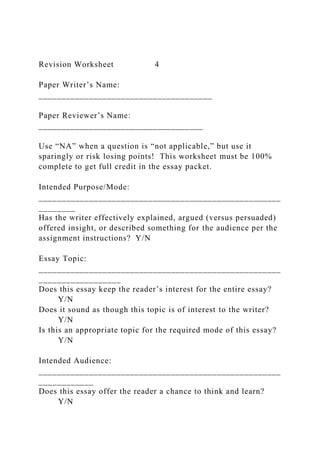
Revision Worksheet 4
Paper Writer’s Name:
______________________________________
Paper Reviewer’s Name:
____________________________________
Use “NA” when a question is “not applicable,” but use it
sparingly or risk losing points! This worksheet must be 100%
complete to get full credit in the essay packet.
Intended Purpose/Mode:
_____________________________________________________
________
Has the writer effectively explained, argued (versus persuaded)
offered insight, or described something for the audience per the
assignment instructions? Y/N
Essay Topic:
_____________________________________________________
__________________
Does this essay keep the reader’s interest for the entire essay?
Y/N
Does it sound as though this topic is of interest to the writer?
Y/N
Is this an appropriate topic for the required mode of this essay?
Y/N
Intended Audience:
_____________________________________________________
____________
Does this essay offer the reader a chance to think and learn?
Y/N
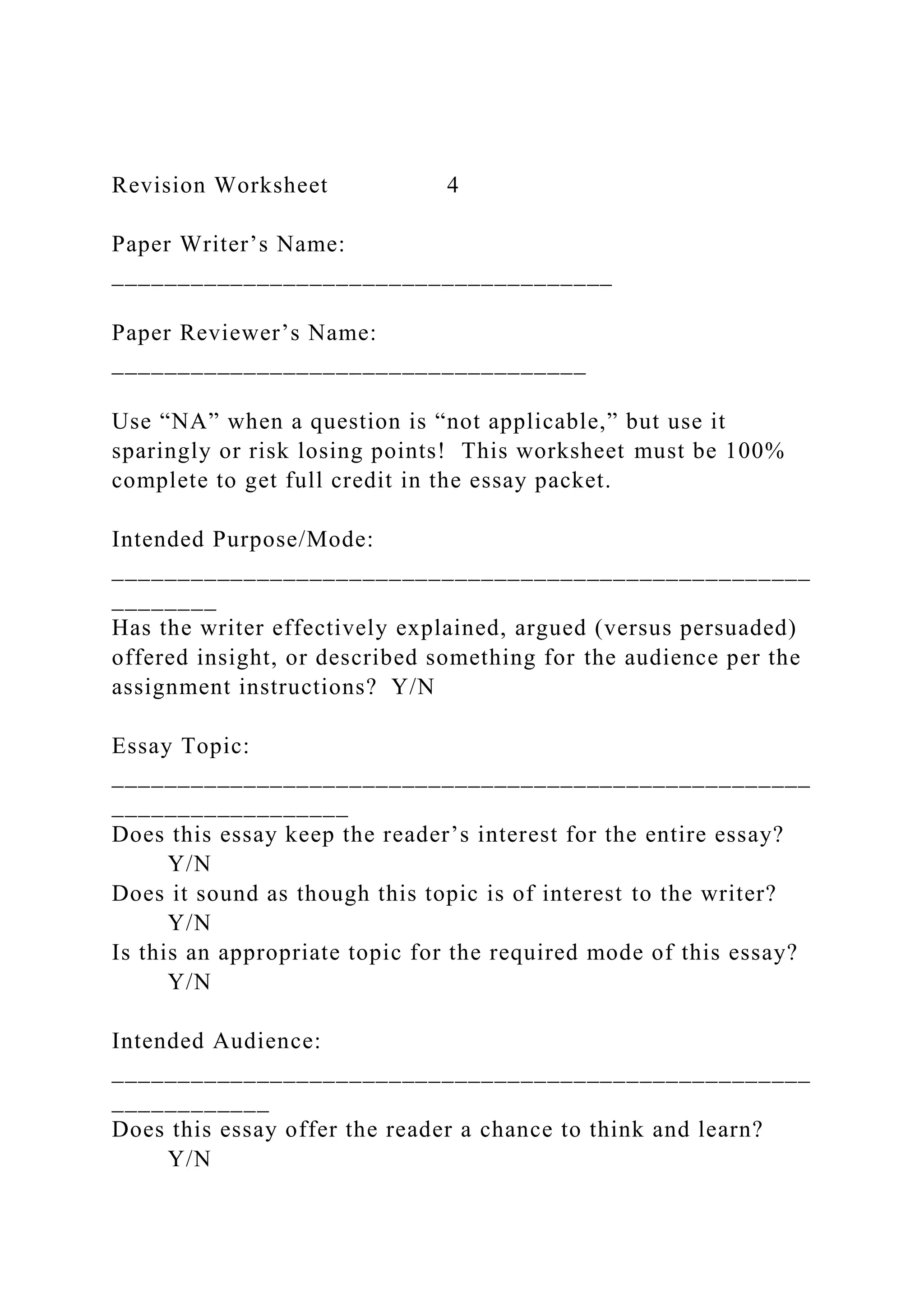
Has the writer used a natural voice and style that is effective for
the intended audience?Y/N
Unity and Structure
Essay Title:
_____________________________________________________
__________________
Does the title explain the specific focus of the essay? Y/N
Thesis Claim:
_____________________________________________________
________________
Is the thesis focused on one main idea? Y/N
Essay Map:
_____________________________________________________
__________________
Does the essay map appear in conjunction with the thesis
statement? Y/N
Can the thesis and essay map easily be found at the end of the
first paragraph of the essay? Y/N
Does the conclusion end the essay in a way that helps the reader
remember the thesis claim? Y/N
Does each paragraph have one clear topic sentence? Y/N
Does each topic sentence stem from one main idea expressed in
the essay map? Y/N
If there is no essay map, would an essay map benefit the unity
or coherence of the essay? Y/N
Write out the topic sentences or narrative transitional sentences:
Coherence
Do the ideas in the essay flow smoothly from one idea to
another? Y/N
Are the paragraphs ordered logically and deliberately? Y/N
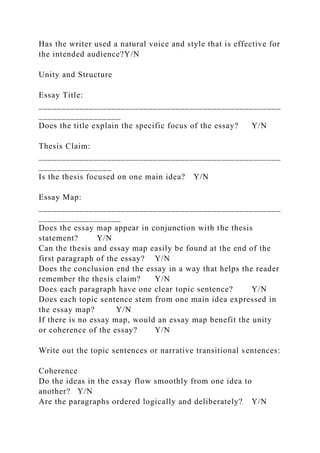
Does the writer stick to one point of view (first or third
person)? Y/N
Does the writer stick to one verb tense (past, present, or
future)? Y/N
Is each new piece of evidence introduced and presented
smoothly?Y/N
Clarity
Has the writer used specific language in the thesis and topic
sentences? Y/N
Has the writer avoided using “I think” statements and vague
language (including “you”)? Y/N
Are all the sentences clear, concise, and coherent? Y/N
Are the words accurate, necessary and meaningful? Y/N
Has the writer edited for grammar and punctuation? Y/N
Has the writer successfully corrected all sentence fragments and
run-on sentences? Y/N
Has the writer successfully corrected all subject-verb or
pronoun agreement errors? Y/N
Does this essay contain ample supporting details to support each
topic sentence? Y/N
Has the student used expert testimony and facts or statistics as
evidence? Y/N
Has the student used a narrative, personal experience, or logic
and reason as evidence? Y/N
Has the student provided appropriate and descriptive real and
hypothetical examples? Y/N
Has the student uploaded and reviewed the paper through
Grammarly? Y/N
List the types of evidence used in the body paragraphs. This
may include examples, testimony, personal observation,
narrative, facts and statistics, reason and logic, or description.
Has the writer used a variety of types of evidence? Y/N
Content &Formatting
Does this essay meet the word count and strategy requirements
of the assignment? Y/N
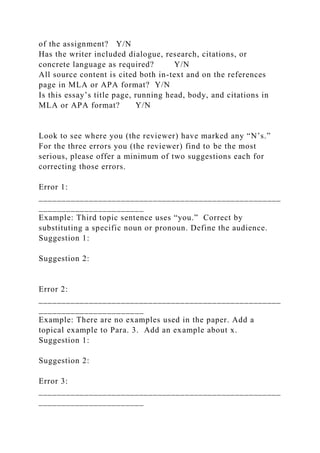
Has the writer included dialogue, research, citations, or
concrete language as required? Y/N
All source content is cited both in-text and on the references
page in MLA or APA format? Y/N
Is this essay’s title page, running head, body, and citations in
MLA or APA format? Y/N
Look to see where you (the reviewer) have marked any “N’s.”
For the three errors you (the reviewer) find to be the most
serious, please offer a minimum of two suggestions each for
correcting those errors.
Error 1:
_____________________________________________________
_______________________
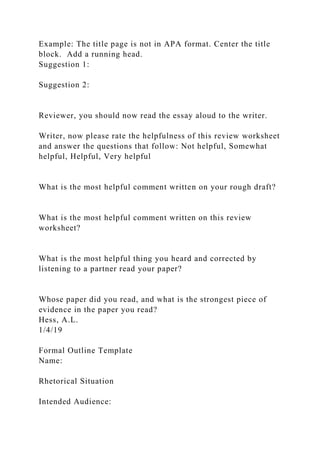
Example: Third topic sentence uses “you.” Correct by
substituting a specific noun or pronoun. Define the audience.
Suggestion 1:
Suggestion 2:
Error 2:
_____________________________________________________
_______________________
Example: There are no examples used in the paper. Add a
topical example to Para. 3. Add an example about x.
Suggestion 1:
Suggestion 2:
Error 3:
_____________________________________________________
_______________________
Example: The title page is not in APA format. Center the title
block. Add a running head.
Suggestion 1:
Suggestion 2:
Reviewer, you should now read the essay aloud to the writer.
Writer, now please rate the helpfulness of this review worksheet
and answer the questions that follow: Not helpful, Somewhat
helpful, Helpful, Very helpful
What is the most helpful comment written on your rough draft?
What is the most helpful comment written on this review
worksheet?
What is the most helpful thing you heard and corrected by
listening to a partner read your paper?
Whose paper did you read, and what is the strongest piece of
evidence in the paper you read?
Hess, A.L.
1/4/19
Formal Outline Template
Name:
Rhetorical Situation
Intended Audience:
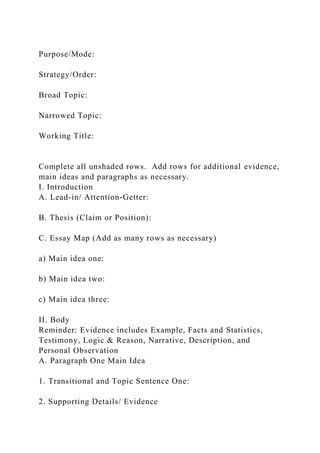
Purpose/Mode:
Strategy/Order:
Broad Topic:
Narrowed Topic:
Working Title:
Complete all unshaded rows. Add rows for additional evidence,
main ideas and paragraphs as necessary.
I. Introduction
A. Lead-in/ Attention-Getter:
B. Thesis (Claim or Position):
C. Essay Map (Add as many rows as necessary)
a) Main idea one:
b) Main idea two:
c) Main idea three:
II. Body
Reminder: Evidence includes Example, Facts and Statistics,
Testimony, Logic & Reason, Narrative, Description, and
Personal Observation
A. Paragraph One Main Idea
1. Transitional and Topic Sentence One:
2. Supporting Details/ Evidence
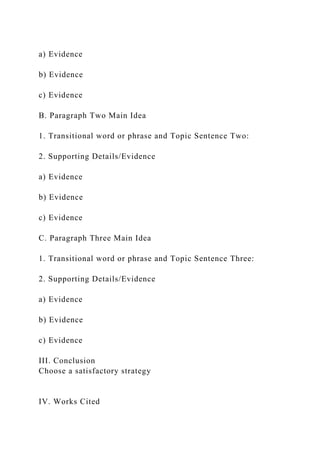
a) Evidence
b) Evidence
c) Evidence
B. Paragraph Two Main Idea
1. Transitional word or phrase and Topic Sentence Two:
2. Supporting Details/Evidence
a) Evidence
b) Evidence
c) Evidence
C. Paragraph Three Main Idea
1. Transitional word or phrase and Topic Sentence Three:
2. Supporting Details/Evidence
a) Evidence
b) Evidence
c) Evidence
III. Conclusion
Choose a satisfactory strategy
IV. Works Cited
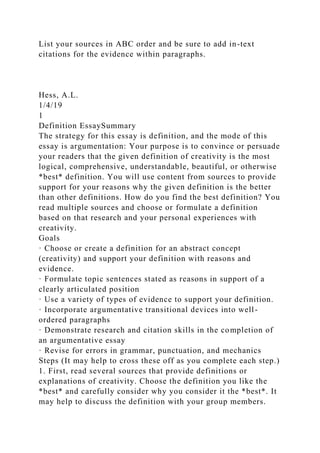
List your sources in ABC order and be sure to add in-text
citations for the evidence within paragraphs.
Hess, A.L.
1/4/19
1
Definition EssaySummary
The strategy for this essay is definition, and the mode of this
essay is argumentation: Your purpose is to convince or persuade
your readers that the given definition of creativity is the most
logical, comprehensive, understandable, beautiful, or otherwise
*best* definition. You will use content from sources to provide
support for your reasons why the given definition is the better
than other definitions. How do you find the best definition? You
read multiple sources and choose or formulate a definition
based on that research and your personal experiences with
creativity.
Goals
· Choose or create a definition for an abstract concept
(creativity) and support your definition with reasons and
evidence.
· Formulate topic sentences stated as reasons in support of a
clearly articulated position
· Use a variety of types of evidence to support your definition.
· Incorporate argumentative transitional devices into well-
ordered paragraphs
· Demonstrate research and citation skills in the completion of
an argumentative essay
· Revise for errors in grammar, punctuation, and mechanics
Steps (It may help to cross these off as you complete each step.)
1. First, read several sources that provide definitions or
explanations of creativity. Choose the definition you like the
*best* and carefully consider why you consider it the *best*. It
may help to discuss the definition with your group members.
2. Complete the Formal Outline Template. Start with your thesis
and topic sentences (reasons). Note that you cannot formulate a
thesis until you decide, through research or experimentation,
which definition is best!
3. Find source material to support your points, like definitions,
descriptions, testimony, or studies. Find source material to
refute (argue against). Add that material, with citations, to your
outline.
4. Type and revise your outline as necessary.
5. Follow your outline to draft your essay. Bring a typed Rough
Draft in MLA format on Revision Day.
6. Revise (to improve) your Rough Draft based on your
Revision Worksheet changes . . . aaaaand
7. Prepare a typed draft of your Argumentative Essay in MLA
format.
8. Submit your draft paper to Turnitin through D2L and review
the report.
9. On the Final Typed Draft, underline your topic sentences and
your thesis and essay map in the introduction. Circle all of
your argumentative transitions.
10. Give your essay a descriptive title based on your thesis’s
topic and tone.
11. Review the MLA guidelines on the OWL at Purdue.
12. Use the cover sheet and rubric for this assignment to be sure
you have met or exceeded all expectations!
Draft Due
I will collect your FormalOutline (with Citations), the Revision
Worksheet, and the 900 -1200 word Final Typed Draft (with a
Works Cited page) on the due date. Please staple (45 degree
angle) or binder clip them all together with the Essay Cover
Checklist and Rubric on top before coming to class. Make it
professional-looking: no binders, folders or paperclips. I
reserve the right to deduct points for lack of "neatness."
Papers must be on time, meet the word count, and be submitted
for a Turnitin Report in order to be graded.
Hess, A. L.
1/4/19
1
Writer’s Name:
Course Section:
Essay Word Count:
Self Evaluation Score/48:
Essay Title:
Turnitin Report Percentage:
Argumentative Essay Cover Sheet and Rubric
Requirement
Prewriting
I completed prewriting exercises to help me formulate main
ideas, points and counterpoints.
Outline
I included complete topic sentences on the typed outline
template, reasons in support of the thesis.
I included cited research as supporting details with both a
parenthetical and end citation.
Typed Rough Draft
My partners and I read and reread the essay in order to help
revise and edit it.
Revision Worksheet
I included one Revision Worksheet for this essay completed by
a Peer or Tutor, showing that I, too, revised a classmate’s essay.
Final Typed Draft
I typed the draft in Times New Roman 12 point font with 1”
margins and consistent double- spacing.
I included a complete MLA header.
I completed all MLA citation formatting requirements (two
sources required).
My title is creative and different from the assignment title
(topic + tone).
I underlined the thesis statement and essay map, if included.
I underlined each topic sentence.
I circled at least 5 transitional words and phrases appropriate
for an argumentative essay,
such as “Although,” “However,” “On the other hand,” or “In
fact.”
The final draft has fewer than 3 errors in grammar, punctuation,
and mechanics.
Academic Honesty
My Turnitin report shows less than 15% source content.
Please staple this cover sheet and rubric to the top of your essay
packet.
Argumentative Essay Rubric
High Proficiency (4)
Proficiency
(3)
Low Proficiency (2)
Non-Proficient (1)
Non-Performing (0)
Outline
I typed an outline using the Formal Outline Template.
Outline template has been typed & completed; demonstrates the
student's ability to plan an essay with reason and source
evidence.
Outline template has been typed & completed; may show few
errors in reason and source evidence.
Outline template has been typed & completed; may show
several errors in reason and source evidence.
The outline is incomplete; does not demonstrate the student's
ability to plan an essay with reason and source evidence.
The outline is missing.
Revision Worksheet
I included a completed Revision Worksheet.
The student includes a revision worksheet completed by a peer
or tutor and the student.
The student includes an incomplete worksheet.
The worksheet is missing
Final Draft
I typed the draft in Times New Roman 12 point
font with 1” margins and consistent double-spacing.
There are no errors in font, margins, or spacing.
There is 1 error with font, margins, or spacing.
There are 2 errors in font, margin, or spacing.
There are 3 or more errors in font, margins, and spacing.
Using MLA format has not been attempted.
I included a complete MLA header and page numbers.
There are no formatting errors in the header or page numbers.
There is 1 formatting error in the header or page numbers.
There are 2 formatting errors in the header or page numbers.
There are 3 or more formatting errors in the header or page
numbers.
Using MLA format has not been attempted.
I completed all MLA citation requirements (2 required sources).
The student includes at least 2 sources with proper in-text and
end citations.
The student includes at least 2 sources with some errors in
formatting in-text and end citations.
The student attempts to cite his or her source(s) both in- text
and on a Works Cited page.
The student cites either only in-text or only on a Works Cited
page for some or all sources.
Using MLA format has not been attempted.
I included a creative title in title case, separate from the
assignment title (topic + tone).
The title explains the paper’s topic and writer’s tone. The title
is in title case.
The title explains either the paper’s topic OR the writer’s tone.
The title is in title case.
The title explains neither the topic nor the writer’s tone. The
title is not in title case.
The title is too general. The title is not in title case.
The full title is missing from the paper.
I underlined the thesis statement and essay map, if included.
The student underlines the complete thesis.
The student underlines a grammatically incorrect thesis or a
misplaced thesis.
The student underlines a sentence that does not function as a
thesis.
The student underlines multiple sentences that do not function
as a thesis.
The student does not attempt to identify the thesis.
I underlined each topic sentence.
The student underlines all of the true topic sentences.
The student underlines all of the true topic sentences, although
one or more may be grammatically incorrect.
The student does not underline all of the true topic sentences.
One or more of the topic sentences are not stated as reasons.
The student does not underline any topics sentences.
I circled 5 transitions appropriate for an argumentative essay,
such as “Although,” “However,” “On the other hand,” or “In
fact.”
The student circles at least 5 appropriately used argumentative
transitional phrases.
The student circles 4 appropriately used argumentative
transitional phrases.
The student circles 3 appropriately used argumentative
transitional phrases.
The student circles 1-2 appropriately used argumentative
transitional phrases.
The student circles no appropriately used argumentative
transitional phrases.
I made 3 or fewer errors in grammar, punctuation, and
mechanics.
The student makes minimal errors (1-3) that do not skew the
meaning of the paper.
The student makes some (4 –6) errors of multiple error types
that may skew the meaning of the paper.
There are many (7-8) errors and error types that skew the
meaning of the paper.
There are many 9- 10) errors and error types that skew the
meaning of the paper.
There are many (over 10) errors and error types that skew the
meaning of the paper.
Overall, this essay presents responsible knowledge, supporting
claims with evidence.
The evidence is varied and fully supports the claim.
The evidence, though perhaps not varied, supports the claim.
The evidence does not always support the claim.
The evidence is contraindicated.
The paper lacks evidence.
Is the completed argumentative checklist and rubric stapled to
top of packet?
Complete argumentative checklist and rubric are stapled to the
top of the packet.
Checklist is incomplete. (Source Content Check “F” may apply).
Correct checklist and/or rubric is missing from the packet.
Revision Worksheet 4Paper Writer’s Name  __________________.docx

Revision Worksheet 4Paper Writer’s Name __________________.docx

  • 1.
    Revision Worksheet 4 PaperWriter’s Name: ______________________________________ Paper Reviewer’s Name: ____________________________________ Use “NA” when a question is “not applicable,” but use it sparingly or risk losing points! This worksheet must be 100% complete to get full credit in the essay packet. Intended Purpose/Mode: _____________________________________________________ ________ Has the writer effectively explained, argued (versus persuaded) offered insight, or described something for the audience per the assignment instructions? Y/N Essay Topic: _____________________________________________________ __________________ Does this essay keep the reader’s interest for the entire essay? Y/N Does it sound as though this topic is of interest to the writer? Y/N Is this an appropriate topic for the required mode of this essay? Y/N Intended Audience: _____________________________________________________ ____________ Does this essay offer the reader a chance to think and learn? Y/N
  • 2.
    Has the writerused a natural voice and style that is effective for the intended audience?Y/N Unity and Structure Essay Title: _____________________________________________________ __________________ Does the title explain the specific focus of the essay? Y/N Thesis Claim: _____________________________________________________ ________________ Is the thesis focused on one main idea? Y/N Essay Map: _____________________________________________________ __________________ Does the essay map appear in conjunction with the thesis statement? Y/N Can the thesis and essay map easily be found at the end of the first paragraph of the essay? Y/N Does the conclusion end the essay in a way that helps the reader remember the thesis claim? Y/N Does each paragraph have one clear topic sentence? Y/N Does each topic sentence stem from one main idea expressed in the essay map? Y/N If there is no essay map, would an essay map benefit the unity or coherence of the essay? Y/N Write out the topic sentences or narrative transitional sentences: Coherence Do the ideas in the essay flow smoothly from one idea to another? Y/N Are the paragraphs ordered logically and deliberately? Y/N
  • 3.
    Does the writerstick to one point of view (first or third person)? Y/N Does the writer stick to one verb tense (past, present, or future)? Y/N Is each new piece of evidence introduced and presented smoothly?Y/N Clarity Has the writer used specific language in the thesis and topic sentences? Y/N Has the writer avoided using “I think” statements and vague language (including “you”)? Y/N Are all the sentences clear, concise, and coherent? Y/N Are the words accurate, necessary and meaningful? Y/N Has the writer edited for grammar and punctuation? Y/N Has the writer successfully corrected all sentence fragments and run-on sentences? Y/N Has the writer successfully corrected all subject-verb or pronoun agreement errors? Y/N Does this essay contain ample supporting details to support each topic sentence? Y/N Has the student used expert testimony and facts or statistics as evidence? Y/N Has the student used a narrative, personal experience, or logic and reason as evidence? Y/N Has the student provided appropriate and descriptive real and hypothetical examples? Y/N Has the student uploaded and reviewed the paper through Grammarly? Y/N List the types of evidence used in the body paragraphs. This may include examples, testimony, personal observation, narrative, facts and statistics, reason and logic, or description. Has the writer used a variety of types of evidence? Y/N Content &Formatting Does this essay meet the word count and strategy requirements
  • 4.
    of the assignment?Y/N Has the writer included dialogue, research, citations, or concrete language as required? Y/N All source content is cited both in-text and on the references page in MLA or APA format? Y/N Is this essay’s title page, running head, body, and citations in MLA or APA format? Y/N Look to see where you (the reviewer) have marked any “N’s.” For the three errors you (the reviewer) find to be the most serious, please offer a minimum of two suggestions each for correcting those errors. Error 1: _____________________________________________________ _______________________ Example: Third topic sentence uses “you.” Correct by substituting a specific noun or pronoun. Define the audience. Suggestion 1: Suggestion 2: Error 2: _____________________________________________________ _______________________ Example: There are no examples used in the paper. Add a topical example to Para. 3. Add an example about x. Suggestion 1: Suggestion 2: Error 3: _____________________________________________________ _______________________
  • 5.
    Example: The titlepage is not in APA format. Center the title block. Add a running head. Suggestion 1: Suggestion 2: Reviewer, you should now read the essay aloud to the writer. Writer, now please rate the helpfulness of this review worksheet and answer the questions that follow: Not helpful, Somewhat helpful, Helpful, Very helpful What is the most helpful comment written on your rough draft? What is the most helpful comment written on this review worksheet? What is the most helpful thing you heard and corrected by listening to a partner read your paper? Whose paper did you read, and what is the strongest piece of evidence in the paper you read? Hess, A.L. 1/4/19 Formal Outline Template Name: Rhetorical Situation Intended Audience:
  • 6.
    Purpose/Mode: Strategy/Order: Broad Topic: Narrowed Topic: WorkingTitle: Complete all unshaded rows. Add rows for additional evidence, main ideas and paragraphs as necessary. I. Introduction A. Lead-in/ Attention-Getter: B. Thesis (Claim or Position): C. Essay Map (Add as many rows as necessary) a) Main idea one: b) Main idea two: c) Main idea three: II. Body Reminder: Evidence includes Example, Facts and Statistics, Testimony, Logic & Reason, Narrative, Description, and Personal Observation A. Paragraph One Main Idea 1. Transitional and Topic Sentence One: 2. Supporting Details/ Evidence
  • 7.
    a) Evidence b) Evidence c)Evidence B. Paragraph Two Main Idea 1. Transitional word or phrase and Topic Sentence Two: 2. Supporting Details/Evidence a) Evidence b) Evidence c) Evidence C. Paragraph Three Main Idea 1. Transitional word or phrase and Topic Sentence Three: 2. Supporting Details/Evidence a) Evidence b) Evidence c) Evidence III. Conclusion Choose a satisfactory strategy IV. Works Cited
  • 8.
    List your sourcesin ABC order and be sure to add in-text citations for the evidence within paragraphs. Hess, A.L. 1/4/19 1 Definition EssaySummary The strategy for this essay is definition, and the mode of this essay is argumentation: Your purpose is to convince or persuade your readers that the given definition of creativity is the most logical, comprehensive, understandable, beautiful, or otherwise *best* definition. You will use content from sources to provide support for your reasons why the given definition is the better than other definitions. How do you find the best definition? You read multiple sources and choose or formulate a definition based on that research and your personal experiences with creativity. Goals · Choose or create a definition for an abstract concept (creativity) and support your definition with reasons and evidence. · Formulate topic sentences stated as reasons in support of a clearly articulated position · Use a variety of types of evidence to support your definition. · Incorporate argumentative transitional devices into well- ordered paragraphs · Demonstrate research and citation skills in the completion of an argumentative essay · Revise for errors in grammar, punctuation, and mechanics Steps (It may help to cross these off as you complete each step.) 1. First, read several sources that provide definitions or explanations of creativity. Choose the definition you like the *best* and carefully consider why you consider it the *best*. It may help to discuss the definition with your group members.
  • 9.
    2. Complete theFormal Outline Template. Start with your thesis and topic sentences (reasons). Note that you cannot formulate a thesis until you decide, through research or experimentation, which definition is best! 3. Find source material to support your points, like definitions, descriptions, testimony, or studies. Find source material to refute (argue against). Add that material, with citations, to your outline. 4. Type and revise your outline as necessary. 5. Follow your outline to draft your essay. Bring a typed Rough Draft in MLA format on Revision Day. 6. Revise (to improve) your Rough Draft based on your Revision Worksheet changes . . . aaaaand 7. Prepare a typed draft of your Argumentative Essay in MLA format. 8. Submit your draft paper to Turnitin through D2L and review the report. 9. On the Final Typed Draft, underline your topic sentences and your thesis and essay map in the introduction. Circle all of your argumentative transitions. 10. Give your essay a descriptive title based on your thesis’s topic and tone. 11. Review the MLA guidelines on the OWL at Purdue. 12. Use the cover sheet and rubric for this assignment to be sure you have met or exceeded all expectations! Draft Due I will collect your FormalOutline (with Citations), the Revision Worksheet, and the 900 -1200 word Final Typed Draft (with a Works Cited page) on the due date. Please staple (45 degree angle) or binder clip them all together with the Essay Cover Checklist and Rubric on top before coming to class. Make it professional-looking: no binders, folders or paperclips. I reserve the right to deduct points for lack of "neatness." Papers must be on time, meet the word count, and be submitted for a Turnitin Report in order to be graded.
  • 10.
    Hess, A. L. 1/4/19 1 Writer’sName: Course Section: Essay Word Count: Self Evaluation Score/48: Essay Title: Turnitin Report Percentage: Argumentative Essay Cover Sheet and Rubric Requirement Prewriting I completed prewriting exercises to help me formulate main ideas, points and counterpoints. Outline I included complete topic sentences on the typed outline template, reasons in support of the thesis. I included cited research as supporting details with both a parenthetical and end citation. Typed Rough Draft My partners and I read and reread the essay in order to help revise and edit it. Revision Worksheet I included one Revision Worksheet for this essay completed by a Peer or Tutor, showing that I, too, revised a classmate’s essay. Final Typed Draft
  • 11.
    I typed thedraft in Times New Roman 12 point font with 1” margins and consistent double- spacing. I included a complete MLA header. I completed all MLA citation formatting requirements (two sources required). My title is creative and different from the assignment title (topic + tone). I underlined the thesis statement and essay map, if included. I underlined each topic sentence. I circled at least 5 transitional words and phrases appropriate for an argumentative essay, such as “Although,” “However,” “On the other hand,” or “In fact.” The final draft has fewer than 3 errors in grammar, punctuation, and mechanics. Academic Honesty My Turnitin report shows less than 15% source content. Please staple this cover sheet and rubric to the top of your essay packet. Argumentative Essay Rubric High Proficiency (4) Proficiency (3) Low Proficiency (2) Non-Proficient (1) Non-Performing (0) Outline I typed an outline using the Formal Outline Template. Outline template has been typed & completed; demonstrates the
  • 12.
    student's ability toplan an essay with reason and source evidence. Outline template has been typed & completed; may show few errors in reason and source evidence. Outline template has been typed & completed; may show several errors in reason and source evidence. The outline is incomplete; does not demonstrate the student's ability to plan an essay with reason and source evidence. The outline is missing. Revision Worksheet I included a completed Revision Worksheet. The student includes a revision worksheet completed by a peer or tutor and the student. The student includes an incomplete worksheet. The worksheet is missing Final Draft I typed the draft in Times New Roman 12 point font with 1” margins and consistent double-spacing. There are no errors in font, margins, or spacing. There is 1 error with font, margins, or spacing. There are 2 errors in font, margin, or spacing. There are 3 or more errors in font, margins, and spacing. Using MLA format has not been attempted. I included a complete MLA header and page numbers. There are no formatting errors in the header or page numbers. There is 1 formatting error in the header or page numbers. There are 2 formatting errors in the header or page numbers. There are 3 or more formatting errors in the header or page numbers. Using MLA format has not been attempted. I completed all MLA citation requirements (2 required sources). The student includes at least 2 sources with proper in-text and end citations. The student includes at least 2 sources with some errors in
  • 13.
    formatting in-text andend citations. The student attempts to cite his or her source(s) both in- text and on a Works Cited page. The student cites either only in-text or only on a Works Cited page for some or all sources. Using MLA format has not been attempted. I included a creative title in title case, separate from the assignment title (topic + tone). The title explains the paper’s topic and writer’s tone. The title is in title case. The title explains either the paper’s topic OR the writer’s tone. The title is in title case. The title explains neither the topic nor the writer’s tone. The title is not in title case. The title is too general. The title is not in title case. The full title is missing from the paper. I underlined the thesis statement and essay map, if included. The student underlines the complete thesis. The student underlines a grammatically incorrect thesis or a misplaced thesis. The student underlines a sentence that does not function as a thesis. The student underlines multiple sentences that do not function as a thesis. The student does not attempt to identify the thesis. I underlined each topic sentence. The student underlines all of the true topic sentences. The student underlines all of the true topic sentences, although one or more may be grammatically incorrect. The student does not underline all of the true topic sentences. One or more of the topic sentences are not stated as reasons. The student does not underline any topics sentences. I circled 5 transitions appropriate for an argumentative essay, such as “Although,” “However,” “On the other hand,” or “In fact.” The student circles at least 5 appropriately used argumentative
  • 14.
    transitional phrases. The studentcircles 4 appropriately used argumentative transitional phrases. The student circles 3 appropriately used argumentative transitional phrases. The student circles 1-2 appropriately used argumentative transitional phrases. The student circles no appropriately used argumentative transitional phrases. I made 3 or fewer errors in grammar, punctuation, and mechanics. The student makes minimal errors (1-3) that do not skew the meaning of the paper. The student makes some (4 –6) errors of multiple error types that may skew the meaning of the paper. There are many (7-8) errors and error types that skew the meaning of the paper. There are many 9- 10) errors and error types that skew the meaning of the paper. There are many (over 10) errors and error types that skew the meaning of the paper. Overall, this essay presents responsible knowledge, supporting claims with evidence. The evidence is varied and fully supports the claim. The evidence, though perhaps not varied, supports the claim. The evidence does not always support the claim. The evidence is contraindicated. The paper lacks evidence. Is the completed argumentative checklist and rubric stapled to top of packet? Complete argumentative checklist and rubric are stapled to the top of the packet. Checklist is incomplete. (Source Content Check “F” may apply). Correct checklist and/or rubric is missing from the packet.