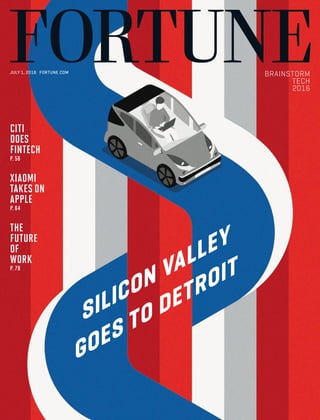
SILICON VALLEY
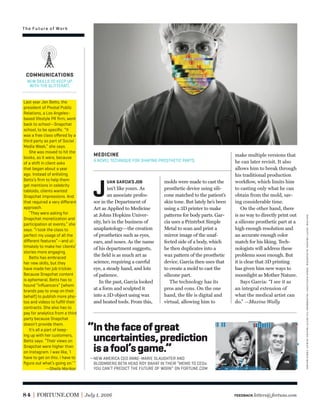
GOES TO DETROIT
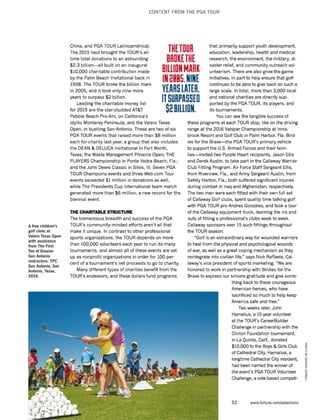
CITI
DOES
FINTECH
P. 56
XIAOMI
TAKES ON
APPLE
P. 64
THE
FUTURE
OF
WORK
P. 79
JULY 1, 2016 FORTUNE.COM
BRAINSTORM
TECH
2016
Quicken Loans NMLS #3030. Equal Housing Lender. Licensed in 50 states. AR, TX: 1050 Woodward Ave., Detroit, MI 48226-1906, (888) 474-0404; AZ: 16425 North Pima, Ste. 200, Scottsdale, AZ 85260, Mortgage
Banker License #BK-0902939; CA: Licensed by Dept. of Business Oversight, under the CA Residential Mortgage Lending Act; CO: Regulated by the Division of Real Estate; GA: Residential Mortgage Licensee
#11704; IL: Residential Mortgage Licensee #4127 – Dept. of Financial and Professional Regulation; KS: SL-0000693; ME: Supervised Lender License; MN: Not an offer for a rate lock agreement; MS: Licensed by
the MS Dept. of Banking and Consumer Finance; NH: Licensed by the NH Banking Dept., #6743MB; NV: License #626; NJ: Licensed Mortgage Banker – NJ Dept. of Banking, 1st (and/or 2nd) mortgages only;
NY: Licensed Mortgage Banker – NYS Banking Dept.; OH: MB 850076; OR: License #ML-1387; PA: Licensed as a 1st Mortgage Banker by the Dept. of Banking and licensed pursuant to the PA Secondary Mortgage
Loan Act; RI: Licensed Lender; VA: www.NMLSConsumerAccess.org; WA: Consumer Loan Company License CL-3030. Quicken Loans NMLS #3030. Rates subject to change. Restrictions may apply. ©2000–2016
Quicken Loans Inc., All rights reserved. Lending services provided by Quicken Loans Inc., a subsidiary of Rock Holdings Inc. “Quicken Loans” is a registered service mark of Intuit Inc., used under license.
QuickenLoans.com
ITSTIMETO
MOVEFORWARDWe knew it was time for a better way to get a home
loan, so we created Rocket Mortgage. With our completely
online process, you can move forward with a custom
mortgage solution in minutes.
’
64
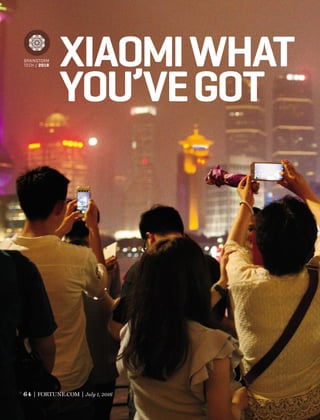
XiaomiWhat
You’veGot
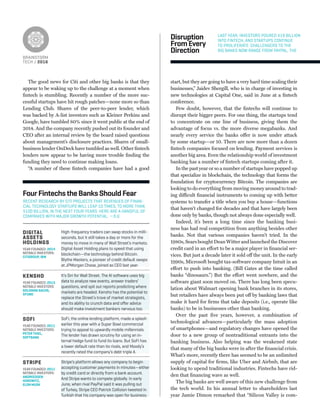
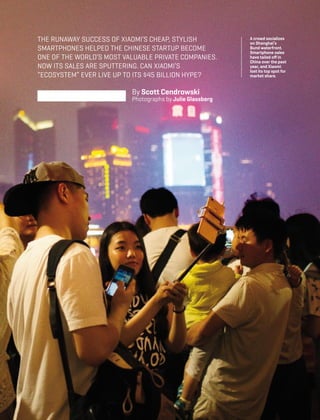
The runaway success of
Xiaomi’s cheap, stylish smart-
phones helped the Chinese
startup become one of the
world’s most valuable private
companies. Now its sales
are sputtering. Can Xiaomi’s
“ecosystem” ever live up to its
$45 billion hype?
By Scott Cendrowski
72
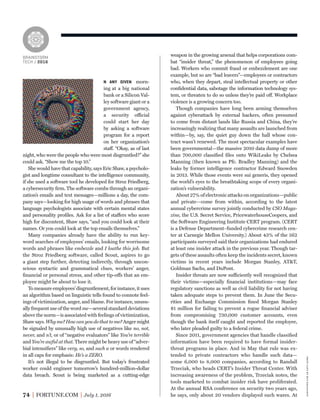
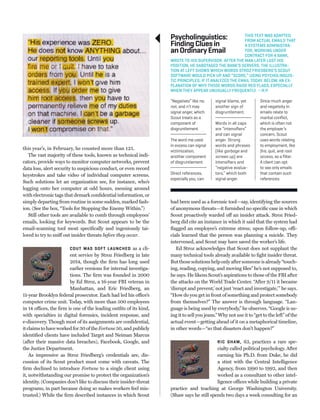
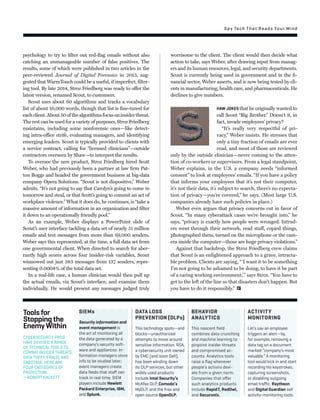
Spy Tech That Reads
Your Mind
Leaks, theft, and sabotage by
employees have become a
major cybersecurity problem.
One company says it can spot
“insider threats” before they
happen—by reading all your
workers’ email.
By Roger Parloff
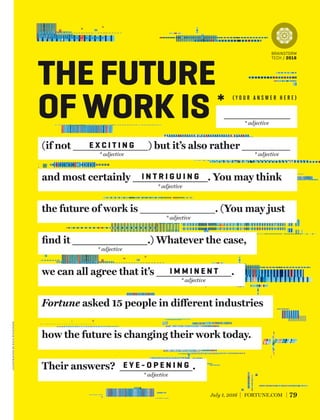
79
TheFutureofWork
Change is hard. The way you
work today isn’t the way
you’ll work tomorrow. Fortune
asked people in a variety of
industries how technology
is changing their workplace.
Here’s what they said.
90
Is Pot Losing Its Buzz
in Colorado?
A backlash is growing in a state
where marijuana has quickly be-
come a $1 billion legal business.
By Jennifer Alsever
56
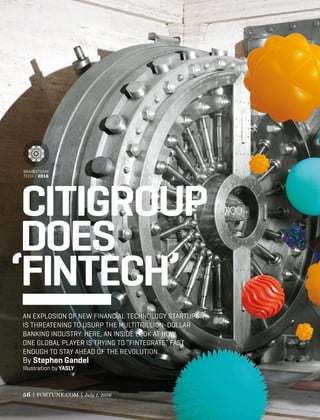
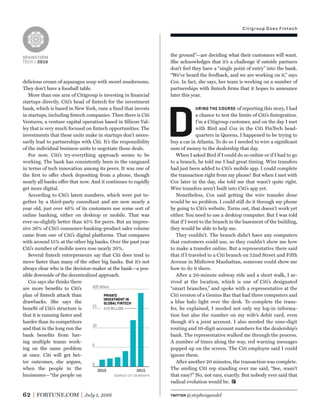
Citigroup Does
‘Fintech’
An explosion of new financial
technology startups is threat-
ening to usurp the multitrillion-
dollar banking industry. Here,
an inside look at how one global
player is trying to “fintegrate”
fast enough to stay ahead of
the revolution.
By Stephen Gandel
46
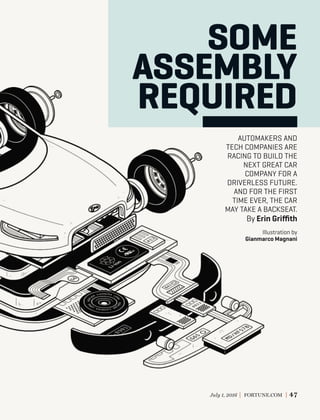
Some
Assembly
Required
Automakers and
tech companies are
racing to build the
next great car com-
pany for a driverless
future. And for the
first time ever,
the car may take
a backseat.
By Erin Griffith
BRAINSTORM TECH / 2016
courtesyofgoogle
cov er illustr ation by STEVEN WILSON
features
July 1, 2016 Volume 174 Number 1
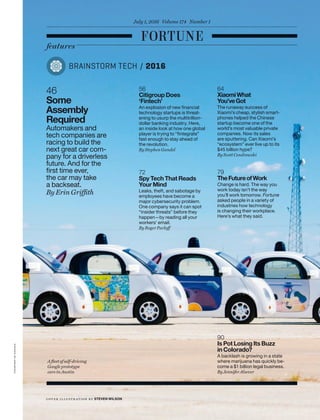
A fleet of self-driving
Google prototype
cars in Austin
4 FORTUNE.COM
Macro
8
Closer Look
This year, the political
conventions matter
again. Here are the fights
to watch in Cleveland
and Philadelphia.
By Anne VanderMey
12
Blood Testing Is
Booming
Companies are betting
a “liquid biopsy” can
change cancer testing.
By Sy Mukherjee
14
The Weird World
of Negative
Interest Rates
Central banks are doing
what was once unthink-
able. Will it save their
economies?
By Chris Matthews
16
Leadership
Some jobs must be auto-
mated; others need the
human touch. Which are
which? That’s your call.
By Geoff Colvin
18
Executive Read
A new book raises the
question: Can you be a
good investor without
knowing anything about
business?
By Roger Lowenstein
20
Brain Health
The blood-brain barrier
has long stymied drug
development for brain
disorders. Researchers
have finally begun to
break through it.
By Erika Fry
Venture
23
How I Got Started
Frank Yang has used
creative design and
gleaming stainless steel
to make Simplehuman
the Apple of housewares.
Interview by Dinah Eng
pursuits
26
Travel Tech
Personal valet app Dufl
lets you pack luggage re-
motely in under a minute.
By Christopher Tkaczyk
28
Black Book
Washington, D.C., isn’t
just for patriots—it’s also
a must for aesthetes
and foodies.
By Adam Erace
Tech
31
Person of Interest:
Brainstorm
Tech Edition
Meet Mikkel Svane, CEO
of Zendesk, a cloud-
based customer-service
software company.
By Heather Clancy
32
The Age of Unicorns:
Brainstorm Tech
Edition
Well-funded cyber-
security firms are waiting
for the right market
conditions for an IPO. It
might be a while.
By Robert Hackett
34
Zeroing In
T-Mobile CEO John
Legere’s crusade for
customers is paying off.
By Aaron Pressman
36
A Boom With a View
Corporations desire to be
nimble like startups at a
time when startups crave
profits like the big boys.
By Erin Griffith
invest
43
Pondering the
Puzzle of IBM
The tech giant is stum-
bling through a painful
turnaround. Is the stock a
bargain or a trap?
By Ryan Derousseau
6 EDITOR’S DESK
96 BING!
CORRECTIONS
In some editions of the
June 15 issue, “The
Outsiders” noted that
Netflix signed a deal with
Disney in May; in fact the
deal had been signed
earlier, but its details were
announced in May. “Pic-
turing the Fortune 500”
(June 15) misstated how
much Netflix is spending
on programming in 2016.
The correct figure is
$5 billion. Fortune regrets
the errors.
dufl:chrishinkle;washington,d.c.:seanpavone—gettyimages
departments
July 1, 2016 Volume 174 Number 1
editor’s desk
6 FORTUNE.COM July 1, 2016
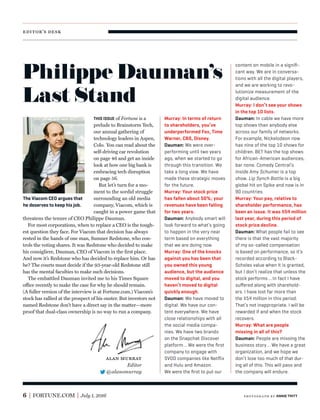
THIS ISSUE of Fortune is a
prelude to Brainstorm Tech,
our annual gathering of
technology leaders in Aspen,
Colo. You can read about the
self-driving car revolution
on page 46 and get an inside
look at how one big bank is
embracing tech disruption
on page 56.
But let’s turn for a mo-
ment to the sordid struggle
surrounding an old media
company, Viacom, which is
caught in a power game that
threatens the tenure of CEO Philippe Dauman.
For most corporations, when to replace a CEO is the tough-
est question they face. For Viacom that decision has always
rested in the hands of one man, Sumner Redstone, who con-
trols the voting shares. It was Redstone who decided to make
his consigliere, Dauman, CEO of Viacom in the first place.
And now it’s Redstone who has decided to replace him. Or has
he? The courts must decide if the 93-year-old Redstone still
has the mental faculties to make such decisions.
The embattled Dauman invited me to his Times Square
office recently to make the case for why he should remain.
(A fuller version of the interview is at Fortune.com.) Viacom’s
stock has rallied at the prospect of his ouster. But investors not
named Redstone don’t have a direct say in the matter—more
proof that dual-class ownership is no way to run a company.
Murray: In terms of return
to shareholders, you’ve
underperformed Fox, Time
Warner, CBS, Disney.
Dauman: We were over-
performing until two years
ago, when we started to go
through this transition. We
take a long view. We have
made these strategic moves
for the future.
Murray: Your stock price
has fallen about 50%; your
revenues have been falling
for two years.
Dauman: Anybody smart will
look forward to what’s going
to happen in the very near
term based on everything
that we are doing now.
Murray: One of the knocks
against you has been that
you owned this young
audience, but the audience
moved to digital, and you
haven’t moved to digital
quickly enough.
Dauman: We have moved to
digital. We have our con-
tent everywhere. We have
close relationships with all
the social media compa-
nies. We have two brands
on the Snapchat Discover
platform … We were the first
company to engage with
SVOD companies like Netflix
and Hulu and Amazon.
We were the first to put our
The Viacom CEO argues that
he deserves to keep his job.
alan murray
Editor
@alansmurray
content on mobile in a signifi-
cant way. We are in conversa-
tions with all the digital players,
and we are working to revo-
lutionize measurement of the
digital audience.
Murray: I don’t see your shows
in the top 10 lists.
Dauman: In cable we have more
top shows than anybody else
across our family of networks.
For example, Nickelodeon now
has nine of the top 10 shows for
children. BET has the top shows
for African-American audiences,
bar none. Comedy Central’s
Inside Amy Schumer is a top
show. Lip Synch Battle is a big
global hit on Spike and now is in
90 countries.
Murray: Your pay, relative to
shareholder performance, has
been an issue. It was $54 million
last year, during this period of
stock price decline.
Dauman: What people fail to see
there is that the vast majority
of my so-called compensation
is based on performance, so it’s
recorded according to Black-
Scholes value when it is granted,
but I don’t realize that unless the
stock performs…In fact I have
suffered along with sharehold-
ers. I have lost far more than
the $54 million in this period.
That’s not inappropriate. I will be
rewarded if and when the stock
recovers.
Murray: What are people
missing in all of this?
Dauman: People are missing the
business story … We have a great
organization, and we hope we
don’t lose too much of that dur-
ing all of this. This will pass and
the company will endure.
Philippe Dauman’s
Last Stand
photogr aph by ANNIE TRITT
“It’s not just security. It’s defense.”
Cyber threats have changed, and the solutions need to
change too. The sophisticated techniques BAE Systems
uses to protect government and military assets are now
helping to defend businesses around the world.
Learn more at BAEsystems.com/cyberdefense
Copyright © 2016 BAE Systems plc. All rights reserved.
JULY 1, 2016
Macro
8 FORTUNE.COM July 1, 2016
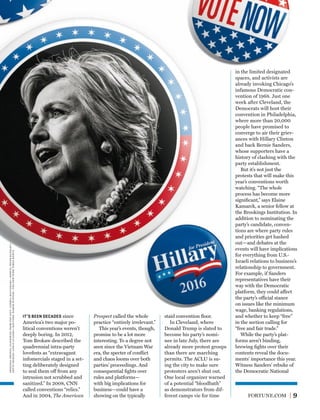
In a typical year the nominating
process looks like a four-day
infomercial. But this is not a
typical year. Here are the
fights to watch in Cleveland and
Philadelphia.
By Anne VanderMey
Thisyear,
conventions
matteragain
CLOSER LOOK
trump/clinton:markpeterson—redux
FORTUNE.COM 9
Prospect called the whole
practice “entirely irrelevant.”
This year’s events, though,
promise to be a lot more
interesting. To a degree not
seen since the Vietnam War
era, the specter of conflict
and chaos looms over both
parties’ proceedings. And
consequential fights over
rules and platforms—
with big implications for
business—could have a
showing on the typically
staid convention floor.
In Cleveland, where
Donald Trump is slated to
become his party’s nomi-
nee in late July, there are
already more protest groups
than there are marching
permits. The ACLU is su-
ing the city to make sure
protesters aren’t shut out.
One local organizer warned
of a potential “bloodbath”
as demonstrators from dif-
ferent camps vie for time
in the limited designated
spaces, and activists are
already invoking Chicago’s
infamous Democratic con-
vention of 1968. Just one
week after Cleveland, the
Democrats will host their
convention in Philadelphia,
where more than 20,000
people have promised to
converge to air their griev-
ances with Hillary Clinton
and back Bernie Sanders,
whose supporters have a
history of clashing with the
party establishment.
But it’s not just the
protests that will make this
year’s conventions worth
watching. “The whole
process has become more
significant,” says Elaine
Kamarck, a senior fellow at
the Brookings Institution. In
addition to nominating the
party’s candidate, conven-
tions are where party rules
and priorities get hashed
out—and debates at the
events will have implications
for everything from U.S.-
Israeli relations to business’s
relationship to government.
For example, if Sanders
representatives have their
way with the Democratic
platform, they could affect
the party’s official stance
on issues like the minimum
wage, banking regulations,
and whether to keep “free”
in the section calling for
“free and fair trade.”
While the party’s plat-
forms aren’t binding,
brewing fights over their
contents reveal the docu-
ments’ importance this year.
Witness Sanders’ rebuke of
the Democratic National
IT’S BEEN DECADES since
America’s two major po-
litical conventions weren’t
deeply boring. In 2012,
Tom Brokaw described the
quadrennial intra-party
lovefests as “extravagant
infomercials staged in a set-
ting deliberately designed
to seal them off from any
intrusion not scrubbed and
sanitized.” In 2008, CNN
called conventions “relics.”
And in 2004, The American
originalphotos,clockwisefromtopleft:andriahautamaki—redux;peterdazeley—
gettyimages;carloallegri—reuters;damonwinter—thenewyorktimesredux
MACRO
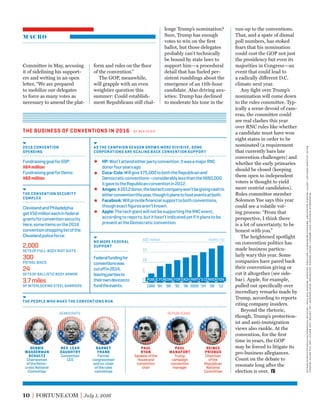
NO MORE FEDERAL
SUPPORT
AS THE CAMPAIGN SEASON GROWS MORE DIVISIVE, SOME
CORPORATIONS ARE SCALING BACK CONVENTION SUPPORT
HP:Won’tattendeitherpartyconvention.ItwasamajorRNC
donorfouryearsago.
Coca-Cola:Willgive$75,000toboththeRepublicanand
Democraticconventions—considerablylessthanthe$660,000
itgavetotheRepublicanconventionin2012.
Amgen:A2012donor,thebiotechcompanywon’tbegivingcashto
eitherconventionthisyear,thoughitplanstohosteventsatboth.
Facebook:Willprovidefinancialsupporttobothconventions,
thoughexactfiguresaren’tknown.
Apple:ThetechgiantwillnotbesupportingtheRNCevent,
accordingtoreports,butithasn’tindicatedyetifitplanstobe
presentattheDemocraticconvention.
2016 CONVENTION
SPENDING
FundraisinggoalforGOP:
$64million
FundraisinggoalforDems:
$60million
REPUBLICANSDEMOCRATS
PAUL
RYAN
Speakerofthe
Houseand
convention
chair
DEBBIE
WASSERMAN
SCHULTZ
Chairwoman
oftheDemo-
craticNational
Committee
PAUL
MANAFORT
Trump
campaign
convention
manager
REV. LEAH
DAUGHTRY
Convention
CEO
REINCE
PRIEBUS
Chairman
ofthe
Republican
National
Committee
BARNEY
FRANK
Former
congressman
andco-chair
oftherules
committee
THE PEOPLE WHO MAKE THE CONVENTIONS RUN
THE BUSINESS OF CONVENTIONS IN 2016 BY BEN GEIER
2,000
SETS OF FULL-BODY RIOT SUITS
300
PATROL BIKES
24
SETS OF BALLISTIC BODY ARMOR
3.7miles
OF INTERLOCKING STEEL BARRIERS
THE CONVENTION SECURITY
COMPLEX
ClevelandandPhiladelphia
get$50millioneachinfederal
grantsforconventionsecurity.
Here,someitemsonthe2016
conventionshoppinglistofthe
Clevelandpoliceforce:
Federalfundingfor
conventionswas
cutoffin2014,
leavingpartiesto
theirowndevicesto
fundtheevents.
0
5
10
15
$20 million
1980 ’84 ’88 ’92 ’04 ’08 ’12’96 2000
PUBLIC FUNDING FOR EACH PARTY’S CONVENTION
SOURCE: FEC
10 FORTUNE.COM July 1, 2016
Committee in May, accusing
it of sidelining his support-
ers and writing in an open
letter, “We are prepared
to mobilize our delegates
to force as many votes as
necessary to amend the plat-
form and rules on the floor
of the convention.”
The GOP, meanwhile,
will grapple with an even
weightier question this
summer: Could establish-
ment Republicans still chal-
run-up to the conventions.
That, and a spate of dismal
poll numbers, has stoked
fears that his nomination
could cost the GOP not just
the presidency but even its
majorities in Congress—an
event that could lead to
a radically different D.C.
climate next year.
Any fight over Trump’s
nomination will come down
to the rules committee. Typ-
ically a scene devoid of cam-
eras, the committee could
see real clashes this year
over RNC rules like whether
a candidate must have won
eight states in order to be
nominated (a requirement
that currently bars late
convention challengers) and
whether the early primaries
should be closed (keeping
them open to independent
voters is thought to yield
more centrist candidates).
Rules committee member
Solomon Yue says this year
could see a volatile vot-
ing process: “From that
perspective, I think there
is a lot of uncertainty, to be
honest with you.”
The heightened spotlight
on convention politics has
made business particu-
larly wary this year. Some
companies have pared back
their convention giving or
cut it altogether (see side-
bar). Apple, for example,
pulled out specifically over
incendiary remarks made by
Trump, according to reports
citing company insiders.
Beyond the rhetoric,
though, Trump’s protection-
ist and anti-immigration
views also rankle. At the
convention, for the first
time in years, the GOP
may be forced to litigate its
pro-business allegiances.
Count on the debate to
resonate long after the
election is over.
lenge Trump’s nomination?
Sure, Trump has enough
votes to win on the first
ballot, but those delegates
probably can’t technically
be bound by state laws to
support him—a procedural
detail that has fueled per-
sistent rumblings about the
emergence of an 11th-hour
candidate. Also driving anx-
ieties: Trump has declined
to moderate his tone in the
wassermanschultz:paulmorigi—gettyimages;daughtry:mattrourke—ap;frank:lourocco—abcviagettyimages;
ryan:allisonshelley—gettyimages;manafort:brendanmcdermid—reuters;priebus:dennisvantine—geisler-fotopres/picture-alliance/dpa/ap
progressive lens
Not all progressive lenses are created equal.
ordinary
progressive lens
Get sharp vision and smooth transitions at any distance with Varilux®
.
Varilux is the only progressive lens brand with lenses designed using W.A.V.E. Technology™
.
Why wear anything else? Get the #
1 progressive lens brand. Get Varilux.
Varilux.com
Dramatization
©2016 Essilor of America, Inc. All rights reserved. Essilor and Varilux are registered trademarks of Essilor International.
W.A.V.E. Technology: Wavefront Advanced Vision Enhancement is a trademark of Essilor International.
MACRO
California-based Freenome
got a multimillion-dollar
cash infusion from Andrees-
sen Horowitz. Pharma
giant Roche nabbed FDA
approval for a first-of-its-
kind blood test to assess the
efficacy of its lung cancer
drug, Tarceva, for differ-
ent patients. And at June’s
American Society of Clinical
Oncology annual meeting,
Guardant Health unveiled
a trove of data showing that
its blood-testing tech was
comparable to standard sur-
gical biopsies for discerning
cancerous mutations and
matching patients to appro-
priate treatments.
These are just a few of
the latest developments
in the burgeoning field of
personalized medicine and
“liquid biopsies”—blood
tests that seek to replace
painful, pricey, and com-
plicated procedures like
the invasive tissue biopsies
that currently dominate the
cancer market. Guardant,
for its part, hopes that one
day its platform can be used
as part of an annual physi-
cal to detect cancer as early
as possible. The Theranos
debacle notwithstanding,
if this new class of blood-
testing tech takes off the
way investors think it might,
cheaper, safer tests could
replace old-school surgical
biopsies altogether.
12 FORTUNE.COM July 1, 2016
C H E C K , P L E A S E
MEALKITSTARTUPS
MAKECOOKING
SIMPLER…AND
PRICIER
W H A T W E K N O W
DIDNORTH
KOREAHAVE
HACKERSSTEAL
MILLIONSFROM
GLOBALBANKS?
INCREASINGLYTRENDY mealkitcompanieslikeBlue
Apron(saidtobeconsideringanIPO)havebuilthot
businessesonthepromiseofmakingcookingathome
easier.Butnot—evenwiththeirperfectlymeasured
portions—cheaper.AnewsurveyfromNPDGroup
foundthattheaveragemealfromakitcostsabout$10
perperson—morethandoublethepriceofshopping
foryourself,accordingtoNPD,andaboutequaltothe
averagecostofeatingout.Thisdynamicplaysout
differentlydependingonthemarket,ofcourse,butit
makestheeconomicsofmealsinaboxalittlelessap-
petizingoutsidebig,expensivecities.—BETH KOWITT
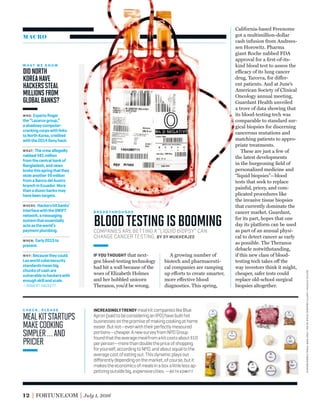
COMPANIES ARE BETTING A “LIQUID BIOPSY” CAN
CHANGE CANCER TESTING. BY SY MUKHERJEE
IF YOU THOUGHT that next-
gen blood-testing technology
had hit a wall because of the
woes of Elizabeth Holmes
and her hobbled unicorn
Theranos, you’d be wrong.
A growing number of
biotech and pharmaceuti-
cal companies are ramping
up efforts to create smarter,
more effective blood
diagnostics. This spring,
B R E A K T H R O U G H S
BLOODTESTINGISBOOMING
WHO: Expertsfinger
the“Lazarusgroup,”
ashadowycomputer-
crackingcorpswithlinks
toNorthKorea,credited
withthe2014Sonyhack.
WHAT: Thecrewallegedly
nabbed$81million
fromthecentralbankof
Bangladesh,andnews
brokethisspringthatthey
stoleanother$9million
fromaBancodelAustro
branchinEcuador.More
thanadozenbanksmay
havebeentargets.
WHERE: Hackershitbanks’
interfacewiththeSWIFT
network,amessaging
systemthatessentially
actsastheworld’s
paymentplumbing.
WHEN: Early2015to
present.
WHY: Becausetheycould.
Laxworldcybersecurity
standardsmeanbig
chunksofcashare
vulnerabletohackerswith
enoughskillandscale.
—ROBERT HACKETT
kevincurtis—gettyimages;evansung—thenewyorktimes/redux
IT is ready
to double your
digital revenue
BMC Digital IT powers 82% of Fortune 500®
companies.
Our IT is ready, is yours?
© Copyright 2016 BMC Software, Inc. A study finds that CEOs expect their digital revenue to double by the turn of the decade. FORTUNE 500 is a registered trademark of the FORTUNE magazine division of Time Inc.
MACRO
THE WEIRD
WORLD
OF NEGATIVE
INTEREST RATES
Japan has seen
a run on cash
safes as
interest rates
go negative.
D E S P E R A T E M E A S U R E S
14 FORTUNE.COM
E X C H A N G E S
THENYSE
ISTHE
NEWNASDAQ
That’s the share of
new jobs listed on
Monster that require
or recommend
applicants have an
MBA, down about
50% from both
lastyearandthe
averagesince2012,
accordingtodata
providedtoFortune.
Thedegree’sanemic
WHITHERTHEMBA?
THENASDAQhaslong
beentheexchangeof
choiceforthecountry’s
hottesttechIPOs.
Butrecentlymore
toptechcompanies
arepickingtheNYSE
instead.It’spartlya
hangoverfromFace-
book’srockyNasdaq
IPO,butevenmoreare-
sultofNYSE’sexpanded
servicesandintense
marketingcampaignin
SiliconValley.Thebiggest
techfirmscurrentlyin
registrationtogopublic
(ElevateCredit,Line
Corp.,andTwilio)andthe
year’slargesttechIPOto
date(AcaciaCommuni-
cations)allchoseNYSE.
Sodidmostoflastyear’s
largestofferings,such
asBox,Fitbit,FirstData,
GoDaddy,andSquare.
Butdon’tshedtoo
manytearsforNasdaq.
Itstilldominatesina
biotechsectorthatnow
producesfarmoreIPOs.
Sincethebeginningof
2015therehavebeen
145biotechIPOsinthe
U.S.(techhad82).Andof
that145,awhopping142
listedontheNasdaq.
—DAN PRIMACK1%
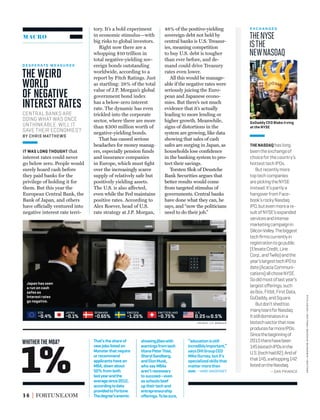
IT WAS LONG THOUGHT that
interest rates could never
go below zero. People would
surely hoard cash before
they paid banks for the
privilege of holding it for
them. But this year the
European Central Bank, the
Bank of Japan, and others
have officially ventured into
negative interest rate terri-
48% of the positive-yielding
sovereign debt not held by
central banks is U.S. Treasur-
ies, meaning competition
to buy U.S. debt is tougher
than ever before, and de-
mand could drive Treasury
rates even lower.
All this would be manage-
able if the negative rates were
seriously juicing the Euro-
pean and Japanese econo-
mies. But there’s not much
evidence that it’s actually
leading to more lending or
higher growth. Meanwhile,
signs of distortions in the
system are growing, like data
showing that sales of cash
safes are surging in Japan, as
households lose confidence
in the banking system to pro-
tect their savings.
Torsten Slok of Deustche
Bank Securities argues that
better results would come
from targeted stimulus of
governments. Central banks
have done what they can, he
says, and “now the politicians
need to do their job.”
CENTRAL BANKS ARE
DOING WHAT WAS ONCE
UNTHINKABLE. WILL IT
SAVE THEIR ECONOMIES?
BY CHRIS MATTHEWS
showingjibeswith
warningsfromtech
titansPeterThiel,
SherylSandberg,
andElonMusk,
who say MBAs
aren’t necessary
to succeed—even
as schools beef
up their tech and
entrepreneurship
offerings.Tobesure,
“educationisstill
incrediblyimportant,”
saysDHIGroupCEO
MikeDurney,butit’s
specializedskillsthat
mattermorethan
ever.—ANNEVANDERMEY
tory. It’s a bold experiment
in economic stimulus—with
big risks to global investors.
Right now there are a
whopping $10 trillion in
total negative-yielding sov-
ereign bonds outstanding
worldwide, according to a
report by Fitch Ratings. Just
as startling: 28% of the total
value of J.P. Morgan’s global
government bond index
has a below-zero interest
rate. The dynamic has even
trickled into the corporate
sector, where there are more
than $300 million worth of
negative-yielding bonds.
That has caused serious
headaches for money manag-
ers, especially pension funds
and insurance companies
in Europe, which must fight
over the increasingly scarce
supply of relatively safe but
positively yielding assets.
The U.S. is also affected,
even while the Fed maintains
positive rates. According to
Alex Roever, head of U.S.
rate strategy at J.P. Morgan,
ECB
–0.4%
JAPAN
–0.1%
DENMARK
–0.65%
SWEDEN
–1.25%
U.S.
0.25 to 0.5%
SWITZERLAND
–0.75%
GoDaddy CEO Blake Irving
at the NYSE
source: j.p. morgan
yuyashino—reuters;brendanmcdermid—reuters
MACRO
Knowingthelimits
ofmachines
L E A D E R S H I P
HEN STOCK MARKETS plunged
early this year, managers at
USAA’s investments divi-
sion noticed something odd.
Customers who routinely
conducted business online were suddenly light-
ing up the phones. USAA had nothing new to tell
them—its fundamental advice hadn’t changed,
and they could have found that guidance online.
Yet clients deeply wanted to talk to a real human
being, and never mind why. They just did.
That reality illustrates a
high-stakes decision that
confronts managers in every
industry: choosing which
employees must be replaced
by technology and which
must not be. Growing num-
bers of jobs at every level can
be performed by machines—
not just faster and more
cheaply than humans can do
them, but better. In many
of those jobs, such as in
factories, failing to replace
people could doom a com-
pany through uncompetitive
costs. Yet in other jobs that
machines can do well, such
as giving financial advice,
replacing too many humans
could be a fatal error. How to
decide? Three situations in
particular seem to justify the
costs, and quirks, of people.
WHEN CUSTOMERS VALUE
THE HUMAN TOUCH. Many
decisions that in theory
are calculable—where to
invest, whether to sue, how
to respond to a medical
diagnosis—are in fact laden
with emotion. Many people
need to interact with a per-
son before choosing a course
of action. In finance, law,
medicine, and other fields,
workers who handle those
interactions most adeptly
will be the least susceptible
to replacement.
WHEN CONSTITUENCIES MUST
BE REPRESENTED. All organiza-
tions are run ultimately by
and for humans, and most
are complex matrices of
desires, incentives, budgets,
and myriad other factors.
If marketing can’t get along
with sales, or management
with labor, nothing good
can happen. Technology
could optimize the whole
intricate machine, but it
will seize up if humans can’t
agree on how to make it go.
WHEN SOMEONE MUST BE
ACCOUNTABLE. So long as
humans and not machines
are in charge—let’s assume
that’s a long time—societies
will demand that people be
made to answer for deci-
sions, even if technology
recommends those deci-
sions. Government officials,
military officers, judges,
business managers, basket-
ball coaches, and others in
leadership roles will remain
where the buck stops.
Technology may reduce the
number of people in such
roles—it’s already taking
over tasks of middle manag-
ers, for example—but re-
sponsibility will ultimately
end up in human hands.
As machines grow more
powerful, deciding who
must go and who must stay
becomes harder. A guid-
ing principle: Just because
technology can do a job
brilliantly doesn’t mean that
it should.
SOME JOBS REALLY MUST BE AUTOMATED;
OTHERS NEED THE HUMAN TOUCH.
WHICH ARE WHICH? THAT’S YOUR CALL.
By Geoff Colvin
W
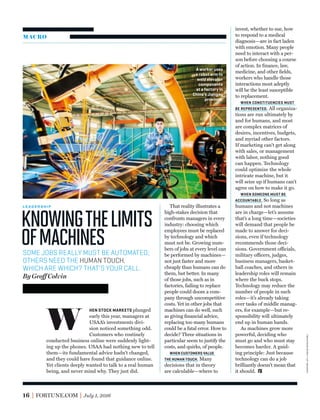
A worker uses
a robot arm to
weld elevator
components
at a factory in
China’s Jiangsu
province.
16 FORTUNE.COM July 1, 2016
imaginechina—apimages
When you need someone to strategize with, we’ll be ready to talk. Our
relationship managers take the time to learn your business and gain a deeper
understanding of your expansion goals. We’ve successfully partnered with
mid-sized to large corporations to help them meet their global business
needs. With our full suite of products backed by our time-tested strength and
stability, we’ve never been more ready to support your business today and
for years to come. To learn more about how our capabilities can work for you,
visit national.wellsfargobank.com/FN9.
* Investment and insurance products: NOT FDIC-Insured • NO Bank Guarantee • MAY Lose Value
1
Wells Fargo Asset Management is a trade name used by the asset management businesses of Wells Fargo & Company. Certain investments are distributed by
Wells Fargo Funds Distributor, LLC, Member FINRA/SIPC, a subsidiary of Wells Fargo & Company.
2
Insurance products and services are offered through non-bank affiliates of Wells Fargo & Company including Wells Fargo Insurance Inc. and Wells Fargo Insurance
Services USA, Inc.
3
Wells Fargo Securities is the trade name for the capital markets and investment banking services of Wells Fargo & Company and its subsidiaries, including Wells Fargo Securities,
LLC, a member of FINRA, NYSE, NFA and SIPC, Wells Fargo Institutional Securities, LLC, a member of FINRA, NFA and SIPC and Wells Fargo Bank, N.A.
© 2016 Wells Fargo Bank, N.A. All rights reserved. Deposit products offered by Wells Fargo Bank, N.A. Member FDIC. Deposits held in non-U.S. branches are not FDIC insured.
WCS-2539351
“We want a banker
who will work with
us and be part of
the team.”
WHOLESALE
BANKING
Asset Management*1
Capital Finance
Commercial & Corporate
Commercial Real Estate
Government & Institutional
Insurance*2
International
Investment Banking &
Capital Markets*3
Treasury Management
MACRO
INVESTMENTGUIDESareas
numerousasswallows.Typically
theybeginwithanacknowledg-
mentthattheworldhaslittle
needforanotherinvestment
guide—butthatthisparticular
bookisdifferent.Soitiswith
HeadsIWin,TailsIWinby
SpencerJakab,awriterand
editoroftheWallStreetJournal’s
HeardontheStreetcolumn.
Jakabisnotpromisingto
makereadersrich.Richer,tobe
sure,butnot,asPoloniuswould
haveit,gaudy.HeadsIWinis
aimedataverageJanesand
Joes.Itencouragesthemtodis-
pensewithanythoughtofbeat-
ingthemarket.Everyonethinks
heorshehasabove-average
skill,saysJakab,butfewactu-
allydo.Helamentsthatpeople
whowouldneverpresumeto
fixtheirownrefrigeratorhave
theburdenofmanagingtheir
money.“You’reprobablyalousy
investor,”hestarklyobserves,
“andshouldbeperfectlyhappy
togetbacktoaveragerather
thanstriveforgreatness.”
Heurgesinvestorstoavoid
marketfashionsandspecula-
tivevehicles,suchashigh-yield
bonds.Abovealltheyshould
avoidcostlyhumanmanage-
mentandinvestinindexfunds.
ItisnotlostonJakabthatmost
professionalinvestorshave
latelyfallenshortofmarket
indexes.Overthe10-year
stretchthatendedin2015,a
mind-boggling82%ofactively
managedlarge-capfundsand
88%ofsmall-andmidcapfunds
laggedtheirbenchmarkindexes,
accordingtoS&PDowJones
Indices.Ifthefashionofthe
momentisindexing,Jakabisits
trumpet.Thoughonewonders
whether,asmorepeoplecrowd
intopopularindexingvehicles
liketheS&P500,overvaluation
andheightenedriskmayfollow.
Jakabhasplentyofsensible
advice—especiallyfornovices.
Theywouldbenefit,hesays,
bydoinglessratherthanmore.
Heendorsesportfolio“rebal-
ancing,”meaningautomatically
investingmoreafterthe
marketfallsandtrimmingafter
gains.Thishastheadvantageof
enforcingarelativelycontrarian
bent;ithasthedisadvantageof
beingunthinking.
ToJakab,notthinkingisan
advantage.Heissosouredon
activemoneymanagement
thathefavorablymentions
studiesthatendorserandom
selection—eventhrowingdarts
atthenewspaper.Hedoesnot
quiteurgereaderstobuyasetof
darts,butthethoughtisthere.
Whatisdeeplyunsatisfying
isthelackofanyappreciation
thatsecuritieshaveaconnec-
tiontoanunderlyingbusiness.
Intherealworld,stocksrise
andfallonthedetailsofthe
enterprise.Assessingthemre-
quirespainstakingwork,which
discouragesmostpeopleand
leavesrichpotentialrewards
forthefewwhoattemptit.
Jakab’sinvestment-world
viewis,“We’reallplayersin
somethingcalledazero-sum
game.”Butitisnotzerosum.
Gamblingiszerosum.Securi-
tiesmarketsareaconstructby
whichinvestorsparticipatein
capitalisticenterprises.Itisno
morezerosumthanExxon.
Jakab’swritingisanecdotal
andwitty,andhisadvicewilldo
moregoodthanharm.Butifhis
aimistoimpartunderstanding,
HeadsIWinisanopportunity
squandered.
Further
reading
Time-Tested
Investment
Books
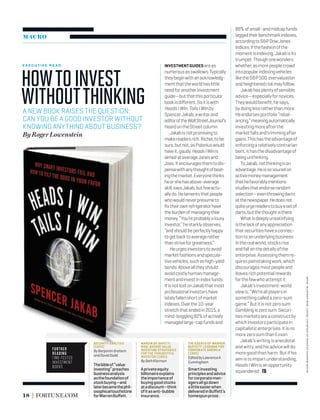
SECURITY ANALYSIS
(1934)
ByBenjaminGraham
andDavidDodd
Thebibleof“value
investing”preaches
businessanalysis
asthefoundationof
stockbuying—and
laterbecamethephil-
osophicaltouchstone
forWarrenBuffett.
MARGIN OF SAFETY:
RISK-AVERSE VALUE
INVESTING STRATEGIES
FOR THE THOUGHTFUL
INVESTOR (1991)
BySethKlarman
Aprivateequity
billionaireexplains
theimportanceof
buyinggoodstocks
atadiscount—think
ofitasanti-bubble
insurance.
THE ESSAYS OF WARREN
BUFFETT: LESSONS FOR
CORPORATE AMERICA
(1995)
EditedbyLawrenceA.
Cunningham
Smartinvesting
principlesandadvice
forcorporateman-
agersallgodown
alittleeasierwhen
deliveredinBuffett’s
homespunprose.18 FORTUNE.COM
E X E C U T I V E R E A D
Howtoinvest
withoutthinkingA NEW BOOK RAISES THE QUESTION:
CAN YOU BE A GOOD INVESTOR WITHOUT
KNOWING ANYTHING ABOUT BUSINESS?
By Roger Lowenstein
book:manfredkoh;cover:courtesyofpenguinrandomhouse
haveKINDLEwillTRAVEL
JAIPUR, INDIA ARAVIND ADIGA, THE WHITE TIGER: A NOVEL @ AMAZONKINDLE
TheRiddleofthe
WallintheBrain
MACRO
OR YEARS the darndest thing kept
happening to drugs in clinical tri-
als to treat brain disorders: They
never made it to the brain. For
pharmaceutical companies this
problem was as costly—developing treatments
for the central nervous system takes an average of
15 years and $1.5 billion—as it was, in hindsight,
kind of obvious. The drugs
were impeded in part by the
blood-brain barrier, or BBB,
a formidable physiological
feature whose properties
were discovered in the 1880s.
Composed of blood vessels
connected by “tight junc-
tions” and studded with
receptor proteins, the BBB
is more a gateway than an
impenetrable wall. It lets in
materials the brain needs
(sugars and amino acids),
while pumping out or de-
flecting the many it does not.
Alcohol, nicotine, and some
small-molecule drugs can
get in, but substances that
do not pass include chemo-
therapy agents, “biologics,”
and other pharmaceutical
breakthroughs. “Unfortu-
nately the blood-brain bar-
rier has effectively excluded
the brain from the entire bio-
tech revolution,” says James
Callaway, CEO of ArmaGen,
a California biotech.
Increasingly research
suggests that the BBB
becomes leaky as we age—a
weakening linked to neuro-
degeneration. People who
suffer traumatic brain in-
jury have a disrupted BBB,
as do those with multiple
sclerosis. And patients with
Alzheimer’s appear to have
a leakier BBB than most,
though whether it’s a cause
or a consequence of the dis-
ease is a matter of debate.
This porousness is one
reason drugmakers have
thought their meds might
make it into the brains of
such patients. But the race
is on to find more certain
strategies that could unlock
treatments for diseases
like Alzheimer’s and brain
cancer. Biotechs like Biogen
and Genentech have dozens
of researchers working on
the issue, while Janssen,
Johnson & Johnson’s phar-
maceutical arm, has sought
partnerships (including with
ArmaGen) to bolster in-
house efforts. All are trying
to hitch molecules to recep-
tors on the BBB for delivery
into the brain. (Key to some
of these efforts: shark and
llama antibodies.)
Impel NeuroPharma is
trying to circumvent the
BBB altogether, develop-
ing a device to spray a drug
into the brain via the nose’s
passageways. Others are
experimenting with lasers,
nanoparticles, ultrasound,
microbubbles, and the FDA-
approved drug Lexiscan to
either cross the barrier or
briefly pry it open. While fre-
quently disrupting the BBB
may pose safety risks, the
strategy is considered prom-
ising for attacking tumors.
It’s likely to be a couple
of years before a biologic
engineered to breach the
wall is approved. For now
the most proven way to get
drugs safely and effectively
into the brain involves a
method pioneered in 1979
by Ed Neuwelt, a neuro-
oncologist at Oregon Health
& Science University. He in-
jects patients with a solution
that temporarily shrinks the
cells in the BBB, creating
space for drugs to slip by.
Patients endure 12 three-day
hospitalizations in a year—
but it works. (His 450 brain
cancer patients include
some who are healthy more
than 25 years after treat-
ment.) Neuwelt, too, hopes
for less invasive methods of
bypassing the BBB. “I need
to be put out of business,” he
says.
F
THE BLOOD-BRAIN BARRIER HAS LONG
STYMIED DRUG DEVELOPMENT FOR BRAIN
DISORDERS. RESEARCHERS HAVE FINALLY
BEGUN TO BREAK THROUGH IT. By Erika Fry
B R A I N H E A LT H
20 FORTUNE.COM July 1, 2016 illustr ation by JVG
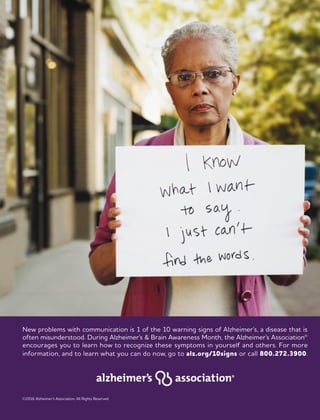
New problems with communication is 1 of the 10 warning signs of Alzheimer’s, a disease that is
often misunderstood. During Alzheimer’s & Brain Awareness Month, the Alzheimer’s Association®
encourages you to learn how to recognize these symptoms in yourself and others. For more
information, and to learn what you can do now, go to alz.org/10signs or call 800.272.3900.
©2016 Alzheimer’s Association. All Rights Reserved.
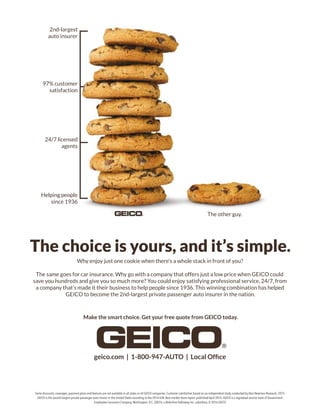
The choice is yours, and it’s simple.
Why enjoy just one cookie when there’s a whole stack in front of you?
The same goes for car insurance. Why go with a company that offers just a low price when GEICO could
save you hundreds and give you so much more? You could enjoy satisfying professional service, 24/7, from
a company that’s made it their business to help people since 1936. This winning combination has helped
GEICO to become the 2nd-largest private passenger auto insurer in the nation.
Make the smart choice. Get your free quote from GEICO today.
Some discounts, coverages, payment plans and features are not available in all states or all GEICO companies. Customer satisfaction based on an independent study conducted by Alan Newman Research, 2015.
GEICO is the second-largest private passenger auto insurer in the United States according to the 2014 A.M. Best market share report, published April 2015. GEICO is a registered service mark of Government
Employees Insurance Company,Washington, D.C. 20076; a Berkshire Hathaway Inc. subsidiary. © 2016 GEICO
2nd-largest
auto insurer
97% customer
satisfaction
24/7 licensed
agents
Helping people
since 1936
The other guy.
FORTUNE.COM 23
HOW I GOT STARTED
JULY 1, 2016
Venture
inventingproductsishislotinlife
Few people would think to apply
their spirit of invention to the
humble kitchen garbage can. But
Frank Yang did just that and
created a new category: the most
prosaic household items recon-
ceived with panache and stain-
less steel. Yang, 44, was a tinkerer
as a child and first learned about
business by helping his dad at
flea markets. Today his com-
pany, Simplehuman, sells soap
pumps, high-tech vanity mirrors
(with sensors that automatically
turn the light on when you ap-
proach), and more. Last year the
company’s sales were $150 mil-
lion. Yang’s story:
Frank Yang, an immigrant from Taiwan, has used creative design and
gleaming stainless steel to make SIMPLEHUMAN the Apple of housewares.
Interview by Dinah Eng
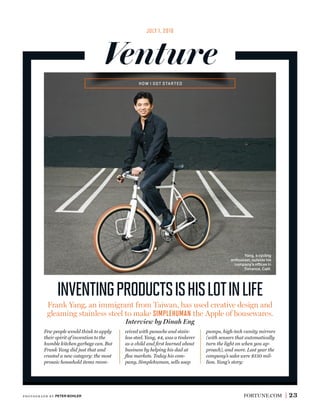
Yang, a cycling
enthusiast, outside his
company’s offices in
Torrance, Calif.
photogr aph by PETER BOHLER
24 FORTUNE.COM July 1, 2016
I grew up in Taiwan.
When people asked, “What
do you want to do when you
grow up?” I’d say, “I want to
invent something and sell
it.” As a kid, I thought there
should be automatic dog
feeders and stoves that turn
themselves off if there are
no pots on them.
When I was 10, my family
immigrated to Los Angeles.
My father became an im-
porter. At first we struggled.
We’d go to swap meets,
where we sold dead inven-
tory from his business—like
seat cushions or mugs that
chill beer—to make ends
meet. I learned how to dis-
play and talk about products
and negotiate in Spanish.
I was always good at fixing
things. In seventh grade, we
had remote-control drag rac-
ing in my neighborhood, and
there was a rich kid who was
a bully. I couldn’t afford an
expensive car, so I fixed up a
cheap one by changing the
chassis and steering wheel
to make the car lighter. Then
I added an extra battery. It
didn’t look good, but I beat
the rich kid.
I went to UCLA for politi-
cal science but wasn’t sure
what I wanted to do. My
girlfriend, who’s now my
wife, was a graphic design
major; she suggested I take
an industrial design class.
I loved it, but it was too late
to change majors.
After graduating, I worked
for my father’s company.
I sourced products—and
learned about the supply
chain and how to deal with
manufacturers. But I felt
suffocated, so I quit and told
my father I was going to
design something to sell. He
was doing well by then, so he
gave me $200,000 to start
my own company.
It was 2000, and I looked
at housewares. I saw big
displays of expensive, unat-
tractive stainless-steel cans
that weren’t much more
functional than cheap plastic
ones. Back then, no real
thought was given to design
in household products. I
thought, “Everyone has a
trash can. I want to design
one that’s really cool.” So I
hired some freelance indus-
trial designers and one em-
ployee. We figured out how to
make the pedal lighter, while
trapping the odor in the can,
and made it all look good.
No manufacturer wanted
to talk to me. I finally found
a small factory in Taiwan,
owned by Mr. Wang Ding-
Chou. For six months we
would fax designs back and
forth. Through trial and
error, we made a prototype,
and I went to the Interna-
tional Home and House-
wares Show in Chicago.
The Target and Container
Store buyers loved it. The
Container Store gave us a
$30,000 order, then Target
placed a test order.
The hardest thing to work
out was the tooling process,
getting the manufacturing
components and machines
right, which affects output,
quality, and pricing. At one
point, Mr. Wang made a
bunch of trash cans, and I
rejected them all. He was
ready to give up working
with me. Manufacturers are
all about faster, cheaper, and
I’m about higher standards.
So I visited the tooling com-
pany with him, and we were
able to work things out.
The first year we had
about $800,000 in sales. I’d
cold-call retailers, and most
didn’t call back. But opportu-
nities come up, and you have
to be ready to take advantage
of them. I remember sending
some sample cans over to the
Lowe’s buyer, and the next
day, he called to say another
company he worked with
was out of business. “Let’s
talk,” he said.
Our company was initially
called Canworks. When buy-
ers wanted more products,
we started making dishrags,
but our name didn’t fit. I
wanted people to feel ef-
ficient when using our prod-
ucts. We talked with naming
consultants, and they came
up with Simplehuman.
Eventually retailers told
us to expand into the bath
category. So in 2010 we
introduced bath accessories.
We made a bamboo tissue-
box holder, but the numbers
weren’t good—we were
just one of many choices.
I learned we can’t make
everything, and lost about
$750,000 on the R&D and
tooling for that line. But we
stuck with the bath line and
went on to make sensor mir-
rors and soap pumps.
For me, it’s about creating
something people love. We
designed our soap dispenser
to pump soap at 0.5 seconds.
An engineer told me, “I can
do it in 0.2 seconds.” I said,
“Okay, do it; we’ll see what
happens.” When I put my
hand under that second
dispenser, soap appeared
instantly. It was magical.
Why? People’s reaction times
to visual stimuli average
0.25 seconds, so when some-
thing happens within 0.25
seconds, it’s magical. That’s
what you get when you don’t
settle for “good enough.”
HOWTOCREATEAWORKPLACE
FORSMARTPEOPLE
FRANK YANG, founder and CEO of Simplehuman
Ibelieveinhealth
andfamilyfirst.
AtSimplehuman,
individualscan
settheirownwork
hours.We’rehere
tomakeakick-ass
product,butifyou
needtoleavefor
family, just go.
Ifit’sspringbreak
andyou’renoton
vacation,bring
yourkidstowork.
Wehavea
basketballcourt
andgyminthe
middleofthe
office.There’s
yogaatnoon,
KravMagaon
Fridayafternoons,
basketballgames
afterwork,and
more.Peopleshoot
hoopswhiletalking
outproductissues.
EveryTuesday
achefcomesin
tocreatehealthy
lunches.Every
Fridayweserve
abreakfastbuilt
arounddifferent
ethnicfoods.
Afterbreakfast
wehavestaff
announcements
andtalkasagroup
aboutwhat’s
happeninginthe
company.
It’snotabout
partyingallday.
Wehavean
environment
wherepeopleare
moreopenabout
discussingthings
andsolvingprob-
lemstogether.
There’ssome-
thingdifferent
aboutarguingina
conferenceroom
withaguywho’s
alsoonthesame
basketballteamas
youare.Wehave
verylowturnover.
VENTURE HOW I GOT STARTED
or lose money.
*Guarantees apply to certain insurance and annuity products and are subject to product terms, exclusions, limitations, and the insurer’s claims-paying ability and
SAVE
Alert:
Fidelity Meeting
Reminder:
Today
BECAUSE SOMEDAY
I’ll look back on all my saving
and see a life well spent.
Retirement
Income Plan
We’ll help you build a plan for
Every someday needs a plan®
866.449.2276
JULY 1, 2016
Pursuits
26 FORTUNE.COM
PERSONALVALET
APPDUFLLETS
YOUPACKLUGGAGE
REMOTELYINUNDER
AMINUTE—ANDWILL
EVENLAUNDERYOUR
TRAVELWARDROBE.
By Christopher
Tkaczyk
MAGINE having
an assistant
who, at the
touch of a but-
ton, will launder
and press your
business clothing, fold
everything neatly, pack it
in your suitcase, and then
arrange to have it delivered
to your hotel before you
arrive and picked up when
you leave. No time wasted
packing, no waiting in lines
at the airport to check bags,
no hotel laundry fees. That’s
essentially how Dufl works.
From its management
facility in Tempe, Ariz., Dufl’s
small staff of 25 will photo-
graph, inventory, and profes-
sionally clean your clothes,
then pack them alongside
your shoes and full-size
toiletries before shipping ev-
erything to your destination.
When you open the Dufl app
to begin a new trip, you tap
on the items in your Dufl
“closet” to choose what you
want delivered. The online
clothing and luggage handler
says it has served nearly
10,000 registered users since
it launched in May 2015.
Dufl caters mostly to
business travelers, execu-
tives, and celebrities, and
each trip costs $99, in
addition to a $10 monthly
storage fee for each personal
closet. The per-trip fee
includes three-day domestic
shipping via FedEx and all
laundry service. Interna-
tional trips and overnight
service incur extra fees, and
a 24/7 concierge service
handles any unusual prob-
lems, such as a late arrival
or redirected flights.
“Our users say it saves
them money. They don’t
have to pay baggage fees,
and they don’t have to pay
for dry cleaning,” says CEO
and founder Bill Rinehart.
The company has already
partnered with Concur to
help users file work-related
expenses more easily. And
earlier this year it began
handling sports gear, such
as golf clubs, fishing poles,
and skis. Dufl also plans to
open a second facility on the
East Coast later this year
to accommodate its large
number of users who fly in
and out of New York City.
The real value of Dufl,
says the company, is the time
saved. “Per roundtrip, at least
three hours is spent packing
and unpacking. If you travel
twice a month, that’s three
days a year,” explains the
company’s chief marketing
officer, Andrea Graziani, who
says 89% of users report that
Dufl is life changing.
“I don’t have to gate-
check anything. It gives me
a lot of freedom that I didn’t
have before,” says health
care consultant Debbe
McCall. “As a heart patient,
I don’t need any more stress
while traveling. Between
this and TSA PreCheck, fly-
ing is fun again.”
Never
PackYour
Bags
Again
I
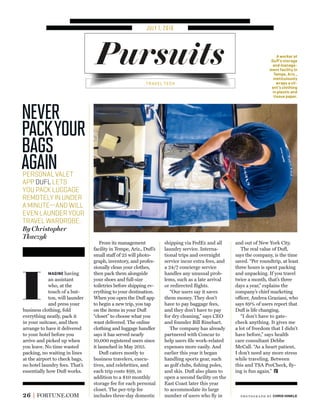
A worker at
Dufl’s storage
and manage-
ment facility in
Tempe, Ariz.,
meticulously
wraps a cli-
ent’s clothing
in plastic and
tissue paper.
TRAVEL TECH
photogr aph by CHRIS HINKLE
The
$10,000
Day
PURSUITS / Black Book
For a longer, interactive version of this story, go to fortune.com/blackbook.
28 FORTUNE.COM July 1, 2016
THE ROSEWOOD HOTEL IN GEORGETOWN, along the scenic C&O
Canal, makes an ideal base for exploring Washington, D.C.
Concierge Jason Denby offers tips for guests on the monu-
ment and museum circuit and for gourmets hoping to skip
the line at the hottest new restaurant.
Bestnewrestaurant:Eric
Ziebold’sKinshipishandsdown
myfavoriteinD.C.rightnow.
Iwouldgothereeverydayto
eattheswordfishwithcapers,
oranges,andratatouille,and
Ialsolovethesuccotashwith
favasandpolenta.It’sthekind
ofplacewhereyoujustcan’twait
tomakeyournextreservation.
Linehack:TheAmerican
foodatRose’sLuxuryissophis-
ticatedbuttheantithesisof
fancy—oneofthereasonsit’s
sopopular.Forafee,weoffer
tosendsomeoneto waitinline
forourguests,whowillreceive
atextwhentheirtableisready.
Presidentialdining:Since
they’reayounger,fitcouplewho
appreciatehealthandgood
food,it’snotuncommontosee
thePresidentandFirstLadyat
greatrestaurantslikeMaketto,
MintwoodPlace,andMasseria.
TheObamashaveembraced
themoderndiningsceneinD.C.
Powerbreakfast:InGeorge-
town,Leopold’sKafeisa
European-styleeaterywhere
powerbrokersgotomakedeals
undertheradar.
Hidden-gemmuseum:A
lotofpeopledon’tknowabout
theterrificPhillipsCollection,
whichhasespeciallywonderful
Renoirs.It’slocatedinthePhil-
lipses’formerhome,amansion
locatednearDupontCircle.
Outdooractivity:RockCreek
Parkisamust-seenationalpark
thatrunsrightthroughthecity.
Therearegreatrunningandhik-
ingtrailsandevenagolfcourse.
Shoppingspree:Beforethe
CityCenterDCdevelopment
openedonthesiteoftheformer
conventioncenter,youhadto
goouttotheMarylandborder
forluxurystores.Nowyou’ve
gotCarolinaHerrera,Dior,Gucci,
Hermès,andmore,allwithin
onecityblock.DavidChang’s
Momofukuistheretoo,so
there’sexcellentdiningtogo
withtheshopping.
Locals’secret:Everyday
at6p.m.theKennedyCenter
hasfreeperformancesonthe
MillenniumStage.Theshows
aren’tpromotedmuch,so
notalotofpeopleknowabout
them.Makesuretograbadrink
beforetheshowandcheckout
therooftopterrace,whichhas
greatviews.
Thingstoavoid:Don’tdo
themonumentcircuitduring
theday,whenthey’remost
crowded.Instead,seethemlit
upatnight,wheneachtakeson
avibeofitsown.Orifyou’reinto
fitness,tryrunningtheNational
Mallordoanurbanhike.
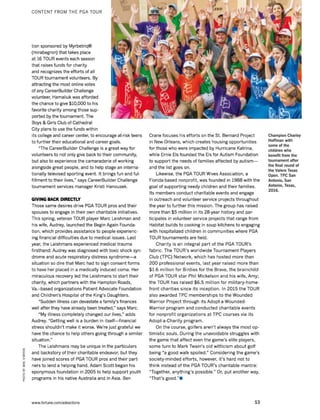
[1] Chef Eric Ziebold in the dual
kitchen of his restaurants Kinship
and Métier. [2] “Luncheon of the
Boating Party” by Renoir is a
highlight of the Phillips Collection.
WE ASKED JASON DENBY TO PLAN US A SINGLE, SPECTACULAR DAY IN WASHINGTON, D.C.…
BeginyourdaybywakingupinthePresidentialSuiteoftheRosewood,andthentakeashortwalk
downtheChesapeake&OhioCanaltoBaked&Wiredtoenjoyahandcraftedcoffeeorespressoand
fresh-bakedbiscuitorquiche.AchauffeuredBentleywillpickyouupandtakeyouonanexclusive
privatetouroftheCapitol,theNationalGalleryofArt,andtheNationalArchives.Enjoyaspeciallunchat
Daikaya,followedbyatriptoWashington,Va.,foraprivatecookingclasswithacclaimedchefPatrick
O’ConnellattheInnatLittleWashington,followedbydinneratthechef’stableinthekitchen.Youwill
retiretotheClaiborneHouseattheInnandwakeupthenextmorningforyourreturntothecapital.
Whattosee(andeat)inD.C.America’s capital isn’t just for patriots—it’s also a
must for aesthetes and foodies. By Adam Erace
1
2
courtesyofkinship;pierre-augusterenoircourtesyofthephillipscollection
illustr ation by MARTĺN LAKSMAN
BENTLEY B05
UNITIME
Breitling for Bentley chronographs stem from an encounter
between two exceptional brands, two worlds dedicated to
performance, two identical passions for excellence. Crafted
by Breitling with an extreme concern for perfection, they
combine highly distinctive designs, opulent finishing
and mechanical movements chronometer-certified by
the COSC, a token of superior precision and reliability.
Breitling for Bentley: the best of two worlds.
Tech
July 1, 2016 FORTUNE.COM 31
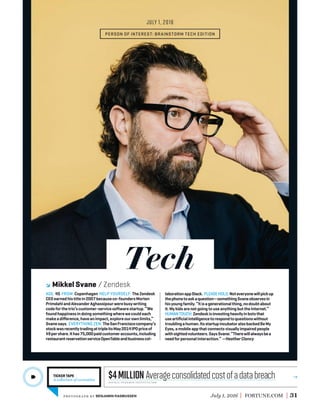
AGE: 45 FROM: Copenhagen HELP YOURSELF: TheZendesk
CEOearnedhistitlein2007becauseco-foundersMorten
PrimdahlandAlexanderAghassipourwerebusywriting
codeforthetrio’scustomer-servicesoftwarestartup.“We
foundhappinessindoingsomethingwherewecouldeach
makeadifference,haveanimpact,exploreourownlimits,”
Svanesays. EVERYTHING ZEN: TheSanFranciscocompany’s
stockwasrecentlytradingattripleitsMay2014IPOpriceof
$9pershare.Ithas75,000paidcustomeraccounts,including
restaurantreservationserviceOpenTableandbusinesscol-
laborationappSlack. PLEASEHOLD:Noteveryonewillpickup
thephonetoaskaquestion—somethingSvaneobservesin
hisyoungfamily.“Itisagenerationalthing,nodoubtabout
it.MykidsarenotgoingtouseanythingbuttheInternet.”
HUMANTOUCH: Zendeskisinvestingheavilyinbotsthat
useartificialintelligencetorespondtoquestionswithout
troublingahuman.ItsstartupincubatoralsobackedBeMy
Eyes,amobileappthatconnectsvisuallyimpairedpeople
withsightedvolunteers.SaysSvane:“Therewillalwaysbea
needforpersonalinteraction.”—HeatherClancy
PERSON OF INTEREST: BRAINSTORM TECH EDITION
TICKER TAPE
A collection of curiosities
Mikkel Svane Zendesk
JULY 1, 2016
source: ponemon institute/ibm
$4MillionAverageconsolidatedcostofadatabreach
photogr aph by BENJAMIN RASMUSSEN
32 FORTUNE.COM July 1, 2016
company pause. “The mar-
kets are certainly uncertain,”
says Mark McClain, CEO and
founder of the firm, which
has more than $100 million
in annual revenue.
At presstime, just two U.S.
tech companies had gone
public this year: Secure-
Works, a cybersecurity unit
spun off from Dell, and
Acacia Communications, a
fiber-optics purveyor. Dell
shoved SecureWorks out the
door in April on its way to
a $67 billion mega-merger
with EMC, only to watch the
fledgling company’s share
price sag. Acacia made a
far stronger debut in May.
In June the Bain Capital–
backed Blue Coat filed for a
public offering before revers-
ing course and selling out
to Symantec, the lumbering
antivirus software firm, for
$4.6 billion. Line, Twilio, and
C
HAMPION SAILORS have been known
to learn their craft on Lake Travis,
just outside Austin. The hills and
topography surrounding the body
of water whip up challenging winds,
making it a sublime place for budding athletes to
refine their tacking and jibbing skills ahead of a
lifetime of competition.
SailPoint, a digital-identity-management firm
with headquarters two miles from the lake, is pre-
paring for a race of its own. Like many companies,
SailPoint has contemplated an initial public offer-
ing. But global economic headwinds have given the
AppDynamics appear most
likely to go public next.
The biggest IPO drought
in years has put a damper on
an otherwise vibrant cyber-
security sector. Not long ago
investors plowed funds into
the firms at lofty valuations.
Now there is a backlog of
companies waiting for an
exit, among them Veracode,
Carbon Black, ForeScout,
Okta, Zscaler, and Optiv.
“Financially, Secure-
Works is making us all sit
back and reevaluate,” says
Mike DeCesare, CEO of
ForeScout, a network secu-
rity company with $125 mil-
lion in annual revenue and
a billion-dollar valuation.
“The question is, Why would
you go public right now? If
you don’t need the money,
what is it about the current
environment that you find
attractive?”
The clock is ticking. In the
business of digital defense,
the race to stay ahead of
hackers’ attacks means that
innovative strategies steadily
depreciate. “One of the risks
of delaying an IPO is that
you could miss your win-
dow,” cautions David Cowan,
an investor at Bessemer
Venture Partners. “You don’t
want to be an old private
cybersecurity company.”
Furthermore, many cy-
bersecurity firms aren’t well
suited for public markets,
says Asheem Chandna,
an investor at Greylock
Partners. “We’ll see over the
coming couple of years a
steady clip of M&A,” he says.
SailPoint’s McClain con-
tinues to hold his breath. “To
use a silly sailing analogy,” he
says, “why would you launch
your boat in this storm?”
fishorcutbait
TECH THE AGE OF UNICORNS: BRAINSTORM TECH EDITION
“I’mpositiveTwitteristhinkingaboutit.” Investor Marc Andreessen on upcoming
tech mergers and acquisitions
bloomberg technology conference
Well-funded cybersecurity firms are
waiting for the right market conditions
for an IPO. It might be a while.
By Robert Hackett
illustrationbymichaelgeorgehaddad
34 FORTUNE.COM July 1, 2016
entered the fray: “Still seeing
huge #TMobileTuesdays
app volume, but we’re mak-
ing good! You won’t lose
anything and we’ll make this
right ASAP! #StayTuned.”
Today pretty much every
company has a Twitter
presence, and many CEOs
tweet. But T-Mobile’s chief
executive goes way beyond
the usual corporate pablum.
Legere is tweeting about his
travels, his kids, his slow-
cooked meals, and his rainy
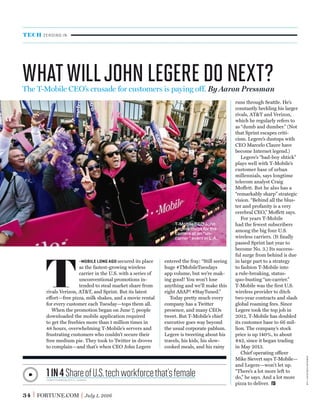
T
-MOBILE LONG AGO secured its place
as the fastest-growing wireless
carrier in the U.S. with a series of
unconventional promotions in-
tended to steal market share from
rivals Verizon, AT&T, and Sprint. But its latest
effort—free pizza, milk shakes, and a movie rental
for every customer each Tuesday—tops them all.
When the promotion began on June 7, people
downloaded the mobile application required
to get the freebies more than 1 million times in
48 hours, overwhelming T-Mobile’s servers and
frustrating customers who couldn’t secure their
free medium pie. They took to Twitter in droves
to complain—and that’s when CEO John Legere
runs through Seattle. He’s
constantly heckling his larger
rivals, AT&T and Verizon,
which he regularly refers to
as “dumb and dumber.” (Not
that Sprint escapes criti-
cism. Legere’s dustups with
CEO Marcelo Claure have
become Internet legend.)
Legere’s “bad-boy shtick”
plays well with T-Mobile’s
customer base of urban
millennials, says longtime
telecom analyst Craig
Moffett. But he also has a
“remarkably sharp” strategic
vision. “Behind all the blus-
ter and profanity is a very
cerebral CEO,” Moffett says.
For years T-Mobile
had the fewest subscribers
among the big four U.S.
wireless carriers. (It finally
passed Sprint last year to
become No. 3.) Its success-
ful surge from behind is due
in large part to a strategy
to fashion T-Mobile into
a rule-breaking, status-
quo-busting “un-carrier.”
T-Mobile was the first U.S.
wireless provider to ditch
two-year contracts and slash
global roaming fees. Since
Legere took the top job in
2012, T-Mobile has doubled
its customer base to 66 mil-
lion. The company’s stock
price is up 140%, to about
$42, since it began trading
in May 2013.
Chief operating officer
Mike Sievert says T-Mobile—
and Legere—won’t let up.
“There’s a lot more left to
do,” he says. And a lot more
pizza to deliver.
WhatWillJohnlegeredoNext?
TECH ZEROING IN
The T-Mobile CEO’s crusade for customers is paying off. By Aaron Pressman
1in4ShareofU.S.techworkforcethat’sfemalecomputerworld/u.s. census
T-Mobile CEO John
Legere mugs for the
camera at an “un-
carrier” event in L.A.
jordanstrauss—ap
36 FORTUNE.COM July 1, 2016
competitions. They might
even hire a staff futurist or
an overpriced “millennial
consultant.”
Startups have a term for
this condition: innovation
theater. It has been especial-
ly intense as leaders of staid
categories, such as hospi-
tality, transportation, and
finance, realize their entire
industry could be flipped on
its head by some kids with
an app. It took only seven
years for Airbnb to become
more valuable (on paper)
than Hilton Worldwide; it
took Uber six years to top
Ford and General Motors.
It’s no wonder Fortune 500
CEOs can’t shut up about
transformation and “dis-
rupting ourselves.”
They’re in an awkward
position. If these execu-
tives dismiss the startups
or do nothing, they risk
irrelevance. If they engage
in innovation theater, they
risk the mockery of snarky
O
VER THE PAST FEW YEARS it has
become common for senior execu-
tives at Fortune 500 companies
to make a pilgrimage to Silicon
Valley. Touring Mountain View
and Menlo Park is the latest trend to sweep the
C-suite, next to corporate mindfulness and adult
summer camps.
You can imagine the awkwardness that follows.
Stiff-haired corporate ladder climbers play dress-
up in hoodies, trading their golf outings and steak
dinners for drone flying and hipster tacos. They
return to the home office in Parsippany or Peoria
brimming with ideas about growth hacking. May-
be they rip out their cubicles and install an open
floor plan. Perhaps they create “intrapreneurship”
columnists like me.
But now I’m wondering
why we assume that Silicon
Valley’s way of doing things
is automatically better.
From Theranos to Zenefits,
it’s clear that the age-old
startup philosophy of “ask
forgiveness, not permis-
sion” is not a viable busi-
ness strategy. “Hustling,” in
startup parlance, works only
when you’re a 10-person
company making cute
Internet distractions—not
when people’s health and
safety are at stake.
Ironically, the hot new
trend at startups today is
corporate theater. As venture
funding slows, startups are
curtailing spending. They’re
learning their way around
Capitol Hill and K Street
too. “People are buttoning
it up a bit,” says CB Insights
CEO Anand Sanwal. Before,
startups “could get away
with lots of questionable and
bad behavior.”
Some startups have even
created positions like chief
regulatory officer as a sign
they’re taking things more
seriously. That’s a lot less fun
than roles like chief inspira-
tion officer or vibe manager
(Heroku, a cloud-platform-
as-a-service company, has
two of those). But the least
fun thing of all is shutting
down your company.
Thus startups’ newfound
focus on profits. That’s good
news for Fortune 500 com-
panies seeking to emulate
them: Making money is
kind of your thing.
TECH A BOOM WITH A VIEW
Corporations desire to be nimble
like startups at a time when startups
crave profits like the big boys.
By Erin Griffith
hey,jealousy
MORE BWAV
Follow Erin Griffith on
Twitter (@eringriffith)
or at fortune.com/boom.
illustrationbymarlygallardo
FASTER TO MARKET BY HPE.
ORCHESTRATION BY CDW.
©2016 CDW®
, CDW•G®
and PEOPLE WHO GET IT™ are trademarks of CDW LLC.
If fast isn’t fast enough. If applications needed to launch yesterday. If your organization needs a competitive
advantage right now, you need a hybrid infrastructure orchestrated by CDW. Fuel speed to innovation
with Hewlett Packard Enterprise’s rack, blade and converged server systems powered by Intel®
Xeon®
processors and a seamless solution designed by CDW that turns your ideas into reality — fast.
Learn more at CDW.com/hpenterprise
AGOODCATCH
REQUIRESA
SOPHISTICATED
APPROACHAttracting the perfect candidate requires a highly specialized set of talent acquisition tools.
So iCIMS specifically designed software to proactively build pools of talent, recruit and
track new applicants, and onboard the next great, new hire.
To learn more, visit iCIMS.com.
©2016 iCIMS, Inc. All rights reserved.
July 1, 2016 FORTUNE.COM 43
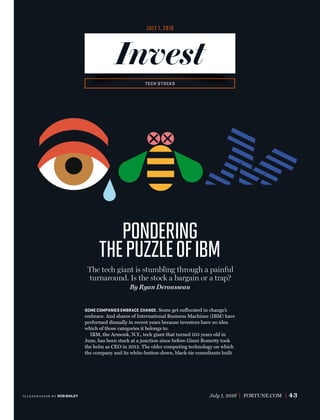
By Ryan Derousseau
pondering
thepuzzleofiBM
The tech giant is stumbling through a painful
turnaround. Is the stock a bargain or a trap?
SOME COMPANIES EMBRACE CHANGE. Some get suffocated in change’s
embrace. And shares of International Business Machines (IBM) have
performed dismally in recent years because investors have no idea
which of those categories it belongs to.
IBM, the Armonk, N.Y., tech giant that turned 105 years old in
June, has been stuck at a junction since before Ginni Rometty took
the helm as CEO in 2012. The older computing technology on which
the company and its white-button-down, black-tie consultants built
JULY 1, 2016
Invest
TECH STOCKS
illustr ation by ROB BAILEY
0
20
40
60
80% NASDAQ
COMPOSITE
INDEX
IBM STOCK
3.1%
’11 2012 2014 ’16
IBM REVENUE BY SEGMENT, 2015
TECH SERVICES
$32 BILLION
SOFTWARE
$23 BILLION
BUSINESS
SERVICES
$17 BILLION
HARDWARE
$7.6 BILLION
FINANCING
$1.8 BILLION
SOURCES: S&P GLOBAL; IBM
44 FORTUNE.COM July 1, 2016
That, of course, is a big
if, and one many investors
aren’t willing to bet on. Only
seven of 26 analysts who
follow the company rate
it a buy or strong buy—an
unusually low ratio in that
bullish community. Insti-
tutional investors such as
mutual funds and pen-
sion funds have also fled,
accounting for only 66%
of IBM shares, according
to Morningstar; for com-
parable tech giants like
Hewlett Packard Enterprise
and Cisco Systems, that
figure is 82% or more. But
if IBM does finally reverse
its revenue declines, those
institutions could pile back
into the stock—generating a
nice pop for people willing
to invest in it now. (“Another
reason not to be super bear-
ish,” notes Milunovich.)
Investors who take that
gamble would be buying
a still-profitable company
for a very low 11 times 2017
earnings, and collecting a
3.4% dividend (far above the
S&P 500’s average) while
they waited. They would
be waiting in prestigious
company. Warren Buffett’s
Berkshire Hathaway, IBM’s
single largest shareholder,
has bought more than
12 million shares since the
end of 2013, giving it a total
of 81 million. Buffett bought
nearly 200,000 in the quar-
ter that ended in March.
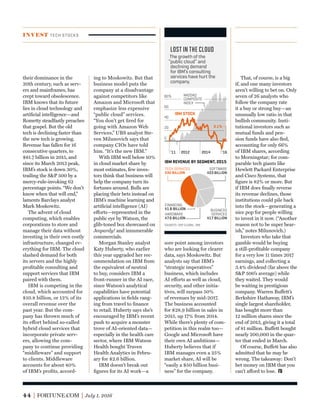
Of course, Buffett has also
admitted that he may be
wrong. The takeaway: Don’t
bet money on IBM that you
can’t afford to lose.
ing to Moskowitz. But that
business model puts the
company at a disadvantage
against competitors like
Amazon and Microsoft that
emphasize less expensive
“public cloud” services.
“You don’t get fired for
going with Amazon Web
Services,” UBS analyst Ste-
ven Milunovich says that
company CIOs have told
him. “It’s the new IBM.”
With IBM well below 10%
in cloud market share by
most estimates, few inves-
tors think that business will
help the company turn its
fortunes around. Bulls are
placing their bets instead on
IBM’s machine learning and
artificial intelligence (AI)
efforts—represented in the
public eye by Watson, the
glib-toned box showcased on
Jeopardy! and innumerable
commercials.
Morgan Stanley analyst
Katy Huberty, who earlier
this year upgraded her rec-
ommendation on IBM from
the equivalent of neutral
to buy, considers IBM a
front-runner in the AI race,
since Watson’s analytical
capabilities have potential
applications in fields rang-
ing from travel to finance
to retail. Huberty says she’s
encouraged by IBM’s recent
push to acquire a monster
trove of AI-oriented data—
especially in the health care
sector, where IBM Watson
Health bought Truven
Health Analytics in Febru-
ary for $2.6 billion.
IBM doesn’t break out
figures for its AI work—a
sore point among investors
who are looking for clearer
data, says Moskowitz. But
analysts say that IBM’s
“strategic imperatives”
business, which includes
AI efforts as well as cloud,
security, and other initia-
tives, will surpass 50%
of revenues by mid-2017.
The business accounted
for $28.9 billion in sales in
2015, up 17% from 2014.
While there’s plenty of com-
petition in this realm too—
Google and Microsoft have
their own AI ambitions—
Huberty believes that if
IBM manages even a 25%
market share, AI will be
“easily a $50 billion busi-
ness” for the company.
their dominance in the
20th century, such as serv-
ers and mainframes, has
crept toward obsolescence.
IBM knows that its future
lies in cloud technology and
artificial intelligence—and
Rometty steadfastly preaches
that gospel. But the old
tech is declining faster than
the new tech is growing.
Revenue has fallen for 16
consecutive quarters, to
$81.7 billion in 2015, and
since its March 2013 peak,
IBM’s stock is down 30%,
trailing the S&P 500 by a
mercy-rule-invoking 62
percentage points. “We don’t
know when that will end,”
laments Barclays analyst
Mark Moskowitz.
The advent of cloud
computing, which enables
corporations to store and
manage their data without
investing in their own costly
infrastructure, changed ev-
erything for IBM. The cloud
slashed demand for both
its servers and the highly
profitable consulting and
support services that IBM
paired with them.
IBM is competing in the
cloud, which accounted for
$10.8 billion, or 13% of its
overall revenue over the
past year. But the com-
pany has thrown much of
its effort behind so-called
hybrid cloud services that
incorporate private serv-
ers, allowing the com-
pany to continue providing
“middleware” and support
to clients. Middleware
accounts for about 40%
of IBM’s profits, accord-
LOST IN THE CLOUD
The growth of the
“public cloud” and
declining demand
for IBM’s consulting
services have hurt the
company.
INVEST TECH STOCKS
The best things in life don’t happen behind a desk. And with the #1 trading
app in the App Store, your portfolio can go wherever you’re going.
Our Mobile Trader app lets you set custom alerts to monitor your watch lists
and positions, and sends live updates straight to your devices. Of course,
whether or not you decide to check your devices is up to you.
The best returns aren’t just measured in dollars.
WHEN THE MARKET CALLS,
ANSWER IT.
Open and fund an account, download the app and trade commission-free
for 60 days. Visit tdameritrade.com/mobile
46 FORTUNE.COM July 1, 2016
BRAINSTORM
TECH / 2016
BRAINSTORM
TECH / 2016
July 1, 2016 FORTUNE.COM 47
AUTOMAKERS AND
TECH COMPANIES ARE
RACING TO BUILD THE
NEXT GREAT CAR
COMPANY FOR A
DRIVERLESS FUTURE.
AND FOR THE FIRST
TIME EVER, THE CAR
MAY TAKE A BACKSEAT.
By Erin Griffith
SOME
ASSEMBLY
REQUIRED
Illustration by
Gianmarco Magnani
48 FORTUNE.COM July 1, 2016
themselves. By year-end the company expects to have the
largest fleet of autonomous test vehicles of any automaker.
Ford is not alone. The entire automotive industry is in
the midst of a radical transformation that is reshaping the
very definition of what it means to be a car company. There
is hype, hope, fear, and insecurity—and at the center of it
all is the self-driving car. Thanks to cheap sensors, pow-
erful machine-learning technology, and a kick in the butt
from the likes of Google and Tesla Motors, driverless vehi-
cles are becoming a sooner-than-you-think reality. General
Motors, Toyota, Nissan, Volkswagen, Fiat-Chrysler, BMW,
and just about every other auto company are wading—
some cautiously and some with big, headline-grabbing
moves—into territory that executives in Detroit and else-
where not long ago considered a science-fiction fantasy.
Everything changed in March, when GM spent $1 billion
on a tiny self-driving startup called Cruise Automation. For
months tech companies, startups, and automakers circled
one another, unsure of whether and how to partner. In an
industry moving this quickly it’s hard to know if a friend-
ly partner will turn into a competitor. It happened when
Google’s venture capital arm invested $258 million in Uber
in 2013; now the ride-hailing company is poised to directly
compete against its investor with its self-driving project.
But the hesitancy ended after GM’s deal. In May, Toyota
struck a partnership with Uber, Volkswagen invested $300
million in ride-hailing company Gett, Apple poured $1 bil-
lion into China’s Didi Chuxing, and Google partnered with
Fiat-Chrysler to outfit 100 Pacifica minivans with self-
driving technology. All in the span of one month.
No one is sure how our driverless future will look. Will
we be able to scroll through our Instagram feeds from the
backseat while our cars drive us to work? Will we even need
to own private cars anymore? Some people expect that regu-
My brain knows that
this demonstration has
been carefully staged
and will work exactly
as planned, but the rest
of my body tenses up
as I step on the gas of a
Ford Fusion sedan and
accelerate directly to-
ward the “parked car” in
front of me.
BRAINSTORM
TECH / 2016
Rear-ending cars on purpose is not a natural act. It takes
a metric ton of concentration to resist slamming on the
brakes, so I play the role of distracted driver. To the right,
a parking lot packed with brightly painted Ford vehicles
sparkles in the afternoon sun. In the distance, an Ameri-
can flag waves from its pole. Ford’s iconic blue logo is
painted into the side of a grassy hill.
I hear a warning beep from the car’s dashboard. A red
light flashes on the display panel. I imagine that I’m a char-
acter from the movie Mad Max: Fury Road, chanting in
my head, “I live, I die, I live again.” Inches from the decoy
car, I let out a shriek as the automatic brake kicks in, jerk-
ing the Fusion to a sudden halt.
From the passenger seat, Scott Lindstrom, manager of
driver-assist technologies at Ford Motor Co., assures me
I’m not the first person to scream during this demo. I ask
how he simulates accidents day after day. “It is very nerve-
racking,” he says. Also, he’s hit the decoy plenty of times.
In 2012 he even did it in front of Ford’s board of directors.
Back then the idea of self-driving cars looked, to Ford’s
leadership, like a frivolous Silicon Valley moonshot. Four
years later things have dramatically changed. Today Ford’s
vehicle lineup features more than 30 options for semiauton-
omous features, including the automatic brakes I tested, and
the company is aggressively working on cars that fully drive
1900 1905 1910 1915
Thirty American
automakers
produce
2,500 motor
vehicles.
1899
Henry
Ford
founds the
Ford
Motor Co.
1903
First
automatic
transmis-
sion for
carriages.
1904
Ford introduces
the Model T, the
first affordable
automobile.
William Durant
founds GM.
1908
Electric
ignition
debuts on a
Cadillac,
replaces hand
cranking.
1911
First moving
assembly line
at Ford reduces
the build time
of a car to
2½ hours.
1913
Ford doubles
workers’ pay
and reduces
the workday
from nine to
eight hours.
1914
0.5TRILLIONMILES0
ABriefHistoryof
AmericanAutoDisruption
BRAINSTORM
TECH / 2016
The Self-Driving Car
July 1, 2016 FORTUNE.COM 49
lation will limit self-driving cars to closed-off areas in major
cities. Others believe that the first driverless fatality will set
the whole effort back by a decade. Predictions as to when
fully autonomous vehicles will actually hit the road range
from 2050 to as soon as next year. (The answer for Tesla
owners is last fall—they have been posting “Look, Ma, no
hands!” videos online since October, when Tesla updated its
software with an “autopilot” feature that steers the vehicle
on highways—not fully autonomous, but a strong start.)
Automakers, technology companies, and ambitious
startups all agree that this transformation isn’t just head-
lines and hype, but inevitable. Every person I interviewed
for this article deliberately pointed out that, no, really—
this is happening. Even regulators are onboard. “We’ve got
a clock ticking,” U.S. Transportation Secretary Anthony
Foxx told Reuters in April. “This technology is coming.
Ready or not, it’s coming.”
Sure, there are hacking fears and privacy issues and ethi-
cal questions and infrastructure challenges and concerns
about lost jobs. But those will all be worked out, the indus-
try’s thinking goes, once everyone realizes how many lives
could be saved with this technology. Car accidents cause
more than 1 million deaths and 15 million injuries globally
each year. Over 90% of them are caused by human error. For
some executives, the argument is so obvious it’s worth blow-
ing a gasket over. “How could you accept that? Why is this
not a national crisis?” bemoaned Eric Schmidt, executive
chairman of Google’s parent company, Alphabet, at a share-
holder meeting in June. “I am, frankly, beside myself over
the lack of consensus on how important this problem is.”
Beyond saving lives, consider the money saved (traffic
accidents cause $500 billion in economic damage world-
wide each year), the benefits to cities (parking lots become
green spaces), the increases in productivity (commut-
ers can work in transit; truckers can sleep without pull-
ing over), and improvements in accessibility (the elderly,
blind, and disabled get affordable robot chauffeurs!).
But most important from a business perspective, driv-
erless vehicles are poised to threaten the $570 billion that
Americans spend each year on new cars. For 125 years U.S.
auto companies made their money on the manufacture of
motor vehicles. Now they must be in the business of ride-
hailing apps, shuttle buses, 3D maps, and computers on
wheels that drive themselves. They’re no longer automo-
tive companies either—they’re now calling themselves
“mobility” companies, just in case all those predictions
about the end of car ownership come true. At stake is a
transportation services market that Ford believes is worth
$5.4 trillion, a sum that makes you wonder why it took the
auto industry so long to go after it.
It’s telling that ride-hailing leader Uber got its start while
the auto industry was facing bankruptcy in 2009. Now
Uber is worth more than GM and Ford by tens of billions of
dollars, despite generating approximately $145 billion less
in revenue. Alphabet has enough cash lying around to buy
Ford or GM outright if it wanted to. Apple, which is widely
“Any good company has a point of view of the
future,” Ford CEO Mark Fields says. At left, a Ford
Fusion Hybrid autonomous research vehicle.
1920 1925 1930 1935
First coil spring
suspension debuts,
improving wheel
shimmy.
1934
First car radio.
It costs the
equivalent of $1,870
in 2016 dollars.
1930
There are just 44 active automobile
manufacturers, down from 253 in
1908. About 80% of the market is
controlled by Ford, GM, and Chrysler.
1929
Cadillac debuts the first
synchromesh transmis-
sion, making it easier for
drivers to switch gears.
1928
Rickenbacker is the first
automaker to make
laminated safety glass
standard equipment.
1926
Ford,
GM,
Chrysler
TOTAL YEARLY
MILES DRIVEN
BY VEHICLES IN
THE U.S.
timeline illustr ations by NICOLAS RAPP
fordfusion:courtesyoffordmotors;fields:qilaishen—bloombergviagettyimages
1940 1945 1950 1955
0.51.01.5TRILLIONMILES0
The U.S. military
formalizes
requirements for
a light reconnais-
sance vehicle—
today’s Jeep.
1940
The start of the war
halts the manufac-
ture of vehicles for
the civilian market;
tires and gasoline
are rationed.
1942
Introduction
of the first
modern
car phone.
It weighs
80 pounds.
1946
B.F. Goodrich
reveals its
tubeless tire,
making automo-
biles safer and
more efficient.
1947
Buick offers an
automatic transmis-
sion, which becomes
the model for
today’s automatic
transmissions.
1948
Power steering
debuts.
The Interstate
Highway
System is
authorized.
1956
TOTALYEARLYMILESDRIVENBYVEHICLESINTHEU.S.
50 FORTUNE.COM July 1, 2016
ing technology to market. In January they left to launch
Otto, a startup that retrofits commercial big rigs with fully
autonomous driving systems.
After only five months of development, the founders
made their first public demonstration, sending an 18-wheel-
er barreling down California’s 101 highway at 55 mph with
no human interference. There’s a sense of urgency at the
company. “We’ve been moving as fast as we can,” says Ron.
“It’s not going to be a 10-year or even a five-year horizon.
We intend to bring the technology to market faster.”
However soon you believe that driverless vehicles are
coming, Silicon Valley innovators want them even soon-
er. Big and small tech companies alike have decided that
transportation is the next frontier in need of disruption.
They’re not adopting Detroit’s historical approach of incre-
mental improvements, deploying ever more semiautono-
mous features until the robots finally take over. Rather,
they’re plotting revolution. Google’s self-driving pod-cars
don’t even have a steering wheel or pedals. (The National
Highway Traffic Safety Administration defines this as
“Level 4” autonomy—the agency’s highest level.)
Google argues that revolution is the safest option.
Requiring a licensed driver be able to take over from
the computer actually increases the likelihood of an
accident because people aren’t that reliable, the com-
pany says. (Plus, keeping a human element in the driv-
ing mix destroys the economic and accessibility benefits
that autonomous technology promises.) Chris Urmson,
Google’s director of self-driving cars, made the case for
full autonomy—in vain—to California regulators earlier
this year. GM, meanwhile, is pro–steering wheel and ped-
als, according to recent comments made by CEO Mary
Barra. The U.S. Department of Transportation plans to
announce a new set of guidelines in July.
rumored to be working on its own car, could buy them both
plus Fiat-Chrysler in a Big Three value pack.
The Silicon Valley invasion has not gone unnoticed.
“There are enough people working at legacy companies
in Detroit who have read The Innovator’s Dilemma. They
know all the business school case studies about how in-
cumbent organizations can’t sit around and ignore innova-
tors,” says Brian Johnson, a Barclays analyst who has ar-
gued that the economy will reach “peak car” ownership in
the next year. “The incumbents are willing to move more
quickly than I would have expected. There is almost an ea-
gerness to show they’re not dinosaurs.”
Ford president and CEO Mark Fields, for example, has
taken to declaring that his company needs to “disrupt it-
self” before Silicon Valley players get the chance. The sen-
timent raises several questions: Does he really mean it?
And does he understand what that takes? Even if the an-
swer is yes to both, a much bigger question looms: Can he?
F
OR SIX YEARS Anthony Levandowski worked on
Google’s self-driving car project, developing sen-
sors, creating policies, and testing technology.
He’s credited as one of the architects of the com-
pany’s famous driverless vehicles. In turn Google,
the online advertising giant that’s increasingly known for
its ambitious research projects, is credited with showing
the world how fast this loopy curiosity could become a
business reality. Despite that progress, Levandowski and
Lior Ron, a product lead on Google Maps, couldn’t stand
the idea of waiting any longer to bring autonomous driv-
BRAINSTORM
TECH / 2016
BRAINSTORM
TECH / 2016
1960 1965 1970 1975
Engineer
Ralph Teetor
develops
cruise
control.
1958
Volvo develops
the three-point
seatbelt system
and releases the
patent for all
manufacturers
to use.
1959
Federal
standards for
automotive
safety are
established.
1966
Engineers at auto
supplier TRW
invent a transmis-
sion capable of
mixing combus-
tion and electric
power sources.
1969
Bendix develops
the first
computerized
antilock braking
system for a
production
vehicle.
1971
The first car
equipped with an
airbag arrives to
market. The first
production
catalytic converter
also appears.
1973
0.51.01.5TRILLIONMILES0TOTALYEARLYMILESDRIVENBYVEHICLESINTHEU.S.
July 1, 2016 FORTUNE.COM 51
The Self-Driving Car
Zoox, a Menlo Park, Calif., startup, is firmly on the
revolutionary side of things. According to a snazzy com-
puter rendering from the company, it’s building perfectly
symmetrical, bidirectional, neon-green-and-black robo-
taxis that look like giant remote-control toys. The vehicle
is not really a car, founder Tim Kentley-Klay likes to say.
“It’s what comes after the car.” That’s because Zoox is not
bothering with incremental, semiautonomous features like
the automatic brake I tested with Ford. That approach is
“not going to give us the changes we want to really solve
mobility issues in our cities going forward,” Kentley-Klay
explained at a 2014 conference in Berlin. Zoox has not yet
shared its progress beyond the early rendering, but it has
big plans. The company is currently raising $252 million
in funding at a reported valuation of $1 billion.
Many people assume Zoox, Google, and Uber (which
revealed its own driverless test car in May) will eventu-
ally launch their own urban fleets of on-demand autono-
mous vehicles. Basically robo-taxis. For Uber, reducing or
eliminating its army of more than 1 million contract driv-
ers would slash the unprofitable startup’s costs. Uber cur-
rently pays about 75% of its income to drivers. Eliminating
that outlay would likely make up for the new expense of
buying, maintaining, and storing a fleet of driverless cars.
For Google, a ride-hailing service allows the company
to turn one of its most expensive moon shot projects into a
real moneymaking business. Google will reportedly make
its driverless car project a standalone subsidiary this year.
Executive chairman Schmidt told investors the company
believes the cars will be commercially available in “some
years, not decades.” But first Google needs to reduce the
cost of its sensor-covered vehicles from around $170,000
today to less than $30,000, according to a person familiar
with the company’s plans.
And that’s a key problem in Silicon Valley’s robo-taxi
plan: The nerds have little experience bending metal.
Tesla, the one Silicon Valley company that’s managed to ac-
tually make a car, has been late to deliver every new model
it has released since the launch of its very first vehicle (the
Roadster, thrice delayed) in 2008. Tesla operates at a much
smaller scale than its established peers in Detroit, Japan,
and Germany, but its manufacturing problems aren’t just
normal growing pains. For its latest Model X sport-utility
vehicle, Tesla blamed a components shortage in part on its
own hubris. It tried to add “far too much new technology”
to the vehicle, the electric-auto maker said in a statement.
Auto revolutionaries, take note: If Elon Musk, the real
life Iron Man, struggled with manufacturing, then every-
one else will too.
W
HEN GOOGLE UNVEILED its fleet of zippy
little pod-cars in 2014, executives in the
automotive industry could barely hide
their smirks.
“No automotive manufacturer would
ever have dared to show such an ugly potato in public,”
Self-driving technology could reduce spending on
roadways, parking, and public transit, says Chris
Urmson, director of Google’s self-driving car proj-
ect. At far left, Google’s first self-driving concept.
car:courtesyofgoogle;urmson:drewangerer—bloombergviagettyimages
1980 1985 1990 1995
Annual sales of
American-made
cars peak at
12.87 million
units.
1978
Japan becomes
the world’s
leading auto
producer.
1980
Electronic
fuel injection
appears.
1982
GM shows off its Impact,
an electric concept car,
and announces that it
will become a produc-
tion vehicle.
1990
Onboard diagnostic
codes are
standardized
across the U.S. GM
rolls out OnStar.
1996
The first
Toyota Prius
goes on sale,
in Japan.
1997
1.01.52.02.5TRILLIONMILES0TOTALYEARLYMILESDRIVENBYVEHICLESINTHEU.S.
52 FORTUNE.COM July 1, 2016
Worse, analysts have long speculated about the com-
ing of peak car, comparable to the peak in horse owner-
ship in 1920. With cheap robo-taxis available to chauffeur
people around cities, households that spend an average of
$9,000 a year on transportation could lower that outlay to
just $2,000. “Can the mobility sector capture all of that? I
think no,” says Robin Chase, co-founder and former CEO
of car-rental company Zipcar. “Car companies will still
make money selling cars, but the whole market will shrink
because we’ll use those vehicles more efficiently.”
Meanwhile, young people are increasingly uninterested
in driving. The percentage of people between the ages of 16
and 44 who obtain a driver’s license has been steadily de-
clining since 1983, according to a study by the University of
Michigan Transportation Research Institute. Automakers
bristle at the notion that millennials hate cars—GM presi-
dent Dan Ammann calls it an “overly cliché story written
by lazy journalists”—but it’s clear that automakers are no
longer laughing at Google’s ugly potatoes.
The U.S. auto industry has been caught flat-footed be-
fore. In the 1980s, Japanese imports came to quickly domi-
nate the low end of the North American market as Euro-
pean brands secured the high end. The specter of Google,
Apple, Uber, Tesla, Lyft, or even Zoox cornering the future
market of How Americans Get Around has created two
kinds of paranoia in Detroit: a fear of taking on too much
risk and a fear of not taking on enough. “Nobody wants to
go too far and pull a Time Warner–AOL,” one exec told me.
On the other hand, “nobody one wants to get iPod-ed like
the music industry,” said another.
That fear is driving the great mobility transformation.
In early 2015, Ford CEO Fields was preparing to deliver a
“change the world”–style speech at CES, the annual con-
sumer electronics trade show, spanning urbanization, the
said Ulrich Weinberg, a professor at the Hasso Plattner
Institute in Germany, in an interview published in Audi’s
2014 shareholder letter. Auto critics had a similar reaction.
(Google’s first self-driving concept looked “like a vintage
Japanese cartoon character had an illegitimate child with a
computer mouse,” wrote Andrew Krok.) “People were liter-
ally laughing at Google and Tesla,” says Lars Reger, chief
technology officer of NXP Semiconductors, a supplier of
self-driving vehicle technology.
The dismissal shows just how different the two indus-
tries’ worldviews are. In a vehicle, Google saw “a robot
that by accident has four wheels,” Reger says. Traditional
car manufacturers saw “a horse carriage with a combus-
tion engine.” Tech companies launch ideas and iterate on
them with continual improvements. “That doesn’t work in
our business,” Ford’s Fields says. “You can’t hit control-alt-
delete when you’re going 70 miles an hour.”
It’s easy to be dismissive when times are good, as they
have been for Detroit lately. For the past three years the
auto industry has delivered record sales, profits, and
growth. GM and Ford are still Fortune 10 companies.
Yet Ford’s stock has fallen by 12% in the past year.
GM’s stock has dropped by 19% despite an announced $9
billion of share buybacks. At Ford’s annual shareholder
meeting in May, a frustrated investor even asked about
bringing former CEO Alan Mulally out of retirement to
boost the company’s share price. The existential threat
facing automakers is compounded by investor fears that
the automakers’ recent boom is as short-lived as today’s
low interest rates and cheap gas prices.
BRAINSTORM
TECH / 2016
BRAINSTORM
TECH / 2016
2000 2005 20152010
The first
Prius is sold
in the U.S.
2000
Bluetooth allows
connection
between mobile
phones and cars.
2001
The first collision-
avoidance systems
arrive to market.
Tesla Motors is
founded.
2003
The first onboard
Wi-Fi connectivity
appears in
passenger
vehicles.
2008
Ride-hailing service
Uber is founded.
Google begins its
Self-Driving Car
Project.
2009
Nevada becomes
the first state to
authorize the
operation of
autonomous vehicles.
2011
1.01.52.02.53.0TRILLIONMILES0
NV
TOTALYEARLYMILESDRIVENBYVEHICLESINTHEU.S.
July 1, 2016 FORTUNE.COM 53
The Self-Driving Car
middle class, air quality, and millennials. It included lines
like, “Mobility is about far more than motion—it’s really
about progress. Human progress.”
Preparing for that event was the moment Ford’s execu-
tives realized they needed to shift, says Ken Washington,
Ford’s vice president of research and advanced engineer-
ing. “It kind of jelled for us that, wow, this is really about
being a mobility company,” he says. “Over the last year that
messaging has gotten more and more crisp.”
That epiphany led to the creation, in March, of Ford’s
Smart Mobility subsidiary, a separate LLC that will de-
velop software, tech services, and business models related
to transportation in the same way Apple makes software
like iTunes and the App Store to complement its hardware
businesses. “We’re viewing ourselves as the kind of compa-
ny that gets that there’s more than one way to be mobile,”
says Washington, adding that he doubts Ford’s Smart Mo-
bility subsidiary “will have the famous Thursday business
process review meetings that Ford is known for.”
GM president Ammann had a similar revelation two
years ago. Ammann is a car person; he likes to drive his
1961 baby-blue Cadillac Series 62 convertible. But he
found himself increasingly relying on a company-provided
driver to chauffeur him to work and back because it freed
up an extra hour and a half each day to get work done.
“There’s this significant opportunity cost of the time people
spend driving,” he says. GM’s customers were also telling
the company that they wanted to use cars without the cost
and hassle of actually owning them—the same need that
gave rise to on-demand ride-hailing services like Uber and
Lyft. “We see our customers behaving in this way,” Am-
mann says. “We need to move with them.”
At the Los Angeles Auto Show in November, Ammann
watched Lyft president and co-founder John Zimmer de-
liver an ultimatum to the automotive industry: “You can
fight [the end of car ownership], and that will probably
not turn out well. Or you can acknowledge that this is
happening. This is real, serious, and going to change your
world.” The room, full of insurers, regulators, auto dealers,
and parts manufacturers, was silent for a moment before
a “slow golf clap” began to build, Zimmer says.
After the speech Ammann pulled Zimmer into a ho-
tel suite, where the two quickly hashed out a deal for GM
to invest $500 million into Lyft, valuing the company at
$5.5 billion, investment included. The meeting, which Zim-
mer kept secret from his entourage, went for three hours.
Zimmer has had plenty of meetings with auto executives
over the years, but it was strange to explain his vision of the
future and have one respond with “I agree,” he says.
A few months later Ammann met with Daniel Kan and
Kyle Vogt, co-founders of Cruise, a 2½-year-old startup
building a software platform for autonomous vehicles.
As with Lyft, they shared visions, Ammann said “I agree,”
and boom—a big, splashy deal. The companies consid-
ered merely partnering but realized they could move
faster with an acquisition. “Every time we visited, they’d
Anthony Levandowski, one of the architects of
Google’s self-driving car, left the company to
start Otto, which retrofits tractor-trailers with
autonomous technology. At far left, an Otto truck.
courtesyofotto(2)
commenter. Fueling the fear, Google filed to patent a grim-
looking “human fly paper” material for the outsides of its
vehicles in case one of its cars hits a pedestrian, complete
with images of bodies stuck to cars.
Silicon Valley is great at building hype. Trust is a dif-
ferent story. Yet just about everyone working on self-
driving vehicles believes that people’s fears will dissipate
once they experience the technology in person. Regard-
less of whether they’re skeptics or enthusiasts, riders
always react in the same way, according to Ziv Aviram,
whose company, Mobileye, provides collision-avoidance
systems to 25 automakers. During that first nervous min-
ute, riders position their hands above the steering wheel
and their foot above the brake, poised to take over in the
event of a glitch. By the second minute they relax, and by
the fifth minute they take their eyes off the road and chat
as if they weren’t in the driver’s seat. After that, “there’s
no way back,” Aviram says.
Auto execs understand this phenomenon well, rattling
off examples of vehicle features that the public initially re-
moved along another nine steps,” Ammann says. At the
time, Cruise didn’t even have a plan to bring its technology
to market. It had explored everything from pizza delivery
and package transport to semitrucks and ride sharing, Kan
says. Ammann was still convinced, and GM plunked down
$1 billion for the 40-person firm in March.
The three companies plan to work together—using
Lyft’s ride-hailing service, Cruise’s self-driving technology,
and GM’s vehicles—to launch an on-demand driverless
ride service to compete with Google, Uber, Zoox, and any-
one else that comes along. Says Ammann: “We feel we have
the three key pieces we need at this point.”
It matters little that the motivations of automakers (fear
of being iPod-ed) and tech players (desire to change the
world) stand in opposition. More important is that both par-
ties share a goal: to get driverless cars on the road. Indeed,
a lobbying group called the Self-Driving Coalition for Safer
Streets formed in April, linking Google, Uber, Lyft, Ford, and
Volvo. Digital transformation makes for strange bedfellows.
I
N THE 1930S a driverless Tin Lizzy called the Phan-
tom Auto toured the country to dazzle crowds with
its self-driving capabilities. Imagine, gushed the Free
Lance-Star of Fredericksburg, Va., an empty auto-
mobile traveling the streets: “No one touching it, no
wires or strings attached to it, weaving in and out of traffic,
climbing hills, turning corners, stopping for traffic lights,
just as though there were an invisible driver at the wheel!”
The glory lasted until 1932, when the Phantom Auto
mowed down 10 people, hospitalizing two and fracturing
numerous limbs (and a skull) at a demonstration in Ha-
nover, Pa. The car’s operators, who remotely controlled
the vehicle from a trailing car, were arrested on charges of
assault and battery, and the driverless vehicle was retired.
Just as the thrill of self-driving cars is not new, neither
is the fear of them. Eighty years later, in Google’s home-
town of Mountain View, one of its pod-cars ran into a bus.
In May, Google posted job listings for test drivers in Ari-
zona, which tech bloggers painted as a dream job. Who
wouldn’t want to make $20 an hour sitting in a car doing
nothing for eight hours a day? But the social media reac-
tion from nontechies was a glimpse into the public’s fears
of robot cars. “You’re gonna have to pay more to get me in
that tin can with a mind of its own,” wrote one Facebook
54 FORTUNE.COM July 1, 2016
BRAINSTORM
TECH / 2016
BRAINSTORM
TECH / 2016
Self-Driving Car
sisted: seatbelts, airbags, antilock brakes, cruise control,
even automatic transmission. “I don’t want any computer
stomping on the brake for me,” says Ford technical leader
Jim McBride, remembering pushback from drivers of the
past. “I don’t want an airbag blowing up in my face and
I can’t see out the front window.” Even today, Ford’s self-
driving test vehicles contain giant red fail-safe buttons
next to the gearshift that are essentially for looks. (No one
has ever used them, the automaker told me.)
Despite all this—the technological advancement, the
sudden rash of dealmaking, the this-is-happening clarity
stretching from Motor City to the City by the Bay—self-
driving cars today remain a Phantom Auto curiosity. Our
self-driving future requires interstate cooperation, ubiq-
uitous connectivity, regulatory approvals, and buy-in from
ancillary players like parking garages, insurance provid-
ers, and dealerships. “It’s not enough to throw some sen-
sors and software on a two-ton projectile and say ‘Look,
Ma, we made it smart,’” says Jamyn Edis, CEO of Dash,
an automotive software startup based in New York City.
Many experts don’t expect that the world will adopt
Level 4 autonomy—the ability to summon a car that
goes from point A to point B without human interfer-
ence—for 25 years, or a full generational change. But
partial autonomy arrived much sooner than anyone ex-
pected. Google already has demonstrated “A to B” tech-
nology that works. By 2021, one of Mobileye’s automo-
tive clients (Aviram won’t say which) will have it too.
Five years may seem like forever to the hoodie-wearing
tech crowd, but “in our industry,” Aviram says, “2021 is
like tomorrow.”
Until then GM, Ford, and other auto giants will en-
dure investor skepticism over whether their investments
in apps and robo-taxis can ever become profitable busi-
nesses. Disruption, by definition, requires making one’s
existing business smaller. It’s why so few Fortune 500
companies have managed to pull off what Mark Fields is
attempting with Ford: disrupting themselves. That chal-
lenge is not lost on Big Auto executives. “Will Ford as a
company be the size and scale it is today in 15 years?” asks
Zipcar founder Chase. “Probably not.”
That doesn’t mean they won’t try like hell. Next year
GM will launch a semiautonomous Super Cruise feature
that allows for hands-free driving in its Cadillac CT6 at
the same time that it develops “straight to Level 4” tech-
nology within its subsidiary Cruise. Ford is also trying
to strike a balance between evolution, with its vehicle
lineup’s semiautonomous features, and revolution, with
its test fleet of driverless cars. Ford executives insist it
is not totally contradictory to protect the company’s ex-
isting business while also building technology that will
make it obsolete.
I think about that conundrum as I accelerate down a
ramp along Interstate 94 on my way out of Detroit in my
non-self-driving rental car. I squint and stare at the trac-
tor-trailer in front of me while a reckless driver swerves
between lanes at 80 miles per hour to my left. I realize
that everything around me—from the radio ads for auto
dealerships and cheap car insurance to the billboards for
accident settlement attorneys—will be completely trans-
formed by the self-driving car. And then I nearly rear-
end the truck.
July 1, 2016 FORTUNE.COM 55
The end of car ownership is “real, serious, and
going to change your world,” Lyft co-founder and
president John Zimmer told auto-industry execu-
tives at the Los Angeles Auto Show in November.
zimmer:patrickt.fallon—bloombergviagettyimages
FEEDBACK letters@fortune.com
The Self-Driving Car
BRAINSTORM
TECH / 2016
CITIGROUP
DOES
‘FINTECH’
AN EXPLOSION OF NEW FINANCIAL TECHNOLOGY STARTUPS
IS THREATENING TO USURP THE MULTITRILLION-DOLLAR
BANKING INDUSTRY. HERE, AN INSIDE LOOK AT HOW
ONE GLOBAL PLAYER IS TRYING TO “FINTEGRATE” FAST
ENOUGH TO STAY AHEAD OF THE REVOLUTION.
By Stephen Gandel
Illustration by YASLY
56 FORTUNE.COM July 1, 2016
BRAINSTORM
TECH / 2016
58 FORTUNE.COM July 1, 2016
on earth, he describes how businesses leap forward thanks
to “Cambrian explosions” of innovation.
To increase the odds of such a transformative event hap-
pening at Citigroup, Bird has his team focused on rapid
prototyping—working on projects in two-week sprints.
He says Citi is on track to release the new iteration of its
mobile-banking app in the fourth quarter of this year, af-
ter 10 months of development. The gee-whiz feature: facial
recognition. Just look at your phone and you will be logged
in to your account. It’s a project that in the past would have
taken Citi years to complete.
Given how quickly new competitors are arising, Citi can’t
move too fast. Last year investors poured $19 billion into
finance startups, up from less than $2 billion five years be-
fore. In March, research firm Venture Scanner said it was
tracking 1,379 fintech companies, with combined funding of
$33 billion. The opportunity for the startups is huge. Rev-
enue in the North American consumer-banking business
alone was $850 billion in 2015. It’s projected to grow nearly
What he needed
was a SWAT team.
The week after being put in charge of Citi-
group’s consumer banking business last year,
Stephen Bird went to Silicon Valley to meet
with venture capitalist Marc Andreessen
and other tech luminaries in hopes of gain-
ing insight on how to counter the challenge
from “fintech”—the rapidly proliferating class
of technology startups bent on disrupting
every facet of the traditional financial services
business. Together they represent perhaps the
No. 1 threat facing large banks today.
It was Salesforce.com CEO Marc Benioff who gave him
the idea. Benioff told Bird that he could never hope to
change the culture or operations of a banking behemoth,
with $1.8 trillion in assets, all at once. But if he put to-
gether an elite group within Citi, one that could operate
with startup-like speed and agility, he might just get some-
where. Bird decided that to push big changes inside the
company, he would first need to think small.
Today the skunkworks operation that Bird created,
known as Citi FinTech, is made up of about 40 employees
handpicked from various parts of Citi and poached from
tech companies such as Amazon and PayPal. In keeping
with the outsider mentality Bird wants, the operation
is based not in Citigroup’s Manhattan headquarters but
across the East River in Queens, on the 10th floor of a
Citi building that also houses the credit card business. On
one wall there’s a five-by-10-foot chart listing all of Citi’s
new fintech competitors and which of the megabank’s
business lines each startup puts in jeopardy—from pay-
ments to commercial lending to wealth management. Not
far away is the requisite appurtenance of every startup: a
foosball table.
But Bird, 49, is well aware that props alone won’t suffice
if Citi is going to stay, in his words, “future compatible.” An
18-year company veteran, he began his career at General
Electric, and he’s prone to spouting nuggets of manage-
ment wisdom—and even quoting legendary GE CEO Jack
Welch—in his native Scottish burr. (He grew up outside
Glasgow.) Bird says companies don’t progress evenly. In-
stead, referencing a pivotal period in the evolution of life
previousspreadphoto:peterdazeley—gettyimages
Citigroup Does Fintech
50% over the next seven years, to more than $1.2 trillion.
The most wrenching period for the big banks is almost
certainly yet to come. In March, Citigroup’s own research
department put out one of the direst assessments yet. The
112-page report, titled “Digital Disruption,” was produced
for the bank’s investment clients and reads like a Jerry Ma-
guire manifesto. The gist: Radical change is coming. Citi
says that fintechs have nabbed $9 billion in business so far,
a small percentage of what banks bring in each year. But in
just four years, the Citi analysts predict, fintech revenues
will leap more than 10 times, exceeding $100 billion. By
2023 fintech will account for 17% of consumer-banking
services in North America, or $203 billion.
If that bit of prognostication didn’t get the attention of
the average midlevel bank exec, this one surely did: The
Citi researchers predict that the fintech revolution will
wipe out nearly a third of all the employees at traditional
banks in the next 10 years.
Such a stark outlook helps explain the seriousness with
which Citi and its big-bank peers are suddenly treating the
latest threat to their hegemony. “Fintech is different,” says
Bird. “It will change your life and my life. And will change
this institution and every other bank.”
Veering back to another paleontology metaphor, Bird
puts the financial industry’s situation in perspective. “I de-
scribe it as the extinction phase,” he says. “What happens
in an extinction phase is that you either rapidly adapt and
new means of competition are created, or you go extinct.”
Citi, then, is in a Darwinian fight for its life.
T
O LEAD HIS intracompany startup, last fall Bird
tapped Heather Cox, 45, who had originally
joined Citi a little over two years ago from Capi-
tal One to run a different digital business unit.
The fast-talking, high-energy Cox has a deep
history in financial technology. She headed the team at
E*Trade that in 2004 was the first to offer the ability to use
a scanner to deposit checks through a website.
Perhaps just as important, Cox is a self-described fintech
junkie—which makes her a good test case for the kinds of
customers that Citi and the other big banks will have to
win over. On Cox’s phone are payment apps Venmo and
Square Cash, as well as stock-gifting app Stockpile. On top
of that, Cox has apps of five traditional banks and a bro-
kerage firm. Cox says she started using Square Cash a year
and a half ago, and she’s hooked. She uses it to pay her kid’s
tutor, among other things.
Is it okay for the head of Citi FinTech to admit that she
uses the competition’s products? Absolutely, says Cox, clad
in a hoodie as we chat on a recent Tuesday, explaining that
her team needs to learn how to “fintegrate”—a word she says
she coined—the good stuff that the competition is doing.
That’s the challenge in front of the banks: They had the
customers; they let fintechs carve some away; and now
they have to get them back.
Cox understands this. Her solution: Citi’s new mobile
app will have an open architecture in order to give Citi’s
customers access to the best functions of the smartest
fintech apps. Imagine the app store if it were solely for
banking services—all accessible with a Citi sign-in on
your phone.
Will it work? Cox says it has to. “I’ve had this ‘fintegra-
tion’ notion for 18 months now,” says Cox. “But we’ve got
some new religion around here.”
Heather Cox, CEO of Citi FinTech, and Stephen
Bird, CEO of global consumer banking for Citi.
Bird chose Cox to launch a financial technology
startup within the megabank last year.
photogr aph by PATRICK JAMES MILLER
BRAINSTORM
TECH / 2016
The good news for Citi and other big banks is that they
appear to be waking up to the challenge at a moment when
fintech is stumbling. Recently a number of the more suc-
cessful startups have hit rough patches—none more so than
Lending Club. Shares of the peer-to-peer lender, which
was backed by A-list investors such as Kleiner Perkins and
Google, have tumbled 80% since it went public at the end of
2014. And the company recently pushed out its founder and
CEO after an internal review by the board raised questions
about management’s disclosure practices. Shares of small-
business lender OnDeck have tumbled as well. Other fintech
lenders now appear to be having more trouble finding the
funding they need to continue making loans.
“A number of these fintech companies have had a good
start, but they are going to have a very hard time scaling their
businesses,” Jaidev Shergill, who is in charge of investing in
new technologies at Capital One, said in June at a fintech
conference.
Few doubt, however, that the fintechs will continue to
disrupt their bigger peers. For one thing, the startups tend
to concentrate on one line of business, giving them the
advantage of focus vs. the more diverse megabanks. And
nearly every service the banks offer is now under attack
by some startup—or 10. There are now more than a dozen
fintech companies focused on lending. Payment services is
another big area. Even the relationship world of investment
banking has a number of fintech startups coming after it.
In the past year or so a number of startups have popped up
that specialize in blockchain, the technology that forms the
foundation for cryptocurrency Bitcoin. The companies are
looking to do everything from moving money around to trad-
ing difficult financial instruments to coming up with better
systems to transfer a title when you buy a house—functions
that haven’t changed for decades and that have largely been
done only by banks, though not always done especially well.
Indeed, it’s been a long time since the banking busi-
ness has had real competition from anything besides other
banks. Not that various companies haven’t tried. In the
1980s, Sears bought Dean Witter and launched the Discover
credit card in an effort to be a major player in financial ser-
vices. But just a decade later it sold off the unit. In the early
1990s, Microsoft bought tax-software company Intuit in an
effort to push into banking. (Bill Gates at the time called
banks “dinosaurs.”) But the effort went nowhere, and the
software giant soon moved on. There has long been specu-
lation about Walmart opening bank branches in its stores,
but retailers have always been put off by banking laws that
make it hard for firms that take deposits (i.e., operate like
banks) to be in businesses other than banking.
Over the past five years, however, a combination of
technological advances—particularly the mass adoption
of smartphones—and regulatory changes have opened the
door to a new group of nontraditional entrants into the
banking business. Also helping was the weakened state
that many of the big banks were in after the financial crisis.
What’s more, recently there has seemed to be an unlimited
supply of capital for firms, like Uber and Airbnb, that are
looking to upend traditional industries. Fintechs have rid-
den that financing wave as well.
The big banks are well aware of this new challenge from
the tech world. In his annual letter to shareholders last
year Jamie Dimon remarked that “Silicon Valley is com-
Disruption
FromEvery
Direction
LAST YEAR, INVESTORS POURED $19 BILLION
INTO FINTECH, AND STARTUPS CONTINUE
TO PROLIFERATE. CHALLENGERS TO THE
BIG BANKS NOW RANGE FROM PAYPAL, THE
RECENT RESEARCH BY CITI PROJECTS THAT REVENUES OF FINAN-
CIAL TECHNOLOGY STARTUPS WILL LEAP 10 TIMES, TO MORE THAN
$100 BILLION, IN THE NEXT FOUR YEARS. HERE ARE A HANDFUL OF
COMPANIES WITH MAJOR GROWTH POTENTIAL. —S.G.
SOFI
YEAR FOUNDED: 2011
NOTABLE INVESTORS:
PETER THIEL,
SOFTBANK
STRIPE
YEAR FOUNDED: 2011
NOTABLE INVESTORS:
ANDREESSEN
HOROWITZ,
ELON MUSK
DIGITAL
ASSETS
HOLDINGS
YEAR FOUNDED: 2014
NOTABLE INVESTORS:
CITIGROUP, IBM
SoFi, the online lending platform, made a splash
earlier this year with a Super Bowl commercial
trying to appeal to upwardly mobile millennials.
The lender has drawn scrutiny for using an in-
ternal hedge fund to fund its loans. But SoFi has
a lower default rate than its rivals, and Moody’s
recently rated the company’s debt triple A.
Stripe’s platform allows any company to begin
accepting customer payments in minutes—either
by credit card or directly from a bank account.
And Stripe wants to compete globally. In early
June, when rival PayPal said it was pulling out
of Turkey, Stripe CEO Patrick Collision tweeted in
Turkish that his company was open for business.
High-frequency traders can swap stocks in milli-
seconds, but it still takes a day or more for the
money to move in many of Wall Street’s markets.
Digital Asset Holding plans to speed that using
blockchain—the technology behind Bitcoin.
Blythe Masters, a pioneer of credit default swaps
at JPMorgan Chase, joined as CEO last year.
FourFintechstheBanksShouldFear
KENSHO
YEAR FOUNDED: 2013
NOTABLE INVESTORS:
GOLDMAN SACHS,
XFUND
It’s Siri for Wall Street. The AI software uses big
data to analyze new events, answer traders’
questions, and spit out reports predicting where
markets are headed. Kensho has the potential to
replace the Street’s trove of market strategists,
and its ability to crunch data and offer advice
should make investment bankers nervous too.
Citigroup Does Fintech
July 1, 2016 FORTUNE.COM 61
ing.” But among the big banks none seems to be taking the
threat from Silicon Valley more seriously than Citi. It has
the largest portfolio of investments in fintech startups of
any of them.
Not all banks will be hit the same. And it appears Citi-
group could be one of the most vulnerable. Citi today gen-
erates roughly 51% of its revenue from consumer banking,
which is the area where Citi’s own analysts see the highest
vulnerability. But the company generates another 11% of its
revenue from payment processing, or the business of moving
money anywhere around the globe for big businesses. Citi
has long been one of the leaders in international payments—
that’s where the whole “Citi never sleeps” marketing line
comes from. And after consumer banking, payment process-
ing is likely to be the next big target for fintech.
“Cross-border [money] transfers are a pain in the
ass,” says Nilesh Dusane, a VP at Ripple, which has a
blockchain-like technology that it believes is much bet-
ter at transferring money than the system that is currently
used by banks. There are a lot of customer pain points
when it comes to moving money under the current system.
Both bankers and entrepreneurs
say that it’s a big opportunity for
fintech—and a challenge for Citi
and its peers.
D
ESPITE THE common
threat, each of the big
banks are attacking
fintech differently.
Bank of America, for
instance, has consolidated its ef-
forts under the leadership of one
executive, Cathy Bessant, who
serves as the head of technology
and fintech for the entire bank.
She has an “innovation budget” of
$3 billion to spend on fintech and
other new technology projects this
year. If anyone in consumer bank-
ing at BofA wants to upgrade the
bank’s mobile app or partner with
a fintech company, for instance, he
must go to Bessant for approval.
JPMorgan Chase appears to be
looking more to partner with fin-
tech companies rather than to build
its own technology. In December,
Chase signed a deal with business
fintech lender OnDeck Capital,
one of the most significant partner-
ships yet between a big bank and a
EQUIDATE
KENSHO
AXIAL
IEX
ANGELLIST
CIRCLEUP
INVESTMENT
BANKING
LENDUP
ONDECK
LENDING
CLUB
SOFI
PROSPER
KABBAGE
AVANT
CREDIT
KARMA
LENDING
COIN
SQUARE
PAYPAL
TRANSFERWISE
STRIPE
PAYMENTS
MOZIDO
CIRCLE INTERNET FINANCIAL
RETAIL
BANKING
DIGITAL
ASSETS
HOLDINGS
BLOCKSTREAM
COINBASE
RIPPLE
TREASURY
FUNCTIONS
BETTERMENT
WEALTHFRONTROBINHOOD
WEALTH
MANAGEMENT
FINTECH
STARTUPS
SIZE OF CIRCLE SHOWS:
$100 million
$500 million
$5 billion
$1 billion
$44.6billion
FUNDING
CIRCLE
SOURCES: CB INSIGHTS; CRUNCHBASE; FUNDERBEAM; BLOOMBERG MARKET DATA AS OF JUNE 10, 2016.
ESTIMATED VALUATION FUNDS RAISED
(VALUATION N.A.)
Financial
information N.A.
finance startup. Chase also has a partnership with block-
chain startup Digital Asset Holdings. (For more on promis-
ing fintech startups, see box.)
Citi, meanwhile, is tackling fintech with a decentral-
ized approach—and Bird’s team in retail is just one piece.
Unlike BofA, Citi has no single fintech czar for the whole
company. Each division of Citi is allowed to make its own
strategic decisions on how to counter the challenge from
fintech and how much to spend to do so. Bird and Cox say
that the plan in the retail division is to do a mix of partner-
ing and developing technologies themselves.
Things are very different in the Citi institutional pay-
ments business. There is no dedicated fintech unit inside
the group. The two men who run the business, Naveed Sul-
tan and Hubert J.P. Jolly, do so from Citi’s worldwide head-
quarters in lower Manhattan rather than from Queens.
They dress in dark suits and wear cuff links. And they
host visitors in Citi’s private dining room, which serves a
GRANDDADDY OF E-PAYMENTS, WHICH
SPUN OFF FROM EBAY LAST YEAR, TO CRYPTO-
CURRENCY COMPANIES SUCH AS COINBASE.
A SELECTION OF THE BEST-FUNDED STARTUPS:
Citigroup Does Fintech
BRAINSTORM
TECH / 2016
62 FORTUNE.COM July 1, 2016
delicious cream of asparagus soup with morel mushrooms.
They don’t have a foosball table.
More than one arm of Citigroup is investing in financial
startups directly. Citi’s head of fintech for the investment
bank, which is based in New York, runs a fund that invests
in startups, including fintech companies. Then there is Citi
Ventures, a venture capital operation based in Silicon Val-
ley that is very much focused on fintech opportunities. The
investments that these units make in startups don’t neces-
sarily lead to partnerships with Citi. It’s the responsibility
of the individual business units to negotiate those deals.
For now, Citi’s try-everything approach seems to be
working. The bank has consistently been in the vanguard
in terms of tech innovation among its peers. It was one of
the first to offer check depositing from a phone, though
nearly all banks offer that now. And it continues to rapidly
get more digital.
According to Citi’s latest numbers, which were put to-
gether by a third-party consultant and are now nearly a
year old, just over 46% of its customers use some sort of
online banking, either on desktop or mobile. That was
ever-so-slightly better than 45% for peers. But an impres-
sive 36% of Citi’s consumer-banking-product sales volume
came from one of Citi’s digital platforms. That compares
with around 15% at the other big banks. Over the past year
Citi’s number of mobile users rose nearly 26%.
Several fintech entrepreneurs say that Citi does tend to
move faster than many of the other big banks. But it’s not
always clear who is the decision-maker at the bank—a pos-
sible downside of the decentralized approach.
Cox says she thinks there
are more benefits to Citi’s
plan of fintech attack than
drawbacks. She says the
benefit of Citi’s structure is
that it is running faster and
harder than its competitors
and that in the long run the
bank benefits from hav-
ing multiple teams work-
ing on the same problem
at once. Citi will get bet-
ter outcomes, she argues,
when the people in the
businesses—“the people on
the ground”—are deciding what their customers will want.
She acknowledges that it’s a challenge if outside partners
don’t feel they have a “single point of entry” into the bank.
“We’ve heard the feedback, and we are working on it,” says
Cox. In fact, she says, her team is working on a number of
partnerships with fintech firms that it hopes to announce
later this year.
D
URING THE COURSE of reporting this story, I had
a chance to test the limits of Citi’s fintegration.
I’m a Citigroup customer, and on the day I met
with Bird and Cox in the Citi FinTech head-
quarters in Queens, I happened to be trying to
buy a car in Atlanta. To do so I needed to wire a significant
sum of money to the dealership that day.
When I asked Bird if I could do so online or if I had to go
to a branch, he told me I had great timing. Wire transfers
had just been added to Citi’s mobile app. I could complete
the transaction right from my phone! But when I met with
Cox later in the day, she told me that wasn’t quite right.
Wire transfers aren’t built into Citi’s app yet.
Nonetheless, Cox said getting the wire transfer done
would be no problem. I could still do it through my phone
by going to Citi’s website. Turns out, that doesn’t work yet
either. You need to use a desktop computer. But I was told
that if I went to the branch in the basement of the building,
they would be able to help me.
They couldn’t. The branch didn’t have any computers
that customers could use, so they couldn’t show me how
to make a transfer online. But a representative there said
that if I traveled to a Citi branch on 52nd Street and Fifth
Avenue in Midtown Manhattan, someone could show me
how to do it there.
After a 20-minute subway ride and a short walk, I ar-
rived at the location, which is one of Citi’s designated
“smart branches,” and spoke with a representative at the
Citi version of a Genius Bar that had three computers and
a blue halo light over the desk. To complete the trans-
fer, he explained, I needed not only my log-in informa-
tion but also the number on my wife’s debit card, even
though it’s a joint account. I also needed the nine-digit
routing and 10-digit account numbers for the dealership’s
bank. The representative walked me through the process.
A number of times along the way, red warning messages
popped up on the screen. The Citi employee said I could
ignore them.
After another 20 minutes, the transaction was complete.
The smiling Citi rep standing over me said, “See, wasn’t
that easy?” No, not easy, exactly. But nobody ever said that
radical evolution would be.
0
5
10
15
$20 billion
$19 BILLION
2010 2015
PRIVATE
INVESTMENT IN
GLOBAL FINTECH
SOURCES: CITI; CB INSIGHTS
TWITTER @stephengandel
RETIRE LIKE A 20 YEAR OLD.
INVEST LIKE A 50 YEAR OLD.
© 2016 Hennion and Walsh. Securities offered through Hennion & Walsh Inc. Member of FINRA, SIPC. Investing in bonds involves risk including possible loss of principal. Income
may be subject to state, local or federal alternative minimum tax. When interest rates rise, bond prices fall, and when interest rates fall, bond prices rise. *Source: Moody’s Investor
Service, March 7, 2012 “U.S. Municipal Bond Defaults and Recoveries. 1970–2011.” Past performance is not guarantee of future results.
The Main Advantages of Municipal Bonds
Investors are attracted to municipal bonds
for three reasons, safety of principal,
regular predictable income and the tax-free
benefits. Together, these three elements
can make a compelling case for including
tax-free municipal bonds in your portfolio.
Potential Safety of Principal
Many investors, particularly those nearing
retirement or in retirement, are concerned
about protecting their principal. In March
of 2012, Moody’s published research
that showed that rated investment grade
municipal bonds had an average cumulative
default rate of just 0.08% between 1970
and 2011.* That means while there is some
risk of principal loss, investing in rated
investment-grade municipal bonds can be
a cornerstone for safety of your principal.
Potential Regular Predictable Income
Municipal bonds typically pay interest
every six months unless they get called or
default. That means that you can count
on a regular, predictable income stream.
Because most bonds have call options, which
means you get your principal back before
the maturity date, subsequent municipal
bonds you purchase can earn more or less
interest than the called bond. According to
Moody’s 2012 research,*default rates are
historically low for the rated investment-
grade bonds favored by Hennion & Walsh.
Potential Triple Tax-Free Income
Income from municipal bonds is not subject
to federal income tax and, depending on
where you live, may also be exempt from
state and local taxes. Triple tax-free can
be a big attraction for many investors in
this time of looming tax increases.
About Hennion & Walsh
Since 1990 Hennion & Walsh has specialized
in investment grade tax-free municipal
bonds.The company supervises over $3
billion in assets in over 16,000 accounts,
providing individual investors with institutional
quality service and personal attention.
Our FREE Gift To You
We’re sure you’ll want to know more
about the benefits of tax-free Municipal
Bonds. So our experts have written a
helpful Bond Guide for investors. It’s free and
comes with no obligation whatsoever.
Recapture the freedom you had in your youth. But without your youth. Or your hair.
FREE Bond Guide
Without cost or obligation
Call (800) 316-2804
64 FORTUNE.COM July 1, 2016
XIAOMIWHAT
YOU’VEGOT
BRAINSTORM
TECH / 2016
THE RUNAWAY SUCCESS OF XIAOMI’S CHEAP, STYLISH
SMARTPHONES HELPED THE CHINESE STARTUP BECOME
ONE OF THE WORLD’S MOST VALUABLE PRIVATE COMPANIES.
NOW ITS SALES ARE SPUTTERING. CAN XIAOMI’S
“ECOSYSTEM” EVER LIVE UP TO ITS $45 BILLION HYPE?
By Scott Cendrowski
Photographs by Julie Glassberg
A crowd socializes
on Shanghai’s
Bund waterfront.
Smartphone sales
have tailed off in
China over the past
year, and Xiaomi
lost its top spot for
market share.
BRAINSTORM
TECH / 2016
66 FORTUNE.COM July 1, 2016
lion valuation remains a powerful symbol of its aspirations,
so much so that Xiaomi proudly includes it in product cata-
logues. (Some analysts put the figure slightly higher.)
The company didn’t attain that valuation on the
strength of its phones, though those get raves in the tech
press (and have even made Xiaomi modestly profitable)
while selling for half the price of an iPhone. No, private
investors judged Xiaomi to be more valuable than FedEx
or Caterpillar or Delta Air Lines because of the promise
that it could build a network of products, services, and re-
curring revenues—an ecosystem like Apple’s—not just in
China but around the world.
January 15, 2015:Inside a Beijing convention hall big enough to fit a brigade, Chinese tech upstart Xiaomi is
rolling out its newest big-screen phone, the Mi Note. The event has the hype of a Hollywood
premiere, and $15 tickets have sold out to this crowd of thousands of buzzing fans.
When CEO Lei Jun takes the stage, in distressed jeans, sneakers, and a blue button-down, he’s
confident—cocky, even. You can hardly blame him. Xiaomi, the company Lei founded in 2010,
has become the world’s fourth-largest smartphone seller, hawking affordable, stylish phones that
cater to China’s immense middle class and its youth culture. Xiaomi has just completed a fund-
ing round that made it the world’s most valuable private startup, with an astounding valuation
of $45 billion—reflecting investor excitement about not only its phones but also its “ecosystem”
of online services and smart-home products, which could
turn phone buyers into loyal customers for years to come.
Tech journalists have begun calling Xiaomi the “Ap-
ple of China.” The name rankles designers at the actual
Apple, who grouse that Xiaomi phones are merely cheap
iPhone copies. Lei begs to differ. In fact, he tells the Beijing
crowd, his phones are better: “The Mi Note is lighter, thin-
ner, narrower, and shorter than the iPhone 6 Plus, but
our screen is larger,” he gushes. Over the next few months
customers validate his exuberance, as Xiaomi has its best
quarter ever for smartphone sales—while monthly users
of its games, apps, and services top 100 million.
May 21, 2016:
Beijing again, but this time at a government-sponsored
techconferenceinanolderexhibitioncenter.Smartphones
are a topic most attendees would rather avoid, since sales
have sputtered. But in an interview with Chinese media,
a Xiaomi public affairs official lets slip that Xiaomi’s
sales rose just 3% in 2015, to $12.5 billion. A year earlier,
Lei Jun had boldly predicted that figure would be $16 bil-
lion. As for the much-touted ecosystem, investors say it
produced half the services revenue Xiaomi had expected.
Apparently this news wasn’t supposed to go public:
Chinese websites quickly delete references to the inter-
view, and Xiaomi declines to comment on the numbers.
Still, the setback reinforces what industry watchers al-
ready suspect: Xiaomi’s sales have flatlined, and its revo-
lution is in jeopardy.
Xiaomi’s tale may sound like merely another iteration of that
now familiar headline, tech unicorn gallops into wall.
But Xiaomi (pronounced “SHAO-me,” with the first syllable
sounding like the “show” in “shower”) isn’t just any private-
ly held, multibillion-dollar startup. It’s a rising power in a
nation eager to prove that its consumer-oriented companies
can compete globally. “Xiaomi’s mission is to change the
world’s view of Chinese products,” Lei said last year. While
Xiaomi no longer wears the most-valuable-startup crown—
that now belongs to ride-hailing service Uber—its $45 bil-
A customer peruses the gear at a Xiaomi store in
a Shanghai mall. Xiaomi’s smartphone models
won early accolades for offering sleek designs at
about half the price of comparable iPhones.
Xiaomi What You’ve Got
If anything, Xiaomi’s idea of an ecosystem is more am-
bitious than Apple’s. Apple focuses on services like iTunes
and a tightly focused suite of tablets, computers, and smart-
phones. Xiaomi envisions a sprawling Internet of things. The
company hopes you will someday control your Xiaomi water
purifier, Xiaomi air filter, and Xiaomi mood lighting—an
entire Xiaomi smart home, essentially—with a few taps on
your phone. Executives and investors say today’s disappoint-
ing numbers are merely a stumble en route to this goal. “In
terms of the ecosystem build-out and international expan-
sion, Xiaomi’s still at the very early stages,” Richard Ji, the
venture capitalist and former Morgan Stanley tech analyst
whose Hong Kong–based All-Stars Investment led Xiaomi’s
big 2014 funding round, tells Fortune.
A bet on that build-out is a bet on several transforma-
tive trends: the rise of China’s middle class, the incorpora-
tion of average Joes and Janes into the Internet of things,
and the capacity of consumer-focused Chinese companies
to make inroads in Europe and the U.S. But as Xiaomi’s
progress slows, there’s growing skepticism that a startup
without innovative technology of its own or much success
outside of smartphone sales can produce an ecosystem
anywhere nearly as big or “sticky” as Apple’s and Google’s.
“I think the wheels are wobbling,” says Duncan Clark, an
Internet consultant based in China and an early adviser
to e-commerce giant Alibaba. And that makes a bet on
Xiaomi look more and more like a long shot.
X
IAOMI EXECUTIVES hate it when their com-
pany is called a smartphone startup. They
much prefer “Internet company.” And Xiaomi
hewed to that identity even as it shipped
175 million smartphones over the past five
years. The company had no retail locations until recently,
selling most of its phones via its website. In China, the
phone ships with Xiaomi’s operating system, a heavily
tweaked version of Google’s Android, complete with its
own online music and app store.
Xiaomi realized a few years ago that phone buyers alone
weren’t generating much recurring revenue—nor were they
luring return traffic from customers who might be enticed
to upgrade to a new phone. The company started selling
smartphone batteries in different colors as accessories, and
those did well enough to spark an aha moment, says Hugo
Barra, Xiaomi’s head of international business: “Why not
new products?” Barra, a Brazilian-born MIT grad who
once led the Android new products team at Google, had
been poached to turn Xiaomi into an international brand.
“We don’t care about selling phones, but about getting as
many users as we can,” he has said. If devices attract users,
Xiaomi brass reasoned, let’s assemble a fleet of devices.
The ecosystem campaign aims to do just that. Its core
is a team of 170 people with expertise in product develop-
ment, supply chain, and design. But unlike, say, Jony Ive
and his design hive at Apple, Xiaomi’s team works primar-
ily with outside companies. The company partners with
hardware startups (and often creates new ones), provid-
ing seed money for ecosystem products. Xiaomi avoids
taking full control, encouraging the founders to act like
risk-taking entrepreneurs. The company gets an exclusive
deal to sell most of the startups’ products, and in turn the
startups, now numbering 55, get access to Xiaomi’s supply
chain, marketing, and even its industrial engineers.
Liu De, a 43-year-old former dean of industrial design
at Beijing University of Technology, leads the ecosystem
effort with a blanket approach, in which almost everything
fits. Xiaomi sells headphones, Bluetooth speakers, a fitness
wristband that doubles as a buzzing alarm clock. So far
its bestsellers have been everyday, non-“smart” products:
a power strip, a portable smartphone charger. But the big-
ger goal is to create an entire synced smart home. In April,
Xiaomi invited 300 journalists to its Beijing unveiling of
its $150 smart rice cooker. (From their phones, users can
track rice transforming from the “water absorption” phase
to one called “big fire.”)
Xiaomi’s ecosystem sales were about $750 million last
year, although most of that flows to its startups through rev-
enue-sharing agreements. Smart homes may be a $15 billion
market in China by 2018, according to Juniper Research,
and Liu says Xiaomi’s ecosystem revenue might equal its
BRAINSTORM
TECH / 2016
68 FORTUNE.COM July 1, 2016
smartphone revenue in less than five years.
Last year, 90% of Xiaomi’s $12.5 billion to-
tal revenue came from smartphones. So in
essence, Liu and Xiaomi hope to catapult a
$750 million, mostly domestic business into
at least an $11 billion, increasingly global one.
A
VISITTOYEELIGHT, oneofXiaomi’s
startups, suggests how com-
plicated that effort could be.
Headquartered in the formerly
German-controlled coastal city
of Qingdao, the 60-employee company sells
a “smart” mood light generating 16 million
hues, as well as a Bluetooth-enabled light-
bulb—a dead ringer for the Hue lightbulb
from Dutch electronics giant Philips.
In 2014, after Google bought Nest for
$3.2 billion, smart-home startups were
in vogue, and Yeelight founder Eric Jiang
companies, which would boost its retail prices by several
percentage points. And since Xiaomi’s e-commerce site
has virtually no traction outside China, Yeelight would
have to pair up with traditional retailers, raising its prices
another 30% to 40%. The bottom line: Unless Yeelight
rolls out innovative technology of its own, it loses a lot of
its price advantage outside China.
Xiaomi’s phones have encountered comparable IP
headaches abroad. Swedish telecom giant Ericsson for
years accused Xiaomi of using Ericsson wireless tech
without licensing it—and after Xiaomi began selling
smartphones in India in 2014, Ericsson won an injunc-
tion against it. (The case is ongoing; Xiaomi declines to
discuss pending litigation.) In May, Xiaomi announced a
deal with Microsoft that will help address the phone IP
problem, buying 1,500 patents. But those patents won’t do
much for the lightbulbs and water purifiers. “At least some
of the ecosystem companies have this problem” with IP,
Liu admits. And without the support of Xiaomi’s website,
only a few ecosystem products have made the leap abroad.
They aren’t exactly high-margin, statement gear. The Mi
Band fitness tracker has been modestly successful in the
U.S., for example, but it sells for $15.
Three years ago, Lei Jun told the New York Times, “We’re
not just some cheap Chinese company making a cheap
phone.” But many Chinese consumers still see Xiaomi that
way because of some of its stumbles in making trustworthy
products. Its first Mi air purifier was criticized this year by a
Xiaomi CEO Lei Jun promotes his company’s smartphones at a product-release
event in Beijing. Smartphones account for more than 90% of Xiaomi’s revenue.
The company believes that its other Mi-branded “smart” products (featured at
right) will become global top sellers, though sales so far have been modest.
found himself being courted by venture capitalists. Xiaomi’s
offer seemed like a godsend, Jiang says. Xiaomi would help
with everything from branding to quality control. It also let
Yeelight bypass traditional retailers, who typically take a
40% cut of the purchase price. Instead, Yeelight’s products
were put in front of what Jiang calls the fire hose of traffic on
Xiaomi’s website—which averages more than 140 million
unique monthly visitors, according to China Rank.
Yeelight has sold 500,000 lightbulbs and mood lights
since last summer, 10 times the rate before Xiaomi invested,
says Jiang—at prices 80% lower than the Philips Hue starter
kit. That makes Yeelight the kind of symbiotic success story
on which Xiaomi wants to build its ecosystem.
But Yeelight is also the kind of company that fuels Xiao-
mi’s skeptics—and one whose challenges mirror many of
its ecosystem startups. Yeelight sells products that aren’t
daily necessities, a sticking point for Chinese consumers,
who have only about 20% as much discretionary income
as Americans. And if Yeelight wants to reach consumers
outside China, its rock-bottom prices are bound to rise.
Even lightbulbs have intellectual property that needs to
be licensed outside China. (China has strong IP laws on
paper, but enforcement is lax.) Jiang, a former software
engineer at Lucent, speaks frankly: To sell in the U.S. or
Europe, Yeelight will have to license patents from other
zhangjinxinhua—eyevine/redux
Xiaomi What You’ve Got
Shanghai regulator for the amount of clean air it produced.
(The company says the purifier has “passed all standards re-
quired by regulators in Beijing.”) Complaints about Xiaomi’s
$620 4K TVs appear on Xiaomi’s own consumer forums.
Even Xiaomi’s reputation-making phones have been fal-
lible. Though Xiaomi relies on a web of suppliers, including
iPhone-maker Foxconn, its products haven’t proved as reli-
able as those of more mature competitors. Some Mi phone
users lament cracked screens and static from earphone slots.
Xiaomi’s newest flagship phone, the Mi 5, has attracted com-
plaints since its release in March, with buyers reporting that
new handsets often reached a scorching 120˚F.
Xiaomi says the handset complaints involve “isolated
cases” and says, “We do investigate all reasonable com-
plaints.” But the phones’ perceived unreliability has had an
impact. Clark, the Internet consultant, recently surveyed
phone owners in China. Only 37% of Xiaomi owners said
they would buy another Xiaomi phone, while 74% of Ap-
ple users said they would get another iPhone. “Xiaomi isn’t
sticky,” Clark says. “It’s not what an ecosystem should be.”
T
HE GROWING PAINS would matter less if smart-
phone sales were soaring. No such luck. Before
the Mi Note launch, Lei announced a smart-
phone sales goal of 100 million units for 2015.
The company ultimately shipped only 71 mil-
lion, according to IDC. In the first quarter of 2016, Xiaomi
shipped 10.9 million phones, a 26% year-over-year decline.
(Global phone sales were down 0.5% over that stretch.)
These numbers make Xiaomi’s $45 billion valuation
look shaky. If Xiaomi delivers a 10% operating margin on
its $12.5 billion in revenue, it would be valued at a bubbly
38 times its earnings. Since Xiaomi sells phones at close
to cost to gain users, a 5% margin seems more likely (and
even generous). After taxes, that would imply a value of 80
times earnings, and four times sales.If Xiaomi were publicly
WH GROUP
2015 REVENUE: $21.2 BILLION
REVENUE SHARE FROM
OUTSIDE CHINA: 71%
After buying Smithfield
Foods in 2013, mainland
China’s state-owned
Shuanghui changed its
name to WH Group and
listed itself on the Hong
Kong stock exchange. It’s
now the world’s dominant
pork processor, far larger
by revenue than U.S.
meat-packaging giants
like Hormel and Dean.
MIDEA
2015 REVENUE: $22.2 BILLION
REVENUE SHARE FROM
OUTSIDE CHINA: 36%
China’s biggest manu-
facturer of consumer
appliances sells air con-
ditioners and refrigerators
in the U.S., Mexico, and
elsewhere. It’s con-
sidered a high-quality
white-goods maker in
China. One of its Chinese
competitors, Haier, re-
cently agreed to buy GE’s
appliance business.
POWER CHINA
2015 REVENUE: $43 BILLION
REVENUE SHARE FROM
OUTSIDE CHINA: 25%
This state-owned maker
of hydropower dams
and power plants has
projects in countries from
Pakistan to Laos; nuclear
energy and wind-power
projects are also part of
its portfolio. Its services
have become a way for
China to extend its soft
power abroad in develop-
ing countries.
HUAWEI
2015 REVENUE: $62.9 BILLION
REVENUE SHARE FROM
OUTSIDE CHINA: 55%
Huawei is practically a
household name across
Europe and Latin America
thanks to its smartphones,
wireless networks, and
sponsorship of English
soccer club Arsenal.
The Shenzhen-based
company remains effec-
tively blocked in the U.S.,
however, over national
security concerns.
LENOVO
2015 REVENUE: $66.7 BILLION
REVENUE SHARE FROM
OUTSIDE CHINA: 73%
Lenovo’s global reach
rests on two acquisitions
of U.S.-based businesses.
It bought IBM’s personal-
computer operations in
2005, and in 2014 it bought
the Motorola handset busi-
ness from Google. Lenovo’s
smartphone unit has strug-
gled, and the company now
holds the dubious honor of
world’s largest PC maker.
China’sHomegrown“Globals”
CHINESE FACTORIES ARE FAMOUS FOR MAKING INEXPENSIVE
GOODS FOR FOREIGN-OWNED COMPANIES. BUT RELATIVELY FEW OF
CHINA’S COMPANIES SELL THEIR OWN GOODS AND SERVICES WIDELY
ABROAD. HERE ARE A FEW NOTABLE EXCEPTIONS.
MI BAND 2
(FITNESS TRACKER)
MI HEADPHONES MI NOTE
(“PHABLET” PHONE)
MI POWER STRIP MI PRESSURIZED
RICE COOKER
allproductphotoscourtesyofxiaomi
BRAINSTORM
TECH / 2016
traded, it would need to at least quadruple its revenue to
bring that valuation closer to, say, Apple’s.
If Xiaomi were public, it’s also safe to say that distraught
investors would have fled the stock. Apple’s shares are down
12% since April, when it reported the impact of slowing
smartphone sales on its top line. Apple’s tech ecosystem is
the world’s most successful, generating $6 billion in quar-
terly revenue—roughly 12% of Apple’s total sales. But that
revenue is highly influenced by device sales growth. When
their phones are new, people spend more on apps and ser-
vices; when the shine fades, spending plummets.
Xiaomi, of course, is private. And its sales have been strong
enough to keep it from needing to raise more money. That
has helped the company avoid a headline-grabbing “down
round” where it might raise money at a lower valuation than
its previous round (although there are reports the company
is looking to issue debt). Tuck Lye Koh, an early Xiaomi
backer and a co-founder of Shunwei Capital in Beijing, says
he and others are confident Xiaomi will dominate China’s
Internet of things. They see Xiaomi as both an Internet com-
pany, blessed with low costs, and a future Ikea, a maker of
high-quality, low-cost goods that sell in mass volumes.
Richard Ji of All-Stars Investment says Xiaomi’s lower
smartphone prices mean its potential customer base is
much larger than Apple’s. To skeptics, Ji also replies: Just
look at Tencent. That Chinese Internet giant was largely
0
5
10
15
20 million
0
1
2
3
4
5
6%
XIAOMI QUARTERLY
SMARTPHONE
SHIPMENTS
XIAOMI SMARTPHONE
SHIPMENTS AS A SHARE
OF GLOBAL MARKET
2014 2015 2016 2014 2015 2016
10.9 MILLION 3.3%
SOURCE: IDC
AUnicornRisesandFalls
XIAOMI’S SURGING SMARTPHONE SALES EARNED IT A SKY-HIGH
VALUATION, BUT ITS OUTLOOK HAS SAGGED ALONG WITH THE
BROADER SMARTPHONE MARKET.
Old Dominion’s focus on premium service means every item arrives with one of the
lowest claims ratios and one of the best on-time records in the industry.
Old Dominion Freight Line, the Old Dominion logo, OD Household Services and Helping The World Keep Promises are service marks or registered service marks of
Old Dominion Freight Line, Inc. All other trademarks and service marks identified herein are the intellectual property of their respective owners.
© 2016 Old Dominion Freight Line, Inc., Thomasville, N.C. All rights reserved.
Xiaomi What You’ve Got
TWITTER @scendrowski
give investors more equity if Xiaomi raises money or goes
public at a lower valuation.
Xiaomi could mature into a successful company even if
it doesn’t reach the potential its investors foresee. The Mi 5
phone, which Xiaomi unveiled this spring at Barcelona’s
Mobile World Congress, could reignite sales, while its Mi-
crosoft patent deal could help its phones crack more foreign
markets. Thanks to inroads in India and Brazil, the com-
pany derives about 9% of revenue outside China—a rare ac-
complishment for a Chinese company.
There’s also that dream of a smart-home ecosystem—
though Xiaomi won’t have that field to itself. Huawei,
which sold 108 million phones last year to seize the Chinese
market-share lead from Xiaomi, is now advertising its own
smart-home suite, with partners including Haier, the appli-
ance maker that paid $5 billion for GE’s appliance business
this year. “I don’t want to be considered second to anyone,”
Lei once told a crowd at a Xiaomi publicity event. But de-
spite a magical few years of growth, first place is looking ever
more out of reach.
dismissed by investors until it introduced WeChat, which
has become China’s most popular social network, helping
Tencent’s revenue more than quadruple since 2011.
Ji envisions a similar trajectory for Xiaomi. But it hasn’t
materialized. Xiaomi’s revenue from apps and games
missed its $1 billion sales target last year, hitting $560 mil-
lion in 2015, according to one current investor. And un-
like Tencent and Apple, Xiaomi’s ecosystem growth hinges
on making bestsellers out of devices like rice cookers and
drones—products for which competition is stiff and mar-
gins are low. “These are one-use-type products,” says Neil
Shah of Counterpoint Research in Mumbai. “The rice
cooker will only cook rice. It won’t consume content. It
won’t get you additional revenue.”
I
F XIAOMI doesn’t live up to its $45 billion valuation, you
won’t need to shed a tear for the investors who gave
it that status. The Singaporean sovereign wealth fund
GIC, Ji’s All-Stars fund, Russian billionaire Yuri Mil-
ner’s DST, and Yunfeng Capital, a fund affiliated with
Alibaba founder Jack Ma, were among the core investors
in late 2014 that raised $1.1 billion for Xiaomi. Though in-
vestors would not discuss the deal with Fortune, the fact
that the funding came relatively late in Xiaomi’s develop-
ment makes it likely that it’s a “ratchet” deal—one that will
For more information, visit odfl.com or call 1-800-235-5569.
OD Domestic offers: • More than 220 service centers nationwide
• Competitive transit times and pricing
• Proactive shipping solutions
BRAINSTORM
TECH / 2016
July 1, 2016 FORTUNE.COM 73
SPY TECH
THATREADS
YOURMIND
LEAKS, THEFT, AND SABOTAGE
BY EMPLOYEES HAVE BECOME
A MAJOR CYBERSECURITY
PROBLEM. ONE COMPANY
SAYS IT CAN SPOT
“INSIDER THREATS” BEFORE
THEY HAPPEN—BY READING
ALL YOUR WORKERS’ EMAIL.
By Roger Parloff
TYPOGRAPHY BY RUS KHASANOV
BRAINSTORM
TECH / 2016
dropcapsbyruskhasanov
74 FORTUNE.COM July 1, 2016
N ANY GIVEN morn-
ing at a big national
bank or a Silicon Val-
ley software giant or a
government agency,
a security official
could start her day
by asking a software
program for a report
on her organization’s
staff. “Okay, as of last
night, who were the people who were most disgruntled?” she
could ask. “Show me the top 10.”
She would have that capability, says Eric Shaw, a psycholo-
gist and longtime consultant to the intelligence community,
if she used a software tool he developed for Stroz Friedberg,
a cybersecurity firm. The software combs through an organi-
zation’s emails and text messages—millions a day, the com-
pany says—looking for high usage of words and phrases that
language psychologists associate with certain mental states
and personality profiles. Ask for a list of staffers who score
high for discontent, Shaw says, “and you could look at their
names. Or you could look at the top emails themselves.”
Many companies already have the ability to run key-
word searches of employees’ emails, looking for worrisome
words and phrases like embezzle and I loathe this job. But
the Stroz Friedberg software, called Scout, aspires to go
a giant step further, detecting indirectly, through uncon-
scious syntactic and grammatical clues, workers’ anger,
financial or personal stress, and other tip-offs that an em-
ployee might be about to lose it.
To measure employees’ disgruntlement, for instance, it uses
an algorithm based on linguistic tells found to connote feel-
ings of victimization, anger, and blame. For instance, unusu-
ally frequent use of the word me—several standard deviations
above the norm—is associated with feelings of victimization,
Shaw says. Why me? How can you do that to me? Anger might
be signaled by unusually high use of negatives like no, not,
never, and n’t, or of “negative evaluators” like You’re terrible
and You’re awful at that. There might be heavy use of “adver-
bial intensifiers” like very, so, and such a or words rendered
in all caps for emphasis: He’s a ZERO.
It’s not illegal to be disgruntled. But today’s frustrated
worker could engineer tomorrow’s hundred-million-dollar
data breach. Scout is being marketed as a cutting-edge
weapon in the growing arsenal that helps corporations com-
bat “insider threat,” the phenomenon of employees going
bad. Workers who commit fraud or embezzlement are one
example, but so are “bad leavers”—employees or contractors
who, when they depart, steal intellectual property or other
confidential data, sabotage the information technology sys-
tem, or threaten to do so unless they’re paid off. Workplace
violence is a growing concern too.
Though companies have long been arming themselves
against cyberattack by external hackers, often presumed
to come from distant lands like Russia and China, they’re
increasingly realizing that many assaults are launched from
within—by, say, the quiet guy down the hall whose con-
tract wasn’t renewed. The most spectacular examples have
been governmental—the massive 2010 data dump of more
than 700,000 classified files onto WikiLeaks by Chelsea
Manning (then known as Pfc. Bradley Manning) and the
leaks by former intelligence contractor Edward Snowden
in 2013. While those events were sui generis, they opened
the world’s eyes to the breathtaking scope of every organi-
zation’s vulnerability.
About 27% of electronic attacks on organizations—public
and private—come from within, according to the latest
annual cybercrime survey jointly conducted by CSO Maga-
zine, the U.S. Secret Service, PricewaterhouseCoopers, and
the Software Engineering Institute CERT program. (CERT
is a Defense Department–funded cybercrime research cen-
ter at Carnegie Mellon University.) About 43% of the 562
participants surveyed said their organizations had endured
at least one insider attack in the previous year. Though tar-
gets of these assaults often keep the incidents secret, known
victims in recent years include Morgan Stanley, AT&T,
Goldman Sachs, and DuPont.
Insider threats are now sufficiently well recognized that
their victims—especially financial institutions—may face
regulatory sanctions as well as civil liability for not having
taken adequate steps to prevent them. In June the Secu-
rities and Exchange Commission fined Morgan Stanley
$1 million for failing to prevent a rogue financial adviser
from compromising 730,000 customer accounts, even
though the bank itself caught and reported the employee,
who later pleaded guilty to a federal crime.
Since 2011, government agencies that handle classified
information have been required to have formal insider-
threat programs in place. And in May that rule was ex-
tended to private contractors who handle such data—
some 6,000 to 8,000 companies, according to Randall
Trzeciak, who heads CERT’s Insider Threat Center. With
increasing awareness of the problem, Trzeciak notes, the
tools marketed to combat insider risk have proliferated.
At the annual RSA conference on security two years ago,
he says, only about 20 vendors displayed such wares. At
this year’s, in February, he counted more than 125.
The vast majority of these tools, known as technical indi-
cators, provide ways to monitor computer networks, prevent
data loss, alert security to suspicious conduct, or even record
keystrokes and take video of individual computer screens.
Such solutions let an organization see, for instance, who’s
logging onto her computer at odd hours, messing around
with electronic tags that demark confidential information, or
simply departing from routine in some sudden, marked fash-
ion. (See the box, “Tools for Stopping the Enemy Within.”)
Still other tools are available to comb through employees’
emails, looking for keywords. But Scout appears to be the
email-scanning tool most specifically and ingeniously tai-
lored to try to sniff out insider threats before they occur.
COUT WAS SOFT LAUNCHED as a cli-
ent service by Stroz Friedberg in late
2014, though the firm has long used
earlier versions for internal investiga-
tions. The firm was founded in 2000
by Ed Stroz, a 16-year FBI veteran in
Manhattan, and Eric Friedberg, an
11-year Brooklyn federal prosecutor. Each had led his office’s
computer crime unit. Today, with more than 500 employees
in 14 offices, the firm is one of the leading outfits of its kind,
with specialties in digital forensics, incident response, and
e-discovery. Though most of its assignments are confidential,
itclaimstohaveworkedfor30oftheFortune 50,and publicly
identified clients have included Target and Neiman Marcus
(after their massive data breaches), Facebook, Google, and
the Justice Department.
As impressive as Stroz Friedberg’s credentials are, dis-
cussion of its Scout product must come with caveats. The
firm declined to introduce Fortune to a single client using
it, notwithstanding our promise to protect the organization’s
identity. (Companies don’t like to discuss their insider-threat
programs, in part because doing so makes workers feel mis-
trusted.) While the firm described instances in which Scout
had been used as a forensic tool—say, identifying the sources
of anonymous threats—it furnished no specific case in which
Scout proactively warded off an insider attack. Stroz Fried-
berg did cite an instance in which it said that the system had
flagged an employee’s extreme stress; upon follow-up, offi-
cials learned that the person was planning a suicide. They
intervened, and Scout may have saved the worker’s life.
Ed Stroz acknowledges that Scout does not supplant the
many technical tools already available to fight insider threat.
Butthosesolutionshelponlyaftersomeoneisalready“touch-
ing, reading, copying, and moving files” he’s not supposed to,
he says. He likens Scout’s aspirations to those of the FBI after
the attacks on the World Trade Center. “After 9/11 it became
‘disrupt and prevent,’ not just ‘react and investigate,’” he says.
“How do you get in front of something and protect somebody
from themselves?” The answer is through language. “Lan-
guage is being used by everybody,” he observes. “Google is us-
ing it to sell you jeans.” Why not use it to “get to the left” of the
actual event—getting ahead of it on a metaphorical timeline,
in other words—“so that disasters don’t happen?”
RIC SHAW, 63, practices a rare spe-
cialty called political psychology. After
earning his Ph.D. from Duke, he did
a stint with the Central Intelligence
Agency, from 1990 to 1992, and then
worked as a consultant to other intel-
ligence offices while building a private
practice and teaching at George Washington University.
(Shaw says he still spends two days a week consulting for an
THIS TEXT WAS ADAPTED
FROM ACTUAL EMAILS THAT
A SYSTEMS ADMINISTRA-
TOR, WORKING UNDER
CONTRACT FOR A BANK,
WROTE TO HIS SUPERVISOR. AFTER THE MAN LATER LOST HIS
POSITION, HE SABOTAGED THE BANK’S SERVERS. THE ILLUSTRA-
TION AT LEFT SHOWS WHICH WORDS STROZ FRIEDBERG’S SCOUT
SOFTWARE WOULD PICK UP AND “SCORE,” USING PSYCHOLINGUIS-
TIC PRINCIPLES, IF IT ANALYZED THE EMAIL TODAY. BELOW, AN EX-
PLANATION OF WHY THOSE WORDS RAISE RED FLAGS, ESPECIALLY
WHEN THEY APPEAR UNUSUALLY FREQUENTLY. —R.P.
“Negatives” like no,
not, and n’t may
signal anger, which
Scout treats as a
component of
disgruntlement.
The word me used
in excess can signal
victimization,
another component
of disgruntlement.
Direct references,
especially you, can
signal blame, yet
another sign of
disgruntlement.
Words in all caps
are “intensifiers”
and can signal
anger. Strong
words and phrases
(like garbage and
screws up) are
intensifiers and
“negative evalua-
tors,” which both
signal anger.
Since much anger
and negativity in
emails relate to
marital conflict,
which is often not
the employer’s
concern, Scout
uses words relating
to employment, like
fire, quit, and root
access, as a filter.
A client can opt
to see only emails
that contain such
references.
Psycholinguistics:
FindingCluesin
anOrdinaryEmail
Ed Stroz became interested in psycholinguistics
while investigating white-collar crime as an FBI
agent. He says his Scout software is designed to
“protect somebody from themselves.”
BRAINSTORM
TECH / 2016
intelligence agency, which he won’t identify but which, he
says, has installed Scout to monitor its own personnel.)
Political psychologists draw up mental-health profiles
of foreign leaders—Kim Jong-Un, say—to assist policy-
makers at the State and Defense departments, intelligence
agencies, and the White House. Is a hostile chief of state a
madman, or can he be reasoned with? If the latter, what is
the best way to approach him? These psychologists can’t
examine their patients on the couch. One tool they use
instead is language. They look for clues to a leader’s per-
sonality in his unconscious speech patterns as captured at
public appearances.
In the late 1990s, Shaw recounts, the Defense Department
asked Shaw to study insider cyberattacks after a couple of
alarming incidents, including one in which an administrator
at a Navy hospital encrypted patient records and held them
for ransom. The FBI computer crime squads had the most
experience with such crimes, so Shaw was put in touch with
Ed Stroz, who then headed the flagship unit in Manhattan.
The first case file that Stroz showed Shaw involved a sys-
tems administrator at a bank who had butted heads with
his supervisor. The supervisor eventually terminated him,
prompting him to leave behind a “logic bomb” embedded in
the network, which exploded and shut down the bank’s serv-
ers. Shaw examined the email traffic between the disputants
prior to the termination and then marked them up by hand
to show Stroz the linguistic red flags.
“It was fascinating,” recalls Stroz. At the FBI, he focused
on white-collar crime, a realm in which the perpetrator’s
state of mind is often the only contested issue. Shaw’s analy-
sis provided entrée into that realm. “At some point,” Shaw
continues, “[Stroz] is watching me code the emails, and he
said, ‘You know, we have computers that will do this now.’
That was the beginning of the idea of creating this psycho-
linguistic software.”
Stroz left the bureau in 2000 and co-founded Stroz
Friedberg. A few months later he contacted Shaw, after re-
ceiving client calls that required forensic linguistic exper-
tise. These were often “anonymous author” cases, in which
a client was receiving threats or demands. Shaw would try
to identify the perpetrator by comparing distinctive aspects
of his writing style to those of a series of suspects. He relied
in part on traditional forensic techniques—distinctive for-
matting conventions, odd diction, telltale misspellings—but
also on the linguistic principles political psychologists used.
In a case written up in the New York Times in 2005, for in-
stance, Shaw’s work helped identify a cyberextortionist who
had been demanding $17 million from MicroPatent, a patent
and trademark company he had hacked. (The perpetrator
pleaded guilty and was sentenced to prison.)
To assist in analyzing writings, Stroz and Shaw developed
an internal software tool, which they named WarmTouch.
“Terrible name,” Stroz admits, “but the idea was, the key-
board exists only because human beings need a way to in-
terface with the computer. The human being begins where
he touches the keys.” Meanwhile, Shaw continued studying
insider-risk cases, poring over case files at CERT’s Insider
Threat Center. He looked for missed warning flags that pre-
ceded these crimes and then tried to design features that
would enable WarmTouch to pick up the linguistic precur-
sors of bad behavior.
To test and hone his hypotheses, he hid actual emails
written by insiders prior to crimes in portions of a large,
publicly available database of emails known as the Enron
corpus. (The corpus consists of about 600,000 emails writ-
ten by 175 Enron employees, the vast majority of them in-
nocent of any wrongdoing, whose emails were collected by
the Federal Energy Regulatory Commission during an in-
vestigation of market manipulation.) Shaw then had both
human coders and WarmTouch use principles of language
FEEDBACK letters@fortune.com photogr aph by SPENCER HEYFRON
SIEMs
Security information and
event management is
the art of monitoring all
the data generated by a
company’s security soft-
ware and appliances. In-
formation managers store
info to be studied later;
event managers create
data feeds that staff can
track in real time. SIEM
players include Hewlett
Packard Enterprise, IBM,
and Splunk.
BEHAVIOR
ANALYTICS
This nascent field
combines data crunching
and machine learning to
pinpoint insider threats
and compromised ac-
counts. Analytics tools
raise a flag whenever
people’s actions devi-
ate from a given norm.
Companies that offer
such analytics products
include Rapid7, RedOwl,
and Securonix.
DATA LOSS
PREVENTION (DLPs)
This technology spots—and
blocks—unauthorized
attempts to move around
sensitive information. RSA,
a cybersecurity unit owned
by EMC (and soon Dell),
has been winding down
its DLP services, but other
widely used products
include Intel Security’s
McAfee DLP, Comodo’s
MyDLP, and the free and
open source OpenDLP.
ACTIVITY
MONITORING
Let’s say an employee
triggers an alert—by,
for example, removing a
data tag on a document
marked “company’s most
valuable.” A monitoring
tool would kick in and start
recording his keystrokes,
capturing screenshots,
or disabling outgoing
email traffic. Raytheon
and Digital Guardian sell
activity-monitoring tools.
Toolsfor
Stoppingthe
EnemyWithin
CYBERSECURITY PROS
HAVE DEVISED A RANGE
OF TECHNICAL TOOLS TO
COMBAT INSIDER THREATS:
DATA THEFT, FRAUD, AND
SABOTAGE. HERE ARE
FOUR CATEGORIES OF
PROTECTION.
—ROBERT HACKETT
psychology to try to filter out red-flag emails without also
catching an unmanageable number of false positives. The
results, some of which were published in two articles in the
peer-reviewed Journal of Digital Forensics in 2013, sug-
gested that WarmTouch could be a useful, if imperfect, filter-
ing tool. By late 2014, Stroz Friedberg was ready to offer the
latest version, renamed Scout, to customers.
Scout uses about 60 algorithms and tracks a vocabulary
list of about 10,000 words, though that list is fine-tuned for
eachclient.About50ofthealgorithmsfocusoninsiderthreat.
The rest can be used for a variety of purposes, Stroz Friedberg
maintains, including some nonforensic ones—like detect-
ing intra-office strife, evaluating managers, and identifying
emerging leaders. Scout is typically provided to clients with
a service contract, calling for “licensed clinicians”—outside
contractors overseen by Shaw—to interpret the results.
To oversee the new product, Stroz Friedberg hired Scott
Weber, who had previously been a partner at law firm Pat-
ton Boggs and headed the government business at big-data
company Opera Solutions. “Scout is not dispositive,” Weber
admits. “It’s not going to say that Carolyn’s going to come in
tomorrow and steal, or that Scott’s going to commit an act of
workplace violence.” What it does do, he continues, is “take a
massive amount of information in an organization and filter
it down to an operationally friendly pool.”
As an example, Weber displays a PowerPoint slide of
Scout’s user interface tackling a data set of nearly 51 million
emails and text messages from more than 69,000 senders.
Weber says this represented, at the time, a full data set from
one governmental client. When directed to search for aber-
rantly high scores across four insider-risk variables, Scout
winnowed out just 383 messages from 137 senders, repre-
senting 0.0008% of the total data set.
In a real-life case, a human clinician would then pull up
the actual emails, via Scout’s interface, and examine them
individually. He would present any messages judged truly
worrisome to the client. The client would then decide what
action to take, says Weber, after drawing input from manag-
ers and its human resources, legal, and security departments.
Scout is currently being used in government and in the fi-
nancial sector, Weber asserts, and is now being tested by cli-
ents in manufacturing, health care, and pharmaceuticals. He
declines to give numbers.
HAW JOKES that he originally wanted to
call Scout “Big Brother.” Doesn’t it, in
fact, invade employees’ privacy?
“It’s really very respectful of pri-
vacy,” Weber insists. He stresses that
only a tiny fraction of emails are ever
read, and most of those are reviewed
only by the outside clinician—never coming to the atten-
tion of co-workers or supervisors. From a legal standpoint,
Weber explains, in the U.S. a company needs “informed
consent” to look at employees’ emails. “If you have a policy
that informs your employees that it’s not their computer,
it’s not their data, it’s subject to search, there’s no expecta-
tion of privacy—you’re covered,” he says. (Most large U.S.
companies already have such policies in place.)
Weber even argues that privacy concerns cut in favor of
Scout. “In many cyberattack cases we’re brought into,” he
says, “privacy is exactly how people were wronged. Intrud-
ers went through their network, read stuff, copied things,
photographed them, turned on the microphone or the cam-
era inside the computer—those are huge privacy violations.”
Against that backdrop, the Stroz Friedberg crew claims
that Scout is an enlightened approach to a grave, intracta-
ble problem. Clients are saying, “‘I want it to be something
I’m not going to be ashamed to be doing, to have it be part
of a caring working environment,’” says Stroz. “You have to
get to the left of the line so that disasters don’t happen. But
you have to do it responsibly.”
Spy Tech That Reads Your Mind
WE HAVE AN EDUCATED, TALENTED AND DIVERSE WORKFORCE EAGER TO
CHANGE THE WORLD. IMAGINE WHAT THEY’LL DO FOR YOUR BUSINESS.
The only thing as impressive as our current workforce of 9.7+ million is our future one. Our colleges and universities are among the nation’s top
performers of R&D and commercialization of technologies. So while we’re helping you succeed with today’s talent, we’re also preparing tomorrow’s.
Discover what a future in Florida means for your business at floridathefutureishere.com or call 877-YES-FLORIDA.
( Y O U R A N S W E R H E R E )
*
July 1, 2016 FORTUNE.COM 79
* adjective
(if not ) but it’s also rather
and most certainly . You may think
the future of work is . (You may just
find it .) Whatever the case,
we can all agree that it’s .
Fortune asked 15 people in different industries
how the future is changing their work today.
Their answers? .
* adjective
THE FUTURE
OF WORK IS
* adjective * adjective
* adjective
* adjective
* adjective
* adjective
BRAINSTORM
TECH / 2016
I N T R I G U I N G
E X C I T I N G
I M M I N E N T
E Y E - O P E N I N G
illustrationbykylewilkinson
OF BUSINESS LEADERS CITE AN INSUFFICIENT
UNDERSTANDING OF DISRUPTIVE CHANGES
AS A BARRIER TO THOSE CHANGES
51% SOURCE: WORLD ECONOMIC FORUM
80 FORTUNE.COM
GOVERNMENT
Ted Ross, CIO, City of Los Angeles
A MOVE TO THE CLOUD CHANGED HOW L.A. RESPONDS TO A CRISIS.
T
ED ROSS isproud of
the state-of-the-art
Emergency Operations
Center on which more than
4 million Los Angeles resi-
dents will rely in the event
of a terrorist attack, a flood,
or an earthquake. “It’s truly
Kiefer Sutherland, 24-esque,”
says Ross, the chief informa-
tion officer for the City of
Los Angeles. It’s a resource
that helps America’s second-
most-populous city be more
resilient, acting as a staging
area for emergency respond-
ers to coordinate efforts. But
there’s only one of its scale—
which is why the choice to
add redundancy keeps Ross
(and the rest of L.A.) sleep-
ing soundly at night. Los
Angeles has long maintained
alternative emergency
operations centers across the
city, but over time it became
clear that the aging facilities
weren’t capable of handling
the load of the main EOC
should it go down. “We all
started to get this horrible
feeling that would keep us
up at night—should there
be a horrible disaster that
impacted our main EOC,
our alternate EOC would not
be up to snuff,” says Ross.
So last year the city decided
to move to the cloud. Now
backups for its evacuation
tracking, hazard mitigation,
and emergency communi-
cations systems reside on
Amazon’s global network
of data centers. Initially the
move was meant to be tem-
porary, buying the city time
to repair the cooling systems
in its secondary centers. But
Ross never looked back. A
cloud backup costs the city
just $300 a month, saves
time, and maintains opera-
tions when they’re needed
most, he says. “We can set up
a virtual EOC anytime, any-
where.”—Andrew Zaleski
When faced with a tricky
automotive repair, Jamie
Ludolph used to turn to a
tome-like service manual.
Today at the Atlanta car
dealership where Ludolph is
a master guild technician, he
can turn to a robot.
The Audi Robotic Telepres-
ence, or ART, is a remote-
controlled robot on wheels.
Outfitted with cameras and
a screen, it lets mechanics
at Audi of America dealer-
ships talk to experts at the
company’s technical center in
Auburn Hills, Mich.
“At the beginning I wasn’t
really sure how helpful it
would be or if there were
any advantages to it,” says
Ludolph, who has been a
mechanic for more than two
decades. “The first time I
used it, though, I realized how
much time it cut off of what
my normal routine would be.”
ART isn’t used for
every problem, and today’s
mechanics have several
high-tech diagnostic tools at
their disposal. But the robot
is the latest example of how
dealership repair shops have
transformed from grease pits
into high-tech service cen-
ters loaded with computers.
“In the last 10 years the
technology has gotten a
lot more advanced, a lot
quicker,” says Ludolph.
Despite that pace, Ludolph
isn’t nostalgic for the old
days. The job “is a little bit
cleaner than it used to be,” he
says, “although sometimes
you still have to get in there
and get dirty.”
—Kirsten Korosec
AUTOMOTIVE
ROBOTS HELP MECHANICS
IDENTIFY FIXES.
photogr aph by MICHAEL LEWIS
iconillustrationsbymartínlaksman
July 1, 2016 FORTUNE.COM 81
The ancient world of wine
doesn’t seem ripe for techno-
logical revolution. But that’s
exactly what Brian Smith
set out to do when he co-
founded Winc, an online wine
club in Los Angeles, in 2012.
Though the U.S. wine
market continues to grow
steadily—$38 billion in 2015
sales—many producers still
have a hard time reaching
consumers daunted by the
discovery process. The solu-
tion was once a good shop
owner or sommelier. But what
if an algorithm could make
recommendations based on
a person’s preferences?
Winc asks customers to
fill out a brief online survey
about their affinity to certain
flavors (Coffee: Black or with
cream and sugar? Salt: A
little or a lot?) and recom-
mends bottles accordingly.
The data allow winemak-
ers to take more risks. The
surprise popularity of 2014
The Bluffer Valdiguié, for
example, demonstrated that
people were willing to try wine
from an unknown varietal.
“Thanks to technology,”
Smith says, “we can use data
to develop our own wines.”
And, of course, winners.
—Rachel King
RETAIL
ALGORITHMS PUT A SOMM
IN EVERY HOME. W
ITH NEARLY 2 mil-
lion lines of code
and a host of futur-
istic technologies, the F-35
Joint Strike Fighter isn’t the
kind of product one designs
with only a pencil and paper.
But Bob Ruszkowski, a
longtime aircraft engineer
for Lockheed Martin and
its secretive Skunk Works
lab, remembers when the
company did just that.
“When I started here in
1985, we were still drawing
new designs on drafting
boards,” says Ruszkowski,
now director of advanced air
dominance, unmanned sys-
tems, and directed energy.
“Today computer-aided
design is commonplace, but
it is still advancing in a lot of
important ways.”
Advances in computing
have given aircraft engi-
neers a wealth of sophisti-
cated new capabilities. For
example, engineers once
built separate models for
different kinds of analysis—
one to test an aircraft’s aero-
dynamic properties, another
to test its potential radar
signature, and so on. Today
a single model can output
data to various analysis
tools simultaneously.
“Before, we would opti-
mize the design of an aircraft
in a serial fashion,” Rusz-
kowski says. “Now we are
doing parallel optimization
and looking at thousands of
iterations within a very short
period of time.”
Today’s aircraft engineers
optimize designs faster than
ever before. In the future
technology will allow them to
continue doing so even after
an aircraft is in production.
“Imagine a point in time
when you can change the
features of an aircraft using
3D printing technology,” he
says. “You can have an air-
craft that evolves its capabili-
ties over time.” —Clay Dillow
“Youcan’tstoplearning.
Youhavetocontinuetochange
andadapt.”
AEROSPACE
MORE DESIGN IDEAS, FASTER.
The Future of Work
—MIT MEDIA LAB DIRECTOR JOI ITO AT LA
VICTORIA LAB’S FEST 15 IN LIMA, PERU
ito:earlmcgehee—gettyimages;f35:u.s.navyphoto—lockheedmartinviaGettyImages
photo illustr ations by RACHEL AKE
82 FORTUNE.COM July 1, 2016
On his silver tablet
computer Kipp has installed
Plangrid, software that
helps architects and con-
struction managers collabo-
rate on different versions of
the same document in the
cloud. Kipp and his team
also use the software to keep
R
OBERT KIPP’S must-
have tool when he
steps onto a construc-
tion site isn’t a walkie-talkie
or a hard hat, though you’ll
never spot him without
them. It’s an eight-inch
Apple iPad Mini on which
he stores blueprints, field
documentation, and other
relevant information.
“Carrying blueprints un-
der your arm while climbing
up a ladder at a dangerous,
high-story construction site
just wasn’t practical,” says
Kipp, 36, a supervisor and
project manager for con-
struction giant Tutor Perini.
At a site like the
17-million-square-foot
Hudson Yards project in
Manhattan—Kipp’s latest
assignment and the largest
private real estate develop-
ment in the history of the
U.S.—paper is quickly dis-
appearing. The former U.S.
Army captain is just fine
with that. “It minimizes er-
rors in construction because
you can see the documents
clearly,” he says.
on hand the 300 permits
needed for the job, not to
mention the 13,780 sheets
of blueprints. Another piece
of software, the Autodesk-
made modeling app Revit,
allows Kipp to visualize in
three dimensions the build-
ings he’s constructing.
Not all of Kipp’s col-
leagues have been quick to
welcome iPads to the work
site. One foreman Kipp
worked with called tablets
“bullshit” and requested
paper versions of blueprints
instead. But he soon relent-
ed, and today the foreman
swears by an iPad Pro.
The construction indus-
try has not been at the fore-
front of technology adop-
tion, Kipp says. No longer.
“Construction is filled with
inefficiencies,” Kipp says.
“Technology can change
that.” —Leena Rao
“We’reseeingafundamental
shiftinthewaythatpeople
wanttowork.”
—TASKRABBIT CEO STACY BROWN-PHILPOT IN A SPEECH AT THE
2016 NEXT WEB CONFERENCE EUROPE IN AMSTERDAM
CONSTRUCTION
Robert Kipp,
Superintendent,
Tutor Perini
A DEVICE TO GET THE JOB DONE.
brown-philpot:simondawsn—bloombergviagettyimages
photogr aph by PATRICK JAMES MILLER
July 1, 2016 FORTUNE.COM 83
T
HE PUBLIC SECTOR may be behind on embracing modern
technology, but lobbyists are way ahead. And it’s radi-
cally changing the way they do business.
Bryan Miller, senior vice president of public policy for San
Francisco solar energy provider Sunrun, says the rise of on-
line communications platforms—from Google to Facebook
to Twitter to Snapchat—has upended his approach.
“Money is not what it used to be in politics, because the
world of online advocacy has really reduced the impact of
lobbying,” says Miller. “Mail and TV were the traditional
forms of communications, and they’re expensive primarily
because they’re imperfect,” but social media and online ad-
vertising have since emerged as more affordable and precise
alternatives for basic outreach.
The benefits also run in the opposite direction. Miller says
today’s lobbyists can easily look up relevant bills circulating
among policymakers and intervene well before the process is
over. They can also reference videos of lawmakers discussing
potential laws, which can come in handy down the line. “We’ve
found many occasions when our legislative friends said some-
thing very different 10 years ago,” Miller says. “It’s a lot harder
to get away with stuff.”
Concerned, lawmakers? You shouldn’t be. Miller says his
only guideline is to tell the truth. “If you don’t have anything
to hide, you don’t have anything to be worried about,” he says.
Not that public officials are taking him at his word. “We’ve
certainly see some legislative bodies move to reduce access to
public records,” he says. The bureaucracy-busting Internet may
have made democracy much easier, but not everyone in office
is comfortable with that reality. —Kia Kokalitcheva
GOVERNMENT
A DATA-DRIVEN WAY FOR LOBBYISTS TO PERSUADE.
The Future of Work
Ask Danny Kahn how technol-
ogy is changing brewing,
and he’ll take you back 7,000
years to its origins in Meso-
potamia. “That’s one of the
coolest things about brew-
ing,” says Kahn, technical
director for the Sierra Nevada
Brewing Co. in Chico, Calif.
“There’s such a rich history.”
Not that beer can’t taste
any better. Last year Sierra
Nevada figured out a way to
preserve the more delicate
flavor contained in wet-
hopped ales.
Brewers harvest hops for
several weeks in August and
September. Most are dried
and preserved for the rest of
the year, but brewers use a
small fraction immediately
to essentially create the holy
grail of beer. Tragically, it lasts
only for harvest season.
“I don’t think most people
realize how complicated beer
is,” Kahn says. “We’re not just
mixing water and flavors.”
So Sierra Nevada brewers
apply steam to wet hops,
which “carries the oil away,”
Kahn says. They condense
the vapor and separate the
oil from the resulting liquid.
Adding even a tiny amount of
the oil to dry hops gives the
resulting brew the flavor and
aroma of wet hops.
“Nobody else is doing
that,” Kahn says. It’s not a
high-tech solution. But in
an increasingly competi-
tive craft-brewing industry,
standing out on store shelves
matters. —Jasper Scherer
What’s the worst thing that
could happen to an ice cream
maker? Melting product. The
problem kept happening to
Brian Smith, owner of Ample
Hills Creamery in Brooklyn,
usually because an employee
would forget to firmly close
the freezer door. “It’s a heart-
sickening moment when
everything you made the day
before is gone because the
freezer door is open,” he says.
Fed up with more conven-
tional means of enforce-
ment—“We’ve yelled and
screamed enough,” Smith
concedes—the owner and
operations manager Andy
Wandzilak deployed a mobile
application called Modularm
that alerts them to drops in
freezer temperatures. The
creamery can now record
historical data for health
inspections and avoid the
possibility that an absent-
minded employee could ruin
a day’s worth of treats.
When Ample Hills Cream-
ery first opened in 2011, its
most advanced technology
was an ice cream scooper.
“I wanted to create a place
where everyone knows your
name,” Smith says. Now, with
$4 million in funding, Ample
Hills is slowly embracing the
notion that technology can
help standardize processes
across its six locations.
Smith says the “cold
quotient” was once one of his
biggest business problems.
Now it’s just the long lines.
—Larissa Zimberoff
FOOD
A SIMPLE SOLUTION FOR
KEEPING ICE CREAM COLD.
BEVERAGE
IN PURSUIT OF
BETTER BEER.
OF TASKS PERFORMED BY U.S.
WORKERS CAN BE AUTOMATED BY
CURRENTLY EXISTING TECHNOLOGIES
45% SOURCE: MCKINSEY & CO.
capitol:gettyimages
“Inthefaceofgreat
uncertainties,prediction
isafool’sgame.”
—NEW AMERICA CEO ANNE-MARIE SLAUGHTER AND
BLOOMBERG BETA HEAD ROY BAHAT IN THEIR “MEMO TO CEOs:
YOU CAN’T PREDICT THE FUTURE OF WORK” ON FORTUNE.COM
84 FORTUNE.COM July 1, 2016
molds were made to cast the
prosthetic device using sili-
cone matched to the patient’s
skin tone. But lately he’s been
using a 3D printer to make
patterns for body parts. Gar-
cia uses a Printrbot Simple
Metal to scan and print a
mirror image of the unaf-
fected side of a body, which
he then duplicates into a
wax pattern of the prosthetic
device. Garcia then uses that
to create a mold to cast the
silicone part.
The technology has its
pros and cons. On the one
hand, the file is digital and
virtual, allowing him to
J
UAN GARCIA’S JOB
isn’t like yours. As
an associate profes-
sor in the Department of
Art as Applied to Medicine
at Johns Hopkins Univer-
sity, he’s in the business of
anaplastology—the creation
of prosthetics such as eyes,
ears, and noses. As the name
of his department suggests,
the field is as much art as
science, requiring a careful
eye, a steady hand, and lots
of patience.
In the past, Garcia looked
at a form and sculpted it
into a 3D object using wax
and heated tools. From this,
make multiple versions that
he can later revisit. It also
allows him to break through
his traditional production
workflow, which limits him
to casting only what he can
obtain from the mold, sav-
ing considerable time.
On the other hand, there
is no way to directly print out
a silicone prosthetic part at a
high enough resolution and
an accurate enough color
match for his liking. Tech-
nologists will address these
problems soon enough. But
it is clear that 3D printing
has given him new ways to
moonlight as Mother Nature.
Says Garcia: “I see it as
an integral extension of
what the medical artist can
do.” —Maxine Wally
MEDICINE
A NOVEL TECHNIQUE FOR SHAPING PROSTHETIC PARTS.
Last year Jen Betts, the
president of Pivotal Public
Relations, a Los Angeles–
based lifestyle PR firm, went
back to school—Snapchat
school, to be specific. “It
was a free class offered by a
third party as part of Social
Media Week,” she says.
She was moved to hit the
books, as it were, because
of a shift in client asks
that began about a year
ago. Instead of enlisting
Betts’s firm to help them
get mentions in celebrity
tabloids, clients wanted
Snapchat impressions. And
that required a very different
approach.
“They were asking for
Snapchat monetization and
participation at events,” she
says. “I took the class to
perfect my usage of all the
different features”—and ul-
timately to make her clients’
stories more engaging.
Betts has embraced
her new skills, but they
have made her job trickier.
Because Snapchat content
is ephemeral, Betts has to
hound “influencers” (whom
brands pay to snap on their
behalf) to publish more pho-
tos and videos to fulfill their
contracts. She also has to
pay for analytics from a third
party because Snapchat
doesn’t provide them.
It’s all a part of keep-
ing up with her customers,
Betts says. “Their views on
Snapchat were higher than
on Instagram. I was like, ‘I
have to get on this. I have to
figure out what’s going on.’”
—Sheila Marikar
COMMUNICATIONS
NEW SKILLS TO KEEP UP
WITH THE GLITTERATI.
The Future of Work
FEEDBACK letters@fortune.com
doctor:gettyimages;slaughter:chrisratcliffe—bloombergviagettyimages;bahat:chrismichel
powering business
IN HEALTHCARE
See how our expertise can
help power your business.
53.com/powering
Kevin Wagley | Director, National Healthcare, SVP
Kevin.Wagley@53.com
Fifth Third and Fifth Third Bank are registered service marks of Fifth Third Bancorp, Member FDIC. Lending subject to credit approval. CS3739
*Transaction completed by Fifth Third Securities.
This advertisement is neither an offer to sell nor a solicitation of an offer to buy any of these securities.
Fifth Third Securities is the trade name used by Fifth Third Securities, Inc., member FINRA/SIPC, a wholly owned subsidiary of Fifth Third Bank, a registered broker-dealer, and a registered investment advisor
registered with the U.S. Securities and Exchange Commission (SEC). Securities and investments offered through Fifth Third Securities, Inc.: Are Not FDIC Insured, Offer No Bank Guarantee, May Lose Value, Are
Not Insured By Any Federal Government Agency, Are Not A Deposit.
$800MM
Joint Lead Arranger/Syndication AgentSenior Credit Facilities
$600MM*
Co-ManagerConvertible Senior Notes
$1.00B*
Co-Manager
Senior Unsecured Notes
The Future of Work
OF PEOPLE BELIEVE TECHNOLOGY
WILL IMPROVE THEIR JOB PROSPECTS
64% SOURCE: PRICEWATERHOUSECOOPERS
86 FORTUNE.COM
T
HERE’S GOT TO BE a better way to do this,” Joan O’Neill
thought as she pored over the master schedules, student
case loads, and credentials of dozens of schools and
teachers. O’Neill is now a human resources manager in the
Menlo Park City School District. But in 2015 she was a creden-
tial analyst in the San Francisco Unified School District, where
she had to perform an audit of 36 elementary, middle, and
high schools. She first requested from each school printouts
of the teachers’ credentials and the classes they led. Then she
cross-referenced the classes to ensure they were in compli-
ance with various education codes. She also checked California
credentialing websites to make sure instructors were teaching
the right classes.
“It just drove me insane,” O’Neill recalls. “I spent so much
time flipping through pages.”
So O’Neill got to work on a project dubbed Access, which
linked courses and credentials for each class in the district.
After writing the logic, O’Neill worked with the district’s
technologists to create the application. Now one click runs a
report that displays each error in the district. The system also
includes employee information, allowing for far easier review
of records for arrests and credential revocations.
“We’re in the heart of Silicon Valley,” O’Neill says. “Technol-
ogy surrounds us, and we should try to incorporate that into
our work.” —Maxine Wally
EDUCATION
Joan O’Neill, HR Manager,
Menlo Park City School District
ONE COMPLIANCE SYSTEM TO RULE THEM ALL.
Paper menus are as old
as time. But at Da Legna,
an Italian restaurant in
New Haven, those docu-
ments (which once did
double duty as place mats)
haven’t touched a table in a
year. Good thing: At $500 a
month, they cost the busi-
ness a pretty penny. “We
were turning them out like
you wouldn’t believe,” says
Derek Bacon, co-owner of
Da Legna.
Why not go digital?
Frequent customer Jeff
Hong pitched the proprietor
on Bite, his tablet-computer
ordering system. At $20 per
month for each device—Da
Legna started with 10 and
now rents 30—the setup
offered customers far more
for the same cost. Bacon,
you might say, bit.
Customer reactions have
run the gamut—some are
delighted by the interactiv-
ity; others reel from the LED
glare. But it has completely
changed how people spend
time in the restaurant.
Better still, it’s giving the
business better insight into
what food customers really
want, Bacon says.
“We’re saving money,
which is a benefit we didn’t
anticipate,” he says. And
there isn’t a cheesy lami-
nated menu in sight.
—Larissa Zimberoff
When doctors first ap-
proached Hormuz Irani, a
surgical oncologist based in
Bakersfield, Calif., to suggest
he participate in the hospi-
tal’s robotic-surgery training
program, he resisted. He’d
been performing laparo-
scopic surgery since 1995
and heard that the Da Vinci
robot was bulky, expensive,
and time-consuming. But
when he actually started
using what he refers to as
the “workhorse,” he saw the
future of surgery. The optics
were clearer. Tremors from
his hand vanished because
the robot moved in a fluid
motion. Smaller incisions
left his patients with less
pain and shorter healing
times. The arms of the
robot swiveled 360 degrees,
allowing it to do things the
human wrist cannot—sew
backward, for example, or
sew underneath tissue.
“And it’s ergonomic, so
you’re not hunched over a
patient,” Irani says. “That’s
definitely a big plus because
we all end up with back,
neck, and wrist issues.”
The Da Vinci Surgery
System was approved
by the FDA in 2000, and
many more technological
advancements have been
made since then. Irani sees
no sign of that progress
slowing, and unlike before,
he’s looking forward to it.
“A robot could be that
much more advanta-
geous to use in the future,”
Irani says. “Better, lighter,
cheaper.”
—Maxine Wally
HEALTH CARE
A TRUSTED TOOL IN THE
OPERATING ROOM.
HOSPITALITY
NEW MENU,
NEW MIND-SET.
photogr aph by BRAD WENNER
waiter:gettyimages
Icons.
Celebrities.
RockStars.
Businessisourstage.
Copyright 2016 Time Inc. FORTUNE is a trademark of Time Inc., registered in the US and other countries.
LIVE!THURSDAYS@11:00AM
FORTUNE.COM
LIVE
Breaking up with your current finance and HR system
can be hard. But when it’s time, it’s time.
Open up a world of possibilities. With Workday, your team gains the insights they need to
make better decisions and create new growth opportunities. It’s the perfect match for your
business and the only system with a 98% customer satisfaction rating.
We need to talk.
I think it’s time
we go our
separate ways.
I want to change
and adapt. I want
my business to
go places.
Based on a Workday survey of the executive sponsor of each of its customers in 2015. Workday and the Workday logo are registered trademarks of Workday, Inc.
©2016 Workday, Inc. All rights reserved.
Before Lincoln Hughes
tended the land on his farm
in Nevada, Mo., so did his
father and his grandfather.
“My dad worked to leave
the land better for me,”
Hughes says. “My goal is to
leave the ground even better
for my children, and hopefully
their children. It’s all about
taking care of the land.”
For Hughes that means
turning to the skies. On his
corn, wheat, and soybean
farm, he monitors every-
thing from seed count to
nitrate levels with drones
equipped with specialized
cameras. When equip-
ment malfunctioned and
began laying too many
seeds, a drone caught the
error. When abnormal rains
caused a drop in nitrates,
a drone spotted the exact
soil regions that needed
replenishment—a formerly
inexact process that re-
quired the family to send
soil samples to a labora-
tory. It all saves Hughes
between $30 and $40 an
acre, which can add up to
hundreds of thousands of
dollars a year.
“We have a large farm,
and there’s no way I can
get to every field in a timely
manner,” Hughes says. “The
drone solves a lot of my
problems. We’ve got data
running out of our ears.”
—Signe Brewster
AGRICULTURE
AN EYE IN THE SKY FOR THE
GOODS IN THE GROUND.
Places farther
than three
feet away.
workday.com
The Future of Work
RELIGION
TAKING DISRUPTION AS GOSPEL.
Y
OU’LL BE hard-pressed
to find a churchgoer
who carries a Bible
to Church at the Springs on
Sundays—and lead pastor
Ron Sylvia doesn’t mind.
At “the Springs,” as it’s
known—a multisite church
based in Ocala, Fla.—most
of its 3,000 or so members
follow along during services
with the YouVersion Bible
app on their phones. Up
front, Sylvia teaches from an
iPad. Toss in contemporary-
rock worship music, state-
of-the-art LED screens, and
Text to Give software (to
the Springs in 1994.
Sylvia credits business
management guru Tom
Paterson in particular with
helping him apply strategic
thinking to the task of
establishing new churches.
“Relevance is a moving
target, and every corporation
in America knows that irrele-
vance is a slow march toward
death for them,” Sylvia says.
“Everybody—from Coke to
Windex to Elmer’s Glue—
knew that if they didn’t
change, they would die.
Down the road, the church
needs to wake up to that.”
Alongside his ministry
at the Springs, Sylvia directs
NEXT Churches and works
with Intentional Churches,
simplify tithing), and it’s
not difficult to see how the
pastor has cultivated such
a following. “I don’t want
people to step into a time
warp to meet God,” Sylvia
says. “The message will
never change, but the meth-
od must. And our method is
our delivery system.”
The 57-year-old pastor,
a self-professed lover of
numbers and technology,
was studying for a bachelor’s
degree in accounting when
he entered the church minis-
try at age 21. What followed
was two decades of trial and
experimentation as Sylvia—
moved by “a clear calling
to start a contemporary
church”—founded Church at
offering guidance and
mentorship in both
organizations.
Sylvia is also enthusiastic
about keeping up with the
latest changes in the church
world. He says the Internet
allows him to learn from
other churches without
leaving his desk. Sylvia
delights in scouring the web
for insights on how to further
develop his ministry.
“I tell our church all the
time: We signed up to be
God’s R&D department
a long time ago,” he says.
“We’re going to do whatever
it takes to reach people far
from God, and we’re always
going to be pushing the
envelope.” —Audrey Shi
church:johngaim—lightrocket/gettyimages
Workers planting marijuana on
June 17, 2016, at Los Sueños
Farms, in Pueblo, Colo.,
the largest outdoor legal grow
facility in the U.S.
July 1, 2016 FORTUNE.COM 91
F
OR MONTHS, Paula McPheeters and a handful of like-minded volunteers have spent their week-
ends in grocery-store parking lots, even in 95°F heat. Sitting around a folding table draped with
an American flag, they asked passing shoppers to sign a petition. Inevitably a few sign-wielding
young protesters would show up to argue that McPheeters’s group was dead wrong. With the two
sides often just yards away from each other, shouting matches erupted. “We’re peaceful people,” one woman
yelled. “You’re drugged out,” countered an angry man. Threats and phone calls to police became the norm.
The wedge dividing the people of this small blue-collar city of Pueblo, Colo.? Legal marijuana.
a backlash is growing
in a state where marijuana
has quickly become a
$1 billion legal business.
by jennifer alsever
IS POT
LOSING ITS
BUZZ IN
COLORADO?
photogr aphs by RYAN DAVID BROWN
92 FORTUNE.COM July 1, 2016
O
FFICIALS IN DENVER, which is home to one-third
of the state’s cannabis market, moved this spring
to rein in pot capitalism. The city passed an or-
dinance capping the number of dispensaries and
grow facilities at the present level. But discontent continues
to fester in poorer communities, where many of these opera-
tions inevitably land. “We were told that legalization would
take drugs out of our community,” says Candi CdeBaca, a
community activist who grew up in the mostly Latino and
poor Denver neighborhood of Elyria-Swansea. “The drugs
stayed—and the drug dealers changed.”
CdeBaca points to, for example, an increase in school sus-
pensions related to marijuana. And unlike the meatpacking
plants and refineries that once dotted the area, CdeBaca says,
this new industry hasn’t brought her neighbors jobs. Instead,
the money is flowing to outsiders.
“It’s the Wild West, and the well-funded marijuana industry
has dominated the regulatory process, and people are finally
speaking up,” says Frank McNulty, a lawyer for Healthy Col-
orado, which plans to put a measure on the November state
ballot—an easier task in Colorado than in many other states—
that would limit the active drug ingredient THC in cannabis
candy and concentrates and require health warnings on pack-
aging. The marijuana industry has objected to the proposal,
and the issue is now before the Colorado Supreme Court.
Cannabis backers bristle at the pushback, calling it a back-
door effort by prohibitionists who simply disagree with the le-
galization of the drug. Mason Tvert, director of the Marijuana
Policy Project, which leads legalization efforts nationwide,
Colorado gave the green light to recreational marijuana
back in 2012, when it passed a law to make nonmedical pot
sales legal starting Jan. 1, 2014. But now opposition is rising
in communities across the state. Colorado has become a great
social experiment, the results of which are still not clear. “The
jury is still out as to whether this was a good idea,” says Colo-
rado attorney general Cynthia Coffman.
What’s undeniable is this: Legal marijuana is in high demand
in Colorado. Only three other states—Alaska, Washington, and
Oregon—plus the District of Columbia currently permit rec-
reational adult use of cannabis. (It’s legal for medical use in
another 19 states.) Of that group, Colorado led the way in 2015
with $996.5 million in licensed pot sales—a 41.7% jump over
2014 and nearly three times the figure in Washington State.
Recreational sales made up nearly two-thirds of the total.
Now, as citizen groups attempt to put the brakes on the grow-
ing industry, a heated debate has emerged about the drug’s so-
cietal impact. Doctors report a spike in pot-related emergency
room visits—mostly due to people accidentally consuming
too much of potent edible pot products. Police face new cartel-
related drug operations. Parents worry about marijuana being
sold near their homes and schools. And less affluent commu-
nities like Pueblo struggle with the unintended consequences
of becoming home to this emerging and controversial industry.
Amendment 64 decriminalized marijuana statewide, but
Colorado’s cities and counties still decide if the drug can be
grown and sold locally. At least 70% of the municipalities in
the state have banned commercial operations, either by popu-
lar vote or board decisions.
Many other communities have begun pushing back. Last
fall, controversy arose in the small western Colorado town of
Parachute when an antipot group attempted to recall members
of the town council who had welcomed pot shops. (Voters de-
feated the recall 3 to 1.) Debate has since emerged in Aspen,
Carbondale, Glenwood Springs, Grand Junction, Littleton, and
Rifle over the number, location, smell, and mere existence of
retail and cultivation facilities. Citizens in the San Luis Valley,
in the southern part of the state, say their schools and social
services have been overwhelmed by a flood of newcomers com-
ing to grow cannabis on cheap land, despite limited water. And
just this spring officials in Colorado Springs and Englewood
opted to ban pot social clubs, which are akin to lounges in
which people can legally smoke weed in public.
“I’m getting calls now from people who voted for legaliza-
tion thinking it wouldn’t affect them,” says Kevin Sabet, co-
founder of national antimarijuana legalization group Smart
Approaches to Marijuana. “They’re surprised to see these are
sophisticated businesses opening up next to their schools sell-
ing things like marijuana gummy bears. And they’re angry.”
IS POT LOSING ITS BUZZ IN COLORADO?
Pueblo County commissioner Sal Pace, visiting a grow facility,
likens the region to “the Napa Valley of cannabis.”
July 1, 2016 FORTUNE.COM 93
in marijuana-related ER visits among youth under age 18 and
more newborns with marijuana in their system. A number of
local businesses are also backing the ban after struggling to
find sober employees.
Commissioner Pace, in particular, has emerged as a target of
criticism for citizens hoping to rid Pueblo of legal marijuana.
As a state legislator he drafted early pot regulations and then
as commissioner led local efforts to launch the industry in
Pueblo County after 56% of voters in the city approved Amend-
ment 64. “It will take time to change some people’s opinions
that pot is bad,” he says.
The pro-marijuana contingent in Pueblo say critics are mis-
placing blame for the area’s problems. They argue that the pot
business has generated jobs and taxes as well as a college schol-
arship and a local playground. Revoking the licenses of canna-
bis shops, they say, will only fuel the black market. Says Chris
Jones, an employee at a local dispensary clad in a Bob Marley
T-shirt: “We already voted on this one time. Let it stand.”
B
OTH ANTIPOT GROUPS and marijuana advocates tend
to cherry-pick data to support their claims. How-
ever, Larry Wolk, chief medical officer for the state
department of health, says it’s too early to draw con-
clusions about the true social and health impacts on Colorado.
Marijuana-related hospitalizations have tripled in Colorado
since legalization, and emergency room visits have climbed
30%, according to a state report released this spring. And
pot-related calls to poison control have jumped from 20 to
100 a year, says Wolk. Drug-related school suspensions have
also climbed. Yet teen usage hasn’t shot up dramatically, and
crime has remained fairly stable. Marijuana-related DUIs
increased 3%, and traffic fatalities involving THC increased
44%—but the absolute numbers were small in comparison to
those that involved alcohol, according to the report.
The data is tricky, Wolk says, because Colorado didn’t track
these numbers the same way prior to legalization. Are there
more suspensions, he asks, because teachers are more aware?
Are doctors now asking about marijuana at hospitals when they
didn’t previously? “It may be a year or two before we’ll really
have good answers,” says Wolk.
Marijuana legalization has delivered some surprises state-
wide to regulators, police, and citizens alike. For instance, many
people thought legalization would quash the black market for
the drug. “That’s been a fallacy,” says Coffman, Colorado’s attor-
neygeneral.Legalizationofcannabisstoresandgrowoperations
has drawn more drug-related crime, she says, including cartels
that grow the plant in Colorado and then illegally move it and
sell it out of state. “They use the law,” she says, “to break the law.”
Since 2013, law officials say, they have busted 88 drug
cites studies showing minimal impact on society and no harm
to Colorado’s growing economy. Says Tvert: “Anyone who says
it’s caused an increase in this or that [problem] is full of shit.”
What plays out in Colorado may influence what happens
across the nation. Pot remains illegal under federal law. But
legalization of recreational marijuana for adult use will be on
the November ballot in California, Massachusetts, and Nevada,
and likely in Arizona and Maine too. Voters in Arkansas, Flor-
ida, and Missouri will be voting on whether to approve it for
medical use. The growth of the cannabis industry has begun
to attract the interest of big companies. Microsoft announced
in mid-June that it has developed a software product to help
states track marijuana growth and sales.
In a recent appearance on CNBC, Colorado Gov. John Hick-
enlooper offered this advice to other states considering legal-
ization: “I would suggest wait a year or two and see how it goes.”
N
OWHERE HAS THE IMPACT of legalization in Colo-
rado been felt more powerfully than in the small
community of Pueblo, located 114 miles south of
Denver. At least 20 dispensaries and 100 growing
facilities with 4 million square feet of cultivation now dot the
highways near this town of 160,000, which has aggressively
embraced the budding industry, making it the top cultivation
spot in the state. “We’re sort of like the Napa Valley of canna-
bis,” says Pueblo County commissioner Sal Pace.
Pueblo has struggled for decades, ever since the 1983 reces-
sion, when most of the jobs at the local CF&I steel mill disap-
peared. Today the community is dealing with failing schools,
rising gang activity, and increased crime. With a total of 26
homicides in 2014 and 2015, Pueblo earned the highest per
capita murder rate in the state.
When the county’s three commissioners approved licens-
es for marijuana operations in 2014, Pueblo’s problems got
worse, argues McPheeters, a Pueblo mom and community-
college budget manager who is the driving force behind a
group called Citizens for a Healthy Pueblo. “The promises
of marijuana have not come true,” she argues. After weeks of
contentious petition drives, McPheeters’s group believes it has
gathered enough signatures to put a measure on the Novem-
ber ballot to revoke all the recreational marijuana licenses in
the county. Marijuana industry groups, however, have sued,
arguing that the number of signatures falls short under a new
state law. A judge is set to decide in July.
Groups serving the poor in Pueblo report a flood of homeless
peoplearrivingfromotherstates.LocalhomelessshelterPosada,
for instance, has witnessed a 47% jump in demand since 2014,
including 1,200 people who reported to shelter workers that
they came to smoke pot or get jobs in the industry, says Posada’s
director, Anne Stattelman. She says her funding is tapped out.
“It’s changed the culture of our community,” she says.
The city’s three hospitals officially threw their support be-
hind the antipot ballot measure after reporting a 50% spike
OPINION OF COLORADO VOTERS ON WHETHER
LEGALIZING MARIJUANA HAS BEEN GOOD FOR
THE STATE
CURRENT STATE MARIJUANA LAWS
0 20 40 60 80 100
ALL VOTERS
REPUBLICANS
DEMOCRATS
MEN
WOMEN
GOOD BAD DON’T KNOW
MEDICAL USE
LEGALIZED
RECREATIONAL
AND MEDICAL
USE LEGALIZED
MEDICAL USE
LEGALIZED,
RECREATIONAL USE ON
NOVEMBER BALLOT*
MEDICAL USE ON
NOVEMBER BALLOT
NO LEGISLATION
53%
52%
65%
60%
45%
AK
HI
*EXPECTED TO BE ON THE BALLOT. THERE’S ALSO A POSSIBILITY IN MICHIGAN, BUT IT’S UNCLEAR WHETHER IT WILL BE ABLE TO QUALIFY FOR THE BALLOT SOURCE: MARIJUANA POLICY PROJECT
94 FORTUNE.COM July 1, 2016
the marijuana industry to that of Big Tobacco in the 1950s,
portraying the product as a harmless cure-all for everything
from ADHD to anxiety. Yet research shows that marijuana is
harmful to the developing brain. She supports Healthy Colo-
rado’s ballot initiative to limit the active drug ingredient in
THC in marijuana edibles, candy, and concentrates to 17%.
The backlash worries Mike Stettler, the founder of Marisol,
one of Pueblo County’s largest dispensaries, which has been
endorsed by comedian and weed smokers’ icon Tommy Chong.
The onetime construction worker fears that Pueblo’s pushback
against pot will shut down his entire recreational dispensary
and its 10-acre grow operation, which generated $4.5 mil-
lion in revenue last year. “I’m hoping and praying this thing
doesn’t go through, but you don’t know,” he says.
He says he has invested millions in his business and has more
plans for growth. In May he flew to Las Vegas to discuss a part-
nership with famed guitarist Carlos Santana to create a Santana
brand of weed called Smooth, named after the artist’s hit song.
Inside, Marisol is a veritable wonderland for cannabis en-
thusiasts. Customers can consult a “budtender” for advice
on the right weed for energy, sleep, or relaxation. They can
also choose from a seemingly boundless variety of marijuana
merchandise—from vegan “dabbing” concentrates for water
pipes to pot-infused bottled beverages to peanut-butter-and-
jelly-flavored THC candies. There are even liquid products
designed to alleviate marijuana overdoses.
Giving a tour of the store, employee Santana O’Dell, clad
in green tights with tiny marijuana leaves on them, sighs as a
beatific smile appears on her face. “This is freedom,” she says.
For a growing number of her neighbors, however, legalized
marijuana is starting to feel like a really bad high.
cartel operations across the state, and just last year law-
enforcement made a bust that recovered $12 million in illegal
marijuana. Adds Coffman: “That’s crime we hadn’t previously
had in Colorado.”
The state legislature is trying to play catch-up. Last year it
passed 81 bills enacting changes to drug laws, prompting state
law-enforcement groups to request a two-year moratorium
on new laws so that they could have time to adjust. Lawsuits
are also flying—including one from Colorado’s neighbors. Ne-
braska and Oklahoma have sued Colorado, claiming that it is
violating federal drug statutes and contributing to the illegal
drug trade in their states.
Another surprise to many Coloradans is that a promised
huge tax windfall to benefit schools hasn’t materialized. Of
the $135 million generated in 2015, for example, $20 million
goes to regulatory and public-safety efforts related to cannabis,
$40 million funds small rural school construction projects, and
the rest goes to youth drug prevention and abuse programs.
That’s a drop in the bucket for a $6.2 billion education budget.
A third revelation to parents in particular is the potency of to-
day’s pot, says Diane Carlson, a mother of five who started Smart
Colorado to protect teens from the drug. The weed, edibles, and
concentrates sold in stores have THC levels that average 62%
and sometimes as high as 95%, according to a 2015 state report.
That compares with levels of 2% to 8% in the 1990s. “We passed
this thinking it was benign, that it was the stuff from college,”
says Carlson. “The industry is just moving too fast, and we’re
playing catch-up while the industry is innovating.”
Sitting in a Denver café, Carlson compares marketing by
IS POT LOSING ITS BUZZ IN COLORADO?
THE POT THICKENS
Marijuana remains illegal under Federal law, but a growing number of states
are decriminalizing it. voters in colorado are divided.
FEEDBACK letters@fortune.com
CEO DAILY • TERM SHEET • THE BROADSHEET • DATA SHEET • POWER SHEET • THE WORLD’S MOST POWERFUL WOMEN • BRAINSTORM HEALTH DAILY • RACEAHEAD
“Adam’s morning insights,
views, and thoughts
launch my day with a
topical quenched curiosity.”
Blake Irving, CEO GoDaddy
DATA SHEET READER
SHINE.RISE. READ.
NEWSLETTERS
Subscribe Today! FORTUNE.com/newsletters
Copyright 2016 Time Inc. FORTUNE®
and the FORTUNE newsletters are all trademarks of Time Inc.
while you were out
96 FORTUNE.COM
Fortune (ISSN 0015-8259) is published monthly, with extra issues in March, June, September, and December, by Time Inc. Principal office: 225 Liberty St., New York, N.Y., 10281-1008. U.S. Subscriptions: $22.00 for one year. Member, Alliance for Audited Media. POSTMASTER: Send all UAA to
CFS (See DMM 507.1.5.2); Non-Postal and Military Facilities: Send address corrections to Fortune, P.O. Box 62120, Tampa, Fla. 33662-2120. Canada Post Publications Mail Agreement No. 40110178. Periodicals postage paid at New York, N.Y., and at additional mailing offices. Return undeliver-
able Canada addresses to: Postal Stn A, P.O. Box 4321, Toronto, ON, M5W 3G8. GST #888381621RT0001. Customer Service and Subscriptions: For 24/7 service, please use our website: www.fortune.com/customerservice. You can also call 1-800-621-8000 or write to Fortune at P.O. Box
62120, Tampa, Fla. 33662-2120. © 2016 Time Inc. All rights reserved. Fortune is a registered mark of Time Inc. PRINTED IN THE U.S.A. Subscribers: If the postal services alert us that your magazine is undeliverable, we have no further obligation unless we receive a corrected address within two
years. Your bank may provide updates to the card information we have on file. You may opt-out of this service at any time. Mailing List: We make a portion of our mailing list available to reputable firms.
more engaging and marketable. I plan to be a pugnacious,
idealistic mountaineer looking for fun, but still capable of
deep commitment if the right person comes along.
Online shaming consultant: Along with an Internet rage
manager, these professionals will work with you to make sure
that you’re properly gang-bullying the right people on Twitter
and Facebook and not being attacked by the angry mob your-
self for a random joke, comment, or honest opinion.
Self-driving-car driver: Silicon Valley will have its way,
and at some point pretty soon none of us will have the right
or ability to drive ourselves. Instead, vehicles powered by AI
almost as stupid as we are will be in control. When they get
into trouble, individuals capable of running a yellow light in
order to avoid an accident will be needed.
Genuine friend locator: I have many “friends” who are
unknown to me. When they wish me happy birthday, it’s
about as meaningful as when a talking elevator tells me to
have a nice day. Somewhere buried in all those contacts, I
must have some real friends who mean something to me.
This person will help me find them.
Disrupter disrupter: I’m sick of these buttheads and
their enablers in the media and would pay big money to see
somebody with some mad skills mess them up.
Emoji exterminator: There are simply too many. Some
must die.
Geriatric navigator: Egotistical billionaire moguls are
working hard to live forever. It appears they’ll be around for
10, 20, even 40 years longer than prior generations. By the
time they hit 120, they’ll be physically fine but unable to tell
which end is up or how many third homes they own.
Cyber-pet euthanizer: What do you do with a 60-year-
old cyborg Shih Tzu who won’t stop its high, strobed-out
barking? Someone will be needed to take Fluffy out and
gently remove its tiny little silicon brain center.
Brain rebooter: Drugs will appear soon that make us
smarter, faster, and more fun at parties. In addition, they’ll
tend to separate our cerebellums from our corpora callosa.
Enter this specialist to get our heads back together—until we
choose to scramble them again.
Dirt farmer: What’s old is new again. Experts tell us we’re
only about 30% through the whole climate change thing.
When the entire world is covered with nothing but dust,
we’re still going to need broccoli.
Funeral director on Mars: Elon Musk wants to die there.
He’s been right about a lot of things so far. A clear opportu-
nity for the right mortician awaits.
Follow Stanley Bing at stanleybing.com and on Twitter
at @thebingblog.
T
HE WORLD AROUND us is changing so quickly
that only those who don’t even try to understand
it have any chance of dealing with it. Jobs that
used to pay the bills will soon fade into the murk
along with such former occupations as stevedore, elevator
operator, and the guy who separates editorial content from
advertising. The good news is that as old careers disappear,
new ones are arising to take their place. Here are just a few.
Fitbit walker: Face it. Sometimes you just don’t have the
time or inclination to do your steps. This employee will don
your wearable tech and do your 10,000 for you, making sure
you stay in shape.
Identity broker: Increasingly, our “real” selves are simply
too quotidian to make it where it counts in the virtual space.
These entrepreneurs will provide personae that are much
RAPIDLY EVOLVING TECHNOLOGY WILL
ENRICH YOUR LIFE. CAREERS WILL ARISE
TO MAKE IT LESS CONFUSING.
By Stanley Bing
hotjobsfor
2020andbeyond
July 1, 2016
illustrationbygiovannagiuliano
Progressive Casualty Ins. Co. & affiliates. Business insurance may be placed through Progressive Specialty Insurance Agency, Inc. with select insurers, which are not affiliated with Progressive,
are solely responsible for servicing and claims, and pay the agency commission for policies sold. Prices, coverages, privacy policies and commission rates vary among these insurers.
“THEREISNO
AMERICANHISTORY
WITHOUT
BLACKHISTORY.”DR. KHALIL GIBRAN MUHAMMAD
DIRECTOR, SCHOMBURG CENTER FOR RESEARCH IN BLACK CULTURE,
THE NEW YORK PUBLIC LIBRARY
The New York Public Library’s world-renowned Schomburg Center houses
and promotes the history and culture of people of African descent. But it urgently
needed renovations to keep its rich legacy alive. Citi provided the Center with the
necessary financial support and guidance to bring its redevelopment plans to life.
These changes will protect irreplaceable archives, increase visitor numbers and
help to preserve the story of black culture for future generations.
For over 200 years, Citi’s job has been to believe in people and help
make their ideas a reality.
citi.com/progress
©2016Citibank,N.A.MemberFDIC.EqualOppor.tunityLender.Citi,CitiwithArcDesignandTheWorld’sCitiareregisteredservicemarksofCitigroupInc.

Fortune

  • 1.
    SILICON VALLEY GOES TODETROIT CITI DOES FINTECH P. 56 XIAOMI TAKES ON APPLE P. 64 THE FUTURE OF WORK P. 79 JULY 1, 2016 FORTUNE.COM BRAINSTORM TECH 2016
  • 4.
    Quicken Loans NMLS#3030. Equal Housing Lender. Licensed in 50 states. AR, TX: 1050 Woodward Ave., Detroit, MI 48226-1906, (888) 474-0404; AZ: 16425 North Pima, Ste. 200, Scottsdale, AZ 85260, Mortgage Banker License #BK-0902939; CA: Licensed by Dept. of Business Oversight, under the CA Residential Mortgage Lending Act; CO: Regulated by the Division of Real Estate; GA: Residential Mortgage Licensee #11704; IL: Residential Mortgage Licensee #4127 – Dept. of Financial and Professional Regulation; KS: SL-0000693; ME: Supervised Lender License; MN: Not an offer for a rate lock agreement; MS: Licensed by the MS Dept. of Banking and Consumer Finance; NH: Licensed by the NH Banking Dept., #6743MB; NV: License #626; NJ: Licensed Mortgage Banker – NJ Dept. of Banking, 1st (and/or 2nd) mortgages only; NY: Licensed Mortgage Banker – NYS Banking Dept.; OH: MB 850076; OR: License #ML-1387; PA: Licensed as a 1st Mortgage Banker by the Dept. of Banking and licensed pursuant to the PA Secondary Mortgage Loan Act; RI: Licensed Lender; VA: www.NMLSConsumerAccess.org; WA: Consumer Loan Company License CL-3030. Quicken Loans NMLS #3030. Rates subject to change. Restrictions may apply. ©2000–2016 Quicken Loans Inc., All rights reserved. Lending services provided by Quicken Loans Inc., a subsidiary of Rock Holdings Inc. “Quicken Loans” is a registered service mark of Intuit Inc., used under license. QuickenLoans.com ITSTIMETO MOVEFORWARDWe knew it was time for a better way to get a home loan, so we created Rocket Mortgage. With our completely online process, you can move forward with a custom mortgage solution in minutes. ’
  • 5.
    64 XiaomiWhat You’veGot The runaway successof Xiaomi’s cheap, stylish smart- phones helped the Chinese startup become one of the world’s most valuable private companies. Now its sales are sputtering. Can Xiaomi’s “ecosystem” ever live up to its $45 billion hype? By Scott Cendrowski 72 Spy Tech That Reads Your Mind Leaks, theft, and sabotage by employees have become a major cybersecurity problem. One company says it can spot “insider threats” before they happen—by reading all your workers’ email. By Roger Parloff 79 TheFutureofWork Change is hard. The way you work today isn’t the way you’ll work tomorrow. Fortune asked people in a variety of industries how technology is changing their workplace. Here’s what they said. 90 Is Pot Losing Its Buzz in Colorado? A backlash is growing in a state where marijuana has quickly be- come a $1 billion legal business. By Jennifer Alsever 56 Citigroup Does ‘Fintech’ An explosion of new financial technology startups is threat- ening to usurp the multitrillion- dollar banking industry. Here, an inside look at how one global player is trying to “fintegrate” fast enough to stay ahead of the revolution. By Stephen Gandel 46 Some Assembly Required Automakers and tech companies are racing to build the next great car com- pany for a driverless future. And for the first time ever, the car may take a backseat. By Erin Griffith BRAINSTORM TECH / 2016 courtesyofgoogle cov er illustr ation by STEVEN WILSON features July 1, 2016 Volume 174 Number 1 A fleet of self-driving Google prototype cars in Austin
  • 6.
    4 FORTUNE.COM Macro 8 Closer Look Thisyear, the political conventions matter again. Here are the fights to watch in Cleveland and Philadelphia. By Anne VanderMey 12 Blood Testing Is Booming Companies are betting a “liquid biopsy” can change cancer testing. By Sy Mukherjee 14 The Weird World of Negative Interest Rates Central banks are doing what was once unthink- able. Will it save their economies? By Chris Matthews 16 Leadership Some jobs must be auto- mated; others need the human touch. Which are which? That’s your call. By Geoff Colvin 18 Executive Read A new book raises the question: Can you be a good investor without knowing anything about business? By Roger Lowenstein 20 Brain Health The blood-brain barrier has long stymied drug development for brain disorders. Researchers have finally begun to break through it. By Erika Fry Venture 23 How I Got Started Frank Yang has used creative design and gleaming stainless steel to make Simplehuman the Apple of housewares. Interview by Dinah Eng pursuits 26 Travel Tech Personal valet app Dufl lets you pack luggage re- motely in under a minute. By Christopher Tkaczyk 28 Black Book Washington, D.C., isn’t just for patriots—it’s also a must for aesthetes and foodies. By Adam Erace Tech 31 Person of Interest: Brainstorm Tech Edition Meet Mikkel Svane, CEO of Zendesk, a cloud- based customer-service software company. By Heather Clancy 32 The Age of Unicorns: Brainstorm Tech Edition Well-funded cyber- security firms are waiting for the right market conditions for an IPO. It might be a while. By Robert Hackett 34 Zeroing In T-Mobile CEO John Legere’s crusade for customers is paying off. By Aaron Pressman 36 A Boom With a View Corporations desire to be nimble like startups at a time when startups crave profits like the big boys. By Erin Griffith invest 43 Pondering the Puzzle of IBM The tech giant is stum- bling through a painful turnaround. Is the stock a bargain or a trap? By Ryan Derousseau 6 EDITOR’S DESK 96 BING! CORRECTIONS In some editions of the June 15 issue, “The Outsiders” noted that Netflix signed a deal with Disney in May; in fact the deal had been signed earlier, but its details were announced in May. “Pic- turing the Fortune 500” (June 15) misstated how much Netflix is spending on programming in 2016. The correct figure is $5 billion. Fortune regrets the errors. dufl:chrishinkle;washington,d.c.:seanpavone—gettyimages departments July 1, 2016 Volume 174 Number 1
  • 8.
    editor’s desk 6 FORTUNE.COMJuly 1, 2016 THIS ISSUE of Fortune is a prelude to Brainstorm Tech, our annual gathering of technology leaders in Aspen, Colo. You can read about the self-driving car revolution on page 46 and get an inside look at how one big bank is embracing tech disruption on page 56. But let’s turn for a mo- ment to the sordid struggle surrounding an old media company, Viacom, which is caught in a power game that threatens the tenure of CEO Philippe Dauman. For most corporations, when to replace a CEO is the tough- est question they face. For Viacom that decision has always rested in the hands of one man, Sumner Redstone, who con- trols the voting shares. It was Redstone who decided to make his consigliere, Dauman, CEO of Viacom in the first place. And now it’s Redstone who has decided to replace him. Or has he? The courts must decide if the 93-year-old Redstone still has the mental faculties to make such decisions. The embattled Dauman invited me to his Times Square office recently to make the case for why he should remain. (A fuller version of the interview is at Fortune.com.) Viacom’s stock has rallied at the prospect of his ouster. But investors not named Redstone don’t have a direct say in the matter—more proof that dual-class ownership is no way to run a company. Murray: In terms of return to shareholders, you’ve underperformed Fox, Time Warner, CBS, Disney. Dauman: We were over- performing until two years ago, when we started to go through this transition. We take a long view. We have made these strategic moves for the future. Murray: Your stock price has fallen about 50%; your revenues have been falling for two years. Dauman: Anybody smart will look forward to what’s going to happen in the very near term based on everything that we are doing now. Murray: One of the knocks against you has been that you owned this young audience, but the audience moved to digital, and you haven’t moved to digital quickly enough. Dauman: We have moved to digital. We have our con- tent everywhere. We have close relationships with all the social media compa- nies. We have two brands on the Snapchat Discover platform … We were the first company to engage with SVOD companies like Netflix and Hulu and Amazon. We were the first to put our The Viacom CEO argues that he deserves to keep his job. alan murray Editor @alansmurray content on mobile in a signifi- cant way. We are in conversa- tions with all the digital players, and we are working to revo- lutionize measurement of the digital audience. Murray: I don’t see your shows in the top 10 lists. Dauman: In cable we have more top shows than anybody else across our family of networks. For example, Nickelodeon now has nine of the top 10 shows for children. BET has the top shows for African-American audiences, bar none. Comedy Central’s Inside Amy Schumer is a top show. Lip Synch Battle is a big global hit on Spike and now is in 90 countries. Murray: Your pay, relative to shareholder performance, has been an issue. It was $54 million last year, during this period of stock price decline. Dauman: What people fail to see there is that the vast majority of my so-called compensation is based on performance, so it’s recorded according to Black- Scholes value when it is granted, but I don’t realize that unless the stock performs…In fact I have suffered along with sharehold- ers. I have lost far more than the $54 million in this period. That’s not inappropriate. I will be rewarded if and when the stock recovers. Murray: What are people missing in all of this? Dauman: People are missing the business story … We have a great organization, and we hope we don’t lose too much of that dur- ing all of this. This will pass and the company will endure. Philippe Dauman’s Last Stand photogr aph by ANNIE TRITT
  • 9.
    “It’s not justsecurity. It’s defense.” Cyber threats have changed, and the solutions need to change too. The sophisticated techniques BAE Systems uses to protect government and military assets are now helping to defend businesses around the world. Learn more at BAEsystems.com/cyberdefense Copyright © 2016 BAE Systems plc. All rights reserved.
  • 10.
    JULY 1, 2016 Macro 8FORTUNE.COM July 1, 2016 In a typical year the nominating process looks like a four-day infomercial. But this is not a typical year. Here are the fights to watch in Cleveland and Philadelphia. By Anne VanderMey Thisyear, conventions matteragain CLOSER LOOK trump/clinton:markpeterson—redux
  • 11.
    FORTUNE.COM 9 Prospect calledthe whole practice “entirely irrelevant.” This year’s events, though, promise to be a lot more interesting. To a degree not seen since the Vietnam War era, the specter of conflict and chaos looms over both parties’ proceedings. And consequential fights over rules and platforms— with big implications for business—could have a showing on the typically staid convention floor. In Cleveland, where Donald Trump is slated to become his party’s nomi- nee in late July, there are already more protest groups than there are marching permits. The ACLU is su- ing the city to make sure protesters aren’t shut out. One local organizer warned of a potential “bloodbath” as demonstrators from dif- ferent camps vie for time in the limited designated spaces, and activists are already invoking Chicago’s infamous Democratic con- vention of 1968. Just one week after Cleveland, the Democrats will host their convention in Philadelphia, where more than 20,000 people have promised to converge to air their griev- ances with Hillary Clinton and back Bernie Sanders, whose supporters have a history of clashing with the party establishment. But it’s not just the protests that will make this year’s conventions worth watching. “The whole process has become more significant,” says Elaine Kamarck, a senior fellow at the Brookings Institution. In addition to nominating the party’s candidate, conven- tions are where party rules and priorities get hashed out—and debates at the events will have implications for everything from U.S.- Israeli relations to business’s relationship to government. For example, if Sanders representatives have their way with the Democratic platform, they could affect the party’s official stance on issues like the minimum wage, banking regulations, and whether to keep “free” in the section calling for “free and fair trade.” While the party’s plat- forms aren’t binding, brewing fights over their contents reveal the docu- ments’ importance this year. Witness Sanders’ rebuke of the Democratic National IT’S BEEN DECADES since America’s two major po- litical conventions weren’t deeply boring. In 2012, Tom Brokaw described the quadrennial intra-party lovefests as “extravagant infomercials staged in a set- ting deliberately designed to seal them off from any intrusion not scrubbed and sanitized.” In 2008, CNN called conventions “relics.” And in 2004, The American originalphotos,clockwisefromtopleft:andriahautamaki—redux;peterdazeley— gettyimages;carloallegri—reuters;damonwinter—thenewyorktimesredux
  • 12.
    MACRO NO MORE FEDERAL SUPPORT ASTHE CAMPAIGN SEASON GROWS MORE DIVISIVE, SOME CORPORATIONS ARE SCALING BACK CONVENTION SUPPORT HP:Won’tattendeitherpartyconvention.ItwasamajorRNC donorfouryearsago. Coca-Cola:Willgive$75,000toboththeRepublicanand Democraticconventions—considerablylessthanthe$660,000 itgavetotheRepublicanconventionin2012. Amgen:A2012donor,thebiotechcompanywon’tbegivingcashto eitherconventionthisyear,thoughitplanstohosteventsatboth. Facebook:Willprovidefinancialsupporttobothconventions, thoughexactfiguresaren’tknown. Apple:ThetechgiantwillnotbesupportingtheRNCevent, accordingtoreports,butithasn’tindicatedyetifitplanstobe presentattheDemocraticconvention. 2016 CONVENTION SPENDING FundraisinggoalforGOP: $64million FundraisinggoalforDems: $60million REPUBLICANSDEMOCRATS PAUL RYAN Speakerofthe Houseand convention chair DEBBIE WASSERMAN SCHULTZ Chairwoman oftheDemo- craticNational Committee PAUL MANAFORT Trump campaign convention manager REV. LEAH DAUGHTRY Convention CEO REINCE PRIEBUS Chairman ofthe Republican National Committee BARNEY FRANK Former congressman andco-chair oftherules committee THE PEOPLE WHO MAKE THE CONVENTIONS RUN THE BUSINESS OF CONVENTIONS IN 2016 BY BEN GEIER 2,000 SETS OF FULL-BODY RIOT SUITS 300 PATROL BIKES 24 SETS OF BALLISTIC BODY ARMOR 3.7miles OF INTERLOCKING STEEL BARRIERS THE CONVENTION SECURITY COMPLEX ClevelandandPhiladelphia get$50millioneachinfederal grantsforconventionsecurity. Here,someitemsonthe2016 conventionshoppinglistofthe Clevelandpoliceforce: Federalfundingfor conventionswas cutoffin2014, leavingpartiesto theirowndevicesto fundtheevents. 0 5 10 15 $20 million 1980 ’84 ’88 ’92 ’04 ’08 ’12’96 2000 PUBLIC FUNDING FOR EACH PARTY’S CONVENTION SOURCE: FEC 10 FORTUNE.COM July 1, 2016 Committee in May, accusing it of sidelining his support- ers and writing in an open letter, “We are prepared to mobilize our delegates to force as many votes as necessary to amend the plat- form and rules on the floor of the convention.” The GOP, meanwhile, will grapple with an even weightier question this summer: Could establish- ment Republicans still chal- run-up to the conventions. That, and a spate of dismal poll numbers, has stoked fears that his nomination could cost the GOP not just the presidency but even its majorities in Congress—an event that could lead to a radically different D.C. climate next year. Any fight over Trump’s nomination will come down to the rules committee. Typ- ically a scene devoid of cam- eras, the committee could see real clashes this year over RNC rules like whether a candidate must have won eight states in order to be nominated (a requirement that currently bars late convention challengers) and whether the early primaries should be closed (keeping them open to independent voters is thought to yield more centrist candidates). Rules committee member Solomon Yue says this year could see a volatile vot- ing process: “From that perspective, I think there is a lot of uncertainty, to be honest with you.” The heightened spotlight on convention politics has made business particu- larly wary this year. Some companies have pared back their convention giving or cut it altogether (see side- bar). Apple, for example, pulled out specifically over incendiary remarks made by Trump, according to reports citing company insiders. Beyond the rhetoric, though, Trump’s protection- ist and anti-immigration views also rankle. At the convention, for the first time in years, the GOP may be forced to litigate its pro-business allegiances. Count on the debate to resonate long after the election is over. lenge Trump’s nomination? Sure, Trump has enough votes to win on the first ballot, but those delegates probably can’t technically be bound by state laws to support him—a procedural detail that has fueled per- sistent rumblings about the emergence of an 11th-hour candidate. Also driving anx- ieties: Trump has declined to moderate his tone in the wassermanschultz:paulmorigi—gettyimages;daughtry:mattrourke—ap;frank:lourocco—abcviagettyimages; ryan:allisonshelley—gettyimages;manafort:brendanmcdermid—reuters;priebus:dennisvantine—geisler-fotopres/picture-alliance/dpa/ap
  • 13.
    progressive lens Not allprogressive lenses are created equal. ordinary progressive lens Get sharp vision and smooth transitions at any distance with Varilux® . Varilux is the only progressive lens brand with lenses designed using W.A.V.E. Technology™ . Why wear anything else? Get the # 1 progressive lens brand. Get Varilux. Varilux.com Dramatization ©2016 Essilor of America, Inc. All rights reserved. Essilor and Varilux are registered trademarks of Essilor International. W.A.V.E. Technology: Wavefront Advanced Vision Enhancement is a trademark of Essilor International.
  • 14.
    MACRO California-based Freenome got amultimillion-dollar cash infusion from Andrees- sen Horowitz. Pharma giant Roche nabbed FDA approval for a first-of-its- kind blood test to assess the efficacy of its lung cancer drug, Tarceva, for differ- ent patients. And at June’s American Society of Clinical Oncology annual meeting, Guardant Health unveiled a trove of data showing that its blood-testing tech was comparable to standard sur- gical biopsies for discerning cancerous mutations and matching patients to appro- priate treatments. These are just a few of the latest developments in the burgeoning field of personalized medicine and “liquid biopsies”—blood tests that seek to replace painful, pricey, and com- plicated procedures like the invasive tissue biopsies that currently dominate the cancer market. Guardant, for its part, hopes that one day its platform can be used as part of an annual physi- cal to detect cancer as early as possible. The Theranos debacle notwithstanding, if this new class of blood- testing tech takes off the way investors think it might, cheaper, safer tests could replace old-school surgical biopsies altogether. 12 FORTUNE.COM July 1, 2016 C H E C K , P L E A S E MEALKITSTARTUPS MAKECOOKING SIMPLER…AND PRICIER W H A T W E K N O W DIDNORTH KOREAHAVE HACKERSSTEAL MILLIONSFROM GLOBALBANKS? INCREASINGLYTRENDY mealkitcompanieslikeBlue Apron(saidtobeconsideringanIPO)havebuilthot businessesonthepromiseofmakingcookingathome easier.Butnot—evenwiththeirperfectlymeasured portions—cheaper.AnewsurveyfromNPDGroup foundthattheaveragemealfromakitcostsabout$10 perperson—morethandoublethepriceofshopping foryourself,accordingtoNPD,andaboutequaltothe averagecostofeatingout.Thisdynamicplaysout differentlydependingonthemarket,ofcourse,butit makestheeconomicsofmealsinaboxalittlelessap- petizingoutsidebig,expensivecities.—BETH KOWITT COMPANIES ARE BETTING A “LIQUID BIOPSY” CAN CHANGE CANCER TESTING. BY SY MUKHERJEE IF YOU THOUGHT that next- gen blood-testing technology had hit a wall because of the woes of Elizabeth Holmes and her hobbled unicorn Theranos, you’d be wrong. A growing number of biotech and pharmaceuti- cal companies are ramping up efforts to create smarter, more effective blood diagnostics. This spring, B R E A K T H R O U G H S BLOODTESTINGISBOOMING WHO: Expertsfinger the“Lazarusgroup,” ashadowycomputer- crackingcorpswithlinks toNorthKorea,credited withthe2014Sonyhack. WHAT: Thecrewallegedly nabbed$81million fromthecentralbankof Bangladesh,andnews brokethisspringthatthey stoleanother$9million fromaBancodelAustro branchinEcuador.More thanadozenbanksmay havebeentargets. WHERE: Hackershitbanks’ interfacewiththeSWIFT network,amessaging systemthatessentially actsastheworld’s paymentplumbing. WHEN: Early2015to present. WHY: Becausetheycould. Laxworldcybersecurity standardsmeanbig chunksofcashare vulnerabletohackerswith enoughskillandscale. —ROBERT HACKETT kevincurtis—gettyimages;evansung—thenewyorktimes/redux
  • 15.
    IT is ready todouble your digital revenue BMC Digital IT powers 82% of Fortune 500® companies. Our IT is ready, is yours? © Copyright 2016 BMC Software, Inc. A study finds that CEOs expect their digital revenue to double by the turn of the decade. FORTUNE 500 is a registered trademark of the FORTUNE magazine division of Time Inc.
  • 16.
    MACRO THE WEIRD WORLD OF NEGATIVE INTERESTRATES Japan has seen a run on cash safes as interest rates go negative. D E S P E R A T E M E A S U R E S 14 FORTUNE.COM E X C H A N G E S THENYSE ISTHE NEWNASDAQ That’s the share of new jobs listed on Monster that require or recommend applicants have an MBA, down about 50% from both lastyearandthe averagesince2012, accordingtodata providedtoFortune. Thedegree’sanemic WHITHERTHEMBA? THENASDAQhaslong beentheexchangeof choiceforthecountry’s hottesttechIPOs. Butrecentlymore toptechcompanies arepickingtheNYSE instead.It’spartlya hangoverfromFace- book’srockyNasdaq IPO,butevenmoreare- sultofNYSE’sexpanded servicesandintense marketingcampaignin SiliconValley.Thebiggest techfirmscurrentlyin registrationtogopublic (ElevateCredit,Line Corp.,andTwilio)andthe year’slargesttechIPOto date(AcaciaCommuni- cations)allchoseNYSE. Sodidmostoflastyear’s largestofferings,such asBox,Fitbit,FirstData, GoDaddy,andSquare. Butdon’tshedtoo manytearsforNasdaq. Itstilldominatesina biotechsectorthatnow producesfarmoreIPOs. Sincethebeginningof 2015therehavebeen 145biotechIPOsinthe U.S.(techhad82).Andof that145,awhopping142 listedontheNasdaq. —DAN PRIMACK1% IT WAS LONG THOUGHT that interest rates could never go below zero. People would surely hoard cash before they paid banks for the privilege of holding it for them. But this year the European Central Bank, the Bank of Japan, and others have officially ventured into negative interest rate terri- 48% of the positive-yielding sovereign debt not held by central banks is U.S. Treasur- ies, meaning competition to buy U.S. debt is tougher than ever before, and de- mand could drive Treasury rates even lower. All this would be manage- able if the negative rates were seriously juicing the Euro- pean and Japanese econo- mies. But there’s not much evidence that it’s actually leading to more lending or higher growth. Meanwhile, signs of distortions in the system are growing, like data showing that sales of cash safes are surging in Japan, as households lose confidence in the banking system to pro- tect their savings. Torsten Slok of Deustche Bank Securities argues that better results would come from targeted stimulus of governments. Central banks have done what they can, he says, and “now the politicians need to do their job.” CENTRAL BANKS ARE DOING WHAT WAS ONCE UNTHINKABLE. WILL IT SAVE THEIR ECONOMIES? BY CHRIS MATTHEWS showingjibeswith warningsfromtech titansPeterThiel, SherylSandberg, andElonMusk, who say MBAs aren’t necessary to succeed—even as schools beef up their tech and entrepreneurship offerings.Tobesure, “educationisstill incrediblyimportant,” saysDHIGroupCEO MikeDurney,butit’s specializedskillsthat mattermorethan ever.—ANNEVANDERMEY tory. It’s a bold experiment in economic stimulus—with big risks to global investors. Right now there are a whopping $10 trillion in total negative-yielding sov- ereign bonds outstanding worldwide, according to a report by Fitch Ratings. Just as startling: 28% of the total value of J.P. Morgan’s global government bond index has a below-zero interest rate. The dynamic has even trickled into the corporate sector, where there are more than $300 million worth of negative-yielding bonds. That has caused serious headaches for money manag- ers, especially pension funds and insurance companies in Europe, which must fight over the increasingly scarce supply of relatively safe but positively yielding assets. The U.S. is also affected, even while the Fed maintains positive rates. According to Alex Roever, head of U.S. rate strategy at J.P. Morgan, ECB –0.4% JAPAN –0.1% DENMARK –0.65% SWEDEN –1.25% U.S. 0.25 to 0.5% SWITZERLAND –0.75% GoDaddy CEO Blake Irving at the NYSE source: j.p. morgan yuyashino—reuters;brendanmcdermid—reuters
  • 18.
    MACRO Knowingthelimits ofmachines L E AD E R S H I P HEN STOCK MARKETS plunged early this year, managers at USAA’s investments divi- sion noticed something odd. Customers who routinely conducted business online were suddenly light- ing up the phones. USAA had nothing new to tell them—its fundamental advice hadn’t changed, and they could have found that guidance online. Yet clients deeply wanted to talk to a real human being, and never mind why. They just did. That reality illustrates a high-stakes decision that confronts managers in every industry: choosing which employees must be replaced by technology and which must not be. Growing num- bers of jobs at every level can be performed by machines— not just faster and more cheaply than humans can do them, but better. In many of those jobs, such as in factories, failing to replace people could doom a com- pany through uncompetitive costs. Yet in other jobs that machines can do well, such as giving financial advice, replacing too many humans could be a fatal error. How to decide? Three situations in particular seem to justify the costs, and quirks, of people. WHEN CUSTOMERS VALUE THE HUMAN TOUCH. Many decisions that in theory are calculable—where to invest, whether to sue, how to respond to a medical diagnosis—are in fact laden with emotion. Many people need to interact with a per- son before choosing a course of action. In finance, law, medicine, and other fields, workers who handle those interactions most adeptly will be the least susceptible to replacement. WHEN CONSTITUENCIES MUST BE REPRESENTED. All organiza- tions are run ultimately by and for humans, and most are complex matrices of desires, incentives, budgets, and myriad other factors. If marketing can’t get along with sales, or management with labor, nothing good can happen. Technology could optimize the whole intricate machine, but it will seize up if humans can’t agree on how to make it go. WHEN SOMEONE MUST BE ACCOUNTABLE. So long as humans and not machines are in charge—let’s assume that’s a long time—societies will demand that people be made to answer for deci- sions, even if technology recommends those deci- sions. Government officials, military officers, judges, business managers, basket- ball coaches, and others in leadership roles will remain where the buck stops. Technology may reduce the number of people in such roles—it’s already taking over tasks of middle manag- ers, for example—but re- sponsibility will ultimately end up in human hands. As machines grow more powerful, deciding who must go and who must stay becomes harder. A guid- ing principle: Just because technology can do a job brilliantly doesn’t mean that it should. SOME JOBS REALLY MUST BE AUTOMATED; OTHERS NEED THE HUMAN TOUCH. WHICH ARE WHICH? THAT’S YOUR CALL. By Geoff Colvin W A worker uses a robot arm to weld elevator components at a factory in China’s Jiangsu province. 16 FORTUNE.COM July 1, 2016 imaginechina—apimages
  • 19.
    When you needsomeone to strategize with, we’ll be ready to talk. Our relationship managers take the time to learn your business and gain a deeper understanding of your expansion goals. We’ve successfully partnered with mid-sized to large corporations to help them meet their global business needs. With our full suite of products backed by our time-tested strength and stability, we’ve never been more ready to support your business today and for years to come. To learn more about how our capabilities can work for you, visit national.wellsfargobank.com/FN9. * Investment and insurance products: NOT FDIC-Insured • NO Bank Guarantee • MAY Lose Value 1 Wells Fargo Asset Management is a trade name used by the asset management businesses of Wells Fargo & Company. Certain investments are distributed by Wells Fargo Funds Distributor, LLC, Member FINRA/SIPC, a subsidiary of Wells Fargo & Company. 2 Insurance products and services are offered through non-bank affiliates of Wells Fargo & Company including Wells Fargo Insurance Inc. and Wells Fargo Insurance Services USA, Inc. 3 Wells Fargo Securities is the trade name for the capital markets and investment banking services of Wells Fargo & Company and its subsidiaries, including Wells Fargo Securities, LLC, a member of FINRA, NYSE, NFA and SIPC, Wells Fargo Institutional Securities, LLC, a member of FINRA, NFA and SIPC and Wells Fargo Bank, N.A. © 2016 Wells Fargo Bank, N.A. All rights reserved. Deposit products offered by Wells Fargo Bank, N.A. Member FDIC. Deposits held in non-U.S. branches are not FDIC insured. WCS-2539351 “We want a banker who will work with us and be part of the team.” WHOLESALE BANKING Asset Management*1 Capital Finance Commercial & Corporate Commercial Real Estate Government & Institutional Insurance*2 International Investment Banking & Capital Markets*3 Treasury Management
  • 20.
    MACRO INVESTMENTGUIDESareas numerousasswallows.Typically theybeginwithanacknowledg- mentthattheworldhaslittle needforanotherinvestment guide—butthatthisparticular bookisdifferent.Soitiswith HeadsIWin,TailsIWinby SpencerJakab,awriterand editoroftheWallStreetJournal’s HeardontheStreetcolumn. Jakabisnotpromisingto makereadersrich.Richer,tobe sure,butnot,asPoloniuswould haveit,gaudy.HeadsIWinis aimedataverageJanesand Joes.Itencouragesthemtodis- pensewithanythoughtofbeat- ingthemarket.Everyonethinks heorshehasabove-average skill,saysJakab,butfewactu- allydo.Helamentsthatpeople whowouldneverpresumeto fixtheirownrefrigeratorhave theburdenofmanagingtheir money.“You’reprobablyalousy investor,”hestarklyobserves, “andshouldbeperfectlyhappy togetbacktoaveragerather thanstriveforgreatness.” Heurgesinvestorstoavoid marketfashionsandspecula- tivevehicles,suchashigh-yield bonds.Abovealltheyshould avoidcostlyhumanmanage- mentandinvestinindexfunds. ItisnotlostonJakabthatmost professionalinvestorshave latelyfallenshortofmarket indexes.Overthe10-year stretchthatendedin2015,a mind-boggling82%ofactively managedlarge-capfundsand 88%ofsmall-andmidcapfunds laggedtheirbenchmarkindexes, accordingtoS&PDowJones Indices.Ifthefashionofthe momentisindexing,Jakabisits trumpet.Thoughonewonders whether,asmorepeoplecrowd intopopularindexingvehicles liketheS&P500,overvaluation andheightenedriskmayfollow. Jakabhasplentyofsensible advice—especiallyfornovices. Theywouldbenefit,hesays, bydoinglessratherthanmore. Heendorsesportfolio“rebal- ancing,”meaningautomatically investingmoreafterthe marketfallsandtrimmingafter gains.Thishastheadvantageof enforcingarelativelycontrarian bent;ithasthedisadvantageof beingunthinking. ToJakab,notthinkingisan advantage.Heissosouredon activemoneymanagement thathefavorablymentions studiesthatendorserandom selection—eventhrowingdarts atthenewspaper.Hedoesnot quiteurgereaderstobuyasetof darts,butthethoughtisthere. Whatisdeeplyunsatisfying isthelackofanyappreciation thatsecuritieshaveaconnec- tiontoanunderlyingbusiness. Intherealworld,stocksrise andfallonthedetailsofthe enterprise.Assessingthemre- quirespainstakingwork,which discouragesmostpeopleand leavesrichpotentialrewards forthefewwhoattemptit. Jakab’sinvestment-world viewis,“We’reallplayersin somethingcalledazero-sum game.”Butitisnotzerosum. Gamblingiszerosum.Securi- tiesmarketsareaconstructby whichinvestorsparticipatein capitalisticenterprises.Itisno morezerosumthanExxon. Jakab’swritingisanecdotal andwitty,andhisadvicewilldo moregoodthanharm.Butifhis aimistoimpartunderstanding, HeadsIWinisanopportunity squandered. Further reading Time-Tested Investment Books SECURITY ANALYSIS (1934) ByBenjaminGraham andDavidDodd Thebibleof“value investing”preaches businessanalysis asthefoundationof stockbuying—and laterbecamethephil- osophicaltouchstone forWarrenBuffett. MARGIN OFSAFETY: RISK-AVERSE VALUE INVESTING STRATEGIES FOR THE THOUGHTFUL INVESTOR (1991) BySethKlarman Aprivateequity billionaireexplains theimportanceof buyinggoodstocks atadiscount—think ofitasanti-bubble insurance. THE ESSAYS OF WARREN BUFFETT: LESSONS FOR CORPORATE AMERICA (1995) EditedbyLawrenceA. Cunningham Smartinvesting principlesandadvice forcorporateman- agersallgodown alittleeasierwhen deliveredinBuffett’s homespunprose.18 FORTUNE.COM E X E C U T I V E R E A D Howtoinvest withoutthinkingA NEW BOOK RAISES THE QUESTION: CAN YOU BE A GOOD INVESTOR WITHOUT KNOWING ANYTHING ABOUT BUSINESS? By Roger Lowenstein book:manfredkoh;cover:courtesyofpenguinrandomhouse
  • 21.
    haveKINDLEwillTRAVEL JAIPUR, INDIA ARAVINDADIGA, THE WHITE TIGER: A NOVEL @ AMAZONKINDLE
  • 22.
    TheRiddleofthe WallintheBrain MACRO OR YEARS thedarndest thing kept happening to drugs in clinical tri- als to treat brain disorders: They never made it to the brain. For pharmaceutical companies this problem was as costly—developing treatments for the central nervous system takes an average of 15 years and $1.5 billion—as it was, in hindsight, kind of obvious. The drugs were impeded in part by the blood-brain barrier, or BBB, a formidable physiological feature whose properties were discovered in the 1880s. Composed of blood vessels connected by “tight junc- tions” and studded with receptor proteins, the BBB is more a gateway than an impenetrable wall. It lets in materials the brain needs (sugars and amino acids), while pumping out or de- flecting the many it does not. Alcohol, nicotine, and some small-molecule drugs can get in, but substances that do not pass include chemo- therapy agents, “biologics,” and other pharmaceutical breakthroughs. “Unfortu- nately the blood-brain bar- rier has effectively excluded the brain from the entire bio- tech revolution,” says James Callaway, CEO of ArmaGen, a California biotech. Increasingly research suggests that the BBB becomes leaky as we age—a weakening linked to neuro- degeneration. People who suffer traumatic brain in- jury have a disrupted BBB, as do those with multiple sclerosis. And patients with Alzheimer’s appear to have a leakier BBB than most, though whether it’s a cause or a consequence of the dis- ease is a matter of debate. This porousness is one reason drugmakers have thought their meds might make it into the brains of such patients. But the race is on to find more certain strategies that could unlock treatments for diseases like Alzheimer’s and brain cancer. Biotechs like Biogen and Genentech have dozens of researchers working on the issue, while Janssen, Johnson & Johnson’s phar- maceutical arm, has sought partnerships (including with ArmaGen) to bolster in- house efforts. All are trying to hitch molecules to recep- tors on the BBB for delivery into the brain. (Key to some of these efforts: shark and llama antibodies.) Impel NeuroPharma is trying to circumvent the BBB altogether, develop- ing a device to spray a drug into the brain via the nose’s passageways. Others are experimenting with lasers, nanoparticles, ultrasound, microbubbles, and the FDA- approved drug Lexiscan to either cross the barrier or briefly pry it open. While fre- quently disrupting the BBB may pose safety risks, the strategy is considered prom- ising for attacking tumors. It’s likely to be a couple of years before a biologic engineered to breach the wall is approved. For now the most proven way to get drugs safely and effectively into the brain involves a method pioneered in 1979 by Ed Neuwelt, a neuro- oncologist at Oregon Health & Science University. He in- jects patients with a solution that temporarily shrinks the cells in the BBB, creating space for drugs to slip by. Patients endure 12 three-day hospitalizations in a year— but it works. (His 450 brain cancer patients include some who are healthy more than 25 years after treat- ment.) Neuwelt, too, hopes for less invasive methods of bypassing the BBB. “I need to be put out of business,” he says. F THE BLOOD-BRAIN BARRIER HAS LONG STYMIED DRUG DEVELOPMENT FOR BRAIN DISORDERS. RESEARCHERS HAVE FINALLY BEGUN TO BREAK THROUGH IT. By Erika Fry B R A I N H E A LT H 20 FORTUNE.COM July 1, 2016 illustr ation by JVG
  • 23.
    New problems withcommunication is 1 of the 10 warning signs of Alzheimer’s, a disease that is often misunderstood. During Alzheimer’s & Brain Awareness Month, the Alzheimer’s Association® encourages you to learn how to recognize these symptoms in yourself and others. For more information, and to learn what you can do now, go to alz.org/10signs or call 800.272.3900. ©2016 Alzheimer’s Association. All Rights Reserved.
  • 24.
    The choice isyours, and it’s simple. Why enjoy just one cookie when there’s a whole stack in front of you? The same goes for car insurance. Why go with a company that offers just a low price when GEICO could save you hundreds and give you so much more? You could enjoy satisfying professional service, 24/7, from a company that’s made it their business to help people since 1936. This winning combination has helped GEICO to become the 2nd-largest private passenger auto insurer in the nation. Make the smart choice. Get your free quote from GEICO today. Some discounts, coverages, payment plans and features are not available in all states or all GEICO companies. Customer satisfaction based on an independent study conducted by Alan Newman Research, 2015. GEICO is the second-largest private passenger auto insurer in the United States according to the 2014 A.M. Best market share report, published April 2015. GEICO is a registered service mark of Government Employees Insurance Company,Washington, D.C. 20076; a Berkshire Hathaway Inc. subsidiary. © 2016 GEICO 2nd-largest auto insurer 97% customer satisfaction 24/7 licensed agents Helping people since 1936 The other guy.
  • 25.
    FORTUNE.COM 23 HOW IGOT STARTED JULY 1, 2016 Venture inventingproductsishislotinlife Few people would think to apply their spirit of invention to the humble kitchen garbage can. But Frank Yang did just that and created a new category: the most prosaic household items recon- ceived with panache and stain- less steel. Yang, 44, was a tinkerer as a child and first learned about business by helping his dad at flea markets. Today his com- pany, Simplehuman, sells soap pumps, high-tech vanity mirrors (with sensors that automatically turn the light on when you ap- proach), and more. Last year the company’s sales were $150 mil- lion. Yang’s story: Frank Yang, an immigrant from Taiwan, has used creative design and gleaming stainless steel to make SIMPLEHUMAN the Apple of housewares. Interview by Dinah Eng Yang, a cycling enthusiast, outside his company’s offices in Torrance, Calif. photogr aph by PETER BOHLER
  • 26.
    24 FORTUNE.COM July1, 2016 I grew up in Taiwan. When people asked, “What do you want to do when you grow up?” I’d say, “I want to invent something and sell it.” As a kid, I thought there should be automatic dog feeders and stoves that turn themselves off if there are no pots on them. When I was 10, my family immigrated to Los Angeles. My father became an im- porter. At first we struggled. We’d go to swap meets, where we sold dead inven- tory from his business—like seat cushions or mugs that chill beer—to make ends meet. I learned how to dis- play and talk about products and negotiate in Spanish. I was always good at fixing things. In seventh grade, we had remote-control drag rac- ing in my neighborhood, and there was a rich kid who was a bully. I couldn’t afford an expensive car, so I fixed up a cheap one by changing the chassis and steering wheel to make the car lighter. Then I added an extra battery. It didn’t look good, but I beat the rich kid. I went to UCLA for politi- cal science but wasn’t sure what I wanted to do. My girlfriend, who’s now my wife, was a graphic design major; she suggested I take an industrial design class. I loved it, but it was too late to change majors. After graduating, I worked for my father’s company. I sourced products—and learned about the supply chain and how to deal with manufacturers. But I felt suffocated, so I quit and told my father I was going to design something to sell. He was doing well by then, so he gave me $200,000 to start my own company. It was 2000, and I looked at housewares. I saw big displays of expensive, unat- tractive stainless-steel cans that weren’t much more functional than cheap plastic ones. Back then, no real thought was given to design in household products. I thought, “Everyone has a trash can. I want to design one that’s really cool.” So I hired some freelance indus- trial designers and one em- ployee. We figured out how to make the pedal lighter, while trapping the odor in the can, and made it all look good. No manufacturer wanted to talk to me. I finally found a small factory in Taiwan, owned by Mr. Wang Ding- Chou. For six months we would fax designs back and forth. Through trial and error, we made a prototype, and I went to the Interna- tional Home and House- wares Show in Chicago. The Target and Container Store buyers loved it. The Container Store gave us a $30,000 order, then Target placed a test order. The hardest thing to work out was the tooling process, getting the manufacturing components and machines right, which affects output, quality, and pricing. At one point, Mr. Wang made a bunch of trash cans, and I rejected them all. He was ready to give up working with me. Manufacturers are all about faster, cheaper, and I’m about higher standards. So I visited the tooling com- pany with him, and we were able to work things out. The first year we had about $800,000 in sales. I’d cold-call retailers, and most didn’t call back. But opportu- nities come up, and you have to be ready to take advantage of them. I remember sending some sample cans over to the Lowe’s buyer, and the next day, he called to say another company he worked with was out of business. “Let’s talk,” he said. Our company was initially called Canworks. When buy- ers wanted more products, we started making dishrags, but our name didn’t fit. I wanted people to feel ef- ficient when using our prod- ucts. We talked with naming consultants, and they came up with Simplehuman. Eventually retailers told us to expand into the bath category. So in 2010 we introduced bath accessories. We made a bamboo tissue- box holder, but the numbers weren’t good—we were just one of many choices. I learned we can’t make everything, and lost about $750,000 on the R&D and tooling for that line. But we stuck with the bath line and went on to make sensor mir- rors and soap pumps. For me, it’s about creating something people love. We designed our soap dispenser to pump soap at 0.5 seconds. An engineer told me, “I can do it in 0.2 seconds.” I said, “Okay, do it; we’ll see what happens.” When I put my hand under that second dispenser, soap appeared instantly. It was magical. Why? People’s reaction times to visual stimuli average 0.25 seconds, so when some- thing happens within 0.25 seconds, it’s magical. That’s what you get when you don’t settle for “good enough.” HOWTOCREATEAWORKPLACE FORSMARTPEOPLE FRANK YANG, founder and CEO of Simplehuman Ibelieveinhealth andfamilyfirst. AtSimplehuman, individualscan settheirownwork hours.We’rehere tomakeakick-ass product,butifyou needtoleavefor family, just go. Ifit’sspringbreak andyou’renoton vacation,bring yourkidstowork. Wehavea basketballcourt andgyminthe middleofthe office.There’s yogaatnoon, KravMagaon Fridayafternoons, basketballgames afterwork,and more.Peopleshoot hoopswhiletalking outproductissues. EveryTuesday achefcomesin tocreatehealthy lunches.Every Fridayweserve abreakfastbuilt arounddifferent ethnicfoods. Afterbreakfast wehavestaff announcements andtalkasagroup aboutwhat’s happeninginthe company. It’snotabout partyingallday. Wehavean environment wherepeopleare moreopenabout discussingthings andsolvingprob- lemstogether. There’ssome- thingdifferent aboutarguingina conferenceroom withaguywho’s alsoonthesame basketballteamas youare.Wehave verylowturnover. VENTURE HOW I GOT STARTED
  • 27.
    or lose money. *Guaranteesapply to certain insurance and annuity products and are subject to product terms, exclusions, limitations, and the insurer’s claims-paying ability and SAVE Alert: Fidelity Meeting Reminder: Today BECAUSE SOMEDAY I’ll look back on all my saving and see a life well spent. Retirement Income Plan We’ll help you build a plan for Every someday needs a plan® 866.449.2276
  • 28.
    JULY 1, 2016 Pursuits 26FORTUNE.COM PERSONALVALET APPDUFLLETS YOUPACKLUGGAGE REMOTELYINUNDER AMINUTE—ANDWILL EVENLAUNDERYOUR TRAVELWARDROBE. By Christopher Tkaczyk MAGINE having an assistant who, at the touch of a but- ton, will launder and press your business clothing, fold everything neatly, pack it in your suitcase, and then arrange to have it delivered to your hotel before you arrive and picked up when you leave. No time wasted packing, no waiting in lines at the airport to check bags, no hotel laundry fees. That’s essentially how Dufl works. From its management facility in Tempe, Ariz., Dufl’s small staff of 25 will photo- graph, inventory, and profes- sionally clean your clothes, then pack them alongside your shoes and full-size toiletries before shipping ev- erything to your destination. When you open the Dufl app to begin a new trip, you tap on the items in your Dufl “closet” to choose what you want delivered. The online clothing and luggage handler says it has served nearly 10,000 registered users since it launched in May 2015. Dufl caters mostly to business travelers, execu- tives, and celebrities, and each trip costs $99, in addition to a $10 monthly storage fee for each personal closet. The per-trip fee includes three-day domestic shipping via FedEx and all laundry service. Interna- tional trips and overnight service incur extra fees, and a 24/7 concierge service handles any unusual prob- lems, such as a late arrival or redirected flights. “Our users say it saves them money. They don’t have to pay baggage fees, and they don’t have to pay for dry cleaning,” says CEO and founder Bill Rinehart. The company has already partnered with Concur to help users file work-related expenses more easily. And earlier this year it began handling sports gear, such as golf clubs, fishing poles, and skis. Dufl also plans to open a second facility on the East Coast later this year to accommodate its large number of users who fly in and out of New York City. The real value of Dufl, says the company, is the time saved. “Per roundtrip, at least three hours is spent packing and unpacking. If you travel twice a month, that’s three days a year,” explains the company’s chief marketing officer, Andrea Graziani, who says 89% of users report that Dufl is life changing. “I don’t have to gate- check anything. It gives me a lot of freedom that I didn’t have before,” says health care consultant Debbe McCall. “As a heart patient, I don’t need any more stress while traveling. Between this and TSA PreCheck, fly- ing is fun again.” Never PackYour Bags Again I A worker at Dufl’s storage and manage- ment facility in Tempe, Ariz., meticulously wraps a cli- ent’s clothing in plastic and tissue paper. TRAVEL TECH photogr aph by CHRIS HINKLE
  • 30.
    The $10,000 Day PURSUITS / BlackBook For a longer, interactive version of this story, go to fortune.com/blackbook. 28 FORTUNE.COM July 1, 2016 THE ROSEWOOD HOTEL IN GEORGETOWN, along the scenic C&O Canal, makes an ideal base for exploring Washington, D.C. Concierge Jason Denby offers tips for guests on the monu- ment and museum circuit and for gourmets hoping to skip the line at the hottest new restaurant. Bestnewrestaurant:Eric Ziebold’sKinshipishandsdown myfavoriteinD.C.rightnow. Iwouldgothereeverydayto eattheswordfishwithcapers, oranges,andratatouille,and Ialsolovethesuccotashwith favasandpolenta.It’sthekind ofplacewhereyoujustcan’twait tomakeyournextreservation. Linehack:TheAmerican foodatRose’sLuxuryissophis- ticatedbuttheantithesisof fancy—oneofthereasonsit’s sopopular.Forafee,weoffer tosendsomeoneto waitinline forourguests,whowillreceive atextwhentheirtableisready. Presidentialdining:Since they’reayounger,fitcouplewho appreciatehealthandgood food,it’snotuncommontosee thePresidentandFirstLadyat greatrestaurantslikeMaketto, MintwoodPlace,andMasseria. TheObamashaveembraced themoderndiningsceneinD.C. Powerbreakfast:InGeorge- town,Leopold’sKafeisa European-styleeaterywhere powerbrokersgotomakedeals undertheradar. Hidden-gemmuseum:A lotofpeopledon’tknowabout theterrificPhillipsCollection, whichhasespeciallywonderful Renoirs.It’slocatedinthePhil- lipses’formerhome,amansion locatednearDupontCircle. Outdooractivity:RockCreek Parkisamust-seenationalpark thatrunsrightthroughthecity. Therearegreatrunningandhik- ingtrailsandevenagolfcourse. Shoppingspree:Beforethe CityCenterDCdevelopment openedonthesiteoftheformer conventioncenter,youhadto goouttotheMarylandborder forluxurystores.Nowyou’ve gotCarolinaHerrera,Dior,Gucci, Hermès,andmore,allwithin onecityblock.DavidChang’s Momofukuistheretoo,so there’sexcellentdiningtogo withtheshopping. Locals’secret:Everyday at6p.m.theKennedyCenter hasfreeperformancesonthe MillenniumStage.Theshows aren’tpromotedmuch,so notalotofpeopleknowabout them.Makesuretograbadrink beforetheshowandcheckout therooftopterrace,whichhas greatviews. Thingstoavoid:Don’tdo themonumentcircuitduring theday,whenthey’remost crowded.Instead,seethemlit upatnight,wheneachtakeson avibeofitsown.Orifyou’reinto fitness,tryrunningtheNational Mallordoanurbanhike. [1] Chef Eric Ziebold in the dual kitchen of his restaurants Kinship and Métier. [2] “Luncheon of the Boating Party” by Renoir is a highlight of the Phillips Collection. WE ASKED JASON DENBY TO PLAN US A SINGLE, SPECTACULAR DAY IN WASHINGTON, D.C.… BeginyourdaybywakingupinthePresidentialSuiteoftheRosewood,andthentakeashortwalk downtheChesapeake&OhioCanaltoBaked&Wiredtoenjoyahandcraftedcoffeeorespressoand fresh-bakedbiscuitorquiche.AchauffeuredBentleywillpickyouupandtakeyouonanexclusive privatetouroftheCapitol,theNationalGalleryofArt,andtheNationalArchives.Enjoyaspeciallunchat Daikaya,followedbyatriptoWashington,Va.,foraprivatecookingclasswithacclaimedchefPatrick O’ConnellattheInnatLittleWashington,followedbydinneratthechef’stableinthekitchen.Youwill retiretotheClaiborneHouseattheInnandwakeupthenextmorningforyourreturntothecapital. Whattosee(andeat)inD.C.America’s capital isn’t just for patriots—it’s also a must for aesthetes and foodies. By Adam Erace 1 2 courtesyofkinship;pierre-augusterenoircourtesyofthephillipscollection illustr ation by MARTĺN LAKSMAN
  • 32.
    BENTLEY B05 UNITIME Breitling forBentley chronographs stem from an encounter between two exceptional brands, two worlds dedicated to performance, two identical passions for excellence. Crafted by Breitling with an extreme concern for perfection, they combine highly distinctive designs, opulent finishing and mechanical movements chronometer-certified by the COSC, a token of superior precision and reliability. Breitling for Bentley: the best of two worlds.
  • 33.
    Tech July 1, 2016FORTUNE.COM 31 AGE: 45 FROM: Copenhagen HELP YOURSELF: TheZendesk CEOearnedhistitlein2007becauseco-foundersMorten PrimdahlandAlexanderAghassipourwerebusywriting codeforthetrio’scustomer-servicesoftwarestartup.“We foundhappinessindoingsomethingwherewecouldeach makeadifference,haveanimpact,exploreourownlimits,” Svanesays. EVERYTHING ZEN: TheSanFranciscocompany’s stockwasrecentlytradingattripleitsMay2014IPOpriceof $9pershare.Ithas75,000paidcustomeraccounts,including restaurantreservationserviceOpenTableandbusinesscol- laborationappSlack. PLEASEHOLD:Noteveryonewillpickup thephonetoaskaquestion—somethingSvaneobservesin hisyoungfamily.“Itisagenerationalthing,nodoubtabout it.MykidsarenotgoingtouseanythingbuttheInternet.” HUMANTOUCH: Zendeskisinvestingheavilyinbotsthat useartificialintelligencetorespondtoquestionswithout troublingahuman.ItsstartupincubatoralsobackedBeMy Eyes,amobileappthatconnectsvisuallyimpairedpeople withsightedvolunteers.SaysSvane:“Therewillalwaysbea needforpersonalinteraction.”—HeatherClancy PERSON OF INTEREST: BRAINSTORM TECH EDITION TICKER TAPE A collection of curiosities Mikkel Svane Zendesk JULY 1, 2016 source: ponemon institute/ibm $4MillionAverageconsolidatedcostofadatabreach photogr aph by BENJAMIN RASMUSSEN
  • 34.
    32 FORTUNE.COM July1, 2016 company pause. “The mar- kets are certainly uncertain,” says Mark McClain, CEO and founder of the firm, which has more than $100 million in annual revenue. At presstime, just two U.S. tech companies had gone public this year: Secure- Works, a cybersecurity unit spun off from Dell, and Acacia Communications, a fiber-optics purveyor. Dell shoved SecureWorks out the door in April on its way to a $67 billion mega-merger with EMC, only to watch the fledgling company’s share price sag. Acacia made a far stronger debut in May. In June the Bain Capital– backed Blue Coat filed for a public offering before revers- ing course and selling out to Symantec, the lumbering antivirus software firm, for $4.6 billion. Line, Twilio, and C HAMPION SAILORS have been known to learn their craft on Lake Travis, just outside Austin. The hills and topography surrounding the body of water whip up challenging winds, making it a sublime place for budding athletes to refine their tacking and jibbing skills ahead of a lifetime of competition. SailPoint, a digital-identity-management firm with headquarters two miles from the lake, is pre- paring for a race of its own. Like many companies, SailPoint has contemplated an initial public offer- ing. But global economic headwinds have given the AppDynamics appear most likely to go public next. The biggest IPO drought in years has put a damper on an otherwise vibrant cyber- security sector. Not long ago investors plowed funds into the firms at lofty valuations. Now there is a backlog of companies waiting for an exit, among them Veracode, Carbon Black, ForeScout, Okta, Zscaler, and Optiv. “Financially, Secure- Works is making us all sit back and reevaluate,” says Mike DeCesare, CEO of ForeScout, a network secu- rity company with $125 mil- lion in annual revenue and a billion-dollar valuation. “The question is, Why would you go public right now? If you don’t need the money, what is it about the current environment that you find attractive?” The clock is ticking. In the business of digital defense, the race to stay ahead of hackers’ attacks means that innovative strategies steadily depreciate. “One of the risks of delaying an IPO is that you could miss your win- dow,” cautions David Cowan, an investor at Bessemer Venture Partners. “You don’t want to be an old private cybersecurity company.” Furthermore, many cy- bersecurity firms aren’t well suited for public markets, says Asheem Chandna, an investor at Greylock Partners. “We’ll see over the coming couple of years a steady clip of M&A,” he says. SailPoint’s McClain con- tinues to hold his breath. “To use a silly sailing analogy,” he says, “why would you launch your boat in this storm?” fishorcutbait TECH THE AGE OF UNICORNS: BRAINSTORM TECH EDITION “I’mpositiveTwitteristhinkingaboutit.” Investor Marc Andreessen on upcoming tech mergers and acquisitions bloomberg technology conference Well-funded cybersecurity firms are waiting for the right market conditions for an IPO. It might be a while. By Robert Hackett illustrationbymichaelgeorgehaddad
  • 36.
    34 FORTUNE.COM July1, 2016 entered the fray: “Still seeing huge #TMobileTuesdays app volume, but we’re mak- ing good! You won’t lose anything and we’ll make this right ASAP! #StayTuned.” Today pretty much every company has a Twitter presence, and many CEOs tweet. But T-Mobile’s chief executive goes way beyond the usual corporate pablum. Legere is tweeting about his travels, his kids, his slow- cooked meals, and his rainy T -MOBILE LONG AGO secured its place as the fastest-growing wireless carrier in the U.S. with a series of unconventional promotions in- tended to steal market share from rivals Verizon, AT&T, and Sprint. But its latest effort—free pizza, milk shakes, and a movie rental for every customer each Tuesday—tops them all. When the promotion began on June 7, people downloaded the mobile application required to get the freebies more than 1 million times in 48 hours, overwhelming T-Mobile’s servers and frustrating customers who couldn’t secure their free medium pie. They took to Twitter in droves to complain—and that’s when CEO John Legere runs through Seattle. He’s constantly heckling his larger rivals, AT&T and Verizon, which he regularly refers to as “dumb and dumber.” (Not that Sprint escapes criti- cism. Legere’s dustups with CEO Marcelo Claure have become Internet legend.) Legere’s “bad-boy shtick” plays well with T-Mobile’s customer base of urban millennials, says longtime telecom analyst Craig Moffett. But he also has a “remarkably sharp” strategic vision. “Behind all the blus- ter and profanity is a very cerebral CEO,” Moffett says. For years T-Mobile had the fewest subscribers among the big four U.S. wireless carriers. (It finally passed Sprint last year to become No. 3.) Its success- ful surge from behind is due in large part to a strategy to fashion T-Mobile into a rule-breaking, status- quo-busting “un-carrier.” T-Mobile was the first U.S. wireless provider to ditch two-year contracts and slash global roaming fees. Since Legere took the top job in 2012, T-Mobile has doubled its customer base to 66 mil- lion. The company’s stock price is up 140%, to about $42, since it began trading in May 2013. Chief operating officer Mike Sievert says T-Mobile— and Legere—won’t let up. “There’s a lot more left to do,” he says. And a lot more pizza to deliver. WhatWillJohnlegeredoNext? TECH ZEROING IN The T-Mobile CEO’s crusade for customers is paying off. By Aaron Pressman 1in4ShareofU.S.techworkforcethat’sfemalecomputerworld/u.s. census T-Mobile CEO John Legere mugs for the camera at an “un- carrier” event in L.A. jordanstrauss—ap
  • 38.
    36 FORTUNE.COM July1, 2016 competitions. They might even hire a staff futurist or an overpriced “millennial consultant.” Startups have a term for this condition: innovation theater. It has been especial- ly intense as leaders of staid categories, such as hospi- tality, transportation, and finance, realize their entire industry could be flipped on its head by some kids with an app. It took only seven years for Airbnb to become more valuable (on paper) than Hilton Worldwide; it took Uber six years to top Ford and General Motors. It’s no wonder Fortune 500 CEOs can’t shut up about transformation and “dis- rupting ourselves.” They’re in an awkward position. If these execu- tives dismiss the startups or do nothing, they risk irrelevance. If they engage in innovation theater, they risk the mockery of snarky O VER THE PAST FEW YEARS it has become common for senior execu- tives at Fortune 500 companies to make a pilgrimage to Silicon Valley. Touring Mountain View and Menlo Park is the latest trend to sweep the C-suite, next to corporate mindfulness and adult summer camps. You can imagine the awkwardness that follows. Stiff-haired corporate ladder climbers play dress- up in hoodies, trading their golf outings and steak dinners for drone flying and hipster tacos. They return to the home office in Parsippany or Peoria brimming with ideas about growth hacking. May- be they rip out their cubicles and install an open floor plan. Perhaps they create “intrapreneurship” columnists like me. But now I’m wondering why we assume that Silicon Valley’s way of doing things is automatically better. From Theranos to Zenefits, it’s clear that the age-old startup philosophy of “ask forgiveness, not permis- sion” is not a viable busi- ness strategy. “Hustling,” in startup parlance, works only when you’re a 10-person company making cute Internet distractions—not when people’s health and safety are at stake. Ironically, the hot new trend at startups today is corporate theater. As venture funding slows, startups are curtailing spending. They’re learning their way around Capitol Hill and K Street too. “People are buttoning it up a bit,” says CB Insights CEO Anand Sanwal. Before, startups “could get away with lots of questionable and bad behavior.” Some startups have even created positions like chief regulatory officer as a sign they’re taking things more seriously. That’s a lot less fun than roles like chief inspira- tion officer or vibe manager (Heroku, a cloud-platform- as-a-service company, has two of those). But the least fun thing of all is shutting down your company. Thus startups’ newfound focus on profits. That’s good news for Fortune 500 com- panies seeking to emulate them: Making money is kind of your thing. TECH A BOOM WITH A VIEW Corporations desire to be nimble like startups at a time when startups crave profits like the big boys. By Erin Griffith hey,jealousy MORE BWAV Follow Erin Griffith on Twitter (@eringriffith) or at fortune.com/boom. illustrationbymarlygallardo
  • 43.
    FASTER TO MARKETBY HPE. ORCHESTRATION BY CDW. ©2016 CDW® , CDW•G® and PEOPLE WHO GET IT™ are trademarks of CDW LLC. If fast isn’t fast enough. If applications needed to launch yesterday. If your organization needs a competitive advantage right now, you need a hybrid infrastructure orchestrated by CDW. Fuel speed to innovation with Hewlett Packard Enterprise’s rack, blade and converged server systems powered by Intel® Xeon® processors and a seamless solution designed by CDW that turns your ideas into reality — fast. Learn more at CDW.com/hpenterprise
  • 44.
    AGOODCATCH REQUIRESA SOPHISTICATED APPROACHAttracting the perfectcandidate requires a highly specialized set of talent acquisition tools. So iCIMS specifically designed software to proactively build pools of talent, recruit and track new applicants, and onboard the next great, new hire. To learn more, visit iCIMS.com. ©2016 iCIMS, Inc. All rights reserved.
  • 45.
    July 1, 2016FORTUNE.COM 43 By Ryan Derousseau pondering thepuzzleofiBM The tech giant is stumbling through a painful turnaround. Is the stock a bargain or a trap? SOME COMPANIES EMBRACE CHANGE. Some get suffocated in change’s embrace. And shares of International Business Machines (IBM) have performed dismally in recent years because investors have no idea which of those categories it belongs to. IBM, the Armonk, N.Y., tech giant that turned 105 years old in June, has been stuck at a junction since before Ginni Rometty took the helm as CEO in 2012. The older computing technology on which the company and its white-button-down, black-tie consultants built JULY 1, 2016 Invest TECH STOCKS illustr ation by ROB BAILEY
  • 46.
    0 20 40 60 80% NASDAQ COMPOSITE INDEX IBM STOCK 3.1% ’112012 2014 ’16 IBM REVENUE BY SEGMENT, 2015 TECH SERVICES $32 BILLION SOFTWARE $23 BILLION BUSINESS SERVICES $17 BILLION HARDWARE $7.6 BILLION FINANCING $1.8 BILLION SOURCES: S&P GLOBAL; IBM 44 FORTUNE.COM July 1, 2016 That, of course, is a big if, and one many investors aren’t willing to bet on. Only seven of 26 analysts who follow the company rate it a buy or strong buy—an unusually low ratio in that bullish community. Insti- tutional investors such as mutual funds and pen- sion funds have also fled, accounting for only 66% of IBM shares, according to Morningstar; for com- parable tech giants like Hewlett Packard Enterprise and Cisco Systems, that figure is 82% or more. But if IBM does finally reverse its revenue declines, those institutions could pile back into the stock—generating a nice pop for people willing to invest in it now. (“Another reason not to be super bear- ish,” notes Milunovich.) Investors who take that gamble would be buying a still-profitable company for a very low 11 times 2017 earnings, and collecting a 3.4% dividend (far above the S&P 500’s average) while they waited. They would be waiting in prestigious company. Warren Buffett’s Berkshire Hathaway, IBM’s single largest shareholder, has bought more than 12 million shares since the end of 2013, giving it a total of 81 million. Buffett bought nearly 200,000 in the quar- ter that ended in March. Of course, Buffett has also admitted that he may be wrong. The takeaway: Don’t bet money on IBM that you can’t afford to lose. ing to Moskowitz. But that business model puts the company at a disadvantage against competitors like Amazon and Microsoft that emphasize less expensive “public cloud” services. “You don’t get fired for going with Amazon Web Services,” UBS analyst Ste- ven Milunovich says that company CIOs have told him. “It’s the new IBM.” With IBM well below 10% in cloud market share by most estimates, few inves- tors think that business will help the company turn its fortunes around. Bulls are placing their bets instead on IBM’s machine learning and artificial intelligence (AI) efforts—represented in the public eye by Watson, the glib-toned box showcased on Jeopardy! and innumerable commercials. Morgan Stanley analyst Katy Huberty, who earlier this year upgraded her rec- ommendation on IBM from the equivalent of neutral to buy, considers IBM a front-runner in the AI race, since Watson’s analytical capabilities have potential applications in fields rang- ing from travel to finance to retail. Huberty says she’s encouraged by IBM’s recent push to acquire a monster trove of AI-oriented data— especially in the health care sector, where IBM Watson Health bought Truven Health Analytics in Febru- ary for $2.6 billion. IBM doesn’t break out figures for its AI work—a sore point among investors who are looking for clearer data, says Moskowitz. But analysts say that IBM’s “strategic imperatives” business, which includes AI efforts as well as cloud, security, and other initia- tives, will surpass 50% of revenues by mid-2017. The business accounted for $28.9 billion in sales in 2015, up 17% from 2014. While there’s plenty of com- petition in this realm too— Google and Microsoft have their own AI ambitions— Huberty believes that if IBM manages even a 25% market share, AI will be “easily a $50 billion busi- ness” for the company. their dominance in the 20th century, such as serv- ers and mainframes, has crept toward obsolescence. IBM knows that its future lies in cloud technology and artificial intelligence—and Rometty steadfastly preaches that gospel. But the old tech is declining faster than the new tech is growing. Revenue has fallen for 16 consecutive quarters, to $81.7 billion in 2015, and since its March 2013 peak, IBM’s stock is down 30%, trailing the S&P 500 by a mercy-rule-invoking 62 percentage points. “We don’t know when that will end,” laments Barclays analyst Mark Moskowitz. The advent of cloud computing, which enables corporations to store and manage their data without investing in their own costly infrastructure, changed ev- erything for IBM. The cloud slashed demand for both its servers and the highly profitable consulting and support services that IBM paired with them. IBM is competing in the cloud, which accounted for $10.8 billion, or 13% of its overall revenue over the past year. But the com- pany has thrown much of its effort behind so-called hybrid cloud services that incorporate private serv- ers, allowing the com- pany to continue providing “middleware” and support to clients. Middleware accounts for about 40% of IBM’s profits, accord- LOST IN THE CLOUD The growth of the “public cloud” and declining demand for IBM’s consulting services have hurt the company. INVEST TECH STOCKS
  • 47.
    The best thingsin life don’t happen behind a desk. And with the #1 trading app in the App Store, your portfolio can go wherever you’re going. Our Mobile Trader app lets you set custom alerts to monitor your watch lists and positions, and sends live updates straight to your devices. Of course, whether or not you decide to check your devices is up to you. The best returns aren’t just measured in dollars. WHEN THE MARKET CALLS, ANSWER IT. Open and fund an account, download the app and trade commission-free for 60 days. Visit tdameritrade.com/mobile
  • 48.
    46 FORTUNE.COM July1, 2016 BRAINSTORM TECH / 2016 BRAINSTORM TECH / 2016
  • 49.
    July 1, 2016FORTUNE.COM 47 AUTOMAKERS AND TECH COMPANIES ARE RACING TO BUILD THE NEXT GREAT CAR COMPANY FOR A DRIVERLESS FUTURE. AND FOR THE FIRST TIME EVER, THE CAR MAY TAKE A BACKSEAT. By Erin Griffith SOME ASSEMBLY REQUIRED Illustration by Gianmarco Magnani
  • 50.
    48 FORTUNE.COM July1, 2016 themselves. By year-end the company expects to have the largest fleet of autonomous test vehicles of any automaker. Ford is not alone. The entire automotive industry is in the midst of a radical transformation that is reshaping the very definition of what it means to be a car company. There is hype, hope, fear, and insecurity—and at the center of it all is the self-driving car. Thanks to cheap sensors, pow- erful machine-learning technology, and a kick in the butt from the likes of Google and Tesla Motors, driverless vehi- cles are becoming a sooner-than-you-think reality. General Motors, Toyota, Nissan, Volkswagen, Fiat-Chrysler, BMW, and just about every other auto company are wading— some cautiously and some with big, headline-grabbing moves—into territory that executives in Detroit and else- where not long ago considered a science-fiction fantasy. Everything changed in March, when GM spent $1 billion on a tiny self-driving startup called Cruise Automation. For months tech companies, startups, and automakers circled one another, unsure of whether and how to partner. In an industry moving this quickly it’s hard to know if a friend- ly partner will turn into a competitor. It happened when Google’s venture capital arm invested $258 million in Uber in 2013; now the ride-hailing company is poised to directly compete against its investor with its self-driving project. But the hesitancy ended after GM’s deal. In May, Toyota struck a partnership with Uber, Volkswagen invested $300 million in ride-hailing company Gett, Apple poured $1 bil- lion into China’s Didi Chuxing, and Google partnered with Fiat-Chrysler to outfit 100 Pacifica minivans with self- driving technology. All in the span of one month. No one is sure how our driverless future will look. Will we be able to scroll through our Instagram feeds from the backseat while our cars drive us to work? Will we even need to own private cars anymore? Some people expect that regu- My brain knows that this demonstration has been carefully staged and will work exactly as planned, but the rest of my body tenses up as I step on the gas of a Ford Fusion sedan and accelerate directly to- ward the “parked car” in front of me. BRAINSTORM TECH / 2016 Rear-ending cars on purpose is not a natural act. It takes a metric ton of concentration to resist slamming on the brakes, so I play the role of distracted driver. To the right, a parking lot packed with brightly painted Ford vehicles sparkles in the afternoon sun. In the distance, an Ameri- can flag waves from its pole. Ford’s iconic blue logo is painted into the side of a grassy hill. I hear a warning beep from the car’s dashboard. A red light flashes on the display panel. I imagine that I’m a char- acter from the movie Mad Max: Fury Road, chanting in my head, “I live, I die, I live again.” Inches from the decoy car, I let out a shriek as the automatic brake kicks in, jerk- ing the Fusion to a sudden halt. From the passenger seat, Scott Lindstrom, manager of driver-assist technologies at Ford Motor Co., assures me I’m not the first person to scream during this demo. I ask how he simulates accidents day after day. “It is very nerve- racking,” he says. Also, he’s hit the decoy plenty of times. In 2012 he even did it in front of Ford’s board of directors. Back then the idea of self-driving cars looked, to Ford’s leadership, like a frivolous Silicon Valley moonshot. Four years later things have dramatically changed. Today Ford’s vehicle lineup features more than 30 options for semiauton- omous features, including the automatic brakes I tested, and the company is aggressively working on cars that fully drive 1900 1905 1910 1915 Thirty American automakers produce 2,500 motor vehicles. 1899 Henry Ford founds the Ford Motor Co. 1903 First automatic transmis- sion for carriages. 1904 Ford introduces the Model T, the first affordable automobile. William Durant founds GM. 1908 Electric ignition debuts on a Cadillac, replaces hand cranking. 1911 First moving assembly line at Ford reduces the build time of a car to 2½ hours. 1913 Ford doubles workers’ pay and reduces the workday from nine to eight hours. 1914 0.5TRILLIONMILES0 ABriefHistoryof AmericanAutoDisruption BRAINSTORM TECH / 2016
  • 51.
    The Self-Driving Car July1, 2016 FORTUNE.COM 49 lation will limit self-driving cars to closed-off areas in major cities. Others believe that the first driverless fatality will set the whole effort back by a decade. Predictions as to when fully autonomous vehicles will actually hit the road range from 2050 to as soon as next year. (The answer for Tesla owners is last fall—they have been posting “Look, Ma, no hands!” videos online since October, when Tesla updated its software with an “autopilot” feature that steers the vehicle on highways—not fully autonomous, but a strong start.) Automakers, technology companies, and ambitious startups all agree that this transformation isn’t just head- lines and hype, but inevitable. Every person I interviewed for this article deliberately pointed out that, no, really— this is happening. Even regulators are onboard. “We’ve got a clock ticking,” U.S. Transportation Secretary Anthony Foxx told Reuters in April. “This technology is coming. Ready or not, it’s coming.” Sure, there are hacking fears and privacy issues and ethi- cal questions and infrastructure challenges and concerns about lost jobs. But those will all be worked out, the indus- try’s thinking goes, once everyone realizes how many lives could be saved with this technology. Car accidents cause more than 1 million deaths and 15 million injuries globally each year. Over 90% of them are caused by human error. For some executives, the argument is so obvious it’s worth blow- ing a gasket over. “How could you accept that? Why is this not a national crisis?” bemoaned Eric Schmidt, executive chairman of Google’s parent company, Alphabet, at a share- holder meeting in June. “I am, frankly, beside myself over the lack of consensus on how important this problem is.” Beyond saving lives, consider the money saved (traffic accidents cause $500 billion in economic damage world- wide each year), the benefits to cities (parking lots become green spaces), the increases in productivity (commut- ers can work in transit; truckers can sleep without pull- ing over), and improvements in accessibility (the elderly, blind, and disabled get affordable robot chauffeurs!). But most important from a business perspective, driv- erless vehicles are poised to threaten the $570 billion that Americans spend each year on new cars. For 125 years U.S. auto companies made their money on the manufacture of motor vehicles. Now they must be in the business of ride- hailing apps, shuttle buses, 3D maps, and computers on wheels that drive themselves. They’re no longer automo- tive companies either—they’re now calling themselves “mobility” companies, just in case all those predictions about the end of car ownership come true. At stake is a transportation services market that Ford believes is worth $5.4 trillion, a sum that makes you wonder why it took the auto industry so long to go after it. It’s telling that ride-hailing leader Uber got its start while the auto industry was facing bankruptcy in 2009. Now Uber is worth more than GM and Ford by tens of billions of dollars, despite generating approximately $145 billion less in revenue. Alphabet has enough cash lying around to buy Ford or GM outright if it wanted to. Apple, which is widely “Any good company has a point of view of the future,” Ford CEO Mark Fields says. At left, a Ford Fusion Hybrid autonomous research vehicle. 1920 1925 1930 1935 First coil spring suspension debuts, improving wheel shimmy. 1934 First car radio. It costs the equivalent of $1,870 in 2016 dollars. 1930 There are just 44 active automobile manufacturers, down from 253 in 1908. About 80% of the market is controlled by Ford, GM, and Chrysler. 1929 Cadillac debuts the first synchromesh transmis- sion, making it easier for drivers to switch gears. 1928 Rickenbacker is the first automaker to make laminated safety glass standard equipment. 1926 Ford, GM, Chrysler TOTAL YEARLY MILES DRIVEN BY VEHICLES IN THE U.S. timeline illustr ations by NICOLAS RAPP fordfusion:courtesyoffordmotors;fields:qilaishen—bloombergviagettyimages
  • 52.
    1940 1945 19501955 0.51.01.5TRILLIONMILES0 The U.S. military formalizes requirements for a light reconnais- sance vehicle— today’s Jeep. 1940 The start of the war halts the manufac- ture of vehicles for the civilian market; tires and gasoline are rationed. 1942 Introduction of the first modern car phone. It weighs 80 pounds. 1946 B.F. Goodrich reveals its tubeless tire, making automo- biles safer and more efficient. 1947 Buick offers an automatic transmis- sion, which becomes the model for today’s automatic transmissions. 1948 Power steering debuts. The Interstate Highway System is authorized. 1956 TOTALYEARLYMILESDRIVENBYVEHICLESINTHEU.S. 50 FORTUNE.COM July 1, 2016 ing technology to market. In January they left to launch Otto, a startup that retrofits commercial big rigs with fully autonomous driving systems. After only five months of development, the founders made their first public demonstration, sending an 18-wheel- er barreling down California’s 101 highway at 55 mph with no human interference. There’s a sense of urgency at the company. “We’ve been moving as fast as we can,” says Ron. “It’s not going to be a 10-year or even a five-year horizon. We intend to bring the technology to market faster.” However soon you believe that driverless vehicles are coming, Silicon Valley innovators want them even soon- er. Big and small tech companies alike have decided that transportation is the next frontier in need of disruption. They’re not adopting Detroit’s historical approach of incre- mental improvements, deploying ever more semiautono- mous features until the robots finally take over. Rather, they’re plotting revolution. Google’s self-driving pod-cars don’t even have a steering wheel or pedals. (The National Highway Traffic Safety Administration defines this as “Level 4” autonomy—the agency’s highest level.) Google argues that revolution is the safest option. Requiring a licensed driver be able to take over from the computer actually increases the likelihood of an accident because people aren’t that reliable, the com- pany says. (Plus, keeping a human element in the driv- ing mix destroys the economic and accessibility benefits that autonomous technology promises.) Chris Urmson, Google’s director of self-driving cars, made the case for full autonomy—in vain—to California regulators earlier this year. GM, meanwhile, is pro–steering wheel and ped- als, according to recent comments made by CEO Mary Barra. The U.S. Department of Transportation plans to announce a new set of guidelines in July. rumored to be working on its own car, could buy them both plus Fiat-Chrysler in a Big Three value pack. The Silicon Valley invasion has not gone unnoticed. “There are enough people working at legacy companies in Detroit who have read The Innovator’s Dilemma. They know all the business school case studies about how in- cumbent organizations can’t sit around and ignore innova- tors,” says Brian Johnson, a Barclays analyst who has ar- gued that the economy will reach “peak car” ownership in the next year. “The incumbents are willing to move more quickly than I would have expected. There is almost an ea- gerness to show they’re not dinosaurs.” Ford president and CEO Mark Fields, for example, has taken to declaring that his company needs to “disrupt it- self” before Silicon Valley players get the chance. The sen- timent raises several questions: Does he really mean it? And does he understand what that takes? Even if the an- swer is yes to both, a much bigger question looms: Can he? F OR SIX YEARS Anthony Levandowski worked on Google’s self-driving car project, developing sen- sors, creating policies, and testing technology. He’s credited as one of the architects of the com- pany’s famous driverless vehicles. In turn Google, the online advertising giant that’s increasingly known for its ambitious research projects, is credited with showing the world how fast this loopy curiosity could become a business reality. Despite that progress, Levandowski and Lior Ron, a product lead on Google Maps, couldn’t stand the idea of waiting any longer to bring autonomous driv- BRAINSTORM TECH / 2016 BRAINSTORM TECH / 2016
  • 53.
    1960 1965 19701975 Engineer Ralph Teetor develops cruise control. 1958 Volvo develops the three-point seatbelt system and releases the patent for all manufacturers to use. 1959 Federal standards for automotive safety are established. 1966 Engineers at auto supplier TRW invent a transmis- sion capable of mixing combus- tion and electric power sources. 1969 Bendix develops the first computerized antilock braking system for a production vehicle. 1971 The first car equipped with an airbag arrives to market. The first production catalytic converter also appears. 1973 0.51.01.5TRILLIONMILES0TOTALYEARLYMILESDRIVENBYVEHICLESINTHEU.S. July 1, 2016 FORTUNE.COM 51 The Self-Driving Car Zoox, a Menlo Park, Calif., startup, is firmly on the revolutionary side of things. According to a snazzy com- puter rendering from the company, it’s building perfectly symmetrical, bidirectional, neon-green-and-black robo- taxis that look like giant remote-control toys. The vehicle is not really a car, founder Tim Kentley-Klay likes to say. “It’s what comes after the car.” That’s because Zoox is not bothering with incremental, semiautonomous features like the automatic brake I tested with Ford. That approach is “not going to give us the changes we want to really solve mobility issues in our cities going forward,” Kentley-Klay explained at a 2014 conference in Berlin. Zoox has not yet shared its progress beyond the early rendering, but it has big plans. The company is currently raising $252 million in funding at a reported valuation of $1 billion. Many people assume Zoox, Google, and Uber (which revealed its own driverless test car in May) will eventu- ally launch their own urban fleets of on-demand autono- mous vehicles. Basically robo-taxis. For Uber, reducing or eliminating its army of more than 1 million contract driv- ers would slash the unprofitable startup’s costs. Uber cur- rently pays about 75% of its income to drivers. Eliminating that outlay would likely make up for the new expense of buying, maintaining, and storing a fleet of driverless cars. For Google, a ride-hailing service allows the company to turn one of its most expensive moon shot projects into a real moneymaking business. Google will reportedly make its driverless car project a standalone subsidiary this year. Executive chairman Schmidt told investors the company believes the cars will be commercially available in “some years, not decades.” But first Google needs to reduce the cost of its sensor-covered vehicles from around $170,000 today to less than $30,000, according to a person familiar with the company’s plans. And that’s a key problem in Silicon Valley’s robo-taxi plan: The nerds have little experience bending metal. Tesla, the one Silicon Valley company that’s managed to ac- tually make a car, has been late to deliver every new model it has released since the launch of its very first vehicle (the Roadster, thrice delayed) in 2008. Tesla operates at a much smaller scale than its established peers in Detroit, Japan, and Germany, but its manufacturing problems aren’t just normal growing pains. For its latest Model X sport-utility vehicle, Tesla blamed a components shortage in part on its own hubris. It tried to add “far too much new technology” to the vehicle, the electric-auto maker said in a statement. Auto revolutionaries, take note: If Elon Musk, the real life Iron Man, struggled with manufacturing, then every- one else will too. W HEN GOOGLE UNVEILED its fleet of zippy little pod-cars in 2014, executives in the automotive industry could barely hide their smirks. “No automotive manufacturer would ever have dared to show such an ugly potato in public,” Self-driving technology could reduce spending on roadways, parking, and public transit, says Chris Urmson, director of Google’s self-driving car proj- ect. At far left, Google’s first self-driving concept. car:courtesyofgoogle;urmson:drewangerer—bloombergviagettyimages
  • 54.
    1980 1985 19901995 Annual sales of American-made cars peak at 12.87 million units. 1978 Japan becomes the world’s leading auto producer. 1980 Electronic fuel injection appears. 1982 GM shows off its Impact, an electric concept car, and announces that it will become a produc- tion vehicle. 1990 Onboard diagnostic codes are standardized across the U.S. GM rolls out OnStar. 1996 The first Toyota Prius goes on sale, in Japan. 1997 1.01.52.02.5TRILLIONMILES0TOTALYEARLYMILESDRIVENBYVEHICLESINTHEU.S. 52 FORTUNE.COM July 1, 2016 Worse, analysts have long speculated about the com- ing of peak car, comparable to the peak in horse owner- ship in 1920. With cheap robo-taxis available to chauffeur people around cities, households that spend an average of $9,000 a year on transportation could lower that outlay to just $2,000. “Can the mobility sector capture all of that? I think no,” says Robin Chase, co-founder and former CEO of car-rental company Zipcar. “Car companies will still make money selling cars, but the whole market will shrink because we’ll use those vehicles more efficiently.” Meanwhile, young people are increasingly uninterested in driving. The percentage of people between the ages of 16 and 44 who obtain a driver’s license has been steadily de- clining since 1983, according to a study by the University of Michigan Transportation Research Institute. Automakers bristle at the notion that millennials hate cars—GM presi- dent Dan Ammann calls it an “overly cliché story written by lazy journalists”—but it’s clear that automakers are no longer laughing at Google’s ugly potatoes. The U.S. auto industry has been caught flat-footed be- fore. In the 1980s, Japanese imports came to quickly domi- nate the low end of the North American market as Euro- pean brands secured the high end. The specter of Google, Apple, Uber, Tesla, Lyft, or even Zoox cornering the future market of How Americans Get Around has created two kinds of paranoia in Detroit: a fear of taking on too much risk and a fear of not taking on enough. “Nobody wants to go too far and pull a Time Warner–AOL,” one exec told me. On the other hand, “nobody one wants to get iPod-ed like the music industry,” said another. That fear is driving the great mobility transformation. In early 2015, Ford CEO Fields was preparing to deliver a “change the world”–style speech at CES, the annual con- sumer electronics trade show, spanning urbanization, the said Ulrich Weinberg, a professor at the Hasso Plattner Institute in Germany, in an interview published in Audi’s 2014 shareholder letter. Auto critics had a similar reaction. (Google’s first self-driving concept looked “like a vintage Japanese cartoon character had an illegitimate child with a computer mouse,” wrote Andrew Krok.) “People were liter- ally laughing at Google and Tesla,” says Lars Reger, chief technology officer of NXP Semiconductors, a supplier of self-driving vehicle technology. The dismissal shows just how different the two indus- tries’ worldviews are. In a vehicle, Google saw “a robot that by accident has four wheels,” Reger says. Traditional car manufacturers saw “a horse carriage with a combus- tion engine.” Tech companies launch ideas and iterate on them with continual improvements. “That doesn’t work in our business,” Ford’s Fields says. “You can’t hit control-alt- delete when you’re going 70 miles an hour.” It’s easy to be dismissive when times are good, as they have been for Detroit lately. For the past three years the auto industry has delivered record sales, profits, and growth. GM and Ford are still Fortune 10 companies. Yet Ford’s stock has fallen by 12% in the past year. GM’s stock has dropped by 19% despite an announced $9 billion of share buybacks. At Ford’s annual shareholder meeting in May, a frustrated investor even asked about bringing former CEO Alan Mulally out of retirement to boost the company’s share price. The existential threat facing automakers is compounded by investor fears that the automakers’ recent boom is as short-lived as today’s low interest rates and cheap gas prices. BRAINSTORM TECH / 2016 BRAINSTORM TECH / 2016
  • 55.
    2000 2005 20152010 Thefirst Prius is sold in the U.S. 2000 Bluetooth allows connection between mobile phones and cars. 2001 The first collision- avoidance systems arrive to market. Tesla Motors is founded. 2003 The first onboard Wi-Fi connectivity appears in passenger vehicles. 2008 Ride-hailing service Uber is founded. Google begins its Self-Driving Car Project. 2009 Nevada becomes the first state to authorize the operation of autonomous vehicles. 2011 1.01.52.02.53.0TRILLIONMILES0 NV TOTALYEARLYMILESDRIVENBYVEHICLESINTHEU.S. July 1, 2016 FORTUNE.COM 53 The Self-Driving Car middle class, air quality, and millennials. It included lines like, “Mobility is about far more than motion—it’s really about progress. Human progress.” Preparing for that event was the moment Ford’s execu- tives realized they needed to shift, says Ken Washington, Ford’s vice president of research and advanced engineer- ing. “It kind of jelled for us that, wow, this is really about being a mobility company,” he says. “Over the last year that messaging has gotten more and more crisp.” That epiphany led to the creation, in March, of Ford’s Smart Mobility subsidiary, a separate LLC that will de- velop software, tech services, and business models related to transportation in the same way Apple makes software like iTunes and the App Store to complement its hardware businesses. “We’re viewing ourselves as the kind of compa- ny that gets that there’s more than one way to be mobile,” says Washington, adding that he doubts Ford’s Smart Mo- bility subsidiary “will have the famous Thursday business process review meetings that Ford is known for.” GM president Ammann had a similar revelation two years ago. Ammann is a car person; he likes to drive his 1961 baby-blue Cadillac Series 62 convertible. But he found himself increasingly relying on a company-provided driver to chauffeur him to work and back because it freed up an extra hour and a half each day to get work done. “There’s this significant opportunity cost of the time people spend driving,” he says. GM’s customers were also telling the company that they wanted to use cars without the cost and hassle of actually owning them—the same need that gave rise to on-demand ride-hailing services like Uber and Lyft. “We see our customers behaving in this way,” Am- mann says. “We need to move with them.” At the Los Angeles Auto Show in November, Ammann watched Lyft president and co-founder John Zimmer de- liver an ultimatum to the automotive industry: “You can fight [the end of car ownership], and that will probably not turn out well. Or you can acknowledge that this is happening. This is real, serious, and going to change your world.” The room, full of insurers, regulators, auto dealers, and parts manufacturers, was silent for a moment before a “slow golf clap” began to build, Zimmer says. After the speech Ammann pulled Zimmer into a ho- tel suite, where the two quickly hashed out a deal for GM to invest $500 million into Lyft, valuing the company at $5.5 billion, investment included. The meeting, which Zim- mer kept secret from his entourage, went for three hours. Zimmer has had plenty of meetings with auto executives over the years, but it was strange to explain his vision of the future and have one respond with “I agree,” he says. A few months later Ammann met with Daniel Kan and Kyle Vogt, co-founders of Cruise, a 2½-year-old startup building a software platform for autonomous vehicles. As with Lyft, they shared visions, Ammann said “I agree,” and boom—a big, splashy deal. The companies consid- ered merely partnering but realized they could move faster with an acquisition. “Every time we visited, they’d Anthony Levandowski, one of the architects of Google’s self-driving car, left the company to start Otto, which retrofits tractor-trailers with autonomous technology. At far left, an Otto truck. courtesyofotto(2)
  • 56.
    commenter. Fueling thefear, Google filed to patent a grim- looking “human fly paper” material for the outsides of its vehicles in case one of its cars hits a pedestrian, complete with images of bodies stuck to cars. Silicon Valley is great at building hype. Trust is a dif- ferent story. Yet just about everyone working on self- driving vehicles believes that people’s fears will dissipate once they experience the technology in person. Regard- less of whether they’re skeptics or enthusiasts, riders always react in the same way, according to Ziv Aviram, whose company, Mobileye, provides collision-avoidance systems to 25 automakers. During that first nervous min- ute, riders position their hands above the steering wheel and their foot above the brake, poised to take over in the event of a glitch. By the second minute they relax, and by the fifth minute they take their eyes off the road and chat as if they weren’t in the driver’s seat. After that, “there’s no way back,” Aviram says. Auto execs understand this phenomenon well, rattling off examples of vehicle features that the public initially re- moved along another nine steps,” Ammann says. At the time, Cruise didn’t even have a plan to bring its technology to market. It had explored everything from pizza delivery and package transport to semitrucks and ride sharing, Kan says. Ammann was still convinced, and GM plunked down $1 billion for the 40-person firm in March. The three companies plan to work together—using Lyft’s ride-hailing service, Cruise’s self-driving technology, and GM’s vehicles—to launch an on-demand driverless ride service to compete with Google, Uber, Zoox, and any- one else that comes along. Says Ammann: “We feel we have the three key pieces we need at this point.” It matters little that the motivations of automakers (fear of being iPod-ed) and tech players (desire to change the world) stand in opposition. More important is that both par- ties share a goal: to get driverless cars on the road. Indeed, a lobbying group called the Self-Driving Coalition for Safer Streets formed in April, linking Google, Uber, Lyft, Ford, and Volvo. Digital transformation makes for strange bedfellows. I N THE 1930S a driverless Tin Lizzy called the Phan- tom Auto toured the country to dazzle crowds with its self-driving capabilities. Imagine, gushed the Free Lance-Star of Fredericksburg, Va., an empty auto- mobile traveling the streets: “No one touching it, no wires or strings attached to it, weaving in and out of traffic, climbing hills, turning corners, stopping for traffic lights, just as though there were an invisible driver at the wheel!” The glory lasted until 1932, when the Phantom Auto mowed down 10 people, hospitalizing two and fracturing numerous limbs (and a skull) at a demonstration in Ha- nover, Pa. The car’s operators, who remotely controlled the vehicle from a trailing car, were arrested on charges of assault and battery, and the driverless vehicle was retired. Just as the thrill of self-driving cars is not new, neither is the fear of them. Eighty years later, in Google’s home- town of Mountain View, one of its pod-cars ran into a bus. In May, Google posted job listings for test drivers in Ari- zona, which tech bloggers painted as a dream job. Who wouldn’t want to make $20 an hour sitting in a car doing nothing for eight hours a day? But the social media reac- tion from nontechies was a glimpse into the public’s fears of robot cars. “You’re gonna have to pay more to get me in that tin can with a mind of its own,” wrote one Facebook 54 FORTUNE.COM July 1, 2016 BRAINSTORM TECH / 2016 BRAINSTORM TECH / 2016
  • 57.
    Self-Driving Car sisted: seatbelts,airbags, antilock brakes, cruise control, even automatic transmission. “I don’t want any computer stomping on the brake for me,” says Ford technical leader Jim McBride, remembering pushback from drivers of the past. “I don’t want an airbag blowing up in my face and I can’t see out the front window.” Even today, Ford’s self- driving test vehicles contain giant red fail-safe buttons next to the gearshift that are essentially for looks. (No one has ever used them, the automaker told me.) Despite all this—the technological advancement, the sudden rash of dealmaking, the this-is-happening clarity stretching from Motor City to the City by the Bay—self- driving cars today remain a Phantom Auto curiosity. Our self-driving future requires interstate cooperation, ubiq- uitous connectivity, regulatory approvals, and buy-in from ancillary players like parking garages, insurance provid- ers, and dealerships. “It’s not enough to throw some sen- sors and software on a two-ton projectile and say ‘Look, Ma, we made it smart,’” says Jamyn Edis, CEO of Dash, an automotive software startup based in New York City. Many experts don’t expect that the world will adopt Level 4 autonomy—the ability to summon a car that goes from point A to point B without human interfer- ence—for 25 years, or a full generational change. But partial autonomy arrived much sooner than anyone ex- pected. Google already has demonstrated “A to B” tech- nology that works. By 2021, one of Mobileye’s automo- tive clients (Aviram won’t say which) will have it too. Five years may seem like forever to the hoodie-wearing tech crowd, but “in our industry,” Aviram says, “2021 is like tomorrow.” Until then GM, Ford, and other auto giants will en- dure investor skepticism over whether their investments in apps and robo-taxis can ever become profitable busi- nesses. Disruption, by definition, requires making one’s existing business smaller. It’s why so few Fortune 500 companies have managed to pull off what Mark Fields is attempting with Ford: disrupting themselves. That chal- lenge is not lost on Big Auto executives. “Will Ford as a company be the size and scale it is today in 15 years?” asks Zipcar founder Chase. “Probably not.” That doesn’t mean they won’t try like hell. Next year GM will launch a semiautonomous Super Cruise feature that allows for hands-free driving in its Cadillac CT6 at the same time that it develops “straight to Level 4” tech- nology within its subsidiary Cruise. Ford is also trying to strike a balance between evolution, with its vehicle lineup’s semiautonomous features, and revolution, with its test fleet of driverless cars. Ford executives insist it is not totally contradictory to protect the company’s ex- isting business while also building technology that will make it obsolete. I think about that conundrum as I accelerate down a ramp along Interstate 94 on my way out of Detroit in my non-self-driving rental car. I squint and stare at the trac- tor-trailer in front of me while a reckless driver swerves between lanes at 80 miles per hour to my left. I realize that everything around me—from the radio ads for auto dealerships and cheap car insurance to the billboards for accident settlement attorneys—will be completely trans- formed by the self-driving car. And then I nearly rear- end the truck. July 1, 2016 FORTUNE.COM 55 The end of car ownership is “real, serious, and going to change your world,” Lyft co-founder and president John Zimmer told auto-industry execu- tives at the Los Angeles Auto Show in November. zimmer:patrickt.fallon—bloombergviagettyimages FEEDBACK letters@fortune.com The Self-Driving Car
  • 58.
    BRAINSTORM TECH / 2016 CITIGROUP DOES ‘FINTECH’ ANEXPLOSION OF NEW FINANCIAL TECHNOLOGY STARTUPS IS THREATENING TO USURP THE MULTITRILLION-DOLLAR BANKING INDUSTRY. HERE, AN INSIDE LOOK AT HOW ONE GLOBAL PLAYER IS TRYING TO “FINTEGRATE” FAST ENOUGH TO STAY AHEAD OF THE REVOLUTION. By Stephen Gandel Illustration by YASLY 56 FORTUNE.COM July 1, 2016
  • 60.
    BRAINSTORM TECH / 2016 58FORTUNE.COM July 1, 2016 on earth, he describes how businesses leap forward thanks to “Cambrian explosions” of innovation. To increase the odds of such a transformative event hap- pening at Citigroup, Bird has his team focused on rapid prototyping—working on projects in two-week sprints. He says Citi is on track to release the new iteration of its mobile-banking app in the fourth quarter of this year, af- ter 10 months of development. The gee-whiz feature: facial recognition. Just look at your phone and you will be logged in to your account. It’s a project that in the past would have taken Citi years to complete. Given how quickly new competitors are arising, Citi can’t move too fast. Last year investors poured $19 billion into finance startups, up from less than $2 billion five years be- fore. In March, research firm Venture Scanner said it was tracking 1,379 fintech companies, with combined funding of $33 billion. The opportunity for the startups is huge. Rev- enue in the North American consumer-banking business alone was $850 billion in 2015. It’s projected to grow nearly What he needed was a SWAT team. The week after being put in charge of Citi- group’s consumer banking business last year, Stephen Bird went to Silicon Valley to meet with venture capitalist Marc Andreessen and other tech luminaries in hopes of gain- ing insight on how to counter the challenge from “fintech”—the rapidly proliferating class of technology startups bent on disrupting every facet of the traditional financial services business. Together they represent perhaps the No. 1 threat facing large banks today. It was Salesforce.com CEO Marc Benioff who gave him the idea. Benioff told Bird that he could never hope to change the culture or operations of a banking behemoth, with $1.8 trillion in assets, all at once. But if he put to- gether an elite group within Citi, one that could operate with startup-like speed and agility, he might just get some- where. Bird decided that to push big changes inside the company, he would first need to think small. Today the skunkworks operation that Bird created, known as Citi FinTech, is made up of about 40 employees handpicked from various parts of Citi and poached from tech companies such as Amazon and PayPal. In keeping with the outsider mentality Bird wants, the operation is based not in Citigroup’s Manhattan headquarters but across the East River in Queens, on the 10th floor of a Citi building that also houses the credit card business. On one wall there’s a five-by-10-foot chart listing all of Citi’s new fintech competitors and which of the megabank’s business lines each startup puts in jeopardy—from pay- ments to commercial lending to wealth management. Not far away is the requisite appurtenance of every startup: a foosball table. But Bird, 49, is well aware that props alone won’t suffice if Citi is going to stay, in his words, “future compatible.” An 18-year company veteran, he began his career at General Electric, and he’s prone to spouting nuggets of manage- ment wisdom—and even quoting legendary GE CEO Jack Welch—in his native Scottish burr. (He grew up outside Glasgow.) Bird says companies don’t progress evenly. In- stead, referencing a pivotal period in the evolution of life previousspreadphoto:peterdazeley—gettyimages
  • 61.
    Citigroup Does Fintech 50%over the next seven years, to more than $1.2 trillion. The most wrenching period for the big banks is almost certainly yet to come. In March, Citigroup’s own research department put out one of the direst assessments yet. The 112-page report, titled “Digital Disruption,” was produced for the bank’s investment clients and reads like a Jerry Ma- guire manifesto. The gist: Radical change is coming. Citi says that fintechs have nabbed $9 billion in business so far, a small percentage of what banks bring in each year. But in just four years, the Citi analysts predict, fintech revenues will leap more than 10 times, exceeding $100 billion. By 2023 fintech will account for 17% of consumer-banking services in North America, or $203 billion. If that bit of prognostication didn’t get the attention of the average midlevel bank exec, this one surely did: The Citi researchers predict that the fintech revolution will wipe out nearly a third of all the employees at traditional banks in the next 10 years. Such a stark outlook helps explain the seriousness with which Citi and its big-bank peers are suddenly treating the latest threat to their hegemony. “Fintech is different,” says Bird. “It will change your life and my life. And will change this institution and every other bank.” Veering back to another paleontology metaphor, Bird puts the financial industry’s situation in perspective. “I de- scribe it as the extinction phase,” he says. “What happens in an extinction phase is that you either rapidly adapt and new means of competition are created, or you go extinct.” Citi, then, is in a Darwinian fight for its life. T O LEAD HIS intracompany startup, last fall Bird tapped Heather Cox, 45, who had originally joined Citi a little over two years ago from Capi- tal One to run a different digital business unit. The fast-talking, high-energy Cox has a deep history in financial technology. She headed the team at E*Trade that in 2004 was the first to offer the ability to use a scanner to deposit checks through a website. Perhaps just as important, Cox is a self-described fintech junkie—which makes her a good test case for the kinds of customers that Citi and the other big banks will have to win over. On Cox’s phone are payment apps Venmo and Square Cash, as well as stock-gifting app Stockpile. On top of that, Cox has apps of five traditional banks and a bro- kerage firm. Cox says she started using Square Cash a year and a half ago, and she’s hooked. She uses it to pay her kid’s tutor, among other things. Is it okay for the head of Citi FinTech to admit that she uses the competition’s products? Absolutely, says Cox, clad in a hoodie as we chat on a recent Tuesday, explaining that her team needs to learn how to “fintegrate”—a word she says she coined—the good stuff that the competition is doing. That’s the challenge in front of the banks: They had the customers; they let fintechs carve some away; and now they have to get them back. Cox understands this. Her solution: Citi’s new mobile app will have an open architecture in order to give Citi’s customers access to the best functions of the smartest fintech apps. Imagine the app store if it were solely for banking services—all accessible with a Citi sign-in on your phone. Will it work? Cox says it has to. “I’ve had this ‘fintegra- tion’ notion for 18 months now,” says Cox. “But we’ve got some new religion around here.” Heather Cox, CEO of Citi FinTech, and Stephen Bird, CEO of global consumer banking for Citi. Bird chose Cox to launch a financial technology startup within the megabank last year. photogr aph by PATRICK JAMES MILLER
  • 62.
    BRAINSTORM TECH / 2016 Thegood news for Citi and other big banks is that they appear to be waking up to the challenge at a moment when fintech is stumbling. Recently a number of the more suc- cessful startups have hit rough patches—none more so than Lending Club. Shares of the peer-to-peer lender, which was backed by A-list investors such as Kleiner Perkins and Google, have tumbled 80% since it went public at the end of 2014. And the company recently pushed out its founder and CEO after an internal review by the board raised questions about management’s disclosure practices. Shares of small- business lender OnDeck have tumbled as well. Other fintech lenders now appear to be having more trouble finding the funding they need to continue making loans. “A number of these fintech companies have had a good start, but they are going to have a very hard time scaling their businesses,” Jaidev Shergill, who is in charge of investing in new technologies at Capital One, said in June at a fintech conference. Few doubt, however, that the fintechs will continue to disrupt their bigger peers. For one thing, the startups tend to concentrate on one line of business, giving them the advantage of focus vs. the more diverse megabanks. And nearly every service the banks offer is now under attack by some startup—or 10. There are now more than a dozen fintech companies focused on lending. Payment services is another big area. Even the relationship world of investment banking has a number of fintech startups coming after it. In the past year or so a number of startups have popped up that specialize in blockchain, the technology that forms the foundation for cryptocurrency Bitcoin. The companies are looking to do everything from moving money around to trad- ing difficult financial instruments to coming up with better systems to transfer a title when you buy a house—functions that haven’t changed for decades and that have largely been done only by banks, though not always done especially well. Indeed, it’s been a long time since the banking busi- ness has had real competition from anything besides other banks. Not that various companies haven’t tried. In the 1980s, Sears bought Dean Witter and launched the Discover credit card in an effort to be a major player in financial ser- vices. But just a decade later it sold off the unit. In the early 1990s, Microsoft bought tax-software company Intuit in an effort to push into banking. (Bill Gates at the time called banks “dinosaurs.”) But the effort went nowhere, and the software giant soon moved on. There has long been specu- lation about Walmart opening bank branches in its stores, but retailers have always been put off by banking laws that make it hard for firms that take deposits (i.e., operate like banks) to be in businesses other than banking. Over the past five years, however, a combination of technological advances—particularly the mass adoption of smartphones—and regulatory changes have opened the door to a new group of nontraditional entrants into the banking business. Also helping was the weakened state that many of the big banks were in after the financial crisis. What’s more, recently there has seemed to be an unlimited supply of capital for firms, like Uber and Airbnb, that are looking to upend traditional industries. Fintechs have rid- den that financing wave as well. The big banks are well aware of this new challenge from the tech world. In his annual letter to shareholders last year Jamie Dimon remarked that “Silicon Valley is com- Disruption FromEvery Direction LAST YEAR, INVESTORS POURED $19 BILLION INTO FINTECH, AND STARTUPS CONTINUE TO PROLIFERATE. CHALLENGERS TO THE BIG BANKS NOW RANGE FROM PAYPAL, THE RECENT RESEARCH BY CITI PROJECTS THAT REVENUES OF FINAN- CIAL TECHNOLOGY STARTUPS WILL LEAP 10 TIMES, TO MORE THAN $100 BILLION, IN THE NEXT FOUR YEARS. HERE ARE A HANDFUL OF COMPANIES WITH MAJOR GROWTH POTENTIAL. —S.G. SOFI YEAR FOUNDED: 2011 NOTABLE INVESTORS: PETER THIEL, SOFTBANK STRIPE YEAR FOUNDED: 2011 NOTABLE INVESTORS: ANDREESSEN HOROWITZ, ELON MUSK DIGITAL ASSETS HOLDINGS YEAR FOUNDED: 2014 NOTABLE INVESTORS: CITIGROUP, IBM SoFi, the online lending platform, made a splash earlier this year with a Super Bowl commercial trying to appeal to upwardly mobile millennials. The lender has drawn scrutiny for using an in- ternal hedge fund to fund its loans. But SoFi has a lower default rate than its rivals, and Moody’s recently rated the company’s debt triple A. Stripe’s platform allows any company to begin accepting customer payments in minutes—either by credit card or directly from a bank account. And Stripe wants to compete globally. In early June, when rival PayPal said it was pulling out of Turkey, Stripe CEO Patrick Collision tweeted in Turkish that his company was open for business. High-frequency traders can swap stocks in milli- seconds, but it still takes a day or more for the money to move in many of Wall Street’s markets. Digital Asset Holding plans to speed that using blockchain—the technology behind Bitcoin. Blythe Masters, a pioneer of credit default swaps at JPMorgan Chase, joined as CEO last year. FourFintechstheBanksShouldFear KENSHO YEAR FOUNDED: 2013 NOTABLE INVESTORS: GOLDMAN SACHS, XFUND It’s Siri for Wall Street. The AI software uses big data to analyze new events, answer traders’ questions, and spit out reports predicting where markets are headed. Kensho has the potential to replace the Street’s trove of market strategists, and its ability to crunch data and offer advice should make investment bankers nervous too.
  • 63.
    Citigroup Does Fintech July1, 2016 FORTUNE.COM 61 ing.” But among the big banks none seems to be taking the threat from Silicon Valley more seriously than Citi. It has the largest portfolio of investments in fintech startups of any of them. Not all banks will be hit the same. And it appears Citi- group could be one of the most vulnerable. Citi today gen- erates roughly 51% of its revenue from consumer banking, which is the area where Citi’s own analysts see the highest vulnerability. But the company generates another 11% of its revenue from payment processing, or the business of moving money anywhere around the globe for big businesses. Citi has long been one of the leaders in international payments— that’s where the whole “Citi never sleeps” marketing line comes from. And after consumer banking, payment process- ing is likely to be the next big target for fintech. “Cross-border [money] transfers are a pain in the ass,” says Nilesh Dusane, a VP at Ripple, which has a blockchain-like technology that it believes is much bet- ter at transferring money than the system that is currently used by banks. There are a lot of customer pain points when it comes to moving money under the current system. Both bankers and entrepreneurs say that it’s a big opportunity for fintech—and a challenge for Citi and its peers. D ESPITE THE common threat, each of the big banks are attacking fintech differently. Bank of America, for instance, has consolidated its ef- forts under the leadership of one executive, Cathy Bessant, who serves as the head of technology and fintech for the entire bank. She has an “innovation budget” of $3 billion to spend on fintech and other new technology projects this year. If anyone in consumer bank- ing at BofA wants to upgrade the bank’s mobile app or partner with a fintech company, for instance, he must go to Bessant for approval. JPMorgan Chase appears to be looking more to partner with fin- tech companies rather than to build its own technology. In December, Chase signed a deal with business fintech lender OnDeck Capital, one of the most significant partner- ships yet between a big bank and a EQUIDATE KENSHO AXIAL IEX ANGELLIST CIRCLEUP INVESTMENT BANKING LENDUP ONDECK LENDING CLUB SOFI PROSPER KABBAGE AVANT CREDIT KARMA LENDING COIN SQUARE PAYPAL TRANSFERWISE STRIPE PAYMENTS MOZIDO CIRCLE INTERNET FINANCIAL RETAIL BANKING DIGITAL ASSETS HOLDINGS BLOCKSTREAM COINBASE RIPPLE TREASURY FUNCTIONS BETTERMENT WEALTHFRONTROBINHOOD WEALTH MANAGEMENT FINTECH STARTUPS SIZE OF CIRCLE SHOWS: $100 million $500 million $5 billion $1 billion $44.6billion FUNDING CIRCLE SOURCES: CB INSIGHTS; CRUNCHBASE; FUNDERBEAM; BLOOMBERG MARKET DATA AS OF JUNE 10, 2016. ESTIMATED VALUATION FUNDS RAISED (VALUATION N.A.) Financial information N.A. finance startup. Chase also has a partnership with block- chain startup Digital Asset Holdings. (For more on promis- ing fintech startups, see box.) Citi, meanwhile, is tackling fintech with a decentral- ized approach—and Bird’s team in retail is just one piece. Unlike BofA, Citi has no single fintech czar for the whole company. Each division of Citi is allowed to make its own strategic decisions on how to counter the challenge from fintech and how much to spend to do so. Bird and Cox say that the plan in the retail division is to do a mix of partner- ing and developing technologies themselves. Things are very different in the Citi institutional pay- ments business. There is no dedicated fintech unit inside the group. The two men who run the business, Naveed Sul- tan and Hubert J.P. Jolly, do so from Citi’s worldwide head- quarters in lower Manhattan rather than from Queens. They dress in dark suits and wear cuff links. And they host visitors in Citi’s private dining room, which serves a GRANDDADDY OF E-PAYMENTS, WHICH SPUN OFF FROM EBAY LAST YEAR, TO CRYPTO- CURRENCY COMPANIES SUCH AS COINBASE. A SELECTION OF THE BEST-FUNDED STARTUPS:
  • 64.
    Citigroup Does Fintech BRAINSTORM TECH/ 2016 62 FORTUNE.COM July 1, 2016 delicious cream of asparagus soup with morel mushrooms. They don’t have a foosball table. More than one arm of Citigroup is investing in financial startups directly. Citi’s head of fintech for the investment bank, which is based in New York, runs a fund that invests in startups, including fintech companies. Then there is Citi Ventures, a venture capital operation based in Silicon Val- ley that is very much focused on fintech opportunities. The investments that these units make in startups don’t neces- sarily lead to partnerships with Citi. It’s the responsibility of the individual business units to negotiate those deals. For now, Citi’s try-everything approach seems to be working. The bank has consistently been in the vanguard in terms of tech innovation among its peers. It was one of the first to offer check depositing from a phone, though nearly all banks offer that now. And it continues to rapidly get more digital. According to Citi’s latest numbers, which were put to- gether by a third-party consultant and are now nearly a year old, just over 46% of its customers use some sort of online banking, either on desktop or mobile. That was ever-so-slightly better than 45% for peers. But an impres- sive 36% of Citi’s consumer-banking-product sales volume came from one of Citi’s digital platforms. That compares with around 15% at the other big banks. Over the past year Citi’s number of mobile users rose nearly 26%. Several fintech entrepreneurs say that Citi does tend to move faster than many of the other big banks. But it’s not always clear who is the decision-maker at the bank—a pos- sible downside of the decentralized approach. Cox says she thinks there are more benefits to Citi’s plan of fintech attack than drawbacks. She says the benefit of Citi’s structure is that it is running faster and harder than its competitors and that in the long run the bank benefits from hav- ing multiple teams work- ing on the same problem at once. Citi will get bet- ter outcomes, she argues, when the people in the businesses—“the people on the ground”—are deciding what their customers will want. She acknowledges that it’s a challenge if outside partners don’t feel they have a “single point of entry” into the bank. “We’ve heard the feedback, and we are working on it,” says Cox. In fact, she says, her team is working on a number of partnerships with fintech firms that it hopes to announce later this year. D URING THE COURSE of reporting this story, I had a chance to test the limits of Citi’s fintegration. I’m a Citigroup customer, and on the day I met with Bird and Cox in the Citi FinTech head- quarters in Queens, I happened to be trying to buy a car in Atlanta. To do so I needed to wire a significant sum of money to the dealership that day. When I asked Bird if I could do so online or if I had to go to a branch, he told me I had great timing. Wire transfers had just been added to Citi’s mobile app. I could complete the transaction right from my phone! But when I met with Cox later in the day, she told me that wasn’t quite right. Wire transfers aren’t built into Citi’s app yet. Nonetheless, Cox said getting the wire transfer done would be no problem. I could still do it through my phone by going to Citi’s website. Turns out, that doesn’t work yet either. You need to use a desktop computer. But I was told that if I went to the branch in the basement of the building, they would be able to help me. They couldn’t. The branch didn’t have any computers that customers could use, so they couldn’t show me how to make a transfer online. But a representative there said that if I traveled to a Citi branch on 52nd Street and Fifth Avenue in Midtown Manhattan, someone could show me how to do it there. After a 20-minute subway ride and a short walk, I ar- rived at the location, which is one of Citi’s designated “smart branches,” and spoke with a representative at the Citi version of a Genius Bar that had three computers and a blue halo light over the desk. To complete the trans- fer, he explained, I needed not only my log-in informa- tion but also the number on my wife’s debit card, even though it’s a joint account. I also needed the nine-digit routing and 10-digit account numbers for the dealership’s bank. The representative walked me through the process. A number of times along the way, red warning messages popped up on the screen. The Citi employee said I could ignore them. After another 20 minutes, the transaction was complete. The smiling Citi rep standing over me said, “See, wasn’t that easy?” No, not easy, exactly. But nobody ever said that radical evolution would be. 0 5 10 15 $20 billion $19 BILLION 2010 2015 PRIVATE INVESTMENT IN GLOBAL FINTECH SOURCES: CITI; CB INSIGHTS TWITTER @stephengandel
  • 65.
    RETIRE LIKE A20 YEAR OLD. INVEST LIKE A 50 YEAR OLD. © 2016 Hennion and Walsh. Securities offered through Hennion & Walsh Inc. Member of FINRA, SIPC. Investing in bonds involves risk including possible loss of principal. Income may be subject to state, local or federal alternative minimum tax. When interest rates rise, bond prices fall, and when interest rates fall, bond prices rise. *Source: Moody’s Investor Service, March 7, 2012 “U.S. Municipal Bond Defaults and Recoveries. 1970–2011.” Past performance is not guarantee of future results. The Main Advantages of Municipal Bonds Investors are attracted to municipal bonds for three reasons, safety of principal, regular predictable income and the tax-free benefits. Together, these three elements can make a compelling case for including tax-free municipal bonds in your portfolio. Potential Safety of Principal Many investors, particularly those nearing retirement or in retirement, are concerned about protecting their principal. In March of 2012, Moody’s published research that showed that rated investment grade municipal bonds had an average cumulative default rate of just 0.08% between 1970 and 2011.* That means while there is some risk of principal loss, investing in rated investment-grade municipal bonds can be a cornerstone for safety of your principal. Potential Regular Predictable Income Municipal bonds typically pay interest every six months unless they get called or default. That means that you can count on a regular, predictable income stream. Because most bonds have call options, which means you get your principal back before the maturity date, subsequent municipal bonds you purchase can earn more or less interest than the called bond. According to Moody’s 2012 research,*default rates are historically low for the rated investment- grade bonds favored by Hennion & Walsh. Potential Triple Tax-Free Income Income from municipal bonds is not subject to federal income tax and, depending on where you live, may also be exempt from state and local taxes. Triple tax-free can be a big attraction for many investors in this time of looming tax increases. About Hennion & Walsh Since 1990 Hennion & Walsh has specialized in investment grade tax-free municipal bonds.The company supervises over $3 billion in assets in over 16,000 accounts, providing individual investors with institutional quality service and personal attention. Our FREE Gift To You We’re sure you’ll want to know more about the benefits of tax-free Municipal Bonds. So our experts have written a helpful Bond Guide for investors. It’s free and comes with no obligation whatsoever. Recapture the freedom you had in your youth. But without your youth. Or your hair. FREE Bond Guide Without cost or obligation Call (800) 316-2804
  • 66.
    64 FORTUNE.COM July1, 2016 XIAOMIWHAT YOU’VEGOT BRAINSTORM TECH / 2016
  • 67.
    THE RUNAWAY SUCCESSOF XIAOMI’S CHEAP, STYLISH SMARTPHONES HELPED THE CHINESE STARTUP BECOME ONE OF THE WORLD’S MOST VALUABLE PRIVATE COMPANIES. NOW ITS SALES ARE SPUTTERING. CAN XIAOMI’S “ECOSYSTEM” EVER LIVE UP TO ITS $45 BILLION HYPE? By Scott Cendrowski Photographs by Julie Glassberg A crowd socializes on Shanghai’s Bund waterfront. Smartphone sales have tailed off in China over the past year, and Xiaomi lost its top spot for market share.
  • 68.
    BRAINSTORM TECH / 2016 66FORTUNE.COM July 1, 2016 lion valuation remains a powerful symbol of its aspirations, so much so that Xiaomi proudly includes it in product cata- logues. (Some analysts put the figure slightly higher.) The company didn’t attain that valuation on the strength of its phones, though those get raves in the tech press (and have even made Xiaomi modestly profitable) while selling for half the price of an iPhone. No, private investors judged Xiaomi to be more valuable than FedEx or Caterpillar or Delta Air Lines because of the promise that it could build a network of products, services, and re- curring revenues—an ecosystem like Apple’s—not just in China but around the world. January 15, 2015:Inside a Beijing convention hall big enough to fit a brigade, Chinese tech upstart Xiaomi is rolling out its newest big-screen phone, the Mi Note. The event has the hype of a Hollywood premiere, and $15 tickets have sold out to this crowd of thousands of buzzing fans. When CEO Lei Jun takes the stage, in distressed jeans, sneakers, and a blue button-down, he’s confident—cocky, even. You can hardly blame him. Xiaomi, the company Lei founded in 2010, has become the world’s fourth-largest smartphone seller, hawking affordable, stylish phones that cater to China’s immense middle class and its youth culture. Xiaomi has just completed a fund- ing round that made it the world’s most valuable private startup, with an astounding valuation of $45 billion—reflecting investor excitement about not only its phones but also its “ecosystem” of online services and smart-home products, which could turn phone buyers into loyal customers for years to come. Tech journalists have begun calling Xiaomi the “Ap- ple of China.” The name rankles designers at the actual Apple, who grouse that Xiaomi phones are merely cheap iPhone copies. Lei begs to differ. In fact, he tells the Beijing crowd, his phones are better: “The Mi Note is lighter, thin- ner, narrower, and shorter than the iPhone 6 Plus, but our screen is larger,” he gushes. Over the next few months customers validate his exuberance, as Xiaomi has its best quarter ever for smartphone sales—while monthly users of its games, apps, and services top 100 million. May 21, 2016: Beijing again, but this time at a government-sponsored techconferenceinanolderexhibitioncenter.Smartphones are a topic most attendees would rather avoid, since sales have sputtered. But in an interview with Chinese media, a Xiaomi public affairs official lets slip that Xiaomi’s sales rose just 3% in 2015, to $12.5 billion. A year earlier, Lei Jun had boldly predicted that figure would be $16 bil- lion. As for the much-touted ecosystem, investors say it produced half the services revenue Xiaomi had expected. Apparently this news wasn’t supposed to go public: Chinese websites quickly delete references to the inter- view, and Xiaomi declines to comment on the numbers. Still, the setback reinforces what industry watchers al- ready suspect: Xiaomi’s sales have flatlined, and its revo- lution is in jeopardy. Xiaomi’s tale may sound like merely another iteration of that now familiar headline, tech unicorn gallops into wall. But Xiaomi (pronounced “SHAO-me,” with the first syllable sounding like the “show” in “shower”) isn’t just any private- ly held, multibillion-dollar startup. It’s a rising power in a nation eager to prove that its consumer-oriented companies can compete globally. “Xiaomi’s mission is to change the world’s view of Chinese products,” Lei said last year. While Xiaomi no longer wears the most-valuable-startup crown— that now belongs to ride-hailing service Uber—its $45 bil- A customer peruses the gear at a Xiaomi store in a Shanghai mall. Xiaomi’s smartphone models won early accolades for offering sleek designs at about half the price of comparable iPhones.
  • 69.
    Xiaomi What You’veGot If anything, Xiaomi’s idea of an ecosystem is more am- bitious than Apple’s. Apple focuses on services like iTunes and a tightly focused suite of tablets, computers, and smart- phones. Xiaomi envisions a sprawling Internet of things. The company hopes you will someday control your Xiaomi water purifier, Xiaomi air filter, and Xiaomi mood lighting—an entire Xiaomi smart home, essentially—with a few taps on your phone. Executives and investors say today’s disappoint- ing numbers are merely a stumble en route to this goal. “In terms of the ecosystem build-out and international expan- sion, Xiaomi’s still at the very early stages,” Richard Ji, the venture capitalist and former Morgan Stanley tech analyst whose Hong Kong–based All-Stars Investment led Xiaomi’s big 2014 funding round, tells Fortune. A bet on that build-out is a bet on several transforma- tive trends: the rise of China’s middle class, the incorpora- tion of average Joes and Janes into the Internet of things, and the capacity of consumer-focused Chinese companies to make inroads in Europe and the U.S. But as Xiaomi’s progress slows, there’s growing skepticism that a startup without innovative technology of its own or much success outside of smartphone sales can produce an ecosystem anywhere nearly as big or “sticky” as Apple’s and Google’s. “I think the wheels are wobbling,” says Duncan Clark, an Internet consultant based in China and an early adviser to e-commerce giant Alibaba. And that makes a bet on Xiaomi look more and more like a long shot. X IAOMI EXECUTIVES hate it when their com- pany is called a smartphone startup. They much prefer “Internet company.” And Xiaomi hewed to that identity even as it shipped 175 million smartphones over the past five years. The company had no retail locations until recently, selling most of its phones via its website. In China, the phone ships with Xiaomi’s operating system, a heavily tweaked version of Google’s Android, complete with its own online music and app store. Xiaomi realized a few years ago that phone buyers alone weren’t generating much recurring revenue—nor were they luring return traffic from customers who might be enticed to upgrade to a new phone. The company started selling smartphone batteries in different colors as accessories, and those did well enough to spark an aha moment, says Hugo Barra, Xiaomi’s head of international business: “Why not new products?” Barra, a Brazilian-born MIT grad who once led the Android new products team at Google, had been poached to turn Xiaomi into an international brand. “We don’t care about selling phones, but about getting as many users as we can,” he has said. If devices attract users, Xiaomi brass reasoned, let’s assemble a fleet of devices. The ecosystem campaign aims to do just that. Its core is a team of 170 people with expertise in product develop- ment, supply chain, and design. But unlike, say, Jony Ive and his design hive at Apple, Xiaomi’s team works primar- ily with outside companies. The company partners with hardware startups (and often creates new ones), provid- ing seed money for ecosystem products. Xiaomi avoids taking full control, encouraging the founders to act like risk-taking entrepreneurs. The company gets an exclusive deal to sell most of the startups’ products, and in turn the startups, now numbering 55, get access to Xiaomi’s supply chain, marketing, and even its industrial engineers. Liu De, a 43-year-old former dean of industrial design at Beijing University of Technology, leads the ecosystem effort with a blanket approach, in which almost everything fits. Xiaomi sells headphones, Bluetooth speakers, a fitness wristband that doubles as a buzzing alarm clock. So far its bestsellers have been everyday, non-“smart” products: a power strip, a portable smartphone charger. But the big- ger goal is to create an entire synced smart home. In April, Xiaomi invited 300 journalists to its Beijing unveiling of its $150 smart rice cooker. (From their phones, users can track rice transforming from the “water absorption” phase to one called “big fire.”) Xiaomi’s ecosystem sales were about $750 million last year, although most of that flows to its startups through rev- enue-sharing agreements. Smart homes may be a $15 billion market in China by 2018, according to Juniper Research, and Liu says Xiaomi’s ecosystem revenue might equal its
  • 70.
    BRAINSTORM TECH / 2016 68FORTUNE.COM July 1, 2016 smartphone revenue in less than five years. Last year, 90% of Xiaomi’s $12.5 billion to- tal revenue came from smartphones. So in essence, Liu and Xiaomi hope to catapult a $750 million, mostly domestic business into at least an $11 billion, increasingly global one. A VISITTOYEELIGHT, oneofXiaomi’s startups, suggests how com- plicated that effort could be. Headquartered in the formerly German-controlled coastal city of Qingdao, the 60-employee company sells a “smart” mood light generating 16 million hues, as well as a Bluetooth-enabled light- bulb—a dead ringer for the Hue lightbulb from Dutch electronics giant Philips. In 2014, after Google bought Nest for $3.2 billion, smart-home startups were in vogue, and Yeelight founder Eric Jiang companies, which would boost its retail prices by several percentage points. And since Xiaomi’s e-commerce site has virtually no traction outside China, Yeelight would have to pair up with traditional retailers, raising its prices another 30% to 40%. The bottom line: Unless Yeelight rolls out innovative technology of its own, it loses a lot of its price advantage outside China. Xiaomi’s phones have encountered comparable IP headaches abroad. Swedish telecom giant Ericsson for years accused Xiaomi of using Ericsson wireless tech without licensing it—and after Xiaomi began selling smartphones in India in 2014, Ericsson won an injunc- tion against it. (The case is ongoing; Xiaomi declines to discuss pending litigation.) In May, Xiaomi announced a deal with Microsoft that will help address the phone IP problem, buying 1,500 patents. But those patents won’t do much for the lightbulbs and water purifiers. “At least some of the ecosystem companies have this problem” with IP, Liu admits. And without the support of Xiaomi’s website, only a few ecosystem products have made the leap abroad. They aren’t exactly high-margin, statement gear. The Mi Band fitness tracker has been modestly successful in the U.S., for example, but it sells for $15. Three years ago, Lei Jun told the New York Times, “We’re not just some cheap Chinese company making a cheap phone.” But many Chinese consumers still see Xiaomi that way because of some of its stumbles in making trustworthy products. Its first Mi air purifier was criticized this year by a Xiaomi CEO Lei Jun promotes his company’s smartphones at a product-release event in Beijing. Smartphones account for more than 90% of Xiaomi’s revenue. The company believes that its other Mi-branded “smart” products (featured at right) will become global top sellers, though sales so far have been modest. found himself being courted by venture capitalists. Xiaomi’s offer seemed like a godsend, Jiang says. Xiaomi would help with everything from branding to quality control. It also let Yeelight bypass traditional retailers, who typically take a 40% cut of the purchase price. Instead, Yeelight’s products were put in front of what Jiang calls the fire hose of traffic on Xiaomi’s website—which averages more than 140 million unique monthly visitors, according to China Rank. Yeelight has sold 500,000 lightbulbs and mood lights since last summer, 10 times the rate before Xiaomi invested, says Jiang—at prices 80% lower than the Philips Hue starter kit. That makes Yeelight the kind of symbiotic success story on which Xiaomi wants to build its ecosystem. But Yeelight is also the kind of company that fuels Xiao- mi’s skeptics—and one whose challenges mirror many of its ecosystem startups. Yeelight sells products that aren’t daily necessities, a sticking point for Chinese consumers, who have only about 20% as much discretionary income as Americans. And if Yeelight wants to reach consumers outside China, its rock-bottom prices are bound to rise. Even lightbulbs have intellectual property that needs to be licensed outside China. (China has strong IP laws on paper, but enforcement is lax.) Jiang, a former software engineer at Lucent, speaks frankly: To sell in the U.S. or Europe, Yeelight will have to license patents from other zhangjinxinhua—eyevine/redux
  • 71.
    Xiaomi What You’veGot Shanghai regulator for the amount of clean air it produced. (The company says the purifier has “passed all standards re- quired by regulators in Beijing.”) Complaints about Xiaomi’s $620 4K TVs appear on Xiaomi’s own consumer forums. Even Xiaomi’s reputation-making phones have been fal- lible. Though Xiaomi relies on a web of suppliers, including iPhone-maker Foxconn, its products haven’t proved as reli- able as those of more mature competitors. Some Mi phone users lament cracked screens and static from earphone slots. Xiaomi’s newest flagship phone, the Mi 5, has attracted com- plaints since its release in March, with buyers reporting that new handsets often reached a scorching 120˚F. Xiaomi says the handset complaints involve “isolated cases” and says, “We do investigate all reasonable com- plaints.” But the phones’ perceived unreliability has had an impact. Clark, the Internet consultant, recently surveyed phone owners in China. Only 37% of Xiaomi owners said they would buy another Xiaomi phone, while 74% of Ap- ple users said they would get another iPhone. “Xiaomi isn’t sticky,” Clark says. “It’s not what an ecosystem should be.” T HE GROWING PAINS would matter less if smart- phone sales were soaring. No such luck. Before the Mi Note launch, Lei announced a smart- phone sales goal of 100 million units for 2015. The company ultimately shipped only 71 mil- lion, according to IDC. In the first quarter of 2016, Xiaomi shipped 10.9 million phones, a 26% year-over-year decline. (Global phone sales were down 0.5% over that stretch.) These numbers make Xiaomi’s $45 billion valuation look shaky. If Xiaomi delivers a 10% operating margin on its $12.5 billion in revenue, it would be valued at a bubbly 38 times its earnings. Since Xiaomi sells phones at close to cost to gain users, a 5% margin seems more likely (and even generous). After taxes, that would imply a value of 80 times earnings, and four times sales.If Xiaomi were publicly WH GROUP 2015 REVENUE: $21.2 BILLION REVENUE SHARE FROM OUTSIDE CHINA: 71% After buying Smithfield Foods in 2013, mainland China’s state-owned Shuanghui changed its name to WH Group and listed itself on the Hong Kong stock exchange. It’s now the world’s dominant pork processor, far larger by revenue than U.S. meat-packaging giants like Hormel and Dean. MIDEA 2015 REVENUE: $22.2 BILLION REVENUE SHARE FROM OUTSIDE CHINA: 36% China’s biggest manu- facturer of consumer appliances sells air con- ditioners and refrigerators in the U.S., Mexico, and elsewhere. It’s con- sidered a high-quality white-goods maker in China. One of its Chinese competitors, Haier, re- cently agreed to buy GE’s appliance business. POWER CHINA 2015 REVENUE: $43 BILLION REVENUE SHARE FROM OUTSIDE CHINA: 25% This state-owned maker of hydropower dams and power plants has projects in countries from Pakistan to Laos; nuclear energy and wind-power projects are also part of its portfolio. Its services have become a way for China to extend its soft power abroad in develop- ing countries. HUAWEI 2015 REVENUE: $62.9 BILLION REVENUE SHARE FROM OUTSIDE CHINA: 55% Huawei is practically a household name across Europe and Latin America thanks to its smartphones, wireless networks, and sponsorship of English soccer club Arsenal. The Shenzhen-based company remains effec- tively blocked in the U.S., however, over national security concerns. LENOVO 2015 REVENUE: $66.7 BILLION REVENUE SHARE FROM OUTSIDE CHINA: 73% Lenovo’s global reach rests on two acquisitions of U.S.-based businesses. It bought IBM’s personal- computer operations in 2005, and in 2014 it bought the Motorola handset busi- ness from Google. Lenovo’s smartphone unit has strug- gled, and the company now holds the dubious honor of world’s largest PC maker. China’sHomegrown“Globals” CHINESE FACTORIES ARE FAMOUS FOR MAKING INEXPENSIVE GOODS FOR FOREIGN-OWNED COMPANIES. BUT RELATIVELY FEW OF CHINA’S COMPANIES SELL THEIR OWN GOODS AND SERVICES WIDELY ABROAD. HERE ARE A FEW NOTABLE EXCEPTIONS. MI BAND 2 (FITNESS TRACKER) MI HEADPHONES MI NOTE (“PHABLET” PHONE) MI POWER STRIP MI PRESSURIZED RICE COOKER allproductphotoscourtesyofxiaomi
  • 72.
    BRAINSTORM TECH / 2016 traded,it would need to at least quadruple its revenue to bring that valuation closer to, say, Apple’s. If Xiaomi were public, it’s also safe to say that distraught investors would have fled the stock. Apple’s shares are down 12% since April, when it reported the impact of slowing smartphone sales on its top line. Apple’s tech ecosystem is the world’s most successful, generating $6 billion in quar- terly revenue—roughly 12% of Apple’s total sales. But that revenue is highly influenced by device sales growth. When their phones are new, people spend more on apps and ser- vices; when the shine fades, spending plummets. Xiaomi, of course, is private. And its sales have been strong enough to keep it from needing to raise more money. That has helped the company avoid a headline-grabbing “down round” where it might raise money at a lower valuation than its previous round (although there are reports the company is looking to issue debt). Tuck Lye Koh, an early Xiaomi backer and a co-founder of Shunwei Capital in Beijing, says he and others are confident Xiaomi will dominate China’s Internet of things. They see Xiaomi as both an Internet com- pany, blessed with low costs, and a future Ikea, a maker of high-quality, low-cost goods that sell in mass volumes. Richard Ji of All-Stars Investment says Xiaomi’s lower smartphone prices mean its potential customer base is much larger than Apple’s. To skeptics, Ji also replies: Just look at Tencent. That Chinese Internet giant was largely 0 5 10 15 20 million 0 1 2 3 4 5 6% XIAOMI QUARTERLY SMARTPHONE SHIPMENTS XIAOMI SMARTPHONE SHIPMENTS AS A SHARE OF GLOBAL MARKET 2014 2015 2016 2014 2015 2016 10.9 MILLION 3.3% SOURCE: IDC AUnicornRisesandFalls XIAOMI’S SURGING SMARTPHONE SALES EARNED IT A SKY-HIGH VALUATION, BUT ITS OUTLOOK HAS SAGGED ALONG WITH THE BROADER SMARTPHONE MARKET. Old Dominion’s focus on premium service means every item arrives with one of the lowest claims ratios and one of the best on-time records in the industry. Old Dominion Freight Line, the Old Dominion logo, OD Household Services and Helping The World Keep Promises are service marks or registered service marks of Old Dominion Freight Line, Inc. All other trademarks and service marks identified herein are the intellectual property of their respective owners. © 2016 Old Dominion Freight Line, Inc., Thomasville, N.C. All rights reserved.
  • 73.
    Xiaomi What You’veGot TWITTER @scendrowski give investors more equity if Xiaomi raises money or goes public at a lower valuation. Xiaomi could mature into a successful company even if it doesn’t reach the potential its investors foresee. The Mi 5 phone, which Xiaomi unveiled this spring at Barcelona’s Mobile World Congress, could reignite sales, while its Mi- crosoft patent deal could help its phones crack more foreign markets. Thanks to inroads in India and Brazil, the com- pany derives about 9% of revenue outside China—a rare ac- complishment for a Chinese company. There’s also that dream of a smart-home ecosystem— though Xiaomi won’t have that field to itself. Huawei, which sold 108 million phones last year to seize the Chinese market-share lead from Xiaomi, is now advertising its own smart-home suite, with partners including Haier, the appli- ance maker that paid $5 billion for GE’s appliance business this year. “I don’t want to be considered second to anyone,” Lei once told a crowd at a Xiaomi publicity event. But de- spite a magical few years of growth, first place is looking ever more out of reach. dismissed by investors until it introduced WeChat, which has become China’s most popular social network, helping Tencent’s revenue more than quadruple since 2011. Ji envisions a similar trajectory for Xiaomi. But it hasn’t materialized. Xiaomi’s revenue from apps and games missed its $1 billion sales target last year, hitting $560 mil- lion in 2015, according to one current investor. And un- like Tencent and Apple, Xiaomi’s ecosystem growth hinges on making bestsellers out of devices like rice cookers and drones—products for which competition is stiff and mar- gins are low. “These are one-use-type products,” says Neil Shah of Counterpoint Research in Mumbai. “The rice cooker will only cook rice. It won’t consume content. It won’t get you additional revenue.” I F XIAOMI doesn’t live up to its $45 billion valuation, you won’t need to shed a tear for the investors who gave it that status. The Singaporean sovereign wealth fund GIC, Ji’s All-Stars fund, Russian billionaire Yuri Mil- ner’s DST, and Yunfeng Capital, a fund affiliated with Alibaba founder Jack Ma, were among the core investors in late 2014 that raised $1.1 billion for Xiaomi. Though in- vestors would not discuss the deal with Fortune, the fact that the funding came relatively late in Xiaomi’s develop- ment makes it likely that it’s a “ratchet” deal—one that will For more information, visit odfl.com or call 1-800-235-5569. OD Domestic offers: • More than 220 service centers nationwide • Competitive transit times and pricing • Proactive shipping solutions
  • 74.
  • 75.
    July 1, 2016FORTUNE.COM 73 SPY TECH THATREADS YOURMIND LEAKS, THEFT, AND SABOTAGE BY EMPLOYEES HAVE BECOME A MAJOR CYBERSECURITY PROBLEM. ONE COMPANY SAYS IT CAN SPOT “INSIDER THREATS” BEFORE THEY HAPPEN—BY READING ALL YOUR WORKERS’ EMAIL. By Roger Parloff TYPOGRAPHY BY RUS KHASANOV
  • 76.
    BRAINSTORM TECH / 2016 dropcapsbyruskhasanov 74FORTUNE.COM July 1, 2016 N ANY GIVEN morn- ing at a big national bank or a Silicon Val- ley software giant or a government agency, a security official could start her day by asking a software program for a report on her organization’s staff. “Okay, as of last night, who were the people who were most disgruntled?” she could ask. “Show me the top 10.” She would have that capability, says Eric Shaw, a psycholo- gist and longtime consultant to the intelligence community, if she used a software tool he developed for Stroz Friedberg, a cybersecurity firm. The software combs through an organi- zation’s emails and text messages—millions a day, the com- pany says—looking for high usage of words and phrases that language psychologists associate with certain mental states and personality profiles. Ask for a list of staffers who score high for discontent, Shaw says, “and you could look at their names. Or you could look at the top emails themselves.” Many companies already have the ability to run key- word searches of employees’ emails, looking for worrisome words and phrases like embezzle and I loathe this job. But the Stroz Friedberg software, called Scout, aspires to go a giant step further, detecting indirectly, through uncon- scious syntactic and grammatical clues, workers’ anger, financial or personal stress, and other tip-offs that an em- ployee might be about to lose it. To measure employees’ disgruntlement, for instance, it uses an algorithm based on linguistic tells found to connote feel- ings of victimization, anger, and blame. For instance, unusu- ally frequent use of the word me—several standard deviations above the norm—is associated with feelings of victimization, Shaw says. Why me? How can you do that to me? Anger might be signaled by unusually high use of negatives like no, not, never, and n’t, or of “negative evaluators” like You’re terrible and You’re awful at that. There might be heavy use of “adver- bial intensifiers” like very, so, and such a or words rendered in all caps for emphasis: He’s a ZERO. It’s not illegal to be disgruntled. But today’s frustrated worker could engineer tomorrow’s hundred-million-dollar data breach. Scout is being marketed as a cutting-edge weapon in the growing arsenal that helps corporations com- bat “insider threat,” the phenomenon of employees going bad. Workers who commit fraud or embezzlement are one example, but so are “bad leavers”—employees or contractors who, when they depart, steal intellectual property or other confidential data, sabotage the information technology sys- tem, or threaten to do so unless they’re paid off. Workplace violence is a growing concern too. Though companies have long been arming themselves against cyberattack by external hackers, often presumed to come from distant lands like Russia and China, they’re increasingly realizing that many assaults are launched from within—by, say, the quiet guy down the hall whose con- tract wasn’t renewed. The most spectacular examples have been governmental—the massive 2010 data dump of more than 700,000 classified files onto WikiLeaks by Chelsea Manning (then known as Pfc. Bradley Manning) and the leaks by former intelligence contractor Edward Snowden in 2013. While those events were sui generis, they opened the world’s eyes to the breathtaking scope of every organi- zation’s vulnerability. About 27% of electronic attacks on organizations—public and private—come from within, according to the latest annual cybercrime survey jointly conducted by CSO Maga- zine, the U.S. Secret Service, PricewaterhouseCoopers, and the Software Engineering Institute CERT program. (CERT is a Defense Department–funded cybercrime research cen- ter at Carnegie Mellon University.) About 43% of the 562 participants surveyed said their organizations had endured at least one insider attack in the previous year. Though tar- gets of these assaults often keep the incidents secret, known victims in recent years include Morgan Stanley, AT&T, Goldman Sachs, and DuPont. Insider threats are now sufficiently well recognized that their victims—especially financial institutions—may face regulatory sanctions as well as civil liability for not having taken adequate steps to prevent them. In June the Secu- rities and Exchange Commission fined Morgan Stanley $1 million for failing to prevent a rogue financial adviser from compromising 730,000 customer accounts, even though the bank itself caught and reported the employee, who later pleaded guilty to a federal crime. Since 2011, government agencies that handle classified information have been required to have formal insider- threat programs in place. And in May that rule was ex- tended to private contractors who handle such data— some 6,000 to 8,000 companies, according to Randall Trzeciak, who heads CERT’s Insider Threat Center. With increasing awareness of the problem, Trzeciak notes, the tools marketed to combat insider risk have proliferated. At the annual RSA conference on security two years ago, he says, only about 20 vendors displayed such wares. At
  • 77.
    this year’s, inFebruary, he counted more than 125. The vast majority of these tools, known as technical indi- cators, provide ways to monitor computer networks, prevent data loss, alert security to suspicious conduct, or even record keystrokes and take video of individual computer screens. Such solutions let an organization see, for instance, who’s logging onto her computer at odd hours, messing around with electronic tags that demark confidential information, or simply departing from routine in some sudden, marked fash- ion. (See the box, “Tools for Stopping the Enemy Within.”) Still other tools are available to comb through employees’ emails, looking for keywords. But Scout appears to be the email-scanning tool most specifically and ingeniously tai- lored to try to sniff out insider threats before they occur. COUT WAS SOFT LAUNCHED as a cli- ent service by Stroz Friedberg in late 2014, though the firm has long used earlier versions for internal investiga- tions. The firm was founded in 2000 by Ed Stroz, a 16-year FBI veteran in Manhattan, and Eric Friedberg, an 11-year Brooklyn federal prosecutor. Each had led his office’s computer crime unit. Today, with more than 500 employees in 14 offices, the firm is one of the leading outfits of its kind, with specialties in digital forensics, incident response, and e-discovery. Though most of its assignments are confidential, itclaimstohaveworkedfor30oftheFortune 50,and publicly identified clients have included Target and Neiman Marcus (after their massive data breaches), Facebook, Google, and the Justice Department. As impressive as Stroz Friedberg’s credentials are, dis- cussion of its Scout product must come with caveats. The firm declined to introduce Fortune to a single client using it, notwithstanding our promise to protect the organization’s identity. (Companies don’t like to discuss their insider-threat programs, in part because doing so makes workers feel mis- trusted.) While the firm described instances in which Scout had been used as a forensic tool—say, identifying the sources of anonymous threats—it furnished no specific case in which Scout proactively warded off an insider attack. Stroz Fried- berg did cite an instance in which it said that the system had flagged an employee’s extreme stress; upon follow-up, offi- cials learned that the person was planning a suicide. They intervened, and Scout may have saved the worker’s life. Ed Stroz acknowledges that Scout does not supplant the many technical tools already available to fight insider threat. Butthosesolutionshelponlyaftersomeoneisalready“touch- ing, reading, copying, and moving files” he’s not supposed to, he says. He likens Scout’s aspirations to those of the FBI after the attacks on the World Trade Center. “After 9/11 it became ‘disrupt and prevent,’ not just ‘react and investigate,’” he says. “How do you get in front of something and protect somebody from themselves?” The answer is through language. “Lan- guage is being used by everybody,” he observes. “Google is us- ing it to sell you jeans.” Why not use it to “get to the left” of the actual event—getting ahead of it on a metaphorical timeline, in other words—“so that disasters don’t happen?” RIC SHAW, 63, practices a rare spe- cialty called political psychology. After earning his Ph.D. from Duke, he did a stint with the Central Intelligence Agency, from 1990 to 1992, and then worked as a consultant to other intel- ligence offices while building a private practice and teaching at George Washington University. (Shaw says he still spends two days a week consulting for an THIS TEXT WAS ADAPTED FROM ACTUAL EMAILS THAT A SYSTEMS ADMINISTRA- TOR, WORKING UNDER CONTRACT FOR A BANK, WROTE TO HIS SUPERVISOR. AFTER THE MAN LATER LOST HIS POSITION, HE SABOTAGED THE BANK’S SERVERS. THE ILLUSTRA- TION AT LEFT SHOWS WHICH WORDS STROZ FRIEDBERG’S SCOUT SOFTWARE WOULD PICK UP AND “SCORE,” USING PSYCHOLINGUIS- TIC PRINCIPLES, IF IT ANALYZED THE EMAIL TODAY. BELOW, AN EX- PLANATION OF WHY THOSE WORDS RAISE RED FLAGS, ESPECIALLY WHEN THEY APPEAR UNUSUALLY FREQUENTLY. —R.P. “Negatives” like no, not, and n’t may signal anger, which Scout treats as a component of disgruntlement. The word me used in excess can signal victimization, another component of disgruntlement. Direct references, especially you, can signal blame, yet another sign of disgruntlement. Words in all caps are “intensifiers” and can signal anger. Strong words and phrases (like garbage and screws up) are intensifiers and “negative evalua- tors,” which both signal anger. Since much anger and negativity in emails relate to marital conflict, which is often not the employer’s concern, Scout uses words relating to employment, like fire, quit, and root access, as a filter. A client can opt to see only emails that contain such references. Psycholinguistics: FindingCluesin anOrdinaryEmail
  • 78.
    Ed Stroz becameinterested in psycholinguistics while investigating white-collar crime as an FBI agent. He says his Scout software is designed to “protect somebody from themselves.” BRAINSTORM TECH / 2016 intelligence agency, which he won’t identify but which, he says, has installed Scout to monitor its own personnel.) Political psychologists draw up mental-health profiles of foreign leaders—Kim Jong-Un, say—to assist policy- makers at the State and Defense departments, intelligence agencies, and the White House. Is a hostile chief of state a madman, or can he be reasoned with? If the latter, what is the best way to approach him? These psychologists can’t examine their patients on the couch. One tool they use instead is language. They look for clues to a leader’s per- sonality in his unconscious speech patterns as captured at public appearances. In the late 1990s, Shaw recounts, the Defense Department asked Shaw to study insider cyberattacks after a couple of alarming incidents, including one in which an administrator at a Navy hospital encrypted patient records and held them for ransom. The FBI computer crime squads had the most experience with such crimes, so Shaw was put in touch with Ed Stroz, who then headed the flagship unit in Manhattan. The first case file that Stroz showed Shaw involved a sys- tems administrator at a bank who had butted heads with his supervisor. The supervisor eventually terminated him, prompting him to leave behind a “logic bomb” embedded in the network, which exploded and shut down the bank’s serv- ers. Shaw examined the email traffic between the disputants prior to the termination and then marked them up by hand to show Stroz the linguistic red flags. “It was fascinating,” recalls Stroz. At the FBI, he focused on white-collar crime, a realm in which the perpetrator’s state of mind is often the only contested issue. Shaw’s analy- sis provided entrée into that realm. “At some point,” Shaw continues, “[Stroz] is watching me code the emails, and he said, ‘You know, we have computers that will do this now.’ That was the beginning of the idea of creating this psycho- linguistic software.” Stroz left the bureau in 2000 and co-founded Stroz Friedberg. A few months later he contacted Shaw, after re- ceiving client calls that required forensic linguistic exper- tise. These were often “anonymous author” cases, in which a client was receiving threats or demands. Shaw would try to identify the perpetrator by comparing distinctive aspects of his writing style to those of a series of suspects. He relied in part on traditional forensic techniques—distinctive for- matting conventions, odd diction, telltale misspellings—but also on the linguistic principles political psychologists used. In a case written up in the New York Times in 2005, for in- stance, Shaw’s work helped identify a cyberextortionist who had been demanding $17 million from MicroPatent, a patent and trademark company he had hacked. (The perpetrator pleaded guilty and was sentenced to prison.) To assist in analyzing writings, Stroz and Shaw developed an internal software tool, which they named WarmTouch. “Terrible name,” Stroz admits, “but the idea was, the key- board exists only because human beings need a way to in- terface with the computer. The human being begins where he touches the keys.” Meanwhile, Shaw continued studying insider-risk cases, poring over case files at CERT’s Insider Threat Center. He looked for missed warning flags that pre- ceded these crimes and then tried to design features that would enable WarmTouch to pick up the linguistic precur- sors of bad behavior. To test and hone his hypotheses, he hid actual emails written by insiders prior to crimes in portions of a large, publicly available database of emails known as the Enron corpus. (The corpus consists of about 600,000 emails writ- ten by 175 Enron employees, the vast majority of them in- nocent of any wrongdoing, whose emails were collected by the Federal Energy Regulatory Commission during an in- vestigation of market manipulation.) Shaw then had both human coders and WarmTouch use principles of language FEEDBACK letters@fortune.com photogr aph by SPENCER HEYFRON
  • 79.
    SIEMs Security information and eventmanagement is the art of monitoring all the data generated by a company’s security soft- ware and appliances. In- formation managers store info to be studied later; event managers create data feeds that staff can track in real time. SIEM players include Hewlett Packard Enterprise, IBM, and Splunk. BEHAVIOR ANALYTICS This nascent field combines data crunching and machine learning to pinpoint insider threats and compromised ac- counts. Analytics tools raise a flag whenever people’s actions devi- ate from a given norm. Companies that offer such analytics products include Rapid7, RedOwl, and Securonix. DATA LOSS PREVENTION (DLPs) This technology spots—and blocks—unauthorized attempts to move around sensitive information. RSA, a cybersecurity unit owned by EMC (and soon Dell), has been winding down its DLP services, but other widely used products include Intel Security’s McAfee DLP, Comodo’s MyDLP, and the free and open source OpenDLP. ACTIVITY MONITORING Let’s say an employee triggers an alert—by, for example, removing a data tag on a document marked “company’s most valuable.” A monitoring tool would kick in and start recording his keystrokes, capturing screenshots, or disabling outgoing email traffic. Raytheon and Digital Guardian sell activity-monitoring tools. Toolsfor Stoppingthe EnemyWithin CYBERSECURITY PROS HAVE DEVISED A RANGE OF TECHNICAL TOOLS TO COMBAT INSIDER THREATS: DATA THEFT, FRAUD, AND SABOTAGE. HERE ARE FOUR CATEGORIES OF PROTECTION. —ROBERT HACKETT psychology to try to filter out red-flag emails without also catching an unmanageable number of false positives. The results, some of which were published in two articles in the peer-reviewed Journal of Digital Forensics in 2013, sug- gested that WarmTouch could be a useful, if imperfect, filter- ing tool. By late 2014, Stroz Friedberg was ready to offer the latest version, renamed Scout, to customers. Scout uses about 60 algorithms and tracks a vocabulary list of about 10,000 words, though that list is fine-tuned for eachclient.About50ofthealgorithmsfocusoninsiderthreat. The rest can be used for a variety of purposes, Stroz Friedberg maintains, including some nonforensic ones—like detect- ing intra-office strife, evaluating managers, and identifying emerging leaders. Scout is typically provided to clients with a service contract, calling for “licensed clinicians”—outside contractors overseen by Shaw—to interpret the results. To oversee the new product, Stroz Friedberg hired Scott Weber, who had previously been a partner at law firm Pat- ton Boggs and headed the government business at big-data company Opera Solutions. “Scout is not dispositive,” Weber admits. “It’s not going to say that Carolyn’s going to come in tomorrow and steal, or that Scott’s going to commit an act of workplace violence.” What it does do, he continues, is “take a massive amount of information in an organization and filter it down to an operationally friendly pool.” As an example, Weber displays a PowerPoint slide of Scout’s user interface tackling a data set of nearly 51 million emails and text messages from more than 69,000 senders. Weber says this represented, at the time, a full data set from one governmental client. When directed to search for aber- rantly high scores across four insider-risk variables, Scout winnowed out just 383 messages from 137 senders, repre- senting 0.0008% of the total data set. In a real-life case, a human clinician would then pull up the actual emails, via Scout’s interface, and examine them individually. He would present any messages judged truly worrisome to the client. The client would then decide what action to take, says Weber, after drawing input from manag- ers and its human resources, legal, and security departments. Scout is currently being used in government and in the fi- nancial sector, Weber asserts, and is now being tested by cli- ents in manufacturing, health care, and pharmaceuticals. He declines to give numbers. HAW JOKES that he originally wanted to call Scout “Big Brother.” Doesn’t it, in fact, invade employees’ privacy? “It’s really very respectful of pri- vacy,” Weber insists. He stresses that only a tiny fraction of emails are ever read, and most of those are reviewed only by the outside clinician—never coming to the atten- tion of co-workers or supervisors. From a legal standpoint, Weber explains, in the U.S. a company needs “informed consent” to look at employees’ emails. “If you have a policy that informs your employees that it’s not their computer, it’s not their data, it’s subject to search, there’s no expecta- tion of privacy—you’re covered,” he says. (Most large U.S. companies already have such policies in place.) Weber even argues that privacy concerns cut in favor of Scout. “In many cyberattack cases we’re brought into,” he says, “privacy is exactly how people were wronged. Intrud- ers went through their network, read stuff, copied things, photographed them, turned on the microphone or the cam- era inside the computer—those are huge privacy violations.” Against that backdrop, the Stroz Friedberg crew claims that Scout is an enlightened approach to a grave, intracta- ble problem. Clients are saying, “‘I want it to be something I’m not going to be ashamed to be doing, to have it be part of a caring working environment,’” says Stroz. “You have to get to the left of the line so that disasters don’t happen. But you have to do it responsibly.” Spy Tech That Reads Your Mind
  • 80.
    WE HAVE ANEDUCATED, TALENTED AND DIVERSE WORKFORCE EAGER TO CHANGE THE WORLD. IMAGINE WHAT THEY’LL DO FOR YOUR BUSINESS. The only thing as impressive as our current workforce of 9.7+ million is our future one. Our colleges and universities are among the nation’s top performers of R&D and commercialization of technologies. So while we’re helping you succeed with today’s talent, we’re also preparing tomorrow’s. Discover what a future in Florida means for your business at floridathefutureishere.com or call 877-YES-FLORIDA.
  • 81.
    ( Y OU R A N S W E R H E R E ) * July 1, 2016 FORTUNE.COM 79 * adjective (if not ) but it’s also rather and most certainly . You may think the future of work is . (You may just find it .) Whatever the case, we can all agree that it’s . Fortune asked 15 people in different industries how the future is changing their work today. Their answers? . * adjective THE FUTURE OF WORK IS * adjective * adjective * adjective * adjective * adjective * adjective BRAINSTORM TECH / 2016 I N T R I G U I N G E X C I T I N G I M M I N E N T E Y E - O P E N I N G illustrationbykylewilkinson
  • 82.
    OF BUSINESS LEADERSCITE AN INSUFFICIENT UNDERSTANDING OF DISRUPTIVE CHANGES AS A BARRIER TO THOSE CHANGES 51% SOURCE: WORLD ECONOMIC FORUM 80 FORTUNE.COM GOVERNMENT Ted Ross, CIO, City of Los Angeles A MOVE TO THE CLOUD CHANGED HOW L.A. RESPONDS TO A CRISIS. T ED ROSS isproud of the state-of-the-art Emergency Operations Center on which more than 4 million Los Angeles resi- dents will rely in the event of a terrorist attack, a flood, or an earthquake. “It’s truly Kiefer Sutherland, 24-esque,” says Ross, the chief informa- tion officer for the City of Los Angeles. It’s a resource that helps America’s second- most-populous city be more resilient, acting as a staging area for emergency respond- ers to coordinate efforts. But there’s only one of its scale— which is why the choice to add redundancy keeps Ross (and the rest of L.A.) sleep- ing soundly at night. Los Angeles has long maintained alternative emergency operations centers across the city, but over time it became clear that the aging facilities weren’t capable of handling the load of the main EOC should it go down. “We all started to get this horrible feeling that would keep us up at night—should there be a horrible disaster that impacted our main EOC, our alternate EOC would not be up to snuff,” says Ross. So last year the city decided to move to the cloud. Now backups for its evacuation tracking, hazard mitigation, and emergency communi- cations systems reside on Amazon’s global network of data centers. Initially the move was meant to be tem- porary, buying the city time to repair the cooling systems in its secondary centers. But Ross never looked back. A cloud backup costs the city just $300 a month, saves time, and maintains opera- tions when they’re needed most, he says. “We can set up a virtual EOC anytime, any- where.”—Andrew Zaleski When faced with a tricky automotive repair, Jamie Ludolph used to turn to a tome-like service manual. Today at the Atlanta car dealership where Ludolph is a master guild technician, he can turn to a robot. The Audi Robotic Telepres- ence, or ART, is a remote- controlled robot on wheels. Outfitted with cameras and a screen, it lets mechanics at Audi of America dealer- ships talk to experts at the company’s technical center in Auburn Hills, Mich. “At the beginning I wasn’t really sure how helpful it would be or if there were any advantages to it,” says Ludolph, who has been a mechanic for more than two decades. “The first time I used it, though, I realized how much time it cut off of what my normal routine would be.” ART isn’t used for every problem, and today’s mechanics have several high-tech diagnostic tools at their disposal. But the robot is the latest example of how dealership repair shops have transformed from grease pits into high-tech service cen- ters loaded with computers. “In the last 10 years the technology has gotten a lot more advanced, a lot quicker,” says Ludolph. Despite that pace, Ludolph isn’t nostalgic for the old days. The job “is a little bit cleaner than it used to be,” he says, “although sometimes you still have to get in there and get dirty.” —Kirsten Korosec AUTOMOTIVE ROBOTS HELP MECHANICS IDENTIFY FIXES. photogr aph by MICHAEL LEWIS iconillustrationsbymartínlaksman
  • 83.
    July 1, 2016FORTUNE.COM 81 The ancient world of wine doesn’t seem ripe for techno- logical revolution. But that’s exactly what Brian Smith set out to do when he co- founded Winc, an online wine club in Los Angeles, in 2012. Though the U.S. wine market continues to grow steadily—$38 billion in 2015 sales—many producers still have a hard time reaching consumers daunted by the discovery process. The solu- tion was once a good shop owner or sommelier. But what if an algorithm could make recommendations based on a person’s preferences? Winc asks customers to fill out a brief online survey about their affinity to certain flavors (Coffee: Black or with cream and sugar? Salt: A little or a lot?) and recom- mends bottles accordingly. The data allow winemak- ers to take more risks. The surprise popularity of 2014 The Bluffer Valdiguié, for example, demonstrated that people were willing to try wine from an unknown varietal. “Thanks to technology,” Smith says, “we can use data to develop our own wines.” And, of course, winners. —Rachel King RETAIL ALGORITHMS PUT A SOMM IN EVERY HOME. W ITH NEARLY 2 mil- lion lines of code and a host of futur- istic technologies, the F-35 Joint Strike Fighter isn’t the kind of product one designs with only a pencil and paper. But Bob Ruszkowski, a longtime aircraft engineer for Lockheed Martin and its secretive Skunk Works lab, remembers when the company did just that. “When I started here in 1985, we were still drawing new designs on drafting boards,” says Ruszkowski, now director of advanced air dominance, unmanned sys- tems, and directed energy. “Today computer-aided design is commonplace, but it is still advancing in a lot of important ways.” Advances in computing have given aircraft engi- neers a wealth of sophisti- cated new capabilities. For example, engineers once built separate models for different kinds of analysis— one to test an aircraft’s aero- dynamic properties, another to test its potential radar signature, and so on. Today a single model can output data to various analysis tools simultaneously. “Before, we would opti- mize the design of an aircraft in a serial fashion,” Rusz- kowski says. “Now we are doing parallel optimization and looking at thousands of iterations within a very short period of time.” Today’s aircraft engineers optimize designs faster than ever before. In the future technology will allow them to continue doing so even after an aircraft is in production. “Imagine a point in time when you can change the features of an aircraft using 3D printing technology,” he says. “You can have an air- craft that evolves its capabili- ties over time.” —Clay Dillow “Youcan’tstoplearning. Youhavetocontinuetochange andadapt.” AEROSPACE MORE DESIGN IDEAS, FASTER. The Future of Work —MIT MEDIA LAB DIRECTOR JOI ITO AT LA VICTORIA LAB’S FEST 15 IN LIMA, PERU ito:earlmcgehee—gettyimages;f35:u.s.navyphoto—lockheedmartinviaGettyImages photo illustr ations by RACHEL AKE
  • 84.
    82 FORTUNE.COM July1, 2016 On his silver tablet computer Kipp has installed Plangrid, software that helps architects and con- struction managers collabo- rate on different versions of the same document in the cloud. Kipp and his team also use the software to keep R OBERT KIPP’S must- have tool when he steps onto a construc- tion site isn’t a walkie-talkie or a hard hat, though you’ll never spot him without them. It’s an eight-inch Apple iPad Mini on which he stores blueprints, field documentation, and other relevant information. “Carrying blueprints un- der your arm while climbing up a ladder at a dangerous, high-story construction site just wasn’t practical,” says Kipp, 36, a supervisor and project manager for con- struction giant Tutor Perini. At a site like the 17-million-square-foot Hudson Yards project in Manhattan—Kipp’s latest assignment and the largest private real estate develop- ment in the history of the U.S.—paper is quickly dis- appearing. The former U.S. Army captain is just fine with that. “It minimizes er- rors in construction because you can see the documents clearly,” he says. on hand the 300 permits needed for the job, not to mention the 13,780 sheets of blueprints. Another piece of software, the Autodesk- made modeling app Revit, allows Kipp to visualize in three dimensions the build- ings he’s constructing. Not all of Kipp’s col- leagues have been quick to welcome iPads to the work site. One foreman Kipp worked with called tablets “bullshit” and requested paper versions of blueprints instead. But he soon relent- ed, and today the foreman swears by an iPad Pro. The construction indus- try has not been at the fore- front of technology adop- tion, Kipp says. No longer. “Construction is filled with inefficiencies,” Kipp says. “Technology can change that.” —Leena Rao “We’reseeingafundamental shiftinthewaythatpeople wanttowork.” —TASKRABBIT CEO STACY BROWN-PHILPOT IN A SPEECH AT THE 2016 NEXT WEB CONFERENCE EUROPE IN AMSTERDAM CONSTRUCTION Robert Kipp, Superintendent, Tutor Perini A DEVICE TO GET THE JOB DONE. brown-philpot:simondawsn—bloombergviagettyimages photogr aph by PATRICK JAMES MILLER
  • 85.
    July 1, 2016FORTUNE.COM 83 T HE PUBLIC SECTOR may be behind on embracing modern technology, but lobbyists are way ahead. And it’s radi- cally changing the way they do business. Bryan Miller, senior vice president of public policy for San Francisco solar energy provider Sunrun, says the rise of on- line communications platforms—from Google to Facebook to Twitter to Snapchat—has upended his approach. “Money is not what it used to be in politics, because the world of online advocacy has really reduced the impact of lobbying,” says Miller. “Mail and TV were the traditional forms of communications, and they’re expensive primarily because they’re imperfect,” but social media and online ad- vertising have since emerged as more affordable and precise alternatives for basic outreach. The benefits also run in the opposite direction. Miller says today’s lobbyists can easily look up relevant bills circulating among policymakers and intervene well before the process is over. They can also reference videos of lawmakers discussing potential laws, which can come in handy down the line. “We’ve found many occasions when our legislative friends said some- thing very different 10 years ago,” Miller says. “It’s a lot harder to get away with stuff.” Concerned, lawmakers? You shouldn’t be. Miller says his only guideline is to tell the truth. “If you don’t have anything to hide, you don’t have anything to be worried about,” he says. Not that public officials are taking him at his word. “We’ve certainly see some legislative bodies move to reduce access to public records,” he says. The bureaucracy-busting Internet may have made democracy much easier, but not everyone in office is comfortable with that reality. —Kia Kokalitcheva GOVERNMENT A DATA-DRIVEN WAY FOR LOBBYISTS TO PERSUADE. The Future of Work Ask Danny Kahn how technol- ogy is changing brewing, and he’ll take you back 7,000 years to its origins in Meso- potamia. “That’s one of the coolest things about brew- ing,” says Kahn, technical director for the Sierra Nevada Brewing Co. in Chico, Calif. “There’s such a rich history.” Not that beer can’t taste any better. Last year Sierra Nevada figured out a way to preserve the more delicate flavor contained in wet- hopped ales. Brewers harvest hops for several weeks in August and September. Most are dried and preserved for the rest of the year, but brewers use a small fraction immediately to essentially create the holy grail of beer. Tragically, it lasts only for harvest season. “I don’t think most people realize how complicated beer is,” Kahn says. “We’re not just mixing water and flavors.” So Sierra Nevada brewers apply steam to wet hops, which “carries the oil away,” Kahn says. They condense the vapor and separate the oil from the resulting liquid. Adding even a tiny amount of the oil to dry hops gives the resulting brew the flavor and aroma of wet hops. “Nobody else is doing that,” Kahn says. It’s not a high-tech solution. But in an increasingly competi- tive craft-brewing industry, standing out on store shelves matters. —Jasper Scherer What’s the worst thing that could happen to an ice cream maker? Melting product. The problem kept happening to Brian Smith, owner of Ample Hills Creamery in Brooklyn, usually because an employee would forget to firmly close the freezer door. “It’s a heart- sickening moment when everything you made the day before is gone because the freezer door is open,” he says. Fed up with more conven- tional means of enforce- ment—“We’ve yelled and screamed enough,” Smith concedes—the owner and operations manager Andy Wandzilak deployed a mobile application called Modularm that alerts them to drops in freezer temperatures. The creamery can now record historical data for health inspections and avoid the possibility that an absent- minded employee could ruin a day’s worth of treats. When Ample Hills Cream- ery first opened in 2011, its most advanced technology was an ice cream scooper. “I wanted to create a place where everyone knows your name,” Smith says. Now, with $4 million in funding, Ample Hills is slowly embracing the notion that technology can help standardize processes across its six locations. Smith says the “cold quotient” was once one of his biggest business problems. Now it’s just the long lines. —Larissa Zimberoff FOOD A SIMPLE SOLUTION FOR KEEPING ICE CREAM COLD. BEVERAGE IN PURSUIT OF BETTER BEER. OF TASKS PERFORMED BY U.S. WORKERS CAN BE AUTOMATED BY CURRENTLY EXISTING TECHNOLOGIES 45% SOURCE: MCKINSEY & CO. capitol:gettyimages
  • 86.
    “Inthefaceofgreat uncertainties,prediction isafool’sgame.” —NEW AMERICA CEOANNE-MARIE SLAUGHTER AND BLOOMBERG BETA HEAD ROY BAHAT IN THEIR “MEMO TO CEOs: YOU CAN’T PREDICT THE FUTURE OF WORK” ON FORTUNE.COM 84 FORTUNE.COM July 1, 2016 molds were made to cast the prosthetic device using sili- cone matched to the patient’s skin tone. But lately he’s been using a 3D printer to make patterns for body parts. Gar- cia uses a Printrbot Simple Metal to scan and print a mirror image of the unaf- fected side of a body, which he then duplicates into a wax pattern of the prosthetic device. Garcia then uses that to create a mold to cast the silicone part. The technology has its pros and cons. On the one hand, the file is digital and virtual, allowing him to J UAN GARCIA’S JOB isn’t like yours. As an associate profes- sor in the Department of Art as Applied to Medicine at Johns Hopkins Univer- sity, he’s in the business of anaplastology—the creation of prosthetics such as eyes, ears, and noses. As the name of his department suggests, the field is as much art as science, requiring a careful eye, a steady hand, and lots of patience. In the past, Garcia looked at a form and sculpted it into a 3D object using wax and heated tools. From this, make multiple versions that he can later revisit. It also allows him to break through his traditional production workflow, which limits him to casting only what he can obtain from the mold, sav- ing considerable time. On the other hand, there is no way to directly print out a silicone prosthetic part at a high enough resolution and an accurate enough color match for his liking. Tech- nologists will address these problems soon enough. But it is clear that 3D printing has given him new ways to moonlight as Mother Nature. Says Garcia: “I see it as an integral extension of what the medical artist can do.” —Maxine Wally MEDICINE A NOVEL TECHNIQUE FOR SHAPING PROSTHETIC PARTS. Last year Jen Betts, the president of Pivotal Public Relations, a Los Angeles– based lifestyle PR firm, went back to school—Snapchat school, to be specific. “It was a free class offered by a third party as part of Social Media Week,” she says. She was moved to hit the books, as it were, because of a shift in client asks that began about a year ago. Instead of enlisting Betts’s firm to help them get mentions in celebrity tabloids, clients wanted Snapchat impressions. And that required a very different approach. “They were asking for Snapchat monetization and participation at events,” she says. “I took the class to perfect my usage of all the different features”—and ul- timately to make her clients’ stories more engaging. Betts has embraced her new skills, but they have made her job trickier. Because Snapchat content is ephemeral, Betts has to hound “influencers” (whom brands pay to snap on their behalf) to publish more pho- tos and videos to fulfill their contracts. She also has to pay for analytics from a third party because Snapchat doesn’t provide them. It’s all a part of keep- ing up with her customers, Betts says. “Their views on Snapchat were higher than on Instagram. I was like, ‘I have to get on this. I have to figure out what’s going on.’” —Sheila Marikar COMMUNICATIONS NEW SKILLS TO KEEP UP WITH THE GLITTERATI. The Future of Work FEEDBACK letters@fortune.com doctor:gettyimages;slaughter:chrisratcliffe—bloombergviagettyimages;bahat:chrismichel
  • 87.
    powering business IN HEALTHCARE Seehow our expertise can help power your business. 53.com/powering Kevin Wagley | Director, National Healthcare, SVP Kevin.Wagley@53.com Fifth Third and Fifth Third Bank are registered service marks of Fifth Third Bancorp, Member FDIC. Lending subject to credit approval. CS3739 *Transaction completed by Fifth Third Securities. This advertisement is neither an offer to sell nor a solicitation of an offer to buy any of these securities. Fifth Third Securities is the trade name used by Fifth Third Securities, Inc., member FINRA/SIPC, a wholly owned subsidiary of Fifth Third Bank, a registered broker-dealer, and a registered investment advisor registered with the U.S. Securities and Exchange Commission (SEC). Securities and investments offered through Fifth Third Securities, Inc.: Are Not FDIC Insured, Offer No Bank Guarantee, May Lose Value, Are Not Insured By Any Federal Government Agency, Are Not A Deposit. $800MM Joint Lead Arranger/Syndication AgentSenior Credit Facilities $600MM* Co-ManagerConvertible Senior Notes $1.00B* Co-Manager Senior Unsecured Notes
  • 88.
    The Future ofWork OF PEOPLE BELIEVE TECHNOLOGY WILL IMPROVE THEIR JOB PROSPECTS 64% SOURCE: PRICEWATERHOUSECOOPERS 86 FORTUNE.COM T HERE’S GOT TO BE a better way to do this,” Joan O’Neill thought as she pored over the master schedules, student case loads, and credentials of dozens of schools and teachers. O’Neill is now a human resources manager in the Menlo Park City School District. But in 2015 she was a creden- tial analyst in the San Francisco Unified School District, where she had to perform an audit of 36 elementary, middle, and high schools. She first requested from each school printouts of the teachers’ credentials and the classes they led. Then she cross-referenced the classes to ensure they were in compli- ance with various education codes. She also checked California credentialing websites to make sure instructors were teaching the right classes. “It just drove me insane,” O’Neill recalls. “I spent so much time flipping through pages.” So O’Neill got to work on a project dubbed Access, which linked courses and credentials for each class in the district. After writing the logic, O’Neill worked with the district’s technologists to create the application. Now one click runs a report that displays each error in the district. The system also includes employee information, allowing for far easier review of records for arrests and credential revocations. “We’re in the heart of Silicon Valley,” O’Neill says. “Technol- ogy surrounds us, and we should try to incorporate that into our work.” —Maxine Wally EDUCATION Joan O’Neill, HR Manager, Menlo Park City School District ONE COMPLIANCE SYSTEM TO RULE THEM ALL. Paper menus are as old as time. But at Da Legna, an Italian restaurant in New Haven, those docu- ments (which once did double duty as place mats) haven’t touched a table in a year. Good thing: At $500 a month, they cost the busi- ness a pretty penny. “We were turning them out like you wouldn’t believe,” says Derek Bacon, co-owner of Da Legna. Why not go digital? Frequent customer Jeff Hong pitched the proprietor on Bite, his tablet-computer ordering system. At $20 per month for each device—Da Legna started with 10 and now rents 30—the setup offered customers far more for the same cost. Bacon, you might say, bit. Customer reactions have run the gamut—some are delighted by the interactiv- ity; others reel from the LED glare. But it has completely changed how people spend time in the restaurant. Better still, it’s giving the business better insight into what food customers really want, Bacon says. “We’re saving money, which is a benefit we didn’t anticipate,” he says. And there isn’t a cheesy lami- nated menu in sight. —Larissa Zimberoff When doctors first ap- proached Hormuz Irani, a surgical oncologist based in Bakersfield, Calif., to suggest he participate in the hospi- tal’s robotic-surgery training program, he resisted. He’d been performing laparo- scopic surgery since 1995 and heard that the Da Vinci robot was bulky, expensive, and time-consuming. But when he actually started using what he refers to as the “workhorse,” he saw the future of surgery. The optics were clearer. Tremors from his hand vanished because the robot moved in a fluid motion. Smaller incisions left his patients with less pain and shorter healing times. The arms of the robot swiveled 360 degrees, allowing it to do things the human wrist cannot—sew backward, for example, or sew underneath tissue. “And it’s ergonomic, so you’re not hunched over a patient,” Irani says. “That’s definitely a big plus because we all end up with back, neck, and wrist issues.” The Da Vinci Surgery System was approved by the FDA in 2000, and many more technological advancements have been made since then. Irani sees no sign of that progress slowing, and unlike before, he’s looking forward to it. “A robot could be that much more advanta- geous to use in the future,” Irani says. “Better, lighter, cheaper.” —Maxine Wally HEALTH CARE A TRUSTED TOOL IN THE OPERATING ROOM. HOSPITALITY NEW MENU, NEW MIND-SET. photogr aph by BRAD WENNER waiter:gettyimages
  • 89.
    Icons. Celebrities. RockStars. Businessisourstage. Copyright 2016 TimeInc. FORTUNE is a trademark of Time Inc., registered in the US and other countries. LIVE!THURSDAYS@11:00AM FORTUNE.COM LIVE
  • 90.
    Breaking up withyour current finance and HR system can be hard. But when it’s time, it’s time. Open up a world of possibilities. With Workday, your team gains the insights they need to make better decisions and create new growth opportunities. It’s the perfect match for your business and the only system with a 98% customer satisfaction rating. We need to talk. I think it’s time we go our separate ways. I want to change and adapt. I want my business to go places. Based on a Workday survey of the executive sponsor of each of its customers in 2015. Workday and the Workday logo are registered trademarks of Workday, Inc. ©2016 Workday, Inc. All rights reserved. Before Lincoln Hughes tended the land on his farm in Nevada, Mo., so did his father and his grandfather. “My dad worked to leave the land better for me,” Hughes says. “My goal is to leave the ground even better for my children, and hopefully their children. It’s all about taking care of the land.” For Hughes that means turning to the skies. On his corn, wheat, and soybean farm, he monitors every- thing from seed count to nitrate levels with drones equipped with specialized cameras. When equip- ment malfunctioned and began laying too many seeds, a drone caught the error. When abnormal rains caused a drop in nitrates, a drone spotted the exact soil regions that needed replenishment—a formerly inexact process that re- quired the family to send soil samples to a labora- tory. It all saves Hughes between $30 and $40 an acre, which can add up to hundreds of thousands of dollars a year. “We have a large farm, and there’s no way I can get to every field in a timely manner,” Hughes says. “The drone solves a lot of my problems. We’ve got data running out of our ears.” —Signe Brewster AGRICULTURE AN EYE IN THE SKY FOR THE GOODS IN THE GROUND.
  • 91.
    Places farther than three feetaway. workday.com The Future of Work RELIGION TAKING DISRUPTION AS GOSPEL. Y OU’LL BE hard-pressed to find a churchgoer who carries a Bible to Church at the Springs on Sundays—and lead pastor Ron Sylvia doesn’t mind. At “the Springs,” as it’s known—a multisite church based in Ocala, Fla.—most of its 3,000 or so members follow along during services with the YouVersion Bible app on their phones. Up front, Sylvia teaches from an iPad. Toss in contemporary- rock worship music, state- of-the-art LED screens, and Text to Give software (to the Springs in 1994. Sylvia credits business management guru Tom Paterson in particular with helping him apply strategic thinking to the task of establishing new churches. “Relevance is a moving target, and every corporation in America knows that irrele- vance is a slow march toward death for them,” Sylvia says. “Everybody—from Coke to Windex to Elmer’s Glue— knew that if they didn’t change, they would die. Down the road, the church needs to wake up to that.” Alongside his ministry at the Springs, Sylvia directs NEXT Churches and works with Intentional Churches, simplify tithing), and it’s not difficult to see how the pastor has cultivated such a following. “I don’t want people to step into a time warp to meet God,” Sylvia says. “The message will never change, but the meth- od must. And our method is our delivery system.” The 57-year-old pastor, a self-professed lover of numbers and technology, was studying for a bachelor’s degree in accounting when he entered the church minis- try at age 21. What followed was two decades of trial and experimentation as Sylvia— moved by “a clear calling to start a contemporary church”—founded Church at offering guidance and mentorship in both organizations. Sylvia is also enthusiastic about keeping up with the latest changes in the church world. He says the Internet allows him to learn from other churches without leaving his desk. Sylvia delights in scouring the web for insights on how to further develop his ministry. “I tell our church all the time: We signed up to be God’s R&D department a long time ago,” he says. “We’re going to do whatever it takes to reach people far from God, and we’re always going to be pushing the envelope.” —Audrey Shi church:johngaim—lightrocket/gettyimages
  • 92.
    Workers planting marijuanaon June 17, 2016, at Los Sueños Farms, in Pueblo, Colo., the largest outdoor legal grow facility in the U.S.
  • 93.
    July 1, 2016FORTUNE.COM 91 F OR MONTHS, Paula McPheeters and a handful of like-minded volunteers have spent their week- ends in grocery-store parking lots, even in 95°F heat. Sitting around a folding table draped with an American flag, they asked passing shoppers to sign a petition. Inevitably a few sign-wielding young protesters would show up to argue that McPheeters’s group was dead wrong. With the two sides often just yards away from each other, shouting matches erupted. “We’re peaceful people,” one woman yelled. “You’re drugged out,” countered an angry man. Threats and phone calls to police became the norm. The wedge dividing the people of this small blue-collar city of Pueblo, Colo.? Legal marijuana. a backlash is growing in a state where marijuana has quickly become a $1 billion legal business. by jennifer alsever IS POT LOSING ITS BUZZ IN COLORADO? photogr aphs by RYAN DAVID BROWN
  • 94.
    92 FORTUNE.COM July1, 2016 O FFICIALS IN DENVER, which is home to one-third of the state’s cannabis market, moved this spring to rein in pot capitalism. The city passed an or- dinance capping the number of dispensaries and grow facilities at the present level. But discontent continues to fester in poorer communities, where many of these opera- tions inevitably land. “We were told that legalization would take drugs out of our community,” says Candi CdeBaca, a community activist who grew up in the mostly Latino and poor Denver neighborhood of Elyria-Swansea. “The drugs stayed—and the drug dealers changed.” CdeBaca points to, for example, an increase in school sus- pensions related to marijuana. And unlike the meatpacking plants and refineries that once dotted the area, CdeBaca says, this new industry hasn’t brought her neighbors jobs. Instead, the money is flowing to outsiders. “It’s the Wild West, and the well-funded marijuana industry has dominated the regulatory process, and people are finally speaking up,” says Frank McNulty, a lawyer for Healthy Col- orado, which plans to put a measure on the November state ballot—an easier task in Colorado than in many other states— that would limit the active drug ingredient THC in cannabis candy and concentrates and require health warnings on pack- aging. The marijuana industry has objected to the proposal, and the issue is now before the Colorado Supreme Court. Cannabis backers bristle at the pushback, calling it a back- door effort by prohibitionists who simply disagree with the le- galization of the drug. Mason Tvert, director of the Marijuana Policy Project, which leads legalization efforts nationwide, Colorado gave the green light to recreational marijuana back in 2012, when it passed a law to make nonmedical pot sales legal starting Jan. 1, 2014. But now opposition is rising in communities across the state. Colorado has become a great social experiment, the results of which are still not clear. “The jury is still out as to whether this was a good idea,” says Colo- rado attorney general Cynthia Coffman. What’s undeniable is this: Legal marijuana is in high demand in Colorado. Only three other states—Alaska, Washington, and Oregon—plus the District of Columbia currently permit rec- reational adult use of cannabis. (It’s legal for medical use in another 19 states.) Of that group, Colorado led the way in 2015 with $996.5 million in licensed pot sales—a 41.7% jump over 2014 and nearly three times the figure in Washington State. Recreational sales made up nearly two-thirds of the total. Now, as citizen groups attempt to put the brakes on the grow- ing industry, a heated debate has emerged about the drug’s so- cietal impact. Doctors report a spike in pot-related emergency room visits—mostly due to people accidentally consuming too much of potent edible pot products. Police face new cartel- related drug operations. Parents worry about marijuana being sold near their homes and schools. And less affluent commu- nities like Pueblo struggle with the unintended consequences of becoming home to this emerging and controversial industry. Amendment 64 decriminalized marijuana statewide, but Colorado’s cities and counties still decide if the drug can be grown and sold locally. At least 70% of the municipalities in the state have banned commercial operations, either by popu- lar vote or board decisions. Many other communities have begun pushing back. Last fall, controversy arose in the small western Colorado town of Parachute when an antipot group attempted to recall members of the town council who had welcomed pot shops. (Voters de- feated the recall 3 to 1.) Debate has since emerged in Aspen, Carbondale, Glenwood Springs, Grand Junction, Littleton, and Rifle over the number, location, smell, and mere existence of retail and cultivation facilities. Citizens in the San Luis Valley, in the southern part of the state, say their schools and social services have been overwhelmed by a flood of newcomers com- ing to grow cannabis on cheap land, despite limited water. And just this spring officials in Colorado Springs and Englewood opted to ban pot social clubs, which are akin to lounges in which people can legally smoke weed in public. “I’m getting calls now from people who voted for legaliza- tion thinking it wouldn’t affect them,” says Kevin Sabet, co- founder of national antimarijuana legalization group Smart Approaches to Marijuana. “They’re surprised to see these are sophisticated businesses opening up next to their schools sell- ing things like marijuana gummy bears. And they’re angry.” IS POT LOSING ITS BUZZ IN COLORADO? Pueblo County commissioner Sal Pace, visiting a grow facility, likens the region to “the Napa Valley of cannabis.”
  • 95.
    July 1, 2016FORTUNE.COM 93 in marijuana-related ER visits among youth under age 18 and more newborns with marijuana in their system. A number of local businesses are also backing the ban after struggling to find sober employees. Commissioner Pace, in particular, has emerged as a target of criticism for citizens hoping to rid Pueblo of legal marijuana. As a state legislator he drafted early pot regulations and then as commissioner led local efforts to launch the industry in Pueblo County after 56% of voters in the city approved Amend- ment 64. “It will take time to change some people’s opinions that pot is bad,” he says. The pro-marijuana contingent in Pueblo say critics are mis- placing blame for the area’s problems. They argue that the pot business has generated jobs and taxes as well as a college schol- arship and a local playground. Revoking the licenses of canna- bis shops, they say, will only fuel the black market. Says Chris Jones, an employee at a local dispensary clad in a Bob Marley T-shirt: “We already voted on this one time. Let it stand.” B OTH ANTIPOT GROUPS and marijuana advocates tend to cherry-pick data to support their claims. How- ever, Larry Wolk, chief medical officer for the state department of health, says it’s too early to draw con- clusions about the true social and health impacts on Colorado. Marijuana-related hospitalizations have tripled in Colorado since legalization, and emergency room visits have climbed 30%, according to a state report released this spring. And pot-related calls to poison control have jumped from 20 to 100 a year, says Wolk. Drug-related school suspensions have also climbed. Yet teen usage hasn’t shot up dramatically, and crime has remained fairly stable. Marijuana-related DUIs increased 3%, and traffic fatalities involving THC increased 44%—but the absolute numbers were small in comparison to those that involved alcohol, according to the report. The data is tricky, Wolk says, because Colorado didn’t track these numbers the same way prior to legalization. Are there more suspensions, he asks, because teachers are more aware? Are doctors now asking about marijuana at hospitals when they didn’t previously? “It may be a year or two before we’ll really have good answers,” says Wolk. Marijuana legalization has delivered some surprises state- wide to regulators, police, and citizens alike. For instance, many people thought legalization would quash the black market for the drug. “That’s been a fallacy,” says Coffman, Colorado’s attor- neygeneral.Legalizationofcannabisstoresandgrowoperations has drawn more drug-related crime, she says, including cartels that grow the plant in Colorado and then illegally move it and sell it out of state. “They use the law,” she says, “to break the law.” Since 2013, law officials say, they have busted 88 drug cites studies showing minimal impact on society and no harm to Colorado’s growing economy. Says Tvert: “Anyone who says it’s caused an increase in this or that [problem] is full of shit.” What plays out in Colorado may influence what happens across the nation. Pot remains illegal under federal law. But legalization of recreational marijuana for adult use will be on the November ballot in California, Massachusetts, and Nevada, and likely in Arizona and Maine too. Voters in Arkansas, Flor- ida, and Missouri will be voting on whether to approve it for medical use. The growth of the cannabis industry has begun to attract the interest of big companies. Microsoft announced in mid-June that it has developed a software product to help states track marijuana growth and sales. In a recent appearance on CNBC, Colorado Gov. John Hick- enlooper offered this advice to other states considering legal- ization: “I would suggest wait a year or two and see how it goes.” N OWHERE HAS THE IMPACT of legalization in Colo- rado been felt more powerfully than in the small community of Pueblo, located 114 miles south of Denver. At least 20 dispensaries and 100 growing facilities with 4 million square feet of cultivation now dot the highways near this town of 160,000, which has aggressively embraced the budding industry, making it the top cultivation spot in the state. “We’re sort of like the Napa Valley of canna- bis,” says Pueblo County commissioner Sal Pace. Pueblo has struggled for decades, ever since the 1983 reces- sion, when most of the jobs at the local CF&I steel mill disap- peared. Today the community is dealing with failing schools, rising gang activity, and increased crime. With a total of 26 homicides in 2014 and 2015, Pueblo earned the highest per capita murder rate in the state. When the county’s three commissioners approved licens- es for marijuana operations in 2014, Pueblo’s problems got worse, argues McPheeters, a Pueblo mom and community- college budget manager who is the driving force behind a group called Citizens for a Healthy Pueblo. “The promises of marijuana have not come true,” she argues. After weeks of contentious petition drives, McPheeters’s group believes it has gathered enough signatures to put a measure on the Novem- ber ballot to revoke all the recreational marijuana licenses in the county. Marijuana industry groups, however, have sued, arguing that the number of signatures falls short under a new state law. A judge is set to decide in July. Groups serving the poor in Pueblo report a flood of homeless peoplearrivingfromotherstates.LocalhomelessshelterPosada, for instance, has witnessed a 47% jump in demand since 2014, including 1,200 people who reported to shelter workers that they came to smoke pot or get jobs in the industry, says Posada’s director, Anne Stattelman. She says her funding is tapped out. “It’s changed the culture of our community,” she says. The city’s three hospitals officially threw their support be- hind the antipot ballot measure after reporting a 50% spike
  • 96.
    OPINION OF COLORADOVOTERS ON WHETHER LEGALIZING MARIJUANA HAS BEEN GOOD FOR THE STATE CURRENT STATE MARIJUANA LAWS 0 20 40 60 80 100 ALL VOTERS REPUBLICANS DEMOCRATS MEN WOMEN GOOD BAD DON’T KNOW MEDICAL USE LEGALIZED RECREATIONAL AND MEDICAL USE LEGALIZED MEDICAL USE LEGALIZED, RECREATIONAL USE ON NOVEMBER BALLOT* MEDICAL USE ON NOVEMBER BALLOT NO LEGISLATION 53% 52% 65% 60% 45% AK HI *EXPECTED TO BE ON THE BALLOT. THERE’S ALSO A POSSIBILITY IN MICHIGAN, BUT IT’S UNCLEAR WHETHER IT WILL BE ABLE TO QUALIFY FOR THE BALLOT SOURCE: MARIJUANA POLICY PROJECT 94 FORTUNE.COM July 1, 2016 the marijuana industry to that of Big Tobacco in the 1950s, portraying the product as a harmless cure-all for everything from ADHD to anxiety. Yet research shows that marijuana is harmful to the developing brain. She supports Healthy Colo- rado’s ballot initiative to limit the active drug ingredient in THC in marijuana edibles, candy, and concentrates to 17%. The backlash worries Mike Stettler, the founder of Marisol, one of Pueblo County’s largest dispensaries, which has been endorsed by comedian and weed smokers’ icon Tommy Chong. The onetime construction worker fears that Pueblo’s pushback against pot will shut down his entire recreational dispensary and its 10-acre grow operation, which generated $4.5 mil- lion in revenue last year. “I’m hoping and praying this thing doesn’t go through, but you don’t know,” he says. He says he has invested millions in his business and has more plans for growth. In May he flew to Las Vegas to discuss a part- nership with famed guitarist Carlos Santana to create a Santana brand of weed called Smooth, named after the artist’s hit song. Inside, Marisol is a veritable wonderland for cannabis en- thusiasts. Customers can consult a “budtender” for advice on the right weed for energy, sleep, or relaxation. They can also choose from a seemingly boundless variety of marijuana merchandise—from vegan “dabbing” concentrates for water pipes to pot-infused bottled beverages to peanut-butter-and- jelly-flavored THC candies. There are even liquid products designed to alleviate marijuana overdoses. Giving a tour of the store, employee Santana O’Dell, clad in green tights with tiny marijuana leaves on them, sighs as a beatific smile appears on her face. “This is freedom,” she says. For a growing number of her neighbors, however, legalized marijuana is starting to feel like a really bad high. cartel operations across the state, and just last year law- enforcement made a bust that recovered $12 million in illegal marijuana. Adds Coffman: “That’s crime we hadn’t previously had in Colorado.” The state legislature is trying to play catch-up. Last year it passed 81 bills enacting changes to drug laws, prompting state law-enforcement groups to request a two-year moratorium on new laws so that they could have time to adjust. Lawsuits are also flying—including one from Colorado’s neighbors. Ne- braska and Oklahoma have sued Colorado, claiming that it is violating federal drug statutes and contributing to the illegal drug trade in their states. Another surprise to many Coloradans is that a promised huge tax windfall to benefit schools hasn’t materialized. Of the $135 million generated in 2015, for example, $20 million goes to regulatory and public-safety efforts related to cannabis, $40 million funds small rural school construction projects, and the rest goes to youth drug prevention and abuse programs. That’s a drop in the bucket for a $6.2 billion education budget. A third revelation to parents in particular is the potency of to- day’s pot, says Diane Carlson, a mother of five who started Smart Colorado to protect teens from the drug. The weed, edibles, and concentrates sold in stores have THC levels that average 62% and sometimes as high as 95%, according to a 2015 state report. That compares with levels of 2% to 8% in the 1990s. “We passed this thinking it was benign, that it was the stuff from college,” says Carlson. “The industry is just moving too fast, and we’re playing catch-up while the industry is innovating.” Sitting in a Denver café, Carlson compares marketing by IS POT LOSING ITS BUZZ IN COLORADO? THE POT THICKENS Marijuana remains illegal under Federal law, but a growing number of states are decriminalizing it. voters in colorado are divided. FEEDBACK letters@fortune.com
  • 97.
    CEO DAILY •TERM SHEET • THE BROADSHEET • DATA SHEET • POWER SHEET • THE WORLD’S MOST POWERFUL WOMEN • BRAINSTORM HEALTH DAILY • RACEAHEAD “Adam’s morning insights, views, and thoughts launch my day with a topical quenched curiosity.” Blake Irving, CEO GoDaddy DATA SHEET READER SHINE.RISE. READ. NEWSLETTERS Subscribe Today! FORTUNE.com/newsletters Copyright 2016 Time Inc. FORTUNE® and the FORTUNE newsletters are all trademarks of Time Inc.
  • 98.
    while you wereout 96 FORTUNE.COM Fortune (ISSN 0015-8259) is published monthly, with extra issues in March, June, September, and December, by Time Inc. Principal office: 225 Liberty St., New York, N.Y., 10281-1008. U.S. Subscriptions: $22.00 for one year. Member, Alliance for Audited Media. POSTMASTER: Send all UAA to CFS (See DMM 507.1.5.2); Non-Postal and Military Facilities: Send address corrections to Fortune, P.O. Box 62120, Tampa, Fla. 33662-2120. Canada Post Publications Mail Agreement No. 40110178. Periodicals postage paid at New York, N.Y., and at additional mailing offices. Return undeliver- able Canada addresses to: Postal Stn A, P.O. Box 4321, Toronto, ON, M5W 3G8. GST #888381621RT0001. Customer Service and Subscriptions: For 24/7 service, please use our website: www.fortune.com/customerservice. You can also call 1-800-621-8000 or write to Fortune at P.O. Box 62120, Tampa, Fla. 33662-2120. © 2016 Time Inc. All rights reserved. Fortune is a registered mark of Time Inc. PRINTED IN THE U.S.A. Subscribers: If the postal services alert us that your magazine is undeliverable, we have no further obligation unless we receive a corrected address within two years. Your bank may provide updates to the card information we have on file. You may opt-out of this service at any time. Mailing List: We make a portion of our mailing list available to reputable firms. more engaging and marketable. I plan to be a pugnacious, idealistic mountaineer looking for fun, but still capable of deep commitment if the right person comes along. Online shaming consultant: Along with an Internet rage manager, these professionals will work with you to make sure that you’re properly gang-bullying the right people on Twitter and Facebook and not being attacked by the angry mob your- self for a random joke, comment, or honest opinion. Self-driving-car driver: Silicon Valley will have its way, and at some point pretty soon none of us will have the right or ability to drive ourselves. Instead, vehicles powered by AI almost as stupid as we are will be in control. When they get into trouble, individuals capable of running a yellow light in order to avoid an accident will be needed. Genuine friend locator: I have many “friends” who are unknown to me. When they wish me happy birthday, it’s about as meaningful as when a talking elevator tells me to have a nice day. Somewhere buried in all those contacts, I must have some real friends who mean something to me. This person will help me find them. Disrupter disrupter: I’m sick of these buttheads and their enablers in the media and would pay big money to see somebody with some mad skills mess them up. Emoji exterminator: There are simply too many. Some must die. Geriatric navigator: Egotistical billionaire moguls are working hard to live forever. It appears they’ll be around for 10, 20, even 40 years longer than prior generations. By the time they hit 120, they’ll be physically fine but unable to tell which end is up or how many third homes they own. Cyber-pet euthanizer: What do you do with a 60-year- old cyborg Shih Tzu who won’t stop its high, strobed-out barking? Someone will be needed to take Fluffy out and gently remove its tiny little silicon brain center. Brain rebooter: Drugs will appear soon that make us smarter, faster, and more fun at parties. In addition, they’ll tend to separate our cerebellums from our corpora callosa. Enter this specialist to get our heads back together—until we choose to scramble them again. Dirt farmer: What’s old is new again. Experts tell us we’re only about 30% through the whole climate change thing. When the entire world is covered with nothing but dust, we’re still going to need broccoli. Funeral director on Mars: Elon Musk wants to die there. He’s been right about a lot of things so far. A clear opportu- nity for the right mortician awaits. Follow Stanley Bing at stanleybing.com and on Twitter at @thebingblog. T HE WORLD AROUND us is changing so quickly that only those who don’t even try to understand it have any chance of dealing with it. Jobs that used to pay the bills will soon fade into the murk along with such former occupations as stevedore, elevator operator, and the guy who separates editorial content from advertising. The good news is that as old careers disappear, new ones are arising to take their place. Here are just a few. Fitbit walker: Face it. Sometimes you just don’t have the time or inclination to do your steps. This employee will don your wearable tech and do your 10,000 for you, making sure you stay in shape. Identity broker: Increasingly, our “real” selves are simply too quotidian to make it where it counts in the virtual space. These entrepreneurs will provide personae that are much RAPIDLY EVOLVING TECHNOLOGY WILL ENRICH YOUR LIFE. CAREERS WILL ARISE TO MAKE IT LESS CONFUSING. By Stanley Bing hotjobsfor 2020andbeyond July 1, 2016 illustrationbygiovannagiuliano
  • 99.
    Progressive Casualty Ins.Co. & affiliates. Business insurance may be placed through Progressive Specialty Insurance Agency, Inc. with select insurers, which are not affiliated with Progressive, are solely responsible for servicing and claims, and pay the agency commission for policies sold. Prices, coverages, privacy policies and commission rates vary among these insurers.
  • 100.
    “THEREISNO AMERICANHISTORY WITHOUT BLACKHISTORY.”DR. KHALIL GIBRANMUHAMMAD DIRECTOR, SCHOMBURG CENTER FOR RESEARCH IN BLACK CULTURE, THE NEW YORK PUBLIC LIBRARY The New York Public Library’s world-renowned Schomburg Center houses and promotes the history and culture of people of African descent. But it urgently needed renovations to keep its rich legacy alive. Citi provided the Center with the necessary financial support and guidance to bring its redevelopment plans to life. These changes will protect irreplaceable archives, increase visitor numbers and help to preserve the story of black culture for future generations. For over 200 years, Citi’s job has been to believe in people and help make their ideas a reality. citi.com/progress ©2016Citibank,N.A.MemberFDIC.EqualOppor.tunityLender.Citi,CitiwithArcDesignandTheWorld’sCitiareregisteredservicemarksofCitigroupInc.