
Reverse Mortgages
     presented by
    Vicki Cheairs
       MetLife
     281-855-1122


                    Page 1
Reverse Mortgages
What is a reverse mortgage?
• A loan that allows homeowners age 62+ to
  tap into their home equity; never have to
  make payments on the loan; while still
  living in and owning the home. There are
  no restrictions on the use of the proceeds
  from the loan. No ratios, no credit scores,
  no income requirements.

                                          Page 2
History
• 19___ – First reverse mortgage loan originated in
           the USA
• 1987 to 1990 –
           AARP & HUD completely overhauled the
           RM product
• 2001 – First RM in Texas (only 1 type)
• 2005 – Texas citizens voted in all reverse
           mortgage products
• 2008 – The Housing & Economic Recovery Act
           of 2008

                                               Page 3
Types of Reverse Mortgages
• HUD/FHA Home Equity Conversion Mortgage
  (HECM) - (Gov’t)
• Fannie Mae Home Keeper - (Conventional)
• Proprietary Products – (In-House)
• Jan 1, 2009 – FHA HECM for Purchase
• Proposed for October 4, 2010 HECM Saver-
  complete details forthcoming.

  Growth of Reverse Mortgages
  – Prior to the year 2000, fewer than 55,000 HECMs
  – 2007 alone, 107,000+ HECMs funded
                                                      Page 4
An Expanding Need
Economic factors
   •Inflation
   •Fixed incomes
   •Rising healthcare costs
   •Insufficient retirement savings
   •Existing debt, including a first or second mortgage

 Why? – Demographics
    •People are living longer
    •Tendency to underestimate life expectancy leads to
    inadequate retirement savings/planning
    •Baby Boomers – Starting in 2008, 6,000 people per
    day turn 62
                                                      Page 5
Eligibility
• The subject property must be the borrower’s
  principal residence.

•In the case of co-borrowers, at least one borrower must
occupy the property
•Youngest borrower minimum age of 62

•Borrower(s) must maintain the property and pay the
annual taxes and insurance

•Property meets U.S. Department of Housing and Urban
Development (HUD) minimum property standards

                                                   Page 6
Eligible Property
• Single family
• 2 – 4 units, as long as one unit is the
  borrower’s primary residence (HECM and
  PP only)
• Condominiums
• Planned Unit Developments (PUD)
• Manufactured Homes (FHA HECM only)


                                        Page 7
Non-Eligible Properties
• At this time, the following property types are not
  eligible for a reverse mortgage:
   – Investment properties
   – Vacation homes
   – Second homes
   – Properties with illegal accessories units or mixed use
     properties where more than 25% is used for non-
     residential purposes.
   – Manufactured homes which are legally recorded as a
     condominium or if property is not taxed as real estate.
   – Two parcels on one deed.

                                                         Page 8
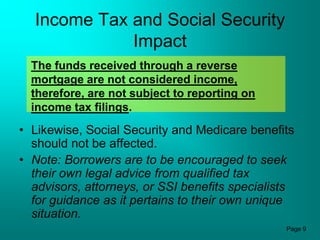
Income Tax and Social Security
             Impact
  The funds received through a reverse
  mortgage are not considered income,
  therefore, are not subject to reporting on
  income tax filings.
• Likewise, Social Security and Medicare benefits
  should not be affected.
• Note: Borrowers are to be encouraged to seek
  their own legal advice from qualified tax
  advisors, attorneys, or SSI benefits specialists
  for guidance as it pertains to their own unique
  situation.
                                                Page 9
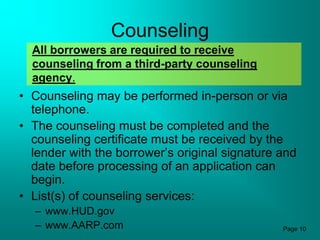
Counseling
  All borrowers are required to receive
  counseling from a third-party counseling
  agency.
• Counseling may be performed in-person or via
  telephone.
• The counseling must be completed and the
  counseling certificate must be received by the
  lender with the borrower’s original signature and
  date before processing of an application can
  begin.
• List(s) of counseling services:
  – www.HUD.gov
  – www.AARP.com                                Page 10
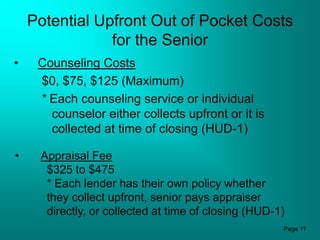
Potential Upfront Out of Pocket Costs
                for the Senior
•    Counseling Costs
     $0, $75, $125 (Maximum)
     * Each counseling service or individual
       counselor either collects upfront or it is
       collected at time of closing (HUD-1)

•    Appraisal Fee
      $325 to $475
      * Each lender has their own policy whether
      they collect upfront, senior pays appraiser
      directly, or collected at time of closing (HUD-1)
                                                      Page 11
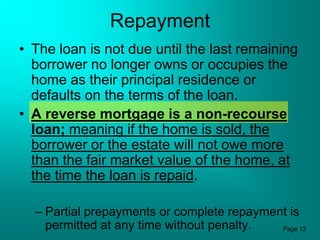
Repayment
• The loan is not due until the last remaining
  borrower no longer owns or occupies the
  home as their principal residence or
  defaults on the terms of the loan.
• A reverse mortgage is a non-recourse
  loan; meaning if the home is sold, the
  borrower or the estate will not owe more
  than the fair market value of the home, at
  the time the loan is repaid.

  – Partial prepayments or complete repayment is
    permitted at any time without penalty.  Page 12
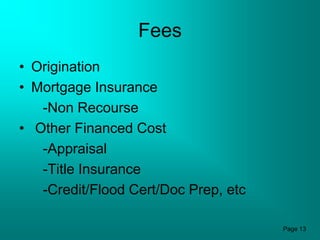
Fees
• Origination
• Mortgage Insurance
   -Non Recourse
• Other Financed Cost
   -Appraisal
   -Title Insurance
   -Credit/Flood Cert/Doc Prep, etc

                                      Page 13
Loan Service Set Aside


                         Page 14
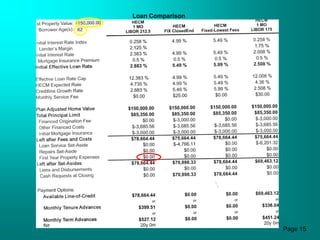
Loan Comparison


                  Page 15
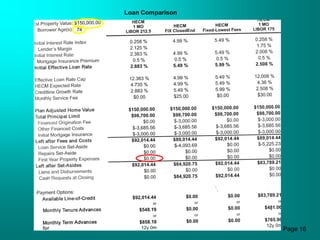
Loan Comparison


                  Page 16
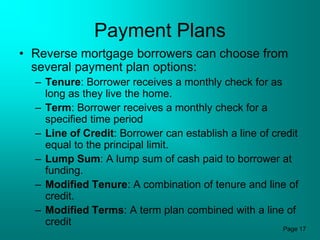
Payment Plans
• Reverse mortgage borrowers can choose from
  several payment plan options:
  – Tenure: Borrower receives a monthly check for as
    long as they live the home.
  – Term: Borrower receives a monthly check for a
    specified time period
  – Line of Credit: Borrower can establish a line of credit
    equal to the principal limit.
  – Lump Sum: A lump sum of cash paid to borrower at
    funding.
  – Modified Tenure: A combination of tenure and line of
    credit.
  – Modified Terms: A term plan combined with a line of
    credit
                                                       Page 17
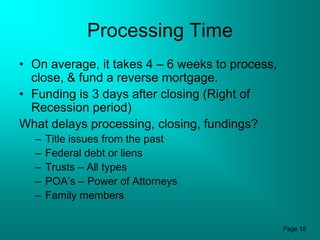
Processing Time
• On average, it takes 4 – 6 weeks to process,
  close, & fund a reverse mortgage.
• Funding is 3 days after closing (Right of
  Recession period)
What delays processing, closing, fundings?
  –   Title issues from the past
  –   Federal debt or liens
  –   Trusts – All types
  –   POA’s – Power of Attorneys
  –   Family members


                                                 Page 18
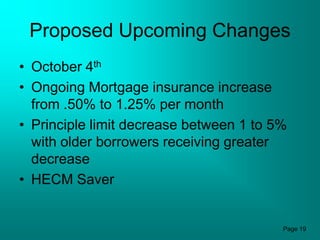
Proposed Upcoming Changes
• October 4th
• Ongoing Mortgage insurance increase
  from .50% to 1.25% per month
• Principle limit decrease between 1 to 5%
  with older borrowers receiving greater
  decrease
• HECM Saver


                                         Page 19

Reverse mortgage

  • 1.
    Reverse Mortgages presented by Vicki Cheairs MetLife 281-855-1122 Page 1
  • 2.
    Reverse Mortgages What isa reverse mortgage? • A loan that allows homeowners age 62+ to tap into their home equity; never have to make payments on the loan; while still living in and owning the home. There are no restrictions on the use of the proceeds from the loan. No ratios, no credit scores, no income requirements. Page 2
  • 3.
    History • 19___ –First reverse mortgage loan originated in the USA • 1987 to 1990 – AARP & HUD completely overhauled the RM product • 2001 – First RM in Texas (only 1 type) • 2005 – Texas citizens voted in all reverse mortgage products • 2008 – The Housing & Economic Recovery Act of 2008 Page 3
  • 4.
    Types of ReverseMortgages • HUD/FHA Home Equity Conversion Mortgage (HECM) - (Gov’t) • Fannie Mae Home Keeper - (Conventional) • Proprietary Products – (In-House) • Jan 1, 2009 – FHA HECM for Purchase • Proposed for October 4, 2010 HECM Saver- complete details forthcoming. Growth of Reverse Mortgages – Prior to the year 2000, fewer than 55,000 HECMs – 2007 alone, 107,000+ HECMs funded Page 4
  • 5.
    An Expanding Need Economicfactors •Inflation •Fixed incomes •Rising healthcare costs •Insufficient retirement savings •Existing debt, including a first or second mortgage Why? – Demographics •People are living longer •Tendency to underestimate life expectancy leads to inadequate retirement savings/planning •Baby Boomers – Starting in 2008, 6,000 people per day turn 62 Page 5
  • 6.
    Eligibility • The subjectproperty must be the borrower’s principal residence. •In the case of co-borrowers, at least one borrower must occupy the property •Youngest borrower minimum age of 62 •Borrower(s) must maintain the property and pay the annual taxes and insurance •Property meets U.S. Department of Housing and Urban Development (HUD) minimum property standards Page 6
  • 7.
    Eligible Property • Singlefamily • 2 – 4 units, as long as one unit is the borrower’s primary residence (HECM and PP only) • Condominiums • Planned Unit Developments (PUD) • Manufactured Homes (FHA HECM only) Page 7
  • 8.
    Non-Eligible Properties • Atthis time, the following property types are not eligible for a reverse mortgage: – Investment properties – Vacation homes – Second homes – Properties with illegal accessories units or mixed use properties where more than 25% is used for non- residential purposes. – Manufactured homes which are legally recorded as a condominium or if property is not taxed as real estate. – Two parcels on one deed. Page 8
  • 9.
    Income Tax andSocial Security Impact The funds received through a reverse mortgage are not considered income, therefore, are not subject to reporting on income tax filings. • Likewise, Social Security and Medicare benefits should not be affected. • Note: Borrowers are to be encouraged to seek their own legal advice from qualified tax advisors, attorneys, or SSI benefits specialists for guidance as it pertains to their own unique situation. Page 9
  • 10.
    Counseling Allborrowers are required to receive counseling from a third-party counseling agency. • Counseling may be performed in-person or via telephone. • The counseling must be completed and the counseling certificate must be received by the lender with the borrower’s original signature and date before processing of an application can begin. • List(s) of counseling services: – www.HUD.gov – www.AARP.com Page 10
  • 11.
    Potential Upfront Outof Pocket Costs for the Senior • Counseling Costs $0, $75, $125 (Maximum) * Each counseling service or individual counselor either collects upfront or it is collected at time of closing (HUD-1) • Appraisal Fee $325 to $475 * Each lender has their own policy whether they collect upfront, senior pays appraiser directly, or collected at time of closing (HUD-1) Page 11
  • 12.
    Repayment • The loanis not due until the last remaining borrower no longer owns or occupies the home as their principal residence or defaults on the terms of the loan. • A reverse mortgage is a non-recourse loan; meaning if the home is sold, the borrower or the estate will not owe more than the fair market value of the home, at the time the loan is repaid. – Partial prepayments or complete repayment is permitted at any time without penalty. Page 12
  • 13.
    Fees • Origination • MortgageInsurance -Non Recourse • Other Financed Cost -Appraisal -Title Insurance -Credit/Flood Cert/Doc Prep, etc Page 13
  • 14.
    Loan Service SetAside Page 14
  • 15.
  • 16.
  • 17.
    Payment Plans • Reversemortgage borrowers can choose from several payment plan options: – Tenure: Borrower receives a monthly check for as long as they live the home. – Term: Borrower receives a monthly check for a specified time period – Line of Credit: Borrower can establish a line of credit equal to the principal limit. – Lump Sum: A lump sum of cash paid to borrower at funding. – Modified Tenure: A combination of tenure and line of credit. – Modified Terms: A term plan combined with a line of credit Page 17
  • 18.
    Processing Time • Onaverage, it takes 4 – 6 weeks to process, close, & fund a reverse mortgage. • Funding is 3 days after closing (Right of Recession period) What delays processing, closing, fundings? – Title issues from the past – Federal debt or liens – Trusts – All types – POA’s – Power of Attorneys – Family members Page 18
  • 19.
    Proposed Upcoming Changes •October 4th • Ongoing Mortgage insurance increase from .50% to 1.25% per month • Principle limit decrease between 1 to 5% with older borrowers receiving greater decrease • HECM Saver Page 19