Reverse Innovation
Example:
mobile Information & Communication Technologies
enabling
PRECISION MEDICINE
(diabetes as a case study in emerging markets)
Dr. Thomas Wilckens
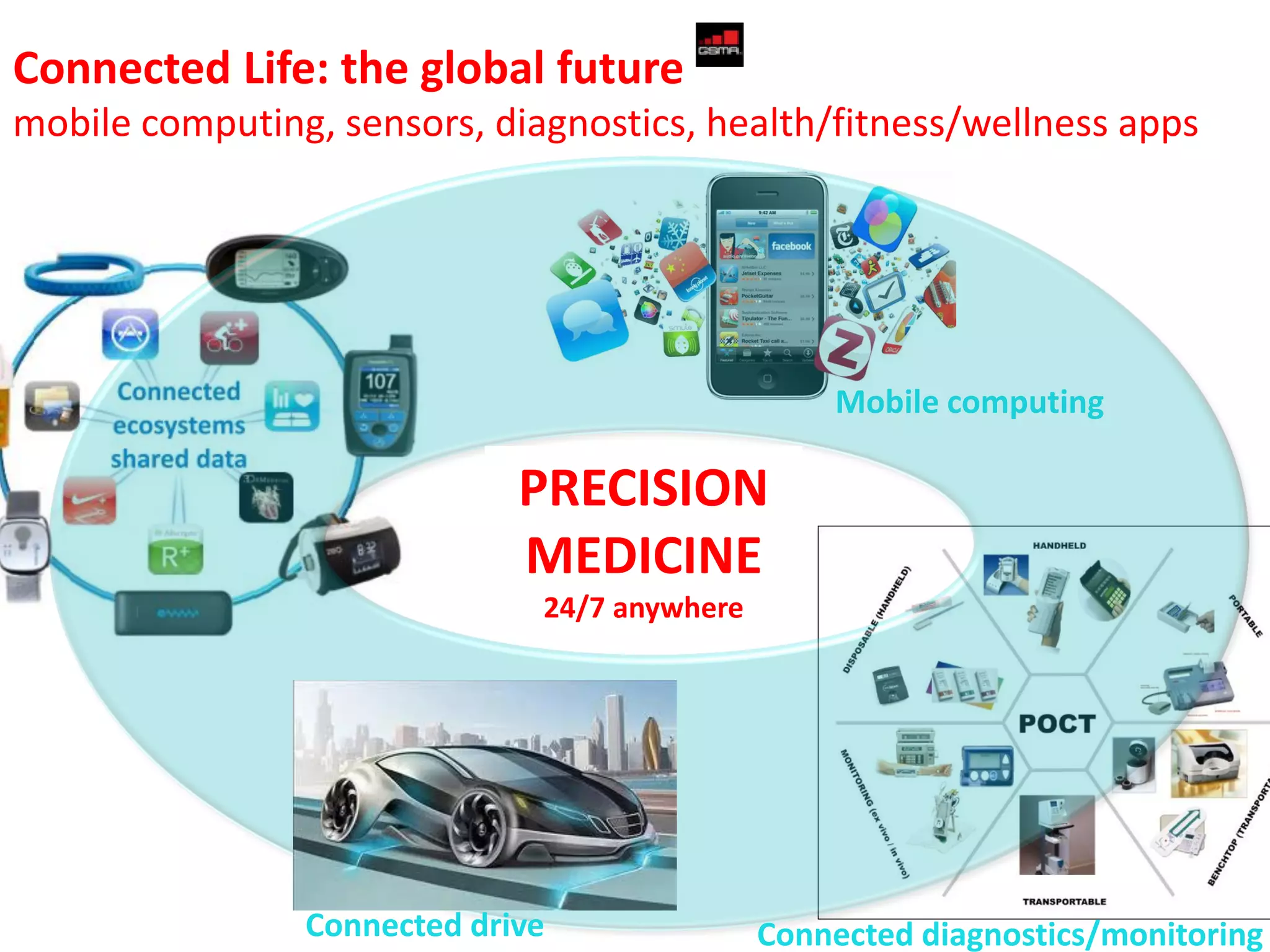
Connected Life: the global future
mobile computing, sensors, diagnostics, health/fitness/wellness apps

Mobile computing

PRECISION
MEDICINE
24/7 anywhere

Connected drive

2

Connected diagnostics/monitoring
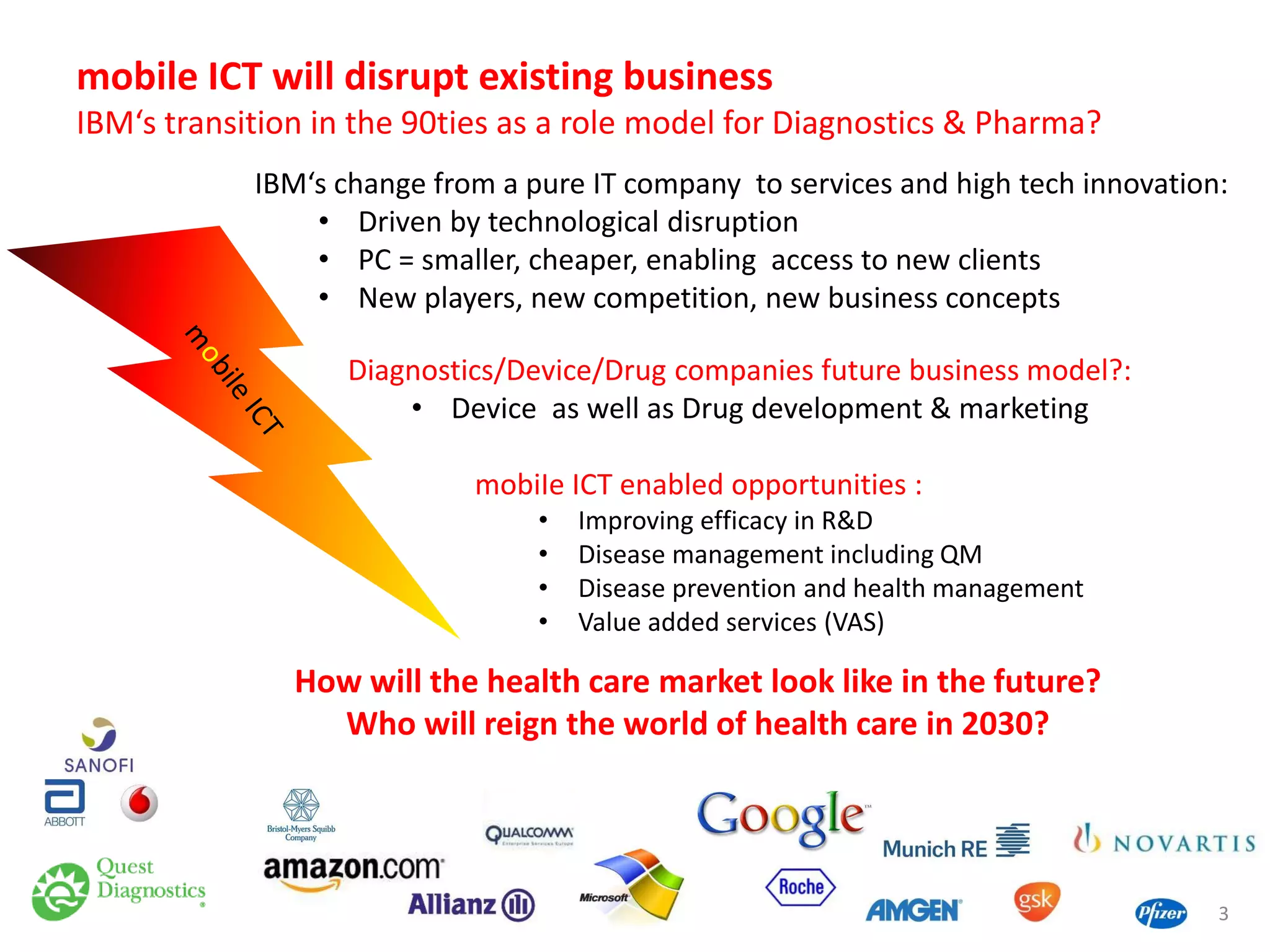
mobile ICT will disrupt existing business
IBM‘s transition in the 90ties as a role model for Diagnostics & Pharma?
IBM‘s change from a pure IT company to services and high tech innovation:
• Driven by technological disruption
• PC = smaller, cheaper, enabling access to new clients
• New players, new competition, new business concepts
Diagnostics/Device/Drug companies future business model?:
• Device as well as Drug development & marketing
mobiIe ICT enabled opportunities :
•
•
•
•

Improving efficacy in R&D
Disease management including QM
Disease prevention and health management
Value added services (VAS)

How will the health care market look like in the future?
Who will reign the world of health care in 2030?

3
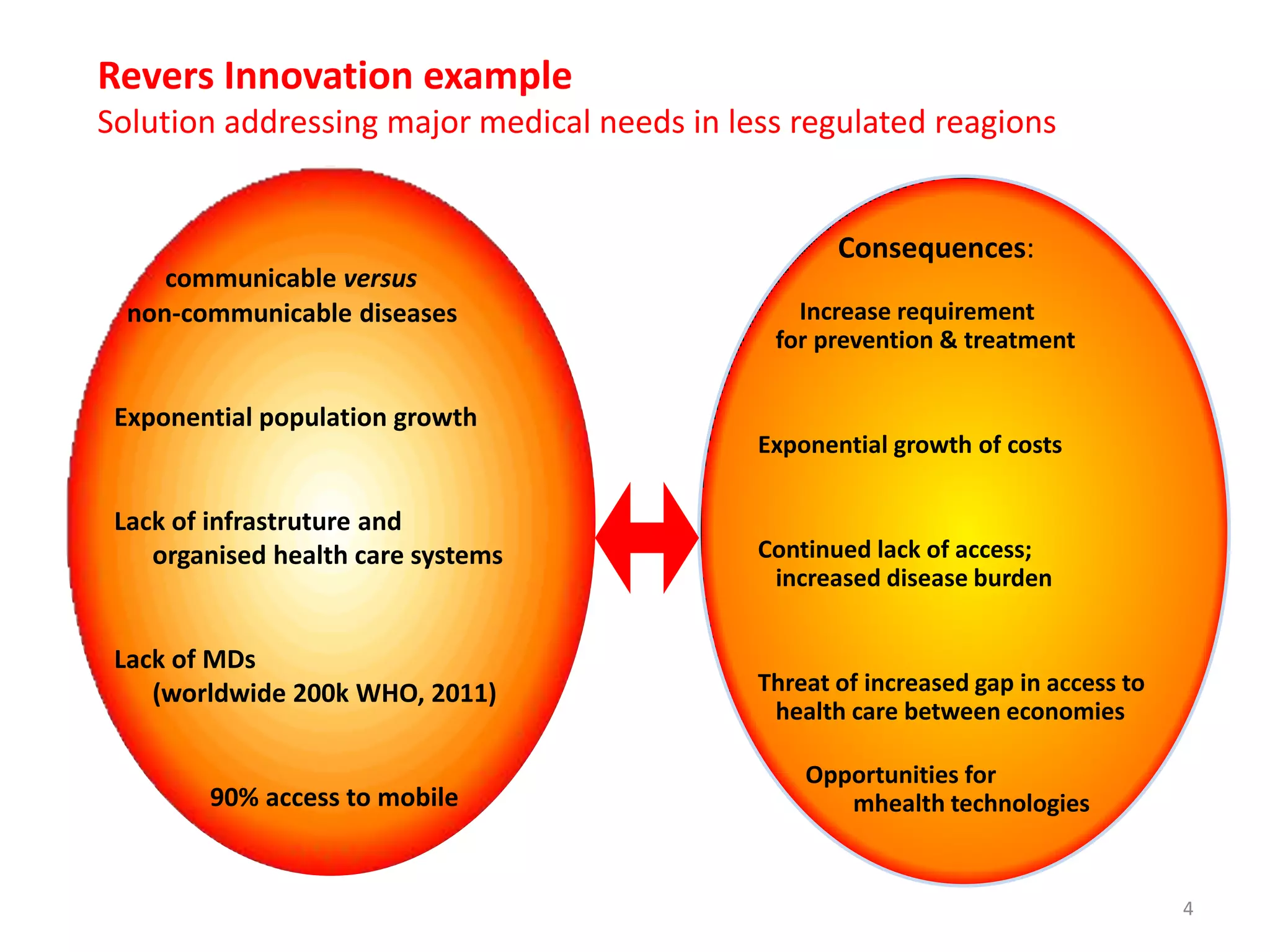
Revers Innovation example
Solution addressing major medical needs in less regulated reagions

Consequences:
communicable versus
non-communicable diseases

Increase requirement
for prevention & treatment

Exponential population growth
Exponential growth of costs

Lack of infrastruture and
organised health care systems

Lack of MDs
(worldwide 200k WHO, 2011)

90% access to mobile

Continued lack of access;
increased disease burden

Threat of increased gap in access to
health care between economies
Opportunities for
mhealth technologies

4
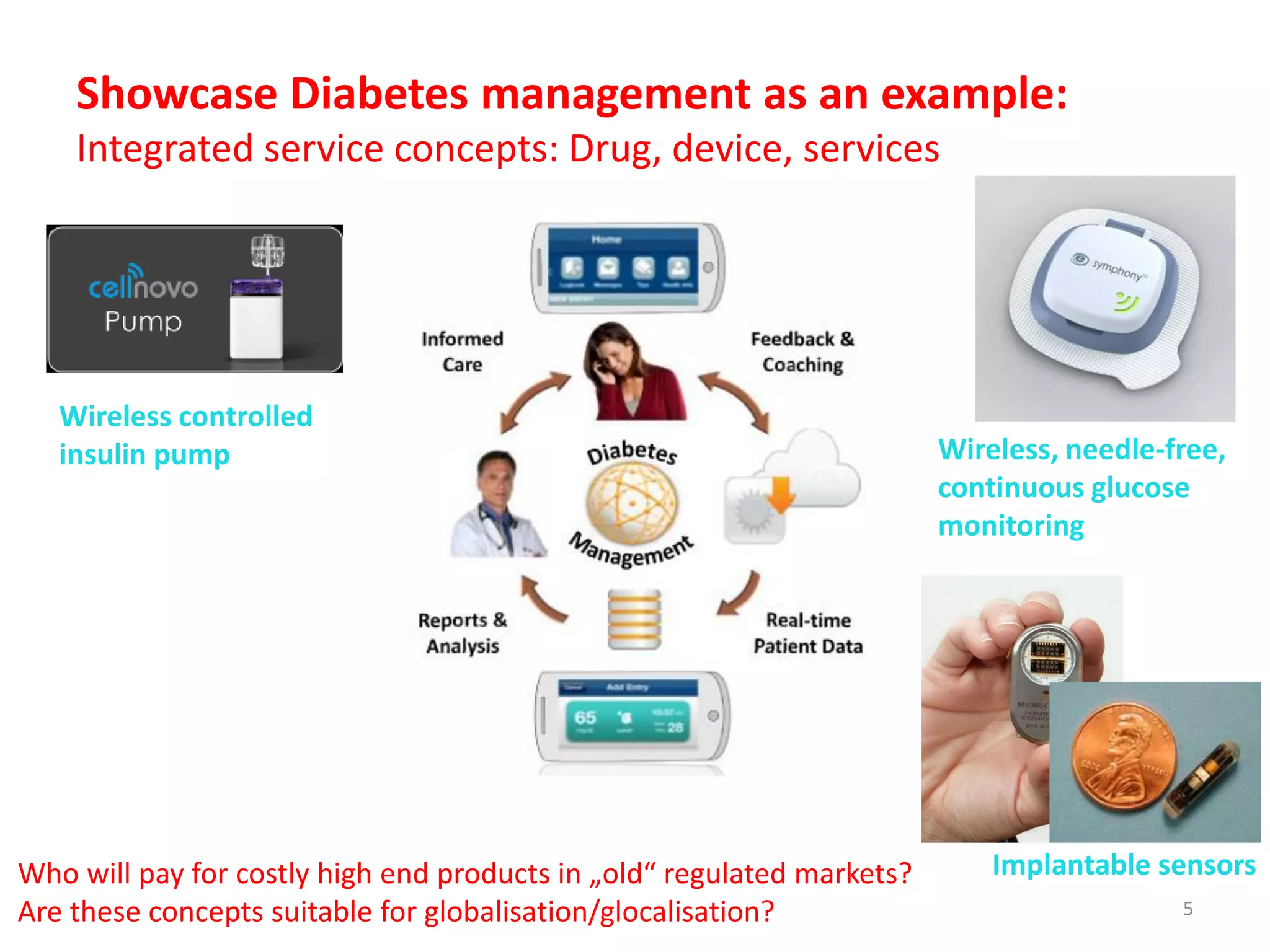
Showcase Diabetes management as an example:
Integrated service concepts: Drug, device, services

Wireless controlled
insulin pump

Who will pay for costly high end products in „old“ regulated markets?
Are these concepts suitable for globalisation/glocalisation?

Wireless, needle-free,
continuous glucose
monitoring

Implantable sensors
5
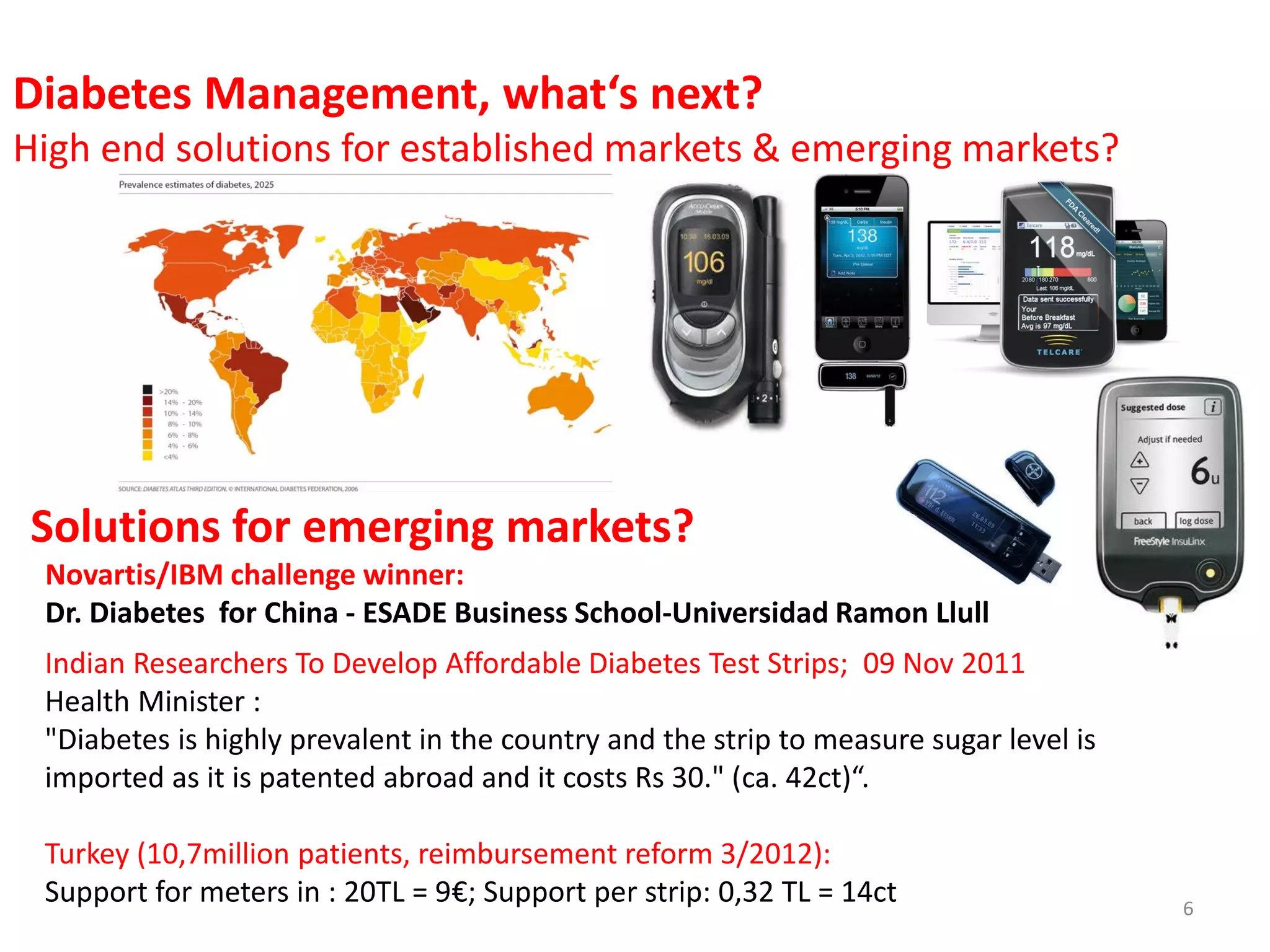
Diabetes Management, what‘s next?
High end solutions for established markets & emerging markets?

Solutions for emerging markets?
Novartis/IBM challenge winner:
Dr. Diabetes for China - ESADE Business School-Universidad Ramon Llull
Indian Researchers To Develop Affordable Diabetes Test Strips; 09 Nov 2011
Health Minister :
"Diabetes is highly prevalent in the country and the strip to measure sugar level is
imported as it is patented abroad and it costs Rs 30." (ca. 42ct)“.
Turkey (10,7million patients, reimbursement reform 3/2012):
Support for meters in : 20TL = 9€; Support per strip: 0,32 TL = 14ct

6
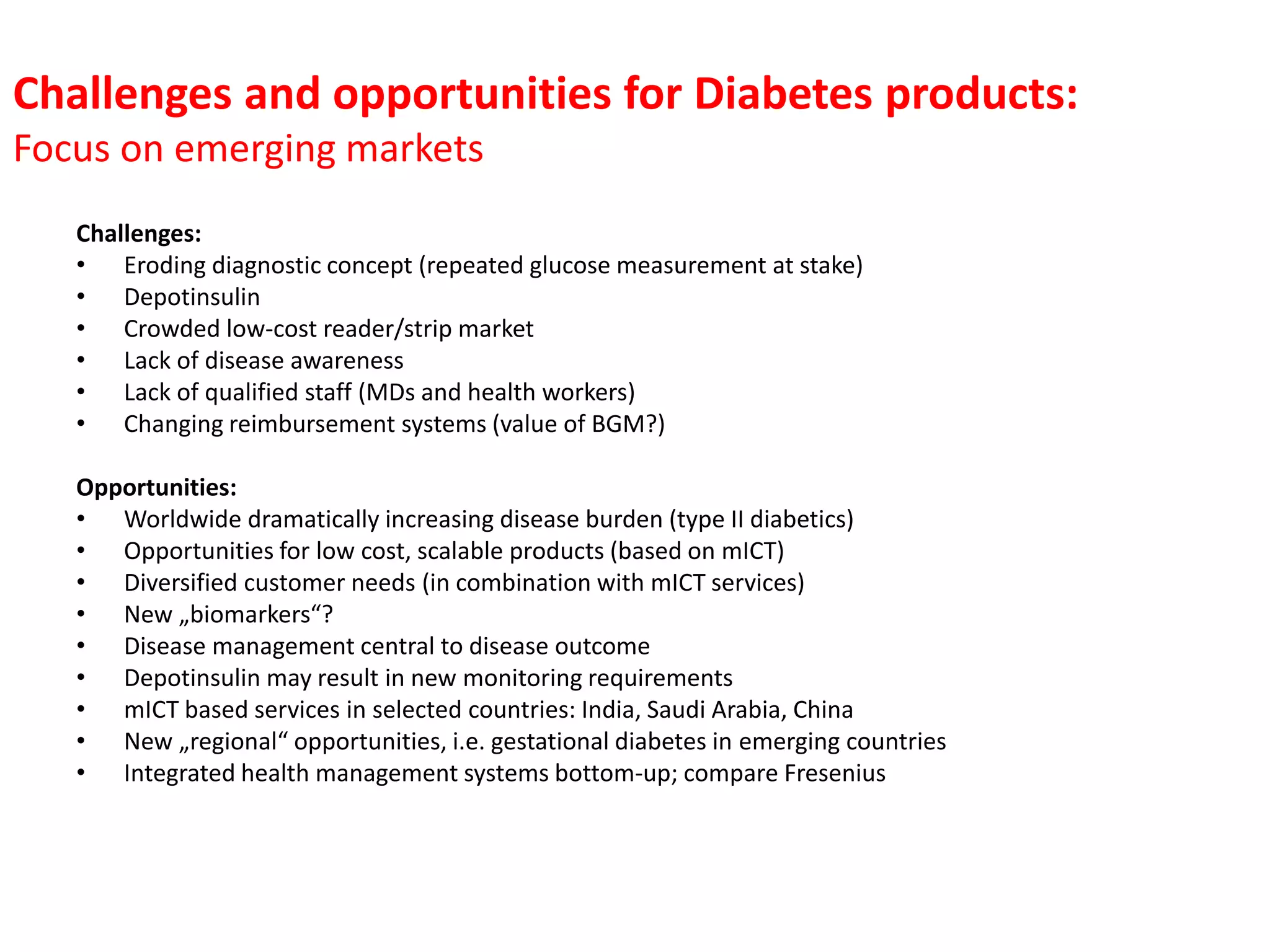
Challenges and opportunities for Diabetes products:
Focus on emerging markets
Challenges:
• Eroding diagnostic concept (repeated glucose measurement at stake)
• Depotinsulin
• Crowded low-cost reader/strip market
• Lack of disease awareness
• Lack of qualified staff (MDs and health workers)
• Changing reimbursement systems (value of BGM?)
Opportunities:
• Worldwide dramatically increasing disease burden (type II diabetics)
• Opportunities for low cost, scalable products (based on mICT)
• Diversified customer needs (in combination with mICT services)
• New „biomarkers“?
• Disease management central to disease outcome
• Depotinsulin may result in new monitoring requirements
• mICT based services in selected countries: India, Saudi Arabia, China
• New „regional“ opportunities, i.e. gestational diabetes in emerging countries
• Integrated health management systems bottom-up; compare Fresenius
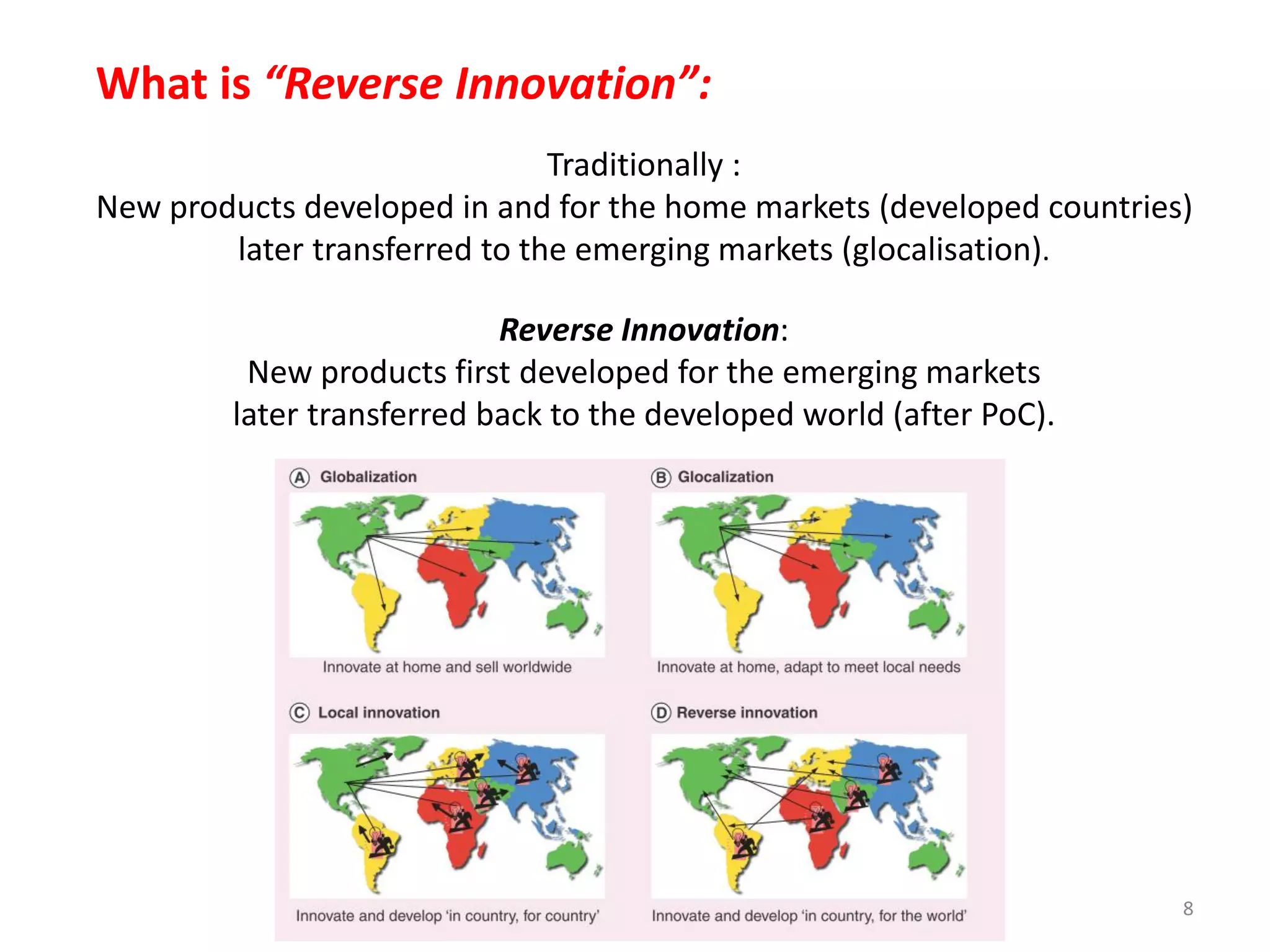
What is “Reverse Innovation”:
Traditionally :
New products developed in and for the home markets (developed countries)
later transferred to the emerging markets (glocalisation).
Reverse Innovation:
New products first developed for the emerging markets
later transferred back to the developed world (after PoC).

8
Reverse Innovation:
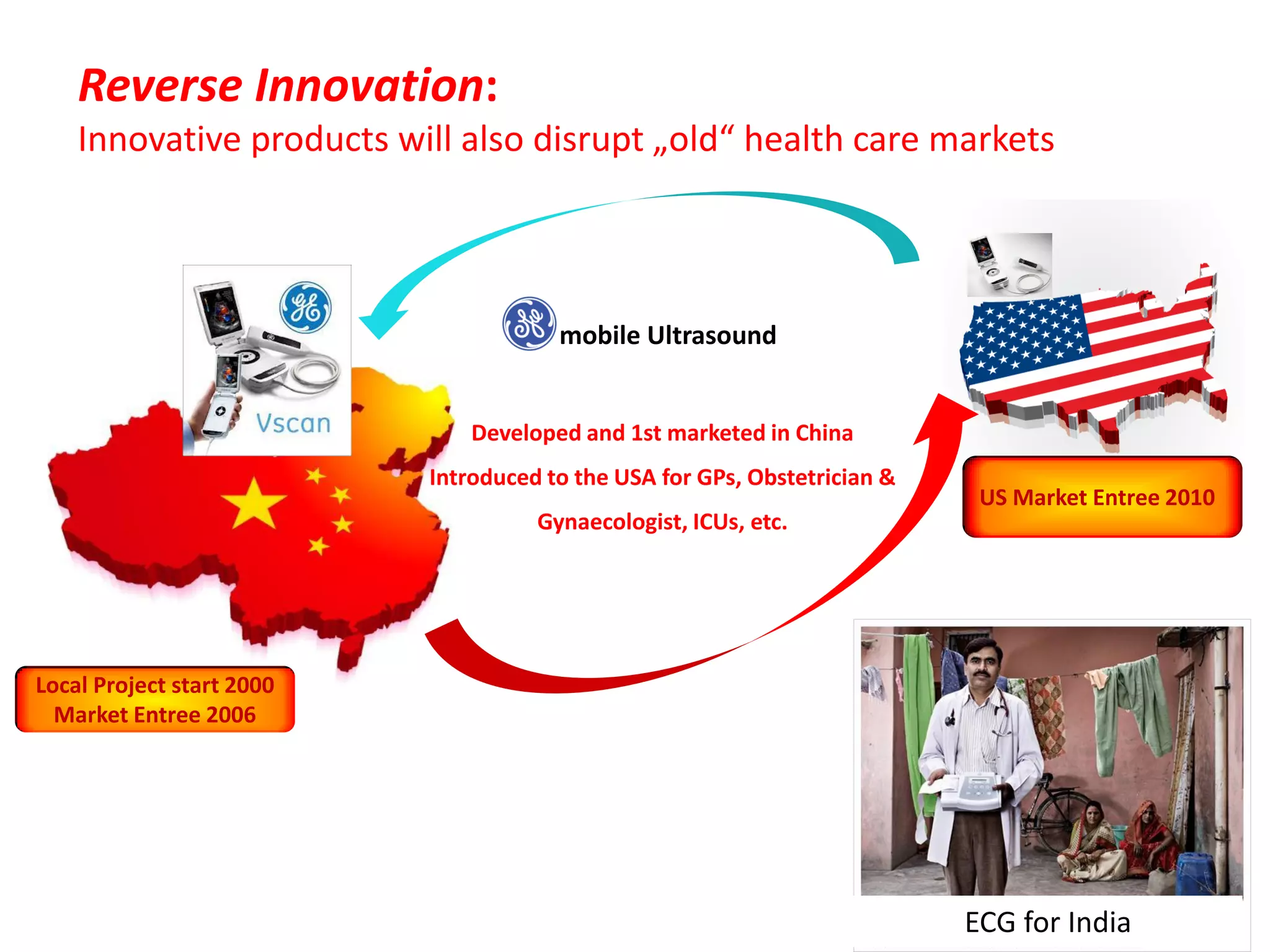
Innovative products will also disrupt „old“ health care markets

mobile Ultrasound

Developed and 1st marketed in China
Introduced to the USA for GPs, Obstetrician &
Gynaecologist, ICUs, etc.

US Market Entree 2010

Local Project start 2000
Market Entree 2006

ECG for India

9
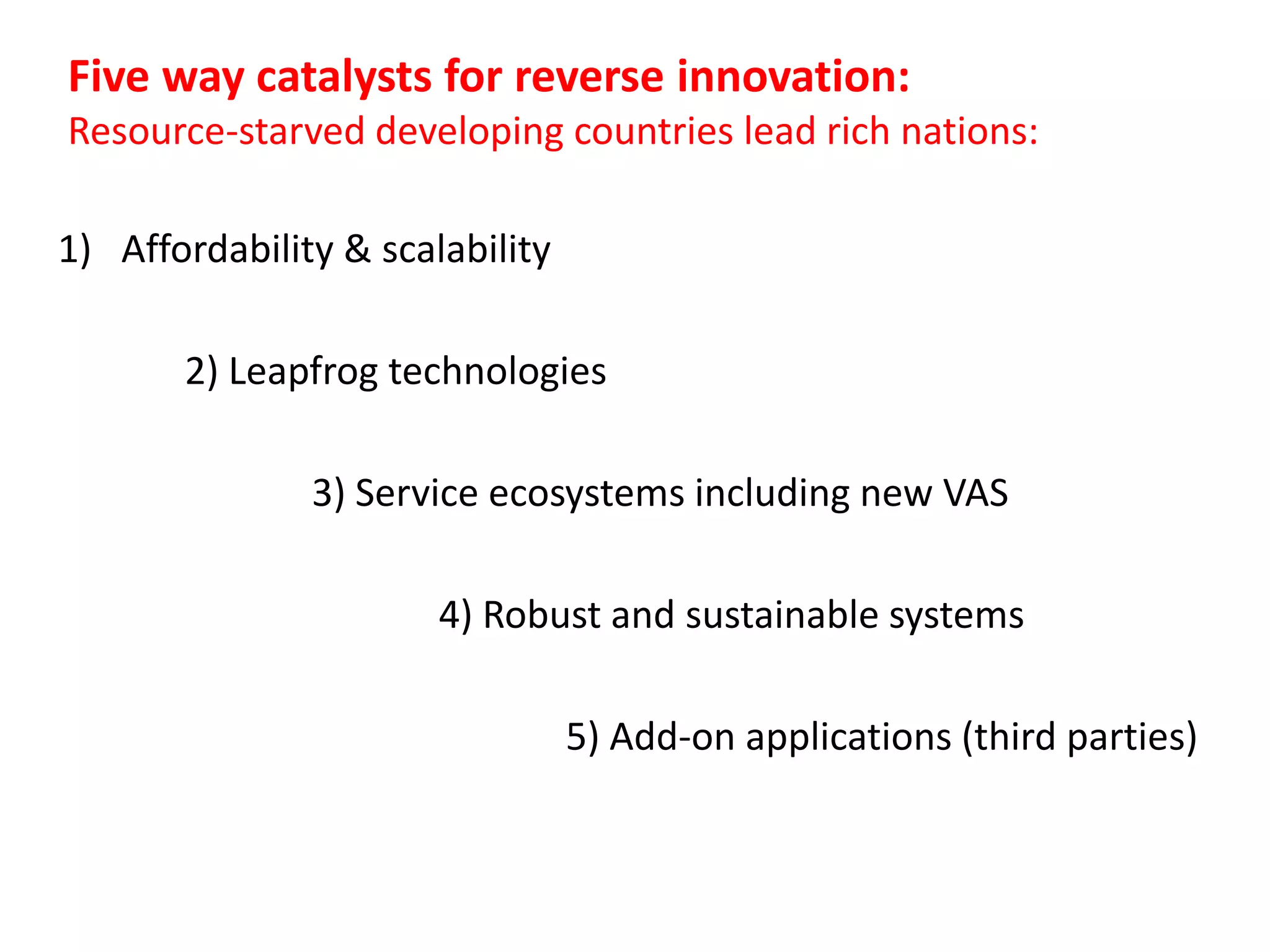
Five way catalysts for reverse innovation:
Resource-starved developing countries lead rich nations:
1) Affordability & scalability
2) Leapfrog technologies
3) Service ecosystems including new VAS
4) Robust and sustainable systems
5) Add-on applications (third parties)
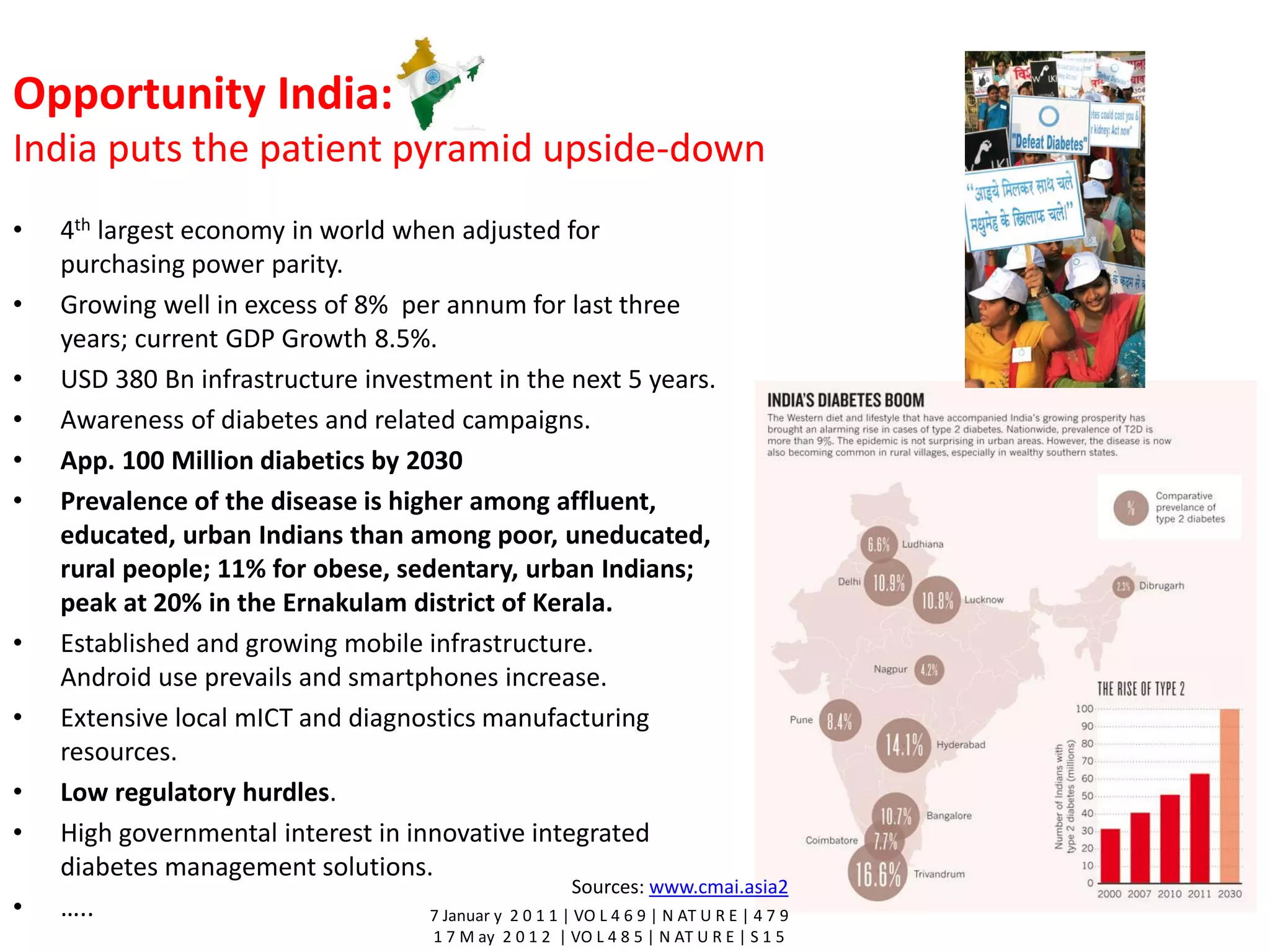
Opportunity India:
India puts the patient pyramid upside-down
•

•
•
•
•
•

•
•
•
•
•

4th largest economy in world when adjusted for
purchasing power parity.
Growing well in excess of 8% per annum for last three
years; current GDP Growth 8.5%.
USD 380 Bn infrastructure investment in the next 5 years.
Awareness of diabetes and related campaigns.
App. 100 Million diabetics by 2030
Prevalence of the disease is higher among affluent,
educated, urban Indians than among poor, uneducated,
rural people; 11% for obese, sedentary, urban Indians;
peak at 20% in the Ernakulam district of Kerala.
Established and growing mobile infrastructure.
Android use prevails and smartphones increase.
Extensive local mICT and diagnostics manufacturing
resources.
Low regulatory hurdles.
High governmental interest in innovative integrated
diabetes management solutions.
Sources: www.cmai.asia2
…..
7 Januar y 2 0 1 1 | VO L 4 6 9 | N AT U R E | 4 7 9
1 7 M ay 2 0 1 2 | VO L 4 8 5 | N AT U R E | S 1 5
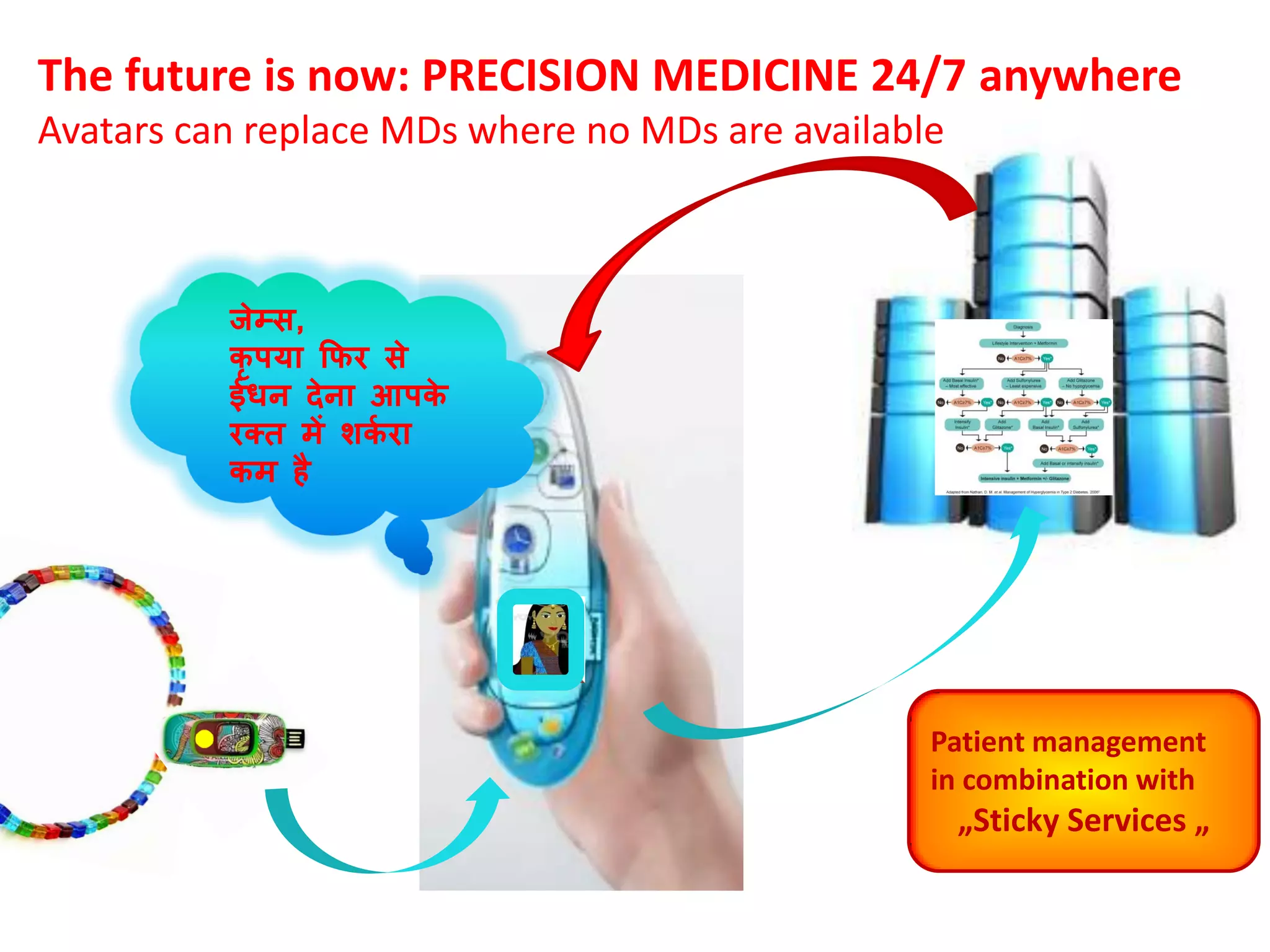
The future is now: PRECISION MEDICINE 24/7 anywhere
Avatars can replace MDs where no MDs are available

जेम्स,
कृपया फिर से
ईधन दे ना आपक
े
रक्त में शकरा
क
कम है

60

Patient management
in combination with

„Sticky Services „
Reverse Innovation Strategy: Step I
Excerpt from the toolkit by Govindarajan & Trimble, 2012
Which are the emerging economies that are strategic for your company? Out of
the 150 poor countries, which ones have:
1.
2.
3.
4.
5.
6.
7.
8.
9.
10.
11.

The bulk of future customers (patient collective)
Potential for future growth (WHO/UN Projection)
Talented low cost skill base (IT and mobile Industry)
Manufacturing capabilities (Resources and talent)
Physical infrastructure (Telecoverage)
Institutional infrastructure (Primary diagnosis of diabetes)
Social infrastructure (Incentive to lower disease burden)
Foundation to build R&D know-how
Local trend scouts & analysts
Potential new competitors
…..
Source: http://www.tuck.dartmouth.edu/uploads/people/vg/vg-reverse-innov-toolkit.pd f
mobile ICT & POC: enabling access to health care
Generate problem-oriented solutions within a contextual framework
Optimized disease management in emerging and „old“markets; i.e. efficient and affordable:

Selected objectives (starting from scratch applying Reverse Innovation principles):
1.
2.
3.
4.
5.
6.
7.
8.

Market-specifically tailored diagnostic devices (test-strips, mReaders, sensors….)
Integrated algorithm-based dosing management (cloud-based and/or Smart Phone)
High end versus low end versions for regional markets and/or client groups
Remote/mobile QM and disease management services in a cultural context
Low energy, ecologically neutral
Culturally adjusted value-added-services (VAS)
Identify general principles applicable from fever diagnostics to chronic condition management
Adjust for (re-) introduction into „old“ markets

Know your customers' needs!
Use local resources for product development!
Caveat & Catch 22:
Customers cannot know what they miss, since they cannot
anticipate what emerging technologies can deliver

Create ideas and be innovative in your customers local/social/economic context!

Reverse Innovation 2014

  • 1.
    Reverse Innovation Example: mobile Information& Communication Technologies enabling PRECISION MEDICINE (diabetes as a case study in emerging markets) Dr. Thomas Wilckens
  • 2.
    Connected Life: theglobal future mobile computing, sensors, diagnostics, health/fitness/wellness apps Mobile computing PRECISION MEDICINE 24/7 anywhere Connected drive 2 Connected diagnostics/monitoring
  • 3.
    mobile ICT willdisrupt existing business IBM‘s transition in the 90ties as a role model for Diagnostics & Pharma? IBM‘s change from a pure IT company to services and high tech innovation: • Driven by technological disruption • PC = smaller, cheaper, enabling access to new clients • New players, new competition, new business concepts Diagnostics/Device/Drug companies future business model?: • Device as well as Drug development & marketing mobiIe ICT enabled opportunities : • • • • Improving efficacy in R&D Disease management including QM Disease prevention and health management Value added services (VAS) How will the health care market look like in the future? Who will reign the world of health care in 2030? 3
  • 4.
    Revers Innovation example Solutionaddressing major medical needs in less regulated reagions Consequences: communicable versus non-communicable diseases Increase requirement for prevention & treatment Exponential population growth Exponential growth of costs Lack of infrastruture and organised health care systems Lack of MDs (worldwide 200k WHO, 2011) 90% access to mobile Continued lack of access; increased disease burden Threat of increased gap in access to health care between economies Opportunities for mhealth technologies 4
  • 5.
    Showcase Diabetes managementas an example: Integrated service concepts: Drug, device, services Wireless controlled insulin pump Who will pay for costly high end products in „old“ regulated markets? Are these concepts suitable for globalisation/glocalisation? Wireless, needle-free, continuous glucose monitoring Implantable sensors 5
  • 6.
    Diabetes Management, what‘snext? High end solutions for established markets & emerging markets? Solutions for emerging markets? Novartis/IBM challenge winner: Dr. Diabetes for China - ESADE Business School-Universidad Ramon Llull Indian Researchers To Develop Affordable Diabetes Test Strips; 09 Nov 2011 Health Minister : "Diabetes is highly prevalent in the country and the strip to measure sugar level is imported as it is patented abroad and it costs Rs 30." (ca. 42ct)“. Turkey (10,7million patients, reimbursement reform 3/2012): Support for meters in : 20TL = 9€; Support per strip: 0,32 TL = 14ct 6
  • 7.
    Challenges and opportunitiesfor Diabetes products: Focus on emerging markets Challenges: • Eroding diagnostic concept (repeated glucose measurement at stake) • Depotinsulin • Crowded low-cost reader/strip market • Lack of disease awareness • Lack of qualified staff (MDs and health workers) • Changing reimbursement systems (value of BGM?) Opportunities: • Worldwide dramatically increasing disease burden (type II diabetics) • Opportunities for low cost, scalable products (based on mICT) • Diversified customer needs (in combination with mICT services) • New „biomarkers“? • Disease management central to disease outcome • Depotinsulin may result in new monitoring requirements • mICT based services in selected countries: India, Saudi Arabia, China • New „regional“ opportunities, i.e. gestational diabetes in emerging countries • Integrated health management systems bottom-up; compare Fresenius
  • 8.
    What is “ReverseInnovation”: Traditionally : New products developed in and for the home markets (developed countries) later transferred to the emerging markets (glocalisation). Reverse Innovation: New products first developed for the emerging markets later transferred back to the developed world (after PoC). 8
  • 9.
    Reverse Innovation: Innovative productswill also disrupt „old“ health care markets mobile Ultrasound Developed and 1st marketed in China Introduced to the USA for GPs, Obstetrician & Gynaecologist, ICUs, etc. US Market Entree 2010 Local Project start 2000 Market Entree 2006 ECG for India 9
  • 10.
    Five way catalystsfor reverse innovation: Resource-starved developing countries lead rich nations: 1) Affordability & scalability 2) Leapfrog technologies 3) Service ecosystems including new VAS 4) Robust and sustainable systems 5) Add-on applications (third parties)
  • 11.
    Opportunity India: India putsthe patient pyramid upside-down • • • • • • • • • • • 4th largest economy in world when adjusted for purchasing power parity. Growing well in excess of 8% per annum for last three years; current GDP Growth 8.5%. USD 380 Bn infrastructure investment in the next 5 years. Awareness of diabetes and related campaigns. App. 100 Million diabetics by 2030 Prevalence of the disease is higher among affluent, educated, urban Indians than among poor, uneducated, rural people; 11% for obese, sedentary, urban Indians; peak at 20% in the Ernakulam district of Kerala. Established and growing mobile infrastructure. Android use prevails and smartphones increase. Extensive local mICT and diagnostics manufacturing resources. Low regulatory hurdles. High governmental interest in innovative integrated diabetes management solutions. Sources: www.cmai.asia2 ….. 7 Januar y 2 0 1 1 | VO L 4 6 9 | N AT U R E | 4 7 9 1 7 M ay 2 0 1 2 | VO L 4 8 5 | N AT U R E | S 1 5
  • 12.
    The future isnow: PRECISION MEDICINE 24/7 anywhere Avatars can replace MDs where no MDs are available जेम्स, कृपया फिर से ईधन दे ना आपक े रक्त में शकरा क कम है 60 Patient management in combination with „Sticky Services „
  • 13.
    Reverse Innovation Strategy:Step I Excerpt from the toolkit by Govindarajan & Trimble, 2012 Which are the emerging economies that are strategic for your company? Out of the 150 poor countries, which ones have: 1. 2. 3. 4. 5. 6. 7. 8. 9. 10. 11. The bulk of future customers (patient collective) Potential for future growth (WHO/UN Projection) Talented low cost skill base (IT and mobile Industry) Manufacturing capabilities (Resources and talent) Physical infrastructure (Telecoverage) Institutional infrastructure (Primary diagnosis of diabetes) Social infrastructure (Incentive to lower disease burden) Foundation to build R&D know-how Local trend scouts & analysts Potential new competitors ….. Source: http://www.tuck.dartmouth.edu/uploads/people/vg/vg-reverse-innov-toolkit.pd f
  • 14.
    mobile ICT &POC: enabling access to health care Generate problem-oriented solutions within a contextual framework Optimized disease management in emerging and „old“markets; i.e. efficient and affordable: Selected objectives (starting from scratch applying Reverse Innovation principles): 1. 2. 3. 4. 5. 6. 7. 8. Market-specifically tailored diagnostic devices (test-strips, mReaders, sensors….) Integrated algorithm-based dosing management (cloud-based and/or Smart Phone) High end versus low end versions for regional markets and/or client groups Remote/mobile QM and disease management services in a cultural context Low energy, ecologically neutral Culturally adjusted value-added-services (VAS) Identify general principles applicable from fever diagnostics to chronic condition management Adjust for (re-) introduction into „old“ markets Know your customers' needs! Use local resources for product development! Caveat & Catch 22: Customers cannot know what they miss, since they cannot anticipate what emerging technologies can deliver Create ideas and be innovative in your customers local/social/economic context!