International Research Journal of Engineering and Technology (IRJET) e-ISSN: 2395-0056
Volume: 06 Issue: 05 | May 2019 www.irjet.net p-ISSN: 2395-0072
© 2019, IRJET | Impact Factor value: 7.211 | ISO 9001:2008 Certified Journal | Page 928
PLAGIARISM CHECKER
Shubham Juvekar1, Bhushan Bhopatrao2, Krunal Binekar3, Prachi Gadhire4
1,2,3Student, Computer Department, DRIEMS, Maharashtra, India.
4 Professor, Computer Department, DRIEMS, Maharashtra, India.
---------------------------------------------------------------------***----------------------------------------------------------------------
Abstract - Plagiarism is any identical or lightly-altered use of
one's own or someone else’s work. Text plagiarism detection
systems are widely available. Students achieve the bestresults
in learning by writing and doing exercises. This mandates a
large number of written exercises. However, limited resources
and distribution of assessment work lead to problems when
students' answers need to be checked for plagiarism.
Plagiarism or copy pasting is difficult to notice in a large
volume of documents. The demonstrated project focuses on
computer-assisted plagiarism detection in medium to large
volumes of text-based submissions. Moreover, the project
supports automated search for web sources.
Key Words: Cheating, plagiarism, computer assisted
assessment, text documents, web based
1. INTRODUCTION
Nowadays, plagiarism is a really serious issue within the
professional environment, or even within the education
system. Since Internet is accessible to everyone, it is easy to
use Internet as a source of information. However, copying
documents from Internet can be considered as plagiarism:
what can be found on Internet can come from a book, a
research document or an article. It can even result to some
legal problems, such as copyright infringement. Plagiarism
detection of first case is easy to detect while the later
requires complex analysis and algorithms.
Plagiarism detection of first case is easy to detect while the
later requires complex analysis and algorithms. Finding
plagiarized parts of a text document is very slow labor for
teachers of copy and paste.
Finding plagiarized parts of a text document is very slow
labor for teachers. Even with a limited number of texts it
relies on the teacher's ability to read and remember every
submission. This is slow and ineffective. The Internet makes
the problem even worse, since the teacherwouldberequired
to read and remember relatedmaterialontheInternettofind
the possible sources of copy and paste. Search engines can
certainly help to find sources that have been copied, but
picking suitable search terms and manually searching is
tedious and repetitive. Plagiarism eats resources that would
be better used in real work. It is wasting everyone's time
without any gain on the course material.
2. IMPLEMENTED SYSTEM
The plagiarism checkersthat academicsusetodaycomparea
document against a wide variety of databases. Instead of
having to use different software for each database that you
want to search, one will be enough to search all of those
available. The majority of teachers use a standard type that
anybody has access to; just choose which one seems most
reliable and start uploading your documents.
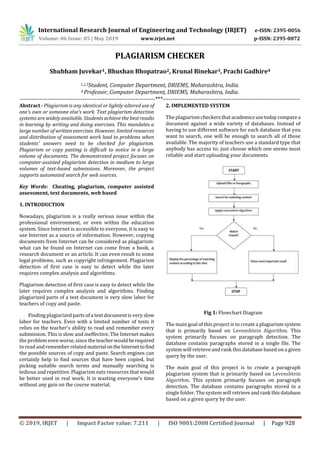
Fig 1: Flowchart Diagram
The main goal of this project is to create a plagiarism system
that is primarily based on Levenshtein Algorithm. This
system primarily focuses on paragraph detection. The
database contains paragraphs stored in a single file. The
system will retrieve and rank this database based on a given
query by the user.
The main goal of this project is to create a paragraph
plagiarism system that is primarily based on Levenshtein
Algorithm. This system primarily focuses on paragraph
detection. The database contains paragraphs stored in a
single folder. The system will retrieveandrank thisdatabase
based on a given query by the user.
International Research Journal of Engineering and Technology (IRJET) e-ISSN: 2395-0056
Volume: 06 Issue: 05 | May 2019 www.irjet.net p-ISSN: 2395-0072
© 2019, IRJET | Impact Factor value: 7.211 | ISO 9001:2008 Certified Journal | Page 929
Fig 2: Sequence Diagram
This project will describe how the software works without
going into details. Importing one single file for online
plagiarism check. Concerning this part, the user is able to
import paragraph to check for plagiarism.Then,theusercan
proceed to the configuration of the plagiarism detection
through the configurationwindow.Then,thefileanalysiscan
start and system will complete some steps.
Levenshtein distance Algorithm:
In information theory, linguistics and computer
science, the Levenshtein distance is a string metric for
measuring the difference between two sequences.
Informally, the Levenshtein distance between two words is
the minimum number of single-character edits (insertions,
deletions or substitutions) required tochangeonewordinto
the other. It is named after the Soviet
mathematician Vladimir Levenshtein, who considered this
distance in 1965.
Levenshtein distance may also be referred to as edit
distance, although that term may also denote a larger family
of distance metrics. It is closely related to pairwise string
alignments.
Mathematically, the Levenshtein distance between two
strings (of length and respectively) is given by where is
the indicator function equal to 0 when and equal to 1.
3. FEATURES OF THE APPLICATION
 Simple
 Efficient
 Reliable
 Reduces human effort
4. CONCLUSION
The experimental results shows that the proposedapproach
is capable to detect plagiarism in paragraph. . Line detection
algorithms such as levenshtein algorithm etc. are used for
this purpose which makes it more efficient from normal
checkers which made us to develop this software.
REFERENCES
[1] H. Maurer, et al., "Plagiarism-a survey," Journal of
Universal Computer Science, vol. 12, pp. 1050-1084, 2006.
[2] L. McKeever. Online plagiarism detection services-savior
or scourge. Assessment & Evaluation in Higher Edu 2006;
31(2): 155-165.
[3] B. G. Vasudevan, et al.Flowchartknowledgeextractionon
image processing. In proceedings of IEEE International Joint
Conference on Neural Networks, 2008; 4075-4082.
[4] K. S. Candan, M. L. Sapino. Data management for
multimedia retrieval. London Cambridge University Press
2010.
[5] Flowchart Plagiarism Detection System: An Image
Processing Approach Jithin S Kuruvila, Midhun Lal V L, Rejin
Roy,Tomin Baby, Sangeetha Jamal, Sherly K K* Rajagiri
School of Engineering and Technology, Kakkanad, Kochi
682039, India

IRJET- Plagiarism Checker

  • 1.
    International Research Journalof Engineering and Technology (IRJET) e-ISSN: 2395-0056 Volume: 06 Issue: 05 | May 2019 www.irjet.net p-ISSN: 2395-0072 © 2019, IRJET | Impact Factor value: 7.211 | ISO 9001:2008 Certified Journal | Page 928 PLAGIARISM CHECKER Shubham Juvekar1, Bhushan Bhopatrao2, Krunal Binekar3, Prachi Gadhire4 1,2,3Student, Computer Department, DRIEMS, Maharashtra, India. 4 Professor, Computer Department, DRIEMS, Maharashtra, India. ---------------------------------------------------------------------***---------------------------------------------------------------------- Abstract - Plagiarism is any identical or lightly-altered use of one's own or someone else’s work. Text plagiarism detection systems are widely available. Students achieve the bestresults in learning by writing and doing exercises. This mandates a large number of written exercises. However, limited resources and distribution of assessment work lead to problems when students' answers need to be checked for plagiarism. Plagiarism or copy pasting is difficult to notice in a large volume of documents. The demonstrated project focuses on computer-assisted plagiarism detection in medium to large volumes of text-based submissions. Moreover, the project supports automated search for web sources. Key Words: Cheating, plagiarism, computer assisted assessment, text documents, web based 1. INTRODUCTION Nowadays, plagiarism is a really serious issue within the professional environment, or even within the education system. Since Internet is accessible to everyone, it is easy to use Internet as a source of information. However, copying documents from Internet can be considered as plagiarism: what can be found on Internet can come from a book, a research document or an article. It can even result to some legal problems, such as copyright infringement. Plagiarism detection of first case is easy to detect while the later requires complex analysis and algorithms. Plagiarism detection of first case is easy to detect while the later requires complex analysis and algorithms. Finding plagiarized parts of a text document is very slow labor for teachers of copy and paste. Finding plagiarized parts of a text document is very slow labor for teachers. Even with a limited number of texts it relies on the teacher's ability to read and remember every submission. This is slow and ineffective. The Internet makes the problem even worse, since the teacherwouldberequired to read and remember relatedmaterialontheInternettofind the possible sources of copy and paste. Search engines can certainly help to find sources that have been copied, but picking suitable search terms and manually searching is tedious and repetitive. Plagiarism eats resources that would be better used in real work. It is wasting everyone's time without any gain on the course material. 2. IMPLEMENTED SYSTEM The plagiarism checkersthat academicsusetodaycomparea document against a wide variety of databases. Instead of having to use different software for each database that you want to search, one will be enough to search all of those available. The majority of teachers use a standard type that anybody has access to; just choose which one seems most reliable and start uploading your documents. Fig 1: Flowchart Diagram The main goal of this project is to create a plagiarism system that is primarily based on Levenshtein Algorithm. This system primarily focuses on paragraph detection. The database contains paragraphs stored in a single file. The system will retrieve and rank this database based on a given query by the user. The main goal of this project is to create a paragraph plagiarism system that is primarily based on Levenshtein Algorithm. This system primarily focuses on paragraph detection. The database contains paragraphs stored in a single folder. The system will retrieveandrank thisdatabase based on a given query by the user.
  • 2.
    International Research Journalof Engineering and Technology (IRJET) e-ISSN: 2395-0056 Volume: 06 Issue: 05 | May 2019 www.irjet.net p-ISSN: 2395-0072 © 2019, IRJET | Impact Factor value: 7.211 | ISO 9001:2008 Certified Journal | Page 929 Fig 2: Sequence Diagram This project will describe how the software works without going into details. Importing one single file for online plagiarism check. Concerning this part, the user is able to import paragraph to check for plagiarism.Then,theusercan proceed to the configuration of the plagiarism detection through the configurationwindow.Then,thefileanalysiscan start and system will complete some steps. Levenshtein distance Algorithm: In information theory, linguistics and computer science, the Levenshtein distance is a string metric for measuring the difference between two sequences. Informally, the Levenshtein distance between two words is the minimum number of single-character edits (insertions, deletions or substitutions) required tochangeonewordinto the other. It is named after the Soviet mathematician Vladimir Levenshtein, who considered this distance in 1965. Levenshtein distance may also be referred to as edit distance, although that term may also denote a larger family of distance metrics. It is closely related to pairwise string alignments. Mathematically, the Levenshtein distance between two strings (of length and respectively) is given by where is the indicator function equal to 0 when and equal to 1. 3. FEATURES OF THE APPLICATION  Simple  Efficient  Reliable  Reduces human effort 4. CONCLUSION The experimental results shows that the proposedapproach is capable to detect plagiarism in paragraph. . Line detection algorithms such as levenshtein algorithm etc. are used for this purpose which makes it more efficient from normal checkers which made us to develop this software. REFERENCES [1] H. Maurer, et al., "Plagiarism-a survey," Journal of Universal Computer Science, vol. 12, pp. 1050-1084, 2006. [2] L. McKeever. Online plagiarism detection services-savior or scourge. Assessment & Evaluation in Higher Edu 2006; 31(2): 155-165. [3] B. G. Vasudevan, et al.Flowchartknowledgeextractionon image processing. In proceedings of IEEE International Joint Conference on Neural Networks, 2008; 4075-4082. [4] K. S. Candan, M. L. Sapino. Data management for multimedia retrieval. London Cambridge University Press 2010. [5] Flowchart Plagiarism Detection System: An Image Processing Approach Jithin S Kuruvila, Midhun Lal V L, Rejin Roy,Tomin Baby, Sangeetha Jamal, Sherly K K* Rajagiri School of Engineering and Technology, Kakkanad, Kochi 682039, India