Audit Approach & Audit procedures of
Revenue, Accounts Receivable & other issues
• Mohammad Gias Uddin ACA [enrolment number: 2100]
• E-mail: gias@icab.org.bd
Key audit procedures…..
Significant Accounts
Based on the ICAB dummy Work Paper [link: : https://www.icab.org.bd/page/audit-program-and-
test-of-details-(tod)]
Planning Analytics related to sales
ISA Reference Guidelines Works performed
[ISA 240.22]
We shall evaluate whether unusual or unexpected
relationships that have been identified in performing planning
analytical procedures, including those related to revenue
accounts, may indicate fraud risks.
We have performed inquiries with respective departments of the entity
to identify unusual or unexpected transactions. In addition, we have
provided special attention in relation to fraud risk and inquired about
it.
When performing planning analytical procedures we generally
use trend analysis, ratio analysis, or a combination thereof.
We may also use data analysis and predictive analysis, if
considered necessary.
We have used trend analysis and predictive analysis to perform
planning analytical procedures.
Trend & ratio analysis related to sales….
Revenue process understanding & related
control test.
Revenue policy, process & contract evaluation [IFRS step-1]
Source documents related to control [3 way/ 5 way match]
Segregation of duties
Evaluation as per IFRS 15
Revenue segmenting & substantive analytical procedures
Sampling
Planning substantive procedures of revenue
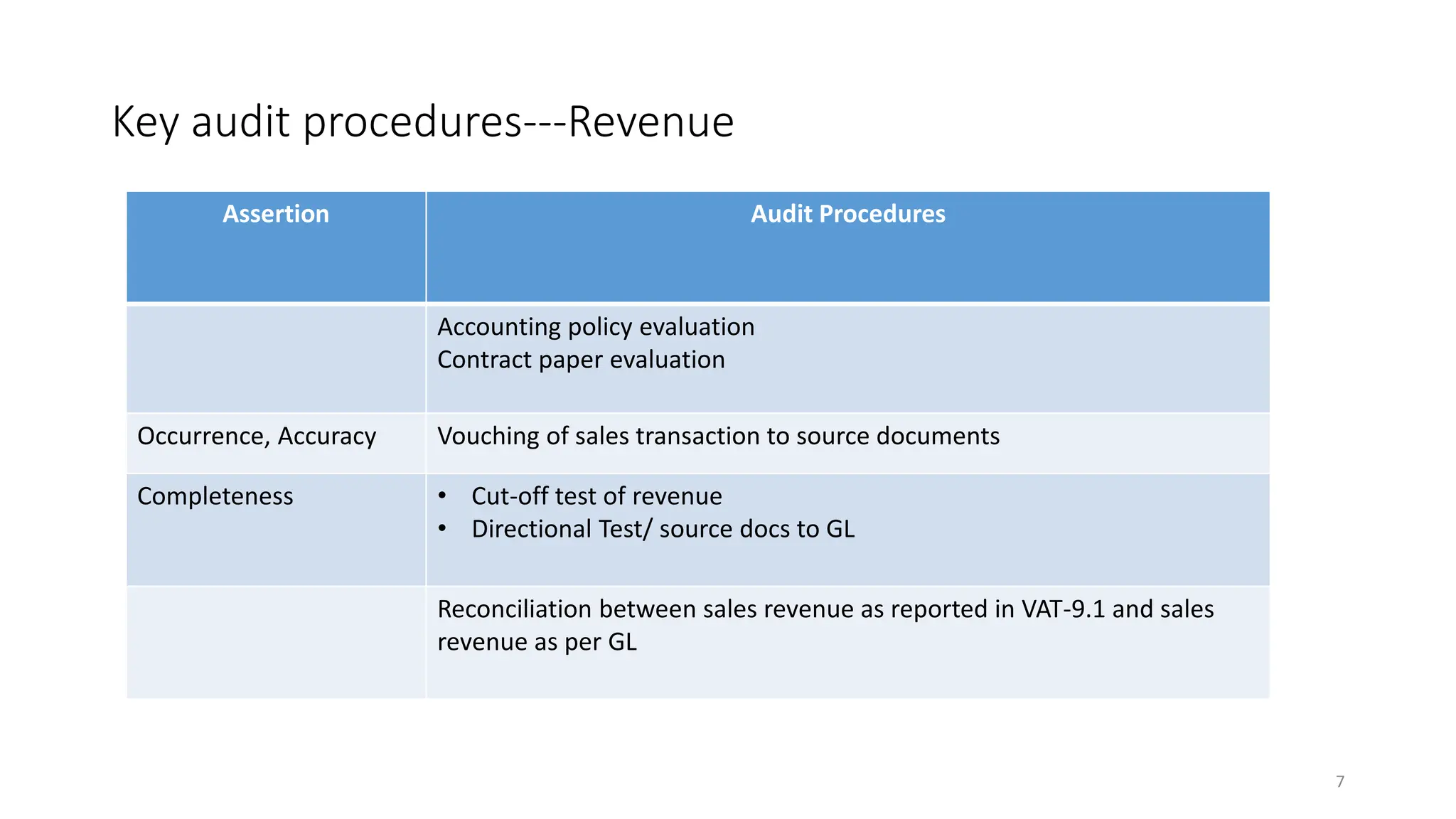
Key audit procedures---Revenue
Assertion Audit Procedures
Accounting policy evaluation
Contract paper evaluation
Occurrence, Accuracy Vouching of sales transaction to source documents
Completeness • Cut-off test of revenue
• Directional Test/ source docs to GL
Reconciliation between sales revenue as reported in VAT-9.1 and sales
revenue as per GL
7
Revenue [IFRS 15 focused]
S1: Identify the contract with customers
• An agreement between two or more parties that creates enforceable
rights and obligations.” A contract can be written, oral, or implied by
an entity’s customary business practices.
• In addition, the general IFRS 15 model applies only when or if:
• Example: the probability of collecting consideration may impact on
transaction price [i.e., 30% price concession bad history customer will
be evaluated with 70% receivable & revenue.
The contract has
commercial
substance
Approved by
parties
Identifiable rights &
payment terms
It is probable that
entity will collect
consideration
If a customer contract does not meet these criteria,
revenue is recognized only when either:
• The entity’s performance is complete and substantially all of the
consideration in the arrangement has been collected and is non-
refundable
• The contract has been terminated and the consideration received is
non-refundable.
Combining Contract…..example-machinery
with support service
Audit Focus area in step-1
• a. evaluate accounting policy, understand the revenue process [test]
• b. Obtain contract with customers
• c. Inspect contract to confirm legal bindings & effectiveness in audit
year
• d. For implied contracts, clarify contractual terms to establish R&O in
each case.
• e. If there is no apparent contract, evaluate the practices. Also consider
other issues
S2: Identify separate performance obligation
(PO)
• A performance obligation is a promise in a contract with a customer
to transfer either-----
• (1) a good or service, or a bundle of goods or services, that is
‘distinct’; or
• (2) a series of distinct goods or services that are substantially the
same and meet certain criteria.
A promised good or service is ‘distinct’ if both of
the following criteria are met: [example-purifier & technical service,
software installation & ASS]
Audit Focus area in step-2
• a. Confirm the goods or services to be transferred, either individually or as
part of a series, by reference to the contracts in place;
• b. Identify distinct goods/ services based on saleability & distinct function;
[If goods/ services are not distinct, management must combine them with
other promised goods or services until a bundle of goods or services that is
distinct can be identified]
[keep in mind that, failure to identify the ‘distinct’ character of the contract
can lead to incorrect revenue recognition. Example: system installation &
support service]
S3: Determine the transaction price (TP)
• Under IFRS 15, the “transaction price” is defined as the amount of
consideration an entity expects to be entitled to in exchange for the
goods or services promised under a contract, excluding any amounts
collected on behalf of third parties.
• An entity must consider the effects of all the following factors when
determining the transaction price:
variable consideration & any constraint on it
Time value of money
Non-cash consideration [FV]
The consideration payable to customers
Variable consideration & its constraints
• The amount of consideration received under a contract might vary due to discounts, rebates, refunds,
credits, price concessions, incentives, performance bonuses, penalties and similar items. IFRS 15’s guidance
on variable consideration also applies if:
• The amount of consideration received under a contract is contingent on the occurrence or non-occurrence
of a future event (eg a fixed-price contract would be variable if the contract included a return right) & the
facts and circumstances at contract inception indicate that the entity intends to offer a price concession.
• To estimate TP with variable consideration an entity determines either: 1. the expected value (the sum of
probability-weighted amounts) or 2. the most likely amount of consideration to be received. [example:
Delivery terms modify in the sale of machine e.g., before or after a period, commission criteria]
• The expected value might be the appropriate amount in situations where an entity has a large number of
similar contracts. The most likely amount might be appropriate in situations where a contract has only two
possible outcomes (for example, a bonus for early delivery that either would be fully received or not at all).
• Example: customer with 30%-40% price concession issue (most likely), single alternative based delivery
(expected value)
Time value of money & non-cash consideration
• Under IFRS 15, an entity must reflect the time value of money in its
estimate of the transaction price if the contract includes a significant
financing component.
• For non-cash consideration: an entity measures the non-cash
consideration at fair value in determining the transaction price. If If an
entity is unable to reasonably measure the fair value of non-cash
consideration, it indirectly measures the consideration by referring to
the stand-alone selling price of the goods or services promised under
the contract
Difference between promised consideration &
cash price
The combined effect of: expected length of time
between goods delivery & receipt of service &
market interest rate
The consideration payable to a customer
Audit Focus area in step-3
• Identify the amount of consideration by reference to the contracts;
• Separate fixed & variable elements & recalculate variable amount as
per contract;
• Test the hypothesis that variable consideration is highly probable by
reviewing the reasonableness of the underlying assumption used in
the entity’s calculation.
S4: Allocate the TP to PO
• Under IFRS 15, an entity allocates a contract’s transaction price to each separate
performance obligation within that contract on a relative stand-alone selling price basis
at contract inception. IFRS 15 defines a stand-alone selling price as “the price at which an
entity would sell a promised good or service separately to a customer.” The best
evidence of the stand-alone selling price is the observable selling price charged by the
entity to similar customers and in similar circumstances, if available. If not, the stand-
alone selling price is estimated using all reasonably available information (including
market conditions, entity-specific factors, and information about the customer or class of
customer), maximizing the use of observable inputs.
• Example: selling machinery to Customer-A with maintenance service for 2 years
amounting to 12 lac [FV 11+3 lac]. Other customers get such service for 2.5 lac.
• Possible methods to estimate the stand-alone selling price:
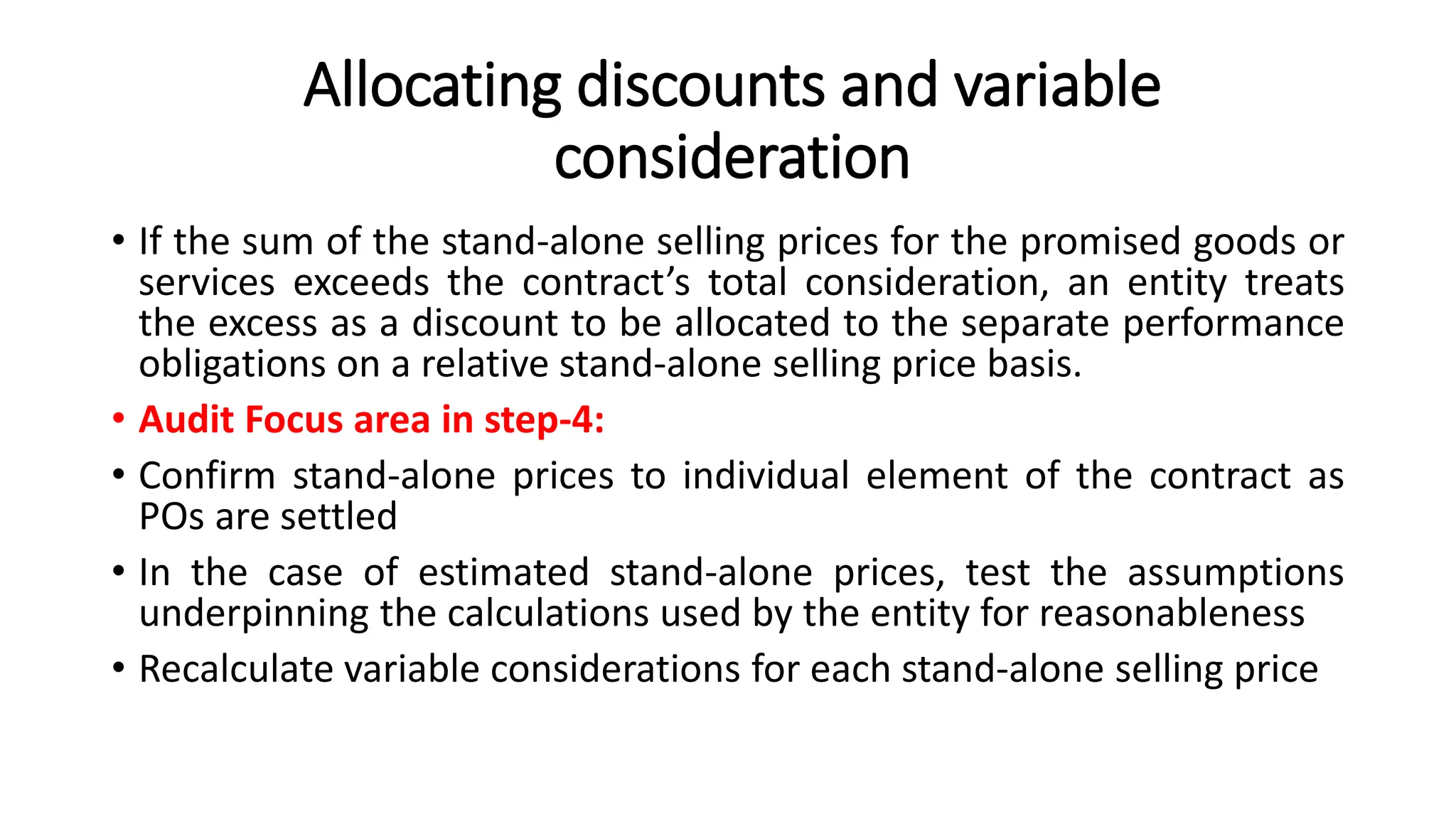
Allocating discounts and variable
consideration
• If the sum of the stand-alone selling prices for the promised goods or
services exceeds the contract’s total consideration, an entity treats
the excess as a discount to be allocated to the separate performance
obligations on a relative stand-alone selling price basis.
• Audit Focus area in step-4:
• Confirm stand-alone prices to individual element of the contract as
POs are settled
• In the case of estimated stand-alone prices, test the assumptions
underpinning the calculations used by the entity for reasonableness
• Recalculate variable considerations for each stand-alone selling price
S5: Recognize revenue as or when each PO is
satisfied
• Under IFRS 15, an entity recognizes revenue when or as it transfers
promised goods or services to a customer. A “transfer” occurs when
the customer obtains control of the good or service.
Audit Focus area in step-5
• For PO satisfied at a point in time, confirm the occurrence based on supporting docs; (vouching
of sales docs)
• For PO satisfied over time:
• a. Identify relevant method of measuring progress by inquiring management & inspecting related
documents: Output Method [measuring value to the customer of goods or services transferred to
date] or Input Method [measuring cost to the entity of goods or services transferred to date]
• b. confirm agreed contract price between customer & auditee
• c. determine conditional revenue/ cost (if any)
• d. confirm the progress to date of the work completed
• Input method: Confirm the total costs estimated for contracts to ensure no planned overspends
have been identified (budget docs, board minutes, mgt accounts can be inspected)
• Output method: Confirm the amounts of contract work certified as complete (Output) at the year
end by reference to relevant documentation (like surveyor’s report or client estimate)
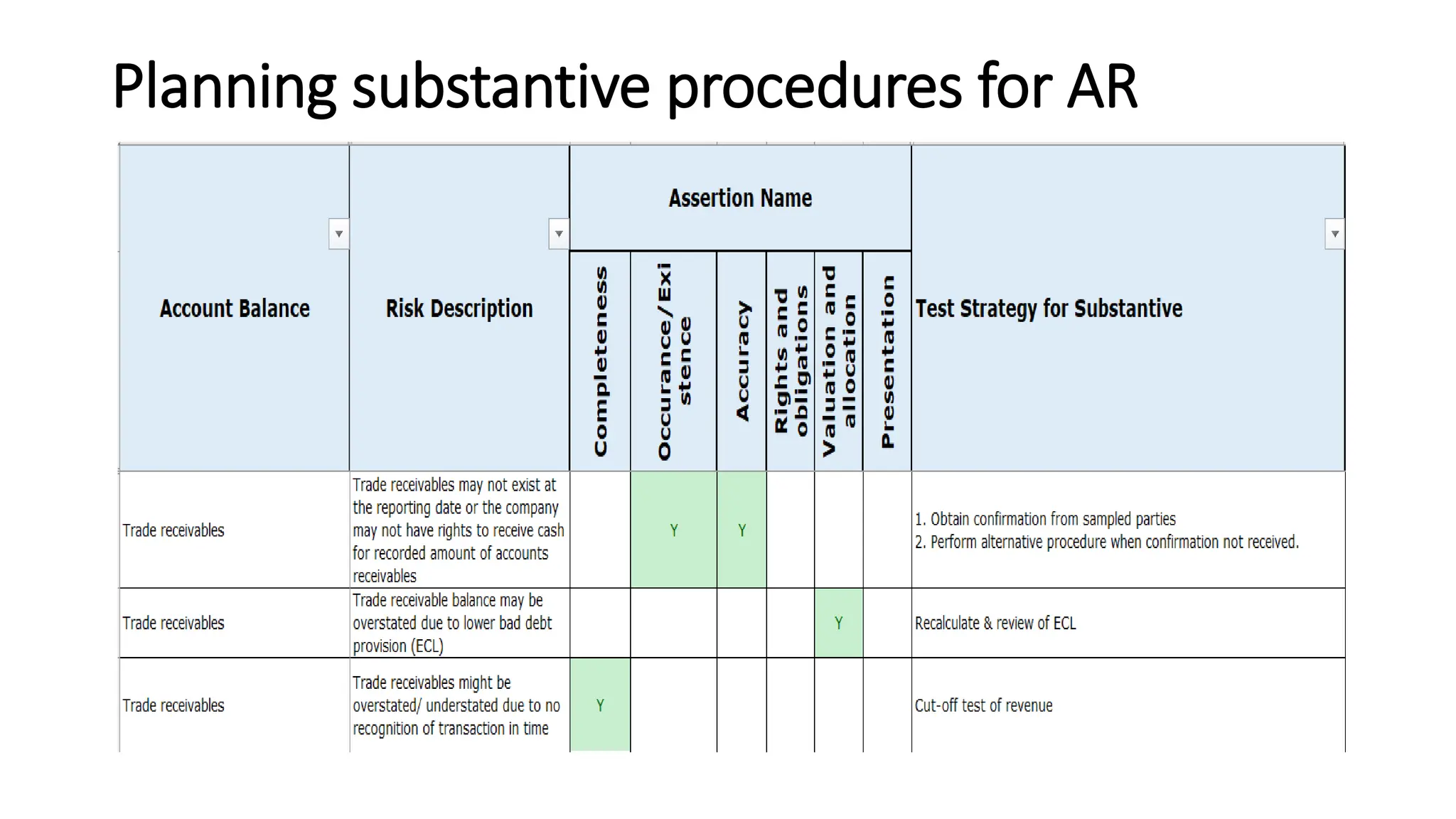
Planning substantive procedures for AR
Key audit procedures---Trade receivables
Assertion Audit Procedures
General Opening balance confirmation, Lead schedule and GL-TB reconciliation
Existence & Accuracy • Balance confirmation from receivables
• Alternative procedures: Invoice checking and subsequent positions check
Valuation Checking the adequacy requirement of provision against receivable (bad debt
provision)
Completeness Cut-off test
30
Trade receivable-balance confirmation
• Obtain TR party schedule along with sub-ledger and match with referenced TB & FS.
• Select sample receivable party based on MUS sampling.
• Prepare confirmation and ensure signed by the appropriate authority
• Circulate confirmation to the respective parties through email or courier and take a receive copy or
reply e-mail from customers.
• Obtain confirmation and match with sub-ledger/party balances.
• Where confirmation has not been received from customers, perform an alternative procedure.
• Always maintain a control sheet:
Any queries

Revenue accounting & audit - Shared.pptx

  • 1.
    Audit Approach &Audit procedures of Revenue, Accounts Receivable & other issues • Mohammad Gias Uddin ACA [enrolment number: 2100] • E-mail: gias@icab.org.bd
  • 2.
    Key audit procedures….. SignificantAccounts Based on the ICAB dummy Work Paper [link: : https://www.icab.org.bd/page/audit-program-and- test-of-details-(tod)]
  • 3.
    Planning Analytics relatedto sales ISA Reference Guidelines Works performed [ISA 240.22] We shall evaluate whether unusual or unexpected relationships that have been identified in performing planning analytical procedures, including those related to revenue accounts, may indicate fraud risks. We have performed inquiries with respective departments of the entity to identify unusual or unexpected transactions. In addition, we have provided special attention in relation to fraud risk and inquired about it. When performing planning analytical procedures we generally use trend analysis, ratio analysis, or a combination thereof. We may also use data analysis and predictive analysis, if considered necessary. We have used trend analysis and predictive analysis to perform planning analytical procedures.
  • 4.
    Trend & ratioanalysis related to sales….
  • 5.
    Revenue process understanding& related control test. Revenue policy, process & contract evaluation [IFRS step-1] Source documents related to control [3 way/ 5 way match] Segregation of duties Evaluation as per IFRS 15 Revenue segmenting & substantive analytical procedures Sampling
  • 6.
  • 7.
    Key audit procedures---Revenue AssertionAudit Procedures Accounting policy evaluation Contract paper evaluation Occurrence, Accuracy Vouching of sales transaction to source documents Completeness • Cut-off test of revenue • Directional Test/ source docs to GL Reconciliation between sales revenue as reported in VAT-9.1 and sales revenue as per GL 7
  • 8.
  • 9.
    S1: Identify thecontract with customers • An agreement between two or more parties that creates enforceable rights and obligations.” A contract can be written, oral, or implied by an entity’s customary business practices. • In addition, the general IFRS 15 model applies only when or if: • Example: the probability of collecting consideration may impact on transaction price [i.e., 30% price concession bad history customer will be evaluated with 70% receivable & revenue. The contract has commercial substance Approved by parties Identifiable rights & payment terms It is probable that entity will collect consideration
  • 10.
    If a customercontract does not meet these criteria, revenue is recognized only when either: • The entity’s performance is complete and substantially all of the consideration in the arrangement has been collected and is non- refundable • The contract has been terminated and the consideration received is non-refundable.
  • 11.
  • 12.
    Audit Focus areain step-1 • a. evaluate accounting policy, understand the revenue process [test] • b. Obtain contract with customers • c. Inspect contract to confirm legal bindings & effectiveness in audit year • d. For implied contracts, clarify contractual terms to establish R&O in each case. • e. If there is no apparent contract, evaluate the practices. Also consider other issues
  • 13.
    S2: Identify separateperformance obligation (PO) • A performance obligation is a promise in a contract with a customer to transfer either----- • (1) a good or service, or a bundle of goods or services, that is ‘distinct’; or • (2) a series of distinct goods or services that are substantially the same and meet certain criteria.
  • 14.
    A promised goodor service is ‘distinct’ if both of the following criteria are met: [example-purifier & technical service, software installation & ASS]
  • 15.
    Audit Focus areain step-2 • a. Confirm the goods or services to be transferred, either individually or as part of a series, by reference to the contracts in place; • b. Identify distinct goods/ services based on saleability & distinct function; [If goods/ services are not distinct, management must combine them with other promised goods or services until a bundle of goods or services that is distinct can be identified] [keep in mind that, failure to identify the ‘distinct’ character of the contract can lead to incorrect revenue recognition. Example: system installation & support service]
  • 16.
    S3: Determine thetransaction price (TP) • Under IFRS 15, the “transaction price” is defined as the amount of consideration an entity expects to be entitled to in exchange for the goods or services promised under a contract, excluding any amounts collected on behalf of third parties. • An entity must consider the effects of all the following factors when determining the transaction price: variable consideration & any constraint on it Time value of money Non-cash consideration [FV] The consideration payable to customers
  • 17.
    Variable consideration &its constraints • The amount of consideration received under a contract might vary due to discounts, rebates, refunds, credits, price concessions, incentives, performance bonuses, penalties and similar items. IFRS 15’s guidance on variable consideration also applies if: • The amount of consideration received under a contract is contingent on the occurrence or non-occurrence of a future event (eg a fixed-price contract would be variable if the contract included a return right) & the facts and circumstances at contract inception indicate that the entity intends to offer a price concession. • To estimate TP with variable consideration an entity determines either: 1. the expected value (the sum of probability-weighted amounts) or 2. the most likely amount of consideration to be received. [example: Delivery terms modify in the sale of machine e.g., before or after a period, commission criteria] • The expected value might be the appropriate amount in situations where an entity has a large number of similar contracts. The most likely amount might be appropriate in situations where a contract has only two possible outcomes (for example, a bonus for early delivery that either would be fully received or not at all). • Example: customer with 30%-40% price concession issue (most likely), single alternative based delivery (expected value)
  • 18.
    Time value ofmoney & non-cash consideration • Under IFRS 15, an entity must reflect the time value of money in its estimate of the transaction price if the contract includes a significant financing component. • For non-cash consideration: an entity measures the non-cash consideration at fair value in determining the transaction price. If If an entity is unable to reasonably measure the fair value of non-cash consideration, it indirectly measures the consideration by referring to the stand-alone selling price of the goods or services promised under the contract Difference between promised consideration & cash price The combined effect of: expected length of time between goods delivery & receipt of service & market interest rate
  • 19.
  • 20.
    Audit Focus areain step-3 • Identify the amount of consideration by reference to the contracts; • Separate fixed & variable elements & recalculate variable amount as per contract; • Test the hypothesis that variable consideration is highly probable by reviewing the reasonableness of the underlying assumption used in the entity’s calculation.
  • 21.
    S4: Allocate theTP to PO • Under IFRS 15, an entity allocates a contract’s transaction price to each separate performance obligation within that contract on a relative stand-alone selling price basis at contract inception. IFRS 15 defines a stand-alone selling price as “the price at which an entity would sell a promised good or service separately to a customer.” The best evidence of the stand-alone selling price is the observable selling price charged by the entity to similar customers and in similar circumstances, if available. If not, the stand- alone selling price is estimated using all reasonably available information (including market conditions, entity-specific factors, and information about the customer or class of customer), maximizing the use of observable inputs. • Example: selling machinery to Customer-A with maintenance service for 2 years amounting to 12 lac [FV 11+3 lac]. Other customers get such service for 2.5 lac. • Possible methods to estimate the stand-alone selling price:
  • 22.
    Allocating discounts andvariable consideration • If the sum of the stand-alone selling prices for the promised goods or services exceeds the contract’s total consideration, an entity treats the excess as a discount to be allocated to the separate performance obligations on a relative stand-alone selling price basis. • Audit Focus area in step-4: • Confirm stand-alone prices to individual element of the contract as POs are settled • In the case of estimated stand-alone prices, test the assumptions underpinning the calculations used by the entity for reasonableness • Recalculate variable considerations for each stand-alone selling price
  • 23.
    S5: Recognize revenueas or when each PO is satisfied • Under IFRS 15, an entity recognizes revenue when or as it transfers promised goods or services to a customer. A “transfer” occurs when the customer obtains control of the good or service.
  • 26.
    Audit Focus areain step-5 • For PO satisfied at a point in time, confirm the occurrence based on supporting docs; (vouching of sales docs) • For PO satisfied over time: • a. Identify relevant method of measuring progress by inquiring management & inspecting related documents: Output Method [measuring value to the customer of goods or services transferred to date] or Input Method [measuring cost to the entity of goods or services transferred to date] • b. confirm agreed contract price between customer & auditee • c. determine conditional revenue/ cost (if any) • d. confirm the progress to date of the work completed • Input method: Confirm the total costs estimated for contracts to ensure no planned overspends have been identified (budget docs, board minutes, mgt accounts can be inspected) • Output method: Confirm the amounts of contract work certified as complete (Output) at the year end by reference to relevant documentation (like surveyor’s report or client estimate)
  • 29.
  • 30.
    Key audit procedures---Tradereceivables Assertion Audit Procedures General Opening balance confirmation, Lead schedule and GL-TB reconciliation Existence & Accuracy • Balance confirmation from receivables • Alternative procedures: Invoice checking and subsequent positions check Valuation Checking the adequacy requirement of provision against receivable (bad debt provision) Completeness Cut-off test 30
  • 31.
    Trade receivable-balance confirmation •Obtain TR party schedule along with sub-ledger and match with referenced TB & FS. • Select sample receivable party based on MUS sampling. • Prepare confirmation and ensure signed by the appropriate authority • Circulate confirmation to the respective parties through email or courier and take a receive copy or reply e-mail from customers. • Obtain confirmation and match with sub-ledger/party balances. • Where confirmation has not been received from customers, perform an alternative procedure. • Always maintain a control sheet:
  • 33.