IFRS 15 Revenue from
contracts with
customers
Vietnam
October 2024
AASB
Official
Official
2
Purpose of this session
➢IASB Webcast
➢High-level overview of IFRS 15
➢Australian perspectives
3
IASB Webcast
IFRS 15 for investors
IFRS 15 overview
Official
Official
4
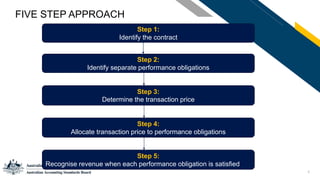
FIVE STEP APPROACH
Step 1:
Identify the contract
Step 2:
Identify separate performance obligations
Step 3:
Determine the transaction price
Step 4:
Allocate transaction price to performance obligations
Step 5:
Recognise revenue when each performance obligation is satisfied
5
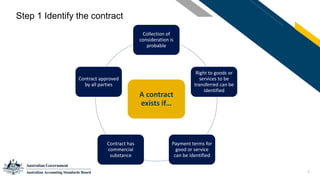
Step 1 Identify the contract
Collection of
consideration is
probable
Right to goods or
services to be
transferred can be
identified
Payment terms for
good or service
can be identified
Contract has
commercial
substance
Contract approved
by all parties
A contract
exists if…
6
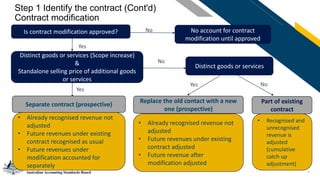
Step 1 Identify the contract (Cont'd)
Contract modification
Is contract modification approved? No account for contract
modification until approved
No
Distinct goods or services (Scope increase)
&
Standalone selling price of additional goods
or services
Yes
Yes
Separate contract (prospective)
No
Distinct goods or services
Replace the old contact with a new
one (prospective)
Part of existing
contract
No
Yes
• Already recognised revenue not
adjusted
• Future revenues under existing
contract recognised as usual
• Future revenues under
modification accounted for
separately
• Recognised and
unrecognised
revenue is
adjusted
(cumulative
catch up
adjustment)
• Already recognised revenue not
adjusted
• Future revenues under existing
contract adjusted
• Future revenue after
modification adjusted
7
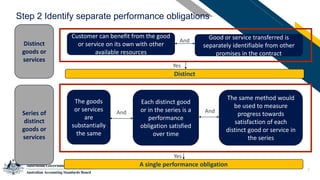
Step 2 Identify separate performance obligations
Customer can benefit from the good
or service on its own with other
available resources
Good or service transferred is
separately identifiable from other
promises in the contract
And
Distinct
Yes
Distinct
goods or
services
Series of
distinct
goods or
services
The goods
or services
are
substantially
the same
The same method would
be used to measure
progress towards
satisfaction of each
distinct good or service in
the series
And
A single performance obligation
Yes
And
Each distinct good
or in the series is a
performance
obligation satisfied
over time
8
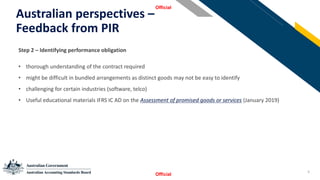
Australian perspectives –
Feedback from PIR
Official
Official
StSSt
Step 2 – Identifying performance obligation
• thorough understanding of the contract required
• might be difficult in bundled arrangements as distinct goods may not be easy to identify
• challenging for certain industries (software, telco)
• Useful educational materials IFRS IC AD on the Assessment of promised goods or services (January 2019)
9
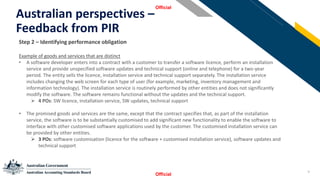
Australian perspectives –
Feedback from PIR
Official
Official
StSSt
Step 2 – Identifying performance obligation
Example of goods and services that are distinct
• A software developer enters into a contract with a customer to transfer a software licence, perform an installation
service and provide unspecified software updates and technical support (online and telephone) for a two-year
period. The entity sells the licence, installation service and technical support separately. The installation service
includes changing the web screen for each type of user (for example, marketing, inventory management and
information technology). The installation service is routinely performed by other entities and does not significantly
modify the software. The software remains functional without the updates and the technical support.
➢ 4 POs: SW licence, installation service, SW updates, technical support
• The promised goods and services are the same, except that the contract specifies that, as part of the installation
service, the software is to be substantially customised to add significant new functionality to enable the software to
interface with other customised software applications used by the customer. The customised installation service can
be provided by other entities.
➢ 3 POs: software customisation (licence for the software + customised installation service), software updates and
technical support
10
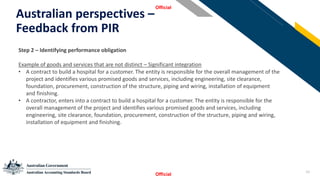
Australian perspectives –
Feedback from PIR
Official
Official
StSSt
Step 2 – Identifying performance obligation
Example of goods and services that are not distinct – Significant integration
• A contract to build a hospital for a customer. The entity is responsible for the overall management of the
project and identifies various promised goods and services, including engineering, site clearance,
foundation, procurement, construction of the structure, piping and wiring, installation of equipment
and finishing.
• A contractor, enters into a contract to build a hospital for a customer. The entity is responsible for the
overall management of the project and identifies various promised goods and services, including
engineering, site clearance, foundation, procurement, construction of the structure, piping and wiring,
installation of equipment and finishing.
11
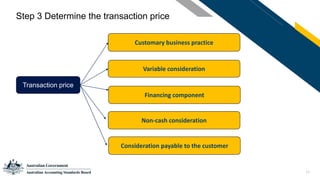
Step 3 Determine the transaction price
Transaction price
Customary business practice
Variable consideration
Financing component
Non-cash consideration
Consideration payable to the customer
12
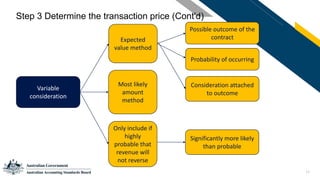
Step 3 Determine the transaction price (Cont'd)
Variable
consideration
Expected
value method
Only include if
highly
probable that
revenue will
not reverse
Most likely
amount
method
Possible outcome of the
contract
Consideration attached
to outcome
Probability of occurring
Significantly more likely
than probable
13
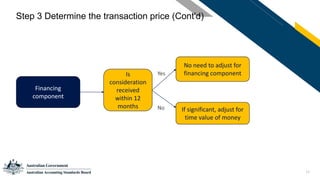
Step 3 Determine the transaction price (Cont'd)
Financing
component
Is
consideration
received
within 12
months
No need to adjust for
financing component
If significant, adjust for
time value of money
Yes
No
14
Australian perspectives –
Feedback from PIR
Official
Official
StSSt
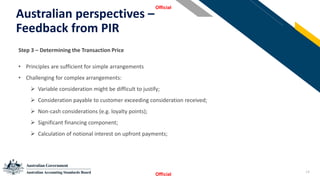
Step 3 – Determining the Transaction Price
• Principles are sufficient for simple arrangements
• Challenging for complex arrangements:
➢ Variable consideration might be difficult to justify;
➢ Consideration payable to customer exceeding consideration received;
➢ Non-cash considerations (e.g. loyalty points);
➢ Significant financing component;
➢ Calculation of notional interest on upfront payments;
15
Australian perspectives –
Feedback from PIR
Official
Official
StSSt
Step 3 – Determining the Transaction Price
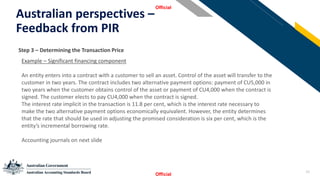
Example – Significant financing component
An entity enters into a contract with a customer to sell an asset. Control of the asset will transfer to the
customer in two years. The contract includes two alternative payment options: payment of CU5,000 in
two years when the customer obtains control of the asset or payment of CU4,000 when the contract is
signed. The customer elects to pay CU4,000 when the contract is signed.
The interest rate implicit in the transaction is 11.8 per cent, which is the interest rate necessary to
make the two alternative payment options economically equivalent. However, the entity determines
that the rate that should be used in adjusting the promised consideration is six per cent, which is the
entity’s incremental borrowing rate.
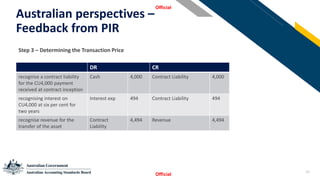
Accounting journals on next slide
16
Australian perspectives –
Feedback from PIR
Official
Official
StSSt
Step 3 – Determining the Transaction Price
DR CR
recognise a contract liability
for the CU4,000 payment
received at contract inception
Cash 4,000 Contract Liability 4,000
recognising interest on
CU4,000 at six per cent for
two years
Interest exp 494 Contract Liability 494
recognise revenue for the
transfer of the asset
Contract
Liability
4,494 Revenue 4,494
17
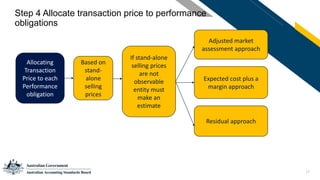
Step 4 Allocate transaction price to performance
obligations
If stand-alone
selling prices
are not
observable
entity must
make an
estimate
Adjusted market
assessment approach
Residual approach
Allocating
Transaction
Price to each
Performance
obligation
Based on
stand-
alone
selling
prices
Expected cost plus a
margin approach
18
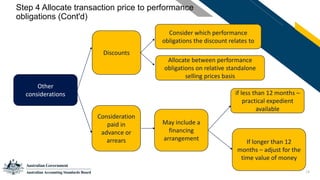
Step 4 Allocate transaction price to performance
obligations (Cont'd)
May include a
financing
arrangement
if less than 12 months –
practical expedient
available
If longer than 12
months – adjust for the
time value of money
Other
considerations
Consideration
paid in
advance or
arrears
Discounts
Consider which performance
obligations the discount relates to
Allocate between performance
obligations on relative standalone
selling prices basis
19
Australian perspectives –
Feedback from PIR
Official
Official
StSSt
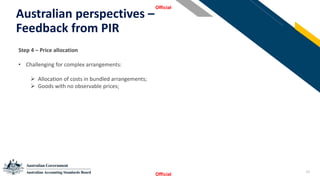
Step 4 – Price allocation
• Challenging for complex arrangements:
➢ Allocation of costs in bundled arrangements;
➢ Goods with no observable prices;
20
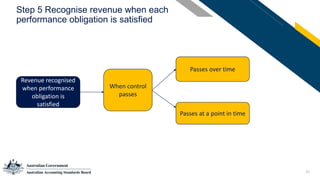
Step 5 Recognise revenue when each
performance obligation is satisfied
Revenue recognised
when performance
obligation is
satisfied
When control
passes
Passes over time
Passes at a point in time
21
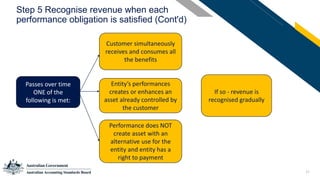
Step 5 Recognise revenue when each
performance obligation is satisfied (Cont'd)
Passes over time
ONE of the
following is met:
If so - revenue is
recognised gradually
Customer simultaneously
receives and consumes all
the benefits
Entity’s performances
creates or enhances an
asset already controlled by
the customer
Performance does NOT
create asset with an
alternative use for the
entity and entity has a
right to payment
22
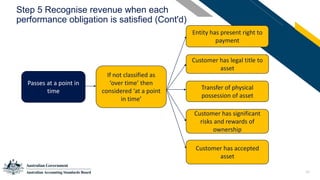
Step 5 Recognise revenue when each
performance obligation is satisfied (Cont'd)
Passes at a point in
time
If not classified as
‘over time’ then
considered ‘at a point
in time’
Entity has present right to
payment
Transfer of physical
possession of asset
Customer has accepted
asset
Customer has legal title to
asset
Customer has significant
risks and rewards of
ownership
23
Australian perspectives –
Feedback from PIR
Official
Official
StSSt
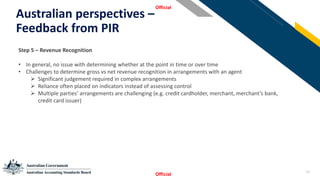
Step 5 – Revenue Recognition
• In general, no issue with determining whether at the point in time or over time
• Challenges to determine gross vs net revenue recognition in arrangements with an agent
➢ Significant judgement required in complex arrangements
➢ Reliance often placed on indicators instead of assessing control
➢ Multiple parties’ arrangements are challenging (e.g. credit cardholder, merchant, merchant’s bank,
credit card issuer)
24
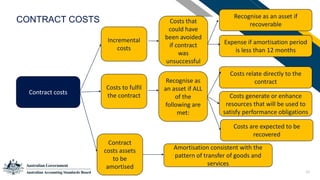
CONTRACT COSTS Recognise as an asset if
recoverable
Contract costs
Costs that
could have
been avoided
if contract
was
unsuccessful
Costs to fulfil
the contract
Contract
costs assets
to be
amortised
Amortisation consistent with the
pattern of transfer of goods and
services
Expense if amortisation period
is less than 12 months
Incremental
costs
Costs relate directly to the
contract
Recognise as
an asset if ALL
of the
following are
met:
Costs generate or enhance
resources that will be used to
satisfy performance obligations
Costs are expected to be
recovered
Thank You.
AASB
Image result for yellow linkedin icons
Image result for twitter icon
Disclaimer This presentation provides personal views of the presenter and does not necessarily represent the views of the AASB or other AASB staff. Its contents are for
general information only and do not constitute advice. The AASB expressly disclaims all liability for any loss or damages arising from reliance upon any information in this
presentation. This presentation is not to be reproduced, distributed or referred to in a public document without the express prior approval of AASB staff.
OFFICIAL
OFFICIAL
Helena Simkova
hsimkova@aasb.gov.au
aasb.gov.au

Contract Modifications: Revenue Recognition Guidelines

  • 1.
    IFRS 15 Revenuefrom contracts with customers Vietnam October 2024 AASB Official Official
  • 2.
    2 Purpose of thissession ➢IASB Webcast ➢High-level overview of IFRS 15 ➢Australian perspectives
  • 3.
    3 IASB Webcast IFRS 15for investors IFRS 15 overview Official Official
  • 4.
    4 FIVE STEP APPROACH Step1: Identify the contract Step 2: Identify separate performance obligations Step 3: Determine the transaction price Step 4: Allocate transaction price to performance obligations Step 5: Recognise revenue when each performance obligation is satisfied
  • 5.
    5 Step 1 Identifythe contract Collection of consideration is probable Right to goods or services to be transferred can be identified Payment terms for good or service can be identified Contract has commercial substance Contract approved by all parties A contract exists if…
  • 6.
    6 Step 1 Identifythe contract (Cont'd) Contract modification Is contract modification approved? No account for contract modification until approved No Distinct goods or services (Scope increase) & Standalone selling price of additional goods or services Yes Yes Separate contract (prospective) No Distinct goods or services Replace the old contact with a new one (prospective) Part of existing contract No Yes • Already recognised revenue not adjusted • Future revenues under existing contract recognised as usual • Future revenues under modification accounted for separately • Recognised and unrecognised revenue is adjusted (cumulative catch up adjustment) • Already recognised revenue not adjusted • Future revenues under existing contract adjusted • Future revenue after modification adjusted
  • 7.
    7 Step 2 Identifyseparate performance obligations Customer can benefit from the good or service on its own with other available resources Good or service transferred is separately identifiable from other promises in the contract And Distinct Yes Distinct goods or services Series of distinct goods or services The goods or services are substantially the same The same method would be used to measure progress towards satisfaction of each distinct good or service in the series And A single performance obligation Yes And Each distinct good or in the series is a performance obligation satisfied over time
  • 8.
    8 Australian perspectives – Feedbackfrom PIR Official Official StSSt Step 2 – Identifying performance obligation • thorough understanding of the contract required • might be difficult in bundled arrangements as distinct goods may not be easy to identify • challenging for certain industries (software, telco) • Useful educational materials IFRS IC AD on the Assessment of promised goods or services (January 2019)
  • 9.
    9 Australian perspectives – Feedbackfrom PIR Official Official StSSt Step 2 – Identifying performance obligation Example of goods and services that are distinct • A software developer enters into a contract with a customer to transfer a software licence, perform an installation service and provide unspecified software updates and technical support (online and telephone) for a two-year period. The entity sells the licence, installation service and technical support separately. The installation service includes changing the web screen for each type of user (for example, marketing, inventory management and information technology). The installation service is routinely performed by other entities and does not significantly modify the software. The software remains functional without the updates and the technical support. ➢ 4 POs: SW licence, installation service, SW updates, technical support • The promised goods and services are the same, except that the contract specifies that, as part of the installation service, the software is to be substantially customised to add significant new functionality to enable the software to interface with other customised software applications used by the customer. The customised installation service can be provided by other entities. ➢ 3 POs: software customisation (licence for the software + customised installation service), software updates and technical support
  • 10.
    10 Australian perspectives – Feedbackfrom PIR Official Official StSSt Step 2 – Identifying performance obligation Example of goods and services that are not distinct – Significant integration • A contract to build a hospital for a customer. The entity is responsible for the overall management of the project and identifies various promised goods and services, including engineering, site clearance, foundation, procurement, construction of the structure, piping and wiring, installation of equipment and finishing. • A contractor, enters into a contract to build a hospital for a customer. The entity is responsible for the overall management of the project and identifies various promised goods and services, including engineering, site clearance, foundation, procurement, construction of the structure, piping and wiring, installation of equipment and finishing.
  • 11.
    11 Step 3 Determinethe transaction price Transaction price Customary business practice Variable consideration Financing component Non-cash consideration Consideration payable to the customer
  • 12.
    12 Step 3 Determinethe transaction price (Cont'd) Variable consideration Expected value method Only include if highly probable that revenue will not reverse Most likely amount method Possible outcome of the contract Consideration attached to outcome Probability of occurring Significantly more likely than probable
  • 13.
    13 Step 3 Determinethe transaction price (Cont'd) Financing component Is consideration received within 12 months No need to adjust for financing component If significant, adjust for time value of money Yes No
  • 14.
    14 Australian perspectives – Feedbackfrom PIR Official Official StSSt Step 3 – Determining the Transaction Price • Principles are sufficient for simple arrangements • Challenging for complex arrangements: ➢ Variable consideration might be difficult to justify; ➢ Consideration payable to customer exceeding consideration received; ➢ Non-cash considerations (e.g. loyalty points); ➢ Significant financing component; ➢ Calculation of notional interest on upfront payments;
  • 15.
    15 Australian perspectives – Feedbackfrom PIR Official Official StSSt Step 3 – Determining the Transaction Price Example – Significant financing component An entity enters into a contract with a customer to sell an asset. Control of the asset will transfer to the customer in two years. The contract includes two alternative payment options: payment of CU5,000 in two years when the customer obtains control of the asset or payment of CU4,000 when the contract is signed. The customer elects to pay CU4,000 when the contract is signed. The interest rate implicit in the transaction is 11.8 per cent, which is the interest rate necessary to make the two alternative payment options economically equivalent. However, the entity determines that the rate that should be used in adjusting the promised consideration is six per cent, which is the entity’s incremental borrowing rate. Accounting journals on next slide
  • 16.
    16 Australian perspectives – Feedbackfrom PIR Official Official StSSt Step 3 – Determining the Transaction Price DR CR recognise a contract liability for the CU4,000 payment received at contract inception Cash 4,000 Contract Liability 4,000 recognising interest on CU4,000 at six per cent for two years Interest exp 494 Contract Liability 494 recognise revenue for the transfer of the asset Contract Liability 4,494 Revenue 4,494
  • 17.
    17 Step 4 Allocatetransaction price to performance obligations If stand-alone selling prices are not observable entity must make an estimate Adjusted market assessment approach Residual approach Allocating Transaction Price to each Performance obligation Based on stand- alone selling prices Expected cost plus a margin approach
  • 18.
    18 Step 4 Allocatetransaction price to performance obligations (Cont'd) May include a financing arrangement if less than 12 months – practical expedient available If longer than 12 months – adjust for the time value of money Other considerations Consideration paid in advance or arrears Discounts Consider which performance obligations the discount relates to Allocate between performance obligations on relative standalone selling prices basis
  • 19.
    19 Australian perspectives – Feedbackfrom PIR Official Official StSSt Step 4 – Price allocation • Challenging for complex arrangements: ➢ Allocation of costs in bundled arrangements; ➢ Goods with no observable prices;
  • 20.
    20 Step 5 Recogniserevenue when each performance obligation is satisfied Revenue recognised when performance obligation is satisfied When control passes Passes over time Passes at a point in time
  • 21.
    21 Step 5 Recogniserevenue when each performance obligation is satisfied (Cont'd) Passes over time ONE of the following is met: If so - revenue is recognised gradually Customer simultaneously receives and consumes all the benefits Entity’s performances creates or enhances an asset already controlled by the customer Performance does NOT create asset with an alternative use for the entity and entity has a right to payment
  • 22.
    22 Step 5 Recogniserevenue when each performance obligation is satisfied (Cont'd) Passes at a point in time If not classified as ‘over time’ then considered ‘at a point in time’ Entity has present right to payment Transfer of physical possession of asset Customer has accepted asset Customer has legal title to asset Customer has significant risks and rewards of ownership
  • 23.
    23 Australian perspectives – Feedbackfrom PIR Official Official StSSt Step 5 – Revenue Recognition • In general, no issue with determining whether at the point in time or over time • Challenges to determine gross vs net revenue recognition in arrangements with an agent ➢ Significant judgement required in complex arrangements ➢ Reliance often placed on indicators instead of assessing control ➢ Multiple parties’ arrangements are challenging (e.g. credit cardholder, merchant, merchant’s bank, credit card issuer)
  • 24.
    24 CONTRACT COSTS Recogniseas an asset if recoverable Contract costs Costs that could have been avoided if contract was unsuccessful Costs to fulfil the contract Contract costs assets to be amortised Amortisation consistent with the pattern of transfer of goods and services Expense if amortisation period is less than 12 months Incremental costs Costs relate directly to the contract Recognise as an asset if ALL of the following are met: Costs generate or enhance resources that will be used to satisfy performance obligations Costs are expected to be recovered
  • 25.
    Thank You. AASB Image resultfor yellow linkedin icons Image result for twitter icon Disclaimer This presentation provides personal views of the presenter and does not necessarily represent the views of the AASB or other AASB staff. Its contents are for general information only and do not constitute advice. The AASB expressly disclaims all liability for any loss or damages arising from reliance upon any information in this presentation. This presentation is not to be reproduced, distributed or referred to in a public document without the express prior approval of AASB staff. OFFICIAL OFFICIAL Helena Simkova hsimkova@aasb.gov.au aasb.gov.au