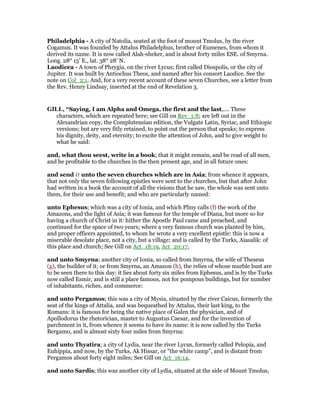
REVELATIO 1 COMME TARY
Written and edited by Glenn Pease
I TRODUCTIO
MY OTES, “Jesus is the author, but John is the writer. Jesus is both the one
revealed and the revealer of what is to be. The goal of the book is not to see the
future, but to see Him who is Lord of the future and all time. It is more important to
know who holds the future than to know what the future holds. Jesus is both the
agent and the content of the Revelation. It has no ultimate value if it does not lead
you to focus on Him. The revealing of Jesus or the unveiling enables us to see
mysteries in a light we could never know without revelation. We cannot discover
these things by study and research, but only by the revealed Word of God.
From the outset, we are given the most important truth about the Book of
Revelation: it does show us the Antichrist, it does show us God's judgment, it does
show us calamity on the earth, it does show us Mystery Babylon and all it entails -
but most of all, it reveals Jesus Christ to us. If we catch everything else, but miss
Jesus in the book, we have missed the book
must soon take place.These are not probable things, but things that must take place,
and soon. The futurists point out that soon to God can be a long time, for a day is
like a thousand years to Him, and so they see this as long range and not in the life
time of the first hearers of the revelation as the preterists feel. But the fact is it is a
simple statement, and does fit the view that the early Christians had that the end
would be soon. See Rom. 13:12 and 1Pet. 4:7
Dr. Ray Summers of Southwestern Baptist Theological Seminary writes, "I do not
believe that any interpretation of Revelation can be correct if it was meaningless
and if it failed to bring practical help and comfort to those who first received the
book. To start from any other viewpoint is to follow the road which leads away from
the truth of the book..." You can spot a lot of foolish ideas easy when you have
this perspective. Barclay writes, "As John saw it, the events in it were working
themselves out in the immediate happenings and events which were coming upon
the world."
This little word has been a big issue of debate. Is it God's soon or man's soon? If
it is soon for man, then the revelation is primarily for the first century Christians. If
it is soon for God, then it can be for any generation, and probably for the last
generation of Christians. So the Preterists and the Futurists debate the meaning of
this word. It is likely that the books was meant for all Christians. It has to mean
something to those who received it first, that is the Christians of the 7 churches. The
soon had to be relevant to them or it is meaningless. John is just saying here what
his fellow Apostles have already said. Paul writes in Rom. 13:2, "The night is far
gone, the day is at hand." Peter in IPet. 4:7 writes, "The end of all things is at
hand." In the third verse here, John says the time is near. So it is wise to see the
Preterist viewpoint, for something had to happen that fits this revelation to the
original readers of it would be false prophecy. This does not mean it has no meaning
to all other generations, however, for as George Eldon Ladd says, "It is the nature
of Biblical prophecy to make it possible for every generation to live in expectancy of
the end." Every generation could be the last and so it is always relevant.
THE SEVE CHURCHES. This is the first of 54 sevens in the book. Seven is the
number of completeness and wholeness and so the 7 here refers to all churches. The
seven are symbolic of the total for all time. But they are real and literal churches.
But just as the letter to the Galatians and Ephesians were to literal churches, the
message was for all churches for all time. We are reading others peoples mail in
reading the ew Testament, but God meant it that way.
There were other churches in Asia not mentioned, such as Troas in Acts 20:5-12,
Colosse in Col. 1:2 and Hierapolis in Col. 4:13. But all are included in the 7. Paul
also wrote letters to just 7 churches:Rome,Corinth,Galatia,
Ephesus,Philippi,Colosse,Thessalonica
EVERY EYE WILL SEE HIM
Has there ever been an event in history that every eye has seen. Time Magazine
carried two references to Christ's "second coming" during the epic summer of 1969.
One was in the account of man's landing on the moon. It asserted that the only
event which could command larger worldwide headlines would be "the second
coming."
" o man will forsee it, and all men will see it." The second coming is not hidden
and obscure like the first coming, but open and public to all the world. There is no
secret coming in the Bible, but all references to the second coming are public and
universal.
1.
Apocalypse: Definitions and Related
Terms
Prof. Felix Just, S.J. - Loyola Marymount University
Preliminary Description of "Apocalypse":
•In popular terminology today, an "apocalypse" is a catastrophic event (e.g.,
nuclear holocaust).
In biblical teminology, an "apocalypse" is not an event, but a "revelation" that is
recorded in written form:
•it is a piece of crisis literature that “reveals” truths about the past, present,
and/or future in highly symbolic terms;
the revelation often comes in dreams or visions, and usually needs to be interpreted with
the help of an angel;
it is usually intended to provide hope and encouragement for people in the midst of
severe trials and tribulations.
•Caution: "The Apocalypse" is an alternate name (used esp. by Protestants) for
"The Book of Revelation" in the New Testament.
Also, "The Little Apocalypse" or "The Apocalyptic Discourse" are names sometimes
given to Mark 13 (and the parallel passages in Matt 24 and Luke 21), containing the
teachings of Jesus about the future of Jerusalem and the end of the world.
2. Technical Definition of "Apocalypse" (from SBL "Apocalypse Group";
published in J. J. Collins, Semeia 14 [1979] 9):
" ‘Apocalypse’ is a genre of revelatory literature with a narrative framework,
in which a revelation is mediated by an otherworldly being to a human
recipient,
disclosing a transcendent reality with is
both temporal, insofar as it envisages eschatological salvation,
and spatial insofar as it involves another, supernatural world."
Definition addition regarding the genre’s purpose, incorporating suggestions of
Hellholm (1982) & Aune (1986):
"…intended to interpret the present, earthly circumstances in light of the
supernatural world and of the future,
and to influence both the understanding and the behavior of the audience by
means of divine authority."
Subdivisions or Types of Apocalypses:
•Apocalypses can be classified according to features in their CONTENT:
•Some apocalypses contain "Otherworldly Journeys" (e.g., the seer is
purportedly taken on a tour of heaven)
Others do not contain "Otherworldly Journeys" (e.g., while seeing heavenly things, the
seer stays on earth)
•Apocalypses can also be classified according to their primary REFERENTS:
•Some apocalypses deal with Personal Eschatology (the death and after-
life of individuals)
Others focus more on Ethnic or ational Eschatology (the end of a nation or empire)
Many others contain Cosmic Eschatology (the ultimate end of the whole world)
Related Terminology:
•Apocalyptic (adj.) - originally referred to anything “revelatory”; now usually
refers to catastrophic violence or disasters.
Apocalypticism - a world view with strong apocalyptic expectations; social movements
that expect the end of the world.
Eschatology / Eschatological - any teaching about the “end” times and/or the future
world beyond the end of normal time.
Prophecy - not “foretelling the future”; but speaking & acting on behalf of God about
past, present or future truths.
Revelation - an “uncovering” of something which has always been true, but previously
hidden or unknown to humans.
Day of the Lord / Judgment Day - a cosmic event expected in the future, but the
specific expectations vary.
Parousia - the “coming” or “arrival” of any important figure, esp. of Jesus at the end of
time, in early Christian expectations.
Rapture - a fairly new term for the expectation that faithful Christians will be taken off
the earth to live with Jesus, while all other people are not; based on an overly literal
misinterpretation of 1Thess 4:15-17.
Tribulation - in fundamentalist expectations, a 7-year period of great suffering and
turmoil before the Second Coming of Christ; but exactly when the rapture is to occur in
relation to the tribulation is disputed among such believers:
•Pre-Tribulation Rapture - non-believers have to endure the 7-year
tribulation, but believers are raptured first;
Mid-Tribulation Rapture - believers must endure 3½ years of tribulation before they are
raptured;
Post-Tribulation Rapture - believers must endure the entire 7-year tribulation before they
are raptured.
•Dispensationalism - the belief that world history is divided into a certain
number of eras or "dispensations," which usually also implies the belief that one
is living in the last (or next-to-last) dispensation before the end of the world
and/or the beginning of God's Kingdom.
Armageddon / Harmagedon - the place (Megiddo) where the final battle is to occur,
according to Rev 16:16
Millennium - any one-thousand year period; or more specifically the thousand year
period of peace of Rev 20:1-6.
Millennialist / -ism - religious groups that expect Rev 20 to occur literally, and often try
to calculate exact times.
Cautions:
•not every Apocalypse is purely eschatological (they may also interpret past or
present events, not only the future)
not all Eschatology is apocalyptic (some show a future that is peaceful, not violent).
2B. EBC, “THE PROLOGUE
The Revelation of Jesus Christ, which God gave Him to show unto His servants, even the
things which must shortly come to pass: and He sent and signified it through His angel
unto His servant John; who bare witness of the word of God, and of the testimony of
Jesus Christ, even of all things that he saw. Blessed is he that readeth, and they that hear
the words of the prophecy, and keep the things which are written therein: for the season
is at hand (Rev_1:1-3).
THE first chapter of Revelation introduces us to the whole book, and supplies in great
measure the key by which we are to interpret it. The book is not intended to be a mystery
in the sense in which we commonly understand that word. It deals indeed with the
future, the details of which must always be dark to us; and it does this by means of
figures and symbols and modes of speech far removed from the ordinary simplicity of
language which marks the New Testament writers. But it is not on that account designed
to be unintelligible. The figures and Symbols employed in it are used with perfect
regularity; its peculiar modes of speech are supposed to be at least not unfamiliar to the
reader; and it is taken for granted that he under stands them. The writer obviously
expects that his meaning, so far from being obscured by his style, will he thereby
illustrated, enforced, and brought home to the mind, with greater than ordinary power.
The word Revelation by which he describes to us the general character of his work is of
itself sufficient to show this. "Revelation" means the uncovering of that which has
hitherto been covered, the drawing back of a veil which has hung over a person or thing,
the laying bare what has been hitherto concealed; and the book before us is a revelation
instead of a mystery.
Again, the book is a revelation of Jesus Christ; not so much a revelation of what Jesus
Christ Himself is, as one of which He is the Author and Source. He is the Head of His
Church, reigning supreme in His heavenly abode. He is the Eternal Son, the Word
without whom was not anything made that was made, and who executes all the purposes
of the Father, "the same yesterday, and to-day, and forever."l He is at the same time
"Head over all things to the Church."2 He regulates her fortunes. He controls in her
behalf the events of history. He fills the cup which He puts into her hand with prosperity
or adversity, with joy or sorrow, with victory or defeat. Who else can impart a revelation
so true, so weighty, and so precious? (1 Joh_5:19; Heb_13:8; 2 Eph_1:22)
Yet again, the revelation to be now given by Jesus Christ is one which God gave Him, the
revelation of the eternal and unchangeable plan of One who turneth the hearts of kings
as the rivers of water, who saith and it is done, who commandeth and it stands fast.
Finally, the revelation relates to things that must shortly come to pass, and thus has all
the interest of the present, and not merely of a far-distant future.
Such is the general character of that revelation which Jesus Christ sent and signified
through His angel unto His servant John. And that Apostle faithfully recorded it for the
instruction and comfort of the Church. Like his Divine Master, with whom throughout all
this book believers are so closely identified, and who is Himself the Amen, the faithful
and true witness,* the disciple whom He loved stands forth to bear witness of the word
of God thus given him, of the testimony of Jesus thus signified to him, even of all things
that he saw. He places himself in thought at the end of the visions he had witnessed, and
retraces for others the elevating pictures which had filled, as he beheld them, his own
soul with rapture. (* Rev_3:14.)
Therefore may he now, ere yet he enters upon his task, pronounce a blessing upon those
who shall pay due heed to what he is to say. Does he think of the person by whom the
apostolic writings were read aloud in the midst of the Christian congregation? then,
Blessed is he that readeth. Does he think of those who listen? then, Blessed are they that
hear the words of the prophecy. Or, lastly, does he think not merely of reading and
hearing, but of that laying up in the heart to which these were only preparatory? then,
Blessed are they that keep the things which are written therein, for the season, the short
season in which everything shall be accomplished, is at hand.
The Introduction to the book is over; and it may be well to mark for a moment that
tendency to divide his matter into three parts which peculiarly distinguishes St. John,
and to which, as supplying an important rule of interpretation, we shall often have
occasion to refer. There are obviously three parts in the Introduction, - the Source, the
Contents, and the Importance of the revelation: and each of these is again divided into
three. Three persons are mentioned when the Source is spoken of, - God, Jesus Christ,
and the servants of Jesus; three when the Contents are referred to, - the Word of God,
the Testimony of Jesus, and All things that he saw; and three when the Importance of the
book is described, - He that readeth, They that hear, and They that keep the things
written therein.
"John to the seven churches which are in Asia: Grace to you, and peace, from Him which
is, and which was, and which is to come; and from the seven Spirits which are before His
throne; and from Jesus Christ, who is the faithful witness, the firstborn of the dead, and
the ruler of the kings of the earth. Unto Him that loveth us, and loosed us from our sins
in His blood; and He made us to be a kingdom, to be priests unto His God and Father; to
Him be the glory and the dominion forever and ever. Amen. Behold, He cometh with the
clouds; and every eye shall see Him, and they which pierced Him; and all the tribes of the
earth shall wail over Him. Even so, Amen. I am the Alpha and the Omega, saith the Lord,
God, which is and which was and which is to come, the Almighty (Rev_1:4-8)."
From the Introduction we pass to the Salutation, extending from ver. 4 to ver. 8
(Rev_1:4-8). Adopting a method different from that of the fourth Gospel, which is also
the production of his pen, the writer of Revelation names himself. The difference is easily
explained. The fourth Gospel is original not only in its contents but its form. The
Apocalypse is moulded after the fashion of the ancient prophets, and of the numerous
apocalyptic authors of the time; and it was the practice of both these classes of writers to
place their names at the head of what they wrote. The fourth Gospel was also intended to
set forth in a purely objective manner the glory of the Eternal Word made flesh, and that
too in such a way that the glory exhibited in Him should authenticate itself,
independently of human testimony. The Apocalypse needed a voucher from one known
and trusted. It came through the mind of a man, and we naturally ask, Who is the man
through whom it came? The enquiry is satisfied, and we are told that it comes from John.
In telling us this St. John speaks with the authority which belongs to him. By-and-by we
shall see him in another light, occupying a position similar to ours, and standing on the
same level with us in the covenant of grace. But at this moment he is the Apostle, the
Evangelist, the Minister of God, a consecrated priest in the Christian community who is
about to pronounce a priestly blessing on the Church Let the Church bow her head and
reverently receive it.
The Salutation is addressed to the seven churches which are in Asia. On this point it is
enough to say that by the Asia spoken of we are to understand neither the continent of
that name, nor its great western division Asia Minor, but only a single district of the
latter, of which Ephesus, where St. John spent the later years of his life and ministry, was
the capital. There the aged Apostle tended all those portions of the flock of Christ that he
could reach, and all the churches of the neighborhood were his peculiar care. We know
that these were in number more than seven. We know that to no church could the
Apostle be indifferent. The conclusion is irresistible, that here, as so often in this book as
well as in other parts of Scripture, the number seven is not to be literally under stood.
Seven churches are selected, the condition of which appeared most suitable to the
purpose which the Apostle has in view; and these seven represent the Church of Christ in
every country of the world, down to the very end of time. The universal Church spreads
itself out beneath his gaze; and before he instructs he blesses it.
The blessing is, Grace to you, and peace; grace first, the Divine grace, in its enlightening,
quickening, and beautifying power; and then peace, peace with God and man, peace that
in the deep recesses of the heart remains undisturbed by outward trouble, the peace of
which it is said by Him who is the Prince of peace, "Peace I leave with you; My peace I
give unto you: not as the world giveth give I unto you. Let not your heart be troubled,
neither let it be fearful."* (* Joh_14:27).
The source of the blessing is next indicated, the Triune God, the three Persons of the
glorious Trinity, the Father, the Holy Spirit, and the Son. Probably we should have
thought of a different order; but the truth is that it is the Son, as the manifestation of the
Godhead, who is mainly in the Apostle’s mind. Hence the peculiarity of the first
designation, Him which is, and which was, and which is to come, a designation specially
applicable to our Lord. Hence also the peculiarity of the second designation, The seven
Spirits which are before His throne; not so much the Spirit viewed in His individual
personality, in the eternal relations of the Divine existence, as that Spirit in the
manifoldness of His operation in the Church, the Spirit of the glorified Redeemer, not
one therefore, but seven. Hence, again, the peculiar designation of Christ, Jesus Christ,
who is the faithful witness, the firstborn of the dead, and the ruler of the kings of the
earth; not so much the Son in His metaphysical relation to the Godhead, as in attributes
connected with His redemptive work. And hence, finally, the fact that when these three
Persons have been named, the Seer fills up the remaining verses of his Salutation with
thoughts, not of the Trinity, but of Him who has already redeemed us, and who will in
due time come to perfect our salvation.
Now, therefore, the Church, reflecting upon all that has been done, is done, and shall be
done for her, is able to raise the song of triumphant thanksgiving, Unto Him that loveth
us, and loosed us from our sins in His blood, and He made us to be a kingdom, to be
priests unto His God and Father; to Him be the glory and the dominion forever and
ever. Amen. In these words the possession of complete redemption is implied. The true
reading of the original is not that of our Authorized Version, "Unto Him that washed,"
but "Unto Him that loosed" us from our sins. We have received not merely the pardon of
sin, but deliverance from its power. "Our soul is escaped as a bird out of the snare of the
fowler; the snare is broken, and we are escaped."* The chains in which Satan held us
captive have been snapped asunder and we are free. Again, this loosing has taken place
"in" rather than "by" the blood of Christ, for the blood of Christ is living blood, and in
that life of His we are enfolded and enwrapped, so that it is not we that live, but Christ
that liveth in us. Once more they who are thus spoken of are "a kingdom, priests unto
His God and Father," the former being the lower stage, the latter the higher. The word
"kingdom" has reference, less to the splendour of royalty than to victory over foes.
Christians reign in conquering their spiritual enemies; and then, in possession of the
victory that overcometh the world, they enter into the innermost sanctuary of the Most
High and dwell in the secret of His Tabernacle. There their great High Priest is one with
"His God and Father," and there they also dwell with His Father and their Father, with
His God and their God. (* Psa_124:7)
The statement of these verses, however, reveals not only what the Christian Church is to
which the Apocalypse is addressed; it reveals also what the Lord is from whom the
revelation comes. He is indeed the Saviour who died for us, the witness faithful unto
death: but He is also the Saviour who rose again, who is the firstborn of the dead, and
who has ascended to the right hand of God, where He lives and reigns in glory
everlasting. It is the glorified Redeemer from whom the book of His revelation comes;
and He has all power committed to Him both in heaven and on earth. More particularly,
He is "the ruler of the kings of the earth." This is not a description of such honour as
might be given by a crowd of loyal nobles to a beloved prince. It rather gives expression
to a power by which "the kings of the earth," the potentates of a sinful world, are
subdued and crushed.
Lastly, the Salutation includes the thought that He who is now hidden in heaven from
our view, will yet appear in the glory that belongs to Him. He is the Lord who "is to
come"; or, as it is expanded in the words immediately following the doxology, Behold, He
cometh with the clouds; and every eye shall see Him, and they which pierced Him; and
all the tribes of the earth shall wail over Him. Even so, Amen. It is of importance to ask
what the glory is in which the glorified Lord is thus spoken of as coming. Is it that of one
who shall be the object of admiration to every eye, and who, by the revelation of Himself,
shall win all who behold Him to godly penitence and faith? The context forbids such an
interpretation. The tribes "of the earth" are like its kings in ver. 5 (Rev_1:5), the tribes of
an ungodly world, and the "wailing" is that of Rev_18:9, where the same word is used,
and where the kings of the earth weep and wail over the fall of guilty Babylon, which they
behold burning before their eyes. The tones of that judgment which is to re-echo
throughout the book are already heard: "Give the king Thy judgments, O God, and Thy
righteousness unto the king’s Son. He shall judge the people with righteousness, and Thy
poor with judgment"; "Verily there is a reward for the righteous: verily, He is a God that
judgeth in the earth."1 (1 Psa_72:1-2; Psa_58:11)
And now the glorified Redeemer Himself declares what He is: I am the Alpha and the
Omega, saith the Lord, God, which is and which was and which is to come, the
Almighty. It will be observed that after the word "Lord" we have interposed a comma not
found in either the Authorized or the Revised Version.1 On various other occasions we
shall have to do the same, and the call to do so arises partly from the connection of the
thought, partly from St. John’s love of that tripartite division of an idea which has been
already spoken of. The former does not lead us to the Father; it leads us, on the contrary,
to the Son. He it is Who has been described immediately before, and with Him the
description which follows is to be occupied. No doubt the thought of God, of the Father,
lies immediately behind the words. No doubt also "the Son can do nothing of Himself,
but what He seeth the Father doing"; yet "what things soever He doeth, these the Son
also doeth in like manner."2 By the Son the Father acts. In the Son the Father speaks.
The Son is the manifestation of the Father. The same Divine attributes, therefore, which
are to be seen in the Father, are to be seen in the Son. Let us hear Him as He seals His
intimations of coming judgment with the assurance that He is God, who has come who is
and who is to come, the Almighty. (1 Compare the Greek text of Westcott and Hart; 2
Joh_5:19)
"I John, your brother and partaker with you in the tribulation and kingdom and patience
which are in Jesus, was in the isle that is called Patmos, for the word of God and the
testimony of Jesus. I was in the Spirit on the Lord s day, and I heard behind me a great
voice, as of a trumpet, saying, What thou seest, write in a book, and send it to the seven
churches; unto Ephesus, and unto Smyrna, and unto Pergamum, and unto Thyatira, and
unto Sardis, and unto Philadelphia, and unto Laodicea. And I turned to see the voice
which spake with me. And having turned, I saw seven golden candlesticks; and in the
midst of the candlesticks one like unto a Son of man, clothed with a garment down to the
foot, and girt about at the breasts with a golden girdle. And His head and His hair were
white as white wool, white as snow; and His eyes were as a flame of fire; and His feet like
unto burnished brass, as if it had been refined in a furnace; and His voice as the voice of
many waters. And He had in His right hand seven stars: and out of His mouth proceeded
a sharp two-edged sword: and His countenance was as the sun shineth in his strength.
And when I saw Him, I fell at His feet as one dead. And He laid His right hand upon me,
saying, Fear not; I am the first and the last, and the living One; And I became dead, and
behold, I am alive for evermore, and I have the keys of death and of Hades. Write
therefore the things which thou sawest, and the things which are, and the things which
shall come to pass hereafter; the mystery of the stars which thou sawest upon My right
hand, and the seven golden candlesticks. The seven stars are the angels of the seven
churches; and the seven candle sticks are seven churches (Rev_1:9-20)."
After the Introduction and Salutation, the visions of the book begin, the first being the
key to all that follow. The circumstances amidst which it was given are described, not
merely to satisfy curiosity, or to afford information, but to establish such a connection
between St. John and his readers as shall authenticate and vivify its lessons.
I John, he begins, your brother and partaker with you in the tribulation and kingdom
and patience which are in Jesus, was in the isle that is called Patmos, for the word of
God and the testimony of Jesus. It is no longer only the Apostle, the authoritative
messenger of God, who speaks; it is one who occupies the same ground as other
members of the Church, and is bound to them by the strong deep tie of common sorrow.
The aged and honoured Evangelist, "the disciple whom Jesus loved," is one with them,
bears the same burden, drinks the same cup, and has no higher consolation than they
may have. He is their "brother," a brother in adversity, for he is a partaker with them of
the "tribulation" that is in Jesus. The reference is to outward suffering and persecution;
for the words of the Master were now literally fulfilled: "A servant is not greater than his
lord. If they persecuted Me they will also persecute you;" "Yea, the hour cometh, that
whosoever killeth you shall think that he offereth service unto God."* The scorn, the
hatred, the persecution of the world! for such as were exposed to these things was the
Apocalypse written, by such was it understood; and if, in later times, it has often failed to
make its due impression on the minds of men, it is because it is not intended for those
who are at ease in Zion. The more Christians are compelled to feel that the world hates
them, and that they cannot be its friends, the greater to them will be the power and
beauty of this book. Its revelations, like the stars of the sky, shine most brightly in the
cold, dark night. (* Joh_15:20; Joh_16:2).
"Tribulation" is the chief thing spoken of, but the Apostle, with his love of groups of
three, accompanies it with other two marks of the Christian’s condition in the world, the
"kingdom" and "patience" that are in Jesus. St. John therefore was in tribulation. He had
been driven from Ephesus, we know not why, and had been banished to Patmos, a small
rocky island of the Ægean Sea. He had been banished for his faith, for his adherence to
"the word of God and the testimony of Jesus," the former expression leading our
thoughts to the revelation of the Old Testament, the latter to that of the New; the former
to those prophets, culminating in the Baptist, of whom the same Apostle who now writes
tells us in the beginning of his Gospel, that they "came for witness, that they might bear
witness of the light;"1 the latter to "the true light, even the light which lighteth every man
coming into the world."2 Driven from the society of his friends and "children," we cannot
doubt that St. John would be drawn even more closely than was his wont to the bosom of
his Lord; would feel that he was still protected by His care; would remember the words
uttered by Him in the most sublime and touching moment of His life, "And I am no more
in the world, and these are in the world, and I come to Thee. Holy Father, keep them in
Thy name which Thou hast given Me";3 and would share the blessed experience of
knowing that, on every spot of earth however remote, and amidst all trials however
heavy, he was in the hands of One who stills the tumults of the people as well as the
waves of the sea beating upon the rock-bound coast of Patmos. (1 Joh_1:7; 2 Joh_1:9; 3
Joh_17:11)
Animated by feelings such as these, the Apostle knew that, whatever appearances to the
contrary might present themselves, the time now passing over his head was the time of
the Lord’s rule, and not of man’s. No thought could be more inspiring, and it was the
preparation in his soul for the scene which followed.
I was in the Spirit on the Lord s day, and I heard behind me a great voice, as of a
trumpet, saying, What thou seest, write in a book, and send it to the seven churches;
unto Ephesus, and unto Smyrna, and unto Pergamum, and unto Thyatira, and unto
Sardis, and unto Philadelphia, and unto Laodicea. The Lord’s day here referred to may
have been the Sunday, the first day of the Christian week, the day commemorative of that
morning when He who had been "crucified through weakness, yet lived through the
power of God."l If so, there was a peculiar fitness in that vision, now to be granted, of the
risen and glorified Redeemer. But it seems doubtful if this is the true interpretation,
Proof is wanting that the first day of the week had yet received the name of "The Lord’s
Day," and it is more in accordance with the prophetic tone of the book before us, to think
that by St. John the whole of that brief season which was to pass before the Church
should follow her Lord to glory was regarded as "The Lord’s Day." Whichever
interpretation we adopt, the fact remains that, meditating in his lonely isle upon the
glory of his Lord in heaven and the contrasted fortunes of His Church on earth, St. John
passed into a state of spiritual ecstasy. Like St. Paul, he was caught up into the third
heavens; but, unlike him, he was permitted, and even commanded, to record what he
heard and saw.2 (1 2Co_13:4; 2Compare 2Co_12:4)
And I heard behind me, he says, a great voice as of a trumpet, saying, What thou seest,
write in a book, and send it to the seven churches; unto Ephesus, and unto Smyrna, and
unto Pergamum, and unto Thyatira, and unto Sardis, and unto Philadelphia, and unto
Laodicea. We need not dwell now upon these churches. We shall meet them again. They
are "the seven churches which are in Asia" already spoken of in ver. 4 (Rev_1:4); and
they are to be viewed as representative of the whole Christian Church in all countries of
the world, and throughout all time. In their condition they represented to St. John what
that Church is, in her Divine origin and human frailty, in her graces and defects, in her
zeal and lukewarmness, in her joys and sorrows, in the guardianship of her Lord, and in
her final victory after many struggles. Not to Christians in these cities alone is the
Apocalypse spoken, but to all Christians in all their circumstances: "He that hath an ear,
let him hear." The Apostle heard.
And I turned to see the voice which spake with me. And having turned I saw seven
golden candlesticks; and in the midst of the candlesticks one like unto a Son of man. It
was a splendid vision which was thus presented to his eyes. The golden candlestick, first
of the Tabernacle and then of the Temple, was one of the gorgeous articles of furniture in
God’s holy house. It was wrought, with its seven branches, after the fashion of an almond
tree, the earliest tree of spring to hasten (whence also it was named) into blossom; and,
as we learn from the elaborateness and beauty of the workmanship, from the symbolical
numbers largely resorted to in its construction, and from the analogy of all the furniture
of the Tabernacle, it represented Israel when that people, having offered themselves at
the altar, and having been cleansed in the laver of the court, entered as a nation of priests
into the special dwelling-place of their heavenly King. Here, therefore, the seven golden
candlesticks, or as in ver. 4 (Rev_1:4) the one in seven, represent the Church, as she
burns in the secret place of the Most High.
But we are not invited to dwell upon the Church. Something greater attracts the eye, He
who is "like unto a Son of man." The expression of the original is remarkable. It occurs
only once in any of the other books of the New Testament, in Joh_5:27, although there,
both in the Authorized and Revised versions, it is unhappily translated "the Son of man."
It is the humanness of our Lord’s Person more than the Person Himself, or rather it is
the Person in His humanness, to which the words of the original direct us. Amidst all the
glory that surrounds Him we arc to think of Him as man; but what a man!
Clothed with a garment down to the foot, and girt about at the breasts with a golden
girdle. And His head and His hair were white as white wool, white as snow; and His
eyes were as a flame of fire; and His feet like unto burnished brass as if it had been
refined in a furnace; and His voice as the voice of many waters. And He had in His
right hand seven stars; and out of His mouth proceeded a sharp two-edged sword: and
His countenance was as the sun shineth in His strength. The particulars of the
description indicate the official position of the Person spoken of, and the character in
which He appears, (1) He is a priest, clothed with the long white garment reaching to the
feet that was a distinguishing part of the priestly dress, but at the same time so wearing
the girdle at the breasts, not at the waist, as to show that He was a priest engaged in the
active service of the sanctuary. (2) He is a king, for, with the exception of the last
mentioned particular, all the other features of the description given of Him point to
kingly rather than to priestly power, while the prophetic language of Isaiah, as he looks
forward to Eliakim the son of Hilkiah, language which we may well suppose to have been
now in the Seer’s thoughts, leads to the same conclusion: "And I will clothe him with thy
robe and strengthen him with thy girdle, and I will commit thy government into his
hand."* The "Son of man," in short, here brought before us in His heavenly glory, is both
Priest and King. (* Isa_22:21; comp. also Isa_22:22 with Rev_3:7)
Not only so. It is even of peculiar importance to observe that the attributes with which
the Priest-King is clothed are not so much those of tenderness and mercy as those of
power and majesty, inspiring the beholder with a sense of awe and with the fear of
judgment. Already we have had some traces of this in considering ver. 7 (Rev_1:7): now
it comes out in all its force. That hair of a glistering whiteness which, like snow on which
the sun is shining, it almost pains the eye to look upon; those eyes penetrating like a
flame of fire into the inmost recesses of the heart; those feet which like metal raised to a
white heat in a furnace consume in an instant whatever they tread upon in anger; that
voice loud and continuous, like the sound of the mighty tea as it booms along the shore;
that sword sharp, two-edged, issuing from the mouth, so that no one can escape it when
it is drawn to slay; and lastly, that countenance like the sun in the height of a tropical
sky, when man and beast cower from the irresistible scorching of his beams, all are
symbolical of judgment. Eager to save, the exalted High Priest is yet also mighty to
destroy. "Thou shalt break them with a rod of iron; Thou shalt dash them in pieces like a
potter’s vessel. Be wise now, therefore, O ye Kings; be instructed, ye judges of the earth.
Serve the Lord with fear, and rejoice with trembling. Kiss the Son, lest He be angry, and
ye perish from the way, when His wrath is kindled but a little. Blessed are all they that
put their trust in Him."* (* Psa_2:9-12).
The Apostle felt all this; and, believer as he was in Jesus, convinced of his Master’s love,
and one who returned that love with the warmest affections of his heart, he was yet
overwhelmed with terror. And when I saw Him, he tells us, I fell at His feet as one dead.
In circumstances somewhat similar to the present, a somewhat similar effect had been
produced upon other saints of God. When Isaiah beheld the glory of the Lord he cried,
"Woe is me! for I am undone; because I am a man of unclean lips, and I dwell in the
midst of a people of unclean lips; for mine eyes have seen the King, the Lord of hosts."1
When Ezekiel beheld a vision of the same kind, he tells us that he "fell upon his face."2
When the angel Gabriel appeared to Daniel in order to explain the vision which had been
shown him, the prophet says, "I was afraid, and fell upon my face."3 Here the effect was
greater than in any of these instances, corresponding to the greater glory shown; and the
Apostle fell at the feet of the glorified Lord as one "dead." But there is mercy with the
Lord that He may be feared; and He laid His right hand upon me, adds St. John, saying,
Fear not: and then follows in three parts that full and gracious declaration of what He is,
in His eternal pre-existence, in that work on behalf of man which embraced not only His
being lifted on high upon the cross, but His Resurrection and Ascension to His Father’s
throne, and in the consummation of His victory over all the enemies of our salvation, - 1.
I am the First and the Last, and the Living One; 2. And I became dead, and behold, I
am alive for evermore; 3. And I have the keys of death and of Hades. (1 Isa_6:5; 2
Eze_1:28; 3 Dan_8:17)
A few more words are spoken by the glorified Person who thus appeared to St. John, but
at this point we may pause for a moment, for the vision is complete. It is the first vision
of the book, and it contains the key-note of the whole. As distinguished from the fourth
Gospel, in which Jesus clothed as He is with His humanity is yet pre-eminently the Son
of God, the Saviour while here retaining His Divinity is yet pre-eminently a Son of man.
In other words, He is not merely the Only Begotten who was from eternity in the bosom
of the Father: He is also Head over all things to His Church. And He is this as the
glorified Redeemer who has finished His work on earth, and now carries it on in heaven.
This work too He carries on, not only as a High Priest "touched with the feeling of our
infirmities," but as One clothed with judgment. He is a man of war, and to Him the
words of the Psalmist may be applied:
"Gird Thy sword upon Thy thigh, O Mighty One, Thy glory and Thy majesty.
And in Thy majesty ride prosperously,
Because of truth and meekness and righteousness:
And Thy right hand shall teach Thee terrible things.
Thine arrows are sharp;
The peoples fall under Thee;
They are in the heart of the King’s enemies."* (* Psa_45:3-5)
Yet we cannot separate the body of Christ from the head, who is Son of man as well as
Son of God. With the Head the members are one, and they too therefore are here
contemplated as engaged in a work of judgment. With their Lord they are opposed by an
ungodly world. In it they also struggle, and war, and overcome. The tribulation, and the
kingdom and patience "in Jesus,"1 are their lot; but living a resurrection life and escaped
from the power of death and Hades, salvation has been in principle made theirs, and
they have only to wait for the full manifestation of that Lord with whom, when He is
manifested, they also shall be manifested in glory.2 (1 Rev_1:9; 2 Col_3:4)
Thus we are taught what to expect in the book of Revelation. It will record the conflict of
Christ and His people with the evil that is in the world, and their victory over it. It will
tell of struggle with sin and Satan, but of sin vanquished and Satan bruised beneath their
feet. It will be the story of the Church as she journeys through the wilderness to the land
of promise, encountering many foes, but more than conqueror through Him that loved
her, and often raising to heaven her song of praise, "Sing unto the Lord, for He hath
triumphed gloriously, the horse and his rider He hath cast into the sea."* (* Exo_15:1)
Now then we are prepared to listen to the closing words of the glorious Person who had
revealed Himself to St. John, as He repeats His injunction to him to write, and gives him
some explanation of what he had seen: Write, therefore, the things which thou sawest,
and the things which are, and the things which shall come to pass hereafter; the
mystery of the seven stars which thou sawest upon My right hand, and the seven
golden candlesticks. The seven stars are the angels of the seven churches; and the seven
candlesticks are seven churches. The golden candlesticks and the stars, the churches and
the angels of the churches, will immediately meet us when we proceed to the next two
chapters of the book. Meanwhile it is enough to know that we are about to enter upon the
fortunes of that Church of the Lord Jesus Christ in the world which embraces within it
the execution of the final purposes of the Almighty, and the accomplishment of His plans
for the perfection and happiness of His whole creation.
R A Taylor, “The interpretation of Revelation.
Goldsworthy clarifies the principles of interpretation that pertain when we come to
obscure passages in Revelation.
i. We must allow the clearer texts to take precedence over the more obscure.
ii. We cannot allow a point of doctrine to be established on an apocalyptic vision
against clear statements to the contrary in the epistolary material of the NT (i.e. the
letters).
iii. He also insists that the gospel of Jesus Christ is the key to the interpretation of the
whole Bible.
In some ways interpreting Revelation is like a jig-saw, we must first find the corner
pieces, an obvious example is the Lamb and the rider on the white horse in chapter 19
who is the exalted Christ, then there are other symbols which are defined in the book
such as the lampstands and the dragon. From these we go on to more obscure symbols
but which are clearly based on parts of the OT such as the seven trumpets and bowls
which are modelled on the plagues on the Egyptians and the beast out of the earth
which is based on Daniel’s visions. It is clear then that it is possible to make a
framework from the less obscure within which we can fit the more obscure. It is
unlikely that we can complete the whole jig-saw but if the framework is correct we
should at least grasp a portion of the whole picture.
This commentary assumes that the keys to its interpretation lie in the OT and NT
scripture, but that an NT interpretation is required. It assumes that it is symbolic
unless clearly meant to be literal. It assumes that the book’s author is God and that it
is written to the church throughout the ages from the writing of the letter to the
Second Coming. The content primarily concerns the fate of the church and of her
enemies. The symbology allows it to be interpreted in the light of the current
historical situation throughout church history without being specific to a particular
event, although there are specific events recorded such as the birth of Christ and the
second coming. Many of the events recorded in the book are parallel with other events
in the book. The book can be viewed from the point of view of events in the past,
current events and future events, all are meaningful.
3.1. The four schools of interpretation:
There are four schools of interpretation.
i. The preterist: that it describes in veiled language events of John's own time, and
until the end of the Roman Empire or at least the conversion of Constantine. This has
the disadvantage in that it is only meaningful then but to us it is not as relevant. The
beast is seen as only the Roman empire and Babylon is Rome, however there are clear
references to the Rome of John’s time and it is helpful to know the circumstances of
John's time in interpreting the book. In Rev 1: 11 John is told "Write on a scroll what
you see and send it to the seven churches: to Ephesus, Smyrna, Pergamum, Thyatira,
Sardis, Philadelphia and Laodicea." hence in some ways it is similar to Paul's letters
to the Romans, Corinthians, Colossians, Ephesians and Thessalonians. In both John’s
and Paul's letters God has chosen these to be preserved for His church throughout the
centuries. Just as the letter to the Corinthians addresses specific problems they had
then it also deals with these problems for future centuries. In the same way Revelation
deals with the problems faced by the seven churches in Asia, but it also has a great
deal to say to future generations. Because John uses symbolic imagery Revelation is
not tied down to only the Roman Empire but may also be used to describe successive
persecuting tyrannies down through the centuries. Examples of the preterist view are
Morris, Hailey and Barclay. Chilton identifies the destruction of Jerusalem in AD 70
as the main focus of Revelation.
The next three methods of interpretation deal with the value of Revelation to future
generations in different ways.
ii. The historicist: that it is a chart of the whole of history from Christ's first coming
to his second, and beyond. In this method people will try to make sections of
Revelation fit in with specific historical events. The beast is seen as the current
manifestation of the beast such as the papacy in the time of the reformation. This
position is untenable because there will be a wide variation of interpretations through
the ages. But because the principles are valid to all generations, as the idealist would
suggest, each generation should be able to identify the characters portrayed by
Revelation. Therefore the historicist's view should not be disparaged, it has provided
comfort in times of persecution throughout church history. The most important of the
historical interpretation from the 12th century to reformation times makes the papacy
the beast and Rome or the Roman church is Babylon. However to make Revelation a
chart of the whole of human history and therefore to use it to predict when the end
will come is wrong and is not how John intended Revelation to be read, but to use it
to strengthen God’s people undergoing particular trials is a valid use.
iii. The idealist: that between messages for the first century and prophecies of the far
future it deals chiefly with principles that are always valid in Christian experience.
The beast is the Roman Empire of John’s day but also a succession of ungodly
empires leading to the last empire from which the antichrist will come. Because
Christians have been persecuted throughout the generations, each generation should
be able to identify who their beast is. The main example is Hendriksen, see also Beale
and Wilcock.
iv. The futurist: that it is largely a prophecy of events still to come, especially just
prior to the return of Christ. This is the normal interpretation of someone reading the
book for the first time because its imagery looks so fantastic. It means that the book
will be especially relevant for those in the last generation. The beast is seen as the
antichrist who emerges from a revived Roman empire. It is clear that the Second
Coming features prominently throughout the book and therefore there is truth in the
futurist view, but this view tends to overlook spiritual truth that is of value today.
However note that John is told not to seal up the book (Rev 22:10) because the time is
near, although Daniel was told to seal up the vision until the end times (Dan 12:4),
this means that the book is about to start its fulfilment. The book of Revelation was
written initially to the seven churches in Asia, and hence the preterist view. However
the book will reach it final fulfilment when the last antichrist appears and Christ
returns this is the futurist view.
Ladd divides the futurist views into two kinds, the moderate and the extreme view
known as dispensationalism. The latter makes a sharp distinction between Israel and
the church. The letters to the seven churches deal with seven ages of church history.
Chapter 7 onwards concerns Israel because the church has been raptured by this point
so that it does not suffer in the great tribulation, which occurs during the last 3 and a
half years of history. This view is widely held in America, the best exponent of this
view is Walvoord.
The futurist will argue that the preterist interpretation is wrong because Revelation
concerns the end times, but during the time of the Roman Empire the preterist
interpretation was the end time. A similar comment could be made of the historicist
interpretation during the Reformation. The idealist interpretation is probably the most
relevant today, to meet today’s needs during hard times when Christians are under
pressure and it certainly does not discount a future fulfilment either. I would strongly
question the idea that Revelation only has a future fulfilment.
The problem for anyone trying to interpret the book is that on reading the text one can
find support for all these views, which is why there is such a wide variety of
interpretations and indeed disagreements. In a sense they are all correct, the futurist
sees the beast as the future antichrist, the historicist sees the beast of history, the
preterist sees the beast in Roman times and the idealist sees a succession of beasts
leading up to the antichrist. The futurist writes from the point of view of a church not
undergoing persecution now but expects it in the future particularly from the
antichrist. The historicist writes from the point of view of current persecution or
recent persecution as historical events and finds these in Revelation. The idealist
looks to past periods of persecution and sees general principles within Revelation that
can explain these. The preterist writes about how Revelation explains the persecution
under the Roman Empire. They are all correct, but they all see truth from a different
perspective. This commentary is written mainly from a futurist and idealist viewpoint
because this interpretation will be most useful to the church in this generation in the
West. While the church in the West is not undergoing persecution, war is still being
waged against it in the form of false doctrine and the seduction of worldly values.
Mounce points out that 'John himself could without contradiction be preterist,
historicist, futurist and idealist. He wrote out of his own immediate situation, his
prophecies would have historical fulfilment, he anticipated a future consummation,
and he revealed principles, which operated beneath the course of history. The
interpretive problem grows out of the fact that the End did not arrive on schedule.' If
the author of the Revelation is the author of the fourth gospel, then he certainly
expected to be alive when Christ returned, John 21:21-24. If we read John’s first
letter, 2:18 indicates that he considered himself to be living in the last hour.
Rev 1:3 tells us that there is a blessing for the one who reads the words of this
prophecy and takes to heart its message because the time is near (see also 22:10).
From this we are assured that the contents are relevant now, just as our Lord’s Second
Coming is relevant now just as much as it was 1,900 years ago. To the writers of the
NT the time of the Lord’s coming is always near, Phil 4:5, Jam 5:8, 1 Pet 4:7. Jesus
warns us to be ready for His return because He is coming at an hour we do not expect
(Mat 24:44). Therefore Revelation warns us to be ready now because the events it
depicts can occur at any time. Therefore any interpretation that puts the events either
in the distant past or future is misleading because its purpose is to prepare our hearts
now for what is coming soon. Just as there is a blessing for those who take to heart the
message of this book at the start of Revelation, so at the end (22:7) there is a blessing
on those who keep the words of the prophecy of Revelation together with a reminder
that Jesus is coming soon. Part of the message of Revelation is to prepare His people
for His second coming and the events preceding it.
Ladd talks at some length about the two fold nature of prophecy which has an
immediate fulfilment as well as a distant fulfilment, an example of this being the
Olivet discourse which concerned the historical judgement of Jerusalem at the hands
of the Romans in AD 70 (Luke 21:20 ff.) and the eschatological appearance of the
antichrist (Mat 24:15 ff.). In the same way Revelation had its immediate fulfilment
with the series of Roman persecutions on the Christians until Constantine in AD 313
as well as the appearance of the antichrist in the distant future. Therefore the correct
interpretation is a blend of both the preterist and futurist views and including any
tribulation that the church experiences between these two periods.
While much of it can be interpreted to describe events at the end of the age, this
follows a succession of events that leads to the climax of history. It is a fact of history
that throughout the gospel age there have been political and religious empires that
have persecuted the church, the book of Revelation is written to those saints as well as
those in the reign of the antichrist. The idea that the church will not be on earth when
the antichrist is revealed is not to be found within Revelation and this idea does a
great disservice to believers today. This commentary uses a combination of
approaches, much of the book incorporates the circumstances of John’s time which
must form the basis of any interpretation, because it was written for the seven
churches in Asia. It describes what is going to happen soon, in the near future, but it
also looks into the distant future, it describes the end times as well so a combination
of preterist, futurist and idealist are used. The approach used will depend on the text.
To the preterist the beast is the Roman Empire and its emperor, but to the idealist a
succession of tyrannical empires throughout history who persecute the saints, but to
the futurist these all find their greatest fulfilment in the kingdom of the antichrist,
there is truth in all these views. The fact that the book does leave sufficient ambiguity
for all these views to be true is probably deliberate so that each generation can benefit
from the book. Its symbolism also means that Revelation cannot be used to predict the
future, which is always veiled from man (cf. seven thunders 10:3-4). Its purpose is to
prepare us for the future, especially for the consummation of all things when Christ is
revealed.
3. ARGUME TS FOR THE SYMBOLIC I TERPRETATIO
Verse 1 of the first chapter of Revelation tells us that
it is "SIG IFIED". All of the Greek reference works that I have
been able to obtain describe the word which is translated
"signified" as meaning to put forth in "sign" form. Since a "sign"
is an indication of something and not the thing itself, then
Revelation is written in "sign" language or prophetic imagery
which depicts events in the spiritual realm by using descriptions
of things which are literal or physical. For example, a SIG which
says "GROCERY STORE" is not where you buy the groceries. It is not
the store itself, but rather an indicator pointing to the place
where the groceries are for sale. Also, a STOP sign "signifies"
that you should STOP, but it is not the act of stopping. It does
not actually stop as it was not moving in the first place. It only
indicates that a "stop" should take place. Even so, the "pictures"
painted by John in writing down the Revelation are not the actual
events portrayed, but rather symbolic indicators of the actual
events (signs).
(A) If Jesus starts us out in this book of Revelation by
SHOWI G US that some of these things are symbolic, is it possible
that he is giving us a key to the interpretation of the entirety
of the book?
(B) If:
"seven stars" symbolize "angels" (Greek = messengers or Pastors),
"seven golden candlesticks" symbolize the seven churches,
the "sun" symbolizes Jesus' light or TRUTH (John 1:9, Malachi 4:2),
"sharp two-edged sword" symbolizes the WORD OF GOD...Hebrews 4:12,
"kings and priests" symbolize SPIRITUAL positions (1 Peter 2:5),
then is it not possible that the other things that we have
underlined in the text are also symbolic, and the Bible provides
the scriptural keys that will help us to find out WHAT those
symbols represent I TRUTH?
(a) Revelation 17:1, "waters" symbolize "peoples, multitudes,
nations, tongues"...Revelation 17:15.
(b) Revelation 17:9, "seven heads" symbolize "seven mountains" and
"seven kings"...Revelation 17:9-10.
(c) Revelation 17:12, "ten horns" symbolize "ten kings" (verse 12).
(d) Revelation 5:8, "golden vials full of odours (incense)"
symbolize the prayers of "saints" (God's children).
(e) Revelation 4:6-10, the "four beasts" and "four and twenty
elders" symbolize the children of God who have been redeemed by the
blood of Jesus...Revelation 5:9-10.
(f) Revelation 12:14, the "time, and times, and half a time"
symbolize the same period as the "thousand two hundred and
threescore days"...Revelation 12:6 (same events described).
(g) Revelation 19:8, the "fine white linen" symbolizes the
"righteousness of saints".
(h) Revelation 21:10 the "heavenly Jerusalem" symbolizes the
"bride" of Jesus Christ, the TRUE CHURCH (Ephesians 5:22-
33)...Revelation 21:2 and 9.
As a final means of showing the symbolic nature of
the book of Revelation, I would ask the reader to prayerfully
consider the POSSIBILITY of the following uses of symbols. I am not
going to take the time to expound I DEPTH the proof texts, but
only ask you to CO SIDER the POSSIBILITY of the following:
(A) "Winds" such as we see described in Revelation 7:1
symbolize doctrines (religious teachings) of which O LY O E WI D is
the TRUTH (the O E narrow way mentioned in Matthew 7:13-14) and the
others are FALSE (blowing from and towards the wrong directions) as
we see described in Ephesians 4:14;
4:14 That we [henceforth] be no more children, tossed to and
fro, and carried about with every wind of doctrine, by the
sleight of men, [and] cunning craftiness, whereby they lie in
wait to deceive;
(B) The "woman" in Revelation 12 pictures the TRUE CHURCH as
the SPIRITUAL MOTHER of those who have the "testimony of Jesus
Christ (Rev. 12:17)". otice the following scriptures found in
Galatians 4:26;
But Jerusalem which is above is free, which is the MOTHER of
us all. (caps mine)
In the context Paul is contrasting the people of God under the OLD
COVE A T (LITERAL Israel and Jerusalem) with the people of God
under the EW COVE A T (SPIRITUAL Israel and SPIRITUAL Jerusalem).
Whereas LITERAL Jerusalem was the center of the worship and the
administration of the Word of God under the Old Testament (i.e.
covenant...same meaning), SPIRITUAL JERUSALEM or the TRUE CHURCH
was the center for the worship of God and the administration of the
Word of God under the ew Testament (covenant). Every true CHILD OF
GOD is conceived (begotten) by God (James 1:13), and is "brought to
birth" by the SPIRITUAL MOTHER, the church (even as we see typified
or symbolized in the LITERAL HUMA process which God "created").
Matthew 12:50;
For whosoever shall do the will of my Father which is in
heaven, the same is my brother, and sister, and MOTHER. (caps mine)
For a more complete study of this "type", please study our booklet
called "THE CHALLE GE", which teaches the symbolism pictured by the
literal VIRGI BIRTH of Jesus Christ, and the symbolic picture of
the "MOTHER" position of the church.
(C) The "EARTH" mentioned in Revelation 12 which helps the
"woman" is also symbolic, and represents something which we shall
cover in detail in a chapter of this book.
(D) If the "earth" is symbolic, then it is possible that the
term "heaven" (which in the Greek from which this is translated
means a HIGH PLACE) is also used in a symbolic sense in this
context.
(E) If the "earth" and "heaven" are symbolic here, then the
"sun" which would shine in this "heaven" (Jesus...Malachi 4:2), and
the "stars" which shine as lesser lights in this "heaven" (God's
messengers or MI ISTRY...Revelation 1:20, Matthew 5:14, Daniel
12:3, 1 Corinthians 15:41, Galatians 4:14, etc.) would ALSO be
symbolic.
(F) If the things mentioned in "C", "D", and "E" are symbolic,
(and we will deal with them more in this booklet), then is it
possible that the "GREAT RED DRAGO " mentioned in Revelation 12,
and spoken of as being "called" the "devil" and "satan", IS ALSO a
symbolic picture? IS IT POSSIBLE THAT THE DEVIL (BEELZEBUB), THE
"GOD OF THIS WORLD" A D "PRI CE OF DARK ESS" IS OT
LITERALLY A
BEAST WITH SEVE HEADS A D TE HOR S A D SEVE CROW S
UPO HIS
HEADS? A chapter in this booklet will cover the TRUTH of this
subject. Please OTICE that even after he is cast "to the earth",
he is STILL able to persecute the "woman" who is in "heaven".
Revelation 12:13,
And when the dragon saw that he was cast unto the earth, he
persecuted the woman which brought forth the man child.
The context shows that the "woman" WAS OT cast out of
"heaven", but rather provided for by God.
(G) The "blood...unto the horse bridles" in Revelation 14:20
is shown in the context to be GRAPE JUICE if you literalize the
text. Obviously, to literalize the text is to teach error.
14:16 And he that sat on the cloud thrust in his sickle on
the earth; and the earth was reaped.
14:17 And another angel came out of the temple which is in
heaven, he also having a sharp sickle.
14:18 And another angel came out from the altar, which had
power over fire; and cried with a loud cry to him that had the
sharp sickle, saying, Thrust in thy sharp sickle, and gather
the clusters of the vine of the earth; for her grapes are fully
ripe.
14:19 And the angel thrust in his sickle into the earth, and
gathered the vine of the earth, and cast [it] into the great
winepress of the wrath of God.
14:20 And the winepress was trodden without the city, and
blood came out of the winepress, even unto the horse bridles,
by the space of a thousand [and] six hundred furlongs.
Other scriptures in the Bible refer to the "BLOOD of the GRAPE":
Genesis 49:11 "BLOOD of grapes"
Deuteronomy 32:14 "BLOOD of the grape"
In order to understand what the "blood" represents, we must consult
the context for more information. This shows us that the grapesare
produced by the "vine of the earth". We must determine from the
scriptures WHAT this vine symbolizes before we can know more about
the "blood of the grapes" which come from the vine.
Jesus used a very simple parable or symbolic "type" in John 15:1
when he said that he was the "TRUE VI E". This statement implies
that there is also a FALSE VI E. In order to determine which of
these is shown in Revelation 14, we need only to notice two things:
(a) Jesus is the vine from heaven and not of this earth.
(b) In Revelation 14, the "vine of the earth" is cast into the
"great winepress of the wrath of God". Although some people might
want us to believe that this pictures when Jesus went to the cross
and bore our sins, the entire context of Revelation 14 shows events
which can be proven to take place AFTER CALVARY. Therefore, the
vine of the "earth" cannot be a picture of Jesus as he will never
again experience the "wrath of God".
Since we can rightly and Biblically symbolize Jesus as the VI E
of heaven, and TRUE CHILDRE OF GOD ARE THE "BRA CHES" OF THE
VI E,
then we must surely see that the "vine of the earth" is just the
opposite. The "vine of the earth" is the FALSE "JESUS" that Paul
the apostle spoke of in 2 Corinthians 11:
11:2 For I am jealous over you with godly jealousy: for I
have espoused you to one husband, that I may present [you as] a
chaste virgin to Christ.
11:3 But I fear, lest by any means, as the serpent beguiled
Eve through his subtlety, so your minds should be corrupted
from the simplicity that is in Christ.
11:4 For if he that cometh preacheth another Jesus, whom we
have not preached, or [if] ye receive another spirit, which ye
have not received, or another gospel, which ye have not
accepted, ye might well bear with [him].
11:13 For such [are] false apostles, deceitful workers,
transforming themselves into the apostles of Christ.
11:14 And no marvel; for Satan himself is transformed into an
angel of light.
11:15 Therefore [it is] no great thing if his ministers also
be transformed as the ministers of righteousness; whose end
shall be according to their works.
Even as the TRUE VI E and its branches produce "grapes" of the TRUE
WORD OF GOD, even so the "vine of the earth" produces "EARTH"
gospel or fleshly religion which is designed for the "natural man"
since he cannot understand the things that are SPIRITUAL which are
the TRUE "BLOOD" of the "TRUE VI E".
1 Corinthians 2:14 says:
"But the natural man receiveth not the things of the Spirit of
God: for they are foolishness unto him: neither can he know them,
because they are spiritually discerned."
If you are enjoying this study, you may access the next chapter
(filename =REVSTUDY.TXT or .ZIP in Library "A") using the password:
"PURE". This helps us to present the studies in a manner so they
will be less confusing. You need thefoundations laid in the earlier
chapters to understand the latter ones.
Since the "natural man" or non-spiritual (lost) person cannot
understand the TRUTH, the devil produces his own "grapes", and God
WA TS them to be "pressed" so the "blood" can go forth from false
churches and false preachers in order to deceive those who do not
LOVE the TRUTH. otice 2 Thessalonians 2:9-12;
2:9 [Even him], whose coming is after the working of Satan
with all power and signs and lying wonders,
2:10 And with all deceivableness of unrighteousness in them
that perish; because they received not the love of the truth,
that they might be saved.
2:11 And for this cause God shall send them strong delusion,
that they should believe a lie:
2:12 That they all might be damned who believed not the
truth, but had pleasure in unrighteousness.
For this reason WE DO OT BELIEVE I TRYI G TO PREVE T THE WORK
OF FALSE CHURCHES, but rather we strive to warn HO EST HEARTS (GOD'S
TRUE ELECT) so they will not be deceived.
"Wine" (grape juice or "blood") is used to symbolize the word of
God in Isaiah 55:1-2.
Jesus referred to the grape juice which he and the disciples drank
at the "LAST SUPPER" (passover; Luke 22:15) as "the new testament
in my blood". He was therefore speaking of the blood of the grape
as representative of his blood which he taught in John 6:53-63 was
symbolic of his "WORDS", or in other words, THE WORD OF GOD.
Obviously, if the "blood" of the grapes produced by the "vine of
the earth" is symbolic in Revelation 14, then the horses and their
"bridles" are ALSO symbolic. Therefore, this helps us to see that
symbolic consistency requires that the four horses in Revelation 6
also be symbolic. We will deal with those symbols in another study.
Everyone who professes to be a Christian today believes that they
are getting the TRUTH preached to them in their churches and that
they are therefore "drinking" of the "blood" of the "vine" from
heaven; Jesus Christ. However, as the scriptures have shown us, the
devil (Beelzebub) "transforms (the Greek word means "disguises")
himself and his "ministers" do the same. They PRETE D to be
preachers of "righteousness" (see text already quoted from 2 Cor.
11:13-15). They do not go around trying to get people to take
drugs, to drink liquor, to commit adultery, to murder, to steal,
etc. They stand in the pulpits of the churches of the land and
PREACH RIGHTEOUS ESS.
You might ask, "but how can we know who are true preachers of the
TRUE WORD OF GOD"?
There are several characteristics that the Bible pictures which can
help us to know for certain if we are hearing the TRUE WORD OF GOD.
I will only list them for now, as there is not enough room in this
booklet to detail and prove them all. However, we do have other
study booklets which cover each of these subjects in detail.
(a) True God sent preaching will be centered on the study of
the scriptures and OT just some well presented "good words and
fair speeches" which tickle the "ears" and entice the natural mind,
but do not "feed" and bring spiritual understanding to the spirit.
Such false preaching will USE the Bible to "read from", yet will
not expound its depths. Romans 16:18 says:
16:17 ow I beseech you, brethren, mark them which cause
divisions and offences contrary to the doctrine which ye have
learned; and avoid them.
16:18 For they that are such serve not our Lord Jesus Christ,
but their own belly; and by good words and fair speeches
deceive the hearts of the simple.
(b) True God sent preaching will not be short "sermonettes"
of 20 or 30 minutes intended for the comfort and benefit of the
"FLESH", but will consume however much time is necessary in order
to detail the meaning of the scriptures that God desires to be
brought with understanding for that particular time. Such spiritual
"feeding" will often seem rather short to honest hearts (time
passes quickly when you are enjoying yourself), yet will
usually require an hour of more (sometimes several) in order to
fully study into the depths of the subject which the Lord is
leading the preacher to teach.
(c) True preachers will not concern themselves with their
"style" of delivery, but will only desire to bring the word in a
manner so as to make it very clear and understandable to those who
are spiritually capable of receiving it. They do not strive to
appeal to those who have "itching ears", but only desire to "feed
with knowledge and understanding" (Jeremiah 3:15). They have a God
given task to expound the deep and hidden things of God so the
people of God may receive SPIRITUAL nourishment from them. THEY ARE
OT CALLED BY GOD TO SIMPLY PLAY O ME A D WOME 'S
EMOTIO S TO MAKE THEM "FEEL" RELIGIOUS OR "SAVED".
(d) Contrary to many people's beliefs or understanding, TRUE
GOD CALLED A D SE T preachers ARE OT to preach so-called
"evangelistic" sermonettes" that basically just admonish men and
women to turn to God (i.e. "get saved"). Acts 20:28, 1 Timothy
4:11-16, and other texts show us that a true preacher must FEED the
people of GOD; not just try to make them to become such. Since the
"word of God" is the means of spiritual life (through "conception"
spiritually...James 1:13), anyone who is honest hearted and comes
into contact (spiritually) with the preaching of the "word" may be
conceived without the preacher trying to "pry them toward Jesus"
through some special "call" or "pull". However, for saved people to
hear over and over these "calls to come to Christ", there is no
benefit. They need "feeding" with SPIRITUAL U DERSTA DI G.
(e) TRUE preaching of the word is just expounding the meaning
of the text, but must also show the application of the meaning to
our lives today. I do not just refer to the teaching of "DO" and
"DO 'TS". I realize that we must have some teaching along the lines
of how we should live and what we should and should not do.
HOWEVER, the preacher must remember that I STRUCTIO is not FOOD
no matter how true that it is. God's people need SPIRITUAL FOOD as
well as instruction on Christian living.
This should give the reader a basic idea as to the proper method of
interpreting the Book of Revelation. In the next chapter, we will
study how that using this method enables us to "rightly divide"
some of the commonly misunderstood and erroneously taught portions
of the book.
PULPIT COMME TARY
Introduction: the purport of the book.
In commencing a series of sketches which shall furnish in outline a homiletic exposition of such a book
as this, the writer may well feel borne down with a sense of the responsibility of the task he has
undertaken. And yet such responsibility, great as it is, is prevented from being overwhelming through
the infinite joy and comfort he has himself derived from a repeated study of it—a study extending over
some fifteen or twenty years, and now renewed for the special purpose of giving utterance to
convictions of its value and glory, which deepen with each succeeding examination of its contents. Into
the detailed opinions of the varied expositors as to whether the preterist, futurist, or historical
interpretations are the most correct, it will neither be in his province nor to his taste to enter. There is
another order of exposition—the spiritual—which, accepting whatever can be verified in the other
three, sees rather throughout the Apocalypse an unfolding of the principles on which the great Head of
the Church will carry forward his own work, and a parabolic setting of the fortunes of his Church as she
moves forward to the final consummation of all things. As Dr. Lee remarks, £ "the historical system
assumes that single events, as they come to pass in succession, exhibit the full accomplishment of the
different predictions of the Apocalypse," while "the 'spiritual' application is never exhausted, but merely
receives additional illustrations as time rolls on." Hengstenberg's remarks are worthy of being
remembered: £ "That the Christian may remain steadfast and fearless where he is, even though it
should be in the midst of a falling world, this book is fitted to render for such a purpose a most
important service. It has thus proved a blessing even to many who have very imperfectly understood it.
For it is wonderful how the edifying power that resides in the book forces its way even through the
most imperfect understanding of its contents, if only the soul that applies to it is hungry and thirsty,
weary and heavy laden, if it only stands in living faith on the Divinity of Scripture and the glorious
consummation of the kingdom of Christ." In full accord with the convictions of the value of the
Apocalypse, thus admirably expressed by the great evangelical German divine, do we now commence
for homiletic purposes to unfold its plan. Our first sketch must needs be like the first three verses—
introductory. Introductory, however, though the verses are, they are amazingly full of holy and blessed
teaching. We have here—
I. THE NAME GIVEN TO THE BOOK. "The Revelation ( ἀποκαλύψις £)" (verse 1). At the forefront
of the book this is its avowal. It declares itself to be nothing less than the disclosure of what was
behind a veil, and so invisible to mortal sight, until the veil was drawn aside and unseen things were
thereby disclosed. That there are other realms than our globe, peopled with moral and spiritual beings,
is again and again declared in Scripture; that there are mysterious forces of good and of evil in the
distant places of creation is also told us. That there is many a contest over man in these far-off realms;
that there is a Divine Being who watches over the conflict, and who will "bring forth judgment unto
victory;" that the theatre on which the issue is to be fought out is this globe; and that at the
consummation the direst enemies of the world and of man will be put to an utter shame;—all this could
no philosophy forecast, nor any science teach; all this lies behind an impenetrable veil. If we are to
know these things, they must be revealed to us, and this can be done only by our God! Note: As this is
declared at the outset concerning this book, as such it must be regarded; until its claims be disproved,
they should be reverently accepted.
II. THE METHOD OF THE REVELATION. The several steps are shown us—the terminus a quo and
theterminus ad quem. We have:
1. Its origin. "God"—God the Father. If God be the Father of all men, that he should let them know
something about himself is most reasonable. To suppose that he cannot, is to suppose that a father
would build a house for his children, of such a kind that they could never find out where their father
was!
2. Its channel. "Jesus Christ." God gave it to him. HE is the Medium, the Mediator between God and
man; and the clearest disclosures of God and his purposes come to us through the everlasting Son.
3. Its agents.
4. Its mode. "He signified it." The word means "to signify by symbols."
5. For whom? "To show unto his servants," etc. The Word of God is committed as a trust to those who
love and serve him. The faith was "once [for all] delivered to the saints." Why to these? (cf. Matthew
13:10Matthew 13:10 ,Matthew 13:11Matthew 13:11 ). Note: Here in outline is a wondrous sketch
of how God reveals his truth.
III. THE CONTENTS OF THE REVELATION. £
1. Events. "Things which must shortly come to pass."
2. Such events as are necessarily involved in the bringing about of the Divine purposes. "Must" (verse
1).
3. Events which, in the prophetic forecast, are near at hand. "Shortly," i.e. in the reckoning of Heaven
(cf.2 Peter 3:82 Peter 3:8 ). The next great crisis of the world is the second coming of the Son of God.
He is on the way. But at what point of time the Son of man will be revealed it is not given to man to
know. The series of events that prepare the way for the second coming began immediately after the
first and are going on now.Not a moment is lost. Heaven's great harvest day is coming on.
IV. THE USE TO BE MADE OF THIS REVELATION. (Verse 3.) Reading, hearing, doing.
1. It was to be read in the Churches. "He that readeth," equivalent to "he that reads it in the assemblies
of the saints." The Word of God is not to be hid in a corner, but publicly read. It is not the preserve of
the few, but the charter for the many.
2. The people are to hear. God's truth was to be set before men through the ear. The doctrine that it is
more effective when set before the eye, finds in such a passage as this no support.
3. The hearers must keep the things written therein. Note: If the book is so obscure that no one can
understand it, it is hard to say how men can keep the things that are herein written. The blessing
pronounced on those who do keep them implies that they are sufficiently plain for that purpose. How,
then, are we to "keep" these things?
V. THE BLESSEDNESS OF THOSE WHO RIGHTLY USE THIS REVELATION. "Blessed is he," etc.
(verse 3). It is not difficult to see in what this blessedness consists.
1. Such will have a good understanding; for they will know the meaning and plan of the world's course
and destiny.
2. They will have a sure resting place in the absolute certainty of the final triumph of truth and
righteousness.
3. They will have a good hope. "Looking for the mercy of the Lord Jesus Christ unto eternal life."
1 The revelation of Jesus Christ, which God gave him to
show his servants what must soon take place. He made
it known by sending his angel to his servant John,
1. Revelation is the word apokalupsis which is used 18 times in the ew Testament.
Paul uses it 13 times as the main user. It means to uncover what is hidden. If you
uncover a painting, that is an apokalypse. It is an exposure of what before could not
be seen. When you come into the kitchen and smell something good and to see what
it is you lift the cover on the pan and see what it is, that is a revelation.
Jesus is the author, but John is the writer. Jesus is both the one revealed and the
revealer of what is to be. The goal of the book is not to see the future, but to see Him
who is Lord of the future and all time. It is more important to know who holds the
future than to know what the future holds. Jesus is both the agent and the content of
the Revelation. It has no ultimate value if it does not lead you to focus on Him. The
revealing of Jesus or the unvailing enables us to see mysteries in a light we could
never know without revelation. We cannot discover these things by study and
research, but only by the revealed Word of God.
1B. WILLIAM BARCLAY, “This is the revelation revealed by Jesus Christ, the revelation
which God gave to him to show to his servants, the revelation which tells of the things which must
soon happen. This revelation Jesus Christ sent and explained through his angel to his servant
John, who testified to the word sent to him by God and attested by the witness borne by Jesus
Christ everything which he saw.
This book is called sometimes the Revelation and sometimes the Apocalypse. It begins with the
words "The revelation of Jesus Christ," which mean not the revelation about Jesus Christ but the
revelation given by Jesus Christ. The Greek word for revelation is apokalupsis (GSN0602) which
is a word with a history.
(i) Apokalupsis (GSN0602) is composed of two parts. Apo (GSN0575) means "away from" and
kalupsis (compare GSN2572) "a veiling." Apokalupsis (GSN0602), therefore, means an unveiling,
a revealing. It was not originally a specially religious word; it meant simply the disclosure of any
fact. There is an interesting use of it in Plutarch (How to tell a Flatterer from a Friend, 32).
Plutarch tells how once Pythagoras severely rebuked a devoted disciple of his in public and the
young man went out and hanged himself. "From that time on Pythagoras never admonished
anyone when anyone else was present. For error should be treated as a foul disease, and all
admonition and disclosure (apokalupsis, GSN0602) should be in secret." But apokalupsis
(GSN0602) became specially a Christian word.
(ii) It is used for the revealing of God's will to us for our actions. Paul says that he went up to
Jerusalem by apokalupsis (GSN0602). He went because God told him he wanted him to go
(Gal.2:2).
(iii) It is used of the revelation of God's truth to men. Paul received his gospel, not from men, but
by apokalupsis (GSN0602) from Jesus Christ (Gal.1:12). In the Christian assembly the message
of the preacher is an apokalupsis (GSN0602) (1Cor.14:6).
(iv) It is used of God's revealing to men of his own mysteries, especially in the incarnation of
Jesus Christ (Rom.16:25; Eph.3:3).
(v) It is specially used of the revelation of the power and the holiness of God which is to come at
the last days. That will be an unveiling of judgment (Rom.2:5); but for the Christian it will be an
unveiling of praise and glory (1Pet.1:7); of grace (1Pet.1:13); of joy (1Pet.4:13).
Before we remind ourselves of the more technical use of apokalupsis (GSN0602), we may note
two things.
(i) This revelation is connected specially with the work of the Holy Spirit (Eph.1:17).
(ii) We are bound to see that here we have a picture of the whole of the Christian life. There is no
part of it which is not lit by the revelation of God. God reveals to us what we must do and say; in
Jesus Christ he reveals himself to us, for he who has seen Jesus has seen the Father (Jn.14:9);
and life moves on to the great and final revelation in which there is judgment for those who have
not submitted to God but grace and glory and joy for those who are in Jesus Christ. Revelation is
no technical theological idea; it is what God is offering to all who will listen.
Now we look at the technical meaning of apokalupsis (GSN0602), for that meaning is specially
connected with this book.
The Jews had long since ceased to hope that they would be vindicated as the chosen people by
human means. They hoped now for nothing less than the direct intervention of God. To that end
they divided all time into two ages--this present age, wholly given over to evil; and the age to
come, the age of God. Between the two there was to be a time of terrible trial. Between the Old
and the New Testaments the Jews wrote many books which were visions of the dreadful time
before the end and of the blessedness to come. These books were called Apokalypses; and that
is what the Revelation is. Although there is nothing like it in the New Testament, it belongs to a
class of literature which was common between the Testaments. All these books are wild and
unintelligible, for they are trying to describe the indescribable. The very subject with which the
Revelation deals is the reason why it is so difficult to understand.
THE MEANS OF GOD'S REVELATION
Rev. 1:1-3 (continued)
This short section gives us a concise account of how revelation comes to men.
(i) Revelation begins with God, the fountain of all truth. Every truth which men discover is two
things--a discovery of the human mind and a gift of God. But it must always be remembered that
men never create the truth; they receive it from God. We must also remember that that reception
comes in two ways. It comes from earnest seeking. God gave men minds and it is often through
our minds that he speaks to us. Certainly he does not grant his truth to the man who is too lazy to
think. It comes from reverent waiting. God sends his truth to the man who not only thinks
strenuously, but waits quietly in prayer and in devotion. But it must be remembered that prayer
and devotion are not simply passive things. They are the dedicated listening for the voice of God.
(ii) God gives this revelation to Jesus Christ. The Bible never, as it were, makes a second God of
Jesus; rather it stresses his utter dependence on God. "My teaching," said Jesus, "is not mine,
but his who sent me" (Jn.7:16). "I do nothing on my own authority but speak thus as the Father
taught me" (Jn.8:28). "I have not spoken on my own authority; the Father who sent me has
himself given me commandment what to say and what to speak" (Jn.12:49). It is God's truth that
Jesus brings to men; and that is precisely why his teaching is unique and final.
(iii) Jesus sends that truth to John through his angel (Rev. 1:1). Here the writer of the Revelation
was a child of his day. At this time in history men were specially conscious of the transcendence
of God. That is to say, they were impressed above all things with the difference between God and
man. So much so that they felt direct communication between God and man was impossible and
that there must always be some intermediary. In the Old Testament story Moses received the
Law directly from the hands of God (Exo.19-20); but twice in the New Testament it is said that the
Law was given by angels (Ac.7:53; Gal.3:19).
(iv) Finally, the revelation is given to John. It is most uplifting to remember the part men play in
the coming of God's revelation. God must find a man to whom he can entrust his truth and whom
he can use as his mouthpiece.
(v) Let us note the content of the revelation which comes to John. It is the revelation of "the things
which must quickly happen" (Rev. 1:1). There are two important words here. There is must.
History is not haphazard; it has purpose. There is quickly. Here is the proof that it is quite wrong
to use the Revelation as a kind of mysterious timetable of what is going to happen thousands of
years from now. As John sees it, the things it deals with are working themselves out immediately.
The Revelation must be interpreted against the background of its own time.
SERVANTS OF GOD
Rev. 1:1-3 (continued)
Twice the word servant appears in this passage. God's revelation was sent to his servants and it
was sent through his servant John. In Greek the word is doulos (GSN1401) and in Hebrew `ebed
(HSN5650). Both are difficult fully to translate. The normal translation of doulos (GSN1401) is
slave. The real servant of God is, in fact, his slave. A servant can leave his service when he likes;
he has stated hours of work and stated hours of freedom; he works for a wage; he has a mind of
his own and can bargain as to when and for what he will give his labour. A slave can do none of
these things; he is the absolute possession of his owner, with neither time nor will of his own.
Doulos (GSN1401) and `ebed (HSN5650) bring out how absolutely we must surrender life to
God.
It is of the greatest interest to note to whom these words are applied in Scripture.
Abraham is the servant of God (Gen.26:24; Ps.105:26; Dn.9:11). Jacob is the servant of God
(Isa.44:1-2; Isa.45:4; Eze.37:25). Caleb and Joshua are the servants of God (Num.14:24;
Josh.24:29; Judg.6:49; 2Chr.24:6; Neh.1:7; Neh.10:29; Ps.105:26; Dn.9:11). Jacob is the servant
of God (Isa.44:1-2; Isa.45:4; Eze.37:25). Caleb and Joshua are the servants of God (Num.14:24;
Josh.24:29; Judg.2:8). David is second only to Moses as characteristically the servant of God
(Ps.132:10; Ps.144:10; 1Kgs.8:66; 1Kgs.11:36; 2Kgs.19:34; 2Kgs.20:6; 1Chr.17:4; in the titles of
Ps.18 and Ps.36; Ps.89:3; Eze.34:24). Elijah is the servant of God (2Kgs.9:36; 2Kgs.10:10).
Isaiah is the servant of God (Isa.20:3). Job is the servant of God (Jb.1:8; Jb.42:7). The prophets
are the servants of God (2Kgs.21:10; Am.3:7). The apostles are the servants of God (Php.1:1;
Tit.1:1; Jas.1:1; Jd.1; Rom.1:1; 2Cor.4:5). A man like Epaphras is the servant of God (Col.4:12).
All Christians are the servants of God (Eph.6:6).
Two things emerge from this.
(i) The greatest men regarded as their greatest honour the fact that they were servants of God.
(ii) We must note the width of this service. Moses, the law-giver; Abraham, the adventurous
pilgrim; David, shepherd boy, sweet singer of Israel, king of the nation; Caleb and Joshua,
soldiers and men of action; Elijah and Isaiah, prophets and men of God; Job, faithful in
misfortune; the apostles, who bore to men the story of Jesus; every Christian--all are servants of
God. There is none whom God cannot use, if he will submit to his service.
THE BLESSED'S OF GOD
Rev. 1:1-3 (continued)
This passage ends with a threefold blessing.
(i) The man who reads these words is blessed. The reader here mentioned is not the private
reader, but the man who publicly reads the word in the presence of the congregation. The reading
of Scripture was the centre of any Jewish service (Lk.4:16; Ac.13:15). In the Jewish synagogue
scripture was read to the congregation by seven ordinary members of the congregation, although
if a priest or levite was present he took precedence. The Christian Church took much of its
service from the synagogue order and the reading of scripture remained a central part of the
service. Justin Martyr gives the earliest account of what a Christian service was like; and it
includes the reading of "the memoirs of the apostles (i.e. the Gospels), and the writings of the
prophets" (Justin Martyr 1: 67). Reader became in time an official office in the Church. One of
Tertullian's complaints about the heretical sects was the way in which a man could too speedily
arrive at office without any training for it. He writes: "And so it comes to pass that today one man
is their bishop, and tomorrow another; today he is a deacon who tomorrow is a reader" (Tertullian,
On Prescription against Heretics, 41).
(ii) The man who hears these words is blessed. We do well to remember how great a privilege it
is to hear the word of God in our own tongue, a privilege which was dearly bought. Men died to
give it to us; and the professional clergy sought for long to keep it to themselves. To this day the
task of giving men the Scriptures in their own language goes on.
(iii) The man who keeps these words is blessed. To hear God's word is a privilege; to obey it is a
duty. There is no real Christianity in the man who hears and forgets or deliberately disregards.
That is all the more true because the time is short. The time is near (Rev. 1:3). The early church
lived in vivid expectation of the coming of Jesus Christ and that expectation was "the ground of
hope in distress and constant heed to warning." Apart altogether from that, no man knows when
the call will come to take him from this earth, and in order to meet God with confidence he must
add the obedience of his life to the listening of his ear.
We may note that there are seven blesseds in the Revelation.
(i) There is the blessed we have just studied. We may call it the blessedness of reading, hearing
and obeying the Word of God.
(ii) Blessed are the dead who die in the Lord henceforth (Rev. 14:13). We may call it the
blessedness in heaven of Christ's friends on earth.
(iii) Blessed is he who is awake, keeping his garments (Rev. 16:15). We may call it the
blessedness of the watchful pilgrim.
(iv) Blessed are those who are invited to the marriage supper of the Lamb (Rev. 19:9). We may,
call it the blessedness of the invited guests of God.
(v) Blessed is he who shares in the first resurrection (Rev. 20:6). We may call it the blessedness
of the man whom death cannot touch.
(vi) Blessed is he who keeps the words of the prophecy of this book (Rev. 22:7). We may call it
the blessedness of the wise reader of God's Word.
(vii) Blessed are those who do his commandments (Rev. 22:14). We may call it the blessedness
of those who hear and obey.
Such blessedness is open to every Christian.
It could be translated "the revelation about Jesus Christ" But it would be more
proper to look at it as "the revelation that belongs to Jesus Christ. This is because of
the next phrase, "which God gave unto Him", shows that the revelation now belongs
to Jesus Christ. God the Father gave these things to Jesus Christ, and now that they
belong to Him, He now gives them to His servants. What does the book reveal? It is
the revelation of Jesus Christ; it is His revelation (it belongs to Him), and He is the
object (He is the one revealed by the book). From the outset, we are given the most
important truth about the Book of Revelation: it does show us the Antichrist, it does
show us God's judgment, it does show us calamity on the earth, it does show us
Mystery Babylon and all it entails - but most of all, it reveals Jesus Christ to us. If
we catch everything else, but miss Jesus in the book, we have missed the book
2. "THIS BOOK IS THE U VEILI G OF
JESUS CHRIST. This statement tells us several things:
(1) JESUS CHRIST IS VEILED OR HIDDE U TIL REVELATIO IS
FULLY U DERSTOOD.
(2) Since TRUE, SPIRITUAL K OWLEDGE of JESUS CHRIST is
essential to our experience of salvation, then understanding this
book of REVELATIO is extremely important to the children of God.
(3) Since the verse states that this is the unveiling of
Jesus CHRIST, then it has to be a picture of Jesus as he fulfills
the work of being the "CHRIST" or in other words, the MESSIAH.
Since the Bible teaches us that the church is suppose to function
as the SPIRITUAL "BODY OF CHRIST" (i.e. 1 Corinthians 12), then
the message of Revelation is very likely to be connected with the
revealing of JESUS as he is seen in his spiritual "body", the
CHURCH." author unknown
3. DAVID RIGGS “The word "signified" (vs. 1) means "the act or process of signifying
by signs or other symbolic means" (Webster); "to give a sign, indicate, to signify" (Vine).
Normally, a passage of Scripture must be understood in its plain and natural sense unless
the context demands that it be taken figuratively. The reverse is true in Revelation--the
symbols are to be taken figuratively unless the context demands otherwise. The symbols
and figures of Revelation should be understood in the light of the plain passages of the
New Testament and should never be made to contradict them. It was "by his angel unto
his servant John." Angels played a part in giving the law (Acts 7:53; Gal. 3:19) and
angels also have a significant role in the book of Revelation.
4. ZEISLER, "There are five generations of witness in the first three verses- God (1) gave
the Revelation to Jesus (2), who gave it to an angel (3), who gave it to John (4) who gave
it to the world (5). Lastly, a blessing is pronounced (verse 3) on the individual who reads
it. (I take that to mean to an individual who reads it aloud before a congregation.)So five
times this message is passed from one individual to anothe and that is the first
responsibility we ought to look at the responsibility to bear witness to the truth of Jesus.
But this responsibility would be better thought of as a privilege I think Have you ever
wondered why God did not write the gospel in detail in theclouds so that everyone who
ever lived could read about the cross etc., as he looked at the sky? Or have you wondered
why God does notappear to every man and woman so that the gospel is efficiently
communicated to every individual in the world? Why has he chosen to use us rather, as
instruments to give the Revelation to someone, who in turn must give it to another who in
turn must give it to another?Well, he has done so because he loves us, because the
greatest honor he can bestow on his people is to allow them to participate with him in the
bringing of light into a dark world. If he did not love us so much he would have arranged
for the gospel to be declared another way,but we have the privilege the honor of being
used by God to reveal Christ to the world. That changes my feeling about my witnessing
responsibility; it is an honor, not a burden.
5. BARNES, "The Revelation of Jesus Christ - This is evidently a title or caption
of the whole book, and is designed to comprise the substance of the whole; for all that the
book contains would be embraced in the general declaration that it is a revelation of
Jesus Christ. The word rendered “Revelation” - ᅒποκάλυψις Apokalupsis, whence we have
derived our word “Apocalypse” - means properly an that is, nakedness; from ᅊποκαλύπτω
apokaluptō, to uncover. It would apply to anything which had been covered up so as to be
bidden from the view, as by a veil, a darkness, in an ark or chest, and then made manifest
by removing the covering. It comes then to be used in the sense of disclosing or
revealing, by removing the veil of darkness or ignorance. “There is nothing covered that
shall not be revealed.” It may be applied to the disclosing or manifesting of anything
which was before obscure or unknown. This may be done:
(a) by instruction in regard to what was before obscure; that is, by statements of what
was unknown before the statements were made; as in Luk_2:32, where it is said that
Christ would be “a light to lighten the Gentiles” - φራς εᅶς ᅊποκάλυψιν ᅚθνራν phōs eis
apokalupsin ethnōn; or when it is applied to the divine mysteries, purposes, or doctrines,
before obscure or unknown, but made clear by light revealed in the gospel, Rom_16:25;
1Co_2:10; 1Co_14:6; Eph_3:5.
(b) by the event itself; as the manifestation of the wrath of God at the day of judgment
will disclose the true nature of his wrath. “After thy hardness and impenitent heart
treasurest up unto thyself wrath against the day of wrath and “revelation” of the
righteous judgment of God,” Rev_2:5. “For the earnest expectation of the creature
waiteth for the manifestation (Greek revelation) of the sons of God,” Rom_8:19; that is
until it shall be manifest by the event what they who are the children of God are to be. In
this sense the word is frequently applied to the second advent or appearing of the Lord
Jesus Christ, as disclosing him in his glory, or showing what he truly is; “When the Lord
Jesus shall be revealed,” 2Th_1:7 - ᅚν τሀ ᅊποκαλυψει en tēn apokalupsei - in the revelation
of Jesus Christ; “Waiting for the coming (the revelation - την ᅊποκάλυψιν tēn apokalupsin
of our Lord Jesus Christ,” 1Co_1:7; “At the appearing (Greek revelation) of Jesus Christ,”
1Pe_1:7; “When his glory shall be revealed,” 1Pe_4:13.
(c) It is used in the sense of making known what is to come, whether by words, signs, or
symbols, as if a veil were lifted from what is hidden from human vision, or which is
covered by the darkness of the unknown future. This is called a revelation, because the
knowledge of the event is in fact made known to the world by Him who alone can see it,
and in such a manner as he pleases to employ; though many of the terms or the symbols
may be, from the necessity of the case, obscure, and though their full meaning may be
disclosed only by the event. It is in this sense, evidently, that the word is used here: and
in this sense that it is more commonly employed when we speak of a revelation. Thus,
the word ‫גּלה‬ gaalaah is used in Amo_3:7, “Surely the Lord God will do nothing, but he
revealeth his secret unto his servants.” So Job_33:16, “Then he openeth (margin,
revealeth or uncovereth; Heb. ‫יגלה‬ yigleh the ears of men”; that is, in a dream, he
discloses to their ears his truth before concealed or unknown. Compare Dan_2:22,
Dan_2:28-29; Dan_10:1; Deu_29:29. These ideas enter into the word as used in the
passage before us. The idea is that of a disclosure of an extraordinary character, beyond
the mere ability of man, by a special communication from heaven. This is manifest, not
only from the usual meaning of this word, but by the word “prophecy,” in Rev_1:3, and
by all the arrangements by which these things were made known. The ideas which would
be naturally conveyed by the use of this word in this connection are two:
(1) That there was something which was before hidden, obscure, or unknown; and,
(2) That this was so disclosed by these communications as to be seen or known.
The things hidden or unknown were those which pertained to the future; the method
of disclosing them was mainly by symbols. In the Greek, in this passage, the article is
missing - ᅊποκάλυψις apokalupsis - a Revelation, not ᅧ hē, the Revelation. This is omitted
because it is the title of a book, and because the use of the article might imply that this
was the only revelation, excluding other books claiming to be a revelation; or it might
imply some previous mention of the book, or knowledge of it in the reader. The simple
meaning is, that this was “a Revelation”; it was only a part of the revelation which God
has given to mankind.
The phrase, “the Revelation of Jesus Christ,” might, so far as the construction of the
language is concerned, refer either to Christ as the subject or object. It might either mean
that Christ is the object revealed in this book, and that its great purpose is to make him
known, and so the phrase is understood in the commentary called Hyponoia (New York,
1844); or it may mean that this is a revelation which Christ makes to mankind, that is, it
is his in the sense that he communicates it to the world. That this latter is the meaning
here is clear:
(1) Because it is expressly said in this verse that it was a revelation which God gave to
him;
(2) Because it is said that it pertains to things which must shortly come to pass; and,
(3) Because, in fact, the revelation is a disclosure of eyelets which were to happen,
and not of the person or work of the Lord Jesus Christ.
Which God gave unto him - Which God imparted or communicated to Jesus
Christ. This is in accordance with the representations everywhere made in the Scriptures,
that God is the original fountain of truth and knowledge, and that, whatever was the
original dignity of the Son of God, there was a mediatorial dependence on the Father. See
Joh_5:19-20, “Verily, verily, I say unto you, the Son can do nothing of himself, but what
he seeth the Father do: for whatsoever he doeth, these also doeth the Son likewise. For
the Father loveth the Son, and showeth him (δεικνυσιν αᆒτሬ deiknusin autō) all things
that himself doeth.” “My doctrine is not mine, but his that sent me,” Joh_7:16. “As my
Father hath taught me ᅚδιδάξεν µε edidaxen me, I speak these things,” Joh_8:28. “For I
have not spoken of myself; but the Father which sent me, he gave me a commandment,
what I should say, and what I should speak,” Joh_12:49. See also Joh_14:10; Joh_17:7-
8; Mat_11:27; Mar_13:32. The same mediatorial dependence the apostle teaches us still
subsists in heaven in his glorified state, and will continue until he has subdued all things
1Co_15:24-28; and hence, even in that state, he is represented as receiving the
Revelation from the Father to communicate it to people.
To show unto his servants - That is, to his people, to Christians, often represented as
the servants of God or of Christ, 1Pe_2:16; Rev_2:20; Rev_7:3; Rev_19:2; Rev_22:3. It
is true that the word is sometimes applied, by way of eminence, to the prophets
1Ch_6:49; Dan_6:20, and to the apostles Rom_1:1; Gal_1:10; Phi_1:1; Tit_1:1; Jam_1:1;
but it is also applied to the mass of Christians, and there is no reason why it should not
be so understood here. The book was sent to the churches of Asia, and was clearly
designed for general use; and the contents of the book were evidently intended for the
churches of the Redeemer in all ages and lands. Compare Rev_1:3. The word rendered
“to show” (δεሏξαι deixai) commonly denotes to point out, to cause to see, to present to
the sight, and is a word eminently appropriate here, as what was to be revealed was, in
general, to be presented to the sight by sensible tokens or symbols.
Things which must shortly come to pass - Not all the things that will occur, but
such as it was deemed of importance for his people to be made acquainted with. Nor is it
certainly implied that all the things that are communicated would shortly come to pass,
or would soon occur. Some of them might perhaps he in the distant future, and still it
might be true that there were those which were revealed in connection with them, which
soon would occur. The word rendered “things” (ᅏ ha) is a pronoun, and might be
rendered “what”; “he showed to his servants what things were about to occur,” not
implying that he showed all the things that would happen, but such as he judged to be
needful that his people should know. The word would naturally embrace those things
which, in the circumstances, were most desirable to be known. The phrase rendered
“must come to pass” (δεሏ γενέσθαι dei genesthai), would imply more than mere futurity;
The word used (δεሏ dei) means “it needs, there is need of,” and implies that there is some
kind of necessity that the event should occur.
That necessity may either arise from the felt waist of anything, as where it is absent or
missing, Xen. Cyr. iv., 10; ib. Rev_7:5, Rev_7:9; or from the nature of the case, or from a
sense of duty, as Mat_16:21, “Jesus began to show to his disciples that he must go (δεሏ
ᅊπελθεሏν dei apelthein) to Jerusalem” (compare Mat_26:35; Mar_14:31; Luk_2:49); or
the necessity may exist, because a thing is right and just, meaning that it ought to be
done, as Luk_13:14, “There are six days in which men ought to work” δεሏ ᅚργάζεσθαι dei
ergazesthai. And ought not this woman οᆒκ ᅞδει ouk edei, whom Satan hath bound, etc.,
be loosed from this bond,” Luk_13:16 (compare Mar_13:14; Joh_4:20; Act_5:11,
Act_5:29; 2Ti_2:6; Mat_18:33; Mat_25:27); or the necessity may be that it is
conformable to the divine arrangement, or is made necessary by divine appointment, as
in Joh_3:14, “As Moses lifted up the serpent in the wilderness, even so must (δεሏ dei) the
Son of man be lifted up.” “For as yet they knew not the Scriptures, that he must (δεሏ dei)
rise again from the dead,” Joh_20:9; compare Act_4:12; Act_14:22, et al.
In the passage before us, it is implied that there was some necessity that the things
referred to should occur. They were not the result of chance, they were not fortuitous. It
is not, however, stated what was the ground of the necessity; whether because there was
a want of something to complete a great arrangement, or because it was fight and proper
in existing circumstances, or because such was the divine appointment. They were events
which, on some account, must certainly occur, and which, therefore, it was important
should be made known. The real ground of the necessity, probably, was founded in the
design of God in redemption. He intended to carry out his great plans in reference to his
church, and the things revealed here must necessarily occur in the completion of that
design. The phrase rendered “shortly” (ᅚν τάχει en tachei) is one whose meaning has been
much controverted, and on which much has been made to depend in the interpretation
of the whole book.
The question has been whether the phrase necessarily implies that the events referred
to were soon to occur, or whether it may have such an extent of meaning as to admit the
supposition that the events referred to, though beginning soon, would embrace in their
development far distant years, and would reach the end of all things. Those who
maintain, as Prof. Stuart, that the book was written before the destruction of Jerusalem,
and that the portion in Rev. 4–11 has special reference to Jerusalem and Judea, and the
portion in Rev. 12–19 refers to persecution and pagan Rome, maintain the former
opinion; those who suppose that Rev. 4–11 refers to the irruption of Northern barbarians
in the Roman empire, and Rev. 12ff., to the rise and the persecutions of the papal power,
embrace the latter opinion. All that is proper in this place is, without reference to any
theory of interpretation, to inquire into the proper meaning of the language, or to
ascertain what idea it would naturally convey:
(a) The phrase properly and literally means, “with quickness, swiftness, speed; that is,
speedily, quickly, shortly” (Robinson’s Lexicon; Stuart, in loco). It is the same in
meaning as ταχέως tacheōs. Compare 1Co_4:19, “But I will come to you shortly, if the
Lord will.” “Go out quickly into the streets,” Luk_14:21. “Sit down quickly, and write
fifty,” Luk_16:6. “She rose up hastily (ταχέως tacheōs) and went out,” Joh_11:31. “That ye
are so soon removed (ταχέως tacheōs) from him that called you,” Gal_1:6. “Lay hands
suddenly on no man,” 1Ti_5:22. See also Phi_2:19, Phi_2:24; 2Th_2:2; 2Ti_4:9. The
phrase used here ᅚν τάχει en tachei occurs in Luk_18:8, “He will avenge them speedily”
(literally with speed). “Arise up quickly,” Act_12:7. “Get time quickly out of Jerusalem,”
Act_22:18. “Would depart shortly,” Act_25:4. “Bruise Satan under your feet shortly,”
Rom_16:20; and Rev_1:1; Rev_22:6. The essential idea is, that the thing which is spoken
of was soon to occur, or it was not a remote and distant event. There is the notion of
rapidity, of haste, of suddenness. It is such a phrase as is used when the thing is on the
point of happening, and could not be applied to an event which was in the remote future,
considered as an independent event standing by itself. The same idea is expressed, in
regard to the same thing, in Rev_1:3, “The time is at hand” - ᆇ γᆭρ καιρᆵς ᅚγγύς ho gar
kairos engus; that is, it is near, it is soon to occur. Yet.
(b) it is not necessary to suppose that the meaning is that all that there is in the book
was soon to happen. It may mean that the series of events which were to follow on in
their proper order was soon to commence, though it might be that the sequel would be
remote. The first in the series of events was soon to begin, and the others would follow
on in their train, though a portion of them, in the regular order, might be in a remote
futurity. If we suppose that there was such an order, that a series of transactions was
about to commence, involving along train of momentous developments, and that the
beginning of this was to occur soon, the language used by John would be what would be
naturally employed to express it. Thus, in case of a revolution in a government, when a
reigning prince should be driven from his kingdom, to be succeeded by a new dynasty,
which would long occupy the throne, and involving, as the consequence of the revolution,
important events extending far into the future, we would naturally say that these things
were shortly to occur, or that the time was near. It is customary to speak of a succession
of events or periods as near, however vast or interminable the series may be, when the
commencement is at hand. Thus, we say that the great events of the eternal world are
near; that is, the beginning of them is soon to occur. So Christians now speak often of the
millennium as near, or as about to occur, though it is the belief of many that it will be
protracted for many ages.
(c) That this is the true idea hem is clear, whatever general view of interpretation in
regard to the book is adopted. Even Prof. Stuart, who contends that the greater portion
of the book refers to the destruction of Jerusalem, and the persecutions of pagan Rome,
admits that “the closing part of the Revelation relates beyond all doubt to a distant
period, and some of it to a future eternity” (ii., p. 5); and, if this be so, then there is no
impropriety in supposing that a part of the series of predictions preceding this may lie
also in a somewhat remote futurity. The true idea seems to be that the writer
contemplated a series of events that were to occur, and that this series was about to
commence. How far into the future it was to extend, is to be learned by the proper
interpretation of all the parts of the series.
And he sent - Greek: “Sending by his angel, signified it to his servant John.” The idea
is not precisely that he sent his angel to communicate the message, but that he sent by
him, or employed him as an agent in doing it. The thing sent was rather the message
than the angel.
And signified it - ᅠσήµανεν Esēmanen. He indicated it by signs and symbols. The word
occurs in the New Testament only in Joh_12:33; Joh_18:32; Joh_21:19; Act_11:28;
Act_25:27, and in the passage before us, in all which places it is rendered “signify,
signifying, or signified.” It properly refers to some sign, signal, or token by which
anything is made known (compare Mat_26:28; Rom_4:11; Gen_9:12-13; Gen_17:11;
Luk_2:12; 2Co_12:12; 1Co_14:22), and is a word most happily chosen to denote the
manner in which the events referred to were to be communicated to John, for nearly the
whole book is made up of signs and symbols. If it be asked what was signified to John, it
may be replied that either the word “it” may be understood, as in our translation, to refer
to the Apocalypse (Revelation), or refer to what he saw (ᆋσα εᅼδε hosa eide), as Prof.
Stuart supposes; or it may be absolute, without any object following, as Prof. Robinson
(Lexicon) supposes. The general sense is, that, sending by his angel, he made to John a
communication by expressive signs or symbols.
By his angel - That is, an angel was employed to cause these scenic representations to
pass before the mind of the apostle. The communication was not made directly to him,
but was through the medium of a heavenly messenger employed for this purpose. Thus,
in Rev_22:6, it is said, “And the Lord God of the holy prophets sent his angel to show
unto his servants the things which must shortly be done.” Compare Rev_1:8-9 of that
chapter. There is frequent allusion in the Scriptures to the fact that angels have been
employed as agents in making known the divine will, or in the revelations which have
been made to people. Thus, in Act_7:53, it is said, “Who have received the law by the
disposition of angels.” “For if the word spoken by angels was stedfast,” etc., Heb_2:2;
“and it was ordained by angels in the hand of a mediator,” Gal_3:19. Compare the notes
on Act_7:38, Act_7:53. There is almost no further reference to the agency of the angel
employed for this service in the book, and there is no distinct specification of what he
did, or of his great agency in the case.
John is everywhere represented as seeing the symbols himself, and it would seem that
the agency of the angel was, either to cause those symbols to pass before the apostle, or
to convey their meaning to his mind. How far John himself understood the meaning of
these symbols, we have not the means of knowing with certainty. The most probable
supposition is, that the angel was employed to cause these visions or symbols to pass
before his mind, rather than to interpret them. If an interpretation had been given, it is
inconceivable that it should not have been recorded, and there is no more probability
that their meaning should have been disclosed to John himself, for his private use, than
that it should have been disclosed and recorded for the use of others. It would seem
probable, therefore, that John had only that view of the meaning of what he saw which
anyone else might obtain from the record of the visions. Compare the notes on 1Pe_1:10-
12.
Unto his servant John - Nothing could be learned from this expression as to what
John was the author of the book, whether the apostle of that name or some other.
Compare the introduction, section 1. It cannot be inferred from the use of the word
“servant,” rather than apostle, that the apostle John was not the author, for it was not
uncommon for the apostles to designate themselves merely by the words “servants,” or
“servants of God.” Compare the notes on Rom_1:1.
6. CLARKE, "The Revelation of Jesus Christ - The word Αποκαλυψις, from which
we have our word Apocalypse, signifies literally, a revelation, or discovery of what was
concealed or hidden. It is here said that this revelation, or discovery of hidden things,
was given by God to Jesus Christ; that Christ gave it to his angel; that this angel showed
it to John; and that John sent it to the Churches. Thus we find it came from God to
Christ, from Christ to the angel, from the angel to John, and from John to the Church. It
is properly, therefore, the Revelation of God, sent by these various agents to his servants
at large; and this is the proper title of the book.
Things which must shortly come to pass - On the mode of interpretation devised
by Wetstein, this is plain; for if the book were written before the destruction of
Jerusalem, and the prophecies in it relate to that destruction, and the civil wars among
the Romans, which lasted but three or four years, then it might be said the Revelation is
of things which must shortly come to pass. But if we consider the book as referring to the
state of the Church in all ages, the words here, and those in Rev_1:3, must be understood
of the commencement of the events predicted; as if he had said: In a short time the train
of these visions will be put in motion: -
- et incipient magni procedere menses.
“And those times, pregnant with the most stupendous events, will begin
to roll on.”
7. GILL, "The Revelation of Jesus Christ,.... Either of which he is the author: for it
was he that sent and showed it by his angel to John; it was he, the lion of the tribe of
Judah, that took the book, and opened the seals of it, and which is a very considerable
proof of his deity; since none but God could foreknow and foretell things to come, or
declare the end from the beginning, and from ancient times the things that are not yet, as
is done in this book: or of which he is the subject; for it treats much of his person, offices,
and grace, and of Christ mystical, of the state of his church, in the several ages of time; or
it is that revelation which was first made unto him, to which sense the following words
incline:
which God gave unto him; not to him as he is God, for as such he is omniscient, and
foreknew whatever would come to pass, and needed no revelation to be made to him, but
as he was man and Mediator; and this was given him by God the Father, and put into his
hands, to make known as being a part of the administration of his prophetic office: the
end of its being given him was,
to show unto his servant things which must shortly come to pass: the Arabic
version adds, "in future ages"; things that were to be hereafter, the accomplishment of
which was necessary, because of the certain and unalterable decree of God, the good of
his people, and his own glory; and these were to come to pass quickly, in a very little
time; not that they would all be fulfilled in a short space of time, for there are some
things not fulfilled yet, though it is nineteen hundred years ago and more, since this
revelation was made; and we are sure there are some things that will not be
accomplished till a thousand years hence, and more, for the millennium is not yet begun;
and after that is ended, there is to be a second resurrection, and a destruction of the Gog
and Magog army; but the sense is, that these things should very quickly begin to be
fulfilled, and from thenceforward go on fulfilling till all were accomplished. Now to show,
to represent these things, in a clear manner, as the nature of them would admit of, to the
servants of Christ, all true believers, read and hear and diligently observe them, and
especially to the ministers of the Gospel, whose business is to search into them, and
point them out to and particularly to his servant John, was this revelation made by
Christ, who immediately answered this end:
and he sent, and signified it by his angel unto servant John; he who is the Lord
of angels, and to whom they are ministering spirits, sometimes sent one angel and
sometimes another; and by various emblems, signs, and visions, represented and set
before John, a faithful servant, and a beloved disciple of his, the whole of this revelation.
8. JAMISON, "Rev_1:1-20. Title: Source and object of this Revelation: Blessing on the
reader and keeper of it, as the time is near: Inscription to the seven churches: Apostolic
greeting: Keynote, “behold he cometh” (Compare at the close, Rev_22:20, “Surely I
come quickly”): Introductory vision of the Son of Man in glory, amidst the seven
candlesticks, with seven stars in His right hand.
Revelation — an apocalypse or unveiling of those things which had been veiled. A
manifesto of the kingdom of Christ. The travelling manual of the Church for the Gentile
Christian times. Not a detailed history of the future, but a representation of the great
epochs and chief powers in developing the kingdom of God in relation to the world. The
“Church-historical” view goes counter to the great principle that Scripture interprets
itself. Revelation is to teach us to understand the times, not the times to interpret to us
the Apocalypse, although it is in the nature of the case that a reflex influence is exerted
here and is understood by the prudent [Auberlen]. The book is in a series of parallel
groups, not in chronological succession. Still there is an organic historical development
of the kingdom of God. In this book all the other books of the Bible end and meet: in it is
the consummation of all previous prophecy. Daniel foretells as to Christ and the Roman
destruction of Jerusalem, and the last Antichrist. But John’s Revelation fills up the
intermediate period, and describes the millennium and final state beyond Antichrist.
Daniel, as a godly statesman, views the history of God’s people in relation to the four
world kingdoms. John, as an apostle, views history from the Christian Church aspect.
The term Apocalypse is applied to no Old Testament book. Daniel is the nearest
approach to it; but what Daniel was told to seal and shut up till the time of the end, John,
now that the time is at hand (Rev_1:3), is directed to reveal.
of Jesus Christ — coming from Him. Jesus Christ, not John the writer, is the Author of
the Apocalypse. Christ taught many things before His departure; but those which were
unsuitable for announcement at that time He brought together into the Apocalypse
[Bengel]. Compare His promise, Joh_15:15, “All things that I have heard of My Father, I
have made known unto you”; also, Joh_16:13, “The Spirit of truth will show you things
to come.” The Gospels and Acts are the books, respectively, of His first advent, in the
flesh, and in the Spirit; the Epistles are the inspired comment on them. The Apocalypse
is the book of His second advent and the events preliminary to it.
which God gave unto him — The Father reveals Himself and His will in, and by, His
Son.
to show — The word recurs in Rev_22:6 : so entirely have the parts of Revelation
reference to one another. It is its peculiar excellence that it comprises in a perfect
compendium future things, and these widely differing: things close at hand, far off, and
between the two; great and little; destroying and saving; repeated from old prophecies
and new; long and short, and these interwoven with one another, opposed and mutually
agreeing; mutually involving and evolving one another; so that in no book more than in
this would the addition, or taking away, of a single word or clause (Rev_22:18,
Rev_22:19), have the effect of marring the sense of the context and the comparison of
passages together [Bengel].
his servants — not merely to “His servant John,” but to all His servants (compare
Rev_22:3).
shortly — Greek, “speedily”; literally, “in,” or “with speed.” Compare “the time is at
hand,” Rev_1:3; Rev_22:6, “shortly”; Rev_22:7, “Behold, I come quickly.” Not that the
things prophesied were according to man’s computation near; but this word “shortly”
implies a corrective of our estimate of worldly events and periods. Though a “thousand
years” (Rev_20:1-15) at least are included, the time is declared to be at hand. Luk_18:8,
“speedily.” The Israelite Church hastened eagerly to the predicted end, which premature
eagerness prophecy restrains (compare Dan_9:1-27). The Gentile Church needs to be
reminded of the transitoriness of the world (which it is apt to make its home) and the
nearness of Christ’s advent. On the one hand Revelation says, “the time is at hand”; on
the other, the succession of seals, etc., show that many intermediate events must first
elapse.
he sent — Jesus Christ sent.
by his angel — joined with “sent.” The angel does not come forward to “signify” things
to John until Rev_17:1; Rev_19:9, Rev_19:10. Previous to that John receives information
from others. Jesus Christ opens the Revelation, Rev_1:10, Rev_1:11; Rev_4:1; in Rev_6:1
one of the four living creatures acts as his informant; in Rev_7:13, one of the elders; in
Rev_10:8, Rev_10:9, the Lord and His angel who stood on the sea and earth. Only at the
end (Rev_17:1) does the one angel stand by Him (compare Dan_8:16; Dan_9:21;
Zec_1:19).
9. must soon take place.
These are not probable things, but things that must take place, and soon. The
futurists point out that soon to God can be a long time, for a day is like a thousand
years to Him, and so they see this as long range and not in the life time of the first
hearers of the revelation as the preterists feel. But the fact is it is a simple statement,
and does fit the view that the early Christians had that the end would be soon. See
Rom. 13:12 and 1Pet. 4:7
10. Dr. Ray Summers of Southwestern Baptist Theological Seminary writes, "I do
not believe that any interpretation of Revelation can be correct if it was meaningless
and if it failed to bring practical help and comfort to those who first received the
book. To start from any other viewpoint is to follow the road which leads away from
the truth of the book..." You can spot a lot of foolish ideas easy when you have
this perspective. Barclay writes, "As John saw it, the events in it were working
themselves out in the immediate happenings and events which were coming upon
the world."
11. This little word has been a big issue of debate. Is it God's soon or man's soon? If
it is soon for man, then the revelation is primarily for the first century Christians. If
it is soon for God, then it can be for any generation, and probably for the last
generation of Christians. So the Preterists and the Futurists debate the meaning of
this word. It is likely that the books was meant for all Christians. It has to mean
something to those who received it first, that is the Christians of the 7 churches. The
soon had to be relevant to them or it is meaningless. John is just saying here what
his fellow Apostles have already said. Paul writes in Rom. 13:2, "The night is far
gone, the day is at hand." Peter in IPet. 4:7 writes, "The end of all things is at
hand." In the third verse here, John says the time is near. So it is wise to see the
Preterist viewpoint, for something had to happen that fits this revelation to the
original readers of it would be false prophecy. This does not mean it has no meaning
to all other generations, however, for as George Eldon Ladd says, "It is the nature
of Biblical prophecy to make it possible for every generation to live in expectancy of
the end." Every generation could be the last and so it is always relevant
12. "Then there is that little but most-important word must in verse 1: What must
soon take place. In the original Greek this must indicates the unfolding of a divine
plan. The Lord Jesus, while on earth, lived with this must. He already used it as a
boy, I must be about my Father's business, Luke 2:49, the Son of man must suffer
many things. Mk 8:31, The Son of man must be delivered, must be lifted up, and so on.
This is a must not of cold, impersonal facts, creating fatalism. o, it is the word of
the God of John 3:16 who so loved the world, the God of the good-pleasure for
sinners. This must that guided our Saviour during his earthly life of suffering and
death, now continues to guide Him in the glory of His exaltation, the glory of
gathering His Church from His heavenly throne." author unknown
13. Another way some look at this is, "But the Greek words here for "shortly" are
"en taxei", meaning "rapid in execution". This doesn't say it would happen soon,
but when it did happen, it would happen quickly."
14. A Rapid Succession. The author is this excellent article is unknown
But wait a moment, so I hear everyone exclaiming, wait a moment, you are
ducking the main problem we have with the book of Revelation. You, so I
noticed, have sailed with a wide detour around that one little word with
which the book ends in chapter 22, and that John already takes up in the
introduction. The word is soon. What soon must take place.
A nice idea, indeed, of that ladder, but climbing down the ladder we end up
in the mud. Not in the first place there was the mud of the life in the seven
churches. Some of them had abandoned the first love, or thought they were
rich while they were utterly poor; the mud of utter confusion caused by that
word soon.
Soon? you wonder, but we write already 1992, and still we are waiting for
what was supposed to have happened long ago, from John's viewpoint
already in his own days. Did he not write in his epistle, little children, it is
the last hour? (1 John 2:18). But was it the last hour? The world still
stands!
And what about Paul? The one moment he creates the impression that the
end is near, but the next time he has to admonish the believers in
Thessalonica that they should not stand in idleness at the street corner,
waiting for Christ's return, but rather go back to work.
And what about Jesus Himself? Did He not at the one occasion draw the
picture of a speedy return? You will see the Son of man coming with the
clouds. But the next time you hear, that there will be wars and rumours of
wars, but yet the end will not take place until this gospel of the kingdom
has been preached to all nations. And did He not include Himself in that
mysterious word in Matthew 24:36, But of that day and hour no one knows,
not even the angels in heaven, nor the Son, but the Father only.? He seems
to include Himself, that also He Himself, at that moment anyway, did not
know the exact day and hour?
So then, beloved, is not your problem with the word soon the problem of
the whole New Testament? And you may as well include the Old
Testament! The one time the prophets speak about the Day of the LORD as
being very near, very soon. Then it seems to lie in the far future, when the
sun will turn into darkness and the moon into blood.
What is it now?
All through the centuries there have been believers who tried to determine
the date of Christ's return. And lately, especially since the Gulf War, there
has been an avalanche of books and brochures in which people foretell
that now the end is very near. The Rapture in 1993, the Millennium in the
year 2000. The Lord said soon, isn't it? Well then, now He comes soon, this
year, next year. Get ready, be prepared to travel soon (Omega letter,
January 1992) But what is soon? There we have it again: translation, and
the original Greek or Hebrew text. Yes, indeed, be thankful that at the
College they teach the students to understand those original languages.
Otherwise they can never become good preachers.
So, then, what does the Holy Spirit exactly say, here and in chapter 22:20,
He who testifies to these things says, 'surely I am coming soon'.
First we should know that in the original the soon in the end of the book is
not exactly the same as here in our text. There is a slight difference. At the
end, after all that has been seen by John: judgement day, resurrection of
the dead, new heaven and new earth, it is, in one brief word, soon! Amen!
come Lord Jesus! But at the beginning of this dramatic vision it is said in
two words, which can best be translated by "with haste". And there is
already a sparkle of light. If someone says, yes, I come with haste, then that
means that I have a lot to do yet, but I come as soon as possible, as soon
as I have finished my work here.
A correct understanding of this soon is absolutely necessary for the
understanding of this last book of the Bible; and I do not exaggerate when I
add that it is necessary for understanding the whole Bible. That is true not
only about the letters of John and Paul, but also the discourses of the Lord
Himself in chapters like Matthew 24 and 25, when at the one moment the
end of the age is the destruction of Jerusalem in the year 70, and then
again it is a faraway event, the end of the world.
Therefore, before we can say some more about the soon in Revelation, we
must have an open eye for what I would call the prophetic perspective in
the Bible. Think of Peter on Pentecost day. He quotes Joel, In the last days
I will pour out my Spirit upon all flesh. Now we would say "stop, Peter,
that's enough". But he goes on, like Joel did, I will show wonders in
heaven, blood and fire and vapour of smoke; the sun shall be turned into
darkness. . .. You know R by heart. Then the day of the LORD comes. Did
Peter quote too much? Did Joel go too far? No, but they saw in the
distance, and they saw what we now call the first and the second coming of
our Saviour as one event. It is indeed one event, but we now know that
there are many centuries between this first and second coming.
You will find the same with all the OT prophets. Our professor showed us
that every prophetic message has a threefold fulfilment; the first in his own
days, the second in the coming of the Messiah, and the third, full fulfilment
when He returns in glory and makes all things new. That's the
"perspective", and without taking this characteristic of the whole Bible into
account, you have lost the key of understanding. Even that first gospel in
paradise, preached by God Himself, must, and may be understood in
perspective. The serpent stood before the woman there, but again in Egypt
where the baby boys had to be fed to the crocodiles. And again and again.
In the murder of the innocent by Herod in Bethlehem. In the persecution of
the seven churches, and most of all in the battle between the Son of man
and the devil himself. Perspective, yes, because again in Revelation, ch 12,
ch 20, the dragon stood before the woman, and went after the remnant of
her seed.
Only against this background we will be able to understand the soon or the
with haste in our text. In the following sermons of this series we will see
more about what is meant by this with haste. But already now we must
have an inkling of it before we can say farewell to our text. I found a
beautiful translation of this expression in a German commentary, which I
translate for you: In Rapid Succession. That's it! "In rapid succession".
15. A LIST OF THE TERMS THAT INDICATE THIS BOOK HAS TO BE
INTERPRETED IN THE LIGHT OF WHAT THE FIRST READERS WOULD
UNDERSTAND BY ITS REVELATION. JESUS ALSO SAID THINGS THAT MAKE
IT CLEAR THAT SOMETHINGS TRULY AMAZING HAPPENED IN THE
GENERATION WHO SAW HIM.
Rev. 1:1The revelation of Jesus Christ, which God gave him to show to his servants
what must soon take place; and he made it known by sending his angel to his
servant John,
Rev. 1:3 Blessed is he that readeth, and they that hear the words of this prophecy,
and keep those things which are written therein: for the time is at hand.
Rev. 22:6 And he said unto me, These sayings are faithful and true: and the Lord
God of the holy prophets sent his angel to shew unto his servants the things which
must shortly be done.
Rev. 22:7 7 And behold, I am coming soon." Blessed is he who keeps the words of
the prophecy of this book.
Rev. 22:20 He who testifies to these things says, "Surely I am coming soon."
Amen. Come, Lord Jesus!
LAST DAYS
Ac 2:17 And it shall come to pass in the last days, saith God, I will pour out of my
Spirit upon all flesh: and your sons and your daughters shall prophesy, and your
young men shall see visions, and your old men shall dream dreams:
2Ti 3:1 This know also, that in the last days perilous times shall come.
Heb 1:2 Hath in these last days spoken unto us by his Son, whom he hath
appointed heir of all things, by whom also he made the worlds;
Jas 5:3 Your gold and silver is cankered; and the rust of them shall be a witness
against you, and shall eat your flesh as it were fire. Ye have heaped treasure
together for the last days.
2Pe 3:3 Knowing this first, that there shall come in the last days scoffers, walking
after their own lusts,
PREDICTIO S OF JESUS
Lu 21:32 Verily I say unto you, This generation shall not pass away, till all be
fulfilled.
Mt 16:28 Verily I say unto you, There be some standing here, which shall not taste
of death, till they see the Son of man coming in his kingdom.
Mt. 24:33 So likewise ye, when ye shall see all these things, know that it is near,
even at the doors.
34 Verily I say unto you, This generation shall not pass, till all these things be
fulfilled.
Mt. 10:23 23 But when they persecute you in this city, flee ye into another: for
verily I say unto you, Ye shall not have gone over the cities of Israel, till the Son of
man be come.
sending his angel ote the chain of command from God to
Jesus to the angel and then to John and finally to the servants.
servant John
Barclay says, " o man can be anything greater than the servant of God." John was
God's instrument to get the revelation to others. It is the highest calling to be a tool
God can use to get His word to others. Reflect on who was responsible in getting
God's Word to you, and then on this note from Frank Laubach, "It would be better
for us to throw away 99% of our learning and of our tangled philosophy and stick to
just one simple thing for our daily life-to keep asking God, who needs me next,
Father."
John has the distiction of being both the youngest and oldest Apostle. He was a mere
teen when called likely and he outlived all the others and so was the oldest. God does
not discriminate but uses young and old and does not retire them when old. John
would not qualify for the physical needed to go into space, but God took him on a
trip to heaven to see what none have ever seen. o rocking chair for the senior
citizen.
The Prince of Prophets is John, the Apostle. The grandest of prophecies
is the Apocalypse. Its subject is the most sublime, its imagery the
richest, and the panorama it unrolls the grandest of any portion of the
Book of God
Bond-Servants
Now, He is to give this Revelation to His "bond-servants". Who are they? You may recall
that much of the New Testament uses that term. Very often, the epistle writers wrote:
Titus 1:1 Paul, a bond-servant of God, and an apostle of Jesus Christ...
James 1:1 James, a bond-servant of God and of the Lord Jesus Christ...
2Pet. 1:1 Simon Peter, a bond-servant and apostle of Jesus Christ...
Jude 1 Jude, a bond-servant of Jesus Christ...
Where did the term "bond-servant" come from? In the Jewish culture, Hebrew slaves
were to be set free after 6 years of serving. But in some cases, working for the master was
a far better deal than being out free in the world. Exodus 21 tells us,
Exod. 21:5-6 "But if the slave plainly says, 'I love my master... I will not go out as a free man,' then
his master shall bring him to God, then he shall bring him to the door or the doorpost. And his
master shall pierce his ear with an awl; and he shall serve him permanently."
So a bond-servant is someone who willingly commits to serve his master for life. We see
that our freedom in the world is not as desirable as serving the Lord forever, so we allow
our Master to pierce our flesh and rule over us for the rest of our lives.
2 who testifies to everything he saw--that is, the word of
God and the testimony of Jesus Christ.
It is a book of visions and the imagery is an appeal to the eye gate and
to the imagination. Eugene Peterson says we must see this as a great
Christian poem or we will be misreading and misusing it. It is the
language of imagination and we are to enter into it and experience the
revelation. He writes, "St. John is a poet, using words to intensify our
relationship with God. He is not trying to get us to think more
accurately or to train us into better behavior, but to get us to believe
more recklessly, behave more playfully-the faith-recklessness and
hope-playfulness of children entering into the kingdom of God. He
will jar us out of our lethargy, get us to live on the alert, open our eyes
to the burning bush and fiery chariots, open our ears to the hard-steel
promises and commands of Christ, banish boredom from the gospel,
lift up our heads, enlarge our hearts." "..he takes the old, everyday
things of creation and salvation, of Father, Son, and Spirit, of world
and flesh and devil that we take for granted, and forces us to look at
them and experience again (or maybe for the first time) their reality."
Peterson quotes Archibald MacLeish, "Anything can make us look, only art makes
us see." This is John's work of art to make us see.
1. BAR ES, “Who bare record of the word of God - Who bore witness to, or
testified of ᅚµαρτύρησεν emarturēsen the Word of God. He regarded himself merely as a
“witness” of what he had seen, and claimed only to make a fair and faithful “record” of it.
“This is the disciple which “testifieth” (ᆇ µαρτυρራν ho marturōn) of these things, and
wrote these things,” Joh_21:24. “And he that saw it bare record” - µεµαρτύρηκε
memarturēke Joh_19:35. Compare also the following places, where the apostle uses the
same word of himself: 1Jo_1:2; 1Jo_4:14. The expression here, “the word of God,” is one
the meaning of which has been much controverted, and is important in its bearing on the
question who was the author of the Book of Revelation. The main inquiry is, whether the
writer refers to the “testimony” which he bears in this book respecting the “word of God”;
or whether he refers to some testimony on that subject in some other book with which
those to whom he wrote were so familiar that they would at once recognize him as the
author; or whether he refers to the fact that he had borne his testimony to the great
truths of religion, and especially respecting Jesus Christ, as a preacher who was well
known, and who would be characterized by this expression.
The phrase “the word of God” - τᆵν λόγον τοሞ Θεοሞ ton logon tou Theou - occurs
frequently in the New Testament (compare Joh_10:35; Act_4:31; Act_6:2, Act_6:7;
Act_11:1; Act_12:24); and may either mean the Word or doctrine respecting God - that
which teaches what God is - or what he speaks or teaches. It is more commonly used in
the latter sense (compare the passages referred to above), and especially refers to what
God speaks or commands in the gospel. The fair meaning of this expression would be,
that John had borne faithful witness to, or testimony of, the truth which God had spoken
to man in the gospel of Christ. So far as the “language” used here is concerned, this might
apply either to a written or an oral testimony; either to a treatise like that of his gospel, to
his preaching, or to the record which he was then making. Vitringa and others suppose
that the reference here is to the gospel which he had published, and which now bears his
name; Lucke and others, to the revelation made to him in Patmos, the record of which he
now makes in this book; Prof. Stuart and others, to the fact that he was a teacher or
preacher of the gospel, and that (compare Rev_1:9) the allusion is to the testimony
which he had borne to the gospel, and for which he was an exile in Patmos. Is it not
possible that these conflicting opinions may be to some extent harmonized, by supposing
that in the use of the aorist tense - ᅚµαρτύρησε emarturēse - the writer meant to refer to a
characteristic of himself, to wit, that he was a faithful witness of the Word of God and of
Jesus Christ whenever and however made known to him?
With an eye, perhaps, to the record which he was about to make in this book, and
intending to include that may he not also refer to what had been and was his well-known
character as a witness of what God communicated to him? He had always borne this
testimony. He always regarded himself as such a witness. He had been an eyewitness of
what had occurred in the life and at the death of the Saviour (see the notes on 2Pe_1:17-
18), and had, in all his writings and public administrations, horne witness to what he had
seen and heard; for that Rev_1:9 he had been banished to Patmos: and he was now about
to carry out the same characteristic of himself by bearing witness to what he saw in these
new revelations. This would be much in the manner of John, who often refers to this
characteristic of himself (compare Joh_19:35; Joh_21:24; 1Jo_1:2), as well as harmonize
the different opinions. The meaning, then, of the expression, “who bare record of the
word of God,” as I understand it, is, that it was a characteristic of the writer to bear
simple but faithful testimony to the truth which God communicated to people in the
gospel. If this be the correct interpretation, it may be remarked:
(a) That this is such language as John the apostle would be likely to use, and yet
(b) That it is not such language as an author would be likely to adopt if there was an
attempt to forge a book in his name.
The artifice would be too refined to occur probably to anyone, for although perfectly
natural for John, it would not be so natural for a forger of a book to select this
circumstance and weave it thus unostentatiously into his narrative.
And of the testimony of Jesus Christ - That is, in accordance with the
interpretation above, of the testimony “which Jesus Christ bore for the truth”; not of a
testimony “respecting” Jesus Christ. The idea is, that Jesus Christ was himself “a
witness” to the truth, and that the writer of this book was a witness merely of the
testimony which Christ had borne. Whether the testimony of Jesus Christ was borne in
his preaching when in the flesh, or whether made known to the writer by him at any
subsequent period, it was his office to make a faithful record of that testimony. As he had
always before done that, so he was about to do it now in the new revelation made to him
in Patmos, which he regarded as a new testimony of Jesus Christ to the truth, Rev_1:1. It
is remarkable that, in confirmation of this view, John so often describes the Lord Jesus
as a witness, or represents him as having come to hear his faithful testimony to the truth.
Thus, in Rev_1:5; “And from Jesus Christ, who is the faithful and true witness.” “I am
one that bear witness - ᆇ µαρτυρራν ho marturōn - of myself,” Joh_8:18. “To this end was I
born, and for this cause came I into the world, that I should bear witness - ᅻνα µαρτυρήσω
hina marturēsō - to the truth,” Joh_18:37. “These things saith the Amen, the faithful and
true witness” - ᆇ µάρτυς ᆇ πιστᆵς ho martus ho pistos, ... Rev_3:14. Of this testimony which
the Lord Jesus came to bring to man respecting eternal realities, the writer of this book
says that he regarded himself as a witness. To the office of bearing such testimony he had
been dedicated; that testimony he was now to bear, as he had always done.
And of all things that he saw - ᆑσα τε εᅶδεν Hosa te eiden. This is the common
reading in the Greek, and according to this reading it would properly mean, “and
whatsoever he saw”; that is, it would imply that he bore witness to “the Word of God,”
and to “the testimony of Jesus Christ,” and to “whatever he saw” - meaning that the
things which he saw, and to which he refers, were things additional to those to which he
had referred by “the Word of God,” and the “testimony of Christ.” From this it has been
supposed that in the former part of the verse he refers to some testimony which he had
formerly borne, as in his gospel or in his preaching, and that here he refers to what he
“saw” in the visions of the Revelation as additional to the former. But it should be
remembered that the word rendered “and” - τε te - is missing in a large number of
manuscripts (see Wetstein), and that it is now omitted in the best editions of the Greek
Testament - as by Griesbach, Tittmann and Hahn. The evidence is clear that it should be
omitted; and if so omitted, the reference is to whatever he had at any time borne his
testimony to, and not particularly to what passed before him in the visions of this book.
It is a general affirmation that he had always borne a faithful testimony to whatever he
had seen respecting the Word of God and the testimony of Christ. The correct rendering
of the whole passage then would be, “And sending by his angel, he signifies it to his
servant John, who bare record of” (that is, whose character and office it was to bear his
testimony to) “the word of God” (the message which God has sent to me), “and the
testimony of Jesus Christ” (the testimony which Christ bore to the truth), “whatsoever he
saw.” He concealed nothing; he held nothing back; he made it known precisely as it was
seen by him. Thus interpreted, the passage refers to what was a general characteristic of
the writer, and is designed to embrace all that was made known to him, and to affirm
that he was a faithful witness to it. There were doubtless special reasons why John was
employed as the medium through which this communication was to be made to the
church and the world. Among these reasons may have been the following:
(a) That he was the “beloved disciple.”
(b) That he was the only surviving apostle.
(c) That his character was such that his statements would be readily received.
Compare Joh_19:35; Joh_21:24; 3Jo_1:12.
(d) It may be that his mind was better suited to be the medium of these
communications than that of any other of the apostles - even if they had been then
alive.
There is almost no one whose mental characteristics are less correctly understood than
those of the apostle John. Among the most gentle and amiable of people; with a heart so
suited for love as to be known as “the beloved disciple” - he yet had mental
characteristics which made it proper that he should be called “a son of thunder”
Mar_3:17; a mind suited to preserve and record the profound thoughts in his gospel; a
mind of high poetic order, suited for the magnificent conceptions in this book.
2. CLARKE, “Who bare record of the word of God - Is there a reference here to
the first chapter of John’s gospel, In the beginning was the Word, and the Word was with
God, etc.? Of this Word John did bear record. Or, does the writer mean the fidelity with
which he noted and related the word - doctrines or prophecies, which he received at this
time by revelation from God? This seems more consistent with the latter part of the
verse.
3. GILL, “Who bore record of the word of God,.... Of the essential and eternal
Word of God, his only begotten Son; as John the apostle did in his Gospel, and in his
epistles, and also in this book; and which is a clear evidence of his being the writer of it,
And of the testimony of Jesus Christ; that is, the Gospel, which testifies of the
person of Christ, of the truth of his divinity, and reality of his human nature; of the union
of the two natures, divine and human, his person: of his several offices, of prophet, priest
and King; of what he did and suffered for his people; and of the blessings of grace which
they receive by him:
and of all things that he saw; with his bodily eyes, as the human body of Christ, the
miracles he wrought in it, the transfiguration of it on the mount, the crucifixion of it, and
the piercing of it with a spear, and the resurrection of it from the dead; and also the
visions recorded in this book; and such a faithful witness serves greatly to confirm the
authority of this book, and to recommend the perusal of it. The Complutensian edition
and the Arabic version read, "which are, and which shall", or "must be hereafter", as in
Rev_1:19.
4. HE RY, “I. What we may call the pedigree of this book. 1. It is the revelation of
Jesus Christ. The whole Bible is so; for all revelation comes through Christ and all
centres in him; and especially in these last days God has spoken to us by his Son, and
concerning his Son. Christ, as the king of his church, has been pleased thus far to let his
church know by what rules and methods he will proceed in his government; and, as the
prophet of the church, he has made known to us the things that shall be hereafter. 2. It is
a revelation which God gave unto Christ. Though Christ is himself God, and as such has
light and life in himself, yet, as he sustains the office of Mediator between God and man,
he receives his instructions from the Father. The human nature of Christ, though
endowed with the greatest sagacity, judgment, and penetration, could not, in a way of
reason, discover these great events, which not being produced by natural causes, but
wholly depending upon the will of God, could be the object only of divine prescience, and
must come to a created mind only by revelation. Our Lord Jesus is the great trustee of
divine revelation; it is to him that we owe the knowledge we have of what we are to
expect from God and what he expects from us. 3. This revelation Christ sent and
signified by his angel. Observe here the admirable order of divine revelation. God gave it
to Christ, and Christ employed an angel to communicate it to the churches. The angels
are God's messengers; they are ministering spirits to the heirs of salvation. They are
Christ's servants: principalities and powers are subject to him; all the angels of God are
obliged to worship him. 4. The angels signified it to the apostle John. As the angels are
the messengers of Christ, the ministers are the messengers of the churches; what they
receive from heaven, they are to communicate to the churches. John was the apostle
chosen for this service. Some think he was the only one surviving, the rest having sealed
their testimony with their blood. This was to be the last book of divine revelation; and
therefore notified to the church by the last of the apostles. John was the beloved disciple.
He was, under the New Testament, as the prophet Daniel under the Old, a man greatly
beloved. He was the servant of Christ; he was an apostle, an evangelist, and a prophet; he
served Christ in all the three extraordinary offices of the church. James was an apostle,
but not a prophet, nor an evangelist; Matthew was an apostle and evangelist, but not a
prophet; Luke was an evangelist, but neither a prophet nor an apostle; but John was all
three; and so Christ calls him in an eminent sense his servant John. 5. John was to
deliver this revelation to the church, to all his servants. For the revelation was not
designed for the use of Christ's extraordinary servants the ministers only, but for all his
servants, the members of the church; they have all a right to the oracles of God, and all
have their concern in them.
II. Here we have the subject-matter of this revelation, namely, the things that must
shortly come to pass. The evangelists give us an account of the things that are past;
prophecy gives us an account of things to come. These future events are shown, not in
the clearest light in which God could have set them, but in such a light as he saw most
proper, and which would best answer his wise and holy purposes. Had they been as
clearly foretold in all their circumstances as God could have revealed them, the
prediction might have prevented the accomplishment; but they are foretold more darkly,
to beget in us a veneration for the scripture, and to engage our attention and excite our
enquiry. We have in this revelation a general idea of the methods of divine providence
and government in and about the church, and many good lessons may be learned hereby.
These events (it is said) were such as should come to pass not only surely, but shortly;
that is, they would begin to come to pass very shortly, and the whole would be
accomplished in a short time. For now the last ages of the world had come.
III. Here is an attestation of the prophecy, Rev_1:2. It was signified to John, who bore
record of the word of God, and of the testimony of Jesus Christ, and of all things that he
saw. It is observable that the historical books of the Old Testament have not always the
name of the historian prefixed to them, as in the books of Judges, Kings, Chronicles; but
in the prophetical books the name is always prefixed, as Isaiah, Jeremiah, etc. So in the
New Testament, though John did not prefix his name to his first epistle, yet he does to
this prophecy, as ready to vouch and answer for the truth of it; and he gives us not only
his name, but his office. He was one who bore record of the word of God in general, and
of the testimony of Jesus in particular, and of all things that he saw; he was an eye-
witness, and he concealed nothing that he saw. Nothing recorded in this revelation was
his own invention or imagination; but all was the record of God and the testimony of
Jesus; and, as he added nothing to it, so he kept back no part of the counsels of God.
5. BIBLICAL ILLUSTRATOR, “The Revelation of Jesus Christ
I. The Revelation, or Apocalypse.
1. This sacred book is called the Revelation, or Apocalypse, to express its origin. It is
the Word of the living God, given by Divine inspiration, and invested with Divine
authority.
2. It is called the Apocalypse to express its nature. It gives a blessed manifestation of the
character, counsels, and dealings of God.
3. It is called the Apocalypse, to express its object. There is an objective revelation of the
character and will of God which is given in His Word; of the great plan of mercy which is
given in the gospel; of the great events of Providence which are given in sacred prophecy.
4. It is called the Apocalypse, to express its subject. There is a subjective revelation
experienced by the saint, consisting in the saving illumination of the Spirit (Mat_11:25;
Psa_119:18).
5. It is called the Apocalypse, to express its great design. The word signifies to remove
the veil that conceals an object from view.
6. There is, notwithstanding this glorious manifestation, considerable darkness resting
on this book. It is denominated “The mystery of God.” This obscurity arises from the
depth of the counsels of heaven, from the symbolical language in which they are
revealed, from the prophetical nature of the sacred book. But amid all the mystery with
which it is enveloped, there is a light within the cloud to illuminate and cheer.
II. The revelation of Jesus Christ.
1. It is a revelation from Him as the great Author, and the great Medium, and the
great Depositary, and the great Dispenser of Divine revelation, and all its hopes,
promises, and blessings.
2. It is a revelation concerning Him as the great subject, the sum and substance of the
glorious gospel.
3. It is a revelation through Him, as the medium of Divine communication, as the great
Prophet and Teacher of the Church.
4. It is a revelation to Him as the great object, the end, the proprietor of the oracles of
heaven. It is His—His own peculiar charge, ant His own Divine prerogative. In Him all
the lines of Divine truth centre; from Him all the beams of its glory irradiate; to Him all
the prophets gave witness.
III. The great design of this sacred charge.
1. The nature of this design. It is “to show.” This partially explains the word
“revelation,” which is to make manifest what was before concealed. It also explains
the word “signified,” which is to show verbally, in plain language; or symbolically, by
signs or symbols.
2. The persons to whom this design is made known. They are “servants”—the servants of
God, by a devout and voluntary surrender of themselves. They are not only servants, but
they are kings and priests. To these distinguished servants God’s holy will is given. The
secret of the Lord is with them that fear Him; and He will show them His covenant.
3. The objects revealed.
4. The time of fulfilment—“Things that must shortly come to pass.”
(1) This may be viewed personally, as referring to ourselves as individuals. The
time of our departure is at hand. “Lord teach us to number our days, that we may
apply our hearts to wisdom.”
(2) It may be viewed generally. The time is at hand with regard to the Church, and the
end of the world, and the day of judgment.
(3) It may be viewed comparatively. The time is short when we view it in connection
with eternity.
(4) It may be viewed progressively with respect to the nature, the order, and
arrangement of Divine operation—the time is at hand.
5. As the message was important, so the messenger was honourable: “He sent and
signified it by His angel unto His servant John.”
(1) The message, and how it was delivered. He signified and testified, or showed
it; He made it manifest by plain words, direct testimony, and by signs or symbols
(Hos_12:10).
(2) The person that sent—“He sent.” God the Father sent His angel to His servant John.
The Lord Jesus sent His angel: I, Jesus, sent Mine angel to testify to you these things in
the Churches.
(3) The messenger sent was “His angel.” All the holy angels are His by creation,
providence, electing love, confirming grace, and sacred office. But some He selects for
distinguished services. (James Young.)
The design of the book and reward for its study
There is an irresistible charm in lofty eminences. There is exhilaration in ascending
them, though attended, often, With much fatigue. Similar should be the charm of this
wondrous book.
I. The title—“The Revelation of Jesus Christ.”
II. The design. “To show unto His servants,” dec.
III. The special promise. “Blessed is he that readeth,” etc. (D. C. Hughes.)
The preface
I. Its original source is expressed in the title which the author gives to his book: It is a
revelation of Jesus Christ, and not the revelation; as though it were the only one which
He has given, or the only one which He gave to His servant John. There may be a
reference in this term to the special design of this book to reveal the time and manner of
the Saviour’s coming. It was an exciting topic then, as it is now; and many were the
conflicting sentiments that were entertained concerning the apocalypse, or revelation of
Jesus Christ. It is styled “a Revelation of Jesus Christ,” because in His mediatorial
person, as Immanuel, or God-man, and in His official capacity as the great Prophet and
Teacher of His Church, He was the principal party in making it known. Yet in this, as in
every other part of His work, He acts by delegated authority from the Father, and in
subserviency to His will. Not less in heaven than on earth, in His glorification than in the
scenes of His humiliation, is He the medium of communication between God and His
redeemed. This revelation was given to Jesus Christ “to show unto His servants.” It was
given to Christ to reveal to others. He knew them before. The revelation was not made
for Him, but for Him to make known. The persons to whom He is empowered to reveal
them are “His servants.” The servants of Christ, or of God, are the redeemed. This He is
ready to do by His Word, and the teaching of His Spirit.
II. Of the general character of these contents we are thus informed: they are “things
which must shortly come to pass.” It is not a history of the past, nor a record of the
present, but a prophecy of the future. It is not a mass of conjecture, but of certainties.
Though pending upon the fickleness of human passions, the whole future course of
events is as unalterably fixed as the past.
III. We are informed to whom this revelation, in the first instance, was made known.
“He sent and signified it … unto His servant John.” He teaches one, that this one may
teach many. Ministers should look for their teaching immediately from Christ. John had
borne a faithful testimony of the things which had been, and now he is to bear record of
the things that should be hereafter. Those who have evinced a sound judgment, and
given a faithful record of things which are, and have been, are best qualified to treat of
things to come.
IV. We are informed of the manner in which this revelation was communicated by Jesus
Christ to His servant John: “He sent and signified it by His angel.” God gives the
revelation to Jesus Christ, and He to an angel, and the angel to John. The word “angel,”
which simply signifies a messenger, is not applied in Scripture exclusively to that
particular order of beings of which it is the generic term. What more natural to conclude
than that saints carry with them their prevailing disposition to heaven; and that the saint
whose heart was most interested in the events here recorded should have been selected
by Christ as His messenger to John? We have Moses and Elias appearing in angelic
forms to our Lord upon the mount. Why not Isaiah or Jeremiah, or Daniel, to John in the
isle of Patmos?
V. We are informed of the purpose for which this revelation was recorded. It was for our
study and observance; “Blessed is he that readeth,” etc. Whoever undertakes to read the
Divine Word to ethers, shall be blessed in his deed. While he is reading new light will
burst upon the sacred page, and his own mind will be instructed. The hearers too will be
blessed. Few, if any methods, are better adapted to ascertain the meaning of Scripture,
and to impress it upon the mind, than its being read by one and afterwards made the
subject of mutual inquiry and observation. The multiplication of copies ought not to have
superseded this wholesome practice. Let the reading and familiar discussion of all parts
of the sacred volume once become general, and a blessing, as the dew of Hermon, will
descend upon the mountains of Zion. The particular reason for the blessedness which
would accompany the study of this book is given in the concluding observation: “for the
time is at hand.” This had a special application to the Churches to which it is first
addressed. It was an intimation to them that the first events of the series in which they
were principally concerned would speedily occur. It was needful, therefore, that they
should take them at once into serious consideration. To be forewarned is to be
forearmed. Let them avail themselves of these preadmonitions, and they would
experience the blessedness of those who are prepared for the conflict and sure of final
victory. Conclusion:
1. The Church is entrusted with the observation and improvement of events as they
rise.
2. It must adapt itself to external changes in the use of appointed means.
3. Prophecy is intended to point out the direction in which its energies should be
employed. (G. Rogers.)
Divine revelations
Christians are not confined to this world in their enjoyments of life. They not merely
behold the things of men, but also the things of God; not merely the things of time, but
also those of eternity.
I. They proceed from the infinite source of knowledge and love.
1. God is the primal author of spiritual revelations. He is the source of light, and
alone can cause it to shine from heaven into the heart of man.
2. Christ is the sympathetic medium of spiritual revelations. St. John is here writing of
Him as having ascended to heaven with a Divine-human nature.
3. Varied messengers are the communicating agencies of revelation. Angelic ministeries
are interested in the instruction of the good. Who was the messenger here employed? It
would seem that prophetic fires were kindled in some ancient seer who had entered upon
his heavenly rest, and that he was employed to uncover to the imprisoned apostle the
sublime visions of this book.
II. They are given to those engaged in the moral service of the universe. “To show unto
His servants.”
1. They are not given to the nationally presumptuous. These have other visions more
welcome to their ambitious spirits—visions of fame. They would rather dream of
servile crowds paying them transient homage, than be permitted the grandest
revelation of heaven that is possible to human soul.
2. They are not given to the socially great. They are not given to kings by virtue of their
kinghood. They are not given to the warrior in acknowledgment of his victory. They are
not given to the wealthy in praise of their industry and thrift. They are rather given to the
humble, to the poor in spirit, to the pure in heart, to the loving servants of the Lord.
3. They are not given to the intellectually wise. To untutored minds, but of heavenly
thought, things Divine are made known, far grander than are suspected by the students
of earthly things. They are given to the good—
(1) Because the good are in sympathy with God.
(2) Because the good will live under the influence of the revelation.
(3) Because the good will be faithful to the revelation.
III. They are given at times of solitude and grief.
1. The good man’s solitude is never lonely. But when earth is far removed, when the
hurry of business and the excitement of pleasure are behind, then come those
heavenly visions which so enrich the soul.
2. God does not forsake His faithful servants in their time of need. In the furnace we get
bright visions of the Son of Man.
IV. They are designed to interpret the eventful ages of mankind.
1. Man is unable to interpret the spiritual meaning of the ages.
2. The moral significance of the ages ought to engage our most careful study.
Lessons:
1. Adore the condescension of God in revealing Himself to man.
2. Praise the glory of God which He has manifested to your soul in time of vision.
3. Live and write the spiritual revelations of the Eternal. (J. S. Exell, M. A.)
Aspects of human history
I. As a revelation. Christ reveals the future history of mankind—
1. By disclosing its essential principles.
2. By the dispensations of Providence.
II. As a record.
1. Here is a commission from heaven to record certain things.
2. Here is a commission from heaven to reveal certain things, addressed to a man.
3. Here is a commission from heaven to record certain things, addressed to a man of the
highest moral class.
III. As a study.
1. Historic events are of moral significance.
2. The moral significance involves a Divine law.
3. In practical obedience to this Divine law there is true happiness. (D. Thomas, D. D.)
To show unto His servants things which must shortly come to pass.
Christ’s cabinet council
For the behoof and benefit of the family of faith who are all of Christ’s cabinet council.
(J. Trapp.)
Timely warning
I. Timely revelation. “To show unto His servants things which must shortly come to
pass.” There was a time when we did not see into the evil of sin as we were afterwards led
to do. There was a time when we did not see into the infallible certainty of the judgment
of God as we did when the Lord was pleased to cause the weighty matters of judgment to
sink down deep into our souls. Then the question was, How are we to escape this
tremendous evil? What, then, is to be done? Some of us ran one way, and some another;
but ere long the Lord showed unto us that Jesus Christ came into the world to save
sinners.
II. confirmation. Now these are the servants of the Lord that are thus brought to serve
Him in newness of spirit, and not in the oldness of the letter; that are thus brought to
serve Him, not at Mount Gerizim, nor at Jerusalem, nor any other earthly locality, but
brought to serve Him in spirit and in truth, and consequently to worship Him
everywhere. And we need confirming in these things, or else our unbelief, our many
infirmities, our many trials, would put an end to His religion. And so we need confirming
from time to time in God’s truth in order to keep us pursuing. How does the Lord
confirm us now? Is it not by a fresh manifestation of the redeeming power of the blood of
the Lamb? Is it not by a fresh opening up unto us of the excellency of the atoning death
of the Lord Jesus Christ?
III. direction. What a mercy this is! It is a great thing to be guided by the Lord; there is
not anything too hard for Him. I have found it good in my time to watch the hand of the
Lord in all these things. So, then, “to show unto His servants,” to direct them; and He
does in many of His dealings say, “What! do thou knowest not now, but thou shalt know
hereafter.”
IV. The things that were shortly to come to pass. How there are two orders of things that
were shortly to come to pass; one very unpleasant, and the other exceedingly pleasant.
Well, you and I know not what troubles lie in our path yet, but there is not anything too
hard for the Lord. I am not going to look to coming troubles—that is not my business,
“Sufficient unto the day is the evil thereof.” So, then, if tribulation shall abound,
consolation shall abound also. But now I must be careful in pointing out the pleasant
circumstances—“things which must shortly come to pass.” To speak plainly, it means
that these people should soon be in heaven. You observe that every one of the promises is
founded upon victory. “To him that overcometh.” It is a legal victory, or victory of right.
In righteousness did He judge and make war. He strove for the victory lawfully. Now the
Lord shows unto His servants the way of victory, and that way is by faith in what the
Saviour has done. (Jas. Wells.)
Advantage of revelation
If there be no revelation, we have no hope, and can have no comfort in our death, and no
assurance of immortality after it. If there be no revelation, we are in a perpetual maze, as
if we were at sea without star or compass, and knew not what course to take to gain our
harbour. (Bp. Williams.)
His servant John, who bare record.—
The Christianity of St. John
Of what sort was the Christianity of St. John between thirty and forty years after Christ’s
death, as we find it in the Book of the Revelation?
(1) In chap. 4. we have a vision reminding us of Isaiah and Ezekiel. There is a
Throne, and One who sits on it. He is Lord and God. He lives for ever and ever.
He created all things, and is worthy to receive glory and honour and power. In the
second chapter we read of One who is the Son of God. He in whom St. John
believes is therefore God the Father, Almighty, Maker of heaven and earth.
(2) This Son of God is Jesus Christ, who is also King of kings and Lord of lords, and
therefore Lord of all men, our Lord. The Lamb, that is Christ, is worshipped by every
created thing, in one breath with Him that sitteth upon the Throne.
(3) The Incarnation of Christ is implied in His crucifixion, His blood, His death, and the
title, or description, Son of Man. All of these are expressly mentioned in the Revelation.
Besides we find Christ described by him as the Lion of the Tribe of Judah, and the Root
of David.
(4) That Christ suffered is implied in His overcoming, and in His being a Lamb, as it had
been slain; a phrase recalling the fifty-third chapter of Isaiah, where the suffering is
described at length, and where it is foretold that the Sufferer shall triumph after death.
(5) The Descent into Hades must be understood from the words, “I was dead, and
behold I am alive for evermore,” etc. The Resurrection is not only stated in these and
other like words, but is a fundamental conception of the whole book.
(6) We do not read of the Ascension; yet as the death took place on earth, and Christ is
described as in heaven after His resurrection, an ascension is implied.
(7) The sitting on the Throne of God, and the coming again to judgment are me
prominent as to need no special reference.
(8) Then we have the Spirit, symbolised in His abundant powers by the seven lamps
before the Throne, and again by the seven eyes of the Lamb. From this last may we not
infer the double procession?
(9) The Communion of Saints is indicated in many ways. The Angels of the Seven
Churches are wreathed into a garland of stars in the right hand of the Son of Man. The
souls of the martyrs, under the altar, are to wait for their brethren. The great multitude
who have come out of the great tribulation stand before the Throne and before the Lamb.
(10) The Remission of Sins meets us in the very first chapter;
(11) the Resurrection of the Dead comes in the twentieth; and
(12) the Life Everlasting is the one great gift variously shadowed forth by the Tree of
Life, the Crown of Life, the Hidden Manna, the Morning Star, the Book of Life, the Pillar
in the Temple, the Sitting Down with Christ on His Throne; the Seven Gifts to the Seven
Churches. Here then, in this venerable monument of the apostolic age, are all the Articles
of the Christian faith, as we now have them in our creed.
2. Until a man has made a careful study of the Revelation, he might very possibly set
it down as a tissue of harsh allegories, thrown together without skill or method, and
betokening little in its author but a bewildered enthusiasm. But indeed there is in it a
wonderful order. The whole book seems to have been all present to the writer’s mind
at once, like the universe to the mind of the Creator, before a word of it was written.
Vision follows vision, each complete in itself, like a picture, yet all adding something
new, like each of the seven parables in the 13th of St. Matthew, to the manifold
lineaments of the kingdom of heaven. Then there is this peculiarity: Almost every
phrase of the Revelation has its counterpart in the old Testament. The Revelation
consists of Old Testament ideas spiritually combined with New Testament narratives.
3. St. John, after all, only translates the Old Testament prophecies out of their local
dialect into catholic speech. Malachi’s pure offering in every place, Zechariah’s feast of
tabernacles, Daniel’s kingdom of the saints, Jeremiah’s Jerusalem with the ark. What is
all this but our Lord’s teaching to the woman of Samaria, and the absence of a sanctuary
from the New Jerusalem—everywhere Immanuel? Then we have Isaiah’s abounding
prophecies of these things, the Psalms with their trumpet-call to all lands, the seed of
Abraham blessing the nations, nay, the primal promise of bruising the serpent’s head—
the wonder is that there could ever have been a mistake. These old prophets saw there
was something in their faith and worship, different in kind from the local idolatries of
other nations, something which had in it the germ of catholicity. St. John had touched
and handled the stem which grew from that germ, and he knew that it must grow till it
filled the earth.
4. St. John paints an ideal; and ideals are never realised completely in this world. But
what would the world have been without them? Here in England, what has been, deep
down beneath the vulgar strife of parties, the ground of our Constitution in Church and
State? What but the walking of our nation amidst the light of the holy city, and our kings
bringing their glory into it? (J. Foxley, M. A.)
Of the word of God, and of the testimony of Jesus Christ, and of all things
that he saw.
Three aspects of revelation
Some apply these three expressions to the three portions of Holy Writ, of which John
was the inspired penman. The word of God, they refer to the gospel; the testimony of
Jesus, to the epistles; and the things which he saw, to the Book of Revelation. But they
rather seem to refer to the subject of all these sacred writings.
I. “The Word of God” is His personal, essential, and eternal Word—His only-begotten
Son. John bare record of Him in the gospel, in the epistles, and in the Book of
Revelation. Or the Word of God is His written Word, the glorious doctrines of Divine
revelation. This is the meaning of the Word of God in verse 9; Rev_6:9; Rev_12:11;
Rev_20:4.
II. “the testimony of Jesus” is the glorious gospel of the blessed God.
1. The gospel is called the testimony of Jesus, because He is the author of it, equally
with the Father. He is the faithful witness, revealing the character, the counsels, and
the will of God.
2. Because He is the subject of it. The Spirit of Christ testified beforehand the sufferings
of Christ, and the glory that followed.
3. Because He is the object of it. To Him gave all the prophets witness. The holy apostles
were His inspired witnesses.
4. Because He was the recipient of this testimony (Joh_5:19-20; Joh_7:16; Joh_8:28;
Joh_12:49; Joh_14:10; Joh_17:7; Mat_11:27).
III. Of all things that He saw. (James Young.)
Blessed is he that readeth, and they that hear—
The seven “blesseds” in the Revelation
There are seven benedictions in the Book of Revelation. Seven is said to be the number of
completeness or perfection. The first of these benedictions occurs in the opening lines of
John’s Apocalypse: “Blessed is he that readeth and they that hear the words of this
prophecy, and keep,” etc. Just at the close of the Apocalypse is another similar passage:
“Blessed is he that keepeth the sayings of the prophecy of this book.” These two verses
are like the golden clasps—one on either lid—that hold together a dear old family Bible.
The next benediction is pronounced upon the gospel-guests: “Blessed are they who are
called unto the marriage-supper of the Lamb.” They who are drawn by the attraction of
the Cross, and yield to that drawing, are renewed by the Holy Spirit. Theirs is a place at
the celestial banquet. How careful should every disciple be to walk unspotted from the
world, for every stain looks ugly upon a white ground. There is a hint as to the method of
keeping thus clean, which is given in the third benediction: “Blessed is he that watcheth
and keepeth his garments, lest he walk naked and they see his shame.” No believer can
preserve the purity of his character without prayerful vigilance. “Watch.” And one reason
for this watchfulness is that Christ’s coming is to be as unannounced as the midnight
visit of a burglar. Old Dr. Alexander used to say with solemn tenderness, “I won’t answer
for any Christian who dies while in an awful state of backsliding.” Upon the gospel-doers
rests the sweet approval of the fourth benediction. It is the blessing upon those “that do
His commandments.” The evidence and the joy of discipleship both lie in obedience to
Christ. This is what the world has a right to demand from us—a religion of fruits. God
will judge every one of us according to our works. The next blessing is that angelic voice
that floats over the resting-place of the pious dead. “Blessed are the dead which die in the
Lord.” To them the perils of the voyage are over. They have cast anchor in the haven.
They are safe. About the last one of the benedictions in this sublime book there has been
no little controversy: “Blessed and holy is he that hath part in the first resurrection.” It is
enough for me that, if I fall to sleep in Jesus I shall awake with Him. There is not an
unmarked grave in all Christ’s household of the slumberers. Them which sleep in Jesus
will God bring together with Him. (T. L. Cuyler, D. D.)
Reading the Revelation
A scholar of singular simplicity and holiness of life was asked by a friend at the
University, why he so often read the Book of the Revelation. The answer savoured of
great humility and simple faith. He turned to this verse, “Blessed is he that readeth,” etc.
Bengal, with his usual sagacity, in his commentary on these words rebukes men for their
neglect of this great book, reversing the promise, as ii it were written, “Blessed is he that
readeth not!” The very title “Revelation” should, he says, quicken our interest, and
provoke our desire to look in and see those things which are revealed; whereas too many
pass by the uplifted veil with eyes averted, and lips closed, as if silence were wisdom, and
indifference a sign of reverential fear. But let them take heed, he says, lest, while they
devise all manner of excuse for refusing the heavenly gift, they weary God as did Ahaz,
when in pretended modesty he would ask no sign of Him; lest also they be found
ungrateful to Jesus Christ. (Canon Furse.)
The Apocalypse to be read
What if there be a veil laid over this Revelation, will it not be rarified by reading, and by
degrees wholly worn away? (J. Trapp.)
The words of this prophecy.—
Prophecy, though difficult to understand, must yet be studied
When Professor Stuart, one of the greatest biblical authorities, was asked one time by his
scholars to explain this book to them, he told them he wouldn’t till he understood it.
Now, if you wait till you understand every stone, rivulet, tree, bush, and blade of grass in
a picture it will be a long time before you admire it. And so with our food. If you wait to
analyse every kind of edible on the table it will be a long while indeed before you enjoy it.
Because we can’t understand every thought, word, and picture in the Book of Revelation
is no reason why we should not give our attention to what we can understand in it. (H. A.
Buttz.)
And keep those things which are written therein.—
Keeping the Word of God
1. To keep those things is to believe them. Faith must be mixed with the hearing of
the gospel; we cannot keep those things unless we believe them.
2. To keep those things is to remember, ponder, keep them in mind (Luk_2:19;
Luk_2:51). We are saved by the gospel, if we keep it in memory. We must remember
God’s name, His wonderful works, His holy Word, and His precious promises.
3. To keep those things is to observe or obey them; to be doers of the Word and not
hearers only; to resemble, embody, and exhibit the holy Word of God in living characters
in the life and conversation.
4. To keep those things is to hold them fast; to hold fast the beginning of our confidence
steadfast to the end; to take heed lest at any time we should let them slip; lest there he in
us an evil heart of unbelief, in departing from the living God; lest we should draw back
unto perdition.
5. To keep those things is to make progress in holiness, to go on from strength to
strength, from grace to grace, from glory to glory, till every one appears in Zion before
God. (James Young.)
3 Blessed is the one who reads the words of this
prophecy, and blessed are those who hear it and take to
heart what is written in it, because the time is near.
"Blessed" in verse 3 carries both the idea of being "happy" and being "praised or
spoken well of." It is the same word used by Jesus in Matt. 5:1-13 and is the first of
seven in Revelation. "Blessed":
(1) 1:3 --- "is he who reads...and those who hear...and keep those things"
(2) 14:13 --- "are the dead who die in the Lord"
(3) 16:15 --- "is he who watches and keeps his garments"
(4) 19:9 --- "are those who are called unto the marriage supper of the Lamb"
(5) 20:6 --- "is he who has part in the first resurrection"
(6) 22:7 --- "is he who keeps the words of the prophecy of this book"
(7) 22:14 --- "are those who do His commandments, that they may have the right to the
tree of life" (The above are from the KJV)
. Sevens are God's signature of verification, much like the watermarks on paper
currency.
Greek and Hebrew letters each have a numeric value.The Bible in it's original
languages are actually impregnated with sevens! For example, the first sentence in
the Bible is, "In the beginning God created the heavens and the earth". The number
of words Hebrew is 7. These 7 words have 28 letters, which is 4x7. The subject &
predicate have 14 letters (2x7), the object has 14 letters (2x7), the first, middle, and
last letters of the sentence is 133 (19x7). The first and last letters of all the words in
the sentence are 1393 (199x7). And it goes on and on and on just for this first
sentence.
This 7's signature has been checked throughout the entire Hebrew and Greek Bible.
It is consistent.
God's Word divides evenly by seven: the number of vocabulary words, words that
begin with a vowel, words that begin with a consonant, words that begin with each
letter of the alphabet, words that occur more than once, words that occur only once,
number of male names, number of female names, etc.
It has also been checked against the Apocryhpha and other so-called inspired
writings. They all failed miserably. These 7's are God's signature. They are one
more proof that although 40 authors wrote 66 books over thousands of years, God
authored and inspired it.
The number 7 is all through the scriptures, and speaks of completion, or wholeness.
After seven days, the creation was complete.
The sabbath is on the seventh day.
The sabbath year is the seventh year.
Jacob served seven years for Rachel.
The golden lamp in the tabernacle had seven branches on it.
On the Jericho march they marched around the city 7 times on the seventh day of
marching, with seven priests blowing seven trumpets.
Joseph interpreting Pharoah's dream - 7 years famine, 7 years of plenty
ebuchadnezzar's insanity lasted for 7 periods of time
The Lord's prayer has seven parts to it.
There are seven parables in Mat. 13.
There are seven sayings by Jesus from the cross.
In fact the number seven appears 54 times in the book of Revelation alone.
Here is an invitation to a blessing. It is one we can choose to have by simply reading
or hearing.
A threefold way to blessing is to read, hear and heed the Revelation. This is a now
book that is to be heeded or taken to heart and have your life changed because of it.
The reader is singular and the hearers are plural because the reading was done by
one who was appointed, often a layman. Jesus was a reader in Luke 4:16.
We ought not miss the blessing because of the lunatic fringe who use this book for
all kinds of fantastic nonsense. Let us not pass by on the other side just because it
has been wounded by its friends and enemies. There is no blessing for those who
ignore it. o other ew Testament
book has this offer of blessing and so we see that God knew it would be neglected
without some enticement, for He knew it would be greatly abused and then
neglected because of its difficulty.
The first century Christians had to be able to make relevant sense out of this book
or they could not receive this blessing and so we need to recognize that any
interpretation of it has to be one that would make sense to them. If it was all
mystery there is no way they could give heed to it. To put all of it into the distant
future and not see its relevance to the early Christians is to make the blessing
meaningless. They were the ones who read it more so than most Christians today,
and it was a great encouragement to them for they could see it relevance more than
we do.
The public reading of the Bible was a common practice in that day more so than
now. This was the practice Paul encouraged in the T. "Until I come, devote
yourself to the public reading of Scripture, to preaching and to teaching" (1
Timothy 4:13). In addition, he commanded the church to read his letters in public.
He wrote to the church in Colossae, "after this letter has been read to you, see that it
is also read in the church of the Laodiceans and that you in turn read the letter from
Laodicea" (Colossians 4:16).
The public reading of Scripture was also an essential part of the Jewish synagogue
service:
Luke 4:16 "He went to azareth, where he had been brought up, and on the
Sabbath day he went into the synagogue, as was his custom. And he stood up to
read."
Acts 13:15 "After the reading from the Law and the Prophets, the synagogue rulers
sent word to them, saying, 'Brothers, if you have a message of encouragement for
the people, please speak.'"
ote that it is the reader and the hearers that are to be blessed and not those who
preach and write commentaries on it. They get into arguments as to who is right
and divide the church and no one gets a blessing, but all get confused and hurt.
Those who feel they have all the answers are more of a curse than a blessing.
In the light of the great diversity of interpretation of this book and in light of the
curse pronounced on those who add or subtract from the book in 22:18-19, it is wise
to stay uncommitted to any system of interpretation as a know it all, and keep an
open mind, seeking for truth and insight from every perspective. Being overly
dogmatic on this book can cause you to lose the blessing and earn the curse.
If this book is to have any value to us, however, it must be that it deals with
fulfillment that is not just past, but which is perpetual and final. It has to have a
message for every age, and so we need to see it from many perspectives, but always
linked to that which makes sense to the first readers. Its relevance to us must be
based on its relevance to them.
and take to heart what is written in it
DAVID RIGGS “The victory of Christ is revealed throughout the book (1:18; 5:9; 6:2; 11:15; 14:1,14;
17:14; 19:15). Christ conquers death, hades, the dragon, the beast, the false prophet, and those who worship
the beast. The book also pictures the victory that the saints have through Christ--as having washed their
robes (7:14; 22:14), as having come out of the great tribulation (7:14), as standing upon their feet and not
dead (11:11), as victorious over the beast (15:2), as reigning on earth and with Christ (1:6; 5:10; 20:4). The
book, therefore, was given to bring comfort for the church and to encourage the saints in time of great
tribulation--for example, God sees their tears (7:17); their prayers shall rule (8:3-4); suffering on earth is
surpassed by glory (14:13; 20:4); their blood will be avenged (6:9-11; 19:2); victory is assured (15:2).
We are convinced that the book met a need at the time of its writing and that it dealt with an historical
situation in which spiritual forces were at work. We are even more persuaded that its message will apply to
all generations. In the book we see the conflict between God and Satan. God's forces are Christ and the
church, while Satan's forces are evil government and false religion. God and His righteousness will
triumph. Satan is destined to destruction; he and all his helpers will be defeated. Christ is victorious and His
saints can be victorious through Him. This idea is set forth gloriously and completely in 17:14: "These will
war against the Lamb, and the Lamb shall overcome them, for he is Lord of lords, and King of kings; and
they also shall overcome that are with him, called and chosen and faithful." (ASV) This is the main theme
of the book.
Note that the blessing is not based on reading and hearing, but on reading, hearing, and keeping. (See
also James 1:25).
the time is near. John is not saying anything new here, for
Paul says in Rom. 13:2 "the night is far gone, the day is at hand."
Peter says in IPet. 4:7 "The end of all lthings is at hand." This would
be a false prophecy if it had no message for its original hearers. It is
meaningful to all generations, but must be seen in the context of the
early Christians.
see Slides file Time
Devil's Beastitudes:
Blessed are those who are too tired, busy or disorganized to meet with
fellow Christians on Sundays each week.
Their hearts are not in it.
Blessed are those who enjoy noticing the mannerisms of clergy and choir.
Their hearts are not in it.
Blessed are those Christians who wait to be asked and expect to be
thanked.
I can use them.
Blessed are the touchy.
With a bit of luck they may even stop going to church.
They are my missionaries.
Blessed are those who claim to love God at the same time as hating other
people.
They are mine forever.
Blessed are the trouble makers.
They shall be called my children.
Blessed are those who have no time to pray.
They are easy prey for me.
Blessed are you when you read this and think it is about other people and
not about yourself.
I've got you.
1. BAR ES, “Blessed is he that readeth - That is, it is to be regarded as a privilege
attended with many blessings, to be permitted to mark the disclosures to be made in this
book; the important revelations respecting future times. Prof. Stuart supposes that this
refers to a public reading, and that the phrase “those who hear the words of this
prophecy,” refers to those who listened to the public reader, and that both the reader and
hearer should regard themselves as highly favored. It is, however, more in accordance
with the usual meaning of the word rendered “read,” to suppose that it refers to the act of
one’s reading for himself; to learn by reading. So Robinson (Lexicon) understands it. The
Greek word, indeed, would bear the other interpretation (see Luk_4:16; Act_13:27;
Act_15:21; 2Co_3:15); but as this book was sent abroad to be read by Christians, and not
merely to be in the hands of the ministers of religion to be read by them to others, it is
more natural to interpret the word in the usual sense.
And hear the words of this prophecy - As they shall be declared or repeated by
others; or perhaps the word “hear” is used in a sense that is not uncommon, that of
giving attention to; taking heed to. The general sense is, that they were to be regarded as
highly favored who became acquainted in any way with what is here communicated. The
writer does not say that they were blessed who understood it, or that they who read or
heard it would fully understand it; but it is clearly implied, that there would be so far an
understanding of its meaning as to make it a felicitous condition to have been made
acquainted with it. An author could not be supposed to say that one should regard his
condition as a favored one who merely heard words that he could not understand, or who
had placed before him magnificent symbols that had to him no meaning. The word
“prophecy” is used here in its more strict sense as denoting the disclosure of future
events - a large portion of the book being of this nature. It is here synonymous with
“Revelation” in Rev_1:1.
And keep those things which are written therein - Keep in mind those things
which relate to the future; and obey those things which arc required as truth and duty.
The blessing which results from having in possession the revealed truth of God is not
merely in reading it, or in hearing it: it results from the fact that the truth is properly
regarded, and exerts a suitable influence over our lives. Compare Psa_19:11; “And in
keeping of them there is great reward.”
For the time is at hand - See Rev_1:1. The word used here - ᅚγγύς engus - has the
same signification substantially as the word “shortly” in Rev_1:1. It would apply to any
event whose beginning was soon to occur, though the end might be remote, for the series
of events might stretch far into the future. It cannot be doubted, however, that the writer
meant to press upon them the importance of attending to these things, from the fact that
either entirely or in part these things were soon to happen. It may be inferred from this
verse, that it is possible so to “understand” this book, as that it may convey useful
instruction. This is the only book in the Bible of which a special blessing is pronounced
on him who reads it; but assuredly a blessing would not be pronounced on the perusal of
a book which is entirely unintelligible. While, therefore, there may be many obscurities
in this book, it is also to be assumed that it may be so far understood as to be useful to
Christians, in supporting their faith, and giving them elevated views of the final triumph
of religion, and of the glory of the world to come. Anything is a blessing which enables us
with well-founded hope and joy to look forward to the heavenly world.
2. CLARKE, “Blessed is he that readeth - This is to be understood of the happiness
or security of the persons who, reading and hearing the prophecies of those things which
were to come to pass shortly, took proper measures to escape from the impending evils.
The time is at hand - Either in which they shall be all fulfilled, or begin to be
fulfilled. See the note on Rev_1:1.
These three verses contain the introduction; now the dedication to the seven Churches
commences.
3. GILL, “Blessed is he that readeth,.... This book the Revelation, privately, in his
closet or family, carefully and diligently, with a desire of understanding it; or publicly in
the church of God, and endeavours open and explain it to others; and may allude to the
reading of the law and the prophets in the synagogues, which were not barely read, but
expounded; see Act_13:15; and the rather this may be thought to be the sense of the
words, since there is a change of number in the next clause,
and they that hear the words of this prophecy; that listen attentively to the
reading and exposition of this book, and have ears to hear, so as to understand the
prophecies contained in it: for the whole, when delivered to John, was a prophecy of
things to come: but some versions read the number alike in both clauses; as either,
"blessed is he that readeth, and he that heareth", as the Vulgate Latin and Ethiopic
versions; or "blessed are they that read, and they that hear", as the Arabic version:
and keep those things which are written therein; the last version adds,
"concerning this frail world"; who not only read, and hear, but put in practice what they
read and hear; for there are some things in this book which are of a practical nature,
especially in the epistles to the seven churches; or the sense is, happy are those persons
that observe, and take notice of what is written herein, and meditate upon them, and well
weigh them in their minds, and retain them in their memories. Now, though eternal
happiness does not depend upon, nor is procured by any of these means, as reading,
hearing, and observing; yet there is a real happiness, a true pleasure, that does attend
these things, which may stir up to a regard unto them; and for which purpose the
following words are added:
for the time is at hand; when thee things should begin to be fulfilled.
4. HE RY, “We have here an apostolic benediction on those who should give a due
regard to this divine revelation; and this benediction is given more generally and more
especially.
I. More generally, to all who either read or hear the words of the prophecy. This
blessing seems to be pronounced with a design to encourage us to study this book,
and not be weary of looking into it upon account of the obscurity of many things in it;
it will repay the labour of the careful and attentive reader. Observe, 1. It is a blessed
privilege to enjoy the oracles of God. This was one of the principal advantages the
Jews had above the Gentiles. 2. It is a blessed thing to study the scriptures; those are
well employed who search the scriptures. 3. It is a privilege not only to read the
scriptures ourselves, but to hear them read by others, who are qualified to give us the
sense of what they read and to lead us into an understanding of them. 4. It is not
sufficient to our blessedness that we read and hear the scriptures, but we must keep
the things that are written; we must keep them in our memories, in our minds, in our
affections, and in practice, and we shall be blessed in the deed. 5. The nearer we
come to the accomplishment of the scriptures, the greater regard we shall give to
them. The time is at hand, and we should be so much the more attentive as we see
the day approaching.
5 JAMISO , “he that readeth, and they that hear — namely, the public reader in
Church assemblies, and his hearers. In the first instance, he by whom John sent the
book from Patmos to the seven churches, read it publicly: a usage most scriptural and
profitable. A special blessing attends him who reads or hears the apocalyptic
“prophecy” with a view to keeping the things therein (as there is but one article to
“they that hear and keep those things,” not two classes, but only one is meant: “they
who not only hear, but also keep those things,” Rom_2:13); even though he find not
the key to its interpretation, he finds a stimulus to faith, hope, and patient waiting for
Christ. Note: the term “prophecy” has relation to the human medium or prophet
inspired, here John: “Revelation” to the Divine Being who reveals His will, here Jesus
Christ. God gave the revelation to Jesus: He by His angel revealed it to John, who
was to make it known to the Church.
6. Donald J Perry, “Revelation 1:3 Blessed is he that readeth, and they that hear the words of this prophecy,
and keep those things which are written therein: for the time is at hand.
John says the reader and the hearer of Revelation are blessed. This is one of
the seven blessings found in Revelation. See 1:3, 14:13, 16:15, 19:9, 20:6, 22:7,
22:14. This book is thought by some to be too much trouble to hear and
understand. However, God says we are blessed if we keep the things in this
book. Since God has given it to us, should we neglect it? God tells us
repeatedly in each letter to His churches, "He that hath an ear let him hear what the
Spirit saith to the seven churches." This message for us to hear is stronger than in
any other book in the Bible. If we chose not to hear and make applicable the
coming of the Lord, we must ask ourselves if we are deaf and blind. We then
need to ask ourselves if we really hear anything.
4 John, To the seven churches in the province of Asia:
Grace and peace to you from him who is, and who was,
and who is to come, and from the seven spirits [1]
before his throne,
These were the first people to receive this revelation and it must be seen through
their eyes to be meaningful, for if they could not make heads nor tails of it, it was
not a revelation at all. Some say we are to look at this book from the point of view of
the daily news, but not so. It is to be looked at from the perspective of these
Christians.
THE SEVE CHURCHES. This is the first of 54 sevens in the book. Seven is the
number of completeness and wholeness and so the 7 here refers to all churches. The
seven are symbolic of the total for all time. But they are real and literal churches.
But just as the letter to the Galatians and Ephesians were to literal churches, the
message was for all churches for all time. We are reading others peoples mail in
reading the ew Testament, but God meant it that way.
There were other churches in Asia not mentioned, such as Troas in Acts 20:5-12,
Colosse in Col. 1:2 and Hierapolis in Col. 4:13. But all are included in the 7. Paul
also wrote letters to just 7 churches:Rome,Corinth,Galatia,
Ephesus,Philippi,Colosse,Thessalonica
GRACE A D PEACE
He says, "Grace to you and peace." 17 of the 27 books in the ew Testament contain
this greeting. Why is it so predominant, and why is it always in that order? Grace is
God's unmerited favor. He has blessed us with salvation by allowing His Son to be
crucified for our sins.
Rom. 5:8 ...While we were yet sinners, Christ died for us.
We have been "saved through the grace of the Lord Jesus" (Acts
15:11), and we didn't deserve it. We couldn't do anything to earn it,
and we can't do anything to pay for it. And the only way we will ever
have peace in our hearts is when we realize that we are saved by His
grace, not by our works. If you don't know grace, you won't know
peace. But if you do know grace, then you will know peace.
It is important to note that even Revelation, a book prophesying
judgement, destruction, and famine begins with "Grace and Peace".
"Before the the seals of judgement are broken, before the trumpets
are blown, before the vials of God's wrath are poured out, God
Himself comforts the hearts of those who are in Christ: 'Grace to you
and peace.'" (Barnhouse)
FROM HIM WHO IS: God is the contemporary of every age. All that is at all
times is in His presence. Dr. A. J. Cronin could not believe God could be present to
every person. But in medical school he studied the brain. Millions of nerve endings
go to all parts of the body, and the brain can be thinking great thoughts, but one pin
prick in the finger will get the brains attention. He realized that the brain can be
aware of all, and God is the brain or mind of the universe, and is sensitive to all that
is. That is how He knows of every sparrow that falls.
WHO WAS:
WHO IS TO COME: God is always in every tomorrow.
What are some of his names besides "God"?
God always names things for what they are. So, too, with himself:
Elohim. The creator.
Jehovah. The covenant maker and keeper. For example:
Jehovah Jireh. Jehovah our provider.24
Jehovah Ropheka. Jehovah our healer.25
Jehovah Nissi. Jehovah our banner.26
Jehovah Mekaddishkem. Jehovah our sanctifier.27
Jehovah Shalom. Jehovah our peace sender.28
Jehovah Zebaoth. Jehovah of hosts.29
Jehovah Zidkenu. Jehovah our righteousness.30
Jehovah Shammah. Jehovah is there.31
Jehovah Elyon. Jehovah most high.32
Jehovah Roi. Jehovah my shepherd.33
Jah. Jehovah having become our salvation.
El. Elohim in all his strength and power.
Eloah. Elohim, the living God who is to be worshipped as contrasted with inanimate
idols.
Elyon. Elohim, the most high God.
Shaddai. The Almighty, able to supply every need.
Adonai. Lord, Blesser.
Adon. Lord, Ruler.
Adonim. Lord, Owner.
THE SEVE SPIRITS
So who or what are these seven spirits? Remember, that seven is a picture of
completeness, and could actually mean one complete thing. It probably symbolized
the full, complete and all seeing Holy Spirit.
After doing a little Bible homework, we discover that they are representative of the
7-fold Spirit of God, which we read about in Isaiah 11:
Isa. 11:2 And the Spirit of the LORD will rest on Him, The spirit of wisdom and understanding, The
spirit of counsel and strength, The spirit of knowledge and the fear of the LORD.
1- He is the Spirit of the Lord (Gen 1:2)
2- He is the Spirit of Wisdom (Deut 34:9)
3- He is the Spirit of Understanding (1Cor 2:14)
4- He is the Spirit of Counsel (Luke 12:2)
5- He is the Spirit of Strength (Judges 15:14)
6- He is the Spirit of Knowledge (John 14:26)
7- He is the Spirit of the Fear of the Lord (Acts 9:31)
There is a hymn that goes:
Come, Holy Ghost, our hearts inspire
And lighten with celestial fire;
Thou the anointing Spirit art,
Who dost Thy sevenfold gifts impart.
The 7 spirits are mentioned again in 3:1; 4:5; and 5:6 The Jews talked of 7 angel
before the throne of God that were archangels. 7 was popular everywhere, and even
the pagans had their 7 star gods.
1. BAR ES, “John to the seven churches which are in Asia - The word “Asia” is
used in quite different senses by different writers. It is used:
(1) As referring to the whole eastern continent now known by that name;
(2) Either Asia or Asia Minor;
(3) That part of Asia which Attalus III, king of Pergamos, gave to the Romans,
namely, Mysia, Phrygia, Lycaonia, Lydia, Carla, Pisidia, and the southern coast - that is,
all in the western, southwestern, and southern parts of Asia Minor; and,
(4) In the New Testament, usually the southwestern part of Asia Minor, of which
Ephesus was the capital. See the notes at Act_2:9.
The word “Asia” is not found in the Hebrew Scriptures, but it occurs often in the Books
of Maccabees, and in the New Testament. In the New Testament it is not used in the
large sense in which it is now, as applied to the whole continent, but in its largest
signification it would include only Asia Minor. It is also used, especially by Luke, as
denoting the country that was called “Ionia,” or what embraced the provinces of Caria
and Lydia. Of this region Ephesus was the principal city, and it was in this region that the
“seven churches” were situated. Whether there were more than seven churches in this
region is not intimated by the writer of this book, and on that point we have no certain
knowledge. it is evident that these seven were the principal churches, even if there were
more, and that there was some reason why they should be particularly addressed.
There is mention of some other churches in the neighborhood of these. Colosse was
near to Laodicea; and from Col_4:13, it would seem not improbable that there was a
church also at Hierapolis. But there may have been nothing in their circumstances that
demanded particular instruction or admonition, and they may have been on that account
omitted. There is also some reason to suppose that, though there had been other
churches in that vicinity besides the seven mentioned by John, they had become extinct
at the time when he wrote the Book of Revelation. It appears from Tacitus (History, xiv,
27; compare also Pliny, N. H., v. 29), that in the time of Nero, 61 a.d., the city of Laodicea
was destroyed by an earthquake, in which earthquake, according to Eusebius, the
adjacent cities of Colosse and Hierapolis were involved. Laodicea was, indeed,
immediately rebuilt, but there is no evidence of the re-establishment of the church there
before the time when John wrote this book.
The earliest mention we have of a church there, after the one referred to in the New
Testament by Paul Col_2:1; Col_4:13, Col_4:15-16, is in the time of Trajan, when Papias
was bishop there, sometime between 98 a.d. and 117 a.d. It would appear, then, to be not
improbable that at the time when the Apocalypse was written, there were in fact but
seven churches in the vicinity. Prof. Stuart (i., 219) supposes that “seven, and only so
many, may have been named, because the sevenfold divisions and groups of various
objects constitute a conspicuous feature in the Apocalypse throughout.” But this reason
seems too artificial; and it can hardly be supposed that it would influence the mind of
John, in the specification by name of the churches to which the book was sent. If no
names had been mentioned, and if the statement had occurred in glowing poetic
description, it is not inconceivable that the number seven might have been selected for
some such purpose.
Grace be unto you, and peace - The usual form of salutation in addressing a church.
See the notes on Rom_1:7.
From him which is, and which was, and which is to come - From him who is
everlasting - embracing all duration, past, present, and to come. No expression could
more strikingly denote eternity than this. He now exists; he has existed in the past; he
will exist in the future. There is an evident allusion here to the name Yahweh, the name
by which the true God is appropriately designated in the Scriptures. That name ‫יהוה‬
Yahweh, from ‫היה‬ haayah, to be, to exist, seems to have been adopted because it denotes
existence, or being, and as denoting simply one who exists; and has reference merely to
the fact of existence. The word has no variation of form, and has no reference to time,
and would embrace all time: that is, it is as true at one time as another that he exists.
Such a word would not be inappropriately paraphrased by the phrase “who is, and who
was, and who is to come,” or who is to be; and there can be no doubt that John referred
to him here as being himself the eternal and uncreated existence, and as the great and
original fountain of all being.
They who desire to find a full discussion in regard to the origin of the name Yahweh, may
consult an article by Prof. Tholuck, in the “Biblical Repository,” vol. iv., pp. 89-108. It is
remarkable that there are some passages in pagan inscriptions and writings which bear a
very strong resemblance to the language used here by John respecting God. Thus,
Plutarch (De Isa. et Osir., p. 354.), speaking of a temple of Isis, at Sais, in Egypt, says, “It
bore this inscription - ‘I am all that was, and is, and shall be, and my vail no mortal can
remove’“ - ᅠγώ εᅶµι πᇰν τᆵ γεγονός, καᆳ ᆋν, καᆳ ᅚσόµενον καᆳ τᆵν ᅚµᆵν πέπλον οᆒδείς τω
θνητᆵς ᅊνεκάλυψεν Egō eimi pan to gegonos, kai hon, kai esomenon kai ton emon peplon
oudeis tō thnētos anekalupsen. So Orpheus (in Auctor. Lib. de Mundo), “Jupiter is the
head, Jupiter is the middle, and all things are made by Jupiter.” So in Pausanias (Phocic.
12), “Jupiter was; Jupiter is; Jupiter shall be.” The reference in the phrase before us is to
God as such, or to God considered as the Father.
And from the seven Spirits which are before his throne - After all that has been
written on this very difficult expression, it is still impossible to determine with certainty
its meaning. The principal opinions which have been held in regard to it are the
following:
I. That it refers to God, as such. This opinion is held by Eichhorn, and is favored by
Ewald. No arguments derived from any parallel passages are urged for this opinion, nor
can any such be found, where God is himself spoken of under the representation of a
sevenfold Spirit. But the objections to this view are so obvious as to be insuperable:
(1) If it refers to God as such, then it would be mere tautology, for the writer had just
referred to him in the phrase “from him who was,” etc.
(2) It is difficult to perceive in what sense “seven spirits” could be ascribed to God, or
how he could be described as a being of “Seven Spirits.” At least, if he could be
spoken of as such, there would be no objection to applying the phrase to the Holy
Spirit.
(3) How could it be said of God himself that he was “before the throne?” He is
everywhere represented as sitting on the throne, not as before it. It is easy to conceive of
angels as standing before the throne; and of the Holy Spirit it is more easy to conceive as
being represented thus as ready to go forth and convey a heavenly influence from that
throne, but it is impossible to conceive in what sense this could be applied to God as
such.
II. The opinion held by Grotius, and by John Henry Heinrichs, that it refers to “the
multiform providence of God,” or to God considered as operating in seven or many
different ways. In support of this Grotius appeals to Rev_5:12; Rev_7:12. But this
opinion is so far-fetched, and it is so destitute of support, as to have found, it is believed,
no other advocates, and to need no further notice. It cannot be supposed that John
meant to personify the attributes of the Deity, and then to unite them with God himself,
and with the Lord Jesus Christ, and to represent them as real subsistences from which
important blessings descend to people. It is clear that as by the phrase, “who is, and who
was, and who is to come,” and by “Jesus Christ, the faithful and true witness,” he refers
to real subsistences, so he must here. Besides, if the attributes of God, or the modes of
divine operation, are denoted why is the number seven chosen? And why are they
represented as standing before the throne?
III. A third opinion is, that the reference is to seven attending and ministering
presence-angels - angels represented as standing before the throne of God, or in his
presence. This opinion was adopted among the ancients by Clemens of Alexandria
Andreas of Cesarea, and others; among the moderns by Beza, Drusius, Hammond,
Wetstein, Rosenmuller, Clarke, Prof. Stuart, and others. This opinion, however, has been
held in somewhat different forms; some maintaining that the seven angels are referred to
because it was a received opinion among the Hebrews that there were seven angels
standing in the presence of God as seven princes stood in the Persian court before the
king; others, that the angels of the seven churches are particularly referred to,
represented now as standing in the presence of God; others, that seven angels,
represented as the principal angels employed in the government of the world, are
referred to; and others, that seven archangels are particularly designated. Compare
Poole, Synoptists in loco. The arguments which are relied on by those who suppose that
seven angels are here referred to are briefly these:
(1) The nature of the expression used here. The expression, it is said, is such as would
naturally denote beings who were before his throne - beings who were different from him
who was on the throne - and beings more than one in number. That it could not refer to
one on the throne, but must mean those distinct and separate from one on the throne, is
argued from the use of the phrases “before the throne,” and “before God,” in Rev_4:5;
Rev_7:9, Rev_7:15; Rev_8:2; Rev_11:4, Rev_11:16; Rev_12:10; Rev_14:3; Rev_20:12; in
all which places the representation denotes those who were in the presence of God, and
standing before him.
(2) It is argued from other passages in the Book of Revelation which, it is said (Prof.
Stuart), go directly to confirm this opinion. Thus, in Rev_8:2; “And I saw the seven
angels which stood before God.” So Rev_4:5; the seven lamps of fire burning before the
throne, are said to be “the seven Spirits of God.” In these passages, it is alleged that the
article “the” designates the well-known angels; or those which had been before specified,
and that this is the first mention of any such angels after the designation in the passage
before us.
(3) It is said that this is in accordance with what was usual among the Hebrews, who
were accustomed to speak of seven presence-angels, or angels standing in the presence of
Yahweh. Thus, in the Book of Tobit (12:15), Raphael is introduced as using this language:
“I am Raphael, one of the seven holy angels, which present the prayers of the saints, and
which go in and out before the glory of the Holy One.” The apocryphal Book of Enoch
(chapter 20) gives the names of the seven angels who watch; that is, of the watchers
(compare the notes on Dan_4:13, Dan_4:17) who stand in the presence of God waiting
for the divine commands, or who watch over the affairs of people. So in the Zendavesta
of Zoroaster, seven amshaspends, or archangels, are mentioned. See Prof. Stuart, in loco.
To these views, however, there are objections of great weight, if they are not in fact
quite insuperable. They are such as the following:
(1) That the same rank should be given to them as to God, as the source of blessings.
According to the view which represents this expression as referring to angels, they are
placed on the same level, so far as the matter before us is concerned, with “him who was,
and is, and is to come,” and with the Lord Jesus Christ - a doctrine which does not
elsewhere occur in the Scriptures, and which we cannot suppose the writer designed to
teach.
(2) That blessings should be invoked from angels - as if they could impart “grace and
peace.” It is evident that, whoever is referred to here by the phrase “the seven Spirits,” he
is placed on the same level with the others mentioned as the source of “grace and peace.”
But it cannot be supposed that an inspired writer would invoke that grace and peace
from any but a divine being.
(3) That as two persons of the Trinity are mentioned here, it is to be presumed that the
third would not be omitted; or to put this argument in a stronger form, it cannot be
supposed that an inspired writer would mention two of the persons of the Trinity in this
connection, and then not only not mention the third, but refer to angels - to creatures -
as bestowing what would be appropriately sought from the Holy Spirit. The incongruity
would be not merely in omitting all reference to the Spirit - which might indeed occur, as
it often does in the Scriptures - but in putting in the place which that Spirit would
naturally occupy an allusion to angels as conferring blessings.
(4) If this refer to angels, it is impossible to avoid the inference that angel-worship, or
invocation of angels, is proper. To all intents and purposes, this is an act of worship; for
it is an act of solemn invocation. It is an acknowledgment of the “seven Spirits,” as the
source of “grace and peace.” It would be impossible to resist this impression on the
popular mind; it would not be possible to meet it if urged as an argument in favor of the
propriety of angel-invocation, or angel-worship. And yet, if there is anything clear in the
Scriptures, it is that God alone is to he worshipped. For these reasons, it seems to me
that this interpretation cannot be well founded.
IV. There remains a fourth opinion, that it refers to the Holy Spirit, and in favor of that
opinion it may be urged:
(1) That it is most natural to suppose that the Holy Spirit would be invoked on such an
occasion, in connection with him “who was, and is, and is to come,” and with “Jesus
Christ.” If two of the persons of the Trinity were addressed on such an occasion, it would
be properly supposed that the Holy Spirit would not be omitted, as one of the persons
from whom the blessing was to descend. Compare 2Co_13:14; “The grace of the Lord
Jesus Christ, and the love of God, and the communion of the Holy Spirit, be with you
all.”
(2) It would be unnatural and improper, in such an invocation, to unite angels with God
as imparting blessings, or as participating with God and with Christ in communicating
blessings to man. An invocation to God to send his angels, or to impart grace and favor
through angelic help, would be in entire accordance with the usage in Scripture, but it is
not in accordance with such usage to invoke such blessings from angels.
(3) It cannot be denied that an invocation of grace from “him who is, and was, and is to
come,” is of the nature of worship. The address to him is as God, and the attitude of the
mind in such an address is that of one who is engaged in an act of devotion. The effect of
uniting any other being with him in such a case, would be to lead to the worship of one
thus associated with him. In regard to the Lord Jesus, “the faithful and true witness,” it is
from such expressions as these that we are led to the belief that he is divine, and that it is
proper to worship him as such. The same effect must be produced in reference to what is
here called “the seven Spirits before the throne.” We cannot well resist the impression
that someone with divine attributes is intended; or, if it refer to angels, we cannot easily
show that it is not proper to render divine worship to them. If they were thus invoked by
an apostle, can it be improper to worship them now?
(4) The word used here is not “angels,” but “spirits”; and though it is true that angels are
spirits, and that the word “spirit” is applied to them Heb_1:7, yet it is also true that that
is not a word which would be understood to refer to them without designating that
angels were meant. If angels had been intended here, that word would naturally have
been used, as is the case elsewhere in this book.
(5) In Rev_4:5, where there is a reference to “the seven lamps before the throne,” it is
said of them that they “are,” that is, they represent “the seven Spirits of God.” This
passage may be understood as referring to the same thing as that before us, but it cannot
he well understood of angels; because:
(a) If it did, it would have been natural to use that language for the reason above
mentioned;
(b) The angels are nowhere called “the spirits of God,” nor would such language be
proper.
The phrase, “Spirit of God” naturally implies divinity, and could not be applied to a
creature. For these reasons it seems to me that the interpretation which applies the
phrase to the Holy Spirit is to be preferred; and though that interpretation is not free
from difficulties, yet there are fewer difficulties in that than in either of the others
proposed. Though it may not be possible wholly to remove the difficulties involved in
that interpretation, yet perhaps something may be done to diminish their force:
(1) First, as to the reason why the number seven should be applied to the Holy Spirit:
(a) There would be as much propriety certainly in applying it to the Holy Spirit as to God
as such. And yet Grotius, Eichhorn, Ewald, and others saw no difficulty in such an
application considered as representing a sevenfold mode of operation of God, or a
manifold divine agency.
(b) The word “seven” often denotes a full or complete number, and may be used to
denote what is full, complete, or manifold; and might thus be used in reference to an all-
perfect Spirit, or to a spirit which was manifold in its operations.
(c) The number seven is evidently a favorite number in the Book of Revelation, and it
might be used by the author in places, and in a sense, such as it would not be likely to be
used by another writer. Thus, there are seven epistles to the seven churches; there are
seven seals, seven trumpets, seven vials of the wrath of God, seven last plagues; there are
seven lamps, and seven Spirits of God; the Lamb has seven horns and seven eyes. In
Rev_1:16, seven stars are mentioned; in Rev_5:12, seven attributes of God; Rev_12:3,
the dragon has seven heads; Rev_13:1, the beast has seven heads.
(d) The number seven, therefore, may have been given to the Holy Spirit with
reference to the diversity or the fulness of his operations on the souls of people, and to
his manifold agency on the affairs of the world, as further developed in this book.
2) As to his being represented as “before the throne,” this may be intended to designate
the fact that the Divine Spirit was, as it were, prepared to go forth, or to be sent forth,
in accordance with a common representation in the Scriptures, to accomplish
important purposes on human affairs. The posture does not necessarily imply
inferiority of nature, anymore than the language does respecting the Son of God,
when he is represented as being sent into the world to execute an important
commission from the Father.
1B. Donald J Perry, “Revelation 1:4 John to the seven churches which are in Asia: Grace be unto you, and
peace, from him which is, and which was, and which is to come; and from the seven Spirits
which are before his throne;
Here there is a reference to the Trinity and God's past, present, and future
aspects that work among the seven Spirits who stand before the throne and
who work among the seven churches. It appears that as the angel has come to
John to relay this message, so, too, are there seven Spirits who work among the
churches in different ways. These seven Spirits also represent the Holy Spirits
seen in Zechariah 4. They represent and speak from what is the perfection of
these churches. The Holy Spirit directs us today against what God’s direction
for us in eternity. This brings to light the importance of prayer.
At this point, John ends the introductory paragraph and opens another
introductory section ending in verse 8 with the same words as in verse 4 as
"which is and was and is to come." In verse 8 just prior to this, Christ says, " I am the
Alpha and the Omega" as He does also in verse 11, outlining or expounding
further from this point. It is the nature throughout the book of Revelation for
there to be a prelude to each following section just prior to the end of any
section. This recurring rule has some interesting truths revealed about what is
to follow before the end of the book.
John and each of Christ's seven angels are the means that Christ uses to
reveal Himself to His churches. God will also readily use us to reveal Himself if
we surrender our lives to Him. Here, John is to reveal the Revelation of Jesus
Christ, which God gave unto Jesus, who gave it to unto an angel, who gave it
unto John to be revealed with the help of angels.
Christ promises His churches that He still comes today. There are no longer
these seven literal churches spoken to here, as the Lord has removed some of
them by coming to them after A.D. 70. Nevertheless, yet there are seven
churches today that are made up as each of these seven churches. The message
of Revelation is also that Jesus is coming to our church to judge it. "Will He
remove our candlestick?" is the question we should be asking ourselves.
2. CLARKE, “John to the seven Churches - The apostle begins this much in the
manner of the Jewish prophets. They often name themselves in the messages which they
receive from God to deliver to the people; e.g. “The vision of Isaiah, the son of Amoz,
which he saw concerning Judah and Jerusalem.” “The words of Jeremiah, the son of
Hilkiah; to whom the word of the Lord came.” “The word of the Lord came expressly
unto Ezekiel, the priest.” “The word of the Lord that came unto Hosea, the son of Beeri.”
“The word of the Lord that came to Joel.” “The words of Amos, who was among the
herdsmen of Tekoa.” “The vision of Obadiah; thus saith the Lord.” “The word of the Lord
came unto Jonah.” So, “The revelation of Jesus Christ, which he sent and signified to his
servant John.” “John to the seven Churches,” etc.
The Asia here mentioned was what is called Asia Minor, or the Lydian or Proconsular
Asia; the seven Churches were those of Ephesus, Smyrna, Pergamos, Thyatira, Sardis,
Philadelphia, and Laodicea. Of these as they occur. We are not to suppose that they were
the only Christian Churches then in Asia Minor; there were several others then in
Phrygia, Pamphylia, Galatia, Pontus, Cappadocia, etc., etc. But these seven were those
which lay nearest to the apostle, and were more particularly under his care; though the
message was sent to the Churches in general, and perhaps it concerns the whole
Christian world. But the number seven may be used here as the number of perfection; as
the Hebrews use the seven names of the heavens, the seven names of the earth, the seven
patriarchs, seven suns, seven kinds, seven years, seven months, seven days, etc., etc.; in
which the rabbins find a great variety of mysteries.
Grace be unto you - This form of apostolical benediction we have often seen in the
preceding epistles.
From him which is, and which was, and which is to come - This phraseology is
purely Jewish, and probably taken from the Tetragrammaton, ‫יהוה‬ Yehovah; which is
supposed to include in itself all time, past, present, and future. But they often use the
phrase of which the ᆇ ων, και ᆇ ην, και ᆇ ερχοµενος, of the apostle, is a literal translation.
So, in Sohar Chadash, fol. 7, 1: “Rabbi Jose said, By the name Tetragrammaton, (i.e. ‫יהוה‬,
Yehovah), the higher and lower regions, the heavens, the earth, and all they contain, were
perfected; and they are all before him reputed as nothing; ‫יהיה‬ ‫והוא‬ ‫הוה‬ ‫והוא‬ ‫היה‬ ‫והוא‬ vehu
hayah, vehu hoveh, vehu yihyeh; and He Was, and He Is, and He Will Be. So, in Shemoth
Rabba, sec. 3, fol. 105, 2: “The holy blessed God said to Moses, tell them: - ‫ואני‬ ‫שהייתי‬ ‫אני‬
‫לבוא‬ ‫לעתיד‬ ‫הוא‬ ‫ואני‬ ‫עכשיו‬ ‫הוא‬ ani shehayithi, veani hu achshaiu, veani hu laathid labo; I Was, I
Now Am, and I Will Be in Future.” In Chasad Shimuel, Rab. Samuel ben David asks:
“Why are we commanded to use three hours of prayer? Answer: These hours point out
the holy blessed God; ‫ויהיה‬ ‫הוה‬ ‫היה‬ ‫שהוא‬ shehu hayah, hoveh, veyihyeh; he who Was, who Is,
and who Shall Be. The Morning prayer points out him who Was before the foundation of
the world; the Noonday prayer points out him who Is; and the Evening prayer points out
him who Is to Come.” This phraseology is exceedingly appropriate, and strongly
expresses the eternity of God; for we have no other idea of time than as past, or now
existing, or yet to exist; nor have we any idea of eternity but as that duration called by
some aeternitas a parte ante, the eternity that was before time, and aeternitas a parte
post, the endless duration that shall be when time is no more. That which Was, is the
eternity before time; that which Is, is time itself; and that which Is to Come, is the
eternity which shall be when time is no more.
The seven Spirits - before his throne - The ancient Jews, who represented the
throne of God as the throne of an eastern monarch, supposed that there were seven
ministering angels before this throne, as there were seven ministers attendant on the
throne of a Persian monarch. We have an ample proof of this, Tobit 12:15: I am Raphael,
one of the Seven Holy Angels which present the prayers of the saints, and which go in
and out before the glory of the Holy One. And in Jonathan ben Uzziel’s Targum, on
Gen_11:7 : God said to the Seven Angels which stand before him, Come now, etc.
In Pirkey Eliezer, iv. and vii: “The angels which were first created minister before him
without the veil.” Sometimes they represent them as seven cohorts or troops of angels,
under whom are thirty inferior orders.
That seven Angels are here meant, and not the Holy Spirit, is most evident from the
place, the number, and the tradition. Those who imagine the Holy Ghost to be intended
suppose the number seven is used to denote his manifold gifts and graces. That these
seven spirits are angels, see Rev_3:1; Rev_4:5; and particularly Rev_5:6, where they are
called the seven spirits of God Sent Forth into All the Earth.
2B. WILLIAM BARCLAY, “THE MESSAGE AND ITS DESTINATION
Rev. 1:4-6
This is John writing to the seven Churches which are in Asia. Grace be to you and peace from
him who is and who was and who is to come, and from the seven spirits which are before his
throne, and from Jesus Christ, the witness on whom you can rely, the first-born of the dead, and
the ruler of the kings of the earth. To him who loves us and who set us free from our sins at the
cost of his own blood, and who made us a kingdom, priests to his God and Father, to him be
glory and dominion for ever. Amen.
The Revelation is a letter, written to the seven Churches which are in Asia. In the New Testament
Asia is never the continent but always the Roman province. Once the kingdom of Attalus the
Third, he had willed it to the Romans at his death. It included the western sea-coast of Asia
Minor, on the shores of the Mediterranean, with Phrygia, Mysia, Caria and Lycia in the hinterland;
and its capital was the city of Pergamum.
The seven Churches are named in Rev. 1:11--Ephesus, Smyrna, Pergamum, Thyatira, Sardis,
Philadelphia, Laodicea. These were by no means the only Churches in Asia. There were
Churches at Colossae (Col.1:2); Hierapolis (Col.4:13); Troas (2Cor.2:12; Ac.20:5); Miletus
(Ac.20:17); Magnesia and Tralles, as the letters of Ignatius, the Bishop of Antioch, show. Why did
John single out only these seven? There can be more than one reason for his selection.
(i) These Churches might be regarded as the centres of seven postal districts, being all on a kind
of ring road which circled the interior of the province. Troas was off the beaten track. But
Hierapolis and Colossae were within walking distance of Laodicea; and Tralles, Magnesia and
Miletus were close to Ephesus. Letters delivered to these seven cities would easily circulate in
the surrounding areas; and since every letter had to be hand-written, each letter would need to be
sent where it would reach most easily the greatest number of people.
(ii) Any reading of the Revelation will show John's preference for the number seven. It occurs fifty-
four times. There are seven candle-sticks (Rev. 1:12), seven stars (Rev. 1:16), seven lamps
(Rev. 4:5), seven seals (Rev. 5:1), seven horns and seven eyes (Rev. 5:6), seven thunders (Rev.
10:3), seven angels, plagues and bowls (Rev. 15:6-8). The ancient peoples regarded seven as
the perfect number, and it runs all through the Revelation.
From this certain of the early commentators drew an interesting conclusion. Seven is the perfect
number because it stands for completeness. It is, therefore, suggested that, when John wrote to
seven Churches, he was, in fact, writing to the whole Church. The first list of New Testament
books, called the Muratorian Canon, says of the Revelation: "For John also, though he wrote in
the Revelation to seven Churches, nevertheless speaks to them all." This is all the more likely
when we remember how often John says: "He who has an ear, let him hear what the Spirit says
to the Churches" (Rev. 2:7; Rev. 2:11, Rev. 2:17; Rev. 2:29; Rev. 3:6; Rev. 3:13; Rev. 3:22).
(iii) Although the reasons we have adduced for the choice of these seven Churches may be valid,
it may be still more valid that he chose them because in them he had a special authority. They
were in a special sense his Churches, and by speaking to them he sent a message first to those
who knew and loved him best, and then through them to every Church in every generation.
THE BLESSING AND ITS SOURCE
Rev. 1:4-6 (continued)
He begins by sending them the blessing of God.
He sends them grace, and this means all the undeserved gifts of the wondrous love of God. He
sends them peace, which R. C. Charles finely describes as "the harmony restored between God
and man through Christ." But there are two extra-ordinary things in this greeting.
(i) John sends blessings from him who is and who was and who is to come. That is in itself a
common title for God. In Exo.3:14 the word of God to Moses is "I am who I am." The Jewish
Rabbis explained that by saying that God meant: "I was; I still am; and in the future I will be." The
Greeks spoke of "Zeus who was, Zeus who is, and Zeus who will be." The Orphic worshippers
said: "Zeus is the first and Zeus is the last; Zeus is the head and Zeus is the middle; and from
Zeus all things come." This is what in Hebrews so beautifully became: "Jesus Christ is the same
yesterday, today and for ever" (Heb.13:8).
But to get the full meaning of this we must look at it in the Greek, for John bursts the bonds of
grammar to show his reverence for God. We translate the first phrase from him who is; but that is
not what the Greek says. A Greek noun is in the nominative case when it is the subject of a
sentence, but, when it is governed by a preposition it changes its case and its form. It is so in
English. He is the subject of a sentence; him is the object. When John says that the blessing
comes from him who is he should have put him who is in the genitive case after the preposition;
but quite ungrammatically he leaves it in the nominative. It is as if we said in English from he who
is, refusing to change he into him. John has such an immense reverence for God that he refuses
to alter the form of his name even when the rules of grammar demand it.
John is not finished with his amazing use of language. The second phrase is from him who was.
Literally, John says from the he was. The point is that who was would be in Greek a participle.
The odd thing is that the verb eimi (GSN1510) (to be) has no past participle. Instead there is used
the participle genomenos from the verb gignomai, which means not only to be but also to
become. Becoming implies change and John utterly refuses to apply any word to God that will
imply any change; and so he uses a Greek phrase that is grammatically impossible and that no
one ever used before.
In the terrible days in which he was writing John stayed his heart on the changelessness of God
and used defiance of grammar to underline his faith.
THE SEVENFOLD SPIRIT
Rev. 1:4-6 (continued)
Anyone who reads this passage must be astonished at the form of the Trinity which we meet
here. We speak of Father, Son and Holy Spirit. Here we have God the Father and Jesus Christ
the Son but instead of the Holy Spirit we have the seven Spirits who are before his throne. These
seven Spirits are mentioned more than once in the Revelation (Rev. 3:1; Rev. 4:5; Rev. 5:6).
Three main explanations have been offered of them.
(i) The Jews talked of the seven angels of the presence, whom they beautifully called "the seven
first white ones" (I Enoch 90: 21). They were what we call the archangels, and "they stand and
enter before the glory of the Lord" (Tob.12:15). Their names are not always the same but they are
often called Uriel, Rafael, Raguel, Michael, Gabriel, Saiquael and Jeremiel. They had the care of
the elements of the world--fire, air and water--and were the guardian angels of the nations. They
were the most illustrious and the most intimate servants of God. Some think that they are the
seven Spirits mentioned here. But that cannot be; great as the angels were, they were still
created beings.
(ii) The second explanation connects them with the famous passage in Isa.11:2; as the
Septuagint, the Greek version of the Old Testament, has it: "The spirit of the Lord shall rest upon
him, the spirit of wisdom and understanding, the spirit of counsel and might, the spirit of
knowledge and piety; by this spirit he shall be filled with the fear of God." This passage is the
basis of the great conception of the sevenfold gifts of the Spirit.
Come, Holy Ghost, our souls inspire And lighten with celestial fire; Thou the anointing Spirit art,
Who dost thy sevenfold gifts impart.
The Spirit, as Beatus said, is one in name but sevenfold in virtues. If we think of the sevenfold gift
of the Spirit, it is not difficult to think of the Spirit as seven Spirits, each giving great gifts to men.
So it is suggested that the conception of the sevenfold gifts of the Spirit gave rise to the idea of
the seven Spirits before the throne of God.
(iii) The third explanation connects the idea of the seven Spirits with the fact of the seven
Churches. In Heb.2:4 we read of God giving "gifts of the Holy Spirit." The word translated gifts is
merismos (GSN3311), and it really means shares, as if the idea was that God gives a share of his
Spirit to every man. So the idea here would be that the seven Spirits stand for the share of the
Spirit which God gave to each of the seven Churches. It would mean that no Christian fellowship
is left without the presence and the power and the illumination of the Spirit.
THE TITLES OF JESUS
Rev. 1:4-6 (continued)
In this passage three great titles are ascribed to Jesus Christ.
(i) He is the witness on whom we can rely. It is a favourite idea of the Fourth Gospel that Jesus is
a witness of the truth of God. Jesus said to Nicodemus: "Truly, truly, I say to you, we speak of
what we know, and bear witness to what we have seen" (Jn.3:11). Jesus said to Pilate: "For this I
have come into the world, to bear witness to the truth" (Jn.18:37). A witness is essentially a
person who speaks from first-hand knowledge. That is why Jesus is God's witness. He is uniquely
the person with first-hand knowledge about God.
(ii) He is the first-born of the dead. The word for first-born is prototokos (GSN4416). It can have
two meanings. (a) It can mean literally first-born. If it is used in this sense, the reference must be
to the Resurrection. Through his Resurrection Jesus gained a victory over death, which all who
believe in him may share. (b) Since the first-born was the son who inherited his father's honour
and power, prototokos (GSN4416) comes to mean one with power and honour, one who
occupies the first place, a prince among men. When Paul speaks of Jesus as the first-born of all
creation (Col.1:15), he means that to him the first place of honour and glory belongs. If we take
the word in this sense--and probably we should--it means that Jesus is Lord of the dead as he is
Lord of the living. There is no part of the universe, in this world or in the world to come, and
nothing in life or in death of which Jesus Christ is not Lord.
(iii) He is the ruler of kings on earth. There are two things to note here. (a) This is a reminiscence
of Ps.89:27: "I will make him the first-born, the highest of the kings of the earth." That was always
taken by Jewish scholars to be a description of the coming Messiah; and, therefore, to say that
Jesus is the ruler of kings on earth is to claim that he is the Messiah. (b) Swete very beautifully
points out the connection between this title of Jesus and the temptation story. In that story the
devil took Jesus up into a high mountain and showed him all the kingdoms of the earth and their
glory and said: "All these I will give you, if you will fall down and worship me" (Matt.4:8-9; Lk.4:6-
7). It was the devil's claim that the kingdoms of the earth were delivered into his power (Lk.4:6);
and it was his suggestion that, if Jesus would strike a bargain with him, he would give him a share
in them. The amazing thing is that what the devil promised Jesus--and could never have given
him--Jesus won for himself by the suffering of the Cross and the power of the Resurrection. Not
compromise with evil, but the unswerving loyalty and the unfailing love which accepted the Cross
brought Jesus his universal lordship.
WHAT JESUS DID FOR MEN
Rev. 1:4-6 (continued)
Few passages set down with such splendour what Jesus did for men.
(i) He loves us and he set us free from our sins at the cost of his own blood. The King James
Version is in error here. It reads: "Unto him that loved us and washed us from our sins in his own
blood." The words "to wash" and "to set free" are in Greek very alike. "To wash" is louein
(GSN3068); "to set free" is luein (GSN3089); and they are pronounced exactly in the same way.
But there is no doubt that the oldest and best Greek manuscripts read luein (GSN3089). Again "in
his own blood" is a mistranslation. The word translated "in" is en (GSN1722) which, indeed, can
mean "in"; but here it is a translation of the Hebrew word "be-" (the e is pronounced very short as
in "the"), which means "at the price of."
What Jesus did, as John sees it, is that he freed us from our sins at the cost of his own blood.
This is exactly what he says later on when he speaks of those who were ransomed for God by
the blood of the Lamb (Rev. 5:9). It is exactly what Paul meant when he spoke of us being
redeemed from the curse of the Law (Gal.3:13); and when he spoke of redeeming those who
were under the Law (Gal.4:5). In both cases the word used is exagorazein (GSN1805), which
means to buy out from, to pay the price of buying a person or a thing out of the possession of him
who holds that person or thing in his power.
This is a very interesting and important correction of the King James Version. It is made in all the
newer translations and it means that the well-worn phrases which speak of being "washed in the
blood of the Lamb" have little scriptural authority. These phrases convey a staggering picture; and
it must come to many with a certain relief to know that what John said was that we are set free
from our sins at the cost of the blood, that is, at the cost of the life of Jesus Christ.
There is another very significant thing here. We must carefully note the tenses of the verbs. John
says that Jesus loves us and set us free. Loves is the present tense and it means that the love of
God in Christ Jesus is something which is continuous. Set us free is the past tense, the Greek
aorist, which tells of one act completed in the past and it means that in the one act of the Cross
our liberation from sin was achieved. That is to say, what happened on the Cross was one
availing act in time which was an expression of the continuous love of God.
(ii) Jesus made us a kingdom, priests to God. That is a quotation of Exo.19:6: "You shall be to me
a kingdom of priests, and a holy nation." Jesus has done two things for US.
(a) He has given us royalty. Through him we may become the true sons of God; and, if we are
sons of the King of kings, we are of lineage than which there can be none more royal.
(b) He made us priests. The point is this. Under the old way, only the priest had the right of
access to God. When a Jew entered the Temple, he could pass through the Court of the Gentiles,
the Court of the Women, the Court of the Israelites--but there he must stop; into the Court of the
Priests he could not go; no nearer the Holy of Holies could he come. In the vision of the great
days to come Isaiah said: "You shall be called the priests of the Lord" (Isa.61:6). In that day every
one of the people would be a priest and have access to God. That is what John means; because
of what Jesus Christ did access to the presence of God is now open to every man. There is a
priesthood of all believers. We can come boldly to the throne of grace (Heb.4:16), because for us
there is a new and living way into the presence of God (Heb.10:19-22).
3. GILL, “John to the seven churches which are in Asia,.... In lesser Asia; their
names are mentioned in Rev_1:11,
grace be unto you, and peace; which is the common salutation of the apostles in all
their epistles, and includes all blessings of grace, and all prosperity, inward and outward:
See Gill on Rom_1:7. The persons from whom they are wished are very particularly
described,
from him which is, and which was, and which is to come; which some
understand of the whole Trinity; the Father by him "which is", being the I am that I am;
the Son by him "which was", which was with God the Father, and was God; and the Spirit
by him "which is to come", who was promised to come from the Father and the Son, as a
Comforter, and the Spirit of truth: others think Christ is here only intended, as he is in
Rev_1:8 by the same expressions; and is he "which is", since before Abraham he was the
"I am"; and he "which was", the eternal Logos or Word; and "is to come", as the Judge of
quick and dead. But rather this is to be understood of the first Person, of God the Father;
and the phrases are expressive both of his eternity, he being God from everlasting to
everlasting; and of his immutability, he being now what he always was, and will be what
he now is, and ever was, without any variableness, or shadow of turning: they are a
periphrasis, and an explanation of the word "Jehovah", which includes all tenses, past,
present, and to come. So the Jews explain this name in Exo_3:14,
"Says R. Isaac (k), the holy blessed God said to Moses, Say unto them, I am he that was,
and I am he that now is, and I am he that is to come, wherefore ‫אהיה‬ is written three
times.
And such a periphrasis of God is frequent in their writings (l),
And from the seven spirits which are before his throneAnd from the seven spirits which are before his throneAnd from the seven spirits which are before his throneAnd from the seven spirits which are before his throne; either before the throne of God the
Father; or, as the Ethiopic version reads, "before the throne of the Lord Jesus Christ"; by whom
are meant not angels, though these are spirits, and stand before the throne of God, and are ready
to do his will: this is the sense of some interpreters, who think such a number of them is
mentioned with reference to the seven angels of the churches; or to the seven last "Sephirot", or
numbers in the Cabalistic tree of the Jews; the three first they suppose design the three Persons
in the Godhead, expressed in the preceding clause, and the seven last the whole company of
angels: or to the seven principal angels the Jews speak of. Indeed, in the Apocrypha,
"I am Raphael, one of the seven holy angels, which present the prayers of the saints, and which go
in and out before the glory of the Holy One.'' (Tobit 12:15)
Raphael is said to be one of the seven angels; but it does not appear to be a generally received
notion of theirs that there were seven principal angels. The Chaldee paraphrase on Gen_11:7 is
misunderstood by Mr. Mede, for not "seven", but "seventy angels" are there addressed. It was
usual with the Jews only to speak of four principal angels, who stand round about the throne of
God; and their names are Michael, Uriel, Gabriel, and Raphael; according to them, Michael
stands at his right hand, Uriel at his left, Gabriel before him, and Raphael behind him (m).
However, it does not seem likely that angels should be placed in such a situation between the
divine Persons, the Father and the Son; and still less that grace and peace should be wished for
from them, as from God the Father, and the Lord Jesus Christ; and that any countenance should
be given to angel worship, in a book in which angels are so often represented as worshippers, and
in which worship is more than once forbidden them, and that by themselves: but by these seven
spirits are intended the Holy Spirit of God, who is one in his person, but his gifts and graces are
various; and therefore he is signified by this number, because of the fulness and perfection of
them, and with respect to the seven churches, over whom he presided, whom he influenced, and
sanctified, and filled, and enriched with his gifts and graces,
4. HE RY 4-8, “. The apostolic benediction is pronounced more especially and
particularly to the seven Asian churches, Rev_1:4. These seven churches are named in
Rev_1:11, and distinct messages sent to each of them respectively in the chapters
following. The apostolic blessing is more expressly directed to these because they were
nearest to him, who was now in the isle of Patmos, and perhaps he had the peculiar care
of them, and superintendency over them, not excluding any of the rest of the apostles, if
any of them were now living. Here observe,
1. What the blessing is which he pronounces on all the faithful in these churches:
Grace and peace, holiness and comfort. Grace, that is, the good-will of God towards us
and his good work in us; and peace, that is, the sweet evidence and assurance of this
grace. There can be no true peace where there is not true grace; and, where grace goes
before, peace will follow.
2. Whence this blessing is to come. In whose name does the apostle bless the churches?
In the name of God, of the whole Trinity; for this is an act of adoration, and God only is
the proper object of it; his ministers must bless the people in no name but his alone. And
here, (1.) The Father is first named: God the Father, which may be taken either
essentially, for God as God, or personally, for the first person in the ever-blessed Trinity,
the God and Father of our Lord Jesus Christ; and he is described as the Jehovah who is,
and who was, and who is to come, eternal, unchangeable, the same to the Old
Testament church which was, and to the New Testament church which is, and who will
be the same to the church triumphant which is to come. (2.) The Holy Spirit, called the
seven spirits, not seven in number, nor in nature, but the infinite perfect Spirit of God, in
whom there is a diversity of gifts and operations. He is before the throne; for, as God
made, so he governs, all things by his Spirit. (3.) The Lord Jesus Christ. He mentions him
after the Spirit, because he intended to enlarge more upon the person of Christ, as God
manifested in the flesh, whom he had seen dwelling on earth before, and now saw again
in a glorious form. Observe the particular account we have here of Christ, Rev_1:5. [1.]
He is the faithful witness; he was from eternity a witness to all the counsels of God
(Joh_1:18), and he was in time a faithful witness to the revealed will of God, who has
now spoken to us by his Son; upon his testimony we may safely depend, for he is a
faithful witness, cannot be deceived and cannot deceive us. [2.] He is the first-begotten
or first-born from the dead, or the first parent and head of the resurrection, the only one
who raised himself by his own power, and who will by the same power raise up his
people from their graves to everlasting honour; for he has begotten them again to a lively
hope by his resurrection from the dead. [3.] He is the prince of the kings of the earth;
from him they have their authority; by him their power is limited and their wrath
restrained; by him their counsels are over-ruled, and to him they are accountable. This is
good news to the church, and it is good evidence of the Godhead of Christ, who is King of
kings and Lord of lords. [4.] He is the great friend of his church and people, one who has
done great things for them, and this out of pure disinterested affection. He has loved
them, and, in pursuance of that everlasting love, he has, First, Washed them from their
sins in his own blood. Sins leave a stain upon the soul, a stain of guilt and of pollution.
Nothing can fetch out this stain but the blood of Christ; and, rather than it should not be
washed out, Christ was willing to shed his own blood, to purchase pardon and purity for
them. Secondly, He has made them kings and priests to God and his Father. Having
justified and sanctified them, he makes them kings to his Father; that is, in his Father's
account, with his approbation, and for his glory. As kings, they govern their own spirits,
conquer Satan, have power and prevalency with God in prayer, and shall judge the world.
He hath made them priests, given them access to God, enabled them to enter into the
holiest and to offer spiritual and acceptable sacrifices, and has given them an unction
suitable to this character; and for these high honours and favours they are bound to
ascribe to him dominion and glory for ever. [5.] He will be the Judge of the world:
Behold, he cometh, and every eye shall see him, Rev_1:7. This book, the Revelation,
begins and ends with a prediction of the second coming of the Lord Jesus Christ. We
should set ourselves to meditate frequently upon the second coming of Christ, and keep
it in the eye of our faith and expectation. John speaks as if he saw that day: “Behold, he
cometh, as sure as if you beheld him with your eyes. He cometh with clouds, which are
his chariot and pavilion. He will come publicly: Every eye shall see him, the eye of his
people, the eye of his enemies, every eye, yours and mine.” He shall come, to the terror of
those who have pierced him and have not repented and of all who have wounded and
crucified him afresh by their apostasy from him, and to the astonishment of the pagan
world. For he comes to take vengeance on those who know not God, as well as on those
that obey not the gospel of Christ. [6.] This account of Christ is ratified and confirmed by
himself, Rev_1:8. Here our Lord Jesus justly challenges the same honour and power that
is ascribed to the Father, Rev_1:4. He is the beginning and the end; all things are from
him and for him; he is the Almighty; he is the same eternal and unchangeable one. And
surely whoever presumes to blot out one character of this name of Christ deserves to
have his name blotted out of the book of life. Those that honour him he will honour; but
those who despise him shall be lightly esteemed.
5. BIBLICAL ILLUSTRATOR, “The dedication
I. The writer of this book is again named—“John.” The things he was now about to relate
depended upon his own testimony. He therefore mentions his name once, and again, and
yet a third time. He refers to his former writings for his credibility as an inspired
historian, and relates circumstantially the occasion upon which this revelation was given
him. “I, John,” he says in verse 9, “I am the person to whom these disclosures were
made, by whose hand they were written down, and am open to the examination of the
most sceptical inquirer.”
II. The persons to whom he dedicates this book: “To the seven Churches,” etc. It is
dedicated to them particularly, partly because they were more immediately under this
apostle’s care, and partly because they were suffering from the same persecution with
himself, and most needed the consolations which the views here given of the final
triumph of the Church of Christ were calculated to impart.
III. The salutation. “Grace be unto you and peace.” The origin of our salvation is grace,
the effect peace. In proportion as we perceive the grace, we have peace. First grace, then
peace. Both are from God. We are reminded here of their threefold source. The Father is
first mentioned as of unchanging form, who has never appeared under any other aspect
than that of the Supreme Being, “Him which is, and which was, and which is to come.”
Next we have the Spirit under a divided form, as illustrative of the variety and diffusion,
and also of the limitation of His influences; and here we have the Son in the
distinguishing characteristics of His mission, “and from Jesus Christ who is the Faithful
Witness and the First-begotten of the dead, and the Prince of the kings of the earth.”
Thus all the persons of the Godhead are mentioned as constituting the well-spring of
grace and peace to the Church. Nor is there any saving grace, nor is there any permanent
peace, that does not flow from each and all of these.
IV. This dedication includes an ascription of praise to the Redeemer: “Unto Him that
loved us,” etc.
V. This is followed by a reference to the second coming of Christ. “Behold He cometh
with clouds,” etc.
VI. This is further confirmed, by an announcement from Christ Himself, of His proper
Divinity. “I am Alpha and Omega,” etc. To the foregoing truths Christ affixes this as His
signature.
VII. This dedication closes with a statement of the time and place in which this
revelation was given. “I, John, who also am your brother,” etc. We need only observe
here the humble and affectionate manner in which, though an aged apostle and favoured
with these revelations, he speaks of his station amongst other Christians. He is not
exalted above measure through the abundance of the revelations. He speaks not of
anything in which he was superior, but of that only in which he was upon an equality
with them. He calls not himself a companion of Christ and of His apostles, but their
“companion in tribulation.” He does not address them as their diocesan, or father in
God, but as their “brother.” The humility of the apostles, it is to be feared, as well as their
dignity, died with them. This “I, John,” which is repeated in the last chapter, yet stands
out as on the borderland of that primitive simplicity which the Church has yet many
steps to retrace before she regains. (G. Rogers.)
Grace be unto you, and peace.
The gifts of Christ as Witness, risen and crowned
I. Grace and peace from the faithful Witness. But where did John get this word? From
the lips of the Master, who began His career with these words (Joh_3:11); and who all
but ended it with these royal words (Joh_18:37). Christ Himself, then, claimed to be in
an eminent and special sense the witness to the world. What was the substance of His
testimony? It was a testimony mainly about God. It is one thing to speak about God in
words, maxims, precepts; it is another thing to show us God in act and life. The one is
theology, the other is gospel. It is not Christ’s words only that make Him the “Amen,” the
“faithful and true Witness,” but it is all His deeds of grace and truth and pity; all His
yearnings over wickedness and sorrow; all His drawings of the profligate and the outcast
to Himself, His life of loneliness, His death of shame. The substance of His testimony is
the name, the revelation of the character of His Father and our Father. This name of
“witness” bears likewise strongly upon the remarkable manner of our Lord’s testimony.
The task of a witness is to tell his story, not to argue about it. And there is nothing more
characteristic of our Lord’s words than the way in which, without attempt of proof, He
makes them stand on their own evidence, or rather depend upon His veracity. And now,
ask yourselves, is there not grace and peace brought to us all from that faithful Witness,
and from His credible testimony? Surely the one thing that the world wants is to have the
question answered whether there really is a God in heaven that cares anything about me,
and to whom I can trust myself wholly; believing that He will lift me out of all my
meannesses and sins, and make me pure and blessed like Himself. Surely that is the
deepest of all human needs, howsoever little men may know it. And sure I am that none
of us can find the certitude of such a Father unless we give credence to the message of
Jesus Christ our Lord.
II. Grace and peace from the conqueror of death. “The First begotten from the dead”
does not precisely convey the idea of the original, which would be more accurately
represented by “The First born from the dead”—the resurrection being looked upon as a
kind of birth into a higher order of life. And how is it that grace and peace come to us
from the risen Witness? Think first how the resurrection of Jesus Christ is the
confirmation of His testimony. In it the Father, to whom He had borne witness in His life
and death, bears witness to Christ, that His claims were true and His work well-pleasing.
He is “declared to be the Son of God by the resurrection from the dead.” Strike away the
resurrection and you fatally damage the witness of Jesus. If Christ be not risen our
preaching and your faith are alike vain; ye are yet in your sins. Grace and peace come
from faith in the “First begotten from the dead.” And that is true in another aspect. Faith
in the resurrection gives us a living Lord to confide in, not a dead one, whose work we
may look back upon with thankfulness, but a living one, whose work is with us, and by
whose true companionship and real affection, strength and help are granted to us every
day. In still another way do grace and peace flow to us, from the “First begotten from the
dead,” inasmuch as in His resurrection life we are armed for victory over that foe whom
He has conquered. If He be the Firstborn, He will have “many brethren.”
III. Grace and peace from The King of Kings. The series of aspects of Christ’s work here
is ranged in order of time, in so far as the second follows the first, and the third flows
from both, though we are not to suppose that our Lord has ceased to be the faithful
Witness when He has ascended His sovereign throne. His own saying, “I have declared
Thy name, and will declare it,” shows us that His witness is perpetual, and carried on
from His seat at the right hand of God. He is the “Prince of the kings of the earth” just
because He is “the faithful Witness.’’ A kingdom over heart and conscience, will and
spirit, is the kingdom which Christ has founded, and His rule rests upon His witness.
And not only so, He is “the Prince of the kings of the earth” because in that witness He
became, as the word etymologically conveys both ideas, a martyr. His first regal title was
written upon His Cross, and on the Cross it ever stands. He is the King because He is the
Sacrifice. And He is the Prince of the kings of the earth because, witnessing and slain, He
has risen again; His resurrection has been the step midway, as it were, between the
humiliation of earth and death, and the loftiness of the throne. By it He has climbed to
His place at the right hand of God. He is King and Prince, then, by right of truth, love,
sacrifice, death, resurrection. (A. Maclaren, D. D.)
A ministerial salutation and a sublime doxology
I. A ministerial salutation.
1. It was given by an old minister to Churches with whom he was formerly
acquainted. It is well for ministers to communicate the experience of their higher
moments of spiritual enjoyment to their congregations. Pastors should never forget
the old churches from which they have removed. They should always be ready to
write to them a holy salutation.
2. It evokes the highest moral blessing to rest upon the Asiatic Churches.
(1) All Christian Churches need Divine grace, to inspire with humility, to
strengthen in trial, and to quicken in energy.
(2) All Christian Churches need peace, that sympathy may extend from member to
member, that moral progress may be constant, and that the world may have a pattern of
holy unity. God only can impart these heavenly blessings.
3. It mentions the Divine Being under the grandest appellations.
(1) Indicative of eternity, “Which is, and which was, and which is to come.”
(2) Indicative of dignity. “And from the Seven Spirits.”
(3) Indicative of fidelity. “And from Jesus Christ, who is the faithful Witness.” During
the period of His Incarnation Christ was a faithful witness. He was a faithful witness of
His Father. He was faithful to the Jews; before Pilate; to humanity. He sealed His
testimony with His death.
(4) Indicative of royalty. “The Prince of the kings of the earth.” Rendered supreme, not
by the victory of an earthly conquest, but by the right of eternal Godhead.
II. A sublime doxology.
1. Inspired by a glad remembrance of the Divine love. “Unto Him that loved us.”
Ministers ought to delight to dwell on the love of God. If they did, it would frequently
awaken a loving song within them. It would also have a glad effect upon their
congregations.
2. Celebrating the Divine and sweet renewal of the soul. “And washed us from our sins.”
The love of Christ, and the renewal of the moral nature, should go together, not merely in
the pages of a book, but also in the actual experiences of the soul. He can wash us from
our sins, and give purity, freedom, and peace in their stead. What process of cleansing so
marvellous, so healthful, and heavenly as this!
3. Mentioning the exalted position to which Christian manhood is raised in Christ. “And
hath made us kings and priests unto God.”
(1) The Christian is a king. He rules himself; his thoughts, affections, and
passions. He rules others by the sublime influence of patience and faith.
(2) The Christian is a priest. He offers sacrifices to God, the sacrifice of himself, which is
reasonable and acceptable; the sacrifice of his prayer, praise, and service. He also makes
intercession for others.
4. Concluding with a devout ascription of praise to Christ. “To Him be glory and
dominion for ever and ever. Amen.” Christ has “glory.” The glory of Divinity; of
heavenly praise; of terrestial worship; of moral conquest; of unbounded moral
influence. Christ has “dominion”; dominion over the material universe; over a
growing empire of souls; by right of nature rather than by right of birth. Both His
glory and dominion are eternal. Both should be celebrated in the anthems of the
Church, as they are glad reasons for human, as well as angelic, joy. (J. S. Exell, M. A.)
Grace
1. A world of grace surrounds us.
2. A time of grace lies back of us.
3. A hope of eternal grace opens up before us. (B. Hoffmann.)
From Him which is, and which was, and which is to come.—
The proper object of all religious worship is the living and true God
1. Divine worship must be presented to God, essentially considered, as possessing all
those Divine perfections which form a proper object of contemplation, praise, and
adoration; and a proper ground of hope and holy confidence.
2. Worship must be addressed to God, personally considered, the Father, the Son, and
the Holy Ghost, as possessing all those personal characters that form a ground of
confidence, love, and adoration.
3. Worship must be given to God, graciously considered, as possessing all those covenant
and gracious excellences that form a ground of hope and everlasting consolation in all
our approaches to the throne of grace. Such is the character recognised by the apostle in
the prayer before us. The words imply the existence of three Divine persons in the
adorable Trinity, and they apply equally to the Father, the Son, and the Spirit. They are
also expressive of His adorable sovereignty, as the Ruler, the Lawgiver, and the Judge of
the universe. They suppose the kingdoms of nature, of providence, and grace, to be
under His power; and they also teach the eternity of that kingdom. (James Young.)
Christ for ever
We speak of time as past, present, and future; but what a mystery it is! The present
moment is all of time that actually exists. All past time ends in the present moment. All
future time begins in the same point. To use the experience of the past so as to shape the
future aright is to redeem the time. This gives to every moment of time a tremendous
importance. It makes the thought of it the most practical of all things. It is from this
extremely practical point of view that I wish to look at this otherwise most abstruse of
subjects. I wish to look at Christ’s relation to time, in order to determine our own
relation to it. He is here spoken of under the aspect of a past, a present, and a future
Christ. The relations of Jesus Christ to time span the whole of time. They are
commensurate with the whole purpose of God in time. It is only as our lives run into the
line of Christ’s life, as stretching through all time, that we can be saved. The life that flies
off at a tangent from that line, or that crosses, contradicts, or reverses it, is a lost life.
I. The Christ of the past. It is very evident to a spiritual reader of the Bible that Christ
runs through the whole of it, from the beginning to the end. But what I want specially to
notice here is that the Christ of the past represents three great facts that are for ever
settled and done. First, that one, and only one, perfect human life has been lived in the
world; second, that one, and only one, atoning death has been died in the world; and
third, that one, and only one Person, in virtue of the life He lived and the death He died,
is the conqueror of sin and death. Those are facts that belong to the past history of this
world. They are eternally consummated and complete. Moreover, they are thoroughly
well authenticated facts; and it is not easy to see how there can be any real justification of
doubt concerning them. You cannot separate the one from the other. You must believe in
a whole Christ or not at all. What the age wants is of a diluted Christ—not a mere spectre
of Christianity, or ghost of morality, but a whole Christ.
II. The Christ of the present. Christianity is much impeded by the want of progress in the
Church. There is not that growth and robustness in our modern Christianity which there
ought to be. Why has Christ not remained the Christ of the past alone? Why has He not
remained in the grave? Why is He at the right hand of God in heaven—at the very goal of
the ages? Because He would not have His people live in the past. He is the Christ of the
present, to be with His people to-day, to lead them on to far higher things than they have
yet realised. The present ought to be full of Christ. For what does this belief in a living
Redeemer imply? It implies three things: First, that in Christ, as seated on the right hand
of God in heaven, we have an actual Person in whom might and right are absolutely one.
Further, this Christ who exists to-day in the face of all the tyrannies and inequalities of
the world, as the absolute embodiment of might and right, is not sitting aloft in heaven in
passive contemplation of the conflict here. He is actually ruling over all worlds for the
accomplishment of a Divine purpose. There is a third idea here belonging to the Christ of
the present. Believing in Him as the actual embodiment of might and right, and as that
One who is ruling over all things for the accomplishment of a Divine purpose, we are
called upon to co-operate with Him in the present, and we have the promise that just as
we intelligently do so will we receive of the power of the Spirit to enable us to do the
work to which we are called. He rules in heaven to shed down power upon His people.
He walks in the midst of the seven golden candlesticks, and holds the seven stars in His
right hand.
III. The Christ of the future, What, then, are the certainties in connection with the Christ
of the future in which we are called to believe? There is, first of all, the certainty that the
Word and Spirit of Christ will prevail throughout the whole earth. There are tremendous
obstacles to be overcome. There are false principles at work everywhere in human
society. There is scepticism of first principles altogether. There are the disintegrating
forces of a shallow and self-elated criticism. And beyond all these there are the dense
masses of pure heathenism. But in view of what we have already considered, we cannot
possibly have one atom of doubt as to the result. Who can doubt what the future will be?
It must be the legitimate sequel of the things which, in the name of God, have been
accomplished in the past, and are being wrought out and applied in the present. Having
once got an intelligent hold of these things, we can no more doubt them than we can
doubt our own existence. But it follows also that the Christ of the future is that One
whom we have individually and personally to meet. There is just one other thought lying
in the Christ of the future, and that is the relation that is destined to exist for ever
between Christ and His own people—the relation of the heavenly Bridegroom to His
bride, the Church. In that sublime relationship we have the consummation of felicity. (F.
Ferguson, D. D.)
The seven spirits.—
Omnipotence, omniscience, omnipresence
, are here ascribed to the seven spirits which are before the throne.
1. They are called seven spirits symbolically. The number seven is the symbol of
blessedness. He sanctified the seventh day; He made it a holy day. The number seven
is the symbol of holiness. He rested on the seventh day; He made it a day of sacred
repose. The number seven is the symbol of rest. He rested and was refreshed on the
seventh day, because His work was finished. The number seven is the symbol of
perfection.
2. They are called seven spirits typically, in allusion to the typical use of the number
seven in the law of Moses and in the Old Testament.
3. They are called seven spirits prophetically. We find the sevenfold spirit described in
prophecy as resting upon Christ (Isa_11:2). And we find a sevenfold effect of the
manifold gifts of the Holy Spirit described by the prophet Isaiah (Isa_61:1-3).
4. They are called the seven spirits emblematically. The seven lamps and the seven eyes
(Zec_4:2; Zec_4:10), are explained to be the spirit (verses 6, 7). The seven lamps are
applied in the same sense in Rev.
4. and 5.; and the seven eyes are explained in this sense in chaps, 5. and 6., all of which
refer to the Spirit of God.
5. They are called the seven spirits officially (1Co_12:4-11; Zec_12:10).
6. They are called the seven spirits relatively, in reference to the symbolical number
seven applied to the Churches. As there are seven Churches, so there are seven spirits.
The number of the one corresponds with the number of the other. The fulness of the
Spirit is commensurate with the necessities of the Church. But amid this variety there is
still a blessed unity. As the seven Churches are the symbol of the one Church of Christ, so
the seven spirits are the symbol of the one Divine Spirit. (James Young.)
Jesus Christ … the faithful witness.—
The trustworthiness of Jesus Christ
Those who do not regard Jesus of Nazareth as the Son of God, find themselves at once
placed in a difficulty, by the very attitude which He assumes toward mankind in this
respect. The Bible abounds with the very strongest denunciations against the sin of
trusting anybody else but God. The ancient law pronounced a distinct curse upon any
man who fell into this sin. The Psalmist exhorts us not to allow ourselves to be drawn
into it (see Jer_17:5-6). Now, if our blessed Lord laid Himself out to induce, on the part
of His contemporaries, a moral attitude towards Himself, which was incompatible with
the direct law of God, He was not a good man, but an impostor. Christ was either the Son
of God, or else, from first to last, throughout the whole course of His ministry, He
allowed persons to fix upon Him a confidence which they ought not to have reposed
upon any person—whatever his pretensions—unless that person were God Himself. Nay,
it is not merely that He permitted His people to trust Him; but He actually held Himself
forward as an object of faith. He positively demanded faith in Himself before He would
comply with the entreaties of those that approached Him. Still more emphatic is the
position which He occupies in the moral world. He represents Himself ks the object of
the sinner’s confidence. “As Moses lifted up the serpent,” etc. What blasphemy if He be
not the Son of God! I venture to say that the man who fixes the eye of intelligent faith
upon the dying Son of Man, if Christ be not the Son of God, is guilty of idolatry, and the
blighting curse of the prophet will rest upon him: “That man shall be like the heath in the
desert, he shall not see when good cometh.” I marvel greatly, then, if Christ be not the
Son of God, why these results do not follow. How comes it to pass that those who trust
Him most fervently, are not the most shrivelled beings on the face of God’s earth? I said I
was to speak to you about Christ’s trustworthiness. There is this great truth that
underlies it all; but I want to point out other considerations that lead us in the same
direction, in order that our faith may be strengthened. First, He gathered around Him a
little band of followers, and asked them to do a good deal. Their fishing boats and nets,
to be sure, were not very valuable property; but then, remember, these were all they had.
What authority had they to make such a tremendous sacrifice? Simply the bare word of a
Stranger, who says, “Follow Me.” Very well, did He prove Himself trustworthy? They
wandered about with Him many a weary night; sometimes their commissariat was very
slender indeed; yet, somehow, they never wanted; “the five barley loaves” managed to
supply the wants of all who put their trust in the Lord Jesus. “Jesus Christ is the same to-
day.” In our outward circumstances, how many are there of us that make proof of it?
How many are there of us who pass through difficulty and trial, and sometimes have
been sore straitened, and yet the Lord has met our wants| He has fulfilled His promise.
Is that all? No; by no means. From beginning to end of our Lord’s blessed ministry, He
was continually being approached by the children of want and misery. Now observe—
from the nobleman at Capernaum to the dying thief on the cross of Calvary, the very first
thing He demanded of them was confidence; and we do not read of one single case where
that confidence was ill reposed. There were plenty of enemies who would have been glad
to point to such cases. Contemporary history says nothing about them. The Jews have
left no contradiction of the glorious facts which our blessed Lord actually achieved: the
cases where He failed remain unknown, and will for ever remain unknown, because they
never existed. All this leads up to the conclusion that the Lord Jesus Christ was pre-
eminently a trustworthy Person. But now, one step further. If He was trustworthy in
these minor details of His daily life, does it not seem reasonable to conclude that He
would also be trustworthy in the great work which He came into the world specially to
perform? “Well,” you say, “it was a greater work than any of the rest.” So it was. “It
entailed a great deal more moral power.” Yes, a great deal more. “It involved vaster
mysteries.” Yes; all true. Set against that, however, another consideration. We shall
readily admit that God must have known the nature of the work; He must have foreseen
its difficulties, understood its condition. Now, there was only one Person God could have
trusted with the work—His own eternal Word, co-eternal with Himself—One with
Himself for ever—He could afford to trust Him. Now then, if God could trust Him with
this work, I think we may trust Him with it. The passage of Scripture which I have
brought before you, represents Him as “the faithful Witness, the First begotten of the
dead.” He stands before us as the risen Christ, and the question naturally arises, Is His
character different now from what it was when He lived here on earth, 1800 years ago?
Well, it seems only reasonable to suppose that the words of the risen Saviour will be even
more trustworthy, if possible, than the words of a living Saviour. As the Son of God, He
knew all about eternity from all eternity; but, as the Son of Man, He had to make that
long, long voyage into that unknown region which lies beyond the stream of death. He
has returned from His journey, and He stands before His disciples in the fulness of
resurrection-life as “The Trustworthy.” If He was trustworthy when He lived, surely He is
no less trustworthy now. Lo! the risen Jesus stands before you. His very life witnesses to
something. The fact that He is “raised from the dead to die no more” witnesses to
something. What does it witness to? The very first words He utters, set my doubt at rest.
He speaks of “My Father and your Father, My God and your God.” What? Has a risen
Christ borne faithful witness to me, that there is now established between fallen man and
a holy God this blessed relationship, so that I may look up and say, “Father!” and that I
may know that He looks down and says “Son!” What were His first words to the
disciples, as they gathered together in fear and trembling? He stands in their midst, and
says, “Peace be unto you.” Is it true? The risen Christ says so: “the faithful Witness” says
so. It is true; because it is witnessed to by a risen Saviour. The Lord Jesus Christ stands
before us as “the First begotten of the dead,” and as “the faithful Witness.” (W. Hay
Aitken, M. A.)
Jesus His own witness
The two-fold proposition we offer for your acceptance is this: Jesus Christ was not a
product of the age in which He lived, but a native of another world who came to this
world for a purpose; that He was God and man in one person. The geologist, finding a
stone where there was no other stone like it, reasonably concluded that it was imported.
A Chinaman walking down the streets of Shanghai meets an American missionary. The
missionary is a man like himself, but in dress, language, and religion is totally different A
foolish man, that Chinaman, if he does not conclude that he has met a foreigner. Now
Jesus Christ was a man like other men, and yet so different from all other men that we
are justified in believing that He is more than man and not a native of this world at all.
Our first proof of this proposition is Jesus Christ Himself, in His claims, His character,
and His works. He claimed that He was the Son of Man. His claim was not that He was a
son of man, nor the son of a man, but the Son of Man, of all men, of the human race, of
humanity. His was a life world-wide. His was a heart pulsating with the blood of the
human race. He reckoned for His ancestry the collective myriads of mankind. Now, was
there anything in the environments of Christ to make out of Him such a world-wide Son
of Man? Just the contrary. He lived in a mountain village, and village life tends to make
men narrow. Travel may correct this tendency, but He did not travel out of Palestine.
Born of the tribe of Judah, and having a legal right to the throne of David, we would
naturally expect Him to share the narrow, bitter feeling of His Jewish kindred, and, like
them, chafe under the loss of national glory. On the other hand, He shares none of their
narrow feelings. He teaches them a lesson of brotherly love by condemning their priest
and Levite for passing by on the other side, while He praises the hated Samaritan who
stops and helps the wounded man. All through His life there was a conflict between His
universal sympathy and the narrow bigotry of His people. The forces at work at that time
did not produce such a man. He evidently brought into the world this new idea, which we
find through Revelation to be native of the world from which He came. Jesus claimed to
be the Son of God. He was not a Son of God, but the Son of God. It was evident that His
friends and enemies understood Him as claiming that in being the Son of God He was
God. In many places He claims attributes which none but God can possess. There are
some, however, who demand more evidence than a mere claim. They wish to know the
basis on which the claim rests. Let me say to such there are but three positions we can
hold with reference to Christ. None but a God, a madman, or a deceiver could have made
the claims that He did. The charge that He was a madman no one is foolish enough to
defend. Then He was either God or the worst of men. A good man cannot claim to be
what he is not. Nor does any one at this day claim that Jesus was a deceiver. There is no
middle ground. The very thought shocks the conscience of one who is at all familiar with
His character. If, then, there be none foolish enough to claim that He was a madman, or
bad enough to assert that He was a bad man, surely the verdict that He was good is
universal; and if good He was God. (A. C. Dixon.)
The resources of Christianity
It is no little war which Christianity is waging.
1. Christianity possesses the resource of the truth. Jesus Christ is the “faithful
Witness.” A faithful witness is one who utters the truth. And truth is something
conquering and eternal.
2. Christianity possesses the resource of the truth sub-stunt!areal. Christ staked
everything upon the Resurrection. But the fact of the resurrection stands. So Christianity
stands with it.
3. Christianity possesses the resource of a present Divine power. The pierced hand is on
the helm of all things.
4. Christianity possesses the resource of a sacrificial Divine love. It is from the Cross that
Christ appeals to men. Such appeal must be irresistible.
Lessons—
1. Of courage. The Christian is on the winning side of things.
2. Of wise prudence. He who opposes Christ must go down before Him. Is it not best to
make alliance with the Conquering One? (Wayland Hoyt, D. D.)
Views of Christ
We have Christ here in three aspects—
I. In relation to truth. “He is a witness.” What is truth? Reality. Christ came to bear
witness of the reality of realities. As a witness of God. Christ was a competent witness—
1. Intellectually competent. “No man hath seen God at any time, the only-begotten of
the Father.” He alone knew the Absolute.
2. Morally competent. He had no motive to misrepresent Him. You must be pure to
represent purity, just to represent justice, loving to represent love.
II. In relation to immortality. “First begotten of the dead.” How was He first begotten of
the dead? Did not Lazarus rise from the grave? Not in time, but in importance.
1. He rose by His own power. No one else ever did.
2. He rose as the representative of risen saints.
III. In relation to empire. “The Prince of the kings of the earth.” “All power is given unto
Him.” (David Thomas, D. D.)
Christ as Mediator
I. Christ’s mediatorial titles.
1. Christ is invested with prophetic order. As a prophet He is “faithful.” He shed the
true lighten the momentous questions.
2. Christ is invested with priestly order. He was the first who rose from death to
immortality. He entered heaven with His own blood, to appear before His Father to
intercede for the salvation of all who would believe on His name.
3. Christ is invested with kingly order.
II. Christ’s mediatorial work.
1. The original cause of the work. “He loved us.”
2. The efficacy of the work. “Washed us.”
3. The end attained by the work. “Hath made us kings and priests.”
III. Christ’s mediatorial glory. To Him be glory and dominion for ever and ever, Amen.
“Glory and might.”
1. It is personally addressed—“unto Him.”
2. It is constantly felt,—“unto Him that loved us.”
3. It is everlastingly due—“for ever and ever.”
4. It is universally approved—“Amen.” (Homilist.)
A threefold description of Christ
First, from His prophetical; secondly, from His priestly; thirdly, from His regal. We
begin with the prophetical office of Christ, expressed in these words, wherein Jesus
Christ is said to be the faithful witness. First, it is the witness. Christ is a witness, and He
is a special and singular witness, so as there is none else besides that in this particular is
like unto Him (Isa_4:4). First, by way of discovery and revelation, as making known to
us the will of His Father (Mat_11:27; Joh_1:18). There were two ways wherein Christ did
make known unto us the gospel, and the will of His Father. First, in His own person
(Isa_61:1, etc.) Second, He did it also, and still does in His servants, who were sent and
appointed by Him (1Pe_1:10-11). Third, by way of assurance and confirmation, not only
so far forth as He reveals to us those things which we knew not; but also as He does
further settle us in these things which we know; He is a witness in this respect likewise.
And that by virtue of His Spirit that dwelleth in us (2Co_2:10). Now there are two things
which Christ by His Spirit doth thus witness to all those that are members of Him. First,
the truths and doctrines of Christianity; and second, their own spiritual condition and
state in grace, as having such truths belonging to them. The second is, the faithful. Christ
is not only a witness but a faithful witness, which is the chief commendation of a witness.
This faithfulness of Christ in point of testimony may be explained in three particulars.
First, in the veracity of it. Christ is a faithful witness, because He witnesses nothing but
that which is indeed truth. Second, from the universality of it. Christ’s faithfulness is
seen, not only in delivering the truth, but the whole truth. And as without reservation, so
without addition likewise; that which the Father commits unto Him to be declared, that
alone does Christ declare. Third, His faithfulness is seen in His sincerity in all this, in
that herein He seeks not His own glory, but the glory of Him that sent Him (Joh_7:18).
The consideration of this point thus explained may have a suitable influence upon
ourselves in a way of application. First, as a special argument to us to believe what is
propounded by Christ. Faithfulness on Christ’s part calls for faith on ours; and His
witnessing, it calls for our assent. Let us hold upon Christ’s faithfulness by trusting
perfectly to the grace which is revealed. Second, as for promises, so for threatenings; He
is the faithful witness here likewise. A second use of this point may be to acquaint us with
the blessed estate of the servants of God. Those that are true members of Christ are
happy persons, because He is a faithful witness. Whatever they have at present here
below they have much in reversion and expectation; and that because they have an
interest in Christ, who will be sure not to fail them. Third, seeing Christ is a faithful
witness it should teach us also conformity to Christ in this particular, whether ministers
or other Christians. The second is taken from His priestly, in these, “And the first
begotten of the dead.” The principal actions of Christ’s priesthood consist in two
particulars—the one is in dying for us, and the other in rising again from the dead, and
making intercession for us. First, Christ was once dead. This is one thing which is here
implied (1Co_15:3). The death of Christ is a special article of our Christian faith. Second,
He rose again from the dead; He was begotten among the dead, that is, He was raised
from death to life. And this the Scripture also mentions to be profitable to us, both in
point of justification, and in point of sanctification likewise (Rom_4:25; the latter in
Rom_6:4). Third, Christ was the first begotten of the dead (Col_1:18). Christ was said to
be the first begotten of the dead, in point of order, as being first in the glorious
Resurrection. Therefore He is called the first-fruits of them that sleep (1Co_15:20).
Christ is before any other in this particular. And this again in a twofold respect. First, as
to the principle of His resurrection; and secondly, as to the terms of it. Though Lazarus
and some others rose from the dead before Christ, yet they rose from natural death to
natural life, and so as to die again; but Christ so rose as never more to die (Rom_6:9).
Thus now Christ is the first begotten of the dead, in point of order. The second is in point
of influence; so far forth as Christ’s resurrection was operative and efficacious to ours; by
way of merit, by way of efficiency, and by way of pattern or example. Again, He is said to
be the first begotten of the dead, in regard of that authority which He has over the dead,
obtained by His rising again (Rom_14:9). Christ was Lord of us before He rose again; but
His resurrection put Him into the actual possession of this lordship, and was a clearer
manifestation of it. This is a point of singular encouragement to God’s children; and that
especially against the fear of death, and the horror of the grave. There is an inseparable
union betwixt Christ and every believer; and that not only in regard of their souls, but
also of their bodies (1Co_6:15). And God has made a gracious covenant with them
likewise in Christ, to be their God, even for ever and ever, and in death itself, which they
shall at last be also raised up from, upon the account of Christ’s resurrection (1Pe_1:3-4).
His regal, or kingly office. “And the Prince of kings of the earth.” Christ is not only a
prophet and a priest, but likewise a king (Act_5:31). This Christ is said to be upon a
twofold consideration. First, in reference to His nature. Second, in reference to His
office. Thus He hath all power in heaven and earth committed unto Him (Mat_28:18).
Now here He is said not only to be a prince absolutely, but relatively, the Prince of the
kings of the earth, as showing both His influence upon them, and likewise their
dependence upon Him. The consideration of this point is useful both to princes and
people. First, it is useful to princes to teach them to look up to this great and mighty
Prince of all, whom they thus stand in subjection unto. And second, it is useful to people
in sundry regards likewise. First, to infer their obedience; and second, to regulate it. (T.
Horton, D. D.)
The first begotten of the dead.—
The risen Christ the only revealer of immortality
Simple as these words are, it is perhaps impossible for us to understand how deep and
blessed their meaning was to him who wrote them. Their brief sentence, beautiful in its
brevity, must have formed his only strength against the powerful influences that tended
to depress his faith. To that old man, gazing on the desolate sea, and thinking of that
unseen and boundless ocean in which all things seemed to perish, every wave which
broke on the shores of Patmos would seem to speak of the omnipotence of death, if there
were no human Christ exalted above its power. But such a One there was. John saw Him,
and His name was this—“the First Begotten of the dead.” The name, “first begotten,”
implies that He, the first who rose, should lead the great armies of the sons of God to a
conquest over death, thereby implying that He was the first who revealed to them the
certain truth of their deathless destiny. John says, “He is the faithful witness, and the
first begotten of the dead, and the Prince of the kings of the earth.” Between these three
facts there is a fundamental connection. They teach us, then, that unless Christ had
risen, His witness to God and His truth would have been imperfect and vain, and that on
His rising stands His kingship over men. And if that be true, it is evident that unless we
realise in our individual experience the meaning of “Christ, the first begotten of the
dead,” we can neither understand nor feel the power of the testimony which He bore to
God.
I. Let us inquire on what grounds, apart from those given by the risen Redeemer, man
could build any belief in a deathless life. Let us imagine that there is no Christ, and we
shall find that every ground of belief will fail us.
1. We may grant at once that in hours of glad and hopeful feeling nature might seem
to suggest to man a life beyond the sleep of the grave, and that, for a time, he might
think he believed it. But that is not a true test. To judge of the real personal value of
such natural suggestions, we must test them in times of darkness, doubt, and sorrow.
Do you think that then men can rise to faith on the strength of some dim and mystic
hint which nature appears to convey—that, because she renews her life, man’s life
will rise from the tomb? No! The human spirit, startled at its own doubts, and
anxiously punting for belief, can never build its faith in a thing so awfully glorious
upon any emblems such as those.
2. Again, men have tried to find a proof of immortality by reasoning from the great law
that God leaves none of His works unfinished. We admit that this argument is very
strong. When taken in union with the truth of Christ, it seems to prove unanswerably the
immortality of man. But we can, perhaps, show that, if there were no Christ, it would
furnish no certain proof, but only indicate a probability. For, mark, it assumes that we
can tell whether man’s life is completed or not. I know God’s works are never unfinished,
but may not man’s life have answered all its ends, though we see not how? The insect
sports its life away during a summer morning; the “bird pipes his lone desire, and dies
unheard amid his tree.” And man, before God, is but an insect of a day; even compared
with God’s angels, he is an insignificant creature; and may not this strange life of ours
have answered the purposes God designed?
3. Once more, men have appealed to the instincts of the human heart as pledges of
immortality. These beliefs might afford convincing proofs but for two facts. The first is,
that sin deadens aspiration, denies the Divine, and blots out the heavenly. Sin stifles
those yearnings after the spiritual and eternal, which nothing finite can satisfy. The
sinner’s eye glances not beyond the visible. The second fact is, that by clothing all faith in
a future with terror, sin tends to produce disbelief in it.
II. We proceed to note how Christ’s rising is the great revelation of immortality.
1. On the one hand, the fact of His rising reveals it to every man. No mere voice from
the unseen world would satisfy man’s heart. A real Son of God and of man must
descend into the dark unknown, and come forth a conqueror. Man stood before the
grave in doubt; the Christ rose, the doubt was gone.
2. The risen Christ reveals immortality in a still deeper sense to the Christian. Christ
rose, and the man who is in Christ realises the resurrection now. With Christ he is dead
to the old life, and is risen with Him into a new spiritual world. (E. L. Hull, B. A.)
Unto Him that loved us.—
John’s song of praise to Christ
It is not a song which John heard, but a song which welled up in John’s heart. It is not a
song which came down from heaven, but a song which ascended to heaven from earth.
The very mention of the Saviour’s name awakened in his heart the memory of His love.
Here is the song of an exile. Here is the song of one who was solitary, without a heart to
sympathise with him, or a voice to unite with him in his praises. It was in a loathsome
dungeon that Bunyan followed the Pilgrim from the City of Destruction to the heavenly
Jerusalem, and so mapped it out that it has imparted gladness to millions from that day
to this. It was in the midst of sickness and when the victim of persecution, of which
Judge Jeffreys was the appropriate instrument, that Baxter wrote his “Saint’s Everlasting
Rest,” picturing by faith and hope, even from this world of sorrow, the depth of joy that
remaineth for the people of God. And so here, this apostle of the Lord Jesus Christ,
banished to Patmos, “for the Word of God and for the testimony of Jesus,” found Patmos
a second Paradise.
I. The theme which awakened his praises was the love of Jesus. It was this that even in
Patmos made John sing this doxology of praise, and it is the great theme which pervades
the whole of this book.
1. The Lord Jesus Himself had an irrepressible eagerness to speak of His love to His
disciples. “Having loved His own who were in the world, He loved them unto the
end.” “As My Father loved Me, even so have I loved you.” “Greater love hath no man
than this, that a man lay down his life for his friends.”
2. The revelation of the love of Christ was ever on the lips and ever on the pens of those
sacred writers. “We love Him, because He first loved us.” The apostle Paul said, “The love
of Christ constraineth us.” The greatest prayer he offered for man was this, that they
might be “rooted and grounded in love,” and that they might “be able to comprehend
with all saints what is the breadth and length and depth and height, and to know the love
of Christ, which passeth knowledge, and be filled with all the fulness of God.”
3. The love of the Lord Jesus, of which the apostle here speaks, was a love that was
undeserved. This very apostle had seen what the love of Christ had cost Christ. This very
apostle had heard such language as this from the lips of Jesus: “I have a baptism to be
baptized with; and how am I straitened till it be accomplished.” He had heard Him say,
“Father, the hour is come, glorify Thy Son, that Thy Son may also glorify Thee.” He had
heard Him say, “Now is My soul troubled. What shall I say? Father, save Me from this
hour; but for this cause came I unto this hour.” He had stood by the very Cross, and had
watched the long hours of agony and of death.
4. It was love which John realised for himself. It was not a sentimental thing with him.
He could say, “I speak of that which I know, and testify of that which I have tasted.”
II. The blessings which the apostle celebrates in his song.
1. “Unto Him that loved us, and washed us from our sins in His own blood.” The
apostle thought of his past state and his present state. He was a sinner, and he had
been cleansed from sin. This separated his song from the songs of the angels in glory.
Their song is a song of sympathy with the redeemed; but here is a song for sinners. It
is this that makes it suitable for our lips.
2. “He has made us kings and priests unto God and His Father.” (J. J. Brown.)
John’s first doxology
John had hardly begun to deliver his message to the seven Churches, he had hardly given
in his name and stated from whom the message came, when he felt that he must lift up
his heart in a joyful doxology. The very mention of the name of the Lord Jesus, the
“faithful witness,” etc., fired his heart. This text is just the upward burst of a great geyser
of devotion.
I. The condition of heart out of which outbursts of adoration arise.
1. This man of doxologies, from whom praise flashes forth like light from the rising
sun, is first of all a man who has realised the person of his Lord. The first word is,
“Unto Him”; and then he must a second time before he has finished say, “To Him be
glory and dominion.” His Lord’s person is evidently before his eye. He sees the actual
Christ upon the throne. The great fault of many professors is that Christ is to them a
character upon paper; certainly more than a myth, but yet a person of the dim past,
an historical personage, but who is far from being a living, present reality. Jesus was
no abstraction to John; he loved Him too much for that. Love has a great vivifying
power: it makes our impressions of those who are far away from us very lifelike, and
brings them very near. John’s great tender heart could not think of Christ as a cloudy
conception; but he remembered Him as that blessed One with whom He had spoken,
and on whose breast he had leaned.
2. John, in whom we notice the outburst of devotion, was a man firmly assured of his
possession of the blessings for which he praised the Lord. Doubt has no outbursts; its
chill breath freezes all things. Oh for more assurance! I would have you know beyond all
doubt that Jesus is yours, so that you can say without hesitation, “He loved me and gave
Himself for me.” John was certain that he was loved, and he was furthermore most clear
that he was washed, and therefore he poured forth his soul in praise.
3. John had also felt, and was feeling very strongly, his communion with all the saints.
Notice his use of the plural pronoun. It is well for you and me to use this “us” very often.
There are times when it is better to say “me,” but in general let us get away to the “us”;
for has not our Lord taught us when we pray to say, “Our Father which art in heaven.
Give us this day our daily bread; forgive us our trespasses,” and so on? Our usual praises
must be, “Unto Him that loved us, and washed us from our sins.”
II. The outburst itself.
1. It is a doxology, and as such does not stand alone: it is one of many. In the Book of
the Revelation doxologies are frequent. If you begin praising God you are bound to go
on. Praise is somewhat like an avalanche, which may begin with a snowflake on the
mountain moved by the wing of a bird, but that flake binds others to itself and
becomes a rolling ball: this rolling ball gathers more snow about it till it is huge,
immense; it crashes through a forest. Thus praise may begin With the tear of
gratitude; anon the bosom swells with love; thankfulness rises to a song; it breaks
forth into a shout; it mounts up to join the everlasting hallelujahs which surround the
throne of the Eternal.
2. This outburst carried within itself its own justification. Look at it closely, and you
perceive the reasons why, in this enthusiastic manner, John adores his Saviour. The first
is, “Unto Him that loved us.” This love is in the present tense, for the passage may be
read, “Unto Him that loveth us.” Dwell on the present character of it, and be at this
moment moved to holy praise. He loved us, first before He washed us. Yes, He loved us
so much that He washed us from our sins, black as they were. He did it effectually too:
He did not try to wash us, but He actually and completely “washed us from our sins.” The
stains were deep; they seemed indelible, but He has “washed us from our sins.” “Wash
me, and I shall be whiter than snow,” has been realised by every believer. But think of
how He washed us—“in His own blood.” Men are chary of their own blood, for it is their
life; yet will brave ones pour it out for their country or for some worthy object; but Jesus
shed His blood for such unworthy ones as we are, that He might by His atonement for
ever put away the iniquity of His people. At what a cost was this cleansing provided I Nor
is this all. The Lord that loved us would do nothing by halves, and therefore, when He
washed us in His own blood, He “made us kings.” We walk like kings among the sons of
men, honoured before the Lord and His holy angels—the peerage of eternity. Our
thoughts, our aims, our hopes, and our longings are all of a nobler kind than those of the
mere carnal man. We read of the peculiar treasures of kings, and we have a choice wealth
of grace. He has made us even now among the sons of men to possess the earth and to
delight ourselves in the abundance of peace. Furthermore, our Lord has made us priests.
The world is dumb, and we must speak for it. We are to be priests for all mankind. Oh,
what dignity is this! Peter Martyr told Queen Elizabeth, “Kings and queens are more
bound to obey God than any other persons: first, as God’s creatures, and secondly, as His
servants in office.” This applies to us also. (C. H. Spurgeon.)
Christ’s love to us in washing us from our sins
To Him that loved us: it is spoken in a manner exclusively, as if none did so much love us
as Christ, as indeed there does not. The use of this point is to believe it, and to teach us to
labour more and more to assure our hearts of it. We should endeavour to have the sense
of this love of Christ more upon our souls, and to be well settled in it. Which was that
which the apostle Paul did so much pray for (Eph_3:16-17). This is discerned by such
notes as are most proper to it. We may know that Christ hath loved us, according to that
which He has done for us, and especially done in us, by changing our natures and by
infusing of His graces into us. The second is from the manifestation of this affection in
particular, in these words, “And hath washed us from our sins in His own blood.” First,
take it absolutely and in itself, as it is an expression of the privilege of believers, and that
is to be washed from their sins by Christ’s blood. The blood of Christ hath that efficacy
with it as to cleanse from all sins (1Jn_1:7). There is a double benefit from the blood of
Christ—the one is the benefit of justification, as to the taking away of the guilt of sin; and
the other is the benefit of sanctification, as to the taking away of the power and
dominion. And each of these are here included in this expression. The improvement of
this point to ourselves may be drawn forth into a various application. First, it may serve
as a discovery to us of the grievous nature of sin, which had need of such a remedy as this
to be used for the removal of it. Secondly, here is matter of encouragement also to the
servants of God in all the upbraidings of conscience and of Satan setting in with it, that
here is a remedy and help for them. Hence also we have abound of encouragement in our
access to the throne of grace and hope of our entrance into heaven at last. Lastly, seeing
we have so much benefit by the blood of Christ, we should in a special manner take heed
of sinning against it. And so much may be spoken of this passage in its absolute
consideration, as it is the expression of a Christian’s privilege, which is to be washed
from his sins in Christ’s blood. Now, further, we may also look upon it relatively, and in
connection with the words before, where it is said that He hath “loved us.” And so it is an
expression to us of Christ’s affection. First, in His death itself He showed His love to us
in that, and that is implied in His blood. It was not only the blood of His finger, but the
blood of His heart, His very life went with it. Secondly, in the manner of His death there
was His love also in that. And this likewise implied in the word “blood,” which does
denote some violence in it, a cruel and painful death (Col_1:20; Php_2:8). Thirdly, in the
full and perfect application of this His death unto us. It is said “that He washed us in His
own blood.” He did not sprinkle us only, but bath us. He did give us a plentiful share and
interest in it. And lastly, there is an emphasis also in the word of propriety, in that it is
said “His own blood.” The priests under the old Law, in the execution of their office,
sprinkled the people with blood, and did in a sense and after a sort wash them from their
sins in it. But that blood was not their own, but the blood of beasts. And this is a further
enlargement of His love towards us. The use of all to ourselves is to enlarge our hearts in
all thankfulness and acknowledgment to Christ for His goodness, which we should be
very much quickened unto. And we should make it a ground of encouragement in the
expectation of all things else from Christ which are necessary for us. He that has not
stuck at this great expression of love will be sure not to stick to anything which is inferior
to it; and He that has given us the greater will not stick to give us the less. And so I have
done also with the second general part of the text, which is the description of Christ from
the particular discovery of His affection, “who hath washed us,” etc. The third and last is
from the effect and result of it in these words, “And hath made us kings and priests unto
God and His Father.” Wherein there is a twofold dignity which believers do partake of
from and with Christ.
I. His kingly office; all true believers are kings. This is to be taken not in a temporal
sense, but in a spiritual; and so the Scripture still expresses it (Luk_12:32; Luk_22:29).
1. For the state of grace. All true Christians, they are kings in this particular, namely,
so far forth as they have power over their spiritual enemies, and all those things
which might hinder their salvation. Thus is he a king in reference to the state of
grace.
2. In reference to the state of glory also, so far forth as he is an heir of heaven, and shall
reign with Christ for ever and ever. Thus he is a king in regard of right and title, even
here in this life, though he be not in actual possession.
II. His priesthood, “And hath made us priests,” etc.
1. In regard of the prayers which are continually put up by them both for ourselves
and others (1Pe_2:5).
2. As to the keeping of themselves from the pollutions and defilements of the world. The
priests they were prohibited the touching of those things which were unclean.
3. As to the teaching and instructing of others in the communion of saints (Mal_2:7).
And so should every Christian also in his way and within his compass (Gen_18:19).
4. As to the offering up of themselves to God. And then the high priest especially, he
entered into the sanctum sanctorum, so should every Christian have his heart always
towards the Holy of Holies, etc.
5. The priests they still blessed the people; so would the mouths of Christians do others
with whom they converse (1Pe_3:9). (T. Horton, D. D.)
Christ and the soul
I. Christ is the lover of the soul. He loved it with—
1. An absolutely disinterested love.
2. A practically self-sacrificing love.
3. An earnestly forgiving love.
II. Christ is the cleanser of the soul. The grand mission and work of Christ are to put
away sin from the soul. Sin is not so ingrained into the texture of the human soul that it
cannot be removed; it can be washed out.
III. Christ is the ennobler of the soul.
1. Christ makes souls “kings.” He enthrones the soul, gives it the sceptre of self-
control, and enables it to make all things subservient to its own moral advancement.
2. Christ makes souls” priests.”
IV. Christ is the hero of the soul. “To Him be glory,” etc. Worship is not a service, but a
spirit; is not obedience to a law, but the irrepressible instinct of a life.
V. Christ is the hope of the soul. “Behold, He cometh,” etc. (David Thomas, D. D.)
Loved and laved
I. The love of Christ.
1. He loved us freely. He did not love us because we were righteous, because we had
neither omitted any duty nor committed any offence. We are described in Scripture
sometimes as crimson, and again as scarlet with sin. These are glaring colours, and
sin is a glaring thing that must be seen. God has seen it; God abhors it. But though
He saw it He loved us.
2. He loved us condescendingly. He loved us “and washed us.” That God should create, I
understand; that He should destroy, I also understand; but that He should wash and
cleanse those who have made themselves foul with sin is marvellous. God is so full of
power that, if a thing is broken, it is never worth His while to mend it. It is the poverty of
our resources that compels us to put up with defiled and broken things and make them
better. Yet He loved us, so that He stooped to wash us from our defilement.
3. He loved us in a holy manner. Even the Almighty could not make us happy and let us
remain in sin.
4. He loved us at a costly rate; lie hath washed us from our sins “in His own blood.”
5. He loved us effectually. The text says that Christ “loved us and washed us from our
sins,” or “loosed us from our sins.”
6. Once more, this love of Christ is perpetual; He loves us still. Turning to the Revised
Version we read, “Unto Him that loveth us.” He did not finish His love by His death. He
loves you still, and He will always love you.
II. Glorify this loving, living Saviour.
1. Gladly confess His name. “Then, I should have to bear a lot of ridicule,” says one.
And are you afraid to follow your Master for fear of ridicule? Remember what, for
love of you, He bore.
2. Next, if we really do wish to glorify Him, we must shun all sin. A man cannot say,
“Unto Him that loved me and washed me from my sins be glory,” and then go and drink
with the drunkard. You dare not say “Unto Him be glory,” and then, as a professed
Christian, go and do a dishonest deed, or speak a lie, or do that which would be
discreditable to yourself and would bring dishonour on His name.
3. Again, if we truly say, “To Him be glory and dominion,” then we must give Him
dominion over ourselves. Each man is a little empire of three kingdoms—body, soul, and
spirit—and it should be a united kingdom. Make Christ King of it all.
4. And then, next, if we say, “To Him be glory and dominion,” we must seek to bring
others under His sway. There is some way in which every one of us can do it. Begin at
home; do not be content till the boys and girls all belong to Christ. Then look after your
neighbours. You that are large employers, care for the men who work for you.
5. If we really wish that Christ should have glory and dominion because He has washed
us from our sins in His blood, we must do nothing to dishonour Him ourselves, and we
shall do anything sooner than see His blessed gospel and His holy name dishonoured by
others.
6. Unto Him that loved and laved us let us give all glory and dominion; but if we would
do that we must not be cold and indifferent about holy things. You know what kind of
hearers some people are. You may say what you will to them, but they are never moved.
They are so solid, so cold. Can I hear of that dear name and never catch the sacred fire?
Can I think of Calvary and still my heart remain cold and chill? (C. H. Spurgeon.)
Praise to Christ
I. What Christ has done for His people.
1. He hath loved us. Can anything be more evident? He loved us from eternity. He
foresaw our misery, and, moved with pity, provided for our relief. He loved us when
we existed only in His eternal idea. What a love, reaching through eternal ages and
undiminished! “He hath chosen us in Him before the foundation of the world, that
we should be holy, and without blame before Him in love.” “He hath predestinated us
unto the adoption of children by Jesus Christ to Himself.” All this from the infinite
love of His nature; because He loved us. All that He hath done for His Church
through ages are proofs of His love to you. By this merciful preservation of the
Church the news of salvation has reached us.
2. He hath washed us from our sins in His own blood.
3. He honours us. “And hath made us kings and priests unto God and His Father.”
II. The returns of gratitude and praise which His people render to Him.
1. To Him be glory. He has an essential glory as God. He is possessed of glory arising
from His undertaking in behalf of sinful men—from His unparalleled condescension
—glorious example—unreserved benevolence—patient submission—from His Cross—
spoiling principalities and powers—making a show of them openly, triumphing over
them in it—conquest over death—glorious ascension. All this glory the believers see,
with gladness, beaming on the crown of the Redeemer. The glory of the Saviour
receives additional lustre from those offices which He so successfully fills for His
people at the right hand of God. Is He an Advocate? How many causes has He
gained! Is He a Priest? All the services of His people are rendered acceptable to God
through Him. Is He an Intercessor? What innumerable benefits hath He obtained for
them! Is He a Mediator? What hosts of enemies hath He reconciled to God, making
them one in Him. Is He a Saviour? How complete and perfect His work, saving to the
uttermost all who come unto God through Him. Is He a Leader and Commander of
the people? What glorious achievements and conquests have His people made
through Him. But His people look forward with pleasing expectation to a period
when the glories of their Saviour shall be abundantly increased, and shine forth in
their greatest splendour. In the day of judgment He will gather His people before
Him, and glorify His grace in their eternal salvation. “He will come to be glorified in
His saints and admired by all them that believe.” He will be glorified by their variety;
out of all nations and kindreds and tongues. He will be glorified by the circumstances
attending their salvation. These are they which have come out of great tribulation—
through reproaches and persecutions. He will be glorified by the infinite rewards
which He will then bestow upon them.
2. “To Him be dominion for ever and ever. Amen.” Christ hath a natural dominion as
God, and in this His people acquiesce and rejoice. “The Lord reigneth, let the earth
rejoice, let the multitude of the isles be glad thereof.” But He hath acquired dominion as
Mediator by grant from His Father. “Ask of Me and I shall give Thee the heathen for
Thine inheritance,” etc. As the reward of His obedience. “He humbled Himself and
became obedient unto death, even the death of the Cross, wherefore God hath highly
exalted Him,” etc. This is but partly established. So He hath taught us to pray, “Thy
kingdom come,” etc. (R. Watson.)
The measureless love of Christ
I. The duration of the love of Christ. He had us in His heart ages before any sign
appeared of our existence upon this earth—in spirit He was slain for us—before the
foundation of the world. The most ancient of all love is that of Jesus. But turn now from
the past to the future. Even as to this present life, what a distinction does it confer on any
attachment cherished towards us, the absolute certainty of its continuance, of its
surviving all the trials of time, or separation, or misunderstandings, or collisions of
interest, or variations of taste and of pursuit. We rejoice in the knowledge that there are
earthly friendship, which are wholly delivered from all such fear; that there are those of
whom we are assured that, come what will with them or us, they will love us still, will
love us to the end. But then, there is that close of all things here below; and what of the
existence afterwards? Who shall love us throughout that unknown, unending life which
awaits us beyond the grave? Shall those who loved us so long and so tenderly here be
there beside us to bless us with an everlasting affection? We hope so; in our best
moments we believe that it shall be so. Still, there is a shade of dimness over the
prospect. There is, however, one love upon whose continuance through time and
throughout eternity we can most securely count. He whose heart it fills, is the same
yesterday, to day, for ever.
II. Let us contemplate the love of Christ in the width of its embrace, its amplitude, its
infinity. It surrounds us with its vast, its measureless expanse. Its mighty volume is
around each separate spirit, as if the enfolding of that spirit, the guiding, guarding,
purifying of that spirit were its sole and separate care. Yet what untold multitudes of
such spirits does it embrace.
III. The intensity of the love of Christ as shown in actual operation. We measure the
intensity of any affection by the difficulties it overcomes, the burdens it bears, the
services it renders, the sacrifices it makes. Now, so far as we can see, there was a great,
initial difficulty in the love of Christ turning upon such sinners as we are. For what is it
that begets love but the sight in the object of that which is lovable? Was there not much
fitted rather to alienate than to attract? This very feature, however, of the love of Christ—
that it was love to those not worthy of it, is one that goes far to enhance it in our esteem.
He saw in us the guilty that might be pardoned, the defiled that might be purified, the
lost that might be saved. Nay, the very things in us that might have turned away another
benefactor, and led him to seek a more congenial field of labour, gave but the quicker
wing, and the firmer footstep to that great love. The life of Christ on earth was
throughout a manifestation and expression of this love. For let us remember that it is not
merely human heart that beats in Jesus Christ—a human sensibility with which that
heart is gifted. The Divine capacity to love is present here, and the Divine sensibility
attaching to that capacity. (W. Hannay, D. D.)
Christ’s present love, and its great outcome
[Read “loveth us, and loosed us from our sins.”]
I. The ever-present, timeless love of Jesus Christ. John is writing these words of our text
nearly half a century after Jesus Christ was buried. He is speaking to Asiatic Christians,
Greeks and foreigners, most of whom were not born when Jesus Christ died, none of
whom probably had ever seen Him in this world. To these people he proclaims, not a
past love, not a Christ that loved long ago, but a Christ that loves now when John was
writing, a Christ that loves us nineteenth-century Englishmen at the moment when we
read. Another thing must be remembered. He who speaks is “the disciple whom Jesus
loved.” Is it not beautiful that he thus takes all his brethren up to the same level as
himself, and delights to sink all that was special and personal into that which was
common to all. The foundation of all our hopes and all our joys, and all our strength in
the work of the world should be this firm conviction, that we are wrapped about by, and
evermore in, an endless ocean, so to speak, of a present Divine love, of a present loving
Christ. Then, further, that love is not disturbed or absorbed by multitudes. He loveth us,
says John to these Asiatic Christians; and he speaks to all ages and people. Again, it is a
love unchilled by the sovereignty and glory of His exaltation. The Christ of the gospels is
the Christ in His lowliness, bearing the weight of man’s sins; the Christ of the Apocalypse
is the Christ in His loftiness, ruling over the world and time. But it is the same Christ.
From the midst of the glory and the sevenfold brilliancy of the light which is inaccessible,
the same tender heart bends down over us that bent down over all the weary and the
distressed when He Himself was weary; and we can lift up our eyes above stars, and
systems, and material splendours, right up to the central point of the universe, where the
throned Christ is, and see “Him that loveth us”—even us!
II. The great act in time which is the outcome and the proof of this endless love “He
loosed us from our sins by His own blood.” The metaphor is that of bondage. “He that
committeth sin is the slave of sin.” Every wrong thing that we do tends to become our
master and our tyrant. The awful influence of habit, the dreadful effect upon a nature of
a corrupted conscience, the power of regretful memories, the pollution arising from the
very knowledge of what is wrong—these are some of the strands out of which the ropes
that bind us are twisted. We know how tight they grip. But the chains can be got off.
Christ looses them by “His blood.” Like a drop of corrosive acid, that blood, falling upon
the fetters, dissolves them, and the prisoner goes free, emancipated by the Son. His
blood looses the fetters of our sins, inasmuch as His death, touching our hearts, and also
bringing to us new powers through His Spirit, which is shed forth in consequence of His
finished work, frees us from the power of sin, and brings into operation new powers and
motives which free us from our ancient slavery. The chains which bound us shrivel and
melt as the ropes that bound the Hebrew youths in the fire, before the warmth of His
manifested love and the glow of His Spirit’s power.
III. The praise which should be our answer to this great love. Our praise of Christ is but
the expression of our recognition of Him for what He is, and our delight in love towards
Him. Such love and praise, which is but love speaking, is all which He asks. Love can
only be paid by love. Any other recompense offered to it is coinage of another currency,
that is not current in its kingdom. The only recompense that satisfies love is its own
image reflected in another heart. That is what Jesus Christ wants of you. (A. Maclaren,
D. D.)
Christ’s measureless love
I. The love is absolutely sovereign. It was not called forth by any sort of worthiness in the
objects of it, but was entirely spontaneous, self-moved. No doubt these objects come to
have most attractive features. In course of time they are washed, cleansed from the
filthiness in which they lay by nature, or loosed from the degrading bondage in which
they were held. They have moral and spiritual excellences of the highest order, though
not unmixed with imperfections and impurities. But to whom are they indebted for all
this distinction? To Christ alone. And what moved Him to beautify them with salvation,
to take them, as it were, from the dunghill and set them among the princes? His love.
When the love first rested on its objects, when it contemplated and planned their
redemption in the counsels of eternity, it had respect to them simply as fallen, ruined
creatures. It was while provoking the vengeance of high heaven that the arresting hand
was laid on them. Nothing like personal doing or desert had any place whatever in
effecting the blessed change. And this feature is made still more abundantly manifest by
a consideration of the persons often thus raised to a participation in the high calling of
the saints. They are not seldom those that would have been deemed by us the most unfit
and unlikely. They are not the best, but the worst characters; not those standing out from
their fellows for good, but for bad qualities.
II. The love is immeasurably great. How shall we estimate its magnitude? In no better
way than by considering what it freely bestows on its objects, and the sacrifices it makes
for what it thus bestows. Try this love by both these measures. What, then, does it give
those upon whom it rests? All the benefits of redemption. Take these benefits as
summarised here, in connection with and as the ripened fruit of the love in question. The
washing spoken of very specially points to forgiveness, the blotting out of sin in the blood
of atonement. The graces of the Spirit spring up where before there were only the works
of the flesh, and these graces both beautify the character and satisfy the soul. Thus
believers are fitted for being kings and priests unto God and the Father. And has all this
cost Him nothing, or cost Him but little? Has no sacrifice, or only a small one, been
required? He has washed them in His own blood, and to it is to be traced not less their
royal priesthood. His blood was that of sacrifice, of atonement, the price of our
redemption. Here was the great ransom, and it is only in consequence of it that any
sinner is washed and invested with a royal priesthood. Truly, when tried thus, the love
passes knowledge.
III. The love is unchangeably constant. He loved and He loveth us. Who can tell how
much He suffers at the hands of His people? How unthankful and rebellious are they!
But still He forgives, restores, and keeps them. No doubt there are sometimes
appearances to the contrary. He withdraws from His people, hides His face from them,
so that they walk in darkness, and feel as if they were utterly forsaken. But there is no
proof here that His love is either gone or weakened. Behind the frowning Providence
there is still a smiling face. The clouds temporarily obscure, but they do not extinguish,
or even really diminish, the light of heaven. And so it will ever be. The love has stood true
during all the past, and it will not fail in all the future. (John Adam, D. D.)
The love of Christ
I. With respect to the manifestation of the love of Christ, we may remark, in general, that
love was the spring of all His mediatory acts. No doubt, He chiefly sought the glory of His
Father, and testified His love to Him by fulfilling His will. But in prosecuting these
objects He was gratifying His own love.
1. It was love that induced the Son of God to undertake our cause in the counsels of
eternity.
2. The love of Christ appears in the delight He took in the prospect of the work, arduous
and grievous as it was, which He had engaged to perform.
3. His love appears in the assumption of our nature. Oh, what a stoop was there!
4. The love of the Redeemer appears in the whole of His obedience unto death.
II. The nature and properties of Christ’s love.
1. It is the love of a Divine Person.
2. It is the love of a Divine Person in human nature.
3. The love of Christ is transcendently great. It is incredible to all but those who have
been taught from above.
III. Let us attend to the practical improvement of this subject.
1. We may see one proof of the deep depravity of mankind.
2. Here is food for faith.
3. The reasonableness and the duty of love to Christ. (T. McCrie, D. D.)
The love of Christ in Redemption
I. Some of the great general characters of the love of Christ.
1. An everlasting love (Jer_31:3; Psa_103:17; Isa_54:7-8; Eph_1:4-5; Eph_3:11;
Rev_13:8). Does not this lead us to contemplate the glory of an infinite God, as it
shines in this everlasting love?
2. Free and unmerited love (Psa_8:4; Psa_144:3; Job_7:17).
3. Unsolicited love (1Jn_4:10; Rom_5:10). There is something infinitely more noble and
generous in extending mercy to the miserable without waiting for their request, than
when it is hardly procured, or as it were extorted by importunity or solicitation.
4. A distinguishing love, which must greatly enhance the obligation of those who are the
objects of it.
5. An expensive love.
6. A most generous and disinterested love. It was giving to those from whom He could
receive nothing.
7. A most fruitful, active, and beneficent love.
II. Practical improvement of the subject.
1. If so great are the obligations of believers to the love of Christ, how dreadful must
be the condition of those who die in their sins.
2. Learn that the great and leading motive to obedience under the gospel, is a deep and
grateful sense of redeeming love.
3. The necessity of a particular application of the truths of the gospel to ourselves, and
the reliance of every believer upon them as the foundation of his own hope.
4. This leads me to invite every sinner to accept of Christ as his Saviour and to rely upon
Him as He is offered in the gospel. (J. Witherspoon, D. D.)
The work of works
The word translated “washed” should be “loosened.”
I. This is the most important of all works. Sin is a chain that enslaves not the mere body,
but all the faculties of the soul. What a chain is this!
1. It is heavy.
2. Galling.
3. Strong, and—
4. Becomes stronger with the commission of every sin.
II. This, the most important of all works, is effected by Christ and by Him only. He came
into the world to set the captives free. “Ye shall know the truth, and the truth shall make
you free.”
III. That for this, the most important of all works, Christ receives the praises of eternity.
True gratitude implies a belief in three things.
1. A belief in the value of the service rendered.
2. A belief in the kindness of the motive which inspired the service.
3. A belief in the undeservedness of the service on our part. (David Thomas, D. D.)
Living love
It is the echo of the heavenly harping that John hears. This is what they are singing on
high, and what we are training for here.
I. The source of salvation in eternity. “Unto Him that loved us.” When God set out for
His journey of redemption He must have looked round the shelves of glory for what to
take, as some of you starting on a journey, pack your bag or portmanteau. Certain things
you take with you for the journey. So with God. There are the thunders of almighty
power. Is He to take these? No. He became man—poor, feeble man, and the thunders
slept till He came back. Is He to take the glory above the sun’s strength? Is He to take the
robe of uncreated light? No. He strips Him of the visible Godhead. He lays aside the
uncreated Shekinah manifestation, but He takes something—something that heaven can
give and that earth needs. He dips His almighty heart in love. He cannot do without that.
He will not get love enough here, and if He is to bring love He must get it before He
starts. He comes with the only qualification for His great work that He sees needful—love
in His heart. And it is that love that you and I need, the love that death hath no power
over, a love that is to exist and be strong when yonder sun flickers out into eternal
midnight. It is that love that my longing soul craves for, and it is that love that is in
Christ’s heart. Human love—why, we dare only creep from headland to headland; we
cannot launch out into the deep, for death is nigh. But in Christ’s love you can let your
soul go. You can sail into the mighty ocean assured that there is no limit, that there is no
further shore to it, that there are no shoals to tear the ribs of the vessel of your heart
asunder. The love of Christ will outlive the sun; the love of Christ will be strong in mighty
current when the stars, the last of them, pull a veil over their faces and die. The love of
Christ is the one eternal, abiding, almighty force in the universe. Can you sing it? “Unto
Him that loved us” with a deathless, undying, unchanging, abiding, eternal love, to Him
“be glory and dominion for ever and ever.”
II. The effect of salvation in time. The stream runs from the hillside to the valley, and it
gets deep and wide and broad, and the masts of the navy of a commercial city are
reflected in its fair bosom. So with the love of God. It came rushing out of the pearly
gates a mighty torrent, and it came down to the valley and expanded there into a broad
lake, and the love has become a fact in time. And the way it has become a fact is this: The
love has washed us in the precious blood of Christ. Oh, how foul we were, how the streets
of time had left their defilement on our spirit. A thousand rivers—have they water
enough to cleanse a sinful heart? What did God find and feel to be necessary? What is
that awful tinge that reddens the waves of the laver of regeneration? What is this
mysterious chemical, Thou, God, art putting there? Why this agony of Thy beloved Son?
Why the open side, why the pierced hands and feet, why the blood? “Without shedding of
blood there is no remission,” says God. If you turn to the Revised Version you will see the
word “loosed” for “washing.” It is the same idea, but more vigorously expressed.
Sometimes when the dirt sticks you take pumice stone, or something that will rub or
scrape. And so the Greek word shows that God’s washing is so effectual, the blood of
Jesus is so powerful in its cleansing, that it is more like cutting off, it is more like excising
and putting aside. The word is a strong word—loosing, cutting us out from our sins by
His precious blood.
III. The effect of salvation on man. “And hath made us kings.” We crouch, a slave, to the
Cross, but we give three leaps from it, and tread to heaven with the tramp of a king. The
Cross gives dignity, the Cross gives royalty, to the saved heart. Christ crowns us when the
heart accepts Him. We are kings, and we have a country. We are not like John Lack-land,
for a king must have a kingdom. We are kings from the Cross, and what is our kingdom?
It is our heart, our own soul, that is our kingdom. Your great country of promise has to
be conquered by your own little fist of fulfilling. So with your heart. It is the promised
land, but you have to fight for it. You have, as a conqueror, to make the plains of your
own soul reverberate with your own tread. Old habits come out! old sins, passions, lusts,
come out! “Put your feet on the necks of them,” says Christ, and I, by the grace of God,
put my feet on old habits, old sins, old passions, and am king over my own heart. “And
hath made us kings.” And it is the priest’s service that God accepts and needs to-day. It is
the profession of adoration, it is the song of praise from my heart that He cannot get
from the harps of heaven. It is this, that you and I should just tell Him more that we love
Him. You know they say a Scotchman never tells his wife he loves her till he is just dying.
Well, it is a great pity. In this world he would be happier and she would be happier, if he
would tell his love into the ear while it can hear. So the Lord Jesus is longing for you and
me, in time, while we have the opportunity, just to tell Him. Go home, then, to your own
room, and kneel down and say in this holy priesthood of thine, “Lord Jesus, I adore
Thee, I love Thee; to Thee be the glory and dominion for ever and ever. Amen.” (John
Robertson.).
The believer’s acknowledgment of Christ’s love
I. What Christ has done for us.
1. Christ loved us. You all know, from the feelings of your own hearts, something of
what it is to love, and likewise what it is to be the object of affection. Christ’s love to
His people surpasses in intensity and purity and disinterestedness anything that was
ever felt by a human heart. There was no worth or excellence, no good thing about us.
In His eyes we were unseemly and loathsome objects. We were altogether unable to
render Him any service, or to make Him any compensation for the benefits He might
bestow. His essential happiness and glory could neither be diminished by our ruin,
nor increased by our salvation. And consider who it was that loved us in this manner;
for we are in the habit of estimating the value of any expression of love by the
character and condition of the individual from whom we receive it. Now He who thus
loved us was not a mere man like ourselves, but He was the Eternal God, the Author
and the Head of the whole creation; He was not an angel or an archangel, but One
whom all the angels of God are commanded to worship; He was not liable to errors of
judgment, or to mistakes of feeling, but He Was possessed of the Divine perfections,
as well as the Divine nature and prerogatives.
2. “He washed us from our sins in His own blood.” This was the first great step that was
necessary in order to our deliverance and salvation, and this accordingly is mentioned as
the first great manifestation of Christ’s love that was poured out upon believers.
3. “He has likewise made us kings and priests unto God and His Father.” Here the
priestly character, as well as the “kingly” one, is but imperfectly developed, and its
privileges but partially enjoyed. Here we see through a glass, darkly. But a time will come
when all believers shall see face to face—when their intercourse with God shall be much
more close and uninterrupted and delightful than it has ever been upon earth—when
anything that can defile or annoy shall be taken away.
II. The feelings and desires which the contemplation of what Christ has done for us
ought to produce. (W. Cunningham, D. D.)
The love of Christ
I. In this song the redeemed make grateful mention of the love of Christ; that being the
spring of all their present privileges and all their future hopes. This is well put first in
order, not only because it is the source of every spiritual blessing, but also because it is in
itself their chief happiness—they being the objects of his love; and every ingenuous mind
will more esteem the kindly heart, than the costly gifts of a benefactor. How, in ordinary
cases, do we estimate the strength of a friend’s affection for us? Is it in the first instance
by the ardour with which it is expressed in words? Then what are the terms in which the
Redeemer speaks of His people? “I have loved them with an everlasting love; therefore
with loving-kindness have I drawn thee.” Does it enhance our esteem of the benignant
heart of a friend, when his kindness is continued, notwithstanding we have given him
cause of offence; and is that friendship sufficient to melt the hardest heart which requites
every offence with forgiveness, and suffers us not to sink under an unworthy return?
Then is Christ such a friend. Is the love of a friend the more valued because it comes to
us in circumstances of great destitution or distress? Now, it was when we were miserable
and poor that the Redeemer loved us. His office was to bind up the broken-hearted, and
to make the mourner glad. Do we appreciate the friendship which we have reason to
believe has no connection with selfish motives or personal ends? The friendship of the
Redeemer was purely disinterested. The only reward which He sought was the salvation
of His people. The only joy that was set before Him was, that He should see of the travail
of His soul and be satisfied. Do we estimate the strength of a friend’s affection for us by
his fondness for our society, by his affording us free access at all times, and by the
frequency and kindness of his invitations to meet us? Then with what condescension has
the Redeemer invited, nay, urged His people to repair to Him as their friend, as “a very
present help to them, in every time of need!” Do we estimate the strength of a friend’s
affection by the sacrifices he makes, or by the personal sufferings He endures for our
sakes? Then what sacrifice is so great, what sufferings so severe as those of the Son of
God? Do we estimate the kindness of an earthly friend by his long-suffering patience in
bearing with our infirmities, and in dealing tenderly with us, even when we most try his
patience by our provocations? And what believer can fail to acknowledge that he is a
living monument of the Redeemer’s mercy, an unprofitable servant whom none but
Divine patience could have spared. Finally, do we rest with confidence on the friendship
of one who identifies himself with us, and acts as if our interests and his own were the
same? Then is Christ the friend of His people. Whoso, saith He, receiveth you receiveth
Me: Whoso shall give but a cup of cold water to one of these little ones, in the name of a
disciple, shall in no wise lose his reward.
II. But that love was not without effect, and the beloved disciple adverts to some of the
benefits which have flowed from it to His people. He has washed us from our sins in His
own blood. The words imply that the Saviour’s blood was shed, and shed for the
remission of sins; and it was a noble proof of His love. They also intimate that, besides
being shed, that blood had been savingly applied, and had sufficient efficacy to wash
them from their sins. And believers will ever regard the sawing application of that blood
to their consciences as no less proof of the Redeemer’s kindness than the fact of His
having shed it. His love in leading them to that fountain is not less to be celebrated than
His love in having opened it, especially when it is considered that, without such a
personal application of His blood to them individually, His death would have been of no
avail. By that blood they were delivered from the burden of an accusing conscience, and
admitted into peace and friendship with God. By that blood they were delivered for ever
from judgment to come.
III. The design of the Saviour was not accomplished, nor His love exhausted, by
pardoning the sins of His people. It was His design to advance them as monuments of
His grace to a state of great dignity, and to employ them in a very exalted station.
IV. It is the natural fruit, and a strong evidence of faith, and at the same time a source of
great spiritual comfort, to be much engaged in reflecting on the love of the Redeemer,
and regarding with holy gratitude the benefits which you have received or yet expect at
His hands; for while we thus meditate on His love, and on our own honour and
privileges, as His people, our hearts will burn within us, and our lips break forth in His
praise. To many among us, indeed, who are downcast and sorrowful, it may seem as if
this strain were more fitted for those who have already fought the good fight, and
finished their course, than for us who are still in the body, burthened with the remains of
a corrupt nature; weak, yet beset with strong temptation; prone to backsliding. But may
not the most desponding believer take courage at least from their success? May not their
triumphant song inspire us with new hopes, since it tells us that men like ourselves have
obtained the victory. (James Buchanan.)
The redeemed ascribing glory to Christ
I. What Christ’s saints owe to him.
1. A debt of everlasting love. “Unto Him that loved us.”
2. The debt of their redemption.
3. The debt of glory. He “hath made us kings and priests unto God, even His Father.” “A
kingdom of priests,” some will read it. Be it so. Then they are, in reality, what the
Israelites were typically, “a kingdom of priests, an holy nation, a peculiar people.” In the
light of this interpretation we see the significance of the washing previously mentioned;
for when any one of that royal and priestly nation had contracted any ceremonial
uncleanness, before he was restored to his national privileges—or when any one was
called to minister to God in the priestly office, before he was consecrated to the service—
and every time before he went into the temple to minister—it was ordained that he
should be washed. Or, let us interpret, as promising separate offices in glory, that
expression “kings and priests.” We have here evidently a complete reversal of their
condition before regeneration. Once they were slaves, now they are not only set free, they
are made kings to God. Once they were afar off, now they are not only brought nigh, they
are engaged as priests in His own immediate service; kings and priests to One to whom
to serve in the most menial capacity, in the outermost courts of His earthly temple, were
a dignity of surpassing honour.
II. We will now advert to the ascription by the saints to Christ, in acknowledgment of
their obligations to Him, of glory and dominion for ever and ever—which glory and
dominion, you will observe, are the very things of which Christ disrobed Himself in order
to accomplish their salvation; and common justice demands that they should be restored
to Him when the work is done; nay, more, that they should not only be restored, but
restored with increase. (G. Campbell.)
How wonderful that Christ should love us
We know how to love our children, because they are better than we; we know how to love
our friends, because they are no worse than we; but how Christ can stoop from out the
circle of blessed spirits to love us, who are begrimed with sin, and bestormed with
temptation, and wrestling with the lowest parts of humanity—that is past our finding
out. He has loved us from the foundation of the world; and because heaven was too far
away for us to see, He came down to earth to do the things which He has always been
doing profusely above. Christ’s life on earth was not an official mission; it was a
development of His everlasting state; a dip to bring within our horizon those
characteristics and attributes which otherwise we could not comprehend;—God’s
pilgrimage on earth as a shepherd, in search of his wolf-imperilled fold. And when I look
into His life, I say to myself—“As tender as this, and yet on earth! What is He now, then?
If He was such when imprisoned in the flesh, what is He now in the full liberty and
largeness of His heavenly state?” (H. W. Beecher.)
And washed us from our sins in His own blood.—
Christ’s eternal sacrifice
There is no such thing as age in His sacrifice; centuries cannot give antiquity to His
atonement, time cannot wear out its virtues. His blood is as precious now as when it was
first shed, and the fountain for sin and uncleanness flows with a stream as full and ]
purifying as when first it was opened. And how? Simply because by His intercession He
perpetuates His sacrifice; and His offering, though not repeated on earth, is incessantly
presented in heaven. It was enough that He should once die to make atonement, seeing
He ever lives to make intercession. He is now carrying on in heaven the very office and
work which He commenced when upon earth; and, though there is no visible altar and
no literal sacrifice, no endurance of anguish and no shedding of blood, yet still He
presents vividly and energetically the works of His Passion, and the effect is the same as
though He died daily, and acted over again and again the scene of His tremendous
conflict with “the powers of darkness.” (E. Mason, D. D.)
The filthy can be made clean
In some of our factories the filthiest of rags are put through a purifying process and
made clean. They enter the machine soiled and dirty, they come out beautifully white
and clean sheets of paper. Thus will even a poor illustration show us that our
righteousness is as filthy rags, but that through the blood of Christ we are washed and
made white aa snow. (Silas Jones.)
And hath made us kings and priests unto God.—
Kings and priests
Now, observe that this dignity of “kings and priests” is conferred as by a definite act,
contemporaneous with, or, at the most, immediately consequent on, the “loosing from
our sins.” It is then a present dignity.
I. Jesus Christ, the great King, will crown us kings, too, if we will. Every man who has
become the servant of Christ is the king and lord of everything else; to submit to Him is
to rule all besides. Reign over what?
1. First, over the only kingdom that any man really has, and that is himself. We are
meant to be monarchs of this tumultuous and rebellious kingdom within. We are like
some of those little Rajahs whose states adjoin our British possessions, who have
trouble and difficulty with revolted subjects, and fall back upon the great
neighbouring power, saying: “Come and help me: subdue my people for me, and I
will put the territory into your hands.” Go to Christ and say: “Lord! they have
rebelled against me! These passions, these lusts, these follies, these weaknesses,
these sinful habits of mine, they have rebelled against me! What am I to do with
them? Do Thou come and bring peace into the land; and Thine shall be the
authority.” And He will come and loose you from your sins, and make you kings.
2. And there is another realm over which we may rule; and that is, this bewitching and
bewildering world of time and sense, with its phantasmagoria and its illusions and its
lies, that draw us away from the real life and truth and blessedness. Do not let the world
master you! It will, unless you have put yourself under Christ’s control. He will make you
king over all outward things, by enabling you to despise them in comparison with the
sweetness which you find in Him, and so to get the highest good out of them. He will
make you their lord by helping you to use all the things seen and temporal as means to
reach a fuller possession of the things unseen and eternal. Their noblest use is to be the
ladder by which we climb to reach the treasures which are above. They are meant to be
symbols of the eternal, like painted windows through which our eye may travel to the
light beyond, which gives them all their brilliancy. If you want to be set free from all
these things, to be lifted above them, to have a joy that they cannot touch, and an inward
life which they will feed, and not thwart, such emancipation from their control, such
power of using them for your highest purposes, can only be secured by taking Christ for
your King and resting your souls upon Him.
3. And then, all things serve the soul that serves Christ.
II. The King, who is the Priest, makes us priests as well as kings. In what is the force of
this grand conception of the Christian man’s dignity? Four things make the priest—two
of them express his standing, one of them his office, one of them his character. The
priestly standing is marked by consecration and free access to God, the priestly office is
sacrifice, the priestly character is purity. And these four things—consecration, direct
access to God, the power of offering sacrifice which is acceptable to Him, and purity of
life and heart—are the gifts of Christ’s hands to each of you, if you will have them. Every
one that is perfect shall be as his Master, and even here on earth, the Christian life is the
life of Christ in the soul, and consists in growing likeness to Him. Is He a King? So are
we. Is He a Priest? So, therefore, are we. Is He a Son? So are we. Is He the Heir? So are
we. Is He the “Anointed”? “He that in Christ hath anointed us is God.” His offices, His
dignity, His character, His very life becomes ours, if we are His. (A. Maclaren, D. D.)
The humility and dignity of the Christian life
(with verse 1):—
I. The humility of the Christian life.
1. The Christian life is a service: rendered to—
(1) God.
(2) Christianity.
(3) The Christian himself.
(4) Humanity.
It is—
(a) Great in requirement.
(b) Solemn in obligation.
(c) Eternal in reward.
2. The Christian life as a service is esteemed lowly.
II. The dignity of the Christian life.
1. It is a life of moral rulership. He is a moral king. He rules by prayer. Many
conspiracies are formed against Him, but He outlives and controls them all.
2. It is a life of moral sacrifice. He is a priest, not domineering and exclusive, but loving
and expansive in His sympathies.
III. The harmony between the king-hood and the servanthood.
1. The Christian is a king because he is a servant.
2. The Christian is a priest because he has a trust.
Lessons:
1. As servants of God let us do His work.
2. As kings of God, let us extend His kingdom.
3. As priests of God, let us offer His sacrifices. (J. S. Exell, M. A.)
Christians are kings
I. In respect of their birth and extraction. Their lineage is direct and undisputed from
Him who is the fountain-head of all honour and authority. They hold in their veins the
blood royal of heaven. Though not by natural, yet by spiritual birth, which is better, they
are the “sons of God”; though not by succession or inheritance, yet by adoption which is
equally valid, and yet more distinguishing.
II. In respect of their relations and allies.
1. They are members of a family, partly on earth and partly in heaven, which is all
legitimate and royal; which is unstained by any inferior, impure admixture.
2. Their allies, too, are royal like themselves. “Ye are come to Mount Sinai, the city of the
living God, the heavenly Jerusalem, to an innumerable company of angels, and to Jesus,
the Mediator of the new covenant.” “Truly, our fellowship is with the Father, and with
His Son, Jesus Christ.”
III. In respect of the dominion which they have been called to exercise. The empire of a
Christian is his own heart—“the kingdom of God is within him.” And “wisdom,” says
Solomon, the wisdom of self-government, “is better than weapons of war”—better,
inasmuch as it supersedes the use of them; “and he that ruleth his spirit is better,”
bolder, more truly courageous and noble, “than he that taketh a city.” Until ye thus
become “kings,” you must needs remain, not only subjects, but slaves. You are not your
own masters; your “unruly lusts and passions” have the command of you.
IV. To the exercise of this kingly dominion, there are princely, kingly revenues attached.
Believers are not left to their own resources in maintaining their high dignity. In
themselves, and in their own right, they are as poor and dependent after their elevation
as they were before it; their ability to rule is derived exclusively from Him who gave them
the authority to do so, who “made them kings unto God!” They are not only the allies, but
the stipendiaries, so to speak, of Christ; they have all their riches from Him, and in Him.
He is not only the “Lord of their treasury,” He is their treasury—their storehouse itself.
In regard to temporal provision, they may indeed be poor—they often are so. But poor
though they be, they always have enough—enough for their real, as distinguished from
their imaginary wants. Besides, whatever they have, they have not by permission, or
toleration merely, but by inheritance and of right. Then, as to their spiritual provision, if
that is not—not only ample but abundant, they have themselves alone to blame for the
deficiency. And voluntary poverty of this kind is not only unnecessary, it is injurious, it is
sinful; it is dishonouring to Him who has made them what they are. The whole domain of
Scripture is theirs—ever fresh and verdant—in which to expatiate and delight
themselves: the “wells of salvation” are theirs—“the upper springs, and the nether
springs,” “from which to draw water with joy.” Theirs are the treasures of grace—theirs is
the hope of glory!
V. Yet, after all, it remains to be added, the chief part of the dignity to which believers
are admitted is yet to come; or at least yet to be known and Ben. In the present state, it is
the least part of it which is visible. God’s people below are kings in disguise. They are
travelling, in the dress of pilgrims, to their dominions above. In conclusion, let me
remark—
1. If the statements now given be true, there are few Christians who know what their
privileges are; and fewer still, it is to be feared, who are careful to realise and enjoy
them.
2. Let me say to those of you who are, or who believe yourselves to be, “kings unto God,”
“Be holy.” To “keep one’s own heart with all diligence”—to rule one’s own unruly spirit,
the temper, the appetites, the passions—to have that “little member” in subjection, which
“worketh mightily, and which no man can tame,” that is to be a king. (J. Burns, D. D.)
Christians a royal priesthood
I. The functions or offices here assigned to believers.
1. They are made kings. Temporal power and dignity belong to earthly kings. To
Christ, the great King, belong all Divine power and glory. And all His redeemed
followers partake of His power and dignity.
(1) Christians are kings in respect of their power. They have wonderful power
over all their enemies, if they are but careful how to use it and to put it forth.
Thus they can resist the devil, until he flees from them. They can also resist their
own evil tendencies, mortify the deeds of their bodies, crucify their flesh with its
affections and lusts. And they can withstand the world, despising its allurements,
and patiently enduring its frowns.
(2) Christians are also kings in dignity, as regards both their personal dignity and their
bellowed glory.
(a) They partake of the personal dignity of kings. They have in them a kingly
nature. There is a moral majesty in the character of all God’s children.
(b) Christians also partake of a borrowed dignity that is Divine. They partake of the glory
that belongs to the Divine Redeemer. They are arrayed in the robes of His righteousness.
Go to the dying-bed of a mighty, graceless monarch, and you find him, in the midst of
weakness and of misery, hastening down to the sides of the pit. Go to the dying-bed of an
humble child of God, and, though you find him on his pallet of straw, yielding to the
power of dissolution, his face is radiant with the light of the Divine countenance, and
with the hopes of glory that fill and cheer his heart; and already you see Satan, death,
and hell dragged, as powerless, prostrate foes, at the chariot-wheels of his triumphing
faith, and find him raising the song of victory ever all his enemies, as one who already
feels that in Christ he is more than conqueror.
2. Christians are made priests.
(1) The foundation of the priesthood of Christians is their oneness with Christ. As
bone of their bone, and flesh of their flesh, their surety and repreresentative, their
sin-bearer, their righteousness, and their life, all that He did and suffered for
them, and is doing for them, they are dealt with as having done and suffered
themselves, as now doing in and with Him.
(2) The introduction of Christians into their priesthood.
(a) They are called to it by God.
(b) They are Divinely qualified and prepared for their priestly work.
They have been duly purified, being washed by Christ from their sins in His own blood.
They are clothed in the necessary priestly vestments; for Christ has put upon them the
garments of salvation; He has covered them with the robe of His righteousness
(Isa_61:1-11.); He has arrayed them in that fine linen, white and clean, which is the
righteousness of saints (chap. 19.); and they have an unction from the Holy one, a Divine
anointing, an anointing of the Spirit, by which they are made to know and ]eve their
priestly work (1Jn_2:1-29.). They are thus prepared to yield themselves unto God, as
alive from the dead, through Jesus Christ.
(3) Thus called to their work, and qualified for it, they perform the duties of their
priesthood, as the proper business of their life. They present their bodies a living
sacrifice (Rom_12:1-21.). They present to God the sacrifice of a broken and
contrite heart (Psa_51:1-19.). They offer the sacrifice of a living faith (Php_2:1-
30.). They offer the sacrifice of praise and thanksgiving, or what are termed “the
calves of their lips” (Hos_12:1-14., Heb_13:1-25.). They lay on Christ, as their
altar, the deeds of love done by them to others; remembering that with such
sacrifices God is well pleased (Heb_13:1-25., Php_4:1-23.), and that they are the
odour of a sweet smell, a sacrifice acceptable to God (Php_4:1-23.).
II. The inseparable connection between the royalty and the priesthood of Christians,
between their work as kings and their work as priests. They have the honour, and
exercise the power, of kings, because thus only can they be prepared to perform their
duty as priests. For, as kings, they are laden with honours, make conquests, and in
various ways put forth their power, and accumulate the fruits of its exercise, in order
that, as priests, they may take their honours, resources, and conquests, and the varied
fruits of their power, and consecrate them all to the service and glory of God.
III. The subordination of their kingly to their priestly office and work. The office of
Christians, as priests, is higher than their office as kings. And the reason is found in the
very nature of the offices of believers, as kings and as priests to God. For, as kings, they
but rule over themselves, and over creation around, conquering and keeping under the
spiritual enemies that fill and surround them, and causing the creatures around them to
pay them tribute. But as priests, they turn their back upon creation, and their faces
toward God, and stand in His immediate presence, and minister before His eternal
throne. As kings, they but exhibit the honour with which they themselves are invested.
But as priests, they are employed in giving all glory to God. They are thus not priestly
kings, but kingly priests. They are a “royal priesthood.” This view of the subordination of
their kingly to their priestly office and work, becomes more evident and impressive when
we consider how their office, as kings, shall at length be in a great measure absorbed in
their office as priests. For when, as kings, they have conquered sin and Satan, and death
and hell, they shall come out of all their tribulation, and wash their robes, and make
them white in the blood of the Lamb, and be before the throne of God, and, as priests, for
ever serve Him day and night in His temple. And though, as kings, they shall at last
appear with crowns of glory, yet, as priests, they shall take their crowns, and cast them at
the feet of Him who bought them with His blood; and they shall then, and for ever, have
it for their chief employment, to give, as priests, all glory to the Eternal. (W. Nixon.)
The responsibility of exaltation
Frederick the Great, before he became “the Great,” was seated with his roystering
companions, and they were drinking and hallooing, and almost imbecile, when word
came to him that his father was dead, and consequently the crown was to pass to him. He
rose up from among the boisterous crew, and stepped and cried, Stop your fooling; I am
Emperor! (T. de Witt Talmage.).
To Him be glory and dominion for ever and ever. Amen.—
A glorified Christ
I desire to speak of Christ glorified. But how shall we learn what He is like on His throne?
These dim eyes cannot pierce the skies and the clouds to see Him. Men look through
their telescopes at the stars, and mere sparkling points of light prove to be burning suns.
But no telescopes can reveal to us Christ on His throne. Some day we shall see Him as He
is, but now no eye can behold Him. Yet human eyes have seen Him in vision since He
went back to His glory, and those who saw Him have told us what they saw. The beloved
disciple had a vision of His glory.
1. He appears as a glorified Lord. Very wonderful is the contrast between the Christ
of the Gospels and the Christ of the Revelation. Yet they both are one. In the lowly
Jesus of the Incarnation all the Divine glory was enshrined. Men did not see its
outflashings, but the splendour was there. But now in heaven there is no longer any
concealing or hiding of His glory. In our Lord’s intercessory prayer at the Last Supper
He prayed, “Now, O Father, glorify Thou Me with Thine own self with the glory which
I had with Thee before the world was.” This prayer was answered. He was received
up into heaven and sat down at the right hand of God.
2. We must not fail to notice that it is as man—God-man—that Jesus Christ is glorified.
John saw in vision “one like unto a Son of Man” in the midst of the golden candlesticks.
That is, Ha bore there in the glory the form of our humanity. It was that same body on
whose bosom John leaned, whose feet Mary bathed with her ointment, which had lain in
the grave, and in which Thomas saw the wounds—it was that same body that was taken
up into heaven and seated at the right hand of the Father. As He never for a moment
ceased to be God while here on the earth in lowly flesh, so He has never for a moment
ceased to be man since ascending into the heavenly places. The Godhead and the
humanity are forever inseparable. How near it brings Him to us to think of Him as really
human still, in His eternal glory! How it exalts our thought of the dignity of humanity to
remember that one of our race is on the throne of thrones!
3. Another feature of the glorified Christ, as He appeared in vision to John, was His
complete victoriousness. We must never forget that His exaltation was won. He was
crowned with glory and honour for the sufferings of death. Especially does He appear in
John’s vision as victor over death. Those who were raised up before Him were only
brought back to a few more years of the old life of struggle, pain, and sinning. They were
still under death’s power, ant! had to die again. But Christ was born from death into life
—not the old life of pain, infirmity, struggle, tears, and mortality, but into life—full, rich,
blessed, immortal.
4. The vision of the glorified Christ shows Him deeply interested and active in our behalf
in heaven. In John’s vision the risen Lord appears in the midst of the golden
candlesticks. The golden candlesticks are the Churches of the Redeemer in this world.
The vision then represents Christ as in the midst of His Churches, always with His
people. He is still the Good Shepherd. The same truth is taught in another part of the
same vision. “He had in His right hand seven stars.” The stars, we are told, are the
Churches of the redeemed. The symbol is very beautiful. Christ’s Churches are stars in
this dark world. But He held the stars in His right hand, the hand of strength and
honour; so He holds His Churches in His right hand. The picture suggests guidance,
security, help. Christianity cannot fail while the all-conquering Christ holds the Churches
in His right hand. Let us look a little more closely into the manner of Christ’s activity in
heaven for us. What does He do there on our behalf? Several things. Having all power in
heaven and earth, He rules so that all things work together for good, not only for His
Church at large, through the ages, but for every individual believer who trusts Him and
follows Him. Shall we be afraid, amid enemies and storms and convulsions and
conflicting providences, while the government of all things is in the hands that were
pierced with the nails for our redemption? Another form of the activity of the glorified
Christ in heaven is His intercession for us. (J. R. Miller, D. D.)
Thanksgiving
The angel of requests—so the legend runs—goes back from earth heavily laden every time
he comes to gather up the prayers of men. But the angel of thanksgiving, of gratitude, has
almost empty hands as he returns from his errands to this world. (J. R. Miller, D. D.)
6. HAWKER 4-6, “(4) John to the seven churches which are in Asia: Grace be unto you,
and peace, from him which is, and which was, and which is to come; and from the seven
Spirits which are before his throne; (5) And from Jesus Christ, who is the faithful
witness, and the first begotten of the dead, and the prince of the kings of the earth. Unto
him that loved us, and washed us from our sins in his own blood,
The names of these seven Churches we have enumerated in the eleventh verse. And,
awful to relate, they are now all of them in the hands of the Turks, and under the horrible
delusion of the infamous doctrine of Mahomet; called in this scripture, the false Prophet!
Rev_16:13. See Reader! how sure are God’s judgments! While the Church of Christ must
stand forever, neither can the gates of hell prevail against it, Nations, that is, professing
nations, where that Church hath once flourished, as Ephesus, may be given up to utter
ruin. The house of God standeth sure, but the Candlestick is a moveable article in the
house; and may be removed, when the iniquity of a land (as Sodom was before its
destruction) is full. Oh! who that seriously lays at heart, the deplorable state of our highly
favored nation, but finds cause to tremble, lest God should give it up to barrenness, for
the wickedness of them that dwell therein. Psa_107:34. A Christ-despising generation, in
which his Godhead is impudently denied in open day, and now, no law to punish the
daring offenders!
I admire the very blessed expressions in the Apostle’s salutation. What a degree of
elevation, the souls of Prophets and Apostles arrived at, under divine influence, when
speaking the praises of Jehovah. And how much they all delighted, to celebrate each
Person of the Godhead; and each office-character belonging to each Person of the
Godhead, as revealed to the Church in the Covenant of grace? And wherefore should
New Testament, saints come short of sounding forth, the high praises of the Holy Three
in One, who have such increasing causes, in the increasing testimonies of their grace;
accumulating, as that grace must daily do, in the swelling tide continually running from
age to age through the Church?
I would not insist upon a single point of doctrine, as being confirmed, but upon
evidences the most incontestable. But I would humbly ask, are not the sacred Three in
One distinctly spoken of in those hallowed words; from Him which is, and which was,
and which is to come? From Him, in allusion, as may be supposed, to the divine Unity,
and in which the whole Three Persons are included. Which is, and which was, and which
is to come; meaning God the Father, Son, and Spirit, in the eternity and
unchangeableness of their essence, as God, and in which, each, and all these divine
properties; belong to each, and to all. And in their office-character also, which they have
most graciously entered into in the Covenant, those distinctions belong to each and to
all. For, as their nature and the engagements to each other, respecting the Church, are
everlasting; so, to the Church in Christ, it may and must be said of them, which is, and
which was, and which is to come. Reader! what a sweet thought is it, that our mercies are
everlasting and unchangeable; for the Lord Jehovah from whom they come, is
everlasting and unchangeable!
But while we thus give equal glory to the Holy Three in One, both as we contemplate
each, and fall in their Personal distinctions, and in their united glory, as the One Eternal
Jehovah; we have in this scripture also, very blessed views of each, in those distinctions
of character, as they stand in relation to the Church. God the Father in his choice of the
Church, in his gift of the Church to Christ, and in all his purposes of grace and mercy
flowing from his everlasting love to the Church, both is, and was, and is to come. What
God the Father now is, such he always was, and such he always will be, to his Church in
Christ. And what God the Holy Ghost, in his everlasting love to the Church now is, such
he always was, and such he always will be; and such the Son as God, and as God-Man
Mediator. There can be no change in either.
But there is another blessed view this scripture furnisheth, namely, where God the Holy
Ghost, in his office-character, as it concerns the Church, is called the seven Spirits which
are before the throne. That is not seven persons, for God the Holy Ghost is One in his
Person, as are the Person of the Father, and of the Son, but it means God the Spirit, in
his sevenfold gifts and graces, diversified to the Church as they are imparted. Seven is a
perfect number. And by this perfection, this number is specified, as implying a fullness
and perfection of all the gifts and blessings, he imparts to the Church in Christ. And it is
blessed to observe, that as the Holy Ghost gives his unction, both to the great Head of the
Church, and to all his members, and of the same grace, though not in the same degree;
(See Joh_3:34 with Eph_4:7) so, when he anointed Christ and abode upon him, (See
Joh_1:32) as was prophesied, the Lord, the Holy Ghost is said to have done it, in this
sevenfold manner. First. He is said to have rested upon him. Secondly. The Spirit of
wisdom. Thirdly. Understanding. Fourthly. The Spirit of Counsel. Fifthly. Might. Sixthly.
Knowledge. Seventhly. The fear of the Lord, Isa_11:2. Reader! what beauties are in the
scripture! What wonders do they unfold!
One word more on this glorious beginning of the book of Revelation. John saith also:
And from Jesus Christ, who is the faithful witness, and the first begotten of the dead, and
the Prince of the kings of the earth. Here it is very plain, that what is said of Christ, is
said of him in relation to his Person and offices, as God-Man Mediator. Not as God only,
for then, in that sense, he could not be called the first begotten of the dead. Neither as
man only; for then, he could not be the faithful witness, in revealing things of eternity,
and testifying to the eternal truths of Jehovah, by his Spirit, in the hearts and
consciences of his people. But, by the union of both, God and Man in one Person, he is
the faithful witness God hath given to the people; and the Amen, in whom the Church is
blessed forever, Isa_55:4; Rev_3:15; Isa_65:16. In this sweet and gracious point of view,
all that is here said of Christ, is truly blessed. He is t he first begotten of the dead, as he is
the first in the beginning of the creation of God. All things were made by him, Col_1:15-
17. And in resurrection, the first fruits, and the first and sole cause of resurrection, to his
members. For though several instances are on scripture record, of the raising of the
dead, before Christ arose; yet these were all by his power. This Jesus explained and
proved, at the resurrection of Lazarus; when, having called him forth from the grave, he
declared himself to be the resurrection and the life: and having said it, gave the specimen
of it, by the immediate miracle that followed, Joh_11:25; Joh_11:43. By the Prince of the
kings of the earth, doth not simply mean, his government of his Church only, but his
universal and everlasting monarchy over the whole creation of God. All power is given to
me (Jesus himself said) in heaven and earth. So that our Jesus, as God-Man Mediator,
hath unlimited sovereignty and dominion, over all the departments of nature,
providence, grace, and glory, Mat_28:18; Eph_1:20-23. And add to these, there is a
special blessing here spoken of, in reference to his Church; and the Apostle breaks out
into an hymn of praise, while he mentions it. Unto him (saith he) that hath loved us, and
washed us from our sins in his own blood; and hath made us kings and priests unto God
and his Father; to him be glory and dominion forever and ever. Amen. Reader! do
observe the blessedness of what is here said, with a special relation to Christ’s Church.
The Apostle had before spoken of Christ’s unlimited government over all things, but here
it is in his relationship to his body the Church. And do observe yet further, the beautiful
order of these unspeakable blessings. Unto him that hath loved us, and washed us.
Remark, I pray you, that it is his love which is the cause. And his washing us is the effect.
I never can say enough to you, nor my own heart also, on all the blessed properties of
redemption. What would have become of the whole Church, the whole body of Christ’s
members, fallen in the Adam-nature of sin and ruin, had not Jesus redeemed them, and
washed them in his blood? But, when we have carried this to the highest pitch of our
admiration and praise; still the cause of all this is to be extolled and delighted in, before
the effect. Reader! let you and I daily, hourly, minutely, bless the whole Godhead, for all
our mercies; pardon and peace with all that are connected with this blessedness, in the
blood of the cross; but above all these, let us bless God for his love! Oh! who shall
describe, what heart shall conceive, the love of God, and of Christ, which passeth
knowledge?
7. JAMISO , “John — the apostle. For none but he (supposing the writer an honest
man) would thus sign himself nakedly without addition. As sole survivor and
representative of the apostles and eye-witnesses of the Lord, he needed no designation
save his name, to be recognized by his readers.
seven churches — not that there were not more churches in that region, but the
number seven is fixed on as representing totality. These seven represent the universal
Church of all times and places. See Trench’s [Commentary on the Epistles to the Seven
Churches in Asia] interesting note, Rev_1:20, on the number seven. It is the covenant
number, the sign of God’s covenant relation to mankind, and especially to the Church.
Thus, the seventh day, sabbath (Gen_2:3; Eze_20:12). Circumcision, the sign of the
covenant, after seven days (Gen_17:12). Sacrifices (Num_23:1; Num_14:29; 2Ch_29:21).
Compare also God’s acts typical of His covenant (Jos_6:4, Jos_6:15, Jos_6:16;
2Ki_5:10). The feasts ordered by sevens of time (Deu_15:1; Deu_16:9, Deu_16:13,
Deu_16:15). It is a combination of three, the divine number (thus the Trinity: the thrice
Holy, Isa_6:3; the blessing, Num_6:24-26), and four the number of the organized world
in its extension (thus the four elements, the four seasons, the four winds, the four
corners or quarters of the earth, the four living creatures, emblems of redeemed
creaturely life, Rev_4:6; Eze_1:5, Eze_1:6, with four faces and four wings each; the four
beasts and four metals, representing the four world empires, Dan_2:32, Dan_2:33;
Dan_7:3; the four-sided Gospel designed for all quarters of the world; the sheet tied at
four corners, Act_10:11; the four horns, the sum of the world’s forces against the Church,
Zec_1:18). In the Apocalypse, where God’s covenant with His Church comes to its
consummation, appropriately the number seven recurs still more frequently than
elsewhere in Scripture.
Asia — Proconsular, governed by a Roman proconsul: consisting of Phrygia, Mysia,
Caria, and Lydia: the kingdom which Attalus III had bequeathed to Rome.
Grace ... peace — Paul’s apostolical greeting. In his Pastoral Epistles he inserts “mercy”
in addition: so 2Jo_1:3.
him which is ... was ... is to come — a periphrasis for the incommunicable name
Jehovah, the self-existing One, unchangeable. In Greek the indeclinability of the
designation here implies His unchangeableness. Perhaps the reason why “He which is to
come” is used, instead of “He that shall be,” is because the grand theme of Revelation is
the Lord’s coming (Rev_1:7). Still it is THE FATHER as distinguished from “Jesus
Christ” (Rev_1:5) who is here meant. But so one are the Father and Son that the
designation, “which is to come,” more immediately applicable to Christ, is used here of
the Father.
the seven Spirits which are before his throne — The oldest manuscripts omit
“are.”
before — literally, “in the presence of.” The Holy Spirit in His sevenfold (that is, perfect,
complete, and universal) energy. Corresponding to “the seven churches.” One in His own
essence, manifold in His gracious influences. The seven eyes resting on the stone laid by
Jehovah (Rev_5:6). Four is the number of the creature world (compare the fourfold
cherubim); seven the number of God’s revelation in the world.
8. MACLARE 4-5, “THE GIFTS OF CHRIST AS WITNESS, RISEN AND
CROWNED
So loftily did John in his old age come to think of his Lord. The former days of blessed
nearness had not faded from his memory; rather he understood their meaning better
than when he was in the midst of their sweetness. Years and experience, and the teaching
of God’s Spirit, had taught Him to understand what the Master meant when He said :-’ It
is expedient for you that I go away’; for when He had departed John saw Him a great
deal more clearly than ever he had done when he beheld Him with his eyes. He sees Him
now invested with these lofty attributes, and, so to speak, involved in the brightness of
the Throne of God. For the words of my text are not only remarkable in themselves, and
in the order in which they give these three aspects of our Lord’s character, but
remarkable also in that they occur in an invocation in which the Apostle is calling down
blessings from Heaven on the heads of his brethren. The fact that they do so occur points
a question: Is it possible to conceive that the writer of these words thought of Jesus
Christ as less than divine? Could he have asked for ‘ grace and peace’ to come down on
the Asiatic Christians from the divine Father, and an Abstraction, and a Man? A strange
Trinity that would be, most certainly. Rightly or wrongly, the man that said,’ Grace and
peace be unto you, from Him which is, and which was, and which is to come, and from
the seven Spirits which are before His Throne, and from Jesus Christ,’ believed that the
name of the One God was Father, Son, and Holy Spirit.
But it is not so much to this as to the connection of these three clauses with one another,
and to the bearing of all three on our Lord’s power of giving grace and peace to men’s
hearts, that I want to turn your attention now. I take the words simply as they lie here;
asking you to consider, first, how grace and peace come to us ‘from the faithful Witness’;
how, secondly, they come ‘from the first begotten from the dead’; and how, lastly, they
come ‘from the Prince of the kings of the earth.’
I. Now as to the first of these, ‘the faithful Witness.’
All of you who have any familiarity with the language of Scripture will know that a
characteristic of all the writings which are ascribed to the Apostle John, viz., his Gospel,
his Epistles, and the book of the Revelation, is their free and remarkable use of that
expression, ‘Witness.’ It runs through all of them, and is one of the many threads of
connection which tie them all together, and which constitute a very strong argument for
the common authorship of the three sets of writings, vehemently as that has of late been
denied.
But where did John get this word? According to his own teaching he got it from the lips
of the Master, who began His career with these words, ‘We speak that we do know, and
bear witness to that we have seen,’ and who all but ended it with these royal words, ‘Thou
sayest that I am a King! For this cause came I into the world, that I should bear witness
unto the Truth.’ Christ Himself, then, claimed to be in an eminent and special sense the
witness to the world.
The witness of what? What was the substance of His testimony? It was a testimony
mainly about God. The words of my text substantially cover the same ground as His own
words, ‘I have declared Thy name unto My brethren,’ and as those of the Apostle: ‘The
only begotten Son which is in the bosom of the Father, He hath declared Him.’ And they
involve the same ideas as lie in the great name by which He is called in John’s Gospel,’
the Word of God.’
That is to say, all our highest and purest and best knowledge of God comes from the life
and conduct and character of Jesus Christ. His revelation is no mere revelation by words.
Plenty of men have talked about God, and said noble and true and blessed things about
Him. Scattered through the darkness of heathenism, and embedded in the sinfulness of
every man’s heart, there are great and lofty and pure thoughts about Him, which to
cleave to and follow out would bring strength and purity. It is one thing to speak about
God in words, maxims, precepts; it is another thing to show us God in act and life. The
one is theology, the other is gospel. The one is the work of man, the other is the exclusive
prerogative of God manifested in the flesh.
It is not Christ’s words only that make Him the ‘Amen,’ the ‘faithful and true Witness,’
but in addition to these, He witnesses by all His deeds of grace, and truth, and
gentleness, and pity; by all His yearnings over wickedness, and sorrow, and sinfulness;
by all His drawings of the profligate and the outcast and the guilty to Himself, His life of
loneliness, His death of shame. In all these, He is showing us not only the sweetness of a
perfect human character, but in the sweetness of a perfect human character, the sweeter
sweetness of our Father, God. The substance of His testimony is the Name, the revelation
of the character of His Father and our Father.
This name of ‘witness’ bears likewise strongly upon the characteristic and remarkable
manner of our Lord’s testimony. The task of a witness is to affirm; his business is to tell
his story-not to argue about it, simply to state it. And there is nothing more characteristic
of our Lord’s words than the way in which, without attempt at proof or argumentation,
He makes them stand on their own evidence; or, rather, depend upon His veracity. All
His teaching is characterized by what would be insane presumption in any of us, and
would at once rule us out of court as unfit to be listened to on any grave subject, most of
all on religious truth. For His method is this: ‘Verily, verily, I say to you! Take it on My
word. You ask Me for proof of My saying: I am the proof of it; I assert it. That is enough
for you! ‘Not so do men speak. So does the faithful Witness speak; and instead of the
conscience and common-sense of the world rising up and saying, ‘This is the
presumption of a religious madman and dictator,’ they have bowed before Him and said,
‘Thou art fairer than the children of men! Grace is poured into Thy lips.’ He is the
‘faithful Witness, who lays His own character and veracity as the basis of what He has to
say, and has no mightier word by which to back His testimony than His own sovereign
‘Verily! verily!’
The name bears, too, on the ground of His testimony.
A faithful witness is an eye-witness. And that is what Christ claims when He witnesses
about God. ‘‘We speak that we do know, we testify that we have seen.’ ‘I speak that which
I have seen with My Father!’ There is nothing more remarkable about the oral portion of
our Lord’s witness than the absence of any appearance, such as marks all the wisest
words of great men, of having come to them as the result of patient thought. We never
see Him in the act of arriving at a truth, nor detect any traces of the process of forming
opinions in Him. He speaks as if He had seen, and His tone is that of one who is not
thinking out truth or grasping at it, but simply narrating that which lies plain and clear
ever before His eyes. I do not ask you what that involves, but I quote His own statement
of what it involves: ‘No man hath ascended up into Heaven save He that came down from
Heaven, even the Son of Man which is in Heaven.’
There have been plenty of great and gracious words about God, and there have been
plenty of black and blasphemous thoughts of Him. They rise in our own hearts, and they
come from our brothers’ tongues. Men have worshipped gods gracious, gods loving, gods
angry, gods petulant, gods capricious; but God after the fashion of the God whom Jesus
Christ avouches to us, we have nowhere else, a God of absolute love, who ‘so loved the
world’-that is, you and me-’that He gave His only begotten Son, that whosoever believeth
in Him should not perish.’
And now I ask, is there not grace and peace brought to us all from that faithful Witness,
and from His credible testimony? Surely the one thing that the world wants is to have the
question answered whether there really is a God in Heaven that cares anything about me,
and to whom I can trust myself wholly; believing that He will lift me out of all my
meannesses and sins, and make me clean and pure and blessed like Himself. Surely that
is the deepest of all human needs, howsoever little men may know it. And sure I am that
none of us can find the certitude of such a Father unless we give credence to the message
of Jesus Christ our Lord.
This day needs that witness as much as any other; sometimes in our unbelieving
moments, we think more than any other. There is a wave-I believe it is only a wave-
passing over the cultivated thought of Europe at present which will make short work of
all belief in a God that does not grip fast to Jesus Christ. As far as I can read the signs of
the times, and the tendency of modern thinking, it is this:-either an absolute Silence, a
Heaven stretching above us, blue and clear, and cold, and far away, and dumb; or else a
Christ that speaks-He or none! The Theism that has shaken itself loose from Him will be
crushed; I am sure, in the encounter with the agnosticism and the materialism of this
day. And the one refuge is to lay fast hold of the old truth:-’ The only begotten Son which
is in the bosom of the Father, He hath declared Him.’
Oh! you orphan children that have forgotten your Father, and have turned prodigals and
rebels; you that have begun to doubt if there is any one above this low earth that cares for
you; you that have got bewildered and befogged amidst the manifold denials and
controversies of this day; come back to the one voice that speaks to us in tones of
confident certainty as from personal knowledge of a Father. ‘He that hath seen Me hath
seen the Father,’ says Jesus to us all: ‘hearken unto Me, and know God, whom to know in
Me is eternal life.’ Listen to Him. Without His testimony you will be the sport of fears,
and doubts, and errors. With it in your hearts you •will be at rest. Grace and peace come
from the faithful Witness.
II. We have grace and peace from the Conqueror of Death.
The ‘ first begotten from the dead’ does not precisely convey the idea of the original,
which would be more accurately represented by ‘the first born from the dead’-the
resurrection being looked upon as a kind of birth into a higher order of life. It is,
perhaps, scarcely necessary to observe that the accuracy of this designation, ‘the first
born from the dead,’ as applied to our Lord, is not made questionable because of the
mere fact that there were others who rose from the dead before His resurrection, for all
of these died again. What a strange feeling that must have been for Lazarus and the
others, to go twice through the gates of death; twice to know the pain and the pang of
separation! But these all have been gathered to the dust, and lie now waiting ‘the
adoption, that is the resurrection of the body.’ But this Man, being raised, dieth no more,
death hath no more dominion over Him. And how is it that grace and peace come to us
from the risen Witness? Two or three words may be said about that.
Think how, first of all, the resurrection of Jesus Christ is the confirmation of His
testimony. In it the Father, to whom He hath borne witness in His life and death, bears
witness to Christ, that His claims were true and His work well-pleasing. He is ‘declared
to be the Son of God by the resurrection from the dead.’ If our Lord did not rise from the
dead, as all Christendom to-day [1] has been declaring its faith that He did, then, as it
seems to me, there is an end to His claims to be Son of God, and Son of Man, or anything
other than a man like the rest of us. If He be no more and naught else than a man,
altogether like the rest of us, then there is an end to any special revelation of the Divine
nature, heart, purposes, and will, in His works and character. They may still be beautiful,
they may still reveal God in the same sense in which the doings of any good man suggest
a fontal source of goodness from which they flow, but beyond that they are nothing. So
all the truth, and all the peace, all the grace and hope which flow to us from the witness
of Jesus Christ to the Father, are neutralized and destroyed unless we believe in the
resurrection from the dead. His words may still remain gracious, and true in a measure,
only all dashed with the terrible mistake that He asserted that He would rise again, and
rose not. But as for His life, it ceases to be in any real sense, because it ceases to be in any
unique sense, the revelation to the world of the character of God.
And therefore, as I take it, it is no exaggeration to say that the whole fabric of
Christianity and all Christ’s worth as a witness to God, stand or fall with the fact of His
resurrection. If you pull out that keystone, down comes the arch. There may still be fair
carving on some of the fallen fragments, but it is no longer an arch that spans the great
gulf, and has a firm pier on the other side. Strike away the resurrection and you fatally
damage the witness of Jesus. You cannot strike the supernatural out of Christianity, and
keep the natural. The two are so inextricably woven together that to wrench away the one
lacerates the other, and makes it bleed, even to death. If Christ be not risen we have
nothing to preach, and you have nothing to believe. Our preaching and your faith are
alike vain: ye are yet in your sins. Grace and peace come from faith in the ‘first begotten
from the dead.’
And that is true in another way too. Faith in the resurrection gives us a living Lord to
confide in-not a dead Lord, whose work we may look back upon with thankfulness; but a
living one, who works now upon us, and by whose true companionship and real affection
strength and help are granted to us every day. The cold frost of death has not congealed
that stream of love that poured from His heart while He lived on earth; it flows yet for
each of us, for all of us, for the whole world.
My brother, we cannot do without a living Christ to stand beside us, to sympathize, to
help, to love. We cannot do without a living Christ with whom we may speak, who will
speak to us. And that communion which is blessedness, that communication of power
and righteousness which is life, are only possible, if it be true that His death was not the
end of His relationship to us, or of His work in the world, but was only a transition from
one stage of that work to another. We have to look to Christ, the ‘faithful Witness,’ the
Witness who witnessed when He died; but we have to look to Him that is risen again and
takes His place at the right hand of God. And the grace and peace flow to us not only
from the contemplation of the past witness of the Lord, but are showered upon us from
the open hands of the risen and living Christ.
In still another way do grace and peace reach us, from the ‘first begotten from the dead,’
inasmuch as in Him and in His resurrection-life we are armed for victory over that foe
whom He has conquered. If He be the first born, He will have ‘many brethren.’ The ‘first’
implies a second. He has been raised from the dead; therefore death is not the
destruction of conscious life. He has been raised from the dead, therefore any other man
may be. Like another Samson, He has come forth from the prison-house, with the bars
and gates upon His mighty shoulders, and has carried them away up there to the hill-top
where He is. And the prison-house door stands gaping wide, and none so weak but he
can pass out through the ever open portals. Christ has risen, and therefore if we will trust
Him we have conquered that last and grimmest foe. And so for ourselves, when we are
trembling, as we all do with the natural shrinking of flesh from the thought of that
certain death; for ourselves, in our hours of lonely sorrow, when the tears come or the
heart is numbed with pain; for ourselves when we lay ourselves down in our beds to die,
grace and peace, like the dove that fell on His sacred head as it rose from the water of the
baptism-will come down from His hands who is not only ‘the faithful Witness,’ but the
‘first begotten from the dead.’
III. Lastly, we have grace and peace from the King of kings.
The series of aspects of Christ’s work here is ranged in order of time, in so far as the
second follows the first, and the third flows from both, though we are not to suppose that
our Lord has ceased to be the faithful Witness when He has ascended His Sovereign
Throne. His own saying, ‘I have declared Thy name, and will declare it,’ shows us that
His witness is perpetual, and carried on from His seat at the right hand of God.
He is the ‘Prince of the kings of the earth,’ just because He is ‘ the faithful Witness.’ That
is to say: -His dominion is the dominion of the truth; His dominion is a kingdom over
men’s wills and spirits. Does He rule by force? No! Does He rule by outward means? No I
By terror? No I but because, as He said to the astonished Pilate, He came ‘ to bear
witness to the truth’; therefore is He the King not of the Jews only but of the whole
world. A kingdom over heart and conscience, will and spirit, is the kingdom which Christ
has founded, and His rule rests upon His witness.
And not only so, He is ‘ the Prince of the kings of the earth’ because in that witness He
dies, and so becomes a ‘martyr’ to the truth-the word in the original conveying both
ideas. That is to say, His dominion rests not only upon truth. That would be a dominion
grand as compared with the kingdom of this world, but still cold. His dominion rests
upon love and sacrifice. And so His Kingdom is a kingdom of blessing and of gentleness;
and He is crowned with the crowns of the universe, because He was first crowned with
the crown of thorns. His first regal title was written upon His Cross, and from the Cross
His Royalty ever flows. He is the King because He is the sacrifice.
And He is the Prince of the kings of the earth because, witnessing and slain, He has risen
again; His resurrection has been the step midway, as it were, between the humiliation of
earth and death, and the loftiness of the Throne. By it He has climbed to His place at the
right hand of God. He is King and Prince, then, by right of truth, love, sacrifice, death,
resurrection.
And King to what end? That He may send grace and peace. Is there no peace for a man’s
heart in feeling that the Brother that loves him and died for him rules over all the
perplexities of life, the confusions of Providence, the sorrows of a world, and the
corruptions of his own nature? Is it not enough to drive away fears, to anodyne cares, to
disentangle perplexities, to quiet disturbances, to make the coward brave, and the feeble
strong, and the foolish wise, and the querulous patient, to think that my Christ is king;
and that the hands which were nailed to the Cross wield the sceptre, and that He who
died for me rules the universe and rules me?
Oh, brethren! there is no tranquility for a man anywhere else but in the humble, hearty
recognition of that Lord as his Lord. Crown Him with your reverence, with your loyal
obedience, with your constant desires; crown Him with your love, the most precious of
all the crowns that He wears, and you will find that grace and peace come to you from
Him.
Such, then, is the vision that this seer in Patmos had of his Lord. It was to him a
momentary opening of the heavens, which showed him his throned Lord; but the fact
which was made visible to his inward eye for a moment is an eternal fact. To-day as then,
to-morrow as to-day, for Asiatic Greeks and for modern Englishmen, for past centuries,
for the present, and for all the future, for the whole world for ever, Jesus Christ is the
only witness whose voice breaks the awful silence and tells us of a Father; the only
Conqueror of Death who makes the life beyond a firm, certain fact; the King whose
dominion it is life to obey. We all need Him. Your hearts have wants which only His
grace can supply, your lives have troubles which only His peace can still. Sin and sorrow,
change and trial, separation and death, are facts in every man’s experience. They are
ranked against us in serried battalions. You can conquer them all if you will seek shelter
and strength from Him who has died for you, and lives to succour and to save. Trust
Him! Let your faith grasp the past fact of the Cross whose virtue never grows old, and the
present fact of the Throne from which He bends down with hands full of grace; and on
His lips the tender old words: ‘Peace I leave with you, My peace give I unto you I’
9. SBC, “A reason why the Holy Ghost is called "the seven spirits" is found in that
remarkable sevenfold action by which He works upon the soul of a man, for though the
influences of the Holy Ghost are indeed very many, and the enumeration of them might
be extended very far, they do range themselves, with a very singular exactness, under
seven heads.
I. To open the heart like Lydia’s; to show us what we are; to make us feel sin, and
specially sins done against Christ—that is the Spirit’s first work.
II. The Spirit shows us Christ. Every day’s experience proves that we can only know
Christ by the Holy Spirit. There is no other power that ever can or will reveal Christ to
the sinner’s soul.
III. The Spirit comforts. I place this office here, for all the Spirit’s comfortings have to do
with Jesus Christ. I believe the Holy Ghost never comforts a man but through Christ. He
never uses the commonplaces of men’s consolation; He never deals in generalities: He
shows you that Jesus loves you; He shows you that Jesus died for you, that God has
forgiven you. So He makes Christ fill an empty place. He exhibits the exceeding
loveliness and sufficiency of Christ’s person.
IV. After this the Spirit proceeds to teach the man, who is now become a child of God. He
fits the heart to the subject, and the subject to the heart. Hence the marvellous power
and the singular sweetness there is when you sit under the Holy Spirit’s teaching.
V. For where He teaches, there He sanctifies. There is never a good desire but it was He
who prompted it, and never a right thought but it was He who imparted it. It is He who
gives the higher motive, and makes the heart begin to point to the glory of God.
VI. He is the Intercessor who "maketh intercession for us with groanings which cannot
be uttered."
VII. He seals the soul which He has made His temple. As some proprietor when he goes
away puts his mark upon his jewels, so the Holy Ghost fastens you to Christ, that nothing
may ever divide you. He gives you a comforting assurance that you are a child of God; He
makes in the soul a little sanctuary of peace and love.
J. Vaughan, Fifty Sermons, 8th series, p. 156.
Revelation 1:4-5
I take the words simply as they lie here, asking you to consider, first, how grace and
peace come to us "from the faithful Witness"; how, secondly, they come "from the First-
begotten from the dead"; and how, lastly, they come "from the Prince of the kings of the
earth."
I. Now as to the first of these, "the faithful Witness." All of you who have any familiarity
with the language of Scripture will know that a characteristic of all the writings which are
ascribed to the Apostle John—viz., his Gospel, his Epistles, and the book of the
Revelation—is their free and remarkable use of the word "witness." But where did John
get this word? According to his own teaching, he got it from the lips of the Master, who
began His career with these words: "We speak that we do know, and bear witness to that
we have seen," and who all but ended it with these royal words: "Thou sayest that I am a
King. For this cause came I into the world, that I should bear witness unto the truth."
Christ Himself, then, claimed to be, in an eminent and special sense, the Witness to the
world. He witnesses by His words; by all His deeds of grace, and truth, and gentleness,
and pity; by all His yearnings over wickedness, and sorrow, and sinfulness; by all His
drawings of the profligate, and the outcast, and the guilty to Himself; His life of
loneliness, His death of shame.
II. We have grace and peace from the Conqueror of death. The "First-begotten from the
dead" does not precisely convey the idea of the original, which would be more accurately
represented by "the Firstborn from the dead," the Resurrection being looked upon as a
kind of birth into a higher order of life. (1) The resurrection of Jesus Christ is the
confirmation of His testimony. (2) Faith in the Resurrection gives us a living Lord to
confide in. (3) In Him and in His resurrection life we are armed for victory over that foe
whom He has conquered.
III. We have grace and peace from the King of kings. He is the "Prince of the kings of the
earth," (1) because He is "the faithful Witness"; (2) because in that witness He dies; (3)
because, witnessing and slain, He has risen again.
A. Maclaren, A Year’s Ministry, 2nd series, p. 3.
Revelation 1:4-5
The Catholic Church.
Let us recall what would be the general aspect of the Church of Christ, born into actual
life on the day of Pentecost, as it passed away from under the dying eyes and hands of
this very last Apostle left on the earth, who had seen the Lord. What would any one have
found who had looked in upon it at the close of the century? What picture would he have
painted? What would have been his primary impression? A good deal of detail may be
hidden from us, but we can be fairly sure of the broad features that strike the eye, and we
can be quite certain of the character of its inner secret.
I. And, first, it would show itself to him as a corporate society, a social brotherhood, a
family of God. This family, this brotherhood, he would have discovered, had widely over-
spread the empire, and in doing so distinctly followed the line of the Roman imperial
system. That system, we know, was a network of municipalities gathered together into
metropolitan centres. And the Christian society repeated in its own way, on its own
methods, the general feature of this imperial organisation. Its life lay in towns; its ideal
was civic; each city in which it established itself was a little centre for the suburban and
surrounding districts. It was becoming clear its note was to be catholic. That was the
outward society.
II. And inside what did the believer find? He found, first, a fellowship of holy and
gracious living. To understand what this meant, try to recall the epistles of St. Paul, for
you can feel still throbbing, as we know, in those epistles the unutterable ecstacy of the
believers’ escape out of what had before been their proverbial and familiar existence. St.
Paul bids them keep ever in mind the old days from which they have fled—fled as men fly
from a wild and savage beast whose breath has been hot upon them, whose fangs and
claws have been, and are still, too terribly near. We may read and enjoy the noble
classical literature in which the old pagan world expressed, through the lips of its
prophets and philosophers, its higher aspirations and its cleaner graces; but here in St.
Paul we can still touch, and feel, and handle the ghastly history of the common pagan
life, such as it was really known in provincial cities. The ideal of holy living, which before
had been a weak dream, a dream that became daily more confused and despairing, was
now a restored possibility. It had become possible that a whole society, a whole
community of men and women, should live together for the purpose of high and clean
life, with a positive hope of attaining it. That was the new attraction; that was the great
change that had come over the situation—a change from losing to winning. To pass from
one state of things to the other was to pass from death into life; It was to them an
undying and an unutterable joy.
III. It was a society of holiness, and a society of help, and then a society of help and
holiness for all alike, out of every race, and at all social levels. Here, again, we know, was
the secret of its power. A career of moral and spiritual holiness opened out to all women
and to slaves. And how was it held together? Not by being a society of holiness, or a
society of help; but its one indomitable and unswerving article of creed was that all this
outward and visible organism was the outcome of a life essentially supernatural,
invisible, not of this world, unearthly, spiritual, with which life believers stood in
unbroken communion; for in their very midst, moving through the golden candlesticks,
was an energising presence, loved as a friend is loved, known and clung to as a
Redeemer, worshipped as God Himself is worshipped—One who was as verily near,
present, and alive with them as He was in the days of His flesh among the friends whom
He had chosen. From His spiritual life they drank their life, united to it as limbs of one
body to the head—by inseparable union. Of this unalterable union every good word
spoken, every good act done, by each and all, was the true and the natural fruit. This
union was sustained by the constant intercourse of worship, and, above all, by that
central act in which all worship concentrated itself and round which all services of prayer
and praise grouped their office: that act in which the Church on earth ate of the living
bread—"the bread of eternal life, of which whosoever eateth shall never die."
H. Scott Holland, Christian World Pulpit, vol. xliii., p. 360.
PULPIT 4-6, “Revelation 1:4-6
Salutation and song.
The writer of the book again gives us his name: "John." It is extremely unlikely, as the name John was
by no means uncommon, that any other John than the apostle would have given his name thus briefly
and without a word of explanation. £ Those to whom the book was addressed are "the seven
Churches which are in Asia." It does not lie within our province here to inquire whether these seven
Churches are selected from others," to symbolize the whole Church of God." We rather regard them as
indicating the circle over which the influence of the Apostle John was chiefly felt, from his home at
Ephesus. They range over about one third of the district of Asia, called Asia Minor, not far from its
western seaboard. £ There is a separate letter for each of the Churches, which are distinct in their
formation, responsibility, danger, duty, and fault. But what precedes these letters, and also what
follows them, is for the whole of them, that they may read, hear, keep, and transmit to those that
should follow after. We have in these three verses—
I. A SALUTATION. Here is evidently an outbreathing of holy love. But in what light are we to regard it?
Is it the aged apostle himself expressing his own fervent desires that grace and peace may rest upon
the seven Churches? or does he pen these words by commission of the Holy Ghost, as Heaven's own
benediction? Exegetically, either view is tenable. Doctrinally, both would undoubtedly be included,
since the actual difference between the two resolves itself into this: if the words were suggested to
him, it would be the Holy Ghost that commissioned him thus to write; if they were prompted by his own
apostolic fervour, it would be the Holy Ghost who stirred in him thus to feel; either way, therefore, the
outbreathing is the result of a Divine inbreathing. This greeting to believers resolves itself into two
parts.
1. Here are great blessings specified. They are two.
(a) possessed,
(b) made,
(c) imparted and sustained—peace with God; peace in God; peace of conscience; peace in hope.
2. The Divine origin of these blessings is here named. They come from the Trinity in Unity. The
doctrine of the Trinity is never taught in Scripture as an ontological abstraction, but a glorious reality for
faith to accept and life to receive. £
(a) a Testifier of the truth from heaven,
(b) the Beginner of the new realm of life,
(c) the King of kings.
Here are truth, life, power. The sovereignty of the world is Christ's. In him only are the temporal and
spiritual authority rightly and effectively joined. How rich and full is this salutation!
If such blessings come from such a Source, then they are
Thus we are brought within sight of another theme for meditation, though it is not possible for us here
to enlarge thereon; viz. the real endowment and large wealth of the Church of God.
II. A SONG OF PRAISE. The apostle, ere he launches forth on the disclosures which have been made
to him, seems to give relief to his overburdened soul in the rapturous words of the fifth verse. He would
have all believers join with him in one united chorus of gladsome thanksgiving. In expounding this
song, let us first examine the basis of it, and then its contents.
1. The basis of the song. Again and again do prophet and psalmist invite us to "sing unto the Lord."
Apostles oft bid us "rejoice in the Lord." But People will not, cannot sing joyously, unless there be
something to make them glad, and thus to inspire the song. The basis of this song is twofold:
(a) Evil removed. "Loosed us from our sins (so Revised Version). The burden of sin and guilt once
rested heavily. The guilt is cancelled by a forgiving word, the sin cleansed by purifying grace. And this
has been done at no less a cost than the sacrifice of himself—"by his blood." Blood. Not the material
fluid. Even the Levitical Law should raise our thoughts above that. "The blood thereof, which is the life
thereof" (Le John 17:11John 17:11 , John 17:14John 17:14 ). The blood of Christ is so precious
because of the life in laying down which it was shed. He came and stood in our place, and, by bearing
our burdens and atoning for our guilt, acquired a perfect right to loose the Penitent forever from his
load.
(b) Privilege bestowed. "He made us to be a kingdom." The pardoned and renewed souls form a new
creation of redeeming grace—the kingdom of heaven upon earth. "Priests." Every believer is a priest
unto God. He stands, as it were, between a world that knows not God, and him whom to know is life;
that so he may point the way, yea, lead the wanderer home; that he may plead with him for God, and
plead with God for him;—thus fulfilling the truly priestly function of helping man Godward.
2. The contents of the song. We see at once that it is a song of praise to the Lord Jesus Christ. As the
blessings descend from him and through him, so shall the praises of believers rise to him.
"Nothing brought him from above,
Nothing but redeeming love."
He could, as Creator, have blotted man out of being for his transgressions, and have brought nobler
souls into life. But no; he rushed to our rescue, and gave up his life to ensure our own. He did all the
work, and of it he shall bear the glory.
5 and from Jesus Christ, who is the
faithful witness, the firstborn from
the dead, and the ruler of the kings of
the earth.
1. BAR ES, “And from Jesus Christ, who is the faithful witness - See the notes
on Rev_1:2. He is faithful in the sense that he is one on whose testimony there may be
entire reliance, or who is entirely worthy to be believed. From him “grace and peace” are
appropriately sought, as one who hears such a testimony, and as the first-begotten from
the dead, and as reigning over the kings of the earth. Thus, grace and peace are invoked
from the infinite God in all his relations and operations: as the Father, the Source of all
existence; as the Sacred Spirit, going forth in manifold operations upon the hearts of
people; and as the Son of God, the one appointed to bear faithful testimony to the truth
respecting God and future events.
And the first-begotten of the dead - The same Greek expression - πρωτότοκος
prōtotokos - occurs in Col_1:18. See it explained in the notes on that passage. Compare
the notes at 1Co_15:20.
And the prince of the kings of the earth - Who has over all the kings of the earth
the pre-eminence which kings have over their subjects. He is the Ruler of rulers; King of
kings. In Rev_17:14; Rev_19:16, the same thought is expressed by saying that he is the
“King of kings.” No language could more sublimely denote his exalted character, or his
supremacy. Kings and princes sway a scepter over the million of the earth, and the
exaltation of the Saviour is here expressed by supposing that all those kings and princes
constitute a community over which he is the head. The exaltation of the Redeemer is
elsewhere expressed in different language, but the idea is one that everywhere prevails in
regard to him in the Scriptures. Compare Mat_28:18; Mat_11:27; Joh_17:2; Eph_1:20-
22; Phi_2:9-11; Col_1:15-18. The word “prince” - ᆇ ᅎρχων ho archōn - means properly,
“ruler, leader, the first in rank.” We often apply the word “prince” to an heir to a throne
who is not invested with absolute sovereignty. The word here, however, denotes that he
actually exercises dominion over the rulers of the earth. As this is an authority which is
claimed by God (compare Isa_10:5 ff; Isa_45:1 ff; Psa_47:2; Psa_99:1; Psa_103:9;
Dan_4:34), and which can only pertain to God, it is clear that in ascribing this to the
Lord Jesus it is implied that he is possessed of divine attributes. As much of the
revelations of this book pertained to the assertion of power over the princes and rulers of
this world, there was a propriety that, in the commencement, it should be asserted that
he who was to exert that power was invested with the prerogative of a ruler of the
nations, and that he had this right of control.
Unto him that loved us - This refers undoubtedly to the Lord Jesus, whose love for
people was so strong that nothing more was necessary to characterize him than to speak
of him as the one “who loved us.” It is manifest that the division in the verses should
have been made here, for this commences a new subject, not having any special
connection with what precedes. In Rev_1:4, and the first part of this verse, the writer had
invoked grace from the Father, the Spirit, and the Saviour. In the latter clause of the
verse there commences an ascription of praise to the Redeemer; an ascription to him
particularly, because the whole book is regarded as a revelation from him Rev_1:1;
because he was the one who especially appeared to John in the visions of Patmos; and
because he was to be the great agent in carrying into execution the purposes revealed in
this book.
And washed us from our sins in his own blood - He has removed the pollution of
sin from our souls by his blood; that is, his blood has been applied to cleanse us from sin.
Blood can be represented as having a cleansing power only as it makes an expiation for
sin, for considered literally its effect would be the reverse. The language is such as would
be used only on the supposition that he had made an atonement, and that it was by the
atonement that we are cleansed; for in what sense could it be said of a martyr that he
“had washed us from our sins in his blood?” How could this language be used of Paul or
Polycarp; of Ridley or Cranmer? The doctrine that the blood of Christ cleanses us from
sin, or purifies us, is one that is common in the Scriptures. Compare 1Jo_1:7; Heb_9:14.
The specific idea of washing, however - representing that blood as washing sin away - is
one which does not elsewhere occur. It is evidently used in the sense of “cleansing” or
“purifying,” as we do this by “washing,” and as the blood of Christ accomplishes in
respect to our souls, what washing with water does in respect to the body.
1B. Donald J Perry, “The "faithful witness" and the "first begotten" of Rev 1:5 comes from Psalm
89:27,37, Job 16:19, Isaiah 55:4 and John 3:11,32,34. In 2 Samuel 7:8-16,
David is promised a kingdom, and in Psalm 89:37, the Lord likens David's
throne and kingdom to that of Christ. In Psalm 89:36 & 37, the Lord likens
David's throne to the sun and moon that are in the sky, because they are ever
present with us. In Psalm 89:27, firstborn has to do with Christ's resurrection
as explained in Col. 1:18. Psalm 89:27 is speaking of Christ's kingdom as one
that endures forever, and John in Rev. 1:6 tells us we are presently reigning with
Him.
Christ is the first begotten from the dead, and by this we know that He is the
first to arrive in heaven before any other man. (This presents a little confusion
in chapter four, which we will resolve later.) He washed us in His own blood.
There is also an aspect of this washing that is not accomplished until after we
have completed our course and have been made spotless through tribulation
and our labours in Him. (Rev. 1-3)
"First begotten" is from Psalm 2. "Thou art my son this day have I begotten thee"
has to do with Christ being raised up from the dead to work resurrection power
into His kingdom to come in power at the end of the OT temple. (Romans
1:4,6, Matt. 18:27, 28 with 1 Cor. 15:24-25, Rev. 11:15) This is seen to start
from His resurrection in Rev. 5:5 and because of His resurrection. He is the
first to overcome. Christ's resurrection was to bring the true resurrection of life
into the world into and through His Bride. Now Christ has a kingdom in
heaven physically among His firstfruits. There is no more a place called
Abraham's bosom. In Luke 24:26, Jesus says to His disciples, "O fools and slow of
heart to believe all that the prophets have spoken: Ought not Christ to have suffered these
thing to enter in to His glory?" See also Hebrews 2:14,15. Christ does not want us
to be fooled, but to believe what has been said. We are in His kingdom.
1 Thessalonians also matches Matthew 24; therefore if we believe that
Matthew 24 has been fulfilled, we know that the rapture of 1 Thess. 4 has also
occurred for the Firstfruits. Just as the disciples on the road to Emmaus and
the other disciples also did not understand the resurrection of Christ as taught
clearly in Scripture, so, too, was the second coming of Christ not perceived by
those who did not have ears to hear concerning the church that was raised up
with Christ in heavenly places, into the Heavenly Jerusalem itself (Hebrews
12:22) where God gathered his elect. (Matt. 24:31) These that met Him outside
the camp were exalted above their enemies. See Hebrews 13:13,14, which
shows that we are to wait for the Lord without the camp, even OT Jerusalem.
This kingdom we are in, according to Psalm 2 and elsewhere, is one from
which we are not to retreat but to rule from, and overcome whatever stands in
Christ's way as heavenly saints in a kingdom that has millennial aspects to it
until we, too, arrive in the very presence of God as did the Firstfruits. We
wrestle not against flesh and blood, but with Satan. We must remember that
the Beast set against us is not in authority, but rather it "was given to him" by God.
(Rev. 13:7) Like the two witnesses of Rev. 11, we are victorious even in death.
Presently, here we see that Christ even at this point is the Prince of the kings of
the earth. Those who argue that we need to wait for the millennium for Christ
to rule globally are misunderstanding His kingdom rightly. Of course, His reign
takes on its fullness only after He comes when we, too, will meet Him in the air.
In contrast Satan has his plans, who seeks to promote his kingdom as the prince
of the power of the air, Eph. 2:2. Ultamatly his power is restrained by the
sovereignty of our Prince.
"Washed" is also mentioned in similar context in regard to Moses and Aaron
in Lev. 8:6 who were washed from their sins symbolically to carry on the duty as
priests. This can have a connection to Christ the preist in verse 13.
Herer "Loved us ...". is continuous, in the Greek.
2.CLARKE, “
The faithful witness - The true teacher, whose testimony is infallible, and whose
sayings must all come to pass.
The first-begotten of the dead - See the note on Col_1:18.
The prince of the kings - ᆍ αρχων, The chief or head, of all earthly potentates; who
has them all under his dominion and control, and can dispose of them as he will.
Unto him that loved us - This should begin a new verse, as it is the commencement of
a new subject. Our salvation is attributed to the love of God, who gave his Son; and to the
love of Christ, who died for us. See Joh_3:16.
Washed us from our sins - The redemption of the soul, with the remission of sins,
and purification from unrighteousness, is here, as in all the New Testament, attributed to
the blood of Christ shed on the cross for man.
3. GILL, “And from Jesus Christ,.... Who, though the second Person in the Trinity,
is mentioned last, because many things were to be said of him; and who is described in
all his offices: in his prophetic office,
the faithful witness; as he is of his Father, of his mind and will, with respect to
doctrine and worship; of his truth and faithfulness in his promises; and of his love, grace,
and mercy, to his chosen; and of himself, of his true deity, proper sonship, and perfect
equality with the Father; of his Messiahship, and of salvation through his obedience,
sufferings, and death; and of all truth in general, to which he has bore a faithful
testimony several ways, in his ministry, by his miracles, at his death, and by the shedding
of his blood to seal it; by his Spirit since, and by the ministers of his word: he is described
in his priestly office be
the first begotten of the dead: being the first that rose from the dead by his own
power, and to an immortal life; for though some few were raised before him, yet not by
themselves, nor to live for ever, but to die again. Moreover, he is the firstfruits of the
resurrection, the pledge and earnest of it, as well as the efficient cause and exemplar of it.
This character supposes that he died, as he did, for the sins of his people; and that he
rose again from the dead, as he did, for their justification; and that he rose first as their
head and representative, and opened the way of life for them. And he is described in his
kingly office, for it follows,
and the Prince of the kings of the earth: which is not to be understood figuratively
of the saints, who have power over sin, Satan, and the world, through the efficacious
grace of Christ, and of whom he is Prince or King; but literally of the kings and princes of
this world, over whom Christ is King and Lord, who receive their crowns and kingdoms
from him, and rule by him, and are accountable to him, as they one day must be. Next
follows a doxology, or an ascription of glory to him,
unto him that hath loved us; his own, his people, his church, his chosen, and who are
given him by his Father; these he has loved with an everlasting and unchangeable love,
with a love of complacency and delight, which passes knowledge, and will never end: and
which he has shown in espousing their persons, undertaking their cause, assuming their
nature, and in nothing more than in giving himself for them as a propitiatory sacrifice, or
in dying and shedding his precious blood for them, as is next expressed:
and washed us from our sins in his own blood; which shows that these persons
were loved before washed; they were not first washed, and then loved, but first loved,
and then washed. Love was the cause of washing, and not washing the cause of love;
hence it appears that they were in themselves filthy, and unclean through sin; and that
they could not cleanse themselves by anything they could do; and that such was the love
of Christ to them, that he shed his precious blood for them, which is a fountain opened,
to wash in for sin, and which cleanses from all sin. This is to be understood, not of the
sanctification of their natures, which is the work of the Spirit, but of atonement for their
sins, and justification from them by the blood of Christ, whereby they are so removed,
that they are all fair, and without spot. It is afterwards said, that these same persons are
made priests; and it may be observed, that the priests were always washed, before they
performed their service, as such (n). The Alexandrian copy and the Syriac and Arabic
versions read, "and hath loosed us from our sins in", or "by his blood"; that is, from the
guilt of them, which was bound upon them,
4. JAMISO , “the faithful witness — of the truth concerning Himself and His
mission as Prophet, Priest, and King Savior. “He was the faithful witness, because all
things that He heard of the Father He faithfully made known to His disciples. Also,
because He taught the way of God in truth, and cared not for man, nor regarded the
persons of men. Also, because the truth which He taught in words He confirmed by
miracles. Also, because the testimony to Himself on the part of the Father He denied not
even in death. Lastly, because He will give true testimony of the works of good and bad at
the day of judgment” [Richard of St. Victor in Trench]. The nominative in Greek standing
in apposition to the genitive, “Jesus Christ,” gives majestic prominence to “the faithful
witness.”
the first-begotten of the dead — (Col_1:18). Lazarus rose, to die again. Christ rose
to die no more. The image is not as if the grave was the womb of His resurrection-birth
[Alford]; but as Act_13:33; Rom_1:4, treat Christ’s resurrection as the epoch and event
which fulfilled the Scripture, Psa_2:7, “This day (at the resurrection) have I begotten
Thee.” It was then that His divine Sonship as the God-man was manifested and openly
attested by the Father. So our resurrection and our manifested sonship, or generation,
are connected. Hence “regeneration” is used of the resurrection-state at the restitution
of all things (Mat_19:28).
the prince — or Ruler. The kingship of the world which the tempter offered to Jesus on
condition of doing homage to him, and so shunning the cross, He has obtained by the
cross. “The kings of the earth” conspired against the Lord’s Anointed (Psa_2:2): these He
shall break in pieces (Psa_2:9). Those who are wise in time and kiss the Son shall bring
their glory unto Him at His manifestation as King of kings, after He has destroyed His
foes.
Unto him that loved us — The oldest manuscripts read the present, “... loveth us.” It
is His ever-continuing character, He loveth us, and ever shall love us. His love rests
evermore on His people.
washed us — The two oldest manuscripts read, “freed (loosed as from a bond) us”: so
Andreas and Primasius. One very old manuscript, Vulgate, and Coptic read as English
Version, perhaps drawn from Rev_7:4. “Loosed us in (virtue of) His blood,” being the
harder reading to understand, is less likely to have come from the transcribers. The
reference is thus to Greek, “lutron,” the ransom paid for our release (Mat_20:28). In
favor of English Version reading is the usage whereby the priests, before putting on the
holy garments and ministering, washed themselves: so spiritually believers, as priests
unto God, must first be washed in Christ’s blood from every stain before they can serve
God aright now, or hereafter minister as dispensers of blessing to the subject nations in
the millennial kingdom, or minister before God in heaven.
5. VWS, “Jesus Christ
The Son. Placed after the Spirit because what is to follow in Rev_1:5-8 relates to
Him. This is according to John's manner of arranging his thoughts so that a new
sentence shall spring out of the final thought of the preceding sentence. Compare the
Prologue of the Gospel, and Rev_1:1, Rev_1:2, of this chapter.
The faithful witness (ᆇ µάᆇ µάᆇ µάᆇ µάρτυςρτυςρτυςρτυς ᆇ πιστᆵᆇ πιστᆵᆇ πιστᆵᆇ πιστᆵςςςς)
For the phraseology see on 1Jo_4:9. For witness, see on Joh_1:7; see on 1Pe_5:1. As
applied to the Messiah, see Psa_89:37; Isa_55:4. The construction again departs from
the grammatical rule. The words witness, first-born, ruler, are in the nominative case,
instead of being in the genitive, in apposition with Jesus Christ. This construction,
though irregular, nevertheless gives dignity and emphasis to these titles of the Lord. See
on Rev_1:4. The word πιστᆵς, faithful is used (1), of one who shows Himself faithful in
the discharge of a duty or the administration of a trust (Mat_24:45; Luk_12:42).
Hence, trustworthy (1Co_7:25; 2Ti_2:2). Of things that can be relied upon (1Ti_3:1;
2Ti_2:11). (2), Confiding; trusting; a believer (Gal_3:9; Act_16:1; 2Co_6:15; 1Ti_5:16).
See on 1Jo_1:9. The word is combined with ᅊληθινός, true, genuine in Rev_3:14;
Rev_19:11; Rev_21:5; Rev_22:6. Richard of St. Victor (cited by Trench) says: “A faithful
witness, because He gave faithful testimony concerning all things which were to be
testified to by Him in the world. A faithful witness, because whatever He heard from the
Father, He faithfully made known to His disciples. A faithful witness, because He taught
the way of God in truth, neither did He care for any one nor regard the person of men. A
faithful witness, because He announced condemnation to the reprobate and salvation to
the elect. A faithful witness, because He confirmed by miracles the truth which He taught
in words. A faithful witness, because He denied not, even in death, the Father's
testimony to Himself. A faithful witness, because He will give testimony in the day of
judgment concerning the works of the good and of the evil.”
The first-begotten of the dead (ᆇ πρωτόᆇ πρωτόᆇ πρωτόᆇ πρωτότοκοςτοκοςτοκοςτοκος ᅚᅚᅚᅚκκκκ τራτራτራτራνννν νεκρራνεκρራνεκρራνεκρራνννν)
Rev., the first-born. The best texts omit ᅚκ from. Compare Col_1:18. The risen Christ
regarded in His relation to the dead in Christ. He was not the first who rose from the
dead, but the first who so rose that death was thenceforth impossible for Him
(Rom_6:9); rose with that resurrection-life in which He will finally bring with Him those
who sleep in Him (1Th_4:14). Some interpreters, rendering first-born, find in the phrase
the metaphor of death as the womb which bare Him (see on Act_2:24). Others, holding
by the rendering first-begotten, connect the passage with Psa_2:7, which by Paul is
connected with the resurrection of Christ (Act_13:32, Act_13:33). Paul also says that
Jesus “was declared to be the Son of God with power by the resurrection from the dead”
(Rom_1:4). The verb τίκτω which is one of the components of πρωτότοκος first-begotten
or born, is everywhere in the New Testament used in the sense of to bear or to bring
forth, and has nowhere the meaning beget, unless Jam_1:15 be an exception, on which
see note. In classical Greek the meaning beget is common.
The Ruler of the kings of the earth (ᆇ ᅎᆇ ᅎᆇ ᅎᆇ ᅎρχωνρχωνρχωνρχων τራτራτራτራνννν βασιλέβασιλέβασιλέβασιλέωνωνωνων τᇿτᇿτᇿτᇿςςςς γᇿγᇿγᇿγᇿςςςς)
Through resurrection He passes to glory and dominion (Phi_2:9). The comparison
with the kings of the earth is suggested by Psa_2:2. Compare Psa_89:27; Isa_52:15;
1Ti_6:16; and see Rev_6:15; Rev_17:4; Rev_19:16.
Unto Him that loved (τሩ ᅊγαπήτሩ ᅊγαπήτሩ ᅊγαπήτሩ ᅊγαπήσαντισαντισαντισαντι)
The true reading is ᅊγαπራντι that loveth. So Rev. Christ's love is ever present See
Joh_13:1.
Washed (λούλούλούλούσαντισαντισαντισαντι)
Read λύσαντι loosed. Trench remarks on the variation of readings as having grown
out of a play on the words λουτρόν, a bathing, and λύτρον a ransom, both of which
express the central benefits which redound to us through the sacrifice and death of
Christ. He refers to this play upon words as involved in the etymology of the name
Apollo as given by Plato; viz., the washer (ᆇ ᅊπολούων) and the absolver (ᆇ ᅊπολύων)
from all impurities. Either reading falls in with a beautiful circle of imagery. If washed,
compare Psa_51:2; Isa_1:16, Isa_1:18; Eze_36:25; Act_22:16; Eph_5:26; Tit_3:5. If
loosed, compare Mat_20:28; 1Ti_2:6; 1Pe_1:18; Heb_9:12; Gal_3:13; Gal_4:5; Rev_5:9;
Rev_14:3, Rev_14:4.
PULPIT, “The work of works.
"Unto him that loved us, and washed us from our sins in his own blood!" Washing in blood is an
incongruity. The word translated "washed" should be "loosened," and the general idea undoubtedly is,
"Unto him that loosed us from our sins by his own life [or, 'by himself'] be glory." The words refer to
thework of works.
I. THIS IS THE MOST IMPORTANT OF ALL WORKS. Loosing a soul from sin. Sin is a chain of
darkness, a chain that enslaves, not the mere body, but all the faculties of the soul, and confines it in
the cell of moral ignorance and corruption. Fallen angels are represented as manacled in this chain of
darkness. What a chain is this! It is
II. THIS THE MOST IMPORTANT OF ALL WORKS, IS EFFECTED BY CHRIST, AND BY HIM ONLY
. He is here represented as doing it by his own "blood." Sometimes the work is ascribed to "water," to
the "Word," to "truth," to "grace," and to the "Spirit." The word is here used as a symbol of his self-
sacrificing ministry. This is the work to which Christ gives his life. There is no other being in the
universe that can break this chain save Christ. He came into the world to open the prison doors, and to
set the captives free. "Ye shall know the truth, and the truth shall set you free."
III. That for this, the most important of all works, CHRIST RECEIVES THE PRAISES OF ETERNITY.
"Unto him that loved us." True gratitude implies a belief in three things.
1. A belief in the value of the service rendered. Where the service is trivial, and of no importance,
gratitude will not be very stirring or strong.
2. A belief in the kindness of the motive which inspired the service. If a man renders us a service, and
we feel that his motive was sordid and selfish, we could scarcely feel gratitude, however greatly he
benefited us.
3. A belief in the undeservedness of the service on our part. If we feel that the service rendered was
merited by us, and that the author was bound in justice to render it, we could feel but little if any
gratitude. Now, for these three reasons gratitude to Christ must rise to the highest point—a greater
service could not be rendered; a kinder motive could not be imagined; a more undeserved benediction
could not be conferred. "Unto him that loved us," etc.!—D.T.
Revelation 1:8 , Revelation 1:9
A transcendent Being, and a remarkable character.
"I am Alpha and Omega, the Beginning and the Ending," etc. Hero we have two objects arresting our
attention and demanding thought.
I. A BEING WHOSE EXISTENCE IS TRANSCENDENT. "I am Alpha and Omega, the Beginning and
the Ending, saith the Lord, which is, and which was, and which is to come." Although these words are
considered of doubtful authority, and probably an interpolation, they are a representation of the Infinite
One. They not only agree with other declarations of him in sacred Writ, but they are repeated
elsewhere. Here is:
1. Eternity. "I am Alpha and Omega."
"Even as darkness, self-impregned, brings forth
Creative light and silence, speech; so beams,
Known through all ages, hope and help of man,
One God omnific, sole, original,
Wise, wonder-working wielder of the whole,
Infinite, inconceivable, immense,
The Midst without beginning, and the First
From the beginning, and of all being Last."
('Festus.')
2. Omnipotence. "The Almighty." There is nothing impossible for him to do but wrong. "It is impossible
for God to lie," to deceive, or defraud. This moral weakness is his glory. "God is truth, and light is
shadow," says Plato. "The Lord is great in power: he hath his way in the whirlwind and in the storm,
and the clouds are the dust of his feet. He rebuketh the sea, and maketh it dry, and drieth up all the
rivers: Bashan languisheth, and Carmel, and the flower of Lebanon languisheth. The mountains quake
at him, and the hills melt, and the earth is burned at his presence, yea, the world, and all that dwell
therein."
II. A MAN WHOSE CHARACTER IS REMARKABLE. Here is:
1. A character of distinguished excellence described. "I, John, who also am your brother, and
companion [partaker] in tribulation." John describes himself:
2. A character of distinguished excellence banished by bloody persecutors. "In the isle that is called
Patmos." This was the scene of his banishment: a rocky island in the Mediterranean, about fifteen
miles in circumference—a most wild, barren spot; a convict settlement, whither the Romans banished
all criminal wretches they deemed unfit for liberty. On this desolate island, amidst the greatest villains
of the age, this great character was banished. Strange that the providence of Heaven should have
allowed one of the most Christly men on the earth at that time to live for an hour in such a scene. But
Patmos to John and Patmos to the other residents was a different place. To John it was a theatre of
sublimest revelations, the very gate of heaven. He was not alone there; he felt himself surrounded by a
great "multitude which no man could number," with countless thousands of angels; and there he wrote
a book to bless humanity through every coming age.
3. A character of distinguished excellence banished by bloody persecutors for the cause of
Christ. "Forthe Word of God, and for the testimony of Jesus Christ." He was there, not because he had
perpetrated any crime, but because he had rendered the highest service to his age. He bore
"testimony of Jesus," and preached the "Word of God." "John had now," says Dr. Vaughan, "reached a
late point in his long pilgrimage. The storm of persecution had broken upon him in his gentle and
steadfast ministry at Ephesus, and had driven him to the little island of Patmos for the testimony of the
truth. In that solitude, however, he was not alone. Shut out as he was now from all Christian converse,
he was only the more fitted for converse with Christ. Debarred by no fault of his own from all Christian
ordinances, expelled from that congregation in which for so long, day after day, he had uttered the
message of truth and the call of love, he was admitted now to worship m the very sanctuary above,
and to receive, if he might no longer give, instruction from the lips of the Divine Master himself."—D.T.
PULPIT 5-7, “Christ and the soul
"Unto him that loved us, and washed us from our sins in his own blood, and hath made us kings and
priests unto God and his Father; to him be glory," etc. These words suggest a few thoughts concerning
Christ and the soul.
I. CHRIST IS THE LOVER OF THE SOUL. "Unto him that loved us" (Revelation 1:5Revelation 1:5 ).
Other beings may love the human soul—angels may, saints may—but no one has loved it as Christ
has.
1. He loved it with an absolutely disinterested love. Alas! we know but little of disinterested affection.
With all our love for each other, there is generally a mixture of selfishness. But Christ had nothing to
gain from the human spirit; its damnation would not diminish his blessedness; its salvation would not
add to his ineffable bliss. He loved the soul for its own sake, as the offspring of God, endowed with
wonderful capabilities, possessing in itself a fountain of influence that would spread indefinitely through
all time and space.
2. He loved it with a practically self-sacrificing love. It was not a love that existed merely as an
emotion, or that even wrought occasional services; it was a love that led to the sacrifice of himself. "He
loved us, and gave himself for us. "Greater love hath no man than this, that a man lay down his life."
3. He loved it with an earnestly forgiving love. "When we were enemies Christ died for the ungodly."
He loved those who were not only out of sympathy with him, but who were in malignant hostility to him;
and his love was not only such as to incline him to listen to petitions for pardon, but as inspired him
with an intense longing to forgive his enemies. "Herein is love." Who ever loved like this? Here is a
love whose height, depth, length, breadth, passeth all knowledge.
II. CHRIST IS THE CLEANSER OF THE SOUL. "And washed ['loosed'] us from our sins in his own
blood" (Revelation 1:5Revelation 1:5 ). The moral restoration of the soul to the knowledge, image,
and enjoyment of God is represented in a variety of figures in the Bible, which is a highly figurative
book. When the lost state of the soul is represented as a state of condemnation, then its restoration is
represented as forgiveness orjustification; when its lost state is represented as enmity to God, then its
restoration is set forth under the metaphor of reconciliation; when its lest state is represented as a
state of death or sleep, then its restoration is set forth as a quickening and awakening; when its lost
state is represented as a bondage,then its restoration is set forth as an enfranchisement; when its lost
state is represented as a state ofpollution or uncleanness, then its restoration is represented as
a washing or a cleansing. All these figurative expressions represent one thing—the moral
restoration of the soul; and this is spoken of in the text as wrought by Christ. "Washed us from our sins
in his own blood." To be washed in blood is an expression that sounds incongruous and somewhat
offensive; but it does not mean material blood, as the vulgar and the sensuous understand, but
the spiritual blood, which is his moral life, his self-sacrificing love. The cleansing influence which is
here applied to the blood is elsewhere applied to the "Name of Christ." Now "ye are clean through the
word I have spoken;" again, "Sanctified through thy truth." Then to the "water of the Word," "That he
might sanctify and cleanse it with the washing of water by the Word." The "Name," the "Word," the
"Spirit," the "Truth," which are represented in such passages as cleansing the soul, must of course be
regarded as meaning essentially the same thing as "blood" here, which stands for the moral spirit of
Christ, which is the same thing as Christ himself. He it is who cleanseth the soul—cleanseth it by his
life. The figurative language here is purely Judaic, taken from the old temple ceremonies; for "almost
all things were purified by the Law through blood." The grand mission and work of Christ are to put
away sin from the soul. Sin is the guilt, sin is the curse, sin is the ruin of human nature. Sin is not so
engrained, so wrought into the texture of the human soul that it cannot be removed; it can be washed
out, it is separable from it, it can be detached.
III. CHRIST IS THE ENNOBLER OF THE SOUL. "Hath made us kings and priests unto God"
(Revelation 1:6Revelation 1:6 ).
1. Christ makes souls "kings." "I appoint unto you a kingdom, as my Father hath appointed unto me."
Souls in their unregenerate state are paupers, prisoners, slaves; they are the mere creatures of
internal passions and external circumstances. Christ enthrones the soul, gives it the sceptre of self
control, and enables it to make all things subservient to its own moral advancement.
2. Christ makes souls "priests." True priests are in some respects greater than kings. Kings have to do
with creatures, priests with God. Christ, then, is the Ennobler of souls. Worldly sovereigns may and do
bestow titles of greatness on men. The wonder is that they should have the audacity to attempt to
ennoble by bestowing titles. They cannot bestow greatness itself. Christ bestows true greatness—
greatness of thought, heart, sympathy, aim, nature. He alone is great whom Christ makes great; all
others are in the bonds of corruption.
IV. CHRIST IS THE DEITY OF THE SOUL. "To him be glory and dominion forever and ever." The
souls whom Christ has loved, cleansed, and ennobled feel that he is their God, and render to him the
willing and everlasting homage of their nature. "Unto him that loved us, and washed [loosed] us from
our sins in [by] his own blood." God in Christ is the grand object of human worship, and those whom
Christ has thus restored cannot but worship him. Worship with them is not a service, but a spirit; is not
obedience to alaw, but the irrepressible instinct of a life.
V. CHRIST IS THE HOPE OF THE SOUL. "Behold, he cometh with clouds, and every eye shall see
him" (Revelation 1:7Revelation 1:7 ). The high probability is that this is a prophetic description of
Christ as he came in his providence to the destruction of Jerusalem. Between his final advent and this
there are so many striking resemblances that the description of the one is remarkably applicable to the
other. Applying the words to the final advent, we have four facts concerning it.
1. Christ will come. Reason and conscience, as well as the Bible, teach this. Enoch, the seventh from
Adam, prophesied of it; Job knew that he would stand again upon the earth. Christ and his apostles
frequently and unequivocally taught it (Luke 9:26Luke 9:26 ).
2. His coming will be terribly grand. "On the clouds of heaven." The grandest objects to mortal eyes
are the heavens that encircle us. Their vast expanse and immeasurable height, all radiant with rolling
orbs in boundless variety, seem to bear us into the awful depths of infinitude. Anything strange on the
face of those heavens has always a power to strike terror on human souls. Christ is represented as
coming on the clouds. Daniel, in a vision, beheld him thus (Daniel 7:13Daniel 7:13 ). Christ himself
declared that thus he would come (Mark 24:30Mark 24:30 ; 26:6426:64 ). Angels have declared the
same (Acts 1:11Acts 1:11 ). John beheld him on a "great white throne," so effulgent that the material
universe melted away before it. How unlike the despised Galilaean!
3. His coming will be universally observed. "Every eye shall see him" (verse 7). It is an event in which
all are interested. Men in all ages and lands, from Adam "to the last of woman born." Men of all social
gradesand mental types are all vitally concerned in this stupendous event. Hence all shall see him.
4. His coming will be differently regarded.
The Promise of His Coming and Why He Delayed
James Scott
The coming again of the Lord Jesus is a subject of supreme importance, and one which
appeals to the heart of every child of God. If we know Him as the one who loved us and gave
Himself for us (Gal 2:20), we will naturally long to see Him, and every Scripture that treats of
this blessed prospect will become increasingly precious to us. Nothing is more likely to create
a real revival among the people of God than the fact of His imminent return. When John Knox
was in exile his followers got dispirited and the cause of the reformers was at a very low ebb;
but when word came of his release and that he was on the way home, the news swept up the
valley of the Forth, the stronghold of the Reformation, with incredible speed, reminding us of
the days of the Fiery Cross among the highlanders of Scotland. If the message "Knox is
coming" was sufficient to electrify the whole countryside and rouse the people to fever-heat
enthusiasm, what might we expect when once the imminent coming of the Lord Jesus
becomes a reality in the hearts and minds of the people of God and not merely a theory. It
would produce the greatest revival the church has ever known, comparable to what we have
in Matthew 25 when the midnight cry: "Behold the Bridegroom" roused the sleeping virgins.
Only let us grasp the fact that the Man of Calvary is coming and our affections will be stirred;
and instinctively we will say "Come." No sooner did the Psalmist begin to speak of the things
touching the King than his heart overflowed in adoration: "Thou art fairer far than the children
of men; grace is poured into thy lips" (Ps 45:2). It is one thing to speak about the King and
quite another to have our affections engaged with Him. The Seer of Patmos had a somewhat
similar experience when sending greetings to the seven churches; for no sooner did he
mention "Jesus Christ, the faithful Witness, the firstborn from among the dead, and the Prince
of the kings of the earth," than he burst forth in that never-to-be-forgotten doxology: Unto
him that loveth us, and loosed us from our sins by his blood ... to him be glory and dominion
for ever and ever" (Rev 1:5,6).
When we turn to the epistles to the seven churches, where He presents Himself in different
aspects, there is no response, not even from Philadelphia where He reminds her of His
coming. The church has become like the spouse in the Song of Songs where her beloved says:
"Open to me, my sister, my love, my dove, my undefiled; for my head is filled with dew, and
my locks with the drops of the night " (Songs 5:2); but she cares not for His condition, or His
affectionate appeals; she thinks only of her own comfort. Can we wonder that he withdraws
himself, or that Christ has refrained from coming for His faithless church?
As Peter reminds us, the theme of the prophets was the sufferings of Christ and the glories
that should follow; but not a word about His coming for His saints. We have stated elsewhere
that this is not the subject of prophecy but of revelation; and if we can find no mention of the
church in the Old Testament it need not surprise us if the church's hope is not mentioned. The
fact is that both subjects are outwith the scope of prophecy, which has to do with God's
purposes concerning Christ, Israel, and the world; the church, on the other hand, is not only a
New Testament revelation (Eph 3), but in contrast with Israel it has a heavenly calling, a
heavenly hope, and a heavenly inheritance. In other words, prophecy has to do with the earth,
while the church belongs to heaven.
The first mention we have of the blessed hope is from the Lord Himself, and that on the
night of His betrayal. He had been telling His disciples that He was going away, alas, by way of
the cross! and to comfort them in their sorrow He promised to come again for them. They had
heard Him speak, only a day or two before, of His coming in the clouds of heaven with power
and great glory (Matt 24:30). They had also been granted a vision of him as "Son of man
coming in His kingdom" (Matt 16:28); but now that His death has been determined upon, it is
no longer the kingdom but the Father's house. His message to them is, "Let not your heart be
troubled; ye believe in God, believe also in me. In my Father's house are many mansions: if it
were not so, I would have told you. I go to prepare a place for you. And if I go and prepare a
place for you, I am coming again, and will receive you unto myself; that where I am, there ye
may be also" (John 14:1- 3). If still further to emphasize the fact, and comfort their hearts,
they are permitted to listen while He utters that memorable prayer: "Father, I will that they
also, whom thou hast given me, be with me where I am; that they may behold my glory,
which thou hast given me" (John 17:24). To confound all this with His coming as Son of man
is not interpretation but perversion. As Son of man He comes to receive dominion, and glory,
and a kingdom (Dan 7:14), but there is nothing of that here. He comes to take us to the
Father's house and to share with Him the Father's love. It is quite evident that the disciples
understood Him in this sense; for when, in answer to Peter's enquiry concerning John, our
Lord said: "If I will that He tarry till I come, what is that to thee," the saying went abroad
among the disciples that John would not die; that is, he would be alive when Christ came for
His saints. According to the parable of the virgins, it is still further evident that they
considered His coming imminent, for they all went forth to meet Him. In a word, it was the
hope of the early church; and it is said of the saints in Thessalonica that they "turned to God
from idols to serve the living and true God; and to wait for His Son from heaven" (1 Thess
1:9,10).
While we are indebted to the Lord Himself for the first intimation of such a hope, it was left
to the apostle Paul to supply further details as to how it would come about. It would appear
that at Thessalonica some of the saints had died, and their friends seem to have been greatly
distressed as to what would become of them when Christ came; would they be left behind? It
was an unusual difficulty requiring a fresh revelation, for there was no previous instruction
about it. The apostle therefore went to the Lord for further light, as his answer would imply:
"For this we say unto you by the word of the Lord" (1 Thess 4:15); and who but He could
solve such a difficulty? Those who had fallen asleep would lose nothing at His coming; on the
contrary they would have precedence of the living. "The Lord Himself shall descend from
heaven with a shout ... and the dead in Christ shall rise first" (1 Thess 4:16). The contrast is
not between the resurrection of the saints and the unsaved, but between those who have
fallen asleep and those who will be alive. Consequently we learn that before the living are
caught up those who are asleep will be raised, and together they will go to meet the Lord in
the air. The partial rapture theory finds no support here, for not a word is said as to their
moral condition, or the possibility of some being left behind: It is "them which sleep through
Jesus" and "we which are alive and remain" at His coming.
If there is to be discrimination among the living, as some would have us believe, what
about those who have fallen asleep? Were they all faithful during their life-time? In Corinth
there were some behaving so badly that they were cut off: "For this cause many are weak and
sickly among you, and not a few sleep" (1 Cor 11:30); that is, they were taken away by
death. According to this comfortless theory, had Christ come while they were alive, they would
have been left behind; but having died, even under the governmental hand of God, they will
share in the first resurrection for it is "they that are Christ's" (1 Cor 15:23). Scripture is no
less explicit as to the living for, says the apostle: "We which are alive and remain shall be
caught up together with them in the clouds, to meet the Lord in the air: and so shall we ever
be with the Lord" (1 Thess 4:17). There is no question of moral fitness in this connection, for
we have none; hence the apostle elsewhere gives "thanks unto the Father who hath made us
meet to be partakers of the inheritance of the saints in light" (Col 1:12). Any other ground of
confidence is not only unscriptural, but it panders to spiritual pride.
The blood was the sign, Lord,
That marked them as thine, Lord,
And brightly they'll shine at Thy coming again.
We have seen that John 14. gives us the fact of His coming: "I am coming again," but no
particulars are given other than that He will take us to the Father's house. In 1 Thess. iv. we
are supplied with fuller details, particularly in reference to those who have fallen asleep. There
is, however, something still lacking; for while we have been informed that the sleeping ones
will be raised and together with the living caught up, nothing has been said as to` "How are
the dead raised? and with what body do they come?" (1 Cor 15:35). Will they be brought back
to life again, as Lazarus was, to await their "house from heaven " (2 Cor 5:2) along with the
living saints? Far be the thought; for the apostle says in reference to the body: "It is sown in
corruption; it is raised in incorruptibility; it is sown in dishonour; it is raised in glory" (1 Cor
15:42,43). Not raised to be glorified, for such will be their condition when they rise. The great
"mystery," however, to which the apostle refers has to do with the living and not with the
dead: "Behold I show you a mystery: we shall not all sleep, but we shall all be changed" (1
Cor 15:51). In the New Testament the word "mystery " does not refer to what is unintelligible,
but to something kept secret until God was pleased to reveal it. Such was the mystery which
the apostle made known to the Corinthians. To the average person there is nothing so certain
as death; but for the Christian it is by no means a certainty, for the apostle distinctly states
that "We shall not all sleep." What then will happen to those who will be alive at His coming?
This is the great "mystery" of our chapter: "We shall all be changed," and that in a moment.
Clearly then those saints who are "alive and remain" will not die; neither will they go to
heaven in their natural bodies, for "flesh and blood cannot inherit the kingdom of God." It
follows then that "This corruptible must put on incorruptibility; and this mortal must put on
immortality." It is important to notice that this is said of the living; the previous verse
mentions the dead being raised incorruptible but the living put it on (compare verses 42 and
53). The trumpet that wakes the dead will bring about this change in the living; and for one
brief moment every redeemed soul from Abel downward will stand on this earth in "bodies of
glory." Then will be brought to pass the saying: " Death is swallowed up in victory." It is not
only foolish but unscriptural for Christians to put these words and the verse that follows over
the last resting place of their loved ones. The tombstone itself bears witness to the fact that
they are not true; for while death has lost its sting for the people of God, the grave still:
claims its victim. It is when those who have fallen asleep are raised, and the great multitude
alive at His coming 'have been changed, and together caught up to meet the Lord in the air:
that the shout of triumph will be heard: " O death, where is thy sting'? O grave, where is thy
victory?" And in anticipation of that moment we can add our " amen " to the doxology of the
apostle: But thanks be to God, who giveth us the victory through our Lord Jesus Christ" (1 Cor
15:54-57).
Oh, joy ! oh, delight! should we go without dying:
No sickness, no sadness, no dread; and no crying:
Caught up through the clouds with our Lord into glory,
When Jesus receives " His own."
Why Christ Has Not Come
It is doubtless a real joy to be able to tell the people of God that our Lord is coming again,
and that to take us to the Father's house; but instinctively we feel that something more is
expected of us. We cannot ignore the fact that it is a long time since He said " Behold, I come
quickly," and by no stretch of the imagination, or special pleading, can we maintain that a
delay of nineteen centuries is consistent with " quickly." It is beside the mark to plead that " a
thousand years is as one day," consequently it is barely two days since He went away; for it is
equally true that " one day is as a thousand years." All that we can infer from these
statements is that God does not reckon time as we do. We do well to remind ourselves of the
words of Jehovah to His earthly people: " My thoughts are not your thoughts, neither are your
ways my ways " (Isa 55:8). A more satisfactory solution of the difficulty must be found if' we
are to allay the perplexities and misgivings of our hearers.
Let us state the case plainly and fearlessly if perchance we may arouse the saints of God
but of that condition of stupor into which they have fallen owing to the fact of the Bridegroom
having tarried (Matt. xxv. 5) He said He would come; that He was coming quickly; but He has
not come. From the parable of the ten virgins we learn that the early Christians believed that
His coming was imminent. They are represented as going forth to meet Him; their attitude
was one of earnest expectation. Writing to the Philippians the apostle reminds them that "our
citizenship is in heaven, from whence also we wait for a Saviour, the Lord Jesus Christ " (Phil
3:20, RSV). According to Sir R. Anderson, this word "wait" is the strongest that any language
could supply to express the earnest expectation of something believed to be imminent.
Bloomfield says: "It signifies properly to thrust forward the head and neck as in anxious
expectation of hearing or seeing something." It is worse than foolish to suggest that the
apostle changed his mind towards the close of his ministry; for in his letter to Titus, written,
as some believe, shortly before his martyrdom, he tells us that the grace of God will teach us
to live " looking for that blessed hope " (Phil 2:13). The inference is clear and unmistakable
that He was not only expected, but rightly so; in a word, He was due, but for some
unexplained reason He "tarried." And "while the Bridegroom tarried they all slumbered and
slept" (Matt 25:5).
It is quite evident that the Lord and His apostles encouraged the hope of His speedy return.
Consequently the long delay has to be accounted for on some other ground than that of a
mistaken hope. The sad fact is, that the apostles had barely left this scene until many had
departed from the faith; unfaithfulness to Christ soon characterized the whole; and the church
which the apostle desired to present as a chaste virgin to Christ was no longer chaste. An
unholy alliance with the world was quickly formed, with the result that the heavenly calling
was abandoned for a~ position in the world: "Even where Satan's throne is" (Rev2:13, RSV).
Thus lulled to sleep in the licentious embrace of the world all hope of Christ coming for His
saints was lost sight of; even the truth itself was given up, and we shall search the writings of
the fathers in vain for any mention of it. It was otherwise with the truth as to the Lord's
coming in judgment; that was riot lost sight of.
The downgrade movement is briefly foretold in the epistles to the seven churches (Rev 2
and 3) which give us a kind of panoramic view of the professing church from post-apostolic
times until the rapture. At a very early date she had left her "first love"; devotedness to Christ
no longer characterized her, though there was plenty of zeal and activity. The call to
repentance being unheeded God permitted a time of severe persecution to overtake her, if
perchance He might recall the faithless spouse. Whatever effect this may have had at the time
was successfully countered by the devil, who through the emperor Constantine gave her the
right hand of fellowship and a position of honour in the world. Thus we have the first union of
church and state, but it was one of the blackest days in the church's history. Popery and the
"dark ages" quickly followed, when the church became another Jezebel calling herself a
prophetess, who openly and flagrantly taught and seduced the servants of Christ to commit
fornication. "And I gave her space to repent of her fornication; and she repented not" (Rev
2:21). With this all hope of recovery is abandoned; Thyatira goes on to the end unchanged
and unrepentant until she meets her doom at the hands of an angry God (Rev 18).
The Reformation, though a divine movement, so suffered in the hands of men that the
recovery was only partial, and the Lord has to say "I have not found thy works perfect (or
complete) before God" (Rev 3:2). Protestantism, as represented by Sardis, has but a name to
live, though dead, and the call to repentance falls on deaf ears.
Philadelphia with its times of revival followed, when much that the reformers failed to
recover was brought to light, and the word of Christ and His name again had their place in the
assemblies of the people of God. At the best, however, they had but a little strength and they
would be kept from the hour of temptation.
Laodicea gives us the last and most hopeless condition of the professing church. All hope of
recovery having been abandoned there is nothing for her but complete rejection: "I am going
to spew thee out of my mouth."
What hope could there be of the coming of Christ during that long sad history of departure
from God? Could He have come at any of the stages we have been considering? The only
approach to a proper condition was in Philadelphia; but when He renewed His promise:
"Behold, I come quickly," there was no response. He said He would come; but He has not
come; let the reader answer -- Why?
A young man "plights his troth" to the girl of his choice and in order to have a position
worthy of her he goes to a foreign land to seek his fortune. He makes a solemn promise that
when he has attained his object he will come and take her to the beautiful home he has
prepared for her. He is not long away, however, until he becomes painfully conscious of a
change in her feelings towards him. By and bye reports reach him that she is gadding about
with other young men; in fact, she is no longer true to him. Is he likely to come for her in
these circumstances? I trow not. But he promised to come; yes, and he meant to come: but
he does not come -- she herself has made it impossible.
It may be said that God will make good His purposes independent of man's failure. Quite
correct; only let us remember that God formed His purposes with the full knowledge of these
failures.
God's message to the children of Israel in Egypt was, that He would take them to a land
flowing with milk and honey; yet not a single man of them, to whom the promise was made,
entered the land, with the exception of Caleb and Joshua. God promised to take them in but
did not -- and why? He brought them to the border of the land and bade them go in and
possess it; but they rebelled against Him and turned back in heart to Egypt: "They despised
the pleasant land, they believed not his word" (Ps 106:24). Therefore they were debarred
from entering the land for thirty-eight years (Deut 2:14), and, said God: "Ye shall know my
breach of promise" (Num 14:34). Without doubt this is a remarkable statement; and it is
interesting to note that while the revisers render it "My alienation," they give as an alternative
reading "the revoking of my promise"; showing that they understood it, in some sort, as
equivalent to going back on His word. Our Lord promised to come and take us to the Father's
house; but He has not come. Would He have us to be ignorant as to the reason why?
A well-known evangelist observed a woman coming to his mission, but somehow she
seemed anxious to evade him. In order to put her to the test, he said to her as she was going
out: "I am coming to see you tomorrow." However he did not go, with the inevitable result
that she told a neighbor that the evangelist was not a man of his word. On the matter being
referred to him he replied, "I said that I was coming but she never said, Come; so I did not
go." Christ said that He would come again, but He has not come; may the reason not be akin
to that of the evangelists? The bride has never said "Come."
It has been objected that the early Christians were not warranted in expecting the return
of the Lord in their day, because, as time has shown, there was to be a long interval during
which God would visit Gentiles. Besides, if we of the twentieth century were chosen in Christ
before the foundation of the world this delay became an absolute necessity; otherwise God
could not possibly have made good His purpose concerning us. The fatal defect in such
reasoning is, that it leaves out foreknowledge. What would be thought of one who would
maintain that the failure of the first man was a necessity; seeing that God had a second man
in readiness? Or that Adam must sin, because, in the purpose of God, the Sin offering had
already been provided. Only bring in foreknowledge and all these difficulties disappear. God
foresaw that the first man would fail, therefore He was ready with the second; He foresaw that
sin would enter the world, consequently He foreordained the Lamb who would bear it away (1
Pe 1:20).
He also foresaw that the Jews would reject their Messiah and that this would give Him the
occasion to visit the Gentiles to take out of them a people for His name (Acts 15:14). He
foresaw that the apostasy of the professing church would mean the lengthening out of this day
of grace, which would enable Him to include us in that elect company that is to form the bride
of Christ. His foreknowledge that the kingdom would be refused did not hinder Him from
announcing it as "at hand"; neither did the knowledge of His coming rejection and crucifixion
prevent Christ making that official presentation of Himself as Son of David when He rode into
Jerusalem on an ass's colt. Should anyone question the absolute sincerity of that day's
proceedings let him witness those tears and that bitter cry as He beheld the city from Mount
Olivet: "O Jerusalem, Jerusalem, thou that killest the prophets, and stonest them which are
sent unto thee, how often would I have gathered thy children together, even as a hen
gathereth her chickens under her wings, and ye would not" (Matt 23:37). The foreknowledge
of the church's early departure from the faith in no way interfered with His liberty of action in
leaving that comforting message with His sorrowing disciples: "I am coming again, and will
receive you unto myself" (John 14). The mansions were soon prepared and Himself ready to
come; for His subsequent and last message was "Behold, I come quickly," and the explanation
of the long delay must be found, neither in a misleading promise, nor in a mistaken hope but
in the complete failure of those to whom the promise was made. For a more remarkable case
still, we have only to turn to Acts 3:20 where, notwithstanding the predicted destruction of the
city and the dispersion of the people, both by the prophets and the Lord Himself, God
nevertheless makes a definite offer to send Jesus Christ back again, if only they would repent
of their sin in having killed the Prince of Life.
When David had succeeded in quelling the rebellion under Absalom, and he realized that he
was once more king over a united people, he did not immediately march back to Jerusalem at
the head of his victorious army, for he must needs prepare the people for his coming.
Consequently he remained beyond Jordan, whither he had been driven, while he sent the
touching message to Zadok and Abiathar the priests: "Speak unto the elders of Judah, saying,
Why are ye the last to bring the king back to his house ... Ye are my brethren, Ye are my
bones and my flesh: Wherefore then are ye the last to bring back the king? ... and he bowed
the heart of all the men of Judah, even as the heart of one man; so that they sent this word
unto the king, Return thou" (2 Sam 19:11-14). We know that David's greater Son awaits the
moment when Judah will send the same touching message to Him; but is there not something
analogous to this in our Lord's attitude towards His people now? Is He not ready to come? Has
He not sent a more touching message than even David did? "I Jesus have sent mine angel to
testify unto you these things in the churches. I am the root and the offspring of David, and the
bright and morning star" (Rev 22:16). So far there has been no such response as came from
the men of Judah; let alone that complete unity of heart. On the contrary, many even among
the Lord's people get rid of their responsibility, like the extreme Calvinist, by taking shelter
behind a mistaken view of predestination. He promised to come; and that quickly; but the only
response has been one of unbelief, for it is assumed that He is bound by an inexorable law
that makes it impossible for Him to come because certain of the "elect" have yet to be brought
in. Needless to say, such an attitude makes "the promise of none effect," and robs the truth of
its practical value, for no one can say when the 1ast member will be added to the body. True,
it may be today; but the mental attitude referred to is just as likely to relegate it to the dim
and distant future. It goes without saying that the world does not want Christ to come again;
neither does the professing church; but what shall we say of true believers who are indifferent
to the fact? In the words of David to his brother Eliab we may ask: "Is there not a cause?"
When the German Kaiser was in his palmy days he met a titled lady who was keen on the
truth of the Lord's coming; and as the subject was new to him he listened to her with
considerable interest for a time and then abruptly stopped her, saying, "I cannot have that; it
would upset my plans," and herein lies the secret, probably, of the apathy among many of the
Lord's people; they are so much engrossed with the things of time that they instinctively feel
that the immediate return of the Lord would upset many a cherished plan. Hence, instead of
bowing to the truth and purifying themselves (1 John 3:3) they, like the proverbial ostrich,
bury their heads in the vain hope of getting rid of an unpalatable fact.
Nothing could be more touching than the way He presents Himself to the hearts of His
people in this last message. It is not as Lord; nor as Son of God; but it is His human name,
the sweetest name -- I Jesus. Surely if anything is calculated to touch our hearts and to draw
forth the desired response it is that name. Do we not sing:--
The mention of Thy name shall bow
Our hearts to worship Thee;
The chiefest of ten thousand Thou,
Whose love has set us free.
"I am the root and the offspring of David." His connection with Israel (not Judah alone) is
here asserted. As a Divine person He is the root of David's house; but as a man He is
David's offspring. He is David's Lord as well as David's Son. Thus the mercies of David are
made sure in Him.
I am "the bright and morning star"; and that in relation to the heavenly saints. Before the
day dawns for Israel and the world; or the Sun of righteousness arises with healing in His
wings (Mal 4:2); Christ will come for His own. As it is during the darkest hour of the night that
the morning star appears; so it was in the darkness and gloom of Romanism that the
overcomer was promised "the morning star" {Rev 2:28). Just as stars seem brightest when
seen from the bottom of a pit, so the "bright and morning star," the blessed hope of the
saints, will shine with increasing brilliance as the darkness of the apostasy increases.
We have seen that it is the revelation of Himself that stirs the heart of the slumbering
spouse and rouses her to action. His affectionate appeals are no longer ignored and there is an
immediate call for Him to come: "The Spirit and the bride say -- Come." It is not the "come" of
the gospel, we get that later; it is the heartfelt cry of the bride for the Bridegroom. If the
announcement of Himself so touches her heart; what must it be to Him when, at long last, He
hears the welcome call from His erstwhile faithless bride: "Come, Lord Jesus."
"The Spirit and the bride say -- Come." When Eliezer, if such was his name, conducted
Rebekah across that long sandy desert his whole concern would be how to bring her safely to
Isaac. He would, doubtless, seek to engage her affections as he dwelt upon the greatness and
virtues of His master; and when at last she saw Isaac coming to meet them, she seems
instinctively to have discerned who it was. And the answer of the servant to her enquiry fully
confirmed her impression: "It is my master." How her soul would be thrilled when her eyes
first beheld the one who, though unseen, had won her heart. What a joy it must have been to
the servant as he handed his charge over to Isaac, and saw him take the veil with which she
had covered herself and put it over his shoulder, thus signifying that he accepted full
responsibility for her; the government henceforth was to be upon his shoulder (Isa 9:6). Thus
the servant and Rebekah had a mutual joy; their weary journey over, they were now face to
face with the one they both longed to see; and what a joy it must have been to Isaac when he
received his bride from the hand of the servant and heard him relate how he had found her at
the well, and how, when the crucial moment arrived, when she had to choose between him
and her kindred she, without hesitation, said, "I will go." Surely it is not difficult to see in all
this a foreshadowing of that moment when Christ will receive His bride at the hand of the Holy
Spirit, who is conducting her home; nor need we wonder why, at the end of their long weary
journey, "The Spirit and the bride say, come." What a joy will be ours when for the first time,
our eyes behold the One who loved us and gave Himself for us. And what of His deeper joy
when He shall see of the travail of His soul and be satisfied?
The following extract from the late Sir R. Anderson, gives additional emphasis to what we
have written:--
"'My people doth not consider.' Such was the reproach cast upon Israel in the days of
Isaiah's prophecy. And surely a like reproach rests upon the people of God today in regard to
the promise of the Lord's return. During all His ministry He spoke of His coming again; and He
confirmed the promise after His resurrection from the dead. The teaching of His inspired
apostles gave prominence to the hope. And in His final message to His people, as recorded on
the last page of Scripture; the words are three times repeated, `I am coming quickly.'
"'Surely I am coming quickly.' No reference here to a thousand-year day of the
Eternal God, but to the time calendars of men: 'The time was long,' was Daniel's
lament as he pondered the revelation made to him, that seven times seventy
years would pass before the realization of the promised blessing to his people.
And more than four centuries elapsed between the promise of the land to
Abraham and the day when his descendants took possession of it. But nineteen
centuries! And in view of such a promise: 'Surely I am coming quickly!' ... At this
point, then, let us turn aside from controversy. Let us awake to realities
and think. And if we do but think, the staggering fact of a nineteen centuries
delay will lead us to 'consider' with a solemnity and earnestness we have never
known before.
"Under the guidance of the Holy Spirit, given to 'lead them into all truth,' the
apostles taught the saints to look for the coming as a present hope. The
suggestion of subterfuge or mistake would be profane. The facts are not in
dispute; how then can they be explained? Israel's story may teach us something
here. When the people were encamped at Sinai, Canaan lay but a few days'
march across the desert. And in the second year from the Exodus, they were led
to the borders of the land, and bidden to enter and take possession of it. 'But they
entered not in because of unbelief.' The Canaan rest, moreover, was only a type
of the promised rest of the Messianic kingdom. That rest was preached again 'in
David' (Heb 4:7), but lost again through unbelief and the apostasy which unbelief
begets. And in the exile it was revealed to Daniel that it would be further deferred
for seven times seventy years. Lastly it was preached at Pentecost, and lost once
more by unbelief. And to continued unbelief is due the fact of these nineteen
centuries of Israel's rejection.
"Does not this throw light on the seeming failure of 'the hope of the Church?'
Putting from us the profane thought that the Lord has been unmindful of His
promise, are we not led to the conclusion that this long delay has been due to the
unfaithfulness of His people upon earth?
"'Gird up the loins of your mind' is a much needed exhortation, and in no
sphere more than in relation to this very truth. For let us face the facts once
again. The inspired apostles taught their converts to expect the Lord's return. And
'I am coming quickly' was His own last message to His people, before the era of
revelation ended, and the era of a silent heaven set in. But He did not come
quickly, nor has He come at all. Were it not for the 'slovenly mindedness' that
characterizes thought in the religious sphere, this overwhelming fact would lead
to searchings of heart on the part of all spiritual Christians.
"And no influence can be more fitted to promote the 'unity of the Spirit' (Eph
4:3) than the confession of a common hope, and the longing which the hope
inspires. No need here, moreover, for large assemblies or eloquent exhortations.
Enthusiasm thus produced is transient. And He Himself it was who spoke of the
'two or three' gathered together in His Name. Among Christians everywhere there
must surely be some 'who love His appearing.' And if today, for the first time in all
the sad history of Christendom, such would come together in every place the wide
world over, wherever Christians can be found, we might look up in hope that He
who is called 'The Coming One' would fulfil the promise of His Name.'"
6 and has made us to be a kingdom and priests to
serve his God and Father—to him be glory and
power for ever and ever! Amen.
1. BAR ES, “And hath made us kings and priests unto God - In 1Pe_2:9 the
same idea is expressed by saying of Christians that they are “a royal priesthood.” See
the notes on that verse. The quotation in both places is from Exo_19:6; “And ye shall
be unto me a kingdom of priests.” This idea is expressed here by saying that Christ
had made us in fact kings and priests; that is, Christians are exalted to the dignity
and are invested with the office, implied in these words. The word “kings,” as applied
to them, refers to the exalted rank and dignity which they will have; to the fact that
they, in common with their Saviour, will reign triumphant over all enemies; and that,
having gained a victory over sin and death and hell, they may be represented as
reigning together. The word “priests” refers to the fact that they are engaged in the
holy service of God, or that they offer to him acceptable worship. See the notes on
1Pe_2:5.
And his Father - Even his Father; that is, the Saviour has redeemed them, and
elevated them to this exalted rank, in order that they may thus be engaged in the service
of his Father.
To him be glory - To the Redeemer; for so the construction Rev_1:5 demands. The
word “glory” here means praise, or honor, implying a wish that all honor should be
shown him.
And dominion - This word means literally “strength” - κράτος kratos; but it here means
the strength, power, or authority which is exercised over others, and the expression is
equivalent to a wish that he may reign.
1B. DONALD J. PERRY, “Revelation 1:6 And hath made us kings and priests unto God and his
Father; to him
be glory and dominion for ever and ever. Amen.
Here is a very important verse in that it says that we are presently kings and
priests forever and ever. This phrase is repeated by the Christian world through
the mediation of the four beasts and 24 elders, by the blood of Christ Himself,
to proclaim Christ when Christ takes the scroll in 5:10. In that, it says here that
we are made kings and priests unto God (that is the Father), this sense in not
complete in the same sense as it is after the end of the millennium, when
Christ's temporary reign ends. At the end of our course, we are to reign with
Christ (Rev. 3:21) to also have overcome as is also understood by 1 Cor. 15:28.
This verse that reads "God and His Father" is saying that Christ is God. Here,
God is referring to Christ, who is the Son of the Father.
Christ has the best Father possible, with the most loving and closest
relationship. He is our example of how we, too, can have that kind of
relationship with God and our sons and each other. This is why we have such a
detailed account of Christ, that we may have the same relationship with God
that Christ had while He was on earth carrying His cross. See John 17:11.
2. CLARKE, “Kings and priests - See on 1Pe_2:5 (note), 1Pe_2:9 (note). But instead
of βασιλεις και ᅷερεις, kings and priests the most reputable MSS., versions, and fathers
have βασιλειαν ᅷερεις, a kingdom and priests; i.e. a kingdom of priests, or a royal
priesthood. The regal and sacerdotal dignities are the two highest that can possibly
exist among men; and these two are here mentioned to show the glorious
prerogatives and state of the children of God.
To him be glory - That is, to Christ; for it is of him that the prophet speaks, and of
none other.
For ever and ever - Εις τους αιωνας των αιωνων· To ages of ages; or rather, through all
indefinite periods; through all time, and through eternity.
Amen - A word of affirmation and approbation; so it shall be, and so it ought to be.
3. GILL, “And hath made us kings and priests,.... The Alexandrian copy, and
Complutensian edition, read, "a kingdom, priests"; and the Vulgate Latin version, "a
kingdom and priests"; and the Arabic version, "a kingdom of priesthood"; reference
seems to be had to Exo_19:6, "and ye shall be unto me a kingdom of priests"; which
the Jerusalem Targum renders, "ye shall be unto me", ‫וכהנין‬ ‫מלכין‬, "kings and priests";
and so the Targum of Jonathan ben Uzziel paraphrases it thus, "and ye shall be before me",
‫מלכין‬, "kings" crowned with a crown, ‫וכהנין‬, "and priests" ministering. Hence it is a common
saying with the Jews, that all Israelites are the sons of kings (o); and sometimes their doctors
are called ‫תורה‬ ‫מלכי‬, "kings of the law" (p): and they ascribe the same thing to the word of the
Lord as is here attributed to Jesus Christ: so the Targum of Jonathan on Deu_28:13
paraphrases the words,
"the word of the Lord shall appoint or constitute you kings, and not private persons.
Likewise they say (q).
"that even a Gentile, if he studies in the law, is ‫גדול‬ ‫ככהן‬, "as an high priest".
All which may serve to show to what the reference is had in the text, and from whence the
language is taken. But the words are used in a higher and greater sense. The saints are made
"kings" by Christ; they are so now; they have received a kingdom of grace, which cannot be taken
away; and they have the power of kings over sin, Satan, and the world, and all their enemies; and
they live and fare like kings, and are clothed like them, in rich apparel, the righteousness of
Christ; and are attended as kings, angels being their lifeguards; and they will appear much more
so hereafter, when they shall reign on earth with Christ a thousand years, shall sit upon the same
throne, and have a crown of life and righteousness given them, and at last be introduced into the
kingdom of glory. And they become such by being the sons of God, which power and privilege
they receive from Christ, and so are heirs of God, and joint heirs with him, and by being united to
him. And he also makes them "priests" to offer up the spiritual sacrifices of prayer and praise, and
those of a broken heart, and of a contrite spirit, and even their souls and bodies, as a holy, living,
and acceptable sacrifice unto God, by anointing and sanctifying them by his Spirit: and they are
made such by him
to God, and his Fatherto God, and his Fatherto God, and his Fatherto God, and his Father; not to men, nor to angels. Now to him that has shown so much love, and
bestowed such high favours and honours, is the following ascription made,
to himto himto himto him bebebebe glory and dominion for ever and ever, Amenglory and dominion for ever and ever, Amenglory and dominion for ever and ever, Amenglory and dominion for ever and ever, Amen. The glory of his deity, and of all his
offices; of his being the faithful witness, the first begotten of the dead, and the Prince of the kings
of the earth; and of all the benefits and blessings, favours and honours, received from him by his
people: and "dominion"; over all creatures, and over all his saints, and especially in his kingdom,
in the last days, which will be an everlasting one; and which is continually to be wished and prayed
for, that it would come, and come quickly. "Amen"; so let it be, and so it shall be,
3. JAMISO , “And hath — rather as Greek, “And (He) hath.”
made us kings — The oldest manuscripts read, “a kingdom.” One oldest manuscript
reads the dative, “for us.” Another reads “us,” accusative: so Vulgate, Syriac, Coptic, and
Andreas. This seems preferable, “He made us (to be) a kingdom.” So Exo_19:6, “a
kingdom of priests”; 1Pe_2:9, “a royal priesthood.” The saints shall constitute peculiarly
a kingdom of God, and shall themselves be kings (Rev_5:10). They shall share His King-
Priest throne in the millennial kingdom. The emphasis thus falls more on the kingdom
than on priests: whereas in English Version reading it is equally distributed between
both. This book lays prominent stress on the saints’ kingdom. They are kings because
they are priests: the priesthood is the continuous ground and legitimization of their
kingship; they are kings in relation to man, priests in relation to God, serving Him day
and night in His temple (Rev_7:15; Rev_5:10). The priest-kings shall rule, not in an
external mechanical manner, but simply in virtue of what they are, by the power of
attraction and conviction overcoming the heart [Auberlen].
priests — who have pre-eminently the privilege of near access to the king. David’s sons
were priests (Hebrew), 2Sa_8:18. The distinction of priests and people, nearer and more
remote from God, shall cease; all shall have nearest access to Him. All persons and
things shall be holy to the Lord.
God and his Father — There is but one article to both in the Greek, therefore it means,
“Unto Him who is at once God and His Father.”
glory and dominion — Greek, “the glory and the might.” The fuller threefold doxology
occurs, Rev_4:9, Rev_4:11; fourfold, Rev_5:13; Jud_1:25; sevenfold, Rev_7:12;
1Ch_29:11. Doxology occupies the prominent place above, which prayer does below. If
we thought of God’s glory first (as in the Lord’s Prayer), and gave the secondary place to
our needs, we should please God and gain our petitions better than we do.
for ever and ever — Greek, “unto the ages.”
4. PULPIT, “And hath made us kings and priests; rather, as in the Revised Version, and he
made us (to be) akingdom, (to be) priests. "Made us" is not coordinate with "loosed us;" the
sentence makes a fresh start. "Kingdom," not "kings," is the right reading. Christians are nowhere
said to be kings. Collectively they are a kingdom—"a kingdom of priests" (Exodus 19:6Exodus
19:6 ), or, as St. Peter, following the LXX., gives it, "a royal priesthood" (1 Peter 2:91 Peter 2:9 ).
Each member of Christ shares in his eternal priesthood. Unto God and his Father; more
probably we should render, with the Revised Version, unto his God and Father (comp. John
20:17John 20:17 ; Romans 15:6Romans 15:6 ; 2 Corinthians 1:32 Corinthians
1:3 ; Ephesians 1:3Ephesians 1:3 ). Alford objects that when St. John wishes a possessive
genitive to apply to more than one substantive, he commonly repeats the genitive; and he
quotes John 2:12John 2:12 ; John 6:11John 6:11 ; John 9:21John 9:21 . But in these
passages he repeats not only the genitive, but the article. Here the article is not repeated, and τῷ
θεῷ καὶ πατρὶ αὐτοῦ must be taken as one phrase.To him be the glory. The construction
returns to that of the opening clause, "Unto him that loveth us." St. John's doxologies increase in
volume as he progresses—twofold here, threefold in Revelation 4:11Revelation 4:11 , fourfold
in Revelation 5:13Revelation 5:13 , sevenfold in Revelation 7:12Revelation 7:12 . In each
case all the substantives have the article—"the glory," "the honour," "the power," etc. Forever and
ever; literally, unto the ages of the ages ( εἰς τοὺς αἰῶνας τῶν αἰώνων, in saecula
saeculorum). It occurs twelve times in the Apocalypse, besides once without the articles
(Revelation 14:12Revelation 14:12 ). In his Gospel and Epistles St. John uses the simpler
formula, "forever," literally, "unto the age" ( εἰς τὸν αἰῶγα). (See Appendix E. to St. John, in the
'Cambridge Greek Testament.') An indefinite period of immense duration is meant
(comp. Galatians 1:5Galatians 1:5 andEphesians 2:2Ephesians 2:2 , Ephesians
2:7Ephesians 2:7 , where the countless ages of the world to come seem to be contrasted with the
transitory age of this world; see also Hebrews 13:21Hebrews 13:21 and 1 Peter 4:111 Peter
4:11 ).
7 “Look, he is coming with the clouds,”[b]
and “every eye will see him,
even those who pierced him”;
and all peoples on earth “will mourn because of
him.”[c]
So shall it be! Amen.
1. BAR ES, “Behold he cometh with clouds - That is, the Lord Jesus, when he
returns, will come accompanied with clouds. This is in accordance with the uniform
representation respecting the return of the Saviour. See the notes on Mat_24:30.
Compare Mat_26:64; Mar_13:26; Mar_14:62; Act_1:9, Act_1:11. Clouds are
appropriate symbols of majesty, and God is often represented as appearing in that
manner. See Exo_19:18; Psa_18:11 ff; Isa_19:1. So, among the pagan, it was common
to represent their divinities as appearing clothed with a cloud:
“tandem venias, precamur,
Nube candentes humeros amictus.
Augur Apollo”
The design of introducing this representation of the Saviour, and of the manner in
which he would appear, seems to be to impress the mind with a sense of the majesty and
glory. of that being from whom John received his revelations. His rank, his character, his
glory were such as to demand respect; all should reverence him, and all should feel that
his communications about the future were important to them, for they must soon appear
before him.
And every eye shall see him - He will be made visible in his glory to all that dwell
upon the earth; to all the children of men. Everyone, therefore, has an interest in what he
says; everyone has this in certain prospect, that he shall see the Son of God coming as a
Judge.
And they also which pierced him - When he died; that is, they who pierced his
hands, his feet, and his side. There is probably an allusion here to Zec_12:10; “They shall
look upon me whom they have pierced, and they shall mourn.” The language here is so
general that it may refer to any act of looking upon the pierced Saviour, and might be
applied to those who would see him on the cross and to their compunctious visitings
then; or to their subsequent reflections, as they might look by faith on him whom they
had crucified; or to the feeling of any sinners who should reflect that their sins had been
the cause of the death of the Lord Jesus; or it might be applied, as it is here, more
specifically to the feelings which his murderers will have when they shall see him coming
in his glory. All sinners who have pierced his heart by their crimes will then behold him
and will mourn over their treatment of him; they, in a special manner, who imbrued
their hands in his blood will then remember their crime and be overwhelmed with alarm.
The design of what is here said seems to be, to show that the coming of the Saviour will
be an event of great interest to all mankind. None can be indifferent to it, for all will see
him. His friends will hail his advent (compare Rev_22:20), but all who were engaged in
putting him to death, and all who in any manner have pierced his heart by sin and
ingratitude, unless they shall have repented, will have occasion of bitter lamentation
when he shall come. There are none who have a more fearful doom to anticipate than the
murderers of the Son of God, including those who actually put him to death, and those
who would have engaged in such an act had they been present, and those who, by their
conduct, have done all they could to pierce and wound him by their ingratitude.
And all kindreds of the earth - Greek, “All the tribes - φυλαᆳ phulai of the earth.”
This language is the same which the Saviour uses in Mat_24:30. See the notes on that
passage. The word “tribes” is what is commonly applied to the twelve tribes of Israel, and
thus used, it would describe the inhabitants of the Holy Land; but it may be used to
denote nations and people in general, as descended from a common ancestor, and the
connection requires that it should be understood in this sense here, since it is said that
“every eye shall see him”; that is, all that dwell on the face of the earth.
Shall wail because of him - On account of him; on account of their treatment of him.
The word rendered “wail” - κόπτω koptō - means properly to beat, to cut; then to beat or
cut oneself in the breast as an expression of sorrow; and then to lament, to cry aloud in
intense grief. The coming of the Saviour will be an occasion of this:
(a) Because it will be an event which will call the sins of people to remembrance, and
(b) Because they will be overwhelmed with the apprehension of the wrath to come.
Nothing would fill the earth with greater consternation than the coming of the Son of
God in the clouds of heaven; nothing could produce so deep and universal alarm. This
fact, which no one can doubt, is proof that people feel that they are guilty, since, if they
were innocent, they would have nothing to dread by his appearing. It is also a proof that
they believe in the doctrine of future punishment, since, if they do not, there is no reason
why they should be alarmed at his coming. Surely people would not dread his appearing
if they really believed that all will be saved. Who dreads the coming of a benefactor to
bestow favors on him? Who dreads the appearing of a jailer to deliver him from prison;
of a physician to raise him up from a bed of pain; of a deliverer to knock off the fetters of
slavery? And how can it be that people should be alarmed at the coming of the Saviour,
unless their consciences tell them that they have much to fear in the future? The
presence of the Redeemer in the clouds of heaven would destroy all the hopes of those
who believe in the doctrine of universal salvation - as the approach of death now often
does. People believe that there is much to be dreaded in the future world, or they would
not fear the coming of Him who shall wind up the affairs of the human race.
Even so, Amen - ναᆳ, ᅊµήν nai, amēn. “A double expression of “so be it, assuredly,
certainly,” one in Greek and the other in Hebrew” (Prof. Stuart). Compare Rom_8:16,
“Abba, Father” - ᅊββᇰ, ᆇ πατήρ abba, ho patēr. The idea which John seems to intend to
convey is, that the coming of the Lord Jesus, and the consequences which he says will
follow, are events which are altogether certain. This is not the expression of a wish that it
may be so, as our common translation would seem to imply, but a strong affirmation that
it will be so. In some passages, how. over, the word (ναᆳ nai) expresses assent to what is
said, implying approbation of it as true, or as desirable. “Even so, Father: for so it
seemed good in thy sight,” Mat_11:26; Luk_10:21. So in Rev_16:7, “Even so (ναᆳ nai),
Lord God Almighty.” So in Rev_22:20, “Even so (ναᆳ nai), come, Lord Jesus.” The word
“Amen” here seems to determine the meaning of the phrase, and to make it the
affirmation of a “certainty,” rather than the expression of a “wish.”
DONALD J. PERRY, “Revelation 1:7 Behold, he cometh with clouds; and every eye shall see him, and they
also
which pierced him: and all kindreds of the earth shall wail because of him. Even so, Amen.
Concerning "Behold He cometh with the clouds", this corresponds to 2:7. This
refers to Christ's coming to men even at that very moment, wherein as a result
they are either saved or lost at the sight of His coming. Acts 1:11 says that "this
same Jesus which is taken up from you into heaven shall so come in like manner as ye have
seen Him go into heaven." No one saw Christ enter into the presence of the
Father in His ascension (Daniel 7:13), as a "cloud had received him out of their sight."
This can indicate that after this time, Christ would only be understood in the
Spirit by those who knew His word. But Christ is also to come bodily, His
coming is as real as has bodly coming into this world. Christ's coming with a
sword is to establish His kingdom, bringing death, hell and resurrection to a
new meaning in Himself for the nation of Israel.
The sign of the Son of Man in heaven (Matt. 24:30) is the sign that Jesus is in
heaven accomplishing what He said He would do from there when He was on
the earth. Here He gathers together those whose dwelling place is in heaven.
(Matt. 24:31) When the things in Matt. 24 were accomplished, it was clear that
the Son of Man was in Heaven ruling over the affairs of earth. Christ in Matthew 26:64 says,
"Hereafter shall ye see the Son of Man sitting on the right hand of
power" as a sign to the high priest and all Israel that Christ was in power by the
destruction of the OT system and establishment of His church forever in the
earth. This is also the meaning of Matthew 24:30, "And then shall appear the sign of
the Son of Man in heaven." It is also to be understood is ways that the rapture is
understood, as we previously discussed in our writings on 1 Thess. That is, that
these things foremost concern the dead, and that we do not prevent that.
Matt. 24:30 goes on to say, "and all the tribes of the earth shall mourn." Zechariah
12:10 reads, "I will pour upon the house of David and upon the inhabitants of Jerusalem the
Spirit of grace and of supplications: and they shall look on me whom they have pierced, and
they shall mourn for 'Him." And Rev. 1:7: "All the kindreds of the earth shall wail because
of Him." All the tribes refer to those of every period of time after Christ's death
who come to repentance, but most of all it has to do with the 12 tribes of Israel
who killed their Messiah. See that Zechariah 12:11-13:1, John 19:37, Luke
23:27,28 & 48, Acts 2:37 and Revelation 1:7 are the fulfillment of the above
verses. This coming also has to do with seeing Christ in the Spirit of grace and
supplication to repentance at the judgment. Seeing Christ literally in a
resurrected body is second to being able to see Him as He is. (1 John 3:2)
This "sorrow" is not only from the wrath of God when He comes as in
Revelation 6:16, which reads "hid us from the face of Him that sitteth on the throne,"
but it is also when Jerusalem sees they have lost their Messiah and King, having
killed Him. When they understand this, they repent as recorded in Acts 2-4
outlined below:
1. In Acts 2:37, the church becomes filled with the Holy Ghost and some
men mocked them, supposing them to be drunk.
2. Peter speaks up and says that this is that which was spoken by the
prophet Joel (2:29) "I will pour out my spirit upon all flesh."
3. Peter says in Acts 2:36, "ye have crucified both Lord and Christ." As a result,
these men who heard the word of God (in Acts 2:11 "we do hear them speak in
our tongues the wonderful works of God") then hear Peter’s words and "were
pricked in the heart and said unto Peter and to the rest of the apostles, Men and brethren
what shall we do?"
4. They repent in Acts 2:41 and Acts 4:4 and about 3,000 plus 5,000 are
saved.
5. In Acts 4:6, Caiaphas the high priest to whom Jesus spoke, saying in
Matt. 26:64 (and Mark 14:62) "Ye shall see the son of man sitting on the right hand
of power, and coming in the clouds of heaven" sees these things and many
converted to Christ with Annas. When men continue in their hardness of
heart, they will not have the ability to repent and are judged at His coming.
This is the fulfillment that Joel 2:29 has with Zech. 12:10, but it also has to
do with when every elect soul is saved at a end of the world as well as what we
have before us. In our day, men also look on Him whom they pierced, and are
pierced in their hearts as they understand that Christ died for them.
This was first fulfilled at the cross, where we see that Zechariah 12:10 is
quoted in John 19:37, when Christ was pierced. Out of Jesus’ side came forth blood and water (John
19:34), which is the sign that the source of redemption
and sanctification had sprung forth. Acts 2:33 says, "Therefore being by the right
hand of God exalted, and having received of the Father the promise of the Holy Ghost, he
hath shed forth this, which ye now see and hear." Jesus "shed forth" the Holy Ghost
even at the cross, which caused men to look on Him whom they pierced. Man
pierced Christ in enmity and animosity but then looked to Him in repentance
with regret. It was sin that pierced Him, but grace that saves us. The Holy
Ghost here brings true repentance unto salvation by the sight of a dying Savior
giving us the knowledge to be forgiven of sin. The result of Joel 2:29 and Zech.
12:10 is an attitude of repentance as seen in Zech. 13, which speaks of its results
with the cutting off of the unclean spirit and a resurrection of Israel to see
Christ for who He is in light of our own works.
Another aspect of Christ's coming in the clouds is in His receiving the
kingdom from the Father at His resurrection, in Daniel 7:13.
In His coming, He has not only put an end to the physical world, but also to
the Old Covenant that was being misused by the wicked or any wicked apostate
system and generation that would not have Him to reign over them as outlined
in the parables. This is the reason for the apostles asking Him when His
coming would be, in connection with the destruction of Jerusalem in Matt. 24:3.
Christ comes to bring the fullness of the True Covenant to man. The sign of
the Son of Man in heaven would be immediately after the tribulation, as told in
Matthew 24:29-31.
If we tie in Rev. 1:5, we have the sun and moon referred to from Psalm 89
with the clouds of 1:7 as a parallel to Christ's coming that matches Matthew
24:29-31, Isaiah 13:10 and elsewhere. Now, this coming of Christ as the sun
and moon of His kingdom has to do with the blessings of repentance or else
judgment coming down from His throne, replacing the false sun, moon and
those clouds without water of that hypocritical generation.
These clouds that Christ comes on are the witnesses as seen in 1 Thess. 4:17
and Rev. 19:14. It may be argued that these clouds represent the Roman troops
under Titus, which they in fact also do. However, the greater reference is to
Christ's church and His angels proclaiming the Gospel by their overcoming.
(Heb. 12:2, Rev. 19:14) When the message is rejected, these showers of blessing
turn rather as a witness against them, whereby God sends judgment through the
Roman armies. (Luke 19:43) Hebrews 6:7,8 says, "For the earth which drinketh in
the rain that cometh oft upon it, and bringeth forth herbs meet for them by whom it is dressed,
receiveth blessing from God: But that which beareth thorns and briers is rejected, and is nigh
unto cursing; whose end is to be burned."
Revelation 1:8 I am Alpha and Omega, the beginning and the ending, saith the Lord,
which is, and which was, and which is to come, the Almighty.
This A-Z aspect of Christ refers to Christ being the author of this generation
in history in that all that is written of that which is to come and that which was
before, having their place in God working out His plans in Christ here for us to
follow today. Revelation declares that even the Beast is given power by Him.
(Rev. 17:17) Knowing this, we can count all we have or all we don't have as God’s plan's for His
Glory. Christ is the same yesterday, today and forever. He
is now here at this time after the cross in His eternal state for us forever. Thus,
there are past, present and future aspects that are now eternal here in relation to
Christ, his coming and our salvation.
BARCLAY, “THE COMING GLORY
Rev. 1:7
Behold, he is coming with the clouds, and every eye shall see him, and the people who pierced
him will see him; and all the tribes of the earth shall lament over him. Yea! Amen!
From now on in almost every passage, we shall have to note John's continuous use of the Old
Testament. He was so soaked in the Old Testament that it was almost impossible for him to write
a paragraph without quoting it. This is interesting and significant. John was living in a time when
to be a Christian was an agonizing thing. He himself knew banishment and imprisonment and
hard labour; and there were many who knew death in its most cruel forms. The best way to
maintain courage and hope in such a situation was to remember that God had never failed in the
past; and that his power was not grown less now.
In this passage John sets down the motto and the text of his whole book, his confidence in the
triumphant return of Christ, which would rescue Christians in distress from the cruelty of their
enemies.
(i) To Christians the return of Christ is a promise on which to feed the soul. John takes as his
picture of that return Daniel's vision of the four bestial powers who have held the world in their
grip (Dn.7:1-14). There was Babylon, the power that was like a lion with eagle's wings (Dn.7:4).
There was Persia, the power that was like a savage bear (Dn.7:5). There was Greece, the power
that was like a winged leopard (Dn.7:6). There was Rome, a beast with iron teeth, beyond
description (Dn.7:7). But the day of these bestial empires was over, and the dominion was to be
given to a gentle power like a son of man. "I saw in the night visions, and, behold, with the clouds
of heaven there came one like a son of man, and he came to the Ancient of Days, and was
presented before him, and to him was given dominion, and glory, and kingdom, that all peoples,
nations and languages should serve him" (Dn.7:13-14). It is from that passage in Daniel there
emerges the ever-recurring picture of the Son of Man coming on the clouds (Mk.13:26; Mk.14:62;
Matt.24:30; Matt.26:64). When we strip away the purely temporary imagery--we, for instance, no
longer think of heaven as a localized place above the sky--we are left with the unchanging truth
that the day will come when Jesus Christ will be Lord of all. In that hope have ever been the
strength and the comfort of Christians for whom life was difficult and for whom faith meant death.
(ii) To the enemies of Christ, the return of Christ is a threat. To make this point John again quotes
the Old Testament, from Zech.12:10 which contains the words: "When they look on him whom
they have pierced, they shall mourn for him, as one mourns for an only child, and weep bitterly
over him, as one weeps over a first-born." The story behind the Zechariah saying is this. God
gave his people a good shepherd; but the people in.their disobedient folly killed him and took to
themselves evil and self-seeking shepherds. But the day will come when in the grace of God they
will bitterly repent, and in that day they will look on the good shepherd whom they pierced and will
sorrowfully lament for him and for what they have done. John takes that picture and applies it to
Jesus. Men crucified him but the day will come when they will look on him again; and this time, he
will not be a broken figure on a cross but a regal figure to whom universal dominion has been
given.
The first reference of these words is to the Jews and the Romans who actually crucified Jesus.
But in every age all who sin crucify him again. The day will come when those who disregarded
and those who opposed Jesus Christ will find him the Lord of the universe and the judge of their
souls.
The passage closes with the two exclamations--"Even so. Amen!" In the Greek the words are nai
(GSN3483) and amen (GSN0281). Nai (GSN3483) is the Greek and amen (GSN0281) is the
Hebrew (comapre HSN0539) for a solemn affirmation--"Yes, indeed! So let it be!" By using the
expression both in Greek and Hebrew John underlines its awful solemnity.
CLARKE, “Behold, he cometh with clouds - This relates to his coming to execute
judgment on the enemies of his religion; perhaps to his coming to destroy Jerusalem,
as he was to be particularly manifested to them that pierced him, which must mean
the incredulous and rebellious Jews.
And all kindreds of the earth - Πασαι αᅷ φυλαι της γης· All the tribes of the land. By
this the Jewish people are most evidently intended, and therefore the whole verse may be
understood as predicting the destruction of the Jews; and is a presumptive proof that the
Apocalypse was written before the final overthrow of the Jewish state.
Even so, Amen - Ναι, αµην· Yea, Amen. It is true, so be it. Our Lord will come and
execute judgment on the Jews and Gentiles. This the Jews and Romans particularly felt.
GILL, “Behold he cometh with clouds,.... John carries on the account of Christ in
his kingly office, one branch of which is to execute judgment; and describes him by a
future coming of his, which cannot be understood of his coming to take vengeance on
the Jews, at the time of Jerusalem's destruction, though that is sometimes expressed
in such language, and with such circumstances, as here; see Mat_24:30; because if
this revelation was made to John, in the latter end of Domitian's reign, as is
commonly reported by the ancients, and in the year 95 or 96, as chronologers
generally place it, it must be upwards of twenty years after the destruction of
Jerusalem, and therefore cannot relate to that; nor to his coming in a spiritual sense
to convert the Jews in the latter day; for this coming is personal, and with clouds,
when he will be seen by every eye; all which circumstances do not so well agree with
that; besides, all the kindreds of the earth will not lament on that account: the wicked
will take little notice of it, the tribes of the Jews will rejoice at it, and so will all the
converted Gentiles: it is better therefore to understand this of Christ's second coming
to judge the quick and dead, which is represented as just at hand, to denote the
certainty of it; and a "behold" is prefixed to it, to excite attention, and to denote the
importance of it: things of great moment, and very surprising, will then be done;
Christ will appear in great glory and majesty, the dead in Christ will be raised,
Christ's personal kingdom will take place, and the general judgment come on. The
manner of his coming will be "with clouds"; either figuratively, with angels, who will
attend him both for grandeur and service, or literally, in the clouds of heaven; he
shall descend in like manner as he ascended, and as Daniel prophesied he should,
Dan_7:13. Hence, one of the names of the Messiah, with the Jews, is, ‫ענני‬, "Anani" (r),
which signifies "clouds"; and his coming is so described, both to denote the grand and
magnificent manner, in which he will come, making the clouds his chariots; and to strike
terror into his enemies, clouds and darkness being about him, thunder and lightning breaking
out of them, as tokens of that vengeance he comes to take upon them; as also the visibility of
his coming, he shall descend from the third heaven, where he now is, into the airy heaven,
and sit upon the clouds, as on his throne, and be visible to all: hence it follows,
and every eye shall see himand every eye shall see himand every eye shall see himand every eye shall see him; that is, everyone that has eyes shall see him, or all men shall see him;
the righteous shall see him, and be glad; they shall see him in his glory, as he is, and for
themselves, and be satisfied; they shall rejoice at the sight of him; they will be filled with joy
unspeakable, and full of glory: but the wicked will see him and tremble; they will be filled with the
utmost consternation and astonishment; they will not be able to bear the sight of him; they will
flee from him, and call to the rocks and mountains to fall on them, and hide them from his face,
And theyAnd theyAnd theyAnd they alsoalsoalsoalso which pierced himwhich pierced himwhich pierced himwhich pierced him; his hands, feet, and side, when they crucified him; both the
Roman soldiers, who actually did it, and the body of the Jewish nation, the rulers and common
people, who consented to it, and at whose instigation it was done; these, being raised from the
dead, shall see him with their bodily eyes, whom they so used,
And all kindreds of the earth shall wail because of himAnd all kindreds of the earth shall wail because of himAnd all kindreds of the earth shall wail because of himAnd all kindreds of the earth shall wail because of him; all the wicked, in the several parts of the
world, will lament, and wring their hands, and express the inward terror and horror of their
minds, at his appearing; they will fear his resentment of all their wicked words and actions; will
dread his wrath, and tremble at his righteous judgment:
even so, Ameneven so, Ameneven so, Ameneven so, Amen, says John, and so say all true believers; what the wicked lament, they rejoice at;
they desire the coming of Christ, they love it, look and long for it; they believe it shall be, and wish
it may be quickly, as in Rev_22:20; This expression of faith in, and desire after the coming of
Christ, is signified by two words, the one Greek and the other Hebrew; suggesting, that this is an
article of faith among all the saints of all nations, Jews and Gentiles, and is what they are wishing
and waiting for,
JAMISO , “with clouds — Greek, “the clouds,” namely, of heaven. “A cloud received
Him out of their sight” at His ascension (Act_1:9). His ascension corresponds to the
manner of His coming again (Act_1:11). Clouds are the symbols of wrath to sinners.
every eye — His coming shall therefore be a personal, visible appearing.
shall see — It is because they do not now see Him, they will not believe. Contrast
Joh_20:29.
they also - they in particular; “whosoever.” Primarily, at His pre-millennial advent the
Jews, who shall “look upon Him whom they have pierced,” and mourn in repentance,
and say, “Blessed is He that cometh in the name of the Lord.” Secondarily, and here
chiefly, at the general judgment all the ungodly, not only those who actually pierced
Him, but those who did so by their sins, shall look with trembling upon Him. John is the
only one of the Evangelists who records the piercing of Christ’s side. This allusion
identifies him as the author of the Apocalypse. The reality of Christ’s humanity and His
death is proved by His having been pierced; and the water and blood from His side were
the antitype to the Levitical waters of cleansing and blood offerings.
all kindreds ... shall wail — all the unconverted at the general judgment; and
especially at His pre-millennial advent, the Antichristian confederacy (Zec_12:3-6,
Zec_12:9; Zec_14:1-4; Mat_24:30). Greek, “all the tribes of the land,” or “the earth.” See
the limitation to “all,” Rev_13:8. Even the godly while rejoicing in His love shall feel
penitential sorrow at their sins, which shall all be manifested at the general judgment.
because of — Greek, “at,” or “in regard to Him.”
Even so, Amen — Gods seal of His own word; to which corresponds the believer’s
prayer, Rev_22:20. The “even so” is Greek; “Amen” is Hebrew. To both Gentiles and
Jews His promises and threats are unchangeable.
GDB, “The Second Advent
Behold he cometh with the clouds; and every eye shall see him, and they which pierced
him; and all the tribes of the earth shall mourn over him. Even so, Amen.—Rev_1:7.
No one can study the New Testament without feeling that the thought of Christ’s Return
was everywhere present and powerful in the first age. In the Gospels and in the
Apocalypse, in the Acts and in the Epistles, the same hope is the subject of promise, of
exhortation, of vision. It would perhaps be impossible to find any other special doctrine
of Christianity which is not only affirmed, but affirmed in the same language, by St. Paul
and St. James, by St. Peter and St. John. The Return of Christ to judgment was the
subject on which St. Peter spoke when the Jewish multitude were astonished at the first
apostolic miracle; it was the subject on which St. Paul spoke when he first passed over
into Macedonia and his enemies accused him of preaching “another king than Cæsar.” It
seems to rise uppermost in the minds of the Apostles when they are themselves most
deeply moved and when they wish to move others most deeply. It is, as they declare it,
the sufficient motive for patience in affliction and the end of expectation in the presence
of triumphant evil. And more than this: the hope of Christ’s Return was not only
universal in the first age; it was instant. From Jerusalem and Corinth the same voice
came that “the time was at hand,” even as when the Baptist heralded Christ’s ministry.
The dawn of an endless day was held to be already breaking after a weary night; and
while St. Paul reproved the error of those at Thessalonica who neglected the certain
duties of life that they might, as they fancied, watch better the spread of the heavenly
glory, he confirmed the truth which they had misinterpreted. With us it is far otherwise.
A few enthusiasts from time to time bring the thought of Christ’s Return into
prominence, but for the most part it has little influence upon our hearts and minds. We
acknowledge generally, in a vague manner, that we shall severally render an account of
our doings, but we do not look beyond this either in hope or in fear to any manifestation
of judgment in the world.
One of Dr. Bonar’s reminiscences of the people at Jedburgh was a story of a half-witted
man whom he used to visit. This poor man had found Christ and had learned to rejoice in
the thought of His return to earth. He went to Edinburgh on a visit, and came home
much dissatisfied with the ministers. When asked why, he said, “Oh, they a’ flee (fly) wi’
ae (one) wing!” They preached Christ’s First, but not His Second, Coming.1 [Note:
Reminiscences of Andrew A. Bonar, 4.]
I
“He cometh.”
1. The Lord shall come! This is the burden of this last book of Scripture. It was the
burden of the Old Testament; for Enoch’s prophecy runs through all its books,—“Behold,
the Lord cometh with ten thousand of his saints.” It is the burden of the New Testament;
for both the Master and His Apostles give out the same solemn utterance,—“Behold he
cometh;” and the Church in the early ages took up the subject as of profoundest and
most pressing interest, “looking for that blessed hope.” In that coming, the manifestation
of Christ, all things, our actions and ourselves, shall be seen as they are, seen by
ourselves and seen by others. Then the whole course of life, the life of creation, of
humanity, of men, will be laid open, and that vision will be a judgment beyond
controversy and beyond appeal.
Dr. Bonar was absorbed from first to last in the faith and hope of the Second Advent.
Wherever we open the New Testament, we find it thrilling to the heat and joy of that
manifestation and coming of the Lord when we shall see Him as He is. Edward Irving,
with all his errors, did one thing. He revived for his generation the Parousia as the
definite hope of the Church which witnesses to the Lord’s death till He come. Dr. Nansen
has recently told us what science has to say about the end of the world. He tells that the
end will take place after millions of years, when the sun has been cooled. Life will then
have to cope with greater and greater difficulties of existence, until it finally and entirely
disappears. The possibilities of existence will become gradually less and less favourable
for the complicated and highly developed animals, whilst the simple low organisms will
probably be those that will live longest until even they disappear. But the faith of the
Church is that the Christ who once offered Himself in our nature as the full, perfect, and
sufficient sacrifice, satisfaction, and oblation for the sins of the whole world will come
again. The Christ who comes will be the Christ who departed, and His coming will be in
like manner as the disciples saw Him go, visible, corporeal, local. We, according to His
promise, look for a new heaven and a new earth wherein dwelleth righteousness. I
venture to think it a great weakness of our teaching that so little is said about the blessed
hope and appearing of our great God and Saviour. Meanwhile, if He returns not in our
lifetime, we know that we are dying people, all of us; that there are before us death,
judgment, and eternity. So let us offer the prayer:
Then, O my Lord, prepare
My soul for that great day;
O wash me in Thy precious blood,
And take my sins away.1 [Note: W. R. Nicoll, in Memories of Dr. Horatius
Bonar, 109.]
2. No truth, therefore, ought to be more frequently proclaimed, next to the first coming
of the Lord, than His second coming; and we cannot thoroughly set forth all the ends and
bearings of the first advent if we forget the second. At the Lord’s Supper, there is no
discerning the Lord’s body unless we discern His first coming; there is no drinking His
cup to its fulness, unless we also hear Him say, “Until I come.” We must look forward, as
well as backward. We must look to Him on the cross and on the throne. We must vividly
realize that He who has once come is coming yet again, or else our testimony will be
marred and one-sided. The great advent may be near, or it may be far off. It may come
while things remain as they are, or not till after great changes. But, come when it may, it
will come surely. Of that our Lord has warned us. We know not, and we are not to know,
when; but come it will. Those who are then living will see it; and those who are in the
graves will awake to see it. We know not of which number we shall be. But this we do
know, that see Him we shall, and that either to our unspeakable joy or to our shame and
terror and despair.
These were the days of warm and even bitter discussion relative to “The Lord’s Second
Coming.” Pre-millennialists and post-millennialists could scarcely come together for
prophetical Bible study without sharp controversy on the subject. Since Dr. Pierson’s
views had undergone a change, through his interviews with George Müller and his later
Bible studies, he held the decided and unyielding conviction that Christians must be
ready and looking for the return of the Lord at any moment. He was not prepared, nor
did he think it right, to prophesy as to dates, “since,” he said, “the only date given for the
Lord’s return is ‘In such an hour as ye think not, the Son of man cometh.’ ” He believed
that the world was to be “evangelized” but not necessarily converted before the Lord
should come.1 [Note: Arthur T. Pierson: A Biography, by his Son, 185.]
3. The text speaks of Christ’s coming “with the clouds”—an expression suggestive of glory
and power. Of all natural objects that awaken the sense of awe none can rival for power,
mountains, clouds, and sea. But clouds combine, in a measure, the resources of sea and
mountains; smoothed out at dawn or sunset, twisted into strange contortions by the
storm, they rival the solemnity of mountains in their vast proportions, and imitate in
their changeful movements the beating of the waves. Black as forces of evil, bright with
the smile of opening day, floating on the surface of an azure heaven, or piled in giant
waves above the mountains with a look of doom—everywhere they give the sense of
thinly veiled depths of mystery yet to be revealed, and of the wrath and power of God
against sin.
Each common cloud in this our cloudy climate may serve to remind us of the cloud of the
Ascension, and of the clouds of the second Advent. Also of that great cloud of witnesses
who already compass us about, who one day will hear our doom pronounced; who
perhaps will then for the moment become as nothing to us when we stand face to face
with Christ our Judge: “At the brightness of His presence His clouds removed.”2 [Note:
Christina G. Rossetti, The Face of the Deep, 20.]
Every one knows the history of Raphael’s “Madonna di San Sisto,” at Dresden. Its
background is composed of clouds. For many years the picture, begrimed with dirt,
remained uncleaned, and the background of clouds looked dark and threatening; when
the picture was cleaned and carefully examined, it was discovered that the supposed
clouds were not dark atmospheric clouds but multitudes of angel faces luminously
massed together. It is ever thus. His clouds are ministering spirits, angel faces; the heavy
masses of Earth’s dust, which look so dark and unangelic, are His veil; in them He
comes, seeking the heart, striving to eradicate selfishness, to quench passion, to melt
obstinacy, to wean from earthly things.1 [Note: B. Wilberforce, New (?) Theology, 243.]
II
“Every eye shall see him.”
1. When Christ came before, He came to an obscure quarter of the world, and if all of that
land had assembled to see Him, the number would have been but moderate; but, in fact,
only Mary and Joseph were present, with perhaps one or two attendants; and the
shepherds came to look, and the wise men brought their gifts; and that was all. Few were
the eyes that saw Him then. But when He comes again “every eye shall see him,” as every
man sees the sun each day. Jesus said to the high priest, “Hereafter ye shall see the Son
of man sitting at the right hand of power, and coming on the clouds of heaven”
(Mat_26:64). Caiaphas will see Him, and the scribes and elders—those who mocked
Him, and smote Him, and spit upon Him; the people who cried “Crucify him!… not this
man, but Barabbas”; Pilate, who, against his conscience, condemned Him; the penitent
thief, and the impenitent; all the penitent and all the impenitent; those who have
crucified Him afresh by their sins, and those who have served and glorified Him; all who
have ever lived, the high and the low, the rich and the poor, the old and the young; all
shall see Him, at one and the same moment, all together; the eyes of the blind shall be
opened to see Him, all that are in the graves shall see Him, and all who lie in the depths
of the sea.
“And every eye shall see him”—All impelled in one direction, all looking in one
direction. Even a very small crowd doing the same thing at the same instant has a
thrilling, awful power; as once when I saw the chorus of a numerous orchestra turn over
their music-sheets at the same moment, it brought before me the Day of Judgment.2
[Note: Christina G. Rossetti, The Face of the Deep, 20.]
Earth must fade away from our eyes, and we must anticipate that great and solemn truth,
which we shall not fully understand till we stand before God in judgment, that to us there
are but two beings in the whole world, God and ourselves. The sympathy of others, the
pleasant voice, the glad eye, the smiling countenance, the thrilling heart, which at
present are our very life, all will be away from us, when Christ comes in judgment. Every
one will have to think of himself. Every eye shall see Him; every heart will be full of Him.
He will speak to every one; and every one will be rendering to Him his own account.1
[Note: J. H. Newman.]
2. There is consolation in the thought—“Every eye shall see him.” It is a glorious promise,
for, whether in this life or in the life to come, the law is eternal, that only the sanctified
can see the Holy One, only “the pure in heart shall see God,”—yet “every eye shall see
him.” It is the infinite thirst of every awakened soul, the supreme consummation
awaiting the noblest spirits who have passed through earth’s education. Every
inarticulate upward straining of the spirit that we have been unable to interpret has been
the inner eye feeling for Him. Some can interpret it. Faraday, when asked by Acland his
conception of after-death consciousness, cried out, “I shall see Him, and that will be
enough for me.” Augustine cried out, “O let me see Thee; and if to see Thee is to die, let
me die that I may see Thee.”
I remember a man born blind who loved our Lord most intensely, and he was wont to
glory in this, that his eyes had been reserved for his Lord. Said he, “The first whom I shall
ever see will be the Son of man in His glory.”2 [Note: C. H. Spurgeon.]
“Every eye shall see him.” Every eye; the eye of every living man, whoever he is. None
will be able to prevent it. The voice of the trumpet, the brightness of the flame, shall
direct all eyes to Him, shall fix all eyes upon Him. Be it ever so busy an eye, or ever so
vain an eye, whatever employment, whatever amusement it had the moment before, will
then no longer be able to employ it, or to amuse it. The eye will be lifted up to Christ, and
will no more look down upon money, upon books, upon land, upon houses, upon
gardens. Alas! these things will then all pass away in a moment; and not the eyes of the
living alone, but also all the eyes that have ever beheld the sun, though but for a moment;
the eyes of all the sleeping dead will be awakened and opened. The eyes of saints and
sinners of former generations. Your eyes and mine. O awful thought! Blessed Jesus! May
we not see Thee as through tears; may we not then tremble at the sight!1 [Note: Philip
Doddridge.]
III
“And they which pierced him; and all the tribes of the earth shall mourn
over him.”
1. With what different feelings shall men see Christ on the last great day! Some rejoicing,
others mourning: some with hallelujahs, others with cries of despair. “All tribes of the
earth shall mourn over him.” Some of every generation and every tribe; so many, that it
is said “all.” Yet not every individual. Of every generation and tribe, some will see Him
with joy. This was the hope with which He cheered His disciples, sorrowing at His going:
“I will come again, and receive you unto myself; that where I am, there ye may be also”
(Joh_14:3); “I will see you again, and your heart shall rejoice, and your joy no man
taketh from you” (Joh_16:22). And this was the comfort the angels gave to those who
saw Him ascend out of their sight: “This same Jesus … shall so come in like manner as ye
have seen him go into heaven.” To them, as to all His disciples, the Lord’s return was and
is an object, not of dread, but of joyful hope.
This same great coming, then, which “every eye shall see,” is an object of dread to some,
of joy unspeakable to others. When they see the Lord appear, some will wail in terror and
despair, others will rejoice “with joy unspeakable, and full of glory”; and even now, while
some “love his appearing,” others are terrified at the thought. Whence arises this vast
difference? From the vast difference in their present state with regard to Him who will
come. As men (those at least to whom the gospel has come) feel towards Christ Himself,
so do they feel with regard to His coming, and so will they feel when they see Him
appear. They who love Him love to think of His appearing, and will rejoice to see Him;
they who love Him not, and have no saving faith in Him, now fear to think of His
coming, and will then call on the rocks to cover them.
“All kindreds of the earth shall wail” is the reading of the Authorized Version. I cannot
put into English the full meaning of that most expressive word, “wail.” Sound it at length,
and it conveys its own meaning. It is as when men wring their hands and burst out into a
loud cry; or as when Eastern women, in their anguish, rend their garments, and lift up
their voices with the most mournful notes. “All kindreds of the earth shall wail;” wail as a
mother laments over her dead child; wail as a man might wail who found himself
hopelessly imprisoned and doomed to die. Such will be the hopeless grief of all the
kindreds of the earth at the sight of Christ in the clouds: if they remain impenitent, they
shall not be able to be silent; they shall not be able to repress or conceal their anguish.1
[Note: C. H. Spurgeon.]
2. “They which pierced him” are by no means a few. Who have pierced Christ? The
Roman soldier who thrust his spear into the Messiah’s side is not the only one. They that
once professed to love Christ and have gone back to the world; they that speak against
the Christ whom once they professed to love; they whose inconsistent lives have brought
dishonour upon the sacred name of Jesus; they who refused His love, stifled their
consciences, and rejected His rebukes; they who scorn the love and mercy offered by the
Saviour—all these may be said to have pierced Him.
The words “they which pierced him” are taken from Zec_12:10. Both here and in
Joh_19:37 the New Testament writer does not adopt, as usual, the Septuagint reading,
which runs, “because they have mocked me” but “whom they have pierced.” This, as
Alford remarks, is almost a demonstration of the common authorship of the Apocalypse
and the Fourth Gospel. This and Joh_19:37 are the only places in the New Testament
where this prophecy is alluded to.2 [Note: M. F. Sadler, The Revelation of St. John the
Divine, 7.]
Ah, Lord, we all have pierced Thee: wilt Thou be
Wroth with us all to slay us all?
Nay, Lord, be this thing far from Thee and me:
By whom should we arise, for we are small,
By whom if not by Thee?
Lord, if of us who pierced Thee Thou spare one,
Spare yet one more to love Thy Face,
And yet another of poor souls undone,
Another, and another—God of grace,
Let mercy overrun.3 [Note: Christina G. Rossetti, Poetical Works, 137.]
IV
“Even so, Amen.”
1. “This same Jesus shall come.” These words of the angel to the disciples after the
Ascension are words of comfort to those who believe. He “who loved me, and gave
himself for me,” is He who will come in glory; the same Jesus as went about doing good,
and died to redeem us by His blood; as full of grace and love as ever, unchangeably the
same. It is our Saviour who will come with clouds, and whose coming the Apostle hails in
the closing words of the text, “Even so, Amen.” The first of these words is Greek, “Yes”;
the second Hebrew, “So be it”; both together form the fullest expression that could be
given of the certainty and truth of what is stated, and the deep longing of heart for the
fulfilment of the prediction. Here are all St. John’s innermost desires summed up and
spoken out. What earnestness, what vehemence, what longing, are expressed in this
double Amen! It is the amen of faith, and hope, and joy. It is the amen of a weary, heart-
broken exile. It is the amen of a saint left on earth long behind his fellow-saints, and
sighing for the promised rest when the great Rest-giver comes. It is the Church’s amen;
her vehement desire for the day of meeting.
“Even so, Amen.”—“Amen” alone closed the doxology (Rev_1:6), but here where
judgment is the theme, St. John doubles his assent. A lesson of adhesion to the revealed
Will of God, be that Will what it may: a foreshadowing of the perfected will and mind of
all saints at the separating right and left of the final division: an example of the
conformity we must now pray and strive after: “Even so, Amen.”1 [Note: Christina G.
Rossetti, The Face of the Deep, 23.]
The little word Amen means, truly, verily, certainly; and it is a word of firm, heartfelt
faith: as if thou saidst, “O God and Father, those things for which I have prayed I doubt
not; they are surely true and will come to pass, not because I have prayed for them, but
because Thou hast commanded me to ask for them, and hast surely promised; and I am
convinced that Thou art indeed God, and canst not lie. And, therefore, not because of the
worthiness of my prayer, but because of the certainty of Thy promise, I do firmly believe
it, and I have no doubt that an Amen will come out of it, and it will be an Amen.”1 [Note:
Luther, Commentary on the Lord’s Prayer.]
2. Thus the Book of Revelation calls the Church to fix her eyes more intently upon her
true hope. For what is that hope? Is it not the hope of the revelation of her Lord in the
glory that belongs to Him? No hope springs so eternal in the Christian breast. It was that
of the early Church, as she believed that He whom she had loved while He was on earth
would return to perfect the happiness of His redeemed. It ought not less to be our hope
now. “Watching for it, waiting for it, being patient unto it, groaning without it, looking
for it, hasting unto it, loving it—these are the phrases which Scripture uses concerning
the day of God.” And surely it may well use them; for what in comparison with the
prospect of such a day is every other anticipation of the future?
In a letter to Lady Kinloch he wrote: “The return of the Lord Jesus, and our being
glorified together with Him (if so be that we suffer with Him), this true and lively hope
seems to me like a star, which is not seen in the garish light of prosperity and a smooth
course, but only in the stillness of sorrow, or at least of a chastened, crucified condition. I
think this is one reason why the Church lost this hope, after the first ages of martyrdom,
and why now-a-days it so often degenerates into a mere sentimental speculation,—a
pious Zeitvertreib.”2 [Note: G. Carlyle, A Memoir of Adolph Saphir, 216.]
Writing to his sister Mrs. Julius Hare, he says: “The words of the Apostle, ‘Looking for
the revelation of our Lord Jesus Christ,’ have seemed to me the only words that gave me
any glimpse into the future state, or into the use which we are to make of it, in urging
ourselves and others to fight. I think the Millenarians are altogether right, and have done
an infinite service to the Church, in fixing our minds upon these words, and so turning
them away from the expectations of mere personal felicity apart from the establishment
of Christ’s kingdom; from the notion of Heaven which makes us indifferent to the future
condition of the earth. I think they have done good also, in urging the hope of Christ’s
coming, as a duty upon the Church, and in denouncing the want of it as a sin.”3 [Note:
Life of Frederick Denison Maurice, ii. 243.]
The whole Bible was to him bright with the promise of the Lord’s Return, and this
expectation gave joy and hopefulness to his whole life. Sorrow and bereavement made
him think of the glorious time when “death shall have become resurrection”; pain and
suffering reminded him of the “new heavens and the new earth” yet to come. “Are you
content,” he writes to a friend, “with the Lord’s gracious letter to you when you might
rather be wearying for Himself? I know that ‘this same Jesus’ is as precious to you as to
any of us, but when will you be ‘a man of Galilee, gazing up into heaven’?” To another
friend he writes: “Are you loving Christ’s appearing and His kingdom? If not, He hath
somewhat against thee.” … “Some Christians make a great mistake. They think that
because Christ said it was expedient that He should go away, therefore it is expedient
that He should stay away! He went away to present His finished work to the Father, but
He must come back again.”
“I find the thought of Christ’s Coming,” he said, “very helpful in keeping me awake.
Those who are waiting for His appearing will get a special blessing. Perhaps they will get
nearer His Person. I sometimes hope it will be so, and that He will beckon me nearer to
Him if I am waiting for Him; just as at a meeting, you often see one beckoned to come up
to the platform nearer the speakers.”
At a meeting in Philadelphia in 1881, to bid him farewell, the chairman—the late George
Stewart—closed his address by saying that “the Lord, the Righteous Judge, would give to
His dear servant a crown of righteousness at the great day.” He sat down, and on rising
to reply, Dr. Bonar said, “ ‘And not to me only, but to all them also that love his
appearing’ ”1 [Note: Reminiscences of Andrew A. Bonar, 148.]
PULPIT, “It is difficult to determine the exact connexion of these verses with one another, and with
what precedes and follows. It seems best to make Revelation 1:7Revelation 1:7 a kind of
appendix to the salutation, and Revelation 1:8Revelation 1:8 a kind of prelude to the whole
book. They each give us one of the fundamental thoughts of the Apocalypse; Revelation
1:7Revelation 1:7 , Christ's certain return to judgment; Revelation 1:8Revelation 1:8 , his
perfect Divinity.
Revelation 1:7
He cometh. He who loveth us and cleansed us and made us to be a kingdom will assuredly come.
While interpreting the verse of the second advent, we need not exclude the coming to "those who
pierced him" in the destruction of Jerusalem, and to "the tribes of the earth" in the breakup of the
Roman empire. With the clouds. This probably refers to Mark 14:62Mark 14:62 , "Ye shall see the
Son of man coming with the clouds of heaven" (comp. Daniel 7:13Daniel 7:13 , "Behold, one like
the Son of man came with the clouds of heaven"). Aquinas and other writers make the clouds
symbolize the saints, "who rain by preaching, glisten by working miracles, are lifted up by refusing
earthly things, fly by lofty contemplation." And they also; better, and all they who ( οἵτινες) pierced
him. This is strong evidence of common authorship between the Fourth Gospel and the Apocalypse.
PULPIT, “The outlook: the second coming of our Lord.
£
There are one or two more introductory themes presented to us, before we are fairly launched on the
exposition of the visions and scenery of this book. In this verse we have a summing up of its specific
outlook. The apostolic seer beholds the Son of man enthroned in heaven, and unfolds, in symbol, the
movements on earth till the Lord returns again. Hence the view which bounds the scene is this—"he
cometh." We propose in this homily to set forth the place which the New Testament assigns to the
second coming of Christ, in its relation to the Divine dispensations, to the faith and life of the Church,
and to the outlook of the world. We hope, in doing so, to avoid some evils which have given us much
concern, and which seriously impede the preparation of the Church for her Lord's return. We must not,
in thinking of our Saviour's coming again, be led to think of him as now absent from his Church in such
sense as to leave her lonely, helpless, and forlorn. He is not only near his Church, but in it—the Holy
Ghost is her Comforter. She is not desolate—the real presence is in the heart of every believer, in the
assemblies of the saints, and at the feast of the Holy Communion. Nor must we let our attention be
taken off from the responsibilities our Lord has entrusted to us, by any of the interminable and
profitless disputes as to the day or the hour of his appearing. It may be questioned whether the evil
one ever used a more powerful engine for perplexing and injuring the Church, than by dragging her
into disputes of days and years, and so far taking off her attention from the words, "Be ye ready." Nor
will it accord with the demands of our Lord on our fidelity if we allow ourselves to drift into the notion
that the world is getting worse and worse, that the gospel is meant to be a failure, that the great work
of winning the globe for Christ will never be done by any missionary effort, but will be brought about by
the reappearing of our Lord. We have no scriptural warrant for any such conclusion, and we regard it
as a most lamentably successful temptation of the devil to lure the Church of God away from throwing
all her energy to the task of preaching the gospel to every creature. We may not think of the coming of
Christ as if it were to effect the new creation of God's grace, or to build the temple of the Lord. That is
being done now. Christ will come because the harvest of earth is ripe, and when it is ripe. His work will
be that of judgment. He will come, not to assume his sovereignty, but to reveal it to an unbelieving
world and to an exultant and victorious Church. There are nine views which we may take of the
reappearing of our Lord.
I. THE SECOND COMING IS THE NEXT GREAT EVENT IN THE DEVELOPMENT OF THE DIVINED
ISPENSATIONS. There are three points on which Old and New Testament prophecy bids us fix our
gaze, all gathering round the word "coming:" the Redeemer is "the Coming One"—"coming in
weakness to suffer;" "coming in the energy of his Spirit to create and build up and consummate the
Church;" "coming in sublime manifestation to judge the world." All is, however, in the scriptural view,
an unbroken unity—the working out of a Divine plan, not an evolution of blind force. Our Lord, in the
discourse to his disciples recorded in the twenty-fourth chapter of Matthew, speaks of two events then
in view—one, the destruction of Jerusalem; another, the end of the world. Of the former he says, "This
generation shall not pass till allthese things be fulfilled." Of the latter, "Of that day and hour knoweth no
man," etc. And the latter is "the end of the age." When Peter spake on the Day of Pentecost, he
declared that the outpouring of the Holy Ghost began on that day, as spoken of by Joel, ushering in,
as it were, a period which was bounded in the far distance by "the day of the Lord." And so throughout
the Epistles, "the day of Christ," "that day," "the day of the Lord," is uniformly the far point beyond
which none can peer, and for which all things are waiting (cf. Acts 1:11Acts 1:11 ; Philippians
1:10Philippians 1:10 ; 2 Timothy 1:122 Timothy 1:12 )—"looking for," "hasting unto," "waiting for the
manifestation of the sons of God."
II. IT IS AN EVENT WHICH IS EVEN NOW ON THE WAY. He is coming ( ἔρχεται). He is, as it were,
moving towards us every moment. Not as if nothing were being done now, nor as if there were even a
pause for a while. Not as if it were indifferent to us until certain signs meet our eye which tell that the
end is close upon us. Not so—not so is the meaning of the text. He is coming. He is actually on the
way. The train of events which will bring him to us has long ago begun to move; and only, only as we
recognize this do we understand the meaning of the dispensation under which we live. Of old, whether
men knew it or not, every event was made subservient to the first appearing; and now every event is
being so guided and controlled as to prepare the way for the second. Not a moment is being lost.
III. THOUGH CERTAIN AS TO FACT, IT IS UNKNOWN AS TO TIME—AND UNKNOWABLE. "Of
that day and hour knoweth no man;" "It is not for you to know the times and the seasons, which the
Father hath put in his own power." Ever since the beginning of the Christian age there have been ever
and anon men who have professed, by calculations of prophetic time, to assign dates for this or that;
but again and again have their systems failed. When even such a one as Dr. Cumming £ was obliged
to own that if he could tell when the twelve hundred and sixty years began, he could tell when they
would end, but that he must confess that the former was a mere conjecture, who does not see the
futility of thus wasting time in the attempt to reveal what our Lord meant to conceal? There are
manifestly high and holy ends to be served in this concealment. Did we know the precise moment
when all things are to come to a stand, such knowledge would bring them to confusion. Besides, the
texts in Mark 13:35Mark 13:35 and Matthew 24:36-44Matthew 24:36-44 are decisive on this
point.
IV. THERE WILL BE SIGNS WHICH WILL PRECEDE THE COMING OF THE LORD. From those
convulsions of nations, etc., of which many make so much, we gather no light, since they are to mark
the entire duration of this dispensation, and hence neither of them can be taken as a sign of its
immediate close. Nor will there be any change in the daily movements of men, any more than there
was in the days of Noah, "until the flood came, and took them all away." True, "the heavens and the
earth which are now, are reserved unto fire," etc.; but that fire will be one of the accompaniments of
the second coming, not a sign to precede it. The sign which will indicate the approaching end will be
the ripening alike of tares and wheat—bad and good. The bad will get worse, and the good will get
better. Both will ripen. Then the end. The angel will thrust in the sickle because the harvest is ripe.
V. WHEN THE LORD COMES, HE WILL APPEAR IN HIS GLORY. (Matthew 25:31Matthew
25:31 ; 1 John 3:1-31 John 3:1-3 ;Colossians 3:4Colossians 3:4 , "As he is;" cf. also Hebrews
9:28Hebrews 9:28 , "Without sin.") Not as a "weary man and full of woes," but in majesty and might,
"with great power and glory."
VI. THE SECOND COMING WILL CLOSE THE PROBATION OF THE RACE. £ This present time is
"the day of salvation" (Isaiah 49:8Isaiah 49:8 ; 2 Corinthians 6:22 Corinthians 6:2 ), during which
"whosoever shall call on the Name of the Lord shall be saved" (Acts 2:21Acts 2:21 ). Ere it closes,
we cannot doubt that, in some state of being or other,every soul will have been brought into direct
contact with the Saviour for acceptance or rejection, so that when the Saviour comes men will give
account to One who has all things in readiness for judging the living and the dead (1 Peter 4:51 Peter
4:5 , 1 Peter 4:61 Peter 4:6 ). And as has been the soul's attitude towards Christ, according thereto
will be the sentence from him. How can it be otherwise (cf. Matthew 7:1-29Matthew 7:1-29 .)?
VII. THE SECOND COMING WILL BE FOR JUDGMENT. This word "judgment" means very much:
and the judgment period may be as long as "the day of salvation;" and we have long thought that in
these two positions is the clue to the solution of the difficulties of the millenarian controversy. For the
righteous it will mean manifestation, vindication, glorification. For the wicked it will mean manifestation,
condemnation, shame. Both are included in Paul's description in 2 Thessalonians 1:7-102
Thessalonians 1:7-10 . Hence the earth will "wail because of him."
VIII. THE SECOND COMING IS CONSEQUENTLY THE "BLESSED HOPE" OF THE CHURCH, AND
THEDREAD OF THE GUILTY. (Titus 2:13Titus 2:13 .) This is emphatically "the hope" which is so
repeatedly referred to in the New Testament; it is the distinctive feature of the Christian's faith (1
Thessalonians 4:14-181 Thessalonians 4:14-18 ). But guilt dreads it.
IX. THE SECOND COMING OF OUR LORD FOR AWARD OR PUNISHMENT casts a hue all its own
on the meaning and outlook of our daily life (Matthew 25:1-30Matthew 25:1-30 ; 1 John 2:281
John 2:28 ; 2 Peter 3:142 Peter 3:14 ; 2 Corinthians 5:102 Corinthians 5:10 ;Romans 14:9-
12Romans 14:9-12 ; Matthew 7:21-27Matthew 7:21-27 ; 1 Corinthians 3:13-151 Corinthians
3:13-15 ). This—this is the intensely practical end which the disclosures of our Lord's reappearing are
intended to serve. Not that we may dispute with one another who has the most exact calculation as to
the day, the hour, the how; but that our only rivalry may be, who shall be most faithful in doing the work
of the day in the day, and thereby best prove himself to be ready, ever ready, let the Lord come
whenever he may! Of little worth will it be to any to know the moment, unless at the moment they are
ready to go in unto the King. Only as we are ready can we say from the heart, "Even so, come, Lord
Jesus!"
8 “I am the Alpha and the Omega,” says the Lord
God, “who is, and who was, and who is to come,
the Almighty.”
BAR ES, “I am Alpha and Omega - These are the first and the last letters of the
Greek alphabet, and denote properly the first and the last. So in Rev_22:13, where
the two expressions are united, “I am Alpha and Omega, the beginning and the end,
the first and the last.” So in Rev_1:17, the speaker says of himself, “I am the first and
the last.” Among the Jewish rabbis it was common to use the first and the last letters
of the Hebrew alphabet to denote the whole of anything, from beginning to end.
Thus, it is said, “Adam transgressed the whole law, from ‘Aleph (‫א‬) to Taw (‫תּ‬).”
“Abraham kept the whole law, from ‘Aleph (‫א‬) to Taw (‫תּ‬).” The language here is what would
properly denote “eternity” in the being to whom it is applied, and could be used in reference
to no one but the true God. It means that he is the beginning and the end of all things; that he
was at the commencement, and will be at the close; and it is thus equivalent to saying that he
has always existed, and that he will always exist. Compare Isa_41:4, “I the Lord, the first, and
with the last”; Isa_44:6, “I am the first, and I am the last; and beside me there is no God”;
Isa_48:12, “I am he; I am the first, I also am the last.” There can be no doubt that the
language here would be naturally understood as implying divinity, and it could be properly
applied to no one but the true God. The obvious interpretation here would be to apply this to
the Lord Jesus; for:
(a) It is he who is spoken of in the verses preceding, and
(b) There can be no doubt that the same language is applied to him in Rev_1:11.
As there is, however, a difference of reading in this place in the Greek text, and as it can. not be
absolutely certain that the writer meant to refer to the Lord Jesus specifically here, this cannot be
adduced with propriety as a proof-text to demonstrate his divinity. Many mss., instead of “Lord,”
κυρίος kurios, read “God,” Θεᆵς Theos and this reading is adopted by Griesbach,
Tittman, and Hahn, and is now regarded as the correct reading. There is no real
incongruity in supposing, also, that the writer here meant to refer to God as such, since
the introduction of a reference to him would not be inappropriate to his manifest design.
Besides, a portion of the language used here, “which is, and was, and is to come,” is what
would more naturally suggest a reference to God as such, than to the Lord Jesus Christ.
See Rev_1:4. The object for which this passage referring to the “first and the last - to him
who was, and is, and is to come,” is introduced here evidently is, to show that as he was
clothed with omnipotence, and would continue to exist through all ages to come as he
had existed in all ages past, there could be no doubt about his ability to execute all which
it is said he would execute.
Saith the Lord - Or, saith God, according to what is now regarded as the correct
reading.
Which is, and which was, ... - See the notes on Rev_1:4.
The Almighty - An appellation often applied to God, meaning that he has all power,
and used here to denote that he is able to accomplish what is disclosed in this book.
BARCLAY, “THE GOD IN WHOM WE TRUST
Rev. 1:8
I am alpha and omega, says the Lord God, he who is and who was and who is to come, the
Almighty.
Here is a tremendous description of the God in whom we trust and whom we adore.
(i) He is alpha and omega. Alpha (GSN0001) is the first letter and omega (GSN5598) the last of
the Greek alphabet; and the phrase alpha (GSN0001) to omega (GSN5598) indicates
completeness. The first letter of the Hebrew alphabet is aleph and the last is tau; and the Jews
used the same kind of expression. The Rabbis said that Adam transgressed the Law and
Abraham kept it from aleph to tau. They said that God had blessed Israel from aleph to tau. This
expression indicates that God is absolutely complete: he has in himself what H. B. Swete called
"the boundless life which embraces all and transcends all."
(ii) God is he who is and who was and who is to come. That is to say, he is the Eternal. He was
before time began; he is now; and he will be when time ends. He has been the God of all who
have trusted in him; he is the God in whom at this present moment we can put our trust; and
there can be no event and no time in the future which can separate us from him.
Nor death nor life, nor earth nor hell, nor time's destroying sway, Can e'er efface us from his
heart, or make his love decay.
Each future period that will bless, as it has bless'd the past; He lov'd us from the first of time, He
loves us to the last.
(iii) God is the Almighty. The word for Almighty is pantokrator (GSN3841) which describes the
one who has dominion over all things.
The suggestive fact is that this word occurs in the New Testament seven times. Once it occurs in
2Cor.6:18, in a quotation from the Old Testament, and all the six other instances are in the
Revelation. This word is distinctive of John. Think of the circumstances in which he was writing.
The embattled might of Rome had risen up to crush the Christian Church. No empire had ever
been able to withstand Rome; what possible chance against Rome had "the panting, huddled
flock whose crime was Christ"? Humanly speaking the Christian Church had none; but if men
thought that, they had left the most important factor of all out of the reckoning--God the
pantokrator (GSN3841), in the grip of whose hand were all things.
It is this word which in the Greek Old Testament describes the Lord of Sabaoth, the Lord of hosts
(Am.9:5; Hos.12:5). It is this word which John uses in the tremendous text: "The Lord our God the
Almighty reigns" (Rev. 19:6). If men are in the hands of a God like that, nothing can pluck them
away. If behind the Christian Church there is a God like that, so long as she the Church is true to
her Lord, nothing can destroy her.
My times are in thy hand: I'll always trust in thee; And, after death, at thy right hand I shall for ever
be.
CLARKE, “I am Alpha and Omega - I am from eternity to eternity. This mode of
speech is borrowed from the Jews, who express the whole compass of things by ‫א‬ aleph
and ‫ת‬ tau, the first and last letters of the Hebrew alphabet; but as St. John was writing in
Greek, he accommodates the whole to the Greek alphabet, of which Α alpha and omega
are the first and last letters. With the rabbins ‫ת‬ ‫ועד‬ ‫מא‬ meeleph vead tau, “from aleph to
tau,” expressed the whole of a matter, from the beginning to the end. So in Yalcut
Rubeni, fol. 17, 4: Adam transgressed the whole law from aleph to tau; i.e., from the
beginning to the end.
Ibid., fol. 48, 4: Abraham observed the law, from aleph to tau; i.e., he kept it entirely,
from beginning to end.
Ibid., fol. 128, 3: When the holy blessed God pronounced a blessing on the Israelites, he
did it from aleph to tau; i.e., he did it perfectly.
The beginning and the ending - That is, as aleph or alpha is the beginning of the
alphabet, so am I the author and cause of all things; as tau or omega is the end or last
letter of the alphabet, so am I the end of all thinks, the destroyer as well as the
establisher of all things. This clause is wanting in almost every MS. and version of
importance. It appears to have been added first as an explanatory note, and in process of
time crept into the text. Griesbach has left it out of the text. It is worthy of remark, that
as the union of ‫א‬ aleph and ‫ת‬ tau in Hebrew make ‫את‬ eth, which the rabbins interpret of
the first matter out of which all things were formed, (see on Gen_1:1 (note)); so the
union of Α alpha and omega, in Greek, makes the verb αω, I breathe, and may very
properly, in such a symbolical book, point out Him in whom we live, and move, and have
our being; for, having formed man out of the dust of the earth, he breathed into his
nostrils the breath of life, and he became a living soul; and it is by the inspiration or
inbreathing of his Spirit that the souls of men are quickened, made alive from the dead,
and fitted for life eternal. He adds also that he is the Almighty, the all-powerful framer of
the universe, and the inspirer of men.
GILL, “I am Alpha and Omega,.... These are the words of Christ himself, appearing
at once, and confirming what John had said of him, concerning his person, offices, and
future coming: Alpha is the first letter, and Omega the last in the Greek alphabet, and
signifies that Christ is the first and the last, as it is interpreted in Rev_1:11, and is a
character often given to the divine Being in prophetic writings; see Isa_41:4; and is no
small proof of the proper deity of Christ. Alpha is used by the Jews for the chief of
persons or things,
"Macmas and Mezonicha (names of places) are ‫לסלת‬ ‫אלפא‬, "Alpha for fine flour";
that is, the best fine flour is there, they are the chief places for it: and again,
"Tekoah is ‫לשמן‬ ‫אלפא‬, "Alpha for oil",
or the chief place for oil; the best oil was to be had there (s): so Christ, he is the Alpha, the chief
as to his divine nature, being God over all, blessed for ever; and in his divine sonship, none,
angels or men, are in such sense the Son of God as he is; and in all his offices, of prophet, priest,
and King; he is the prophet, the great prophet of the church, never man spake like him, or taught
as he did; he is the most excellent priest, that exceeds Aaron and all his sons, having an
unchangeable priesthood; and he is the King of kings, and Lord of lords; he has the chief place in
the church, he is the head of it, and has in all things the preeminence; he is the chief in honour
and dignity, is at the right hand of God, and has a name above every name: he also in some sense
may be said to be the Omega, the last and the lowest; as in his state of humiliation, he was not
only made lower than the angels, but than man; he was despised and rejected of men, and
scarcely reckoned a man, a worm, and no man; and he humbled himself, and became obedient to
death, even the death of the cross. Moreover, these letters, Alpha and Omega, being the first and
the last in the alphabet, may stand for the whole; and it seems to be a proverbial expression taken
from the Jews, who use the phrase, from Aleph to Tau, for the whole of any thing, which two
letters in the Hebrew alphabet stand in the same place as these; accordingly the Syriac version
renders it Olaph and Tau; and the Arabic version Aleph and Ye. It is said in Eze_9:6, "begin at
my sanctuary",
"R. Joseph taught, do not read "my sanctuary", but "sanctified ones", these are the children of men
who confirm "the whole law", ‫תיו‬ ‫ועד‬ ‫מאלף‬, "from Aleph to Tau";
the same as from Alpha to Omega, or from one end to the other: and a little after,
"says R. Levi, Tau is the end of the seal of the holy blessed God, for says R. Chanina, the seal of
the holy blessed God is ‫אמת‬, "truth": says R. Samuel bar Nachmani, these are the children of men
who confirm the whole law "from Aleph to Tau" (t).
So Christ, he is the Alpha and Omega, the first and last, the chief, the whole of things; as of the
covenant of grace, he is the first and last of it, he is the Mediator, surety, and messenger of it, and
the ratifier and confirmer of it, he is the covenant itself, all its blessings and promises are in him;
he is the sum and substance of the Scriptures, both of the law and of the Gospel; he is the
fulfilling end of the law, and he is the subject matter of the Gospel; he stands in the first verse in
Genesis, and in the last of the Revelation; he is the Alpha and Omega, the first and last, the
whole and all in the business of salvation, in the affair of justification before God, in the
sanctification of his people, in their adoption, and eternal glorification; he stands first and last in
the book of God's purposes and decrees, in the book of the covenant, in the book of the
creatures, or creation, being the first cause, and last end of all things, in the book of Providence,
and in the book of the Scriptures: likewise, as these two letters include all the rest, this phrase
may be expressive of the perfection of Christ, who as God has the fulness of the Godhead, all the
perfections of the divine nature in him; and, as man, is in all things made like unto his brethren;
and, as Mediator, has all fulness of power, wisdom, grace, and righteousness in him, in whom all
the saints are complete; and this may also denote his eternity, he having none before him, nor any
after him; and which also is signified by some other following expressions:
the beginning and the endingthe beginning and the endingthe beginning and the endingthe beginning and the ending; the Alexandrian copy, the Complutensian edition, the Syriac and
Ethiopic versions, leave out this; which seems to be explanative of the former clause, Alpha being
the beginning of the alphabet, and Omega the ending of it; and properly belongs to Christ, who
knows no beginning, nor will he have any end with respect to time, being from everlasting to
everlasting; and agrees with him as the first cause of all things, both of the old and new creation,
and the last end to which they are all referred, being made for his pleasure, honour, and glory:
these things now
saith the Lordsaith the Lordsaith the Lordsaith the Lord; that is, the Lord Jesus Christ; the Alexandrian copy, the Complutensian edition,
and the Vulgate Latin, Syriac, and Arabic versions, read, "the Lord God"; and the Ethiopic
version only God:
which is, and which was, and which is to comewhich is, and which was, and which is to comewhich is, and which was, and which is to comewhich is, and which was, and which is to come; who is God over all, "was" God from all eternity,
and is to come as such; which he will show by: his omniscience and omnipotence, displayed in the
judgment of the world: who "is" now a Saviour of all that come to God by him; "was" so under the
Old Testament dispensation, being the Lamb slain from the foundation of the world; and "is to
come", as such, and shall appear a second time unto salvation to them that look for him:
particularly this phrase is expressive of the eternity of Christ, who is, was, and ever will be; and of
his immutability, who is the same he was, and will be for ever the same he is, and was,
unchangeable in his person, in his love, and in the virtue of his blood, righteousness, and sacrifice;
he is the same today, yesterday, and for ever. This same phrase is used of God the Father in
Rev_1:4; and is a further proof of the deity of Christ; and which is still more confirmed by the
following character,
the Almightythe Almightythe Almightythe Almighty; as he appears to be, by creating all things but of nothing; by upholding all creatures
in their beings; by the miracles he wrought on earth; by the resurrection of himself from the dead;
by obtaining eternal redemption for his people; and by his having the care and government of
them upon him, whom he keeps, upholds, bears, and carries to the end, through all their
infirmities, afflictions, temptations, and trials,
JAMISO , “Greek, “I am the Alpha and the Omega.” The first and last letters of the
alphabet. God in Christ comprises all that goes between, as well as the first and last.
the beginning and the ending — omitted in the oldest manuscripts, though found
in Vulgate and Coptic. Transcribers probably inserted the clause from Rev_21:6. In
Christ, Genesis, the Alpha of the Old Testament, and Revelation, the Omega of the New
Testament, meet together: the last book presenting to us man and God reconciled in
Paradise, as the first book presented man at the beginning innocent and in God’s favor in
Paradise. Accomplishing finally what I begin. Always the same; before the dragon, the
beast, false prophet, and all foes. An anticipatory consolation to the saints under the
coming trials of the Church.
the Lord — The oldest manuscripts read “the Lord God.”
Almighty — Hebrew, “Shaddai,” and “Jehovah Sabaoth,” that is, “of hosts”;
commanding all the hosts or powers in heaven and earth, so able to overcome all His
Church’s foes. It occurs often in Revelation, but nowhere else in the New Testament save
2Co_6:18, a quotation from Isaiah.
HAWKER, “(8) I am Alpha and Omega, the beginning and the ending, saith the Lord,
which is, and which was, and which is to come, the Almighty.
What a blessed verse is here! It should seem, that no sooner had the beloved Apostle
ended, as in the verse before, his rapturous expressions, in contemplating the Person of
his Lord; but Jesus instantly appeared, and delivered himself in these most precious
words, as if confirming all that his servant had said of him. I am Alpha and Omega.
Thrice in this Chapter, here, and again at Rev_1:11; Rev_1:17, the Lord Jesus takes to
himself these characters of distinction. And, to confirm it yet more finally, and fully, in
the last Chapter of this book of the Revelation, as if to leave the impression in full force
upon the minds of his people through all ages of his Church, he repeats those names, and
puts the whole together: I am Alpha and Omega, the beginning and the end, the first and
the last, Rev_22:13.
Now let us pause, and consider these solemn words as they are. And then say, what can
be stronger, in proof of eternity, and all divine perfections? Alpha is the first letter in the
Greek Alphabet, and Omega the last. There is none that comes before, neither any that
comes after. Now, these are the distinguishing characters of Jehovah. None is before,
none after. Hence we find the Lord taking to himself these attributes, as so many
standards of character, in confirmation of his Godhead. Is there a God beside me? yea,
there is no God; I know not any! And this is said at a time when the Lord had been using
the same language as is here used saying: I am the first, and I am the last; and beside me
there is no God. Let the Reader compare the scriptures, and he must be led to see, that
the language is one and the same, and from the same Almighty speaker, Isa_44:6-8; see
also Isa_41:4 and Isa_48:12.
PULPIT, “A prelude to the book. In the simple majesty of its solemn language it reminds us of the
opening of St. John's Gospel and of his First Epistle. "I am the Alpha and the Omega" is here not
followed by "the Beginning and the End," which the Vulgate and some other authorities insert
from Revelation 21:6Revelation 21:6 andRevelation 22:13Revelation 22:13 . Who is "the
Lord," that utters these words? Surely the Christ, as seems clear fromRevelation
22:17Revelation 22:17 ; Revelation 2:8Revelation 2:8 ; Revelation 22:13Revelation 22:13 .
To attribute them to the Father robs the words of their special appropriateness in this context,
where they form a prelude to "the Revelation of Jesus Christ" as God and as the Almighty "Ruler
of the kings of the earth." Yet the fact that similar language is also used of the Father (Revelation
6:6Revelation 6:6 ; Revelation 21:6Revelation 21:6 ) shows how clearly St. John teaches that
Jesus Christ is "equal to the Father as touching his Godhead." These sublime attributes are
applicable to each. Like the doxology (see on verse 6), the statement of these Divine attributes
increases in fulness as the writing proceeds. Here "the Alpha and the Omega;" verse 17
and Revelation 2:8Revelation 2:8 , "the First and the Last;" inRevelation 21:6Revelation 21:6 ,
"the Alpha and the Omega, the Beginning and the End;" in Revelation 22:13Revelation 22:13 ,
"the Alpha and the Omega, the First and the Last, the Beginning and the End." Of these four, the
second and fourth certainly apply to the Son, and the third certainly to the Father, the first probably
to the Son. The Almighty. With the exception of 2 Corinthians 6:182 Corinthians 6:18 , where it
occurs in a quotation, this expression ( ὁ παντοκράτωρ) is in the New Testament peculiar to
the Apocalypse, where it occurs nine times. In theLXX. it represents more than one Hebrew
expression; e.g. Jeremiah 3:19Jeremiah 3:19 ; Job 5:17Job 5:17 .
PULPIT, “The August Speaker declaring his Name from the throne.
One theme alone remains before we enter on the visions of this book. Ere we are told what is said, we
have once more to be assured—Who says it? An all-important question, on the answer to which the
value of what follows entirely depends, inasmuch as the Speaker declares himself, as if it were from
him that the revelation proceeds, and as if it were from his lips that the words went forth. This being
the case, since, according to the first verse, the Lord Jesus Christ is he who receives the revelation,
and who, as the Mediator between God and man, is the channel through which it reaches us, we seem
shut up to the conclusion that the words in the eighth verse are those of the Almighty Father himself
(see Alford, in loc.).As such we now propose to study them. They set him before us in four aspects.
I. IN HIS SUBLIME SELF-EXISTENCE. "I am the Alpha and the Omega, saith the Lord God."
The α and the ω. These letters, being the first and last of the Greek alphabet, enclose, as it were, all
the rest. These words should be compared with Isaiah 41:4Isaiah 41:4 ; Isaiah 43:10Isaiah
43:10 ; Isaiah 44:6Isaiah 44:6 . Note also the ἐγώ εἰµι, the pronoun declaring the personality of the
Speaker; and the verb being that which indicates being, not becoming. The precision of the Apostle
John in the distinctive use of these two verbs is remarkable (seeJohn 1:1-14John 1:1-14 ). There is
no "coming to be" in the Divine nature. He only "is." The I AM THAT I AM. Note: In these words is the
standing and sufficient answer to the charge of anthropomorphism in Bible representations of God. But
it will not be adequately profitable for us merely to admire the sublimity of the words; we must also set
forth their vastness of meaning. What, then, do they import? The Most High is the α and the ω,
enclosing all. Then:
1. All space is enclosed in his infinite presence. (Psalms 139:1-24Psalms 139:1-24 .)
2. All time is included in his endless age. With him is no passing away. He but is. Events, as they
move on, pass beneath his eye.
"All thou dost make lies like a lake
Beneath thine infinite eye.
Years on years, and all appears
Save God, to die."
3. All events are encompassed by his changeless, boundless Being. The
4. All created beings are supported in the holdings of his power. The "hollow of his hand" contains
them.
5. All history, from the beginning of creation to the consummation of all things, is encircled by his
Spirit.Scripture speaks of a beginning (Genesis 1:1Genesis 1:1 ). It also speaks of an end (1
Corinthians 15:241 Corinthians 15:24 ). With God is neither beginning nor end. The beginning and
the ending which are enclosed within the limits of Divine revelation do but occupy, as it were, one
instant of Jehovah's being! At a glance he surveys the whole.
II. IS HIS SUBLIME SELF-MANIFESTATION. "Which is to come." Here, it must be noted, is a verb,
not of becoming, but of movement. Who is the Coming One? The Lord Jesus is, in both the Old and
New Testaments, "he that cometh," and in the entire scope of Revelation his coming is regarded as a
unity—a five-fold one: by the angel of his presence, to the patriarchs; by his Spirit, to the prophets; by
his incarnation, to suffer; by Pentecostal gifts, to inaugurate his kingdom; and by his indwelling with the
Church, to complete it; and hereafter by his reappearing, to consummate it. Yet in the text the Almighty
Father speaks of himself as "the Coming One." It is even so. The Father is perpetually carrying on the
process of a self-revelation to the world; and it is by the Lord Jesus Christ and his work that the Father
is revealed. There is a ceaseless outgoing of the infinite energy. "My Father worketh hitherto, and I
work." In this the Father is:
1. Always moving and energizing.
2. Always advancing.
3. Always controlling events so as to ensure determined issues.
4. Always revealing himself more and more.
5. Always bringing things out to light; judging, administering, all in equity.
This—this is the sublime outlook for this and every age. Each as it rolls on will open up some new
phase of the mysteries of Providence, and in so doing will disclose some new letter in the unfinished
and unfinishable Name!
III. AS HE WHO IS NOW SPEAKING TO MAN. "Saith the Lord God ( λέγει)." This is one of those
utterances which compel us to form some theory of the origin and authority of this Book of Revelation.
An utterance of some well-known and self-evident truth, which is known to be true, whoever may say
it, will allow of almost any theory of authorship without vitally affecting the value of the words
themselves. But it is not so here. The words of this verse are distinctly declared to be Divine. And as
such they must be regarded, until adequate reason to the contrary is shown. The claim they make
cannot be too reverently treated, if it be valid; nor too sternly rejected, if it be otherwise. We are not left
in uncertainty. The high and holy elevation of the words is utterly inconsistent with invalidity of claim.
Their grandeur is like that of the words of the Lord Jesus, which create the faith they require, and
sustain the faith they create. The words are of God. Then they are authoritative. The question of
authority in religion is much disputed nowadays. But there are three kinds of authority which will be
admitted—must be—as long as the world stands.
1. The authority of intrinsic and self-evident truth.
2. The authority of superior knowledge.
3. The authority of rightful supremacy.
It is the third kind which exists here. £ The Lord God speaks: then the words must be authoritative,
beyond dispute.
IV. AS HE WHO, BY ANNOUNCING HIMSELF AS THE SPEAKER, CALLS FOR OUR ATTENTION.
This attention and reverent regard should be shown in:
1. Listening.
2. Studying.
3. Obeying precept.
4. Trusting promise,
finding in the attribute of almightiness a Divine and infinite pledge that not one thing will fail of all that
the Lord hath spoken. With a sense of holy awe, let us now await the visions which are to be opened
up to us, and hearken to the words which the heavenly Speaker will address to the Churches.
John’s Vision of Christ
9 I, John, your brother and companion in the
suffering and kingdom and patient endurance that
are ours in Jesus, was on the island of Patmos
because of the word of God and the testimony of
Jesus.
BAR ES, “I John, who also am your brother - Your Christian brother; who am a
fellow-Christian with you. The reference here is doubtless to the members of the
seven churches in Asia, to whom the epistles in the following chapters were
addressed, and to whom the whole book seems to have been sent. In the previous
verse, the writer had closed the salutation, and he here commences a description of
the circumstances under which the vision appeared to him. He was in a lonely island,
to which he had been banished on account of his attachment to religion; he was in a
state of high spiritual enjoyment on the day devoted to the sacred remembrance of
the Redeemer; he suddenly heard a voice behind him, and turning saw the Son of
man himself, in glorious form, in the midst of seven golden lamps, and fell at his feet
as dead.
And companion in tribulation - Your partner in affliction. That is, he and they
were suffering substantially the same kind of trials on account of their religion. It is
evident from this that some form of persecution was then raging, in which they were also
sufferers, though in their case it did not lead to banishment. The leader, the apostle, the
aged and influential preacher, was banished; but there were many other forms of trial
which they might be called to endure who remained at home. What they were we have
not the means of knowing with certainty.
And in the kingdom and patience of Jesus Christ - The meaning of this passage
is, that he, and those whom he addressed, were not only companions in affliction, but
were fellow-partners in the kingdom of the Redeemer; that is, they shared the honor and
the privileges pertaining to that kingdom; and that they were fellow-partners in the
“patience” of Jesus Christ, that is, in enduring with patience whatever might follow from
their being his friends and followers. The general idea is, that alike in privileges and
sufferings they were united. They shared alike in the results of their attachment to the
Saviour.
Was in the isle that is called Patmos - Patmos is one of the cluster of islands in the
Aegean Sea anciently called the “Sporades.” It lies between the island of Icaria and the
promontory of Miletus. It is merely mentioned by the ancient geographers (Plin. Hist.
Nat., iv., 23; Strabo, x., 488). It is now called Patino or Patmoso. It is some six or eight
miles in length, and not more than a mile in breadth, being about fifteen miles in
circumference. It has neither trees nor rivers, nor has it any land for cultivation, except
some little nooks among the ledges of rocks. On approaching the island, the coast is high,
and consists of a succession of capes, which form so many ports, some of which are
excellent. The only one in use, however, is a deep bay, sheltered by High mountains on
every side but one, where it is protected by a projecting cape. The town attached to this
port is situated upon a high rocky mountain, rising immediately from the sea, and this,
with the Scala below upon the shore, consisting of some ships and houses, forms the only
inhabited site of the island.
Though Patmos is deficient in trees, it abounds in flowery plants and shrubs. Walnuts
and other fruit trees are raised in the orchards, and the wine of Patmos is the strongest
and the best flavored in the Greek islands. Maize and barley are cultivated, but not in a
quantity sufficient for the use of the inhabitants and for a supply of their own vessels,
and others which often put into their good harbor for provisions. The inhabitants now do
not exceed four or five thousand; many of whom are emigrants from the neighboring
continent. About halfway up the mountain there is shown a natural grotto in a rock,
where John is said to have seen his visions and to have written this book. Near this is a
small church, connected with which is a school or college, where the Greek language is
taught; and on the top of the hill, and in the center of the island, is a monastery, which,
from its situation, has a very majestic appearance (Kitto’s Cyclopoedia of Bib. Literally).
The annexed engraving is supposed to give a good representation of the appearance of
the island,
It is commonly supposed that John was banished to this island by Domitian, about 94
a.d. No place could have been selected for banishment which would accord better with
such a design than this. Lonely, desolate, barren, uninhabited, seldom visited, it had all
the requisites which could be desired for a place of punishment; and banishment to that
place would accomplish all that a persecutor could wish in silencing an apostle, without
putting him to death. It was no uncommon thing, in ancient times, to banish people from
their country; either sending them forth at large, or specifying some particular place to
which they were to go. The whole narrative leads us to suppose that this place was
designated as that to which John was to be sent. Banishment to an island was a common
mode of punishment; and there was a distinction made by this act in favor of those who
were thus banished. The more base, low, and vile of criminals were commonly
condemned to work in the mines; the more decent and respectable were banished to
some lonely island. See the authorities quoted in Wetstein, “in loco.”
For the word of God - On account of the word of God; that is, for holding and
preaching the gospel. See the notes on Rev_1:2. It cannot mean that he was sent there
with a view to his “preaching” the Word of God; for it is inconceivable that he should
have been sent from Ephesus to preach in such a little, lonely, desolate place, where
indeed there is no evidence that there were any inhabitants; nor can it mean that he was
sent there by the Spirit of God to receive and record this revelation, for it is clear that the
revelation could have been made elsewhere, and such a place afforded no special
advantages for this. The fair interpretation is, in accordance with all the testimony of
antiquity, that he was sent there in a time of persecution, as a punishment for preaching
the gospel.
And for the testimony of Jesus Christ - See the notes on Rev_1:2. He did not go
there to bear testimony to Jesus Christ on that island, either by preaching or recording
the visions in this book, but he went because he had preached the doctrines which
testified of Christ.
BARCLAY, “THROUGH TRIBULATION TO THE KINGDOM
Rev. 1:9
I, John, your brother and partner in tribulation, in the kingdom, and in that steadfast endurance
which life in Christ alone can give, was in the island which is called Patmos, for the sake of the
word given by God and confirmed by Jesus Christ.
John introduces himself, not by any official title but as your brother and partner in tribulation. His
right to speak was that he had come through all that those to whom he was writing were going
through. Ezekiel writes in his book: "Then I came to the exiles at Telabib, who dwelt by the river
Chebar, and I sat there overwhelmed among them" (Eze.3:15). Men will never listen to one who
preaches endurance from the comfort of an easy chair, nor to one who preaches heroic courage
to others while he himself has sought a prudent safety. It is the man who has gone through it who
can help others who are going through it. As the Indians have it: "No man can criticize another
man until he has walked for a day in his moccasins." John and Ezekiel could speak because they
had sat where their people were sitting.
John puts three words together--tribulation, kingdom, steadfast endurance. Tribulation is thlipsis
(GSN2347). Originally thlipsis meant simply pressure and could, for instance, describe the
pressure of a great stone on a man's body. At first it was used quite literally, but in the New
Testament it has come to describe that pressure of events which is persecution. Steadfast
endurance is hupomone (GSN5281). Hupomone (GSN5281) does not describe the patience
which simply passively submits to the tide of events; it describes the spirit of courage and
conquest which leads to gallantry and transmutes even suffering into glory. The situation of the
Christians was this. They were in thlipsis (GSN2347) and, as John saw it, in the midst of the
terrible events which preceded the end of the world. They were looking towards basileia
(GSN0932), the kingdom, into which they desired to enter and on which they had set their hearts.
There was only one way from thlipsis (GSN2347) to basileia (GSN0932), from affliction to glory,
and that was through hupomone (GSN5281), conquering endurance. Jesus said: "He who
endures to the end will be saved" (Matt.24:13). Paul told his people: "Through many tribulations
we must enter the kingdom of God" (Ac.14:22). In Second Timothy we read: "If we endure, we
shall also reign with him" (2Tim.2:12).
The way to the kingdom is the way of endurance. But before we leave this passage we must note
one thing. That endurance is to be found in Christ. He himself endured to the end and he is able
to enable those who walk with him to achieve the same endurance and to reach the same goal.
THE ISLAND OF BANISHMENT
Rev. 1:9 (continued)
John tells us that, when the visions of the Revelation came to him, he was in Patmos. It was the
unanimous tradition of the early church that he was banished to Patmos in the reign of Domitian.
Jerome says that John was banished in the fourteenth year after Nero and liberated on the death
of Domitian (Concerning Illustrious Men, 9). This would mean that he was banished to Patmos
about A.D. 94 and liberated about A.D. 96.
Patmos, a barren rocky little island belonging to a group of islands called the Sporades, is ten
miles long by five miles wide. It is crescent-shaped, with the horns Of the crescent pointing to the
east. Its shape makes it a good natural harbour. It lies forty miles off the coast of Asia Minor and it
was important because it was the last haven on the voyage from Rome to Ephesus and the first
in the reverse direction.
Banishment to a remote island was a common form of Roman punishment. It was usually meted
out to political prisoners and, as far as they were concerned, there were worse punishments.
Such banishment involved the loss of civil rights and all property except enough for a bare
existence. People so banished were not personally ill-treated and were not confined in prison on
their island but free to move within its narrow limits. Such would be banishment for a political
prisoner; but it would be very different for John. He was a leader of the Christians and Christians
were criminals. The wonder is that he was not executed straight away. Banishment for him would
involve hard labour in the quarries. Sir William Ramsay says his banishment would be "preceded
by scourging, marked by perpetual fetters, scanty clothing, insufficient food, sleep on the bare
ground, a dark prison, work under the lash of the military overseer."
Patmos left its mark on John's writing. To this day they show visitors a cave in a cliff overlooking
the sea, where, they say, the Revelation was written. There are magnificent views of the sea from
Patmos, and, as Strahan says, the Revelation is full of "the sights and the sounds of the infinite
sea." The word thalassa (GSN2281), sea, occurs in the Revelation no fewer than twenty-five
times. Strahan writes: "Nowhere is `the voice of many waters' more musical than in Patmos;
nowhere does the rising and setting sun make a more splendid `sea of glass mingled with fire';
yet nowhere is the longing more natural that the separating sea should be no more."
It was to all the hardships and pain and weariness of banishment and hard labour on Patmos that
John went for the sake of the word given by God So far as the Greek goes, that phrase is capable
of three interpretations. It could mean that John went to Patmos to preach the word of God. It
could mean that he withdrew to the loneliness of Patmos to receive the word of God and the
visions of the Revelation. But it is quite certain that it means that it was John's unshakeable
loyalty to the word of God, and his insistence on preaching the message of Jesus Christ which
brought him to banishment in Patmos.
DONALD J. PERRY, “Revelation 1:9 I John, who also am your brother, and companion in tribulation, and
in
the kingdom and patience of Jesus Christ, was in the isle that is called Patmos, for the word of
God, and for the testimony of Jesus Christ.
Here, John says he is in the tribulation. John makes a point here that he is
our companion in tribulation as well as our companion in the kingdom of God.
This ties in with Rev. 1:6 & 5:10. These who read Revelation do not need to
wonder if they were in tribulation; they knew they were in it even by Rev. 2:9-
10. Though they were in tribulation, it was not yet the end of their tribulation
or the Jewish tribulation which is in the second 3 ½ years as can also be seen
by 12:9-12. Verse 9 proves that we can be in tribulation and in the kingdom at
the same time, even over the heathen kings as it says in 1:5. 2 Timothy 3:12
says all who will live godly lives in Christ Jesus shall suffer persecution. The
saints could not expect to overcome in order to enter into the fullness of the
kingdom of God except through "much tribulation." (1 Thess. 3:3, Acts 14:22)
As Christ was coming, so, too, were the saints to meet Christ in the air.
This “patience”, also mentioned in 2:2, 2:3, 2:19, 3:10, 13:10, 14:14 has to do
with understanding the God who is the Alpha and the Omega, that He has
outlined the truth, and what is to abide for ever. All that presently surrounds
the saints of this world is quickly fading away. Therefore they with patience
wait for Christ’s kingdom and His dominion to come.
CLARKE, “Your brother - A Christian, begotten of God, and incorporated in the
heavenly family.
Companion in tribulation - Suffering under the persecution in which you also
suffer.
In the kingdom - For we are a kingdom of priests unto God.
And patience of Jesus - Meekly bearing all indignities, privations, and sufferings, for
the sake and after the example of our Lord and Master.
The isle that is called Patmos - This island is one of the Sporades, and lies in the
Aegean Sea, between the island of Icaria, and the promontory of Miletus. It is now called
Pactino, Patmol, or Palmosa. It has derived all its celebrity from being the place to which
St. John was banished by one of the Roman emperors; whether Domitian, Claudius, or
Nero, is not agreed on, but it was most probably the latter. The island has a convent on a
well fortified hill, dedicated to John the apostle; the inhabitants are said to amount to
about three hundred men, and about twenty women to one man. It is very barren,
producing very little grain, but abounding in partridges, quails, turtles, pigeons, snipes,
and rabbits. It has many good harbours, and is much infested by pirates. Patmos, its
capital and chief harbour, lies in east Long. 26° 24’, north Lat. 37° 24’. The whole island
is about thirty miles in circumference.
For the testimony of Jesus Christ - For preaching Christianity, and converting
heathens to the Lord Jesus.
GILL, “I, John, who also am your brother,.... Here begins the narrative of the
visions and prophecies of this book, the former verses containing a general preface to
the whole; and this, and the two following verses, are the introduction to the first
vision, which John saw; who describes himself by his name, "I John", the evangelist
and apostle, a servant of Christ, and a beloved disciple of his; one that was well
known to the seven churches to whom he writes, and who had no reason to doubt of
his fidelity in the account he gives them; and also by his relation to them as a
"brother", not in a natural, but in a spiritual sense, they and he belonging to that
family that is named of Christ, to the household of God, and of faith, and having one
and the same Father, even God: thus, though he was an elder, an evangelist, yea, an
apostle by office, yet he puts himself on a level with the several members of these
churches, as he was a believer in Christ:
and companion in tribulation, and in the kingdom and patience of Jesus
Christ; many are the afflictions and tribulations of the saints; these lie in the way to the
kingdom; and they are companions and partners with one another in them, both by
enduring the same, and by their sympathy and compassion with each other; and as they
go sharers in the troubles of this life, so they do, and shall in the kingdom; in the
kingdom of grace now, being all of them made kings and priests unto God, and in the
kingdom of Christ on earth, where they will all reign with him a thousand years, and in
the kingdom of glory, where they shall reign together to all eternity; and in the mean
while, they join in the exercise of the grace of patience, of which Christ is the author,
exemplar, and object; they are directed by the Spirit of God into a patient waiting for
Christ, or a patient expectation of his coming, kingdom, and glory: the Alexandrian copy
reads, "patience in Christ"; and the Complutensian edition, "patience in Christ Jesus":
this same person John, who gives this account of himself,
was in the isle that is called Patmos; but now "Palmosa"; it is one of the islands of
the Cyclades, in the Archipelago, or Icarian sea, and sometimes called the Aegean sea,
and had its name from the turpentine trees in it; it is, as Pliny (u) says, about thirty miles
in circumference; and it lay next to the churches on the continent, and is said to be about
forty miles southwest of Ephesus, from whence John came thither, and to which church
he writes first; how he came here he does not say, concealing, through modesty, his
sufferings; he did not come here of his own accord; Ignatius says (w), John εφυγαδευετο,
"was banished to Patmos": by Domitian emperor of Rome, as Irenaeus says (x), at the
latter end of his reign, about the year 95 or 96; and, as Tertullian (y) after he had been
cast into a vessel of flaming oil, where he got no hurt: and this banishment was not for
any immorality, and capital sin he had committed, but
for the word of God; for believing in Christ, the essential Word of God, and for
professing and bearing record of him, both in preaching and writing:
and for the testimony of Jesus; for the Gospel of Christ, see Rev_1:2; for embracing
it, adhering to it, and publishing it: it is generally thought that John wrote his Revelation
in this isle, though some think it is not to be concluded from these words, but the
contrary that he had been here, but now was not, but at Ephesus, where he wrote what
he had a vision of there,
HE RY 9-16, “We have now come to that glorious vision which the apostle had of the
Lord Jesus Christ, when he came to deliver this revelation to him, where observe,
I. The account given of the person who was favoured with this vision. He describes
himself, 1. By his present state and condition. He was the brother and companion of
these churches in tribulation, and in the kingdom and patience of Christ. He was, at
their time, as the rest of true Christians were, a persecuted man, banished, and perhaps
imprisoned, for his adherence to Christ. He was their brother, though an apostle; he
seems to value himself upon his relation to the church, rather than his authority in it:
Judas Iscariot may be an apostle, but not a brother in the family of God. He was their
companion: the children of God should choose communion and society with each other.
He was their companion in tribulation: the persecuted servants of God did not suffer
alone, the same trials are accomplished in others. He was their companion in patience,
not only a sharer with them in suffering circumstances, but in suffering graces: if we
have the patience of the saints, we should not grudge to meet with their trials. He was
their brother and companion in the patience of the kingdom of Christ, a sufferer for
Christ's cause, for asserting his kingly power over the church and the world, and for
adhering to it against all who would usurp upon it. By this account he gives of his present
state, he acknowledges his engagements to sympathize with them, and to endeavour to
give them counsel and comfort, and bespeaks their more careful attention to what he had
to say to them from Christ their common Lord. 2. By the place where he was when he
was favoured with this vision: he was in the isle Patmos. He does not say who banished
him thither. It becomes Christians to speak sparingly and modestly of their own
sufferings. Patmos is said to be an island in the Aegean Sea, One of those called Cyclades,
and was about thirty-five miles in compass; but under this confinement it was the
apostle's comfort that he did not suffer as an evil-doer, but that it was for the testimony
of Jesus, for bearing witness to Christ as the Immanuel, the Saviour. This was a cause
worth suffering for; and the Spirit of glory and of God rested upon this persecuted
apostle. 3. The day and time in which he had this vision: it was the Lord's day, the day
which Christ had separated and set apart for himself, as the eucharist is called the Lord's
supper. Surely this can be no other than the Christian sabbath, the first day of the week,
to be observed in remembrance of the resurrection of Christ. Let us who call him our
Lord honour him on his own day, the day which the Lord hath made and in which we
ought to rejoice. 4. The frame that his soul was in at this time: He was in the Spirit. He
was not only in a rapture when he received the vision, but before he received it; he was in
a serious, heavenly, spiritual frame, under the blessed gracious influences of the Spirit of
God. God usually prepares the souls of his people for uncommon manifestations of
himself, by the quickening sanctifying influences of his good Spirit. Those who would
enjoy communion with God on the Lord's day must endeavour to abstract their thoughts
and affections from flesh and fleshly things, and be wholly taken up with things of a
spiritual nature.
II. The apostle gives an account of what he heard when thus in the Spirit. An alarm
was given as with the sound of a trumpet, and then he heard a voice, the voice of Christ
applying to himself the character before given, the first and the last, and commanding
the apostle to commit to writing the things that were now to be revealed to him, and to
send it immediately to the seven Asian churches, whose names are mentioned. Thus our
Lord Jesus, the captain of our salvation, gave the apostle notice of his glorious
appearance, as with the sound of a trumpet.
III. We have also an account of what he saw. He turned to see the voice, whose it was and
whence it came; and then a wonderful scene of vision opened itself to him.
1. He saw a representation of the church under the emblem of seven golden candlesticks,
as it is explained in the last verse of the chapter. The churches are compared to
candlesticks, because they hold forth the light of the gospel to advantage. The churches
are not candles: Christ only is our light, and his gospel our lamp; but they receive their
light from Christ and the gospel, and hold it forth to others. They are golden
candlesticks, for they should be precious and pure, comparable to fine gold; not only the
ministers, but the members of the churches ought to be such; their light should so shine
before men as to engage others to give glory to God.
2. He saw a representation of the Lord Jesus Christ in the midst of the golden
candlesticks; for he has promised to be with his churches always to the end of the world,
filling them with light, and life, and love, for he is the very animating informing soul of
the church. And here we observe,
(1.) The glorious form in which Christ appeared in several particulars. [1.] He was
clothed with a garment down to the foot, a princely and priestly robe, denoting
righteousness and honour. [2.] He was girt about with a golden girdle, the breast-plate
of the high priest, on which the names of his people are engraven; he was ready girt to do
all the work of a Redeemer. [3.] His head and hairs were white like wool or snow. He
was the Ancient of days; his hoary head was no sign of decay, but was indeed a crown of
glory. [4.] His eyes were as a flame of fire, piercing and penetrating into the very hearts
and reins of men, scattering terrors among his adversaries. [5.] His feet were like unto
fine burning brass, strong and stedfast, supporting his own interest, subduing his
enemies, treading them to powder. [6.] His voice was as the sound of many waters, of
many rivers falling in together. He can and will make himself heard to those who are afar
off as well as to those who are near. His gospel is a profluent and mighty stream, fed by
the upper springs of infinite wisdom and knowledge. [7.] He had in his right hand seven
stars, that is, the ministers of the seven churches, who are under his direction, have all
their light and influence from him, and are secured and preserved by him. [8.] Out of his
mouth went a two-edged sword, his word, which both wounds and heals, strikes at sin
on the right hand and on the left, [9.] His countenance was as the sun shining, its
strength too bright and dazzling for mortal eyes to behold.
JAMISO , “I John — So “I Daniel” (Dan_7:28; Dan_9:2; Dan_10:2). One of the many
features of resemblance between the Old Testament and the New Testament
apocalyptic seers. No other Scripture writer uses the phrase.
also — as well as being an apostle. The oldest manuscripts omit “also.” In his Gospel
and Epistles he makes no mention of his name, though describing himself as “the
disciple whom Jesus loved.” Here, with similar humility, though naming himself, he does
not mention his apostleship.
companion — Greek, “fellow partaker in the tribulation.” Tribulation is the necessary
precursor of the kingdom,” therefore “the” is prefixed. This must be borne with “patient
endurance.” The oldest manuscripts omit “in the” before “kingdom.” All three are
inseparable: the tribulation, kingdom and endurance.
patience — Translate, “endurance.” “Persevering, enduring continuance” (Act_14:22);
“the queen of the graces (virtues)” [Chrysostom].
of, etc. — The oldest manuscripts read “IN Jesus,” or “Jesus Christ.” It is IN Him that
believers have the right to the kingdom, and the spiritual strength to enable them to
endure patiently for it.
was — Greek, “came to be.”
in ... Patmos — now Patmo or Palmosa. See on Introduction on this island, and John’s
exile to it under Domitian, from which he was released under Nerva. Restricted to a
small spot on earth, he is permitted to penetrate the wide realms of heaven and its
secrets. Thus John drank of Christ’s cup, and was baptized with His baptism
(Mat_20:22).
for — Greek, “for the sake of,” “on account of”; so, “because of the word of God and ...
testimony.” Two oldest manuscripts omit the second “for”; thus “the Word of God” and
“testimony of Jesus” are the more closely joined. Two oldest manuscripts omit “Christ.”
The Apocalypse has been always appreciated most by the Church in adversity. Thus the
Asiatic Church from the flourishing times of Constantine less estimated it. The African
Church being more exposed to the cross always made much of it [Bengel].
HAWKER 9-20, “(9) I John, who also am your brother, and companion in tribulation,
and in the kingdom and patience of Jesus Christ, was in the isle that is called Patmos,
for the word of God, and for the testimony of Jesus Christ. (10) I was in the Spirit on
the Lord’s day, and heard behind me a great voice, as of a trumpet, (11) Saying, I am
Alpha and Omega, the first and the last: and, What thou seest, write in a book, and
send it unto the seven churches which are in Asia; unto Ephesus, and unto Smyrna,
and unto Pergamos, and unto Thyatira, and unto Sardis, and unto Philadelphia, and
unto Laodicea. (12) And I turned to see the voice that spake with me. And being
turned, I saw seven golden candlesticks; (13) And in the midst of the seven
candlesticks one like unto the Son of man, clothed with a garment down to the foot,
and girt about the paps with a golden girdle. (14) His head and his hairs were white
like wool, as white as snow; and his eyes were as a flame of fire; (15) And his feet like
unto fine brass, as if they burned in a furnace; and his voice as the sound of many
waters. (16) And he had in his right hand seven stars: and out of his mouth went a
sharp twoedged sword: and his countenance was as the sun shineth in his strength.
(17) And when I saw him, I fell at his feet as dead. And he laid his right hand upon
me, saying unto me, Fear not; I am the first and the last: (18) I am he that liveth, and
was dead; and, behold, I am alive forevermore, Amen; and have the keys of hell and
of death. (19) Write the things which thou hast seen, and the things which are, and
the things which shall be hereafter; (20) The mystery of the seven stars which thou
sawest in my right hand, and the seven golden candlesticks. The seven stars are the
angels of the seven churches: and the seven candlesticks which thou sawest are the
seven churches.
The Apostle now enters upon his work, to which the Lord had called him, and begins his
relation of it, with an account of himself Where he was, how he was engaged, and the
time in which those visions began. There is somewhat very interesting in the Apostle’s
plain, and artless narrative. A brother, and companion in tribulation to the Church,
being at that time in banishment, for the truth as it is in Jesus. It was the Lord’s day, not
the Jewish sabbath; for though John was by birth a Jew, yet, after the resurrection of
Jesus, the followers of Christ changed the seventh day of the week into the first, in honor
of Christ, and called it the Lord’s day. Reader! this is a full confirmation of the Lord’s
approving the change. And it is a blessed recommendation to the honoring the Lord’s
day, when we find, as in the instance of John, on this day the Lord was pleased to make
this glorious manifestation of himself to his servant. May not all regenerated believers in
Jesus, humbly expect visits, sweet and gracious, from the Lord, on the Lord’s day? Who
that reads this account of John, in Jesus’s mercies toward him on that day of the Lord,
but are encouraged to hope, that in honoring those holy seasons, in the congregation of
the faithful, we may be also blest, and be in the Spirit on the Lord’s day?
I do not venture to enter upon a description, beyond what is here given by the Holy
Ghost, concerning the Person and glory of the Lord. It is infinitely sublime, as
represented in these words. All attempts to add to it must fail. I shall only beg to call the
Reader’s attention to some of the many blessed things contained in it; and may the same
Almighty Spirit, which was then with John, be with all his people, to give them a right
understanding in all things!
And, first. Our grand concern in this, and all other manifestations given of the Lord
Jesus Christ is, to pray for a proper, and just apprehension of his Person. Faith’s object is
Christ. And, therefore, in order to have a right foundation to our faith we must first know
Christ, Or our faith in him, will not be correct. We find here, the Lord Jesus taking to
himself all divine perfections. The Alpha, and Omega, the first and the last, which is, and
which was, and which is to come, the Almighty. We no less hear him declaring himself
under the same distinction of attributes, in his Mediator-character; and, in the moment
when he had laid his right-hand upon John, and when he added, I am he that liveth, and
was dead, and behold I am alive forevermore! Now, what can more plainly, or more fully
confirm all the great and leading truths of our most holy faith, than that Christ is God,
and that as Christ, in our nature, he is come forth, from the invisibility of the Godhead,
to reveal the will of God to his people. If no man hath seen God at any time, if no man
can see the face of God and live, and if the only begotten Son, who lay in the bosom of the
Father, hath come forth, and he only, to declare him; can there be a proof wanting, that it
is the Son of God, who is one with the Father, and the Holy Ghost, in all the divine
attributes, which makes all the revelations that are, or can be made, of himself, and
Father, and Spirit, in our nature; and in the moment of such discoveries, manifests his
Godhead, by assuming all the perfections of the Godhead and thereby proves that
blessed scripture, where it is said, that in Him dwelleth all the fulness of the Godhead
bodily? Col_2:9. Reader! what are your apprehensions of the Person of Christ?
Remember, it is the very bottom, and foundation of every other article of faith. Bear with
me, while I venture to say to you one plain truth of scripture. No man can say that Jesus
is the Lord, but by the Holy Ghost, 1Co_12:3. When John, as here stated, saw Christ; and
when he heard, and received, and recorded the things he had seen; he was in the Spirit.
Mark that! And it is God the Spirit now, as much as then, that can alone cause the spirits
of men to the belief of this great truth. When the Son of God was upon earth, he referred
all his proofs of himself to this divine teaching. The works that I do in my Father’s name,
they bear witness of me, Joh_10:25. And as Jesus by the Spirit wrought his miracles,
every act of this nature, carried the Spirit’s testimony with it, to his Godhead. And I pray
the Reader to observe what I am going to add on this subject. John, we are here told, was
in the Spirit when he gave this testimony to the Godhead of Christ. And David, we are
also told, was under the same blessed teaching, when in Spirit he called Jesus Lord. It is
Christ himself which refers to Ps 110 in confirmation of it, when in conversation with the
Jews he quoted it: The Lord said unto my Lord; said David. A plain proof of those
Persons in the Godhead, and which can be explained on no other ground. Reader! let me
take the words of our God and Savior, and put the question to your heart, which He did
to the Pharisees: What think you of Christ? Mat_22:41-46.
Secondly. Next to the right apprehension of Christ’s Person, as the great, object of faith,
is the conviction of all the leading points, which belong to his office, and relations, and
character. His full, and finished salvation, is here most completely set forth, and set forth
under these strong expressions: Fear not, I am the first and the last. I am he that liveth,
and was dead, and behold I am alive forevermore: Amen, and have the keys of hell and of
death. Observe, what immense things are here spoken of by the Lord Jesus, for his
redeemed to rest with full assurance upon. And observe, how the Lord Jesus puts one of
his glorious names, the Amen, the faithful witness, in the very middle of what he saith,
by way of stamping, signing, sealing, and delivering this blessed Charter. It becomes like
the Patent of heaven. It confirms, and establisheth the Royal Society of his Kings and
Priests, whom he hath made in his Kingdom. It is what I call the everlasting Indenture of
the Covenant. And faith gives a right of holding, a present fee-simple, in the inheritance
by Christ, which is incorruptible and undefiled, and that fadeth not away. Oh! the
blessedness, when He who laid his right hand upon John, confirms with equal assurance,
by his Holy Spirit, the princely grant in every heart of his people, which is to the same
effect; saying, Fear not! Precious, and Almighty Jesus! thou hast indeed the key of all
authority and power, even the Key of David; to open, and none can shut; to shut, and
none can open, Isa_22:22. Lord! do thou open thy word to my soul! and do thou open
my heart, to thy word. Oh! the blessed assurance! My God, my Saviour, hath the key of
death, the key of hell, the key of heaven. At his girdle they all hang and none can open
either, but by his authority. How secure are all thy redeemed! Precious Jesus! all power
is thine, in heaven and in earth!
One word more on this blessed Chapter! Jesus commanded John to write the things he
had seen. And we have reason to bless the Lord, that he both wrote, and by the Lord’s
authority, hath sent what he saw, to his Church. And what a delightful instruction the
Church gathers from the whole? Jesus holds aft his truly ordained ministers, ordained by
God the Holy Ghost, in his Almighty hand, as stars; and he is in the midst of his people,
as here he appeared in the midst of the golden candlesticks, to bless them with his
presence and his grace. From whence we plainly perceive, where the one gains all his
ability to preach, and the other the ability to hear. Hence those sweet words to the
former: As the Father hath sent me, even so send I you, Joh_20:21. And to the latter: Lo!
I am with you alway, even to the end of the world! Mat_28:20. Reader! what saith your
soul’s experience to these things? It is blessed, yea, very blessed, when the written word
is accompanied with the engrafted word; and when the child or God, hearing what the
Spirit saith to the Churches, can set to his seal, that God is true!
MACLARE 9-20, “THE THREEFOLD COMMON HERITAGE
So does the Apostle introduce himself to his readers; with no word of pre-eminence or of
apostolic authority, but with the simple claim to share with them in their Christian
heritage. And this is the same man who, at an earlier stage of his Christian life, desired
that he and his brother might’ sit on Thy right hand and on Thy left in Thy Kingdom.’
What a change had passed over him! What was it that out of such timber made such a
polished shaft? I think there is only one answer-the resurrection of Jesus Christ and the
gift of God’s good Spirit that came after it.
It almost looks as if John was thinking about his old ambitious wish, and our Lord’s
answer to it, when he wrote these words; for the very gist of our Lord’s teaching to him
on that memorable occasion is reproduced in compressed form in my text. He had been
taught that fellowship in Christ’s sufferings must go before participation in His throne;
and so here he puts tribulation before the kingdom. He had been taught, in answer to his
foolish request, that pre-eminence was not the first thing to think of, but service; and
that the only principle according to which rank was determined in that kingdom was
service. So here he says nothing about dignity, but calls himself simply a brother and
companion. He humbly suppresses his apostolic authority, and takes his place, not by the
side of the throne, apart from others, but down among them.
Now the Revised Version is distinctly an improved version in its rendering of these
words. It reads ‘partaker with you,’ instead of ‘companion,’ and so emphasizes the notion
of participation. It reads, ‘in the tribulation and kingdom and patience,’ instead of ‘in
tribulation and in the kingdom and patience’; and so, as it were, brackets all the three
nouns together under one preposition and one definite article, and thus shows more
closely their connection. And instead of ‘in the kingdom and patience of Jesus Christ,’ it
reads, ‘which are in Jesus Christ,’ and so shows that the predicate, ‘in Jesus Christ,’
extends to all the three-the ‘tribulation,’ the ‘kingdom,’ and the ‘patience,’ and not only to
the last of the three, as would be suggested to an ordinary reader of our English version.
So that we have here a participation by all Christian men in three things, all of which are,
in some sense, ‘ in Christ Jesus.’ Note that participation in ‘the kingdom’ stands in the
centre, buttressed, as it were, on the one side by participation ‘in the tribulation,’ and on
the other side by participation ‘ in the patience.’ We may, then, best bring out the
connection and force of these thoughts by looking at the common royalty, the common
road leading to it, and the common temper in which the road is trodden-all which things
do inhere in Christ, and may be ours on condition of our union with Him.
I. So then, first, note the common royalty. ‘I John am a partaker with you in
the kingdom.’
Now John does not say, ‘ I am going to be a partaker,’ but says, ‘Here and now, in this
little rocky island of Patmos, an exile and all but a martyr, I yet, like all the rest of you,
who have the same weird to dree, and the same bitter cup to drink, even now am a
partaker of the kingdom that is in Christ.’
What is that kingdom? It is the sphere or society, the state or realm, in which His will is
obeyed; and, as we may say, His writs run. His kingdom, in the deepest sense of the
word, is only there, where loving hearts yield, and where His will is obeyed consciously,
because the conscious obedience is rooted in love.
But then, besides that, there is a wider sense of the expression in which Christ’s kingdom
stretches all through the universe, and wherever the authority of God is there is the
kingdom of the exalted Christ, who is the right hand and active power of God.
So then the ‘kingdom that is in Christ’ it yours if you are ‘in Christ.’ Or, to put it into
other words, whoever is ruled by Christ has a share in rule with Christ. Hence the words
in the context here, to which a double meaning may be attached, ‘He hath made us to be
a kingdom.’ We are His kingdom in so far as our wills joyfully and lovingly submit to His
authority; and then, in so far as we are His kingdom, we are kings. So far as our wills bow
to and own His sway, they are invested with power to govern ourselves and others. His
subjects are the world’s masters. Even now, in the midst of confusions and rebellions,
and apparent contradictions, the true rule in the world belongs to the men and women
who bow to the authority of Jesus Christ. Whoever worships Him, saying, ‘Thou art the
King of Glory, O Christ,’ receives from Him the blessed assurance, ‘and I appoint unto
you a kingdom.’ His vassals are altogether princes. He is ‘King of kings,’ not only in the
sense that He is higher than the kings of the earth, but also in the sense, though it be no
part of the true meaning of the expression, that those whom He rules are, by the very
submission to His rule, elevated to royal dignity.
We rule over ourselves, which is the best kingdom to govern, on condition of
saying:-’Lord! I cannot rule myself, do Thou rule me.’ When we put the reins into His
hands, when we put our consciences into His keeping, when we take our law from His
gentle and yet sovereign lips, when we let Him direct our thinking; when His word is
absolute truth that ends all controversy, and when His will is the supreme authority that
puts an end to every hesitation and reluctance, then we are masters of ourselves. The
man that has rule over his own spirit is the true king. He that thus is Christ’s man is his
own master. Being lords of ourselves, and having our foot upon our passions, and
conscience and will flexible in His hand and yielding to His lightest touch, as a fine-
mouthed horse does to the least pressure of the bit, then we are masters of circumstances
and the world; and all things are on our side if we are on Christ’s side.
So we do not need to wait for Heaven to be heirs, that is possessors, of the kingdom that
God hath prepared for them that love Him. Christ’s dominion is shared even now and
here by all who serve Him. It is often hard for us to believe this about ourselves or others,
especially when toil weighs upon us, and adverse circumstances, against which we have
vainly striven, tyrannize over our lives. We feel more like powerless victims than lords of
the world. Our lives seem concerned with such petty trivialities, and so absolutely lorded
over by externals, that to talk of a present dominion over a present world seems irony,
flatly contradicted by facts. We are tempted to throw forward the realization of our
regality to the future. We are heirs, indeed, of a great kingdom, but for the present are set
to keep a small huckster’s shop in a back street. So we faithlessly say to ourselves; and we
need to open our eyes, as John would have his brethren do, to the fact of the present
participation of every Christian in the present kingdom of the enthroned Christ. There
can be no more startling anomalies in our lots than were in his, as he sat there in Patmos,
a solitary exile, weighed upon with many cares, ringed about with perils not a few. But in
them all he knew his share in the kingdom to be real and inalienable, and yielding much
for present fruition, however much more remained over for hope and future possession.
The kingdom is not only ‘of but ‘in’ Jesus Christ. He is, as it were, the sphere in which it
is realized. If we are ‘in Him’ by that faith which engrafts us into Him, we shall ourselves
both be and possess that kingdom, and possess it, because we are it.
But while the kingdom is present, its perfect form is future. The crown of righteousness
is laid up for God’s people, even though they are already a kingdom, and already
(according to the true reading of Rev_5:10) ‘reign upon the earth.’ Great hopes, the
greater for their dimness, gather round that future when the faithfulness of the steward
shall be exchanged for the authority of the ruler, and the toil of the servant for the joy of
the Lord. The presumptuous ambition of John in his early request did not sin by setting
his hopes too high; for, much as he asked when he sought a place at the right hand of his
Master’s throne, his wildest dreams fell far below the reality, reserved for all who
overcome, of a share in that very throne itself. There is room there, not for one or two of
the aristocracy of heaven, but for all the true servants of Christ.
They used to say that in the days of the first Napoleon every French soldier carried a
field-marshal’s baton in his knapsack. That is to say, every one of them had the chance of
winning it, and many of them did win it. But every Christian soldier carries a crown in
his, and that not because he perhaps may, but because he certainly will, wear it, when the
war is over, if he stands by his flag, and because he has it already in actual possession,
though for the present the helmet becomes his brow rather than the diadem. On such
themes we can say little, only let us remember that the present and the future life of the
Christian are distinguished, not by the one possessing the royalty which the other wants,
but as the partial and perfect forms of the same kingdom, which, in both forms alike,
depends on our true abiding in Him. That kingdom is in Him, and is the common
heritage of all who are in Him, and who, on earth and in heaven, possess it in degrees
varying accurately with the measure in which they are in Christ, and He in them.
II. Note, secondly, the common road to that common royalty.
As I have remarked, the kingdom is the central thought here, and the other two stand on
either side as subsidiary: on the one hand, a common ‘tribulation’; on the other, a
common ‘patience.’ The former is the path by which all have to travel who attain the
royalty; the latter is the common temper in which all the travelers must face the
steepnesses and roughnesses of the road.
‘Tribulation’ has, no doubt, primarily reference to actual persecution, such as had sent
John to his exile in Patmos, and hung like a threatening thunder-cloud over the Asiatic
churches. But the significance of the word is not exhausted thereby. It is always true that
‘through much tribulation we must enter the kingdom.’ All who are bound to the same
place, and who start from the same place, must go by the same road. There are no short-
cuts nor by-paths for the Christian pilgrim. The only way to the kingdom that is in Christ
is the road which He Himself trod. There is ‘tribulation in Christ,’ as surely as in Him
there are peace and victory, and if we are in Christ we shall be sure to get our share of it.
The Christian course brings now difficulties and trials of its own, and throws those who
truly out-and-out adopt it into relations with the world which will surely lead to
oppositions and pains. If we are in the world as Christ was, we shall have to make up our
minds to share ‘the reproach of Christ’ until Egypt owns Him, and not Pharaoh, for its
King. If there be no such experience, it is much more probable that the reason for
exemption is the Christian’s worldliness than the world’s growing Christlikeness.
No doubt the grosser forms of persecution are at an end, and no doubt multitudes of
nominal Christians live on most amicable terms with the world, and know next to
nothing of the tribulation that is in Christ. But that is not because there is any real
alteration in the consequences of union with Jesus, but because their union is so very
slight and superficial. The world ‘loves its own’ and what can it find to hate in the shoals
of people, whose religion is confined to their tongues mostly, and has next to nothing to
do with their lives? It has not ceased to be a hard thing to be a real and thorough
Christian. A great deal in the world is against us when we try to be so, and a great deal in
ourselves is against us. There will be ‘ tribulation’ by reason of self-denial, and the
mortification and rigid suppression or regulation of habits, tastes, and passions, which
some people may be able to indulge, but which we must cast out, though dear and
sensitive as a right eye, if they interfere with our entrance into life. The law is
unrepealed-’If we suffer with Him, we shall also reign with Him.’
But this participation in the tribulation that is in Christ has another and gentler aspect.
The expression points to the blessed softening of our hardest trials when they are borne
in union with the Man of Sorrows. The sunniest lives have their dark times. Sooner or
later we all have to lay our account with hours when the heart bleeds and hope dies, and
we shall not find strength to bear such times aright unless we bear them in union with
Jesus Christ, by which our darkest sorrows are turned into the tribulation that is in Him,
and all the bitterness, or, at least, the poison of the bitterness, taken out of them, and
they almost changed into a solemn joy. Egypt would be as barren as the desert which
bounds it, were it not for the rising of the Nile; so when the cold waters of sorrow rise up
and spread over our hearts, if we are Christians, they will leave a precious deposit when
they retire, on which will grow rich harvests. Some edible plants are not fit for use till
they have had a touch of frost. Christian character wants the same treatment. It is
needful for us that the road to the kingdom should often run through the valley of
weeping. Our being in the kingdom depends upon the bending of our wills in submission
to the King; then surely nothing should be more welcome to us, as nothing can be more
needful, than anything which bends them, even if the fire which makes their obstinacy
pliable, and softens the iron so that it runs in the appointed mould, should have to be
very hot. The soil of the vineyards on the slopes of Vesuvius is disintegrated lava. The
richest grapes, from which a precious wine is made, grow on the product of eruptions
which tore the mountain-side and darkened all the sky. So our costliest graces of
character are grown in a heart enriched by losses and made fertile by convulsions which
rent it and covered smiling verdure with what seemed at first a fiery flood of ruin. The
kingdom is reached by the road of tribulation. Blessed are they for whom the universal
sorrows which flesh is heir to become helps heavenwards because they are borne in
union with Jesus, and so hallowed into ‘ tribulation that is in Him.’
III. We note the common temper in which the common road to the common
royalty is to be trodden.
‘Tribulation’ refers to circumstances-’patience’ to disposition. We shall certainly meet
with tribulation if we are Christians, and if we are, we shall front tribulation with
patience. Both are equally, though in different ways, characteristics of all the true
travelers to the kingdom. Patience is the link, so to speak, between the kingdom and the
tribulation. Sorrow does not of itself lead to the possession of the kingdom. All depends
on the disposition which the sorrow evokes, and the way in which it is borne. We may
take our sorrows in such a fashion as to be driven by them out of our submission to
Christ, and so they may lead us away from and not towards the kingdom. The worst
affliction is an affliction wasted, and every affliction is wasted, unless it is met with
patience and that in Christ Jesus. Many a man is soured, or paralyzed, or driven from his
faith, or drowned in self-absorbed and self-compassionating regret, or otherwise harmed
by his sorrows, and the only way to get the real good of them is to keep closely united to
our Lord, that in Him we may have patience as well as peace.
Most of us know that the word here translated ‘patience’ means a great deal more than
the passive endurance which we usually mean by that word, and distinctly includes the
notion of active perseverance. That active element is necessarily implied, for instance, in
the exhortation, ‘Let us run with patience the race that is set before us.’ Mere
uncomplaining passive endurance is not the temper which leads to running any race. It
simply bears and does nothing, but the persistent effort of the runner with tense muscles
calls for more than patience. A vivid metaphor underlies the word-that of the fixed
attitude of one bearing up a heavy weight or pressure without yielding or being crushed.
Such immovable constancy is more than passive. There must be much active exercise of
power to prevent collapse. But all the strength is not to be exhausted in the effort to bear
without flinching. There should be enough remaining for work that remains over and
above the sorrow. The true Christian patience implies continuance in well-doing, besides
meek acceptance of tribulation. The first element in it is, no doubt, unmurmuring
acquiescence in whatsoever affliction from God or man beats against us on our path. But
the second is continual effort after Christian progress, notwithstanding the tribulation.
The storm must not blow us out of our course. We must still’ bear up and steer right
onward,’ in spite of all its force on our faces, or, as ‘ birds of tempest-loving kind’ do, so
spread our pinions as to be helped by it towards our goal.
Do I address any one who has to stagger along the Christian course under some heavy
and, perhaps, hopeless load of sorrow? There is a plain lesson for all of us in such
circumstances. It is not less my duty to seek to grow in grace and Christlikeness because
I am sad. That is my first business at all times and under all changes of fortune and
mood. My sorrows are meant to help me to that, and if they so absorb me that I am
indifferent to the obligation of Christian progress, then my patience, however stoical and
uncomplaining it may be, is not the ‘ perseverance that is in Christ Jesus.’ Nor does
tribulation absolve from plain duties. Poor Mary of Bethany sat still in the house, with
her hands lying idly in her lap, and her regrets busy with the most unprofitable of all
occupations-fancying how different all would have been if one thing had been different.
Sorrow is excessive and misdirected and selfish, and therefore hurtful, when for the sake
of indulgence in it we fling up plain tasks. The glory of the kingdom shining athwart the
gloom of the tribulation should help us to be patient, and the patience, laying hold of the
tribulation by the right handle, should convert it into a blessing and an instrument for
helping us to a fuller possession of the kingdom.
This temper of brave and active persistence in the teeth of difficulties will only be found
where these other two are found-in Christ. The stem from which the three-leaved plant
grows must be rooted in Him. He is the King, and in Him abiding we have our share of
the common royalty. He is the forerunner and pathfinder, and, abiding in Him, we tread
the common path to the common kingdom, which is hallowed at every rough place by the
print of His bleeding feet. He is the leader and perfecter of faith, and, abiding in Him, we
receive some breath of the spirit which was in Him, who, for the joy that was set before
Him, endured the Cross, despising the shame. Abiding in Him, we shall possess in our
measure all which is in Him, and find ourselves partakers with an innumerable company
‘in the tribulation and kingdom and patience which are in Christ Jesus,’ and may hope to
hear at last, ‘Ye are they which have continued with Me in My temptations, and I appoint
unto you a Kingdom, as My Father hath appointed unto Me.’
Revelation 1:9-20
THE KING OF GLORY AND LORD OF THE CHURCHES
In this passage we have the seer and his commission (Rev_1:9-11); the vision of the
glorified Christ (Rev_1:12-16); His words of comfort, self-revelation, and command
(Rev_1:17-20).
I. The writer does not call himself an apostle, but a brother and sharer in the
common good of Christians. He does not speak as an apostle, whose
function was to witness to the past earthly history of the Lord, but as a
prophet, whose message was as to the future.
The true rendering of verse 9 (R.V.) brings all three words, ‘tribulation,’ ‘kingdom,’ and
‘patience’ into the same relation to ‘in Jesus.’ Sharing in afflictions which flow from
union to Him is the condition of partaking in His kingdom; and tribulation leads to the
throne, when it is borne with the brave patience which not only endures, but, in spite of
sorrows, goes right onwards, and which is ours if we are in Christ.
Commentators tell us that John was banished to Patmos, an insignificant rock off the
Asiatic coast, under Domitian, and returned to Ephesus in the reign of Nerva (A.D. 96).
No wonder that all through the book we hear the sound of the sea! It was common for
the Romans to dispose of criminals in that fashion, and, clearly, John was shut up in
Patmos as a criminal. ‘For the word of God, and the testimony of Jesus,’ cannot fairly
bear any other meaning than that he was sent there as punishment for bearing witness to
Jesus. Observe the use of ‘witness’ or testimony, as connecting the Apocalypse with the
Gospel and Epistles of John.
In his rocky solitude the Apostle was ‘in the Spirit,’ -by which is, of course, not meant the
condition in which every Christian should ever be, but such a state of elevated
consciousness and communion as Paul was in when he was caught up to the heavens. No
doubt John had been meditating on the unforgotten events of that long-past day of
resurrection, which he was observing in his islet by solitary worship, as he had often
observed it with his brethren in Ephesus; and his devout thoughts made him the more
capable of supernatural communications. Whether the name of the first day of the week
as ‘the Lord’s Day’ originated with this passage, or had already become common, is
uncertain. But, at all events, it was plainly regarded as the day for Christian worship.
Solitary souls, far away from the gatherings of Christ’s people, may still draw near to
Him; and if they turn thought and love towards Him, they will be lifted above this gross
earth, and bear that great voice speaking to them, which rose above the dash of waves,
and thrilled the inward ear of the lonely exile. That voice, penetrating and clear like a
trumpet, gave him his charge, and woke his expectation of visions to follow.
We cannot enter on any consideration of the churches enumerated, or the reasons for
their selection. Suffice it to note that their number suggests their representative
character, and that what is said to them is meant for all churches in all ages.
II. The fuller consideration of the emblem of the candlesticks will come
presently, but we have reverently to gaze upon the glorious figure which
flashed on John’s sight as he turned to see who spoke to him there in his
loneliness.
His first glimpse told him that it was ‘one like to the Son of man’; for it can scarcely be
supposed that the absence of the definite article in the Greek obliges us to think that all
that John meant to say was that the form was manlike. Surely it was a more blessed
resemblance than that vague one which struck on his heart. It was He Himself ‘ with His
human air,’ standing there in the blaze of celestial light. What a rush of memories, what a
rapture of awe and surprise would flood his soul, as that truth broke on him! The
differences between the form seen and that remembered were startling, indeed, but
likeness persisted through them all. Nor is it inexplicable that, when he had taken in all
the features of the vision, he should have fallen as one dead; for the truest love would feel
awe at the reappearance of the dearest invested with heavenly radiance.
The elements of the description are symbolical, and, in most instances, drawn from the
Old Testament. The long robe, girdled high up with a golden girdle, seems to express at
once kingly and priestly dignity. Girded loins meant work. This girdled breast meant
royal repose and priestly calm. The whiteness of the hair (comp. Dan. vii. 9) may
indicate, as in Daniel, length of days; but more probably it expresses ‘the transfiguration
in light of the glorified person of the Redeemer’ (Trench). The flaming eyes are the
symbol of His all-seeing wrath against evil, and the feet of burning brass symbolize the
exalted Christ’s power to tread down His enemies and consume them. His voice was as
the sound of many waters, like the billows that broke on Patmos, whereby is symbolized
the majesty of His utterance of power, whether for rebuke or encouragement, but mainly
for the former.
Flashing in His hand were seven stars. The seer does not stop to tell us how they were
disposed there, nor how one hand could grasp them all; but that right hand can and
does. What this point of the vision means we shall see presently.
The terrible power of the exalted Christ’s word to destroy His foes is expressed by that
symbol of the two-edged sword from His mouth, which, like so many prophetic symbols,
is grotesque if pictured, but sublime when spoken. The face blazed with dazzling
brightness unbearable as the splendors of that southern sun which poured its rays on the
flashing waters round John’s rocky prison.
Is this tremendous figure like the Christ on whose bosom John had leaned? Yes; for one
chief purpose of this book is to make us feel that the exalted Jesus is the same in all
essentials as the lowly Jesus. The heart that beats beneath the golden girdle is the same
that melted with pity and overflowed with love here. The hands that bear the seven stars
are those that were pierced with nails. The eyes that flash fire are those that dropped
tears at a grave and over Jerusalem. The lips from which issues the sharp sword are the
same which said, ‘I will give you rest.’ He has carried all His love, His gentleness, His
sympathy, into the blaze of Deity, and in His glory is still our brother.
III. His gracious words to John tell us this and more. Soothingly He laid the
hand with the stars in it on the terrified Apostle, and gentle words, which he
had heard Him say many a time on earth, came soothingly from the mouth
from which the sword proceeded. How the calming graciousness rises into
majesty! ‘I am the first and the last.’ That is a Divine prerogative (Isa_44:6).
The glorified Christ claims to have been before all creatures, and to be the
end to which all tend.
Verse 18 should be more closely connected with the preceding than in Authorized
Version. The sentence runs on unbroken, ‘and the Living one,’ which is equivalent to the
claim to possess life in Himself (John v. 26), on which follows in majestic continuity,
‘and I became dead’-pointing to the mystery of the Lord of life entering into the
conditions of humanity, and stooping to taste of death-’and, behold, I am alive for
evermore’-the transient eclipse of the grave is followed by glorious life for ever-’ and I
have the keys of death and of Hades’-having authority over that dark prison-house, and
opening and shutting its gates as I will.
Mark how, in these solemn words, the threefold state of the eternal Word is set forth, in
His pre-incarnate fullness of Divine life, in His submission to death, in His resurrection,
and in His ascended glory, as Lord of life and death, and of all worlds. Does our faith
grasp all these? We shall never understand His life and death on earth, unless we see
before them the eternal dwelling of the Word with God, and after them the exaltation of
His manhood to the throne of the universe.
The charge to the Apostle, which follows on this transcendent revelation, has two parts-
the command to write his visions, and the explanation of the symbols of the stars and the
candlesticks. As to the former, we need only note that it extends to the whole book, and
that the three divisions of ‘what thou seest,’ ‘the things which are,’ and ‘the things which
shall be hereafter,’ may refer, respectively, to the vision in this chapter, the letters to the
seven churches, and the subsequent prophetic part of the book.
As to the explanation of the symbols, stars are always, in Scripture, emblems of
authority, and here they are clearly so. But there is great difference of opinion as to the
meaning of the ‘angels,’ which are variously taken as being guardian angels of each
church, or the presiding officers of these, or ideal figures representing each church in its
collective aspect. It is impossible to enter on the discussion of these views here, and we
can only say that, in our judgment, the opinion that the angels are the bishops of the
churches is the most probable. If so, the fact that they are addressed as representing the
churches, responsible for and sharing in their spiritual condition, suggests very solemn
thoughts as to the weight laid on every one who sustains an analogous position, and the
inseparable connection between th« spiritual condition of pastor and people.
The seven candlesticks are the seven churches. The formal unity of the ancient church,
represented by the one candlestick with its seven branches, is exchanged for the real
unity which arises from the presence of Christ in the midst. The old candlestick is at the
bottom of the Mediterranean. The unity of the Church does not depend on compression
into one organization, but on all its parts being clustered around Jesus.
The emblem of the candlestick, or lamp-holder, may suggest lessons as to the Church’s
function. Each church should be light. That light must be derived. There is only one
unkindled and unfed light-that of Jesus Christ. Of the rest of us it has to be said, ‘ He was
not that Light, but was sent to bear witness of that Light.’ Each church should be, as it
were, a clustered light, like those rings of iron, pierced with many little holes, from each
of which a tiny jet of gas comes, which, running all together, make one steady lustre. So
we should each be content to blend our little twinkle in the common light.
SBC, “The Fellowship of the Kingdom of Patience.
I. The ultimate basis of our fellowship we find where we find everything—"in Jesus," for
such is the literal phrase of our text. But it is hard to say here whether the individual or
the community comes first. Both are in Jesus; "the Head of every man is Christ," and "He
is the Head of the body." Union with the Lord, personal union, is the precious secret and
deep foundation of all our fellowship. "He that is joined to the Lord is one spirit." The
spirit common to Him and to His people makes them partakers with Christ and all His
interests, even as Christ becomes a Partaker with us and all that is ours. The Christian is
no longer his own; he has come out of himself; he has a new life, breathes in a new world,
the sun, and the air, and the nourishment, and the life, and the end of which is the Lord.
He is a man still, but a man in Christ.
II. Christ’s presence is in the Church of earth; His glory, and ornaments, and symbolic
attributes are all taken from the lower sanctuary; His right hand is strong with the power
of a human-angel ministry. The candlesticks that receive their light from Him reflect on
Him their glory. Hence the fellowship of Christ’s kingdom has its sphere in the visible
Church or Churches established throughout the world—the Churches, for they are seven;
the Church, for seven is, as we see by the seven spirits, the symbol of unity in diversity.
All true Churches are one in the unity of this common object: the kingdom of Jesus.
III. Every one of us is a companion in the service of the kingdom of the Cross. Such it is
now, whatever its coming glories may be. The service of this kingdom has for its
fundamental law personal self-sacrifice; no law was more constantly, none more sternly,
none more affectingly, enforced by our Lord than this. Only by much tribulation do we
enter into the kingdom of God; only by much tribulation does it enter into us.
IV. Tribulation worketh patience, is a principle of personal religion which we may carry
into our relation to the great fellowship. The kingdom is one of slow development, and all
who serve it must wait in patience, which is, like charity, one of its royal laws. Our
apocalyptic patience has to do with the future; it is the "waiting for the end." We must
labour in the patience of uncertainty. The Lord is at hand; but we must be found
labouring as well as watching.
V. The glorious consummation will surely come. The bright prospect precedes our text
and sheds its glory on it. "Behold, He cometh!" was the inspiring assurance in the
strength of which the last Apostle greeted the Church: "I John, your brother and
companion in this hope." Then will the kingdom be revealed without its ancient
attributes of tribulation and patience.
W. B. Pope, Sermons and Charges, p. 64.
The Kinghood of Patience.
That is a very remarkable phrase, "the kingdom and patience." Kinghood, instead of
being dissevered from patience, is bound up with it; the kingly virtues are all intertwined
with patience and dependent on it. The kingdom, the Divine kingdom, is inherited
through faith and patience; and the kingly man is the patient man.
I. In Jesus there are these two elements: dominion and patience. Nothing is more
beautiful than the patience of Christ as related to His uncompromising fidelity to His
standard of duty and of truth, His holding by His principles while He holds on at the
same time to those slow, backward pupils in the school of faith and of self-sacrifice.
Christ’s mission, in its very nature, involved long, patient waiting. It was the mission of a
sower, sowing seed of slow growth. The harvest of Christ’s ideas was not going to be
reaped in three years, nor in a hundred. He was content to await the slow growth of the
Gospel seed, the slow pervasion of the Gospel leaven, to wait for the consummation of a
sovereignty based on the spiritual transformation wrought by the Gospel. His course in
this stands out as the sublimest illustration of patience in all time, and stamps Him as
the true King of the ages.
II. Christ therefore by His own example, no less than by His word, commends to us this
kingly virtue of patience. Each morning we wake to a twofold fight: with the world
outside and with the self within. God help us if patience fail; God help us if there be not
something within which keeps firm hold of the exceeding great and precious promises,
which will not suffer faith to fail that He that hath begun a good work will perfect it,
which is not disheartened at slow progress, and which, spite of the tears and the dust,
keeps our faces turned toward the place where we know the crown and the glory are,
though we cannot see them.
M. R. Vincent, The Covenant of Peace, p. 234.
Revelation 1:9
Rev_1:9 (R.V.)
I. Note the common royalty: "I John am a partaker with you in the kingdom."
II. Note the common road to that common royalty. "Tribulation" is the path by which all
have to travel who attain the royalty.
III. Note the common temper in which the common road to the common royalty is to be
trodden. "Patience" is the link, so to speak, between the kingdom and the tribulation.
A. Maclaren, The Unchanging Christ, p. 247.
References: Rev_1:9.—J. M. Neale, Sermons for the Church Year, vol. i., p. 50.
Rev_1:9-16.—Homilist, 3rd series, vol. v., p. 266.
VWS, “I John
Compare Dan_7:28; Dan_9:2; Dan_10:2.
Who am also your brother (ᆇ καᆳ ᅊδελφᆵᆇ καᆳ ᅊδελφᆵᆇ καᆳ ᅊδελφᆵᆇ καᆳ ᅊδελφᆵςςςς ᆓµራᆓµራᆓµራᆓµራνννν)
Omit καᆳ, also, and render as Rev., John your brother.
Companion (συγκοινωνᆵσυγκοινωνᆵσυγκοινωνᆵσυγκοινωνᆵςςςς)
Rev., better, partaker with you. See Phi_1:7, and note on partners, Luk_5:10.
Κοινωνᆵς, is a partner, associate. Σύν strengthens the term: partner along with.
Compare John's favorite word in the First Epistle, κοινωνία fellowship, 1Jo_1:3.
In the tribulation, etc.
Denoting the sphere or element in which the fellowship subsisted.
Tribulation (θλίθλίθλίθλίψειψειψειψει)
See on Mat_13:21 Persecution for Christ's sake, and illustrated by John's own
banishment.
Kingdom (βασιλείᇮβασιλείᇮβασιλείᇮβασιλείᇮ)
The present kingdom. Trench is wrong in saying that “while the tribulation is present
the kingdom is only in hope.” On the contrary, it is the assurance of being now within the
kingdom of Christ - under Christ's sovereignty, fighting the good fight under His
leadership - which gives hope and courage and patience. The kingdom of God is a
present energy, and it is a peculiality of John to treat the eternal life as already present.
See Joh_3:36; Joh_5:24; Joh_6:47, Joh_6:54; 1Jo_5:11. “In all these things we are
abundantly the conquerors (Rom_8:37 sqq.). This may go to explain the peculiar order
of the three words; tribulation and kingdom, two apparently antithetic ideas, being
joined, with a true insight into their relation, and patience being added as the element
through which the tribulation is translated into sovereignty. The reference to the future
glorious consummation of the kingdom need not be rejected. It is rather involved in the
present kingdom. Patience, which links the life of tribulation with the sovereignty of
Christ here upon earth, likewise links it with the consummation of Christ's kingdom in
heaven. Through faith and patience the subjects of that kingdom inherit the promises.
“Rightly he says first 'in the tribulation' and adds afterwards 'in the kingdom,' because, if
we suffer together we shall also reign together” (Richard of St. Victor, cited by Trench).
Compare Act_14:22.
Patience
See on 2Pe_1:6; see on Jam_5:7.
Of Jesus Christ (ᅾησοሞ Χριστοሞᅾησοሞ Χριστοሞᅾησοሞ Χριστοሞᅾησοሞ Χριστοሞ)
The best texts omit Christ and insert ᅚν in; rendering, as Rev., “kingdom and patience
which are in Jesus.”
Was (ᅚγενόᅚγενόᅚγενόᅚγενόµηνµηνµηνµην)
Lit., I came to pass, i.e., I found myself: The past tense seems to imply that John was
no longer in Patmos when he wrote.
Patmos
Now called Patmo and Palmosa. In the Aegean, one of the group of the Sporades,
about twenty-eight miles S. S.W. of Samos. It is about ten miles long by six in breadth.
The island is volcanic, and is bare and rocky throughout; the hills, of which the highest
rises to nearly a thousand feet, commanding a magnificent view of the neighboring sea
and islands. The bay of La Scala, running into the land on the east, divides the island into
two nearly equal parts, a northern and a southern. The ancient town, remains of which
are still to be seen, occupied the isthmus which separates La Scala from the bay of
Merika on the western coast. The modern town is on a hill in the southern half of the
island, clustered at the foot of the monastery of St. John. A grotto is shown called “the
grotto of the Apocalypse,” in which the apostle is said to have received the vision. “The
stern, rugged barrenness of its broken promontories well suits the historical fact of the
relegation of the condemned Christian to its shores, as of a convict to his prison. The
view from the topmost peak, or, indeed, from any lofty elevation in the islands, unfolds
an unusual sweep such as well became the Apocalypse, the unveiling of the future to the
eyes of the solitary seer. Above, there was always the broad heaven of a Grecian sky;
sometimes bright with its 'white cloud' (Rev_14:14), sometimes torn with 'lightnings and
thunderings,' and darkened by 'great hail,' or cheered with 'a rainbow like unto an
emerald' (Rev_4:3; Rev_8:7; Rev_11:19; Rev_16:21). Over the high tops of Icaria,
Samos, and Naxos rise the mountains of Asia Minor; amongst which would lie, to the
north, the circle of the Seven Churches to which his addresses were to be sent. Around
him stood the mountains and islands of the Archipelago (Rev_6:14; Rev_16:20). When
he looked round, above or below, 'the sea' would always occupy the foremost place... the
voices of heaven were like the sound of the waves beating on the shore, as 'the sound of
many waters' (Rev_14:2; Rev_19:6); the millstone was 'cast into the sea' (Rev_18:21);
the sea was to 'give up the dead which were in it' (Rev_20:13)” (Stanley, “Sermons in the
East”).
For the word of God (διᆭ τᆵδιᆭ τᆵδιᆭ τᆵδιᆭ τᆵνννν λόλόλόλόγονγονγονγον τοሞ Θεοሞτοሞ Θεοሞτοሞ Θεοሞτοሞ Θεοሞ)
For is because of: on account of. The expression is commonly explained with
reference to John's banishment as a martyr for Christian truth. Some, however,
especially those who desire to overthrow John's authorship of the book, explain that he
was in Patmos for the sake of preaching the word there, or in order to receive a
communication of the word of God. Apart, however, from the general tone of John's
address, which implies a season of persecution, the phrase for the word of God occurs in
two passages where the meaning cannot be doubtful; Rev_6:9, and Rev_20:4.
Testimony (µαρτυρίµαρτυρίµαρτυρίµαρτυρίαναναναν)
See on Joh_1:7.
Of Jesus Christ
Omit Christ.
PULPIT, “The introductory vision. This section is introductory, not merely to the epistles to the
Churches, but to the whole book. In it the seer narrates how he received his commission; and with
it should be compared Isaiah 6:1-13Isaiah 6:1-13 ; Jeremiah 1:1-10Jeremiah 1:1-10 ; Ezekiel
1:1-3Ezekiel 1:1-3 ; Daniel 10:1-21Daniel 10:1-21 , especially Daniel 10:2Daniel
10:2 , Daniel 10:7Daniel 10:7 , where "I Daniel" is exactly parallel to "I John" here. The Revised
Version is again much to be preferred to the Authorized Version.
Revelation 1:9
In the tribulation and kingdom and patience. The order of the words is surprising; we should have
expected "kingdom" to have come first or last. But "and patience" seems to be added epexegetically,
to show how the tribulation leads to the kingdom (comp. Revelation 2:2Revelation 2:2 , Revelation
2:3Revelation 2:3 ,Revelation 2:19Revelation 2:19 ;Revelation 3:10Revelation 3:10 ; Revelation
13:10Revelation 13:10 ; Revelation 14:12Revelation 14:12 ). "In your patience ye shall win your
souls" (Luke 21:19Luke 21:19 ). "Tribulation worketh patience" (Romans 5:3Romans 5:3 ); and
"through many tribulations, we must enter into the kingdom of God" (Acts 14:22Acts 14:22 ). Bengel
notes that it is in tribulation that believers specially love this book. The Church of Asia, particularly after
the prosperous time of Constantine, had a low opinion of the Apocalypse; while the African Church,
which was more subject to persecution, highly esteemed it. "Everything tends to show that the
Apocalypse was acknowledged in Africa from the earliest times as canonical Scripture". Was in the
isle. Here and in Revelation 1:10Revelation 1:10 "was" is literally "came to be"
(ἐγενόµην), implying that such was not his ordinary condition; comp. γενόµενος ἐν ρώµη (2
Timothy 1:172 Timothy 1:17 ). That is called Patmos. St. John does not assume that his readers
know so insignificant a place. He does not say simply "in Patmos," as St. Luke says "to Rhodes" or "to
Cyprus," but "in the isle that iscalled Patmos." Now Patmo or Patino, but in the Middle
Ages Palmosa. Its small size and rugged character made it a suitable place for penal transportation.
Banishment to a small island (deportatio in insulam or insulae vinculum) was common. "Aude aliquid
brevibus Gyaris et carcere dignum" (Juv., Luke 1:73Luke 1:73 ). Compare the cases of Agrippa
Postumus (Tac., 'Ann.,' 1.3) and of Julia (4.71). For a full account of the island, see Gudrin's
'Description de File de Patmos,' Paris: 1856. For the circumstances of St. John's banishment, see
Introduction. It was in exile that Jacob saw God at Bethel; in exile that Moses saw God at the burning
bush; in exile that Elijah heard the "still small voice;" in exile that Ezekiel saw "the likeness of the glory
of the Lord" by the river Chebar; in exile that Daniel saw "the Ancient of days." For the Word of God,
and the testimony of Jesus. No doubt the Greek ( διὰ τὸν λόγον) might mean that he was in
Patmos for the sake of receiving the word; but Revelation 6:9Revelation 6:9 and Revelation
20:4Revelation 20:4 are decisive against this (comp. διὰ τὸ ὄνοµά µου in John 16:21John
16:21 ). These passages and "partaker in the tribulation" here prove that St. John's "coming to be in
Patmos" was caused by suffering for the Word of God. The testimony of Jesus. This, as in verse 2,
probably means the testimony that he bore, rather than the testimony about him. "Christ" is a corrupt
addition to the text in both places in this verse.
PULPIT 9-19, “The Saviour's revelation of himself.
We may divide our Saviour's teaching about himself into three parts, in chronological order. There are
As stage succeeded stage, the words became richer in glory. During the forty days after the
Resurrection, the teachings concerning himself were in advance of those which preceded it (cf. Luke
24:46Luke 24:46 , Luke 24:47Luke 24:47 ). And those on "the Lord's day" to the exile were greater
than all the rest. What a Lord's day that was for the prisoner! Many would gladly share John's
banishment if then heaven were brought so near. Let us reverently study the paragraph before us. In it
we have a vision, a touch, a word:
I. A VISION. "I saw one like unto the Son of man." Where? "In the midst of the seven candlesticks."
In accordance with Old Testament symbolism, and the use of the figure here, the meaning is "that the
Saviour was beheld in the midst of the Churches." His countenance was familiar, although it gleamed
with a splendour which was concealed on earth, save when to the favoured three he was transfigured
on the mount. His face did shine as the sun (verse 16). He had about the breasts a golden girdle—the
mark of royal state, and the emblem of dignified repose. His head and his hairs were white as white
wool, signifying his prerogatives of majesty and glory. His eyes were as a flame of fire, piercing men
through and through, burning up all hypocritical pretence. His feet like unto burnished brass,
symbolizing firmness, might, and splendour. His voice was of unutterable majesty, as the sound of
many waters. In his right hand seven stars, holding those who have the place of responsibility in his
Church, in the place of security, honour, and renown. The overseers of the Churches are Christ's
special care. Out of his mouth went a sharp sword. The sword of the living Word, which, with its
diacritic power, is two-edged. It would not accord with the reverence due to our glorified Lord to
attempt to transfer to canvas the symbols here employed. Rather is it for us to apprehend, spiritually,
the meaning of each, and transfer that to our heart and conscience. And if this be done wisely and
reverently, our eyes will see "the King in his beauty."
II. A TOUCH. Although there is no reason to suppose that the Lord appeared in the fulness of his glory
to John, yet the vision was more than he could bear. "I fell at his feet as one dead." It is in mercy to us
that so much of the glory of the Saviour is concealed from us. We could no more bear to see it in its
fulness than our eyes could bear to gaze on the splendours of the noonday sun. Hence it is a
necessity for us that as yet we should see only as through a glass, darkly. But in the case of the
apostle, the fact of his being so overpowered by the disclosure was the occasion for a fresh display of
Divine tenderness in a touch of love. "He laid his right hand upon me," etc. There was in this touch an
assurance of Divine regard, in spite of the apostle's sense of his own unworthiness. There was an
expression of love. There was an impartation of power, which revived and recruited the drooping and
exhausted frame. If Jesus is apart from us, we are soon overpowered. But if he comes with a vivifying
touch, making us feel how truly we belong to him, and how closely we are bound up with the dearest
interests of his heart,—this revives us. We live again. We can look up anew, and wait joyfully for the
sound of his voice.
III. A WORD. This is twofold.
1. Of commission. (Verses 11, 19.) For remarks on the seven Churches, see homilies on Revelation
2:1-29Revelation 2:1-29 . and 3.
2. Of revelation. This is a marvellously comprehensive revealing of the glory of our Lord. It includes
five disclosures.
3. Of cheer. "Fear not." Christ demands reverence; but he would not have us dread him. He would not
terrify us. But that sublime and transcendent greatness which would crush us if wielded by power
alone,becomes, in the sway of his tender love, a refuge and pavilion in which we can hide! What can
we not entrust to such a Redeemer? We can run no risk when we are in his keeping. We know whom
we have believed, and we are persuaded that he is able to keep that which we have committed to him
against that day.
10 On the Lord’s Day I was in the Spirit, and I
heard behind me a loud voice like a trumpet,
BAR ES, “I was in the Spirit - This cannot refer to his own spirit, for such an
expression would be unintelligible. The language then must refer to some unusual
state, or to some influence that had been brought to bear upon him from without,
that was appropriate to such a day. The word “Spirit” may refer either to the Holy
Spirit, or to some state of mind such as the Holy Spirit produces - a spirit of elevated
devotion, a state of high and uncommon religious enjoyment. It is clear that John
does not mean here to say that he was under the influence of the Holy Spirit in such a
sense as that he was inspired, for the command to make a record, as well as the
visions, came subsequently to the time referred to. The fair meaning of the passage
is, that he was at that time favored, in a large measure, with the influences of the
Holy Spirit - the spirit of true devotion; that he had a high state of religious
enjoyment, and was in a condition not inappropriate to the remarkable
communications which were made to him on that day.
The state of mind in which he was at the time here referred to, is not such as the
prophets are often represented to have been in when under the prophetic inspiration
(compare Eze_1:1; Eze_8:3; Eze_40:2; Jer_24:1), and which was often accompanied
with an entire prostration of bodily strength (compare Num_24:4); 1Sa_19:24;
Eze_1:28; Dan_10:8-10; Rev_1:17), but such as any Christian may experience when in a
high state of religious enjoyment. He was not yet under the prophetic ecstasy (compare
Act_10:10; Act_11:5; Act_22:17), but was, though in a lonely and barren island, and far
away from the privileges of the sanctuary, permitted to enjoy, in a high degree, the
consolations of religion - an illustration of the great truth that God can meet his people
anywhere; that, when in solitude and in circumstances of outward affliction, when
persecuted and cast out, when deprived of the public means of grace and the society of
religious friends, He can meet them with the abundant consolations of His grace, and
pour joy and peace into their souls. This state was not inappropriate to the revelations
which were about to be made to John, but this itself was not that state. It was a state
which seems to have resulted from the fact, that on that desert island he devoted the day
to the worship of God, and, by honoring the day dedicated to the memory of the risen
Saviour, found, what all will find, that it was attended with rick spiritual influences on
his soul.
On the Lord’s day - The word rendered here as “Lord’s” (κυριακሀ kuriakē), occurs only
in this place and in 1Co_11:20, where it is applied to the Lord’s supper. It properly means
“pertaining to the Lord”; and, so far as this word is concerned, it might mean a day
“pertaining to the Lord,” in any sense, or for any reason; either because he claimed it as
his own, and had set it apart for his own service, or because it was designed to
commemorate some important event pertaining to him, or because it was observed in
honor of him. It is clear:
(1) That this refers to some day which was distinguished from all other days of the
week, and which would be sufficiently designated by the use of this term.
(2) That it was a day which was for some reason regarded as especially a day of the
Lord, or especially devoted to him.
(3) It would further appear that this was a day particularly devoted to the Lord Jesus;
for:
(a) That is the natural meaning of the word “Lord” as used in the New Testament
(compare the notes on Act_1:24); and
(b) If the Jewish Sabbath were intended to be designated, the word “Sabbath” would
have been used.
The term was used generally by the early Christians to denote the first day of the week.
It occurs twice in the Epistle of Ignatius to the Magnesians (about 101 a.d.), who calls the
Lord’s day “the queen and prince of all days.” Chrysostom (on Ps. 119) says, “It was called
the Lord’s day because the Lord rose from the dead on that day.” Later fathers make a
marked distinction between the “Sabbath” and the “Lord’s day”; meaning by the former
the Jewish “Sabbath,” or the seventh day of the week, and by the latter the first day of the
week, kept holy by Christians. So Theodoret (Fab. Haeret. ii. 1), speaking of the
Ebionites, says, “They keep the Sabbath according to the Jewish law, and sanctify the
Lord’s day in like manner as we do” (Prof. Stuart). The strong probability is, that the
name was given to this day in honor of the Lord Jesus, and because he rose on that day
from the dead. No one can doubt that it was an appellation given to the first day of the
week; and the passage, therefore, proves:
(1) That that day was thus early distinguished in some special manner, so that the
mere mention of it would be sufficient to identify it in the minds of those to whom
the apostle wrote;
(2) That it was in some sense regarded as devoted to the Lord Jesus, or was designed in
some way to commemorate what he had done; and,
(3) That if this book were written by the apostle John, the observance of that day has the
apostolic sanction. He had manifestly, in accordance with a prevailing custom, set apart
this day in honor of the Lord Jesus. Though alone, he was engaged on that day in acts of
devotion. Though far away from the sanctuary, he enjoyed what all Christians hope to
enjoy on such a day of rest, and what not a few do in fact enjoy in its observance. We may
remark, in view of this statement:
(a) that when away from the sanctuary, and deprived of its privileges, we should
nevertheless not fail to observe the Christian Sabbath. If on a bed of sickness, if
in a land of strangers, if on the deep, if in a foreign clime, if on a lonely island, as
John was, where we have none of the advantages of public worship, we should
yet honor the Sabbath. We should worship God alone, if we have none to unite
with us; we should show to those around us, if we are with strangers, by our
dress and our conversation, by a serious and devent manner, by abstinence from
labor, and by a resting from travel, that we devoutly regard this day as set apart
for God.
(b) We may expect, in such circumstances, and with such a devout observance of the day,
that God will meet with us and bless us. It was on a lonely island, far away from the
sanctuary and from the society of Christian friends, that the Saviour met “the beloved
disciple,” and we may trust it will be so with us. For on such a desert island, in a lonely
forest, on the deep, or amid strangers in a foreign land, he can as easily meet us as in the
sanctuary where we have been accustomed to worship, and when surrounded by all the
privileges of a Christian land. No man, at home or abroad, among friends or strangers,
enjoying the privileges of the sanctuary, or deprived of those privileges, ever kept the
Christian Sabbath in a devout manner without profit to his own soul; and, when deprived
of the privileges of public worship, the visitations of the Saviour to the soul may be more
than a compensation for all our privations. Who would not be willing to be banished to a
lonely island like Patmos, if he might enjoy such a glorious vision of the Redeemer as
John was favored with there?
And heard behind me a great voice - A loud voice. This was of course sudden,
and took him by surprise.
As of a trumpet - Loud as a trumpet. This is evidently the only point in the
comparison. It does not mean that the tones of the voice resembled a trumpet, but only
that it was clear, loud, and distinct like a trumpet. A trumpet is a well-known wind
instrument, distinguished for the clearness of its sounds, and was used for calling
assemblies together, for marshalling hosts for battle, etc. The Hebrew word employed
commonly to denote a trumpet ‫שׁופר‬ showpar means “bright” and “clear,” and is
supposed to have been given to the instrument on account of its clear and shrill sound, as
we now give the name “clarion” to a certain wind-instrument. The Hebrew trumpet is
often referred to as employed, on account of its clearness, to summon people together,
Exo_19:13; Num_10:10; Jdg_7:18, etc.; 1Sa_13:3; 2Sa_15:10.
BARCLAY, “IN THE SPIRIT ON THE LORD'S DAY
Rev. 1:10-11
I was in the Spirit on the Lord's Day, and I heard behind me a great voice, like the sound of a
trumpet, saying: "Write what you see in a book, and send it to the seven Churches, to Ephesus
and to Smyrna, and to Pergamos and to Thyatira and to Sardis and to Philadelphia and to
Laodicea."
Historically this is an extremely interesting passage for it is the first reference in literature to the
Lord's Day.
We have often spoken of the Day of the Lord, that day of wrath and judgment when this present
age with all its evil was to be shatteringly changed into the age to come. Some think that John is
saying that he was transported in a vision to that Day of the Lord and saw in advance all the
astonishing things which were to happen then. Those who hold that view are very few and it is not
a natural meaning for the words.
It is quite certain that when John uses the expression the Lord's Day he is using it as we use it--
its very first mention in literature.
How did the Christian Church cease to observe the Sabbath, Saturday, and come to observe the
Lord's Day, Sunday? The Sabbath commemorated the rest of God after the creation of the world;
the Lord's Day commemorates the rising of Jesus from the dead.
The three earliest references to the Lord's Day may well be the following. The Didache, The
Teaching of the Twelve Apostles, the first manual of Christian worship and instruction, says of the
Christian Church: "On the Lord's Day we meet and break bread" (Didache 14: 1). Ignatius of
Antioch, writing to the Magnesians, describes the Christians as "no longer living for the Sabbath,
but for the Lord's Day" (Ignatius, To the Magnesians, 9: 1). Melito of Sardis wrote a treatise
Concerning the Lord's Day. By early in the second century the Sabbath had been abandoned and
the Lord's Day was the accepted Christian day.
One thing seems certain. All these early references come from Asia Minor and it was there that
the observance of the Lord's Day first came in. But what was it that suggested to the Christians a
weekly observance of the first day of the week? In the east there was a day of the month and a
day of the week called Sebaste (GSN4575), which means The Emperor's Day; it was no doubt
this which made the Christians decide that the first day of the week must be dedicated to their
Lord.
John was in the Spirit. This phrase means that he was in an ecstasy in which he was lifted
beyond the things of space and time into the world of eternity. "The Spirit lifted me up," said
Ezekiel (Eze.3:12), "and I heard behind me the sound of a great earthquake." For John the voice
was like the sound of a trumpet. The sound of the trumpet is woven into the language of the New
Testament (Matt.24:31; 1Cor.15:52; 1Th.4:16). There is no doubt that in the mind of John there is
here another Old Testament picture. In the account of the giving of the Law it is said: "There were
thunders and lightnings, and a thick cloud upon the mountain, and a very loud trumpet blast"
(Exo.19:16). The voice of God sounds with the commanding, unmistakable clarity of a trumpet
call.
John is told to write the vision which he sees. It is his duty to share the message which God gives
to him. A man must first hear and then transmit, even if the price of the transmission is costly
indeed. It may be that a man must withdraw to see his vision, but he must also go forth to tell it.
Two phrases go together. John was in Patmos; and John was in the Spirit. We have seen what
Patmos was like, and we have seen the pain and the hardship that John was undergoing. No
matter where a man is, no matter how hard his life, no matter what he is passing through, he may
still be in the Spirit. And, if he is in the Spirit, even on Patmos, the glory and the message of God
will come to him.
DONALD J. PERRY, “Revelation 1:10 I was in the Spirit on the Lord's day, and heard behind me a great
voice, as of a trumpet.
Concerning "I was in the Spirit on the Lord's day," Paul says in Romans 8:1-
16,"But ye are not in the flesh but in the spirit if it so be that the spirit of God dwells in
you."
Simply, he was in fellowship with God. The writers of the Bible wrote what
they had seen and heard. In the NT, they wrote those things that they
understood. The book of Revelation is just that kind of a book, in which the
writer understands what he is writing about.
Concerning "On the Lord’s day," this is Sunday. Acts 20:7 says: "Upon the first
day of the week . . . " when the disciples broke bread, taking the Lord's Supper. 1
Cor. 16:2 says "Upon the first day of the week..." the offering was to be taken. If
there is a day that is the Lord's day, that day, according to the New Testament
would be Sunday. Hebrews 4:8 says, "for if Joshua had given them rest then would he
not afterwards spoken of another day?" Joshua did not give them the rest of God, but
Christ did. This Sabbath was a type that was fulfilled in Christ when we are no
longer slaves to sin but are free from the law of sin and death in an eternal day
of rest in Christ. This is understood in its fullest sense after we are with Christ
where he is, when we only dwell in righteousness on the last day, the day of
resurrection.
".... And heard behind me a great voice like unto a trumpet." The reason John heard
"behind" him this voice is that Christ is symbolicly showing that we need to
turn to Him. This section starting with the testimony that John is to tell about
is pictured in Ezekiel 3 and reads as follows: "Moreover he said unto me, Son of
man, eat that thou findest; eat this roll, and go speak unto the house of Israel. ...Behold, I
have made thy face strong against their faces, and thy forehead strong against their foreheads.
... Then the spirit took me up, and I heard behind me a voice of a great rushing, saying,
Blessed be the glory of the LORD from his place. I heard also the noise of the wings of the
living creatures that touched one another, and the noise of the wheels over against them, and a
noise of a great rushing. So the spirit lifted me up, and took me away, and I went in
bitterness, in the heat of my spirit; but the hand of the LORD was strong upon me. Then I
came to them of the captivity at Telabib, that dwelt by the river of Chebar, and I sat where
they sat, and remained there astonished among them seven days. And it came to pass at the
end of seven days, that the word of the LORD came unto me, saying, Son of man, I have
made thee a watchman unto the house of Israel: therefore hear the word at my mouth, and give
them warning from me. When I say unto the wicked, Thou shalt surely die; and thou givest
him not warning, nor speakest to warn the wicked from his wicked way, to save his life; the
same wicked man shall die in his iniquity; but his blood will I require at thine hand. etc.
From what is written here in Ezekiel (and from Rev. 1:11), and prior to this
in Ezekiel, we see that this book is a message which is to be given to those to
whom the book pertains first, to the Firstfruits.
Below is a study of the the trumpets used in the Old Testament. The trumpet
is used simply to call God's people to an assembly for some kind of action.
Nowhere are there seven trumpets as there are in Revelation, except in the book
of Joshua. Joshua first circles Jericho seven times a day for six days. On the
seventh day, Joshua circles Jericho seven times. This is the same pattern of the
seals and trumpets in Revelation. However, pictured here in Revelation, all
seven trumpets are seen to sound once separately as well as one time together at
the end. (1 Cor. 15:52, Matt. 24:31. Here the 7th seal represents a complete end)
The trumpets sound to Israel as seven separate plagues, which is also the
pattern for the seven separate candlesticks, as well as for all Israel at the end.
The trumpet was used to mark the Day of Atonement:
Trumpets were used to gather people in the seventh month for a holy
convocation. On the 1st day, they were to offer an offering by fire. The 10th
day was the day of Atonement, in it, men were to afflict their souls.
This was the day of atonement of Lev. 23:24. The order of the trumpets in
the seventh month were as follows:
1st day Numbers 1 bullock 1 ram 7 lambs 1 kid Trumps / psalms.
29:01
2nd day Numbers
29:17 12 bullocks 2 rams 14 lambs 1 kid
3rd day Numbers
29:20 11 bullocks 2 rams 14 lambs 1 kid
4th day Numbers
29:23 10 bullocks 2 rams 14 lambs 1 kid
5th day Numbers
29:26 9 bullocks 2 rams 14 lambs 1 kid
6th day Numbers
29:29 8 bullocks 2 rams 14 lambs 1 kid
7th day Numbers
29:32 7 bullocks 2 rams 14 lambs 1 kid Sabbath Booths
stop
8th day Numbers
29:35 1 bullock 1 ram 7 lambs 1 kid
10th day Numbers
29:8 1 bullock 1 ram 7 lambs 1 kid
Day of
Atonement of the
Altar 23:27.
15th day Numbers
29:13 13 bullocks 2 rams 7 lambs 1 kid
Exodus 29:37 shows that it takes seven days to make atonement for the altar.
This is done once a year. (Exodus 30:10) After this in Exodus 30:11, it talks
about numbering Israel. See also Lev. 23:24 & Numbers 29:1 which is
significant, as here in Revelation we also have in the midst of the 6th seal the
numbering of the 144,000.
The trumpet was used to gather men to the tabernacle of God for war and
burnt offerings. Below are listed places where the word “trumpet” is used. Not
every place where the word is used is included, but rather only those places
which we have found which have shed some light on the Book of Revelation.
Exodus 19:13,16 & 19 The first mention of a trumpet is at Mt. Sinai,
where the voice of a trumpet waxed louder and louder as the Lord
descended on Mt. Sinai. Exodus 24:16 says, "And the glory of the Lord abode
upon Mount Sinai, and a cloud covered Mt. Sinai six days: and the seventh day he called
unto Moses out of the midst of the cloud and Moses went into the midst of the cloud forty
days and forty nights." This was after four leaders including Moses, together
with seventy elders, did eat and drink with the Lord. This may be symbolic
of the whole book of Revelation, with the 40 days and nights being
symbolic of the marriage of the Lamb to the end. The seven days are
symbolic of the seven trumpets in the Lord is cleansing His kingdom. On
the seventh day all Israel enters into their kingdom as one nation having
died mid-tribulation symbolically to be resurrected.
Lev. 23:24 & 25. The feast of trumpets and the Day of Atonement. This
was to be in the seventh month, the first day of the month. On the tenth
day was the Day of Atonement.
Numbers 10:2 speaks of two trumpets of silver used for calling the
assembly for the journeying of the camps first assembling at the tabernacle.
Numbers 10:9 speaks of assembling for war and Numbers 10:10 for
blowing the trumpets over the offerings.
Joshua 6:4. Joshua blew rams’ horns on the 1st day (6:8), and on the 7th
day he encompassed the city. With him were seven priests who carried the
ark. On the seventh day, they encompassed the city seven times. This is
similar to Revelation 8 where after seven seals, there are seven trumpets
within the sixth seal pointing to the seventh seal. The trumpets were
sounded after they were silent during those days. This has its fulfillment in
Rev 8:1. Joshua 6:5 says that on the seventh day, they shall go up into the
city. This is a picture of the rapture of 1 Thess. 4.
Judges 3:27. Ehud blows a trumpet on Mt. Ephraim to take back Israel
from the Moabites.
Judges 7:18. Gedeon takes the tents of their enemies as they blew
trumpets saying the sword of the Lord and of Gedeon.
2 Samuel 6:15. David and all the house of Israel bring up the Ark of God
with the sound of the trumpet and shouting.
1 Kings 1:34. Solomon is made king with a trumpet.
1 Chronicles 15:28. Trumpets are blown as the ark of God came into the
city of David. Twice it mentions this and then David in 16:7 prophesies
Psalm 105 & 19:9.
2 Chronicles 5:13. The dedication of Solomon's temple had trumpets
with special Levitical singers of Levi who numbered 1400 being similar to
the number in Rev. 7 (144,000) and Rev. 21:17 (144). 2 Chronicles 7:8
shows that this was the Day of Atonement.
2 Chronicles 29:26. The temple is rededicated by Hezekiah.
Ezra 3:17. The Priests dedicate the foundation of the temple with
trumpets.
Nehemiah 12: 35,41. Priests blow trumpets at the dedication of the
walls.
Nehemiah 4:20. Trumpets were used to signal Israel to come together
and fight while they were separated as they were building the wall.
Psalm 47. “God has gone up as with a trumpet.”
Psalm 81:3. “Blow up the trumpet in the new moon.“
Psalm 98:6. “Make a joyful noise before the Lord the King.”
Psalm 150:3. “Praise the Lord with the sound of the trumpet.”
Isaiah 18:3. “All ye inhabitants of the world, and dwellers on the earth, see ye,
when he lifteth up an ensign on the mountains; and when he bloweth a trumpet, hear ye .
. .”
Isaiah 27:13. “The great trumpet shall be blown. Those of Egypt will come to
worship in Jerusalem.”
Isaiah 58:1. “Lift up thy voice like a trumpet and show the people their sin.”
Jeremiah 4:5. “Blow ye a trumpet in the land.”
Hosea 8:1. “Set the trumpet to thy mouth for He shall come as an eagle against the
house of the Lord because they have transgressed my covenant and trespassed against my
law.”
Joel 2:1. “Blow ye a trumpet in Zion ... for the day of the Lord cometh.”
Zechariah 9:14. “The Lord shall be seen. His arrow shall go forth as lightning.
The Lord shall blow a trumpet.”
Matthew 24:31. “With a great sound of a trumpet ... they shall gather together His
elect from the four winds from one end of heaven to the other.” This is the seventh
trumpet.
The names of Christ in chapter 1 are repeated to the seven churches:
Ephesus, 2:1 & 1:16. “He who holds the seven stars in his right hand who walketh
in the midst of the seven golden candlesticks.” This is the reverse order of what we
find in chapter 1.
Smyrna, 2:8 & 1:17. “The first and the last which was dead and is alive.”
Pergamos, 2:12 & 1:16. “He that hath the sharp two-edged sword.” He says to
them: “Repent or I will come quickly and fight with the sword of my mouth.”
Thyatira, 2:18 & 1:15. “Son of God who hath His eyes like unto a flame of fire
and His feet are like fine brass.”
Sardis, 3:1 & 1:16. “He that hath the Seven Spirits of God and the seven stars.”
Philadelphia, 3:7 & 1:18. “He that is holy and true he that hath the key of David,
He that openeth and no man shutteth and shutteth and no man openeth.”
Laodicea, 3:14 & 1:5. “The Amen, the faithful and true witness the beginning of
the creation of God.”
John's vision of Christ. In the OT, there was one candle stand. In the New
Testament, there are seven candle stands that stand separately. This is because
today there is no more the OT candle stand where all are joined together under
that hierarchical system.
The "heard and saw" pattern here is repeated throughout the book of
Revelation. John heard a voice behind him like a trumpet, and being turned he
saw seven golden candlesticks, and in the midst of them one like unto the Son
of Man.
Daniel saw a similar vision to John's in Daniel 10:5-8, where he said: "my
comeliness was turned in me into corruption"
In chapter 2 and 3, we find that six of the seven churches are asked to repent.
As long as we are being sanctified, we can expect that we will be continually
turning from ourselves to Christ. This being about to be martyred has
something else in view besides this life and repentance. It is the kingdom itself
directly. John was not perfected yet either. Christ, who is the first begotten
from the dead, tells John to fear not and lays His right hand upon him. It is in
this hand in which He is also holding the seven stars. John in verse 12 turns
around to see Christ and sees instead seven golden candlesticks. Then he tells
us he sees Jesus in the midst of them. If we can turn from ourselves and our
circumstances, we see Christ for who He really is. Likewise, men must see "one
like unto the Son of Man" in the midst of our churches if we are to come into
Christ's kingdom. Here, unlike Daniel's vision, Christ is now in the midst of
His people. Because He has purchased us by His blood, we can boldly enter the
throne of grace. Today, God's people are the Bride of Christ as they overcome
and enter into His presence and are seated with Him. In our present NT
dispensation, Christ is in our midst and we are seated with Him in heavenly
places past (Exodus 24:9, Rev. 4-5), present (Eph. 2) and future (Rev. 21-22).
The Lord's coming is also to be understood as past, present and future, because
He changes not. (Malachi 3:6) He is the "Alpha and Omega, the first and the last."
Now we are bound instead to Christ and are one people in Him. The message
here is that Christ wants us to minister to the world through Him by His
Church.
CLARKE, “I was in the Spirit - That is, I received the Spirit of prophecy, and was
under its influence when the first vision was exhibited.
The Lord’s day - The first day of the week, observed as the Christian Sabbath,
because on it Jesus Christ rose from the dead; therefore it was called the Lord’s day, and
has taken place of the Jewish Sabbath throughout the Christian world.
And heard behind me a great voice - This voice came unexpectedly and suddenly.
He felt himself under the Divine afflatus; but did not know what scenes were to be
represented.
As of a trumpet - This was calculated to call in every wandering thought, to fix his
attention, and solemnize his whole frame. Thus God prepared Moses to receive the law.
See Exo_19:16, Exo_19:19, etc.
GILL, “I was in the Spirit on the Lord's day,.... Not on the Jewish sabbath, which
was now abolished, nor was that ever called the Lord's day, and had John meant that,
he would have said on the sabbath day; much less the Jewish passover, but the first
day of the week is designed; so the Ethiopic version renders it "on the first day"; and
is so called just as the ordinance of the supper is called the Lord's supper, being
instituted by the Lord, and the Lord's table, 1Co_10:21, and that because it was the
day in which our Lord rose from the dead, Mar_16:9; and in which he appeared at
different times to his disciples, Joh_20:19, and which the primitive churches set
apart for his worship and service, and on which they met together to hear the word,
and attend on ordinances, Act_20:7; and Justin Martyr (z) tells us, who lived within
about fifty years after this time, that on the day called τη του ηλιου ηµερα, "Sunday",
(by the Greeks,) the Christians met together in one place, and read the Scriptures,
and prayed together, and administered the ordinance of the supper; and this, he
adds, was the first day in which God created the World, and our Saviour Jesus Christ
rose from the dead; yea, Barnabas (a), the companion of the Apostle Paul, calls this
day the eighth day, in distinction from the seventh day sabbath of the Jews, and
which he says is the beginning of another world; and therefore we keep the eighth
day, adds he, joyfully, in which Jesus rose from the dead, and being manifested,
ascended unto heaven: and this day was known by the ancients by the name of "the
Lord's day"; as by Ignatius (b), Irenaeus (c), Tertullian (d), Origen (e), and others; for
it must be some day that was known by this name, otherwise it is mentioned to no
purpose, because it would not be distinctive from others; for which reason it cannot
merely design the day in which John saw this vision, because the Lord appeared on it
to him, for this would not distinguish it from any other day. Some have conjectured
that this was not the weekly Lord's day observed by the Christians, but the
anniversary of Christ's resurrection; and so the Ethiopians still call Easter
"Schambatah Crostos", the sabbath of Christ: to understand it of the former is best.
Now, though John was driven from the house and worship of God, and could not join
with the saints in the public worship of that day; yet he was employed in spiritual
contemplations and exercises, and was under a more than ordinary influence of the
Spirit of God; and his spirit or soul was wholly intent upon, and taken up with divine
and spiritual things, with visions and representations that were made unto his mind,
which he perceived in his spirit, and not with the organs of his body; he was in an
ecstasy of spirit, and knew not scarcely whether he was in the body or out of it:
and heard behind me a great voice, as of a trumpet; which was the voice of the
Son of God, as appears by what it uttered, Rev_1:11; and is afterwards said to be as the
sound of many waters; and it was behind him, as in Isa_30:21, it came to him at an
unawares, and surprised him, while he was in deep meditation on spiritual things: and it
was a very "great" one; it was the voice of a great person, of the Son of God, and
expressed great things, and was very sonorous and loud, it was like the sound of a
trumpet; and this was partly to awaken the attention of John to it, and partly to express
the certainty of the relation he gives of what it said; had it been a low muttering voice, it
might be questioned whether John rightly understood it, and whether he might not be
mistaken in the account of what he heard; but it being so loud and clear, there is no room
for such a doubt,
JAMISO , “I was — Greek, “I came to be”; “I became.”
in the Spirit — in a state of ecstasy; the outer world being shut out, and the inner and
higher life or spirit being taken full possession of by God’s Spirit, so that an immediate
connection with the invisible world is established. While the prophet “speaks” in the
Spirit, the apocalyptic seer is in the Spirit in his whole person. The spirit only (that which
connects us with God and the invisible world) is active, or rather recipient, in the
apocalyptic state. With Christ this being “in the Spirit” was not the exception, but His
continual state.
on the Lord’s day — Though forcibly detained from Church communion with the
brethren in the sanctuary on the Lord’s day, the weekly commemoration of the
resurrection, John was holding spiritual communion with them. This is the earliest
mention of the term, “the Lord’s day.” But the consecration of the day to worship,
almsgiving, and the Lord’s Supper, is implied in Act_20:7; 1Co_16:2; compare
Joh_20:19-26. The name corresponds to “the Lord’s Supper,” 1Co_11:20. Ignatius seems
to allude to “the Lord’s day” [Epistle to the Magnesians, 9], and Irenaeus [Quaest ad
Orthod., 115] (in Justin Martyr). Justin Martyr [Apology, 2.98], etc., “On Sunday we all
hold our joint meeting; for the first day is that on which God, having removed darkness
and chaos, made the world, and Jesus Christ our Savior rose from the dead. On the day
before Saturday they crucified Him; and on the day after Saturday, which is Sunday,
having appeared to His apostles and disciples, He taught these things.” To the Lord’s day
Pliny doubtless refers [Epistles, Book X., p. 97], “The Christians on a fixed day before
dawn meet and sing a hymn to Christ as God,” etc. Tertullian [The Chaplet, 3], “On the
Lord’s day we deem it wrong to fast.” Melito, bishop of Sardis (second century), wrote a
book on the Lord’s day [Eusebius 4.26]. Also, Dionysius of Corinth, in Eusebius
[Ecclesiastical History, 4.23, 8]. Clement of Alexandria [Miscellanies, 5. and 7.12];
Origen [Against Celsus, 8. 22]. The theory that the day of Christ’s second coming is
meant, is untenable. “The day of the Lord” is different in the Greek from “the Lord’s (an
adjective) day,” which latter in the ancient Church always designates our Sunday, though
it is not impossible that the two shall coincide (at least in some parts of the earth),
whence a tradition is mentioned in Jerome [Commentary on Matthew, 25], that the
Lord’s coming was expected especially on the Paschal Lord’s day. The visions of the
Apocalypse, the seals, trumpets, and vials, etc., are grouped in sevens, and naturally
begin on the first day of the seven, the birthday of the Church, whose future they set
forth [Wordsworth].
great voice — summoning solemn attention; Greek order, “I heard a voice behind me
great (loud) as (that) of a trumpet.” The trumpet summoned to religious feasts, and
accompanies God’s revelations of Himself.
PULPIT, “I was in the Spirit. I came to be (see on Revelation 1:9Revelation 1:9 ) in a state of
ecstasy capable of receiving revelations; like γενέσθαι µε ἐν ἐκστάσει (Acts 22:17Acts
22:17 ; comp. Acts 10:10Acts 10:10 ; 2 Corinthians 12:2-42 Corinthians 12:2-4 ). On the
Lord's day. The expression occurs here only in the New Testament, and beyond all reasonable
doubt it means "on Sunday." This is, therefore, the earliest use of the phrase in this sense. That it
means Easter Day or Pentecost is baseless conjecture. The phrase had not yet become common
in A.D. 57, as is shown from St. Paul writing, "on the first of the week" (1 Corinthians 16:21
Corinthians 16:2 ), the usual expression in the Gospels and Acts. But from Ignatius onwards, we
have a complete chain of evidence that ἡ κυριακήbecame the regular Christian name for the
first day of the week; and κυριακή is still the name of Sunday in the Levant. "No longer
observing sabbaths, but fashioning their lives after the Lord's day" (Ign., 'Magn.,' 9.). Melito,
Bishop of Sardis, wrote a treatise περί κυριακῆς (Eusebius, 'Hist. Eccl.,' IV. 26:2). Dionysius of
Corinth, in an epistle to the Romans, mentions that the Church of Corinth is that day keeping the
Lord's holy day (Eusebius, 'Hist. Eccl.,' IV. 23.11). Comp. also Clem. Alex., 'Strom.,' VII. 12.98;
Tertull., 'De Con.,' 3. and 'De Idol.,' 14., where Dominicus dies is obviously a translation
of κυριακὴἡµέρα; and fragment 7 of the lost works of Irenaeus. That "the Lord's day" ( ἡ
κυριακὴ ἡµέρα) in this place is the same as "the day of the Lord" ( ἡ ἡµέρα τοῦ κυίου) is
not at all probable. The context is quite against any such meaning as that St. John is spiritually
transported to the day of judgment. ContrastRevelation 6:17Revelation 6:17 ; Revelation
16:14Revelation 16:14 ; 1 John 4:171 John 4:17 ; John 6:39John 6:39 , John 6:40John
6:40 , John 6:44John 6:44 , John 6:54John 6:54 ; John 11:24John 11:24 ;John 12:48John
12:48 . Whereas, seeing that the visions which follow are grouped in sevens (the seven
candlesticks, seven seals, seven trumpets, seven vials), the fact that they begin on the first day of
the seven is eminently appropriate. Great voice. The voice is evidently Christ's; but throughout
the Apocalypse the speaker is frequently not named. By a construction common in Hebrew,
"saying" agrees with "trumpet," the nearest substantive, instead of with "voice" (comp. Ezekiel
3:12Ezekiel 3:12 ; Matthew 24:31Matthew 24:31 ). "Therefore it is frombehind, for all the
symbols and references are to be sought for in the Old Testament" (I. Williams); comp.Isaiah
30:21Isaiah 30:21 .
BIBLICAL ILLUSTRATOR 9-11, “St. John—a sublime character
I. A character of distinguished excellence described.
1. As a “brother”; his heart glows with a Christly fraternity for the good of all the
Churches throughout all the world.
2. As a sufferer; he is in “tribulation.” The best men on earth are subject to suffering.
II. A character of distinguished excellence banished by bloody persecutors. “In the isle
called Patmos.” On this desolate island, amidst the greatest villains of the age, this great
character was banished. Strange that the Providence of heaven should have allowed one
of the most Christly men on the earth at that time to live for an hour in such a scene. But
Patmos to John, and Patmos to the other residents, was a different place. To John it was
a theatre of sublimest revelations—the very gate of heaven.
III. A character of distinguished excellence banished by bloody persecutors for the cause
of Christ. He bore “testimony of Jesus,” and preached the “Word of God.” (Homilist.)
Companions in the Divine kingdom
1. Holy men of God, who committed to writing the oracles of heaven, frequently
mention their name, their office, and the high authority with which they were
invested, as an evidence of the truth of their sacred message, and as a ground of
confidence in it.
2. The blessings, the promises, the hopes, the privileges of the kingdom, and the glorious
prospects of life and immortality belonged in common to all the holy brethren. They
were brethren in affection; they loved one another with a pure love fervently; they were
brethren in profession, a holy band of brothers, united together in the faith, hope, and
profession of the gospel; they were brethren in action, holy obedience, devoted effort, in
deed and in truth, in work and in warfare, in sorrow and suffering, in conflict and
conquest, in life and in death.
3. They were also companions. They were companions in friendship, like David and
Jonathan; companions in love, like Paul and Timothy; companions in arms, as soldiers
of the Cross. They had all the same cause, interest, and object; the same profession,
conflict, and triumph; and the same cause, prospects, and glory.
4. The objects in which John was their brother and companion were three: the
tribulation, the kingdom, and patience of Jesus.
(1) He was their brother in tribulation. This supposes subjection to all the
common calamities of life; we are born to trouble as the sparks fly upwards. It
includes persecutions for the sake of Christ. Of these the primitive saints had a
large share. To be a brother and companion in tribulation includes sympathy
with the afflicted. The fellowship of saints consists greatly in sympathetic
feelings. If one member suffers, all the members suffer with it.
(2) He was a brother and companion in the kingdom of Christ. Observe the connection
between the tribulation and the kingdom of Jesus. If we suffer with Him, we shall reign
with Him. The Lord Jesus Christ is the King of this kingdom. He is the King of Zion—the
King of martyrs. As a King, he was prefigured by many an ancient type—Melchizedek was
king of Salem; Moses was king in Jeshurun; Judah was the lawgiver from whom the
Shiloh came. The kingdom was foreshadowed as well as the King. The people of Israel
were a royal priesthood, a kingdom of priests.
(3) The patience of Jesus Christ. This word includes a patient enduring, a patient
waiting, and a patient persevering.
5. The exile of the apostle. His grace shall be sufficient for us; He will perfect His
strength in our weakness.
6. It was for the sake of Jesus that John was now an exile; but He for whom he suffered
was infinitely worthy; and John was ready to count all things but loss for the excellence
of the knowledge of Christ Jesus his Lord. (James Young.)
The glorified Saviour
I. The revelation to the imprisoned saint. Though confined on this prison-isle, the
disciple of Christ was not left a prey to regrets or mournful contemplation about the
failure of his own or his Master’s work. Arabi Pasha from his coffee plantation in Ceylon
contemplates without hope the decline of the arms of the crescent under which he fought
and the nationality he defended. John Baptist from his dungeon in the Machaerus when
Christ was on the earth had sent to make sure that the Messiah had come; but this other
John, though a captive, and a disciple of a departed Master, yet beheld the unmistakable
marks of victory on that countenance shining as the sun in his strength. The restoration
would not come in his day, but the victory was sealed. In the inferences we draw from
startling events concerning the coming of the Lord to earth, there are some facts which
should be borne in mind. One is the manifold increase of population and human activity
with advancing years. There are bound to be with this enlarged area of civilisation a vast
series of crises and combinations. Again, the means of communication are such that we
read of all the world’s calamities summed up in one day’s journal. The occasions of
trouble are multiplied by our very frequent contact with nations and individuals. We
cannot infer, therefore, a disproportionate increase of evils because we hear of them
oftener than formerly. Our spirits chafe under the slow advance of reform according to
the vernier scale when we wish for the yard measure standard of progress. But we are
still with our brother John in the tribulation and patience period of the kingdom, and yet
one of hope.
II. The fulness of the revelation to a single saint. “I was in the Spirit on the Lord’s day.”
That was a magnificent service which was performed for that troubled soul on his seagirt
isle that Sabbath day. The presence of one worshipper is sufficient to start the angelic
choir, to secure the entrance of the high priest in his robes of ascended majesty. One
troubled spirit requires the whole of the Divine ministry. The disciple of Christ who puts
himself in the line with Divine commands, whatever his estate or humiliation, often finds
the whole splendid ritual produced for him. It was the Lord’s day when this mighty
revelation came to the prisoner. He was in the spirit, though depressed and anxious.
Many persons will stay away from church because of evils which have come or
misfortunes in the family. But they thus fail of the very relief God has vouchsafed to
those who seek to serve Him. The choicest blessings are for those who are in the line of
appointed duty. The individual is not overlooked. We are taught here how in all the
mighty movements of nations and the universe itself Christ has time to spare and
disposition to care for His humble, persecuted disciples.
III. The continued story for the world. “Write therefore the things that thou sawest.”
After the personal revelation comes the permanent message for the ministry, the Church,
and the world. There was to be a book and a commentary by the living One. Attention
was here called to the value of permanent records of the Lord’s will for the Church in all
ages. The Bible was not only largely written by captives, but has been ever the prisoners’
book. (William R. Campbell.)
Brother and companion
I. Brother and companion. He does not write as a lord over them, but as one of
themselves. He is one of the many “brethren” in Asia; one of the “household of faith.” He
is no stranger, no master or ruler, but truly a part of themselves, who needed their
sympathy and love even more than they needed his. Not a brother only, but a
“companion”: a co-partner with them in all things; a sharer with them in the same faith
and hope, the same sorrow and joy.
II. Brother and companion in tribulation. There was tribulation in the Churches then, as
now; in some eases it was “much tribulation” (Act_14:22), or “great tribulation”
(Rev_2:22; Rev_7:14). “Weeping endured for a night” (Psa_30:5); for this is the night,
and it is the time of tears. What John suffered, these Churches suffered; what they
suffered, he suffered: for the sympathy between all the members of the body was quick
and instantaneous in these days of love. Sympathy between the members of Christ’s body
is little known in these last days; so many non-conducting materials have prevented the
communication. The world has come in; false brethren have come in; the members do
not realise the vitality of their connection with the Head. The links are broken; the fine
nerves that carried the spiritual feeling through every part have frozen or become
insensible, if not dead. Who of us appreciates this deep, true spiritual union, with which
no external unity can intermeddle, either to hinder or to help?
III. Brother and companion in the kingdom. The kingdom belongs alike to all the
members of the one body from the beginning. One in sorrow, one in joy; one in shame,
one in glory; one in tribulation, one in triumph!
IV. Brother and companion in the patience of Jesus Christ. Until that kingdom come,
there is need of patience; patience such as all the saints have shown in the days of their
pilgrimage; the patience exhibited by the Master Himself; the patience of faith and hope;
the patient waiting for the kingdom. Be patient unto the coming of the Lord. Be patient
under wrong, and suffering, and weariness, and hope deferred. (H. Bonar, D. D.)
Companion in tribulation, and in the kingdom and patience of Jesus Christ.
The threefold common heritage
I. The common royalty. John does not say, “I am going in be a partaker,” but says, here
and now, in this little rocky island of Patmos, “I yet, like all the rest of you, who have the
same bitter cup to drink, I even now am a partaker of the kingdom that is in Christ.”
What is that kingdom? It is the sphere or society, the state or realm, in which His will is
obeyed; and, as we may say, His writs run. But then, besides that, there is a wider sense
of the expression, in which Christ’s kingdom stretches all through the universe, and
wherever the authority of God is, there is the kingdom of the exalted Christ, who is the
right hand and active power of God. So then the “kingdom that is in Christ “is yours if
you are “in Christ.” Or, to put it into other words, whoever is ruled by Christ has a share
in rule with Christ. His vassals are altogether princes. We rule over ourselves, which is
the best kingdom to govern, on condition of saying, “Lord, I cannot rule myself; do Thou
rule me.” So we do not need to wait for heaven to be possessors of the kingdom that God
hath prepared for them that love Him. But while the kingdom is present, its perfect form
is future. They used to say that in the days of the first Napoleon every French soldier
carried a field marshal’s baton in his knapsack. That is to say, every one of them had the
chance of winning it, and many of them did win it. But every Christian soldier carries a
crown in his, and that not because he perhaps may, but because he certainly will, wear it,
when the war is over, if he stands by his flag, and because he has it already in actual
possession, though for the present the helmet becomes his brow rather than the diadem.
II. The common road to that common royalty. There are no short cuts nor bye-paths for
the Christian pilgrim. There is “tribulation in Christ,” as surely as in Him there are peace
and victory, and if we are in Christ we shall be sure to get our share of it. The Christian
course brings new difficulties and trials of its own, and throws those who truly out-and-
out adopt it into relations with the world which will surely lead to oppositions and pains.
It has not ceased to be a hard thing to be a real and thorough Christian. The law is
unrepealed—“If we suffer with Him, we shall also reign with Him.” But this participation
in the tribulation that is in Christ has another and gentler aspect. The expression points
to the blessed softening of our hardest trials when they are borne in union with the Man
of Sorrows.
III. The common temper in which the common road to the common royalty is to be
trodden. Patience is the link, so to speak, between the kingdom and the tribulation.
Sorrow does not of itself lead to the possession of the kingdom. All depends on the
disposition which the sorrow evokes, and the way in which it is borne. We may take our
sorrows in such a fashion as to be driven by them out of our submission to Christ, and so
they may lead us away from and not towards the kingdom. The worst affliction is an
affliction wasted, and every affliction is wasted unless it is met with patience, and that in
Christ Jesus. A vivid metaphor underlies the word—that of the fixed attitude of one
bearing up a heavy weight or pressure without yielding or being crushed. Such
immovable constancy is more than passive. The true Christian patience implies
continuance in well-doing, besides meek acceptance of tribulation. The first element in it
is, no doubt, unmurmuring acquiescence in whatsoever affliction from God or man beats
against us on our path. But the second is, continual effort after Christian progress,
notwithstanding the tribulation. The storm must not blow us out of our course. We must
still “bear up and steer right onward,” in spite of all its force on our faces, or, as “birds of
tempest-loving kind” do, so spread our pinions as to be helped by it towards our goal. (A.
Maclaren, D. D.)
The efficiency of the passive virtues
Kingdom and patience I a very singular conjunction of terms, to say the least, as if in
Jesus Christ were made compatible authority and suffering, the impassive throne of a
monarch and the meek subjection of a cross, the reigning power of a prince and the mild
endurance of a lamb. What more striking paradox! And yet in this you have exactly that
which is the prime distinction of Christianity. It is a kingdom erected by patience. It
reigns in virtue of submission. Its victory and dominion are the fruits of a most peculiar
and singular endurance. We too commonly take up the impression that power is
measured by exertion; that we are effective simply because of what we do, or the noise
we make; consequently, that when we are not in exertion of some kind, we are not
accomplishing anything; and that if we are too humble, or poor, or infirm, to be engaged
in great works and projects, there is really nothing for us to do, and we are living to no
purpose. This very gross and wholly mistaken impression I wish to remove, by showing
that a right passivity is sometimes the greatest and most effective Christian power, and
that if we are brothers and companions in the kingdom and patience of Jesus, we are
likely to fulfil the highest conception of the Christian life. Observe, then, first of all, that
the passive and submissive virtues are most of all remote from the exercise or attainment
of those who are out of the Christian spirit and the life of faith. It is commonly not
difficult for men to be active or even bravely so; but when you come to the passive or
receiving side of life, here they fail. To bear evil and wrong, to forgive, to suffer no
resentment under injury, to be gentle when nature burns with a fierce heat and pride
clamours for redress, to restrain envy, to bear defeat with a firm and peaceful mind, not
to be vexed or fretted by cares, losses, or petty injuries, to abide in contentment and
serenity of spirit when trouble and disappointment come—these are conquests, alas how
difficult to most of us! Accordingly it will be seen that a true Christian man is
distinguished from other men not so much by his beneficent works as by his patience.
Consider also more distinctly the immense power of principle that is necessary to
establish the soul in these virtues of endurance and patience. Here is no place for
ambition, no stimulus of passion, such as makes even cowards brave in the field. Here
are no exploits to be carried, no applauses of the multitude to be won. The disciple,
knowing that God forgives and waits, wants to belike Him; knowing that he has nothing
himself to boast of but the shame of a sinner, wants to be nothing, and prefers to suffer
and crucify his resentments, and, since God would not contend with him, will not
contend with those who do him injury. He gets the power of his patience wholly from
above. We can act out of the human, but to suffer well requires participation of what is
Divine. Hence the impression of greatness and sublimity which all men feel in the
contemplation of that energy which is itself energised by a self-sacrificing and suffering
patience. And accordingly there is no power over the human soul and character so
effective and so nearly irresistible as this. Notice again, yet more distinctly, what will add
a yet more conclusive evidence, how it is chiefly by this endurance of evil that Christ, as a
Redeemer, prevails against the sin of the human heart and subdues its enmity. Just upon
the eve of what we call His Passion, He says, in way of visible triumph, to His disciples,
“The prince of this world is judged”; as if the kingdom of evil were now to be crushed,
and His own new kingdom established by some terrible bolt of judgment falling on His
adversaries. It was even so; and that bolt of judgment was the Passion of the Cross.
When law was broken, and all the supports of authority set up by God’s majesty were
quite torn away, God brought forth a power greater than law, greater than majesty, even
the power of His patience, and by this He broke for ever the spirit of evil in the world.
The new-creating grace of Christianity is scarcely more, in fact, than a Divine application
of the principle, that when nothing else can subdue an enemy patience sometimes will.
Again, it is important to notice that men, as being under sin, are set against all active
efforts to turn them, or persuade them; but never against that which implies no effort—
viz., the gentle virtues of patience. They provoke no opposition, because they are not put
forth for us, but for their own sake. They fix our admiration, therefore, win our homage,
and melt into our feeling. They move us the more, because they do not attempt to move
us. They are silent, empty of all power but that which lies in their goodness, and for just
that reason they are among the greatest powers that Christianity wields. Once more, it is
important for every man, when he will cast the balance between the powers of action and
of passion, or when he will discover the real effectiveness of passive good, to refer to his
own consciousness. See how little impression is often made upon you by the most
strenuous efforts to exert influence over you, and then how often you are swayed by
feelings of respect, reverence, admiration, tenderness, from the simple observation of
one who suffers well; receiving injury without resentment, gilding the lot of poverty and
privation with a spirit of contentment and of filial trust in God; forgiving, gentle,
unresisting, peaceful, and strong, under great storms of affliction. Let every Christian
carefully observe his own consciousness here, and he will be in the least possible danger
of disesteeming patience as a barren or sterile virtue, or of looking upon effort and action
as the only operative and fruitful Christian powers. Let us notice some of the instructive
and practical uses of the truth illustrated.
1. It is here that Christianity makes issue with the whole world on the question of
human greatness. It works out the recovery of transgressors by the transforming
power of sacrifice. And so it establishes a kingdom, which is itself the reign of the
patience of Jesus. The whole plan centres in this one principle, that the suffering side
of character has a power of its own, superior in some respects to the most active
endeavours. And in this it proves its originality by standing quite alone.
2. The office of the Christian martyrs is hero explained. We look back upon the long ages
of woe, the martyr ages of the Church, and we behold a vast array of active genius and
power, that could not be permitted to spend itself in works of benefaction to the race, but
was consecrated of God to the more sacred and more fruitful grace of suffering. The
design was, it would seem, to prepare a Christly past, to show whole ages of faith
populated with men who were able, coming after their Master and bearing His cross, to
suffer with Him, and add their human testimony to His.
3. We see in this subject how it is that many persons are so abundantly active in religion
with so little effect; while others who are not conspicuous in action accomplish so much.
The reason is that one class trust mainly to the virtues of action, while the others unite
also the virtues of patience. One class is brother and companion in the kingdom and
works of Jesus, the other in the kingdom and patience of Jesus.
4. The reason why we have so many crosses, trials, wrongs, and pains, is here made
evident. We have not one too many for the successful culture of our faith. The great
thing, and that which it is most of all difficult to produce in us, is a participation of
Christ’s forgiving, gentleness, and patience. This, if we can learn it, is the most difficult
and the most distinctively Christian of all attainments. Therefore we need a continual
discipline of occasions, poverty, sickness, bereavements, losses, treacheries,
misrepresentations, oppressions, persecutions; we can hardly have too many for our own
good, if only we receive them as our Saviour did His cross. (H. Bushnell, D. D.)
The kinghood of patience
That is a very remarkable phrase—“the kingdom and patience.” It might almost seem to
be an arbitrary and fanciful phrase. And more than this, the two ideas would appear, to
some minds at least, to be contradictory. Patience does not appeal to such minds as a
kingly virtue, but rather as a commonplace quality befitting people of humbler rank.
Impatience is somehow conceived as a king’s privilege. The Bible puts this whole matter
directly the other way. Kinghood, instead of being dissevered from patience, is bound up
with it: the kingly virtues are all intertwined with patience and dependent upon it. This
truth, when we come to examine it, is not confined to the region of Scripture or of
religion. It is, in part at least, an every-day, business truth. It is a familiar enough fact
that the great successes of the world have been won by hard and patient work, and not by
inspired flashes; and we are beginning to have greater respect for the power of holding
on than for the power of brilliant striking out. And, as in so many cases, Christ shows us
how, in these familiar views, we have gotten hold of one end of a truth which runs up
through the whole spiritual economy; a truth which takes the form of a principle:
patience is kinghood. But if that principle is to commend itself practically to mankind it
must be incarnated. Men will not believe it on the strength of mere assertion. In Jesus
there are these two elements, dominion and patience. Now, I ask you to consider the
peculiar trial of patience applied to a cultured mind and a pure character m contact with
dense Ignorance, wicked cruelty, intense bigotry, enormous conceit, and personal
degradation in every conceivable form. Look at the matter, for instance, on its lowest
side. Did you ever do a full day’s work in a hospital, surrounded from morning until
evening with the sick and wounded and dying? If you have, you know how weary in body
you were when the night came. And yet your worst experience of that kind was but a
faint shadow of many days in Christ’s life, especially those in which He was pressed all
day long by that fearful oriental crowd, thrusting their various ailments upon His
attention. Wise and good men who devote their lives to the ignorant have nevertheless
some compensation. They step out of their own congenial circle, where their character
and thoughts are appreciated, and down into the lower circle; but they can step back
again at intervals, and refresh themselves with the contact and sympathy of congenial
minds. But this compensation was denied Christ. There was, indeed, small band that
loved Him, listened to Him, and believed in Him, but even these could sympathise with
Him only to a very small extent. Nothing is more beautiful than the patience of Christ as
related to His uncompromising fidelity to His standard of duty and of truth: His holding
by His principles while He holds on at the same time to those slow, backward pupils in
the school of faith and of self-sacrifice. Many a man, by his severe devotion to his moral
ideals, cuts himself loose from other men. They admire his courage and consistency, but
refuse to follow him; and a reason for this is often found in his impatience with their
slowness. It was the patience of Christ which enabled Him to bate not one jot of His high
claims and at the same time to lose none of those whom the Father had given Him. He
could mourn over slow faith and uneducated conscience and low ideals of duty, yet He
could go on teaching, and continue to wait long and patiently while they toiled slowly
and painfully up toward His higher level. Once more let me briefly refer you to Christ’s
patience as shown in His method of securing friends and helpers. Most reformers, in
their zeal to secure partisans, are willing to receive them under the influence of
momentary enthusiasm. They are willing to have a man commit himself while his reason
is unconvinced and only his fancy captivated. You cannot hut observe how Christ
guarded against this mistake, though His caution doubtless cost Him many followers. He
had patience to wait for followers who should embrace His cause deliberately, from
conviction; and in this light the plainness of His statements concerning the terms and
consequences of His service are worth noting. Nothing is concealed. And now I should
like to dwell upon the patience of Christ as shown in His waiting. Christ’s mission, in its
very nature, involved long, patient waiting. It was the mission of a sower, sowing seed of
slow growth. The harvest of Christ’s ideas was not going to be reaped in three years nor
in a hundred. He knew perfectly that He should return from earth leaving behind Him
almost nothing in the way of visible results. He was content to await the slow growth of
the gospel seed; to wait for the consummation of a sovereignty based on the spiritual
transformation wrought by the gospel. His course in this stands out as the sublimest
illustration of patience in all time, and stamps Him as the true King of the ages. Christ,
therefore, by His own example, no less than by His word, commends to us this kingly
virtue of patience. So, then, if you and I are expecting to win moral and spiritual
dominion, this element must come to the front in our lives. Suppose we want to be good,
truthful, pure in heart, single in purpose, Christlike in temper. Are these things wrought
in us on the instant? No, you and I know it is not so. We know that each morning we
wake to a twofold fight, with the world outside and with the self within. God help us if
patience fail. God help us if there be not something within which keeps firm hold of the
exceeding great and precious promises; which will not suffer faith to fail, that He that
hath begun a good work will perfect it; which is not disheartened at slow progress, and
which, spite of the tears and the dust, keeps our faces turned toward the place where we
know the crown and the glory are, though we cannot see them. So, too, like Christ, we
have a work to do among men. We shall not do it without patience. We must try and get a
firmer hold of the great principle of Christ’s life: “not to be ministered unto, but to
minister”; and when we shall have gotten it clearly into our minds that our main purpose
in life is not to be blessed by the world, but to bless the world, then we shall find
ourselves on the road where every day and every hour will beget a prayer for the patience
of Jesus Christ. Bearing, waiting, enduring—these do not seem to be means to kinghood;
but if we aim at spiritual kinghood, dominion over our hearts, dominion over self,
dominion over character—the kingdom of Jesus Christ—that and that only is the way to
it. (M. R. Vincent, D. D.)
In the isle that is called Patmos.—
John in Patmos
Whenever a man is sent anywhere for the Word of God and the testimony of Jesus
Christ, he is not in prison, he is not in Patmos only. Jesus Christ said “the Son of Man
who is in heaven” at the very moment when He was sitting upon the earth and was
visible to spectators; and so John might have said—I was in Patmos yet I was in heaven;
in the body I was confined to a bruited island, but in the spirit I was with my Lord in the
sanctuary of the skies, lost in contemplation and adoration, and preparing to return to
the earth with fuller equipment as a gospel preacher. (J. Parker, D. D.)
The influence of solitude and suffering upon a Christian life
I. To make it truly sympathetic. “I John, who also am your brother.”
II. To make it intensely sad. “And companion in tribulation.” Not even aged apostles are
exempt from sorrow. But while in this solitude, St. John was not wholly occupied with
his own suffering; he remembered that of his fellow Christians. The companionship of
pain will merge into the companionship of praise.
III. To make it supremely godly. “And in the kingdom and patience of Jesus Christ.”
IV. To make it deeply conscious of its innocence. “For the Word of God, and for the
testimony of Jesus Christ.” A consciousness of rectitude is always a soul-sustaining
influence in periods of trial.
V. To make it subserve the Divine purpose. “What thou seest write in a book.” God can
make the wrath of persecutors, the tribulations of saints, to praise Him. Lessons:
1. That wicked men have a strange power of rendering sad the lives of the good.
2. That loneliness may augment the efficiency of ministerial work.
3. That the common sufferings of the Christian life should have a uniting tendency.
4. That God gives bright visions to tried saints. (J. S. Exell, M. A.)
Solitude for Christ
1. See here how far graceless and profane persecutors may prevail against the
servants of Jesus Christ.
2. Solitariness for Christ is not the worst condition. Christ can make up that another
way, and if there be a necessity of withdrawing men from their duty: neither doth John
lose anything by his banishment; for he finds more intimate communion with Christ, and
gets more of His mind: nor doth the Church lose anything by it; for she gets this
revelation of God’s mind. If we believed this we would never go out of God’s way to make
up His work: for if He please to lay us by He knows how to make up that both to
ourselves and God’s people. The Christian Church is as much beholden to Paul’s
imprisonment in epistles, as to his liberty in preaching.
3. Honest suffering for Christ hath often with it the clearest manifestations of Christ.
Folks that will continue faithful and bide by their duty through sufferings, they shall not
only not be losers but gainers (1Pe_4:14). (James Durham.)
I was in the Spirit.—
St John in the Spirit in Patmos
1. To be in the Spirit is to possess the Spirit.
2. The second thing referred to is the time of the vision: “The Lord’s Day.” It is His Day
because it is the day of His Divine appointment. This is the day which the Lord hath
made; we will be glad and rejoice in it. And it is His day because He is the subject of it.
His personal glory; His victory and triumph over death and the grave; His holding the
keys of hell and of death; from the subjects of holy meditation on this blessed day. (J.
Young.)
Inspiring influences
I. The Lord’s Day. All days are His, but this belongs to Him by special right.
1. It is the memorial of His resurrection.
2. It eternises the sabbatic ideal. A day of fulfilment, completion, and rest.
3. It is the earnest of the ultimate enfranchisement of the race. A day of enlarged liberty
and not of more stringent bondage.
II. The spirit’s day.
1. It “takes of the things of Christ” and shows them unto us.
2. The entire being is uplifted and transformed. Inspiration is no fruitless ecstacy, no
mere festival of the emotions; it is full of practical impulse, intellectual enlightenment,
and moral purification.
3. Only “in the Spirit” can the Lord’s Day, especially the great Easter Day, be fully and
profitably observed. (St. J. A. Frere, M. A.)
On the Lord’s Day.—
The Lord’s Day
What is the meaning of this expression, “the Lord’s Day”? Does it mean the day of
judgment? Such a meaning would not serve St. John’s purpose here. He is plainly giving
the date of his great vision, not the scene to which it introduced him. Does it, then, mean
the annual feast of our Lord’s resurrection from the dead, our Easter Day? That day, as
we know from the Epistle to the Corinthians, was observed in apostolic times. But it
could hardly have served for a date; because in those days, as for some time afterwards,
there were different opinions in the Church as to the day on which properly it ought to be
kept. Does the phrase, then, mean the Sabbath Day of the Mosaic Law? God calls the
Sabbath by the mouth of the prophet “My holy day.” And the language of the fourth
commandment, “the seventh day is the Sabbath of the Lord thy God,” might well seem to
justify the expression. But there is no known instance in the New Testament of the
Sabbath being alluded to except by its own name, “the Sabbath.” If St. John had meant
the Sabbath, or seventh day of the week, he would certainly have used the word
“Sabbath.” He would not have used another word which the Christian Church, from the
days of the apostles downwards, has applied not to the seventh day of the week, but to
the first. There is indeed no real reason for doubting that by “the Lord’s Day” St. John
meant the first day of the week, or, as we should say, Sunday. Our Lord Jesus Christ has
made that day, in a special sense, His own, by rising on it from the dead, and by
connecting it with His first six appearances after His resurrection.
I. The first principle embodied in the observance of the Lord’s Day is the duty of
consecrating a certain portion of time, at least one seventh, to the service of God. This
principle is common to the Jewish Sabbath and to the Christian Lord’s Day. “Remember
that thou keep holy the Sabbath Day.” “Keep the day holy”—consecrate it—so the precept
runs. Such a consecration implies two things. It implies a separation of the thing
consecrated from all others, and a communication to it of a quality of holiness or purity
which it had not before. The day is to be unlike other days, and it is also to be marked by
some positive characteristics which should proclaim its dedication to God. Now, to this
idea of a special consecration of a section of time, it is sometimes objected that in a true
Christian life all time is already consecrated. Does not this consecration of a section of
time ignore the obligation to a service which knows no limits? The answer is, that the
larger obligation of love is not ignored because the smaller obligation of duty is insisted
on. All a Christian’s time is, properly, consecrated time. But, practically, in many cases,
none at all would be consecrated, unless an effort were made to mark a certain portion of
it off by a special consecration. And apart from its importance in the life of a servant of
God, the public setting apart of a certain measure of time to God’s service, is a witness to
God’s claims borne before the world, calculated to strike the imaginations of men. Such
an observance makes room for the thought of God amidst the pressing importunities of
business and enjoyment.
II. A second principle represented in the Lord’s Day is the periodical suspension of
human toil. This principle is closely connected with that of the consecration of time. In
order to make the day, by this particular prohibition, unlike other days; in order to make
room for the acknowledgment of God on it, ordinary occupations are suspended. Here
we have a second principle which is common to the Jewish Sabbath and to the Christian
Lord’s Day. In the Old Testament a variety of particular occupations are expressly
forbidden on the Sabbath—sowing and reaping, gathering wood, kindling a fire for
cooking, holding markets, all kinds of trade, pressing grapes, carrying burdens of all
kinds; and in a later age the Pharisees and the lawyers added very largely to these
prohibitions. It was against the Pharisaic perversions of the Sabbath that our Lord
protested both by act and word, reminding His countrymen that the Sabbath was made
for the moral good of man, and not man for the later legal theory of the Sabbath. But the
broad principle of abstinence from labour, however it was caricatured in the later Jewish
practice, was itself a sacred principle, and it passed on as such into the Christian
observance of the Lord’s Day. Thus the Sabbath and the Lord’s Day agree in affirming
two principles, the hallowing of a seventh part of time, and the obligation of abstinence
from servile work on one day in seven. But are they identical? May we rightly,
scripturally, call the Lord’s Day the Sabbath? These questions must be answered in the
negative. The Jewish Sabbath and the Christian Lord’s Day, while agreeing in affirming
two principles, differ in two noteworthy respects. First, they differ, as has already been
implied, in being kept on distinct days. The change was made because there was an
imperative reason for making it. For the Lord’s Day and the Sabbath differ, secondly, in
the reason or motive for observing them. The Sabbath is the weekly commemoration of
the rest of God after creation. It brought before the mind of the Jew the ineffable majesty
of the great Creator, between whom and the noblest work of His hands there yawns an
impassable abyss. Now, the Christian motive of observing the Lord’s Day is the
resurrection of Christ from the dead. That truth is to the Christian creed what the
creation of the world out of nothing is to the Jewish creed. It is the fundamental truth on
which all else that is distinctively Christian rests; and it is just as much put forward by
the Christian apostles as is the creation of all things out of nothing by the Jewish
prophets. The Jewish Sabbath stands in the same relation to the Lord’s Day as does
circumcision to Christian baptism; as does the Paschal Lamb to the Holy Communion; as
does the law in general to the gospel. It is a shadow of a good thing to come. It is only
perpetuated by being transfigured, or rather it is so transfigured as to have parted with
its identity. The spiritual consecration of a seventh part of time, the abstinence from
labour, these remain; but the spirit, the governing motive of the day, is fundamentally
changed.
III. But here a third, and a last principle, comes forward, which is embodied by the day.
And this third principle is, the necessity of the public worship of God. The cessation of
ordinary work is not enjoined upon Christians, only that they may while away the time,
or spend it in self-pleasing or in something worse. The Lord’s Day is the day of days, on
which Jesus our Lord has a first claim. On this great day every instructed and believing
Christian thinks of Him as completing the work of our redemption, as vindicating His
character as a teacher of absolute truth, as triumphing publicly over His enemies, as
conquering death in that nature which had always hitherto been subject to the empire of
death, as deigning, now that He has overcome the sharpness of death, to “open the
kingdom of heaven to all believers.” And when the religious obligations of the day have
been complied with, there are duties of human kindliness which may well find a place in
kind deeds and words to friends, in visits to the sick, in acts of consideration for the
poor; all of these are in keeping with the spirit of the day. Above all, the day should be
made—mark it well, parents and guardians—a bright, as well as a solemn day, for
children—first solemn, but then and always bright; so that in after life they may look
back on the Sundays of childhood as on the happiest days of youth. Among the thoughts
which Sunday, more than other days, brings to us is the memory of those whom we have
known and loved, and who have passed away—the memory of the dead. We do well to
make the most of these thoughts. They are sent to us from above to enable us to prepare,
after our measure, and by God’s grace, to follow. But, as I have said, the mental
atmosphere of a true Christian, on Sunday especially, is above all things an atmosphere
of worship. He may think it right and reverent to say little; but the day says to him from
its early dawn, “Lift up thy heart,” and his answer is, “I lift it up unto the Lord.” He is, in
his way, like St. John, “in the Spirit.” He sees the higher and the everlasting realities; he
measures earth against heaven, and time against eternity, and poor, weak man against
the almighty and everlasting Creator. Sundays such as these are to the human life like
shafts in a long tunnel—they admit at regular intervals light and air; and, though we pass
them all too soon, their helpful influence does not vanish with the day. It furnishes us
with strength and light for the duties which await us, and makes it easier to follow loyally
the road which God’s loving providence may have traced for each one of us, on towards
our eternal home. (Canon Liddon.)
The Christian’s Sabbath
I. A delightful encouragement to those who are the Lord’s example of the beloved John
hath, in the next place, a manifest application to those who are permitted to enjoy the
privileges of public worship.
II. It is their duty to be in the spirit on the Lord’s Day, and in His house of prayer.
III. The danger of those who neglect the privilege of sabbath ordinances, and forsake the
assembling of themselves together in the house of prayer. Did it ever occur to you why
the Creator made man in His own image and likeness, on the evening before the
Sabbath? Let me say that surely it was thus done in order that His gifted creature might
forthwith enter upon the observance of the Sabbath; that he might begin his life with that
worship of the Most High which was the chief end of his being. It is related concerning
one of the richest mines of Peru, that thousands passed over it without noticing the
wealth beneath their feet, until at length a poor Indian, just falling down a precipice,
snatched at a bush to save his life, and exposed a mass of ore, of which it appeared that
the whole surface of the mountain was composed. If ye had attended in the house of
prayer, and caught at the ordinances of the gospel, the treasures of the love of Christ
would have been discovered, and they would have made you rich indeed. (R. P.
Buddicom, M. A.)
St. John’s view of the Sabbath rest
This in truth is not his thought at all. His primary question is, not what he shall see, but
whether he shall be fit for the sight. The arduous part of the work to him is not the
opening of heaven nor the revelation of heaven; it is the preparation for heaven. He feels
that what he needs before all things is the spirit of the sabbath. The question now is,
What in the view of St. John is the spirit of the Lord’s day—that spirit which the seer
regards as essential and preliminary to any rending of the veil between earth and heaven.
Every anniversary day requires its appropriate spirit. Without that spirit, nothing which
happens outside will reveal anything to the spectator. The day of a Queen’s jubilee
requires the spirit of loyalty; without this, no streaming of flags will convey it to the eye,
no blast of trumpets will communicate it to the ear. The day which commemorates a
victory needs the spirit of patriotism; without this the roll of artillery is all in vain. The
day which keeps the anniversary of Shakespeare’s birth demands the spirit of poetry;
without this the banquet has no significance. The sabbath is in John’s view also an
anniversary. It is the anniversary of creation and resurrection. It, too, can only be
understood by its appropriate spirit. What is the appropriate spirit of this day as it
appears to the seer of Patmos? Do we find in this passage any trace of the thought which
lay beneath the words, and which led him to connect the visions of his book with the
breath of the seventh morning? I think we do. I believe that, if we join the second clause
of the verse to the first, we shall reach a luminous understanding of the idea which
dominated the mind of the apostle, “I was in the spirit on the Lord’s day, and heard
behind me a great voice as of a trumpet.” I take the explanatory clause to be the hearing
of the trumpet behind him. The idea is clearly that of retrospect, looking back. Now,
John’s ideal of the sabbath rest is that of a satisfied past. It is the ability to look back and
say “It was all very good.” Now, this view of the sabbath rest is borne out both by the Old
Testament and by the New. In the book of Genesis it is described as God’s rest from
creation; but it is a retrospective rest. It is not the joy of prospect but the joy of memory.
It is the looking back upon the work that has been done, and finding that it has been
done well, “God saw everything that He had made, and, behold, it was very good.” In the
New Testament the day has the significance of a triumph. It is the rest of the soldier who
has fought the battle and ascended up on high leading captivity captive. Yet here again it
is a retrospective rest. It is the triumph of a work done. The spirit of the Lord’s day is the
spirit of retrospective rest. We come next to ask, What is it that renders this the fitting
spirit for the Apocalypse? We often think that our chief desire in seeking the rending of
the veil is to get a glimpse of the future. In that we deceive ourselves. No man would be
satisfied with such a revelation if he got it to-morrow. We want, not mainly a sight of the
future, but a sight of the past. The desire of man in this world is not simply to feel that in
another world it will be all right with him. He wants to feel that it is all right now. His
hope is that in a future life the clouds of this will be, not simply rolled away, but
explained. This was John’s vision. He put himself in the spirit of the Lord’s day. He
conceived himself to be standing in the seventh morning of creation, and looking back.
He heard a trumpet behind him—the voice of the vindicating past proclaiming that it was
all very good; and it was the sabbath of his soul. Now, I believe that psychologically St.
John is right. I think that to our age, even more than to his, the greatest religious rest in
the world is that which comes from the retrospect of history. (G. Matheson, D. D.)
The Christian’s Sabbath
I. As a day of Divine sanction.
1. The sanctification of the day of our Lord’s resurrection by the new-covenant
Church was prophetically notified by David when he wrote Psa_118:22-24.
2. The example of the apostles and early Christians carries with it the weight of
conclusive authority.
3. The usefulness with which the observance of the Christian Sabbath has been attended
is a full ratification of all it has claimed.
II. As a day of holy employment.
1. The Sabbath should be hallowed by the cessation of secular business and toil. In
this respect it should strictly answer to the signification of its name, and be a day of
rest.
2. The Sabbath should be hallowed by the careful avoidance of all frivolities, and all
pleasures which do not advance the spiritual welfare.
3. The Sabbath should be hallowed by devotional attendance on the public worship of
God. Nor must you imagine that an occasional attendance on the engagements of public
worship is an adequate discharge of obligation. To be regular, to be punctual, to be
devout—these must characterise your habits in the service of your God.
4. The Sabbath should be hallowed by performance of the relative and private duties of
religion.
III. As a day of Christian gladness and anticipation.
1. Gladness, on this blessed season, must inspire every Christian mind. A source of
joy exists in the events it commemorates.
2. Anticipation necessarily arises out of the nature of the institution. The Sabbath is
emphatically, as it always has been, type. We anticipate, from the rest of the Sabbath,
that age so earnestly desired, when religion shall have completed her triumphs. “The
Lord’s Day” is a distinct memorial of the period, when the latter glory shall dawn; and
when the incense of pure worship shall be offered to the living God from every kindred
and tongue and people. (J. Parsons.)
Heard behind me a great voice, as of a trumpet.—
A great voice as of a trumpet
1. What John heard. It was “a voice.” It was not a mere sound, but it was a voice.
Words are the expression of thoughts, the language of mind, the utterance of the
heart, and the wishes of the soul; they are the medium of mental and moral
communication of man with man, of mind with mind. The voice of God is the
utterance of His will, the revelation of His mercy, and the medium of Divine
communication with man.
2. Whose voice was this he heard? It was the voice of the Son of Man, a brother and a
friend. It was a voice infinitely gracious, unutterably tender, full of compassion.
3. What was the voice which the prophet heard? It was “a great voice.”
(1) It was great in its author, the great God and our Saviour.
(2) It was great in its nature, its power and excellence, magnitude and mystery.
(3) It was great in its subject, the plans and arrangements of providence and grace.
(4) It was great in its design, to arouse the regards of a slumbering world.
4. What the voice resembled. It was “as of a trumpet.” It was not a mere sound, but
an articulate voice. It was as the voice of a trumpet, sonorous, powerful, solemn, and
majestic; gracious, awful, clear, and commanding; giving forth a distinct and certain
sound. It was as the trumpet of the God of Israel, the symbol of His presence.
5. Whence the voice came: “I heard a voice behind me.” It came from behind as the voice
of a Watchman, whose eye never slumbers, whose eye never sleeps. It came from behind
as the voice of a Teacher: “Thine eyes shall see thy teachers; and thine ears shall hear a
word behind thee, saying, This is the way, walk ye in it, when ye turn to the right hand, or
when ye turn to the left.” (J. Young.)
Voices and visions from eternity
I. A wonderful voice from eternity comes to man.
1. The voice was marked by clearness.
2. By fulness. Is there any voice in nature equal to the voice of the old ocean—majestic,
full, continuous, drowning all other sounds?
II. A wonderful personage from eternity appears to man.
1. The scene of the appearance.
2. Its characteristics.
(1) Royalty.
(2) Purity.
(3) Penetration.
(4) Firmness.
(5) Dominion.
(6) Victory.
(7) Brightness.
III. A wonderful impression from eternity is made upon man. What were John’s
emotions? Was there amazement at seeing One whom he loved above all others, and
with whom he had parted, some thirty years before? Was it dread? Was he terror-struck
at the marvellous apparition? Was it remorse? Did the effulgence of its purity quicken
within him such a sense of guilt as filled him with self-loathing and horror? Perhaps all
these emotions blended in a tidal rush that physically paralysed him for a while. (D.
Thomas, D. D.)
What thou seest, write in a book.—
The two Bibles
(with Heb_10:16):—Here are two Bibles, two Divine books. The first passage refers to
God’s writing through man upon parchment; this constitutes the book which we
commonly call the Bible. The second passage refers to God’s writing through the Bible by
His Spirit on the human soul. Christianity in human life is better than Christianity in
cold ink. Why?
I. Because it contains the Divine things, the other only contains the symbols. Divine
virtues are not in the letter press, they are only represented there. But in the Christly life
they themselves are breathing, operative, soul-fashioning forces.
II. Because it is the end of culture, the other only the means. When men get into them
the true spiritual graces, the moral principles and temper of Christ, they have realised
the end of Divine training. The paper Bible is the means of this.
III. Because it is self-obvious, the other requires explanation. A Christly life is a Bible
that a child can read, that men of all tribes and languages can interpret. Not so with the
paper Bible, it contains many things “hard to be understood.”
IV. Because it is imperishable, the other is temporary. The principles of truth, love, and
goodness that are written on the human soul are not only indestructible in themselves,
but the substance on which they are written is indestructible, it is eternal life.
Conclusion: Prize the paper Bible by all means, but don’t superstitiously worship it. Prize
the Christly life, it is greater than all literature. (Homilist.)
Christian authorship in its higher moods
I. That it writes upon a heavenly suggestion. “What thou seest write in a book.”
1. It does not write merely upon the suggestion of some interesting topic.
2. It does not write for the desire of popular authorship.
3. It does not write in the hope of financial remuneration.
4. It writes upon the prompting of a Divine impulse.
II. That it records celestial visions.
1. It does not record the fancies of fiction.
2. It does not record the vagaries of philosophy.
3. It records the higher moral experiences of the soul.
III. That it writes for the moral instruction of the Church. “And send it unto the seven
Churches which are in Asia.”
1. The Church needs the instruction of Christian authorship.
2. Christ requires that Christian authorship should seek the moral good of the Church.
Lessons:—
1. God commands good men to write books for the welfare of the Church.
2. Let men seek the higher moods of authorship.
3. Let us cultivate an experience of soul worthy of record. (J. S. Exell, M. A.)
Christ and literature
The first century of our era was by no means an unlettered age. Yet there is no point in
which the contrast between the first century and the nineteenth is more striking than the
place that literature takes. Now reading is not confined to a cultivated circle: it is a
universal acquisition. This diffused power of literature is of very modern growth: its
origin was in the invention of printing four hundred years ago, and its stalwart youth to-
day is due simply to the cheapening of paper and the improvements in the processes of
production. Its future is altogether incalculable. Now this vast change in the habits and
the conditions of the world necessarily creates a number of problems which could not be
alluded to in the New Testament, such problems as these: How should we read? What
should we read? How are we to regard printed matter? What principles should regulate
us in the use of it? Now it is to be observed that though the Bible can give no direct
answer to these questions, the Bible by its very existence is in a certain sense the
suggestion of an answer: for this ancient book is a proof that from the very beginning
God laid claim to the human faculty of reading and writing for His own purposes. We
find Jesus Christ in the text claiming the pen of a certain man in order that He may
communicate with men through ages to come. From the recognition of this fact I want to
pass to a very broad and general statement. Looking at the whole mass of printed and
written matter with which the world at the present day teems, I propose that we should
divide it into two parts, and of the one part we should say: “This is such that Christ said,
or might have said, ‘Write it,’ such as He could approve and use, and that is such that you
could not possibly conceive Him saying, either ‘Write or read it,’ such that it could have
no imprimatur of His, and stands condemned in the light of His countenance.” That
stern edict of the Caliph Omar, commanding the library at Alexandria to be burnt,
because, as he said, “If it contains what is in the Word of God, the Word of God is
sufficient, and if it contains what is against it, it ought to be destroyed,” has frequently
been censured. But I would suggest that we actually take his recommendation, with a
little modification, as the principle of modern reading; we may say, with regard to every
book or paper or pamphlet that we wish to read, “Is this a thing about which my Lord
might have said, ‘Write,’ or even ‘Read’? Then I propose to read it and understand it to
the best of my ability. Is it, on the other hand, a writing of a kind concerning which He
would have said neither ‘Write’ nor ‘Read’? for me it shall be an unwritten book, a blank,
illegible paper; by no means shall my eyes peruse it.” First, consider the penetrating and
insidious power of a printed page. Suppose it is bad, suppose it is corrupting; it comes
before us with a quiet, demure, and decent aspect; nothing could be less aggressive, less
dangerous than this; it may even be bound in the costliest binding and printed upon the
best paper. Now, if a living companion approached us with the same corrupt influences
in him as are contained in this innocent page, every decent mind would keep him at a
distance, and would insist upon some satisfactory introduction. He would give more or
less an indication of what he is, and as we got to see what he is we should decline his
acquaintance. But this companion, this written page leaps into the breast at a bound; it is
there at once unquestioned and uncensured; it is like that wooden horse which was
introduced into Troy with the approbation of all the people, containing within its belly
the armed men that were to be the ruin of the city, but not disgorging itself until it was
well within the walls. But, on the other hand, suppose that the writing be good, consider
what a winged and miraculous power this written thing possesses. It can fly where no
human voice can reach it, can arrest and hold a man whom no human hand can touch,
and when it has laid its spell upon him it will be like a two-edged sword, piercing to the
dividing of the bone and of the marrow. The Press is a great pulpit to-day, the greatest of
pulpits. Those who have learnt to write at the bidding of Jesus reach a wider audience
than could ever be assembled in St. Paul’s or the Metropolitian Tabernacle. But another
reason for a principle of selection arises from the simple fact that the printed literature of
the world is so vast. None of us can read everything; and is it not, therefore, best to make
up our mind that we will read all that is good? and if we go upon that principle, we shall
not have time to read anything that is bad. But the principle of which I have been
speaking is a little more specific, that we read only what Christ has said “Write,” and
refuse all the rest. Now, is it possible that some of you are afraid that in adopting this
principle you would restrict your reading within very narrow limits, and is it possible,
too, that some of you say, “How are we to know which things are in accordance with the
literary censorship of Jesus Christ”? Let me point out that you need mot be troubled by
the narrowness of the literature that is thus suggested, and, secondly, that there is a very
easy way of knowing which literature Christ approves. A good critic knows the mark of
any well-known writer before he has gone half-way down the first page, and a good
Christian seldom has to read more than two or three sentences before discovering
whether that is a piece of Christ’s literature or not. But in this matter of determining, I
frankly admit that if you adopt my principle you will not always be in the fashion. It is no
part of the Christian’s duty to read a book because it happens to be in vogue. Again, if
you adopt this principle, you will not find it necessary to read through your daily paper:
you will read, perhaps, a good deal less of the daily paper than most people do read. But I
said that the literature to be read on this principle is not limited as some people suppose.
Let me tell you what it is. There is the Bible to begin with. There is another branch of
literature that has to be read by Christians, the reports of the progress of the Master’s
kingdom, the news which comes from the front of the Lord’s battle in the world. Then,
leaving the Bible and the reports of the Master’s kingdom, there is the noble pile of books
on science; and I wonder if it has occurred to every one here that if, as the Bible teaches
us, Jesus Christ is the Creator of this universe, every true fact about this universe is a
record of Jesus Christ’s handiwork? and, considering the incalculable mass of scientific
detail to-day, no one can say that the literature is limited. Then there are all the
accredited records of human history—an almost unlimited sphere of reading. Then,
again, there are the poets—not all the poets, nor all of any poet, but you may mark this,
that no poet of the first rank ever wrote but, when he gets into the higher region of his
thought and utterance, he has become a mouthpiece of God. Then there are all the wise,
true masters of thought in this age and ages that have gone by, so numerous, so great,
and some of them even so voluminous that we are never likely to finish them; and then
there are all the stories—I dare not call them novels, for the name has been defiled—but
all the stories that have come from the pure and purifying imagination of great writers
and thinkers, the mass of which very few of us have read. (R. F. Horton, M. A.)
Send it unto the seven Churches which are in Asia.—
Things common in all the letters
I. Christ sustains a common relationship to them all.
1. The relationship of authority. The only Lord in the kingdom of souls.
2. The relationship of oversight. Christ knows all Churches, reads their inner heart,
sounds the depths of their impulses.
3. The relationship of moral discipline. In all the letters there is commendation, rebuke,
promise, threatening. His spiritual providence and power run through all.
II. Christ speaks through their “angels,” or messengers to all.
III. Christ promises great blessings to the victorious in all.
1. The resistance of evil is the characteristic of all Christians. Other men may speak
against evil—condemn evil in words; but the Christian resists it.
2. The resistance of evil must in all cases be personal. To be supposed that there can be
any social or ecclesiastical resistance of sin as sin is a delusion. It is to Him “that over-
cometh,” not it.
3. The resistance of evil is a matter of difficulty. Every warfare implies difficulty, peril,
enterprise, perseverance, and so forth.
4. The resistance of evil, though difficult, may be achieved. “To Him that overcometh,”
etc. Thank God, in the case of every man evil may be overcome, and the triumph is one of
the most blessed in the history of intelligent beings.
IV. Christ demands attention to the voice of the spirit in all. The “Spirit.” What Spirit?
God. God in Christ’s ministry. (Caleb Morris.)
The seven Epistles compared
I. The circumstances of these letters common to all.
1. In all Christ assumes different aspects.
2. In all Christ addresses Himself through a special officer.
3. In all Christ declares His thorough knowledge of their moral history.
4. In all Christ promises great blessings to the morally victorious.
5. In all Christ commands attention to the voice of the Spirit.
6. In all Christ’s grand aim is spiritual culture.
7. In all Christ observes a threefold division.
(1) A reference to some of the attributes of Him who addresses the Church.
(2) A disclosure of the characteristics of the Church, with appropriate admonition,
encouragement, or reproof.
(3) Promises of reward to all who preserve in their Christian course and overcome the
spiritual enemies who assault them.
II. Circumstances in which some of them differ.
1. We find two (Smyrna and Philadelphia) who receive commendation.
2. Two (Sardis and Laodicea) are censured.
3. Three (Ephesus, Pergamos, and Thyatira) contain mingled censure and
commendation. In these cases the approbation precedes the blame, showing that it was
more grateful to commend than to reprove. (D. Thomas, D. D.)
I saw seven golden candlesticks.—
The seven golden candlesticks
1. The nature of the symbol. The Church is called a candlestick, in allusion to the
candlestick in the ancient sanctuary-in allusion also to the exposition of the symbol
given by the prophet (Zec_4:2-6); and on account of her own celestial light—she
receives, resembles, embodies, and dispenses the light, glory, and gladness of heaven
(Isa_60:1).
2. The precious material of which they are formed. They are golden candlesticks. The
formation of the Church is the doing of the Lord, and marvellous in our eyes. The plan,
the contrivance, the direction, and formation of the golden candlesticks were all Divine
and heavenly; bearing the impress of the hand that formed them. They are called golden
candlesticks, to express their intrinsic excellence, their purity and value, their glory and
beauty, their splendour and their preciousness. They are called golden candlesticks, to
express the estimation in which they are held by the family of heaven.
3. The form and number of the golden candlesticks. They were seven. There was but one
candlestick in the ancient sanctuary, which represented the one Church of Israel—
complete within itself.
(1) The number implies the purity of the light; it proceeds from the pure celestial
oil.
(2) The fulness of the light; a plenitude of glory is poured from the Churches, to
enlighten and cheer a dark world.
(3) The power of the light; it has a power of holy influence and everlasting consolation;
the power of sweet attraction.
(4) The variety of the light; the beauty and variety of the colours of the rainbow meet
and mingle here.
(5) The unity of the light; there is a blessed unity without uniformity; although there are
seven, they are all one; they have all one support, they are formed of one material,
nourished by the same means.
4. The use and design of the seven golden candlesticks. The use of a candlestick is to
receive, exhibit, and dispense the light. Now, the Church of Christ does this by her
purity; her purity of doctrine, purity of communion; purity, simplicity, and
spirituality of worship; and by her spiritual power to command heavenly purity. She
does it by her testimony to the character of God, in the embodied form of Divine
truth, in the pure essential doctrines of grace, and she does it by her efforts to publish
the gospel; as a witnessing Church, in maintaining the truth; and a missionary
Church, in dispensing the truth throughout the whole world. (James Young.)
The cedars and the candlesticks
(with Gen_3:8):—The Book of Revelation is a mosaic, in which the previous parts of the
Bible are brought together and formed into a new picture, illustrative of the fortunes of
the Church and the world. As Genesis is the book of beginnings, so Revelation is the book
of completions.
1. Between the two revelations of God to man which meets us respectively at the
commencement and at the close of the sacred Scriptures, we find the closest
connection. He who appeared to our first parents walking among the trees of the
garden, appeared in vision to the beloved disciple in the midst of the seven golden
candlesticks in the Isle of Patmos. The two Divine manifestations were essentially the
same, although they differed in outward form and circumstances. Between them
there were connecting links. The experience of the exile on Horeb, for instance, was
repeated in the case of the exile in Patmos. The same vision of the burning bush
which appeared to Moses appeared to John in the vision of the seven golden
candlesticks. The Son of Man associated Himself with the one symbol in the same
way that He had associated Himself with the other. The occasion in both oases was
similar. The burning bush was never to be extinguished, it was to become a
candlestick; and the fire of God’s dealings with His people for their purification was
to become a conspicuous light held aloft to lighten the whole world. The same truth is
still further illustrated by the fact that the vision of John in Patmos was based upon
the Jewish tabernacle and temple. Separated outwardly from the solemnities of the
ancient worship—from the priesthood, the altars, the sacrifices, the festivals, the
Hebrew Christians could still enjoy all that was most precious and enduring in the
possession of their race. And the modification in the old form which the apostle
beheld was itself full of significance. The single candlestick of pure gold, whose light
illumined the holy place which was the pattern of the Church upon earth, appeared
before John in the darkness and loneliness of his exile, multiplied into seven distinct
candlesticks, as if each branch of the prototype had become a separate candlestick; in
token that the original Jewish Church, which was one—the Church of a single people
—had differentiated into a Christian Church, which while one as to its unity of faith
and love, is also many as regards its organisation and individual life, the Church of all
nations and people and tribes and tongues. And as the vision of Patmos was thus
connected with the tabernacle and temple, and with the vision of Horeb, so we can
trace them all back to the Adamic revelation, whose symbol was the tree of life in the
midst of the garden. The difference between the living tree and the dead fuel on the
hearth or in the lamp, is that the fire in the one, owing to the conserving power of the
vital principle, is burning without being consumed; whereas in the other is the
burning and consuming—reducing to dust and ashes, because of the absence of the
vital conserving principle. The bowls which contained the oil were shaped like an
almond-nut, the knops looked like the flower buds, and the carved flowers resembled
the fully-expanded blossoms of the almond tree. This tree was selected as the pattern
of the golden candlestick, and as that which yielded Aaron’s miraculous rod, because
it is the first to awaken from sleep of winter, as its Hebrew name signifies. It was a
symbol of the life of nature, rising in perpetual youth and beauty out of the decaying
ruins of man’s works. And so the Hebrew candlestick might be regarded as
emblematical of the life of the Church, being the first to awaken out of the wreck of
human sin, exhibiting its beauties of holiness and fruits of righteousness, while all
around the world is wrapt in the winter sleep of spiritual torpor.
2. But between the revelation of Eden and the revelation of Patmos there are some
striking points of contrast. The revelation of Eden was given in circumstances of peace
and happiness. Nature was a faithful outward reflection of man’s moral state. Its beauty
and fruitfulness coincided with man’s moral beauty and fruitfulness. But the revelation
of Patmos was amid widely different circumstances. The symbol of it was not the tree
that grew spontaneously by the laws of natural growth, but the candlestick wrought by
human hands, with the sweat of the face. The gold of which it was composed was dug
with toil and trouble from the mine, melted in the furnace, purified from its ore, and not
cast into a mould, but beaten out of a solid piece with the hammer into the form in which
it appeared. The oil for the light was also beaten from the olive berries grown, gathered,
and expressed by human toil and skill; and the wick in like manner was a human
manufacture made of the fine twined linen which formed part of the curtains of the
tabernacle. The whole idea of the candlestick implied toil and trouble. And this is the
great characteristic of the revelation of which it is the symbol. Everything connected with
it indicates salvation from sin through toil and suffering. Every image, every symbol and
type in sacred Scripture, speaks of the curse of the ground and the sorrow of the soul
which sin had brought into the world. This great factor is taken into account in all
remedial schemes. The first promise to our race announces redemption through pain
and toil and sorrow. The bruising of the serpent’s head is to be accomplished only
through the wounding of the victor’s heel. The Levitical institutions disclose the
painfulness of the covenant of grace in g most remarkable manner. Their limitations,
their restrictions, their heavy burdens, their awful sanctions, their sacrifices of blood and
death, all speak in the most impressive manner of the evil of sin and the costliness of the
deliverance from it. And the life and death of our Saviour disclose this in a way still more
solemn and emphatic. The trees of Eden in His case were converted into the Cross of
Calvary; and the glorious fiat of the first creation, “Let there be light, and there was
light,” into the awful cry of darkness and death—the birth-pang of the new creation, “My
God, My God, why hast Thou forsaken Me?” In the midst of the seven golden
candlesticks the beloved disciple heard Him saying, “I am He that liveth and was dead.”
In the midst of the throne, John, through his tears, saw “a Lamb as it had been slain.”
3. Another point of contrast between the revelation or Patmos and the revelation of Eden
is the clearness and fulness of the one, in comparison with the dimness and obscurity of
the other. God talked with Adam not only among but through the medium of the trees of
the garden, conveyed to him spiritual instruction by the objects and processes of nature
around him. Religion meant to Him simply the knowledge, worship, and service of God
as He was revealed by the objects and processes of nature; and on these points nature
could give him all the light that he needed. But we have sinned and fallen, and religion to
us includes, besides these elements, repentance of sin and dependence upon an
atonement. Nature therefore cannot solve the awful doubts which arise in the human
heart regarding the justice of God. “How shall man be just with God?” We need that He
who at first commanded the light to shine out of darkness, should give us the light of the
knowledge of His glory in the face of Jet-as Christ. God has given to us this special
revelation, suited to our altered sinful state, in the economy of redemption.
4. And now we come to the last point of contrast between the revelation of Eden and the
revelation of Patmos, namely, the transitory nature of the one and the permanence of the
other. God appeared to our first parents walking among the trees of the garden. These
trees were in their very nature evanescent. But, on the other hand, God in Christ
appeared to the beloved disciple in Patmos in the midst of the seven golden candlesticks;
and these candlesticks were the symbols of the Word of the Lord which endureth for
ever. The form and substance of these candlesticks indicated the imperishable nature of
the revelation which they symbolised. They were all beaten out of solid gold—the most
enduring of all earthly materials—the very pavement of heaven itself. They were carved
with the figures of flowers and fruits, preserving the exquisite loveliness of the fading
flowers and fruit of earth in an imperishable form. Thus they are appropriate emblems of
the beauty and glory of the new creation of God, a creation, though new, yet founded as it
were on the ruins of the old, fashioned of lasting and unfading materials, and yet
combining all the beauty and glory of that which shall pass away. (H. Macmillan, D. D.)
The seven golden lamps
I. The candlesticks. It is not so much to the light as to the utensil or stand for holding it
that his attention is turned, for the light of these lamps is not from an earthly source, but
from Him who is “the Light of the world.” Israel, for ages, was the world’s only light—a
light confined within narrow boundaries; not diffused over earth, nor set upon a hill. Of
this the one seven-branched candlestick in the tabernacle and temple was the symbol.
The lamp-stand was doubly shut in—first, by the outer curtain, or wall of the house; and,
secondly, by the inner curtain, or wall of the holy place. But now that lamp stands in
uncurtained, unhidden splendour, shining out over all the world.
II. The materials of which the candlesticks are made. They are of gold. Generally in
Scripture gold symbolises the holy, the perfect, the Divine. The Churches are “in God the
Father, and in Christ Jesus, our Lord.” They are not from beneath, but from above; they
are not of the world, even as Christ is not of the world. They are composed of men born
from above. With Divine glory they shine; with Divine beauty they stand forth before the
world, representing the surpassing and all-precious excellence of Him in whose beauty
they s re beautiful, and in whose perfection they are perfect. Golden Churches! Golden
men t Golden witnesses for Christ and His truth! How far the Church of God in the past
centuries, since John wrote, has fulfilled the description, ecclesiastical history can tell.
The age of gold was not a long one; and then followed the silver, the brass, and the iron.
How much of gold is to be seen in the Churches of our day?
III. The number of the candlesticks. Seven—
1. Perfection. As the one sunbeam is composed of seven parts, and thus perfected
into whiteness, so seven is the Divine number of perfection, or completeness.
2. Variety. The manifold gifts of the one Spirit, sent from the one Christ.
3. Unity. Seven is oneness; oneness with diversity: one firmament, many stars.
4. Covenant-certainty. Seven is the covenant-number (Gen_21:31). The Churches are the
Churches of the everlasting covenant—the covenant between the Father and the Son
—“ordered in all things, and sure.” (H. Bonar, D. D.)
GTB, “The Lord’s Day
I was in the Spirit on the Lord’s day.—Rev_1:10.
1. The religious importance of the first day of the week arose from the conviction that
Christ had risen from the dead on that day. The conviction is certainly found to exist very
early in the Church, and we can hardly resist the conclusion that its origin must be
sought in the fact that, in some mode which we shall never exactly understand, it was on
“the first day of the week” that Christ so manifested Himself to His Apostles as to create
in them the assurance of His being actually alive among them in the fulness of personal
life. The phrase of the Apocalypse, then, is not hard of explanation. The first day of the
week was known as “the Lord’s Day,” because in truth the Lord had then made clear His
title to the lordship He claimed. It was on that day, so the Church believed, that the Son
of Man, “who was born of the seed of David according to the flesh,” was “declared to be
the Son of God with power, according to the spirit of holiness, by the resurrection of the
dead.” It was as an “Easter Day in every week” that the first day of the week first secured
its religious importance.
The Church had no definite command from the Lord to change the date of its rest-day,
nor indeed did the Church do that all at once; it was not possible. But the first day of the
week, the day on which He rose from the dead and appeared to His disciples, the day,
too, on which the Holy Spirit came, the Church has, by a sort of inspired instinct, set
apart to Christian fellowship, meetings for prayer and worship, and the celebration of the
Holy Supper. Gradually it took the place of the seventh day as the day of rest.
There is no historical fact that enjoys better proof than this—that the observance of the
day by intermission of toil and by special religious exercises was the constant practice of
the Christian Church from the days of the Apostles. The civil laws, when the secular arm
was extended to the Church, tell the same tale. Constantine forbade lawsuits on this day:
the courts were to be closed. The Valentians, elder and younger, follow. Theodosius
enacts that all Sundays in the year be days of vacation from all business of the law
whatsoever.
Secular business of a more private kind was also strictly forbidden, though ploughing
and harvesting were at first excepted from the prohibition. Christian soldiers were
required to attend church. And what is of special interest, in view of present-day
tendencies, no public games or shows or frivolous recreations were allowed by law on the
Lord’s Day.
From the very beginning the English people believed that this was a day apart, a day
given of God, a day in which men could recover their connection with spiritual things,
and refresh their hearts by waiting upon the invisible God. Perhaps no one has described
the English Sunday better than the Royalist poet, George Herbert:
Sundays the pillars are
On which heav’n’s palace arched lies;
The other days fill up the spare
And hollow room with vanities:
They are the fruitful beds and borders
In God’s rich garden; that is bare
Which parts their ranks and orders.
2. The spirit of man is tidal and “the soul wins its victories as the sea wins hers.” The
tides of the spirit are known to us all—the great reactions, the swinging tides of feeling,
interest, and energy. These are from above, coming down upon us, unlike the pedestrian
guides of common sense and principle which direct us evenly on our way. This does not
apply merely to the ebb and flow of sweet or tender feeling, though it includes that also.
Rather one thinks of the occasional heightening of life all round, the intensification of its
powers in moments when it “means intensely, and means good.” Now this occasional
quality of human nature is the explanation of the common delight in the observance of
special days. Birthdays and other anniversaries, the return of friends from afar, the
festivals commemorating national and religious events, are all of them times of spiritual
rising tide. It is fitting to give them their opportunity, to set time apart, and to forbid
encroaching duties.
Dr. Haegler, in his Expenditure and Repair of Vital Force, says that the night succeeding
a day’s labour does not afford a complete recuperation of zig-zag lines. The Monday line
shows a man at his maximum strength. With each succeeding day the line is shortened a
little. On Tuesday morning the workman, refreshed by sleep, has regained most of his
lost energy, but not all. On Wednesday the line is shorter still, that is, there is a larger
margin of loss. On Thursday and Friday and Saturday the lines are shortened more and
more. On Saturday night the minimum of strength is reached. Now comes Sunday. If the
workman observes it, he regains his full normal vigour and begins again where he began
a week ago. If he refuses to observe it, and keeps on doing so, he will never regain his
normal standard of vital force, but will suffer a constant drain and decline until he ends
in physical breakdown. Thus it appears as a scientific fact that the man who habitually
refuses to rest on Sunday is living on his reserve. He is literally working himself to death.
3. The need for the observance of set days is embedded in human nature. Eternal as the
constitution of the soul of man is the necessity for the existence of a day of rest. And on
this ground alone can we find an impregnable defence of the proportion one day in
seven. The seventh being altered to the first, one might ask why one in seven might not
be altered to one in ten. The thing has been tried; and by the necessities of human nature
the change has been found pernicious. One day in ten, prescribed by revolutionary
France, was actually pronounced by physiologists insufficient. So that we begin to find
that, in a deeper sense than we at first suspected, “the sabbath was made for man.” Even
in the contrivance of one day in seven, it was arranged by unerring wisdom. Just because
the Sabbath was made for man, and not because man was ordained to keep the Sabbath-
day, we cannot tamper even with the iota, one day in seven.
Professor Hodge of Clark University, Worcester, Mass., demonstrated in his biological
laboratory that the nerve cells are not fully restored from a day’s wear by a night’s rest,
and that they need to be fully restored every few days, and that such perfect restoration
cannot be accomplished with less than thirty to thirty-six hours of continuous rest, which
means a rest-day added to the adjoining two nights, a rest such as the Sabbath regularly
affords.
“I beg and pray of you,” said Dolly Winthrop, “to leave off weaving of a Sunday, for it’s
bad for soul and body—and the money as comes i’ that way ’ull be a bad bed to lie down
on at the last, if it doesn’t fly away, nobody knows where, like the white frost. And you’ll
excuse me being that free with you, Master Marner, for I wish you well—I do.”1 [Note:
George Eliot, Silas Marner.]
I certainly do feel by experience the eternal obligation because of the eternal necessity of
the Sabbath. The soul withers without it; it thrives in proportion to the fidelity of its
observance. Nay, I even believe the stern rigour of the Puritan Sabbath had a grand effect
upon the soul. Fancy a man thrown in upon himself, with no permitted music, nor
relaxation, nor literature, nor secular conversation—nothing but his Bible, his own soul
and God’s silence! What hearts of iron this system must have made. How different from
our stuffed-arm-chair religion and “gospel of comfort!” as if to be made comfortable were
the great end of religion. I am persuaded, however, that the Sabbath must rest not on an
enactment, but on the necessities of human nature. It is necessary not because it is
commanded; but it is commanded because it is necessary. If the Bible says, “Eat the herb
of the field,” sustenance does not become a duty in consequence of the enactment, but
the enactment is only a statement of the law of human nature. And so with the Sabbath,
and this appears to be a truer and far more impregnable base to place it on. You cannot
base it on a law; but you can show that the law was based on an eternal fitness. There I
think it never can be dislodged.2 [Note: Life and Letters of the Rev. F. W. Robertson,
211.]
Sunday is a quiet hollow, scooped out of the windy hill of the week.3 [Note: George
MacDonald.]
4. To observe a day in any worthy sense, one must enter into its spirit. The true worth of
Sunday to us all depends on our coming to find in it the opportunity, the hope, the
means of some such rising above this world as that of which St. John speaks; some
approach towards that entrance among things eternal which he links with the Lord’s
Day. Yes, whatever may be our place and work in life, our share in its pleasures and
hardships and interests and sorrows, if Sunday is to mean more and not less to us as the
years go by, we must be using it to learn a little more of our duty, and of our need, of
ourselves, as God sees us, and, above all, of His will, His ways, His mercy, and His
justice.
As is the Spirit, so is the Lord’s Day. The one is proportionate to the other. You cannot
make any day the Lord’s Day for a man who has no Lord. You cannot make any day a
Sabbath, if a man has no Sabbath in him. True, our Saviour said, “The sabbath was made
for man, and not man for the sabbath,” but then the Sabbath which is made for the man
must be made in the man, and by him. Forced rest is not restful. The man whose day is
only an outer quiet can have no inner peace. There is no dreariness so dreadful as the
dreariness of a period of loneliness, of solitude, to a man who fears his own society and
pants for the distraction that comes from the society of other men. Hence there can be no
Lord’s Day for any man unless he be in the Spirit, and just in proportion as he is in it will
the day be to him rich with a message from heaven, great with the grace of God.
We all remember times when we have gone to our work all out of tune, and unable to fix
the mind on what we had to do, half dead, as it were, to the demand; to find, as the time
went on, that things were slipping through our hands to no sort of purpose; and when
night came we had to say sadly, with the emperor, “I have lost a day.” We have lost the
day, because we have not caught its spirit. But on another day we have found we were so
clear of head and sure of hand that we have done the work of two men, and come out all
aglow with the spirit which has borne us as on the wings of eagles.
I go into my study, and become absorbed in a book. The author may be dead and gone
this thousand years, and no other trace of him remain on the earth; but if he has hidden
his spirit in that book, and I can find it, he opens his heart to me, and I open mine to
him, and find myself touched as he was touched when he wrote that chapter. I cannot
help the tears in my eyes as I read, any more than he could help them when he wrote, or
the strong throb of the heart, or the ripple of laughter. I see what he saw in human
homes and human lives, catch the vision he had of the open heavens, or the lurid flame
and smoke. I am in the spirit of this master of my morning, and his spirit is in me; my
senses are simply the messengers between his soul and mine. I seem to hear the voice
when I read they used to hear who knew the writer. There is a spell on me which makes
time and place of no account, and I wonder how my morning has slipped away.1 [Note:
R. Collyer, The Joy of Youth, 53.]
5. When we are in the Spirit on the Lord’s Day, the gates of a new world open to us. The
seer in Patmos saw visions and heard the sound of trumpets. The tradition is that he was
banished to Patmos, to work in the mines there, because he was of the outcast and
branded Christian sect; and if this is the truth, we cannot doubt that his overseers would
keep a stern hand on him, and allow no day for rest, or time for worship. He would have
to dig and delve his full stint, like the slave he was, until the time came to lay down his
pick and go to his hovel. Or, if it was known among his keepers that this day was more
sacred to him than any other in the week, they would mark it for him, it may be, with the
rubric of a deeper misery.
Sunday was not a holiday in the mines, but the spirit of this redeemed man is free, and
he has access to the spiritual world. While his feet and hands toil at their dreary tasks, he
passes into an ecstatic state, suspending his connexion with this material world, and
leading him into the other land, unseen of any eyes but his. In this exalted state the
boundaries of both time and space are thrown down, and he moves free in a larger world.
He is back again in the morning light of the day of Christ’s rising. Again he runs to the
empty tomb with Peter; again the woman whom they have left solitary by that empty
tomb comes and tells them what she has seen; and again, amid the evening shadows, he
himself hears the words, “Peace be unto you.” Similarly he escapes from the narrow
confines of the island, and shares the life of the infant Church scattered along the coast-
lines of the Great Sea. He is their brother and companion, both in the tribulation and in
the Kingdom of Jesus Christ; he is with them both in darkness and in glory. He is with
them, too, in that patience of the saints which both the tribulation and the Kingdom have
taught them—that wonderful patience of the Early Church, which had learned to be
patient with life, both in its present trial and in its deferred hope.
Principal Alexander Whyte, in giving a New Year exhortation in 1913, testified: “If my
experience of the Lord’s Day is of any value or any interest to any of you—well, here it is.
I have had a long lifetime’s experience of, on the whole, a somewhat scrupulously kept
Lord’s Day. And that day, so kept, has been to me one of my chief blessings in a life full of
such blessings. I can testify, and that with the most entire integrity, that from my
childhood down to this hour, I have greatly loved and greatly valued the seclusion, and
the silence, and the rest, and especially the reading proper to the Lord’s Day. And at the
end of a long life, I look back and bless God for those who brought me up in the nurture
and admonition of the Lord’s Day. Especially do I recall my Lord’s Day reading before
my teens, and during them and after them. Speak for yourselves. But it would ill become
me and it would be very unsafe for me if I were to be silent about the Scottish Sabbath, or
were I to do less than all that in me lies to secure such a Sabbath to my own household
and to yours.”
Alexander McLaren’s upbringing would now be called rigidly Puritanic, but instead of its
having left on his mind any unhappy impression, all through life it was recalled with
feelings of gratitude and pleasure. As for “Sabbath day” employments, no recollections
were more lovingly dwelt on than their “unvarying round.” “When I was a boy,” he would
say, “I was taken regularly to two services long before I was old enough to listen
attentively to the sermon, but no remembrance of wishing the service to be over dwells in
my memory. There was no evening service in those days. Parents were expected to teach
their children then, and they did. In my father’s house, after an extra good tea, the lesson
began, very often with the repetition of the second chapter of Ephesians, each member of
the family, including father and mother, repeating one verse. I, as youngest, brought up
the rear. I knew nothing of ‘dreary Sundays,’ so often spoken of as being the rule in
Scotland, especially long ago.”1 [Note: E. T. McLaren, Dr. McLaren of Manchester, 8.]
O day to sweet religious thought
So wisely set apart,
Back to the silent strength of life
Help thou my wavering heart.
Nor let the obtrusive lies of sense
My meditations draw
From the composed, majestic realm
Of everlasting law.
I know these outward forms, wherein
So much my hopes I stay,
Are but the shadowy hints of that
Which cannot pass away.
That just outside the work-day path
By man’s volition trod,
Lie the resistless issues of
The things ordained of God.2 [Note: Alice Carey.]
6. A set day kept in the spirit goes far to hallow all our days. Christianity is not satisfied
with one-seventh of our time. It lays imperious claims to the whole, and in our settings
forth of the duty of Sunday observance, we may not stoop in her name to contract for a
fraction, on the understanding that the residuum may legitimately be given to the world.
It behoves us to bate not one jot of the sacred claims of Him who “desires not ours but
us” for His purchased possession. In abandoning Egypt, “not a hoof may be left behind.”
If “the Son of man is Lord also of the sabbath,” we will bear in mind that this
appropriation on His part does not imply the ceding of His lordship over all our days. He
is Lord over the Sabbath, to interpret it, to preside over it, to ennoble it by merging it in
“the Lord’s Day,” breathing into it an air of liberty and love, necessarily unknown before,
and thus making it the nearest resemblance to the eternal sabbatism. But, in doing this
as its Lord, He claims the first-fruits as holy only that the lump also may be holy, thus to
secure that—
The week-days following in their train
The fulness of the blessing gain,
Till all, both resting and employ,
Be one Lord’s day of holy joy.
It is said that those who serve a battery on the battlefield are obliged at intervals to pause
in calm self-possession, heeding not the awful excitement, that the guns may cool; yes,
and that the smoke may lift to enable them to take accurate aim; and further that they
may replenish their stores of ammunition. And so no Christian can truly fight the battle
of the week without the quiet Sabbath to cool his guns, to lift off earth-lowering shadows,
and to replenish his stores of strength from the secret place of the Most High.
Through the week we go down into the valleys of care and shadow. Our Sabbaths should
be hills of light and joy in God’s presence; and so, as time rolls by, we shall go on from
mountain-top to mountain-top, till at last we catch the glory of the gate, and enter in, to
go no more out forever.1 [Note: H. W. Beecher.]
A conscientious observance of the Sabbath brings a double blessing—release from the
pressure of outward business, and escape from the tyranny of a man’s own strength. All
unvaried activity is apt to become engrossing; and the best thing a man can do, in order
to preserve the completeness of a rich and well-balanced humanity, is to shake himself
loose as frequently as possible from the domination of an exclusive current of thought.
Nothing more dangerous or more hostile to moral health than what the Germans would
call a pampered subjectivity.1 [Note: The Day Book of John Stuart Blackie, 52.]
Among the counsels written by Mr. Gladstone in 1854–1857 for the use of his eldest son
is the following:—
“Sunday, the day of the Resurrection, is at once the emblem, the earnest, and the joy, of
the renewed life: cherish it accordingly: grudge, and as it were resent, any intrusion of
worldly thoughts or conversation: except upon real necessity, strive to shut out rigorously
any worldly business: always view the devotion of the day to God, not as a yoke, but as a
privilege; and be assured that if and so far as this view of it shall seem over-strained, the
soul is not in its health.”2 [Note: Letters on Church and Religion of W. E. Gladstone, ii.
414.]
The Lord’s Day was observed as a remembrance of the Risen Lord. Its observance is a
direct testimony to the greatest fact of the Gospel—the Resurrection; and to one of the
chief doctrines of our faith—Christ’s Divinity. If it was not His day, the day He had for
ever purchased and baptised to Himself by rising again from the dead, Christianity had
no foundation, forgiveness no security, “men’s faith was vain, they were yet in their sins.”
… It was a point of personal loyalty to Christ to keep it. It was one great way of showing
love and worship to their Redeemer. It was not a command so much as a privilege. They
did not ask, “What shall I lose by keeping it?” but, “What may I not miss by neglecting
it?” Is this our attitude to the Lord’s Day? Is it a day of personal gratitude to One who
gave Himself for me? You keep your friend’s birthday, you think of him, send messages
and presents to him. Have you no thoughts, words, gifts for Christ on His birthday? You
ask for ways of showing Him love, of letting it be known that you are His. Here is one.
Show Him your love by dedicating to Him this day.3 [Note: R. W. Barbour, Thoughts,
56.]
Still Sundays, rising o’er the world,
Have never failed to bring their calm,
While from their tranquil wings unfurled,
On the tired heart distilling balm,
A purer air bathes all the fields,
A purer gold the generous sky;
The land a hallowed silence yields,
All things in mute, glad worship lie,—
All, save where careless innocence
In the great Presence sports and plays,
A wild bird whistles, or the wind
Tosses the light snow from the sprays.
For life renews itself each week,
Each Sunday seems to crown the year;
The fair earth rounds as fresh a cheek
As though just made another sphere.
The shadowy film that sometimes breathes
Between our thought and heaven disparts,
The quiet hour so brightly wreathes
Its solemn peace about our hearts,
And Nature, whether sun or shower
Caprices with her soaring days,
Rests conscious, in a happy sense,
Of the wide smile that lights her ways.1 [Note: Harriet P. Spofford,
Poems.]
PULPIT 10-17, “Voices and visions from eternity.
"I was in the Spirit on the Lord's day," etc. Concerning this vision, and, indeed, nearly all the visions
recorded in this Apocalypse, there are three facts to be predicated at the outset.
1. It is mental. What is here reported as heard and seen by John was not seen by his bodily eye or
heard by his bodily ear. It was, I consider, a purely mental vision. It is one of the characteristic
attributes and distinctions of man that he can see and hear objects that come not within the range of
his senses. Though the eagle is reported to have a keen and far-reaching eye, and has borne its
pinions into the region of sunny azure, it has no glimpse of the spirit domain; whereas a man who may
be even sightless and deaf has the power of seeing wonderful things and hearing wonderful things.
The sightless bard of England lived in a bright world; his genius bore him aloft into regions where there
was no cloud. These mental visions are of two classes—the voluntary and the involuntary. The former
are the productions of creative genius, the latter are those dreams of the night when deep sleep falls
on man. Mental visions are not necessarily illusions. They are often more real than those of the
physical; they come further into the depths of our being, and convey to us impressions of things of
which material phenomena are but the effects and expressions.
2. It is credible. Had it been reported that John saw with the outward eye, and heard with
the outward ear, the things here reported, the report could not have been believed. The objects are so
unique, so incongruous with all that is natural, so grotesque, and, we may say, so monstrous and
unaesthetic, that we could not believe a man who said he saw them with his outward eye or heard
them with his outward ear. A Being "clothed with a garment down to the foot, and girt about the paps
with a golden girdle. His head and his hairs were white like wool, as white as snow; and his eyes were
as a flame of fire; and his feet like unto fine brass, as if they burned in a furnace; and his voice as the
sound of many waters. And he had in his right hand seven stars: and out of his mouth went a sharp
two-edged sword: and his countenance was as the sun shineth in his strength." Who could believe a
man who said he beheld these with his bodily eye? But as a mental vision it is credible enough. What
grotesque shapes appear to us in dreams! What strange monstrosities rise to our mental eye! The
deities that arose out of the imagination of Nineveh, Greece, and India, and throughout the whole
domain of heathendom, were as unnatural and incoherent in their forms as the aspects of the Son of
man before us. The reports of mental visions, however extraordinary, are credible; men believe in
them.
3. It is symbolic. It has a deep spiritual meaning, it adumbrates mighty lessons, it is a picture of eternal
realities. What are the great truths here symbolized? That a wonderful voice from eternity comes to
man; a wonderful personage from eternity appears to man; and wonderful impressions from eternity
are made upon man. Notice—
I. THAT A WONDERFUL VOICE FROM ETERNITY COMES TO MAN. "I was in the Spirit on the
Lord's day, and heard behind me a great voice, as of a trumpet." We are told also that the voice that
came to John was "as the sound of many waters." The spiritual condition of John when the voice came
is worthy of note. He was "in the Spirit." This means, I trow, something more than being in the spirit in
a moral sense—in the spirit of heavenly loyalty and devotion. In this condition all true men are; they
are led by the Spirit; they walk by the Spirit. It is being in an elevated state of mind, a kind of ecstasy in
which a man is lifted out of himself, in which, like Paul, he is taken up to heaven, and sees and hears
things unutterable. He was in such a condition as this at a certain period here called "the Lord's day."
All men who are in the Spirit in the moral sense—in the sense of vital godliness—feel and regard all
days as "the Lord's day." But the days of spiritual ecstasies and transports are ever special. Perhaps
the first day of the week is here referred to—the day of our Saviour's resurrection from the dead.
Probably the association of that wonderful day served to raise his soul into this ecstatic state.
Concerning the voice that came to him when in this state, it was marked by two things.
1. The voice was marked by clearness. "A great voice, as of a trumpet." The voice was clear, loud,
strong, as a trumpet. It was a voice to which he could not close his ears if he wished to; its clarion
notes rang into him.
2. The voice was marked by fulness. "As the sound of many waters." "Daniel described the voice of
the Ancient of Days as the voice of a multitude (Daniel 10:6Daniel 10:6 ); but the voice of the
multitude was in earlier Hebrew writings compared to the sound of the waves of the sea, which the
voice of the Lord could alone subdue (Psalms 65:7Psalms 65:7 ; Psalms 93:4Psalms 93:4 ). This
image the evangelist adopts to describe the voice of Christ, strong and majestic amid the Babel
sounds of earth. That voice whose word stilled the sea sounds as the waves of the sea which St. John
heard him rebuke." Is there any voice in nature equal to the voice of the old ocean—majestic, full,
continuous, drowning all other sounds? The clamour and the din of a thousand armies on the shore
are lost amidst the roar of the incoming waves. Such was the voice that came to John
from eternity, and such a voice comes to all men in every condition and in every age, clear and full,
bearing messages to the soul from the great Father of spirits. True, clear, full, and continuous though
that voice be, it is only heard by those who, like John, are "in the Spirit"—whose spirits are alive and
elevated with the real and the Divine.
II. THAT A WONDERFUL PERSONAGE FROM ETERNITY APPEARS TO MAN. "Like unto the Son
of man." Christ was indeed the Son of man, not the son of a tribe or of a class, but the Son of
humanity, free from all national peculiarities, tribal idiosyncrasies, or ecclesiastical predilections.
Observe here two things.
1. The scene of the appearance. "In the midst of the seven candlesticks." The seven Churches, viz.
those of "Ephesus, Smyrna, Pergamos, Thyatira, Sardis, Philadelphia, and Laodicea," are here
represented as "golden candlesticks;" they are precious lights, they bear and diffuse the light of God.
Why these seven Churches are here selected and addressed rather than other Churches, of which
there were several, some more important than these, such as the Church at Corinth, Thessalonica,
etc., I know not. It might have been because they had in their combination all those excellences and
defects, needs and duties, which together represent the universal Church, the Church of all times and
lands. It was in these Churches, these "candlesticks," that the "Son of man" now appeared to John. He
who would see Christ must look for him in true Churches, the communions of holy men.
2. The characteristics of the appearance. Mark the description. He was "clothed with a garment down
to the foot, and girt about the paps with a golden girdle"—a long, ample robe of regal authority. "His
head and his hairs were white like wool, as white as snow." Does the white hair indicate decay? It
frequently does so with us. Snowy locks are at once the sign and consequence of declining strength.
Not so with him. He is "the same yesterday, and today, and forever." "Fire," says Trench, "at its highest
intensity is white; the red in fire is of the earth, earthy; it implies something which the fire has not yet
thoroughly subdued, while the pure flame is absolutely white. This must be kept in mind whenever we
read of white as the colour and livery of heaven." "His eyes were as a flame of fire"—eyes that
penetrate into the deepest depth of the soul, discern moral distinctions, and burn with a holy
indignation at the wrong. "His feet like unto fine brass, as if they burned in a furnace." This indicates
strength at once enduring and resistless. "He had in his right hand seven stars." These seven stars
represent, it is supposed, the chief pastors of the seven Churches. An ideal pastor is a moral star,
catching and reflecting the light of the Sun of Righteousness. "Out of his mouth went [proceeded] a
sharp two-edged sword." This is the Word of the truth, elsewhere called the "sword of the Spirit," quick
and powerful, etc. The sword by which Christ fights his moral battles and wins his moral conquests is
not the sword of steel, but the sword of truth. "His countenance was as the sun shineth in his strength."
"Of the angel by the vacant tomb it is said his countenance was like lightning (Matthew 28:3Matthew
28:3 ); here the countenance of the Lord is compared to the sun at its brightest and clearest, in the
splendour of the highest noon, no veil, no mist, no cloud obscuring its brightness." Here, then, is the
wonderful Personage which has appeared to us, the children of men, from eternity. Though he is "the
Son of man," thoroughly human, he has an attitude and aspect that are superhuman. His voice clear
as a "trumpet" and full as an ocean, his regal robes girt with a "golden girdle," his "hair white as snow,"
radiating effulgent purity, his feet strong as "brass," his hand clasping "seven stars," his mouth flashing
out a "two-edged sword" and his countenance luminous as the "sun in his strength." What manner of
man is this? The symbolical representation here indicates:
III. THAT A WONDERFUL IMPRESSION FROM ETERNITY IS MADE UPON MAN. "And when I saw
him, I fell at his feet as [one] dead." It is a physiological fact that a sudden rush of strong emotions will
stop the heart and arrest the current of life in its flow. What were John's emotions? Was
there amazement? Was he amazed at seeing One whom he loved above all others, and with whom he
had parted, some few years before, on the Mount of Olives, when a cloud received him out of sight,
now in form sublimely unique and overwhelmingly majestic? Was it dread? Was he terror struck at the
marvellous apparition? Was itremorse? Did the effulgence of its purity quicken within him such a sense
of guilt as filled him with self loathing and horror? I know not. Perhaps all these emotions blended in a
tidal rush that physically paralyzed him for a while. When Isaiah, in the temple, saw the Lord on high
and lifted up, he exclaimed, "Woe is me! for I am undone." When Job heard the voice speaking out of
the whirlwind, he exclaimed, "I abhor myself in dust and ashes." When Christ appeared to Peter, he
cried out, "Depart from me; for I am a sinful man, O Lord." When the Roman ruffians, in the garden of
Gethsemane, saw the moral majesty on his brow, and heard his words, such emotions rushed up
within them as stopped their hearts, and they "went backward and fell to the ground." Eternity is
constantly making solemn impressions upon man. In most cases, perhaps, the impressions are
superficial and fugitive, but frequently in certain seasons and conditions of life they are terrible beyond
description. There are but few men who have not felt at times something of the moral terrors of
Eliphaz: "In thoughts from the visions of the night, when deep sleep falleth on men, fear came upon
me, and trembling, which made all my bones to shake." No impressions, however, from eternity are so
deep and salutary as those conveyed to the heart by profound meditations on the doctrines, the
history, and the character of Christ. Such impressions are the means by which the all-loving Father
renews the moral character of his children and makes them meet for his everlasting fellowship and
service.—D.T.
11 which said: “Write on a scroll what you see
and send it to the seven churches: to Ephesus,
Smyrna, Pergamum, Thyatira, Sardis,
Philadelphia and Laodicea.”
BAR ES, “Saying - That is, literally, “the trumpet saying.” It was, however, manifestly
the voice that addressed these words to John, though they seemed to come through a
trumpet, and hence the trumpet is represented as uttering them.
I am Alpha and Omega - Rev_1:8.
The first and the last - An explanation of the terms Alpha and Omega. See the notes
on Rev_1:8.
And, What thou seest - The voice, in addition to the declaration, “I am Alpha and
Omega,” gave this direction that he should record what he saw. The phrase, “what thou
seest,” refers to what would pass before him in vision, what he there saw, and what he
would see in the extraordinary manifestations which were to be made to him.
Write in a book - Make a fair record of it all; evidently meaning that he should
describe things as they occurred, and implying that the vision would be held so long
before the eye of his mind that he would be able to transfer it to the “book.” The fair and
obvious interpretation of this is, that he was to make the record in the island of Patmos,
and then send it to the churches. Though Patmos was a lonely and barren place, and
though probably here were few or no inhabitants there, yet there is no improbability in
supposing that John could have found writing materials there, nor even that he may have
been permitted to take such materials with him. He seems to have been banished for
“preaching,” not for “writing”; and there is no evidence that the materials for writing
would be withheld from him. John Bunyan, in Bedford jail, found materials for writing
the “Pilgrim’s Progress,” and there is no evidence that the apostle John was denied the
means of recording his thoughts when in the island of Patmos. The word “book” here
(βιβλίον biblion), would more properly mean a roll or scroll, that being the form in which
books were anciently made. See the notes on Luk_4:17.
And send it unto the seven churches which are in Asia - The churches which are
immediately designated, not implying that there were no other churches in Asia, but that
there were particular reasons for sending it to these. He was to send all that he should
“see”; to wit, all that is recorded in this volume or book of “Revelation.” Part of this Rev.
2; Rev. 3 would pertain particularly to them; the remainder Rev. 4–22 would pertain to
them no more than to others, but still they would have the common interest in it which
all the church would have, and, in their circumstances of trial, there might be important
reasons why they should see the assurance that the church would ultimately triumph
over all its enemies. They were to derive from it themselves the consolation which it was
suited to impart in time of trial, and to transmit it to future times, for the welfare of the
church at large.
Unto Ephesus - Perhaps mentioned first as being the capital of that portion of Asia
Minor; the most important city of the seven; the place where John had preached, and
whence he had been banished. For a particular description of these seven churches, see
the notes on the epistles addressed to them in Rev. 2–3.
DONALD J. PERRY, “Revelation 1:11-13 Saying, I am Alpha and Omega, the first and the last: and,
What
thou seest, write in a book, and send it unto the seven churches which are in Asia; unto
Ephesus, and unto Smyrna, and unto Pergamos, and unto Thyatira, and unto Sardis, and
unto Philadelphia, and unto Laodicea. 12 And I turned to see the voice that spake with me.
And being turned, I saw seven golden candlesticks; 13 And in the midst of the seven
candlesticks one like unto the Son of man, clothed with a garment down to the foot, and girt
about the paps with a golden girdle.
Concerning "I saw one like unto the Son of Man," there will be less and less
difference between us and Christ as we grow closer to Him. If the world
cannot see Jesus in us, how will they be saved? John does not say that he saw
the Son of Man but one like unto the Son of Man. John did see Christ;
however, God's message to us is often not understood in its true context
because our sin clouds the true perception of Christ. Matthew 13:43 shows that
in the resurrection, the righteous will shine as the sun in the kingdom of the
Father. This is why there is no need for a sun figuratively, in the new heaven
and new earth.
Christ declares His presence here thirty-three times here in Revelation 1 as
follows:
1:1 Jesus
1:1 Christ
1:1 God
1:2 Word of God
1:2 Jesus
1:2 Christ
1:4 The seven Spirits
1:4 Which is which was and which is to come.
1:5 Jesus
1:5 Christ
1:5 Faithful Witness
1:5 First begotten from the dead
1:5 Prince of the kings of the earth
1:5 Him that loved us …
1:6 God and His Father.
1:6 Amen
1:8 I am
1:8 Alpha and Omega
1:8 The Almighty
1:8 Which is which was and which is to come.
1:9 Jesus
1:9 Christ
1:9 Word of God
1:9 Jesus
1:9 Christ
1:10 The Spirit
1:11 I am
1:11 Alpha and Omega
1:11 First and Last
1:13 Son of Man
1:17 First and Last
1:18 I Am
1:18 He that liveth and was dead
1:18 Amen
The end of the book also lists names for Christ, though they are not as
numerous.
King of Kings
Lord of Lords
22:13: Alpha and Omega
Beginning and End
First and Last
Offspring of David
Bright and Morning Star
Christ twice has said He is past, present, future and thrice the beginning and
the end. Now here also says He is in the midst or the heart of His church. He
also declairs that He is in our midst by His testimony and the Word of God. As
we have seen, this threefold aspect of God is a key issue in understanding the
Lord. God changes not, in the way we understand His coming. He stands in
the midst of the candlesticks as He walks among us today. We need to
recognize Him and we will see Him. Here in this context, He is in the office of
a priest among us. As Christ stands in the midst of His churches, so does He
equally stand in the midst of the throne and with the Beasts about the throne.
(Rev. 5:6) The tree of life is also set in the midst of heaven (Rev. 2:7, 22:2),
which represents the fruit of Christ's church in Him. Jesus said in John 6:53,
"Exempt ye eat the flesh of the Son of Man, and drink His blood, ye have no life in you."
Also Jesus said in John 15:5, "I am the vine, ye are the branches: He that abideth in me,
and I in him, the same bringeth forth much fruit: for without me ye can do nothing."
Below is a description of Rev. 1:13-1:16 which is of Christ, as also outlined in
Daniel 10:4-19; other similarities are also noted.
Concerning "Like unto the son of man." This term "son of man" refers to Christ
come in the flesh, which has much significance, for it was in this way that God's
promises to the fathers were fulfilled in Christ to deliver His people. (Rev. 12:2)
And it is only Christ as "the son of man" to whom we can be united today.
Concerning "Clothed with a garment down to the foot." Christ's garments here are
said to be white; however, they will soon also be red as He tramples the grapes
of wrath. (Isaiah 63:2) It is the day of salvation until one rejects His offer. God
will save His people and redeem them from OT Israel. These white garments
represent those of a high priest as they are connected with a golden girdle.
Concerning "Girt about the paps with a golden girdle." At this point, it becomes
evident that Christ is clothed as a high priest as that of those in Lev. 8:9. This
golden girdle is representative of knowing God's will for the people.
CLARKE, “I am Alpha and Omega, the first and the last: and - This whole
clause is wanting in ABC, thirty-one others; some editions; the Syriac, Coptic,
Ethiopic, Armenian, Slavonic, Vulgate, Arethas, Andreas, and Primasius. Griesbach
has left it out of the text.
Saying - What thou seest, write in a book - Carefully note down every thing that
is represented to thee. John had the visions from heaven; but he described them in his
own language and manner.
Send it unto the seven Churches - The names of which immediately follow. In Asia.
This is wanting in the principal MSS. and versions. Griesbach has left it out of the text.
Ephesus - This was a city of Ionia, in Asia Minor, situated at the mouth of the river
Cayster, on the shore of the Aegean Sea, about fifty miles south of Smyrna. See preface to
the Epistle to the Ephesians.
Smyrna - Now called also Ismir, is the largest and richest city of Asia Minor. It is
situated about one hundred and eighty-three miles west by south of Constantinople, on
the shore of the Aegean Sea. It is supposed to contain about one hundred and forty
thousand inhabitants, of whom there are from fifteen to twenty thousand Greeks, six
thousand Armenians, five thousand Roman Catholics, one hundred and forty
Protestants, eleven thousand Jews, and fifteen thousand Turks. It is a beautiful city, but
often ravaged by the plague, and seldom two years together free from earthquakes. In
1758 the city was nearly desolated by the plague; scarcely a sufficient number of the
inhabitants survived to gather in the fruits of the earth. In 1688 there was a terrible
earthquake here, which overthrew a great number of houses; in one of the shocks, the
rock on which the castle stood opened, swallowed up the castle and five thousand
persons! On these accounts, nothing but the love of gain, so natural to man, could induce
any person to make it his residence; though, in other respects, it can boast of many
advantages. In this city the Turks have nineteen mosques; the Greeks, two churches; the
Armenians, one; and the Jews, eight synagogues; and the English and Dutch factories
have each a chaplain. Smyrna is one hundred miles north of the island of Rhodes, long.
27° 25’ E., lat. 38° 28’ N.
Pergamos - A town of Mysia, situated on the river Caicus. It was the royal residence of
Eumenes, and the kings of the race of the Attali. It was anciently famous for its library,
which contained, according to Plutarch, two hundred thousand volumes. It was here that
the membranae Pergameniae, Pergamenian skins, were invented; from which we derive
our word parchment. Pergamos was the birthplace of Galen; and in it P. Scipio died. It is
now called Pergamo and Bergamo, and is situated in long. 27° 0’ E., lat. 39° 13’ N.
Thyatira - Now called Akissat and Ak-kissar, a city of Natolia, in Asia Minor, seated on
the river Hermus, in a plain eighteen miles broad, and is about fifty miles from
Pergamos; long. 27° 49’ E., lat. 38° 16’ N. The houses are chiefly built of earth, but the
mosques are all of marble. Many remarkable ancient inscriptions have been discovered
in this place.
Sardis - Now called Sardo and Sart, a town of Asia, in Natolia, about forty miles east
from Smyrna. It is seated on the side of mount Tmolus, and was once the capital of the
Lydian kings, and here Croesus reigned. It is now a poor, inconsiderable village. Long.
28° 5’ E., lat. 37° 51’ N.
Philadelphia - A city of Natolia, seated at the foot of mount Tmolus, by the river
Cogamus. It was founded by Attalus Philadelphus, brother of Eumenes, from whom it
derived its name. It is now called Alah-sheker, and is about forty miles ESE. of Smyrna.
Long. 28° 15’ E., lat. 38° 28’ N.
Laodicea - A town of Phrygia, on the river Lycus; first called Diospolis, or the city of
Jupiter. It was built by Antiochus Theos, and named after his consort Laodice. See the
note on Col_2:1. And, for a very recent account of these seven Churches, see a letter from
the Rev. Henry Lindsay, inserted at the end of Revelation 3.
GILL, “Saying, I am Alpha and Omega, the first and the last,.... These
characters, which are repeated here; see Gill on Rev_1:8; are left out in the
Alexandrian copy, the Complutensian edition, the Vulgate Latin, Syriac, and Ethiopic
versions; but are very fitly retained, to point out the person that speaks; to express
his dignity, deity, and eternity; to excite the attention of John, and to give weight to
what he said:
and, what thou seest, write in a book; that it might remain, and be read of all men,
and be profitable to the churches in the then present age, and in all future ones:
and send it unto the seven churches which are in Asia; from whence it appears,
that not only the seven following epistles were sent to the churches, but that after John
had written in a book the account of all the visions that he saw, the whole was sent unto
them, for their use and benefit; and who are particularly named:
unto Ephesus; which was a city of Ionia, and which Pliny calls (f) the work of the
Amazons, and the light of Asia; it was famous for the temple of Diana, but more so for
having a church of Christ in it: hither the Apostle Paul came and preached, and
continued for the space of two years; where a very famous church was planted by him,
and proper officers appointed, to whom he wrote a very excellent epistle: this is now a
miserable desolate place, not a city, but a village; and is called by the Turks, Aiasalik: of
this place and church; See Gill on Act_18:19, Act_20:17,
and unto Smyrna; another city of Ionia, so called from Smyrna, the wife of Theseus
(g), the builder of it; or from Smyrna, an Amazon (h), the relies of whose marble bust are
to be seen there to this day: it lies about forty six miles from Ephesus, and is by the Turks
now called Esmir, and is still a place famous, not for pompous buildings, but for number
of inhabitants, riches, and commerce:
and unto Pergamos; this was a city of Mysia, situated by the river Caicus, formerly the
seat of the kings of Attalia, and was bequeathed by Attalus, their last king, to the
Romans: it is famous for being the native place of Galen the physician, and of
Apollodorus the rhetorician, master to Augustus Caesar, and for the invention of
parchment in it, from whence it seems to have its name: it is now called by the Turks
Bergamo, and is almost sixty four miles from Smyrna:
and unto Thyatira; a city of Lydia, near the river Lycus, formerly called Pelopia, and
Euhippia, and now, by the Turks, Ak Hissar, or "the white camp", and is distant from
Pergamos about forty eight miles; See Gill on Act_16:14,
and unto Sardis; this was another city of Lydia, situated at the side of Mount Tmolus,
it was the metropolis of Lydia, and the seat of King Croesus, and is now called, by the
Turks, Sart; and instead of a famous city, it is now an obscure little village, of mean
houses, and scarce any other inhabitants in it than shepherds and cow keepers, and is
thirty three miles from Thyatira:
and unto Philadelphia; another city of Lydia, situated at the foot of Mount Tmolus; it
had its name from Attalus Philadelphus, the builder of it; it is now called, by the Turks,
Alah Shahr, or "the fair city", though there is nothing beautiful or magnificent in it; it is
distant from Thyatira about twenty seven miles:
and unto Laodicea; another city of Lydia, near the river Lycus, first named Diospolis,
afterwards Rhoas, and is now, by the Turks, called Eski Hissar, or "the old camp"; and is
inhabited by none, unless it be in the night, by wolves, foxes, and jackals, as our
countryman Dr. Smith affirms, in his "Notitia" of the seven churches of Asia; from whom
I have taken the account of these cities as they now are, and the rest from Pliny and
Ptolomy chiefly,
JAMISO , “I am Alpha and Omega, the first and the last; and — The oldest
manuscripts, omit all this clause.
write in a book — To this book, having such an origin, and to the other books of
Holy Scripture, who is there that gives the weight which their importance demands,
preferring them to the many books of the world? [Bengel].
seven churches — As there were many other churches in Proconsular Asia (for
example, Miletus, Magnesia, Tralles), besides the seven specified, doubtless the number
seven is fixed upon because of its mystical signification, expressing totality and
universality. The words, “which are in Asia” are rejected by the oldest manuscripts, A, B,
C, Cyprian, Vulgate, and Syriac; Coptic alone supports them of old authorities. These
seven are representative churches; and, as a complex whole, ideally complete, embody
the chief spiritual characteristics of the Church, whether as faithful or unfaithful, in all
ages. The churches selected are not taken at random, but have a many-sided
completeness. Thus, on one side we have Smyrna, a Church exposed to persecutions unto
death; on the other Sardis, having a high name for spiritual life and yet dead. Again,
Laodicea, in its own estimate rich and having need of nothing, with ample talents, yet
lukewarm in Christ’s cause; on the other hand, Philadelphia, with but a little strength,
yet keeping Christ’s word and having an open door of usefulness set before it by Christ
Himself. Again, Ephesus, intolerant of evil and of false apostles, yet having left its first
love; on the other hand, Thyatira, abounding in works, love, service, and faith, yet
suffering the false prophetess to seduce many. In another aspect, Ephesus in conflict
with false freedom, that is fleshly licentiousness (the Nicolaitanes); so also Pergamos in
conflict with Balaam-like tempters to fornication and idol-meats; and on the other side,
Philadelphia in conflict with the Jewish synagogue, that is, legal bondage. Finally, Sardis
and Laodicea without any active opposition to call forth their spiritual energies; a
dangerous position, considering man’s natural indolence. In the historic scheme of
interpretation, which seems fanciful, Ephesus (meaning “the beloved” or “desired”
[Stier]) represents the waning period of the apostolic age. Smyrna (“myrrh”), bitter
suffering, yet sweet and costly perfume, the martyr period of the Decian and Diocletian
age. Pergamos (a “castle” or “tower”), the Church possessing earthly power and
decreasing spirituality from Constantine’s time until the seventh century. Thyatira
(“unwearied about sacrifices”), the Papal Church in the first half of the Middle Ages; like
“Jezebel,” keen about its so-called sacrifice of the mass, and slaying the prophets and
witnesses of God. Sardis, from the close of the twelfth century to the Reformation.
Philadelphia (“brotherly love”), the first century of the Reformation. Laodicea, the
Reformed Church after its first zeal had become lukewarm.
PULPIT, “On ample evidence ( ‫א‬, A, C, and all versions), "I am Alpha the Last; and" must be
omitted; also "which are in Asia." Write in a book ; literally, into a book ( εἰς βιβλίον). Over and
over again, twelve times in all, St. John reminds us that he writes this book by Divine command
(verse 19; Revelation 2:1Revelation 2:1 ,Revelation 2:8Revelation 2:8 , Revelation
2:12Revelation 2:12 ,Revelation 2:18Revelation 2:18 ; Revelation 3:1Revelation
3:1 , Revelation 3:7Revelation 3:7 , Revelation 3:14Revelation 3:14 ; Revelation
14:13Revelation 14:13 ; Revelation 19:9Revelation 19:9 ; Revelation 21:5Revelation 21:5 ;
comp. Revelation 10:4Revelation 10:4 ). The seven Churches. The order is not haphazard. It
is precisely that which would be natural to a person writing in Patmos or travelling from Ephesus.
Ephesus comes first as metropolis; then the city on the coast, Smyrna; then the inland cities in
order, working round towards Ephesus again. In short, it is just the order in which St. John would
visit the Churches in making an apostolic circuit as metropolitan. With the exception of what is told
us in these chapters, the history of the Churches of Pergamum, Thyatira, and Sardis in the
apostolic or sub-apostolic age is quite unknown. It was an ancient objection to the Apocalypse that
in Thyatira there was no Church (see on Revelation 2:18Revelation 2:18 ).
12 I turned around to see the voice that was
speaking to me. And when I turned I saw seven
golden lampstands,
BAR ES, “And I turned to see the voice that spake with me - He naturally
turned round to see who it was that spake to him in this solitary and desolate place,
where he thought himself to be alone. To see the “voice” here means to see the
“person” who spake.
And being turned, I saw seven golden candlesticks - These were the “first”
things that met his eye. This must have been in “vision,” of course, and the meaning is,
that there “seemed” to be there seven such lamps or candelabras. The word rendered
“candlesticks” (λυχνία luchnia) means properly a light-stand, lampstand - something to
bear up a light. It would be applied to anything that was used for this purpose; and
nothing is intimated, in the use of the word, in regard to the form or dimensions of the
light-bearers. Lamps were more commonly used at that time than candles, and it is
rather to be supposed that these were designed to be lamp-bearers, or lamp-sustainers,
than candle-sticks. They were seven in number; not one branching into seven, but seven
standing apart, and so far from each other that he who appeared to John could stand
among them. The lamp-bearers evidently sustained each a light, and these gave a special
brilliancy to the scene. It is not improbable that, as they were designed to represent the
seven churches of Asia, they were arranged in an order resembling these churches. The
scene is not laid in the temple, as many suppose, for there is nothing that resembles the
arrangements in the temple except the mere fact of the lights. The scene as yet is in
Patmos, and there is no evidence that John did not regard himself as there, or that he
fancied for a moment that he was translated to the temple in Jerusalem. There can be no
doubt as to the design of this representation, for it is expressly declared Rev_1:20 that
the seven lamp-bearers were intended to represent the seven churches. Light is often
used in the Scriptures as an emblem of true religion; Christians are represented as “the
light of the world” (Mat_5:14; compare Phi_2:15; Joh_8:12), and a Christian church may
be represented as a light standing in the midst of surrounding darkness.
BARCLAY, “THE DIVINE MESSENGER
Rev. 1:12-13
And I turned to see the voice that was speaking to me; and, when I had turned, I saw seven
golden lampstands, and, in the midst of the lampstands, one like a son of man, clothed in a robe
that reached to his feet, and girt about the breasts with a golden girdle.
We now begin on the first of John's visions; and we shall see that his mind is so saturated with
Scripture that element after element in the picture has an Old Testament background and
counterpart.
He says that he turned to see the voice. We would say: "I turned to see whose was the voice
which was speaking to me."
When he turned, he saw seven golden lampstands. John does not only allude to the Old
Testament; he takes items from many places in it and out of them he forms a composite picture.
The picture of the seven golden lampstands has three sources.
(a) It comes from the picture of the candlestick of pure gold in the Tabernacle. It was to have six
branches, three on one side and three on the other, and seven lamps to give light (Exo.25:31-37).
(b) It comes from the picture of Solomon's Temple. In it there were to be five candlesticks of pure
gold on the right hand and five on the left (1Kgs.7:49).
(c) It comes from the vision of Zechariah. Zechariah saw "a candlestick all of gold, with a bowl on
the top of it, and seven lamps on it" (Zech.4:2).
When John sees a vision, he sees it in terms of scenes from the Old Testament places and
occasions when God had already revealed himself to his people. Surely there is a lesson here.
The best way to prepare oneself for new revelation of truth is to study the revelation which God
has already given.
In the midst of the lampstands he saw one like a son of man. Here we are back to the picture of
Dn.7:13, in which the kingdom and the power and the dominion are given by the Ancient of Days
to one like a son of man. As we well know from Jesus' use of it, Son of Man became nothing less
than the title of the Messiah; and by using it here John makes it plain that the revelation which he
is to receive is coming from Jesus Christ himself
This figure was clothed with a robe which reached down to his feet, and he was girt about the
breasts with a golden girdle. Here again we have three pictures.
(a) The word which describes the robe is poderes (GSN4158), reaching down to the feet. This is
the word which the Greek Old Testament uses to describe the robe of the High Priest (Exo.28:4;
Exo.29:5; Lev.16:4). Josephus also describes carefully the garments which the priests and the
High Priest wore when they were serving in the Temple. They wore "a long robe reaching to the
feet," and around the breast, "higher than the elbows," they wore a girdle which was loosely
wound round and round the body. The girdle was embroidered with colours and flowers, with a
mixture of gold interwoven (Josephus: The Antiquities of the Jews, 3.7: 2, 4). All this means that
the description of the robe and the girdle of the glorified Christ is almost exactly that of the dress
of the priests and of the High Priest. Here, then, is the symbol of the high priestly character of the
work of the Risen Lord. A priest, as the Jews saw it, was a man who himself has access to God
and who opens the way for others to come to him; even in the heavenly places Jesus, the great
High Priest, is still carrying on his priestly work, opening the way for all men to the presence of
God.
(b) But other people besides priests wore the long robe reaching to the feet and the high girdle. It
was the dress of great ones, of princes and of kings. Poderes (GSN4158) is the description of the
robe of Jonathan (1Sam.18:4); of Saul (1Sam.24:5,11); of the princes of the sea (Eze.26:16). The
robe the Risen Christ was wearing was the robe of royalty. No longer was he a criminal on a
cross; he was dressed like a king.
Christ is Priest and Christ is King.
(c) There is still another part of this picture. In the vision of Daniel, the divine figure who came to
tell him the truth of God was clothed in fine linen (the Greek Old Testament calls his garment
poderes, GSN4158) and girt with fine gold (Dn.10:5). This, then, is the dress of the messenger of
God. So this presents Jesus Christ as the supreme messenger of God.
Here is a tremendous picture. When we trace the origins of the thought of John, we see that by
the very dress of the Risen Lord he is showing him to us in his threefold eternal office of Prophet,
Priest and King, the one who brings the truth of God, the one who enables others to enter into the
presence of God and the one to whom God has given the power and dominion for ever.
CLARKE, “And I turned For he had heard the voice behind him. To see the voice; i.e.,
the person from whom the voice came.
Seven golden candlesticks - ᅡπτα λυχνιας χρυσας· Seven golden lamps. It is absurd
to say, a golden silver, or brazen candlestick. These seven lamps represented the seven
Churches, in which the light of God was continually shining, and the love of God
continually burning. And they are here represented as golden, to show how precious they
were in the sight of God. This is a reference to the temple at Jerusalem, where there was
a candlestick or chandelier of seven branches; or rather six branches; three springing out
on either side, and one in the center. See Exo_25:31-37. This reference to the temple
seems to intimate that the temple of Jerusalem was a type of the whole Christian Church.
GILL, “And I turned to see the voice that spake with me,.... The Complutensian
edition reads, "and there I turned": and so the Arabic version; that is, to see who it
was that spoke, from whom the voice came, and by whom it was uttered; see
Exo_20:18,
and being turned, I saw seven golden candlesticks; which represented the seven
churches, Rev_1:20; in allusion to the seven lamps in the candlestick of the sanctuary,
Exo_25:37; compared to "candlesticks", for the use of them, which is to hold forth light;
these have none of themselves, but what is put into them, and being put into them, they
hold it forth; so the churches of Christ have no light of themselves, but what is put into
them; and the light which is put into them, is not the mere light of nature, nor the law of
Moses, but the Gospel of Christ; which dispels darkness, and is the means of
enlightening sinners, and gives light to saints, by which they walk and work; and this
light is put into the churches by Christ, whose the Gospel is, and who is himself come a
light into the world; and being put here by him, it is held forth by them, especially by the
ministers of it, who are the lights of the world, both by their ministry, and in their lives
and conversations: and they are compared to "golden" candlesticks, because of their
excellency, preciousness, and value, in the esteem of Christ; and for their brightness and
purity in doctrine, discipline, and life; and for their splendour, glory, and beauty; and for
their stability and duration; and though they are liable to corruption and taint, yet may
be melted, refined, and purified as gold.
JAMISO , “see the voice — that is, ascertain whence the voice came; to see who was
it from whom the voice proceeded.
that — Greek, “of what kind it was which.” The voice is that of God the Father, as at
Christ’s baptism and transfiguration, so here in presenting Christ as our High Priest.
spake — The oldest manuscripts, versions, and Fathers read, “was speaking.”
being — “having turned.”
seven ... candlesticks — “lamp-stands” [Kelly]. The stand holding the lamp. In
Exo_25:31, Exo_25:32, the seven are united in ONE candlestick or lamp-stand, that is,
six arms and a central shaft; so Zec_4:2, Zec_4:11. Here the seven are separate
candlesticks, typifying, as that one, the entire Church, but now no longer as the Jewish
Church (represented by the one sevenfold candlestick) restricted to one outward unity
and one place; the several churches are mutually independent as to external ceremonies
and government (provided all things are done to edification, and schisms or needless
separations are avoided), yet one in the unity of the Spirit and the Headship of Christ.
The candlestick is not light, but the bearer of light, holding it forth to give light around.
The light is the Lord’s, not the Church’s; from Him she receives it. She is to be a light-
bearer to His glory. The candlestick stood in the holy place, the type of the Church on
earth, as the holiest place was type of the Church in heaven. The holy place’s only light
was derived from the candlestick, daylight being excluded; so the Lord God is the
Church’s only light; hers is the light of grace, not nature. “Golden” symbolizes at once the
greatest preciousness and sacredness; so that in the Zend Avesta, “golden” is
synonymous with heavenly or divine [Trench].
VWS, “To see the voice
The voice is put for the speaker.
That spake (ᅫᅫᅫᅫτιςτιςτιςτις)
The compound relative has a qualitative force: of what sort.
With me (µετµετµετµετ' ᅚµοሞᅚµοሞᅚµοሞᅚµοሞ)
The preposition implies conversation and not mere address.
Candlesticks (λυχνίλυχνίλυχνίλυχνίαςαςαςας)
See on Mat_5:15. We are at once reminded of the seven-branched candlestick of the
tabernacle (Exo_25:31; Heb_9:2; compare Zec_4:2). Here there is not one candlestick
with seven branches, but seven candlesticks, representing the Christian Church. The
Jewish Church was one, as being the Church of a single people. The Christian Church,
though essentially one, is a Church composed of many peoples. It is no longer outwardly
one or in one place. According to the literal meaning of the word, lampstand, the several
lampstands are bearers of the light (Mat_5:14, Mat_5:16), “holding forth the word of
life” (Phi_2:15, Phi_2:16).
The epithet golden, so common in Revelation, indicates the preciousness of all that
pertains to the Church of God. Trench observes that throughout the ancient East there
was a sense of sacredness attached to this metal, which still, to a great extent, survives.
Thus, golden in the Zend Avesta is throughout synonymous with heavenly or divine.
Even so late as the time of David gold was not used as a standard of value, but merely as
a very precious article of commerce, and was weighed. In the Scriptures it is the symbol
of great value, duration, incorruptibility, strength (Isa_13:12; Lam_4:2; 2Ti_2:20;
Job_36:19). It is used metaphorically of Christian character (Rev_3:18). In the Earthly
Paradise, Dante describes trees like gold.
“A little farther on, seven trees of gold
In semblance the long space still intervening
Between ourselves and them did counterfeit.”
“Purgatorio,” xxix., 43-45
PULPIT, “To see the voice. As in Genesis 3:8Genesis 3:8 , "the voice" is put for the speaker.
This is the right method in studying the Revelation; we must, like St. John, "turn to see the voice."
We must look, not to the events about which it seems to us to speak, but to him who utters it. The
book is "the Revelation," not of the secrets of history, but "of Jesus Christ." Seven golden
candlesticks. The word λυχνία occurs in Matthew 5:15Matthew 5:15 ; Mark 4:21Mark
4:21 ; Luke 8:16Luke 8:16 ; Luke 11:33Luke 11:33 ; Hebrews 9:2Hebrews 9:2 ; and seven
times in this book. In Exodus 20:1-26Exodus 20:1-26 :37 we have seven λύχνοι on
one λυχνία, seven lamps on one lamp stand. So also in Zechariah 4:2Zechariah 4:2 . It is by
no means certain that a similar figure is not meant here; the seven-branched candlestick familiar
to all who know the Arch of Titus. If the Christ stood "in the midst of the candlesticks," his form
would appear as that which united the seven branches. But it is perhaps more natural to
understand seven separate lamp stands, each with its own lamp; and these, in contrast with the
seven-branched stand of the temple, may represent the elastic multiplicity of the Christian
Churches throughout the world in contrast with the rigid unity of the Jewish Church of Jerusalem.
13 and among the lampstands was someone like a
son of man,[d] dressed in a robe reaching down to
his feet and with a golden sash around his chest.
BAR ES, “And in the midst of the seven candlesticks - Standing among them, so
as to be encircled with them. This shows that the representation could not have been
like that of the vision of Zechariah Zec_4:2, where the prophet sees “a candlestick all
of gold, with a bowl upon the top of it, and his seven lamps thereon.” In the vision as
it appeared to John, there was not one lampbearer, with seven lamps or branches,
but there were seven lamp-bearers, so arranged that one in the likeness of the Son of
man could stand in the midst of them.
One like unto the Son of man - This was evidently the Lord Jesus Christ himself,
elsewhere so often called “the Son of man.” That it was the Saviour himself is apparent
from Rev_1:18. The expression rendered “like unto the Son of man,” should have been
“like unto a son of man”; that is, like a man, a human being, or in a human form. The
reasons for so interpreting it are:
(a) That the Greek is without the article, and
(b) That, as it is rendered in our version, it seems to make the writer say that he was
like himself, since the expression “the Son of man” is in the New Testament but another
name for the Lord Jesus.
The phrase is often applied to him in the New Testament, and always, except in three
instances Act_7:56; Rev_1:13; Rev_14:14, by the Saviour himself, evidently to denote his
warm interest in man, or his relationship to man; to signify that he was a man, and
wished to designate himself eminently as such. See the notes on Mat_8:20. In the use of
this phrase in the New Testament, there is probably an allusion to Dan_7:13. The idea
would seem to be, that he whom he saw resembled “the Son of man” - the Lord Jesus, as
he had seen him in the days of his flesh though it would appear that he did not know that
it was he until he was informed of it, Rev_1:18. Indeed, the costume in which he
appeared was so unlike that in which John had been accustomed to see the Lord Jesus in
the days of his flesh, that it cannot be well supposed that he would at once recognize him
as the same.
Clothed with a garment down to the foot - A robe reaching down to the feet, or to
the ankles, yet so as to leave the feet themselves visible. The allusion here, doubtless, is
to a long, loose, flowing robe, such as was worn by kings. Compare the notes on Isa_6:1.
And girt about the paps - About the breast. It was common, and is still, in the East, to
wear a girdle to confine the robe, as well as to form a beautiful ornament. This was
commonly worn about the middle of the person, or “the loins,” but it would seem also
that it was sometimes worn around the breast. See the notes on Mat_5:38-41.
With a golden girdle - Either wholly made of gold, or, more probably, richly
ornamented with gold. This would naturally suggest the idea of one of rank, probably
one of princely rank. The raiment here assumed was not that of a priest, but that of a
king. It was very far from being that in which the Redeemer appeared when he dwelt
upon the earth, and was rather designed to denote his royal state as he is exalted in
heaven. He is not indeed represented with a crown and scepter here, and perhaps the
leading idea is that of one of exalted rank, of unusual dignity, of one suited to inspire awe
and respect. In other circumstances, in this book, this same Redeemer is represented as
wearing a crown, and going forth to conquest. See Rev_19:12-16. Here the representation
seems to have been designed to impress the mind with a sense of the greatness and glory
of the personage who thus suddenly made his appearance.
CLARKE, “Like unto the Son of man - This seems a reference to Dan_7:13. This
was our blessed Lord himself, Rev_1:18.
Clothed with a garment down to the foot - This is a description of the high
priest, in his sacerdotal robes. See these described at large in the notes on Exo_28:4,
etc., Jesus is our high priest, even in heaven. He is still discharging the sacerdotal
functions before the throne of God.
Golden girdle - The emblem both of regal and sacerdotal dignity.
GILL, “And in the midst of the seven candlesticks one like unto the son of
man,.... By whom is meant not an angel, for he speaks of himself as a divine Person,
as the Alpha and Omega, the first and the last, phrases not applicable to any created
beings; and of himself also as having been dead, which angels are not capable of, and
of living again, and of living for evermore, and having power over death and the
grave, which no creature has; yea, he calls himself expressly the Son of God,
Rev_1:11; so that Christ is manifestly designed, who, as a divine Person, appeared in
a form like that individual human nature which was at his Father's right hand; for
that human nature of his, or he as the son of man, was not in the midst of these
candlesticks, or churches, but he the Son of God was in a form like to his human
nature in heaven; so before his incarnation, he is said to be like unto the son of man,
in Dan_7:13; to which there is a reference here, and not only in this, but in some
other parts of the description; so after his ascension, he in a visionary way appears,
not in that real human nature he assumed, but in a form like unto it, that being in
heaven; but when he was here on earth he is called the son of man, and not like to
one; though even such a phrase may express the truth and reality of his humanity, for
who more like to the son of man than he who is so? see Joh_1:14; now Christ was
seen by John in the midst of the candlesticks or churches, and among whom he
walked, as in Rev_2:1; which is expressive of his presence in his churches, and which
he has promised unto the end of the world; and of the gracious visits he makes them,
and the sweet communion and conversation he indulges them with, to their joy and
comfort; as well as the walks he takes among them for his own delight and pleasure;
and where he is, abides and takes his turns, particularly as a priest, in which form he
now appeared, as the antitype of Aaron the high priest, to him the lamps or candles
in the candlesticks, to cause them to burn more brightly and clearly:
clothed with a garment down to the foot; which some understand of the
righteousness of Christ; this is called a garment, a wedding garment, the best or first
robe, the robe of righteousness; and is fitly compared to one, it being unto, and upon
believers, put upon them, and which covers their persons, keeps them warm and
comfortable, and beautifies and adorns them; and is a very beautiful, pure, and spotless
robe; and reaches to the feet, covers all the members of Christ's mystical body, the
meanest and lowest, as well as the more excellent; the weakest believer as well, and as
much, as the strongest: but not Christ mystical, but personal, is here represented; others
therefore think that this long garment is a sign of gravity and wisdom, it being usual for
men of power and authority, and learning, as the Jewish sanhedrim, Scribes and
Pharisees, to wear long garments; but it seems rather to design a priestly robe; the robe
of the ephod wore by the high priest is called by this name in the Septuagint version of
Exo_28:4; and so it is by Josephus (i), who speaking of the hyacinthine tunic, or robe of
blue, says, this is ποδηρης, "a garment down to the foot", which in our language is called
"Meeir"; rather it should be ‫מעיל‬, "Meil", which is its Hebrew name; and so this robe is
expressed by the same word here, used by Philo the Jew (k), and by Jerom (l); so Maimonides (m)
says, the length of his garment was to the top of his heel: and in the habit of a priest did Christ
now appear; and so he is described in his priestly office, in the midst of his churches, having made
atonement for their sins by the sacrifice of himself; and now as their high priest had entered into
the holiest of all with his own blood and righteousness; bore their names on his breastplate,
appeared in the presence of God on their account, and ever lived to make intercession for them:
and girt about the paps with a golden girdleand girt about the paps with a golden girdleand girt about the paps with a golden girdleand girt about the paps with a golden girdle; as the high priest was with the girdle of the ephod,
which was made of gold, of blue, purple, scarlet, and fine twined linen, Exo_28:8; and with which
the priests were girt about the paps, or breast, as Christ is here described: it is said of the priests
in Eze_44:18, "they shall not gird themselves with anything that causeth sweat"; which some
render "in sweating places": and so some Jewish writers interpret it, which will serve to illustrate
the present place,
"says R. Abai (n), (upon citing Eze_44:18) they do not gird themselves in the place in which they
sweat; according to the tradition, when they gird themselves they do not gird neither below their
loins, nor above their arm holes, but over against their arm holes;
the gloss says, upon their ribs, against their arm pit, that is, about their breast, or paps; and which
is still more plainly expressed by the Targum on the above place, which paraphrases it thus,
"they shall not gird about their loins, but they shall gird ‫לבבהון‬ ‫לע‬, "about their heart".
So Josephus (o) says, the high priest's garment was girt about the breast, a little below the arm
holes. Christ's girdle, as a King, is the girdle of faithfulness and righteousness, which is about his
loins; and his girdle, as a prophet, is the girdle of truth; but, as a priest, it is the girdle of love; it is
that which has constrained him to put himself in the room and stead of his people, to assume
their nature, give himself a sacrifice for them, and intercede on their behalf: this is like a girdle,
round from everlasting to everlasting; is said to be "golden", because of the excellency, purity,
glory, and duration of it; and because it is very strong, affectionate, and hearty, it is hid to be a
girdle about the paps, near where is the heart, the seat of love; and this may also denote the
power, strength, and readiness of Christ to assist and help his churches in every time of need,
JAMISO , “His glorified form as man could be recognized by John, who had seen it at
the Transfiguration.
in the midst — implying Christ’s continual presence and ceaseless activity in the
midst of His people on earth. In Rev_4:1-3, when He appears in heaven, His insignia
undergo a corresponding change yet even there the rainbow reminds us of His
everlasting covenant with them.
seven — omitted in two of the oldest manuscripts, but supported by one.
Son of man — The form which John had seen enduring the agony of Gethsemane, and
the shame and anguish of Calvary, he now sees glorified. His glory (as Son of man, not
merely Son of God) is the result of His humiliation as Son of man.
down to the foot — a mark of high rank. The garment and girdle seem to be emblems
of His priesthood. Compare Exo_28:2, Exo_28:4, Exo_28:31; Septuagint. Aaron’s robe
and girdle were “for glory and beauty,” and combined the insignia of royalty and
priesthood, the characteristics of Christ’s antitypical priesthood “after the order of
Melchisedec.” His being in the midst of the candlesticks (only seen in the temple), shows
that it is as a king-priest He is so attired. This priesthood He has exercised ever since His
ascension; and, therefore He here wears its emblems. As Aaron wore these insignia when
He came forth from the sanctuary to bless the people (Lev_16:4, Lev_16:23, Lev_16:24,
the chetoneth, or holy linen coat), so when Christ shall come again, He shall appear in the
similar attire of “beauty and glory” (Isa_4:2, Margin). The angels are attired somewhat
like their Lord (Rev_15:6). The ordinary girding for one actively engaged, was at the
loins; but Josephus [Antiquities,3.7.2], expressly tells us that the Levitical priests were
girt higher up, about the breasts or paps, appropriate to calm, majestic movement. The
girdle bracing the frame together, symbolizes collected powers. Righteousness and
faithfulness are Christ’s girdle. The high priest’s girdle was only interwoven with gold,
but Christ’s is all of gold; the antitype exceeds the type.
SPURGEON, “"Girt about the paps with a golden girdle."
Revelation 1:13
"One like unto the Son of Man" appeared to John in Patmos,
and the beloved disciple marked that he wore a girdle of
gold. A girdle, for Jesus never was ungirt while upon earth,
but stood always ready for service, and now before the
eternal throne he stays not is holy ministry, but as a priest
is girt about with "the curious girdle of the ephod." Well it is
for us that he has not ceased to fulfil his offices of love for
us, since this is one of our choicest safeguards that he ever
liveth to make intercession for us. Jesus is never an idler;
his garments are never loose as though his offices were
ended; he diligently carries on the cause of his people. A
golden girdle, to manifest the superiority of his service, the
royalty of his person, the dignity of his state, the glory of his
reward. No longer does he cry out of the dust, but he pleads
with authority, a King as well as a Priest. Safe enough is our
cause in the hands of our enthroned Melchizedek.
Our Lord presents all his people with an example. We must
never unbind our girdles. This is not the time for lying down
at ease, it is the season of service and warfare. We need to
bind the girdle of truth more and more tightly around our
loins. It is a golden girdle, and so will be our richest
ornament, and we greatly need it, for a heart that is not well
braced up with the truth as it is in Jesus, and with the
fidelity which is wrought of the Spirit, will be easily
entangled with the things of this life, and tripped up by the
snares of temptation. It is in vain that we possess the
Scriptures unless we bind them around us like a girdle,
surrounding our entire nature, keeping each part of our
character in order, and giving compactness to our whole
man. If in heaven Jesus unbinds not the girdle, much less
may we upon earth. Stand, therefore, having your loins girt
about with truth.
PULPIT, “In the midst of the candlesticks. "For where two or three are gathered together in my
Name, there am I in the midst of them". Like unto the Son of man. Here and in Revelation
14:14Revelation 14:14 we have simply υἱὸς ἀνθωώπου, as also in John 5:27John 5:27
and Daniel 7:13Daniel 7:13 ; not ὁ υἱὸς τοῦ ἀνθρώπου, as in Acts 7:56Acts 7:56 and
everywhere else in all four Gospels. It is not certain that the absence of the articles forbids us to
render the phrase, "the Son of man;" but it is safer to render, "a son of man." The glorified Messiah
still wears that human form by which the beloved disciple had known him before the Ascension
(John 21:7John 21:7 ). With the exception of Acts 7:56Acts 7:56 , the full form, "the Son of
man," is used only by the Christ of himself. A garment down to the feet. The word ποδηρής,
sc. χιτών (vestis talaris), though frequent in the LXX. (Ezekiel 9:2Ezekiel 9:2 , Ezekiel
9:3Ezekiel 9:3 , Ezekiel 9:11Ezekiel 9:11 ; Zechariah 3:4Zechariah 3:4 , etc.), occurs nowhere
else in the New Testament. The robe is an official one. The Rhemish renders it "a priestly garment
down to the foote." Compare Joseph's "coat of many colours," which literally means a "coat
reaching to the extremities." In Exodus 28:31Exodus 28:31 "the robe of the ephod" of the high
priest is ὑποδύτης ποδήρης. The angel in Daniel 10:5Daniel 10:5 , Daniel 10:6Daniel
10:6 is described in similar language: "whose loins were girded with fine gold of Uphaz"
(comp. Isaiah 22:21Isaiah 22:21 , "I will clothe him with thy robe, and strengthen him with thy
girdle, and I will commit thy government into his hand"). "Enough is said to indicate that the Son of
man claims and fulfils the office which was assigned to the children of Aaron; that he blesses the
people in God's Name; that he stands as their Representative before his Father" (F.D. Maurice).
BIBLICAL ILLUSTRATOR 13-20, “The Son of Man amid the candlesticks
I.
His wonderful position. “In the midst of the seven golden candlesticks.”
1. This implies His presence with His people (Exo_33:14-15; Psa_132:13-14;
Isa_43:1-2). He is in the midst of the golden candlesticks as the great High Priest,
trimming, preparing, and lighting the lamps.
2. The symbol supposes communion and fellowship; He walks in the midst of the golden
candlesticks.
3. The words imply Divine superintendence; His peculiar power and providence; His
gracious inspection; His unceasing care.
4. The words are expressive of Divine operation. Jesus works while He walks; He is
never idle.
(1) He works by His Spirit.
(2) He works by His providence.
(3) He works by His judgments, as well as by His mercy.
(4) The effects of Christ’s working are manifold and gracious.
The first effect is holiness. The next effect is happiness, everlasting consolation and good
hope through grace. A third effect is glory: Arise, shine, for thy light is come, and the
glory of the Lord is risen upon thee.
5. His presence implies the stability of the Church. He is in the Church as the God of
nature, providence, and grace; and no weapon formed against her shall prosper.
II. His Divine person.
1. The human nature of our Lord Jesus Christ—“I saw one like unto the Son of Man.”
(1) The likeness. There is the likeness of resemblance: God sent forth His Son in
the likeness of sinful flesh. He was not sinful flesh, but lie bare the likeness. There
is the likeness of identity: He that was in the form of God was really God; He that
was in the form of a servant was really a servant; and He that was made in the
likeness of men, and was found in fashion as a man, was really a man. There is
also the likeness of equality: He not only took the nature of man, but his frail,
afflicted, mortal state. And there is here also the likeness of representation: in His
low and afflicted condition on earth, we have an image of man as a mourner and
a mortal; and in His glorified condition at the Father’s right hand, we have a
representation of what the saints in heaven shall for ever be. As we have borne
the image of the earthly, we shall also bear the image of the heavenly.
(2) The reality of His human nature. Although comparison is here employed, yet the
reality is implied in the comparison. The incarnation of the Son was an important part of
the counsels of eternity. This great doctrine was taught by types and symbols. All his
appearances to the holy patriarchs were preludes and pledges of His coming in the flesh.
(3) The necessity of His human nature. As a Prophet, it behoved Him to be made like
unto His brethren; as a Priest, to be taken from amongst men; as a King, to be made of
the house of David. Thus in the glorious description that follows, He appears in the
likeness of the Son, and human members are ascribed to His Divine person.
2. The Divine nature of our blessed Lord.
(1) The likeness of the Son of God. There is here, as in His human nature, the
likeness of resemblance—He resembles God; He resembles Him in everything;
He is the perfect image of the invisible God.
(2) The reality of His Deity.
(3) The necessity of His Deity. It behoved Jesus to be God as well as man, that He might
be the Daysman between both parties; that His Deity might impart infinite value to His
obedience and suffering and atoning sacrifice; that He might be the object of faith, hope,
and confidence; and that His Deity might impart power and dignity to His intercession
and His government.
3. The wonderful union between the Divine and human natures in His one Divine
person; as Immanuel, God with us. He is both God and man in two distinct natures,
and one person for ever. This union is ineffable, unsearchable, mysterious, and
Divine. It is the great mystery of godliness; God manifest in the flesh.
4. The effects of this union. (James Young.)
The Christ of Patmos
The Lord Jesus Christ is the same yesterday, to-day, and for ever. Having neither
beginning of days nor end of years, He is a priest for ever after the order of Melchisedec.
But the views which His people have of Him are extremely varied. According to our
progress in grace will be the standpoint from which we view the Saviour; and according
to the position from which we look at Him, will be what we see of Him.
I. The value of this vision to us.
1. It is a representation of the same Christ who suffered for our sins.
2. It represents to us what Christ is now.
3. It represents what He is to the Churches.
4. The effect it would have upon us if we really felt and understood it.
We should fall at His feet as dead. Blessed position! We are never so truly living as when
the creature dies away in the presence of the all-glorious reigning King.
II. The meaning of the vision. (C. H. Spurgeon.)
St. John’s vision
Ordinarily, if we would enjoy the Divine presence and blessing, we must seek them in the
ordinances of Divine appointment. But the case is different when our absence from the
public means of grace is unavoidable. God is not, in the bestowment of spiritual good,
confined even to the means which He Himself has instituted. The truth of this St. John
realised.
I. Explain the vision which St. John beheld, and notice its effect upon him.
1. The personage described as in the midst of the seven candlesticks was a
representation of Him who was accustomed, while upon earth, to designate Himself,
“The Son of Man.”
2. St. John further describes His situation: He was in the midst of the seven golden
candlesticks.
(1) This exhibits the character and duty of the Churches of Christ. They are
candlesticks. Having been themselves enlightened from above, it is the duty of
Christians to diffuse light.
(2) The light which Christians are required to shed on the gloom of a sinful world is not
their own, but a borrowed light. The light which they possess has been kindled within
them by the Father of lights.
(3) The care which Christ manifests towards the Churches.
3. The glorious Person who appeared to John is also described in His habit. He was
“clothed with a garment down to the foot, and girt about the paps with a golden
girdle.” The dress was sacerdotal. He is not only a prophet and a king but also an
high priest.
4. In this representation of Christ He is more particularly described by the parts and
members of His body.
(1) “His head and His hairs were white like wool, as white as snow.” A hoary head
denotes age; and may not our adorable Saviour be thus set forth as the “Ancient
of Days”?
(2) His eyes are described as “a flame of fire,” clearly to denote His piercing knowledge.
(3) His feet are described as “like unto fine brass, as if they burned in a furnace.” This is
symbolical of the power of Christ, which nothing can resist. Whatever opposition may be
made to the Divine plans and proceedings, it will utterly fail.
(4) His voice was “as the sound of many waters.” The same simile is employed by the
prophet (Eze_43:2). The roar of waters is powerful, and is heard afar. And so Christ will
command attention. By the representation before us, He probably intended to signify
that, however His words had been disregarded by the fallen Churches, they could not
drown His voice.
5. The glorious Personage whom the apostle beheld in the vision is also described as
holding in His hand seven stars. Stars appear when the sun has withdrawn himself;
so Christian ministers are the ambassadors of Christ, the Sun of Righteousness,
praying men, in Christ’s stead, to be reconciled to God. Of what service are the stars
to the mariner, as he sails over the trackless deep! The Christian is a mariner,
voyaging over the sea of life, anxiously tending towards the haven of the skies, yet
fearing lest he should make shipwreck of faith. The ministers of Christ are stars.
Their peculiar office is to hold forth the light of God’s truth, and, by their course in
the world, by their life and conversation, to be examples and guides to their flocks.
Christian ministers are stars, and have, therefore, orbits assigned them in which to
move. The Head of the Church plants each in His proper place within it.
6. The protection which Christ affords to His ministers is also strikingly set forth in this
description. He holds them in His right hand. He holds the stars in His right hand, and
every one of them is immortal till His work is done.
7. Of the glorious Personage whom St. John saw in the vision, he says that there went out
of His mouth a sharp two-edged sword. This sword manifestly denotes the word of truth
which Christ has spoken. If it fail to cut the heart of the sinner with conviction, it will
pierce and destroy him.
8. In the vision under our notice, we have Christ represented as with a countenance like
the run shining in his strength. Oh, how changed from that visage which was so marred
more than any man!
II. Deduce one or two suitable remarks from the subject before us.
1. The clearer the discoveries which Christ makes of HimseLf, the more humbled
shall we be under a sense of our own vileness.
2. God vouchsafes special comfort and support to those who suffer for His sake.
3. What cause will the enemies of Christ have to tremble, when He appears, in the last
day, to judge them! (W. Cardall, B. A.)
The first scene in the great revelation
I. The recipient of this glorious revelation. “I John,” etc.
II. The manner in which the first scene was ushered in.
1. The fulfilment of the vision is guaranteed. “I am Alpha and Omega.” God will ever
live to carry on His work.
2. The permanency of the revelation is implied. “What thou seest, write.”
3. The universal reference of this revelation is expressed.
III. The real significance of the scene itself.
1. The Saviour’s relation to His Church.
(1) He occupies a central position, “in the midst of the seven candlesticks.” This
was a position of authority and honour.
(2) He assumes a brother’s form. This was intended for the comfort of the saints; for
while the Saviour wore a brother’s nature, He would retain a brother’s heart.
(3) He performs the office of an intercessor. Long robes were worn by men of lofty
station: but the girdle seems to refer to the priest’s official robe.
2. The Saviour’s relation to the opponents of His cause.
(1) His supreme authority. The white hair is intended to remind us of the
knowledge, experience, and authority of age.
(2) His clearness of vision. Not a tear was ever shed, but the eye of Jesus saw it; not an
act of cruelty or of crime was ever perpetrated, but the Saviour marked it in His book.
(3) His irresistible force. He can tread to dust His fiercest foes.
(4) His terrible majesty. Nothing is more majestic than the crash of the cataract. Those
who have seen the Fall of Niagara never can forget the impression it made upon the
mind.
3. The Saviour’s relation to Christian enterprise.
(1) The safety and guidance of His agents. “He had in His right hand seven stars.”
(2) The power of His word. “And out of His mouth went a sharp, two-edged sword.” The
two edges show the manifold effects of Christian teaching.
(3) The unsullied glory of the Saviour. Whatever happens, the glory of Jesus will never
pass behind a cloud. No greater comfort can the Christian find than this. (Evan Lewis, B.
A.)
The introductory vision
I. John mentions the day on which this vision occurred: “the Lord’s Day.” The loss of the
Sabbath was felt by John in Patmos. Our pleasures brighten as they take their flight. This
is particularly the case with the experience of Christians in relation to the Sabbath.
II. The apostle alludes to his frame of mind at the time this vision was given him: “I was
in the Spirit.” The blessing of God comes in the use of His appointed means; and
supernatural communications begin where the highest effort of ordinary grace ends. God
honoured His Sabbath, and He honoured the prayerful endeavours of His servant, by His
revelations at that time. There is a spirit of the Sabbath which all believers should seek to
attain, and which, when cultivated to the utmost, will bring them well nigh to the borders
of inspiration, and to the gate of heaven.
III. We come to the first supernatural sign. “And heard behind me a great voice as of a
trumpet, saying,” or as of a speaking-trumpet, the epithet “saying” agreeing not with the
“voice,” but with the “trumpet.” Such an instrument was much in use amongst the
ancients. It was employed by generals to give orders to their armies. The brazen lungs of
Stentor, mentioned by Homer, in the wars of Troy, were probably of this kind. Hence the
“voice of a trumpet” is used in Scripture for a loud and authoritative word of command.
IV. The language he hears. How important it is to note clown impressions as they occur!
How needful, for correct preservation, to record them at once! Our memories are
treacherous. New scenes arise to obscure the deepest impressions in our minds.
V. The vision he beholds. “And I turned to see the voice that spake with me.” The true
reason why natural beauty and tasteful proportions are disregarded in the image before
us is, that it is solely of a hieroglyphical character. Hieroglyphics have no pretension to
beauty. Symmetry is the last quality that is studied in their construction. In conformity
with this method of instruction, we have the image assumed by Christ in vision to John,
with this difference, that it is given only as a heiroglyphical representation, and not as a
delineation of His real form. The value of hieroglyphics lies in their meaning, and their
beauty in their design. What beauty could our first parents see in the imagery by which
their restoration was promised, apart from the design? What beauty was there in the
serpent of brass, in the altar of burnt offering, in the figures of the cherubim, in
themselves considered? What glory is there in the Cross, apart from its design? What
beauty in a Lamb as it had been slain, even in the midst of the throne? What is there to
gratify the eye, the ear, or the taste, in the only relics of a symbolical ritual, in baptism
and the Lord’s Supper? We have here the utmost simplicity of emblems combined with
the highest grandeur of design. Visible signs are employed to lead to the contemplation
of invisible realities. Under these impressions, we turn again to the vision before us. We
expect now no external loveliness and attractions, and are prepared to look for its whole
beauty in the moral sentiments it inspires. His appearance, as when known to John in
the flesh, would have been equally incompatible with the purpose and the time. He
assumes the very figure the occasion required. It was modelled by the revelations He
came to unfold. It was not His natural dress, but His adornment for a particular
interview; not His home attire, but His equipment for a special expedition. It is not the
beau ideal of the Christian’s God, but the symbolical representation of the means by
which His kingdom would be established in the whole earth. If the whole aspect had
been mild and alluring, it would have given a false impression to John of what it was
intended to prefigure and the purpose for which it was assumed. It revealed the
combination of those perfections in Christ which would be required; the resources at His
command, His unslumbering zeal, His terror in battle, the certainty of His conquest, the
serenity of His government, and the glory of His reign. The high priest’s breast-plate is
associated with the warrior’s coat of mail, the snow-white locks of age with the sparkling
eye of youth, unconquerable prowess with melting pity, the awfulness of justice with the
endearments of love, the thunder of His arm with the radiance of His smiles. (G.
Rogers.)
The power of an objective faith
If we were asked to fix upon the most prominent want in the spiritual life of the present
time, we might perhaps not untruly say that it is the want of objective faith. Visions pass
before us, and we believe that in them is our life, but where is the entranced
consciousness of their reality? Where is the fresh, warm faith which ever sees One like
unto the Son of Man moving amid sacraments, and taking the shape of human symbols?
Where is the rapturous conviction that pierces at once through the veil of visions, and
sees the well-known features by a perpetual inspiration? And yet, this is undeniably the
character of the faith which has drawn the soul to God at all times. If we consider the
practical bearing of this great truth, we shall see its efficacy to be of the most momentous
kind.
1. And first, it is the true sustaining power of the spiritual life.
2. Again, as objective faith is the sustenance of spiritual life, so is it the true antidote of
one of the greatest dangers which beset the soul in times of strong religious excitement—
that of morbid self-contemplation. Remorse, terror of conscience, growing
scrupulousness, deepening awe at the sanctities of religion—all tend to fix the eye of the
awakened soul on itself in a minutely introspective, anxious study, which tends to
despondency and alarm, and, sadder still, depressing the soul’s energies, creates fresh
hindrances to restoration and to peace. The remedy is to be found in an objective faith.
Combine with the care of the soul a deeper care to realise the presence of Him in whom it
lives. This vision of His love is the counteracting stay. The soul looks safely on itself, if it
look still more earnestly on its God. The one vision is the true complement of the other.
3. Once more: the same truth holds good as to our progress in any single grace. We gain
more by looking on what is perfect than by striving against what is imperfect. One of the
strongest laws of our nature is the law of imitation. We grow into what we behold. St.
Paul is only expressing this great law of assimilation in its highest reality, when he says
that, “beholding as in a glass the glory of the Lord, we are changed into the same image
from glory to glory, even as by the Spirit of the Lord.” Objective faith is therefore the
ordained process in the perfecting of the inner life. We subdue our pride not by
mourning over it, but by feeding on the lowliness of Jesus. We learn how to give way to
others by contemplating His self-sacrifice. Anger has no power over us, while He who
was smitten on the cheek is vividly before our mind. We are stronger to bear pain while
we look on the Crucifixion. In conclusion: The catholic principle of life is Christ revealed
to the soul. His work in us is the impression of the look on which we feed. Our likeness to
Him is the reproduction in us of the features of a Countenance towards which we are
continually turned. We live by going out of ourselves; we become what we look upon.
“We live by faith; not by sight.” We are what we believe. As some of the lower creatures
change their colour according to the food on which they feed, so are we transformed by
that which we have received within as the daily food of our soul’s communings. The
realities in which we learn to live become our own real life. (Canon T. T. Carter.)
With a garment down to the foot, and … a golden girdle.—
The world’s great High Priest
I. That the Son of Man, who was on the earth, is the world’s High Priest.
1. The apostle saw the ascended Saviour as the High Priest of men.
2. The apostle saw in the High Priest of men the tokens of His human Incarnation.
II. That Christ is from the great eternity. “His head and His hairs were white like wool,
as white as snow.”
1. As from the great Eternity, Christ can give men counsel.
2. As from the great Eternity, Christ should win the reverence of men.
3. As from the great Eternity, Christ is the pattern of men.
III. That Christ is most penetrating in His scrutiny. “And His eyes were as a flame of
fire.”
1. That Christ is most penetrating in His scrutiny of the creed, conduct, and activity
of His Church.
2. He scrutinises with terrible wrath the conduct of the enemies of His Church.
IV. That Christ is most unwearied is His purposes. “And His feet like unto fine brass, as
if they burned in a furnace.”
1. Christ is unwearied in His purpose of love toward His Church and Gospel.
2. Christ is unwearied in His purpose of moral retribution toward the enemies of His
Church.
V. That Christ is most sublime and effective in His utterances. “His voice as the sound of
many waters.” “Out of His mouth went a two-edged sword.”
1. The voice of Christ is majestic. It is as the resounding of many waters.
2. The voice of Christ is diffusive. The sound of many waters can be heard at a great
distance, in almost any direction.
3. The voice of Christ is piercing. It is like a two-edged sword.
VI. That Christ is supreme in His beneficent glory. “And His countenance was as the sun
shineth in his strength.”
1. Because of the glorious majesty that is in Him.
2. Because of the influence He exerts upon growth.
3. Because of the joy He inspires.
Lessons:
1. That Christ is the hope of His Church in time of persecution.
2. That soul-visions are given to men at times of holy communion with God.
3. That the world has a Divine High Priest. (J. S. Exell, M. A.)
The offices of Christ continued in heaven
1.The authority and warrantableness of our Lord Jesus Christ’s kingly and princely
office, as that which followeth, doth of His prophetical office: hereby letting us know,
that our Lord Jesus’s being in heaven and in glory hath not made Him lay by His
offices, or the executing of them; but He remains King and Priest for ever (Psa_110:1-
7.): even in heaven He bears His offices to His Churches.
2. That our Lord Jesus Christ, not only bears these offices, but In an excellent and
glorious manner. There is no such king, no such priest, no such prophet as He.
3. It holds out that our Lord Jesus’s stateliness and glory doth not mar nor hinder Him
in the application of His offices, and executing them for the good of His Church. Christ’s
greatness and glory is so far from unfitting Him for the discharge of His offices, that He
hath robes compacted, and Himself so fitted, as He may handsomely go about the
discharge of them, being still girded, though the girdle be of gold. (James Durham.)
His head and His hairs were white.—
The exalted Saviour
1. “His head and His hairs were white like wool, as white as snow.” There is here an
allusion to Daniel’s vision of the Ancient of Days (Dan_7:9-13).
(1) His head of snow is the symbol of eternity. It implies the perpetual existence
of His Godhead.
(2) His hoary head is the symbol of sovereignty.
(3) The hoary head is the symbol of wisdom. This is closely connected with His crown.
(4) His head, and His hairs of wool and snow were symbols of His essential holiness and
immaculate purity. His beauty is the beauty of holiness, His crown is the crown of purity,
His sceptre is the sceptre of righteousness. The best and fairest of the sons of men have
their spots or stains; but He is pure, perfect, and unsullied.
(5) The head of snow is the symbol of glory. The word “white,” is shining or resplendent;
it is silvery, glistening; shining like lightning, it is radiantly bright, pure, white, effulgent,
expressive of the purest splendour.
2. “His eyes were as a flame of fire” (Dan_10:6). His eyes are the symbol of His Deity
or omniscience. His knowledge is absolutely perfect and infinite.
(1) The words imply the splendour of His knowledge. He not only beholds all
objects, and every object, but His eyes shed a splendour on everything He sees.
(2) The words imply the purity of His knowledge. He beholds holiness with infinite
delight. He is of purer eyes than to behold evil, and He cannot look upon sin. He is light,
and in Him is no darkness at all.
(3) The words imply the minuteness of His knowledge.
3. “And His feet like unto fine brass, as if they burned in a furnace.” This is the
symbol of the Deity of Christ, His Divine power, His glory and majesty, His eternity
and immutability. It is the symbol of His gracious presence with His people.
4. “And His voice as the sound of many waters.” There is a twofold voice attributed to
Christ—the voice of His mercy, and the voice of His majesty.
5. “And He had in His right hand seven stars.” Stars are symbols of rulers, who are of
two classes—civil and sacred. We proceed to consider the next symbol mentioned, the
“right hand” of Christ. The right hand is the symbol of wisdom. God’s hand and His
counsel are synonymous terms: it is the symbol of power—“Thy right hand is become
glorious in power.” It is the symbol of honour. It is the symbol of favour: The man of
God’s right hand is the Son of His love. It is the symbol of comfort: “In Thy presence is
fulness of joy; at Thy right hand there are pleasures for evermore.” It is the symbol of
security: The child was caught up to the throne of God, beyond the reach of every foe. It
is the symbol of mercy: “God saves by His right hand, and the arm of His strength.”
6. “Out of His mouth went a sharp two-edged sword.” There is, as we have seen, a
twofold view of the voice of Christ: the voice of His majesty, and the voice of His mercy.
It is the last of these that is here intended.
(1) Why is the Word compared to a sword? The Word is compared to a sword, to
express its keen and penetrating power, its blessed properties and mighty
operations. It has a moral power to touch the heart, to impress the image of the
truth upon the mind, to lead the sinner to look with holy mourning on Him
whom he hath pierced.
(2) The Word of God is called the sword of the Spirit, because it was indited by the
Spirit; because it is employed by the Spirit; because it is blessed by the Spirit, in its sweet
and gracious influences; because it is explained by the Spirit—He that inspired it is the
best and the only infallible expositor; and, finally, because its gracious effects arise from
His powerful operation on the soul.
(3) It proceeds out of Christ’s mouth, as the only-begotten Son of God came forth from
the bosom of the Father to reveal Him.
(4) It must be used and improved by every child of God.
(5) What are some of its wonderful effects? There is a twofold effect of the Word of God
—one of mercy, and one of judgment.
7. “His countenance was as the sun shineth in his strength.”
(1) There is majesty in the symbol.
(2) There is might in the symbol.
(3) There is mercy in the symbol. What a blessing to creation is the influence of the sun!
What a blessing to the universe is the Sun of Righteousness, arising with healing and
salvation in His wings!
(4) There is beauty in the symbol. The sun is the loveliest object in creation. And who
can express the beauty of the Saviour?
(5) It is also the symbol of His favour and His love. When the face is mild, placid, and
serene, like the sun without a cloud, it is the index or emblem of favour and affection.
(6) It is the symbol of anger as well as of love: “The face of God is set against them that
do wickedly.”
(7) It is the symbol, in a word, of knowledge, of holiness, and happiness. Thus the Sun of
Righteousness shines upon the saint, and pours the marvellous light of His glory, in
incomprehensible sweetness and majesty, upon the weary pilgrim in passing through the
wilderness. (James Young.)
The white hair of Jesus
I will tell you of the sorrow, the beauty, and the antiquity of Jesus.
1. There is nothing that so soon changes the colour of the hair as trouble. Well,
surely, Jesus, my Lord, had enough suffering to whiten His hair.
2. My text sets forth the beauty of Christ. Whimsical fashion changes its mind very often
as to which is the best colour for the hair. The Romans sprinkled theirs with silver and
gold. Our ancestors powdered theirs white. Human custom decides this and declares
that; but God declares that He likes frost colour best when He says: “The hoary head is a
crown of glory if it be found in the way of righteousness.”
3. The antiquity of the Jesus. It is no new Christ that has come. He saw the first star
beam on the darkness, the first wave swing to its place, and He heard the first rock jar
down to its place in the mountain-socket. “His hair is white as the wool, as white as the
snow”—an aged Christ. Ah, that gives me so much confidence! It is the same Jesus that
heard David’s prayer—the same Jesus on whose breast John laid. You cannot bring Him
a new ease. He has had ten thousand cases just like it before. He is an aged Christ. There
are times when we want chiefly the young and the gay about us; but when I am in deep
trouble give me a fatherly old man or a motherly old woman. More than once in the black
night of sorrow have I hailed the grey dawn of an old man’s hair. When I want courage
for life I love to think of Christ as young and ardent; but when I feel the need of
sympathy and condolence I bring before me the picture of an old Jesus: “His hairs as
white as the wool, as white as the snow.” Is there not a balm in this for the aged? (T. De
Witt Talmage.)
His eyes were as a flame of fire.—
Christ the Truth
Fire is the element used to consume; and when we think of our Master’s character in the
light of that fiery vision, what do we see? Well, putting it into the plain language of every-
day life, what St. John must have remembered, and what you and I must remember, is
not so much the actual authority of the Judge as the innate sincerity of Christ. Christ was
true. He never flinched from the entirety of truth. He met philosopher and Pharisee and
Sadducee as He met all others, with perfect calmness and decision; but with firmness
and without relenting He dragged out their contemptible baseness of thought and
purpose, and set it out in the sunshine before the eyes of all, and said to them all, “Oh, ye
hypocrites!” And when He met those who talk about the religion of impulsiveness and
not the religion of principle—with the men whose religion varied with every breath of
public opinion, who held no truth long, who grasped this thing as being very useful to-
day, and flung it to the winds this day week—with this sort of people He dealt, to their
intense and surprised mortification, in order to wound their consciences and teach them
that religion requires permanent self-denial. And when He met the soul which was at
least approximately near to Him, the soul that felt and acknowledged its sin, and did not
play a part, or put on airs, or have a stately gait or philosophic mind—to that soul He was
tenderer than a woman, kinder than the truest friend, bringing to that soul the bright
lights of hope and the stars of eternity; no trace of scorn then, no anger. And so He went
through the world; dragging out the defects of the unreal, condemning the falsehood of
His friends, and this at the risk of all His popularity. Christ never flattered, never bowed
down to human opinion; knowing what was in the mind He was ever true and sincere. I
want you to meditate upon that example, to meditate upon His force of sincerity as it
touches us. Now apply that truth and sincerity to the judgment. Christ is coming, Christ
shall judge us. Apply that character to the judgment. The last judgment, so Scripture tells
us, will be the unfailing, true, righteous judgment of God. God’s judgment—the judgment
of the coming Christ—is discriminating with fine accuracy; it deals with facts, and not
with professions of heart, as we shall know in that last hour. Christ shall save us because
He is true. “His eyes are as a flame of fire.” And then remember that it shall be a
judgment when He shall show whether our confession was true. (Canon Knox Little.)
And His feet like unto fine brass, as if they burned in a furnace.—
The administration of Christ
By our feet we move from one place to another, that we may execute the purposes which
we have formed. The feet of Christ, then, are descriptive of His execution of His designs
by the dispensations of His grace and providence—more especially of the signal
manifestations of His glory in seasons of difficulty and danger.
1. This symbol exhibits to us the stability of the kingdom of Christ, and the energy of
His government. The great cause of the stability of Christ’s kingdom amidst all
attempts to shake and subvert it, is the invincible energy of His administration. “His
feet are like fine brass.” He has fixed His plan of government with infinite wisdom,
and He carries it into full effect. No circumstances can occur to thwart or disappoint
Him.
2. The absolute purity of the administration of Christ. “His feet are like fine,” or
polished, “brass, burning,” purified, “in a furnace.” Men, indeed, have attempted to defile
His purity and to sully His spotless character. They have clothed Him with the most
detestable attributes. They have accused His administration of folly and injustice. They
have invoked His sacred name to prosper plans of iniquity, and to sanction the most
unhallowed usurpations. No; still “His feet” are pure and bright “like unto fine brass, as
if they burned in a furnace.”
3. The administration of Christ abounds with splendid and stupendous displays of His
glory. His reign suffers no interruption, and with perfect wisdom and righteousness He
invariably administers His great kingdom. His enemies, however, sometimes think that
He has abandoned the reins of government, and is indifferent how things are conducted.
They feel and act as if they were without superintendence and control (Psa_94:5-7). The
ungodly rejoice. The neglected and suffering saints become fearful and despondent. But
there are seasons in which the King of Zion gloriously appears, fulfilling promises and
executing threatenings, working salvation for His Church, and easing Himself of His
adversaries.
4. Christ is continually making progress in accomplishing His wise and holy purposes.
He is ever carrying forward His great plan of mercy and of judgment.
5. Let us make the administration of Christ the subject of our devout study. The
knowledge which we shall thus acquire of His character, the confirmation which we shall
thus receive to our faith, will amply reward all our pains. (James Stark.)
His voice as the sound of many waters.—
The voice of Christ
Many have supposed that there is here an allusion to the sound of cataract. The
reference, however, appears to be, not to the roar of a waterfall, but to the motion of the
tides. The voice of the Son of God speaking in the gospel may, for various reasons, be
compared to the sound of many waters.
I. It is never altogether silent. How many are employed, in almost every quarter of the
globe, in proclaiming the message of mercy! As the noise of the seas is created by a
multitude of separate waves, so the glad tidings of great joy are announced by a
multitude of individual heralds.
II. The voice of Christ is addressed to all the ends of the earth. As we stand upon the
beach, we may have something like a community of feeling with the inhabitants of the
most distant climes; for the waters of the same great deep wash the shores of all the
continents of the globe, and speak in the same tones of mystery and magnificence to all
the sons and daughters of Adam. It may be said of the ebbing and flowing tides, as of the
other works of creation and of Providence (Psa_19:3-4). And the love of Christ is
expansive as the broad ocean; for He sends forth His invitations of mercy to every
kindred and people and nation. The inhabitants of the various countries of the globe
cannot understand each other’s speech, as every province has its own tongue or dialect;
but the noise of the seas is a universal language, proclaiming to all the power and the
majesty of the ever-living Jehovah. And how delightful to anticipate the period when the
harmony of the heralds of salvation will be as the sound of many waters, when the same
truths will be echoed from shore to shore, and when the uniform reverberation of the
tides will be emblematic of the one gospel preached among all nations! (Isa_52:8).
III. The voice of Christ is fitted to inspire us with awe and reverence. There is something
in the very aspect of the ocean which expands and elevates the mind. Almost every one is
constrained to be serious as he stands solitary on the strand, and looks abroad upon the
world of waters before him, and listens to the ceaseless agitation of the far-resounding
surge. The shoreless sea is the mirror of infinite duration; and as the floods lift up their
voice, we feel as if they were repeating their commission from the High and the Holy One
who inhabiteth eternity (Psa_29:3-4). It is thus, too, with the gospel (Psa_119:161). The
truth as it is in Jesus has a self-evidencing power—it commends itself to the conscience—
it carries with it a conviction that it is a communication from heaven.
IV. The voice of Christ is by many disregarded. How few, as they pass along the beach,
ever think of listening to the dashing of the waves! Some may mark their various
murmurs, and their magnificent echoes, and, ascending in thought to Him who formed
the seas, and who sendeth the wind out of His treasuries, may contemplate with adoring
wonder the glory of Jehovah; but upon the mass of individuals the noise of the many
waters makes no impression. And it is thus, too, with the gospel. How many make light
of the great salvation! How many listen to the joyful sound as to a matter in which they
have no interest—even as to the noise of many waters! (W. D. Killen, D. D.)
He had in His right hand seven stars.—
Lessons from the Christ of Patmos
I. The position of instrumentality in reference to our Lord Jesus. “He had in His right
hand seven stars.” God has ordained that there shall be men anointed of His Spirit, who
shall, beyond others, be the means of conversion and edification, and these are as stars
in the sky of the Church.
1. Note well, that instrumentality is of temporary use, and is intended for the time of
darkness. The Lord will use instruments till He Himself appears, but even those
whom He calls “stars” are only the transient apparatus of a passing night.
2. This should make us think very humbly of ourselves; for this illustrates our weakness.
Were we lights of the first magnitude, the darkness would no longer remain.
3. Still, instrumentality is honourably spoken of by Him whose judgment is supremely
wise, The Lord Jesus does not despise the agency which He employs.
4. Stars are guides, and so are the Lord’s true ministers. Some stars in yonder sky have
done measureless service to wanderers over the trackless deep, and to those who have
lost themselves in the labyrinths of the forest.
5. A certain star, the morning star, is also the herald of the day. Happy messenger of
God, who has the sound of his Master’s feet behind him.
6. It is an honourable comparison that the instruments of God’s good pleasure have put
upon them in being compared to stars; for the stars are the comfort and solace of the
night. “How beautiful upon the mountains are the feet of him that bringeth glad tidings!”
7. Instrumentality is honourably placed; for we see the stars in the right hand of Him
who is the First and the Last. They may be despised by those who oppose the Word, but
they need not be ashamed; for while the right hand of God is their position, they are
more honourable than the princes and kings of the earth.
8. See, also, how true instrumentality is graciously sustained. The chosen servants of the
Lord are under special protection; for they shine in Christ’s right hand.
II. The place of real power. “Out of His mouth went a sharp two-edged sword.” Not out
of the stars, but out of our Lord’s mouth goes the strength which wins the day.
1. The true power of the Church lies in Christ personally. The power of a Church in
the presence of her Lord. He has not deposited power in men; He retains it in
Himself, and from Himself we must seek it. Behold the infinite resources of the
Church; all power is in Jesus, and Jesus is with His people.
2. The power lies in Christ’s word: “Out of His mouth went a sharp two-edged sword.”
The power is not in the stars, but in the word which made the stars.
3. It is not only His word, but it is His word as He Himself speaks it. It is not the letter of
the word which Jesus spake eighteen hundred years ago which works wonders; but it is
that same word as He now delivers it into our ear and heart by His own living, loving,
heart-subduing voice.
4. The word is in itself adapted to the Divine end, for it is sharp and two-edged; and
when it is spoken by the Lord, its adaptation is seen. The gospel is very sharp when the
Spirit of God lays it home. No doctrine of men has such piercing power.
III. The source of true glory.
1. To the saints the glory of Christ lies in Himself: His own countenance is the centre
of glory.
2. The favour of Christ, if it be enjoyed by a Church, is effectual for all purposes.
3. The brightness of our Lord cannot be measured, neither could His glory be endured of
mortal men if once it were fully revealed. “His countenance was as the sun shineth in his
strength.” John therefore could not gaze upon that countenance, but fell at his Lord’s feet
as dead. And if the Lord Jesus were to manifest Himself to us as He really is, in all His
unveiled majesty, we should die with excess of joy.
4. If Christ’s face be so bright, then we know where to trace all the light and all the glory
that we have ever seen or known. Is there any beauty in the landscape? It is the sun that
makes it beautiful. Is there any brightness in any object round about us? It is the sun that
makes it bright. (C. H. Spurgeon.)
His countenance was as the sun shineth in his strength.—
Christ’s countenance compared to the sun
1.Because of the glorious majesty that is in it (Son_5:15). There is an excellency and
beauty in it that dazzles and obscures all the excellency and beauty of the world, even
as the light of the sun obscures the stars.
2. Because of the lightsomeness of it; for Christ is to believers as the sun is to the world
(Joh_1:9).
3. His countenance is as the sun shining in his strength, for the refreshingness of it
(Psa_4:6-7). His countenance maketh the heart more glad than corn and wine and
worldly comforts whatsoever.
4. His countenance is so compared from the effectual influence ii hath on believers’
growth (Mal_4:1-6.). (James Durham.)
14 The hair on his head was white like wool, as
white as snow, and his eyes were like blazing fire.
BAR ES, “His head and his hairs were white like wool, as white as snow -
Exceedingly or perfectly white - the first suggestion to the mind of the apostle being
that of wool, and then the thought occurring of its extreme whiteness resembling
snow - the purest white of which the mind conceives. The comparison with wool and
snow to denote anything especially white is not uncommon. See Isa_1:18. Prof.
Stuart supposes that this means, not that his hairs were literally white, as if with age,
which he says would be incongruous to one just risen from the dead, clothed with
immortal youth and vigor, but that it means radiant, bright, resplendent - similar to
what occurred on the transfiguration of the Saviour, Mat_17:2. But to this it may be
replied:
(a) That this would not accord well with that with which his hair is compared - snow
and wool, particularly the latter.
(b) The usual meaning of the word is more obvious here, and not at all inappropriate.
The representation was suited to signify majesty and authority; and this would be best
accomplished by the image of one who was venerable in years. Thus, in the vision that
appeared to Daniel Dan_7:9, it is said of him who is there called the “Ancient of Days,”
that “his garment was white as snow, and the hair of his head like the pure wool.” It is
not improbable that John had that representation in his eye, and that therefore he would
be impressed with the conviction that this was a manifestation of a divine person. We are
not necessarily to suppose that this is the form in which the Saviour always appears now
in heaven, anymore than we are to suppose that God appears always in the form in which
he was manifested to Isaiah Isa_6:1, to Daniel Dan_7:9, or to Moses and Aaron, Nadab
and Abihu in the mount, Exo_24:10-11. The representation is, that this form was
assumed for the purpose of impressing the mind of the apostle with a sense of his
majesty and glory.
And his eyes were as a flame of fire - Bright, sharp, penetrating; as if everything
was light before them, or they would penetrate into the thoughts of people. Such a
representation is not uncommon. We speak of a lightning glance, a fiery look, etc. In
Dan_10:6, it is said of the man who appeared to the prophet on the banks of the river
Hiddekel, that his eyes were “as lamps of fire.” Numerous instances of this comparison
from the Greek and Latin Classics may be seen in Wetstein, in loco.
DONALD J. PERRY, “Revelation 1:14 His head and his hairs were white like wool, as white as snow; and
his
eyes were as a flame of fire;
Concerning "hairs were white like wool, as white as snow." Christ is the Ancient of
Days. He has been from the beginning. In Isaiah, it says He is the everlasting
Father. His knowledge goes beyond the white hairs of our fathers so far that
one cannot ever begin to rightly comprehend it. God's wisdom not only
outnumbers our years, but it also has as many sides as the many snowflakes of
which no two are alike. His knowledge is as high as the cold, white,
snowcapped peaks whose blinding whiteness is out of the reach of man. His
knowledge goes on for eternity, yet at the same time we are made in His image
so that we can have communion with Him.
To look into Christ's eyes is to be purified. Christ's primary desire is only to
see us purified, as also this should be our desire for us His church. The only
thing we need fear is God. We must understand the awfulness of God's wrath.
There is nothing more dreadful then having God as our enemy. We need not
fear tribulation or the fire by which Christ desires to refine us. Only the refiners
of silver and gold know and understand the value and the toil of laboring in the
dark places of the earth, absent of natural light. Their hard labour and men's
lives are given to bring to the refiner the precious metals. Rather, we should
fear the lack of refinement and tribulation than to be left in the earth apart from
the purposes of God. We should run to Christ and pray to be lost from this
world as martyrs safe in Him, only being refined further. James says to consider
it all joy when you encounter various trials.
An interesting verse in comparison is Exodus 14:23-24, which says, "And the
Egyptians pursued, and went in after them to the midst of the sea, even all Pharaoh's horses,
his chariots, and his horsemen. And it came to pass, that in the morning watch the LORD
looked unto the host of the Egyptians through the pillar of fire and of the cloud, and troubled
the host of the Egyptians..."
CLARKE, “His head and his hairs were white like wool - This was not only an
emblem of his antiquity, but it was the evidence of his glory; for the whiteness or
splendor of his head and hair doubtless proceeded from the rays of light and glory
which encircled his head, and darted from it in all directions. The splendor around
the head was termed by the Romans nimbus, and by us a glory; and was represented
round the heads of gods, deified persons, and saints. It is used in the same way
through almost all the nations of the earth.
His eyes were as a flame of fire - To denote his omniscience, and the all-
penetrating nature of the Divine knowledge.
GILL, “His head and his hairs were white like wool, as white as snow,.... In
allusion to the white head and hairs of old men, said to be hoary, or like the hoar
frost, and compared to an almond tree in bloom, Ecc_12:5; and here to wool and
snow for whiteness; see Eze_27:18; and according to the Jews (p), ‫לבן‬ ‫צמר‬, "white
wool", is the wool of a lamb just born, about which a cloth is bound, that it may not be defiled;
now these metaphors are expressive of the antiquity of Christ, who is the everlasting Father,
and whose goings forth were of old, even from everlasting; and of his senile gravity and
prudence, for with the Ancient is wisdom; he is the wisdom of God, in whom all the treasures
of wisdom and knowledge are hid; and also of his glory and majesty, being the brightness of
his Father's glory; and likewise of his true and proper deity, since this description is the same
with that of the Ancient of days in Dan_7:9; for by his head is not here meant either God the
Father, who is sometimes called the head of Christ, 1Co_11:3, nor his divine nature, which is
the chief and principal in him, nor his headship over the church; nor do his hairs intend his
elect, which grow upon him, and are nourished by him, and are so called for their number,
weakness, and purity:
and his eyesand his eyesand his eyesand his eyes werewerewerewere as a flame of fireas a flame of fireas a flame of fireas a flame of fire: see Dan_10:6; which may design the omniscience of Christ,
which reaches to all persons, and things, and is very searching and penetrating, and discovers and
brings to light things the most dark and obscure; and also Christ's eyes of love upon his own
people, which have both heat and light; Christ's love never waxes cold, and, being shed abroad in
the hearts of his people, warms theirs; and in the light of his gracious countenance do they see
light; and his love, like flames of fire, melts their souls into a true and genuine repentance for sin:
or else, rather his eyes of wrath and vengeance, as set upon his enemies, are here meant: which
will be fierce and furious, bring swift and sudden destruction on them, before which there is no
standing, and from which there is no fleeing. It is said of Augustus Caesar, that he had fiery eyes
JAMISO , “- Greek, “But,” or “And.”
like wool — Greek, “like white wool.” The color is the point of comparison; signifying
purity and glory. (So in Isa_1:18). Not age, for hoary hairs are the sign of decay.
eyes ... as ... flame — all-searching and penetrating like fire: at the same time, also,
implying consuming indignation against sin, especially at His coming “in flaming fire,
taking vengeance” on all the ungodly, which is confirmed as the meaning here, by
Rev_19:11, Rev_19:12.
VWS. “White (λευκαᆳλευκαᆳλευκαᆳλευκαᆳ)
See on Luk_9:29. Compare Dan_7:9.
Wool - snow
This combination to represent whiteness occurs in Dan_7:9, and Isa_1:18. Snow, in
Psa_51:7.
Flame of fire
Compare Dan_10:6. Fire, in Scripture, is the expression of divine anger. The figure
may include the thought of the clear and penetrating insight of the Son of Man; but it
also expresses His indignation at the sin which His divine insight detects. Compare
Rev_19:11, Rev_19:12. So Homer, of Agamemnon in a rage: “His eyes were like shining
fire” (“Iliad,” i., 104); also of Athene, when she appears to Achilles: “Her eyes appeared
dreadful to him” (“Iliad,” i., 200).
PULPIT, “His head. From the garments of the great High Priest, St. John passes on to himself.
What he had seen as a momentary foretaste of glory at the Transfiguration, he sees now as the
abiding condition of the Christ. In Daniel 7:9Daniel 7:9 "the Ancient of days" has "the hair of
his head like pure wool." This snowy whiteness is partly the brightness of heavenly glory, partly
the majesty of the hoary head. The Christ appears to St. John as a son of man, but also as a
"Divine Person invested with the attributes of eternity." As a flame of fire. "The Lord thy God is a
consuming fire" (Deuteronomy 4:24Deuteronomy 4:24 ). "I the Lord search the heart, I try the
reins" (Jeremiah 17:10Jeremiah 17:10 ). The flame purifies the conscience and kindles the
affections.
BARCLAY 14-18, “THE PICTURE OF THE RISEN CHRIST
Rev. 1:14-18
His head and his hair were white, as white as wool, like snow; and his eyes were as a flame of
fire; and his feet were like beaten brass, as if it had been refined in a furnace; and his voice was
as the voice of many waters; he had seven stars in his right hand; and out of his mouth there was
coming a sharp two-edged sword; and his face was as the sun shining in its strength. And when I
saw him, I fell at his feet like a dead man. And he put his right hand on me and said: "Stop being
afraid. I am the first and the last; I am the living one although I was dead, and, behold, I am alive
for ever and ever; and I have the keys of death and of Hades."
Before we begin to look at this passage in detail, there are two general facts we must note.
(i) It is easy to miss seeing how carefully wrought the Revelation is. It is not a book which was
flung together in a hurry; it is a closely integrated and artistic literary whole. In this passage we
have a whole series of descriptions of the Risen Christ; and the interesting thing is that each of
the letters to the seven Churches, which follow in the next two chapters, with the exception of the
letter to Laodicea, opens with a description of the Risen Christ taken from this chapter. It is as if
this chapter sounded a series of themes which were later to become the texts for the letters to the
Churches. Let us set down the beginning of each of the first six letters and see how it
corresponds to the description of the Risen Christ here.
To the angel of the Church in Ephesus, write: The words of him who holds the seven stars in his
right hand (Rev. 2:1).
To the angel of the Church in Smyrna, write: The words of the first and the last, who died and
came to life (Rev. 2:8).
To the angel of the Church in Pergamum, write: The words of him who has the sharp two-edged
sword (Rev. 2:12).
To the angel of the Church in Thyatira, write: The words of the Son of God, who has eyes like a
flame of fire, and whose feel are like burnished bronze (Rev. 2:18).
To the angel of the Church in Sardis, write: The words of him who has the seven spirits of God
and the seven stars (Rev. 3:1).
To the angel of the Church in Philadelphia, write: The words of the holy one, the true one, who
has the key of David, who opens and no one shall shut, who shuts and no one opens (Rev. 3:7).
This is literary craftsmanship of a very high standard.
(ii) The second thing to note is that in this passage John takes titles which in the Old Testament
are descriptions of God and applies them to the Risen Christ.
His head and his hair were white, as white wool, like snow.
In Dn.7:9 that is a description of the Ancient of Days.
His voice was as the sound of many waters.
In Eze.43:2 that is a description of God's own voice.
He had the seven stars in his hand.
In the Old Testament it is God himself who controls the stars. It is God's question to Job: "Can
you bind the chains of the Pleiades, or loose the cords of Orion?" (Jb.38:31).
I am the first and the last.
Isaiah hears the voice of God saying: "I am the first and I am the last; besides me there is no
God" (Isa.44:6; compare Isa.48:12).
I am the living one.
In the Old Testament God is characteristically "the living God" (Josh.3:10; Ps.42:2; Hos.1:10).
I have the keys of death and of Hades.
The Rabbis had a saying that there were three keys which belonged to God and which he would
share with no other--of birth, rain and raising the dead.
Nothing could better show the reverence in which John holds Jesus Christ. He holds him so high
that he can give him nothing less than the titles which in the Old Testament belong to God.
The highest place that heaven affords Is his, is his by right, The King of kings, and Lord of lords,
And heaven's eternal Light.
THE TITLES OF THE RISEN LORD (1)
Rev. 1:14-18 (continued)
Let us look very briefly at each of the titles by which the Risen Lord is here called.
His head and his hair were white, as white wool, like snow.
This, taken from the description of the Ancient of Days in Dn.7:9, is symbolic of two things. (a) It
stands for great age; and it speaks to us of the eternal existence of Jesus Christ. (b) It speaks to
us of divine purity. The snow and the white wool are the emblems of stainless purity. "Though
your sins are like scarlet," said Isaiah, "they shall be as white as snow; though they are red like
crimson, they shall become like wool" (Isa.1:18). Here we have the symbols of the preexistence
and the sinlessness of Christ.
His eyes were as a flame of fire.
Daniel is always in John's mind, and this is part of the description of the divine figure who brought
the vision to Daniel. "His eyes like flaming torches" (Dn.10:6). When we read the gospel story, we
get the impression that he who had once seen the eyes of Jesus could never forget them. Again
and again we have the vivid picture of his eyes sweeping round a circle of people (Mk.3:34;
Mk.10:23; Mk.11:11); sometimes his eyes flashed in anger (Mk.3:5); sometimes they fastened on
someone in love (Mk.10:21); and sometimes they had in them all the sorrow of one whose friends
had wounded him to the quick (Lk.22:61).
His feet were like beaten brass, as if it had been refined by fire in a furnace.
The word translated beaten brass is chalkolibanos (GSN5474). No one really knows what the
metal is. Perhaps it was that fabulous compound called electrum, which the ancients believed to
be an alloy of gold and silver and more precious than either. Here again it is the Old Testament
which gives John his vision. In Daniel it is said of the divine messenger that "his feet were like the
gleam of burnished bronze" (Dn.10:6); in Ezekiel it is said of the angelic beings that "their feet
sparkled like burnished bronze" (Eze.1:7). It may be that we are to see two things in the picture.
The brass stands for strength, for the steadfastness of God; and the shining rays stand for speed,
for the swiftness of the feet of God to help his own or to punish sin.
His voice was as the sound of many waters.
This is the description of the voice of God in Eze.43:2. But it may be that we can catch an echo of
the little island of Patmos. As H. B. Swete has it: "The roar of the Aegean was in the ears of the
seer." H. B. Swete goes on to say that the voice of God is not confined to one note. Here. it is like
the thunder of the sea, but it can also be like a still small voice (1Kgs.19:12), or, as the Greek
version of the Old Testament has it, like a gentle breeze. It can thunder a rebuke; and it can
croon with the soothing comfort of a mother over her hurt child.
He had seven stars in his right hand
Here again, we have something which was the prerogative of God alone. But there is also
something lovely. When the seer fell in awed terror before the vision of the Risen Christ, the
Christ stretched out his right hand and placed it on him and bade him not to be afraid. The hand
of Christ is strong enough to uphold the heavens and gentle enough to wipe away our tears.
THE TITLES OF THE RISEN LORD (2)
Rev. 1:14-18 (continued)
There was coming forth from his mouth a sharp, two-edged sword
The sword referred to was not long and narrow like a fencer's blade; it was a short, tongue-
shaped sword for close righting. Again the seer has gone here and there in the Old Testament for
his picture. Isaiah says of God: "He shall smite the earth with the rod of his mouth" (Isa.11:4); and
of himself: "He made my mouth like a sharp sword" (Isa.49:2). The symbolism tells us of the
penetrating quality of the word of God. If we listen to it, no shield of self-deception can withstand
it; it strips away our self-deludings, lays bare our sin and leads to pardon. "The word of God is
living and active, sharper than any two-edged sword" (Heb.4:12). "The Lord will slay the wicked
with the breath of his mouth" (2Th.2:8).
His face was as the sun shining in its strength.
In Judges there is a great picture which may well have been in John's mind, The enemies of God
shall perish, "but thy friends be like the sun as he rises in his might" (Judg.5:31). If that is true of
them that love God, how much truer it must be of God's beloved Son. Swete sees something
even lovelier here, nothing less than a memory of the Transfiguration. On that occasion Jesus
was transfigured before Peter, James and John, "and his face shone like the sun" (Matt.17:2). No
one who had seen that sight could ever forget the glow and if the writer of this book is that same
John perhaps he saw again on the face of the Risen Christ the glory he had glimpsed on the
Mount of Transfiguration.
When I saw him, I fell at his feet like a dead man.
This was the experience of Ezekiel when God spoke to him (Eze.1:28; Eze.3:23; Eze.43:3). But
surely we can find again a memory of the Gospel story. On that day in Galilee when there was
the great catch of fish and Peter glimpsed who Jesus was, he fell down at his knees, conscious
only that he was a sinful man (Lk.5:1-11). To the end of the day there can be nothing but
reverence in the presence of the holiness and the glory of the Risen Christ.
Stop being afraid.
Surely here, too, we have reminiscence of the Gospel story, for these were words which the
disciples had heard more than once from the lips of Jesus. It was thus he spoke to them when he
came to them across the water (Matt.14:27; Mk.6:50); and it was thus above all that he spoke to
them on the Mount of Transfiguration, when they were terrified at the sound of the divine voice
(Matt.17:7). Even in heaven, when we come near the unapproachable glory, Jesus is saying: "I
am here; do not be afraid."
I am the first and the last.
In the Old Testament this is nothing other than the self-description of God (Isa.44:6; Isa.48:12). It
is the promise of Jesus that he is there at the beginning and the end. He is there in the moment of
birth and at the time of death. He is there when we set out upon the Christian way and when we
finish our course. As F. W. H. Myers makes Paul say:
Yea thro' life, death, thro' sorrow and thro' sinning He shall suffice me, for he hath sufficed: Christ
is the end, for Christ was the beginning, Christ the beginning, for the end is Christ.
I am the living one, although I was dead and I am alive for ever and for ever.
Here is at once the claim and the promise of Christ, the claim of one who conquered death and
the promise of one who is alive for evermore to be with his people.
I have the keys of death and Hades.
Death has its gates (Psa.9:13; Ps.107:18; Isa.38:10); and Christ has the keys of these gates.
There were those who took this claim--and some still do--as a reference to the descent into hell
(1Pet.3:18-20). There was a conception in the ancient Church that when Jesus descended into
Hades, he unlocked the doors and brought out Abraham and all God's faithful people who had
lived and died in the generations before. But we may take it in an even wider sense; for we who
are Christians believe that Jesus Christ has abolished death and brought life and immortality to
light through the gospel (2Tim.1:10), that because he lives we shall live also (Jn.14:19), and that,
therefore, for us and for those whom we love the bitterness of death is for ever past.
15 His feet were like bronze glowing in a furnace,
and his voice was like the sound of rushing waters.
BAR ES, “And his feet like unto fine brass - Compare Dan_10:6, “And his arms
and his feet like in color to polished brass.” See also Eze_1:7, “and they” (the feet of
the living creatures) “sparkled like the color of burnished brass.” The word used here
- χαλκολιβάνω chalkolibanō - occurs in the New Testament only here and in
Rev_2:18. It is not found in the Septuagint. The word properly means “white brass”
(probably compounded of χαλκός chalkos, brass, and λίβανος libanos, whiteness, from
the Hebrew ‫לבן‬ laban, white). Others regard it as from χαλκός chalkos, brass, and
λιπαρόν liparon, clear. The metal referred to was undoubtedly a species of brass
distinguished for its clearness or whiteness. Brass is a compound metal, composed of
copper and zinc. The color varies much according to the different proportions of the
various ingredients. The Vulgate here renders the word “aurichalcum,” a mixture of
gold and of brass - perhaps the same as the ᅦλεκτρον ēlektron - the electrum of the
ancients, composed of gold and of silver, usually in the proportion of four parts gold
and one part silver, and distinguished for its brilliancy. See Robinson, Lexicon, and
Wetstein, in loco. The kind of metal here referred to, however, would seem to be
some compound of brass - of a whitish and brilliant color. The exact proportion of
the ingredients in the metal here referred to cannot now be determined.
As if they burned in a furnace - That is, his feet were so bright that they seemed to
be like a beautiful metal glowing intensely in the midst of a furnace. Anyone who has
looked upon the dazzling and almost insupportable brilliancy of metal in a furnace, can
form an idea of the image here presented.
And his voice as the sound of many waters - As the roar of the ocean, or of a
cataract. Nothing could be a more sublime description of majesty and authority than to
compare the voice of a speaker with the roar of the ocean. This comparison often occurs
in the Scriptures. See Eze_43:2, “And behold the glory of the God of Israel came from the
east: and his voice was like the sound of many waters: and the earth shined with his
glory.” So Rev_14:2; Rev_19:6. Compare Eze_1:24; Dan_10:6.
DONALD J. PERRY, “Revelation 1:15 And his feet like unto fine brass, as if they burned in a furnace;
and
his voice as the sound of many waters.
Feet like unto fine brass burned in a furnace. As we look for explanations to here in Revelation, the
first place to go in search for answers is Ezekiel,
as Revelation is a further revelation of Ezekiel. Since we are in the introduction
of Revelation, we will look in the introduction of Ezekiel for answers. In
parallel to Christ's brass feet, the four beasts in Ezekiel 1:7 are the only other
parallel to "brass feet" besides Deut. 33:25, where it says that "Asher shoes shall be
like iron and as thy days so shall thy strength be." Ezekiel 1:7 says, “And their feet were
straight feet; and the sole of their feet was like the sole of a calf's foot: and they sparkled like
the colour of burnished brass.” Burnished means polished, whereas fine has to do
with its quality. Now, these beasts that are described in Ezekiel and Revelation
are modeled on earth in the brazen laver as having their place between the altar
and the temple where the priests wash themselves after the sacrifice on the way
to the temple. See Exodus 30:17ff. And the LORD spake unto Moses, saying, Thou
shalt also make a laver of brass, and his foot also of brass, to wash withal: and thou shalt put
it between the tabernacle of the congregation and the altar, and thou shalt put water therein.
For Aaron and his sons shall wash their hands and their feet thereat: When they go into the
tabernacle of the congregation, they shall wash with water, that they die not; or when they come
near to the altar to minister, to burn offering made by fire unto the LORD: So they shall
wash their hands and their feet, that they die not: and it shall be a statute for ever to them,
even to him and to his seed throughout their generations. ... And the altar of burnt offering
with all his vessels, and the laver and his foot. And thou shalt sanctify them, that they may be
most holy: whatsoever toucheth them shall be holy. As Christ says He has feet like fine
brass, He is signifying that as the brass laver was between the altar and the
temple, so, too, is He in relation to His people in between the altar and the
temple to cleanse them.
This altar, laver, and temple are also symbolic of Israel's journey to Jerusalem
from Egypt. Christ, however, is not on this journey and is in the Most Holy
Place after the cross.
This sign to these the seven churches is demonstrated as follows:
1. The Altar: This represents Passover in Egypt.
2. The Brass Laver: This represents the wilderness wanderings. As they
crossed the Red Sea (Exodus 14:21,27), it parted as Moses stretched his hand
over it to enter the wilderness, which place they entered as their feet touch the
Jordan, stopping that river in a heap. (Joshua 3:13, 4:18-19) Through the water
of the brass laver, we die and are resurrected in baptism.
Israel was a kingdom of priests at Mt. Sinai even as Christ is a priest in Rev
1:15. It is through the office of the priest that we enter the Promised Land,
which represents the temple. Exodus 19:3ff. says, "And Moses went up unto God,
and the LORD called unto him out of the mountain, saying, Thus shalt thou say to the house
of Jacob, and tell the children of Israel; Ye have seen what I did unto the Egyptians, and how
I bare you on eagles' wings, and brought you unto myself. Now therefore, if ye will obey my
voice indeed, and keep my covenant, then ye shall be a peculiar treasure unto me above all
people: for all the earth is mine: And ye shall be unto me a kingdom of priests, and an holy
nation." These are the words which thou shalt speak unto the children of Israel. And Moses
came and called for the elders of the people, and laid before their faces all these words which the LORD commanded
him."
3. The Temple: Israel's entering the Promised Land is symbolic of entering
the new Jerusalem and the Heavenly City and Temple of Rev. 21:22 after the
land is cleansed of its wicked inhabitants. Their ultimate destination, if they
were to fulfill their calling, was to come to the Promised Land that Abraham
sought, of which Heb. 11:16 says, "But now they desire a better country, that is, an
heavenly: wherefore God is not ashamed to be called their God: for he hath prepared for them
a city." The author of Hebrews here shows that this city exists. Galatians 4:26
says, "But Jerusalem which is above is free, which is the mother of us all."
The feet of the Laver are stationary, and one must come to it to be sanctified.
However, the real laver moves and has wheels that can carry the testimony
(Dan. 12:4), which as a result calls men into accountability. The wheels
represent the church. Ezekiel 1:5-7 says, “Also out of the midst thereof came the
likeness of four living creatures. And this was their appearance; they had the likeness of a
man. And every one had four faces, and everyone had four wings. And their feet were straight
feet; and the sole of their feet was like the sole of a calf's foot: and they sparkled like the colour
of burnished brass.” The laver made by Solomon was so heavy it could not be
measured for weight. See 1 Kings 7:47, 25:16; 2 Chron. 4:15.
Here in Rev. 1:15, it says that Christ's feet "are like as to fine brass as if they
burned in a furnace" This also parallels the four beasts and the laver who have feet
as brass that sparkled as if they were on fire, as it says in Ezekiel 1:7, "And their
feet ... sparkled like the colour of burnished brass." and Ezekiel 1:13, "As for the likeness
of the living creatures, their appearance was like burning coals of fire, and like the appearance
of lamps: it went up and down among the living creatures; and the fire was bright, and out of
the fire went forth lightning." The first brass laver was made from the looking glass
of women, and during the day, the laver glowed in the hot sun as if it were on
fire. With Christ, this refers to His burning wilderness experience when He was
40 days in the wilderness. During this time in the wilderness, He had things
brought forth to the surface in Him that were to be pre-eminent in His ministry.
Hebrews 5:8 says, "Though he were a Son, yet learned he obedience by the things which he
suffered;" Jesus withstood trials, and his testimony is of one who has been
refined like brass burned in a furnace. Christ and His kingdom the Bride are
solid and stable in the midst of trials and do not crumble in contrast to that of
Babylon, wherein all its impurities are burned out of it.
Among them during this time was the brazen serpent to whom they looked
for salvation (Num. 21:9), which also tried them, and ties in with Rev. 1:15.
Since we know that the brass laver is a parallel symbol of Christ's feet, we can
also compare Genesis 18:4-5 to this: “Let a little water, I pray you, be fetched, and
wash your feet, and rest yourselves under the tree: And I will fetch a morsel of bread, and
comfort ye your hearts; after that ye shall pass on: for therefore are ye come to your servant.
And they said, So do, as thou hast said.” And Genesis 19:2, “And he said, Behold now,
my lords, turn in, I pray you, into your servant's house, and tarry all night, and wash your
feet, and ye shall rise up early, and go on your ways. And they said, Nay; but we will abide in
the street all night.”
Jesus washed the disciples’ feet changing the duty of the priests to wash the feet of other priests. (John
13:3ff.) Jesus knowing that the Father had given all things
into his hands, and that he was come from God, and went to God; He riseth from supper,
and laid aside his garments; and took a towel, and girded himself. After that he poureth water
into a bason, and began to wash the disciples' feet, and to wipe them with the towel wherewith
he was girded. Then cometh he to Simon Peter: and Peter saith unto him, Lord, dost thou
wash my feet? Jesus answered and said unto him, What I do thou knowest not now; but thou
shalt know hereafter. Peter saith unto him, Thou shalt never wash my feet. Jesus answered
him, If I wash thee not, thou hast no part with me. Simon Peter saith unto him, Lord, not
my feet only, but also my hands and my head. Jesus saith to him, He that is washed needeth
not save to wash his feet, but is clean every whit: and ye are clean, but not all. For he knew
who should betray him; therefore said he, Ye are not all clean. So after he had washed their
feet, and had taken his garments, and was set down again, he said unto them, Know ye what I
have done to you? Ye call me Master and Lord: and ye say well; for so I am. If I then, your
Lord and Master, have washed your feet; ye also ought to wash one another's feet. For I have
given you an example, that ye should do as I have done to you. Verily, verily, I say unto you,
The servant is not greater than his lord; neither he that is sent greater than he that sent him.
If ye know these things, happy are ye if ye do them.
Concerning "His voice is as the sound of many waters." These waters represent the
waters in the basin and are to represent God's people once they are cleansed, as
seen in 19:6, as well as God's revelation to His seven churches, who, when they
understand the glory through these waters, they come to God as the fish in
Ezekiel's river of life. This river is what continues out from the throne, bringing
life at the end of Revelation. In the new heaven and new earth, there is
revelation from the throne that comes forth as a river. So much revelation is
there that there is more that passes by than what we can drink. It's a river, not a
trickling fountain! It is a river that fills the sea to turn the Gentiles, and indeed
the whole world, to Christ. The revelation of God is not only vast, but there is
always more coming forth. Such a thing is beyond our imaginations. It is not
possible to comprehend the amount of revelation that there is past and before
us. Paul said for this reason”, If any man think he knoweth anything he knoweth not yet
as he ought to know.” (1 Cor. 8:2) However, some of us are limited as we refuse to
drink somewhere that God has prepared for us because we will not walk with
God.
Jeremiah says in 9:23-24 that as we attain knowledge, we need to regard who
we are and who God is: "Thus saith the LORD, Let not the wise man glory in his
wisdom, neither let the mighty man glory in his might, let not the rich man glory in his riches:
But let him that glorieth glory in this, that he understandeth and knoweth me, that I am the
LORD which exercise lovingkindness, judgment, and righteousness, in the earth: for in these
things I delight, saith the LORD."
Unbelievers think they are missing out on something if they become attached
to the Lord. This is like the lie that Satan told Eve, that God wishes to
withhold something good from us. Man thinks he is going on a sure path until
he realized his earthly mind is limited. He seeks to correct this problem by
thinking of himself as the source of all his income. Anything we do not have,
we are better off without, there is no end to the world: It is the delusion of men
to think there is an end to his lust. Lust has no end except in death.
We know we have come to know God if we have been in His presence, God
has then spoken to us. God speaks in similar ways that He spoke with Moses,
yet as with the people in the wilderness we many times ignore God. There is
presently an abundance of revelation which was revealed in its fullness on the
last day. Jesus said in John 16:23, "In that day you will ask me no question," referring
to our coming resurrection. In that day there will be an over abundance of
revelation of the Lord. As a result of such revelation, John fell on his face as
one dead. This is very much the same thing that happened in Daniel's vision in
Daniel 10. Daniel was called the man greatly beloved, as John, too, was known
as the beloved apostle
CLARKE, “His feet like unto fine brass - An emblem of his stability and
permanence, brass being considered the most durable of all metallic substances or
compounds.
The original word, χαλκολιβανον, means the famous aurichalcum, or factitious metal,
which, according to Suidas, was ειδος ηλεκτρου, τιµιωτερον χρυσου, “a kind of amber, more
precious than gold.” It seems to have been a composition of gold, silver, and brass, and
the same with the Corinthian brass, so highly famed and valued; for when Lucius
Mummius took and burnt the city of Corinth, many statues of these three metals, being
melted, had run together, and formed the composition already mentioned, and which
was held in as high estimation as gold. See Pliny, Hist. Nat., lib. 34, c. 2; Florus, lib. 2, c.
16. It may however mean no more than copper melted with lapis calaminaris, which
converts it into brass; and the flame that proceeds from the metal during this operation
is one of the most intensely and unsufferably vivid that can be imagined. I have often
seen several furnaces employed in this operation, and the flames bursting up through the
earth (for these furnaces are under ground) always called to remembrance this
description given by St. John: His feet of fine brass, as if they burned in a furnace; the
propriety and accuracy of which none could doubt, and every one must feel who has
viewed this most dazzling operation.
His voice as the sound of many waters - The same description we find in
Eze_43:2 : The glory of the God of Israel came from the way of the east; and his voice
was like the noise of many waters: and the earth shined with his glory.
GILL, “And his feet like unto fine brass, as if they burned in a furnace,.... By
which is meant, not his human nature in a suffering state; or his people, the meaner
and lower parts of his mystical body, in a like state; or his apostles and ministers,
who are supporters of his church, and run to and fro with spiritual knowledge, for
which, though they suffer much, are permanent and glorious; but either the power of
Christ in bearing up and supporting his people, in the care and government and
defence of them; or his ways, works, and walks in his churches, and all his
providential administrations towards them, which are holy, just, and righteous, and
will be manifest; or his wrath and vengeance in treading down and trampling upon
his enemies:
and his voice as the sound of many waters; meaning his Gospel, as preached by
his apostles and ministers, which was heard far and near; see Rom_10:18; and which
made a great noise in the world; or his voice of vengeance on his enemies, which will be
very terrible and irresistible.
JAMISO , “fine brass — Greek, “chalcolibanus,” derived by some from two Greek
words, “brass” and “frankincense”; derived by Bochart from Greek, “chalcos,” “brass,”
and Hebrew, “libbeen,” “to whiten”; hence, “brass,” which in the furnace has reached
a white heat. Thus it answers to “burnished (flashing, or glowing) brass,” Eze_1:7;
Rev_10:1, “His feet as pillars of fire.” Translate, “Glowing brass, as if they had been
made fiery (red-hot) in a furnace.” The feet of the priests were bare in ministering in
the sanctuary. So our great High Priest here.
voice as ... many waters — (Eze_43:2); in Dan_10:6, it is “like the voice of a
multitude.” As the Bridegroom’s voice, so the bride’s, Rev_14:2; Rev_19:6; Eze_1:24, the
cherubim, or redeemed creation. His voice, however, is here regarded in its terribleness
to His foes. Contrast Son_2:8; Son_5:2, with which compare Rev_3:20.
PULPIT, “Fine brass. This may stand as a translation of χαλκολίβανος, a word which occurs
here and inRevelation 2:18Revelation 2:18 only, and the second half of which has never
been satisfactorily explained. It may have been a local technical term in use among the
metalworkers of Ephesus (Acts 19:24Acts 19:24 ; 2 Timothy 4:142 Timothy 4:14 ). The
Rhemish Version renders it "latten." In what follows, the Revised Version is to be preferred: "as if it
had been refined in a furnace; and his voice as the voice of many waters." It is tempting to think
that "the roar of the sea is in the ears of the lonely man in Patmos;" but the image seems rather to
be that of the sound of many cataracts (comp. Ezekiel 1:24Ezekiel 1:24 ; Ezekiel 43:2Ezekiel
43:2 ; Daniel 10:6Daniel 10:6 ). There is singularly little of the scenery of Patmos in the
Apocalypse.
16 In his right hand he held seven stars, and
coming out of his mouth was a sharp, double-
edged sword. His face was like the sun shining in
all its brilliance.
BAR ES, “And he had in his right hand seven stars - Emblematic of the angels of
the seven churches. How he held them is not said. It may be that they seemed to rest
on his open palm; or it may be that he seemed to hold them as if they were arranged
in a certain order, and with some sort of attachment, so that they could be grasped. It
is not improbable that, as in the case of the seven lamp-bearers (see the notes at
Rev_1:13), they were so arranged as to represent the relative position of the seven
churches.
And out of his mouth went a sharp two-edged sword - On the form of the
ancient two-edged sword, see the notes on Eph_6:17. The two edges were designed to cut
both ways; and such a sword is a striking emblem of the penetrating power of truth, or of
words that proceed from the mouth; and this is designed undoubtedly to be the
representation here - that there was some symbol which showed that his words, or his
truth, had the power of cutting deep, or penetrating the soul. So in Isa_49:2, it is said of
the same personage, “And he hath made my mouth like a sharp sword.” See the notes on
that verse. So in Heb_4:12, “The Word of God is quick and powerful, sharper than any
two-edged sword,” etc. So it is said of Pericles by Aristophanes:
“His powerful speech.
Pierced the hearer’s soul, and left behind.
Deep in his bosom its keen point infixt.”
A similar figure often occurs in Arabic poetry. “As arrows his words enter into the
heart.” See Gesenius, Commentary zu, Isa_49:2. The only difficulty here is in regard to
the apparently incongruous representation of a sword seeming to proceed from the
mouth; but it is not perhaps necessary to suppose that John means to say that he saw
such an image. He heard him speak; he felt the penetrating power of his words; and they
were as if a sharp sword proceeded from his mouth. They penetrated deep into the soul,
and as he looked on him it seemed as if a sword came from his mouth. Perhaps it is not
necessary to suppose that there was even any visible representation of this - either of a
sword or of the breath proceeding from his mouth appearing to take this form, as Prof.
Stuart supposes. It may be wholly a figurative representation, as Heinrichs and Ewald
suppose. Though there were visible and impressive symbols of his majesty and glory
presented to the eyes, it is not necessary to suppose that there were visible symbols of his
words.
And his countenance - His face. There had been before particular descriptions of
some parts of his face - as of his eyes - but this is a representation of his whole aspect; of
the general splendor and brightness of his countenance.
Was as the sun shineth in his strength - In his full splendor when unobscured by
clouds; where his rays are in no way intercepted. Compare Jdg_5:31; “But let them that
love him (the Lord) be as the sun when he goeth forth in his might”; 2Sa_23:4, “And he
shall be as the light of the morning, when the sun ariseth, even a morning without
clouds”; Psa_19:5, “Which (the sun) is as a bridegroom coming out of his chamber, and
rejoiceth as a strong man to run a race.” There could be no more striking description of
the majesty and glory of the countenance than to compare it with the overpowering
splendor of the sun. This closes the description of the personage that appeared to John.
The design was evidently to impress him with a sense of his majesty and glory, and to
prepare the way for the authoritative nature of the communications which he was to
make. It is obvious that this appearance must have been assumed.
The representation is not that of the Redeemer as he rose from the dead - a middle-
aged man; nor is it clear that it was the same as on the mount of transfiguration - where,
for anything that appears, he retained his usual aspect and form though temporarily
invested with extraordinary brilliancy; nor is it the form in which we may suppose he
ascended to heaven for there is no evidence that he was thus transformed when he
ascended; nor is it that of a priest - for all the special habiliments of a Jewish priest are
missing in this description. The appearance assumed is, evidently, in accordance with
various representations of God as he appeared to Ezekiel, to Isaiah, and to Daniel - what
was a suitable manifestation of a divine being - of one clothed in the majesty and power
of God. We are not to infer from this, that this is in fact the appearance of the Redeemer
now in heaven, or that this is the form in which he will appear when he comes to judge
the world. Of his appearance in heaven we have no knowledge; of the aspect which he
will assume when he comes to judge people we have no certain information. We are
necessarily quite as ignorant of this as we are of what will be our own form and
appearance after the resurrection from the dead.
DONALD J. PERRY, “Revelation 1:16 And he had in his right hand seven stars: and out of his mouth
went a
sharp two edged sword: and his countenance was as the sun shineth in his strength.
Christ goes forth here as complete after A.D. 33. (Rev. 5:5) These will not be
falling stars because they are in the right hand of our resurrected Christ! Stars
that fall are not in Christ's hand. The true stars are the seed of Abraham. Why
are there only seven? Seven represents the whole number of the people of
God. Just as the false church has seven seals against it, so, too, the true church
has seven candlesticks or seven stars that represent it. This is their testimony.
Concerning "Out of his mouth went a sharp two edged sword." James says "Death
and life are in the power of the tongue and those who love it will eat its fruit". There is a
death of self that brings resurrection life by the words of Jesus. This is the
primary message of the book of Revelation. Revelation is about this kind of
death and new life in Christ, living as a martyr.
Normally, we would expect Christ to have this sword in his right hand.
However, this is where the seven churches are, just as mentioned in the verse
prior. The Church is, in fact, Christ's sword which is directed by the words of
His mouth. They are complete in Him through the cross. We also have in our
right hand the power and name of God as the 144,000. In the right hand of
God is also the seven-sealed book which represents God's covenant with His
people. Jesus is also He who is our mediator, as depicted by being at the right
hand of God the Father in His ascension, as in Luke 22:69.
Concerning "His countenance was unto the sun shineth in his strength." This also
refers to the endurance of Christ's kingdom through His resurrection. Psalm
89:27 says that His kingdom will endure as the sun. There is no one who will be
able to stand in Christ's presence who will not be blinded by the brightness of
His overwhelming radiance. Apostates think that God is just like them! Psalms
50:21 says, "These things hast thou done, and I kept silence; thou thoughtest that I was
altogether such an one as thyself: but I will reprove thee, and set them in order before thine
eyes." Another delusion from which men suffer is the notion that they can
escape Him here or in the hereafter. This sun will burn them up, and there will
be nothing left of their power to continue in their sin or their name.
Revelation 1:17 And when I saw him, I fell at his feet as dead. And he laid his right
hand upon me, saying unto me, Fear not; I am the first and the last:
The "first and last" is also included with "was dead and is alive" and "have the keys
of hell and death." The "first and last" here means that Christ is the first to
overcome by His death to gain salvation for us, which salvation we also are to
obtain by following Him and his apostles, and the Firstfruits. He also is He
who has the last and only "way" of salvation. There is no other way of salvation
besides going through our Christ. Those to whom He wrote in Smyrna were
counseled of the eminent martyrdom that would befall them by those opposed
to them. Today, Christ is still and will always be the first and the last, who is
and who is to come.
John falls down dead as a type signifying that as we come to Christ, it is by
the death of ourselves as martyrs to be resurrected into His life. There is no
other way to come to Jesus but through the death of everything that is of us,
that we may be redefined within Christ. We must be ready to reckon all that we
are and all that we desire as an obstacle and not of Christ.
CLARKE, “In his right hand seven stars - The stars are afterwards interpreted as
representing the seven angels, messengers, or bishops of the seven Churches. Their
being in the right hand of Christ shows that they are under his special care and most
powerful protection. See below.
Out of his mouth went a sharp two-edged sword - This is no doubt intended to
point out the judgments about to be pronounced by Christ against the rebellious Jews
and persecuting Romans; God’s judgments were just now going to fall upon both. The
sharp two-edged sword may represent the word of God in general, according to that
saying of the apostle, Heb_4:12 : The word of God is quick and powerful, sharper than
any two-edged sword, piercing even to the dividing asunder of soul and spirit, etc. And
the word of God is termed the sword of the Spirit, Eph_6:17.
And his countenance was as the sun shineth in his strength - His face was like
the disk of the sun in the brightest summer’s day, when there were no clouds to abate the
splendor of his rays. A similar form of expression is found in Jdg_5:31 : Let them that
love him be as the sun when he Goeth Forth in His Might. And a similar description may
be found, Midrash in Yalcut Simeoni, part I., fol. 55, 4: “When Moses and Aaron came
and stood before Pharaoh, they appeared like the ministering angels; and their stature,
like the cedars of Lebanon: - ‫חמה‬ ‫לגלגלי‬ ‫דומים‬ ‫עיניהם‬ ‫וגלגלי‬ vegalgilley eyneyhem domim
legalgilley chammah, and the pupils of their eyes were like the wheels of the sun; and their
beards were as the grape of the palm trees; ‫חמה‬ ‫כזיו‬ ‫פניהם‬ ‫וזיו‬ veziv peneyhem keziv
chammah, and the Splendor of Their Faces was as the Splendor of the Sun.”
GILL, “And he had in his right hand seven stars,.... The angels or pastors of the
seven churches, Rev_1:20. The ministers of the Gospel are compared to stars,
because of their efficient cause, God, who has made them, and fixed them in their
proper place, and for his glory; and because of the matter of them, being the same
with the heavens, so ministers are of the same nature with the churches; and because
of their form, light, which they receive from the sun, so preachers of the Gospel
receive their light from Christ; and because of their multitude and variety, so the
ministers of the Gospel are many, and their gifts different; and chiefly for their
usefulness, to give light to others, to direct to Christ, and point out the way of
salvation, and to rule over the churches: nor was it unusual with the Jews to compare
good men to stars, and to the seven stars. The Targumist (r) says, the seven lamps in
the candlestick answer to the seven stars to which the righteous are like. These are
led and held in Christ's right hand; which shows that they are dear unto him, and
highly valued by him; that they are his, in his possession, at his dispose, whom he
uses as his instruments to do his work; and whom he upholds and sustains, that they
shall not sink under their burdens; and whom he preserves from failing, and so holds
them that they shall stand fast in the faith, and not be carried away with the error of
the wicked:
and out of his mouth went a sharp twoedged sword; which designs the word of
God; see Eph_6:17; This comes out of the mouth of Christ, it is the word of God, and not
of man; and is a sharp sword, contains sharp reproofs for sin, severe threatenings against
it, and gives cutting convictions of it, and is a twoedged one; and by its two edges may be
meant law and Gospel; the law lays open the sins of men, fills with grief and anguish for
them, yea, not only wounds, but kills; and the Gospel cuts down the best in man, his
wisdom, holiness, righteousness, and carnal privileges, in which he trusts; and the worst
in man, teaching him to deny ungodliness and worldly lusts: or the word of God may be
so called, because it is a means both of saving and of destroying; it is the savour of life
unto life to some, and the savour of death unto death to others; and is both an offensive
and defensive weapon; it is for the defence of the saints, against Satan, false teachers,
and every other enemy; and an offensive one to them, which cuts them down, and
destroys them and their principles: or this may mean the judiciary sentence of Christ
upon the wicked, which will be a fighting against them, and a smiting of the nations of
the world; see Rev_2:16; which the Jews interpret of the law (s):
and his countenance was as the sun shineth in his strength; at noonday; such
was the countenance of Christ at his transfiguration, Mat_17:2; and designs here the
manifestation of himself in the glories of his person, and in the riches of his grace; who is
the sun of righteousness that arises upon his people with light, heat, joy, and comfort;
see the phrase in Jdg_5:31, which the Jewish writers understand of the strength of the
sun both in the summer solstice, and in the middle of the day, or at noon, at which time
its heat is strongest, and it usually shines brightest; the design of the metaphor is to set
forth the glory and majesty of Christ,
JAMISO , “he had — Greek, “having.” John takes up the description from time to
time, irrespective of the construction, with separate strokes of the pencil [Alford].
in ... right hand seven stars — (Rev_1:20; Rev_2:1; Rev_3:1). He holds them as a
star-studded “crown of glory,” or “royal diadem,” in His hand: so Isa_62:3. He is their
Possessor and Upholder.
out of ... mouth went — Greek, “going forth”; not wielded in the hand. His WORD is
omnipotent in executing His will in punishing sinners. It is the sword of His Spirit.
Reproof and punishment, rather than its converting winning power, is the prominent
point. Still, as He encourages the churches, as well as threatens, the former quality of the
Word is not excluded. Its two edges (back and front) may allude to its double efficacy,
condemning some, converting others. Tertullian [Epistle against Judaizers], takes them
of the Old and the New Testaments. Richard of St. Victor, “the Old Testament cutting
externally our carnal, the New Testament internally, our spiritual sins.”
sword — Greek, “romphaia,” the Thracian long and heavy broad sword: six times in
Revelation, once only elsewhere in New Testament, namely, Luk_2:35.
sun ... in his strength — in unclouded power. So shall the righteous shine, reflecting
the image of the Sun of righteousness. Trench notices that this description, sublime as a
purely mental conception, would be intolerable if we were to give it an outward form.
With the Greeks, aesthecial taste was the first consideration, to which all others must
give way. With the Hebrews, truth and the full representation ideally of the religious
reality were the paramount consideration, that representation being designed not to be
outwardly embodied, but to remain a purely mental conception. This exalting of the
essence above the form marks their deeper religious earnestness.
VWS, “A sharp, two-edged sword (ምοµφαίምοµφαίምοµφαίምοµφαίαααα δίδίδίδίστοµοςστοµοςστοµοςστοµος ᆆξεሏᆆξεሏᆆξεሏᆆξεሏαααα)
The (Greek order is a sword, two-edged, sharp. For the peculiar word for sword see
on Luk_2:35. Two-edged is, literally, two-mouthed. See on edge, Luk_21:24. Homer
speaks of poles for sea-fighting, “clad on the tip (στόµα, mouth) with brass.”
Countenance (ᆊᆊᆊᆊψιςψιςψιςψις)
Used by John only, and only three times: here, Joh_7:24; Joh_11:44. Not general
appearance.
Shineth (φαίφαίφαίφαίειειειει)
See on Joh_1:5.
In his strength
With the full power of the eastern sun at noonday.
This picture of the Son of Man suggests some remarks on the general character of
such symbols in Revelation. It may be at once said that they are not of a character which
tolerates the sharper definitions of pictorial art. They must be held in the mind, not as
clearly-cut symbols which translate themselves into appeals to the eye and which have
their exact correspondences in visible facts, but rather in their totality, and with a
dominant sense of their inner correspondences with moral and spiritual ideas. To
translate them into picture is inevitably to run at some point into a grotesqueness which
impairs and degrades their solemnity. This is shown in Albrecht Dürer's sixteen wood-
cuts illustrative of Revelation. Professor Milligan goes too far in saying that these are
only grotesque. One must be always impressed with Dürer's strong individuality,
“lurking” as Lord Lindsay remarks, below a mind “like a lake, stirred by every breath of
wind which descends on it through the circumjacent valleys;” with the fertility of his
invention, the plenitude of his thought, his simplicity and fearlessness. But his very
truthfulness to nature is his enemy in his dealing with such themes as the Apocalyptic
visions; investing them as it does with a realism which is foreign to their spirit and
intent. Take, for example, “the four riders” (Revelation 6). The power is at once felt of the
onward movement of the three horsemen with bow, sword, and balances; the intense,
inexorable purpose with which they drive on over the prostrste forms at their feet; but
the fourth rider, Death on the pale horse, followed by Hell, portrayed as the wide-opened
jaws of a rnonster into which a crowned head is sinking, degenerates into a ghastly
caricature of the most offensive German type - a harlequin, far surpassing in hideousness
the traditional skeleton with seythe and hour-glass.
Similarly, the angel with his feet like pillars of fire, the one upon the sea and the
other upon the earth. If we are solemnly impressed by the awful face of the angel
breaking forth from the sun, the solemnity degenerates into something akin to
amusement, at the feet like solid columns, ending in flame at the knees, and at the
Evangelist “who kneels on a promontory with the corner of the great book presented by
the angel in his mouth, apparently in danger of choking.”
In short, such symbols as the Lamb with seven horns and seven eyes; the four living
creatures, each with six wings, and full of eyes before and behind; the beast rising out of
the sea, having ten horns and seven heads, and on the horns ten diadems, - do not lend
themselves to the pencil. An illustration of the sadly grotesque effect of such an attempt
may be seen in Mr. Elliott's “Horae Apocalypticae,” where is a picture of the locust of
chapter 9, with a gold crown on the head, hair like women's, a breastplate of iron, and a
tail like a scorpion's.
Archbishop Trench very aptly draws the comparison between the modes in which the
Greek and the Hebrew mind respectively dealt with symbolism. With the Greek, the
aesthetic element is dominant, so that the first necessity of the symbol is that it shall
satisfy the sense of beauty, form, and proportion. With the Hebrew, the first necessity is
“that the symbol should set forth truly and fully the religious idea of which it is intended
to be the vehicle. How it would appear when it clothed itself in an outward form and
shape; whether it would find favor and allowance at the bar of taste, was quite a
secondary consideration; may be confidently affirmed not to have been a consideration
at all.”
The imagery of Revelation is Hebrew and not Greek. It is doubtful if there is any symbol
taken from heathenism, so that the symbols of Revelation are to be read from the Jewish
and not from the Heathen stand-point.
But to say that these symbols jar upon the aesthetic sense is not to detract from their
value as symbols, nor to decry them as violations of the fitness of things. It may be fairly
asked if, with all their apparent incongruity, and even monstrousness, they may not,
after all, be true to a higher canon of congruity. Certain it is that the great visible divine
economy, both of nature and of man, distinctly includes the grotesque, the monstrous,
the ridiculous (or what we style such). We recognize the fact in the phrase “freaks of
Nature.” But are they freaks? Are they incongruous? Until we shall have grasped in mind
the whole kosmos, it will not be safe for us to answer that question too positively. The
apparent incongruity, viewed from a higher plane, may merge into beautiful congruity.
Tested by a more subtle sense; brought into connection and relation with the whole
region of mental and spiritual phenomena; regarded as a factor of that larger realm
which embraces ideas and spiritual verities along with external phenomena; the
outwardly grotesque may resolve itself into the spiritually beautiful; the superficial
incongruity into essential and profound harmony.
This possibility emerges into fact in certain utterances of our Lord, notably in His
parables. Long since, the absurdity has been recognized of attempting to make a parable
“go on all fours;” in other words, to insist on a hard and literal correspondence between
the minutest details of the symbol and the thing symbolized. Sound exposition has
advanced to a broader, freer, yet deeper and more spiritual treatment of these
utterances, grasping below mere correspondences of detail to that deeper, “fundamental
harmony and parallelism between the two grand spheres of cosmic being - that of Nature
and that of Spirit; between the three kingdoms of Nature, History, and Revelation. The
selection of symbols and parables in Scripture, therefore, is not arbitrary, but is based on
an insight into the essence of things” (Milligan).
Thus then, in this picture of the Son of Man, the attempt to portray to the eye the girded
figure, with snow-white hair, flaming eyes, and a sword proceeding out of His mouth, -
with feet like shining brass, and holding seven stars in His hand, would result as
satisfactorily as the attempt to picture the mysterious combination of eyes and wheels
and wings in Ezekiel's vision. If, on the other hand, we frankly admit the impossibility of
this, and relegate this symbolism to a higher region, as a delineation (imperfect through
the imperfection of human speech and the inevitable power of the sensuous) of deep-
lying spiritual facts, priestly and royal dignity, purity, divine insight, divine indignation
at sin; if we thus bring the deeper suggestions of outward humanity and nature into
relation with their true correspondents in the spiritual realm - we gain something more
and deeper than a pictorial appeal to the imagination. We grasp what we cannot
formulate; nevertheless we grasp it. Dropping the outward correspondence, we are the
freer to penetrate to the depths of the symbolism, and reach an inner correspondence no
less real and no less apprehensible.
PULPIT, “He holds the Churches in his hand as a precious possession, which he sustains as a
glory to himself. These Churches are as planets, which shine, not with their own light, but that of
the sun; which shine most brightly in the night of "tribulation," which (like him who holds them in
his right hand) are a guide to the wanderer, and are ever moving, yet ever at rest. Out of his
mouth a sharp two-edged sword. This metaphor runs through both Old and New Testaments. It
is frequent in this book (Revelation 2:12Revelation 2:12 ,Revelation 2:16Revelation
2:16 ; Revelation 19:15Revelation 19:15 , Revelation 19:21Revelation 19:21 ; comp. Luke
2:35Luke 2:35 ; Ephesians 6:17Ephesians 6:17 ; Hebrews 4:12Hebrews 4:12 ;Psalms
45:3Psalms 45:3 ; Psalms 57:4Psalms 57:4 ; Psalms 59:7Psalms 59:7 ; Psalms 64:3Psalms
64:3 ; Psalms 149:6Psalms 149:6 ; Proverbs 12:18Proverbs 12:18 ; Isaiah 11:4Isaiah
11:4 ; Isaiah 49:2Isaiah 49:2 , etc.). The sharp words of men and the searching words of God are
both spoken of under this figure of the sword. Tertullian and Richard of St. Victor explain the two
edges as the Law and the Gospel. Other still more fanciful explanations have been given. "Two-
edged" ( δίστοµος) is literally "two-mouthed," and perhaps expresses no more than the
thorough efficiency of the sword. It occurs in Revelation 2:12Revelation 2:12 andHebrews
4:12Hebrews 4:12 ; also in classical Greek as equivalent to the more common ἀµφήκης. If a
double meaning be insisted on, it may be found in the double character of God's Word, which not
only smites the wicked, but searches the good; which cuts sometimes to punish, sometimes to
heal. Thus in these very epistles to the Churches, penetrating words both of blessing and
condemnation are uttered. The word for "sword" (ῥοµφαία) occurs six times in Revelation;
elsewhere in the New Testament only Luke 2:35Luke 2:35 . In classical Greek it is the heavy
Thracian broadsword. In the LXX. it is used of the "flaming sword" of the cherubim which kept the
way of the tree of life (Genesis 3:24Genesis 3:24 ); also of the sword of Goliath (1 Kings 17:1-
241 Kings 17:1-24 :25). His countenance was as the sun shineth. It is the "Sun of
Righteousness" and "the Light of the world." The exceptional glory of the Transfiguration has
become constant now.
17 When I saw him, I fell at his feet as though
dead. Then he placed his right hand on me and
said: “Do not be afraid. I am the First and the
Last.
BAR ES, “And when I saw him, I fell at his feet as dead - As if I were dead;
deprived of sense and consciousness. He was overwhelmed with the suddenness of
the vision; he saw that this was a divine being; but he did not as yet know that it was
the Saviour. It is not probable that in this vision he would immediately recognize any
of the familiar features of the Lord Jesus as he had been accustomed to see him some
sixty years before; and if he did, the effect would have been quite as overpowering as
is here described. But the subsequent revelations of this divine personage would
rather seem to imply that John did not at once recognize him as the Lord Jesus. The
effect here described is one that often occurred to those who had a vision of God. See
Dan_8:18, “Now as he was speaking with me, I was in a deep sleep on my face toward
the ground; but he touched me, and set me upright”; Dan_8:27, “And I Daniel
fainted, and was sick certain days; afterward I rose up, and did the king’s business.”
Compare Exo_33:20; Isa_6:5; Eze_1:28; Eze_43:3; Dan_10:7-9, Dan_10:17.
And he laid his right hand upon me - For the purpose of raising him up. Compare
Dan_8:18, “He touched me and set me upright.” We usually stretch out the right hand to
raise up one who has fallen.
Saying unto me, Fear not - Compare Mat_14:27, “It is I; be not afraid.” The fact that
it was the Saviour, though he appeared in this form of overpowering majesty, was a
reason why John should not be afraid. Why that was a reason, he immediately adds -
that he was the first and the last; that though he had been dead he was now alive, and
would continue ever to live, and that he had the keys of hell and of death. It is evident
that John was overpowered with that awful emotion which the human mind must feel at
the evidence of the presence of God. Thus, people feel when God seems to come near
them by the impressive symbols of his majesty - as in the thunder, the earthquake, and
the tempest. Compare Hab_3:16; Luk_9:34. Yet, amidst the most awful manifestations
of divine power, the simple assurance that our Redeemer is near us is enough to allay our
fears, and diffuse calmness through the soul.
I am the first and the last - See the notes at Rev_1:8. This is stated to be one of the
reasons why he should not fear - that he was eternal: “I always live - have lived through
all the past, and will live through all which is to come - and therefore I can accomplish all
my promises, and execute all my purposes.”
CLARKE, “I fell at his feet as dead - The appearance of the glory of the Lord had
then same effect upon Ezekiel, Eze_1:28 : and the appearance of Gabriel had the
same effect on Daniel, Dan_8:17. The terrible splendor of such majesty was more
than the apostle could bear, and he fell down deprived of his senses, but was soon
enabled to behold the vision by a communication of strength from our Lord’s right
hand.
GILL, “And when I saw him,.... The glorious person here described, who was just
behind him, and of whom he had a full view, being so near him:
I fell at his feet as dead; through consternation and fear, the sight was so amazing
and terrible; the appearance of a divine person in any degree of majesty and glory, has
had some considerable effect upon men, even upon the best of men; but John seems to
be more affected with it than any, as the vision was the more grand and illustrious:
Manoah was afraid he should die, but did not fall down as dead; Ezekiel fell upon his
face, but had his senses; Daniel's comeliness turned into corruption, and he retained no
strength, he fainted, and fell into a deep sleep; see Jdg_13:22; but John fell down at
once, as dead. This panic which good men were seized with, at any more than ordinary
appearance of God, or apprehension of his presence, arose from a notion that present
death ensues a sight of him; hence Jacob wonders, and is thankful, that he had seen God
face to face, and yet his life was preserved, Gen_32:30; and such an effect as here, upon
the body, any uncommon discovery of the divine Being has, partly through the weakness
of human nature, which in its present circumstances is not able to bear the rays and
glories of a divine person; hence the resurrection of the body in power, glory, and
immortality, incorruption and spirituality, is necessary to the enjoyment of God and
Christ in a state of bliss and happiness to all eternity; and partly through a consciousness
of sin, which ever since the fall of Adam has occasioned fear and perturbation of mind,
even in the best of saints, when they have had any sense of the divine Majesty being near,
in an unusual form of glory:
and he laid his right hand upon me; even the same in which he had, and held the
seven stars; and which showed what an affection he had for him, in what esteem he had
him, what care he took of him, and what power he would exert in lifting up,
strengthening, and supporting him; for he laid not his hand on him in wrath and angers,
but in love; and in order to raise him up and revive his spirits, and remove his fears;
hence the Ethiopic version renders it, "and he took hold on me with his right hand, and
lifted me up"; as he does all who in a spiritual sense fall at his feet; it is always safe and
comfortable falling there:
saying unto me, fear not; language which John had heard from him in the days of his
flesh, and might therefore be chose now on purpose that he might the sooner know who
he was and be comforted; see Mat_14:27.
I am the first and the last; a way of speaking used by God when he is about to
comfort his people, and remove their fears; see Isa_41:4; and is used by Christ for the
same purpose here; and so is a proof of his true and proper deity, and is expressive of his
eternity, and also of his dignity and excellency: he is the first and last in divine
predestination, in the covenant of grace, in creation, in the business of salvation, and in
his church, by whom, and for whom, are all things in it; he is the head of the body, the
Son over his own house, and the firstborn among many brethren; and so the Alexandrian
copy read, here, "the firstborn and the last". ‫ראשון‬, "the first", is a name of the Messiah with
the Jews (t); See Gill on Rev_1:8.
HE RY, “(2.) The impression this appearance of Christ made upon the apostle John
(Rev_1:17): He fell at the feet of Christ as dead; he was overpowered with the
greatness of the lustre and glory in which Christ appeared, though he had been so
familiar with him before. How well is it for us that God speaks to us by men like
ourselves, whose terrors shall not make us afraid, for none can see the face of God
and live!
(3.) The condescending goodness of the Lord Jesus to his disciple: He laid his hand
upon him, Rev_1:17. He raised him up; he did not plead against him with his great
power, but he put strength into him, he spoke kind words to him. [1.] Words of comfort
and encouragement: Fear not. He commanded away the slavish fears of his disciple. [2.]
Words of instruction, telling him particularly who he was that thus appeared to him. And
here he acquaints him, First, with his divine nature: The first and the last. Secondly,
With his former sufferings: I was dead; the very same that his disciples saw upon the
cross dying for the sins of men. Thirdly, With his resurrection and life: “I live, and am
alive for evermore, have conquered death and opened the grave, and am partaker of an
endless life.” Fourthly, With his office and authority: I have the keys of hell and of death,
a sovereign dominion in and over the invisible world, opening and none can shut,
shutting so that none can open, opening the gates of death when he pleases and the gates
of the eternal world, of happiness or misery, as the Judge of all, from whose sentence
there lies no appeal. Fifthly, With his will and pleasure: Write the things which thou
hast seen, and the things which are, and which shall be hereafter. Sixthly, With the
meaning of the seven stars, that they are the ministers of the churches; and of the seven
candlesticks, that they are the seven churches, to whom Christ would now send by him
particular and proper messages.
JAMISO , “So fallen is man that God’s manifestation of His glorious presence
overwhelms him.
laid his right hand upon me — So the same Lord Jesus did at the Transfiguration
to the three prostrate disciples, of whom John was one, saying, Be not afraid. The
“touch” of His hand, as of old, imparted strength.
unto me — omitted in the oldest manuscripts.
the first ... the last — (Isa_41:4; Isa_44:6; Isa_48:12). From eternity, and enduring to
eternity: “the First by creation, the Last by retribution: the First, because before Me there
was no God formed; the Last, because after Me there shall be no other: the First, because
from Me are all things; the Last, because to Me all things return” [Richard of St. Victor].
VWS, “I fell
Compare Exo_23:20; Eze_1:28; Dan_8:17 sqq.; Dan_10:7 sqq.; Luk_5:8;
Rev_19:10. The condition of the seer, in the Spirit, does not supersede existence in the
body. Compare Act_9:3-5.
The first and the last
This epithet is three times ascribed to Jehovah by Isaiah (Isa_41:4; Isa_44:6;
Isa_48:12); three times in this book (here, Rev_2:8; Rev_22:13). Richard of St. Victor
comments thus: “I am the first and the last. First through creation, last through
retribution. First, because before me a God was not formed; last, because after me there
shall not be another. First, because all things are from me; last, because all things are to
me; from me the beginning, to me the end. First, because I am the cause of origin; last,
because I am the judge and the end” (cited by Trench).
SBC, “The Keys of Hell and of Death.
I. Looking back upon His incarnate course below, our Lord testifies that He, the Eternal,
Living One, died in the verity of His human nature. The solemnity and grandeur of this
allusion to His death and the wonderful way in which it is connected with His person as
the fountain of life conspire to make this testimony of the ascended Lord unspeakably
impressive. We cannot but be struck with the fact that, in His review of His past among
men, our Lord makes His having died sum up all. It is impossible to do justice to the
risen Saviour’s words unless we make them the measure of the design of the Incarnation
itself. God became man that the Living One might become the dead.
II. "Behold, I," the same who died, "am alive for evermore." Undoubtedly there is here an
undertone of triumph over death, such as becomes Him who by dying conquered the last
enemy. It is as if the Lord, who confesses that He was dead, asserts that notwithstanding
He still and ever lives. In virtue of His essential life, He could not be holden of death, but
continued in His incarnate person to live evermore. Having died for mankind, He now
lives to be Lord over all, or, as St. Paul says, "Christ both died and rose and revived that
He might be Lord of the dead and the living." His own testimony is, "I am alive for
evermore." It is His eternal encouragement to His troubled Church and to every
individual member of it.
III. No Christian dies but at the time when the Lord appoints. There is a sense in which
this is true of every mortal, but there is a very special sense in which the death of His
saints is cared for. Their life is precious to Him, and He will see that without just cause it
shall not be abridged by one moment. To him who is in Jesus there can be no premature
end, no death by accident, no departing before the call from above. The Lord Himself,
and in person, opens the door and receives the dying saint.
W. B. Pope, Sermons and Charges, p. 19.
Love in the Glorified Saviour.
I. When the Man of sorrows had ceased to walk in sorrow, and He that was acquainted
with grief had all tears for ever wiped from His eyes, do we find that He in any degree
laid aside His human sympathies, that He had less love, less compassion, less feeling, for
our infirmities? Because, as it seems to me, this was an important crisis in His course. He
is lifted far above all personal yearning for human companionship. Receiving the homage
of the principalities and powers in the heavenly places, does He still invite to Him, will
He still give rest to, the weary and the heavy-laden? This demand of our backward,
unready, wayward souls He has fully satisfied. He called Mary by her name, and
entrusted her with words of comfort to those whom He still knew as His brethren: that
He was ascending to His Father and their Father, to His God and their God. Nor was this
the only proof given of His love and sympathy on that memorable day: "Go your way; tell
His disciples and Peter that He goeth before you into Galilee."
II. We have in the risen Saviour all that our hearts can desire. Not one of His human
sympathies has been lost by His resumption of glory; not one of the attributes of Divine
omnipotence has been limited by His taking human nature into the Godhead. He
remains as He was even when on earth: perfect man. He is in communion with our whole
nature. Not a sigh is uttered by any overburdened heart which He does not hear; not a
sorrow in the wide world but it touches Him. And herein is the great lesson for our
infinite consolation and encouragement: that the Son of God, high as He is above all
might, and majesty, and power, is not too high to be a dear Friend to every one among
us; that love can never die; that among the glories of the Godhead itself it is uneclipsed,
not obscured, but is highest in the highest, and of men, and of angels, and of God
Himself, is the brightest crown and the most blessed perfection.
H. Alford, Quebec Chapel Sermons, vol. iv., p. 189.
The Living Christ.
This sublime apocalypse is the climax of revelation. It carries us forward from narrative
to prophecy, from facts to truths, from present conditions to permanent issues. It crowns
the story of redemptive agencies with a vision of redemptive achievements. It is a book of
completions, of finishing touches, of final results. It takes up the broken threads of
history, and weaves them into the fabric of eternity. It turns our gaze from what has been
and is around us, to what is and shall be before us. Above all, it advances our thought
from the Christ of history to the Christ of eternity. It translates for us the Man of sorrows
into the crowned and conquering Lord of a supreme spiritual empire.
I. This text is Christ’s new introduction of Himself to the Church militant, an
introduction of Himself from above to His disciples left below. It is the revelation of
Himself in His lordship, clothed with the authority and resource of spiritual empire. On
His head are many crowns; in His hands are the keys of mastery; to His service yield all
God’s powers. But I want you to note that right in the centre of this shining vision the old
familiar Christ of the Gospels is made clearly discernible. Not only does He introduce
Himself as the Living One with the keys, but as the One who became dead, the One
therefore who lived and moved within the range of men’s observation. Christ was not
content to show Himself in His glory, endowed with the splendour of Divine power. He
was careful to claim His place on the field of history, to reaffirm His identity as the Son
of man, to revive the facts of His incarnate life, and to link what He is in heaven to what
He was on earth. The human brow is visible through the Divine halo. The hand that
grasps the sceptre bears the nail-marks of the tragedy. His eyes, albeit that John saw
them as flaming fires, recall the tear-drops which fell at Bethany and over Jerusalem.
And it is the Christ Himself that throws into promise these lineaments of His humanity.
He permits us to look at His crown, but while as yet we turn to look at it He lifts before
us the vision of His cross, He unveils for us the splendours of His throne, ay, and He bids
us to look at the steps which led up to it and at the inscriptions which they bear, and the
heavenly writing spells Bethlehem, Nazareth, Gethsemane, Calvary, Olivet.
II. The historic Christ, who lived, spake, worked, died, and rose again in our midst, is our
ultimate ground of verification for the great spiritual truths and hopes which inspire and
quicken us today. We are asked to believe that it is possible for us to be just and to
believe in lofty and generous thoughts of God and man which today happily fill the
Church—we are told we can believe these apart from history; we can accept them as
sentiments kindled in us by the direct operation of the Spirit of God. There is a truth in
the assertion, but only a half-truth. For in the last analysis of things my faith in these
high truths about God and about man runs back for verification to the life God lived
amongst us and the sacrifice which He wrought in our behalf.
III. But the text tells us we must not stop there, that the Christ of history is only the
beginning, that the cross of Christ is only the finger-post that Christ is yonder and lives,
that Christ is here inside and lives, and that the faith of Christ bids us turn from distant
history when we have built upon it to find Christ here and now, a living presence in our
own hearts and in the world. The grand and fatal blunder of evangelical theology is that
it stops with the cross of Calvary, stops before Christ. It forgets that He rose again and
lives; it forgets that, while by His death we are reconciled to God, it is by His life that we
are saved. It forgets, or is only beginning now adequately to remember, that, while our
great structure of faith rests upon solid foundations on the earth, it builds and caps its
towers away up in the heavens. It will not do for you and me to stand on the slopes of
Olivet gazing up at the departing Christ, or our conception of Christ and of His Gospel,
and our character, experience, and hope, will suffer disastrous impoverishment. The
men of Galilee had all the facts of Christ’s life, and after the Resurrection they had some
appreciation of their meaning and scope. But they had no adequate Gospel, they had no
large and compelling Christian life, until the Christ of eternity revealed Himself unto
them. Although Christ’s last words to His disciples were, "All power is given unto Me in
heaven and in earth; go ye out and preach," He immediately checked Himself and said,
"Not yet; not yet: tarry ye in Jerusalem until ye be endued with power from on high."
And that power was the vision of Christ, that pentecostal baptism of the risen Lord, that
personal experience of Christ’s return and indwelling.
C. A. Berry, British Weekly Pulpit, vol. iii., p. 49.
PULPIT, “I fell at his feet as dead; literally, as one dead—as a dead man. St. Peter had fallen at
Jesus' feet when he became conscious of the ineffable difference between sinlessness and
sinfulness (Luke 5:8Luke 5:8 ). How much more, therefore, would consciousness of the glorified
Christ overwhelm St. John! Long years of contemplation of the incarnate Son would not prevent
that. In like manner, Joshua (Joshua 5:14Joshua 5:14 ), Daniel (Daniel 7:17Daniel
7:17 , Daniel 7:27Daniel 7:27 ), and St. Paul (Acts 9:4Acts 9:4 ) are affected by the Divine
presence. Fear not. Thus Christ encouraged the terrified apostles on the lake (John 6:20John
6:20 ) and at the Transfiguration. So also the angel cheered Daniel (Daniel 10:12Daniel 10:12 ),
Zacharias (Luke 1:13Luke 1:13 ), Mary (Luke 1:30Luke 1:30 ), the shepherds (Luke 2:10Luke
2:10 ), and the women at the sepulchre (Matthew 28:5Matthew 28:5 ).
PULPIT 17-18, “Christ's ministry on earth, and his existence in heaven.
"And he laid his right hand upon me, saying unto me, Fear not; I am the First and the Last: I am he that
liveth, and was dead; and, behold, I am alive forevermore, Amen; and have the keys of hell and of
death." These verses lead us to consider two subjects—the ministry of Christ on earth, and his
existence in heaven.
I. CHRIST'S MINISTRY ON EARTH. "And he laid his right hand upon me, saying unto me, Fear not."
John's vision of Christ struck him to the ground with fear. The remarks of Trench on these words
cannot be overlooked: "The unholy, and all flesh is such that it cannot endure immediate contact with
the holy, the human with the Divine. Heathen legend, so far as its testimony may be accepted,
consents here with Christian truth. Semele must perish if Jupiter reveals himself to her in his glory,
being consumed in the brightness of that glory. 'Thou canst not see my face: for there shall no man
see me, and live' (Exodus 33:20Exodus 33:20 ). Forevery man it is a dreadful thing to stand face to
face with God. The beloved disciple who had handled the Word of life, lain in his Lord's bosom in the
days of his flesh, can as little as any other endure the revelation of his majesty, or do without that 'Fear
not' with which the Lord reassures him here. This same 'Fear not' is uttered on similar occasions to
Isaiah (Isaiah 6:7Isaiah 6:7 ), to Daniel (Daniel 10:12Daniel 10:12 ), to Peter (Luke 5:1Luke 5:1 ),
to the three at the Transfiguration, of whom John himself was one (Matthew 17:7Matthew 17:7 ). Nor
is this reassurance confined to words only; the Lord at the same time lays his hand upon him—
something parallel to which goes along with the 'Fear not' of three among the instances just referred
to; and from the touch of that hand the seer receives strength again, and is set, no doubt, upon his feet
once more (Ezekiel 1:28Ezekiel 1:28 ; Ezekiel 2:1Ezekiel 2:1 , Ezekiel 2:2Ezekiel 2:2 ). The 'right
hand' being ever contemplated in Scripture as the hand of power alike for God (Deuteronomy
33:2Deuteronomy 33:2 ; Isaiah 48:13Isaiah 48:13 ; Acts 7:55Acts 7:55 ) and for man (Genesis
48:14Genesis 48:14 ; Zechariah 3:1Zechariah 3:1 ;Matthew 5:30Matthew 5:30 ), it is only fit that
with the right hand of the Lord he should be thus strengthened and revived." The point here to be
observed is that Christ's ministry on earth is to remove fear. Of all the passions that take possession of
the soul there are none more unvirtuous in nature and pernicious in influence than fear. It implies a
lack of trust in the personal, loving care of the great Father. It is hostile to all heroism and moral
nobility of soul. Now, Christ's ministry is to remove this. He says to man, "It is I: be not afraid."
II. CHRIST'S EXISTENCE IN HEAVEN. "I am the First and the Last: I am he that liveth [the Living
One], and was dead [and I was dead]; and, behold, I am alive forevermore, Amen; and have the keys
of hell [death] and of death [Hades]." One might have thought that, after Christ had received such
malignant treatment on this earth, his departure from it would be an everlasting termination of all his
communications with it; that his last word on earth to men would be his last word to them until the day
of doom; that on his ascension to heaven he would withdraw himself with a righteous indignation from
this corrupt planet, turn away from it, and speak only to intelligences who would devoutly hail his every
utterance. Not so, however. Here, after a few years of personal absence from this earth, with unabated
love for our fallen race, he breaks the silence of eternity, and makes such communications to John, on
the isle of Patmos, as would be for the good of all coming generations. The words lead us to consider
now his existence in heaven. Notice:
1. His life in heaven is a life that succeeds an extraordinary death. "I am he that liveth, and was dead."
Life after death is a life in itself truly wonderful. Such a life we have never seen. But the life of Christ in
heaven is a life succeeding a death that has no parallel in the history of the universe. There are at
least three circumstances that mark off his death at an infinite distance from that of any other being
that ever died.
2. His life in heaven is a life of endless duration. "I am alive forevermore."
3. His life in heaven is a life of absolute dominion over the destinies often. "I have the keys of hell
[death] and of death [Hades]." He has dominion over the bodies and souls of men as well when
they are separated from each other as previous to their dissolution. "He is the Lord of the dead
and of the living." From his absolute dominion over the destinies of men four things may be
inferred.
PULPIT, “The "Fear nots" of Christ.
"Fear not." This is a characteristic word of the Bible, but especially of the Gospel, and chief of all, of
our blessed Lord. For he not only, as in our text, spoke the word many times, but his whole message
and mission to mankind was to banish the bondslave fear which had haunted them so long from their
minds. "'Fear not' is a plant that grows very plentifully in God's garden. If you look through the flower
beds of Scripture, you will continually find by the side of other flowers the sweet 'Fear nots' peering out
from among doctrines and precepts, even as violets look up from their hiding places of green leaves."
Take any concordance, and count the number of times and note the occasions where the heart-
cheering word or its equivalent occurs, and it will be seen that it is indeed a characteristic word of God
to man. From Genesis to Revelation, from earliest patriarch to latest apostle, the sweet echo and
reverberation of this word is clearly audible. Dr. Watts' Catechism says, in its answer to the question,
"Who was Isaiah?" "He was the prophet that spoke more of Jesus Christ than all the rest." And this is
so, and for this very reason he is richest in comfort to the people of God, and you will see more of
these "Fear nots" in his writings than anywhere else. "They grow like the kingcups and the daisies, and
other sweet flowers of the meadows, among which the little children in the springtime delight
themselves, and the bank that is the fullest of these beautiful flowers is that which Isaiah has cast up."
But let us listen now to those blessed words spoken by Christ himself, rather than by his Spirit through
his prophets.
I. And first this one in our text
which DRIVES AWAY DREAD AND DISMAY IN PRESENCE OF THEDIVINE GLORY. Not but what
there is good reason for such dread at the thought of God. For how stands the case as between our
souls and God? We have sinned—there is no doubt about that. And then there rises up before the soul
the awful vision of God's majesty and might and of his wrath against sin. And the dread which this
vision causes is deepened as we hear the accusations of conscience, as we listen to the reasonings
founded on the necessity of penalty following sin. "Plato, Plato," said Socrates, "I cannot see how God
can forgive sin." As we observe the reign of law, and note how therein every "transgression receives
its just recompense of reward" (Hebrews 2:2Hebrews 2:2 ), all this fills the awakened soul with
dread, as indeed it cannot but do. But to such soul Christ comes and says, "Fear not." In many ways
he says this; but chief of all by his cross and sacrifice, whereby he shows to us how without dishonour
done to the Divine law, but rather with all honour rendered to it, God can "be just and yet the Justifier,"
etc. To him, our Redeemer and Saviour, let the soul convinced of sir and in dread on account thereof,
at once turn, and soon shall be heard, in spite of all accusing, condemning voices, the blessed word of
Christ that silences them all, and says to the soul that trusts in him, "Fear not." This same word—
II. MEETS THE RENEWED CONSCIOUSNESS OF SIN WHICH THE SENSE OF GOD'S GOODNES
SOFTEN PRODUCES. "Fear not," said our Lord to Peter; "from henceforth thou shalt catch men"
(Luke 5:10Luke 5:10 ). Peter was overwhelmed at the magnitude of the blessing bestowed on him.
"He was astonished at the draught of fishes which they had taken." Had the number been but small, he
would not have been astonished, but being what it was, he could only cast himself down before the
Lord and cry, "Depart from me; for I am a sinful man, O Lord!" He had known and seen much of Christ
before this; he had heard John say of him, "Behold the Lamb of God, which taketh," etc.; and he had
believed and followed him. But never before, that we know of, had there been wakened up in him such
sense of his own unworthiness as he gives utterance to now. What led to it? Not the quickened belief
that Jesus was the Christ; not the sight of a miracle only, for he had seen other miracles before this—
that at Cana, for example; but it was the sense of the Lord's goodness to him, not in this great haul of
fish merely or chiefly, but in his condescension that he should make such as he was his friend,
companion, and apostle. And such sense of the Lord's great goodness does have this humbling effect.
"The more thy glories strike mine eye,
The humbler I shall lie."
Where there is borne in upon our minds the great love of God to usward, the light of that love makes
us see more clearly our own unworthiness of it. It will not puff any man up with pride, or make him
thank God that he is not as other men are, but will work in him such humility and lowliness of heart as,
whilst it qualifies him the better to do Christ's work, will need, and will have, Christ's "Fear not" to
prevent it becoming over diffident and doubtful as to whether he can serve Christ at all. They who have
been most honoured, as Peter was, "to catch men for life," as the Lord promised him he should, know
how the sense of such unmerited goodness prostrates them before God in deepest self abasement
and in "penitential tears." And it is to this mood of mind—so blessed every way—that the Lord speaks
his "Fear not." Let each one of us, would we know more of the Lord's goodness, especially in regard to
success in all spiritual work, ask ourselves—What effect does that goodness have upon me? If it
makes us proud and self sufficient, that will be the signal for its coming to an end; but if, as it should, it
humble us and make us feel more than ever how unworthy, because how sinful we are, then that will
be the token that there is for us more blessing yet in store.
III. FORBIDS THE GIVING UP OF HOPE EVEN IN SEEMINGLY HOPELESS CASES. This is the
lesson of the "Fear not" of our Lord's which is given in Luke 8:50Luke 8:50 . If ever there was a
seemingly hopeless case, it was that of the recovery of the little daughter of Jairus, after the
messengers had come and told him, "Thy daughter is dead." No doubt he had fretted and fumed
inwardly at the, as he would think it, deplorable interruption and delay which had occurred owing to the
poor woman's coming and touching the hem of the Lord's garment, and so being healed, all which led
to her discovery and confession, but likewise to much loss of time. But when the word came to Jairus
that his dear child was dead, his distress and anguish must have been terrible, and were clearly visible
to the Lord, who at once meets it with this "Fear not: believe only, and she shall be made whole." Now,
this is a typical instance and a never-to-be-forgotten lesson for us all. Where Christ is concerned, or
rather concerns himself for us, we need never, we may never, despair.
1. We may apply this lesson largely to temporal events, though not universally, because oftentimes his
will plainly is not to deliver us from the temporal trouble which we fear. But even then we should not
fear, for though not in form, yet in substance, he will give deliverance and help. He will always do what
is best, though that best be in some other form than that which we have desired.
2. But the lesson is of universal application in regard to spiritual blessings which we seek at his hands.
Many a dear one lies spiritually at the point of death, and if we have gone to Christ with the entreaty
that he will come and heal, we are not to despair of our prayer being answered. We may not see the
answer in this world—God's providence may have rendered that impossible, but still we are never to
give up hope. "It is told of a woman who prayed long for her husband, how she used to attend a certain
meeting house in the north of England; but her husband never went with her. He was a drinking,
swearing man, and she had much anguish of heart about him. She never ceased to pray, and yet she
never saw any result. She went to the meeting house quite alone, with this exception, that a dog
always went with her, and this faithful animal would curl himself up under the seat, and lie quiet during
the service. When she was dead, her husband was still unsaved, but doggie went to the meeting
house. His master wondered whatever the faithful animal did at the service. Curiosity made him follow
the good creature. The dog led him down the aisle to his dear old mistress's seat. The man sat on the
seat, and the dog curled himself up as usual. God guided the minister that day; the Word came with
power, and that man wept till he found the Saviour" (Spurgeon). That instance is but one out of many
more, all of which go to confirm the blessed lesson of this "Fear not." Let ministers and teachers,
parents, and all who have those dear to them as yet unsaved, be encouraged to persevere in fervent
prayer and believing endeavour on their behalf. "Fear not: believe only, and" thy beloved one "shall be
made whole." And we may each one substitute our own selves for the daughter of Jairus, and read,
"thy own soul" shall be made whole. For not seldom we are prone to despair about ourselves and to
give up the contest. Old sins break out again, old habits reassert themselves, and we seem delivered
over to them, and all our prayer and effort to be of no avail. "Fear not," says the Lord to all such.
Another of these "Fear nots"—
IV. DEFIES PERSECUTION. Matthew 10:28Matthew 10:28 , "Fear not them which kill the body."
That entire chapter is an armoury of weapons wherewith the war with the world may be successfully
waged. Not much of open and violent persecution exists in our day. The serpent has had its fangs
drawn, and the mouths of the lions have been shut; but still the enemies of Christ know well enough
how to inflict much of pain on those who will not take their side, but are faithful to the Lord. Many a
working man and working woman who have to mingle in their daily employ with large numbers of
others in warehouses, workshops, factories, and the like, can bear witness to the truth of this; and
many a boy at school likewise. To all such this "Fear not" of Christ's specially comes. To be despised
by men may be hard, but will it not be worse to be rejected of the Lord if you give in to the fear of man?
And is not the glad welcome and "Well done" of Christ worth winning, even at the cost of a sharp,
though short-lived persecution now? Surely it is. And think how little they can do. They cannot
touch you. They may mangle and murder your poor body, though they are not likely to go so far as
that; but that is not you. And when they have done that, they have no more that they can do. And how
utter has been their failure in the past! One would have thought that the Church of Christ must have
been exterminated long ago, considering what a ceaseless storm of hell's artillery has been beating
upon her devoted head. But lo! here the Church of Christ is, invincible in him who himself is invincible.
Satan, the prompter of all persecution, soon tires when he finds that failure follows all he does. "Fear
not," therefore; be bold for Christ. Confess him, and he will confess you. This word—
V. DISPELS ANXIETY ABOUT THE SUPPLY OF EARTHLY WANTS. In Luke 12:32Luke 12:32
Christ says, "Fear not, little flock; for it is your Father's good pleasure to give you the kingdom." He
had been warning them against troubled, distracting thoughts about temporal provision, bidding them
seek first the kingdom of God, and all needful things should be added. And, to uplift them far above
such anxiety, he bids them fear not, for the kingdom is to be theirs. And in confirmation of this word,
does not observation attest that, as a rule—there are, no doubt, exceptions—the wants of the servants
of Christ are, somehow or other, supplied? A good man has written against that verse in the psalms
which says, "I have been young, and now am old; yet nor his seed begging bread"—against this he
has written, "Then, David, I have." Well, once and again he may have; but the rule is, "all these
things" are added unto them. How it is done, whence it comes, or how much, is often a great puzzle.
The cupboard may be very bare sometimes, and the cruse very dry; but supply comes as mysteriously
but as surely as the ravens brought to the prophet his daffy food. Yes; Christ makes good his word,
and he will, brother, to thee. "Fear not," therefore. And let this blessed word serve us as it served St.
Paul; for it—
VI. SUSTAINS UNDER APPARENT FAILURE. "Fear not," said the Lord to St. Paul; "lo, God hath
given thee all them that sail with thee" (Acts 27:24Acts 27:24 ). It was the time of Paul's shipwreck.
There seemed but a step betwixt him and death. The ship was going to pieces; there seemed no hope
nor help. And this was to be the end, apparently, of his apostolic career—Rome not seen, his work
incomplete. But then, by his angel, the Lord sent to him this "Fear not." Let us be assured all things—
all events, circumstances—must work; they do; they can never be quiet. And they must work together.
They seem at times to pull different ways and to lead far apart from one another. But no; they are
interlinked and connected one with the other by all manner of associations, so that they must work
together, whether they will or no. And they must work together for good, and not evil, to them that love
God. When the warp and the woof of the fabric are complete, good shall be seen to be the outcome of
it all. So was it with all Paul's life and, not least, with this very shipwreck. And this "Fear not" was sent
to tell him that it would be so. Oh, how constantly God is better to us than all our fears! Our worst
troubles are those that never come at all, but which we are afraid will come. We often think we are
brought to a dead halt, but, lo! as in many a lake and fiord you come up to a promontory or what
seems like a wall of rock, and lo! there is an opening through which you glide, and there you are with
more room than ever. Then "Fear not;" but cast thy care on God, and he will sustain thee. Apparent
failure is not real, and out of the darkest perplexity he can bring forth light.—S.C.
The Glorious Master and the Swooning
Disciple
Delivered on Lord’s Day Morning, January 7th, 1872, by
C. H. SPURGEON,
At the Metropolitan Tabernacle, Newington
“And when I saw him, I fell at his feet as dead. And he laid his right hand
upon me, saying unto me, Fear not; I am the first and the last: I am he that
liveth, and was dead; and, behold, I am alive for evermore, Amen; and have
the keys of hell and of death.”—Revelation 1:17-18.
LOW THOUGHTS OF THE LORD JESUS CHRIST are exceedingly
mischievous to believers. If you sink your estimate of him you shift
everything else in the same proportion. He who thinks lightly of the Savior
thinks so much the less of the evil of sin; and, consequently, he becomes
callous as to the past, careless as to the present, and venturesome as to the
future. He thinks little of the punishment due to sin, because he has small
notions of the atonement made for sin. Christian activity for right is also
abated; as well as holy horror of wrong. He who thinks lightly of the Lord
Jesus renders to him but small service; he does not estimate the Redeemer’s
love at a rate high enough to stir his soul to ardor; if he does not count the
blood wherewith he was redeemed an unholy thing, yet he thinks it a small
matter, not at all sufficient to claim from him life-long service. Gratitude is
weak when favors are undervalued. He serves little who loves little, and he
loves little who has no sense of having been greatly beloved. The man who
thinks lightly of Christ also has but poor comfort as to his
own security. With a little Savior I am still in danger, but if he be the mighty
God, able to save unto the uttermost, then am I safe in his protecting hand,
and my consolations are rich and abounding. In these, and a thousand other
ways, an unworthy estimate of our Lord will prove most solemnly injurious.
The Lord deliver us from this evil.
If our conceptions of the Lord Jesus are very enlarged, they will only be his
due. We cannot exaggerate here. He deserves higher praise than we can ever
render to him. As high as the heavens are above the earth, so high is be
above our loftiest conceptions. Even when the angels strike their loudest
notes, and chant his praises most exultingly on their highest festal days, the
music falls far short of his excellence. He is higher than a seraph’s most
soaring thought! Rise then, my brethren, as on eagle’s wings, and let your
adoring souls magnify and extol the Lord your Savior.
When our thoughts of Jesus are expanded and elevated, we obtain right ideas
upon other matters. In the light of his love and atoning sacrifice, we see the
depth of the degradation from which such a Redeemer has uplifted us, and
we hate, with all our hearts, the sins which pierced such an altogether lovely
one, and made it needful for the Lord of life to die. Forming some adequate
estimate of what Jesus has done for us, our gratitude grows, and with our
gratitude our love—while love compels us to consecration, and consecration
suggests heroic self-denying actions. Then are we bold to speak for him, and
ready, if needs be, to suffer for him while we feel we could give up all we
have to increase his glory, without so much as dreaming that we had made a
sacrifice.
Let your thoughts of Christ be high, and your delight in him will be high too;
your sense of security will be strong, and with that sense of security will
come the sacred joy and peace which always keep the heart which
confidently reposes in the mediator’s hands. If thou wouldst thyself be
raised, let thy thoughts of Christ be raised. If thou wouldst rise above these
earthly toys, thou must have higher and more elevated thoughts of him who
is high above all things. Earth sinks as Jesus rises. Honor the Son even as
thou wouldst honor the Father, and, in so doing, thy soul shall be sanctified
and brought into closer fellowship with the great Father of Spirits, whose
delight it is to glorify his Son.
My object, this morning, is to suggest some few truths to your recollection
which may help to set the Lord Jesus on a glorious high throne within your
hearts. My motto, this morning, will be—
“Bring forth the royal diadem
And crown him Lord of all.”
My anxiety is that he may be crowned with many crowns in all these many
hearts, and that you may now perform those exercises of faith, those
delightful acts of adoring love, which shall bring to him great glory.
I. Coming to the text, the first thing we notice in it is THE DISCIPLE
OVERPOWERED. We will meditate a little while upon that. John writes,
“And when I saw him, I fell at his feet as dead.”
The beloved disciple was favored with an unusual vision of his glorified
Lord. In the blaze of that revelation even his eagle eye was dimmed and his
holy soul was overwhelmed. He was overpowered, but not with ecstacy. At
first sight it would have seemed certain that excess of delight would have
been John’s most prominent feeling; it would appear certain that to see his
long lost Master, whom he had so dearly loved, would have caused a rush of
joy to John’s soul, and that if overpowered at all, it would have been with
ecstatic bliss. That it was not so is clear from the fact that our Lord said to
him, “Fear not.” Fear was far more in the ascendant than holy joy. I will not
say that John was unhappy, but, certainly, it was not delight which
prostrated him at the Savior’s feet; and I gather from this that if we, in our
present embodied state, were favored with an unveiled vision of Christ, it
would not make a heaven for us; we may think it would, but we know not
what spirit we are of. Such new wine, if put into these old bottles, would
cause them to burst. Not heaven but deadly faintness would be the result of
the beatific vision, if granted to these earthly eyes. We should not say, if we
could behold the King in his beauty as we now are, “I gazed upon him, and
my heart leaped for joy,” but like John we should have to confess, “When I
saw him I fell at his feet as dead.” There is a time for everything, and this
period of our sojourn in flesh and blood is not the season for seeing the
Redeemer face to face: that vision will be ours when we are fully prepared
for it. We are as yet too feeble to bear the far more exceeding and eternal
weight of glory. I do not say but what we are so prepared by his grace that, if
now he took us away from this body, are should be able to bear the splendor
of his face; but, I do say, that flesh and blood cannot inherit the kingdom of
God, and that when, as an exception to the rule, a mortal man is permitted to
behold his Lord, his flesh and blood are made to feel the sentence of death
within themselves, and to fall as if slain by the revelation of the Lord. We
ought, therefore, to thank God that “he holdeth back the face of his throne,
and spreadeth his cloud upon it.” That face which shines as the sun in its
strength, manifests its love by wearing as yet a concealing veil. Be grateful,
that while you are to be here to serve him, and to do his will in suffering for
him, he does not deprive you of your power to serve or suffer, by
overwhelming you with excessive revelations. It is an instance of the glory
of God’s grace that he conceals his majesty from his people, and wraps
clouds and darkness round about him; this he does not to deny his saints a
bliss which they might covet, but to preserve them from an unseasonable
joy, which, as yet, they are not capable of bearing. We shall see him as he is,
when he shall be like him, but not till then. That for a while we may be able
to perform the duties of this mortal life, and not lie perpetually stretched like
dead men at his feet, he doth not manifest himself to us in the clear light
which shone upon the seer of Patmos.
I beg you to notice with care this beloved disciple in his fainting fit, and note
first, the occasion of it. He says, “I saw him.” This it was that made him
faint with fear. “I saw HIM.” He had seen him on earth, but not in his full
glory as the first begotten from the dead, and the prince of the kings of the
earth. When our Savior dwelt among men, in order to their redemption, he
made himself of no reputation, and took upon himself the form of a servant;
for this reason he restrained the flashings of his Deity, and the godhead
shone through the manhood with occasional and softened rays. But now,
Jesus was resplendent as the ancient of days, girt with a golden girdle, with a
countenance outshining the sun in its strength, and this even the best beloved
apostle could not endure. He could gaze with dauntless eye upon the throne
of jasper and the rainbow of emerald, he could view with rapture the sea of
glass like unto crystal, and the seven lamps of fire burning before the throne,
but the vision of the Lord himself was too much for him. He who quailed not
when the doors of both heaven and hell were opened to him in vision, yet
fell lifeless when he saw the Lord. None either in earth or heaven can
compare with Jesus in glory. Oh for the day when we shall gaze upon his
glory and partake in it. Such is his sacred will concerning us. “Father, I will
that they also whom thou hast given me may be with me where I am, that
they may behold my glory.” To bear that sight we shall need to be purified
and strengthened. God himself must enlarge and strengthen our faculties, for
as yet, like the disciples upon labor, we should be bewildered by the
brightness.
Here was the occasion of his faintness. But what was the reason why a sight
of Christ so overcame Him? I take it we have the reason in the text, it was
partly fear. But, why fear? Was not John beloved of the Lord Jesus? Did he
not also know the Savior’s love to him? Yes, but for all that, he was afraid,
or else the Master would not have said to him, “Fear not.” That fear
originated partly in a sense of his own weakness and insignificance in the
presence of the divine strength and greatness. How shall an insect live in the
furnace of the sun? How can mortal eye behold unquenched the light of
Deity, or mortal ear hear that voice which is as many waters? We are such
infirmity, folly and nothingness, that, if we have but a glimpse of
omnipotence, awe and reverence prostrate us to the earth. Daniel tells us that
when he saw the great vision by the river Hiddekel, there remained no
strength in him, for his comeliness was turned in on him into corruption, and
he fell into a deep sleep upon his face. John, also, at that time, perhaps,
perceived more impressively than ever the purity and immaculate boldness
of Christ: and, being conscious of his own imperfection, he felt like Isaiah
when he cried “Woe is me, I am undone; for I am a man of unclean lips; for
mine eyes have seen the Lord of Hosts.” Even his faith, though fixed upon
the Lord, our righteousness, was not able to bear him up under the first
surprising view of uncreated holiness. Methinks his feelings severe like
those of the patriarch of Uz, when he says, “I have heard of thee by the
hearing of the ear, but now mine eye seeth thee, wherefore I abhor myself,
and repent in dust and ashes.” The most spiritual and sanctified minds, when
they fully perceive the majesty and holiness of God, are so greatly conscious
of the great disproportion between themselves and the Lord, that they are
humbled and filled with holy awe, and even with dread and alarm. The
reverence which is commendable is pushed by the infirmity of our nature
into a fear which is excessive, and that which is good in itself is made deadly
unto us; so prone are we to err on the one side or the other.
There is no doubt, too, that a part of the fear which caused John to swoon
arose from a partial ignorance or forgetfulness of his Lord. Shall we charge
this upon one who wrote one of the gospels, and three choice epistles? Yes,
it was doubtless so, because the Master went on to instruct and teach him in
order to remove his fear. He needed fresh knowledge or old truths brought
home with renewed power, in order to cure his dread. As soon as he knew
his Lord he recovered his strength. The wonderful person who then stood
before him bade him know that he was the first and the last, the ever living
and Almighty Lord. The knowledge of Jesus is the best remedy for fears:
when we are better acquainted with our Lord we part company with half our
doubts—these bats and owls cannot bear the sun. Jesus in his person, work,
offices, and relations, is a mine of consolation; every truth which is
connected with him is an argument against fear: when our heart shall be
filled with perfect love to him fear will be cast out, as Satan was cast down
from heaven. Study then your Lord. Make it your life’s object to know him.
Seek the Holy Spirit’s illumination, and the choice privilege of fellowship,
and your despondency and distress will vanish as night birds fly to hide
themselves when the day breaketh. It is folly to walk in sorrow when we
might constantly rejoice. We do not read that John was any more afraid after
the Lord had discoursed lovingly upon his own glorious person and
character. That divine enlightenment which was given to his mind, purged
from it any secret mistake and misjudgment which had created excessive
fear.
But, while we thus notice the occasion and the reasons, we must not
forget the extent to which John was overpowered. He says, “I fell at his feet
as dead;” He does not say in a partial swoon, or overcome with amazement:
he uses a very strong description, “I fell at his feet as dead.” He was not
dead, but he was “as dead;” that is to say, he could see no more, the blaze of
Jesus’ face had blinded him; he could hear no more, the voice like the sound
of many waters had stunned his ear; no bodily faculty retained its power. His
soul, too, had lost consciousness under the pressure put upon it; he was
unable to think much less to act. He was stripped not only of self-glory and
strength, but almost of life itself. This is by no means a desirable natural
condition, but it is much to be coveted spiritually. It is an infinite blessing to
us to be utterly emptied, stripped, spoiled, and slain before the Lord. Our
strength is our weakness, our life is our death, and when both are entirely
gone, we begin to be strong and in very deed to live. To lie at Jesus’ feet is a
right experience; to lie there as sick and wounded is better, but to lie there as
dead is best of all; a man is taught in the mysteries of the kingdom, who
comes to that. Moses with dim legal light needs to be told to put off his shoe
from off his foot in the presence of the Lord of Hosts, but John is manifestly
far in advance of him, because he lies lower
Revelation 1 commentary

Revelation 1 commentary

  • 1.
    REVELATIO 1 COMMETARY Written and edited by Glenn Pease I TRODUCTIO MY OTES, “Jesus is the author, but John is the writer. Jesus is both the one revealed and the revealer of what is to be. The goal of the book is not to see the future, but to see Him who is Lord of the future and all time. It is more important to know who holds the future than to know what the future holds. Jesus is both the agent and the content of the Revelation. It has no ultimate value if it does not lead you to focus on Him. The revealing of Jesus or the unveiling enables us to see mysteries in a light we could never know without revelation. We cannot discover these things by study and research, but only by the revealed Word of God. From the outset, we are given the most important truth about the Book of Revelation: it does show us the Antichrist, it does show us God's judgment, it does show us calamity on the earth, it does show us Mystery Babylon and all it entails - but most of all, it reveals Jesus Christ to us. If we catch everything else, but miss Jesus in the book, we have missed the book must soon take place.These are not probable things, but things that must take place, and soon. The futurists point out that soon to God can be a long time, for a day is like a thousand years to Him, and so they see this as long range and not in the life time of the first hearers of the revelation as the preterists feel. But the fact is it is a simple statement, and does fit the view that the early Christians had that the end would be soon. See Rom. 13:12 and 1Pet. 4:7 Dr. Ray Summers of Southwestern Baptist Theological Seminary writes, "I do not believe that any interpretation of Revelation can be correct if it was meaningless and if it failed to bring practical help and comfort to those who first received the book. To start from any other viewpoint is to follow the road which leads away from the truth of the book..." You can spot a lot of foolish ideas easy when you have this perspective. Barclay writes, "As John saw it, the events in it were working themselves out in the immediate happenings and events which were coming upon the world." This little word has been a big issue of debate. Is it God's soon or man's soon? If it is soon for man, then the revelation is primarily for the first century Christians. If it is soon for God, then it can be for any generation, and probably for the last generation of Christians. So the Preterists and the Futurists debate the meaning of this word. It is likely that the books was meant for all Christians. It has to mean something to those who received it first, that is the Christians of the 7 churches. The soon had to be relevant to them or it is meaningless. John is just saying here what his fellow Apostles have already said. Paul writes in Rom. 13:2, "The night is far
  • 2.
    gone, the dayis at hand." Peter in IPet. 4:7 writes, "The end of all things is at hand." In the third verse here, John says the time is near. So it is wise to see the Preterist viewpoint, for something had to happen that fits this revelation to the original readers of it would be false prophecy. This does not mean it has no meaning to all other generations, however, for as George Eldon Ladd says, "It is the nature of Biblical prophecy to make it possible for every generation to live in expectancy of the end." Every generation could be the last and so it is always relevant. THE SEVE CHURCHES. This is the first of 54 sevens in the book. Seven is the number of completeness and wholeness and so the 7 here refers to all churches. The seven are symbolic of the total for all time. But they are real and literal churches. But just as the letter to the Galatians and Ephesians were to literal churches, the message was for all churches for all time. We are reading others peoples mail in reading the ew Testament, but God meant it that way. There were other churches in Asia not mentioned, such as Troas in Acts 20:5-12, Colosse in Col. 1:2 and Hierapolis in Col. 4:13. But all are included in the 7. Paul also wrote letters to just 7 churches:Rome,Corinth,Galatia, Ephesus,Philippi,Colosse,Thessalonica EVERY EYE WILL SEE HIM Has there ever been an event in history that every eye has seen. Time Magazine carried two references to Christ's "second coming" during the epic summer of 1969. One was in the account of man's landing on the moon. It asserted that the only event which could command larger worldwide headlines would be "the second coming." " o man will forsee it, and all men will see it." The second coming is not hidden and obscure like the first coming, but open and public to all the world. There is no secret coming in the Bible, but all references to the second coming are public and universal. 1. Apocalypse: Definitions and Related Terms Prof. Felix Just, S.J. - Loyola Marymount University Preliminary Description of "Apocalypse": •In popular terminology today, an "apocalypse" is a catastrophic event (e.g., nuclear holocaust). In biblical teminology, an "apocalypse" is not an event, but a "revelation" that is recorded in written form:
  • 3.
    •it is apiece of crisis literature that “reveals” truths about the past, present, and/or future in highly symbolic terms; the revelation often comes in dreams or visions, and usually needs to be interpreted with the help of an angel; it is usually intended to provide hope and encouragement for people in the midst of severe trials and tribulations. •Caution: "The Apocalypse" is an alternate name (used esp. by Protestants) for "The Book of Revelation" in the New Testament. Also, "The Little Apocalypse" or "The Apocalyptic Discourse" are names sometimes given to Mark 13 (and the parallel passages in Matt 24 and Luke 21), containing the teachings of Jesus about the future of Jerusalem and the end of the world. 2. Technical Definition of "Apocalypse" (from SBL "Apocalypse Group"; published in J. J. Collins, Semeia 14 [1979] 9): " ‘Apocalypse’ is a genre of revelatory literature with a narrative framework, in which a revelation is mediated by an otherworldly being to a human recipient, disclosing a transcendent reality with is both temporal, insofar as it envisages eschatological salvation, and spatial insofar as it involves another, supernatural world." Definition addition regarding the genre’s purpose, incorporating suggestions of Hellholm (1982) & Aune (1986): "…intended to interpret the present, earthly circumstances in light of the supernatural world and of the future, and to influence both the understanding and the behavior of the audience by means of divine authority." Subdivisions or Types of Apocalypses: •Apocalypses can be classified according to features in their CONTENT: •Some apocalypses contain "Otherworldly Journeys" (e.g., the seer is purportedly taken on a tour of heaven) Others do not contain "Otherworldly Journeys" (e.g., while seeing heavenly things, the seer stays on earth) •Apocalypses can also be classified according to their primary REFERENTS: •Some apocalypses deal with Personal Eschatology (the death and after- life of individuals) Others focus more on Ethnic or ational Eschatology (the end of a nation or empire) Many others contain Cosmic Eschatology (the ultimate end of the whole world) Related Terminology: •Apocalyptic (adj.) - originally referred to anything “revelatory”; now usually refers to catastrophic violence or disasters. Apocalypticism - a world view with strong apocalyptic expectations; social movements that expect the end of the world. Eschatology / Eschatological - any teaching about the “end” times and/or the future
  • 4.
    world beyond theend of normal time. Prophecy - not “foretelling the future”; but speaking & acting on behalf of God about past, present or future truths. Revelation - an “uncovering” of something which has always been true, but previously hidden or unknown to humans. Day of the Lord / Judgment Day - a cosmic event expected in the future, but the specific expectations vary. Parousia - the “coming” or “arrival” of any important figure, esp. of Jesus at the end of time, in early Christian expectations. Rapture - a fairly new term for the expectation that faithful Christians will be taken off the earth to live with Jesus, while all other people are not; based on an overly literal misinterpretation of 1Thess 4:15-17. Tribulation - in fundamentalist expectations, a 7-year period of great suffering and turmoil before the Second Coming of Christ; but exactly when the rapture is to occur in relation to the tribulation is disputed among such believers: •Pre-Tribulation Rapture - non-believers have to endure the 7-year tribulation, but believers are raptured first; Mid-Tribulation Rapture - believers must endure 3½ years of tribulation before they are raptured; Post-Tribulation Rapture - believers must endure the entire 7-year tribulation before they are raptured. •Dispensationalism - the belief that world history is divided into a certain number of eras or "dispensations," which usually also implies the belief that one is living in the last (or next-to-last) dispensation before the end of the world and/or the beginning of God's Kingdom. Armageddon / Harmagedon - the place (Megiddo) where the final battle is to occur, according to Rev 16:16 Millennium - any one-thousand year period; or more specifically the thousand year period of peace of Rev 20:1-6. Millennialist / -ism - religious groups that expect Rev 20 to occur literally, and often try to calculate exact times. Cautions: •not every Apocalypse is purely eschatological (they may also interpret past or present events, not only the future) not all Eschatology is apocalyptic (some show a future that is peaceful, not violent). 2B. EBC, “THE PROLOGUE The Revelation of Jesus Christ, which God gave Him to show unto His servants, even the things which must shortly come to pass: and He sent and signified it through His angel unto His servant John; who bare witness of the word of God, and of the testimony of Jesus Christ, even of all things that he saw. Blessed is he that readeth, and they that hear the words of the prophecy, and keep the things which are written therein: for the season is at hand (Rev_1:1-3). THE first chapter of Revelation introduces us to the whole book, and supplies in great measure the key by which we are to interpret it. The book is not intended to be a mystery in the sense in which we commonly understand that word. It deals indeed with the
  • 5.
    future, the detailsof which must always be dark to us; and it does this by means of figures and symbols and modes of speech far removed from the ordinary simplicity of language which marks the New Testament writers. But it is not on that account designed to be unintelligible. The figures and Symbols employed in it are used with perfect regularity; its peculiar modes of speech are supposed to be at least not unfamiliar to the reader; and it is taken for granted that he under stands them. The writer obviously expects that his meaning, so far from being obscured by his style, will he thereby illustrated, enforced, and brought home to the mind, with greater than ordinary power. The word Revelation by which he describes to us the general character of his work is of itself sufficient to show this. "Revelation" means the uncovering of that which has hitherto been covered, the drawing back of a veil which has hung over a person or thing, the laying bare what has been hitherto concealed; and the book before us is a revelation instead of a mystery. Again, the book is a revelation of Jesus Christ; not so much a revelation of what Jesus Christ Himself is, as one of which He is the Author and Source. He is the Head of His Church, reigning supreme in His heavenly abode. He is the Eternal Son, the Word without whom was not anything made that was made, and who executes all the purposes of the Father, "the same yesterday, and to-day, and forever."l He is at the same time "Head over all things to the Church."2 He regulates her fortunes. He controls in her behalf the events of history. He fills the cup which He puts into her hand with prosperity or adversity, with joy or sorrow, with victory or defeat. Who else can impart a revelation so true, so weighty, and so precious? (1 Joh_5:19; Heb_13:8; 2 Eph_1:22) Yet again, the revelation to be now given by Jesus Christ is one which God gave Him, the revelation of the eternal and unchangeable plan of One who turneth the hearts of kings as the rivers of water, who saith and it is done, who commandeth and it stands fast. Finally, the revelation relates to things that must shortly come to pass, and thus has all the interest of the present, and not merely of a far-distant future. Such is the general character of that revelation which Jesus Christ sent and signified through His angel unto His servant John. And that Apostle faithfully recorded it for the instruction and comfort of the Church. Like his Divine Master, with whom throughout all this book believers are so closely identified, and who is Himself the Amen, the faithful and true witness,* the disciple whom He loved stands forth to bear witness of the word of God thus given him, of the testimony of Jesus thus signified to him, even of all things that he saw. He places himself in thought at the end of the visions he had witnessed, and retraces for others the elevating pictures which had filled, as he beheld them, his own soul with rapture. (* Rev_3:14.) Therefore may he now, ere yet he enters upon his task, pronounce a blessing upon those who shall pay due heed to what he is to say. Does he think of the person by whom the apostolic writings were read aloud in the midst of the Christian congregation? then, Blessed is he that readeth. Does he think of those who listen? then, Blessed are they that hear the words of the prophecy. Or, lastly, does he think not merely of reading and hearing, but of that laying up in the heart to which these were only preparatory? then, Blessed are they that keep the things which are written therein, for the season, the short season in which everything shall be accomplished, is at hand. The Introduction to the book is over; and it may be well to mark for a moment that tendency to divide his matter into three parts which peculiarly distinguishes St. John, and to which, as supplying an important rule of interpretation, we shall often have occasion to refer. There are obviously three parts in the Introduction, - the Source, the Contents, and the Importance of the revelation: and each of these is again divided into three. Three persons are mentioned when the Source is spoken of, - God, Jesus Christ,
  • 6.
    and the servantsof Jesus; three when the Contents are referred to, - the Word of God, the Testimony of Jesus, and All things that he saw; and three when the Importance of the book is described, - He that readeth, They that hear, and They that keep the things written therein. "John to the seven churches which are in Asia: Grace to you, and peace, from Him which is, and which was, and which is to come; and from the seven Spirits which are before His throne; and from Jesus Christ, who is the faithful witness, the firstborn of the dead, and the ruler of the kings of the earth. Unto Him that loveth us, and loosed us from our sins in His blood; and He made us to be a kingdom, to be priests unto His God and Father; to Him be the glory and the dominion forever and ever. Amen. Behold, He cometh with the clouds; and every eye shall see Him, and they which pierced Him; and all the tribes of the earth shall wail over Him. Even so, Amen. I am the Alpha and the Omega, saith the Lord, God, which is and which was and which is to come, the Almighty (Rev_1:4-8)." From the Introduction we pass to the Salutation, extending from ver. 4 to ver. 8 (Rev_1:4-8). Adopting a method different from that of the fourth Gospel, which is also the production of his pen, the writer of Revelation names himself. The difference is easily explained. The fourth Gospel is original not only in its contents but its form. The Apocalypse is moulded after the fashion of the ancient prophets, and of the numerous apocalyptic authors of the time; and it was the practice of both these classes of writers to place their names at the head of what they wrote. The fourth Gospel was also intended to set forth in a purely objective manner the glory of the Eternal Word made flesh, and that too in such a way that the glory exhibited in Him should authenticate itself, independently of human testimony. The Apocalypse needed a voucher from one known and trusted. It came through the mind of a man, and we naturally ask, Who is the man through whom it came? The enquiry is satisfied, and we are told that it comes from John. In telling us this St. John speaks with the authority which belongs to him. By-and-by we shall see him in another light, occupying a position similar to ours, and standing on the same level with us in the covenant of grace. But at this moment he is the Apostle, the Evangelist, the Minister of God, a consecrated priest in the Christian community who is about to pronounce a priestly blessing on the Church Let the Church bow her head and reverently receive it. The Salutation is addressed to the seven churches which are in Asia. On this point it is enough to say that by the Asia spoken of we are to understand neither the continent of that name, nor its great western division Asia Minor, but only a single district of the latter, of which Ephesus, where St. John spent the later years of his life and ministry, was the capital. There the aged Apostle tended all those portions of the flock of Christ that he could reach, and all the churches of the neighborhood were his peculiar care. We know that these were in number more than seven. We know that to no church could the Apostle be indifferent. The conclusion is irresistible, that here, as so often in this book as well as in other parts of Scripture, the number seven is not to be literally under stood. Seven churches are selected, the condition of which appeared most suitable to the purpose which the Apostle has in view; and these seven represent the Church of Christ in every country of the world, down to the very end of time. The universal Church spreads itself out beneath his gaze; and before he instructs he blesses it. The blessing is, Grace to you, and peace; grace first, the Divine grace, in its enlightening, quickening, and beautifying power; and then peace, peace with God and man, peace that in the deep recesses of the heart remains undisturbed by outward trouble, the peace of which it is said by Him who is the Prince of peace, "Peace I leave with you; My peace I give unto you: not as the world giveth give I unto you. Let not your heart be troubled, neither let it be fearful."* (* Joh_14:27). The source of the blessing is next indicated, the Triune God, the three Persons of the
  • 7.
    glorious Trinity, theFather, the Holy Spirit, and the Son. Probably we should have thought of a different order; but the truth is that it is the Son, as the manifestation of the Godhead, who is mainly in the Apostle’s mind. Hence the peculiarity of the first designation, Him which is, and which was, and which is to come, a designation specially applicable to our Lord. Hence also the peculiarity of the second designation, The seven Spirits which are before His throne; not so much the Spirit viewed in His individual personality, in the eternal relations of the Divine existence, as that Spirit in the manifoldness of His operation in the Church, the Spirit of the glorified Redeemer, not one therefore, but seven. Hence, again, the peculiar designation of Christ, Jesus Christ, who is the faithful witness, the firstborn of the dead, and the ruler of the kings of the earth; not so much the Son in His metaphysical relation to the Godhead, as in attributes connected with His redemptive work. And hence, finally, the fact that when these three Persons have been named, the Seer fills up the remaining verses of his Salutation with thoughts, not of the Trinity, but of Him who has already redeemed us, and who will in due time come to perfect our salvation. Now, therefore, the Church, reflecting upon all that has been done, is done, and shall be done for her, is able to raise the song of triumphant thanksgiving, Unto Him that loveth us, and loosed us from our sins in His blood, and He made us to be a kingdom, to be priests unto His God and Father; to Him be the glory and the dominion forever and ever. Amen. In these words the possession of complete redemption is implied. The true reading of the original is not that of our Authorized Version, "Unto Him that washed," but "Unto Him that loosed" us from our sins. We have received not merely the pardon of sin, but deliverance from its power. "Our soul is escaped as a bird out of the snare of the fowler; the snare is broken, and we are escaped."* The chains in which Satan held us captive have been snapped asunder and we are free. Again, this loosing has taken place "in" rather than "by" the blood of Christ, for the blood of Christ is living blood, and in that life of His we are enfolded and enwrapped, so that it is not we that live, but Christ that liveth in us. Once more they who are thus spoken of are "a kingdom, priests unto His God and Father," the former being the lower stage, the latter the higher. The word "kingdom" has reference, less to the splendour of royalty than to victory over foes. Christians reign in conquering their spiritual enemies; and then, in possession of the victory that overcometh the world, they enter into the innermost sanctuary of the Most High and dwell in the secret of His Tabernacle. There their great High Priest is one with "His God and Father," and there they also dwell with His Father and their Father, with His God and their God. (* Psa_124:7) The statement of these verses, however, reveals not only what the Christian Church is to which the Apocalypse is addressed; it reveals also what the Lord is from whom the revelation comes. He is indeed the Saviour who died for us, the witness faithful unto death: but He is also the Saviour who rose again, who is the firstborn of the dead, and who has ascended to the right hand of God, where He lives and reigns in glory everlasting. It is the glorified Redeemer from whom the book of His revelation comes; and He has all power committed to Him both in heaven and on earth. More particularly, He is "the ruler of the kings of the earth." This is not a description of such honour as might be given by a crowd of loyal nobles to a beloved prince. It rather gives expression to a power by which "the kings of the earth," the potentates of a sinful world, are subdued and crushed. Lastly, the Salutation includes the thought that He who is now hidden in heaven from our view, will yet appear in the glory that belongs to Him. He is the Lord who "is to come"; or, as it is expanded in the words immediately following the doxology, Behold, He cometh with the clouds; and every eye shall see Him, and they which pierced Him; and
  • 8.
    all the tribesof the earth shall wail over Him. Even so, Amen. It is of importance to ask what the glory is in which the glorified Lord is thus spoken of as coming. Is it that of one who shall be the object of admiration to every eye, and who, by the revelation of Himself, shall win all who behold Him to godly penitence and faith? The context forbids such an interpretation. The tribes "of the earth" are like its kings in ver. 5 (Rev_1:5), the tribes of an ungodly world, and the "wailing" is that of Rev_18:9, where the same word is used, and where the kings of the earth weep and wail over the fall of guilty Babylon, which they behold burning before their eyes. The tones of that judgment which is to re-echo throughout the book are already heard: "Give the king Thy judgments, O God, and Thy righteousness unto the king’s Son. He shall judge the people with righteousness, and Thy poor with judgment"; "Verily there is a reward for the righteous: verily, He is a God that judgeth in the earth."1 (1 Psa_72:1-2; Psa_58:11) And now the glorified Redeemer Himself declares what He is: I am the Alpha and the Omega, saith the Lord, God, which is and which was and which is to come, the Almighty. It will be observed that after the word "Lord" we have interposed a comma not found in either the Authorized or the Revised Version.1 On various other occasions we shall have to do the same, and the call to do so arises partly from the connection of the thought, partly from St. John’s love of that tripartite division of an idea which has been already spoken of. The former does not lead us to the Father; it leads us, on the contrary, to the Son. He it is Who has been described immediately before, and with Him the description which follows is to be occupied. No doubt the thought of God, of the Father, lies immediately behind the words. No doubt also "the Son can do nothing of Himself, but what He seeth the Father doing"; yet "what things soever He doeth, these the Son also doeth in like manner."2 By the Son the Father acts. In the Son the Father speaks. The Son is the manifestation of the Father. The same Divine attributes, therefore, which are to be seen in the Father, are to be seen in the Son. Let us hear Him as He seals His intimations of coming judgment with the assurance that He is God, who has come who is and who is to come, the Almighty. (1 Compare the Greek text of Westcott and Hart; 2 Joh_5:19) "I John, your brother and partaker with you in the tribulation and kingdom and patience which are in Jesus, was in the isle that is called Patmos, for the word of God and the testimony of Jesus. I was in the Spirit on the Lord s day, and I heard behind me a great voice, as of a trumpet, saying, What thou seest, write in a book, and send it to the seven churches; unto Ephesus, and unto Smyrna, and unto Pergamum, and unto Thyatira, and unto Sardis, and unto Philadelphia, and unto Laodicea. And I turned to see the voice which spake with me. And having turned, I saw seven golden candlesticks; and in the midst of the candlesticks one like unto a Son of man, clothed with a garment down to the foot, and girt about at the breasts with a golden girdle. And His head and His hair were white as white wool, white as snow; and His eyes were as a flame of fire; and His feet like unto burnished brass, as if it had been refined in a furnace; and His voice as the voice of many waters. And He had in His right hand seven stars: and out of His mouth proceeded a sharp two-edged sword: and His countenance was as the sun shineth in his strength. And when I saw Him, I fell at His feet as one dead. And He laid His right hand upon me, saying, Fear not; I am the first and the last, and the living One; And I became dead, and behold, I am alive for evermore, and I have the keys of death and of Hades. Write therefore the things which thou sawest, and the things which are, and the things which shall come to pass hereafter; the mystery of the stars which thou sawest upon My right hand, and the seven golden candlesticks. The seven stars are the angels of the seven churches; and the seven candle sticks are seven churches (Rev_1:9-20)." After the Introduction and Salutation, the visions of the book begin, the first being the
  • 9.
    key to allthat follow. The circumstances amidst which it was given are described, not merely to satisfy curiosity, or to afford information, but to establish such a connection between St. John and his readers as shall authenticate and vivify its lessons. I John, he begins, your brother and partaker with you in the tribulation and kingdom and patience which are in Jesus, was in the isle that is called Patmos, for the word of God and the testimony of Jesus. It is no longer only the Apostle, the authoritative messenger of God, who speaks; it is one who occupies the same ground as other members of the Church, and is bound to them by the strong deep tie of common sorrow. The aged and honoured Evangelist, "the disciple whom Jesus loved," is one with them, bears the same burden, drinks the same cup, and has no higher consolation than they may have. He is their "brother," a brother in adversity, for he is a partaker with them of the "tribulation" that is in Jesus. The reference is to outward suffering and persecution; for the words of the Master were now literally fulfilled: "A servant is not greater than his lord. If they persecuted Me they will also persecute you;" "Yea, the hour cometh, that whosoever killeth you shall think that he offereth service unto God."* The scorn, the hatred, the persecution of the world! for such as were exposed to these things was the Apocalypse written, by such was it understood; and if, in later times, it has often failed to make its due impression on the minds of men, it is because it is not intended for those who are at ease in Zion. The more Christians are compelled to feel that the world hates them, and that they cannot be its friends, the greater to them will be the power and beauty of this book. Its revelations, like the stars of the sky, shine most brightly in the cold, dark night. (* Joh_15:20; Joh_16:2). "Tribulation" is the chief thing spoken of, but the Apostle, with his love of groups of three, accompanies it with other two marks of the Christian’s condition in the world, the "kingdom" and "patience" that are in Jesus. St. John therefore was in tribulation. He had been driven from Ephesus, we know not why, and had been banished to Patmos, a small rocky island of the Ægean Sea. He had been banished for his faith, for his adherence to "the word of God and the testimony of Jesus," the former expression leading our thoughts to the revelation of the Old Testament, the latter to that of the New; the former to those prophets, culminating in the Baptist, of whom the same Apostle who now writes tells us in the beginning of his Gospel, that they "came for witness, that they might bear witness of the light;"1 the latter to "the true light, even the light which lighteth every man coming into the world."2 Driven from the society of his friends and "children," we cannot doubt that St. John would be drawn even more closely than was his wont to the bosom of his Lord; would feel that he was still protected by His care; would remember the words uttered by Him in the most sublime and touching moment of His life, "And I am no more in the world, and these are in the world, and I come to Thee. Holy Father, keep them in Thy name which Thou hast given Me";3 and would share the blessed experience of knowing that, on every spot of earth however remote, and amidst all trials however heavy, he was in the hands of One who stills the tumults of the people as well as the waves of the sea beating upon the rock-bound coast of Patmos. (1 Joh_1:7; 2 Joh_1:9; 3 Joh_17:11) Animated by feelings such as these, the Apostle knew that, whatever appearances to the contrary might present themselves, the time now passing over his head was the time of the Lord’s rule, and not of man’s. No thought could be more inspiring, and it was the preparation in his soul for the scene which followed. I was in the Spirit on the Lord s day, and I heard behind me a great voice, as of a
  • 10.
    trumpet, saying, Whatthou seest, write in a book, and send it to the seven churches; unto Ephesus, and unto Smyrna, and unto Pergamum, and unto Thyatira, and unto Sardis, and unto Philadelphia, and unto Laodicea. The Lord’s day here referred to may have been the Sunday, the first day of the Christian week, the day commemorative of that morning when He who had been "crucified through weakness, yet lived through the power of God."l If so, there was a peculiar fitness in that vision, now to be granted, of the risen and glorified Redeemer. But it seems doubtful if this is the true interpretation, Proof is wanting that the first day of the week had yet received the name of "The Lord’s Day," and it is more in accordance with the prophetic tone of the book before us, to think that by St. John the whole of that brief season which was to pass before the Church should follow her Lord to glory was regarded as "The Lord’s Day." Whichever interpretation we adopt, the fact remains that, meditating in his lonely isle upon the glory of his Lord in heaven and the contrasted fortunes of His Church on earth, St. John passed into a state of spiritual ecstasy. Like St. Paul, he was caught up into the third heavens; but, unlike him, he was permitted, and even commanded, to record what he heard and saw.2 (1 2Co_13:4; 2Compare 2Co_12:4) And I heard behind me, he says, a great voice as of a trumpet, saying, What thou seest, write in a book, and send it to the seven churches; unto Ephesus, and unto Smyrna, and unto Pergamum, and unto Thyatira, and unto Sardis, and unto Philadelphia, and unto Laodicea. We need not dwell now upon these churches. We shall meet them again. They are "the seven churches which are in Asia" already spoken of in ver. 4 (Rev_1:4); and they are to be viewed as representative of the whole Christian Church in all countries of the world, and throughout all time. In their condition they represented to St. John what that Church is, in her Divine origin and human frailty, in her graces and defects, in her zeal and lukewarmness, in her joys and sorrows, in the guardianship of her Lord, and in her final victory after many struggles. Not to Christians in these cities alone is the Apocalypse spoken, but to all Christians in all their circumstances: "He that hath an ear, let him hear." The Apostle heard. And I turned to see the voice which spake with me. And having turned I saw seven golden candlesticks; and in the midst of the candlesticks one like unto a Son of man. It was a splendid vision which was thus presented to his eyes. The golden candlestick, first of the Tabernacle and then of the Temple, was one of the gorgeous articles of furniture in God’s holy house. It was wrought, with its seven branches, after the fashion of an almond tree, the earliest tree of spring to hasten (whence also it was named) into blossom; and, as we learn from the elaborateness and beauty of the workmanship, from the symbolical numbers largely resorted to in its construction, and from the analogy of all the furniture of the Tabernacle, it represented Israel when that people, having offered themselves at the altar, and having been cleansed in the laver of the court, entered as a nation of priests into the special dwelling-place of their heavenly King. Here, therefore, the seven golden candlesticks, or as in ver. 4 (Rev_1:4) the one in seven, represent the Church, as she burns in the secret place of the Most High. But we are not invited to dwell upon the Church. Something greater attracts the eye, He who is "like unto a Son of man." The expression of the original is remarkable. It occurs only once in any of the other books of the New Testament, in Joh_5:27, although there, both in the Authorized and Revised versions, it is unhappily translated "the Son of man." It is the humanness of our Lord’s Person more than the Person Himself, or rather it is the Person in His humanness, to which the words of the original direct us. Amidst all the glory that surrounds Him we arc to think of Him as man; but what a man! Clothed with a garment down to the foot, and girt about at the breasts with a golden girdle. And His head and His hair were white as white wool, white as snow; and His
  • 11.
    eyes were asa flame of fire; and His feet like unto burnished brass as if it had been refined in a furnace; and His voice as the voice of many waters. And He had in His right hand seven stars; and out of His mouth proceeded a sharp two-edged sword: and His countenance was as the sun shineth in His strength. The particulars of the description indicate the official position of the Person spoken of, and the character in which He appears, (1) He is a priest, clothed with the long white garment reaching to the feet that was a distinguishing part of the priestly dress, but at the same time so wearing the girdle at the breasts, not at the waist, as to show that He was a priest engaged in the active service of the sanctuary. (2) He is a king, for, with the exception of the last mentioned particular, all the other features of the description given of Him point to kingly rather than to priestly power, while the prophetic language of Isaiah, as he looks forward to Eliakim the son of Hilkiah, language which we may well suppose to have been now in the Seer’s thoughts, leads to the same conclusion: "And I will clothe him with thy robe and strengthen him with thy girdle, and I will commit thy government into his hand."* The "Son of man," in short, here brought before us in His heavenly glory, is both Priest and King. (* Isa_22:21; comp. also Isa_22:22 with Rev_3:7) Not only so. It is even of peculiar importance to observe that the attributes with which the Priest-King is clothed are not so much those of tenderness and mercy as those of power and majesty, inspiring the beholder with a sense of awe and with the fear of judgment. Already we have had some traces of this in considering ver. 7 (Rev_1:7): now it comes out in all its force. That hair of a glistering whiteness which, like snow on which the sun is shining, it almost pains the eye to look upon; those eyes penetrating like a flame of fire into the inmost recesses of the heart; those feet which like metal raised to a white heat in a furnace consume in an instant whatever they tread upon in anger; that voice loud and continuous, like the sound of the mighty tea as it booms along the shore; that sword sharp, two-edged, issuing from the mouth, so that no one can escape it when it is drawn to slay; and lastly, that countenance like the sun in the height of a tropical sky, when man and beast cower from the irresistible scorching of his beams, all are symbolical of judgment. Eager to save, the exalted High Priest is yet also mighty to destroy. "Thou shalt break them with a rod of iron; Thou shalt dash them in pieces like a potter’s vessel. Be wise now, therefore, O ye Kings; be instructed, ye judges of the earth. Serve the Lord with fear, and rejoice with trembling. Kiss the Son, lest He be angry, and ye perish from the way, when His wrath is kindled but a little. Blessed are all they that put their trust in Him."* (* Psa_2:9-12). The Apostle felt all this; and, believer as he was in Jesus, convinced of his Master’s love, and one who returned that love with the warmest affections of his heart, he was yet overwhelmed with terror. And when I saw Him, he tells us, I fell at His feet as one dead. In circumstances somewhat similar to the present, a somewhat similar effect had been produced upon other saints of God. When Isaiah beheld the glory of the Lord he cried, "Woe is me! for I am undone; because I am a man of unclean lips, and I dwell in the midst of a people of unclean lips; for mine eyes have seen the King, the Lord of hosts."1 When Ezekiel beheld a vision of the same kind, he tells us that he "fell upon his face."2 When the angel Gabriel appeared to Daniel in order to explain the vision which had been shown him, the prophet says, "I was afraid, and fell upon my face."3 Here the effect was greater than in any of these instances, corresponding to the greater glory shown; and the Apostle fell at the feet of the glorified Lord as one "dead." But there is mercy with the Lord that He may be feared; and He laid His right hand upon me, adds St. John, saying, Fear not: and then follows in three parts that full and gracious declaration of what He is, in His eternal pre-existence, in that work on behalf of man which embraced not only His being lifted on high upon the cross, but His Resurrection and Ascension to His Father’s
  • 12.
    throne, and inthe consummation of His victory over all the enemies of our salvation, - 1. I am the First and the Last, and the Living One; 2. And I became dead, and behold, I am alive for evermore; 3. And I have the keys of death and of Hades. (1 Isa_6:5; 2 Eze_1:28; 3 Dan_8:17) A few more words are spoken by the glorified Person who thus appeared to St. John, but at this point we may pause for a moment, for the vision is complete. It is the first vision of the book, and it contains the key-note of the whole. As distinguished from the fourth Gospel, in which Jesus clothed as He is with His humanity is yet pre-eminently the Son of God, the Saviour while here retaining His Divinity is yet pre-eminently a Son of man. In other words, He is not merely the Only Begotten who was from eternity in the bosom of the Father: He is also Head over all things to His Church. And He is this as the glorified Redeemer who has finished His work on earth, and now carries it on in heaven. This work too He carries on, not only as a High Priest "touched with the feeling of our infirmities," but as One clothed with judgment. He is a man of war, and to Him the words of the Psalmist may be applied: "Gird Thy sword upon Thy thigh, O Mighty One, Thy glory and Thy majesty. And in Thy majesty ride prosperously, Because of truth and meekness and righteousness: And Thy right hand shall teach Thee terrible things. Thine arrows are sharp; The peoples fall under Thee; They are in the heart of the King’s enemies."* (* Psa_45:3-5) Yet we cannot separate the body of Christ from the head, who is Son of man as well as Son of God. With the Head the members are one, and they too therefore are here contemplated as engaged in a work of judgment. With their Lord they are opposed by an ungodly world. In it they also struggle, and war, and overcome. The tribulation, and the kingdom and patience "in Jesus,"1 are their lot; but living a resurrection life and escaped from the power of death and Hades, salvation has been in principle made theirs, and they have only to wait for the full manifestation of that Lord with whom, when He is manifested, they also shall be manifested in glory.2 (1 Rev_1:9; 2 Col_3:4) Thus we are taught what to expect in the book of Revelation. It will record the conflict of Christ and His people with the evil that is in the world, and their victory over it. It will tell of struggle with sin and Satan, but of sin vanquished and Satan bruised beneath their feet. It will be the story of the Church as she journeys through the wilderness to the land of promise, encountering many foes, but more than conqueror through Him that loved her, and often raising to heaven her song of praise, "Sing unto the Lord, for He hath triumphed gloriously, the horse and his rider He hath cast into the sea."* (* Exo_15:1) Now then we are prepared to listen to the closing words of the glorious Person who had revealed Himself to St. John, as He repeats His injunction to him to write, and gives him some explanation of what he had seen: Write, therefore, the things which thou sawest, and the things which are, and the things which shall come to pass hereafter; the mystery of the seven stars which thou sawest upon My right hand, and the seven golden candlesticks. The seven stars are the angels of the seven churches; and the seven candlesticks are seven churches. The golden candlesticks and the stars, the churches and the angels of the churches, will immediately meet us when we proceed to the next two chapters of the book. Meanwhile it is enough to know that we are about to enter upon the fortunes of that Church of the Lord Jesus Christ in the world which embraces within it the execution of the final purposes of the Almighty, and the accomplishment of His plans
  • 13.
    for the perfectionand happiness of His whole creation. R A Taylor, “The interpretation of Revelation. Goldsworthy clarifies the principles of interpretation that pertain when we come to obscure passages in Revelation. i. We must allow the clearer texts to take precedence over the more obscure. ii. We cannot allow a point of doctrine to be established on an apocalyptic vision against clear statements to the contrary in the epistolary material of the NT (i.e. the letters). iii. He also insists that the gospel of Jesus Christ is the key to the interpretation of the whole Bible. In some ways interpreting Revelation is like a jig-saw, we must first find the corner pieces, an obvious example is the Lamb and the rider on the white horse in chapter 19 who is the exalted Christ, then there are other symbols which are defined in the book such as the lampstands and the dragon. From these we go on to more obscure symbols but which are clearly based on parts of the OT such as the seven trumpets and bowls which are modelled on the plagues on the Egyptians and the beast out of the earth which is based on Daniel’s visions. It is clear then that it is possible to make a framework from the less obscure within which we can fit the more obscure. It is unlikely that we can complete the whole jig-saw but if the framework is correct we should at least grasp a portion of the whole picture. This commentary assumes that the keys to its interpretation lie in the OT and NT scripture, but that an NT interpretation is required. It assumes that it is symbolic unless clearly meant to be literal. It assumes that the book’s author is God and that it is written to the church throughout the ages from the writing of the letter to the Second Coming. The content primarily concerns the fate of the church and of her enemies. The symbology allows it to be interpreted in the light of the current historical situation throughout church history without being specific to a particular event, although there are specific events recorded such as the birth of Christ and the second coming. Many of the events recorded in the book are parallel with other events in the book. The book can be viewed from the point of view of events in the past, current events and future events, all are meaningful. 3.1. The four schools of interpretation: There are four schools of interpretation. i. The preterist: that it describes in veiled language events of John's own time, and until the end of the Roman Empire or at least the conversion of Constantine. This has the disadvantage in that it is only meaningful then but to us it is not as relevant. The beast is seen as only the Roman empire and Babylon is Rome, however there are clear references to the Rome of John’s time and it is helpful to know the circumstances of John's time in interpreting the book. In Rev 1: 11 John is told "Write on a scroll what you see and send it to the seven churches: to Ephesus, Smyrna, Pergamum, Thyatira, Sardis, Philadelphia and Laodicea." hence in some ways it is similar to Paul's letters to the Romans, Corinthians, Colossians, Ephesians and Thessalonians. In both John’s and Paul's letters God has chosen these to be preserved for His church throughout the centuries. Just as the letter to the Corinthians addresses specific problems they had then it also deals with these problems for future centuries. In the same way Revelation deals with the problems faced by the seven churches in Asia, but it also has a great deal to say to future generations. Because John uses symbolic imagery Revelation is not tied down to only the Roman Empire but may also be used to describe successive persecuting tyrannies down through the centuries. Examples of the preterist view are Morris, Hailey and Barclay. Chilton identifies the destruction of Jerusalem in AD 70 as the main focus of Revelation.
  • 14.
    The next threemethods of interpretation deal with the value of Revelation to future generations in different ways. ii. The historicist: that it is a chart of the whole of history from Christ's first coming to his second, and beyond. In this method people will try to make sections of Revelation fit in with specific historical events. The beast is seen as the current manifestation of the beast such as the papacy in the time of the reformation. This position is untenable because there will be a wide variation of interpretations through the ages. But because the principles are valid to all generations, as the idealist would suggest, each generation should be able to identify the characters portrayed by Revelation. Therefore the historicist's view should not be disparaged, it has provided comfort in times of persecution throughout church history. The most important of the historical interpretation from the 12th century to reformation times makes the papacy the beast and Rome or the Roman church is Babylon. However to make Revelation a chart of the whole of human history and therefore to use it to predict when the end will come is wrong and is not how John intended Revelation to be read, but to use it to strengthen God’s people undergoing particular trials is a valid use. iii. The idealist: that between messages for the first century and prophecies of the far future it deals chiefly with principles that are always valid in Christian experience. The beast is the Roman Empire of John’s day but also a succession of ungodly empires leading to the last empire from which the antichrist will come. Because Christians have been persecuted throughout the generations, each generation should be able to identify who their beast is. The main example is Hendriksen, see also Beale and Wilcock. iv. The futurist: that it is largely a prophecy of events still to come, especially just prior to the return of Christ. This is the normal interpretation of someone reading the book for the first time because its imagery looks so fantastic. It means that the book will be especially relevant for those in the last generation. The beast is seen as the antichrist who emerges from a revived Roman empire. It is clear that the Second Coming features prominently throughout the book and therefore there is truth in the futurist view, but this view tends to overlook spiritual truth that is of value today. However note that John is told not to seal up the book (Rev 22:10) because the time is near, although Daniel was told to seal up the vision until the end times (Dan 12:4), this means that the book is about to start its fulfilment. The book of Revelation was written initially to the seven churches in Asia, and hence the preterist view. However the book will reach it final fulfilment when the last antichrist appears and Christ returns this is the futurist view. Ladd divides the futurist views into two kinds, the moderate and the extreme view known as dispensationalism. The latter makes a sharp distinction between Israel and the church. The letters to the seven churches deal with seven ages of church history. Chapter 7 onwards concerns Israel because the church has been raptured by this point so that it does not suffer in the great tribulation, which occurs during the last 3 and a half years of history. This view is widely held in America, the best exponent of this view is Walvoord. The futurist will argue that the preterist interpretation is wrong because Revelation concerns the end times, but during the time of the Roman Empire the preterist interpretation was the end time. A similar comment could be made of the historicist interpretation during the Reformation. The idealist interpretation is probably the most relevant today, to meet today’s needs during hard times when Christians are under pressure and it certainly does not discount a future fulfilment either. I would strongly question the idea that Revelation only has a future fulfilment. The problem for anyone trying to interpret the book is that on reading the text one can find support for all these views, which is why there is such a wide variety of interpretations and indeed disagreements. In a sense they are all correct, the futurist sees the beast as the future antichrist, the historicist sees the beast of history, the
  • 15.
    preterist sees thebeast in Roman times and the idealist sees a succession of beasts leading up to the antichrist. The futurist writes from the point of view of a church not undergoing persecution now but expects it in the future particularly from the antichrist. The historicist writes from the point of view of current persecution or recent persecution as historical events and finds these in Revelation. The idealist looks to past periods of persecution and sees general principles within Revelation that can explain these. The preterist writes about how Revelation explains the persecution under the Roman Empire. They are all correct, but they all see truth from a different perspective. This commentary is written mainly from a futurist and idealist viewpoint because this interpretation will be most useful to the church in this generation in the West. While the church in the West is not undergoing persecution, war is still being waged against it in the form of false doctrine and the seduction of worldly values. Mounce points out that 'John himself could without contradiction be preterist, historicist, futurist and idealist. He wrote out of his own immediate situation, his prophecies would have historical fulfilment, he anticipated a future consummation, and he revealed principles, which operated beneath the course of history. The interpretive problem grows out of the fact that the End did not arrive on schedule.' If the author of the Revelation is the author of the fourth gospel, then he certainly expected to be alive when Christ returned, John 21:21-24. If we read John’s first letter, 2:18 indicates that he considered himself to be living in the last hour. Rev 1:3 tells us that there is a blessing for the one who reads the words of this prophecy and takes to heart its message because the time is near (see also 22:10). From this we are assured that the contents are relevant now, just as our Lord’s Second Coming is relevant now just as much as it was 1,900 years ago. To the writers of the NT the time of the Lord’s coming is always near, Phil 4:5, Jam 5:8, 1 Pet 4:7. Jesus warns us to be ready for His return because He is coming at an hour we do not expect (Mat 24:44). Therefore Revelation warns us to be ready now because the events it depicts can occur at any time. Therefore any interpretation that puts the events either in the distant past or future is misleading because its purpose is to prepare our hearts now for what is coming soon. Just as there is a blessing for those who take to heart the message of this book at the start of Revelation, so at the end (22:7) there is a blessing on those who keep the words of the prophecy of Revelation together with a reminder that Jesus is coming soon. Part of the message of Revelation is to prepare His people for His second coming and the events preceding it. Ladd talks at some length about the two fold nature of prophecy which has an immediate fulfilment as well as a distant fulfilment, an example of this being the Olivet discourse which concerned the historical judgement of Jerusalem at the hands of the Romans in AD 70 (Luke 21:20 ff.) and the eschatological appearance of the antichrist (Mat 24:15 ff.). In the same way Revelation had its immediate fulfilment with the series of Roman persecutions on the Christians until Constantine in AD 313 as well as the appearance of the antichrist in the distant future. Therefore the correct interpretation is a blend of both the preterist and futurist views and including any tribulation that the church experiences between these two periods. While much of it can be interpreted to describe events at the end of the age, this follows a succession of events that leads to the climax of history. It is a fact of history that throughout the gospel age there have been political and religious empires that have persecuted the church, the book of Revelation is written to those saints as well as those in the reign of the antichrist. The idea that the church will not be on earth when the antichrist is revealed is not to be found within Revelation and this idea does a great disservice to believers today. This commentary uses a combination of
  • 16.
    approaches, much ofthe book incorporates the circumstances of John’s time which must form the basis of any interpretation, because it was written for the seven churches in Asia. It describes what is going to happen soon, in the near future, but it also looks into the distant future, it describes the end times as well so a combination of preterist, futurist and idealist are used. The approach used will depend on the text. To the preterist the beast is the Roman Empire and its emperor, but to the idealist a succession of tyrannical empires throughout history who persecute the saints, but to the futurist these all find their greatest fulfilment in the kingdom of the antichrist, there is truth in all these views. The fact that the book does leave sufficient ambiguity for all these views to be true is probably deliberate so that each generation can benefit from the book. Its symbolism also means that Revelation cannot be used to predict the future, which is always veiled from man (cf. seven thunders 10:3-4). Its purpose is to prepare us for the future, especially for the consummation of all things when Christ is revealed. 3. ARGUME TS FOR THE SYMBOLIC I TERPRETATIO Verse 1 of the first chapter of Revelation tells us that it is "SIG IFIED". All of the Greek reference works that I have been able to obtain describe the word which is translated "signified" as meaning to put forth in "sign" form. Since a "sign" is an indication of something and not the thing itself, then Revelation is written in "sign" language or prophetic imagery which depicts events in the spiritual realm by using descriptions of things which are literal or physical. For example, a SIG which says "GROCERY STORE" is not where you buy the groceries. It is not the store itself, but rather an indicator pointing to the place where the groceries are for sale. Also, a STOP sign "signifies" that you should STOP, but it is not the act of stopping. It does not actually stop as it was not moving in the first place. It only indicates that a "stop" should take place. Even so, the "pictures" painted by John in writing down the Revelation are not the actual events portrayed, but rather symbolic indicators of the actual events (signs). (A) If Jesus starts us out in this book of Revelation by SHOWI G US that some of these things are symbolic, is it possible that he is giving us a key to the interpretation of the entirety of the book? (B) If: "seven stars" symbolize "angels" (Greek = messengers or Pastors), "seven golden candlesticks" symbolize the seven churches,
  • 17.
    the "sun" symbolizesJesus' light or TRUTH (John 1:9, Malachi 4:2), "sharp two-edged sword" symbolizes the WORD OF GOD...Hebrews 4:12, "kings and priests" symbolize SPIRITUAL positions (1 Peter 2:5), then is it not possible that the other things that we have underlined in the text are also symbolic, and the Bible provides the scriptural keys that will help us to find out WHAT those symbols represent I TRUTH? (a) Revelation 17:1, "waters" symbolize "peoples, multitudes, nations, tongues"...Revelation 17:15. (b) Revelation 17:9, "seven heads" symbolize "seven mountains" and "seven kings"...Revelation 17:9-10. (c) Revelation 17:12, "ten horns" symbolize "ten kings" (verse 12). (d) Revelation 5:8, "golden vials full of odours (incense)" symbolize the prayers of "saints" (God's children). (e) Revelation 4:6-10, the "four beasts" and "four and twenty elders" symbolize the children of God who have been redeemed by the blood of Jesus...Revelation 5:9-10. (f) Revelation 12:14, the "time, and times, and half a time" symbolize the same period as the "thousand two hundred and threescore days"...Revelation 12:6 (same events described). (g) Revelation 19:8, the "fine white linen" symbolizes the "righteousness of saints". (h) Revelation 21:10 the "heavenly Jerusalem" symbolizes the "bride" of Jesus Christ, the TRUE CHURCH (Ephesians 5:22- 33)...Revelation 21:2 and 9. As a final means of showing the symbolic nature of the book of Revelation, I would ask the reader to prayerfully consider the POSSIBILITY of the following uses of symbols. I am not going to take the time to expound I DEPTH the proof texts, but only ask you to CO SIDER the POSSIBILITY of the following: (A) "Winds" such as we see described in Revelation 7:1 symbolize doctrines (religious teachings) of which O LY O E WI D is the TRUTH (the O E narrow way mentioned in Matthew 7:13-14) and the
  • 18.
    others are FALSE(blowing from and towards the wrong directions) as we see described in Ephesians 4:14; 4:14 That we [henceforth] be no more children, tossed to and fro, and carried about with every wind of doctrine, by the sleight of men, [and] cunning craftiness, whereby they lie in wait to deceive; (B) The "woman" in Revelation 12 pictures the TRUE CHURCH as the SPIRITUAL MOTHER of those who have the "testimony of Jesus Christ (Rev. 12:17)". otice the following scriptures found in Galatians 4:26; But Jerusalem which is above is free, which is the MOTHER of us all. (caps mine) In the context Paul is contrasting the people of God under the OLD COVE A T (LITERAL Israel and Jerusalem) with the people of God under the EW COVE A T (SPIRITUAL Israel and SPIRITUAL Jerusalem). Whereas LITERAL Jerusalem was the center of the worship and the administration of the Word of God under the Old Testament (i.e. covenant...same meaning), SPIRITUAL JERUSALEM or the TRUE CHURCH was the center for the worship of God and the administration of the Word of God under the ew Testament (covenant). Every true CHILD OF GOD is conceived (begotten) by God (James 1:13), and is "brought to birth" by the SPIRITUAL MOTHER, the church (even as we see typified or symbolized in the LITERAL HUMA process which God "created"). Matthew 12:50; For whosoever shall do the will of my Father which is in heaven, the same is my brother, and sister, and MOTHER. (caps mine) For a more complete study of this "type", please study our booklet called "THE CHALLE GE", which teaches the symbolism pictured by the literal VIRGI BIRTH of Jesus Christ, and the symbolic picture of the "MOTHER" position of the church. (C) The "EARTH" mentioned in Revelation 12 which helps the "woman" is also symbolic, and represents something which we shall cover in detail in a chapter of this book. (D) If the "earth" is symbolic, then it is possible that the term "heaven" (which in the Greek from which this is translated means a HIGH PLACE) is also used in a symbolic sense in this context. (E) If the "earth" and "heaven" are symbolic here, then the
  • 19.
    "sun" which wouldshine in this "heaven" (Jesus...Malachi 4:2), and the "stars" which shine as lesser lights in this "heaven" (God's messengers or MI ISTRY...Revelation 1:20, Matthew 5:14, Daniel 12:3, 1 Corinthians 15:41, Galatians 4:14, etc.) would ALSO be symbolic. (F) If the things mentioned in "C", "D", and "E" are symbolic, (and we will deal with them more in this booklet), then is it possible that the "GREAT RED DRAGO " mentioned in Revelation 12, and spoken of as being "called" the "devil" and "satan", IS ALSO a symbolic picture? IS IT POSSIBLE THAT THE DEVIL (BEELZEBUB), THE "GOD OF THIS WORLD" A D "PRI CE OF DARK ESS" IS OT LITERALLY A BEAST WITH SEVE HEADS A D TE HOR S A D SEVE CROW S UPO HIS HEADS? A chapter in this booklet will cover the TRUTH of this subject. Please OTICE that even after he is cast "to the earth", he is STILL able to persecute the "woman" who is in "heaven". Revelation 12:13, And when the dragon saw that he was cast unto the earth, he persecuted the woman which brought forth the man child. The context shows that the "woman" WAS OT cast out of "heaven", but rather provided for by God. (G) The "blood...unto the horse bridles" in Revelation 14:20 is shown in the context to be GRAPE JUICE if you literalize the text. Obviously, to literalize the text is to teach error. 14:16 And he that sat on the cloud thrust in his sickle on the earth; and the earth was reaped. 14:17 And another angel came out of the temple which is in heaven, he also having a sharp sickle. 14:18 And another angel came out from the altar, which had power over fire; and cried with a loud cry to him that had the sharp sickle, saying, Thrust in thy sharp sickle, and gather the clusters of the vine of the earth; for her grapes are fully ripe. 14:19 And the angel thrust in his sickle into the earth, and gathered the vine of the earth, and cast [it] into the great winepress of the wrath of God. 14:20 And the winepress was trodden without the city, and blood came out of the winepress, even unto the horse bridles, by the space of a thousand [and] six hundred furlongs. Other scriptures in the Bible refer to the "BLOOD of the GRAPE":
  • 20.
    Genesis 49:11 "BLOODof grapes" Deuteronomy 32:14 "BLOOD of the grape" In order to understand what the "blood" represents, we must consult the context for more information. This shows us that the grapesare produced by the "vine of the earth". We must determine from the scriptures WHAT this vine symbolizes before we can know more about the "blood of the grapes" which come from the vine. Jesus used a very simple parable or symbolic "type" in John 15:1 when he said that he was the "TRUE VI E". This statement implies that there is also a FALSE VI E. In order to determine which of these is shown in Revelation 14, we need only to notice two things: (a) Jesus is the vine from heaven and not of this earth. (b) In Revelation 14, the "vine of the earth" is cast into the "great winepress of the wrath of God". Although some people might want us to believe that this pictures when Jesus went to the cross and bore our sins, the entire context of Revelation 14 shows events which can be proven to take place AFTER CALVARY. Therefore, the vine of the "earth" cannot be a picture of Jesus as he will never again experience the "wrath of God". Since we can rightly and Biblically symbolize Jesus as the VI E of heaven, and TRUE CHILDRE OF GOD ARE THE "BRA CHES" OF THE VI E, then we must surely see that the "vine of the earth" is just the opposite. The "vine of the earth" is the FALSE "JESUS" that Paul the apostle spoke of in 2 Corinthians 11: 11:2 For I am jealous over you with godly jealousy: for I have espoused you to one husband, that I may present [you as] a chaste virgin to Christ. 11:3 But I fear, lest by any means, as the serpent beguiled Eve through his subtlety, so your minds should be corrupted from the simplicity that is in Christ. 11:4 For if he that cometh preacheth another Jesus, whom we have not preached, or [if] ye receive another spirit, which ye have not received, or another gospel, which ye have not accepted, ye might well bear with [him]. 11:13 For such [are] false apostles, deceitful workers, transforming themselves into the apostles of Christ. 11:14 And no marvel; for Satan himself is transformed into an
  • 21.
    angel of light. 11:15Therefore [it is] no great thing if his ministers also be transformed as the ministers of righteousness; whose end shall be according to their works. Even as the TRUE VI E and its branches produce "grapes" of the TRUE WORD OF GOD, even so the "vine of the earth" produces "EARTH" gospel or fleshly religion which is designed for the "natural man" since he cannot understand the things that are SPIRITUAL which are the TRUE "BLOOD" of the "TRUE VI E". 1 Corinthians 2:14 says: "But the natural man receiveth not the things of the Spirit of God: for they are foolishness unto him: neither can he know them, because they are spiritually discerned." If you are enjoying this study, you may access the next chapter (filename =REVSTUDY.TXT or .ZIP in Library "A") using the password: "PURE". This helps us to present the studies in a manner so they will be less confusing. You need thefoundations laid in the earlier chapters to understand the latter ones. Since the "natural man" or non-spiritual (lost) person cannot understand the TRUTH, the devil produces his own "grapes", and God WA TS them to be "pressed" so the "blood" can go forth from false churches and false preachers in order to deceive those who do not LOVE the TRUTH. otice 2 Thessalonians 2:9-12; 2:9 [Even him], whose coming is after the working of Satan with all power and signs and lying wonders, 2:10 And with all deceivableness of unrighteousness in them that perish; because they received not the love of the truth, that they might be saved. 2:11 And for this cause God shall send them strong delusion, that they should believe a lie: 2:12 That they all might be damned who believed not the truth, but had pleasure in unrighteousness. For this reason WE DO OT BELIEVE I TRYI G TO PREVE T THE WORK OF FALSE CHURCHES, but rather we strive to warn HO EST HEARTS (GOD'S TRUE ELECT) so they will not be deceived. "Wine" (grape juice or "blood") is used to symbolize the word of God in Isaiah 55:1-2. Jesus referred to the grape juice which he and the disciples drank
  • 22.
    at the "LASTSUPPER" (passover; Luke 22:15) as "the new testament in my blood". He was therefore speaking of the blood of the grape as representative of his blood which he taught in John 6:53-63 was symbolic of his "WORDS", or in other words, THE WORD OF GOD. Obviously, if the "blood" of the grapes produced by the "vine of the earth" is symbolic in Revelation 14, then the horses and their "bridles" are ALSO symbolic. Therefore, this helps us to see that symbolic consistency requires that the four horses in Revelation 6 also be symbolic. We will deal with those symbols in another study. Everyone who professes to be a Christian today believes that they are getting the TRUTH preached to them in their churches and that they are therefore "drinking" of the "blood" of the "vine" from heaven; Jesus Christ. However, as the scriptures have shown us, the devil (Beelzebub) "transforms (the Greek word means "disguises") himself and his "ministers" do the same. They PRETE D to be preachers of "righteousness" (see text already quoted from 2 Cor. 11:13-15). They do not go around trying to get people to take drugs, to drink liquor, to commit adultery, to murder, to steal, etc. They stand in the pulpits of the churches of the land and PREACH RIGHTEOUS ESS. You might ask, "but how can we know who are true preachers of the TRUE WORD OF GOD"? There are several characteristics that the Bible pictures which can help us to know for certain if we are hearing the TRUE WORD OF GOD. I will only list them for now, as there is not enough room in this booklet to detail and prove them all. However, we do have other study booklets which cover each of these subjects in detail. (a) True God sent preaching will be centered on the study of the scriptures and OT just some well presented "good words and fair speeches" which tickle the "ears" and entice the natural mind, but do not "feed" and bring spiritual understanding to the spirit. Such false preaching will USE the Bible to "read from", yet will not expound its depths. Romans 16:18 says: 16:17 ow I beseech you, brethren, mark them which cause divisions and offences contrary to the doctrine which ye have learned; and avoid them. 16:18 For they that are such serve not our Lord Jesus Christ, but their own belly; and by good words and fair speeches deceive the hearts of the simple.
  • 23.
    (b) True Godsent preaching will not be short "sermonettes" of 20 or 30 minutes intended for the comfort and benefit of the "FLESH", but will consume however much time is necessary in order to detail the meaning of the scriptures that God desires to be brought with understanding for that particular time. Such spiritual "feeding" will often seem rather short to honest hearts (time passes quickly when you are enjoying yourself), yet will usually require an hour of more (sometimes several) in order to fully study into the depths of the subject which the Lord is leading the preacher to teach. (c) True preachers will not concern themselves with their "style" of delivery, but will only desire to bring the word in a manner so as to make it very clear and understandable to those who are spiritually capable of receiving it. They do not strive to appeal to those who have "itching ears", but only desire to "feed with knowledge and understanding" (Jeremiah 3:15). They have a God given task to expound the deep and hidden things of God so the people of God may receive SPIRITUAL nourishment from them. THEY ARE OT CALLED BY GOD TO SIMPLY PLAY O ME A D WOME 'S EMOTIO S TO MAKE THEM "FEEL" RELIGIOUS OR "SAVED". (d) Contrary to many people's beliefs or understanding, TRUE GOD CALLED A D SE T preachers ARE OT to preach so-called "evangelistic" sermonettes" that basically just admonish men and women to turn to God (i.e. "get saved"). Acts 20:28, 1 Timothy 4:11-16, and other texts show us that a true preacher must FEED the people of GOD; not just try to make them to become such. Since the "word of God" is the means of spiritual life (through "conception" spiritually...James 1:13), anyone who is honest hearted and comes into contact (spiritually) with the preaching of the "word" may be conceived without the preacher trying to "pry them toward Jesus" through some special "call" or "pull". However, for saved people to hear over and over these "calls to come to Christ", there is no benefit. They need "feeding" with SPIRITUAL U DERSTA DI G. (e) TRUE preaching of the word is just expounding the meaning of the text, but must also show the application of the meaning to our lives today. I do not just refer to the teaching of "DO" and "DO 'TS". I realize that we must have some teaching along the lines of how we should live and what we should and should not do. HOWEVER, the preacher must remember that I STRUCTIO is not FOOD no matter how true that it is. God's people need SPIRITUAL FOOD as well as instruction on Christian living. This should give the reader a basic idea as to the proper method of
  • 24.
    interpreting the Bookof Revelation. In the next chapter, we will study how that using this method enables us to "rightly divide" some of the commonly misunderstood and erroneously taught portions of the book. PULPIT COMME TARY Introduction: the purport of the book. In commencing a series of sketches which shall furnish in outline a homiletic exposition of such a book as this, the writer may well feel borne down with a sense of the responsibility of the task he has undertaken. And yet such responsibility, great as it is, is prevented from being overwhelming through the infinite joy and comfort he has himself derived from a repeated study of it—a study extending over some fifteen or twenty years, and now renewed for the special purpose of giving utterance to convictions of its value and glory, which deepen with each succeeding examination of its contents. Into the detailed opinions of the varied expositors as to whether the preterist, futurist, or historical interpretations are the most correct, it will neither be in his province nor to his taste to enter. There is another order of exposition—the spiritual—which, accepting whatever can be verified in the other three, sees rather throughout the Apocalypse an unfolding of the principles on which the great Head of the Church will carry forward his own work, and a parabolic setting of the fortunes of his Church as she moves forward to the final consummation of all things. As Dr. Lee remarks, £ "the historical system assumes that single events, as they come to pass in succession, exhibit the full accomplishment of the different predictions of the Apocalypse," while "the 'spiritual' application is never exhausted, but merely receives additional illustrations as time rolls on." Hengstenberg's remarks are worthy of being remembered: £ "That the Christian may remain steadfast and fearless where he is, even though it should be in the midst of a falling world, this book is fitted to render for such a purpose a most important service. It has thus proved a blessing even to many who have very imperfectly understood it. For it is wonderful how the edifying power that resides in the book forces its way even through the most imperfect understanding of its contents, if only the soul that applies to it is hungry and thirsty, weary and heavy laden, if it only stands in living faith on the Divinity of Scripture and the glorious consummation of the kingdom of Christ." In full accord with the convictions of the value of the Apocalypse, thus admirably expressed by the great evangelical German divine, do we now commence for homiletic purposes to unfold its plan. Our first sketch must needs be like the first three verses— introductory. Introductory, however, though the verses are, they are amazingly full of holy and blessed teaching. We have here— I. THE NAME GIVEN TO THE BOOK. "The Revelation ( ἀποκαλύψις £)" (verse 1). At the forefront of the book this is its avowal. It declares itself to be nothing less than the disclosure of what was behind a veil, and so invisible to mortal sight, until the veil was drawn aside and unseen things were thereby disclosed. That there are other realms than our globe, peopled with moral and spiritual beings, is again and again declared in Scripture; that there are mysterious forces of good and of evil in the distant places of creation is also told us. That there is many a contest over man in these far-off realms; that there is a Divine Being who watches over the conflict, and who will "bring forth judgment unto victory;" that the theatre on which the issue is to be fought out is this globe; and that at the consummation the direst enemies of the world and of man will be put to an utter shame;—all this could no philosophy forecast, nor any science teach; all this lies behind an impenetrable veil. If we are to know these things, they must be revealed to us, and this can be done only by our God! Note: As this is declared at the outset concerning this book, as such it must be regarded; until its claims be disproved, they should be reverently accepted. II. THE METHOD OF THE REVELATION. The several steps are shown us—the terminus a quo and theterminus ad quem. We have: 1. Its origin. "God"—God the Father. If God be the Father of all men, that he should let them know something about himself is most reasonable. To suppose that he cannot, is to suppose that a father would build a house for his children, of such a kind that they could never find out where their father was!
  • 25.
    2. Its channel."Jesus Christ." God gave it to him. HE is the Medium, the Mediator between God and man; and the clearest disclosures of God and his purposes come to us through the everlasting Son. 3. Its agents. 4. Its mode. "He signified it." The word means "to signify by symbols." 5. For whom? "To show unto his servants," etc. The Word of God is committed as a trust to those who love and serve him. The faith was "once [for all] delivered to the saints." Why to these? (cf. Matthew 13:10Matthew 13:10 ,Matthew 13:11Matthew 13:11 ). Note: Here in outline is a wondrous sketch of how God reveals his truth. III. THE CONTENTS OF THE REVELATION. £ 1. Events. "Things which must shortly come to pass." 2. Such events as are necessarily involved in the bringing about of the Divine purposes. "Must" (verse 1). 3. Events which, in the prophetic forecast, are near at hand. "Shortly," i.e. in the reckoning of Heaven (cf.2 Peter 3:82 Peter 3:8 ). The next great crisis of the world is the second coming of the Son of God. He is on the way. But at what point of time the Son of man will be revealed it is not given to man to know. The series of events that prepare the way for the second coming began immediately after the first and are going on now.Not a moment is lost. Heaven's great harvest day is coming on. IV. THE USE TO BE MADE OF THIS REVELATION. (Verse 3.) Reading, hearing, doing. 1. It was to be read in the Churches. "He that readeth," equivalent to "he that reads it in the assemblies of the saints." The Word of God is not to be hid in a corner, but publicly read. It is not the preserve of the few, but the charter for the many. 2. The people are to hear. God's truth was to be set before men through the ear. The doctrine that it is more effective when set before the eye, finds in such a passage as this no support. 3. The hearers must keep the things written therein. Note: If the book is so obscure that no one can understand it, it is hard to say how men can keep the things that are herein written. The blessing pronounced on those who do keep them implies that they are sufficiently plain for that purpose. How, then, are we to "keep" these things? V. THE BLESSEDNESS OF THOSE WHO RIGHTLY USE THIS REVELATION. "Blessed is he," etc. (verse 3). It is not difficult to see in what this blessedness consists. 1. Such will have a good understanding; for they will know the meaning and plan of the world's course and destiny. 2. They will have a sure resting place in the absolute certainty of the final triumph of truth and righteousness. 3. They will have a good hope. "Looking for the mercy of the Lord Jesus Christ unto eternal life." 1 The revelation of Jesus Christ, which God gave him to show his servants what must soon take place. He made it known by sending his angel to his servant John, 1. Revelation is the word apokalupsis which is used 18 times in the ew Testament.
  • 26.
    Paul uses it13 times as the main user. It means to uncover what is hidden. If you uncover a painting, that is an apokalypse. It is an exposure of what before could not be seen. When you come into the kitchen and smell something good and to see what it is you lift the cover on the pan and see what it is, that is a revelation. Jesus is the author, but John is the writer. Jesus is both the one revealed and the revealer of what is to be. The goal of the book is not to see the future, but to see Him who is Lord of the future and all time. It is more important to know who holds the future than to know what the future holds. Jesus is both the agent and the content of the Revelation. It has no ultimate value if it does not lead you to focus on Him. The revealing of Jesus or the unvailing enables us to see mysteries in a light we could never know without revelation. We cannot discover these things by study and research, but only by the revealed Word of God. 1B. WILLIAM BARCLAY, “This is the revelation revealed by Jesus Christ, the revelation which God gave to him to show to his servants, the revelation which tells of the things which must soon happen. This revelation Jesus Christ sent and explained through his angel to his servant John, who testified to the word sent to him by God and attested by the witness borne by Jesus Christ everything which he saw. This book is called sometimes the Revelation and sometimes the Apocalypse. It begins with the words "The revelation of Jesus Christ," which mean not the revelation about Jesus Christ but the revelation given by Jesus Christ. The Greek word for revelation is apokalupsis (GSN0602) which is a word with a history. (i) Apokalupsis (GSN0602) is composed of two parts. Apo (GSN0575) means "away from" and kalupsis (compare GSN2572) "a veiling." Apokalupsis (GSN0602), therefore, means an unveiling, a revealing. It was not originally a specially religious word; it meant simply the disclosure of any fact. There is an interesting use of it in Plutarch (How to tell a Flatterer from a Friend, 32). Plutarch tells how once Pythagoras severely rebuked a devoted disciple of his in public and the young man went out and hanged himself. "From that time on Pythagoras never admonished anyone when anyone else was present. For error should be treated as a foul disease, and all admonition and disclosure (apokalupsis, GSN0602) should be in secret." But apokalupsis (GSN0602) became specially a Christian word. (ii) It is used for the revealing of God's will to us for our actions. Paul says that he went up to Jerusalem by apokalupsis (GSN0602). He went because God told him he wanted him to go (Gal.2:2). (iii) It is used of the revelation of God's truth to men. Paul received his gospel, not from men, but by apokalupsis (GSN0602) from Jesus Christ (Gal.1:12). In the Christian assembly the message of the preacher is an apokalupsis (GSN0602) (1Cor.14:6). (iv) It is used of God's revealing to men of his own mysteries, especially in the incarnation of Jesus Christ (Rom.16:25; Eph.3:3). (v) It is specially used of the revelation of the power and the holiness of God which is to come at the last days. That will be an unveiling of judgment (Rom.2:5); but for the Christian it will be an unveiling of praise and glory (1Pet.1:7); of grace (1Pet.1:13); of joy (1Pet.4:13). Before we remind ourselves of the more technical use of apokalupsis (GSN0602), we may note
  • 27.
    two things. (i) Thisrevelation is connected specially with the work of the Holy Spirit (Eph.1:17). (ii) We are bound to see that here we have a picture of the whole of the Christian life. There is no part of it which is not lit by the revelation of God. God reveals to us what we must do and say; in Jesus Christ he reveals himself to us, for he who has seen Jesus has seen the Father (Jn.14:9); and life moves on to the great and final revelation in which there is judgment for those who have not submitted to God but grace and glory and joy for those who are in Jesus Christ. Revelation is no technical theological idea; it is what God is offering to all who will listen. Now we look at the technical meaning of apokalupsis (GSN0602), for that meaning is specially connected with this book. The Jews had long since ceased to hope that they would be vindicated as the chosen people by human means. They hoped now for nothing less than the direct intervention of God. To that end they divided all time into two ages--this present age, wholly given over to evil; and the age to come, the age of God. Between the two there was to be a time of terrible trial. Between the Old and the New Testaments the Jews wrote many books which were visions of the dreadful time before the end and of the blessedness to come. These books were called Apokalypses; and that is what the Revelation is. Although there is nothing like it in the New Testament, it belongs to a class of literature which was common between the Testaments. All these books are wild and unintelligible, for they are trying to describe the indescribable. The very subject with which the Revelation deals is the reason why it is so difficult to understand. THE MEANS OF GOD'S REVELATION Rev. 1:1-3 (continued) This short section gives us a concise account of how revelation comes to men. (i) Revelation begins with God, the fountain of all truth. Every truth which men discover is two things--a discovery of the human mind and a gift of God. But it must always be remembered that men never create the truth; they receive it from God. We must also remember that that reception comes in two ways. It comes from earnest seeking. God gave men minds and it is often through our minds that he speaks to us. Certainly he does not grant his truth to the man who is too lazy to think. It comes from reverent waiting. God sends his truth to the man who not only thinks strenuously, but waits quietly in prayer and in devotion. But it must be remembered that prayer and devotion are not simply passive things. They are the dedicated listening for the voice of God. (ii) God gives this revelation to Jesus Christ. The Bible never, as it were, makes a second God of Jesus; rather it stresses his utter dependence on God. "My teaching," said Jesus, "is not mine, but his who sent me" (Jn.7:16). "I do nothing on my own authority but speak thus as the Father taught me" (Jn.8:28). "I have not spoken on my own authority; the Father who sent me has himself given me commandment what to say and what to speak" (Jn.12:49). It is God's truth that Jesus brings to men; and that is precisely why his teaching is unique and final. (iii) Jesus sends that truth to John through his angel (Rev. 1:1). Here the writer of the Revelation was a child of his day. At this time in history men were specially conscious of the transcendence of God. That is to say, they were impressed above all things with the difference between God and man. So much so that they felt direct communication between God and man was impossible and that there must always be some intermediary. In the Old Testament story Moses received the Law directly from the hands of God (Exo.19-20); but twice in the New Testament it is said that the Law was given by angels (Ac.7:53; Gal.3:19).
  • 28.
    (iv) Finally, therevelation is given to John. It is most uplifting to remember the part men play in the coming of God's revelation. God must find a man to whom he can entrust his truth and whom he can use as his mouthpiece. (v) Let us note the content of the revelation which comes to John. It is the revelation of "the things which must quickly happen" (Rev. 1:1). There are two important words here. There is must. History is not haphazard; it has purpose. There is quickly. Here is the proof that it is quite wrong to use the Revelation as a kind of mysterious timetable of what is going to happen thousands of years from now. As John sees it, the things it deals with are working themselves out immediately. The Revelation must be interpreted against the background of its own time. SERVANTS OF GOD Rev. 1:1-3 (continued) Twice the word servant appears in this passage. God's revelation was sent to his servants and it was sent through his servant John. In Greek the word is doulos (GSN1401) and in Hebrew `ebed (HSN5650). Both are difficult fully to translate. The normal translation of doulos (GSN1401) is slave. The real servant of God is, in fact, his slave. A servant can leave his service when he likes; he has stated hours of work and stated hours of freedom; he works for a wage; he has a mind of his own and can bargain as to when and for what he will give his labour. A slave can do none of these things; he is the absolute possession of his owner, with neither time nor will of his own. Doulos (GSN1401) and `ebed (HSN5650) bring out how absolutely we must surrender life to God. It is of the greatest interest to note to whom these words are applied in Scripture. Abraham is the servant of God (Gen.26:24; Ps.105:26; Dn.9:11). Jacob is the servant of God (Isa.44:1-2; Isa.45:4; Eze.37:25). Caleb and Joshua are the servants of God (Num.14:24; Josh.24:29; Judg.6:49; 2Chr.24:6; Neh.1:7; Neh.10:29; Ps.105:26; Dn.9:11). Jacob is the servant of God (Isa.44:1-2; Isa.45:4; Eze.37:25). Caleb and Joshua are the servants of God (Num.14:24; Josh.24:29; Judg.2:8). David is second only to Moses as characteristically the servant of God (Ps.132:10; Ps.144:10; 1Kgs.8:66; 1Kgs.11:36; 2Kgs.19:34; 2Kgs.20:6; 1Chr.17:4; in the titles of Ps.18 and Ps.36; Ps.89:3; Eze.34:24). Elijah is the servant of God (2Kgs.9:36; 2Kgs.10:10). Isaiah is the servant of God (Isa.20:3). Job is the servant of God (Jb.1:8; Jb.42:7). The prophets are the servants of God (2Kgs.21:10; Am.3:7). The apostles are the servants of God (Php.1:1; Tit.1:1; Jas.1:1; Jd.1; Rom.1:1; 2Cor.4:5). A man like Epaphras is the servant of God (Col.4:12). All Christians are the servants of God (Eph.6:6). Two things emerge from this. (i) The greatest men regarded as their greatest honour the fact that they were servants of God. (ii) We must note the width of this service. Moses, the law-giver; Abraham, the adventurous pilgrim; David, shepherd boy, sweet singer of Israel, king of the nation; Caleb and Joshua, soldiers and men of action; Elijah and Isaiah, prophets and men of God; Job, faithful in misfortune; the apostles, who bore to men the story of Jesus; every Christian--all are servants of God. There is none whom God cannot use, if he will submit to his service. THE BLESSED'S OF GOD Rev. 1:1-3 (continued)
  • 29.
    This passage endswith a threefold blessing. (i) The man who reads these words is blessed. The reader here mentioned is not the private reader, but the man who publicly reads the word in the presence of the congregation. The reading of Scripture was the centre of any Jewish service (Lk.4:16; Ac.13:15). In the Jewish synagogue scripture was read to the congregation by seven ordinary members of the congregation, although if a priest or levite was present he took precedence. The Christian Church took much of its service from the synagogue order and the reading of scripture remained a central part of the service. Justin Martyr gives the earliest account of what a Christian service was like; and it includes the reading of "the memoirs of the apostles (i.e. the Gospels), and the writings of the prophets" (Justin Martyr 1: 67). Reader became in time an official office in the Church. One of Tertullian's complaints about the heretical sects was the way in which a man could too speedily arrive at office without any training for it. He writes: "And so it comes to pass that today one man is their bishop, and tomorrow another; today he is a deacon who tomorrow is a reader" (Tertullian, On Prescription against Heretics, 41). (ii) The man who hears these words is blessed. We do well to remember how great a privilege it is to hear the word of God in our own tongue, a privilege which was dearly bought. Men died to give it to us; and the professional clergy sought for long to keep it to themselves. To this day the task of giving men the Scriptures in their own language goes on. (iii) The man who keeps these words is blessed. To hear God's word is a privilege; to obey it is a duty. There is no real Christianity in the man who hears and forgets or deliberately disregards. That is all the more true because the time is short. The time is near (Rev. 1:3). The early church lived in vivid expectation of the coming of Jesus Christ and that expectation was "the ground of hope in distress and constant heed to warning." Apart altogether from that, no man knows when the call will come to take him from this earth, and in order to meet God with confidence he must add the obedience of his life to the listening of his ear. We may note that there are seven blesseds in the Revelation. (i) There is the blessed we have just studied. We may call it the blessedness of reading, hearing and obeying the Word of God. (ii) Blessed are the dead who die in the Lord henceforth (Rev. 14:13). We may call it the blessedness in heaven of Christ's friends on earth. (iii) Blessed is he who is awake, keeping his garments (Rev. 16:15). We may call it the blessedness of the watchful pilgrim. (iv) Blessed are those who are invited to the marriage supper of the Lamb (Rev. 19:9). We may, call it the blessedness of the invited guests of God. (v) Blessed is he who shares in the first resurrection (Rev. 20:6). We may call it the blessedness of the man whom death cannot touch. (vi) Blessed is he who keeps the words of the prophecy of this book (Rev. 22:7). We may call it the blessedness of the wise reader of God's Word. (vii) Blessed are those who do his commandments (Rev. 22:14). We may call it the blessedness of those who hear and obey.
  • 30.
    Such blessedness isopen to every Christian. It could be translated "the revelation about Jesus Christ" But it would be more proper to look at it as "the revelation that belongs to Jesus Christ. This is because of the next phrase, "which God gave unto Him", shows that the revelation now belongs to Jesus Christ. God the Father gave these things to Jesus Christ, and now that they belong to Him, He now gives them to His servants. What does the book reveal? It is the revelation of Jesus Christ; it is His revelation (it belongs to Him), and He is the object (He is the one revealed by the book). From the outset, we are given the most important truth about the Book of Revelation: it does show us the Antichrist, it does show us God's judgment, it does show us calamity on the earth, it does show us Mystery Babylon and all it entails - but most of all, it reveals Jesus Christ to us. If we catch everything else, but miss Jesus in the book, we have missed the book 2. "THIS BOOK IS THE U VEILI G OF JESUS CHRIST. This statement tells us several things: (1) JESUS CHRIST IS VEILED OR HIDDE U TIL REVELATIO IS FULLY U DERSTOOD. (2) Since TRUE, SPIRITUAL K OWLEDGE of JESUS CHRIST is essential to our experience of salvation, then understanding this book of REVELATIO is extremely important to the children of God. (3) Since the verse states that this is the unveiling of Jesus CHRIST, then it has to be a picture of Jesus as he fulfills the work of being the "CHRIST" or in other words, the MESSIAH. Since the Bible teaches us that the church is suppose to function as the SPIRITUAL "BODY OF CHRIST" (i.e. 1 Corinthians 12), then the message of Revelation is very likely to be connected with the revealing of JESUS as he is seen in his spiritual "body", the CHURCH." author unknown 3. DAVID RIGGS “The word "signified" (vs. 1) means "the act or process of signifying by signs or other symbolic means" (Webster); "to give a sign, indicate, to signify" (Vine). Normally, a passage of Scripture must be understood in its plain and natural sense unless the context demands that it be taken figuratively. The reverse is true in Revelation--the symbols are to be taken figuratively unless the context demands otherwise. The symbols and figures of Revelation should be understood in the light of the plain passages of the New Testament and should never be made to contradict them. It was "by his angel unto his servant John." Angels played a part in giving the law (Acts 7:53; Gal. 3:19) and angels also have a significant role in the book of Revelation. 4. ZEISLER, "There are five generations of witness in the first three verses- God (1) gave
  • 31.
    the Revelation toJesus (2), who gave it to an angel (3), who gave it to John (4) who gave it to the world (5). Lastly, a blessing is pronounced (verse 3) on the individual who reads it. (I take that to mean to an individual who reads it aloud before a congregation.)So five times this message is passed from one individual to anothe and that is the first responsibility we ought to look at the responsibility to bear witness to the truth of Jesus. But this responsibility would be better thought of as a privilege I think Have you ever wondered why God did not write the gospel in detail in theclouds so that everyone who ever lived could read about the cross etc., as he looked at the sky? Or have you wondered why God does notappear to every man and woman so that the gospel is efficiently communicated to every individual in the world? Why has he chosen to use us rather, as instruments to give the Revelation to someone, who in turn must give it to another who in turn must give it to another?Well, he has done so because he loves us, because the greatest honor he can bestow on his people is to allow them to participate with him in the bringing of light into a dark world. If he did not love us so much he would have arranged for the gospel to be declared another way,but we have the privilege the honor of being used by God to reveal Christ to the world. That changes my feeling about my witnessing responsibility; it is an honor, not a burden. 5. BARNES, "The Revelation of Jesus Christ - This is evidently a title or caption of the whole book, and is designed to comprise the substance of the whole; for all that the book contains would be embraced in the general declaration that it is a revelation of Jesus Christ. The word rendered “Revelation” - ᅒποκάλυψις Apokalupsis, whence we have derived our word “Apocalypse” - means properly an that is, nakedness; from ᅊποκαλύπτω apokaluptō, to uncover. It would apply to anything which had been covered up so as to be bidden from the view, as by a veil, a darkness, in an ark or chest, and then made manifest by removing the covering. It comes then to be used in the sense of disclosing or revealing, by removing the veil of darkness or ignorance. “There is nothing covered that shall not be revealed.” It may be applied to the disclosing or manifesting of anything which was before obscure or unknown. This may be done: (a) by instruction in regard to what was before obscure; that is, by statements of what was unknown before the statements were made; as in Luk_2:32, where it is said that Christ would be “a light to lighten the Gentiles” - φራς εᅶς ᅊποκάλυψιν ᅚθνራν phōs eis apokalupsin ethnōn; or when it is applied to the divine mysteries, purposes, or doctrines, before obscure or unknown, but made clear by light revealed in the gospel, Rom_16:25; 1Co_2:10; 1Co_14:6; Eph_3:5. (b) by the event itself; as the manifestation of the wrath of God at the day of judgment will disclose the true nature of his wrath. “After thy hardness and impenitent heart treasurest up unto thyself wrath against the day of wrath and “revelation” of the righteous judgment of God,” Rev_2:5. “For the earnest expectation of the creature waiteth for the manifestation (Greek revelation) of the sons of God,” Rom_8:19; that is until it shall be manifest by the event what they who are the children of God are to be. In this sense the word is frequently applied to the second advent or appearing of the Lord Jesus Christ, as disclosing him in his glory, or showing what he truly is; “When the Lord Jesus shall be revealed,” 2Th_1:7 - ᅚν τሀ ᅊποκαλυψει en tēn apokalupsei - in the revelation of Jesus Christ; “Waiting for the coming (the revelation - την ᅊποκάλυψιν tēn apokalupsin of our Lord Jesus Christ,” 1Co_1:7; “At the appearing (Greek revelation) of Jesus Christ,”
  • 32.
    1Pe_1:7; “When hisglory shall be revealed,” 1Pe_4:13. (c) It is used in the sense of making known what is to come, whether by words, signs, or symbols, as if a veil were lifted from what is hidden from human vision, or which is covered by the darkness of the unknown future. This is called a revelation, because the knowledge of the event is in fact made known to the world by Him who alone can see it, and in such a manner as he pleases to employ; though many of the terms or the symbols may be, from the necessity of the case, obscure, and though their full meaning may be disclosed only by the event. It is in this sense, evidently, that the word is used here: and in this sense that it is more commonly employed when we speak of a revelation. Thus, the word ‫גּלה‬ gaalaah is used in Amo_3:7, “Surely the Lord God will do nothing, but he revealeth his secret unto his servants.” So Job_33:16, “Then he openeth (margin, revealeth or uncovereth; Heb. ‫יגלה‬ yigleh the ears of men”; that is, in a dream, he discloses to their ears his truth before concealed or unknown. Compare Dan_2:22, Dan_2:28-29; Dan_10:1; Deu_29:29. These ideas enter into the word as used in the passage before us. The idea is that of a disclosure of an extraordinary character, beyond the mere ability of man, by a special communication from heaven. This is manifest, not only from the usual meaning of this word, but by the word “prophecy,” in Rev_1:3, and by all the arrangements by which these things were made known. The ideas which would be naturally conveyed by the use of this word in this connection are two: (1) That there was something which was before hidden, obscure, or unknown; and, (2) That this was so disclosed by these communications as to be seen or known. The things hidden or unknown were those which pertained to the future; the method of disclosing them was mainly by symbols. In the Greek, in this passage, the article is missing - ᅊποκάλυψις apokalupsis - a Revelation, not ᅧ hē, the Revelation. This is omitted because it is the title of a book, and because the use of the article might imply that this was the only revelation, excluding other books claiming to be a revelation; or it might imply some previous mention of the book, or knowledge of it in the reader. The simple meaning is, that this was “a Revelation”; it was only a part of the revelation which God has given to mankind. The phrase, “the Revelation of Jesus Christ,” might, so far as the construction of the language is concerned, refer either to Christ as the subject or object. It might either mean that Christ is the object revealed in this book, and that its great purpose is to make him known, and so the phrase is understood in the commentary called Hyponoia (New York, 1844); or it may mean that this is a revelation which Christ makes to mankind, that is, it is his in the sense that he communicates it to the world. That this latter is the meaning here is clear: (1) Because it is expressly said in this verse that it was a revelation which God gave to him; (2) Because it is said that it pertains to things which must shortly come to pass; and, (3) Because, in fact, the revelation is a disclosure of eyelets which were to happen, and not of the person or work of the Lord Jesus Christ. Which God gave unto him - Which God imparted or communicated to Jesus Christ. This is in accordance with the representations everywhere made in the Scriptures, that God is the original fountain of truth and knowledge, and that, whatever was the original dignity of the Son of God, there was a mediatorial dependence on the Father. See Joh_5:19-20, “Verily, verily, I say unto you, the Son can do nothing of himself, but what he seeth the Father do: for whatsoever he doeth, these also doeth the Son likewise. For the Father loveth the Son, and showeth him (δεικνυσιν αᆒτሬ deiknusin autō) all things
  • 33.
    that himself doeth.”“My doctrine is not mine, but his that sent me,” Joh_7:16. “As my Father hath taught me ᅚδιδάξεν µε edidaxen me, I speak these things,” Joh_8:28. “For I have not spoken of myself; but the Father which sent me, he gave me a commandment, what I should say, and what I should speak,” Joh_12:49. See also Joh_14:10; Joh_17:7- 8; Mat_11:27; Mar_13:32. The same mediatorial dependence the apostle teaches us still subsists in heaven in his glorified state, and will continue until he has subdued all things 1Co_15:24-28; and hence, even in that state, he is represented as receiving the Revelation from the Father to communicate it to people. To show unto his servants - That is, to his people, to Christians, often represented as the servants of God or of Christ, 1Pe_2:16; Rev_2:20; Rev_7:3; Rev_19:2; Rev_22:3. It is true that the word is sometimes applied, by way of eminence, to the prophets 1Ch_6:49; Dan_6:20, and to the apostles Rom_1:1; Gal_1:10; Phi_1:1; Tit_1:1; Jam_1:1; but it is also applied to the mass of Christians, and there is no reason why it should not be so understood here. The book was sent to the churches of Asia, and was clearly designed for general use; and the contents of the book were evidently intended for the churches of the Redeemer in all ages and lands. Compare Rev_1:3. The word rendered “to show” (δεሏξαι deixai) commonly denotes to point out, to cause to see, to present to the sight, and is a word eminently appropriate here, as what was to be revealed was, in general, to be presented to the sight by sensible tokens or symbols. Things which must shortly come to pass - Not all the things that will occur, but such as it was deemed of importance for his people to be made acquainted with. Nor is it certainly implied that all the things that are communicated would shortly come to pass, or would soon occur. Some of them might perhaps he in the distant future, and still it might be true that there were those which were revealed in connection with them, which soon would occur. The word rendered “things” (ᅏ ha) is a pronoun, and might be rendered “what”; “he showed to his servants what things were about to occur,” not implying that he showed all the things that would happen, but such as he judged to be needful that his people should know. The word would naturally embrace those things which, in the circumstances, were most desirable to be known. The phrase rendered “must come to pass” (δεሏ γενέσθαι dei genesthai), would imply more than mere futurity; The word used (δεሏ dei) means “it needs, there is need of,” and implies that there is some kind of necessity that the event should occur. That necessity may either arise from the felt waist of anything, as where it is absent or missing, Xen. Cyr. iv., 10; ib. Rev_7:5, Rev_7:9; or from the nature of the case, or from a sense of duty, as Mat_16:21, “Jesus began to show to his disciples that he must go (δεሏ ᅊπελθεሏν dei apelthein) to Jerusalem” (compare Mat_26:35; Mar_14:31; Luk_2:49); or the necessity may exist, because a thing is right and just, meaning that it ought to be done, as Luk_13:14, “There are six days in which men ought to work” δεሏ ᅚργάζεσθαι dei ergazesthai. And ought not this woman οᆒκ ᅞδει ouk edei, whom Satan hath bound, etc., be loosed from this bond,” Luk_13:16 (compare Mar_13:14; Joh_4:20; Act_5:11, Act_5:29; 2Ti_2:6; Mat_18:33; Mat_25:27); or the necessity may be that it is conformable to the divine arrangement, or is made necessary by divine appointment, as in Joh_3:14, “As Moses lifted up the serpent in the wilderness, even so must (δεሏ dei) the Son of man be lifted up.” “For as yet they knew not the Scriptures, that he must (δεሏ dei) rise again from the dead,” Joh_20:9; compare Act_4:12; Act_14:22, et al. In the passage before us, it is implied that there was some necessity that the things
  • 34.
    referred to shouldoccur. They were not the result of chance, they were not fortuitous. It is not, however, stated what was the ground of the necessity; whether because there was a want of something to complete a great arrangement, or because it was fight and proper in existing circumstances, or because such was the divine appointment. They were events which, on some account, must certainly occur, and which, therefore, it was important should be made known. The real ground of the necessity, probably, was founded in the design of God in redemption. He intended to carry out his great plans in reference to his church, and the things revealed here must necessarily occur in the completion of that design. The phrase rendered “shortly” (ᅚν τάχει en tachei) is one whose meaning has been much controverted, and on which much has been made to depend in the interpretation of the whole book. The question has been whether the phrase necessarily implies that the events referred to were soon to occur, or whether it may have such an extent of meaning as to admit the supposition that the events referred to, though beginning soon, would embrace in their development far distant years, and would reach the end of all things. Those who maintain, as Prof. Stuart, that the book was written before the destruction of Jerusalem, and that the portion in Rev. 4–11 has special reference to Jerusalem and Judea, and the portion in Rev. 12–19 refers to persecution and pagan Rome, maintain the former opinion; those who suppose that Rev. 4–11 refers to the irruption of Northern barbarians in the Roman empire, and Rev. 12ff., to the rise and the persecutions of the papal power, embrace the latter opinion. All that is proper in this place is, without reference to any theory of interpretation, to inquire into the proper meaning of the language, or to ascertain what idea it would naturally convey: (a) The phrase properly and literally means, “with quickness, swiftness, speed; that is, speedily, quickly, shortly” (Robinson’s Lexicon; Stuart, in loco). It is the same in meaning as ταχέως tacheōs. Compare 1Co_4:19, “But I will come to you shortly, if the Lord will.” “Go out quickly into the streets,” Luk_14:21. “Sit down quickly, and write fifty,” Luk_16:6. “She rose up hastily (ταχέως tacheōs) and went out,” Joh_11:31. “That ye are so soon removed (ταχέως tacheōs) from him that called you,” Gal_1:6. “Lay hands suddenly on no man,” 1Ti_5:22. See also Phi_2:19, Phi_2:24; 2Th_2:2; 2Ti_4:9. The phrase used here ᅚν τάχει en tachei occurs in Luk_18:8, “He will avenge them speedily” (literally with speed). “Arise up quickly,” Act_12:7. “Get time quickly out of Jerusalem,” Act_22:18. “Would depart shortly,” Act_25:4. “Bruise Satan under your feet shortly,” Rom_16:20; and Rev_1:1; Rev_22:6. The essential idea is, that the thing which is spoken of was soon to occur, or it was not a remote and distant event. There is the notion of rapidity, of haste, of suddenness. It is such a phrase as is used when the thing is on the point of happening, and could not be applied to an event which was in the remote future, considered as an independent event standing by itself. The same idea is expressed, in regard to the same thing, in Rev_1:3, “The time is at hand” - ᆇ γᆭρ καιρᆵς ᅚγγύς ho gar kairos engus; that is, it is near, it is soon to occur. Yet. (b) it is not necessary to suppose that the meaning is that all that there is in the book was soon to happen. It may mean that the series of events which were to follow on in their proper order was soon to commence, though it might be that the sequel would be remote. The first in the series of events was soon to begin, and the others would follow on in their train, though a portion of them, in the regular order, might be in a remote futurity. If we suppose that there was such an order, that a series of transactions was about to commence, involving along train of momentous developments, and that the
  • 35.
    beginning of thiswas to occur soon, the language used by John would be what would be naturally employed to express it. Thus, in case of a revolution in a government, when a reigning prince should be driven from his kingdom, to be succeeded by a new dynasty, which would long occupy the throne, and involving, as the consequence of the revolution, important events extending far into the future, we would naturally say that these things were shortly to occur, or that the time was near. It is customary to speak of a succession of events or periods as near, however vast or interminable the series may be, when the commencement is at hand. Thus, we say that the great events of the eternal world are near; that is, the beginning of them is soon to occur. So Christians now speak often of the millennium as near, or as about to occur, though it is the belief of many that it will be protracted for many ages. (c) That this is the true idea hem is clear, whatever general view of interpretation in regard to the book is adopted. Even Prof. Stuart, who contends that the greater portion of the book refers to the destruction of Jerusalem, and the persecutions of pagan Rome, admits that “the closing part of the Revelation relates beyond all doubt to a distant period, and some of it to a future eternity” (ii., p. 5); and, if this be so, then there is no impropriety in supposing that a part of the series of predictions preceding this may lie also in a somewhat remote futurity. The true idea seems to be that the writer contemplated a series of events that were to occur, and that this series was about to commence. How far into the future it was to extend, is to be learned by the proper interpretation of all the parts of the series. And he sent - Greek: “Sending by his angel, signified it to his servant John.” The idea is not precisely that he sent his angel to communicate the message, but that he sent by him, or employed him as an agent in doing it. The thing sent was rather the message than the angel. And signified it - ᅠσήµανεν Esēmanen. He indicated it by signs and symbols. The word occurs in the New Testament only in Joh_12:33; Joh_18:32; Joh_21:19; Act_11:28; Act_25:27, and in the passage before us, in all which places it is rendered “signify, signifying, or signified.” It properly refers to some sign, signal, or token by which anything is made known (compare Mat_26:28; Rom_4:11; Gen_9:12-13; Gen_17:11; Luk_2:12; 2Co_12:12; 1Co_14:22), and is a word most happily chosen to denote the manner in which the events referred to were to be communicated to John, for nearly the whole book is made up of signs and symbols. If it be asked what was signified to John, it may be replied that either the word “it” may be understood, as in our translation, to refer to the Apocalypse (Revelation), or refer to what he saw (ᆋσα εᅼδε hosa eide), as Prof. Stuart supposes; or it may be absolute, without any object following, as Prof. Robinson (Lexicon) supposes. The general sense is, that, sending by his angel, he made to John a communication by expressive signs or symbols. By his angel - That is, an angel was employed to cause these scenic representations to pass before the mind of the apostle. The communication was not made directly to him, but was through the medium of a heavenly messenger employed for this purpose. Thus, in Rev_22:6, it is said, “And the Lord God of the holy prophets sent his angel to show unto his servants the things which must shortly be done.” Compare Rev_1:8-9 of that chapter. There is frequent allusion in the Scriptures to the fact that angels have been employed as agents in making known the divine will, or in the revelations which have been made to people. Thus, in Act_7:53, it is said, “Who have received the law by the disposition of angels.” “For if the word spoken by angels was stedfast,” etc., Heb_2:2; “and it was ordained by angels in the hand of a mediator,” Gal_3:19. Compare the notes on Act_7:38, Act_7:53. There is almost no further reference to the agency of the angel employed for this service in the book, and there is no distinct specification of what he
  • 36.
    did, or ofhis great agency in the case. John is everywhere represented as seeing the symbols himself, and it would seem that the agency of the angel was, either to cause those symbols to pass before the apostle, or to convey their meaning to his mind. How far John himself understood the meaning of these symbols, we have not the means of knowing with certainty. The most probable supposition is, that the angel was employed to cause these visions or symbols to pass before his mind, rather than to interpret them. If an interpretation had been given, it is inconceivable that it should not have been recorded, and there is no more probability that their meaning should have been disclosed to John himself, for his private use, than that it should have been disclosed and recorded for the use of others. It would seem probable, therefore, that John had only that view of the meaning of what he saw which anyone else might obtain from the record of the visions. Compare the notes on 1Pe_1:10- 12. Unto his servant John - Nothing could be learned from this expression as to what John was the author of the book, whether the apostle of that name or some other. Compare the introduction, section 1. It cannot be inferred from the use of the word “servant,” rather than apostle, that the apostle John was not the author, for it was not uncommon for the apostles to designate themselves merely by the words “servants,” or “servants of God.” Compare the notes on Rom_1:1. 6. CLARKE, "The Revelation of Jesus Christ - The word Αποκαλυψις, from which we have our word Apocalypse, signifies literally, a revelation, or discovery of what was concealed or hidden. It is here said that this revelation, or discovery of hidden things, was given by God to Jesus Christ; that Christ gave it to his angel; that this angel showed it to John; and that John sent it to the Churches. Thus we find it came from God to Christ, from Christ to the angel, from the angel to John, and from John to the Church. It is properly, therefore, the Revelation of God, sent by these various agents to his servants at large; and this is the proper title of the book. Things which must shortly come to pass - On the mode of interpretation devised by Wetstein, this is plain; for if the book were written before the destruction of Jerusalem, and the prophecies in it relate to that destruction, and the civil wars among the Romans, which lasted but three or four years, then it might be said the Revelation is of things which must shortly come to pass. But if we consider the book as referring to the state of the Church in all ages, the words here, and those in Rev_1:3, must be understood of the commencement of the events predicted; as if he had said: In a short time the train of these visions will be put in motion: - - et incipient magni procedere menses. “And those times, pregnant with the most stupendous events, will begin to roll on.” 7. GILL, "The Revelation of Jesus Christ,.... Either of which he is the author: for it was he that sent and showed it by his angel to John; it was he, the lion of the tribe of Judah, that took the book, and opened the seals of it, and which is a very considerable proof of his deity; since none but God could foreknow and foretell things to come, or declare the end from the beginning, and from ancient times the things that are not yet, as is done in this book: or of which he is the subject; for it treats much of his person, offices, and grace, and of Christ mystical, of the state of his church, in the several ages of time; or it is that revelation which was first made unto him, to which sense the following words
  • 37.
    incline: which God gaveunto him; not to him as he is God, for as such he is omniscient, and foreknew whatever would come to pass, and needed no revelation to be made to him, but as he was man and Mediator; and this was given him by God the Father, and put into his hands, to make known as being a part of the administration of his prophetic office: the end of its being given him was, to show unto his servant things which must shortly come to pass: the Arabic version adds, "in future ages"; things that were to be hereafter, the accomplishment of which was necessary, because of the certain and unalterable decree of God, the good of his people, and his own glory; and these were to come to pass quickly, in a very little time; not that they would all be fulfilled in a short space of time, for there are some things not fulfilled yet, though it is nineteen hundred years ago and more, since this revelation was made; and we are sure there are some things that will not be accomplished till a thousand years hence, and more, for the millennium is not yet begun; and after that is ended, there is to be a second resurrection, and a destruction of the Gog and Magog army; but the sense is, that these things should very quickly begin to be fulfilled, and from thenceforward go on fulfilling till all were accomplished. Now to show, to represent these things, in a clear manner, as the nature of them would admit of, to the servants of Christ, all true believers, read and hear and diligently observe them, and especially to the ministers of the Gospel, whose business is to search into them, and point them out to and particularly to his servant John, was this revelation made by Christ, who immediately answered this end: and he sent, and signified it by his angel unto servant John; he who is the Lord of angels, and to whom they are ministering spirits, sometimes sent one angel and sometimes another; and by various emblems, signs, and visions, represented and set before John, a faithful servant, and a beloved disciple of his, the whole of this revelation. 8. JAMISON, "Rev_1:1-20. Title: Source and object of this Revelation: Blessing on the reader and keeper of it, as the time is near: Inscription to the seven churches: Apostolic greeting: Keynote, “behold he cometh” (Compare at the close, Rev_22:20, “Surely I come quickly”): Introductory vision of the Son of Man in glory, amidst the seven candlesticks, with seven stars in His right hand. Revelation — an apocalypse or unveiling of those things which had been veiled. A manifesto of the kingdom of Christ. The travelling manual of the Church for the Gentile Christian times. Not a detailed history of the future, but a representation of the great epochs and chief powers in developing the kingdom of God in relation to the world. The “Church-historical” view goes counter to the great principle that Scripture interprets itself. Revelation is to teach us to understand the times, not the times to interpret to us the Apocalypse, although it is in the nature of the case that a reflex influence is exerted here and is understood by the prudent [Auberlen]. The book is in a series of parallel groups, not in chronological succession. Still there is an organic historical development of the kingdom of God. In this book all the other books of the Bible end and meet: in it is the consummation of all previous prophecy. Daniel foretells as to Christ and the Roman destruction of Jerusalem, and the last Antichrist. But John’s Revelation fills up the intermediate period, and describes the millennium and final state beyond Antichrist. Daniel, as a godly statesman, views the history of God’s people in relation to the four world kingdoms. John, as an apostle, views history from the Christian Church aspect.
  • 38.
    The term Apocalypseis applied to no Old Testament book. Daniel is the nearest approach to it; but what Daniel was told to seal and shut up till the time of the end, John, now that the time is at hand (Rev_1:3), is directed to reveal. of Jesus Christ — coming from Him. Jesus Christ, not John the writer, is the Author of the Apocalypse. Christ taught many things before His departure; but those which were unsuitable for announcement at that time He brought together into the Apocalypse [Bengel]. Compare His promise, Joh_15:15, “All things that I have heard of My Father, I have made known unto you”; also, Joh_16:13, “The Spirit of truth will show you things to come.” The Gospels and Acts are the books, respectively, of His first advent, in the flesh, and in the Spirit; the Epistles are the inspired comment on them. The Apocalypse is the book of His second advent and the events preliminary to it. which God gave unto him — The Father reveals Himself and His will in, and by, His Son. to show — The word recurs in Rev_22:6 : so entirely have the parts of Revelation reference to one another. It is its peculiar excellence that it comprises in a perfect compendium future things, and these widely differing: things close at hand, far off, and between the two; great and little; destroying and saving; repeated from old prophecies and new; long and short, and these interwoven with one another, opposed and mutually agreeing; mutually involving and evolving one another; so that in no book more than in this would the addition, or taking away, of a single word or clause (Rev_22:18, Rev_22:19), have the effect of marring the sense of the context and the comparison of passages together [Bengel]. his servants — not merely to “His servant John,” but to all His servants (compare Rev_22:3). shortly — Greek, “speedily”; literally, “in,” or “with speed.” Compare “the time is at hand,” Rev_1:3; Rev_22:6, “shortly”; Rev_22:7, “Behold, I come quickly.” Not that the things prophesied were according to man’s computation near; but this word “shortly” implies a corrective of our estimate of worldly events and periods. Though a “thousand years” (Rev_20:1-15) at least are included, the time is declared to be at hand. Luk_18:8, “speedily.” The Israelite Church hastened eagerly to the predicted end, which premature eagerness prophecy restrains (compare Dan_9:1-27). The Gentile Church needs to be reminded of the transitoriness of the world (which it is apt to make its home) and the nearness of Christ’s advent. On the one hand Revelation says, “the time is at hand”; on the other, the succession of seals, etc., show that many intermediate events must first elapse. he sent — Jesus Christ sent. by his angel — joined with “sent.” The angel does not come forward to “signify” things to John until Rev_17:1; Rev_19:9, Rev_19:10. Previous to that John receives information from others. Jesus Christ opens the Revelation, Rev_1:10, Rev_1:11; Rev_4:1; in Rev_6:1 one of the four living creatures acts as his informant; in Rev_7:13, one of the elders; in Rev_10:8, Rev_10:9, the Lord and His angel who stood on the sea and earth. Only at the end (Rev_17:1) does the one angel stand by Him (compare Dan_8:16; Dan_9:21; Zec_1:19). 9. must soon take place. These are not probable things, but things that must take place, and soon. The futurists point out that soon to God can be a long time, for a day is like a thousand years to Him, and so they see this as long range and not in the life time of the first
  • 39.
    hearers of therevelation as the preterists feel. But the fact is it is a simple statement, and does fit the view that the early Christians had that the end would be soon. See Rom. 13:12 and 1Pet. 4:7 10. Dr. Ray Summers of Southwestern Baptist Theological Seminary writes, "I do not believe that any interpretation of Revelation can be correct if it was meaningless and if it failed to bring practical help and comfort to those who first received the book. To start from any other viewpoint is to follow the road which leads away from the truth of the book..." You can spot a lot of foolish ideas easy when you have this perspective. Barclay writes, "As John saw it, the events in it were working themselves out in the immediate happenings and events which were coming upon the world." 11. This little word has been a big issue of debate. Is it God's soon or man's soon? If it is soon for man, then the revelation is primarily for the first century Christians. If it is soon for God, then it can be for any generation, and probably for the last generation of Christians. So the Preterists and the Futurists debate the meaning of this word. It is likely that the books was meant for all Christians. It has to mean something to those who received it first, that is the Christians of the 7 churches. The soon had to be relevant to them or it is meaningless. John is just saying here what his fellow Apostles have already said. Paul writes in Rom. 13:2, "The night is far gone, the day is at hand." Peter in IPet. 4:7 writes, "The end of all things is at hand." In the third verse here, John says the time is near. So it is wise to see the Preterist viewpoint, for something had to happen that fits this revelation to the original readers of it would be false prophecy. This does not mean it has no meaning to all other generations, however, for as George Eldon Ladd says, "It is the nature of Biblical prophecy to make it possible for every generation to live in expectancy of the end." Every generation could be the last and so it is always relevant 12. "Then there is that little but most-important word must in verse 1: What must soon take place. In the original Greek this must indicates the unfolding of a divine plan. The Lord Jesus, while on earth, lived with this must. He already used it as a boy, I must be about my Father's business, Luke 2:49, the Son of man must suffer many things. Mk 8:31, The Son of man must be delivered, must be lifted up, and so on. This is a must not of cold, impersonal facts, creating fatalism. o, it is the word of the God of John 3:16 who so loved the world, the God of the good-pleasure for sinners. This must that guided our Saviour during his earthly life of suffering and death, now continues to guide Him in the glory of His exaltation, the glory of gathering His Church from His heavenly throne." author unknown 13. Another way some look at this is, "But the Greek words here for "shortly" are "en taxei", meaning "rapid in execution". This doesn't say it would happen soon, but when it did happen, it would happen quickly." 14. A Rapid Succession. The author is this excellent article is unknown
  • 40.
    But wait amoment, so I hear everyone exclaiming, wait a moment, you are ducking the main problem we have with the book of Revelation. You, so I noticed, have sailed with a wide detour around that one little word with which the book ends in chapter 22, and that John already takes up in the introduction. The word is soon. What soon must take place. A nice idea, indeed, of that ladder, but climbing down the ladder we end up in the mud. Not in the first place there was the mud of the life in the seven churches. Some of them had abandoned the first love, or thought they were rich while they were utterly poor; the mud of utter confusion caused by that word soon. Soon? you wonder, but we write already 1992, and still we are waiting for what was supposed to have happened long ago, from John's viewpoint already in his own days. Did he not write in his epistle, little children, it is the last hour? (1 John 2:18). But was it the last hour? The world still stands! And what about Paul? The one moment he creates the impression that the end is near, but the next time he has to admonish the believers in Thessalonica that they should not stand in idleness at the street corner, waiting for Christ's return, but rather go back to work. And what about Jesus Himself? Did He not at the one occasion draw the picture of a speedy return? You will see the Son of man coming with the clouds. But the next time you hear, that there will be wars and rumours of wars, but yet the end will not take place until this gospel of the kingdom has been preached to all nations. And did He not include Himself in that mysterious word in Matthew 24:36, But of that day and hour no one knows, not even the angels in heaven, nor the Son, but the Father only.? He seems to include Himself, that also He Himself, at that moment anyway, did not know the exact day and hour? So then, beloved, is not your problem with the word soon the problem of the whole New Testament? And you may as well include the Old Testament! The one time the prophets speak about the Day of the LORD as being very near, very soon. Then it seems to lie in the far future, when the sun will turn into darkness and the moon into blood. What is it now? All through the centuries there have been believers who tried to determine the date of Christ's return. And lately, especially since the Gulf War, there has been an avalanche of books and brochures in which people foretell that now the end is very near. The Rapture in 1993, the Millennium in the year 2000. The Lord said soon, isn't it? Well then, now He comes soon, this year, next year. Get ready, be prepared to travel soon (Omega letter, January 1992) But what is soon? There we have it again: translation, and
  • 41.
    the original Greekor Hebrew text. Yes, indeed, be thankful that at the College they teach the students to understand those original languages. Otherwise they can never become good preachers. So, then, what does the Holy Spirit exactly say, here and in chapter 22:20, He who testifies to these things says, 'surely I am coming soon'. First we should know that in the original the soon in the end of the book is not exactly the same as here in our text. There is a slight difference. At the end, after all that has been seen by John: judgement day, resurrection of the dead, new heaven and new earth, it is, in one brief word, soon! Amen! come Lord Jesus! But at the beginning of this dramatic vision it is said in two words, which can best be translated by "with haste". And there is already a sparkle of light. If someone says, yes, I come with haste, then that means that I have a lot to do yet, but I come as soon as possible, as soon as I have finished my work here. A correct understanding of this soon is absolutely necessary for the understanding of this last book of the Bible; and I do not exaggerate when I add that it is necessary for understanding the whole Bible. That is true not only about the letters of John and Paul, but also the discourses of the Lord Himself in chapters like Matthew 24 and 25, when at the one moment the end of the age is the destruction of Jerusalem in the year 70, and then again it is a faraway event, the end of the world. Therefore, before we can say some more about the soon in Revelation, we must have an open eye for what I would call the prophetic perspective in the Bible. Think of Peter on Pentecost day. He quotes Joel, In the last days I will pour out my Spirit upon all flesh. Now we would say "stop, Peter, that's enough". But he goes on, like Joel did, I will show wonders in heaven, blood and fire and vapour of smoke; the sun shall be turned into darkness. . .. You know R by heart. Then the day of the LORD comes. Did Peter quote too much? Did Joel go too far? No, but they saw in the distance, and they saw what we now call the first and the second coming of our Saviour as one event. It is indeed one event, but we now know that there are many centuries between this first and second coming. You will find the same with all the OT prophets. Our professor showed us that every prophetic message has a threefold fulfilment; the first in his own days, the second in the coming of the Messiah, and the third, full fulfilment when He returns in glory and makes all things new. That's the "perspective", and without taking this characteristic of the whole Bible into account, you have lost the key of understanding. Even that first gospel in paradise, preached by God Himself, must, and may be understood in perspective. The serpent stood before the woman there, but again in Egypt where the baby boys had to be fed to the crocodiles. And again and again. In the murder of the innocent by Herod in Bethlehem. In the persecution of the seven churches, and most of all in the battle between the Son of man
  • 42.
    and the devilhimself. Perspective, yes, because again in Revelation, ch 12, ch 20, the dragon stood before the woman, and went after the remnant of her seed. Only against this background we will be able to understand the soon or the with haste in our text. In the following sermons of this series we will see more about what is meant by this with haste. But already now we must have an inkling of it before we can say farewell to our text. I found a beautiful translation of this expression in a German commentary, which I translate for you: In Rapid Succession. That's it! "In rapid succession". 15. A LIST OF THE TERMS THAT INDICATE THIS BOOK HAS TO BE INTERPRETED IN THE LIGHT OF WHAT THE FIRST READERS WOULD UNDERSTAND BY ITS REVELATION. JESUS ALSO SAID THINGS THAT MAKE IT CLEAR THAT SOMETHINGS TRULY AMAZING HAPPENED IN THE GENERATION WHO SAW HIM. Rev. 1:1The revelation of Jesus Christ, which God gave him to show to his servants what must soon take place; and he made it known by sending his angel to his servant John, Rev. 1:3 Blessed is he that readeth, and they that hear the words of this prophecy, and keep those things which are written therein: for the time is at hand. Rev. 22:6 And he said unto me, These sayings are faithful and true: and the Lord God of the holy prophets sent his angel to shew unto his servants the things which must shortly be done. Rev. 22:7 7 And behold, I am coming soon." Blessed is he who keeps the words of the prophecy of this book. Rev. 22:20 He who testifies to these things says, "Surely I am coming soon." Amen. Come, Lord Jesus! LAST DAYS Ac 2:17 And it shall come to pass in the last days, saith God, I will pour out of my Spirit upon all flesh: and your sons and your daughters shall prophesy, and your young men shall see visions, and your old men shall dream dreams: 2Ti 3:1 This know also, that in the last days perilous times shall come. Heb 1:2 Hath in these last days spoken unto us by his Son, whom he hath appointed heir of all things, by whom also he made the worlds; Jas 5:3 Your gold and silver is cankered; and the rust of them shall be a witness against you, and shall eat your flesh as it were fire. Ye have heaped treasure
  • 43.
    together for thelast days. 2Pe 3:3 Knowing this first, that there shall come in the last days scoffers, walking after their own lusts, PREDICTIO S OF JESUS Lu 21:32 Verily I say unto you, This generation shall not pass away, till all be fulfilled. Mt 16:28 Verily I say unto you, There be some standing here, which shall not taste of death, till they see the Son of man coming in his kingdom. Mt. 24:33 So likewise ye, when ye shall see all these things, know that it is near, even at the doors. 34 Verily I say unto you, This generation shall not pass, till all these things be fulfilled. Mt. 10:23 23 But when they persecute you in this city, flee ye into another: for verily I say unto you, Ye shall not have gone over the cities of Israel, till the Son of man be come. sending his angel ote the chain of command from God to Jesus to the angel and then to John and finally to the servants. servant John Barclay says, " o man can be anything greater than the servant of God." John was God's instrument to get the revelation to others. It is the highest calling to be a tool God can use to get His word to others. Reflect on who was responsible in getting God's Word to you, and then on this note from Frank Laubach, "It would be better for us to throw away 99% of our learning and of our tangled philosophy and stick to just one simple thing for our daily life-to keep asking God, who needs me next, Father." John has the distiction of being both the youngest and oldest Apostle. He was a mere teen when called likely and he outlived all the others and so was the oldest. God does not discriminate but uses young and old and does not retire them when old. John would not qualify for the physical needed to go into space, but God took him on a trip to heaven to see what none have ever seen. o rocking chair for the senior citizen. The Prince of Prophets is John, the Apostle. The grandest of prophecies
  • 44.
    is the Apocalypse.Its subject is the most sublime, its imagery the richest, and the panorama it unrolls the grandest of any portion of the Book of God Bond-Servants Now, He is to give this Revelation to His "bond-servants". Who are they? You may recall that much of the New Testament uses that term. Very often, the epistle writers wrote: Titus 1:1 Paul, a bond-servant of God, and an apostle of Jesus Christ... James 1:1 James, a bond-servant of God and of the Lord Jesus Christ... 2Pet. 1:1 Simon Peter, a bond-servant and apostle of Jesus Christ... Jude 1 Jude, a bond-servant of Jesus Christ... Where did the term "bond-servant" come from? In the Jewish culture, Hebrew slaves were to be set free after 6 years of serving. But in some cases, working for the master was a far better deal than being out free in the world. Exodus 21 tells us, Exod. 21:5-6 "But if the slave plainly says, 'I love my master... I will not go out as a free man,' then his master shall bring him to God, then he shall bring him to the door or the doorpost. And his master shall pierce his ear with an awl; and he shall serve him permanently." So a bond-servant is someone who willingly commits to serve his master for life. We see that our freedom in the world is not as desirable as serving the Lord forever, so we allow our Master to pierce our flesh and rule over us for the rest of our lives. 2 who testifies to everything he saw--that is, the word of God and the testimony of Jesus Christ. It is a book of visions and the imagery is an appeal to the eye gate and to the imagination. Eugene Peterson says we must see this as a great Christian poem or we will be misreading and misusing it. It is the language of imagination and we are to enter into it and experience the revelation. He writes, "St. John is a poet, using words to intensify our relationship with God. He is not trying to get us to think more accurately or to train us into better behavior, but to get us to believe more recklessly, behave more playfully-the faith-recklessness and hope-playfulness of children entering into the kingdom of God. He will jar us out of our lethargy, get us to live on the alert, open our eyes to the burning bush and fiery chariots, open our ears to the hard-steel promises and commands of Christ, banish boredom from the gospel, lift up our heads, enlarge our hearts." "..he takes the old, everyday things of creation and salvation, of Father, Son, and Spirit, of world and flesh and devil that we take for granted, and forces us to look at them and experience again (or maybe for the first time) their reality." Peterson quotes Archibald MacLeish, "Anything can make us look, only art makes us see." This is John's work of art to make us see.
  • 45.
    1. BAR ES,“Who bare record of the word of God - Who bore witness to, or testified of ᅚµαρτύρησεν emarturēsen the Word of God. He regarded himself merely as a “witness” of what he had seen, and claimed only to make a fair and faithful “record” of it. “This is the disciple which “testifieth” (ᆇ µαρτυρራν ho marturōn) of these things, and wrote these things,” Joh_21:24. “And he that saw it bare record” - µεµαρτύρηκε memarturēke Joh_19:35. Compare also the following places, where the apostle uses the same word of himself: 1Jo_1:2; 1Jo_4:14. The expression here, “the word of God,” is one the meaning of which has been much controverted, and is important in its bearing on the question who was the author of the Book of Revelation. The main inquiry is, whether the writer refers to the “testimony” which he bears in this book respecting the “word of God”; or whether he refers to some testimony on that subject in some other book with which those to whom he wrote were so familiar that they would at once recognize him as the author; or whether he refers to the fact that he had borne his testimony to the great truths of religion, and especially respecting Jesus Christ, as a preacher who was well known, and who would be characterized by this expression. The phrase “the word of God” - τᆵν λόγον τοሞ Θεοሞ ton logon tou Theou - occurs frequently in the New Testament (compare Joh_10:35; Act_4:31; Act_6:2, Act_6:7; Act_11:1; Act_12:24); and may either mean the Word or doctrine respecting God - that which teaches what God is - or what he speaks or teaches. It is more commonly used in the latter sense (compare the passages referred to above), and especially refers to what God speaks or commands in the gospel. The fair meaning of this expression would be, that John had borne faithful witness to, or testimony of, the truth which God had spoken to man in the gospel of Christ. So far as the “language” used here is concerned, this might apply either to a written or an oral testimony; either to a treatise like that of his gospel, to his preaching, or to the record which he was then making. Vitringa and others suppose that the reference here is to the gospel which he had published, and which now bears his name; Lucke and others, to the revelation made to him in Patmos, the record of which he now makes in this book; Prof. Stuart and others, to the fact that he was a teacher or preacher of the gospel, and that (compare Rev_1:9) the allusion is to the testimony which he had borne to the gospel, and for which he was an exile in Patmos. Is it not possible that these conflicting opinions may be to some extent harmonized, by supposing that in the use of the aorist tense - ᅚµαρτύρησε emarturēse - the writer meant to refer to a characteristic of himself, to wit, that he was a faithful witness of the Word of God and of Jesus Christ whenever and however made known to him? With an eye, perhaps, to the record which he was about to make in this book, and intending to include that may he not also refer to what had been and was his well-known character as a witness of what God communicated to him? He had always borne this testimony. He always regarded himself as such a witness. He had been an eyewitness of what had occurred in the life and at the death of the Saviour (see the notes on 2Pe_1:17- 18), and had, in all his writings and public administrations, horne witness to what he had seen and heard; for that Rev_1:9 he had been banished to Patmos: and he was now about to carry out the same characteristic of himself by bearing witness to what he saw in these new revelations. This would be much in the manner of John, who often refers to this characteristic of himself (compare Joh_19:35; Joh_21:24; 1Jo_1:2), as well as harmonize the different opinions. The meaning, then, of the expression, “who bare record of the word of God,” as I understand it, is, that it was a characteristic of the writer to bear simple but faithful testimony to the truth which God communicated to people in the gospel. If this be the correct interpretation, it may be remarked:
  • 46.
    (a) That thisis such language as John the apostle would be likely to use, and yet (b) That it is not such language as an author would be likely to adopt if there was an attempt to forge a book in his name. The artifice would be too refined to occur probably to anyone, for although perfectly natural for John, it would not be so natural for a forger of a book to select this circumstance and weave it thus unostentatiously into his narrative. And of the testimony of Jesus Christ - That is, in accordance with the interpretation above, of the testimony “which Jesus Christ bore for the truth”; not of a testimony “respecting” Jesus Christ. The idea is, that Jesus Christ was himself “a witness” to the truth, and that the writer of this book was a witness merely of the testimony which Christ had borne. Whether the testimony of Jesus Christ was borne in his preaching when in the flesh, or whether made known to the writer by him at any subsequent period, it was his office to make a faithful record of that testimony. As he had always before done that, so he was about to do it now in the new revelation made to him in Patmos, which he regarded as a new testimony of Jesus Christ to the truth, Rev_1:1. It is remarkable that, in confirmation of this view, John so often describes the Lord Jesus as a witness, or represents him as having come to hear his faithful testimony to the truth. Thus, in Rev_1:5; “And from Jesus Christ, who is the faithful and true witness.” “I am one that bear witness - ᆇ µαρτυρራν ho marturōn - of myself,” Joh_8:18. “To this end was I born, and for this cause came I into the world, that I should bear witness - ᅻνα µαρτυρήσω hina marturēsō - to the truth,” Joh_18:37. “These things saith the Amen, the faithful and true witness” - ᆇ µάρτυς ᆇ πιστᆵς ho martus ho pistos, ... Rev_3:14. Of this testimony which the Lord Jesus came to bring to man respecting eternal realities, the writer of this book says that he regarded himself as a witness. To the office of bearing such testimony he had been dedicated; that testimony he was now to bear, as he had always done. And of all things that he saw - ᆑσα τε εᅶδεν Hosa te eiden. This is the common reading in the Greek, and according to this reading it would properly mean, “and whatsoever he saw”; that is, it would imply that he bore witness to “the Word of God,” and to “the testimony of Jesus Christ,” and to “whatever he saw” - meaning that the things which he saw, and to which he refers, were things additional to those to which he had referred by “the Word of God,” and the “testimony of Christ.” From this it has been supposed that in the former part of the verse he refers to some testimony which he had formerly borne, as in his gospel or in his preaching, and that here he refers to what he “saw” in the visions of the Revelation as additional to the former. But it should be remembered that the word rendered “and” - τε te - is missing in a large number of manuscripts (see Wetstein), and that it is now omitted in the best editions of the Greek Testament - as by Griesbach, Tittmann and Hahn. The evidence is clear that it should be omitted; and if so omitted, the reference is to whatever he had at any time borne his testimony to, and not particularly to what passed before him in the visions of this book. It is a general affirmation that he had always borne a faithful testimony to whatever he had seen respecting the Word of God and the testimony of Christ. The correct rendering of the whole passage then would be, “And sending by his angel, he signifies it to his servant John, who bare record of” (that is, whose character and office it was to bear his testimony to) “the word of God” (the message which God has sent to me), “and the testimony of Jesus Christ” (the testimony which Christ bore to the truth), “whatsoever he saw.” He concealed nothing; he held nothing back; he made it known precisely as it was seen by him. Thus interpreted, the passage refers to what was a general characteristic of the writer, and is designed to embrace all that was made known to him, and to affirm
  • 47.
    that he wasa faithful witness to it. There were doubtless special reasons why John was employed as the medium through which this communication was to be made to the church and the world. Among these reasons may have been the following: (a) That he was the “beloved disciple.” (b) That he was the only surviving apostle. (c) That his character was such that his statements would be readily received. Compare Joh_19:35; Joh_21:24; 3Jo_1:12. (d) It may be that his mind was better suited to be the medium of these communications than that of any other of the apostles - even if they had been then alive. There is almost no one whose mental characteristics are less correctly understood than those of the apostle John. Among the most gentle and amiable of people; with a heart so suited for love as to be known as “the beloved disciple” - he yet had mental characteristics which made it proper that he should be called “a son of thunder” Mar_3:17; a mind suited to preserve and record the profound thoughts in his gospel; a mind of high poetic order, suited for the magnificent conceptions in this book. 2. CLARKE, “Who bare record of the word of God - Is there a reference here to the first chapter of John’s gospel, In the beginning was the Word, and the Word was with God, etc.? Of this Word John did bear record. Or, does the writer mean the fidelity with which he noted and related the word - doctrines or prophecies, which he received at this time by revelation from God? This seems more consistent with the latter part of the verse. 3. GILL, “Who bore record of the word of God,.... Of the essential and eternal Word of God, his only begotten Son; as John the apostle did in his Gospel, and in his epistles, and also in this book; and which is a clear evidence of his being the writer of it, And of the testimony of Jesus Christ; that is, the Gospel, which testifies of the person of Christ, of the truth of his divinity, and reality of his human nature; of the union of the two natures, divine and human, his person: of his several offices, of prophet, priest and King; of what he did and suffered for his people; and of the blessings of grace which they receive by him: and of all things that he saw; with his bodily eyes, as the human body of Christ, the miracles he wrought in it, the transfiguration of it on the mount, the crucifixion of it, and the piercing of it with a spear, and the resurrection of it from the dead; and also the visions recorded in this book; and such a faithful witness serves greatly to confirm the authority of this book, and to recommend the perusal of it. The Complutensian edition and the Arabic version read, "which are, and which shall", or "must be hereafter", as in Rev_1:19. 4. HE RY, “I. What we may call the pedigree of this book. 1. It is the revelation of Jesus Christ. The whole Bible is so; for all revelation comes through Christ and all centres in him; and especially in these last days God has spoken to us by his Son, and concerning his Son. Christ, as the king of his church, has been pleased thus far to let his church know by what rules and methods he will proceed in his government; and, as the prophet of the church, he has made known to us the things that shall be hereafter. 2. It is a revelation which God gave unto Christ. Though Christ is himself God, and as such has
  • 48.
    light and lifein himself, yet, as he sustains the office of Mediator between God and man, he receives his instructions from the Father. The human nature of Christ, though endowed with the greatest sagacity, judgment, and penetration, could not, in a way of reason, discover these great events, which not being produced by natural causes, but wholly depending upon the will of God, could be the object only of divine prescience, and must come to a created mind only by revelation. Our Lord Jesus is the great trustee of divine revelation; it is to him that we owe the knowledge we have of what we are to expect from God and what he expects from us. 3. This revelation Christ sent and signified by his angel. Observe here the admirable order of divine revelation. God gave it to Christ, and Christ employed an angel to communicate it to the churches. The angels are God's messengers; they are ministering spirits to the heirs of salvation. They are Christ's servants: principalities and powers are subject to him; all the angels of God are obliged to worship him. 4. The angels signified it to the apostle John. As the angels are the messengers of Christ, the ministers are the messengers of the churches; what they receive from heaven, they are to communicate to the churches. John was the apostle chosen for this service. Some think he was the only one surviving, the rest having sealed their testimony with their blood. This was to be the last book of divine revelation; and therefore notified to the church by the last of the apostles. John was the beloved disciple. He was, under the New Testament, as the prophet Daniel under the Old, a man greatly beloved. He was the servant of Christ; he was an apostle, an evangelist, and a prophet; he served Christ in all the three extraordinary offices of the church. James was an apostle, but not a prophet, nor an evangelist; Matthew was an apostle and evangelist, but not a prophet; Luke was an evangelist, but neither a prophet nor an apostle; but John was all three; and so Christ calls him in an eminent sense his servant John. 5. John was to deliver this revelation to the church, to all his servants. For the revelation was not designed for the use of Christ's extraordinary servants the ministers only, but for all his servants, the members of the church; they have all a right to the oracles of God, and all have their concern in them. II. Here we have the subject-matter of this revelation, namely, the things that must shortly come to pass. The evangelists give us an account of the things that are past; prophecy gives us an account of things to come. These future events are shown, not in the clearest light in which God could have set them, but in such a light as he saw most proper, and which would best answer his wise and holy purposes. Had they been as clearly foretold in all their circumstances as God could have revealed them, the prediction might have prevented the accomplishment; but they are foretold more darkly, to beget in us a veneration for the scripture, and to engage our attention and excite our enquiry. We have in this revelation a general idea of the methods of divine providence and government in and about the church, and many good lessons may be learned hereby. These events (it is said) were such as should come to pass not only surely, but shortly; that is, they would begin to come to pass very shortly, and the whole would be accomplished in a short time. For now the last ages of the world had come. III. Here is an attestation of the prophecy, Rev_1:2. It was signified to John, who bore record of the word of God, and of the testimony of Jesus Christ, and of all things that he saw. It is observable that the historical books of the Old Testament have not always the name of the historian prefixed to them, as in the books of Judges, Kings, Chronicles; but in the prophetical books the name is always prefixed, as Isaiah, Jeremiah, etc. So in the New Testament, though John did not prefix his name to his first epistle, yet he does to this prophecy, as ready to vouch and answer for the truth of it; and he gives us not only his name, but his office. He was one who bore record of the word of God in general, and of the testimony of Jesus in particular, and of all things that he saw; he was an eye- witness, and he concealed nothing that he saw. Nothing recorded in this revelation was
  • 49.
    his own inventionor imagination; but all was the record of God and the testimony of Jesus; and, as he added nothing to it, so he kept back no part of the counsels of God. 5. BIBLICAL ILLUSTRATOR, “The Revelation of Jesus Christ I. The Revelation, or Apocalypse. 1. This sacred book is called the Revelation, or Apocalypse, to express its origin. It is the Word of the living God, given by Divine inspiration, and invested with Divine authority. 2. It is called the Apocalypse to express its nature. It gives a blessed manifestation of the character, counsels, and dealings of God. 3. It is called the Apocalypse, to express its object. There is an objective revelation of the character and will of God which is given in His Word; of the great plan of mercy which is given in the gospel; of the great events of Providence which are given in sacred prophecy. 4. It is called the Apocalypse, to express its subject. There is a subjective revelation experienced by the saint, consisting in the saving illumination of the Spirit (Mat_11:25; Psa_119:18). 5. It is called the Apocalypse, to express its great design. The word signifies to remove the veil that conceals an object from view. 6. There is, notwithstanding this glorious manifestation, considerable darkness resting on this book. It is denominated “The mystery of God.” This obscurity arises from the depth of the counsels of heaven, from the symbolical language in which they are revealed, from the prophetical nature of the sacred book. But amid all the mystery with which it is enveloped, there is a light within the cloud to illuminate and cheer. II. The revelation of Jesus Christ. 1. It is a revelation from Him as the great Author, and the great Medium, and the great Depositary, and the great Dispenser of Divine revelation, and all its hopes, promises, and blessings. 2. It is a revelation concerning Him as the great subject, the sum and substance of the glorious gospel. 3. It is a revelation through Him, as the medium of Divine communication, as the great Prophet and Teacher of the Church. 4. It is a revelation to Him as the great object, the end, the proprietor of the oracles of heaven. It is His—His own peculiar charge, ant His own Divine prerogative. In Him all the lines of Divine truth centre; from Him all the beams of its glory irradiate; to Him all the prophets gave witness. III. The great design of this sacred charge. 1. The nature of this design. It is “to show.” This partially explains the word “revelation,” which is to make manifest what was before concealed. It also explains the word “signified,” which is to show verbally, in plain language; or symbolically, by signs or symbols. 2. The persons to whom this design is made known. They are “servants”—the servants of God, by a devout and voluntary surrender of themselves. They are not only servants, but they are kings and priests. To these distinguished servants God’s holy will is given. The secret of the Lord is with them that fear Him; and He will show them His covenant. 3. The objects revealed. 4. The time of fulfilment—“Things that must shortly come to pass.” (1) This may be viewed personally, as referring to ourselves as individuals. The time of our departure is at hand. “Lord teach us to number our days, that we may
  • 50.
    apply our heartsto wisdom.” (2) It may be viewed generally. The time is at hand with regard to the Church, and the end of the world, and the day of judgment. (3) It may be viewed comparatively. The time is short when we view it in connection with eternity. (4) It may be viewed progressively with respect to the nature, the order, and arrangement of Divine operation—the time is at hand. 5. As the message was important, so the messenger was honourable: “He sent and signified it by His angel unto His servant John.” (1) The message, and how it was delivered. He signified and testified, or showed it; He made it manifest by plain words, direct testimony, and by signs or symbols (Hos_12:10). (2) The person that sent—“He sent.” God the Father sent His angel to His servant John. The Lord Jesus sent His angel: I, Jesus, sent Mine angel to testify to you these things in the Churches. (3) The messenger sent was “His angel.” All the holy angels are His by creation, providence, electing love, confirming grace, and sacred office. But some He selects for distinguished services. (James Young.) The design of the book and reward for its study There is an irresistible charm in lofty eminences. There is exhilaration in ascending them, though attended, often, With much fatigue. Similar should be the charm of this wondrous book. I. The title—“The Revelation of Jesus Christ.” II. The design. “To show unto His servants,” dec. III. The special promise. “Blessed is he that readeth,” etc. (D. C. Hughes.) The preface I. Its original source is expressed in the title which the author gives to his book: It is a revelation of Jesus Christ, and not the revelation; as though it were the only one which He has given, or the only one which He gave to His servant John. There may be a reference in this term to the special design of this book to reveal the time and manner of the Saviour’s coming. It was an exciting topic then, as it is now; and many were the conflicting sentiments that were entertained concerning the apocalypse, or revelation of Jesus Christ. It is styled “a Revelation of Jesus Christ,” because in His mediatorial person, as Immanuel, or God-man, and in His official capacity as the great Prophet and Teacher of His Church, He was the principal party in making it known. Yet in this, as in every other part of His work, He acts by delegated authority from the Father, and in subserviency to His will. Not less in heaven than on earth, in His glorification than in the scenes of His humiliation, is He the medium of communication between God and His redeemed. This revelation was given to Jesus Christ “to show unto His servants.” It was given to Christ to reveal to others. He knew them before. The revelation was not made for Him, but for Him to make known. The persons to whom He is empowered to reveal them are “His servants.” The servants of Christ, or of God, are the redeemed. This He is ready to do by His Word, and the teaching of His Spirit.
  • 51.
    II. Of thegeneral character of these contents we are thus informed: they are “things which must shortly come to pass.” It is not a history of the past, nor a record of the present, but a prophecy of the future. It is not a mass of conjecture, but of certainties. Though pending upon the fickleness of human passions, the whole future course of events is as unalterably fixed as the past. III. We are informed to whom this revelation, in the first instance, was made known. “He sent and signified it … unto His servant John.” He teaches one, that this one may teach many. Ministers should look for their teaching immediately from Christ. John had borne a faithful testimony of the things which had been, and now he is to bear record of the things that should be hereafter. Those who have evinced a sound judgment, and given a faithful record of things which are, and have been, are best qualified to treat of things to come. IV. We are informed of the manner in which this revelation was communicated by Jesus Christ to His servant John: “He sent and signified it by His angel.” God gives the revelation to Jesus Christ, and He to an angel, and the angel to John. The word “angel,” which simply signifies a messenger, is not applied in Scripture exclusively to that particular order of beings of which it is the generic term. What more natural to conclude than that saints carry with them their prevailing disposition to heaven; and that the saint whose heart was most interested in the events here recorded should have been selected by Christ as His messenger to John? We have Moses and Elias appearing in angelic forms to our Lord upon the mount. Why not Isaiah or Jeremiah, or Daniel, to John in the isle of Patmos? V. We are informed of the purpose for which this revelation was recorded. It was for our study and observance; “Blessed is he that readeth,” etc. Whoever undertakes to read the Divine Word to ethers, shall be blessed in his deed. While he is reading new light will burst upon the sacred page, and his own mind will be instructed. The hearers too will be blessed. Few, if any methods, are better adapted to ascertain the meaning of Scripture, and to impress it upon the mind, than its being read by one and afterwards made the subject of mutual inquiry and observation. The multiplication of copies ought not to have superseded this wholesome practice. Let the reading and familiar discussion of all parts of the sacred volume once become general, and a blessing, as the dew of Hermon, will descend upon the mountains of Zion. The particular reason for the blessedness which would accompany the study of this book is given in the concluding observation: “for the time is at hand.” This had a special application to the Churches to which it is first addressed. It was an intimation to them that the first events of the series in which they were principally concerned would speedily occur. It was needful, therefore, that they should take them at once into serious consideration. To be forewarned is to be forearmed. Let them avail themselves of these preadmonitions, and they would experience the blessedness of those who are prepared for the conflict and sure of final victory. Conclusion: 1. The Church is entrusted with the observation and improvement of events as they rise. 2. It must adapt itself to external changes in the use of appointed means. 3. Prophecy is intended to point out the direction in which its energies should be employed. (G. Rogers.) Divine revelations Christians are not confined to this world in their enjoyments of life. They not merely behold the things of men, but also the things of God; not merely the things of time, but
  • 52.
    also those ofeternity. I. They proceed from the infinite source of knowledge and love. 1. God is the primal author of spiritual revelations. He is the source of light, and alone can cause it to shine from heaven into the heart of man. 2. Christ is the sympathetic medium of spiritual revelations. St. John is here writing of Him as having ascended to heaven with a Divine-human nature. 3. Varied messengers are the communicating agencies of revelation. Angelic ministeries are interested in the instruction of the good. Who was the messenger here employed? It would seem that prophetic fires were kindled in some ancient seer who had entered upon his heavenly rest, and that he was employed to uncover to the imprisoned apostle the sublime visions of this book. II. They are given to those engaged in the moral service of the universe. “To show unto His servants.” 1. They are not given to the nationally presumptuous. These have other visions more welcome to their ambitious spirits—visions of fame. They would rather dream of servile crowds paying them transient homage, than be permitted the grandest revelation of heaven that is possible to human soul. 2. They are not given to the socially great. They are not given to kings by virtue of their kinghood. They are not given to the warrior in acknowledgment of his victory. They are not given to the wealthy in praise of their industry and thrift. They are rather given to the humble, to the poor in spirit, to the pure in heart, to the loving servants of the Lord. 3. They are not given to the intellectually wise. To untutored minds, but of heavenly thought, things Divine are made known, far grander than are suspected by the students of earthly things. They are given to the good— (1) Because the good are in sympathy with God. (2) Because the good will live under the influence of the revelation. (3) Because the good will be faithful to the revelation. III. They are given at times of solitude and grief. 1. The good man’s solitude is never lonely. But when earth is far removed, when the hurry of business and the excitement of pleasure are behind, then come those heavenly visions which so enrich the soul. 2. God does not forsake His faithful servants in their time of need. In the furnace we get bright visions of the Son of Man. IV. They are designed to interpret the eventful ages of mankind. 1. Man is unable to interpret the spiritual meaning of the ages. 2. The moral significance of the ages ought to engage our most careful study. Lessons: 1. Adore the condescension of God in revealing Himself to man. 2. Praise the glory of God which He has manifested to your soul in time of vision. 3. Live and write the spiritual revelations of the Eternal. (J. S. Exell, M. A.) Aspects of human history I. As a revelation. Christ reveals the future history of mankind— 1. By disclosing its essential principles.
  • 53.
    2. By thedispensations of Providence. II. As a record. 1. Here is a commission from heaven to record certain things. 2. Here is a commission from heaven to reveal certain things, addressed to a man. 3. Here is a commission from heaven to record certain things, addressed to a man of the highest moral class. III. As a study. 1. Historic events are of moral significance. 2. The moral significance involves a Divine law. 3. In practical obedience to this Divine law there is true happiness. (D. Thomas, D. D.) To show unto His servants things which must shortly come to pass. Christ’s cabinet council For the behoof and benefit of the family of faith who are all of Christ’s cabinet council. (J. Trapp.) Timely warning I. Timely revelation. “To show unto His servants things which must shortly come to pass.” There was a time when we did not see into the evil of sin as we were afterwards led to do. There was a time when we did not see into the infallible certainty of the judgment of God as we did when the Lord was pleased to cause the weighty matters of judgment to sink down deep into our souls. Then the question was, How are we to escape this tremendous evil? What, then, is to be done? Some of us ran one way, and some another; but ere long the Lord showed unto us that Jesus Christ came into the world to save sinners. II. confirmation. Now these are the servants of the Lord that are thus brought to serve Him in newness of spirit, and not in the oldness of the letter; that are thus brought to serve Him, not at Mount Gerizim, nor at Jerusalem, nor any other earthly locality, but brought to serve Him in spirit and in truth, and consequently to worship Him everywhere. And we need confirming in these things, or else our unbelief, our many infirmities, our many trials, would put an end to His religion. And so we need confirming from time to time in God’s truth in order to keep us pursuing. How does the Lord confirm us now? Is it not by a fresh manifestation of the redeeming power of the blood of the Lamb? Is it not by a fresh opening up unto us of the excellency of the atoning death of the Lord Jesus Christ? III. direction. What a mercy this is! It is a great thing to be guided by the Lord; there is not anything too hard for Him. I have found it good in my time to watch the hand of the Lord in all these things. So, then, “to show unto His servants,” to direct them; and He does in many of His dealings say, “What! do thou knowest not now, but thou shalt know hereafter.” IV. The things that were shortly to come to pass. How there are two orders of things that were shortly to come to pass; one very unpleasant, and the other exceedingly pleasant. Well, you and I know not what troubles lie in our path yet, but there is not anything too hard for the Lord. I am not going to look to coming troubles—that is not my business, “Sufficient unto the day is the evil thereof.” So, then, if tribulation shall abound,
  • 54.
    consolation shall aboundalso. But now I must be careful in pointing out the pleasant circumstances—“things which must shortly come to pass.” To speak plainly, it means that these people should soon be in heaven. You observe that every one of the promises is founded upon victory. “To him that overcometh.” It is a legal victory, or victory of right. In righteousness did He judge and make war. He strove for the victory lawfully. Now the Lord shows unto His servants the way of victory, and that way is by faith in what the Saviour has done. (Jas. Wells.) Advantage of revelation If there be no revelation, we have no hope, and can have no comfort in our death, and no assurance of immortality after it. If there be no revelation, we are in a perpetual maze, as if we were at sea without star or compass, and knew not what course to take to gain our harbour. (Bp. Williams.) His servant John, who bare record.— The Christianity of St. John Of what sort was the Christianity of St. John between thirty and forty years after Christ’s death, as we find it in the Book of the Revelation? (1) In chap. 4. we have a vision reminding us of Isaiah and Ezekiel. There is a Throne, and One who sits on it. He is Lord and God. He lives for ever and ever. He created all things, and is worthy to receive glory and honour and power. In the second chapter we read of One who is the Son of God. He in whom St. John believes is therefore God the Father, Almighty, Maker of heaven and earth. (2) This Son of God is Jesus Christ, who is also King of kings and Lord of lords, and therefore Lord of all men, our Lord. The Lamb, that is Christ, is worshipped by every created thing, in one breath with Him that sitteth upon the Throne. (3) The Incarnation of Christ is implied in His crucifixion, His blood, His death, and the title, or description, Son of Man. All of these are expressly mentioned in the Revelation. Besides we find Christ described by him as the Lion of the Tribe of Judah, and the Root of David. (4) That Christ suffered is implied in His overcoming, and in His being a Lamb, as it had been slain; a phrase recalling the fifty-third chapter of Isaiah, where the suffering is described at length, and where it is foretold that the Sufferer shall triumph after death. (5) The Descent into Hades must be understood from the words, “I was dead, and behold I am alive for evermore,” etc. The Resurrection is not only stated in these and other like words, but is a fundamental conception of the whole book. (6) We do not read of the Ascension; yet as the death took place on earth, and Christ is described as in heaven after His resurrection, an ascension is implied. (7) The sitting on the Throne of God, and the coming again to judgment are me prominent as to need no special reference. (8) Then we have the Spirit, symbolised in His abundant powers by the seven lamps before the Throne, and again by the seven eyes of the Lamb. From this last may we not infer the double procession? (9) The Communion of Saints is indicated in many ways. The Angels of the Seven Churches are wreathed into a garland of stars in the right hand of the Son of Man. The souls of the martyrs, under the altar, are to wait for their brethren. The great multitude who have come out of the great tribulation stand before the Throne and before the Lamb.
  • 55.
    (10) The Remissionof Sins meets us in the very first chapter; (11) the Resurrection of the Dead comes in the twentieth; and (12) the Life Everlasting is the one great gift variously shadowed forth by the Tree of Life, the Crown of Life, the Hidden Manna, the Morning Star, the Book of Life, the Pillar in the Temple, the Sitting Down with Christ on His Throne; the Seven Gifts to the Seven Churches. Here then, in this venerable monument of the apostolic age, are all the Articles of the Christian faith, as we now have them in our creed. 2. Until a man has made a careful study of the Revelation, he might very possibly set it down as a tissue of harsh allegories, thrown together without skill or method, and betokening little in its author but a bewildered enthusiasm. But indeed there is in it a wonderful order. The whole book seems to have been all present to the writer’s mind at once, like the universe to the mind of the Creator, before a word of it was written. Vision follows vision, each complete in itself, like a picture, yet all adding something new, like each of the seven parables in the 13th of St. Matthew, to the manifold lineaments of the kingdom of heaven. Then there is this peculiarity: Almost every phrase of the Revelation has its counterpart in the old Testament. The Revelation consists of Old Testament ideas spiritually combined with New Testament narratives. 3. St. John, after all, only translates the Old Testament prophecies out of their local dialect into catholic speech. Malachi’s pure offering in every place, Zechariah’s feast of tabernacles, Daniel’s kingdom of the saints, Jeremiah’s Jerusalem with the ark. What is all this but our Lord’s teaching to the woman of Samaria, and the absence of a sanctuary from the New Jerusalem—everywhere Immanuel? Then we have Isaiah’s abounding prophecies of these things, the Psalms with their trumpet-call to all lands, the seed of Abraham blessing the nations, nay, the primal promise of bruising the serpent’s head— the wonder is that there could ever have been a mistake. These old prophets saw there was something in their faith and worship, different in kind from the local idolatries of other nations, something which had in it the germ of catholicity. St. John had touched and handled the stem which grew from that germ, and he knew that it must grow till it filled the earth. 4. St. John paints an ideal; and ideals are never realised completely in this world. But what would the world have been without them? Here in England, what has been, deep down beneath the vulgar strife of parties, the ground of our Constitution in Church and State? What but the walking of our nation amidst the light of the holy city, and our kings bringing their glory into it? (J. Foxley, M. A.) Of the word of God, and of the testimony of Jesus Christ, and of all things that he saw. Three aspects of revelation Some apply these three expressions to the three portions of Holy Writ, of which John was the inspired penman. The word of God, they refer to the gospel; the testimony of Jesus, to the epistles; and the things which he saw, to the Book of Revelation. But they rather seem to refer to the subject of all these sacred writings. I. “The Word of God” is His personal, essential, and eternal Word—His only-begotten Son. John bare record of Him in the gospel, in the epistles, and in the Book of Revelation. Or the Word of God is His written Word, the glorious doctrines of Divine revelation. This is the meaning of the Word of God in verse 9; Rev_6:9; Rev_12:11; Rev_20:4. II. “the testimony of Jesus” is the glorious gospel of the blessed God.
  • 56.
    1. The gospelis called the testimony of Jesus, because He is the author of it, equally with the Father. He is the faithful witness, revealing the character, the counsels, and the will of God. 2. Because He is the subject of it. The Spirit of Christ testified beforehand the sufferings of Christ, and the glory that followed. 3. Because He is the object of it. To Him gave all the prophets witness. The holy apostles were His inspired witnesses. 4. Because He was the recipient of this testimony (Joh_5:19-20; Joh_7:16; Joh_8:28; Joh_12:49; Joh_14:10; Joh_17:7; Mat_11:27). III. Of all things that He saw. (James Young.) Blessed is he that readeth, and they that hear— The seven “blesseds” in the Revelation There are seven benedictions in the Book of Revelation. Seven is said to be the number of completeness or perfection. The first of these benedictions occurs in the opening lines of John’s Apocalypse: “Blessed is he that readeth and they that hear the words of this prophecy, and keep,” etc. Just at the close of the Apocalypse is another similar passage: “Blessed is he that keepeth the sayings of the prophecy of this book.” These two verses are like the golden clasps—one on either lid—that hold together a dear old family Bible. The next benediction is pronounced upon the gospel-guests: “Blessed are they who are called unto the marriage-supper of the Lamb.” They who are drawn by the attraction of the Cross, and yield to that drawing, are renewed by the Holy Spirit. Theirs is a place at the celestial banquet. How careful should every disciple be to walk unspotted from the world, for every stain looks ugly upon a white ground. There is a hint as to the method of keeping thus clean, which is given in the third benediction: “Blessed is he that watcheth and keepeth his garments, lest he walk naked and they see his shame.” No believer can preserve the purity of his character without prayerful vigilance. “Watch.” And one reason for this watchfulness is that Christ’s coming is to be as unannounced as the midnight visit of a burglar. Old Dr. Alexander used to say with solemn tenderness, “I won’t answer for any Christian who dies while in an awful state of backsliding.” Upon the gospel-doers rests the sweet approval of the fourth benediction. It is the blessing upon those “that do His commandments.” The evidence and the joy of discipleship both lie in obedience to Christ. This is what the world has a right to demand from us—a religion of fruits. God will judge every one of us according to our works. The next blessing is that angelic voice that floats over the resting-place of the pious dead. “Blessed are the dead which die in the Lord.” To them the perils of the voyage are over. They have cast anchor in the haven. They are safe. About the last one of the benedictions in this sublime book there has been no little controversy: “Blessed and holy is he that hath part in the first resurrection.” It is enough for me that, if I fall to sleep in Jesus I shall awake with Him. There is not an unmarked grave in all Christ’s household of the slumberers. Them which sleep in Jesus will God bring together with Him. (T. L. Cuyler, D. D.) Reading the Revelation A scholar of singular simplicity and holiness of life was asked by a friend at the University, why he so often read the Book of the Revelation. The answer savoured of great humility and simple faith. He turned to this verse, “Blessed is he that readeth,” etc. Bengal, with his usual sagacity, in his commentary on these words rebukes men for their
  • 57.
    neglect of thisgreat book, reversing the promise, as ii it were written, “Blessed is he that readeth not!” The very title “Revelation” should, he says, quicken our interest, and provoke our desire to look in and see those things which are revealed; whereas too many pass by the uplifted veil with eyes averted, and lips closed, as if silence were wisdom, and indifference a sign of reverential fear. But let them take heed, he says, lest, while they devise all manner of excuse for refusing the heavenly gift, they weary God as did Ahaz, when in pretended modesty he would ask no sign of Him; lest also they be found ungrateful to Jesus Christ. (Canon Furse.) The Apocalypse to be read What if there be a veil laid over this Revelation, will it not be rarified by reading, and by degrees wholly worn away? (J. Trapp.) The words of this prophecy.— Prophecy, though difficult to understand, must yet be studied When Professor Stuart, one of the greatest biblical authorities, was asked one time by his scholars to explain this book to them, he told them he wouldn’t till he understood it. Now, if you wait till you understand every stone, rivulet, tree, bush, and blade of grass in a picture it will be a long time before you admire it. And so with our food. If you wait to analyse every kind of edible on the table it will be a long while indeed before you enjoy it. Because we can’t understand every thought, word, and picture in the Book of Revelation is no reason why we should not give our attention to what we can understand in it. (H. A. Buttz.) And keep those things which are written therein.— Keeping the Word of God 1. To keep those things is to believe them. Faith must be mixed with the hearing of the gospel; we cannot keep those things unless we believe them. 2. To keep those things is to remember, ponder, keep them in mind (Luk_2:19; Luk_2:51). We are saved by the gospel, if we keep it in memory. We must remember God’s name, His wonderful works, His holy Word, and His precious promises. 3. To keep those things is to observe or obey them; to be doers of the Word and not hearers only; to resemble, embody, and exhibit the holy Word of God in living characters in the life and conversation. 4. To keep those things is to hold them fast; to hold fast the beginning of our confidence steadfast to the end; to take heed lest at any time we should let them slip; lest there he in us an evil heart of unbelief, in departing from the living God; lest we should draw back unto perdition. 5. To keep those things is to make progress in holiness, to go on from strength to strength, from grace to grace, from glory to glory, till every one appears in Zion before God. (James Young.)
  • 58.
    3 Blessed isthe one who reads the words of this prophecy, and blessed are those who hear it and take to heart what is written in it, because the time is near. "Blessed" in verse 3 carries both the idea of being "happy" and being "praised or spoken well of." It is the same word used by Jesus in Matt. 5:1-13 and is the first of seven in Revelation. "Blessed": (1) 1:3 --- "is he who reads...and those who hear...and keep those things" (2) 14:13 --- "are the dead who die in the Lord" (3) 16:15 --- "is he who watches and keeps his garments" (4) 19:9 --- "are those who are called unto the marriage supper of the Lamb" (5) 20:6 --- "is he who has part in the first resurrection" (6) 22:7 --- "is he who keeps the words of the prophecy of this book" (7) 22:14 --- "are those who do His commandments, that they may have the right to the tree of life" (The above are from the KJV) . Sevens are God's signature of verification, much like the watermarks on paper currency. Greek and Hebrew letters each have a numeric value.The Bible in it's original languages are actually impregnated with sevens! For example, the first sentence in the Bible is, "In the beginning God created the heavens and the earth". The number of words Hebrew is 7. These 7 words have 28 letters, which is 4x7. The subject & predicate have 14 letters (2x7), the object has 14 letters (2x7), the first, middle, and last letters of the sentence is 133 (19x7). The first and last letters of all the words in the sentence are 1393 (199x7). And it goes on and on and on just for this first sentence. This 7's signature has been checked throughout the entire Hebrew and Greek Bible. It is consistent. God's Word divides evenly by seven: the number of vocabulary words, words that begin with a vowel, words that begin with a consonant, words that begin with each letter of the alphabet, words that occur more than once, words that occur only once, number of male names, number of female names, etc. It has also been checked against the Apocryhpha and other so-called inspired writings. They all failed miserably. These 7's are God's signature. They are one more proof that although 40 authors wrote 66 books over thousands of years, God authored and inspired it. The number 7 is all through the scriptures, and speaks of completion, or wholeness. After seven days, the creation was complete.
  • 59.
    The sabbath ison the seventh day. The sabbath year is the seventh year. Jacob served seven years for Rachel. The golden lamp in the tabernacle had seven branches on it. On the Jericho march they marched around the city 7 times on the seventh day of marching, with seven priests blowing seven trumpets. Joseph interpreting Pharoah's dream - 7 years famine, 7 years of plenty ebuchadnezzar's insanity lasted for 7 periods of time The Lord's prayer has seven parts to it. There are seven parables in Mat. 13. There are seven sayings by Jesus from the cross. In fact the number seven appears 54 times in the book of Revelation alone. Here is an invitation to a blessing. It is one we can choose to have by simply reading or hearing. A threefold way to blessing is to read, hear and heed the Revelation. This is a now book that is to be heeded or taken to heart and have your life changed because of it. The reader is singular and the hearers are plural because the reading was done by one who was appointed, often a layman. Jesus was a reader in Luke 4:16. We ought not miss the blessing because of the lunatic fringe who use this book for all kinds of fantastic nonsense. Let us not pass by on the other side just because it has been wounded by its friends and enemies. There is no blessing for those who ignore it. o other ew Testament book has this offer of blessing and so we see that God knew it would be neglected without some enticement, for He knew it would be greatly abused and then neglected because of its difficulty. The first century Christians had to be able to make relevant sense out of this book or they could not receive this blessing and so we need to recognize that any interpretation of it has to be one that would make sense to them. If it was all mystery there is no way they could give heed to it. To put all of it into the distant future and not see its relevance to the early Christians is to make the blessing meaningless. They were the ones who read it more so than most Christians today, and it was a great encouragement to them for they could see it relevance more than we do. The public reading of the Bible was a common practice in that day more so than now. This was the practice Paul encouraged in the T. "Until I come, devote yourself to the public reading of Scripture, to preaching and to teaching" (1 Timothy 4:13). In addition, he commanded the church to read his letters in public. He wrote to the church in Colossae, "after this letter has been read to you, see that it is also read in the church of the Laodiceans and that you in turn read the letter from
  • 60.
    Laodicea" (Colossians 4:16). Thepublic reading of Scripture was also an essential part of the Jewish synagogue service: Luke 4:16 "He went to azareth, where he had been brought up, and on the Sabbath day he went into the synagogue, as was his custom. And he stood up to read." Acts 13:15 "After the reading from the Law and the Prophets, the synagogue rulers sent word to them, saying, 'Brothers, if you have a message of encouragement for the people, please speak.'" ote that it is the reader and the hearers that are to be blessed and not those who preach and write commentaries on it. They get into arguments as to who is right and divide the church and no one gets a blessing, but all get confused and hurt. Those who feel they have all the answers are more of a curse than a blessing. In the light of the great diversity of interpretation of this book and in light of the curse pronounced on those who add or subtract from the book in 22:18-19, it is wise to stay uncommitted to any system of interpretation as a know it all, and keep an open mind, seeking for truth and insight from every perspective. Being overly dogmatic on this book can cause you to lose the blessing and earn the curse. If this book is to have any value to us, however, it must be that it deals with fulfillment that is not just past, but which is perpetual and final. It has to have a message for every age, and so we need to see it from many perspectives, but always linked to that which makes sense to the first readers. Its relevance to us must be based on its relevance to them. and take to heart what is written in it DAVID RIGGS “The victory of Christ is revealed throughout the book (1:18; 5:9; 6:2; 11:15; 14:1,14; 17:14; 19:15). Christ conquers death, hades, the dragon, the beast, the false prophet, and those who worship the beast. The book also pictures the victory that the saints have through Christ--as having washed their robes (7:14; 22:14), as having come out of the great tribulation (7:14), as standing upon their feet and not dead (11:11), as victorious over the beast (15:2), as reigning on earth and with Christ (1:6; 5:10; 20:4). The book, therefore, was given to bring comfort for the church and to encourage the saints in time of great tribulation--for example, God sees their tears (7:17); their prayers shall rule (8:3-4); suffering on earth is surpassed by glory (14:13; 20:4); their blood will be avenged (6:9-11; 19:2); victory is assured (15:2). We are convinced that the book met a need at the time of its writing and that it dealt with an historical situation in which spiritual forces were at work. We are even more persuaded that its message will apply to all generations. In the book we see the conflict between God and Satan. God's forces are Christ and the church, while Satan's forces are evil government and false religion. God and His righteousness will triumph. Satan is destined to destruction; he and all his helpers will be defeated. Christ is victorious and His saints can be victorious through Him. This idea is set forth gloriously and completely in 17:14: "These will war against the Lamb, and the Lamb shall overcome them, for he is Lord of lords, and King of kings; and they also shall overcome that are with him, called and chosen and faithful." (ASV) This is the main theme of the book. Note that the blessing is not based on reading and hearing, but on reading, hearing, and keeping. (See
  • 61.
    also James 1:25). thetime is near. John is not saying anything new here, for Paul says in Rom. 13:2 "the night is far gone, the day is at hand." Peter says in IPet. 4:7 "The end of all lthings is at hand." This would be a false prophecy if it had no message for its original hearers. It is meaningful to all generations, but must be seen in the context of the early Christians. see Slides file Time Devil's Beastitudes: Blessed are those who are too tired, busy or disorganized to meet with fellow Christians on Sundays each week. Their hearts are not in it. Blessed are those who enjoy noticing the mannerisms of clergy and choir. Their hearts are not in it. Blessed are those Christians who wait to be asked and expect to be thanked. I can use them. Blessed are the touchy. With a bit of luck they may even stop going to church. They are my missionaries. Blessed are those who claim to love God at the same time as hating other people. They are mine forever. Blessed are the trouble makers. They shall be called my children. Blessed are those who have no time to pray. They are easy prey for me. Blessed are you when you read this and think it is about other people and not about yourself. I've got you.
  • 62.
    1. BAR ES,“Blessed is he that readeth - That is, it is to be regarded as a privilege attended with many blessings, to be permitted to mark the disclosures to be made in this book; the important revelations respecting future times. Prof. Stuart supposes that this refers to a public reading, and that the phrase “those who hear the words of this prophecy,” refers to those who listened to the public reader, and that both the reader and hearer should regard themselves as highly favored. It is, however, more in accordance with the usual meaning of the word rendered “read,” to suppose that it refers to the act of one’s reading for himself; to learn by reading. So Robinson (Lexicon) understands it. The Greek word, indeed, would bear the other interpretation (see Luk_4:16; Act_13:27; Act_15:21; 2Co_3:15); but as this book was sent abroad to be read by Christians, and not merely to be in the hands of the ministers of religion to be read by them to others, it is more natural to interpret the word in the usual sense. And hear the words of this prophecy - As they shall be declared or repeated by others; or perhaps the word “hear” is used in a sense that is not uncommon, that of giving attention to; taking heed to. The general sense is, that they were to be regarded as highly favored who became acquainted in any way with what is here communicated. The writer does not say that they were blessed who understood it, or that they who read or heard it would fully understand it; but it is clearly implied, that there would be so far an understanding of its meaning as to make it a felicitous condition to have been made acquainted with it. An author could not be supposed to say that one should regard his condition as a favored one who merely heard words that he could not understand, or who had placed before him magnificent symbols that had to him no meaning. The word “prophecy” is used here in its more strict sense as denoting the disclosure of future events - a large portion of the book being of this nature. It is here synonymous with “Revelation” in Rev_1:1. And keep those things which are written therein - Keep in mind those things which relate to the future; and obey those things which arc required as truth and duty. The blessing which results from having in possession the revealed truth of God is not merely in reading it, or in hearing it: it results from the fact that the truth is properly regarded, and exerts a suitable influence over our lives. Compare Psa_19:11; “And in keeping of them there is great reward.” For the time is at hand - See Rev_1:1. The word used here - ᅚγγύς engus - has the same signification substantially as the word “shortly” in Rev_1:1. It would apply to any event whose beginning was soon to occur, though the end might be remote, for the series of events might stretch far into the future. It cannot be doubted, however, that the writer meant to press upon them the importance of attending to these things, from the fact that either entirely or in part these things were soon to happen. It may be inferred from this verse, that it is possible so to “understand” this book, as that it may convey useful instruction. This is the only book in the Bible of which a special blessing is pronounced on him who reads it; but assuredly a blessing would not be pronounced on the perusal of a book which is entirely unintelligible. While, therefore, there may be many obscurities in this book, it is also to be assumed that it may be so far understood as to be useful to Christians, in supporting their faith, and giving them elevated views of the final triumph of religion, and of the glory of the world to come. Anything is a blessing which enables us with well-founded hope and joy to look forward to the heavenly world. 2. CLARKE, “Blessed is he that readeth - This is to be understood of the happiness or security of the persons who, reading and hearing the prophecies of those things which were to come to pass shortly, took proper measures to escape from the impending evils. The time is at hand - Either in which they shall be all fulfilled, or begin to be
  • 63.
    fulfilled. See thenote on Rev_1:1. These three verses contain the introduction; now the dedication to the seven Churches commences. 3. GILL, “Blessed is he that readeth,.... This book the Revelation, privately, in his closet or family, carefully and diligently, with a desire of understanding it; or publicly in the church of God, and endeavours open and explain it to others; and may allude to the reading of the law and the prophets in the synagogues, which were not barely read, but expounded; see Act_13:15; and the rather this may be thought to be the sense of the words, since there is a change of number in the next clause, and they that hear the words of this prophecy; that listen attentively to the reading and exposition of this book, and have ears to hear, so as to understand the prophecies contained in it: for the whole, when delivered to John, was a prophecy of things to come: but some versions read the number alike in both clauses; as either, "blessed is he that readeth, and he that heareth", as the Vulgate Latin and Ethiopic versions; or "blessed are they that read, and they that hear", as the Arabic version: and keep those things which are written therein; the last version adds, "concerning this frail world"; who not only read, and hear, but put in practice what they read and hear; for there are some things in this book which are of a practical nature, especially in the epistles to the seven churches; or the sense is, happy are those persons that observe, and take notice of what is written herein, and meditate upon them, and well weigh them in their minds, and retain them in their memories. Now, though eternal happiness does not depend upon, nor is procured by any of these means, as reading, hearing, and observing; yet there is a real happiness, a true pleasure, that does attend these things, which may stir up to a regard unto them; and for which purpose the following words are added: for the time is at hand; when thee things should begin to be fulfilled. 4. HE RY, “We have here an apostolic benediction on those who should give a due regard to this divine revelation; and this benediction is given more generally and more especially. I. More generally, to all who either read or hear the words of the prophecy. This blessing seems to be pronounced with a design to encourage us to study this book, and not be weary of looking into it upon account of the obscurity of many things in it; it will repay the labour of the careful and attentive reader. Observe, 1. It is a blessed privilege to enjoy the oracles of God. This was one of the principal advantages the Jews had above the Gentiles. 2. It is a blessed thing to study the scriptures; those are well employed who search the scriptures. 3. It is a privilege not only to read the scriptures ourselves, but to hear them read by others, who are qualified to give us the sense of what they read and to lead us into an understanding of them. 4. It is not sufficient to our blessedness that we read and hear the scriptures, but we must keep the things that are written; we must keep them in our memories, in our minds, in our affections, and in practice, and we shall be blessed in the deed. 5. The nearer we come to the accomplishment of the scriptures, the greater regard we shall give to them. The time is at hand, and we should be so much the more attentive as we see the day approaching.
  • 64.
    5 JAMISO ,“he that readeth, and they that hear — namely, the public reader in Church assemblies, and his hearers. In the first instance, he by whom John sent the book from Patmos to the seven churches, read it publicly: a usage most scriptural and profitable. A special blessing attends him who reads or hears the apocalyptic “prophecy” with a view to keeping the things therein (as there is but one article to “they that hear and keep those things,” not two classes, but only one is meant: “they who not only hear, but also keep those things,” Rom_2:13); even though he find not the key to its interpretation, he finds a stimulus to faith, hope, and patient waiting for Christ. Note: the term “prophecy” has relation to the human medium or prophet inspired, here John: “Revelation” to the Divine Being who reveals His will, here Jesus Christ. God gave the revelation to Jesus: He by His angel revealed it to John, who was to make it known to the Church. 6. Donald J Perry, “Revelation 1:3 Blessed is he that readeth, and they that hear the words of this prophecy, and keep those things which are written therein: for the time is at hand. John says the reader and the hearer of Revelation are blessed. This is one of the seven blessings found in Revelation. See 1:3, 14:13, 16:15, 19:9, 20:6, 22:7, 22:14. This book is thought by some to be too much trouble to hear and understand. However, God says we are blessed if we keep the things in this book. Since God has given it to us, should we neglect it? God tells us repeatedly in each letter to His churches, "He that hath an ear let him hear what the Spirit saith to the seven churches." This message for us to hear is stronger than in any other book in the Bible. If we chose not to hear and make applicable the coming of the Lord, we must ask ourselves if we are deaf and blind. We then need to ask ourselves if we really hear anything. 4 John, To the seven churches in the province of Asia: Grace and peace to you from him who is, and who was, and who is to come, and from the seven spirits [1] before his throne, These were the first people to receive this revelation and it must be seen through their eyes to be meaningful, for if they could not make heads nor tails of it, it was not a revelation at all. Some say we are to look at this book from the point of view of the daily news, but not so. It is to be looked at from the perspective of these Christians. THE SEVE CHURCHES. This is the first of 54 sevens in the book. Seven is the number of completeness and wholeness and so the 7 here refers to all churches. The seven are symbolic of the total for all time. But they are real and literal churches.
  • 65.
    But just asthe letter to the Galatians and Ephesians were to literal churches, the message was for all churches for all time. We are reading others peoples mail in reading the ew Testament, but God meant it that way. There were other churches in Asia not mentioned, such as Troas in Acts 20:5-12, Colosse in Col. 1:2 and Hierapolis in Col. 4:13. But all are included in the 7. Paul also wrote letters to just 7 churches:Rome,Corinth,Galatia, Ephesus,Philippi,Colosse,Thessalonica GRACE A D PEACE He says, "Grace to you and peace." 17 of the 27 books in the ew Testament contain this greeting. Why is it so predominant, and why is it always in that order? Grace is God's unmerited favor. He has blessed us with salvation by allowing His Son to be crucified for our sins. Rom. 5:8 ...While we were yet sinners, Christ died for us. We have been "saved through the grace of the Lord Jesus" (Acts 15:11), and we didn't deserve it. We couldn't do anything to earn it, and we can't do anything to pay for it. And the only way we will ever have peace in our hearts is when we realize that we are saved by His grace, not by our works. If you don't know grace, you won't know peace. But if you do know grace, then you will know peace. It is important to note that even Revelation, a book prophesying judgement, destruction, and famine begins with "Grace and Peace". "Before the the seals of judgement are broken, before the trumpets are blown, before the vials of God's wrath are poured out, God Himself comforts the hearts of those who are in Christ: 'Grace to you and peace.'" (Barnhouse) FROM HIM WHO IS: God is the contemporary of every age. All that is at all times is in His presence. Dr. A. J. Cronin could not believe God could be present to every person. But in medical school he studied the brain. Millions of nerve endings go to all parts of the body, and the brain can be thinking great thoughts, but one pin prick in the finger will get the brains attention. He realized that the brain can be aware of all, and God is the brain or mind of the universe, and is sensitive to all that is. That is how He knows of every sparrow that falls. WHO WAS: WHO IS TO COME: God is always in every tomorrow. What are some of his names besides "God"? God always names things for what they are. So, too, with himself: Elohim. The creator. Jehovah. The covenant maker and keeper. For example:
  • 66.
    Jehovah Jireh. Jehovahour provider.24 Jehovah Ropheka. Jehovah our healer.25 Jehovah Nissi. Jehovah our banner.26 Jehovah Mekaddishkem. Jehovah our sanctifier.27 Jehovah Shalom. Jehovah our peace sender.28 Jehovah Zebaoth. Jehovah of hosts.29 Jehovah Zidkenu. Jehovah our righteousness.30 Jehovah Shammah. Jehovah is there.31 Jehovah Elyon. Jehovah most high.32 Jehovah Roi. Jehovah my shepherd.33 Jah. Jehovah having become our salvation. El. Elohim in all his strength and power. Eloah. Elohim, the living God who is to be worshipped as contrasted with inanimate idols. Elyon. Elohim, the most high God. Shaddai. The Almighty, able to supply every need. Adonai. Lord, Blesser. Adon. Lord, Ruler. Adonim. Lord, Owner. THE SEVE SPIRITS So who or what are these seven spirits? Remember, that seven is a picture of completeness, and could actually mean one complete thing. It probably symbolized the full, complete and all seeing Holy Spirit. After doing a little Bible homework, we discover that they are representative of the 7-fold Spirit of God, which we read about in Isaiah 11: Isa. 11:2 And the Spirit of the LORD will rest on Him, The spirit of wisdom and understanding, The spirit of counsel and strength, The spirit of knowledge and the fear of the LORD. 1- He is the Spirit of the Lord (Gen 1:2) 2- He is the Spirit of Wisdom (Deut 34:9) 3- He is the Spirit of Understanding (1Cor 2:14) 4- He is the Spirit of Counsel (Luke 12:2) 5- He is the Spirit of Strength (Judges 15:14) 6- He is the Spirit of Knowledge (John 14:26) 7- He is the Spirit of the Fear of the Lord (Acts 9:31) There is a hymn that goes: Come, Holy Ghost, our hearts inspire And lighten with celestial fire; Thou the anointing Spirit art, Who dost Thy sevenfold gifts impart. The 7 spirits are mentioned again in 3:1; 4:5; and 5:6 The Jews talked of 7 angel
  • 67.
    before the throneof God that were archangels. 7 was popular everywhere, and even the pagans had their 7 star gods. 1. BAR ES, “John to the seven churches which are in Asia - The word “Asia” is used in quite different senses by different writers. It is used: (1) As referring to the whole eastern continent now known by that name; (2) Either Asia or Asia Minor; (3) That part of Asia which Attalus III, king of Pergamos, gave to the Romans, namely, Mysia, Phrygia, Lycaonia, Lydia, Carla, Pisidia, and the southern coast - that is, all in the western, southwestern, and southern parts of Asia Minor; and, (4) In the New Testament, usually the southwestern part of Asia Minor, of which Ephesus was the capital. See the notes at Act_2:9. The word “Asia” is not found in the Hebrew Scriptures, but it occurs often in the Books of Maccabees, and in the New Testament. In the New Testament it is not used in the large sense in which it is now, as applied to the whole continent, but in its largest signification it would include only Asia Minor. It is also used, especially by Luke, as denoting the country that was called “Ionia,” or what embraced the provinces of Caria and Lydia. Of this region Ephesus was the principal city, and it was in this region that the “seven churches” were situated. Whether there were more than seven churches in this region is not intimated by the writer of this book, and on that point we have no certain knowledge. it is evident that these seven were the principal churches, even if there were more, and that there was some reason why they should be particularly addressed. There is mention of some other churches in the neighborhood of these. Colosse was near to Laodicea; and from Col_4:13, it would seem not improbable that there was a church also at Hierapolis. But there may have been nothing in their circumstances that demanded particular instruction or admonition, and they may have been on that account omitted. There is also some reason to suppose that, though there had been other churches in that vicinity besides the seven mentioned by John, they had become extinct at the time when he wrote the Book of Revelation. It appears from Tacitus (History, xiv, 27; compare also Pliny, N. H., v. 29), that in the time of Nero, 61 a.d., the city of Laodicea was destroyed by an earthquake, in which earthquake, according to Eusebius, the adjacent cities of Colosse and Hierapolis were involved. Laodicea was, indeed, immediately rebuilt, but there is no evidence of the re-establishment of the church there before the time when John wrote this book. The earliest mention we have of a church there, after the one referred to in the New Testament by Paul Col_2:1; Col_4:13, Col_4:15-16, is in the time of Trajan, when Papias was bishop there, sometime between 98 a.d. and 117 a.d. It would appear, then, to be not improbable that at the time when the Apocalypse was written, there were in fact but seven churches in the vicinity. Prof. Stuart (i., 219) supposes that “seven, and only so many, may have been named, because the sevenfold divisions and groups of various objects constitute a conspicuous feature in the Apocalypse throughout.” But this reason seems too artificial; and it can hardly be supposed that it would influence the mind of John, in the specification by name of the churches to which the book was sent. If no names had been mentioned, and if the statement had occurred in glowing poetic description, it is not inconceivable that the number seven might have been selected for some such purpose. Grace be unto you, and peace - The usual form of salutation in addressing a church. See the notes on Rom_1:7. From him which is, and which was, and which is to come - From him who is everlasting - embracing all duration, past, present, and to come. No expression could
  • 68.
    more strikingly denoteeternity than this. He now exists; he has existed in the past; he will exist in the future. There is an evident allusion here to the name Yahweh, the name by which the true God is appropriately designated in the Scriptures. That name ‫יהוה‬ Yahweh, from ‫היה‬ haayah, to be, to exist, seems to have been adopted because it denotes existence, or being, and as denoting simply one who exists; and has reference merely to the fact of existence. The word has no variation of form, and has no reference to time, and would embrace all time: that is, it is as true at one time as another that he exists. Such a word would not be inappropriately paraphrased by the phrase “who is, and who was, and who is to come,” or who is to be; and there can be no doubt that John referred to him here as being himself the eternal and uncreated existence, and as the great and original fountain of all being. They who desire to find a full discussion in regard to the origin of the name Yahweh, may consult an article by Prof. Tholuck, in the “Biblical Repository,” vol. iv., pp. 89-108. It is remarkable that there are some passages in pagan inscriptions and writings which bear a very strong resemblance to the language used here by John respecting God. Thus, Plutarch (De Isa. et Osir., p. 354.), speaking of a temple of Isis, at Sais, in Egypt, says, “It bore this inscription - ‘I am all that was, and is, and shall be, and my vail no mortal can remove’“ - ᅠγώ εᅶµι πᇰν τᆵ γεγονός, καᆳ ᆋν, καᆳ ᅚσόµενον καᆳ τᆵν ᅚµᆵν πέπλον οᆒδείς τω θνητᆵς ᅊνεκάλυψεν Egō eimi pan to gegonos, kai hon, kai esomenon kai ton emon peplon oudeis tō thnētos anekalupsen. So Orpheus (in Auctor. Lib. de Mundo), “Jupiter is the head, Jupiter is the middle, and all things are made by Jupiter.” So in Pausanias (Phocic. 12), “Jupiter was; Jupiter is; Jupiter shall be.” The reference in the phrase before us is to God as such, or to God considered as the Father. And from the seven Spirits which are before his throne - After all that has been written on this very difficult expression, it is still impossible to determine with certainty its meaning. The principal opinions which have been held in regard to it are the following: I. That it refers to God, as such. This opinion is held by Eichhorn, and is favored by Ewald. No arguments derived from any parallel passages are urged for this opinion, nor can any such be found, where God is himself spoken of under the representation of a sevenfold Spirit. But the objections to this view are so obvious as to be insuperable: (1) If it refers to God as such, then it would be mere tautology, for the writer had just referred to him in the phrase “from him who was,” etc. (2) It is difficult to perceive in what sense “seven spirits” could be ascribed to God, or how he could be described as a being of “Seven Spirits.” At least, if he could be spoken of as such, there would be no objection to applying the phrase to the Holy Spirit. (3) How could it be said of God himself that he was “before the throne?” He is everywhere represented as sitting on the throne, not as before it. It is easy to conceive of angels as standing before the throne; and of the Holy Spirit it is more easy to conceive as being represented thus as ready to go forth and convey a heavenly influence from that throne, but it is impossible to conceive in what sense this could be applied to God as such. II. The opinion held by Grotius, and by John Henry Heinrichs, that it refers to “the multiform providence of God,” or to God considered as operating in seven or many different ways. In support of this Grotius appeals to Rev_5:12; Rev_7:12. But this opinion is so far-fetched, and it is so destitute of support, as to have found, it is believed, no other advocates, and to need no further notice. It cannot be supposed that John meant to personify the attributes of the Deity, and then to unite them with God himself,
  • 69.
    and with theLord Jesus Christ, and to represent them as real subsistences from which important blessings descend to people. It is clear that as by the phrase, “who is, and who was, and who is to come,” and by “Jesus Christ, the faithful and true witness,” he refers to real subsistences, so he must here. Besides, if the attributes of God, or the modes of divine operation, are denoted why is the number seven chosen? And why are they represented as standing before the throne? III. A third opinion is, that the reference is to seven attending and ministering presence-angels - angels represented as standing before the throne of God, or in his presence. This opinion was adopted among the ancients by Clemens of Alexandria Andreas of Cesarea, and others; among the moderns by Beza, Drusius, Hammond, Wetstein, Rosenmuller, Clarke, Prof. Stuart, and others. This opinion, however, has been held in somewhat different forms; some maintaining that the seven angels are referred to because it was a received opinion among the Hebrews that there were seven angels standing in the presence of God as seven princes stood in the Persian court before the king; others, that the angels of the seven churches are particularly referred to, represented now as standing in the presence of God; others, that seven angels, represented as the principal angels employed in the government of the world, are referred to; and others, that seven archangels are particularly designated. Compare Poole, Synoptists in loco. The arguments which are relied on by those who suppose that seven angels are here referred to are briefly these: (1) The nature of the expression used here. The expression, it is said, is such as would naturally denote beings who were before his throne - beings who were different from him who was on the throne - and beings more than one in number. That it could not refer to one on the throne, but must mean those distinct and separate from one on the throne, is argued from the use of the phrases “before the throne,” and “before God,” in Rev_4:5; Rev_7:9, Rev_7:15; Rev_8:2; Rev_11:4, Rev_11:16; Rev_12:10; Rev_14:3; Rev_20:12; in all which places the representation denotes those who were in the presence of God, and standing before him. (2) It is argued from other passages in the Book of Revelation which, it is said (Prof. Stuart), go directly to confirm this opinion. Thus, in Rev_8:2; “And I saw the seven angels which stood before God.” So Rev_4:5; the seven lamps of fire burning before the throne, are said to be “the seven Spirits of God.” In these passages, it is alleged that the article “the” designates the well-known angels; or those which had been before specified, and that this is the first mention of any such angels after the designation in the passage before us. (3) It is said that this is in accordance with what was usual among the Hebrews, who were accustomed to speak of seven presence-angels, or angels standing in the presence of Yahweh. Thus, in the Book of Tobit (12:15), Raphael is introduced as using this language: “I am Raphael, one of the seven holy angels, which present the prayers of the saints, and which go in and out before the glory of the Holy One.” The apocryphal Book of Enoch (chapter 20) gives the names of the seven angels who watch; that is, of the watchers (compare the notes on Dan_4:13, Dan_4:17) who stand in the presence of God waiting for the divine commands, or who watch over the affairs of people. So in the Zendavesta of Zoroaster, seven amshaspends, or archangels, are mentioned. See Prof. Stuart, in loco. To these views, however, there are objections of great weight, if they are not in fact quite insuperable. They are such as the following: (1) That the same rank should be given to them as to God, as the source of blessings. According to the view which represents this expression as referring to angels, they are placed on the same level, so far as the matter before us is concerned, with “him who was, and is, and is to come,” and with the Lord Jesus Christ - a doctrine which does not
  • 70.
    elsewhere occur inthe Scriptures, and which we cannot suppose the writer designed to teach. (2) That blessings should be invoked from angels - as if they could impart “grace and peace.” It is evident that, whoever is referred to here by the phrase “the seven Spirits,” he is placed on the same level with the others mentioned as the source of “grace and peace.” But it cannot be supposed that an inspired writer would invoke that grace and peace from any but a divine being. (3) That as two persons of the Trinity are mentioned here, it is to be presumed that the third would not be omitted; or to put this argument in a stronger form, it cannot be supposed that an inspired writer would mention two of the persons of the Trinity in this connection, and then not only not mention the third, but refer to angels - to creatures - as bestowing what would be appropriately sought from the Holy Spirit. The incongruity would be not merely in omitting all reference to the Spirit - which might indeed occur, as it often does in the Scriptures - but in putting in the place which that Spirit would naturally occupy an allusion to angels as conferring blessings. (4) If this refer to angels, it is impossible to avoid the inference that angel-worship, or invocation of angels, is proper. To all intents and purposes, this is an act of worship; for it is an act of solemn invocation. It is an acknowledgment of the “seven Spirits,” as the source of “grace and peace.” It would be impossible to resist this impression on the popular mind; it would not be possible to meet it if urged as an argument in favor of the propriety of angel-invocation, or angel-worship. And yet, if there is anything clear in the Scriptures, it is that God alone is to he worshipped. For these reasons, it seems to me that this interpretation cannot be well founded. IV. There remains a fourth opinion, that it refers to the Holy Spirit, and in favor of that opinion it may be urged: (1) That it is most natural to suppose that the Holy Spirit would be invoked on such an occasion, in connection with him “who was, and is, and is to come,” and with “Jesus Christ.” If two of the persons of the Trinity were addressed on such an occasion, it would be properly supposed that the Holy Spirit would not be omitted, as one of the persons from whom the blessing was to descend. Compare 2Co_13:14; “The grace of the Lord Jesus Christ, and the love of God, and the communion of the Holy Spirit, be with you all.” (2) It would be unnatural and improper, in such an invocation, to unite angels with God as imparting blessings, or as participating with God and with Christ in communicating blessings to man. An invocation to God to send his angels, or to impart grace and favor through angelic help, would be in entire accordance with the usage in Scripture, but it is not in accordance with such usage to invoke such blessings from angels. (3) It cannot be denied that an invocation of grace from “him who is, and was, and is to come,” is of the nature of worship. The address to him is as God, and the attitude of the mind in such an address is that of one who is engaged in an act of devotion. The effect of uniting any other being with him in such a case, would be to lead to the worship of one thus associated with him. In regard to the Lord Jesus, “the faithful and true witness,” it is from such expressions as these that we are led to the belief that he is divine, and that it is proper to worship him as such. The same effect must be produced in reference to what is here called “the seven Spirits before the throne.” We cannot well resist the impression that someone with divine attributes is intended; or, if it refer to angels, we cannot easily show that it is not proper to render divine worship to them. If they were thus invoked by an apostle, can it be improper to worship them now? (4) The word used here is not “angels,” but “spirits”; and though it is true that angels are spirits, and that the word “spirit” is applied to them Heb_1:7, yet it is also true that that is not a word which would be understood to refer to them without designating that
  • 71.
    angels were meant.If angels had been intended here, that word would naturally have been used, as is the case elsewhere in this book. (5) In Rev_4:5, where there is a reference to “the seven lamps before the throne,” it is said of them that they “are,” that is, they represent “the seven Spirits of God.” This passage may be understood as referring to the same thing as that before us, but it cannot he well understood of angels; because: (a) If it did, it would have been natural to use that language for the reason above mentioned; (b) The angels are nowhere called “the spirits of God,” nor would such language be proper. The phrase, “Spirit of God” naturally implies divinity, and could not be applied to a creature. For these reasons it seems to me that the interpretation which applies the phrase to the Holy Spirit is to be preferred; and though that interpretation is not free from difficulties, yet there are fewer difficulties in that than in either of the others proposed. Though it may not be possible wholly to remove the difficulties involved in that interpretation, yet perhaps something may be done to diminish their force: (1) First, as to the reason why the number seven should be applied to the Holy Spirit: (a) There would be as much propriety certainly in applying it to the Holy Spirit as to God as such. And yet Grotius, Eichhorn, Ewald, and others saw no difficulty in such an application considered as representing a sevenfold mode of operation of God, or a manifold divine agency. (b) The word “seven” often denotes a full or complete number, and may be used to denote what is full, complete, or manifold; and might thus be used in reference to an all- perfect Spirit, or to a spirit which was manifold in its operations. (c) The number seven is evidently a favorite number in the Book of Revelation, and it might be used by the author in places, and in a sense, such as it would not be likely to be used by another writer. Thus, there are seven epistles to the seven churches; there are seven seals, seven trumpets, seven vials of the wrath of God, seven last plagues; there are seven lamps, and seven Spirits of God; the Lamb has seven horns and seven eyes. In Rev_1:16, seven stars are mentioned; in Rev_5:12, seven attributes of God; Rev_12:3, the dragon has seven heads; Rev_13:1, the beast has seven heads. (d) The number seven, therefore, may have been given to the Holy Spirit with reference to the diversity or the fulness of his operations on the souls of people, and to his manifold agency on the affairs of the world, as further developed in this book. 2) As to his being represented as “before the throne,” this may be intended to designate the fact that the Divine Spirit was, as it were, prepared to go forth, or to be sent forth, in accordance with a common representation in the Scriptures, to accomplish important purposes on human affairs. The posture does not necessarily imply inferiority of nature, anymore than the language does respecting the Son of God, when he is represented as being sent into the world to execute an important commission from the Father. 1B. Donald J Perry, “Revelation 1:4 John to the seven churches which are in Asia: Grace be unto you, and peace, from him which is, and which was, and which is to come; and from the seven Spirits which are before his throne; Here there is a reference to the Trinity and God's past, present, and future aspects that work among the seven Spirits who stand before the throne and who work among the seven churches. It appears that as the angel has come to John to relay this message, so, too, are there seven Spirits who work among the
  • 72.
    churches in differentways. These seven Spirits also represent the Holy Spirits seen in Zechariah 4. They represent and speak from what is the perfection of these churches. The Holy Spirit directs us today against what God’s direction for us in eternity. This brings to light the importance of prayer. At this point, John ends the introductory paragraph and opens another introductory section ending in verse 8 with the same words as in verse 4 as "which is and was and is to come." In verse 8 just prior to this, Christ says, " I am the Alpha and the Omega" as He does also in verse 11, outlining or expounding further from this point. It is the nature throughout the book of Revelation for there to be a prelude to each following section just prior to the end of any section. This recurring rule has some interesting truths revealed about what is to follow before the end of the book. John and each of Christ's seven angels are the means that Christ uses to reveal Himself to His churches. God will also readily use us to reveal Himself if we surrender our lives to Him. Here, John is to reveal the Revelation of Jesus Christ, which God gave unto Jesus, who gave it to unto an angel, who gave it unto John to be revealed with the help of angels. Christ promises His churches that He still comes today. There are no longer these seven literal churches spoken to here, as the Lord has removed some of them by coming to them after A.D. 70. Nevertheless, yet there are seven churches today that are made up as each of these seven churches. The message of Revelation is also that Jesus is coming to our church to judge it. "Will He remove our candlestick?" is the question we should be asking ourselves. 2. CLARKE, “John to the seven Churches - The apostle begins this much in the manner of the Jewish prophets. They often name themselves in the messages which they receive from God to deliver to the people; e.g. “The vision of Isaiah, the son of Amoz, which he saw concerning Judah and Jerusalem.” “The words of Jeremiah, the son of Hilkiah; to whom the word of the Lord came.” “The word of the Lord came expressly unto Ezekiel, the priest.” “The word of the Lord that came unto Hosea, the son of Beeri.” “The word of the Lord that came to Joel.” “The words of Amos, who was among the herdsmen of Tekoa.” “The vision of Obadiah; thus saith the Lord.” “The word of the Lord came unto Jonah.” So, “The revelation of Jesus Christ, which he sent and signified to his servant John.” “John to the seven Churches,” etc. The Asia here mentioned was what is called Asia Minor, or the Lydian or Proconsular Asia; the seven Churches were those of Ephesus, Smyrna, Pergamos, Thyatira, Sardis, Philadelphia, and Laodicea. Of these as they occur. We are not to suppose that they were the only Christian Churches then in Asia Minor; there were several others then in Phrygia, Pamphylia, Galatia, Pontus, Cappadocia, etc., etc. But these seven were those which lay nearest to the apostle, and were more particularly under his care; though the message was sent to the Churches in general, and perhaps it concerns the whole Christian world. But the number seven may be used here as the number of perfection; as the Hebrews use the seven names of the heavens, the seven names of the earth, the seven patriarchs, seven suns, seven kinds, seven years, seven months, seven days, etc., etc.; in which the rabbins find a great variety of mysteries. Grace be unto you - This form of apostolical benediction we have often seen in the preceding epistles. From him which is, and which was, and which is to come - This phraseology is
  • 73.
    purely Jewish, andprobably taken from the Tetragrammaton, ‫יהוה‬ Yehovah; which is supposed to include in itself all time, past, present, and future. But they often use the phrase of which the ᆇ ων, και ᆇ ην, και ᆇ ερχοµενος, of the apostle, is a literal translation. So, in Sohar Chadash, fol. 7, 1: “Rabbi Jose said, By the name Tetragrammaton, (i.e. ‫יהוה‬, Yehovah), the higher and lower regions, the heavens, the earth, and all they contain, were perfected; and they are all before him reputed as nothing; ‫יהיה‬ ‫והוא‬ ‫הוה‬ ‫והוא‬ ‫היה‬ ‫והוא‬ vehu hayah, vehu hoveh, vehu yihyeh; and He Was, and He Is, and He Will Be. So, in Shemoth Rabba, sec. 3, fol. 105, 2: “The holy blessed God said to Moses, tell them: - ‫ואני‬ ‫שהייתי‬ ‫אני‬ ‫לבוא‬ ‫לעתיד‬ ‫הוא‬ ‫ואני‬ ‫עכשיו‬ ‫הוא‬ ani shehayithi, veani hu achshaiu, veani hu laathid labo; I Was, I Now Am, and I Will Be in Future.” In Chasad Shimuel, Rab. Samuel ben David asks: “Why are we commanded to use three hours of prayer? Answer: These hours point out the holy blessed God; ‫ויהיה‬ ‫הוה‬ ‫היה‬ ‫שהוא‬ shehu hayah, hoveh, veyihyeh; he who Was, who Is, and who Shall Be. The Morning prayer points out him who Was before the foundation of the world; the Noonday prayer points out him who Is; and the Evening prayer points out him who Is to Come.” This phraseology is exceedingly appropriate, and strongly expresses the eternity of God; for we have no other idea of time than as past, or now existing, or yet to exist; nor have we any idea of eternity but as that duration called by some aeternitas a parte ante, the eternity that was before time, and aeternitas a parte post, the endless duration that shall be when time is no more. That which Was, is the eternity before time; that which Is, is time itself; and that which Is to Come, is the eternity which shall be when time is no more. The seven Spirits - before his throne - The ancient Jews, who represented the throne of God as the throne of an eastern monarch, supposed that there were seven ministering angels before this throne, as there were seven ministers attendant on the throne of a Persian monarch. We have an ample proof of this, Tobit 12:15: I am Raphael, one of the Seven Holy Angels which present the prayers of the saints, and which go in and out before the glory of the Holy One. And in Jonathan ben Uzziel’s Targum, on Gen_11:7 : God said to the Seven Angels which stand before him, Come now, etc. In Pirkey Eliezer, iv. and vii: “The angels which were first created minister before him without the veil.” Sometimes they represent them as seven cohorts or troops of angels, under whom are thirty inferior orders. That seven Angels are here meant, and not the Holy Spirit, is most evident from the place, the number, and the tradition. Those who imagine the Holy Ghost to be intended suppose the number seven is used to denote his manifold gifts and graces. That these seven spirits are angels, see Rev_3:1; Rev_4:5; and particularly Rev_5:6, where they are called the seven spirits of God Sent Forth into All the Earth. 2B. WILLIAM BARCLAY, “THE MESSAGE AND ITS DESTINATION Rev. 1:4-6 This is John writing to the seven Churches which are in Asia. Grace be to you and peace from him who is and who was and who is to come, and from the seven spirits which are before his throne, and from Jesus Christ, the witness on whom you can rely, the first-born of the dead, and the ruler of the kings of the earth. To him who loves us and who set us free from our sins at the cost of his own blood, and who made us a kingdom, priests to his God and Father, to him be glory and dominion for ever. Amen.
  • 74.
    The Revelation isa letter, written to the seven Churches which are in Asia. In the New Testament Asia is never the continent but always the Roman province. Once the kingdom of Attalus the Third, he had willed it to the Romans at his death. It included the western sea-coast of Asia Minor, on the shores of the Mediterranean, with Phrygia, Mysia, Caria and Lycia in the hinterland; and its capital was the city of Pergamum. The seven Churches are named in Rev. 1:11--Ephesus, Smyrna, Pergamum, Thyatira, Sardis, Philadelphia, Laodicea. These were by no means the only Churches in Asia. There were Churches at Colossae (Col.1:2); Hierapolis (Col.4:13); Troas (2Cor.2:12; Ac.20:5); Miletus (Ac.20:17); Magnesia and Tralles, as the letters of Ignatius, the Bishop of Antioch, show. Why did John single out only these seven? There can be more than one reason for his selection. (i) These Churches might be regarded as the centres of seven postal districts, being all on a kind of ring road which circled the interior of the province. Troas was off the beaten track. But Hierapolis and Colossae were within walking distance of Laodicea; and Tralles, Magnesia and Miletus were close to Ephesus. Letters delivered to these seven cities would easily circulate in the surrounding areas; and since every letter had to be hand-written, each letter would need to be sent where it would reach most easily the greatest number of people. (ii) Any reading of the Revelation will show John's preference for the number seven. It occurs fifty- four times. There are seven candle-sticks (Rev. 1:12), seven stars (Rev. 1:16), seven lamps (Rev. 4:5), seven seals (Rev. 5:1), seven horns and seven eyes (Rev. 5:6), seven thunders (Rev. 10:3), seven angels, plagues and bowls (Rev. 15:6-8). The ancient peoples regarded seven as the perfect number, and it runs all through the Revelation. From this certain of the early commentators drew an interesting conclusion. Seven is the perfect number because it stands for completeness. It is, therefore, suggested that, when John wrote to seven Churches, he was, in fact, writing to the whole Church. The first list of New Testament books, called the Muratorian Canon, says of the Revelation: "For John also, though he wrote in the Revelation to seven Churches, nevertheless speaks to them all." This is all the more likely when we remember how often John says: "He who has an ear, let him hear what the Spirit says to the Churches" (Rev. 2:7; Rev. 2:11, Rev. 2:17; Rev. 2:29; Rev. 3:6; Rev. 3:13; Rev. 3:22). (iii) Although the reasons we have adduced for the choice of these seven Churches may be valid, it may be still more valid that he chose them because in them he had a special authority. They were in a special sense his Churches, and by speaking to them he sent a message first to those who knew and loved him best, and then through them to every Church in every generation. THE BLESSING AND ITS SOURCE Rev. 1:4-6 (continued) He begins by sending them the blessing of God. He sends them grace, and this means all the undeserved gifts of the wondrous love of God. He sends them peace, which R. C. Charles finely describes as "the harmony restored between God and man through Christ." But there are two extra-ordinary things in this greeting. (i) John sends blessings from him who is and who was and who is to come. That is in itself a common title for God. In Exo.3:14 the word of God to Moses is "I am who I am." The Jewish Rabbis explained that by saying that God meant: "I was; I still am; and in the future I will be." The Greeks spoke of "Zeus who was, Zeus who is, and Zeus who will be." The Orphic worshippers said: "Zeus is the first and Zeus is the last; Zeus is the head and Zeus is the middle; and from
  • 75.
    Zeus all thingscome." This is what in Hebrews so beautifully became: "Jesus Christ is the same yesterday, today and for ever" (Heb.13:8). But to get the full meaning of this we must look at it in the Greek, for John bursts the bonds of grammar to show his reverence for God. We translate the first phrase from him who is; but that is not what the Greek says. A Greek noun is in the nominative case when it is the subject of a sentence, but, when it is governed by a preposition it changes its case and its form. It is so in English. He is the subject of a sentence; him is the object. When John says that the blessing comes from him who is he should have put him who is in the genitive case after the preposition; but quite ungrammatically he leaves it in the nominative. It is as if we said in English from he who is, refusing to change he into him. John has such an immense reverence for God that he refuses to alter the form of his name even when the rules of grammar demand it. John is not finished with his amazing use of language. The second phrase is from him who was. Literally, John says from the he was. The point is that who was would be in Greek a participle. The odd thing is that the verb eimi (GSN1510) (to be) has no past participle. Instead there is used the participle genomenos from the verb gignomai, which means not only to be but also to become. Becoming implies change and John utterly refuses to apply any word to God that will imply any change; and so he uses a Greek phrase that is grammatically impossible and that no one ever used before. In the terrible days in which he was writing John stayed his heart on the changelessness of God and used defiance of grammar to underline his faith. THE SEVENFOLD SPIRIT Rev. 1:4-6 (continued) Anyone who reads this passage must be astonished at the form of the Trinity which we meet here. We speak of Father, Son and Holy Spirit. Here we have God the Father and Jesus Christ the Son but instead of the Holy Spirit we have the seven Spirits who are before his throne. These seven Spirits are mentioned more than once in the Revelation (Rev. 3:1; Rev. 4:5; Rev. 5:6). Three main explanations have been offered of them. (i) The Jews talked of the seven angels of the presence, whom they beautifully called "the seven first white ones" (I Enoch 90: 21). They were what we call the archangels, and "they stand and enter before the glory of the Lord" (Tob.12:15). Their names are not always the same but they are often called Uriel, Rafael, Raguel, Michael, Gabriel, Saiquael and Jeremiel. They had the care of the elements of the world--fire, air and water--and were the guardian angels of the nations. They were the most illustrious and the most intimate servants of God. Some think that they are the seven Spirits mentioned here. But that cannot be; great as the angels were, they were still created beings. (ii) The second explanation connects them with the famous passage in Isa.11:2; as the Septuagint, the Greek version of the Old Testament, has it: "The spirit of the Lord shall rest upon him, the spirit of wisdom and understanding, the spirit of counsel and might, the spirit of knowledge and piety; by this spirit he shall be filled with the fear of God." This passage is the basis of the great conception of the sevenfold gifts of the Spirit. Come, Holy Ghost, our souls inspire And lighten with celestial fire; Thou the anointing Spirit art, Who dost thy sevenfold gifts impart. The Spirit, as Beatus said, is one in name but sevenfold in virtues. If we think of the sevenfold gift of the Spirit, it is not difficult to think of the Spirit as seven Spirits, each giving great gifts to men.
  • 76.
    So it issuggested that the conception of the sevenfold gifts of the Spirit gave rise to the idea of the seven Spirits before the throne of God. (iii) The third explanation connects the idea of the seven Spirits with the fact of the seven Churches. In Heb.2:4 we read of God giving "gifts of the Holy Spirit." The word translated gifts is merismos (GSN3311), and it really means shares, as if the idea was that God gives a share of his Spirit to every man. So the idea here would be that the seven Spirits stand for the share of the Spirit which God gave to each of the seven Churches. It would mean that no Christian fellowship is left without the presence and the power and the illumination of the Spirit. THE TITLES OF JESUS Rev. 1:4-6 (continued) In this passage three great titles are ascribed to Jesus Christ. (i) He is the witness on whom we can rely. It is a favourite idea of the Fourth Gospel that Jesus is a witness of the truth of God. Jesus said to Nicodemus: "Truly, truly, I say to you, we speak of what we know, and bear witness to what we have seen" (Jn.3:11). Jesus said to Pilate: "For this I have come into the world, to bear witness to the truth" (Jn.18:37). A witness is essentially a person who speaks from first-hand knowledge. That is why Jesus is God's witness. He is uniquely the person with first-hand knowledge about God. (ii) He is the first-born of the dead. The word for first-born is prototokos (GSN4416). It can have two meanings. (a) It can mean literally first-born. If it is used in this sense, the reference must be to the Resurrection. Through his Resurrection Jesus gained a victory over death, which all who believe in him may share. (b) Since the first-born was the son who inherited his father's honour and power, prototokos (GSN4416) comes to mean one with power and honour, one who occupies the first place, a prince among men. When Paul speaks of Jesus as the first-born of all creation (Col.1:15), he means that to him the first place of honour and glory belongs. If we take the word in this sense--and probably we should--it means that Jesus is Lord of the dead as he is Lord of the living. There is no part of the universe, in this world or in the world to come, and nothing in life or in death of which Jesus Christ is not Lord. (iii) He is the ruler of kings on earth. There are two things to note here. (a) This is a reminiscence of Ps.89:27: "I will make him the first-born, the highest of the kings of the earth." That was always taken by Jewish scholars to be a description of the coming Messiah; and, therefore, to say that Jesus is the ruler of kings on earth is to claim that he is the Messiah. (b) Swete very beautifully points out the connection between this title of Jesus and the temptation story. In that story the devil took Jesus up into a high mountain and showed him all the kingdoms of the earth and their glory and said: "All these I will give you, if you will fall down and worship me" (Matt.4:8-9; Lk.4:6- 7). It was the devil's claim that the kingdoms of the earth were delivered into his power (Lk.4:6); and it was his suggestion that, if Jesus would strike a bargain with him, he would give him a share in them. The amazing thing is that what the devil promised Jesus--and could never have given him--Jesus won for himself by the suffering of the Cross and the power of the Resurrection. Not compromise with evil, but the unswerving loyalty and the unfailing love which accepted the Cross brought Jesus his universal lordship. WHAT JESUS DID FOR MEN Rev. 1:4-6 (continued) Few passages set down with such splendour what Jesus did for men.
  • 77.
    (i) He lovesus and he set us free from our sins at the cost of his own blood. The King James Version is in error here. It reads: "Unto him that loved us and washed us from our sins in his own blood." The words "to wash" and "to set free" are in Greek very alike. "To wash" is louein (GSN3068); "to set free" is luein (GSN3089); and they are pronounced exactly in the same way. But there is no doubt that the oldest and best Greek manuscripts read luein (GSN3089). Again "in his own blood" is a mistranslation. The word translated "in" is en (GSN1722) which, indeed, can mean "in"; but here it is a translation of the Hebrew word "be-" (the e is pronounced very short as in "the"), which means "at the price of." What Jesus did, as John sees it, is that he freed us from our sins at the cost of his own blood. This is exactly what he says later on when he speaks of those who were ransomed for God by the blood of the Lamb (Rev. 5:9). It is exactly what Paul meant when he spoke of us being redeemed from the curse of the Law (Gal.3:13); and when he spoke of redeeming those who were under the Law (Gal.4:5). In both cases the word used is exagorazein (GSN1805), which means to buy out from, to pay the price of buying a person or a thing out of the possession of him who holds that person or thing in his power. This is a very interesting and important correction of the King James Version. It is made in all the newer translations and it means that the well-worn phrases which speak of being "washed in the blood of the Lamb" have little scriptural authority. These phrases convey a staggering picture; and it must come to many with a certain relief to know that what John said was that we are set free from our sins at the cost of the blood, that is, at the cost of the life of Jesus Christ. There is another very significant thing here. We must carefully note the tenses of the verbs. John says that Jesus loves us and set us free. Loves is the present tense and it means that the love of God in Christ Jesus is something which is continuous. Set us free is the past tense, the Greek aorist, which tells of one act completed in the past and it means that in the one act of the Cross our liberation from sin was achieved. That is to say, what happened on the Cross was one availing act in time which was an expression of the continuous love of God. (ii) Jesus made us a kingdom, priests to God. That is a quotation of Exo.19:6: "You shall be to me a kingdom of priests, and a holy nation." Jesus has done two things for US. (a) He has given us royalty. Through him we may become the true sons of God; and, if we are sons of the King of kings, we are of lineage than which there can be none more royal. (b) He made us priests. The point is this. Under the old way, only the priest had the right of access to God. When a Jew entered the Temple, he could pass through the Court of the Gentiles, the Court of the Women, the Court of the Israelites--but there he must stop; into the Court of the Priests he could not go; no nearer the Holy of Holies could he come. In the vision of the great days to come Isaiah said: "You shall be called the priests of the Lord" (Isa.61:6). In that day every one of the people would be a priest and have access to God. That is what John means; because of what Jesus Christ did access to the presence of God is now open to every man. There is a priesthood of all believers. We can come boldly to the throne of grace (Heb.4:16), because for us there is a new and living way into the presence of God (Heb.10:19-22). 3. GILL, “John to the seven churches which are in Asia,.... In lesser Asia; their names are mentioned in Rev_1:11, grace be unto you, and peace; which is the common salutation of the apostles in all their epistles, and includes all blessings of grace, and all prosperity, inward and outward: See Gill on Rom_1:7. The persons from whom they are wished are very particularly
  • 78.
    described, from him whichis, and which was, and which is to come; which some understand of the whole Trinity; the Father by him "which is", being the I am that I am; the Son by him "which was", which was with God the Father, and was God; and the Spirit by him "which is to come", who was promised to come from the Father and the Son, as a Comforter, and the Spirit of truth: others think Christ is here only intended, as he is in Rev_1:8 by the same expressions; and is he "which is", since before Abraham he was the "I am"; and he "which was", the eternal Logos or Word; and "is to come", as the Judge of quick and dead. But rather this is to be understood of the first Person, of God the Father; and the phrases are expressive both of his eternity, he being God from everlasting to everlasting; and of his immutability, he being now what he always was, and will be what he now is, and ever was, without any variableness, or shadow of turning: they are a periphrasis, and an explanation of the word "Jehovah", which includes all tenses, past, present, and to come. So the Jews explain this name in Exo_3:14, "Says R. Isaac (k), the holy blessed God said to Moses, Say unto them, I am he that was, and I am he that now is, and I am he that is to come, wherefore ‫אהיה‬ is written three times. And such a periphrasis of God is frequent in their writings (l), And from the seven spirits which are before his throneAnd from the seven spirits which are before his throneAnd from the seven spirits which are before his throneAnd from the seven spirits which are before his throne; either before the throne of God the Father; or, as the Ethiopic version reads, "before the throne of the Lord Jesus Christ"; by whom are meant not angels, though these are spirits, and stand before the throne of God, and are ready to do his will: this is the sense of some interpreters, who think such a number of them is mentioned with reference to the seven angels of the churches; or to the seven last "Sephirot", or numbers in the Cabalistic tree of the Jews; the three first they suppose design the three Persons in the Godhead, expressed in the preceding clause, and the seven last the whole company of angels: or to the seven principal angels the Jews speak of. Indeed, in the Apocrypha, "I am Raphael, one of the seven holy angels, which present the prayers of the saints, and which go in and out before the glory of the Holy One.'' (Tobit 12:15) Raphael is said to be one of the seven angels; but it does not appear to be a generally received notion of theirs that there were seven principal angels. The Chaldee paraphrase on Gen_11:7 is misunderstood by Mr. Mede, for not "seven", but "seventy angels" are there addressed. It was usual with the Jews only to speak of four principal angels, who stand round about the throne of God; and their names are Michael, Uriel, Gabriel, and Raphael; according to them, Michael stands at his right hand, Uriel at his left, Gabriel before him, and Raphael behind him (m). However, it does not seem likely that angels should be placed in such a situation between the
  • 79.
    divine Persons, theFather and the Son; and still less that grace and peace should be wished for from them, as from God the Father, and the Lord Jesus Christ; and that any countenance should be given to angel worship, in a book in which angels are so often represented as worshippers, and in which worship is more than once forbidden them, and that by themselves: but by these seven spirits are intended the Holy Spirit of God, who is one in his person, but his gifts and graces are various; and therefore he is signified by this number, because of the fulness and perfection of them, and with respect to the seven churches, over whom he presided, whom he influenced, and sanctified, and filled, and enriched with his gifts and graces, 4. HE RY 4-8, “. The apostolic benediction is pronounced more especially and particularly to the seven Asian churches, Rev_1:4. These seven churches are named in Rev_1:11, and distinct messages sent to each of them respectively in the chapters following. The apostolic blessing is more expressly directed to these because they were nearest to him, who was now in the isle of Patmos, and perhaps he had the peculiar care of them, and superintendency over them, not excluding any of the rest of the apostles, if any of them were now living. Here observe, 1. What the blessing is which he pronounces on all the faithful in these churches: Grace and peace, holiness and comfort. Grace, that is, the good-will of God towards us and his good work in us; and peace, that is, the sweet evidence and assurance of this grace. There can be no true peace where there is not true grace; and, where grace goes before, peace will follow. 2. Whence this blessing is to come. In whose name does the apostle bless the churches? In the name of God, of the whole Trinity; for this is an act of adoration, and God only is the proper object of it; his ministers must bless the people in no name but his alone. And here, (1.) The Father is first named: God the Father, which may be taken either essentially, for God as God, or personally, for the first person in the ever-blessed Trinity, the God and Father of our Lord Jesus Christ; and he is described as the Jehovah who is, and who was, and who is to come, eternal, unchangeable, the same to the Old Testament church which was, and to the New Testament church which is, and who will be the same to the church triumphant which is to come. (2.) The Holy Spirit, called the seven spirits, not seven in number, nor in nature, but the infinite perfect Spirit of God, in whom there is a diversity of gifts and operations. He is before the throne; for, as God made, so he governs, all things by his Spirit. (3.) The Lord Jesus Christ. He mentions him after the Spirit, because he intended to enlarge more upon the person of Christ, as God manifested in the flesh, whom he had seen dwelling on earth before, and now saw again in a glorious form. Observe the particular account we have here of Christ, Rev_1:5. [1.] He is the faithful witness; he was from eternity a witness to all the counsels of God (Joh_1:18), and he was in time a faithful witness to the revealed will of God, who has now spoken to us by his Son; upon his testimony we may safely depend, for he is a faithful witness, cannot be deceived and cannot deceive us. [2.] He is the first-begotten or first-born from the dead, or the first parent and head of the resurrection, the only one who raised himself by his own power, and who will by the same power raise up his people from their graves to everlasting honour; for he has begotten them again to a lively hope by his resurrection from the dead. [3.] He is the prince of the kings of the earth; from him they have their authority; by him their power is limited and their wrath restrained; by him their counsels are over-ruled, and to him they are accountable. This is
  • 80.
    good news tothe church, and it is good evidence of the Godhead of Christ, who is King of kings and Lord of lords. [4.] He is the great friend of his church and people, one who has done great things for them, and this out of pure disinterested affection. He has loved them, and, in pursuance of that everlasting love, he has, First, Washed them from their sins in his own blood. Sins leave a stain upon the soul, a stain of guilt and of pollution. Nothing can fetch out this stain but the blood of Christ; and, rather than it should not be washed out, Christ was willing to shed his own blood, to purchase pardon and purity for them. Secondly, He has made them kings and priests to God and his Father. Having justified and sanctified them, he makes them kings to his Father; that is, in his Father's account, with his approbation, and for his glory. As kings, they govern their own spirits, conquer Satan, have power and prevalency with God in prayer, and shall judge the world. He hath made them priests, given them access to God, enabled them to enter into the holiest and to offer spiritual and acceptable sacrifices, and has given them an unction suitable to this character; and for these high honours and favours they are bound to ascribe to him dominion and glory for ever. [5.] He will be the Judge of the world: Behold, he cometh, and every eye shall see him, Rev_1:7. This book, the Revelation, begins and ends with a prediction of the second coming of the Lord Jesus Christ. We should set ourselves to meditate frequently upon the second coming of Christ, and keep it in the eye of our faith and expectation. John speaks as if he saw that day: “Behold, he cometh, as sure as if you beheld him with your eyes. He cometh with clouds, which are his chariot and pavilion. He will come publicly: Every eye shall see him, the eye of his people, the eye of his enemies, every eye, yours and mine.” He shall come, to the terror of those who have pierced him and have not repented and of all who have wounded and crucified him afresh by their apostasy from him, and to the astonishment of the pagan world. For he comes to take vengeance on those who know not God, as well as on those that obey not the gospel of Christ. [6.] This account of Christ is ratified and confirmed by himself, Rev_1:8. Here our Lord Jesus justly challenges the same honour and power that is ascribed to the Father, Rev_1:4. He is the beginning and the end; all things are from him and for him; he is the Almighty; he is the same eternal and unchangeable one. And surely whoever presumes to blot out one character of this name of Christ deserves to have his name blotted out of the book of life. Those that honour him he will honour; but those who despise him shall be lightly esteemed. 5. BIBLICAL ILLUSTRATOR, “The dedication I. The writer of this book is again named—“John.” The things he was now about to relate depended upon his own testimony. He therefore mentions his name once, and again, and yet a third time. He refers to his former writings for his credibility as an inspired historian, and relates circumstantially the occasion upon which this revelation was given him. “I, John,” he says in verse 9, “I am the person to whom these disclosures were made, by whose hand they were written down, and am open to the examination of the most sceptical inquirer.” II. The persons to whom he dedicates this book: “To the seven Churches,” etc. It is dedicated to them particularly, partly because they were more immediately under this apostle’s care, and partly because they were suffering from the same persecution with himself, and most needed the consolations which the views here given of the final triumph of the Church of Christ were calculated to impart. III. The salutation. “Grace be unto you and peace.” The origin of our salvation is grace, the effect peace. In proportion as we perceive the grace, we have peace. First grace, then peace. Both are from God. We are reminded here of their threefold source. The Father is first mentioned as of unchanging form, who has never appeared under any other aspect than that of the Supreme Being, “Him which is, and which was, and which is to come.”
  • 81.
    Next we havethe Spirit under a divided form, as illustrative of the variety and diffusion, and also of the limitation of His influences; and here we have the Son in the distinguishing characteristics of His mission, “and from Jesus Christ who is the Faithful Witness and the First-begotten of the dead, and the Prince of the kings of the earth.” Thus all the persons of the Godhead are mentioned as constituting the well-spring of grace and peace to the Church. Nor is there any saving grace, nor is there any permanent peace, that does not flow from each and all of these. IV. This dedication includes an ascription of praise to the Redeemer: “Unto Him that loved us,” etc. V. This is followed by a reference to the second coming of Christ. “Behold He cometh with clouds,” etc. VI. This is further confirmed, by an announcement from Christ Himself, of His proper Divinity. “I am Alpha and Omega,” etc. To the foregoing truths Christ affixes this as His signature. VII. This dedication closes with a statement of the time and place in which this revelation was given. “I, John, who also am your brother,” etc. We need only observe here the humble and affectionate manner in which, though an aged apostle and favoured with these revelations, he speaks of his station amongst other Christians. He is not exalted above measure through the abundance of the revelations. He speaks not of anything in which he was superior, but of that only in which he was upon an equality with them. He calls not himself a companion of Christ and of His apostles, but their “companion in tribulation.” He does not address them as their diocesan, or father in God, but as their “brother.” The humility of the apostles, it is to be feared, as well as their dignity, died with them. This “I, John,” which is repeated in the last chapter, yet stands out as on the borderland of that primitive simplicity which the Church has yet many steps to retrace before she regains. (G. Rogers.) Grace be unto you, and peace. The gifts of Christ as Witness, risen and crowned I. Grace and peace from the faithful Witness. But where did John get this word? From the lips of the Master, who began His career with these words (Joh_3:11); and who all but ended it with these royal words (Joh_18:37). Christ Himself, then, claimed to be in an eminent and special sense the witness to the world. What was the substance of His testimony? It was a testimony mainly about God. It is one thing to speak about God in words, maxims, precepts; it is another thing to show us God in act and life. The one is theology, the other is gospel. It is not Christ’s words only that make Him the “Amen,” the “faithful and true Witness,” but it is all His deeds of grace and truth and pity; all His yearnings over wickedness and sorrow; all His drawings of the profligate and the outcast to Himself, His life of loneliness, His death of shame. The substance of His testimony is the name, the revelation of the character of His Father and our Father. This name of “witness” bears likewise strongly upon the remarkable manner of our Lord’s testimony. The task of a witness is to tell his story, not to argue about it. And there is nothing more characteristic of our Lord’s words than the way in which, without attempt of proof, He makes them stand on their own evidence, or rather depend upon His veracity. And now, ask yourselves, is there not grace and peace brought to us all from that faithful Witness, and from His credible testimony? Surely the one thing that the world wants is to have the question answered whether there really is a God in heaven that cares anything about me, and to whom I can trust myself wholly; believing that He will lift me out of all my meannesses and sins, and make me pure and blessed like Himself. Surely that is the deepest of all human needs, howsoever little men may know it. And sure I am that none
  • 82.
    of us canfind the certitude of such a Father unless we give credence to the message of Jesus Christ our Lord. II. Grace and peace from the conqueror of death. “The First begotten from the dead” does not precisely convey the idea of the original, which would be more accurately represented by “The First born from the dead”—the resurrection being looked upon as a kind of birth into a higher order of life. And how is it that grace and peace come to us from the risen Witness? Think first how the resurrection of Jesus Christ is the confirmation of His testimony. In it the Father, to whom He had borne witness in His life and death, bears witness to Christ, that His claims were true and His work well-pleasing. He is “declared to be the Son of God by the resurrection from the dead.” Strike away the resurrection and you fatally damage the witness of Jesus. If Christ be not risen our preaching and your faith are alike vain; ye are yet in your sins. Grace and peace come from faith in the “First begotten from the dead.” And that is true in another aspect. Faith in the resurrection gives us a living Lord to confide in, not a dead one, whose work we may look back upon with thankfulness, but a living one, whose work is with us, and by whose true companionship and real affection, strength and help are granted to us every day. In still another way do grace and peace flow to us, from the “First begotten from the dead,” inasmuch as in His resurrection life we are armed for victory over that foe whom He has conquered. If He be the Firstborn, He will have “many brethren.” III. Grace and peace from The King of Kings. The series of aspects of Christ’s work here is ranged in order of time, in so far as the second follows the first, and the third flows from both, though we are not to suppose that our Lord has ceased to be the faithful Witness when He has ascended His sovereign throne. His own saying, “I have declared Thy name, and will declare it,” shows us that His witness is perpetual, and carried on from His seat at the right hand of God. He is the “Prince of the kings of the earth” just because He is “the faithful Witness.’’ A kingdom over heart and conscience, will and spirit, is the kingdom which Christ has founded, and His rule rests upon His witness. And not only so, He is “the Prince of the kings of the earth” because in that witness He became, as the word etymologically conveys both ideas, a martyr. His first regal title was written upon His Cross, and on the Cross it ever stands. He is the King because He is the Sacrifice. And He is the Prince of the kings of the earth because, witnessing and slain, He has risen again; His resurrection has been the step midway, as it were, between the humiliation of earth and death, and the loftiness of the throne. By it He has climbed to His place at the right hand of God. He is King and Prince, then, by right of truth, love, sacrifice, death, resurrection. (A. Maclaren, D. D.) A ministerial salutation and a sublime doxology I. A ministerial salutation. 1. It was given by an old minister to Churches with whom he was formerly acquainted. It is well for ministers to communicate the experience of their higher moments of spiritual enjoyment to their congregations. Pastors should never forget the old churches from which they have removed. They should always be ready to write to them a holy salutation. 2. It evokes the highest moral blessing to rest upon the Asiatic Churches. (1) All Christian Churches need Divine grace, to inspire with humility, to strengthen in trial, and to quicken in energy. (2) All Christian Churches need peace, that sympathy may extend from member to member, that moral progress may be constant, and that the world may have a pattern of
  • 83.
    holy unity. Godonly can impart these heavenly blessings. 3. It mentions the Divine Being under the grandest appellations. (1) Indicative of eternity, “Which is, and which was, and which is to come.” (2) Indicative of dignity. “And from the Seven Spirits.” (3) Indicative of fidelity. “And from Jesus Christ, who is the faithful Witness.” During the period of His Incarnation Christ was a faithful witness. He was a faithful witness of His Father. He was faithful to the Jews; before Pilate; to humanity. He sealed His testimony with His death. (4) Indicative of royalty. “The Prince of the kings of the earth.” Rendered supreme, not by the victory of an earthly conquest, but by the right of eternal Godhead. II. A sublime doxology. 1. Inspired by a glad remembrance of the Divine love. “Unto Him that loved us.” Ministers ought to delight to dwell on the love of God. If they did, it would frequently awaken a loving song within them. It would also have a glad effect upon their congregations. 2. Celebrating the Divine and sweet renewal of the soul. “And washed us from our sins.” The love of Christ, and the renewal of the moral nature, should go together, not merely in the pages of a book, but also in the actual experiences of the soul. He can wash us from our sins, and give purity, freedom, and peace in their stead. What process of cleansing so marvellous, so healthful, and heavenly as this! 3. Mentioning the exalted position to which Christian manhood is raised in Christ. “And hath made us kings and priests unto God.” (1) The Christian is a king. He rules himself; his thoughts, affections, and passions. He rules others by the sublime influence of patience and faith. (2) The Christian is a priest. He offers sacrifices to God, the sacrifice of himself, which is reasonable and acceptable; the sacrifice of his prayer, praise, and service. He also makes intercession for others. 4. Concluding with a devout ascription of praise to Christ. “To Him be glory and dominion for ever and ever. Amen.” Christ has “glory.” The glory of Divinity; of heavenly praise; of terrestial worship; of moral conquest; of unbounded moral influence. Christ has “dominion”; dominion over the material universe; over a growing empire of souls; by right of nature rather than by right of birth. Both His glory and dominion are eternal. Both should be celebrated in the anthems of the Church, as they are glad reasons for human, as well as angelic, joy. (J. S. Exell, M. A.) Grace 1. A world of grace surrounds us. 2. A time of grace lies back of us. 3. A hope of eternal grace opens up before us. (B. Hoffmann.) From Him which is, and which was, and which is to come.— The proper object of all religious worship is the living and true God 1. Divine worship must be presented to God, essentially considered, as possessing all those Divine perfections which form a proper object of contemplation, praise, and adoration; and a proper ground of hope and holy confidence.
  • 84.
    2. Worship mustbe addressed to God, personally considered, the Father, the Son, and the Holy Ghost, as possessing all those personal characters that form a ground of confidence, love, and adoration. 3. Worship must be given to God, graciously considered, as possessing all those covenant and gracious excellences that form a ground of hope and everlasting consolation in all our approaches to the throne of grace. Such is the character recognised by the apostle in the prayer before us. The words imply the existence of three Divine persons in the adorable Trinity, and they apply equally to the Father, the Son, and the Spirit. They are also expressive of His adorable sovereignty, as the Ruler, the Lawgiver, and the Judge of the universe. They suppose the kingdoms of nature, of providence, and grace, to be under His power; and they also teach the eternity of that kingdom. (James Young.) Christ for ever We speak of time as past, present, and future; but what a mystery it is! The present moment is all of time that actually exists. All past time ends in the present moment. All future time begins in the same point. To use the experience of the past so as to shape the future aright is to redeem the time. This gives to every moment of time a tremendous importance. It makes the thought of it the most practical of all things. It is from this extremely practical point of view that I wish to look at this otherwise most abstruse of subjects. I wish to look at Christ’s relation to time, in order to determine our own relation to it. He is here spoken of under the aspect of a past, a present, and a future Christ. The relations of Jesus Christ to time span the whole of time. They are commensurate with the whole purpose of God in time. It is only as our lives run into the line of Christ’s life, as stretching through all time, that we can be saved. The life that flies off at a tangent from that line, or that crosses, contradicts, or reverses it, is a lost life. I. The Christ of the past. It is very evident to a spiritual reader of the Bible that Christ runs through the whole of it, from the beginning to the end. But what I want specially to notice here is that the Christ of the past represents three great facts that are for ever settled and done. First, that one, and only one, perfect human life has been lived in the world; second, that one, and only one, atoning death has been died in the world; and third, that one, and only one Person, in virtue of the life He lived and the death He died, is the conqueror of sin and death. Those are facts that belong to the past history of this world. They are eternally consummated and complete. Moreover, they are thoroughly well authenticated facts; and it is not easy to see how there can be any real justification of doubt concerning them. You cannot separate the one from the other. You must believe in a whole Christ or not at all. What the age wants is of a diluted Christ—not a mere spectre of Christianity, or ghost of morality, but a whole Christ. II. The Christ of the present. Christianity is much impeded by the want of progress in the Church. There is not that growth and robustness in our modern Christianity which there ought to be. Why has Christ not remained the Christ of the past alone? Why has He not remained in the grave? Why is He at the right hand of God in heaven—at the very goal of the ages? Because He would not have His people live in the past. He is the Christ of the present, to be with His people to-day, to lead them on to far higher things than they have yet realised. The present ought to be full of Christ. For what does this belief in a living Redeemer imply? It implies three things: First, that in Christ, as seated on the right hand of God in heaven, we have an actual Person in whom might and right are absolutely one. Further, this Christ who exists to-day in the face of all the tyrannies and inequalities of the world, as the absolute embodiment of might and right, is not sitting aloft in heaven in passive contemplation of the conflict here. He is actually ruling over all worlds for the
  • 85.
    accomplishment of aDivine purpose. There is a third idea here belonging to the Christ of the present. Believing in Him as the actual embodiment of might and right, and as that One who is ruling over all things for the accomplishment of a Divine purpose, we are called upon to co-operate with Him in the present, and we have the promise that just as we intelligently do so will we receive of the power of the Spirit to enable us to do the work to which we are called. He rules in heaven to shed down power upon His people. He walks in the midst of the seven golden candlesticks, and holds the seven stars in His right hand. III. The Christ of the future, What, then, are the certainties in connection with the Christ of the future in which we are called to believe? There is, first of all, the certainty that the Word and Spirit of Christ will prevail throughout the whole earth. There are tremendous obstacles to be overcome. There are false principles at work everywhere in human society. There is scepticism of first principles altogether. There are the disintegrating forces of a shallow and self-elated criticism. And beyond all these there are the dense masses of pure heathenism. But in view of what we have already considered, we cannot possibly have one atom of doubt as to the result. Who can doubt what the future will be? It must be the legitimate sequel of the things which, in the name of God, have been accomplished in the past, and are being wrought out and applied in the present. Having once got an intelligent hold of these things, we can no more doubt them than we can doubt our own existence. But it follows also that the Christ of the future is that One whom we have individually and personally to meet. There is just one other thought lying in the Christ of the future, and that is the relation that is destined to exist for ever between Christ and His own people—the relation of the heavenly Bridegroom to His bride, the Church. In that sublime relationship we have the consummation of felicity. (F. Ferguson, D. D.) The seven spirits.— Omnipotence, omniscience, omnipresence , are here ascribed to the seven spirits which are before the throne. 1. They are called seven spirits symbolically. The number seven is the symbol of blessedness. He sanctified the seventh day; He made it a holy day. The number seven is the symbol of holiness. He rested on the seventh day; He made it a day of sacred repose. The number seven is the symbol of rest. He rested and was refreshed on the seventh day, because His work was finished. The number seven is the symbol of perfection. 2. They are called seven spirits typically, in allusion to the typical use of the number seven in the law of Moses and in the Old Testament. 3. They are called seven spirits prophetically. We find the sevenfold spirit described in prophecy as resting upon Christ (Isa_11:2). And we find a sevenfold effect of the manifold gifts of the Holy Spirit described by the prophet Isaiah (Isa_61:1-3). 4. They are called the seven spirits emblematically. The seven lamps and the seven eyes (Zec_4:2; Zec_4:10), are explained to be the spirit (verses 6, 7). The seven lamps are applied in the same sense in Rev. 4. and 5.; and the seven eyes are explained in this sense in chaps, 5. and 6., all of which refer to the Spirit of God. 5. They are called the seven spirits officially (1Co_12:4-11; Zec_12:10). 6. They are called the seven spirits relatively, in reference to the symbolical number seven applied to the Churches. As there are seven Churches, so there are seven spirits. The number of the one corresponds with the number of the other. The fulness of the
  • 86.
    Spirit is commensuratewith the necessities of the Church. But amid this variety there is still a blessed unity. As the seven Churches are the symbol of the one Church of Christ, so the seven spirits are the symbol of the one Divine Spirit. (James Young.) Jesus Christ … the faithful witness.— The trustworthiness of Jesus Christ Those who do not regard Jesus of Nazareth as the Son of God, find themselves at once placed in a difficulty, by the very attitude which He assumes toward mankind in this respect. The Bible abounds with the very strongest denunciations against the sin of trusting anybody else but God. The ancient law pronounced a distinct curse upon any man who fell into this sin. The Psalmist exhorts us not to allow ourselves to be drawn into it (see Jer_17:5-6). Now, if our blessed Lord laid Himself out to induce, on the part of His contemporaries, a moral attitude towards Himself, which was incompatible with the direct law of God, He was not a good man, but an impostor. Christ was either the Son of God, or else, from first to last, throughout the whole course of His ministry, He allowed persons to fix upon Him a confidence which they ought not to have reposed upon any person—whatever his pretensions—unless that person were God Himself. Nay, it is not merely that He permitted His people to trust Him; but He actually held Himself forward as an object of faith. He positively demanded faith in Himself before He would comply with the entreaties of those that approached Him. Still more emphatic is the position which He occupies in the moral world. He represents Himself ks the object of the sinner’s confidence. “As Moses lifted up the serpent,” etc. What blasphemy if He be not the Son of God! I venture to say that the man who fixes the eye of intelligent faith upon the dying Son of Man, if Christ be not the Son of God, is guilty of idolatry, and the blighting curse of the prophet will rest upon him: “That man shall be like the heath in the desert, he shall not see when good cometh.” I marvel greatly, then, if Christ be not the Son of God, why these results do not follow. How comes it to pass that those who trust Him most fervently, are not the most shrivelled beings on the face of God’s earth? I said I was to speak to you about Christ’s trustworthiness. There is this great truth that underlies it all; but I want to point out other considerations that lead us in the same direction, in order that our faith may be strengthened. First, He gathered around Him a little band of followers, and asked them to do a good deal. Their fishing boats and nets, to be sure, were not very valuable property; but then, remember, these were all they had. What authority had they to make such a tremendous sacrifice? Simply the bare word of a Stranger, who says, “Follow Me.” Very well, did He prove Himself trustworthy? They wandered about with Him many a weary night; sometimes their commissariat was very slender indeed; yet, somehow, they never wanted; “the five barley loaves” managed to supply the wants of all who put their trust in the Lord Jesus. “Jesus Christ is the same to- day.” In our outward circumstances, how many are there of us that make proof of it? How many are there of us who pass through difficulty and trial, and sometimes have been sore straitened, and yet the Lord has met our wants| He has fulfilled His promise. Is that all? No; by no means. From beginning to end of our Lord’s blessed ministry, He was continually being approached by the children of want and misery. Now observe— from the nobleman at Capernaum to the dying thief on the cross of Calvary, the very first thing He demanded of them was confidence; and we do not read of one single case where that confidence was ill reposed. There were plenty of enemies who would have been glad to point to such cases. Contemporary history says nothing about them. The Jews have left no contradiction of the glorious facts which our blessed Lord actually achieved: the cases where He failed remain unknown, and will for ever remain unknown, because they never existed. All this leads up to the conclusion that the Lord Jesus Christ was pre-
  • 87.
    eminently a trustworthyPerson. But now, one step further. If He was trustworthy in these minor details of His daily life, does it not seem reasonable to conclude that He would also be trustworthy in the great work which He came into the world specially to perform? “Well,” you say, “it was a greater work than any of the rest.” So it was. “It entailed a great deal more moral power.” Yes, a great deal more. “It involved vaster mysteries.” Yes; all true. Set against that, however, another consideration. We shall readily admit that God must have known the nature of the work; He must have foreseen its difficulties, understood its condition. Now, there was only one Person God could have trusted with the work—His own eternal Word, co-eternal with Himself—One with Himself for ever—He could afford to trust Him. Now then, if God could trust Him with this work, I think we may trust Him with it. The passage of Scripture which I have brought before you, represents Him as “the faithful Witness, the First begotten of the dead.” He stands before us as the risen Christ, and the question naturally arises, Is His character different now from what it was when He lived here on earth, 1800 years ago? Well, it seems only reasonable to suppose that the words of the risen Saviour will be even more trustworthy, if possible, than the words of a living Saviour. As the Son of God, He knew all about eternity from all eternity; but, as the Son of Man, He had to make that long, long voyage into that unknown region which lies beyond the stream of death. He has returned from His journey, and He stands before His disciples in the fulness of resurrection-life as “The Trustworthy.” If He was trustworthy when He lived, surely He is no less trustworthy now. Lo! the risen Jesus stands before you. His very life witnesses to something. The fact that He is “raised from the dead to die no more” witnesses to something. What does it witness to? The very first words He utters, set my doubt at rest. He speaks of “My Father and your Father, My God and your God.” What? Has a risen Christ borne faithful witness to me, that there is now established between fallen man and a holy God this blessed relationship, so that I may look up and say, “Father!” and that I may know that He looks down and says “Son!” What were His first words to the disciples, as they gathered together in fear and trembling? He stands in their midst, and says, “Peace be unto you.” Is it true? The risen Christ says so: “the faithful Witness” says so. It is true; because it is witnessed to by a risen Saviour. The Lord Jesus Christ stands before us as “the First begotten of the dead,” and as “the faithful Witness.” (W. Hay Aitken, M. A.) Jesus His own witness The two-fold proposition we offer for your acceptance is this: Jesus Christ was not a product of the age in which He lived, but a native of another world who came to this world for a purpose; that He was God and man in one person. The geologist, finding a stone where there was no other stone like it, reasonably concluded that it was imported. A Chinaman walking down the streets of Shanghai meets an American missionary. The missionary is a man like himself, but in dress, language, and religion is totally different A foolish man, that Chinaman, if he does not conclude that he has met a foreigner. Now Jesus Christ was a man like other men, and yet so different from all other men that we are justified in believing that He is more than man and not a native of this world at all. Our first proof of this proposition is Jesus Christ Himself, in His claims, His character, and His works. He claimed that He was the Son of Man. His claim was not that He was a son of man, nor the son of a man, but the Son of Man, of all men, of the human race, of humanity. His was a life world-wide. His was a heart pulsating with the blood of the human race. He reckoned for His ancestry the collective myriads of mankind. Now, was there anything in the environments of Christ to make out of Him such a world-wide Son
  • 88.
    of Man? Justthe contrary. He lived in a mountain village, and village life tends to make men narrow. Travel may correct this tendency, but He did not travel out of Palestine. Born of the tribe of Judah, and having a legal right to the throne of David, we would naturally expect Him to share the narrow, bitter feeling of His Jewish kindred, and, like them, chafe under the loss of national glory. On the other hand, He shares none of their narrow feelings. He teaches them a lesson of brotherly love by condemning their priest and Levite for passing by on the other side, while He praises the hated Samaritan who stops and helps the wounded man. All through His life there was a conflict between His universal sympathy and the narrow bigotry of His people. The forces at work at that time did not produce such a man. He evidently brought into the world this new idea, which we find through Revelation to be native of the world from which He came. Jesus claimed to be the Son of God. He was not a Son of God, but the Son of God. It was evident that His friends and enemies understood Him as claiming that in being the Son of God He was God. In many places He claims attributes which none but God can possess. There are some, however, who demand more evidence than a mere claim. They wish to know the basis on which the claim rests. Let me say to such there are but three positions we can hold with reference to Christ. None but a God, a madman, or a deceiver could have made the claims that He did. The charge that He was a madman no one is foolish enough to defend. Then He was either God or the worst of men. A good man cannot claim to be what he is not. Nor does any one at this day claim that Jesus was a deceiver. There is no middle ground. The very thought shocks the conscience of one who is at all familiar with His character. If, then, there be none foolish enough to claim that He was a madman, or bad enough to assert that He was a bad man, surely the verdict that He was good is universal; and if good He was God. (A. C. Dixon.) The resources of Christianity It is no little war which Christianity is waging. 1. Christianity possesses the resource of the truth. Jesus Christ is the “faithful Witness.” A faithful witness is one who utters the truth. And truth is something conquering and eternal. 2. Christianity possesses the resource of the truth sub-stunt!areal. Christ staked everything upon the Resurrection. But the fact of the resurrection stands. So Christianity stands with it. 3. Christianity possesses the resource of a present Divine power. The pierced hand is on the helm of all things. 4. Christianity possesses the resource of a sacrificial Divine love. It is from the Cross that Christ appeals to men. Such appeal must be irresistible. Lessons— 1. Of courage. The Christian is on the winning side of things. 2. Of wise prudence. He who opposes Christ must go down before Him. Is it not best to make alliance with the Conquering One? (Wayland Hoyt, D. D.) Views of Christ We have Christ here in three aspects— I. In relation to truth. “He is a witness.” What is truth? Reality. Christ came to bear
  • 89.
    witness of thereality of realities. As a witness of God. Christ was a competent witness— 1. Intellectually competent. “No man hath seen God at any time, the only-begotten of the Father.” He alone knew the Absolute. 2. Morally competent. He had no motive to misrepresent Him. You must be pure to represent purity, just to represent justice, loving to represent love. II. In relation to immortality. “First begotten of the dead.” How was He first begotten of the dead? Did not Lazarus rise from the grave? Not in time, but in importance. 1. He rose by His own power. No one else ever did. 2. He rose as the representative of risen saints. III. In relation to empire. “The Prince of the kings of the earth.” “All power is given unto Him.” (David Thomas, D. D.) Christ as Mediator I. Christ’s mediatorial titles. 1. Christ is invested with prophetic order. As a prophet He is “faithful.” He shed the true lighten the momentous questions. 2. Christ is invested with priestly order. He was the first who rose from death to immortality. He entered heaven with His own blood, to appear before His Father to intercede for the salvation of all who would believe on His name. 3. Christ is invested with kingly order. II. Christ’s mediatorial work. 1. The original cause of the work. “He loved us.” 2. The efficacy of the work. “Washed us.” 3. The end attained by the work. “Hath made us kings and priests.” III. Christ’s mediatorial glory. To Him be glory and dominion for ever and ever, Amen. “Glory and might.” 1. It is personally addressed—“unto Him.” 2. It is constantly felt,—“unto Him that loved us.” 3. It is everlastingly due—“for ever and ever.” 4. It is universally approved—“Amen.” (Homilist.) A threefold description of Christ First, from His prophetical; secondly, from His priestly; thirdly, from His regal. We begin with the prophetical office of Christ, expressed in these words, wherein Jesus Christ is said to be the faithful witness. First, it is the witness. Christ is a witness, and He is a special and singular witness, so as there is none else besides that in this particular is like unto Him (Isa_4:4). First, by way of discovery and revelation, as making known to us the will of His Father (Mat_11:27; Joh_1:18). There were two ways wherein Christ did make known unto us the gospel, and the will of His Father. First, in His own person (Isa_61:1, etc.) Second, He did it also, and still does in His servants, who were sent and appointed by Him (1Pe_1:10-11). Third, by way of assurance and confirmation, not only so far forth as He reveals to us those things which we knew not; but also as He does further settle us in these things which we know; He is a witness in this respect likewise.
  • 90.
    And that byvirtue of His Spirit that dwelleth in us (2Co_2:10). Now there are two things which Christ by His Spirit doth thus witness to all those that are members of Him. First, the truths and doctrines of Christianity; and second, their own spiritual condition and state in grace, as having such truths belonging to them. The second is, the faithful. Christ is not only a witness but a faithful witness, which is the chief commendation of a witness. This faithfulness of Christ in point of testimony may be explained in three particulars. First, in the veracity of it. Christ is a faithful witness, because He witnesses nothing but that which is indeed truth. Second, from the universality of it. Christ’s faithfulness is seen, not only in delivering the truth, but the whole truth. And as without reservation, so without addition likewise; that which the Father commits unto Him to be declared, that alone does Christ declare. Third, His faithfulness is seen in His sincerity in all this, in that herein He seeks not His own glory, but the glory of Him that sent Him (Joh_7:18). The consideration of this point thus explained may have a suitable influence upon ourselves in a way of application. First, as a special argument to us to believe what is propounded by Christ. Faithfulness on Christ’s part calls for faith on ours; and His witnessing, it calls for our assent. Let us hold upon Christ’s faithfulness by trusting perfectly to the grace which is revealed. Second, as for promises, so for threatenings; He is the faithful witness here likewise. A second use of this point may be to acquaint us with the blessed estate of the servants of God. Those that are true members of Christ are happy persons, because He is a faithful witness. Whatever they have at present here below they have much in reversion and expectation; and that because they have an interest in Christ, who will be sure not to fail them. Third, seeing Christ is a faithful witness it should teach us also conformity to Christ in this particular, whether ministers or other Christians. The second is taken from His priestly, in these, “And the first begotten of the dead.” The principal actions of Christ’s priesthood consist in two particulars—the one is in dying for us, and the other in rising again from the dead, and making intercession for us. First, Christ was once dead. This is one thing which is here implied (1Co_15:3). The death of Christ is a special article of our Christian faith. Second, He rose again from the dead; He was begotten among the dead, that is, He was raised from death to life. And this the Scripture also mentions to be profitable to us, both in point of justification, and in point of sanctification likewise (Rom_4:25; the latter in Rom_6:4). Third, Christ was the first begotten of the dead (Col_1:18). Christ was said to be the first begotten of the dead, in point of order, as being first in the glorious Resurrection. Therefore He is called the first-fruits of them that sleep (1Co_15:20). Christ is before any other in this particular. And this again in a twofold respect. First, as to the principle of His resurrection; and secondly, as to the terms of it. Though Lazarus and some others rose from the dead before Christ, yet they rose from natural death to natural life, and so as to die again; but Christ so rose as never more to die (Rom_6:9). Thus now Christ is the first begotten of the dead, in point of order. The second is in point of influence; so far forth as Christ’s resurrection was operative and efficacious to ours; by way of merit, by way of efficiency, and by way of pattern or example. Again, He is said to be the first begotten of the dead, in regard of that authority which He has over the dead, obtained by His rising again (Rom_14:9). Christ was Lord of us before He rose again; but His resurrection put Him into the actual possession of this lordship, and was a clearer manifestation of it. This is a point of singular encouragement to God’s children; and that especially against the fear of death, and the horror of the grave. There is an inseparable union betwixt Christ and every believer; and that not only in regard of their souls, but also of their bodies (1Co_6:15). And God has made a gracious covenant with them likewise in Christ, to be their God, even for ever and ever, and in death itself, which they shall at last be also raised up from, upon the account of Christ’s resurrection (1Pe_1:3-4). His regal, or kingly office. “And the Prince of kings of the earth.” Christ is not only a
  • 91.
    prophet and apriest, but likewise a king (Act_5:31). This Christ is said to be upon a twofold consideration. First, in reference to His nature. Second, in reference to His office. Thus He hath all power in heaven and earth committed unto Him (Mat_28:18). Now here He is said not only to be a prince absolutely, but relatively, the Prince of the kings of the earth, as showing both His influence upon them, and likewise their dependence upon Him. The consideration of this point is useful both to princes and people. First, it is useful to princes to teach them to look up to this great and mighty Prince of all, whom they thus stand in subjection unto. And second, it is useful to people in sundry regards likewise. First, to infer their obedience; and second, to regulate it. (T. Horton, D. D.) The first begotten of the dead.— The risen Christ the only revealer of immortality Simple as these words are, it is perhaps impossible for us to understand how deep and blessed their meaning was to him who wrote them. Their brief sentence, beautiful in its brevity, must have formed his only strength against the powerful influences that tended to depress his faith. To that old man, gazing on the desolate sea, and thinking of that unseen and boundless ocean in which all things seemed to perish, every wave which broke on the shores of Patmos would seem to speak of the omnipotence of death, if there were no human Christ exalted above its power. But such a One there was. John saw Him, and His name was this—“the First Begotten of the dead.” The name, “first begotten,” implies that He, the first who rose, should lead the great armies of the sons of God to a conquest over death, thereby implying that He was the first who revealed to them the certain truth of their deathless destiny. John says, “He is the faithful witness, and the first begotten of the dead, and the Prince of the kings of the earth.” Between these three facts there is a fundamental connection. They teach us, then, that unless Christ had risen, His witness to God and His truth would have been imperfect and vain, and that on His rising stands His kingship over men. And if that be true, it is evident that unless we realise in our individual experience the meaning of “Christ, the first begotten of the dead,” we can neither understand nor feel the power of the testimony which He bore to God. I. Let us inquire on what grounds, apart from those given by the risen Redeemer, man could build any belief in a deathless life. Let us imagine that there is no Christ, and we shall find that every ground of belief will fail us. 1. We may grant at once that in hours of glad and hopeful feeling nature might seem to suggest to man a life beyond the sleep of the grave, and that, for a time, he might think he believed it. But that is not a true test. To judge of the real personal value of such natural suggestions, we must test them in times of darkness, doubt, and sorrow. Do you think that then men can rise to faith on the strength of some dim and mystic hint which nature appears to convey—that, because she renews her life, man’s life will rise from the tomb? No! The human spirit, startled at its own doubts, and anxiously punting for belief, can never build its faith in a thing so awfully glorious upon any emblems such as those. 2. Again, men have tried to find a proof of immortality by reasoning from the great law that God leaves none of His works unfinished. We admit that this argument is very strong. When taken in union with the truth of Christ, it seems to prove unanswerably the immortality of man. But we can, perhaps, show that, if there were no Christ, it would furnish no certain proof, but only indicate a probability. For, mark, it assumes that we
  • 92.
    can tell whetherman’s life is completed or not. I know God’s works are never unfinished, but may not man’s life have answered all its ends, though we see not how? The insect sports its life away during a summer morning; the “bird pipes his lone desire, and dies unheard amid his tree.” And man, before God, is but an insect of a day; even compared with God’s angels, he is an insignificant creature; and may not this strange life of ours have answered the purposes God designed? 3. Once more, men have appealed to the instincts of the human heart as pledges of immortality. These beliefs might afford convincing proofs but for two facts. The first is, that sin deadens aspiration, denies the Divine, and blots out the heavenly. Sin stifles those yearnings after the spiritual and eternal, which nothing finite can satisfy. The sinner’s eye glances not beyond the visible. The second fact is, that by clothing all faith in a future with terror, sin tends to produce disbelief in it. II. We proceed to note how Christ’s rising is the great revelation of immortality. 1. On the one hand, the fact of His rising reveals it to every man. No mere voice from the unseen world would satisfy man’s heart. A real Son of God and of man must descend into the dark unknown, and come forth a conqueror. Man stood before the grave in doubt; the Christ rose, the doubt was gone. 2. The risen Christ reveals immortality in a still deeper sense to the Christian. Christ rose, and the man who is in Christ realises the resurrection now. With Christ he is dead to the old life, and is risen with Him into a new spiritual world. (E. L. Hull, B. A.) Unto Him that loved us.— John’s song of praise to Christ It is not a song which John heard, but a song which welled up in John’s heart. It is not a song which came down from heaven, but a song which ascended to heaven from earth. The very mention of the Saviour’s name awakened in his heart the memory of His love. Here is the song of an exile. Here is the song of one who was solitary, without a heart to sympathise with him, or a voice to unite with him in his praises. It was in a loathsome dungeon that Bunyan followed the Pilgrim from the City of Destruction to the heavenly Jerusalem, and so mapped it out that it has imparted gladness to millions from that day to this. It was in the midst of sickness and when the victim of persecution, of which Judge Jeffreys was the appropriate instrument, that Baxter wrote his “Saint’s Everlasting Rest,” picturing by faith and hope, even from this world of sorrow, the depth of joy that remaineth for the people of God. And so here, this apostle of the Lord Jesus Christ, banished to Patmos, “for the Word of God and for the testimony of Jesus,” found Patmos a second Paradise. I. The theme which awakened his praises was the love of Jesus. It was this that even in Patmos made John sing this doxology of praise, and it is the great theme which pervades the whole of this book. 1. The Lord Jesus Himself had an irrepressible eagerness to speak of His love to His disciples. “Having loved His own who were in the world, He loved them unto the end.” “As My Father loved Me, even so have I loved you.” “Greater love hath no man than this, that a man lay down his life for his friends.” 2. The revelation of the love of Christ was ever on the lips and ever on the pens of those sacred writers. “We love Him, because He first loved us.” The apostle Paul said, “The love of Christ constraineth us.” The greatest prayer he offered for man was this, that they might be “rooted and grounded in love,” and that they might “be able to comprehend
  • 93.
    with all saintswhat is the breadth and length and depth and height, and to know the love of Christ, which passeth knowledge, and be filled with all the fulness of God.” 3. The love of the Lord Jesus, of which the apostle here speaks, was a love that was undeserved. This very apostle had seen what the love of Christ had cost Christ. This very apostle had heard such language as this from the lips of Jesus: “I have a baptism to be baptized with; and how am I straitened till it be accomplished.” He had heard Him say, “Father, the hour is come, glorify Thy Son, that Thy Son may also glorify Thee.” He had heard Him say, “Now is My soul troubled. What shall I say? Father, save Me from this hour; but for this cause came I unto this hour.” He had stood by the very Cross, and had watched the long hours of agony and of death. 4. It was love which John realised for himself. It was not a sentimental thing with him. He could say, “I speak of that which I know, and testify of that which I have tasted.” II. The blessings which the apostle celebrates in his song. 1. “Unto Him that loved us, and washed us from our sins in His own blood.” The apostle thought of his past state and his present state. He was a sinner, and he had been cleansed from sin. This separated his song from the songs of the angels in glory. Their song is a song of sympathy with the redeemed; but here is a song for sinners. It is this that makes it suitable for our lips. 2. “He has made us kings and priests unto God and His Father.” (J. J. Brown.) John’s first doxology John had hardly begun to deliver his message to the seven Churches, he had hardly given in his name and stated from whom the message came, when he felt that he must lift up his heart in a joyful doxology. The very mention of the name of the Lord Jesus, the “faithful witness,” etc., fired his heart. This text is just the upward burst of a great geyser of devotion. I. The condition of heart out of which outbursts of adoration arise. 1. This man of doxologies, from whom praise flashes forth like light from the rising sun, is first of all a man who has realised the person of his Lord. The first word is, “Unto Him”; and then he must a second time before he has finished say, “To Him be glory and dominion.” His Lord’s person is evidently before his eye. He sees the actual Christ upon the throne. The great fault of many professors is that Christ is to them a character upon paper; certainly more than a myth, but yet a person of the dim past, an historical personage, but who is far from being a living, present reality. Jesus was no abstraction to John; he loved Him too much for that. Love has a great vivifying power: it makes our impressions of those who are far away from us very lifelike, and brings them very near. John’s great tender heart could not think of Christ as a cloudy conception; but he remembered Him as that blessed One with whom He had spoken, and on whose breast he had leaned. 2. John, in whom we notice the outburst of devotion, was a man firmly assured of his possession of the blessings for which he praised the Lord. Doubt has no outbursts; its chill breath freezes all things. Oh for more assurance! I would have you know beyond all doubt that Jesus is yours, so that you can say without hesitation, “He loved me and gave Himself for me.” John was certain that he was loved, and he was furthermore most clear that he was washed, and therefore he poured forth his soul in praise. 3. John had also felt, and was feeling very strongly, his communion with all the saints. Notice his use of the plural pronoun. It is well for you and me to use this “us” very often.
  • 94.
    There are timeswhen it is better to say “me,” but in general let us get away to the “us”; for has not our Lord taught us when we pray to say, “Our Father which art in heaven. Give us this day our daily bread; forgive us our trespasses,” and so on? Our usual praises must be, “Unto Him that loved us, and washed us from our sins.” II. The outburst itself. 1. It is a doxology, and as such does not stand alone: it is one of many. In the Book of the Revelation doxologies are frequent. If you begin praising God you are bound to go on. Praise is somewhat like an avalanche, which may begin with a snowflake on the mountain moved by the wing of a bird, but that flake binds others to itself and becomes a rolling ball: this rolling ball gathers more snow about it till it is huge, immense; it crashes through a forest. Thus praise may begin With the tear of gratitude; anon the bosom swells with love; thankfulness rises to a song; it breaks forth into a shout; it mounts up to join the everlasting hallelujahs which surround the throne of the Eternal. 2. This outburst carried within itself its own justification. Look at it closely, and you perceive the reasons why, in this enthusiastic manner, John adores his Saviour. The first is, “Unto Him that loved us.” This love is in the present tense, for the passage may be read, “Unto Him that loveth us.” Dwell on the present character of it, and be at this moment moved to holy praise. He loved us, first before He washed us. Yes, He loved us so much that He washed us from our sins, black as they were. He did it effectually too: He did not try to wash us, but He actually and completely “washed us from our sins.” The stains were deep; they seemed indelible, but He has “washed us from our sins.” “Wash me, and I shall be whiter than snow,” has been realised by every believer. But think of how He washed us—“in His own blood.” Men are chary of their own blood, for it is their life; yet will brave ones pour it out for their country or for some worthy object; but Jesus shed His blood for such unworthy ones as we are, that He might by His atonement for ever put away the iniquity of His people. At what a cost was this cleansing provided I Nor is this all. The Lord that loved us would do nothing by halves, and therefore, when He washed us in His own blood, He “made us kings.” We walk like kings among the sons of men, honoured before the Lord and His holy angels—the peerage of eternity. Our thoughts, our aims, our hopes, and our longings are all of a nobler kind than those of the mere carnal man. We read of the peculiar treasures of kings, and we have a choice wealth of grace. He has made us even now among the sons of men to possess the earth and to delight ourselves in the abundance of peace. Furthermore, our Lord has made us priests. The world is dumb, and we must speak for it. We are to be priests for all mankind. Oh, what dignity is this! Peter Martyr told Queen Elizabeth, “Kings and queens are more bound to obey God than any other persons: first, as God’s creatures, and secondly, as His servants in office.” This applies to us also. (C. H. Spurgeon.) Christ’s love to us in washing us from our sins To Him that loved us: it is spoken in a manner exclusively, as if none did so much love us as Christ, as indeed there does not. The use of this point is to believe it, and to teach us to labour more and more to assure our hearts of it. We should endeavour to have the sense of this love of Christ more upon our souls, and to be well settled in it. Which was that which the apostle Paul did so much pray for (Eph_3:16-17). This is discerned by such notes as are most proper to it. We may know that Christ hath loved us, according to that which He has done for us, and especially done in us, by changing our natures and by infusing of His graces into us. The second is from the manifestation of this affection in particular, in these words, “And hath washed us from our sins in His own blood.” First,
  • 95.
    take it absolutelyand in itself, as it is an expression of the privilege of believers, and that is to be washed from their sins by Christ’s blood. The blood of Christ hath that efficacy with it as to cleanse from all sins (1Jn_1:7). There is a double benefit from the blood of Christ—the one is the benefit of justification, as to the taking away of the guilt of sin; and the other is the benefit of sanctification, as to the taking away of the power and dominion. And each of these are here included in this expression. The improvement of this point to ourselves may be drawn forth into a various application. First, it may serve as a discovery to us of the grievous nature of sin, which had need of such a remedy as this to be used for the removal of it. Secondly, here is matter of encouragement also to the servants of God in all the upbraidings of conscience and of Satan setting in with it, that here is a remedy and help for them. Hence also we have abound of encouragement in our access to the throne of grace and hope of our entrance into heaven at last. Lastly, seeing we have so much benefit by the blood of Christ, we should in a special manner take heed of sinning against it. And so much may be spoken of this passage in its absolute consideration, as it is the expression of a Christian’s privilege, which is to be washed from his sins in Christ’s blood. Now, further, we may also look upon it relatively, and in connection with the words before, where it is said that He hath “loved us.” And so it is an expression to us of Christ’s affection. First, in His death itself He showed His love to us in that, and that is implied in His blood. It was not only the blood of His finger, but the blood of His heart, His very life went with it. Secondly, in the manner of His death there was His love also in that. And this likewise implied in the word “blood,” which does denote some violence in it, a cruel and painful death (Col_1:20; Php_2:8). Thirdly, in the full and perfect application of this His death unto us. It is said “that He washed us in His own blood.” He did not sprinkle us only, but bath us. He did give us a plentiful share and interest in it. And lastly, there is an emphasis also in the word of propriety, in that it is said “His own blood.” The priests under the old Law, in the execution of their office, sprinkled the people with blood, and did in a sense and after a sort wash them from their sins in it. But that blood was not their own, but the blood of beasts. And this is a further enlargement of His love towards us. The use of all to ourselves is to enlarge our hearts in all thankfulness and acknowledgment to Christ for His goodness, which we should be very much quickened unto. And we should make it a ground of encouragement in the expectation of all things else from Christ which are necessary for us. He that has not stuck at this great expression of love will be sure not to stick to anything which is inferior to it; and He that has given us the greater will not stick to give us the less. And so I have done also with the second general part of the text, which is the description of Christ from the particular discovery of His affection, “who hath washed us,” etc. The third and last is from the effect and result of it in these words, “And hath made us kings and priests unto God and His Father.” Wherein there is a twofold dignity which believers do partake of from and with Christ. I. His kingly office; all true believers are kings. This is to be taken not in a temporal sense, but in a spiritual; and so the Scripture still expresses it (Luk_12:32; Luk_22:29). 1. For the state of grace. All true Christians, they are kings in this particular, namely, so far forth as they have power over their spiritual enemies, and all those things which might hinder their salvation. Thus is he a king in reference to the state of grace. 2. In reference to the state of glory also, so far forth as he is an heir of heaven, and shall reign with Christ for ever and ever. Thus he is a king in regard of right and title, even here in this life, though he be not in actual possession. II. His priesthood, “And hath made us priests,” etc. 1. In regard of the prayers which are continually put up by them both for ourselves
  • 96.
    and others (1Pe_2:5). 2.As to the keeping of themselves from the pollutions and defilements of the world. The priests they were prohibited the touching of those things which were unclean. 3. As to the teaching and instructing of others in the communion of saints (Mal_2:7). And so should every Christian also in his way and within his compass (Gen_18:19). 4. As to the offering up of themselves to God. And then the high priest especially, he entered into the sanctum sanctorum, so should every Christian have his heart always towards the Holy of Holies, etc. 5. The priests they still blessed the people; so would the mouths of Christians do others with whom they converse (1Pe_3:9). (T. Horton, D. D.) Christ and the soul I. Christ is the lover of the soul. He loved it with— 1. An absolutely disinterested love. 2. A practically self-sacrificing love. 3. An earnestly forgiving love. II. Christ is the cleanser of the soul. The grand mission and work of Christ are to put away sin from the soul. Sin is not so ingrained into the texture of the human soul that it cannot be removed; it can be washed out. III. Christ is the ennobler of the soul. 1. Christ makes souls “kings.” He enthrones the soul, gives it the sceptre of self- control, and enables it to make all things subservient to its own moral advancement. 2. Christ makes souls” priests.” IV. Christ is the hero of the soul. “To Him be glory,” etc. Worship is not a service, but a spirit; is not obedience to a law, but the irrepressible instinct of a life. V. Christ is the hope of the soul. “Behold, He cometh,” etc. (David Thomas, D. D.) Loved and laved I. The love of Christ. 1. He loved us freely. He did not love us because we were righteous, because we had neither omitted any duty nor committed any offence. We are described in Scripture sometimes as crimson, and again as scarlet with sin. These are glaring colours, and sin is a glaring thing that must be seen. God has seen it; God abhors it. But though He saw it He loved us. 2. He loved us condescendingly. He loved us “and washed us.” That God should create, I understand; that He should destroy, I also understand; but that He should wash and cleanse those who have made themselves foul with sin is marvellous. God is so full of power that, if a thing is broken, it is never worth His while to mend it. It is the poverty of our resources that compels us to put up with defiled and broken things and make them better. Yet He loved us, so that He stooped to wash us from our defilement. 3. He loved us in a holy manner. Even the Almighty could not make us happy and let us remain in sin. 4. He loved us at a costly rate; lie hath washed us from our sins “in His own blood.” 5. He loved us effectually. The text says that Christ “loved us and washed us from our
  • 97.
    sins,” or “loosedus from our sins.” 6. Once more, this love of Christ is perpetual; He loves us still. Turning to the Revised Version we read, “Unto Him that loveth us.” He did not finish His love by His death. He loves you still, and He will always love you. II. Glorify this loving, living Saviour. 1. Gladly confess His name. “Then, I should have to bear a lot of ridicule,” says one. And are you afraid to follow your Master for fear of ridicule? Remember what, for love of you, He bore. 2. Next, if we really do wish to glorify Him, we must shun all sin. A man cannot say, “Unto Him that loved me and washed me from my sins be glory,” and then go and drink with the drunkard. You dare not say “Unto Him be glory,” and then, as a professed Christian, go and do a dishonest deed, or speak a lie, or do that which would be discreditable to yourself and would bring dishonour on His name. 3. Again, if we truly say, “To Him be glory and dominion,” then we must give Him dominion over ourselves. Each man is a little empire of three kingdoms—body, soul, and spirit—and it should be a united kingdom. Make Christ King of it all. 4. And then, next, if we say, “To Him be glory and dominion,” we must seek to bring others under His sway. There is some way in which every one of us can do it. Begin at home; do not be content till the boys and girls all belong to Christ. Then look after your neighbours. You that are large employers, care for the men who work for you. 5. If we really wish that Christ should have glory and dominion because He has washed us from our sins in His blood, we must do nothing to dishonour Him ourselves, and we shall do anything sooner than see His blessed gospel and His holy name dishonoured by others. 6. Unto Him that loved and laved us let us give all glory and dominion; but if we would do that we must not be cold and indifferent about holy things. You know what kind of hearers some people are. You may say what you will to them, but they are never moved. They are so solid, so cold. Can I hear of that dear name and never catch the sacred fire? Can I think of Calvary and still my heart remain cold and chill? (C. H. Spurgeon.) Praise to Christ I. What Christ has done for His people. 1. He hath loved us. Can anything be more evident? He loved us from eternity. He foresaw our misery, and, moved with pity, provided for our relief. He loved us when we existed only in His eternal idea. What a love, reaching through eternal ages and undiminished! “He hath chosen us in Him before the foundation of the world, that we should be holy, and without blame before Him in love.” “He hath predestinated us unto the adoption of children by Jesus Christ to Himself.” All this from the infinite love of His nature; because He loved us. All that He hath done for His Church through ages are proofs of His love to you. By this merciful preservation of the Church the news of salvation has reached us. 2. He hath washed us from our sins in His own blood. 3. He honours us. “And hath made us kings and priests unto God and His Father.” II. The returns of gratitude and praise which His people render to Him. 1. To Him be glory. He has an essential glory as God. He is possessed of glory arising from His undertaking in behalf of sinful men—from His unparalleled condescension —glorious example—unreserved benevolence—patient submission—from His Cross—
  • 98.
    spoiling principalities andpowers—making a show of them openly, triumphing over them in it—conquest over death—glorious ascension. All this glory the believers see, with gladness, beaming on the crown of the Redeemer. The glory of the Saviour receives additional lustre from those offices which He so successfully fills for His people at the right hand of God. Is He an Advocate? How many causes has He gained! Is He a Priest? All the services of His people are rendered acceptable to God through Him. Is He an Intercessor? What innumerable benefits hath He obtained for them! Is He a Mediator? What hosts of enemies hath He reconciled to God, making them one in Him. Is He a Saviour? How complete and perfect His work, saving to the uttermost all who come unto God through Him. Is He a Leader and Commander of the people? What glorious achievements and conquests have His people made through Him. But His people look forward with pleasing expectation to a period when the glories of their Saviour shall be abundantly increased, and shine forth in their greatest splendour. In the day of judgment He will gather His people before Him, and glorify His grace in their eternal salvation. “He will come to be glorified in His saints and admired by all them that believe.” He will be glorified by their variety; out of all nations and kindreds and tongues. He will be glorified by the circumstances attending their salvation. These are they which have come out of great tribulation— through reproaches and persecutions. He will be glorified by the infinite rewards which He will then bestow upon them. 2. “To Him be dominion for ever and ever. Amen.” Christ hath a natural dominion as God, and in this His people acquiesce and rejoice. “The Lord reigneth, let the earth rejoice, let the multitude of the isles be glad thereof.” But He hath acquired dominion as Mediator by grant from His Father. “Ask of Me and I shall give Thee the heathen for Thine inheritance,” etc. As the reward of His obedience. “He humbled Himself and became obedient unto death, even the death of the Cross, wherefore God hath highly exalted Him,” etc. This is but partly established. So He hath taught us to pray, “Thy kingdom come,” etc. (R. Watson.) The measureless love of Christ I. The duration of the love of Christ. He had us in His heart ages before any sign appeared of our existence upon this earth—in spirit He was slain for us—before the foundation of the world. The most ancient of all love is that of Jesus. But turn now from the past to the future. Even as to this present life, what a distinction does it confer on any attachment cherished towards us, the absolute certainty of its continuance, of its surviving all the trials of time, or separation, or misunderstandings, or collisions of interest, or variations of taste and of pursuit. We rejoice in the knowledge that there are earthly friendship, which are wholly delivered from all such fear; that there are those of whom we are assured that, come what will with them or us, they will love us still, will love us to the end. But then, there is that close of all things here below; and what of the existence afterwards? Who shall love us throughout that unknown, unending life which awaits us beyond the grave? Shall those who loved us so long and so tenderly here be there beside us to bless us with an everlasting affection? We hope so; in our best moments we believe that it shall be so. Still, there is a shade of dimness over the prospect. There is, however, one love upon whose continuance through time and throughout eternity we can most securely count. He whose heart it fills, is the same yesterday, to day, for ever. II. Let us contemplate the love of Christ in the width of its embrace, its amplitude, its infinity. It surrounds us with its vast, its measureless expanse. Its mighty volume is
  • 99.
    around each separatespirit, as if the enfolding of that spirit, the guiding, guarding, purifying of that spirit were its sole and separate care. Yet what untold multitudes of such spirits does it embrace. III. The intensity of the love of Christ as shown in actual operation. We measure the intensity of any affection by the difficulties it overcomes, the burdens it bears, the services it renders, the sacrifices it makes. Now, so far as we can see, there was a great, initial difficulty in the love of Christ turning upon such sinners as we are. For what is it that begets love but the sight in the object of that which is lovable? Was there not much fitted rather to alienate than to attract? This very feature, however, of the love of Christ— that it was love to those not worthy of it, is one that goes far to enhance it in our esteem. He saw in us the guilty that might be pardoned, the defiled that might be purified, the lost that might be saved. Nay, the very things in us that might have turned away another benefactor, and led him to seek a more congenial field of labour, gave but the quicker wing, and the firmer footstep to that great love. The life of Christ on earth was throughout a manifestation and expression of this love. For let us remember that it is not merely human heart that beats in Jesus Christ—a human sensibility with which that heart is gifted. The Divine capacity to love is present here, and the Divine sensibility attaching to that capacity. (W. Hannay, D. D.) Christ’s present love, and its great outcome [Read “loveth us, and loosed us from our sins.”] I. The ever-present, timeless love of Jesus Christ. John is writing these words of our text nearly half a century after Jesus Christ was buried. He is speaking to Asiatic Christians, Greeks and foreigners, most of whom were not born when Jesus Christ died, none of whom probably had ever seen Him in this world. To these people he proclaims, not a past love, not a Christ that loved long ago, but a Christ that loves now when John was writing, a Christ that loves us nineteenth-century Englishmen at the moment when we read. Another thing must be remembered. He who speaks is “the disciple whom Jesus loved.” Is it not beautiful that he thus takes all his brethren up to the same level as himself, and delights to sink all that was special and personal into that which was common to all. The foundation of all our hopes and all our joys, and all our strength in the work of the world should be this firm conviction, that we are wrapped about by, and evermore in, an endless ocean, so to speak, of a present Divine love, of a present loving Christ. Then, further, that love is not disturbed or absorbed by multitudes. He loveth us, says John to these Asiatic Christians; and he speaks to all ages and people. Again, it is a love unchilled by the sovereignty and glory of His exaltation. The Christ of the gospels is the Christ in His lowliness, bearing the weight of man’s sins; the Christ of the Apocalypse is the Christ in His loftiness, ruling over the world and time. But it is the same Christ. From the midst of the glory and the sevenfold brilliancy of the light which is inaccessible, the same tender heart bends down over us that bent down over all the weary and the distressed when He Himself was weary; and we can lift up our eyes above stars, and systems, and material splendours, right up to the central point of the universe, where the throned Christ is, and see “Him that loveth us”—even us! II. The great act in time which is the outcome and the proof of this endless love “He loosed us from our sins by His own blood.” The metaphor is that of bondage. “He that committeth sin is the slave of sin.” Every wrong thing that we do tends to become our master and our tyrant. The awful influence of habit, the dreadful effect upon a nature of a corrupted conscience, the power of regretful memories, the pollution arising from the very knowledge of what is wrong—these are some of the strands out of which the ropes
  • 100.
    that bind usare twisted. We know how tight they grip. But the chains can be got off. Christ looses them by “His blood.” Like a drop of corrosive acid, that blood, falling upon the fetters, dissolves them, and the prisoner goes free, emancipated by the Son. His blood looses the fetters of our sins, inasmuch as His death, touching our hearts, and also bringing to us new powers through His Spirit, which is shed forth in consequence of His finished work, frees us from the power of sin, and brings into operation new powers and motives which free us from our ancient slavery. The chains which bound us shrivel and melt as the ropes that bound the Hebrew youths in the fire, before the warmth of His manifested love and the glow of His Spirit’s power. III. The praise which should be our answer to this great love. Our praise of Christ is but the expression of our recognition of Him for what He is, and our delight in love towards Him. Such love and praise, which is but love speaking, is all which He asks. Love can only be paid by love. Any other recompense offered to it is coinage of another currency, that is not current in its kingdom. The only recompense that satisfies love is its own image reflected in another heart. That is what Jesus Christ wants of you. (A. Maclaren, D. D.) Christ’s measureless love I. The love is absolutely sovereign. It was not called forth by any sort of worthiness in the objects of it, but was entirely spontaneous, self-moved. No doubt these objects come to have most attractive features. In course of time they are washed, cleansed from the filthiness in which they lay by nature, or loosed from the degrading bondage in which they were held. They have moral and spiritual excellences of the highest order, though not unmixed with imperfections and impurities. But to whom are they indebted for all this distinction? To Christ alone. And what moved Him to beautify them with salvation, to take them, as it were, from the dunghill and set them among the princes? His love. When the love first rested on its objects, when it contemplated and planned their redemption in the counsels of eternity, it had respect to them simply as fallen, ruined creatures. It was while provoking the vengeance of high heaven that the arresting hand was laid on them. Nothing like personal doing or desert had any place whatever in effecting the blessed change. And this feature is made still more abundantly manifest by a consideration of the persons often thus raised to a participation in the high calling of the saints. They are not seldom those that would have been deemed by us the most unfit and unlikely. They are not the best, but the worst characters; not those standing out from their fellows for good, but for bad qualities. II. The love is immeasurably great. How shall we estimate its magnitude? In no better way than by considering what it freely bestows on its objects, and the sacrifices it makes for what it thus bestows. Try this love by both these measures. What, then, does it give those upon whom it rests? All the benefits of redemption. Take these benefits as summarised here, in connection with and as the ripened fruit of the love in question. The washing spoken of very specially points to forgiveness, the blotting out of sin in the blood of atonement. The graces of the Spirit spring up where before there were only the works of the flesh, and these graces both beautify the character and satisfy the soul. Thus believers are fitted for being kings and priests unto God and the Father. And has all this cost Him nothing, or cost Him but little? Has no sacrifice, or only a small one, been required? He has washed them in His own blood, and to it is to be traced not less their royal priesthood. His blood was that of sacrifice, of atonement, the price of our redemption. Here was the great ransom, and it is only in consequence of it that any sinner is washed and invested with a royal priesthood. Truly, when tried thus, the love
  • 101.
    passes knowledge. III. Thelove is unchangeably constant. He loved and He loveth us. Who can tell how much He suffers at the hands of His people? How unthankful and rebellious are they! But still He forgives, restores, and keeps them. No doubt there are sometimes appearances to the contrary. He withdraws from His people, hides His face from them, so that they walk in darkness, and feel as if they were utterly forsaken. But there is no proof here that His love is either gone or weakened. Behind the frowning Providence there is still a smiling face. The clouds temporarily obscure, but they do not extinguish, or even really diminish, the light of heaven. And so it will ever be. The love has stood true during all the past, and it will not fail in all the future. (John Adam, D. D.) The love of Christ I. With respect to the manifestation of the love of Christ, we may remark, in general, that love was the spring of all His mediatory acts. No doubt, He chiefly sought the glory of His Father, and testified His love to Him by fulfilling His will. But in prosecuting these objects He was gratifying His own love. 1. It was love that induced the Son of God to undertake our cause in the counsels of eternity. 2. The love of Christ appears in the delight He took in the prospect of the work, arduous and grievous as it was, which He had engaged to perform. 3. His love appears in the assumption of our nature. Oh, what a stoop was there! 4. The love of the Redeemer appears in the whole of His obedience unto death. II. The nature and properties of Christ’s love. 1. It is the love of a Divine Person. 2. It is the love of a Divine Person in human nature. 3. The love of Christ is transcendently great. It is incredible to all but those who have been taught from above. III. Let us attend to the practical improvement of this subject. 1. We may see one proof of the deep depravity of mankind. 2. Here is food for faith. 3. The reasonableness and the duty of love to Christ. (T. McCrie, D. D.) The love of Christ in Redemption I. Some of the great general characters of the love of Christ. 1. An everlasting love (Jer_31:3; Psa_103:17; Isa_54:7-8; Eph_1:4-5; Eph_3:11; Rev_13:8). Does not this lead us to contemplate the glory of an infinite God, as it shines in this everlasting love? 2. Free and unmerited love (Psa_8:4; Psa_144:3; Job_7:17). 3. Unsolicited love (1Jn_4:10; Rom_5:10). There is something infinitely more noble and generous in extending mercy to the miserable without waiting for their request, than when it is hardly procured, or as it were extorted by importunity or solicitation. 4. A distinguishing love, which must greatly enhance the obligation of those who are the objects of it. 5. An expensive love.
  • 102.
    6. A mostgenerous and disinterested love. It was giving to those from whom He could receive nothing. 7. A most fruitful, active, and beneficent love. II. Practical improvement of the subject. 1. If so great are the obligations of believers to the love of Christ, how dreadful must be the condition of those who die in their sins. 2. Learn that the great and leading motive to obedience under the gospel, is a deep and grateful sense of redeeming love. 3. The necessity of a particular application of the truths of the gospel to ourselves, and the reliance of every believer upon them as the foundation of his own hope. 4. This leads me to invite every sinner to accept of Christ as his Saviour and to rely upon Him as He is offered in the gospel. (J. Witherspoon, D. D.) The work of works The word translated “washed” should be “loosened.” I. This is the most important of all works. Sin is a chain that enslaves not the mere body, but all the faculties of the soul. What a chain is this! 1. It is heavy. 2. Galling. 3. Strong, and— 4. Becomes stronger with the commission of every sin. II. This, the most important of all works, is effected by Christ and by Him only. He came into the world to set the captives free. “Ye shall know the truth, and the truth shall make you free.” III. That for this, the most important of all works, Christ receives the praises of eternity. True gratitude implies a belief in three things. 1. A belief in the value of the service rendered. 2. A belief in the kindness of the motive which inspired the service. 3. A belief in the undeservedness of the service on our part. (David Thomas, D. D.) Living love It is the echo of the heavenly harping that John hears. This is what they are singing on high, and what we are training for here. I. The source of salvation in eternity. “Unto Him that loved us.” When God set out for His journey of redemption He must have looked round the shelves of glory for what to take, as some of you starting on a journey, pack your bag or portmanteau. Certain things you take with you for the journey. So with God. There are the thunders of almighty power. Is He to take these? No. He became man—poor, feeble man, and the thunders slept till He came back. Is He to take the glory above the sun’s strength? Is He to take the robe of uncreated light? No. He strips Him of the visible Godhead. He lays aside the uncreated Shekinah manifestation, but He takes something—something that heaven can give and that earth needs. He dips His almighty heart in love. He cannot do without that. He will not get love enough here, and if He is to bring love He must get it before He starts. He comes with the only qualification for His great work that He sees needful—love
  • 103.
    in His heart.And it is that love that you and I need, the love that death hath no power over, a love that is to exist and be strong when yonder sun flickers out into eternal midnight. It is that love that my longing soul craves for, and it is that love that is in Christ’s heart. Human love—why, we dare only creep from headland to headland; we cannot launch out into the deep, for death is nigh. But in Christ’s love you can let your soul go. You can sail into the mighty ocean assured that there is no limit, that there is no further shore to it, that there are no shoals to tear the ribs of the vessel of your heart asunder. The love of Christ will outlive the sun; the love of Christ will be strong in mighty current when the stars, the last of them, pull a veil over their faces and die. The love of Christ is the one eternal, abiding, almighty force in the universe. Can you sing it? “Unto Him that loved us” with a deathless, undying, unchanging, abiding, eternal love, to Him “be glory and dominion for ever and ever.” II. The effect of salvation in time. The stream runs from the hillside to the valley, and it gets deep and wide and broad, and the masts of the navy of a commercial city are reflected in its fair bosom. So with the love of God. It came rushing out of the pearly gates a mighty torrent, and it came down to the valley and expanded there into a broad lake, and the love has become a fact in time. And the way it has become a fact is this: The love has washed us in the precious blood of Christ. Oh, how foul we were, how the streets of time had left their defilement on our spirit. A thousand rivers—have they water enough to cleanse a sinful heart? What did God find and feel to be necessary? What is that awful tinge that reddens the waves of the laver of regeneration? What is this mysterious chemical, Thou, God, art putting there? Why this agony of Thy beloved Son? Why the open side, why the pierced hands and feet, why the blood? “Without shedding of blood there is no remission,” says God. If you turn to the Revised Version you will see the word “loosed” for “washing.” It is the same idea, but more vigorously expressed. Sometimes when the dirt sticks you take pumice stone, or something that will rub or scrape. And so the Greek word shows that God’s washing is so effectual, the blood of Jesus is so powerful in its cleansing, that it is more like cutting off, it is more like excising and putting aside. The word is a strong word—loosing, cutting us out from our sins by His precious blood. III. The effect of salvation on man. “And hath made us kings.” We crouch, a slave, to the Cross, but we give three leaps from it, and tread to heaven with the tramp of a king. The Cross gives dignity, the Cross gives royalty, to the saved heart. Christ crowns us when the heart accepts Him. We are kings, and we have a country. We are not like John Lack-land, for a king must have a kingdom. We are kings from the Cross, and what is our kingdom? It is our heart, our own soul, that is our kingdom. Your great country of promise has to be conquered by your own little fist of fulfilling. So with your heart. It is the promised land, but you have to fight for it. You have, as a conqueror, to make the plains of your own soul reverberate with your own tread. Old habits come out! old sins, passions, lusts, come out! “Put your feet on the necks of them,” says Christ, and I, by the grace of God, put my feet on old habits, old sins, old passions, and am king over my own heart. “And hath made us kings.” And it is the priest’s service that God accepts and needs to-day. It is the profession of adoration, it is the song of praise from my heart that He cannot get from the harps of heaven. It is this, that you and I should just tell Him more that we love Him. You know they say a Scotchman never tells his wife he loves her till he is just dying. Well, it is a great pity. In this world he would be happier and she would be happier, if he would tell his love into the ear while it can hear. So the Lord Jesus is longing for you and me, in time, while we have the opportunity, just to tell Him. Go home, then, to your own room, and kneel down and say in this holy priesthood of thine, “Lord Jesus, I adore Thee, I love Thee; to Thee be the glory and dominion for ever and ever. Amen.” (John Robertson.).
  • 104.
    The believer’s acknowledgmentof Christ’s love I. What Christ has done for us. 1. Christ loved us. You all know, from the feelings of your own hearts, something of what it is to love, and likewise what it is to be the object of affection. Christ’s love to His people surpasses in intensity and purity and disinterestedness anything that was ever felt by a human heart. There was no worth or excellence, no good thing about us. In His eyes we were unseemly and loathsome objects. We were altogether unable to render Him any service, or to make Him any compensation for the benefits He might bestow. His essential happiness and glory could neither be diminished by our ruin, nor increased by our salvation. And consider who it was that loved us in this manner; for we are in the habit of estimating the value of any expression of love by the character and condition of the individual from whom we receive it. Now He who thus loved us was not a mere man like ourselves, but He was the Eternal God, the Author and the Head of the whole creation; He was not an angel or an archangel, but One whom all the angels of God are commanded to worship; He was not liable to errors of judgment, or to mistakes of feeling, but He Was possessed of the Divine perfections, as well as the Divine nature and prerogatives. 2. “He washed us from our sins in His own blood.” This was the first great step that was necessary in order to our deliverance and salvation, and this accordingly is mentioned as the first great manifestation of Christ’s love that was poured out upon believers. 3. “He has likewise made us kings and priests unto God and His Father.” Here the priestly character, as well as the “kingly” one, is but imperfectly developed, and its privileges but partially enjoyed. Here we see through a glass, darkly. But a time will come when all believers shall see face to face—when their intercourse with God shall be much more close and uninterrupted and delightful than it has ever been upon earth—when anything that can defile or annoy shall be taken away. II. The feelings and desires which the contemplation of what Christ has done for us ought to produce. (W. Cunningham, D. D.) The love of Christ I. In this song the redeemed make grateful mention of the love of Christ; that being the spring of all their present privileges and all their future hopes. This is well put first in order, not only because it is the source of every spiritual blessing, but also because it is in itself their chief happiness—they being the objects of his love; and every ingenuous mind will more esteem the kindly heart, than the costly gifts of a benefactor. How, in ordinary cases, do we estimate the strength of a friend’s affection for us? Is it in the first instance by the ardour with which it is expressed in words? Then what are the terms in which the Redeemer speaks of His people? “I have loved them with an everlasting love; therefore with loving-kindness have I drawn thee.” Does it enhance our esteem of the benignant heart of a friend, when his kindness is continued, notwithstanding we have given him cause of offence; and is that friendship sufficient to melt the hardest heart which requites every offence with forgiveness, and suffers us not to sink under an unworthy return? Then is Christ such a friend. Is the love of a friend the more valued because it comes to us in circumstances of great destitution or distress? Now, it was when we were miserable and poor that the Redeemer loved us. His office was to bind up the broken-hearted, and to make the mourner glad. Do we appreciate the friendship which we have reason to believe has no connection with selfish motives or personal ends? The friendship of the Redeemer was purely disinterested. The only reward which He sought was the salvation
  • 105.
    of His people.The only joy that was set before Him was, that He should see of the travail of His soul and be satisfied. Do we estimate the strength of a friend’s affection for us by his fondness for our society, by his affording us free access at all times, and by the frequency and kindness of his invitations to meet us? Then with what condescension has the Redeemer invited, nay, urged His people to repair to Him as their friend, as “a very present help to them, in every time of need!” Do we estimate the strength of a friend’s affection by the sacrifices he makes, or by the personal sufferings He endures for our sakes? Then what sacrifice is so great, what sufferings so severe as those of the Son of God? Do we estimate the kindness of an earthly friend by his long-suffering patience in bearing with our infirmities, and in dealing tenderly with us, even when we most try his patience by our provocations? And what believer can fail to acknowledge that he is a living monument of the Redeemer’s mercy, an unprofitable servant whom none but Divine patience could have spared. Finally, do we rest with confidence on the friendship of one who identifies himself with us, and acts as if our interests and his own were the same? Then is Christ the friend of His people. Whoso, saith He, receiveth you receiveth Me: Whoso shall give but a cup of cold water to one of these little ones, in the name of a disciple, shall in no wise lose his reward. II. But that love was not without effect, and the beloved disciple adverts to some of the benefits which have flowed from it to His people. He has washed us from our sins in His own blood. The words imply that the Saviour’s blood was shed, and shed for the remission of sins; and it was a noble proof of His love. They also intimate that, besides being shed, that blood had been savingly applied, and had sufficient efficacy to wash them from their sins. And believers will ever regard the sawing application of that blood to their consciences as no less proof of the Redeemer’s kindness than the fact of His having shed it. His love in leading them to that fountain is not less to be celebrated than His love in having opened it, especially when it is considered that, without such a personal application of His blood to them individually, His death would have been of no avail. By that blood they were delivered from the burden of an accusing conscience, and admitted into peace and friendship with God. By that blood they were delivered for ever from judgment to come. III. The design of the Saviour was not accomplished, nor His love exhausted, by pardoning the sins of His people. It was His design to advance them as monuments of His grace to a state of great dignity, and to employ them in a very exalted station. IV. It is the natural fruit, and a strong evidence of faith, and at the same time a source of great spiritual comfort, to be much engaged in reflecting on the love of the Redeemer, and regarding with holy gratitude the benefits which you have received or yet expect at His hands; for while we thus meditate on His love, and on our own honour and privileges, as His people, our hearts will burn within us, and our lips break forth in His praise. To many among us, indeed, who are downcast and sorrowful, it may seem as if this strain were more fitted for those who have already fought the good fight, and finished their course, than for us who are still in the body, burthened with the remains of a corrupt nature; weak, yet beset with strong temptation; prone to backsliding. But may not the most desponding believer take courage at least from their success? May not their triumphant song inspire us with new hopes, since it tells us that men like ourselves have obtained the victory. (James Buchanan.) The redeemed ascribing glory to Christ I. What Christ’s saints owe to him. 1. A debt of everlasting love. “Unto Him that loved us.”
  • 106.
    2. The debtof their redemption. 3. The debt of glory. He “hath made us kings and priests unto God, even His Father.” “A kingdom of priests,” some will read it. Be it so. Then they are, in reality, what the Israelites were typically, “a kingdom of priests, an holy nation, a peculiar people.” In the light of this interpretation we see the significance of the washing previously mentioned; for when any one of that royal and priestly nation had contracted any ceremonial uncleanness, before he was restored to his national privileges—or when any one was called to minister to God in the priestly office, before he was consecrated to the service— and every time before he went into the temple to minister—it was ordained that he should be washed. Or, let us interpret, as promising separate offices in glory, that expression “kings and priests.” We have here evidently a complete reversal of their condition before regeneration. Once they were slaves, now they are not only set free, they are made kings to God. Once they were afar off, now they are not only brought nigh, they are engaged as priests in His own immediate service; kings and priests to One to whom to serve in the most menial capacity, in the outermost courts of His earthly temple, were a dignity of surpassing honour. II. We will now advert to the ascription by the saints to Christ, in acknowledgment of their obligations to Him, of glory and dominion for ever and ever—which glory and dominion, you will observe, are the very things of which Christ disrobed Himself in order to accomplish their salvation; and common justice demands that they should be restored to Him when the work is done; nay, more, that they should not only be restored, but restored with increase. (G. Campbell.) How wonderful that Christ should love us We know how to love our children, because they are better than we; we know how to love our friends, because they are no worse than we; but how Christ can stoop from out the circle of blessed spirits to love us, who are begrimed with sin, and bestormed with temptation, and wrestling with the lowest parts of humanity—that is past our finding out. He has loved us from the foundation of the world; and because heaven was too far away for us to see, He came down to earth to do the things which He has always been doing profusely above. Christ’s life on earth was not an official mission; it was a development of His everlasting state; a dip to bring within our horizon those characteristics and attributes which otherwise we could not comprehend;—God’s pilgrimage on earth as a shepherd, in search of his wolf-imperilled fold. And when I look into His life, I say to myself—“As tender as this, and yet on earth! What is He now, then? If He was such when imprisoned in the flesh, what is He now in the full liberty and largeness of His heavenly state?” (H. W. Beecher.) And washed us from our sins in His own blood.— Christ’s eternal sacrifice There is no such thing as age in His sacrifice; centuries cannot give antiquity to His atonement, time cannot wear out its virtues. His blood is as precious now as when it was first shed, and the fountain for sin and uncleanness flows with a stream as full and ] purifying as when first it was opened. And how? Simply because by His intercession He perpetuates His sacrifice; and His offering, though not repeated on earth, is incessantly presented in heaven. It was enough that He should once die to make atonement, seeing He ever lives to make intercession. He is now carrying on in heaven the very office and
  • 107.
    work which Hecommenced when upon earth; and, though there is no visible altar and no literal sacrifice, no endurance of anguish and no shedding of blood, yet still He presents vividly and energetically the works of His Passion, and the effect is the same as though He died daily, and acted over again and again the scene of His tremendous conflict with “the powers of darkness.” (E. Mason, D. D.) The filthy can be made clean In some of our factories the filthiest of rags are put through a purifying process and made clean. They enter the machine soiled and dirty, they come out beautifully white and clean sheets of paper. Thus will even a poor illustration show us that our righteousness is as filthy rags, but that through the blood of Christ we are washed and made white aa snow. (Silas Jones.) And hath made us kings and priests unto God.— Kings and priests Now, observe that this dignity of “kings and priests” is conferred as by a definite act, contemporaneous with, or, at the most, immediately consequent on, the “loosing from our sins.” It is then a present dignity. I. Jesus Christ, the great King, will crown us kings, too, if we will. Every man who has become the servant of Christ is the king and lord of everything else; to submit to Him is to rule all besides. Reign over what? 1. First, over the only kingdom that any man really has, and that is himself. We are meant to be monarchs of this tumultuous and rebellious kingdom within. We are like some of those little Rajahs whose states adjoin our British possessions, who have trouble and difficulty with revolted subjects, and fall back upon the great neighbouring power, saying: “Come and help me: subdue my people for me, and I will put the territory into your hands.” Go to Christ and say: “Lord! they have rebelled against me! These passions, these lusts, these follies, these weaknesses, these sinful habits of mine, they have rebelled against me! What am I to do with them? Do Thou come and bring peace into the land; and Thine shall be the authority.” And He will come and loose you from your sins, and make you kings. 2. And there is another realm over which we may rule; and that is, this bewitching and bewildering world of time and sense, with its phantasmagoria and its illusions and its lies, that draw us away from the real life and truth and blessedness. Do not let the world master you! It will, unless you have put yourself under Christ’s control. He will make you king over all outward things, by enabling you to despise them in comparison with the sweetness which you find in Him, and so to get the highest good out of them. He will make you their lord by helping you to use all the things seen and temporal as means to reach a fuller possession of the things unseen and eternal. Their noblest use is to be the ladder by which we climb to reach the treasures which are above. They are meant to be symbols of the eternal, like painted windows through which our eye may travel to the light beyond, which gives them all their brilliancy. If you want to be set free from all these things, to be lifted above them, to have a joy that they cannot touch, and an inward life which they will feed, and not thwart, such emancipation from their control, such power of using them for your highest purposes, can only be secured by taking Christ for your King and resting your souls upon Him.
  • 108.
    3. And then,all things serve the soul that serves Christ. II. The King, who is the Priest, makes us priests as well as kings. In what is the force of this grand conception of the Christian man’s dignity? Four things make the priest—two of them express his standing, one of them his office, one of them his character. The priestly standing is marked by consecration and free access to God, the priestly office is sacrifice, the priestly character is purity. And these four things—consecration, direct access to God, the power of offering sacrifice which is acceptable to Him, and purity of life and heart—are the gifts of Christ’s hands to each of you, if you will have them. Every one that is perfect shall be as his Master, and even here on earth, the Christian life is the life of Christ in the soul, and consists in growing likeness to Him. Is He a King? So are we. Is He a Priest? So, therefore, are we. Is He a Son? So are we. Is He the Heir? So are we. Is He the “Anointed”? “He that in Christ hath anointed us is God.” His offices, His dignity, His character, His very life becomes ours, if we are His. (A. Maclaren, D. D.) The humility and dignity of the Christian life (with verse 1):— I. The humility of the Christian life. 1. The Christian life is a service: rendered to— (1) God. (2) Christianity. (3) The Christian himself. (4) Humanity. It is— (a) Great in requirement. (b) Solemn in obligation. (c) Eternal in reward. 2. The Christian life as a service is esteemed lowly. II. The dignity of the Christian life. 1. It is a life of moral rulership. He is a moral king. He rules by prayer. Many conspiracies are formed against Him, but He outlives and controls them all. 2. It is a life of moral sacrifice. He is a priest, not domineering and exclusive, but loving and expansive in His sympathies. III. The harmony between the king-hood and the servanthood. 1. The Christian is a king because he is a servant. 2. The Christian is a priest because he has a trust. Lessons: 1. As servants of God let us do His work. 2. As kings of God, let us extend His kingdom. 3. As priests of God, let us offer His sacrifices. (J. S. Exell, M. A.) Christians are kings
  • 109.
    I. In respectof their birth and extraction. Their lineage is direct and undisputed from Him who is the fountain-head of all honour and authority. They hold in their veins the blood royal of heaven. Though not by natural, yet by spiritual birth, which is better, they are the “sons of God”; though not by succession or inheritance, yet by adoption which is equally valid, and yet more distinguishing. II. In respect of their relations and allies. 1. They are members of a family, partly on earth and partly in heaven, which is all legitimate and royal; which is unstained by any inferior, impure admixture. 2. Their allies, too, are royal like themselves. “Ye are come to Mount Sinai, the city of the living God, the heavenly Jerusalem, to an innumerable company of angels, and to Jesus, the Mediator of the new covenant.” “Truly, our fellowship is with the Father, and with His Son, Jesus Christ.” III. In respect of the dominion which they have been called to exercise. The empire of a Christian is his own heart—“the kingdom of God is within him.” And “wisdom,” says Solomon, the wisdom of self-government, “is better than weapons of war”—better, inasmuch as it supersedes the use of them; “and he that ruleth his spirit is better,” bolder, more truly courageous and noble, “than he that taketh a city.” Until ye thus become “kings,” you must needs remain, not only subjects, but slaves. You are not your own masters; your “unruly lusts and passions” have the command of you. IV. To the exercise of this kingly dominion, there are princely, kingly revenues attached. Believers are not left to their own resources in maintaining their high dignity. In themselves, and in their own right, they are as poor and dependent after their elevation as they were before it; their ability to rule is derived exclusively from Him who gave them the authority to do so, who “made them kings unto God!” They are not only the allies, but the stipendiaries, so to speak, of Christ; they have all their riches from Him, and in Him. He is not only the “Lord of their treasury,” He is their treasury—their storehouse itself. In regard to temporal provision, they may indeed be poor—they often are so. But poor though they be, they always have enough—enough for their real, as distinguished from their imaginary wants. Besides, whatever they have, they have not by permission, or toleration merely, but by inheritance and of right. Then, as to their spiritual provision, if that is not—not only ample but abundant, they have themselves alone to blame for the deficiency. And voluntary poverty of this kind is not only unnecessary, it is injurious, it is sinful; it is dishonouring to Him who has made them what they are. The whole domain of Scripture is theirs—ever fresh and verdant—in which to expatiate and delight themselves: the “wells of salvation” are theirs—“the upper springs, and the nether springs,” “from which to draw water with joy.” Theirs are the treasures of grace—theirs is the hope of glory! V. Yet, after all, it remains to be added, the chief part of the dignity to which believers are admitted is yet to come; or at least yet to be known and Ben. In the present state, it is the least part of it which is visible. God’s people below are kings in disguise. They are travelling, in the dress of pilgrims, to their dominions above. In conclusion, let me remark— 1. If the statements now given be true, there are few Christians who know what their privileges are; and fewer still, it is to be feared, who are careful to realise and enjoy them. 2. Let me say to those of you who are, or who believe yourselves to be, “kings unto God,” “Be holy.” To “keep one’s own heart with all diligence”—to rule one’s own unruly spirit, the temper, the appetites, the passions—to have that “little member” in subjection, which “worketh mightily, and which no man can tame,” that is to be a king. (J. Burns, D. D.)
  • 110.
    Christians a royalpriesthood I. The functions or offices here assigned to believers. 1. They are made kings. Temporal power and dignity belong to earthly kings. To Christ, the great King, belong all Divine power and glory. And all His redeemed followers partake of His power and dignity. (1) Christians are kings in respect of their power. They have wonderful power over all their enemies, if they are but careful how to use it and to put it forth. Thus they can resist the devil, until he flees from them. They can also resist their own evil tendencies, mortify the deeds of their bodies, crucify their flesh with its affections and lusts. And they can withstand the world, despising its allurements, and patiently enduring its frowns. (2) Christians are also kings in dignity, as regards both their personal dignity and their bellowed glory. (a) They partake of the personal dignity of kings. They have in them a kingly nature. There is a moral majesty in the character of all God’s children. (b) Christians also partake of a borrowed dignity that is Divine. They partake of the glory that belongs to the Divine Redeemer. They are arrayed in the robes of His righteousness. Go to the dying-bed of a mighty, graceless monarch, and you find him, in the midst of weakness and of misery, hastening down to the sides of the pit. Go to the dying-bed of an humble child of God, and, though you find him on his pallet of straw, yielding to the power of dissolution, his face is radiant with the light of the Divine countenance, and with the hopes of glory that fill and cheer his heart; and already you see Satan, death, and hell dragged, as powerless, prostrate foes, at the chariot-wheels of his triumphing faith, and find him raising the song of victory ever all his enemies, as one who already feels that in Christ he is more than conqueror. 2. Christians are made priests. (1) The foundation of the priesthood of Christians is their oneness with Christ. As bone of their bone, and flesh of their flesh, their surety and repreresentative, their sin-bearer, their righteousness, and their life, all that He did and suffered for them, and is doing for them, they are dealt with as having done and suffered themselves, as now doing in and with Him. (2) The introduction of Christians into their priesthood. (a) They are called to it by God. (b) They are Divinely qualified and prepared for their priestly work. They have been duly purified, being washed by Christ from their sins in His own blood. They are clothed in the necessary priestly vestments; for Christ has put upon them the garments of salvation; He has covered them with the robe of His righteousness (Isa_61:1-11.); He has arrayed them in that fine linen, white and clean, which is the righteousness of saints (chap. 19.); and they have an unction from the Holy one, a Divine anointing, an anointing of the Spirit, by which they are made to know and ]eve their priestly work (1Jn_2:1-29.). They are thus prepared to yield themselves unto God, as alive from the dead, through Jesus Christ. (3) Thus called to their work, and qualified for it, they perform the duties of their priesthood, as the proper business of their life. They present their bodies a living sacrifice (Rom_12:1-21.). They present to God the sacrifice of a broken and
  • 111.
    contrite heart (Psa_51:1-19.).They offer the sacrifice of a living faith (Php_2:1- 30.). They offer the sacrifice of praise and thanksgiving, or what are termed “the calves of their lips” (Hos_12:1-14., Heb_13:1-25.). They lay on Christ, as their altar, the deeds of love done by them to others; remembering that with such sacrifices God is well pleased (Heb_13:1-25., Php_4:1-23.), and that they are the odour of a sweet smell, a sacrifice acceptable to God (Php_4:1-23.). II. The inseparable connection between the royalty and the priesthood of Christians, between their work as kings and their work as priests. They have the honour, and exercise the power, of kings, because thus only can they be prepared to perform their duty as priests. For, as kings, they are laden with honours, make conquests, and in various ways put forth their power, and accumulate the fruits of its exercise, in order that, as priests, they may take their honours, resources, and conquests, and the varied fruits of their power, and consecrate them all to the service and glory of God. III. The subordination of their kingly to their priestly office and work. The office of Christians, as priests, is higher than their office as kings. And the reason is found in the very nature of the offices of believers, as kings and as priests to God. For, as kings, they but rule over themselves, and over creation around, conquering and keeping under the spiritual enemies that fill and surround them, and causing the creatures around them to pay them tribute. But as priests, they turn their back upon creation, and their faces toward God, and stand in His immediate presence, and minister before His eternal throne. As kings, they but exhibit the honour with which they themselves are invested. But as priests, they are employed in giving all glory to God. They are thus not priestly kings, but kingly priests. They are a “royal priesthood.” This view of the subordination of their kingly to their priestly office and work, becomes more evident and impressive when we consider how their office, as kings, shall at length be in a great measure absorbed in their office as priests. For when, as kings, they have conquered sin and Satan, and death and hell, they shall come out of all their tribulation, and wash their robes, and make them white in the blood of the Lamb, and be before the throne of God, and, as priests, for ever serve Him day and night in His temple. And though, as kings, they shall at last appear with crowns of glory, yet, as priests, they shall take their crowns, and cast them at the feet of Him who bought them with His blood; and they shall then, and for ever, have it for their chief employment, to give, as priests, all glory to the Eternal. (W. Nixon.) The responsibility of exaltation Frederick the Great, before he became “the Great,” was seated with his roystering companions, and they were drinking and hallooing, and almost imbecile, when word came to him that his father was dead, and consequently the crown was to pass to him. He rose up from among the boisterous crew, and stepped and cried, Stop your fooling; I am Emperor! (T. de Witt Talmage.). To Him be glory and dominion for ever and ever. Amen.— A glorified Christ I desire to speak of Christ glorified. But how shall we learn what He is like on His throne? These dim eyes cannot pierce the skies and the clouds to see Him. Men look through their telescopes at the stars, and mere sparkling points of light prove to be burning suns. But no telescopes can reveal to us Christ on His throne. Some day we shall see Him as He is, but now no eye can behold Him. Yet human eyes have seen Him in vision since He went back to His glory, and those who saw Him have told us what they saw. The beloved disciple had a vision of His glory.
  • 112.
    1. He appearsas a glorified Lord. Very wonderful is the contrast between the Christ of the Gospels and the Christ of the Revelation. Yet they both are one. In the lowly Jesus of the Incarnation all the Divine glory was enshrined. Men did not see its outflashings, but the splendour was there. But now in heaven there is no longer any concealing or hiding of His glory. In our Lord’s intercessory prayer at the Last Supper He prayed, “Now, O Father, glorify Thou Me with Thine own self with the glory which I had with Thee before the world was.” This prayer was answered. He was received up into heaven and sat down at the right hand of God. 2. We must not fail to notice that it is as man—God-man—that Jesus Christ is glorified. John saw in vision “one like unto a Son of Man” in the midst of the golden candlesticks. That is, Ha bore there in the glory the form of our humanity. It was that same body on whose bosom John leaned, whose feet Mary bathed with her ointment, which had lain in the grave, and in which Thomas saw the wounds—it was that same body that was taken up into heaven and seated at the right hand of the Father. As He never for a moment ceased to be God while here on the earth in lowly flesh, so He has never for a moment ceased to be man since ascending into the heavenly places. The Godhead and the humanity are forever inseparable. How near it brings Him to us to think of Him as really human still, in His eternal glory! How it exalts our thought of the dignity of humanity to remember that one of our race is on the throne of thrones! 3. Another feature of the glorified Christ, as He appeared in vision to John, was His complete victoriousness. We must never forget that His exaltation was won. He was crowned with glory and honour for the sufferings of death. Especially does He appear in John’s vision as victor over death. Those who were raised up before Him were only brought back to a few more years of the old life of struggle, pain, and sinning. They were still under death’s power, ant! had to die again. But Christ was born from death into life —not the old life of pain, infirmity, struggle, tears, and mortality, but into life—full, rich, blessed, immortal. 4. The vision of the glorified Christ shows Him deeply interested and active in our behalf in heaven. In John’s vision the risen Lord appears in the midst of the golden candlesticks. The golden candlesticks are the Churches of the Redeemer in this world. The vision then represents Christ as in the midst of His Churches, always with His people. He is still the Good Shepherd. The same truth is taught in another part of the same vision. “He had in His right hand seven stars.” The stars, we are told, are the Churches of the redeemed. The symbol is very beautiful. Christ’s Churches are stars in this dark world. But He held the stars in His right hand, the hand of strength and honour; so He holds His Churches in His right hand. The picture suggests guidance, security, help. Christianity cannot fail while the all-conquering Christ holds the Churches in His right hand. Let us look a little more closely into the manner of Christ’s activity in heaven for us. What does He do there on our behalf? Several things. Having all power in heaven and earth, He rules so that all things work together for good, not only for His Church at large, through the ages, but for every individual believer who trusts Him and follows Him. Shall we be afraid, amid enemies and storms and convulsions and conflicting providences, while the government of all things is in the hands that were pierced with the nails for our redemption? Another form of the activity of the glorified Christ in heaven is His intercession for us. (J. R. Miller, D. D.) Thanksgiving The angel of requests—so the legend runs—goes back from earth heavily laden every time he comes to gather up the prayers of men. But the angel of thanksgiving, of gratitude, has
  • 113.
    almost empty handsas he returns from his errands to this world. (J. R. Miller, D. D.) 6. HAWKER 4-6, “(4) John to the seven churches which are in Asia: Grace be unto you, and peace, from him which is, and which was, and which is to come; and from the seven Spirits which are before his throne; (5) And from Jesus Christ, who is the faithful witness, and the first begotten of the dead, and the prince of the kings of the earth. Unto him that loved us, and washed us from our sins in his own blood, The names of these seven Churches we have enumerated in the eleventh verse. And, awful to relate, they are now all of them in the hands of the Turks, and under the horrible delusion of the infamous doctrine of Mahomet; called in this scripture, the false Prophet! Rev_16:13. See Reader! how sure are God’s judgments! While the Church of Christ must stand forever, neither can the gates of hell prevail against it, Nations, that is, professing nations, where that Church hath once flourished, as Ephesus, may be given up to utter ruin. The house of God standeth sure, but the Candlestick is a moveable article in the house; and may be removed, when the iniquity of a land (as Sodom was before its destruction) is full. Oh! who that seriously lays at heart, the deplorable state of our highly favored nation, but finds cause to tremble, lest God should give it up to barrenness, for the wickedness of them that dwell therein. Psa_107:34. A Christ-despising generation, in which his Godhead is impudently denied in open day, and now, no law to punish the daring offenders! I admire the very blessed expressions in the Apostle’s salutation. What a degree of elevation, the souls of Prophets and Apostles arrived at, under divine influence, when speaking the praises of Jehovah. And how much they all delighted, to celebrate each Person of the Godhead; and each office-character belonging to each Person of the Godhead, as revealed to the Church in the Covenant of grace? And wherefore should New Testament, saints come short of sounding forth, the high praises of the Holy Three in One, who have such increasing causes, in the increasing testimonies of their grace; accumulating, as that grace must daily do, in the swelling tide continually running from age to age through the Church? I would not insist upon a single point of doctrine, as being confirmed, but upon evidences the most incontestable. But I would humbly ask, are not the sacred Three in One distinctly spoken of in those hallowed words; from Him which is, and which was, and which is to come? From Him, in allusion, as may be supposed, to the divine Unity, and in which the whole Three Persons are included. Which is, and which was, and which is to come; meaning God the Father, Son, and Spirit, in the eternity and unchangeableness of their essence, as God, and in which, each, and all these divine properties; belong to each, and to all. And in their office-character also, which they have most graciously entered into in the Covenant, those distinctions belong to each and to all. For, as their nature and the engagements to each other, respecting the Church, are everlasting; so, to the Church in Christ, it may and must be said of them, which is, and which was, and which is to come. Reader! what a sweet thought is it, that our mercies are everlasting and unchangeable; for the Lord Jehovah from whom they come, is everlasting and unchangeable! But while we thus give equal glory to the Holy Three in One, both as we contemplate each, and fall in their Personal distinctions, and in their united glory, as the One Eternal Jehovah; we have in this scripture also, very blessed views of each, in those distinctions of character, as they stand in relation to the Church. God the Father in his choice of the Church, in his gift of the Church to Christ, and in all his purposes of grace and mercy flowing from his everlasting love to the Church, both is, and was, and is to come. What
  • 114.
    God the Fathernow is, such he always was, and such he always will be, to his Church in Christ. And what God the Holy Ghost, in his everlasting love to the Church now is, such he always was, and such he always will be; and such the Son as God, and as God-Man Mediator. There can be no change in either. But there is another blessed view this scripture furnisheth, namely, where God the Holy Ghost, in his office-character, as it concerns the Church, is called the seven Spirits which are before the throne. That is not seven persons, for God the Holy Ghost is One in his Person, as are the Person of the Father, and of the Son, but it means God the Spirit, in his sevenfold gifts and graces, diversified to the Church as they are imparted. Seven is a perfect number. And by this perfection, this number is specified, as implying a fullness and perfection of all the gifts and blessings, he imparts to the Church in Christ. And it is blessed to observe, that as the Holy Ghost gives his unction, both to the great Head of the Church, and to all his members, and of the same grace, though not in the same degree; (See Joh_3:34 with Eph_4:7) so, when he anointed Christ and abode upon him, (See Joh_1:32) as was prophesied, the Lord, the Holy Ghost is said to have done it, in this sevenfold manner. First. He is said to have rested upon him. Secondly. The Spirit of wisdom. Thirdly. Understanding. Fourthly. The Spirit of Counsel. Fifthly. Might. Sixthly. Knowledge. Seventhly. The fear of the Lord, Isa_11:2. Reader! what beauties are in the scripture! What wonders do they unfold! One word more on this glorious beginning of the book of Revelation. John saith also: And from Jesus Christ, who is the faithful witness, and the first begotten of the dead, and the Prince of the kings of the earth. Here it is very plain, that what is said of Christ, is said of him in relation to his Person and offices, as God-Man Mediator. Not as God only, for then, in that sense, he could not be called the first begotten of the dead. Neither as man only; for then, he could not be the faithful witness, in revealing things of eternity, and testifying to the eternal truths of Jehovah, by his Spirit, in the hearts and consciences of his people. But, by the union of both, God and Man in one Person, he is the faithful witness God hath given to the people; and the Amen, in whom the Church is blessed forever, Isa_55:4; Rev_3:15; Isa_65:16. In this sweet and gracious point of view, all that is here said of Christ, is truly blessed. He is t he first begotten of the dead, as he is the first in the beginning of the creation of God. All things were made by him, Col_1:15- 17. And in resurrection, the first fruits, and the first and sole cause of resurrection, to his members. For though several instances are on scripture record, of the raising of the dead, before Christ arose; yet these were all by his power. This Jesus explained and proved, at the resurrection of Lazarus; when, having called him forth from the grave, he declared himself to be the resurrection and the life: and having said it, gave the specimen of it, by the immediate miracle that followed, Joh_11:25; Joh_11:43. By the Prince of the kings of the earth, doth not simply mean, his government of his Church only, but his universal and everlasting monarchy over the whole creation of God. All power is given to me (Jesus himself said) in heaven and earth. So that our Jesus, as God-Man Mediator, hath unlimited sovereignty and dominion, over all the departments of nature, providence, grace, and glory, Mat_28:18; Eph_1:20-23. And add to these, there is a special blessing here spoken of, in reference to his Church; and the Apostle breaks out into an hymn of praise, while he mentions it. Unto him (saith he) that hath loved us, and washed us from our sins in his own blood; and hath made us kings and priests unto God and his Father; to him be glory and dominion forever and ever. Amen. Reader! do observe the blessedness of what is here said, with a special relation to Christ’s Church. The Apostle had before spoken of Christ’s unlimited government over all things, but here it is in his relationship to his body the Church. And do observe yet further, the beautiful order of these unspeakable blessings. Unto him that hath loved us, and washed us. Remark, I pray you, that it is his love which is the cause. And his washing us is the effect.
  • 115.
    I never cansay enough to you, nor my own heart also, on all the blessed properties of redemption. What would have become of the whole Church, the whole body of Christ’s members, fallen in the Adam-nature of sin and ruin, had not Jesus redeemed them, and washed them in his blood? But, when we have carried this to the highest pitch of our admiration and praise; still the cause of all this is to be extolled and delighted in, before the effect. Reader! let you and I daily, hourly, minutely, bless the whole Godhead, for all our mercies; pardon and peace with all that are connected with this blessedness, in the blood of the cross; but above all these, let us bless God for his love! Oh! who shall describe, what heart shall conceive, the love of God, and of Christ, which passeth knowledge? 7. JAMISO , “John — the apostle. For none but he (supposing the writer an honest man) would thus sign himself nakedly without addition. As sole survivor and representative of the apostles and eye-witnesses of the Lord, he needed no designation save his name, to be recognized by his readers. seven churches — not that there were not more churches in that region, but the number seven is fixed on as representing totality. These seven represent the universal Church of all times and places. See Trench’s [Commentary on the Epistles to the Seven Churches in Asia] interesting note, Rev_1:20, on the number seven. It is the covenant number, the sign of God’s covenant relation to mankind, and especially to the Church. Thus, the seventh day, sabbath (Gen_2:3; Eze_20:12). Circumcision, the sign of the covenant, after seven days (Gen_17:12). Sacrifices (Num_23:1; Num_14:29; 2Ch_29:21). Compare also God’s acts typical of His covenant (Jos_6:4, Jos_6:15, Jos_6:16; 2Ki_5:10). The feasts ordered by sevens of time (Deu_15:1; Deu_16:9, Deu_16:13, Deu_16:15). It is a combination of three, the divine number (thus the Trinity: the thrice Holy, Isa_6:3; the blessing, Num_6:24-26), and four the number of the organized world in its extension (thus the four elements, the four seasons, the four winds, the four corners or quarters of the earth, the four living creatures, emblems of redeemed creaturely life, Rev_4:6; Eze_1:5, Eze_1:6, with four faces and four wings each; the four beasts and four metals, representing the four world empires, Dan_2:32, Dan_2:33; Dan_7:3; the four-sided Gospel designed for all quarters of the world; the sheet tied at four corners, Act_10:11; the four horns, the sum of the world’s forces against the Church, Zec_1:18). In the Apocalypse, where God’s covenant with His Church comes to its consummation, appropriately the number seven recurs still more frequently than elsewhere in Scripture. Asia — Proconsular, governed by a Roman proconsul: consisting of Phrygia, Mysia, Caria, and Lydia: the kingdom which Attalus III had bequeathed to Rome. Grace ... peace — Paul’s apostolical greeting. In his Pastoral Epistles he inserts “mercy” in addition: so 2Jo_1:3. him which is ... was ... is to come — a periphrasis for the incommunicable name Jehovah, the self-existing One, unchangeable. In Greek the indeclinability of the designation here implies His unchangeableness. Perhaps the reason why “He which is to come” is used, instead of “He that shall be,” is because the grand theme of Revelation is the Lord’s coming (Rev_1:7). Still it is THE FATHER as distinguished from “Jesus Christ” (Rev_1:5) who is here meant. But so one are the Father and Son that the designation, “which is to come,” more immediately applicable to Christ, is used here of the Father. the seven Spirits which are before his throne — The oldest manuscripts omit “are.” before — literally, “in the presence of.” The Holy Spirit in His sevenfold (that is, perfect, complete, and universal) energy. Corresponding to “the seven churches.” One in His own
  • 116.
    essence, manifold inHis gracious influences. The seven eyes resting on the stone laid by Jehovah (Rev_5:6). Four is the number of the creature world (compare the fourfold cherubim); seven the number of God’s revelation in the world. 8. MACLARE 4-5, “THE GIFTS OF CHRIST AS WITNESS, RISEN AND CROWNED So loftily did John in his old age come to think of his Lord. The former days of blessed nearness had not faded from his memory; rather he understood their meaning better than when he was in the midst of their sweetness. Years and experience, and the teaching of God’s Spirit, had taught Him to understand what the Master meant when He said :-’ It is expedient for you that I go away’; for when He had departed John saw Him a great deal more clearly than ever he had done when he beheld Him with his eyes. He sees Him now invested with these lofty attributes, and, so to speak, involved in the brightness of the Throne of God. For the words of my text are not only remarkable in themselves, and in the order in which they give these three aspects of our Lord’s character, but remarkable also in that they occur in an invocation in which the Apostle is calling down blessings from Heaven on the heads of his brethren. The fact that they do so occur points a question: Is it possible to conceive that the writer of these words thought of Jesus Christ as less than divine? Could he have asked for ‘ grace and peace’ to come down on the Asiatic Christians from the divine Father, and an Abstraction, and a Man? A strange Trinity that would be, most certainly. Rightly or wrongly, the man that said,’ Grace and peace be unto you, from Him which is, and which was, and which is to come, and from the seven Spirits which are before His Throne, and from Jesus Christ,’ believed that the name of the One God was Father, Son, and Holy Spirit. But it is not so much to this as to the connection of these three clauses with one another, and to the bearing of all three on our Lord’s power of giving grace and peace to men’s hearts, that I want to turn your attention now. I take the words simply as they lie here; asking you to consider, first, how grace and peace come to us ‘from the faithful Witness’; how, secondly, they come ‘from the first begotten from the dead’; and how, lastly, they come ‘from the Prince of the kings of the earth.’ I. Now as to the first of these, ‘the faithful Witness.’ All of you who have any familiarity with the language of Scripture will know that a characteristic of all the writings which are ascribed to the Apostle John, viz., his Gospel, his Epistles, and the book of the Revelation, is their free and remarkable use of that expression, ‘Witness.’ It runs through all of them, and is one of the many threads of connection which tie them all together, and which constitute a very strong argument for the common authorship of the three sets of writings, vehemently as that has of late been denied. But where did John get this word? According to his own teaching he got it from the lips of the Master, who began His career with these words, ‘We speak that we do know, and bear witness to that we have seen,’ and who all but ended it with these royal words, ‘Thou sayest that I am a King! For this cause came I into the world, that I should bear witness unto the Truth.’ Christ Himself, then, claimed to be in an eminent and special sense the witness to the world. The witness of what? What was the substance of His testimony? It was a testimony mainly about God. The words of my text substantially cover the same ground as His own words, ‘I have declared Thy name unto My brethren,’ and as those of the Apostle: ‘The only begotten Son which is in the bosom of the Father, He hath declared Him.’ And they involve the same ideas as lie in the great name by which He is called in John’s Gospel,’ the Word of God.’
  • 117.
    That is tosay, all our highest and purest and best knowledge of God comes from the life and conduct and character of Jesus Christ. His revelation is no mere revelation by words. Plenty of men have talked about God, and said noble and true and blessed things about Him. Scattered through the darkness of heathenism, and embedded in the sinfulness of every man’s heart, there are great and lofty and pure thoughts about Him, which to cleave to and follow out would bring strength and purity. It is one thing to speak about God in words, maxims, precepts; it is another thing to show us God in act and life. The one is theology, the other is gospel. The one is the work of man, the other is the exclusive prerogative of God manifested in the flesh. It is not Christ’s words only that make Him the ‘Amen,’ the ‘faithful and true Witness,’ but in addition to these, He witnesses by all His deeds of grace, and truth, and gentleness, and pity; by all His yearnings over wickedness, and sorrow, and sinfulness; by all His drawings of the profligate and the outcast and the guilty to Himself, His life of loneliness, His death of shame. In all these, He is showing us not only the sweetness of a perfect human character, but in the sweetness of a perfect human character, the sweeter sweetness of our Father, God. The substance of His testimony is the Name, the revelation of the character of His Father and our Father. This name of ‘witness’ bears likewise strongly upon the characteristic and remarkable manner of our Lord’s testimony. The task of a witness is to affirm; his business is to tell his story-not to argue about it, simply to state it. And there is nothing more characteristic of our Lord’s words than the way in which, without attempt at proof or argumentation, He makes them stand on their own evidence; or, rather, depend upon His veracity. All His teaching is characterized by what would be insane presumption in any of us, and would at once rule us out of court as unfit to be listened to on any grave subject, most of all on religious truth. For His method is this: ‘Verily, verily, I say to you! Take it on My word. You ask Me for proof of My saying: I am the proof of it; I assert it. That is enough for you! ‘Not so do men speak. So does the faithful Witness speak; and instead of the conscience and common-sense of the world rising up and saying, ‘This is the presumption of a religious madman and dictator,’ they have bowed before Him and said, ‘Thou art fairer than the children of men! Grace is poured into Thy lips.’ He is the ‘faithful Witness, who lays His own character and veracity as the basis of what He has to say, and has no mightier word by which to back His testimony than His own sovereign ‘Verily! verily!’ The name bears, too, on the ground of His testimony. A faithful witness is an eye-witness. And that is what Christ claims when He witnesses about God. ‘‘We speak that we do know, we testify that we have seen.’ ‘I speak that which I have seen with My Father!’ There is nothing more remarkable about the oral portion of our Lord’s witness than the absence of any appearance, such as marks all the wisest words of great men, of having come to them as the result of patient thought. We never see Him in the act of arriving at a truth, nor detect any traces of the process of forming opinions in Him. He speaks as if He had seen, and His tone is that of one who is not thinking out truth or grasping at it, but simply narrating that which lies plain and clear ever before His eyes. I do not ask you what that involves, but I quote His own statement of what it involves: ‘No man hath ascended up into Heaven save He that came down from Heaven, even the Son of Man which is in Heaven.’ There have been plenty of great and gracious words about God, and there have been plenty of black and blasphemous thoughts of Him. They rise in our own hearts, and they come from our brothers’ tongues. Men have worshipped gods gracious, gods loving, gods angry, gods petulant, gods capricious; but God after the fashion of the God whom Jesus Christ avouches to us, we have nowhere else, a God of absolute love, who ‘so loved the world’-that is, you and me-’that He gave His only begotten Son, that whosoever believeth
  • 118.
    in Him shouldnot perish.’ And now I ask, is there not grace and peace brought to us all from that faithful Witness, and from His credible testimony? Surely the one thing that the world wants is to have the question answered whether there really is a God in Heaven that cares anything about me, and to whom I can trust myself wholly; believing that He will lift me out of all my meannesses and sins, and make me clean and pure and blessed like Himself. Surely that is the deepest of all human needs, howsoever little men may know it. And sure I am that none of us can find the certitude of such a Father unless we give credence to the message of Jesus Christ our Lord. This day needs that witness as much as any other; sometimes in our unbelieving moments, we think more than any other. There is a wave-I believe it is only a wave- passing over the cultivated thought of Europe at present which will make short work of all belief in a God that does not grip fast to Jesus Christ. As far as I can read the signs of the times, and the tendency of modern thinking, it is this:-either an absolute Silence, a Heaven stretching above us, blue and clear, and cold, and far away, and dumb; or else a Christ that speaks-He or none! The Theism that has shaken itself loose from Him will be crushed; I am sure, in the encounter with the agnosticism and the materialism of this day. And the one refuge is to lay fast hold of the old truth:-’ The only begotten Son which is in the bosom of the Father, He hath declared Him.’ Oh! you orphan children that have forgotten your Father, and have turned prodigals and rebels; you that have begun to doubt if there is any one above this low earth that cares for you; you that have got bewildered and befogged amidst the manifold denials and controversies of this day; come back to the one voice that speaks to us in tones of confident certainty as from personal knowledge of a Father. ‘He that hath seen Me hath seen the Father,’ says Jesus to us all: ‘hearken unto Me, and know God, whom to know in Me is eternal life.’ Listen to Him. Without His testimony you will be the sport of fears, and doubts, and errors. With it in your hearts you •will be at rest. Grace and peace come from the faithful Witness. II. We have grace and peace from the Conqueror of Death. The ‘ first begotten from the dead’ does not precisely convey the idea of the original, which would be more accurately represented by ‘the first born from the dead’-the resurrection being looked upon as a kind of birth into a higher order of life. It is, perhaps, scarcely necessary to observe that the accuracy of this designation, ‘the first born from the dead,’ as applied to our Lord, is not made questionable because of the mere fact that there were others who rose from the dead before His resurrection, for all of these died again. What a strange feeling that must have been for Lazarus and the others, to go twice through the gates of death; twice to know the pain and the pang of separation! But these all have been gathered to the dust, and lie now waiting ‘the adoption, that is the resurrection of the body.’ But this Man, being raised, dieth no more, death hath no more dominion over Him. And how is it that grace and peace come to us from the risen Witness? Two or three words may be said about that. Think how, first of all, the resurrection of Jesus Christ is the confirmation of His testimony. In it the Father, to whom He hath borne witness in His life and death, bears witness to Christ, that His claims were true and His work well-pleasing. He is ‘declared to be the Son of God by the resurrection from the dead.’ If our Lord did not rise from the dead, as all Christendom to-day [1] has been declaring its faith that He did, then, as it seems to me, there is an end to His claims to be Son of God, and Son of Man, or anything other than a man like the rest of us. If He be no more and naught else than a man, altogether like the rest of us, then there is an end to any special revelation of the Divine nature, heart, purposes, and will, in His works and character. They may still be beautiful,
  • 119.
    they may stillreveal God in the same sense in which the doings of any good man suggest a fontal source of goodness from which they flow, but beyond that they are nothing. So all the truth, and all the peace, all the grace and hope which flow to us from the witness of Jesus Christ to the Father, are neutralized and destroyed unless we believe in the resurrection from the dead. His words may still remain gracious, and true in a measure, only all dashed with the terrible mistake that He asserted that He would rise again, and rose not. But as for His life, it ceases to be in any real sense, because it ceases to be in any unique sense, the revelation to the world of the character of God. And therefore, as I take it, it is no exaggeration to say that the whole fabric of Christianity and all Christ’s worth as a witness to God, stand or fall with the fact of His resurrection. If you pull out that keystone, down comes the arch. There may still be fair carving on some of the fallen fragments, but it is no longer an arch that spans the great gulf, and has a firm pier on the other side. Strike away the resurrection and you fatally damage the witness of Jesus. You cannot strike the supernatural out of Christianity, and keep the natural. The two are so inextricably woven together that to wrench away the one lacerates the other, and makes it bleed, even to death. If Christ be not risen we have nothing to preach, and you have nothing to believe. Our preaching and your faith are alike vain: ye are yet in your sins. Grace and peace come from faith in the ‘first begotten from the dead.’ And that is true in another way too. Faith in the resurrection gives us a living Lord to confide in-not a dead Lord, whose work we may look back upon with thankfulness; but a living one, who works now upon us, and by whose true companionship and real affection strength and help are granted to us every day. The cold frost of death has not congealed that stream of love that poured from His heart while He lived on earth; it flows yet for each of us, for all of us, for the whole world. My brother, we cannot do without a living Christ to stand beside us, to sympathize, to help, to love. We cannot do without a living Christ with whom we may speak, who will speak to us. And that communion which is blessedness, that communication of power and righteousness which is life, are only possible, if it be true that His death was not the end of His relationship to us, or of His work in the world, but was only a transition from one stage of that work to another. We have to look to Christ, the ‘faithful Witness,’ the Witness who witnessed when He died; but we have to look to Him that is risen again and takes His place at the right hand of God. And the grace and peace flow to us not only from the contemplation of the past witness of the Lord, but are showered upon us from the open hands of the risen and living Christ. In still another way do grace and peace reach us, from the ‘first begotten from the dead,’ inasmuch as in Him and in His resurrection-life we are armed for victory over that foe whom He has conquered. If He be the first born, He will have ‘many brethren.’ The ‘first’ implies a second. He has been raised from the dead; therefore death is not the destruction of conscious life. He has been raised from the dead, therefore any other man may be. Like another Samson, He has come forth from the prison-house, with the bars and gates upon His mighty shoulders, and has carried them away up there to the hill-top where He is. And the prison-house door stands gaping wide, and none so weak but he can pass out through the ever open portals. Christ has risen, and therefore if we will trust Him we have conquered that last and grimmest foe. And so for ourselves, when we are trembling, as we all do with the natural shrinking of flesh from the thought of that certain death; for ourselves, in our hours of lonely sorrow, when the tears come or the heart is numbed with pain; for ourselves when we lay ourselves down in our beds to die, grace and peace, like the dove that fell on His sacred head as it rose from the water of the baptism-will come down from His hands who is not only ‘the faithful Witness,’ but the ‘first begotten from the dead.’
  • 120.
    III. Lastly, wehave grace and peace from the King of kings. The series of aspects of Christ’s work here is ranged in order of time, in so far as the second follows the first, and the third flows from both, though we are not to suppose that our Lord has ceased to be the faithful Witness when He has ascended His Sovereign Throne. His own saying, ‘I have declared Thy name, and will declare it,’ shows us that His witness is perpetual, and carried on from His seat at the right hand of God. He is the ‘Prince of the kings of the earth,’ just because He is ‘ the faithful Witness.’ That is to say: -His dominion is the dominion of the truth; His dominion is a kingdom over men’s wills and spirits. Does He rule by force? No! Does He rule by outward means? No I By terror? No I but because, as He said to the astonished Pilate, He came ‘ to bear witness to the truth’; therefore is He the King not of the Jews only but of the whole world. A kingdom over heart and conscience, will and spirit, is the kingdom which Christ has founded, and His rule rests upon His witness. And not only so, He is ‘ the Prince of the kings of the earth’ because in that witness He dies, and so becomes a ‘martyr’ to the truth-the word in the original conveying both ideas. That is to say, His dominion rests not only upon truth. That would be a dominion grand as compared with the kingdom of this world, but still cold. His dominion rests upon love and sacrifice. And so His Kingdom is a kingdom of blessing and of gentleness; and He is crowned with the crowns of the universe, because He was first crowned with the crown of thorns. His first regal title was written upon His Cross, and from the Cross His Royalty ever flows. He is the King because He is the sacrifice. And He is the Prince of the kings of the earth because, witnessing and slain, He has risen again; His resurrection has been the step midway, as it were, between the humiliation of earth and death, and the loftiness of the Throne. By it He has climbed to His place at the right hand of God. He is King and Prince, then, by right of truth, love, sacrifice, death, resurrection. And King to what end? That He may send grace and peace. Is there no peace for a man’s heart in feeling that the Brother that loves him and died for him rules over all the perplexities of life, the confusions of Providence, the sorrows of a world, and the corruptions of his own nature? Is it not enough to drive away fears, to anodyne cares, to disentangle perplexities, to quiet disturbances, to make the coward brave, and the feeble strong, and the foolish wise, and the querulous patient, to think that my Christ is king; and that the hands which were nailed to the Cross wield the sceptre, and that He who died for me rules the universe and rules me? Oh, brethren! there is no tranquility for a man anywhere else but in the humble, hearty recognition of that Lord as his Lord. Crown Him with your reverence, with your loyal obedience, with your constant desires; crown Him with your love, the most precious of all the crowns that He wears, and you will find that grace and peace come to you from Him. Such, then, is the vision that this seer in Patmos had of his Lord. It was to him a momentary opening of the heavens, which showed him his throned Lord; but the fact which was made visible to his inward eye for a moment is an eternal fact. To-day as then, to-morrow as to-day, for Asiatic Greeks and for modern Englishmen, for past centuries, for the present, and for all the future, for the whole world for ever, Jesus Christ is the only witness whose voice breaks the awful silence and tells us of a Father; the only Conqueror of Death who makes the life beyond a firm, certain fact; the King whose dominion it is life to obey. We all need Him. Your hearts have wants which only His grace can supply, your lives have troubles which only His peace can still. Sin and sorrow, change and trial, separation and death, are facts in every man’s experience. They are ranked against us in serried battalions. You can conquer them all if you will seek shelter
  • 121.
    and strength fromHim who has died for you, and lives to succour and to save. Trust Him! Let your faith grasp the past fact of the Cross whose virtue never grows old, and the present fact of the Throne from which He bends down with hands full of grace; and on His lips the tender old words: ‘Peace I leave with you, My peace give I unto you I’ 9. SBC, “A reason why the Holy Ghost is called "the seven spirits" is found in that remarkable sevenfold action by which He works upon the soul of a man, for though the influences of the Holy Ghost are indeed very many, and the enumeration of them might be extended very far, they do range themselves, with a very singular exactness, under seven heads. I. To open the heart like Lydia’s; to show us what we are; to make us feel sin, and specially sins done against Christ—that is the Spirit’s first work. II. The Spirit shows us Christ. Every day’s experience proves that we can only know Christ by the Holy Spirit. There is no other power that ever can or will reveal Christ to the sinner’s soul. III. The Spirit comforts. I place this office here, for all the Spirit’s comfortings have to do with Jesus Christ. I believe the Holy Ghost never comforts a man but through Christ. He never uses the commonplaces of men’s consolation; He never deals in generalities: He shows you that Jesus loves you; He shows you that Jesus died for you, that God has forgiven you. So He makes Christ fill an empty place. He exhibits the exceeding loveliness and sufficiency of Christ’s person. IV. After this the Spirit proceeds to teach the man, who is now become a child of God. He fits the heart to the subject, and the subject to the heart. Hence the marvellous power and the singular sweetness there is when you sit under the Holy Spirit’s teaching. V. For where He teaches, there He sanctifies. There is never a good desire but it was He who prompted it, and never a right thought but it was He who imparted it. It is He who gives the higher motive, and makes the heart begin to point to the glory of God. VI. He is the Intercessor who "maketh intercession for us with groanings which cannot be uttered." VII. He seals the soul which He has made His temple. As some proprietor when he goes away puts his mark upon his jewels, so the Holy Ghost fastens you to Christ, that nothing may ever divide you. He gives you a comforting assurance that you are a child of God; He makes in the soul a little sanctuary of peace and love. J. Vaughan, Fifty Sermons, 8th series, p. 156. Revelation 1:4-5 I take the words simply as they lie here, asking you to consider, first, how grace and peace come to us "from the faithful Witness"; how, secondly, they come "from the First- begotten from the dead"; and how, lastly, they come "from the Prince of the kings of the earth." I. Now as to the first of these, "the faithful Witness." All of you who have any familiarity with the language of Scripture will know that a characteristic of all the writings which are ascribed to the Apostle John—viz., his Gospel, his Epistles, and the book of the Revelation—is their free and remarkable use of the word "witness." But where did John get this word? According to his own teaching, he got it from the lips of the Master, who began His career with these words: "We speak that we do know, and bear witness to that we have seen," and who all but ended it with these royal words: "Thou sayest that I am a
  • 122.
    King. For thiscause came I into the world, that I should bear witness unto the truth." Christ Himself, then, claimed to be, in an eminent and special sense, the Witness to the world. He witnesses by His words; by all His deeds of grace, and truth, and gentleness, and pity; by all His yearnings over wickedness, and sorrow, and sinfulness; by all His drawings of the profligate, and the outcast, and the guilty to Himself; His life of loneliness, His death of shame. II. We have grace and peace from the Conqueror of death. The "First-begotten from the dead" does not precisely convey the idea of the original, which would be more accurately represented by "the Firstborn from the dead," the Resurrection being looked upon as a kind of birth into a higher order of life. (1) The resurrection of Jesus Christ is the confirmation of His testimony. (2) Faith in the Resurrection gives us a living Lord to confide in. (3) In Him and in His resurrection life we are armed for victory over that foe whom He has conquered. III. We have grace and peace from the King of kings. He is the "Prince of the kings of the earth," (1) because He is "the faithful Witness"; (2) because in that witness He dies; (3) because, witnessing and slain, He has risen again. A. Maclaren, A Year’s Ministry, 2nd series, p. 3. Revelation 1:4-5 The Catholic Church. Let us recall what would be the general aspect of the Church of Christ, born into actual life on the day of Pentecost, as it passed away from under the dying eyes and hands of this very last Apostle left on the earth, who had seen the Lord. What would any one have found who had looked in upon it at the close of the century? What picture would he have painted? What would have been his primary impression? A good deal of detail may be hidden from us, but we can be fairly sure of the broad features that strike the eye, and we can be quite certain of the character of its inner secret. I. And, first, it would show itself to him as a corporate society, a social brotherhood, a family of God. This family, this brotherhood, he would have discovered, had widely over- spread the empire, and in doing so distinctly followed the line of the Roman imperial system. That system, we know, was a network of municipalities gathered together into metropolitan centres. And the Christian society repeated in its own way, on its own methods, the general feature of this imperial organisation. Its life lay in towns; its ideal was civic; each city in which it established itself was a little centre for the suburban and surrounding districts. It was becoming clear its note was to be catholic. That was the outward society. II. And inside what did the believer find? He found, first, a fellowship of holy and gracious living. To understand what this meant, try to recall the epistles of St. Paul, for you can feel still throbbing, as we know, in those epistles the unutterable ecstacy of the believers’ escape out of what had before been their proverbial and familiar existence. St. Paul bids them keep ever in mind the old days from which they have fled—fled as men fly from a wild and savage beast whose breath has been hot upon them, whose fangs and claws have been, and are still, too terribly near. We may read and enjoy the noble classical literature in which the old pagan world expressed, through the lips of its prophets and philosophers, its higher aspirations and its cleaner graces; but here in St. Paul we can still touch, and feel, and handle the ghastly history of the common pagan life, such as it was really known in provincial cities. The ideal of holy living, which before had been a weak dream, a dream that became daily more confused and despairing, was
  • 123.
    now a restoredpossibility. It had become possible that a whole society, a whole community of men and women, should live together for the purpose of high and clean life, with a positive hope of attaining it. That was the new attraction; that was the great change that had come over the situation—a change from losing to winning. To pass from one state of things to the other was to pass from death into life; It was to them an undying and an unutterable joy. III. It was a society of holiness, and a society of help, and then a society of help and holiness for all alike, out of every race, and at all social levels. Here, again, we know, was the secret of its power. A career of moral and spiritual holiness opened out to all women and to slaves. And how was it held together? Not by being a society of holiness, or a society of help; but its one indomitable and unswerving article of creed was that all this outward and visible organism was the outcome of a life essentially supernatural, invisible, not of this world, unearthly, spiritual, with which life believers stood in unbroken communion; for in their very midst, moving through the golden candlesticks, was an energising presence, loved as a friend is loved, known and clung to as a Redeemer, worshipped as God Himself is worshipped—One who was as verily near, present, and alive with them as He was in the days of His flesh among the friends whom He had chosen. From His spiritual life they drank their life, united to it as limbs of one body to the head—by inseparable union. Of this unalterable union every good word spoken, every good act done, by each and all, was the true and the natural fruit. This union was sustained by the constant intercourse of worship, and, above all, by that central act in which all worship concentrated itself and round which all services of prayer and praise grouped their office: that act in which the Church on earth ate of the living bread—"the bread of eternal life, of which whosoever eateth shall never die." H. Scott Holland, Christian World Pulpit, vol. xliii., p. 360. PULPIT 4-6, “Revelation 1:4-6 Salutation and song. The writer of the book again gives us his name: "John." It is extremely unlikely, as the name John was by no means uncommon, that any other John than the apostle would have given his name thus briefly and without a word of explanation. £ Those to whom the book was addressed are "the seven Churches which are in Asia." It does not lie within our province here to inquire whether these seven Churches are selected from others," to symbolize the whole Church of God." We rather regard them as indicating the circle over which the influence of the Apostle John was chiefly felt, from his home at Ephesus. They range over about one third of the district of Asia, called Asia Minor, not far from its western seaboard. £ There is a separate letter for each of the Churches, which are distinct in their formation, responsibility, danger, duty, and fault. But what precedes these letters, and also what follows them, is for the whole of them, that they may read, hear, keep, and transmit to those that should follow after. We have in these three verses— I. A SALUTATION. Here is evidently an outbreathing of holy love. But in what light are we to regard it? Is it the aged apostle himself expressing his own fervent desires that grace and peace may rest upon the seven Churches? or does he pen these words by commission of the Holy Ghost, as Heaven's own benediction? Exegetically, either view is tenable. Doctrinally, both would undoubtedly be included, since the actual difference between the two resolves itself into this: if the words were suggested to him, it would be the Holy Ghost that commissioned him thus to write; if they were prompted by his own apostolic fervour, it would be the Holy Ghost who stirred in him thus to feel; either way, therefore, the outbreathing is the result of a Divine inbreathing. This greeting to believers resolves itself into two parts. 1. Here are great blessings specified. They are two. (a) possessed,
  • 124.
    (b) made, (c) impartedand sustained—peace with God; peace in God; peace of conscience; peace in hope. 2. The Divine origin of these blessings is here named. They come from the Trinity in Unity. The doctrine of the Trinity is never taught in Scripture as an ontological abstraction, but a glorious reality for faith to accept and life to receive. £ (a) a Testifier of the truth from heaven, (b) the Beginner of the new realm of life, (c) the King of kings. Here are truth, life, power. The sovereignty of the world is Christ's. In him only are the temporal and spiritual authority rightly and effectively joined. How rich and full is this salutation! If such blessings come from such a Source, then they are Thus we are brought within sight of another theme for meditation, though it is not possible for us here to enlarge thereon; viz. the real endowment and large wealth of the Church of God. II. A SONG OF PRAISE. The apostle, ere he launches forth on the disclosures which have been made to him, seems to give relief to his overburdened soul in the rapturous words of the fifth verse. He would have all believers join with him in one united chorus of gladsome thanksgiving. In expounding this song, let us first examine the basis of it, and then its contents. 1. The basis of the song. Again and again do prophet and psalmist invite us to "sing unto the Lord." Apostles oft bid us "rejoice in the Lord." But People will not, cannot sing joyously, unless there be something to make them glad, and thus to inspire the song. The basis of this song is twofold: (a) Evil removed. "Loosed us from our sins (so Revised Version). The burden of sin and guilt once rested heavily. The guilt is cancelled by a forgiving word, the sin cleansed by purifying grace. And this has been done at no less a cost than the sacrifice of himself—"by his blood." Blood. Not the material fluid. Even the Levitical Law should raise our thoughts above that. "The blood thereof, which is the life thereof" (Le John 17:11John 17:11 , John 17:14John 17:14 ). The blood of Christ is so precious because of the life in laying down which it was shed. He came and stood in our place, and, by bearing our burdens and atoning for our guilt, acquired a perfect right to loose the Penitent forever from his load. (b) Privilege bestowed. "He made us to be a kingdom." The pardoned and renewed souls form a new creation of redeeming grace—the kingdom of heaven upon earth. "Priests." Every believer is a priest unto God. He stands, as it were, between a world that knows not God, and him whom to know is life; that so he may point the way, yea, lead the wanderer home; that he may plead with him for God, and plead with God for him;—thus fulfilling the truly priestly function of helping man Godward. 2. The contents of the song. We see at once that it is a song of praise to the Lord Jesus Christ. As the blessings descend from him and through him, so shall the praises of believers rise to him. "Nothing brought him from above, Nothing but redeeming love." He could, as Creator, have blotted man out of being for his transgressions, and have brought nobler souls into life. But no; he rushed to our rescue, and gave up his life to ensure our own. He did all the work, and of it he shall bear the glory.
  • 125.
    5 and fromJesus Christ, who is the faithful witness, the firstborn from the dead, and the ruler of the kings of the earth. 1. BAR ES, “And from Jesus Christ, who is the faithful witness - See the notes on Rev_1:2. He is faithful in the sense that he is one on whose testimony there may be entire reliance, or who is entirely worthy to be believed. From him “grace and peace” are appropriately sought, as one who hears such a testimony, and as the first-begotten from the dead, and as reigning over the kings of the earth. Thus, grace and peace are invoked from the infinite God in all his relations and operations: as the Father, the Source of all existence; as the Sacred Spirit, going forth in manifold operations upon the hearts of people; and as the Son of God, the one appointed to bear faithful testimony to the truth respecting God and future events. And the first-begotten of the dead - The same Greek expression - πρωτότοκος prōtotokos - occurs in Col_1:18. See it explained in the notes on that passage. Compare the notes at 1Co_15:20. And the prince of the kings of the earth - Who has over all the kings of the earth the pre-eminence which kings have over their subjects. He is the Ruler of rulers; King of kings. In Rev_17:14; Rev_19:16, the same thought is expressed by saying that he is the “King of kings.” No language could more sublimely denote his exalted character, or his supremacy. Kings and princes sway a scepter over the million of the earth, and the exaltation of the Saviour is here expressed by supposing that all those kings and princes constitute a community over which he is the head. The exaltation of the Redeemer is elsewhere expressed in different language, but the idea is one that everywhere prevails in regard to him in the Scriptures. Compare Mat_28:18; Mat_11:27; Joh_17:2; Eph_1:20- 22; Phi_2:9-11; Col_1:15-18. The word “prince” - ᆇ ᅎρχων ho archōn - means properly, “ruler, leader, the first in rank.” We often apply the word “prince” to an heir to a throne who is not invested with absolute sovereignty. The word here, however, denotes that he actually exercises dominion over the rulers of the earth. As this is an authority which is claimed by God (compare Isa_10:5 ff; Isa_45:1 ff; Psa_47:2; Psa_99:1; Psa_103:9; Dan_4:34), and which can only pertain to God, it is clear that in ascribing this to the Lord Jesus it is implied that he is possessed of divine attributes. As much of the revelations of this book pertained to the assertion of power over the princes and rulers of this world, there was a propriety that, in the commencement, it should be asserted that he who was to exert that power was invested with the prerogative of a ruler of the nations, and that he had this right of control. Unto him that loved us - This refers undoubtedly to the Lord Jesus, whose love for people was so strong that nothing more was necessary to characterize him than to speak of him as the one “who loved us.” It is manifest that the division in the verses should have been made here, for this commences a new subject, not having any special connection with what precedes. In Rev_1:4, and the first part of this verse, the writer had invoked grace from the Father, the Spirit, and the Saviour. In the latter clause of the
  • 126.
    verse there commencesan ascription of praise to the Redeemer; an ascription to him particularly, because the whole book is regarded as a revelation from him Rev_1:1; because he was the one who especially appeared to John in the visions of Patmos; and because he was to be the great agent in carrying into execution the purposes revealed in this book. And washed us from our sins in his own blood - He has removed the pollution of sin from our souls by his blood; that is, his blood has been applied to cleanse us from sin. Blood can be represented as having a cleansing power only as it makes an expiation for sin, for considered literally its effect would be the reverse. The language is such as would be used only on the supposition that he had made an atonement, and that it was by the atonement that we are cleansed; for in what sense could it be said of a martyr that he “had washed us from our sins in his blood?” How could this language be used of Paul or Polycarp; of Ridley or Cranmer? The doctrine that the blood of Christ cleanses us from sin, or purifies us, is one that is common in the Scriptures. Compare 1Jo_1:7; Heb_9:14. The specific idea of washing, however - representing that blood as washing sin away - is one which does not elsewhere occur. It is evidently used in the sense of “cleansing” or “purifying,” as we do this by “washing,” and as the blood of Christ accomplishes in respect to our souls, what washing with water does in respect to the body. 1B. Donald J Perry, “The "faithful witness" and the "first begotten" of Rev 1:5 comes from Psalm 89:27,37, Job 16:19, Isaiah 55:4 and John 3:11,32,34. In 2 Samuel 7:8-16, David is promised a kingdom, and in Psalm 89:37, the Lord likens David's throne and kingdom to that of Christ. In Psalm 89:36 & 37, the Lord likens David's throne to the sun and moon that are in the sky, because they are ever present with us. In Psalm 89:27, firstborn has to do with Christ's resurrection as explained in Col. 1:18. Psalm 89:27 is speaking of Christ's kingdom as one that endures forever, and John in Rev. 1:6 tells us we are presently reigning with Him. Christ is the first begotten from the dead, and by this we know that He is the first to arrive in heaven before any other man. (This presents a little confusion in chapter four, which we will resolve later.) He washed us in His own blood. There is also an aspect of this washing that is not accomplished until after we have completed our course and have been made spotless through tribulation and our labours in Him. (Rev. 1-3) "First begotten" is from Psalm 2. "Thou art my son this day have I begotten thee" has to do with Christ being raised up from the dead to work resurrection power into His kingdom to come in power at the end of the OT temple. (Romans 1:4,6, Matt. 18:27, 28 with 1 Cor. 15:24-25, Rev. 11:15) This is seen to start from His resurrection in Rev. 5:5 and because of His resurrection. He is the first to overcome. Christ's resurrection was to bring the true resurrection of life into the world into and through His Bride. Now Christ has a kingdom in heaven physically among His firstfruits. There is no more a place called Abraham's bosom. In Luke 24:26, Jesus says to His disciples, "O fools and slow of heart to believe all that the prophets have spoken: Ought not Christ to have suffered these thing to enter in to His glory?" See also Hebrews 2:14,15. Christ does not want us to be fooled, but to believe what has been said. We are in His kingdom. 1 Thessalonians also matches Matthew 24; therefore if we believe that Matthew 24 has been fulfilled, we know that the rapture of 1 Thess. 4 has also occurred for the Firstfruits. Just as the disciples on the road to Emmaus and the other disciples also did not understand the resurrection of Christ as taught clearly in Scripture, so, too, was the second coming of Christ not perceived by
  • 127.
    those who didnot have ears to hear concerning the church that was raised up with Christ in heavenly places, into the Heavenly Jerusalem itself (Hebrews 12:22) where God gathered his elect. (Matt. 24:31) These that met Him outside the camp were exalted above their enemies. See Hebrews 13:13,14, which shows that we are to wait for the Lord without the camp, even OT Jerusalem. This kingdom we are in, according to Psalm 2 and elsewhere, is one from which we are not to retreat but to rule from, and overcome whatever stands in Christ's way as heavenly saints in a kingdom that has millennial aspects to it until we, too, arrive in the very presence of God as did the Firstfruits. We wrestle not against flesh and blood, but with Satan. We must remember that the Beast set against us is not in authority, but rather it "was given to him" by God. (Rev. 13:7) Like the two witnesses of Rev. 11, we are victorious even in death. Presently, here we see that Christ even at this point is the Prince of the kings of the earth. Those who argue that we need to wait for the millennium for Christ to rule globally are misunderstanding His kingdom rightly. Of course, His reign takes on its fullness only after He comes when we, too, will meet Him in the air. In contrast Satan has his plans, who seeks to promote his kingdom as the prince of the power of the air, Eph. 2:2. Ultamatly his power is restrained by the sovereignty of our Prince. "Washed" is also mentioned in similar context in regard to Moses and Aaron in Lev. 8:6 who were washed from their sins symbolically to carry on the duty as priests. This can have a connection to Christ the preist in verse 13. Herer "Loved us ...". is continuous, in the Greek. 2.CLARKE, “ The faithful witness - The true teacher, whose testimony is infallible, and whose sayings must all come to pass. The first-begotten of the dead - See the note on Col_1:18. The prince of the kings - ᆍ αρχων, The chief or head, of all earthly potentates; who has them all under his dominion and control, and can dispose of them as he will. Unto him that loved us - This should begin a new verse, as it is the commencement of a new subject. Our salvation is attributed to the love of God, who gave his Son; and to the love of Christ, who died for us. See Joh_3:16. Washed us from our sins - The redemption of the soul, with the remission of sins, and purification from unrighteousness, is here, as in all the New Testament, attributed to the blood of Christ shed on the cross for man. 3. GILL, “And from Jesus Christ,.... Who, though the second Person in the Trinity, is mentioned last, because many things were to be said of him; and who is described in all his offices: in his prophetic office, the faithful witness; as he is of his Father, of his mind and will, with respect to doctrine and worship; of his truth and faithfulness in his promises; and of his love, grace, and mercy, to his chosen; and of himself, of his true deity, proper sonship, and perfect equality with the Father; of his Messiahship, and of salvation through his obedience, sufferings, and death; and of all truth in general, to which he has bore a faithful testimony several ways, in his ministry, by his miracles, at his death, and by the shedding of his blood to seal it; by his Spirit since, and by the ministers of his word: he is described in his priestly office be
  • 128.
    the first begottenof the dead: being the first that rose from the dead by his own power, and to an immortal life; for though some few were raised before him, yet not by themselves, nor to live for ever, but to die again. Moreover, he is the firstfruits of the resurrection, the pledge and earnest of it, as well as the efficient cause and exemplar of it. This character supposes that he died, as he did, for the sins of his people; and that he rose again from the dead, as he did, for their justification; and that he rose first as their head and representative, and opened the way of life for them. And he is described in his kingly office, for it follows, and the Prince of the kings of the earth: which is not to be understood figuratively of the saints, who have power over sin, Satan, and the world, through the efficacious grace of Christ, and of whom he is Prince or King; but literally of the kings and princes of this world, over whom Christ is King and Lord, who receive their crowns and kingdoms from him, and rule by him, and are accountable to him, as they one day must be. Next follows a doxology, or an ascription of glory to him, unto him that hath loved us; his own, his people, his church, his chosen, and who are given him by his Father; these he has loved with an everlasting and unchangeable love, with a love of complacency and delight, which passes knowledge, and will never end: and which he has shown in espousing their persons, undertaking their cause, assuming their nature, and in nothing more than in giving himself for them as a propitiatory sacrifice, or in dying and shedding his precious blood for them, as is next expressed: and washed us from our sins in his own blood; which shows that these persons were loved before washed; they were not first washed, and then loved, but first loved, and then washed. Love was the cause of washing, and not washing the cause of love; hence it appears that they were in themselves filthy, and unclean through sin; and that they could not cleanse themselves by anything they could do; and that such was the love of Christ to them, that he shed his precious blood for them, which is a fountain opened, to wash in for sin, and which cleanses from all sin. This is to be understood, not of the sanctification of their natures, which is the work of the Spirit, but of atonement for their sins, and justification from them by the blood of Christ, whereby they are so removed, that they are all fair, and without spot. It is afterwards said, that these same persons are made priests; and it may be observed, that the priests were always washed, before they performed their service, as such (n). The Alexandrian copy and the Syriac and Arabic versions read, "and hath loosed us from our sins in", or "by his blood"; that is, from the guilt of them, which was bound upon them, 4. JAMISO , “the faithful witness — of the truth concerning Himself and His mission as Prophet, Priest, and King Savior. “He was the faithful witness, because all things that He heard of the Father He faithfully made known to His disciples. Also, because He taught the way of God in truth, and cared not for man, nor regarded the persons of men. Also, because the truth which He taught in words He confirmed by miracles. Also, because the testimony to Himself on the part of the Father He denied not even in death. Lastly, because He will give true testimony of the works of good and bad at the day of judgment” [Richard of St. Victor in Trench]. The nominative in Greek standing in apposition to the genitive, “Jesus Christ,” gives majestic prominence to “the faithful witness.” the first-begotten of the dead — (Col_1:18). Lazarus rose, to die again. Christ rose
  • 129.
    to die nomore. The image is not as if the grave was the womb of His resurrection-birth [Alford]; but as Act_13:33; Rom_1:4, treat Christ’s resurrection as the epoch and event which fulfilled the Scripture, Psa_2:7, “This day (at the resurrection) have I begotten Thee.” It was then that His divine Sonship as the God-man was manifested and openly attested by the Father. So our resurrection and our manifested sonship, or generation, are connected. Hence “regeneration” is used of the resurrection-state at the restitution of all things (Mat_19:28). the prince — or Ruler. The kingship of the world which the tempter offered to Jesus on condition of doing homage to him, and so shunning the cross, He has obtained by the cross. “The kings of the earth” conspired against the Lord’s Anointed (Psa_2:2): these He shall break in pieces (Psa_2:9). Those who are wise in time and kiss the Son shall bring their glory unto Him at His manifestation as King of kings, after He has destroyed His foes. Unto him that loved us — The oldest manuscripts read the present, “... loveth us.” It is His ever-continuing character, He loveth us, and ever shall love us. His love rests evermore on His people. washed us — The two oldest manuscripts read, “freed (loosed as from a bond) us”: so Andreas and Primasius. One very old manuscript, Vulgate, and Coptic read as English Version, perhaps drawn from Rev_7:4. “Loosed us in (virtue of) His blood,” being the harder reading to understand, is less likely to have come from the transcribers. The reference is thus to Greek, “lutron,” the ransom paid for our release (Mat_20:28). In favor of English Version reading is the usage whereby the priests, before putting on the holy garments and ministering, washed themselves: so spiritually believers, as priests unto God, must first be washed in Christ’s blood from every stain before they can serve God aright now, or hereafter minister as dispensers of blessing to the subject nations in the millennial kingdom, or minister before God in heaven. 5. VWS, “Jesus Christ The Son. Placed after the Spirit because what is to follow in Rev_1:5-8 relates to Him. This is according to John's manner of arranging his thoughts so that a new sentence shall spring out of the final thought of the preceding sentence. Compare the Prologue of the Gospel, and Rev_1:1, Rev_1:2, of this chapter. The faithful witness (ᆇ µάᆇ µάᆇ µάᆇ µάρτυςρτυςρτυςρτυς ᆇ πιστᆵᆇ πιστᆵᆇ πιστᆵᆇ πιστᆵςςςς) For the phraseology see on 1Jo_4:9. For witness, see on Joh_1:7; see on 1Pe_5:1. As applied to the Messiah, see Psa_89:37; Isa_55:4. The construction again departs from the grammatical rule. The words witness, first-born, ruler, are in the nominative case, instead of being in the genitive, in apposition with Jesus Christ. This construction, though irregular, nevertheless gives dignity and emphasis to these titles of the Lord. See on Rev_1:4. The word πιστᆵς, faithful is used (1), of one who shows Himself faithful in the discharge of a duty or the administration of a trust (Mat_24:45; Luk_12:42). Hence, trustworthy (1Co_7:25; 2Ti_2:2). Of things that can be relied upon (1Ti_3:1; 2Ti_2:11). (2), Confiding; trusting; a believer (Gal_3:9; Act_16:1; 2Co_6:15; 1Ti_5:16). See on 1Jo_1:9. The word is combined with ᅊληθινός, true, genuine in Rev_3:14; Rev_19:11; Rev_21:5; Rev_22:6. Richard of St. Victor (cited by Trench) says: “A faithful witness, because He gave faithful testimony concerning all things which were to be testified to by Him in the world. A faithful witness, because whatever He heard from the Father, He faithfully made known to His disciples. A faithful witness, because He taught the way of God in truth, neither did He care for any one nor regard the person of men. A
  • 130.
    faithful witness, becauseHe announced condemnation to the reprobate and salvation to the elect. A faithful witness, because He confirmed by miracles the truth which He taught in words. A faithful witness, because He denied not, even in death, the Father's testimony to Himself. A faithful witness, because He will give testimony in the day of judgment concerning the works of the good and of the evil.” The first-begotten of the dead (ᆇ πρωτόᆇ πρωτόᆇ πρωτόᆇ πρωτότοκοςτοκοςτοκοςτοκος ᅚᅚᅚᅚκκκκ τራτራτራτራνννν νεκρራνεκρራνεκρራνεκρራνννν) Rev., the first-born. The best texts omit ᅚκ from. Compare Col_1:18. The risen Christ regarded in His relation to the dead in Christ. He was not the first who rose from the dead, but the first who so rose that death was thenceforth impossible for Him (Rom_6:9); rose with that resurrection-life in which He will finally bring with Him those who sleep in Him (1Th_4:14). Some interpreters, rendering first-born, find in the phrase the metaphor of death as the womb which bare Him (see on Act_2:24). Others, holding by the rendering first-begotten, connect the passage with Psa_2:7, which by Paul is connected with the resurrection of Christ (Act_13:32, Act_13:33). Paul also says that Jesus “was declared to be the Son of God with power by the resurrection from the dead” (Rom_1:4). The verb τίκτω which is one of the components of πρωτότοκος first-begotten or born, is everywhere in the New Testament used in the sense of to bear or to bring forth, and has nowhere the meaning beget, unless Jam_1:15 be an exception, on which see note. In classical Greek the meaning beget is common. The Ruler of the kings of the earth (ᆇ ᅎᆇ ᅎᆇ ᅎᆇ ᅎρχωνρχωνρχωνρχων τራτራτራτራνννν βασιλέβασιλέβασιλέβασιλέωνωνωνων τᇿτᇿτᇿτᇿςςςς γᇿγᇿγᇿγᇿςςςς) Through resurrection He passes to glory and dominion (Phi_2:9). The comparison with the kings of the earth is suggested by Psa_2:2. Compare Psa_89:27; Isa_52:15; 1Ti_6:16; and see Rev_6:15; Rev_17:4; Rev_19:16. Unto Him that loved (τሩ ᅊγαπήτሩ ᅊγαπήτሩ ᅊγαπήτሩ ᅊγαπήσαντισαντισαντισαντι) The true reading is ᅊγαπራντι that loveth. So Rev. Christ's love is ever present See Joh_13:1. Washed (λούλούλούλούσαντισαντισαντισαντι) Read λύσαντι loosed. Trench remarks on the variation of readings as having grown out of a play on the words λουτρόν, a bathing, and λύτρον a ransom, both of which express the central benefits which redound to us through the sacrifice and death of Christ. He refers to this play upon words as involved in the etymology of the name Apollo as given by Plato; viz., the washer (ᆇ ᅊπολούων) and the absolver (ᆇ ᅊπολύων) from all impurities. Either reading falls in with a beautiful circle of imagery. If washed, compare Psa_51:2; Isa_1:16, Isa_1:18; Eze_36:25; Act_22:16; Eph_5:26; Tit_3:5. If loosed, compare Mat_20:28; 1Ti_2:6; 1Pe_1:18; Heb_9:12; Gal_3:13; Gal_4:5; Rev_5:9; Rev_14:3, Rev_14:4. PULPIT, “The work of works. "Unto him that loved us, and washed us from our sins in his own blood!" Washing in blood is an incongruity. The word translated "washed" should be "loosened," and the general idea undoubtedly is, "Unto him that loosed us from our sins by his own life [or, 'by himself'] be glory." The words refer to thework of works. I. THIS IS THE MOST IMPORTANT OF ALL WORKS. Loosing a soul from sin. Sin is a chain of
  • 131.
    darkness, a chainthat enslaves, not the mere body, but all the faculties of the soul, and confines it in the cell of moral ignorance and corruption. Fallen angels are represented as manacled in this chain of darkness. What a chain is this! It is II. THIS THE MOST IMPORTANT OF ALL WORKS, IS EFFECTED BY CHRIST, AND BY HIM ONLY . He is here represented as doing it by his own "blood." Sometimes the work is ascribed to "water," to the "Word," to "truth," to "grace," and to the "Spirit." The word is here used as a symbol of his self- sacrificing ministry. This is the work to which Christ gives his life. There is no other being in the universe that can break this chain save Christ. He came into the world to open the prison doors, and to set the captives free. "Ye shall know the truth, and the truth shall set you free." III. That for this, the most important of all works, CHRIST RECEIVES THE PRAISES OF ETERNITY. "Unto him that loved us." True gratitude implies a belief in three things. 1. A belief in the value of the service rendered. Where the service is trivial, and of no importance, gratitude will not be very stirring or strong. 2. A belief in the kindness of the motive which inspired the service. If a man renders us a service, and we feel that his motive was sordid and selfish, we could scarcely feel gratitude, however greatly he benefited us. 3. A belief in the undeservedness of the service on our part. If we feel that the service rendered was merited by us, and that the author was bound in justice to render it, we could feel but little if any gratitude. Now, for these three reasons gratitude to Christ must rise to the highest point—a greater service could not be rendered; a kinder motive could not be imagined; a more undeserved benediction could not be conferred. "Unto him that loved us," etc.!—D.T. Revelation 1:8 , Revelation 1:9 A transcendent Being, and a remarkable character. "I am Alpha and Omega, the Beginning and the Ending," etc. Hero we have two objects arresting our attention and demanding thought. I. A BEING WHOSE EXISTENCE IS TRANSCENDENT. "I am Alpha and Omega, the Beginning and the Ending, saith the Lord, which is, and which was, and which is to come." Although these words are considered of doubtful authority, and probably an interpolation, they are a representation of the Infinite One. They not only agree with other declarations of him in sacred Writ, but they are repeated elsewhere. Here is: 1. Eternity. "I am Alpha and Omega." "Even as darkness, self-impregned, brings forth Creative light and silence, speech; so beams, Known through all ages, hope and help of man, One God omnific, sole, original, Wise, wonder-working wielder of the whole, Infinite, inconceivable, immense, The Midst without beginning, and the First From the beginning, and of all being Last." ('Festus.') 2. Omnipotence. "The Almighty." There is nothing impossible for him to do but wrong. "It is impossible for God to lie," to deceive, or defraud. This moral weakness is his glory. "God is truth, and light is shadow," says Plato. "The Lord is great in power: he hath his way in the whirlwind and in the storm, and the clouds are the dust of his feet. He rebuketh the sea, and maketh it dry, and drieth up all the rivers: Bashan languisheth, and Carmel, and the flower of Lebanon languisheth. The mountains quake at him, and the hills melt, and the earth is burned at his presence, yea, the world, and all that dwell therein."
  • 132.
    II. A MANWHOSE CHARACTER IS REMARKABLE. Here is: 1. A character of distinguished excellence described. "I, John, who also am your brother, and companion [partaker] in tribulation." John describes himself: 2. A character of distinguished excellence banished by bloody persecutors. "In the isle that is called Patmos." This was the scene of his banishment: a rocky island in the Mediterranean, about fifteen miles in circumference—a most wild, barren spot; a convict settlement, whither the Romans banished all criminal wretches they deemed unfit for liberty. On this desolate island, amidst the greatest villains of the age, this great character was banished. Strange that the providence of Heaven should have allowed one of the most Christly men on the earth at that time to live for an hour in such a scene. But Patmos to John and Patmos to the other residents was a different place. To John it was a theatre of sublimest revelations, the very gate of heaven. He was not alone there; he felt himself surrounded by a great "multitude which no man could number," with countless thousands of angels; and there he wrote a book to bless humanity through every coming age. 3. A character of distinguished excellence banished by bloody persecutors for the cause of Christ. "Forthe Word of God, and for the testimony of Jesus Christ." He was there, not because he had perpetrated any crime, but because he had rendered the highest service to his age. He bore "testimony of Jesus," and preached the "Word of God." "John had now," says Dr. Vaughan, "reached a late point in his long pilgrimage. The storm of persecution had broken upon him in his gentle and steadfast ministry at Ephesus, and had driven him to the little island of Patmos for the testimony of the truth. In that solitude, however, he was not alone. Shut out as he was now from all Christian converse, he was only the more fitted for converse with Christ. Debarred by no fault of his own from all Christian ordinances, expelled from that congregation in which for so long, day after day, he had uttered the message of truth and the call of love, he was admitted now to worship m the very sanctuary above, and to receive, if he might no longer give, instruction from the lips of the Divine Master himself."—D.T. PULPIT 5-7, “Christ and the soul "Unto him that loved us, and washed us from our sins in his own blood, and hath made us kings and priests unto God and his Father; to him be glory," etc. These words suggest a few thoughts concerning Christ and the soul. I. CHRIST IS THE LOVER OF THE SOUL. "Unto him that loved us" (Revelation 1:5Revelation 1:5 ). Other beings may love the human soul—angels may, saints may—but no one has loved it as Christ has. 1. He loved it with an absolutely disinterested love. Alas! we know but little of disinterested affection. With all our love for each other, there is generally a mixture of selfishness. But Christ had nothing to gain from the human spirit; its damnation would not diminish his blessedness; its salvation would not add to his ineffable bliss. He loved the soul for its own sake, as the offspring of God, endowed with wonderful capabilities, possessing in itself a fountain of influence that would spread indefinitely through all time and space. 2. He loved it with a practically self-sacrificing love. It was not a love that existed merely as an emotion, or that even wrought occasional services; it was a love that led to the sacrifice of himself. "He loved us, and gave himself for us. "Greater love hath no man than this, that a man lay down his life." 3. He loved it with an earnestly forgiving love. "When we were enemies Christ died for the ungodly." He loved those who were not only out of sympathy with him, but who were in malignant hostility to him; and his love was not only such as to incline him to listen to petitions for pardon, but as inspired him with an intense longing to forgive his enemies. "Herein is love." Who ever loved like this? Here is a love whose height, depth, length, breadth, passeth all knowledge. II. CHRIST IS THE CLEANSER OF THE SOUL. "And washed ['loosed'] us from our sins in his own blood" (Revelation 1:5Revelation 1:5 ). The moral restoration of the soul to the knowledge, image, and enjoyment of God is represented in a variety of figures in the Bible, which is a highly figurative book. When the lost state of the soul is represented as a state of condemnation, then its restoration is represented as forgiveness orjustification; when its lost state is represented as enmity to God, then its restoration is set forth under the metaphor of reconciliation; when its lest state is represented as a state of death or sleep, then its restoration is set forth as a quickening and awakening; when its lost
  • 133.
    state is representedas a bondage,then its restoration is set forth as an enfranchisement; when its lost state is represented as a state ofpollution or uncleanness, then its restoration is represented as a washing or a cleansing. All these figurative expressions represent one thing—the moral restoration of the soul; and this is spoken of in the text as wrought by Christ. "Washed us from our sins in his own blood." To be washed in blood is an expression that sounds incongruous and somewhat offensive; but it does not mean material blood, as the vulgar and the sensuous understand, but the spiritual blood, which is his moral life, his self-sacrificing love. The cleansing influence which is here applied to the blood is elsewhere applied to the "Name of Christ." Now "ye are clean through the word I have spoken;" again, "Sanctified through thy truth." Then to the "water of the Word," "That he might sanctify and cleanse it with the washing of water by the Word." The "Name," the "Word," the "Spirit," the "Truth," which are represented in such passages as cleansing the soul, must of course be regarded as meaning essentially the same thing as "blood" here, which stands for the moral spirit of Christ, which is the same thing as Christ himself. He it is who cleanseth the soul—cleanseth it by his life. The figurative language here is purely Judaic, taken from the old temple ceremonies; for "almost all things were purified by the Law through blood." The grand mission and work of Christ are to put away sin from the soul. Sin is the guilt, sin is the curse, sin is the ruin of human nature. Sin is not so engrained, so wrought into the texture of the human soul that it cannot be removed; it can be washed out, it is separable from it, it can be detached. III. CHRIST IS THE ENNOBLER OF THE SOUL. "Hath made us kings and priests unto God" (Revelation 1:6Revelation 1:6 ). 1. Christ makes souls "kings." "I appoint unto you a kingdom, as my Father hath appointed unto me." Souls in their unregenerate state are paupers, prisoners, slaves; they are the mere creatures of internal passions and external circumstances. Christ enthrones the soul, gives it the sceptre of self control, and enables it to make all things subservient to its own moral advancement. 2. Christ makes souls "priests." True priests are in some respects greater than kings. Kings have to do with creatures, priests with God. Christ, then, is the Ennobler of souls. Worldly sovereigns may and do bestow titles of greatness on men. The wonder is that they should have the audacity to attempt to ennoble by bestowing titles. They cannot bestow greatness itself. Christ bestows true greatness— greatness of thought, heart, sympathy, aim, nature. He alone is great whom Christ makes great; all others are in the bonds of corruption. IV. CHRIST IS THE DEITY OF THE SOUL. "To him be glory and dominion forever and ever." The souls whom Christ has loved, cleansed, and ennobled feel that he is their God, and render to him the willing and everlasting homage of their nature. "Unto him that loved us, and washed [loosed] us from our sins in [by] his own blood." God in Christ is the grand object of human worship, and those whom Christ has thus restored cannot but worship him. Worship with them is not a service, but a spirit; is not obedience to alaw, but the irrepressible instinct of a life. V. CHRIST IS THE HOPE OF THE SOUL. "Behold, he cometh with clouds, and every eye shall see him" (Revelation 1:7Revelation 1:7 ). The high probability is that this is a prophetic description of Christ as he came in his providence to the destruction of Jerusalem. Between his final advent and this there are so many striking resemblances that the description of the one is remarkably applicable to the other. Applying the words to the final advent, we have four facts concerning it. 1. Christ will come. Reason and conscience, as well as the Bible, teach this. Enoch, the seventh from Adam, prophesied of it; Job knew that he would stand again upon the earth. Christ and his apostles frequently and unequivocally taught it (Luke 9:26Luke 9:26 ). 2. His coming will be terribly grand. "On the clouds of heaven." The grandest objects to mortal eyes are the heavens that encircle us. Their vast expanse and immeasurable height, all radiant with rolling orbs in boundless variety, seem to bear us into the awful depths of infinitude. Anything strange on the face of those heavens has always a power to strike terror on human souls. Christ is represented as coming on the clouds. Daniel, in a vision, beheld him thus (Daniel 7:13Daniel 7:13 ). Christ himself declared that thus he would come (Mark 24:30Mark 24:30 ; 26:6426:64 ). Angels have declared the same (Acts 1:11Acts 1:11 ). John beheld him on a "great white throne," so effulgent that the material universe melted away before it. How unlike the despised Galilaean! 3. His coming will be universally observed. "Every eye shall see him" (verse 7). It is an event in which
  • 134.
    all are interested.Men in all ages and lands, from Adam "to the last of woman born." Men of all social gradesand mental types are all vitally concerned in this stupendous event. Hence all shall see him. 4. His coming will be differently regarded. The Promise of His Coming and Why He Delayed James Scott The coming again of the Lord Jesus is a subject of supreme importance, and one which appeals to the heart of every child of God. If we know Him as the one who loved us and gave Himself for us (Gal 2:20), we will naturally long to see Him, and every Scripture that treats of this blessed prospect will become increasingly precious to us. Nothing is more likely to create a real revival among the people of God than the fact of His imminent return. When John Knox was in exile his followers got dispirited and the cause of the reformers was at a very low ebb; but when word came of his release and that he was on the way home, the news swept up the valley of the Forth, the stronghold of the Reformation, with incredible speed, reminding us of the days of the Fiery Cross among the highlanders of Scotland. If the message "Knox is coming" was sufficient to electrify the whole countryside and rouse the people to fever-heat enthusiasm, what might we expect when once the imminent coming of the Lord Jesus becomes a reality in the hearts and minds of the people of God and not merely a theory. It would produce the greatest revival the church has ever known, comparable to what we have in Matthew 25 when the midnight cry: "Behold the Bridegroom" roused the sleeping virgins. Only let us grasp the fact that the Man of Calvary is coming and our affections will be stirred; and instinctively we will say "Come." No sooner did the Psalmist begin to speak of the things touching the King than his heart overflowed in adoration: "Thou art fairer far than the children of men; grace is poured into thy lips" (Ps 45:2). It is one thing to speak about the King and quite another to have our affections engaged with Him. The Seer of Patmos had a somewhat similar experience when sending greetings to the seven churches; for no sooner did he mention "Jesus Christ, the faithful Witness, the firstborn from among the dead, and the Prince of the kings of the earth," than he burst forth in that never-to-be-forgotten doxology: Unto him that loveth us, and loosed us from our sins by his blood ... to him be glory and dominion for ever and ever" (Rev 1:5,6). When we turn to the epistles to the seven churches, where He presents Himself in different aspects, there is no response, not even from Philadelphia where He reminds her of His coming. The church has become like the spouse in the Song of Songs where her beloved says: "Open to me, my sister, my love, my dove, my undefiled; for my head is filled with dew, and my locks with the drops of the night " (Songs 5:2); but she cares not for His condition, or His affectionate appeals; she thinks only of her own comfort. Can we wonder that he withdraws himself, or that Christ has refrained from coming for His faithless church? As Peter reminds us, the theme of the prophets was the sufferings of Christ and the glories that should follow; but not a word about His coming for His saints. We have stated elsewhere that this is not the subject of prophecy but of revelation; and if we can find no mention of the church in the Old Testament it need not surprise us if the church's hope is not mentioned. The fact is that both subjects are outwith the scope of prophecy, which has to do with God's purposes concerning Christ, Israel, and the world; the church, on the other hand, is not only a New Testament revelation (Eph 3), but in contrast with Israel it has a heavenly calling, a heavenly hope, and a heavenly inheritance. In other words, prophecy has to do with the earth, while the church belongs to heaven. The first mention we have of the blessed hope is from the Lord Himself, and that on the night of His betrayal. He had been telling His disciples that He was going away, alas, by way of the cross! and to comfort them in their sorrow He promised to come again for them. They had heard Him speak, only a day or two before, of His coming in the clouds of heaven with power and great glory (Matt 24:30). They had also been granted a vision of him as "Son of man
  • 135.
    coming in Hiskingdom" (Matt 16:28); but now that His death has been determined upon, it is no longer the kingdom but the Father's house. His message to them is, "Let not your heart be troubled; ye believe in God, believe also in me. In my Father's house are many mansions: if it were not so, I would have told you. I go to prepare a place for you. And if I go and prepare a place for you, I am coming again, and will receive you unto myself; that where I am, there ye may be also" (John 14:1- 3). If still further to emphasize the fact, and comfort their hearts, they are permitted to listen while He utters that memorable prayer: "Father, I will that they also, whom thou hast given me, be with me where I am; that they may behold my glory, which thou hast given me" (John 17:24). To confound all this with His coming as Son of man is not interpretation but perversion. As Son of man He comes to receive dominion, and glory, and a kingdom (Dan 7:14), but there is nothing of that here. He comes to take us to the Father's house and to share with Him the Father's love. It is quite evident that the disciples understood Him in this sense; for when, in answer to Peter's enquiry concerning John, our Lord said: "If I will that He tarry till I come, what is that to thee," the saying went abroad among the disciples that John would not die; that is, he would be alive when Christ came for His saints. According to the parable of the virgins, it is still further evident that they considered His coming imminent, for they all went forth to meet Him. In a word, it was the hope of the early church; and it is said of the saints in Thessalonica that they "turned to God from idols to serve the living and true God; and to wait for His Son from heaven" (1 Thess 1:9,10). While we are indebted to the Lord Himself for the first intimation of such a hope, it was left to the apostle Paul to supply further details as to how it would come about. It would appear that at Thessalonica some of the saints had died, and their friends seem to have been greatly distressed as to what would become of them when Christ came; would they be left behind? It was an unusual difficulty requiring a fresh revelation, for there was no previous instruction about it. The apostle therefore went to the Lord for further light, as his answer would imply: "For this we say unto you by the word of the Lord" (1 Thess 4:15); and who but He could solve such a difficulty? Those who had fallen asleep would lose nothing at His coming; on the contrary they would have precedence of the living. "The Lord Himself shall descend from heaven with a shout ... and the dead in Christ shall rise first" (1 Thess 4:16). The contrast is not between the resurrection of the saints and the unsaved, but between those who have fallen asleep and those who will be alive. Consequently we learn that before the living are caught up those who are asleep will be raised, and together they will go to meet the Lord in the air. The partial rapture theory finds no support here, for not a word is said as to their moral condition, or the possibility of some being left behind: It is "them which sleep through Jesus" and "we which are alive and remain" at His coming. If there is to be discrimination among the living, as some would have us believe, what about those who have fallen asleep? Were they all faithful during their life-time? In Corinth there were some behaving so badly that they were cut off: "For this cause many are weak and sickly among you, and not a few sleep" (1 Cor 11:30); that is, they were taken away by death. According to this comfortless theory, had Christ come while they were alive, they would have been left behind; but having died, even under the governmental hand of God, they will share in the first resurrection for it is "they that are Christ's" (1 Cor 15:23). Scripture is no less explicit as to the living for, says the apostle: "We which are alive and remain shall be caught up together with them in the clouds, to meet the Lord in the air: and so shall we ever be with the Lord" (1 Thess 4:17). There is no question of moral fitness in this connection, for we have none; hence the apostle elsewhere gives "thanks unto the Father who hath made us meet to be partakers of the inheritance of the saints in light" (Col 1:12). Any other ground of confidence is not only unscriptural, but it panders to spiritual pride. The blood was the sign, Lord, That marked them as thine, Lord, And brightly they'll shine at Thy coming again. We have seen that John 14. gives us the fact of His coming: "I am coming again," but no particulars are given other than that He will take us to the Father's house. In 1 Thess. iv. we are supplied with fuller details, particularly in reference to those who have fallen asleep. There is, however, something still lacking; for while we have been informed that the sleeping ones
  • 136.
    will be raisedand together with the living caught up, nothing has been said as to` "How are the dead raised? and with what body do they come?" (1 Cor 15:35). Will they be brought back to life again, as Lazarus was, to await their "house from heaven " (2 Cor 5:2) along with the living saints? Far be the thought; for the apostle says in reference to the body: "It is sown in corruption; it is raised in incorruptibility; it is sown in dishonour; it is raised in glory" (1 Cor 15:42,43). Not raised to be glorified, for such will be their condition when they rise. The great "mystery," however, to which the apostle refers has to do with the living and not with the dead: "Behold I show you a mystery: we shall not all sleep, but we shall all be changed" (1 Cor 15:51). In the New Testament the word "mystery " does not refer to what is unintelligible, but to something kept secret until God was pleased to reveal it. Such was the mystery which the apostle made known to the Corinthians. To the average person there is nothing so certain as death; but for the Christian it is by no means a certainty, for the apostle distinctly states that "We shall not all sleep." What then will happen to those who will be alive at His coming? This is the great "mystery" of our chapter: "We shall all be changed," and that in a moment. Clearly then those saints who are "alive and remain" will not die; neither will they go to heaven in their natural bodies, for "flesh and blood cannot inherit the kingdom of God." It follows then that "This corruptible must put on incorruptibility; and this mortal must put on immortality." It is important to notice that this is said of the living; the previous verse mentions the dead being raised incorruptible but the living put it on (compare verses 42 and 53). The trumpet that wakes the dead will bring about this change in the living; and for one brief moment every redeemed soul from Abel downward will stand on this earth in "bodies of glory." Then will be brought to pass the saying: " Death is swallowed up in victory." It is not only foolish but unscriptural for Christians to put these words and the verse that follows over the last resting place of their loved ones. The tombstone itself bears witness to the fact that they are not true; for while death has lost its sting for the people of God, the grave still: claims its victim. It is when those who have fallen asleep are raised, and the great multitude alive at His coming 'have been changed, and together caught up to meet the Lord in the air: that the shout of triumph will be heard: " O death, where is thy sting'? O grave, where is thy victory?" And in anticipation of that moment we can add our " amen " to the doxology of the apostle: But thanks be to God, who giveth us the victory through our Lord Jesus Christ" (1 Cor 15:54-57). Oh, joy ! oh, delight! should we go without dying: No sickness, no sadness, no dread; and no crying: Caught up through the clouds with our Lord into glory, When Jesus receives " His own." Why Christ Has Not Come It is doubtless a real joy to be able to tell the people of God that our Lord is coming again, and that to take us to the Father's house; but instinctively we feel that something more is expected of us. We cannot ignore the fact that it is a long time since He said " Behold, I come quickly," and by no stretch of the imagination, or special pleading, can we maintain that a delay of nineteen centuries is consistent with " quickly." It is beside the mark to plead that " a thousand years is as one day," consequently it is barely two days since He went away; for it is equally true that " one day is as a thousand years." All that we can infer from these statements is that God does not reckon time as we do. We do well to remind ourselves of the words of Jehovah to His earthly people: " My thoughts are not your thoughts, neither are your ways my ways " (Isa 55:8). A more satisfactory solution of the difficulty must be found if' we are to allay the perplexities and misgivings of our hearers. Let us state the case plainly and fearlessly if perchance we may arouse the saints of God but of that condition of stupor into which they have fallen owing to the fact of the Bridegroom having tarried (Matt. xxv. 5) He said He would come; that He was coming quickly; but He has not come. From the parable of the ten virgins we learn that the early Christians believed that His coming was imminent. They are represented as going forth to meet Him; their attitude was one of earnest expectation. Writing to the Philippians the apostle reminds them that "our citizenship is in heaven, from whence also we wait for a Saviour, the Lord Jesus Christ " (Phil 3:20, RSV). According to Sir R. Anderson, this word "wait" is the strongest that any language
  • 137.
    could supply toexpress the earnest expectation of something believed to be imminent. Bloomfield says: "It signifies properly to thrust forward the head and neck as in anxious expectation of hearing or seeing something." It is worse than foolish to suggest that the apostle changed his mind towards the close of his ministry; for in his letter to Titus, written, as some believe, shortly before his martyrdom, he tells us that the grace of God will teach us to live " looking for that blessed hope " (Phil 2:13). The inference is clear and unmistakable that He was not only expected, but rightly so; in a word, He was due, but for some unexplained reason He "tarried." And "while the Bridegroom tarried they all slumbered and slept" (Matt 25:5). It is quite evident that the Lord and His apostles encouraged the hope of His speedy return. Consequently the long delay has to be accounted for on some other ground than that of a mistaken hope. The sad fact is, that the apostles had barely left this scene until many had departed from the faith; unfaithfulness to Christ soon characterized the whole; and the church which the apostle desired to present as a chaste virgin to Christ was no longer chaste. An unholy alliance with the world was quickly formed, with the result that the heavenly calling was abandoned for a~ position in the world: "Even where Satan's throne is" (Rev2:13, RSV). Thus lulled to sleep in the licentious embrace of the world all hope of Christ coming for His saints was lost sight of; even the truth itself was given up, and we shall search the writings of the fathers in vain for any mention of it. It was otherwise with the truth as to the Lord's coming in judgment; that was riot lost sight of. The downgrade movement is briefly foretold in the epistles to the seven churches (Rev 2 and 3) which give us a kind of panoramic view of the professing church from post-apostolic times until the rapture. At a very early date she had left her "first love"; devotedness to Christ no longer characterized her, though there was plenty of zeal and activity. The call to repentance being unheeded God permitted a time of severe persecution to overtake her, if perchance He might recall the faithless spouse. Whatever effect this may have had at the time was successfully countered by the devil, who through the emperor Constantine gave her the right hand of fellowship and a position of honour in the world. Thus we have the first union of church and state, but it was one of the blackest days in the church's history. Popery and the "dark ages" quickly followed, when the church became another Jezebel calling herself a prophetess, who openly and flagrantly taught and seduced the servants of Christ to commit fornication. "And I gave her space to repent of her fornication; and she repented not" (Rev 2:21). With this all hope of recovery is abandoned; Thyatira goes on to the end unchanged and unrepentant until she meets her doom at the hands of an angry God (Rev 18). The Reformation, though a divine movement, so suffered in the hands of men that the recovery was only partial, and the Lord has to say "I have not found thy works perfect (or complete) before God" (Rev 3:2). Protestantism, as represented by Sardis, has but a name to live, though dead, and the call to repentance falls on deaf ears. Philadelphia with its times of revival followed, when much that the reformers failed to recover was brought to light, and the word of Christ and His name again had their place in the assemblies of the people of God. At the best, however, they had but a little strength and they would be kept from the hour of temptation. Laodicea gives us the last and most hopeless condition of the professing church. All hope of recovery having been abandoned there is nothing for her but complete rejection: "I am going to spew thee out of my mouth." What hope could there be of the coming of Christ during that long sad history of departure from God? Could He have come at any of the stages we have been considering? The only approach to a proper condition was in Philadelphia; but when He renewed His promise: "Behold, I come quickly," there was no response. He said He would come; but He has not come; let the reader answer -- Why? A young man "plights his troth" to the girl of his choice and in order to have a position worthy of her he goes to a foreign land to seek his fortune. He makes a solemn promise that when he has attained his object he will come and take her to the beautiful home he has
  • 138.
    prepared for her.He is not long away, however, until he becomes painfully conscious of a change in her feelings towards him. By and bye reports reach him that she is gadding about with other young men; in fact, she is no longer true to him. Is he likely to come for her in these circumstances? I trow not. But he promised to come; yes, and he meant to come: but he does not come -- she herself has made it impossible. It may be said that God will make good His purposes independent of man's failure. Quite correct; only let us remember that God formed His purposes with the full knowledge of these failures. God's message to the children of Israel in Egypt was, that He would take them to a land flowing with milk and honey; yet not a single man of them, to whom the promise was made, entered the land, with the exception of Caleb and Joshua. God promised to take them in but did not -- and why? He brought them to the border of the land and bade them go in and possess it; but they rebelled against Him and turned back in heart to Egypt: "They despised the pleasant land, they believed not his word" (Ps 106:24). Therefore they were debarred from entering the land for thirty-eight years (Deut 2:14), and, said God: "Ye shall know my breach of promise" (Num 14:34). Without doubt this is a remarkable statement; and it is interesting to note that while the revisers render it "My alienation," they give as an alternative reading "the revoking of my promise"; showing that they understood it, in some sort, as equivalent to going back on His word. Our Lord promised to come and take us to the Father's house; but He has not come. Would He have us to be ignorant as to the reason why? A well-known evangelist observed a woman coming to his mission, but somehow she seemed anxious to evade him. In order to put her to the test, he said to her as she was going out: "I am coming to see you tomorrow." However he did not go, with the inevitable result that she told a neighbor that the evangelist was not a man of his word. On the matter being referred to him he replied, "I said that I was coming but she never said, Come; so I did not go." Christ said that He would come again, but He has not come; may the reason not be akin to that of the evangelists? The bride has never said "Come." It has been objected that the early Christians were not warranted in expecting the return of the Lord in their day, because, as time has shown, there was to be a long interval during which God would visit Gentiles. Besides, if we of the twentieth century were chosen in Christ before the foundation of the world this delay became an absolute necessity; otherwise God could not possibly have made good His purpose concerning us. The fatal defect in such reasoning is, that it leaves out foreknowledge. What would be thought of one who would maintain that the failure of the first man was a necessity; seeing that God had a second man in readiness? Or that Adam must sin, because, in the purpose of God, the Sin offering had already been provided. Only bring in foreknowledge and all these difficulties disappear. God foresaw that the first man would fail, therefore He was ready with the second; He foresaw that sin would enter the world, consequently He foreordained the Lamb who would bear it away (1 Pe 1:20). He also foresaw that the Jews would reject their Messiah and that this would give Him the occasion to visit the Gentiles to take out of them a people for His name (Acts 15:14). He foresaw that the apostasy of the professing church would mean the lengthening out of this day of grace, which would enable Him to include us in that elect company that is to form the bride of Christ. His foreknowledge that the kingdom would be refused did not hinder Him from announcing it as "at hand"; neither did the knowledge of His coming rejection and crucifixion prevent Christ making that official presentation of Himself as Son of David when He rode into Jerusalem on an ass's colt. Should anyone question the absolute sincerity of that day's proceedings let him witness those tears and that bitter cry as He beheld the city from Mount Olivet: "O Jerusalem, Jerusalem, thou that killest the prophets, and stonest them which are sent unto thee, how often would I have gathered thy children together, even as a hen gathereth her chickens under her wings, and ye would not" (Matt 23:37). The foreknowledge of the church's early departure from the faith in no way interfered with His liberty of action in leaving that comforting message with His sorrowing disciples: "I am coming again, and will receive you unto myself" (John 14). The mansions were soon prepared and Himself ready to come; for His subsequent and last message was "Behold, I come quickly," and the explanation
  • 139.
    of the longdelay must be found, neither in a misleading promise, nor in a mistaken hope but in the complete failure of those to whom the promise was made. For a more remarkable case still, we have only to turn to Acts 3:20 where, notwithstanding the predicted destruction of the city and the dispersion of the people, both by the prophets and the Lord Himself, God nevertheless makes a definite offer to send Jesus Christ back again, if only they would repent of their sin in having killed the Prince of Life. When David had succeeded in quelling the rebellion under Absalom, and he realized that he was once more king over a united people, he did not immediately march back to Jerusalem at the head of his victorious army, for he must needs prepare the people for his coming. Consequently he remained beyond Jordan, whither he had been driven, while he sent the touching message to Zadok and Abiathar the priests: "Speak unto the elders of Judah, saying, Why are ye the last to bring the king back to his house ... Ye are my brethren, Ye are my bones and my flesh: Wherefore then are ye the last to bring back the king? ... and he bowed the heart of all the men of Judah, even as the heart of one man; so that they sent this word unto the king, Return thou" (2 Sam 19:11-14). We know that David's greater Son awaits the moment when Judah will send the same touching message to Him; but is there not something analogous to this in our Lord's attitude towards His people now? Is He not ready to come? Has He not sent a more touching message than even David did? "I Jesus have sent mine angel to testify unto you these things in the churches. I am the root and the offspring of David, and the bright and morning star" (Rev 22:16). So far there has been no such response as came from the men of Judah; let alone that complete unity of heart. On the contrary, many even among the Lord's people get rid of their responsibility, like the extreme Calvinist, by taking shelter behind a mistaken view of predestination. He promised to come; and that quickly; but the only response has been one of unbelief, for it is assumed that He is bound by an inexorable law that makes it impossible for Him to come because certain of the "elect" have yet to be brought in. Needless to say, such an attitude makes "the promise of none effect," and robs the truth of its practical value, for no one can say when the 1ast member will be added to the body. True, it may be today; but the mental attitude referred to is just as likely to relegate it to the dim and distant future. It goes without saying that the world does not want Christ to come again; neither does the professing church; but what shall we say of true believers who are indifferent to the fact? In the words of David to his brother Eliab we may ask: "Is there not a cause?" When the German Kaiser was in his palmy days he met a titled lady who was keen on the truth of the Lord's coming; and as the subject was new to him he listened to her with considerable interest for a time and then abruptly stopped her, saying, "I cannot have that; it would upset my plans," and herein lies the secret, probably, of the apathy among many of the Lord's people; they are so much engrossed with the things of time that they instinctively feel that the immediate return of the Lord would upset many a cherished plan. Hence, instead of bowing to the truth and purifying themselves (1 John 3:3) they, like the proverbial ostrich, bury their heads in the vain hope of getting rid of an unpalatable fact. Nothing could be more touching than the way He presents Himself to the hearts of His people in this last message. It is not as Lord; nor as Son of God; but it is His human name, the sweetest name -- I Jesus. Surely if anything is calculated to touch our hearts and to draw forth the desired response it is that name. Do we not sing:-- The mention of Thy name shall bow Our hearts to worship Thee; The chiefest of ten thousand Thou, Whose love has set us free. "I am the root and the offspring of David." His connection with Israel (not Judah alone) is here asserted. As a Divine person He is the root of David's house; but as a man He is David's offspring. He is David's Lord as well as David's Son. Thus the mercies of David are made sure in Him. I am "the bright and morning star"; and that in relation to the heavenly saints. Before the day dawns for Israel and the world; or the Sun of righteousness arises with healing in His wings (Mal 4:2); Christ will come for His own. As it is during the darkest hour of the night that
  • 140.
    the morning starappears; so it was in the darkness and gloom of Romanism that the overcomer was promised "the morning star" {Rev 2:28). Just as stars seem brightest when seen from the bottom of a pit, so the "bright and morning star," the blessed hope of the saints, will shine with increasing brilliance as the darkness of the apostasy increases. We have seen that it is the revelation of Himself that stirs the heart of the slumbering spouse and rouses her to action. His affectionate appeals are no longer ignored and there is an immediate call for Him to come: "The Spirit and the bride say -- Come." It is not the "come" of the gospel, we get that later; it is the heartfelt cry of the bride for the Bridegroom. If the announcement of Himself so touches her heart; what must it be to Him when, at long last, He hears the welcome call from His erstwhile faithless bride: "Come, Lord Jesus." "The Spirit and the bride say -- Come." When Eliezer, if such was his name, conducted Rebekah across that long sandy desert his whole concern would be how to bring her safely to Isaac. He would, doubtless, seek to engage her affections as he dwelt upon the greatness and virtues of His master; and when at last she saw Isaac coming to meet them, she seems instinctively to have discerned who it was. And the answer of the servant to her enquiry fully confirmed her impression: "It is my master." How her soul would be thrilled when her eyes first beheld the one who, though unseen, had won her heart. What a joy it must have been to the servant as he handed his charge over to Isaac, and saw him take the veil with which she had covered herself and put it over his shoulder, thus signifying that he accepted full responsibility for her; the government henceforth was to be upon his shoulder (Isa 9:6). Thus the servant and Rebekah had a mutual joy; their weary journey over, they were now face to face with the one they both longed to see; and what a joy it must have been to Isaac when he received his bride from the hand of the servant and heard him relate how he had found her at the well, and how, when the crucial moment arrived, when she had to choose between him and her kindred she, without hesitation, said, "I will go." Surely it is not difficult to see in all this a foreshadowing of that moment when Christ will receive His bride at the hand of the Holy Spirit, who is conducting her home; nor need we wonder why, at the end of their long weary journey, "The Spirit and the bride say, come." What a joy will be ours when for the first time, our eyes behold the One who loved us and gave Himself for us. And what of His deeper joy when He shall see of the travail of His soul and be satisfied? The following extract from the late Sir R. Anderson, gives additional emphasis to what we have written:-- "'My people doth not consider.' Such was the reproach cast upon Israel in the days of Isaiah's prophecy. And surely a like reproach rests upon the people of God today in regard to the promise of the Lord's return. During all His ministry He spoke of His coming again; and He confirmed the promise after His resurrection from the dead. The teaching of His inspired apostles gave prominence to the hope. And in His final message to His people, as recorded on the last page of Scripture; the words are three times repeated, `I am coming quickly.' "'Surely I am coming quickly.' No reference here to a thousand-year day of the Eternal God, but to the time calendars of men: 'The time was long,' was Daniel's lament as he pondered the revelation made to him, that seven times seventy years would pass before the realization of the promised blessing to his people. And more than four centuries elapsed between the promise of the land to Abraham and the day when his descendants took possession of it. But nineteen centuries! And in view of such a promise: 'Surely I am coming quickly!' ... At this point, then, let us turn aside from controversy. Let us awake to realities and think. And if we do but think, the staggering fact of a nineteen centuries delay will lead us to 'consider' with a solemnity and earnestness we have never known before. "Under the guidance of the Holy Spirit, given to 'lead them into all truth,' the apostles taught the saints to look for the coming as a present hope. The suggestion of subterfuge or mistake would be profane. The facts are not in
  • 141.
    dispute; how thencan they be explained? Israel's story may teach us something here. When the people were encamped at Sinai, Canaan lay but a few days' march across the desert. And in the second year from the Exodus, they were led to the borders of the land, and bidden to enter and take possession of it. 'But they entered not in because of unbelief.' The Canaan rest, moreover, was only a type of the promised rest of the Messianic kingdom. That rest was preached again 'in David' (Heb 4:7), but lost again through unbelief and the apostasy which unbelief begets. And in the exile it was revealed to Daniel that it would be further deferred for seven times seventy years. Lastly it was preached at Pentecost, and lost once more by unbelief. And to continued unbelief is due the fact of these nineteen centuries of Israel's rejection. "Does not this throw light on the seeming failure of 'the hope of the Church?' Putting from us the profane thought that the Lord has been unmindful of His promise, are we not led to the conclusion that this long delay has been due to the unfaithfulness of His people upon earth? "'Gird up the loins of your mind' is a much needed exhortation, and in no sphere more than in relation to this very truth. For let us face the facts once again. The inspired apostles taught their converts to expect the Lord's return. And 'I am coming quickly' was His own last message to His people, before the era of revelation ended, and the era of a silent heaven set in. But He did not come quickly, nor has He come at all. Were it not for the 'slovenly mindedness' that characterizes thought in the religious sphere, this overwhelming fact would lead to searchings of heart on the part of all spiritual Christians. "And no influence can be more fitted to promote the 'unity of the Spirit' (Eph 4:3) than the confession of a common hope, and the longing which the hope inspires. No need here, moreover, for large assemblies or eloquent exhortations. Enthusiasm thus produced is transient. And He Himself it was who spoke of the 'two or three' gathered together in His Name. Among Christians everywhere there must surely be some 'who love His appearing.' And if today, for the first time in all the sad history of Christendom, such would come together in every place the wide world over, wherever Christians can be found, we might look up in hope that He who is called 'The Coming One' would fulfil the promise of His Name.'" 6 and has made us to be a kingdom and priests to serve his God and Father—to him be glory and power for ever and ever! Amen. 1. BAR ES, “And hath made us kings and priests unto God - In 1Pe_2:9 the same idea is expressed by saying of Christians that they are “a royal priesthood.” See the notes on that verse. The quotation in both places is from Exo_19:6; “And ye shall be unto me a kingdom of priests.” This idea is expressed here by saying that Christ
  • 142.
    had made usin fact kings and priests; that is, Christians are exalted to the dignity and are invested with the office, implied in these words. The word “kings,” as applied to them, refers to the exalted rank and dignity which they will have; to the fact that they, in common with their Saviour, will reign triumphant over all enemies; and that, having gained a victory over sin and death and hell, they may be represented as reigning together. The word “priests” refers to the fact that they are engaged in the holy service of God, or that they offer to him acceptable worship. See the notes on 1Pe_2:5. And his Father - Even his Father; that is, the Saviour has redeemed them, and elevated them to this exalted rank, in order that they may thus be engaged in the service of his Father. To him be glory - To the Redeemer; for so the construction Rev_1:5 demands. The word “glory” here means praise, or honor, implying a wish that all honor should be shown him. And dominion - This word means literally “strength” - κράτος kratos; but it here means the strength, power, or authority which is exercised over others, and the expression is equivalent to a wish that he may reign. 1B. DONALD J. PERRY, “Revelation 1:6 And hath made us kings and priests unto God and his Father; to him be glory and dominion for ever and ever. Amen. Here is a very important verse in that it says that we are presently kings and priests forever and ever. This phrase is repeated by the Christian world through the mediation of the four beasts and 24 elders, by the blood of Christ Himself, to proclaim Christ when Christ takes the scroll in 5:10. In that, it says here that we are made kings and priests unto God (that is the Father), this sense in not complete in the same sense as it is after the end of the millennium, when Christ's temporary reign ends. At the end of our course, we are to reign with Christ (Rev. 3:21) to also have overcome as is also understood by 1 Cor. 15:28. This verse that reads "God and His Father" is saying that Christ is God. Here, God is referring to Christ, who is the Son of the Father. Christ has the best Father possible, with the most loving and closest relationship. He is our example of how we, too, can have that kind of relationship with God and our sons and each other. This is why we have such a detailed account of Christ, that we may have the same relationship with God that Christ had while He was on earth carrying His cross. See John 17:11. 2. CLARKE, “Kings and priests - See on 1Pe_2:5 (note), 1Pe_2:9 (note). But instead of βασιλεις και ᅷερεις, kings and priests the most reputable MSS., versions, and fathers have βασιλειαν ᅷερεις, a kingdom and priests; i.e. a kingdom of priests, or a royal priesthood. The regal and sacerdotal dignities are the two highest that can possibly exist among men; and these two are here mentioned to show the glorious prerogatives and state of the children of God. To him be glory - That is, to Christ; for it is of him that the prophet speaks, and of none other. For ever and ever - Εις τους αιωνας των αιωνων· To ages of ages; or rather, through all indefinite periods; through all time, and through eternity. Amen - A word of affirmation and approbation; so it shall be, and so it ought to be.
  • 143.
    3. GILL, “Andhath made us kings and priests,.... The Alexandrian copy, and Complutensian edition, read, "a kingdom, priests"; and the Vulgate Latin version, "a kingdom and priests"; and the Arabic version, "a kingdom of priesthood"; reference seems to be had to Exo_19:6, "and ye shall be unto me a kingdom of priests"; which the Jerusalem Targum renders, "ye shall be unto me", ‫וכהנין‬ ‫מלכין‬, "kings and priests"; and so the Targum of Jonathan ben Uzziel paraphrases it thus, "and ye shall be before me", ‫מלכין‬, "kings" crowned with a crown, ‫וכהנין‬, "and priests" ministering. Hence it is a common saying with the Jews, that all Israelites are the sons of kings (o); and sometimes their doctors are called ‫תורה‬ ‫מלכי‬, "kings of the law" (p): and they ascribe the same thing to the word of the Lord as is here attributed to Jesus Christ: so the Targum of Jonathan on Deu_28:13 paraphrases the words, "the word of the Lord shall appoint or constitute you kings, and not private persons. Likewise they say (q). "that even a Gentile, if he studies in the law, is ‫גדול‬ ‫ככהן‬, "as an high priest". All which may serve to show to what the reference is had in the text, and from whence the language is taken. But the words are used in a higher and greater sense. The saints are made "kings" by Christ; they are so now; they have received a kingdom of grace, which cannot be taken away; and they have the power of kings over sin, Satan, and the world, and all their enemies; and they live and fare like kings, and are clothed like them, in rich apparel, the righteousness of Christ; and are attended as kings, angels being their lifeguards; and they will appear much more so hereafter, when they shall reign on earth with Christ a thousand years, shall sit upon the same throne, and have a crown of life and righteousness given them, and at last be introduced into the kingdom of glory. And they become such by being the sons of God, which power and privilege they receive from Christ, and so are heirs of God, and joint heirs with him, and by being united to him. And he also makes them "priests" to offer up the spiritual sacrifices of prayer and praise, and those of a broken heart, and of a contrite spirit, and even their souls and bodies, as a holy, living, and acceptable sacrifice unto God, by anointing and sanctifying them by his Spirit: and they are made such by him to God, and his Fatherto God, and his Fatherto God, and his Fatherto God, and his Father; not to men, nor to angels. Now to him that has shown so much love, and bestowed such high favours and honours, is the following ascription made,
  • 144.
    to himto himtohimto him bebebebe glory and dominion for ever and ever, Amenglory and dominion for ever and ever, Amenglory and dominion for ever and ever, Amenglory and dominion for ever and ever, Amen. The glory of his deity, and of all his offices; of his being the faithful witness, the first begotten of the dead, and the Prince of the kings of the earth; and of all the benefits and blessings, favours and honours, received from him by his people: and "dominion"; over all creatures, and over all his saints, and especially in his kingdom, in the last days, which will be an everlasting one; and which is continually to be wished and prayed for, that it would come, and come quickly. "Amen"; so let it be, and so it shall be, 3. JAMISO , “And hath — rather as Greek, “And (He) hath.” made us kings — The oldest manuscripts read, “a kingdom.” One oldest manuscript reads the dative, “for us.” Another reads “us,” accusative: so Vulgate, Syriac, Coptic, and Andreas. This seems preferable, “He made us (to be) a kingdom.” So Exo_19:6, “a kingdom of priests”; 1Pe_2:9, “a royal priesthood.” The saints shall constitute peculiarly a kingdom of God, and shall themselves be kings (Rev_5:10). They shall share His King- Priest throne in the millennial kingdom. The emphasis thus falls more on the kingdom than on priests: whereas in English Version reading it is equally distributed between both. This book lays prominent stress on the saints’ kingdom. They are kings because they are priests: the priesthood is the continuous ground and legitimization of their kingship; they are kings in relation to man, priests in relation to God, serving Him day and night in His temple (Rev_7:15; Rev_5:10). The priest-kings shall rule, not in an external mechanical manner, but simply in virtue of what they are, by the power of attraction and conviction overcoming the heart [Auberlen]. priests — who have pre-eminently the privilege of near access to the king. David’s sons were priests (Hebrew), 2Sa_8:18. The distinction of priests and people, nearer and more remote from God, shall cease; all shall have nearest access to Him. All persons and things shall be holy to the Lord. God and his Father — There is but one article to both in the Greek, therefore it means, “Unto Him who is at once God and His Father.” glory and dominion — Greek, “the glory and the might.” The fuller threefold doxology occurs, Rev_4:9, Rev_4:11; fourfold, Rev_5:13; Jud_1:25; sevenfold, Rev_7:12; 1Ch_29:11. Doxology occupies the prominent place above, which prayer does below. If we thought of God’s glory first (as in the Lord’s Prayer), and gave the secondary place to our needs, we should please God and gain our petitions better than we do. for ever and ever — Greek, “unto the ages.” 4. PULPIT, “And hath made us kings and priests; rather, as in the Revised Version, and he made us (to be) akingdom, (to be) priests. "Made us" is not coordinate with "loosed us;" the sentence makes a fresh start. "Kingdom," not "kings," is the right reading. Christians are nowhere said to be kings. Collectively they are a kingdom—"a kingdom of priests" (Exodus 19:6Exodus 19:6 ), or, as St. Peter, following the LXX., gives it, "a royal priesthood" (1 Peter 2:91 Peter 2:9 ). Each member of Christ shares in his eternal priesthood. Unto God and his Father; more probably we should render, with the Revised Version, unto his God and Father (comp. John 20:17John 20:17 ; Romans 15:6Romans 15:6 ; 2 Corinthians 1:32 Corinthians 1:3 ; Ephesians 1:3Ephesians 1:3 ). Alford objects that when St. John wishes a possessive genitive to apply to more than one substantive, he commonly repeats the genitive; and he quotes John 2:12John 2:12 ; John 6:11John 6:11 ; John 9:21John 9:21 . But in these passages he repeats not only the genitive, but the article. Here the article is not repeated, and τῷ θεῷ καὶ πατρὶ αὐτοῦ must be taken as one phrase.To him be the glory. The construction
  • 145.
    returns to thatof the opening clause, "Unto him that loveth us." St. John's doxologies increase in volume as he progresses—twofold here, threefold in Revelation 4:11Revelation 4:11 , fourfold in Revelation 5:13Revelation 5:13 , sevenfold in Revelation 7:12Revelation 7:12 . In each case all the substantives have the article—"the glory," "the honour," "the power," etc. Forever and ever; literally, unto the ages of the ages ( εἰς τοὺς αἰῶνας τῶν αἰώνων, in saecula saeculorum). It occurs twelve times in the Apocalypse, besides once without the articles (Revelation 14:12Revelation 14:12 ). In his Gospel and Epistles St. John uses the simpler formula, "forever," literally, "unto the age" ( εἰς τὸν αἰῶγα). (See Appendix E. to St. John, in the 'Cambridge Greek Testament.') An indefinite period of immense duration is meant (comp. Galatians 1:5Galatians 1:5 andEphesians 2:2Ephesians 2:2 , Ephesians 2:7Ephesians 2:7 , where the countless ages of the world to come seem to be contrasted with the transitory age of this world; see also Hebrews 13:21Hebrews 13:21 and 1 Peter 4:111 Peter 4:11 ). 7 “Look, he is coming with the clouds,”[b] and “every eye will see him, even those who pierced him”; and all peoples on earth “will mourn because of him.”[c] So shall it be! Amen. 1. BAR ES, “Behold he cometh with clouds - That is, the Lord Jesus, when he returns, will come accompanied with clouds. This is in accordance with the uniform representation respecting the return of the Saviour. See the notes on Mat_24:30. Compare Mat_26:64; Mar_13:26; Mar_14:62; Act_1:9, Act_1:11. Clouds are appropriate symbols of majesty, and God is often represented as appearing in that manner. See Exo_19:18; Psa_18:11 ff; Isa_19:1. So, among the pagan, it was common to represent their divinities as appearing clothed with a cloud: “tandem venias, precamur, Nube candentes humeros amictus. Augur Apollo” The design of introducing this representation of the Saviour, and of the manner in which he would appear, seems to be to impress the mind with a sense of the majesty and glory. of that being from whom John received his revelations. His rank, his character, his glory were such as to demand respect; all should reverence him, and all should feel that his communications about the future were important to them, for they must soon appear
  • 146.
    before him. And everyeye shall see him - He will be made visible in his glory to all that dwell upon the earth; to all the children of men. Everyone, therefore, has an interest in what he says; everyone has this in certain prospect, that he shall see the Son of God coming as a Judge. And they also which pierced him - When he died; that is, they who pierced his hands, his feet, and his side. There is probably an allusion here to Zec_12:10; “They shall look upon me whom they have pierced, and they shall mourn.” The language here is so general that it may refer to any act of looking upon the pierced Saviour, and might be applied to those who would see him on the cross and to their compunctious visitings then; or to their subsequent reflections, as they might look by faith on him whom they had crucified; or to the feeling of any sinners who should reflect that their sins had been the cause of the death of the Lord Jesus; or it might be applied, as it is here, more specifically to the feelings which his murderers will have when they shall see him coming in his glory. All sinners who have pierced his heart by their crimes will then behold him and will mourn over their treatment of him; they, in a special manner, who imbrued their hands in his blood will then remember their crime and be overwhelmed with alarm. The design of what is here said seems to be, to show that the coming of the Saviour will be an event of great interest to all mankind. None can be indifferent to it, for all will see him. His friends will hail his advent (compare Rev_22:20), but all who were engaged in putting him to death, and all who in any manner have pierced his heart by sin and ingratitude, unless they shall have repented, will have occasion of bitter lamentation when he shall come. There are none who have a more fearful doom to anticipate than the murderers of the Son of God, including those who actually put him to death, and those who would have engaged in such an act had they been present, and those who, by their conduct, have done all they could to pierce and wound him by their ingratitude. And all kindreds of the earth - Greek, “All the tribes - φυλαᆳ phulai of the earth.” This language is the same which the Saviour uses in Mat_24:30. See the notes on that passage. The word “tribes” is what is commonly applied to the twelve tribes of Israel, and thus used, it would describe the inhabitants of the Holy Land; but it may be used to denote nations and people in general, as descended from a common ancestor, and the connection requires that it should be understood in this sense here, since it is said that “every eye shall see him”; that is, all that dwell on the face of the earth. Shall wail because of him - On account of him; on account of their treatment of him. The word rendered “wail” - κόπτω koptō - means properly to beat, to cut; then to beat or cut oneself in the breast as an expression of sorrow; and then to lament, to cry aloud in intense grief. The coming of the Saviour will be an occasion of this: (a) Because it will be an event which will call the sins of people to remembrance, and (b) Because they will be overwhelmed with the apprehension of the wrath to come. Nothing would fill the earth with greater consternation than the coming of the Son of God in the clouds of heaven; nothing could produce so deep and universal alarm. This fact, which no one can doubt, is proof that people feel that they are guilty, since, if they were innocent, they would have nothing to dread by his appearing. It is also a proof that they believe in the doctrine of future punishment, since, if they do not, there is no reason why they should be alarmed at his coming. Surely people would not dread his appearing if they really believed that all will be saved. Who dreads the coming of a benefactor to bestow favors on him? Who dreads the appearing of a jailer to deliver him from prison; of a physician to raise him up from a bed of pain; of a deliverer to knock off the fetters of slavery? And how can it be that people should be alarmed at the coming of the Saviour, unless their consciences tell them that they have much to fear in the future? The
  • 147.
    presence of theRedeemer in the clouds of heaven would destroy all the hopes of those who believe in the doctrine of universal salvation - as the approach of death now often does. People believe that there is much to be dreaded in the future world, or they would not fear the coming of Him who shall wind up the affairs of the human race. Even so, Amen - ναᆳ, ᅊµήν nai, amēn. “A double expression of “so be it, assuredly, certainly,” one in Greek and the other in Hebrew” (Prof. Stuart). Compare Rom_8:16, “Abba, Father” - ᅊββᇰ, ᆇ πατήρ abba, ho patēr. The idea which John seems to intend to convey is, that the coming of the Lord Jesus, and the consequences which he says will follow, are events which are altogether certain. This is not the expression of a wish that it may be so, as our common translation would seem to imply, but a strong affirmation that it will be so. In some passages, how. over, the word (ναᆳ nai) expresses assent to what is said, implying approbation of it as true, or as desirable. “Even so, Father: for so it seemed good in thy sight,” Mat_11:26; Luk_10:21. So in Rev_16:7, “Even so (ναᆳ nai), Lord God Almighty.” So in Rev_22:20, “Even so (ναᆳ nai), come, Lord Jesus.” The word “Amen” here seems to determine the meaning of the phrase, and to make it the affirmation of a “certainty,” rather than the expression of a “wish.” DONALD J. PERRY, “Revelation 1:7 Behold, he cometh with clouds; and every eye shall see him, and they also which pierced him: and all kindreds of the earth shall wail because of him. Even so, Amen. Concerning "Behold He cometh with the clouds", this corresponds to 2:7. This refers to Christ's coming to men even at that very moment, wherein as a result they are either saved or lost at the sight of His coming. Acts 1:11 says that "this same Jesus which is taken up from you into heaven shall so come in like manner as ye have seen Him go into heaven." No one saw Christ enter into the presence of the Father in His ascension (Daniel 7:13), as a "cloud had received him out of their sight." This can indicate that after this time, Christ would only be understood in the Spirit by those who knew His word. But Christ is also to come bodily, His coming is as real as has bodly coming into this world. Christ's coming with a sword is to establish His kingdom, bringing death, hell and resurrection to a new meaning in Himself for the nation of Israel. The sign of the Son of Man in heaven (Matt. 24:30) is the sign that Jesus is in heaven accomplishing what He said He would do from there when He was on the earth. Here He gathers together those whose dwelling place is in heaven. (Matt. 24:31) When the things in Matt. 24 were accomplished, it was clear that the Son of Man was in Heaven ruling over the affairs of earth. Christ in Matthew 26:64 says, "Hereafter shall ye see the Son of Man sitting on the right hand of power" as a sign to the high priest and all Israel that Christ was in power by the destruction of the OT system and establishment of His church forever in the earth. This is also the meaning of Matthew 24:30, "And then shall appear the sign of the Son of Man in heaven." It is also to be understood is ways that the rapture is understood, as we previously discussed in our writings on 1 Thess. That is, that these things foremost concern the dead, and that we do not prevent that. Matt. 24:30 goes on to say, "and all the tribes of the earth shall mourn." Zechariah 12:10 reads, "I will pour upon the house of David and upon the inhabitants of Jerusalem the Spirit of grace and of supplications: and they shall look on me whom they have pierced, and they shall mourn for 'Him." And Rev. 1:7: "All the kindreds of the earth shall wail because of Him." All the tribes refer to those of every period of time after Christ's death
  • 148.
    who come torepentance, but most of all it has to do with the 12 tribes of Israel who killed their Messiah. See that Zechariah 12:11-13:1, John 19:37, Luke 23:27,28 & 48, Acts 2:37 and Revelation 1:7 are the fulfillment of the above verses. This coming also has to do with seeing Christ in the Spirit of grace and supplication to repentance at the judgment. Seeing Christ literally in a resurrected body is second to being able to see Him as He is. (1 John 3:2) This "sorrow" is not only from the wrath of God when He comes as in Revelation 6:16, which reads "hid us from the face of Him that sitteth on the throne," but it is also when Jerusalem sees they have lost their Messiah and King, having killed Him. When they understand this, they repent as recorded in Acts 2-4 outlined below: 1. In Acts 2:37, the church becomes filled with the Holy Ghost and some men mocked them, supposing them to be drunk. 2. Peter speaks up and says that this is that which was spoken by the prophet Joel (2:29) "I will pour out my spirit upon all flesh." 3. Peter says in Acts 2:36, "ye have crucified both Lord and Christ." As a result, these men who heard the word of God (in Acts 2:11 "we do hear them speak in our tongues the wonderful works of God") then hear Peter’s words and "were pricked in the heart and said unto Peter and to the rest of the apostles, Men and brethren what shall we do?" 4. They repent in Acts 2:41 and Acts 4:4 and about 3,000 plus 5,000 are saved. 5. In Acts 4:6, Caiaphas the high priest to whom Jesus spoke, saying in Matt. 26:64 (and Mark 14:62) "Ye shall see the son of man sitting on the right hand of power, and coming in the clouds of heaven" sees these things and many converted to Christ with Annas. When men continue in their hardness of heart, they will not have the ability to repent and are judged at His coming. This is the fulfillment that Joel 2:29 has with Zech. 12:10, but it also has to do with when every elect soul is saved at a end of the world as well as what we have before us. In our day, men also look on Him whom they pierced, and are pierced in their hearts as they understand that Christ died for them. This was first fulfilled at the cross, where we see that Zechariah 12:10 is quoted in John 19:37, when Christ was pierced. Out of Jesus’ side came forth blood and water (John 19:34), which is the sign that the source of redemption and sanctification had sprung forth. Acts 2:33 says, "Therefore being by the right hand of God exalted, and having received of the Father the promise of the Holy Ghost, he hath shed forth this, which ye now see and hear." Jesus "shed forth" the Holy Ghost even at the cross, which caused men to look on Him whom they pierced. Man pierced Christ in enmity and animosity but then looked to Him in repentance with regret. It was sin that pierced Him, but grace that saves us. The Holy Ghost here brings true repentance unto salvation by the sight of a dying Savior giving us the knowledge to be forgiven of sin. The result of Joel 2:29 and Zech. 12:10 is an attitude of repentance as seen in Zech. 13, which speaks of its results with the cutting off of the unclean spirit and a resurrection of Israel to see Christ for who He is in light of our own works. Another aspect of Christ's coming in the clouds is in His receiving the kingdom from the Father at His resurrection, in Daniel 7:13. In His coming, He has not only put an end to the physical world, but also to the Old Covenant that was being misused by the wicked or any wicked apostate system and generation that would not have Him to reign over them as outlined in the parables. This is the reason for the apostles asking Him when His coming would be, in connection with the destruction of Jerusalem in Matt. 24:3.
  • 149.
    Christ comes tobring the fullness of the True Covenant to man. The sign of the Son of Man in heaven would be immediately after the tribulation, as told in Matthew 24:29-31. If we tie in Rev. 1:5, we have the sun and moon referred to from Psalm 89 with the clouds of 1:7 as a parallel to Christ's coming that matches Matthew 24:29-31, Isaiah 13:10 and elsewhere. Now, this coming of Christ as the sun and moon of His kingdom has to do with the blessings of repentance or else judgment coming down from His throne, replacing the false sun, moon and those clouds without water of that hypocritical generation. These clouds that Christ comes on are the witnesses as seen in 1 Thess. 4:17 and Rev. 19:14. It may be argued that these clouds represent the Roman troops under Titus, which they in fact also do. However, the greater reference is to Christ's church and His angels proclaiming the Gospel by their overcoming. (Heb. 12:2, Rev. 19:14) When the message is rejected, these showers of blessing turn rather as a witness against them, whereby God sends judgment through the Roman armies. (Luke 19:43) Hebrews 6:7,8 says, "For the earth which drinketh in the rain that cometh oft upon it, and bringeth forth herbs meet for them by whom it is dressed, receiveth blessing from God: But that which beareth thorns and briers is rejected, and is nigh unto cursing; whose end is to be burned." Revelation 1:8 I am Alpha and Omega, the beginning and the ending, saith the Lord, which is, and which was, and which is to come, the Almighty. This A-Z aspect of Christ refers to Christ being the author of this generation in history in that all that is written of that which is to come and that which was before, having their place in God working out His plans in Christ here for us to follow today. Revelation declares that even the Beast is given power by Him. (Rev. 17:17) Knowing this, we can count all we have or all we don't have as God’s plan's for His Glory. Christ is the same yesterday, today and forever. He is now here at this time after the cross in His eternal state for us forever. Thus, there are past, present and future aspects that are now eternal here in relation to Christ, his coming and our salvation. BARCLAY, “THE COMING GLORY Rev. 1:7 Behold, he is coming with the clouds, and every eye shall see him, and the people who pierced him will see him; and all the tribes of the earth shall lament over him. Yea! Amen! From now on in almost every passage, we shall have to note John's continuous use of the Old Testament. He was so soaked in the Old Testament that it was almost impossible for him to write a paragraph without quoting it. This is interesting and significant. John was living in a time when to be a Christian was an agonizing thing. He himself knew banishment and imprisonment and hard labour; and there were many who knew death in its most cruel forms. The best way to maintain courage and hope in such a situation was to remember that God had never failed in the past; and that his power was not grown less now. In this passage John sets down the motto and the text of his whole book, his confidence in the triumphant return of Christ, which would rescue Christians in distress from the cruelty of their enemies. (i) To Christians the return of Christ is a promise on which to feed the soul. John takes as his
  • 150.
    picture of thatreturn Daniel's vision of the four bestial powers who have held the world in their grip (Dn.7:1-14). There was Babylon, the power that was like a lion with eagle's wings (Dn.7:4). There was Persia, the power that was like a savage bear (Dn.7:5). There was Greece, the power that was like a winged leopard (Dn.7:6). There was Rome, a beast with iron teeth, beyond description (Dn.7:7). But the day of these bestial empires was over, and the dominion was to be given to a gentle power like a son of man. "I saw in the night visions, and, behold, with the clouds of heaven there came one like a son of man, and he came to the Ancient of Days, and was presented before him, and to him was given dominion, and glory, and kingdom, that all peoples, nations and languages should serve him" (Dn.7:13-14). It is from that passage in Daniel there emerges the ever-recurring picture of the Son of Man coming on the clouds (Mk.13:26; Mk.14:62; Matt.24:30; Matt.26:64). When we strip away the purely temporary imagery--we, for instance, no longer think of heaven as a localized place above the sky--we are left with the unchanging truth that the day will come when Jesus Christ will be Lord of all. In that hope have ever been the strength and the comfort of Christians for whom life was difficult and for whom faith meant death. (ii) To the enemies of Christ, the return of Christ is a threat. To make this point John again quotes the Old Testament, from Zech.12:10 which contains the words: "When they look on him whom they have pierced, they shall mourn for him, as one mourns for an only child, and weep bitterly over him, as one weeps over a first-born." The story behind the Zechariah saying is this. God gave his people a good shepherd; but the people in.their disobedient folly killed him and took to themselves evil and self-seeking shepherds. But the day will come when in the grace of God they will bitterly repent, and in that day they will look on the good shepherd whom they pierced and will sorrowfully lament for him and for what they have done. John takes that picture and applies it to Jesus. Men crucified him but the day will come when they will look on him again; and this time, he will not be a broken figure on a cross but a regal figure to whom universal dominion has been given. The first reference of these words is to the Jews and the Romans who actually crucified Jesus. But in every age all who sin crucify him again. The day will come when those who disregarded and those who opposed Jesus Christ will find him the Lord of the universe and the judge of their souls. The passage closes with the two exclamations--"Even so. Amen!" In the Greek the words are nai (GSN3483) and amen (GSN0281). Nai (GSN3483) is the Greek and amen (GSN0281) is the Hebrew (comapre HSN0539) for a solemn affirmation--"Yes, indeed! So let it be!" By using the expression both in Greek and Hebrew John underlines its awful solemnity. CLARKE, “Behold, he cometh with clouds - This relates to his coming to execute judgment on the enemies of his religion; perhaps to his coming to destroy Jerusalem, as he was to be particularly manifested to them that pierced him, which must mean the incredulous and rebellious Jews. And all kindreds of the earth - Πασαι αᅷ φυλαι της γης· All the tribes of the land. By this the Jewish people are most evidently intended, and therefore the whole verse may be understood as predicting the destruction of the Jews; and is a presumptive proof that the Apocalypse was written before the final overthrow of the Jewish state. Even so, Amen - Ναι, αµην· Yea, Amen. It is true, so be it. Our Lord will come and execute judgment on the Jews and Gentiles. This the Jews and Romans particularly felt. GILL, “Behold he cometh with clouds,.... John carries on the account of Christ in his kingly office, one branch of which is to execute judgment; and describes him by a
  • 151.
    future coming ofhis, which cannot be understood of his coming to take vengeance on the Jews, at the time of Jerusalem's destruction, though that is sometimes expressed in such language, and with such circumstances, as here; see Mat_24:30; because if this revelation was made to John, in the latter end of Domitian's reign, as is commonly reported by the ancients, and in the year 95 or 96, as chronologers generally place it, it must be upwards of twenty years after the destruction of Jerusalem, and therefore cannot relate to that; nor to his coming in a spiritual sense to convert the Jews in the latter day; for this coming is personal, and with clouds, when he will be seen by every eye; all which circumstances do not so well agree with that; besides, all the kindreds of the earth will not lament on that account: the wicked will take little notice of it, the tribes of the Jews will rejoice at it, and so will all the converted Gentiles: it is better therefore to understand this of Christ's second coming to judge the quick and dead, which is represented as just at hand, to denote the certainty of it; and a "behold" is prefixed to it, to excite attention, and to denote the importance of it: things of great moment, and very surprising, will then be done; Christ will appear in great glory and majesty, the dead in Christ will be raised, Christ's personal kingdom will take place, and the general judgment come on. The manner of his coming will be "with clouds"; either figuratively, with angels, who will attend him both for grandeur and service, or literally, in the clouds of heaven; he shall descend in like manner as he ascended, and as Daniel prophesied he should, Dan_7:13. Hence, one of the names of the Messiah, with the Jews, is, ‫ענני‬, "Anani" (r), which signifies "clouds"; and his coming is so described, both to denote the grand and magnificent manner, in which he will come, making the clouds his chariots; and to strike terror into his enemies, clouds and darkness being about him, thunder and lightning breaking out of them, as tokens of that vengeance he comes to take upon them; as also the visibility of his coming, he shall descend from the third heaven, where he now is, into the airy heaven, and sit upon the clouds, as on his throne, and be visible to all: hence it follows, and every eye shall see himand every eye shall see himand every eye shall see himand every eye shall see him; that is, everyone that has eyes shall see him, or all men shall see him; the righteous shall see him, and be glad; they shall see him in his glory, as he is, and for themselves, and be satisfied; they shall rejoice at the sight of him; they will be filled with joy unspeakable, and full of glory: but the wicked will see him and tremble; they will be filled with the utmost consternation and astonishment; they will not be able to bear the sight of him; they will flee from him, and call to the rocks and mountains to fall on them, and hide them from his face, And theyAnd theyAnd theyAnd they alsoalsoalsoalso which pierced himwhich pierced himwhich pierced himwhich pierced him; his hands, feet, and side, when they crucified him; both the Roman soldiers, who actually did it, and the body of the Jewish nation, the rulers and common people, who consented to it, and at whose instigation it was done; these, being raised from the dead, shall see him with their bodily eyes, whom they so used, And all kindreds of the earth shall wail because of himAnd all kindreds of the earth shall wail because of himAnd all kindreds of the earth shall wail because of himAnd all kindreds of the earth shall wail because of him; all the wicked, in the several parts of the
  • 152.
    world, will lament,and wring their hands, and express the inward terror and horror of their minds, at his appearing; they will fear his resentment of all their wicked words and actions; will dread his wrath, and tremble at his righteous judgment: even so, Ameneven so, Ameneven so, Ameneven so, Amen, says John, and so say all true believers; what the wicked lament, they rejoice at; they desire the coming of Christ, they love it, look and long for it; they believe it shall be, and wish it may be quickly, as in Rev_22:20; This expression of faith in, and desire after the coming of Christ, is signified by two words, the one Greek and the other Hebrew; suggesting, that this is an article of faith among all the saints of all nations, Jews and Gentiles, and is what they are wishing and waiting for, JAMISO , “with clouds — Greek, “the clouds,” namely, of heaven. “A cloud received Him out of their sight” at His ascension (Act_1:9). His ascension corresponds to the manner of His coming again (Act_1:11). Clouds are the symbols of wrath to sinners. every eye — His coming shall therefore be a personal, visible appearing. shall see — It is because they do not now see Him, they will not believe. Contrast Joh_20:29. they also - they in particular; “whosoever.” Primarily, at His pre-millennial advent the Jews, who shall “look upon Him whom they have pierced,” and mourn in repentance, and say, “Blessed is He that cometh in the name of the Lord.” Secondarily, and here chiefly, at the general judgment all the ungodly, not only those who actually pierced Him, but those who did so by their sins, shall look with trembling upon Him. John is the only one of the Evangelists who records the piercing of Christ’s side. This allusion identifies him as the author of the Apocalypse. The reality of Christ’s humanity and His death is proved by His having been pierced; and the water and blood from His side were the antitype to the Levitical waters of cleansing and blood offerings. all kindreds ... shall wail — all the unconverted at the general judgment; and especially at His pre-millennial advent, the Antichristian confederacy (Zec_12:3-6, Zec_12:9; Zec_14:1-4; Mat_24:30). Greek, “all the tribes of the land,” or “the earth.” See the limitation to “all,” Rev_13:8. Even the godly while rejoicing in His love shall feel penitential sorrow at their sins, which shall all be manifested at the general judgment. because of — Greek, “at,” or “in regard to Him.” Even so, Amen — Gods seal of His own word; to which corresponds the believer’s prayer, Rev_22:20. The “even so” is Greek; “Amen” is Hebrew. To both Gentiles and Jews His promises and threats are unchangeable. GDB, “The Second Advent Behold he cometh with the clouds; and every eye shall see him, and they which pierced him; and all the tribes of the earth shall mourn over him. Even so, Amen.—Rev_1:7. No one can study the New Testament without feeling that the thought of Christ’s Return was everywhere present and powerful in the first age. In the Gospels and in the Apocalypse, in the Acts and in the Epistles, the same hope is the subject of promise, of exhortation, of vision. It would perhaps be impossible to find any other special doctrine of Christianity which is not only affirmed, but affirmed in the same language, by St. Paul and St. James, by St. Peter and St. John. The Return of Christ to judgment was the
  • 153.
    subject on whichSt. Peter spoke when the Jewish multitude were astonished at the first apostolic miracle; it was the subject on which St. Paul spoke when he first passed over into Macedonia and his enemies accused him of preaching “another king than Cæsar.” It seems to rise uppermost in the minds of the Apostles when they are themselves most deeply moved and when they wish to move others most deeply. It is, as they declare it, the sufficient motive for patience in affliction and the end of expectation in the presence of triumphant evil. And more than this: the hope of Christ’s Return was not only universal in the first age; it was instant. From Jerusalem and Corinth the same voice came that “the time was at hand,” even as when the Baptist heralded Christ’s ministry. The dawn of an endless day was held to be already breaking after a weary night; and while St. Paul reproved the error of those at Thessalonica who neglected the certain duties of life that they might, as they fancied, watch better the spread of the heavenly glory, he confirmed the truth which they had misinterpreted. With us it is far otherwise. A few enthusiasts from time to time bring the thought of Christ’s Return into prominence, but for the most part it has little influence upon our hearts and minds. We acknowledge generally, in a vague manner, that we shall severally render an account of our doings, but we do not look beyond this either in hope or in fear to any manifestation of judgment in the world. One of Dr. Bonar’s reminiscences of the people at Jedburgh was a story of a half-witted man whom he used to visit. This poor man had found Christ and had learned to rejoice in the thought of His return to earth. He went to Edinburgh on a visit, and came home much dissatisfied with the ministers. When asked why, he said, “Oh, they a’ flee (fly) wi’ ae (one) wing!” They preached Christ’s First, but not His Second, Coming.1 [Note: Reminiscences of Andrew A. Bonar, 4.] I “He cometh.” 1. The Lord shall come! This is the burden of this last book of Scripture. It was the burden of the Old Testament; for Enoch’s prophecy runs through all its books,—“Behold, the Lord cometh with ten thousand of his saints.” It is the burden of the New Testament; for both the Master and His Apostles give out the same solemn utterance,—“Behold he cometh;” and the Church in the early ages took up the subject as of profoundest and most pressing interest, “looking for that blessed hope.” In that coming, the manifestation of Christ, all things, our actions and ourselves, shall be seen as they are, seen by ourselves and seen by others. Then the whole course of life, the life of creation, of humanity, of men, will be laid open, and that vision will be a judgment beyond controversy and beyond appeal. Dr. Bonar was absorbed from first to last in the faith and hope of the Second Advent. Wherever we open the New Testament, we find it thrilling to the heat and joy of that manifestation and coming of the Lord when we shall see Him as He is. Edward Irving, with all his errors, did one thing. He revived for his generation the Parousia as the definite hope of the Church which witnesses to the Lord’s death till He come. Dr. Nansen has recently told us what science has to say about the end of the world. He tells that the end will take place after millions of years, when the sun has been cooled. Life will then have to cope with greater and greater difficulties of existence, until it finally and entirely disappears. The possibilities of existence will become gradually less and less favourable for the complicated and highly developed animals, whilst the simple low organisms will probably be those that will live longest until even they disappear. But the faith of the Church is that the Christ who once offered Himself in our nature as the full, perfect, and sufficient sacrifice, satisfaction, and oblation for the sins of the whole world will come
  • 154.
    again. The Christwho comes will be the Christ who departed, and His coming will be in like manner as the disciples saw Him go, visible, corporeal, local. We, according to His promise, look for a new heaven and a new earth wherein dwelleth righteousness. I venture to think it a great weakness of our teaching that so little is said about the blessed hope and appearing of our great God and Saviour. Meanwhile, if He returns not in our lifetime, we know that we are dying people, all of us; that there are before us death, judgment, and eternity. So let us offer the prayer: Then, O my Lord, prepare My soul for that great day; O wash me in Thy precious blood, And take my sins away.1 [Note: W. R. Nicoll, in Memories of Dr. Horatius Bonar, 109.] 2. No truth, therefore, ought to be more frequently proclaimed, next to the first coming of the Lord, than His second coming; and we cannot thoroughly set forth all the ends and bearings of the first advent if we forget the second. At the Lord’s Supper, there is no discerning the Lord’s body unless we discern His first coming; there is no drinking His cup to its fulness, unless we also hear Him say, “Until I come.” We must look forward, as well as backward. We must look to Him on the cross and on the throne. We must vividly realize that He who has once come is coming yet again, or else our testimony will be marred and one-sided. The great advent may be near, or it may be far off. It may come while things remain as they are, or not till after great changes. But, come when it may, it will come surely. Of that our Lord has warned us. We know not, and we are not to know, when; but come it will. Those who are then living will see it; and those who are in the graves will awake to see it. We know not of which number we shall be. But this we do know, that see Him we shall, and that either to our unspeakable joy or to our shame and terror and despair. These were the days of warm and even bitter discussion relative to “The Lord’s Second Coming.” Pre-millennialists and post-millennialists could scarcely come together for prophetical Bible study without sharp controversy on the subject. Since Dr. Pierson’s views had undergone a change, through his interviews with George Müller and his later Bible studies, he held the decided and unyielding conviction that Christians must be ready and looking for the return of the Lord at any moment. He was not prepared, nor did he think it right, to prophesy as to dates, “since,” he said, “the only date given for the Lord’s return is ‘In such an hour as ye think not, the Son of man cometh.’ ” He believed that the world was to be “evangelized” but not necessarily converted before the Lord should come.1 [Note: Arthur T. Pierson: A Biography, by his Son, 185.] 3. The text speaks of Christ’s coming “with the clouds”—an expression suggestive of glory and power. Of all natural objects that awaken the sense of awe none can rival for power, mountains, clouds, and sea. But clouds combine, in a measure, the resources of sea and mountains; smoothed out at dawn or sunset, twisted into strange contortions by the storm, they rival the solemnity of mountains in their vast proportions, and imitate in their changeful movements the beating of the waves. Black as forces of evil, bright with the smile of opening day, floating on the surface of an azure heaven, or piled in giant waves above the mountains with a look of doom—everywhere they give the sense of thinly veiled depths of mystery yet to be revealed, and of the wrath and power of God against sin. Each common cloud in this our cloudy climate may serve to remind us of the cloud of the
  • 155.
    Ascension, and ofthe clouds of the second Advent. Also of that great cloud of witnesses who already compass us about, who one day will hear our doom pronounced; who perhaps will then for the moment become as nothing to us when we stand face to face with Christ our Judge: “At the brightness of His presence His clouds removed.”2 [Note: Christina G. Rossetti, The Face of the Deep, 20.] Every one knows the history of Raphael’s “Madonna di San Sisto,” at Dresden. Its background is composed of clouds. For many years the picture, begrimed with dirt, remained uncleaned, and the background of clouds looked dark and threatening; when the picture was cleaned and carefully examined, it was discovered that the supposed clouds were not dark atmospheric clouds but multitudes of angel faces luminously massed together. It is ever thus. His clouds are ministering spirits, angel faces; the heavy masses of Earth’s dust, which look so dark and unangelic, are His veil; in them He comes, seeking the heart, striving to eradicate selfishness, to quench passion, to melt obstinacy, to wean from earthly things.1 [Note: B. Wilberforce, New (?) Theology, 243.] II “Every eye shall see him.” 1. When Christ came before, He came to an obscure quarter of the world, and if all of that land had assembled to see Him, the number would have been but moderate; but, in fact, only Mary and Joseph were present, with perhaps one or two attendants; and the shepherds came to look, and the wise men brought their gifts; and that was all. Few were the eyes that saw Him then. But when He comes again “every eye shall see him,” as every man sees the sun each day. Jesus said to the high priest, “Hereafter ye shall see the Son of man sitting at the right hand of power, and coming on the clouds of heaven” (Mat_26:64). Caiaphas will see Him, and the scribes and elders—those who mocked Him, and smote Him, and spit upon Him; the people who cried “Crucify him!… not this man, but Barabbas”; Pilate, who, against his conscience, condemned Him; the penitent thief, and the impenitent; all the penitent and all the impenitent; those who have crucified Him afresh by their sins, and those who have served and glorified Him; all who have ever lived, the high and the low, the rich and the poor, the old and the young; all shall see Him, at one and the same moment, all together; the eyes of the blind shall be opened to see Him, all that are in the graves shall see Him, and all who lie in the depths of the sea. “And every eye shall see him”—All impelled in one direction, all looking in one direction. Even a very small crowd doing the same thing at the same instant has a thrilling, awful power; as once when I saw the chorus of a numerous orchestra turn over their music-sheets at the same moment, it brought before me the Day of Judgment.2 [Note: Christina G. Rossetti, The Face of the Deep, 20.] Earth must fade away from our eyes, and we must anticipate that great and solemn truth, which we shall not fully understand till we stand before God in judgment, that to us there are but two beings in the whole world, God and ourselves. The sympathy of others, the pleasant voice, the glad eye, the smiling countenance, the thrilling heart, which at present are our very life, all will be away from us, when Christ comes in judgment. Every one will have to think of himself. Every eye shall see Him; every heart will be full of Him. He will speak to every one; and every one will be rendering to Him his own account.1 [Note: J. H. Newman.] 2. There is consolation in the thought—“Every eye shall see him.” It is a glorious promise, for, whether in this life or in the life to come, the law is eternal, that only the sanctified can see the Holy One, only “the pure in heart shall see God,”—yet “every eye shall see
  • 156.
    him.” It isthe infinite thirst of every awakened soul, the supreme consummation awaiting the noblest spirits who have passed through earth’s education. Every inarticulate upward straining of the spirit that we have been unable to interpret has been the inner eye feeling for Him. Some can interpret it. Faraday, when asked by Acland his conception of after-death consciousness, cried out, “I shall see Him, and that will be enough for me.” Augustine cried out, “O let me see Thee; and if to see Thee is to die, let me die that I may see Thee.” I remember a man born blind who loved our Lord most intensely, and he was wont to glory in this, that his eyes had been reserved for his Lord. Said he, “The first whom I shall ever see will be the Son of man in His glory.”2 [Note: C. H. Spurgeon.] “Every eye shall see him.” Every eye; the eye of every living man, whoever he is. None will be able to prevent it. The voice of the trumpet, the brightness of the flame, shall direct all eyes to Him, shall fix all eyes upon Him. Be it ever so busy an eye, or ever so vain an eye, whatever employment, whatever amusement it had the moment before, will then no longer be able to employ it, or to amuse it. The eye will be lifted up to Christ, and will no more look down upon money, upon books, upon land, upon houses, upon gardens. Alas! these things will then all pass away in a moment; and not the eyes of the living alone, but also all the eyes that have ever beheld the sun, though but for a moment; the eyes of all the sleeping dead will be awakened and opened. The eyes of saints and sinners of former generations. Your eyes and mine. O awful thought! Blessed Jesus! May we not see Thee as through tears; may we not then tremble at the sight!1 [Note: Philip Doddridge.] III “And they which pierced him; and all the tribes of the earth shall mourn over him.” 1. With what different feelings shall men see Christ on the last great day! Some rejoicing, others mourning: some with hallelujahs, others with cries of despair. “All tribes of the earth shall mourn over him.” Some of every generation and every tribe; so many, that it is said “all.” Yet not every individual. Of every generation and tribe, some will see Him with joy. This was the hope with which He cheered His disciples, sorrowing at His going: “I will come again, and receive you unto myself; that where I am, there ye may be also” (Joh_14:3); “I will see you again, and your heart shall rejoice, and your joy no man taketh from you” (Joh_16:22). And this was the comfort the angels gave to those who saw Him ascend out of their sight: “This same Jesus … shall so come in like manner as ye have seen him go into heaven.” To them, as to all His disciples, the Lord’s return was and is an object, not of dread, but of joyful hope. This same great coming, then, which “every eye shall see,” is an object of dread to some, of joy unspeakable to others. When they see the Lord appear, some will wail in terror and despair, others will rejoice “with joy unspeakable, and full of glory”; and even now, while some “love his appearing,” others are terrified at the thought. Whence arises this vast difference? From the vast difference in their present state with regard to Him who will come. As men (those at least to whom the gospel has come) feel towards Christ Himself, so do they feel with regard to His coming, and so will they feel when they see Him appear. They who love Him love to think of His appearing, and will rejoice to see Him; they who love Him not, and have no saving faith in Him, now fear to think of His coming, and will then call on the rocks to cover them. “All kindreds of the earth shall wail” is the reading of the Authorized Version. I cannot put into English the full meaning of that most expressive word, “wail.” Sound it at length,
  • 157.
    and it conveysits own meaning. It is as when men wring their hands and burst out into a loud cry; or as when Eastern women, in their anguish, rend their garments, and lift up their voices with the most mournful notes. “All kindreds of the earth shall wail;” wail as a mother laments over her dead child; wail as a man might wail who found himself hopelessly imprisoned and doomed to die. Such will be the hopeless grief of all the kindreds of the earth at the sight of Christ in the clouds: if they remain impenitent, they shall not be able to be silent; they shall not be able to repress or conceal their anguish.1 [Note: C. H. Spurgeon.] 2. “They which pierced him” are by no means a few. Who have pierced Christ? The Roman soldier who thrust his spear into the Messiah’s side is not the only one. They that once professed to love Christ and have gone back to the world; they that speak against the Christ whom once they professed to love; they whose inconsistent lives have brought dishonour upon the sacred name of Jesus; they who refused His love, stifled their consciences, and rejected His rebukes; they who scorn the love and mercy offered by the Saviour—all these may be said to have pierced Him. The words “they which pierced him” are taken from Zec_12:10. Both here and in Joh_19:37 the New Testament writer does not adopt, as usual, the Septuagint reading, which runs, “because they have mocked me” but “whom they have pierced.” This, as Alford remarks, is almost a demonstration of the common authorship of the Apocalypse and the Fourth Gospel. This and Joh_19:37 are the only places in the New Testament where this prophecy is alluded to.2 [Note: M. F. Sadler, The Revelation of St. John the Divine, 7.] Ah, Lord, we all have pierced Thee: wilt Thou be Wroth with us all to slay us all? Nay, Lord, be this thing far from Thee and me: By whom should we arise, for we are small, By whom if not by Thee? Lord, if of us who pierced Thee Thou spare one, Spare yet one more to love Thy Face, And yet another of poor souls undone, Another, and another—God of grace, Let mercy overrun.3 [Note: Christina G. Rossetti, Poetical Works, 137.] IV “Even so, Amen.” 1. “This same Jesus shall come.” These words of the angel to the disciples after the Ascension are words of comfort to those who believe. He “who loved me, and gave himself for me,” is He who will come in glory; the same Jesus as went about doing good, and died to redeem us by His blood; as full of grace and love as ever, unchangeably the same. It is our Saviour who will come with clouds, and whose coming the Apostle hails in the closing words of the text, “Even so, Amen.” The first of these words is Greek, “Yes”; the second Hebrew, “So be it”; both together form the fullest expression that could be given of the certainty and truth of what is stated, and the deep longing of heart for the fulfilment of the prediction. Here are all St. John’s innermost desires summed up and
  • 158.
    spoken out. Whatearnestness, what vehemence, what longing, are expressed in this double Amen! It is the amen of faith, and hope, and joy. It is the amen of a weary, heart- broken exile. It is the amen of a saint left on earth long behind his fellow-saints, and sighing for the promised rest when the great Rest-giver comes. It is the Church’s amen; her vehement desire for the day of meeting. “Even so, Amen.”—“Amen” alone closed the doxology (Rev_1:6), but here where judgment is the theme, St. John doubles his assent. A lesson of adhesion to the revealed Will of God, be that Will what it may: a foreshadowing of the perfected will and mind of all saints at the separating right and left of the final division: an example of the conformity we must now pray and strive after: “Even so, Amen.”1 [Note: Christina G. Rossetti, The Face of the Deep, 23.] The little word Amen means, truly, verily, certainly; and it is a word of firm, heartfelt faith: as if thou saidst, “O God and Father, those things for which I have prayed I doubt not; they are surely true and will come to pass, not because I have prayed for them, but because Thou hast commanded me to ask for them, and hast surely promised; and I am convinced that Thou art indeed God, and canst not lie. And, therefore, not because of the worthiness of my prayer, but because of the certainty of Thy promise, I do firmly believe it, and I have no doubt that an Amen will come out of it, and it will be an Amen.”1 [Note: Luther, Commentary on the Lord’s Prayer.] 2. Thus the Book of Revelation calls the Church to fix her eyes more intently upon her true hope. For what is that hope? Is it not the hope of the revelation of her Lord in the glory that belongs to Him? No hope springs so eternal in the Christian breast. It was that of the early Church, as she believed that He whom she had loved while He was on earth would return to perfect the happiness of His redeemed. It ought not less to be our hope now. “Watching for it, waiting for it, being patient unto it, groaning without it, looking for it, hasting unto it, loving it—these are the phrases which Scripture uses concerning the day of God.” And surely it may well use them; for what in comparison with the prospect of such a day is every other anticipation of the future? In a letter to Lady Kinloch he wrote: “The return of the Lord Jesus, and our being glorified together with Him (if so be that we suffer with Him), this true and lively hope seems to me like a star, which is not seen in the garish light of prosperity and a smooth course, but only in the stillness of sorrow, or at least of a chastened, crucified condition. I think this is one reason why the Church lost this hope, after the first ages of martyrdom, and why now-a-days it so often degenerates into a mere sentimental speculation,—a pious Zeitvertreib.”2 [Note: G. Carlyle, A Memoir of Adolph Saphir, 216.] Writing to his sister Mrs. Julius Hare, he says: “The words of the Apostle, ‘Looking for the revelation of our Lord Jesus Christ,’ have seemed to me the only words that gave me any glimpse into the future state, or into the use which we are to make of it, in urging ourselves and others to fight. I think the Millenarians are altogether right, and have done an infinite service to the Church, in fixing our minds upon these words, and so turning them away from the expectations of mere personal felicity apart from the establishment of Christ’s kingdom; from the notion of Heaven which makes us indifferent to the future condition of the earth. I think they have done good also, in urging the hope of Christ’s coming, as a duty upon the Church, and in denouncing the want of it as a sin.”3 [Note: Life of Frederick Denison Maurice, ii. 243.] The whole Bible was to him bright with the promise of the Lord’s Return, and this expectation gave joy and hopefulness to his whole life. Sorrow and bereavement made
  • 159.
    him think ofthe glorious time when “death shall have become resurrection”; pain and suffering reminded him of the “new heavens and the new earth” yet to come. “Are you content,” he writes to a friend, “with the Lord’s gracious letter to you when you might rather be wearying for Himself? I know that ‘this same Jesus’ is as precious to you as to any of us, but when will you be ‘a man of Galilee, gazing up into heaven’?” To another friend he writes: “Are you loving Christ’s appearing and His kingdom? If not, He hath somewhat against thee.” … “Some Christians make a great mistake. They think that because Christ said it was expedient that He should go away, therefore it is expedient that He should stay away! He went away to present His finished work to the Father, but He must come back again.” “I find the thought of Christ’s Coming,” he said, “very helpful in keeping me awake. Those who are waiting for His appearing will get a special blessing. Perhaps they will get nearer His Person. I sometimes hope it will be so, and that He will beckon me nearer to Him if I am waiting for Him; just as at a meeting, you often see one beckoned to come up to the platform nearer the speakers.” At a meeting in Philadelphia in 1881, to bid him farewell, the chairman—the late George Stewart—closed his address by saying that “the Lord, the Righteous Judge, would give to His dear servant a crown of righteousness at the great day.” He sat down, and on rising to reply, Dr. Bonar said, “ ‘And not to me only, but to all them also that love his appearing’ ”1 [Note: Reminiscences of Andrew A. Bonar, 148.] PULPIT, “It is difficult to determine the exact connexion of these verses with one another, and with what precedes and follows. It seems best to make Revelation 1:7Revelation 1:7 a kind of appendix to the salutation, and Revelation 1:8Revelation 1:8 a kind of prelude to the whole book. They each give us one of the fundamental thoughts of the Apocalypse; Revelation 1:7Revelation 1:7 , Christ's certain return to judgment; Revelation 1:8Revelation 1:8 , his perfect Divinity. Revelation 1:7 He cometh. He who loveth us and cleansed us and made us to be a kingdom will assuredly come. While interpreting the verse of the second advent, we need not exclude the coming to "those who pierced him" in the destruction of Jerusalem, and to "the tribes of the earth" in the breakup of the Roman empire. With the clouds. This probably refers to Mark 14:62Mark 14:62 , "Ye shall see the Son of man coming with the clouds of heaven" (comp. Daniel 7:13Daniel 7:13 , "Behold, one like the Son of man came with the clouds of heaven"). Aquinas and other writers make the clouds symbolize the saints, "who rain by preaching, glisten by working miracles, are lifted up by refusing earthly things, fly by lofty contemplation." And they also; better, and all they who ( οἵτινες) pierced him. This is strong evidence of common authorship between the Fourth Gospel and the Apocalypse. PULPIT, “The outlook: the second coming of our Lord. £ There are one or two more introductory themes presented to us, before we are fairly launched on the exposition of the visions and scenery of this book. In this verse we have a summing up of its specific outlook. The apostolic seer beholds the Son of man enthroned in heaven, and unfolds, in symbol, the movements on earth till the Lord returns again. Hence the view which bounds the scene is this—"he cometh." We propose in this homily to set forth the place which the New Testament assigns to the second coming of Christ, in its relation to the Divine dispensations, to the faith and life of the Church,
  • 160.
    and to theoutlook of the world. We hope, in doing so, to avoid some evils which have given us much concern, and which seriously impede the preparation of the Church for her Lord's return. We must not, in thinking of our Saviour's coming again, be led to think of him as now absent from his Church in such sense as to leave her lonely, helpless, and forlorn. He is not only near his Church, but in it—the Holy Ghost is her Comforter. She is not desolate—the real presence is in the heart of every believer, in the assemblies of the saints, and at the feast of the Holy Communion. Nor must we let our attention be taken off from the responsibilities our Lord has entrusted to us, by any of the interminable and profitless disputes as to the day or the hour of his appearing. It may be questioned whether the evil one ever used a more powerful engine for perplexing and injuring the Church, than by dragging her into disputes of days and years, and so far taking off her attention from the words, "Be ye ready." Nor will it accord with the demands of our Lord on our fidelity if we allow ourselves to drift into the notion that the world is getting worse and worse, that the gospel is meant to be a failure, that the great work of winning the globe for Christ will never be done by any missionary effort, but will be brought about by the reappearing of our Lord. We have no scriptural warrant for any such conclusion, and we regard it as a most lamentably successful temptation of the devil to lure the Church of God away from throwing all her energy to the task of preaching the gospel to every creature. We may not think of the coming of Christ as if it were to effect the new creation of God's grace, or to build the temple of the Lord. That is being done now. Christ will come because the harvest of earth is ripe, and when it is ripe. His work will be that of judgment. He will come, not to assume his sovereignty, but to reveal it to an unbelieving world and to an exultant and victorious Church. There are nine views which we may take of the reappearing of our Lord. I. THE SECOND COMING IS THE NEXT GREAT EVENT IN THE DEVELOPMENT OF THE DIVINED ISPENSATIONS. There are three points on which Old and New Testament prophecy bids us fix our gaze, all gathering round the word "coming:" the Redeemer is "the Coming One"—"coming in weakness to suffer;" "coming in the energy of his Spirit to create and build up and consummate the Church;" "coming in sublime manifestation to judge the world." All is, however, in the scriptural view, an unbroken unity—the working out of a Divine plan, not an evolution of blind force. Our Lord, in the discourse to his disciples recorded in the twenty-fourth chapter of Matthew, speaks of two events then in view—one, the destruction of Jerusalem; another, the end of the world. Of the former he says, "This generation shall not pass till allthese things be fulfilled." Of the latter, "Of that day and hour knoweth no man," etc. And the latter is "the end of the age." When Peter spake on the Day of Pentecost, he declared that the outpouring of the Holy Ghost began on that day, as spoken of by Joel, ushering in, as it were, a period which was bounded in the far distance by "the day of the Lord." And so throughout the Epistles, "the day of Christ," "that day," "the day of the Lord," is uniformly the far point beyond which none can peer, and for which all things are waiting (cf. Acts 1:11Acts 1:11 ; Philippians 1:10Philippians 1:10 ; 2 Timothy 1:122 Timothy 1:12 )—"looking for," "hasting unto," "waiting for the manifestation of the sons of God." II. IT IS AN EVENT WHICH IS EVEN NOW ON THE WAY. He is coming ( ἔρχεται). He is, as it were, moving towards us every moment. Not as if nothing were being done now, nor as if there were even a pause for a while. Not as if it were indifferent to us until certain signs meet our eye which tell that the end is close upon us. Not so—not so is the meaning of the text. He is coming. He is actually on the way. The train of events which will bring him to us has long ago begun to move; and only, only as we recognize this do we understand the meaning of the dispensation under which we live. Of old, whether men knew it or not, every event was made subservient to the first appearing; and now every event is being so guided and controlled as to prepare the way for the second. Not a moment is being lost. III. THOUGH CERTAIN AS TO FACT, IT IS UNKNOWN AS TO TIME—AND UNKNOWABLE. "Of that day and hour knoweth no man;" "It is not for you to know the times and the seasons, which the Father hath put in his own power." Ever since the beginning of the Christian age there have been ever and anon men who have professed, by calculations of prophetic time, to assign dates for this or that; but again and again have their systems failed. When even such a one as Dr. Cumming £ was obliged to own that if he could tell when the twelve hundred and sixty years began, he could tell when they would end, but that he must confess that the former was a mere conjecture, who does not see the futility of thus wasting time in the attempt to reveal what our Lord meant to conceal? There are manifestly high and holy ends to be served in this concealment. Did we know the precise moment when all things are to come to a stand, such knowledge would bring them to confusion. Besides, the texts in Mark 13:35Mark 13:35 and Matthew 24:36-44Matthew 24:36-44 are decisive on this
  • 161.
    point. IV. THERE WILLBE SIGNS WHICH WILL PRECEDE THE COMING OF THE LORD. From those convulsions of nations, etc., of which many make so much, we gather no light, since they are to mark the entire duration of this dispensation, and hence neither of them can be taken as a sign of its immediate close. Nor will there be any change in the daily movements of men, any more than there was in the days of Noah, "until the flood came, and took them all away." True, "the heavens and the earth which are now, are reserved unto fire," etc.; but that fire will be one of the accompaniments of the second coming, not a sign to precede it. The sign which will indicate the approaching end will be the ripening alike of tares and wheat—bad and good. The bad will get worse, and the good will get better. Both will ripen. Then the end. The angel will thrust in the sickle because the harvest is ripe. V. WHEN THE LORD COMES, HE WILL APPEAR IN HIS GLORY. (Matthew 25:31Matthew 25:31 ; 1 John 3:1-31 John 3:1-3 ;Colossians 3:4Colossians 3:4 , "As he is;" cf. also Hebrews 9:28Hebrews 9:28 , "Without sin.") Not as a "weary man and full of woes," but in majesty and might, "with great power and glory." VI. THE SECOND COMING WILL CLOSE THE PROBATION OF THE RACE. £ This present time is "the day of salvation" (Isaiah 49:8Isaiah 49:8 ; 2 Corinthians 6:22 Corinthians 6:2 ), during which "whosoever shall call on the Name of the Lord shall be saved" (Acts 2:21Acts 2:21 ). Ere it closes, we cannot doubt that, in some state of being or other,every soul will have been brought into direct contact with the Saviour for acceptance or rejection, so that when the Saviour comes men will give account to One who has all things in readiness for judging the living and the dead (1 Peter 4:51 Peter 4:5 , 1 Peter 4:61 Peter 4:6 ). And as has been the soul's attitude towards Christ, according thereto will be the sentence from him. How can it be otherwise (cf. Matthew 7:1-29Matthew 7:1-29 .)? VII. THE SECOND COMING WILL BE FOR JUDGMENT. This word "judgment" means very much: and the judgment period may be as long as "the day of salvation;" and we have long thought that in these two positions is the clue to the solution of the difficulties of the millenarian controversy. For the righteous it will mean manifestation, vindication, glorification. For the wicked it will mean manifestation, condemnation, shame. Both are included in Paul's description in 2 Thessalonians 1:7-102 Thessalonians 1:7-10 . Hence the earth will "wail because of him." VIII. THE SECOND COMING IS CONSEQUENTLY THE "BLESSED HOPE" OF THE CHURCH, AND THEDREAD OF THE GUILTY. (Titus 2:13Titus 2:13 .) This is emphatically "the hope" which is so repeatedly referred to in the New Testament; it is the distinctive feature of the Christian's faith (1 Thessalonians 4:14-181 Thessalonians 4:14-18 ). But guilt dreads it. IX. THE SECOND COMING OF OUR LORD FOR AWARD OR PUNISHMENT casts a hue all its own on the meaning and outlook of our daily life (Matthew 25:1-30Matthew 25:1-30 ; 1 John 2:281 John 2:28 ; 2 Peter 3:142 Peter 3:14 ; 2 Corinthians 5:102 Corinthians 5:10 ;Romans 14:9- 12Romans 14:9-12 ; Matthew 7:21-27Matthew 7:21-27 ; 1 Corinthians 3:13-151 Corinthians 3:13-15 ). This—this is the intensely practical end which the disclosures of our Lord's reappearing are intended to serve. Not that we may dispute with one another who has the most exact calculation as to the day, the hour, the how; but that our only rivalry may be, who shall be most faithful in doing the work of the day in the day, and thereby best prove himself to be ready, ever ready, let the Lord come whenever he may! Of little worth will it be to any to know the moment, unless at the moment they are ready to go in unto the King. Only as we are ready can we say from the heart, "Even so, come, Lord Jesus!"
  • 162.
    8 “I amthe Alpha and the Omega,” says the Lord God, “who is, and who was, and who is to come, the Almighty.” BAR ES, “I am Alpha and Omega - These are the first and the last letters of the Greek alphabet, and denote properly the first and the last. So in Rev_22:13, where the two expressions are united, “I am Alpha and Omega, the beginning and the end, the first and the last.” So in Rev_1:17, the speaker says of himself, “I am the first and the last.” Among the Jewish rabbis it was common to use the first and the last letters of the Hebrew alphabet to denote the whole of anything, from beginning to end. Thus, it is said, “Adam transgressed the whole law, from ‘Aleph (‫א‬) to Taw (‫תּ‬).” “Abraham kept the whole law, from ‘Aleph (‫א‬) to Taw (‫תּ‬).” The language here is what would properly denote “eternity” in the being to whom it is applied, and could be used in reference to no one but the true God. It means that he is the beginning and the end of all things; that he was at the commencement, and will be at the close; and it is thus equivalent to saying that he has always existed, and that he will always exist. Compare Isa_41:4, “I the Lord, the first, and with the last”; Isa_44:6, “I am the first, and I am the last; and beside me there is no God”; Isa_48:12, “I am he; I am the first, I also am the last.” There can be no doubt that the language here would be naturally understood as implying divinity, and it could be properly applied to no one but the true God. The obvious interpretation here would be to apply this to the Lord Jesus; for: (a) It is he who is spoken of in the verses preceding, and (b) There can be no doubt that the same language is applied to him in Rev_1:11. As there is, however, a difference of reading in this place in the Greek text, and as it can. not be absolutely certain that the writer meant to refer to the Lord Jesus specifically here, this cannot be adduced with propriety as a proof-text to demonstrate his divinity. Many mss., instead of “Lord,” κυρίος kurios, read “God,” Θεᆵς Theos and this reading is adopted by Griesbach, Tittman, and Hahn, and is now regarded as the correct reading. There is no real incongruity in supposing, also, that the writer here meant to refer to God as such, since the introduction of a reference to him would not be inappropriate to his manifest design. Besides, a portion of the language used here, “which is, and was, and is to come,” is what would more naturally suggest a reference to God as such, than to the Lord Jesus Christ. See Rev_1:4. The object for which this passage referring to the “first and the last - to him who was, and is, and is to come,” is introduced here evidently is, to show that as he was clothed with omnipotence, and would continue to exist through all ages to come as he had existed in all ages past, there could be no doubt about his ability to execute all which it is said he would execute. Saith the Lord - Or, saith God, according to what is now regarded as the correct reading.
  • 163.
    Which is, andwhich was, ... - See the notes on Rev_1:4. The Almighty - An appellation often applied to God, meaning that he has all power, and used here to denote that he is able to accomplish what is disclosed in this book. BARCLAY, “THE GOD IN WHOM WE TRUST Rev. 1:8 I am alpha and omega, says the Lord God, he who is and who was and who is to come, the Almighty. Here is a tremendous description of the God in whom we trust and whom we adore. (i) He is alpha and omega. Alpha (GSN0001) is the first letter and omega (GSN5598) the last of the Greek alphabet; and the phrase alpha (GSN0001) to omega (GSN5598) indicates completeness. The first letter of the Hebrew alphabet is aleph and the last is tau; and the Jews used the same kind of expression. The Rabbis said that Adam transgressed the Law and Abraham kept it from aleph to tau. They said that God had blessed Israel from aleph to tau. This expression indicates that God is absolutely complete: he has in himself what H. B. Swete called "the boundless life which embraces all and transcends all." (ii) God is he who is and who was and who is to come. That is to say, he is the Eternal. He was before time began; he is now; and he will be when time ends. He has been the God of all who have trusted in him; he is the God in whom at this present moment we can put our trust; and there can be no event and no time in the future which can separate us from him. Nor death nor life, nor earth nor hell, nor time's destroying sway, Can e'er efface us from his heart, or make his love decay. Each future period that will bless, as it has bless'd the past; He lov'd us from the first of time, He loves us to the last. (iii) God is the Almighty. The word for Almighty is pantokrator (GSN3841) which describes the one who has dominion over all things. The suggestive fact is that this word occurs in the New Testament seven times. Once it occurs in 2Cor.6:18, in a quotation from the Old Testament, and all the six other instances are in the Revelation. This word is distinctive of John. Think of the circumstances in which he was writing. The embattled might of Rome had risen up to crush the Christian Church. No empire had ever been able to withstand Rome; what possible chance against Rome had "the panting, huddled flock whose crime was Christ"? Humanly speaking the Christian Church had none; but if men thought that, they had left the most important factor of all out of the reckoning--God the pantokrator (GSN3841), in the grip of whose hand were all things. It is this word which in the Greek Old Testament describes the Lord of Sabaoth, the Lord of hosts (Am.9:5; Hos.12:5). It is this word which John uses in the tremendous text: "The Lord our God the Almighty reigns" (Rev. 19:6). If men are in the hands of a God like that, nothing can pluck them away. If behind the Christian Church there is a God like that, so long as she the Church is true to her Lord, nothing can destroy her. My times are in thy hand: I'll always trust in thee; And, after death, at thy right hand I shall for ever be.
  • 164.
    CLARKE, “I amAlpha and Omega - I am from eternity to eternity. This mode of speech is borrowed from the Jews, who express the whole compass of things by ‫א‬ aleph and ‫ת‬ tau, the first and last letters of the Hebrew alphabet; but as St. John was writing in Greek, he accommodates the whole to the Greek alphabet, of which Α alpha and omega are the first and last letters. With the rabbins ‫ת‬ ‫ועד‬ ‫מא‬ meeleph vead tau, “from aleph to tau,” expressed the whole of a matter, from the beginning to the end. So in Yalcut Rubeni, fol. 17, 4: Adam transgressed the whole law from aleph to tau; i.e., from the beginning to the end. Ibid., fol. 48, 4: Abraham observed the law, from aleph to tau; i.e., he kept it entirely, from beginning to end. Ibid., fol. 128, 3: When the holy blessed God pronounced a blessing on the Israelites, he did it from aleph to tau; i.e., he did it perfectly. The beginning and the ending - That is, as aleph or alpha is the beginning of the alphabet, so am I the author and cause of all things; as tau or omega is the end or last letter of the alphabet, so am I the end of all thinks, the destroyer as well as the establisher of all things. This clause is wanting in almost every MS. and version of importance. It appears to have been added first as an explanatory note, and in process of time crept into the text. Griesbach has left it out of the text. It is worthy of remark, that as the union of ‫א‬ aleph and ‫ת‬ tau in Hebrew make ‫את‬ eth, which the rabbins interpret of the first matter out of which all things were formed, (see on Gen_1:1 (note)); so the union of Α alpha and omega, in Greek, makes the verb αω, I breathe, and may very properly, in such a symbolical book, point out Him in whom we live, and move, and have our being; for, having formed man out of the dust of the earth, he breathed into his nostrils the breath of life, and he became a living soul; and it is by the inspiration or inbreathing of his Spirit that the souls of men are quickened, made alive from the dead, and fitted for life eternal. He adds also that he is the Almighty, the all-powerful framer of the universe, and the inspirer of men. GILL, “I am Alpha and Omega,.... These are the words of Christ himself, appearing at once, and confirming what John had said of him, concerning his person, offices, and future coming: Alpha is the first letter, and Omega the last in the Greek alphabet, and signifies that Christ is the first and the last, as it is interpreted in Rev_1:11, and is a character often given to the divine Being in prophetic writings; see Isa_41:4; and is no small proof of the proper deity of Christ. Alpha is used by the Jews for the chief of persons or things, "Macmas and Mezonicha (names of places) are ‫לסלת‬ ‫אלפא‬, "Alpha for fine flour"; that is, the best fine flour is there, they are the chief places for it: and again, "Tekoah is ‫לשמן‬ ‫אלפא‬, "Alpha for oil",
  • 165.
    or the chiefplace for oil; the best oil was to be had there (s): so Christ, he is the Alpha, the chief as to his divine nature, being God over all, blessed for ever; and in his divine sonship, none, angels or men, are in such sense the Son of God as he is; and in all his offices, of prophet, priest, and King; he is the prophet, the great prophet of the church, never man spake like him, or taught as he did; he is the most excellent priest, that exceeds Aaron and all his sons, having an unchangeable priesthood; and he is the King of kings, and Lord of lords; he has the chief place in the church, he is the head of it, and has in all things the preeminence; he is the chief in honour and dignity, is at the right hand of God, and has a name above every name: he also in some sense may be said to be the Omega, the last and the lowest; as in his state of humiliation, he was not only made lower than the angels, but than man; he was despised and rejected of men, and scarcely reckoned a man, a worm, and no man; and he humbled himself, and became obedient to death, even the death of the cross. Moreover, these letters, Alpha and Omega, being the first and the last in the alphabet, may stand for the whole; and it seems to be a proverbial expression taken from the Jews, who use the phrase, from Aleph to Tau, for the whole of any thing, which two letters in the Hebrew alphabet stand in the same place as these; accordingly the Syriac version renders it Olaph and Tau; and the Arabic version Aleph and Ye. It is said in Eze_9:6, "begin at my sanctuary", "R. Joseph taught, do not read "my sanctuary", but "sanctified ones", these are the children of men who confirm "the whole law", ‫תיו‬ ‫ועד‬ ‫מאלף‬, "from Aleph to Tau"; the same as from Alpha to Omega, or from one end to the other: and a little after, "says R. Levi, Tau is the end of the seal of the holy blessed God, for says R. Chanina, the seal of the holy blessed God is ‫אמת‬, "truth": says R. Samuel bar Nachmani, these are the children of men who confirm the whole law "from Aleph to Tau" (t). So Christ, he is the Alpha and Omega, the first and last, the chief, the whole of things; as of the covenant of grace, he is the first and last of it, he is the Mediator, surety, and messenger of it, and the ratifier and confirmer of it, he is the covenant itself, all its blessings and promises are in him; he is the sum and substance of the Scriptures, both of the law and of the Gospel; he is the fulfilling end of the law, and he is the subject matter of the Gospel; he stands in the first verse in Genesis, and in the last of the Revelation; he is the Alpha and Omega, the first and last, the
  • 166.
    whole and allin the business of salvation, in the affair of justification before God, in the sanctification of his people, in their adoption, and eternal glorification; he stands first and last in the book of God's purposes and decrees, in the book of the covenant, in the book of the creatures, or creation, being the first cause, and last end of all things, in the book of Providence, and in the book of the Scriptures: likewise, as these two letters include all the rest, this phrase may be expressive of the perfection of Christ, who as God has the fulness of the Godhead, all the perfections of the divine nature in him; and, as man, is in all things made like unto his brethren; and, as Mediator, has all fulness of power, wisdom, grace, and righteousness in him, in whom all the saints are complete; and this may also denote his eternity, he having none before him, nor any after him; and which also is signified by some other following expressions: the beginning and the endingthe beginning and the endingthe beginning and the endingthe beginning and the ending; the Alexandrian copy, the Complutensian edition, the Syriac and Ethiopic versions, leave out this; which seems to be explanative of the former clause, Alpha being the beginning of the alphabet, and Omega the ending of it; and properly belongs to Christ, who knows no beginning, nor will he have any end with respect to time, being from everlasting to everlasting; and agrees with him as the first cause of all things, both of the old and new creation, and the last end to which they are all referred, being made for his pleasure, honour, and glory: these things now saith the Lordsaith the Lordsaith the Lordsaith the Lord; that is, the Lord Jesus Christ; the Alexandrian copy, the Complutensian edition, and the Vulgate Latin, Syriac, and Arabic versions, read, "the Lord God"; and the Ethiopic version only God: which is, and which was, and which is to comewhich is, and which was, and which is to comewhich is, and which was, and which is to comewhich is, and which was, and which is to come; who is God over all, "was" God from all eternity, and is to come as such; which he will show by: his omniscience and omnipotence, displayed in the judgment of the world: who "is" now a Saviour of all that come to God by him; "was" so under the Old Testament dispensation, being the Lamb slain from the foundation of the world; and "is to come", as such, and shall appear a second time unto salvation to them that look for him: particularly this phrase is expressive of the eternity of Christ, who is, was, and ever will be; and of his immutability, who is the same he was, and will be for ever the same he is, and was, unchangeable in his person, in his love, and in the virtue of his blood, righteousness, and sacrifice; he is the same today, yesterday, and for ever. This same phrase is used of God the Father in Rev_1:4; and is a further proof of the deity of Christ; and which is still more confirmed by the following character,
  • 167.
    the Almightythe AlmightytheAlmightythe Almighty; as he appears to be, by creating all things but of nothing; by upholding all creatures in their beings; by the miracles he wrought on earth; by the resurrection of himself from the dead; by obtaining eternal redemption for his people; and by his having the care and government of them upon him, whom he keeps, upholds, bears, and carries to the end, through all their infirmities, afflictions, temptations, and trials, JAMISO , “Greek, “I am the Alpha and the Omega.” The first and last letters of the alphabet. God in Christ comprises all that goes between, as well as the first and last. the beginning and the ending — omitted in the oldest manuscripts, though found in Vulgate and Coptic. Transcribers probably inserted the clause from Rev_21:6. In Christ, Genesis, the Alpha of the Old Testament, and Revelation, the Omega of the New Testament, meet together: the last book presenting to us man and God reconciled in Paradise, as the first book presented man at the beginning innocent and in God’s favor in Paradise. Accomplishing finally what I begin. Always the same; before the dragon, the beast, false prophet, and all foes. An anticipatory consolation to the saints under the coming trials of the Church. the Lord — The oldest manuscripts read “the Lord God.” Almighty — Hebrew, “Shaddai,” and “Jehovah Sabaoth,” that is, “of hosts”; commanding all the hosts or powers in heaven and earth, so able to overcome all His Church’s foes. It occurs often in Revelation, but nowhere else in the New Testament save 2Co_6:18, a quotation from Isaiah. HAWKER, “(8) I am Alpha and Omega, the beginning and the ending, saith the Lord, which is, and which was, and which is to come, the Almighty. What a blessed verse is here! It should seem, that no sooner had the beloved Apostle ended, as in the verse before, his rapturous expressions, in contemplating the Person of his Lord; but Jesus instantly appeared, and delivered himself in these most precious words, as if confirming all that his servant had said of him. I am Alpha and Omega. Thrice in this Chapter, here, and again at Rev_1:11; Rev_1:17, the Lord Jesus takes to himself these characters of distinction. And, to confirm it yet more finally, and fully, in the last Chapter of this book of the Revelation, as if to leave the impression in full force upon the minds of his people through all ages of his Church, he repeats those names, and puts the whole together: I am Alpha and Omega, the beginning and the end, the first and the last, Rev_22:13. Now let us pause, and consider these solemn words as they are. And then say, what can be stronger, in proof of eternity, and all divine perfections? Alpha is the first letter in the Greek Alphabet, and Omega the last. There is none that comes before, neither any that comes after. Now, these are the distinguishing characters of Jehovah. None is before, none after. Hence we find the Lord taking to himself these attributes, as so many standards of character, in confirmation of his Godhead. Is there a God beside me? yea, there is no God; I know not any! And this is said at a time when the Lord had been using the same language as is here used saying: I am the first, and I am the last; and beside me there is no God. Let the Reader compare the scriptures, and he must be led to see, that the language is one and the same, and from the same Almighty speaker, Isa_44:6-8; see
  • 168.
    also Isa_41:4 andIsa_48:12. PULPIT, “A prelude to the book. In the simple majesty of its solemn language it reminds us of the opening of St. John's Gospel and of his First Epistle. "I am the Alpha and the Omega" is here not followed by "the Beginning and the End," which the Vulgate and some other authorities insert from Revelation 21:6Revelation 21:6 andRevelation 22:13Revelation 22:13 . Who is "the Lord," that utters these words? Surely the Christ, as seems clear fromRevelation 22:17Revelation 22:17 ; Revelation 2:8Revelation 2:8 ; Revelation 22:13Revelation 22:13 . To attribute them to the Father robs the words of their special appropriateness in this context, where they form a prelude to "the Revelation of Jesus Christ" as God and as the Almighty "Ruler of the kings of the earth." Yet the fact that similar language is also used of the Father (Revelation 6:6Revelation 6:6 ; Revelation 21:6Revelation 21:6 ) shows how clearly St. John teaches that Jesus Christ is "equal to the Father as touching his Godhead." These sublime attributes are applicable to each. Like the doxology (see on verse 6), the statement of these Divine attributes increases in fulness as the writing proceeds. Here "the Alpha and the Omega;" verse 17 and Revelation 2:8Revelation 2:8 , "the First and the Last;" inRevelation 21:6Revelation 21:6 , "the Alpha and the Omega, the Beginning and the End;" in Revelation 22:13Revelation 22:13 , "the Alpha and the Omega, the First and the Last, the Beginning and the End." Of these four, the second and fourth certainly apply to the Son, and the third certainly to the Father, the first probably to the Son. The Almighty. With the exception of 2 Corinthians 6:182 Corinthians 6:18 , where it occurs in a quotation, this expression ( ὁ παντοκράτωρ) is in the New Testament peculiar to the Apocalypse, where it occurs nine times. In theLXX. it represents more than one Hebrew expression; e.g. Jeremiah 3:19Jeremiah 3:19 ; Job 5:17Job 5:17 . PULPIT, “The August Speaker declaring his Name from the throne. One theme alone remains before we enter on the visions of this book. Ere we are told what is said, we have once more to be assured—Who says it? An all-important question, on the answer to which the value of what follows entirely depends, inasmuch as the Speaker declares himself, as if it were from him that the revelation proceeds, and as if it were from his lips that the words went forth. This being the case, since, according to the first verse, the Lord Jesus Christ is he who receives the revelation, and who, as the Mediator between God and man, is the channel through which it reaches us, we seem shut up to the conclusion that the words in the eighth verse are those of the Almighty Father himself (see Alford, in loc.).As such we now propose to study them. They set him before us in four aspects. I. IN HIS SUBLIME SELF-EXISTENCE. "I am the Alpha and the Omega, saith the Lord God." The α and the ω. These letters, being the first and last of the Greek alphabet, enclose, as it were, all the rest. These words should be compared with Isaiah 41:4Isaiah 41:4 ; Isaiah 43:10Isaiah 43:10 ; Isaiah 44:6Isaiah 44:6 . Note also the ἐγώ εἰµι, the pronoun declaring the personality of the Speaker; and the verb being that which indicates being, not becoming. The precision of the Apostle John in the distinctive use of these two verbs is remarkable (seeJohn 1:1-14John 1:1-14 ). There is no "coming to be" in the Divine nature. He only "is." The I AM THAT I AM. Note: In these words is the standing and sufficient answer to the charge of anthropomorphism in Bible representations of God. But it will not be adequately profitable for us merely to admire the sublimity of the words; we must also set forth their vastness of meaning. What, then, do they import? The Most High is the α and the ω, enclosing all. Then: 1. All space is enclosed in his infinite presence. (Psalms 139:1-24Psalms 139:1-24 .) 2. All time is included in his endless age. With him is no passing away. He but is. Events, as they move on, pass beneath his eye.
  • 169.
    "All thou dostmake lies like a lake Beneath thine infinite eye. Years on years, and all appears Save God, to die." 3. All events are encompassed by his changeless, boundless Being. The 4. All created beings are supported in the holdings of his power. The "hollow of his hand" contains them. 5. All history, from the beginning of creation to the consummation of all things, is encircled by his Spirit.Scripture speaks of a beginning (Genesis 1:1Genesis 1:1 ). It also speaks of an end (1 Corinthians 15:241 Corinthians 15:24 ). With God is neither beginning nor end. The beginning and the ending which are enclosed within the limits of Divine revelation do but occupy, as it were, one instant of Jehovah's being! At a glance he surveys the whole. II. IS HIS SUBLIME SELF-MANIFESTATION. "Which is to come." Here, it must be noted, is a verb, not of becoming, but of movement. Who is the Coming One? The Lord Jesus is, in both the Old and New Testaments, "he that cometh," and in the entire scope of Revelation his coming is regarded as a unity—a five-fold one: by the angel of his presence, to the patriarchs; by his Spirit, to the prophets; by his incarnation, to suffer; by Pentecostal gifts, to inaugurate his kingdom; and by his indwelling with the Church, to complete it; and hereafter by his reappearing, to consummate it. Yet in the text the Almighty Father speaks of himself as "the Coming One." It is even so. The Father is perpetually carrying on the process of a self-revelation to the world; and it is by the Lord Jesus Christ and his work that the Father is revealed. There is a ceaseless outgoing of the infinite energy. "My Father worketh hitherto, and I work." In this the Father is: 1. Always moving and energizing. 2. Always advancing. 3. Always controlling events so as to ensure determined issues. 4. Always revealing himself more and more. 5. Always bringing things out to light; judging, administering, all in equity. This—this is the sublime outlook for this and every age. Each as it rolls on will open up some new phase of the mysteries of Providence, and in so doing will disclose some new letter in the unfinished and unfinishable Name! III. AS HE WHO IS NOW SPEAKING TO MAN. "Saith the Lord God ( λέγει)." This is one of those utterances which compel us to form some theory of the origin and authority of this Book of Revelation. An utterance of some well-known and self-evident truth, which is known to be true, whoever may say it, will allow of almost any theory of authorship without vitally affecting the value of the words themselves. But it is not so here. The words of this verse are distinctly declared to be Divine. And as such they must be regarded, until adequate reason to the contrary is shown. The claim they make cannot be too reverently treated, if it be valid; nor too sternly rejected, if it be otherwise. We are not left in uncertainty. The high and holy elevation of the words is utterly inconsistent with invalidity of claim. Their grandeur is like that of the words of the Lord Jesus, which create the faith they require, and sustain the faith they create. The words are of God. Then they are authoritative. The question of authority in religion is much disputed nowadays. But there are three kinds of authority which will be admitted—must be—as long as the world stands. 1. The authority of intrinsic and self-evident truth. 2. The authority of superior knowledge. 3. The authority of rightful supremacy. It is the third kind which exists here. £ The Lord God speaks: then the words must be authoritative, beyond dispute.
  • 170.
    IV. AS HEWHO, BY ANNOUNCING HIMSELF AS THE SPEAKER, CALLS FOR OUR ATTENTION. This attention and reverent regard should be shown in: 1. Listening. 2. Studying. 3. Obeying precept. 4. Trusting promise, finding in the attribute of almightiness a Divine and infinite pledge that not one thing will fail of all that the Lord hath spoken. With a sense of holy awe, let us now await the visions which are to be opened up to us, and hearken to the words which the heavenly Speaker will address to the Churches. John’s Vision of Christ 9 I, John, your brother and companion in the suffering and kingdom and patient endurance that are ours in Jesus, was on the island of Patmos because of the word of God and the testimony of Jesus. BAR ES, “I John, who also am your brother - Your Christian brother; who am a fellow-Christian with you. The reference here is doubtless to the members of the seven churches in Asia, to whom the epistles in the following chapters were addressed, and to whom the whole book seems to have been sent. In the previous verse, the writer had closed the salutation, and he here commences a description of the circumstances under which the vision appeared to him. He was in a lonely island, to which he had been banished on account of his attachment to religion; he was in a state of high spiritual enjoyment on the day devoted to the sacred remembrance of the Redeemer; he suddenly heard a voice behind him, and turning saw the Son of man himself, in glorious form, in the midst of seven golden lamps, and fell at his feet as dead. And companion in tribulation - Your partner in affliction. That is, he and they were suffering substantially the same kind of trials on account of their religion. It is evident from this that some form of persecution was then raging, in which they were also sufferers, though in their case it did not lead to banishment. The leader, the apostle, the aged and influential preacher, was banished; but there were many other forms of trial which they might be called to endure who remained at home. What they were we have not the means of knowing with certainty. And in the kingdom and patience of Jesus Christ - The meaning of this passage is, that he, and those whom he addressed, were not only companions in affliction, but were fellow-partners in the kingdom of the Redeemer; that is, they shared the honor and the privileges pertaining to that kingdom; and that they were fellow-partners in the
  • 171.
    “patience” of JesusChrist, that is, in enduring with patience whatever might follow from their being his friends and followers. The general idea is, that alike in privileges and sufferings they were united. They shared alike in the results of their attachment to the Saviour. Was in the isle that is called Patmos - Patmos is one of the cluster of islands in the Aegean Sea anciently called the “Sporades.” It lies between the island of Icaria and the promontory of Miletus. It is merely mentioned by the ancient geographers (Plin. Hist. Nat., iv., 23; Strabo, x., 488). It is now called Patino or Patmoso. It is some six or eight miles in length, and not more than a mile in breadth, being about fifteen miles in circumference. It has neither trees nor rivers, nor has it any land for cultivation, except some little nooks among the ledges of rocks. On approaching the island, the coast is high, and consists of a succession of capes, which form so many ports, some of which are excellent. The only one in use, however, is a deep bay, sheltered by High mountains on every side but one, where it is protected by a projecting cape. The town attached to this port is situated upon a high rocky mountain, rising immediately from the sea, and this, with the Scala below upon the shore, consisting of some ships and houses, forms the only inhabited site of the island. Though Patmos is deficient in trees, it abounds in flowery plants and shrubs. Walnuts and other fruit trees are raised in the orchards, and the wine of Patmos is the strongest and the best flavored in the Greek islands. Maize and barley are cultivated, but not in a quantity sufficient for the use of the inhabitants and for a supply of their own vessels, and others which often put into their good harbor for provisions. The inhabitants now do not exceed four or five thousand; many of whom are emigrants from the neighboring continent. About halfway up the mountain there is shown a natural grotto in a rock, where John is said to have seen his visions and to have written this book. Near this is a small church, connected with which is a school or college, where the Greek language is taught; and on the top of the hill, and in the center of the island, is a monastery, which, from its situation, has a very majestic appearance (Kitto’s Cyclopoedia of Bib. Literally). The annexed engraving is supposed to give a good representation of the appearance of the island, It is commonly supposed that John was banished to this island by Domitian, about 94 a.d. No place could have been selected for banishment which would accord better with such a design than this. Lonely, desolate, barren, uninhabited, seldom visited, it had all the requisites which could be desired for a place of punishment; and banishment to that place would accomplish all that a persecutor could wish in silencing an apostle, without putting him to death. It was no uncommon thing, in ancient times, to banish people from their country; either sending them forth at large, or specifying some particular place to which they were to go. The whole narrative leads us to suppose that this place was designated as that to which John was to be sent. Banishment to an island was a common mode of punishment; and there was a distinction made by this act in favor of those who were thus banished. The more base, low, and vile of criminals were commonly condemned to work in the mines; the more decent and respectable were banished to some lonely island. See the authorities quoted in Wetstein, “in loco.” For the word of God - On account of the word of God; that is, for holding and preaching the gospel. See the notes on Rev_1:2. It cannot mean that he was sent there with a view to his “preaching” the Word of God; for it is inconceivable that he should have been sent from Ephesus to preach in such a little, lonely, desolate place, where indeed there is no evidence that there were any inhabitants; nor can it mean that he was sent there by the Spirit of God to receive and record this revelation, for it is clear that the revelation could have been made elsewhere, and such a place afforded no special advantages for this. The fair interpretation is, in accordance with all the testimony of
  • 172.
    antiquity, that hewas sent there in a time of persecution, as a punishment for preaching the gospel. And for the testimony of Jesus Christ - See the notes on Rev_1:2. He did not go there to bear testimony to Jesus Christ on that island, either by preaching or recording the visions in this book, but he went because he had preached the doctrines which testified of Christ. BARCLAY, “THROUGH TRIBULATION TO THE KINGDOM Rev. 1:9 I, John, your brother and partner in tribulation, in the kingdom, and in that steadfast endurance which life in Christ alone can give, was in the island which is called Patmos, for the sake of the word given by God and confirmed by Jesus Christ. John introduces himself, not by any official title but as your brother and partner in tribulation. His right to speak was that he had come through all that those to whom he was writing were going through. Ezekiel writes in his book: "Then I came to the exiles at Telabib, who dwelt by the river Chebar, and I sat there overwhelmed among them" (Eze.3:15). Men will never listen to one who preaches endurance from the comfort of an easy chair, nor to one who preaches heroic courage to others while he himself has sought a prudent safety. It is the man who has gone through it who can help others who are going through it. As the Indians have it: "No man can criticize another man until he has walked for a day in his moccasins." John and Ezekiel could speak because they had sat where their people were sitting. John puts three words together--tribulation, kingdom, steadfast endurance. Tribulation is thlipsis (GSN2347). Originally thlipsis meant simply pressure and could, for instance, describe the pressure of a great stone on a man's body. At first it was used quite literally, but in the New Testament it has come to describe that pressure of events which is persecution. Steadfast endurance is hupomone (GSN5281). Hupomone (GSN5281) does not describe the patience which simply passively submits to the tide of events; it describes the spirit of courage and conquest which leads to gallantry and transmutes even suffering into glory. The situation of the Christians was this. They were in thlipsis (GSN2347) and, as John saw it, in the midst of the terrible events which preceded the end of the world. They were looking towards basileia (GSN0932), the kingdom, into which they desired to enter and on which they had set their hearts. There was only one way from thlipsis (GSN2347) to basileia (GSN0932), from affliction to glory, and that was through hupomone (GSN5281), conquering endurance. Jesus said: "He who endures to the end will be saved" (Matt.24:13). Paul told his people: "Through many tribulations we must enter the kingdom of God" (Ac.14:22). In Second Timothy we read: "If we endure, we shall also reign with him" (2Tim.2:12). The way to the kingdom is the way of endurance. But before we leave this passage we must note one thing. That endurance is to be found in Christ. He himself endured to the end and he is able to enable those who walk with him to achieve the same endurance and to reach the same goal. THE ISLAND OF BANISHMENT Rev. 1:9 (continued) John tells us that, when the visions of the Revelation came to him, he was in Patmos. It was the unanimous tradition of the early church that he was banished to Patmos in the reign of Domitian. Jerome says that John was banished in the fourteenth year after Nero and liberated on the death
  • 173.
    of Domitian (ConcerningIllustrious Men, 9). This would mean that he was banished to Patmos about A.D. 94 and liberated about A.D. 96. Patmos, a barren rocky little island belonging to a group of islands called the Sporades, is ten miles long by five miles wide. It is crescent-shaped, with the horns Of the crescent pointing to the east. Its shape makes it a good natural harbour. It lies forty miles off the coast of Asia Minor and it was important because it was the last haven on the voyage from Rome to Ephesus and the first in the reverse direction. Banishment to a remote island was a common form of Roman punishment. It was usually meted out to political prisoners and, as far as they were concerned, there were worse punishments. Such banishment involved the loss of civil rights and all property except enough for a bare existence. People so banished were not personally ill-treated and were not confined in prison on their island but free to move within its narrow limits. Such would be banishment for a political prisoner; but it would be very different for John. He was a leader of the Christians and Christians were criminals. The wonder is that he was not executed straight away. Banishment for him would involve hard labour in the quarries. Sir William Ramsay says his banishment would be "preceded by scourging, marked by perpetual fetters, scanty clothing, insufficient food, sleep on the bare ground, a dark prison, work under the lash of the military overseer." Patmos left its mark on John's writing. To this day they show visitors a cave in a cliff overlooking the sea, where, they say, the Revelation was written. There are magnificent views of the sea from Patmos, and, as Strahan says, the Revelation is full of "the sights and the sounds of the infinite sea." The word thalassa (GSN2281), sea, occurs in the Revelation no fewer than twenty-five times. Strahan writes: "Nowhere is `the voice of many waters' more musical than in Patmos; nowhere does the rising and setting sun make a more splendid `sea of glass mingled with fire'; yet nowhere is the longing more natural that the separating sea should be no more." It was to all the hardships and pain and weariness of banishment and hard labour on Patmos that John went for the sake of the word given by God So far as the Greek goes, that phrase is capable of three interpretations. It could mean that John went to Patmos to preach the word of God. It could mean that he withdrew to the loneliness of Patmos to receive the word of God and the visions of the Revelation. But it is quite certain that it means that it was John's unshakeable loyalty to the word of God, and his insistence on preaching the message of Jesus Christ which brought him to banishment in Patmos. DONALD J. PERRY, “Revelation 1:9 I John, who also am your brother, and companion in tribulation, and in the kingdom and patience of Jesus Christ, was in the isle that is called Patmos, for the word of God, and for the testimony of Jesus Christ. Here, John says he is in the tribulation. John makes a point here that he is our companion in tribulation as well as our companion in the kingdom of God. This ties in with Rev. 1:6 & 5:10. These who read Revelation do not need to wonder if they were in tribulation; they knew they were in it even by Rev. 2:9- 10. Though they were in tribulation, it was not yet the end of their tribulation or the Jewish tribulation which is in the second 3 ½ years as can also be seen by 12:9-12. Verse 9 proves that we can be in tribulation and in the kingdom at the same time, even over the heathen kings as it says in 1:5. 2 Timothy 3:12 says all who will live godly lives in Christ Jesus shall suffer persecution. The saints could not expect to overcome in order to enter into the fullness of the
  • 174.
    kingdom of Godexcept through "much tribulation." (1 Thess. 3:3, Acts 14:22) As Christ was coming, so, too, were the saints to meet Christ in the air. This “patience”, also mentioned in 2:2, 2:3, 2:19, 3:10, 13:10, 14:14 has to do with understanding the God who is the Alpha and the Omega, that He has outlined the truth, and what is to abide for ever. All that presently surrounds the saints of this world is quickly fading away. Therefore they with patience wait for Christ’s kingdom and His dominion to come. CLARKE, “Your brother - A Christian, begotten of God, and incorporated in the heavenly family. Companion in tribulation - Suffering under the persecution in which you also suffer. In the kingdom - For we are a kingdom of priests unto God. And patience of Jesus - Meekly bearing all indignities, privations, and sufferings, for the sake and after the example of our Lord and Master. The isle that is called Patmos - This island is one of the Sporades, and lies in the Aegean Sea, between the island of Icaria, and the promontory of Miletus. It is now called Pactino, Patmol, or Palmosa. It has derived all its celebrity from being the place to which St. John was banished by one of the Roman emperors; whether Domitian, Claudius, or Nero, is not agreed on, but it was most probably the latter. The island has a convent on a well fortified hill, dedicated to John the apostle; the inhabitants are said to amount to about three hundred men, and about twenty women to one man. It is very barren, producing very little grain, but abounding in partridges, quails, turtles, pigeons, snipes, and rabbits. It has many good harbours, and is much infested by pirates. Patmos, its capital and chief harbour, lies in east Long. 26° 24’, north Lat. 37° 24’. The whole island is about thirty miles in circumference. For the testimony of Jesus Christ - For preaching Christianity, and converting heathens to the Lord Jesus. GILL, “I, John, who also am your brother,.... Here begins the narrative of the visions and prophecies of this book, the former verses containing a general preface to the whole; and this, and the two following verses, are the introduction to the first vision, which John saw; who describes himself by his name, "I John", the evangelist and apostle, a servant of Christ, and a beloved disciple of his; one that was well known to the seven churches to whom he writes, and who had no reason to doubt of his fidelity in the account he gives them; and also by his relation to them as a "brother", not in a natural, but in a spiritual sense, they and he belonging to that family that is named of Christ, to the household of God, and of faith, and having one and the same Father, even God: thus, though he was an elder, an evangelist, yea, an apostle by office, yet he puts himself on a level with the several members of these churches, as he was a believer in Christ: and companion in tribulation, and in the kingdom and patience of Jesus Christ; many are the afflictions and tribulations of the saints; these lie in the way to the kingdom; and they are companions and partners with one another in them, both by enduring the same, and by their sympathy and compassion with each other; and as they go sharers in the troubles of this life, so they do, and shall in the kingdom; in the kingdom of grace now, being all of them made kings and priests unto God, and in the kingdom of Christ on earth, where they will all reign with him a thousand years, and in the kingdom of glory, where they shall reign together to all eternity; and in the mean
  • 175.
    while, they joinin the exercise of the grace of patience, of which Christ is the author, exemplar, and object; they are directed by the Spirit of God into a patient waiting for Christ, or a patient expectation of his coming, kingdom, and glory: the Alexandrian copy reads, "patience in Christ"; and the Complutensian edition, "patience in Christ Jesus": this same person John, who gives this account of himself, was in the isle that is called Patmos; but now "Palmosa"; it is one of the islands of the Cyclades, in the Archipelago, or Icarian sea, and sometimes called the Aegean sea, and had its name from the turpentine trees in it; it is, as Pliny (u) says, about thirty miles in circumference; and it lay next to the churches on the continent, and is said to be about forty miles southwest of Ephesus, from whence John came thither, and to which church he writes first; how he came here he does not say, concealing, through modesty, his sufferings; he did not come here of his own accord; Ignatius says (w), John εφυγαδευετο, "was banished to Patmos": by Domitian emperor of Rome, as Irenaeus says (x), at the latter end of his reign, about the year 95 or 96; and, as Tertullian (y) after he had been cast into a vessel of flaming oil, where he got no hurt: and this banishment was not for any immorality, and capital sin he had committed, but for the word of God; for believing in Christ, the essential Word of God, and for professing and bearing record of him, both in preaching and writing: and for the testimony of Jesus; for the Gospel of Christ, see Rev_1:2; for embracing it, adhering to it, and publishing it: it is generally thought that John wrote his Revelation in this isle, though some think it is not to be concluded from these words, but the contrary that he had been here, but now was not, but at Ephesus, where he wrote what he had a vision of there, HE RY 9-16, “We have now come to that glorious vision which the apostle had of the Lord Jesus Christ, when he came to deliver this revelation to him, where observe, I. The account given of the person who was favoured with this vision. He describes himself, 1. By his present state and condition. He was the brother and companion of these churches in tribulation, and in the kingdom and patience of Christ. He was, at their time, as the rest of true Christians were, a persecuted man, banished, and perhaps imprisoned, for his adherence to Christ. He was their brother, though an apostle; he seems to value himself upon his relation to the church, rather than his authority in it: Judas Iscariot may be an apostle, but not a brother in the family of God. He was their companion: the children of God should choose communion and society with each other. He was their companion in tribulation: the persecuted servants of God did not suffer alone, the same trials are accomplished in others. He was their companion in patience, not only a sharer with them in suffering circumstances, but in suffering graces: if we have the patience of the saints, we should not grudge to meet with their trials. He was their brother and companion in the patience of the kingdom of Christ, a sufferer for Christ's cause, for asserting his kingly power over the church and the world, and for adhering to it against all who would usurp upon it. By this account he gives of his present state, he acknowledges his engagements to sympathize with them, and to endeavour to give them counsel and comfort, and bespeaks their more careful attention to what he had to say to them from Christ their common Lord. 2. By the place where he was when he was favoured with this vision: he was in the isle Patmos. He does not say who banished him thither. It becomes Christians to speak sparingly and modestly of their own sufferings. Patmos is said to be an island in the Aegean Sea, One of those called Cyclades,
  • 176.
    and was aboutthirty-five miles in compass; but under this confinement it was the apostle's comfort that he did not suffer as an evil-doer, but that it was for the testimony of Jesus, for bearing witness to Christ as the Immanuel, the Saviour. This was a cause worth suffering for; and the Spirit of glory and of God rested upon this persecuted apostle. 3. The day and time in which he had this vision: it was the Lord's day, the day which Christ had separated and set apart for himself, as the eucharist is called the Lord's supper. Surely this can be no other than the Christian sabbath, the first day of the week, to be observed in remembrance of the resurrection of Christ. Let us who call him our Lord honour him on his own day, the day which the Lord hath made and in which we ought to rejoice. 4. The frame that his soul was in at this time: He was in the Spirit. He was not only in a rapture when he received the vision, but before he received it; he was in a serious, heavenly, spiritual frame, under the blessed gracious influences of the Spirit of God. God usually prepares the souls of his people for uncommon manifestations of himself, by the quickening sanctifying influences of his good Spirit. Those who would enjoy communion with God on the Lord's day must endeavour to abstract their thoughts and affections from flesh and fleshly things, and be wholly taken up with things of a spiritual nature. II. The apostle gives an account of what he heard when thus in the Spirit. An alarm was given as with the sound of a trumpet, and then he heard a voice, the voice of Christ applying to himself the character before given, the first and the last, and commanding the apostle to commit to writing the things that were now to be revealed to him, and to send it immediately to the seven Asian churches, whose names are mentioned. Thus our Lord Jesus, the captain of our salvation, gave the apostle notice of his glorious appearance, as with the sound of a trumpet. III. We have also an account of what he saw. He turned to see the voice, whose it was and whence it came; and then a wonderful scene of vision opened itself to him. 1. He saw a representation of the church under the emblem of seven golden candlesticks, as it is explained in the last verse of the chapter. The churches are compared to candlesticks, because they hold forth the light of the gospel to advantage. The churches are not candles: Christ only is our light, and his gospel our lamp; but they receive their light from Christ and the gospel, and hold it forth to others. They are golden candlesticks, for they should be precious and pure, comparable to fine gold; not only the ministers, but the members of the churches ought to be such; their light should so shine before men as to engage others to give glory to God. 2. He saw a representation of the Lord Jesus Christ in the midst of the golden candlesticks; for he has promised to be with his churches always to the end of the world, filling them with light, and life, and love, for he is the very animating informing soul of the church. And here we observe, (1.) The glorious form in which Christ appeared in several particulars. [1.] He was clothed with a garment down to the foot, a princely and priestly robe, denoting righteousness and honour. [2.] He was girt about with a golden girdle, the breast-plate of the high priest, on which the names of his people are engraven; he was ready girt to do all the work of a Redeemer. [3.] His head and hairs were white like wool or snow. He was the Ancient of days; his hoary head was no sign of decay, but was indeed a crown of glory. [4.] His eyes were as a flame of fire, piercing and penetrating into the very hearts and reins of men, scattering terrors among his adversaries. [5.] His feet were like unto fine burning brass, strong and stedfast, supporting his own interest, subduing his enemies, treading them to powder. [6.] His voice was as the sound of many waters, of many rivers falling in together. He can and will make himself heard to those who are afar off as well as to those who are near. His gospel is a profluent and mighty stream, fed by the upper springs of infinite wisdom and knowledge. [7.] He had in his right hand seven
  • 177.
    stars, that is,the ministers of the seven churches, who are under his direction, have all their light and influence from him, and are secured and preserved by him. [8.] Out of his mouth went a two-edged sword, his word, which both wounds and heals, strikes at sin on the right hand and on the left, [9.] His countenance was as the sun shining, its strength too bright and dazzling for mortal eyes to behold. JAMISO , “I John — So “I Daniel” (Dan_7:28; Dan_9:2; Dan_10:2). One of the many features of resemblance between the Old Testament and the New Testament apocalyptic seers. No other Scripture writer uses the phrase. also — as well as being an apostle. The oldest manuscripts omit “also.” In his Gospel and Epistles he makes no mention of his name, though describing himself as “the disciple whom Jesus loved.” Here, with similar humility, though naming himself, he does not mention his apostleship. companion — Greek, “fellow partaker in the tribulation.” Tribulation is the necessary precursor of the kingdom,” therefore “the” is prefixed. This must be borne with “patient endurance.” The oldest manuscripts omit “in the” before “kingdom.” All three are inseparable: the tribulation, kingdom and endurance. patience — Translate, “endurance.” “Persevering, enduring continuance” (Act_14:22); “the queen of the graces (virtues)” [Chrysostom]. of, etc. — The oldest manuscripts read “IN Jesus,” or “Jesus Christ.” It is IN Him that believers have the right to the kingdom, and the spiritual strength to enable them to endure patiently for it. was — Greek, “came to be.” in ... Patmos — now Patmo or Palmosa. See on Introduction on this island, and John’s exile to it under Domitian, from which he was released under Nerva. Restricted to a small spot on earth, he is permitted to penetrate the wide realms of heaven and its secrets. Thus John drank of Christ’s cup, and was baptized with His baptism (Mat_20:22). for — Greek, “for the sake of,” “on account of”; so, “because of the word of God and ... testimony.” Two oldest manuscripts omit the second “for”; thus “the Word of God” and “testimony of Jesus” are the more closely joined. Two oldest manuscripts omit “Christ.” The Apocalypse has been always appreciated most by the Church in adversity. Thus the Asiatic Church from the flourishing times of Constantine less estimated it. The African Church being more exposed to the cross always made much of it [Bengel]. HAWKER 9-20, “(9) I John, who also am your brother, and companion in tribulation, and in the kingdom and patience of Jesus Christ, was in the isle that is called Patmos, for the word of God, and for the testimony of Jesus Christ. (10) I was in the Spirit on the Lord’s day, and heard behind me a great voice, as of a trumpet, (11) Saying, I am Alpha and Omega, the first and the last: and, What thou seest, write in a book, and send it unto the seven churches which are in Asia; unto Ephesus, and unto Smyrna, and unto Pergamos, and unto Thyatira, and unto Sardis, and unto Philadelphia, and unto Laodicea. (12) And I turned to see the voice that spake with me. And being turned, I saw seven golden candlesticks; (13) And in the midst of the seven candlesticks one like unto the Son of man, clothed with a garment down to the foot, and girt about the paps with a golden girdle. (14) His head and his hairs were white like wool, as white as snow; and his eyes were as a flame of fire; (15) And his feet like unto fine brass, as if they burned in a furnace; and his voice as the sound of many waters. (16) And he had in his right hand seven stars: and out of his mouth went a sharp twoedged sword: and his countenance was as the sun shineth in his strength.
  • 178.
    (17) And whenI saw him, I fell at his feet as dead. And he laid his right hand upon me, saying unto me, Fear not; I am the first and the last: (18) I am he that liveth, and was dead; and, behold, I am alive forevermore, Amen; and have the keys of hell and of death. (19) Write the things which thou hast seen, and the things which are, and the things which shall be hereafter; (20) The mystery of the seven stars which thou sawest in my right hand, and the seven golden candlesticks. The seven stars are the angels of the seven churches: and the seven candlesticks which thou sawest are the seven churches. The Apostle now enters upon his work, to which the Lord had called him, and begins his relation of it, with an account of himself Where he was, how he was engaged, and the time in which those visions began. There is somewhat very interesting in the Apostle’s plain, and artless narrative. A brother, and companion in tribulation to the Church, being at that time in banishment, for the truth as it is in Jesus. It was the Lord’s day, not the Jewish sabbath; for though John was by birth a Jew, yet, after the resurrection of Jesus, the followers of Christ changed the seventh day of the week into the first, in honor of Christ, and called it the Lord’s day. Reader! this is a full confirmation of the Lord’s approving the change. And it is a blessed recommendation to the honoring the Lord’s day, when we find, as in the instance of John, on this day the Lord was pleased to make this glorious manifestation of himself to his servant. May not all regenerated believers in Jesus, humbly expect visits, sweet and gracious, from the Lord, on the Lord’s day? Who that reads this account of John, in Jesus’s mercies toward him on that day of the Lord, but are encouraged to hope, that in honoring those holy seasons, in the congregation of the faithful, we may be also blest, and be in the Spirit on the Lord’s day? I do not venture to enter upon a description, beyond what is here given by the Holy Ghost, concerning the Person and glory of the Lord. It is infinitely sublime, as represented in these words. All attempts to add to it must fail. I shall only beg to call the Reader’s attention to some of the many blessed things contained in it; and may the same Almighty Spirit, which was then with John, be with all his people, to give them a right understanding in all things! And, first. Our grand concern in this, and all other manifestations given of the Lord Jesus Christ is, to pray for a proper, and just apprehension of his Person. Faith’s object is Christ. And, therefore, in order to have a right foundation to our faith we must first know Christ, Or our faith in him, will not be correct. We find here, the Lord Jesus taking to himself all divine perfections. The Alpha, and Omega, the first and the last, which is, and which was, and which is to come, the Almighty. We no less hear him declaring himself under the same distinction of attributes, in his Mediator-character; and, in the moment when he had laid his right-hand upon John, and when he added, I am he that liveth, and was dead, and behold I am alive forevermore! Now, what can more plainly, or more fully confirm all the great and leading truths of our most holy faith, than that Christ is God, and that as Christ, in our nature, he is come forth, from the invisibility of the Godhead, to reveal the will of God to his people. If no man hath seen God at any time, if no man can see the face of God and live, and if the only begotten Son, who lay in the bosom of the Father, hath come forth, and he only, to declare him; can there be a proof wanting, that it is the Son of God, who is one with the Father, and the Holy Ghost, in all the divine attributes, which makes all the revelations that are, or can be made, of himself, and Father, and Spirit, in our nature; and in the moment of such discoveries, manifests his Godhead, by assuming all the perfections of the Godhead and thereby proves that blessed scripture, where it is said, that in Him dwelleth all the fulness of the Godhead bodily? Col_2:9. Reader! what are your apprehensions of the Person of Christ? Remember, it is the very bottom, and foundation of every other article of faith. Bear with me, while I venture to say to you one plain truth of scripture. No man can say that Jesus
  • 179.
    is the Lord,but by the Holy Ghost, 1Co_12:3. When John, as here stated, saw Christ; and when he heard, and received, and recorded the things he had seen; he was in the Spirit. Mark that! And it is God the Spirit now, as much as then, that can alone cause the spirits of men to the belief of this great truth. When the Son of God was upon earth, he referred all his proofs of himself to this divine teaching. The works that I do in my Father’s name, they bear witness of me, Joh_10:25. And as Jesus by the Spirit wrought his miracles, every act of this nature, carried the Spirit’s testimony with it, to his Godhead. And I pray the Reader to observe what I am going to add on this subject. John, we are here told, was in the Spirit when he gave this testimony to the Godhead of Christ. And David, we are also told, was under the same blessed teaching, when in Spirit he called Jesus Lord. It is Christ himself which refers to Ps 110 in confirmation of it, when in conversation with the Jews he quoted it: The Lord said unto my Lord; said David. A plain proof of those Persons in the Godhead, and which can be explained on no other ground. Reader! let me take the words of our God and Savior, and put the question to your heart, which He did to the Pharisees: What think you of Christ? Mat_22:41-46. Secondly. Next to the right apprehension of Christ’s Person, as the great, object of faith, is the conviction of all the leading points, which belong to his office, and relations, and character. His full, and finished salvation, is here most completely set forth, and set forth under these strong expressions: Fear not, I am the first and the last. I am he that liveth, and was dead, and behold I am alive forevermore: Amen, and have the keys of hell and of death. Observe, what immense things are here spoken of by the Lord Jesus, for his redeemed to rest with full assurance upon. And observe, how the Lord Jesus puts one of his glorious names, the Amen, the faithful witness, in the very middle of what he saith, by way of stamping, signing, sealing, and delivering this blessed Charter. It becomes like the Patent of heaven. It confirms, and establisheth the Royal Society of his Kings and Priests, whom he hath made in his Kingdom. It is what I call the everlasting Indenture of the Covenant. And faith gives a right of holding, a present fee-simple, in the inheritance by Christ, which is incorruptible and undefiled, and that fadeth not away. Oh! the blessedness, when He who laid his right hand upon John, confirms with equal assurance, by his Holy Spirit, the princely grant in every heart of his people, which is to the same effect; saying, Fear not! Precious, and Almighty Jesus! thou hast indeed the key of all authority and power, even the Key of David; to open, and none can shut; to shut, and none can open, Isa_22:22. Lord! do thou open thy word to my soul! and do thou open my heart, to thy word. Oh! the blessed assurance! My God, my Saviour, hath the key of death, the key of hell, the key of heaven. At his girdle they all hang and none can open either, but by his authority. How secure are all thy redeemed! Precious Jesus! all power is thine, in heaven and in earth! One word more on this blessed Chapter! Jesus commanded John to write the things he had seen. And we have reason to bless the Lord, that he both wrote, and by the Lord’s authority, hath sent what he saw, to his Church. And what a delightful instruction the Church gathers from the whole? Jesus holds aft his truly ordained ministers, ordained by God the Holy Ghost, in his Almighty hand, as stars; and he is in the midst of his people, as here he appeared in the midst of the golden candlesticks, to bless them with his presence and his grace. From whence we plainly perceive, where the one gains all his ability to preach, and the other the ability to hear. Hence those sweet words to the former: As the Father hath sent me, even so send I you, Joh_20:21. And to the latter: Lo! I am with you alway, even to the end of the world! Mat_28:20. Reader! what saith your soul’s experience to these things? It is blessed, yea, very blessed, when the written word is accompanied with the engrafted word; and when the child or God, hearing what the Spirit saith to the Churches, can set to his seal, that God is true!
  • 180.
    MACLARE 9-20, “THETHREEFOLD COMMON HERITAGE So does the Apostle introduce himself to his readers; with no word of pre-eminence or of apostolic authority, but with the simple claim to share with them in their Christian heritage. And this is the same man who, at an earlier stage of his Christian life, desired that he and his brother might’ sit on Thy right hand and on Thy left in Thy Kingdom.’ What a change had passed over him! What was it that out of such timber made such a polished shaft? I think there is only one answer-the resurrection of Jesus Christ and the gift of God’s good Spirit that came after it. It almost looks as if John was thinking about his old ambitious wish, and our Lord’s answer to it, when he wrote these words; for the very gist of our Lord’s teaching to him on that memorable occasion is reproduced in compressed form in my text. He had been taught that fellowship in Christ’s sufferings must go before participation in His throne; and so here he puts tribulation before the kingdom. He had been taught, in answer to his foolish request, that pre-eminence was not the first thing to think of, but service; and that the only principle according to which rank was determined in that kingdom was service. So here he says nothing about dignity, but calls himself simply a brother and companion. He humbly suppresses his apostolic authority, and takes his place, not by the side of the throne, apart from others, but down among them. Now the Revised Version is distinctly an improved version in its rendering of these words. It reads ‘partaker with you,’ instead of ‘companion,’ and so emphasizes the notion of participation. It reads, ‘in the tribulation and kingdom and patience,’ instead of ‘in tribulation and in the kingdom and patience’; and so, as it were, brackets all the three nouns together under one preposition and one definite article, and thus shows more closely their connection. And instead of ‘in the kingdom and patience of Jesus Christ,’ it reads, ‘which are in Jesus Christ,’ and so shows that the predicate, ‘in Jesus Christ,’ extends to all the three-the ‘tribulation,’ the ‘kingdom,’ and the ‘patience,’ and not only to the last of the three, as would be suggested to an ordinary reader of our English version. So that we have here a participation by all Christian men in three things, all of which are, in some sense, ‘ in Christ Jesus.’ Note that participation in ‘the kingdom’ stands in the centre, buttressed, as it were, on the one side by participation ‘in the tribulation,’ and on the other side by participation ‘ in the patience.’ We may, then, best bring out the connection and force of these thoughts by looking at the common royalty, the common road leading to it, and the common temper in which the road is trodden-all which things do inhere in Christ, and may be ours on condition of our union with Him. I. So then, first, note the common royalty. ‘I John am a partaker with you in the kingdom.’ Now John does not say, ‘ I am going to be a partaker,’ but says, ‘Here and now, in this little rocky island of Patmos, an exile and all but a martyr, I yet, like all the rest of you, who have the same weird to dree, and the same bitter cup to drink, even now am a partaker of the kingdom that is in Christ.’ What is that kingdom? It is the sphere or society, the state or realm, in which His will is obeyed; and, as we may say, His writs run. His kingdom, in the deepest sense of the word, is only there, where loving hearts yield, and where His will is obeyed consciously, because the conscious obedience is rooted in love. But then, besides that, there is a wider sense of the expression in which Christ’s kingdom stretches all through the universe, and wherever the authority of God is there is the kingdom of the exalted Christ, who is the right hand and active power of God. So then the ‘kingdom that is in Christ’ it yours if you are ‘in Christ.’ Or, to put it into
  • 181.
    other words, whoeveris ruled by Christ has a share in rule with Christ. Hence the words in the context here, to which a double meaning may be attached, ‘He hath made us to be a kingdom.’ We are His kingdom in so far as our wills joyfully and lovingly submit to His authority; and then, in so far as we are His kingdom, we are kings. So far as our wills bow to and own His sway, they are invested with power to govern ourselves and others. His subjects are the world’s masters. Even now, in the midst of confusions and rebellions, and apparent contradictions, the true rule in the world belongs to the men and women who bow to the authority of Jesus Christ. Whoever worships Him, saying, ‘Thou art the King of Glory, O Christ,’ receives from Him the blessed assurance, ‘and I appoint unto you a kingdom.’ His vassals are altogether princes. He is ‘King of kings,’ not only in the sense that He is higher than the kings of the earth, but also in the sense, though it be no part of the true meaning of the expression, that those whom He rules are, by the very submission to His rule, elevated to royal dignity. We rule over ourselves, which is the best kingdom to govern, on condition of saying:-’Lord! I cannot rule myself, do Thou rule me.’ When we put the reins into His hands, when we put our consciences into His keeping, when we take our law from His gentle and yet sovereign lips, when we let Him direct our thinking; when His word is absolute truth that ends all controversy, and when His will is the supreme authority that puts an end to every hesitation and reluctance, then we are masters of ourselves. The man that has rule over his own spirit is the true king. He that thus is Christ’s man is his own master. Being lords of ourselves, and having our foot upon our passions, and conscience and will flexible in His hand and yielding to His lightest touch, as a fine- mouthed horse does to the least pressure of the bit, then we are masters of circumstances and the world; and all things are on our side if we are on Christ’s side. So we do not need to wait for Heaven to be heirs, that is possessors, of the kingdom that God hath prepared for them that love Him. Christ’s dominion is shared even now and here by all who serve Him. It is often hard for us to believe this about ourselves or others, especially when toil weighs upon us, and adverse circumstances, against which we have vainly striven, tyrannize over our lives. We feel more like powerless victims than lords of the world. Our lives seem concerned with such petty trivialities, and so absolutely lorded over by externals, that to talk of a present dominion over a present world seems irony, flatly contradicted by facts. We are tempted to throw forward the realization of our regality to the future. We are heirs, indeed, of a great kingdom, but for the present are set to keep a small huckster’s shop in a back street. So we faithlessly say to ourselves; and we need to open our eyes, as John would have his brethren do, to the fact of the present participation of every Christian in the present kingdom of the enthroned Christ. There can be no more startling anomalies in our lots than were in his, as he sat there in Patmos, a solitary exile, weighed upon with many cares, ringed about with perils not a few. But in them all he knew his share in the kingdom to be real and inalienable, and yielding much for present fruition, however much more remained over for hope and future possession. The kingdom is not only ‘of but ‘in’ Jesus Christ. He is, as it were, the sphere in which it is realized. If we are ‘in Him’ by that faith which engrafts us into Him, we shall ourselves both be and possess that kingdom, and possess it, because we are it. But while the kingdom is present, its perfect form is future. The crown of righteousness is laid up for God’s people, even though they are already a kingdom, and already (according to the true reading of Rev_5:10) ‘reign upon the earth.’ Great hopes, the greater for their dimness, gather round that future when the faithfulness of the steward shall be exchanged for the authority of the ruler, and the toil of the servant for the joy of the Lord. The presumptuous ambition of John in his early request did not sin by setting his hopes too high; for, much as he asked when he sought a place at the right hand of his Master’s throne, his wildest dreams fell far below the reality, reserved for all who
  • 182.
    overcome, of ashare in that very throne itself. There is room there, not for one or two of the aristocracy of heaven, but for all the true servants of Christ. They used to say that in the days of the first Napoleon every French soldier carried a field-marshal’s baton in his knapsack. That is to say, every one of them had the chance of winning it, and many of them did win it. But every Christian soldier carries a crown in his, and that not because he perhaps may, but because he certainly will, wear it, when the war is over, if he stands by his flag, and because he has it already in actual possession, though for the present the helmet becomes his brow rather than the diadem. On such themes we can say little, only let us remember that the present and the future life of the Christian are distinguished, not by the one possessing the royalty which the other wants, but as the partial and perfect forms of the same kingdom, which, in both forms alike, depends on our true abiding in Him. That kingdom is in Him, and is the common heritage of all who are in Him, and who, on earth and in heaven, possess it in degrees varying accurately with the measure in which they are in Christ, and He in them. II. Note, secondly, the common road to that common royalty. As I have remarked, the kingdom is the central thought here, and the other two stand on either side as subsidiary: on the one hand, a common ‘tribulation’; on the other, a common ‘patience.’ The former is the path by which all have to travel who attain the royalty; the latter is the common temper in which all the travelers must face the steepnesses and roughnesses of the road. ‘Tribulation’ has, no doubt, primarily reference to actual persecution, such as had sent John to his exile in Patmos, and hung like a threatening thunder-cloud over the Asiatic churches. But the significance of the word is not exhausted thereby. It is always true that ‘through much tribulation we must enter the kingdom.’ All who are bound to the same place, and who start from the same place, must go by the same road. There are no short- cuts nor by-paths for the Christian pilgrim. The only way to the kingdom that is in Christ is the road which He Himself trod. There is ‘tribulation in Christ,’ as surely as in Him there are peace and victory, and if we are in Christ we shall be sure to get our share of it. The Christian course brings now difficulties and trials of its own, and throws those who truly out-and-out adopt it into relations with the world which will surely lead to oppositions and pains. If we are in the world as Christ was, we shall have to make up our minds to share ‘the reproach of Christ’ until Egypt owns Him, and not Pharaoh, for its King. If there be no such experience, it is much more probable that the reason for exemption is the Christian’s worldliness than the world’s growing Christlikeness. No doubt the grosser forms of persecution are at an end, and no doubt multitudes of nominal Christians live on most amicable terms with the world, and know next to nothing of the tribulation that is in Christ. But that is not because there is any real alteration in the consequences of union with Jesus, but because their union is so very slight and superficial. The world ‘loves its own’ and what can it find to hate in the shoals of people, whose religion is confined to their tongues mostly, and has next to nothing to do with their lives? It has not ceased to be a hard thing to be a real and thorough Christian. A great deal in the world is against us when we try to be so, and a great deal in ourselves is against us. There will be ‘ tribulation’ by reason of self-denial, and the mortification and rigid suppression or regulation of habits, tastes, and passions, which some people may be able to indulge, but which we must cast out, though dear and sensitive as a right eye, if they interfere with our entrance into life. The law is unrepealed-’If we suffer with Him, we shall also reign with Him.’ But this participation in the tribulation that is in Christ has another and gentler aspect. The expression points to the blessed softening of our hardest trials when they are borne
  • 183.
    in union withthe Man of Sorrows. The sunniest lives have their dark times. Sooner or later we all have to lay our account with hours when the heart bleeds and hope dies, and we shall not find strength to bear such times aright unless we bear them in union with Jesus Christ, by which our darkest sorrows are turned into the tribulation that is in Him, and all the bitterness, or, at least, the poison of the bitterness, taken out of them, and they almost changed into a solemn joy. Egypt would be as barren as the desert which bounds it, were it not for the rising of the Nile; so when the cold waters of sorrow rise up and spread over our hearts, if we are Christians, they will leave a precious deposit when they retire, on which will grow rich harvests. Some edible plants are not fit for use till they have had a touch of frost. Christian character wants the same treatment. It is needful for us that the road to the kingdom should often run through the valley of weeping. Our being in the kingdom depends upon the bending of our wills in submission to the King; then surely nothing should be more welcome to us, as nothing can be more needful, than anything which bends them, even if the fire which makes their obstinacy pliable, and softens the iron so that it runs in the appointed mould, should have to be very hot. The soil of the vineyards on the slopes of Vesuvius is disintegrated lava. The richest grapes, from which a precious wine is made, grow on the product of eruptions which tore the mountain-side and darkened all the sky. So our costliest graces of character are grown in a heart enriched by losses and made fertile by convulsions which rent it and covered smiling verdure with what seemed at first a fiery flood of ruin. The kingdom is reached by the road of tribulation. Blessed are they for whom the universal sorrows which flesh is heir to become helps heavenwards because they are borne in union with Jesus, and so hallowed into ‘ tribulation that is in Him.’ III. We note the common temper in which the common road to the common royalty is to be trodden. ‘Tribulation’ refers to circumstances-’patience’ to disposition. We shall certainly meet with tribulation if we are Christians, and if we are, we shall front tribulation with patience. Both are equally, though in different ways, characteristics of all the true travelers to the kingdom. Patience is the link, so to speak, between the kingdom and the tribulation. Sorrow does not of itself lead to the possession of the kingdom. All depends on the disposition which the sorrow evokes, and the way in which it is borne. We may take our sorrows in such a fashion as to be driven by them out of our submission to Christ, and so they may lead us away from and not towards the kingdom. The worst affliction is an affliction wasted, and every affliction is wasted, unless it is met with patience and that in Christ Jesus. Many a man is soured, or paralyzed, or driven from his faith, or drowned in self-absorbed and self-compassionating regret, or otherwise harmed by his sorrows, and the only way to get the real good of them is to keep closely united to our Lord, that in Him we may have patience as well as peace. Most of us know that the word here translated ‘patience’ means a great deal more than the passive endurance which we usually mean by that word, and distinctly includes the notion of active perseverance. That active element is necessarily implied, for instance, in the exhortation, ‘Let us run with patience the race that is set before us.’ Mere uncomplaining passive endurance is not the temper which leads to running any race. It simply bears and does nothing, but the persistent effort of the runner with tense muscles calls for more than patience. A vivid metaphor underlies the word-that of the fixed attitude of one bearing up a heavy weight or pressure without yielding or being crushed. Such immovable constancy is more than passive. There must be much active exercise of power to prevent collapse. But all the strength is not to be exhausted in the effort to bear without flinching. There should be enough remaining for work that remains over and above the sorrow. The true Christian patience implies continuance in well-doing, besides
  • 184.
    meek acceptance oftribulation. The first element in it is, no doubt, unmurmuring acquiescence in whatsoever affliction from God or man beats against us on our path. But the second is continual effort after Christian progress, notwithstanding the tribulation. The storm must not blow us out of our course. We must still’ bear up and steer right onward,’ in spite of all its force on our faces, or, as ‘ birds of tempest-loving kind’ do, so spread our pinions as to be helped by it towards our goal. Do I address any one who has to stagger along the Christian course under some heavy and, perhaps, hopeless load of sorrow? There is a plain lesson for all of us in such circumstances. It is not less my duty to seek to grow in grace and Christlikeness because I am sad. That is my first business at all times and under all changes of fortune and mood. My sorrows are meant to help me to that, and if they so absorb me that I am indifferent to the obligation of Christian progress, then my patience, however stoical and uncomplaining it may be, is not the ‘ perseverance that is in Christ Jesus.’ Nor does tribulation absolve from plain duties. Poor Mary of Bethany sat still in the house, with her hands lying idly in her lap, and her regrets busy with the most unprofitable of all occupations-fancying how different all would have been if one thing had been different. Sorrow is excessive and misdirected and selfish, and therefore hurtful, when for the sake of indulgence in it we fling up plain tasks. The glory of the kingdom shining athwart the gloom of the tribulation should help us to be patient, and the patience, laying hold of the tribulation by the right handle, should convert it into a blessing and an instrument for helping us to a fuller possession of the kingdom. This temper of brave and active persistence in the teeth of difficulties will only be found where these other two are found-in Christ. The stem from which the three-leaved plant grows must be rooted in Him. He is the King, and in Him abiding we have our share of the common royalty. He is the forerunner and pathfinder, and, abiding in Him, we tread the common path to the common kingdom, which is hallowed at every rough place by the print of His bleeding feet. He is the leader and perfecter of faith, and, abiding in Him, we receive some breath of the spirit which was in Him, who, for the joy that was set before Him, endured the Cross, despising the shame. Abiding in Him, we shall possess in our measure all which is in Him, and find ourselves partakers with an innumerable company ‘in the tribulation and kingdom and patience which are in Christ Jesus,’ and may hope to hear at last, ‘Ye are they which have continued with Me in My temptations, and I appoint unto you a Kingdom, as My Father hath appointed unto Me.’ Revelation 1:9-20 THE KING OF GLORY AND LORD OF THE CHURCHES In this passage we have the seer and his commission (Rev_1:9-11); the vision of the glorified Christ (Rev_1:12-16); His words of comfort, self-revelation, and command (Rev_1:17-20). I. The writer does not call himself an apostle, but a brother and sharer in the common good of Christians. He does not speak as an apostle, whose function was to witness to the past earthly history of the Lord, but as a prophet, whose message was as to the future. The true rendering of verse 9 (R.V.) brings all three words, ‘tribulation,’ ‘kingdom,’ and ‘patience’ into the same relation to ‘in Jesus.’ Sharing in afflictions which flow from union to Him is the condition of partaking in His kingdom; and tribulation leads to the throne, when it is borne with the brave patience which not only endures, but, in spite of
  • 185.
    sorrows, goes rightonwards, and which is ours if we are in Christ. Commentators tell us that John was banished to Patmos, an insignificant rock off the Asiatic coast, under Domitian, and returned to Ephesus in the reign of Nerva (A.D. 96). No wonder that all through the book we hear the sound of the sea! It was common for the Romans to dispose of criminals in that fashion, and, clearly, John was shut up in Patmos as a criminal. ‘For the word of God, and the testimony of Jesus,’ cannot fairly bear any other meaning than that he was sent there as punishment for bearing witness to Jesus. Observe the use of ‘witness’ or testimony, as connecting the Apocalypse with the Gospel and Epistles of John. In his rocky solitude the Apostle was ‘in the Spirit,’ -by which is, of course, not meant the condition in which every Christian should ever be, but such a state of elevated consciousness and communion as Paul was in when he was caught up to the heavens. No doubt John had been meditating on the unforgotten events of that long-past day of resurrection, which he was observing in his islet by solitary worship, as he had often observed it with his brethren in Ephesus; and his devout thoughts made him the more capable of supernatural communications. Whether the name of the first day of the week as ‘the Lord’s Day’ originated with this passage, or had already become common, is uncertain. But, at all events, it was plainly regarded as the day for Christian worship. Solitary souls, far away from the gatherings of Christ’s people, may still draw near to Him; and if they turn thought and love towards Him, they will be lifted above this gross earth, and bear that great voice speaking to them, which rose above the dash of waves, and thrilled the inward ear of the lonely exile. That voice, penetrating and clear like a trumpet, gave him his charge, and woke his expectation of visions to follow. We cannot enter on any consideration of the churches enumerated, or the reasons for their selection. Suffice it to note that their number suggests their representative character, and that what is said to them is meant for all churches in all ages. II. The fuller consideration of the emblem of the candlesticks will come presently, but we have reverently to gaze upon the glorious figure which flashed on John’s sight as he turned to see who spoke to him there in his loneliness. His first glimpse told him that it was ‘one like to the Son of man’; for it can scarcely be supposed that the absence of the definite article in the Greek obliges us to think that all that John meant to say was that the form was manlike. Surely it was a more blessed resemblance than that vague one which struck on his heart. It was He Himself ‘ with His human air,’ standing there in the blaze of celestial light. What a rush of memories, what a rapture of awe and surprise would flood his soul, as that truth broke on him! The differences between the form seen and that remembered were startling, indeed, but likeness persisted through them all. Nor is it inexplicable that, when he had taken in all the features of the vision, he should have fallen as one dead; for the truest love would feel awe at the reappearance of the dearest invested with heavenly radiance. The elements of the description are symbolical, and, in most instances, drawn from the Old Testament. The long robe, girdled high up with a golden girdle, seems to express at once kingly and priestly dignity. Girded loins meant work. This girdled breast meant royal repose and priestly calm. The whiteness of the hair (comp. Dan. vii. 9) may indicate, as in Daniel, length of days; but more probably it expresses ‘the transfiguration in light of the glorified person of the Redeemer’ (Trench). The flaming eyes are the symbol of His all-seeing wrath against evil, and the feet of burning brass symbolize the exalted Christ’s power to tread down His enemies and consume them. His voice was as the sound of many waters, like the billows that broke on Patmos, whereby is symbolized the majesty of His utterance of power, whether for rebuke or encouragement, but mainly
  • 186.
    for the former. Flashingin His hand were seven stars. The seer does not stop to tell us how they were disposed there, nor how one hand could grasp them all; but that right hand can and does. What this point of the vision means we shall see presently. The terrible power of the exalted Christ’s word to destroy His foes is expressed by that symbol of the two-edged sword from His mouth, which, like so many prophetic symbols, is grotesque if pictured, but sublime when spoken. The face blazed with dazzling brightness unbearable as the splendors of that southern sun which poured its rays on the flashing waters round John’s rocky prison. Is this tremendous figure like the Christ on whose bosom John had leaned? Yes; for one chief purpose of this book is to make us feel that the exalted Jesus is the same in all essentials as the lowly Jesus. The heart that beats beneath the golden girdle is the same that melted with pity and overflowed with love here. The hands that bear the seven stars are those that were pierced with nails. The eyes that flash fire are those that dropped tears at a grave and over Jerusalem. The lips from which issues the sharp sword are the same which said, ‘I will give you rest.’ He has carried all His love, His gentleness, His sympathy, into the blaze of Deity, and in His glory is still our brother. III. His gracious words to John tell us this and more. Soothingly He laid the hand with the stars in it on the terrified Apostle, and gentle words, which he had heard Him say many a time on earth, came soothingly from the mouth from which the sword proceeded. How the calming graciousness rises into majesty! ‘I am the first and the last.’ That is a Divine prerogative (Isa_44:6). The glorified Christ claims to have been before all creatures, and to be the end to which all tend. Verse 18 should be more closely connected with the preceding than in Authorized Version. The sentence runs on unbroken, ‘and the Living one,’ which is equivalent to the claim to possess life in Himself (John v. 26), on which follows in majestic continuity, ‘and I became dead’-pointing to the mystery of the Lord of life entering into the conditions of humanity, and stooping to taste of death-’and, behold, I am alive for evermore’-the transient eclipse of the grave is followed by glorious life for ever-’ and I have the keys of death and of Hades’-having authority over that dark prison-house, and opening and shutting its gates as I will. Mark how, in these solemn words, the threefold state of the eternal Word is set forth, in His pre-incarnate fullness of Divine life, in His submission to death, in His resurrection, and in His ascended glory, as Lord of life and death, and of all worlds. Does our faith grasp all these? We shall never understand His life and death on earth, unless we see before them the eternal dwelling of the Word with God, and after them the exaltation of His manhood to the throne of the universe. The charge to the Apostle, which follows on this transcendent revelation, has two parts- the command to write his visions, and the explanation of the symbols of the stars and the candlesticks. As to the former, we need only note that it extends to the whole book, and that the three divisions of ‘what thou seest,’ ‘the things which are,’ and ‘the things which shall be hereafter,’ may refer, respectively, to the vision in this chapter, the letters to the seven churches, and the subsequent prophetic part of the book. As to the explanation of the symbols, stars are always, in Scripture, emblems of authority, and here they are clearly so. But there is great difference of opinion as to the meaning of the ‘angels,’ which are variously taken as being guardian angels of each church, or the presiding officers of these, or ideal figures representing each church in its collective aspect. It is impossible to enter on the discussion of these views here, and we can only say that, in our judgment, the opinion that the angels are the bishops of the
  • 187.
    churches is themost probable. If so, the fact that they are addressed as representing the churches, responsible for and sharing in their spiritual condition, suggests very solemn thoughts as to the weight laid on every one who sustains an analogous position, and the inseparable connection between th« spiritual condition of pastor and people. The seven candlesticks are the seven churches. The formal unity of the ancient church, represented by the one candlestick with its seven branches, is exchanged for the real unity which arises from the presence of Christ in the midst. The old candlestick is at the bottom of the Mediterranean. The unity of the Church does not depend on compression into one organization, but on all its parts being clustered around Jesus. The emblem of the candlestick, or lamp-holder, may suggest lessons as to the Church’s function. Each church should be light. That light must be derived. There is only one unkindled and unfed light-that of Jesus Christ. Of the rest of us it has to be said, ‘ He was not that Light, but was sent to bear witness of that Light.’ Each church should be, as it were, a clustered light, like those rings of iron, pierced with many little holes, from each of which a tiny jet of gas comes, which, running all together, make one steady lustre. So we should each be content to blend our little twinkle in the common light. SBC, “The Fellowship of the Kingdom of Patience. I. The ultimate basis of our fellowship we find where we find everything—"in Jesus," for such is the literal phrase of our text. But it is hard to say here whether the individual or the community comes first. Both are in Jesus; "the Head of every man is Christ," and "He is the Head of the body." Union with the Lord, personal union, is the precious secret and deep foundation of all our fellowship. "He that is joined to the Lord is one spirit." The spirit common to Him and to His people makes them partakers with Christ and all His interests, even as Christ becomes a Partaker with us and all that is ours. The Christian is no longer his own; he has come out of himself; he has a new life, breathes in a new world, the sun, and the air, and the nourishment, and the life, and the end of which is the Lord. He is a man still, but a man in Christ. II. Christ’s presence is in the Church of earth; His glory, and ornaments, and symbolic attributes are all taken from the lower sanctuary; His right hand is strong with the power of a human-angel ministry. The candlesticks that receive their light from Him reflect on Him their glory. Hence the fellowship of Christ’s kingdom has its sphere in the visible Church or Churches established throughout the world—the Churches, for they are seven; the Church, for seven is, as we see by the seven spirits, the symbol of unity in diversity. All true Churches are one in the unity of this common object: the kingdom of Jesus. III. Every one of us is a companion in the service of the kingdom of the Cross. Such it is now, whatever its coming glories may be. The service of this kingdom has for its fundamental law personal self-sacrifice; no law was more constantly, none more sternly, none more affectingly, enforced by our Lord than this. Only by much tribulation do we enter into the kingdom of God; only by much tribulation does it enter into us. IV. Tribulation worketh patience, is a principle of personal religion which we may carry into our relation to the great fellowship. The kingdom is one of slow development, and all who serve it must wait in patience, which is, like charity, one of its royal laws. Our apocalyptic patience has to do with the future; it is the "waiting for the end." We must labour in the patience of uncertainty. The Lord is at hand; but we must be found labouring as well as watching. V. The glorious consummation will surely come. The bright prospect precedes our text and sheds its glory on it. "Behold, He cometh!" was the inspiring assurance in the strength of which the last Apostle greeted the Church: "I John, your brother and companion in this hope." Then will the kingdom be revealed without its ancient attributes of tribulation and patience.
  • 188.
    W. B. Pope,Sermons and Charges, p. 64. The Kinghood of Patience. That is a very remarkable phrase, "the kingdom and patience." Kinghood, instead of being dissevered from patience, is bound up with it; the kingly virtues are all intertwined with patience and dependent on it. The kingdom, the Divine kingdom, is inherited through faith and patience; and the kingly man is the patient man. I. In Jesus there are these two elements: dominion and patience. Nothing is more beautiful than the patience of Christ as related to His uncompromising fidelity to His standard of duty and of truth, His holding by His principles while He holds on at the same time to those slow, backward pupils in the school of faith and of self-sacrifice. Christ’s mission, in its very nature, involved long, patient waiting. It was the mission of a sower, sowing seed of slow growth. The harvest of Christ’s ideas was not going to be reaped in three years, nor in a hundred. He was content to await the slow growth of the Gospel seed, the slow pervasion of the Gospel leaven, to wait for the consummation of a sovereignty based on the spiritual transformation wrought by the Gospel. His course in this stands out as the sublimest illustration of patience in all time, and stamps Him as the true King of the ages. II. Christ therefore by His own example, no less than by His word, commends to us this kingly virtue of patience. Each morning we wake to a twofold fight: with the world outside and with the self within. God help us if patience fail; God help us if there be not something within which keeps firm hold of the exceeding great and precious promises, which will not suffer faith to fail that He that hath begun a good work will perfect it, which is not disheartened at slow progress, and which, spite of the tears and the dust, keeps our faces turned toward the place where we know the crown and the glory are, though we cannot see them. M. R. Vincent, The Covenant of Peace, p. 234. Revelation 1:9 Rev_1:9 (R.V.) I. Note the common royalty: "I John am a partaker with you in the kingdom." II. Note the common road to that common royalty. "Tribulation" is the path by which all have to travel who attain the royalty. III. Note the common temper in which the common road to the common royalty is to be trodden. "Patience" is the link, so to speak, between the kingdom and the tribulation. A. Maclaren, The Unchanging Christ, p. 247. References: Rev_1:9.—J. M. Neale, Sermons for the Church Year, vol. i., p. 50. Rev_1:9-16.—Homilist, 3rd series, vol. v., p. 266. VWS, “I John Compare Dan_7:28; Dan_9:2; Dan_10:2.
  • 189.
    Who am alsoyour brother (ᆇ καᆳ ᅊδελφᆵᆇ καᆳ ᅊδελφᆵᆇ καᆳ ᅊδελφᆵᆇ καᆳ ᅊδελφᆵςςςς ᆓµራᆓµራᆓµራᆓµራνννν) Omit καᆳ, also, and render as Rev., John your brother. Companion (συγκοινωνᆵσυγκοινωνᆵσυγκοινωνᆵσυγκοινωνᆵςςςς) Rev., better, partaker with you. See Phi_1:7, and note on partners, Luk_5:10. Κοινωνᆵς, is a partner, associate. Σύν strengthens the term: partner along with. Compare John's favorite word in the First Epistle, κοινωνία fellowship, 1Jo_1:3. In the tribulation, etc. Denoting the sphere or element in which the fellowship subsisted. Tribulation (θλίθλίθλίθλίψειψειψειψει) See on Mat_13:21 Persecution for Christ's sake, and illustrated by John's own banishment. Kingdom (βασιλείᇮβασιλείᇮβασιλείᇮβασιλείᇮ) The present kingdom. Trench is wrong in saying that “while the tribulation is present the kingdom is only in hope.” On the contrary, it is the assurance of being now within the kingdom of Christ - under Christ's sovereignty, fighting the good fight under His leadership - which gives hope and courage and patience. The kingdom of God is a present energy, and it is a peculiality of John to treat the eternal life as already present. See Joh_3:36; Joh_5:24; Joh_6:47, Joh_6:54; 1Jo_5:11. “In all these things we are abundantly the conquerors (Rom_8:37 sqq.). This may go to explain the peculiar order of the three words; tribulation and kingdom, two apparently antithetic ideas, being joined, with a true insight into their relation, and patience being added as the element through which the tribulation is translated into sovereignty. The reference to the future glorious consummation of the kingdom need not be rejected. It is rather involved in the present kingdom. Patience, which links the life of tribulation with the sovereignty of Christ here upon earth, likewise links it with the consummation of Christ's kingdom in heaven. Through faith and patience the subjects of that kingdom inherit the promises. “Rightly he says first 'in the tribulation' and adds afterwards 'in the kingdom,' because, if we suffer together we shall also reign together” (Richard of St. Victor, cited by Trench). Compare Act_14:22. Patience See on 2Pe_1:6; see on Jam_5:7. Of Jesus Christ (ᅾησοሞ Χριστοሞᅾησοሞ Χριστοሞᅾησοሞ Χριστοሞᅾησοሞ Χριστοሞ) The best texts omit Christ and insert ᅚν in; rendering, as Rev., “kingdom and patience which are in Jesus.” Was (ᅚγενόᅚγενόᅚγενόᅚγενόµηνµηνµηνµην) Lit., I came to pass, i.e., I found myself: The past tense seems to imply that John was no longer in Patmos when he wrote. Patmos Now called Patmo and Palmosa. In the Aegean, one of the group of the Sporades, about twenty-eight miles S. S.W. of Samos. It is about ten miles long by six in breadth.
  • 190.
    The island isvolcanic, and is bare and rocky throughout; the hills, of which the highest rises to nearly a thousand feet, commanding a magnificent view of the neighboring sea and islands. The bay of La Scala, running into the land on the east, divides the island into two nearly equal parts, a northern and a southern. The ancient town, remains of which are still to be seen, occupied the isthmus which separates La Scala from the bay of Merika on the western coast. The modern town is on a hill in the southern half of the island, clustered at the foot of the monastery of St. John. A grotto is shown called “the grotto of the Apocalypse,” in which the apostle is said to have received the vision. “The stern, rugged barrenness of its broken promontories well suits the historical fact of the relegation of the condemned Christian to its shores, as of a convict to his prison. The view from the topmost peak, or, indeed, from any lofty elevation in the islands, unfolds an unusual sweep such as well became the Apocalypse, the unveiling of the future to the eyes of the solitary seer. Above, there was always the broad heaven of a Grecian sky; sometimes bright with its 'white cloud' (Rev_14:14), sometimes torn with 'lightnings and thunderings,' and darkened by 'great hail,' or cheered with 'a rainbow like unto an emerald' (Rev_4:3; Rev_8:7; Rev_11:19; Rev_16:21). Over the high tops of Icaria, Samos, and Naxos rise the mountains of Asia Minor; amongst which would lie, to the north, the circle of the Seven Churches to which his addresses were to be sent. Around him stood the mountains and islands of the Archipelago (Rev_6:14; Rev_16:20). When he looked round, above or below, 'the sea' would always occupy the foremost place... the voices of heaven were like the sound of the waves beating on the shore, as 'the sound of many waters' (Rev_14:2; Rev_19:6); the millstone was 'cast into the sea' (Rev_18:21); the sea was to 'give up the dead which were in it' (Rev_20:13)” (Stanley, “Sermons in the East”). For the word of God (διᆭ τᆵδιᆭ τᆵδιᆭ τᆵδιᆭ τᆵνννν λόλόλόλόγονγονγονγον τοሞ Θεοሞτοሞ Θεοሞτοሞ Θεοሞτοሞ Θεοሞ) For is because of: on account of. The expression is commonly explained with reference to John's banishment as a martyr for Christian truth. Some, however, especially those who desire to overthrow John's authorship of the book, explain that he was in Patmos for the sake of preaching the word there, or in order to receive a communication of the word of God. Apart, however, from the general tone of John's address, which implies a season of persecution, the phrase for the word of God occurs in two passages where the meaning cannot be doubtful; Rev_6:9, and Rev_20:4. Testimony (µαρτυρίµαρτυρίµαρτυρίµαρτυρίαναναναν) See on Joh_1:7. Of Jesus Christ Omit Christ. PULPIT, “The introductory vision. This section is introductory, not merely to the epistles to the Churches, but to the whole book. In it the seer narrates how he received his commission; and with it should be compared Isaiah 6:1-13Isaiah 6:1-13 ; Jeremiah 1:1-10Jeremiah 1:1-10 ; Ezekiel 1:1-3Ezekiel 1:1-3 ; Daniel 10:1-21Daniel 10:1-21 , especially Daniel 10:2Daniel 10:2 , Daniel 10:7Daniel 10:7 , where "I Daniel" is exactly parallel to "I John" here. The Revised Version is again much to be preferred to the Authorized Version. Revelation 1:9 In the tribulation and kingdom and patience. The order of the words is surprising; we should have
  • 191.
    expected "kingdom" tohave come first or last. But "and patience" seems to be added epexegetically, to show how the tribulation leads to the kingdom (comp. Revelation 2:2Revelation 2:2 , Revelation 2:3Revelation 2:3 ,Revelation 2:19Revelation 2:19 ;Revelation 3:10Revelation 3:10 ; Revelation 13:10Revelation 13:10 ; Revelation 14:12Revelation 14:12 ). "In your patience ye shall win your souls" (Luke 21:19Luke 21:19 ). "Tribulation worketh patience" (Romans 5:3Romans 5:3 ); and "through many tribulations, we must enter into the kingdom of God" (Acts 14:22Acts 14:22 ). Bengel notes that it is in tribulation that believers specially love this book. The Church of Asia, particularly after the prosperous time of Constantine, had a low opinion of the Apocalypse; while the African Church, which was more subject to persecution, highly esteemed it. "Everything tends to show that the Apocalypse was acknowledged in Africa from the earliest times as canonical Scripture". Was in the isle. Here and in Revelation 1:10Revelation 1:10 "was" is literally "came to be" (ἐγενόµην), implying that such was not his ordinary condition; comp. γενόµενος ἐν ρώµη (2 Timothy 1:172 Timothy 1:17 ). That is called Patmos. St. John does not assume that his readers know so insignificant a place. He does not say simply "in Patmos," as St. Luke says "to Rhodes" or "to Cyprus," but "in the isle that iscalled Patmos." Now Patmo or Patino, but in the Middle Ages Palmosa. Its small size and rugged character made it a suitable place for penal transportation. Banishment to a small island (deportatio in insulam or insulae vinculum) was common. "Aude aliquid brevibus Gyaris et carcere dignum" (Juv., Luke 1:73Luke 1:73 ). Compare the cases of Agrippa Postumus (Tac., 'Ann.,' 1.3) and of Julia (4.71). For a full account of the island, see Gudrin's 'Description de File de Patmos,' Paris: 1856. For the circumstances of St. John's banishment, see Introduction. It was in exile that Jacob saw God at Bethel; in exile that Moses saw God at the burning bush; in exile that Elijah heard the "still small voice;" in exile that Ezekiel saw "the likeness of the glory of the Lord" by the river Chebar; in exile that Daniel saw "the Ancient of days." For the Word of God, and the testimony of Jesus. No doubt the Greek ( διὰ τὸν λόγον) might mean that he was in Patmos for the sake of receiving the word; but Revelation 6:9Revelation 6:9 and Revelation 20:4Revelation 20:4 are decisive against this (comp. διὰ τὸ ὄνοµά µου in John 16:21John 16:21 ). These passages and "partaker in the tribulation" here prove that St. John's "coming to be in Patmos" was caused by suffering for the Word of God. The testimony of Jesus. This, as in verse 2, probably means the testimony that he bore, rather than the testimony about him. "Christ" is a corrupt addition to the text in both places in this verse. PULPIT 9-19, “The Saviour's revelation of himself. We may divide our Saviour's teaching about himself into three parts, in chronological order. There are As stage succeeded stage, the words became richer in glory. During the forty days after the Resurrection, the teachings concerning himself were in advance of those which preceded it (cf. Luke 24:46Luke 24:46 , Luke 24:47Luke 24:47 ). And those on "the Lord's day" to the exile were greater than all the rest. What a Lord's day that was for the prisoner! Many would gladly share John's banishment if then heaven were brought so near. Let us reverently study the paragraph before us. In it we have a vision, a touch, a word: I. A VISION. "I saw one like unto the Son of man." Where? "In the midst of the seven candlesticks." In accordance with Old Testament symbolism, and the use of the figure here, the meaning is "that the Saviour was beheld in the midst of the Churches." His countenance was familiar, although it gleamed with a splendour which was concealed on earth, save when to the favoured three he was transfigured on the mount. His face did shine as the sun (verse 16). He had about the breasts a golden girdle—the mark of royal state, and the emblem of dignified repose. His head and his hairs were white as white wool, signifying his prerogatives of majesty and glory. His eyes were as a flame of fire, piercing men through and through, burning up all hypocritical pretence. His feet like unto burnished brass, symbolizing firmness, might, and splendour. His voice was of unutterable majesty, as the sound of many waters. In his right hand seven stars, holding those who have the place of responsibility in his Church, in the place of security, honour, and renown. The overseers of the Churches are Christ's special care. Out of his mouth went a sharp sword. The sword of the living Word, which, with its diacritic power, is two-edged. It would not accord with the reverence due to our glorified Lord to
  • 192.
    attempt to transferto canvas the symbols here employed. Rather is it for us to apprehend, spiritually, the meaning of each, and transfer that to our heart and conscience. And if this be done wisely and reverently, our eyes will see "the King in his beauty." II. A TOUCH. Although there is no reason to suppose that the Lord appeared in the fulness of his glory to John, yet the vision was more than he could bear. "I fell at his feet as one dead." It is in mercy to us that so much of the glory of the Saviour is concealed from us. We could no more bear to see it in its fulness than our eyes could bear to gaze on the splendours of the noonday sun. Hence it is a necessity for us that as yet we should see only as through a glass, darkly. But in the case of the apostle, the fact of his being so overpowered by the disclosure was the occasion for a fresh display of Divine tenderness in a touch of love. "He laid his right hand upon me," etc. There was in this touch an assurance of Divine regard, in spite of the apostle's sense of his own unworthiness. There was an expression of love. There was an impartation of power, which revived and recruited the drooping and exhausted frame. If Jesus is apart from us, we are soon overpowered. But if he comes with a vivifying touch, making us feel how truly we belong to him, and how closely we are bound up with the dearest interests of his heart,—this revives us. We live again. We can look up anew, and wait joyfully for the sound of his voice. III. A WORD. This is twofold. 1. Of commission. (Verses 11, 19.) For remarks on the seven Churches, see homilies on Revelation 2:1-29Revelation 2:1-29 . and 3. 2. Of revelation. This is a marvellously comprehensive revealing of the glory of our Lord. It includes five disclosures. 3. Of cheer. "Fear not." Christ demands reverence; but he would not have us dread him. He would not terrify us. But that sublime and transcendent greatness which would crush us if wielded by power alone,becomes, in the sway of his tender love, a refuge and pavilion in which we can hide! What can we not entrust to such a Redeemer? We can run no risk when we are in his keeping. We know whom we have believed, and we are persuaded that he is able to keep that which we have committed to him against that day. 10 On the Lord’s Day I was in the Spirit, and I heard behind me a loud voice like a trumpet, BAR ES, “I was in the Spirit - This cannot refer to his own spirit, for such an expression would be unintelligible. The language then must refer to some unusual state, or to some influence that had been brought to bear upon him from without, that was appropriate to such a day. The word “Spirit” may refer either to the Holy Spirit, or to some state of mind such as the Holy Spirit produces - a spirit of elevated devotion, a state of high and uncommon religious enjoyment. It is clear that John does not mean here to say that he was under the influence of the Holy Spirit in such a sense as that he was inspired, for the command to make a record, as well as the visions, came subsequently to the time referred to. The fair meaning of the passage is, that he was at that time favored, in a large measure, with the influences of the Holy Spirit - the spirit of true devotion; that he had a high state of religious enjoyment, and was in a condition not inappropriate to the remarkable communications which were made to him on that day.
  • 193.
    The state ofmind in which he was at the time here referred to, is not such as the prophets are often represented to have been in when under the prophetic inspiration (compare Eze_1:1; Eze_8:3; Eze_40:2; Jer_24:1), and which was often accompanied with an entire prostration of bodily strength (compare Num_24:4); 1Sa_19:24; Eze_1:28; Dan_10:8-10; Rev_1:17), but such as any Christian may experience when in a high state of religious enjoyment. He was not yet under the prophetic ecstasy (compare Act_10:10; Act_11:5; Act_22:17), but was, though in a lonely and barren island, and far away from the privileges of the sanctuary, permitted to enjoy, in a high degree, the consolations of religion - an illustration of the great truth that God can meet his people anywhere; that, when in solitude and in circumstances of outward affliction, when persecuted and cast out, when deprived of the public means of grace and the society of religious friends, He can meet them with the abundant consolations of His grace, and pour joy and peace into their souls. This state was not inappropriate to the revelations which were about to be made to John, but this itself was not that state. It was a state which seems to have resulted from the fact, that on that desert island he devoted the day to the worship of God, and, by honoring the day dedicated to the memory of the risen Saviour, found, what all will find, that it was attended with rick spiritual influences on his soul. On the Lord’s day - The word rendered here as “Lord’s” (κυριακሀ kuriakē), occurs only in this place and in 1Co_11:20, where it is applied to the Lord’s supper. It properly means “pertaining to the Lord”; and, so far as this word is concerned, it might mean a day “pertaining to the Lord,” in any sense, or for any reason; either because he claimed it as his own, and had set it apart for his own service, or because it was designed to commemorate some important event pertaining to him, or because it was observed in honor of him. It is clear: (1) That this refers to some day which was distinguished from all other days of the week, and which would be sufficiently designated by the use of this term. (2) That it was a day which was for some reason regarded as especially a day of the Lord, or especially devoted to him. (3) It would further appear that this was a day particularly devoted to the Lord Jesus; for: (a) That is the natural meaning of the word “Lord” as used in the New Testament (compare the notes on Act_1:24); and (b) If the Jewish Sabbath were intended to be designated, the word “Sabbath” would have been used. The term was used generally by the early Christians to denote the first day of the week. It occurs twice in the Epistle of Ignatius to the Magnesians (about 101 a.d.), who calls the Lord’s day “the queen and prince of all days.” Chrysostom (on Ps. 119) says, “It was called the Lord’s day because the Lord rose from the dead on that day.” Later fathers make a marked distinction between the “Sabbath” and the “Lord’s day”; meaning by the former the Jewish “Sabbath,” or the seventh day of the week, and by the latter the first day of the week, kept holy by Christians. So Theodoret (Fab. Haeret. ii. 1), speaking of the Ebionites, says, “They keep the Sabbath according to the Jewish law, and sanctify the Lord’s day in like manner as we do” (Prof. Stuart). The strong probability is, that the name was given to this day in honor of the Lord Jesus, and because he rose on that day from the dead. No one can doubt that it was an appellation given to the first day of the week; and the passage, therefore, proves: (1) That that day was thus early distinguished in some special manner, so that the mere mention of it would be sufficient to identify it in the minds of those to whom the apostle wrote;
  • 194.
    (2) That itwas in some sense regarded as devoted to the Lord Jesus, or was designed in some way to commemorate what he had done; and, (3) That if this book were written by the apostle John, the observance of that day has the apostolic sanction. He had manifestly, in accordance with a prevailing custom, set apart this day in honor of the Lord Jesus. Though alone, he was engaged on that day in acts of devotion. Though far away from the sanctuary, he enjoyed what all Christians hope to enjoy on such a day of rest, and what not a few do in fact enjoy in its observance. We may remark, in view of this statement: (a) that when away from the sanctuary, and deprived of its privileges, we should nevertheless not fail to observe the Christian Sabbath. If on a bed of sickness, if in a land of strangers, if on the deep, if in a foreign clime, if on a lonely island, as John was, where we have none of the advantages of public worship, we should yet honor the Sabbath. We should worship God alone, if we have none to unite with us; we should show to those around us, if we are with strangers, by our dress and our conversation, by a serious and devent manner, by abstinence from labor, and by a resting from travel, that we devoutly regard this day as set apart for God. (b) We may expect, in such circumstances, and with such a devout observance of the day, that God will meet with us and bless us. It was on a lonely island, far away from the sanctuary and from the society of Christian friends, that the Saviour met “the beloved disciple,” and we may trust it will be so with us. For on such a desert island, in a lonely forest, on the deep, or amid strangers in a foreign land, he can as easily meet us as in the sanctuary where we have been accustomed to worship, and when surrounded by all the privileges of a Christian land. No man, at home or abroad, among friends or strangers, enjoying the privileges of the sanctuary, or deprived of those privileges, ever kept the Christian Sabbath in a devout manner without profit to his own soul; and, when deprived of the privileges of public worship, the visitations of the Saviour to the soul may be more than a compensation for all our privations. Who would not be willing to be banished to a lonely island like Patmos, if he might enjoy such a glorious vision of the Redeemer as John was favored with there? And heard behind me a great voice - A loud voice. This was of course sudden, and took him by surprise. As of a trumpet - Loud as a trumpet. This is evidently the only point in the comparison. It does not mean that the tones of the voice resembled a trumpet, but only that it was clear, loud, and distinct like a trumpet. A trumpet is a well-known wind instrument, distinguished for the clearness of its sounds, and was used for calling assemblies together, for marshalling hosts for battle, etc. The Hebrew word employed commonly to denote a trumpet ‫שׁופר‬ showpar means “bright” and “clear,” and is supposed to have been given to the instrument on account of its clear and shrill sound, as we now give the name “clarion” to a certain wind-instrument. The Hebrew trumpet is often referred to as employed, on account of its clearness, to summon people together, Exo_19:13; Num_10:10; Jdg_7:18, etc.; 1Sa_13:3; 2Sa_15:10. BARCLAY, “IN THE SPIRIT ON THE LORD'S DAY Rev. 1:10-11 I was in the Spirit on the Lord's Day, and I heard behind me a great voice, like the sound of a trumpet, saying: "Write what you see in a book, and send it to the seven Churches, to Ephesus
  • 195.
    and to Smyrna,and to Pergamos and to Thyatira and to Sardis and to Philadelphia and to Laodicea." Historically this is an extremely interesting passage for it is the first reference in literature to the Lord's Day. We have often spoken of the Day of the Lord, that day of wrath and judgment when this present age with all its evil was to be shatteringly changed into the age to come. Some think that John is saying that he was transported in a vision to that Day of the Lord and saw in advance all the astonishing things which were to happen then. Those who hold that view are very few and it is not a natural meaning for the words. It is quite certain that when John uses the expression the Lord's Day he is using it as we use it-- its very first mention in literature. How did the Christian Church cease to observe the Sabbath, Saturday, and come to observe the Lord's Day, Sunday? The Sabbath commemorated the rest of God after the creation of the world; the Lord's Day commemorates the rising of Jesus from the dead. The three earliest references to the Lord's Day may well be the following. The Didache, The Teaching of the Twelve Apostles, the first manual of Christian worship and instruction, says of the Christian Church: "On the Lord's Day we meet and break bread" (Didache 14: 1). Ignatius of Antioch, writing to the Magnesians, describes the Christians as "no longer living for the Sabbath, but for the Lord's Day" (Ignatius, To the Magnesians, 9: 1). Melito of Sardis wrote a treatise Concerning the Lord's Day. By early in the second century the Sabbath had been abandoned and the Lord's Day was the accepted Christian day. One thing seems certain. All these early references come from Asia Minor and it was there that the observance of the Lord's Day first came in. But what was it that suggested to the Christians a weekly observance of the first day of the week? In the east there was a day of the month and a day of the week called Sebaste (GSN4575), which means The Emperor's Day; it was no doubt this which made the Christians decide that the first day of the week must be dedicated to their Lord. John was in the Spirit. This phrase means that he was in an ecstasy in which he was lifted beyond the things of space and time into the world of eternity. "The Spirit lifted me up," said Ezekiel (Eze.3:12), "and I heard behind me the sound of a great earthquake." For John the voice was like the sound of a trumpet. The sound of the trumpet is woven into the language of the New Testament (Matt.24:31; 1Cor.15:52; 1Th.4:16). There is no doubt that in the mind of John there is here another Old Testament picture. In the account of the giving of the Law it is said: "There were thunders and lightnings, and a thick cloud upon the mountain, and a very loud trumpet blast" (Exo.19:16). The voice of God sounds with the commanding, unmistakable clarity of a trumpet call. John is told to write the vision which he sees. It is his duty to share the message which God gives to him. A man must first hear and then transmit, even if the price of the transmission is costly indeed. It may be that a man must withdraw to see his vision, but he must also go forth to tell it. Two phrases go together. John was in Patmos; and John was in the Spirit. We have seen what Patmos was like, and we have seen the pain and the hardship that John was undergoing. No matter where a man is, no matter how hard his life, no matter what he is passing through, he may still be in the Spirit. And, if he is in the Spirit, even on Patmos, the glory and the message of God will come to him.
  • 196.
    DONALD J. PERRY,“Revelation 1:10 I was in the Spirit on the Lord's day, and heard behind me a great voice, as of a trumpet. Concerning "I was in the Spirit on the Lord's day," Paul says in Romans 8:1- 16,"But ye are not in the flesh but in the spirit if it so be that the spirit of God dwells in you." Simply, he was in fellowship with God. The writers of the Bible wrote what they had seen and heard. In the NT, they wrote those things that they understood. The book of Revelation is just that kind of a book, in which the writer understands what he is writing about. Concerning "On the Lord’s day," this is Sunday. Acts 20:7 says: "Upon the first day of the week . . . " when the disciples broke bread, taking the Lord's Supper. 1 Cor. 16:2 says "Upon the first day of the week..." the offering was to be taken. If there is a day that is the Lord's day, that day, according to the New Testament would be Sunday. Hebrews 4:8 says, "for if Joshua had given them rest then would he not afterwards spoken of another day?" Joshua did not give them the rest of God, but Christ did. This Sabbath was a type that was fulfilled in Christ when we are no longer slaves to sin but are free from the law of sin and death in an eternal day of rest in Christ. This is understood in its fullest sense after we are with Christ where he is, when we only dwell in righteousness on the last day, the day of resurrection. ".... And heard behind me a great voice like unto a trumpet." The reason John heard "behind" him this voice is that Christ is symbolicly showing that we need to turn to Him. This section starting with the testimony that John is to tell about is pictured in Ezekiel 3 and reads as follows: "Moreover he said unto me, Son of man, eat that thou findest; eat this roll, and go speak unto the house of Israel. ...Behold, I have made thy face strong against their faces, and thy forehead strong against their foreheads. ... Then the spirit took me up, and I heard behind me a voice of a great rushing, saying, Blessed be the glory of the LORD from his place. I heard also the noise of the wings of the living creatures that touched one another, and the noise of the wheels over against them, and a noise of a great rushing. So the spirit lifted me up, and took me away, and I went in bitterness, in the heat of my spirit; but the hand of the LORD was strong upon me. Then I came to them of the captivity at Telabib, that dwelt by the river of Chebar, and I sat where they sat, and remained there astonished among them seven days. And it came to pass at the end of seven days, that the word of the LORD came unto me, saying, Son of man, I have made thee a watchman unto the house of Israel: therefore hear the word at my mouth, and give them warning from me. When I say unto the wicked, Thou shalt surely die; and thou givest him not warning, nor speakest to warn the wicked from his wicked way, to save his life; the same wicked man shall die in his iniquity; but his blood will I require at thine hand. etc. From what is written here in Ezekiel (and from Rev. 1:11), and prior to this in Ezekiel, we see that this book is a message which is to be given to those to whom the book pertains first, to the Firstfruits. Below is a study of the the trumpets used in the Old Testament. The trumpet is used simply to call God's people to an assembly for some kind of action. Nowhere are there seven trumpets as there are in Revelation, except in the book of Joshua. Joshua first circles Jericho seven times a day for six days. On the seventh day, Joshua circles Jericho seven times. This is the same pattern of the seals and trumpets in Revelation. However, pictured here in Revelation, all seven trumpets are seen to sound once separately as well as one time together at the end. (1 Cor. 15:52, Matt. 24:31. Here the 7th seal represents a complete end) The trumpets sound to Israel as seven separate plagues, which is also the
  • 197.
    pattern for theseven separate candlesticks, as well as for all Israel at the end. The trumpet was used to mark the Day of Atonement: Trumpets were used to gather people in the seventh month for a holy convocation. On the 1st day, they were to offer an offering by fire. The 10th day was the day of Atonement, in it, men were to afflict their souls. This was the day of atonement of Lev. 23:24. The order of the trumpets in the seventh month were as follows: 1st day Numbers 1 bullock 1 ram 7 lambs 1 kid Trumps / psalms. 29:01 2nd day Numbers 29:17 12 bullocks 2 rams 14 lambs 1 kid 3rd day Numbers 29:20 11 bullocks 2 rams 14 lambs 1 kid 4th day Numbers 29:23 10 bullocks 2 rams 14 lambs 1 kid 5th day Numbers 29:26 9 bullocks 2 rams 14 lambs 1 kid 6th day Numbers 29:29 8 bullocks 2 rams 14 lambs 1 kid 7th day Numbers 29:32 7 bullocks 2 rams 14 lambs 1 kid Sabbath Booths stop 8th day Numbers 29:35 1 bullock 1 ram 7 lambs 1 kid 10th day Numbers 29:8 1 bullock 1 ram 7 lambs 1 kid Day of Atonement of the Altar 23:27. 15th day Numbers 29:13 13 bullocks 2 rams 7 lambs 1 kid Exodus 29:37 shows that it takes seven days to make atonement for the altar. This is done once a year. (Exodus 30:10) After this in Exodus 30:11, it talks about numbering Israel. See also Lev. 23:24 & Numbers 29:1 which is significant, as here in Revelation we also have in the midst of the 6th seal the numbering of the 144,000. The trumpet was used to gather men to the tabernacle of God for war and burnt offerings. Below are listed places where the word “trumpet” is used. Not every place where the word is used is included, but rather only those places which we have found which have shed some light on the Book of Revelation. Exodus 19:13,16 & 19 The first mention of a trumpet is at Mt. Sinai, where the voice of a trumpet waxed louder and louder as the Lord descended on Mt. Sinai. Exodus 24:16 says, "And the glory of the Lord abode upon Mount Sinai, and a cloud covered Mt. Sinai six days: and the seventh day he called unto Moses out of the midst of the cloud and Moses went into the midst of the cloud forty days and forty nights." This was after four leaders including Moses, together with seventy elders, did eat and drink with the Lord. This may be symbolic of the whole book of Revelation, with the 40 days and nights being symbolic of the marriage of the Lamb to the end. The seven days are symbolic of the seven trumpets in the Lord is cleansing His kingdom. On the seventh day all Israel enters into their kingdom as one nation having died mid-tribulation symbolically to be resurrected.
  • 198.
    Lev. 23:24 &25. The feast of trumpets and the Day of Atonement. This was to be in the seventh month, the first day of the month. On the tenth day was the Day of Atonement. Numbers 10:2 speaks of two trumpets of silver used for calling the assembly for the journeying of the camps first assembling at the tabernacle. Numbers 10:9 speaks of assembling for war and Numbers 10:10 for blowing the trumpets over the offerings. Joshua 6:4. Joshua blew rams’ horns on the 1st day (6:8), and on the 7th day he encompassed the city. With him were seven priests who carried the ark. On the seventh day, they encompassed the city seven times. This is similar to Revelation 8 where after seven seals, there are seven trumpets within the sixth seal pointing to the seventh seal. The trumpets were sounded after they were silent during those days. This has its fulfillment in Rev 8:1. Joshua 6:5 says that on the seventh day, they shall go up into the city. This is a picture of the rapture of 1 Thess. 4. Judges 3:27. Ehud blows a trumpet on Mt. Ephraim to take back Israel from the Moabites. Judges 7:18. Gedeon takes the tents of their enemies as they blew trumpets saying the sword of the Lord and of Gedeon. 2 Samuel 6:15. David and all the house of Israel bring up the Ark of God with the sound of the trumpet and shouting. 1 Kings 1:34. Solomon is made king with a trumpet. 1 Chronicles 15:28. Trumpets are blown as the ark of God came into the city of David. Twice it mentions this and then David in 16:7 prophesies Psalm 105 & 19:9. 2 Chronicles 5:13. The dedication of Solomon's temple had trumpets with special Levitical singers of Levi who numbered 1400 being similar to the number in Rev. 7 (144,000) and Rev. 21:17 (144). 2 Chronicles 7:8 shows that this was the Day of Atonement. 2 Chronicles 29:26. The temple is rededicated by Hezekiah. Ezra 3:17. The Priests dedicate the foundation of the temple with trumpets. Nehemiah 12: 35,41. Priests blow trumpets at the dedication of the walls. Nehemiah 4:20. Trumpets were used to signal Israel to come together and fight while they were separated as they were building the wall. Psalm 47. “God has gone up as with a trumpet.” Psalm 81:3. “Blow up the trumpet in the new moon.“ Psalm 98:6. “Make a joyful noise before the Lord the King.” Psalm 150:3. “Praise the Lord with the sound of the trumpet.” Isaiah 18:3. “All ye inhabitants of the world, and dwellers on the earth, see ye, when he lifteth up an ensign on the mountains; and when he bloweth a trumpet, hear ye . . .” Isaiah 27:13. “The great trumpet shall be blown. Those of Egypt will come to worship in Jerusalem.” Isaiah 58:1. “Lift up thy voice like a trumpet and show the people their sin.” Jeremiah 4:5. “Blow ye a trumpet in the land.” Hosea 8:1. “Set the trumpet to thy mouth for He shall come as an eagle against the house of the Lord because they have transgressed my covenant and trespassed against my law.” Joel 2:1. “Blow ye a trumpet in Zion ... for the day of the Lord cometh.” Zechariah 9:14. “The Lord shall be seen. His arrow shall go forth as lightning.
  • 199.
    The Lord shallblow a trumpet.” Matthew 24:31. “With a great sound of a trumpet ... they shall gather together His elect from the four winds from one end of heaven to the other.” This is the seventh trumpet. The names of Christ in chapter 1 are repeated to the seven churches: Ephesus, 2:1 & 1:16. “He who holds the seven stars in his right hand who walketh in the midst of the seven golden candlesticks.” This is the reverse order of what we find in chapter 1. Smyrna, 2:8 & 1:17. “The first and the last which was dead and is alive.” Pergamos, 2:12 & 1:16. “He that hath the sharp two-edged sword.” He says to them: “Repent or I will come quickly and fight with the sword of my mouth.” Thyatira, 2:18 & 1:15. “Son of God who hath His eyes like unto a flame of fire and His feet are like fine brass.” Sardis, 3:1 & 1:16. “He that hath the Seven Spirits of God and the seven stars.” Philadelphia, 3:7 & 1:18. “He that is holy and true he that hath the key of David, He that openeth and no man shutteth and shutteth and no man openeth.” Laodicea, 3:14 & 1:5. “The Amen, the faithful and true witness the beginning of the creation of God.” John's vision of Christ. In the OT, there was one candle stand. In the New Testament, there are seven candle stands that stand separately. This is because today there is no more the OT candle stand where all are joined together under that hierarchical system. The "heard and saw" pattern here is repeated throughout the book of Revelation. John heard a voice behind him like a trumpet, and being turned he saw seven golden candlesticks, and in the midst of them one like unto the Son of Man. Daniel saw a similar vision to John's in Daniel 10:5-8, where he said: "my comeliness was turned in me into corruption" In chapter 2 and 3, we find that six of the seven churches are asked to repent. As long as we are being sanctified, we can expect that we will be continually turning from ourselves to Christ. This being about to be martyred has something else in view besides this life and repentance. It is the kingdom itself directly. John was not perfected yet either. Christ, who is the first begotten from the dead, tells John to fear not and lays His right hand upon him. It is in this hand in which He is also holding the seven stars. John in verse 12 turns around to see Christ and sees instead seven golden candlesticks. Then he tells us he sees Jesus in the midst of them. If we can turn from ourselves and our circumstances, we see Christ for who He really is. Likewise, men must see "one like unto the Son of Man" in the midst of our churches if we are to come into Christ's kingdom. Here, unlike Daniel's vision, Christ is now in the midst of His people. Because He has purchased us by His blood, we can boldly enter the throne of grace. Today, God's people are the Bride of Christ as they overcome and enter into His presence and are seated with Him. In our present NT dispensation, Christ is in our midst and we are seated with Him in heavenly places past (Exodus 24:9, Rev. 4-5), present (Eph. 2) and future (Rev. 21-22). The Lord's coming is also to be understood as past, present and future, because He changes not. (Malachi 3:6) He is the "Alpha and Omega, the first and the last." Now we are bound instead to Christ and are one people in Him. The message here is that Christ wants us to minister to the world through Him by His Church.
  • 200.
    CLARKE, “I wasin the Spirit - That is, I received the Spirit of prophecy, and was under its influence when the first vision was exhibited. The Lord’s day - The first day of the week, observed as the Christian Sabbath, because on it Jesus Christ rose from the dead; therefore it was called the Lord’s day, and has taken place of the Jewish Sabbath throughout the Christian world. And heard behind me a great voice - This voice came unexpectedly and suddenly. He felt himself under the Divine afflatus; but did not know what scenes were to be represented. As of a trumpet - This was calculated to call in every wandering thought, to fix his attention, and solemnize his whole frame. Thus God prepared Moses to receive the law. See Exo_19:16, Exo_19:19, etc. GILL, “I was in the Spirit on the Lord's day,.... Not on the Jewish sabbath, which was now abolished, nor was that ever called the Lord's day, and had John meant that, he would have said on the sabbath day; much less the Jewish passover, but the first day of the week is designed; so the Ethiopic version renders it "on the first day"; and is so called just as the ordinance of the supper is called the Lord's supper, being instituted by the Lord, and the Lord's table, 1Co_10:21, and that because it was the day in which our Lord rose from the dead, Mar_16:9; and in which he appeared at different times to his disciples, Joh_20:19, and which the primitive churches set apart for his worship and service, and on which they met together to hear the word, and attend on ordinances, Act_20:7; and Justin Martyr (z) tells us, who lived within about fifty years after this time, that on the day called τη του ηλιου ηµερα, "Sunday", (by the Greeks,) the Christians met together in one place, and read the Scriptures, and prayed together, and administered the ordinance of the supper; and this, he adds, was the first day in which God created the World, and our Saviour Jesus Christ rose from the dead; yea, Barnabas (a), the companion of the Apostle Paul, calls this day the eighth day, in distinction from the seventh day sabbath of the Jews, and which he says is the beginning of another world; and therefore we keep the eighth day, adds he, joyfully, in which Jesus rose from the dead, and being manifested, ascended unto heaven: and this day was known by the ancients by the name of "the Lord's day"; as by Ignatius (b), Irenaeus (c), Tertullian (d), Origen (e), and others; for it must be some day that was known by this name, otherwise it is mentioned to no purpose, because it would not be distinctive from others; for which reason it cannot merely design the day in which John saw this vision, because the Lord appeared on it to him, for this would not distinguish it from any other day. Some have conjectured that this was not the weekly Lord's day observed by the Christians, but the anniversary of Christ's resurrection; and so the Ethiopians still call Easter "Schambatah Crostos", the sabbath of Christ: to understand it of the former is best. Now, though John was driven from the house and worship of God, and could not join with the saints in the public worship of that day; yet he was employed in spiritual contemplations and exercises, and was under a more than ordinary influence of the Spirit of God; and his spirit or soul was wholly intent upon, and taken up with divine and spiritual things, with visions and representations that were made unto his mind, which he perceived in his spirit, and not with the organs of his body; he was in an ecstasy of spirit, and knew not scarcely whether he was in the body or out of it: and heard behind me a great voice, as of a trumpet; which was the voice of the
  • 201.
    Son of God,as appears by what it uttered, Rev_1:11; and is afterwards said to be as the sound of many waters; and it was behind him, as in Isa_30:21, it came to him at an unawares, and surprised him, while he was in deep meditation on spiritual things: and it was a very "great" one; it was the voice of a great person, of the Son of God, and expressed great things, and was very sonorous and loud, it was like the sound of a trumpet; and this was partly to awaken the attention of John to it, and partly to express the certainty of the relation he gives of what it said; had it been a low muttering voice, it might be questioned whether John rightly understood it, and whether he might not be mistaken in the account of what he heard; but it being so loud and clear, there is no room for such a doubt, JAMISO , “I was — Greek, “I came to be”; “I became.” in the Spirit — in a state of ecstasy; the outer world being shut out, and the inner and higher life or spirit being taken full possession of by God’s Spirit, so that an immediate connection with the invisible world is established. While the prophet “speaks” in the Spirit, the apocalyptic seer is in the Spirit in his whole person. The spirit only (that which connects us with God and the invisible world) is active, or rather recipient, in the apocalyptic state. With Christ this being “in the Spirit” was not the exception, but His continual state. on the Lord’s day — Though forcibly detained from Church communion with the brethren in the sanctuary on the Lord’s day, the weekly commemoration of the resurrection, John was holding spiritual communion with them. This is the earliest mention of the term, “the Lord’s day.” But the consecration of the day to worship, almsgiving, and the Lord’s Supper, is implied in Act_20:7; 1Co_16:2; compare Joh_20:19-26. The name corresponds to “the Lord’s Supper,” 1Co_11:20. Ignatius seems to allude to “the Lord’s day” [Epistle to the Magnesians, 9], and Irenaeus [Quaest ad Orthod., 115] (in Justin Martyr). Justin Martyr [Apology, 2.98], etc., “On Sunday we all hold our joint meeting; for the first day is that on which God, having removed darkness and chaos, made the world, and Jesus Christ our Savior rose from the dead. On the day before Saturday they crucified Him; and on the day after Saturday, which is Sunday, having appeared to His apostles and disciples, He taught these things.” To the Lord’s day Pliny doubtless refers [Epistles, Book X., p. 97], “The Christians on a fixed day before dawn meet and sing a hymn to Christ as God,” etc. Tertullian [The Chaplet, 3], “On the Lord’s day we deem it wrong to fast.” Melito, bishop of Sardis (second century), wrote a book on the Lord’s day [Eusebius 4.26]. Also, Dionysius of Corinth, in Eusebius [Ecclesiastical History, 4.23, 8]. Clement of Alexandria [Miscellanies, 5. and 7.12]; Origen [Against Celsus, 8. 22]. The theory that the day of Christ’s second coming is meant, is untenable. “The day of the Lord” is different in the Greek from “the Lord’s (an adjective) day,” which latter in the ancient Church always designates our Sunday, though it is not impossible that the two shall coincide (at least in some parts of the earth), whence a tradition is mentioned in Jerome [Commentary on Matthew, 25], that the Lord’s coming was expected especially on the Paschal Lord’s day. The visions of the Apocalypse, the seals, trumpets, and vials, etc., are grouped in sevens, and naturally begin on the first day of the seven, the birthday of the Church, whose future they set forth [Wordsworth]. great voice — summoning solemn attention; Greek order, “I heard a voice behind me great (loud) as (that) of a trumpet.” The trumpet summoned to religious feasts, and accompanies God’s revelations of Himself.
  • 202.
    PULPIT, “I wasin the Spirit. I came to be (see on Revelation 1:9Revelation 1:9 ) in a state of ecstasy capable of receiving revelations; like γενέσθαι µε ἐν ἐκστάσει (Acts 22:17Acts 22:17 ; comp. Acts 10:10Acts 10:10 ; 2 Corinthians 12:2-42 Corinthians 12:2-4 ). On the Lord's day. The expression occurs here only in the New Testament, and beyond all reasonable doubt it means "on Sunday." This is, therefore, the earliest use of the phrase in this sense. That it means Easter Day or Pentecost is baseless conjecture. The phrase had not yet become common in A.D. 57, as is shown from St. Paul writing, "on the first of the week" (1 Corinthians 16:21 Corinthians 16:2 ), the usual expression in the Gospels and Acts. But from Ignatius onwards, we have a complete chain of evidence that ἡ κυριακήbecame the regular Christian name for the first day of the week; and κυριακή is still the name of Sunday in the Levant. "No longer observing sabbaths, but fashioning their lives after the Lord's day" (Ign., 'Magn.,' 9.). Melito, Bishop of Sardis, wrote a treatise περί κυριακῆς (Eusebius, 'Hist. Eccl.,' IV. 26:2). Dionysius of Corinth, in an epistle to the Romans, mentions that the Church of Corinth is that day keeping the Lord's holy day (Eusebius, 'Hist. Eccl.,' IV. 23.11). Comp. also Clem. Alex., 'Strom.,' VII. 12.98; Tertull., 'De Con.,' 3. and 'De Idol.,' 14., where Dominicus dies is obviously a translation of κυριακὴἡµέρα; and fragment 7 of the lost works of Irenaeus. That "the Lord's day" ( ἡ κυριακὴ ἡµέρα) in this place is the same as "the day of the Lord" ( ἡ ἡµέρα τοῦ κυίου) is not at all probable. The context is quite against any such meaning as that St. John is spiritually transported to the day of judgment. ContrastRevelation 6:17Revelation 6:17 ; Revelation 16:14Revelation 16:14 ; 1 John 4:171 John 4:17 ; John 6:39John 6:39 , John 6:40John 6:40 , John 6:44John 6:44 , John 6:54John 6:54 ; John 11:24John 11:24 ;John 12:48John 12:48 . Whereas, seeing that the visions which follow are grouped in sevens (the seven candlesticks, seven seals, seven trumpets, seven vials), the fact that they begin on the first day of the seven is eminently appropriate. Great voice. The voice is evidently Christ's; but throughout the Apocalypse the speaker is frequently not named. By a construction common in Hebrew, "saying" agrees with "trumpet," the nearest substantive, instead of with "voice" (comp. Ezekiel 3:12Ezekiel 3:12 ; Matthew 24:31Matthew 24:31 ). "Therefore it is frombehind, for all the symbols and references are to be sought for in the Old Testament" (I. Williams); comp.Isaiah 30:21Isaiah 30:21 . BIBLICAL ILLUSTRATOR 9-11, “St. John—a sublime character I. A character of distinguished excellence described. 1. As a “brother”; his heart glows with a Christly fraternity for the good of all the Churches throughout all the world. 2. As a sufferer; he is in “tribulation.” The best men on earth are subject to suffering. II. A character of distinguished excellence banished by bloody persecutors. “In the isle called Patmos.” On this desolate island, amidst the greatest villains of the age, this great character was banished. Strange that the Providence of heaven should have allowed one of the most Christly men on the earth at that time to live for an hour in such a scene. But Patmos to John, and Patmos to the other residents, was a different place. To John it was a theatre of sublimest revelations—the very gate of heaven. III. A character of distinguished excellence banished by bloody persecutors for the cause of Christ. He bore “testimony of Jesus,” and preached the “Word of God.” (Homilist.) Companions in the Divine kingdom 1. Holy men of God, who committed to writing the oracles of heaven, frequently mention their name, their office, and the high authority with which they were invested, as an evidence of the truth of their sacred message, and as a ground of
  • 203.
    confidence in it. 2.The blessings, the promises, the hopes, the privileges of the kingdom, and the glorious prospects of life and immortality belonged in common to all the holy brethren. They were brethren in affection; they loved one another with a pure love fervently; they were brethren in profession, a holy band of brothers, united together in the faith, hope, and profession of the gospel; they were brethren in action, holy obedience, devoted effort, in deed and in truth, in work and in warfare, in sorrow and suffering, in conflict and conquest, in life and in death. 3. They were also companions. They were companions in friendship, like David and Jonathan; companions in love, like Paul and Timothy; companions in arms, as soldiers of the Cross. They had all the same cause, interest, and object; the same profession, conflict, and triumph; and the same cause, prospects, and glory. 4. The objects in which John was their brother and companion were three: the tribulation, the kingdom, and patience of Jesus. (1) He was their brother in tribulation. This supposes subjection to all the common calamities of life; we are born to trouble as the sparks fly upwards. It includes persecutions for the sake of Christ. Of these the primitive saints had a large share. To be a brother and companion in tribulation includes sympathy with the afflicted. The fellowship of saints consists greatly in sympathetic feelings. If one member suffers, all the members suffer with it. (2) He was a brother and companion in the kingdom of Christ. Observe the connection between the tribulation and the kingdom of Jesus. If we suffer with Him, we shall reign with Him. The Lord Jesus Christ is the King of this kingdom. He is the King of Zion—the King of martyrs. As a King, he was prefigured by many an ancient type—Melchizedek was king of Salem; Moses was king in Jeshurun; Judah was the lawgiver from whom the Shiloh came. The kingdom was foreshadowed as well as the King. The people of Israel were a royal priesthood, a kingdom of priests. (3) The patience of Jesus Christ. This word includes a patient enduring, a patient waiting, and a patient persevering. 5. The exile of the apostle. His grace shall be sufficient for us; He will perfect His strength in our weakness. 6. It was for the sake of Jesus that John was now an exile; but He for whom he suffered was infinitely worthy; and John was ready to count all things but loss for the excellence of the knowledge of Christ Jesus his Lord. (James Young.) The glorified Saviour I. The revelation to the imprisoned saint. Though confined on this prison-isle, the disciple of Christ was not left a prey to regrets or mournful contemplation about the failure of his own or his Master’s work. Arabi Pasha from his coffee plantation in Ceylon contemplates without hope the decline of the arms of the crescent under which he fought and the nationality he defended. John Baptist from his dungeon in the Machaerus when Christ was on the earth had sent to make sure that the Messiah had come; but this other John, though a captive, and a disciple of a departed Master, yet beheld the unmistakable marks of victory on that countenance shining as the sun in his strength. The restoration would not come in his day, but the victory was sealed. In the inferences we draw from startling events concerning the coming of the Lord to earth, there are some facts which should be borne in mind. One is the manifold increase of population and human activity with advancing years. There are bound to be with this enlarged area of civilisation a vast
  • 204.
    series of crisesand combinations. Again, the means of communication are such that we read of all the world’s calamities summed up in one day’s journal. The occasions of trouble are multiplied by our very frequent contact with nations and individuals. We cannot infer, therefore, a disproportionate increase of evils because we hear of them oftener than formerly. Our spirits chafe under the slow advance of reform according to the vernier scale when we wish for the yard measure standard of progress. But we are still with our brother John in the tribulation and patience period of the kingdom, and yet one of hope. II. The fulness of the revelation to a single saint. “I was in the Spirit on the Lord’s day.” That was a magnificent service which was performed for that troubled soul on his seagirt isle that Sabbath day. The presence of one worshipper is sufficient to start the angelic choir, to secure the entrance of the high priest in his robes of ascended majesty. One troubled spirit requires the whole of the Divine ministry. The disciple of Christ who puts himself in the line with Divine commands, whatever his estate or humiliation, often finds the whole splendid ritual produced for him. It was the Lord’s day when this mighty revelation came to the prisoner. He was in the spirit, though depressed and anxious. Many persons will stay away from church because of evils which have come or misfortunes in the family. But they thus fail of the very relief God has vouchsafed to those who seek to serve Him. The choicest blessings are for those who are in the line of appointed duty. The individual is not overlooked. We are taught here how in all the mighty movements of nations and the universe itself Christ has time to spare and disposition to care for His humble, persecuted disciples. III. The continued story for the world. “Write therefore the things that thou sawest.” After the personal revelation comes the permanent message for the ministry, the Church, and the world. There was to be a book and a commentary by the living One. Attention was here called to the value of permanent records of the Lord’s will for the Church in all ages. The Bible was not only largely written by captives, but has been ever the prisoners’ book. (William R. Campbell.) Brother and companion I. Brother and companion. He does not write as a lord over them, but as one of themselves. He is one of the many “brethren” in Asia; one of the “household of faith.” He is no stranger, no master or ruler, but truly a part of themselves, who needed their sympathy and love even more than they needed his. Not a brother only, but a “companion”: a co-partner with them in all things; a sharer with them in the same faith and hope, the same sorrow and joy. II. Brother and companion in tribulation. There was tribulation in the Churches then, as now; in some eases it was “much tribulation” (Act_14:22), or “great tribulation” (Rev_2:22; Rev_7:14). “Weeping endured for a night” (Psa_30:5); for this is the night, and it is the time of tears. What John suffered, these Churches suffered; what they suffered, he suffered: for the sympathy between all the members of the body was quick and instantaneous in these days of love. Sympathy between the members of Christ’s body is little known in these last days; so many non-conducting materials have prevented the communication. The world has come in; false brethren have come in; the members do not realise the vitality of their connection with the Head. The links are broken; the fine nerves that carried the spiritual feeling through every part have frozen or become insensible, if not dead. Who of us appreciates this deep, true spiritual union, with which no external unity can intermeddle, either to hinder or to help? III. Brother and companion in the kingdom. The kingdom belongs alike to all the
  • 205.
    members of theone body from the beginning. One in sorrow, one in joy; one in shame, one in glory; one in tribulation, one in triumph! IV. Brother and companion in the patience of Jesus Christ. Until that kingdom come, there is need of patience; patience such as all the saints have shown in the days of their pilgrimage; the patience exhibited by the Master Himself; the patience of faith and hope; the patient waiting for the kingdom. Be patient unto the coming of the Lord. Be patient under wrong, and suffering, and weariness, and hope deferred. (H. Bonar, D. D.) Companion in tribulation, and in the kingdom and patience of Jesus Christ. The threefold common heritage I. The common royalty. John does not say, “I am going in be a partaker,” but says, here and now, in this little rocky island of Patmos, “I yet, like all the rest of you, who have the same bitter cup to drink, I even now am a partaker of the kingdom that is in Christ.” What is that kingdom? It is the sphere or society, the state or realm, in which His will is obeyed; and, as we may say, His writs run. But then, besides that, there is a wider sense of the expression, in which Christ’s kingdom stretches all through the universe, and wherever the authority of God is, there is the kingdom of the exalted Christ, who is the right hand and active power of God. So then the “kingdom that is in Christ “is yours if you are “in Christ.” Or, to put it into other words, whoever is ruled by Christ has a share in rule with Christ. His vassals are altogether princes. We rule over ourselves, which is the best kingdom to govern, on condition of saying, “Lord, I cannot rule myself; do Thou rule me.” So we do not need to wait for heaven to be possessors of the kingdom that God hath prepared for them that love Him. But while the kingdom is present, its perfect form is future. They used to say that in the days of the first Napoleon every French soldier carried a field marshal’s baton in his knapsack. That is to say, every one of them had the chance of winning it, and many of them did win it. But every Christian soldier carries a crown in his, and that not because he perhaps may, but because he certainly will, wear it, when the war is over, if he stands by his flag, and because he has it already in actual possession, though for the present the helmet becomes his brow rather than the diadem. II. The common road to that common royalty. There are no short cuts nor bye-paths for the Christian pilgrim. There is “tribulation in Christ,” as surely as in Him there are peace and victory, and if we are in Christ we shall be sure to get our share of it. The Christian course brings new difficulties and trials of its own, and throws those who truly out-and- out adopt it into relations with the world which will surely lead to oppositions and pains. It has not ceased to be a hard thing to be a real and thorough Christian. The law is unrepealed—“If we suffer with Him, we shall also reign with Him.” But this participation in the tribulation that is in Christ has another and gentler aspect. The expression points to the blessed softening of our hardest trials when they are borne in union with the Man of Sorrows. III. The common temper in which the common road to the common royalty is to be trodden. Patience is the link, so to speak, between the kingdom and the tribulation. Sorrow does not of itself lead to the possession of the kingdom. All depends on the disposition which the sorrow evokes, and the way in which it is borne. We may take our sorrows in such a fashion as to be driven by them out of our submission to Christ, and so they may lead us away from and not towards the kingdom. The worst affliction is an affliction wasted, and every affliction is wasted unless it is met with patience, and that in Christ Jesus. A vivid metaphor underlies the word—that of the fixed attitude of one bearing up a heavy weight or pressure without yielding or being crushed. Such immovable constancy is more than passive. The true Christian patience implies
  • 206.
    continuance in well-doing,besides meek acceptance of tribulation. The first element in it is, no doubt, unmurmuring acquiescence in whatsoever affliction from God or man beats against us on our path. But the second is, continual effort after Christian progress, notwithstanding the tribulation. The storm must not blow us out of our course. We must still “bear up and steer right onward,” in spite of all its force on our faces, or, as “birds of tempest-loving kind” do, so spread our pinions as to be helped by it towards our goal. (A. Maclaren, D. D.) The efficiency of the passive virtues Kingdom and patience I a very singular conjunction of terms, to say the least, as if in Jesus Christ were made compatible authority and suffering, the impassive throne of a monarch and the meek subjection of a cross, the reigning power of a prince and the mild endurance of a lamb. What more striking paradox! And yet in this you have exactly that which is the prime distinction of Christianity. It is a kingdom erected by patience. It reigns in virtue of submission. Its victory and dominion are the fruits of a most peculiar and singular endurance. We too commonly take up the impression that power is measured by exertion; that we are effective simply because of what we do, or the noise we make; consequently, that when we are not in exertion of some kind, we are not accomplishing anything; and that if we are too humble, or poor, or infirm, to be engaged in great works and projects, there is really nothing for us to do, and we are living to no purpose. This very gross and wholly mistaken impression I wish to remove, by showing that a right passivity is sometimes the greatest and most effective Christian power, and that if we are brothers and companions in the kingdom and patience of Jesus, we are likely to fulfil the highest conception of the Christian life. Observe, then, first of all, that the passive and submissive virtues are most of all remote from the exercise or attainment of those who are out of the Christian spirit and the life of faith. It is commonly not difficult for men to be active or even bravely so; but when you come to the passive or receiving side of life, here they fail. To bear evil and wrong, to forgive, to suffer no resentment under injury, to be gentle when nature burns with a fierce heat and pride clamours for redress, to restrain envy, to bear defeat with a firm and peaceful mind, not to be vexed or fretted by cares, losses, or petty injuries, to abide in contentment and serenity of spirit when trouble and disappointment come—these are conquests, alas how difficult to most of us! Accordingly it will be seen that a true Christian man is distinguished from other men not so much by his beneficent works as by his patience. Consider also more distinctly the immense power of principle that is necessary to establish the soul in these virtues of endurance and patience. Here is no place for ambition, no stimulus of passion, such as makes even cowards brave in the field. Here are no exploits to be carried, no applauses of the multitude to be won. The disciple, knowing that God forgives and waits, wants to belike Him; knowing that he has nothing himself to boast of but the shame of a sinner, wants to be nothing, and prefers to suffer and crucify his resentments, and, since God would not contend with him, will not contend with those who do him injury. He gets the power of his patience wholly from above. We can act out of the human, but to suffer well requires participation of what is Divine. Hence the impression of greatness and sublimity which all men feel in the contemplation of that energy which is itself energised by a self-sacrificing and suffering patience. And accordingly there is no power over the human soul and character so effective and so nearly irresistible as this. Notice again, yet more distinctly, what will add a yet more conclusive evidence, how it is chiefly by this endurance of evil that Christ, as a Redeemer, prevails against the sin of the human heart and subdues its enmity. Just upon the eve of what we call His Passion, He says, in way of visible triumph, to His disciples,
  • 207.
    “The prince ofthis world is judged”; as if the kingdom of evil were now to be crushed, and His own new kingdom established by some terrible bolt of judgment falling on His adversaries. It was even so; and that bolt of judgment was the Passion of the Cross. When law was broken, and all the supports of authority set up by God’s majesty were quite torn away, God brought forth a power greater than law, greater than majesty, even the power of His patience, and by this He broke for ever the spirit of evil in the world. The new-creating grace of Christianity is scarcely more, in fact, than a Divine application of the principle, that when nothing else can subdue an enemy patience sometimes will. Again, it is important to notice that men, as being under sin, are set against all active efforts to turn them, or persuade them; but never against that which implies no effort— viz., the gentle virtues of patience. They provoke no opposition, because they are not put forth for us, but for their own sake. They fix our admiration, therefore, win our homage, and melt into our feeling. They move us the more, because they do not attempt to move us. They are silent, empty of all power but that which lies in their goodness, and for just that reason they are among the greatest powers that Christianity wields. Once more, it is important for every man, when he will cast the balance between the powers of action and of passion, or when he will discover the real effectiveness of passive good, to refer to his own consciousness. See how little impression is often made upon you by the most strenuous efforts to exert influence over you, and then how often you are swayed by feelings of respect, reverence, admiration, tenderness, from the simple observation of one who suffers well; receiving injury without resentment, gilding the lot of poverty and privation with a spirit of contentment and of filial trust in God; forgiving, gentle, unresisting, peaceful, and strong, under great storms of affliction. Let every Christian carefully observe his own consciousness here, and he will be in the least possible danger of disesteeming patience as a barren or sterile virtue, or of looking upon effort and action as the only operative and fruitful Christian powers. Let us notice some of the instructive and practical uses of the truth illustrated. 1. It is here that Christianity makes issue with the whole world on the question of human greatness. It works out the recovery of transgressors by the transforming power of sacrifice. And so it establishes a kingdom, which is itself the reign of the patience of Jesus. The whole plan centres in this one principle, that the suffering side of character has a power of its own, superior in some respects to the most active endeavours. And in this it proves its originality by standing quite alone. 2. The office of the Christian martyrs is hero explained. We look back upon the long ages of woe, the martyr ages of the Church, and we behold a vast array of active genius and power, that could not be permitted to spend itself in works of benefaction to the race, but was consecrated of God to the more sacred and more fruitful grace of suffering. The design was, it would seem, to prepare a Christly past, to show whole ages of faith populated with men who were able, coming after their Master and bearing His cross, to suffer with Him, and add their human testimony to His. 3. We see in this subject how it is that many persons are so abundantly active in religion with so little effect; while others who are not conspicuous in action accomplish so much. The reason is that one class trust mainly to the virtues of action, while the others unite also the virtues of patience. One class is brother and companion in the kingdom and works of Jesus, the other in the kingdom and patience of Jesus. 4. The reason why we have so many crosses, trials, wrongs, and pains, is here made evident. We have not one too many for the successful culture of our faith. The great thing, and that which it is most of all difficult to produce in us, is a participation of Christ’s forgiving, gentleness, and patience. This, if we can learn it, is the most difficult and the most distinctively Christian of all attainments. Therefore we need a continual
  • 208.
    discipline of occasions,poverty, sickness, bereavements, losses, treacheries, misrepresentations, oppressions, persecutions; we can hardly have too many for our own good, if only we receive them as our Saviour did His cross. (H. Bushnell, D. D.) The kinghood of patience That is a very remarkable phrase—“the kingdom and patience.” It might almost seem to be an arbitrary and fanciful phrase. And more than this, the two ideas would appear, to some minds at least, to be contradictory. Patience does not appeal to such minds as a kingly virtue, but rather as a commonplace quality befitting people of humbler rank. Impatience is somehow conceived as a king’s privilege. The Bible puts this whole matter directly the other way. Kinghood, instead of being dissevered from patience, is bound up with it: the kingly virtues are all intertwined with patience and dependent upon it. This truth, when we come to examine it, is not confined to the region of Scripture or of religion. It is, in part at least, an every-day, business truth. It is a familiar enough fact that the great successes of the world have been won by hard and patient work, and not by inspired flashes; and we are beginning to have greater respect for the power of holding on than for the power of brilliant striking out. And, as in so many cases, Christ shows us how, in these familiar views, we have gotten hold of one end of a truth which runs up through the whole spiritual economy; a truth which takes the form of a principle: patience is kinghood. But if that principle is to commend itself practically to mankind it must be incarnated. Men will not believe it on the strength of mere assertion. In Jesus there are these two elements, dominion and patience. Now, I ask you to consider the peculiar trial of patience applied to a cultured mind and a pure character m contact with dense Ignorance, wicked cruelty, intense bigotry, enormous conceit, and personal degradation in every conceivable form. Look at the matter, for instance, on its lowest side. Did you ever do a full day’s work in a hospital, surrounded from morning until evening with the sick and wounded and dying? If you have, you know how weary in body you were when the night came. And yet your worst experience of that kind was but a faint shadow of many days in Christ’s life, especially those in which He was pressed all day long by that fearful oriental crowd, thrusting their various ailments upon His attention. Wise and good men who devote their lives to the ignorant have nevertheless some compensation. They step out of their own congenial circle, where their character and thoughts are appreciated, and down into the lower circle; but they can step back again at intervals, and refresh themselves with the contact and sympathy of congenial minds. But this compensation was denied Christ. There was, indeed, small band that loved Him, listened to Him, and believed in Him, but even these could sympathise with Him only to a very small extent. Nothing is more beautiful than the patience of Christ as related to His uncompromising fidelity to His standard of duty and of truth: His holding by His principles while He holds on at the same time to those slow, backward pupils in the school of faith and of self-sacrifice. Many a man, by his severe devotion to his moral ideals, cuts himself loose from other men. They admire his courage and consistency, but refuse to follow him; and a reason for this is often found in his impatience with their slowness. It was the patience of Christ which enabled Him to bate not one jot of His high claims and at the same time to lose none of those whom the Father had given Him. He could mourn over slow faith and uneducated conscience and low ideals of duty, yet He could go on teaching, and continue to wait long and patiently while they toiled slowly and painfully up toward His higher level. Once more let me briefly refer you to Christ’s patience as shown in His method of securing friends and helpers. Most reformers, in their zeal to secure partisans, are willing to receive them under the influence of momentary enthusiasm. They are willing to have a man commit himself while his reason
  • 209.
    is unconvinced andonly his fancy captivated. You cannot hut observe how Christ guarded against this mistake, though His caution doubtless cost Him many followers. He had patience to wait for followers who should embrace His cause deliberately, from conviction; and in this light the plainness of His statements concerning the terms and consequences of His service are worth noting. Nothing is concealed. And now I should like to dwell upon the patience of Christ as shown in His waiting. Christ’s mission, in its very nature, involved long, patient waiting. It was the mission of a sower, sowing seed of slow growth. The harvest of Christ’s ideas was not going to be reaped in three years nor in a hundred. He knew perfectly that He should return from earth leaving behind Him almost nothing in the way of visible results. He was content to await the slow growth of the gospel seed; to wait for the consummation of a sovereignty based on the spiritual transformation wrought by the gospel. His course in this stands out as the sublimest illustration of patience in all time, and stamps Him as the true King of the ages. Christ, therefore, by His own example, no less than by His word, commends to us this kingly virtue of patience. So, then, if you and I are expecting to win moral and spiritual dominion, this element must come to the front in our lives. Suppose we want to be good, truthful, pure in heart, single in purpose, Christlike in temper. Are these things wrought in us on the instant? No, you and I know it is not so. We know that each morning we wake to a twofold fight, with the world outside and with the self within. God help us if patience fail. God help us if there be not something within which keeps firm hold of the exceeding great and precious promises; which will not suffer faith to fail, that He that hath begun a good work will perfect it; which is not disheartened at slow progress, and which, spite of the tears and the dust, keeps our faces turned toward the place where we know the crown and the glory are, though we cannot see them. So, too, like Christ, we have a work to do among men. We shall not do it without patience. We must try and get a firmer hold of the great principle of Christ’s life: “not to be ministered unto, but to minister”; and when we shall have gotten it clearly into our minds that our main purpose in life is not to be blessed by the world, but to bless the world, then we shall find ourselves on the road where every day and every hour will beget a prayer for the patience of Jesus Christ. Bearing, waiting, enduring—these do not seem to be means to kinghood; but if we aim at spiritual kinghood, dominion over our hearts, dominion over self, dominion over character—the kingdom of Jesus Christ—that and that only is the way to it. (M. R. Vincent, D. D.) In the isle that is called Patmos.— John in Patmos Whenever a man is sent anywhere for the Word of God and the testimony of Jesus Christ, he is not in prison, he is not in Patmos only. Jesus Christ said “the Son of Man who is in heaven” at the very moment when He was sitting upon the earth and was visible to spectators; and so John might have said—I was in Patmos yet I was in heaven; in the body I was confined to a bruited island, but in the spirit I was with my Lord in the sanctuary of the skies, lost in contemplation and adoration, and preparing to return to the earth with fuller equipment as a gospel preacher. (J. Parker, D. D.) The influence of solitude and suffering upon a Christian life I. To make it truly sympathetic. “I John, who also am your brother.” II. To make it intensely sad. “And companion in tribulation.” Not even aged apostles are
  • 210.
    exempt from sorrow.But while in this solitude, St. John was not wholly occupied with his own suffering; he remembered that of his fellow Christians. The companionship of pain will merge into the companionship of praise. III. To make it supremely godly. “And in the kingdom and patience of Jesus Christ.” IV. To make it deeply conscious of its innocence. “For the Word of God, and for the testimony of Jesus Christ.” A consciousness of rectitude is always a soul-sustaining influence in periods of trial. V. To make it subserve the Divine purpose. “What thou seest write in a book.” God can make the wrath of persecutors, the tribulations of saints, to praise Him. Lessons: 1. That wicked men have a strange power of rendering sad the lives of the good. 2. That loneliness may augment the efficiency of ministerial work. 3. That the common sufferings of the Christian life should have a uniting tendency. 4. That God gives bright visions to tried saints. (J. S. Exell, M. A.) Solitude for Christ 1. See here how far graceless and profane persecutors may prevail against the servants of Jesus Christ. 2. Solitariness for Christ is not the worst condition. Christ can make up that another way, and if there be a necessity of withdrawing men from their duty: neither doth John lose anything by his banishment; for he finds more intimate communion with Christ, and gets more of His mind: nor doth the Church lose anything by it; for she gets this revelation of God’s mind. If we believed this we would never go out of God’s way to make up His work: for if He please to lay us by He knows how to make up that both to ourselves and God’s people. The Christian Church is as much beholden to Paul’s imprisonment in epistles, as to his liberty in preaching. 3. Honest suffering for Christ hath often with it the clearest manifestations of Christ. Folks that will continue faithful and bide by their duty through sufferings, they shall not only not be losers but gainers (1Pe_4:14). (James Durham.) I was in the Spirit.— St John in the Spirit in Patmos 1. To be in the Spirit is to possess the Spirit. 2. The second thing referred to is the time of the vision: “The Lord’s Day.” It is His Day because it is the day of His Divine appointment. This is the day which the Lord hath made; we will be glad and rejoice in it. And it is His day because He is the subject of it. His personal glory; His victory and triumph over death and the grave; His holding the keys of hell and of death; from the subjects of holy meditation on this blessed day. (J. Young.) Inspiring influences I. The Lord’s Day. All days are His, but this belongs to Him by special right. 1. It is the memorial of His resurrection. 2. It eternises the sabbatic ideal. A day of fulfilment, completion, and rest. 3. It is the earnest of the ultimate enfranchisement of the race. A day of enlarged liberty
  • 211.
    and not ofmore stringent bondage. II. The spirit’s day. 1. It “takes of the things of Christ” and shows them unto us. 2. The entire being is uplifted and transformed. Inspiration is no fruitless ecstacy, no mere festival of the emotions; it is full of practical impulse, intellectual enlightenment, and moral purification. 3. Only “in the Spirit” can the Lord’s Day, especially the great Easter Day, be fully and profitably observed. (St. J. A. Frere, M. A.) On the Lord’s Day.— The Lord’s Day What is the meaning of this expression, “the Lord’s Day”? Does it mean the day of judgment? Such a meaning would not serve St. John’s purpose here. He is plainly giving the date of his great vision, not the scene to which it introduced him. Does it, then, mean the annual feast of our Lord’s resurrection from the dead, our Easter Day? That day, as we know from the Epistle to the Corinthians, was observed in apostolic times. But it could hardly have served for a date; because in those days, as for some time afterwards, there were different opinions in the Church as to the day on which properly it ought to be kept. Does the phrase, then, mean the Sabbath Day of the Mosaic Law? God calls the Sabbath by the mouth of the prophet “My holy day.” And the language of the fourth commandment, “the seventh day is the Sabbath of the Lord thy God,” might well seem to justify the expression. But there is no known instance in the New Testament of the Sabbath being alluded to except by its own name, “the Sabbath.” If St. John had meant the Sabbath, or seventh day of the week, he would certainly have used the word “Sabbath.” He would not have used another word which the Christian Church, from the days of the apostles downwards, has applied not to the seventh day of the week, but to the first. There is indeed no real reason for doubting that by “the Lord’s Day” St. John meant the first day of the week, or, as we should say, Sunday. Our Lord Jesus Christ has made that day, in a special sense, His own, by rising on it from the dead, and by connecting it with His first six appearances after His resurrection. I. The first principle embodied in the observance of the Lord’s Day is the duty of consecrating a certain portion of time, at least one seventh, to the service of God. This principle is common to the Jewish Sabbath and to the Christian Lord’s Day. “Remember that thou keep holy the Sabbath Day.” “Keep the day holy”—consecrate it—so the precept runs. Such a consecration implies two things. It implies a separation of the thing consecrated from all others, and a communication to it of a quality of holiness or purity which it had not before. The day is to be unlike other days, and it is also to be marked by some positive characteristics which should proclaim its dedication to God. Now, to this idea of a special consecration of a section of time, it is sometimes objected that in a true Christian life all time is already consecrated. Does not this consecration of a section of time ignore the obligation to a service which knows no limits? The answer is, that the larger obligation of love is not ignored because the smaller obligation of duty is insisted on. All a Christian’s time is, properly, consecrated time. But, practically, in many cases, none at all would be consecrated, unless an effort were made to mark a certain portion of it off by a special consecration. And apart from its importance in the life of a servant of God, the public setting apart of a certain measure of time to God’s service, is a witness to God’s claims borne before the world, calculated to strike the imaginations of men. Such an observance makes room for the thought of God amidst the pressing importunities of
  • 212.
    business and enjoyment. II.A second principle represented in the Lord’s Day is the periodical suspension of human toil. This principle is closely connected with that of the consecration of time. In order to make the day, by this particular prohibition, unlike other days; in order to make room for the acknowledgment of God on it, ordinary occupations are suspended. Here we have a second principle which is common to the Jewish Sabbath and to the Christian Lord’s Day. In the Old Testament a variety of particular occupations are expressly forbidden on the Sabbath—sowing and reaping, gathering wood, kindling a fire for cooking, holding markets, all kinds of trade, pressing grapes, carrying burdens of all kinds; and in a later age the Pharisees and the lawyers added very largely to these prohibitions. It was against the Pharisaic perversions of the Sabbath that our Lord protested both by act and word, reminding His countrymen that the Sabbath was made for the moral good of man, and not man for the later legal theory of the Sabbath. But the broad principle of abstinence from labour, however it was caricatured in the later Jewish practice, was itself a sacred principle, and it passed on as such into the Christian observance of the Lord’s Day. Thus the Sabbath and the Lord’s Day agree in affirming two principles, the hallowing of a seventh part of time, and the obligation of abstinence from servile work on one day in seven. But are they identical? May we rightly, scripturally, call the Lord’s Day the Sabbath? These questions must be answered in the negative. The Jewish Sabbath and the Christian Lord’s Day, while agreeing in affirming two principles, differ in two noteworthy respects. First, they differ, as has already been implied, in being kept on distinct days. The change was made because there was an imperative reason for making it. For the Lord’s Day and the Sabbath differ, secondly, in the reason or motive for observing them. The Sabbath is the weekly commemoration of the rest of God after creation. It brought before the mind of the Jew the ineffable majesty of the great Creator, between whom and the noblest work of His hands there yawns an impassable abyss. Now, the Christian motive of observing the Lord’s Day is the resurrection of Christ from the dead. That truth is to the Christian creed what the creation of the world out of nothing is to the Jewish creed. It is the fundamental truth on which all else that is distinctively Christian rests; and it is just as much put forward by the Christian apostles as is the creation of all things out of nothing by the Jewish prophets. The Jewish Sabbath stands in the same relation to the Lord’s Day as does circumcision to Christian baptism; as does the Paschal Lamb to the Holy Communion; as does the law in general to the gospel. It is a shadow of a good thing to come. It is only perpetuated by being transfigured, or rather it is so transfigured as to have parted with its identity. The spiritual consecration of a seventh part of time, the abstinence from labour, these remain; but the spirit, the governing motive of the day, is fundamentally changed. III. But here a third, and a last principle, comes forward, which is embodied by the day. And this third principle is, the necessity of the public worship of God. The cessation of ordinary work is not enjoined upon Christians, only that they may while away the time, or spend it in self-pleasing or in something worse. The Lord’s Day is the day of days, on which Jesus our Lord has a first claim. On this great day every instructed and believing Christian thinks of Him as completing the work of our redemption, as vindicating His character as a teacher of absolute truth, as triumphing publicly over His enemies, as conquering death in that nature which had always hitherto been subject to the empire of death, as deigning, now that He has overcome the sharpness of death, to “open the kingdom of heaven to all believers.” And when the religious obligations of the day have been complied with, there are duties of human kindliness which may well find a place in kind deeds and words to friends, in visits to the sick, in acts of consideration for the poor; all of these are in keeping with the spirit of the day. Above all, the day should be
  • 213.
    made—mark it well,parents and guardians—a bright, as well as a solemn day, for children—first solemn, but then and always bright; so that in after life they may look back on the Sundays of childhood as on the happiest days of youth. Among the thoughts which Sunday, more than other days, brings to us is the memory of those whom we have known and loved, and who have passed away—the memory of the dead. We do well to make the most of these thoughts. They are sent to us from above to enable us to prepare, after our measure, and by God’s grace, to follow. But, as I have said, the mental atmosphere of a true Christian, on Sunday especially, is above all things an atmosphere of worship. He may think it right and reverent to say little; but the day says to him from its early dawn, “Lift up thy heart,” and his answer is, “I lift it up unto the Lord.” He is, in his way, like St. John, “in the Spirit.” He sees the higher and the everlasting realities; he measures earth against heaven, and time against eternity, and poor, weak man against the almighty and everlasting Creator. Sundays such as these are to the human life like shafts in a long tunnel—they admit at regular intervals light and air; and, though we pass them all too soon, their helpful influence does not vanish with the day. It furnishes us with strength and light for the duties which await us, and makes it easier to follow loyally the road which God’s loving providence may have traced for each one of us, on towards our eternal home. (Canon Liddon.) The Christian’s Sabbath I. A delightful encouragement to those who are the Lord’s example of the beloved John hath, in the next place, a manifest application to those who are permitted to enjoy the privileges of public worship. II. It is their duty to be in the spirit on the Lord’s Day, and in His house of prayer. III. The danger of those who neglect the privilege of sabbath ordinances, and forsake the assembling of themselves together in the house of prayer. Did it ever occur to you why the Creator made man in His own image and likeness, on the evening before the Sabbath? Let me say that surely it was thus done in order that His gifted creature might forthwith enter upon the observance of the Sabbath; that he might begin his life with that worship of the Most High which was the chief end of his being. It is related concerning one of the richest mines of Peru, that thousands passed over it without noticing the wealth beneath their feet, until at length a poor Indian, just falling down a precipice, snatched at a bush to save his life, and exposed a mass of ore, of which it appeared that the whole surface of the mountain was composed. If ye had attended in the house of prayer, and caught at the ordinances of the gospel, the treasures of the love of Christ would have been discovered, and they would have made you rich indeed. (R. P. Buddicom, M. A.) St. John’s view of the Sabbath rest This in truth is not his thought at all. His primary question is, not what he shall see, but whether he shall be fit for the sight. The arduous part of the work to him is not the opening of heaven nor the revelation of heaven; it is the preparation for heaven. He feels that what he needs before all things is the spirit of the sabbath. The question now is, What in the view of St. John is the spirit of the Lord’s day—that spirit which the seer regards as essential and preliminary to any rending of the veil between earth and heaven. Every anniversary day requires its appropriate spirit. Without that spirit, nothing which happens outside will reveal anything to the spectator. The day of a Queen’s jubilee requires the spirit of loyalty; without this, no streaming of flags will convey it to the eye,
  • 214.
    no blast oftrumpets will communicate it to the ear. The day which commemorates a victory needs the spirit of patriotism; without this the roll of artillery is all in vain. The day which keeps the anniversary of Shakespeare’s birth demands the spirit of poetry; without this the banquet has no significance. The sabbath is in John’s view also an anniversary. It is the anniversary of creation and resurrection. It, too, can only be understood by its appropriate spirit. What is the appropriate spirit of this day as it appears to the seer of Patmos? Do we find in this passage any trace of the thought which lay beneath the words, and which led him to connect the visions of his book with the breath of the seventh morning? I think we do. I believe that, if we join the second clause of the verse to the first, we shall reach a luminous understanding of the idea which dominated the mind of the apostle, “I was in the spirit on the Lord’s day, and heard behind me a great voice as of a trumpet.” I take the explanatory clause to be the hearing of the trumpet behind him. The idea is clearly that of retrospect, looking back. Now, John’s ideal of the sabbath rest is that of a satisfied past. It is the ability to look back and say “It was all very good.” Now, this view of the sabbath rest is borne out both by the Old Testament and by the New. In the book of Genesis it is described as God’s rest from creation; but it is a retrospective rest. It is not the joy of prospect but the joy of memory. It is the looking back upon the work that has been done, and finding that it has been done well, “God saw everything that He had made, and, behold, it was very good.” In the New Testament the day has the significance of a triumph. It is the rest of the soldier who has fought the battle and ascended up on high leading captivity captive. Yet here again it is a retrospective rest. It is the triumph of a work done. The spirit of the Lord’s day is the spirit of retrospective rest. We come next to ask, What is it that renders this the fitting spirit for the Apocalypse? We often think that our chief desire in seeking the rending of the veil is to get a glimpse of the future. In that we deceive ourselves. No man would be satisfied with such a revelation if he got it to-morrow. We want, not mainly a sight of the future, but a sight of the past. The desire of man in this world is not simply to feel that in another world it will be all right with him. He wants to feel that it is all right now. His hope is that in a future life the clouds of this will be, not simply rolled away, but explained. This was John’s vision. He put himself in the spirit of the Lord’s day. He conceived himself to be standing in the seventh morning of creation, and looking back. He heard a trumpet behind him—the voice of the vindicating past proclaiming that it was all very good; and it was the sabbath of his soul. Now, I believe that psychologically St. John is right. I think that to our age, even more than to his, the greatest religious rest in the world is that which comes from the retrospect of history. (G. Matheson, D. D.) The Christian’s Sabbath I. As a day of Divine sanction. 1. The sanctification of the day of our Lord’s resurrection by the new-covenant Church was prophetically notified by David when he wrote Psa_118:22-24. 2. The example of the apostles and early Christians carries with it the weight of conclusive authority. 3. The usefulness with which the observance of the Christian Sabbath has been attended is a full ratification of all it has claimed. II. As a day of holy employment. 1. The Sabbath should be hallowed by the cessation of secular business and toil. In this respect it should strictly answer to the signification of its name, and be a day of rest.
  • 215.
    2. The Sabbathshould be hallowed by the careful avoidance of all frivolities, and all pleasures which do not advance the spiritual welfare. 3. The Sabbath should be hallowed by devotional attendance on the public worship of God. Nor must you imagine that an occasional attendance on the engagements of public worship is an adequate discharge of obligation. To be regular, to be punctual, to be devout—these must characterise your habits in the service of your God. 4. The Sabbath should be hallowed by performance of the relative and private duties of religion. III. As a day of Christian gladness and anticipation. 1. Gladness, on this blessed season, must inspire every Christian mind. A source of joy exists in the events it commemorates. 2. Anticipation necessarily arises out of the nature of the institution. The Sabbath is emphatically, as it always has been, type. We anticipate, from the rest of the Sabbath, that age so earnestly desired, when religion shall have completed her triumphs. “The Lord’s Day” is a distinct memorial of the period, when the latter glory shall dawn; and when the incense of pure worship shall be offered to the living God from every kindred and tongue and people. (J. Parsons.) Heard behind me a great voice, as of a trumpet.— A great voice as of a trumpet 1. What John heard. It was “a voice.” It was not a mere sound, but it was a voice. Words are the expression of thoughts, the language of mind, the utterance of the heart, and the wishes of the soul; they are the medium of mental and moral communication of man with man, of mind with mind. The voice of God is the utterance of His will, the revelation of His mercy, and the medium of Divine communication with man. 2. Whose voice was this he heard? It was the voice of the Son of Man, a brother and a friend. It was a voice infinitely gracious, unutterably tender, full of compassion. 3. What was the voice which the prophet heard? It was “a great voice.” (1) It was great in its author, the great God and our Saviour. (2) It was great in its nature, its power and excellence, magnitude and mystery. (3) It was great in its subject, the plans and arrangements of providence and grace. (4) It was great in its design, to arouse the regards of a slumbering world. 4. What the voice resembled. It was “as of a trumpet.” It was not a mere sound, but an articulate voice. It was as the voice of a trumpet, sonorous, powerful, solemn, and majestic; gracious, awful, clear, and commanding; giving forth a distinct and certain sound. It was as the trumpet of the God of Israel, the symbol of His presence. 5. Whence the voice came: “I heard a voice behind me.” It came from behind as the voice of a Watchman, whose eye never slumbers, whose eye never sleeps. It came from behind as the voice of a Teacher: “Thine eyes shall see thy teachers; and thine ears shall hear a word behind thee, saying, This is the way, walk ye in it, when ye turn to the right hand, or when ye turn to the left.” (J. Young.) Voices and visions from eternity I. A wonderful voice from eternity comes to man.
  • 216.
    1. The voicewas marked by clearness. 2. By fulness. Is there any voice in nature equal to the voice of the old ocean—majestic, full, continuous, drowning all other sounds? II. A wonderful personage from eternity appears to man. 1. The scene of the appearance. 2. Its characteristics. (1) Royalty. (2) Purity. (3) Penetration. (4) Firmness. (5) Dominion. (6) Victory. (7) Brightness. III. A wonderful impression from eternity is made upon man. What were John’s emotions? Was there amazement at seeing One whom he loved above all others, and with whom he had parted, some thirty years before? Was it dread? Was he terror-struck at the marvellous apparition? Was it remorse? Did the effulgence of its purity quicken within him such a sense of guilt as filled him with self-loathing and horror? Perhaps all these emotions blended in a tidal rush that physically paralysed him for a while. (D. Thomas, D. D.) What thou seest, write in a book.— The two Bibles (with Heb_10:16):—Here are two Bibles, two Divine books. The first passage refers to God’s writing through man upon parchment; this constitutes the book which we commonly call the Bible. The second passage refers to God’s writing through the Bible by His Spirit on the human soul. Christianity in human life is better than Christianity in cold ink. Why? I. Because it contains the Divine things, the other only contains the symbols. Divine virtues are not in the letter press, they are only represented there. But in the Christly life they themselves are breathing, operative, soul-fashioning forces. II. Because it is the end of culture, the other only the means. When men get into them the true spiritual graces, the moral principles and temper of Christ, they have realised the end of Divine training. The paper Bible is the means of this. III. Because it is self-obvious, the other requires explanation. A Christly life is a Bible that a child can read, that men of all tribes and languages can interpret. Not so with the paper Bible, it contains many things “hard to be understood.” IV. Because it is imperishable, the other is temporary. The principles of truth, love, and goodness that are written on the human soul are not only indestructible in themselves, but the substance on which they are written is indestructible, it is eternal life. Conclusion: Prize the paper Bible by all means, but don’t superstitiously worship it. Prize the Christly life, it is greater than all literature. (Homilist.) Christian authorship in its higher moods I. That it writes upon a heavenly suggestion. “What thou seest write in a book.”
  • 217.
    1. It doesnot write merely upon the suggestion of some interesting topic. 2. It does not write for the desire of popular authorship. 3. It does not write in the hope of financial remuneration. 4. It writes upon the prompting of a Divine impulse. II. That it records celestial visions. 1. It does not record the fancies of fiction. 2. It does not record the vagaries of philosophy. 3. It records the higher moral experiences of the soul. III. That it writes for the moral instruction of the Church. “And send it unto the seven Churches which are in Asia.” 1. The Church needs the instruction of Christian authorship. 2. Christ requires that Christian authorship should seek the moral good of the Church. Lessons:— 1. God commands good men to write books for the welfare of the Church. 2. Let men seek the higher moods of authorship. 3. Let us cultivate an experience of soul worthy of record. (J. S. Exell, M. A.) Christ and literature The first century of our era was by no means an unlettered age. Yet there is no point in which the contrast between the first century and the nineteenth is more striking than the place that literature takes. Now reading is not confined to a cultivated circle: it is a universal acquisition. This diffused power of literature is of very modern growth: its origin was in the invention of printing four hundred years ago, and its stalwart youth to- day is due simply to the cheapening of paper and the improvements in the processes of production. Its future is altogether incalculable. Now this vast change in the habits and the conditions of the world necessarily creates a number of problems which could not be alluded to in the New Testament, such problems as these: How should we read? What should we read? How are we to regard printed matter? What principles should regulate us in the use of it? Now it is to be observed that though the Bible can give no direct answer to these questions, the Bible by its very existence is in a certain sense the suggestion of an answer: for this ancient book is a proof that from the very beginning God laid claim to the human faculty of reading and writing for His own purposes. We find Jesus Christ in the text claiming the pen of a certain man in order that He may communicate with men through ages to come. From the recognition of this fact I want to pass to a very broad and general statement. Looking at the whole mass of printed and written matter with which the world at the present day teems, I propose that we should divide it into two parts, and of the one part we should say: “This is such that Christ said, or might have said, ‘Write it,’ such as He could approve and use, and that is such that you could not possibly conceive Him saying, either ‘Write or read it,’ such that it could have no imprimatur of His, and stands condemned in the light of His countenance.” That stern edict of the Caliph Omar, commanding the library at Alexandria to be burnt, because, as he said, “If it contains what is in the Word of God, the Word of God is sufficient, and if it contains what is against it, it ought to be destroyed,” has frequently been censured. But I would suggest that we actually take his recommendation, with a little modification, as the principle of modern reading; we may say, with regard to every book or paper or pamphlet that we wish to read, “Is this a thing about which my Lord
  • 218.
    might have said,‘Write,’ or even ‘Read’? Then I propose to read it and understand it to the best of my ability. Is it, on the other hand, a writing of a kind concerning which He would have said neither ‘Write’ nor ‘Read’? for me it shall be an unwritten book, a blank, illegible paper; by no means shall my eyes peruse it.” First, consider the penetrating and insidious power of a printed page. Suppose it is bad, suppose it is corrupting; it comes before us with a quiet, demure, and decent aspect; nothing could be less aggressive, less dangerous than this; it may even be bound in the costliest binding and printed upon the best paper. Now, if a living companion approached us with the same corrupt influences in him as are contained in this innocent page, every decent mind would keep him at a distance, and would insist upon some satisfactory introduction. He would give more or less an indication of what he is, and as we got to see what he is we should decline his acquaintance. But this companion, this written page leaps into the breast at a bound; it is there at once unquestioned and uncensured; it is like that wooden horse which was introduced into Troy with the approbation of all the people, containing within its belly the armed men that were to be the ruin of the city, but not disgorging itself until it was well within the walls. But, on the other hand, suppose that the writing be good, consider what a winged and miraculous power this written thing possesses. It can fly where no human voice can reach it, can arrest and hold a man whom no human hand can touch, and when it has laid its spell upon him it will be like a two-edged sword, piercing to the dividing of the bone and of the marrow. The Press is a great pulpit to-day, the greatest of pulpits. Those who have learnt to write at the bidding of Jesus reach a wider audience than could ever be assembled in St. Paul’s or the Metropolitian Tabernacle. But another reason for a principle of selection arises from the simple fact that the printed literature of the world is so vast. None of us can read everything; and is it not, therefore, best to make up our mind that we will read all that is good? and if we go upon that principle, we shall not have time to read anything that is bad. But the principle of which I have been speaking is a little more specific, that we read only what Christ has said “Write,” and refuse all the rest. Now, is it possible that some of you are afraid that in adopting this principle you would restrict your reading within very narrow limits, and is it possible, too, that some of you say, “How are we to know which things are in accordance with the literary censorship of Jesus Christ”? Let me point out that you need mot be troubled by the narrowness of the literature that is thus suggested, and, secondly, that there is a very easy way of knowing which literature Christ approves. A good critic knows the mark of any well-known writer before he has gone half-way down the first page, and a good Christian seldom has to read more than two or three sentences before discovering whether that is a piece of Christ’s literature or not. But in this matter of determining, I frankly admit that if you adopt my principle you will not always be in the fashion. It is no part of the Christian’s duty to read a book because it happens to be in vogue. Again, if you adopt this principle, you will not find it necessary to read through your daily paper: you will read, perhaps, a good deal less of the daily paper than most people do read. But I said that the literature to be read on this principle is not limited as some people suppose. Let me tell you what it is. There is the Bible to begin with. There is another branch of literature that has to be read by Christians, the reports of the progress of the Master’s kingdom, the news which comes from the front of the Lord’s battle in the world. Then, leaving the Bible and the reports of the Master’s kingdom, there is the noble pile of books on science; and I wonder if it has occurred to every one here that if, as the Bible teaches us, Jesus Christ is the Creator of this universe, every true fact about this universe is a record of Jesus Christ’s handiwork? and, considering the incalculable mass of scientific detail to-day, no one can say that the literature is limited. Then there are all the accredited records of human history—an almost unlimited sphere of reading. Then, again, there are the poets—not all the poets, nor all of any poet, but you may mark this,
  • 219.
    that no poetof the first rank ever wrote but, when he gets into the higher region of his thought and utterance, he has become a mouthpiece of God. Then there are all the wise, true masters of thought in this age and ages that have gone by, so numerous, so great, and some of them even so voluminous that we are never likely to finish them; and then there are all the stories—I dare not call them novels, for the name has been defiled—but all the stories that have come from the pure and purifying imagination of great writers and thinkers, the mass of which very few of us have read. (R. F. Horton, M. A.) Send it unto the seven Churches which are in Asia.— Things common in all the letters I. Christ sustains a common relationship to them all. 1. The relationship of authority. The only Lord in the kingdom of souls. 2. The relationship of oversight. Christ knows all Churches, reads their inner heart, sounds the depths of their impulses. 3. The relationship of moral discipline. In all the letters there is commendation, rebuke, promise, threatening. His spiritual providence and power run through all. II. Christ speaks through their “angels,” or messengers to all. III. Christ promises great blessings to the victorious in all. 1. The resistance of evil is the characteristic of all Christians. Other men may speak against evil—condemn evil in words; but the Christian resists it. 2. The resistance of evil must in all cases be personal. To be supposed that there can be any social or ecclesiastical resistance of sin as sin is a delusion. It is to Him “that over- cometh,” not it. 3. The resistance of evil is a matter of difficulty. Every warfare implies difficulty, peril, enterprise, perseverance, and so forth. 4. The resistance of evil, though difficult, may be achieved. “To Him that overcometh,” etc. Thank God, in the case of every man evil may be overcome, and the triumph is one of the most blessed in the history of intelligent beings. IV. Christ demands attention to the voice of the spirit in all. The “Spirit.” What Spirit? God. God in Christ’s ministry. (Caleb Morris.) The seven Epistles compared I. The circumstances of these letters common to all. 1. In all Christ assumes different aspects. 2. In all Christ addresses Himself through a special officer. 3. In all Christ declares His thorough knowledge of their moral history. 4. In all Christ promises great blessings to the morally victorious. 5. In all Christ commands attention to the voice of the Spirit. 6. In all Christ’s grand aim is spiritual culture. 7. In all Christ observes a threefold division. (1) A reference to some of the attributes of Him who addresses the Church. (2) A disclosure of the characteristics of the Church, with appropriate admonition, encouragement, or reproof. (3) Promises of reward to all who preserve in their Christian course and overcome the
  • 220.
    spiritual enemies whoassault them. II. Circumstances in which some of them differ. 1. We find two (Smyrna and Philadelphia) who receive commendation. 2. Two (Sardis and Laodicea) are censured. 3. Three (Ephesus, Pergamos, and Thyatira) contain mingled censure and commendation. In these cases the approbation precedes the blame, showing that it was more grateful to commend than to reprove. (D. Thomas, D. D.) I saw seven golden candlesticks.— The seven golden candlesticks 1. The nature of the symbol. The Church is called a candlestick, in allusion to the candlestick in the ancient sanctuary-in allusion also to the exposition of the symbol given by the prophet (Zec_4:2-6); and on account of her own celestial light—she receives, resembles, embodies, and dispenses the light, glory, and gladness of heaven (Isa_60:1). 2. The precious material of which they are formed. They are golden candlesticks. The formation of the Church is the doing of the Lord, and marvellous in our eyes. The plan, the contrivance, the direction, and formation of the golden candlesticks were all Divine and heavenly; bearing the impress of the hand that formed them. They are called golden candlesticks, to express their intrinsic excellence, their purity and value, their glory and beauty, their splendour and their preciousness. They are called golden candlesticks, to express the estimation in which they are held by the family of heaven. 3. The form and number of the golden candlesticks. They were seven. There was but one candlestick in the ancient sanctuary, which represented the one Church of Israel— complete within itself. (1) The number implies the purity of the light; it proceeds from the pure celestial oil. (2) The fulness of the light; a plenitude of glory is poured from the Churches, to enlighten and cheer a dark world. (3) The power of the light; it has a power of holy influence and everlasting consolation; the power of sweet attraction. (4) The variety of the light; the beauty and variety of the colours of the rainbow meet and mingle here. (5) The unity of the light; there is a blessed unity without uniformity; although there are seven, they are all one; they have all one support, they are formed of one material, nourished by the same means. 4. The use and design of the seven golden candlesticks. The use of a candlestick is to receive, exhibit, and dispense the light. Now, the Church of Christ does this by her purity; her purity of doctrine, purity of communion; purity, simplicity, and spirituality of worship; and by her spiritual power to command heavenly purity. She does it by her testimony to the character of God, in the embodied form of Divine truth, in the pure essential doctrines of grace, and she does it by her efforts to publish the gospel; as a witnessing Church, in maintaining the truth; and a missionary Church, in dispensing the truth throughout the whole world. (James Young.) The cedars and the candlesticks
  • 221.
    (with Gen_3:8):—The Bookof Revelation is a mosaic, in which the previous parts of the Bible are brought together and formed into a new picture, illustrative of the fortunes of the Church and the world. As Genesis is the book of beginnings, so Revelation is the book of completions. 1. Between the two revelations of God to man which meets us respectively at the commencement and at the close of the sacred Scriptures, we find the closest connection. He who appeared to our first parents walking among the trees of the garden, appeared in vision to the beloved disciple in the midst of the seven golden candlesticks in the Isle of Patmos. The two Divine manifestations were essentially the same, although they differed in outward form and circumstances. Between them there were connecting links. The experience of the exile on Horeb, for instance, was repeated in the case of the exile in Patmos. The same vision of the burning bush which appeared to Moses appeared to John in the vision of the seven golden candlesticks. The Son of Man associated Himself with the one symbol in the same way that He had associated Himself with the other. The occasion in both oases was similar. The burning bush was never to be extinguished, it was to become a candlestick; and the fire of God’s dealings with His people for their purification was to become a conspicuous light held aloft to lighten the whole world. The same truth is still further illustrated by the fact that the vision of John in Patmos was based upon the Jewish tabernacle and temple. Separated outwardly from the solemnities of the ancient worship—from the priesthood, the altars, the sacrifices, the festivals, the Hebrew Christians could still enjoy all that was most precious and enduring in the possession of their race. And the modification in the old form which the apostle beheld was itself full of significance. The single candlestick of pure gold, whose light illumined the holy place which was the pattern of the Church upon earth, appeared before John in the darkness and loneliness of his exile, multiplied into seven distinct candlesticks, as if each branch of the prototype had become a separate candlestick; in token that the original Jewish Church, which was one—the Church of a single people —had differentiated into a Christian Church, which while one as to its unity of faith and love, is also many as regards its organisation and individual life, the Church of all nations and people and tribes and tongues. And as the vision of Patmos was thus connected with the tabernacle and temple, and with the vision of Horeb, so we can trace them all back to the Adamic revelation, whose symbol was the tree of life in the midst of the garden. The difference between the living tree and the dead fuel on the hearth or in the lamp, is that the fire in the one, owing to the conserving power of the vital principle, is burning without being consumed; whereas in the other is the burning and consuming—reducing to dust and ashes, because of the absence of the vital conserving principle. The bowls which contained the oil were shaped like an almond-nut, the knops looked like the flower buds, and the carved flowers resembled the fully-expanded blossoms of the almond tree. This tree was selected as the pattern of the golden candlestick, and as that which yielded Aaron’s miraculous rod, because it is the first to awaken from sleep of winter, as its Hebrew name signifies. It was a symbol of the life of nature, rising in perpetual youth and beauty out of the decaying ruins of man’s works. And so the Hebrew candlestick might be regarded as emblematical of the life of the Church, being the first to awaken out of the wreck of human sin, exhibiting its beauties of holiness and fruits of righteousness, while all around the world is wrapt in the winter sleep of spiritual torpor. 2. But between the revelation of Eden and the revelation of Patmos there are some striking points of contrast. The revelation of Eden was given in circumstances of peace and happiness. Nature was a faithful outward reflection of man’s moral state. Its beauty
  • 222.
    and fruitfulness coincidedwith man’s moral beauty and fruitfulness. But the revelation of Patmos was amid widely different circumstances. The symbol of it was not the tree that grew spontaneously by the laws of natural growth, but the candlestick wrought by human hands, with the sweat of the face. The gold of which it was composed was dug with toil and trouble from the mine, melted in the furnace, purified from its ore, and not cast into a mould, but beaten out of a solid piece with the hammer into the form in which it appeared. The oil for the light was also beaten from the olive berries grown, gathered, and expressed by human toil and skill; and the wick in like manner was a human manufacture made of the fine twined linen which formed part of the curtains of the tabernacle. The whole idea of the candlestick implied toil and trouble. And this is the great characteristic of the revelation of which it is the symbol. Everything connected with it indicates salvation from sin through toil and suffering. Every image, every symbol and type in sacred Scripture, speaks of the curse of the ground and the sorrow of the soul which sin had brought into the world. This great factor is taken into account in all remedial schemes. The first promise to our race announces redemption through pain and toil and sorrow. The bruising of the serpent’s head is to be accomplished only through the wounding of the victor’s heel. The Levitical institutions disclose the painfulness of the covenant of grace in g most remarkable manner. Their limitations, their restrictions, their heavy burdens, their awful sanctions, their sacrifices of blood and death, all speak in the most impressive manner of the evil of sin and the costliness of the deliverance from it. And the life and death of our Saviour disclose this in a way still more solemn and emphatic. The trees of Eden in His case were converted into the Cross of Calvary; and the glorious fiat of the first creation, “Let there be light, and there was light,” into the awful cry of darkness and death—the birth-pang of the new creation, “My God, My God, why hast Thou forsaken Me?” In the midst of the seven golden candlesticks the beloved disciple heard Him saying, “I am He that liveth and was dead.” In the midst of the throne, John, through his tears, saw “a Lamb as it had been slain.” 3. Another point of contrast between the revelation or Patmos and the revelation of Eden is the clearness and fulness of the one, in comparison with the dimness and obscurity of the other. God talked with Adam not only among but through the medium of the trees of the garden, conveyed to him spiritual instruction by the objects and processes of nature around him. Religion meant to Him simply the knowledge, worship, and service of God as He was revealed by the objects and processes of nature; and on these points nature could give him all the light that he needed. But we have sinned and fallen, and religion to us includes, besides these elements, repentance of sin and dependence upon an atonement. Nature therefore cannot solve the awful doubts which arise in the human heart regarding the justice of God. “How shall man be just with God?” We need that He who at first commanded the light to shine out of darkness, should give us the light of the knowledge of His glory in the face of Jet-as Christ. God has given to us this special revelation, suited to our altered sinful state, in the economy of redemption. 4. And now we come to the last point of contrast between the revelation of Eden and the revelation of Patmos, namely, the transitory nature of the one and the permanence of the other. God appeared to our first parents walking among the trees of the garden. These trees were in their very nature evanescent. But, on the other hand, God in Christ appeared to the beloved disciple in Patmos in the midst of the seven golden candlesticks; and these candlesticks were the symbols of the Word of the Lord which endureth for ever. The form and substance of these candlesticks indicated the imperishable nature of the revelation which they symbolised. They were all beaten out of solid gold—the most enduring of all earthly materials—the very pavement of heaven itself. They were carved with the figures of flowers and fruits, preserving the exquisite loveliness of the fading flowers and fruit of earth in an imperishable form. Thus they are appropriate emblems of
  • 223.
    the beauty andglory of the new creation of God, a creation, though new, yet founded as it were on the ruins of the old, fashioned of lasting and unfading materials, and yet combining all the beauty and glory of that which shall pass away. (H. Macmillan, D. D.) The seven golden lamps I. The candlesticks. It is not so much to the light as to the utensil or stand for holding it that his attention is turned, for the light of these lamps is not from an earthly source, but from Him who is “the Light of the world.” Israel, for ages, was the world’s only light—a light confined within narrow boundaries; not diffused over earth, nor set upon a hill. Of this the one seven-branched candlestick in the tabernacle and temple was the symbol. The lamp-stand was doubly shut in—first, by the outer curtain, or wall of the house; and, secondly, by the inner curtain, or wall of the holy place. But now that lamp stands in uncurtained, unhidden splendour, shining out over all the world. II. The materials of which the candlesticks are made. They are of gold. Generally in Scripture gold symbolises the holy, the perfect, the Divine. The Churches are “in God the Father, and in Christ Jesus, our Lord.” They are not from beneath, but from above; they are not of the world, even as Christ is not of the world. They are composed of men born from above. With Divine glory they shine; with Divine beauty they stand forth before the world, representing the surpassing and all-precious excellence of Him in whose beauty they s re beautiful, and in whose perfection they are perfect. Golden Churches! Golden men t Golden witnesses for Christ and His truth! How far the Church of God in the past centuries, since John wrote, has fulfilled the description, ecclesiastical history can tell. The age of gold was not a long one; and then followed the silver, the brass, and the iron. How much of gold is to be seen in the Churches of our day? III. The number of the candlesticks. Seven— 1. Perfection. As the one sunbeam is composed of seven parts, and thus perfected into whiteness, so seven is the Divine number of perfection, or completeness. 2. Variety. The manifold gifts of the one Spirit, sent from the one Christ. 3. Unity. Seven is oneness; oneness with diversity: one firmament, many stars. 4. Covenant-certainty. Seven is the covenant-number (Gen_21:31). The Churches are the Churches of the everlasting covenant—the covenant between the Father and the Son —“ordered in all things, and sure.” (H. Bonar, D. D.) GTB, “The Lord’s Day I was in the Spirit on the Lord’s day.—Rev_1:10. 1. The religious importance of the first day of the week arose from the conviction that Christ had risen from the dead on that day. The conviction is certainly found to exist very early in the Church, and we can hardly resist the conclusion that its origin must be sought in the fact that, in some mode which we shall never exactly understand, it was on “the first day of the week” that Christ so manifested Himself to His Apostles as to create in them the assurance of His being actually alive among them in the fulness of personal life. The phrase of the Apocalypse, then, is not hard of explanation. The first day of the week was known as “the Lord’s Day,” because in truth the Lord had then made clear His title to the lordship He claimed. It was on that day, so the Church believed, that the Son of Man, “who was born of the seed of David according to the flesh,” was “declared to be the Son of God with power, according to the spirit of holiness, by the resurrection of the dead.” It was as an “Easter Day in every week” that the first day of the week first secured its religious importance.
  • 224.
    The Church hadno definite command from the Lord to change the date of its rest-day, nor indeed did the Church do that all at once; it was not possible. But the first day of the week, the day on which He rose from the dead and appeared to His disciples, the day, too, on which the Holy Spirit came, the Church has, by a sort of inspired instinct, set apart to Christian fellowship, meetings for prayer and worship, and the celebration of the Holy Supper. Gradually it took the place of the seventh day as the day of rest. There is no historical fact that enjoys better proof than this—that the observance of the day by intermission of toil and by special religious exercises was the constant practice of the Christian Church from the days of the Apostles. The civil laws, when the secular arm was extended to the Church, tell the same tale. Constantine forbade lawsuits on this day: the courts were to be closed. The Valentians, elder and younger, follow. Theodosius enacts that all Sundays in the year be days of vacation from all business of the law whatsoever. Secular business of a more private kind was also strictly forbidden, though ploughing and harvesting were at first excepted from the prohibition. Christian soldiers were required to attend church. And what is of special interest, in view of present-day tendencies, no public games or shows or frivolous recreations were allowed by law on the Lord’s Day. From the very beginning the English people believed that this was a day apart, a day given of God, a day in which men could recover their connection with spiritual things, and refresh their hearts by waiting upon the invisible God. Perhaps no one has described the English Sunday better than the Royalist poet, George Herbert: Sundays the pillars are On which heav’n’s palace arched lies; The other days fill up the spare And hollow room with vanities: They are the fruitful beds and borders In God’s rich garden; that is bare Which parts their ranks and orders. 2. The spirit of man is tidal and “the soul wins its victories as the sea wins hers.” The tides of the spirit are known to us all—the great reactions, the swinging tides of feeling, interest, and energy. These are from above, coming down upon us, unlike the pedestrian guides of common sense and principle which direct us evenly on our way. This does not apply merely to the ebb and flow of sweet or tender feeling, though it includes that also. Rather one thinks of the occasional heightening of life all round, the intensification of its powers in moments when it “means intensely, and means good.” Now this occasional quality of human nature is the explanation of the common delight in the observance of special days. Birthdays and other anniversaries, the return of friends from afar, the festivals commemorating national and religious events, are all of them times of spiritual rising tide. It is fitting to give them their opportunity, to set time apart, and to forbid encroaching duties. Dr. Haegler, in his Expenditure and Repair of Vital Force, says that the night succeeding a day’s labour does not afford a complete recuperation of zig-zag lines. The Monday line shows a man at his maximum strength. With each succeeding day the line is shortened a little. On Tuesday morning the workman, refreshed by sleep, has regained most of his lost energy, but not all. On Wednesday the line is shorter still, that is, there is a larger margin of loss. On Thursday and Friday and Saturday the lines are shortened more and more. On Saturday night the minimum of strength is reached. Now comes Sunday. If the
  • 225.
    workman observes it,he regains his full normal vigour and begins again where he began a week ago. If he refuses to observe it, and keeps on doing so, he will never regain his normal standard of vital force, but will suffer a constant drain and decline until he ends in physical breakdown. Thus it appears as a scientific fact that the man who habitually refuses to rest on Sunday is living on his reserve. He is literally working himself to death. 3. The need for the observance of set days is embedded in human nature. Eternal as the constitution of the soul of man is the necessity for the existence of a day of rest. And on this ground alone can we find an impregnable defence of the proportion one day in seven. The seventh being altered to the first, one might ask why one in seven might not be altered to one in ten. The thing has been tried; and by the necessities of human nature the change has been found pernicious. One day in ten, prescribed by revolutionary France, was actually pronounced by physiologists insufficient. So that we begin to find that, in a deeper sense than we at first suspected, “the sabbath was made for man.” Even in the contrivance of one day in seven, it was arranged by unerring wisdom. Just because the Sabbath was made for man, and not because man was ordained to keep the Sabbath- day, we cannot tamper even with the iota, one day in seven. Professor Hodge of Clark University, Worcester, Mass., demonstrated in his biological laboratory that the nerve cells are not fully restored from a day’s wear by a night’s rest, and that they need to be fully restored every few days, and that such perfect restoration cannot be accomplished with less than thirty to thirty-six hours of continuous rest, which means a rest-day added to the adjoining two nights, a rest such as the Sabbath regularly affords. “I beg and pray of you,” said Dolly Winthrop, “to leave off weaving of a Sunday, for it’s bad for soul and body—and the money as comes i’ that way ’ull be a bad bed to lie down on at the last, if it doesn’t fly away, nobody knows where, like the white frost. And you’ll excuse me being that free with you, Master Marner, for I wish you well—I do.”1 [Note: George Eliot, Silas Marner.] I certainly do feel by experience the eternal obligation because of the eternal necessity of the Sabbath. The soul withers without it; it thrives in proportion to the fidelity of its observance. Nay, I even believe the stern rigour of the Puritan Sabbath had a grand effect upon the soul. Fancy a man thrown in upon himself, with no permitted music, nor relaxation, nor literature, nor secular conversation—nothing but his Bible, his own soul and God’s silence! What hearts of iron this system must have made. How different from our stuffed-arm-chair religion and “gospel of comfort!” as if to be made comfortable were the great end of religion. I am persuaded, however, that the Sabbath must rest not on an enactment, but on the necessities of human nature. It is necessary not because it is commanded; but it is commanded because it is necessary. If the Bible says, “Eat the herb of the field,” sustenance does not become a duty in consequence of the enactment, but the enactment is only a statement of the law of human nature. And so with the Sabbath, and this appears to be a truer and far more impregnable base to place it on. You cannot base it on a law; but you can show that the law was based on an eternal fitness. There I think it never can be dislodged.2 [Note: Life and Letters of the Rev. F. W. Robertson, 211.] Sunday is a quiet hollow, scooped out of the windy hill of the week.3 [Note: George MacDonald.] 4. To observe a day in any worthy sense, one must enter into its spirit. The true worth of Sunday to us all depends on our coming to find in it the opportunity, the hope, the means of some such rising above this world as that of which St. John speaks; some
  • 226.
    approach towards thatentrance among things eternal which he links with the Lord’s Day. Yes, whatever may be our place and work in life, our share in its pleasures and hardships and interests and sorrows, if Sunday is to mean more and not less to us as the years go by, we must be using it to learn a little more of our duty, and of our need, of ourselves, as God sees us, and, above all, of His will, His ways, His mercy, and His justice. As is the Spirit, so is the Lord’s Day. The one is proportionate to the other. You cannot make any day the Lord’s Day for a man who has no Lord. You cannot make any day a Sabbath, if a man has no Sabbath in him. True, our Saviour said, “The sabbath was made for man, and not man for the sabbath,” but then the Sabbath which is made for the man must be made in the man, and by him. Forced rest is not restful. The man whose day is only an outer quiet can have no inner peace. There is no dreariness so dreadful as the dreariness of a period of loneliness, of solitude, to a man who fears his own society and pants for the distraction that comes from the society of other men. Hence there can be no Lord’s Day for any man unless he be in the Spirit, and just in proportion as he is in it will the day be to him rich with a message from heaven, great with the grace of God. We all remember times when we have gone to our work all out of tune, and unable to fix the mind on what we had to do, half dead, as it were, to the demand; to find, as the time went on, that things were slipping through our hands to no sort of purpose; and when night came we had to say sadly, with the emperor, “I have lost a day.” We have lost the day, because we have not caught its spirit. But on another day we have found we were so clear of head and sure of hand that we have done the work of two men, and come out all aglow with the spirit which has borne us as on the wings of eagles. I go into my study, and become absorbed in a book. The author may be dead and gone this thousand years, and no other trace of him remain on the earth; but if he has hidden his spirit in that book, and I can find it, he opens his heart to me, and I open mine to him, and find myself touched as he was touched when he wrote that chapter. I cannot help the tears in my eyes as I read, any more than he could help them when he wrote, or the strong throb of the heart, or the ripple of laughter. I see what he saw in human homes and human lives, catch the vision he had of the open heavens, or the lurid flame and smoke. I am in the spirit of this master of my morning, and his spirit is in me; my senses are simply the messengers between his soul and mine. I seem to hear the voice when I read they used to hear who knew the writer. There is a spell on me which makes time and place of no account, and I wonder how my morning has slipped away.1 [Note: R. Collyer, The Joy of Youth, 53.] 5. When we are in the Spirit on the Lord’s Day, the gates of a new world open to us. The seer in Patmos saw visions and heard the sound of trumpets. The tradition is that he was banished to Patmos, to work in the mines there, because he was of the outcast and branded Christian sect; and if this is the truth, we cannot doubt that his overseers would keep a stern hand on him, and allow no day for rest, or time for worship. He would have to dig and delve his full stint, like the slave he was, until the time came to lay down his pick and go to his hovel. Or, if it was known among his keepers that this day was more sacred to him than any other in the week, they would mark it for him, it may be, with the rubric of a deeper misery. Sunday was not a holiday in the mines, but the spirit of this redeemed man is free, and he has access to the spiritual world. While his feet and hands toil at their dreary tasks, he passes into an ecstatic state, suspending his connexion with this material world, and leading him into the other land, unseen of any eyes but his. In this exalted state the boundaries of both time and space are thrown down, and he moves free in a larger world.
  • 227.
    He is backagain in the morning light of the day of Christ’s rising. Again he runs to the empty tomb with Peter; again the woman whom they have left solitary by that empty tomb comes and tells them what she has seen; and again, amid the evening shadows, he himself hears the words, “Peace be unto you.” Similarly he escapes from the narrow confines of the island, and shares the life of the infant Church scattered along the coast- lines of the Great Sea. He is their brother and companion, both in the tribulation and in the Kingdom of Jesus Christ; he is with them both in darkness and in glory. He is with them, too, in that patience of the saints which both the tribulation and the Kingdom have taught them—that wonderful patience of the Early Church, which had learned to be patient with life, both in its present trial and in its deferred hope. Principal Alexander Whyte, in giving a New Year exhortation in 1913, testified: “If my experience of the Lord’s Day is of any value or any interest to any of you—well, here it is. I have had a long lifetime’s experience of, on the whole, a somewhat scrupulously kept Lord’s Day. And that day, so kept, has been to me one of my chief blessings in a life full of such blessings. I can testify, and that with the most entire integrity, that from my childhood down to this hour, I have greatly loved and greatly valued the seclusion, and the silence, and the rest, and especially the reading proper to the Lord’s Day. And at the end of a long life, I look back and bless God for those who brought me up in the nurture and admonition of the Lord’s Day. Especially do I recall my Lord’s Day reading before my teens, and during them and after them. Speak for yourselves. But it would ill become me and it would be very unsafe for me if I were to be silent about the Scottish Sabbath, or were I to do less than all that in me lies to secure such a Sabbath to my own household and to yours.” Alexander McLaren’s upbringing would now be called rigidly Puritanic, but instead of its having left on his mind any unhappy impression, all through life it was recalled with feelings of gratitude and pleasure. As for “Sabbath day” employments, no recollections were more lovingly dwelt on than their “unvarying round.” “When I was a boy,” he would say, “I was taken regularly to two services long before I was old enough to listen attentively to the sermon, but no remembrance of wishing the service to be over dwells in my memory. There was no evening service in those days. Parents were expected to teach their children then, and they did. In my father’s house, after an extra good tea, the lesson began, very often with the repetition of the second chapter of Ephesians, each member of the family, including father and mother, repeating one verse. I, as youngest, brought up the rear. I knew nothing of ‘dreary Sundays,’ so often spoken of as being the rule in Scotland, especially long ago.”1 [Note: E. T. McLaren, Dr. McLaren of Manchester, 8.] O day to sweet religious thought So wisely set apart, Back to the silent strength of life Help thou my wavering heart. Nor let the obtrusive lies of sense My meditations draw From the composed, majestic realm Of everlasting law. I know these outward forms, wherein So much my hopes I stay, Are but the shadowy hints of that Which cannot pass away. That just outside the work-day path By man’s volition trod, Lie the resistless issues of
  • 228.
    The things ordainedof God.2 [Note: Alice Carey.] 6. A set day kept in the spirit goes far to hallow all our days. Christianity is not satisfied with one-seventh of our time. It lays imperious claims to the whole, and in our settings forth of the duty of Sunday observance, we may not stoop in her name to contract for a fraction, on the understanding that the residuum may legitimately be given to the world. It behoves us to bate not one jot of the sacred claims of Him who “desires not ours but us” for His purchased possession. In abandoning Egypt, “not a hoof may be left behind.” If “the Son of man is Lord also of the sabbath,” we will bear in mind that this appropriation on His part does not imply the ceding of His lordship over all our days. He is Lord over the Sabbath, to interpret it, to preside over it, to ennoble it by merging it in “the Lord’s Day,” breathing into it an air of liberty and love, necessarily unknown before, and thus making it the nearest resemblance to the eternal sabbatism. But, in doing this as its Lord, He claims the first-fruits as holy only that the lump also may be holy, thus to secure that— The week-days following in their train The fulness of the blessing gain, Till all, both resting and employ, Be one Lord’s day of holy joy. It is said that those who serve a battery on the battlefield are obliged at intervals to pause in calm self-possession, heeding not the awful excitement, that the guns may cool; yes, and that the smoke may lift to enable them to take accurate aim; and further that they may replenish their stores of ammunition. And so no Christian can truly fight the battle of the week without the quiet Sabbath to cool his guns, to lift off earth-lowering shadows, and to replenish his stores of strength from the secret place of the Most High. Through the week we go down into the valleys of care and shadow. Our Sabbaths should be hills of light and joy in God’s presence; and so, as time rolls by, we shall go on from mountain-top to mountain-top, till at last we catch the glory of the gate, and enter in, to go no more out forever.1 [Note: H. W. Beecher.] A conscientious observance of the Sabbath brings a double blessing—release from the pressure of outward business, and escape from the tyranny of a man’s own strength. All unvaried activity is apt to become engrossing; and the best thing a man can do, in order to preserve the completeness of a rich and well-balanced humanity, is to shake himself loose as frequently as possible from the domination of an exclusive current of thought. Nothing more dangerous or more hostile to moral health than what the Germans would call a pampered subjectivity.1 [Note: The Day Book of John Stuart Blackie, 52.] Among the counsels written by Mr. Gladstone in 1854–1857 for the use of his eldest son is the following:— “Sunday, the day of the Resurrection, is at once the emblem, the earnest, and the joy, of the renewed life: cherish it accordingly: grudge, and as it were resent, any intrusion of worldly thoughts or conversation: except upon real necessity, strive to shut out rigorously any worldly business: always view the devotion of the day to God, not as a yoke, but as a privilege; and be assured that if and so far as this view of it shall seem over-strained, the soul is not in its health.”2 [Note: Letters on Church and Religion of W. E. Gladstone, ii. 414.] The Lord’s Day was observed as a remembrance of the Risen Lord. Its observance is a
  • 229.
    direct testimony tothe greatest fact of the Gospel—the Resurrection; and to one of the chief doctrines of our faith—Christ’s Divinity. If it was not His day, the day He had for ever purchased and baptised to Himself by rising again from the dead, Christianity had no foundation, forgiveness no security, “men’s faith was vain, they were yet in their sins.” … It was a point of personal loyalty to Christ to keep it. It was one great way of showing love and worship to their Redeemer. It was not a command so much as a privilege. They did not ask, “What shall I lose by keeping it?” but, “What may I not miss by neglecting it?” Is this our attitude to the Lord’s Day? Is it a day of personal gratitude to One who gave Himself for me? You keep your friend’s birthday, you think of him, send messages and presents to him. Have you no thoughts, words, gifts for Christ on His birthday? You ask for ways of showing Him love, of letting it be known that you are His. Here is one. Show Him your love by dedicating to Him this day.3 [Note: R. W. Barbour, Thoughts, 56.] Still Sundays, rising o’er the world, Have never failed to bring their calm, While from their tranquil wings unfurled, On the tired heart distilling balm, A purer air bathes all the fields, A purer gold the generous sky; The land a hallowed silence yields, All things in mute, glad worship lie,— All, save where careless innocence In the great Presence sports and plays, A wild bird whistles, or the wind Tosses the light snow from the sprays. For life renews itself each week, Each Sunday seems to crown the year; The fair earth rounds as fresh a cheek As though just made another sphere. The shadowy film that sometimes breathes Between our thought and heaven disparts, The quiet hour so brightly wreathes Its solemn peace about our hearts, And Nature, whether sun or shower Caprices with her soaring days, Rests conscious, in a happy sense, Of the wide smile that lights her ways.1 [Note: Harriet P. Spofford, Poems.]
  • 230.
    PULPIT 10-17, “Voicesand visions from eternity. "I was in the Spirit on the Lord's day," etc. Concerning this vision, and, indeed, nearly all the visions recorded in this Apocalypse, there are three facts to be predicated at the outset. 1. It is mental. What is here reported as heard and seen by John was not seen by his bodily eye or heard by his bodily ear. It was, I consider, a purely mental vision. It is one of the characteristic attributes and distinctions of man that he can see and hear objects that come not within the range of his senses. Though the eagle is reported to have a keen and far-reaching eye, and has borne its pinions into the region of sunny azure, it has no glimpse of the spirit domain; whereas a man who may be even sightless and deaf has the power of seeing wonderful things and hearing wonderful things. The sightless bard of England lived in a bright world; his genius bore him aloft into regions where there was no cloud. These mental visions are of two classes—the voluntary and the involuntary. The former are the productions of creative genius, the latter are those dreams of the night when deep sleep falls on man. Mental visions are not necessarily illusions. They are often more real than those of the physical; they come further into the depths of our being, and convey to us impressions of things of which material phenomena are but the effects and expressions. 2. It is credible. Had it been reported that John saw with the outward eye, and heard with the outward ear, the things here reported, the report could not have been believed. The objects are so unique, so incongruous with all that is natural, so grotesque, and, we may say, so monstrous and unaesthetic, that we could not believe a man who said he saw them with his outward eye or heard them with his outward ear. A Being "clothed with a garment down to the foot, and girt about the paps with a golden girdle. His head and his hairs were white like wool, as white as snow; and his eyes were as a flame of fire; and his feet like unto fine brass, as if they burned in a furnace; and his voice as the sound of many waters. And he had in his right hand seven stars: and out of his mouth went a sharp two-edged sword: and his countenance was as the sun shineth in his strength." Who could believe a man who said he beheld these with his bodily eye? But as a mental vision it is credible enough. What grotesque shapes appear to us in dreams! What strange monstrosities rise to our mental eye! The deities that arose out of the imagination of Nineveh, Greece, and India, and throughout the whole domain of heathendom, were as unnatural and incoherent in their forms as the aspects of the Son of man before us. The reports of mental visions, however extraordinary, are credible; men believe in them. 3. It is symbolic. It has a deep spiritual meaning, it adumbrates mighty lessons, it is a picture of eternal realities. What are the great truths here symbolized? That a wonderful voice from eternity comes to man; a wonderful personage from eternity appears to man; and wonderful impressions from eternity are made upon man. Notice— I. THAT A WONDERFUL VOICE FROM ETERNITY COMES TO MAN. "I was in the Spirit on the Lord's day, and heard behind me a great voice, as of a trumpet." We are told also that the voice that came to John was "as the sound of many waters." The spiritual condition of John when the voice came is worthy of note. He was "in the Spirit." This means, I trow, something more than being in the spirit in a moral sense—in the spirit of heavenly loyalty and devotion. In this condition all true men are; they are led by the Spirit; they walk by the Spirit. It is being in an elevated state of mind, a kind of ecstasy in which a man is lifted out of himself, in which, like Paul, he is taken up to heaven, and sees and hears things unutterable. He was in such a condition as this at a certain period here called "the Lord's day." All men who are in the Spirit in the moral sense—in the sense of vital godliness—feel and regard all days as "the Lord's day." But the days of spiritual ecstasies and transports are ever special. Perhaps the first day of the week is here referred to—the day of our Saviour's resurrection from the dead. Probably the association of that wonderful day served to raise his soul into this ecstatic state. Concerning the voice that came to him when in this state, it was marked by two things. 1. The voice was marked by clearness. "A great voice, as of a trumpet." The voice was clear, loud, strong, as a trumpet. It was a voice to which he could not close his ears if he wished to; its clarion notes rang into him. 2. The voice was marked by fulness. "As the sound of many waters." "Daniel described the voice of the Ancient of Days as the voice of a multitude (Daniel 10:6Daniel 10:6 ); but the voice of the multitude was in earlier Hebrew writings compared to the sound of the waves of the sea, which the
  • 231.
    voice of theLord could alone subdue (Psalms 65:7Psalms 65:7 ; Psalms 93:4Psalms 93:4 ). This image the evangelist adopts to describe the voice of Christ, strong and majestic amid the Babel sounds of earth. That voice whose word stilled the sea sounds as the waves of the sea which St. John heard him rebuke." Is there any voice in nature equal to the voice of the old ocean—majestic, full, continuous, drowning all other sounds? The clamour and the din of a thousand armies on the shore are lost amidst the roar of the incoming waves. Such was the voice that came to John from eternity, and such a voice comes to all men in every condition and in every age, clear and full, bearing messages to the soul from the great Father of spirits. True, clear, full, and continuous though that voice be, it is only heard by those who, like John, are "in the Spirit"—whose spirits are alive and elevated with the real and the Divine. II. THAT A WONDERFUL PERSONAGE FROM ETERNITY APPEARS TO MAN. "Like unto the Son of man." Christ was indeed the Son of man, not the son of a tribe or of a class, but the Son of humanity, free from all national peculiarities, tribal idiosyncrasies, or ecclesiastical predilections. Observe here two things. 1. The scene of the appearance. "In the midst of the seven candlesticks." The seven Churches, viz. those of "Ephesus, Smyrna, Pergamos, Thyatira, Sardis, Philadelphia, and Laodicea," are here represented as "golden candlesticks;" they are precious lights, they bear and diffuse the light of God. Why these seven Churches are here selected and addressed rather than other Churches, of which there were several, some more important than these, such as the Church at Corinth, Thessalonica, etc., I know not. It might have been because they had in their combination all those excellences and defects, needs and duties, which together represent the universal Church, the Church of all times and lands. It was in these Churches, these "candlesticks," that the "Son of man" now appeared to John. He who would see Christ must look for him in true Churches, the communions of holy men. 2. The characteristics of the appearance. Mark the description. He was "clothed with a garment down to the foot, and girt about the paps with a golden girdle"—a long, ample robe of regal authority. "His head and his hairs were white like wool, as white as snow." Does the white hair indicate decay? It frequently does so with us. Snowy locks are at once the sign and consequence of declining strength. Not so with him. He is "the same yesterday, and today, and forever." "Fire," says Trench, "at its highest intensity is white; the red in fire is of the earth, earthy; it implies something which the fire has not yet thoroughly subdued, while the pure flame is absolutely white. This must be kept in mind whenever we read of white as the colour and livery of heaven." "His eyes were as a flame of fire"—eyes that penetrate into the deepest depth of the soul, discern moral distinctions, and burn with a holy indignation at the wrong. "His feet like unto fine brass, as if they burned in a furnace." This indicates strength at once enduring and resistless. "He had in his right hand seven stars." These seven stars represent, it is supposed, the chief pastors of the seven Churches. An ideal pastor is a moral star, catching and reflecting the light of the Sun of Righteousness. "Out of his mouth went [proceeded] a sharp two-edged sword." This is the Word of the truth, elsewhere called the "sword of the Spirit," quick and powerful, etc. The sword by which Christ fights his moral battles and wins his moral conquests is not the sword of steel, but the sword of truth. "His countenance was as the sun shineth in his strength." "Of the angel by the vacant tomb it is said his countenance was like lightning (Matthew 28:3Matthew 28:3 ); here the countenance of the Lord is compared to the sun at its brightest and clearest, in the splendour of the highest noon, no veil, no mist, no cloud obscuring its brightness." Here, then, is the wonderful Personage which has appeared to us, the children of men, from eternity. Though he is "the Son of man," thoroughly human, he has an attitude and aspect that are superhuman. His voice clear as a "trumpet" and full as an ocean, his regal robes girt with a "golden girdle," his "hair white as snow," radiating effulgent purity, his feet strong as "brass," his hand clasping "seven stars," his mouth flashing out a "two-edged sword" and his countenance luminous as the "sun in his strength." What manner of man is this? The symbolical representation here indicates: III. THAT A WONDERFUL IMPRESSION FROM ETERNITY IS MADE UPON MAN. "And when I saw him, I fell at his feet as [one] dead." It is a physiological fact that a sudden rush of strong emotions will stop the heart and arrest the current of life in its flow. What were John's emotions? Was there amazement? Was he amazed at seeing One whom he loved above all others, and with whom he had parted, some few years before, on the Mount of Olives, when a cloud received him out of sight, now in form sublimely unique and overwhelmingly majestic? Was it dread? Was he terror struck at the marvellous apparition? Was itremorse? Did the effulgence of its purity quicken within him such a sense of guilt as filled him with self loathing and horror? I know not. Perhaps all these emotions blended in a
  • 232.
    tidal rush thatphysically paralyzed him for a while. When Isaiah, in the temple, saw the Lord on high and lifted up, he exclaimed, "Woe is me! for I am undone." When Job heard the voice speaking out of the whirlwind, he exclaimed, "I abhor myself in dust and ashes." When Christ appeared to Peter, he cried out, "Depart from me; for I am a sinful man, O Lord." When the Roman ruffians, in the garden of Gethsemane, saw the moral majesty on his brow, and heard his words, such emotions rushed up within them as stopped their hearts, and they "went backward and fell to the ground." Eternity is constantly making solemn impressions upon man. In most cases, perhaps, the impressions are superficial and fugitive, but frequently in certain seasons and conditions of life they are terrible beyond description. There are but few men who have not felt at times something of the moral terrors of Eliphaz: "In thoughts from the visions of the night, when deep sleep falleth on men, fear came upon me, and trembling, which made all my bones to shake." No impressions, however, from eternity are so deep and salutary as those conveyed to the heart by profound meditations on the doctrines, the history, and the character of Christ. Such impressions are the means by which the all-loving Father renews the moral character of his children and makes them meet for his everlasting fellowship and service.—D.T. 11 which said: “Write on a scroll what you see and send it to the seven churches: to Ephesus, Smyrna, Pergamum, Thyatira, Sardis, Philadelphia and Laodicea.” BAR ES, “Saying - That is, literally, “the trumpet saying.” It was, however, manifestly the voice that addressed these words to John, though they seemed to come through a trumpet, and hence the trumpet is represented as uttering them. I am Alpha and Omega - Rev_1:8. The first and the last - An explanation of the terms Alpha and Omega. See the notes on Rev_1:8. And, What thou seest - The voice, in addition to the declaration, “I am Alpha and Omega,” gave this direction that he should record what he saw. The phrase, “what thou seest,” refers to what would pass before him in vision, what he there saw, and what he would see in the extraordinary manifestations which were to be made to him. Write in a book - Make a fair record of it all; evidently meaning that he should describe things as they occurred, and implying that the vision would be held so long before the eye of his mind that he would be able to transfer it to the “book.” The fair and obvious interpretation of this is, that he was to make the record in the island of Patmos, and then send it to the churches. Though Patmos was a lonely and barren place, and though probably here were few or no inhabitants there, yet there is no improbability in supposing that John could have found writing materials there, nor even that he may have been permitted to take such materials with him. He seems to have been banished for “preaching,” not for “writing”; and there is no evidence that the materials for writing would be withheld from him. John Bunyan, in Bedford jail, found materials for writing the “Pilgrim’s Progress,” and there is no evidence that the apostle John was denied the means of recording his thoughts when in the island of Patmos. The word “book” here
  • 233.
    (βιβλίον biblion), wouldmore properly mean a roll or scroll, that being the form in which books were anciently made. See the notes on Luk_4:17. And send it unto the seven churches which are in Asia - The churches which are immediately designated, not implying that there were no other churches in Asia, but that there were particular reasons for sending it to these. He was to send all that he should “see”; to wit, all that is recorded in this volume or book of “Revelation.” Part of this Rev. 2; Rev. 3 would pertain particularly to them; the remainder Rev. 4–22 would pertain to them no more than to others, but still they would have the common interest in it which all the church would have, and, in their circumstances of trial, there might be important reasons why they should see the assurance that the church would ultimately triumph over all its enemies. They were to derive from it themselves the consolation which it was suited to impart in time of trial, and to transmit it to future times, for the welfare of the church at large. Unto Ephesus - Perhaps mentioned first as being the capital of that portion of Asia Minor; the most important city of the seven; the place where John had preached, and whence he had been banished. For a particular description of these seven churches, see the notes on the epistles addressed to them in Rev. 2–3. DONALD J. PERRY, “Revelation 1:11-13 Saying, I am Alpha and Omega, the first and the last: and, What thou seest, write in a book, and send it unto the seven churches which are in Asia; unto Ephesus, and unto Smyrna, and unto Pergamos, and unto Thyatira, and unto Sardis, and unto Philadelphia, and unto Laodicea. 12 And I turned to see the voice that spake with me. And being turned, I saw seven golden candlesticks; 13 And in the midst of the seven candlesticks one like unto the Son of man, clothed with a garment down to the foot, and girt about the paps with a golden girdle. Concerning "I saw one like unto the Son of Man," there will be less and less difference between us and Christ as we grow closer to Him. If the world cannot see Jesus in us, how will they be saved? John does not say that he saw the Son of Man but one like unto the Son of Man. John did see Christ; however, God's message to us is often not understood in its true context because our sin clouds the true perception of Christ. Matthew 13:43 shows that in the resurrection, the righteous will shine as the sun in the kingdom of the Father. This is why there is no need for a sun figuratively, in the new heaven and new earth. Christ declares His presence here thirty-three times here in Revelation 1 as follows: 1:1 Jesus 1:1 Christ 1:1 God 1:2 Word of God 1:2 Jesus 1:2 Christ 1:4 The seven Spirits 1:4 Which is which was and which is to come. 1:5 Jesus 1:5 Christ 1:5 Faithful Witness 1:5 First begotten from the dead 1:5 Prince of the kings of the earth 1:5 Him that loved us …
  • 234.
    1:6 God andHis Father. 1:6 Amen 1:8 I am 1:8 Alpha and Omega 1:8 The Almighty 1:8 Which is which was and which is to come. 1:9 Jesus 1:9 Christ 1:9 Word of God 1:9 Jesus 1:9 Christ 1:10 The Spirit 1:11 I am 1:11 Alpha and Omega 1:11 First and Last 1:13 Son of Man 1:17 First and Last 1:18 I Am 1:18 He that liveth and was dead 1:18 Amen The end of the book also lists names for Christ, though they are not as numerous. King of Kings Lord of Lords 22:13: Alpha and Omega Beginning and End First and Last Offspring of David Bright and Morning Star Christ twice has said He is past, present, future and thrice the beginning and the end. Now here also says He is in the midst or the heart of His church. He also declairs that He is in our midst by His testimony and the Word of God. As we have seen, this threefold aspect of God is a key issue in understanding the Lord. God changes not, in the way we understand His coming. He stands in the midst of the candlesticks as He walks among us today. We need to recognize Him and we will see Him. Here in this context, He is in the office of a priest among us. As Christ stands in the midst of His churches, so does He equally stand in the midst of the throne and with the Beasts about the throne. (Rev. 5:6) The tree of life is also set in the midst of heaven (Rev. 2:7, 22:2), which represents the fruit of Christ's church in Him. Jesus said in John 6:53, "Exempt ye eat the flesh of the Son of Man, and drink His blood, ye have no life in you." Also Jesus said in John 15:5, "I am the vine, ye are the branches: He that abideth in me, and I in him, the same bringeth forth much fruit: for without me ye can do nothing." Below is a description of Rev. 1:13-1:16 which is of Christ, as also outlined in Daniel 10:4-19; other similarities are also noted. Concerning "Like unto the son of man." This term "son of man" refers to Christ come in the flesh, which has much significance, for it was in this way that God's promises to the fathers were fulfilled in Christ to deliver His people. (Rev. 12:2) And it is only Christ as "the son of man" to whom we can be united today. Concerning "Clothed with a garment down to the foot." Christ's garments here are said to be white; however, they will soon also be red as He tramples the grapes of wrath. (Isaiah 63:2) It is the day of salvation until one rejects His offer. God
  • 235.
    will save Hispeople and redeem them from OT Israel. These white garments represent those of a high priest as they are connected with a golden girdle. Concerning "Girt about the paps with a golden girdle." At this point, it becomes evident that Christ is clothed as a high priest as that of those in Lev. 8:9. This golden girdle is representative of knowing God's will for the people. CLARKE, “I am Alpha and Omega, the first and the last: and - This whole clause is wanting in ABC, thirty-one others; some editions; the Syriac, Coptic, Ethiopic, Armenian, Slavonic, Vulgate, Arethas, Andreas, and Primasius. Griesbach has left it out of the text. Saying - What thou seest, write in a book - Carefully note down every thing that is represented to thee. John had the visions from heaven; but he described them in his own language and manner. Send it unto the seven Churches - The names of which immediately follow. In Asia. This is wanting in the principal MSS. and versions. Griesbach has left it out of the text. Ephesus - This was a city of Ionia, in Asia Minor, situated at the mouth of the river Cayster, on the shore of the Aegean Sea, about fifty miles south of Smyrna. See preface to the Epistle to the Ephesians. Smyrna - Now called also Ismir, is the largest and richest city of Asia Minor. It is situated about one hundred and eighty-three miles west by south of Constantinople, on the shore of the Aegean Sea. It is supposed to contain about one hundred and forty thousand inhabitants, of whom there are from fifteen to twenty thousand Greeks, six thousand Armenians, five thousand Roman Catholics, one hundred and forty Protestants, eleven thousand Jews, and fifteen thousand Turks. It is a beautiful city, but often ravaged by the plague, and seldom two years together free from earthquakes. In 1758 the city was nearly desolated by the plague; scarcely a sufficient number of the inhabitants survived to gather in the fruits of the earth. In 1688 there was a terrible earthquake here, which overthrew a great number of houses; in one of the shocks, the rock on which the castle stood opened, swallowed up the castle and five thousand persons! On these accounts, nothing but the love of gain, so natural to man, could induce any person to make it his residence; though, in other respects, it can boast of many advantages. In this city the Turks have nineteen mosques; the Greeks, two churches; the Armenians, one; and the Jews, eight synagogues; and the English and Dutch factories have each a chaplain. Smyrna is one hundred miles north of the island of Rhodes, long. 27° 25’ E., lat. 38° 28’ N. Pergamos - A town of Mysia, situated on the river Caicus. It was the royal residence of Eumenes, and the kings of the race of the Attali. It was anciently famous for its library, which contained, according to Plutarch, two hundred thousand volumes. It was here that the membranae Pergameniae, Pergamenian skins, were invented; from which we derive our word parchment. Pergamos was the birthplace of Galen; and in it P. Scipio died. It is now called Pergamo and Bergamo, and is situated in long. 27° 0’ E., lat. 39° 13’ N. Thyatira - Now called Akissat and Ak-kissar, a city of Natolia, in Asia Minor, seated on the river Hermus, in a plain eighteen miles broad, and is about fifty miles from Pergamos; long. 27° 49’ E., lat. 38° 16’ N. The houses are chiefly built of earth, but the mosques are all of marble. Many remarkable ancient inscriptions have been discovered in this place. Sardis - Now called Sardo and Sart, a town of Asia, in Natolia, about forty miles east from Smyrna. It is seated on the side of mount Tmolus, and was once the capital of the Lydian kings, and here Croesus reigned. It is now a poor, inconsiderable village. Long. 28° 5’ E., lat. 37° 51’ N.
  • 236.
    Philadelphia - Acity of Natolia, seated at the foot of mount Tmolus, by the river Cogamus. It was founded by Attalus Philadelphus, brother of Eumenes, from whom it derived its name. It is now called Alah-sheker, and is about forty miles ESE. of Smyrna. Long. 28° 15’ E., lat. 38° 28’ N. Laodicea - A town of Phrygia, on the river Lycus; first called Diospolis, or the city of Jupiter. It was built by Antiochus Theos, and named after his consort Laodice. See the note on Col_2:1. And, for a very recent account of these seven Churches, see a letter from the Rev. Henry Lindsay, inserted at the end of Revelation 3. GILL, “Saying, I am Alpha and Omega, the first and the last,.... These characters, which are repeated here; see Gill on Rev_1:8; are left out in the Alexandrian copy, the Complutensian edition, the Vulgate Latin, Syriac, and Ethiopic versions; but are very fitly retained, to point out the person that speaks; to express his dignity, deity, and eternity; to excite the attention of John, and to give weight to what he said: and, what thou seest, write in a book; that it might remain, and be read of all men, and be profitable to the churches in the then present age, and in all future ones: and send it unto the seven churches which are in Asia; from whence it appears, that not only the seven following epistles were sent to the churches, but that after John had written in a book the account of all the visions that he saw, the whole was sent unto them, for their use and benefit; and who are particularly named: unto Ephesus; which was a city of Ionia, and which Pliny calls (f) the work of the Amazons, and the light of Asia; it was famous for the temple of Diana, but more so for having a church of Christ in it: hither the Apostle Paul came and preached, and continued for the space of two years; where a very famous church was planted by him, and proper officers appointed, to whom he wrote a very excellent epistle: this is now a miserable desolate place, not a city, but a village; and is called by the Turks, Aiasalik: of this place and church; See Gill on Act_18:19, Act_20:17, and unto Smyrna; another city of Ionia, so called from Smyrna, the wife of Theseus (g), the builder of it; or from Smyrna, an Amazon (h), the relies of whose marble bust are to be seen there to this day: it lies about forty six miles from Ephesus, and is by the Turks now called Esmir, and is still a place famous, not for pompous buildings, but for number of inhabitants, riches, and commerce: and unto Pergamos; this was a city of Mysia, situated by the river Caicus, formerly the seat of the kings of Attalia, and was bequeathed by Attalus, their last king, to the Romans: it is famous for being the native place of Galen the physician, and of Apollodorus the rhetorician, master to Augustus Caesar, and for the invention of parchment in it, from whence it seems to have its name: it is now called by the Turks Bergamo, and is almost sixty four miles from Smyrna: and unto Thyatira; a city of Lydia, near the river Lycus, formerly called Pelopia, and Euhippia, and now, by the Turks, Ak Hissar, or "the white camp", and is distant from Pergamos about forty eight miles; See Gill on Act_16:14, and unto Sardis; this was another city of Lydia, situated at the side of Mount Tmolus,
  • 237.
    it was themetropolis of Lydia, and the seat of King Croesus, and is now called, by the Turks, Sart; and instead of a famous city, it is now an obscure little village, of mean houses, and scarce any other inhabitants in it than shepherds and cow keepers, and is thirty three miles from Thyatira: and unto Philadelphia; another city of Lydia, situated at the foot of Mount Tmolus; it had its name from Attalus Philadelphus, the builder of it; it is now called, by the Turks, Alah Shahr, or "the fair city", though there is nothing beautiful or magnificent in it; it is distant from Thyatira about twenty seven miles: and unto Laodicea; another city of Lydia, near the river Lycus, first named Diospolis, afterwards Rhoas, and is now, by the Turks, called Eski Hissar, or "the old camp"; and is inhabited by none, unless it be in the night, by wolves, foxes, and jackals, as our countryman Dr. Smith affirms, in his "Notitia" of the seven churches of Asia; from whom I have taken the account of these cities as they now are, and the rest from Pliny and Ptolomy chiefly, JAMISO , “I am Alpha and Omega, the first and the last; and — The oldest manuscripts, omit all this clause. write in a book — To this book, having such an origin, and to the other books of Holy Scripture, who is there that gives the weight which their importance demands, preferring them to the many books of the world? [Bengel]. seven churches — As there were many other churches in Proconsular Asia (for example, Miletus, Magnesia, Tralles), besides the seven specified, doubtless the number seven is fixed upon because of its mystical signification, expressing totality and universality. The words, “which are in Asia” are rejected by the oldest manuscripts, A, B, C, Cyprian, Vulgate, and Syriac; Coptic alone supports them of old authorities. These seven are representative churches; and, as a complex whole, ideally complete, embody the chief spiritual characteristics of the Church, whether as faithful or unfaithful, in all ages. The churches selected are not taken at random, but have a many-sided completeness. Thus, on one side we have Smyrna, a Church exposed to persecutions unto death; on the other Sardis, having a high name for spiritual life and yet dead. Again, Laodicea, in its own estimate rich and having need of nothing, with ample talents, yet lukewarm in Christ’s cause; on the other hand, Philadelphia, with but a little strength, yet keeping Christ’s word and having an open door of usefulness set before it by Christ Himself. Again, Ephesus, intolerant of evil and of false apostles, yet having left its first love; on the other hand, Thyatira, abounding in works, love, service, and faith, yet suffering the false prophetess to seduce many. In another aspect, Ephesus in conflict with false freedom, that is fleshly licentiousness (the Nicolaitanes); so also Pergamos in conflict with Balaam-like tempters to fornication and idol-meats; and on the other side, Philadelphia in conflict with the Jewish synagogue, that is, legal bondage. Finally, Sardis and Laodicea without any active opposition to call forth their spiritual energies; a dangerous position, considering man’s natural indolence. In the historic scheme of interpretation, which seems fanciful, Ephesus (meaning “the beloved” or “desired” [Stier]) represents the waning period of the apostolic age. Smyrna (“myrrh”), bitter suffering, yet sweet and costly perfume, the martyr period of the Decian and Diocletian age. Pergamos (a “castle” or “tower”), the Church possessing earthly power and decreasing spirituality from Constantine’s time until the seventh century. Thyatira (“unwearied about sacrifices”), the Papal Church in the first half of the Middle Ages; like “Jezebel,” keen about its so-called sacrifice of the mass, and slaying the prophets and
  • 238.
    witnesses of God.Sardis, from the close of the twelfth century to the Reformation. Philadelphia (“brotherly love”), the first century of the Reformation. Laodicea, the Reformed Church after its first zeal had become lukewarm. PULPIT, “On ample evidence ( ‫א‬, A, C, and all versions), "I am Alpha the Last; and" must be omitted; also "which are in Asia." Write in a book ; literally, into a book ( εἰς βιβλίον). Over and over again, twelve times in all, St. John reminds us that he writes this book by Divine command (verse 19; Revelation 2:1Revelation 2:1 ,Revelation 2:8Revelation 2:8 , Revelation 2:12Revelation 2:12 ,Revelation 2:18Revelation 2:18 ; Revelation 3:1Revelation 3:1 , Revelation 3:7Revelation 3:7 , Revelation 3:14Revelation 3:14 ; Revelation 14:13Revelation 14:13 ; Revelation 19:9Revelation 19:9 ; Revelation 21:5Revelation 21:5 ; comp. Revelation 10:4Revelation 10:4 ). The seven Churches. The order is not haphazard. It is precisely that which would be natural to a person writing in Patmos or travelling from Ephesus. Ephesus comes first as metropolis; then the city on the coast, Smyrna; then the inland cities in order, working round towards Ephesus again. In short, it is just the order in which St. John would visit the Churches in making an apostolic circuit as metropolitan. With the exception of what is told us in these chapters, the history of the Churches of Pergamum, Thyatira, and Sardis in the apostolic or sub-apostolic age is quite unknown. It was an ancient objection to the Apocalypse that in Thyatira there was no Church (see on Revelation 2:18Revelation 2:18 ). 12 I turned around to see the voice that was speaking to me. And when I turned I saw seven golden lampstands, BAR ES, “And I turned to see the voice that spake with me - He naturally turned round to see who it was that spake to him in this solitary and desolate place, where he thought himself to be alone. To see the “voice” here means to see the “person” who spake. And being turned, I saw seven golden candlesticks - These were the “first” things that met his eye. This must have been in “vision,” of course, and the meaning is, that there “seemed” to be there seven such lamps or candelabras. The word rendered “candlesticks” (λυχνία luchnia) means properly a light-stand, lampstand - something to bear up a light. It would be applied to anything that was used for this purpose; and nothing is intimated, in the use of the word, in regard to the form or dimensions of the light-bearers. Lamps were more commonly used at that time than candles, and it is rather to be supposed that these were designed to be lamp-bearers, or lamp-sustainers, than candle-sticks. They were seven in number; not one branching into seven, but seven standing apart, and so far from each other that he who appeared to John could stand among them. The lamp-bearers evidently sustained each a light, and these gave a special brilliancy to the scene. It is not improbable that, as they were designed to represent the seven churches of Asia, they were arranged in an order resembling these churches. The scene is not laid in the temple, as many suppose, for there is nothing that resembles the
  • 239.
    arrangements in thetemple except the mere fact of the lights. The scene as yet is in Patmos, and there is no evidence that John did not regard himself as there, or that he fancied for a moment that he was translated to the temple in Jerusalem. There can be no doubt as to the design of this representation, for it is expressly declared Rev_1:20 that the seven lamp-bearers were intended to represent the seven churches. Light is often used in the Scriptures as an emblem of true religion; Christians are represented as “the light of the world” (Mat_5:14; compare Phi_2:15; Joh_8:12), and a Christian church may be represented as a light standing in the midst of surrounding darkness. BARCLAY, “THE DIVINE MESSENGER Rev. 1:12-13 And I turned to see the voice that was speaking to me; and, when I had turned, I saw seven golden lampstands, and, in the midst of the lampstands, one like a son of man, clothed in a robe that reached to his feet, and girt about the breasts with a golden girdle. We now begin on the first of John's visions; and we shall see that his mind is so saturated with Scripture that element after element in the picture has an Old Testament background and counterpart. He says that he turned to see the voice. We would say: "I turned to see whose was the voice which was speaking to me." When he turned, he saw seven golden lampstands. John does not only allude to the Old Testament; he takes items from many places in it and out of them he forms a composite picture. The picture of the seven golden lampstands has three sources. (a) It comes from the picture of the candlestick of pure gold in the Tabernacle. It was to have six branches, three on one side and three on the other, and seven lamps to give light (Exo.25:31-37). (b) It comes from the picture of Solomon's Temple. In it there were to be five candlesticks of pure gold on the right hand and five on the left (1Kgs.7:49). (c) It comes from the vision of Zechariah. Zechariah saw "a candlestick all of gold, with a bowl on the top of it, and seven lamps on it" (Zech.4:2). When John sees a vision, he sees it in terms of scenes from the Old Testament places and occasions when God had already revealed himself to his people. Surely there is a lesson here. The best way to prepare oneself for new revelation of truth is to study the revelation which God has already given. In the midst of the lampstands he saw one like a son of man. Here we are back to the picture of Dn.7:13, in which the kingdom and the power and the dominion are given by the Ancient of Days to one like a son of man. As we well know from Jesus' use of it, Son of Man became nothing less than the title of the Messiah; and by using it here John makes it plain that the revelation which he is to receive is coming from Jesus Christ himself This figure was clothed with a robe which reached down to his feet, and he was girt about the breasts with a golden girdle. Here again we have three pictures. (a) The word which describes the robe is poderes (GSN4158), reaching down to the feet. This is
  • 240.
    the word whichthe Greek Old Testament uses to describe the robe of the High Priest (Exo.28:4; Exo.29:5; Lev.16:4). Josephus also describes carefully the garments which the priests and the High Priest wore when they were serving in the Temple. They wore "a long robe reaching to the feet," and around the breast, "higher than the elbows," they wore a girdle which was loosely wound round and round the body. The girdle was embroidered with colours and flowers, with a mixture of gold interwoven (Josephus: The Antiquities of the Jews, 3.7: 2, 4). All this means that the description of the robe and the girdle of the glorified Christ is almost exactly that of the dress of the priests and of the High Priest. Here, then, is the symbol of the high priestly character of the work of the Risen Lord. A priest, as the Jews saw it, was a man who himself has access to God and who opens the way for others to come to him; even in the heavenly places Jesus, the great High Priest, is still carrying on his priestly work, opening the way for all men to the presence of God. (b) But other people besides priests wore the long robe reaching to the feet and the high girdle. It was the dress of great ones, of princes and of kings. Poderes (GSN4158) is the description of the robe of Jonathan (1Sam.18:4); of Saul (1Sam.24:5,11); of the princes of the sea (Eze.26:16). The robe the Risen Christ was wearing was the robe of royalty. No longer was he a criminal on a cross; he was dressed like a king. Christ is Priest and Christ is King. (c) There is still another part of this picture. In the vision of Daniel, the divine figure who came to tell him the truth of God was clothed in fine linen (the Greek Old Testament calls his garment poderes, GSN4158) and girt with fine gold (Dn.10:5). This, then, is the dress of the messenger of God. So this presents Jesus Christ as the supreme messenger of God. Here is a tremendous picture. When we trace the origins of the thought of John, we see that by the very dress of the Risen Lord he is showing him to us in his threefold eternal office of Prophet, Priest and King, the one who brings the truth of God, the one who enables others to enter into the presence of God and the one to whom God has given the power and dominion for ever. CLARKE, “And I turned For he had heard the voice behind him. To see the voice; i.e., the person from whom the voice came. Seven golden candlesticks - ᅡπτα λυχνιας χρυσας· Seven golden lamps. It is absurd to say, a golden silver, or brazen candlestick. These seven lamps represented the seven Churches, in which the light of God was continually shining, and the love of God continually burning. And they are here represented as golden, to show how precious they were in the sight of God. This is a reference to the temple at Jerusalem, where there was a candlestick or chandelier of seven branches; or rather six branches; three springing out on either side, and one in the center. See Exo_25:31-37. This reference to the temple seems to intimate that the temple of Jerusalem was a type of the whole Christian Church. GILL, “And I turned to see the voice that spake with me,.... The Complutensian edition reads, "and there I turned": and so the Arabic version; that is, to see who it was that spoke, from whom the voice came, and by whom it was uttered; see Exo_20:18,
  • 241.
    and being turned,I saw seven golden candlesticks; which represented the seven churches, Rev_1:20; in allusion to the seven lamps in the candlestick of the sanctuary, Exo_25:37; compared to "candlesticks", for the use of them, which is to hold forth light; these have none of themselves, but what is put into them, and being put into them, they hold it forth; so the churches of Christ have no light of themselves, but what is put into them; and the light which is put into them, is not the mere light of nature, nor the law of Moses, but the Gospel of Christ; which dispels darkness, and is the means of enlightening sinners, and gives light to saints, by which they walk and work; and this light is put into the churches by Christ, whose the Gospel is, and who is himself come a light into the world; and being put here by him, it is held forth by them, especially by the ministers of it, who are the lights of the world, both by their ministry, and in their lives and conversations: and they are compared to "golden" candlesticks, because of their excellency, preciousness, and value, in the esteem of Christ; and for their brightness and purity in doctrine, discipline, and life; and for their splendour, glory, and beauty; and for their stability and duration; and though they are liable to corruption and taint, yet may be melted, refined, and purified as gold. JAMISO , “see the voice — that is, ascertain whence the voice came; to see who was it from whom the voice proceeded. that — Greek, “of what kind it was which.” The voice is that of God the Father, as at Christ’s baptism and transfiguration, so here in presenting Christ as our High Priest. spake — The oldest manuscripts, versions, and Fathers read, “was speaking.” being — “having turned.” seven ... candlesticks — “lamp-stands” [Kelly]. The stand holding the lamp. In Exo_25:31, Exo_25:32, the seven are united in ONE candlestick or lamp-stand, that is, six arms and a central shaft; so Zec_4:2, Zec_4:11. Here the seven are separate candlesticks, typifying, as that one, the entire Church, but now no longer as the Jewish Church (represented by the one sevenfold candlestick) restricted to one outward unity and one place; the several churches are mutually independent as to external ceremonies and government (provided all things are done to edification, and schisms or needless separations are avoided), yet one in the unity of the Spirit and the Headship of Christ. The candlestick is not light, but the bearer of light, holding it forth to give light around. The light is the Lord’s, not the Church’s; from Him she receives it. She is to be a light- bearer to His glory. The candlestick stood in the holy place, the type of the Church on earth, as the holiest place was type of the Church in heaven. The holy place’s only light was derived from the candlestick, daylight being excluded; so the Lord God is the Church’s only light; hers is the light of grace, not nature. “Golden” symbolizes at once the greatest preciousness and sacredness; so that in the Zend Avesta, “golden” is synonymous with heavenly or divine [Trench]. VWS, “To see the voice The voice is put for the speaker. That spake (ᅫᅫᅫᅫτιςτιςτιςτις) The compound relative has a qualitative force: of what sort. With me (µετµετµετµετ' ᅚµοሞᅚµοሞᅚµοሞᅚµοሞ) The preposition implies conversation and not mere address. Candlesticks (λυχνίλυχνίλυχνίλυχνίαςαςαςας)
  • 242.
    See on Mat_5:15.We are at once reminded of the seven-branched candlestick of the tabernacle (Exo_25:31; Heb_9:2; compare Zec_4:2). Here there is not one candlestick with seven branches, but seven candlesticks, representing the Christian Church. The Jewish Church was one, as being the Church of a single people. The Christian Church, though essentially one, is a Church composed of many peoples. It is no longer outwardly one or in one place. According to the literal meaning of the word, lampstand, the several lampstands are bearers of the light (Mat_5:14, Mat_5:16), “holding forth the word of life” (Phi_2:15, Phi_2:16). The epithet golden, so common in Revelation, indicates the preciousness of all that pertains to the Church of God. Trench observes that throughout the ancient East there was a sense of sacredness attached to this metal, which still, to a great extent, survives. Thus, golden in the Zend Avesta is throughout synonymous with heavenly or divine. Even so late as the time of David gold was not used as a standard of value, but merely as a very precious article of commerce, and was weighed. In the Scriptures it is the symbol of great value, duration, incorruptibility, strength (Isa_13:12; Lam_4:2; 2Ti_2:20; Job_36:19). It is used metaphorically of Christian character (Rev_3:18). In the Earthly Paradise, Dante describes trees like gold. “A little farther on, seven trees of gold In semblance the long space still intervening Between ourselves and them did counterfeit.” “Purgatorio,” xxix., 43-45 PULPIT, “To see the voice. As in Genesis 3:8Genesis 3:8 , "the voice" is put for the speaker. This is the right method in studying the Revelation; we must, like St. John, "turn to see the voice." We must look, not to the events about which it seems to us to speak, but to him who utters it. The book is "the Revelation," not of the secrets of history, but "of Jesus Christ." Seven golden candlesticks. The word λυχνία occurs in Matthew 5:15Matthew 5:15 ; Mark 4:21Mark 4:21 ; Luke 8:16Luke 8:16 ; Luke 11:33Luke 11:33 ; Hebrews 9:2Hebrews 9:2 ; and seven times in this book. In Exodus 20:1-26Exodus 20:1-26 :37 we have seven λύχνοι on one λυχνία, seven lamps on one lamp stand. So also in Zechariah 4:2Zechariah 4:2 . It is by no means certain that a similar figure is not meant here; the seven-branched candlestick familiar to all who know the Arch of Titus. If the Christ stood "in the midst of the candlesticks," his form would appear as that which united the seven branches. But it is perhaps more natural to understand seven separate lamp stands, each with its own lamp; and these, in contrast with the seven-branched stand of the temple, may represent the elastic multiplicity of the Christian Churches throughout the world in contrast with the rigid unity of the Jewish Church of Jerusalem. 13 and among the lampstands was someone like a son of man,[d] dressed in a robe reaching down to his feet and with a golden sash around his chest. BAR ES, “And in the midst of the seven candlesticks - Standing among them, so as to be encircled with them. This shows that the representation could not have been
  • 243.
    like that ofthe vision of Zechariah Zec_4:2, where the prophet sees “a candlestick all of gold, with a bowl upon the top of it, and his seven lamps thereon.” In the vision as it appeared to John, there was not one lampbearer, with seven lamps or branches, but there were seven lamp-bearers, so arranged that one in the likeness of the Son of man could stand in the midst of them. One like unto the Son of man - This was evidently the Lord Jesus Christ himself, elsewhere so often called “the Son of man.” That it was the Saviour himself is apparent from Rev_1:18. The expression rendered “like unto the Son of man,” should have been “like unto a son of man”; that is, like a man, a human being, or in a human form. The reasons for so interpreting it are: (a) That the Greek is without the article, and (b) That, as it is rendered in our version, it seems to make the writer say that he was like himself, since the expression “the Son of man” is in the New Testament but another name for the Lord Jesus. The phrase is often applied to him in the New Testament, and always, except in three instances Act_7:56; Rev_1:13; Rev_14:14, by the Saviour himself, evidently to denote his warm interest in man, or his relationship to man; to signify that he was a man, and wished to designate himself eminently as such. See the notes on Mat_8:20. In the use of this phrase in the New Testament, there is probably an allusion to Dan_7:13. The idea would seem to be, that he whom he saw resembled “the Son of man” - the Lord Jesus, as he had seen him in the days of his flesh though it would appear that he did not know that it was he until he was informed of it, Rev_1:18. Indeed, the costume in which he appeared was so unlike that in which John had been accustomed to see the Lord Jesus in the days of his flesh, that it cannot be well supposed that he would at once recognize him as the same. Clothed with a garment down to the foot - A robe reaching down to the feet, or to the ankles, yet so as to leave the feet themselves visible. The allusion here, doubtless, is to a long, loose, flowing robe, such as was worn by kings. Compare the notes on Isa_6:1. And girt about the paps - About the breast. It was common, and is still, in the East, to wear a girdle to confine the robe, as well as to form a beautiful ornament. This was commonly worn about the middle of the person, or “the loins,” but it would seem also that it was sometimes worn around the breast. See the notes on Mat_5:38-41. With a golden girdle - Either wholly made of gold, or, more probably, richly ornamented with gold. This would naturally suggest the idea of one of rank, probably one of princely rank. The raiment here assumed was not that of a priest, but that of a king. It was very far from being that in which the Redeemer appeared when he dwelt upon the earth, and was rather designed to denote his royal state as he is exalted in heaven. He is not indeed represented with a crown and scepter here, and perhaps the leading idea is that of one of exalted rank, of unusual dignity, of one suited to inspire awe and respect. In other circumstances, in this book, this same Redeemer is represented as wearing a crown, and going forth to conquest. See Rev_19:12-16. Here the representation seems to have been designed to impress the mind with a sense of the greatness and glory of the personage who thus suddenly made his appearance. CLARKE, “Like unto the Son of man - This seems a reference to Dan_7:13. This was our blessed Lord himself, Rev_1:18. Clothed with a garment down to the foot - This is a description of the high priest, in his sacerdotal robes. See these described at large in the notes on Exo_28:4, etc., Jesus is our high priest, even in heaven. He is still discharging the sacerdotal
  • 244.
    functions before thethrone of God. Golden girdle - The emblem both of regal and sacerdotal dignity. GILL, “And in the midst of the seven candlesticks one like unto the son of man,.... By whom is meant not an angel, for he speaks of himself as a divine Person, as the Alpha and Omega, the first and the last, phrases not applicable to any created beings; and of himself also as having been dead, which angels are not capable of, and of living again, and of living for evermore, and having power over death and the grave, which no creature has; yea, he calls himself expressly the Son of God, Rev_1:11; so that Christ is manifestly designed, who, as a divine Person, appeared in a form like that individual human nature which was at his Father's right hand; for that human nature of his, or he as the son of man, was not in the midst of these candlesticks, or churches, but he the Son of God was in a form like to his human nature in heaven; so before his incarnation, he is said to be like unto the son of man, in Dan_7:13; to which there is a reference here, and not only in this, but in some other parts of the description; so after his ascension, he in a visionary way appears, not in that real human nature he assumed, but in a form like unto it, that being in heaven; but when he was here on earth he is called the son of man, and not like to one; though even such a phrase may express the truth and reality of his humanity, for who more like to the son of man than he who is so? see Joh_1:14; now Christ was seen by John in the midst of the candlesticks or churches, and among whom he walked, as in Rev_2:1; which is expressive of his presence in his churches, and which he has promised unto the end of the world; and of the gracious visits he makes them, and the sweet communion and conversation he indulges them with, to their joy and comfort; as well as the walks he takes among them for his own delight and pleasure; and where he is, abides and takes his turns, particularly as a priest, in which form he now appeared, as the antitype of Aaron the high priest, to him the lamps or candles in the candlesticks, to cause them to burn more brightly and clearly: clothed with a garment down to the foot; which some understand of the righteousness of Christ; this is called a garment, a wedding garment, the best or first robe, the robe of righteousness; and is fitly compared to one, it being unto, and upon believers, put upon them, and which covers their persons, keeps them warm and comfortable, and beautifies and adorns them; and is a very beautiful, pure, and spotless robe; and reaches to the feet, covers all the members of Christ's mystical body, the meanest and lowest, as well as the more excellent; the weakest believer as well, and as much, as the strongest: but not Christ mystical, but personal, is here represented; others therefore think that this long garment is a sign of gravity and wisdom, it being usual for men of power and authority, and learning, as the Jewish sanhedrim, Scribes and Pharisees, to wear long garments; but it seems rather to design a priestly robe; the robe of the ephod wore by the high priest is called by this name in the Septuagint version of Exo_28:4; and so it is by Josephus (i), who speaking of the hyacinthine tunic, or robe of blue, says, this is ποδηρης, "a garment down to the foot", which in our language is called "Meeir"; rather it should be ‫מעיל‬, "Meil", which is its Hebrew name; and so this robe is expressed by the same word here, used by Philo the Jew (k), and by Jerom (l); so Maimonides (m) says, the length of his garment was to the top of his heel: and in the habit of a priest did Christ now appear; and so he is described in his priestly office, in the midst of his churches, having made
  • 245.
    atonement for theirsins by the sacrifice of himself; and now as their high priest had entered into the holiest of all with his own blood and righteousness; bore their names on his breastplate, appeared in the presence of God on their account, and ever lived to make intercession for them: and girt about the paps with a golden girdleand girt about the paps with a golden girdleand girt about the paps with a golden girdleand girt about the paps with a golden girdle; as the high priest was with the girdle of the ephod, which was made of gold, of blue, purple, scarlet, and fine twined linen, Exo_28:8; and with which the priests were girt about the paps, or breast, as Christ is here described: it is said of the priests in Eze_44:18, "they shall not gird themselves with anything that causeth sweat"; which some render "in sweating places": and so some Jewish writers interpret it, which will serve to illustrate the present place, "says R. Abai (n), (upon citing Eze_44:18) they do not gird themselves in the place in which they sweat; according to the tradition, when they gird themselves they do not gird neither below their loins, nor above their arm holes, but over against their arm holes; the gloss says, upon their ribs, against their arm pit, that is, about their breast, or paps; and which is still more plainly expressed by the Targum on the above place, which paraphrases it thus, "they shall not gird about their loins, but they shall gird ‫לבבהון‬ ‫לע‬, "about their heart". So Josephus (o) says, the high priest's garment was girt about the breast, a little below the arm holes. Christ's girdle, as a King, is the girdle of faithfulness and righteousness, which is about his loins; and his girdle, as a prophet, is the girdle of truth; but, as a priest, it is the girdle of love; it is that which has constrained him to put himself in the room and stead of his people, to assume their nature, give himself a sacrifice for them, and intercede on their behalf: this is like a girdle, round from everlasting to everlasting; is said to be "golden", because of the excellency, purity, glory, and duration of it; and because it is very strong, affectionate, and hearty, it is hid to be a girdle about the paps, near where is the heart, the seat of love; and this may also denote the power, strength, and readiness of Christ to assist and help his churches in every time of need, JAMISO , “His glorified form as man could be recognized by John, who had seen it at the Transfiguration. in the midst — implying Christ’s continual presence and ceaseless activity in the midst of His people on earth. In Rev_4:1-3, when He appears in heaven, His insignia undergo a corresponding change yet even there the rainbow reminds us of His everlasting covenant with them.
  • 246.
    seven — omittedin two of the oldest manuscripts, but supported by one. Son of man — The form which John had seen enduring the agony of Gethsemane, and the shame and anguish of Calvary, he now sees glorified. His glory (as Son of man, not merely Son of God) is the result of His humiliation as Son of man. down to the foot — a mark of high rank. The garment and girdle seem to be emblems of His priesthood. Compare Exo_28:2, Exo_28:4, Exo_28:31; Septuagint. Aaron’s robe and girdle were “for glory and beauty,” and combined the insignia of royalty and priesthood, the characteristics of Christ’s antitypical priesthood “after the order of Melchisedec.” His being in the midst of the candlesticks (only seen in the temple), shows that it is as a king-priest He is so attired. This priesthood He has exercised ever since His ascension; and, therefore He here wears its emblems. As Aaron wore these insignia when He came forth from the sanctuary to bless the people (Lev_16:4, Lev_16:23, Lev_16:24, the chetoneth, or holy linen coat), so when Christ shall come again, He shall appear in the similar attire of “beauty and glory” (Isa_4:2, Margin). The angels are attired somewhat like their Lord (Rev_15:6). The ordinary girding for one actively engaged, was at the loins; but Josephus [Antiquities,3.7.2], expressly tells us that the Levitical priests were girt higher up, about the breasts or paps, appropriate to calm, majestic movement. The girdle bracing the frame together, symbolizes collected powers. Righteousness and faithfulness are Christ’s girdle. The high priest’s girdle was only interwoven with gold, but Christ’s is all of gold; the antitype exceeds the type. SPURGEON, “"Girt about the paps with a golden girdle." Revelation 1:13 "One like unto the Son of Man" appeared to John in Patmos, and the beloved disciple marked that he wore a girdle of gold. A girdle, for Jesus never was ungirt while upon earth, but stood always ready for service, and now before the eternal throne he stays not is holy ministry, but as a priest is girt about with "the curious girdle of the ephod." Well it is for us that he has not ceased to fulfil his offices of love for us, since this is one of our choicest safeguards that he ever liveth to make intercession for us. Jesus is never an idler; his garments are never loose as though his offices were ended; he diligently carries on the cause of his people. A golden girdle, to manifest the superiority of his service, the royalty of his person, the dignity of his state, the glory of his reward. No longer does he cry out of the dust, but he pleads with authority, a King as well as a Priest. Safe enough is our cause in the hands of our enthroned Melchizedek. Our Lord presents all his people with an example. We must never unbind our girdles. This is not the time for lying down at ease, it is the season of service and warfare. We need to
  • 247.
    bind the girdleof truth more and more tightly around our loins. It is a golden girdle, and so will be our richest ornament, and we greatly need it, for a heart that is not well braced up with the truth as it is in Jesus, and with the fidelity which is wrought of the Spirit, will be easily entangled with the things of this life, and tripped up by the snares of temptation. It is in vain that we possess the Scriptures unless we bind them around us like a girdle, surrounding our entire nature, keeping each part of our character in order, and giving compactness to our whole man. If in heaven Jesus unbinds not the girdle, much less may we upon earth. Stand, therefore, having your loins girt about with truth. PULPIT, “In the midst of the candlesticks. "For where two or three are gathered together in my Name, there am I in the midst of them". Like unto the Son of man. Here and in Revelation 14:14Revelation 14:14 we have simply υἱὸς ἀνθωώπου, as also in John 5:27John 5:27 and Daniel 7:13Daniel 7:13 ; not ὁ υἱὸς τοῦ ἀνθρώπου, as in Acts 7:56Acts 7:56 and everywhere else in all four Gospels. It is not certain that the absence of the articles forbids us to render the phrase, "the Son of man;" but it is safer to render, "a son of man." The glorified Messiah still wears that human form by which the beloved disciple had known him before the Ascension (John 21:7John 21:7 ). With the exception of Acts 7:56Acts 7:56 , the full form, "the Son of man," is used only by the Christ of himself. A garment down to the feet. The word ποδηρής, sc. χιτών (vestis talaris), though frequent in the LXX. (Ezekiel 9:2Ezekiel 9:2 , Ezekiel 9:3Ezekiel 9:3 , Ezekiel 9:11Ezekiel 9:11 ; Zechariah 3:4Zechariah 3:4 , etc.), occurs nowhere else in the New Testament. The robe is an official one. The Rhemish renders it "a priestly garment down to the foote." Compare Joseph's "coat of many colours," which literally means a "coat reaching to the extremities." In Exodus 28:31Exodus 28:31 "the robe of the ephod" of the high priest is ὑποδύτης ποδήρης. The angel in Daniel 10:5Daniel 10:5 , Daniel 10:6Daniel 10:6 is described in similar language: "whose loins were girded with fine gold of Uphaz" (comp. Isaiah 22:21Isaiah 22:21 , "I will clothe him with thy robe, and strengthen him with thy girdle, and I will commit thy government into his hand"). "Enough is said to indicate that the Son of man claims and fulfils the office which was assigned to the children of Aaron; that he blesses the people in God's Name; that he stands as their Representative before his Father" (F.D. Maurice). BIBLICAL ILLUSTRATOR 13-20, “The Son of Man amid the candlesticks I. His wonderful position. “In the midst of the seven golden candlesticks.” 1. This implies His presence with His people (Exo_33:14-15; Psa_132:13-14; Isa_43:1-2). He is in the midst of the golden candlesticks as the great High Priest, trimming, preparing, and lighting the lamps. 2. The symbol supposes communion and fellowship; He walks in the midst of the golden
  • 248.
    candlesticks. 3. The wordsimply Divine superintendence; His peculiar power and providence; His gracious inspection; His unceasing care. 4. The words are expressive of Divine operation. Jesus works while He walks; He is never idle. (1) He works by His Spirit. (2) He works by His providence. (3) He works by His judgments, as well as by His mercy. (4) The effects of Christ’s working are manifold and gracious. The first effect is holiness. The next effect is happiness, everlasting consolation and good hope through grace. A third effect is glory: Arise, shine, for thy light is come, and the glory of the Lord is risen upon thee. 5. His presence implies the stability of the Church. He is in the Church as the God of nature, providence, and grace; and no weapon formed against her shall prosper. II. His Divine person. 1. The human nature of our Lord Jesus Christ—“I saw one like unto the Son of Man.” (1) The likeness. There is the likeness of resemblance: God sent forth His Son in the likeness of sinful flesh. He was not sinful flesh, but lie bare the likeness. There is the likeness of identity: He that was in the form of God was really God; He that was in the form of a servant was really a servant; and He that was made in the likeness of men, and was found in fashion as a man, was really a man. There is also the likeness of equality: He not only took the nature of man, but his frail, afflicted, mortal state. And there is here also the likeness of representation: in His low and afflicted condition on earth, we have an image of man as a mourner and a mortal; and in His glorified condition at the Father’s right hand, we have a representation of what the saints in heaven shall for ever be. As we have borne the image of the earthly, we shall also bear the image of the heavenly. (2) The reality of His human nature. Although comparison is here employed, yet the reality is implied in the comparison. The incarnation of the Son was an important part of the counsels of eternity. This great doctrine was taught by types and symbols. All his appearances to the holy patriarchs were preludes and pledges of His coming in the flesh. (3) The necessity of His human nature. As a Prophet, it behoved Him to be made like unto His brethren; as a Priest, to be taken from amongst men; as a King, to be made of the house of David. Thus in the glorious description that follows, He appears in the likeness of the Son, and human members are ascribed to His Divine person. 2. The Divine nature of our blessed Lord. (1) The likeness of the Son of God. There is here, as in His human nature, the likeness of resemblance—He resembles God; He resembles Him in everything; He is the perfect image of the invisible God. (2) The reality of His Deity. (3) The necessity of His Deity. It behoved Jesus to be God as well as man, that He might be the Daysman between both parties; that His Deity might impart infinite value to His obedience and suffering and atoning sacrifice; that He might be the object of faith, hope, and confidence; and that His Deity might impart power and dignity to His intercession and His government. 3. The wonderful union between the Divine and human natures in His one Divine person; as Immanuel, God with us. He is both God and man in two distinct natures, and one person for ever. This union is ineffable, unsearchable, mysterious, and
  • 249.
    Divine. It isthe great mystery of godliness; God manifest in the flesh. 4. The effects of this union. (James Young.) The Christ of Patmos The Lord Jesus Christ is the same yesterday, to-day, and for ever. Having neither beginning of days nor end of years, He is a priest for ever after the order of Melchisedec. But the views which His people have of Him are extremely varied. According to our progress in grace will be the standpoint from which we view the Saviour; and according to the position from which we look at Him, will be what we see of Him. I. The value of this vision to us. 1. It is a representation of the same Christ who suffered for our sins. 2. It represents to us what Christ is now. 3. It represents what He is to the Churches. 4. The effect it would have upon us if we really felt and understood it. We should fall at His feet as dead. Blessed position! We are never so truly living as when the creature dies away in the presence of the all-glorious reigning King. II. The meaning of the vision. (C. H. Spurgeon.) St. John’s vision Ordinarily, if we would enjoy the Divine presence and blessing, we must seek them in the ordinances of Divine appointment. But the case is different when our absence from the public means of grace is unavoidable. God is not, in the bestowment of spiritual good, confined even to the means which He Himself has instituted. The truth of this St. John realised. I. Explain the vision which St. John beheld, and notice its effect upon him. 1. The personage described as in the midst of the seven candlesticks was a representation of Him who was accustomed, while upon earth, to designate Himself, “The Son of Man.” 2. St. John further describes His situation: He was in the midst of the seven golden candlesticks. (1) This exhibits the character and duty of the Churches of Christ. They are candlesticks. Having been themselves enlightened from above, it is the duty of Christians to diffuse light. (2) The light which Christians are required to shed on the gloom of a sinful world is not their own, but a borrowed light. The light which they possess has been kindled within them by the Father of lights. (3) The care which Christ manifests towards the Churches. 3. The glorious Person who appeared to John is also described in His habit. He was “clothed with a garment down to the foot, and girt about the paps with a golden girdle.” The dress was sacerdotal. He is not only a prophet and a king but also an high priest. 4. In this representation of Christ He is more particularly described by the parts and members of His body.
  • 250.
    (1) “His headand His hairs were white like wool, as white as snow.” A hoary head denotes age; and may not our adorable Saviour be thus set forth as the “Ancient of Days”? (2) His eyes are described as “a flame of fire,” clearly to denote His piercing knowledge. (3) His feet are described as “like unto fine brass, as if they burned in a furnace.” This is symbolical of the power of Christ, which nothing can resist. Whatever opposition may be made to the Divine plans and proceedings, it will utterly fail. (4) His voice was “as the sound of many waters.” The same simile is employed by the prophet (Eze_43:2). The roar of waters is powerful, and is heard afar. And so Christ will command attention. By the representation before us, He probably intended to signify that, however His words had been disregarded by the fallen Churches, they could not drown His voice. 5. The glorious Personage whom the apostle beheld in the vision is also described as holding in His hand seven stars. Stars appear when the sun has withdrawn himself; so Christian ministers are the ambassadors of Christ, the Sun of Righteousness, praying men, in Christ’s stead, to be reconciled to God. Of what service are the stars to the mariner, as he sails over the trackless deep! The Christian is a mariner, voyaging over the sea of life, anxiously tending towards the haven of the skies, yet fearing lest he should make shipwreck of faith. The ministers of Christ are stars. Their peculiar office is to hold forth the light of God’s truth, and, by their course in the world, by their life and conversation, to be examples and guides to their flocks. Christian ministers are stars, and have, therefore, orbits assigned them in which to move. The Head of the Church plants each in His proper place within it. 6. The protection which Christ affords to His ministers is also strikingly set forth in this description. He holds them in His right hand. He holds the stars in His right hand, and every one of them is immortal till His work is done. 7. Of the glorious Personage whom St. John saw in the vision, he says that there went out of His mouth a sharp two-edged sword. This sword manifestly denotes the word of truth which Christ has spoken. If it fail to cut the heart of the sinner with conviction, it will pierce and destroy him. 8. In the vision under our notice, we have Christ represented as with a countenance like the run shining in his strength. Oh, how changed from that visage which was so marred more than any man! II. Deduce one or two suitable remarks from the subject before us. 1. The clearer the discoveries which Christ makes of HimseLf, the more humbled shall we be under a sense of our own vileness. 2. God vouchsafes special comfort and support to those who suffer for His sake. 3. What cause will the enemies of Christ have to tremble, when He appears, in the last day, to judge them! (W. Cardall, B. A.) The first scene in the great revelation I. The recipient of this glorious revelation. “I John,” etc. II. The manner in which the first scene was ushered in. 1. The fulfilment of the vision is guaranteed. “I am Alpha and Omega.” God will ever live to carry on His work. 2. The permanency of the revelation is implied. “What thou seest, write.” 3. The universal reference of this revelation is expressed.
  • 251.
    III. The realsignificance of the scene itself. 1. The Saviour’s relation to His Church. (1) He occupies a central position, “in the midst of the seven candlesticks.” This was a position of authority and honour. (2) He assumes a brother’s form. This was intended for the comfort of the saints; for while the Saviour wore a brother’s nature, He would retain a brother’s heart. (3) He performs the office of an intercessor. Long robes were worn by men of lofty station: but the girdle seems to refer to the priest’s official robe. 2. The Saviour’s relation to the opponents of His cause. (1) His supreme authority. The white hair is intended to remind us of the knowledge, experience, and authority of age. (2) His clearness of vision. Not a tear was ever shed, but the eye of Jesus saw it; not an act of cruelty or of crime was ever perpetrated, but the Saviour marked it in His book. (3) His irresistible force. He can tread to dust His fiercest foes. (4) His terrible majesty. Nothing is more majestic than the crash of the cataract. Those who have seen the Fall of Niagara never can forget the impression it made upon the mind. 3. The Saviour’s relation to Christian enterprise. (1) The safety and guidance of His agents. “He had in His right hand seven stars.” (2) The power of His word. “And out of His mouth went a sharp, two-edged sword.” The two edges show the manifold effects of Christian teaching. (3) The unsullied glory of the Saviour. Whatever happens, the glory of Jesus will never pass behind a cloud. No greater comfort can the Christian find than this. (Evan Lewis, B. A.) The introductory vision I. John mentions the day on which this vision occurred: “the Lord’s Day.” The loss of the Sabbath was felt by John in Patmos. Our pleasures brighten as they take their flight. This is particularly the case with the experience of Christians in relation to the Sabbath. II. The apostle alludes to his frame of mind at the time this vision was given him: “I was in the Spirit.” The blessing of God comes in the use of His appointed means; and supernatural communications begin where the highest effort of ordinary grace ends. God honoured His Sabbath, and He honoured the prayerful endeavours of His servant, by His revelations at that time. There is a spirit of the Sabbath which all believers should seek to attain, and which, when cultivated to the utmost, will bring them well nigh to the borders of inspiration, and to the gate of heaven. III. We come to the first supernatural sign. “And heard behind me a great voice as of a trumpet, saying,” or as of a speaking-trumpet, the epithet “saying” agreeing not with the “voice,” but with the “trumpet.” Such an instrument was much in use amongst the ancients. It was employed by generals to give orders to their armies. The brazen lungs of Stentor, mentioned by Homer, in the wars of Troy, were probably of this kind. Hence the “voice of a trumpet” is used in Scripture for a loud and authoritative word of command. IV. The language he hears. How important it is to note clown impressions as they occur! How needful, for correct preservation, to record them at once! Our memories are treacherous. New scenes arise to obscure the deepest impressions in our minds. V. The vision he beholds. “And I turned to see the voice that spake with me.” The true
  • 252.
    reason why naturalbeauty and tasteful proportions are disregarded in the image before us is, that it is solely of a hieroglyphical character. Hieroglyphics have no pretension to beauty. Symmetry is the last quality that is studied in their construction. In conformity with this method of instruction, we have the image assumed by Christ in vision to John, with this difference, that it is given only as a heiroglyphical representation, and not as a delineation of His real form. The value of hieroglyphics lies in their meaning, and their beauty in their design. What beauty could our first parents see in the imagery by which their restoration was promised, apart from the design? What beauty was there in the serpent of brass, in the altar of burnt offering, in the figures of the cherubim, in themselves considered? What glory is there in the Cross, apart from its design? What beauty in a Lamb as it had been slain, even in the midst of the throne? What is there to gratify the eye, the ear, or the taste, in the only relics of a symbolical ritual, in baptism and the Lord’s Supper? We have here the utmost simplicity of emblems combined with the highest grandeur of design. Visible signs are employed to lead to the contemplation of invisible realities. Under these impressions, we turn again to the vision before us. We expect now no external loveliness and attractions, and are prepared to look for its whole beauty in the moral sentiments it inspires. His appearance, as when known to John in the flesh, would have been equally incompatible with the purpose and the time. He assumes the very figure the occasion required. It was modelled by the revelations He came to unfold. It was not His natural dress, but His adornment for a particular interview; not His home attire, but His equipment for a special expedition. It is not the beau ideal of the Christian’s God, but the symbolical representation of the means by which His kingdom would be established in the whole earth. If the whole aspect had been mild and alluring, it would have given a false impression to John of what it was intended to prefigure and the purpose for which it was assumed. It revealed the combination of those perfections in Christ which would be required; the resources at His command, His unslumbering zeal, His terror in battle, the certainty of His conquest, the serenity of His government, and the glory of His reign. The high priest’s breast-plate is associated with the warrior’s coat of mail, the snow-white locks of age with the sparkling eye of youth, unconquerable prowess with melting pity, the awfulness of justice with the endearments of love, the thunder of His arm with the radiance of His smiles. (G. Rogers.) The power of an objective faith If we were asked to fix upon the most prominent want in the spiritual life of the present time, we might perhaps not untruly say that it is the want of objective faith. Visions pass before us, and we believe that in them is our life, but where is the entranced consciousness of their reality? Where is the fresh, warm faith which ever sees One like unto the Son of Man moving amid sacraments, and taking the shape of human symbols? Where is the rapturous conviction that pierces at once through the veil of visions, and sees the well-known features by a perpetual inspiration? And yet, this is undeniably the character of the faith which has drawn the soul to God at all times. If we consider the practical bearing of this great truth, we shall see its efficacy to be of the most momentous kind. 1. And first, it is the true sustaining power of the spiritual life. 2. Again, as objective faith is the sustenance of spiritual life, so is it the true antidote of one of the greatest dangers which beset the soul in times of strong religious excitement— that of morbid self-contemplation. Remorse, terror of conscience, growing scrupulousness, deepening awe at the sanctities of religion—all tend to fix the eye of the
  • 253.
    awakened soul onitself in a minutely introspective, anxious study, which tends to despondency and alarm, and, sadder still, depressing the soul’s energies, creates fresh hindrances to restoration and to peace. The remedy is to be found in an objective faith. Combine with the care of the soul a deeper care to realise the presence of Him in whom it lives. This vision of His love is the counteracting stay. The soul looks safely on itself, if it look still more earnestly on its God. The one vision is the true complement of the other. 3. Once more: the same truth holds good as to our progress in any single grace. We gain more by looking on what is perfect than by striving against what is imperfect. One of the strongest laws of our nature is the law of imitation. We grow into what we behold. St. Paul is only expressing this great law of assimilation in its highest reality, when he says that, “beholding as in a glass the glory of the Lord, we are changed into the same image from glory to glory, even as by the Spirit of the Lord.” Objective faith is therefore the ordained process in the perfecting of the inner life. We subdue our pride not by mourning over it, but by feeding on the lowliness of Jesus. We learn how to give way to others by contemplating His self-sacrifice. Anger has no power over us, while He who was smitten on the cheek is vividly before our mind. We are stronger to bear pain while we look on the Crucifixion. In conclusion: The catholic principle of life is Christ revealed to the soul. His work in us is the impression of the look on which we feed. Our likeness to Him is the reproduction in us of the features of a Countenance towards which we are continually turned. We live by going out of ourselves; we become what we look upon. “We live by faith; not by sight.” We are what we believe. As some of the lower creatures change their colour according to the food on which they feed, so are we transformed by that which we have received within as the daily food of our soul’s communings. The realities in which we learn to live become our own real life. (Canon T. T. Carter.) With a garment down to the foot, and … a golden girdle.— The world’s great High Priest I. That the Son of Man, who was on the earth, is the world’s High Priest. 1. The apostle saw the ascended Saviour as the High Priest of men. 2. The apostle saw in the High Priest of men the tokens of His human Incarnation. II. That Christ is from the great eternity. “His head and His hairs were white like wool, as white as snow.” 1. As from the great Eternity, Christ can give men counsel. 2. As from the great Eternity, Christ should win the reverence of men. 3. As from the great Eternity, Christ is the pattern of men. III. That Christ is most penetrating in His scrutiny. “And His eyes were as a flame of fire.” 1. That Christ is most penetrating in His scrutiny of the creed, conduct, and activity of His Church. 2. He scrutinises with terrible wrath the conduct of the enemies of His Church. IV. That Christ is most unwearied is His purposes. “And His feet like unto fine brass, as if they burned in a furnace.” 1. Christ is unwearied in His purpose of love toward His Church and Gospel. 2. Christ is unwearied in His purpose of moral retribution toward the enemies of His Church. V. That Christ is most sublime and effective in His utterances. “His voice as the sound of
  • 254.
    many waters.” “Outof His mouth went a two-edged sword.” 1. The voice of Christ is majestic. It is as the resounding of many waters. 2. The voice of Christ is diffusive. The sound of many waters can be heard at a great distance, in almost any direction. 3. The voice of Christ is piercing. It is like a two-edged sword. VI. That Christ is supreme in His beneficent glory. “And His countenance was as the sun shineth in his strength.” 1. Because of the glorious majesty that is in Him. 2. Because of the influence He exerts upon growth. 3. Because of the joy He inspires. Lessons: 1. That Christ is the hope of His Church in time of persecution. 2. That soul-visions are given to men at times of holy communion with God. 3. That the world has a Divine High Priest. (J. S. Exell, M. A.) The offices of Christ continued in heaven 1.The authority and warrantableness of our Lord Jesus Christ’s kingly and princely office, as that which followeth, doth of His prophetical office: hereby letting us know, that our Lord Jesus’s being in heaven and in glory hath not made Him lay by His offices, or the executing of them; but He remains King and Priest for ever (Psa_110:1- 7.): even in heaven He bears His offices to His Churches. 2. That our Lord Jesus Christ, not only bears these offices, but In an excellent and glorious manner. There is no such king, no such priest, no such prophet as He. 3. It holds out that our Lord Jesus’s stateliness and glory doth not mar nor hinder Him in the application of His offices, and executing them for the good of His Church. Christ’s greatness and glory is so far from unfitting Him for the discharge of His offices, that He hath robes compacted, and Himself so fitted, as He may handsomely go about the discharge of them, being still girded, though the girdle be of gold. (James Durham.) His head and His hairs were white.— The exalted Saviour 1. “His head and His hairs were white like wool, as white as snow.” There is here an allusion to Daniel’s vision of the Ancient of Days (Dan_7:9-13). (1) His head of snow is the symbol of eternity. It implies the perpetual existence of His Godhead. (2) His hoary head is the symbol of sovereignty. (3) The hoary head is the symbol of wisdom. This is closely connected with His crown. (4) His head, and His hairs of wool and snow were symbols of His essential holiness and immaculate purity. His beauty is the beauty of holiness, His crown is the crown of purity, His sceptre is the sceptre of righteousness. The best and fairest of the sons of men have their spots or stains; but He is pure, perfect, and unsullied. (5) The head of snow is the symbol of glory. The word “white,” is shining or resplendent; it is silvery, glistening; shining like lightning, it is radiantly bright, pure, white, effulgent, expressive of the purest splendour.
  • 255.
    2. “His eyeswere as a flame of fire” (Dan_10:6). His eyes are the symbol of His Deity or omniscience. His knowledge is absolutely perfect and infinite. (1) The words imply the splendour of His knowledge. He not only beholds all objects, and every object, but His eyes shed a splendour on everything He sees. (2) The words imply the purity of His knowledge. He beholds holiness with infinite delight. He is of purer eyes than to behold evil, and He cannot look upon sin. He is light, and in Him is no darkness at all. (3) The words imply the minuteness of His knowledge. 3. “And His feet like unto fine brass, as if they burned in a furnace.” This is the symbol of the Deity of Christ, His Divine power, His glory and majesty, His eternity and immutability. It is the symbol of His gracious presence with His people. 4. “And His voice as the sound of many waters.” There is a twofold voice attributed to Christ—the voice of His mercy, and the voice of His majesty. 5. “And He had in His right hand seven stars.” Stars are symbols of rulers, who are of two classes—civil and sacred. We proceed to consider the next symbol mentioned, the “right hand” of Christ. The right hand is the symbol of wisdom. God’s hand and His counsel are synonymous terms: it is the symbol of power—“Thy right hand is become glorious in power.” It is the symbol of honour. It is the symbol of favour: The man of God’s right hand is the Son of His love. It is the symbol of comfort: “In Thy presence is fulness of joy; at Thy right hand there are pleasures for evermore.” It is the symbol of security: The child was caught up to the throne of God, beyond the reach of every foe. It is the symbol of mercy: “God saves by His right hand, and the arm of His strength.” 6. “Out of His mouth went a sharp two-edged sword.” There is, as we have seen, a twofold view of the voice of Christ: the voice of His majesty, and the voice of His mercy. It is the last of these that is here intended. (1) Why is the Word compared to a sword? The Word is compared to a sword, to express its keen and penetrating power, its blessed properties and mighty operations. It has a moral power to touch the heart, to impress the image of the truth upon the mind, to lead the sinner to look with holy mourning on Him whom he hath pierced. (2) The Word of God is called the sword of the Spirit, because it was indited by the Spirit; because it is employed by the Spirit; because it is blessed by the Spirit, in its sweet and gracious influences; because it is explained by the Spirit—He that inspired it is the best and the only infallible expositor; and, finally, because its gracious effects arise from His powerful operation on the soul. (3) It proceeds out of Christ’s mouth, as the only-begotten Son of God came forth from the bosom of the Father to reveal Him. (4) It must be used and improved by every child of God. (5) What are some of its wonderful effects? There is a twofold effect of the Word of God —one of mercy, and one of judgment. 7. “His countenance was as the sun shineth in his strength.” (1) There is majesty in the symbol. (2) There is might in the symbol. (3) There is mercy in the symbol. What a blessing to creation is the influence of the sun! What a blessing to the universe is the Sun of Righteousness, arising with healing and salvation in His wings! (4) There is beauty in the symbol. The sun is the loveliest object in creation. And who can express the beauty of the Saviour?
  • 256.
    (5) It isalso the symbol of His favour and His love. When the face is mild, placid, and serene, like the sun without a cloud, it is the index or emblem of favour and affection. (6) It is the symbol of anger as well as of love: “The face of God is set against them that do wickedly.” (7) It is the symbol, in a word, of knowledge, of holiness, and happiness. Thus the Sun of Righteousness shines upon the saint, and pours the marvellous light of His glory, in incomprehensible sweetness and majesty, upon the weary pilgrim in passing through the wilderness. (James Young.) The white hair of Jesus I will tell you of the sorrow, the beauty, and the antiquity of Jesus. 1. There is nothing that so soon changes the colour of the hair as trouble. Well, surely, Jesus, my Lord, had enough suffering to whiten His hair. 2. My text sets forth the beauty of Christ. Whimsical fashion changes its mind very often as to which is the best colour for the hair. The Romans sprinkled theirs with silver and gold. Our ancestors powdered theirs white. Human custom decides this and declares that; but God declares that He likes frost colour best when He says: “The hoary head is a crown of glory if it be found in the way of righteousness.” 3. The antiquity of the Jesus. It is no new Christ that has come. He saw the first star beam on the darkness, the first wave swing to its place, and He heard the first rock jar down to its place in the mountain-socket. “His hair is white as the wool, as white as the snow”—an aged Christ. Ah, that gives me so much confidence! It is the same Jesus that heard David’s prayer—the same Jesus on whose breast John laid. You cannot bring Him a new ease. He has had ten thousand cases just like it before. He is an aged Christ. There are times when we want chiefly the young and the gay about us; but when I am in deep trouble give me a fatherly old man or a motherly old woman. More than once in the black night of sorrow have I hailed the grey dawn of an old man’s hair. When I want courage for life I love to think of Christ as young and ardent; but when I feel the need of sympathy and condolence I bring before me the picture of an old Jesus: “His hairs as white as the wool, as white as the snow.” Is there not a balm in this for the aged? (T. De Witt Talmage.) His eyes were as a flame of fire.— Christ the Truth Fire is the element used to consume; and when we think of our Master’s character in the light of that fiery vision, what do we see? Well, putting it into the plain language of every- day life, what St. John must have remembered, and what you and I must remember, is not so much the actual authority of the Judge as the innate sincerity of Christ. Christ was true. He never flinched from the entirety of truth. He met philosopher and Pharisee and Sadducee as He met all others, with perfect calmness and decision; but with firmness and without relenting He dragged out their contemptible baseness of thought and purpose, and set it out in the sunshine before the eyes of all, and said to them all, “Oh, ye hypocrites!” And when He met those who talk about the religion of impulsiveness and not the religion of principle—with the men whose religion varied with every breath of public opinion, who held no truth long, who grasped this thing as being very useful to- day, and flung it to the winds this day week—with this sort of people He dealt, to their intense and surprised mortification, in order to wound their consciences and teach them
  • 257.
    that religion requirespermanent self-denial. And when He met the soul which was at least approximately near to Him, the soul that felt and acknowledged its sin, and did not play a part, or put on airs, or have a stately gait or philosophic mind—to that soul He was tenderer than a woman, kinder than the truest friend, bringing to that soul the bright lights of hope and the stars of eternity; no trace of scorn then, no anger. And so He went through the world; dragging out the defects of the unreal, condemning the falsehood of His friends, and this at the risk of all His popularity. Christ never flattered, never bowed down to human opinion; knowing what was in the mind He was ever true and sincere. I want you to meditate upon that example, to meditate upon His force of sincerity as it touches us. Now apply that truth and sincerity to the judgment. Christ is coming, Christ shall judge us. Apply that character to the judgment. The last judgment, so Scripture tells us, will be the unfailing, true, righteous judgment of God. God’s judgment—the judgment of the coming Christ—is discriminating with fine accuracy; it deals with facts, and not with professions of heart, as we shall know in that last hour. Christ shall save us because He is true. “His eyes are as a flame of fire.” And then remember that it shall be a judgment when He shall show whether our confession was true. (Canon Knox Little.) And His feet like unto fine brass, as if they burned in a furnace.— The administration of Christ By our feet we move from one place to another, that we may execute the purposes which we have formed. The feet of Christ, then, are descriptive of His execution of His designs by the dispensations of His grace and providence—more especially of the signal manifestations of His glory in seasons of difficulty and danger. 1. This symbol exhibits to us the stability of the kingdom of Christ, and the energy of His government. The great cause of the stability of Christ’s kingdom amidst all attempts to shake and subvert it, is the invincible energy of His administration. “His feet are like fine brass.” He has fixed His plan of government with infinite wisdom, and He carries it into full effect. No circumstances can occur to thwart or disappoint Him. 2. The absolute purity of the administration of Christ. “His feet are like fine,” or polished, “brass, burning,” purified, “in a furnace.” Men, indeed, have attempted to defile His purity and to sully His spotless character. They have clothed Him with the most detestable attributes. They have accused His administration of folly and injustice. They have invoked His sacred name to prosper plans of iniquity, and to sanction the most unhallowed usurpations. No; still “His feet” are pure and bright “like unto fine brass, as if they burned in a furnace.” 3. The administration of Christ abounds with splendid and stupendous displays of His glory. His reign suffers no interruption, and with perfect wisdom and righteousness He invariably administers His great kingdom. His enemies, however, sometimes think that He has abandoned the reins of government, and is indifferent how things are conducted. They feel and act as if they were without superintendence and control (Psa_94:5-7). The ungodly rejoice. The neglected and suffering saints become fearful and despondent. But there are seasons in which the King of Zion gloriously appears, fulfilling promises and executing threatenings, working salvation for His Church, and easing Himself of His adversaries. 4. Christ is continually making progress in accomplishing His wise and holy purposes. He is ever carrying forward His great plan of mercy and of judgment. 5. Let us make the administration of Christ the subject of our devout study. The
  • 258.
    knowledge which weshall thus acquire of His character, the confirmation which we shall thus receive to our faith, will amply reward all our pains. (James Stark.) His voice as the sound of many waters.— The voice of Christ Many have supposed that there is here an allusion to the sound of cataract. The reference, however, appears to be, not to the roar of a waterfall, but to the motion of the tides. The voice of the Son of God speaking in the gospel may, for various reasons, be compared to the sound of many waters. I. It is never altogether silent. How many are employed, in almost every quarter of the globe, in proclaiming the message of mercy! As the noise of the seas is created by a multitude of separate waves, so the glad tidings of great joy are announced by a multitude of individual heralds. II. The voice of Christ is addressed to all the ends of the earth. As we stand upon the beach, we may have something like a community of feeling with the inhabitants of the most distant climes; for the waters of the same great deep wash the shores of all the continents of the globe, and speak in the same tones of mystery and magnificence to all the sons and daughters of Adam. It may be said of the ebbing and flowing tides, as of the other works of creation and of Providence (Psa_19:3-4). And the love of Christ is expansive as the broad ocean; for He sends forth His invitations of mercy to every kindred and people and nation. The inhabitants of the various countries of the globe cannot understand each other’s speech, as every province has its own tongue or dialect; but the noise of the seas is a universal language, proclaiming to all the power and the majesty of the ever-living Jehovah. And how delightful to anticipate the period when the harmony of the heralds of salvation will be as the sound of many waters, when the same truths will be echoed from shore to shore, and when the uniform reverberation of the tides will be emblematic of the one gospel preached among all nations! (Isa_52:8). III. The voice of Christ is fitted to inspire us with awe and reverence. There is something in the very aspect of the ocean which expands and elevates the mind. Almost every one is constrained to be serious as he stands solitary on the strand, and looks abroad upon the world of waters before him, and listens to the ceaseless agitation of the far-resounding surge. The shoreless sea is the mirror of infinite duration; and as the floods lift up their voice, we feel as if they were repeating their commission from the High and the Holy One who inhabiteth eternity (Psa_29:3-4). It is thus, too, with the gospel (Psa_119:161). The truth as it is in Jesus has a self-evidencing power—it commends itself to the conscience— it carries with it a conviction that it is a communication from heaven. IV. The voice of Christ is by many disregarded. How few, as they pass along the beach, ever think of listening to the dashing of the waves! Some may mark their various murmurs, and their magnificent echoes, and, ascending in thought to Him who formed the seas, and who sendeth the wind out of His treasuries, may contemplate with adoring wonder the glory of Jehovah; but upon the mass of individuals the noise of the many waters makes no impression. And it is thus, too, with the gospel. How many make light of the great salvation! How many listen to the joyful sound as to a matter in which they have no interest—even as to the noise of many waters! (W. D. Killen, D. D.) He had in His right hand seven stars.— Lessons from the Christ of Patmos
  • 259.
    I. The positionof instrumentality in reference to our Lord Jesus. “He had in His right hand seven stars.” God has ordained that there shall be men anointed of His Spirit, who shall, beyond others, be the means of conversion and edification, and these are as stars in the sky of the Church. 1. Note well, that instrumentality is of temporary use, and is intended for the time of darkness. The Lord will use instruments till He Himself appears, but even those whom He calls “stars” are only the transient apparatus of a passing night. 2. This should make us think very humbly of ourselves; for this illustrates our weakness. Were we lights of the first magnitude, the darkness would no longer remain. 3. Still, instrumentality is honourably spoken of by Him whose judgment is supremely wise, The Lord Jesus does not despise the agency which He employs. 4. Stars are guides, and so are the Lord’s true ministers. Some stars in yonder sky have done measureless service to wanderers over the trackless deep, and to those who have lost themselves in the labyrinths of the forest. 5. A certain star, the morning star, is also the herald of the day. Happy messenger of God, who has the sound of his Master’s feet behind him. 6. It is an honourable comparison that the instruments of God’s good pleasure have put upon them in being compared to stars; for the stars are the comfort and solace of the night. “How beautiful upon the mountains are the feet of him that bringeth glad tidings!” 7. Instrumentality is honourably placed; for we see the stars in the right hand of Him who is the First and the Last. They may be despised by those who oppose the Word, but they need not be ashamed; for while the right hand of God is their position, they are more honourable than the princes and kings of the earth. 8. See, also, how true instrumentality is graciously sustained. The chosen servants of the Lord are under special protection; for they shine in Christ’s right hand. II. The place of real power. “Out of His mouth went a sharp two-edged sword.” Not out of the stars, but out of our Lord’s mouth goes the strength which wins the day. 1. The true power of the Church lies in Christ personally. The power of a Church in the presence of her Lord. He has not deposited power in men; He retains it in Himself, and from Himself we must seek it. Behold the infinite resources of the Church; all power is in Jesus, and Jesus is with His people. 2. The power lies in Christ’s word: “Out of His mouth went a sharp two-edged sword.” The power is not in the stars, but in the word which made the stars. 3. It is not only His word, but it is His word as He Himself speaks it. It is not the letter of the word which Jesus spake eighteen hundred years ago which works wonders; but it is that same word as He now delivers it into our ear and heart by His own living, loving, heart-subduing voice. 4. The word is in itself adapted to the Divine end, for it is sharp and two-edged; and when it is spoken by the Lord, its adaptation is seen. The gospel is very sharp when the Spirit of God lays it home. No doctrine of men has such piercing power. III. The source of true glory. 1. To the saints the glory of Christ lies in Himself: His own countenance is the centre of glory. 2. The favour of Christ, if it be enjoyed by a Church, is effectual for all purposes. 3. The brightness of our Lord cannot be measured, neither could His glory be endured of mortal men if once it were fully revealed. “His countenance was as the sun shineth in his strength.” John therefore could not gaze upon that countenance, but fell at his Lord’s feet as dead. And if the Lord Jesus were to manifest Himself to us as He really is, in all His
  • 260.
    unveiled majesty, weshould die with excess of joy. 4. If Christ’s face be so bright, then we know where to trace all the light and all the glory that we have ever seen or known. Is there any beauty in the landscape? It is the sun that makes it beautiful. Is there any brightness in any object round about us? It is the sun that makes it bright. (C. H. Spurgeon.) His countenance was as the sun shineth in his strength.— Christ’s countenance compared to the sun 1.Because of the glorious majesty that is in it (Son_5:15). There is an excellency and beauty in it that dazzles and obscures all the excellency and beauty of the world, even as the light of the sun obscures the stars. 2. Because of the lightsomeness of it; for Christ is to believers as the sun is to the world (Joh_1:9). 3. His countenance is as the sun shining in his strength, for the refreshingness of it (Psa_4:6-7). His countenance maketh the heart more glad than corn and wine and worldly comforts whatsoever. 4. His countenance is so compared from the effectual influence ii hath on believers’ growth (Mal_4:1-6.). (James Durham.) 14 The hair on his head was white like wool, as white as snow, and his eyes were like blazing fire. BAR ES, “His head and his hairs were white like wool, as white as snow - Exceedingly or perfectly white - the first suggestion to the mind of the apostle being that of wool, and then the thought occurring of its extreme whiteness resembling snow - the purest white of which the mind conceives. The comparison with wool and snow to denote anything especially white is not uncommon. See Isa_1:18. Prof. Stuart supposes that this means, not that his hairs were literally white, as if with age, which he says would be incongruous to one just risen from the dead, clothed with immortal youth and vigor, but that it means radiant, bright, resplendent - similar to what occurred on the transfiguration of the Saviour, Mat_17:2. But to this it may be replied: (a) That this would not accord well with that with which his hair is compared - snow and wool, particularly the latter. (b) The usual meaning of the word is more obvious here, and not at all inappropriate. The representation was suited to signify majesty and authority; and this would be best accomplished by the image of one who was venerable in years. Thus, in the vision that appeared to Daniel Dan_7:9, it is said of him who is there called the “Ancient of Days,” that “his garment was white as snow, and the hair of his head like the pure wool.” It is not improbable that John had that representation in his eye, and that therefore he would be impressed with the conviction that this was a manifestation of a divine person. We are not necessarily to suppose that this is the form in which the Saviour always appears now
  • 261.
    in heaven, anymorethan we are to suppose that God appears always in the form in which he was manifested to Isaiah Isa_6:1, to Daniel Dan_7:9, or to Moses and Aaron, Nadab and Abihu in the mount, Exo_24:10-11. The representation is, that this form was assumed for the purpose of impressing the mind of the apostle with a sense of his majesty and glory. And his eyes were as a flame of fire - Bright, sharp, penetrating; as if everything was light before them, or they would penetrate into the thoughts of people. Such a representation is not uncommon. We speak of a lightning glance, a fiery look, etc. In Dan_10:6, it is said of the man who appeared to the prophet on the banks of the river Hiddekel, that his eyes were “as lamps of fire.” Numerous instances of this comparison from the Greek and Latin Classics may be seen in Wetstein, in loco. DONALD J. PERRY, “Revelation 1:14 His head and his hairs were white like wool, as white as snow; and his eyes were as a flame of fire; Concerning "hairs were white like wool, as white as snow." Christ is the Ancient of Days. He has been from the beginning. In Isaiah, it says He is the everlasting Father. His knowledge goes beyond the white hairs of our fathers so far that one cannot ever begin to rightly comprehend it. God's wisdom not only outnumbers our years, but it also has as many sides as the many snowflakes of which no two are alike. His knowledge is as high as the cold, white, snowcapped peaks whose blinding whiteness is out of the reach of man. His knowledge goes on for eternity, yet at the same time we are made in His image so that we can have communion with Him. To look into Christ's eyes is to be purified. Christ's primary desire is only to see us purified, as also this should be our desire for us His church. The only thing we need fear is God. We must understand the awfulness of God's wrath. There is nothing more dreadful then having God as our enemy. We need not fear tribulation or the fire by which Christ desires to refine us. Only the refiners of silver and gold know and understand the value and the toil of laboring in the dark places of the earth, absent of natural light. Their hard labour and men's lives are given to bring to the refiner the precious metals. Rather, we should fear the lack of refinement and tribulation than to be left in the earth apart from the purposes of God. We should run to Christ and pray to be lost from this world as martyrs safe in Him, only being refined further. James says to consider it all joy when you encounter various trials. An interesting verse in comparison is Exodus 14:23-24, which says, "And the Egyptians pursued, and went in after them to the midst of the sea, even all Pharaoh's horses, his chariots, and his horsemen. And it came to pass, that in the morning watch the LORD looked unto the host of the Egyptians through the pillar of fire and of the cloud, and troubled the host of the Egyptians..." CLARKE, “His head and his hairs were white like wool - This was not only an emblem of his antiquity, but it was the evidence of his glory; for the whiteness or splendor of his head and hair doubtless proceeded from the rays of light and glory which encircled his head, and darted from it in all directions. The splendor around the head was termed by the Romans nimbus, and by us a glory; and was represented round the heads of gods, deified persons, and saints. It is used in the same way through almost all the nations of the earth.
  • 262.
    His eyes wereas a flame of fire - To denote his omniscience, and the all- penetrating nature of the Divine knowledge. GILL, “His head and his hairs were white like wool, as white as snow,.... In allusion to the white head and hairs of old men, said to be hoary, or like the hoar frost, and compared to an almond tree in bloom, Ecc_12:5; and here to wool and snow for whiteness; see Eze_27:18; and according to the Jews (p), ‫לבן‬ ‫צמר‬, "white wool", is the wool of a lamb just born, about which a cloth is bound, that it may not be defiled; now these metaphors are expressive of the antiquity of Christ, who is the everlasting Father, and whose goings forth were of old, even from everlasting; and of his senile gravity and prudence, for with the Ancient is wisdom; he is the wisdom of God, in whom all the treasures of wisdom and knowledge are hid; and also of his glory and majesty, being the brightness of his Father's glory; and likewise of his true and proper deity, since this description is the same with that of the Ancient of days in Dan_7:9; for by his head is not here meant either God the Father, who is sometimes called the head of Christ, 1Co_11:3, nor his divine nature, which is the chief and principal in him, nor his headship over the church; nor do his hairs intend his elect, which grow upon him, and are nourished by him, and are so called for their number, weakness, and purity: and his eyesand his eyesand his eyesand his eyes werewerewerewere as a flame of fireas a flame of fireas a flame of fireas a flame of fire: see Dan_10:6; which may design the omniscience of Christ, which reaches to all persons, and things, and is very searching and penetrating, and discovers and brings to light things the most dark and obscure; and also Christ's eyes of love upon his own people, which have both heat and light; Christ's love never waxes cold, and, being shed abroad in the hearts of his people, warms theirs; and in the light of his gracious countenance do they see light; and his love, like flames of fire, melts their souls into a true and genuine repentance for sin: or else, rather his eyes of wrath and vengeance, as set upon his enemies, are here meant: which will be fierce and furious, bring swift and sudden destruction on them, before which there is no standing, and from which there is no fleeing. It is said of Augustus Caesar, that he had fiery eyes JAMISO , “- Greek, “But,” or “And.” like wool — Greek, “like white wool.” The color is the point of comparison; signifying purity and glory. (So in Isa_1:18). Not age, for hoary hairs are the sign of decay. eyes ... as ... flame — all-searching and penetrating like fire: at the same time, also, implying consuming indignation against sin, especially at His coming “in flaming fire, taking vengeance” on all the ungodly, which is confirmed as the meaning here, by Rev_19:11, Rev_19:12.
  • 263.
    VWS. “White (λευκαᆳλευκαᆳλευκαᆳλευκαᆳ) Seeon Luk_9:29. Compare Dan_7:9. Wool - snow This combination to represent whiteness occurs in Dan_7:9, and Isa_1:18. Snow, in Psa_51:7. Flame of fire Compare Dan_10:6. Fire, in Scripture, is the expression of divine anger. The figure may include the thought of the clear and penetrating insight of the Son of Man; but it also expresses His indignation at the sin which His divine insight detects. Compare Rev_19:11, Rev_19:12. So Homer, of Agamemnon in a rage: “His eyes were like shining fire” (“Iliad,” i., 104); also of Athene, when she appears to Achilles: “Her eyes appeared dreadful to him” (“Iliad,” i., 200). PULPIT, “His head. From the garments of the great High Priest, St. John passes on to himself. What he had seen as a momentary foretaste of glory at the Transfiguration, he sees now as the abiding condition of the Christ. In Daniel 7:9Daniel 7:9 "the Ancient of days" has "the hair of his head like pure wool." This snowy whiteness is partly the brightness of heavenly glory, partly the majesty of the hoary head. The Christ appears to St. John as a son of man, but also as a "Divine Person invested with the attributes of eternity." As a flame of fire. "The Lord thy God is a consuming fire" (Deuteronomy 4:24Deuteronomy 4:24 ). "I the Lord search the heart, I try the reins" (Jeremiah 17:10Jeremiah 17:10 ). The flame purifies the conscience and kindles the affections. BARCLAY 14-18, “THE PICTURE OF THE RISEN CHRIST Rev. 1:14-18 His head and his hair were white, as white as wool, like snow; and his eyes were as a flame of fire; and his feet were like beaten brass, as if it had been refined in a furnace; and his voice was as the voice of many waters; he had seven stars in his right hand; and out of his mouth there was coming a sharp two-edged sword; and his face was as the sun shining in its strength. And when I saw him, I fell at his feet like a dead man. And he put his right hand on me and said: "Stop being afraid. I am the first and the last; I am the living one although I was dead, and, behold, I am alive for ever and ever; and I have the keys of death and of Hades." Before we begin to look at this passage in detail, there are two general facts we must note. (i) It is easy to miss seeing how carefully wrought the Revelation is. It is not a book which was flung together in a hurry; it is a closely integrated and artistic literary whole. In this passage we have a whole series of descriptions of the Risen Christ; and the interesting thing is that each of the letters to the seven Churches, which follow in the next two chapters, with the exception of the letter to Laodicea, opens with a description of the Risen Christ taken from this chapter. It is as if this chapter sounded a series of themes which were later to become the texts for the letters to the Churches. Let us set down the beginning of each of the first six letters and see how it corresponds to the description of the Risen Christ here. To the angel of the Church in Ephesus, write: The words of him who holds the seven stars in his right hand (Rev. 2:1).
  • 264.
    To the angelof the Church in Smyrna, write: The words of the first and the last, who died and came to life (Rev. 2:8). To the angel of the Church in Pergamum, write: The words of him who has the sharp two-edged sword (Rev. 2:12). To the angel of the Church in Thyatira, write: The words of the Son of God, who has eyes like a flame of fire, and whose feel are like burnished bronze (Rev. 2:18). To the angel of the Church in Sardis, write: The words of him who has the seven spirits of God and the seven stars (Rev. 3:1). To the angel of the Church in Philadelphia, write: The words of the holy one, the true one, who has the key of David, who opens and no one shall shut, who shuts and no one opens (Rev. 3:7). This is literary craftsmanship of a very high standard. (ii) The second thing to note is that in this passage John takes titles which in the Old Testament are descriptions of God and applies them to the Risen Christ. His head and his hair were white, as white wool, like snow. In Dn.7:9 that is a description of the Ancient of Days. His voice was as the sound of many waters. In Eze.43:2 that is a description of God's own voice. He had the seven stars in his hand. In the Old Testament it is God himself who controls the stars. It is God's question to Job: "Can you bind the chains of the Pleiades, or loose the cords of Orion?" (Jb.38:31). I am the first and the last. Isaiah hears the voice of God saying: "I am the first and I am the last; besides me there is no God" (Isa.44:6; compare Isa.48:12). I am the living one. In the Old Testament God is characteristically "the living God" (Josh.3:10; Ps.42:2; Hos.1:10). I have the keys of death and of Hades. The Rabbis had a saying that there were three keys which belonged to God and which he would share with no other--of birth, rain and raising the dead. Nothing could better show the reverence in which John holds Jesus Christ. He holds him so high that he can give him nothing less than the titles which in the Old Testament belong to God. The highest place that heaven affords Is his, is his by right, The King of kings, and Lord of lords,
  • 265.
    And heaven's eternalLight. THE TITLES OF THE RISEN LORD (1) Rev. 1:14-18 (continued) Let us look very briefly at each of the titles by which the Risen Lord is here called. His head and his hair were white, as white wool, like snow. This, taken from the description of the Ancient of Days in Dn.7:9, is symbolic of two things. (a) It stands for great age; and it speaks to us of the eternal existence of Jesus Christ. (b) It speaks to us of divine purity. The snow and the white wool are the emblems of stainless purity. "Though your sins are like scarlet," said Isaiah, "they shall be as white as snow; though they are red like crimson, they shall become like wool" (Isa.1:18). Here we have the symbols of the preexistence and the sinlessness of Christ. His eyes were as a flame of fire. Daniel is always in John's mind, and this is part of the description of the divine figure who brought the vision to Daniel. "His eyes like flaming torches" (Dn.10:6). When we read the gospel story, we get the impression that he who had once seen the eyes of Jesus could never forget them. Again and again we have the vivid picture of his eyes sweeping round a circle of people (Mk.3:34; Mk.10:23; Mk.11:11); sometimes his eyes flashed in anger (Mk.3:5); sometimes they fastened on someone in love (Mk.10:21); and sometimes they had in them all the sorrow of one whose friends had wounded him to the quick (Lk.22:61). His feet were like beaten brass, as if it had been refined by fire in a furnace. The word translated beaten brass is chalkolibanos (GSN5474). No one really knows what the metal is. Perhaps it was that fabulous compound called electrum, which the ancients believed to be an alloy of gold and silver and more precious than either. Here again it is the Old Testament which gives John his vision. In Daniel it is said of the divine messenger that "his feet were like the gleam of burnished bronze" (Dn.10:6); in Ezekiel it is said of the angelic beings that "their feet sparkled like burnished bronze" (Eze.1:7). It may be that we are to see two things in the picture. The brass stands for strength, for the steadfastness of God; and the shining rays stand for speed, for the swiftness of the feet of God to help his own or to punish sin. His voice was as the sound of many waters. This is the description of the voice of God in Eze.43:2. But it may be that we can catch an echo of the little island of Patmos. As H. B. Swete has it: "The roar of the Aegean was in the ears of the seer." H. B. Swete goes on to say that the voice of God is not confined to one note. Here. it is like the thunder of the sea, but it can also be like a still small voice (1Kgs.19:12), or, as the Greek version of the Old Testament has it, like a gentle breeze. It can thunder a rebuke; and it can croon with the soothing comfort of a mother over her hurt child. He had seven stars in his right hand Here again, we have something which was the prerogative of God alone. But there is also something lovely. When the seer fell in awed terror before the vision of the Risen Christ, the Christ stretched out his right hand and placed it on him and bade him not to be afraid. The hand of Christ is strong enough to uphold the heavens and gentle enough to wipe away our tears.
  • 266.
    THE TITLES OFTHE RISEN LORD (2) Rev. 1:14-18 (continued) There was coming forth from his mouth a sharp, two-edged sword The sword referred to was not long and narrow like a fencer's blade; it was a short, tongue- shaped sword for close righting. Again the seer has gone here and there in the Old Testament for his picture. Isaiah says of God: "He shall smite the earth with the rod of his mouth" (Isa.11:4); and of himself: "He made my mouth like a sharp sword" (Isa.49:2). The symbolism tells us of the penetrating quality of the word of God. If we listen to it, no shield of self-deception can withstand it; it strips away our self-deludings, lays bare our sin and leads to pardon. "The word of God is living and active, sharper than any two-edged sword" (Heb.4:12). "The Lord will slay the wicked with the breath of his mouth" (2Th.2:8). His face was as the sun shining in its strength. In Judges there is a great picture which may well have been in John's mind, The enemies of God shall perish, "but thy friends be like the sun as he rises in his might" (Judg.5:31). If that is true of them that love God, how much truer it must be of God's beloved Son. Swete sees something even lovelier here, nothing less than a memory of the Transfiguration. On that occasion Jesus was transfigured before Peter, James and John, "and his face shone like the sun" (Matt.17:2). No one who had seen that sight could ever forget the glow and if the writer of this book is that same John perhaps he saw again on the face of the Risen Christ the glory he had glimpsed on the Mount of Transfiguration. When I saw him, I fell at his feet like a dead man. This was the experience of Ezekiel when God spoke to him (Eze.1:28; Eze.3:23; Eze.43:3). But surely we can find again a memory of the Gospel story. On that day in Galilee when there was the great catch of fish and Peter glimpsed who Jesus was, he fell down at his knees, conscious only that he was a sinful man (Lk.5:1-11). To the end of the day there can be nothing but reverence in the presence of the holiness and the glory of the Risen Christ. Stop being afraid. Surely here, too, we have reminiscence of the Gospel story, for these were words which the disciples had heard more than once from the lips of Jesus. It was thus he spoke to them when he came to them across the water (Matt.14:27; Mk.6:50); and it was thus above all that he spoke to them on the Mount of Transfiguration, when they were terrified at the sound of the divine voice (Matt.17:7). Even in heaven, when we come near the unapproachable glory, Jesus is saying: "I am here; do not be afraid." I am the first and the last. In the Old Testament this is nothing other than the self-description of God (Isa.44:6; Isa.48:12). It is the promise of Jesus that he is there at the beginning and the end. He is there in the moment of birth and at the time of death. He is there when we set out upon the Christian way and when we finish our course. As F. W. H. Myers makes Paul say: Yea thro' life, death, thro' sorrow and thro' sinning He shall suffice me, for he hath sufficed: Christ is the end, for Christ was the beginning, Christ the beginning, for the end is Christ.
  • 267.
    I am theliving one, although I was dead and I am alive for ever and for ever. Here is at once the claim and the promise of Christ, the claim of one who conquered death and the promise of one who is alive for evermore to be with his people. I have the keys of death and Hades. Death has its gates (Psa.9:13; Ps.107:18; Isa.38:10); and Christ has the keys of these gates. There were those who took this claim--and some still do--as a reference to the descent into hell (1Pet.3:18-20). There was a conception in the ancient Church that when Jesus descended into Hades, he unlocked the doors and brought out Abraham and all God's faithful people who had lived and died in the generations before. But we may take it in an even wider sense; for we who are Christians believe that Jesus Christ has abolished death and brought life and immortality to light through the gospel (2Tim.1:10), that because he lives we shall live also (Jn.14:19), and that, therefore, for us and for those whom we love the bitterness of death is for ever past. 15 His feet were like bronze glowing in a furnace, and his voice was like the sound of rushing waters. BAR ES, “And his feet like unto fine brass - Compare Dan_10:6, “And his arms and his feet like in color to polished brass.” See also Eze_1:7, “and they” (the feet of the living creatures) “sparkled like the color of burnished brass.” The word used here - χαλκολιβάνω chalkolibanō - occurs in the New Testament only here and in Rev_2:18. It is not found in the Septuagint. The word properly means “white brass” (probably compounded of χαλκός chalkos, brass, and λίβανος libanos, whiteness, from the Hebrew ‫לבן‬ laban, white). Others regard it as from χαλκός chalkos, brass, and λιπαρόν liparon, clear. The metal referred to was undoubtedly a species of brass distinguished for its clearness or whiteness. Brass is a compound metal, composed of copper and zinc. The color varies much according to the different proportions of the various ingredients. The Vulgate here renders the word “aurichalcum,” a mixture of gold and of brass - perhaps the same as the ᅦλεκτρον ēlektron - the electrum of the ancients, composed of gold and of silver, usually in the proportion of four parts gold and one part silver, and distinguished for its brilliancy. See Robinson, Lexicon, and Wetstein, in loco. The kind of metal here referred to, however, would seem to be some compound of brass - of a whitish and brilliant color. The exact proportion of the ingredients in the metal here referred to cannot now be determined. As if they burned in a furnace - That is, his feet were so bright that they seemed to be like a beautiful metal glowing intensely in the midst of a furnace. Anyone who has looked upon the dazzling and almost insupportable brilliancy of metal in a furnace, can form an idea of the image here presented. And his voice as the sound of many waters - As the roar of the ocean, or of a
  • 268.
    cataract. Nothing couldbe a more sublime description of majesty and authority than to compare the voice of a speaker with the roar of the ocean. This comparison often occurs in the Scriptures. See Eze_43:2, “And behold the glory of the God of Israel came from the east: and his voice was like the sound of many waters: and the earth shined with his glory.” So Rev_14:2; Rev_19:6. Compare Eze_1:24; Dan_10:6. DONALD J. PERRY, “Revelation 1:15 And his feet like unto fine brass, as if they burned in a furnace; and his voice as the sound of many waters. Feet like unto fine brass burned in a furnace. As we look for explanations to here in Revelation, the first place to go in search for answers is Ezekiel, as Revelation is a further revelation of Ezekiel. Since we are in the introduction of Revelation, we will look in the introduction of Ezekiel for answers. In parallel to Christ's brass feet, the four beasts in Ezekiel 1:7 are the only other parallel to "brass feet" besides Deut. 33:25, where it says that "Asher shoes shall be like iron and as thy days so shall thy strength be." Ezekiel 1:7 says, “And their feet were straight feet; and the sole of their feet was like the sole of a calf's foot: and they sparkled like the colour of burnished brass.” Burnished means polished, whereas fine has to do with its quality. Now, these beasts that are described in Ezekiel and Revelation are modeled on earth in the brazen laver as having their place between the altar and the temple where the priests wash themselves after the sacrifice on the way to the temple. See Exodus 30:17ff. And the LORD spake unto Moses, saying, Thou shalt also make a laver of brass, and his foot also of brass, to wash withal: and thou shalt put it between the tabernacle of the congregation and the altar, and thou shalt put water therein. For Aaron and his sons shall wash their hands and their feet thereat: When they go into the tabernacle of the congregation, they shall wash with water, that they die not; or when they come near to the altar to minister, to burn offering made by fire unto the LORD: So they shall wash their hands and their feet, that they die not: and it shall be a statute for ever to them, even to him and to his seed throughout their generations. ... And the altar of burnt offering with all his vessels, and the laver and his foot. And thou shalt sanctify them, that they may be most holy: whatsoever toucheth them shall be holy. As Christ says He has feet like fine brass, He is signifying that as the brass laver was between the altar and the temple, so, too, is He in relation to His people in between the altar and the temple to cleanse them. This altar, laver, and temple are also symbolic of Israel's journey to Jerusalem from Egypt. Christ, however, is not on this journey and is in the Most Holy Place after the cross. This sign to these the seven churches is demonstrated as follows: 1. The Altar: This represents Passover in Egypt. 2. The Brass Laver: This represents the wilderness wanderings. As they crossed the Red Sea (Exodus 14:21,27), it parted as Moses stretched his hand over it to enter the wilderness, which place they entered as their feet touch the Jordan, stopping that river in a heap. (Joshua 3:13, 4:18-19) Through the water of the brass laver, we die and are resurrected in baptism. Israel was a kingdom of priests at Mt. Sinai even as Christ is a priest in Rev 1:15. It is through the office of the priest that we enter the Promised Land, which represents the temple. Exodus 19:3ff. says, "And Moses went up unto God, and the LORD called unto him out of the mountain, saying, Thus shalt thou say to the house of Jacob, and tell the children of Israel; Ye have seen what I did unto the Egyptians, and how I bare you on eagles' wings, and brought you unto myself. Now therefore, if ye will obey my voice indeed, and keep my covenant, then ye shall be a peculiar treasure unto me above all
  • 269.
    people: for allthe earth is mine: And ye shall be unto me a kingdom of priests, and an holy nation." These are the words which thou shalt speak unto the children of Israel. And Moses came and called for the elders of the people, and laid before their faces all these words which the LORD commanded him." 3. The Temple: Israel's entering the Promised Land is symbolic of entering the new Jerusalem and the Heavenly City and Temple of Rev. 21:22 after the land is cleansed of its wicked inhabitants. Their ultimate destination, if they were to fulfill their calling, was to come to the Promised Land that Abraham sought, of which Heb. 11:16 says, "But now they desire a better country, that is, an heavenly: wherefore God is not ashamed to be called their God: for he hath prepared for them a city." The author of Hebrews here shows that this city exists. Galatians 4:26 says, "But Jerusalem which is above is free, which is the mother of us all." The feet of the Laver are stationary, and one must come to it to be sanctified. However, the real laver moves and has wheels that can carry the testimony (Dan. 12:4), which as a result calls men into accountability. The wheels represent the church. Ezekiel 1:5-7 says, “Also out of the midst thereof came the likeness of four living creatures. And this was their appearance; they had the likeness of a man. And every one had four faces, and everyone had four wings. And their feet were straight feet; and the sole of their feet was like the sole of a calf's foot: and they sparkled like the colour of burnished brass.” The laver made by Solomon was so heavy it could not be measured for weight. See 1 Kings 7:47, 25:16; 2 Chron. 4:15. Here in Rev. 1:15, it says that Christ's feet "are like as to fine brass as if they burned in a furnace" This also parallels the four beasts and the laver who have feet as brass that sparkled as if they were on fire, as it says in Ezekiel 1:7, "And their feet ... sparkled like the colour of burnished brass." and Ezekiel 1:13, "As for the likeness of the living creatures, their appearance was like burning coals of fire, and like the appearance of lamps: it went up and down among the living creatures; and the fire was bright, and out of the fire went forth lightning." The first brass laver was made from the looking glass of women, and during the day, the laver glowed in the hot sun as if it were on fire. With Christ, this refers to His burning wilderness experience when He was 40 days in the wilderness. During this time in the wilderness, He had things brought forth to the surface in Him that were to be pre-eminent in His ministry. Hebrews 5:8 says, "Though he were a Son, yet learned he obedience by the things which he suffered;" Jesus withstood trials, and his testimony is of one who has been refined like brass burned in a furnace. Christ and His kingdom the Bride are solid and stable in the midst of trials and do not crumble in contrast to that of Babylon, wherein all its impurities are burned out of it. Among them during this time was the brazen serpent to whom they looked for salvation (Num. 21:9), which also tried them, and ties in with Rev. 1:15. Since we know that the brass laver is a parallel symbol of Christ's feet, we can also compare Genesis 18:4-5 to this: “Let a little water, I pray you, be fetched, and wash your feet, and rest yourselves under the tree: And I will fetch a morsel of bread, and comfort ye your hearts; after that ye shall pass on: for therefore are ye come to your servant. And they said, So do, as thou hast said.” And Genesis 19:2, “And he said, Behold now, my lords, turn in, I pray you, into your servant's house, and tarry all night, and wash your feet, and ye shall rise up early, and go on your ways. And they said, Nay; but we will abide in the street all night.” Jesus washed the disciples’ feet changing the duty of the priests to wash the feet of other priests. (John 13:3ff.) Jesus knowing that the Father had given all things into his hands, and that he was come from God, and went to God; He riseth from supper, and laid aside his garments; and took a towel, and girded himself. After that he poureth water into a bason, and began to wash the disciples' feet, and to wipe them with the towel wherewith
  • 270.
    he was girded.Then cometh he to Simon Peter: and Peter saith unto him, Lord, dost thou wash my feet? Jesus answered and said unto him, What I do thou knowest not now; but thou shalt know hereafter. Peter saith unto him, Thou shalt never wash my feet. Jesus answered him, If I wash thee not, thou hast no part with me. Simon Peter saith unto him, Lord, not my feet only, but also my hands and my head. Jesus saith to him, He that is washed needeth not save to wash his feet, but is clean every whit: and ye are clean, but not all. For he knew who should betray him; therefore said he, Ye are not all clean. So after he had washed their feet, and had taken his garments, and was set down again, he said unto them, Know ye what I have done to you? Ye call me Master and Lord: and ye say well; for so I am. If I then, your Lord and Master, have washed your feet; ye also ought to wash one another's feet. For I have given you an example, that ye should do as I have done to you. Verily, verily, I say unto you, The servant is not greater than his lord; neither he that is sent greater than he that sent him. If ye know these things, happy are ye if ye do them. Concerning "His voice is as the sound of many waters." These waters represent the waters in the basin and are to represent God's people once they are cleansed, as seen in 19:6, as well as God's revelation to His seven churches, who, when they understand the glory through these waters, they come to God as the fish in Ezekiel's river of life. This river is what continues out from the throne, bringing life at the end of Revelation. In the new heaven and new earth, there is revelation from the throne that comes forth as a river. So much revelation is there that there is more that passes by than what we can drink. It's a river, not a trickling fountain! It is a river that fills the sea to turn the Gentiles, and indeed the whole world, to Christ. The revelation of God is not only vast, but there is always more coming forth. Such a thing is beyond our imaginations. It is not possible to comprehend the amount of revelation that there is past and before us. Paul said for this reason”, If any man think he knoweth anything he knoweth not yet as he ought to know.” (1 Cor. 8:2) However, some of us are limited as we refuse to drink somewhere that God has prepared for us because we will not walk with God. Jeremiah says in 9:23-24 that as we attain knowledge, we need to regard who we are and who God is: "Thus saith the LORD, Let not the wise man glory in his wisdom, neither let the mighty man glory in his might, let not the rich man glory in his riches: But let him that glorieth glory in this, that he understandeth and knoweth me, that I am the LORD which exercise lovingkindness, judgment, and righteousness, in the earth: for in these things I delight, saith the LORD." Unbelievers think they are missing out on something if they become attached to the Lord. This is like the lie that Satan told Eve, that God wishes to withhold something good from us. Man thinks he is going on a sure path until he realized his earthly mind is limited. He seeks to correct this problem by thinking of himself as the source of all his income. Anything we do not have, we are better off without, there is no end to the world: It is the delusion of men to think there is an end to his lust. Lust has no end except in death. We know we have come to know God if we have been in His presence, God has then spoken to us. God speaks in similar ways that He spoke with Moses, yet as with the people in the wilderness we many times ignore God. There is presently an abundance of revelation which was revealed in its fullness on the last day. Jesus said in John 16:23, "In that day you will ask me no question," referring to our coming resurrection. In that day there will be an over abundance of revelation of the Lord. As a result of such revelation, John fell on his face as one dead. This is very much the same thing that happened in Daniel's vision in Daniel 10. Daniel was called the man greatly beloved, as John, too, was known as the beloved apostle
  • 271.
    CLARKE, “His feetlike unto fine brass - An emblem of his stability and permanence, brass being considered the most durable of all metallic substances or compounds. The original word, χαλκολιβανον, means the famous aurichalcum, or factitious metal, which, according to Suidas, was ειδος ηλεκτρου, τιµιωτερον χρυσου, “a kind of amber, more precious than gold.” It seems to have been a composition of gold, silver, and brass, and the same with the Corinthian brass, so highly famed and valued; for when Lucius Mummius took and burnt the city of Corinth, many statues of these three metals, being melted, had run together, and formed the composition already mentioned, and which was held in as high estimation as gold. See Pliny, Hist. Nat., lib. 34, c. 2; Florus, lib. 2, c. 16. It may however mean no more than copper melted with lapis calaminaris, which converts it into brass; and the flame that proceeds from the metal during this operation is one of the most intensely and unsufferably vivid that can be imagined. I have often seen several furnaces employed in this operation, and the flames bursting up through the earth (for these furnaces are under ground) always called to remembrance this description given by St. John: His feet of fine brass, as if they burned in a furnace; the propriety and accuracy of which none could doubt, and every one must feel who has viewed this most dazzling operation. His voice as the sound of many waters - The same description we find in Eze_43:2 : The glory of the God of Israel came from the way of the east; and his voice was like the noise of many waters: and the earth shined with his glory. GILL, “And his feet like unto fine brass, as if they burned in a furnace,.... By which is meant, not his human nature in a suffering state; or his people, the meaner and lower parts of his mystical body, in a like state; or his apostles and ministers, who are supporters of his church, and run to and fro with spiritual knowledge, for which, though they suffer much, are permanent and glorious; but either the power of Christ in bearing up and supporting his people, in the care and government and defence of them; or his ways, works, and walks in his churches, and all his providential administrations towards them, which are holy, just, and righteous, and will be manifest; or his wrath and vengeance in treading down and trampling upon his enemies: and his voice as the sound of many waters; meaning his Gospel, as preached by his apostles and ministers, which was heard far and near; see Rom_10:18; and which made a great noise in the world; or his voice of vengeance on his enemies, which will be very terrible and irresistible. JAMISO , “fine brass — Greek, “chalcolibanus,” derived by some from two Greek words, “brass” and “frankincense”; derived by Bochart from Greek, “chalcos,” “brass,” and Hebrew, “libbeen,” “to whiten”; hence, “brass,” which in the furnace has reached a white heat. Thus it answers to “burnished (flashing, or glowing) brass,” Eze_1:7; Rev_10:1, “His feet as pillars of fire.” Translate, “Glowing brass, as if they had been made fiery (red-hot) in a furnace.” The feet of the priests were bare in ministering in the sanctuary. So our great High Priest here.
  • 272.
    voice as ...many waters — (Eze_43:2); in Dan_10:6, it is “like the voice of a multitude.” As the Bridegroom’s voice, so the bride’s, Rev_14:2; Rev_19:6; Eze_1:24, the cherubim, or redeemed creation. His voice, however, is here regarded in its terribleness to His foes. Contrast Son_2:8; Son_5:2, with which compare Rev_3:20. PULPIT, “Fine brass. This may stand as a translation of χαλκολίβανος, a word which occurs here and inRevelation 2:18Revelation 2:18 only, and the second half of which has never been satisfactorily explained. It may have been a local technical term in use among the metalworkers of Ephesus (Acts 19:24Acts 19:24 ; 2 Timothy 4:142 Timothy 4:14 ). The Rhemish Version renders it "latten." In what follows, the Revised Version is to be preferred: "as if it had been refined in a furnace; and his voice as the voice of many waters." It is tempting to think that "the roar of the sea is in the ears of the lonely man in Patmos;" but the image seems rather to be that of the sound of many cataracts (comp. Ezekiel 1:24Ezekiel 1:24 ; Ezekiel 43:2Ezekiel 43:2 ; Daniel 10:6Daniel 10:6 ). There is singularly little of the scenery of Patmos in the Apocalypse. 16 In his right hand he held seven stars, and coming out of his mouth was a sharp, double- edged sword. His face was like the sun shining in all its brilliance. BAR ES, “And he had in his right hand seven stars - Emblematic of the angels of the seven churches. How he held them is not said. It may be that they seemed to rest on his open palm; or it may be that he seemed to hold them as if they were arranged in a certain order, and with some sort of attachment, so that they could be grasped. It is not improbable that, as in the case of the seven lamp-bearers (see the notes at Rev_1:13), they were so arranged as to represent the relative position of the seven churches. And out of his mouth went a sharp two-edged sword - On the form of the ancient two-edged sword, see the notes on Eph_6:17. The two edges were designed to cut both ways; and such a sword is a striking emblem of the penetrating power of truth, or of words that proceed from the mouth; and this is designed undoubtedly to be the representation here - that there was some symbol which showed that his words, or his truth, had the power of cutting deep, or penetrating the soul. So in Isa_49:2, it is said of the same personage, “And he hath made my mouth like a sharp sword.” See the notes on that verse. So in Heb_4:12, “The Word of God is quick and powerful, sharper than any two-edged sword,” etc. So it is said of Pericles by Aristophanes: “His powerful speech. Pierced the hearer’s soul, and left behind. Deep in his bosom its keen point infixt.”
  • 273.
    A similar figureoften occurs in Arabic poetry. “As arrows his words enter into the heart.” See Gesenius, Commentary zu, Isa_49:2. The only difficulty here is in regard to the apparently incongruous representation of a sword seeming to proceed from the mouth; but it is not perhaps necessary to suppose that John means to say that he saw such an image. He heard him speak; he felt the penetrating power of his words; and they were as if a sharp sword proceeded from his mouth. They penetrated deep into the soul, and as he looked on him it seemed as if a sword came from his mouth. Perhaps it is not necessary to suppose that there was even any visible representation of this - either of a sword or of the breath proceeding from his mouth appearing to take this form, as Prof. Stuart supposes. It may be wholly a figurative representation, as Heinrichs and Ewald suppose. Though there were visible and impressive symbols of his majesty and glory presented to the eyes, it is not necessary to suppose that there were visible symbols of his words. And his countenance - His face. There had been before particular descriptions of some parts of his face - as of his eyes - but this is a representation of his whole aspect; of the general splendor and brightness of his countenance. Was as the sun shineth in his strength - In his full splendor when unobscured by clouds; where his rays are in no way intercepted. Compare Jdg_5:31; “But let them that love him (the Lord) be as the sun when he goeth forth in his might”; 2Sa_23:4, “And he shall be as the light of the morning, when the sun ariseth, even a morning without clouds”; Psa_19:5, “Which (the sun) is as a bridegroom coming out of his chamber, and rejoiceth as a strong man to run a race.” There could be no more striking description of the majesty and glory of the countenance than to compare it with the overpowering splendor of the sun. This closes the description of the personage that appeared to John. The design was evidently to impress him with a sense of his majesty and glory, and to prepare the way for the authoritative nature of the communications which he was to make. It is obvious that this appearance must have been assumed. The representation is not that of the Redeemer as he rose from the dead - a middle- aged man; nor is it clear that it was the same as on the mount of transfiguration - where, for anything that appears, he retained his usual aspect and form though temporarily invested with extraordinary brilliancy; nor is it the form in which we may suppose he ascended to heaven for there is no evidence that he was thus transformed when he ascended; nor is it that of a priest - for all the special habiliments of a Jewish priest are missing in this description. The appearance assumed is, evidently, in accordance with various representations of God as he appeared to Ezekiel, to Isaiah, and to Daniel - what was a suitable manifestation of a divine being - of one clothed in the majesty and power of God. We are not to infer from this, that this is in fact the appearance of the Redeemer now in heaven, or that this is the form in which he will appear when he comes to judge the world. Of his appearance in heaven we have no knowledge; of the aspect which he will assume when he comes to judge people we have no certain information. We are necessarily quite as ignorant of this as we are of what will be our own form and appearance after the resurrection from the dead. DONALD J. PERRY, “Revelation 1:16 And he had in his right hand seven stars: and out of his mouth went a sharp two edged sword: and his countenance was as the sun shineth in his strength. Christ goes forth here as complete after A.D. 33. (Rev. 5:5) These will not be falling stars because they are in the right hand of our resurrected Christ! Stars that fall are not in Christ's hand. The true stars are the seed of Abraham. Why
  • 274.
    are there onlyseven? Seven represents the whole number of the people of God. Just as the false church has seven seals against it, so, too, the true church has seven candlesticks or seven stars that represent it. This is their testimony. Concerning "Out of his mouth went a sharp two edged sword." James says "Death and life are in the power of the tongue and those who love it will eat its fruit". There is a death of self that brings resurrection life by the words of Jesus. This is the primary message of the book of Revelation. Revelation is about this kind of death and new life in Christ, living as a martyr. Normally, we would expect Christ to have this sword in his right hand. However, this is where the seven churches are, just as mentioned in the verse prior. The Church is, in fact, Christ's sword which is directed by the words of His mouth. They are complete in Him through the cross. We also have in our right hand the power and name of God as the 144,000. In the right hand of God is also the seven-sealed book which represents God's covenant with His people. Jesus is also He who is our mediator, as depicted by being at the right hand of God the Father in His ascension, as in Luke 22:69. Concerning "His countenance was unto the sun shineth in his strength." This also refers to the endurance of Christ's kingdom through His resurrection. Psalm 89:27 says that His kingdom will endure as the sun. There is no one who will be able to stand in Christ's presence who will not be blinded by the brightness of His overwhelming radiance. Apostates think that God is just like them! Psalms 50:21 says, "These things hast thou done, and I kept silence; thou thoughtest that I was altogether such an one as thyself: but I will reprove thee, and set them in order before thine eyes." Another delusion from which men suffer is the notion that they can escape Him here or in the hereafter. This sun will burn them up, and there will be nothing left of their power to continue in their sin or their name. Revelation 1:17 And when I saw him, I fell at his feet as dead. And he laid his right hand upon me, saying unto me, Fear not; I am the first and the last: The "first and last" is also included with "was dead and is alive" and "have the keys of hell and death." The "first and last" here means that Christ is the first to overcome by His death to gain salvation for us, which salvation we also are to obtain by following Him and his apostles, and the Firstfruits. He also is He who has the last and only "way" of salvation. There is no other way of salvation besides going through our Christ. Those to whom He wrote in Smyrna were counseled of the eminent martyrdom that would befall them by those opposed to them. Today, Christ is still and will always be the first and the last, who is and who is to come. John falls down dead as a type signifying that as we come to Christ, it is by the death of ourselves as martyrs to be resurrected into His life. There is no other way to come to Jesus but through the death of everything that is of us, that we may be redefined within Christ. We must be ready to reckon all that we are and all that we desire as an obstacle and not of Christ. CLARKE, “In his right hand seven stars - The stars are afterwards interpreted as representing the seven angels, messengers, or bishops of the seven Churches. Their being in the right hand of Christ shows that they are under his special care and most powerful protection. See below. Out of his mouth went a sharp two-edged sword - This is no doubt intended to point out the judgments about to be pronounced by Christ against the rebellious Jews
  • 275.
    and persecuting Romans;God’s judgments were just now going to fall upon both. The sharp two-edged sword may represent the word of God in general, according to that saying of the apostle, Heb_4:12 : The word of God is quick and powerful, sharper than any two-edged sword, piercing even to the dividing asunder of soul and spirit, etc. And the word of God is termed the sword of the Spirit, Eph_6:17. And his countenance was as the sun shineth in his strength - His face was like the disk of the sun in the brightest summer’s day, when there were no clouds to abate the splendor of his rays. A similar form of expression is found in Jdg_5:31 : Let them that love him be as the sun when he Goeth Forth in His Might. And a similar description may be found, Midrash in Yalcut Simeoni, part I., fol. 55, 4: “When Moses and Aaron came and stood before Pharaoh, they appeared like the ministering angels; and their stature, like the cedars of Lebanon: - ‫חמה‬ ‫לגלגלי‬ ‫דומים‬ ‫עיניהם‬ ‫וגלגלי‬ vegalgilley eyneyhem domim legalgilley chammah, and the pupils of their eyes were like the wheels of the sun; and their beards were as the grape of the palm trees; ‫חמה‬ ‫כזיו‬ ‫פניהם‬ ‫וזיו‬ veziv peneyhem keziv chammah, and the Splendor of Their Faces was as the Splendor of the Sun.” GILL, “And he had in his right hand seven stars,.... The angels or pastors of the seven churches, Rev_1:20. The ministers of the Gospel are compared to stars, because of their efficient cause, God, who has made them, and fixed them in their proper place, and for his glory; and because of the matter of them, being the same with the heavens, so ministers are of the same nature with the churches; and because of their form, light, which they receive from the sun, so preachers of the Gospel receive their light from Christ; and because of their multitude and variety, so the ministers of the Gospel are many, and their gifts different; and chiefly for their usefulness, to give light to others, to direct to Christ, and point out the way of salvation, and to rule over the churches: nor was it unusual with the Jews to compare good men to stars, and to the seven stars. The Targumist (r) says, the seven lamps in the candlestick answer to the seven stars to which the righteous are like. These are led and held in Christ's right hand; which shows that they are dear unto him, and highly valued by him; that they are his, in his possession, at his dispose, whom he uses as his instruments to do his work; and whom he upholds and sustains, that they shall not sink under their burdens; and whom he preserves from failing, and so holds them that they shall stand fast in the faith, and not be carried away with the error of the wicked: and out of his mouth went a sharp twoedged sword; which designs the word of God; see Eph_6:17; This comes out of the mouth of Christ, it is the word of God, and not of man; and is a sharp sword, contains sharp reproofs for sin, severe threatenings against it, and gives cutting convictions of it, and is a twoedged one; and by its two edges may be meant law and Gospel; the law lays open the sins of men, fills with grief and anguish for them, yea, not only wounds, but kills; and the Gospel cuts down the best in man, his wisdom, holiness, righteousness, and carnal privileges, in which he trusts; and the worst in man, teaching him to deny ungodliness and worldly lusts: or the word of God may be so called, because it is a means both of saving and of destroying; it is the savour of life unto life to some, and the savour of death unto death to others; and is both an offensive and defensive weapon; it is for the defence of the saints, against Satan, false teachers, and every other enemy; and an offensive one to them, which cuts them down, and destroys them and their principles: or this may mean the judiciary sentence of Christ
  • 276.
    upon the wicked,which will be a fighting against them, and a smiting of the nations of the world; see Rev_2:16; which the Jews interpret of the law (s): and his countenance was as the sun shineth in his strength; at noonday; such was the countenance of Christ at his transfiguration, Mat_17:2; and designs here the manifestation of himself in the glories of his person, and in the riches of his grace; who is the sun of righteousness that arises upon his people with light, heat, joy, and comfort; see the phrase in Jdg_5:31, which the Jewish writers understand of the strength of the sun both in the summer solstice, and in the middle of the day, or at noon, at which time its heat is strongest, and it usually shines brightest; the design of the metaphor is to set forth the glory and majesty of Christ, JAMISO , “he had — Greek, “having.” John takes up the description from time to time, irrespective of the construction, with separate strokes of the pencil [Alford]. in ... right hand seven stars — (Rev_1:20; Rev_2:1; Rev_3:1). He holds them as a star-studded “crown of glory,” or “royal diadem,” in His hand: so Isa_62:3. He is their Possessor and Upholder. out of ... mouth went — Greek, “going forth”; not wielded in the hand. His WORD is omnipotent in executing His will in punishing sinners. It is the sword of His Spirit. Reproof and punishment, rather than its converting winning power, is the prominent point. Still, as He encourages the churches, as well as threatens, the former quality of the Word is not excluded. Its two edges (back and front) may allude to its double efficacy, condemning some, converting others. Tertullian [Epistle against Judaizers], takes them of the Old and the New Testaments. Richard of St. Victor, “the Old Testament cutting externally our carnal, the New Testament internally, our spiritual sins.” sword — Greek, “romphaia,” the Thracian long and heavy broad sword: six times in Revelation, once only elsewhere in New Testament, namely, Luk_2:35. sun ... in his strength — in unclouded power. So shall the righteous shine, reflecting the image of the Sun of righteousness. Trench notices that this description, sublime as a purely mental conception, would be intolerable if we were to give it an outward form. With the Greeks, aesthecial taste was the first consideration, to which all others must give way. With the Hebrews, truth and the full representation ideally of the religious reality were the paramount consideration, that representation being designed not to be outwardly embodied, but to remain a purely mental conception. This exalting of the essence above the form marks their deeper religious earnestness. VWS, “A sharp, two-edged sword (ምοµφαίምοµφαίምοµφαίምοµφαίαααα δίδίδίδίστοµοςστοµοςστοµοςστοµος ᆆξεሏᆆξεሏᆆξεሏᆆξεሏαααα) The (Greek order is a sword, two-edged, sharp. For the peculiar word for sword see on Luk_2:35. Two-edged is, literally, two-mouthed. See on edge, Luk_21:24. Homer speaks of poles for sea-fighting, “clad on the tip (στόµα, mouth) with brass.” Countenance (ᆊᆊᆊᆊψιςψιςψιςψις) Used by John only, and only three times: here, Joh_7:24; Joh_11:44. Not general appearance. Shineth (φαίφαίφαίφαίειειειει) See on Joh_1:5. In his strength
  • 277.
    With the fullpower of the eastern sun at noonday. This picture of the Son of Man suggests some remarks on the general character of such symbols in Revelation. It may be at once said that they are not of a character which tolerates the sharper definitions of pictorial art. They must be held in the mind, not as clearly-cut symbols which translate themselves into appeals to the eye and which have their exact correspondences in visible facts, but rather in their totality, and with a dominant sense of their inner correspondences with moral and spiritual ideas. To translate them into picture is inevitably to run at some point into a grotesqueness which impairs and degrades their solemnity. This is shown in Albrecht Dürer's sixteen wood- cuts illustrative of Revelation. Professor Milligan goes too far in saying that these are only grotesque. One must be always impressed with Dürer's strong individuality, “lurking” as Lord Lindsay remarks, below a mind “like a lake, stirred by every breath of wind which descends on it through the circumjacent valleys;” with the fertility of his invention, the plenitude of his thought, his simplicity and fearlessness. But his very truthfulness to nature is his enemy in his dealing with such themes as the Apocalyptic visions; investing them as it does with a realism which is foreign to their spirit and intent. Take, for example, “the four riders” (Revelation 6). The power is at once felt of the onward movement of the three horsemen with bow, sword, and balances; the intense, inexorable purpose with which they drive on over the prostrste forms at their feet; but the fourth rider, Death on the pale horse, followed by Hell, portrayed as the wide-opened jaws of a rnonster into which a crowned head is sinking, degenerates into a ghastly caricature of the most offensive German type - a harlequin, far surpassing in hideousness the traditional skeleton with seythe and hour-glass. Similarly, the angel with his feet like pillars of fire, the one upon the sea and the other upon the earth. If we are solemnly impressed by the awful face of the angel breaking forth from the sun, the solemnity degenerates into something akin to amusement, at the feet like solid columns, ending in flame at the knees, and at the Evangelist “who kneels on a promontory with the corner of the great book presented by the angel in his mouth, apparently in danger of choking.” In short, such symbols as the Lamb with seven horns and seven eyes; the four living creatures, each with six wings, and full of eyes before and behind; the beast rising out of the sea, having ten horns and seven heads, and on the horns ten diadems, - do not lend themselves to the pencil. An illustration of the sadly grotesque effect of such an attempt may be seen in Mr. Elliott's “Horae Apocalypticae,” where is a picture of the locust of chapter 9, with a gold crown on the head, hair like women's, a breastplate of iron, and a tail like a scorpion's. Archbishop Trench very aptly draws the comparison between the modes in which the Greek and the Hebrew mind respectively dealt with symbolism. With the Greek, the aesthetic element is dominant, so that the first necessity of the symbol is that it shall satisfy the sense of beauty, form, and proportion. With the Hebrew, the first necessity is “that the symbol should set forth truly and fully the religious idea of which it is intended to be the vehicle. How it would appear when it clothed itself in an outward form and shape; whether it would find favor and allowance at the bar of taste, was quite a secondary consideration; may be confidently affirmed not to have been a consideration at all.” The imagery of Revelation is Hebrew and not Greek. It is doubtful if there is any symbol taken from heathenism, so that the symbols of Revelation are to be read from the Jewish and not from the Heathen stand-point. But to say that these symbols jar upon the aesthetic sense is not to detract from their value as symbols, nor to decry them as violations of the fitness of things. It may be fairly asked if, with all their apparent incongruity, and even monstrousness, they may not,
  • 278.
    after all, betrue to a higher canon of congruity. Certain it is that the great visible divine economy, both of nature and of man, distinctly includes the grotesque, the monstrous, the ridiculous (or what we style such). We recognize the fact in the phrase “freaks of Nature.” But are they freaks? Are they incongruous? Until we shall have grasped in mind the whole kosmos, it will not be safe for us to answer that question too positively. The apparent incongruity, viewed from a higher plane, may merge into beautiful congruity. Tested by a more subtle sense; brought into connection and relation with the whole region of mental and spiritual phenomena; regarded as a factor of that larger realm which embraces ideas and spiritual verities along with external phenomena; the outwardly grotesque may resolve itself into the spiritually beautiful; the superficial incongruity into essential and profound harmony. This possibility emerges into fact in certain utterances of our Lord, notably in His parables. Long since, the absurdity has been recognized of attempting to make a parable “go on all fours;” in other words, to insist on a hard and literal correspondence between the minutest details of the symbol and the thing symbolized. Sound exposition has advanced to a broader, freer, yet deeper and more spiritual treatment of these utterances, grasping below mere correspondences of detail to that deeper, “fundamental harmony and parallelism between the two grand spheres of cosmic being - that of Nature and that of Spirit; between the three kingdoms of Nature, History, and Revelation. The selection of symbols and parables in Scripture, therefore, is not arbitrary, but is based on an insight into the essence of things” (Milligan). Thus then, in this picture of the Son of Man, the attempt to portray to the eye the girded figure, with snow-white hair, flaming eyes, and a sword proceeding out of His mouth, - with feet like shining brass, and holding seven stars in His hand, would result as satisfactorily as the attempt to picture the mysterious combination of eyes and wheels and wings in Ezekiel's vision. If, on the other hand, we frankly admit the impossibility of this, and relegate this symbolism to a higher region, as a delineation (imperfect through the imperfection of human speech and the inevitable power of the sensuous) of deep- lying spiritual facts, priestly and royal dignity, purity, divine insight, divine indignation at sin; if we thus bring the deeper suggestions of outward humanity and nature into relation with their true correspondents in the spiritual realm - we gain something more and deeper than a pictorial appeal to the imagination. We grasp what we cannot formulate; nevertheless we grasp it. Dropping the outward correspondence, we are the freer to penetrate to the depths of the symbolism, and reach an inner correspondence no less real and no less apprehensible. PULPIT, “He holds the Churches in his hand as a precious possession, which he sustains as a glory to himself. These Churches are as planets, which shine, not with their own light, but that of the sun; which shine most brightly in the night of "tribulation," which (like him who holds them in his right hand) are a guide to the wanderer, and are ever moving, yet ever at rest. Out of his mouth a sharp two-edged sword. This metaphor runs through both Old and New Testaments. It is frequent in this book (Revelation 2:12Revelation 2:12 ,Revelation 2:16Revelation 2:16 ; Revelation 19:15Revelation 19:15 , Revelation 19:21Revelation 19:21 ; comp. Luke 2:35Luke 2:35 ; Ephesians 6:17Ephesians 6:17 ; Hebrews 4:12Hebrews 4:12 ;Psalms 45:3Psalms 45:3 ; Psalms 57:4Psalms 57:4 ; Psalms 59:7Psalms 59:7 ; Psalms 64:3Psalms 64:3 ; Psalms 149:6Psalms 149:6 ; Proverbs 12:18Proverbs 12:18 ; Isaiah 11:4Isaiah 11:4 ; Isaiah 49:2Isaiah 49:2 , etc.). The sharp words of men and the searching words of God are both spoken of under this figure of the sword. Tertullian and Richard of St. Victor explain the two edges as the Law and the Gospel. Other still more fanciful explanations have been given. "Two-
  • 279.
    edged" ( δίστοµος)is literally "two-mouthed," and perhaps expresses no more than the thorough efficiency of the sword. It occurs in Revelation 2:12Revelation 2:12 andHebrews 4:12Hebrews 4:12 ; also in classical Greek as equivalent to the more common ἀµφήκης. If a double meaning be insisted on, it may be found in the double character of God's Word, which not only smites the wicked, but searches the good; which cuts sometimes to punish, sometimes to heal. Thus in these very epistles to the Churches, penetrating words both of blessing and condemnation are uttered. The word for "sword" (ῥοµφαία) occurs six times in Revelation; elsewhere in the New Testament only Luke 2:35Luke 2:35 . In classical Greek it is the heavy Thracian broadsword. In the LXX. it is used of the "flaming sword" of the cherubim which kept the way of the tree of life (Genesis 3:24Genesis 3:24 ); also of the sword of Goliath (1 Kings 17:1- 241 Kings 17:1-24 :25). His countenance was as the sun shineth. It is the "Sun of Righteousness" and "the Light of the world." The exceptional glory of the Transfiguration has become constant now. 17 When I saw him, I fell at his feet as though dead. Then he placed his right hand on me and said: “Do not be afraid. I am the First and the Last. BAR ES, “And when I saw him, I fell at his feet as dead - As if I were dead; deprived of sense and consciousness. He was overwhelmed with the suddenness of the vision; he saw that this was a divine being; but he did not as yet know that it was the Saviour. It is not probable that in this vision he would immediately recognize any of the familiar features of the Lord Jesus as he had been accustomed to see him some sixty years before; and if he did, the effect would have been quite as overpowering as is here described. But the subsequent revelations of this divine personage would rather seem to imply that John did not at once recognize him as the Lord Jesus. The effect here described is one that often occurred to those who had a vision of God. See Dan_8:18, “Now as he was speaking with me, I was in a deep sleep on my face toward the ground; but he touched me, and set me upright”; Dan_8:27, “And I Daniel fainted, and was sick certain days; afterward I rose up, and did the king’s business.” Compare Exo_33:20; Isa_6:5; Eze_1:28; Eze_43:3; Dan_10:7-9, Dan_10:17. And he laid his right hand upon me - For the purpose of raising him up. Compare Dan_8:18, “He touched me and set me upright.” We usually stretch out the right hand to raise up one who has fallen. Saying unto me, Fear not - Compare Mat_14:27, “It is I; be not afraid.” The fact that it was the Saviour, though he appeared in this form of overpowering majesty, was a reason why John should not be afraid. Why that was a reason, he immediately adds - that he was the first and the last; that though he had been dead he was now alive, and would continue ever to live, and that he had the keys of hell and of death. It is evident that John was overpowered with that awful emotion which the human mind must feel at the evidence of the presence of God. Thus, people feel when God seems to come near
  • 280.
    them by theimpressive symbols of his majesty - as in the thunder, the earthquake, and the tempest. Compare Hab_3:16; Luk_9:34. Yet, amidst the most awful manifestations of divine power, the simple assurance that our Redeemer is near us is enough to allay our fears, and diffuse calmness through the soul. I am the first and the last - See the notes at Rev_1:8. This is stated to be one of the reasons why he should not fear - that he was eternal: “I always live - have lived through all the past, and will live through all which is to come - and therefore I can accomplish all my promises, and execute all my purposes.” CLARKE, “I fell at his feet as dead - The appearance of the glory of the Lord had then same effect upon Ezekiel, Eze_1:28 : and the appearance of Gabriel had the same effect on Daniel, Dan_8:17. The terrible splendor of such majesty was more than the apostle could bear, and he fell down deprived of his senses, but was soon enabled to behold the vision by a communication of strength from our Lord’s right hand. GILL, “And when I saw him,.... The glorious person here described, who was just behind him, and of whom he had a full view, being so near him: I fell at his feet as dead; through consternation and fear, the sight was so amazing and terrible; the appearance of a divine person in any degree of majesty and glory, has had some considerable effect upon men, even upon the best of men; but John seems to be more affected with it than any, as the vision was the more grand and illustrious: Manoah was afraid he should die, but did not fall down as dead; Ezekiel fell upon his face, but had his senses; Daniel's comeliness turned into corruption, and he retained no strength, he fainted, and fell into a deep sleep; see Jdg_13:22; but John fell down at once, as dead. This panic which good men were seized with, at any more than ordinary appearance of God, or apprehension of his presence, arose from a notion that present death ensues a sight of him; hence Jacob wonders, and is thankful, that he had seen God face to face, and yet his life was preserved, Gen_32:30; and such an effect as here, upon the body, any uncommon discovery of the divine Being has, partly through the weakness of human nature, which in its present circumstances is not able to bear the rays and glories of a divine person; hence the resurrection of the body in power, glory, and immortality, incorruption and spirituality, is necessary to the enjoyment of God and Christ in a state of bliss and happiness to all eternity; and partly through a consciousness of sin, which ever since the fall of Adam has occasioned fear and perturbation of mind, even in the best of saints, when they have had any sense of the divine Majesty being near, in an unusual form of glory: and he laid his right hand upon me; even the same in which he had, and held the seven stars; and which showed what an affection he had for him, in what esteem he had him, what care he took of him, and what power he would exert in lifting up, strengthening, and supporting him; for he laid not his hand on him in wrath and angers, but in love; and in order to raise him up and revive his spirits, and remove his fears; hence the Ethiopic version renders it, "and he took hold on me with his right hand, and lifted me up"; as he does all who in a spiritual sense fall at his feet; it is always safe and comfortable falling there:
  • 281.
    saying unto me,fear not; language which John had heard from him in the days of his flesh, and might therefore be chose now on purpose that he might the sooner know who he was and be comforted; see Mat_14:27. I am the first and the last; a way of speaking used by God when he is about to comfort his people, and remove their fears; see Isa_41:4; and is used by Christ for the same purpose here; and so is a proof of his true and proper deity, and is expressive of his eternity, and also of his dignity and excellency: he is the first and last in divine predestination, in the covenant of grace, in creation, in the business of salvation, and in his church, by whom, and for whom, are all things in it; he is the head of the body, the Son over his own house, and the firstborn among many brethren; and so the Alexandrian copy read, here, "the firstborn and the last". ‫ראשון‬, "the first", is a name of the Messiah with the Jews (t); See Gill on Rev_1:8. HE RY, “(2.) The impression this appearance of Christ made upon the apostle John (Rev_1:17): He fell at the feet of Christ as dead; he was overpowered with the greatness of the lustre and glory in which Christ appeared, though he had been so familiar with him before. How well is it for us that God speaks to us by men like ourselves, whose terrors shall not make us afraid, for none can see the face of God and live! (3.) The condescending goodness of the Lord Jesus to his disciple: He laid his hand upon him, Rev_1:17. He raised him up; he did not plead against him with his great power, but he put strength into him, he spoke kind words to him. [1.] Words of comfort and encouragement: Fear not. He commanded away the slavish fears of his disciple. [2.] Words of instruction, telling him particularly who he was that thus appeared to him. And here he acquaints him, First, with his divine nature: The first and the last. Secondly, With his former sufferings: I was dead; the very same that his disciples saw upon the cross dying for the sins of men. Thirdly, With his resurrection and life: “I live, and am alive for evermore, have conquered death and opened the grave, and am partaker of an endless life.” Fourthly, With his office and authority: I have the keys of hell and of death, a sovereign dominion in and over the invisible world, opening and none can shut, shutting so that none can open, opening the gates of death when he pleases and the gates of the eternal world, of happiness or misery, as the Judge of all, from whose sentence there lies no appeal. Fifthly, With his will and pleasure: Write the things which thou hast seen, and the things which are, and which shall be hereafter. Sixthly, With the meaning of the seven stars, that they are the ministers of the churches; and of the seven candlesticks, that they are the seven churches, to whom Christ would now send by him particular and proper messages. JAMISO , “So fallen is man that God’s manifestation of His glorious presence overwhelms him. laid his right hand upon me — So the same Lord Jesus did at the Transfiguration to the three prostrate disciples, of whom John was one, saying, Be not afraid. The “touch” of His hand, as of old, imparted strength. unto me — omitted in the oldest manuscripts. the first ... the last — (Isa_41:4; Isa_44:6; Isa_48:12). From eternity, and enduring to eternity: “the First by creation, the Last by retribution: the First, because before Me there was no God formed; the Last, because after Me there shall be no other: the First, because
  • 282.
    from Me areall things; the Last, because to Me all things return” [Richard of St. Victor]. VWS, “I fell Compare Exo_23:20; Eze_1:28; Dan_8:17 sqq.; Dan_10:7 sqq.; Luk_5:8; Rev_19:10. The condition of the seer, in the Spirit, does not supersede existence in the body. Compare Act_9:3-5. The first and the last This epithet is three times ascribed to Jehovah by Isaiah (Isa_41:4; Isa_44:6; Isa_48:12); three times in this book (here, Rev_2:8; Rev_22:13). Richard of St. Victor comments thus: “I am the first and the last. First through creation, last through retribution. First, because before me a God was not formed; last, because after me there shall not be another. First, because all things are from me; last, because all things are to me; from me the beginning, to me the end. First, because I am the cause of origin; last, because I am the judge and the end” (cited by Trench). SBC, “The Keys of Hell and of Death. I. Looking back upon His incarnate course below, our Lord testifies that He, the Eternal, Living One, died in the verity of His human nature. The solemnity and grandeur of this allusion to His death and the wonderful way in which it is connected with His person as the fountain of life conspire to make this testimony of the ascended Lord unspeakably impressive. We cannot but be struck with the fact that, in His review of His past among men, our Lord makes His having died sum up all. It is impossible to do justice to the risen Saviour’s words unless we make them the measure of the design of the Incarnation itself. God became man that the Living One might become the dead. II. "Behold, I," the same who died, "am alive for evermore." Undoubtedly there is here an undertone of triumph over death, such as becomes Him who by dying conquered the last enemy. It is as if the Lord, who confesses that He was dead, asserts that notwithstanding He still and ever lives. In virtue of His essential life, He could not be holden of death, but continued in His incarnate person to live evermore. Having died for mankind, He now lives to be Lord over all, or, as St. Paul says, "Christ both died and rose and revived that He might be Lord of the dead and the living." His own testimony is, "I am alive for evermore." It is His eternal encouragement to His troubled Church and to every individual member of it. III. No Christian dies but at the time when the Lord appoints. There is a sense in which this is true of every mortal, but there is a very special sense in which the death of His saints is cared for. Their life is precious to Him, and He will see that without just cause it shall not be abridged by one moment. To him who is in Jesus there can be no premature end, no death by accident, no departing before the call from above. The Lord Himself, and in person, opens the door and receives the dying saint. W. B. Pope, Sermons and Charges, p. 19. Love in the Glorified Saviour. I. When the Man of sorrows had ceased to walk in sorrow, and He that was acquainted with grief had all tears for ever wiped from His eyes, do we find that He in any degree laid aside His human sympathies, that He had less love, less compassion, less feeling, for our infirmities? Because, as it seems to me, this was an important crisis in His course. He
  • 283.
    is lifted farabove all personal yearning for human companionship. Receiving the homage of the principalities and powers in the heavenly places, does He still invite to Him, will He still give rest to, the weary and the heavy-laden? This demand of our backward, unready, wayward souls He has fully satisfied. He called Mary by her name, and entrusted her with words of comfort to those whom He still knew as His brethren: that He was ascending to His Father and their Father, to His God and their God. Nor was this the only proof given of His love and sympathy on that memorable day: "Go your way; tell His disciples and Peter that He goeth before you into Galilee." II. We have in the risen Saviour all that our hearts can desire. Not one of His human sympathies has been lost by His resumption of glory; not one of the attributes of Divine omnipotence has been limited by His taking human nature into the Godhead. He remains as He was even when on earth: perfect man. He is in communion with our whole nature. Not a sigh is uttered by any overburdened heart which He does not hear; not a sorrow in the wide world but it touches Him. And herein is the great lesson for our infinite consolation and encouragement: that the Son of God, high as He is above all might, and majesty, and power, is not too high to be a dear Friend to every one among us; that love can never die; that among the glories of the Godhead itself it is uneclipsed, not obscured, but is highest in the highest, and of men, and of angels, and of God Himself, is the brightest crown and the most blessed perfection. H. Alford, Quebec Chapel Sermons, vol. iv., p. 189. The Living Christ. This sublime apocalypse is the climax of revelation. It carries us forward from narrative to prophecy, from facts to truths, from present conditions to permanent issues. It crowns the story of redemptive agencies with a vision of redemptive achievements. It is a book of completions, of finishing touches, of final results. It takes up the broken threads of history, and weaves them into the fabric of eternity. It turns our gaze from what has been and is around us, to what is and shall be before us. Above all, it advances our thought from the Christ of history to the Christ of eternity. It translates for us the Man of sorrows into the crowned and conquering Lord of a supreme spiritual empire. I. This text is Christ’s new introduction of Himself to the Church militant, an introduction of Himself from above to His disciples left below. It is the revelation of Himself in His lordship, clothed with the authority and resource of spiritual empire. On His head are many crowns; in His hands are the keys of mastery; to His service yield all God’s powers. But I want you to note that right in the centre of this shining vision the old familiar Christ of the Gospels is made clearly discernible. Not only does He introduce Himself as the Living One with the keys, but as the One who became dead, the One therefore who lived and moved within the range of men’s observation. Christ was not content to show Himself in His glory, endowed with the splendour of Divine power. He was careful to claim His place on the field of history, to reaffirm His identity as the Son of man, to revive the facts of His incarnate life, and to link what He is in heaven to what He was on earth. The human brow is visible through the Divine halo. The hand that grasps the sceptre bears the nail-marks of the tragedy. His eyes, albeit that John saw them as flaming fires, recall the tear-drops which fell at Bethany and over Jerusalem. And it is the Christ Himself that throws into promise these lineaments of His humanity. He permits us to look at His crown, but while as yet we turn to look at it He lifts before us the vision of His cross, He unveils for us the splendours of His throne, ay, and He bids us to look at the steps which led up to it and at the inscriptions which they bear, and the
  • 284.
    heavenly writing spellsBethlehem, Nazareth, Gethsemane, Calvary, Olivet. II. The historic Christ, who lived, spake, worked, died, and rose again in our midst, is our ultimate ground of verification for the great spiritual truths and hopes which inspire and quicken us today. We are asked to believe that it is possible for us to be just and to believe in lofty and generous thoughts of God and man which today happily fill the Church—we are told we can believe these apart from history; we can accept them as sentiments kindled in us by the direct operation of the Spirit of God. There is a truth in the assertion, but only a half-truth. For in the last analysis of things my faith in these high truths about God and about man runs back for verification to the life God lived amongst us and the sacrifice which He wrought in our behalf. III. But the text tells us we must not stop there, that the Christ of history is only the beginning, that the cross of Christ is only the finger-post that Christ is yonder and lives, that Christ is here inside and lives, and that the faith of Christ bids us turn from distant history when we have built upon it to find Christ here and now, a living presence in our own hearts and in the world. The grand and fatal blunder of evangelical theology is that it stops with the cross of Calvary, stops before Christ. It forgets that He rose again and lives; it forgets that, while by His death we are reconciled to God, it is by His life that we are saved. It forgets, or is only beginning now adequately to remember, that, while our great structure of faith rests upon solid foundations on the earth, it builds and caps its towers away up in the heavens. It will not do for you and me to stand on the slopes of Olivet gazing up at the departing Christ, or our conception of Christ and of His Gospel, and our character, experience, and hope, will suffer disastrous impoverishment. The men of Galilee had all the facts of Christ’s life, and after the Resurrection they had some appreciation of their meaning and scope. But they had no adequate Gospel, they had no large and compelling Christian life, until the Christ of eternity revealed Himself unto them. Although Christ’s last words to His disciples were, "All power is given unto Me in heaven and in earth; go ye out and preach," He immediately checked Himself and said, "Not yet; not yet: tarry ye in Jerusalem until ye be endued with power from on high." And that power was the vision of Christ, that pentecostal baptism of the risen Lord, that personal experience of Christ’s return and indwelling. C. A. Berry, British Weekly Pulpit, vol. iii., p. 49. PULPIT, “I fell at his feet as dead; literally, as one dead—as a dead man. St. Peter had fallen at Jesus' feet when he became conscious of the ineffable difference between sinlessness and sinfulness (Luke 5:8Luke 5:8 ). How much more, therefore, would consciousness of the glorified Christ overwhelm St. John! Long years of contemplation of the incarnate Son would not prevent that. In like manner, Joshua (Joshua 5:14Joshua 5:14 ), Daniel (Daniel 7:17Daniel 7:17 , Daniel 7:27Daniel 7:27 ), and St. Paul (Acts 9:4Acts 9:4 ) are affected by the Divine presence. Fear not. Thus Christ encouraged the terrified apostles on the lake (John 6:20John 6:20 ) and at the Transfiguration. So also the angel cheered Daniel (Daniel 10:12Daniel 10:12 ), Zacharias (Luke 1:13Luke 1:13 ), Mary (Luke 1:30Luke 1:30 ), the shepherds (Luke 2:10Luke 2:10 ), and the women at the sepulchre (Matthew 28:5Matthew 28:5 ). PULPIT 17-18, “Christ's ministry on earth, and his existence in heaven. "And he laid his right hand upon me, saying unto me, Fear not; I am the First and the Last: I am he that liveth, and was dead; and, behold, I am alive forevermore, Amen; and have the keys of hell and of death." These verses lead us to consider two subjects—the ministry of Christ on earth, and his existence in heaven. I. CHRIST'S MINISTRY ON EARTH. "And he laid his right hand upon me, saying unto me, Fear not." John's vision of Christ struck him to the ground with fear. The remarks of Trench on these words
  • 285.
    cannot be overlooked:"The unholy, and all flesh is such that it cannot endure immediate contact with the holy, the human with the Divine. Heathen legend, so far as its testimony may be accepted, consents here with Christian truth. Semele must perish if Jupiter reveals himself to her in his glory, being consumed in the brightness of that glory. 'Thou canst not see my face: for there shall no man see me, and live' (Exodus 33:20Exodus 33:20 ). Forevery man it is a dreadful thing to stand face to face with God. The beloved disciple who had handled the Word of life, lain in his Lord's bosom in the days of his flesh, can as little as any other endure the revelation of his majesty, or do without that 'Fear not' with which the Lord reassures him here. This same 'Fear not' is uttered on similar occasions to Isaiah (Isaiah 6:7Isaiah 6:7 ), to Daniel (Daniel 10:12Daniel 10:12 ), to Peter (Luke 5:1Luke 5:1 ), to the three at the Transfiguration, of whom John himself was one (Matthew 17:7Matthew 17:7 ). Nor is this reassurance confined to words only; the Lord at the same time lays his hand upon him— something parallel to which goes along with the 'Fear not' of three among the instances just referred to; and from the touch of that hand the seer receives strength again, and is set, no doubt, upon his feet once more (Ezekiel 1:28Ezekiel 1:28 ; Ezekiel 2:1Ezekiel 2:1 , Ezekiel 2:2Ezekiel 2:2 ). The 'right hand' being ever contemplated in Scripture as the hand of power alike for God (Deuteronomy 33:2Deuteronomy 33:2 ; Isaiah 48:13Isaiah 48:13 ; Acts 7:55Acts 7:55 ) and for man (Genesis 48:14Genesis 48:14 ; Zechariah 3:1Zechariah 3:1 ;Matthew 5:30Matthew 5:30 ), it is only fit that with the right hand of the Lord he should be thus strengthened and revived." The point here to be observed is that Christ's ministry on earth is to remove fear. Of all the passions that take possession of the soul there are none more unvirtuous in nature and pernicious in influence than fear. It implies a lack of trust in the personal, loving care of the great Father. It is hostile to all heroism and moral nobility of soul. Now, Christ's ministry is to remove this. He says to man, "It is I: be not afraid." II. CHRIST'S EXISTENCE IN HEAVEN. "I am the First and the Last: I am he that liveth [the Living One], and was dead [and I was dead]; and, behold, I am alive forevermore, Amen; and have the keys of hell [death] and of death [Hades]." One might have thought that, after Christ had received such malignant treatment on this earth, his departure from it would be an everlasting termination of all his communications with it; that his last word on earth to men would be his last word to them until the day of doom; that on his ascension to heaven he would withdraw himself with a righteous indignation from this corrupt planet, turn away from it, and speak only to intelligences who would devoutly hail his every utterance. Not so, however. Here, after a few years of personal absence from this earth, with unabated love for our fallen race, he breaks the silence of eternity, and makes such communications to John, on the isle of Patmos, as would be for the good of all coming generations. The words lead us to consider now his existence in heaven. Notice: 1. His life in heaven is a life that succeeds an extraordinary death. "I am he that liveth, and was dead." Life after death is a life in itself truly wonderful. Such a life we have never seen. But the life of Christ in heaven is a life succeeding a death that has no parallel in the history of the universe. There are at least three circumstances that mark off his death at an infinite distance from that of any other being that ever died. 2. His life in heaven is a life of endless duration. "I am alive forevermore." 3. His life in heaven is a life of absolute dominion over the destinies often. "I have the keys of hell [death] and of death [Hades]." He has dominion over the bodies and souls of men as well when they are separated from each other as previous to their dissolution. "He is the Lord of the dead and of the living." From his absolute dominion over the destinies of men four things may be inferred. PULPIT, “The "Fear nots" of Christ. "Fear not." This is a characteristic word of the Bible, but especially of the Gospel, and chief of all, of our blessed Lord. For he not only, as in our text, spoke the word many times, but his whole message and mission to mankind was to banish the bondslave fear which had haunted them so long from their minds. "'Fear not' is a plant that grows very plentifully in God's garden. If you look through the flower beds of Scripture, you will continually find by the side of other flowers the sweet 'Fear nots' peering out from among doctrines and precepts, even as violets look up from their hiding places of green leaves." Take any concordance, and count the number of times and note the occasions where the heart-
  • 286.
    cheering word orits equivalent occurs, and it will be seen that it is indeed a characteristic word of God to man. From Genesis to Revelation, from earliest patriarch to latest apostle, the sweet echo and reverberation of this word is clearly audible. Dr. Watts' Catechism says, in its answer to the question, "Who was Isaiah?" "He was the prophet that spoke more of Jesus Christ than all the rest." And this is so, and for this very reason he is richest in comfort to the people of God, and you will see more of these "Fear nots" in his writings than anywhere else. "They grow like the kingcups and the daisies, and other sweet flowers of the meadows, among which the little children in the springtime delight themselves, and the bank that is the fullest of these beautiful flowers is that which Isaiah has cast up." But let us listen now to those blessed words spoken by Christ himself, rather than by his Spirit through his prophets. I. And first this one in our text which DRIVES AWAY DREAD AND DISMAY IN PRESENCE OF THEDIVINE GLORY. Not but what there is good reason for such dread at the thought of God. For how stands the case as between our souls and God? We have sinned—there is no doubt about that. And then there rises up before the soul the awful vision of God's majesty and might and of his wrath against sin. And the dread which this vision causes is deepened as we hear the accusations of conscience, as we listen to the reasonings founded on the necessity of penalty following sin. "Plato, Plato," said Socrates, "I cannot see how God can forgive sin." As we observe the reign of law, and note how therein every "transgression receives its just recompense of reward" (Hebrews 2:2Hebrews 2:2 ), all this fills the awakened soul with dread, as indeed it cannot but do. But to such soul Christ comes and says, "Fear not." In many ways he says this; but chief of all by his cross and sacrifice, whereby he shows to us how without dishonour done to the Divine law, but rather with all honour rendered to it, God can "be just and yet the Justifier," etc. To him, our Redeemer and Saviour, let the soul convinced of sir and in dread on account thereof, at once turn, and soon shall be heard, in spite of all accusing, condemning voices, the blessed word of Christ that silences them all, and says to the soul that trusts in him, "Fear not." This same word— II. MEETS THE RENEWED CONSCIOUSNESS OF SIN WHICH THE SENSE OF GOD'S GOODNES SOFTEN PRODUCES. "Fear not," said our Lord to Peter; "from henceforth thou shalt catch men" (Luke 5:10Luke 5:10 ). Peter was overwhelmed at the magnitude of the blessing bestowed on him. "He was astonished at the draught of fishes which they had taken." Had the number been but small, he would not have been astonished, but being what it was, he could only cast himself down before the Lord and cry, "Depart from me; for I am a sinful man, O Lord!" He had known and seen much of Christ before this; he had heard John say of him, "Behold the Lamb of God, which taketh," etc.; and he had believed and followed him. But never before, that we know of, had there been wakened up in him such sense of his own unworthiness as he gives utterance to now. What led to it? Not the quickened belief that Jesus was the Christ; not the sight of a miracle only, for he had seen other miracles before this— that at Cana, for example; but it was the sense of the Lord's goodness to him, not in this great haul of fish merely or chiefly, but in his condescension that he should make such as he was his friend, companion, and apostle. And such sense of the Lord's great goodness does have this humbling effect. "The more thy glories strike mine eye, The humbler I shall lie." Where there is borne in upon our minds the great love of God to usward, the light of that love makes us see more clearly our own unworthiness of it. It will not puff any man up with pride, or make him thank God that he is not as other men are, but will work in him such humility and lowliness of heart as, whilst it qualifies him the better to do Christ's work, will need, and will have, Christ's "Fear not" to prevent it becoming over diffident and doubtful as to whether he can serve Christ at all. They who have been most honoured, as Peter was, "to catch men for life," as the Lord promised him he should, know how the sense of such unmerited goodness prostrates them before God in deepest self abasement and in "penitential tears." And it is to this mood of mind—so blessed every way—that the Lord speaks his "Fear not." Let each one of us, would we know more of the Lord's goodness, especially in regard to success in all spiritual work, ask ourselves—What effect does that goodness have upon me? If it makes us proud and self sufficient, that will be the signal for its coming to an end; but if, as it should, it humble us and make us feel more than ever how unworthy, because how sinful we are, then that will be the token that there is for us more blessing yet in store. III. FORBIDS THE GIVING UP OF HOPE EVEN IN SEEMINGLY HOPELESS CASES. This is the lesson of the "Fear not" of our Lord's which is given in Luke 8:50Luke 8:50 . If ever there was a
  • 287.
    seemingly hopeless case,it was that of the recovery of the little daughter of Jairus, after the messengers had come and told him, "Thy daughter is dead." No doubt he had fretted and fumed inwardly at the, as he would think it, deplorable interruption and delay which had occurred owing to the poor woman's coming and touching the hem of the Lord's garment, and so being healed, all which led to her discovery and confession, but likewise to much loss of time. But when the word came to Jairus that his dear child was dead, his distress and anguish must have been terrible, and were clearly visible to the Lord, who at once meets it with this "Fear not: believe only, and she shall be made whole." Now, this is a typical instance and a never-to-be-forgotten lesson for us all. Where Christ is concerned, or rather concerns himself for us, we need never, we may never, despair. 1. We may apply this lesson largely to temporal events, though not universally, because oftentimes his will plainly is not to deliver us from the temporal trouble which we fear. But even then we should not fear, for though not in form, yet in substance, he will give deliverance and help. He will always do what is best, though that best be in some other form than that which we have desired. 2. But the lesson is of universal application in regard to spiritual blessings which we seek at his hands. Many a dear one lies spiritually at the point of death, and if we have gone to Christ with the entreaty that he will come and heal, we are not to despair of our prayer being answered. We may not see the answer in this world—God's providence may have rendered that impossible, but still we are never to give up hope. "It is told of a woman who prayed long for her husband, how she used to attend a certain meeting house in the north of England; but her husband never went with her. He was a drinking, swearing man, and she had much anguish of heart about him. She never ceased to pray, and yet she never saw any result. She went to the meeting house quite alone, with this exception, that a dog always went with her, and this faithful animal would curl himself up under the seat, and lie quiet during the service. When she was dead, her husband was still unsaved, but doggie went to the meeting house. His master wondered whatever the faithful animal did at the service. Curiosity made him follow the good creature. The dog led him down the aisle to his dear old mistress's seat. The man sat on the seat, and the dog curled himself up as usual. God guided the minister that day; the Word came with power, and that man wept till he found the Saviour" (Spurgeon). That instance is but one out of many more, all of which go to confirm the blessed lesson of this "Fear not." Let ministers and teachers, parents, and all who have those dear to them as yet unsaved, be encouraged to persevere in fervent prayer and believing endeavour on their behalf. "Fear not: believe only, and" thy beloved one "shall be made whole." And we may each one substitute our own selves for the daughter of Jairus, and read, "thy own soul" shall be made whole. For not seldom we are prone to despair about ourselves and to give up the contest. Old sins break out again, old habits reassert themselves, and we seem delivered over to them, and all our prayer and effort to be of no avail. "Fear not," says the Lord to all such. Another of these "Fear nots"— IV. DEFIES PERSECUTION. Matthew 10:28Matthew 10:28 , "Fear not them which kill the body." That entire chapter is an armoury of weapons wherewith the war with the world may be successfully waged. Not much of open and violent persecution exists in our day. The serpent has had its fangs drawn, and the mouths of the lions have been shut; but still the enemies of Christ know well enough how to inflict much of pain on those who will not take their side, but are faithful to the Lord. Many a working man and working woman who have to mingle in their daily employ with large numbers of others in warehouses, workshops, factories, and the like, can bear witness to the truth of this; and many a boy at school likewise. To all such this "Fear not" of Christ's specially comes. To be despised by men may be hard, but will it not be worse to be rejected of the Lord if you give in to the fear of man? And is not the glad welcome and "Well done" of Christ worth winning, even at the cost of a sharp, though short-lived persecution now? Surely it is. And think how little they can do. They cannot touch you. They may mangle and murder your poor body, though they are not likely to go so far as that; but that is not you. And when they have done that, they have no more that they can do. And how utter has been their failure in the past! One would have thought that the Church of Christ must have been exterminated long ago, considering what a ceaseless storm of hell's artillery has been beating upon her devoted head. But lo! here the Church of Christ is, invincible in him who himself is invincible. Satan, the prompter of all persecution, soon tires when he finds that failure follows all he does. "Fear not," therefore; be bold for Christ. Confess him, and he will confess you. This word— V. DISPELS ANXIETY ABOUT THE SUPPLY OF EARTHLY WANTS. In Luke 12:32Luke 12:32 Christ says, "Fear not, little flock; for it is your Father's good pleasure to give you the kingdom." He had been warning them against troubled, distracting thoughts about temporal provision, bidding them
  • 288.
    seek first thekingdom of God, and all needful things should be added. And, to uplift them far above such anxiety, he bids them fear not, for the kingdom is to be theirs. And in confirmation of this word, does not observation attest that, as a rule—there are, no doubt, exceptions—the wants of the servants of Christ are, somehow or other, supplied? A good man has written against that verse in the psalms which says, "I have been young, and now am old; yet nor his seed begging bread"—against this he has written, "Then, David, I have." Well, once and again he may have; but the rule is, "all these things" are added unto them. How it is done, whence it comes, or how much, is often a great puzzle. The cupboard may be very bare sometimes, and the cruse very dry; but supply comes as mysteriously but as surely as the ravens brought to the prophet his daffy food. Yes; Christ makes good his word, and he will, brother, to thee. "Fear not," therefore. And let this blessed word serve us as it served St. Paul; for it— VI. SUSTAINS UNDER APPARENT FAILURE. "Fear not," said the Lord to St. Paul; "lo, God hath given thee all them that sail with thee" (Acts 27:24Acts 27:24 ). It was the time of Paul's shipwreck. There seemed but a step betwixt him and death. The ship was going to pieces; there seemed no hope nor help. And this was to be the end, apparently, of his apostolic career—Rome not seen, his work incomplete. But then, by his angel, the Lord sent to him this "Fear not." Let us be assured all things— all events, circumstances—must work; they do; they can never be quiet. And they must work together. They seem at times to pull different ways and to lead far apart from one another. But no; they are interlinked and connected one with the other by all manner of associations, so that they must work together, whether they will or no. And they must work together for good, and not evil, to them that love God. When the warp and the woof of the fabric are complete, good shall be seen to be the outcome of it all. So was it with all Paul's life and, not least, with this very shipwreck. And this "Fear not" was sent to tell him that it would be so. Oh, how constantly God is better to us than all our fears! Our worst troubles are those that never come at all, but which we are afraid will come. We often think we are brought to a dead halt, but, lo! as in many a lake and fiord you come up to a promontory or what seems like a wall of rock, and lo! there is an opening through which you glide, and there you are with more room than ever. Then "Fear not;" but cast thy care on God, and he will sustain thee. Apparent failure is not real, and out of the darkest perplexity he can bring forth light.—S.C. The Glorious Master and the Swooning Disciple Delivered on Lord’s Day Morning, January 7th, 1872, by C. H. SPURGEON, At the Metropolitan Tabernacle, Newington “And when I saw him, I fell at his feet as dead. And he laid his right hand upon me, saying unto me, Fear not; I am the first and the last: I am he that liveth, and was dead; and, behold, I am alive for evermore, Amen; and have the keys of hell and of death.”—Revelation 1:17-18. LOW THOUGHTS OF THE LORD JESUS CHRIST are exceedingly mischievous to believers. If you sink your estimate of him you shift everything else in the same proportion. He who thinks lightly of the Savior thinks so much the less of the evil of sin; and, consequently, he becomes
  • 289.
    callous as tothe past, careless as to the present, and venturesome as to the future. He thinks little of the punishment due to sin, because he has small notions of the atonement made for sin. Christian activity for right is also abated; as well as holy horror of wrong. He who thinks lightly of the Lord Jesus renders to him but small service; he does not estimate the Redeemer’s love at a rate high enough to stir his soul to ardor; if he does not count the blood wherewith he was redeemed an unholy thing, yet he thinks it a small matter, not at all sufficient to claim from him life-long service. Gratitude is weak when favors are undervalued. He serves little who loves little, and he loves little who has no sense of having been greatly beloved. The man who thinks lightly of Christ also has but poor comfort as to his own security. With a little Savior I am still in danger, but if he be the mighty God, able to save unto the uttermost, then am I safe in his protecting hand, and my consolations are rich and abounding. In these, and a thousand other ways, an unworthy estimate of our Lord will prove most solemnly injurious. The Lord deliver us from this evil. If our conceptions of the Lord Jesus are very enlarged, they will only be his due. We cannot exaggerate here. He deserves higher praise than we can ever render to him. As high as the heavens are above the earth, so high is be above our loftiest conceptions. Even when the angels strike their loudest notes, and chant his praises most exultingly on their highest festal days, the music falls far short of his excellence. He is higher than a seraph’s most soaring thought! Rise then, my brethren, as on eagle’s wings, and let your adoring souls magnify and extol the Lord your Savior. When our thoughts of Jesus are expanded and elevated, we obtain right ideas upon other matters. In the light of his love and atoning sacrifice, we see the depth of the degradation from which such a Redeemer has uplifted us, and we hate, with all our hearts, the sins which pierced such an altogether lovely one, and made it needful for the Lord of life to die. Forming some adequate estimate of what Jesus has done for us, our gratitude grows, and with our gratitude our love—while love compels us to consecration, and consecration suggests heroic self-denying actions. Then are we bold to speak for him, and ready, if needs be, to suffer for him while we feel we could give up all we have to increase his glory, without so much as dreaming that we had made a sacrifice. Let your thoughts of Christ be high, and your delight in him will be high too; your sense of security will be strong, and with that sense of security will come the sacred joy and peace which always keep the heart which confidently reposes in the mediator’s hands. If thou wouldst thyself be
  • 290.
    raised, let thythoughts of Christ be raised. If thou wouldst rise above these earthly toys, thou must have higher and more elevated thoughts of him who is high above all things. Earth sinks as Jesus rises. Honor the Son even as thou wouldst honor the Father, and, in so doing, thy soul shall be sanctified and brought into closer fellowship with the great Father of Spirits, whose delight it is to glorify his Son. My object, this morning, is to suggest some few truths to your recollection which may help to set the Lord Jesus on a glorious high throne within your hearts. My motto, this morning, will be— “Bring forth the royal diadem And crown him Lord of all.” My anxiety is that he may be crowned with many crowns in all these many hearts, and that you may now perform those exercises of faith, those delightful acts of adoring love, which shall bring to him great glory. I. Coming to the text, the first thing we notice in it is THE DISCIPLE OVERPOWERED. We will meditate a little while upon that. John writes, “And when I saw him, I fell at his feet as dead.” The beloved disciple was favored with an unusual vision of his glorified Lord. In the blaze of that revelation even his eagle eye was dimmed and his holy soul was overwhelmed. He was overpowered, but not with ecstacy. At first sight it would have seemed certain that excess of delight would have been John’s most prominent feeling; it would appear certain that to see his long lost Master, whom he had so dearly loved, would have caused a rush of joy to John’s soul, and that if overpowered at all, it would have been with ecstatic bliss. That it was not so is clear from the fact that our Lord said to him, “Fear not.” Fear was far more in the ascendant than holy joy. I will not say that John was unhappy, but, certainly, it was not delight which prostrated him at the Savior’s feet; and I gather from this that if we, in our present embodied state, were favored with an unveiled vision of Christ, it would not make a heaven for us; we may think it would, but we know not what spirit we are of. Such new wine, if put into these old bottles, would cause them to burst. Not heaven but deadly faintness would be the result of the beatific vision, if granted to these earthly eyes. We should not say, if we could behold the King in his beauty as we now are, “I gazed upon him, and my heart leaped for joy,” but like John we should have to confess, “When I saw him I fell at his feet as dead.” There is a time for everything, and this period of our sojourn in flesh and blood is not the season for seeing the Redeemer face to face: that vision will be ours when we are fully prepared
  • 291.
    for it. Weare as yet too feeble to bear the far more exceeding and eternal weight of glory. I do not say but what we are so prepared by his grace that, if now he took us away from this body, are should be able to bear the splendor of his face; but, I do say, that flesh and blood cannot inherit the kingdom of God, and that when, as an exception to the rule, a mortal man is permitted to behold his Lord, his flesh and blood are made to feel the sentence of death within themselves, and to fall as if slain by the revelation of the Lord. We ought, therefore, to thank God that “he holdeth back the face of his throne, and spreadeth his cloud upon it.” That face which shines as the sun in its strength, manifests its love by wearing as yet a concealing veil. Be grateful, that while you are to be here to serve him, and to do his will in suffering for him, he does not deprive you of your power to serve or suffer, by overwhelming you with excessive revelations. It is an instance of the glory of God’s grace that he conceals his majesty from his people, and wraps clouds and darkness round about him; this he does not to deny his saints a bliss which they might covet, but to preserve them from an unseasonable joy, which, as yet, they are not capable of bearing. We shall see him as he is, when he shall be like him, but not till then. That for a while we may be able to perform the duties of this mortal life, and not lie perpetually stretched like dead men at his feet, he doth not manifest himself to us in the clear light which shone upon the seer of Patmos. I beg you to notice with care this beloved disciple in his fainting fit, and note first, the occasion of it. He says, “I saw him.” This it was that made him faint with fear. “I saw HIM.” He had seen him on earth, but not in his full glory as the first begotten from the dead, and the prince of the kings of the earth. When our Savior dwelt among men, in order to their redemption, he made himself of no reputation, and took upon himself the form of a servant; for this reason he restrained the flashings of his Deity, and the godhead shone through the manhood with occasional and softened rays. But now, Jesus was resplendent as the ancient of days, girt with a golden girdle, with a countenance outshining the sun in its strength, and this even the best beloved apostle could not endure. He could gaze with dauntless eye upon the throne of jasper and the rainbow of emerald, he could view with rapture the sea of glass like unto crystal, and the seven lamps of fire burning before the throne, but the vision of the Lord himself was too much for him. He who quailed not when the doors of both heaven and hell were opened to him in vision, yet fell lifeless when he saw the Lord. None either in earth or heaven can compare with Jesus in glory. Oh for the day when we shall gaze upon his glory and partake in it. Such is his sacred will concerning us. “Father, I will
  • 292.
    that they alsowhom thou hast given me may be with me where I am, that they may behold my glory.” To bear that sight we shall need to be purified and strengthened. God himself must enlarge and strengthen our faculties, for as yet, like the disciples upon labor, we should be bewildered by the brightness. Here was the occasion of his faintness. But what was the reason why a sight of Christ so overcame Him? I take it we have the reason in the text, it was partly fear. But, why fear? Was not John beloved of the Lord Jesus? Did he not also know the Savior’s love to him? Yes, but for all that, he was afraid, or else the Master would not have said to him, “Fear not.” That fear originated partly in a sense of his own weakness and insignificance in the presence of the divine strength and greatness. How shall an insect live in the furnace of the sun? How can mortal eye behold unquenched the light of Deity, or mortal ear hear that voice which is as many waters? We are such infirmity, folly and nothingness, that, if we have but a glimpse of omnipotence, awe and reverence prostrate us to the earth. Daniel tells us that when he saw the great vision by the river Hiddekel, there remained no strength in him, for his comeliness was turned in on him into corruption, and he fell into a deep sleep upon his face. John, also, at that time, perhaps, perceived more impressively than ever the purity and immaculate boldness of Christ: and, being conscious of his own imperfection, he felt like Isaiah when he cried “Woe is me, I am undone; for I am a man of unclean lips; for mine eyes have seen the Lord of Hosts.” Even his faith, though fixed upon the Lord, our righteousness, was not able to bear him up under the first surprising view of uncreated holiness. Methinks his feelings severe like those of the patriarch of Uz, when he says, “I have heard of thee by the hearing of the ear, but now mine eye seeth thee, wherefore I abhor myself, and repent in dust and ashes.” The most spiritual and sanctified minds, when they fully perceive the majesty and holiness of God, are so greatly conscious of the great disproportion between themselves and the Lord, that they are humbled and filled with holy awe, and even with dread and alarm. The reverence which is commendable is pushed by the infirmity of our nature into a fear which is excessive, and that which is good in itself is made deadly unto us; so prone are we to err on the one side or the other. There is no doubt, too, that a part of the fear which caused John to swoon arose from a partial ignorance or forgetfulness of his Lord. Shall we charge this upon one who wrote one of the gospels, and three choice epistles? Yes, it was doubtless so, because the Master went on to instruct and teach him in order to remove his fear. He needed fresh knowledge or old truths brought
  • 293.
    home with renewedpower, in order to cure his dread. As soon as he knew his Lord he recovered his strength. The wonderful person who then stood before him bade him know that he was the first and the last, the ever living and Almighty Lord. The knowledge of Jesus is the best remedy for fears: when we are better acquainted with our Lord we part company with half our doubts—these bats and owls cannot bear the sun. Jesus in his person, work, offices, and relations, is a mine of consolation; every truth which is connected with him is an argument against fear: when our heart shall be filled with perfect love to him fear will be cast out, as Satan was cast down from heaven. Study then your Lord. Make it your life’s object to know him. Seek the Holy Spirit’s illumination, and the choice privilege of fellowship, and your despondency and distress will vanish as night birds fly to hide themselves when the day breaketh. It is folly to walk in sorrow when we might constantly rejoice. We do not read that John was any more afraid after the Lord had discoursed lovingly upon his own glorious person and character. That divine enlightenment which was given to his mind, purged from it any secret mistake and misjudgment which had created excessive fear. But, while we thus notice the occasion and the reasons, we must not forget the extent to which John was overpowered. He says, “I fell at his feet as dead;” He does not say in a partial swoon, or overcome with amazement: he uses a very strong description, “I fell at his feet as dead.” He was not dead, but he was “as dead;” that is to say, he could see no more, the blaze of Jesus’ face had blinded him; he could hear no more, the voice like the sound of many waters had stunned his ear; no bodily faculty retained its power. His soul, too, had lost consciousness under the pressure put upon it; he was unable to think much less to act. He was stripped not only of self-glory and strength, but almost of life itself. This is by no means a desirable natural condition, but it is much to be coveted spiritually. It is an infinite blessing to us to be utterly emptied, stripped, spoiled, and slain before the Lord. Our strength is our weakness, our life is our death, and when both are entirely gone, we begin to be strong and in very deed to live. To lie at Jesus’ feet is a right experience; to lie there as sick and wounded is better, but to lie there as dead is best of all; a man is taught in the mysteries of the kingdom, who comes to that. Moses with dim legal light needs to be told to put off his shoe from off his foot in the presence of the Lord of Hosts, but John is manifestly far in advance of him, because he lies lower