Results Only
Web Investments
Jakob Persson
DrupalCon Prague, Thursday September 26th, 2013
Introducing me
Founder and CEO of Sveyt
Co-founded NodeOne
Worked with Drupal since 2005
Studied cognitive science and computer
science.
jakob.persson@sveyt.com
http://twitter.com/jakobper
http://drupal.org/user/37564
Prototypes, develops and builds your product idea and
validates market assumptions with Drupal.
We are hiring freelancers. Talk to us!
jakob.persson@sveyt.com
16%
16%
of all web projects are
considered
“complete successes”
only
16%
of all web projects are
considered
“complete successes”
1 out of 6 beers is Czech
(Czech beer is awesome)
http://www.sxc.hu/photo/1209277
1 out of 6 cars doesn’t crash
http://www.sxc.hu/photo/1357729 http://www.sxc.hu/photo/1018876 http://www.sxc.hu/photo/1067693 http://www.sxc.hu/photo/1156584 http://www.sxc.hu/photo/1093472 http://www.sxc.hu/photo/1421209
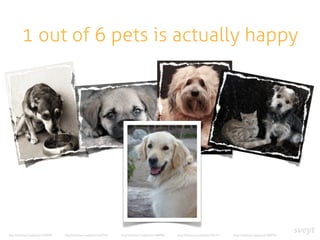
1 out of 6 pets is actually happy
http://www.sxc.hu/photo/1428378 http://www.sxc.hu/photo/1427333 http://www.sxc.hu/photo/1388996 http://www.sxc.hu/photo/1421011 http://www.sxc.hu/photo/1009754
"Nobody wants a 1/4 inch
drill — what they want is a
1/4 inch hole.”
—Theodore Levitt, marketing professor at Harvard
Requirements
Does it say who the people who we need to involve,
engage and reach are?
Does it say what the buyer expects the return to be?
Does it say why the buyer is spending resources and
money on this project?
"Delivery plans and requirements
documents are often shopping lists of
features, without any context that explains
why such things are important."
– Gojko Adzic, award–winning strategic software delivery consultant
http://www.sxc.hu/photo/1004855
18V 3 Ah Li-Ion
Rubber grip
Nylon wrist strap
1h recharge time
3,000 RPM electric
motor
Speed chuck
“I don’t care!
Does it make a fr****** hole?”
If so, how can we then build
something that successfully brings
value to our customers using that??
You will leave this room with a method to shift
how you manage projects from requirements-
oriented to results-only,
with happier customers and teams as a result
We need to emphasize
investment and results,
not costs and requirements
Poll: Your last project
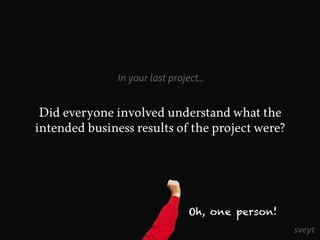
Did everyone involved understand what the
intended business results of the project were?
Oh, one person!
In your last project...
Was everyone, buyer and seller, able to
communicate clearly and transparently about
risks and problems that occured?
And another one!
In your last project...
Did everyone feel that the project was something
they could be proud of in terms of achievement,
quality and innovation?
In your last project...
I am not surprised...
Did everyone involved understand the
definition of a successful project and how
success was measured?
In your last project...
And now it’s her turn!
In the end, did the customer get what they
needed to address an actual business problem
or opportunity?
Anyone? :(
In your last project...
A
Story
from
Reality
Fables, myths and
project management
[slide: WidgetCo HQ]
One beautiful spring morning…
Here’s the idea!
[slide: In front of computer]
Susan is researching competitors’ websites.
[slide: Stack of documents]
The requirements stack up.
Bidders call Susan to get the answers they need.
Done deal!
Milestones are set by date and tied to scope.
“What were we thinking?”
de·vel·op·er [dih-vel-uh-per] noun: A person that
converts coffee into code
The team is working to exhaustion.
“Where’s the hockey stick?”
Was this a success?
+ The requirements were fulfilled to the letter
- Team worked their a**es off
- The seller made a loss
- The buyer didn't see the results they were hoping for
1 3
How did we end up here?
Need
Requirements and Design
Bidding
Execution
Evaluation
Let’s consider five
important phases
in the project
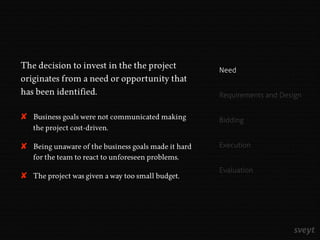
The decision to invest in the the project
originates from a need or opportunity that
has been identified.
✘ Business goals were not communicated making
the project cost-driven.
✘ Being unaware of the business goals made it hard
for the team to react to unforeseen problems.
✘ The project was given a way too small budget.
Need
Requirements and Design
Bidding
Execution
Evaluation
A requirement is a capability to which a
project outcome should conform and should
ideally capture more than just easily
observable and measurably aspects.
✘ The requirements focused on the superficial.
✘ The requirements were not relevant to the
business goals.
✘ Requirements were written by someone whose
expertise skewed them towards the easily
definable.
Need
Requirements and Design
Bidding
Execution
Evaluation
The competitive bidding process helps
winnow bidders, stimulate competition and
procure services at the lowest possible price.
✘ Relying only on a bidding process often tends to
make the buyer only look to price, ignoring ability
to perform.
✘ Bids rely heavily on software estimation which is
hard, if not near impossible.
✘ Optimistic assumptions and estimates put the
seller in a “knife to the throat” situation.
Need
Requirements and Design
Bidding
Execution
Evaluation
Project execution is what usually takes most
time and deals with directing and managing
the project, its assets and its progress.
✘ Designed to make the buyer feel secure, instead it
caused much stress, frustration killing motivation.
✘ The inflexible execution prevented the project
from gaining from ongoing learning.
✘ The soured relationship undermined trust
between parties and chances of project success.
Need
Requirements and Design
Bidding
Execution
Evaluation
In the long term, projects aren’t evaluated
based on how well they fulfill the
requirements to the letter but how well they
have the desired result.
✘ Very few members of the project team were aware
of the expected result.
✘ WidgetCo’s project failed to deliver the results the
executive sponsors had been hoping for.
Need
Requirements and Design
Bidding
Execution
Evaluation
This is not a rare case.
At companies that aren’t among the
top 25% of technology users, 3 out of 10
IT projects fail on average
http://www.umsl.edu/~sauterv/analysis/6840_f03_papers/frese/
“
Lack of user input
and involvement
http://www.sxc.hu/photo/1099035
User research
Incomplete
requirements
http://www.sxc.hu/photo/504217
Systematic collection
of requirements
Requirements linked
to goals
Agency involvement
Unrealistic
expectations
http://www.sxc.hu/photo/704067
Expectations and goals
communicated and
shared
Budget in relation to
expectations
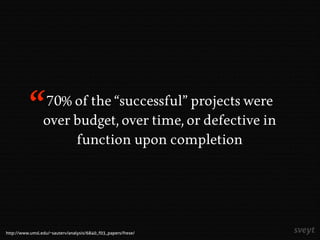
70% of the “successful” projects were
over budget, over time, or defective in
function upon completion
http://www.umsl.edu/~sauterv/analysis/6840_f03_papers/frese/
“
Is it sustainable?
For you?
For your customers?
For our entire business?
+ Team worked at an effective pace
+ The seller made a profit
+ The buyer saw the results they were hoping for
- The requirements were not fulfilled to the letter
3 1
What if we inverted the scoreboard?
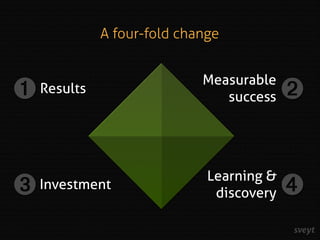
Let’s change how we
view projects
Measurable
success
Results
A four-fold change
➊
➌
➋
➍Learning &
discovery
Investment
A change with amazing consequences
TRUST Parties expect each other to act and deliver to the best of ability
GAIN The project is done on budget, buyer gets value and seller makes a profit
RESPECT Parties respect the competence/experience of each other
PURPOSE Parties feel this project is worth doing
ACHIEVEMENT Parties are proud of being part of the project and achieving its goals
What would it be like then…
The decision to invest in the the project
originates from a need or opportunity that
has been identified.
✓ The business goals are being communicated from
day one.
✓ The budget is based on the expected return, the
project considered an investment clearly linked to
the business goals.
✓ There are measurable success criteria the team
feels are realistic and which motivate them.
Need
Requirements and Design
Bidding
Execution
Evaluation
A requirement is a capability to which a
project outcome should conform and should
ideally capture more than just easily
observable and measurably aspects.
✓ Requirements are focused, sufficiently high level
and relevant to the success criteria.
✓ Requirements are supported by strategic analysis
and user research.
✓ Reliance on requirements as a way to control is
replaced with reliance on project leadership.
✓ There’s working communication and strong
executive support.
Need
Requirements and Design
Bidding
Execution
Evaluation
The competitive bidding process helps
winnow bidders, stimulate competition and
procure services at the lowest possible price.
✓ Focus on lowest price is replaced by a wish to find
the company with best ability to deliver.
✓ Software estimates only serve as input for first
stage of planning.
✓ Transparency makes the seller able to offer advice
on how to achieve the desired business result.
Need
Requirements and Design
Bidding
Execution
Evaluation
Project execution is what usually takes most
time and deals with directing and managing
the project, its assets and its progress.
✓ It’s understood that things be more difficult or
easier than planned for – learning is expected.
✓ Constant communication helps synchronize
expectations between team and executive
sponsors.
✓ Continual delivery helps establish trust.
✓ Flexibility fosters high morale as well as a creative
atmosphere.
Need
Requirements and Design
Bidding
Execution
Evaluation
In the long term, projects aren’t evaluated
based on how well they fulfill the
requirements to the letter but how well they
have the desired result.
✓ The team understands why the website was
designed and built a certain way.
✓ Everyone involved knows what the project’s goals
are and what they’re trying to achieve.
✓ Everyone is eagerly waiting for the first results of
their efforts to materialize, prepared to rethink,
redesign and tweak if necessary.
Need
Requirements and Design
Bidding
Execution
Evaluation
Too good to be true, eh?
“Where did all these ideas come from
and do they even work?”
Let’s see what the research says.
Two methods with proven track records
Agile
Impact Mapping
&
Effect Mapping
www.impactmapping.org
scrumshortcuts.com
Agile Methods
Scrum, FDD, XP, Kanban, DSDM…
Some concern projects, some are
sets of practices.
Family of Agile Methods
an inexact timeline
1990 2000 2010
Crystal
Scrum
Pair Programming
XP
Continuous Integration
TDD
Agile Manifesto
Lean SD*
https://corinna.scorpius.uberspace.de/finding-marbles/wordpress/wp-content/uploads/2012/04/agile-lean-engineering-timeline1.png
Kanban for SD*
Lean Startup
* Software Development
Do they work?
http://www.infoq.com/news/2012/11/success-agile-projects
– David F. Rico, “The Business Value of Using Agile Project
Management for New Products and Services”.
“An early study of agile project management showed
10% to 20% improvements in revenues, quality, and
cycle time, and 54% reductions in costs…”
Do they work!? Ya bet they do!
http://www.onedesk.com/2013/01/waterfall-vs-agile/
Waterfall Agile
Successful Challenged Failed
“Agile projects are three times more successful
than Waterfall projects.”
14%
57%
29%
42%
49%
9%
– 2011 CHAOS Manifesto from the Standish Group
http://stackoverflow.com/questions/3001627/agile-when-does-it-work-well-and-when-doesnt-it
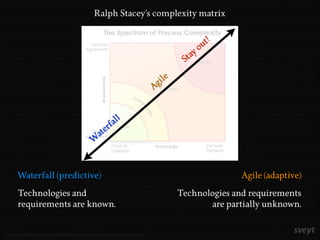
W
aterfall
Agile
Stay out!
Waterfall (predictive)
Technologies and
requirements are known.
Agile (adaptive)
Technologies and requirements
are partially unknown.
Ralph Stacey's complexity matrix
Which is best?
It depends on the type of project.
In my experience, agile is very well
suited for Drupal development.
“Impact mapping brings usability and speed to proven product and
project management strategies, helping them fit better into modern
software delivery constraints, and at the same time applying some
great ideas from other industries to software delivery”
– impactmapping.org
Impact Mapping
✓ Facilitate strategic planning to create a big-picture view
focused on key business objectives
✓ Facilitate learning through delivery
✓ Help us manage project roadmaps
✓ Represent delivery scope in a way that is easy to evolve to
react to changed market opportunities or new knowledge
Impact Maps
Impact Maps
“An impact map is a visualisation of scope and
underlying assumptions, created collaboratively
by senior technical and business people.”
Why?
Who?
Who?
How?
How?
How?
How?
What?
What?
What?
What?
– Gojko Adzic
What?
What?
Impact Maps
Why?
Who?
Who?
How?
How?
How?
How?
What?
What?
What?
What?
What?
What?
Business goal Deliverables
Effect Maps
Effect
User
Group
User
Group
User Need
User Need
User Need
User Need
Feature
Feature
Feature?
Feature
Feature
Feature
Effect Features
Effect Maps vs Impact Maps
Effect Maps Impact Maps
Based on user research, a
structured map of goals, end
users and their needs, used in
interaction design
Created in a strategic meeting,
a roadmap focusing on
impact, used to make
decisions regarding scope
Helps interaction designers
design for end users based on
business goals
Helps the project focus on the
right deliverables to achieve
the business goals
You’ll do right to learn about both.
Usability Testing
User Group
User Need
Feature
Persona
Wireframe
Prototype
Who are our users and what do
they need?
Assumptions
SMART
Goals
Impacts
Learn
What are our assumptions and what do we
need to do to achieve our goals?
Why?
Who?
How?
What?
What?
Actors
Build
Measure
You’re not convinced…
"But without price bidding, sellers have
no incentive to be cost effective"
"But the buyer needs to set up
clear milestones, otherwise the
project will fail"
"Customers don't always know their
business needs/goals"
Things can be done very
differently from how
they’re often done
Meanwhile, somewhere in Universe
“A.k.a ‘the nice
universe’”
A
Much Better Story
from
Universe
Fables, myths and
project management
2
[slide: WidgetCo HQ]
One beautiful spring morning…
Here’s the idea!
Realistic yet ambitious goals were set that day…
…measurable goals tied to timeframes – SMART.
IT guy Mark was eager to help.
[slide: interview of a person]
WidgetCo makes pet products, did I mention that?
[slide: wireframes]
Wireframes were drawn.
[slide: presentation]
The agencies made impressive pitches.
[slide: happy team]
The agency seemed to love what they did.
[slide: enthusiastic person]
Susan’s enthusiasm was also ehm... strong.
[slide: person thinking hard]
Analyzing the requirements took some deep thinking.
[slide: meeting]
The team had continuous meetings.
[slide: effective team]
Finding the requirements that contributed most to
impact took time.
[slide: champagne, party]
The end result was what everyone had been hoping for.
Life in Universe
Stronger buyer-seller relationship
Better use of money and higher success rate
Higher satisfaction for all parties involved
Which universe do you want to live in?
The steps we need to take
The new dictionary
Cost Investment
Requirements Results
Plan Learning
Control Trust
Four principles
1. We view the project as intended to create results
2. There’s agreement on how to measure and define
success
3. The project is considered an investment
4. It will be a learning experience for all parties
➊
➌
➋
➍
Starting with goals
“We need a
better website!”
“It’s really hard to find
out who we are and
there’s no way to post
comments and feel
involved!”
“A big share of our
customers want to
feel involved.”
“We need to reach those
customers in order to
channel more sales
through our site.”
KAA-
POW!
We view the project as
intended to create results
➊
$€£
“We need to reach those customers
in order to channel more sales
through our site.”
“How many?”
SCALE Number of orders per month
METER Order list on e-commerce site.
BENCHMARK 3,000 “We’re seeing 3,000 per month now”
CONSTRAINT 5,000 “We need at least 5,000 to break even”
TARGET 7,000 “We want to reach 5,000”
We are in agreement on how to
measure and define success➋
“We need to reach those customers in order to
channel more sales through our site.”
“By when?”
MILESTONE 1 – more purchasesMILESTONE 1 – more purchasesMILESTONE 1 – more purchases
SCALE Number of orders per month in six monthsNumber of orders per month in six months
METER Order list on e-commerce site.Order list on e-commerce site.
BENCHMARK 3,000
CONSTRAINT 5,000
TARGET 7,000
“We can tolerate higher costs for a
short while.”
MILESTONE 1 – more purchases, higher IT costsMILESTONE 1 – more purchases, higher IT costsMILESTONE 1 – more purchases, higher IT costs
More orders Operational costs
SCALE
Number of orders per month in six
months
Hosting costs + IT staff salaries
METER Order list on e-commerce site. Financial accounts
BENCHMARK 3,000 €80,000
CONSTRAINT 5,000 €120,000
TARGET 7,000 €80,000
“But we want to reduce them as
soon as we see results.”
MILESTONE 2 – same number of orders, lower IT costsMILESTONE 2 – same number of orders, lower IT costsMILESTONE 2 – same number of orders, lower IT costs
More orders Operational costs
SCALE
Number of orders per month in six
months
Hosting costs + IT staff salaries
METER Order list on e-commerce site. Financial accounts
BENCHMARK
CONSTRAINT 7,000 €80,000
TARGET 7,000 €50,000
MILESTONE 2 – same number of orders, lower IT costsMILESTONE 2 – same number of orders, lower IT costsMILESTONE 2 – same number of orders, lower IT costs
More orders Operational costs
SCALE Number of orders per month in six
months
Hosting costs + IT staff salaries
METER Order list on e-commerce site. Financial accounts
“What are these results worth to you?”
“Let me think. The answer to that
determines the budget.”
MILESTONE 1 – more purchases, higher IT costsMILESTONE 1 – more purchases, higher IT costsMILESTONE 1 – more purchases, higher IT costs
More orders Operational costs
SCALE Number of orders per month in six months Hosting costs + IT staff salaries
METER Order list on e-commerce site. Financial accounts
The project is an investment➌
7,000 orders
per month
Customers
Place orders
Product
recommendations
Why are we doing it?
Who will help us?
How will they
help?
What are we
doing?
7,000 orders
per month
Customers
Place orders
Facebook
integration
Why are we doing it?
Who will help us?
How will they
help?
What are we
doing?
What else could those guys do for us?
Who else can help? How?
Who can obstruct us?
7,000 orders
per month
Customers
What else could those guys do for us?
Who else can help? How?
Who can obstruct us?
Friends of
customers
Repeat
customers
7,000 orders
per month
Customers
What else can they do?
Place orders
Tell friends
Place orders
Tell friends
7,000 orders
per month
Customers
Which ones to try first?
Is there a high-value low-hanging-fruit
impact somewhere?
Place orders
Tell friends
Customers
What are the deliverables?
Could we test it without software?
Could we start earning with a partly
manual process?
Product
recommendations
Facebook like/
share
Impact maps visualize
deliverables and assumptions
and link them to business goals.
This helps us justify every
feature we build or test.
MILESTONE 1 – more purchases, higher IT costsMILESTONE 1 – more purchases, higher IT costsMILESTONE 1 – more purchases, higher IT costs
More orders Operational costs
SCALE Number of orders per month in six
months
Hosting costs + IT staff salaries
METER Order list on e-commerce site. Financial accounts
BENCHMARK 3,000 €80,000
CONSTRAINT 5,000 €120,000
TARGET 7,000 €80,000
Place orders
Tell friends
Customers
Product
recommendations
Facebook like/
share
7,000 orders
per month
Friends of
customers
Repeat
customers
A simplified
impact map
with milestones
attached
Are we achieving key targets?
Milestone 1
Sprint 1 Sprint 2 Sprint 3
Milestone 2
Sprint 4 Sprint 5 Sprint 6
Hmm, no. Let’s rethink our strategy!
Milestone 3
Sprint 7 Sprint 8 Sprint 9
More ordersMore orders
SCALE Number of orders per month in six months
METER Order list on e-commerce site.
BENCHMARK 3,000
CONSTRAINT 5,000
TARGET 7,000
The project will be a learning
experience for all parties
➍
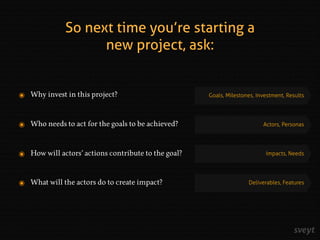
๏ Why invest in this project?
๏ Who needs to act for the goals to be achieved?
๏ How will actors’ actions contribute to the goal?
๏ What will the actors do to create impact?
Goals, Milestones, Investment, Results
Actors, Personas
Impacts, Needs
Deliverables, Features
So next time you’re starting a
new project, ask:
Impact Mapping | I
Books
Background:http://jasonbleinel.deviantart.com/art/Carbon-Fibre-Texture-114032735
Resources, books, links and more:
www.jakob-persson.com/rowi
Results Only
Web Investments
Results Only
Web Investments
You’ve just been part of
A production by
Presented by Jakob Persson, Founder and CEO
jakob.persson@sveyt.com
jakobper
www.jakob-persson.com
lifeissveyt
www.sveyt.com
Background:http://jasonbleinel.deviantart.com/art/Carbon-Fibre-Texture-114032735

Results-Only Web Investments

  • 1.
    Results Only Web Investments JakobPersson DrupalCon Prague, Thursday September 26th, 2013
  • 2.
    Introducing me Founder andCEO of Sveyt Co-founded NodeOne Worked with Drupal since 2005 Studied cognitive science and computer science. jakob.persson@sveyt.com http://twitter.com/jakobper http://drupal.org/user/37564
  • 3.
    Prototypes, develops andbuilds your product idea and validates market assumptions with Drupal. We are hiring freelancers. Talk to us! jakob.persson@sveyt.com
  • 4.
  • 5.
    16% of all webprojects are considered “complete successes”
  • 6.
    only 16% of all webprojects are considered “complete successes”
  • 7.
    1 out of6 beers is Czech (Czech beer is awesome) http://www.sxc.hu/photo/1209277
  • 8.
    1 out of6 cars doesn’t crash http://www.sxc.hu/photo/1357729 http://www.sxc.hu/photo/1018876 http://www.sxc.hu/photo/1067693 http://www.sxc.hu/photo/1156584 http://www.sxc.hu/photo/1093472 http://www.sxc.hu/photo/1421209
  • 9.
    1 out of6 pets is actually happy http://www.sxc.hu/photo/1428378 http://www.sxc.hu/photo/1427333 http://www.sxc.hu/photo/1388996 http://www.sxc.hu/photo/1421011 http://www.sxc.hu/photo/1009754
  • 10.
    "Nobody wants a1/4 inch drill — what they want is a 1/4 inch hole.” —Theodore Levitt, marketing professor at Harvard
  • 11.
  • 12.
    Does it saywho the people who we need to involve, engage and reach are? Does it say what the buyer expects the return to be? Does it say why the buyer is spending resources and money on this project?
  • 13.
    "Delivery plans andrequirements documents are often shopping lists of features, without any context that explains why such things are important." – Gojko Adzic, award–winning strategic software delivery consultant
  • 14.
    http://www.sxc.hu/photo/1004855 18V 3 AhLi-Ion Rubber grip Nylon wrist strap 1h recharge time 3,000 RPM electric motor Speed chuck “I don’t care! Does it make a fr****** hole?”
  • 15.
    If so, howcan we then build something that successfully brings value to our customers using that??
  • 16.
    You will leavethis room with a method to shift how you manage projects from requirements- oriented to results-only, with happier customers and teams as a result
  • 17.
    We need toemphasize investment and results, not costs and requirements
  • 18.
  • 19.
    Did everyone involvedunderstand what the intended business results of the project were? Oh, one person! In your last project...
  • 20.
    Was everyone, buyerand seller, able to communicate clearly and transparently about risks and problems that occured? And another one! In your last project...
  • 21.
    Did everyone feelthat the project was something they could be proud of in terms of achievement, quality and innovation? In your last project... I am not surprised...
  • 22.
    Did everyone involvedunderstand the definition of a successful project and how success was measured? In your last project... And now it’s her turn!
  • 23.
    In the end,did the customer get what they needed to address an actual business problem or opportunity? Anyone? :( In your last project...
  • 24.
  • 25.
    [slide: WidgetCo HQ] Onebeautiful spring morning…
  • 26.
  • 27.
    [slide: In frontof computer] Susan is researching competitors’ websites.
  • 28.
    [slide: Stack ofdocuments] The requirements stack up.
  • 29.
    Bidders call Susanto get the answers they need.
  • 30.
  • 31.
    Milestones are setby date and tied to scope.
  • 32.
    “What were wethinking?”
  • 33.
    de·vel·op·er [dih-vel-uh-per] noun:A person that converts coffee into code
  • 34.
    The team isworking to exhaustion.
  • 35.
  • 36.
    Was this asuccess? + The requirements were fulfilled to the letter - Team worked their a**es off - The seller made a loss - The buyer didn't see the results they were hoping for 1 3
  • 37.
    How did weend up here?
  • 38.
    Need Requirements and Design Bidding Execution Evaluation Let’sconsider five important phases in the project
  • 39.
    The decision toinvest in the the project originates from a need or opportunity that has been identified. ✘ Business goals were not communicated making the project cost-driven. ✘ Being unaware of the business goals made it hard for the team to react to unforeseen problems. ✘ The project was given a way too small budget. Need Requirements and Design Bidding Execution Evaluation
  • 40.
    A requirement isa capability to which a project outcome should conform and should ideally capture more than just easily observable and measurably aspects. ✘ The requirements focused on the superficial. ✘ The requirements were not relevant to the business goals. ✘ Requirements were written by someone whose expertise skewed them towards the easily definable. Need Requirements and Design Bidding Execution Evaluation
  • 41.
    The competitive biddingprocess helps winnow bidders, stimulate competition and procure services at the lowest possible price. ✘ Relying only on a bidding process often tends to make the buyer only look to price, ignoring ability to perform. ✘ Bids rely heavily on software estimation which is hard, if not near impossible. ✘ Optimistic assumptions and estimates put the seller in a “knife to the throat” situation. Need Requirements and Design Bidding Execution Evaluation
  • 42.
    Project execution iswhat usually takes most time and deals with directing and managing the project, its assets and its progress. ✘ Designed to make the buyer feel secure, instead it caused much stress, frustration killing motivation. ✘ The inflexible execution prevented the project from gaining from ongoing learning. ✘ The soured relationship undermined trust between parties and chances of project success. Need Requirements and Design Bidding Execution Evaluation
  • 43.
    In the longterm, projects aren’t evaluated based on how well they fulfill the requirements to the letter but how well they have the desired result. ✘ Very few members of the project team were aware of the expected result. ✘ WidgetCo’s project failed to deliver the results the executive sponsors had been hoping for. Need Requirements and Design Bidding Execution Evaluation
  • 44.
    This is nota rare case.
  • 45.
    At companies thataren’t among the top 25% of technology users, 3 out of 10 IT projects fail on average http://www.umsl.edu/~sauterv/analysis/6840_f03_papers/frese/ “
  • 46.
    Lack of userinput and involvement http://www.sxc.hu/photo/1099035 User research
  • 47.
  • 48.
  • 49.
    70% of the“successful” projects were over budget, over time, or defective in function upon completion http://www.umsl.edu/~sauterv/analysis/6840_f03_papers/frese/ “
  • 50.
    Is it sustainable? Foryou? For your customers? For our entire business?
  • 51.
    + Team workedat an effective pace + The seller made a profit + The buyer saw the results they were hoping for - The requirements were not fulfilled to the letter 3 1 What if we inverted the scoreboard?
  • 52.
    Let’s change howwe view projects
  • 53.
  • 54.
    A change withamazing consequences TRUST Parties expect each other to act and deliver to the best of ability GAIN The project is done on budget, buyer gets value and seller makes a profit RESPECT Parties respect the competence/experience of each other PURPOSE Parties feel this project is worth doing ACHIEVEMENT Parties are proud of being part of the project and achieving its goals
  • 55.
    What would itbe like then…
  • 56.
    The decision toinvest in the the project originates from a need or opportunity that has been identified. ✓ The business goals are being communicated from day one. ✓ The budget is based on the expected return, the project considered an investment clearly linked to the business goals. ✓ There are measurable success criteria the team feels are realistic and which motivate them. Need Requirements and Design Bidding Execution Evaluation
  • 57.
    A requirement isa capability to which a project outcome should conform and should ideally capture more than just easily observable and measurably aspects. ✓ Requirements are focused, sufficiently high level and relevant to the success criteria. ✓ Requirements are supported by strategic analysis and user research. ✓ Reliance on requirements as a way to control is replaced with reliance on project leadership. ✓ There’s working communication and strong executive support. Need Requirements and Design Bidding Execution Evaluation
  • 58.
    The competitive biddingprocess helps winnow bidders, stimulate competition and procure services at the lowest possible price. ✓ Focus on lowest price is replaced by a wish to find the company with best ability to deliver. ✓ Software estimates only serve as input for first stage of planning. ✓ Transparency makes the seller able to offer advice on how to achieve the desired business result. Need Requirements and Design Bidding Execution Evaluation
  • 59.
    Project execution iswhat usually takes most time and deals with directing and managing the project, its assets and its progress. ✓ It’s understood that things be more difficult or easier than planned for – learning is expected. ✓ Constant communication helps synchronize expectations between team and executive sponsors. ✓ Continual delivery helps establish trust. ✓ Flexibility fosters high morale as well as a creative atmosphere. Need Requirements and Design Bidding Execution Evaluation
  • 60.
    In the longterm, projects aren’t evaluated based on how well they fulfill the requirements to the letter but how well they have the desired result. ✓ The team understands why the website was designed and built a certain way. ✓ Everyone involved knows what the project’s goals are and what they’re trying to achieve. ✓ Everyone is eagerly waiting for the first results of their efforts to materialize, prepared to rethink, redesign and tweak if necessary. Need Requirements and Design Bidding Execution Evaluation
  • 61.
    Too good tobe true, eh?
  • 62.
    “Where did allthese ideas come from and do they even work?” Let’s see what the research says.
  • 63.
    Two methods withproven track records Agile Impact Mapping & Effect Mapping www.impactmapping.org scrumshortcuts.com
  • 64.
    Agile Methods Scrum, FDD,XP, Kanban, DSDM… Some concern projects, some are sets of practices.
  • 65.
    Family of AgileMethods an inexact timeline 1990 2000 2010 Crystal Scrum Pair Programming XP Continuous Integration TDD Agile Manifesto Lean SD* https://corinna.scorpius.uberspace.de/finding-marbles/wordpress/wp-content/uploads/2012/04/agile-lean-engineering-timeline1.png Kanban for SD* Lean Startup * Software Development
  • 66.
    Do they work? http://www.infoq.com/news/2012/11/success-agile-projects –David F. Rico, “The Business Value of Using Agile Project Management for New Products and Services”. “An early study of agile project management showed 10% to 20% improvements in revenues, quality, and cycle time, and 54% reductions in costs…”
  • 67.
    Do they work!?Ya bet they do! http://www.onedesk.com/2013/01/waterfall-vs-agile/ Waterfall Agile Successful Challenged Failed “Agile projects are three times more successful than Waterfall projects.” 14% 57% 29% 42% 49% 9% – 2011 CHAOS Manifesto from the Standish Group
  • 68.
    http://stackoverflow.com/questions/3001627/agile-when-does-it-work-well-and-when-doesnt-it W aterfall Agile Stay out! Waterfall (predictive) Technologiesand requirements are known. Agile (adaptive) Technologies and requirements are partially unknown. Ralph Stacey's complexity matrix
  • 69.
    Which is best? Itdepends on the type of project. In my experience, agile is very well suited for Drupal development.
  • 70.
    “Impact mapping bringsusability and speed to proven product and project management strategies, helping them fit better into modern software delivery constraints, and at the same time applying some great ideas from other industries to software delivery” – impactmapping.org Impact Mapping
  • 71.
    ✓ Facilitate strategicplanning to create a big-picture view focused on key business objectives ✓ Facilitate learning through delivery ✓ Help us manage project roadmaps ✓ Represent delivery scope in a way that is easy to evolve to react to changed market opportunities or new knowledge Impact Maps
  • 72.
    Impact Maps “An impactmap is a visualisation of scope and underlying assumptions, created collaboratively by senior technical and business people.” Why? Who? Who? How? How? How? How? What? What? What? What? – Gojko Adzic What? What?
  • 73.
  • 74.
    Effect Maps Effect User Group User Group User Need UserNeed User Need User Need Feature Feature Feature? Feature Feature Feature Effect Features
  • 75.
    Effect Maps vsImpact Maps Effect Maps Impact Maps Based on user research, a structured map of goals, end users and their needs, used in interaction design Created in a strategic meeting, a roadmap focusing on impact, used to make decisions regarding scope Helps interaction designers design for end users based on business goals Helps the project focus on the right deliverables to achieve the business goals
  • 76.
    You’ll do rightto learn about both.
  • 77.
    Usability Testing User Group UserNeed Feature Persona Wireframe Prototype Who are our users and what do they need?
  • 78.
    Assumptions SMART Goals Impacts Learn What are ourassumptions and what do we need to do to achieve our goals? Why? Who? How? What? What? Actors Build Measure
  • 79.
  • 80.
    "But without pricebidding, sellers have no incentive to be cost effective"
  • 81.
    "But the buyerneeds to set up clear milestones, otherwise the project will fail"
  • 82.
    "Customers don't alwaysknow their business needs/goals"
  • 83.
    Things can bedone very differently from how they’re often done
  • 84.
    Meanwhile, somewhere inUniverse “A.k.a ‘the nice universe’”
  • 85.
    A Much Better Story from Universe Fables,myths and project management 2
  • 86.
    [slide: WidgetCo HQ] Onebeautiful spring morning…
  • 87.
  • 88.
    Realistic yet ambitiousgoals were set that day…
  • 89.
    …measurable goals tiedto timeframes – SMART.
  • 90.
    IT guy Markwas eager to help.
  • 91.
    [slide: interview ofa person] WidgetCo makes pet products, did I mention that?
  • 92.
  • 93.
    [slide: presentation] The agenciesmade impressive pitches.
  • 94.
    [slide: happy team] Theagency seemed to love what they did.
  • 95.
    [slide: enthusiastic person] Susan’senthusiasm was also ehm... strong.
  • 96.
    [slide: person thinkinghard] Analyzing the requirements took some deep thinking.
  • 97.
    [slide: meeting] The teamhad continuous meetings.
  • 98.
    [slide: effective team] Findingthe requirements that contributed most to impact took time.
  • 99.
    [slide: champagne, party] Theend result was what everyone had been hoping for.
  • 100.
    Life in Universe Strongerbuyer-seller relationship Better use of money and higher success rate Higher satisfaction for all parties involved
  • 101.
    Which universe doyou want to live in?
  • 102.
    The steps weneed to take
  • 103.
  • 104.
  • 105.
  • 106.
  • 107.
  • 108.
    Four principles 1. Weview the project as intended to create results 2. There’s agreement on how to measure and define success 3. The project is considered an investment 4. It will be a learning experience for all parties ➊ ➌ ➋ ➍
  • 109.
  • 110.
    “We need a betterwebsite!” “It’s really hard to find out who we are and there’s no way to post comments and feel involved!” “A big share of our customers want to feel involved.” “We need to reach those customers in order to channel more sales through our site.” KAA- POW! We view the project as intended to create results ➊ $€£
  • 111.
    “We need toreach those customers in order to channel more sales through our site.” “How many?” SCALE Number of orders per month METER Order list on e-commerce site. BENCHMARK 3,000 “We’re seeing 3,000 per month now” CONSTRAINT 5,000 “We need at least 5,000 to break even” TARGET 7,000 “We want to reach 5,000” We are in agreement on how to measure and define success➋
  • 112.
    “We need toreach those customers in order to channel more sales through our site.” “By when?” MILESTONE 1 – more purchasesMILESTONE 1 – more purchasesMILESTONE 1 – more purchases SCALE Number of orders per month in six monthsNumber of orders per month in six months METER Order list on e-commerce site.Order list on e-commerce site. BENCHMARK 3,000 CONSTRAINT 5,000 TARGET 7,000
  • 113.
    “We can toleratehigher costs for a short while.” MILESTONE 1 – more purchases, higher IT costsMILESTONE 1 – more purchases, higher IT costsMILESTONE 1 – more purchases, higher IT costs More orders Operational costs SCALE Number of orders per month in six months Hosting costs + IT staff salaries METER Order list on e-commerce site. Financial accounts BENCHMARK 3,000 €80,000 CONSTRAINT 5,000 €120,000 TARGET 7,000 €80,000
  • 114.
    “But we wantto reduce them as soon as we see results.” MILESTONE 2 – same number of orders, lower IT costsMILESTONE 2 – same number of orders, lower IT costsMILESTONE 2 – same number of orders, lower IT costs More orders Operational costs SCALE Number of orders per month in six months Hosting costs + IT staff salaries METER Order list on e-commerce site. Financial accounts BENCHMARK CONSTRAINT 7,000 €80,000 TARGET 7,000 €50,000
  • 115.
    MILESTONE 2 –same number of orders, lower IT costsMILESTONE 2 – same number of orders, lower IT costsMILESTONE 2 – same number of orders, lower IT costs More orders Operational costs SCALE Number of orders per month in six months Hosting costs + IT staff salaries METER Order list on e-commerce site. Financial accounts “What are these results worth to you?” “Let me think. The answer to that determines the budget.” MILESTONE 1 – more purchases, higher IT costsMILESTONE 1 – more purchases, higher IT costsMILESTONE 1 – more purchases, higher IT costs More orders Operational costs SCALE Number of orders per month in six months Hosting costs + IT staff salaries METER Order list on e-commerce site. Financial accounts The project is an investment➌
  • 116.
    7,000 orders per month Customers Placeorders Product recommendations Why are we doing it? Who will help us? How will they help? What are we doing?
  • 117.
    7,000 orders per month Customers Placeorders Facebook integration Why are we doing it? Who will help us? How will they help? What are we doing? What else could those guys do for us? Who else can help? How? Who can obstruct us?
  • 118.
    7,000 orders per month Customers Whatelse could those guys do for us? Who else can help? How? Who can obstruct us? Friends of customers Repeat customers
  • 119.
    7,000 orders per month Customers Whatelse can they do? Place orders Tell friends
  • 120.
    Place orders Tell friends 7,000orders per month Customers Which ones to try first? Is there a high-value low-hanging-fruit impact somewhere?
  • 121.
    Place orders Tell friends Customers Whatare the deliverables? Could we test it without software? Could we start earning with a partly manual process? Product recommendations Facebook like/ share
  • 122.
    Impact maps visualize deliverablesand assumptions and link them to business goals. This helps us justify every feature we build or test.
  • 123.
    MILESTONE 1 –more purchases, higher IT costsMILESTONE 1 – more purchases, higher IT costsMILESTONE 1 – more purchases, higher IT costs More orders Operational costs SCALE Number of orders per month in six months Hosting costs + IT staff salaries METER Order list on e-commerce site. Financial accounts BENCHMARK 3,000 €80,000 CONSTRAINT 5,000 €120,000 TARGET 7,000 €80,000 Place orders Tell friends Customers Product recommendations Facebook like/ share 7,000 orders per month Friends of customers Repeat customers A simplified impact map with milestones attached
  • 124.
    Are we achievingkey targets? Milestone 1 Sprint 1 Sprint 2 Sprint 3 Milestone 2 Sprint 4 Sprint 5 Sprint 6 Hmm, no. Let’s rethink our strategy! Milestone 3 Sprint 7 Sprint 8 Sprint 9 More ordersMore orders SCALE Number of orders per month in six months METER Order list on e-commerce site. BENCHMARK 3,000 CONSTRAINT 5,000 TARGET 7,000 The project will be a learning experience for all parties ➍
  • 125.
    ๏ Why investin this project? ๏ Who needs to act for the goals to be achieved? ๏ How will actors’ actions contribute to the goal? ๏ What will the actors do to create impact? Goals, Milestones, Investment, Results Actors, Personas Impacts, Needs Deliverables, Features So next time you’re starting a new project, ask:
  • 126.
  • 127.
  • 128.
    Results Only Web Investments You’vejust been part of A production by Presented by Jakob Persson, Founder and CEO jakob.persson@sveyt.com jakobper www.jakob-persson.com lifeissveyt www.sveyt.com Background:http://jasonbleinel.deviantart.com/art/Carbon-Fibre-Texture-114032735