Ian Swinson Lead User Interface Designer [email_address] Postcard Patterns An Agile UI Pattern Creation Process
Safe Harbor Statement “ Safe harbor” statement under the Private Securities Litigation Reform Act of 1995: This presentation may contain forward-looking statements including but not limited to statements concerning the potential market for our existing service offerings and future offerings. All of our forward looking statements involve risks, uncertainties and assumptions. If any such risks or uncertainties materialize or if any of the assumptions proves incorrect, our results could differ materially from the results expressed or implied by the forward-looking statements we make. The risks and uncertainties referred to above include - but are not limited to - risks associated with possible fluctuations in our operating results and cash flows, rate of growth and anticipated revenue run rate, errors, interruptions or delays in our service or our Web hosting, our new business model, our history of operating losses, the possibility that we will not remain profitable, breach of our security measures, the emerging market in which we operate, our relatively limited operating history, our ability to hire, retain and motivate our employees and manage our growth, competition, our ability to continue to release and gain customer acceptance of new and improved versions of our service, customer and partner acceptance of the AppExchange, successful customer deployment and utilization of our services, unanticipated changes in our effective tax rate, fluctuations in the number of shares outstanding, the price of such shares, foreign currency exchange rates and interest rates.  Further information on these and other factors that could affect our financial results is included in the reports on Forms 10-K, 10-Q and 8-K and in other filings we make with the Securities and Exchange Commission from time to time. These documents are available on the SEC Filings section of the Investor Information section of our website at  www.salesforce.com/investor . Salesforce.com, inc. assumes no obligation and does not intend to update these forward-looking statements, except as required by law.
Agenda Salesforce.com –  A Brief History Patternforce 1.0 –   A Cautionary Tale Patternforce 2.0 –   A New Beginning May the force be with us! Patternforce 3.0 –  The Future Q & A
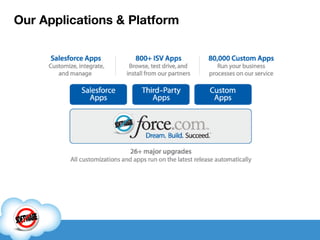
Our Applications & Platform
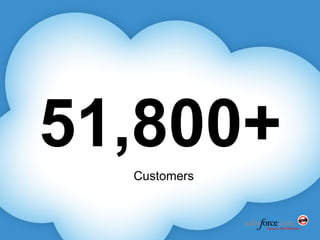
51,800+ Customers
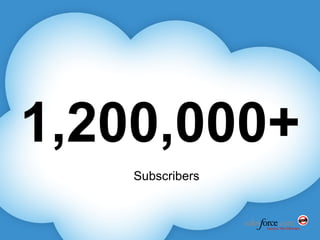
1,200,000+ Subscribers
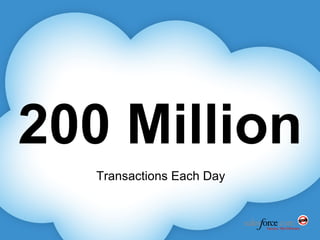
200 Million Transactions Each Day
UE in  2004
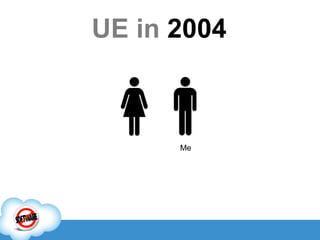
UE in  2004 Me
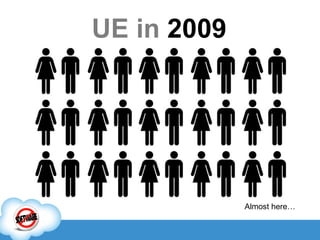
UE in  2009 Almost here…
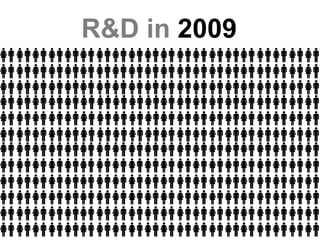
R&D in  2009
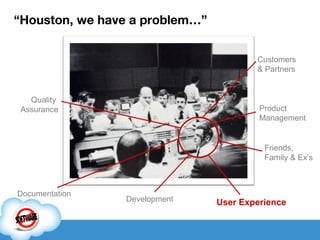
“ Houston, we have a problem…” Quality  Assurance Documentation User Experience Product Management Development Customers  & Partners Friends,  Family & Ex’s
We need to retain consistency We already have multiple versions Can we choose one and move on? Comments added to the “bad” code New employees need to get up to speed quickly We need insight into other teams’ solutions A consistent, universally available location We don’t have designers for every feature Developers, Designers and PM’s are always asking questions We need to minimize distractions for the Designers Consistency Efficiency We Need a Pattern Library?
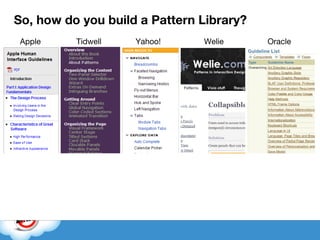
So, how do you build a Pattern Library? Apple Tidwell Yahoo!  Welie Oracle
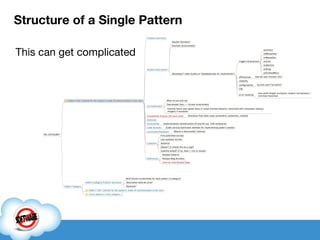
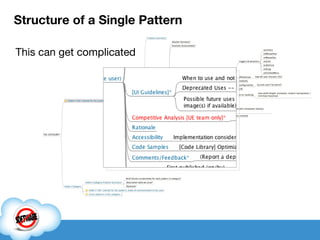
Structure of a Single Pattern This can get complicated
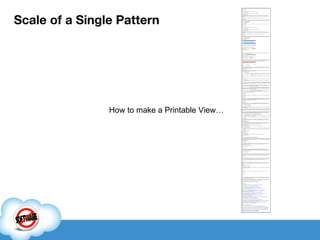
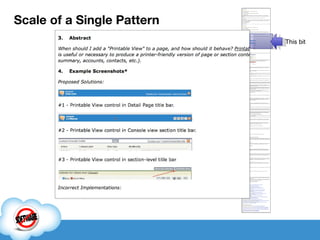
Scale of a Single Pattern How to make a Printable View…
Scale of a Single Pattern How to make a Printable View… This bit
Our valiant attempt…
We worked
We slept
We worked some more
We carefully rehydrated
We worked some more
We ate, we traveled, we had babies
And after a little more work we asked…
How did we do?
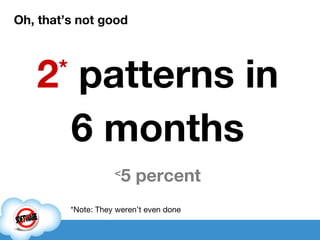
Oh, that’s not good 2 *   patterns in 6 months < 5 percent *Note: They weren’t even done
Clearly, this is not going to work
What did we do wrong? External Research Only –  We looked at examples but didn’t validate them internally Detail & Scale –  We went way too deep, way too early Scope Creep –  “Oooh, and wouldn’t it be cool?!” Incomplete Taxonomy –  We didn’t have a complete idea of what we needed to document No Prioritization –  Printable View? The number one pattern in our app? Um, no. Deaf Ears   –  We didn’t listen to our designers
Back to work…but with  agility
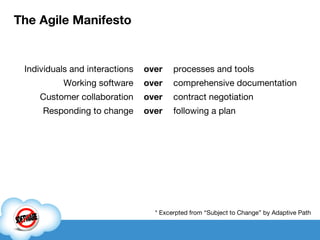
The Agile Manifesto Individuals and interactions Working software Customer collaboration Responding to change over over over over processes and tools comprehensive documentation contract negotiation following a plan * Excerpted from “Subject to Change” by Adaptive Path
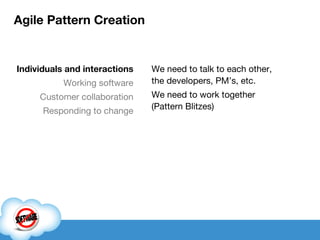
Agile Pattern Creation Individuals and interactions Working software Customer collaboration Responding to change We need to talk to each other, the developers, PM’s, etc. We need to work together (Pattern Blitzes)
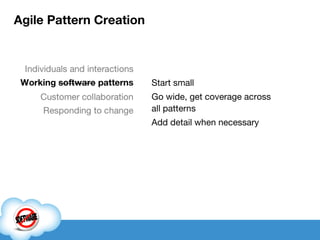
Agile Pattern Creation Start small Go wide, get coverage across all patterns Add detail when necessary
Agile Pattern Creation Check progress regularly Share with our intended audience and make changes Listen to suggestions
Agile Pattern Creation Create something nimble – easy to create and easy to update Software changes all the time Designs change all the time
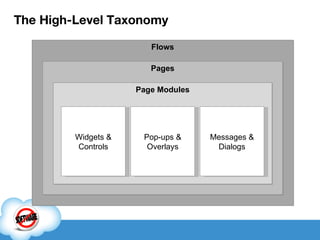
The High-Level Taxonomy Flows Pages Page Modules Pop-ups & Overlays Messages & Dialogs Widgets & Controls
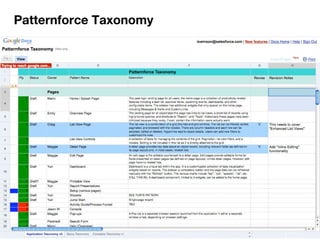
Patternforce Taxonomy We ended up with a large, but relatively flat, list.
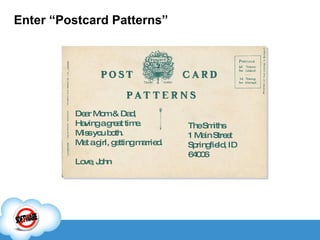
Enter “Postcard Patterns” Dear Mom & Dad, Having a great time. Miss you both. Met a girl, getting married. Love, John The Smiths 1 Main Street Springfield, ID 64006
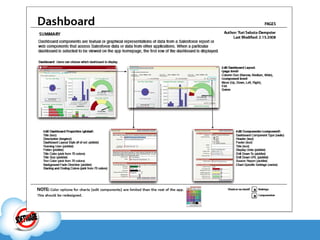
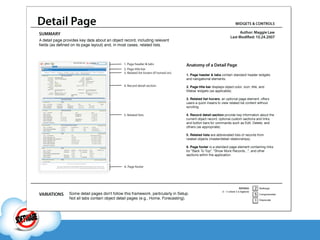
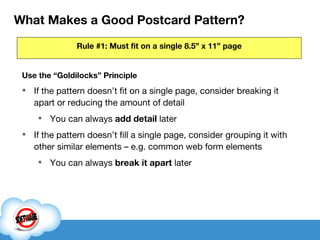
What Makes a Good Postcard Pattern? Use the “Goldilocks” Principle If the pattern doesn’t fit on a single page, consider breaking it apart or reducing the amount of detail You can always  add detail  later If the pattern doesn’t fill a single page, consider grouping it with other similar elements – e.g. common web form elements You can always  break it apart  later Rule #1: Must fit on a single 8.5” x 11” page
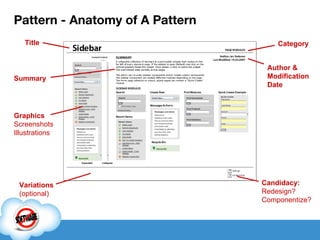
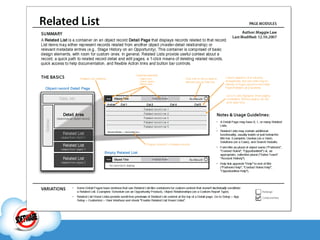
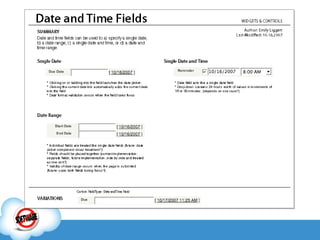
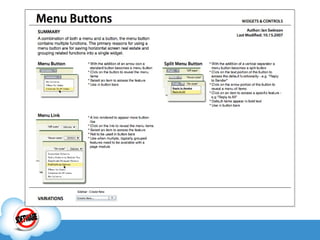
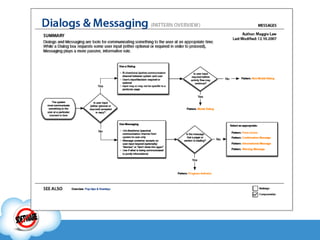
Pattern - Anatomy of A Pattern Title Summary Category Author & Modification Date Variations (optional) Candidacy: Redesign? Componentize? Graphics Screenshots Illustrations


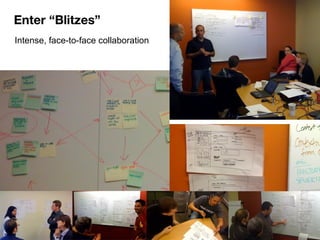
Enter “Blitzes” Intense, face-to-face collaboration
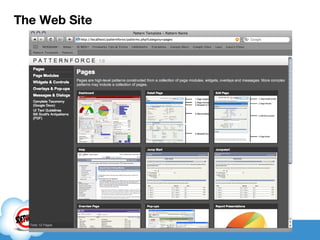
The Web Site
How did we do this time?
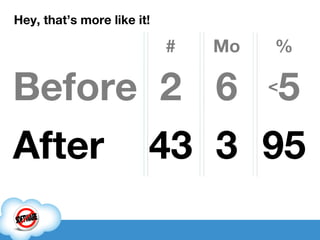
Hey, that’s more like it! Before After 2 43 6 3 < 5 95 # Mo %
What did we do right? Research First –  Talk to your audience, show them examples Complete Taxonomy –  Sure, it’ll grow but we knew the scale  Time-Box –  Blitzes & weekly deadlines Validation –  Weekly meetings to review progress and sign-of Centrally Located –  Everyone loved a single starting point Ownership –  You’re the author. Have a question, contact the author
Patternforce 3.0 – Ongoing Challenges Flexibility for customers Taxonomy – multi-faceted, multi-layered & tagged Integrate visual design & code specs & examples Convert from PDF to Google Docs Show screenshots of Patternforce Internal marketing – emails, updates, detail Component model
Q & A
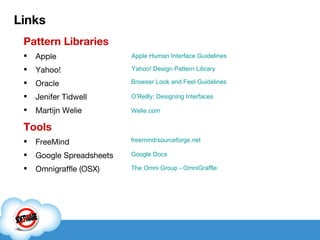
Links Pattern Libraries Apple Yahoo! Oracle Jenifer Tidwell  Martijn Welie Tools FreeMind Google Spreadsheets Omnigraffle (OSX) O’Reilly: Designing Interfaces  Browser Look and Feel Guidelines Apple Human Interface Guidelines Welie.com Yahoo! Design Pattern Library freemind/sourceforge.net Google Docs The Omni Group - OmniGraffle
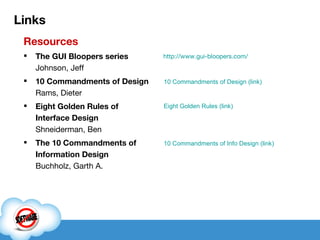
Links Resources The GUI Bloopers series Johnson, Jeff 10 Commandments of Design Rams, Dieter Eight Golden Rules of Interface Design Shneiderman, Ben The 10 Commandments of Information Design Buchholz, Garth A. Eight Golden Rules (link) 10 Commandments of Design (link) http://www.gui-bloopers.com/ 10 Commandments of Info Design (link)

IxDA09 - Postcard Patterns

  • 1.
    Ian Swinson LeadUser Interface Designer [email_address] Postcard Patterns An Agile UI Pattern Creation Process
  • 2.
    Safe Harbor Statement“ Safe harbor” statement under the Private Securities Litigation Reform Act of 1995: This presentation may contain forward-looking statements including but not limited to statements concerning the potential market for our existing service offerings and future offerings. All of our forward looking statements involve risks, uncertainties and assumptions. If any such risks or uncertainties materialize or if any of the assumptions proves incorrect, our results could differ materially from the results expressed or implied by the forward-looking statements we make. The risks and uncertainties referred to above include - but are not limited to - risks associated with possible fluctuations in our operating results and cash flows, rate of growth and anticipated revenue run rate, errors, interruptions or delays in our service or our Web hosting, our new business model, our history of operating losses, the possibility that we will not remain profitable, breach of our security measures, the emerging market in which we operate, our relatively limited operating history, our ability to hire, retain and motivate our employees and manage our growth, competition, our ability to continue to release and gain customer acceptance of new and improved versions of our service, customer and partner acceptance of the AppExchange, successful customer deployment and utilization of our services, unanticipated changes in our effective tax rate, fluctuations in the number of shares outstanding, the price of such shares, foreign currency exchange rates and interest rates. Further information on these and other factors that could affect our financial results is included in the reports on Forms 10-K, 10-Q and 8-K and in other filings we make with the Securities and Exchange Commission from time to time. These documents are available on the SEC Filings section of the Investor Information section of our website at www.salesforce.com/investor . Salesforce.com, inc. assumes no obligation and does not intend to update these forward-looking statements, except as required by law.
  • 3.
    Agenda Salesforce.com – A Brief History Patternforce 1.0 – A Cautionary Tale Patternforce 2.0 – A New Beginning May the force be with us! Patternforce 3.0 – The Future Q & A
  • 4.
  • 5.
  • 6.
  • 7.
  • 8.
    UE in 2004
  • 9.
    UE in 2004 Me
  • 10.
    UE in 2009 Almost here…
  • 11.
    R&D in 2009
  • 12.
    “ Houston, wehave a problem…” Quality Assurance Documentation User Experience Product Management Development Customers & Partners Friends, Family & Ex’s
  • 13.
    We need toretain consistency We already have multiple versions Can we choose one and move on? Comments added to the “bad” code New employees need to get up to speed quickly We need insight into other teams’ solutions A consistent, universally available location We don’t have designers for every feature Developers, Designers and PM’s are always asking questions We need to minimize distractions for the Designers Consistency Efficiency We Need a Pattern Library?
  • 14.
    So, how doyou build a Pattern Library? Apple Tidwell Yahoo! Welie Oracle
  • 15.
    Structure of aSingle Pattern This can get complicated
  • 16.
    Structure of aSingle Pattern This can get complicated
  • 17.
    Scale of aSingle Pattern How to make a Printable View…
  • 18.
    Scale of aSingle Pattern How to make a Printable View… This bit
  • 19.
  • 20.
  • 21.
  • 22.
  • 23.
  • 24.
  • 25.
    We ate, wetraveled, we had babies
  • 26.
    And after alittle more work we asked…
  • 27.
  • 28.
    Oh, that’s notgood 2 * patterns in 6 months < 5 percent *Note: They weren’t even done
  • 29.
    Clearly, this isnot going to work
  • 30.
    What did wedo wrong? External Research Only – We looked at examples but didn’t validate them internally Detail & Scale – We went way too deep, way too early Scope Creep – “Oooh, and wouldn’t it be cool?!” Incomplete Taxonomy – We didn’t have a complete idea of what we needed to document No Prioritization – Printable View? The number one pattern in our app? Um, no. Deaf Ears – We didn’t listen to our designers
  • 31.
    Back to work…butwith agility
  • 32.
    The Agile ManifestoIndividuals and interactions Working software Customer collaboration Responding to change over over over over processes and tools comprehensive documentation contract negotiation following a plan * Excerpted from “Subject to Change” by Adaptive Path
  • 33.
    Agile Pattern CreationIndividuals and interactions Working software Customer collaboration Responding to change We need to talk to each other, the developers, PM’s, etc. We need to work together (Pattern Blitzes)
  • 34.
    Agile Pattern CreationStart small Go wide, get coverage across all patterns Add detail when necessary
  • 35.
    Agile Pattern CreationCheck progress regularly Share with our intended audience and make changes Listen to suggestions
  • 36.
    Agile Pattern CreationCreate something nimble – easy to create and easy to update Software changes all the time Designs change all the time
  • 37.
    The High-Level TaxonomyFlows Pages Page Modules Pop-ups & Overlays Messages & Dialogs Widgets & Controls
  • 38.
    Patternforce Taxonomy Weended up with a large, but relatively flat, list.
  • 39.
    Enter “Postcard Patterns”Dear Mom & Dad, Having a great time. Miss you both. Met a girl, getting married. Love, John The Smiths 1 Main Street Springfield, ID 64006
  • 40.
    What Makes aGood Postcard Pattern? Use the “Goldilocks” Principle If the pattern doesn’t fit on a single page, consider breaking it apart or reducing the amount of detail You can always add detail later If the pattern doesn’t fill a single page, consider grouping it with other similar elements – e.g. common web form elements You can always break it apart later Rule #1: Must fit on a single 8.5” x 11” page
  • 41.
    Pattern - Anatomyof A Pattern Title Summary Category Author & Modification Date Variations (optional) Candidacy: Redesign? Componentize? Graphics Screenshots Illustrations
  • 42.
  • 43.
  • 44.
  • 45.
  • 46.
  • 47.
  • 48.
    Enter “Blitzes” Intense,face-to-face collaboration
  • 49.
  • 50.
    How did wedo this time?
  • 51.
    Hey, that’s morelike it! Before After 2 43 6 3 < 5 95 # Mo %
  • 52.
    What did wedo right? Research First – Talk to your audience, show them examples Complete Taxonomy – Sure, it’ll grow but we knew the scale Time-Box – Blitzes & weekly deadlines Validation – Weekly meetings to review progress and sign-of Centrally Located – Everyone loved a single starting point Ownership – You’re the author. Have a question, contact the author
  • 53.
    Patternforce 3.0 –Ongoing Challenges Flexibility for customers Taxonomy – multi-faceted, multi-layered & tagged Integrate visual design & code specs & examples Convert from PDF to Google Docs Show screenshots of Patternforce Internal marketing – emails, updates, detail Component model
  • 54.
  • 55.
    Links Pattern LibrariesApple Yahoo! Oracle Jenifer Tidwell Martijn Welie Tools FreeMind Google Spreadsheets Omnigraffle (OSX) O’Reilly: Designing Interfaces Browser Look and Feel Guidelines Apple Human Interface Guidelines Welie.com Yahoo! Design Pattern Library freemind/sourceforge.net Google Docs The Omni Group - OmniGraffle
  • 56.
    Links Resources TheGUI Bloopers series Johnson, Jeff 10 Commandments of Design Rams, Dieter Eight Golden Rules of Interface Design Shneiderman, Ben The 10 Commandments of Information Design Buchholz, Garth A. Eight Golden Rules (link) 10 Commandments of Design (link) http://www.gui-bloopers.com/ 10 Commandments of Info Design (link)