responsive, real-time
with Backbone.js and WebSockets


   Andrei Cîmpean, @Andrei_Cimpean
Today, we are going to look at how we are
building a real-time, responsive JavaScript
client app.
For Google Chrome.
And IE8.
What is a real-time application ?
●   It enables users to receive information as soon
    as it is published

What is a responsive application ?
●   Its UI updates instantly, no matter what
Why do we need “real-time, responsive”
●   a client imports entries, packages them and
    puts them up on the market for another users
    to bid on and, if they win the auction, to pay
●   an app that behaves like a market
●   allows clients to sell and bid
●   time constrained user actions ( seconds )
What we needed to do
●   structure the market on the client app
●   communication mechanism
●   don't stress the server
●   support only Chrome and IE 8+ :|
●   make sure it works at least a full day without
    crashing or requiring a full page refresh
Technology decisions
●   Backbone.js + plugins – for structure
●   CometD – for communication
Structure
Backbone.js + plugins
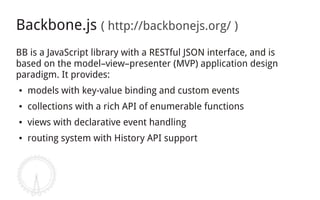
Backbone.js ( http://backbonejs.org/ )
BB is a JavaScript library with a RESTful JSON interface, and is
based on the model–view–presenter (MVP) application design
paradigm. It provides:
●   models with key-value binding and custom events
●   collections with a rich API of enumerable functions
●   views with declarative event handling
●   routing system with History API support
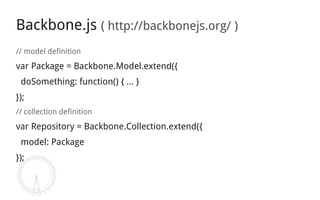
Backbone.js ( http://backbonejs.org/ )
// model definition
var Package = Backbone.Model.extend({
 doSomething: function() { … }
});
// collection definition
var Repository = Backbone.Collection.extend({
 model: Package
});
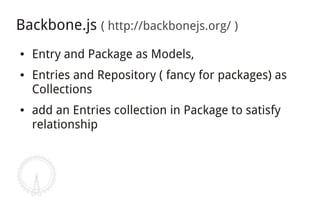
Backbone.js ( http://backbonejs.org/ )
●   Entry and Package as Models,
●   Entries and Repository ( fancy for packages) as
    Collections
●   add an Entries collection in Package to satisfy
    relationship
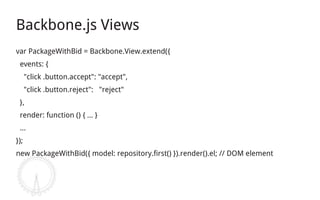
Backbone.js Views
var PackageWithBid = Backbone.View.extend({
 events: {
      "click .button.accept": "accept",
      "click .button.reject": "reject"
 },
 render: function () { ... }
 ...
});
new PackageWithBid({ model: repository.first() }).render().el; // DOM element
Backbone.js Views
●   views can be binded to model or collection
    events
●   managing a large number of nested views
    can be a pain
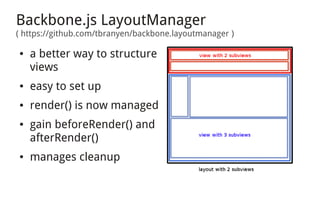
Backbone.js LayoutManager
( https://github.com/tbranyen/backbone.layoutmanager )

●   a better way to structure
    views
●   easy to set up
●   render() is now managed
●   gain beforeRender() and
    afterRender()
●   manages cleanup
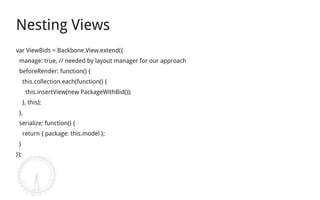
Nesting Views
var ViewBids = Backbone.View.extend({
 manage: true, // needed by layout manager for our approach
 beforeRender: function() {
      this.collection.each(function() {
       this.insertView(new PackageWithBid());
      }, this);
 },
 serialize: function() {
      return { package: this.model };
 }
});
Why Backbone.js ?
●   Backbone.js was chosen because it is small, very
    light; The entire source code can be read with
    ease ( ~ 1500 LOC )
●   good documentation
●   a big community with a lot of plugins, some
    really good
Communication
WebSockets
“It has to be a bit more complicated.”
            Internet Explorer Dev Team
WebSockets ( http://www.websocket.org/ )
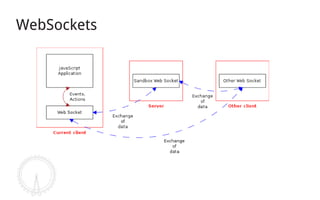
●   a full-duplex single socket connection over
    which messages can be sent between client and
    server
●   doesn't work in Internet Explorer
WebSockets
Sorting out IE8+
●   any browser with Flash can support WebSocket
    using a web-socket-js shim/polyfill
    –   flash leaks memory
●   fallback system: long-polling vs flash
    –   flash leaks memory
●   use a “wrapper” that enables fallback
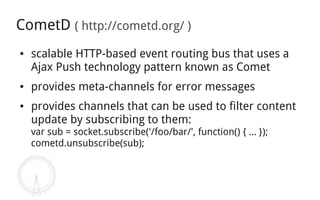
CometD ( http://cometd.org/ )
●   scalable HTTP-based event routing bus that uses a
    Ajax Push technology pattern known as Comet
●   provides meta-channels for error messages
●   provides channels that can be used to filter content
    update by subscribing to them:
    var sub = socket.subscribe('/foo/bar/', function() { ... });
    cometd.unsubscribe(sub);
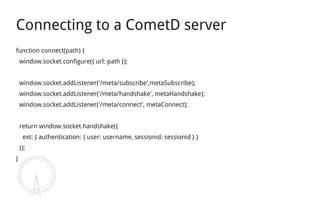
Connecting to a CometD server
function connect(path) {
    window.socket.configure({ url: path });


    window.socket.addListener('/meta/subscribe',metaSubscribe);
    window.socket.addListener('/meta/handshake', metaHandshake);
    window.socket.addListener('/meta/connect', metaConnect);


    return window.socket.handshake({
     ext: { authentication: { user: username, sessionid: sessionid } }
    });
}
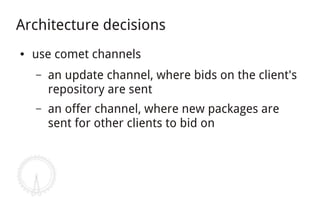
Architecture decisions
●   use comet channels
    –   an update channel, where bids on the client's
        repository are sent
    –   an offer channel, where new packages are
        sent for other clients to bid on
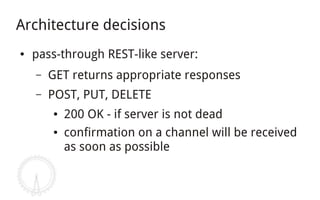
Architecture decisions
●   pass-through REST-like server:
    –   GET returns appropriate responses
    –   POST, PUT, DELETE
        ●   200 OK - if server is not dead
        ●   confirmation on a channel will be received
            as soon as possible
Optimism and responsiveness
●   we are optimists
●   each action that would require a confirmation is
    actually displayed as if it was a success immediately
●   if the confirmation message says that something
    failed, we just display a notification and revert. Most
    of the time this is not required.
Reverting optimism
●   when the action is performed, after the server
    call we replace old views with ones representing
    the new state ( one property )
●   if the confirmation invalidates the action, we
    restore the previous state and re-render all
●   this approach guards almost all the actions a
    user can perform in the application
Reverting optimism
●   actions that change more than just an order
    state, first create a snapshot of itself
●   if the confirmation invalidates the action, we
    restore the snapshot and re-render all
●   for these, we render the view representing the
    new state but block them with a loading
    animation
So, basically
●   be optimistic when rendering but prepared to
    raise alarms
●   always use ;

An approach to responsive, realtime with Backbone.js and WebSockets

  • 1.
    responsive, real-time with Backbone.jsand WebSockets Andrei Cîmpean, @Andrei_Cimpean
  • 2.
    Today, we aregoing to look at how we are building a real-time, responsive JavaScript client app. For Google Chrome. And IE8.
  • 3.
    What is areal-time application ? ● It enables users to receive information as soon as it is published What is a responsive application ? ● Its UI updates instantly, no matter what
  • 4.
    Why do weneed “real-time, responsive” ● a client imports entries, packages them and puts them up on the market for another users to bid on and, if they win the auction, to pay ● an app that behaves like a market ● allows clients to sell and bid ● time constrained user actions ( seconds )
  • 5.
    What we neededto do ● structure the market on the client app ● communication mechanism ● don't stress the server ● support only Chrome and IE 8+ :| ● make sure it works at least a full day without crashing or requiring a full page refresh
  • 6.
    Technology decisions ● Backbone.js + plugins – for structure ● CometD – for communication
  • 7.
  • 8.
    Backbone.js ( http://backbonejs.org/) BB is a JavaScript library with a RESTful JSON interface, and is based on the model–view–presenter (MVP) application design paradigm. It provides: ● models with key-value binding and custom events ● collections with a rich API of enumerable functions ● views with declarative event handling ● routing system with History API support
  • 9.
    Backbone.js ( http://backbonejs.org/) // model definition var Package = Backbone.Model.extend({ doSomething: function() { … } }); // collection definition var Repository = Backbone.Collection.extend({ model: Package });
  • 10.
    Backbone.js ( http://backbonejs.org/) ● Entry and Package as Models, ● Entries and Repository ( fancy for packages) as Collections ● add an Entries collection in Package to satisfy relationship
  • 11.
    Backbone.js Views var PackageWithBid= Backbone.View.extend({ events: { "click .button.accept": "accept", "click .button.reject": "reject" }, render: function () { ... } ... }); new PackageWithBid({ model: repository.first() }).render().el; // DOM element
  • 12.
    Backbone.js Views ● views can be binded to model or collection events ● managing a large number of nested views can be a pain
  • 13.
    Backbone.js LayoutManager ( https://github.com/tbranyen/backbone.layoutmanager) ● a better way to structure views ● easy to set up ● render() is now managed ● gain beforeRender() and afterRender() ● manages cleanup
  • 14.
    Nesting Views var ViewBids= Backbone.View.extend({ manage: true, // needed by layout manager for our approach beforeRender: function() { this.collection.each(function() { this.insertView(new PackageWithBid()); }, this); }, serialize: function() { return { package: this.model }; } });
  • 15.
    Why Backbone.js ? ● Backbone.js was chosen because it is small, very light; The entire source code can be read with ease ( ~ 1500 LOC ) ● good documentation ● a big community with a lot of plugins, some really good
  • 16.
  • 17.
    “It has tobe a bit more complicated.” Internet Explorer Dev Team
  • 18.
    WebSockets ( http://www.websocket.org/) ● a full-duplex single socket connection over which messages can be sent between client and server ● doesn't work in Internet Explorer
  • 19.
  • 20.
    Sorting out IE8+ ● any browser with Flash can support WebSocket using a web-socket-js shim/polyfill – flash leaks memory ● fallback system: long-polling vs flash – flash leaks memory ● use a “wrapper” that enables fallback
  • 21.
    CometD ( http://cometd.org/) ● scalable HTTP-based event routing bus that uses a Ajax Push technology pattern known as Comet ● provides meta-channels for error messages ● provides channels that can be used to filter content update by subscribing to them: var sub = socket.subscribe('/foo/bar/', function() { ... }); cometd.unsubscribe(sub);
  • 22.
    Connecting to aCometD server function connect(path) { window.socket.configure({ url: path }); window.socket.addListener('/meta/subscribe',metaSubscribe); window.socket.addListener('/meta/handshake', metaHandshake); window.socket.addListener('/meta/connect', metaConnect); return window.socket.handshake({ ext: { authentication: { user: username, sessionid: sessionid } } }); }
  • 23.
    Architecture decisions ● use comet channels – an update channel, where bids on the client's repository are sent – an offer channel, where new packages are sent for other clients to bid on
  • 24.
    Architecture decisions ● pass-through REST-like server: – GET returns appropriate responses – POST, PUT, DELETE ● 200 OK - if server is not dead ● confirmation on a channel will be received as soon as possible
  • 25.
    Optimism and responsiveness ● we are optimists ● each action that would require a confirmation is actually displayed as if it was a success immediately ● if the confirmation message says that something failed, we just display a notification and revert. Most of the time this is not required.
  • 26.
    Reverting optimism ● when the action is performed, after the server call we replace old views with ones representing the new state ( one property ) ● if the confirmation invalidates the action, we restore the previous state and re-render all ● this approach guards almost all the actions a user can perform in the application
  • 27.
    Reverting optimism ● actions that change more than just an order state, first create a snapshot of itself ● if the confirmation invalidates the action, we restore the snapshot and re-render all ● for these, we render the view representing the new state but block them with a loading animation
  • 28.
    So, basically ● be optimistic when rendering but prepared to raise alarms ● always use ;