Coordination
and Response
GCE Study Buddy
Biology
Coordination in Mammal
●coordination is the way in which receptors detect stimuli,
and then nerve impulses are sent to the effectors
●in mammals, coordination is carried out through the
activities of nervous system and the endocrine system
●nervous coordination is brought about by transmission of
nerve impulses between receptors and effectors through
nerve fibres
●endocrine coordination is brought about by hormones
secreted from endocrine glands
What is Nervous Coordination ?
●nervous system of mammal consists of
central nervous system(CNS) and peripheral
nervous system
●CNS includes brain and spinal cord and the
peripheral nervous system includes cranial
nerves and spinal nerves
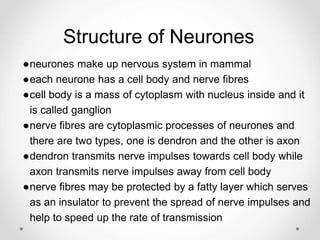
Structure of Neurones
●neurones make up nervous system in mammal
●each neurone has a cell body and nerve fibres
●cell body is a mass of cytoplasm with nucleus inside and it
is called ganglion
●nerve fibres are cytoplasmic processes of neurones and
there are two types, one is dendron and the other is axon
●dendron transmits nerve impulses towards cell body while
axon transmits nerve impulses away from cell body
●nerve fibres may be protected by a fatty layer which serves
as an insulator to prevent the spread of nerve impulses and
help to speed up the rate of transmission
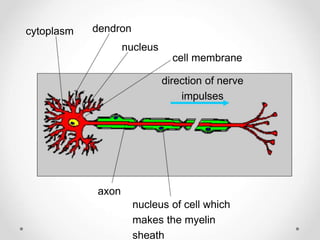
cytoplasm dendron
cell membrane
nucleus
nucleus of cell which
makes the myelin
sheath
axon
direction of nerve
impulses
Types of Neurons
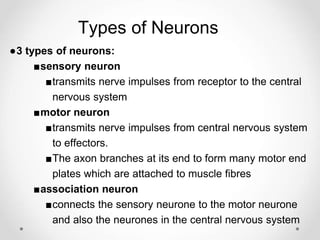
●3 types of neurons:
■sensory neuron
■transmits nerve impulses from receptor to the central
nervous system
■motor neuron
■transmits nerve impulses from central nervous system
to effectors.
■The axon branches at its end to form many motor end
plates which are attached to muscle fibres
■association neuron
■connects the sensory neurone to the motor neurone
and also the neurones in the central nervous system
Nerve
●bundles of nerve fibres
●usually myelinated and surrounded by a sheath of white
connective tissue
●impulses do not jump from one fibre to another because of
the presence of fatty substance in nerve
●in sensory nerves, there may be ganglia where the cell
bodies are situated
●nerve fibres found inside the central nervous system do
not have insulating fatty layers
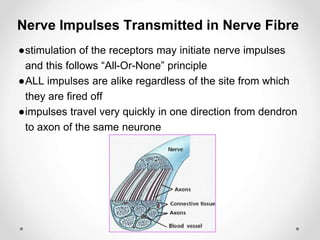
Nerve Impulses Transmitted in Nerve Fibre
●stimulation of the receptors may initiate nerve impulses
and this follows “All-Or-None” principle
●ALL impulses are alike regardless of the site from which
they are fired off
●impulses travel very quickly in one direction from dendron
to axon of the same neurone
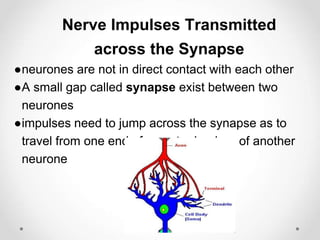
Nerve Impulses Transmitted
across the Synapse
●neurones are not in direct contact with each other
●A small gap called synapse exist between two
neurones
●impulses need to jump across the synapse as to
travel from one end of axon to dendron of another
neurone
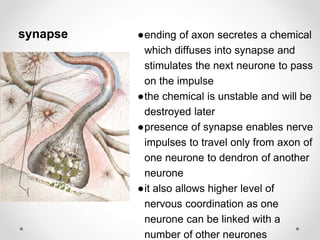
●ending of axon secretes a chemical
which diffuses into synapse and
stimulates the next neurone to pass
on the impulse
●the chemical is unstable and will be
destroyed later
●presence of synapse enables nerve
impulses to travel only from axon of
one neurone to dendron of another
neurone
●it also allows higher level of
nervous coordination as one
neurone can be linked with a
number of other neurones
synapse
○includes brain and spinal cord in higher animal
Central Nervous System (CNS)
Protection of CNS
●brain is enclosed in cranium of skull while spinal
cord is enclosed in vertebral column
●CNS is also enveloped in three layers of meninges
and between the inner two layers is a cavity filled
with cerebrospinal fluid
●act as a cushion for absorbing external shock
●nourish neurones inside as it enables diffusion of
oxygen and food to the nerve cells
●it also filled up cavity called ventricle in brain and
in the central canal of spinal cord
●it also helps in preventing collapse of CNS
Functions of Cerebrospinal Fluid
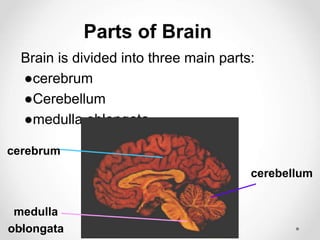
Brain is divided into three main parts:
●cerebrum
●Cerebellum
●medulla oblongata
Parts of Brain
cerebellum
cerebrum
medulla
oblongata
Cerebrum
●lies in the front part of brain and divided into two
cerebral hemispheres connected by nerve fibres
●surface of cerebrum is highly folded to increase area
for coordination
●centre of thinking, memory, reasoning, imagination,
learning and voluntary actions
●divided into three functional areas
1.sensory areas: receive impulses from receptors
2.motor areas: send out impulses to effectors
3.association area: correlates impulses from different
receptors and assists in producing appropriate responses
Cerebellum
●lies below the back part of cerebrum
●centre for muscular coordination and involved in
control of body balance
●damage of cerebellum will lead to a loss of ability
to maintain balance
Medulla Oblongata
●lies at the floor of cerebellum
●reflex centre for controlling involuntary actions
such as breathing, heartbeat, swallowing,
coughing, sneezing and salivation
●damage of medulla oblongata may lead to death
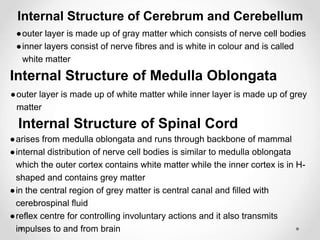
Internal Structure of Cerebrum and Cerebellum
●outer layer is made up of gray matter which consists of nerve cell bodies
●inner layers consist of nerve fibres and is white in colour and is called
white matter
Internal Structure of Medulla Oblongata
●outer layer is made up of white matter while inner layer is made up of grey
matter
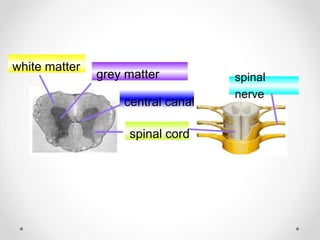
Internal Structure of Spinal Cord
●arises from medulla oblongata and runs through backbone of mammal
●internal distribution of nerve cell bodies is similar to medulla oblongata
which the outer cortex contains white matter while the inner cortex is in H-
shaped and contains grey matter
●in the central region of grey matter is central canal and filled with
cerebrospinal fluid
●reflex centre for controlling involuntary actions and it also transmits
impulses to and from brain
white matter
grey matter
central canal
spinal cord
spinal
nerve
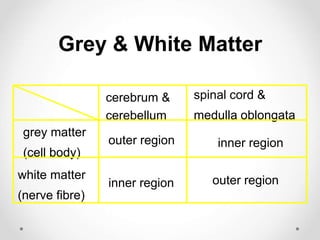
Grey & White Matter
grey matter
(cell body)
white matter
(nerve fibre)
cerebrum &
cerebellum
outer region
inner region
spinal cord &
medulla oblongata
inner region
outer region
Peripheral Nervous System
●consist of cranial nerves and spinal nerves
●these nerves leave CNS and run out to every part of the body
Cranial Nerves and Spinal Nerves
●all are mixed nerves carrying both sensory and motor neurones
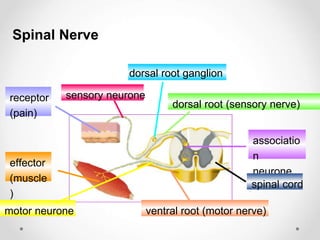
●each spinal nerve has a dorsal root and ventral root
●dorsal root contains ganglion which contains nerve cell bodies
●Cranial Nerve
○twelve pairs of cranial nerves in mammal
○most of cranial nerves arise from lateral sides of medulla oblongata
●Spinal Nerve
○there are 31 pairs of spinal nerves in human
dorsal root ganglion
dorsal root (sensory nerve)
associatio
n
neurone
spinal cord
ventral root (motor nerve)
motor neurone
sensory neurone
effector
(muscle
)
receptor
(pain)
Spinal Nerve
●cells in dorsal root ganglion are sensory neurones
and impulses travel through dorsal root to spinal
cord from spinal nerve
●ventral root carries motor nerve fibres and their cell
bodies are found in H-shaped grey matter of spinal
cord
Reflex Action
●simple reflex action is a quick, inborn and automatic
response of an animal to a stimulus and cerebrum
does not involve in the response
●protective in function and need not be learnt
●same stimulus initiates the same responses at
different times
●examples like withdrawal from hot objects, blinking,
coughing, sneezing and pupil size
Reflex Arc
●neural pathway between receptor and effector
involved in a reflex action
●example is knee jerk reflex
Knee Jerk Reflex
1.At the Receptor
○receptor receives stimulus. In this case, tapping stimulates
tendon of knee cap
2.At the Sensory Neurone
○from ending of dendrons of sensory neurones, nerve impulses
fired off
3.Across the Synapse to the Motor Neurone
○through dorsal root of spinal nerve, impulses are carried to
spinal cord
○impulses jump across synapses to motor neurones in grey
matter but in other reflex action, association neurones may
involve
4. To the effector impulses are further transmitted through ventral
root to effector to produce responses
●in knee jerk, effector is muscles in upper
leg which it will contract when impulses
are received so the leg jerks up and it is
an example of spinal reflex action as only
spinal cord is involved
Knee Jerk Reflex
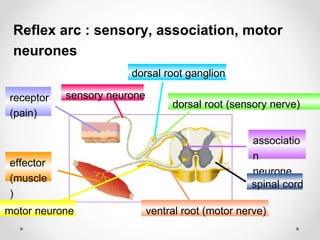
dorsal root ganglion
dorsal root (sensory nerve)
associatio
n
neurone
spinal cord
ventral root (motor nerve)
motor neurone
sensory neurone
effector
(muscle
)
receptor
(pain)
Reflex arc : sensory, association, motor
neurones
●spinal reflexes can occur in deep sleep and
do not depend on awareness but impulses
can still pass form sensory neurones up the
spinal cord to brain
●other reflex actions like blinking, coughing
and sneezing are cranial reflex action and
take place in medulla oblongata
Voluntary Actions
●conscious response to a certain stimulus
●involves cerebrum of brain and mammals are
aware of all the steps of the response
●may differ from time to time as mammals can gain
experiences and store them in cerebrum so they
can choose how to response to the same stimulus
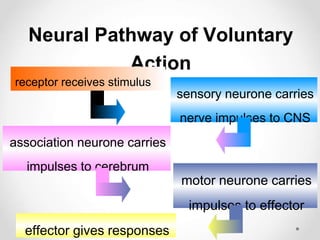
Neural Pathway of Voluntary
Action
receptor receives stimulus
sensory neurone carries
nerve impulses to CNS
association neurone carries
impulses to cerebrum
motor neurone carries
impulses to effector
effector gives responses
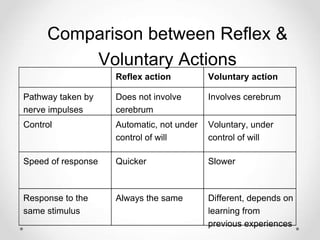
Comparison between Reflex &
Voluntary Actions
Reflex action Voluntary action
Pathway taken by
nerve impulses
Does not involve
cerebrum
Involves cerebrum
Control Automatic, not under
control of will
Voluntary, under
control of will
Speed of response Quicker Slower
Response to the
same stimulus
Always the same Different, depends on
learning from
previous experiences
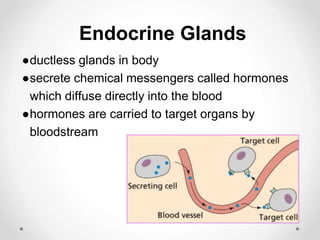
Endocrine Glands
●ductless glands in body
●secrete chemical messengers called hormones
which diffuse directly into the blood
●hormones are carried to target organs by
bloodstream
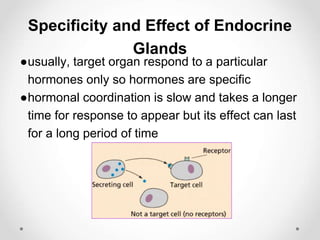
Specificity and Effect of Endocrine
Glands
●usually, target organ respond to a particular
hormones only so hormones are specific
●hormonal coordination is slow and takes a longer
time for response to appear but its effect can last
for a long period of time
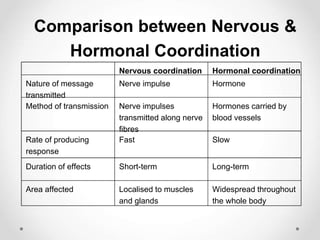
Comparison between Nervous &
Hormonal Coordination
Nervous coordination Hormonal coordination
Nature of message
transmitted
Nerve impulse Hormone
Method of transmission Nerve impulses
transmitted along nerve
fibres
Hormones carried by
blood vessels
Rate of producing
response
Fast Slow
Duration of effects Short-term Long-term
Area affected Localised to muscles
and glands
Widespread throughout
the whole body
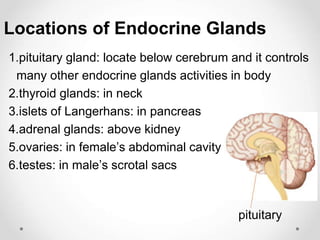
Locations of Endocrine Glands
1.pituitary gland: locate below cerebrum and it controls
many other endocrine glands activities in body
2.thyroid glands: in neck
3.islets of Langerhans: in pancreas
4.adrenal glands: above kidney
5.ovaries: in female’s abdominal cavity
6.testes: in male’s scrotal sacs
pituitary
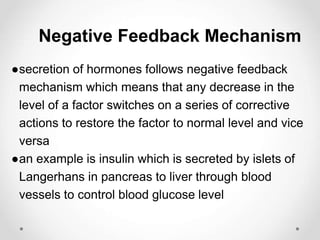
Negative Feedback Mechanism
●secretion of hormones follows negative feedback
mechanism which means that any decrease in the
level of a factor switches on a series of corrective
actions to restore the factor to normal level and vice
versa
●an example is insulin which is secreted by islets of
Langerhans in pancreas to liver through blood
vessels to control blood glucose level
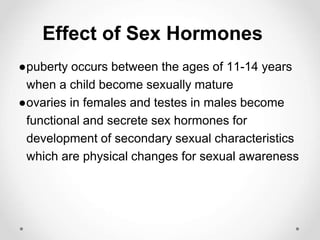
Effect of Sex Hormones
●puberty occurs between the ages of 11-14 years
when a child become sexually mature
●ovaries in females and testes in males become
functional and secrete sex hormones for
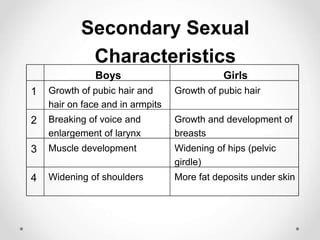
development of secondary sexual characteristics
which are physical changes for sexual awareness
Secondary Sexual
Characteristics
Boys Girls
1 Growth of pubic hair and
hair on face and in armpits
Growth of pubic hair
2 Breaking of voice and
enlargement of larynx
Growth and development of
breasts
3 Muscle development Widening of hips (pelvic
girdle)
4 Widening of shoulders More fat deposits under skin

response&coordination.pptx

  • 1.
  • 2.
    Coordination in Mammal ●coordinationis the way in which receptors detect stimuli, and then nerve impulses are sent to the effectors ●in mammals, coordination is carried out through the activities of nervous system and the endocrine system ●nervous coordination is brought about by transmission of nerve impulses between receptors and effectors through nerve fibres ●endocrine coordination is brought about by hormones secreted from endocrine glands
  • 3.
    What is NervousCoordination ? ●nervous system of mammal consists of central nervous system(CNS) and peripheral nervous system ●CNS includes brain and spinal cord and the peripheral nervous system includes cranial nerves and spinal nerves
  • 4.
    Structure of Neurones ●neuronesmake up nervous system in mammal ●each neurone has a cell body and nerve fibres ●cell body is a mass of cytoplasm with nucleus inside and it is called ganglion ●nerve fibres are cytoplasmic processes of neurones and there are two types, one is dendron and the other is axon ●dendron transmits nerve impulses towards cell body while axon transmits nerve impulses away from cell body ●nerve fibres may be protected by a fatty layer which serves as an insulator to prevent the spread of nerve impulses and help to speed up the rate of transmission
  • 5.
    cytoplasm dendron cell membrane nucleus nucleusof cell which makes the myelin sheath axon direction of nerve impulses
  • 6.
    Types of Neurons ●3types of neurons: ■sensory neuron ■transmits nerve impulses from receptor to the central nervous system ■motor neuron ■transmits nerve impulses from central nervous system to effectors. ■The axon branches at its end to form many motor end plates which are attached to muscle fibres ■association neuron ■connects the sensory neurone to the motor neurone and also the neurones in the central nervous system
  • 7.
    Nerve ●bundles of nervefibres ●usually myelinated and surrounded by a sheath of white connective tissue ●impulses do not jump from one fibre to another because of the presence of fatty substance in nerve ●in sensory nerves, there may be ganglia where the cell bodies are situated ●nerve fibres found inside the central nervous system do not have insulating fatty layers
  • 8.
    Nerve Impulses Transmittedin Nerve Fibre ●stimulation of the receptors may initiate nerve impulses and this follows “All-Or-None” principle ●ALL impulses are alike regardless of the site from which they are fired off ●impulses travel very quickly in one direction from dendron to axon of the same neurone
  • 9.
    Nerve Impulses Transmitted acrossthe Synapse ●neurones are not in direct contact with each other ●A small gap called synapse exist between two neurones ●impulses need to jump across the synapse as to travel from one end of axon to dendron of another neurone
  • 10.
    ●ending of axonsecretes a chemical which diffuses into synapse and stimulates the next neurone to pass on the impulse ●the chemical is unstable and will be destroyed later ●presence of synapse enables nerve impulses to travel only from axon of one neurone to dendron of another neurone ●it also allows higher level of nervous coordination as one neurone can be linked with a number of other neurones synapse
  • 11.
    ○includes brain andspinal cord in higher animal Central Nervous System (CNS) Protection of CNS ●brain is enclosed in cranium of skull while spinal cord is enclosed in vertebral column ●CNS is also enveloped in three layers of meninges and between the inner two layers is a cavity filled with cerebrospinal fluid
  • 12.
    ●act as acushion for absorbing external shock ●nourish neurones inside as it enables diffusion of oxygen and food to the nerve cells ●it also filled up cavity called ventricle in brain and in the central canal of spinal cord ●it also helps in preventing collapse of CNS Functions of Cerebrospinal Fluid
  • 13.
    Brain is dividedinto three main parts: ●cerebrum ●Cerebellum ●medulla oblongata Parts of Brain cerebellum cerebrum medulla oblongata
  • 14.
    Cerebrum ●lies in thefront part of brain and divided into two cerebral hemispheres connected by nerve fibres ●surface of cerebrum is highly folded to increase area for coordination ●centre of thinking, memory, reasoning, imagination, learning and voluntary actions ●divided into three functional areas 1.sensory areas: receive impulses from receptors 2.motor areas: send out impulses to effectors 3.association area: correlates impulses from different receptors and assists in producing appropriate responses
  • 15.
    Cerebellum ●lies below theback part of cerebrum ●centre for muscular coordination and involved in control of body balance ●damage of cerebellum will lead to a loss of ability to maintain balance
  • 16.
    Medulla Oblongata ●lies atthe floor of cerebellum ●reflex centre for controlling involuntary actions such as breathing, heartbeat, swallowing, coughing, sneezing and salivation ●damage of medulla oblongata may lead to death
  • 17.
    Internal Structure ofCerebrum and Cerebellum ●outer layer is made up of gray matter which consists of nerve cell bodies ●inner layers consist of nerve fibres and is white in colour and is called white matter Internal Structure of Medulla Oblongata ●outer layer is made up of white matter while inner layer is made up of grey matter Internal Structure of Spinal Cord ●arises from medulla oblongata and runs through backbone of mammal ●internal distribution of nerve cell bodies is similar to medulla oblongata which the outer cortex contains white matter while the inner cortex is in H- shaped and contains grey matter ●in the central region of grey matter is central canal and filled with cerebrospinal fluid ●reflex centre for controlling involuntary actions and it also transmits impulses to and from brain
  • 18.
    white matter grey matter centralcanal spinal cord spinal nerve
  • 19.
    Grey & WhiteMatter grey matter (cell body) white matter (nerve fibre) cerebrum & cerebellum outer region inner region spinal cord & medulla oblongata inner region outer region
  • 20.
    Peripheral Nervous System ●consistof cranial nerves and spinal nerves ●these nerves leave CNS and run out to every part of the body Cranial Nerves and Spinal Nerves ●all are mixed nerves carrying both sensory and motor neurones ●each spinal nerve has a dorsal root and ventral root ●dorsal root contains ganglion which contains nerve cell bodies ●Cranial Nerve ○twelve pairs of cranial nerves in mammal ○most of cranial nerves arise from lateral sides of medulla oblongata ●Spinal Nerve ○there are 31 pairs of spinal nerves in human
  • 21.
    dorsal root ganglion dorsalroot (sensory nerve) associatio n neurone spinal cord ventral root (motor nerve) motor neurone sensory neurone effector (muscle ) receptor (pain) Spinal Nerve
  • 22.
    ●cells in dorsalroot ganglion are sensory neurones and impulses travel through dorsal root to spinal cord from spinal nerve ●ventral root carries motor nerve fibres and their cell bodies are found in H-shaped grey matter of spinal cord
  • 23.
    Reflex Action ●simple reflexaction is a quick, inborn and automatic response of an animal to a stimulus and cerebrum does not involve in the response ●protective in function and need not be learnt ●same stimulus initiates the same responses at different times ●examples like withdrawal from hot objects, blinking, coughing, sneezing and pupil size
  • 24.
    Reflex Arc ●neural pathwaybetween receptor and effector involved in a reflex action ●example is knee jerk reflex
  • 25.
    Knee Jerk Reflex 1.Atthe Receptor ○receptor receives stimulus. In this case, tapping stimulates tendon of knee cap 2.At the Sensory Neurone ○from ending of dendrons of sensory neurones, nerve impulses fired off 3.Across the Synapse to the Motor Neurone ○through dorsal root of spinal nerve, impulses are carried to spinal cord ○impulses jump across synapses to motor neurones in grey matter but in other reflex action, association neurones may involve 4. To the effector impulses are further transmitted through ventral root to effector to produce responses
  • 26.
    ●in knee jerk,effector is muscles in upper leg which it will contract when impulses are received so the leg jerks up and it is an example of spinal reflex action as only spinal cord is involved Knee Jerk Reflex
  • 27.
    dorsal root ganglion dorsalroot (sensory nerve) associatio n neurone spinal cord ventral root (motor nerve) motor neurone sensory neurone effector (muscle ) receptor (pain) Reflex arc : sensory, association, motor neurones
  • 28.
    ●spinal reflexes canoccur in deep sleep and do not depend on awareness but impulses can still pass form sensory neurones up the spinal cord to brain ●other reflex actions like blinking, coughing and sneezing are cranial reflex action and take place in medulla oblongata
  • 29.
    Voluntary Actions ●conscious responseto a certain stimulus ●involves cerebrum of brain and mammals are aware of all the steps of the response ●may differ from time to time as mammals can gain experiences and store them in cerebrum so they can choose how to response to the same stimulus
  • 30.
    Neural Pathway ofVoluntary Action receptor receives stimulus sensory neurone carries nerve impulses to CNS association neurone carries impulses to cerebrum motor neurone carries impulses to effector effector gives responses
  • 31.
    Comparison between Reflex& Voluntary Actions Reflex action Voluntary action Pathway taken by nerve impulses Does not involve cerebrum Involves cerebrum Control Automatic, not under control of will Voluntary, under control of will Speed of response Quicker Slower Response to the same stimulus Always the same Different, depends on learning from previous experiences
  • 32.
    Endocrine Glands ●ductless glandsin body ●secrete chemical messengers called hormones which diffuse directly into the blood ●hormones are carried to target organs by bloodstream
  • 33.
    Specificity and Effectof Endocrine Glands ●usually, target organ respond to a particular hormones only so hormones are specific ●hormonal coordination is slow and takes a longer time for response to appear but its effect can last for a long period of time
  • 34.
    Comparison between Nervous& Hormonal Coordination Nervous coordination Hormonal coordination Nature of message transmitted Nerve impulse Hormone Method of transmission Nerve impulses transmitted along nerve fibres Hormones carried by blood vessels Rate of producing response Fast Slow Duration of effects Short-term Long-term Area affected Localised to muscles and glands Widespread throughout the whole body
  • 35.
    Locations of EndocrineGlands 1.pituitary gland: locate below cerebrum and it controls many other endocrine glands activities in body 2.thyroid glands: in neck 3.islets of Langerhans: in pancreas 4.adrenal glands: above kidney 5.ovaries: in female’s abdominal cavity 6.testes: in male’s scrotal sacs pituitary
  • 36.
    Negative Feedback Mechanism ●secretionof hormones follows negative feedback mechanism which means that any decrease in the level of a factor switches on a series of corrective actions to restore the factor to normal level and vice versa ●an example is insulin which is secreted by islets of Langerhans in pancreas to liver through blood vessels to control blood glucose level
  • 37.
    Effect of SexHormones ●puberty occurs between the ages of 11-14 years when a child become sexually mature ●ovaries in females and testes in males become functional and secrete sex hormones for development of secondary sexual characteristics which are physical changes for sexual awareness
  • 38.
    Secondary Sexual Characteristics Boys Girls 1Growth of pubic hair and hair on face and in armpits Growth of pubic hair 2 Breaking of voice and enlargement of larynx Growth and development of breasts 3 Muscle development Widening of hips (pelvic girdle) 4 Widening of shoulders More fat deposits under skin