INFORMATION
NAME: RUTIK RAMESH DOIFODE
ROLL NO : 213812
CLASS : TYBSC
SUBJECT : PLANT PHYSIOLOGY AND BIOCHEMISTRY
SUBJECT CODE : BOT3602
TOPIC : MITOCHONDRIA, TYPES OF
RESPIRATION,EMP
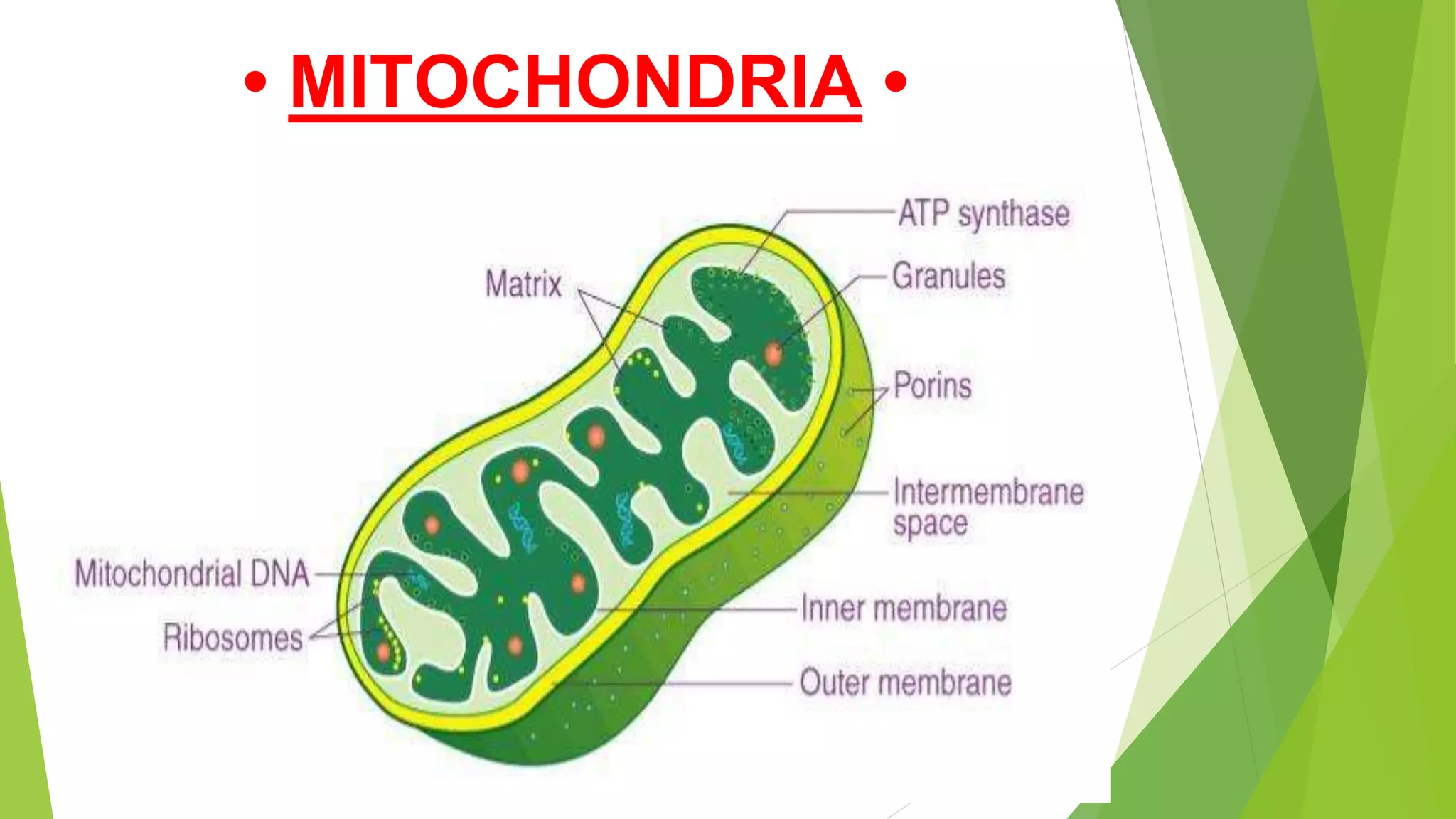
• MITOCHONDRIA •
• MITOCHONDRIA •
► Power house of cell 🡪 ENERGY ⚡⚡⚡
► It is a membrane-bound organelle, present in the cytoplasm
of the cell of Eukaryotic organisms .
► It digests the nutrients and releases chemical energy in the
cell in the form of ATP- Adenosine Triphosphate.
► Oxygen and glucose 🡪 ATP
• HISTORY : Hypothetically mitochondria are believed to have
originated as prokaryotic cells like bacteria.
• They were capable of oxidative mechanisms. Over the course
of evolution, they started living as endosymbionts inside the cell
of prokaryotes.
• Mitochondria have fragments of genetic information in the
form of DNA and can multiply on their own by division.
• STRUCTURE •
► Colourless, round or oval in shape and bound by a double membrane .
► Membranes made of phospholipid bilayers and proteins.
1) Outer membrane : Smooth , 60 A° thick and is freely permeable to
macromolecules so that ions, ATP, ADP, etc.
2) Inter membranous space : The space between the outer membrane and inner
membrane is the intermembrane space.
• This space also consists of small molecules like ions and sugars .
Outer and inner membrane are collectively called as Peristromium
3) Inner membrane : Same diameter as that of outer membrane, selectively
permeable to oxygen, carbon dioxide, and water .
• The inner mitochondrial membrane is the fundamental site of ATP generation.
• Electron carrier molecules or coenzymes of Electron Transport Chain namely
cytochromes, dehydrogenases and flavoproteins are present on rest of inner
mitochondrial membrane.
• The inner mitochondrial membrane has several folds in it called Cristae, to
increase the surface area.
• STRUCTURE •
4) Cristae : The inner membrane of Mitochondria is
thrown into a series of infoldings in cavity of
mitochondria. These infoldings are called as Cristae.
• It increased the surface area inside the mitochondrial
membrane to generate ATP molecules efficiently .
• Oxysomes or F1 particles are attached to cristae.
• The Oxysomes consists of three parts – rounded head
piece , stalk and base piece .
5) Matrix : It is fluidic and contains proteins, ribosomes,
enzymes, tRNA, and genomic DNA.
• Due to the presence of genetic material, the
Mitochondrial Matrix can synthesize its RNA and
proteins.
• The synthesis of ATP would be incomplete without the
enzymes of the matrix which aid the most important
chemical cycles.
• FUNCTION •
• The other major role played by mitochondria is carrying out
cellular metabolism.
• Mitochondria is also responsible for cell growth and
multiplication. When there’s too much strain on an organ,
performing a specific task, mitochondria multiply on their own to
carry out their purpose more efficiently.
• mitochondria regulate cell differentiation and division.
• It stores calcium ions thus helping cell signaling. Free calcium
regulates a series of chemical reactions in the cell and thus,
mitochondria regulate cell signaling.
Definition
“Respiration is defined as a metabolic process wherein, the living cells
of an organism obtains energy (in the form of ATP) by taking in oxygen
and liberating carbon dioxide from the oxidation of complex organic
substances.”
Respiration in Plants
1. Respiration in Roots :
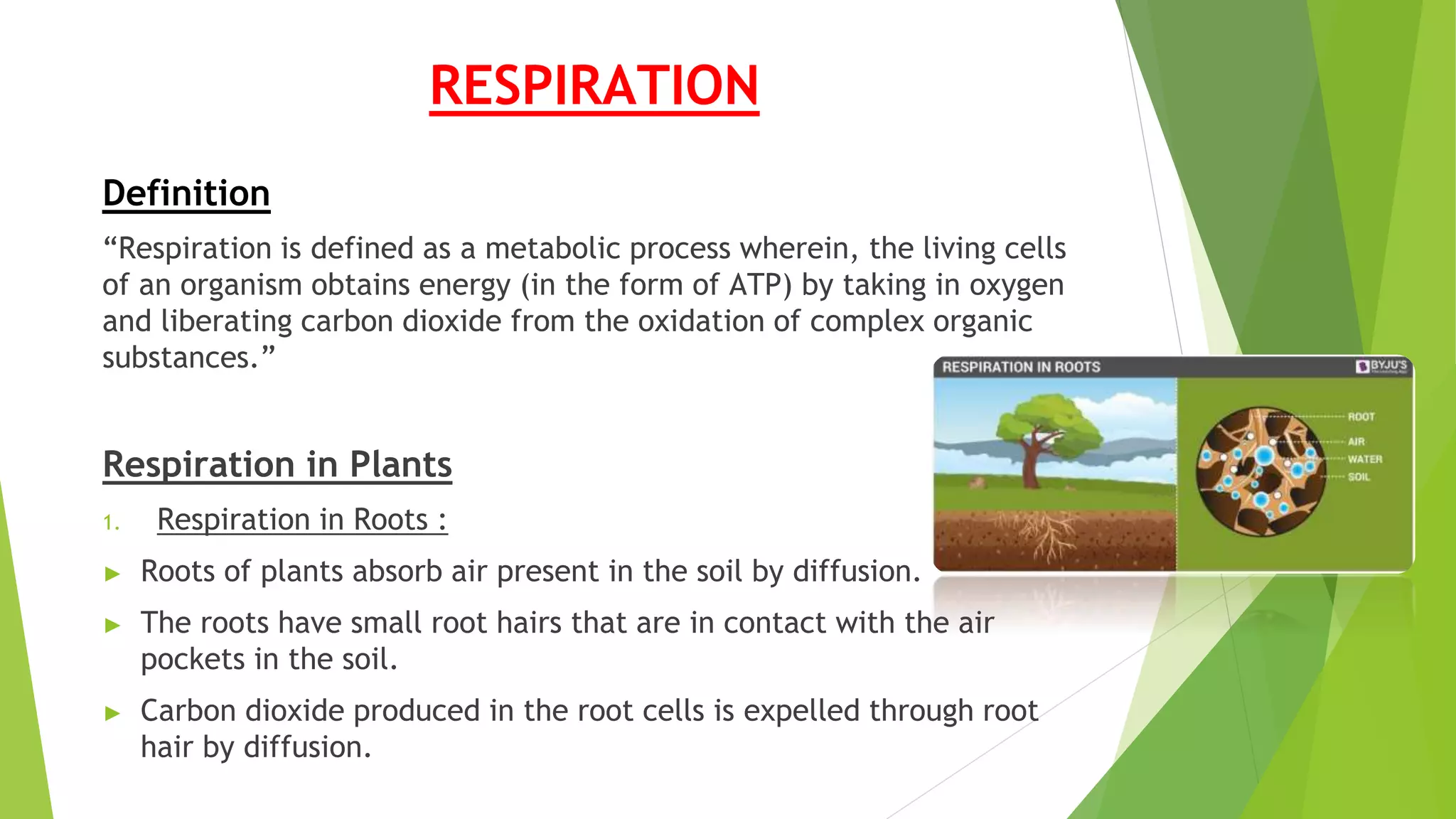
► Roots of plants absorb air present in the soil by diffusion.
► The roots have small root hairs that are in contact with the air
pockets in the soil.
► Carbon dioxide produced in the root cells is expelled through root
hair by diffusion.
RESPIRATION
• Respiration in Steam
Stems of herbs have stomata.
Oxygen from air diffuses into the stomata and reaches all the cells
from respiration.
Carbon dioxide also diffuses out from the stomata.
In woody stems, the bark haslenticels for gaseous exchange.
Oxygen diffuses into the woody stem and reaches all inner
cells for respiration.
CO2 diffuses out from the same lenticels.
Respiration In Leaves
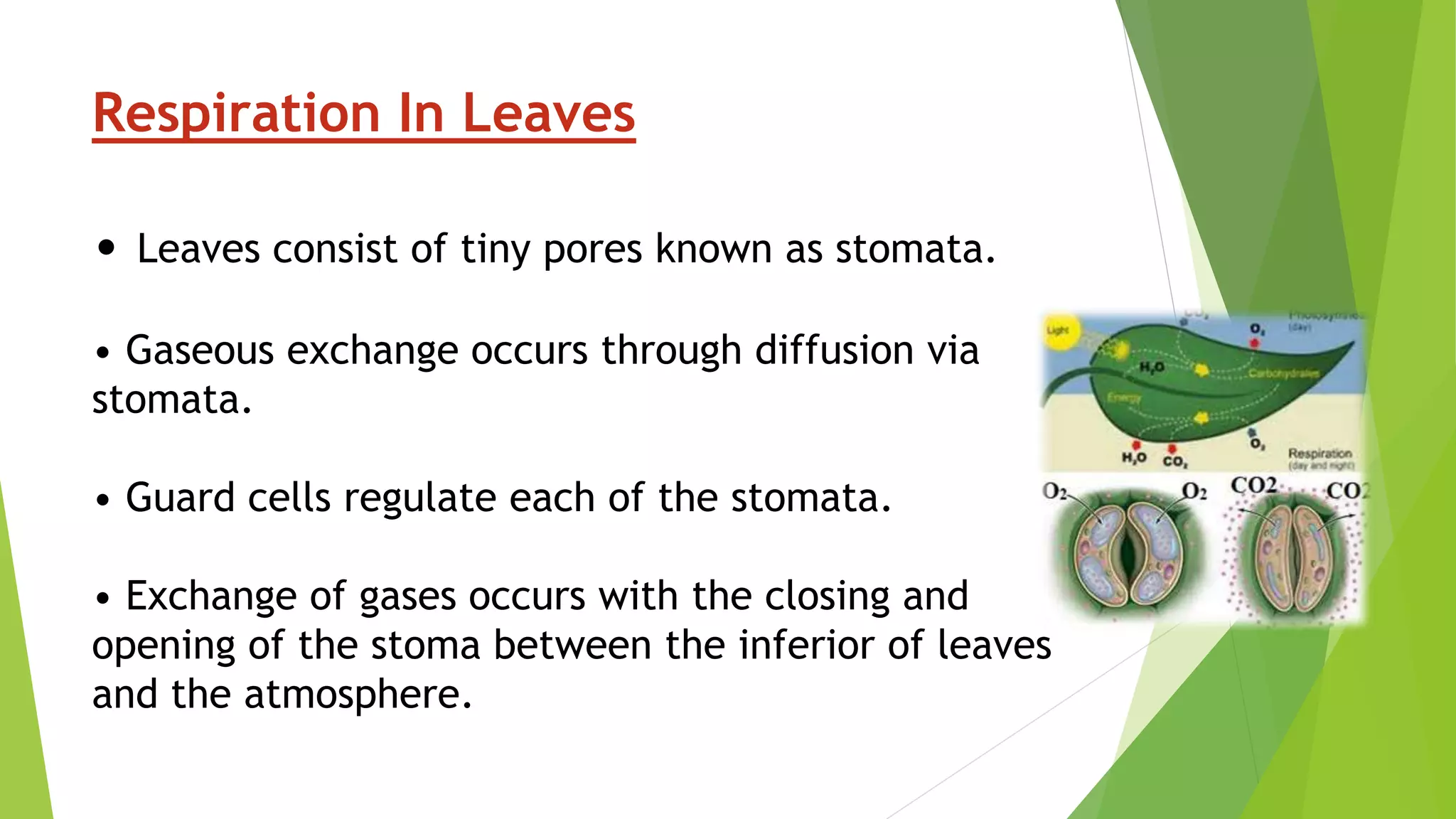
• Leaves consist of tiny pores known as stomata.
• Gaseous exchange occurs through diffusion via
stomata.
• Guard cells regulate each of the stomata.
• Exchange of gases occurs with the closing and
opening of the stoma between the inferior of leaves
and the atmosphere.
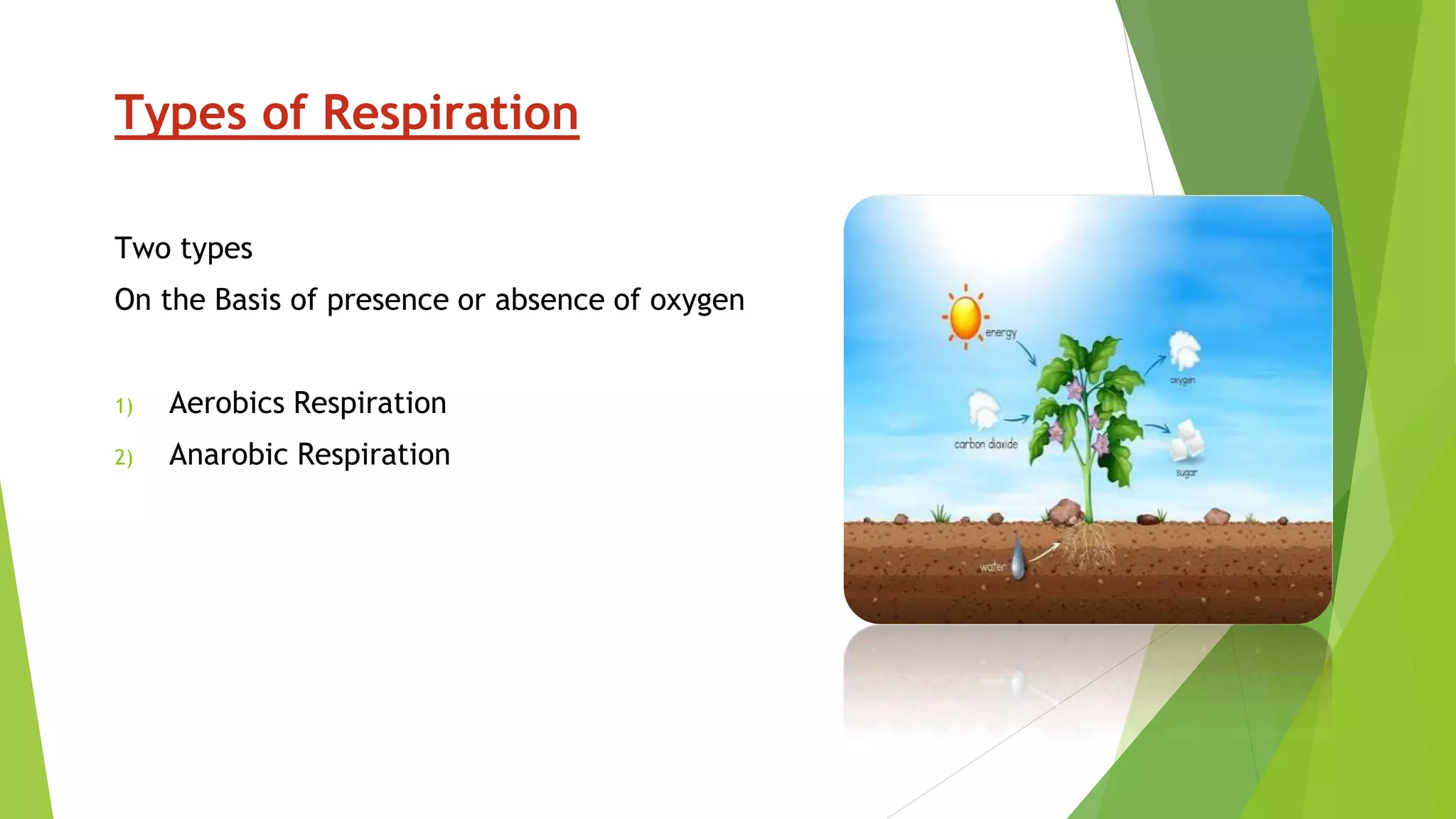
Types of Respiration
Two types
On the Basis of presence or absence of oxygen
1) Aerobics Respiration
2) Anarobic Respiration
Aerobic Respiration
► The respiration that occurs in the presence of oxygen is named
aerobic respiration due to ‘air’ which has oxygen.
► Aerobic respiration contains the utilization of oxygen for the
breaking of chemical bonds in glucose to liberate energy in high
volumes.
► It is the central source of energy for plants.
► C6H12O6 +6O2 ⟶ 6CO2 + 6H2O + Energy
► All the organisms that gain energy by aerobic respiration cannot exist
without oxygen.
► Aerobic respiration takes more energy because a complete breaking of
glucose takes place during respiration with the use of oxygen.
Anaerobic Respiration
► The respiration that occurs in the absence of oxygen is known as
anaerobic respiration.
► In this process, the incomplete oxidation of food substances is being
made by carbon dioxide CO2, and alcohol(OH).
► Besides this other organic matter such as citric acid, oxalic acid,
lactic acid, etc are also produced.
► This process is also called intramolecular respiration.
► Anaerobic respiration occurs in organisms like yeast, certain
bacteria, and parasitic worms.
► The animals and plants that can exist and gain energy even in the
lack of oxygen are called Anaerobic.
► Glucose ⟶ Alcohol + CO2 + (Energy)
Glycolysis - EMP
► Glycolysis comes from a merger of two Greek words
► Glykys : sweet
► Lysis : breakdown/splitting
► It is also known as Embden-Meyerhof-Parnas pathway or EMP
pathway.
► GLYCOLYSIS is the sequence of 10 enzyme-catalyzed reactions that
converts glucose into pyruvate with simultaneous production on of
ATP
► In this oxidative process, 1mol of glucose is partially oxidised to 2
moles of pyruvate.
► This major pathway of glucose metabolism occurs in the cytosol of
all cell.
► This unique pathway occurs aerobically as well as anaerobically &
doesn’t involve molecular oxygen.
Glycolysis EMP
► .
• REFERENCES •
► https://www.vedantu.com/biology/mitochondria
► https://byjus.com/biology/chloroplasts
► Class – 12th Biology - Maharashtra Board of Secondary
Education.
► www.google.com
► https://www.britannica.com/science/chloroplast
► https://sketchfab.com/tags/mitochondria
► NCERT 11 th book
► Vedantu.com
: THANK YOU :

Respiration.pptx

  • 1.
    INFORMATION NAME: RUTIK RAMESHDOIFODE ROLL NO : 213812 CLASS : TYBSC SUBJECT : PLANT PHYSIOLOGY AND BIOCHEMISTRY SUBJECT CODE : BOT3602 TOPIC : MITOCHONDRIA, TYPES OF RESPIRATION,EMP
  • 2.
  • 3.
    • MITOCHONDRIA • ►Power house of cell 🡪 ENERGY ⚡⚡⚡ ► It is a membrane-bound organelle, present in the cytoplasm of the cell of Eukaryotic organisms . ► It digests the nutrients and releases chemical energy in the cell in the form of ATP- Adenosine Triphosphate. ► Oxygen and glucose 🡪 ATP • HISTORY : Hypothetically mitochondria are believed to have originated as prokaryotic cells like bacteria. • They were capable of oxidative mechanisms. Over the course of evolution, they started living as endosymbionts inside the cell of prokaryotes. • Mitochondria have fragments of genetic information in the form of DNA and can multiply on their own by division.
  • 4.
    • STRUCTURE • ►Colourless, round or oval in shape and bound by a double membrane . ► Membranes made of phospholipid bilayers and proteins. 1) Outer membrane : Smooth , 60 A° thick and is freely permeable to macromolecules so that ions, ATP, ADP, etc. 2) Inter membranous space : The space between the outer membrane and inner membrane is the intermembrane space. • This space also consists of small molecules like ions and sugars . Outer and inner membrane are collectively called as Peristromium 3) Inner membrane : Same diameter as that of outer membrane, selectively permeable to oxygen, carbon dioxide, and water . • The inner mitochondrial membrane is the fundamental site of ATP generation. • Electron carrier molecules or coenzymes of Electron Transport Chain namely cytochromes, dehydrogenases and flavoproteins are present on rest of inner mitochondrial membrane. • The inner mitochondrial membrane has several folds in it called Cristae, to increase the surface area.
  • 5.
    • STRUCTURE • 4)Cristae : The inner membrane of Mitochondria is thrown into a series of infoldings in cavity of mitochondria. These infoldings are called as Cristae. • It increased the surface area inside the mitochondrial membrane to generate ATP molecules efficiently . • Oxysomes or F1 particles are attached to cristae. • The Oxysomes consists of three parts – rounded head piece , stalk and base piece . 5) Matrix : It is fluidic and contains proteins, ribosomes, enzymes, tRNA, and genomic DNA. • Due to the presence of genetic material, the Mitochondrial Matrix can synthesize its RNA and proteins. • The synthesis of ATP would be incomplete without the enzymes of the matrix which aid the most important chemical cycles.
  • 6.
    • FUNCTION • •The other major role played by mitochondria is carrying out cellular metabolism. • Mitochondria is also responsible for cell growth and multiplication. When there’s too much strain on an organ, performing a specific task, mitochondria multiply on their own to carry out their purpose more efficiently. • mitochondria regulate cell differentiation and division. • It stores calcium ions thus helping cell signaling. Free calcium regulates a series of chemical reactions in the cell and thus, mitochondria regulate cell signaling.
  • 7.
    Definition “Respiration is definedas a metabolic process wherein, the living cells of an organism obtains energy (in the form of ATP) by taking in oxygen and liberating carbon dioxide from the oxidation of complex organic substances.” Respiration in Plants 1. Respiration in Roots : ► Roots of plants absorb air present in the soil by diffusion. ► The roots have small root hairs that are in contact with the air pockets in the soil. ► Carbon dioxide produced in the root cells is expelled through root hair by diffusion. RESPIRATION
  • 8.
    • Respiration inSteam Stems of herbs have stomata. Oxygen from air diffuses into the stomata and reaches all the cells from respiration. Carbon dioxide also diffuses out from the stomata. In woody stems, the bark haslenticels for gaseous exchange. Oxygen diffuses into the woody stem and reaches all inner cells for respiration. CO2 diffuses out from the same lenticels.
  • 9.
    Respiration In Leaves •Leaves consist of tiny pores known as stomata. • Gaseous exchange occurs through diffusion via stomata. • Guard cells regulate each of the stomata. • Exchange of gases occurs with the closing and opening of the stoma between the inferior of leaves and the atmosphere.
  • 10.
    Types of Respiration Twotypes On the Basis of presence or absence of oxygen 1) Aerobics Respiration 2) Anarobic Respiration
  • 11.
    Aerobic Respiration ► Therespiration that occurs in the presence of oxygen is named aerobic respiration due to ‘air’ which has oxygen. ► Aerobic respiration contains the utilization of oxygen for the breaking of chemical bonds in glucose to liberate energy in high volumes. ► It is the central source of energy for plants. ► C6H12O6 +6O2 ⟶ 6CO2 + 6H2O + Energy ► All the organisms that gain energy by aerobic respiration cannot exist without oxygen. ► Aerobic respiration takes more energy because a complete breaking of glucose takes place during respiration with the use of oxygen.
  • 12.
    Anaerobic Respiration ► Therespiration that occurs in the absence of oxygen is known as anaerobic respiration. ► In this process, the incomplete oxidation of food substances is being made by carbon dioxide CO2, and alcohol(OH). ► Besides this other organic matter such as citric acid, oxalic acid, lactic acid, etc are also produced. ► This process is also called intramolecular respiration. ► Anaerobic respiration occurs in organisms like yeast, certain bacteria, and parasitic worms. ► The animals and plants that can exist and gain energy even in the lack of oxygen are called Anaerobic. ► Glucose ⟶ Alcohol + CO2 + (Energy)
  • 13.
    Glycolysis - EMP ►Glycolysis comes from a merger of two Greek words ► Glykys : sweet ► Lysis : breakdown/splitting ► It is also known as Embden-Meyerhof-Parnas pathway or EMP pathway. ► GLYCOLYSIS is the sequence of 10 enzyme-catalyzed reactions that converts glucose into pyruvate with simultaneous production on of ATP ► In this oxidative process, 1mol of glucose is partially oxidised to 2 moles of pyruvate. ► This major pathway of glucose metabolism occurs in the cytosol of all cell. ► This unique pathway occurs aerobically as well as anaerobically & doesn’t involve molecular oxygen.
  • 14.
  • 15.
    • REFERENCES • ►https://www.vedantu.com/biology/mitochondria ► https://byjus.com/biology/chloroplasts ► Class – 12th Biology - Maharashtra Board of Secondary Education. ► www.google.com ► https://www.britannica.com/science/chloroplast ► https://sketchfab.com/tags/mitochondria ► NCERT 11 th book ► Vedantu.com
  • 16.