RESOURCES
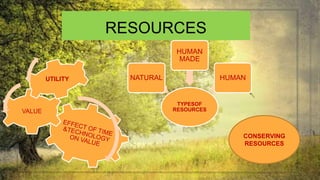
VALUE
UTILITY
TYPESOF
RESOURCES
NATURAL
HUMAN
MADE
HUMAN
CONSERVING
RESOURCES
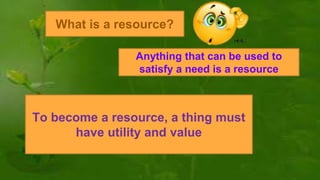
What is a resource?
Anything that can be used to
satisfy a need is a resource
To become a resource, a thing must
have utility and value
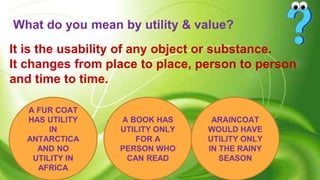
What do you mean by utility & value?
It is the usability of any object or substance.
It changes from place to place, person to person
and time to time.
A FUR COAT
HAS UTILITY
IN
ANTARCTICA
AND NO
UTILITY IN
AFRICA
A BOOK HAS
UTILITY ONLY
FOR A
PERSON WHO
CAN READ
ARAINCOAT
WOULD HAVE
UTILITY ONLY
IN THE RAINY
SEASON
ECONOMIC VALUEUTILITY This means the
worth of a resource.
It changes with time
and need.
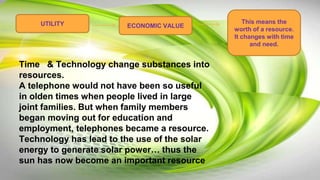
Time & Technology change substances into
resources.
A telephone would not have been so useful
in olden times when people lived in large
joint families. But when family members
began moving out for education and
employment, telephones became a resource.
Technology has lead to the use of the solar
energy to generate solar power… thus the
sun has now become an important resource
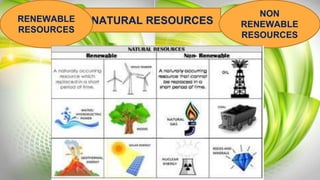
NATURAL RESOURCESRENEWABLE
RESOURCES
NON
RENEWABLE
RESOURCES
DISTRIBUTION OF NATURAL
RESOURCES
TERRAIN
CLIMATE
ALTITUDE
Natural resources
are unequally
distributed
because these
factors differ so
much over the
Earth.
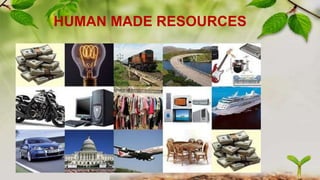
HUMAN MADE RESOURCES
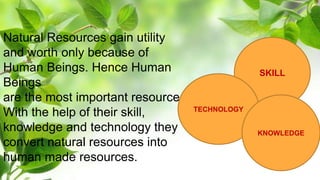
Natural Resources gain utility
and worth only because of
Human Beings. Hence Human
Beings
are the most important resource.
With the help of their skill,
knowledge and technology they
convert natural resources into
human made resources.
SKILL
TECHNOLOGY
KNOWLEDGE
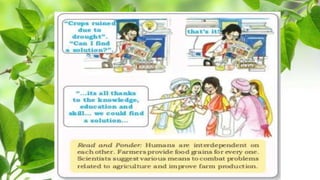
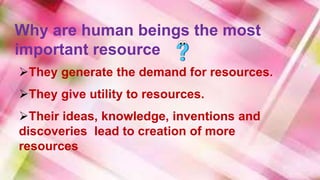
Why are human beings the most
important resource
They generate the demand for resources.
They give utility to resources.
Their ideas, knowledge, inventions and
discoveries lead to creation of more
resources
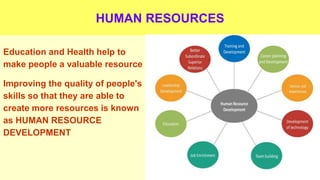
HUMAN RESOURCES
Education and Health help to
make people a valuable resource
Improving the quality of people's
skills so that they are able to
create more resources is known
as HUMAN RESOURCE
DEVELOPMENT
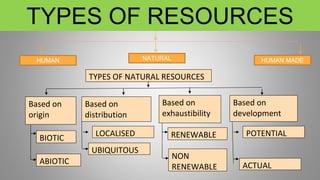
TYPES OF RESOURCES
TYPES OF NATURAL RESOURCES
Based on
exhaustibility
Based on
development
Based on
distribution
Based on
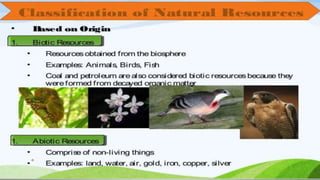
origin
BIOTIC
ABIOTIC
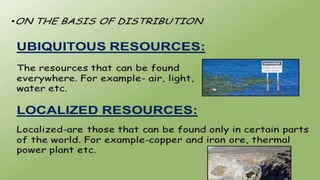
LOCALISED
UBIQUITOUS
NON
RENEWABLE
RENEWABLE POTENTIAL
ACTUAL
HUMAN HUMAN MADENATURAL
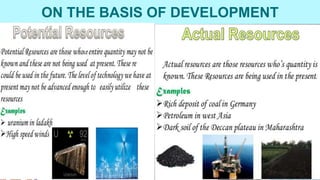
ON THE BASIS OF DEVELOPMENT
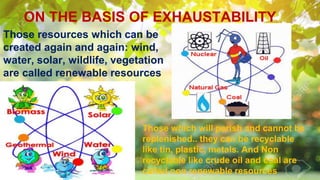
ON THE BASIS OF EXHAUSTABILITY
Those resources which can be
created again and again: wind,
water, solar, wildlife, vegetation
are called renewable resources
Those which will perish and cannot be
replenished.. they can be recyclable
like tin, plastic, metals. And Non
recyclable like crude oil and coal are
called non renewable resources
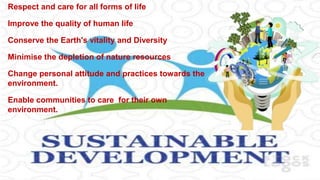
Respect and care for all forms of life
Improve the quality of human life
Conserve the Earth's vitality and Diversity
Minimise the depletion of nature resources
Change personal attitude and practices towards the
environment.
Enable communities to care for their own
environment.
OUR DUTIES TOWARDS ENVIRONMENT
Ensuring that uses of renewable Resources are
sustainable
The diversity of life on the Earth is conserved
Damage to Natural Environment System is
minimised
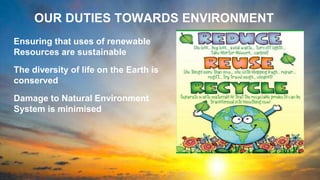
OUR DUTIES TOWARDS ENVIRONMENT
Ensuring that uses of renewable
Resources are sustainable
The diversity of life on the Earth is
conserved
Damage to Natural Environment
System is minimised

Resources

  • 1.
  • 2.
    What is aresource? Anything that can be used to satisfy a need is a resource To become a resource, a thing must have utility and value
  • 3.
    What do youmean by utility & value? It is the usability of any object or substance. It changes from place to place, person to person and time to time. A FUR COAT HAS UTILITY IN ANTARCTICA AND NO UTILITY IN AFRICA A BOOK HAS UTILITY ONLY FOR A PERSON WHO CAN READ ARAINCOAT WOULD HAVE UTILITY ONLY IN THE RAINY SEASON
  • 4.
    ECONOMIC VALUEUTILITY Thismeans the worth of a resource. It changes with time and need. Time & Technology change substances into resources. A telephone would not have been so useful in olden times when people lived in large joint families. But when family members began moving out for education and employment, telephones became a resource. Technology has lead to the use of the solar energy to generate solar power… thus the sun has now become an important resource
  • 5.
  • 6.
    DISTRIBUTION OF NATURAL RESOURCES TERRAIN CLIMATE ALTITUDE Naturalresources are unequally distributed because these factors differ so much over the Earth.
  • 7.
  • 8.
    Natural Resources gainutility and worth only because of Human Beings. Hence Human Beings are the most important resource. With the help of their skill, knowledge and technology they convert natural resources into human made resources. SKILL TECHNOLOGY KNOWLEDGE
  • 10.
    Why are humanbeings the most important resource They generate the demand for resources. They give utility to resources. Their ideas, knowledge, inventions and discoveries lead to creation of more resources
  • 11.
    HUMAN RESOURCES Education andHealth help to make people a valuable resource Improving the quality of people's skills so that they are able to create more resources is known as HUMAN RESOURCE DEVELOPMENT
  • 12.
    TYPES OF RESOURCES TYPESOF NATURAL RESOURCES Based on exhaustibility Based on development Based on distribution Based on origin BIOTIC ABIOTIC LOCALISED UBIQUITOUS NON RENEWABLE RENEWABLE POTENTIAL ACTUAL HUMAN HUMAN MADENATURAL
  • 14.
    ON THE BASISOF DEVELOPMENT
  • 15.
    ON THE BASISOF EXHAUSTABILITY Those resources which can be created again and again: wind, water, solar, wildlife, vegetation are called renewable resources Those which will perish and cannot be replenished.. they can be recyclable like tin, plastic, metals. And Non recyclable like crude oil and coal are called non renewable resources
  • 18.
    Respect and carefor all forms of life Improve the quality of human life Conserve the Earth's vitality and Diversity Minimise the depletion of nature resources Change personal attitude and practices towards the environment. Enable communities to care for their own environment.
  • 19.
    OUR DUTIES TOWARDSENVIRONMENT Ensuring that uses of renewable Resources are sustainable The diversity of life on the Earth is conserved Damage to Natural Environment System is minimised OUR DUTIES TOWARDS ENVIRONMENT
  • 20.
    OUR DUTIES TOWARDSENVIRONMENT Ensuring that uses of renewable Resources are sustainable The diversity of life on the Earth is conserved Damage to Natural Environment System is minimised