stanford hci group /
cs376
http://cs376.stanford.edu
Jeffrey Heer · 2 June 2009
Research Topics
In Human-Computer
Interaction
Course Summary
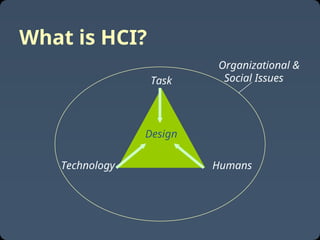
What is HCI?
Humans
Technology
Task
Design
Organizational &
Social Issues
Iterative Design Cycle
Getting it right the first time is hard
Need better support for quick turns around
loop
Design
Prototype
Evaluate
[Buxton, Sketching User Experiences]
[O’Sullivan]
Seated, able-bodied users,
working individually on
document processing
tasks.
6
Revisiting Course Goals
The goal of this course is
for you, upon completion,
to be able to undertake a
research project of your
own design
8
What is Research?
“Systematic data collection with the
intent to contribute to generalizable
knowledge”
“Breaking down phenomena”
reading
doing
Primary Source Material
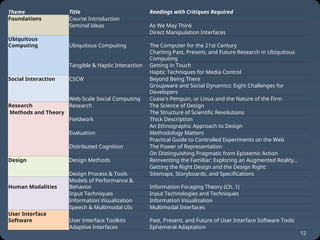
Theme Title Readings with Critiques Required
Foundations Course Introduction
Seminal Ideas As We May Think
Direct Manipulation Interfaces
Ubiquitous
Computing Ubiquitous Computing The Computer for the 21st Century
Charting Past, Present, and Future Research in Ubiquitous
Computing
Tangible & Haptic Interaction Getting in Touch
Haptic Techniques for Media Control
Social Interaction CSCW Beyond Being There
Groupware and Social Dynamics: Eight Challenges for
Developers
Web-Scale Social Computing Coase's Penguin, or Linux and the Nature of the Firm
Research Research The Science of Design
Methods and Theory The Structure of Scientific Revolutions
Fieldwork Thick Description
An Ethnographic Approach to Design
Evaluation Methodology Matters
Practical Guide to Controlled Experiments on the Web
Distributed Cognition The Power of Representation
On Distinguishing Pragmatic from Epistemic Action
Design Design Methods Reinventing the Familiar: Exploring an Augmented Reality…
Getting the Right Design and the Design Right:
Design Process & Tools Sitemaps, Storyboards, and Specifications
Human Modalities
Models of Performance &
Behavior Information Foraging Theory (Ch. 1)
Input Techniques Input Technologies and Techniques
Information Visualization Information Visualization
Speech & Multimodal UIs Multimodal Interfaces
User Interface
Software User Interface Toolkits Past, Present, and Future of User Interface Software Tools
Adaptive Interfaces Ephemeral Adaptation
12
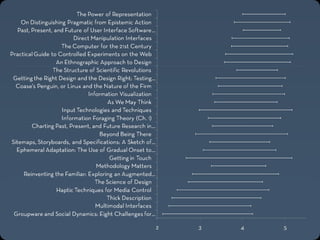
Correlation Coefficient = -0.67
14
Mean Score
Standard
Deviation
Evaluating the Readings
Dimensions of Consideration
 Impactful, solves problem / drives adoption
 Innovative, suggests new directions
 Orienting, clarifies the research landscape
 Clear, exemplar of good communication
How do the papers we have read map onto the
dimensions? Is there a useful typology?
15
Literature Index
Literature Index
Research Methods
Writing
Technical
Presentation
Critical Thinking
Final Project Presentations
Tuesday June 9, 3:30-6:30pm, 104 Gates
8 minute presentations
 6 min for research, 2 min for questions
 Start with an overview:
 1 sentence statement of your research result
 1 slide / 4 sentences of what you did and why
 Rest of time on details. Assume audience is
familiar with HCI issues: focus on your work
 Post slides to course website
21
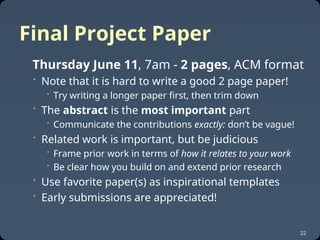
Final Project Paper
Thursday June 11, 7am - 2 pages, ACM format
 Note that it is hard to write a good 2 page paper!
 Try writing a longer paper first, then trim down
 The abstract is the most important part
 Communicate the contributions exactly: don’t be vague!
 Related work is important, but be judicious
 Frame prior work in terms of how it relates to your work
 Be clear how you build on and extend prior research
 Use favorite paper(s) as inspirational templates
 Early submissions are appreciated!
22
What one thing did you
most get out of the
course?
What do you think are
the most promising
directions for HCI
research?

research topics in human computer interaction

  • 1.
    stanford hci group/ cs376 http://cs376.stanford.edu Jeffrey Heer · 2 June 2009 Research Topics In Human-Computer Interaction Course Summary
  • 2.
  • 3.
    Iterative Design Cycle Gettingit right the first time is hard Need better support for quick turns around loop Design Prototype Evaluate
  • 4.
  • 5.
  • 6.
    Seated, able-bodied users, workingindividually on document processing tasks. 6
  • 7.
  • 8.
    The goal ofthis course is for you, upon completion, to be able to undertake a research project of your own design 8
  • 9.
    What is Research? “Systematicdata collection with the intent to contribute to generalizable knowledge” “Breaking down phenomena”
  • 10.
  • 11.
  • 12.
    Theme Title Readingswith Critiques Required Foundations Course Introduction Seminal Ideas As We May Think Direct Manipulation Interfaces Ubiquitous Computing Ubiquitous Computing The Computer for the 21st Century Charting Past, Present, and Future Research in Ubiquitous Computing Tangible & Haptic Interaction Getting in Touch Haptic Techniques for Media Control Social Interaction CSCW Beyond Being There Groupware and Social Dynamics: Eight Challenges for Developers Web-Scale Social Computing Coase's Penguin, or Linux and the Nature of the Firm Research Research The Science of Design Methods and Theory The Structure of Scientific Revolutions Fieldwork Thick Description An Ethnographic Approach to Design Evaluation Methodology Matters Practical Guide to Controlled Experiments on the Web Distributed Cognition The Power of Representation On Distinguishing Pragmatic from Epistemic Action Design Design Methods Reinventing the Familiar: Exploring an Augmented Reality… Getting the Right Design and the Design Right: Design Process & Tools Sitemaps, Storyboards, and Specifications Human Modalities Models of Performance & Behavior Information Foraging Theory (Ch. 1) Input Techniques Input Technologies and Techniques Information Visualization Information Visualization Speech & Multimodal UIs Multimodal Interfaces User Interface Software User Interface Toolkits Past, Present, and Future of User Interface Software Tools Adaptive Interfaces Ephemeral Adaptation 12
  • 14.
    Correlation Coefficient =-0.67 14 Mean Score Standard Deviation
  • 15.
    Evaluating the Readings Dimensionsof Consideration  Impactful, solves problem / drives adoption  Innovative, suggests new directions  Orienting, clarifies the research landscape  Clear, exemplar of good communication How do the papers we have read map onto the dimensions? Is there a useful typology? 15
  • 16.
  • 17.
  • 18.
  • 20.
  • 21.
    Final Project Presentations TuesdayJune 9, 3:30-6:30pm, 104 Gates 8 minute presentations  6 min for research, 2 min for questions  Start with an overview:  1 sentence statement of your research result  1 slide / 4 sentences of what you did and why  Rest of time on details. Assume audience is familiar with HCI issues: focus on your work  Post slides to course website 21
  • 22.
    Final Project Paper ThursdayJune 11, 7am - 2 pages, ACM format  Note that it is hard to write a good 2 page paper!  Try writing a longer paper first, then trim down  The abstract is the most important part  Communicate the contributions exactly: don’t be vague!  Related work is important, but be judicious  Frame prior work in terms of how it relates to your work  Be clear how you build on and extend prior research  Use favorite paper(s) as inspirational templates  Early submissions are appreciated! 22
  • 23.
    What one thingdid you most get out of the course?
  • 24.
    What do youthink are the most promising directions for HCI research?

Editor's Notes

  • #2 The cognitive science and artificial intelligence pioneer Alan Newell defined computer science as such: “Computer science is the study of the phenomena surrounding computers … an empirical discipline … an experimental science” This course provides a graduate-level introduction to human-computer interaction. So the natural next question is, “what is human-computer interaction?” Human-Computer Interaction, or HCI, is the study of the user experience of information technology. Or, to put it a bit more formally, it’s the design and evaluation of information technologies where the goal is user experience based. It is a field whose participants come from a number of different disciplines: the human sciences (cognitive science, psychology, and the social sciences), computer science, and the design disciplines (most notably graphic and industrial design). ------ Give Examples of Tasks: high level: - writing a paper - drawing a picture low level: - copying a word from one paragraph to another - coloring a line
  • #4 Alternating between Divergent and convergent steps happen at different granularities throughout a design process. While initially you may survey a range of very different concepts, the scope of experimentation narrows as a product becomes more well defined. How does this relate to Simon’s operational view of design as an optimization process?
  • #5 This is a drawing by Dan O’Sullivan. It shows how mental model, that my current PC has of me. My computer knows I have an eye – but only one – it does know that I have two ears. It knows I have a finger – but only one, maybe two – and it has no idea that I have a body. Given the richness our human experience in the physical world, it’s shocking that our experience in the digital world is so limited. For traditional desktop applications that target one-finger-man, good programming environments exist that have enabled legions of developers to create the content that helped put a PC on every desk. The goal of our group’s research is to enable an analogous success for ubiquitous computing. Specifically, our interest lies in the move from tools for technology experts toward tools for domain experts, designers.
  • #7 There are a couple of skills that I hope the course will help you learn
  • #9 Having a crisp, generalizable insight – not just system-building.
  • #10 Part of what makes this interesting is that while these activities are going on, you’ll also be doing your own work, which helps situate the discussions about methodology, contribution, etc. in the context of actually doing a small piece of research.
  • #11 First, I wanted to use primary source material to tell the story of human-computer interaction. To learn about the big research ideas in the words of the people that came up with them. In reading about these ideas as they were developed, we get to see the original insight and passion. We’ll also be entertained. By now, some of the original terms (information superhighway, anyone?) have become quaint, and some of the ideas seem hopelessly naïve. But – and this is really surprising – a lot of it is pretty on the mark. (Okay, that’s why we’re reading this stuff – the “dumb ideas in HCI” is a different course  ) Also, reading the original parts helps provide an understanding of the intuitions that people had and the methods that they employed to get there.
  • #16 The second is that I wanted to provide an index into the HCI literature. What’s the space of topics that people have worked on? What are the larger theoretical frameworks?
  • #17 One of my goals in providing this index is that, by the end of the course, you’ll be able to say, “I’m interested in X”, say, speech user interfaces. We’ll have a class on this on 11/16, so you can grab keywords, ideas, and authors from those papers, and start poking around google scholar. You might also be interested in infrastructure for these apps. With speech UIs, as with any area, it won’t be comprehensive – it’ll be a toehold that hopefully provides enough of a zeitgeist of the field that you know what’s out there and can go further if you want to.
  • #18 The third goal of the course is to use these examples as a way of understanding research methods. There are many distinct types of research contributions in HCI, each employing different methods. For example, when Genevieve Bell of Intel is interested in the intersection of spirituality and technology, she employs ethnographic techniques to understand these issues. When Scott Hudson is interested in flexible software architectures for user interfaces, he employs an existence proof (building a system), along with system tests (apps built w/ the system, etc.) to demonstrate an architectural approach that enables a particular type of flexibility. And when Shumin Zhai is interested in high-performance pen input techniques, he employs a combination of performance model analysis and laboratory user studies to demonstrate the efficacy of a technique. Through the readings, we’ll come to see successful examples that will help us understand what methodological approaches are suggested by different types of research questions.
  • #19 Research is, by and large, a persuasive enterprise. By that I mean that there isn’t a fully-determined mapping between empirical work and theory-building. In the abstract, one could claim almost any theory from almost any empirical work, and one could refuse to be convinced of almost any theory from almost any empirical work. But in practice, as the evidence mounts, some theories become much more persuasive. And if one decides to not believe an explanation, it is incumbant to offer an alternate one. As evidence mounts, the scope of realistic alternatives becomes more constrained – this is what Bruno Latour calls the proof race of science: keep going, or submit.
  • #20 The final goal of the course is to teach reading, writing, technical presentation, and critical thinking skills through your participation in these activities.